Strategy for Newly Minted Executives
ongratulations on your promotion and the new role. Even if this is not yet the C-suite, you are in a
position where you would be assisting in either defining (or evolving), implementing and/or
executing the organization’s strategy. As a new executive, it is your turn to take bold decisions and make
your mark as early as possible. Right? May be. Many researches note that the initial 100 days in the
executive position, mostly C-suite, would pressurize you to make a bold move and show that you mean
business! But more on that later.
First let’s define a few terms that are generally used without much deference to the semantics.
According to Harvard Business Review, strategy can mean either the corporate strategy for the entire
organization or the business unit strategy depending on your perspective and location.
The corporate strategy would define what businessesthe company should be in, the inherent capabilities
that distinguish the company from its competitors, the comparative advantages that the organization
enjoys in adding value to its businesses. The business unit strategy, on the other hand, would answer
the question about the key customers for the target market, the differentiating value proposition or the
USP, and the business capabilities that allow you to deliver the value proposition better than your
competitors.
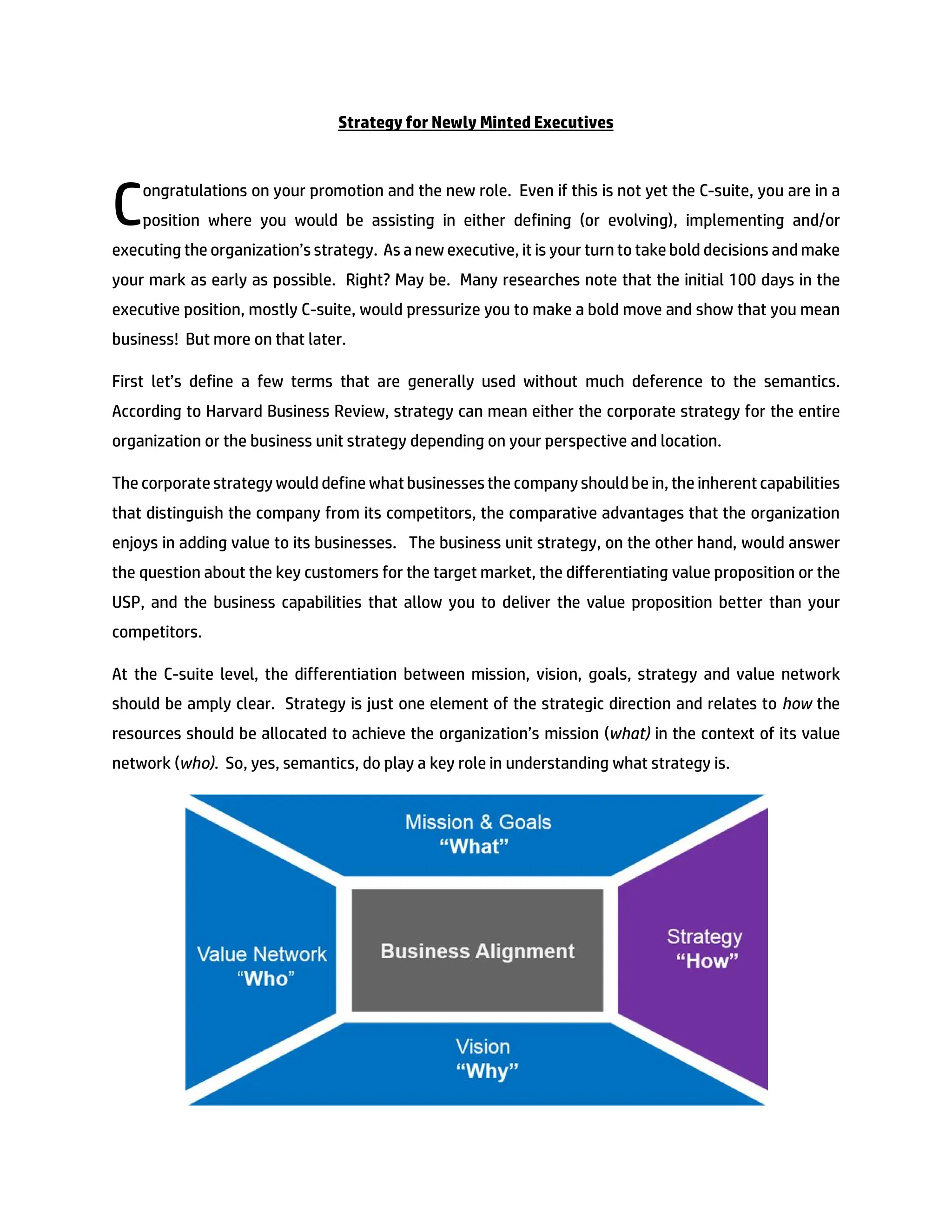
At the C-suite level, the differentiation between mission, vision, goals, strategy and value network
should be amply clear. Strategy is just one element of the strategic direction and relates to how the
resources should be allocated to achieve the organization’s mission (what) in the context of its value
network (who). So, yes, semantics, do play a key role in understanding what strategy is.
C
Understanding what strategy is, therefore, leads one to the next step of designing or evolving the
strategy. As a new executive, there is bound to be a lot of expectation, both of others and our own
making, and based on your position in the hierarchy, the pressure to take immediate bold action may be
immense. You obviously have the skills and the qualities for this role else you would not have been here.
Take your time to understand the complexity and gravity of the new role without acquiescing to others’
expectations of you.
Depending on the circumstances leading to your promotion or induction, there could be a need for
firefighting and taking decisions that might involve considerable heartache to many people. While this
needs to be addressed, following due processes, like consulting your direct reports, can help you in the
long term in winning the trust of your team. This can be your biggest win under the circumstances. A
leader who follows due process even during difficult circumstances is respected. Nevertheless, you are
not obliged to always decide based on the preferences of your team. Your vantage point has to be the
organizational mission and goals.
If you were promoted during the business-as-usual conditions, take time to adapt to the new role and
understand the demands of the position. This time period is subjective and will depend on whether you
are from within the organization or an outsider. According to McKinsey, for a CEO role, a successful
transition can take as many as 18 months! The change of perspective that the new role offers might
surprise you as well as empower you to strategize while bringing in your perspective from your earlier
roles. The onboarding exercises that exist at all big companies, although not each them could be
considered at par, shall give you a peek of what is about to come while at the same allow you time and
space to work on your initial agenda. As per a McKinsey research, the most successful executive
transitions are those where there is a proper alignment with the organization on the strategic direction
as well as on what not to do.
The corporate or the business strategy may differ based on the industry you are in however, the strategy
for strategizing transcends industries. You align yourself with the business needs, understand your
business and market, the competitors and the potential disruptors and prepare for them while ensuring
the business takes care of its customers on a priority basis. The normal business should not disrupt while
“Building a visionary company requires one percent vision and 99
per cent alignment”
you strategize for an innovation. Never leave sight of your customers’ needs. Always remember, the
customer will not leave you for a disruptor or a competitor as long as its needs are being met.
Innovative disruption is the in-thing and might be on your list of things. Disruption, without a strategic
direction, might just end up disrupting your business. As an executive, do not give in to the temptations
of bringing in a new product or service till it aligns directly with your organization’s strategic direction.
Also, be mindful that reallocating scarce resources from one activity to another might negatively impact
the original process. So unless you are able to increase the pie, avoid reallocating the pie without a valid
business justification. As an executive, your focus should be on increasing the pie so that each one gets
a larger share. This can be achieved by understanding your customers, the competitors and markets
incisively. With a lot of venture capital in the market, your newer competitors might be trying various
things with a budget that has no strings attached. Reactions to competitors’ strategy must be an
absolute no while delving deeper to see what works for your organization given your mission, value
network, strengths and resources.
While here, it might also be interesting to look at two different CEOs and their strategies. James Quincey,
who was elevated as CEO of Coca Cola in May this year, has been with the company for the past 21 years.
It has been almost 120 days since his elevation as a CEO, however, there have been no reports about the
larger strategy change for the company. On his recent visit to India, he did talk about adding new
categories including food, snacks or beverages but with a caveat that everything shall be guided by the
company’s global strategy of what the customers want and how that creates value for the customers. In
contrast, let’s look at the Vishal Sikka who was hired as the Infosys CEO in 2014. He was the CTO with
SAP at the time he was hired at Infosys. He brought in a completely new style of functioning and a
knowledge based culture to Infosys. He evolved the strategic direction of the company to move towards
artificial intelligence and automation. The revenues and the profit of Infosys rose under Sikka.
No, we are not commenting on the working style of any CEO but just showcasing how the styles might
differ based on the perspective one has. Sikka, a rank outsider brought in a different perspective as also
the work experience. He aligned the board to his strategy and pursued his strategy relentlessly from day
one. Quincey, in contrast, has served across divisions and levels in Coca Cola for 21 years before being
elevated as a CEO. He understands the company and the culture very closely and taking steps much
“Culture eats strategy for breakfast everyday”
slower than someone who might have been hired from outside the company. In both cases, it is
imperative to align with the other stakeholders.
As an executive, be ready for change and instability due to externalities that might impact the way you
do business. Looking ahead into the future might not be possible every time, however, having an
alternative plan to overcome any disruption shall be a constant. Disruption can come in any form.
Companies like Amazon (and there aren’t many like it) work on a long-term strategy and have disrupted
retailers, book publishers, IT companies, logistics, media and now organic food. Though there aren’t
many like Amazon, but a new wave can come from any side. Your resilience will depend on your
preparedness. Companies like Nokia and RIM (blackberry makers), that were leaders in their respective
categories, had to bite the dust for lack of preparedness and changing very slowly. Similarly, Yahoo, once
the pioneer, is now just another commoner. While these companies are a subject-matter of many a case
studies, however, it is generally accepted that they did nothing disastrous per se to meet the fate that
they did. They were done in by the changing preferences of the customers that they could not read early
enough and their share went off to companies (not disruptors) that gave better options.
While strategizing, remember what Peter Drucker famously said, “Culture eats strategy for breakfast
everyday”. Focus on things that really matter to your company and business.
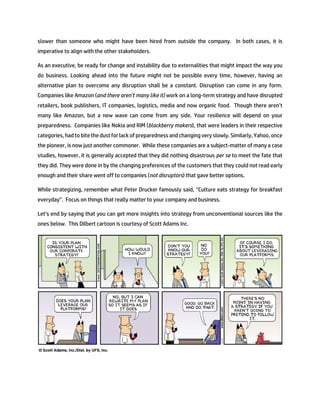
Let’s end by saying that you can get more insights into strategy from unconventional sources like the
ones below. This Dilbert cartoon is courtesy of Scott Adams Inc.

Strategy for Newly Minted Executives.pdf

  • 1.
    Strategy for NewlyMinted Executives ongratulations on your promotion and the new role. Even if this is not yet the C-suite, you are in a position where you would be assisting in either defining (or evolving), implementing and/or executing the organization’s strategy. As a new executive, it is your turn to take bold decisions and make your mark as early as possible. Right? May be. Many researches note that the initial 100 days in the executive position, mostly C-suite, would pressurize you to make a bold move and show that you mean business! But more on that later. First let’s define a few terms that are generally used without much deference to the semantics. According to Harvard Business Review, strategy can mean either the corporate strategy for the entire organization or the business unit strategy depending on your perspective and location. The corporate strategy would define what businessesthe company should be in, the inherent capabilities that distinguish the company from its competitors, the comparative advantages that the organization enjoys in adding value to its businesses. The business unit strategy, on the other hand, would answer the question about the key customers for the target market, the differentiating value proposition or the USP, and the business capabilities that allow you to deliver the value proposition better than your competitors. At the C-suite level, the differentiation between mission, vision, goals, strategy and value network should be amply clear. Strategy is just one element of the strategic direction and relates to how the resources should be allocated to achieve the organization’s mission (what) in the context of its value network (who). So, yes, semantics, do play a key role in understanding what strategy is. C
  • 2.
    Understanding what strategyis, therefore, leads one to the next step of designing or evolving the strategy. As a new executive, there is bound to be a lot of expectation, both of others and our own making, and based on your position in the hierarchy, the pressure to take immediate bold action may be immense. You obviously have the skills and the qualities for this role else you would not have been here. Take your time to understand the complexity and gravity of the new role without acquiescing to others’ expectations of you. Depending on the circumstances leading to your promotion or induction, there could be a need for firefighting and taking decisions that might involve considerable heartache to many people. While this needs to be addressed, following due processes, like consulting your direct reports, can help you in the long term in winning the trust of your team. This can be your biggest win under the circumstances. A leader who follows due process even during difficult circumstances is respected. Nevertheless, you are not obliged to always decide based on the preferences of your team. Your vantage point has to be the organizational mission and goals. If you were promoted during the business-as-usual conditions, take time to adapt to the new role and understand the demands of the position. This time period is subjective and will depend on whether you are from within the organization or an outsider. According to McKinsey, for a CEO role, a successful transition can take as many as 18 months! The change of perspective that the new role offers might surprise you as well as empower you to strategize while bringing in your perspective from your earlier roles. The onboarding exercises that exist at all big companies, although not each them could be considered at par, shall give you a peek of what is about to come while at the same allow you time and space to work on your initial agenda. As per a McKinsey research, the most successful executive transitions are those where there is a proper alignment with the organization on the strategic direction as well as on what not to do. The corporate or the business strategy may differ based on the industry you are in however, the strategy for strategizing transcends industries. You align yourself with the business needs, understand your business and market, the competitors and the potential disruptors and prepare for them while ensuring the business takes care of its customers on a priority basis. The normal business should not disrupt while “Building a visionary company requires one percent vision and 99 per cent alignment”
  • 3.
    you strategize foran innovation. Never leave sight of your customers’ needs. Always remember, the customer will not leave you for a disruptor or a competitor as long as its needs are being met. Innovative disruption is the in-thing and might be on your list of things. Disruption, without a strategic direction, might just end up disrupting your business. As an executive, do not give in to the temptations of bringing in a new product or service till it aligns directly with your organization’s strategic direction. Also, be mindful that reallocating scarce resources from one activity to another might negatively impact the original process. So unless you are able to increase the pie, avoid reallocating the pie without a valid business justification. As an executive, your focus should be on increasing the pie so that each one gets a larger share. This can be achieved by understanding your customers, the competitors and markets incisively. With a lot of venture capital in the market, your newer competitors might be trying various things with a budget that has no strings attached. Reactions to competitors’ strategy must be an absolute no while delving deeper to see what works for your organization given your mission, value network, strengths and resources. While here, it might also be interesting to look at two different CEOs and their strategies. James Quincey, who was elevated as CEO of Coca Cola in May this year, has been with the company for the past 21 years. It has been almost 120 days since his elevation as a CEO, however, there have been no reports about the larger strategy change for the company. On his recent visit to India, he did talk about adding new categories including food, snacks or beverages but with a caveat that everything shall be guided by the company’s global strategy of what the customers want and how that creates value for the customers. In contrast, let’s look at the Vishal Sikka who was hired as the Infosys CEO in 2014. He was the CTO with SAP at the time he was hired at Infosys. He brought in a completely new style of functioning and a knowledge based culture to Infosys. He evolved the strategic direction of the company to move towards artificial intelligence and automation. The revenues and the profit of Infosys rose under Sikka. No, we are not commenting on the working style of any CEO but just showcasing how the styles might differ based on the perspective one has. Sikka, a rank outsider brought in a different perspective as also the work experience. He aligned the board to his strategy and pursued his strategy relentlessly from day one. Quincey, in contrast, has served across divisions and levels in Coca Cola for 21 years before being elevated as a CEO. He understands the company and the culture very closely and taking steps much “Culture eats strategy for breakfast everyday”
  • 4.
    slower than someonewho might have been hired from outside the company. In both cases, it is imperative to align with the other stakeholders. As an executive, be ready for change and instability due to externalities that might impact the way you do business. Looking ahead into the future might not be possible every time, however, having an alternative plan to overcome any disruption shall be a constant. Disruption can come in any form. Companies like Amazon (and there aren’t many like it) work on a long-term strategy and have disrupted retailers, book publishers, IT companies, logistics, media and now organic food. Though there aren’t many like Amazon, but a new wave can come from any side. Your resilience will depend on your preparedness. Companies like Nokia and RIM (blackberry makers), that were leaders in their respective categories, had to bite the dust for lack of preparedness and changing very slowly. Similarly, Yahoo, once the pioneer, is now just another commoner. While these companies are a subject-matter of many a case studies, however, it is generally accepted that they did nothing disastrous per se to meet the fate that they did. They were done in by the changing preferences of the customers that they could not read early enough and their share went off to companies (not disruptors) that gave better options. While strategizing, remember what Peter Drucker famously said, “Culture eats strategy for breakfast everyday”. Focus on things that really matter to your company and business. Let’s end by saying that you can get more insights into strategy from unconventional sources like the ones below. This Dilbert cartoon is courtesy of Scott Adams Inc.