FACULTY TEAM
- Dr. Srividya Raghavan
- Dr. Amit Srivasatava
- Dr. Atma Prakash Ohja
- Visiting Faculty
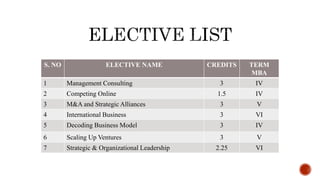
S. NO ELECTIVE NAME CREDITS TERM
MBA
1 Management Consulting 3 IV
2 Competing Online 1.5 IV
3 M&A and Strategic Alliances 3 V
4 International Business 3 VI
5 Decoding Business Model 3 IV
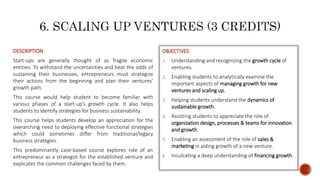
6 Scaling Up Ventures 3 V
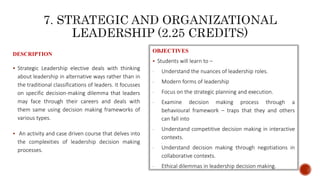
7 Strategic & Organizational Leadership 2.25 VI
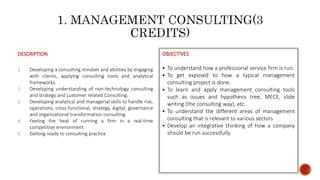
DESCRIPTION
1. Developing a consulting mindset and abilities by engaging
with clients, applying consulting tools and analytical
frameworks.
2. Developing understanding of non-technology consulting
and strategy and customer related Consulting.
3. Developing analytical and managerial skills to handle risk,
operations, cross-functional, strategy, digital, governance
and organizational transformation consulting
4. Feeling the heat of running a firm in a real-time
competitive environment
5. Getting ready to consulting practice
OBJECTIVES
 To understand how a professional service firm is run.
 To get exposed to how a typical management
consulting project is done.
 To learn and apply management consulting tools
such as issues and hypothesis tree, MECE, slide
writing (the consulting way), etc.
 To understand the different areas of management
consulting that is relevant to various sectors
 Develop an integrative thinking of how a company
should be run successfully.
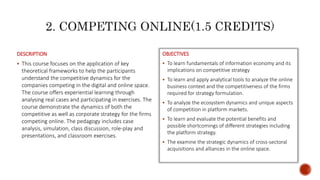
DESCRIPTION
 This course focuses on the application of key
theoretical frameworks to help the participants
understand the competitive dynamics for the
companies competing in the digital and online space.
The course offers experiential learning through
analysing real cases and participating in exercises. The
course demonstrate the dynamics of both the
competitive as well as corporate strategy for the firms
competing online. The pedagogy includes case
analysis, simulation, class discussion, role-play and
presentations, and classroom exercises.
OBJECTIVES
 To learn fundamentals of information economy and its
implications on competitive strategy
 To learn and apply analytical tools to analyze the online
business context and the competitiveness of the firms
required for strategy formulation.
 To analyze the ecosystem dynamics and unique aspects
of competition in platform markets.
 To learn and evaluate the potential benefits and
possible shortcomings of different strategies including
the platform strategy.
 The examine the strategic dynamics of cross-sectoral
acquisitions and alliances in the online space.
DESCRIPTION
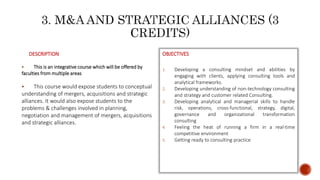
 This is an integrative course which will be offered by
faculties from multiple areas
 This course would expose students to conceptual
understanding of mergers, acquisitions and strategic
alliances. It would also expose students to the
problems & challenges involved in planning,
negotiation and management of mergers, acquisitions
and strategic alliances.
OBJECTIVES
1. Developing a consulting mindset and abilities by
engaging with clients, applying consulting tools and
analytical frameworks.
2. Developing understanding of non-technology consulting
and strategy and customer related Consulting.
3. Developing analytical and managerial skills to handle
risk, operations, cross-functional, strategy, digital,
governance and organizational transformation
consulting
4. Feeling the heat of running a firm in a real-time
competitive environment
5. Getting ready to consulting practice
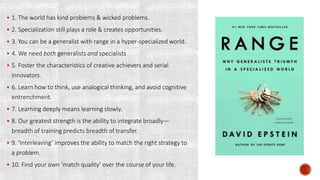
 1. The world has kind problems & wicked problems.
 2. Specialization still plays a role & creates opportunities.
 3. You can be a generalist with range in a hyper-specialized world.
 4. We need both generalists and specialists
 5. Foster the characteristics of creative achievers and serial
innovators.
 6. Learn how to think, use analogical thinking, and avoid cognitive
entrenchment.
 7. Learning deeply means learning slowly.
 8. Our greatest strength is the ability to integrate broadly—
breadth of training predicts breadth of transfer.
 9. ‘Interleaving’ improves the ability to match the right strategy to
a problem.
 10. Find your own ‘match quality’ over the course of your life.
DESCRIPTION
 International Business elective deals with
understanding business conducted across borders. In
a closely networked and global economy,
understanding business across borders is extremely
important. The course covers topics such as culture,
political economy, ethics, economic development
across nations, trade theory, internationalization of
firms etc.
 This is an integrative course which will be offered by
faculties from multiple areas/foreign faculty/visiting
faculty
OBJECTIVES
 Students will understand business in an international
context
 Students will understand nuances in terms of
cultural differences, ethics etc
 Students will understand trade theory and
movement of money across borders
 Students will understand internationalization of
firms
OBJECTIVES
1. Appreciate the underlying economic and business
dynamics that drive value creation and how business
models can work the idea.
2. Map the business models of existing ventures and
design new business models.
3. To help students appreciate and apply the
distinguishing features of the product-service
continuum, economic fundamentals of e-commerce &
mobile businesses, platform businesses, viral
phenomenon, to build interesting and innovative
business models
4. How do Social Ventures differ and how to approach
them
5. To help students develop competence and confidence
to compete on business models.
DESCRIPTION
Business models are at the heart of new enterprise creation.
They are at the core of innovative and disruptive ventures
that create value for the customer as well as society at large.
This course that aims to sensitize students on the
importance of a well conceived business model for success
of a business venture.
On taking this course, students learn to understand, assess
and map business models. This translates into their ability to
use a methodical approach to answer questions such as –
How to convert a good product/service into a value for the
consumer? or How to extract some of that value into your
own organization?
As a case driven course, this course requires several hours of
individual and group preparation to successfully complete
the course at the expected level of critical analysis.
DESCRIPTION
Start-ups are generally thought of as fragile economic
entities. To withstand the uncertainties and beat the odds of
sustaining their businesses, entrepreneurs must strategize
their actions from the beginning and plan their ventures’
growth path.
This course would help student to become familiar with
various phases of a start-up’s growth cycle. It also helps
students to identify strategies for business sustainability.
This course helps students develop an appreciation for the
overarching need to deploying effective functional strategies
which could sometimes differ from traditional/legacy
business strategies.
This predominantly case-based course explores role of an
entrepreneur as a strategist for the established venture and
explicates the common challenges faced by them.
OBJECTIVES
1. Understanding and recognizing the growth cycle of
ventures.
2. Enabling students to analytically examine the
important aspects of managing growth for new
ventures and scaling up.
3. Helping students understand the dynamics of
sustainable growth.
4. Assisting students to appreciate the role of
organization design, processes & teams for innovation
and growth.
5. Enabling an assessment of the role of sales &
marketing in aiding growth of a new venture.
6. Inculcating a deep understanding of financing growth.
DESCRIPTION
 Strategic Leadership elective deals with thinking
about leadership in alternative ways rather than in
the traditional classifications of leaders. It focusses
on specific decision-making dilemma that leaders
may face through their careers and deals with
them same using decision making frameworks of
various types.
 An activity and case driven course that delves into
the complexities of leadership decision making
processes.
OBJECTIVES
 Students will learn to –
- Understand the nuances of leadership roles.
- Modern forms of leadership
- Focus on the strategic planning and execution.
- Examine decision making process through a
behavioural framework – traps that they and others
can fall into
- Understand competitive decision making in interactive
contexts.
- Understand decision making through negotiations in
collaborative contexts.
- Ethical dilemmas in leadership decision making.
THANK YOU

Strategy & Entrepreneurship Electives.pptx

  • 1.
    FACULTY TEAM - Dr.Srividya Raghavan - Dr. Amit Srivasatava - Dr. Atma Prakash Ohja - Visiting Faculty
  • 2.
    S. NO ELECTIVENAME CREDITS TERM MBA 1 Management Consulting 3 IV 2 Competing Online 1.5 IV 3 M&A and Strategic Alliances 3 V 4 International Business 3 VI 5 Decoding Business Model 3 IV 6 Scaling Up Ventures 3 V 7 Strategic & Organizational Leadership 2.25 VI
  • 3.
    DESCRIPTION 1. Developing aconsulting mindset and abilities by engaging with clients, applying consulting tools and analytical frameworks. 2. Developing understanding of non-technology consulting and strategy and customer related Consulting. 3. Developing analytical and managerial skills to handle risk, operations, cross-functional, strategy, digital, governance and organizational transformation consulting 4. Feeling the heat of running a firm in a real-time competitive environment 5. Getting ready to consulting practice OBJECTIVES  To understand how a professional service firm is run.  To get exposed to how a typical management consulting project is done.  To learn and apply management consulting tools such as issues and hypothesis tree, MECE, slide writing (the consulting way), etc.  To understand the different areas of management consulting that is relevant to various sectors  Develop an integrative thinking of how a company should be run successfully.
  • 4.
    DESCRIPTION  This coursefocuses on the application of key theoretical frameworks to help the participants understand the competitive dynamics for the companies competing in the digital and online space. The course offers experiential learning through analysing real cases and participating in exercises. The course demonstrate the dynamics of both the competitive as well as corporate strategy for the firms competing online. The pedagogy includes case analysis, simulation, class discussion, role-play and presentations, and classroom exercises. OBJECTIVES  To learn fundamentals of information economy and its implications on competitive strategy  To learn and apply analytical tools to analyze the online business context and the competitiveness of the firms required for strategy formulation.  To analyze the ecosystem dynamics and unique aspects of competition in platform markets.  To learn and evaluate the potential benefits and possible shortcomings of different strategies including the platform strategy.  The examine the strategic dynamics of cross-sectoral acquisitions and alliances in the online space.
  • 5.
    DESCRIPTION  This isan integrative course which will be offered by faculties from multiple areas  This course would expose students to conceptual understanding of mergers, acquisitions and strategic alliances. It would also expose students to the problems & challenges involved in planning, negotiation and management of mergers, acquisitions and strategic alliances. OBJECTIVES 1. Developing a consulting mindset and abilities by engaging with clients, applying consulting tools and analytical frameworks. 2. Developing understanding of non-technology consulting and strategy and customer related Consulting. 3. Developing analytical and managerial skills to handle risk, operations, cross-functional, strategy, digital, governance and organizational transformation consulting 4. Feeling the heat of running a firm in a real-time competitive environment 5. Getting ready to consulting practice
  • 7.
     1. Theworld has kind problems & wicked problems.  2. Specialization still plays a role & creates opportunities.  3. You can be a generalist with range in a hyper-specialized world.  4. We need both generalists and specialists  5. Foster the characteristics of creative achievers and serial innovators.  6. Learn how to think, use analogical thinking, and avoid cognitive entrenchment.  7. Learning deeply means learning slowly.  8. Our greatest strength is the ability to integrate broadly— breadth of training predicts breadth of transfer.  9. ‘Interleaving’ improves the ability to match the right strategy to a problem.  10. Find your own ‘match quality’ over the course of your life.
  • 8.
    DESCRIPTION  International Businesselective deals with understanding business conducted across borders. In a closely networked and global economy, understanding business across borders is extremely important. The course covers topics such as culture, political economy, ethics, economic development across nations, trade theory, internationalization of firms etc.  This is an integrative course which will be offered by faculties from multiple areas/foreign faculty/visiting faculty OBJECTIVES  Students will understand business in an international context  Students will understand nuances in terms of cultural differences, ethics etc  Students will understand trade theory and movement of money across borders  Students will understand internationalization of firms
  • 9.
    OBJECTIVES 1. Appreciate theunderlying economic and business dynamics that drive value creation and how business models can work the idea. 2. Map the business models of existing ventures and design new business models. 3. To help students appreciate and apply the distinguishing features of the product-service continuum, economic fundamentals of e-commerce & mobile businesses, platform businesses, viral phenomenon, to build interesting and innovative business models 4. How do Social Ventures differ and how to approach them 5. To help students develop competence and confidence to compete on business models. DESCRIPTION Business models are at the heart of new enterprise creation. They are at the core of innovative and disruptive ventures that create value for the customer as well as society at large. This course that aims to sensitize students on the importance of a well conceived business model for success of a business venture. On taking this course, students learn to understand, assess and map business models. This translates into their ability to use a methodical approach to answer questions such as – How to convert a good product/service into a value for the consumer? or How to extract some of that value into your own organization? As a case driven course, this course requires several hours of individual and group preparation to successfully complete the course at the expected level of critical analysis.
  • 10.
    DESCRIPTION Start-ups are generallythought of as fragile economic entities. To withstand the uncertainties and beat the odds of sustaining their businesses, entrepreneurs must strategize their actions from the beginning and plan their ventures’ growth path. This course would help student to become familiar with various phases of a start-up’s growth cycle. It also helps students to identify strategies for business sustainability. This course helps students develop an appreciation for the overarching need to deploying effective functional strategies which could sometimes differ from traditional/legacy business strategies. This predominantly case-based course explores role of an entrepreneur as a strategist for the established venture and explicates the common challenges faced by them. OBJECTIVES 1. Understanding and recognizing the growth cycle of ventures. 2. Enabling students to analytically examine the important aspects of managing growth for new ventures and scaling up. 3. Helping students understand the dynamics of sustainable growth. 4. Assisting students to appreciate the role of organization design, processes & teams for innovation and growth. 5. Enabling an assessment of the role of sales & marketing in aiding growth of a new venture. 6. Inculcating a deep understanding of financing growth.
  • 11.
    DESCRIPTION  Strategic Leadershipelective deals with thinking about leadership in alternative ways rather than in the traditional classifications of leaders. It focusses on specific decision-making dilemma that leaders may face through their careers and deals with them same using decision making frameworks of various types.  An activity and case driven course that delves into the complexities of leadership decision making processes. OBJECTIVES  Students will learn to – - Understand the nuances of leadership roles. - Modern forms of leadership - Focus on the strategic planning and execution. - Examine decision making process through a behavioural framework – traps that they and others can fall into - Understand competitive decision making in interactive contexts. - Understand decision making through negotiations in collaborative contexts. - Ethical dilemmas in leadership decision making.
  • 12.