Dr. Aruna Deshpande
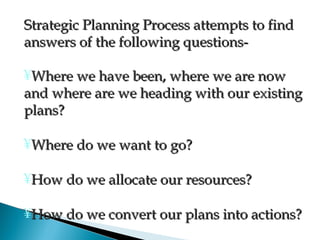
Strategic Planning Process attempts to findStrategic Planning Process attempts to find
answers of the following questions-answers of the following questions-
¥Where we have been, where we are nowWhere we have been, where we are now
and where are we heading with our existingand where are we heading with our existing
plans?plans?
¥Where do we want to go?Where do we want to go?
¥How do we allocate our resources?How do we allocate our resources?
¥How do we convert our plans into actions?How do we convert our plans into actions?
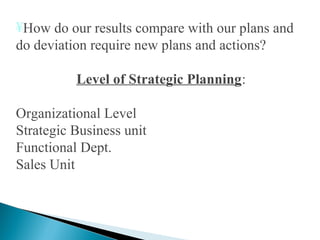
¥How do our results compare with our plans and
do deviation require new plans and actions?
Level of Strategic Planning:
Organizational Level
Strategic Business unit
Functional Dept.
Sales Unit
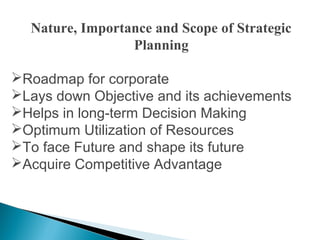
Nature, Importance and Scope of Strategic
Planning
Roadmap for corporate
Lays down Objective and its achievements
Helps in long-term Decision Making
Optimum Utilization of Resources
To face Future and shape its future
Acquire Competitive Advantage
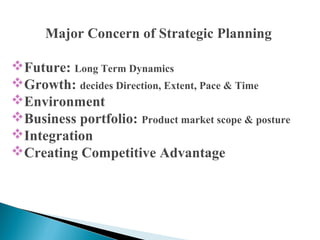
Major Concern of Strategic Planning
Future: Long Term Dynamics
Growth: decides Direction, Extent, Pace & Time
Environment
Business portfolio: Product market scope & posture
Integration
Creating Competitive Advantage
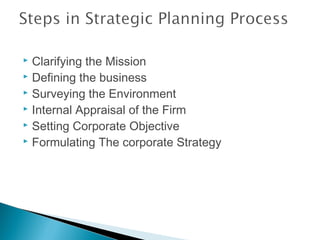
 Clarifying the Mission
 Defining the business
 Surveying the Environment
 Internal Appraisal of the Firm
 Setting Corporate Objective
 Formulating The corporate Strategy
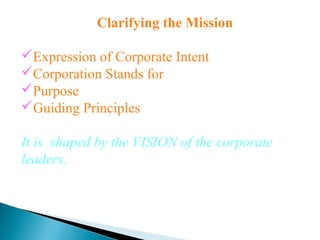
Clarifying the Mission
Expression of Corporate Intent
Corporation Stands for
Purpose
Guiding Principles
It is shaped by the VISION of the corporate
leaders.
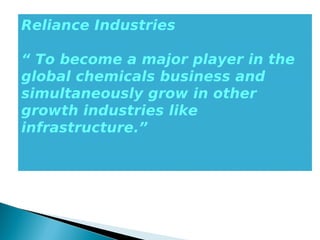
Reliance Industries
“ To become a major player in the
global chemicals business and
simultaneously grow in other
growth industries like
infrastructure.”
Defining the Business
Questions:
What Business are we in?
Whom do we intend to serve?
Do we accurately define the business?
Do we know our customer?
What would be the future of the business?
What are our basic strengths & distinctive
capabilities to pursue the present or desired
business?
Defining Means
Clear-cut Statement
Blue Print of Product/Marketing Strategy.
Surveying the Environment
Internal
External
Internal Appraisal Of the Firm
SW OT Analysis
Appraising the Status of Business:
PLC, Profit potential, Rate of growth.
Assessment of Competitive Advantage and Core
competencies.
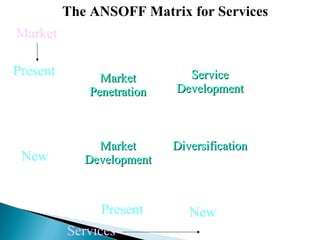
MarketMarket
PenetrationPenetration
ServiceService
DevelopmentDevelopment
MarketMarket
DevelopmentDevelopment
DiversificationDiversification
Present
New
Present New
Market
Services
The ANSOFF Matrix for Services
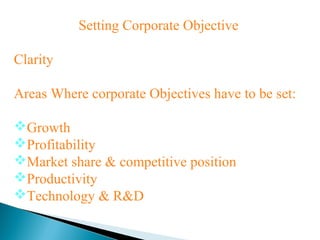
Setting Corporate Objective
Clarity
Areas Where corporate Objectives have to be set:
Growth
Profitability
Market share & competitive position
Productivity
Technology & R&D
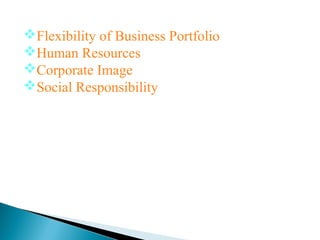
Flexibility of Business Portfolio
Human Resources
Corporate Image
Social Responsibility
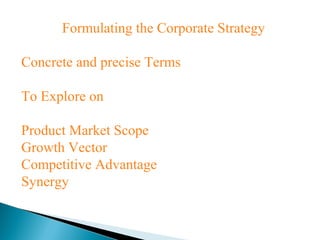
Formulating the Corporate Strategy
Concrete and precise Terms
To Explore on
Product Market Scope
Growth Vector
Competitive Advantage
Synergy
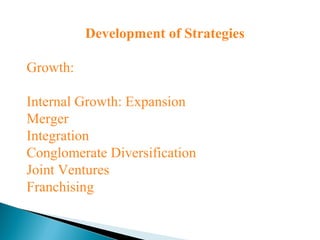
Development of Strategies
Growth:
Internal Growth: Expansion
Merger
Integration
Conglomerate Diversification
Joint Ventures
Franchising
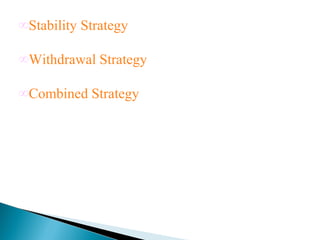
∞Stability Strategy
∞Withdrawal Strategy
∞Combined Strategy
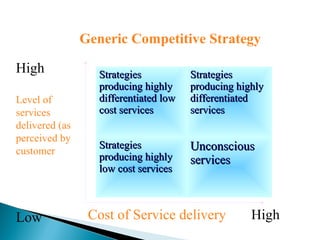
Generic Competitive Strategy
StrategiesStrategies
producing highlyproducing highly
differentiated lowdifferentiated low
cost servicescost services
StrategiesStrategies
producing highlyproducing highly
differentiateddifferentiated
servicesservices
StrategiesStrategies
producing highlyproducing highly
low cost serviceslow cost services
UnconsciousUnconscious
servicesservices
High
Level of
services
delivered (as
perceived by
customer
Low Cost of Service delivery High

Strategic planning