Strategic Management in Action 6th Edition Coulter Solutions Manual
1.
Strategic Management inAction 6th Edition
Coulter Solutions Manual download
https://testbankfan.com/product/strategic-management-in-
action-6th-edition-coulter-solutions-manual/
Find test banks or solution manuals at testbankfan.com today!
2.
Here are somerecommended products for you. Click the link to
download, or explore more at testbankfan.com
Strategic Management in Action 6th Edition Coulter Test
Bank
https://testbankfan.com/product/strategic-management-in-action-6th-
edition-coulter-test-bank/
Business in Action 6th Edition Bovee Solutions Manual
https://testbankfan.com/product/business-in-action-6th-edition-bovee-
solutions-manual/
Strategic Management 6th Edition Hubbard Solutions Manual
https://testbankfan.com/product/strategic-management-6th-edition-
hubbard-solutions-manual/
College Accounting A Career Approach 12th Edition Scott
Test Bank
https://testbankfan.com/product/college-accounting-a-career-
approach-12th-edition-scott-test-bank/
3.
Understanding Pathophysiology 6thEdition Huether Test
Bank
https://testbankfan.com/product/understanding-pathophysiology-6th-
edition-huether-test-bank/
Goulds Pathophysiology for the Health Professions 5th
Edition VanMeter Test Bank
https://testbankfan.com/product/goulds-pathophysiology-for-the-health-
professions-5th-edition-vanmeter-test-bank/
How Children Develop 5th Edition Siegler Test Bank
https://testbankfan.com/product/how-children-develop-5th-edition-
siegler-test-bank/
Microeconomics 2nd Edition Acemoglu Solutions Manual
https://testbankfan.com/product/microeconomics-2nd-edition-acemoglu-
solutions-manual/
Physics Principles With Applications 7th Edition Giancoli
Test Bank
https://testbankfan.com/product/physics-principles-with-
applications-7th-edition-giancoli-test-bank/
4.
Environmental Science fora Changing World Canadian 1st
Edition Branfireun Test Bank
https://testbankfan.com/product/environmental-science-for-a-changing-
world-canadian-1st-edition-branfireun-test-bank/
5.
CHAPTER 5 FUNCTIONALAND COMPETITIVE
STRATEGIES
LEARNING OUTCOMES
Use this Learning Outline as you read and study the chapter:
5.1 Describe the functional strategies an organization needs and explain how those strategies are
implemented and evaluated.
5.2 Explain competitive advantage and what it implies.
5.3 Describe the different competitive strategies.
5.4 Discuss how competitive strategies are implemented and evaluated.
TEXT OUTLINE
Active Learning Hint
Hand out an “empty” chapter outline or one with key information missing for the students to use in note
taking. This outline will help the students to organize the information, while keeping the students
actively listening for the information needed to complete the outline.
Strategic Management in Action Case #1: Driving for Success
You may wish to open with a Question and Answer exercise.
• The Toyota vignette illustrates the interrelationships of an organization's functional strategies and
their contributions to the company’s success. Additionally, you may want to review what a learning
organization is and link Toyota's two main principles with their status as a learning organization.
• Questions to connect previous discussion with this chapter:
• What is Toyota’s competitive advantage?
• What is Toyota’s core competency that provides the basis for their competitive advantage?
• What advantages does the Toyota five-day custom car manufacturing system provide for the
marketing department?
• How can this manufacturing pace be sustained? Can't other manufacturers imitate the Toyota
system?
Teaching Notes: _______________________________________________________________________
_____________________________________________________________________________________
_____________________________________________________________________________________
_____________________________________________________________________________________
_____________________________________________________________________________________
LEARNING OUTCOME 5.1 DESCRIBE THE FUNCTIONAL STRATEGIES AN
ORGANIZATION NEEDS, AND EXPLAIN HOW THOSE
STRATEGIES ARE IMPLEMENTED AND EVALUATED
FUNCTIONAL STRATEGIES AND STRATEGIC MANAGEMENT PROCESS
A. Strategic Management in Action: Process (Figure 5.1)
1. Top-level decision makers (i.e., CEO and top management team) develop the overall goal
of what the organization hopes to achieve (i.e., its vision, mission and strategic objectives)
and establish the overall corporate strategies.
2. Functional strategies are developed taking into account the organization’s vision,
mission(s), overall corporate and competitive strategies.
6.
3. When theorganization is first founded, corporate strategies are addressed immediately
where the overall strategic goal(s) and directions are formulated by the CEO and top
management team and then functional strategies are addressed.
4. The vast majority of strategic situations are ones where the organization is not new. In these
situations; functional strategies are looked at first in the process of deciding the most
appropriate strategies—that is, the ones that will lead to a sustainable competitive
advantage.
B. What Happens after the SWOT Analysis?
1. Decision makers have information about the positive and negative aspects of both the
external and internal environments (i.e., Internal [Strengths and Weaknesses] and External
[Opportunities and Threats]).
2. If the organization’s strengths in the various functional units can be exploited as
competitive advantages, particularly in light of any relevant external opportunities, the
organization may well be on its way to achieving high levels of performance.
3. If negative trends are found in any of the organization’s external areas or weaknesses,
changes in functional strategies might be needed to counteract these.
4. Serious functional weaknesses that might be preventing a competitive advantage from being
developed may need to be corrected or minimized.
Active Learning Hint
Conduct a SWOT analysis for Domino’s Pizza and address the issues presented in the Strategic
Management in Action highlight. Divide the class into groups of 4-5 students to work on the SWOT,
and then ask several of the groups to report their findings. Another method would be to divide the class
into 4 groups (or multiples of four). One group identifies the strengths, another group the weaknesses,
etc. Ask each group to report their findings to the class.
Strategic Management in Action: Super Bowl and Pizza
1. Discuss whether to try to meet peak demand – does it lead to loyalty? Is it a weakness if a company
cannot meet demand on that particular day. If you cannot supply your customers you open the door
to rival suppliers and you may lose some to other pizza-makers if you turn them away.
2. A SWOT analysis may reveal if production or delivery capacity are inadequate for the peak demand
or if there may be excess capacity.
C. What Functional Strategies Does an Organization Need?
Functional (or operational) strategies are the short-term, goal-directed decisions and actions
of the organization’s various functional units (Figure 5.2).
All organizations perform three basic functions as they create and deliver goods and services:
1) Product Strategies (design, production-operations, marketing)
2) People Strategies (human resources)
3) Support Process Strategies (information and financial-accounting systems)
1. Functional Strategies – The Product
a). Product design strategies typically involve an organization’s R&D function
b). Once products are ready to be produced, production-operations strategies ensue
c). Next, marketing strategies are implemented
2. Functional Strategies – The People
a). High-performance Work Practices are human resource policies and practices that
lead to both high individual and high organizational performance.
b). Table 5.1 lists some of the high-performance work practices that have been identified.
7.
These types ofHR strategies can:
(1) Improve knowledge, skills and abilities of organization’s current and
potential employees
(2) Increase employees’ motivation
(3) Reduce loafing on the job
(4) Help retain quality employees
(5) Encourage nonperformers to leave the organization
c). Strategic choices include:
i. Getting people into the organization (HR planning, recruiting and staffing)
ii. Making sure they have the knowledge and skills to do their jobs
iii. Helping them do their jobs better (orientation and training)
iv. Assessing how well they do those jobs and making needed corrections
(performance appraisal and disciplinary actions)
v. Motivating high levels of effort and compensating them fairly and
appropriately (compensation and benefits)
vi. Other HR Issues (employee relations, job design, diversity efforts,
workplace safety and health, workplace misbehavior)
vii. An organization’s HR policies reflect its commitment to and treatment of its
employees. Must closely align with those other strategies to assure that the
right numbers of appropriately skilled people are in the right place at the
right time and that the organization’s workforce is being used effectively
and efficiently.
3. Functional Strategies – The Support Process
a). Organizations have two main support processes – information systems and
financial-accounting systems
b). Information affects how effectively and efficiently organizational members can do
their work
c). Two strategic decisions most associated with the organization’s information system
are the choice of system technology and the choice of types of information
systems needed
d). Financial-accounting systems provide strategic decision makers with information
about the organization’s financial transactions, accounts, and standing
e). Strategic choices include:
i. Collecting and using financial and accounting data
ii. Evaluating financial performance
iii. Doing financial forecasting and budgeting
iv. Determining the optimum financing mix
v. Effectively and efficiently managing the financial-accounting functional
area
Strategic Management In Action: Loading the Airplane
• In light of all the delays and flight cancellations the airlines industry experienced in Summer 2007,
have the students discuss some ideas on how the airlines might adopt some production-operations
strategies that might make each airplane’s turnaround at the gate faster.
For Your Information—To Layoff or Not to Layoff
• Student responses may vary based on the students’ life and work experiences and the state of the
United States and global economy.
8.
The Grey Zone– Corporate Blogs
Corporate blogs are popular and legal but not necessarily in the best interests of the company. Should
organizations promote things that are popular but may be harmful or at least may not be beneficial to the
company?
When an employee raises a concern, what are the risks to the organization of responding? Or not
responding? How might stakeholders see it?
What about government regulators or juries? Will they be more sympathetic if you ignore the concerns
of your stakeholders and it turns out that your company’s actions were harmful? What could happen
then?
Do you have to respond to every stakeholder concern?
Strategic Management in Action: Caesars Entertainment
Great service leads to more spending by gamblers. Ask your students if they think that this would hold
true to other businesses outside of the gambling environment? Does great service lead to more spending
in hotels, resorts, restaurants, retail stores, or bars?
Learning Review: Learning Outcome 5.1
• How does the work done in the functional areas support the creation of a competitive
advantage? If the organization’s strengths in the various functional units can be exploited as
competitive advantages, particularly in light of any relevant external opportunities, the
organization may well be on its way to achieving high levels of performance.
• What happens after the SWOT analysis is completed? After completing the SWOT analysis,
decision makers have information about the positive and negative aspects of both the external
and internal environments. The SWOT analysis points to the strategic issues organizational
decision makers need to address in their pursuit of sustainable competitive advantage and high
levels of performance.
• What are the three functional concerns of organizations? The three functional concerns for
organizations are the product, the people, and the support processes.
• What strategies are important to each of those functional concerns? For product, the strategies
are design, production-operations, and marketing. For people, it is HR strategies. And for
support process, it’s strategies related to information systems and financial-accounting systems.
9.
LEARNING OUTCOME 5.2EXPLAIN WHAT COMPETITIVE ADVANTAGE IS AND
WHAT IT IMPLIES
A. Competitive Advantage
1. Is a key concept of strategic management (getting it and keeping it is what managing
strategically is all about)
2. Sets an organization apart (its competitive edge)
3. Is what an organization’s competitive strategies are designed to exploit
4. Implies that there are other competitors also attempting to develop competitive advantage
and attract customers
5. An organization does something that others can’t do or does it better than others do
(distinctive capability)
6. An organization has something that other competitors don’t (unique resource)
7. Can be eroded easily (and often quickly) by competitors’ actions
B. Understanding the Competitive Environment
1. Competition is everywhere. Most industries and organizations have experienced at some
point.
2. What is Competition?
a) Competition is when organizations battle or vie for some desired object or outcome—
typically customers, market share, survey ranking, or needed resources.
Strategic Management in Action
• Describe situations, outside business and athletics, where competition is taking place.
Answers will vary based on the students and their business and life experiences.
3. Who are Competitors?
Competitors can be described according to:
a) Industry Perspective
(1) Identifies competitors as organizations that are making and selling the same or very
similar good or service.
(2) Describes industries according to the number of sellers and the degree of
differentiation (i.e., similarities or differences of the products or services).
(a) The number of sellers and the level of product-service differentiation will affect
how intensely competitive the industry is.
(b) The most intense competition is “pure competition” where there are many
sellers and no differentiation exists among the sellers.
b) Market Perspective
(1) Competitors are organizations that satisfy the same customer need.
(2) Intensity of competition depends on:
(a) How well the customer’s need is understood or defined
(b) How well different organizations are able to meet that need
c) Strategic Groups Perspective
(1) Recall “current rivalry” in Porter’s Five Forces Model from Chapter 3.
(2) Strategic group is a group of firms competing in an industry that have similar
strategies, resources and customers.
(3) A single industry could have a few or several strategic groups depending on what
strategic factors are important to customers.
(a) Two strategic factors, important to customers, used in grouping competitors are
price and quality.
(b) Important strategic factors, or strategic dimensions, used to determine an
organization’s competitors are different for every industry and can be different
even for different industry segments.
(c) Table 5.2 lists some dimensions that might be used to distinguish strategic
10.
groups.
(4) The mostrelevant competitors are those in an organization’s own strategic group.
(5) Level of intensity of competition from this perspective depends on:
(a) How effectively each competitor has developed its competitive advantage
(b) The competitive strategies used by each competitor in the strategic group
(6) Controversy exists over whether or not specific, identifiable strategic groups even
exist.
(a) These questions generally concern:
(1) The factors that are used to define a strategic group
(2) How those factors are chosen and used to separate specific and identifiable
groups
Strategic Management in Action—Hot Sauce
• Ask students how many are familiar with these two brands of hot sauce.
• Ask the students why they choose one sauce over another.
• Ask the students if an ad campaign changes their mind about a product or brand.
• Ask the students what actions a hot sauce manufacturer might take to protect its competitive position.
C. The Role of Resources and Distinctive Capabilities in Gaining Competitive Advantage
Every organization has resources and capabilities to do whatever it’s in business to do.
1. Not every organization is able to:
a) Effectively exploit the resources or capabilities it has
b) Obtain the resources or capabilities it needs but doesn’t have
c) Classic case of “the haves” and “the have-nots” or “the can do’s” and “the can’t do’s”
2. Some organizations “put it all together” and develop distinctive organizational capabilities
that provide a sustainable competitive advantage, others don’t.
3. Organizations will develop strategies to:
a) Exploit their current resources and capabilities
b) Vie for needed-but-not-owned resources and capabilities to pursue and attain desired
outcomes (customers, market share, resources)
c) While other organizations (few to many) are doing exactly the same thing
4. Competitive advantage, by its very nature, implies trying to gain the edge on others.
5. As organizations fight for a sustainable competitive advantage, the stage for competition—
intense, moderate, or mild—is set.
Strategic Management—The Global Perspective: Sukhoi Holding Company
• Ask students to research other aircraft manufacturers.
• How is the Sukhoi Holding Company going to develop a competitive advantage over other aircraft
manufacturers?
D. From Competitive Advantage to Competitive Strategies
Competitive strategy is the way organizations set themselves apart to compete to create a
sustainable competitive advantage
1. The choice of competitive strategy
a) Depends on how an organization or business unit is going to compete in its particular
industry or market
b) Is based on the competitive advantage(s) that the organization has been able to develop
2. Refining and sharpening its sustainable competitive advantage (in unique resources or
distinctive capabilities) provides the basis for an organization’s competitive strategy.
Teaching Notes: _______________________________________________________________________
11.
_____________________________________________________________________________________
_____________________________________________________________________________________
Learning Review: LearningOutcome 5.2
• Is competition an issue for all organizations? Discuss.
• Competition is a given for all organizations, regardless of size, type, or geographic location. Even
not-for-profit organizations compete for resources and customers.
• What is competitive advantage?
• Competitive advantage is what sets an organization apart—its competitive edge.
• Compare and contrast the three approaches to defining competitors.
• The industry perspective identifies competitors as organizations that are making the same
product or providing the same service.
▪ The marketing perspective says competitors are organizations that satisfy the same customer
need.
▪ The strategic groups perspective identifies a group of firms competing in an industry that have
similar strategies, resources and customers.
• What role do resources and distinctive capabilities play in gaining competitive advantage?
• Organizations will develop strategies to exploit their current resources and capabilities or to vie
for needed-but-not-owned resources and capabilities to pursue and attain desired outcomes such
as customers, market share and resources. They do this while other organizations (few to many)
are doing exactly the same thing. Competitive advantage, by its very nature, implies trying to gain
the edge on others. As organizations strive for a sustainable competitive advantage, the stage for
competition—intense, moderate, or mild—is set.
• Define competitive strategy. What’s the connection between competitive advantage and competitive
strategy?
• Competitive strategy is the way organizations set themselves apart to create a sustainable
competitive advantage.
• The choice of a competitive strategy is based on the competitive advantage(s) that the
organization has been able to develop.
LEARNING OUTCOME 5.3
DESCRIBE THE DIFFERENT COMPETITIVE STRATEGIES
Although it may seem there are numerous ways an organization competes, the number of
competitive strategies is actually few of possible types of competitive strategies, there are actually a
limited number of ways to describe how an organization competes.
A. Traditional Approaches to Defining Competitive Strategy
1. Miles and Snow’s Adaptive Strategies (1978) (Table 5.3):
a) Based on the strategies organizations use to adapt to their uncertain competitive
environments.
b) Generally been supportive of the appropriateness of these strategies for describing how
organizations are competing.
c) Prospector Strategy
(1) Strategy in which an organization continually innovates by finding and exploiting
new product and market opportunities.
(2) Prospector’s competitive strength is ability to:
(a) Survey a wide range of rapidly changing environmental conditions, trends and
situations to create new products and services to fit this dynamic environment.
(3) Prospector’s competitive strategy is to continually innovate, develop and test new
products and services (i.e., find new directions to pursue).
(4) Constant search for innovation creates uncertainties for prospector’s competitors
who never know what’s going to happen next or what to expect.
(5) If prospector can develop new products or services that the market desires and is
12.
willing to payfor, it has a competitive advantage.
(6) Examples: Fox Broadcasting Network and MTV known for innovative television
network programming and willingness to pursue new directions based on its ability
to assess environmental trends.
b) Defender Strategy
(1) Strategy used by organizations to protect current market share by emphasizing
existing products and producing only a limited product line.
(2) Defenders have well-established businesses that they’re seeking to defend.
(3) Defender has success with this strategy as long as the primary technology and
narrow product line remain competitive.
(4) Over time, defenders can carve out and maintain niches within their industries that
competitors find difficult to penetrate.
(5) Example: Lincoln Electric of Cleveland, OH; Anheuser-Busch; IBM
c) Analyzer Strategy – strategy of analysis and imitation.
Analyzers
(1) Watch for and copy the successful ideas of prospectors
(2) Compete by following the direction that prospectors pioneer
(3) Thoroughly analyze new business ideas before jumping in
(4) Systematically assess and evaluate whether the move is appropriate for them
(5) Examples: Unilever’s Suave shampoo and skin care products, COSMI Corporation
(education, entertainment and business software)
Strategic Management—The Global Perspective: Pague Menos
• Ask students what they think about the Brazilian retailer copying Wal-Mart’s strategies?
• How successful can Pague Menos be by taking the low cost approach?
• What are the drawbacks to using a low cost strategy? Is it sustainable?
• What is to keep another emerging competitor from copying Pague Menos? What if the new
competitor undercuts Pague Menos’ prices?
d) Reactor Strategy – the lack of a coherent strategic plan or apparent means of
competing.
(1) Reactors:
(a) Simply react to environmental changes and make adjustments only when finally
forced to do so by environmental pressures
(b) Oftentimes unable to respond quickly to perceived environmental changes
because:
(1) They lack the needed resource or capabilities OR
(2) They’re not able to exploit their current resources and capabilities
(2) This is not a recommended competitive strategy for developing a competitive
advantage.
(3) Thought of as a “default” strategy, almost a nonstrategy position.
(4) Without significant strategic changes, a reactor will always be in a weak
competitive position.
(5) Examples: Sears; Sizzler International, Inc.; Digital Equipment Corporation
For Your Information – The Copycat Economy
• Ask the students to evaluate Clorox’s decision to market ReadyMop and determine what strategy is
being used. Was it an offensive or a defensive move on Clorox’s part?
• Ask the students if they can think of any other examples of “copycatting?” In the soft drink business
every new flavor is virtually matched immediately by a competing flavor from a rival. Diet Pepsi and
13.
Diet Coke havespawned cherry, lemon, lime, and vanilla flavored varieties, as well as C2, a low
carb Coke and Pepsi One a very low calorie add-on to the Diet Pepsi line. The key seems to be to not
allow any competitor an advantage for any length of time. Fast-food makers have done the same
thing with gourmet salads. Wendy’s started the war with a very successful introduction of gourmet
salads and McDonald’s followed with several varieties within months. Automobile financing and
rebates are another example where there is little difference between competitors.
• How did Procter and Gamble respond to Clorox? Rather than cede any advantage to Clorox, P&G
cut its price (and its profit margin) to not be out positioned by a “fast-follower.” Possible responses
range from increased advertising to win customer attention to price cuts that then limit the ability of
new entrants to garner profits…perhaps discouraging their entry before it occurs.
Teaching Notes: _______________________________________________________________________
_____________________________________________________________________________________
_____________________________________________________________________________________
_____________________________________________________________________________________
2. Porter’s Generic Competitive Strategies (1980)
a) Porter’s approach is based on an organization’s competitive advantage.
b) Competitive advantage can come from only one of two sources:
(1) Having the lowest costs in the industry
(2) Possessing significant and desirable differences from competitors
c) Another important strategic factor is the scope of the product-market in which the
organization wishes to compete—that is, broad (i.e., all or most market segments) or
narrow (i.e., only one segment or a few segments).
d) The mix of these factors provides the basis for Porter’s approach.
e) The term generic simply refers to the fact that these strategies can be pursued by any
type or size organization in any type or size industry.
(1) Cost leadership Strategy (or low-cost strategy) is one in which an organization
strives to have the lowest costs in its industry and produces products for a broad
customer base.
(a) Cost leader
(1) Chooses to compete on the basis of having the lowest costs.
(2) The main goal is to have the lowest (total unit) costs in the industry
(emphasis on costs, not prices).
(a) With the lowest costs in its industry, the cost leader:
(1) Can potentially charge the lowest prices and
(2) Still earn significant profits, even during a price war
(b) Successful pursuit of the cost leadership strategy
(1) Everything the cost leader does—every strategic decision made, every
strategic action taken—is aimed at keeping costs as low as possible.
(2) Efficiency in all areas of operations is the main objective, and all resources,
distinctive capabilities, and functional strategies are directed at that.
(3) The cost leader isn’t going to have deep and wide product lines as
providing these product or service variations is expensive.
(4) ,The cost leader has chosen to compete on the basis of low costs, not on
being different than competitors.
(5) The cost leader will market products aimed at the “average” customer.
(6) Little or no product frills or differences will be available. No fancy artwork or
plush office furniture at corporate headquarters and no corporate jets.
(7) Cost leader won’t have an elaborate high-tech, multimedia interactive Web site
unless it’s an extremely cost effective and efficient way to reach masses of
potential customers.
(8) Examples: Payless Shoe Source, Collective Brands, Nucor Corporation and
Wal-Mart. Ask the students to identify common characteristics between these
14.
organizations
1. Other characteristicsof cost leaders include:
a. Strict attention to production controls
b. Rigorous use of budgets
c. Little product differentiation—just enough to satisfy what the mass
market might demand
d. Limited market segmentation—products or services aimed at the
mass market
e. Emphasis on productivity improvements
f. Resources, distinctive capabilities and core competencies found in
production-operations and materials management
2. Drawbacks of the cost leadership strategy:
a. The main danger is that competitors might find ways of lowering
costs even further; taking away the cost leader’s cost advantage.
b. Competitors might be able to easily imitate what the cost leader is
doing and erode the cost advantage.
c. Cost leader, in its all-out pursuit of lowering costs, might lose sight
of changing customer tastes and needs.
(2) Differentiation Strategy
a) Organization competes by providing unique (different) products with features that:
i. Customers value,
ii. Perceive as different, and
iii. Are willing to pay a premium price for
b) The main goal of the differentiator is to provide products or services that are truly
unique and different in the eyes of customers.
c) Doing this, the differentiator can charge a premium price because customers perceive
that the product or service is different and that it uniquely meets their needs.
d) This premium price provides the profit incentive to compete on the basis of
differentiation.
For Your Information—Selling Luxury
• Have your students visit some of the Web sites mentioned as they consider these questions. Perhaps
several of your students have already used some of the services such as Lexus and General Electric’s
Profile washer and dryer. Encourage the students to share these “experiences” with the class.
• Are there other examples of luxury marketers trying new approaches to selling their products?
Student responses will vary on this question. Encourage students to identify as many luxury
marketers as possible.
● What do you think of these pitches?
Student responses to this question may vary based on their life and professional experiences.
• Is the differentiation strategy one that’s appropriate only in good economic times?
Student responses may vary, but should include differentiation will work in conditions where a
company’s products or services provides customers value, is perceived as different and customers
are willing to pay a premium price.
e) A successful differentiator:
i. All its capabilities, resources and functional strategies are aimed at
isolating and understanding specific market segments and developing
product features valued by customers in those various segments.
ii. Has broad and wide product lines—that is, many different models,
features, price ranges and so forth.
iii. Has countless variations of market segments and product features so
that the customer perceives the product or service as different and
unique and worth the extra price.
iv. Because the differentiation strategy can be expensive, the differentiator
15.
also needs tocontrol costs to protect profits, but not to the extent that it
loses its source of differentiation.
f) Examples: Gap, Old Navy, Pottery Barn
g) Other characteristics of differentiators include:
i. Differentiating themselves along as many dimensions as possible and
segmenting the market into many niches.
ii. Establish brand loyalty, where customers consistently and repeatedly
seek out, purchase and use a particular brand. Brand loyalty can be a
very powerful competitive weapon for the differentiator.
iii. The differentiator’s distinctive capabilities tend to be in marketing and
research and development.
h) Drawbacks of the differentiation strategy
i. Must remain unique in customers’ eyes, which may be difficult
depending on competitors’ abilities to imitate and copy successful
differentiation features.
ii. Customers might become more price sensitive, and product differences
might become less important.
(3) Focus strategy is when an organization pursues either a cost or differentiation
advantage but in a limited (narrow) customer group or segment.
a) A focuser:
i. Concentrates on serving a limited (narrow) customer group or segment
known as a market niche:
a. Geographical niche can be defined in terms of region or
locality.
b. Type of customer niche focuses on a specific group of
customers.
c. Product line niche would focus on a specific and specialized
product line.
2. Pursues either a cost or differentiation advantage
a. Cost focuser competes
i. By having lower costs than the overall industry cost
leader in specific and narrow niches
ii. Also successful if an organization can produce
complex or custom-built products that don’t lend
themselves easily to cost efficiencies by the industry’s
overall cost leaders
b. Differentiation focuser can use whatever forms of
differentiation the broad differentiator might use, such as:
i. Product features
ii. Product innovations
iii. Product quality
iv. Customer responsiveness
v. Specializes in one or a few segments instead of all
market segments.
c. Advantages of the focus strategy:
i. The focuser knows its market niche well and can build
strong brand loyalty by responding to changing
customers’ needs
ii. The focuser who can provide products or services that
the broad competitors can’t or won’t, will have the
niche all to itself.
Strategic Management—The Global Perspective: Abraaj Capital
• Do you think a cost focus or differentiation focus strategy might be more appropriate?
16.
▪ A differentiationfocus strategy might be more appropriate as Abraaj Capital might focus on
product features, product innovation, product quality, or customer responsiveness to outcompete
its rivals (i.e., Goldman Sachs, Citigroup) in the Middle East and Southeast Asia markets.
d. Drawbacks of the focus strategy
i. The focuser often operates on a small scale making it
difficult to lower costs significantly. However, with
technological advancements such as flexible
manufacturing systems, this drawback is not as critical
as it once was. As information and computer
technology become more affordable, focusers have
discovered that economies (cost efficiencies) don’t
necessarily have to come from large-scale production
runs.
ii. The niche customers might change their tastes or
needs. Because it is often difficult for a focuser to
change niches easily and quickly, this could be a
serious problem. In addition, any technological
changes that might impact the niche can have a similar
effect.
iii. The threat of the broad differentiator taking notice of
the focuser’s market niche, especially if the focuser is
enjoying a significant level of success, and moving in
to offer products and services to those customers.
(4) Stuck in the Middle
a) Happens when an organization isn’t successfully pursuing either a low-cost
or a differentiation competitive advantage
b) Occurs when an organization’s:
1. Costs are too high to compete with the low-cost leader.
2. Products and services aren’t differentiated enough to compete with the
differentiator.
c) This is not a preferred or profitable strategic direction.
d) Becoming “unstuck” means making consistent strategic decisions about what
competitive advantage to pursue and then doing so by aligning resources,
distinctive capabilities and core competencies.
Teaching Notes: _______________________________________________________________________
_____________________________________________________________________________________
_____________________________________________________________________________________
3. Contemporary Views on Competitive Strategy
Some of the newer perspectives provide an expanded, and perhaps more realistic, description of
what competitive strategies organizations are using.
a. Integrated Low-Cost Differentiation Strategy
i. Competitive advantage by simultaneously achieving low costs and high levels of
differentiation.
ii. Technological advancements that make this hybrid competitive strategy possible are:
a) Flexible manufacturing systems
b) Just-in-time inventory systems
c) Integrated manufacturing systems
b. Just because these technological advancements are available and accessible doesn’t
mean that every organization that uses them will be able to successfully implement an
integrated low-cost differentiation strategy.
17.
Strategic Management inAction: Dell
• A classroom discussion may be beneficial, given that many of your students will be quite familiar
with Dell computer. Ask your students to discuss whether they have Gateway, Hewlett-Packard,
IBM, or another PC manufacturer. Ask your students how Dell has lost its market share and ask for
suggestions on how it might regain the competitive edge it had.
b. Mintzberg’s Generic Competitive Strategies
i. Henry Mintzberg developed an alternative typology of six possible competitive
strategies that better reflected the increasing complexity of the competitive
environment.
The following is taken from Figure 5.4: Mintzberg’s Generic Competitive Strategies.
a) Differentiation by price: Modification of Porter’s cost leadership; advantage
from organization’s ability to charge below-average market prices.
Differentiated on basis of price.
b) Differentiation by marketing image: Organization attempts to create a
certain image in customers’ minds. Uses marketing image as potent competitive
weapon.
c) Differentiation by product design: Competition on basis of providing
desirable product features and design configurations; offers wide selections of
product features and different designs.
d) Differentiation by quality: Deliver higher reliability and performance at a
comparable price. Superior product quality pursued at a comparable price.
e) Differentiation by product support: Emphasizing customer support services.
Providing all-encompassing bundle of desired customer support services.
f) Undifferentiated strategy: No basis for differentiation or following a copycat
strategy.
ii. The verdict on Mintzberg’s alternative generic competitive strategies typology appears
to have merit.
Teaching Notes: _______________________________________________________________________
_____________________________________________________________________________________
_____________________________________________________________________________________
_____________________________________________________________________________________
Learning Review: Learning Outcome 5.3
• Describe each of Miles and Snow’s four adaptive strategies?
• Prospector strategy is one in which an organization continually innovates by finding and
exploiting new product and market opportunities.
• Defender strategy is characterized by the search for market stability and producing only a limited
product line directed at a narrow segment of the total potential market.
• Analyzer strategy is one of analysis and imitation.
• Reactor strategy is the lack of a coherent strategic plan or apparent means of competing.
• According to Porter, what are the two types of competitive advantage?
• Competitive advantage can come from either having the lowest costs in the industry or from
possessing significant and desirable differences from competitors.
• Describe each of Porter’s generic competitive strategies.
18.
• Cost leadershipstrategy is one in which an organization strives to have the lowest costs in its
industry and produces products or services for a broad customer base.
• Differentiation strategy is a strategy in which the organization competes on the basis of
providing unique (different) products-services with features that customers value, perceive as
different and are willing to pay a premium price for.
• A Cost Focuser competes by having lower costs than the overall industry cost leader in specific
and narrow niches.
• The Differentiation Focuser can use whatever forms of differentiation the broad differentiator
might use—product features, product innovations, product quality, customer responsiveness, or
whatever. The only difference is that the focuser is specializing in one or a few segments instead
of all market segments.
• What does it mean to be “stuck in the middle?”
• Stuck in the middle happens when an organization isn’t successfully pursuing either a low cost
or a differentiation competitive advantage. An organization becomes stuck in the middle when its
costs are too high to compete with the low-cost leader or when its products and services aren’t
differentiated enough to compete with the differentiator.
• What is the integrated low-cost differentiation strategy and how does it contradict the concept behind
Porter’s generic competitive strategies?
• An integrated low-cost differentiation strategy is one in which an organization develops a
competitive advantage by simultaneously achieving low costs and high levels of differentiation.
• Porter’s original work maintained that an organization couldn’t simultaneously pursue a low-cost
and a differentiation advantage. Despite strong empirical support for Porter’s strategy framework,
several strategy researchers questioned this “mutual exclusivity.” Instead of having to pursue one
or the other, strategy research evidence is starting to show that organizations can pursue an
integrated low-cost differentiation strategy and do so successfully.
• Describe each of the competitive strategies in Mintzberg’s generic strategy typology.
• Differentiation by price is a modification of Porter’s cost leadership strategy.
• Differentiation by marketing image described a competitive strategy in which an organization
attempted to create a certain image in customers’ minds.
• Differentiation by product design can be used to describe organizations that competed on the basis
of providing desirable product features and design configurations.
• Differentiation by quality described a strategy in which organizations competed by delivering
higher reliability and performance at a comparable price.
• Differentiation by product support emphasized the customer support services provided by the
organization.
• Undifferentiated strategy described situations in which an organization had no basis for
differentiation or when it deliberately followed a copycat strategy.
LEARNING OUTCOME 5.4
DISCUSS HOW COMPETITIVE STRATEGIES ARE IMPLEMENTED AND EVALUATED
The Grey Zone: The Class of 2015
Have students brainstorm a list of companies who have targeted them simply because they are in
college. What do these companies have in common? What approaches do they use to gain the
students as customers? Does it work? What turns them off?
A. Implementing Competitive Strategy
Implementation utilizes resources, distinctive capabilities and core competencies. If a strategy is
not implemented, then it’s nothing more than an idea. Functional strategies play a significant
role in implementing competitive strategy.
1. The Role of Functional Strategies
a) Functional strategies:
(1) Play a critical role in the implementation of its competitive strategy.
19.
(a) The challengein implementing the organization’s competitive strategy is to
create and exploit a sustainable competitive advantage.
(b) This competitive advantage comes from the organization’s ability to use its
resources to develop capabilities that may become distinctive.
(c) All of these details happen through the actual strategies that are being used in
the various functional work units of the organization.
(2) Have a dual role that influence both:
(a) What competitive strategy is most appropriate?
(1) Depends on what organizational resources and capabilities currently
available or being acquired and developed through the functional strategies.
(2) To successfully attain a sustainable competitive advantage, each of Porter’s
generic competitive strategies requires certain skills, resources and
organizational requirements. (Table 5.4)
(b) How is that strategy implemented?
(1) The strategy(ies) being used in each functional area should support
whatever competitive advantage (and competitive strategy) is being
pursued.
(a) If competition is based on having the lowest costs, then:
(1) Functional strategies being used should support and reinforce that
strategy.
(2) Cost efficiencies would be pursued in all operational areas, but
particularly in production-operations.
(3) Financial strategies could support the quest for operational
efficiency including such things as capital investment in technology
if it’s needed and could contribute to lowering costs.
(4) All organizational resources, distinctive capabilities and core
competencies would be directed at attaining the goal of having the
industry’s lowest costs.
(b) If the organization chose to compete on the basis of both low costs and
differentiation, then its functional strategies better reflect that choice or
it will never be able to develop a sustainable competitive advantage.
Active Learning Hint
• Define fast follower (copycat) and give an example to the class. Have students debate which skills,
resources and requirements best fit a company pursuing a “fast follower” strategy.
To do this have students address the following questions:
▪ Do copycats need strong marketing abilities? Why?
▪ Do copycats need good engineering skills? Should those skills be for new product development or
for process/cost engineering?
▪ Would you focus more on control or innovation in your production process? Explain.
Strategic Management Action: Singapore Airlines (SIA)
This sidebar illustrates competitive action in the air travel industry. A key question is whether there will
be any brand loyalty to specific airlines. What makes customers loyal to a particular airline? Is it the
details or is it simply a price decision? Could famous people play a role as celebrity endorsers?
2. Competitive Actions
Once an organization’s competitive strategy is implemented through functional decisions and
actions, it will use certain postures, actions and tactics as it competes against other organizations
for customers, market share, or other desired objects or outcomes.
a) Offensive moves are when an organization attempts to exploit and strengthen its
onderdaen te wesendie die moeder der nature ons ghelijc gemaect
heeft. eñ die vader vã hemelrijc tot sijn rijcke geroepen heeft.
daermen ewelick in leeft mit blijscappẽ Wij leuen gemackelic in onse
holen wãt nyemant en derf ons daer in storen. Eñ wi en dragen oec
gheen costelicke clederẽ: wãt wi decken ons al mit papelẽ alsoet
tamelic is Wij en willen gheen vrouwẽ om oncuysheit mede te doen.
mer om dat wi begeren kinderen daer aen te winnen Onder õs so en
sterft nyemãt voor sinen vader eñ mitten doden en maken wij gheen
feeste wãt het is mit ons alleens mitten minsten eñ mitten meestẽ:
Maer uwe zede is dat ghi groot goet leght an den doden eñ ghi en
laet der aerden niet hebben dat haer is: mer ghi ouerdect uwe
dooden mit siluere eñ goude eñ ontneemt der aerden aldus dat haer
toebehoort. In ons lãt en valt gheen plaghe want wi en ontsuuerẽ
die lucht niet mit quaetheden daer die plagen om plegẽ te geschien
Die wint eñ dat weder is in onsen lãden ghenoechlick nadẽ tijt
vanden iare Wij en houdẽ anders gheen medicijn dã dat wi etẽ
soberlic zuuere spijse: wãt vasten doet wel genesen eñ hout ons
gesont Wij en plegen gheẽ spel. danssen noch roeyen noch tornoyẽ
noch spel van dieren te maken: eñ wi en varen nergent om sulck
spel te ansien. want die werelt eñ dẽ hemel geuen õs genoech
schoonheden te ansien Wãt wi sien dẽ hemel dat hi schone eñ claer
is. eñ allesins wel gecyert is mitten sterren en planeten. Oeck syen
wi in die zee die gedaente vã purpure eñ oec van die visschen in
menighen manieren daer in spelen ende springhen Dan syen wi
voort hoe die zee die aerde allesins omme helset heeft: recht oft
haer suster waer Wij hebben oec groote genoechte te syen op die
groote weyden die al om ende om mit schoon groene bloemen staen
die soe wel eñ soete ruken voor die ogen eñ voor den sin eñ daer
hebbẽ wi veel genoechten in Wi hebben oec grote ghenoechte aen
te sien die wilde bosschen eñ die groene bomen daer die vogelen
soe schoon eñ soet op singhen Dit sijn die rijcheden der naturen eñ
haer schoonhedẽ eñ weelden Wij en varen nimmermeer te lande
noch ter zee om comenscappe te doen: wãt die rijcheden vã
vremden landẽ en sullẽ nimmermeer onsen sin verwinnen Eñ wi en
begeren niet meer vã aertschen goeden dan dat wi in armoeden
leuẽ mogen blijdelic eñ sonder sorghe Wij en leren oec niet schone
22.
spreken wãt daerleyt loosheit in: eñ men becleet die logen mit
schoonre talen also schone datter menich man mede bedrogen wort
Wãt men ontschuldicht daer mede de misdadighen eñ men
[ver]duystert daer mede dat recht Dã prijsen die ghene diet horen
dẽ taelman eñ seggẽ dat hi wijs is: mer dit is een onsalich prijs die
die cõsciencie besmettet Maer onder ons en doetmen dit
nimmermeer. want wi hebben een zeer simpele sprake die altijts wel
eñ waersprekende wesen moet Ende wi en willen tot gheenre
scholen gaen: anders niet dan daermen leert dat sekerste eñ dat
beste. wãt wi en leren anders niet eeren dã dat ouerste goet. Eñ ghi
leert te vogelen eñ te doen dat genoechlic is uwẽ vleische Wij en
offeren gode gheen beesten. noch en maken hẽ gheen grote
costelicke tẽpelen eñ outaren als ghi doet Eñ v luden dunct datter
gheen arm ludẽ en sijn die uwes goets te doen hebben Dat is groote
misdaet want god wilt gheeert wesen om sijn grootheit mit suueren
dienst sonder bloet te storten eñ te offerẽ Wãt alsmen hẽ bidt mit
suueren woorden soe doet hi dẽ menschen genade Want god is
selue dat woort daer alle dingen bi gemaect sijn eñ alle dingen
behoet hout eñ voet Dat woort minnẽ wi. wãt dat heeft ons nv
gegeuen onsẽ geest eñ ons leuen. Mer om dat god selue is gheest
eñ leuen soe en machmen niet wel gewinnen sijn vrientscap mit
desen aertschen goede: mer men wint sijn vrientscap mit suuerẽ
leuen eñ datmen hẽ altijt dancke eñ loue Hier om segghen wi dat
ghi onsalich volck bent. want ghi en [ver]staet niet dat v beghin is
vandẽ hemel. eñ dat ghi maechscap hebt mit gode die alle dinc
gescepen heeft Mer mit dorperlike dinghen besmet ghi uwe edelheit
altemael om dat ghi die genoechte uwes vleysches volget na sijnre
begeerten: ende dat ghi vercoren hebt eñ minnet alle dingen die
comen vãder aerden: ende die minne daer of ontsuuert die lucht:
dat water ende die aerde Noch doet ghi veel meer quaets want ghi
sijt gode al of gegaen eñ ghi aenbedet dode luden recht of sij goden
waren want sij sijn moortdadighe luden eñ vyanden die v tot alle
scanden brengen
23.
A
Hoe dat AlexanderDidimus antwoorde
Ca.lix
lexander antwoorde Didimus der Bracmãnen coninc aldus Sijn v
dingen also als ghi seght: soe schijnt dat die Bracmãnen alleen
leuen sonder sõden op dese werelt na dat v ghescrifte luydet Want
ghi en gebruyct niet tot eenigen tijt die weeldicheit die die natuere
ghegeuen heeft allen mẽschen eñ leuen naden auenturẽ ghemeen
Aldus schijnt dat ghi luden alleene goden sijt oft ghi en acht op gode
niet wãt ghi ontseght hẽ dat hi v geuen wil: eñ dit dunc mi bet
sotheit wesẽ dan leuẽ na wijsheit
24.
D
Hoe Didimus Alexãderantwoorde
Ca.lx
idimus antwoorde hier op aldus Alexander Wij en sijn niet
vryelinghen van deser werelt: mer wi sijn hier al gasten want wi
en bliuen hier niet geduerich: eñ wij liden doer dese werelt als een
pelgrim die tot sinen lande waert vaert so ontcõmert van alle dingen
eñ so licht dat õs die sondẽ niet en beswaren. noch gulsicheit noch
ãder quaetheit voor gode diemẽ gheenẽ mãtel makẽ en mach Mer
wij haesten ons onsen wech ouerlijdende tot gode waert mit zuuere
cõsciencien eñ mit een aensicht dat hẽ niet scamen en derf. Eñ wi
en willẽ gheen godẽ wesen noch gode achterdeel doen Mer ghi mint
tot uwer onsalicheit gode mit cleynre giften: Wij en sijn niet sculdich
te verteren noch te begeren al dat wi syen. wãt dat en ware gheen
besetheit noch eere Eñ god heeft meenich dinc opter werelt
ghemaect om dattet die werelt niet oerbaerlic en ware. noch sonder
hẽ niet en soude mogen staen Mer god heeft dẽ mensche gegeuen
die nutscap vanden dingen die hi ghemaect heeft tot haren vryen
wille die hi hem vry gelaten heeft: Eñ so wye hem dan mit vryen
wille hout an dat quaetste eñ laet dat beste. die en vaert bi gode
niet. mer hi verdient gods vyantscap daer mede
25.
A
Hoe Alexander wederãtwoorde
Ca:lxi
lexander screef hẽ weder: eñ seide Ic en prijse voor gheen
salicheit dat ghi v lant soe vry hiet. wãt het is bet een karcker dã
lant om dat ghi nergents en gaet noch en vaert in anderen lãden. Eñ
oec õ dat nyemãt op v en acht. Dit dunct ons een crancke salicheit:
wãt ghi en sayet noch en plãt bomen noch en maeket huysẽ noch
zalẽ. eñ dit dunct ons alle katyuicheit Aldus en gheeft õs gheẽ wõder
dat gi leeft als beesten: mer datmẽ reyn leeft in weelden dat is een
eerlic dinc Dat ghi mit vrouwẽ niet veel en sijt wye salt v mogen
prisen Wãt uwe wijuẽ sijn onbequaem: het waer scãde dat se
menich mã begeerde Mer wi gebruykẽ alle dat die aerde draecht mit
vryen wille in ons te wachtẽ van sõden eñ ontscult te hebbẽ Aldus
soe nam die tale een eynde tusschen alexander eñ die Bracmãnen
Maer Alexander seide hier int eynde dat hi wel waer die alsoe dede
Mer nochtans bleef Didimus voor eñ int achterste int beste Want sijn
geloue schijnt alleheel der kerstenẽ gheloue ghelijc te wesen. daer hi
seyt God is dat woort eñ biden woorde wordẽ alle dingen geschepen
eñ onthouden
26.
A
Hoe Alexander teBabilonien quam tot s[~ij]re doot
waert.
Cap.lxij.
ls alexander bi Babilonien quã soe hiet hẽ een waersegger dat hi
inder stat niet en ghinge: wãt sijn leuen lach daer an Hier õ liet
alexander die stat staen eñ hi voer ouer in een stat gehietẽ Bursia
daer doe nyemãt in en woende Een vã alexanders vriendẽ die
Amoxarcus hiet die seide hẽ datmen gheen waerseggers gelouen en
soude want sij plegen veel te lieghen Om dese woorden soe voer
alexander te Babilonien binnen Doe seide Corbanes die waerseggher
Gheen argher dinc en is aenden mẽsche dã dat een mẽsche plõper is
om te doẽ s[~ij]s selfs oerbaer dan eens anders Als Alexander binnẽ
die stat quam soe settemen hẽ een crone op s[~ij] hooft gemaect
vã yuore eñ goude Eñ Porrius leyde hẽ an die een syde eñ Dari[us]
broeder an die ander syde. Eñ als hi te rechte geseten was so quã
groot volc voor hẽ eñ clageden hẽ ouer sijn rechters. eñ si vraechdẽ
hem oft sinen wille was datmẽse soe iãmerlic tonder dede Als
alexander dit hoorde soe dede hij alle sijn rechters doden voor die
boden ogen. eñ hier na nam hi Hoaxanes Darius dochter te wijue:
Eñ hij hiet dẽ Gryeken dat sij nemen souden vãden schoonsten eñ
edelste maechden die hẽ best behaechden vãden ghenen die si wt
alle lãden gebrocht hadden Hier na vergaderde hi alle dat ridderscap
eñ goedese rijckelick eñ hi gaf hẽ groot goet alsoet elck begheerde:
Eñ die oude ridders liet hi vry vã oerloghen. mer in haer stede sette
hi iõgelingen Eñ die iõghelingen seidẽ daer zeer teghen: eñ sij baden
hẽ dat hijse oec verlaten wilde: mer hi seide hẽ dat hijse om
27.
gheenrehõde bede verlatẽen soude Die boden die hẽ geseynt warẽ
wt alle landen eñ die hẽ die heerscappie vã alle landẽ op gauen:
quamen tot hẽ mit ontallike presenten vã costeliken gulden iuwelen
van gesteenten eñ van zyden wercke. als van wapenen van cronen
eñ vã paerden Eñ dese ontfinc hi alle vriendelic eñ hi gaf hẽ schone
presenten weder om Hier en binnen seynde hẽ Olymphias sijn
moeder brieuen die spraken dat hi hem wachtẽ soude van Antipater
dien verrader. want sy hadde anxt dat hi hẽ verradẽ soude. Als
Alexander dese brieuen gelesen hadde soe ontboet hi sõder beyden
Antipater dat hijs nergents õ laten en soude hi en quaem tot hẽ in
Babilonien inder stat Hier om wort Antipater tornich inden weghe
doe hi te Babilonien waert quã eñ hi dede maken een fenijn dat
inder werelt gheen stercker wesen en mochte
28.
E
Van Alexanders feesteñ zijn vermeten
Ca. lxiij
er Antipater quã so voer alexander binnen eñ butẽ soe hi wilde
eñ hi was wel te vreden Mer hẽ ontstarf Ensistien die hi bouen
alle sijn princen zeer beminnede: want het was een die schoonste
iongelinc diemen in al die werelt vandt Eñ Alexander weende lãge
daer om eñ hi dede hẽ een costelic graf maken daer hi veel scats an
leyde. wãt het coste hẽ te maken xij.M: talenten gouts. Oeck dede
alexander gebieden datmẽ desen iongelinc anbedẽ soude als een
god eñ daer voor houdẽ Als dese iongelinc begrauen was soe keerde
Alexander weder in Babilonien eñ daer lach hi stille eñ hildt grote
feeste. eñ daer ontfinc hi nacht eñ dach die slotelen eñ die presentẽ
die hẽ quamen wt alle lãden Mer om dat die vã Romen hẽ nv gheen
present en sendẽ soe swoer hi dat hi Romen destrueren soude Eñ
om dat hi alle die werelt tonder hadde soe wilde hi voorder
oerloghen dan een mensche toe behoort. eñ hi seyde sinen ludẽ dat
sij sinen raet doen wilden hi soude hẽ doen weten eñ hebbẽ die
heymelicheit der naturen Eñ hi dede noch meer scepẽ maken eñ hi
voer in die diepe doncker zee om der naturẽ cracht te dwingen Des
balch haer die nature eñ die vier elementẽ mede die altijt mit hem
geweest hadde. want die nature was haer vrouwe Doe voer die
natuere ter hellen om hulpe te soecken dat sy Alexander ter doot
brengen mochte. eñ sy vãt daer hulpe eñ raet want alexander wort
wter zee te lãde ghesteken eñ quam weder in Babilonien Antipater
was doe oec gecomen in Babiloniẽ: eñ hi hadde drie zonẽ Die eerste
hiet Casander. die ander Philippus eñ die derde Yollas Dese warẽ bij
29.
Alexander onthoudẽ omdat die een altijt den dranc proefde eer
datten alexander dranc: eñ als hijen dã geproeft had soe ontfinc
alexan[der] dẽ nap eñ dranc selue Nu had Antipater doen maken so
sterckẽ fenijn. dat hi wel seker was hads alexander yet int lijf dat hi
steruẽ moeste Want dit fenijn was also sterck datmen niet houden
en mochte in vaten van siluer of van goude noch vã yser of vã
metael noch in gheẽ vat: sõder in een hoeue van een paert Antipater
was oeck soe seker dat alexander daer of steruẽ soude dat hi seide
tot Casãder sinẽ zone dat hi dat rijck vã Macedoniẽ behoudẽ soude
30.
T
Hoe Alexander vergeuenwort
Ca. lxiiij
hessales die node alexander eñ sijn gheselscap mit hẽ ten eten
in die stat eñ daer maecte hi hẽ feeste bouen alle feesten eñ hi
gaf daer die meeste eñ die costelicste gerechten diemen vinden
mochte Eñ Yollas eñ Philippus sijn broeder schencten voordẽ coninc:
eñ sij waren wel voersien hoe si alexander souden vergeuen. wãt
haer vader hadt hẽ geseyt Doe sy sagen dat Alexander genoech
ghedrõcken hadde. soe schencte die een eñ die ander proefde dẽ
dranc daer noch gheen fenijn in en was mer daer nae deden sy
fonteyn water inden wijn daer dat fenijn in gemenget was Eñ doe
gaf men dẽ coninc den nappe eñ hi dranc: mer int middel van sinen
toghe soe ontfinc hi binnen eenen anxtelickẽ steke daer hi zeer of
veruaert wort Wãt het ghinc hem in sijn lijf oft hi mit een knyf
gesteken had geweest: eñ Alexander riep mit groot misbaer Eñ sijn
vriendẽ meenden dat hijt wt drõckenscap dede eñ sij bleuen in dat
meenẽ: maer het was een quade moort. Doe badt alexander datmen
hẽ wech droeghe eñ daermen hem wech droech. so was hi half doot
Want hi wort vã binnen also gepinicht dat hi dicwijl een swaert
eyschte om hẽ seluen doot te steken eñ om sijn pine te corten Want
sijn vrienden die ontrent hem stonden eñ haer handen aen hem
deden om hem te helpen soe docht hẽ dat sij hẽ zeere deden als of
sij hẽ ghewont haddẽ: want corts te voren daer hi lach en sliep
hadde hẽ dit al wel ghedroemt. Opten vierden dach sach hi wel dat
hi steruẽ moeste: Eñ hi seide Nv ken ic mijn geual wãt al mijn
geslachte dat vã Achilles gecomen is dat is al gestoruẽ ontrent sijn
31.
xxx. iaren mitgroten euelen Sijn ridders seidẽ dat hi verraden was.
eñ sij riepen alte iãmerlicke lude Aylaes wye heuet ons mit soe grotẽ
moort beroeft vã onsen coninc Eñ die dit geselscap ghescoert heeft
die sal menigen mã sijn leuen benemen: wãt des ghelijcx en wort
nye ghesien of geuonden
32.
A
Van Alexanders doot
Ca.lxv.
lexander dede hem dragen in een hoghe stat daer hẽ al sijn
volck mochte syen liggen in groter pijnẽ Eñ hi lietse alle tot hẽ
comen eñ hi beual datmen nyemant [ver]bieden en soude die daer
comẽ wilde. Eñ daer quam tot hem menich stout riddere die zeer
screyden eñ groot misbaer maecten Hier nae badt Alexander sijn
vrienden. als hi doot ware datmen hẽ mit duerbaren specien eñ
balsamen begrauen soude Eñ datmẽ hẽ voeren soude nergens dã in
Lybia in Amõs sijns vrients schonen tempel daer hi gecroent staet
Doe vraechdẽ hem sijne vriendẽ om dat sij sagen dat hi soe cranc
was: wye hi wilde dat nae hem sijn crone draghen soude vã sijnen
rijcke Hi seide die beste Maer hi en noemde nyemãt. noch Hercules
sinẽ zone noch sinen broeder: noch oec dat kint dat Roexanes
droech die doe swaer ghinc bi hẽ mit kinde Want alexander dachtet
ouer dat hi die soe groten heer was van enighen mã soe groten
rijcken heer makẽ soude hi en waert waerdich want hi hads onwaert
sulck goet te laten enighen man dies niet waerdich en waere. Ten
sesten daghe ontuiel hẽ sijn sprake eñ doe nam hi sijn vingerlinc eñ
stact een vãden iongelingen an sijn hant Doe meendẽ veel herẽ die
daer waren dat alexander wilde dat hi coninck nae hẽ wesen soude
Scolastica historia seit dat alexãders suster hẽ fenijn gaf: om dat sy
hoepte eenen grotẽ heer te crigen eñ vrouwe te wesen vã alle sijn
rijck Eñ alsoe haest als hi dat fenijn int lijf hadde dat hi doe sijn
sprake verloes Eñ om dat hi wilde dat nẽmermeer also groten heere
nae hẽ wesen en soude in aertrike als hi doen was. soe screef hi
33.
sinen laetsten willeeñ deelde sijn rijck in twalef deelen ende hi gaft
twalef vã sinen gesellen die mit hẽ opgeuoet warẽ. eñ dien gaf hi
elck een deel van sinen rijcke: Maer die vier verdreuen alle die
andere eñ bleuen daer heeren of.
34.
I
Van Alexanders vromicheit
Ca:lxvi
nder maent Iulius diemẽ hoymaẽt hiet mit ons soe sterf dese
grote Alexander doe hij in sijn xxxiij. iaer was Hi was die meeste
van moede eñ vã herten die nye in die werelt quã Hi was oec die
machtichste mã die nye in die werelt regneerde Hi verloste altijt sijn
rid[der]s wt harẽ noot dat sij mit sinen troeste soe stout waren dat
hẽ dochte al haddẽ sij alle naect gheweest. hẽ en hadde niet mogen
deren als sij hẽ sagen Hẽ en geuiel oec nye dat hi enigen man
bestont hi en verwan hẽ. noch nye en bestont hi borch noch stat hoe
vaste dat sy warẽ: hi en wanse of hadse tot sinen wille Nye en quam
oec volck tegen hẽ te stride hi en [ver]wanse Mer int eynde wort hi
selue verwõnen, maer niet mit geuechte mer mit verraderie vã sinẽ
dienres die alsoe deerlic vergauen mit fenijn Men leest dat hi enen
steen hadde soe wye die steen droech dat hem gheen fenijn deren
en mochte Mer daer hi aldus [ver]raden was so was hẽ des nachts
dẽ steen benomen om dat dẽ moort voldaen soude wordẽ eñ
verholen bliuẽ Mer alst fenijn in die aderen getogen was alsoe dattet
die natuere niet en conde gelosen soe wort hẽ sinen steen weder
gegeuen al heymelic Eñ aldus verghinc die auenture mit hẽ Als die
mare te Babilonien quam dat Alexander gestoruẽ was in die bloeme
sijnre ioecht eñ int meeste van sijnre cracht so wort die stat zeer
droeuich Maer die luden die hij verwonnen hadde en wouden dat
niet gelouen dat hi doot soude wesen: want sij meenden dat hi
nimmermeer en soude mogen steruen Sonderlinghe om dat si
ghesien hadden dat hi in groter auenturen dicwijls verlost worde
35.
vander doot Maerdoen sij wel die waerheit wisten dat hi sekere doot
was soe beweenden sij hem harde zeere Als Roaxanes Darius
dochter Alexanders wijf vernam dat Alexander haer heere doot was.
soe hadde sy daer of soe groten rouwe. dat sy daer nae nye en at
Maer Alexanders magen wt gryeken en hadden gheenen rouwe om
hẽ niet meer dan oft haer vyant geweest hadde: Roaxanes Darius
dochter alexanders wijf dede haer gespelinnen doden om dat sy
haer an laghen ende rieden dat sy eenen anderen man nemen
soude:
36.
M
Van Alexanders begrauinghe:
Caplxvij
en maecte in Babilonien groot geclach eñ hant gheslach van
rouwen Maer ick segghe ouer waer dat die dode menschẽ
gheen vrienden en hebben. want datmen daerwaert dient dat is al
om ghewin. want anden doden en leyt nyemant eñ elck doets hẽ
eerst of also hi eerst mach Die na Alexander bleuẽ die bedreuen
haer dinc alsoe dat al gemeenlic rijck bleuen Maer daer was ghestrijt
een wile om s[~ij] sepulture Die vã Gryeken wilden hẽ ter stont
veruoeren tot haren lande waert Mer si droeghen ouer een datmen
Iupiter vraghen soude waermen hẽ grauen soude Iupiter ãtwoorde
datmen alexander grauen soude in Alexandrien in die groote stadt
die hi seluer dede maken in Egipten Dit seide doe Iupiter. eñ men
dede daer een schoon costelic graf maken Ende Ptholomeus die nae
hem coninc bleef dede hẽ daer zeer rijckelick begrauen. alsoet
alsulcken heere ende coninck wel betamelic was: In Alexanders
tijden en vantmen ghenen alsoe wijsen coninc als hi was. hadde hi
hẽ konnen wachten van veel wijns te drincken: eñ hadde dese grote
heere hẽ konnen houden also gemaetich in sijn manieren in sijnre
groter rijcheyt als hi dede doe hi arm was. Inder noot en konste hem
nyemant bet beuroeden dan hi. maer in sijnre weelden was hi zeer
sot: want hi wilde god gehieten wesen Eñ altijts hadde hi tot sinen
raede seuen wijse mannen: want dat beual hem die groote
philosophe Aristoteles sijn lieue meester Maer als hẽ yet swaers aen
quam soe nam hi elcken van desen wijsen mannen alleen eñ hi seide
hem sijn dingen eñ ghebreck altemael: eñ dan soe vraechde hi hem
37.
sijnen raet. Endealdus onthieldt hi wel wat hem elcke man riet. eñ
ten laetsten nam hi eñ schiep hi wt alle desen den besten raet in hẽ
seluen alsoe hi best conste ghemercken Ende dan auentuerde hi den
raet Aldus soe wort al niet sijn dinghen die alsoe sterck soe rijck so
machtich was. want hi moeste steruen. Eñ hi bleef doot soe voor
gheseit is God verleene ons na onsen doot dat eewighe leuẽ eñ die
grote blijscappe sonder eynde: Amen:
Hier eyndt dat regiment eñ dat leuen van den groten eñ moghenden
coninc Alexander die een heere was van alle die werelt
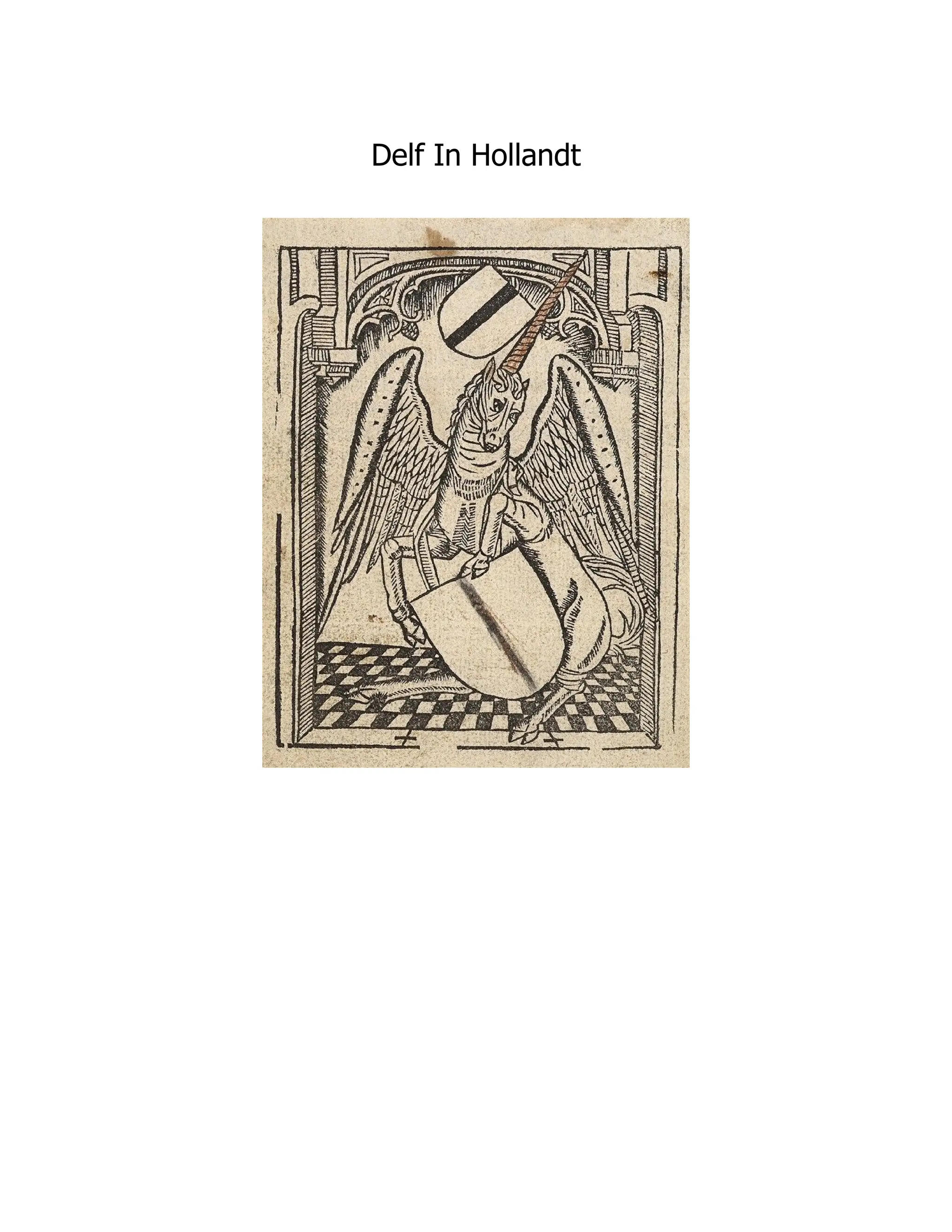
Gheprendt eñ voleyndt te Delf in Hollandt Int iaer ons heren.
M:CCCC. eñ xci: op den vijfsten dach van December
*** END OFTHE PROJECT GUTENBERG EBOOK HIER BEGHINT DIE
HYSTORIE VANDEN GROOTEN CONINCK ALEXANDER ***
Updated editions will replace the previous one—the old editions will
be renamed.
Creating the works from print editions not protected by U.S.
copyright law means that no one owns a United States copyright in
these works, so the Foundation (and you!) can copy and distribute it
in the United States without permission and without paying
copyright royalties. Special rules, set forth in the General Terms of
Use part of this license, apply to copying and distributing Project
Gutenberg™ electronic works to protect the PROJECT GUTENBERG™
concept and trademark. Project Gutenberg is a registered trademark,
and may not be used if you charge for an eBook, except by following
the terms of the trademark license, including paying royalties for use
of the Project Gutenberg trademark. If you do not charge anything
for copies of this eBook, complying with the trademark license is
very easy. You may use this eBook for nearly any purpose such as
creation of derivative works, reports, performances and research.
Project Gutenberg eBooks may be modified and printed and given
away—you may do practically ANYTHING in the United States with
eBooks not protected by U.S. copyright law. Redistribution is subject
to the trademark license, especially commercial redistribution.
START: FULL LICENSE
PLEASE READ THISBEFORE YOU DISTRIBUTE OR USE THIS WORK
To protect the Project Gutenberg™ mission of promoting the free
distribution of electronic works, by using or distributing this work (or
any other work associated in any way with the phrase “Project
Gutenberg”), you agree to comply with all the terms of the Full
Project Gutenberg™ License available with this file or online at
www.gutenberg.org/license.
Section 1. General Terms of Use and
Redistributing Project Gutenberg™
electronic works
1.A. By reading or using any part of this Project Gutenberg™
electronic work, you indicate that you have read, understand, agree
to and accept all the terms of this license and intellectual property
(trademark/copyright) agreement. If you do not agree to abide by all
the terms of this agreement, you must cease using and return or
destroy all copies of Project Gutenberg™ electronic works in your
possession. If you paid a fee for obtaining a copy of or access to a
Project Gutenberg™ electronic work and you do not agree to be
bound by the terms of this agreement, you may obtain a refund
from the person or entity to whom you paid the fee as set forth in
paragraph 1.E.8.
1.B. “Project Gutenberg” is a registered trademark. It may only be
used on or associated in any way with an electronic work by people
who agree to be bound by the terms of this agreement. There are a
few things that you can do with most Project Gutenberg™ electronic
works even without complying with the full terms of this agreement.
See paragraph 1.C below. There are a lot of things you can do with
Project Gutenberg™ electronic works if you follow the terms of this
agreement and help preserve free future access to Project
Gutenberg™ electronic works. See paragraph 1.E below.
42.
1.C. The ProjectGutenberg Literary Archive Foundation (“the
Foundation” or PGLAF), owns a compilation copyright in the
collection of Project Gutenberg™ electronic works. Nearly all the
individual works in the collection are in the public domain in the
United States. If an individual work is unprotected by copyright law
in the United States and you are located in the United States, we do
not claim a right to prevent you from copying, distributing,
performing, displaying or creating derivative works based on the
work as long as all references to Project Gutenberg are removed. Of
course, we hope that you will support the Project Gutenberg™
mission of promoting free access to electronic works by freely
sharing Project Gutenberg™ works in compliance with the terms of
this agreement for keeping the Project Gutenberg™ name associated
with the work. You can easily comply with the terms of this
agreement by keeping this work in the same format with its attached
full Project Gutenberg™ License when you share it without charge
with others.
1.D. The copyright laws of the place where you are located also
govern what you can do with this work. Copyright laws in most
countries are in a constant state of change. If you are outside the
United States, check the laws of your country in addition to the
terms of this agreement before downloading, copying, displaying,
performing, distributing or creating derivative works based on this
work or any other Project Gutenberg™ work. The Foundation makes
no representations concerning the copyright status of any work in
any country other than the United States.
1.E. Unless you have removed all references to Project Gutenberg:
1.E.1. The following sentence, with active links to, or other
immediate access to, the full Project Gutenberg™ License must
appear prominently whenever any copy of a Project Gutenberg™
work (any work on which the phrase “Project Gutenberg” appears,
or with which the phrase “Project Gutenberg” is associated) is
accessed, displayed, performed, viewed, copied or distributed:
43.
This eBook isfor the use of anyone anywhere in the United
States and most other parts of the world at no cost and with
almost no restrictions whatsoever. You may copy it, give it away
or re-use it under the terms of the Project Gutenberg License
included with this eBook or online at www.gutenberg.org. If you
are not located in the United States, you will have to check the
laws of the country where you are located before using this
eBook.
1.E.2. If an individual Project Gutenberg™ electronic work is derived
from texts not protected by U.S. copyright law (does not contain a
notice indicating that it is posted with permission of the copyright
holder), the work can be copied and distributed to anyone in the
United States without paying any fees or charges. If you are
redistributing or providing access to a work with the phrase “Project
Gutenberg” associated with or appearing on the work, you must
comply either with the requirements of paragraphs 1.E.1 through
1.E.7 or obtain permission for the use of the work and the Project
Gutenberg™ trademark as set forth in paragraphs 1.E.8 or 1.E.9.
1.E.3. If an individual Project Gutenberg™ electronic work is posted
with the permission of the copyright holder, your use and distribution
must comply with both paragraphs 1.E.1 through 1.E.7 and any
additional terms imposed by the copyright holder. Additional terms
will be linked to the Project Gutenberg™ License for all works posted
with the permission of the copyright holder found at the beginning
of this work.
1.E.4. Do not unlink or detach or remove the full Project
Gutenberg™ License terms from this work, or any files containing a
part of this work or any other work associated with Project
Gutenberg™.
1.E.5. Do not copy, display, perform, distribute or redistribute this
electronic work, or any part of this electronic work, without
prominently displaying the sentence set forth in paragraph 1.E.1
44.
with active linksor immediate access to the full terms of the Project
Gutenberg™ License.
1.E.6. You may convert to and distribute this work in any binary,
compressed, marked up, nonproprietary or proprietary form,
including any word processing or hypertext form. However, if you
provide access to or distribute copies of a Project Gutenberg™ work
in a format other than “Plain Vanilla ASCII” or other format used in
the official version posted on the official Project Gutenberg™ website
(www.gutenberg.org), you must, at no additional cost, fee or
expense to the user, provide a copy, a means of exporting a copy, or
a means of obtaining a copy upon request, of the work in its original
“Plain Vanilla ASCII” or other form. Any alternate format must
include the full Project Gutenberg™ License as specified in
paragraph 1.E.1.
1.E.7. Do not charge a fee for access to, viewing, displaying,
performing, copying or distributing any Project Gutenberg™ works
unless you comply with paragraph 1.E.8 or 1.E.9.
1.E.8. You may charge a reasonable fee for copies of or providing
access to or distributing Project Gutenberg™ electronic works
provided that:
• You pay a royalty fee of 20% of the gross profits you derive
from the use of Project Gutenberg™ works calculated using the
method you already use to calculate your applicable taxes. The
fee is owed to the owner of the Project Gutenberg™ trademark,
but he has agreed to donate royalties under this paragraph to
the Project Gutenberg Literary Archive Foundation. Royalty
payments must be paid within 60 days following each date on
which you prepare (or are legally required to prepare) your
periodic tax returns. Royalty payments should be clearly marked
as such and sent to the Project Gutenberg Literary Archive
Foundation at the address specified in Section 4, “Information
45.
about donations tothe Project Gutenberg Literary Archive
Foundation.”
• You provide a full refund of any money paid by a user who
notifies you in writing (or by e-mail) within 30 days of receipt
that s/he does not agree to the terms of the full Project
Gutenberg™ License. You must require such a user to return or
destroy all copies of the works possessed in a physical medium
and discontinue all use of and all access to other copies of
Project Gutenberg™ works.
• You provide, in accordance with paragraph 1.F.3, a full refund of
any money paid for a work or a replacement copy, if a defect in
the electronic work is discovered and reported to you within 90
days of receipt of the work.
• You comply with all other terms of this agreement for free
distribution of Project Gutenberg™ works.
1.E.9. If you wish to charge a fee or distribute a Project Gutenberg™
electronic work or group of works on different terms than are set
forth in this agreement, you must obtain permission in writing from
the Project Gutenberg Literary Archive Foundation, the manager of
the Project Gutenberg™ trademark. Contact the Foundation as set
forth in Section 3 below.
1.F.
1.F.1. Project Gutenberg volunteers and employees expend
considerable effort to identify, do copyright research on, transcribe
and proofread works not protected by U.S. copyright law in creating
the Project Gutenberg™ collection. Despite these efforts, Project
Gutenberg™ electronic works, and the medium on which they may
be stored, may contain “Defects,” such as, but not limited to,
incomplete, inaccurate or corrupt data, transcription errors, a
copyright or other intellectual property infringement, a defective or
46.
damaged disk orother medium, a computer virus, or computer
codes that damage or cannot be read by your equipment.
1.F.2. LIMITED WARRANTY, DISCLAIMER OF DAMAGES - Except for
the “Right of Replacement or Refund” described in paragraph 1.F.3,
the Project Gutenberg Literary Archive Foundation, the owner of the
Project Gutenberg™ trademark, and any other party distributing a
Project Gutenberg™ electronic work under this agreement, disclaim
all liability to you for damages, costs and expenses, including legal
fees. YOU AGREE THAT YOU HAVE NO REMEDIES FOR
NEGLIGENCE, STRICT LIABILITY, BREACH OF WARRANTY OR
BREACH OF CONTRACT EXCEPT THOSE PROVIDED IN PARAGRAPH
1.F.3. YOU AGREE THAT THE FOUNDATION, THE TRADEMARK
OWNER, AND ANY DISTRIBUTOR UNDER THIS AGREEMENT WILL
NOT BE LIABLE TO YOU FOR ACTUAL, DIRECT, INDIRECT,
CONSEQUENTIAL, PUNITIVE OR INCIDENTAL DAMAGES EVEN IF
YOU GIVE NOTICE OF THE POSSIBILITY OF SUCH DAMAGE.
1.F.3. LIMITED RIGHT OF REPLACEMENT OR REFUND - If you
discover a defect in this electronic work within 90 days of receiving
it, you can receive a refund of the money (if any) you paid for it by
sending a written explanation to the person you received the work
from. If you received the work on a physical medium, you must
return the medium with your written explanation. The person or
entity that provided you with the defective work may elect to provide
a replacement copy in lieu of a refund. If you received the work
electronically, the person or entity providing it to you may choose to
give you a second opportunity to receive the work electronically in
lieu of a refund. If the second copy is also defective, you may
demand a refund in writing without further opportunities to fix the
problem.
1.F.4. Except for the limited right of replacement or refund set forth
in paragraph 1.F.3, this work is provided to you ‘AS-IS’, WITH NO
OTHER WARRANTIES OF ANY KIND, EXPRESS OR IMPLIED,
47.
INCLUDING BUT NOTLIMITED TO WARRANTIES OF
MERCHANTABILITY OR FITNESS FOR ANY PURPOSE.
1.F.5. Some states do not allow disclaimers of certain implied
warranties or the exclusion or limitation of certain types of damages.
If any disclaimer or limitation set forth in this agreement violates the
law of the state applicable to this agreement, the agreement shall be
interpreted to make the maximum disclaimer or limitation permitted
by the applicable state law. The invalidity or unenforceability of any
provision of this agreement shall not void the remaining provisions.
1.F.6. INDEMNITY - You agree to indemnify and hold the Foundation,
the trademark owner, any agent or employee of the Foundation,
anyone providing copies of Project Gutenberg™ electronic works in
accordance with this agreement, and any volunteers associated with
the production, promotion and distribution of Project Gutenberg™
electronic works, harmless from all liability, costs and expenses,
including legal fees, that arise directly or indirectly from any of the
following which you do or cause to occur: (a) distribution of this or
any Project Gutenberg™ work, (b) alteration, modification, or
additions or deletions to any Project Gutenberg™ work, and (c) any
Defect you cause.
Section 2. Information about the Mission
of Project Gutenberg™
Project Gutenberg™ is synonymous with the free distribution of
electronic works in formats readable by the widest variety of
computers including obsolete, old, middle-aged and new computers.
It exists because of the efforts of hundreds of volunteers and
donations from people in all walks of life.
Volunteers and financial support to provide volunteers with the
assistance they need are critical to reaching Project Gutenberg™’s
goals and ensuring that the Project Gutenberg™ collection will
48.
Welcome to ourwebsite – the perfect destination for book lovers and
knowledge seekers. We believe that every book holds a new world,
offering opportunities for learning, discovery, and personal growth.
That’s why we are dedicated to bringing you a diverse collection of
books, ranging from classic literature and specialized publications to
self-development guides and children's books.
More than just a book-buying platform, we strive to be a bridge
connecting you with timeless cultural and intellectual values. With an
elegant, user-friendly interface and a smart search system, you can
quickly find the books that best suit your interests. Additionally,
our special promotions and home delivery services help you save time
and fully enjoy the joy of reading.
Join us on a journey of knowledge exploration, passion nurturing, and
personal growth every day!
testbankfan.com


![3. When the organization is first founded, corporate strategies are addressed immediately
where the overall strategic goal(s) and directions are formulated by the CEO and top
management team and then functional strategies are addressed.
4. The vast majority of strategic situations are ones where the organization is not new. In these
situations; functional strategies are looked at first in the process of deciding the most
appropriate strategies—that is, the ones that will lead to a sustainable competitive
advantage.
B. What Happens after the SWOT Analysis?
1. Decision makers have information about the positive and negative aspects of both the
external and internal environments (i.e., Internal [Strengths and Weaknesses] and External
[Opportunities and Threats]).
2. If the organization’s strengths in the various functional units can be exploited as
competitive advantages, particularly in light of any relevant external opportunities, the
organization may well be on its way to achieving high levels of performance.
3. If negative trends are found in any of the organization’s external areas or weaknesses,
changes in functional strategies might be needed to counteract these.
4. Serious functional weaknesses that might be preventing a competitive advantage from being
developed may need to be corrected or minimized.
Active Learning Hint
Conduct a SWOT analysis for Domino’s Pizza and address the issues presented in the Strategic
Management in Action highlight. Divide the class into groups of 4-5 students to work on the SWOT,
and then ask several of the groups to report their findings. Another method would be to divide the class
into 4 groups (or multiples of four). One group identifies the strengths, another group the weaknesses,
etc. Ask each group to report their findings to the class.
Strategic Management in Action: Super Bowl and Pizza
1. Discuss whether to try to meet peak demand – does it lead to loyalty? Is it a weakness if a company
cannot meet demand on that particular day. If you cannot supply your customers you open the door
to rival suppliers and you may lose some to other pizza-makers if you turn them away.
2. A SWOT analysis may reveal if production or delivery capacity are inadequate for the peak demand
or if there may be excess capacity.
C. What Functional Strategies Does an Organization Need?
Functional (or operational) strategies are the short-term, goal-directed decisions and actions
of the organization’s various functional units (Figure 5.2).
All organizations perform three basic functions as they create and deliver goods and services:
1) Product Strategies (design, production-operations, marketing)
2) People Strategies (human resources)
3) Support Process Strategies (information and financial-accounting systems)
1. Functional Strategies – The Product
a). Product design strategies typically involve an organization’s R&D function
b). Once products are ready to be produced, production-operations strategies ensue
c). Next, marketing strategies are implemented
2. Functional Strategies – The People
a). High-performance Work Practices are human resource policies and practices that
lead to both high individual and high organizational performance.
b). Table 5.1 lists some of the high-performance work practices that have been identified.](https://image.slidesharecdn.com/6296-250503024633-cae82822/75/Strategic-Management-in-Action-6th-Edition-Coulter-Solutions-Manual-6-2048.jpg)








![spreken wãt daer leyt loosheit in: eñ men becleet die logen mit
schoonre talen also schone datter menich man mede bedrogen wort
Wãt men ontschuldicht daer mede de misdadighen eñ men
[ver]duystert daer mede dat recht Dã prijsen die ghene diet horen
dẽ taelman eñ seggẽ dat hi wijs is: mer dit is een onsalich prijs die
die cõsciencie besmettet Maer onder ons en doetmen dit
nimmermeer. want wi hebben een zeer simpele sprake die altijts wel
eñ waersprekende wesen moet Ende wi en willen tot gheenre
scholen gaen: anders niet dan daermen leert dat sekerste eñ dat
beste. wãt wi en leren anders niet eeren dã dat ouerste goet. Eñ ghi
leert te vogelen eñ te doen dat genoechlic is uwẽ vleische Wij en
offeren gode gheen beesten. noch en maken hẽ gheen grote
costelicke tẽpelen eñ outaren als ghi doet Eñ v luden dunct datter
gheen arm ludẽ en sijn die uwes goets te doen hebben Dat is groote
misdaet want god wilt gheeert wesen om sijn grootheit mit suueren
dienst sonder bloet te storten eñ te offerẽ Wãt alsmen hẽ bidt mit
suueren woorden soe doet hi dẽ menschen genade Want god is
selue dat woort daer alle dingen bi gemaect sijn eñ alle dingen
behoet hout eñ voet Dat woort minnẽ wi. wãt dat heeft ons nv
gegeuen onsẽ geest eñ ons leuen. Mer om dat god selue is gheest
eñ leuen soe en machmen niet wel gewinnen sijn vrientscap mit
desen aertschen goede: mer men wint sijn vrientscap mit suuerẽ
leuen eñ datmen hẽ altijt dancke eñ loue Hier om segghen wi dat
ghi onsalich volck bent. want ghi en [ver]staet niet dat v beghin is
vandẽ hemel. eñ dat ghi maechscap hebt mit gode die alle dinc
gescepen heeft Mer mit dorperlike dinghen besmet ghi uwe edelheit
altemael om dat ghi die genoechte uwes vleysches volget na sijnre
begeerten: ende dat ghi vercoren hebt eñ minnet alle dingen die
comen vãder aerden: ende die minne daer of ontsuuert die lucht:
dat water ende die aerde Noch doet ghi veel meer quaets want ghi
sijt gode al of gegaen eñ ghi aenbedet dode luden recht of sij goden
waren want sij sijn moortdadighe luden eñ vyanden die v tot alle
scanden brengen](https://image.slidesharecdn.com/6296-250503024633-cae82822/75/Strategic-Management-in-Action-6th-Edition-Coulter-Solutions-Manual-22-2048.jpg)
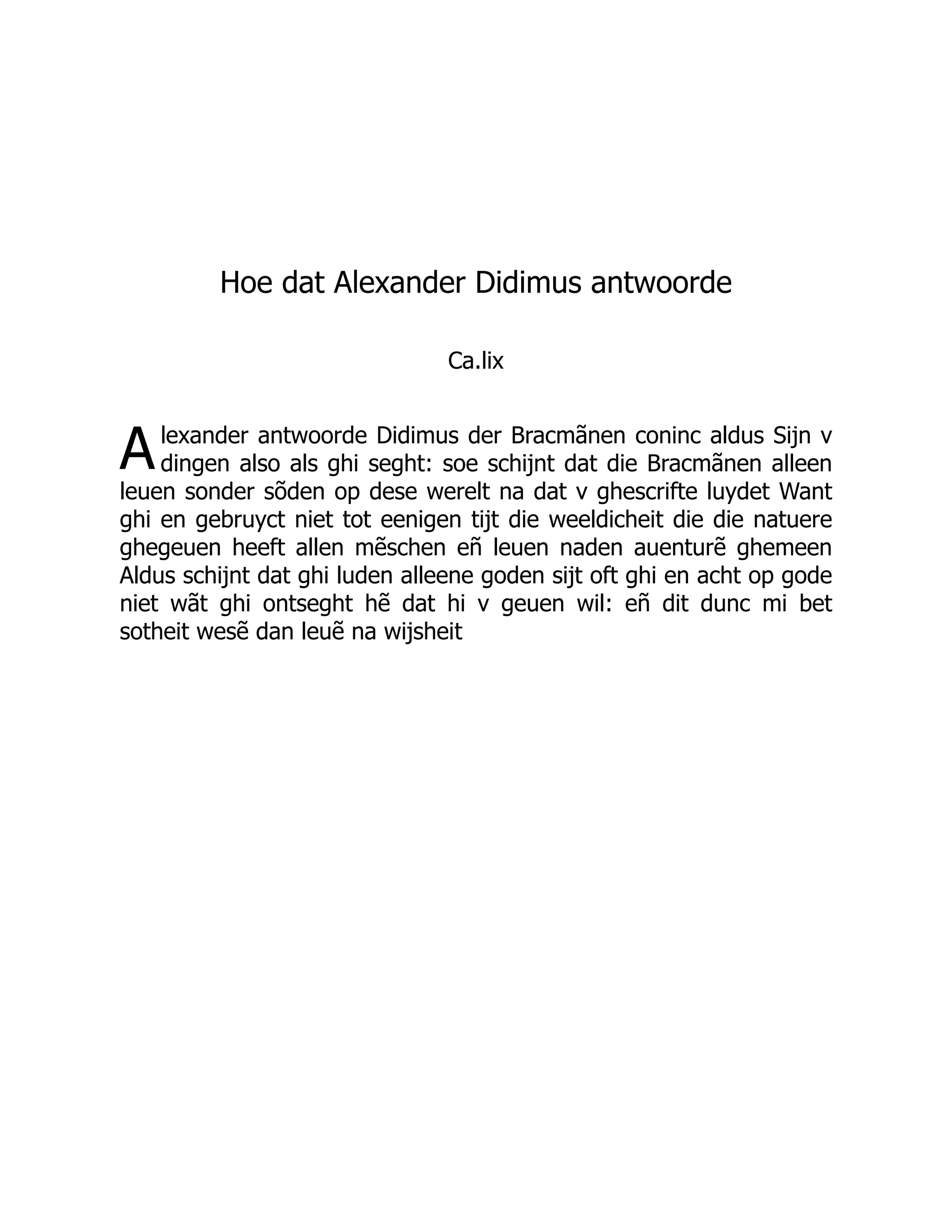
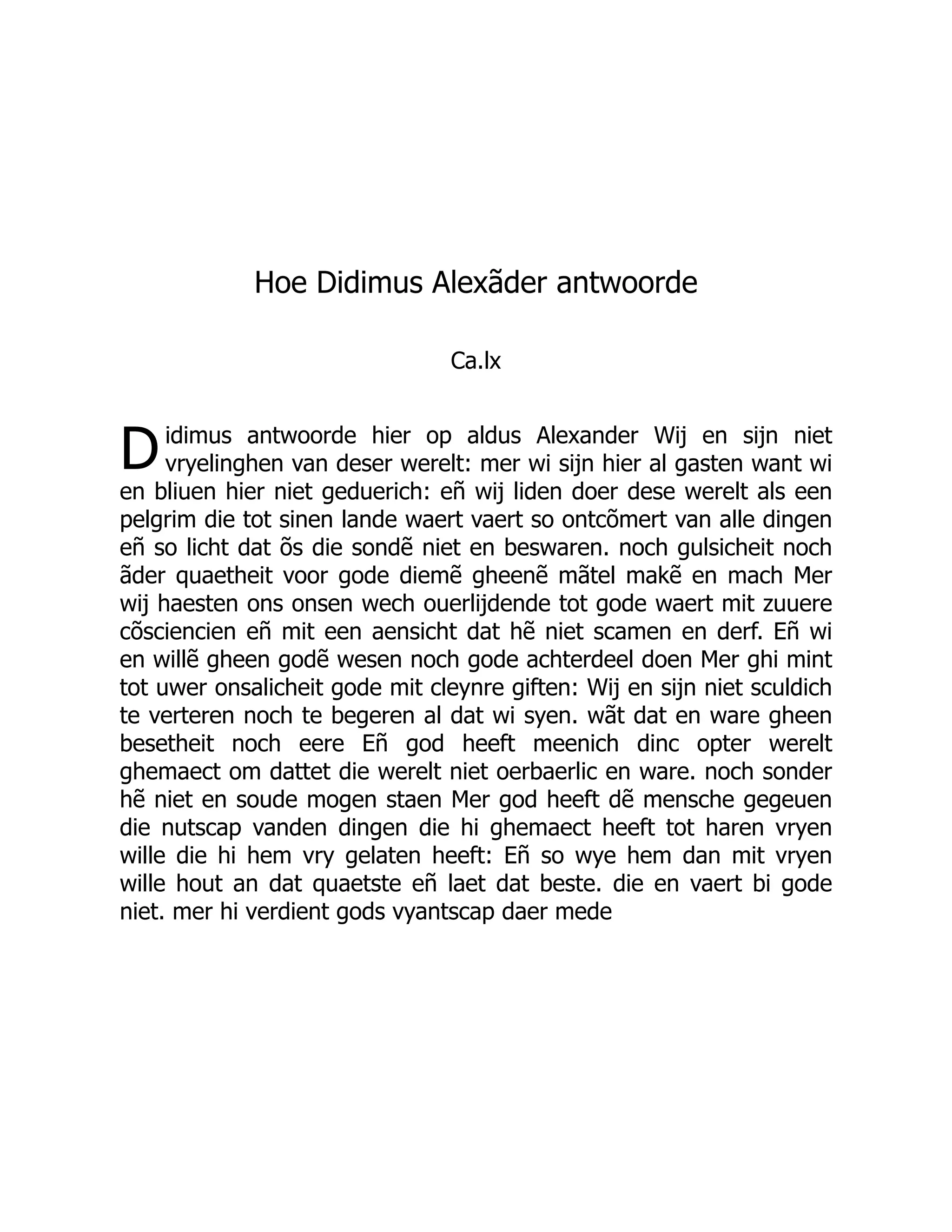
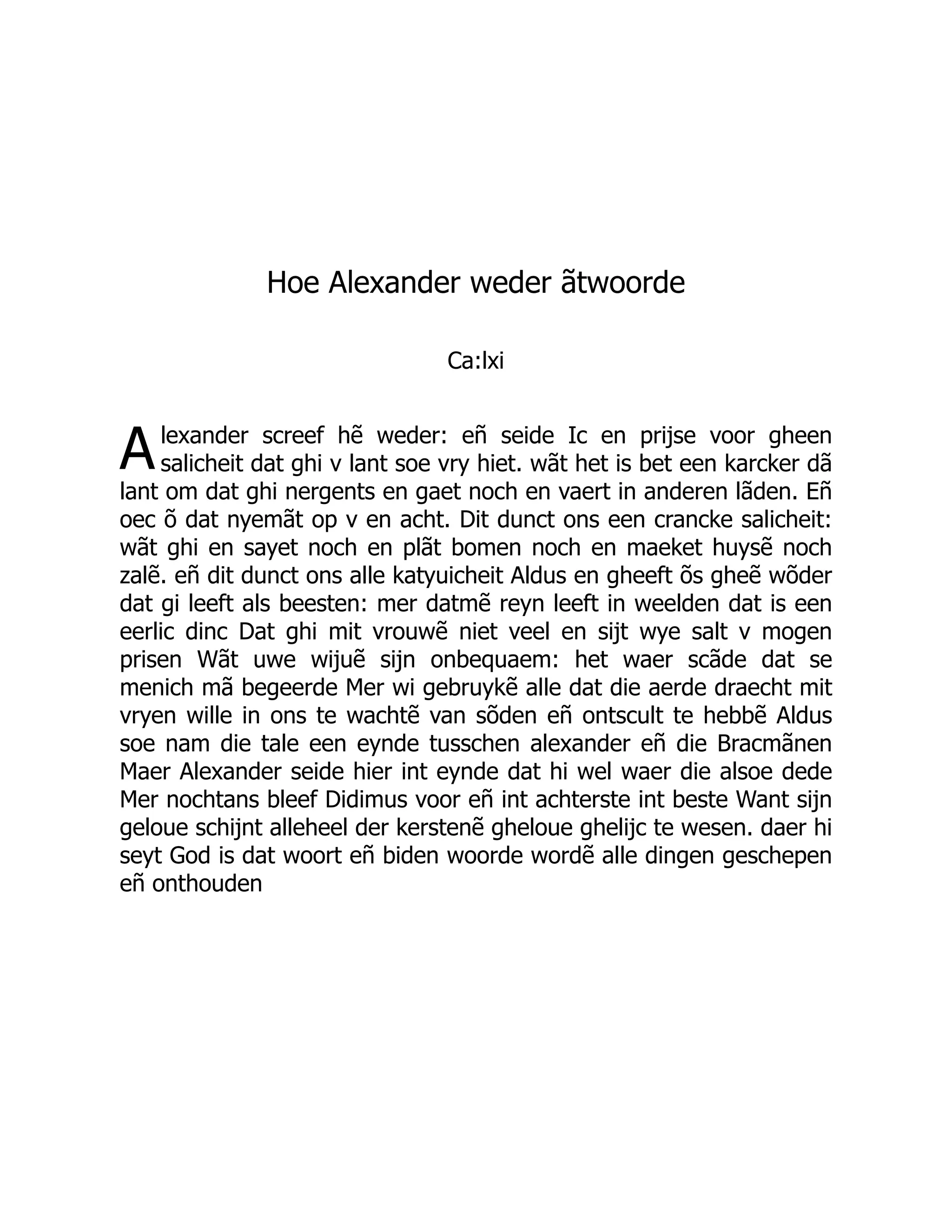
![A
Hoe Alexander te Babilonien quam tot s[~ij]re doot
waert.
Cap.lxij.
ls alexander bi Babilonien quã soe hiet hẽ een waersegger dat hi
inder stat niet en ghinge: wãt sijn leuen lach daer an Hier õ liet
alexander die stat staen eñ hi voer ouer in een stat gehietẽ Bursia
daer doe nyemãt in en woende Een vã alexanders vriendẽ die
Amoxarcus hiet die seide hẽ datmen gheen waerseggers gelouen en
soude want sij plegen veel te lieghen Om dese woorden soe voer
alexander te Babilonien binnen Doe seide Corbanes die waerseggher
Gheen argher dinc en is aenden mẽsche dã dat een mẽsche plõper is
om te doẽ s[~ij]s selfs oerbaer dan eens anders Als Alexander binnẽ
die stat quam soe settemen hẽ een crone op s[~ij] hooft gemaect
vã yuore eñ goude Eñ Porrius leyde hẽ an die een syde eñ Dari[us]
broeder an die ander syde. Eñ als hi te rechte geseten was so quã
groot volc voor hẽ eñ clageden hẽ ouer sijn rechters. eñ si vraechdẽ
hem oft sinen wille was datmẽse soe iãmerlic tonder dede Als
alexander dit hoorde soe dede hij alle sijn rechters doden voor die
boden ogen. eñ hier na nam hi Hoaxanes Darius dochter te wijue:
Eñ hij hiet dẽ Gryeken dat sij nemen souden vãden schoonsten eñ
edelste maechden die hẽ best behaechden vãden ghenen die si wt
alle lãden gebrocht hadden Hier na vergaderde hi alle dat ridderscap
eñ goedese rijckelick eñ hi gaf hẽ groot goet alsoet elck begheerde:
Eñ die oude ridders liet hi vry vã oerloghen. mer in haer stede sette
hi iõgelingen Eñ die iõghelingen seidẽ daer zeer teghen: eñ sij baden
hẽ dat hijse oec verlaten wilde: mer hi seide hẽ dat hijse om](https://image.slidesharecdn.com/6296-250503024633-cae82822/75/Strategic-Management-in-Action-6th-Edition-Coulter-Solutions-Manual-26-2048.jpg)


![Alexander onthoudẽ om dat die een altijt den dranc proefde eer
datten alexander dranc: eñ als hijen dã geproeft had soe ontfinc
alexan[der] dẽ nap eñ dranc selue Nu had Antipater doen maken so
sterckẽ fenijn. dat hi wel seker was hads alexander yet int lijf dat hi
steruẽ moeste Want dit fenijn was also sterck datmen niet houden
en mochte in vaten van siluer of van goude noch vã yser of vã
metael noch in gheẽ vat: sõder in een hoeue van een paert Antipater
was oeck soe seker dat alexander daer of steruẽ soude dat hi seide
tot Casãder sinẽ zone dat hi dat rijck vã Macedoniẽ behoudẽ soude](https://image.slidesharecdn.com/6296-250503024633-cae82822/75/Strategic-Management-in-Action-6th-Edition-Coulter-Solutions-Manual-29-2048.jpg)


![A
Van Alexanders doot
Ca. lxv.
lexander dede hem dragen in een hoghe stat daer hẽ al sijn
volck mochte syen liggen in groter pijnẽ Eñ hi lietse alle tot hẽ
comen eñ hi beual datmen nyemant [ver]bieden en soude die daer
comẽ wilde. Eñ daer quam tot hem menich stout riddere die zeer
screyden eñ groot misbaer maecten Hier nae badt Alexander sijn
vrienden. als hi doot ware datmen hẽ mit duerbaren specien eñ
balsamen begrauen soude Eñ datmẽ hẽ voeren soude nergens dã in
Lybia in Amõs sijns vrients schonen tempel daer hi gecroent staet
Doe vraechdẽ hem sijne vriendẽ om dat sij sagen dat hi soe cranc
was: wye hi wilde dat nae hem sijn crone draghen soude vã sijnen
rijcke Hi seide die beste Maer hi en noemde nyemãt. noch Hercules
sinẽ zone noch sinen broeder: noch oec dat kint dat Roexanes
droech die doe swaer ghinc bi hẽ mit kinde Want alexander dachtet
ouer dat hi die soe groten heer was van enighen mã soe groten
rijcken heer makẽ soude hi en waert waerdich want hi hads onwaert
sulck goet te laten enighen man dies niet waerdich en waere. Ten
sesten daghe ontuiel hẽ sijn sprake eñ doe nam hi sijn vingerlinc eñ
stact een vãden iongelingen an sijn hant Doe meendẽ veel herẽ die
daer waren dat alexander wilde dat hi coninck nae hẽ wesen soude
Scolastica historia seit dat alexãders suster hẽ fenijn gaf: om dat sy
hoepte eenen grotẽ heer te crigen eñ vrouwe te wesen vã alle sijn
rijck Eñ alsoe haest als hi dat fenijn int lijf hadde dat hi doe sijn
sprake verloes Eñ om dat hi wilde dat nẽmermeer also groten heere
nae hẽ wesen en soude in aertrike als hi doen was. soe screef hi](https://image.slidesharecdn.com/6296-250503024633-cae82822/75/Strategic-Management-in-Action-6th-Edition-Coulter-Solutions-Manual-32-2048.jpg)

![I
Van Alexanders vromicheit
Ca: lxvi
nder maent Iulius diemẽ hoymaẽt hiet mit ons soe sterf dese
grote Alexander doe hij in sijn xxxiij. iaer was Hi was die meeste
van moede eñ vã herten die nye in die werelt quã Hi was oec die
machtichste mã die nye in die werelt regneerde Hi verloste altijt sijn
rid[der]s wt harẽ noot dat sij mit sinen troeste soe stout waren dat
hẽ dochte al haddẽ sij alle naect gheweest. hẽ en hadde niet mogen
deren als sij hẽ sagen Hẽ en geuiel oec nye dat hi enigen man
bestont hi en verwan hẽ. noch nye en bestont hi borch noch stat hoe
vaste dat sy warẽ: hi en wanse of hadse tot sinen wille Nye en quam
oec volck tegen hẽ te stride hi en [ver]wanse Mer int eynde wort hi
selue verwõnen, maer niet mit geuechte mer mit verraderie vã sinẽ
dienres die alsoe deerlic vergauen mit fenijn Men leest dat hi enen
steen hadde soe wye die steen droech dat hem gheen fenijn deren
en mochte Mer daer hi aldus [ver]raden was so was hẽ des nachts
dẽ steen benomen om dat dẽ moort voldaen soude wordẽ eñ
verholen bliuẽ Mer alst fenijn in die aderen getogen was alsoe dattet
die natuere niet en conde gelosen soe wort hẽ sinen steen weder
gegeuen al heymelic Eñ aldus verghinc die auenture mit hẽ Als die
mare te Babilonien quam dat Alexander gestoruẽ was in die bloeme
sijnre ioecht eñ int meeste van sijnre cracht so wort die stat zeer
droeuich Maer die luden die hij verwonnen hadde en wouden dat
niet gelouen dat hi doot soude wesen: want sij meenden dat hi
nimmermeer en soude mogen steruen Sonderlinghe om dat si
ghesien hadden dat hi in groter auenturen dicwijls verlost worde](https://image.slidesharecdn.com/6296-250503024633-cae82822/75/Strategic-Management-in-Action-6th-Edition-Coulter-Solutions-Manual-34-2048.jpg)

![M
Van Alexanders begrauinghe:
Cap lxvij
en maecte in Babilonien groot geclach eñ hant gheslach van
rouwen Maer ick segghe ouer waer dat die dode menschẽ
gheen vrienden en hebben. want datmen daerwaert dient dat is al
om ghewin. want anden doden en leyt nyemant eñ elck doets hẽ
eerst of also hi eerst mach Die na Alexander bleuẽ die bedreuen
haer dinc alsoe dat al gemeenlic rijck bleuen Maer daer was ghestrijt
een wile om s[~ij] sepulture Die vã Gryeken wilden hẽ ter stont
veruoeren tot haren lande waert Mer si droeghen ouer een datmen
Iupiter vraghen soude waermen hẽ grauen soude Iupiter ãtwoorde
datmen alexander grauen soude in Alexandrien in die groote stadt
die hi seluer dede maken in Egipten Dit seide doe Iupiter. eñ men
dede daer een schoon costelic graf maken Ende Ptholomeus die nae
hem coninc bleef dede hẽ daer zeer rijckelick begrauen. alsoet
alsulcken heere ende coninck wel betamelic was: In Alexanders
tijden en vantmen ghenen alsoe wijsen coninc als hi was. hadde hi
hẽ konnen wachten van veel wijns te drincken: eñ hadde dese grote
heere hẽ konnen houden also gemaetich in sijn manieren in sijnre
groter rijcheyt als hi dede doe hi arm was. Inder noot en konste hem
nyemant bet beuroeden dan hi. maer in sijnre weelden was hi zeer
sot: want hi wilde god gehieten wesen Eñ altijts hadde hi tot sinen
raede seuen wijse mannen: want dat beual hem die groote
philosophe Aristoteles sijn lieue meester Maer als hẽ yet swaers aen
quam soe nam hi elcken van desen wijsen mannen alleen eñ hi seide
hem sijn dingen eñ ghebreck altemael: eñ dan soe vraechde hi hem](https://image.slidesharecdn.com/6296-250503024633-cae82822/75/Strategic-Management-in-Action-6th-Edition-Coulter-Solutions-Manual-36-2048.jpg)