Dan Hahn


Strategic Communication Basics
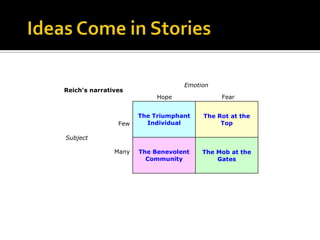
Emotion
Reich's narratives
                           Hope             Fear


                      The Triumphant   The Rot at the
                Few     Individual          Top

Subject

               Many   The Benevolent   The Mob at the
                        Community          Gates
 Your story goes public more quickly and more
  broadly.
 Your story, not theirs, defines reality.
 Case in point: Ronald Reagan transformed the civil
  rights movement into a story about “activist
  judges,” “social experiments,” and the need to “get
  government off your backs” without having to
  mention civil rights (but old time Dixiecrats “got it.”)
   Upshot: stories can fly under your radar.
   You like what I like.
   You value what I value.
   You think like I think
    … which implies
   Effective communicators care enough
    about their audiences to identify with
    their attitudes!
 Policy wonks and other head-trippers are a
  minority.
 We hold faith, hope, and love in our hearts.
 We hold anger, fear, and disgust in our guts.
 Winning stories go for hearts or guts.
   Narrative Fidelity
   Narrative Probability
     or in plain English
   Does it hang together?
   Does it ring true?
 Has coherent structure, implicit or explicit, from
  “once upon a time” to “happily ever after.”
 Has heroes, villains, “damsels in distress,” etc.
  clearly defined.
 Is moving, vivid, memorable, rich in
  metaphor, has a clear moral, yet is clear enough
  that Disney could use it.
 May reframe opposition narratives, metaphors
  (see Reagan, above).
 Choose a still-challenging issue.
 Identify the opposition.
 Identify their core story (stories).
 Do they have “winning stories” that
   Evoke commonality?
   Touch emotions?
   Hang together and ring true?
 How might you undermine their story (stories) ?
 Remain with that still-challenging issue.
 Identify your core story (stories) .
 Do you have “winning stories” that
   Evoke commonality?
   Touch emotions?
   Hang together and ring true?
 How might you defend your story?
 Create or revise your core story and prepare to
  share the improvements.

Strategic communication

  • 1.
  • 2.
    Emotion Reich's narratives Hope Fear The Triumphant The Rot at the Few Individual Top Subject Many The Benevolent The Mob at the Community Gates
  • 3.
     Your storygoes public more quickly and more broadly.  Your story, not theirs, defines reality.  Case in point: Ronald Reagan transformed the civil rights movement into a story about “activist judges,” “social experiments,” and the need to “get government off your backs” without having to mention civil rights (but old time Dixiecrats “got it.”)  Upshot: stories can fly under your radar.
  • 4.
    You like what I like.  You value what I value.  You think like I think … which implies  Effective communicators care enough about their audiences to identify with their attitudes!
  • 5.
     Policy wonksand other head-trippers are a minority.  We hold faith, hope, and love in our hearts.  We hold anger, fear, and disgust in our guts.  Winning stories go for hearts or guts.
  • 6.
    Narrative Fidelity  Narrative Probability or in plain English  Does it hang together?  Does it ring true?
  • 7.
     Has coherentstructure, implicit or explicit, from “once upon a time” to “happily ever after.”  Has heroes, villains, “damsels in distress,” etc. clearly defined.  Is moving, vivid, memorable, rich in metaphor, has a clear moral, yet is clear enough that Disney could use it.  May reframe opposition narratives, metaphors (see Reagan, above).
  • 8.
     Choose astill-challenging issue.  Identify the opposition.  Identify their core story (stories).  Do they have “winning stories” that  Evoke commonality?  Touch emotions?  Hang together and ring true?  How might you undermine their story (stories) ?
  • 9.
     Remain withthat still-challenging issue.  Identify your core story (stories) .  Do you have “winning stories” that  Evoke commonality?  Touch emotions?  Hang together and ring true?  How might you defend your story?  Create or revise your core story and prepare to share the improvements.