#DISTRIBUTED
Part Story. Part Manifesto.
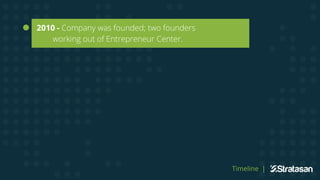
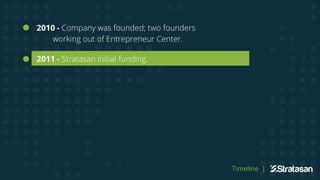
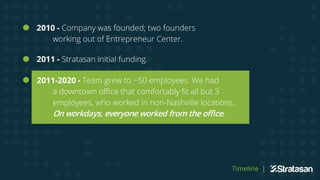
2010 - Company was founded; two founders
working out of Entrepreneur Center.
Timeline |
2011 - Stratasan initial funding.
Timeline |
2010 - Company was founded; two founders
working out of Entrepreneur Center.
March 11, 2020 through today
We’re still working remotely.
2011-2020 - Team grew to ~50 employees. We had
a downtown office that comfortably fit all but 3
employees, who worked in non-Nashville locations.
On workdays, everyone worked from the office.
Timeline |
2011 - Stratasan initial funding.
2010 - Company was founded; two founders
working out of Entrepreneur Center.
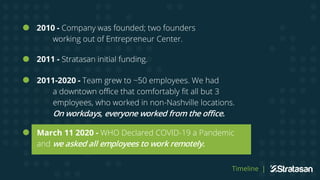
March 11 2020 - WHO Declared COVID-19 a Pandemic
and we asked all employees to work remotely.
Timeline |
2011 - Stratasan initial funding.
2010 - Company was founded; two founders
working out of Entrepreneur Center.
2011-2020 - Team grew to ~50 employees. We had
a downtown office that comfortably fit all but 3
employees, who worked in non-Nashville locations.
On workdays, everyone worked from the office.
And, it’s working.
And, it’s working.
So well, in fact…
That we decided to do it indefinitely.
Except we’re calling it
“Distributed,” not “remote.”
Remote work is a discipline for the individual worker,
Distributed work is a discipline
for the entire organization.
(according to this Dropbox blog)
WHAT WE’LL COVER TODAY
1 | Guiding Principles for Distributed Work
2 | Revisit Our Core Values
3 | Our Culture and “Unwritten Rules”
As of Jan 2021,
we’ve grown to 68 Stratanauts.
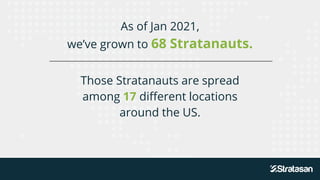
Those Stratanauts are spread
among 17 different locations
around the US.
As of Jan 2021,
we’ve grown to 68 Stratanauts.
1
2
3
32
NASHVILLE AREA
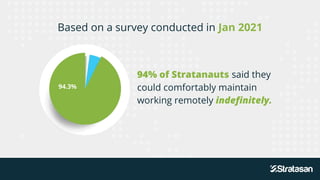
Based on a survey conducted in Jan 2021
Based on a survey conducted in
94% of Stratanauts said they
could comfortably maintain
working remotely indefinitely.
94.3%
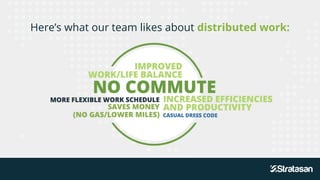
Here’s what our team likes about distributed work:
But wait...
moving toward a fully distributed workforce
isn’t as easy as it sounds.
moving toward a fully distributed workforce
isn’t as easy as it sounds.
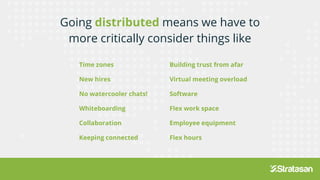
Time zones
New hires
No watercooler chats!
Whiteboarding
Collaboration
Keeping connected
Building trust from afar
Virtual meeting overload
Software
Flex work space
Employee equipment
Flex hours
Going distributed means we have to
more critically consider things like
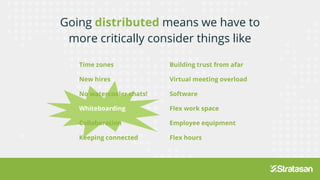
Time zones
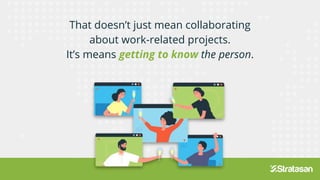
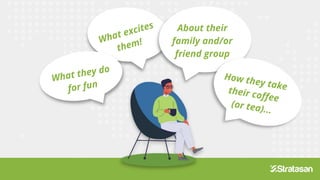
New hires
No watercooler chats!
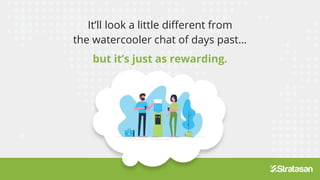
Whiteboarding
Collaboration
Keeping connected
Building trust from afar
Virtual meeting overload
Software
Flex work space
Employee equipment
Flex hours
Going distributed means we have to
more critically consider things like
To make this work,
we’ve got to change the way
we think.
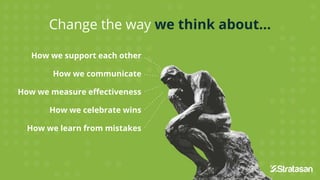
Change the way we think about...
How we support each other
Change the way we think about...
How we support each other
How we communicate
Change the way we think about...
How we support each other
How we communicate
How we measure effectiveness
Change the way we think about...
How we support each other
How we communicate
How we measure effectiveness
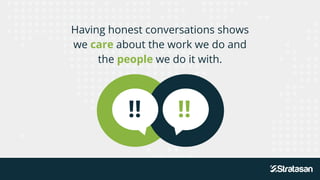
How we celebrate wins
Change the way we think about...
How we support each other
How we communicate
How we measure effectiveness
How we celebrate wins
How we learn from mistakes
We can no longer get away with
doing things the way we’ve always done them.
~ because ~
distributed work creates an entirely new landscape
in which to conduct business.
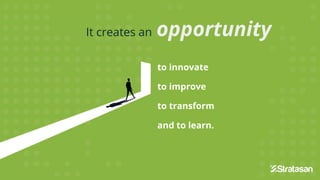
It creates an opportunity
to innovate
to improve
to transform
and to learn.
We’ve come up with a few guiding principles
to help us adapt to this new way.
(As we all know, “We’ll figure it out” is a commonly used phrase around here. More on this later…)
“We’ll figure it out” is a commonly used phrase around here. More on this later…)
is a commonly used phrase around here. More on this later…)
Disclaimer: This is a work in progress.
We’re iterating and
learning as we go.
Disclaimer: This is a work in progress.
We’re iterating and
learning as we go.
Communication
is King.
Communication
is King (and Queen).
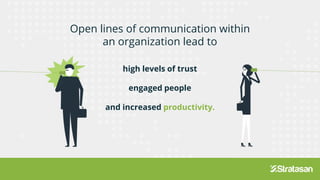
Open lines of communication within
an organization lead to
high levels of trust
engaged people
and increased productivity.
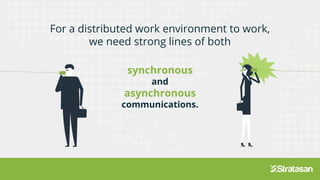
For a distributed work environment to work,
we need strong lines of both
synchronous
and
asynchronous
communications.
we need strong lines of both
Asynchronous communication
doesn’t require the recipient’s immediate attention,
allowing them to respond to the message
at their convenience.
Mastering the art of asynchronous communication
allows for work to get done
efficiently
and
effectively
in an organization where people
aren’t physically together.
When reading
(and when writing), it’s best to
assume positive intent
We love this one so much → it was brought back as a core value by popular demand.
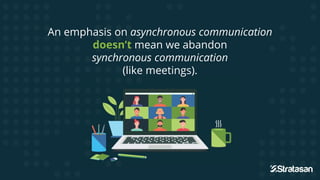
An emphasis on asynchronous communication
doesn’t mean we abandon
synchronous communication
(like meetings).
(like meetings).
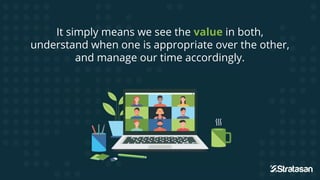
It simply means we see the value in both,
understand when one is appropriate over the other,
and manage our time accordingly.
We view meetings as massive opportunities.
Opportunities to
- Connect
- Discuss
- Unite
We view meetings as massive opportunities.
Opportunities to
- Connect
- Discuss
- Unite
Have breakthroughs.
To make meetings meaningful,
we have to be deliberate.
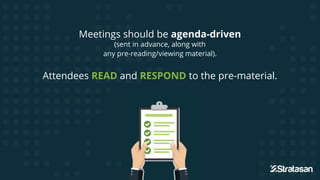
Meetings should be agenda-driven
(sent in advance, along with
any pre-reading/viewing material).
Attendees READ and RESPOND to the pre-material.
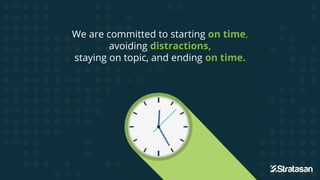
We are committed to starting on time,
avoiding distractions,
staying on topic, and ending on time.
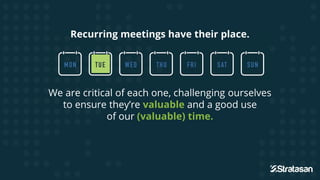
Recurring meetings have their place.
We are critical of each one, challenging ourselves
to ensure they’re valuable and a good use
of our (valuable) time.
Recurring meetings have their place.
We are critical of each one, challenging ourselves
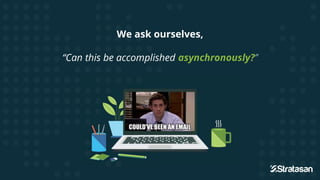
We ask ourselves,
“Can this be accomplished asynchronously?”
And also:
“Is this the right amount of time for this meeting?”
“Is this the right attendee list?”
“Is the goal of the meeting clear?”
“Is this the right cadence?”.
In short:
We’re vigilant in managing our time.
Time is sacred. We must use it wisely.
Document
Everything.
Document
Everything.
To keep our team aligned in a
distributed work environment...
Documentation is essential.
Documentation enables a stronger,
more informed, more trusting,
and more connected team.
Documentation prevents the toxic cycle of
touch points intending to "bring people up to speed."
Documentation holds us accountable
to both a higher quality of work and to each other.
In a distributed work environment,
documentation is a competitive advantage.
1
IF
( and only if )
it’s done properly
by everyone.
Clarity in writing = Clarity in thinking.
Which is why clear writing is hard work.
But it’s worth it.
Thinking about
how our words
will be received
helps us be
more empathetic.
Thinking
will be received
A great method for
documentation is an RFC.
What’s an RFC?
It’s a “Request for Comment.”
But it’s worth it.
Request for Comment is a method
of documentation that serves as
a way to communicate proposals,
gather feedback, and plan
a course of action.
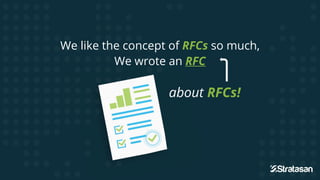
We like the concept of RFCs so much,
We wrote an RFC
about RFCs!
We like the concept of RFCs
We wrote an RFC
about
We wrote an
about
Not to mention,
in a distributed environment,
communicating through writing is inherently
inclusive and considerate.
Engagement
over presence.
Engagement
over presence.
It’s not about showing up physically.
It’s about showing up mentally
and engaging fully
from wherever you are.
Distributed work requires a mindshift
in how we measure success.
It introduces
a new social contract.
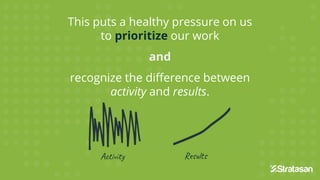
This puts a healthy pressure on us
to prioritize our work
and
recognize the difference between
activity and results.
Activity Results
We hire people who
take pride in doing
great work.
take pride in doing
great work.
In the interview process, we call this the
“give-a- factor”
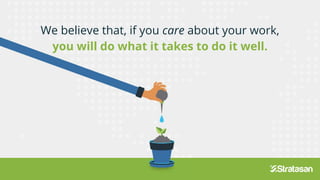
We believe that, if you care about your work,
you will do what it takes to do it well.
Being in a positive work environment
+
caring about your work
allows you to
bring your whole self to work.
Bringing your whole self to work
usually leads to...
usually leads to...
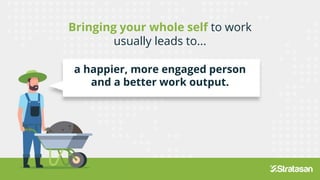
Bringing your whole self to work
usually leads to...
a happier, more engaged person
and a better work output.
usually leads to...
a happier, more engaged person
and a better work output.
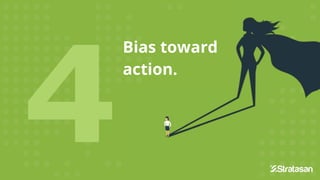
Bias toward
action.
Bias toward
action.
We favor action over
deliberation.
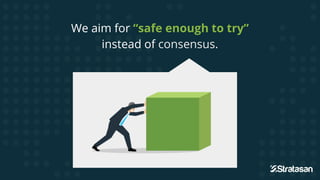
We aim for “safe enough to try”
instead of consensus.
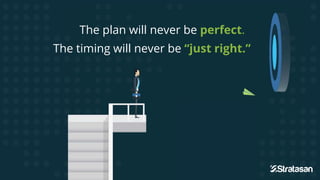
The plan will never be perfect.
The timing will never be “just right.”
When time is of the essence
(which, it always is) we
act quickly,
fail fast,
learn,
and try again.
(Back to our documentation principle)...
we seek a consent-based environment,
not a consensus-based one.
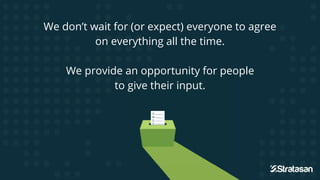
We don’t wait for (or expect) everyone to agree
on everything all the time.
We provide an opportunity for people
to give their input.
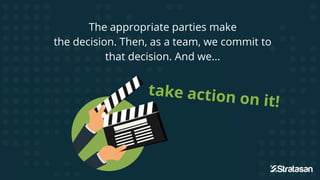
The appropriate parties make
the decision. Then, as a team, we commit to
that decision. And we...
Be human
and be kind.
Be human
and be kind.
In a distributed world,
relationship building doesn’t happen
as organically as when
people share a physical space.
We have to deliberately build relationships
with those we work with.
That doesn’t just mean collaborating
about work-related projects.
It’s means getting to know the person.
About their
family and/or
friend group
friend group
It’ll look a little different from
the watercooler chat of days past…
but it’s just as rewarding.
People put forth their best when they
are doing it for each other.
(Especially when things are hard.
And, when you’re doing meaningful work,
they often are.)
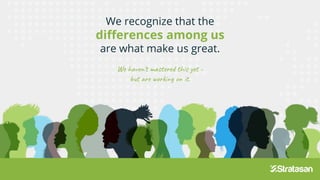
We recognize that the
differences among us
are what make us great.
We haven't mastered this yet -
but are working on it.
Share information,
don’t hoard it.
Share information,
don’t hoard it.
Share information,
don’t hoard it.
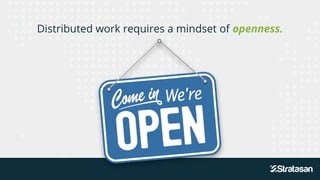
Distributed work requires a mindset of openness.
Openness to
new ideas
collaboration
input from others
sharing with the team...
We know that information breeds
knowledge,
a broader understanding,
empathy for others,
and, usually,
a more productive, happier team.
We assume our reader (or listener)
would benefit from context.
So we offer it.
We are responsive,
provide commentary, participate,
and offer suggestions.
We strive to over- communicate.
But how do we make sure
the team is communicating in a way
that’s best for the organization -
and the people within it?
We lean (hard) on our
core values.
Our core values
unite our team and hold us accountable.
They are the fabric of who we are.
Our Success
Is My Success.
Our Success
Is My Success.
1
Core Value
This one's first because it's critical to our
success and is our only non-negotiable.
We have a team of awesome contributors,
and we recognize that nothing great is done alone.
It’s the collective, the sum of the parts,
that makes us who we are.
We are quick to give praise
and slow to take credit.
We support one another,
appreciate and recognize the contribution of others,
and
strive for the success of the team.
Everyone Makes
The Coffee.
Everyone Makes
The Coffee.
2
Core Value
Back when we
were in the office,
this metaphor made
a bit more sense.
Now that we’re
remote … most of
us make our own
damn coffee (or tea).
We help where help is needed.
Whether we’re asked to pitch in on
an important call, run a meeting at the
last minute, run a report to help out
a team member….
everybody does what’s necessary
to keep the engine running.
Anyway…
title.
No job is
too small
for a
title.
“big” “small”
No job
is too
big for a
A nod to our 4th Guiding Principle
We have a bias for action.
If action is needed and we’re capable
of taking it -
We do.
Assume
Positive Intent.
Assume
Positive Intent.
3
Core Value
We believe it’s important to start
from the assumption that
People are Good
and that their intentions are positive.
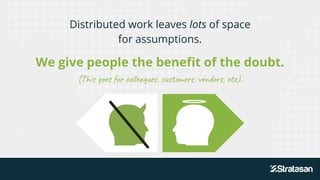
Distributed work leaves lots of space
for assumptions.
We give people the benefit of the doubt.
(This goes for colleagues, customers, vendors, etc).
We assume people
coming from a good place
and exercise empathy.
We believe this builds stronger
and more trusting relationships.
Honest Conversations
Make Us Stronger.
Honest Conversations
Make Us Stronger.
4
Core Value
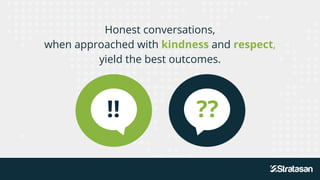
Honest conversations,
when approached with kindness and respect,
yield the best outcomes.
!! ??
Having honest conversations shows
we care about the work we do and
the people we do it with.
!! !!
We respect the viewpoints of others.
We seek first to understand.
We assume positive intent.
And we have
real conversations
as a result.
We’ll Figure
It Out.
We’ll Figure
It Out.
5
Core Value
We may not immediately have the answer
to a question or a solution to a problem,
but we’re always committed to finding one.
We believe most challenges are great opportunities
to consciously show up with a resourceful attitude,
brainstorm,
and consider the best course of action.
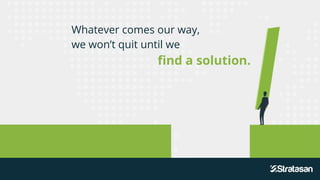
Whatever comes our way,
we won’t quit until we
find a solution.
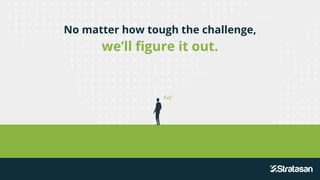
No matter how tough the challenge,
we’ll figure it out.
Yes!
Staying true to our 2nd guiding principle
(document everything),
here are our written “unwritten rules”
of distributed work.
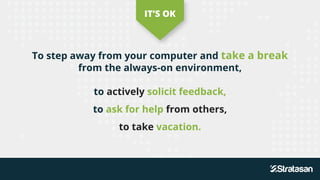
To step away from your computer and take a break
from the always-on environment,
IT’S OK
to actively solicit feedback,
to ask for help from others,
to take vacation.
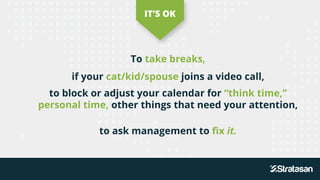
To take breaks,
if your cat/kid/spouse joins a video call,
IT’S OK
to block or adjust your calendar for “think time,”
personal time, other things that need your attention,
to ask management to fix it.
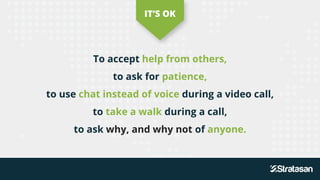
To accept help from others,
to ask for patience,
to use chat instead of voice during a video call,
to take a walk during a call,
to ask why, and why not of anyone.
IT’S OK
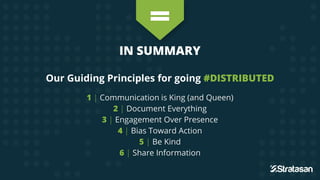
IN SUMMARY
Our Guiding Principles for going #DISTRIBUTED
1 | Communication is King (and Queen)
2 | Document Everything
3 | Engagement Over Presence
4 | Bias Toward Action
5 | Be Kind
6 | Share Information
IN SUMMARY
Our CORE VALUES
1 | Our Success is My Success
2 | Everyone Makes the Coffee
3 | Assume Positive Intent
4 | Honest Conversations Make Us Stronger
5 | We’ll Figure It Out
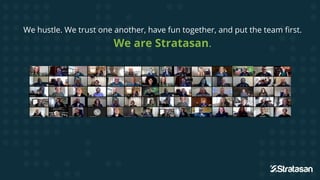
We hustle. We trust one another, have fun together, and put the team first.
We are Stratasan.

Stratasan's #DISTRIBUTED: Part Story. Part Manifesto.

  • 1.
  • 2.
    2010 - Companywas founded; two founders working out of Entrepreneur Center. Timeline |
  • 3.
    2011 - Stratasaninitial funding. Timeline | 2010 - Company was founded; two founders working out of Entrepreneur Center.
  • 4.
    March 11, 2020through today We’re still working remotely.
  • 5.
    2011-2020 - Teamgrew to ~50 employees. We had a downtown office that comfortably fit all but 3 employees, who worked in non-Nashville locations. On workdays, everyone worked from the office. Timeline | 2011 - Stratasan initial funding. 2010 - Company was founded; two founders working out of Entrepreneur Center.
  • 6.
    March 11 2020- WHO Declared COVID-19 a Pandemic and we asked all employees to work remotely. Timeline | 2011 - Stratasan initial funding. 2010 - Company was founded; two founders working out of Entrepreneur Center. 2011-2020 - Team grew to ~50 employees. We had a downtown office that comfortably fit all but 3 employees, who worked in non-Nashville locations. On workdays, everyone worked from the office.
  • 7.
  • 8.
    So well, infact… That we decided to do it indefinitely.
  • 9.
    Except we’re callingit “Distributed,” not “remote.”
  • 10.
    Remote work isa discipline for the individual worker, Distributed work is a discipline for the entire organization. (according to this Dropbox blog)
  • 11.
    WHAT WE’LL COVERTODAY 1 | Guiding Principles for Distributed Work 2 | Revisit Our Core Values 3 | Our Culture and “Unwritten Rules”
  • 12.
    As of Jan2021, we’ve grown to 68 Stratanauts.
  • 13.
    Those Stratanauts arespread among 17 different locations around the US. As of Jan 2021, we’ve grown to 68 Stratanauts.
  • 14.
  • 15.
    Based on asurvey conducted in Jan 2021 Based on a survey conducted in 94% of Stratanauts said they could comfortably maintain working remotely indefinitely. 94.3%
  • 16.
    Here’s what ourteam likes about distributed work: Here’s what our team likes about distributed work:
  • 17.
    But wait... moving towarda fully distributed workforce isn’t as easy as it sounds. moving toward a fully distributed workforce isn’t as easy as it sounds.
  • 18.
    Time zones New hires Nowatercooler chats! Whiteboarding Collaboration Keeping connected Building trust from afar Virtual meeting overload Software Flex work space Employee equipment Flex hours Going distributed means we have to more critically consider things like
  • 19.
    Time zones New hires Nowatercooler chats! Whiteboarding Collaboration Keeping connected Building trust from afar Virtual meeting overload Software Flex work space Employee equipment Flex hours Going distributed means we have to more critically consider things like
  • 20.
    To make thiswork, we’ve got to change the way we think.
  • 21.
    Change the waywe think about... How we support each other
  • 22.
    Change the waywe think about... How we support each other How we communicate
  • 23.
    Change the waywe think about... How we support each other How we communicate How we measure effectiveness
  • 24.
    Change the waywe think about... How we support each other How we communicate How we measure effectiveness How we celebrate wins
  • 25.
    Change the waywe think about... How we support each other How we communicate How we measure effectiveness How we celebrate wins How we learn from mistakes
  • 26.
    We can nolonger get away with doing things the way we’ve always done them. ~ because ~ distributed work creates an entirely new landscape in which to conduct business.
  • 27.
    It creates anopportunity It creates an opportunity
  • 28.
    It creates anopportunity It creates an opportunity to innovate to improve to transform and to learn.
  • 29.
    We’ve come upwith a few guiding principles to help us adapt to this new way. (As we all know, “We’ll figure it out” is a commonly used phrase around here. More on this later…) “We’ll figure it out” is a commonly used phrase around here. More on this later…) is a commonly used phrase around here. More on this later…)
  • 30.
    Disclaimer: This isa work in progress. We’re iterating and learning as we go. Disclaimer: This is a work in progress. We’re iterating and learning as we go.
  • 31.
  • 32.
  • 33.
    Open lines ofcommunication within an organization lead to high levels of trust engaged people and increased productivity.
  • 34.
    For a distributedwork environment to work, we need strong lines of both synchronous and asynchronous communications. we need strong lines of both
  • 35.
    Asynchronous communication doesn’t requirethe recipient’s immediate attention, allowing them to respond to the message at their convenience. at their convenience.
  • 36.
    Mastering the artof asynchronous communication allows for work to get done efficiently and effectively in an organization where people aren’t physically together.
  • 37.
    When reading (and whenwriting), it’s best to assume positive intent We love this one so much → it was brought back as a core value by popular demand.
  • 38.
    An emphasis onasynchronous communication doesn’t mean we abandon synchronous communication (like meetings). (like meetings).
  • 39.
    It simply meanswe see the value in both, understand when one is appropriate over the other, and manage our time accordingly.
  • 40.
    We view meetingsas massive opportunities. Opportunities to - Connect - Discuss - Unite
  • 41.
    We view meetingsas massive opportunities. Opportunities to - Connect - Discuss - Unite Have breakthroughs.
  • 42.
    To make meetingsmeaningful, we have to be deliberate.
  • 43.
    Meetings should beagenda-driven (sent in advance, along with any pre-reading/viewing material). Attendees READ and RESPOND to the pre-material.
  • 44.
    We are committedto starting on time, avoiding distractions, staying on topic, and ending on time.
  • 45.
    Recurring meetings havetheir place. We are critical of each one, challenging ourselves to ensure they’re valuable and a good use of our (valuable) time. Recurring meetings have their place. We are critical of each one, challenging ourselves
  • 46.
    We ask ourselves, “Canthis be accomplished asynchronously?”
  • 47.
    And also: “Is thisthe right amount of time for this meeting?” “Is this the right attendee list?” “Is the goal of the meeting clear?” “Is this the right cadence?”.
  • 48.
    In short: We’re vigilantin managing our time. Time is sacred. We must use it wisely.
  • 49.
  • 50.
    To keep ourteam aligned in a distributed work environment... Documentation is essential.
  • 51.
    Documentation enables astronger, more informed, more trusting, and more connected team.
  • 52.
    Documentation prevents thetoxic cycle of touch points intending to "bring people up to speed." Documentation holds us accountable to both a higher quality of work and to each other. to both a higher quality of work and to each other. to both a higher quality of work and to each other.
  • 53.
    In a distributedwork environment, documentation is a competitive advantage. 1
  • 54.
    IF ( and onlyif ) it’s done properly by everyone.
  • 55.
    Clarity in writing= Clarity in thinking. Which is why clear writing is hard work. But it’s worth it.
  • 56.
    Thinking about how ourwords will be received helps us be more empathetic. Thinking will be received
  • 57.
    A great methodfor documentation is an RFC. What’s an RFC? It’s a “Request for Comment.” But it’s worth it.
  • 58.
    Request for Commentis a method of documentation that serves as a way to communicate proposals, gather feedback, and plan a course of action.
  • 59.
    We like theconcept of RFCs so much, We wrote an RFC about RFCs! We like the concept of RFCs We wrote an RFC about We wrote an about
  • 60.
    Not to mention, ina distributed environment, communicating through writing is inherently inclusive and considerate.
  • 61.
  • 62.
    It’s not aboutshowing up physically. It’s about showing up mentally and engaging fully from wherever you are.
  • 63.
    Distributed work requiresa mindshift in how we measure success. It introduces a new social contract.
  • 64.
    This puts ahealthy pressure on us to prioritize our work and recognize the difference between activity and results. activity and results. Activity Results
  • 65.
    We hire peoplewho take pride in doing great work. take pride in doing great work.
  • 66.
    In the interviewprocess, we call this the “give-a- factor”
  • 67.
    We believe that,if you care about your work,
  • 68.
    We believe that,if you care about your work, you will do what it takes to do it well.
  • 69.
    Being in apositive work environment + caring about your work allows you to bring your whole self to work.
  • 70.
    Bringing your wholeself to work usually leads to... usually leads to...
  • 71.
    Bringing your wholeself to work usually leads to... a happier, more engaged person and a better work output. usually leads to... a happier, more engaged person and a better work output.
  • 72.
  • 73.
    We favor actionover deliberation.
  • 74.
    We aim for“safe enough to try” instead of consensus. instead of consensus.
  • 75.
    The plan willnever be perfect. The timing will never be “just right.”
  • 76.
    When time isof the essence (which, it always is) we act quickly, fail fast, learn, and try again.
  • 77.
    (Back to ourdocumentation principle)... we seek a consent-based environment, not a consensus-based one.
  • 78.
    We don’t waitfor (or expect) everyone to agree on everything all the time. We provide an opportunity for people to give their input.
  • 79.
    The appropriate partiesmake the decision. Then, as a team, we commit to that decision. And we...
  • 80.
    Be human and bekind. Be human and be kind.
  • 81.
    In a distributedworld, relationship building doesn’t happen as organically as when people share a physical space. We have to deliberately build relationships with those we work with.
  • 82.
    That doesn’t justmean collaborating about work-related projects. It’s means getting to know the person.
  • 83.
  • 84.
    It’ll look alittle different from the watercooler chat of days past… but it’s just as rewarding.
  • 85.
    People put forththeir best when they are doing it for each other. (Especially when things are hard. And, when you’re doing meaningful work, they often are.)
  • 86.
    We recognize thatthe differences among us are what make us great. We haven't mastered this yet - but are working on it.
  • 87.
    Share information, don’t hoardit. Share information, don’t hoard it. Share information, don’t hoard it.
  • 88.
    Distributed work requiresa mindset of openness. Distributed work requires a mindset of openness. Distributed work requires a mindset of openness.
  • 89.
    Openness to new ideas collaboration inputfrom others sharing with the team...
  • 90.
    We know thatinformation breeds knowledge, a broader understanding, empathy for others, and, usually, a more productive, happier team.
  • 91.
    We assume ourreader (or listener) would benefit from context. So we offer it.
  • 92.
    We are responsive, providecommentary, participate, and offer suggestions. We strive to over- communicate.
  • 93.
    But how dowe make sure the team is communicating in a way that’s best for the organization - and the people within it?
  • 94.
    We lean (hard)on our core values.
  • 95.
    Our core values uniteour team and hold us accountable. They are the fabric of who we are.
  • 96.
    Our Success Is MySuccess. Our Success Is My Success. 1 Core Value This one's first because it's critical to our success and is our only non-negotiable.
  • 97.
    We have ateam of awesome contributors, and we recognize that nothing great is done alone. It’s the collective, the sum of the parts, that makes us who we are.
  • 98.
    We are quickto give praise and slow to take credit.
  • 99.
    We support oneanother, appreciate and recognize the contribution of others, and strive for the success of the team.
  • 100.
    Everyone Makes The Coffee. EveryoneMakes The Coffee. 2 Core Value
  • 101.
    Back when we werein the office, this metaphor made a bit more sense. Now that we’re remote … most of us make our own damn coffee (or tea).
  • 102.
    We help wherehelp is needed. Whether we’re asked to pitch in on an important call, run a meeting at the last minute, run a report to help out a team member…. everybody does what’s necessary to keep the engine running. Anyway…
  • 103.
    title. No job is toosmall for a title. “big” “small” No job is too big for a
  • 104.
    A nod toour 4th Guiding Principle We have a bias for action. If action is needed and we’re capable of taking it - We do.
  • 105.
  • 106.
    We believe it’simportant to start from the assumption that People are Good and that their intentions are positive.
  • 107.
    Distributed work leaveslots of space for assumptions. We give people the benefit of the doubt. (This goes for colleagues, customers, vendors, etc).
  • 108.
    We assume people comingfrom a good place and exercise empathy. We believe this builds stronger and more trusting relationships.
  • 109.
    Honest Conversations Make UsStronger. Honest Conversations Make Us Stronger. 4 Core Value
  • 110.
    Honest conversations, when approachedwith kindness and respect, yield the best outcomes. !! ??
  • 111.
    Having honest conversationsshows we care about the work we do and the people we do it with. !! !!
  • 112.
    We respect theviewpoints of others. We seek first to understand. We assume positive intent. And we have real conversations as a result.
  • 113.
    We’ll Figure It Out. We’llFigure It Out. 5 Core Value
  • 114.
    We may notimmediately have the answer to a question or a solution to a problem, but we’re always committed to finding one.
  • 115.
    We believe mostchallenges are great opportunities to consciously show up with a resourceful attitude, brainstorm, and consider the best course of action.
  • 116.
    Whatever comes ourway, we won’t quit until we find a solution.
  • 117.
    No matter howtough the challenge, we’ll figure it out. Yes!
  • 118.
    Staying true toour 2nd guiding principle (document everything), here are our written “unwritten rules” of distributed work.
  • 119.
    To step awayfrom your computer and take a break from the always-on environment, IT’S OK to actively solicit feedback, to ask for help from others, to take vacation.
  • 120.
    To take breaks, ifyour cat/kid/spouse joins a video call, IT’S OK to block or adjust your calendar for “think time,” personal time, other things that need your attention, to ask management to fix it.
  • 121.
    To accept helpfrom others, to ask for patience, to use chat instead of voice during a video call, to take a walk during a call, to ask why, and why not of anyone. IT’S OK
  • 122.
    IN SUMMARY Our GuidingPrinciples for going #DISTRIBUTED 1 | Communication is King (and Queen) 2 | Document Everything 3 | Engagement Over Presence 4 | Bias Toward Action 5 | Be Kind 6 | Share Information
  • 123.
    IN SUMMARY Our COREVALUES 1 | Our Success is My Success 2 | Everyone Makes the Coffee 3 | Assume Positive Intent 4 | Honest Conversations Make Us Stronger 5 | We’ll Figure It Out
  • 124.
    We hustle. Wetrust one another, have fun together, and put the team first. We are Stratasan.