How to allocate marketing 
resources across retailers? 
Example: Cheese Manufacturer (Borden brand)
Data 
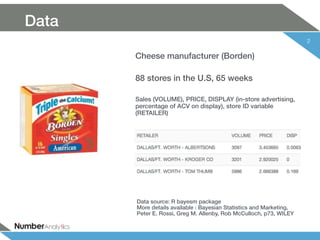
Cheese manufacturer (Borden) 
88 stores in the U.S, 65 weeks 
Sales (VOLUME), PRICE, DISPLAY (in-store advertising, 
percentage of ACV on display), store ID variable 
(RETAILER) 
! 
2 
Data source: R bayesm package 
More details available : Bayesian Statistics and Marketing, 
Peter E. Rossi, Greg M. Allenby, Rob McCulloch, p73, WILEY
Business Problem 
How should a Borden manager allocate 
marketing resources across retailers (88 stores)? 
DISPLAY advertising budget 
PRICE discount promotion (coupon) budget 
3
Method Selection 
Click “Marketing” and select “Bayesian Demand Model” 
4
Why should we use Bayesian? 
Running log-linear regression for each store has limitations 
to estimate demand parameters at store level 
Some variables might have not much variations at store level 
No variation Can’t estimate at all 
Little variation Could produce wrong sign estimates and 
outliers 
“Bayesian” estimation overcomes these drawbacks by 
combining store level information and pooled information 
across stores 
5 
More details: Bayesian Statistics and Marketing, Peter E. Rossi, Greg M. Allenby, Rob 
McCulloch, p73, WILEY
Sample Data 
6 
Choose Sample (cheese, 88 retailers in the U.S.) 
! 
The 88 retailers sample data is only available for 
“Advanced plan” 
You can get similar results with 13 retailer sample 
data under “Basic plan”
Variable Selection 
Select the variables for Sales, Price, Store, and Promotion, and click the "Run" button 
7
Price Elasticity 
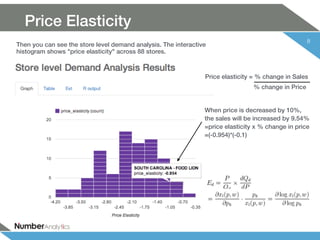
8 Then you can see the store level demand analysis. The interactive 
histogram shows "price elasticity" across 88 stores. 
Price elasticity = % change in Sales 
% change in Price 
When price is decreased by 10%, 
the sales will be increased by 9.54% 
=price elasticity x % change in price 
=(-0.954)*(-0.1)
Sales Lift by DISPLAY 
DISPLAY Sale Lift score shows how much sales could be lifted given DISPLAY in-store ad 
is 100% 
Sales Lift by DISPLAY = {exp(Est_DISPLAY x DISPLAY)-1}x100, when DISPLAY = 1 (100%) 
9 
When in-store DISPLAY ad coverage is 100%, 
the sales is increased by 462.94% 
Base Sales Lift score is 100
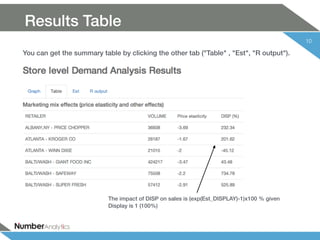
Results Table 
10 
You can get the summary table by clicking the other tab ("Table" , "Est", "R output"). 
The impact of DISP on sales is (exp(Est_DISPLAY)-1)x100 % given 
Display is 1 (100%)
What if analysis 
In-store Display ad simulation 
11 
What if analysis: 
When in-store DISPLAY ad coverage is 10%, 
the sales is increased by 18.86% 
[exp(1.728 * 0.1) -1 ]*100=18.86 
Est_DISPLAY is 1.728
Resource Allocation 
A marketer should prioritize their 
DISPLAY advertising budgets to the most 
sensitive stores (DISP Lift scores are 
high), and allocate price discount 
promotions (like discount coupons) to the 
most price sensitive markets where the 
price elasticity is highest (absolute value) 
12

Store level Demand Analysis using Bayesian Log-linear model

  • 1.
    How to allocatemarketing resources across retailers? Example: Cheese Manufacturer (Borden brand)
  • 2.
    Data Cheese manufacturer(Borden) 88 stores in the U.S, 65 weeks Sales (VOLUME), PRICE, DISPLAY (in-store advertising, percentage of ACV on display), store ID variable (RETAILER) ! 2 Data source: R bayesm package More details available : Bayesian Statistics and Marketing, Peter E. Rossi, Greg M. Allenby, Rob McCulloch, p73, WILEY
  • 3.
    Business Problem Howshould a Borden manager allocate marketing resources across retailers (88 stores)? DISPLAY advertising budget PRICE discount promotion (coupon) budget 3
  • 4.
    Method Selection Click“Marketing” and select “Bayesian Demand Model” 4
  • 5.
    Why should weuse Bayesian? Running log-linear regression for each store has limitations to estimate demand parameters at store level Some variables might have not much variations at store level No variation Can’t estimate at all Little variation Could produce wrong sign estimates and outliers “Bayesian” estimation overcomes these drawbacks by combining store level information and pooled information across stores 5 More details: Bayesian Statistics and Marketing, Peter E. Rossi, Greg M. Allenby, Rob McCulloch, p73, WILEY
  • 6.
    Sample Data 6 Choose Sample (cheese, 88 retailers in the U.S.) ! The 88 retailers sample data is only available for “Advanced plan” You can get similar results with 13 retailer sample data under “Basic plan”
  • 7.
    Variable Selection Selectthe variables for Sales, Price, Store, and Promotion, and click the "Run" button 7
  • 8.
    Price Elasticity 8Then you can see the store level demand analysis. The interactive histogram shows "price elasticity" across 88 stores. Price elasticity = % change in Sales % change in Price When price is decreased by 10%, the sales will be increased by 9.54% =price elasticity x % change in price =(-0.954)*(-0.1)
  • 9.
    Sales Lift byDISPLAY DISPLAY Sale Lift score shows how much sales could be lifted given DISPLAY in-store ad is 100% Sales Lift by DISPLAY = {exp(Est_DISPLAY x DISPLAY)-1}x100, when DISPLAY = 1 (100%) 9 When in-store DISPLAY ad coverage is 100%, the sales is increased by 462.94% Base Sales Lift score is 100
  • 10.
    Results Table 10 You can get the summary table by clicking the other tab ("Table" , "Est", "R output"). The impact of DISP on sales is (exp(Est_DISPLAY)-1)x100 % given Display is 1 (100%)
  • 11.
    What if analysis In-store Display ad simulation 11 What if analysis: When in-store DISPLAY ad coverage is 10%, the sales is increased by 18.86% [exp(1.728 * 0.1) -1 ]*100=18.86 Est_DISPLAY is 1.728
  • 12.
    Resource Allocation Amarketer should prioritize their DISPLAY advertising budgets to the most sensitive stores (DISP Lift scores are high), and allocate price discount promotions (like discount coupons) to the most price sensitive markets where the price elasticity is highest (absolute value) 12