Stacy Tokarz
FAST SHUTTER SPEED
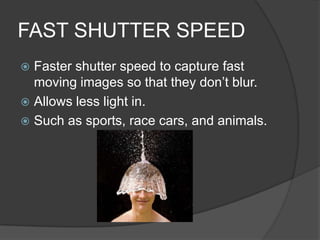
 Faster shutter speed to capture fast
  moving images so that they don’t blur.
 Allows less light in.
 Such as sports, race cars, and animals.
SLOW SHUTTER SPEED
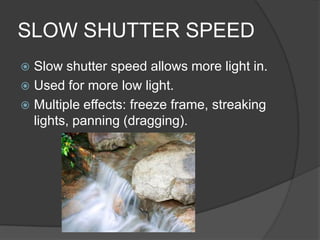
 Slow shutter speed allows more light in.
 Used for more low light.
 Multiple effects: freeze frame, streaking
  lights, panning (dragging).
AMOUNT OF TIME
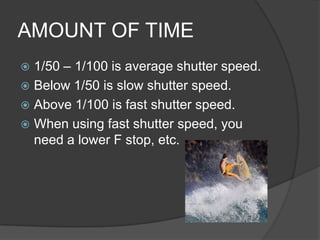
 1/50 – 1/100 is average shutter speed.
 Below 1/50 is slow shutter speed.
 Above 1/100 is fast shutter speed.
 When using fast shutter speed, you
  need a lower F stop, etc.
CONCLUSION
 Shutter speeds are nice!
 You have to use shutter speed in every
  photo.
 Very useful for taking photos.
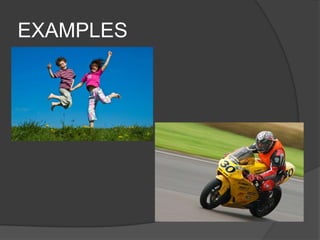
EXAMPLES

stokarz_powerpoint

  • 1.
  • 2.
    FAST SHUTTER SPEED Faster shutter speed to capture fast moving images so that they don’t blur.  Allows less light in.  Such as sports, race cars, and animals.
  • 3.
    SLOW SHUTTER SPEED Slow shutter speed allows more light in.  Used for more low light.  Multiple effects: freeze frame, streaking lights, panning (dragging).
  • 4.
    AMOUNT OF TIME 1/50 – 1/100 is average shutter speed.  Below 1/50 is slow shutter speed.  Above 1/100 is fast shutter speed.  When using fast shutter speed, you need a lower F stop, etc.
  • 5.
    CONCLUSION  Shutter speedsare nice!  You have to use shutter speed in every photo.  Very useful for taking photos.
  • 6.