FACULTY OF MANAGEMENT STUDIES
PRESENTED BY:
MUSKAN AGRAWAL
NEHAL SOLANKI
NIKHIL JAIN
NIKHIL SANADHYA
NIMIT AUDICHYA
NIRIKISHA CHOUBISA
PRESENTED TO:
DR. SWATI MA’AM
CONTENTS
• BASICS OF STOCK MARKETS
• BROKERAGE
• EAGELS FORD
• 7P’s of Eagles Ford
• TRADING
• SWOT ANALYSIS
• CONCLUSION AND SUGGESTIONS
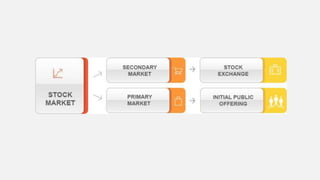
STOCK MARKET
A stock market or equity
market is a public entity for
the trading of company stock
(shares) and derivatives at an
agreed price; these are
securities listed on a stock
exchange as well as those only
traded privately.
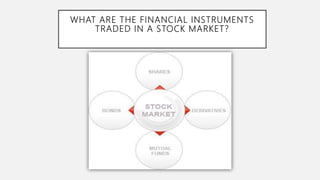
WHAT ARE THE FINANCIAL INSTRUMENTS
TRADED IN A STOCK MARKET?
FUNCTIONS OF STOCK MARKET
• Enrolment of members
• Make bye-laws of stock exchange
• Provide for the listing of securities
• Provide facilities for trading of securities
• Provide clearing services
• Publication of information
• Arbitration
• Investor education and investors protection
BASICS OF STOCK MARKETS
HOW ARE SHARES PRICED IN THE MARKET
AND WHO DETERMINES THE PRICE?
• The market determines the price of the share.
Normally, share prices go up when the company is
growing very fast or it is earning very good profits
or it gets new orders. As demand for the stock picks
up more investors want to buy the stock at higher
prices and that is how the price goes up. Price of
share is determined by demand and supply.
WHAT ARE STOCK INDICES?
• Thousands of companies list their shares on the Indian
share markets. From these, a few similar stocks are grouped
together to form an index. The classification may be on the
basis of company size, industry, market capitalization, or
other categories. The BSE Sensex includes 30 stocks and the
NSE comprises 50 stocks. Others include sector indices like
the Bankex, market cap indices like the BSE Midcap or the
BSE Small cap, and others.
WHAT IS THE ROLE OF A BROKER IN THE SHARE
MARKET?
• The broker helps you execute your buy and sell trades.
Brokers typically help buyers find sellers and sellers find
buyers. Most brokers will also advise you on what stocks
to buy, what stocks to sell and how to invest money in
share markets for beginners. They will also assist you in
how to trade in stock market. For that service, the broker
is paid brokerage.
IS THE TRADING ACCOUNT SAME AS THE DEMAT
ACCOUNT?
• There is an important difference between the two. Trading account
is where you execute your buy and sell trades. The demat account is
where your shares are held in custody. When you buy shares in your
trading account, your bank account gets debited and your demat
account get credited. The reverse is true when you sell shares.
STOCK MARKET TERMS
• Agent : An agent is a brokerage firm which does buying/selling of shares on
behalf of the investor in the stock market.
• Ask/Offer: It refers to the lowest price at which the owner of the equity shares is
ready to sell the shares in the stock market.
• Bear Market : It refers to a period in which the prices of equity shares fall
consistently. You may look at it like beginning of a downward trend in the stock
market.
• Bull Market : An opposite of bear market, a bull market situation in which the
prices of the stocks are increasing over a prolonged period of time. A single
stock and a sector can be bullish at one time and bearish at another time.
• Beta : It measures the association between price of one equity share and the
overall movement of stock market. Beta of the market is assumed to be 1. A
stock’s beta of more than 1 shows a higher risk than the market. A beta of less
than 1 shows that stock is less riskier than the market.
WHAT IS ROLLING SETTLEMENTS?
• Every order that is executed on the share market must
be settled. Buyers receive their shares and sellers
receive the sale proceeds. The settlement is the
procedure wherein the buyers procure their shares and
sellers receive their monies. The rolling settlement is
when all trades have to be settled at the end of the
day. In other words, the buyer must pay for his
purchase and seller delivers the sold shares in one day
on the share market. Indian share markets adopt the
T+2 settlements, which means the transactions are
completed on Day One and the settlement of these
trades must be completed within two working days
from Day One.
BROKERS
WHAT IS BROKER?
• Brokers are individuals or representatives
of brokerage firms who negotiate transactions between
a seller and buyer. Therefore, they serve as facilitators
in stock trading. They usually get a part of the sale
when negotiations are finalized. It is called a
commission. Investment brokers come under different
class based on the services they extend and advice they
offer.
TYPES OF BROKERS
• Full-Service Broker :A Full-Service Broker provides a mixture of services
to the clients. This comprises of doing the required research to base their
advice, commodity trading, retirement planning and providing tax-saving
tips are amongst the useful offerings.
• Discount Broker : Based on your orders, a Discount Broker carries out
buying and selling of stocks at reduced commission possibly at a flat
fee brokerage value. They may offer recommendations but verifications
have to be done by you. They can consequently give orders to execute on
your behalf. They do not provide personalized investment advice and
additional services.
• Online Broker: An Online Broker connects and works with you over the
internet. They often work across different brokerage websites. Information
like graphs, charts and trending news to complete your research are
provided by them.
HOW DO I START
TRADING?
Find out a Stock Broker
Open a D-Mat and Trading Account
Deposit money (initial margin) in the trading
account
Start trading in your account
HOW DO I CHOOSE A
BROKER?
Zero – in on a few good Broking Firms
Go through their cost structure and benefits they offer
If possible, find out about their existingclients
Who are theirbankers?
Analyze the brokers’ past performance
Find out if they offer research and advisoryservices
Try to negotiate on variouscharges
See how well learned are the employees
Finally, chose the broker who’s offer is most beneficial
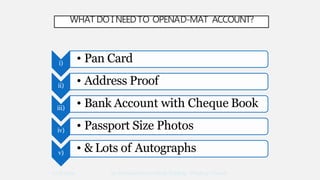
WHAT DO I NEEDTO OPENAD-MAT ACCOUNT?
i) • Pan Card
ii) • Address Proof
iii) • Bank Account with Cheque Book
iv) • Passport Size Photos
v) • & Lots of Autographs
10/8/2009 An Introduction to Stock Trading - Pradeep Tewani
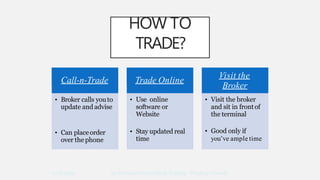
HOW TO
TRADE?
Call-n-Trade
• Broker calls youto
update and advise
• Can placeorder
over the phone
Trade Online
• Use online
software or
Website
• Stay updated real
time
Visit the
Broker
• Visit the broker
and sit in frontof
the terminal
10/8/2009 An Introduction to Stock Trading - Pradeep Tewani
• Good only if
you’ve ample time
EAGLES FORD
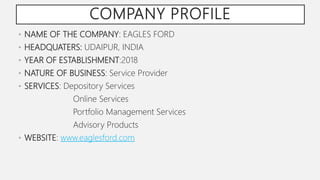
COMPANY PROFILE
• NAME OF THE COMPANY: EAGLES FORD
• HEADQUATERS: UDAIPUR, INDIA
• YEAR OF ESTABLISHMENT:2018
• NATURE OF BUSINESS: Service Provider
• SERVICES: Depository Services
Online Services
Portfolio Management Services
Advisory Products
• WEBSITE: www.eaglesford.com
7P’S OF EAGLES FORD
7P’S OF EAGLES FORD
• Product
• Price
• Promotion
• Physical Evidence
• Process
• Place
• People
PRODUCT
Product Variety:-
• Classic Royal Account.
• Eagle Trade Account.
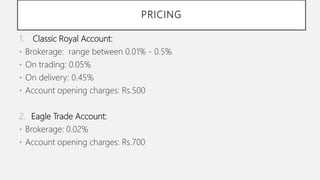
PRICING
1. Classic Royal Account:
• Brokerage: range between 0.01% - 0.5%
• On trading: 0.05%
• On delivery: 0.45%
• Account opening charges: Rs.500
2. Eagle Trade Account:
• Brokerage: 0.02%
• Account opening charges: Rs.700
PHYSICAL EVIDENCE
• Locality of the office
• Office Environment
• Interiors and Infrastructure
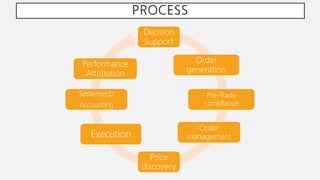
PROCESS
Decision
Support
Order
generation
Pre-Trade
compliance
Order
management
Price
discovery
Execution
Settlement/
Accounting
Performance
Attribution
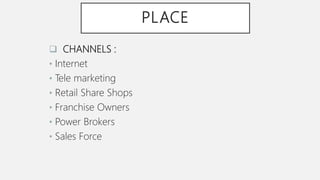
PLACE
 CHANNELS :
• Internet
• Tele marketing
• Retail Share Shops
• Franchise Owners
• Power Brokers
• Sales Force
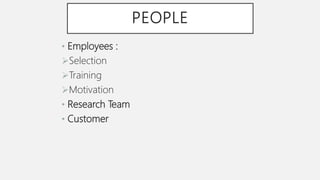
PEOPLE
• Employees :
Selection
Training
Motivation
• Research Team
• Customer
NEED TO KNOW
When to Buy
When to Sell
When to Hold
SWOT ANALYSIS
STRENGTH
• Describe what an organization excels at and
what separates it from the competition: a strong
brand, loyal customer base, a strong balance sheet,
unique technology, and so on. For example, a hedge
fund may have developed a proprietary trading
strategy that returns market-beating results. It must
then decide how to use those results to attract new
investors.
WEAKNESS
• They are areas where the business needs to
improve to remain competitive: a weak brand,
higher-than-average turnover, high levels of
debt, an inadequate supply chain, or lack of
capital.
OPPORTUNITIES
• One of the ways that a brokerage can rapidly expand
operations is by acting in a property management
capacity. This is an important revenue stream for a
real estate brokerage as it provides ongoing and
highly predictable streams of revenue that can
balance out commission based income. Additionally,
many real estate brokerages aggressively recruit
agents in order to hold their license at the firm. This
is the fastest way to expand revenues. It is important
to be able to recruit real estate agents that have
extensive contacts within their local market.
THREATS
Online listings have created a much more free-market
atmosphere for real estate sales. Many property owners
have turned to selling their homes on their own without the
assistance of a real estate agent. This trend is expected to
continue for a significant period of time. Additionally, in
today's economy, many people have acquired their real
estate sales licensure so that they can act as an agent on a
part time basis.
THANK YOU

Stock Market (product development)

  • 1.
    FACULTY OF MANAGEMENTSTUDIES PRESENTED BY: MUSKAN AGRAWAL NEHAL SOLANKI NIKHIL JAIN NIKHIL SANADHYA NIMIT AUDICHYA NIRIKISHA CHOUBISA PRESENTED TO: DR. SWATI MA’AM
  • 2.
    CONTENTS • BASICS OFSTOCK MARKETS • BROKERAGE • EAGELS FORD • 7P’s of Eagles Ford • TRADING • SWOT ANALYSIS • CONCLUSION AND SUGGESTIONS
  • 3.
    STOCK MARKET A stockmarket or equity market is a public entity for the trading of company stock (shares) and derivatives at an agreed price; these are securities listed on a stock exchange as well as those only traded privately.
  • 5.
    WHAT ARE THEFINANCIAL INSTRUMENTS TRADED IN A STOCK MARKET?
  • 6.
    FUNCTIONS OF STOCKMARKET • Enrolment of members • Make bye-laws of stock exchange • Provide for the listing of securities • Provide facilities for trading of securities • Provide clearing services • Publication of information • Arbitration • Investor education and investors protection
  • 7.
  • 8.
    HOW ARE SHARESPRICED IN THE MARKET AND WHO DETERMINES THE PRICE? • The market determines the price of the share. Normally, share prices go up when the company is growing very fast or it is earning very good profits or it gets new orders. As demand for the stock picks up more investors want to buy the stock at higher prices and that is how the price goes up. Price of share is determined by demand and supply.
  • 9.
    WHAT ARE STOCKINDICES? • Thousands of companies list their shares on the Indian share markets. From these, a few similar stocks are grouped together to form an index. The classification may be on the basis of company size, industry, market capitalization, or other categories. The BSE Sensex includes 30 stocks and the NSE comprises 50 stocks. Others include sector indices like the Bankex, market cap indices like the BSE Midcap or the BSE Small cap, and others.
  • 10.
    WHAT IS THEROLE OF A BROKER IN THE SHARE MARKET? • The broker helps you execute your buy and sell trades. Brokers typically help buyers find sellers and sellers find buyers. Most brokers will also advise you on what stocks to buy, what stocks to sell and how to invest money in share markets for beginners. They will also assist you in how to trade in stock market. For that service, the broker is paid brokerage.
  • 11.
    IS THE TRADINGACCOUNT SAME AS THE DEMAT ACCOUNT? • There is an important difference between the two. Trading account is where you execute your buy and sell trades. The demat account is where your shares are held in custody. When you buy shares in your trading account, your bank account gets debited and your demat account get credited. The reverse is true when you sell shares.
  • 12.
    STOCK MARKET TERMS •Agent : An agent is a brokerage firm which does buying/selling of shares on behalf of the investor in the stock market. • Ask/Offer: It refers to the lowest price at which the owner of the equity shares is ready to sell the shares in the stock market. • Bear Market : It refers to a period in which the prices of equity shares fall consistently. You may look at it like beginning of a downward trend in the stock market. • Bull Market : An opposite of bear market, a bull market situation in which the prices of the stocks are increasing over a prolonged period of time. A single stock and a sector can be bullish at one time and bearish at another time. • Beta : It measures the association between price of one equity share and the overall movement of stock market. Beta of the market is assumed to be 1. A stock’s beta of more than 1 shows a higher risk than the market. A beta of less than 1 shows that stock is less riskier than the market.
  • 13.
    WHAT IS ROLLINGSETTLEMENTS? • Every order that is executed on the share market must be settled. Buyers receive their shares and sellers receive the sale proceeds. The settlement is the procedure wherein the buyers procure their shares and sellers receive their monies. The rolling settlement is when all trades have to be settled at the end of the day. In other words, the buyer must pay for his purchase and seller delivers the sold shares in one day on the share market. Indian share markets adopt the T+2 settlements, which means the transactions are completed on Day One and the settlement of these trades must be completed within two working days from Day One.
  • 14.
  • 15.
    WHAT IS BROKER? •Brokers are individuals or representatives of brokerage firms who negotiate transactions between a seller and buyer. Therefore, they serve as facilitators in stock trading. They usually get a part of the sale when negotiations are finalized. It is called a commission. Investment brokers come under different class based on the services they extend and advice they offer.
  • 16.
    TYPES OF BROKERS •Full-Service Broker :A Full-Service Broker provides a mixture of services to the clients. This comprises of doing the required research to base their advice, commodity trading, retirement planning and providing tax-saving tips are amongst the useful offerings. • Discount Broker : Based on your orders, a Discount Broker carries out buying and selling of stocks at reduced commission possibly at a flat fee brokerage value. They may offer recommendations but verifications have to be done by you. They can consequently give orders to execute on your behalf. They do not provide personalized investment advice and additional services. • Online Broker: An Online Broker connects and works with you over the internet. They often work across different brokerage websites. Information like graphs, charts and trending news to complete your research are provided by them.
  • 17.
    HOW DO ISTART TRADING? Find out a Stock Broker Open a D-Mat and Trading Account Deposit money (initial margin) in the trading account Start trading in your account
  • 18.
    HOW DO ICHOOSE A BROKER? Zero – in on a few good Broking Firms Go through their cost structure and benefits they offer If possible, find out about their existingclients Who are theirbankers? Analyze the brokers’ past performance Find out if they offer research and advisoryservices Try to negotiate on variouscharges See how well learned are the employees Finally, chose the broker who’s offer is most beneficial
  • 19.
    WHAT DO INEEDTO OPENAD-MAT ACCOUNT? i) • Pan Card ii) • Address Proof iii) • Bank Account with Cheque Book iv) • Passport Size Photos v) • & Lots of Autographs 10/8/2009 An Introduction to Stock Trading - Pradeep Tewani
  • 20.
    HOW TO TRADE? Call-n-Trade • Brokercalls youto update and advise • Can placeorder over the phone Trade Online • Use online software or Website • Stay updated real time Visit the Broker • Visit the broker and sit in frontof the terminal 10/8/2009 An Introduction to Stock Trading - Pradeep Tewani • Good only if you’ve ample time
  • 21.
  • 22.
    COMPANY PROFILE • NAMEOF THE COMPANY: EAGLES FORD • HEADQUATERS: UDAIPUR, INDIA • YEAR OF ESTABLISHMENT:2018 • NATURE OF BUSINESS: Service Provider • SERVICES: Depository Services Online Services Portfolio Management Services Advisory Products • WEBSITE: www.eaglesford.com
  • 23.
  • 24.
    7P’S OF EAGLESFORD • Product • Price • Promotion • Physical Evidence • Process • Place • People
  • 25.
    PRODUCT Product Variety:- • ClassicRoyal Account. • Eagle Trade Account.
  • 26.
    PRICING 1. Classic RoyalAccount: • Brokerage: range between 0.01% - 0.5% • On trading: 0.05% • On delivery: 0.45% • Account opening charges: Rs.500 2. Eagle Trade Account: • Brokerage: 0.02% • Account opening charges: Rs.700
  • 27.
    PHYSICAL EVIDENCE • Localityof the office • Office Environment • Interiors and Infrastructure
  • 28.
  • 29.
    PLACE  CHANNELS : •Internet • Tele marketing • Retail Share Shops • Franchise Owners • Power Brokers • Sales Force
  • 30.
  • 31.
    NEED TO KNOW Whento Buy When to Sell When to Hold
  • 32.
  • 33.
    STRENGTH • Describe whatan organization excels at and what separates it from the competition: a strong brand, loyal customer base, a strong balance sheet, unique technology, and so on. For example, a hedge fund may have developed a proprietary trading strategy that returns market-beating results. It must then decide how to use those results to attract new investors.

  • 34.
    WEAKNESS • They areareas where the business needs to improve to remain competitive: a weak brand, higher-than-average turnover, high levels of debt, an inadequate supply chain, or lack of capital.
  • 35.
    OPPORTUNITIES • One ofthe ways that a brokerage can rapidly expand operations is by acting in a property management capacity. This is an important revenue stream for a real estate brokerage as it provides ongoing and highly predictable streams of revenue that can balance out commission based income. Additionally, many real estate brokerages aggressively recruit agents in order to hold their license at the firm. This is the fastest way to expand revenues. It is important to be able to recruit real estate agents that have extensive contacts within their local market.
  • 36.
    THREATS Online listings havecreated a much more free-market atmosphere for real estate sales. Many property owners have turned to selling their homes on their own without the assistance of a real estate agent. This trend is expected to continue for a significant period of time. Additionally, in today's economy, many people have acquired their real estate sales licensure so that they can act as an agent on a part time basis.
  • 37.