Software Transactional Memory
Steve Severance – Alpha Heavy Industries
Motivation
• Innovations in concurrency has not kept pace
• Still using locks
• Immutability has helped in Haskell
STM Basics
• Transactional Concurrency
• Atomicity – Results are visible all at once
• Isolation – Action unaffected by other threads
• Everything you need is in the stm-2.4.2
package
Haskell and STM
• Exploits Three Haskell Features:
– Purity (Transactions must be pure)
– Monads
– Immutability (Values are never modified)
• Utilizes the Type System
– Anything involved in the transaction is marked
(TVar, TChan, STM, etc…)
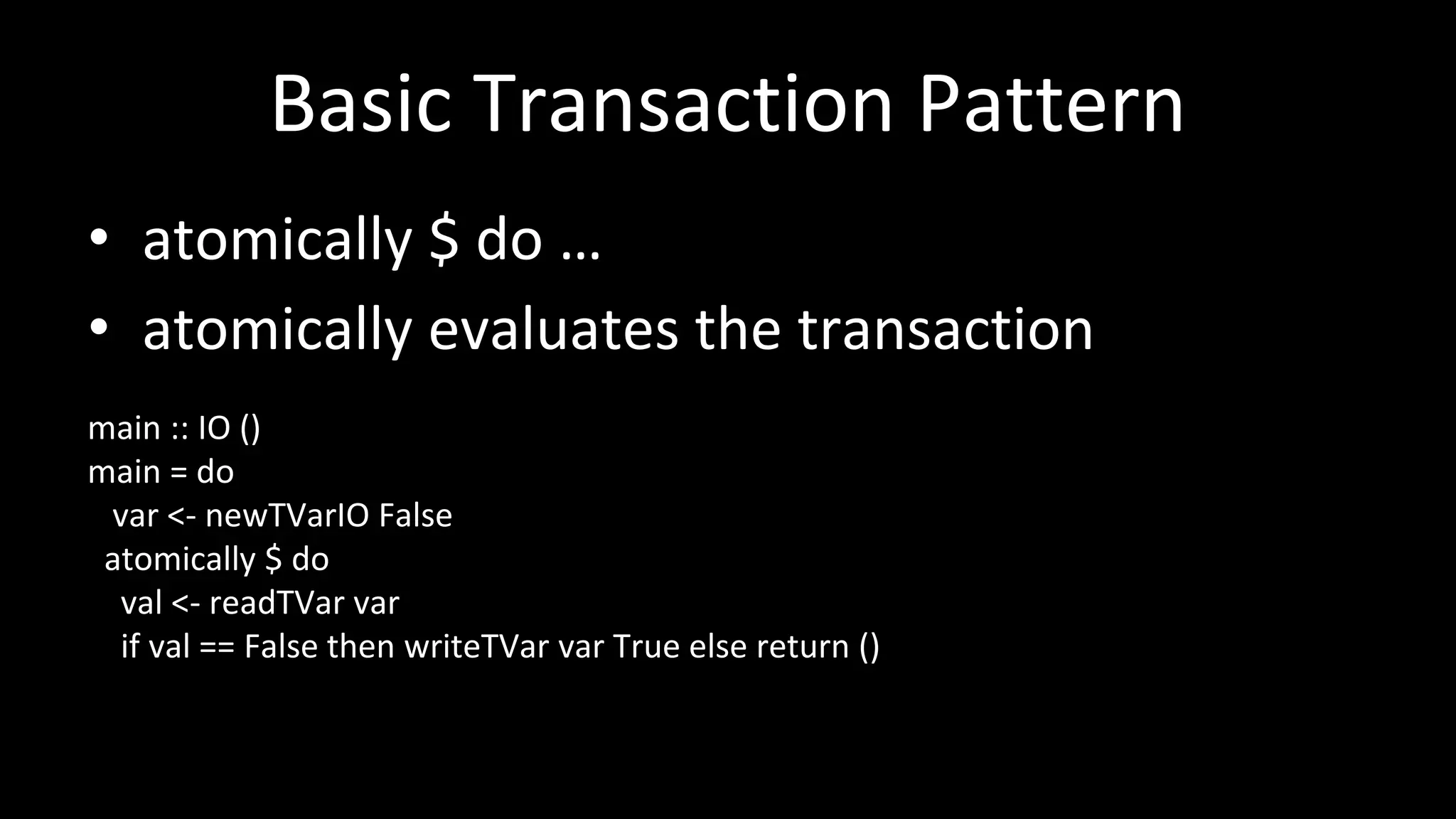
Basic Transaction Pattern
• atomically $ do …
• atomically evaluates the transaction
main :: IO ()
main = do
var <- newTVarIO False
atomically $ do
val <- readTVar var
if val == False then writeTVar var True else return ()
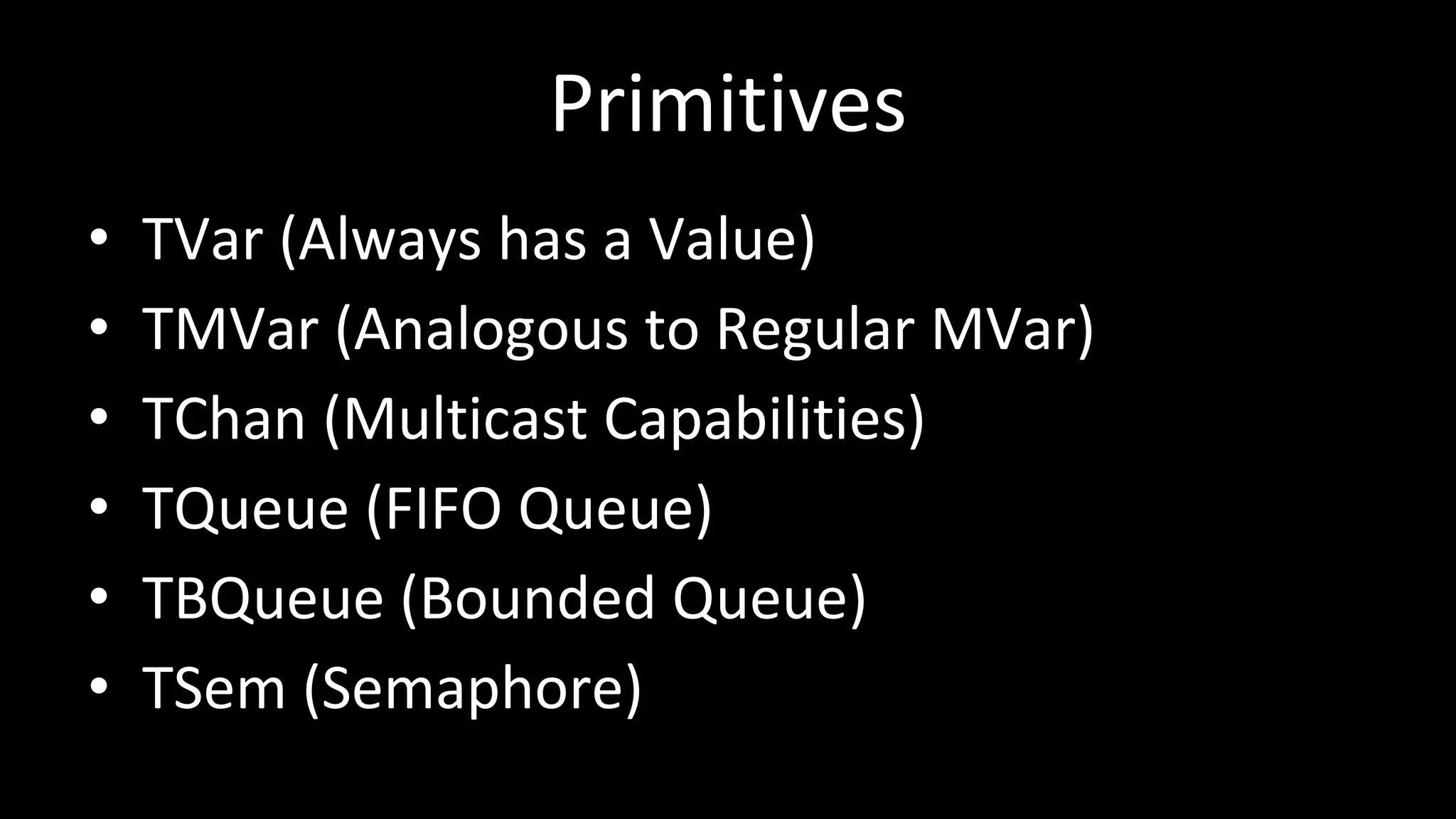
Primitives
• TVar (Always has a Value)
• TMVar (Analogous to Regular MVar)
• TChan (Multicast Capabilities)
• TQueue (FIFO Queue)
• TBQueue (Bounded Queue)
• TSem (Semaphore)
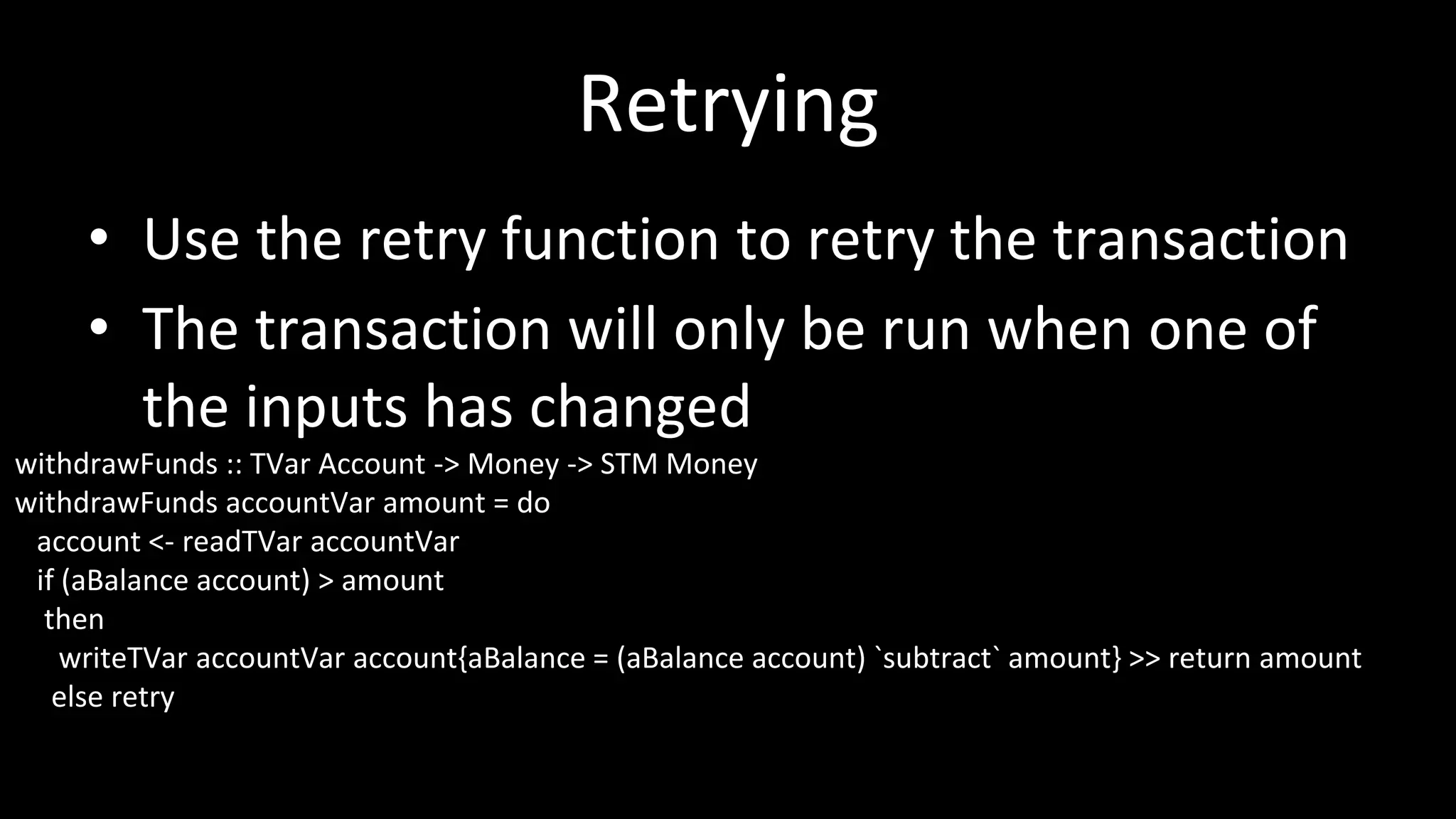
Retrying
• Use the retry function to retry the transaction
• The transaction will only be run when one of
the inputs has changed
withdrawFunds :: TVar Account -> Money -> STM Money
withdrawFunds accountVar amount = do
account <- readTVar accountVar
if (aBalance account) > amount
then
writeTVar accountVar account{aBalance = (aBalance account) `subtract` amount} >> return amount
else retry
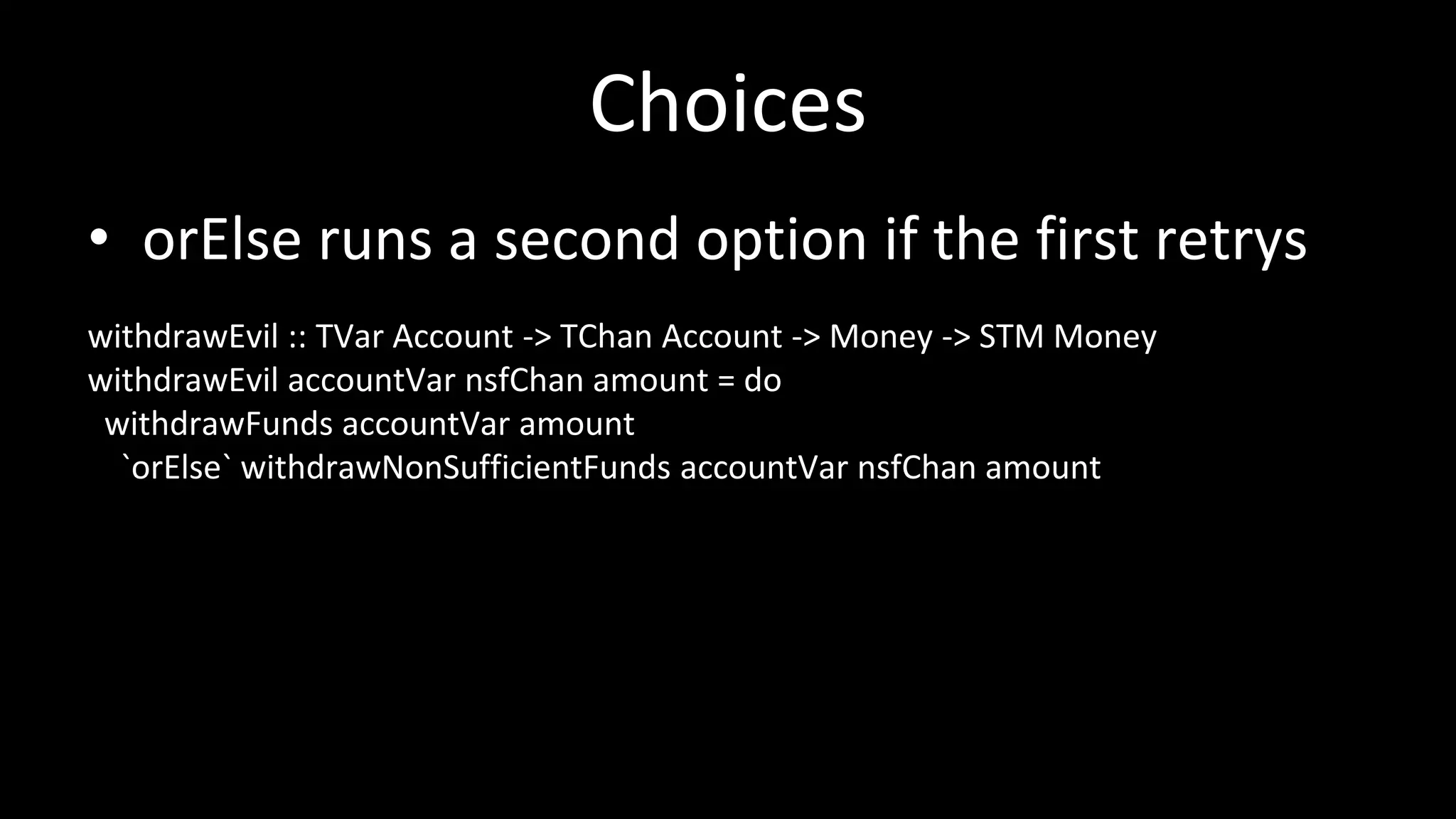
Choices
• orElse runs a second option if the first retrys
withdrawEvil :: TVar Account -> TChan Account -> Money -> STM Money
withdrawEvil accountVar nsfChan amount = do
withdrawFunds accountVar amount
`orElse` withdrawNonSufficientFunds accountVar nsfChan amount
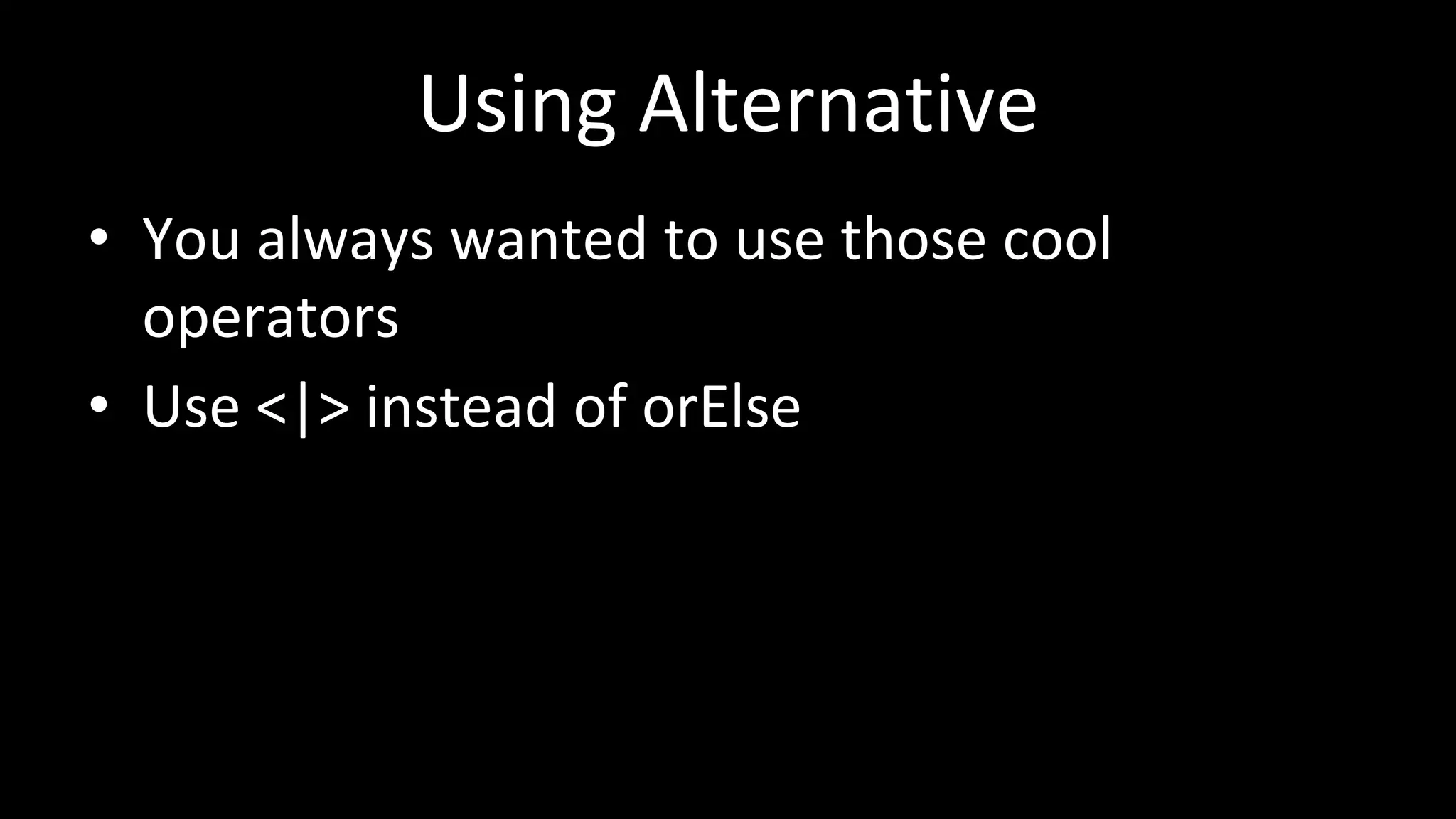
Using Alternative
• You always wanted to use those cool
operators
• Use <|> instead of orElse
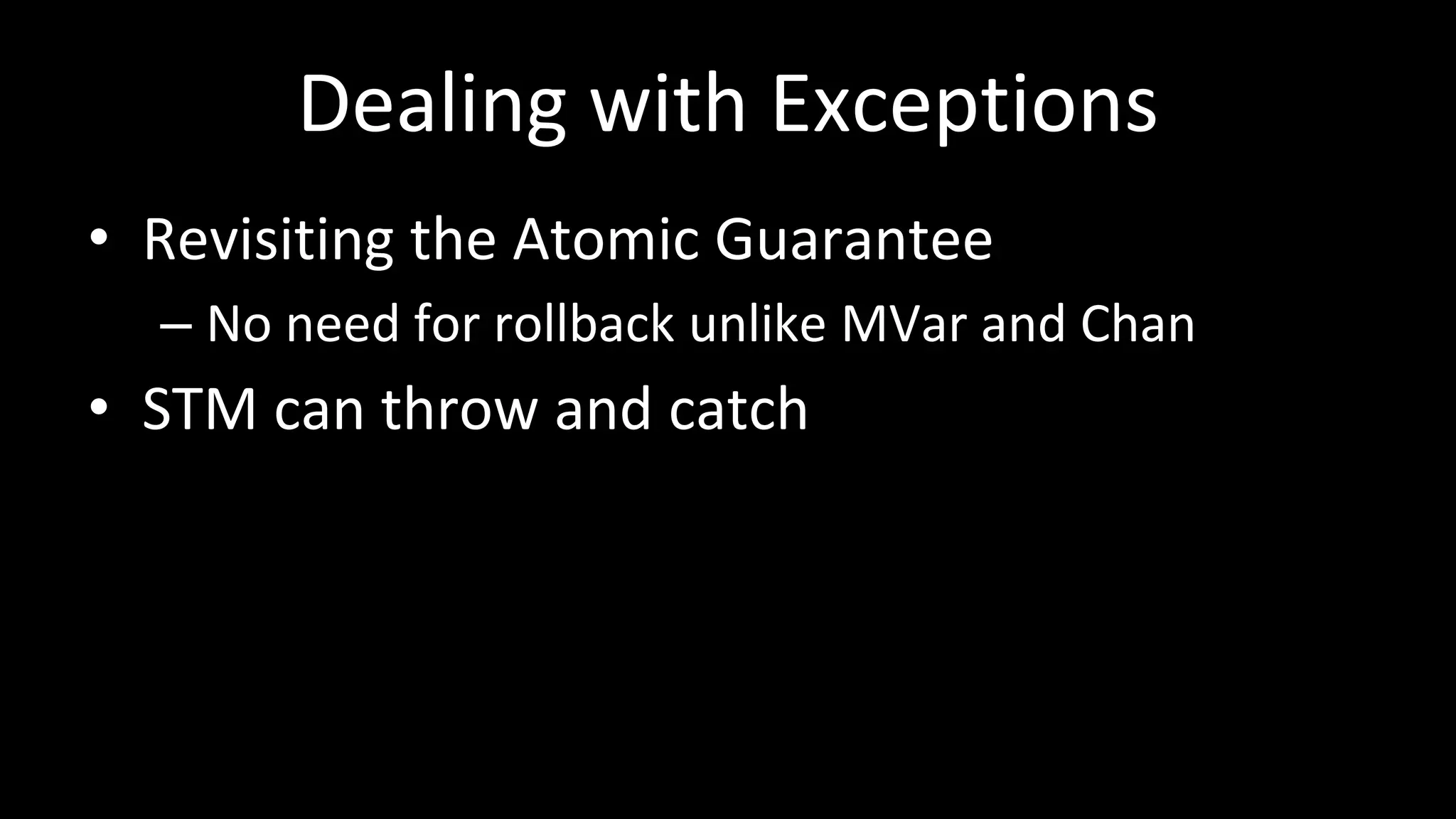
Dealing with Exceptions
• Revisiting the Atomic Guarantee
– No need for rollback unlike MVar and Chan
• STM can throw and catch
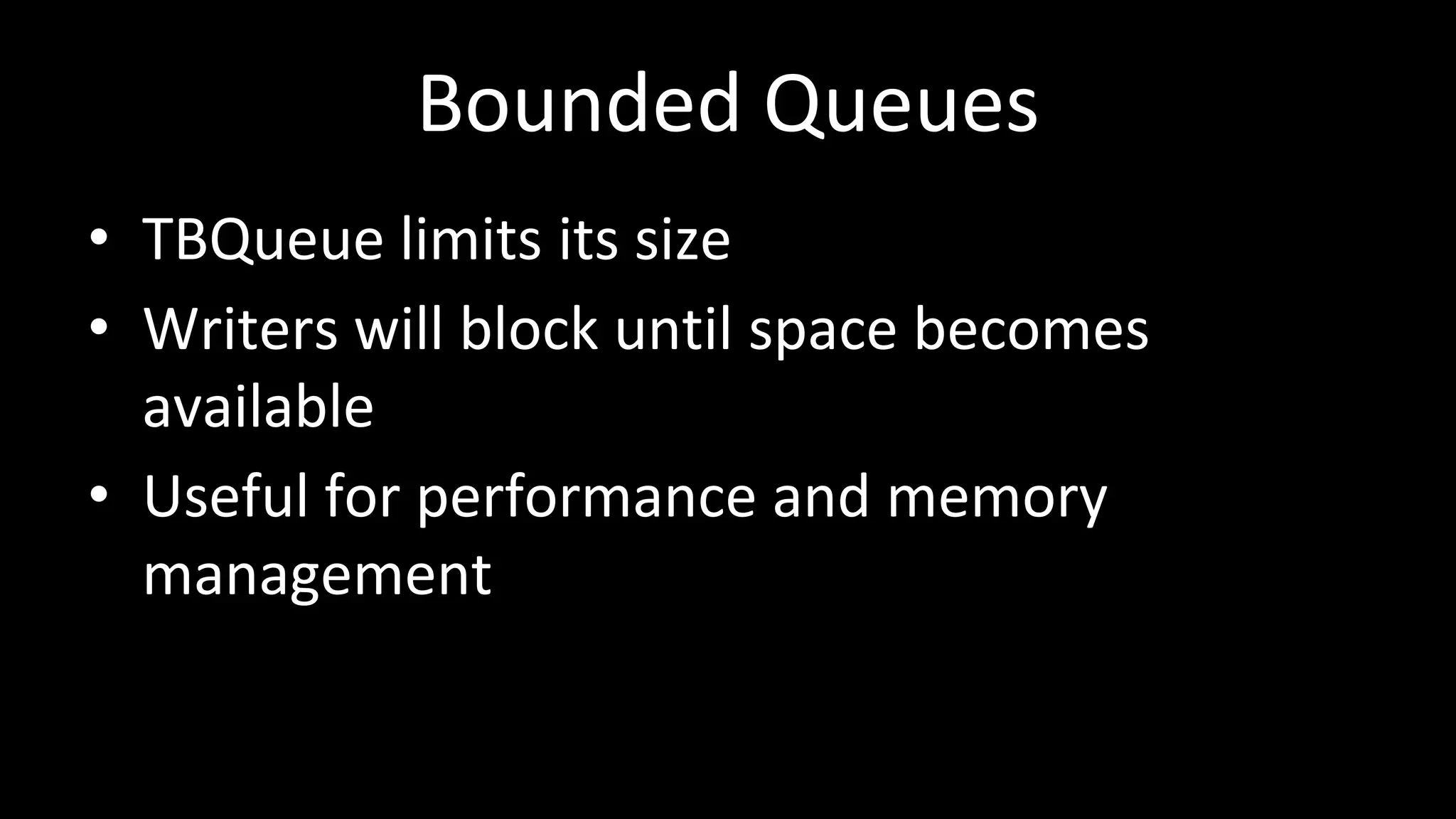
Bounded Queues
• TBQueue limits its size
• Writers will block until space becomes
available
• Useful for performance and memory
management
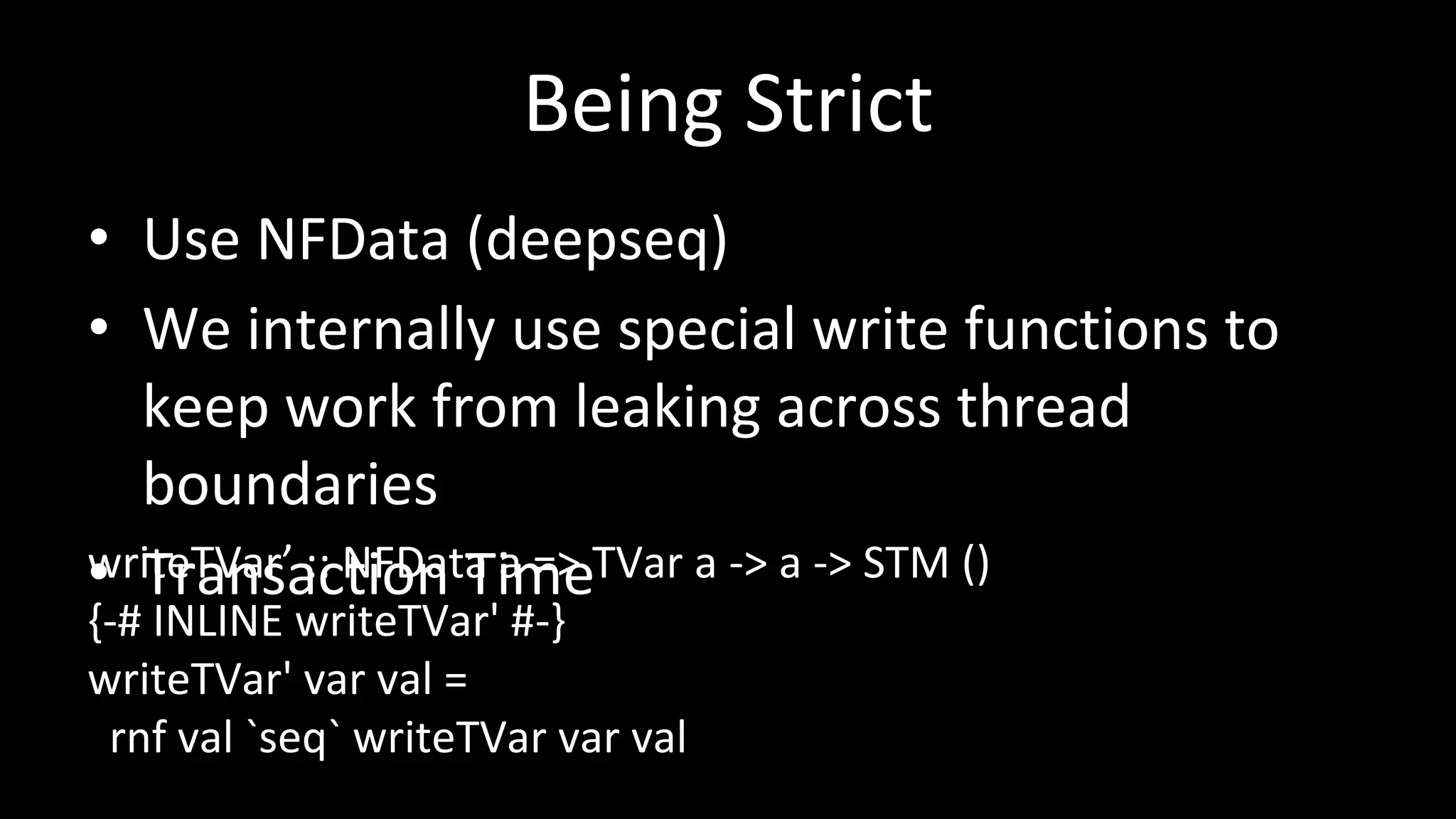
Being Strict
• Use NFData (deepseq)
• We internally use special write functions to
keep work from leaking across thread
boundaries
• Transaction TimewriteTVar’ :: NFData a => TVar a -> a -> STM ()
{-# INLINE writeTVar' #-}
writeTVar' var val =
rnf val `seq` writeTVar var val
Other Languages
• Clojure
• Scala
• C++
• C#/.Net
References
• Composable Memory Transactions
• Beautiful Concurrency
• STM Retrospective for .Net
• Gists:
– Sample 1

STM in Haskell

  • 1.
    Software Transactional Memory SteveSeverance – Alpha Heavy Industries
  • 2.
    Motivation • Innovations inconcurrency has not kept pace • Still using locks • Immutability has helped in Haskell
  • 3.
    STM Basics • TransactionalConcurrency • Atomicity – Results are visible all at once • Isolation – Action unaffected by other threads • Everything you need is in the stm-2.4.2 package
  • 4.
    Haskell and STM •Exploits Three Haskell Features: – Purity (Transactions must be pure) – Monads – Immutability (Values are never modified) • Utilizes the Type System – Anything involved in the transaction is marked (TVar, TChan, STM, etc…)
  • 5.
    Basic Transaction Pattern •atomically $ do … • atomically evaluates the transaction main :: IO () main = do var <- newTVarIO False atomically $ do val <- readTVar var if val == False then writeTVar var True else return ()
  • 6.
    Primitives • TVar (Alwayshas a Value) • TMVar (Analogous to Regular MVar) • TChan (Multicast Capabilities) • TQueue (FIFO Queue) • TBQueue (Bounded Queue) • TSem (Semaphore)
  • 7.
    Retrying • Use theretry function to retry the transaction • The transaction will only be run when one of the inputs has changed withdrawFunds :: TVar Account -> Money -> STM Money withdrawFunds accountVar amount = do account <- readTVar accountVar if (aBalance account) > amount then writeTVar accountVar account{aBalance = (aBalance account) `subtract` amount} >> return amount else retry
  • 8.
    Choices • orElse runsa second option if the first retrys withdrawEvil :: TVar Account -> TChan Account -> Money -> STM Money withdrawEvil accountVar nsfChan amount = do withdrawFunds accountVar amount `orElse` withdrawNonSufficientFunds accountVar nsfChan amount
  • 9.
    Using Alternative • Youalways wanted to use those cool operators • Use <|> instead of orElse
  • 10.
    Dealing with Exceptions •Revisiting the Atomic Guarantee – No need for rollback unlike MVar and Chan • STM can throw and catch
  • 11.
    Bounded Queues • TBQueuelimits its size • Writers will block until space becomes available • Useful for performance and memory management
  • 12.
    Being Strict • UseNFData (deepseq) • We internally use special write functions to keep work from leaking across thread boundaries • Transaction TimewriteTVar’ :: NFData a => TVar a -> a -> STM () {-# INLINE writeTVar' #-} writeTVar' var val = rnf val `seq` writeTVar var val
  • 13.
    Other Languages • Clojure •Scala • C++ • C#/.Net
  • 14.
    References • Composable MemoryTransactions • Beautiful Concurrency • STM Retrospective for .Net • Gists: – Sample 1