/
Information Technology
Version 2014-2016
Dr Jimmy Schwarzkopf
STKI “IT Knowledge Integrators”
jimmy@stki.info
2
Thank you to the great STKI team
3
Thank you to all these companies
(expo outside)
4
Thank you to all of you
for “being here”
5
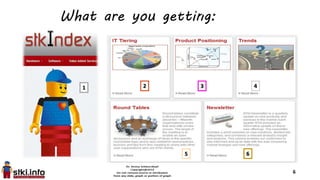
What are you getting:
1 2 3 4
5
6
What are you getting
6
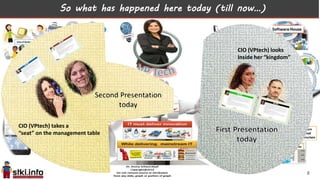
So what has happened here today (till now…)
7
CIO (VPtech) looks
Inside her “kingdom”
CIO (VPtech) takes a
“seat” on the management table
First day in the
“new” position: Mrs. Israela Israeli
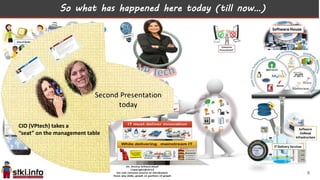
So what has happened here today (till now…)
8
CIO (VPtech) looks
Inside her “kingdom”
CIO (VPtech) takes a
“seat” on the management table
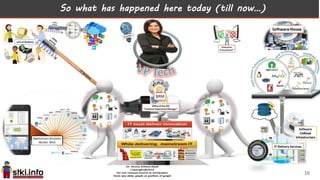
So what has happened here today (till now…)
9
CIO (VPtech) takes a
“seat” on the management table
So what has happened here today (till now…)
10
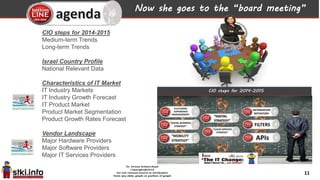
Now she goes to the “board meeting”
11
CIO steps for 2014-2015
Medium-term Trends
Long-term Trends
Israel Country Profile
National Relevant Data
Characteristics of IT Market
IT Industry Markets
IT Industry Growth Forecast
IT Product Market
Product Market Segmentation
Product Growth Rates Forecast
Vendor Landscape
Major Hardware Providers
Major Software Providers
Major IT Services Providers
STKI Summit 2014
Dr. Jimmy Schwarzkopf
STKI “IT Knowledge Integrators”
www.stki.info
jimmy@stki.info
“ DECISION is a sharp knife that cuts clean and straight;
INDECISION, a dull one that hacks and tears and
leaves ragged edges behind it. ”
Gordon Graham 12
Era of great “HEAD SCRATCHING”
13
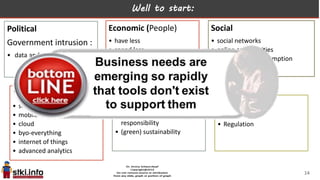
Well to start:
Political
Government intrusion :
• data and privacy
Economic (People)
• have less
• spend less
• want more
• global competition
Social
• social networks
• online communities
• collaborative consumption
Technological
• social
• mobile
• cloud
• byo-everything
• internet of things
• advanced analytics
Environmental
• Corporate social
responsibility
• (green) sustainability
Legal
• Compliance
• Regulation
14
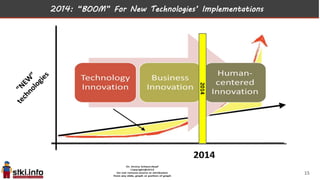
2014: “BOOM” For New Technologies’ Implementations
15
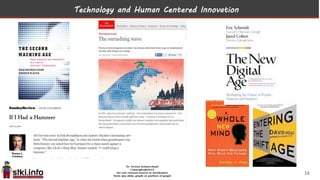
Technology and Human Centered Innovation
16
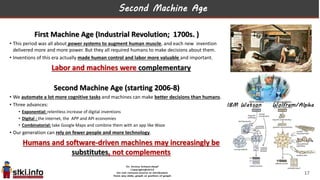
Second Machine Age
First Machine Age (Industrial Revolution; 1700s. )
• This period was all about power systems to augment human muscle, and each new invention
delivered more and more power. But they all required humans to make decisions about them.
• Inventions of this era actually made human control and labor more valuable and important.
Labor and machines were complementary
Second Machine Age (starting 2006-8)
• We automate a lot more cognitive tasks and machines can make better decisions than humans.
• Three advances:
• Exponential: relentless increase of digital inventions
• Digital : the internet, the APP and API economies
• Combinatorial: take Google Maps and combine them with an app like Waze
• Our generation can rely on fewer people and more technology.
Humans and software-driven machines may increasingly be
substitutes, not complements
17
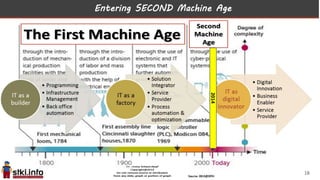
Entering SECOND Machine Age
18
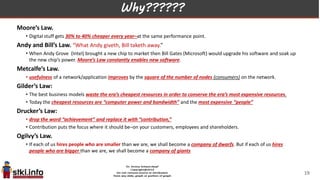
Why??????
Moore’s Law.
• Digital stuff gets 30% to 40% cheaper every year–at the same performance point.
Andy and Bill’s Law. “What Andy giveth, Bill taketh away.”
• When Andy Grove (Intel) brought a new chip to market then Bill Gates (Microsoft) would upgrade his software and soak up
the new chip’s power. Moore’s Law constantly enables new software.
Metcalfe’s Law.
• usefulness of a network/application improves by the square of the number of nodes (consumers) on the network.
Gilder’s Law:
• The best business models waste the era’s cheapest resources in order to conserve the era’s most expensive resources.
• Today the cheapest resources are “computer power and bandwidth” and the most expensive “people”
Drucker’s Law:
• drop the word “achievement” and replace it with “contribution,”
• Contribution puts the focus where it should be–on your customers, employees and shareholders.
Ogilvy’s Law.
• If each of us hires people who are smaller than we are, we shall become a company of dwarfs. But if each of us hires
people who are bigger than we are, we shall become a company of giants
19
Why??????
Moore’s Law.
• Digital stuff gets 30% to 40% cheaper every year–at the same performance point.
Andy and Bill’s Law. “What Andy giveth, Bill taketh away.”
• When Andy Grove (Intel) brought a new chip to market then Bill Gates (Microsoft) would upgrade his software and soak up
the new chip’s power. Moore’s Law constantly enables new software.
Metcalfe’s Law.
• usefulness of a network/application improves by the square of the number of nodes (consumers) on the network.
Gilder’s Law:
• The best business models waste the era’s cheapest resources in order to conserve the era’s most expensive resources.
• Today the cheapest resources are “computer power and bandwidth” and the most expensive “people”
Drucker’s Law:
• drop the word “achievement” and replace it with “contribution,”
• Contribution puts the focus where it should be–on your customers, employees and shareholders.
Ogilvy’s Law.
• If each of us hires people who are smaller than we are, we shall become a company of dwarfs. But if each of us hires
people who are bigger than we are, we shall become a company of giants
20
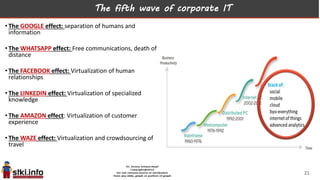
The fifth wave of corporate IT
• The GOOGLE effect: separation of humans and
information
• The WHATSAPP effect: Free communications, death of
distance
• The FACEBOOK effect: Virtualization of human
relationships
• The LINKEDIN effect: Virtualization of specialized
knowledge
• The AMAZON effect: Virtualization of customer
experience
• The WAZE effect: Virtualization and crowdsourcing of
travel
21
The fifth wave of corporate IT
• The GOOGLE effect: separation of humans and
information
• The WHATSAPP effect: Free communications, death of
distance
• The FACEBOOK effect: Virtualization of human
relationships
• The LINKEDIN effect: Virtualization of specialized
knowledge
• The AMAZON effect: Virtualization of customer
experience
• The WAZE effect: Virtualization and crowdsourcing of
travel
22
Wearables and iBeacons
Wearables / iBeacons computing reshape how work gets
done, how decisions are made, and how you engage
with employees, customers, and partners.
Wearables / iBeacons introduce technology to
previously prohibitive scenarios
While consumer are in the spotlight today, STKI expects
business to drive acceptance and transformative
products
23
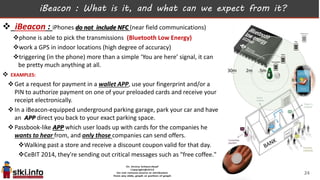
iBeacon : What is it, and what can we expect from it?
 iBeacon : iPhones do not include NFC (near field communications)
phone is able to pick the transmissions (Bluetooth Low Energy)
work a GPS in indoor locations (high degree of accuracy)
triggering (in the phone) more than a simple ‘You are here’ signal, it can
be pretty much anything at all.
 EXAMPLES:
Get a request for payment in a wallet APP, use your fingerprint and/or a
PIN to authorize payment on one of your preloaded cards and receive your
receipt electronically.
In a iBeacon-equipped underground parking garage, park your car and have
an APP direct you back to your exact parking space.
Passbook-like APP which user loads up with cards for the companies he
wants to hear from, and only those companies can send offers.
Walking past a store and receive a discount coupon valid for that day.
CeBIT 2014, they're sending out critical messages such as "free coffee."
24
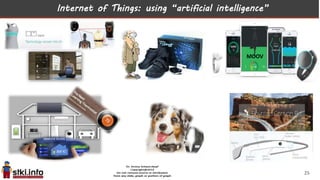
Internet of Things: using “artificial intelligence”
25
MOOV
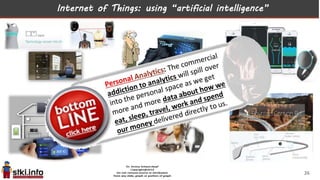
Internet of Things: using “artificial intelligence”
26
MOOV
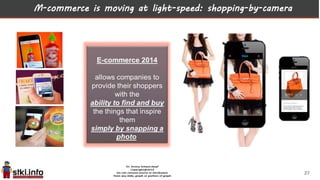
M-commerce is moving at light-speed: shopping-by-camera
27
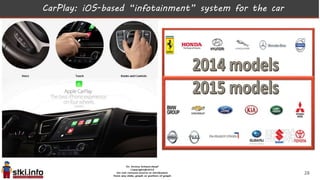
CarPlay: iOS-based “infotainment” system for the car
28
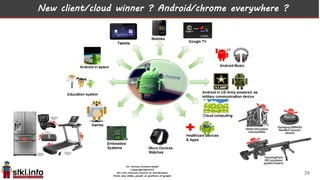
New client/cloud winner ? Android/chrome everywhere ?
29
30
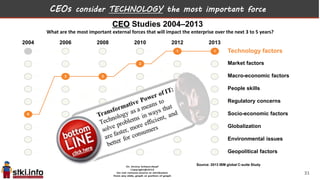
CEOs consider TECHNOLOGY the most important force
CEO Studies 2004–2013
2004 2006 2008 2010 2012 2013
6
3 3
2
1 Technology factors
Market factors
Macro-economic factors
People skills
Regulatory concerns
Socio-economic factors
Globalization
Environmental issues
Geopolitical factors
1
Source: 2013 IBM global C-suite Study
What are the most important external forces that will impact the enterprise over the next 3 to 5 years?
31
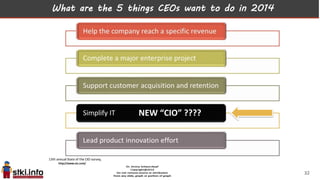
What are the 5 things CEOs want to do in 2014
32
NEW “CIO” ????
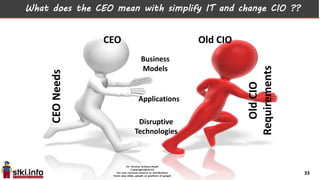
What does the CEO mean with simplify IT and change CIO ??
33
CEONeeds
OldCIO
Requirements
Business
Models
Applications
Disruptive
Technologies
CEO Old CIO
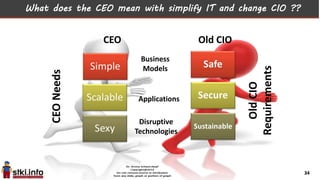
What does the CEO mean with simplify IT and change CIO ??
34
CEONeeds
OldCIO
Requirements
Business
Models
Applications
Disruptive
Technologies
CEO Old CIO
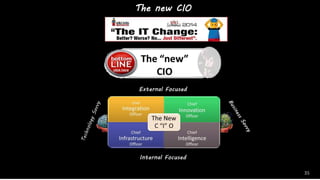
The new CIO
35
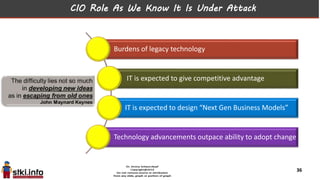
CIO Role As We Know It Is Under Attack
Burdens of legacy technology
IT is expected to give competitive advantage
IT is expected to design “Next Gen Business Models”
Technology advancements outpace ability to adopt change
36
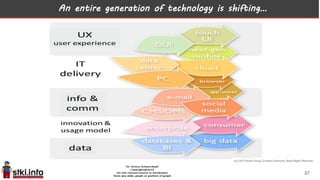
An entire generation of technology is shifting…
37
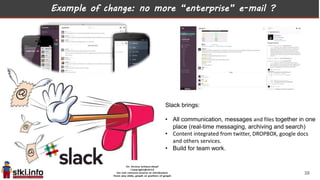
Example of change: no more “enterprise” e-mail ?
Slack brings:
• All communication, messages and files together in one
place (real-time messaging, archiving and search)
• Content integrated from twitter, DROPBOX, google docs
and others services.
• Build for team work.
38
1
3 3
2 2
Technology factors
Market factors
Macro-economic factors
People skills
Regulatory concerns
Socio-economic factors
Globalization
Environmental issues
Geopolitical factors
CEO CFO CHRO CIO CMO CSCO
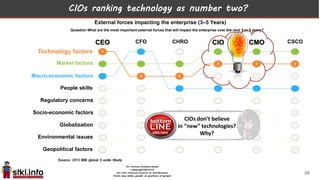
CIOs ranking technology as number two?
External forces impacting the enterprise (3–5 Years)
Question What are the most important external forces that will impact the enterprise over the next 3 to 5 years?
2
39
What should we do?
40
CIOs rules and tools
• Provide “everyone” with simple rules and tools for
social, mobile, big data and cloud
• Establish foundation and tools for managing and
governing 10x-100x more IT and data
• Throw out “traditional” IT playbook and go
“emergent” technologies
• Become a “change” agent and an IT
“revolutionary”
• IT & Business must become “DESIGN THINKERS”
41
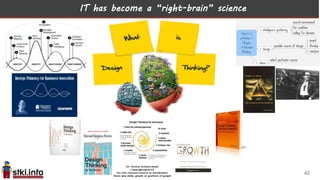
IT has become a “right-brain” science
42
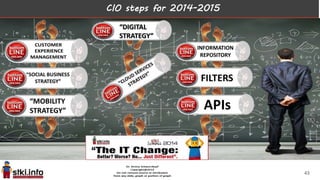
CIO steps for 2014-2015
43
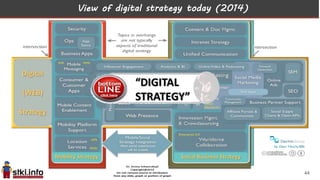
View of digital strategy today (2014)
44
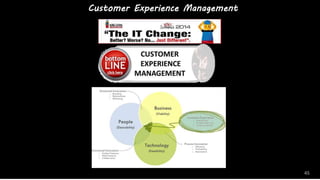
Customer Experience Management
45
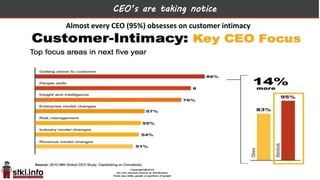
CEO’s are taking notice
Almost every CEO (95%) obsesses on customer intimacy
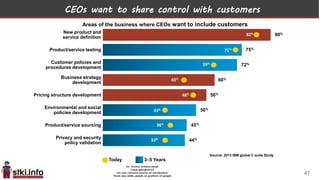
CEOs want to share control with customers
Areas of the business where CEOs want to include customers
Business strategy
development
60%43%
Product/service testing 75%
71%
Environmental and social
policies development
50%
33%
Product/service sourcing 45%36%
44%Privacy and security
policy validation
33%
90%82%New product and
service definition
Customer policies and
procedures development
72%59%
3–5 YearsToday
Pricing structure development 48% 56%
Source: 2013 IBM global C-suite Study
47
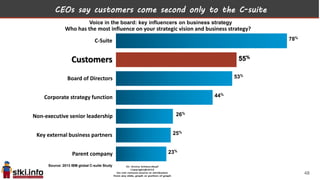
CEOs say customers come second only to the C-suite
Voice in the board: key influencers on business strategy
C-Suite 78%
Customers 55%
Board of Directors 53%
Corporate strategy function 44%
Non-executive senior leadership 26%
Key external business partners 25%
Parent company 23%
Who has the most influence on your strategic vision and business strategy?
Source: 2013 IBM global C-suite Study
48
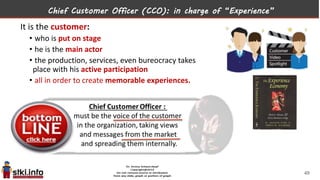
Chief Customer Officer (CCO): in charge of “Experience”
It is the customer:
• who is put on stage
• he is the main actor
• the production, services, even bureocracy takes
place with his active participation
• all in order to create memorable experiences.
49
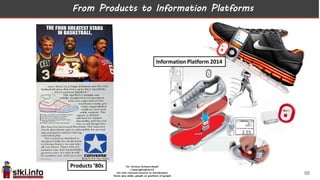
From Products to Information Platforms
50
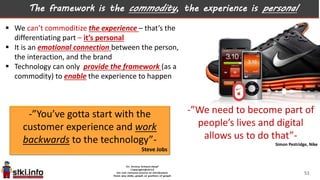
The framework is the commodity, the experience is personal
 We can’t commoditize the experience – that’s the
differentiating part – it’s personal
 It is an emotional connection between the person,
the interaction, and the brand
 Technology can only provide the framework (as a
commodity) to enable the experience to happen
-”We need to become part of
people’s lives and digital
allows us to do that”-
Simon Pestridge, Nike
-”You’ve gotta start with the
customer experience and work
backwards to the technology”-
Steve Jobs
51
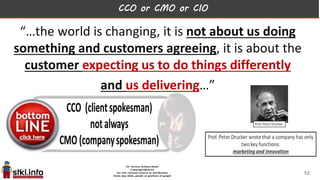
CCO or CMO or CIO
“…the world is changing, it is not about us doing
something and customers agreeing, it is about the
customer expecting us to do things differently
and us delivering…”
52
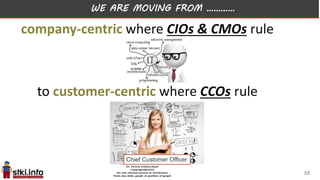
company-centric where CIOs & CMOs rule
to customer-centric where CCOs rule
WE ARE MOVING FROM …………
Chief Customer Officer
53
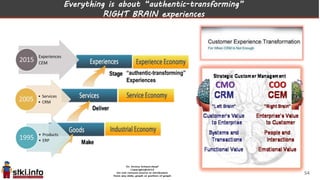
Everything is about “authentic-transforming”
RIGHT BRAIN experiences
54
CMO COO
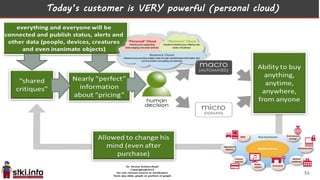
Today’s customer is VERY powerful (personal cloud)
55
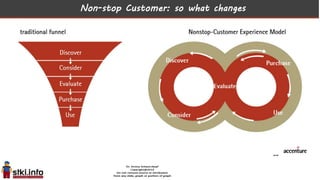
Non-stop Customer: so what changes
56
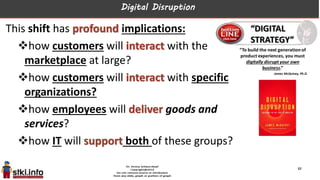
Digital Disruption
This shift has profound implications:
how customers will interact with the
marketplace at large?
how customers will interact with specific
organizations?
how employees will deliver goods and
services?
how IT will support both of these groups?
57
Digital Strategy
58
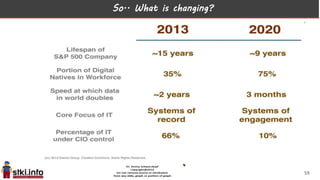
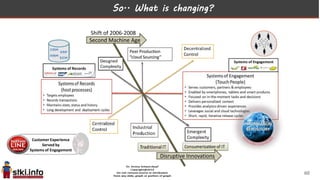
So.. What is changing?
Second Machine Age
Shift of 2006-2008
Disruptive Innovations
59
So.. What is changing?
Second Machine Age
Shift of 2006-2008
Disruptive Innovations
60
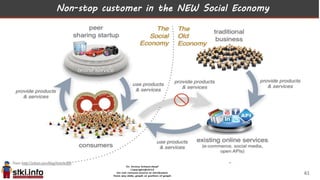
Non-stop customer in the NEW Social Economy
61
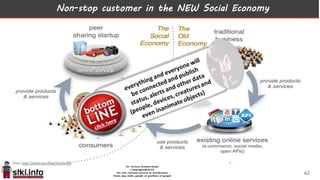
Non-stop customer in the NEW Social Economy
62
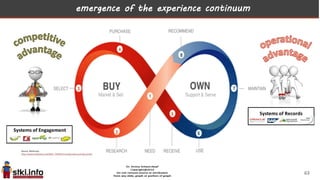
emergence of the experience continuum
63
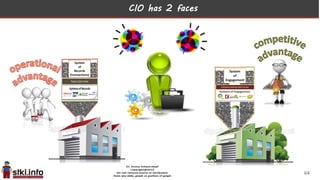
CIO has 2 faces
64
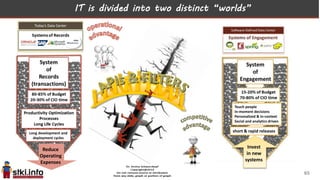
IT is divided into two distinct “worlds”
Invest
in new
systems
Reduce
Operating
Expenses
Long development and
deployment cycles
Touch people
In-moment decisions
Personalized & in-context
Social and analytics driven
short & rapid releases
65
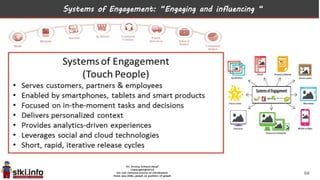
Systems of Engagement: “Engaging and influencing “
66
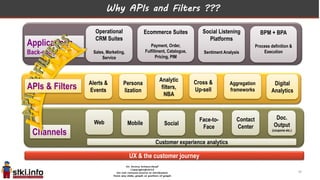
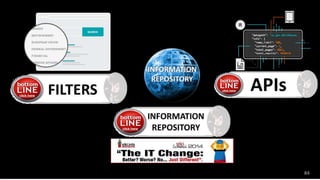
Why APIs and Filters ???
Channels
UX & the customer journey
Operational
CRM Suites
Sales, Marketing,
Service
Ecommerce Suites
Payment, Order,
Fulfillment, Catalogue,
Pricing, PIM
Social Listening
Platforms
Sentiment Analysis
BPM + BPA
Process definition &
Execution
Applications
Back-end processes
Customer experience analytics
Alerts &
Events
Persona
lization
Analytic
filters,
NBA
Digital
Analytics
Cross &
Up-sell
Aggregation
frameworks
Web Mobile Social
Face-to-
Face
Contact
Center
Doc.
Output
(coupons etc.)
67
APIs & Filters
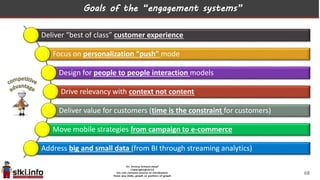
Goals of the “engagement systems”
Deliver “best of class” customer experience
Focus on personalization “push” mode
Design for people to people interaction models
Drive relevancy with context not content
Deliver value for customers (time is the constraint for customers)
Move mobile strategies from campaign to e-commerce
Address big and small data (from BI through streaming analytics)
68
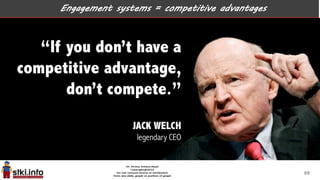
Engagement systems = competitive advantages
69
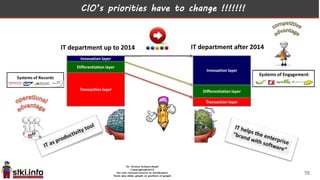
CIO’s priorities have to change !!!!!!!
Transaction layer
Differentiation layer
Innovation layer
Transaction layer
Differentiation layer
Innovation layer
IT department up to 2014 IT department after 2014
70
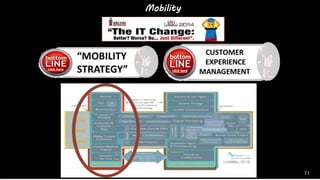
Mobility
71
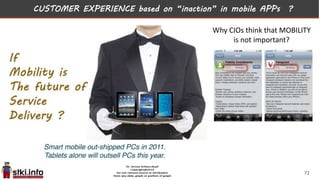
CUSTOMER EXPERIENCE based on “inaction” in mobile APPs ?
72
Why CIOs think that MOBILITY
is not important?
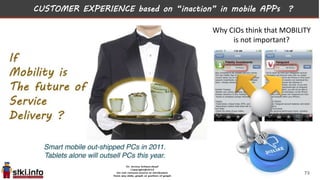
CUSTOMER EXPERIENCE based on “inaction” in mobile APPs ?
73
Why CIOs think that MOBILITY
is not important?
customers always have an experience
(good, bad, or indifferent)
74
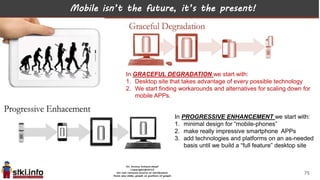
Mobile isn’t the future, it’s the present!
In PROGRESSIVE ENHANCEMENT we start with:
1. minimal design for “mobile-phones”
2. make really impressive smartphone APPs
3. add technologies and platforms on an as-needed
basis until we build a “full feature” desktop site
In GRACEFUL DEGRADATION we start with:
1. Desktop site that takes advantage of every possible technology
2. We start finding workarounds and alternatives for scaling down for
mobile APPs.
75
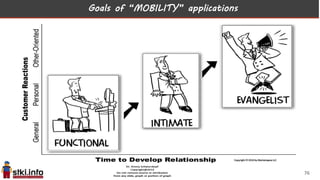
Goals of “MOBILITY” applications
76
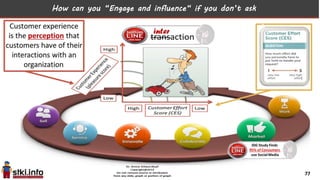
How can you “Engage and influence“ if you don’t ask
77
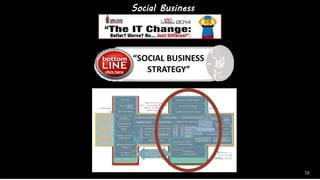
Social Business
78
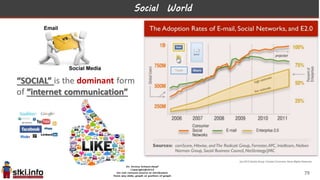
Social World
79
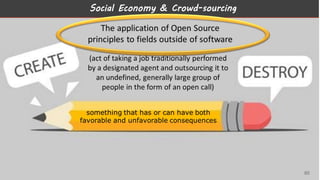
Social Economy & Crowd-sourcing
for
enterprises
80
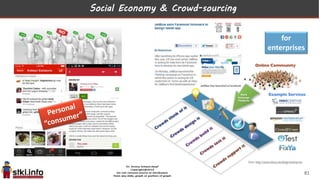
Social Economy & Crowd-sourcing
for
enterprises
81
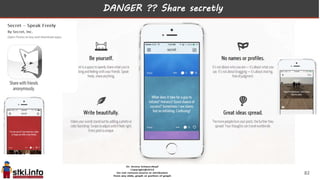
DANGER ?? Share secretly
82
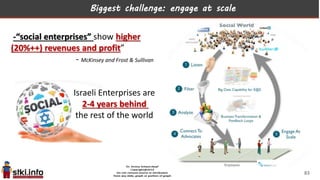
Biggest challenge: engage at scale
-“social enterprises” show higher
(20%++) revenues and profit”
- McKinsey and Frost & Sullivan
Israeli Enterprises are
2-4 years behind
the rest of the world
83
84
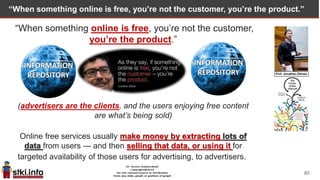
“When something online is free, you’re not the customer, you’re the product.”
“When something online is free, you’re not the customer,
you’re the product.”
(advertisers are the clients, and the users enjoying free content
are what’s being sold)
Online free services usually make money by extracting lots of
data from users — and then selling that data, or using it for
targeted availability of those users for advertising, to advertisers.
85
86
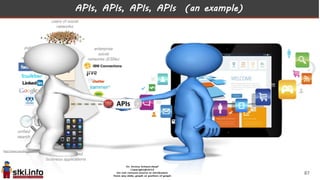
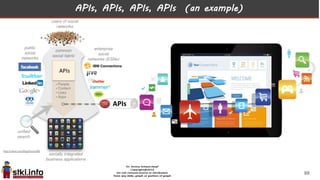
APIs, APIs, APIs, APIs (an example)
87
APIs, APIs, APIs, APIs (an example)
88
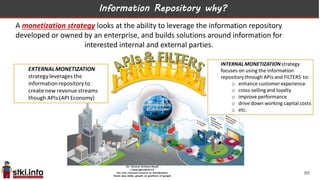
Information Repository why?
A monetization strategy looks at the ability to leverage the information repository
developed or owned by an enterprise, and builds solutions around information for
interested internal and external parties.
89
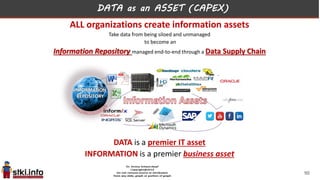
DATA as an ASSET (CAPEX)
ALL organizations create information assets
Take data from being siloed and unmanaged
to become an
Information Repository managed end-to-end through a Data Supply Chain
DATA is a premier IT asset
INFORMATION is a premier business asset
90
DATA transformed to INFORMATION
91
“What’s the difference between
information and data?
It’s like the difference between
knowing Julia Roberts’ phone
number
and
Knowing Julia Roberts”
- Woody Allen
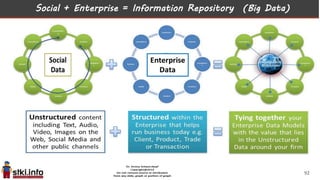
Social + Enterprise = Information Repository (Big Data)
92
INFORMATION
REPOSITORY
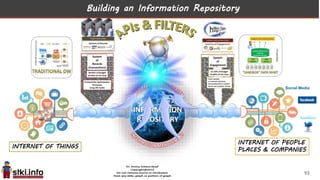
Building an Information Repository
INTERNET OF THINGS
INTERNET OF PEOPLE
PLACES & COMPANIES
93
Social Media
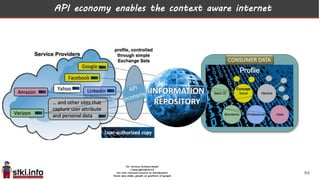
API economy enables the context aware internet
94
CONSUMER DATA
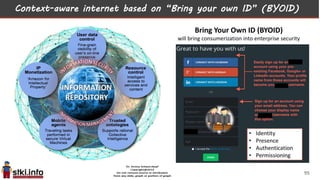
Context-aware internet based on “Bring your own ID” (BYOID)
Bring Your Own ID (BYOID)
will bring consumerization into enterprise security
95
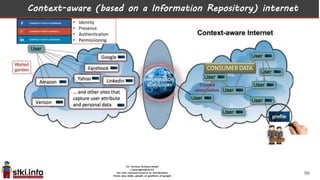
Context-aware (based on a Information Repository) internet
96
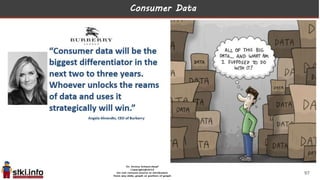
Consumer Data
97
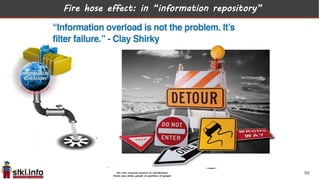
Fire hose effect: in “information repository”
“fire hose effect” solution:
• stream
• filter
• drain
98
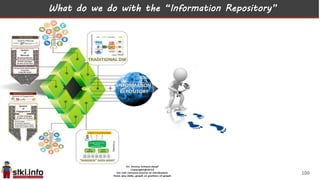
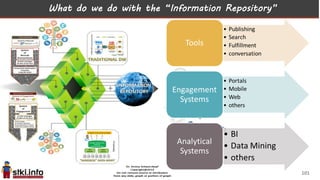
What do we do with the “Information Repository”
99
What do we do with the “Information Repository”
100
What do we do with the “Information Repository”
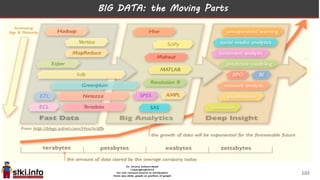
101
BIG DATA: the Moving Parts
102
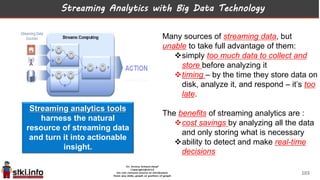
Streaming Analytics with Big Data Technology
Many sources of streaming data, but
unable to take full advantage of them:
simply too much data to collect and
store before analyzing it
timing – by the time they store data on
disk, analyze it, and respond – it’s too
late.
The benefits of streaming analytics are :
cost savings by analyzing all the data
and only storing what is necessary
ability to detect and make real-time
decisions
Streaming analytics tools
harness the natural
resource of streaming data
and turn it into actionable
insight.
103
CLOUD
104
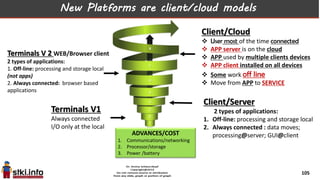
Client/Cloud
 User most of the time connected
 APP server is on the cloud
 APP used by multiple clients devices
 APP client installed on all devices
 Some work off line
 Move from APP to SERVICE
Terminals V 2 WEB/Browser client
2 types of applications:
1. Off-line: processing and storage local
(not apps)
2. Always connected: browser based
applications
Client/Server
2 types of applications:
1. Off-line: processing and storage local
2. Always connected : data moves;
processing@server; GUI@client
Terminals V1
Always connected
I/O only at the local
New Platforms are client/cloud models
ADVANCES/COST
1. Communications/networking
2. Processor/storage
3. Power /battery
105
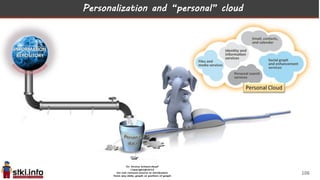
Personalization and “personal” cloud
106
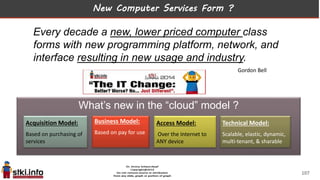
New Computer Services Form ?
What’s new in the “cloud” model ?
Acquisition Model:
Based on purchasing of
services
Business Model:
Based on pay for use
Access Model:
Over the Internet to
ANY device
Technical Model:
Scalable, elastic, dynamic,
multi-tenant, & sharable
Every decade a new, lower priced computer class
forms with new programming platform, network, and
interface resulting in new usage and industry.
Gordon Bell
107
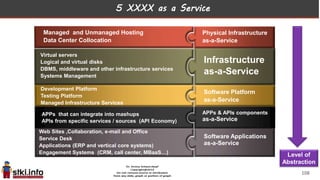
Managed and Unmanaged Hosting
Data Center Collocation
Development Platform
Testing Platform
Managed Infrastructure Services
Virtual servers
Logical and virtual disks
DBMS, middleware and other infrastructure services
Systems Management
APPs that can integrate into mashups
APIs from specific services / sources (API Economy)
Web Sites ,Collaboration, e-mail and Office
Service Desk
Applications (ERP and vertical core systems)
Engagement Systems (CRM, call center, MBaaS…)
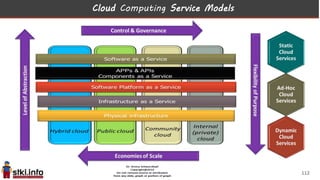
Physical Infrastructure
as-a-Service
Infrastructure
as-a-Service
Software Platform
as-a-Service
APPs & APIs components
as-a-Service
Software Applications
as-a-Service
5 XXXX as a Service
Level of
Abstraction
108
109
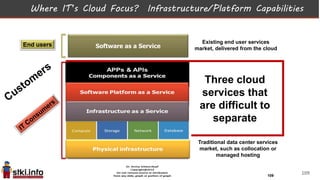
Physical infrastructure
Software Platform as a Service
APPs & APIs
Components as a Service
Infrastructure as a Service
Software as a ServiceEnd users
Traditional data center services
market, such as collocation or
managed hosting
Existing end user services
market, delivered from the cloud
Three cloud
services that
are difficult to
separate
Where IT’s Cloud Focus? Infrastructure/Platform Capabilities
109
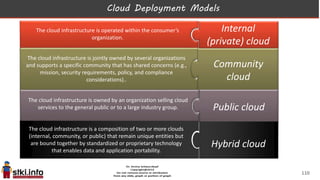
Cloud Deployment Models
Internal
(private) cloud
Community
cloud
Public cloud
Hybrid cloud
The cloud infrastructure is operated within the consumer’s
organization.
The cloud infrastructure is owned by an organization selling cloud
services to the general public or to a large industry group.
The cloud infrastructure is jointly owned by several organizations
and supports a specific community that has shared concerns (e.g.,
mission, security requirements, policy, and compliance
considerations)..
The cloud infrastructure is a composition of two or more clouds
(internal, community, or public) that remain unique entities but
are bound together by standardized or proprietary technology
that enables data and application portability.
110
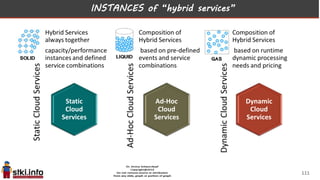
INSTANCES of “hybrid services”
Dynamic
Cloud
Services
Ad-Hoc
Cloud
Services
Static
Cloud
Services
111
Cloud Computing Service Models
112
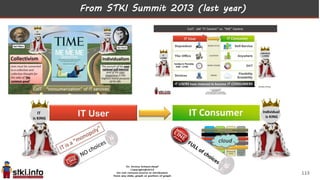
From STKI Summit 2013 (last year)
113
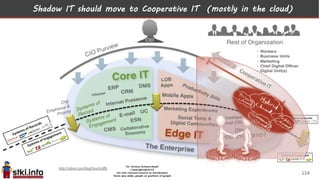
Shadow IT should move to Cooperative IT (mostly in the cloud)
114
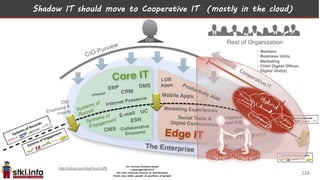
Shadow IT should move to Cooperative IT (mostly in the cloud)
115
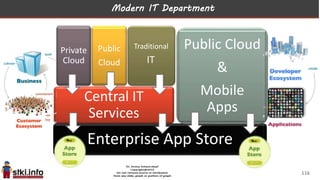
Modern IT Department
Enterprise App Store
Central IT
Services
Private
Cloud
Public
Cloud
Public Cloud
&
Mobile
Apps
Traditional
IT
116
Shutterstock
117
END of PART
O N E

STKI Summit 2014 Main tent presenation

  • 1.
    / Information Technology Version 2014-2016 DrJimmy Schwarzkopf STKI “IT Knowledge Integrators” jimmy@stki.info
  • 2.
  • 3.
    Thank you tothe great STKI team 3
  • 4.
    Thank you toall these companies (expo outside) 4
  • 5.
    Thank you toall of you for “being here” 5
  • 6.
    What are yougetting: 1 2 3 4 5 6 What are you getting 6
  • 7.
    So what hashappened here today (till now…) 7 CIO (VPtech) looks Inside her “kingdom” CIO (VPtech) takes a “seat” on the management table First day in the “new” position: Mrs. Israela Israeli
  • 8.
    So what hashappened here today (till now…) 8 CIO (VPtech) looks Inside her “kingdom” CIO (VPtech) takes a “seat” on the management table
  • 9.
    So what hashappened here today (till now…) 9 CIO (VPtech) takes a “seat” on the management table
  • 10.
    So what hashappened here today (till now…) 10
  • 11.
    Now she goesto the “board meeting” 11 CIO steps for 2014-2015 Medium-term Trends Long-term Trends Israel Country Profile National Relevant Data Characteristics of IT Market IT Industry Markets IT Industry Growth Forecast IT Product Market Product Market Segmentation Product Growth Rates Forecast Vendor Landscape Major Hardware Providers Major Software Providers Major IT Services Providers
  • 12.
    STKI Summit 2014 Dr.Jimmy Schwarzkopf STKI “IT Knowledge Integrators” www.stki.info jimmy@stki.info “ DECISION is a sharp knife that cuts clean and straight; INDECISION, a dull one that hacks and tears and leaves ragged edges behind it. ” Gordon Graham 12
  • 13.
    Era of great“HEAD SCRATCHING” 13
  • 14.
    Well to start: Political Governmentintrusion : • data and privacy Economic (People) • have less • spend less • want more • global competition Social • social networks • online communities • collaborative consumption Technological • social • mobile • cloud • byo-everything • internet of things • advanced analytics Environmental • Corporate social responsibility • (green) sustainability Legal • Compliance • Regulation 14
  • 15.
    2014: “BOOM” ForNew Technologies’ Implementations 15
  • 16.
    Technology and HumanCentered Innovation 16
  • 17.
    Second Machine Age FirstMachine Age (Industrial Revolution; 1700s. ) • This period was all about power systems to augment human muscle, and each new invention delivered more and more power. But they all required humans to make decisions about them. • Inventions of this era actually made human control and labor more valuable and important. Labor and machines were complementary Second Machine Age (starting 2006-8) • We automate a lot more cognitive tasks and machines can make better decisions than humans. • Three advances: • Exponential: relentless increase of digital inventions • Digital : the internet, the APP and API economies • Combinatorial: take Google Maps and combine them with an app like Waze • Our generation can rely on fewer people and more technology. Humans and software-driven machines may increasingly be substitutes, not complements 17
  • 18.
  • 19.
    Why?????? Moore’s Law. • Digitalstuff gets 30% to 40% cheaper every year–at the same performance point. Andy and Bill’s Law. “What Andy giveth, Bill taketh away.” • When Andy Grove (Intel) brought a new chip to market then Bill Gates (Microsoft) would upgrade his software and soak up the new chip’s power. Moore’s Law constantly enables new software. Metcalfe’s Law. • usefulness of a network/application improves by the square of the number of nodes (consumers) on the network. Gilder’s Law: • The best business models waste the era’s cheapest resources in order to conserve the era’s most expensive resources. • Today the cheapest resources are “computer power and bandwidth” and the most expensive “people” Drucker’s Law: • drop the word “achievement” and replace it with “contribution,” • Contribution puts the focus where it should be–on your customers, employees and shareholders. Ogilvy’s Law. • If each of us hires people who are smaller than we are, we shall become a company of dwarfs. But if each of us hires people who are bigger than we are, we shall become a company of giants 19
  • 20.
    Why?????? Moore’s Law. • Digitalstuff gets 30% to 40% cheaper every year–at the same performance point. Andy and Bill’s Law. “What Andy giveth, Bill taketh away.” • When Andy Grove (Intel) brought a new chip to market then Bill Gates (Microsoft) would upgrade his software and soak up the new chip’s power. Moore’s Law constantly enables new software. Metcalfe’s Law. • usefulness of a network/application improves by the square of the number of nodes (consumers) on the network. Gilder’s Law: • The best business models waste the era’s cheapest resources in order to conserve the era’s most expensive resources. • Today the cheapest resources are “computer power and bandwidth” and the most expensive “people” Drucker’s Law: • drop the word “achievement” and replace it with “contribution,” • Contribution puts the focus where it should be–on your customers, employees and shareholders. Ogilvy’s Law. • If each of us hires people who are smaller than we are, we shall become a company of dwarfs. But if each of us hires people who are bigger than we are, we shall become a company of giants 20
  • 21.
    The fifth waveof corporate IT • The GOOGLE effect: separation of humans and information • The WHATSAPP effect: Free communications, death of distance • The FACEBOOK effect: Virtualization of human relationships • The LINKEDIN effect: Virtualization of specialized knowledge • The AMAZON effect: Virtualization of customer experience • The WAZE effect: Virtualization and crowdsourcing of travel 21
  • 22.
    The fifth waveof corporate IT • The GOOGLE effect: separation of humans and information • The WHATSAPP effect: Free communications, death of distance • The FACEBOOK effect: Virtualization of human relationships • The LINKEDIN effect: Virtualization of specialized knowledge • The AMAZON effect: Virtualization of customer experience • The WAZE effect: Virtualization and crowdsourcing of travel 22
  • 23.
    Wearables and iBeacons Wearables/ iBeacons computing reshape how work gets done, how decisions are made, and how you engage with employees, customers, and partners. Wearables / iBeacons introduce technology to previously prohibitive scenarios While consumer are in the spotlight today, STKI expects business to drive acceptance and transformative products 23
  • 24.
    iBeacon : Whatis it, and what can we expect from it?  iBeacon : iPhones do not include NFC (near field communications) phone is able to pick the transmissions (Bluetooth Low Energy) work a GPS in indoor locations (high degree of accuracy) triggering (in the phone) more than a simple ‘You are here’ signal, it can be pretty much anything at all.  EXAMPLES: Get a request for payment in a wallet APP, use your fingerprint and/or a PIN to authorize payment on one of your preloaded cards and receive your receipt electronically. In a iBeacon-equipped underground parking garage, park your car and have an APP direct you back to your exact parking space. Passbook-like APP which user loads up with cards for the companies he wants to hear from, and only those companies can send offers. Walking past a store and receive a discount coupon valid for that day. CeBIT 2014, they're sending out critical messages such as "free coffee." 24
  • 25.
    Internet of Things:using “artificial intelligence” 25 MOOV
  • 26.
    Internet of Things:using “artificial intelligence” 26 MOOV
  • 27.
    M-commerce is movingat light-speed: shopping-by-camera 27
  • 28.
  • 29.
    New client/cloud winner? Android/chrome everywhere ? 29
  • 30.
  • 31.
    CEOs consider TECHNOLOGYthe most important force CEO Studies 2004–2013 2004 2006 2008 2010 2012 2013 6 3 3 2 1 Technology factors Market factors Macro-economic factors People skills Regulatory concerns Socio-economic factors Globalization Environmental issues Geopolitical factors 1 Source: 2013 IBM global C-suite Study What are the most important external forces that will impact the enterprise over the next 3 to 5 years? 31
  • 32.
    What are the5 things CEOs want to do in 2014 32 NEW “CIO” ????
  • 33.
    What does theCEO mean with simplify IT and change CIO ?? 33 CEONeeds OldCIO Requirements Business Models Applications Disruptive Technologies CEO Old CIO
  • 34.
    What does theCEO mean with simplify IT and change CIO ?? 34 CEONeeds OldCIO Requirements Business Models Applications Disruptive Technologies CEO Old CIO
  • 35.
  • 36.
    CIO Role AsWe Know It Is Under Attack Burdens of legacy technology IT is expected to give competitive advantage IT is expected to design “Next Gen Business Models” Technology advancements outpace ability to adopt change 36
  • 37.
    An entire generationof technology is shifting… 37
  • 38.
    Example of change:no more “enterprise” e-mail ? Slack brings: • All communication, messages and files together in one place (real-time messaging, archiving and search) • Content integrated from twitter, DROPBOX, google docs and others services. • Build for team work. 38
  • 39.
    1 3 3 2 2 Technologyfactors Market factors Macro-economic factors People skills Regulatory concerns Socio-economic factors Globalization Environmental issues Geopolitical factors CEO CFO CHRO CIO CMO CSCO CIOs ranking technology as number two? External forces impacting the enterprise (3–5 Years) Question What are the most important external forces that will impact the enterprise over the next 3 to 5 years? 2 39
  • 40.
  • 41.
    CIOs rules andtools • Provide “everyone” with simple rules and tools for social, mobile, big data and cloud • Establish foundation and tools for managing and governing 10x-100x more IT and data • Throw out “traditional” IT playbook and go “emergent” technologies • Become a “change” agent and an IT “revolutionary” • IT & Business must become “DESIGN THINKERS” 41
  • 42.
    IT has becomea “right-brain” science 42
  • 43.
    CIO steps for2014-2015 43
  • 44.
    View of digitalstrategy today (2014) 44
  • 45.
  • 46.
    CEO’s are takingnotice Almost every CEO (95%) obsesses on customer intimacy
  • 47.
    CEOs want toshare control with customers Areas of the business where CEOs want to include customers Business strategy development 60%43% Product/service testing 75% 71% Environmental and social policies development 50% 33% Product/service sourcing 45%36% 44%Privacy and security policy validation 33% 90%82%New product and service definition Customer policies and procedures development 72%59% 3–5 YearsToday Pricing structure development 48% 56% Source: 2013 IBM global C-suite Study 47
  • 48.
    CEOs say customerscome second only to the C-suite Voice in the board: key influencers on business strategy C-Suite 78% Customers 55% Board of Directors 53% Corporate strategy function 44% Non-executive senior leadership 26% Key external business partners 25% Parent company 23% Who has the most influence on your strategic vision and business strategy? Source: 2013 IBM global C-suite Study 48
  • 49.
    Chief Customer Officer(CCO): in charge of “Experience” It is the customer: • who is put on stage • he is the main actor • the production, services, even bureocracy takes place with his active participation • all in order to create memorable experiences. 49
  • 50.
    From Products toInformation Platforms 50
  • 51.
    The framework isthe commodity, the experience is personal  We can’t commoditize the experience – that’s the differentiating part – it’s personal  It is an emotional connection between the person, the interaction, and the brand  Technology can only provide the framework (as a commodity) to enable the experience to happen -”We need to become part of people’s lives and digital allows us to do that”- Simon Pestridge, Nike -”You’ve gotta start with the customer experience and work backwards to the technology”- Steve Jobs 51
  • 52.
    CCO or CMOor CIO “…the world is changing, it is not about us doing something and customers agreeing, it is about the customer expecting us to do things differently and us delivering…” 52
  • 53.
    company-centric where CIOs& CMOs rule to customer-centric where CCOs rule WE ARE MOVING FROM ………… Chief Customer Officer 53
  • 54.
    Everything is about“authentic-transforming” RIGHT BRAIN experiences 54 CMO COO
  • 55.
    Today’s customer isVERY powerful (personal cloud) 55
  • 56.
    Non-stop Customer: sowhat changes 56
  • 57.
    Digital Disruption This shifthas profound implications: how customers will interact with the marketplace at large? how customers will interact with specific organizations? how employees will deliver goods and services? how IT will support both of these groups? 57
  • 58.
  • 59.
    So.. What ischanging? Second Machine Age Shift of 2006-2008 Disruptive Innovations 59
  • 60.
    So.. What ischanging? Second Machine Age Shift of 2006-2008 Disruptive Innovations 60
  • 61.
    Non-stop customer inthe NEW Social Economy 61
  • 62.
    Non-stop customer inthe NEW Social Economy 62
  • 63.
    emergence of theexperience continuum 63
  • 64.
    CIO has 2faces 64
  • 65.
    IT is dividedinto two distinct “worlds” Invest in new systems Reduce Operating Expenses Long development and deployment cycles Touch people In-moment decisions Personalized & in-context Social and analytics driven short & rapid releases 65
  • 66.
    Systems of Engagement:“Engaging and influencing “ 66
  • 67.
    Why APIs andFilters ??? Channels UX & the customer journey Operational CRM Suites Sales, Marketing, Service Ecommerce Suites Payment, Order, Fulfillment, Catalogue, Pricing, PIM Social Listening Platforms Sentiment Analysis BPM + BPA Process definition & Execution Applications Back-end processes Customer experience analytics Alerts & Events Persona lization Analytic filters, NBA Digital Analytics Cross & Up-sell Aggregation frameworks Web Mobile Social Face-to- Face Contact Center Doc. Output (coupons etc.) 67 APIs & Filters
  • 68.
    Goals of the“engagement systems” Deliver “best of class” customer experience Focus on personalization “push” mode Design for people to people interaction models Drive relevancy with context not content Deliver value for customers (time is the constraint for customers) Move mobile strategies from campaign to e-commerce Address big and small data (from BI through streaming analytics) 68
  • 69.
    Engagement systems =competitive advantages 69
  • 70.
    CIO’s priorities haveto change !!!!!!! Transaction layer Differentiation layer Innovation layer Transaction layer Differentiation layer Innovation layer IT department up to 2014 IT department after 2014 70
  • 71.
  • 72.
    CUSTOMER EXPERIENCE basedon “inaction” in mobile APPs ? 72 Why CIOs think that MOBILITY is not important?
  • 73.
    CUSTOMER EXPERIENCE basedon “inaction” in mobile APPs ? 73 Why CIOs think that MOBILITY is not important?
  • 74.
    customers always havean experience (good, bad, or indifferent) 74
  • 75.
    Mobile isn’t thefuture, it’s the present! In PROGRESSIVE ENHANCEMENT we start with: 1. minimal design for “mobile-phones” 2. make really impressive smartphone APPs 3. add technologies and platforms on an as-needed basis until we build a “full feature” desktop site In GRACEFUL DEGRADATION we start with: 1. Desktop site that takes advantage of every possible technology 2. We start finding workarounds and alternatives for scaling down for mobile APPs. 75
  • 76.
    Goals of “MOBILITY”applications 76
  • 77.
    How can you“Engage and influence“ if you don’t ask 77
  • 78.
  • 79.
  • 80.
    Social Economy &Crowd-sourcing for enterprises 80
  • 81.
    Social Economy &Crowd-sourcing for enterprises 81
  • 82.
    DANGER ?? Sharesecretly 82
  • 83.
    Biggest challenge: engageat scale -“social enterprises” show higher (20%++) revenues and profit” - McKinsey and Frost & Sullivan Israeli Enterprises are 2-4 years behind the rest of the world 83
  • 84.
  • 85.
    “When something onlineis free, you’re not the customer, you’re the product.” “When something online is free, you’re not the customer, you’re the product.” (advertisers are the clients, and the users enjoying free content are what’s being sold) Online free services usually make money by extracting lots of data from users — and then selling that data, or using it for targeted availability of those users for advertising, to advertisers. 85
  • 86.
  • 87.
    APIs, APIs, APIs,APIs (an example) 87
  • 88.
    APIs, APIs, APIs,APIs (an example) 88
  • 89.
    Information Repository why? Amonetization strategy looks at the ability to leverage the information repository developed or owned by an enterprise, and builds solutions around information for interested internal and external parties. 89
  • 90.
    DATA as anASSET (CAPEX) ALL organizations create information assets Take data from being siloed and unmanaged to become an Information Repository managed end-to-end through a Data Supply Chain DATA is a premier IT asset INFORMATION is a premier business asset 90
  • 91.
    DATA transformed toINFORMATION 91 “What’s the difference between information and data? It’s like the difference between knowing Julia Roberts’ phone number and Knowing Julia Roberts” - Woody Allen
  • 92.
    Social + Enterprise= Information Repository (Big Data) 92
  • 93.
    INFORMATION REPOSITORY Building an InformationRepository INTERNET OF THINGS INTERNET OF PEOPLE PLACES & COMPANIES 93 Social Media
  • 94.
    API economy enablesthe context aware internet 94 CONSUMER DATA
  • 95.
    Context-aware internet basedon “Bring your own ID” (BYOID) Bring Your Own ID (BYOID) will bring consumerization into enterprise security 95
  • 96.
    Context-aware (based ona Information Repository) internet 96
  • 97.
  • 98.
    Fire hose effect:in “information repository” “fire hose effect” solution: • stream • filter • drain 98
  • 99.
    What do wedo with the “Information Repository” 99
  • 100.
    What do wedo with the “Information Repository” 100
  • 101.
    What do wedo with the “Information Repository” 101
  • 102.
    BIG DATA: theMoving Parts 102
  • 103.
    Streaming Analytics withBig Data Technology Many sources of streaming data, but unable to take full advantage of them: simply too much data to collect and store before analyzing it timing – by the time they store data on disk, analyze it, and respond – it’s too late. The benefits of streaming analytics are : cost savings by analyzing all the data and only storing what is necessary ability to detect and make real-time decisions Streaming analytics tools harness the natural resource of streaming data and turn it into actionable insight. 103
  • 104.
  • 105.
    Client/Cloud  User mostof the time connected  APP server is on the cloud  APP used by multiple clients devices  APP client installed on all devices  Some work off line  Move from APP to SERVICE Terminals V 2 WEB/Browser client 2 types of applications: 1. Off-line: processing and storage local (not apps) 2. Always connected: browser based applications Client/Server 2 types of applications: 1. Off-line: processing and storage local 2. Always connected : data moves; processing@server; GUI@client Terminals V1 Always connected I/O only at the local New Platforms are client/cloud models ADVANCES/COST 1. Communications/networking 2. Processor/storage 3. Power /battery 105
  • 106.
  • 107.
    New Computer ServicesForm ? What’s new in the “cloud” model ? Acquisition Model: Based on purchasing of services Business Model: Based on pay for use Access Model: Over the Internet to ANY device Technical Model: Scalable, elastic, dynamic, multi-tenant, & sharable Every decade a new, lower priced computer class forms with new programming platform, network, and interface resulting in new usage and industry. Gordon Bell 107
  • 108.
    Managed and UnmanagedHosting Data Center Collocation Development Platform Testing Platform Managed Infrastructure Services Virtual servers Logical and virtual disks DBMS, middleware and other infrastructure services Systems Management APPs that can integrate into mashups APIs from specific services / sources (API Economy) Web Sites ,Collaboration, e-mail and Office Service Desk Applications (ERP and vertical core systems) Engagement Systems (CRM, call center, MBaaS…) Physical Infrastructure as-a-Service Infrastructure as-a-Service Software Platform as-a-Service APPs & APIs components as-a-Service Software Applications as-a-Service 5 XXXX as a Service Level of Abstraction 108
  • 109.
    109 Physical infrastructure Software Platformas a Service APPs & APIs Components as a Service Infrastructure as a Service Software as a ServiceEnd users Traditional data center services market, such as collocation or managed hosting Existing end user services market, delivered from the cloud Three cloud services that are difficult to separate Where IT’s Cloud Focus? Infrastructure/Platform Capabilities 109
  • 110.
    Cloud Deployment Models Internal (private)cloud Community cloud Public cloud Hybrid cloud The cloud infrastructure is operated within the consumer’s organization. The cloud infrastructure is owned by an organization selling cloud services to the general public or to a large industry group. The cloud infrastructure is jointly owned by several organizations and supports a specific community that has shared concerns (e.g., mission, security requirements, policy, and compliance considerations).. The cloud infrastructure is a composition of two or more clouds (internal, community, or public) that remain unique entities but are bound together by standardized or proprietary technology that enables data and application portability. 110
  • 111.
    INSTANCES of “hybridservices” Dynamic Cloud Services Ad-Hoc Cloud Services Static Cloud Services 111
  • 112.
  • 113.
    From STKI Summit2013 (last year) 113
  • 114.
    Shadow IT shouldmove to Cooperative IT (mostly in the cloud) 114
  • 115.
    Shadow IT shouldmove to Cooperative IT (mostly in the cloud) 115
  • 116.
    Modern IT Department EnterpriseApp Store Central IT Services Private Cloud Public Cloud Public Cloud & Mobile Apps Traditional IT 116
  • 117.