
Sterilization
Assistant Professor
Mr. Swapnil Shankar Patil
(M. Pharm, PhD-Research
Scholar)
Department of Pharmaceutics
Sterilization
 It is the process that destroys all microorganisms
(including bacterial microspores).
 The skin could never be sterilized without its own
destruction.
Disinfection
 A process which destroys only the vegetative
forms of organisms =basically clean.
 A disinfectant (germicide, antiseptic): any
chemical substance with either a bactericidal or
a bacteriostatic action.
 Antiseptic -- Agent applied to living tissue
 Disinfectant -- Agent applied to inanimate
surface
Surgical Disinfection
 This is an essential part of a programme for
the control of infection.
 High Risk Items: as they come in close
contact with broken skin or those that breach
mucous membranes or are introduced into a
sterile cavity.
Methods of Disinfection
 Physical: The most important as they can be relied on to
ensure the sterilization of articles used in the treatment
of patients:
– Thermal: Heat or Steam
– Radiation: infra-red radiation, - rays,  particles
– Filtration:utilizing filters capable of screening out microorganisms
 Chemical: Less effective, used for personnel
– Organic
– Inorganic
 Gaseous disinfectants: very efficient, not routine
– Formaldehyde gas
– Ethylene oxide
Physical Methods of Disinfection
HEAT
DRY HEAT
 Kills by Destructive oxidation of cell constituents
 Surest incineration
 Hot-air oven:
– inefficient, poor conductor of heat, penetrates feebly.
– 160°C for 1 hour: damages fabrics, melts rubber
– Used for: Glassware, oily fluids, powders
Physical Methods of Disinfection
HEAT
MOIST HEAT
Effective at low temperature, in a shorter period
of time
 Boiling: 100°C for 30 minutes
 Pasteurisation: 63°C for 30 minutes
 Tyndallisation: steaming for 20 minutes for 3
successive days
 Steaming under pressure= Autoclaving
Advantages of steam
 Kills by denaturing & coagulating enzymes &
proteins
 More rapid (maximum needed time 45mn) & at
lower temperature
 Condensation of steam leads to liberation of
latent heat which raises the temperature, and
gives more penetration
 Half dense as air, so has better penetration
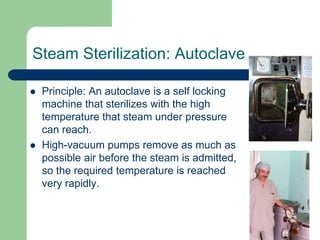
Steam Sterilization: Autoclave
 Principle: An autoclave is a self locking
machine that sterilizes with the high
temperature that steam under pressure
can reach.
 High-vacuum pumps remove as much as
possible air before the steam is admitted,
so the required temperature is reached
very rapidly.
Steam criteria
 Dry: no suspended droplets of water
 Close to its point of condensation: not
superheated
 Free from air: as it decreases the temperature
and the penetration
 Temperature
– 121°C: 15mn-30mn
– 134°C: 4-7mn Flashing
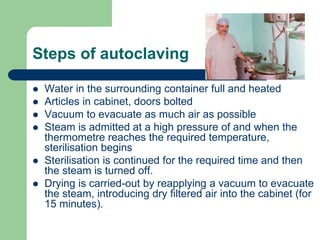
Steps of autoclaving
 Water in the surrounding container full and heated
 Articles in cabinet, doors bolted
 Vacuum to evacuate as much air as possible
 Steam is admitted at a high pressure of and when the
thermometre reaches the required temperature,
sterilisation begins
 Sterilisation is continued for the required time and then
the steam is turned off.
 Drying is carried-out by reapplying a vacuum to evacuate
the steam, introducing dry filtered air into the cabinet (for
15 minutes).
Efficient Autoclaving
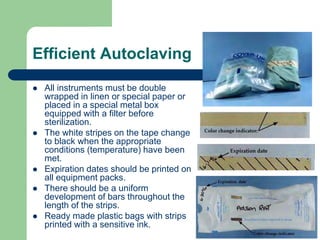
 All instruments must be double
wrapped in linen or special paper or
placed in a special metal box
equipped with a filter before
sterilization.
 The white stripes on the tape change
to black when the appropriate
conditions (temperature) have been
met.
 Expiration dates should be printed on
all equipment packs.
 There should be a uniform
development of bars throughout the
length of the strips.
 Ready made plastic bags with strips
printed with a sensitive ink.
Control of autoclave efficiency
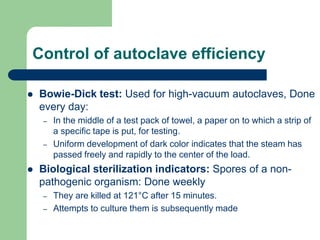
 Bowie-Dick test: Used for high-vacuum autoclaves, Done
every day:
– In the middle of a test pack of towel, a paper on to which a strip of
a specific tape is put, for testing.
– Uniform development of dark color indicates that the steam has
passed freely and rapidly to the center of the load.
 Biological sterilization indicators: Spores of a non-
pathogenic organism: Done weekly
– They are killed at 121°C after 15 minutes.
– Attempts to culture them is subsequently made
CHEMICAL DISINFECTION
A SATISFACTORY AGENT SHOULD:
 Be active against a wide range of organisms and
spores. Only few are truly sterilizer
 Have a rapid action
 Should not be toxic or irritant to the skin
 Should be Persistent
There is no one disinfectant which can be
used to kill all micro-organisms in all
situations.
Types of Chemical disinfectants
 Inorganic:
– Iodine
– Chlorine
 Organic:
– Alcohols
– Aldehydes
– Phenols
– Cationic surface-active agents
Inorganic disinfectants
The halogens: Chlorine and Iodine
 Have a rapid action against vegetative
organisms and spores= true sterilizers
 Their action is annulled by foreign organic
material
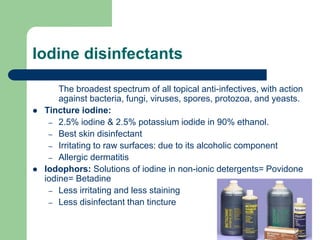
Iodine disinfectants
The broadest spectrum of all topical anti-infectives, with action
against bacteria, fungi, viruses, spores, protozoa, and yeasts.
 Tincture iodine:
– 2.5% iodine & 2.5% potassium iodide in 90% ethanol.
– Best skin disinfectant
– Irritating to raw surfaces: due to its alcoholic component
– Allergic dermatitis
 Iodophors: Solutions of iodine in non-ionic detergents= Povidone
iodine= Betadine
– Less irritating and less staining
– Less disinfectant than tincture
Chlorine disinfectants
 Powerful, Disinfect water
 Particularly active against viruses
 Concentrated solutions too corrosive
 Usually diluted with a compatible detergent
Organic Disinfectants
 Alcohols: bactericidal: 50-70% ethanol
 Aldehydes:
– Formalin: irritant, powerful=sterilizer
– Glutaraldehyde: less irritant, not volatile, more rapid action.
 Phenols: continued activity in organic matter as human
excreta.
– Phenol: Toxic, expensive
– Cresols: Lysol
– Chloroxylenol: Dettol
– Chlorhexidine: Hibitane- Alkanol
– Hexachlorophane
 Cationic surface-active agents:
– Cetrimide: Cetavlon
Alcohol
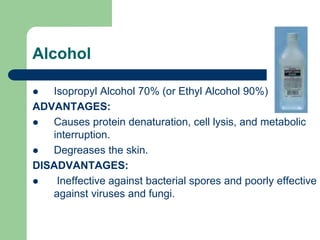
 Isopropyl Alcohol 70% (or Ethyl Alcohol 90%)
ADVANTAGES:
 Causes protein denaturation, cell lysis, and metabolic
interruption.
 Degreases the skin.
DISADVANTAGES:
 Ineffective against bacterial spores and poorly effective
against viruses and fungi.
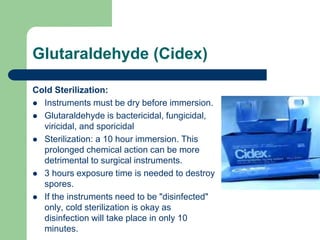
Glutaraldehyde (Cidex)
Cold Sterilization:
 Instruments must be dry before immersion.
 Glutaraldehyde is bactericidal, fungicidal,
viricidal, and sporicidal
 Sterilization: a 10 hour immersion. This
prolonged chemical action can be more
detrimental to surgical instruments.
 3 hours exposure time is needed to destroy
spores.
 If the instruments need to be "disinfected"
only, cold sterilization is okay as
disinfection will take place in only 10
minutes.
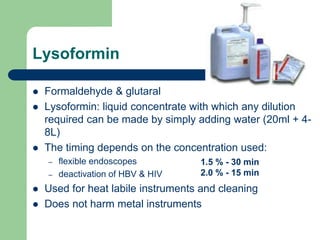
Lysoformin
 Formaldehyde & glutaral
 Lysoformin: liquid concentrate with which any dilution
required can be made by simply adding water (20ml + 4-
8L)
 The timing depends on the concentration used:
– flexible endoscopes
– deactivation of HBV & HIV
 Used for heat labile instruments and cleaning
 Does not harm metal instruments
1.5 % - 30 min
2.0 % - 15 min
Sterility Check List
Before assuming a pack is sterile, always
evaluate the following before opening the
pack:
 Expiration date
 Indicator color change
 General condition of wrapper and how it
had been stored
 Always check for holes or moisture damage
Standards for
Surgical Scrubbing, Gowning and
Gloving
 The pre-surgical practice of scrubbing,
gowning and gloving is integral to the
minimization of risk of infection from micro-
organisms present in the wound at the time
of surgery.
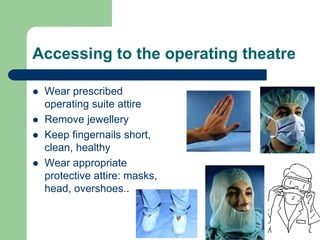
Accessing to the operating theatre
 Wear prescribed
operating suite attire
 Remove jewellery
 Keep fingernails short,
clean, healthy
 Wear appropriate
protective attire: masks,
head, overshoes..
REMEMBER
 What went inside the machines is
the STERILISED material
 Personnel are only DISINFECTED
THANK YOU

Sterilization

  • 1.
    Sterilization Assistant Professor Mr. SwapnilShankar Patil (M. Pharm, PhD-Research Scholar) Department of Pharmaceutics
  • 2.
    Sterilization  It isthe process that destroys all microorganisms (including bacterial microspores).  The skin could never be sterilized without its own destruction.
  • 3.
    Disinfection  A processwhich destroys only the vegetative forms of organisms =basically clean.  A disinfectant (germicide, antiseptic): any chemical substance with either a bactericidal or a bacteriostatic action.  Antiseptic -- Agent applied to living tissue  Disinfectant -- Agent applied to inanimate surface
  • 4.
    Surgical Disinfection  Thisis an essential part of a programme for the control of infection.  High Risk Items: as they come in close contact with broken skin or those that breach mucous membranes or are introduced into a sterile cavity.
  • 5.
    Methods of Disinfection Physical: The most important as they can be relied on to ensure the sterilization of articles used in the treatment of patients: – Thermal: Heat or Steam – Radiation: infra-red radiation, - rays,  particles – Filtration:utilizing filters capable of screening out microorganisms  Chemical: Less effective, used for personnel – Organic – Inorganic  Gaseous disinfectants: very efficient, not routine – Formaldehyde gas – Ethylene oxide
  • 6.
    Physical Methods ofDisinfection HEAT DRY HEAT  Kills by Destructive oxidation of cell constituents  Surest incineration  Hot-air oven: – inefficient, poor conductor of heat, penetrates feebly. – 160°C for 1 hour: damages fabrics, melts rubber – Used for: Glassware, oily fluids, powders
  • 7.
    Physical Methods ofDisinfection HEAT MOIST HEAT Effective at low temperature, in a shorter period of time  Boiling: 100°C for 30 minutes  Pasteurisation: 63°C for 30 minutes  Tyndallisation: steaming for 20 minutes for 3 successive days  Steaming under pressure= Autoclaving
  • 8.
    Advantages of steam Kills by denaturing & coagulating enzymes & proteins  More rapid (maximum needed time 45mn) & at lower temperature  Condensation of steam leads to liberation of latent heat which raises the temperature, and gives more penetration  Half dense as air, so has better penetration
  • 9.
    Steam Sterilization: Autoclave Principle: An autoclave is a self locking machine that sterilizes with the high temperature that steam under pressure can reach.  High-vacuum pumps remove as much as possible air before the steam is admitted, so the required temperature is reached very rapidly.
  • 10.
    Steam criteria  Dry:no suspended droplets of water  Close to its point of condensation: not superheated  Free from air: as it decreases the temperature and the penetration  Temperature – 121°C: 15mn-30mn – 134°C: 4-7mn Flashing
  • 11.
    Steps of autoclaving Water in the surrounding container full and heated  Articles in cabinet, doors bolted  Vacuum to evacuate as much air as possible  Steam is admitted at a high pressure of and when the thermometre reaches the required temperature, sterilisation begins  Sterilisation is continued for the required time and then the steam is turned off.  Drying is carried-out by reapplying a vacuum to evacuate the steam, introducing dry filtered air into the cabinet (for 15 minutes).
  • 12.
    Efficient Autoclaving  Allinstruments must be double wrapped in linen or special paper or placed in a special metal box equipped with a filter before sterilization.  The white stripes on the tape change to black when the appropriate conditions (temperature) have been met.  Expiration dates should be printed on all equipment packs.  There should be a uniform development of bars throughout the length of the strips.  Ready made plastic bags with strips printed with a sensitive ink.
  • 13.
    Control of autoclaveefficiency  Bowie-Dick test: Used for high-vacuum autoclaves, Done every day: – In the middle of a test pack of towel, a paper on to which a strip of a specific tape is put, for testing. – Uniform development of dark color indicates that the steam has passed freely and rapidly to the center of the load.  Biological sterilization indicators: Spores of a non- pathogenic organism: Done weekly – They are killed at 121°C after 15 minutes. – Attempts to culture them is subsequently made
  • 14.
    CHEMICAL DISINFECTION A SATISFACTORYAGENT SHOULD:  Be active against a wide range of organisms and spores. Only few are truly sterilizer  Have a rapid action  Should not be toxic or irritant to the skin  Should be Persistent There is no one disinfectant which can be used to kill all micro-organisms in all situations.
  • 15.
    Types of Chemicaldisinfectants  Inorganic: – Iodine – Chlorine  Organic: – Alcohols – Aldehydes – Phenols – Cationic surface-active agents
  • 16.
    Inorganic disinfectants The halogens:Chlorine and Iodine  Have a rapid action against vegetative organisms and spores= true sterilizers  Their action is annulled by foreign organic material
  • 17.
    Iodine disinfectants The broadestspectrum of all topical anti-infectives, with action against bacteria, fungi, viruses, spores, protozoa, and yeasts.  Tincture iodine: – 2.5% iodine & 2.5% potassium iodide in 90% ethanol. – Best skin disinfectant – Irritating to raw surfaces: due to its alcoholic component – Allergic dermatitis  Iodophors: Solutions of iodine in non-ionic detergents= Povidone iodine= Betadine – Less irritating and less staining – Less disinfectant than tincture
  • 18.
    Chlorine disinfectants  Powerful,Disinfect water  Particularly active against viruses  Concentrated solutions too corrosive  Usually diluted with a compatible detergent
  • 19.
    Organic Disinfectants  Alcohols:bactericidal: 50-70% ethanol  Aldehydes: – Formalin: irritant, powerful=sterilizer – Glutaraldehyde: less irritant, not volatile, more rapid action.  Phenols: continued activity in organic matter as human excreta. – Phenol: Toxic, expensive – Cresols: Lysol – Chloroxylenol: Dettol – Chlorhexidine: Hibitane- Alkanol – Hexachlorophane  Cationic surface-active agents: – Cetrimide: Cetavlon
  • 20.
    Alcohol  Isopropyl Alcohol70% (or Ethyl Alcohol 90%) ADVANTAGES:  Causes protein denaturation, cell lysis, and metabolic interruption.  Degreases the skin. DISADVANTAGES:  Ineffective against bacterial spores and poorly effective against viruses and fungi.
  • 21.
    Glutaraldehyde (Cidex) Cold Sterilization: Instruments must be dry before immersion.  Glutaraldehyde is bactericidal, fungicidal, viricidal, and sporicidal  Sterilization: a 10 hour immersion. This prolonged chemical action can be more detrimental to surgical instruments.  3 hours exposure time is needed to destroy spores.  If the instruments need to be "disinfected" only, cold sterilization is okay as disinfection will take place in only 10 minutes.
  • 22.
    Lysoformin  Formaldehyde &glutaral  Lysoformin: liquid concentrate with which any dilution required can be made by simply adding water (20ml + 4- 8L)  The timing depends on the concentration used: – flexible endoscopes – deactivation of HBV & HIV  Used for heat labile instruments and cleaning  Does not harm metal instruments 1.5 % - 30 min 2.0 % - 15 min
  • 23.
    Sterility Check List Beforeassuming a pack is sterile, always evaluate the following before opening the pack:  Expiration date  Indicator color change  General condition of wrapper and how it had been stored  Always check for holes or moisture damage
  • 24.
    Standards for Surgical Scrubbing,Gowning and Gloving  The pre-surgical practice of scrubbing, gowning and gloving is integral to the minimization of risk of infection from micro- organisms present in the wound at the time of surgery.
  • 25.
    Accessing to theoperating theatre  Wear prescribed operating suite attire  Remove jewellery  Keep fingernails short, clean, healthy  Wear appropriate protective attire: masks, head, overshoes..
  • 26.
    REMEMBER  What wentinside the machines is the STERILISED material  Personnel are only DISINFECTED
  • 27.