DR.B.V.RAMANA, M.D.,
Microorganisms capable of causing infection are constantly present in the external environment and on the human body. Microorganisms are responsible for contamination and infection. The aim of sterilisation is to remove or destroy them from materials or from surfaces.
Relative Resistance of Microbial Forms Highest resistance Moderate resistance Least resistance bacterial endospore (Bacillus & Clostridium) protozoan cyst some fungal spores some naked virus vegetative bacteria that have higher resistance  ( M. tuberculosis,  S.aureus, Pseudomonas) most bacterial vegetative cells ordinary fungal spores & hypae enveloped virus Yeasts Trophozoites
Definitions: Sterilisation : It is a process by which an article, surface or medium is made free of all microorganisms either in vegetative or spore form. Disinfection : Destruction of all pathogens or organisms capable of producing infections but not necessarily spores. All organisms may not be killed but the number is reduced to a level that is no longer harmful to health.
Antiseptics : Chemical disinfectants which can safely applied to living tissues and are used to prevent infection by inhibiting the growth of microorganisms. Asepsis : Technique by which the occurrence of infection into an uninfected tissue is prevented.
a suffix indicating that the antimicrobial agent will kill or  destroy a certain group of microorganism  suffix “ cide ” – meaning to kill viricide – destroys virus fungicide – destroys fungi   bactericide – destroys bacteria Suffix “ static/stasis ” – meaning to stand still  a suffix indicating that the agent will prevent the growth or  multiplication of the type of organism but are not killed outright  bacteriostatic - prevents the growth of bacteria fungistatic – prevents the growth of fungi
Uses of sterilisation: Sterilisation of materials, instruments used in surgical and diagnostic procedures. Sterilisation of Media and reagents used in the microbiology laboratory. Food and drug manufacturing to ensure safety from contaminating organisms.
Methods  Physical methods  Chemical methods
Physical methods: Sunlight  Heat  Dry heat Moist heat Filtration  Radiation
Chemical methods: Alcohols Aldehydes Phenols Halogens Oxidizing agents Salts Surface active agents Dyes Vapour phase disinfectants
Physical methods
Sun light: Active germicidal effect due to its content of ultraviolet rays . Natural method of sterilisation of water in tanks, rivers and lakes.
Heat : Most reliable and commonly employed method  . Two types: Dry heat Moist heat
Heat : Principle: Dry heat kills the organism by denaturation  of the bacterial proteins,  oxidative damage toxic effect of elevated levels of electrolytes .
Heat : Principle: Moist  heat kills the organism by  denaturation of the bacterial proteins coagulation of the bacterial proteins
Heat : Factors influencing: Nature of heat Temperature and duration Characteristic of organism and spores Type of material
Heat : Dry heat: Red  heat Flaming  Incineration  Hot air oven
Dry heat: Red  heat: Materials are held in the flame of a bunsen burner till they become red hot. Inoculating wires or loops Tips of forceps Needles
Dry heat: 2. Flaming: Materials are passed through the flame of a bunsen burner without allowing them to become red hot. Glass slides scalpels Mouths of culture tubes
Dry heat: 3. Incineration:  Materials are reduced to ashes by burning. Instrument used was incinerator. Soiled dressings Animal carcasses Bedding  Pathological material
Dry heat: 4. Hot air oven:
Hot air oven:  Most widely used method Electrically heated and fitted with a fan to even distribution of air in the chamber. Fitted with a thermostat that maintains the chamber air at a chosen temperature. Temperature and time: 160 C for 2 hours. 170 C for 1 hour 180 C for 30 minutes.
Uses: Sterilisation of  Glassware  like glass syringes, petridishes, pipettes and test tubes.  Surgical instruments like scalpels, scissors, forceps etc. Chemicals like liquid paraffin, fats etc.
Precautions : Should not be overloaded  Arranged in a manner which allows free circulation of air Material to be sterilised should be perfectly dry. Test tubes, flasks etc. should be fitted with cotton plugs. petridishes and pipetts should be wrapped in paper. Rubber materials and inflammable materials should not be kept inside. The oven must be allowed to cool for two hours before opening, since glass waremay crack by sudden cooling.
Sterilisation controls : Spores of  Bacillus subtilis subsp. niger Thermocouples  Browne’s tube
Moist  heat sterilisation: A temperature below 100°C A temperature of 100°C A temperature above 100°C
A temperature below 100°C Pasteurisation of milk Inspissation Vaccine bath
Pasteurisation of milk Two types Holder method ( 63°C for 30 minutes) Flash method ( 72°C for 20 seconds followed by quickly cooling to 13°C) Inspissation: Heating at 80-85°C for half an hour daily on three consecutive days Serum or egg media are sterilised Vaccine bath: Heating at 60°C for an hour daily in vaccine bath for several sucessive days. Serum or body fluids can be sterilised by heating  at 56°C for an hour daily for several sucessive days.
A temperature at 100°C Boiling  Tyndallisation Steam sterilisation
Boiling : Boiling for 10 – 30 minutes may kill most of vegetative forms but spores with stand boiling. Tyndallisation  : Steam at 100C for 20 minutes on three successive days Used for egg , serum and sugar containing media. Steam steriliser : Steam at 100°C for 90 minutes. Used for media which are decomposed at high temperature.
A temperature above 100°C Autoclave : -Steam above 100 ° C has a better killing power  than dry heat. -Bacteria are more susceptible to moist heat.
Components of autoclave: Consists of vertical or horizontal cylinder of gunmetal or stainless steel. Lid is fastened by screw clamps and rendered air tight by an asbestos washer. Lid bears a discharge tap for air and steam, a pressure gauge and a safety valve.
 
Sterilisation conditions: Temperature – 121 °C Chamber pressure -15 lb per square inch. Holding time – 15 minutes Others : 126°C for 10 minutes 133°C for 3 minutes
Uses : Useful for materials which can not withstand high temp. To sterilise culture media, rubber material, gowns, dressings, gloves etc.
Sterilisation controls: Thermocouples Bacterial spores-  Bacillus stearothermophilus Browne’s tube Autoclave tapes
3. Filtration: Useful for substances which get damaged by heat. To sterilise sera, sugars and antibiotic solutions. To obtain bacteria free filtrates of clinical samples. Purification of water.
Types of filters: Candle filters Asbestos disc filters Sintered glass filters Membrane filters Air filters Syringe filters
Candle filters
Membrane filters
Radiations : Ionising radiations Non - Ionising radiations
Ionising radiations: X rays Gamma rays Cosmic rays Gamma radiation are commercially used for sterilisation of disposable items. (cold sterilisation)
Non-Ionising radiation: Infra red rays Ultraviolet (UV) rays Infra red is used for rapid mass sterilisation of syringes and catheters. Ultraviolet radiation is used for disinfecting enclosed areas such as bacterial laboratory, inoculation hood, laminar flow and operation theatres.
Chemical Methods
A variety of chemical agents are used as antiseptics and disinfectants. Factors influencing the potency of a disinfectant: Concentration Time of action pH  Temperature Nature of organism Presence of organic matter
High level disinfectants Intermediate level disinfectants low level disinfectants
High level disinfectants: Glutaraldehyde, Hydrogen peroxide, peracitic acid and chlorine compounds. Effectiveness may be equal to that of sterilisation. Used for: Endoscopes Cystoscopes Surgical instruments with plastic components
Intermediate level disinfectants May not effective against spores Includes alcohols, iodophores and phenols Used for: Laryngoscopes Fiber optic endoscopes
Low  level disinfectants: Many organisms can survive on exposure to these disinfectants. Used for items which come in contact with the patients but they do not penetrate  into tissues. Stethoscopes, ECG electrodes etc.
1.Alcohols : Ethyl alcohol and Isopropyl alcohol are commonly used. Act by denaturing of bacterial proteins. No sporicidal and virucidal activity. Used as skin antiseptics. Isopropyl alcohol is preferred to Ethyl alcohol as it is better fat solvent, more bactericidal and less volatile.
2. Aldehydes: Formaldehyde Glutaraldehyde
Formaldehyde: Bactericidal, sporicidal and virucidal Used in both aqueous solution and gaseous forms A 10% aqueous solution is routinely used. Uses: preservation of tissues for pathological examination To sterilise bacterial vaccines To prepare toxoid from toxin For killing of bacterial cultures and suspensions For destroying anthrax spores in hair and wool.
Glutaraldehyde : Effective against bacteria , fungi and viruses. Less toxic and irritant to eyes and skin than formaldehyde Used as 2% buffered solution Available commercially as CIDEX Uses: For sterilisation of cystoscopes, endoscopes and bronchoscopes For sterilisation of plastic endotracheal tubes, face masks, rubber anesthetic tubes
3.Phenols: Lister,the father of antiseptic surgery, first introduced the use of phenol ( Carbolic acid) in surgery (1867). Produced by distillation of coal tar between temperatures of 170°C and 270°C. Bactericidal action due to cell membrane damage. Commonly  used Phenol derivatives are  cresol  chlorhexidine  chloroxylenol  hexachlorophanes
Cresols : Lysol is a solution of cresols in soap. Active against a wide range of organisms. uses: For sterilisation of infected glass ware Cleaning of floors Disinfection of excreta
Chlorhexidine: Eg.Salvlon – (Chlorhexidine and cetrimide) More active against Gram positive than Gram negative Good fungicidal activity. No action on spores and little activity against viruses
Chloroxylenol : Eg.dettol Less toxic and less irritant. Readily inactivated by organic matter Inactive against pseudomonas.
Hexachlorophane: More active against Gram positive than Gram negative bacteria. Bacteriostatic  at high dilutions. Applied on skin as prophylaxis against staphylococcal infections. Potentially toxic and should be used with care.
4.Halogens: Chlorine  Iodine  Commonly used disinfectants Bactericidal, sporicidal and virucidal
Chlorine : In the form of  Bleaching  powder,  Sodium  hypochlorite  Chloramine  Disinfection is due to release of free chlorine. Reacts with water to form hypochlorus acid . Bactericidal, virucidal, fungicidal and sporicidal. Used in water supplies, swimming pools, food and dairy industries .
Iodine : Used as skin disinfectant. Bactericidal and moderate action on spores. Betadine is one example.
5.Oxidising agents: Hydrogen peroxide Effective at concentration of 3-6% Kills spores at 10- 25% Used to disinfect Contact lenses Surgical prostheses Plastic implants
6.Salts: Salts of heavy metals have toxic effect on bacteria. Salts of copper, silver and mercury are used as disinfectants. Act by coagulation of bacterial proteins. Mercuric chloride, once used as disinfectant is highly toxic. Thiomersol and mercurochrome are less toxic  Copper salts are used as fungicides.
7.Surface active agents: Substances which alter energy relationships at interfaces , producing a reduction of surface tension, are known as surface active agents or surfactants. Anionic cationic nonionic  amphoteric compounds.
The anionic compounds: e.g.:- common soaps,  Have  strong detergent but weak antimicrobial properties .  These agents are most active at acidic pH.  Effective  against Gram positive organisms but are relatively ineffective against Gram negative species.
Cationic  surfactants: Quaternary ammonium compounds are the most important cationic surfactants.  These  compounds are bactericidal for a wide range of organisms, gram positive species are more susceptible. The common cationic compounds are acetyl trimethyl ammonium bromide (cetavalon or cetrimide) and benzalkonium chloride.
Amphoteric compounds: known as ‘Tego’ compounds possess detergent properties of anionic and antimicrobial activity of cationic compounds.  They are active against a wide range of Gram positive and Gram negative organisms and some viruses.
8.Dyes : Two groups of dyes have been used extensively as skin and wound antiseptics aniline dyes  acridine dyes  Both are bacteriostatic in high dilution but have low bactericidal action.  Aniline dyes include crystal violet, brilliant green and malachite green.  They are more active against Gram positive bacteria than Gram negative bacteria.
Acridine dyes include acriflavine , euflavine, proflavine and aminacrine. They are more active against Gram positive bacteria than Gram negative bacteria. Gentian violet and acriflavine are two widely used dyes for skin disinfection especially in Gram positive bacterial infections.
9.Vapour phase disinfectants: Formaldehyde gas Ethylene oxide Betapropiolactone
Formaldehyde gas: Used for fumigation of operation theatres, wards and laboratories etc. It is generated by adding 150 gm of KMnO4 to 280 ml of formalin for 1000 cu. Feet of room volume. The doors should be sealed and left unopened for 48 hours. The gas is toxic and irritant when inhaled. After completion of sterilisation the irritant vapours are nullified by exposure to ammonia vapour.
Ethylene oxide: It is a colourless liquid with a boiling point of 10.7°C. Effective against all types of organisms including viruses and spores. It has a potential toxicity to human beings, including mutagenicity and carcinogenicity . It is highly inflamable. Used for sterilising plastic and rubber articles, respirators, heart lung machines, sutures, dental equipments etc.
Betapropiolactone : Condensation product of ketane and formaldehyde. It has a boiling point of 163°C. Used in 0.2%. Effective against all types of organisms including viruses. More efficient for fumigation than formaldehyde. Used for inactivation of vaccines.
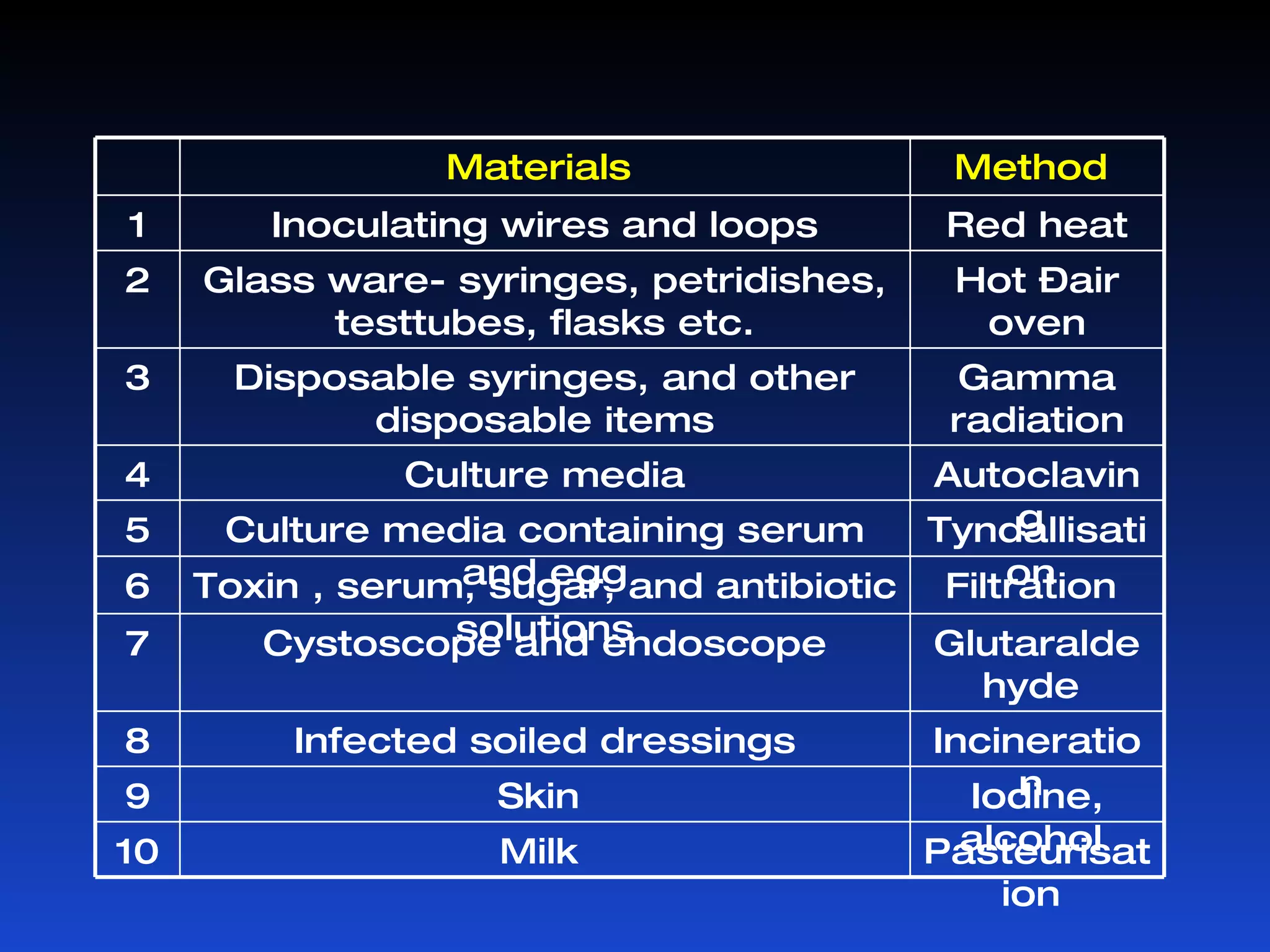
Materials  Method  1 Inoculating wires and loops Red heat 2 Glass ware- syringes, petridishes, testtubes, flasks etc. Hot –air oven 3 Disposable syringes, and other disposable items Gamma radiation 4 Culture media Autoclaving  5 Culture media containing serum and egg Tyndallisation  6 Toxin , serum, sugar, and antibiotic solutions Filtration  7 Cystoscope and endoscope Glutaraldehyde  8 Infected soiled dressings Incineration  9 Skin  Iodine, alcohol  10 Milk  Pasteurisation
 

Sterilization

  • 1.
  • 2.
    Microorganisms capable ofcausing infection are constantly present in the external environment and on the human body. Microorganisms are responsible for contamination and infection. The aim of sterilisation is to remove or destroy them from materials or from surfaces.
  • 3.
    Relative Resistance ofMicrobial Forms Highest resistance Moderate resistance Least resistance bacterial endospore (Bacillus & Clostridium) protozoan cyst some fungal spores some naked virus vegetative bacteria that have higher resistance ( M. tuberculosis, S.aureus, Pseudomonas) most bacterial vegetative cells ordinary fungal spores & hypae enveloped virus Yeasts Trophozoites
  • 4.
    Definitions: Sterilisation :It is a process by which an article, surface or medium is made free of all microorganisms either in vegetative or spore form. Disinfection : Destruction of all pathogens or organisms capable of producing infections but not necessarily spores. All organisms may not be killed but the number is reduced to a level that is no longer harmful to health.
  • 5.
    Antiseptics : Chemicaldisinfectants which can safely applied to living tissues and are used to prevent infection by inhibiting the growth of microorganisms. Asepsis : Technique by which the occurrence of infection into an uninfected tissue is prevented.
  • 6.
    a suffix indicatingthat the antimicrobial agent will kill or destroy a certain group of microorganism suffix “ cide ” – meaning to kill viricide – destroys virus fungicide – destroys fungi bactericide – destroys bacteria Suffix “ static/stasis ” – meaning to stand still a suffix indicating that the agent will prevent the growth or multiplication of the type of organism but are not killed outright bacteriostatic - prevents the growth of bacteria fungistatic – prevents the growth of fungi
  • 7.
    Uses of sterilisation:Sterilisation of materials, instruments used in surgical and diagnostic procedures. Sterilisation of Media and reagents used in the microbiology laboratory. Food and drug manufacturing to ensure safety from contaminating organisms.
  • 8.
    Methods Physicalmethods Chemical methods
  • 9.
    Physical methods: Sunlight Heat Dry heat Moist heat Filtration Radiation
  • 10.
    Chemical methods: AlcoholsAldehydes Phenols Halogens Oxidizing agents Salts Surface active agents Dyes Vapour phase disinfectants
  • 11.
  • 12.
    Sun light: Activegermicidal effect due to its content of ultraviolet rays . Natural method of sterilisation of water in tanks, rivers and lakes.
  • 13.
    Heat : Mostreliable and commonly employed method . Two types: Dry heat Moist heat
  • 14.
    Heat : Principle:Dry heat kills the organism by denaturation of the bacterial proteins, oxidative damage toxic effect of elevated levels of electrolytes .
  • 15.
    Heat : Principle:Moist heat kills the organism by denaturation of the bacterial proteins coagulation of the bacterial proteins
  • 16.
    Heat : Factorsinfluencing: Nature of heat Temperature and duration Characteristic of organism and spores Type of material
  • 17.
    Heat : Dryheat: Red heat Flaming Incineration Hot air oven
  • 18.
    Dry heat: Red heat: Materials are held in the flame of a bunsen burner till they become red hot. Inoculating wires or loops Tips of forceps Needles
  • 19.
    Dry heat: 2.Flaming: Materials are passed through the flame of a bunsen burner without allowing them to become red hot. Glass slides scalpels Mouths of culture tubes
  • 20.
    Dry heat: 3.Incineration: Materials are reduced to ashes by burning. Instrument used was incinerator. Soiled dressings Animal carcasses Bedding Pathological material
  • 21.
    Dry heat: 4.Hot air oven:
  • 22.
    Hot air oven: Most widely used method Electrically heated and fitted with a fan to even distribution of air in the chamber. Fitted with a thermostat that maintains the chamber air at a chosen temperature. Temperature and time: 160 C for 2 hours. 170 C for 1 hour 180 C for 30 minutes.
  • 23.
    Uses: Sterilisation of Glassware like glass syringes, petridishes, pipettes and test tubes. Surgical instruments like scalpels, scissors, forceps etc. Chemicals like liquid paraffin, fats etc.
  • 24.
    Precautions : Shouldnot be overloaded Arranged in a manner which allows free circulation of air Material to be sterilised should be perfectly dry. Test tubes, flasks etc. should be fitted with cotton plugs. petridishes and pipetts should be wrapped in paper. Rubber materials and inflammable materials should not be kept inside. The oven must be allowed to cool for two hours before opening, since glass waremay crack by sudden cooling.
  • 25.
    Sterilisation controls :Spores of Bacillus subtilis subsp. niger Thermocouples Browne’s tube
  • 26.
    Moist heatsterilisation: A temperature below 100°C A temperature of 100°C A temperature above 100°C
  • 27.
    A temperature below100°C Pasteurisation of milk Inspissation Vaccine bath
  • 28.
    Pasteurisation of milkTwo types Holder method ( 63°C for 30 minutes) Flash method ( 72°C for 20 seconds followed by quickly cooling to 13°C) Inspissation: Heating at 80-85°C for half an hour daily on three consecutive days Serum or egg media are sterilised Vaccine bath: Heating at 60°C for an hour daily in vaccine bath for several sucessive days. Serum or body fluids can be sterilised by heating at 56°C for an hour daily for several sucessive days.
  • 29.
    A temperature at100°C Boiling Tyndallisation Steam sterilisation
  • 30.
    Boiling : Boilingfor 10 – 30 minutes may kill most of vegetative forms but spores with stand boiling. Tyndallisation : Steam at 100C for 20 minutes on three successive days Used for egg , serum and sugar containing media. Steam steriliser : Steam at 100°C for 90 minutes. Used for media which are decomposed at high temperature.
  • 31.
    A temperature above100°C Autoclave : -Steam above 100 ° C has a better killing power than dry heat. -Bacteria are more susceptible to moist heat.
  • 32.
    Components of autoclave:Consists of vertical or horizontal cylinder of gunmetal or stainless steel. Lid is fastened by screw clamps and rendered air tight by an asbestos washer. Lid bears a discharge tap for air and steam, a pressure gauge and a safety valve.
  • 33.
  • 34.
    Sterilisation conditions: Temperature– 121 °C Chamber pressure -15 lb per square inch. Holding time – 15 minutes Others : 126°C for 10 minutes 133°C for 3 minutes
  • 35.
    Uses : Usefulfor materials which can not withstand high temp. To sterilise culture media, rubber material, gowns, dressings, gloves etc.
  • 36.
    Sterilisation controls: ThermocouplesBacterial spores- Bacillus stearothermophilus Browne’s tube Autoclave tapes
  • 37.
    3. Filtration: Usefulfor substances which get damaged by heat. To sterilise sera, sugars and antibiotic solutions. To obtain bacteria free filtrates of clinical samples. Purification of water.
  • 38.
    Types of filters:Candle filters Asbestos disc filters Sintered glass filters Membrane filters Air filters Syringe filters
  • 39.
  • 40.
  • 41.
    Radiations : Ionisingradiations Non - Ionising radiations
  • 42.
    Ionising radiations: Xrays Gamma rays Cosmic rays Gamma radiation are commercially used for sterilisation of disposable items. (cold sterilisation)
  • 43.
    Non-Ionising radiation: Infrared rays Ultraviolet (UV) rays Infra red is used for rapid mass sterilisation of syringes and catheters. Ultraviolet radiation is used for disinfecting enclosed areas such as bacterial laboratory, inoculation hood, laminar flow and operation theatres.
  • 44.
  • 45.
    A variety ofchemical agents are used as antiseptics and disinfectants. Factors influencing the potency of a disinfectant: Concentration Time of action pH Temperature Nature of organism Presence of organic matter
  • 46.
    High level disinfectantsIntermediate level disinfectants low level disinfectants
  • 47.
    High level disinfectants:Glutaraldehyde, Hydrogen peroxide, peracitic acid and chlorine compounds. Effectiveness may be equal to that of sterilisation. Used for: Endoscopes Cystoscopes Surgical instruments with plastic components
  • 48.
    Intermediate level disinfectantsMay not effective against spores Includes alcohols, iodophores and phenols Used for: Laryngoscopes Fiber optic endoscopes
  • 49.
    Low leveldisinfectants: Many organisms can survive on exposure to these disinfectants. Used for items which come in contact with the patients but they do not penetrate into tissues. Stethoscopes, ECG electrodes etc.
  • 50.
    1.Alcohols : Ethylalcohol and Isopropyl alcohol are commonly used. Act by denaturing of bacterial proteins. No sporicidal and virucidal activity. Used as skin antiseptics. Isopropyl alcohol is preferred to Ethyl alcohol as it is better fat solvent, more bactericidal and less volatile.
  • 51.
  • 52.
    Formaldehyde: Bactericidal, sporicidaland virucidal Used in both aqueous solution and gaseous forms A 10% aqueous solution is routinely used. Uses: preservation of tissues for pathological examination To sterilise bacterial vaccines To prepare toxoid from toxin For killing of bacterial cultures and suspensions For destroying anthrax spores in hair and wool.
  • 53.
    Glutaraldehyde : Effectiveagainst bacteria , fungi and viruses. Less toxic and irritant to eyes and skin than formaldehyde Used as 2% buffered solution Available commercially as CIDEX Uses: For sterilisation of cystoscopes, endoscopes and bronchoscopes For sterilisation of plastic endotracheal tubes, face masks, rubber anesthetic tubes
  • 54.
    3.Phenols: Lister,the fatherof antiseptic surgery, first introduced the use of phenol ( Carbolic acid) in surgery (1867). Produced by distillation of coal tar between temperatures of 170°C and 270°C. Bactericidal action due to cell membrane damage. Commonly used Phenol derivatives are cresol chlorhexidine chloroxylenol hexachlorophanes
  • 55.
    Cresols : Lysolis a solution of cresols in soap. Active against a wide range of organisms. uses: For sterilisation of infected glass ware Cleaning of floors Disinfection of excreta
  • 56.
    Chlorhexidine: Eg.Salvlon –(Chlorhexidine and cetrimide) More active against Gram positive than Gram negative Good fungicidal activity. No action on spores and little activity against viruses
  • 57.
    Chloroxylenol : Eg.dettolLess toxic and less irritant. Readily inactivated by organic matter Inactive against pseudomonas.
  • 58.
    Hexachlorophane: More activeagainst Gram positive than Gram negative bacteria. Bacteriostatic at high dilutions. Applied on skin as prophylaxis against staphylococcal infections. Potentially toxic and should be used with care.
  • 59.
    4.Halogens: Chlorine Iodine Commonly used disinfectants Bactericidal, sporicidal and virucidal
  • 60.
    Chlorine : Inthe form of Bleaching powder, Sodium hypochlorite Chloramine Disinfection is due to release of free chlorine. Reacts with water to form hypochlorus acid . Bactericidal, virucidal, fungicidal and sporicidal. Used in water supplies, swimming pools, food and dairy industries .
  • 61.
    Iodine : Usedas skin disinfectant. Bactericidal and moderate action on spores. Betadine is one example.
  • 62.
    5.Oxidising agents: Hydrogenperoxide Effective at concentration of 3-6% Kills spores at 10- 25% Used to disinfect Contact lenses Surgical prostheses Plastic implants
  • 63.
    6.Salts: Salts ofheavy metals have toxic effect on bacteria. Salts of copper, silver and mercury are used as disinfectants. Act by coagulation of bacterial proteins. Mercuric chloride, once used as disinfectant is highly toxic. Thiomersol and mercurochrome are less toxic Copper salts are used as fungicides.
  • 64.
    7.Surface active agents:Substances which alter energy relationships at interfaces , producing a reduction of surface tension, are known as surface active agents or surfactants. Anionic cationic nonionic amphoteric compounds.
  • 65.
    The anionic compounds:e.g.:- common soaps, Have strong detergent but weak antimicrobial properties . These agents are most active at acidic pH. Effective against Gram positive organisms but are relatively ineffective against Gram negative species.
  • 66.
    Cationic surfactants:Quaternary ammonium compounds are the most important cationic surfactants. These compounds are bactericidal for a wide range of organisms, gram positive species are more susceptible. The common cationic compounds are acetyl trimethyl ammonium bromide (cetavalon or cetrimide) and benzalkonium chloride.
  • 67.
    Amphoteric compounds: knownas ‘Tego’ compounds possess detergent properties of anionic and antimicrobial activity of cationic compounds. They are active against a wide range of Gram positive and Gram negative organisms and some viruses.
  • 68.
    8.Dyes : Twogroups of dyes have been used extensively as skin and wound antiseptics aniline dyes acridine dyes Both are bacteriostatic in high dilution but have low bactericidal action. Aniline dyes include crystal violet, brilliant green and malachite green. They are more active against Gram positive bacteria than Gram negative bacteria.
  • 69.
    Acridine dyes includeacriflavine , euflavine, proflavine and aminacrine. They are more active against Gram positive bacteria than Gram negative bacteria. Gentian violet and acriflavine are two widely used dyes for skin disinfection especially in Gram positive bacterial infections.
  • 70.
    9.Vapour phase disinfectants:Formaldehyde gas Ethylene oxide Betapropiolactone
  • 71.
    Formaldehyde gas: Usedfor fumigation of operation theatres, wards and laboratories etc. It is generated by adding 150 gm of KMnO4 to 280 ml of formalin for 1000 cu. Feet of room volume. The doors should be sealed and left unopened for 48 hours. The gas is toxic and irritant when inhaled. After completion of sterilisation the irritant vapours are nullified by exposure to ammonia vapour.
  • 72.
    Ethylene oxide: Itis a colourless liquid with a boiling point of 10.7°C. Effective against all types of organisms including viruses and spores. It has a potential toxicity to human beings, including mutagenicity and carcinogenicity . It is highly inflamable. Used for sterilising plastic and rubber articles, respirators, heart lung machines, sutures, dental equipments etc.
  • 73.
    Betapropiolactone : Condensationproduct of ketane and formaldehyde. It has a boiling point of 163°C. Used in 0.2%. Effective against all types of organisms including viruses. More efficient for fumigation than formaldehyde. Used for inactivation of vaccines.
  • 74.
    Materials Method 1 Inoculating wires and loops Red heat 2 Glass ware- syringes, petridishes, testtubes, flasks etc. Hot –air oven 3 Disposable syringes, and other disposable items Gamma radiation 4 Culture media Autoclaving 5 Culture media containing serum and egg Tyndallisation 6 Toxin , serum, sugar, and antibiotic solutions Filtration 7 Cystoscope and endoscope Glutaraldehyde 8 Infected soiled dressings Incineration 9 Skin Iodine, alcohol 10 Milk Pasteurisation
  • 75.