

Fish and Shellfish


               Chapter 20


Labensky, et al.                                                                        © 2007 Pearson Education
On Cooking: A Textbook of Culinary Fundamentals, 4th edition.   Upper Saddle River, NJ 07458. All Rights Reserved
After studying this unit
 You will be able to:
         Understand the structure and
          composition of fish and shellfish
         Identify a variety of fish and shellfish
         Purchase fish and shellfish appropriate
          for your needs
         Store fish and shellfish properly
         Prepare fish and shellfish for cooking
         Apply various cooking methods to fish
          and shellfish

Labensky, et al.                                                                        © 2007 Pearson Education
On Cooking: A Textbook of Culinary Fundamentals, 4th edition.   Upper Saddle River, NJ 07458. All Rights Reserved
Fish and Shellfish
 Fish are aquatic                                               Shellfish are
  vertebrates with                                                aquatic
  fins for swimming                                               invertebrates with
  and gills for                                                   shells or carapaces
  breathing


Labensky, et al.                                                                             © 2007 Pearson Education
On Cooking: A Textbook of Culinary Fundamentals, 4th edition.        Upper Saddle River, NJ 07458. All Rights Reserved
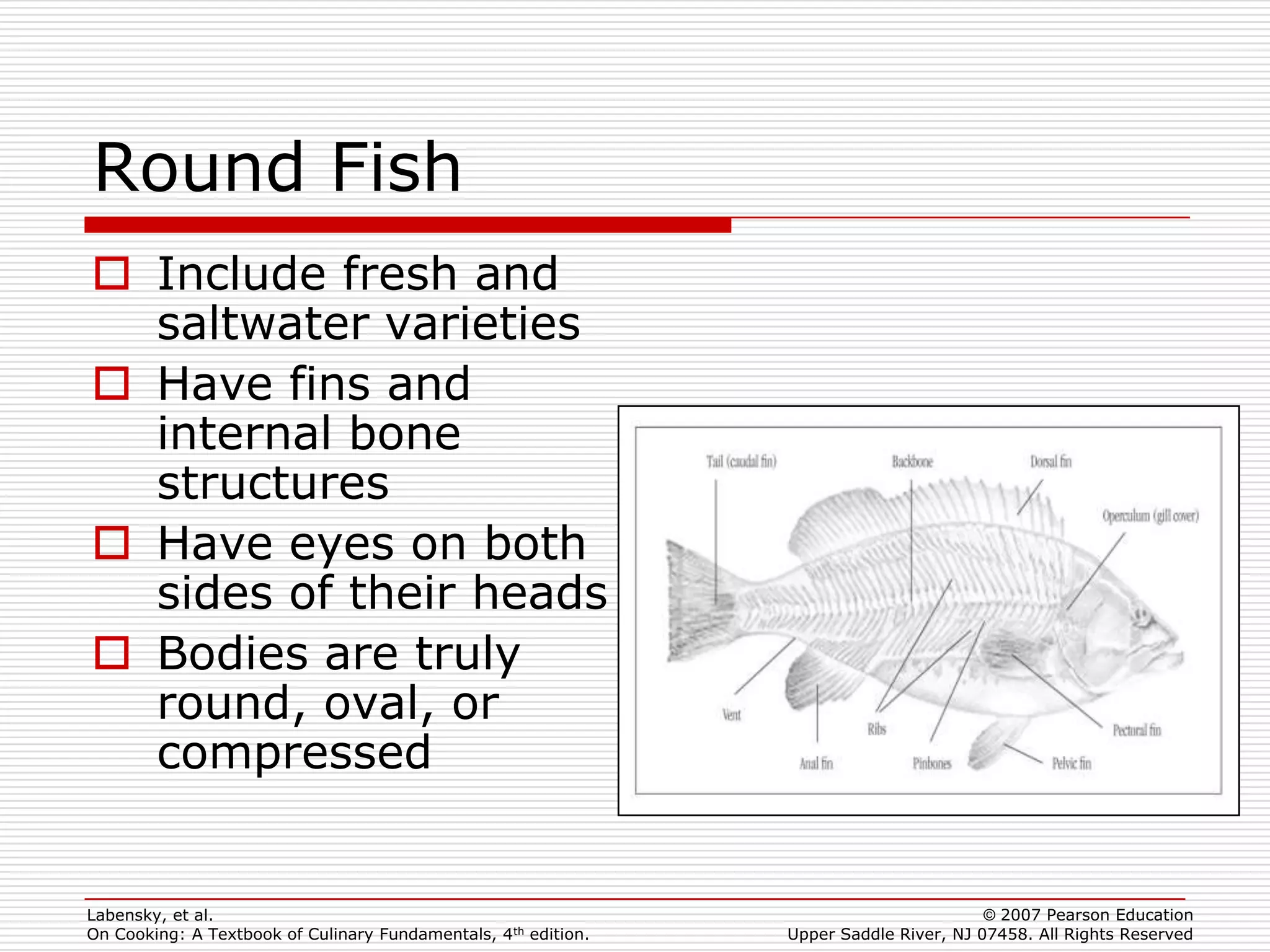
Round Fish
 Include fresh and
  saltwater varieties
 Have fins and
  internal bone
  structures
 Have eyes on both
  sides of their heads
 Bodies are truly
  round, oval, or
  compressed


Labensky, et al.                                                                        © 2007 Pearson Education
On Cooking: A Textbook of Culinary Fundamentals, 4th edition.   Upper Saddle River, NJ 07458. All Rights Reserved
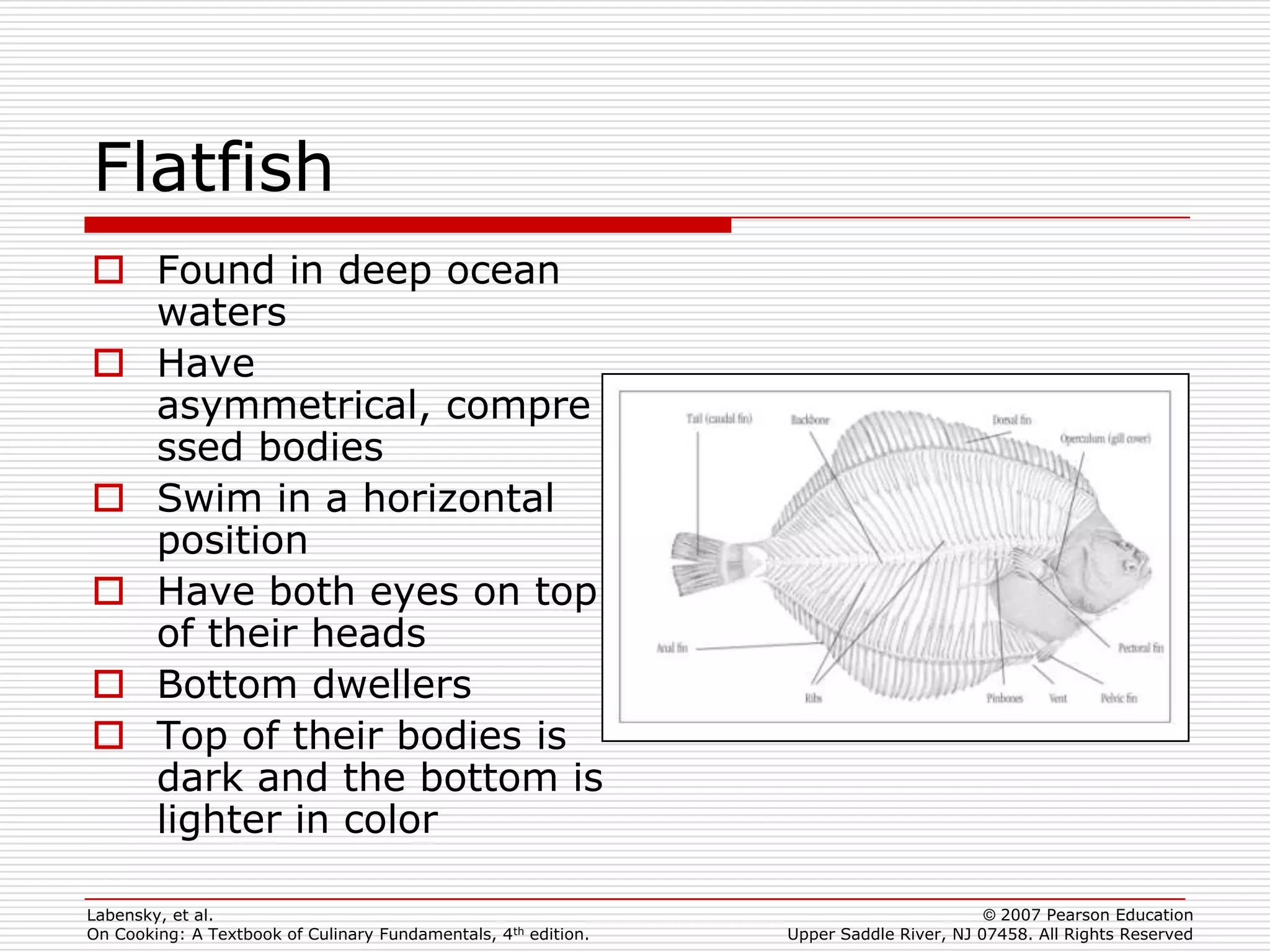
Flatfish
 Found in deep ocean
  waters
 Have
  asymmetrical, compre
  ssed bodies
 Swim in a horizontal
  position
 Have both eyes on top
  of their heads
 Bottom dwellers
 Top of their bodies is
  dark and the bottom is
  lighter in color

Labensky, et al.                                                                        © 2007 Pearson Education
On Cooking: A Textbook of Culinary Fundamentals, 4th edition.   Upper Saddle River, NJ 07458. All Rights Reserved
Mollusks
 Have small unsegmented bodies and
  no internal skeleton


Labensky, et al.                                                                        © 2007 Pearson Education
On Cooking: A Textbook of Culinary Fundamentals, 4th edition.   Upper Saddle River, NJ 07458. All Rights Reserved
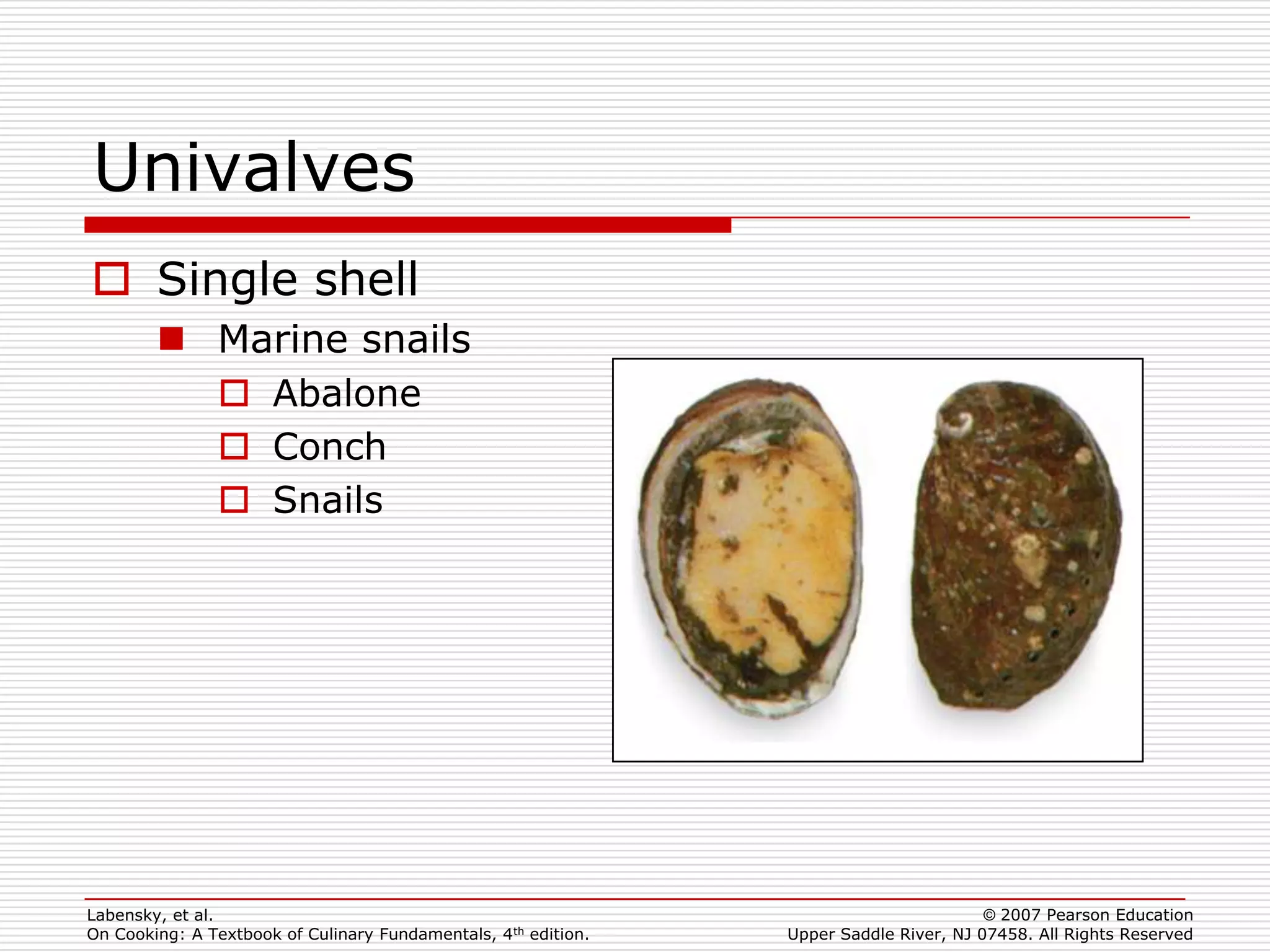
Univalves
 Single shell
         Marine snails
           Abalone
           Conch
           Snails


Labensky, et al.                                                                        © 2007 Pearson Education
On Cooking: A Textbook of Culinary Fundamentals, 4th edition.   Upper Saddle River, NJ 07458. All Rights Reserved
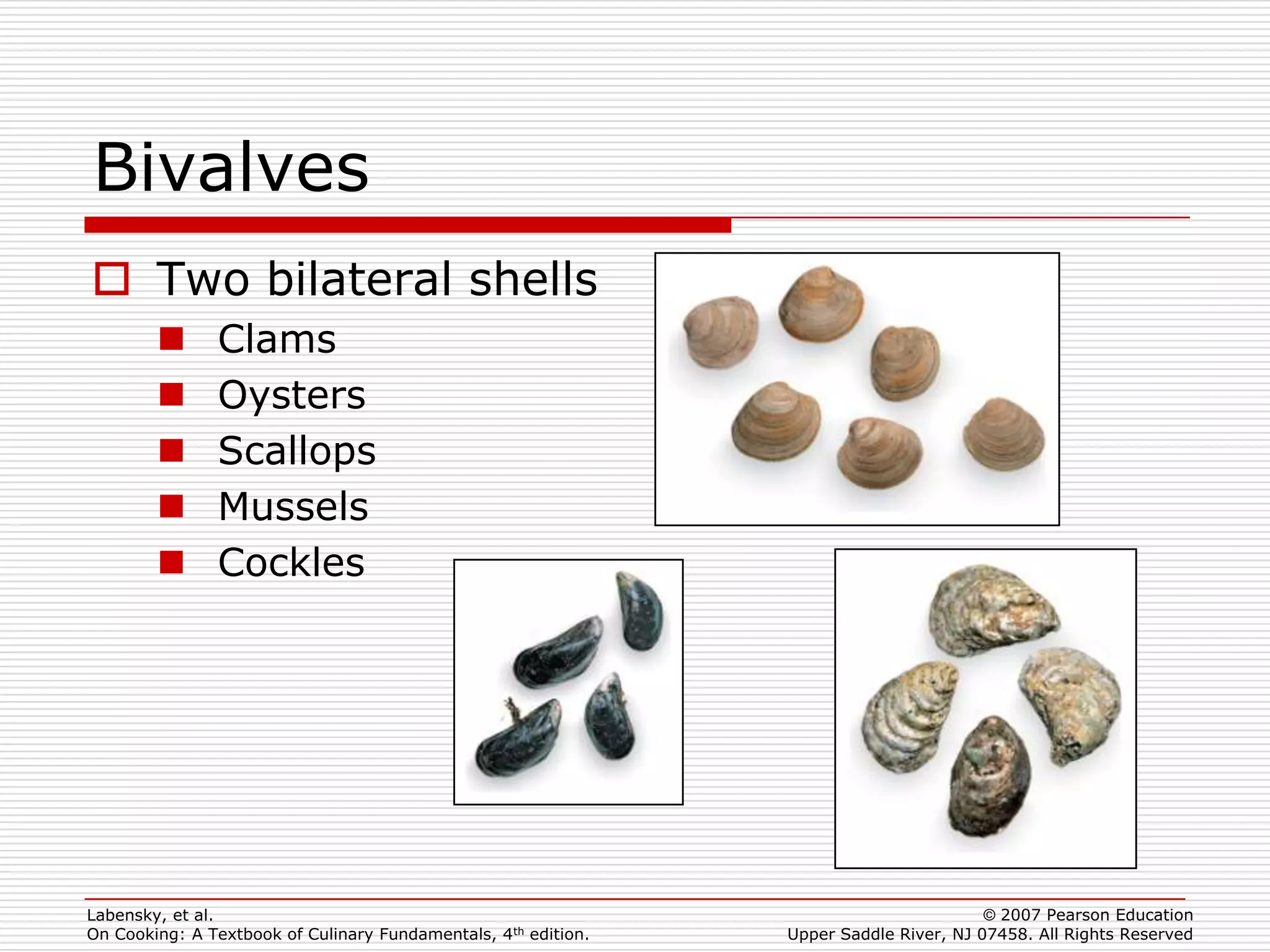
Bivalves
 Two bilateral shells
              Clams
              Oysters
              Scallops
              Mussels
              Cockles


Labensky, et al.                                                                        © 2007 Pearson Education
On Cooking: A Textbook of Culinary Fundamentals, 4th edition.   Upper Saddle River, NJ 07458. All Rights Reserved
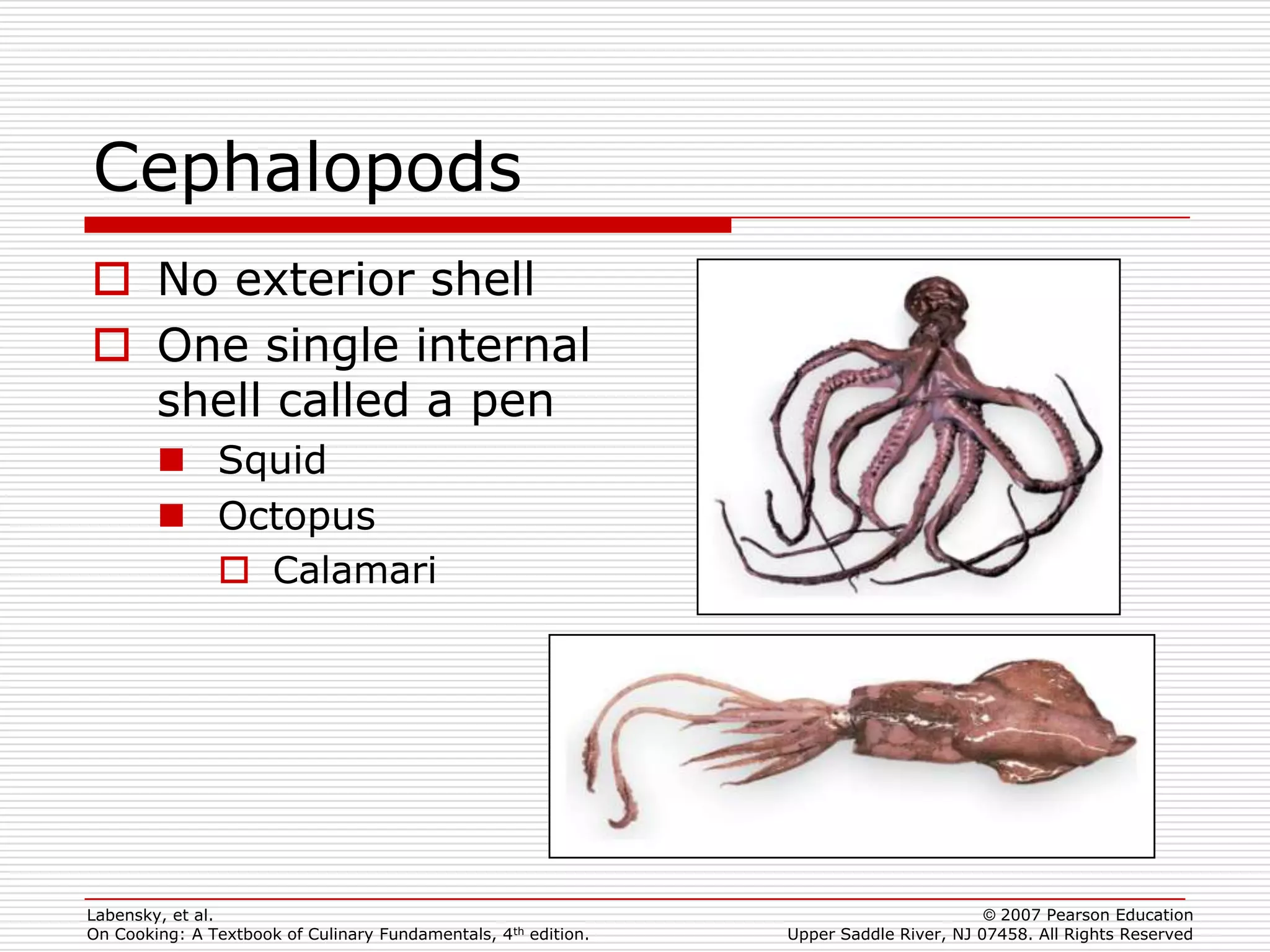
Cephalopods
 No exterior shell
 One single internal
  shell called a pen
         Squid
         Octopus
           Calamari


Labensky, et al.                                                                        © 2007 Pearson Education
On Cooking: A Textbook of Culinary Fundamentals, 4th edition.   Upper Saddle River, NJ 07458. All Rights Reserved
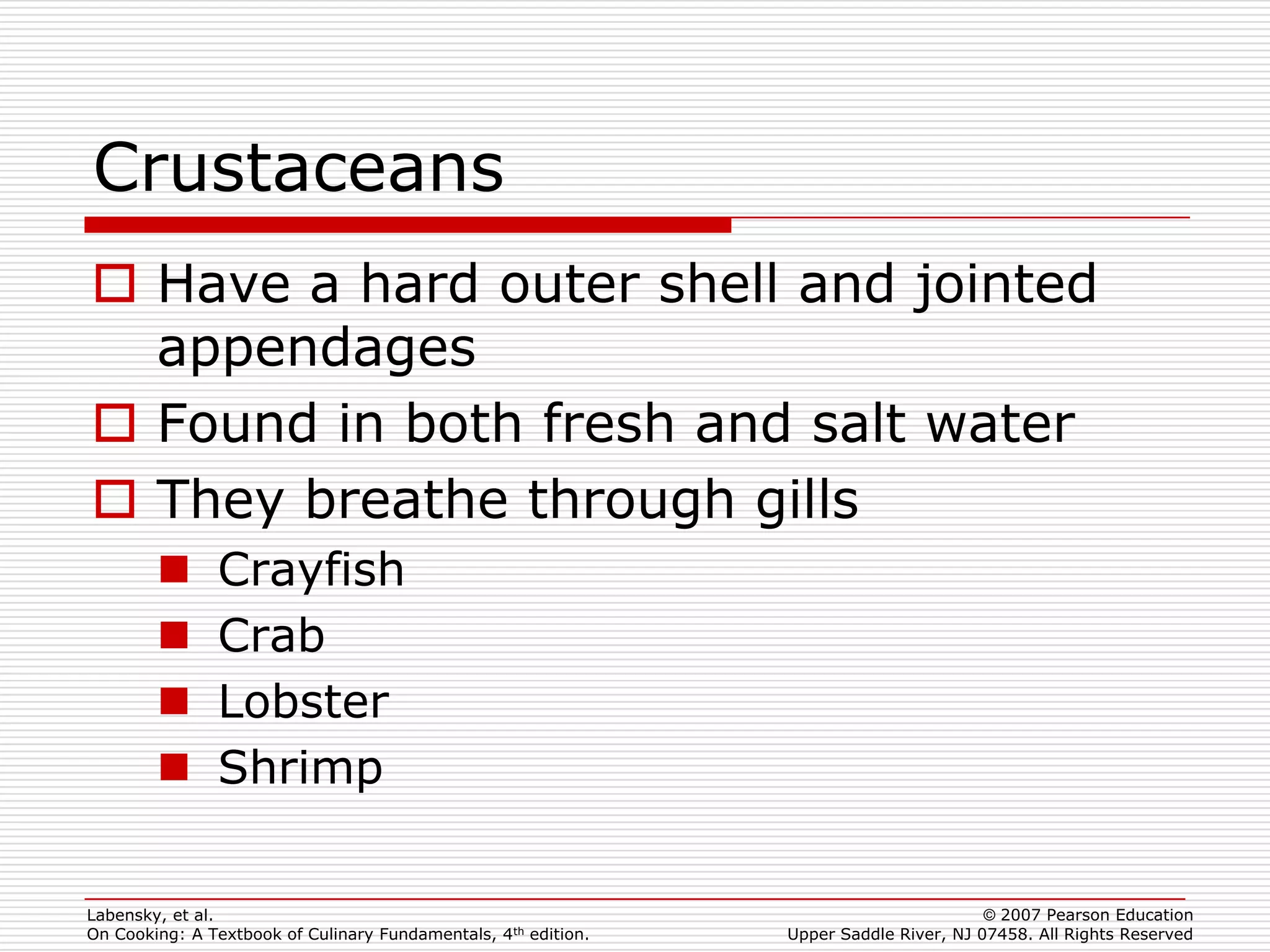
Crustaceans
 Have a hard outer shell and jointed
  appendages
 Found in both fresh and salt water
 They breathe through gills
              Crayfish
              Crab
              Lobster
              Shrimp

Labensky, et al.                                                                        © 2007 Pearson Education
On Cooking: A Textbook of Culinary Fundamentals, 4th edition.   Upper Saddle River, NJ 07458. All Rights Reserved
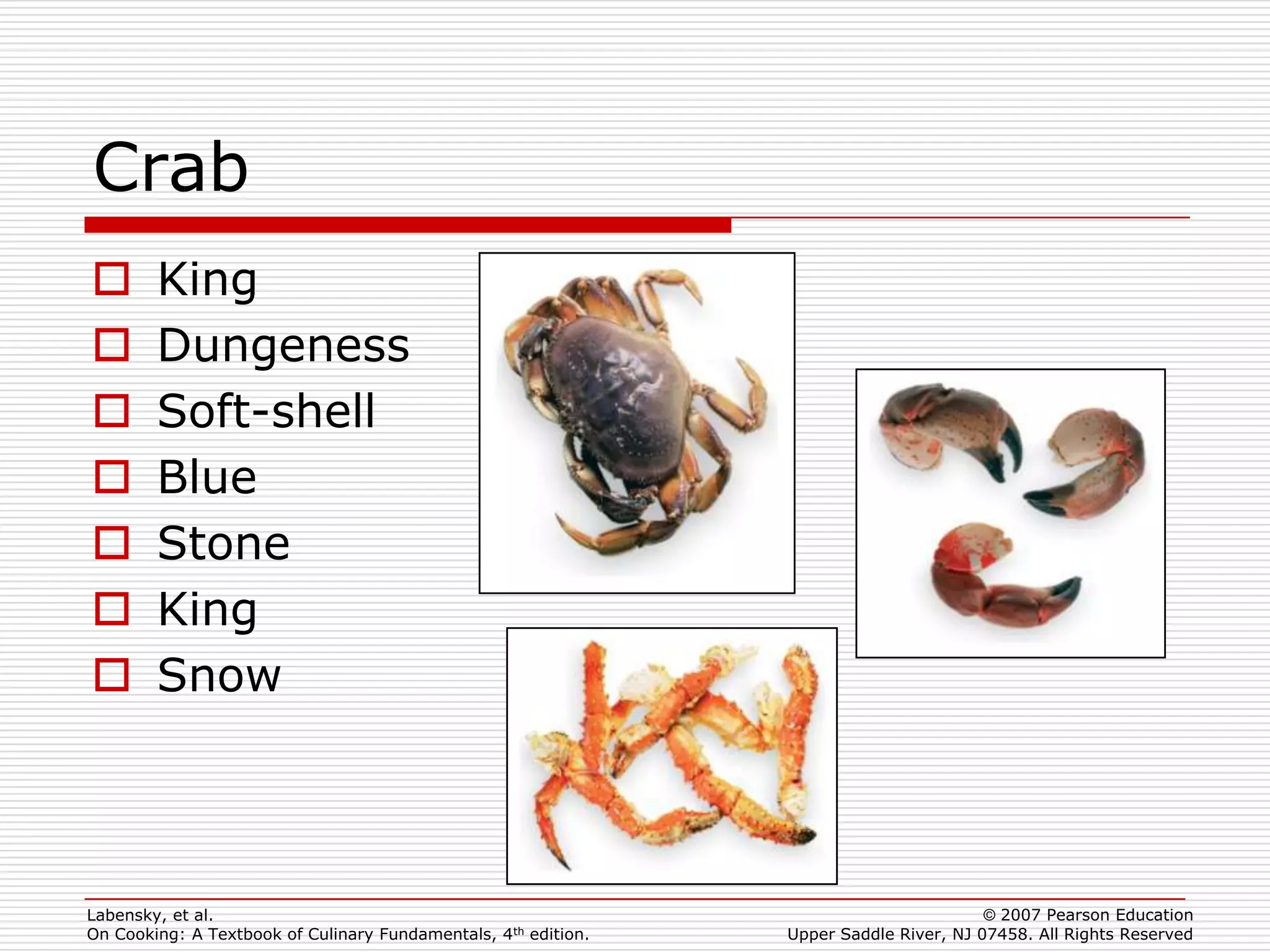
Crab
       King
       Dungeness
       Soft-shell
       Blue
       Stone
       King
       Snow


Labensky, et al.                                                                        © 2007 Pearson Education
On Cooking: A Textbook of Culinary Fundamentals, 4th edition.   Upper Saddle River, NJ 07458. All Rights Reserved
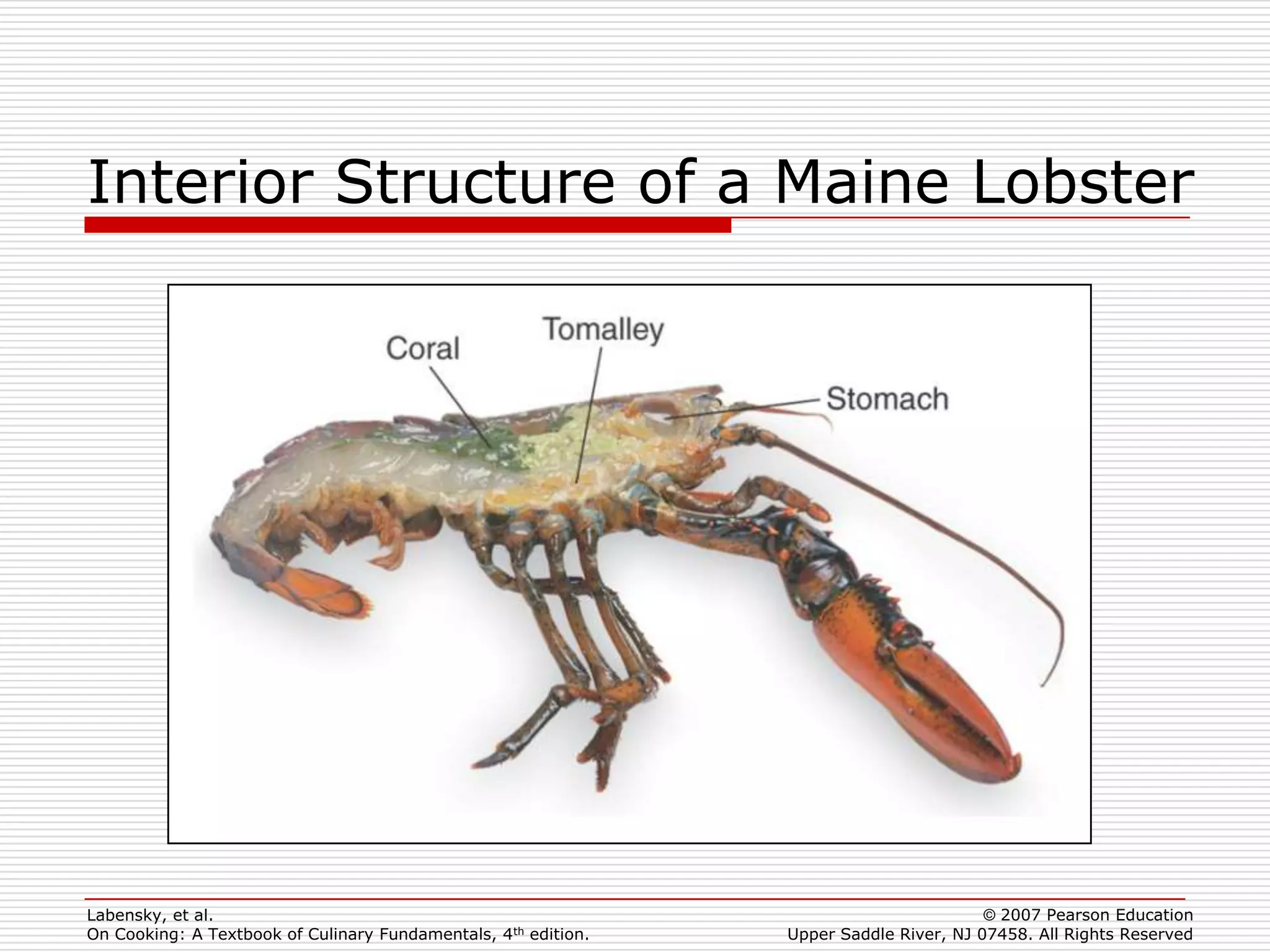
Interior Structure of a Maine Lobster


Labensky, et al.                                                                        © 2007 Pearson Education
On Cooking: A Textbook of Culinary Fundamentals, 4th edition.   Upper Saddle River, NJ 07458. All Rights Reserved
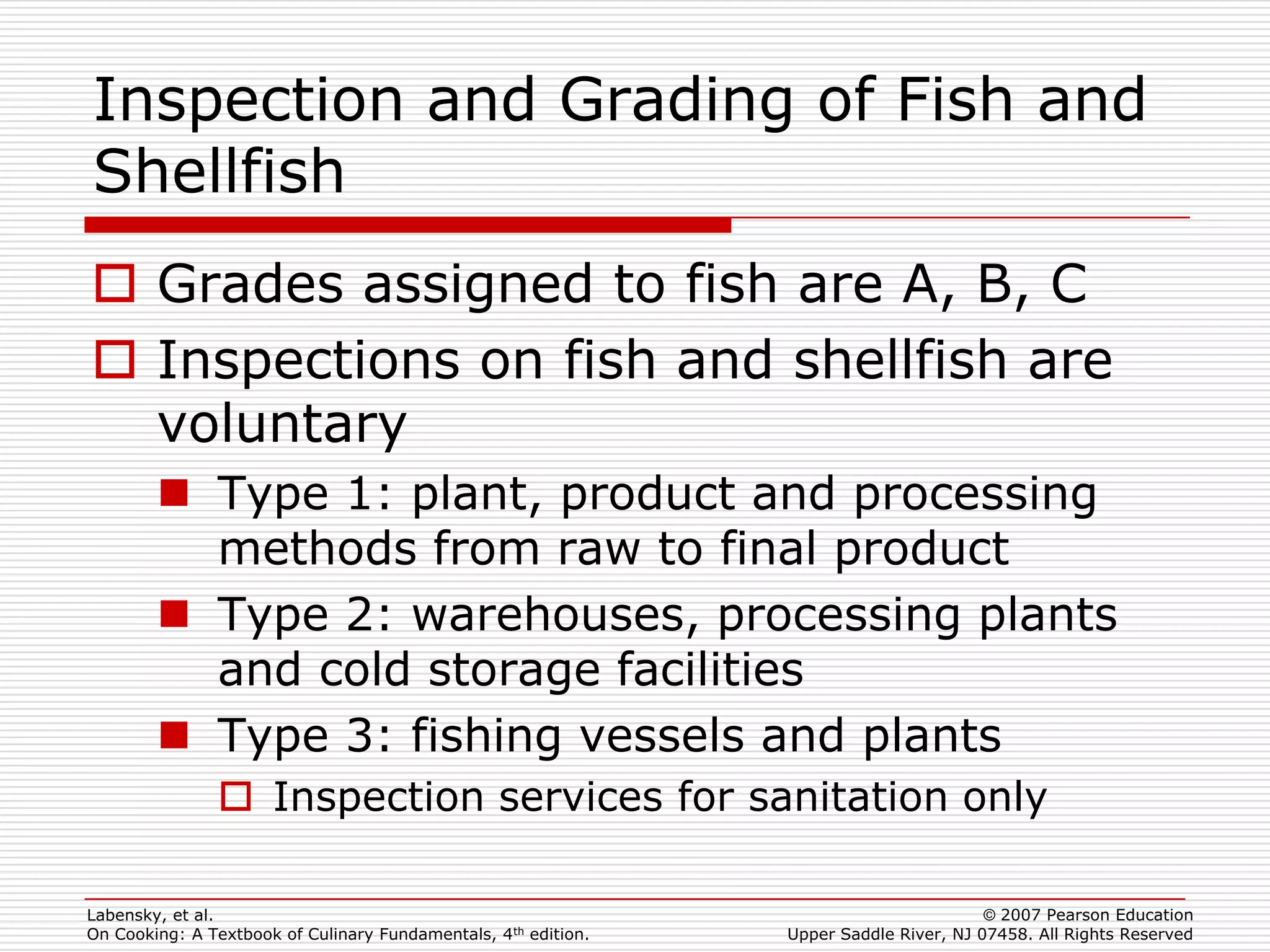
Inspection and Grading of Fish and
Shellfish
 Grades assigned to fish are A, B, C
 Inspections on fish and shellfish are
  voluntary
         Type 1: plant, product and processing
          methods from raw to final product
         Type 2: warehouses, processing plants
          and cold storage facilities
         Type 3: fishing vessels and plants
                Inspection services for sanitation only

Labensky, et al.                                                                        © 2007 Pearson Education
On Cooking: A Textbook of Culinary Fundamentals, 4th edition.   Upper Saddle River, NJ 07458. All Rights Reserved
Determining Freshness in Fish
       Smell
              No odor or the smell of the sea
       Eyes
              Clear and full
       Gills
              Intact and bright red
       Texture
              Flesh should be firm
       Fins and scales
              Moist and full
       Appearance
              Moist and glistening
       Movement
              Shellfish that is purchased alive should show movement
              Crustaceans should close their shells when tapped


Labensky, et al.                                                                        © 2007 Pearson Education
On Cooking: A Textbook of Culinary Fundamentals, 4th edition.   Upper Saddle River, NJ 07458. All Rights Reserved
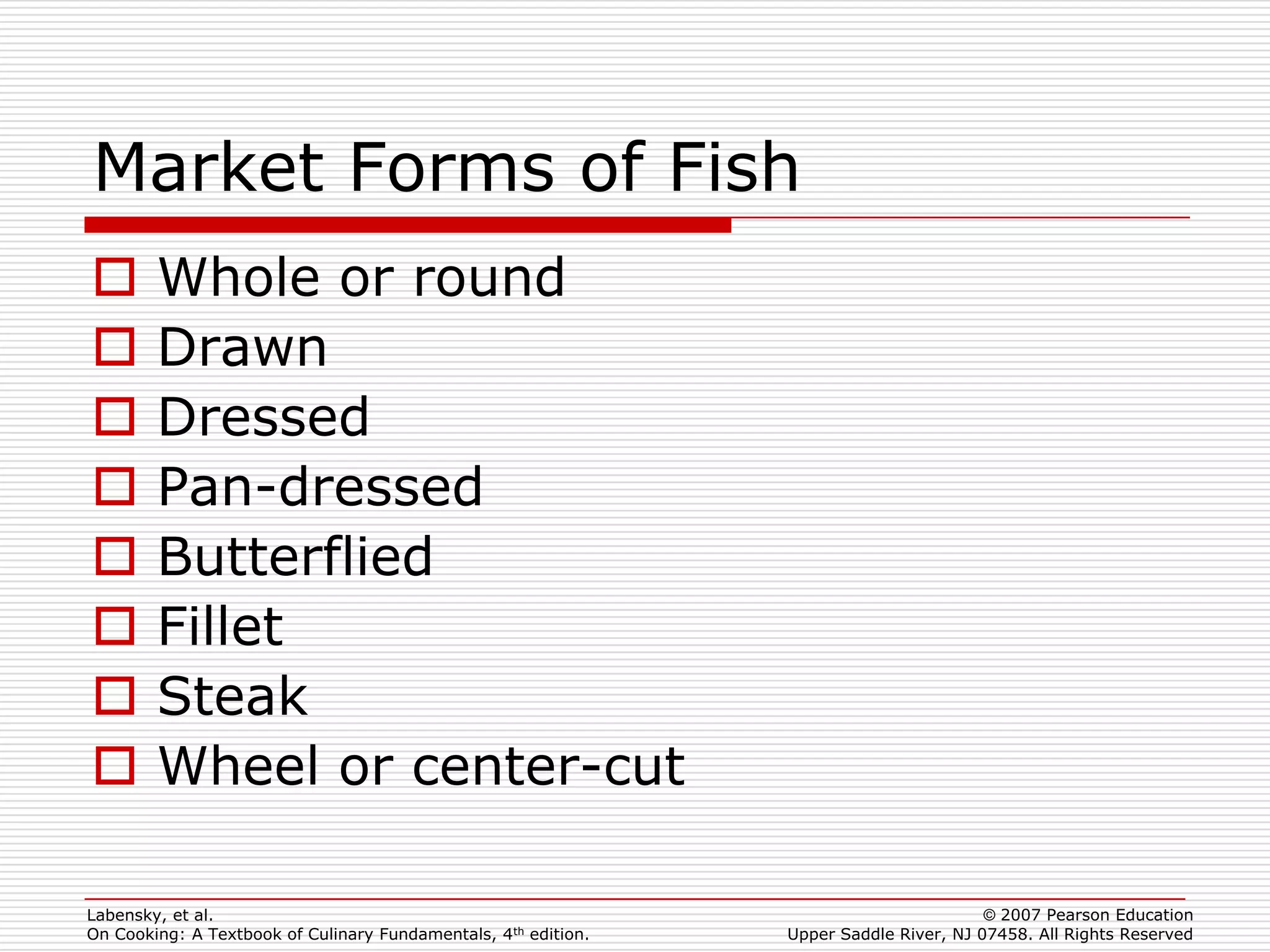
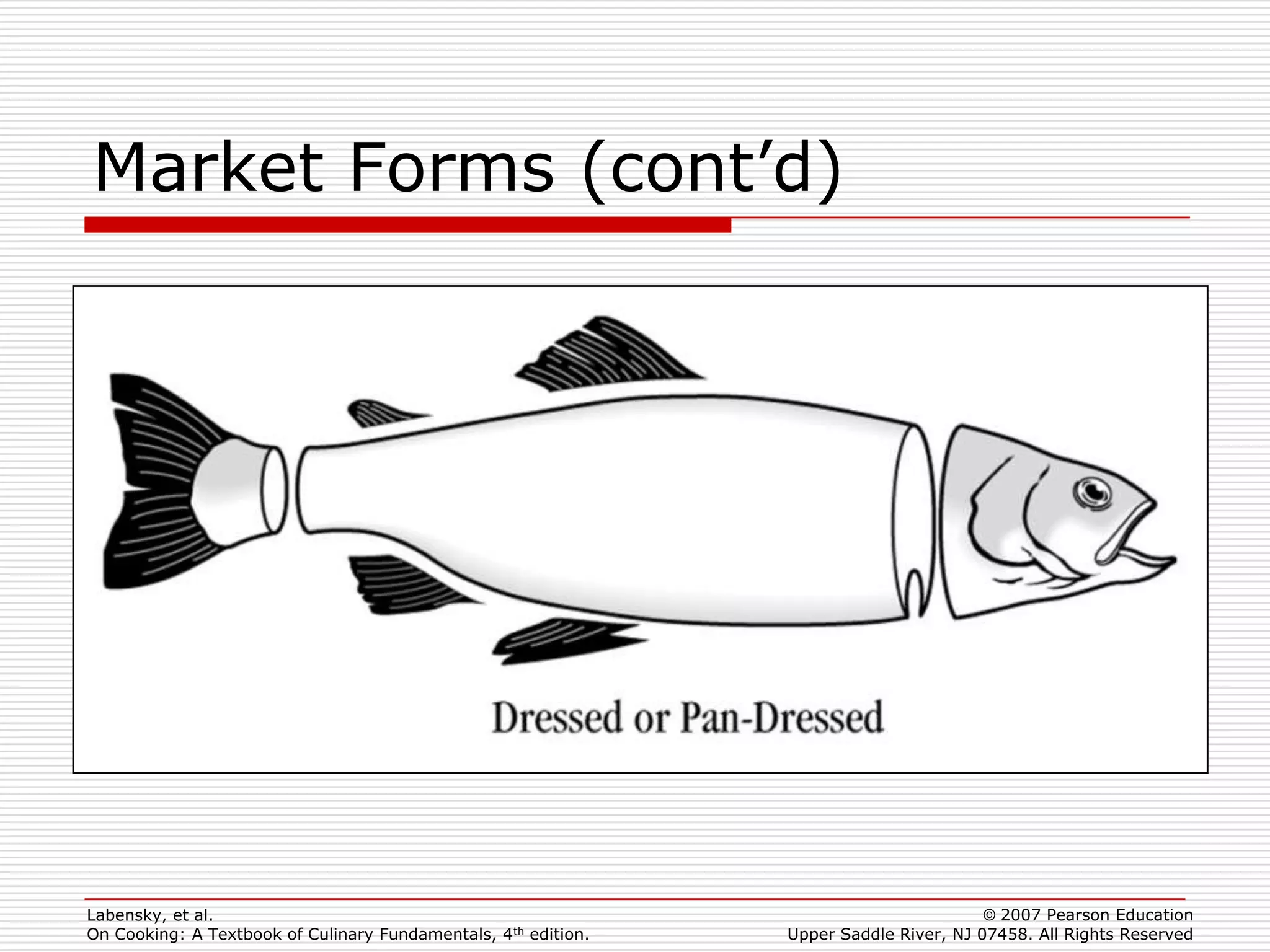
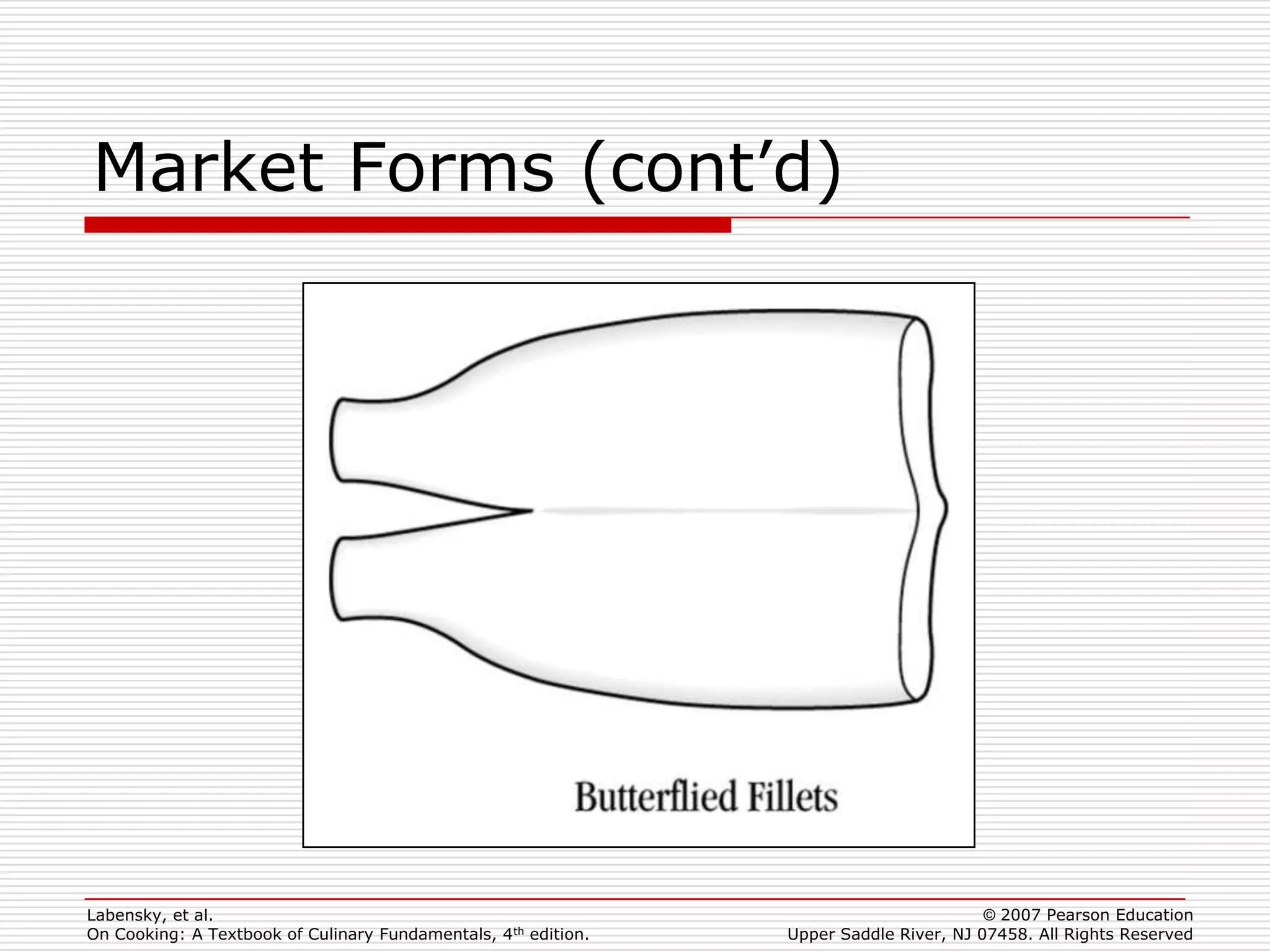
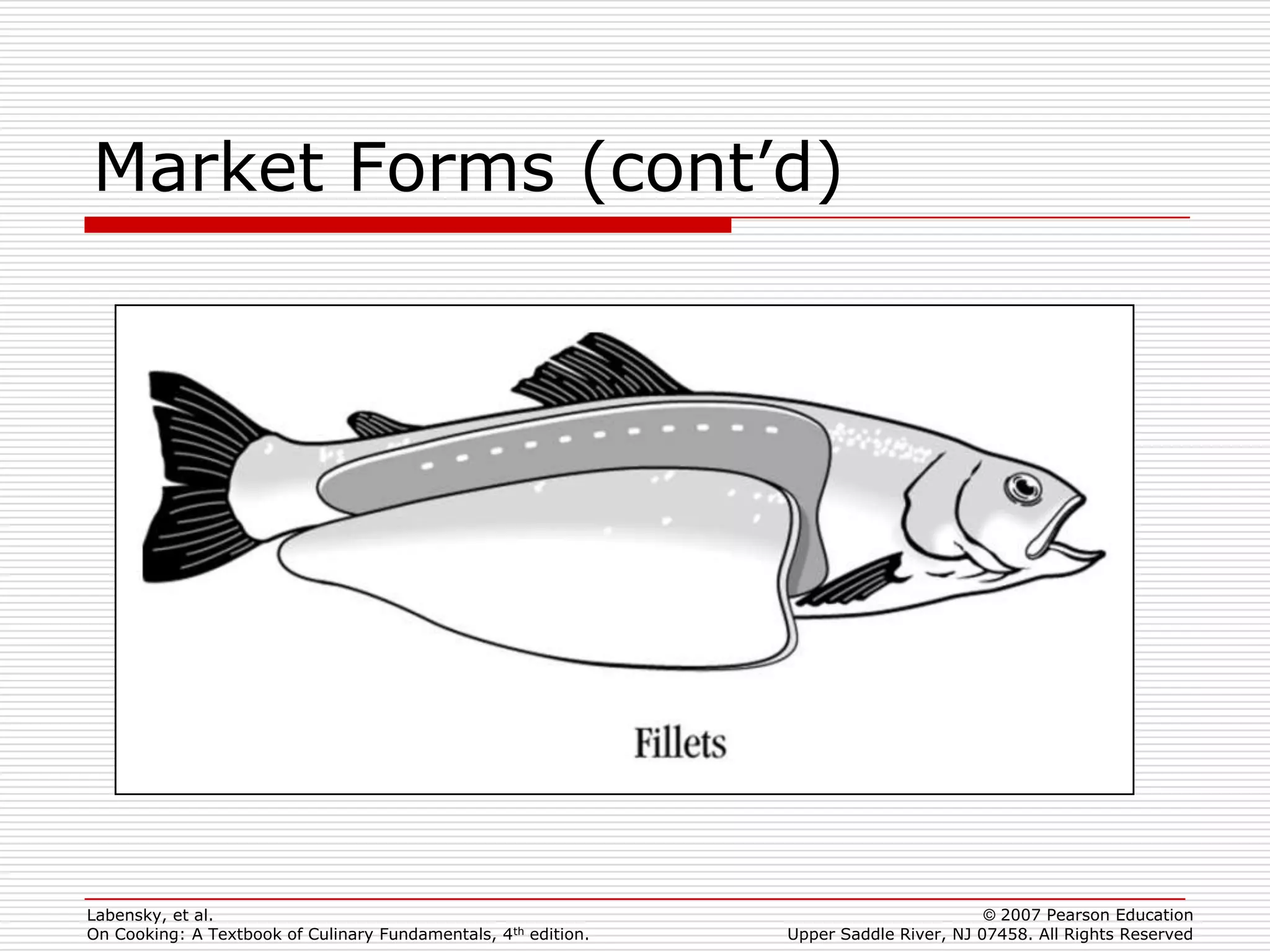
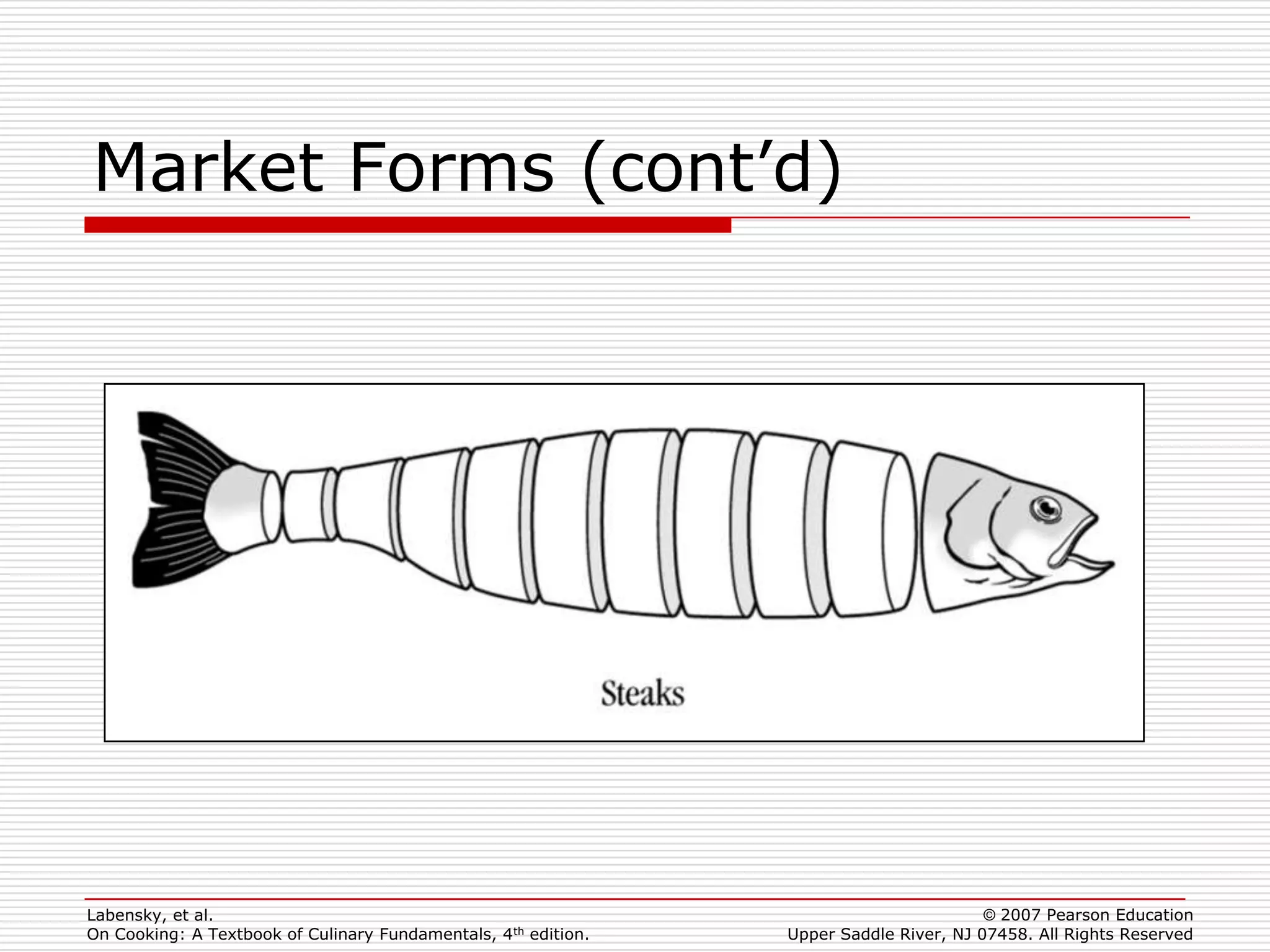
Market Forms of Fish
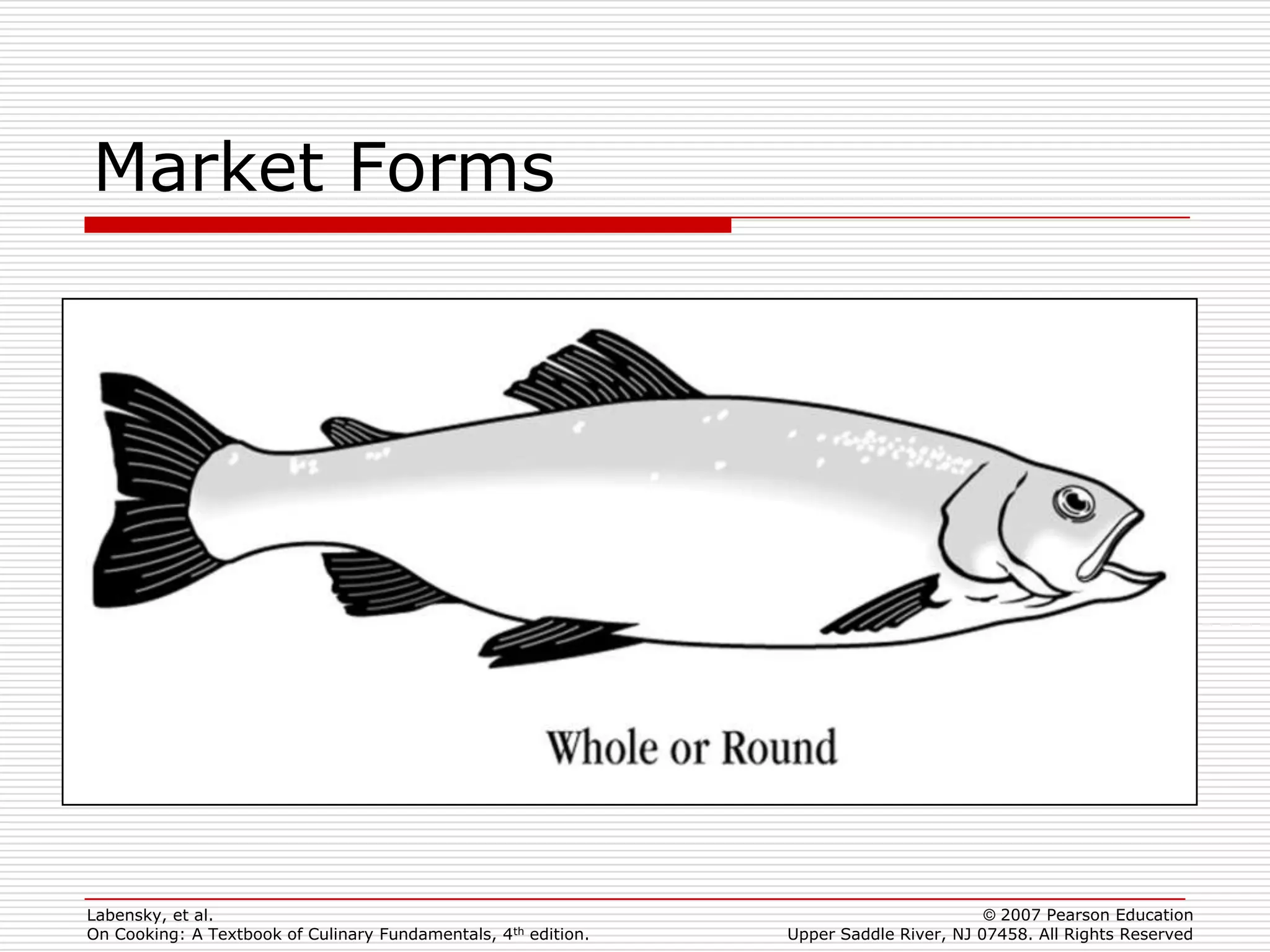
       Whole or round
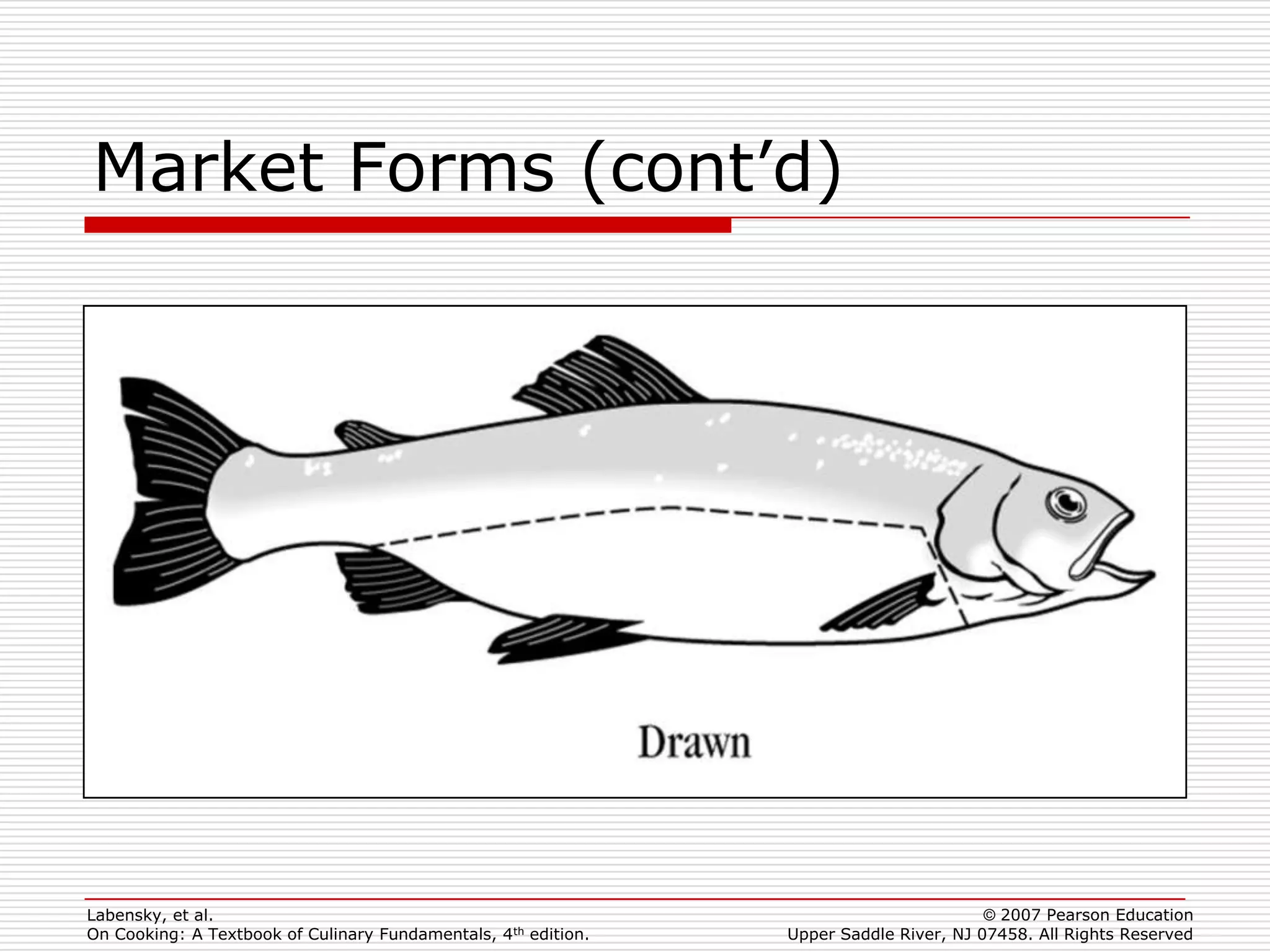
       Drawn
       Dressed
       Pan-dressed
       Butterflied
       Fillet
       Steak
       Wheel or center-cut

Labensky, et al.                                                                        © 2007 Pearson Education
On Cooking: A Textbook of Culinary Fundamentals, 4th edition.   Upper Saddle River, NJ 07458. All Rights Reserved
Market Forms


Labensky, et al.                                                                        © 2007 Pearson Education
On Cooking: A Textbook of Culinary Fundamentals, 4th edition.   Upper Saddle River, NJ 07458. All Rights Reserved
Market Forms (cont’d)


Labensky, et al.                                                                        © 2007 Pearson Education
On Cooking: A Textbook of Culinary Fundamentals, 4th edition.   Upper Saddle River, NJ 07458. All Rights Reserved
Market Forms (cont’d)


Labensky, et al.                                                                        © 2007 Pearson Education
On Cooking: A Textbook of Culinary Fundamentals, 4th edition.   Upper Saddle River, NJ 07458. All Rights Reserved
Market Forms (cont’d)


Labensky, et al.                                                                        © 2007 Pearson Education
On Cooking: A Textbook of Culinary Fundamentals, 4th edition.   Upper Saddle River, NJ 07458. All Rights Reserved
Market Forms (cont’d)


Labensky, et al.                                                                        © 2007 Pearson Education
On Cooking: A Textbook of Culinary Fundamentals, 4th edition.   Upper Saddle River, NJ 07458. All Rights Reserved
Market Forms (cont’d)


Labensky, et al.                                                                        © 2007 Pearson Education
On Cooking: A Textbook of Culinary Fundamentals, 4th edition.   Upper Saddle River, NJ 07458. All Rights Reserved
Market Forms (cont’d)


Labensky, et al.                                                                        © 2007 Pearson Education
On Cooking: A Textbook of Culinary Fundamentals, 4th edition.   Upper Saddle River, NJ 07458. All Rights Reserved
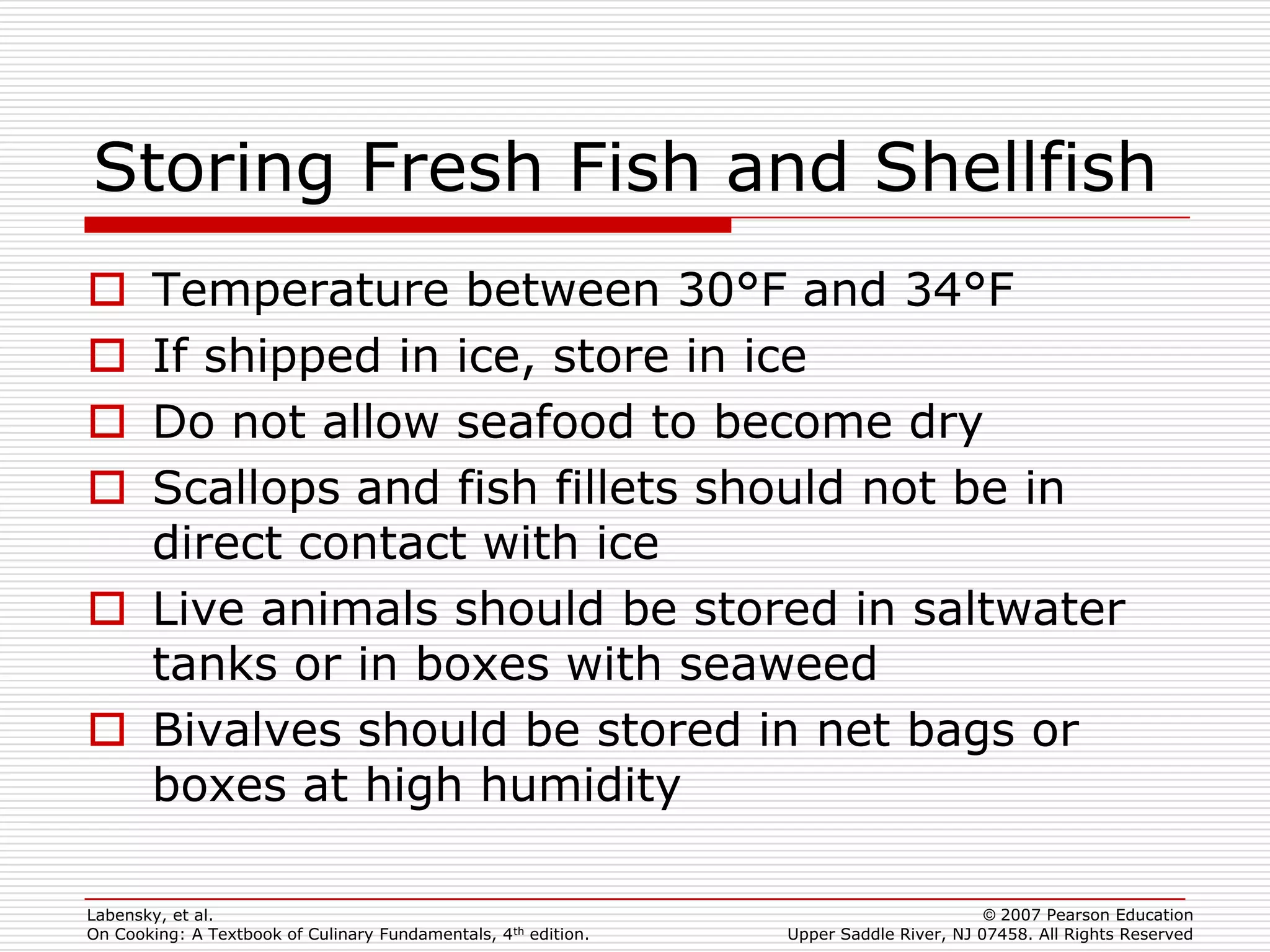
Storing Fresh Fish and Shellfish
 Temperature between 30°F and 34°F
 If shipped in ice, store in ice
 Do not allow seafood to become dry
 Scallops and fish fillets should not be in
  direct contact with ice
 Live animals should be stored in saltwater
  tanks or in boxes with seaweed
 Bivalves should be stored in net bags or
  boxes at high humidity

Labensky, et al.                                                                        © 2007 Pearson Education
On Cooking: A Textbook of Culinary Fundamentals, 4th edition.   Upper Saddle River, NJ 07458. All Rights Reserved
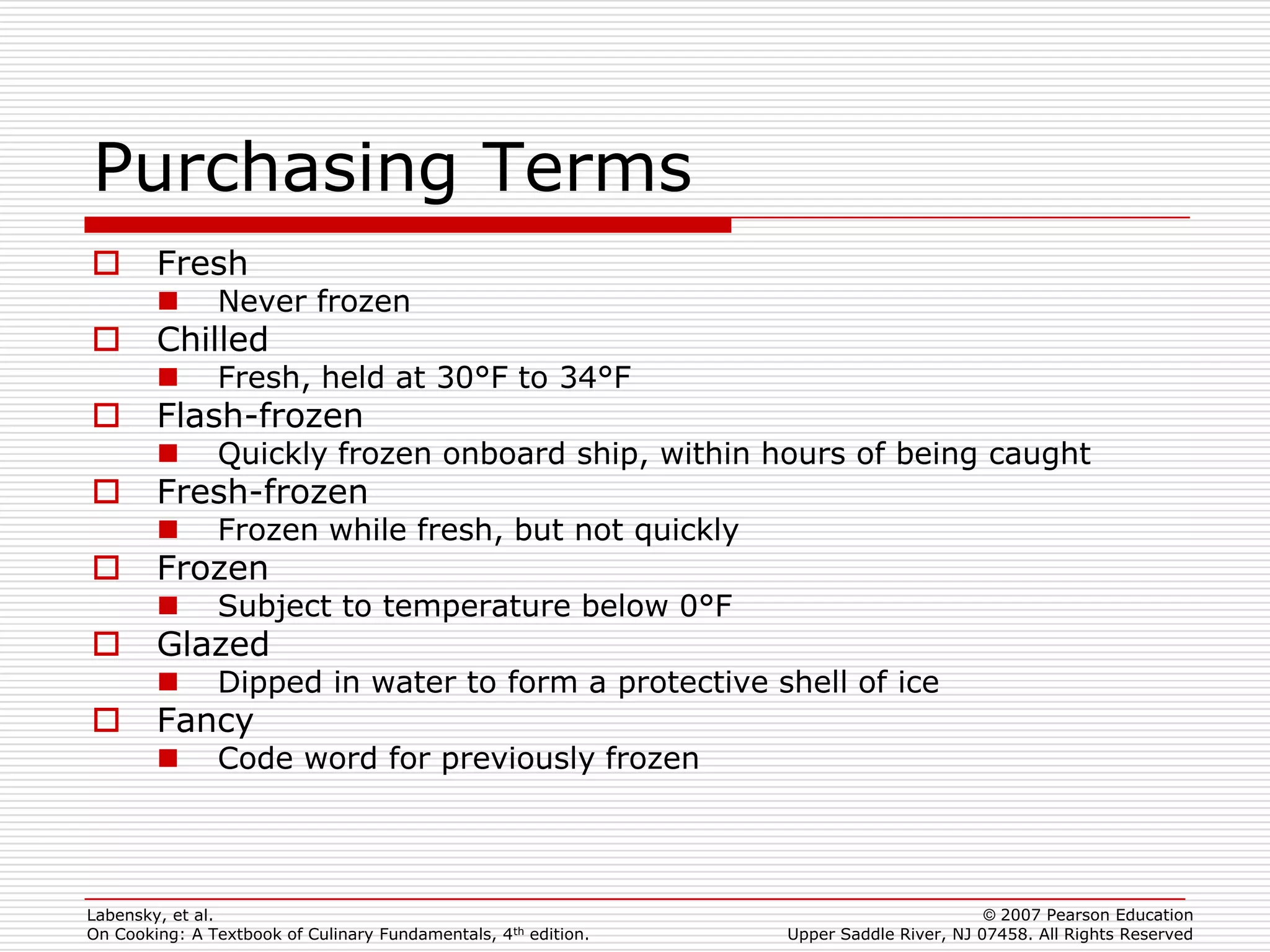
Purchasing Terms
       Fresh
              Never frozen
       Chilled
              Fresh, held at 30°F to 34°F
       Flash-frozen
              Quickly frozen onboard ship, within hours of being caught
       Fresh-frozen
              Frozen while fresh, but not quickly
       Frozen
              Subject to temperature below 0°F
       Glazed
              Dipped in water to form a protective shell of ice
       Fancy
              Code word for previously frozen


Labensky, et al.                                                                        © 2007 Pearson Education
On Cooking: A Textbook of Culinary Fundamentals, 4th edition.   Upper Saddle River, NJ 07458. All Rights Reserved
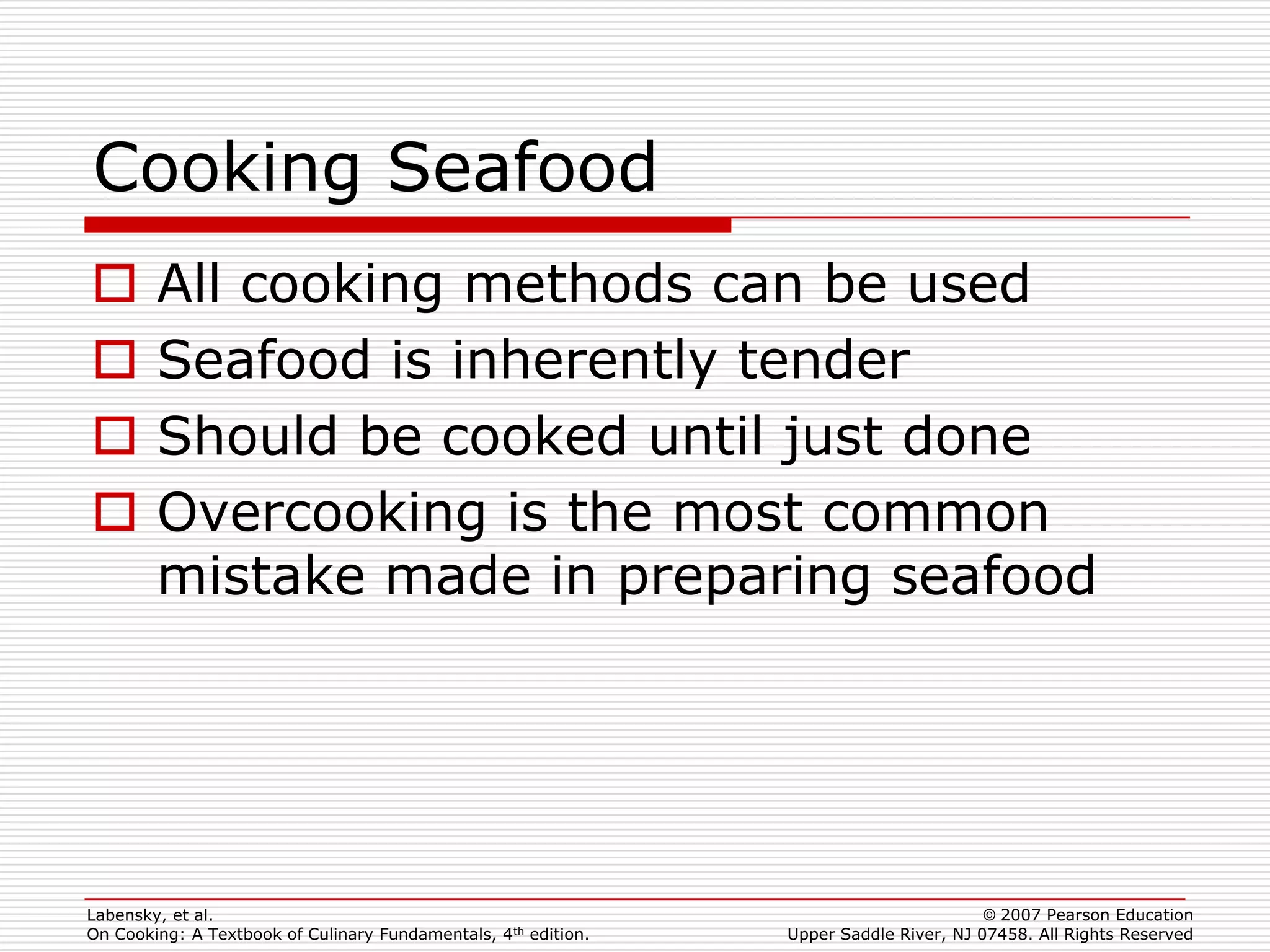
Cooking Seafood
       All cooking methods can be used
       Seafood is inherently tender
       Should be cooked until just done
       Overcooking is the most common
        mistake made in preparing seafood


Labensky, et al.                                                                        © 2007 Pearson Education
On Cooking: A Textbook of Culinary Fundamentals, 4th edition.   Upper Saddle River, NJ 07458. All Rights Reserved
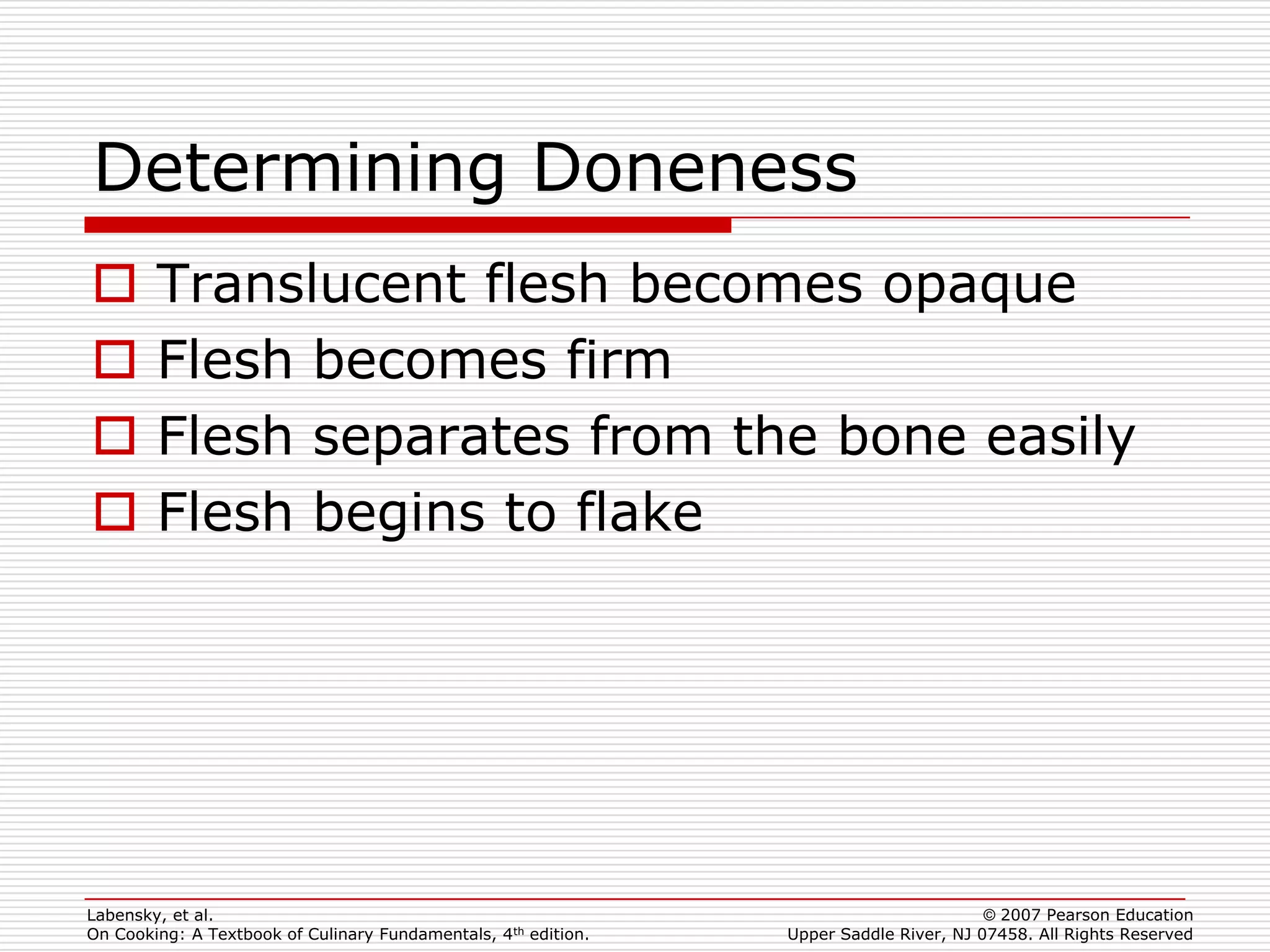
Determining Doneness
       Translucent flesh becomes opaque
       Flesh becomes firm
       Flesh separates from the bone easily
       Flesh begins to flake


Labensky, et al.                                                                        © 2007 Pearson Education
On Cooking: A Textbook of Culinary Fundamentals, 4th edition.   Upper Saddle River, NJ 07458. All Rights Reserved

Ch20

  • 1.
    Fish and Shellfish Chapter 20 Labensky, et al. © 2007 Pearson Education On Cooking: A Textbook of Culinary Fundamentals, 4th edition. Upper Saddle River, NJ 07458. All Rights Reserved
  • 2.
    After studying thisunit  You will be able to:  Understand the structure and composition of fish and shellfish  Identify a variety of fish and shellfish  Purchase fish and shellfish appropriate for your needs  Store fish and shellfish properly  Prepare fish and shellfish for cooking  Apply various cooking methods to fish and shellfish Labensky, et al. © 2007 Pearson Education On Cooking: A Textbook of Culinary Fundamentals, 4th edition. Upper Saddle River, NJ 07458. All Rights Reserved
  • 3.
    Fish and Shellfish Fish are aquatic  Shellfish are vertebrates with aquatic fins for swimming invertebrates with and gills for shells or carapaces breathing Labensky, et al. © 2007 Pearson Education On Cooking: A Textbook of Culinary Fundamentals, 4th edition. Upper Saddle River, NJ 07458. All Rights Reserved
  • 4.
    Round Fish  Includefresh and saltwater varieties  Have fins and internal bone structures  Have eyes on both sides of their heads  Bodies are truly round, oval, or compressed Labensky, et al. © 2007 Pearson Education On Cooking: A Textbook of Culinary Fundamentals, 4th edition. Upper Saddle River, NJ 07458. All Rights Reserved
  • 5.
    Flatfish  Found indeep ocean waters  Have asymmetrical, compre ssed bodies  Swim in a horizontal position  Have both eyes on top of their heads  Bottom dwellers  Top of their bodies is dark and the bottom is lighter in color Labensky, et al. © 2007 Pearson Education On Cooking: A Textbook of Culinary Fundamentals, 4th edition. Upper Saddle River, NJ 07458. All Rights Reserved
  • 6.
    Mollusks  Have smallunsegmented bodies and no internal skeleton Labensky, et al. © 2007 Pearson Education On Cooking: A Textbook of Culinary Fundamentals, 4th edition. Upper Saddle River, NJ 07458. All Rights Reserved
  • 7.
    Univalves  Single shell  Marine snails  Abalone  Conch  Snails Labensky, et al. © 2007 Pearson Education On Cooking: A Textbook of Culinary Fundamentals, 4th edition. Upper Saddle River, NJ 07458. All Rights Reserved
  • 8.
    Bivalves  Two bilateralshells  Clams  Oysters  Scallops  Mussels  Cockles Labensky, et al. © 2007 Pearson Education On Cooking: A Textbook of Culinary Fundamentals, 4th edition. Upper Saddle River, NJ 07458. All Rights Reserved
  • 9.
    Cephalopods  No exteriorshell  One single internal shell called a pen  Squid  Octopus  Calamari Labensky, et al. © 2007 Pearson Education On Cooking: A Textbook of Culinary Fundamentals, 4th edition. Upper Saddle River, NJ 07458. All Rights Reserved
  • 10.
    Crustaceans  Have ahard outer shell and jointed appendages  Found in both fresh and salt water  They breathe through gills  Crayfish  Crab  Lobster  Shrimp Labensky, et al. © 2007 Pearson Education On Cooking: A Textbook of Culinary Fundamentals, 4th edition. Upper Saddle River, NJ 07458. All Rights Reserved
  • 11.
    Crab  King  Dungeness  Soft-shell  Blue  Stone  King  Snow Labensky, et al. © 2007 Pearson Education On Cooking: A Textbook of Culinary Fundamentals, 4th edition. Upper Saddle River, NJ 07458. All Rights Reserved
  • 12.
    Interior Structure ofa Maine Lobster Labensky, et al. © 2007 Pearson Education On Cooking: A Textbook of Culinary Fundamentals, 4th edition. Upper Saddle River, NJ 07458. All Rights Reserved
  • 13.
    Inspection and Gradingof Fish and Shellfish  Grades assigned to fish are A, B, C  Inspections on fish and shellfish are voluntary  Type 1: plant, product and processing methods from raw to final product  Type 2: warehouses, processing plants and cold storage facilities  Type 3: fishing vessels and plants  Inspection services for sanitation only Labensky, et al. © 2007 Pearson Education On Cooking: A Textbook of Culinary Fundamentals, 4th edition. Upper Saddle River, NJ 07458. All Rights Reserved
  • 14.
    Determining Freshness inFish  Smell  No odor or the smell of the sea  Eyes  Clear and full  Gills  Intact and bright red  Texture  Flesh should be firm  Fins and scales  Moist and full  Appearance  Moist and glistening  Movement  Shellfish that is purchased alive should show movement  Crustaceans should close their shells when tapped Labensky, et al. © 2007 Pearson Education On Cooking: A Textbook of Culinary Fundamentals, 4th edition. Upper Saddle River, NJ 07458. All Rights Reserved
  • 15.
    Market Forms ofFish  Whole or round  Drawn  Dressed  Pan-dressed  Butterflied  Fillet  Steak  Wheel or center-cut Labensky, et al. © 2007 Pearson Education On Cooking: A Textbook of Culinary Fundamentals, 4th edition. Upper Saddle River, NJ 07458. All Rights Reserved
  • 16.
    Market Forms Labensky, etal. © 2007 Pearson Education On Cooking: A Textbook of Culinary Fundamentals, 4th edition. Upper Saddle River, NJ 07458. All Rights Reserved
  • 17.
    Market Forms (cont’d) Labensky,et al. © 2007 Pearson Education On Cooking: A Textbook of Culinary Fundamentals, 4th edition. Upper Saddle River, NJ 07458. All Rights Reserved
  • 18.
    Market Forms (cont’d) Labensky,et al. © 2007 Pearson Education On Cooking: A Textbook of Culinary Fundamentals, 4th edition. Upper Saddle River, NJ 07458. All Rights Reserved
  • 19.
    Market Forms (cont’d) Labensky,et al. © 2007 Pearson Education On Cooking: A Textbook of Culinary Fundamentals, 4th edition. Upper Saddle River, NJ 07458. All Rights Reserved
  • 20.
    Market Forms (cont’d) Labensky,et al. © 2007 Pearson Education On Cooking: A Textbook of Culinary Fundamentals, 4th edition. Upper Saddle River, NJ 07458. All Rights Reserved
  • 21.
    Market Forms (cont’d) Labensky,et al. © 2007 Pearson Education On Cooking: A Textbook of Culinary Fundamentals, 4th edition. Upper Saddle River, NJ 07458. All Rights Reserved
  • 22.
    Market Forms (cont’d) Labensky,et al. © 2007 Pearson Education On Cooking: A Textbook of Culinary Fundamentals, 4th edition. Upper Saddle River, NJ 07458. All Rights Reserved
  • 23.
    Storing Fresh Fishand Shellfish  Temperature between 30°F and 34°F  If shipped in ice, store in ice  Do not allow seafood to become dry  Scallops and fish fillets should not be in direct contact with ice  Live animals should be stored in saltwater tanks or in boxes with seaweed  Bivalves should be stored in net bags or boxes at high humidity Labensky, et al. © 2007 Pearson Education On Cooking: A Textbook of Culinary Fundamentals, 4th edition. Upper Saddle River, NJ 07458. All Rights Reserved
  • 24.
    Purchasing Terms  Fresh  Never frozen  Chilled  Fresh, held at 30°F to 34°F  Flash-frozen  Quickly frozen onboard ship, within hours of being caught  Fresh-frozen  Frozen while fresh, but not quickly  Frozen  Subject to temperature below 0°F  Glazed  Dipped in water to form a protective shell of ice  Fancy  Code word for previously frozen Labensky, et al. © 2007 Pearson Education On Cooking: A Textbook of Culinary Fundamentals, 4th edition. Upper Saddle River, NJ 07458. All Rights Reserved
  • 25.
    Cooking Seafood  All cooking methods can be used  Seafood is inherently tender  Should be cooked until just done  Overcooking is the most common mistake made in preparing seafood Labensky, et al. © 2007 Pearson Education On Cooking: A Textbook of Culinary Fundamentals, 4th edition. Upper Saddle River, NJ 07458. All Rights Reserved
  • 26.
    Determining Doneness  Translucent flesh becomes opaque  Flesh becomes firm  Flesh separates from the bone easily  Flesh begins to flake Labensky, et al. © 2007 Pearson Education On Cooking: A Textbook of Culinary Fundamentals, 4th edition. Upper Saddle River, NJ 07458. All Rights Reserved