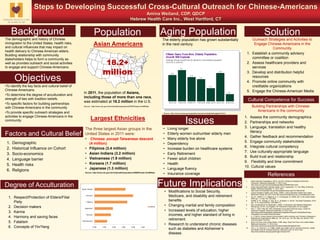
Steps to Developing Successful Cross-Cultural Outreach for Chinese-Americans
Amina Weiland, CDP, QDCP
Hebrew Health Care Inc., West Hartford, CT
Background
Factors and Cultural Belief
References
Objectives
Population
Cultural Competence for Success
•To identify the key facts and cultural belief of
Chinese-Americans.
•To determine the degree of acculturation and
strength of ties with tradition beliefs.
•To specific factors for building partnerships
with Chinese-Americans in the community
•To provide specific outreach strategies and
activities to engage Chinese-Americans in the
community
Solution
Issues
1. Asian American Populations. (2013, July 02). Centers for Disease Control and
Prevention. Retrieved December 17, 2013, from
http://www.cdc.gov/minorityhealth/populations/REMP/asian.html
2. Asian American/Pacific Islander Profile. (2012, September 17). The Office of Minority
Health. Retrieved December 17, 2013, from
http://www.minorityhealth.hhs.gov/templates/browse.aspx?lvl=3&lvlid=29
3. Culture-Sensitive Health Care: Asian. (2000). Culture-Sensitive Health Care: Asian.
Retrieved October 29, 2013, from http://www.diversityresources.com/health/asian.html
4. He, W., Velkoff, V. A., DeBarros, K. A., & Sengupta, M. (2005). 65+ in the United States:
2005 (pp. 1-4, Rep. No. P23-209).
5. Hoeffel, E. M., Rastogi, S., Kim, M. O., & Shahid, H. (2012). The Asian Population: 2010
(pp. 14-15, Issue brief No. C2010BR-11).
6. Key Considerations for Replication. (2004). In Dementia Care Network Replication
Manual (pp. 33-34). Los Angeles, CA: Alzheimer's Association of Los Angeles.
7. Kieu, T. (2013, May 28). Why Immigration Is an Asian American Issue. Center for
American Progress. Retrieved December 10, 2013, from
http://www.americanprogress.org/issues/immigration/news/2013/05/28/64474/why-
immigration-is-an-asian-american-issue/
8. Li, Y. (2012). Cross-Cultural Communication within American and Chinese Colleagues in
Multinational Organizations (68th ed., Vol. 2010, pp. 114-129, Rep. No. Article 7). NY:
Communication Common.
9. Sixty-Five Plus in the United States. (1995, May). Sixty-Five Plus in the United States.
Retrieved December 17, 2013, from
http://www.census.gov/population/socdemo/statbriefs/agebrief.html
10. Tom, L. S., & Burns, J. A. (1998). Health and Health care for Chinese American. Health
and Health Care for Chinese American. Retrieved June 10, 2013, from
http://www.stanford.edu/group/ethnoger/chinese.html
1. Demographic
2. Historical Influence on Cohort
3. Socio-economics
4. Language barrier
5. Health risks
6. Religions
Largest Ethnicities
The demographic and history of Chinese
immigration to the United States, health risks,
and cultural influences that may impact on
health delivery to Chinese American elders.
Building relationship with community
stakeholders helps to form a community as
well as provides outreach and social activities
to engage and support Chinese-Americans.
Asian Americans
Outreach Strategies and Activities to
Engage Chinese-Americans in the
Community
1. Establish a community advisory
committee or coalition
2. Assess healthcare providers and
services
3. Develop and distribution helpful
resources
4. Promote online community with
creditable organizations
5. Engage the Chinese-American Media
The three largest Asian groups in the
United States in 2011 were:
• Chinese ,except Taiwanese descent
(4 million)
• Filipinos (3.4 million)
• Asian Indians (3.2 million)
• Vietnamese (1.9 million)
• Koreans (1.7 million)
• Japanese (1.3 million)
Source: http://www.cdc.gov/minorityhealth/populations/REMP/asian.html#Stats
18.2+
million
Degree of Acculturation
1. Respect/Protection of Elders/Filial
Piety
2. Decision makers
3. Karma
4. Harmony and saving faces
5. Fatalism
6. Concepts of Yin/Yang
In 2011, the population of Asians,
including those of more than one race,
was estimated at 18.2 million in the U.S.
Source: http://www.cdc.gov/minorityhealth/populations/REMP/asian.html#Stats
Aging Population
Building Partnerships with Chinese-
Americans in the community
1. Assess the community demographics
2. Partnerships and networks
3. Language, translation and healthy
literacy
4. Gather feedback and recommendation
5. Engage community stakeholders
6. Integrate cultural competency
7. Use culturally-appropriate language
8. Build trust and relationship
9. Flexibility and time commitment
10. Cultural values
The elderly population has grown substantially
in the next century.
Source: http://www.census.gov/population/socdemo/statbriefs/agebrief.html
• Living longer
• Elderly women outnumber elderly men
• Many elderly live alone
• Dependency
• Increase burden on healthcare systems
• Early Retirement
• Fewer adult children
• Health
• Language fluency
• Insurance coverage
Future Implications
• Modifications to Social Security,
Medicare, and disability and retirement
benefits
• Changing martial and family composition
• Increased levels of education, higher
incomes, and higher standard of living in
retirement.
• Research to understand chronic diseases
such as diabetes and Alzheimer’s
disease.

Steps to Developing Successful Chinese-Americans_Weiland

  • 1.
    Steps to DevelopingSuccessful Cross-Cultural Outreach for Chinese-Americans Amina Weiland, CDP, QDCP Hebrew Health Care Inc., West Hartford, CT Background Factors and Cultural Belief References Objectives Population Cultural Competence for Success •To identify the key facts and cultural belief of Chinese-Americans. •To determine the degree of acculturation and strength of ties with tradition beliefs. •To specific factors for building partnerships with Chinese-Americans in the community •To provide specific outreach strategies and activities to engage Chinese-Americans in the community Solution Issues 1. Asian American Populations. (2013, July 02). Centers for Disease Control and Prevention. Retrieved December 17, 2013, from http://www.cdc.gov/minorityhealth/populations/REMP/asian.html 2. Asian American/Pacific Islander Profile. (2012, September 17). The Office of Minority Health. Retrieved December 17, 2013, from http://www.minorityhealth.hhs.gov/templates/browse.aspx?lvl=3&lvlid=29 3. Culture-Sensitive Health Care: Asian. (2000). Culture-Sensitive Health Care: Asian. Retrieved October 29, 2013, from http://www.diversityresources.com/health/asian.html 4. He, W., Velkoff, V. A., DeBarros, K. A., & Sengupta, M. (2005). 65+ in the United States: 2005 (pp. 1-4, Rep. No. P23-209). 5. Hoeffel, E. M., Rastogi, S., Kim, M. O., & Shahid, H. (2012). The Asian Population: 2010 (pp. 14-15, Issue brief No. C2010BR-11). 6. Key Considerations for Replication. (2004). In Dementia Care Network Replication Manual (pp. 33-34). Los Angeles, CA: Alzheimer's Association of Los Angeles. 7. Kieu, T. (2013, May 28). Why Immigration Is an Asian American Issue. Center for American Progress. Retrieved December 10, 2013, from http://www.americanprogress.org/issues/immigration/news/2013/05/28/64474/why- immigration-is-an-asian-american-issue/ 8. Li, Y. (2012). Cross-Cultural Communication within American and Chinese Colleagues in Multinational Organizations (68th ed., Vol. 2010, pp. 114-129, Rep. No. Article 7). NY: Communication Common. 9. Sixty-Five Plus in the United States. (1995, May). Sixty-Five Plus in the United States. Retrieved December 17, 2013, from http://www.census.gov/population/socdemo/statbriefs/agebrief.html 10. Tom, L. S., & Burns, J. A. (1998). Health and Health care for Chinese American. Health and Health Care for Chinese American. Retrieved June 10, 2013, from http://www.stanford.edu/group/ethnoger/chinese.html 1. Demographic 2. Historical Influence on Cohort 3. Socio-economics 4. Language barrier 5. Health risks 6. Religions Largest Ethnicities The demographic and history of Chinese immigration to the United States, health risks, and cultural influences that may impact on health delivery to Chinese American elders. Building relationship with community stakeholders helps to form a community as well as provides outreach and social activities to engage and support Chinese-Americans. Asian Americans Outreach Strategies and Activities to Engage Chinese-Americans in the Community 1. Establish a community advisory committee or coalition 2. Assess healthcare providers and services 3. Develop and distribution helpful resources 4. Promote online community with creditable organizations 5. Engage the Chinese-American Media The three largest Asian groups in the United States in 2011 were: • Chinese ,except Taiwanese descent (4 million) • Filipinos (3.4 million) • Asian Indians (3.2 million) • Vietnamese (1.9 million) • Koreans (1.7 million) • Japanese (1.3 million) Source: http://www.cdc.gov/minorityhealth/populations/REMP/asian.html#Stats 18.2+ million Degree of Acculturation 1. Respect/Protection of Elders/Filial Piety 2. Decision makers 3. Karma 4. Harmony and saving faces 5. Fatalism 6. Concepts of Yin/Yang In 2011, the population of Asians, including those of more than one race, was estimated at 18.2 million in the U.S. Source: http://www.cdc.gov/minorityhealth/populations/REMP/asian.html#Stats Aging Population Building Partnerships with Chinese- Americans in the community 1. Assess the community demographics 2. Partnerships and networks 3. Language, translation and healthy literacy 4. Gather feedback and recommendation 5. Engage community stakeholders 6. Integrate cultural competency 7. Use culturally-appropriate language 8. Build trust and relationship 9. Flexibility and time commitment 10. Cultural values The elderly population has grown substantially in the next century. Source: http://www.census.gov/population/socdemo/statbriefs/agebrief.html • Living longer • Elderly women outnumber elderly men • Many elderly live alone • Dependency • Increase burden on healthcare systems • Early Retirement • Fewer adult children • Health • Language fluency • Insurance coverage Future Implications • Modifications to Social Security, Medicare, and disability and retirement benefits • Changing martial and family composition • Increased levels of education, higher incomes, and higher standard of living in retirement. • Research to understand chronic diseases such as diabetes and Alzheimer’s disease.