Steps in Planning
• FAROOQUI MOHAMMED MOHIUDDIN
ANEES AHMED:20202A0030
• BHAKTI HARISH MALI:20202A0032
• ROHIT VIKAS DHAINJE: 20202A0035
• YASH SHANKAR KHATPE:20202A0036
AGENDA
• Introduction
• Importance of Planning
• Hierarchy of Plans
• Planning at Supervisor level
• Types of Plans
• Steps in Planning
INTRODUCTION
OF PLANNING
• Choosing in advance what to do, how to do it, when
to do it, and who is to do it is what Koontz and
O'Donnel define as planning. It spans the distance
between where we are and where we wish to be. In
essence, it is a forecasting exercise.
• Planning involves conviction of specific objectives,
programs, setting policies, strategies, rules and
procedures and preparing budgets. Planning is a
function which is executed by managers at all levels
– top, middle and supervisory.
• Planning provides clear sense of direction to the
activities of the organization and job behavior of
managers and others. Planning is an attempt to
forecast the future in order to achieve better
performance.
IMPORTANCE OF
PLANNING
• Planning is essential for all organizations, from small
to large, as it helps to anticipate future needs and
ensures success.
• Planning is the first and foremost function of
management, other functions follow planning. What is
not planned cannot be organized and controlled.
Planning establishes the objectives, and all other
functions are performed to achieve the objectives set
by the planning process.
• Planning helps managers reduce risk and uncertainty
by using rational and fact-based decisions.
• Planning helps managers coordinate resources to
achieve organizational objectives.
• Planning sets goals and develops plans to achieve
them, which become benchmarks for performance
measurement. Control involves measuring actual
performance, comparing it to the standards, and
initiating corrective action if deviations occur.
HIEARCHY OF PLANS
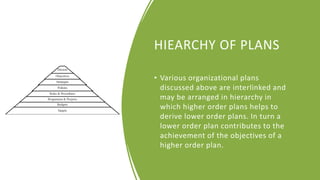
• Various organizational plans
discussed above are interlinked and
may be arranged in hierarchy in
which higher order plans helps to
derive lower order plans. In turn a
lower order plan contributes to the
achievement of the objectives of a
higher order plan.
HIEARCHY OF
PLANS
❑Mission and Purpose:Organizations have objectives
and end results, which are often referred to as
mission, purpose, goal, or target. The supervisor
role is to follow the mission set by authorities and
suggest improvements to top management.
❑Objectives:Objectives are the goals, aims or
purposes of organizations, which vary from one
organization to another. Supervisors divide main
objectives into smaller objectives to implement
day-to-day work.
❑Strategies:A strategy is a plan that takes into
account strengths, weaknesses, opportunities and
threats to create an optimal match between the
firm and external environment.
HIEARCHY OF
PLANS
❑ Policies:Policies are a general guideline for
decision making, channeling the thinking of
organization members to align with organizational
objectives.
❑Procedures:Procedures are detailed instructions for
performing activities regularly, helping to
accelerate clerical work without duplication and
waste of resources. Supervisors formulate
procedures to implement objectives.
❑Methods:Methods are a component part of
procedures and can be improved by eliminating
wastes and conducting "motion study" to reduce
fatigue, productivity and costs.
❑Rules: Rules are detailed instructions that a specific
action must or must not be performed in a given
situation, more rigid than policies.
HIEARCHY OF
PLANS
❑Programme: A programme is a sequence of
activities to achieve a given goal, consisting of
objectives, policies, procedures, task assignments,
steps, resources, etc.
❑Budgets:Budgets are a single use plan for a
particular period of time and are used as an
instrument of managerial control. They include
sales, production, cash, and revenue and expenses
budgets, with the supervisor mainly involved in
material and manpower budgets.
PLANNING AT
SUPERVISOR LEVEL
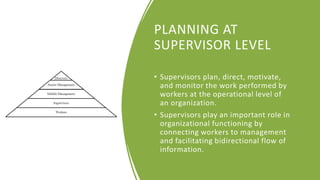
• Supervisors plan, direct, motivate,
and monitor the work performed by
workers at the operational level of
an organization.
• Supervisors play an important role in
organizational functioning by
connecting workers to management
and facilitating bidirectional flow of
information.
TYPES OF PLANS
Three major types of plans can help supervisors
achieve their organization's goals i.e. strategic,
tactical, and operational. Operational plans lead to
the achievement of tactical plans and tactical plan
lead to the attainment of strategic plans. In addition
to these three types of plans, supervisors/managers
should also develop a contingency plan in case if their
original plans fail
TYPES OF PLANS
❑Operational Plans: An operational plan is one that
supervisor uses to accomplish his or her job
responsibilities. Supervisors, team leaders, and
facilitators develop operational plans to support
tactical plans
❑Tactical Plans: Tactical plans are concerned with
shorter time frames and narrower scopes than are
strategic plans. These plans usually span one year
or less because they are considered short‐term
goals. Long‐term goals, on the other hand, can take
several years or more to accomplish.
❑Strategic plan: A strategic plan is an outline of
steps designed with the goals of the entire
organization as a whole in mind, rather than with
the goals of specific divisions or departments
STEPS IN
PLANNING
❑Establishing goals/objectives: The first step in
planning process is to determine the goal or
objectives. These are set by top level management
after number of objectives has been carefully
considered. The objective set depends on the
number of factors like mission of the organization,
abilities of the organization etc.
❑Establishing planning premises:Planning premises
means the conditions under which planning
activities will be undertaken. Planning premises are
planning assumptions like the expected
environmental factors, pertinent facts and
information relating to the future such as general
economic conditions, population trends,
competitive behavior etc. The planning premises
can be classified as below:
• Internal and External premises
• Tangible and Intangible premises
• Controllable and non-controllable premises
STEPS IN
PLANNING
❑Deciding the planning period: The period or
duration of plan is decided after establishing
planning premises. Some plans may vary depending
upon type of objective or work. Companies
generally base their period on a future that can
reasonably be anticipated.
❑ Identification of alternatives: A particular
objective can be achieved through implementing
various course of actions. For example, an
organization's objective is to grow further which
can be achieved in several ways like expanding in
the same field of business or product line,
diversifying in other areas, joining hands with other
organization and so on. With each category there
may be several alternatives. For example,
diversification may point out the possibility of
entering one of the several fields.
STEPS IN
PLANNING
❑ Evaluation and selection of alternative: Evaluation
of the alternatives is done to determine which is
the most appropriate course of action for achieving
goals and objectives
❑Developing derivative/supportive plans: Once the
plan is selected, various plans are derived so as it
supports the main plan. The supporting plans may
be done for buying equipment, buying raw material
etc. The development of the plan requires following
activities:
• Programming
• Allocating resources
• Scheduling
• Fixing accountability
STEPS IN
PLANNING
❑Measuring and controlling the process: We must
monitor the progress of plan else it may result in
huge loss. Supervisors need to check the progress
of their plans and accordingly take remedial action
on it. So, process of controlling is a part of any
plan.
THANK YOU

steps on planning.pdf

  • 1.
    Steps in Planning •FAROOQUI MOHAMMED MOHIUDDIN ANEES AHMED:20202A0030 • BHAKTI HARISH MALI:20202A0032 • ROHIT VIKAS DHAINJE: 20202A0035 • YASH SHANKAR KHATPE:20202A0036
  • 2.
    AGENDA • Introduction • Importanceof Planning • Hierarchy of Plans • Planning at Supervisor level • Types of Plans • Steps in Planning
  • 3.
    INTRODUCTION OF PLANNING • Choosingin advance what to do, how to do it, when to do it, and who is to do it is what Koontz and O'Donnel define as planning. It spans the distance between where we are and where we wish to be. In essence, it is a forecasting exercise. • Planning involves conviction of specific objectives, programs, setting policies, strategies, rules and procedures and preparing budgets. Planning is a function which is executed by managers at all levels – top, middle and supervisory. • Planning provides clear sense of direction to the activities of the organization and job behavior of managers and others. Planning is an attempt to forecast the future in order to achieve better performance.
  • 4.
    IMPORTANCE OF PLANNING • Planningis essential for all organizations, from small to large, as it helps to anticipate future needs and ensures success. • Planning is the first and foremost function of management, other functions follow planning. What is not planned cannot be organized and controlled. Planning establishes the objectives, and all other functions are performed to achieve the objectives set by the planning process. • Planning helps managers reduce risk and uncertainty by using rational and fact-based decisions. • Planning helps managers coordinate resources to achieve organizational objectives. • Planning sets goals and develops plans to achieve them, which become benchmarks for performance measurement. Control involves measuring actual performance, comparing it to the standards, and initiating corrective action if deviations occur.
  • 5.
    HIEARCHY OF PLANS •Various organizational plans discussed above are interlinked and may be arranged in hierarchy in which higher order plans helps to derive lower order plans. In turn a lower order plan contributes to the achievement of the objectives of a higher order plan.
  • 6.
    HIEARCHY OF PLANS ❑Mission andPurpose:Organizations have objectives and end results, which are often referred to as mission, purpose, goal, or target. The supervisor role is to follow the mission set by authorities and suggest improvements to top management. ❑Objectives:Objectives are the goals, aims or purposes of organizations, which vary from one organization to another. Supervisors divide main objectives into smaller objectives to implement day-to-day work. ❑Strategies:A strategy is a plan that takes into account strengths, weaknesses, opportunities and threats to create an optimal match between the firm and external environment.
  • 7.
    HIEARCHY OF PLANS ❑ Policies:Policiesare a general guideline for decision making, channeling the thinking of organization members to align with organizational objectives. ❑Procedures:Procedures are detailed instructions for performing activities regularly, helping to accelerate clerical work without duplication and waste of resources. Supervisors formulate procedures to implement objectives. ❑Methods:Methods are a component part of procedures and can be improved by eliminating wastes and conducting "motion study" to reduce fatigue, productivity and costs. ❑Rules: Rules are detailed instructions that a specific action must or must not be performed in a given situation, more rigid than policies.
  • 8.
    HIEARCHY OF PLANS ❑Programme: Aprogramme is a sequence of activities to achieve a given goal, consisting of objectives, policies, procedures, task assignments, steps, resources, etc. ❑Budgets:Budgets are a single use plan for a particular period of time and are used as an instrument of managerial control. They include sales, production, cash, and revenue and expenses budgets, with the supervisor mainly involved in material and manpower budgets.
  • 9.
    PLANNING AT SUPERVISOR LEVEL •Supervisors plan, direct, motivate, and monitor the work performed by workers at the operational level of an organization. • Supervisors play an important role in organizational functioning by connecting workers to management and facilitating bidirectional flow of information.
  • 10.
    TYPES OF PLANS Threemajor types of plans can help supervisors achieve their organization's goals i.e. strategic, tactical, and operational. Operational plans lead to the achievement of tactical plans and tactical plan lead to the attainment of strategic plans. In addition to these three types of plans, supervisors/managers should also develop a contingency plan in case if their original plans fail
  • 11.
    TYPES OF PLANS ❑OperationalPlans: An operational plan is one that supervisor uses to accomplish his or her job responsibilities. Supervisors, team leaders, and facilitators develop operational plans to support tactical plans ❑Tactical Plans: Tactical plans are concerned with shorter time frames and narrower scopes than are strategic plans. These plans usually span one year or less because they are considered short‐term goals. Long‐term goals, on the other hand, can take several years or more to accomplish. ❑Strategic plan: A strategic plan is an outline of steps designed with the goals of the entire organization as a whole in mind, rather than with the goals of specific divisions or departments
  • 12.
    STEPS IN PLANNING ❑Establishing goals/objectives:The first step in planning process is to determine the goal or objectives. These are set by top level management after number of objectives has been carefully considered. The objective set depends on the number of factors like mission of the organization, abilities of the organization etc. ❑Establishing planning premises:Planning premises means the conditions under which planning activities will be undertaken. Planning premises are planning assumptions like the expected environmental factors, pertinent facts and information relating to the future such as general economic conditions, population trends, competitive behavior etc. The planning premises can be classified as below: • Internal and External premises • Tangible and Intangible premises • Controllable and non-controllable premises
  • 13.
    STEPS IN PLANNING ❑Deciding theplanning period: The period or duration of plan is decided after establishing planning premises. Some plans may vary depending upon type of objective or work. Companies generally base their period on a future that can reasonably be anticipated. ❑ Identification of alternatives: A particular objective can be achieved through implementing various course of actions. For example, an organization's objective is to grow further which can be achieved in several ways like expanding in the same field of business or product line, diversifying in other areas, joining hands with other organization and so on. With each category there may be several alternatives. For example, diversification may point out the possibility of entering one of the several fields.
  • 14.
    STEPS IN PLANNING ❑ Evaluationand selection of alternative: Evaluation of the alternatives is done to determine which is the most appropriate course of action for achieving goals and objectives ❑Developing derivative/supportive plans: Once the plan is selected, various plans are derived so as it supports the main plan. The supporting plans may be done for buying equipment, buying raw material etc. The development of the plan requires following activities: • Programming • Allocating resources • Scheduling • Fixing accountability
  • 15.
    STEPS IN PLANNING ❑Measuring andcontrolling the process: We must monitor the progress of plan else it may result in huge loss. Supervisors need to check the progress of their plans and accordingly take remedial action on it. So, process of controlling is a part of any plan.
  • 16.