Steps & Language for
Problem Solving
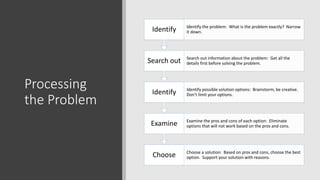
Processing
the Problem
Choose Choose a solution: Based on pros and cons, choose the best
option. Support your solution with reasons.
Examine Examine the pros and cons of each option: Eliminate
options that will not work based on the pros and cons.
Identify Identify possible solution options: Brainstorm, be creative.
Don’t limit your options.
Search out Search out information about the problem: Get all the
details first before solving the problem.
Identify Identify the problem: What is the problem exactly? Narrow
it down.
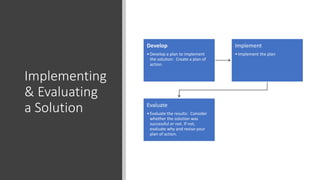
Implementing
& Evaluating
a Solution
Develop
•Develop a plan to implement
the solution: Create a plan of
action.
Implement
•Implement the plan
Evaluate
•Evaluate the results: Consider
whether the solution was
successful or not. If not,
evaluate why and revise your
plan of action.
Language for
Problem
Solving
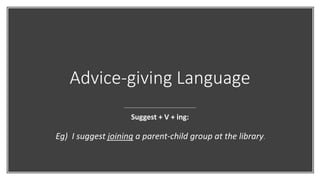
Advice-giving Language
Suggest + V + ing:
Eg) I suggest joining a parent-child group at the library.
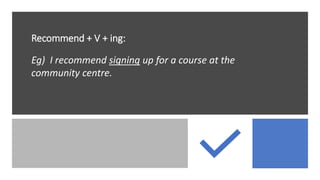
Recommend + V + ing:
Eg) I recommend signing up for a course at the
community centre.
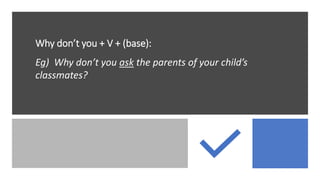
Why don’t you + V + (base):
Eg) Why don’t you ask the parents of your child’s
classmates?
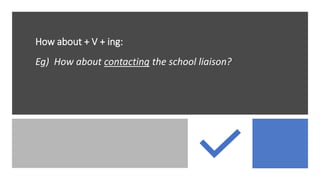
How about + V + ing:
Eg) How about contacting the school liaison?
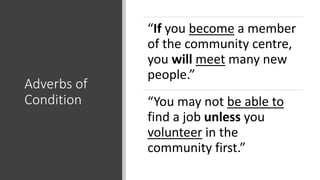
Adverbs of
Condition
“If you become a member
of the community centre,
you will meet many new
people.”
“You may not be able to
find a job unless you
volunteer in the
community first.”
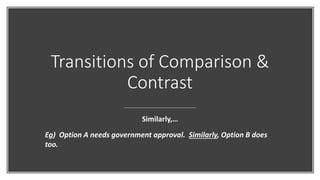
Transitions of Comparison &
Contrast
Similarly,…
Eg) Option A needs government approval. Similarly, Option B does
too.
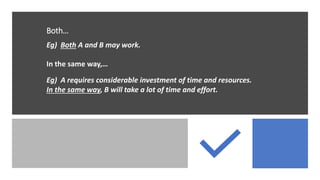
Both…
Eg) Both A and B may work.
Eg) A requires considerable investment of time and resources.
In the same way, B will take a lot of time and effort.
In the same way,…
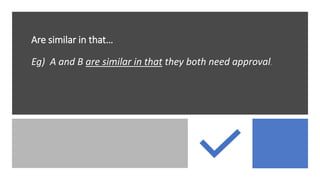
Are similar in that…
Eg) A and B are similar in that they both need approval.
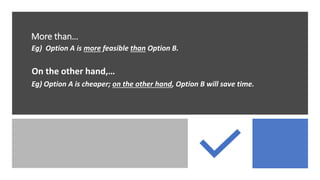
More than…
Eg) Option A is more feasible than Option B.
On the other hand,…
Eg) Option A is cheaper; on the other hand, Option B will save time.
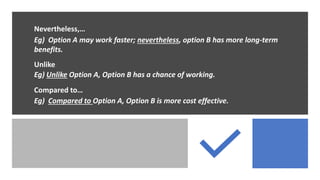
Nevertheless,…
Eg) Option A may work faster; nevertheless, option B has more long-term
benefits.
Unlike
Eg) Unlike Option A, Option B has a chance of working.
Compared to…
Eg) Compared to Option A, Option B is more cost effective.

Steps & Language for Problem Solving

  • 1.
    Steps & Languagefor Problem Solving
  • 2.
    Processing the Problem Choose Choosea solution: Based on pros and cons, choose the best option. Support your solution with reasons. Examine Examine the pros and cons of each option: Eliminate options that will not work based on the pros and cons. Identify Identify possible solution options: Brainstorm, be creative. Don’t limit your options. Search out Search out information about the problem: Get all the details first before solving the problem. Identify Identify the problem: What is the problem exactly? Narrow it down.
  • 3.
    Implementing & Evaluating a Solution Develop •Developa plan to implement the solution: Create a plan of action. Implement •Implement the plan Evaluate •Evaluate the results: Consider whether the solution was successful or not. If not, evaluate why and revise your plan of action.
  • 4.
  • 5.
    Advice-giving Language Suggest +V + ing: Eg) I suggest joining a parent-child group at the library.
  • 6.
    Recommend + V+ ing: Eg) I recommend signing up for a course at the community centre.
  • 7.
    Why don’t you+ V + (base): Eg) Why don’t you ask the parents of your child’s classmates?
  • 8.
    How about +V + ing: Eg) How about contacting the school liaison?
  • 9.
    Adverbs of Condition “If youbecome a member of the community centre, you will meet many new people.” “You may not be able to find a job unless you volunteer in the community first.”
  • 10.
    Transitions of Comparison& Contrast Similarly,… Eg) Option A needs government approval. Similarly, Option B does too.
  • 11.
    Both… Eg) Both Aand B may work. Eg) A requires considerable investment of time and resources. In the same way, B will take a lot of time and effort. In the same way,…
  • 12.
    Are similar inthat… Eg) A and B are similar in that they both need approval.
  • 13.
    More than… Eg) OptionA is more feasible than Option B. On the other hand,… Eg) Option A is cheaper; on the other hand, Option B will save time.
  • 14.
    Nevertheless,… Eg) Option Amay work faster; nevertheless, option B has more long-term benefits. Unlike Eg) Unlike Option A, Option B has a chance of working. Compared to… Eg) Compared to Option A, Option B is more cost effective.