STEPS IN OBSERVING
STUDENTS’ BEHAVIOR
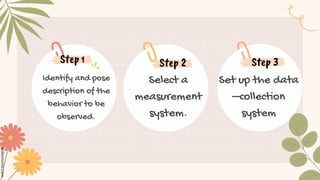
Identify and pose
description of the
behavior to be
observed.
Select a
measurement
system.
Step 1 Step 2
Set up the data
–collection
system
Step 3
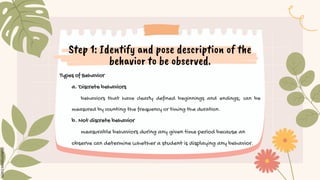
Step 1: Identify and pose description of the
behavior to be observed.
Types of Behavior
a. Discrete behaviors
behaviors that have clearly defined beginnings and endings; can be
measured by counting the frequency or timing the duration.
b. Not discrete behavior
measurable behaviors during any given time period because an
observe can determine whether a student is displaying any behavior.
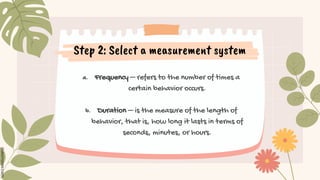
Step 2: Select a measurement system
a. Frequency – refers to the number of times a
certain behavior occurs.
b. Duration – is the measure of the length of
behavior, that is, how long it lasts in terms of
seconds, minutes, or hours.
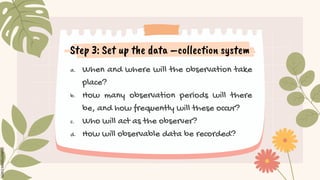
a. When and where will the observation take
place?
b. How many observation periods will there
be, and how frequently will these occur?
c. Who will act as the observer?
d. How will observable data be recorded?
Step 3: Set up the data –collection system
Classroom Observation Techniques
for Teachers
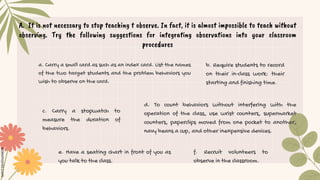
A. It is not necessary to stop teaching t observe. In fact, it is almost impossible to teach without
observing. Try the following suggestions for integrating observations into your classroom
procedures
a. Carry a small card as such as an index card. List the names
of the two target students and the problem behaviors you
wish to observe on the card.
b. Require students to record
on their in-class work: their
starting and finishing time.
d. To count behaviors without interfering with the
operation of the class, use wrist counters, supermarket
counters, paperclips moved from one pocket to another,
navy beans a cup, and other inexpensive devices.
e. Have a seating chart in front of you as
you talk to the class.
c. Carry a stopwatch to
measure the duration of
behaviors.
f. Recruit volunteers to
observe in the classroom.
ASSESSMENTS
STANDARDS IN
SPECIAL EDUCATION
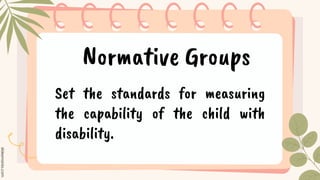
Normative Groups
Set the standards for measuring
the capability of the child with
disability.
Validity
A test measures what its
authors or users claim it to
measures (Salvia et al., 2010).
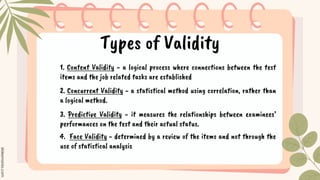
Types of Validity
1. Content Validity - a logical process where connections between the test
items and the job related tasks are established
2. Concurrent Validity - a statistical method using correlation, rather than
a logical method.
3. Predictive Validity - it measures the relationships between examinees’
performances on the test and their actual status.
4. Face Validity - determined by a review of the items and not through the
use of statistical analysis.
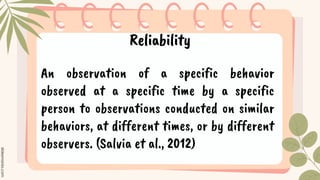
Reliability
Reliability
An observation of a specific behavior
observed at a specific time by a specific
person to observations conducted on similar
behaviors, at different times, or by different
observers. (Salvia et al., 2012)
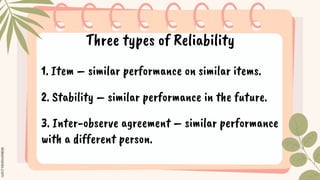
Three types of Reliability
1. Item – similar performance on similar items.
2. Stability – similar performance in the future.
3. Inter-observe agreement – similar performance
with a different person.
UNIVERSAL DESIGN
FOR SPECIAL
EDUCATION
What is Universal Design?
the design of products and environments to
be used by all people, to the greatest
extent possible, without the need for
adaptation or specialized design.
Mace’s (1977) Seven Principles of the Universal Design
Equitable Use Flexibility in
Use
Perceptible
Information
Tolerance for
Error
1 2
4 5
Simple and
Intuitive Use
Low Physical
Effort
3
6 7
Size and Space for
Approach and Use
The design is
useful and
marketable to
people with
disabilities.
The use of
the design is
easy to
understand.
The design can
accommodate
a wide range
of individual
preferences.
The design
communicates
necessary
information
effectively to
the user.
The design
minimizes hazards
and the adverse
consequences of
accidental or
unintended actions
The design can
be used
efficiently and
comfortably with
a low minimum
level of fatigue.
Appropriate size
and space
provided for
approach, reach,
manipulation,
and use.
THANK YOU!
This is our team.
Erika V. John S. Marie M.
Lorem ipsum dolor sit
amet, consectetuer
adipiscing elit. Aenean
commodo ligula eget
dolor.
Lorem ipsum dolor sit
amet, consectetuer
adipiscing elit. Aenean
commodo ligula eget
dolor.
Lorem ipsum dolor sit
amet, consectetuer
adipiscing elit. Aenean
commodo ligula eget
dolor.
Cats love to
sleep.
A fifteen-year-old cat has
probably spent ten years of its
life sleeping.
Also, cats use their whiskers as
feelers to determine if a space
is too small to squeeze
through.
And this is a timeline.
1999
Lorem ipsum
dolor sit amet,
consectetuer
adipiscing elit.
2005 Lorem ipsum
dolor sit amet,
consectetuer
adipiscing elit.
2015
Lorem ipsum
dolor sit amet,
consectetuer
adipiscing elit.
2019
2022
Lorem ipsum
dolor sit amet,
consectetuer
adipiscing elit.
Lorem ipsum
dolor sit amet,
consectetuer
adipiscing elit.
Presenting a website or an app?
If you are presenting a website, an internet product or an
app, you can place a screenshot of it here.
Presenting a website or an
app?
If you are presenting a website, an internet product
or an app, you can place a screenshot of it here.
Thank you!
Do you have any questions?
hello@mail.com
555-111-222
mydomain.com
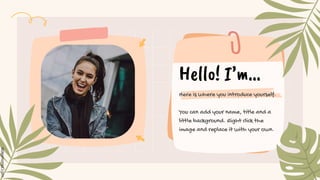
Hello! I’m...
Here is where you introduce yourself.
You can add your name, title and a
little background. Right click the
image and replace it with your own.
Certificate of Completion
Anna Smith.
You have successfully completed
This course.
Congratulations!
Date Signature
03/05/2023
Would you rather…
Today is Monday March 6th.
Announcements
Quote of the Day
Check List
Lorem ipsum dolor sit
amet, consectetuer
adipiscing elit.
Aenean commodo ligula
eget dolor.
Lorem ipsum dolor sit
amet, consectetuer
adipiscing elit.
Do the best you can until you know
better. Then when you know
better, do better.
Something here.
Something else here
And a third thing here.
Duplicate the check
mark.
And the check boxes.
― Maya Angelou
Credits.
Presentation Template: SlidesMania
Sample Images: Unsplash
Fonts used in this presentation: Gochi Hand and
Caveat Brush
Editable Icons
Add a brief introduction of your section here: Let’s dive in
and get to know some interesti
Free themes and templates for
Google Slides or PowerPoint
NOT to be sold as is or modified!
Read FAQ on slidesmania.com
Do not remove the slidesmania.com text on the sides.
Sharing is caring!
Koalas are
even more lazy
than cats.
Koalas don’t have much energy and, when not feasting on leaves, they spend their time dozing in the
branches. Believe it or not, they can sleep for up to 18 hours a day!
Did you know?
Did you know that elephants can sense storms?
Elephants may be able to detect a thunderstorm from hundreds of
miles away, and will head towards it, looking for water.
You can add a little bit more information. But try to not overload your
slides with text.

STEPS IN OBSERVING STUDENT'S BEHAVIOR. PPT

  • 1.
  • 2.
    Identify and pose descriptionof the behavior to be observed. Select a measurement system. Step 1 Step 2 Set up the data –collection system Step 3
  • 3.
    Step 1: Identifyand pose description of the behavior to be observed. Types of Behavior a. Discrete behaviors behaviors that have clearly defined beginnings and endings; can be measured by counting the frequency or timing the duration. b. Not discrete behavior measurable behaviors during any given time period because an observe can determine whether a student is displaying any behavior.
  • 4.
    Step 2: Selecta measurement system a. Frequency – refers to the number of times a certain behavior occurs. b. Duration – is the measure of the length of behavior, that is, how long it lasts in terms of seconds, minutes, or hours.
  • 5.
    a. When andwhere will the observation take place? b. How many observation periods will there be, and how frequently will these occur? c. Who will act as the observer? d. How will observable data be recorded? Step 3: Set up the data –collection system
  • 6.
  • 7.
    A. It isnot necessary to stop teaching t observe. In fact, it is almost impossible to teach without observing. Try the following suggestions for integrating observations into your classroom procedures a. Carry a small card as such as an index card. List the names of the two target students and the problem behaviors you wish to observe on the card. b. Require students to record on their in-class work: their starting and finishing time. d. To count behaviors without interfering with the operation of the class, use wrist counters, supermarket counters, paperclips moved from one pocket to another, navy beans a cup, and other inexpensive devices. e. Have a seating chart in front of you as you talk to the class. c. Carry a stopwatch to measure the duration of behaviors. f. Recruit volunteers to observe in the classroom.
  • 8.
  • 9.
    Normative Groups Set thestandards for measuring the capability of the child with disability.
  • 10.
    Validity A test measureswhat its authors or users claim it to measures (Salvia et al., 2010).
  • 11.
    Types of Validity 1.Content Validity - a logical process where connections between the test items and the job related tasks are established 2. Concurrent Validity - a statistical method using correlation, rather than a logical method. 3. Predictive Validity - it measures the relationships between examinees’ performances on the test and their actual status. 4. Face Validity - determined by a review of the items and not through the use of statistical analysis.
  • 12.
    Reliability Reliability An observation ofa specific behavior observed at a specific time by a specific person to observations conducted on similar behaviors, at different times, or by different observers. (Salvia et al., 2012)
  • 13.
    Three types ofReliability 1. Item – similar performance on similar items. 2. Stability – similar performance in the future. 3. Inter-observe agreement – similar performance with a different person.
  • 14.
  • 15.
    What is UniversalDesign? the design of products and environments to be used by all people, to the greatest extent possible, without the need for adaptation or specialized design.
  • 16.
    Mace’s (1977) SevenPrinciples of the Universal Design Equitable Use Flexibility in Use Perceptible Information Tolerance for Error 1 2 4 5 Simple and Intuitive Use Low Physical Effort 3 6 7 Size and Space for Approach and Use The design is useful and marketable to people with disabilities. The use of the design is easy to understand. The design can accommodate a wide range of individual preferences. The design communicates necessary information effectively to the user. The design minimizes hazards and the adverse consequences of accidental or unintended actions The design can be used efficiently and comfortably with a low minimum level of fatigue. Appropriate size and space provided for approach, reach, manipulation, and use.
  • 17.
  • 18.
    This is ourteam. Erika V. John S. Marie M. Lorem ipsum dolor sit amet, consectetuer adipiscing elit. Aenean commodo ligula eget dolor. Lorem ipsum dolor sit amet, consectetuer adipiscing elit. Aenean commodo ligula eget dolor. Lorem ipsum dolor sit amet, consectetuer adipiscing elit. Aenean commodo ligula eget dolor.
  • 19.
    Cats love to sleep. Afifteen-year-old cat has probably spent ten years of its life sleeping. Also, cats use their whiskers as feelers to determine if a space is too small to squeeze through.
  • 20.
    And this isa timeline. 1999 Lorem ipsum dolor sit amet, consectetuer adipiscing elit. 2005 Lorem ipsum dolor sit amet, consectetuer adipiscing elit. 2015 Lorem ipsum dolor sit amet, consectetuer adipiscing elit. 2019 2022 Lorem ipsum dolor sit amet, consectetuer adipiscing elit. Lorem ipsum dolor sit amet, consectetuer adipiscing elit.
  • 22.
    Presenting a websiteor an app? If you are presenting a website, an internet product or an app, you can place a screenshot of it here.
  • 23.
    Presenting a websiteor an app? If you are presenting a website, an internet product or an app, you can place a screenshot of it here.
  • 24.
    Thank you! Do youhave any questions? hello@mail.com 555-111-222 mydomain.com
  • 25.
    Hello! I’m... Here iswhere you introduce yourself. You can add your name, title and a little background. Right click the image and replace it with your own.
  • 26.
    Certificate of Completion AnnaSmith. You have successfully completed This course. Congratulations! Date Signature 03/05/2023
  • 27.
    Would you rather… Todayis Monday March 6th. Announcements Quote of the Day Check List Lorem ipsum dolor sit amet, consectetuer adipiscing elit. Aenean commodo ligula eget dolor. Lorem ipsum dolor sit amet, consectetuer adipiscing elit. Do the best you can until you know better. Then when you know better, do better. Something here. Something else here And a third thing here. Duplicate the check mark. And the check boxes. ― Maya Angelou
  • 28.
    Credits. Presentation Template: SlidesMania SampleImages: Unsplash Fonts used in this presentation: Gochi Hand and Caveat Brush
  • 29.
  • 30.
    Add a briefintroduction of your section here: Let’s dive in and get to know some interesti
  • 31.
    Free themes andtemplates for Google Slides or PowerPoint NOT to be sold as is or modified! Read FAQ on slidesmania.com Do not remove the slidesmania.com text on the sides. Sharing is caring!
  • 32.
    Koalas are even morelazy than cats. Koalas don’t have much energy and, when not feasting on leaves, they spend their time dozing in the branches. Believe it or not, they can sleep for up to 18 hours a day!
  • 33.
    Did you know? Didyou know that elephants can sense storms? Elephants may be able to detect a thunderstorm from hundreds of miles away, and will head towards it, looking for water. You can add a little bit more information. But try to not overload your slides with text.