Alessandra Revello 
UOC Pronto Soccorso – Medicina d’Urgenza 
Ospedale Sandro Pertini – Roma 
Direttore F. R. Pugliese 
Nessun conflitto di interessi
Alessandra Revello
Delays in the timely implementation of reperfusion 
therapy are key issues in the management of 
STEMI. 
The greatest benefit gained from reperfusion 
therapy occurs within the first 2–3 hours of 
symptom onset. 
Steg PG, James SK, et Al. ”ESC Guidelines for the management of acute myocardial infarction in 
patients presenting with ST-segment elevation.” Eur Heart J 2012;33(20):2569–2619. 
Gershlick AH, Banning AP, et Al. «Reperfusion therapy for STEMI: is there still a role for thrombolysis 
in the era of primary percutaneous coronary intervention?» Lancet 2013;382(9892):624–632 
Alessandra Revello
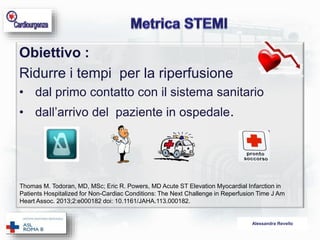
Obiettivo : 
Ridurre i tempi per la riperfusione 
• dal primo contatto con il sistema sanitario 
• dall’arrivo del paziente in ospedale. 
Thomas M. Todoran, MD, MSc; Eric R. Powers, MD Acute ST Elevation Myocardial Infarction in 
Patients Hospitalized for Non-Cardiac Conditions: The Next Challenge in Reperfusion Time J Am 
Heart Assoc. 2013;2:e000182 doi: 10.1161/JAHA.113.000182. 
Alessandra Revello
Alessandra Revello
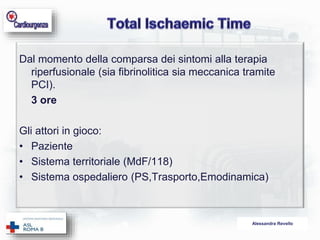
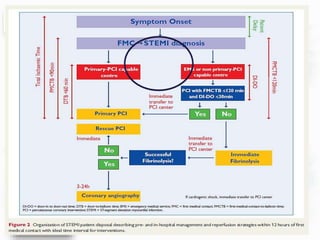
Dal momento della comparsa dei sintomi alla terapia 
riperfusionale (sia fibrinolitica sia meccanica tramite 
PCI). 
3 ore 
Gli attori in gioco: 
• Paziente 
• Sistema territoriale (MdF/118) 
• Sistema ospedaliero (PS,Trasporto,Emodinamica) 
Alessandra Revello
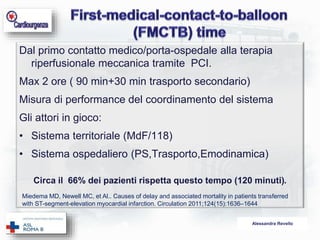
Dal primo contatto medico/porta-ospedale alla terapia 
Alessandra Revello 
riperfusionale meccanica tramite PCI. 
Max 2 ore ( 90 min+30 min trasporto secondario) 
Misura di performance del coordinamento del sistema 
Gli attori in gioco: 
• Sistema territoriale (MdF/118) 
• Sistema ospedaliero (PS,Trasporto,Emodinamica) 
Circa il 66% dei pazienti rispetta questo tempo (120 minuti). 
Miedema MD, Newell MC, et Al.. Causes of delay and associated mortality in patients transferred 
with ST-segment-elevation myocardial infarction. Circulation 2011;124(15):1636–1644
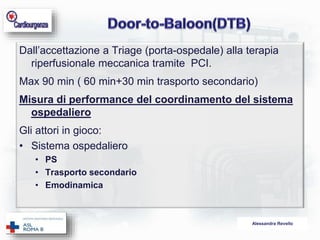
Dall’accettazione a Triage (porta-ospedale) alla terapia 
Alessandra Revello 
riperfusionale meccanica tramite PCI. 
Max 90 min ( 60 min+30 min trasporto secondario) 
Misura di performance del coordinamento del sistema 
ospedaliero 
Gli attori in gioco: 
• Sistema ospedaliero 
• PS 
• Trasporto secondario 
• Emodinamica
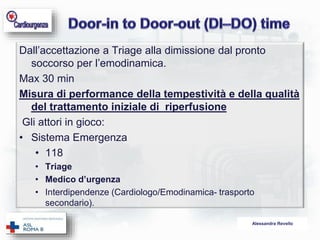
Dall’accettazione a Triage alla dimissione dal pronto 
Alessandra Revello 
soccorso per l’emodinamica. 
Max 30 min 
Misura di performance della tempestività e della qualità 
del trattamento iniziale di riperfusione 
Gli attori in gioco: 
• Sistema Emergenza 
• 118 
• Triage 
• Medico d’urgenza 
• Interdipendenze (Cardiologo/Emodinamica- trasporto 
secondario).
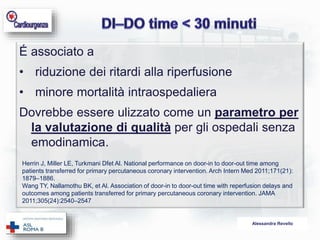
É associato a 
• riduzione dei ritardi alla riperfusione 
• minore mortalità intraospedaliera 
Dovrebbe essere ulizzato come un parametro per 
la valutazione di qualità per gli ospedali senza 
emodinamica. 
Herrin J, Miller LE, Turkmani Dfet Al. National performance on door-in to door-out time among 
patients transferred for primary percutaneous coronary intervention. Arch Intern Med 2011;171(21): 
1879–1886. 
Wang TY, Nallamothu BK, et Al. Association of door-in to door-out time with reperfusion delays and 
outcomes among patients transferred for primary percutaneous coronary intervention. JAMA 
2011;305(24):2540–2547 
Alessandra Revello
Alessandra Revello
Alessandra Revello
Alessandra Revello
Alessandra Revello 
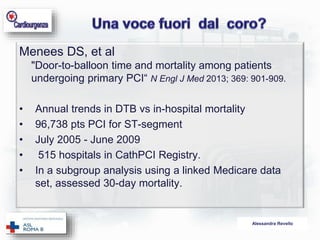
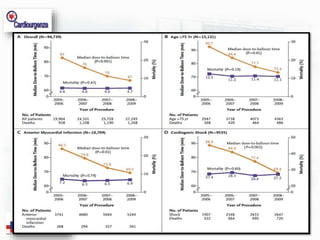
Menees DS, et al 
"Door-to-balloon time and mortality among patients 
undergoing primary PCI“ N Engl J Med 2013; 369: 901-909. 
• Annual trends in DTB vs in-hospital mortality 
• 96,738 pts PCI for ST-segment 
• July 2005 - June 2009 
• 515 hospitals in CathPCI Registry. 
• In a subgroup analysis using a linked Medicare data 
set, assessed 30-day mortality.
Alessandra Revello
Alessandra Revello 
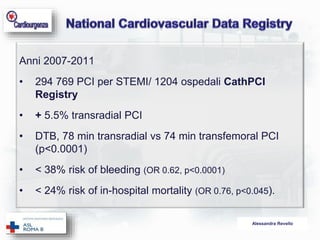
Anni 2007-2011 
• 294 769 PCI per STEMI/ 1204 ospedali CathPCI 
Registry 
• + 5.5% transradial PCI 
• DTB, 78 min transradial vs 74 min transfemoral PCI 
(p<0.0001) 
• < 38% risk of bleeding (OR 0.62, p<0.0001) 
• < 24% risk of in-hospital mortality (OR 0.76, p<0.045).
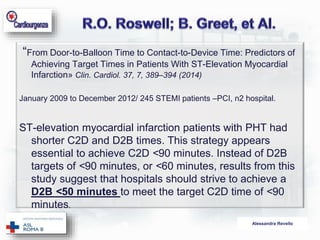
“From Door-to-Balloon Time to Contact-to-Device Time: Predictors of 
Achieving Target Times in Patients With ST-Elevation Myocardial 
Infarction» Clin. Cardiol. 37, 7, 389–394 (2014) 
January 2009 to December 2012/ 245 STEMI patients –PCI, n2 hospital. 
ST-elevation myocardial infarction patients with PHT had 
shorter C2D and D2B times. This strategy appears 
essential to achieve C2D <90 minutes. Instead of D2B 
targets of <90 minutes, or <60 minutes, results from this 
study suggest that hospitals should strive to achieve a 
D2B <50 minutes to meet the target C2D time of <90 
minutes. 
Alessandra Revello
It’s essential to have a basic understanding of how a 
Alessandra Revello 
given system works. 
If you don’t understand the way things work and you 
try to change them, it won’t be sustainable change. 
. . . And to create a high-performing organization, you 
have to have high-performing small systems within 
it.
Alessandra Revello 
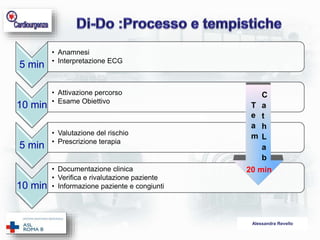
5 min 
• Anamnesi 
• Interpretazione ECG 
10 min 
• Attivazione percorso 
• Esame Obiettivo 
5 min 
• Valutazione del rischio 
• Prescrizione terapia 
10 min 
• Documentazione clinica 
• Verifica e rivalutazione paziente 
• Informazione paziente e congiunti 
T 
e 
a 
m 
C 
a 
t 
h 
L 
a 
b 
20 min
Alessandra Revello 
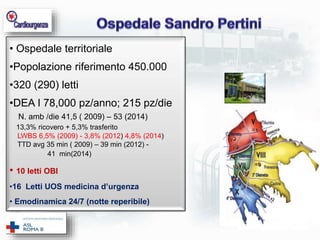
• Ospedale territoriale 
•Popolazione riferimento 450.000 
•320 (290) letti 
•DEA I 78,000 pz/anno; 215 pz/die 
N. amb /die 41,5 ( 2009) – 53 (2014) 
13,3% ricovero + 5,3% trasferito 
LWBS 6,5% (2009) - 3,8% (2012) 4,8% (2014) 
TTD avg 35 min ( 2009) – 39 min (2012) - 
41 min(2014) 
• 10 letti OBI 
•16 Letti UOS medicina d’urgenza 
• Emodinamica 24/7 (notte reperibile)
Alessandra Revello 
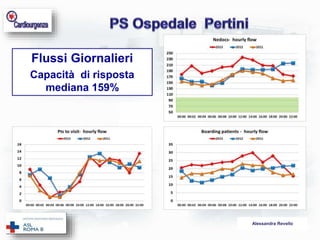
Flussi Giornalieri 
Capacità di risposta 
mediana 159%
Alessandra Revello 
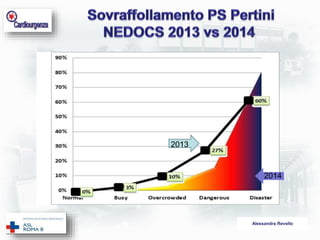
2013 
2014
Alessandra Revello
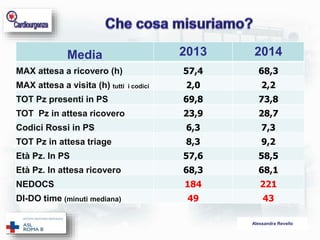
Media 2013 2014 
MAX attesa a ricovero (h) 57,4 68,3 
MAX attesa a visita (h) tutti i codici 2,0 2,2 
TOT Pz presenti in PS 69,8 73,8 
TOT Pz in attesa ricovero 23,9 28,7 
Codici Rossi in PS 6,3 7,3 
TOT Pz in attesa triage 8,3 9,2 
Età Pz. In PS 57,6 58,5 
Età Pz. In attesa ricovero 68,3 68,1 
NEDOCS 184 221 
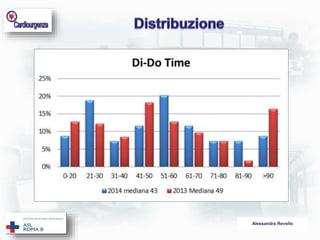
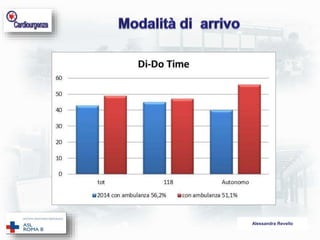
DI-DO time (minuti mediana) 49 43 
Alessandra Revello
Alessandra Revello
Alessandra Revello
Alessandra Revello 
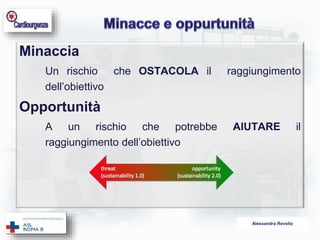
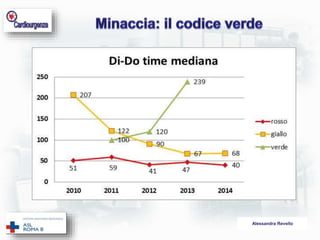
Minaccia 
Un rischio che OSTACOLA il raggiungimento 
dell’obiettivo 
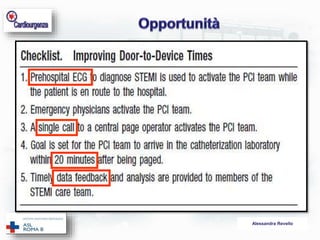
Opportunità 
A un rischio che potrebbe AIUTARE il 
raggiungimento dell’obiettivo
Alessandra Revello
Alessandra Revello
Alessandra Revello
Alessandra Revello
Alessandra Revello 
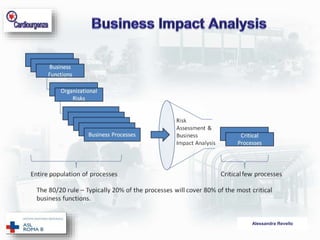
Funzioni nel percorso STEMI 
• diagnosi 
• attivazione percorso 
• valutazione rischio 
• terapia iniziale riperfusione 
• informazione e preparazione paziente
E’ una funzione essenziale nel percorso 
del paziente con STEMI. 
La compromissione di questo processo interrompe 
le operazioni e non risponde alle esigenze dei 
pazienti, non soddisfa i requisiti obbligatori per 
consentire l'esecuzione della missione 
dell'organizzazione. 
Alessandra Revello

Stemi time In ED

  • 1.
    Alessandra Revello UOCPronto Soccorso – Medicina d’Urgenza Ospedale Sandro Pertini – Roma Direttore F. R. Pugliese Nessun conflitto di interessi
  • 2.
  • 3.
    Delays in thetimely implementation of reperfusion therapy are key issues in the management of STEMI. The greatest benefit gained from reperfusion therapy occurs within the first 2–3 hours of symptom onset. Steg PG, James SK, et Al. ”ESC Guidelines for the management of acute myocardial infarction in patients presenting with ST-segment elevation.” Eur Heart J 2012;33(20):2569–2619. Gershlick AH, Banning AP, et Al. «Reperfusion therapy for STEMI: is there still a role for thrombolysis in the era of primary percutaneous coronary intervention?» Lancet 2013;382(9892):624–632 Alessandra Revello
  • 4.
    Obiettivo : Ridurrei tempi per la riperfusione • dal primo contatto con il sistema sanitario • dall’arrivo del paziente in ospedale. Thomas M. Todoran, MD, MSc; Eric R. Powers, MD Acute ST Elevation Myocardial Infarction in Patients Hospitalized for Non-Cardiac Conditions: The Next Challenge in Reperfusion Time J Am Heart Assoc. 2013;2:e000182 doi: 10.1161/JAHA.113.000182. Alessandra Revello
  • 5.
  • 6.
    Dal momento dellacomparsa dei sintomi alla terapia riperfusionale (sia fibrinolitica sia meccanica tramite PCI). 3 ore Gli attori in gioco: • Paziente • Sistema territoriale (MdF/118) • Sistema ospedaliero (PS,Trasporto,Emodinamica) Alessandra Revello
  • 7.
    Dal primo contattomedico/porta-ospedale alla terapia Alessandra Revello riperfusionale meccanica tramite PCI. Max 2 ore ( 90 min+30 min trasporto secondario) Misura di performance del coordinamento del sistema Gli attori in gioco: • Sistema territoriale (MdF/118) • Sistema ospedaliero (PS,Trasporto,Emodinamica) Circa il 66% dei pazienti rispetta questo tempo (120 minuti). Miedema MD, Newell MC, et Al.. Causes of delay and associated mortality in patients transferred with ST-segment-elevation myocardial infarction. Circulation 2011;124(15):1636–1644
  • 8.
    Dall’accettazione a Triage(porta-ospedale) alla terapia Alessandra Revello riperfusionale meccanica tramite PCI. Max 90 min ( 60 min+30 min trasporto secondario) Misura di performance del coordinamento del sistema ospedaliero Gli attori in gioco: • Sistema ospedaliero • PS • Trasporto secondario • Emodinamica
  • 9.
    Dall’accettazione a Triagealla dimissione dal pronto Alessandra Revello soccorso per l’emodinamica. Max 30 min Misura di performance della tempestività e della qualità del trattamento iniziale di riperfusione Gli attori in gioco: • Sistema Emergenza • 118 • Triage • Medico d’urgenza • Interdipendenze (Cardiologo/Emodinamica- trasporto secondario).
  • 10.
    É associato a • riduzione dei ritardi alla riperfusione • minore mortalità intraospedaliera Dovrebbe essere ulizzato come un parametro per la valutazione di qualità per gli ospedali senza emodinamica. Herrin J, Miller LE, Turkmani Dfet Al. National performance on door-in to door-out time among patients transferred for primary percutaneous coronary intervention. Arch Intern Med 2011;171(21): 1879–1886. Wang TY, Nallamothu BK, et Al. Association of door-in to door-out time with reperfusion delays and outcomes among patients transferred for primary percutaneous coronary intervention. JAMA 2011;305(24):2540–2547 Alessandra Revello
  • 11.
  • 12.
  • 13.
  • 14.
    Alessandra Revello MeneesDS, et al "Door-to-balloon time and mortality among patients undergoing primary PCI“ N Engl J Med 2013; 369: 901-909. • Annual trends in DTB vs in-hospital mortality • 96,738 pts PCI for ST-segment • July 2005 - June 2009 • 515 hospitals in CathPCI Registry. • In a subgroup analysis using a linked Medicare data set, assessed 30-day mortality.
  • 15.
  • 16.
    Alessandra Revello Anni2007-2011 • 294 769 PCI per STEMI/ 1204 ospedali CathPCI Registry • + 5.5% transradial PCI • DTB, 78 min transradial vs 74 min transfemoral PCI (p<0.0001) • < 38% risk of bleeding (OR 0.62, p<0.0001) • < 24% risk of in-hospital mortality (OR 0.76, p<0.045).
  • 17.
    “From Door-to-Balloon Timeto Contact-to-Device Time: Predictors of Achieving Target Times in Patients With ST-Elevation Myocardial Infarction» Clin. Cardiol. 37, 7, 389–394 (2014) January 2009 to December 2012/ 245 STEMI patients –PCI, n2 hospital. ST-elevation myocardial infarction patients with PHT had shorter C2D and D2B times. This strategy appears essential to achieve C2D <90 minutes. Instead of D2B targets of <90 minutes, or <60 minutes, results from this study suggest that hospitals should strive to achieve a D2B <50 minutes to meet the target C2D time of <90 minutes. Alessandra Revello
  • 18.
    It’s essential tohave a basic understanding of how a Alessandra Revello given system works. If you don’t understand the way things work and you try to change them, it won’t be sustainable change. . . . And to create a high-performing organization, you have to have high-performing small systems within it.
  • 19.
    Alessandra Revello 5min • Anamnesi • Interpretazione ECG 10 min • Attivazione percorso • Esame Obiettivo 5 min • Valutazione del rischio • Prescrizione terapia 10 min • Documentazione clinica • Verifica e rivalutazione paziente • Informazione paziente e congiunti T e a m C a t h L a b 20 min
  • 20.
    Alessandra Revello •Ospedale territoriale •Popolazione riferimento 450.000 •320 (290) letti •DEA I 78,000 pz/anno; 215 pz/die N. amb /die 41,5 ( 2009) – 53 (2014) 13,3% ricovero + 5,3% trasferito LWBS 6,5% (2009) - 3,8% (2012) 4,8% (2014) TTD avg 35 min ( 2009) – 39 min (2012) - 41 min(2014) • 10 letti OBI •16 Letti UOS medicina d’urgenza • Emodinamica 24/7 (notte reperibile)
  • 21.
    Alessandra Revello FlussiGiornalieri Capacità di risposta mediana 159%
  • 22.
  • 23.
  • 24.
    Media 2013 2014 MAX attesa a ricovero (h) 57,4 68,3 MAX attesa a visita (h) tutti i codici 2,0 2,2 TOT Pz presenti in PS 69,8 73,8 TOT Pz in attesa ricovero 23,9 28,7 Codici Rossi in PS 6,3 7,3 TOT Pz in attesa triage 8,3 9,2 Età Pz. In PS 57,6 58,5 Età Pz. In attesa ricovero 68,3 68,1 NEDOCS 184 221 DI-DO time (minuti mediana) 49 43 Alessandra Revello
  • 25.
  • 26.
  • 27.
    Alessandra Revello Minaccia Un rischio che OSTACOLA il raggiungimento dell’obiettivo Opportunità A un rischio che potrebbe AIUTARE il raggiungimento dell’obiettivo
  • 28.
  • 29.
  • 30.
  • 31.
  • 32.
    Alessandra Revello Funzioninel percorso STEMI • diagnosi • attivazione percorso • valutazione rischio • terapia iniziale riperfusione • informazione e preparazione paziente
  • 33.
    E’ una funzioneessenziale nel percorso del paziente con STEMI. La compromissione di questo processo interrompe le operazioni e non risponde alle esigenze dei pazienti, non soddisfa i requisiti obbligatori per consentire l'esecuzione della missione dell'organizzazione. Alessandra Revello