Stem Cell Therapy Treatment for Optic Nerve Atrophy
Optic nerve atrophy is a condition that damages the optic nerve. Stem cells in Optic nerve atrophy restore vision by replacing damaged retinal ganglion cells.
Stem Cell Therapy Treatment for Optic Nerve Atrophy
1.
www.advancells.com +91-9654321400
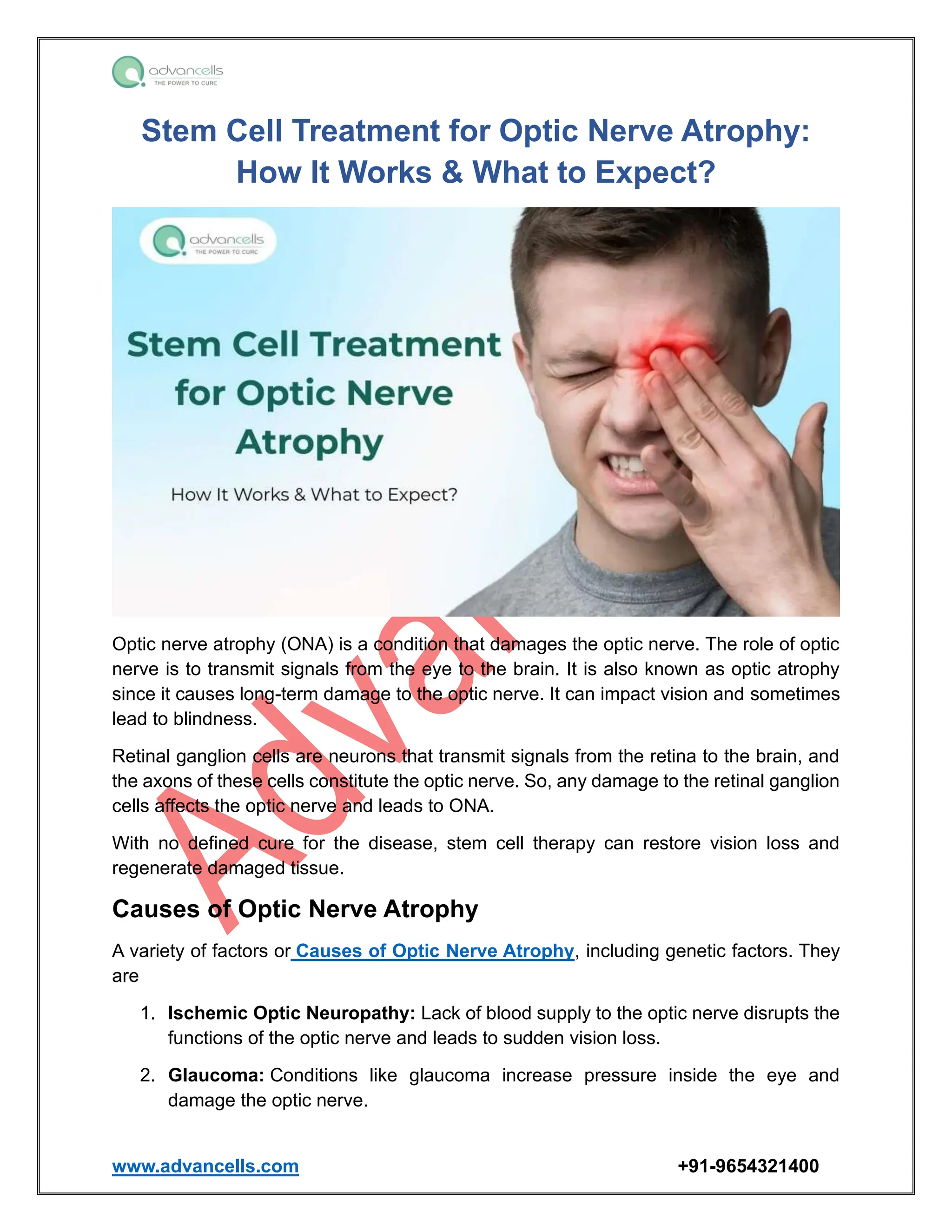
Stem CellTreatment for Optic Nerve Atrophy:
How It Works & What to Expect?
Optic nerve atrophy (ONA) is a condition that damages the optic nerve. The role of optic
nerve is to transmit signals from the eye to the brain. It is also known as optic atrophy
since it causes long-term damage to the optic nerve. It can impact vision and sometimes
lead to blindness.
Retinal ganglion cells are neurons that transmit signals from the retina to the brain, and
the axons of these cells constitute the optic nerve. So, any damage to the retinal ganglion
cells affects the optic nerve and leads to ONA.
With no defined cure for the disease, stem cell therapy can restore vision loss and
regenerate damaged tissue.
Causes of Optic Nerve Atrophy
A variety of factors or Causes of Optic Nerve Atrophy, including genetic factors. They
are
1. Ischemic Optic Neuropathy: Lack of blood supply to the optic nerve disrupts the
functions of the optic nerve and leads to sudden vision loss.
2. Glaucoma: Conditions like glaucoma increase pressure inside the eye and
damage the optic nerve.
2.
www.advancells.com +91-9654321400
3. Infectionor Injury: Infection, trauma or injury to the eye can also impact the optic
nerve and affect vision.
4. Inflammation: Inflammation of the optic nerve, i.e., optic neuritis, also can trigger
ONA.
5. Toxin exposure and Nutritional Deficiency: Exposure to toxins and nutritional
deficiencies can leave an impact and damage the optic nerve.
How is Nutritional Deficiency Associated with Optic Nerve Atrophy
Deficiency of nutrients, especially vitamins, contributes to the development of Optic Nerve
Atrophy. According to WHO, around 2, 50,000 to 5, 00,000 children suffering from vitamin
A deficiency have vision loss.
One such example is that of an 8-year-old Malaysian boy who lost his vision suddenly.
On examination, it was found that the child had vitamin A deficiency, which affected his
optic nerves and contributed to sudden vision loss.
Therefore, it is important to incorporate enough nutrients in the diet to prevent optic nerve
damage and vision loss.
Types of Optic Nerve Atrophy
1. Primary Optic Nerve Atrophy: It is a type where an injury or trauma directly
damages the optic nerve.
2. Secondary Optic Nerve Atrophy: In this type, certain conditions like glaucoma
or optic neuritis indirectly damage the optic nerve.
Symptoms Related to Vision Are:
1. Vision loss or blurry vision
2. Peripheral vision damage
3. Alteration of colour vision
4. Difficulty in distinguishing colour
New Treatment for Optic Nerve Atrophy
• Neuroprotective Interventions: Certain medications and pharmacological
agents, such as anti-oxidants, provide neuroprotection and reduce inflammation
and oxidative stress. They also prevent further damage by slowing down disease
progression.
3.
www.advancells.com +91-9654321400
• OpticNerve Stimulation: It is a type of treatment strategy where an electrical
device is fitted in the optic nerve. The device generates electrical impulses that
stimulate the optic nerve, which regenerates nerve fibers and restores vision.
• Visual aids: Aids such as electronic readers or glasses and magnifiers help
improve vision in patients with optic atrophy.
• Rehabilitation strategies: Counselling and specialized training can help improve
challenges and can help cope with vision loss.
• Retinal implants: These devices are implanted in the eyes, bypassing the
damaged optic nerve and directly stimulating the retina. Such devices help regain
the loss of sight to some extent.
• Gene therapy: Genetic therapy is a therapy where mutated genes are replaced
with healthy genes to restore vision loss. However, gene therapy carries its own
set of risks.
Stem Cell Treatment for Optic Nerve Atrophy
The main goal of the stem cell therapy is to regenerate and restore damaged tissue and
lost functions. Stem cell therapy in Optic Nerve Atrophy restores vision and replaces
damaged retinal ganglion cells by releasing certain growth factors.
It addresses two issues:
1. Replacing and regenerating damaged retinal ganglionic cells
2. Preserving vision and preventing secondary damage.
Mechanism of Stem Cells for Optic Nerve Atrophy
1. Release of Neurotrophic Factors
Stem cells release factors such as Vascular endothelial growth factor (VEGF), fibroblast
growth factor, and Nerve growth factor (NGF) during tissue regeneration. They also
release Neurotrophic factor (NT-3), Ciliary neurotrophic factor (CNTF), which enhance
the survival of Retinal ganglion cells (RGCs) and Brain-derived neurotrophic factor
(BDNF), which provide neuroprotection. Additionally, after the optic nerve injury, the Glial
cell-derived neurotrophic factor (GDNF) promotes the survival of RGCs.
2. Immunomodulation
Stem cells travel to the injured tissue, inhibit release of inflammatory cytokines and
enhance the survival of damaged cells. They inhibit the production of TNF22, which
reduces inflammation and promotes regeneration.
4.
www.advancells.com +91-9654321400
Stem cellsreduce TNF-α, IL-1β, IL-6, IL-8, and MCP-1 inflammatory cytokines levels and
enhance IL-6 and IL-10 levels, which initiates neurogenesis and modulates the immune
response. They also enhance the survival of retinal ganglionic cells by secreting
Neurotrophic factor (NTF).
3. Paracrine Effects
Stem cells exert a paracrine effect by releasing paracrine factors and cytokines. The
released cytokines prevent the apoptosis of neurons. They also enhance the expression
of NTF.
Role of Exosomes in ONA
Exosomes are extracellular vesicles that contain lipids, proteins, miRNAs and mRNAs.
The components of exosomes are essential for retinal function. Exosomes elicit certain
cellular responses. The responses are
1. Tissue repair and regeneration
2. Ameliorating immune response
3. Attenuating apoptosis of retinal cells
4. Reducing inflammatory cytokines expression
5. Enhancing survival of RGCs
6. Providing neuroprotection.
What Positive Perks Can One Expect with Stem Cell Therapy?
1. Restoration of vision
2. Neuroprotection
3. Slows down disease progression
4. Reduces inflammation and pain
5. Improves overall quality of life.
Assessment of Optic Nerve Function
In order to evaluate the migration of cells, localization, and axonogenesis, several tests
are recommended. They are:
1. To detect expression of NTF along with growth factors – ELISA, chain reaction,
RT-PCR and western blot.
2. For visual nerve function – Flash visual evoked potential (f-VEP)
5.
www.advancells.com +91-9654321400
3. Formeasuring retinal nerve fiber layer – Optical coherence tomography (OCT)
4. To trace Retinal ganglion cells (RGCs) – Fluorogold (FG).
Conclusion
With no existing cure for the treatment of optic nerve atrophy, the use of stem cell therapy
has paved the way for its treatment. The collaborative implementation of stem cells
restores vision loss in optic nerve atrophy. Both stem cells and exosomes have proven
their ability to treat optic nerve damage. Therefore, with further research and trials, stem
cell therapy can be established as the go-to therapy for optic nerve atrophy.
FAQ’s
Q: Define Optic nerve atrophy.
Optic nerve atrophy is a condition that damages the optic nerve. The role of optic nerve
is to transmit signals from the eye to the brain. It is also known as optic atrophy since it
causes long-term damage to the optic nerve. It can impact vision and sometimes lead to
blindness.
Q: What are the two types of Optic nerve atrophy?
Primary ONA is a type where an injury or trauma directly damages the optic nerve, and
secondary ONA is where certain conditions like glaucoma or optic neuritis indirectly
damage the optic nerve.
Q: How does stem cell therapy work in optic atrophy?
Stem cells in Optic nerve atrophy restore vision by replacing damaged retinal ganglion
cells and releasing certain growth factors to reduce inflammation and promote the survival
of neurons.
Q: What positive perks can one expect with stem cells?
The positive perks that one can expect in optic atrophy are restoration of vision,
neuroprotection, reduction of inflammation and pain, slowing of disease progression and
improvement of overall quality of life.



![Understanding Parkinson’s Disease: Causes, Symptoms, and Treatment [2025]](https://cdn.slidesharecdn.com/ss_thumbnails/understandingparkinson-251208102525-80ba3223-thumbnail.jpg?width=640&height=640&fit=bounds)


