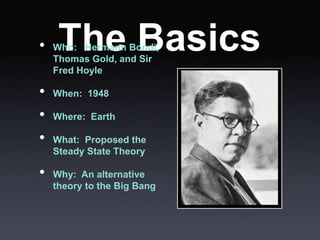
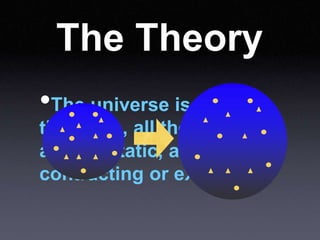
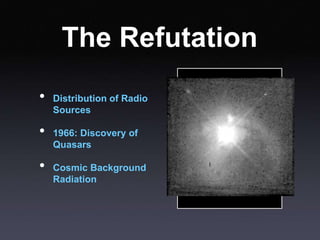
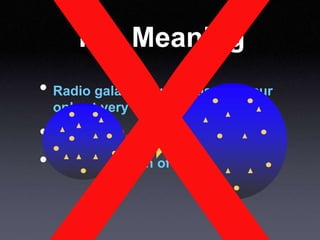
The Steady State Theory proposed by Hermann Bondi, Thomas Gold, and Sir Fred Hoyle in 1948 suggested that the universe is always expanding while simultaneously creating matter to fill the gaps, maintaining a constant and unchanging density. This theory provided an alternative to the Big Bang theory by proposing the universe had no beginning and would exist forever in this steady state. However, discoveries like the cosmic microwave background radiation and quasars at large distances implied the universe evolved over time, leading to the prevailing Big Bang model of today. The Steady State theory helped prove the Big Bang by making testable predictions that were later contradicted by observations.