Do you wantto edit this presentation?
Make a copy and edit
in Google Slides.
1. On the menu bar, click File and
then Make a copy and Entire
Presentation.
2. Type a name for the file.
3. Choose where to save it on
your Google Drive.
4. Click Ok.
5. A new tab will open. Wait for
the file to be completely loaded
on a new tab.
6. Once the file has loaded, edit
this presentation using Google
Slides.
Download an offline
copy and edit in
Microsoft PowerPoint.
1. On the menu bar, click File and
then Download as.
2. Choose a file type. Select
Microsoft PowerPoint (.pptx).
3. Wait for the file to be
downloaded to your local disk.
4. Once completely downloaded,
open the file and edit it using
Microsoft PowerPoint or any
offline presentation program.
Do You Want to Edit This Presentation?
3.
Learning Competency
● Comparethe different hypotheses explaining the
origin of the universe.
At the end of this lesson, the given enrichment competency
should be met by the students.
4.
Learning Objectives
At theend of this lesson, the learner should be able to
do the following:
● Explain the origin and the fate of the universe according
to steady-state theory and oscillating universe theory.
● Identify different proponents of the steady-state and
oscillating universe theories.
● Enumerate negative implications of steady-state and
oscillating universe theories.
5.
At a glance,
youknow
that bigger
plastic
containers
will be
heavier to
carry.
Learn about It!
•The steady-state theory is another view that proposes
that the universe has always been expanding.
• As the universe expands, new stars and galaxies are
formed at the same rate that old ones become
unobservable due to distance and recession velocity.
The Steady-State Theory
10.
Learn about It!
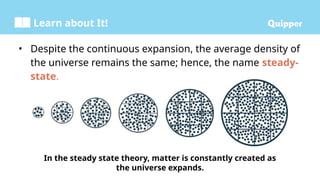
Inthe steady state theory, matter is constantly created as
the universe expands.
• Despite the continuous expansion, the average density of
the universe remains the same; hence, the name steady-
state.
11.
Learn about It!
•has no beginning and has no end.
• has always been here and will always be present.
• always looks the same in any time and space.
• creates new matter as it continuously expands.
The universe, according to the Steady-State Theory:
12.
Learn about It!
•Hermann Bondi, Thomas Gold, and Fred Hoyle
proposed the steady state theory in 1948.
Proponents of the Steady-State Theory
13.
Learn about It!
•It is not parallel with the law of conservation of energy
and mass.
• The discovery of cosmic microwave background (CMB)
radiation significantly supported the explanations given by
the big bang theory and led many scientists to reject the
steady-state theory in 1965.
Drawbacks of the Steady-State Theory
14.
Learn about It!
•Recent findings rejects the idea that cosmic radiation was a
result of a supernova.
• It has been proven that radiation is equal in any direction of
the universe and could not have resulted from supernovae.
Drawbacks of the Steady-State Theory
15.
Learn about It!
•Oscillating universe theory, also known as pulsating
theory, proposes that the universe is expanding and will
contract once all the energy after the big bang has been
used up.
• Then, it will expand again once it approaches the point of
singularity.
Oscillating Universe Theory
16.
Learn about It!
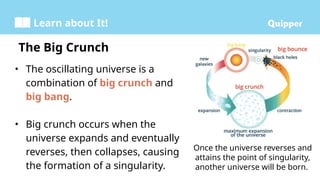
•The oscillating universe is a
combination of big crunch and
big bang.
• Big crunch occurs when the
universe expands and eventually
reverses, then collapses, causing
the formation of a singularity.
The Big Crunch
Once the universe reverses and
attains the point of singularity,
another universe will be born.
17.
Learn about It!
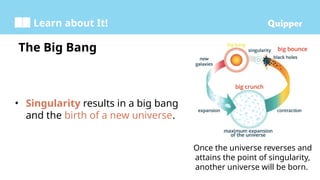
•Singularity results in a big bang
and the birth of a new universe.
The Big Bang
Once the universe reverses and
attains the point of singularity,
another universe will be born.
18.
Learn about It!
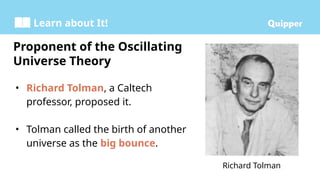
•Richard Tolman, a Caltech
professor, proposed it.
• Tolman called the birth of another
universe as the big bounce.
Proponent of the Oscillating
Universe Theory
Richard Tolman
19.
Learn about It!
•The suggestion that the universe would collapse on its own
after it reaches its full expansion violates some current laws
of physics, such as the postulated existence of dark energy.
• The currently postulated end of the universe is by big freeze
or heat death.
Drawbacks of the Oscillating Universe Theory
20.
Key Points
● Thesteady-state theory
suggests that the universe has always been here and will always
be present.
● It was proposed by Hermann Bondi, Thomas Gold, and
Fred Hoyle in 1948.
21.
Key Points
● Theoscillating universe theory
discusses that the universe is expanding and will contract once
all the energy after the big bang has been used up, only to
expand again once it approaches the point of singularity.
● Richard Tolman is the proponent of the oscillating universe
theory.
22.
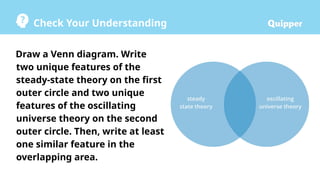
Check Your Understanding
Drawa Venn diagram. Write
two unique features of the
steady-state theory on the first
outer circle and two unique
features of the oscillating
universe theory on the second
outer circle. Then, write at least
one similar feature in the
overlapping area.
23.
Bibliography
Darling D. 2016.“Chamberlin-Moulton Planetesimal Hypothesis”. Accessed March 16, 2017.
https://www.daviddarling.info/encyclopedia/C/CMplanhypoth.html.
Schombert J. 2012. “Origin of the Solar System”. Accessed March 16, 2017.
http://abyss.uoregon.edu/~js/ast121/lectures/lec24.html.
Chambers J. and Jacqueline Mitton. 2013. From Dust to Life: The Origin andEvolution of Our Solar System.
New Jersey: Princeton University Press.
Woolfson M. 2012. Time, Space, Stars, and Man: The Story of the Big Bang. Singapore: World Scientific.
Holder R. and Simon Mitton. 2013. Georges Lemaître: Life, Science, and Legacy,. Germany: Springer
Science & Business Media.