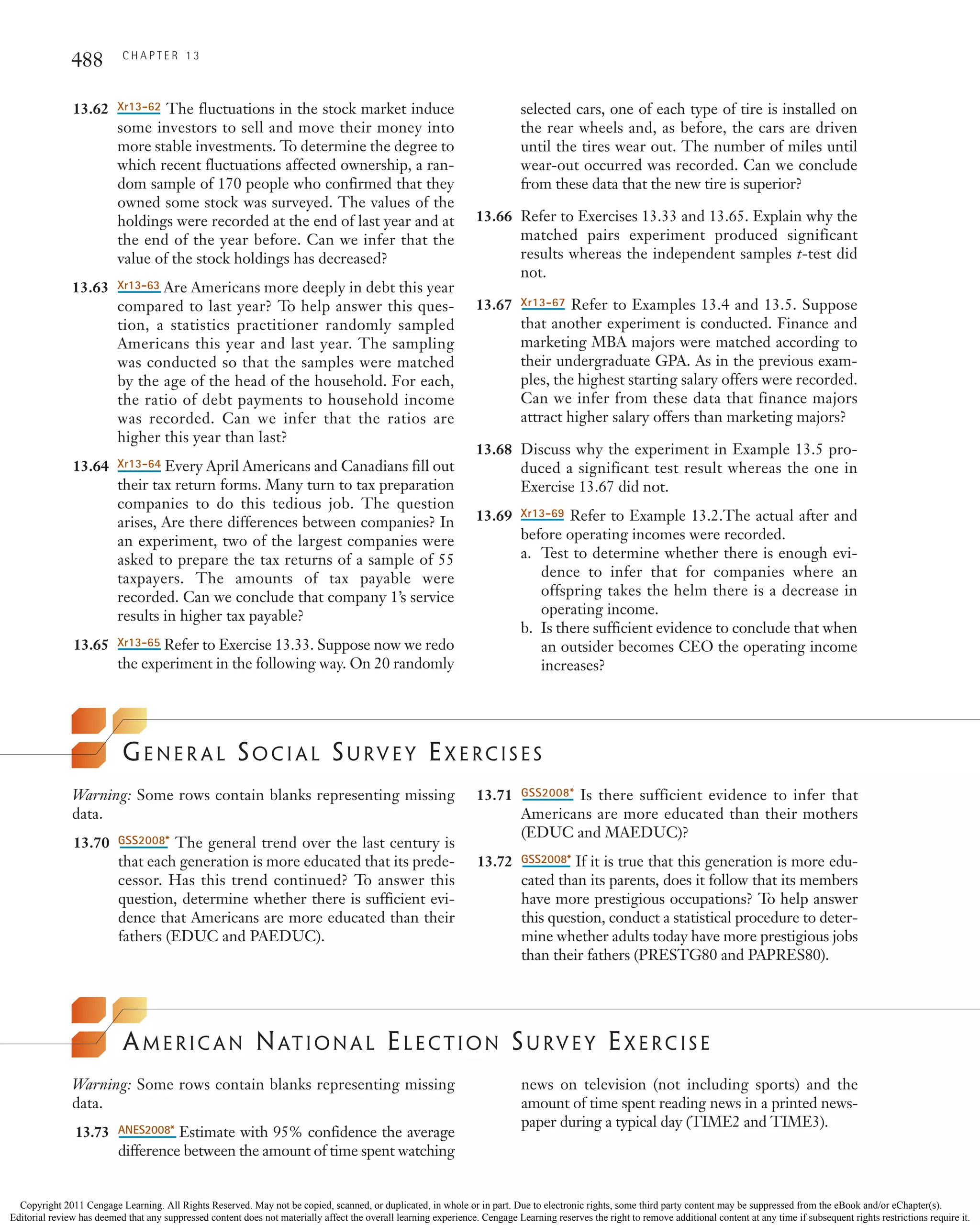
Problem
Objectives
A
GUIDE
TO
STATISTICAL
TECHNIQUES
Describe
a
Population
Histogram
Section
3.1
Ogive
Section
3.1
Stem-and-leaf
Section
3.1
Line
chart
Section
3.2
Mean,
median,
and
mode
Section
4.1
Range,
variance,
and
standard
deviation
Section
4.2
ion
4.2
Percentiles
and
quartiles
Section
4.3
Box
plot
Section
4.3
t-test
and
estimator
of
a
mean
Section
12.1
Chi-squared
test
and
estimator
of
a
variance
Section
12.2
Frequency
distribution
Section
2.2
Bar
chart
Section
2.2
Pie
chart
Section
2.2
z-test
and
estimator
of
a
proportion
Section
12.3
Chi-squared
goodness-of-
fit
test
Section
15.1
Median
Section
4.1
Percentiles
and
quartiles
Section
4.3
Box
plot
Section
4.3
Compare
Two
Populations
Equal-variances
t-test
and
estimator
of
the
difference
between
two
means:
independent
samples
Section
13.1
Unequal-variances
t-test
and
estimator
of
the
difference
between
two
means:
independent
samples
Section
13.1
t-test
and
estimator
of
mean
difference
Section
13.3
F-test
and
estimator
of
ratio
of
two
variances
Section
13.4
z-test
and
estimator
of
the
difference
between
two
proportions
Section
13.5
Chi-squared
test
of
a
contingency
table
Section
15.2
Compare
Two
or
More
Populations
One-way
analysis
of
variance
Section
14.1
LSD
multiple
comparison
method
Section
14.2
Tukey’s
multiple
comparison
method
Section
14.2
Two-way
analysis
of
variance
Section
14.4
Two-factor
analysis
of
variance
Section
14.5
Chi-squared
test
of
a
contingency
table
Section
15.2
Analyze
Relationship
between
Two
Variables
Scatter
diagram
Section
3.3
Covariance
Section
4.4
Coefficient
of
correlation
Section
4.4
Coefficient
of
determination
Section
4.4
Least
squares
line
Section
4.4
Simple
linear
regression
and
correlation
Chapter
16
Chi-squared
test
of
a
contingency
table
Section
15.2
DATA
T
YPES
Ordinal
Nominal
Interval
Analyze
Relationship
among
Two
or
More
Variables
Multiple
regression
Chapter
17
Not
covered
Not
covered
IFC-Abbreviated.qxd 11/22/10 7:03 PM Page 2
Copyright 2011 Cengage Learning. All Rights Reserved. May not be copied, scanned, or duplicated, in whole or in part. Due to electronic rights, some third party content may be suppressed from the eBook and/or eChapter(s).
Editorial review has deemed that any suppressed content does not materially affect the overall learning experience. Cengage Learning reserves the right to remove additional content at any time if subsequent rights restrictions require it.
AMERICAN NATIONAL ELECTION SURVEY AND GENERAL
SOCIAL SURVEY EXERCISES
Chapter ANES Page GSS Page
2 2.34–2.37 31
3 3.62–3.67 82 3.25–3.28 64
3.68–3.71 82
4 4.37–4.38 117 4.39 117
4.58–4.60 126 4.61–4.62 126
4.86 144 4.84–4.85 144
12 12.51–12.53 413 12.46–12.50 413
12.116–12.123 435 12.103–12.115 434
13 13.42–13.44 472 13.38–13.41 472
13.73 488 13.70–13.72 488
13.123–13.125 512 13.113–13.122 511
A13.27–A13.30 524 A13.18–A13.126 523
14 14.27–14.32 543 14.21–14.26 542
14.47–14.50 553 14.43–14.46 552
14.66–14.67 563
A14.23–A14.25 594 A14.19–A14.22 594
15 15.17 604 15.18–15.21 604
15.43–15.46 615 15.39–15.42 614
A15.25–A15.28 631 A15.17–A15.24 630
16 16.45–16.49 665 16.50–16.53 666
16.73–16.76 671 16.77–16.80 671
A16.27–A16.28 689 A16.17–A16.26 689
17 17.21–17.22 713 17.16–17.20 712
A17.27–A17.28 734 A17.17–A17.26 733
APPLICATION SECTIONS
Section 4.5 (Optional) Application in Professional Sports Management: Determinants of the Number
of Wins in a Baseball Season (illustrating an application of the least squares method and
correlation) 144
Section 4.6 (Optional) Application in Finance: Market Model (illustrating using a least squares lines and
coefficient of determination to estimate a stock’s market-related risk and its firm-specific risk) 147
Section 7.3 (Optional) Application in Finance: Portfolio Diversification and Asset Allocation (illustrating
the laws of expected value and variance and covariance) 237
Section 12.4 (Optional) Application in Marketing: Market Segmentation (using inference about a proportion
to estimate the size of a market segment) 435
Section 14.6 (Optional) Application in Operations Management: Finding and Reducing Variation (using
analysis of variance to actively experiment to find sources of variation) 578
APPLICATION SUBSECTION
Section 6.4 (Optional) Application in Medicine and Medical Insurance: Medical Screening (using Bayes’s
Law to calculate probabilities after a screening test) 199
IFC-Abbreviated.qxd 11/22/10 7:03 PM Page 3
Copyright 2011 Cengage Learning. All Rights Reserved. May not be copied, scanned, or duplicated, in whole or in part. Due to electronic rights, some third party content may be suppressed from the eBook and/or eChapter(s).
Editorial review has deemed that any suppressed content does not materially affect the overall learning experience. Cengage Learning reserves the right to remove additional content at any time if subsequent rights restrictions require it.
This page intentionally left blank
Statistics
FOR MANAGEMENT AND ECONOMICS ABBREVIATED
9e
Abb_FM.qxd 11/23/10 12:33 AM Page i
Copyright 2011 Cengage Learning. All Rights Reserved. May not be copied, scanned, or duplicated, in whole or in part. Due to electronic rights, some third party content may be suppressed from the eBook and/or eChapter(s).
Editorial review has deemed that any suppressed content does not materially affect the overall learning experience. Cengage Learning reserves the right to remove additional content at any time if subsequent rights restrictions require it.
This is an electronic version of the print textbook. Due to electronic rights
restrictions, some third party content may be suppressed. Editorial
review has deemed that any suppres ed content does not materially
affect the overall learning experience. The publisher reserves the
right to remove content from this title at any time if subsequent
rights restrictions require it. For valuable information on pricing, previous
editions, changes to current editions, and alternate formats, please visit
www.cengage.com/highered to search by ISBN#, author, title, or keyword
for materials in your areas of interest.
s
Copyright 2011 Cengage Learning. All Rights Reserved. May not be copied, scanned, or duplicated, in whole or in part. Due to electronic rights, some third party content may be suppressed from the eBook and/or eChapter(s).
Editorial review has deemed that any suppressed content does not materially affect the overall learning experience. Cengage Learning reserves the right to remove additional content at any time if subsequent rights restrictions require it.
Statistics
FOR MANAGEMENT AND ECONOMICS ABBREVIATED
9e
G E R A L D K E L L E R
Wilfred Laurier University
Australia • Brazil • Japan • Korea • Mexico • Singapore • Spain • United Kingdom • United States
Abb_FM.qxd 11/23/10 12:33 AM Page iii
Copyright 2011 Cengage Learning. All Rights Reserved. May not be copied, scanned, or duplicated, in whole or in part. Due to electronic rights, some third party content may be suppressed from the eBook and/or eChapter(s).
Editorial review has deemed that any suppressed content does not materially affect the overall learning experience. Cengage Learning reserves the right to remove additional content at any time if subsequent rights restrictions require it.
Statistics for Management and Economics
Abbreviated, Ninth Edition
Gerald Keller
VP/Editorial Director:
Jack W. Calhoun
Publisher:
Joe Sabatino
Senior Acquisitions Editor:
Charles McCormick, Jr.
Developmental Editor:
Elizabeth Lowry
Editorial Assistant:
Nora Heink
Senior Marketing Communications Manager:
Libby Shipp
Marketing Manager:
Adam Marsh
Content Project Manager:
Jacquelyn K Featherly
Media Editor:
Chris Valentine
Manufacturing Buyer:
Miranda Klapper
Production House/Compositor:
MPS Limited, a Macmillan Company
Senior Rights Specialist:
John Hill
Senior Art Director:
Stacy Jenkins Shirley
Internal Designer:
KeDesign/cmiller design
Cover Designer:
Cmiller design
Cover Images:
© iStock Photo
© 2012, 2009 South-Western, a part of Cengage Learning
ALL RIGHTS RESERVED. No part of this work covered by the copyright herein may
be reproduced, transmitted, stored or used in any form or by any means graphic,
electronic, or mechanical, including but not limited to photocopying, recording,
scanning, digitizing, taping, Web distribution, information networks, or information
storage and retrieval systems, except as permitted under Section 107 or 108 of the
1976 United States Copyright Act, without the prior written permission of the
publisher
Library of Congress Control Number: 2010928228
Abbreviated Student Edition ISBN 13: 978-1-111-52708-2
Abbreviated Student Edition ISBN 10: 1-111-52708-3
Package Abbreviated Student Edition ISBN 13: 978-1-111-52732-7
Package Abbreviated Student Edition ISBN 10: 1-111-52732-6
South-Western Cengage Learning
5191 Natorp Boulevard
Mason, OH 45040
USA
C
Cengage Learning products are represented in Canada by
Nelson Education, Ltd.
For your course and learning solutions, visit www.cengage.com
Purchase any of our products at your local college store or at our
preferred online store www.cengagebrain.com
For product information and technology assistance, contact us at
Cengage Learning Customer & Sales Support, 1
1-
-8
80
00
0-
-3
35
54
4-
-9
97
70
06
6
For permission to use material from this text or product,
submit all requests online at www.cengage.com/permissions
Further permissions questions can be emailed to
permissionrequest@cengage.com
ExamView® and ExamView Pro® are registered trademarks
of FSCreations, Inc. Windows is a registered trademark of the
Microsoft Corporation used herein under license. Macintosh and
Power Macintosh are registered trademarks of Apple Computer, Inc.
used herein under license.
Printed in the United States of America
1 2 3 4 5 6 7 14 13 12 11 10
Abb_FM.qxd 11/23/10 12:33 AM Page iv
Copyright 2011 Cengage Learning. All Rights Reserved. May not be copied, scanned, or duplicated, in whole or in part. Due to electronic rights, some third party content may be suppressed from the eBook and/or eChapter(s).
Editorial review has deemed that any suppressed content does not materially affect the overall learning experience. Cengage Learning reserves the right to remove additional content at any time if subsequent rights restrictions require it.
vii
1 What is Statistics? 1
2 Graphical Descriptive Techniques I 11
3 Graphical Descriptive Techniques II 43
4 Numerical Descriptive Techniques 97
5 Data Collection and Sampling 161
6 Probability 175
7 Random Variables and Discrete Probability Distributions 217
8 Continuous Probability Distributions 263
9 Sampling Distributions 307
10 Introduction to Estimation 335
11 Introduction to Hypothesis Testing 360
12 Inference about a Population 398
13 Inference about Comparing Two Populations 448
14 Analysis of Variance 525
15 Chi-Squared Tests 596
16 Simple Linear Regression and Correlation 633
17 Multiple Regression 692
Appendix A Data File Sample Statistics A-1
Appendix B Tables B-1
Appendix C Answers to Selected Even-Numbered Exercises C-1
Index I-1
B r i e f C O N T E N T S
Abb_FM.qxd 11/23/10 12:33 AM Page vii
Copyright 2011 Cengage Learning. All Rights Reserved. May not be copied, scanned, or duplicated, in whole or in part. Due to electronic rights, some third party content may be suppressed from the eBook and/or eChapter(s).
Editorial review has deemed that any suppressed content does not materially affect the overall learning experience. Cengage Learning reserves the right to remove additional content at any time if subsequent rights restrictions require it.
1 What Is Statistics? 1
Introduction 1
1.1 Key Statistical Concepts 5
1.2 Statistical Applications in Business 6
1.3 Large Real Data Sets 6
1.4 Statistics and the Computer 7
2 Graphical Descriptive Techniques I 11
Introduction 12
2.1 Types of Data and Information 13
2.2 Describing a Set of Nominal Data 18
2.3 Describing the Relationship between Two Nominal
Variables and Comparing Two or More Nominal Data Sets 32
3 Graphical Descriptive Techniques II 43
Introduction 44
3.1 Graphical Techniques to Describe a Set of Interval Data 44
3.2 Describing Time-Series Data 64
3.3 Describing the Relationship between Two Interval Variables 74
3.4 Art and Science of Graphical Presentations 82
4 Numerical Descriptive Techniques 97
Introduction 98
Sample Statistic or Population Parameter 98
4.1 Measures of Central Location 98
4.2 Measures of Variability 108
4.3 Measures of Relative Standing and Box Plots 117
4.4 Measures of Linear Relationship 126
4.5 (Optional) Applications in Professional Sports: Baseball 144
C O N T E N T S
viii
Abb_FM.qxd 11/23/10 12:33 AM Page viii
Copyright 2011 Cengage Learning. All Rights Reserved. May not be copied, scanned, or duplicated, in whole or in part. Due to electronic rights, some third party content may be suppressed from the eBook and/or eChapter(s).
Editorial review has deemed that any suppressed content does not materially affect the overall learning experience. Cengage Learning reserves the right to remove additional content at any time if subsequent rights restrictions require it.
4.6 (Optional) Applications in Finance: Market Model 147
4.7 Comparing Graphical and Numerical Techniques 150
4.8 General Guidelines for Exploring Data 153
5 Data Collection and Sampling 161
Introduction 162
5.1 Methods of Collecting Data 162
5.2 Sampling 165
5.3 Sampling Plans 167
5.4 Sampling and Nonsampling Errors 172
6 Probability 175
Introduction 176
6.1 Assigning Probability to Events 176
6.2 Joint, Marginal, and Conditional Probability 180
6.3 Probability Rules and Trees 191
6.4 Bayes’s Law 199
6.5 Identifying the Correct Method 209
7 Random Variables and Discrete Probability Distributions 217
Introduction 218
7.1 Random Variables and Probability Distributions 218
7.2 Bivariate Distributions 229
7.3 (Optional) Applications in Finance: Portfolio Diversification
and Asset Allocation 237
7.4 Binomial Distribution 243
7.5 Poisson Distribution 251
8 Continuous Probability Distributions 263
Introduction 264
8.1 Probability Density Functions 264
8.2 Normal Distribution 270
8.3 (Optional) Exponential Distribution 287
8.4 Other Continuous Distributions 291
ix
C O N T E N T S
Abb_FM.qxd 11/23/10 12:33 AM Page ix
Copyright 2011 Cengage Learning. All Rights Reserved. May not be copied, scanned, or duplicated, in whole or in part. Due to electronic rights, some third party content may be suppressed from the eBook and/or eChapter(s).
Editorial review has deemed that any suppressed content does not materially affect the overall learning experience. Cengage Learning reserves the right to remove additional content at any time if subsequent rights restrictions require it.
x C O N T E N T S
9 Sampling Distributions 307
Introduction 308
9.1 Sampling Distribution of the Mean 308
9.2 Sampling Distribution of a Proportion 321
9.3 Sampling Distribution of the Difference between Two Means 327
9.4 From Here to Inference 330
10 Introduction to Estimation 335
Introduction 336
10.1 Concepts of Estimation 336
10.2 Estimating the Population Mean When the Population Standard Deviation Is Known 339
10.3 Selecting the Sample Size 353
11 Introduction to Hypothesis Testing 360
Introduction 361
11.1 Concepts of Hypothesis Testing 361
11.2 Testing the Population Mean When the Population Standard Deviation Is Known 365
11.3 Calculating the Probability of a Type II Error 385
11.4 The Road Ahead 394
12 Inference about a Population 398
Introduction 399
12.1 Inference about a Population Mean When the Standard Deviation Is Unknown 399
12.2 Inference about a Population Variance 413
12.3 Inference about a Population Proportion 421
12.4 (Optional) Applications in Marketing: Market Segmentation 435
13 Inference about Comparing Two Populations 448
Introduction 449
13.1 Inference about the Difference between Two Means: Independent Samples 449
13.2 Observational and Experimental Data 472
13.3 Inference about the Difference between Two Means: Matched Pairs Experiment 475
13.4 Inference about the Ratio of Two Variances 489
13.5 Inference about the Difference between Two Population Proportions 495
Appendix 13 Review of Chapters 12 and 13 519
Abb_FM.qxd 11/23/10 12:33 AM Page x
Copyright 2011 Cengage Learning. All Rights Reserved. May not be copied, scanned, or duplicated, in whole or in part. Due to electronic rights, some third party content may be suppressed from the eBook and/or eChapter(s).
Editorial review has deemed that any suppressed content does not materially affect the overall learning experience. Cengage Learning reserves the right to remove additional content at any time if subsequent rights restrictions require it.
xi
C O N T E N T S
14 Analysis of Variance 525
Introduction 526
14.1 One-Way Analysis of Variance 526
14.2 Multiple Comparisons 543
14.3 Analysis of Variance Experimental Designs 553
14.4 Randomized Block (Two-Way) Analysis of Variance 554
14.5 Two-Factor Analysis of Variance 563
14.6 (Optional) Applications in Operations Management:
Finding and Reducing Variation 578
Appendix 14 Review of Chapters 12 to 14 589
15 Chi-Squared Tests 596
Introduction 597
15.1 Chi-Squared Goodness-of-Fit Test 597
15.2 Chi-Squared Test of a Contingency Table 604
15.3 Summary of Tests on Nominal Data 615
15.4 (Optional) Chi-Squared Test for Normality 617
Appendix 15 Review of Chapters 12 to 15 626
16 Simple Linear Regression and Correlation 633
Introduction 634
16.1 Model 634
16.2 Estimating the Coefficients 637
16.3 Error Variable: Required Conditions 647
16.4 Assessing the Model 650
16.5 Using the Regression Equation 666
16.6 Regression Diagnostics—I 671
Appendix 16 Review of Chapters 12 to 16 684
17 Multiple Regression 692
Introduction 693
17.1 Model and Required Conditions 693
17.2 Estimating the Coefficients and Assessing the Model 694
17.3 Regression Diagnostics—II 713
17.4 Regression Diagnostics—III (Time Series) 716
Appendix 17 Review of Chapters 12 to 17 729
Abb_FM.qxd 11/23/10 12:33 AM Page xi
Copyright 2011 Cengage Learning. All Rights Reserved. May not be copied, scanned, or duplicated, in whole or in part. Due to electronic rights, some third party content may be suppressed from the eBook and/or eChapter(s).
Editorial review has deemed that any suppressed content does not materially affect the overall learning experience. Cengage Learning reserves the right to remove additional content at any time if subsequent rights restrictions require it.
xii C O N T E N T S
Appendix A Data File Sample Statistics A-1
Appendix B Tables B-1
Appendix C Answers to Selected Even-Numbered Exercises C-1
Index I-1
Abb_FM.qxd 11/23/10 12:33 AM Page xii
Copyright 2011 Cengage Learning. All Rights Reserved. May not be copied, scanned, or duplicated, in whole or in part. Due to electronic rights, some third party content may be suppressed from the eBook and/or eChapter(s).
Editorial review has deemed that any suppressed content does not materially affect the overall learning experience. Cengage Learning reserves the right to remove additional content at any time if subsequent rights restrictions require it.
xv
P r e fa c e
B
usinesses are increasingly using statistical techniques to convert data into informa-
tion. For students preparing for the business world, it is not enough merely to
focus on mastering a diverse set of statistical techniques and calculations. A course
and its attendant textbook must provide a complete picture of statistical concepts and
their applications to the real world. Statistics for Management and Economics is designed
to demonstrate that statistics methods are vital tools for today’s managers and
economists.
Fulfilling this objective requires the several features that I have built into this book.
First, I have included data-driven examples, exercises, and cases that demonstrate statis-
tical applications that are and can be used by marketing managers, financial analysts,
accountants, economists, operations managers, and others. Many are accompanied by
large and either genuine or realistic data sets. Second, I reinforce the applied nature of
the discipline by teaching students how to choose the correct statistical technique.
Third, I teach students the concepts that are essential to interpreting the statistical
results.
Why I Wrote This Book
Business is complex and requires effective management to succeed. Managing complex-
ity requires many skills. There are more competitors, more places to sell products, and
more places to locate workers. As a consequence, effective decision making is more cru-
cial than ever before. On the other hand, managers have more access to larger and more
detailed data that are potential sources of information. However, to achieve this poten-
tial requires that managers know how to convert data into information. This knowledge
extends well beyond the arithmetic of calculating statistics. Unfortunately, this is what
most textbooks offer—a series of unconnected techniques illustrated mostly with man-
ual calculations. This continues a pattern that goes back many years. What is required
is a complete approach to applying statistical techniques.
When I started teaching statistics in 1971, books demonstrated how to calculate
statistics and, in some cases, how various formulas were derived. One reason for doing
so was the belief that by doing calculations by hand, students would be able to under-
stand the techniques and concepts. When the first edition of this book was published in
1988, an important goal was to teach students to identify the correct technique.
Through the next eight editions, I refined my approach to emphasize interpretation
and decision making equally. I now divide the solution of statistical problems into three
stages and include them in every appropriate example: (1) identify the technique,
(2) compute the statistics, and (3) interpret the results. The compute stage can be com-
pleted in any or all of three ways: manually (with the aid of a calculator), using Excel
2010, and using Minitab. For those courses that wish to use the computer extensively,
manual calculations can be played down or omitted completely. Conversely, those that
wish to emphasize manual calculations may easily do so, and the computer solutions can
be selectively introduced or skipped entirely. This approach is designed to provide max-
imum flexibility, and it leaves to the instructor the decision of if and when to introduce
the computer.
Abb_FM.qxd 11/23/10 12:33 AM Page xv
Copyright 2011 Cengage Learning. All Rights Reserved. May not be copied, scanned, or duplicated, in whole or in part. Due to electronic rights, some third party content may be suppressed from the eBook and/or eChapter(s).
Editorial review has deemed that any suppressed content does not materially affect the overall learning experience. Cengage Learning reserves the right to remove additional content at any time if subsequent rights restrictions require it.
I believe that my approach offers several advantages.
• An emphasis on identification and interpretation provides students with practical
skills they can apply to real problems they will face regardless of whether a
course uses manual or computer calculations.
• Students learn that statistics is a method of converting data into information.
With 878 data files and corresponding problems that ask students to interpret
statistical results, students are given ample opportunities to practice data analysis
and decision making.
• The optional use of the computer allows for larger and more realistic exercises
and examples.
Placing calculations in the context of a larger problem allows instructors to focus on
more important aspects of the decision problem. For example, more attention needs to
be devoted to interpreting statistical results. Proper interpretation of statistical results
requires an understanding of the probability and statistical concepts that underlie the
techniques and an understanding of the context of the problems. An essential aspect of
my approach is teaching students the concepts. I do so in two ways.
1. Nineteen Java applets allow students to see for themselves how statistical
techniques are derived without going through the sometimes complicated
mathematical derivations.
2. Instructions are provided about how to create Excel worksheets that allow
students to perform “what-if” analyses. Students can easily see the effect of
changing the components of a statistical technique, such as the effect of
increasing the sample size.
Efforts to teach statistics as a valuable and necessary tool in business and economics are
made more difficult by the positioning of the statistics course in most curricula. The
required statistics course in most undergraduate programs appears in the first or second
year. In many graduate programs, the statistics course is offered in the first semester of
a three-semester program and the first year of a two-year program. Accounting, eco-
nomics, finance, human resource management, marketing, and operations management
are usually taught after the statistics course. Consequently, most students will not be
able to understand the general context of the statistical application. This deficiency is
addressed in this book by “Applications in . . .” sections, subsections, and boxes.
Illustrations of statistical applications in business that students are unfamiliar with are
preceded by an explanation of the background material.
• For example, to illustrate graphical techniques, we use an example that compares
the histograms of the returns on two different investments. To explain what
financial analysts look for in the histograms requires an understanding that risk
is measured by the amount of variation in the returns. The example is preceded
by an “Applications in Finance” box that discusses how return on investment is
computed and used.
• Later when I present the normal distribution, I feature another “Applications in
Finance” box to show why the standard deviation of the returns measures the
risk of that investment.
• Thirty-six application boxes are scattered throughout the book.
• I’ve added Do-It-Yourself Excel exercises will teach students to compute
spreadsheets on their own.
xvi P R E F A C E
Abb_FM.qxd 11/23/10 12:33 AM Page xvi
Copyright 2011 Cengage Learning. All Rights Reserved. May not be copied, scanned, or duplicated, in whole or in part. Due to electronic rights, some third party content may be suppressed from the eBook and/or eChapter(s).
Editorial review has deemed that any suppressed content does not materially affect the overall learning experience. Cengage Learning reserves the right to remove additional content at any time if subsequent rights restrictions require it.
Some applications are so large that I devote an entire section or subsection to the topic.
For example, in the chapter that introduces the confidence interval estimator of a pro-
portion, I also present market segmentation. In that section, I show how the confidence
interval estimate of a population proportion can yield estimates of the sizes of market
segments. In other chapters, I illustrate various statistical techniques by showing how
marketing managers can apply these techniques to determine the differences that exist
between market segments. There are six such sections and one subsection in this book.
The “Applications in . . .” segments provide great motivation to the student who asks,
“How will I ever use this technique?”
New in This Edition
Six large real data sets are the sources of 150 new exercises. Students will have the
opportunity to convert real data into information. Instructors can use the data sets for
hundreds of additional examples and exercises.
Many of the examples, exercises, and cases using real data in the eighth edition
have been updated. These include the data on wins, payrolls, and attendance in base-
ball, basketball, football, and hockey; returns on stocks listed on the New York Stock
Exchange, NASDAQ, and Toronto Stock Exchange; and global warming.
Chapter 2 in the eighth edition, which presented graphical techniques, has been
split into two chapters–2 and 3. Chapter 2 describes graphical techniques for nominal
data, and Chapter 3 presents graphical techniques for interval data. Some of the mater-
ial in the eighth edition Chapter 3 has been incorporated into the new Chapter 3.
To make room for the new additional exercises we have removed Section 12.5,
Applications in Accounting: Auditing.
I’ve created many new examples and exercises. Here are the numbers for the
Abbreviated ninth edition: 116 solved examples, 1727 exercises, 26 cases, 690 data sets,
35 appendixes containing 37 solved examples, 98 exercises, and 25 data sets for a grand
total of 153 solved examples, 1825 exercises, 26 cases, and 715 data sets.
xvii
P R E F A C E
Abb_FM.qxd 11/23/10 12:33 AM Page xvii
Copyright 2011 Cengage Learning. All Rights Reserved. May not be copied, scanned, or duplicated, in whole or in part. Due to electronic rights, some third party content may be suppressed from the eBook and/or eChapter(s).
Editorial review has deemed that any suppressed content does not materially affect the overall learning experience. Cengage Learning reserves the right to remove additional content at any time if subsequent rights restrictions require it.
Data Driven: The Big Picture
Solving statistical problems begins with a problem and
data. The ability to select the right method by problem
objective and data type is a valuable tool for business.
Because business decisions are driven by data, students will
leave this course equipped with the tools they need to make
effective, informed decisions in all areas of the business
world.
GUIDED BOOK TOUR
Identify the Correct
Technique
Examples introduce the first
crucial step in this three-step
(identify–compute–interpret)
approach. Every example’s
solution begins by examining
the data type and problem
objective and then identifying
the right technique to solve
the problem.
xviii P R E F A C E
E X A M P L E 13.1* Direct and Broker-Purchased Mutual Funds
Millions of investors buy mutual funds (see page 181 for a description of mutual funds),
choosing from thousands of possibilities. Some funds can be purchased directly from
banks or other financial institutions whereas others must be purchased through brokers,
who charge a fee for this service. This raises the question, Can investors do better by
buying mutual funds directly than by purchasing mutual funds through brokers? To
help answer this question, a group of researchers randomly sampled the annual returns
from mutual funds that can be acquired directly and mutual funds that are bought
through brokers and recorded the net annual returns, which are the returns on invest-
ment after deducting all relevant fees. These are listed next.
Direct Broker
9.33 4.68 4.23 14.69 10.29 3.24 3.71 16.4 4.36 9.43
6.94 3.09 10.28 ⫺2.97 4.39 ⫺6.76 13.15 6.39 ⫺11.07 8.31
16.17 7.26 7.1 10.37 ⫺2.06 12.8 11.05 ⫺1.9 9.24 ⫺3.99
16.97 2.05 ⫺3.09 ⫺0.63 7.66 11.1 ⫺3.12 9.49 ⫺2.67 ⫺4.44
5.94 13.07 5.6 ⫺0.15 10.83 2.73 8.94 6.7 8.97 8.63
12.61 0.59 5.27 0.27 14.48 ⫺0.13 2.74 0.19 1.87 7.06
3.33 13.57 8.09 4.59 4.8 18.22 4.07 12.39 ⫺1.53 1.57
16.13 0.35 15.05 6.38 13.12 ⫺0.8 5.6 6.54 5.23 ⫺8.44
11.2 2.69 13.21 ⫺0.24 ⫺6.54 ⫺5.75 ⫺0.85 10.92 6.87 ⫺5.72
1.14 18.45 1.72 10.32 ⫺1.06 2.59 ⫺0.28 ⫺2.15 ⫺1.69 6.95
Can we conclude at the 5% significance level that directly purchased mutual funds out-
perform mutual funds bought through brokers?
S O L U T I O N
I D E N T I F Y
To answer the question, we need to compare the population of returns from direct and the
returns from broker-bought mutual funds. The data are obviously interval (we’ve
recorded real numbers). This problem objective–data type combination tells us that the
parameter to be tested is the difference between two means, ␮1 ⫺ ␮2. The hypothesis to
DATA
Xm13-01
be tested is that the mean net annual return from directly purchased mutual funds (␮1) is
larger than the mean of broker-purchased funds (␮2). Hence, the alternative hypothesis is
As usual, the null hypothesis automatically follows:
To decide which of the t-tests of ␮1 ⫺ ␮2 to apply, we conduct the F-test of .
C O M P U T E
M A N U A L L Y
From the data, we calculated the following statistics:
Test statistic:
Rejection region: F 7 Fa>2,n1,n2
= F.025,49,49 L F.025,50,50 = 1.75
F = s2
1>s2
2 = 37.49>43.34 = 0.86
s2
1 = 37.49 and s2
2 = 43.34
H1: s2
1>s2
2 Z 1
H0: s2
1>s2
2 = 1
s2
1>s2
2
H0: 1m1 - m22 = 0
H1: 1m1 - m22 7 0
Abb_FM.qxd 11/23/10 12:33 AM Page xviii
Copyright 2011 Cengage Learning. All Rights Reserved. May not be copied, scanned, or duplicated, in whole or in part. Due to electronic rights, some third party content may be suppressed from the eBook and/or eChapter(s).
Editorial review has deemed that any suppressed content does not materially affect the overall learning experience. Cengage Learning reserves the right to remove additional content at any time if subsequent rights restrictions require it.
APPENDIX 14 REVIEW OF CHAPTERS 12 TO 14
The number of techniques introduced in Chapters 12 to 14 is up to 20. As we did in
Appendix 13, we provide a table of the techniques with formulas and required condi-
tions, a flowchart to help you identify the correct technique, and 25 exercises to give
you practice in how to choose the appropriate method. The table and the flowchart
have been amended to include the three analysis of variance techniques introduced in
this chapter and the three multiple comparison methods.
TABLE A14.1 Summary of Statistical Techniques in Chapters 12 to 14
t-test of ␮
Estimator of ␮ (including estimator of N␮)
␹2 test of ␴2
Estimator of ␴2
z-test of p
Estimator of p (including estimator of Np)
Equal-variances t-test of ␮1 ⫺ ␮2
Equal-variances estimator of ␮1 ⫺ ␮2
Unequal-variances t-test of ␮1 ⫺ ␮2
Unequal-variances estimator of ␮1 ⫺ ␮2
t-test of ␮D
Estimator of ␮D
F-test of
Estimator of
z-test of p1 ⫺ p2 (Case 1)
z-test of p1 ⫺ p2 (Case 2)
Estimator of p1 ⫺ p2
One-way analysis of variance (including multiple comparisons)
Two-way (randomized blocks) analysis of variance
Two-factor analysis of variance
s2
1>s2
2
s2
1>s2
2
Appendixes 13, 14, 15, 16, and 17 reinforce this problem-solving
approach and allow students to hone their skills.
Flowcharts, found within the appendixes, help students develop
the logical process for choosing the correct technique, reinforce
the learning process, and provide easy review material for students.
Factors That Identify the t-Test and Estimator of ␮D
1. Problem objective: Compare two populations
2. Data type: Interval
3. Descriptive measurement: Central location
4. Experimental design: Matched pairs
Interval
Data type?
Central location Variability
Type of descriptive
measurement?
Describe a population
Problem objective?
Nominal
t-test and
estimator of m
z-test and
estimator of p
x2-test and
estimator of s2
Factors That Identify . . . boxes are found in
each chapter after a technique or concept has
been introduced. These boxes allow students
to see a technique’s essential requirements and
give them a way to easily review their under-
standing. These essential requirements are
revisited in the review chapters, where they
are coupled with other concepts illustrated in
flowcharts.
xix
P R E F A C E
Abb_FM.qxd 11/23/10 12:33 AM Page xix
Copyright 2011 Cengage Learning. All Rights Reserved. May not be copied, scanned, or duplicated, in whole or in part. Due to electronic rights, some third party content may be suppressed from the eBook and/or eChapter(s).
Editorial review has deemed that any suppressed content does not materially affect the overall learning experience. Cengage Learning reserves the right to remove additional content at any time if subsequent rights restrictions require it.
More Data Sets
A total of 715 data sets available to be downloaded provide ample practice.
These data sets often contain real data, are typically large, and are formatted
for Excel, Minitab, SPSS, SAS, JMP IN, and ASCII.
Prevalent use of data in examples, exercises, and cases is highlighted by
the accompanying data icon, which alerts students to go to Keller’s website.
DATA
Xm13-02
xx P R E F A C E
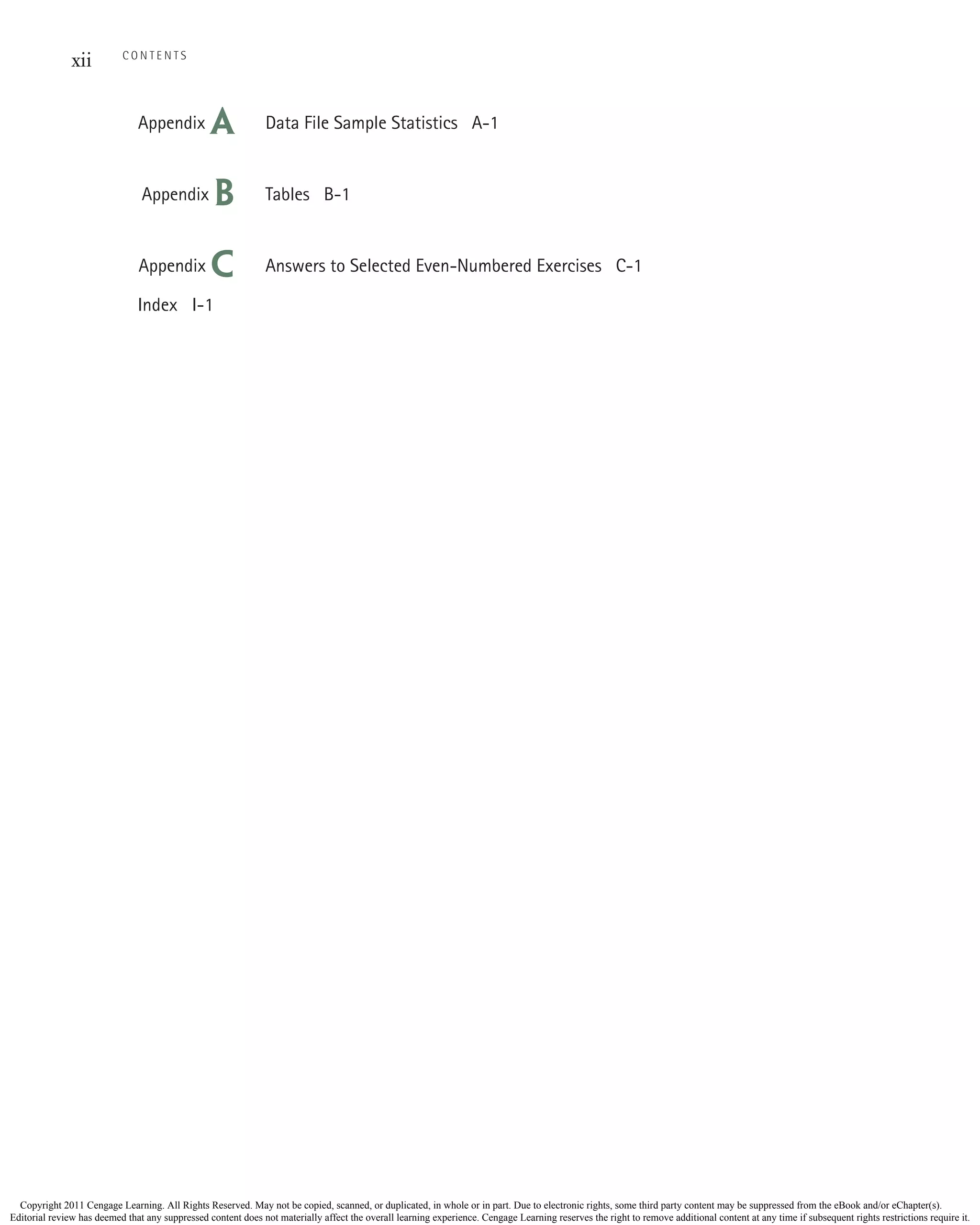
A Guide to Statistical Techniques, found
on the inside front cover of the text, pulls
everything together into one useful table
that helps students identify which technique
to perform based on the problem objective
and data type.
Problem Objectives
A GUIDE TO STATISTICAL TECHNIQUES
Describe a
Population
Histogram
Section 3.1
Ogive
Section 3.1
Stem-and-leaf
Section 3.1
Line chart
Section 3.2
Mean, median, and mode
Section 4.1
Range, variance, and
standard deviation
Section 4.2
ion 4.2
Percentiles and quartiles
Section 4.3
Box plot
Section 4.3
t-test andestimator of amean
Section 12.1
Chi-squared test and
estimator of a variance
Section 12.2
Frequency distribution
Section 2.2
Bar chart
Section 2.2
Pie chart
Section 2.2
z-test and estimator
of a proportion
Section 12.3
Chi-squared goodness-of-
fit test
Section 15.1
Median
Section 4.1
Percentiles and quartiles
Section 4.3
Box plot
Section 4.3
Compare Two
Populations
Equal-variances t-test and estimator
of the difference between two
means: independent samples
Section 13.1
Unequal-variances t-test and
estimator of the difference between
two means: independent samples
Section 13.1
t-test and estimator of mean
difference
Section 13.3
F-test and estimator of ratio of two
variances
Section 13.4
z-test and estimator of the
difference between two proportions
Section 13.5
Chi-squared test of a contingency
table
Section 15.2
Compare Two or
More Populations
One-way analysis of varianc
Section 14.1
LSD multiple comparison
method
Section 14.2
Tukey’s multiple compariso
method
Section 14.2
Two-way analysis of varianc
Section 14.4
Two-factor analysis of varia
Section 14.5
Chi-squared test of a
contingency table
Section 15.2
DA
TA
T
YPES
Ordinal
Nominal
Interval
Abb_FM.qxd 11/23/10 12:33 AM Page xx
Copyright 2011 Cengage Learning. All Rights Reserved. May not be copied, scanned, or duplicated, in whole or in part. Due to electronic rights, some third party content may be suppressed from the eBook and/or eChapter(s).
Editorial review has deemed that any suppressed content does not materially affect the overall learning experience. Cengage Learning reserves the right to remove additional content at any time if subsequent rights restrictions require it.
Flexible to Use
Although many texts today incorporate the use of the computer, Statistics for
Management and Economics is designed for maximum flexibility and ease of use for
both instructors and students. To this end, parallel illustration of both manual and com-
puter printouts is provided throughout the text. This approach allows you to choose
which, if any, computer program to use. Regardless of the method or software you
choose, the output and instructions that you need are provided!
xxi
P R E F A C E
that of 5 years ago, with the possible exception of the
mean, can we conclude at the 5% significance level
that the dean’s claim is true?
11.38 Xr11-38 Past experience indicates that the monthly
long-distance telephone bill is normally distributed
with a mean of $17.85 and a standard deviation of
$3.87. After an advertising campaign aimed at
increasing long-distance telephone usage, a random
sample of 25 household bills was taken.
a. Do the data allow us to infer at the 10% signifi-
cance level that the campaign was successful?
b. What assumption must you make to answer
part (a)?
11.39 Xr11-39 In an attempt to reduce the number of per-
son-hours lost as a result of industrial accidents, a
large production plant installed new safety equip-
ment. In a test of the effectiveness of the equipment,
a random sample of 50 departments was chosen.
The number of person-hours lost in the month
before and the month after the installation of the
safety equipment was recorded. The percentage
change was calculated and recorded. Assume that
the population standard deviation is ␴ ⫽ 6. Can we
infer at the 10% significance level that the new
safety equipment is effective?
11.40 Xr11-40 A highway patrol officer believes that the
average speed of cars traveling over a certain stretch
of highway exceeds the posted limit of 55 mph. The
speeds of a random sample of 200 cars were
recorded. Do these data provide sufficient evidence
at the 1% significance level to support the officer’s
belief? What is the p-value of the test? (Assume that
the standard deviation is known to be 5.)
11.41 Xr11-41 An automotive expert claims that the large
number of self-serve gasoline stations has resulted in
poor automobile maintenance, and that the average
tire pressure is more than 4 pounds per square inch
(psi) below its manufacturer’s specification. As a
quick test, 50 tires are examined, and the number of
psi each tire is below specification is recorded. If we
assume that tire pressure is normally distributed
with ␴ ⫽ 1.5 psi, can we infer at the 10% signifi-
cance level that the expert is correct? What is the
p-value?
11.42 Xr11-42 For the past few years, the number of cus-
tomers of a drive-up bank in New York has averaged
20 per hour, with a standard deviation of 3 per hour.
11.43 Xr11-43 A fast-food franchiser is considering building
a restaurant at a certain location. Based on financial
analyses, a site is acceptable only if the number of
pedestrians passing the location averages more than
100 per hour. The number of pedestrians observed
for each of 40 hours was recorded. Assuming that
the population standard deviation is known to be 16,
can we conclude at the 1% significance level that the
site is acceptable?
11.44 Xr11-44 Many Alpine ski centers base their projec-
tions of revenues and profits on the assumption that
the average Alpine skier skis four times per year. To
investigate the validity of this assumption, a random
sample of 63 skiers is drawn and each is asked to
report the number of times he or she skied the pre-
vious year. If we assume that the standard deviation
is 2, can we infer at the 10% significance level that
the assumption is wrong?
11.45 Xr11-45 The golf professional at a private course
claims that members who have taken lessons from
him lowered their handicap by more than five
strokes. The club manager decides to test the claim
by randomly sampling 25 members who have had
lessons and asking each to report the reduction in
handicap, where a negative number indicates an
increase in the handicap. Assuming that the reduc-
tion in handicap is approximately normally distrib-
uted with a standard deviation of two strokes, test
the golf professional’s claim using a 10% signifi-
cance level.
11.46 Xr11-46 The current no-smoking regulations in
office buildings require workers who smoke to take
breaks and leave the building in order to satisfy
their habits. A study indicates that such workers
average 32 minutes per day taking smoking breaks.
The standard deviation is 8 minutes. To help reduce
the average break, rooms with powerful exhausts
were installed in the buildings. To see whether these
rooms serve their designed purpose, a random sam-
ple of 110 smokers was taken. The total amount of
time away from their desks was measured for 1 day.
Test to determine whether there has been a
decrease in the mean time away from their desks.
Compute the p-value and interpret it relative to the
costs of Type I and Type II errors.
11.47 Xr11-47 A low-handicap golfer who uses Titleist
brand golf balls observed that his average drive is
E X A M P L E 13.9 Test Marketing of Package Designs, Part 1
The General Products Company produces and sells a variety of household products.
Because of stiff competition, one of its products, a bath soap, is not selling well. Hoping
to improve sales, General Products decided to introduce more attractive packaging.
The company’s advertising agency developed two new designs. The first design features
several bright colors to distinguish it from other brands. The second design is light
green in color with just the company’s logo on it. As a test to determine which design is
better, the marketing manager selected two supermarkets. In one supermarket, the soap
was packaged in a box using the first design; in the second supermarket, the second
design was used. The product scanner at each supermarket tracked every buyer of soap
over a 1-week period. The supermarkets recorded the last four digits of the scanner
code for each of the five brands of soap the supermarket sold. The code for the General
Products brand of soap is 9077 (the other codes are 4255, 3745, 7118, and 8855). After
the trial period the scanner data were transferred to a computer file Because the first
DATA
Xm13-09
A
cute otitis media, an infection of
the middle ear, is a common
childhood illness. There are vari-
ous ways to treat the problem. To help
determine the best way, researchers
conducted an experiment. One hundred
and eighty children between 10 months
and 2 years with recurrent acute otitis
media were divided into three equal
groups. Group 1 was treated by surgi-
cally removing the adenoids (adenoidec-
tomy), the second was treated with the
drug Sulfafurazole, and the third with a
placebo. Each child was tracked for
2 years, during which time all symptoms
and episodes of acute otitis media were
recorded. The data were recorded in the
following way:
Column 1: ID number
Column 2: Group number
Column 3: Number of episodes of the
illness
Column 4: Number of visits to a
physician because of any infection
Column 5: Number of prescriptions
Column 6: Number of days with
symptoms of respiratory infection
a. Are there differences between the
three groups with respect to the
number of episodes, number of
physician visits, number of pre-
scriptions, and number of days
with symptoms of respiratory
infection?
b. Assume that you are working for
the company that makes the drug
Sulfafurazole. Write a report to the
company’s executives discussing
your results.
C A S E 1 4 . 1
Comparing Three Methods of Treating
Childhood Ear Infections*
*This case is adapted from the British Medical Journal, February 2004.
DATA
C14-01
©AP
Photo/Chris
Carlson
Abb_FM.qxd 11/23/10 12:33 AM Page xxi
Copyright 2011 Cengage Learning. All Rights Reserved. May not be copied, scanned, or duplicated, in whole or in part. Due to electronic rights, some third party content may be suppressed from the eBook and/or eChapter(s).
Editorial review has deemed that any suppressed content does not materially affect the overall learning experience. Cengage Learning reserves the right to remove additional content at any time if subsequent rights restrictions require it.
xxii P R E F A C E
1
2
3
4
5
6
7
8
9
10
A B C
F-Test: Two-Sample for Variances
Direct Broker
Mean 6.63 3.72
Variance 37.49 43.34
Observations 50 50
49
df 49
F 0.8650
P(F<=f) one-tail 0.3068
F Critical one-tail 0.6222
E X C E L
The value of the test statistic is F ⫽ .8650. Excel outputs the one-tail p-value. Because
we’re conducting a two-tail test, we double that value. Thus, the p-value of the test we’re
conducting is 2 ⫻ .3068 ⫽ .6136.
I N S T R U C T I O N S
1. Type or import the data into two columns. (Open Xm13-01.)
2. Click Data, Data Analysis, and F-test Two-Sample for Variances.
3. Specify the Variable 1 Range (A1:A51) and the Variable 2 Range (B1:B51). Type a
value for  (.05).
C O M P U T E
M A N U A L L Y
From the data, we calculated the following statistics:
Test statistic:
Rejection region:
or
Because F ⫽ .86 is not greater than 1.75 or smaller than .57, we cannot reject the null
hypothesis.
F 6 F1-a2,n1,n2
= F.975,49,49 = 1F.025,49,49 L 1F.025,50,50 = 11.75 = .57
F 7 Fa2,n1,n2
= F.025,49,49 L F.025,50,50 = 1.75
F = s2
1s2
2 = 37.4943.34 = 0.86
s2
1 = 37.49 and s2
2 = 43.34
Compute the Statistics
Once the correct technique has been identified,
examples take students to the next level within
the solution by asking them to compute the sta-
tistics.
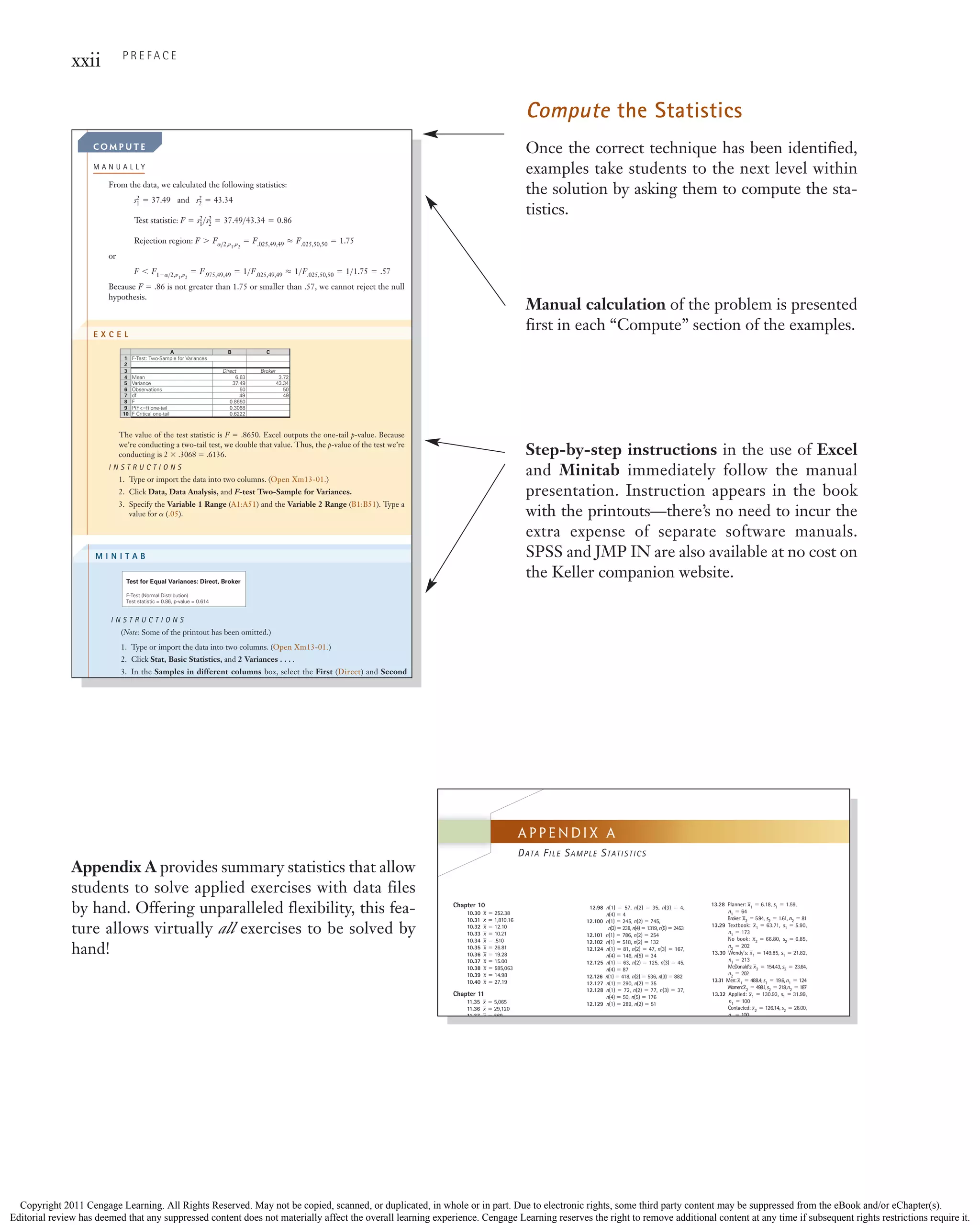
Manual calculation of the problem is presented
first in each “Compute” section of the examples.
Step-by-step instructions in the use of Excel
and Minitab immediately follow the manual
presentation. Instruction appears in the book
with the printouts—there’s no need to incur the
extra expense of separate software manuals.
SPSS and JMP IN are also available at no cost on
the Keller companion website.
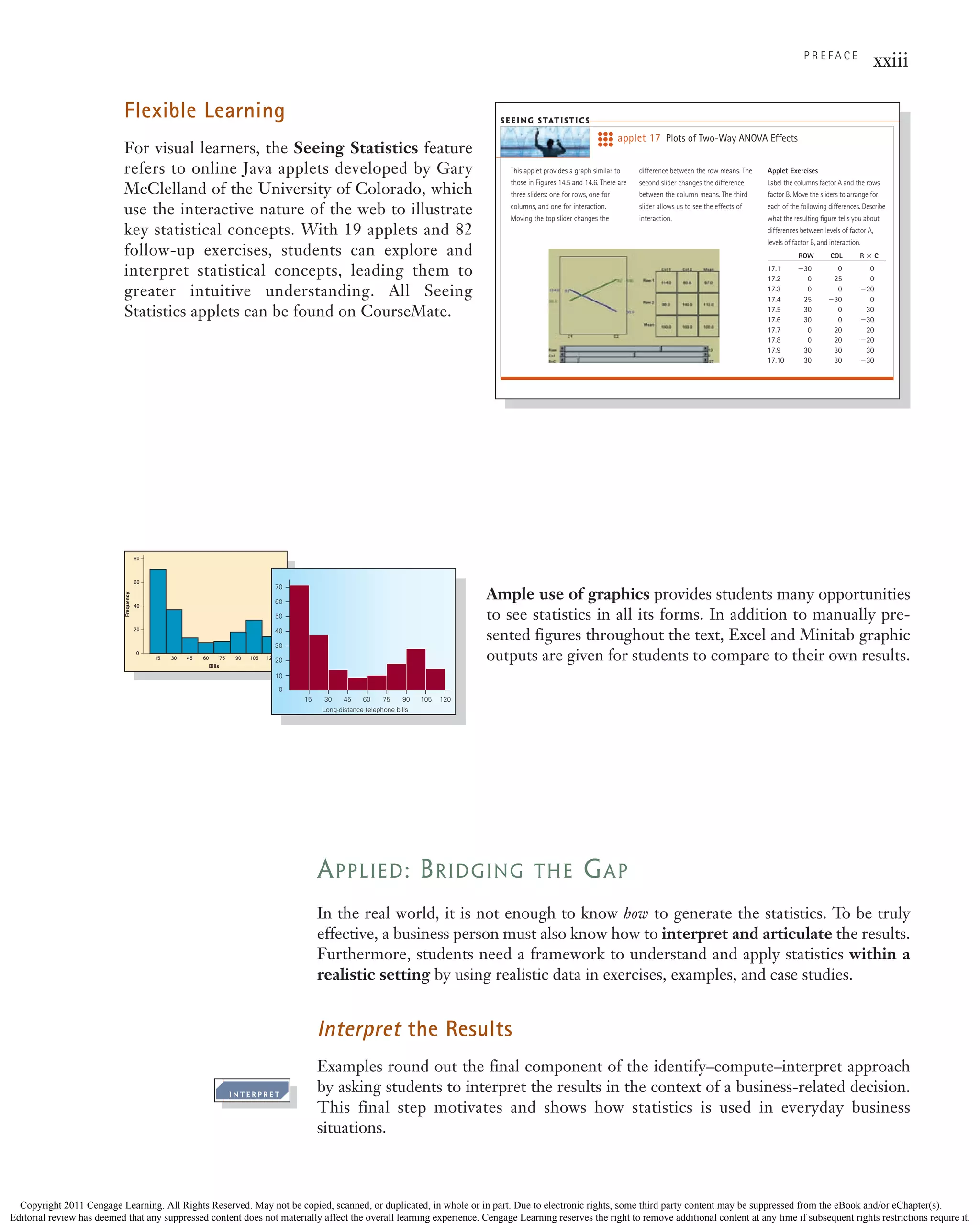
Appendix A provides summary statistics that allow
students to solve applied exercises with data files
by hand. Offering unparalleled flexibility, this fea-
ture allows virtually all exercises to be solved by
hand!
M I N I T A B
Test for Equal Variances: Direct, Broker
F-Test (Normal Distribution)
Test statistic = 0.86, p-value = 0.614
I N S T R U C T I O N S
(Note: Some of the printout has been omitted.)
1. Type or import the data into two columns. (Open Xm13-01.)
2. Click Stat, Basic Statistics, and 2 Variances . . . .
3. In the Samples in different columns box, select the First (Direct) and Second
A p p e n d i x A
Chapter 10
10.30 252.38
10.31 1,810.16
10.32 12.10
10.33 10.21
10.34 .510
10.35 26.81
10.36 19.28
10.37 15.00
10.38 585,063
10.39 14.98
10.40 27.19
Chapter 11
11.35 5,065
11.36 29,120
11 37 569
x =
x =
x =
x =
x =
x =
x =
x =
x =
x =
x =
x =
x =
x =
12.98 n(1) ⫽ 57, n(2) ⫽ 35, n(3) ⫽ 4,
n(4) ⫽ 4
12.100 n(1) ⫽ 245, n(2) ⫽ 745,
n(3)⫽ 238,n(4)⫽ 1319,n(5)⫽ 2453
12.101 n(1) ⫽ 786, n(2) ⫽ 254
12.102 n(1) ⫽ 518, n(2) ⫽ 132
12.124 n(1) ⫽ 81, n(2) ⫽ 47, n(3) ⫽ 167,
n(4) ⫽ 146, n(5) ⫽ 34
12.125 n(1) ⫽ 63, n(2) ⫽ 125, n(3) ⫽ 45,
n(4) ⫽ 87
12.126 n(1) ⫽ 418, n(2) ⫽ 536, n(3) ⫽ 882
12.127 n(1) ⫽ 290, n(2) ⫽ 35
12.128 n(1) ⫽ 72, n(2) ⫽ 77, n(3) ⫽ 37,
n(4) ⫽ 50, n(5) ⫽ 176
12.129 n(1) ⫽ 289, n(2) ⫽ 51
13.28 Planner: 6.18, 1.59,
64
Broker: 5.94, 1.61, 81
13.29 Textbook: 63.71, 5.90,
173
No book: 66.80, 6.85,
202
13.30 Wendy’s: 149.85, 21.82,
213
McDonald’s: 154.43, 23.64,
202
13.31 Men: 488.4, 19.6, 124
Women: 498.1, 21.9, 187
13.32 Applied: 130.93, 31.99,
100
Contacted: 126.14, 26.00,
100
n =
s2 =
x2 =
n1 =
s1 =
x1 =
n2 =
s2 =
x2 =
n1 =
s1 =
x1 =
n2 =
s2 =
x2 =
n1 =
s1 =
x1 =
n2 =
s2 =
x2 =
n1 =
s1 =
x1 =
n2 =
s2 =
x2 =
n1 =
s1 =
x1 =
DATA FILE SAMPLE STATISTICS
Abb_FM.qxd 11/23/10 12:33 AM Page xxii
Copyright 2011 Cengage Learning. All Rights Reserved. May not be copied, scanned, or duplicated, in whole or in part. Due to electronic rights, some third party content may be suppressed from the eBook and/or eChapter(s).
Editorial review has deemed that any suppressed content does not materially affect the overall learning experience. Cengage Learning reserves the right to remove additional content at any time if subsequent rights restrictions require it.
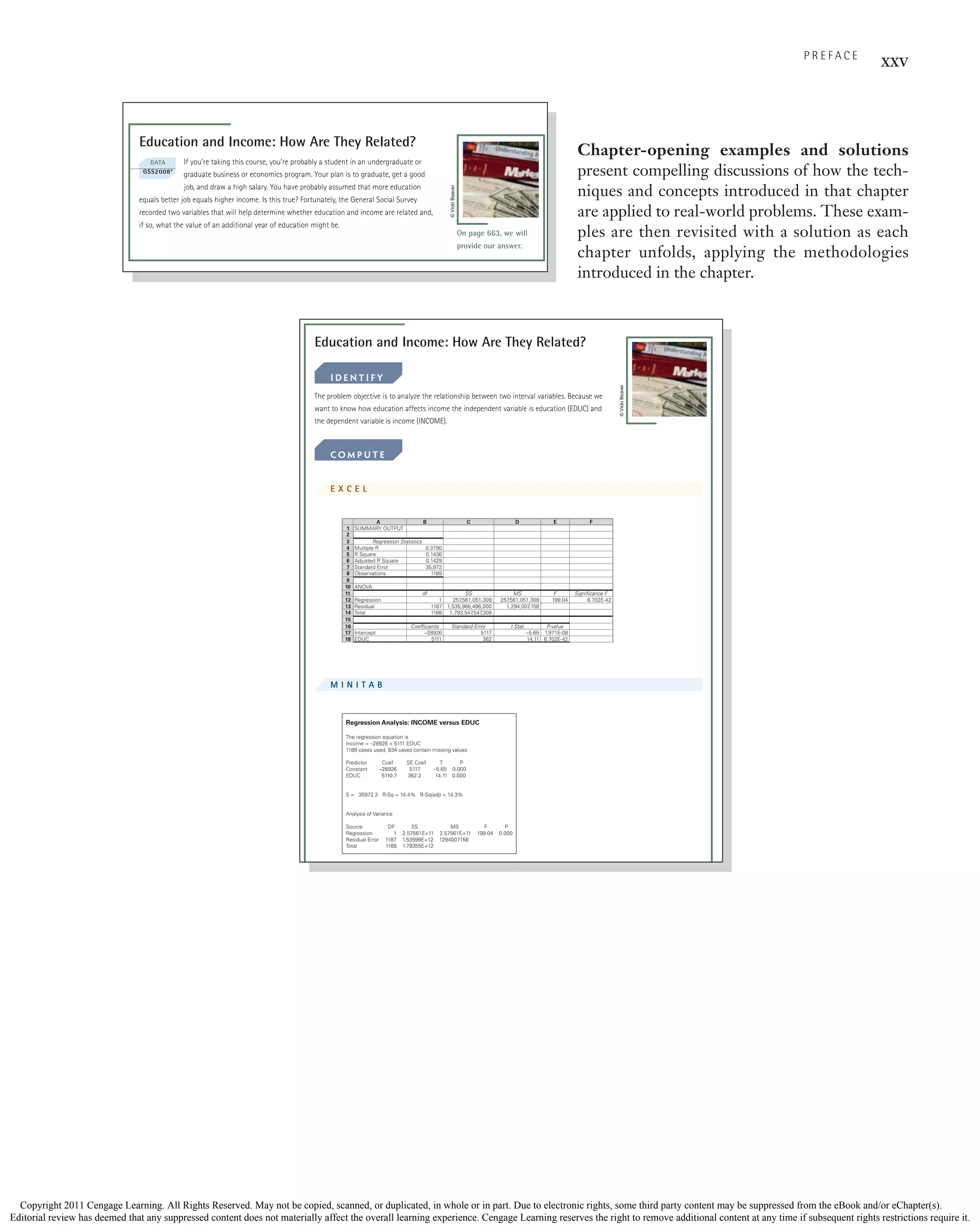
Flexible Learning
For visual learners, the Seeing Statistics feature
refers to online Java applets developed by Gary
McClelland of the University of Colorado, which
use the interactive nature of the web to illustrate
key statistical concepts. With 19 applets and 82
follow-up exercises, students can explore and
interpret statistical concepts, leading them to
greater intuitive understanding. All Seeing
Statistics applets can be found on CourseMate.
SEEING STATISTICS
This applet provides a graph similar to
those in Figures 14.5 and 14.6. There are
three sliders: one for rows, one for
columns, and one for interaction.
Moving the top slider changes the
difference between the row means. The
second slider changes the difference
between the column means. The third
slider allows us to see the effects of
interaction.
Applet Exercises
Label the columns factor A and the rows
factor B. Move the sliders to arrange for
each of the following differences. Describe
what the resulting figure tells you about
differences between levels of factor A,
levels of factor B, and interaction.
ROW COL R ⫻ C
17.1 ⫺30 0 0
17.2 0 25 0
17.3 0 0 ⫺20
17.4 25 ⫺30 0
17.5 30 0 30
17.6 30 0 ⫺30
17.7 0 20 20
17.8 0 20 ⫺20
17.9 30 30 30
17.10 30 30 ⫺30
applet 17 Plots of Two-Way ANOVA Effects
I N T E R P R E T
Bills
Frequency
15 30 45 60 75 90 105 120
80
60
40
20
0
15 30 45 60
Long-distance telephone bills
75 90 105 120
0
10
20
30
40
50
60
70
Ample use of graphics provides students many opportunities
to see statistics in all its forms. In addition to manually pre-
sented figures throughout the text, Excel and Minitab graphic
outputs are given for students to compare to their own results.
APPLIED: BRIDGING THE GAP
In the real world, it is not enough to know how to generate the statistics. To be truly
effective, a business person must also know how to interpret and articulate the results.
Furthermore, students need a framework to understand and apply statistics within a
realistic setting by using realistic data in exercises, examples, and case studies.
Interpret the Results
Examples round out the final component of the identify–compute–interpret approach
by asking students to interpret the results in the context of a business-related decision.
This final step motivates and shows how statistics is used in everyday business
situations.
xxiii
P R E F A C E
Abb_FM.qxd 11/23/10 12:33 AM Page xxiii
Copyright 2011 Cengage Learning. All Rights Reserved. May not be copied, scanned, or duplicated, in whole or in part. Due to electronic rights, some third party content may be suppressed from the eBook and/or eChapter(s).
Editorial review has deemed that any suppressed content does not materially affect the overall learning experience. Cengage Learning reserves the right to remove additional content at any time if subsequent rights restrictions require it.
xxiv P R E F A C E
Applications in Medicine and Medical Insurance (Optional)
Physicians routinely perform medical tests, called screenings, on their patients.
Screening tests are conducted for all patients in a particular age and gender group,
regardless of their symptoms. For example, men in their 50s are advised to take a
prostate-specific antigen (PSA) test to determine whether there is evidence of prostate
cancer. Women undergo a Pap test for cervical cancer. Unfortunately, few of these tests
are 100% accurate. Most can produce false-positive and false-negative results. A false-
positive result is one in which the patient does not have the disease, but the test shows
positive. A false-negative result is one in which the patient does have the disease, but
the test produces a negative result. The consequences of each test are serious and costly.
A false-negative test results in not detecting a disease in a patient, therefore postponing
treatment, perhaps indefinitely. A false-positive test leads to apprehension and fear for
the patient. In most cases, the patient is required to undergo further testing such as a
biopsy. The unnecessary follow-up procedure can pose medical risks.
False-positive test results have financial repercussions. The cost of the follow-up
procedure, for example, is usually far more expensive than the screening test. Medical
insurance companies as well as government-funded plans are all adversely affected by
false-positive test results. Compounding the problem is that physicians and patients are
incapable of properly interpreting the results. A correct analysis can save both lives and
money.
Bayes’s Law is the vehicle we use to determine the true probabilities associated with
screening tests. Applying the complement rule to the false-positive and false-negative
rates produces the conditional probabilities that represent correct conclusions. Prior
probabilities are usually derived by looking at the overall proportion of people with the
diseases. In some cases, the prior probabilities may themselves have been revised
A P P L I C A T I O N S i n O P E R A T I O N S M A N A G E M E N T
Quality
A critical aspect of production is quality. The quality of a final product is a
function of the quality of the product’s components. If the components don’t
fit, the product will not function as planned and likely cease functioning
before its customers expect it to. For example, if a car door is not made to its
specifications, it will not fit. As a result, the door will leak both water and air.
Operations managers attempt to maintain and improve the quality of products by
ensuring that all components are made so that there is as little variation as possible. As
you have already seen, statisticians measure variation by computing the variance.
Incidentally, an entire chapter (Chapter 21) is devoted to the topic of quality.
©
Vicki
Beaver
An Applied Approach
With Applications in . . . sections and boxes, Statistics
for Management and Economics now includes 45
applications (in finance, marketing, operations
management, human resources, economics, and
accounting) highlighting how statistics is used in those
professions. For example, “Applications in Finance:
Portfolio Diversification and Asset Allocation” shows
how probability is used to help select stocks to mini-
mize risk. A new optional section, “Applications in
Professional Sports: Baseball” contains a subsection on
the success of the Oakland Athletics.
In addition to sections and boxes, Applications in . . .
exercises can be found within the exercise sections to
further reinforce the big picture.
4.5 (OPTIONAL) APPLICATIONS IN PROFESSIONAL SPORTS: BASEBALL
In the chapter-opening example, we provided the payrolls and the number of wins from
the 2009 season. We discovered that there is a weak positive linear relationship between
number of wins and payroll. The strength of the linear relationship tells us that some teams
with large payrolls are not successful on the field, whereas some teams with small payrolls
win a large number of games. It would appear that although the amount of money teams
spend is a factor, another factor is how teams spend their money. In this section, we will
analyze the eight seasons between 2002 and 2009 to see how small-payroll teams succeed.
Professional sports in North America is a multibillion-dollar business. The cost of
a new franchise in baseball, football, basketball, and hockey is often in the hundreds of
millions of dollars. Although some teams are financially successful during losing sea-
sons, success on the field is often related to financial success. (Exercises 4.75 and 4.76
Abb_FM.qxd 11/23/10 12:33 AM Page xxiv
Copyright 2011 Cengage Learning. All Rights Reserved. May not be copied, scanned, or duplicated, in whole or in part. Due to electronic rights, some third party content may be suppressed from the eBook and/or eChapter(s).
Editorial review has deemed that any suppressed content does not materially affect the overall learning experience. Cengage Learning reserves the right to remove additional content at any time if subsequent rights restrictions require it.
xxv
P R E F A C E
Chapter-opening examples and solutions
present compelling discussions of how the tech-
niques and concepts introduced in that chapter
are applied to real-world problems. These exam-
ples are then revisited with a solution as each
chapter unfolds, applying the methodologies
introduced in the chapter.
Education and Income: How Are They Related?
If you’re taking this course, you’re probably a student in an undergraduate or
graduate business or economics program. Your plan is to graduate, get a good
job, and draw a high salary. You have probably assumed that more education
equals better job equals higher income. Is this true? Fortunately, the General Social Survey
recorded two variables that will help determine whether education and income are related and,
if so, what the value of an additional year of education might be.
On page 663, we will
provide our answer.
DATA
GSS2008*
©
Vicki
Beaver
Education and Income: How Are They Related?
I D E N T I F Y
The problem objective is to analyze the relationship between two interval variables. Because we
want to know how education affects income the independent variable is education (EDUC) and
the dependent variable is income (INCOME).
C O M P U T E
E X C E L
M I N I T A B
Regression Analysis: INCOME versus EDUC
The regression equation is
Income = –28926 + 5111 EDUC
1189 cases used, 834 cases contain missing values
Predictor Coef SE Coef T P
Constant –28926 5117 –5.65 0.000
EDUC 5110.7 362.2 14.11 0.000
S = 35972.3 R-Sq = 14.4% R-Sq(adj) = 14.3%
Analysis of Variance
Source DF SS MS F P
Regression 1 2.57561E+11 2.57561E+11 199.04 0.000
Residual Error 1187 1.53599E+12 1294007158
Total 1188 1.79355E+12
1
2
3
4
5
6
7
8
9
10
11
12
13
14
15
16
17
18
A B C D E F
SUMMARY OUTPUT
Regression Statistics
Multiple R 0.3790
R Square 0.1436
Adjusted R Square 0.1429
Standard Error 35,972
Observations 1189
ANOVA
df SS MS F Significance F
Regression 1 257
,561,051,309 257
,561,051,309 199.04 6.702E-42
Residual 1187 1,535,986,496,000 1,294,007
,158
Total 1188 1,793,547
,547
,309
Coefficients Standard Error t Stat P-value
Intercept –28926 5117 –5.65 1.971E-08
EDUC 5111 362 14.11 6.702E-42
©
Vicki
Beaver
Abb_FM.qxd 11/23/10 12:33 AM Page xxv
Copyright 2011 Cengage Learning. All Rights Reserved. May not be copied, scanned, or duplicated, in whole or in part. Due to electronic rights, some third party content may be suppressed from the eBook and/or eChapter(s).
Editorial review has deemed that any suppressed content does not materially affect the overall learning experience. Cengage Learning reserves the right to remove additional content at any time if subsequent rights restrictions require it.
xxvi P R E F A C E
CH A P T E R SU M M A RY
Histograms are used to describe a single set of interval data.
Statistics practitioners examine several aspects of the shapes
of histograms. These are symmetry, number of modes, and
its resemblance to a bell shape.
We described the difference between time-series data
and cross-sectional data. Time series are graphed by line
charts.
To analyze the relationship between two interval vari-
ables, we draw a scatter diagram. We look for the direction
and strength of the linear relationship.
E
very year, millions of people start
new diets. There is a bewildering
array of diets to choose from. The
question for many people is, which ones
work? Researchers at Tufts University in
Boston made an attempt to point
dieters in the right direction. Four diets
were used:
1. Atkins low-carbohydrate diet
2. Zone high-protein, moderate-
carbohydrate diet
3. Weight Watchers diet
4. Dr. Ornish’s low-fat diet
The study recruited 160 overweight
people and randomly assigned 40 to
each diet. The average weight before
dieting was 220 pounds, and all needed
to lose between 30 and 80 pounds. All
volunteers agreed to follow their diets
for 2 months. No exercise or regular
meetings were required. The following
variables were recorded for each dieter
using the format shown here:
Column 1: Identification number
Column 2: Diet
Column 3: Percent weight loss
Column 4: Percent low-density lipoprotein
(LDL)—”bad” cholesterol—decrease
Column 5: Percent high-density lipopro-
tein (HDL)—”good” cholesterol—
increase
Column 6: Quit after 2 months?
1 ⫽ yes, 2 ⫽ no
Column 7: Quit after 1 year? 1 ⫽ yes,
2 ⫽ no
Is there enough evidence to conclude
that there are differences between the
diets with respect to
a. percent weight loss?
b. percent LDL decrease?
c. percent HDL increase?
d. proportion quitting within
2 months?
e. proportion quitting after 1 year?
DATA
CA15-01
C A S E A 1 5 . 1 Which Diets Work?
Many of the examples, exercises,
and cases are based on actual
studies performed by statisticians
and published in journals, newspa-
pers, and magazines, or presented at
conferences. Many data files were
recreated to produce the original
results.
A total of 1825 exercises, many of
them new or updated, offer ample
practice for students to use statistics
in an applied context.
Abb_FM.qxd 11/23/10 12:33 AM Page xxvi
Copyright 2011 Cengage Learning. All Rights Reserved. May not be copied, scanned, or duplicated, in whole or in part. Due to electronic rights, some third party content may be suppressed from the eBook and/or eChapter(s).
Editorial review has deemed that any suppressed content does not materially affect the overall learning experience. Cengage Learning reserves the right to remove additional content at any time if subsequent rights restrictions require it.
RESOURCES
Learning Resources
The Essential Textbook Resources website: At the Keller website, you’ll find mate-
rials previously on the student CD, including: Interactive concept simulation exercises
from Seeing Statistics, the Data Analysis Plus add-in, 715 data sets, optional topics,
and 35 appendixes (for more information, please visit www.cengage.com/bstatistics/
keller).
Student Solutions Manual (ISBN: 1111531889): Students can check their under-
standing with this manual, which includes worked solutions of even-numbered
exercises from the text.
Seeing Statistics by Gary McClelland: This online product is flexible and addresses
different learning styles. It presents the visual nature of statistical concepts using more
than 150 Java applets to create an intuitive learning environment. Also included are rel-
evant links to examples, exercises, definitions, and search and navigation capabilities.
Teaching Resources
To access both student and faculty resources, please visit www.cengage.com/login.
ACKNOWLEDGMENTS
Although there is only one name on the cover of this book, the number of people who
made contributions is large. I would like to acknowledge the work of all of them, with
particular emphasis on the following: Paul Baum, California State University,
Northridge, and John Lawrence, California State University, Fullerton, reviewed the
page proofs. Their job was to find errors in presentation, arithmetic, and composi-
tion.The following individuals played important roles in the production of this book
Senior Acquisitions Editor: Charles McCormick, Jr., Developmental Editor: Elizabeth
Lowry, Content Project Manager: Jacquelyn K Featherly and Project Manager Lynn
Lustberg (For all remaining errors, place the blame where it belongs–on me.) Their
advice and suggestions made my task considerably easier.
Fernando Rodriguez produced the test bank stored on the Instructor’s Suite
CD-ROM.
Trent Tucker, Wilfrid Laurier University, and Zvi Goldstein, California State
University, Fullerton, each produced a set of PowerPoint slides.
The author extends thanks also to the survey participants and reviewers of the
previous editions: Paul Baum, California State University, Northridge; Nagraj
Balakrishnan, Clemson University; Howard Clayton, Auburn University; Philip
Cross, Georgetown University; Barry Cuffe, Wingate University; Ernest Demba,
Washington University–St. Louis; Neal Duffy, State University of New York,
Plattsburgh; John Dutton, North Carolina State University; Erick Elder, University
of Arkansas; Mohammed El-Saidi, Ferris State University; Grace Esimai, University
of Texas at Arlington; Abe Feinberg, California State University, Northridge; Samuel
Graves, Boston College; Robert Gould, UCLA; John Hebert, Virginia Tech; James
Hightower, California State University, Fullerton; Bo Honore, Princeton University;
Onisforos Iordanou, Hunter College; Gordon Johnson, California State University,
xxvii
P R E F A C E
Abb_FM.qxd 11/23/10 12:33 AM Page xxvii
Copyright 2011 Cengage Learning. All Rights Reserved. May not be copied, scanned, or duplicated, in whole or in part. Due to electronic rights, some third party content may be suppressed from the eBook and/or eChapter(s).
Editorial review has deemed that any suppressed content does not materially affect the overall learning experience. Cengage Learning reserves the right to remove additional content at any time if subsequent rights restrictions require it.
Northridge; Hilke Kayser, Hamilton College; Kenneth Klassen, California State
University, Northridge; Roger Kleckner, Bowling Green State University–Firelands;
Harry Kypraios, Rollins College; John Lawrence, California State University,
Fullerton; Dennis Lin, Pennsylvania State University; Neal Long, Stetson
University; George Marcoulides, California State University, Fullerton; Paul Mason,
University of North Florida; Walter Mayer, University of Mississippi; John
McDonald, Flinders University; Richard McGowan, Boston College; Richard
McGrath, Bowling Green State University; Amy Miko, St. Francis College; Janis
Miller, Clemson University; Glenn Milligan, Ohio State University; James Moran,
Oregon State University; Patricia Mullins, University of Wisconsin; Kevin Murphy,
Oakland University; Pin Ng, University of Illinois; Des Nicholls, Australian National
University; Andrew Paizis, Queens College; David Pentico, Duquesne University; Ira
Perelle, Mercy College; Nelson Perera, University of Wollongong; Amy Puelz,
Southern Methodist University; Lawrence Ries, University of Missouri; Colleen
Quinn, Seneca College; Tony Quon, University of Ottawa; Madhu Rao, Bowling
Green State University; Phil Roth, Clemson University; Farhad Saboori, Albright
College; Don St. Jean, George Brown College; Hedayeh Samavati, Indiana–Purdue
University; Sandy Shroeder, Ohio Northern University; Jineshwar Singh, George
Brown College; Natalia Smirnova, Queens College; Eric Sowey, University of New
South Wales; Cyrus Stanier, Virginia Tech; Stan Stephenson, Southwest Texas State
University; Arnold Stromberg, University of Kentucky; Steve Thorpe, University of
Northern Iowa; Sheldon Vernon, Houston Baptist University; and W. F. Younkin,
University of Miami.
xxviii P R E F A C E
Abb_FM.qxd 11/23/10 12:33 AM Page xxviii
Copyright 2011 Cengage Learning. All Rights Reserved. May not be copied, scanned, or duplicated, in whole or in part. Due to electronic rights, some third party content may be suppressed from the eBook and/or eChapter(s).
Editorial review has deemed that any suppressed content does not materially affect the overall learning experience. Cengage Learning reserves the right to remove additional content at any time if subsequent rights restrictions require it.
Statistics
FOR MANAGEMENT AND ECONOMICS ABBREVIATED
9e
Abb_FM.qxd 11/23/10 12:33 AM Page xxxi
Copyright 2011 Cengage Learning. All Rights Reserved. May not be copied, scanned, or duplicated, in whole or in part. Due to electronic rights, some third party content may be suppressed from the eBook and/or eChapter(s).
Editorial review has deemed that any suppressed content does not materially affect the overall learning experience. Cengage Learning reserves the right to remove additional content at any time if subsequent rights restrictions require it.
This page intentionally left blank
1
1
WHAT IS STATISTICS?
1.1 Key Statistical Concepts
1.2 Statistical Applications in Business
1.3 Large Real Data Sets
1.4 Statistics and the Computer
Appendix 1 Instructions for Keller’s website
S
tatistics is a way to get information from data. That’s it! Most of this textbook is
devoted to describing how, when, and why managers and statistics practitioners*
conduct statistical procedures. You may ask, “If that’s all there is to statistics, why is
this book (and most other statistics books) so large?” The answer is that students of
applied statistics will be exposed to different kinds of information and data. We demon-
strate some of these with a case and two examples that are featured later in this book.
The first may be of particular interest to you.
INTRODUCTION
*The term statistician is used to describe so many different kinds of occupations that it has ceased to have
any meaning. It is used, for example, to describe a person who calculates baseball statistics as well as an
individual educated in statistical principles. We will describe the former as a statistics practitioner and the
(continued)
© sellingpix/Shutterstock
CH001.qxd 11/22/10 6:13 PM Page 1
Copyright 2011 Cengage Learning. All Rights Reserved. May not be copied, scanned, or duplicated, in whole or in part. Due to electronic rights, some third party content may be suppressed from the eBook and/or eChapter(s).
Editorial review has deemed that any suppressed content does not materially affect the overall learning experience. Cengage Learning reserves the right to remove additional content at any time if subsequent rights restrictions require it.
2 C H A P T E R 1
latter as a statistician. A statistics practitioner is a person who uses statistical techniques properly.
Examples of statistics practitioners include the following:
1. a financial analyst who develops stock portfolios based on historical rates of return;
2. an economist who uses statistical models to help explain and predict variables such as inflation rate,
unemployment rate, and changes in the gross domestic product; and
3. a market researcher who surveys consumers and converts the responses into useful information.
Our goal in this book is to convert you into one such capable individual.
The term statistician refers to an individual who works with the mathematics of statistics. His or
her work involves research that develops techniques and concepts that in the future may help the statis-
tics practitioner. Statisticians are also statistics practitioners, frequently conducting empirical research
and consulting. If you’re taking a statistics course, your instructor is probably a statistician.
E X A M P L E 3.3 Business Statistics Marks (See Chapter 3)
A student enrolled in a business program is attending his first class of the required statis-
tics course. The student is somewhat apprehensive because he believes the myth that the
course is difficult. To alleviate his anxiety, the student asks the professor about last year’s
marks. Because this professor is friendly and helpful, like all other statistics professors, he
obliges the student and provides a list of the final marks, which are composed of term
work plus the final exam. What information can the student obtain from the list?
This is a typical statistics problem. The student has the data (marks) and needs to
apply statistical techniques to get the information he requires. This is a function of
descriptive statistics.
Descriptive Statistics
Descriptive statistics deals with methods of organizing, summarizing, and presenting
data in a convenient and informative way. One form of descriptive statistics uses graph-
ical techniques that allow statistics practitioners to present data in ways that make it
easy for the reader to extract useful information. In Chapters 2 and 3 we will present a
variety of graphical methods.
Another form of descriptive statistics uses numerical techniques to summarize data.
One such method that you have already used frequently calculates the average or mean.
In the same way that you calculate the average age of the employees of a company, we
can compute the mean mark of last year’s statistics course. Chapter 4 introduces several
numerical statistical measures that describe different features of the data.
The actual technique we use depends on what specific information we would like to
extract. In this example, we can see at least three important pieces of information. The first
is the “typical” mark. We call this a measure of central location. The average is one such mea-
sure. In Chapter 4, we will introduce another useful measure of central location, the
median. Suppose the student was told that the average mark last year was 67. Is this enough
information to reduce his anxiety? The student would likely respond “No” because he
would like to know whether most of the marks were close to 67 or were scattered far below
and above the average. He needs a measure of variability. The simplest such measure is the
range, which is calculated by subtracting the smallest number from the largest. Suppose the
largest mark is 96 and the smallest is 24. Unfortunately, this provides little information
since it is based on only two marks. We need other measures—these will be introduced in
Chapter 4. Moreover, the student must determine more about the marks. In particular, he
needs to know how the marks are distributed between 24 and 96. The best way to do this is
to use a graphical technique, the histogram, which will be introduced in Chapter 3.
CH001.qxd 11/22/10 6:13 PM Page 2
Copyright 2011 Cengage Learning. All Rights Reserved. May not be copied, scanned, or duplicated, in whole or in part. Due to electronic rights, some third party content may be suppressed from the eBook and/or eChapter(s).
Editorial review has deemed that any suppressed content does not materially affect the overall learning experience. Cengage Learning reserves the right to remove additional content at any time if subsequent rights restrictions require it.
3
W H A T I S S T A T I S T I C S ?
Case 12.1 Pepsi’s Exclusivity Agreement with a University (see Chapter 12)
In the last few years, colleges and universities have signed exclusivity agreements with a
variety of private companies. These agreements bind the university to sell these compa-
nies’ products exclusively on the campus. Many of the agreements involve food and
beverage firms.
A large university with a total enrollment of about 50,000 students has offered
Pepsi-Cola an exclusivity agreement that would give Pepsi exclusive rights to sell its
products at all university facilities for the next year with an option for future years. In
return, the university would receive 35% of the on-campus revenues and an additional
lump sum of $200,000 per year. Pepsi has been given 2 weeks to respond.
The management at Pepsi quickly reviews what it knows. The market for soft
drinks is measured in terms of 12-ounce cans. Pepsi currently sells an average of
22,000 cans per week over the 40 weeks of the year that the university operates. The
cans sell for an average of one dollar each. The costs, including labor, total 30 cents per
can. Pepsi is unsure of its market share but suspects it is considerably less than 50%. A
quick analysis reveals that if its current market share were 25%, then, with an exclusiv-
ity agreement, Pepsi would sell 88,000 (22,000 is 25% of 88,000) cans per week or
3,520,000 cans per year. The gross revenue would be computed as follows†:
Gross revenue ⫽ 3,520,000 ⫻ $1.00/can ⫽ $3,520,000
This figure must be multiplied by 65% because the university would rake in 35%
of the gross. Thus,
Gross revenue after deducting 35% university take
⫽ 65% ⫻ $3,520,000 ⫽ $2,288,000
The total cost of 30 cents per can (or $1,056,000) and the annual payment to the
university of $200,000 are subtracted to obtain the net profit:
Net profit ⫽ $2,288,000 ⫺ $1,056,000 ⫺ $200,000 ⫽ $1,032,000
Pepsi’s current annual profit is
40 weeks ⫻ 22,000 cans/week ⫻ $.70 ⫽ $616,000
If the current market share is 25%, the potential gain from the agreement is
$1,032,000 – $616,000 ⫽ $416,000
The only problem with this analysis is that Pepsi does not know how many soft drinks
are sold weekly at the university. Coke is not likely to supply Pepsi with information about
its sales, which together with Pepsi’s line of products constitute virtually the entire market.
Pepsi assigned a recent university graduate to survey the university’s students to sup-
ply the missing information. Accordingly, she organizes a survey that asks 500 students to
keep track of the number of soft drinks they purchase in the next 7 days. The responses
are stored in a file C12-01 available to be downloaded. See Appendix 1 for instructions.
Inferential Statistics
The information we would like to acquire in Case 12.1 is an estimate of annual profits
from the exclusivity agreement. The data are the numbers of cans of soft drinks con-
sumed in 7 days by the 500 students in the sample. We can use descriptive techniques to
†We have created an Excel spreadsheet that does the calculations for this case. See Appendix 1 for
instructions on how to download this spreadsheet from Keller’s website plus hundreds of datasets and
much more.
CH001.qxd 11/22/10 6:13 PM Page 3
Copyright 2011 Cengage Learning. All Rights Reserved. May not be copied, scanned, or duplicated, in whole or in part. Due to electronic rights, some third party content may be suppressed from the eBook and/or eChapter(s).
Editorial review has deemed that any suppressed content does not materially affect the overall learning experience. Cengage Learning reserves the right to remove additional content at any time if subsequent rights restrictions require it.
4 C H A P T E R 1
learn more about the data. In this case, however, we are not so much interested in what
the 500 students are reporting as in knowing the mean number of soft drinks consumed
by all 50,000 students on campus. To accomplish this goal we need another branch of
statistics: inferential statistics.
Inferential statistics is a body of methods used to draw conclusions or inferences
about characteristics of populations based on sample data. The population in question
in this case is the university’s 50,000 students. The characteristic of interest is the soft
drink consumption of this population. The cost of interviewing each student in the
population would be prohibitive and extremely time consuming. Statistical techniques
make such endeavors unnecessary. Instead, we can sample a much smaller number of
students (the sample size is 500) and infer from the data the number of soft drinks con-
sumed by all 50,000 students. We can then estimate annual profits for Pepsi.
Example 12.5 Exit Polls (see Chapter 12)
When an election for political office takes place, the television networks cancel regular
programming to provide election coverage. After the ballots are counted, the results are
reported. However, for important offices such as president or senator in large states, the
networks actively compete to see which one will be the first to predict a winner. This is
done through exit polls in which a random sample of voters who exit the polling booth
are asked for whom they voted. From the data, the sample proportion of voters support-
ing the candidates is computed. A statistical technique is applied to determine whether
there is enough evidence to infer that the leading candidate will garner enough votes to
win. Suppose that the exit poll results from the state of Florida during the year 2000 elec-
tions were recorded. Although several candidates were running for president, the exit
pollsters recorded only the votes of the two candidates who had any chance of winning:
Republican George W. Bush and Democrat Albert Gore. The results (765 people who
voted for either Bush or Gore) were stored in file Xm12-05. The network analysts would
like to know whether they can conclude that George W. Bush will win the state of Florida.
Example 12.5 describes a common application of statistical inference. The popula-
tion the television networks wanted to make inferences about is the approximately
5 million Floridians who voted for Bush or Gore for president. The sample consisted of
the 765 people randomly selected by the polling company who voted for either of the
two main candidates. The characteristic of the population that we would like to know is
the proportion of the Florida total electorate that voted for Bush. Specifically, we would
like to know whether more than 50% of the electorate voted for Bush (counting only
those who voted for either the Republican or Democratic candidate). It must be made
clear that we cannot predict the outcome with 100% certainty because we will not ask
all 5 million actual voters for whom they voted. This is a fact that statistics practitioners
and even students of statistics must understand. A sample that is only a small fraction of
the size of the population can lead to correct inferences only a certain percentage of the
time. You will find that statistics practitioners can control that fraction and usually set it
between 90% and 99%.
Incidentally, on the night of the United States election in November 2000, the net-
works goofed badly. Using exit polls as well as the results of previous elections, all four
networks concluded at about 8 P.M. that Al Gore would win Florida. Shortly after
10 P.M., with a large percentage of the actual vote having been counted, the networks
reversed course and declared that George W. Bush would win the state. By 2 A.M.,
another verdict was declared: The result was too close to call. In the future, this experi-
ence will likely be used by statistics instructors when teaching how not to use statistics.
CH001.qxd 11/22/10 6:13 PM Page 4
Copyright 2011 Cengage Learning. All Rights Reserved. May not be copied, scanned, or duplicated, in whole or in part. Due to electronic rights, some third party content may be suppressed from the eBook and/or eChapter(s).
Editorial review has deemed that any suppressed content does not materially affect the overall learning experience. Cengage Learning reserves the right to remove additional content at any time if subsequent rights restrictions require it.
5
W H A T I S S T A T I S T I C S ?
Notice that, contrary to what you probably believed, data are not necessarily num-
bers. The marks in Example 3.3 and the number of soft drinks consumed in a week in
Case 12.1, of course, are numbers; however, the votes in Example 12.5 are not. In
Chapter 2, we will discuss the different types of data you will encounter in statistical
applications and how to deal with them.
1.1 KEY STATISTICAL CONCEPTS
Statistical inference problems involve three key concepts: the population, the sample,
and the statistical inference. We now discuss each of these concepts in more detail.
Population
A population is the group of all items of interest to a statistics practitioner. It is fre-
quently very large and may, in fact, be infinitely large. In the language of statistics, pop-
ulation does not necessarily refer to a group of people. It may, for example, refer to the
population of ball bearings produced at a large plant. In Case 12.1, the population of
interest consists of the 50,000 students on campus. In Example 12.5, the population
consists of the Floridians who voted for Bush or Gore.
A descriptive measure of a population is called a parameter. The parameter of
interest in Case 12.1 is the mean number of soft drinks consumed by all the students at
the university. The parameter in Example 12.5 is the proportion of the 5 million
Florida voters who voted for Bush. In most applications of inferential statistics the para-
meter represents the information we need.
Sample
A sample is a set of data drawn from the studied population. A descriptive measure of a
sample is called a statistic. We use statistics to make inferences about parameters. In
Case 12.1, the statistic we would compute is the mean number of soft drinks consumed in
the last week by the 500 students in the sample. We would then use the sample mean to
infer the value of the population mean, which is the parameter of interest in this problem.
In Example 12.5, we compute the proportion of the sample of 765 Floridians who voted
for Bush. The sample statistic is then used to make inferences about the population of all
5 million votes—that is, we predict the election results even before the actual count.
Statistical Inference
Statistical inference is the process of making an estimate, prediction, or decision about
a population based on sample data. Because populations are almost always very large,
investigating each member of the population would be impractical and expensive. It is far
easier and cheaper to take a sample from the population of interest and draw conclusions
or make estimates about the population on the basis of information provided by the sam-
ple. However, such conclusions and estimates are not always going to be correct. For this
reason, we build into the statistical inference a measure of reliability. There are two such
measures: the confidence level and the significance level. The confidence level is the
proportion of times that an estimating procedure will be correct. For example, in
Case 12.1, we will produce an estimate of the average number of soft drinks to be
consumed by all 50,000 students that has a confidence level of 95%. In other words,
CH001.qxd 11/22/10 6:13 PM Page 5
Copyright 2011 Cengage Learning. All Rights Reserved. May not be copied, scanned, or duplicated, in whole or in part. Due to electronic rights, some third party content may be suppressed from the eBook and/or eChapter(s).
Editorial review has deemed that any suppressed content does not materially affect the overall learning experience. Cengage Learning reserves the right to remove additional content at any time if subsequent rights restrictions require it.
6 C H A P T E R 1
estimates based on this form of statistical inference will be correct 95% of the time.
When the purpose of the statistical inference is to draw a conclusion about a population,
the significance level measures how frequently the conclusion will be wrong. For example,
suppose that, as a result of the analysis in Example 12.5, we conclude that more than
50% of the electorate will vote for George W. Bush, and thus he will win the state of
Florida. A 5% significance level means that samples that lead us to conclude that Bush
wins the election, will be wrong 5% of the time.
1.2 STATISTICAL APPLICATIONS IN BUSINESS
An important function of statistics courses in business and economics programs is to
demonstrate that statistical analysis plays an important role in virtually all aspects of
business and economics. We intend to do so through examples, exercises, and cases.
However, we assume that most students taking their first statistics course have not
taken courses in most of the other subjects in management programs. To understand
fully how statistics is used in these and other subjects, it is necessary to know something
about them. To provide sufficient background to understand the statistical application
we introduce applications in accounting, economics, finance, human resources manage-
ment, marketing, and operations management. We will provide readers with some
background to these applications by describing their functions in two ways.
Application Sections and Subsections
We feature five sections that describe statistical applications in the functional areas of
business. For example, in Section 7.3 we show an application in finance that describes a
financial analyst’s use of probability and statistics to construct portfolios that decrease risk.
One section and one subsection demonstrate the uses of probability and statistics in
specific industries. Section 4.5 introduces an interesting application of statistics in pro-
fessional baseball. A subsection in Section 6.4 presents an application in medical testing
(useful in the medical insurance industry).
Application Boxes
For other topics that require less detailed description, we provide application boxes
with a relatively brief description of the background followed by examples or exercises.
These boxes are scattered throughout the book. For example, in Chapter 3 we discuss a
job a marketing manager may need to undertake to determine the appropriate price for
a product. To understand the context, we need to provide a description of marketing
management. The statistical application will follow.
1.3 LARGE REAL DATA SETS
The authors believe that you learn statistics by doing statistics. For their lives after col-
lege and university, we expect our students to have access to large amounts of real data
that must be summarized to acquire the information needed to make decisions. To pro-
vide practice in this vital skill we have created six large real datasets, available to be
downloaded from Keller’s website. Their sources are the General Social Survey (GSS)
and the American National Election Survey (ANES).
CH001.qxd 11/22/10 6:13 PM Page 6
Copyright 2011 Cengage Learning. All Rights Reserved. May not be copied, scanned, or duplicated, in whole or in part. Due to electronic rights, some third party content may be suppressed from the eBook and/or eChapter(s).
Editorial review has deemed that any suppressed content does not materially affect the overall learning experience. Cengage Learning reserves the right to remove additional content at any time if subsequent rights restrictions require it.
7
W H A T I S S T A T I S T I C S ?
General Social Survey
Since 1972, the General Social Survey has been tracking American attitudes on a wide
variety of topics. Except for the United States census, the GSS is the most frequently
used sources of information about American society. The surveys now conducted every
second year measure hundreds of variables and thousands of observations. We have
included the results of the last four surveys (years 2002, 2004, 2006, and 2008) stored as
GSS2002, GSS2004, GSS2006, and GSS2008, respectively. The survey sizes are 2,765,
2,812, 4,510, and 2,023, respectively. We have reduced the number of variables to about
60 and have deleted the responses that are known as missing data (“Don’t know,”
“Refused,” etc.).
We have included some demographic variables such as, age, gender, race, income,
and education. Others measure political views, support for various government activi-
ties, and work. The full lists of variables for each year are stored in Appendixes
GSS2002, GSS2004, GSS2006, and GSSS2008 that can be downloaded from Keller’s
website.
We have scattered throughout this book examples and exercises drawn from these
data sets.
American National Election Survey
The goal of the American National Election Survey is to provide data about why
Americans vote as they do. The surveys are conducted in presidential election years. We
have included data from the 2004 and 2008 surveys. Like the General Social Survey, the
ANES includes demographic variables. It also deals with interest in the presidential elec-
tion as well as variables describing political beliefs and affiliations. Online Appendixes
ANES2004 and ANES2008 contain the names and definitions of the variables.
The 2008 surveys overly sampled African American and Hispanic voters. We have
“adjusted” these data by randomly deleting responses from these two racial groups.
As is the case with the General Social Surveys, we have removed missing data.
1.4 STATISTICS AND THE COMPUTER
In virtually all applications of statistics, the statistics practitioner must deal with large
amounts of data. For example, Case 12.1 (Pepsi-Cola) involves 500 observations. To
estimate annual profits, the statistics practitioner would have to perform computations
on the data. Although the calculations do not require any great mathematical skill, the
sheer amount of arithmetic makes this aspect of the statistical method time-consuming
and tedious.
Fortunately, numerous commercially prepared computer programs are available to
perform the arithmetic. We have chosen to use Microsoft Excel, which is a spreadsheet
program, and Minitab, which is a statistical software package. (We use the latest ver-
sions of both software: Office 2010 and Minitab 16.) We chose Excel because we believe
that it is and will continue to be the most popular spreadsheet package. One of its draw-
backs is that it does not offer a complete set of the statistical techniques we introduce in
this book. Consequently, we created add-ins that can be loaded onto your computer to
enable you to use Excel for all statistical procedures introduced in this book. The add-
ins can be downloaded and, when installed, will appear as Data Analysis Plus© on Excel’s
Add-Ins menu. Also available are introductions to Excel and Minitab, and detailed
instructions for both software packages.
CH001.qxd 11/22/10 6:13 PM Page 7
Copyright 2011 Cengage Learning. All Rights Reserved. May not be copied, scanned, or duplicated, in whole or in part. Due to electronic rights, some third party content may be suppressed from the eBook and/or eChapter(s).
Editorial review has deemed that any suppressed content does not materially affect the overall learning experience. Cengage Learning reserves the right to remove additional content at any time if subsequent rights restrictions require it.
8 C H A P T E R 1
Appendix 1 describes the material that can be downloaded and provides instruc-
tions on how to acquire the various components.
A large proportion of the examples, exercises, and cases feature large data sets.
These are denoted with the file name on an orange background. We demonstrate the
solution to the statistical examples in three ways: manually, by employing Excel, and by
using Minitab. Moreover, we will provide detailed instructions for all techniques.
The files contain the data needed to produce the solution. However, in many real
applications of statistics, additional data are collected. For instance, in Example 12.5,
the pollster often records the voter’s gender and asks for other information including
race, religion, education, and income. Many other data sets are similarly constructed. In
later chapters, we will return to these files and require other statistical techniques to
extract the needed information. (Files that contain additional data are denoted by an
asterisk on the file name.)
The approach we prefer to take is to minimize the time spent on manual computations
and to focus instead on selecting the appropriate method for dealing with a problem and on
interpreting the output after the computer has performed the necessary computations. In
this way, we hope to demonstrate that statistics can be as interesting and as practical as any
other subject in your curriculum.
Applets and Spreadsheets
Books written for statistics courses taken by mathematics or statistics majors are
considerably different from this one. It is not surprising that such courses feature math-
ematical proofs of theorems and derivations of most procedures. When the material is
covered in this way, the underlying concepts that support statistical inference are
exposed and relatively easy to see. However, this book was created for an applied course
in business and economics statistics. Consequently, we do not address directly the
mathematical principles of statistics. However, as we pointed out previously, one of the
most important functions of statistics practitioners is to properly interpret statistical
results, whether produced manually or by computer. And, to correctly interpret statistics,
students require an understanding of the principles of statistics.
To help students understand the basic foundation, we offer two approaches. First,
we will teach readers how to create Excel spreadsheets that allow for what-if analyses.
By changing some of the input value, students can see for themselves how statistics
works. (The term is derived from what happens to the statistics if I change this value?)
These spreadsheets can also be used to calculate many of the same statistics that we
introduce later in this book. Second, we offer applets, which are computer programs that
perform similar what-if analyses or simulations. The applets and the spreadsheet appli-
cations appear in several chapters and explained in greater detail.
Sample 5
Statistic 5
Statistical inference 5
Confidence level 5
Significance level 5
CH A P T E R SU M M A RY
I M P O R T A N T T E R M S
Descriptive statistics 2
Inferential statistics 4
Exit polls 4
Population 5
Parameter 5
CH001.qxd 11/22/10 6:13 PM Page 8
Copyright 2011 Cengage Learning. All Rights Reserved. May not be copied, scanned, or duplicated, in whole or in part. Due to electronic rights, some third party content may be suppressed from the eBook and/or eChapter(s).
Editorial review has deemed that any suppressed content does not materially affect the overall learning experience. Cengage Learning reserves the right to remove additional content at any time if subsequent rights restrictions require it.
CH A P T E R EX E R C I S E S
1.1 In your own words, define and give an example of
each of the following statistical terms.
a. population
b. sample
c. parameter
d. statistic
e. statistical inference
l.2 Briefly describe the difference between descriptive
statistics and inferential statistics.
1.3 A politician who is running for the office of mayor of
a city with 25,000 registered voters commissions a
survey. In the survey, 48% of the 200 registered vot-
ers interviewed say they plan to vote for her.
a. What is the population of interest?
b. What is the sample?
c. Is the value 48% a parameter or a statistic?
Explain.
1.4 A manufacturer of computer chips claims that less
than 10% of its products are defective. When 1,000
chips were drawn from a large production, 7.5%
were found to be defective.
a. What is the population of interest?
b. What is the sample?
c. What is the parameter?
d. What is the statistic?
e. Does the value 10% refer to the parameter or to
the statistic?
f. Is the value 7.5% a parameter or a statistic?
g. Explain briefly how the statistic can be used to
make inferences about the parameter to test the
claim.
1.5 Suppose you believe that, in general, graduates who
have majored in your subject are offered higher
salaries upon graduating than are graduates of other
programs. Describe a statistical experiment that
could help test your belief.
1.6 You are shown a coin that its owner says is fair in
the sense that it will produce the same number of
heads and tails when flipped a very large number of
times.
a. Describe an experiment to test this claim.
b. What is the population in your experiment?
c. What is the sample?
d. What is the parameter?
e. What is the statistic?
f. Describe briefly how statistical inference can be
used to test the claim.
1.7 Suppose that in Exercise 1.6 you decide to flip the
coin 100 times.
a. What conclusion would you be likely to draw if
you observed 95 heads?
b. What conclusion would you be likely to draw if
you observed 55 heads?
c. Do you believe that, if you flip a perfectly fair coin
100 times, you will always observe exactly 50 heads?
If you answered “no,” then what numbers do you
think are possible? If you answered “yes,” how
many heads would you observe if you flipped the
coin twice? Try flipping a coin twice and repeating
this experiment 10 times and report the results.
1.8 Xm01-08 The owner of a large fleet of taxis is trying
to estimate his costs for next year’s operations. One
major cost is fuel purchases. To estimate fuel pur-
chases, the owner needs to know the total distance
his taxis will travel next year, the cost of a gallon of
fuel, and the fuel mileage of his taxis. The owner
has been provided with the first two figures (dis-
tance estimate and cost of a gallon of fuel).
However, because of the high cost of gasoline, the
owner has recently converted his taxis to operate
on propane. He has measured and recorded the
propane mileage (in miles per gallon) for 50 taxis.
a. What is the population of interest?
b. What is the parameter the owner needs?
c. What is the sample?
d. What is the statistic?
e. Describe briefly how the statistic will produce
the kind of information the owner wants.
9
W H A T I S S T A T I S T I C S ?
CH001.qxd 11/22/10 6:13 PM Page 9
Copyright 2011 Cengage Learning. All Rights Reserved. May not be copied, scanned, or duplicated, in whole or in part. Due to electronic rights, some third party content may be suppressed from the eBook and/or eChapter(s).
Editorial review has deemed that any suppressed content does not materially affect the overall learning experience. Cengage Learning reserves the right to remove additional content at any time if subsequent rights restrictions require it.
10 C H A P T E R 1
APPENDIX 1 INSTRUCTIONS FOR KELLER’S WEBSITE
The Keller website that accompanies this book contains the following features:
Data Analysis Plus 9.0 in VBA, which works with new and earlier versions of Excel
(Office 1997, 2000, XP, 2003, 2007, and 2010 Office for Mac 2004)
A help file for Data Analysis Plus 9.0 in VBA
Data files in the following formats: ASCII, Excel, JMP, Minitab, SAS, and SPSS
Excel workbooks
Seeing Statistics (Java applets that teach a number of important statistical concepts)
Appendices (40 additional topics that are not covered in the book)
Formula card listing every formula in the book
Keller website Instructions
“Data Analysis Plus 9.0 in VBA” can be found on the Keller website. It will be installed
into the XLSTART folder of the most recent version of Excel on your computer. If
properly installed Data Analysis Plus will be a menu item in Excel. The help file for
Data Analysis Plus will be stored directly in your computer’s My Documents folder. It
will appear when you click the Help button or when you make a mistake when using
Data Analysis Plus.
The Data Sets will also be installed from a link within the Keller website.
The Excel workbooks, Seeing Statistics Applets, and Appendixes will be accessed
from the Keller website. Alternatively, you can store the Excel workbooks and
Appendixes to your hard drive.
The Keller website is available using the student access code accompanying all
new books. For more information on how to access the Keller website, please visit
www.cengage.com/bstatistics/keller.
For technical support, please visit www.cengage.com/support for contact options.
Refer to Statistics for Management and Economics, Ninth edition, by Gerald Keller
(ISBN 0-538-47749-0).
CH001.qxd 11/22/10 6:13 PM Page 10
Copyright 2011 Cengage Learning. All Rights Reserved. May not be copied, scanned, or duplicated, in whole or in part. Due to electronic rights, some third party content may be suppressed from the eBook and/or eChapter(s).
Editorial review has deemed that any suppressed content does not materially affect the overall learning experience. Cengage Learning reserves the right to remove additional content at any time if subsequent rights restrictions require it.
11
2
Graphical Descriptive
Techniques I
2.1 Types of Data and Information
2.2 Describing a Set of Nominal Data
2.3 Describing the Relationship between Two Nominal Variables and Comparing
Two or More Nominal Data Sets
Do Male and Female American Voters Differ in
Their Party Affiliation?
In Chapter 1, we introduced the American National Election Survey (ANES), which is
conducted every 4 years with the objective of developing information about how
Americans vote. One question in the 2008 survey was “Do you think of yourself as
Democrat, Republican, Independent, or what?”
Responses were
1. Democrat
2. Republican
3. Independent
©
AP
Photo/David
Smith
DATA
ANES2008*
© Steve Cole/Digital Vision/Getty Images
On page 37 we will
provide our answer.
CH002.qxd 11/22/10 6:14 PM Page 11
Copyright 2011 Cengage Learning. All Rights Reserved. May not be copied, scanned, or duplicated, in whole or in part. Due to electronic rights, some third party content may be suppressed from the eBook and/or eChapter(s).
Editorial review has deemed that any suppressed content does not materially affect the overall learning experience. Cengage Learning reserves the right to remove additional content at any time if subsequent rights restrictions require it.
12 C H A P T E R 2
4. Other party
5. No preference
Respondents were also identified by gender: 1  male, and 2  female. The responses are stored in file ANES2008* on our
Keller’s website. The asterisk indicates that there are variables that are not needed for this example but which will be used
later in this book. For Excel users, GENDER AND PARTY are in columns B and BD, respectively. For Minitab users, GENDER AND
PARTY are in columns 2 and 56, respectively. Some of the data are listed here.
ID GENDER PARTY
1 1 3
2 2 1
3 2 2
. . .
. . .
1795 1 1
1796 1 2
1797 1 1
Determine whether American female and male voters differ in their political affiliations.
I
n Chapter 1, we pointed out that statistics is divided into two basic areas: descriptive
statistics and inferential statistics. The purpose of this chapter, together with the
next, is to present the principal methods that fall under the heading of descriptive
statistics. In this chapter, we introduce graphical and tabular statistical methods that
allow managers to summarize data visually to produce useful information that is often
used in decision making. Another class of descriptive techniques, numerical methods, is
introduced in Chapter 4.
Managers frequently have access to large masses of potentially useful data. But
before the data can be used to support a decision, they must be organized and summa-
rized. Consider, for example, the problems faced by managers who have access to the
databases created by the use of debit cards. The database consists of the personal infor-
mation supplied by the customer when he or she applied for the debit card. This infor-
mation includes age, gender, residence, and the cardholder’s income. In addition, each
time the card is used the database grows to include a history of the timing, price, and
brand of each product purchased. Using the appropriate statistical technique, managers
can determine which segments of the market are buying their company’s brands.
Specialized marketing campaigns, including telemarketing, can be developed. Both
descriptive and inferential statistics would likely be employed in the analysis.
Descriptive statistics involves arranging, summarizing, and presenting a set of
data in such a way that useful information is produced. Its methods make use of graph-
ical techniques and numerical descriptive measures (such as averages) to summarize and
present the data, allowing managers to make decisions based on the information gener-
ated. Although descriptive statistical methods are quite straightforward, their impor-
tance should not be underestimated. Most management, business, and economics
students will encounter numerous opportunities to make valuable use of graphical and
INTRODUCTION
CH002.qxd 11/22/10 6:14 PM Page 12
Copyright 2011 Cengage Learning. All Rights Reserved. May not be copied, scanned, or duplicated, in whole or in part. Due to electronic rights, some third party content may be suppressed from the eBook and/or eChapter(s).
Editorial review has deemed that any suppressed content does not materially affect the overall learning experience. Cengage Learning reserves the right to remove additional content at any time if subsequent rights restrictions require it.
numerical descriptive techniques when preparing reports and presentations in the
workplace. According to a Wharton Business School study, top managers reach a con-
sensus 25% more quickly when responding to a presentation in which graphics are
used.
In Chapter 1, we introduced the distinction between a population and a sample.
Recall that a population is the entire set of observations under study, whereas a sample
is a subset of a population. The descriptive methods presented in this chapter and in
Chapters 3 and 4 apply to both a set of data constituting a population and a set of data
constituting a sample.
In both the preface and Chapter 1, we pointed out that a critical part of your edu-
cation as statistics practitioners includes an understanding of not only how to draw
graphs and calculate statistics (manually or by computer) but also when to use each tech-
nique that we cover. The two most important factors that determine the appropriate
method to use are (1) the type of data and (2) the information that is needed. Both are
discussed next.
*Unfortunately, the term data, like the term statistician, has taken on several different meanings. For
example, dictionaries define data as facts, information, or statistics. In the language of computers, data
may refer to any piece of information such as this textbook or an essay you have written. Such defini-
tions make it difficult for us to present statistics as a method of converting data into information. In this
book, we carefully distinguish among the three terms.
†There are actually four types of data, the fourth being ratio data. However, for statistical purposes there
is no difference between ratio and interval data. Consequently, we combine the two types.
13
G R A P H I C A L D E S C R I P T I V E T E C H N I Q U E S I
2.1 TYPES OF DATA AND INFORMATION
The objective of statistics is to extract information from data. There are different types
of data and information. To help explain this important principle, we need to define
some terms.
A variable is some characteristic of a population or sample. For example, the mark
on a statistics exam is a characteristic of statistics exams that is certainly of interest to
readers of this book. Not all students achieve the same mark. The marks will vary from
student to student, thus the name variable. The price of a stock is another variable. The
prices of most stocks vary daily. We usually represent the name of the variable using
uppercase letters such as X, Y, and Z.
The values of the variable are the possible observations of the variable. The values
of statistics exam marks are the integers between 0 and 100 (assuming the exam is
marked out of 100). The values of a stock price are real numbers that are usually mea-
sured in dollars and cents (sometimes in fractions of a cent). The values range from 0 to
hundreds of dollars.
Data* are the observed values of a variable. For example, suppose that we observe
the following midterm test marks of 10 students:
67 74 71 83 93 55 48 82 68 62
These are the data from which we will extract the information we seek. Incidentally,
data is plural for datum. The mark of one student is a datum.
When most people think of data, they think of sets of numbers. However, there are
three types of data: interval, nominal, and ordinal.†
CH002.qxd 11/22/10 6:14 PM Page 13
Copyright 2011 Cengage Learning. All Rights Reserved. May not be copied, scanned, or duplicated, in whole or in part. Due to electronic rights, some third party content may be suppressed from the eBook and/or eChapter(s).
Editorial review has deemed that any suppressed content does not materially affect the overall learning experience. Cengage Learning reserves the right to remove additional content at any time if subsequent rights restrictions require it.
14 C H A P T E R 2
Interval data are real numbers, such as heights, weights, incomes, and distances.
We also refer to this type of data as quantitative or numerical.
The values of nominal data are categories. For example, responses to questions
about marital status produce nominal data. The values of this variable are single, mar-
ried, divorced, and widowed. Notice that the values are not numbers but instead are
words that describe the categories. We often record nominal data by arbitrarily assign-
ing a number to each category. For example, we could record marital status using the
following codes:
single  1, married  2, divorced  3, widowed  4
However, any other numbering system is valid provided that each category has a differ-
ent number assigned to it. Here is another coding system that is just as valid as the
previous one.
Single  7, married  4, divorced  13, widowed  1
Nominal data are also called qualitative or categorical.
The third type of data is ordinal. Ordinal data appear to be nominal, but the differ-
ence is that the order of their values has meaning. For example, at the completion of
most college and university courses, students are asked to evaluate the course. The vari-
ables are the ratings of various aspects of the course, including the professor. Suppose
that in a particular college the values are
poor, fair, good, very good, and excellent
The difference between nominal and ordinal types of data is that the order of the values
of the latter indicate a higher rating. Consequently, when assigning codes to the values,
we should maintain the order of the values. For example, we can record the students’
evaluations as
Poor  1, Fair  2, Good  3, Very good  4, Excellent  5
Because the only constraint that we impose on our choice of codes is that the order
must be maintained, we can use any set of codes that are in order. For example, we can
also assign the following codes:
Poor  6, Fair  18, Good  23, Very good  45, Excellent  88
As we discuss in Chapter 19, which introduces statistical inference techniques for
ordinal data, the use of any code that preserves the order of the data will produce
exactly the same result. Thus, it’s not the magnitude of the values that is important, it’s
their order.
Students often have difficulty distinguishing between ordinal and interval data.
The critical difference between them is that the intervals or differences between values
of interval data are consistent and meaningful (which is why this type of data is called
interval). For example, the difference between marks of 85 and 80 is the same five-mark
difference that exists between 75 and 70—that is, we can calculate the difference and
interpret the results.
Because the codes representing ordinal data are arbitrarily assigned except for
the order, we cannot calculate and interpret differences. For example, using a 1-2-3-
4-5 coding system to represent poor, fair, good, very good, and excellent, we note
that the difference between excellent and very good is identical to the difference
between good and fair. With a 6-18-23-45-88 coding, the difference between excel-
lent and very good is 43, and the difference between good and fair is 5. Because both
coding systems are valid, we cannot use either system to compute and interpret
differences.
CH002.qxd 11/22/10 6:14 PM Page 14
Copyright 2011 Cengage Learning. All Rights Reserved. May not be copied, scanned, or duplicated, in whole or in part. Due to electronic rights, some third party content may be suppressed from the eBook and/or eChapter(s).
Editorial review has deemed that any suppressed content does not materially affect the overall learning experience. Cengage Learning reserves the right to remove additional content at any time if subsequent rights restrictions require it.
15
G R A P H I C A L D E S C R I P T I V E T E C H N I Q U E S I
Here is another example. Suppose that you are given the following list of the most
active stocks traded on the NASDAQ in descending order of magnitude:
Order Most Active Stocks
1 Microsoft
2 Cisco Systems
3 Dell Computer
4 Sun Microsystems
5 JDS Uniphase
Does this information allow you to conclude that the difference between the number of
stocks traded in Microsoft and Cisco Systems is the same as the difference in the num-
ber of stocks traded between Dell Computer and Sun Microsystems? The answer is
“no” because we have information only about the order of the numbers of trades, which
are ordinal, and not the numbers of trades themselves, which are interval. In other
words, the difference between 1 and 2 is not necessarily the same as the difference
between 3 and 4.
Calculations for Types of Data
Interval Data
All calculations are permitted on interval data. We often describe a set of interval data
by calculating the average. For example, the average of the 10 marks listed on page 13
is 70.3. As you will discover, there are several other important statistics that we will
introduce.
Nominal Data
Because the codes of nominal data are completely arbitrary, we cannot perform any cal-
culations on these codes. To understand why, consider a survey that asks people to
report their marital status. Suppose that the first 10 people surveyed gave the following
responses:
single, married, married, married, widowed, single, married, married, single,
divorced
Using the codes
Single  1, married  2, divorced  3, widowed  4
we would record these responses as
1 2 2 2 4 1 2 2 1 3
The average of these numerical codes is 2.0. Does this mean that the average person is
married? Now suppose four more persons were interviewed, of whom three are wid-
owed and one is divorced. The data are given here:
1 2 2 2 4 1 2 2 1 3 4 4 4 3
The average of these 14 codes is 2.5. Does this mean that the average person is mar-
ried—but halfway to getting divorced? The answer to both questions is an emphatic
“no.” This example illustrates a fundamental truth about nominal data: Calculations
based on the codes used to store this type of data are meaningless. All that we are permit-
ted to do with nominal data is count or compute the percentages of the occurrences of
each category. Thus, we would describe the 14 observations by counting the number of
each marital status category and reporting the frequency as shown in the following table.
CH002.qxd 11/22/10 6:14 PM Page 15
Copyright 2011 Cengage Learning. All Rights Reserved. May not be copied, scanned, or duplicated, in whole or in part. Due to electronic rights, some third party content may be suppressed from the eBook and/or eChapter(s).
Editorial review has deemed that any suppressed content does not materially affect the overall learning experience. Cengage Learning reserves the right to remove additional content at any time if subsequent rights restrictions require it.
16 C H A P T E R 2
Category Code Frequency
Single 1 3
Married 2 5
Divorced 3 2
Widowed 4 4
The remainder of this chapter deals with nominal data only. In Chapter 3, we
introduce graphical techniques that are used to describe interval data.
Ordinal Data
The most important aspect of ordinal data is the order of the values. As a result, the
only permissible calculations are those involving a ranking process. For example, we can
place all the data in order and select the code that lies in the middle. As we discuss in
Chapter 4, this descriptive measurement is called the median.
Hierarchy of Data
The data types can be placed in order of the permissible calculations. At the top of the
list, we place the interval data type because virtually all computations are allowed. The
nominal data type is at the bottom because no calculations other than determining fre-
quencies are permitted. (We are permitted to perform calculations using the frequen-
cies of codes, but this differs from performing calculations on the codes themselves.) In
between interval and nominal data lies the ordinal data type. Permissible calculations
are ones that rank the data.
Higher-level data types may be treated as lower-level ones. For example, in univer-
sities and colleges, we convert the marks in a course, which are interval, to letter grades,
which are ordinal. Some graduate courses feature only a pass or fail designation. In this
case, the interval data are converted to nominal. It is important to point out that when
we convert higher-level data as lower-level we lose information. For example, a mark of 83
on an accounting course exam gives far more information about the performance of
that student than does a letter grade of A, which might be the letter grade for marks
between 80 and 90. As a result, we do not convert data unless it is necessary to do so.
We will discuss this later.
It is also important to note that we cannot treat lower-level data types as higher-
level types.
The definitions and hierarchy are summarized in the following box.
Types of Data
Interval
Values are real numbers.
All calculations are valid.
Data may be treated as ordinal or nominal.
Ordinal
Values must represent the ranked order of the data.
Calculations based on an ordering process are valid.
CH002.qxd 11/22/10 6:14 PM Page 16
Copyright 2011 Cengage Learning. All Rights Reserved. May not be copied, scanned, or duplicated, in whole or in part. Due to electronic rights, some third party content may be suppressed from the eBook and/or eChapter(s).
Editorial review has deemed that any suppressed content does not materially affect the overall learning experience. Cengage Learning reserves the right to remove additional content at any time if subsequent rights restrictions require it.
17
G R A P H I C A L D E S C R I P T I V E T E C H N I Q U E S I
Interval, Ordinal, and Nominal Variables
The variables whose observations constitute our data will be given the same name as the
type of data. Thus, for example, interval data are the observations of an interval variable.
Problem Objectives and Information
In presenting the different types of data, we introduced a critical factor in deciding which
statistical procedure to use. A second factor is the type of information we need to pro-
duce from our data. We discuss the different types of information in greater detail in
Section 11.4 when we introduce problem objectives. However, in this part of the book
(Chapters 2–5), we will use statistical techniques to describe a set of data, compare two or
more sets of data, and describe the relationship between two variables. In Section 2.2, we
introduce graphical and tabular techniques employed to describe a set of nominal data.
Section 2.3 shows how to describe the relationship between two nominal variables and
compare two or more sets of nominal data.
Data may be treated as nominal but not as interval.
Nominal
Values are the arbitrary numbers that represent categories.
Only calculations based on the frequencies or percentages of occurrence
are valid.
Data may not be treated as ordinal or interval.
2.1 Provide two examples each of nominal, ordinal, and
interval data.
2.2 For each of the following examples of data, deter-
mine the type.
a. The number of miles joggers run per week
b. The starting salaries of graduates of MBA
programs
c. The months in which a firm’s employees choose
to take their vacations
d. The final letter grades received by students in a
statistics course
2.3 For each of the following examples of data, deter-
mine the type.
a. The weekly closing price of the stock of
Amazon.com
b. The month of highest vacancy rate at a La
Quinta motel
c. The size of soft drink (small, medium, or large)
ordered by a sample of McDonald’s customers
d. The number of Toyotas imported monthly by the
United States over the last 5 years
e. The marks achieved by the students in a statistics
course final exam marked out of 100
2.4 The placement office at a university regularly sur-
veys the graduates 1 year after graduation and asks
for the following information. For each, determine
the type of data.
a. What is your occupation?
b. What is your income?
c. What degree did you obtain?
d. What is the amount of your student loan?
e. How would you rate the quality of instruction?
(excellent, very good, good, fair, poor)
2.5 Residents of condominiums were recently surveyed
and asked a series of questions. Identify the type of
data for each question.
a. What is your age?
b. On what floor is your condominium?
EX E R C I S E S
CH002.qxd 11/22/10 6:14 PM Page 17
Copyright 2011 Cengage Learning. All Rights Reserved. May not be copied, scanned, or duplicated, in whole or in part. Due to electronic rights, some third party content may be suppressed from the eBook and/or eChapter(s).
Editorial review has deemed that any suppressed content does not materially affect the overall learning experience. Cengage Learning reserves the right to remove additional content at any time if subsequent rights restrictions require it.
18 C H A P T E R 2
2. 2 DESCRIBING A SET OF NOMINAL DATA
As we discussed in Section 2.1, the only allowable calculation on nominal data is to
count the frequency or compute the percentage that each value of the variable repre-
sents. We can summarize the data in a table, which presents the categories and their
counts, called a frequency distribution A relative frequency distribution lists the
categories and the proportion with which each occurs. We can use graphical techniques
to present a picture of the data. There are two graphical methods we can use: the bar
chart and the pie chart.
c. Do you own or rent?
d. How large is your condominium (in square feet)?
e. Does your condominium have a pool?
2.6 A sample of shoppers at a mall was asked the follow-
ing questions. Identify the type of data each question
would produce.
a. What is your age?
b. How much did you spend?
c. What is your marital status?
d. Rate the availability of parking: excellent, good,
fair, or poor
e. How many stores did you enter?
2.7 Information about a magazine’s readers is of interest
to both the publisher and the magazine’s advertisers.
A survey of readers asked respondents to complete
the following:
a. Age
b. Gender
c. Marital status
d. Number of magazine subscriptions
e. Annual income
f. Rate the quality of our magazine: excellent, good,
fair, or poor
For each item identify the resulting data type.
2.8 Baseball fans are regularly asked to offer their opin-
ions about various aspects of the sport. A survey asked
the following questions. Identify the type of data.
a. How many games do you attend annually?
b. How would you rate the quality of entertain-
ment? (excellent, very good, good, fair, poor)
c. Do you have season tickets?
d. How would you rate the quality of the food? (edi-
ble, barely edible, horrible)
2.9 A survey of golfers asked the following questions.
Identify the type of data each question produces.
a. How many rounds of golf do you play annually?
b. Are you a member of a private club?
c. What brand of clubs do you own?
2.10 At the end of the term, university and college stu-
dents often complete questionnaires about their
courses. Suppose that in one university, students
were asked the following.
a. Rate the course (highly relevant, relevant, irrele-
vant)
b. Rate the professor (very effective, effective, not
too effective, not at all effective)
c. What was your midterm grade (A, B, C, D, F)?
Determine the type of data each question produces.
EX A M P L E 2.1 Work Status in the GSS 2008 Survey
In Chapter 1, we briefly introduced the General Social Survey. In the 2008 survey
respondents were asked the following.
“Last week were you working full time, part time, going to school, keeping house,
or what”? The responses were
1. Working full-time
2. Working part-time
3. Temporarily not working
4. Unemployed, laid off
5. Retired
DATA
GSS2008*
CH002.qxd 11/22/10 6:14 PM Page 18
Copyright 2011 Cengage Learning. All Rights Reserved. May not be copied, scanned, or duplicated, in whole or in part. Due to electronic rights, some third party content may be suppressed from the eBook and/or eChapter(s).
Editorial review has deemed that any suppressed content does not materially affect the overall learning experience. Cengage Learning reserves the right to remove additional content at any time if subsequent rights restrictions require it.
19
G R A P H I C A L D E S C R I P T I V E T E C H N I Q U E S I
6. School
7. Keeping house
8. Other
The responses were recorded using the codes 1, 2, 3, 4, 5, 6, 7, and 8, respectively. The
first 150 observations are listed here. The name of the variable is WRKSTAT, and the
data are stored in the 16th column (column P in Excel, column 16 in Minitab).
Construct a frequency and relative frequency distribution for these data and graph-
ically summarize the data by producing a bar chart and a pie chart.
1 1 1 1 1 7 7 1 1 5 1 5 7 1 1
5 7 1 5 2 5 1 5 8 1 5 7 1 4 2
7 1 2 1 1 2 1 7 1 7 1 2 1 1 1
1 1 6 5 1 1 1 1 1 2 5 2 7 2 7
8 1 8 1 7 1 6 7 6 1 5 1 2 2 4
1 1 1 1 1 6 5 5 3 2 1 1 8 1 5
1 1 1 1 5 5 1 5 4 7 1 1 1 4 5
2 5 6 7 7 1 4 2 1 2 6 1 1 1 1
1 1 7 4 1 1 1 7 8 1 3 1 1 3 1
1 1 1 1 1 2 1 5 1 1 1 1 1 2 1
S O L U T I O N
Scan the data. Have you learned anything about the responses of these 150 Americans?
Unless you have special skills you have probably learned little about the numbers. If we
had listed all 2,023 observations you would be even less likely to discover anything use-
ful about the data. To extract useful information requires the application of a statistical
or graphical technique. To choose the appropriate technique we must first identify the
type of data. In this example the data are nominal because the numbers represent cate-
gories. The only calculation permitted on nominal data is to count the number of
occurrences of each category. Hence, we count the number of 1s, 2s, 3s, 4s, 5s, 6s, 7s,
and 8s. The list of the categories and their counts constitute the frequency distribution.
The relative frequency distribution is produced by converting the frequencies into pro-
portions. The frequency and relative frequency distributions are combined in Table 2.1.
WORK STATUS CODE FREQUENCY RELATIVE FREQUENCY (%)
Working full-time 1 1003 49.6
Working part-time 2 211 10.4
Temporarily not working 3 53 2.6
Unemployed, laid off 4 74 3.7
Retired 5 336 16.6
School 6 57 2.8
Keeping house 7 227 11.2
Other 8 60 3.0
Total 2021 100
TABLE 2.1 Frequency and Relative Frequency Distributions for Example 2.1
CH002.qxd 11/22/10 6:14 PM Page 19
Copyright 2011 Cengage Learning. All Rights Reserved. May not be copied, scanned, or duplicated, in whole or in part. Due to electronic rights, some third party content may be suppressed from the eBook and/or eChapter(s).
Editorial review has deemed that any suppressed content does not materially affect the overall learning experience. Cengage Learning reserves the right to remove additional content at any time if subsequent rights restrictions require it.
M I N I T A B
WRKSTAT Count Percent
1 1003 49.63
2 211 10.44
3 53 2.62
4 74 3.66
5 336 16.63
6 57 2.82
7 227 11.23
8 60 2.97
N 2021
* 2
I N S T R U C T I O N S
(Specific commands for this example are highlighted.)
1. Type or import the data into one column. (Open GSS2008.)
2. Click Stat, Tables, and Tally Individual Variables.
3. Type or use the Select button to specify the name of the variable or the column where
the data are stored in the Variables box (WRKSTAT). Under Display, click Counts
and Percents.
20 C H A P T E R 2
There were two individuals who refused to answer hence the number of observations is
the sample size 2,023 minus 2, which equals 2,021.
As we promised in Chapter 1 (and the preface), we demonstrate the solution of all
examples in this book using three approaches (where feasible): manually, using Excel,
and using Minitab. For Excel and Minitab, we provide not only the printout but also
instructions to produce them.
E X C E L
I N S T R U C T I O N S
(Specific commands for this example are highlighted.)
1. Type or import the data into one or more columns. (Open GSS2008.)
2. Activate any empty cell and type
=COUNTIF ([Input range], [Criteria])
Input range are the cells containing the data. In this example, the range is P1:P2024.
The criteria are the codes you want to count: (1) (2) (3) (4) (5) (6) (7) (8). To count the
number of 1s (“Working full-time”), type
=COUNTIF (P1:P2024, 1)
and the frequency will appear in the dialog box. Change the criteria to produce the fre-
quency of the other categories.
CH002.qxd 11/22/10 6:14 PM Page 20
Copyright 2011 Cengage Learning. All Rights Reserved. May not be copied, scanned, or duplicated, in whole or in part. Due to electronic rights, some third party content may be suppressed from the eBook and/or eChapter(s).
Editorial review has deemed that any suppressed content does not materially affect the overall learning experience. Cengage Learning reserves the right to remove additional content at any time if subsequent rights restrictions require it.
W
o
r
k
i
n
g
f
u
l
l
-
t
i
m
e
K
e
e
p
i
n
g
h
o
u
s
e
O
t
h
e
r
S
c
h
o
o
l
R
e
t
i
r
e
d
U
n
e
m
p
l
o
y
e
d
,
l
a
i
d
o
f
f
T
e
m
p
o
r
a
r
i
l
y
n
o
t
w
o
r
k
i
n
g
W
o
r
k
i
n
g
p
a
r
t
-
t
i
m
e
0
Frequency
200
400
800
600
1000
1200
FIGURE 2.1 Bar Chart for Example 2.1
If we wish to emphasize the relative frequencies instead of drawing the bar chart,
we draw a pie chart. A pie chart is simply a circle subdivided into slices that represent
the categories. It is drawn so that the size of each slice is proportional to the percentage
corresponding to that category. For example, because the entire circle is composed of
360 degrees, a category that contains 25% of the observations is represented by a slice
of the pie that contains 25% of 360 degrees, which is equal to 90 degrees. The number
of degrees for each category in Example 2.1 is shown in Table 2.2.
WORK STATUS RELATIVE FREQUENCY (%) SLICE OF THE PIE (º)
Working full-time 49.6 178.7
Working part-time 10.4 37.6
Temporarily not working 2.6 9.4
Unemployed, laid off 3.7 13.2
Retired 16.6 59.9
School 2.8 10.2
Keeping house 11.2 40.4
Other 3.0 10.7
Total 100.0 360
TABLE 2.2 Proportion in Each Category in Example 2.1
21
G R A P H I C A L D E S C R I P T I V E T E C H N I Q U E S I
I N T E R P R E T
Almost 50% of respondents are working full-time, 16.6% are retired, 11.2% are keep-
ing house, 10.4% are working part-time, and the remaining 12.1% are divided almost
equally among the other four categories.
Bar and Pie Charts
The information contained in the data is summarized well in the table. However, graphical
techniques generally catch a reader’s eye more quickly than does a table of numbers. Two
graphical techniques can be used to display the results shown in the table. A bar chart is
often used to display frequencies; a pie chart graphically shows relative frequencies.
The bar chart is created by drawing a rectangle representing each category. The
height of the rectangle represents the frequency. The base is arbitrary. Figure 2.1
depicts the manually drawn bar chart for Example 2.1.
CH002.qxd 11/22/10 6:14 PM Page 21
Copyright 2011 Cengage Learning. All Rights Reserved. May not be copied, scanned, or duplicated, in whole or in part. Due to electronic rights, some third party content may be suppressed from the eBook and/or eChapter(s).
Editorial review has deemed that any suppressed content does not materially affect the overall learning experience. Cengage Learning reserves the right to remove additional content at any time if subsequent rights restrictions require it.
22 C H A P T E R 2
Figure 2.2 was drawn from these results.
Other
3%
Keeping house
11.2%
Working part-time
10.4%
Temporarily not working
2.6%
Working full-time
49.6%
Retired
16.6%
Unemployed, laid off
3.7%
School
2.8%
E X C E L
Here are Excel’s bar and pie charts.
FIGURE 2.2 Pie Chart for Example 2.1
1 2 3 4 5 6 7 8
WRKSTAT
1003
211
53 74
0
400
800
1200
200
600
1000
336
57
227
60
1
50%
2
10%
3
2%
4
4%
5
17%
6
3%
7
11%
8
3%
I N S T R U C T I O N S
1. After creating the frequency distribution, highlight the column of frequencies.
2. For a bar chart, click Insert, Column, and the first 2-D Column.
3. Click Chart Tools (if it does not appear, click inside the box containing the bar chart)
and Layout. This will allow you to make changes to the chart. We removed the
Gridlines, the Legend, and clicked the Data Labels to create the titles.
4. For a pie chart, click Pie and Chart Tools to edit the graph.
CH002.qxd 11/22/10 6:14 PM Page 22
Copyright 2011 Cengage Learning. All Rights Reserved. May not be copied, scanned, or duplicated, in whole or in part. Due to electronic rights, some third party content may be suppressed from the eBook and/or eChapter(s).
Editorial review has deemed that any suppressed content does not materially affect the overall learning experience. Cengage Learning reserves the right to remove additional content at any time if subsequent rights restrictions require it.
M I N I T A B
Count
1 2 3 4 5 6 7 8 *
WRKSTAT
1003
211
53 74
0
400
800
1200
200
600
1000
336
57
227
60
2
Category
5
6
7
8
*
1
2
3
4
Pie Chart
5
16.6%
2
10.4%
3
2.6%
4
3.7%
6
2.8%
7
11.2%
8
3.0%
*
0.1
1
49.6%
I N S T R U C T I O N S
1. Type or import the data into one column. (Open GSS2008.)
For a bar chart:
2. Click Graph and Bar Chart.
3. In the Bars represent box, click Counts of unique values and select Simple.
4. Type or use the Select button to specify the variable in the Variables box (WRKSTAT).
We clicked Labels and added the title and clicked Data Labels and Use y-value labels
to display the frequencies at the top of the columns.
For a pie chart:
2. Click Graph and Pie Chart.
3. Click Chart, Counts of unique values, and in the Categorical variables box type or
use the Select button to specify the variable (WRKSTAT).
We clicked Labels and added the title. We clicked Slice Labels and clicked Category
name and Percent.
I N T E R P R E T
The bar chart focuses on the frequencies and the pie chart focuses on the proportions.
Other Applications of Pie Charts and Bar Charts
Pie and bar charts are used widely in newspapers, magazines, and business and govern-
ment reports. One reason for this appeal is that they are eye-catching and can attract
the reader’s interest whereas a table of numbers might not. Perhaps no one understands
this better than the newspaper USA Today, which typically has a colored graph on the
front page and others inside. Pie and bar charts are frequently used to simply present
numbers associated with categories. The only reason to use a bar or pie chart in such a
situation would be to enhance the reader’s ability to grasp the substance of the data. It
might, for example, allow the reader to more quickly recognize the relative sizes of the
categories, as in the breakdown of a budget. Similarly, treasurers might use pie charts to
show the breakdown of a firm’s revenues by department, or university students might
23
G R A P H I C A L D E S C R I P T I V E T E C H N I Q U E S I
CH002.qxd 11/22/10 6:14 PM Page 23
Copyright 2011 Cengage Learning. All Rights Reserved. May not be copied, scanned, or duplicated, in whole or in part. Due to electronic rights, some third party content may be suppressed from the eBook and/or eChapter(s).
Editorial review has deemed that any suppressed content does not materially affect the overall learning experience. Cengage Learning reserves the right to remove additional content at any time if subsequent rights restrictions require it.
24 C H A P T E R 2
A P P L I C A T I O N S i n E C O N O M I C S
Energy Economics
One variable that has had a large influence on the economies of virtually every
country is energy. The 1973 oil crisis in which the price of oil quadrupled over a
short period of time is generally considered to be one of the largest financial
shocks to our economy. In fact, economists often refer to two different
economies: before the 1973 oil crisis and after.
Unfortunately, the world will be facing more shocks to our economy because
of energy for two primary reasons. The first is the depletion of nonrenewable sources
of energy and the resulting price increases. The second is the possibility that burning fossil
fuels and the creation of carbon dioxide may be the cause of global warming. One economist pre-
dicted that the cost of global warming will be calculated in the trillions of dollars. Statistics can
play an important role by determining whether Earth’s temperature has been increasing and, if so,
whether carbon dioxide is the cause. (See Case 3.1.)
In this chapter, you will encounter other examples and exercises that involve the issue of energy.
©
Aaron
Kohr/Shutterstock
E X A M P L E 2. 2 Energy Consumption in the United States in 2007
Table 2.3 lists the total energy consumption of the United States from all sources in
2007 (latest data available at publication). To make it easier to see the details, the table
measures the energy in quadrillions of British thermal units (BTUs). Use an appropri-
ate graphical technique to depict these figures.
DATA
Xm02-02
A P P L I C A T I O N S i n E C O N O M I C S
Macroeconomics
Macroeconomics is a major branch of economics that deals with the behavior of the economy as
a whole. Macroeconomists develop mathematical models that predict variables such as gross
domestic product, unemployment rates, and inflation. These are used by governments and corpo-
rations to help develop strategies. For example, central banks attempt to control inflation by low-
ering or raising interest rates. To do this requires that economists determine the effect of a
variety of variables, including the supply and demand for energy.
use pie charts to show the amount of time devoted to daily activities (e.g., eat 10%,
sleep 30%, and study statistics 60%).
CH002.qxd 11/22/10 6:14 PM Page 24
Copyright 2011 Cengage Learning. All Rights Reserved. May not be copied, scanned, or duplicated, in whole or in part. Due to electronic rights, some third party content may be suppressed from the eBook and/or eChapter(s).
Editorial review has deemed that any suppressed content does not materially affect the overall learning experience. Cengage Learning reserves the right to remove additional content at any time if subsequent rights restrictions require it.
Hydroelectric
2.41%
Wood
2.11%
Biofuels
1.01%
Solar
0.08%
Wind
0.34%
Waste
0.42%
Geothermal
0.34%
Petroleum
39.21%
Natural gas
23.30%
Coal and coal
products
22.48%
Nuclear
8.30%
FIGURE 2.3 Pie Chart for Example 2.2
25
G R A P H I C A L D E S C R I P T I V E T E C H N I Q U E S I
S O L U T I O N
We’re interested in describing the proportion of total energy consumption for each
source. Thus, the appropriate technique is the pie chart. The next step is to determine
the proportions and sizes of the pie slices from which the pie chart is drawn. The fol-
lowing pie chart was created by Excel. Minitab’s would be similar.
ENERGY SOURCES QUADRILLIONS OF BTUS
Nonrenewable
Petroleum 39.773
Natural Gas 23.637
Coal and coal products 22.801
Nuclear 8.415
Renewable Energy Sources
Hydroelectric 2.446
Wood derived fuels 2.142
Biofuels 1.024
Waste 0.430
Geothermal 0.349
Wind 0.341
Solar/photovoltaic 0.081
Total 101.439
TABLE 2.3 Energy Consumption in the United States by Source, 2007
Sources: Non-renewable energy: Energy Information Administration (EIA), Monthly Energy Review (MER) December 2008, DOE/EIA-0035 (2008/12)
(Washington, DC: December 2008) Tables 1.3, 1.4a, and 1.4b; Renewable Energy: Table 1.2 of this report.
CH002.qxd 11/22/10 6:14 PM Page 25
Copyright 2011 Cengage Learning. All Rights Reserved. May not be copied, scanned, or duplicated, in whole or in part. Due to electronic rights, some third party content may be suppressed from the eBook and/or eChapter(s).
Editorial review has deemed that any suppressed content does not materially affect the overall learning experience. Cengage Learning reserves the right to remove additional content at any time if subsequent rights restrictions require it.
26 C H A P T E R 2
Source: www.beerinfo.com
S O L U T I O N
In this example, we’re primarily interested in the numbers. There is no use in present-
ing proportions here.
The following is Excel’s bar chart.
COUNTRY BEER CONSUMPTION(L/YR)
Australia 119.2
Austria 106.3
Belgium 93.0
Canada 68.3
Croatia 81.2
TABLE 2.4 Per Capita Beer Consumption 2008
Czech Republic 138.1
Denmark 89.9
Finland 85.0
Germany 147.8
Hungary 75.3
Ireland 138.3
Luxembourg 84.4
Netherlands 79.0
New Zealand 77.0
Poland 69.1
Portugal 59.6
Slovakia 84.1
Spain 83.8
United Kingdom 96.8
United States 81.6
E X A M P L E 2.3 Per Capita Beer Consumption (10 Selected Countries)
Table 2.4 lists the per capita beer consumption for each of 20 countries around the
world. Graphically present these numbers.
DATA
Xm02-03
I N T E R P R E T
The United States depends heavily on petroleum, coal, and, natural gas. About 85% of
national energy use is based on these sources. The renewable energy sources amount to
less than 7%, of which about a third is hydroelectric and probably cannot be expanded
much further. Wind and solar barely appear in the chart.
See Exercises 2.11 to 2.15 for more information on the subject.
CH002.qxd 11/22/10 6:14 PM Page 26
Copyright 2011 Cengage Learning. All Rights Reserved. May not be copied, scanned, or duplicated, in whole or in part. Due to electronic rights, some third party content may be suppressed from the eBook and/or eChapter(s).
Editorial review has deemed that any suppressed content does not materially affect the overall learning experience. Cengage Learning reserves the right to remove additional content at any time if subsequent rights restrictions require it.
I N T E R P R E T
Germany, the Czech Republic, Ireland, Australia, and Austria head the list. Both the
United States and Canada rank far lower. Surprised?
Factors That Identify When to Use Frequency and Relative Frequency
Tables, Bar and Pie Charts
1. Objective: Describe a single set of data.
2. Data type: Nominal or ordinal
2.11 Xr02-11 When will the world run out of oil? One
way to judge is to determine the oil reserves of the
countries around the world. The next table displays
the known oil reserves of the top 15 countries.
Graphically describe the figures.
Country Reserves
Brazil 12,620,000,000
Canada 178,100,000,000
China 16,000,000,000
EX E R C I S E S
27
G R A P H I C A L D E S C R I P T I V E T E C H N I Q U E S I
Describing Ordinal Data
There are no specific graphical techniques for ordinal data. Consequently, when we
wish to describe a set of ordinal data, we will treat the data as if they were nominal and
use the techniques described in this section. The only criterion is that the bars in bar
charts should be arranged in ascending (or descending) ordinal values; in pie charts, the
wedges are typically arranged clockwise in ascending or descending order.
We complete this section by describing when bar and pie charts are used to sum-
marize and present data.
0
Beer
Consumption
(liters
per
capita)
20
A
u
s
t
r
a
l
i
a
Country
A
u
s
t
r
i
a
B
e
l
g
i
u
m
C
a
n
a
d
a
C
r
o
a
t
i
a
D
e
n
m
a
r
k
F
i
n
l
a
n
d
G
e
r
m
a
n
y
H
u
n
g
a
r
y
I
r
e
l
a
n
d
N
e
t
h
e
r
l
a
n
d
s
N
e
w
Z
e
a
l
a
n
d
P
o
l
a
n
d
P
o
r
t
u
g
a
l
S
l
o
v
a
k
i
a
S
p
a
i
n
U
n
i
t
e
d
K
i
n
g
d
o
m
U
n
i
t
e
d
S
t
a
t
e
s
L
u
x
e
m
b
o
u
r
g
C
z
e
c
h
R
e
p
u
b
l
i
c
80
160
119.2
106.3
93.0
68.3
81.2
138.1
89.9
85.0
147
.8
75.3
138.3
84.4
79.0 77
.0
69.1
59.6
84.1 83.8
96.8
81.6
60
40
100
120
140
FIGURE 2.4 EXCEL Bar Chart for Example 2.3
(Continued)
CH002.qxd 11/22/10 6:14 PM Page 27
Copyright 2011 Cengage Learning. All Rights Reserved. May not be copied, scanned, or duplicated, in whole or in part. Due to electronic rights, some third party content may be suppressed from the eBook and/or eChapter(s).
Editorial review has deemed that any suppressed content does not materially affect the overall learning experience. Cengage Learning reserves the right to remove additional content at any time if subsequent rights restrictions require it.
28 C H A P T E R 2
Country Reserves
Iran 136,200,000,000
Iraq 115,000,000,000
Kazakhstan 30,000,000,000
Kuwait 104,000,000,000
Libya 43,660,000,000
Nigeria 36,220,000,000
Qatar 15,210,000,000
Russia 60,000,000,000
Saudi Arabia 266,700,000,000
United Arab Emirates 97,800,000,000
United States 21,320,000,000
Venezuela 99,380,000,000
Source: CIA World Factbook.
2.12 Refer to Exercise 2.11. The total reserves in the world
are 1,348,528,420,000 barrels. The total reserves of
the top 15 countries are 1,232,210,000,000 barrels.
Use a graphical technique that emphasizes the
percentage breakdown of the top 15 countries plus
others. Briefly describe your findings.
2.13 Xr02-13 The following table lists the average oil con-
sumption per day for the top 15 oil-consuming
countries. Use a graphical technique to present
these figures.
Consumption
Country (barrels per day)
Brazil 2,520,000
Canada 2,260,000
China 7,850,000
France 1,986,000
Germany 2,569,000
India 2,940,000
Iran 1,755,000
Italy 1,639,000
Japan 4,785,000
Mexico 2,128,000
Russia 2,900,000
Saudi Arabia 2,380,000
South Korea 2,175,000
United Kingdom 1,710,000
United States 19,500,000
Source: CIA World Factbook.
2.14 Xr02-14 There are 42 gallons in a barrel of oil. The
number of products produced and the proportion of
the total are listed in the following table. Draw a
graph to depict these numbers. What can you con-
clude from your graph?
Product Percent of Total (%)
Gasoline 51.4
Distillate fuel oil 15.3
Jet fuel 12.6
Still gas 5.4
Marketable coke 5.0
Residual fuel oil 3.3
Liquefied refinery gas 2.8
Asphalt and road oil 1.9
Lubricants .9
Other 1.5
Source: California Energy Commission based on 2004 data.
2.15 Xr02-15* The following table displays the energy con-
sumption pattern of Australia. The figures measure
the heat content in metric tons (1,000 kilograms) of
oil equivalent. Draw a graph that depicts these num-
bers and explain what you have learned.
Energy Sources Heat Content
Nonrenewable
Coal and coal products 55,385
Oil 33,185
Natural Gas 20,350
Nuclear 0
Renewable Energy Sources
Hydroelectric 1,388
Solid Biomass 4,741
Other (Liquid biomass,
geothermal, solar, wind,
and tide, wave, and ocean) 347
Total 115,396
Source: International Energy Association.
2.16 Xr02-16 The planet may be threatened by global
warming, which may be caused by the burning of fos-
sil fuels (petroleum, natural gas, and coal) that pro-
duces carbon dioxide (CO2). The following table lists
the top 15 producers of CO2 and the annual amounts
(million of metric tons) from fossil fuels. Graphically
depict these figures. Explain what you have learned.
Country CO2 Country CO2
Australia 406.6 Japan 1230.4
Canada 631.3 Korea, South 499.6
China 5322.7 Russia 1696.0
France 415.3 Saudi Arabia 412.4
Germany 844.2 South Africa 423.8
India 1165.7 United Kingdom 577.2
Iran 450.7 United States 5957.0
Italy 466.6
Source: Statistical Abstract of the United States, 2009, Table 1304.
2.17 Xr02-17 The production of steel has often been used
as a measure of the economic strength of a country.
The following table lists the steel production in the
20 largest steel-producing nations in 2008. The
units are millions of metric tons. Use a graphical
technique to display these figures.
CH002.qxd 11/22/10 6:14 PM Page 28
Copyright 2011 Cengage Learning. All Rights Reserved. May not be copied, scanned, or duplicated, in whole or in part. Due to electronic rights, some third party content may be suppressed from the eBook and/or eChapter(s).
Editorial review has deemed that any suppressed content does not materially affect the overall learning experience. Cengage Learning reserves the right to remove additional content at any time if subsequent rights restrictions require it.
Steel Steel
Country production Country production
Belgium 10.7 Mexico 17.2
Brazil 33.7 Poland 9.7
Canada 14.8 Russia 68.5
China 500.5 South Korea 53.6
France 17.9 Spain 18.6
Germany 45.8 Taiwan 19.9
India 55.2 Turkey 26.8
Iran 10 Ukraine 37.1
Italy 30.6 United Kingdom 13.5
Japan 118.7 United States 91.4
Source: World Steel Association.
2.18 Xr02-18 In 2003 (latest figures available) the United
States generated 251.3 million tons of garbage. The
following table lists the amounts by source. Use one
or more graphical techniques to present these figures.
Amount
Source (millions of tons)
Paper and paperboard 85.2
Glass 13.3
Metals 19.1
Plastics 29.4
Rubber and leather 6.5
Textiles 11.8
Wood 13.8
Food scraps 31.2
Yard trimmings 32.4
Other 8.6
Source: Statistical Abstract of the United States, 2009, Table 361.
2.19 Xr02-19 In the last five years, the city of Toronto has
intensified its efforts to reduce the amount of
garbage that is taken to landfill sites. [Currently, the
Greater Toronto Area (GTA) disposes of its garbage
in a dump site in Michigan.] A current analysis of
GTA reveals that 36% of waste collected is taken
from residences and 64% from businesses and public
institutions (hospitals, schools, universities, etc.). A
further breakdown is listed below. (Source: Toronto
City Summit Alliance.)
a. Draw a pie chart for residential waste including
both recycled and disposed waste.
b. Repeat part (a) for nonresidential waste.
Residential
Recycled Pct Disposed Pct
Recycled Plastic 1% Plastic 7%
Recycled Glass 3% Paper 12%
Recycled Paper 14% Metal 2%
Recycled Metal 1% Organic 23%
Recycled Organic/ Other 17%
Food 7%
Recycled Organic/
Yard 10%
Recycled Other 4%
Non-Residential
Recycled Pct Disposed Pct
Recycled Glass 1% Plastic 10%
Recycled Paper 11% Glass 3%
Recycled Metal 3% Paper 31%
Recycled Organic 1% Metal 8%
Recycled Constru- Organic 18%
ction/Demolition 1% Construction
Recycled Other 1% /Demolition 7%
Other 6%
2.20 Xr02-20 The following table lists the top 10 countries
and amounts of oil (millions of barrels annually)
they exported to the United States in 2007.
Country Oil Imports
Algeria 162
Angola 181
Canada 681
Iraq 177
Kuwait 64
Mexico 514
Nigeria 395
Saudi Arabia 530
United Kingdom 37
Venezuela 420
Source: Statistical Abstract of the United States, 2009, Table 895.
a. Draw a bar chart.
b. Draw a pie chart.
c. What information is conveyed by each chart?
2.21 Xr02-21 The following table lists the percentage of males
and females in five age groups that did not have health
insurance in the United States in September 2008. Use
a graphical technique to present these figures.
Age Group Male Female
Under 18 8.5 8.5
18–24 32.3 24.9
25–34 30.4 21.4
35–44 21.3 17.1
45–64 13.5 13.0
Source: National Health Interview Survey.
2.22 Xr02-22 The following table lists the average costs
for a family of four to attend a game at a National
Football League (NFL) stadium compared to a
Canadian Football League (CFL) stadium. Use a
graphical technique that allows the reader to com-
pare each component of the total cost.
29
G R A P H I C A L D E S C R I P T I V E T E C H N I Q U E S I
CH002.qxd 11/22/10 6:14 PM Page 29
Copyright 2011 Cengage Learning. All Rights Reserved. May not be copied, scanned, or duplicated, in whole or in part. Due to electronic rights, some third party content may be suppressed from the eBook and/or eChapter(s).
Editorial review has deemed that any suppressed content does not materially affect the overall learning experience. Cengage Learning reserves the right to remove additional content at any time if subsequent rights restrictions require it.
30 C H A P T E R 2
NFL CFL
Four tickets 274.12 171.16
Parking 19.75 10.85
Two ball caps 31.12 44.26
Two beers 11.90 11.24
Two drinks 7.04 7.28
Four hot dogs 15.00 16.12
Source: Team Market Report, Matthew Coutts.
2.23 Xr02-23 Productivity growth is critical to the eco-
nomic well-being of companies and countries. In the
table below we list the average annual growth rate
(in percent) in productivity for the Organization for
Economic Co-Operation and Development
(OECD) countries. Use graphical technique to pre-
sent these figures.
Productivity Productivity
Country Growth Country Growth
Australia 1.6 Japan 2.775
Austria 1.5 Korea 5.55
Belgium 1.975 Luxembourg 2.6
Canada 1.25 Mexico 1.2
Czech Netherlands 2
Republic 3.3 New Zealand 1.5
Denmark 2.175 Norway 2.575
Finland 2.775 Portugal 2.8
France 2.35 Slovak Republic 4.8
Germany 2.3 Spain 2
Greece 1.6 Sweden 1.775
Hungary 3.6 Switzerland 1.033
Iceland 0.775 United
Ireland 3.775 Kingdom 2.2
Italy 1.525 United
States 1.525
Source: OECD Labor Productivity Database July 2007.
The following exercises require a computer and software.
2.24 Xr02-24 In an attempt to stimulate the economy in
2008, the U.S. government issued rebate checks
totaling $107 billion. A survey conducted by the
National Retail Federation (NRF) asked recipients
what they intended to do with their rebates. The
choices are:
1. Buy something
2. Pay down debt
3. Invest
4. Pay medical bills
5. Save
6. Other
Use a graphical technique to summarize and present
these data. Briefly describe your findings.
2.25 Xr02-25 Refer to Exercise 2.24. Those who respo-
nded that they planned to buy something were asked
what they intended to buy. Here is a list of their
responses.
1. Home improvement project
2. Purchase appliances
3. Purchase automobles
4. Purchase clothing
5. Purchase electronics
6. Purchase furniture
7. Purchase gas
8. Spa or salon time
9. Purchase vacation
10. Purchase groceries
11. Impulse purchase
12. Down payment on house
Graphically summarize these data. What can you
conclude from the chart?
2.26 Xr02-26 What are the most important characteristics
of colleges and universities? This question was asked
of a sample of college-bound high school seniors.
The responses are:
1. Location
2. Majors
3. Academic reputation
4. Career focus
5. Community
6. Number of students
The results are stored using the codes. Use a graph-
ical technique to summarize and present the data.
2.27 Xr02-27 Where do consumers get information about
cars? A sample of recent car buyers was asked to
identify the most useful source of information about
the cars they purchased. The responses are:
1. Consumer guide
2. Dealership
3. Word of mouth
4. Internet
The responses were stored using the codes.
Graphically depict the responses. Source: Automotive
Retailing Today, The Gallup Organization.
2.28 Xr02-28 A survey asked 392 homeowners which area
of their homes they would most like to renovate.
The responses and frequencies are shown next. Use
a graphical technique to present these results.
Briefly summarize your findings.
Area Code
Basement 1
Bathroom 2
Bedroom 3
Kitchen 4
Living/dining room 5
Source: Toronto Star, November 23, 2004.
CH002.qxd 11/22/10 6:14 PM Page 30
Copyright 2011 Cengage Learning. All Rights Reserved. May not be copied, scanned, or duplicated, in whole or in part. Due to electronic rights, some third party content may be suppressed from the eBook and/or eChapter(s).
Editorial review has deemed that any suppressed content does not materially affect the overall learning experience. Cengage Learning reserves the right to remove additional content at any time if subsequent rights restrictions require it.
2.29 Xr02-29 Subway train riders frequently pass the time
by reading a newspaper. New York City has a sub-
way and four newspapers. A sample of 360 subway
riders who regularly read a newspaper was asked to
identify that newspaper. The responses are:
1. New York Daily News
2. New York Post
3. New York Times
4. Wall Street Journal
The responses were recorded using the numerical
codes shown.
a. Produce a frequency distribution and a relative
frequency distribution.
b. Draw an appropriate graph to summarize the
data. What does the graph tell you?
2.30 Xr02-30 Who applies to MBA programs? To help
determine the background of the applicants, a sam-
ple of 230 applicants to a university’s business school
was asked to report their undergraduate degrees.
The degrees were recorded using these codes.
1. BA
2. BBA
3 BEng
4. BSc
5. Other
a. Determine the frequency distribution.
b. Draw a bar chart.
c. Draw a pie chart.
d. What do the charts tell you about the sample of
MBA applicants?
2.31 Xr02-31 Many business and economics courses
require the use of computer, so students often must
buy their own computers. A survey asks students to
identify which computer brands they have pur-
chased. The responses are:
1. IBM
2. Compaq
3. Dell
4. Other
a. Use a graphical technique that depicts the fre-
quencies.
b. Graphically depict the proportions.
c. What do the charts tell you about the brands of
computers used by the students?
2.32 Xr02-32 An increasing number of statistics courses
use a computer and software rather than manual cal-
culations. A survey of statistics instructors asked
them to report the software their courses use. The
responses are:
1. Excel
2. Minitab
3. SAS
4. SPSS
5. Other
a. Produce a frequency distribution.
b. Graphically summarize the data so that the pro-
portions are depicted.
c. What do the charts tell you about the software
choices?
2.33 Xr02-33* The total light beer sales in the United States
are approximately 3 million gallons annually. With
this large of a market, breweries often need to know
more about who is buying their product. The mar-
keting manager of a major brewery wanted to analyze
the light beer sales among college and university stu-
dents who drink light beer. A random sample of 285
graduating students was asked to report which of the
following is their favorite light beer:
1. Bud Light
2. Busch Light
3. Coors Light
4. Michelob Light
5. Miller Lite
6. Natural Light
7. Other brands
The responses were recorded using the codes 1, 2, 3, 4,
5, 6, and 7, respectively. Use a graphical to summarize
these data. What can you conclude from the chart?
The following exercises are based on the GSS described above.
2.34 GSS2008* In the 2008 General Social Survey, respon-
dents were asked to identify their race (RACE) using
the following categories:
1. White
2. Black
3. Other
Summarize the results using an appropriate graphi-
cal technique and interpret your findings.
2.35 GSS2008* Several questions deal with education. One
question in the 2008 survey asked respondents to
indicate their highest degree (DEGREE). The
responses are:
0. Left high school
1. Completed high school
2. Completed junior college
3. Completed bachelor’s degree
4. Completed graduate degree
GE N E R A L SO C I A L SU RV E Y EX E R C I S E S
31
G R A P H I C A L D E S C R I P T I V E T E C H N I Q U E S I
CH002.qxd 11/22/10 6:14 PM Page 31
Copyright 2011 Cengage Learning. All Rights Reserved. May not be copied, scanned, or duplicated, in whole or in part. Due to electronic rights, some third party content may be suppressed from the eBook and/or eChapter(s).
Editorial review has deemed that any suppressed content does not materially affect the overall learning experience. Cengage Learning reserves the right to remove additional content at any time if subsequent rights restrictions require it.
32 C H A P T E R 2
2.3 DESCRIBING THE RELATIONSHIP BET WEEN TWO NOMINAL
VARIABLES AND COMPARING TWO OR MORE NOMINAL
DATA SETS
In Section 2.2, we presented graphical and tabular techniques used to summarize a set of
nominal data. Techniques applied to single sets of data are called univariate. There are
many situations where we wish to depict the relationship between variables; in such cases,
bivariate methods are required. A cross-classification table (also called a cross-tabula-
tion table) is used to describe the relationship between two nominal variables. A variation
of the bar chart introduced in Section 2.2 is employed to graphically describe the relation-
ship. The same technique is used to compare two or more sets of nominal data.
Tabular Method of Describing the Relationship between Two
Nominal Variables
To describe the relationship between two nominal variables, we must remember that we
are permitted only to determine the frequency of the values. As a first step, we need to
produce a cross-classification table that lists the frequency of each combination of the
values of the two variables.
E X A M P L E 2.4 Newspaper Readership Survey
A major North American city has four competing newspapers: the Globe and Mail
(GM), Post, Star and Sun. To help design advertising campaigns, the advertising man-
agers of the newspapers need to know which segments of the newspaper market are
reading their papers. A survey was conducted to analyze the relationship between news-
papers read and occupation. A sample of newspaper readers was asked to report which
newspaper they read—Globe and Mail (1), Post (2), Star (3), Sun (4)—and indicate
whether they were blue-collar workers (1), white-collar workers (2), or professionals
(3). Some of the data are listed here.
DATA
Xm02-04
Use a graphical technique to summarize the data.
Describe what the graph tells you.
2.36 GSS2006* Refer to the GSS in 2006. Responses to the
question about marital status (MARITAL) were:
1. Married
2. Widowed
3. Divorced
4. Separated
5. Never Married
a. Create a frequency distribution
b. Use a graphical method to present these data and
briefly explain what the graph reveals.
2.37 GSS2004* Refer to the 2004 GSS, which asked about
individual’s class (CLASS). The responses were:
1. Lower class
2. Working class
3. Middle class
4. Upper class
Summarize the data using a graphical method and
describe your findings.
CH002.qxd 11/22/10 6:14 PM Page 32
Copyright 2011 Cengage Learning. All Rights Reserved. May not be copied, scanned, or duplicated, in whole or in part. Due to electronic rights, some third party content may be suppressed from the eBook and/or eChapter(s).
Editorial review has deemed that any suppressed content does not materially affect the overall learning experience. Cengage Learning reserves the right to remove additional content at any time if subsequent rights restrictions require it.
If occupation and newspaper are related, there will be differences in the newspapers
read among the occupations. An easy way to see this is to convert the frequencies in
each row (or column) to relative frequencies in each row (or column). That is, compute
the row (or column) totals and divide each frequency by its row (or column) total, as
shown in Table 2.6. Totals may not equal 1 because of rounding.
NEWSPAPER
OCCUPATION GM POST STAR SUN TOTAL
Blue collar 27 18 38 37 120
White collar 29 43 21 15 108
Professional 33 51 22 20 126
Total 89 112 81 72 354
TABLE 2.5 Cross-Classification Table of Frequencies for Example 2.4
NEWSPAPER
OCCUPATION GM POST STAR SUN TOTAL
Blue collar .23 .15 .32 .31 1.00
White collar .27 .40 .19 .14 1.00
Professional .26 .40 .17 .16 1.00
Total .25 .32 .23 .20 1.00
TABLE 2.6 Row Relative Frequencies for Example 2.4
33
G R A P H I C A L D E S C R I P T I V E T E C H N I Q U E S I
Reader Occupation Newspaper
1 2 2
2 1 4
3 2 1
. . .
. . .
352 3 2
353 1 3
354 2 3
Determine whether the two nominal variables are related.
S O L U T I O N
By counting the number of times each of the 12 combinations occurs, we produced the
Table 2.5.
CH002.qxd 11/22/10 6:14 PM Page 33
Copyright 2011 Cengage Learning. All Rights Reserved. May not be copied, scanned, or duplicated, in whole or in part. Due to electronic rights, some third party content may be suppressed from the eBook and/or eChapter(s).
Editorial review has deemed that any suppressed content does not materially affect the overall learning experience. Cengage Learning reserves the right to remove additional content at any time if subsequent rights restrictions require it.
34 C H A P T E R 2
M I N I T A B
Tabulated statistics: Occupation, Newspaper
Rows: Occupation Columns: Newspaper
1 2 3 4 All
1 27 18 38 37 120
22.50 15.00 31.67 30.83 100.00
2 29 43 21 15 108
26.85 39.81 19.44 13.89 100.00
3 33 51 22 20 126
26.19 40.48 17.46 15.87 100.00
All 89 112 81 72 354
25.14 31.64 22.88 20.34 100.00
Cell Contents: Count
% of Row
E X C E L
Excel can produce the cross-classification table using several methods. We will use and
describe the PivotTable in two ways: (1) to create the cross-classification table featuring
the counts and (2) to produce a table showing the row relative frequencies.
Count of Reader Newspaper
Occupation GM Post Star Sun Grand Total
Blue collar 27 18 38 37 120
White collar 29 43 21 15 108
Professional 33 51 22 20 126
Grand Total 89 112 81 72 354
Count of Reader Newspaper
Occupation GM Post Star Sun Grand Total
Blue collar 0.23 0.15 0.32 0.31 1.00
White collar 0.27 0.40 0.19 0.14 1.00
Professional 0.26 0.40 0.17 0.16 1.00
Grand Total 0.25 0.32 0.23 0.20 1.00
I N S T R U C T I O N S
The data must be stored in (at least) three columns as we have done in Xm02-04. Put the
cursor somewhere in the data range.
1. Click Insert and PivotTable.
2. Make sure that the Table/Range is correct.
3. Drag the Occupation button to the ROW section of the box. Drag the Newspaper
button to the COLUMN section. Drag the Reader button to the DATA field. Right-
click any number in the table, click Summarize Data By, and check Count. To con-
vert to row percentages, right-click any number, click Summarize Data By, More
options . . . , and Show values as. Scroll down and click % of rows. (We then for-
matted the data into decimals.) To improve both tables, we substituted the names of
the occupations and newspapers.
CH002.qxd 11/22/10 6:14 PM Page 34
Copyright 2011 Cengage Learning. All Rights Reserved. May not be copied, scanned, or duplicated, in whole or in part. Due to electronic rights, some third party content may be suppressed from the eBook and/or eChapter(s).
Editorial review has deemed that any suppressed content does not materially affect the overall learning experience. Cengage Learning reserves the right to remove additional content at any time if subsequent rights restrictions require it.
35
G R A P H I C A L D E S C R I P T I V E T E C H N I Q U E S I
Graphing The Relationship between Two Nominal Variables
We have chosen to draw three bar charts, one for each occupation depicting the four
newspapers. We’ll use Excel and Minitab for this purpose. The manually drawn charts
are identical.
I N S T R U C T I O N S
1. Type or import the data into two columns. (Open xM02-04)
2. Click Stat, Tables, and Cross Tabulation and Chi-square.
3. Type or use the Select button to specify the Categorical variables: For rows
(Occupation) and For columns (Newspaper)
4. Under Display, click Counts and Row percents (or any you wish)
E X C E L
There are several ways to graphically display the relationship between two nominal
variables. We have chosen two dimensional bar charts for each of the three occupations.
The charts can be created from the output of the PivotTable (either counts as we have
done) or row proportions.
I N S T R U C T I O N S
From the cross-classification table, click Insert and Column. You can do the same
from any completed cross-classification table.
60
50
30
10
0
40
20
Blue collar
GM
Post
Star Sun
GM
Post
Star
Sun
GM
Post
Star Sun
White collar
Occupation
Professional
I N T E R P R E T
Notice that the relative frequencies in the second and third rows are similar and that there
are large differences between row 1 and rows 2 and 3. This tells us that blue-collar workers
tend to read different newspapers from both white-collar workers and professionals and
that white-collar workers and professionals are quite similar in their newspaper choices.
CH002.qxd 11/22/10 6:14 PM Page 35
Copyright 2011 Cengage Learning. All Rights Reserved. May not be copied, scanned, or duplicated, in whole or in part. Due to electronic rights, some third party content may be suppressed from the eBook and/or eChapter(s).
Editorial review has deemed that any suppressed content does not materially affect the overall learning experience. Cengage Learning reserves the right to remove additional content at any time if subsequent rights restrictions require it.
36 C H A P T E R 2
M I N I T A B
Minitab can draw bar charts from the raw data.
I N S T R U C T I O N S
1. Click Graph and Bar Chart.
2. In the Bars represent box, specify Counts of unique values. Select Cluster.
3. In the Categorical variables box, type or select the two variables (Newspaper
Occupation).
Count
Occupation
Newspaper
3
2
1
4
3
2
1
4
3
2
1
4
3
2
1
40
50
30
20
10
0
Chart of Occupation, Newspaper
If you or someone else has created the cross-classification table, Minitab can draw bar
charts directly from the table.
I N S T R U C T I O N S
1. Start with a completed cross-classification table such as Table 2.9.
2. Click Graph and Bar Chart
3. In the Bars represent box click Values from a table. Choose Two-way table
Cluster.
4. In the Graph variables box, Select the columns of numbers in the table. In the
Row labels box, Select the column with the categories.
Count
Occupation
Newspaper
3
2
1
4
3
2
1
4
3
2
1
4
3
2
1
40
50
30
20
10
0
Chart of Occupation, Newspaper
CH002.qxd 11/22/10 6:14 PM Page 36
Copyright 2011 Cengage Learning. All Rights Reserved. May not be copied, scanned, or duplicated, in whole or in part. Due to electronic rights, some third party content may be suppressed from the eBook and/or eChapter(s).
Editorial review has deemed that any suppressed content does not materially affect the overall learning experience. Cengage Learning reserves the right to remove additional content at any time if subsequent rights restrictions require it.
Do Male and Female American Voters Differ in
Their Party Affiliation?
Using the technique introduced above, we produced the bar charts below.
DATA
ANES2008*
E X C E L
©AP
Photo/David
Smith
37
G R A P H I C A L D E S C R I P T I V E T E C H N I Q U E S I
I N T E R P R E T
If the two variables are unrelated, then the patterns exhibited in the bar charts should be
approximately the same. If some relationship exists, then some bar charts will differ
from others.
The graphs tell us the same story as did the table. The shapes of the bar charts for
occupations 2 and 3 (white-collar and professional) are very similar. Both differ consid-
erably from the bar chart for occupation 1 (blue-collar).
Comparing Two or More Sets of Nominal Data
We can interpret the results of the cross-classification table of the bar charts in a dif-
ferent way. In Example 2.4, we can consider the three occupations as defining three
different populations. If differences exist between the columns of the frequency dis-
tributions (or between the bar charts), then we can conclude that differences exist
among the three populations. Alternatively, we can consider the readership of the
four newspapers as four different populations. If differences exist among the frequen-
cies or the bar charts, then we conclude that there are differences between the four
populations.
0.00
0.05
0.10
0.15
0.20
0.25
0.30
0.35
0.40
0.45
Dem
Dem
Rep
Axis
Title
Rep
Ind
Ind
Other Other
Male Female
No
Gender
No
(blank) (blank)
CH002.qxd 11/22/10 6:14 PM Page 37
Copyright 2011 Cengage Learning. All Rights Reserved. May not be copied, scanned, or duplicated, in whole or in part. Due to electronic rights, some third party content may be suppressed from the eBook and/or eChapter(s).
Editorial review has deemed that any suppressed content does not materially affect the overall learning experience. Cengage Learning reserves the right to remove additional content at any time if subsequent rights restrictions require it.
38 C H A P T E R 2
I N T E R P R E T
As you can see, there are substantial differences between the bar charts for men and women. We can conclude
that gender and party affiliation are related. However, we can also conclude that differences in party affiliation
exist between American male and female voters: Specifically, men tend to identify themselves as independents,
whereas women support the Democratic party.
Historically, women tend to be Democrats, and men lean toward the Republican party. However, in this
survey, both genders support the Democrats over the Republicans, which explains the results of the 2008
election.
Data Formats
There are several ways to store the data to be used in this section to produce a table or
a bar or pie chart.
1. The data are in two columns. The first column represents the categories of the
first nominal variable, and the second column stores the categories for the second
variable. Each row represents one observation of the two variables. The number
of observations in each column must be the same. Excel and Minitab can produce
a cross-classification table from these data. (To use Excel’s PivotTable, there also
must be a third variable representing the observation number.) This is the way
the data for Example 2.4 were stored.
2. The data are stored in two or more columns, with each column representing the
same variable in a different sample or population. For example, the variable may
be the type of undergraduate degree of applicants to an MBA program, and there
may be five universities we wish to compare. To produce a cross-classification
table, we would have to count the number of observations of each category
(undergraduate degree) in each column.
3. The table representing counts in a cross-classification table may have already
been created.
M I N I T A B
0
1
Party
Gender 2
1 2 3 4 5 * 1 2 3 4 5 *
100
200
Count
300
400
Chart of Gender, Party
CH002.qxd 11/22/10 6:14 PM Page 38
Copyright 2011 Cengage Learning. All Rights Reserved. May not be copied, scanned, or duplicated, in whole or in part. Due to electronic rights, some third party content may be suppressed from the eBook and/or eChapter(s).
Editorial review has deemed that any suppressed content does not materially affect the overall learning experience. Cengage Learning reserves the right to remove additional content at any time if subsequent rights restrictions require it.
39
G R A P H I C A L D E S C R I P T I V E T E C H N I Q U E S I
Factors That Identify When to Use a Cross-Classification Table
1. Objective: Describe the relationship between two variables and
compare two or more sets of data.
2. Data type: Nominal
2.38 Xr02-38 Has the educational level of adults changed
over the past 15 years? To help answer this question,
the Bureau of Labor Statistics compiled the follow-
ing table; it lists the number (1,000) of adults 25
years of age and older who are employed. Use a
graphical technique to present these figures. Briefly
describe what the chart tells you.
Educational level 1995 1999 2003 2007
Less than high school 12,021 12,110 12,646 12,408
High school 36,746 35,335 33,792 32,634
Some college 30,908 30,401 30,338 30,389
College graduate 31,176 33,651 35,454 37,321
Source: Statistical Abstract of the United States, 2009, Table 572.
2.39 Xr02-39 How do governments spend the tax dollars
they collect, and has this changed over the past 15
years? The following table displays the amounts
spent by the federal, state, and local governments on
consumption expenditures and gross investments.
Consumption expenditures are services (such as
education). Gross investments ($billions) consist of
expenditures on fixed assets (such as roads, bridges,
and highways). Use a graphical technique to present
these figures. Have the ways governments spend
money changed over the previous 15 years?
Level of Government
and Type 1990 1995 2000 2004
Federal national defense
Consumption 308.1 297.3 321.5 477.5
Gross 65.9 51.4 48.8 70.4
Federal nondefense
Consumption 111.7 143.2 177.8 227.0
Gross 22.6 27.3 30.7 35.0
State and local
Consumption 544.6 696.1 917.8 1,099.7
Gross 127.2 154.0 225.0 274.3
Source: Statistical Abstract of the United States, 2006, Table 419.
2.40 Xr02-15* The table below displays the energy con-
sumption patterns of Australia and New Zealand.
The figures measure the heat content in metric tons
(1,000 kilograms) of oil equivalent. Use a graphical
technique to display the differences between the
sources of energy for the two countries.
Energy Sources Australia New Zealand
Nonrenewable
Coal  coal products 55,385 1,281
Oil 33,185 6,275
Natural Gas 20,350 5,324
Nuclear 0 0
Renewable
Hydroelectric 1,388 1,848
Solid Biomass 4,741 805
Other (Liquid biomass,
geothermal, solar, wind,
and tide, wave, 
ocean) 347 2,761
Total 115,396 18,294
Source: International Energy Association.
The following exercises require a computer and software.
2.41 Xr02-41 The average loss from a robbery in the United
States in 2004 was $1,308 (Source: U.S. Federal Bureau
of Investigation). Suppose that a government agency
wanted to know whether the type of robbery differed
between 1990, 1995, 2000, and 2006. A random sample
of robbery reports was taken from each of these years,
and the types were recorded using the codes below.
Determine whether there are differences in the types
of robbery over the 16-year span. (Adapted from
Statistical Abstract of the United States, 2009, Table 308.)
1. Street or highway
2. Commercial house
3. Gas station
4. Convenience store
5. Residence
6. Bank
7. Other
EXERCISES
We complete this section with the factors that identify the use of the techniques
introduced here.
CH002.qxd 11/22/10 6:14 PM Page 39
Copyright 2011 Cengage Learning. All Rights Reserved. May not be copied, scanned, or duplicated, in whole or in part. Due to electronic rights, some third party content may be suppressed from the eBook and/or eChapter(s).
Editorial review has deemed that any suppressed content does not materially affect the overall learning experience. Cengage Learning reserves the right to remove additional content at any time if subsequent rights restrictions require it.
40 C H A P T E R 2
Because of the restrictions applied to this type of data, all
that we can show is the frequency and proportion of each
category.
To describe the relationship between two nominal
variables, we produce cross classification tables and bar
charts.
CH A P T E R SU M M A RY
Descriptive statistical methods are used to summarize data
sets so that we can extract the relevant information. In this
chapter, we presented graphical techniques for nominal
data.
Bar charts, pie charts, and frequency distributions are
employed to summarize single sets of nominal data.
2.42 Xr02-42 The associate dean of a business school was
looking for ways to improve the quality of the appli-
cants to its MBA program. In particular, she wanted
to know whether the undergraduate degree of appli-
cants differed among her school and the three nearby
universities with MBA programs. She sampled 100
applicants of her program and an equal number from
each of the other universities. She recorded their
undergraduate degrees (1  , 2  BEng, 3 
BBA, 4  other) as well the university (codes 1, 2, 3,
and 4). Use a tabular technique to determine
whether the undergraduate degree and the university
each person applied to appear to be related.
2.43 Xr02-43 Is there brand loyalty among car owners in
their purchases of gasoline? To help answer the ques-
tion, a random sample of car owners was asked to
record the brand of gasoline in their last two purchases
(1  Exxon, 2  Amoco, 3  Texaco, 4  Other). Use
a tabular technique to formulate your answer.
2.44 Xr02-44 The costs of smoking for individuals, com-
panies for whom they work, and society in general
is in the many billions of dollars. In an effort to
reduce smoking, various government and non-
government organizations have undertaken infor-
mation campaigns about the dangers of smoking.
Most of these have been directed at young people.
This raises the question: Are you more likely to
smoke if your parents smoke? To shed light on the
issue, a sample of 20- to 40-year-old people were
asked whether they smoked and whether their par-
ents smoked. The results are stored the following
way:
Column 1: 1  do not smoke, 2  smoke
Column 2: 1  neither parent smoked,
2  father smoked, 3  mother smoked,
4  both parents smoked
Use a tabular technique to produce the information
you need.
2.45 Xr02-45 In 2007, 3,882,000 men and 3,196,000
women were unemployed at some time during the
year (Source: U.S. Bureau of Labor Statistics). A sta-
tistics practitioner wanted to investigate the reasons
for unemployment and whether the reasons differed
by gender. A random sample of people 16 years of
age and older was drawn. The reasons given for
their status are:
1. Lost job
2. Left job
3. Reentrants
4. New entrants
Determine whether there are differences between
unemployed men and women in terms of the reasons
for unemployment. (Source: Adapted from Statistical
Abstract of the United States, 2009 Table 604.)
2.46 Xr02-46 In 2004, the total number of prescriptions
sold in the United States was 3,274,000,000 (Source:
National Association of Drug Store Chains). The
sales manager of a chain of drugstores wanted to
determine whether changes were made in the way
the prescriptions were filled. A survey of prescrip-
tions was undertaken in 1995, 2000, and 2007. The
year and type of each prescription were recorded
using the codes below. Determine whether there are
differences between the years. (Source: Adapted from
the Statistical Abstract of the United States, 2009,
Table 151.)
1. Traditional chain store
2. Independent drugstore
3. Mass merchant
4. Supermarket
5. Mail order
2.47 Xr02-33* Refer to Exercise 2.33. Also recorded was
the gender of the respondents. Use a graphical tech-
nique to determine whether the choice of light beers
differs between genders.
CH002.qxd 11/22/10 6:14 PM Page 40
Copyright 2011 Cengage Learning. All Rights Reserved. May not be copied, scanned, or duplicated, in whole or in part. Due to electronic rights, some third party content may be suppressed from the eBook and/or eChapter(s).
Editorial review has deemed that any suppressed content does not materially affect the overall learning experience. Cengage Learning reserves the right to remove additional content at any time if subsequent rights restrictions require it.
The following exercises require a computer and software.
2.48 Xr02-48 A sample of 200 people who had purchased
food at the concession stand at Yankee Stadium
was asked to rate the quality of the food. The
responses are:
a. Poor
b. Fair
c. Good
d. Very good
e. Excellent
Draw a graph that describes the data. What does the
graph tell you?
2.49 Xr02-49 There are several ways to teach applied sta-
tistics. The most popular approaches are:
a. Emphasize manual calculations
b. Use a computer combined with manual calculations
c. Use a computer exclusively with no manual cal-
culations
A survey of 100 statistics instructors asked each one
to report his or her approach. Use a graphical
method to extract the most useful information about
the teaching approaches.
2.50 Xr02-50 Which Internet search engines are the most
popular? A survey undertaken by the Financial Post
(May 14, 2004) asked random samples of
Americans and Canadians that question. The
responses were:
1. Google
2. Microsoft (MSN)
3. Yahoo
4. Other
Use a graphical technique that compares the pro-
portions of Americans’ and Canadians’ use of search
engines
2.51 Xr02-51 The Wilfrid Laurier University bookstore
conducts annual surveys of its customers. One ques-
tion asks respondents to rate the prices of textbooks.
The wording is, “The bookstore’s prices of text-
books are reasonable.” The responses are:
1. Strongly disagree
2. Disagree
3. Neither agree nor disagree
4. Agree
5. Strongly agree
The responses for a group of 115 students were
recorded. Graphically summarize these data and
report your findings.
2.52 Xr02-52 The Red Lobster restaurant chain conducts
regular surveys of its customers to monitor the per-
formance of individual restaurants. One question asks
customers to rate the overall quality of their last visit.
The listed responses are poor (1), fair (2), good (3),
very good (4), and excellent (5). The survey also asks
respondents whether their children accompanied
them to the restaurant (1  yes, 2  no). Graphically
depict these data and describe your findings.
CH A P T E R EX E R C I S E S
41
G R A P H I C A L D E S C R I P T I V E T E C H N I Q U E S I
I M P O R T A N T T E R M S
Variable 13
Values 13
Data 13
Datum 13
Interval 14
Quantitative 14
Numerical 14
Nominal 14
Qualitative 14
Categorical 14
Ordinal 14
Frequency distribution 18
Relative frequency
distribution 18
Bar chart 18
Pie chart 18
Univariate 32
Bivariate 32
Cross-classification table 32
Cross-tabulation table 32
C O M P U T E R O U T P U T A N D I N S T R U C T I O N S
Graphical Technique Excel Minitab
Bar chart 22 23
Pie chart 22 23
CH002.qxd 11/22/10 6:14 PM Page 41
Copyright 2011 Cengage Learning. All Rights Reserved. May not be copied, scanned, or duplicated, in whole or in part. Due to electronic rights, some third party content may be suppressed from the eBook and/or eChapter(s).
Editorial review has deemed that any suppressed content does not materially affect the overall learning experience. Cengage Learning reserves the right to remove additional content at any time if subsequent rights restrictions require it.
2.53 Xr02-53 Many countries are lowering taxes on corpo-
rations in an effort to make their countries more
attractive for investment. In the next table, we list
the marginal effective corporate tax rates among
Organization for Economic Co-Operation and
Development (OECD) countries. Develop a graph
that depicts these figures. Briefly describe your
results.
Country Manufacturers Services Aggregate
Australia 27.7 26.6 26.7
Austria 21.6 19.5 19.9
Belgium 6.0 4.1 0.5
Canada 20.0 29.2 25.2
Czech Republic 1.0 7.8 8.4
Denmark 16.5 12.7 13.4
Finland 22.4 22.9 22.8
France 33.0 31.7 31.9
Germany 30.8 29.4 29.7
Greece 18.0 13.2 13.8
Hungary 12.9 12.0 12.2
Iceland 19.5 17.6 17.9
Ireland 12.7 11.7 12.0
Italy 24.6 28.6 27.8
Japan 35.2 30.4 31.3
Korea 32.8 31.0 31.5
Luxembourg 24.1 20.3 20.6
Mexico 17.1 12.1 13.1
Netherlands 18.3 15.0 15.5
New Zealand 27.1 25.4 25.7
Norway 25.8 23.2 23.5
Poland 14.4 15.0 14.9
Portugal 14.8 16.1 15.9
Slovak 13.3 11.7 12.0
Spain 27.2 25.2 25.5
Sweden 19.3 17.5 17.8
Switzerland 14.8 15.0 14.9
Turkey 22.7 20.2 20.8
United Kingdom 22.7 27.8 26.9
United States 32.7 39.9 36.9
2.54 Xr02-54* A survey of the business school graduates
undertaken by a university placement office asked,
among other questions, the area in which each
person was employed. The areas of employment
are:
a. Accounting
b. Finance
c. General management
d. Marketing/Sales
e. Other
Additional questions were asked and the responses
were recorded in the following way.
Column Variable
1 Identification number
2 Area
3 Gender (1  female, 2  male)
4 Job satisfaction (4  very, 3  quite,
2  little, 1  none)
The placement office wants to know the following:
a. Do female and male graduates differ in their
areas of employment? If so, how?
b. Are area of employment and job satisfaction
related?
42 C H A P T E R 2
CH002.qxd 11/22/10 6:14 PM Page 42
Copyright 2011 Cengage Learning. All Rights Reserved. May not be copied, scanned, or duplicated, in whole or in part. Due to electronic rights, some third party content may be suppressed from the eBook and/or eChapter(s).
Editorial review has deemed that any suppressed content does not materially affect the overall learning experience. Cengage Learning reserves the right to remove additional content at any time if subsequent rights restrictions require it.
43
3
GRAPHICAL DESCRIPTIVE
TECHNIQUES II
3.1 Graphical Techniques to Describe a Set of Interval Data
3.2 Describing Time-Series Data
3.3 Describing the Relationship between Two Interval Variables
3.4 Art and Science of Graphical Presentations
Were Oil Companies Gouging Customers 2000–2009?
The price of oil has been increasing for several reasons. First, oil is a finite resource; the
world will eventually run out. In January 2009, the world was consuming more than
100 million barrels per day—more than 36 billion barrels per year. The total proven
world reserves of oil are 1,348.5 billion barrels. At today’s consumption levels, the proven reserves
will be exhausted in 37 years. (It should be noted, however, that in 2005 the proven reserves of oil
amounted to 1,349.4 billion barrels, indicating that new oil discoveries are offsetting increasing usage.)
Second, China’s and India’s industries are rapidly increasing and require ever-increasing amounts of oil.
Third, over the last 10 years, hurricanes have threatened the oil rigs in the Gulf of Mexico.
The result of the price increases in oil is reflected in the price of gasoline. In January 2000,
the average retail price of gasoline in the United States was $1.301 per U.S. gallon (one U.S.
On page 78 you will
find our answer
DATA
Xm03-00
©
Comstock
Images/Jupiterimages
© Tonis Valling/Shutterstock
CH003.qxd 11/22/10 11:10 PM Page 43
Copyright 2011 Cengage Learning. All Rights Reserved. May not be copied, scanned, or duplicated, in whole or in part. Due to electronic rights, some third party content may be suppressed from the eBook and/or eChapter(s).
Editorial review has deemed that any suppressed content does not materially affect the overall learning experience. Cengage Learning reserves the right to remove additional content at any time if subsequent rights restrictions require it.
44 C H A P T E R 3
3.1 GRAPHICAL TECHNIQUES TO DESCRIBE A SET OF INTERVAL DATA
In this section, we introduce several graphical methods that are used when the data are
interval. The most important of these graphical methods is the histogram. As you will
see, the histogram not only is a powerful graphical technique used to summarize interval
data but also is used to help explain an important aspect of probability (see Chapter 8).
gallon equals 3.79 liters) and the price of oil (West Texas intermediate crude) was $27.18 per barrel (one barrel equals 42
U.S. gallons). (Sources: U.S Department of Energy.) Over the next 10 years, the price of both oil and gasoline substantially
increased. Many drivers complained that the oil companies were guilty of price gouging; that is, they believed that when the
price of oil increased, the price of gas also increased, but when the price of oil decreased, the decrease in the price of gaso-
line seemed to lag behind. To determine whether this perception is accurate, we determined the monthly figures for both
commodities. Were oil and gas prices related?
C
hapter 2 introduced graphical techniques used to summarize and present nomi-
nal data. In this chapter, we do the same for interval data. Section 3.1 presents
techniques to describe a set of interval data, Section 3.2 introduces time series
and the method used to present time series data, and Section 3.3 describes the tech-
nique we use to describe the relationship between two interval variables. We complete
this chapter with a discussion of how to properly use graphical methods in Section 3.4.
INTRODUCTION
A P P L I C A T I O N S i n M A R K E T I N G
Pricing
Traditionally, marketing has been defined in terms of the four P’s: product, price,
promotion, and place. Marketing management is the functional area of business
that focuses on the development of a product, together with its pricing, promo-
tion, and distribution. Decisions are made in these four areas with a view to satis-
fying the wants and needs of consumers while also satisfying the firm’s objective.
The pricing decision must be addressed both for a new product, and, from
time to time, for an existing product. Anyone buying a product such as a personal
computer has been confronted with a wide variety of prices, accompanied by a correspond-
ingly wide variety of features. From a vendor’s standpoint, establishing the appropriate price and
corresponding set of attributes for a product is complicated and must be done in the context of
the overall marketing plan for the product.
©
AP
Photo/Paul
Sakuma
CH003.qxd 11/22/10 11:10 PM Page 44
Copyright 2011 Cengage Learning. All Rights Reserved. May not be copied, scanned, or duplicated, in whole or in part. Due to electronic rights, some third party content may be suppressed from the eBook and/or eChapter(s).
Editorial review has deemed that any suppressed content does not materially affect the overall learning experience. Cengage Learning reserves the right to remove additional content at any time if subsequent rights restrictions require it.
45
G R A P H I C A L D E S C R I P T I V E T E C H N I Q U E S I I
E X A M P L E 3.1 Analysis of Long-Distance Telephone Bills
Following deregulation of telephone service, several new companies were created to com-
pete in the business of providing long-distance telephone service. In almost all cases, these
companies competed on price because the service each offered is similar. Pricing a service
or product in the face of stiff competition is very difficult. Factors to be considered
include supply, demand, price elasticity, and the actions of competitors. Long-distance
packages may employ per minute charges, a flat monthly rate, or some combination of the
two. Determining the appropriate rate structure is facilitated by acquiring information
about the behaviors of customers, especially the size of monthly long-distance bills.
As part of a larger study, a long-distance company wanted to acquire information
about the monthly bills of new subscribers in the first month after signing with the
company. The company’s marketing manager conducted a survey of 200 new residential
subscribers and recorded the first month’s bills. These data are listed here. The general
manager planned to present his findings to senior executives. What information can be
extracted from these data?
Long-Distance Telephone Bills
42.19 39.21 75.71 8.37 1.62 28.77 35.32 13.9 114.67 15.3
38.45 48.54 88.62 7.18 91.1 9.12 117.69 9.22 27.57 75.49
29.23 93.31 99.5 11.07 10.88 118.75 106.84 109.94 64.78 68.69
89.35 104.88 85 1.47 30.62 0 8.4 10.7 45.81 35
118.04 30.61 0 26.4 100.05 13.95 90.04 0 56.04 9.12
110.46 22.57 8.41 13.26 26.97 14.34 3.85 11.27 20.39 18.49
0 63.7 70.48 21.13 15.43 79.52 91.56 72.02 31.77 84.12
72.88 104.84 92.88 95.03 29.25 2.72 10.13 7.74 94.67 13.68
83.05 6.45 3.2 29.04 1.88 9.63 5.72 5.04 44.32 20.84
95.73 16.47 115.5 5.42 16.44 21.34 33.69 33.4 3.69 100.04
103.15 89.5 2.42 77.21 109.08 104.4 115.78 6.95 19.34 112.94
94.52 13.36 1.08 72.47 2.45 2.88 0.98 6.48 13.54 20.12
26.84 44.16 76.69 0 21.97 65.9 19.45 11.64 18.89 53.21
93.93 92.97 13.62 5.64 17.12 20.55 0 83.26 1.57 15.3
90.26 99.56 88.51 6.48 19.7 3.43 27.21 15.42 0 49.24
72.78 92.62 55.99 6.95 6.93 10.44 89.27 24.49 5.2 9.44
101.36 78.89 12.24 19.6 10.05 21.36 14.49 89.13 2.8 2.67
104.8 87.71 119.63 8.11 99.03 24.42 92.17 111.14 5.1 4.69
74.01 93.57 23.31 9.01 29.24 95.52 21 92.64 3.03 41.38
56.01 0 11.05 84.77 15.21 6.72 106.59 53.9 9.16 45.77
S O L U T I O N
Little information can be developed just by casually reading through the 200 observa-
tions. The manager can probably see that most of the bills are under $100, but that is
likely to be the extent of the information garnered from browsing through the data. If
he examines the data more carefully, he may discover that the smallest bill is $0 and the
largest is $119.63. He has now developed some information. However, his presentation
to senior executives will be most unimpressive if no other information is produced. For
example, someone is likely to ask how the numbers are distributed between 0 and
119.63. Are there many small bills and few large bills? What is the “typical” bill? Are
the bills somewhat similar or do they vary considerably?
To help answer these questions and others like them, the marketing manager can
construct a frequency distribution from which a histogram can be drawn. In the
DATA
Xm03-01
CH003.qxd 11/22/10 11:10 PM Page 45
Copyright 2011 Cengage Learning. All Rights Reserved. May not be copied, scanned, or duplicated, in whole or in part. Due to electronic rights, some third party content may be suppressed from the eBook and/or eChapter(s).
Editorial review has deemed that any suppressed content does not materially affect the overall learning experience. Cengage Learning reserves the right to remove additional content at any time if subsequent rights restrictions require it.
46 C H A P T E R 3
previous section a frequency distribution was created by counting the number of times
each category of the nominal variable occurred. We create a frequency distribution for
interval data by counting the number of observations that fall into each of a series of
intervals, called classes, that cover the complete range of observations. We discuss how
to decide the number of classes and the upper and lower limits of the intervals later. We
have chosen eight classes defined in such a way that each observation falls into one and
only one class. These classes are defined as follows:
Classes
Amounts that are less than or equal to 15
Amounts that are more than 15 but less than or equal to 30
Amounts that are more than 30 but less than or equal to 45
Amounts that are more than 45 but less than or equal to 60
Amounts that are more than 60 but less than or equal to 75
Amounts that are more than 75 but less than or equal to 90
Amounts that are more than 90 but less than or equal to 105
Amounts that are more than 105 but less than or equal to 120
Notice that the intervals do not overlap, so there is no uncertainty about which
interval to assign to any observation. Moreover, because the smallest number is 0 and
the largest is 119.63, every observation will be assigned to a class. Finally, the intervals
are equally wide. Although this is not essential, it makes the task of reading and inter-
preting the graph easier.
To create the frequency distribution manually, we count the number of observa-
tions that fall into each interval. Table 3.1 presents the frequency distribution.
CLASS LIMITS FREQUENCY
0 to 15* 71
15 to 30 37
30 to 45 13
45 to 60 9
60 to 75 10
75 to 90 18
90 to 105 28
105 to 120 14
Total 200
TABLE 3.1 Frequency Distribution of the Long-Distance Bills in Example 3.1
*Classes contain observations greater than their lower limits (except for the first class) and less than or equal to their upper limits.
Although the frequency distribution provides information about how the numbers
are distributed, the information is more easily understood and imparted by drawing a pic-
ture or graph. The graph is called a histogram. A histogram is created by drawing rectan-
gles whose bases are the intervals and whose heights are the frequencies. Figure 3.1
exhibits the histogram that was drawn by hand.
CH003.qxd 11/22/10 11:10 PM Page 46
Copyright 2011 Cengage Learning. All Rights Reserved. May not be copied, scanned, or duplicated, in whole or in part. Due to electronic rights, some third party content may be suppressed from the eBook and/or eChapter(s).
Editorial review has deemed that any suppressed content does not materially affect the overall learning experience. Cengage Learning reserves the right to remove additional content at any time if subsequent rights restrictions require it.
47
G R A P H I C A L D E S C R I P T I V E T E C H N I Q U E S I I
E X C E L
15 30 45 60
Long-distance telephone bills
75 90 105 120
0
10
20
30
Frequency
40
50
60
70
FIGURE 3.1 Histogram for Example 3.1
Bills
Frequency
15 30 45 60 75 90 105 120
80
60
40
20
0
I N S T R U C T I O N S
1. Type or import the data into one column. (Open Xm03-01.) In another column, type
the upper limits of the class intervals. Excel calls them bins. (You can put any name in
the first row; we typed “Bills.”)
2. Click Data, Data Analysis, and Histogram. If Data Analysis does not appear in the
menu box, see our Keller’s website, Appendix A1.
3. Specify the Input Range (A1:A201) and the Bin Range (B1:B9). Click Chart
Output. Click Labels if the first row contains names.
4. To remove the gaps, place the cursor over one of the rectangles and click the right
button of the mouse. Click (with the left button) Format Data Series . . . . move the
pointer to Gap Width and use the slider to change the number from 150 to 0.
Except for the first class, Excel counts the number of observations in each class that are
greater than the lower limit and less than or equal to the upper limit.
Note that the numbers along the horizontal axis represent the upper limits of each
class although they appear to be placed in the centers. If you wish, you can replace these
numbers with the actual midpoints by making changes to the frequency distribution in
cells A1:B14 (change 15 to 7.5, 30 to 22.5, . . . , and 120 to 112.5).
You can also convert the histogram to list relative frequencies instead of frequencies.
To do so, change the frequencies to relative frequencies by dividing each frequency by
200; that is, replace 71 by .355, 37 by .185, . . . , and 14 by .07.
If you have difficulty with this technique, turn to the website Appendix A2 or A3,
which provides step-by-step instructions for Excel and provides troubleshooting tips.
CH003.qxd 11/22/10 11:10 PM Page 47
Copyright 2011 Cengage Learning. All Rights Reserved. May not be copied, scanned, or duplicated, in whole or in part. Due to electronic rights, some third party content may be suppressed from the eBook and/or eChapter(s).
Editorial review has deemed that any suppressed content does not materially affect the overall learning experience. Cengage Learning reserves the right to remove additional content at any time if subsequent rights restrictions require it.
M I N I T A B
Note that Minitab counts the number of observations in each class that are strictly less
than their upper limits.
I N S T R U C T I O N S
1. Type or import the data into one column. (Open Xm03-01.)
2. Click Graph, Histogram . . . , and Simple.
3. Type or use the Select button to specify the name of the variable in the Graph
Variables box (Bills). Click Data View.
4. Click Data Display and Bars. Minitab will create a histogram using its own choices of
class intervals.
5. To choose your own classes, double-click the horizontal axis. Click Binning.
6. Under Interval Type, choose Cutpoint. Under Interval Definition, choose
Midpoint/Cutpoint positions and type in your choices (0 15 30 45 60 75 90 105
120) to produce the histogram shown here.
Bills
Frequency
120
90
60
30
0
80
70
60
50
40
30
20
10
0
I N T E R P R E T
The histogram gives us a clear view of the way the bills are distributed. About half the
monthly bills are small ($0 to $30), a few bills are in the middle range ($30 to $75), and
a relatively large number of long-distance bills are at the high end of the range. It would
appear from this sample of first-month long-distance bills that the company’s customers
are split unevenly between light and heavy users of long-distance telephone service. If
the company assumes that this pattern will continue, it must address a number of pric-
ing issues. For example, customers who incurred large monthly bills may be targets of
competitors who offer flat rates for 15-minute or 30-minute calls. The company needs
to know more about these customers. With the additional information, the marketing
manager may suggest altering the company’s pricing.
Determining the Number of Class Intervals
The number of class intervals we select depends entirely on the number of observations
in the data set. The more observations we have, the larger the number of class intervals
we need to use to draw a useful histogram. Table 3.2 provides guidelines on choosing
48 C H A P T E R 3
CH003.qxd 11/22/10 11:10 PM Page 48
Copyright 2011 Cengage Learning. All Rights Reserved. May not be copied, scanned, or duplicated, in whole or in part. Due to electronic rights, some third party content may be suppressed from the eBook and/or eChapter(s).
Editorial review has deemed that any suppressed content does not materially affect the overall learning experience. Cengage Learning reserves the right to remove additional content at any time if subsequent rights restrictions require it.
49
G R A P H I C A L D E S C R I P T I V E T E C H N I Q U E S I I
the number of classes. In Example 3.1, we had 200 observations. The table tells us to
use 7, 8, 9, or 10 classes.
An alternative to the guidelines listed in Table 3.2 is to use Sturges’s formula, which
recommends that the number of class intervals be determined by the following:
Number of class intervals = 1  3.3 log (n)
For example, if n = 50 Sturges’s formula becomes
Number of class intervals = 1  3.3 log(50)  1  3.3(1.7)  6.6
which we round to 7.
Class Interval Widths We determine the approximate width of the classes by sub-
tracting the smallest observation from the largest and dividing the difference by the
number of classes. Thus,
In Example 3.1, we calculated
We often round the result to some convenient value. We then define our class limits by
selecting a lower limit for the first class from which all other limits are determined. The
only condition we apply is that the first class interval must contain the smallest observa-
tion. In Example 3.1, we rounded the class width to 15 and set the lower limit of the
first class to 0. Thus, the first class is defined as “Amounts that are greater than or equal
to 0 but less than or equal to 15.” (Minitab users should remember that the classes are
defined as the number of observations that are strictly less than their upper limits.)
Table 3.2 and Sturges’s formula are guidelines only. It is more important to choose
classes that are easy to interpret. For example, suppose that we have recorded the marks
on an exam of the 100 students registered in the course where the highest mark is 94
and the lowest is 48. Table 3.2 suggests that we use 7, 8, or 9 classes, and Sturges’s for-
mula computes the approximate number of classes as
Class width =
119.63 - 0
8
= 14.95
Class width =
Largest Observation - Smallest Observation
Number of Classes
NUMBER OF OBSERVATIONS NUMBER OF CLASSES
Less than 50 5–7
50–200 7–9
200–500 9–10
500–1,000 10–11
1,000–5,000 11–13
5,000–50,000 13–17
More than 50,000 17–20
TABLE 3.2 Approximate Number of Classes in Histograms
CH003.qxd 11/22/10 11:10 PM Page 49
Copyright 2011 Cengage Learning. All Rights Reserved. May not be copied, scanned, or duplicated, in whole or in part. Due to electronic rights, some third party content may be suppressed from the eBook and/or eChapter(s).
Editorial review has deemed that any suppressed content does not materially affect the overall learning experience. Cengage Learning reserves the right to remove additional content at any time if subsequent rights restrictions require it.
50 C H A P T E R 3
Number of class intervals  1  3.3 log(100)  1  3.3(2)  7.6
which we round to 8. Thus,
which we would round to 6. We could then produce a histogram whose upper limits of
the class intervals are 50, 56, 62, . . . , 98. Because of the rounding and the way in which
we defined the class limits, the number of classes is 9. However, a histogram that is eas-
ier to interpret would be produced using classes whose widths are 5; that is, the upper
limits would be 50, 55, 60, . . . , 95. The number of classes in this case would be 10.
Shapes of Histograms
The purpose of drawing histograms, like that of all other statistical techniques, is to
acquire information. Once we have the information, we frequently need to describe
what we’ve learned to others. We describe the shape of histograms on the basis of the
following characteristics.
Symmetry A histogram is said to be symmetric if, when we draw a vertical line down
the center of the histogram, the two sides are identical in shape and size. Figure 3.2
depicts three symmetric histograms.
Class width =
94 - 48
8
= 5.75
Variable
Frequency
Variable
Frequency
Variable
Frequency
FIGURE 3.2 Three Symmetric Histograms
Variable
Frequency
Variable
Frequency
FIGURE 3.3 Positively and Negatively Skewed Histograms
Skewness A skewed histogram is one with a long tail extending to either the right or
the left. The former is called positively skewed, and the latter is called negatively
skewed. Figure 3.3 shows examples of both. Incomes of employees in large firms tend to
be positively skewed because there is a large number of relatively low-paid workers and a
small number of well-paid executives. The time taken by students to write exams is fre-
quently negatively skewed because few students hand in their exams early; most prefer to
reread their papers and hand them in near the end of the scheduled test period.
Number of Modal Classes As we discuss in Chapter 4, a mode is the observation that
occurs with the greatest frequency. A modal class is the class with the largest number of
observations. A unimodal histogram is one with a single peak. The histogram in
CH003.qxd 11/22/10 11:10 PM Page 50
Copyright 2011 Cengage Learning. All Rights Reserved. May not be copied, scanned, or duplicated, in whole or in part. Due to electronic rights, some third party content may be suppressed from the eBook and/or eChapter(s).
Editorial review has deemed that any suppressed content does not materially affect the overall learning experience. Cengage Learning reserves the right to remove additional content at any time if subsequent rights restrictions require it.
51
G R A P H I C A L D E S C R I P T I V E T E C H N I Q U E S I I
Figure 3.4 is unimodal. A bimodal histogram is one with two peaks, not necessarily
equal in height. Bimodal histograms often indicate that two different distributions are
present. (See Example 3.4.) Figure 3.5 depicts bimodal histograms.
Bell Shape A special type of symmetric unimodal histogram is one that is bell shaped.
In Chapter 8 we will explain why this type of histogram is important. Figure 3.6 exhibits
a bell-shaped histogram.
Variable
Frequency
FIGURE 3.4 A Unimodal Histogram
Variable
Frequency
Variable
Frequency
FIGURE 3.5 Bimodal Histograms
Variable
Frequency
FIGURE 3.6 Bell-Shaped Histogram
Now that we know what to look for, let’s examine some examples of histograms and
see what we can discover.
A P P L I C A T I O N S i n F I N A N C E
Stock and Bond Valuation
A basic understanding of how financial assets, such as stocks and bonds, are
valued is critical to good financial management. Understanding the basics of
valuation is necessary for capital budgeting and capital structure decisions.
Moreover, understanding the basics of valuing investments such as stocks and
bonds is at the heart of the huge and growing discipline known as investment
management.
©
BanaStock/Jupiter
Images
CH003.qxd 11/22/10 11:10 PM Page 51
Copyright 2011 Cengage Learning. All Rights Reserved. May not be copied, scanned, or duplicated, in whole or in part. Due to electronic rights, some third party content may be suppressed from the eBook and/or eChapter(s).
Editorial review has deemed that any suppressed content does not materially affect the overall learning experience. Cengage Learning reserves the right to remove additional content at any time if subsequent rights restrictions require it.
52 C H A P T E R 3
A financial manager must be familiar with the main characteristics of the capital markets
where long-term financial assets such as stocks and bonds trade. A well-functioning capital mar-
ket provides managers with useful information concerning the appropriate prices and rates of
return that are required for a variety of financial securities with differing levels of risk. Statistical
methods can be used to analyze capital markets and summarize their characteristics, such as the
shape of the distribution of stock or bond returns.
A P P L I C A T I O N S i n F I N A N C E
Return on Investment
The return on an investment is calculated by dividing the gain (or loss) by the
value of the investment. For example, a $100 investment that is worth $106
after 1 year has a 6% rate of return. A $100 investment that loses $20 has a
–20% rate of return. For many investments, including individual stocks and
stock portfolios (combinations of various stocks), the rate of return is a variable.
In other words, the investor does not know in advance what the rate of return will
be. It could be a positive number, in which case the investor makes money—or nega-
tive, and the investor loses money.
Investors are torn between two goals. The first is to maximize the rate of return on invest-
ment. The second goal is to reduce risk. If we draw a histogram of the returns for a certain invest-
ment, the location of the center of the histogram gives us some information about the return one
might expect from that investment. The spread or variation of the histogram provides us with
guidance about the risk. If there is little variation, an investor can be quite confident in predicting
what his or her rate of return will be. If there is a great deal of variation, the return becomes
much less predictable and thus riskier. Minimizing the risk becomes an important goal for
investors and financial analysts.
©
Vicki
Beaver
E X A M P L E 3. 2 Comparing Returns on Two Investments
Suppose that you are facing a decision about where to invest that small fortune that
remains after you have deducted the anticipated expenses for the next year from the
earnings from your summer job. A friend has suggested two types of investment, and to
help make the decision you acquire some rates of return from each type. You would like
to know what you can expect by way of the return on your investment, as well as other
types of information, such as whether the rates are spread out over a wide range (mak-
ing the investment risky) or are grouped tightly together (indicating relatively low risk).
Do the data indicate that it is possible that you can do extremely well with little likeli-
hood of a large loss? Is it likely that you could lose money (negative rate of return)?
The returns for the two types of investments are listed here. Draw histograms for
each set of returns and report on your findings. Which investment would you choose
and why?
DATA
Xm03-02
CH003.qxd 11/22/10 11:10 PM Page 52
Copyright 2011 Cengage Learning. All Rights Reserved. May not be copied, scanned, or duplicated, in whole or in part. Due to electronic rights, some third party content may be suppressed from the eBook and/or eChapter(s).
Editorial review has deemed that any suppressed content does not materially affect the overall learning experience. Cengage Learning reserves the right to remove additional content at any time if subsequent rights restrictions require it.
53
G R A P H I C A L D E S C R I P T I V E T E C H N I Q U E S I I
Returns on Investment A Returns on Investment B
30.00 6.93 13.77 8.55 30.33 34.75 30.31 24.3
2.13 13.24 22.42 5.29 30.37 54.19 6.06 10.01
4.30 18.95 34.40 7.04 5.61 44.00 14.73 35.24
25.00 9.43 49.87 12.11 29.00 20.23 36.13 40.7
12.89 1.21 22.92 12.89 26.01 4.16 1.53 22.18
20.24 31.76 20.95 63.00 0.46 10.03 17.61 3.24
1.20 11.07 43.71 19.27 2.07 10.51 1.2 25.1
2.59 8.47 12.83 9.22 29.44 39.04 9.94 24.24
33.00 36.08 0.52 17.00 11 24.76 33.39 38.47
14.26 21.95 61.00 17.30 25.93 15.28 58.67 13.44
15.83 10.33 11.96 52.00 8.29 34.21 0.25 68.00
0.63 12.68 1.94 61.00 52.00 5.23
38.00 13.09 28.45 20.44 32.17 66
S O L U T I O N
We draw the histograms of the returns on the two investments. We’ll use Excel and
Minitab to do the work.
E X C E L
Histogram of Returns on Investment A
0
2
4
6
8
10
12
14
16
18
-15
-30 0 15 30 45 60 75
Returns
Frequency
Histogram of Returns on Investment B
0
2
4
6
8
10
12
14
16
18
-15
-30 0 15 30 45 60 75
Returns
Frequency
M I N I T A B
Returns
Frequency
75
60
45
30
15
0
-15
-30
18
16
14
12
10
8
6
4
2
0
Histogram of Returns on Investment A
Returns
Frequency
60
30
0
-30
18
16
14
12
10
8
6
4
2
0
Histogram of Returns on Investment B
CH003.qxd 11/22/10 11:10 PM Page 53
Copyright 2011 Cengage Learning. All Rights Reserved. May not be copied, scanned, or duplicated, in whole or in part. Due to electronic rights, some third party content may be suppressed from the eBook and/or eChapter(s).
Editorial review has deemed that any suppressed content does not materially affect the overall learning experience. Cengage Learning reserves the right to remove additional content at any time if subsequent rights restrictions require it.
54 C H A P T E R 3
I N T E R P R E T
Comparing the two histograms, we can extract the following information:
1. The center of the histogram of the returns of investment A is slightly lower than that
for investment B.
2. The spread of returns for investment A is considerably less than that for investment B.
3. Both histograms are slightly positively skewed.
These findings suggest that investment A is superior. Although the returns for A
are slightly less than those for B, the wider spread for B makes it unappealing
to most investors. Both investments allow for the possibility of a relatively large
return.
The interpretation of the histograms is somewhat subjective. Other viewers may
not concur with our conclusion. In such cases, numerical techniques provide the detail
and precision lacking in most graphs. We will redo this example in Chapter 4 to illus-
trate how numerical techniques compare to graphical ones.
E X A M P L E 3.3 Business Statistics Marks
A student enrolled in a business program is attending the first class of the required sta-
tistics course. The student is somewhat apprehensive because he believes the myth that
the course is difficult. To alleviate his anxiety, the student asks the professor about last
year’s marks. The professor obliges and provides a list of the final marks, which is com-
posed of term work plus the final exam. Draw a histogram and describe the result, based
on the following marks:
65 81 72 59
71 53 85 66
66 70 72 71
79 76 77 68
65 73 64 72
82 73 77 75
80 85 89 74
86 83 87 77
67 80 78 69
64 67 79 60
62 78 59 92
74 68 63 69
67 67 84 69
72 62 74 73
68 83 74 65
DATA
Xm03-03*
CH003.qxd 11/22/10 11:10 PM Page 54
Copyright 2011 Cengage Learning. All Rights Reserved. May not be copied, scanned, or duplicated, in whole or in part. Due to electronic rights, some third party content may be suppressed from the eBook and/or eChapter(s).
Editorial review has deemed that any suppressed content does not materially affect the overall learning experience. Cengage Learning reserves the right to remove additional content at any time if subsequent rights restrictions require it.
M I N I T A B
50 60 70
Marks
80 90 100
0
5
10
Frequency
15
20
25
55
G R A P H I C A L D E S C R I P T I V E T E C H N I Q U E S I I
I N T E R P R E T
The histogram is unimodal and approximately symmetric. There are no marks below
50, with the great majority of marks between 60 and 90. The modal class is 70 to 80,
and the center of the distribution is approximately 75.
E X C E L
50 60 70
Marks
80 90 100
0
5
10
Frequency
15
20
30
25
E X A M P L E 3.4 Mathematical Statistics Marks
Suppose the student in Example 3.3 obtained a list of last year’s marks in a mathemati-
cal statistics course. This course emphasizes derivations and proofs of theorems. Use
the accompanying data to draw a histogram and compare it to the one produced in
Example 3.3. What does this histogram tell you?
DATA
Xm03-04*
S O L U T I O N
CH003.qxd 11/22/10 11:10 PM Page 55
Copyright 2011 Cengage Learning. All Rights Reserved. May not be copied, scanned, or duplicated, in whole or in part. Due to electronic rights, some third party content may be suppressed from the eBook and/or eChapter(s).
Editorial review has deemed that any suppressed content does not materially affect the overall learning experience. Cengage Learning reserves the right to remove additional content at any time if subsequent rights restrictions require it.
56 C H A P T E R 3
77 67 53 54
74 82 75 44
75 55 76 54
75 73 59 60
67 92 82 50
72 75 82 52
81 75 70 47
76 52 71 46
79 72 75 50
73 78 74 51
59 83 53 44
83 81 49 52
77 73 56 53
74 72 61 56
78 71 61 53
S O L U T I O N
E X C E L
50 60 70
Marks
80 90 100
0
5
10
Frequency
15
20
30
25
M I N I T A B
40 50 60
Marks
70 80 90
0
5
10
Frequency
15
20
25
100
CH003.qxd 11/22/10 11:10 PM Page 56
Copyright 2011 Cengage Learning. All Rights Reserved. May not be copied, scanned, or duplicated, in whole or in part. Due to electronic rights, some third party content may be suppressed from the eBook and/or eChapter(s).
Editorial review has deemed that any suppressed content does not materially affect the overall learning experience. Cengage Learning reserves the right to remove additional content at any time if subsequent rights restrictions require it.
I N T E R P R E T
The histogram is bimodal. The larger modal class is composed of the marks in the 70s.
The smaller modal class includes the marks that are in the 50s. There appear to be few
marks in the 60s. This histogram suggests that there are two groups of students.
Because of the emphasis on mathematics in the course, one may conclude that those
who performed poorly in the course are weaker mathematically than those who per-
formed well. The histograms in this example and in Example 3.3 suggest that the
courses are quite different from one another and have a completely different distribu-
tion of marks.
Stem-and-Leaf Display
One of the drawbacks of the histogram is that we lose potentially useful information by
classifying the observations. In Example 3.1, we learned that there are 71 observations
that fall between 0 and 15. By classifying the observations we did acquire useful infor-
mation. However, the histogram focuses our attention on the frequency of each class
and by doing so sacrifices whatever information was contained in the actual observa-
tions. A statistician named John Tukey introduced the stem-and-leaf display, which is
a method that to some extent overcomes this loss.
The first step in developing a stem-and-leaf display is to split each observation into
two parts, a stem and a leaf. There are several different ways of doing this. For example,
the number 12.3 can be split so that the stem is 12 and the leaf is 3. In this definition the
stem consists of the digits to the left of the decimal and the leaf is the digit to the right of
the decimal. Another method can define the stem as 1 and the leaf as 2 (ignoring the 3).
In this definition the stem is the number of tens and the leaf is the number of ones. We’ll
use this definition to create a stem-and-leaf display for Example 3.1.
The first observation is 42.19. Thus, the stem is 4 and the leaf is 2. The second obser-
vation is 38.45, which has a stem of 3 and a leaf of 8. We continue converting each num-
ber in this way. The stem-and-leaf display consists of listing the stems 0, 1, 2, . . . , 11.
After each stem, we list that stem’s leaves, usually in ascending order. Figure 3.7 depicts
the manually created stem-and-leaf display.
57
G R A P H I C A L D E S C R I P T I V E T E C H N I Q U E S I I
As you can see the stem-and-leaf display is similar to a histogram turned on its side. The
length of each line represents the frequency in the class interval defined by the stems.
The advantage of the stem-and-leaf display over the histogram is that we can see the
actual observations.
Stem
0
1
2
3
4
5
6
7
8
9
10
11
Leaf
000000000111112222223333345555556666666778888999999
000001111233333334455555667889999
0000111112344666778999
001335589
124445589
33566
3458
022224556789
334457889999
00112222233344555999
001344446699
0124557889
FIGURE 3.7 Stem-and-Leaf Display for Example 3.1
CH003.qxd 11/22/10 11:10 PM Page 57
Copyright 2011 Cengage Learning. All Rights Reserved. May not be copied, scanned, or duplicated, in whole or in part. Due to electronic rights, some third party content may be suppressed from the eBook and/or eChapter(s).
Editorial review has deemed that any suppressed content does not materially affect the overall learning experience. Cengage Learning reserves the right to remove additional content at any time if subsequent rights restrictions require it.
58 C H A P T E R 3
E X C E L
1
2
3
4
5
6
7
8
9
10
11
12
13
14
15
16
17
A B C D E F G
Stem  Leaf Display
Stems Leaves
0 -0000000001111122222233333455555566666667788889999999
1 -000001111233333334455555667889999
2 -00001111123446667789999
3 -001335589
4 -12445589
5 -33566
6 -3458
7 -022224556789
8 -334457889999
9 -00112222233344555999
10 -001344446699
11 -0124557889
I N S T R U C T I O N S
1. Type or import the data into one column. (Open Xm03-01.)
2. Click Add-ins, Data Analysis Plus, and Stem-and-Leaf Display.
3. Specify the Input Range (A1:A201). Click one of the values of Increment (the incre-
ment is the difference between stems) (10).
M I N I T A B
Stem-and-Leaf Display: Bills
Stem-and-leaf of Bills N = 200
Leaf Unit = 1.0
52 0 0000000001111122222233333455555566666667788889999999
85 1 000001111233333334455555667889999
(23) 2 00001111123446667789999
92 3 001335589
83 4 12445589
75 5 33566
70 6 3458
66 7 022224556789
54 8 334457889999
42 9 00112222233344555999
22 10 001344446699
10 11 0124557889
The numbers in the left column are called depths. Each depth counts the number of
observations that are on its line or beyond. For example, the second depth is 85, which
means that there are 85 observations that are less than 20. The third depth is displayed in
parentheses, which indicates that the third interval contains the observation that falls in the
middle of all the observations, a statistic we call the median (to be presented in Chapter 4).
For this interval, the depth tells us the frequency of the interval; that is, 23 observations are
greater than or equal to 20 but less than 30. The fourth depth is 92, which tells us that 92
observations are greater than or equal to 30. Notice that for classes below the median, the
CH003.qxd 11/22/10 11:10 PM Page 58
Copyright 2011 Cengage Learning. All Rights Reserved. May not be copied, scanned, or duplicated, in whole or in part. Due to electronic rights, some third party content may be suppressed from the eBook and/or eChapter(s).
Editorial review has deemed that any suppressed content does not materially affect the overall learning experience. Cengage Learning reserves the right to remove additional content at any time if subsequent rights restrictions require it.
59
G R A P H I C A L D E S C R I P T I V E T E C H N I Q U E S I I
Ogive
The frequency distribution lists the number of observations that fall into each class
interval. We can also create a relative frequency distribution by dividing the frequen-
cies by the number of observations. Table 3.3 displays the relative frequency distribu-
tion for Example 3.1.
depth reports the number of observations that are less than the upper limit of that class. For
classes that are above the median, the depth reports the number of observations that are
greater than or equal to the lower limit of that class.
I N S T R U C T I O N S
1. Type or import the data into one column. (Open Xm03-01.)
2. Click Graph and Stem-and-Leaf. . . .
3. Type or use the Select button to specify the variable in the Variables box (Bills). Type
the increment in the Increment box (10).
CLASS LIMITS RELATIVE FREQUENCY
0 to 15 71/200  .355
15 to 30 37/200  .185
30 to 45 13/200  .065
45 to 60 9/200  .045
60 to 75 10/200  .050
75 to 90 18/200  .090
90 to 105 28/200  .140
105 to 120 14/200  .070
Total 200/200  1.0
TABLE 3.3 Relative Frequency Distribution for Example 3.1
As you can see, the relative frequency distribution highlights the proportion of the
observations that fall into each class. In some situations, we may wish to highlight the
proportion of observations that lie below each of the class limits. In such cases, we cre-
ate the cumulative relative frequency distribution. Table 3.4 displays this type of dis-
tribution for Example 3.1.
From Table 3.4, you can see that, for example, 54% of the bills were less than or
equal to $30 and that 79% of the bills were less than or equal to $90.
Another way of presenting this information is the ogive, which is a graphical rep-
resentation of the cumulative relative frequencies. Figure 3.8 is the manually drawn
ogive for Example 3.1.
CH003.qxd 11/22/10 11:10 PM Page 59
Copyright 2011 Cengage Learning. All Rights Reserved. May not be copied, scanned, or duplicated, in whole or in part. Due to electronic rights, some third party content may be suppressed from the eBook and/or eChapter(s).
Editorial review has deemed that any suppressed content does not materially affect the overall learning experience. Cengage Learning reserves the right to remove additional content at any time if subsequent rights restrictions require it.
60 C H A P T E R 3
FIGURE 3.8 Ogive for Example 3.1
0 15 30 45 60 75
Long-distance telephone bills
90 105 120
.10
1.00
.90
.80
.70
.60
.50
.40
.30
.20
Cumulative
relative
frequency
.605
.355
.540
.650
.700
.790
.930
1.000
E X C E L
I N S T R U C T I O N S
Follow instructions to create a histogram. Make the first bin’s upper limit a number that
is slightly smaller than the smallest number in the data set. Move the cursor to Chart
Output and click. Do the same for Cumulative Percentage. Remove the “More”
category. Click on any of the rectangles and click Delete. Change the Scale, if neces-
sary. (Right-click the vertical or horizontal axis, click Format Axis . . . , and change the
Maximum value of Y equal to 1.0.)
Ogive
100
80
60
40
20
0
15
0 30 45 60 75 90 105 120
Bills
Percentages
TABLE 3.4 Cumulative Relative Frequency Distribution for Example 3.1
CUMULATIVE
CLASS LIMITS RELATIVE FREQUENCY RELATIVE FREQUENCY
0 to 15 71/200  .355 71/200  .355
15 to 30 37/200  .185 108/200  .540
30 to 45 13/200  .065 121/200  .605
45 to 60 9/200  .045 130/200  .650
60 to 75 10/200  .05 140/200  .700
75 to 90 18/200  .09 158/200  .790
90 to 105 28/200  .14 186/200  .930
105 to 120 14/200  .07 200/200  1.00
CH003.qxd 11/22/10 11:10 PM Page 60
Copyright 2011 Cengage Learning. All Rights Reserved. May not be copied, scanned, or duplicated, in whole or in part. Due to electronic rights, some third party content may be suppressed from the eBook and/or eChapter(s).
Editorial review has deemed that any suppressed content does not materially affect the overall learning experience. Cengage Learning reserves the right to remove additional content at any time if subsequent rights restrictions require it.
61
G R A P H I C A L D E S C R I P T I V E T E C H N I Q U E S I I
M I N I T A B
Minitab does not draw ogives.
We can use the ogive to estimate the cumulative relative frequencies of other val-
ues. For example, we estimate that about 62% of the bills lie below $50 and that about
48% lie below $25. (See Figure 3.9.)
0 15 30 45 60 75
Long-distance telephone bills
90 105 120
.10
1.00
.90
.80
.70
.60
.50
.40
.30
.20
Cumulative
relative
frequency
.605
.355
.540
.650
.700
.790
.930
1.000
FIGURE 3.9 Ogive with Estimated Relative Frequencies for Example 3.1
Here is a summary of this section’s techniques.
Factors That Identify When to Use a Histogram, Ogive, or
Stem-and-Leaf Display
1. Objective: Describe a single set of data
2. Data type: Interval
3.1 How many classes should a histogram contain if the
number of observations is 250?
3.2 Determine the number of classes of a histogram for
700 observations.
3.3 A data set consists of 125 observations that range
between 37 and 188.
a. What is an appropriate number of classes to have
in the histogram?
b. What class intervals would you suggest?
3.4 A statistics practitioner would like to draw a histogram
of 62 observations that range from 5.2 to 6.1.
a. What is an appropriate number of class intervals?
b. Define the upper limits of the classes you would use.
3.5 Xr03-05 The number of items rejected daily by a
manufacturer because of defects was recorded for
the past 30 days. The results are as follows.
4 9 13 7 5 8 12 15 5 7 3
8 15 17 19 6 4 10 8 22 16 9
5 3 9 19 14 13 18 7
a. Construct a histogram.
b. Construct an ogive.
c. Describe the shape of the histogram.
EX E R C I S E S
CH003.qxd 11/22/10 11:10 PM Page 61
Copyright 2011 Cengage Learning. All Rights Reserved. May not be copied, scanned, or duplicated, in whole or in part. Due to electronic rights, some third party content may be suppressed from the eBook and/or eChapter(s).
Editorial review has deemed that any suppressed content does not materially affect the overall learning experience. Cengage Learning reserves the right to remove additional content at any time if subsequent rights restrictions require it.
62 C H A P T E R 3
3.6 Xr03-06 The final exam in a third-year organizational
behavior course requires students to write several
essay-style answers. The numbers of pages for a
sample of 25 exams were recorded. These data are
shown here.
5 8 9 3 12 8 5 7 3 8 9 5 2
7 12 9 6 3 8 7 10 9 12 7 3
a. Draw a histogram.
b. Draw an ogive.
c. Describe what you’ve learned from the answers
to parts (a) and (b).
3.7 Xr03-07 A large investment firm on Wall Street wants
to review the distribution of ages of its stockbrokers.
The firm believes that this information can be useful
in developing plans to recruit new brokers. The ages
of a sample of 40 brokers are shown here.
46 28 51 34 29 40 38 33 41 52
53 40 50 33 36 41 25 38 37 41
36 50 46 33 61 48 32 28 30 49
41 37 26 39 35 39 46 26 31 35
a. Draw a stem-and-leaf display.
b. Draw a histogram.
c. Draw an ogive.
d. Describe what you have learned.
3.8 Xr03-08 The numbers of weekly sales calls by a
sample of 30 telemarketers are listed here. Draw
a histogram of these data and describe it.
14 8 6 12 21 4 9 3 25 17
9 5 8 18 16 3 17 19 10 15
5 20 17 14 19 7 10 15 10 8
3.9 Xr03-09 The amount of time (in seconds) needed to
complete a critical task on an assembly line was mea-
sured for a sample of 50 assemblies. These data are
as follows:
30.3 34.5 31.1 30.9 33.7
31.9 33.1 31.1 30.0 32.7
34.4 30.1 34.6 31.6 32.4
32.8 31.0 30.2 30.2 32.8
31.1 30.7 33.1 34.4 31.0
32.2 30.9 32.1 34.2 30.7
30.7 30.7 30.6 30.2 33.4
36.8 30.2 31.5 30.1 35.7
30.5 30.6 30.2 31.4 30.7
30.6 37.9 30.3 34.1 30.4
a. Draw a stem-and-leaf display.
b. Draw a histogram.
c. Describe the histogram.
3.10 Xr03-10 A survey of individuals in a mall asked 60
people how many stores they will enter during this
visit to the mall. The responses are listed here.
3 2 4 3 3 9
2 4 3 6 2 2
8 7 6 4 5 1
5 2 3 1 1 7
3 4 1 1 4 8
0 2 5 4 4 4
6 2 2 5 3 8
4 3 1 6 9 1
4 4 1 0 4 6
5 5 5 1 4 3
a. Draw a histogram.
b. Draw an ogive.
c. Describe your findings.
3.11 Xr03-11 A survey asked 50 baseball fans to report the
number of games they attended last year. The results
are listed here. Use an appropriate graphical tech-
nique to present these data and describe what you
have learned.
5 15 14 7 8
16 26 6 15 23
11 15 6 4 7
8 19 16 9 9
8 7 10 5 8
8 6 6 21 10
5 24 5 28 9
11 20 24 5 13
14 9 25 10 24
10 18 22 12 17
3.12 Xr03-12 To help determine the need for more golf
courses, a survey was undertaken. A sample of 75
self-declared golfers was asked how many rounds
of golf they played last year. These data are as
follows:
18 26 16 35 30
15 18 15 18 29
25 30 35 14 20
18 24 21 25 18
29 23 15 19 27
28 9 17 28 25
23 20 24 28 36
20 30 26 12 31
13 26 22 30 29
26 17 32 36 24
29 18 38 31 36
24 30 20 13 23
3 28 5 14 24
13 18 10 14 16
28 19 10 42 22
a. Draw a histogram.
b. Draw a stem-and-leaf display.
c. Draw an ogive.
d. Describe what you have learned.
CH003.qxd 11/22/10 11:10 PM Page 62
Copyright 2011 Cengage Learning. All Rights Reserved. May not be copied, scanned, or duplicated, in whole or in part. Due to electronic rights, some third party content may be suppressed from the eBook and/or eChapter(s).
Editorial review has deemed that any suppressed content does not materially affect the overall learning experience. Cengage Learning reserves the right to remove additional content at any time if subsequent rights restrictions require it.
63
G R A P H I C A L D E S C R I P T I V E T E C H N I Q U E S I I
The following exercises require a computer and statistical
software.
3.13 Xr03-13 The annual incomes for a sample of 200 first-
year accountants were recorded. Summarize these
data using a graphical method. Describe your results.
3.14 Xr03-14 The real estate board in a suburb of
Los Angeles wanted to investigate the distribution
of the prices (in $ thousands) of homes sold during
the past year.
a Draw a histogram.
b. Draw an ogive.
c. Draw a stem-and-leaf display (if your software
allows it).
d. Describe what you have learned.
3.15 Xr03-15 The number of customers entering a bank in
the first hour of operation for each of the last 200
days was recorded. Use a graphical technique to
extract information. Describe your findings.
3.16 Xr03-16 The lengths of time (in minutes) to serve 420
customers at a local restaurant were recorded.
a. How many bins should a histogram of these data
contain?
b. Draw a histogram using the number of bins spec-
ified in part (a).
c. Is the histogram symmetric or skewed?
d. Is the histogram bell shaped?
3.17 Xr03-17 The marks of 320 students on an econom-
ics midterm test were recorded. Use a graphical
technique to summarize these data. What does
the graph tell you?
3.18 Xr03-18 The lengths (in inches) of 150 newborn
babies were recorded. Use whichever graphical
technique you judge suitable to describe these data.
What have you learned from the graph?
3.19 Xr03-19 The number of copies made by an office
copier was recorded for each of the past 75 days.
Graph the data using a suitable technique.
Describe what the graph tells you.
3.20 Xr03-20 Each of a sample of 240 tomatoes grown
with a new type of fertilizer was weighed (in
ounces) and recorded. Draw a histogram and
describe your findings.
3.21 Xr03-21 The volume of water used by each of a
sample of 350 households was measured (in gal-
lons) and recorded. Use a suitable graphical sta-
tistical method to summarize the data. What does
the graph tell you?
3.22 Xr03-22 The number of books shipped out daily by
Amazon.com was recorded for 100 days. Draw a
histogram and describe your findings.
©
Comstock
Images/Jupiterimages
A P P L I C A T I O N S i n B A N K I N G
Credit Scorecards
Credit scorecards are used by banks and financial institutions to determine whether
applicants will receive loans. The scorecard is the product of a statistical technique
that converts questions about income, residence, and other variables into a score.
The higher the score, the higher the probability that the applicant will repay. The
scorecard is a formula produced by a statistical technique called logistic regression,
which is available as an appendix on the Keller’s website. For example, a scorecard may
score age categories in the following way:
Less than 25 20 points
25 to 39 24
40 to 55 30
Over 55 38
Other variables would be scored similarly. The sum for all variables would be the appli-
cant’s score. A cutoff score would be used to predict those who will repay and those who will
default. Because no scorecard is perfect, it is possible to make two types of error: granting
credit to those who will default and not lending money to those who would have repaid.
(Continued)
CH003.qxd 11/22/10 11:10 PM Page 63
Copyright 2011 Cengage Learning. All Rights Reserved. May not be copied, scanned, or duplicated, in whole or in part. Due to electronic rights, some third party content may be suppressed from the eBook and/or eChapter(s).
Editorial review has deemed that any suppressed content does not materially affect the overall learning experience. Cengage Learning reserves the right to remove additional content at any time if subsequent rights restrictions require it.
64 C H A P T E R 3
3.25 The GSS asked respondents to specify their highest
year of school completed (EDUC).
a. Is this type of data interval, ordinal, or nominal?
b. GSS2008* Use a graphical technique to present
these data for the 2008 survey.
c. Briefly describe your results.
3.26 GSS2008* Graphically display the results of the GSS
2008 question, On average days how many hours do
you spend watching television (TVHOURS)?
Briefly describe what you have discovered.
3.27 GSS2008* Employ a graphical technique to present
the ages (AGE) of the respondents in the 2008 sur-
vey. Describe your results.
3.28 GSS2008* The survey in 2008 asked “If working, full-
or part-time, how many hours did you work last
week at all jobs (HRS)?” Summarize these data with
a graphical technique.
GE N E R A L SO C I A L SU RV E Y EX E R C I S E S
3. 2 DESCRIBING TIME-SERIES DATA
Besides classifying data by type, we can also classify them according to whether the
observations are measured at the same time or whether they represent measurements at
successive points in time. The former are called cross-sectional data, and the latter
time-series data.
The techniques described in Section 3.1 are applied to cross-sectional data. All the
data for Example 3.1 were probably determined within the same day. We can probably
say the same thing for Examples 3.2 to 3.4.
EX E R C I S E S
3.23 Xr03-23 A small bank that had not yet used a scorecard wanted to determine
whether a scorecard would be advantageous. The bank manager took a random
sample of 300 loans that were granted and scored each on a scorecard borrowed
from a similar bank. This scorecard is based on the responses supplied by the
applicants to questions such as age, marital status, and household income. The
cutoff is 650, which means that those scoring below are predicted to default and
those scoring above are predicted to repay. Two hundred twenty of the loans were
repaid, the rest were not. The scores of those who repaid and the scores of those
who defaulted were recorded.
a. Use a graphical technique to present the scores of those who repaid.
b. Use a graphical technique to present the scores of those who defaulted.
c. What have you learned about the scorecard?
3.24 Xr03-24 Refer to Exercise 3.23. The bank decided to try another scorecard, this
one based not on the responses of the applicants but on credit bureau reports,
which list problems such as late payments and previous defaults. The scores using
the new scorecard of those who repaid and the scores of those who did not repay
were recorded. The cutoff score is 650.
a. Use a graphical technique to present the scores of those who repaid.
b. Use a graphical technique to present the scores of those who defaulted.
c. What have you learned about the scorecard?
d. Compare the results of this exercise with those of Exercise 3.23. Which score-
card appears to be better?
CH003.qxd 11/22/10 11:10 PM Page 64
Copyright 2011 Cengage Learning. All Rights Reserved. May not be copied, scanned, or duplicated, in whole or in part. Due to electronic rights, some third party content may be suppressed from the eBook and/or eChapter(s).
Editorial review has deemed that any suppressed content does not materially affect the overall learning experience. Cengage Learning reserves the right to remove additional content at any time if subsequent rights restrictions require it.
DATA
Xm03-05
To give another example, consider a real estate consultant who feels that the selling
price of a house is a function of its size, age, and lot size. T
o estimate the specific form of the
function, she samples, say, 100 homes recently sold and records the price, size, age, and lot
size for each home. These data are cross-sectional: They all are observations at the same
point in time. The real estate consultant is also working on a separate project to forecast the
monthly housing starts in the northeastern United States over the next year. T
o do so, she
collects the monthly housing starts in this region for each of the past 5 years. These 60 val-
ues (housing starts) represent time-series data because they are observations taken over time.
Note that the original data may be interval or nominal. All the illustrations above
deal with interval data. A time series can also list the frequencies and relative frequencies
of a nominal variable over a number of time periods. For example, a brand-preference
survey asks consumers to identify their favorite brand. These data are nominal. If we
repeat the survey once a month for several years, the proportion of consumers who pre-
fer a certain company’s product each month would constitute a time series.
Line Chart
Time-series data are often graphically depicted on a line chart, which is a plot of the
variable over time. It is created by plotting the value of the variable on the vertical axis
and the time periods on the horizontal axis.
The chapter-opening example addresses the issue of the relationship between the
price of gasoline and the price of oil. We will introduce the technique we need to
answer the question in Section 3.3. Another question arises: Is the recent price of gaso-
line high compared to the past prices?
EX A M P L E 3.5 Price of Gasoline
We recorded the monthly average retail price of gasoline (in cents per gallon) since
January 1976. Some of these data are displayed below. Draw a line chart to describe
these data and briefly describe the results.
65
G R A P H I C A L D E S C R I P T I V E T E C H N I Q U E S I I
Year Month Price per gallon
1976 1 60.5
1976 2 60.0
1976 3 59.4
1976 4 59.2
1976 5 60.0
1976 6 61.6
1976 7 62.3
1976 8 62.8
1976 9 63.0
1976 10 62.9
1976 11 62.9
1976 12 62.6
2009 1 178.7
2009 2 192.8
2009 3 194.9
2009 4 205.6
CH003.qxd 11/22/10 11:10 PM Page 65
Copyright 2011 Cengage Learning. All Rights Reserved. May not be copied, scanned, or duplicated, in whole or in part. Due to electronic rights, some third party content may be suppressed from the eBook and/or eChapter(s).
Editorial review has deemed that any suppressed content does not materially affect the overall learning experience. Cengage Learning reserves the right to remove additional content at any time if subsequent rights restrictions require it.
66 C H A P T E R 3
S O L U T I O N
Here are the line charts produced manually, and by Excel and Minitab.
2009 5 226.5
2009 6 263.1
2009 7 254.3
2009 8 262.7
2009 9 257.4
2009 10 256.1
2009 11 266.0
2009 12 260.0
Price per gallon
0.0
50.0
100.0
150.0
200.0
250.0
300.0
350.0
400.0
450.0
1 17 33 49 65 81 97 113 129 145 161 177 193 209 225 241 257 273 289 305 321 337 353 369 385 401
FIGURE 3.10 Line Chart for Example 3.5
E X C E L
0
50
100
150
200
250
300
350
400
450
1 25 49 73 97 121 145 169 193 217 241 265 289 313 337 361 385
Average
price
of
gasoline
Month
Line Chart
CH003.qxd 11/22/10 11:10 PM Page 66
Copyright 2011 Cengage Learning. All Rights Reserved. May not be copied, scanned, or duplicated, in whole or in part. Due to electronic rights, some third party content may be suppressed from the eBook and/or eChapter(s).
Editorial review has deemed that any suppressed content does not materially affect the overall learning experience. Cengage Learning reserves the right to remove additional content at any time if subsequent rights restrictions require it.
I N T E R P R E T
The price of gasoline rose from about $.60 to more than a dollar in the late 1970s
(months 1 to 49), fluctuated between $.90 and $1.50 until 2000 (months 49 to 289),
then generally rose with large fluctuations (months 289 to 380), then declined sharply
before rallying in the last 10 months.
67
G R A P H I C A L D E S C R I P T I V E T E C H N I Q U E S I I
M I N I T A B
I N S T R U C T I O N S
1. Type or import the data into one column. (Open Xm03-05.)
2. Click Graph and Time Series Plot . . . . Click Simple.
3. In the series box type or use the Select button to specify the variable (Price). Click
Time/Scale.
4. Click the Time tab, and under Time Scale click Index.
369
328
287
246
205
164
123
82
41
1
450
400
350
300
250
200
150
100
50
Index
Price
per
gallon
Time Series Plot of Price per gallon
I N S T R U C T I O N S
1. Type or import the data into one column. (Open Xm03-05.)
2. Highlight the column of data. Click Insert, Line, and the first 2-D Line. Click
Chart Tools and Layout to make whatever changes you wish.
You can draw two or more line charts (for two or more variables) by highlighting all
columns of data you wish to graph.
CH003.qxd 11/22/10 11:10 PM Page 67
Copyright 2011 Cengage Learning. All Rights Reserved. May not be copied, scanned, or duplicated, in whole or in part. Due to electronic rights, some third party content may be suppressed from the eBook and/or eChapter(s).
Editorial review has deemed that any suppressed content does not materially affect the overall learning experience. Cengage Learning reserves the right to remove additional content at any time if subsequent rights restrictions require it.
68 C H A P T E R 3
A P P L I C A T I O N S i n E C O N O M I C S
Measuring Inflation: Consumer Price Index*
Inflation is the increase in the prices for goods and services. In most countries, inflation is mea-
sured using the Consumer Price Index (CPI). The Consumer Price Index works with a basket of
some 300 goods and services in the United States (and a similar number in other countries),
including such diverse items as food, housing, clothing, transportation, health, and recreation.
The basket is defined for the “typical” or “average” middle-income family, and the set of items
and their weights are revised periodically (every 10 years in the United States and every
7 years in Canada).
Prices for each item in this basket are computed on a monthly basis and the CPI is computed
from these prices. Here is how it works. We start by setting a period of time as the base. In the
United States the base is the years 1982–1984. Suppose that the basket of goods and services
cost $1,000 during this period. Thus, the base is $1,000, and the CPI is set at 100. Suppose that in
the next month (January 1985) the price increases to $1,010. The CPI for January 1985 is calcu-
lated in the following way:
If the price increases to $1,050 in the next month, the CPI is
The CPI, despite never really being intended to serve as the official measure of inflation, has
come to be interpreted in this way by the general public. Pension-plan payments, old-age Social
Security, and some labor contracts are automatically linked to the CPI and automatically indexed
(so it is claimed) to the level of inflation. Despite its flaws, the CPI is used in numerous applications.
One application involves adjusting prices by removing the effect of inflation, making it possible to
track the “real” changes in a time series of prices.
In Example 3.5, the figures shown are the actual prices measured in what are called current
dollars. To remove the effect of inflation, we divide the monthly prices by the CPI for that month
and multiply by 100. These prices are then measured in constant 1982–1984 dollars. This makes it
easier to see what has happened to the prices of the goods and services of interest.
We created two data sets to help you calculate prices in constant 1982–1984 dollars. File
Ch03:CPI-Annual and Ch03:CPI-Monthly list the values of the CPI where 1982–1984 is set at
100 for annual values and monthly values, respectively.
CPI(February 1985) =
1,050
1,000
* 100 = 105
CPI(January 1985) =
1,010
1,000
* 100 = 101
*Keller’s website Appendix Index Numbers, located at www.cengage.com/bstatistics/keller, describes
index numbers and how they are calculated.
CH003.qxd 11/22/10 11:10 PM Page 68
Copyright 2011 Cengage Learning. All Rights Reserved. May not be copied, scanned, or duplicated, in whole or in part. Due to electronic rights, some third party content may be suppressed from the eBook and/or eChapter(s).
Editorial review has deemed that any suppressed content does not materially affect the overall learning experience. Cengage Learning reserves the right to remove additional content at any time if subsequent rights restrictions require it.
DATA
Xm03-06
69
G R A P H I C A L D E S C R I P T I V E T E C H N I Q U E S I I
EX A M P L E 3.6 Price of Gasoline in 1982–1984 Constant Dollars
Remove the effect of inflation in Example 3.5 to determine whether gasoline prices are
higher than they have been in the past.
S O L U T I O N
Here are the 1976 and 2009 average monthly prices of gasoline, the CPI, and the
adjusted prices.
The adjusted figures for all months were used in the line chart produced by Excel.
Minitab’s chart is similar.
Year Month Price per gallon CPI Adjusted price
1976 1 60.5 55.8 108.4
1976 2 60.0 55.9 107.3
1976 3 59.4 56.0 106.1
1976 4 59.2 56.1 105.5
1976 5 60.0 56.4 106.4
1976 6 61.6 56.7 108.6
1976 7 62.3 57.0 109.3
1976 8 62.8 57.3 109.6
1976 9 63.0 57.6 109.4
1976 10 62.9 57.9 108.6
1976 11 62.9 58.1 108.3
1976 12 62.6 58.4 107.2
2009 1 178.7 212.17 84.2
2009 2 192.8 213.01 90.5
2009 3 194.9 212.71 91.6
2009 4 205.6 212.67 96.7
2009 5 226.5 212.88 106.4
2009 6 263.1 214.46 122.7
2009 7 254.3 214.47 118.6
2009 8 262.7 215.43 121.9
2009 9 257.4 215.79 119.3
2009 10 256.1 216.39 118.4
2009 11 266.0 217.25 122.4
2009 12 260.0 217.54 119.5
E X C E L
0
20
40
60
80
100
120
140
160
200
180
1 25 49 73 97 121 145 169 193 217 241 265 289 313 337 361 385
Ajusted
price
of
gasoline
Month
CH003.qxd 11/22/10 11:10 PM Page 69
Copyright 2011 Cengage Learning. All Rights Reserved. May not be copied, scanned, or duplicated, in whole or in part. Due to electronic rights, some third party content may be suppressed from the eBook and/or eChapter(s).
Editorial review has deemed that any suppressed content does not materially affect the overall learning experience. Cengage Learning reserves the right to remove additional content at any time if subsequent rights restrictions require it.
70 C H A P T E R 3
I N T E R P R E T
Using constant 1982–1984 dollars, we can see that the average price of a gallon of gaso-
line hit its peak in the middle of 2008 (month 390). From there it dropped rapidly and
in late 2009 was about equal to the adjusted price in 1976.
There are two more factors to consider in judging whether the price of gasoline is
high. The first is distance traveled and the second is fuel consumption. Exercise 3.41
deals with this issue.
3.29 Xr03-29 The fees television broadcasters pay to cover
the summer Olympic Games has become the largest
source of revenue for the host country. Below we list
the year, city, and revenue in millions of U.S. dollars
paid by television broadcasters around the world.
Draw a chart to describe these prices paid by the
networks.
Year City Broadcast Revenue
1960 Rome 1.2
1964 Tokyo 1.6
1968 Mexico City 9.8
1972 Munich 17.8
1976 Montreal 34.9
1980 Moscow 88.0
1984 Los Angeles 266.9
1988 Seoul 402.6
1992 Barcelona 636.1
1996 Atlanta 898.3
2000 Sydney 1331.6
2004 Athens 1494.0
2008 Beijing 1737.0
Source: Bloomberg News.
3.30 Xr03-30 The number of females enlisted in the
United States Army from 1971 to 2007 are listed
here. Draw a line chart, and describe what the chart
tells you.
Females Females
Year enlisted Year enlisted
1971 11.8 1990 71.2
1972 12.3 1991 67.8
1973 16.5 1992 61.7
1974 26.3 1993 60.2
1975 37.7 1994 59.0
1976 43.8 1995 57.3
1977 46.1 1996 59.0
1978 50.5 1997 62.4
1979 55.2 1998 61.4
1980 61.7 1999 61.5
1981 65.3 2000 62.9
1982 64.1 2001 63.4
1983 66.5 2002 63.2
1984 67.1 2003 63.5
1985 68.4 2004 61.0
1986 69.7 2005 57.9
1987 71.6 2006 58.5
1988 72.0 2007 58.8
1989 74.3
Source: Statistical Abstract of the United States, 2009, Table 494.
3.31 Xr03-31 The United States spends more money on
health care than any other country. To gauge how
fast costs are increasing, the following table was pro-
duced, listing the total health-care expenditures in
the United States annually for 1981 to 2006 (costs
are in $billions).
a. Graphically present these data.
b. Use the data in CPI-Annual to remove the effect
of inflation. Graph the results and describe your
findings.
Health Health
Year expenditures Year expenditures
1981 294 1994 962
1982 331 1995 1017
1983 365 1996 1069
1984 402 1997 1125
1985 440 1998 1191
1986 472 1999 1265
1987 513 2000 1353
1988 574 2001 1470
1989 639 2002 1603
1990 714 2003 1732
1991 782 2004 1852
1992 849 2005 1973
1993 913 2006 2106
Source: Statistical Abstract of the United States, 2009, Table 124.
EX E R C I S E S
(Continued)
CH003.qxd 11/22/10 11:10 PM Page 70
Copyright 2011 Cengage Learning. All Rights Reserved. May not be copied, scanned, or duplicated, in whole or in part. Due to electronic rights, some third party content may be suppressed from the eBook and/or eChapter(s).
Editorial review has deemed that any suppressed content does not materially affect the overall learning experience. Cengage Learning reserves the right to remove additional content at any time if subsequent rights restrictions require it.
71
G R A P H I C A L D E S C R I P T I V E T E C H N I Q U E S I I
3.32 Xr03-32 The number of earned degrees (thousands)
for males and females is listed below for the years
1987 to 2006. Graph both sets of data. What do the
graphs tell you?
Year Female Male
1987 941 882
1988 954 881
1989 986 887
1990 1035 905
1991 1097 928
1992 1147 961
1993 1182 985
1994 1211 995
1995 1223 995
1996 1255 993
1997 1290 998
1998 1304 994
1999 1330 993
2000 1369 1016
2001 1391 1025
2002 1441 1053
2003 1517 1104
2004 1603 1152
2005 1666 1185
2006 1725 1211
Source: U.S. National Center for Education Statistics, Statistical Abstract of the
United States, 2009, Table 288.
3.33 Xr03-33 The number of property crimes (burglary,
larceny, theft, car theft) (in thousands) for the years
1992 to 2006 are listed next. Draw a line chart and
interpret the results.
Year Crimes Year Crimes
1992 12506 2000 10183
1993 12219 2001 10437
1994 12132 2002 10455
1995 12064 2003 10443
1996 11805 2004 10319
1997 11558 2005 10175
1998 10952 2006 9984
1999 10208
Source: U.S. Federal Bureau of Investigation Statistical Abstract of the United
States, 2009, Table 295.
3.34 Xr03-34 Refer to Exercise 3.33. Another way of mea-
suring the number of property crimes is to calculate
the number of crimes per 100,000 of population.
This allows us to remove the effect of the increasing
population. Graph these data and interpret your
findings.
Year Crimes Year Crimes
1992 4868 2000 3606
1993 4695 2001 3658
1994 4605 2002 3628
1995 4526 2003 3589
1996 4378 2004 3515
1997 4235 2005 3434
1998 3966 2006 3337
1999 3655
3.35 Xr03-35 The gross national product (GNP) is the
sum total of the economic output of a the citizens
(nationals) of a country. It is an important measure
of the wealth of a country. The following table lists
the year and the GNP in billions of current dollars
for the United States.
a. Graph the GNP. What have you learned?
b. Use the data in CPI-Annual to compute the
per capita GNP in constant 1982–1984
dollars. Graph the results and describe your
findings.
Year GNP Year GNP
1980 2822 1995 7444
1981 3160 1996 7870
1982 3290 1997 8356
1983 3572 1998 8811
1984 3967 1999 9381
1985 4244 2000 9989
1986 4478 2001 10338
1987 4754 2002 10691
1988 5124 2003 11211
1989 5508 2004 11959
1990 5835 2005 12736
1991 6022 2006 13471
1992 6371 2007 14193
1993 6699 2008 14583
1994 7109
Source: U.S. Bureau of Economic Activity.
3.36 Xr03-36 The average daily U.S. oil consumption and
production (thousands of barrels) is shown for the
years 1973 to 2007. Use a graphical technique to
describe these figures. What does the graph tell
you?
CH003.qxd 11/22/10 11:10 PM Page 71
Copyright 2011 Cengage Learning. All Rights Reserved. May not be copied, scanned, or duplicated, in whole or in part. Due to electronic rights, some third party content may be suppressed from the eBook and/or eChapter(s).
Editorial review has deemed that any suppressed content does not materially affect the overall learning experience. Cengage Learning reserves the right to remove additional content at any time if subsequent rights restrictions require it.
72 C H A P T E R 3
Year 1973 1974 1975 1976 1977 1978 1979 1980 1981 1982
Consumption 17,318 16,655 16,323 17,460 18,443 18,857 18,527 17,060 16,061 15,301
Production 9,209 8,776 8,376 8,132 8,245 8,706 8,551 8,597 8,572 8,649
Year 1983 1984 1985 1986 1987 1988 1989 1990 1991 1992
Consumption 15,228 15,722 15,726 16,277 16,666 17,284 17,327 16,988 16,710 17,031
Production 8,689 8,879 8,972 8,683 8,349 8,140 7,615 7,356 7,418 7,172
Year 1993 1994 1995 1996 1997 1998 1999 2000 2001 2002
Consumption 17,328 17,721 17,730 18,308 18,618 18,913 19,515 19,699 19,647 19,758
Production 6,847 6,662 6,561 6,465 6,452 6,253 5,882 5,822 5,801 5,746
Year 2003 2004 2005 2006 2007
Consumption 20,034 20,731 20,799 20,800 20,680
Production 5,682 5,419 5,179 5,102 5,065
Source: U.S. Department of Energy: Monthly Energy Review.
3.37 Xr03-37 Has housing been a hedge against infla-
tion in the last 20 years? To answer this question,
we produced the following table, which lists the
average selling price of one-family homes in all of
the United States, the Northeast, Midwest,
South, and West for the years 1988 to 2007, as
well as the annual CPI. For the entire country
and for each area, use a graphical technique to
determine whether housing prices stayed ahead
of inflation.
Year All Northeast Midwest South West CPI
1988 89,300 143,000 68,400 82,200 124,900 118.3
1989 94,600 147,700 73,100 85,600 138,400 124.0
1990 97,300 146,200 76,700 86,300 141,200 130.7
1991 102,700 149,300 81,000 89,800 147,400 136.2
1992 105,500 149,000 84,600 92,900 143,300 140.3
1993 109,100 149,300 87,600 95,800 144,400 144.5
1994 113,500 149,300 90,900 97,200 151,900 148.2
1995 117,000 146,500 96,500 99,200 153,600 152.4
1996 122,600 147,800 102,800 105,000 160,200 156.9
1997 129,000 152,400 108,900 111,300 169,000 160.5
1998 136,000 157,100 116,300 118,000 179,500 163.0
1999 141,200 160,700 121,600 122,100 189,400 166.6
2000 147,300 161,200 125,600 130,300 199,200 172.2
2001 156,600 169,400 132,300 139,600 211,700 177.1
2002 167,600 190,100 138,300 149,700 234,300 179.9
2003 180,200 220,300 143,700 159,700 254,700 184.0
2004 195,200 254,400 151,500 171,800 289,100 188.9
2005 219,000 281,600 168,300 181,100 340,300 195.3
2006 221,900 280,300 164,800 183,700 350,500 201.6
2007 217,900 288,100 161,400 178,800 342,500 207.3
Source: Statistical Abstract of the United States, 2009, Table 935.
CH003.qxd 11/22/10 11:10 PM Page 72
Copyright 2011 Cengage Learning. All Rights Reserved. May not be copied, scanned, or duplicated, in whole or in part. Due to electronic rights, some third party content may be suppressed from the eBook and/or eChapter(s).
Editorial review has deemed that any suppressed content does not materially affect the overall learning experience. Cengage Learning reserves the right to remove additional content at any time if subsequent rights restrictions require it.
73
G R A P H I C A L D E S C R I P T I V E T E C H N I Q U E S I I
3.38 Xr03-38 How has the size of government changed?
To help answer this question, we recorded the U.S.
federal budget receipts and outlays (billions of cur-
rent dollars) for the years 1980 to 2007.
a. Use a graphical technique to describe the
receipts and outlays of the annual U.S. federal
government budgets since 1980.
b. Calculate the difference between receipts and
outlays. If the difference is positive the result is a
surplus; if the difference is negative the result is a
deficit. Graph the surplus/deficit variable and
describe the results.
Year 1980 1981 1982 1983 1984 1985 1986 1987 1988 1989
Receipts 517.1 599.3 617.8 600.6 666.5 734.1 769.2 854.4 909.3 991.2
Outlays 590.9 678.2 745.7 808.4 851.9 946.4 990.4 1,004.1 1,064.5 1,143.6
Year 1990 1991 1992 1993 1994 1995 1996 1997 1998 1999
Receipts 1,032.0 1,055.0 1,091.3 1,154.4 1,258.6 1,351.8 1,453.1 1,579.3 1,721.8 1,827.5
Outlays 1,253.2 1,324.4 1,381.7 1,409.5 1,461.9 1,515.8 1,560.5 1,601.3 1,652.6 1,701.9
Year 2000 2001 2002 2003 2004 2005 2006 2007
Receipts 2,025.2 1,991.2 1,853.2 1,782.3 1,880.1 2,153.9 2,407.3 2,568.2
Outlays 1,789.1 1,863.9 2,011.0 2,159.9 2,293.0 2,472.2 2,655.4 2,730.2
Source: Statistical Abstract of the United States, 2009, Table 451.
3.39 Refer to Exercise 3.38. Another way of judging the
size of budget surplus/deficits is to calculate the
deficit as a percentage of GNP. Use the data in
Exercises 3.35 and 3.38 to calculate this variable and
use a graphical technique to display the results.
3.40 Repeat Exercise 3.39 using the CPI-Annual file to
convert all amounts to constant 1982–1984 dollars.
Draw a line chart to show these data.
3.41 Xr03-41 Refer to Example 3.5. The following table
lists the average gasoline consumption in miles per
gallon (MPG) and the average distance (thousands
of miles) driven by cars in each of the years 1980 to
2006. (The file contains the average price for each
year, the annual CPI, fuel consumption and distance
(thousands).) For each year calculate the inflation-
adjusted cost per year of driving. Use a graphical
technique to present the results.
Year 1980 1981 1982 1983 1984 1985 1986 1987 1988 1989
MPG 13.3 13.6 14.1 14.2 14.5 14.6 14.7 15.1 15.6 15.9
Distance 9.5 9.5 9.6 9.8 10.0 10.0 10.1 10.5 10.7 10.9
Year 1990 1991 1992 1993 1994 1995 1996 1997 1998 1999
MPG 16.4 16.9 16.9 16.7 16.7 16.8 16.9 17.0 16.9 17.7
Distance 11.1 11.3 11.6 11.6 11.7 11.8 11.8 12.1 12.2 12.2
Year 2000 2001 2002 2003 2004 2005 2006
MPG 16.9 17.1 16.9 17.0 17.1 17.2 17.1
Distance 12.2 11.9 12.2 12.2 12.2 12.1 12.4
Source: Statistical Abstract of the United States, 2009, Tables 1061 and 1062.
The following exercises require a computer and software.
3.42 Xr03-42 The monthly value of U.S. exports to
Canada (in $millions) and imports from Canada
from 1985 to 2009 were recorded. (Source: Federal
Reserve Economic Data.)
a. Draw a line chart of U.S. exports to Canada.
b. Draw a line chart of U.S. imports from Canada.
c. Calculate the trade balance and draw a line chart.
d. What do all the charts reveal?
CH003.qxd 11/22/10 11:10 PM Page 73
Copyright 2011 Cengage Learning. All Rights Reserved. May not be copied, scanned, or duplicated, in whole or in part. Due to electronic rights, some third party content may be suppressed from the eBook and/or eChapter(s).
Editorial review has deemed that any suppressed content does not materially affect the overall learning experience. Cengage Learning reserves the right to remove additional content at any time if subsequent rights restrictions require it.
DATA
Xm03-07
74 C H A P T E R 3
3.43 Xr03-43 The monthly value of U.S. exports to Japan
(in $ millions) and imports from Japan from 1985 to
2009 were recorded. (Source: Federal Reserve
Economic Data.)
a. Draw a line chart of U.S. exports to Japan.
b. Draw a line chart of U.S. imports from Japan.
c. Calculate the trade balance and draw a line chart.
d. What do all the charts reveal?
3.44 Xr03-44 The value of the Canadian dollar in U.S. dol-
lars was recorded monthly for the period 1971 to
2009. Draw a graph of these figures and interpret
your findings.
3.45 Xr03-45 The value of the Japanese yen in U.S.
dollars was recorded monthly for the period
1971 to 2009. Draw a graph of these figures and
interpret your findings.
3.46 Xr03-46 The Dow Jones Industrial Average was
recorded monthly for the years 1950 to 2009.
Use a graph to describe these numbers. (Source:
Wall Street Journal.)
3.47 Refer to Exercise 3.46. Use the CPI-monthly file
to measure the Dow Jones Industrial Average in
1982–1984 constant dollars. What have you
learned?
3.3 DESCRIBING THE RELATIONSHIP BET WEEN TWO INTERVAL
VARIABLES
Statistics practitioners frequently need to know how two interval variables are related.
For example, financial analysts need to understand how the returns of individual stocks
are related to the returns of the entire market. Marketing managers need to understand
the relationship between sales and advertising. Economists develop statistical tech-
niques to describe the relationship between such variables as unemployment rates and
inflation. The technique is called a scatter diagram.
To draw a scatter diagram, we need data for two variables. In applications where
one variable depends to some degree on the other variable, we label the dependent vari-
able Y and the other, called the independent variable, X. For example, an individual’s
income depends somewhat on the number of years of education. Accordingly, we iden-
tify income as the dependent variable and label it Y, and we identify years of education
as the independent variable and label it X. In other cases where no dependency is evi-
dent, we label the variables arbitrarily.
EX A M P L E 3.7 Analyzing the Relationship between Price and
Size of Houses
A real estate agent wanted to know to what extent the selling price of a home is related to
its size. To acquire this information, he took a sample of 12 homes that had recently sold,
recording the price in thousands of dollars and the size in square feet. These data are
listed in the accompanying table. Use a graphical technique to describe the relationship
between size and price.
Size (ft2) Price ($1,000)
2,354 315
1,807 229
2,637 355
2,024 261
2,241 234
1,489 216
3,377 308
2,825 306
2,302 289
2,068 204
2,715 265
1,833 195
CH003.qxd 11/22/10 11:10 PM Page 74
Copyright 2011 Cengage Learning. All Rights Reserved. May not be copied, scanned, or duplicated, in whole or in part. Due to electronic rights, some third party content may be suppressed from the eBook and/or eChapter(s).
Editorial review has deemed that any suppressed content does not materially affect the overall learning experience. Cengage Learning reserves the right to remove additional content at any time if subsequent rights restrictions require it.
75
G R A P H I C A L D E S C R I P T I V E T E C H N I Q U E S I I
S O L U T I O N
Using the guideline just stated, we label the price of the house Y (dependent variable)
and the size X (independent variable). Figure 3.11 depicts the scatter diagram.
0
50
100
150
Price
200
250
300
350
400
0 500 1000 1500 2000 2500 3000 3500 4000
Size
Scatter Diagram
FIGURE 3.11 Scatter Diagram for Example 3.7
E X C E L
I N S T R U C T I O N S
1. Type or import the data into two adjacent columns. Store variable X in the first col-
umn and variable Y in the next column. (Open Xm03-07.)
2. Click Insert and Scatter.
3. To make cosmetic changes, click Chart Tools and Layout. (We chose to add titles
and remove the gridlines.) If you wish to change the scale, click Axes, Primary
Horizontal Axis or Primary Vertical Axis, More Primary Horizontal or Vertical
Axis Options . . . , and make the changes you want.
0
50
100
150
Price
200
250
300
350
400
0 500 1000 1500 2000 2500 3000 3500 4000
Size
Scatter Diagram
CH003.qxd 11/22/10 11:10 PM Page 75
Copyright 2011 Cengage Learning. All Rights Reserved. May not be copied, scanned, or duplicated, in whole or in part. Due to electronic rights, some third party content may be suppressed from the eBook and/or eChapter(s).
Editorial review has deemed that any suppressed content does not materially affect the overall learning experience. Cengage Learning reserves the right to remove additional content at any time if subsequent rights restrictions require it.
76 C H A P T E R 3
M I N I T A B
I N S T R U C T I O N S
1. Type or import the data into two columns. (Open Xm03-07.)
2. Click Graph and Scatterplot. . . .
3. Click Simple.
4. Type or use the Select button to specify the variable to appear on the Y-axis (Price)
and the X-axis (Size).
3500
3000
2500
2000
1500
360
340
320
300
280
260
240
220
200
Size
Price
Scatterplot of Price vs Size
I N T E R P R E T
The scatter diagram reveals that, in general, the greater the size of the house, the
greater the price. However, there are other variables that determine price. Further
analysis may reveal what these other variables are.
Patterns of Scatter Diagrams
As was the case with histograms, we frequently need to describe verbally how two vari-
ables are related. The two most important characteristics are the strength and direction
of the linear relationship.
Linearity
To determine the strength of the linear relationship, we draw a straight line through the
points in such a way that the line represents the relationship. If most of the points fall
close to the line, we say that there is a linear relationship. If most of the points appear
to be scattered randomly with only a semblance of a straight line, there is no, or at best,
a weak linear relationship. Figure 3.12 depicts several scatter diagrams that exhibit
various levels of linearity.
CH003.qxd 11/22/10 11:10 PM Page 76
Copyright 2011 Cengage Learning. All Rights Reserved. May not be copied, scanned, or duplicated, in whole or in part. Due to electronic rights, some third party content may be suppressed from the eBook and/or eChapter(s).
Editorial review has deemed that any suppressed content does not materially affect the overall learning experience. Cengage Learning reserves the right to remove additional content at any time if subsequent rights restrictions require it.
77
G R A P H I C A L D E S C R I P T I V E T E C H N I Q U E S I I
In drawing the line freehand, we would attempt to draw it so that it passes through the mid-
dle of the data. Unfortunately, different people drawing a straight line through the same set
of data will produce somewhat different lines. Fortunately, statisticians have produced an
objective way to draw the straight line. The method is called the least squares method, and it
will be presented in Chapter 4 and employed in Chapters 16, 17, and 18.
FIGURE 3.12 Scatter Diagrams Depicting Linearity
x
y
y
x
(a) Strong linear relationship
(b) Medium-strength linear relationship
y
x
(c) Weak linear relationship
Note that there may well be some other type of relationship, such as a quadratic or
exponential one.
Direction
In general, if one variable increases when the other does, we say that there is a positive
linear relationship. When the two variables tend to move in opposite directions, we
describe the nature of their association as a negative linear relationship. (The terms
positive and negative will be explained in Chapter 4.) See Figure 3.13 for examples of
scatter diagrams depicting a positive linear relationship, a negative linear relationship,
no relationship, and a nonlinear relationship.
Interpreting a Strong Linear Relationship
In interpreting the results of a scatter diagram it is important to understand that if two vari-
ables are linearly related it does not mean that one is causing the other. In fact, we can never
conclude that one variable causes another variable. We can express this more eloquently as
CH003.qxd 11/22/10 11:10 PM Page 77
Copyright 2011 Cengage Learning. All Rights Reserved. May not be copied, scanned, or duplicated, in whole or in part. Due to electronic rights, some third party content may be suppressed from the eBook and/or eChapter(s).
Editorial review has deemed that any suppressed content does not materially affect the overall learning experience. Cengage Learning reserves the right to remove additional content at any time if subsequent rights restrictions require it.
78 C H A P T E R 3
x
y
y
x
(a) Positive linear relationship
(b) Negative linear relationship
y
x
(c) No relationship
y
x
(d) Nonlinear relationship
FIGURE 3.13 Scatter Diagrams Describing Direction
Were Oil Companies Gouging Customers
2000–2009: Solution
To determine whether drivers’ perceptions that oil companies were gouging consumers, we need
to determine whether and to what extent the two variables are related. The appropriate statistical
technique is the scatter diagram.
We label the price of gasoline Y and the price of oil X. Figure 3.14 displays the scatter
diagram.
©
Comstock
Images/Jupiterimages
Correlation is not causation.
Now that we know what to look for, we can answer the chapter-opening example.
CH003.qxd 11/22/10 11:10 PM Page 78
Copyright 2011 Cengage Learning. All Rights Reserved. May not be copied, scanned, or duplicated, in whole or in part. Due to electronic rights, some third party content may be suppressed from the eBook and/or eChapter(s).
Editorial review has deemed that any suppressed content does not materially affect the overall learning experience. Cengage Learning reserves the right to remove additional content at any time if subsequent rights restrictions require it.
79
G R A P H I C A L D E S C R I P T I V E T E C H N I Q U E S I I
0
50
100
150
200
250
300
350
400
450
Price
of
gasoline
160
140
120
100
80
60
40
20
0
Price of Oil
Scatter Diagram
FIGURE 3.14 Scatter Diagram for Chapter-Opening Example
M I N I T A B
E X C E L
0
50
100
150
200
250
300
350
400
450
Price
of
gasoline
160
140
120
100
80
60
40
20
0
Price of Oil
Scatter Diagram
140
120
100
80
60
40
20
450
400
350
300
250
200
150
100
Price of Oil
Price
of
gasoline
Scatterplot of Price of gasoline vs Price of Oil
(Continued)
CH003.qxd 11/22/10 11:10 PM Page 79
Copyright 2011 Cengage Learning. All Rights Reserved. May not be copied, scanned, or duplicated, in whole or in part. Due to electronic rights, some third party content may be suppressed from the eBook and/or eChapter(s).
Editorial review has deemed that any suppressed content does not materially affect the overall learning experience. Cengage Learning reserves the right to remove additional content at any time if subsequent rights restrictions require it.
80 C H A P T E R 3
We close this section by reviewing the factors that identify the use of the scatter
diagram.
I N T E R P R E T
The scatter diagram reveals that the two prices are strongly related linearly. When the price of oil was below $40,
the relationship between the two was stronger than when the price of oil exceeded $40.
Factors That Identify When to Use a Scatter Diagram
1. Objective: Describe the relationship between two variables
2. Data type: Interval
3.48 Xr03-48 Between 2002 and 2005, there was a decrease
in movie attendance. There are several reasons for
this decline. One reason may be the increase in
DVD sales. The percentage of U.S. homes with
DVD players and the movie attendance (billions) in
the United States for the years 2000 to 2005 are
shown next. Use a graphical technique to describe
the relationship between these variables.
Year 2000 2001 2002 2003 2004 2005
DVD percentage 12 23 37 42 59 74
Movie attendance 1.41 1.49 1.63 1.58 1.53 1.40
Sources: Northern Technology  Telecom Research and Motion Picture Association.
3.49 Xr03-49 Because inflation reduces the purchasing
power of the dollar, investors seek investments that
will provide higher returns when inflation is higher.
It is frequently stated that common stocks provide
just such a hedge against inflation. The annual per-
centage rates of return on common stock and annual
inflation rates for a recent 10-year period are listed
here.
Year 1 2 3 4 5 6 7 8 9 10
Returns 25 8 6 11 21 -15 12 -1 33 0
Inflation 4.4 4.2 4.1 4.0 5.2 5.0 3.8 2.1 1.7 0.2
a. Use a graphical technique to depict the relation-
ship between the two variables.
b. Does it appear that the returns on common
stocks and inflation are linearly related?
3.50 Xr03-50 In a university where calculus is a prerequi-
site for the statistics course, a sample of 15 students
was drawn. The marks for calculus and statistics
were recorded for each student. The data are as fol-
lows:
Calculus 65 58 93 68 74 81 58 85
Statistics 74 72 84 71 68 85 63 73
Calculus 88 75 63 79 80 54 72
Statistics 79 65 62 71 74 68 73
a. Draw a scatter diagram of the data.
b. What does the graph tell you about the relation-
ship between the marks in calculus and statistics?
3.51 Xr03-51 The cost of repairing cars involved in acci-
dents is one reason that insurance premiums are so
high. In an experiment, 10 cars were driven into a
wall. The speeds were varied between 2 and 20 mph.
The costs of repair were estimated and are listed
here. Draw an appropriate graph to analyze the rela-
tionship between the two variables. What does the
graph tell you?
Speed 2 4 6 8 10 12
Cost of Repair ($) 88 124 358 519 699 816
Speed 14 16 18 20
Cost of Repair ($) 905 1,521 1,888 2,201
EX E R C I S E S
CH003.qxd 11/22/10 11:10 PM Page 80
Copyright 2011 Cengage Learning. All Rights Reserved. May not be copied, scanned, or duplicated, in whole or in part. Due to electronic rights, some third party content may be suppressed from the eBook and/or eChapter(s).
Editorial review has deemed that any suppressed content does not materially affect the overall learning experience. Cengage Learning reserves the right to remove additional content at any time if subsequent rights restrictions require it.
81
G R A P H I C A L D E S C R I P T I V E T E C H N I Q U E S I I
3.52 Xr03-52 The growing interest in and use of the
Internet have forced many companies into consider-
ing ways to sell their products on the Web.
Therefore, it is of interest to these companies to
determine who is using the Web. A statistics practi-
tioner undertook a study to determine how educa-
tion and Internet use are connected. She took a
random sample of 15 adults (20 years of age and
older) and asked each to report the years of educa-
tion they had completed and the number of hours of
Internet use in the previous week. These data follow.
a. Employ a suitable graph to depict the data.
b. Does it appear that there is a linear relationship
between the two variables? If so, describe it.
Education 11 11 8 13 17 11 11 11
Internet use 10 5 0 14 24 0 15 12
Education 19 13 15 9 15 15 11
Internet use 20 10 5 8 12 15 0
3.53 Xr03-53 A statistics professor formed the opinion that
students who handed in quiz and exams early out-
performed students who handed in their papers
later. To develop data to decide whether her opinion
is valid, she recorded the amount of time (in min-
utes) taken by students to submit their midterm tests
(time limit 90 minutes) and the subsequent mark for
a sample of 12 students.
Time 90 73 86 85 80 87 90 78 84 71 72 88
Mark 68 65 58 94 76 91 62 81 75 83 85 74
The following exercises require a computer and software.
3.54 Xr03-54 In an attempt to determine the factors that
affect the amount of energy used, 200 households
were analyzed. The number of occupants and the
amount of electricity used were measured for each
household.
a. Draw a graph of the data.
b. What have you learned from the graph?
3.55 Xr03-55 Many downhill skiers eagerly look forward
to the winter months and fresh snowfalls. However,
winter also entails cold days. How does the temper-
ature affect skiers’ desire? To answer this question, a
local ski resort recorded the temperature for 50 ran-
domly selected days and the number of lift tickets
they sold. Use a graphical technique to describe the
data and interpret your results.
3.56 Xr03-56 One general belief held by observers of the
business world is that taller men earn more money
than shorter men. In a University of Pittsburgh
study, 250 MBA graduates, all about 30 years old,
were polled and asked to report their height (in
inches) and their annual income (to the nearest
$1,000).
a. Draw a scatter diagram of the data.
b. What have you learned from the scatter diagram?
3.57 Xr03-57 Do chief executive officers (CEOs) of pub-
licly traded companies earn their compensation?
Every year the National Post’s Business magazine
attempts to answer the question by reporting the
CEO’s annual compensation ($1,000), the profit (or
loss) ($1,000), and the three-year share return (%)
for the top 50 Canadian companies. Use a graphical
technique to answer the question.
3.58 Xr03-58 Are younger workers less likely to stay with
their jobs? To help answer this question, a random
sample of workers was selected. All were asked to
report their ages and how many months they had
been employed with their current employers. Use a
graphical technique to summarize these data.
(Adapted from Statistical Abstract of the United States,
2006, Table 599.)
3.59 Xr03-59 A very large contribution to profits for a
movie theater is the sales of popcorn, soft drinks,
and candy. A movie theater manager speculated that
the longer the time between showings of a movie,
the greater the sales of concession items. To acquire
more information, the manager conducted an exper-
iment. For a month he varied the amount of time
between movie showings and calculated the sales.
Use a graphical technique to help the manager
determine whether longer time gaps produces
higher concession stand sales.
3.60 Xr03-60 An analyst employed at a commodities
trading firm wanted to explore the relationship
between prices of grains and livestock.
Theoretically, the prices should move in the same
direction because, as the price of livestock
increases, more livestock are bred, resulting in a
greater demand for grains to feed them. The ana-
lyst recorded the monthly grains and livestock
subindexes for 1971 to 2008. (Subindexes are
based on the prices of several similar commodities.
For example, the livestock subindex represents the
prices of cattle and hogs.) Using a graphical tech-
nique, describe the relationship between the two
subindexes and report your findings. (Source:
Bridge Commodity Research Bureau.)
3.61 Xr03-61 It is generally believed that higher interest
rates result in less employment because companies
are more reluctant to borrow to expand their busi-
ness. To determine whether there is a relationship
between bank prime rate and unemployment, an
economist collected the monthly prime bank rate
and the monthly unemployment rate for the years
1950 to 2009. Use a graphical technique to supply
your answer. (Source: Bridge Commodity Research
Bureau.)
CH003.qxd 11/22/10 11:10 PM Page 81
Copyright 2011 Cengage Learning. All Rights Reserved. May not be copied, scanned, or duplicated, in whole or in part. Due to electronic rights, some third party content may be suppressed from the eBook and/or eChapter(s).
Editorial review has deemed that any suppressed content does not materially affect the overall learning experience. Cengage Learning reserves the right to remove additional content at any time if subsequent rights restrictions require it.
82 C H A P T E R 3
3.62 ANES2004* Do younger people have more education
(EDUC) than older people (AGE)? Use the
American National Election Survey from 2004 and a
graphical technique to help answer the question.
In the 2008 survey American adults were asked to
report the amount of time (in minutes) that each per-
son spent in an average day watching, reading, or lis-
tening about news in four different media. They are
Internet (TIME1)
Television (TIME2)
Printed newspaper (TIME3)
Radio (TIME4)
3.63 ANES2008* Use a graphical technique to determine
whether people who spend more time reading news
on the Internet also devote more time to watching
news on television.
3.64 ANES2008* Analyze the relationship between the
amount time reading news on the Internet and read-
ing news in a printed newspaper. Does it appear that
they are linearly related?
3.65 ANES2008* Refer to Exercise 3.64. Study the scatter
diagram. Does it appear that something is wrong
with the data? If so, how do you correct the prob-
lem and determine whether a linear relationship
exists?
3.66 ANES2008* Graphically describe the relationship
between the amount of time watching news on tele-
vision and listening to news on the radio. Are the
two linearly related?
3.67 ANES2008* Do younger people spend more time read-
ing news on the Internet than older people? Use a
graphical technique to help answer the question.
A M E R I C A N NAT I O N A L EL E C T I O N SU RV E Y EX E R C I S E S
3.68 GSS2008* Do more educated people tend to marry
people with more education? Draw a scatter dia-
gram of EDUC and SPEDUC to answer the
question.
3.69 GSS2008* Do the children of more educated men
(PAEDUC) have more education (EDUC)?
Produce a graph that helps answer the question.
3.70 GSS2008* Is there a positive linear relationship
between the amount of education of mothers (MAE-
DUC) and their children (EDUC)? Draw a scatter
diagram to answer the question.
3.71 GSS2008* If one member of a married couple works
more hours (HRS) does his or her spouse work less
hours (SPHRS)? Draw a graph to produce the infor-
mation you need.
GE N R A L SO C I A L SU RV E Y EX E R C I S E S
3.4 ART AND SCIENCE OF GRAPHICAL PRESENTATIONS
In this chapter and in Chapter 2, we introduced a number of graphical techniques. The
emphasis was on how to construct each one manually and how to command the com-
puter to draw them. In this section, we discuss how to use graphical techniques effec-
tively. We introduce the concept of graphical excellence, which is a term we apply to
techniques that are informative and concise and that impart information clearly to their
viewers. Additionally, we discuss an equally important concept: graphical integrity and
its enemy graphical deception.
Graphical Excellence
Graphical excellence is achieved when the following characteristics apply.
1. The graph presents large data sets concisely and coherently. Graphical tech-
niques were created to summarize and describe large data sets. Small data sets are eas-
ily summarized with a table. One or two numbers can best be presented in a sentence.
CH003.qxd 11/22/10 11:10 PM Page 82
Copyright 2011 Cengage Learning. All Rights Reserved. May not be copied, scanned, or duplicated, in whole or in part. Due to electronic rights, some third party content may be suppressed from the eBook and/or eChapter(s).
Editorial review has deemed that any suppressed content does not materially affect the overall learning experience. Cengage Learning reserves the right to remove additional content at any time if subsequent rights restrictions require it.
83
G R A P H I C A L D E S C R I P T I V E T E C H N I Q U E S I I
2. The ideas and concepts the statistics practitioner wants to deliver are
clearly understood by the viewer. The chart is designed to describe what
would otherwise be described in words. An excellent chart is one that can replace
a thousand words and still be clearly comprehended by its readers.
3. The graph encourages the viewer to compare two or more variables.
Graphs displaying only one variable provide very little information. Graphs are
often best used to depict relationships between two or more variables or to
explain how and why the observed results occurred.
4. The display induces the viewer to address the substance of the data and not
the form of the graph. The form of the graph is supposed to help present the sub-
stance. If the form replaces the substance, the chart is not performing its function.
5. There is no distortion of what the data reveal. You cannot make statistical
techniques say whatever you like. A knowledgeable reader will easily see through
distortions and deception. We will endeavor to make you a knowledgeable reader
by describing graphical deception later in this section.
Edward Tufte, professor of statistics at Yale University, summarized graphical
excellence this way:
1. Graphical excellence is the well-designed presentation of interesting data—
a matter of substance, of statistics, and of design.
2. Graphical excellence is that which gives the viewer the greatest number of
ideas in the shortest time with the least ink in the smallest space.
3. Graphical excellence is nearly always multivariate.
4. And graphical excellence requires telling the truth about the data.
Now let’s examine the chart that has been acclaimed the best chart ever drawn.
Figure 3.15 depicts Minard’s graph. The striped band is a time series depicting the
size of the army at various places on the map, which is also part of the chart. When
FIGURE 3.15 Chart Depicting Napoleon’s Invasion and Retreat from Russia
in 1812
Source : Edward Tufte, The Visual Display of Quantitative Information (Cheshire, CT: Graphics Press, 1983), p. 41.
CARTE FIGURATIVE des pertes successives en hommes de l'Armée Française dans la campagne de Russie 1812-1813.
Dressée par M.Minard, Inspecteur Général des Ponts et Chaussées en retraite.
TABLEAU GRAPHIQUE de la température en degrés du thermomètre de Réaumur au dessous de zéro
CH003.qxd 11/22/10 11:10 PM Page 83
Copyright 2011 Cengage Learning. All Rights Reserved. May not be copied, scanned, or duplicated, in whole or in part. Due to electronic rights, some third party content may be suppressed from the eBook and/or eChapter(s).
Editorial review has deemed that any suppressed content does not materially affect the overall learning experience. Cengage Learning reserves the right to remove additional content at any time if subsequent rights restrictions require it.
84 C H A P T E R 3
Napoleon invaded Russia by crossing the Niemen River on June 21, 1812, there were
422,000 soldiers. By the time the army reached Moscow, the number had dwindled to
100,000. At that point, the army started its retreat. The black band represents the army
in retreat. At the bottom of the chart, we see the dates starting with October 1813. Just
above the dates, Minard drew another time series, this one showing the temperature. It
was bitterly cold during the fall, and many soldiers died of exposure. As you can see, the
temperature dipped to –30 on December 6. The chart is effective because it depicts five
variables clearly and succinctly.
Graphical Deception
The use of graphs and charts is pervasive in newspapers, magazines, business and eco-
nomic reports, and seminars, in large part because of the increasing availability of com-
puters and software that allow the storage, retrieval, manipulation, and summary of
large masses of raw data. It is therefore more important than ever to be able to evaluate
critically the information presented by means of graphical techniques. In the final
analysis, graphical techniques merely create a visual impression, which is easy to distort.
In fact, distortion is so easy and commonplace that in 1992 the Canadian Institute of
Chartered Accountants found it necessary to begin setting guidelines for financial
graphics, after a study of hundreds of the annual reports of major corporations found
that 8% contained at least one misleading graph that covered up bad results. Although
the heading for this section mentions deception, it is quite possible for an inexperienced
person inadvertently to create distorted impressions with graphs. In any event, you
should be aware of possible methods of graphical deception. This section illustrates a
few of them.
The first thing to watch for is a graph without a scale on one axis. The line chart of
a firm’s sales in Figure 3.16 might represent a growth rate of 100% or 1% over the
5 years depicted, depending on the vertical scale. It is best simply to ignore such graphs.
1996
Sales
1997 1998 1999 2000
FIGURE 3.16 Graph without Scale
A second trap to avoid is being influenced by a graph’s caption. Your impression of
the trend in interest rates might be different, depending on whether you read a newspa-
per carrying caption (a) or caption (b) in Figure 3.17.
Perspective is often distorted if only absolute changes in value, rather than per-
centage changes, are reported. A $1 drop in the price of your $2 stock is relatively
more distressing than a $1 drop in the price of your $100 stock. On January 9, 1986,
newspapers throughout North America displayed graphs similar to the one shown in
Figure 3.18 and reported that the stock market, as measured by the Dow Jones
Industrial Average (DJIA), had suffered its worst 1-day loss ever on the previous day.
CH003.qxd 11/22/10 11:10 PM Page 84
Copyright 2011 Cengage Learning. All Rights Reserved. May not be copied, scanned, or duplicated, in whole or in part. Due to electronic rights, some third party content may be suppressed from the eBook and/or eChapter(s).
Editorial review has deemed that any suppressed content does not materially affect the overall learning experience. Cengage Learning reserves the right to remove additional content at any time if subsequent rights restrictions require it.
85
G R A P H I C A L D E S C R I P T I V E T E C H N I Q U E S I I
The loss was 39 points, exceeding even the loss of Black Tuesday: October 28, 1929.
While the loss was indeed a large one, many news reports failed to mention that the
1986 level of the DJIA was much higher than the 1929 level. A better perspective on
the situation could be gained by noticing that the loss on January 8, 1986, repre-
sented a 2.5% decline, whereas the decline in 1929 was 12.8%. As a point of interest,
we note that the stock market was 12% higher within 2 months of this historic drop
and 40% higher 1 year later. The largest one-day percentage drop in the DJIA is
24.4% (December 12, 1914).
12
11
10
9
8
Interest
rate
(percent)
12
11
10
9
8
Interest
rate
(percent)
2 9 16 23 30
2 9 16
July July
23 30
(a) Interest rates have finally begun
to turn downward.
(b) Last week provided temporary relief from the
upward trend in interest rates.
FIGURE 3.17 Graphs with Different Captions
Jan. 3 Jan. 6 Jan. 7 Jan. 8 Jan. 9
1570
DJIA
1520
1530
1540
1550
1560
FIGURE 3.18 Graph Showing Drop in the DJIA
We now turn to some rather subtle methods of creating distorted impressions with
graphs. Consider the graph in Figure 3.19, which depicts the growth in a firm’s quar-
terly sales during the past year, from $100 million to $110 million. This 10% growth in
quarterly sales can be made to appear more dramatic by stretching the vertical axis—a
technique that involves changing the scale on the vertical axis so that a given dollar
amount is represented by a greater height than before. As a result, the rise in sales
appears to be greater because the slope of the graph is visually (but not numerically)
steeper. The expanded scale is usually accommodated by employing a break in the ver-
tical axis, as in Figure 3.20(a), or by truncating the vertical axis, as in Figure 3.20(b), so
that the vertical scale begins at a point greater than zero. The effect of making slopes
appear steeper can also be created by shrinking the horizontal axis, in which case points
on the horizontal axis are moved closer together.
CH003.qxd 11/22/10 11:10 PM Page 85
Copyright 2011 Cengage Learning. All Rights Reserved. May not be copied, scanned, or duplicated, in whole or in part. Due to electronic rights, some third party content may be suppressed from the eBook and/or eChapter(s).
Editorial review has deemed that any suppressed content does not materially affect the overall learning experience. Cengage Learning reserves the right to remove additional content at any time if subsequent rights restrictions require it.
86 C H A P T E R 3
Just the opposite effect is obtained by stretching the horizontal axis; that is, spread-
ing out the points on the horizontal axis to increase the distance between them so that
slopes and trends will appear to be less steep. The graph of a firm’s profits presented in
Figure 3.21(a) shows considerable swings, both upward and downward in the profits
from one quarter to the next. However, the firm could convey the impression of reason-
able stability in profits from quarter to quarter by stretching the horizontal axis, as
shown in Figure 3.21(b).
FIGURE 3.19 Graph Showing Growth in Quarterly Sales 1
FIGURE 3.20 Graph Showing Growth in Quarterly Sales 2
Profits
(millions
of
dollars)
Quarter
4
(a) Compressed horizontal axis (b) Stretched horizontal axis
50
10
20
30
40
Profits
(millions
of
dollars)
Quarter
1 2 3 4 1 2 3
50
10
20
30
40
1 4
2 3 4 1 2 3
FIGURE 3.21 Graph Showing Considerable Swings or Relative Stability
Mar. June
Quarter
Sept. Dec.
125
Sales
(millions
of
dollars)
25
50
75
100
0
Sales
(millions
of
dollars)
Quarter
Dec.
(a) Break in vertical axis (b) Truncated vertical axis
June Sept.
Mar.
110
0
100
102
104
106
108
Sales
(millions
of
dollars)
Quarter
Dec.
June Sept.
Mar.
110
98
100
102
104
106
108
CH003.qxd 11/22/10 11:10 PM Page 86
Copyright 2011 Cengage Learning. All Rights Reserved. May not be copied, scanned, or duplicated, in whole or in part. Due to electronic rights, some third party content may be suppressed from the eBook and/or eChapter(s).
Editorial review has deemed that any suppressed content does not materially affect the overall learning experience. Cengage Learning reserves the right to remove additional content at any time if subsequent rights restrictions require it.
87
G R A P H I C A L D E S C R I P T I V E T E C H N I Q U E S I I
Similar illusions can be created with bar charts by stretching or shrinking the vertical
or horizontal axis. Another popular method of creating distorted impressions with bar
charts is to construct the bars so that their widths are proportional to their heights. The
bar chart in Figure 3.22(a) correctly depicts the average weekly amount spent on food by
Canadian families during three particular years. This chart correctly uses bars of equal
width so that both the height and the area of each bar are proportional to the expenditures
they represent. The growth in food expenditures is exaggerated in Figure 3.22(b), in
which the widths of the bars increase with their heights. A quick glance at this bar chart
might leave the viewer with the mistaken impression that food expenditures increased
fourfold over the decade, because the 1995 bar is four times the size of the 1985 bar.
Dollars
Year
(a) Correct bar chart (b) Increasing bar widths to create
distortion
0
60
Dollars
1985 1990 1995
Year
1985 1990 1995
120
0
60
120
FIGURE 3.22 Correct and Distorted Bar Charts
You should be on the lookout for size distortions, particularly in pictograms,
which replace the bars with pictures of objects (such as bags of money, people, or
animals) to enhance the visual appeal. Figure 3.23 displays the misuse of a pictogram—
the snowman grows in width as well as height. The proper use of a pictogram is shown
in Figure 3.24, which effectively uses pictures of Coca-Cola bottles.
Snowfall in Metro climbs relentlessly
Snowfall last winter was more than
50% greater than the previous winter,
and more than double what fell four
winters ago.
1988–89
1991–92
1992–93
79.8 cm 95.2 cm 163.6 cm
FIGURE 3.23 Misuse of Pictogram
The preceding examples of creating a distorted impression using graphs are not
exhaustive, but they include some of the more popular methods. They should also serve
to make the point that graphical techniques are used to create a visual impression, and
CH003.qxd 11/22/10 11:10 PM Page 87
Copyright 2011 Cengage Learning. All Rights Reserved. May not be copied, scanned, or duplicated, in whole or in part. Due to electronic rights, some third party content may be suppressed from the eBook and/or eChapter(s).
Editorial review has deemed that any suppressed content does not materially affect the overall learning experience. Cengage Learning reserves the right to remove additional content at any time if subsequent rights restrictions require it.
88 C H A P T E R 3
the impression you obtain may be a distorted one unless you examine the graph with
care. You are less likely to be misled if you focus your attention on the numerical values
that the graph represents. Begin by carefully noting the scales on both axes; graphs with
unmarked axes should be ignored completely.
Shareholders Get More
for Their Money
Return on Coca-Cola’s
shareholders’ equity,
in percent.
15.3%
’87
22.1%
’91
29.5%
’92
9.7%
’85
FIGURE 3.24 Correct Pictogram
3.72 Xr03-72 A computer company has diversified its
operations into financial services, construction, man-
ufacturing, and hotels. In a recent annual report, the
following tables were provided. Create charts to pre-
sent these data so that the differences between last
year and the previous year are clear. (Note: It may be
necessary to draw the charts manually.)
Sales (Millions of Dollars)
by Region
Region Last Year Previous Year
United States 67.3 40.4
Canada 20.9 18.9
Europe 37.9 35.5
Australasia 26.2 10.3
Total 152.2 105.1
Sales (Millions of Dollars) by
Division
Division Last Year Previous Year
Customer service 54.6 43.8
Library systems 49.3 30.5
Construction/property
management 17.5 7.7
Manufacturing and
distribution 15.4 8.9
Financial systems 9.4 10.9
Hotels and clubs 5.9 3.4
3.73 Xr03-73 The following table lists the number (in
thousands) of violent crimes and property crimes
committed annually in 1985 to 2006 (the last year
data were available).
a. Draw a chart that displays both sets of data.
b. Does it appear that crime rates are decreasing?
Explain.
c. Is there another variable that should be included
to show the trends in crime rates?
Year Violent crimes Property crimes
1985 1,328 11,103
1986 1,489 11,723
1987 1,484 12,025
1988 1,566 12,357
EX E R C I S E S
CH003.qxd 11/22/10 11:10 PM Page 88
Copyright 2011 Cengage Learning. All Rights Reserved. May not be copied, scanned, or duplicated, in whole or in part. Due to electronic rights, some third party content may be suppressed from the eBook and/or eChapter(s).
Editorial review has deemed that any suppressed content does not materially affect the overall learning experience. Cengage Learning reserves the right to remove additional content at any time if subsequent rights restrictions require it.
89
G R A P H I C A L D E S C R I P T I V E T E C H N I Q U E S I I
1989 1,646 12,605
1990 1,820 12,655
1991 1,912 12,961
1992 1,932 12,506
1993 1,926 12,219
1994 1,858 12,132
1995 1,799 12,064
1996 1,689 11,805
1997 1,636 11,558
1998 1,534 10,952
1999 1,426 10,208
2000 1,425 10,183
2001 1,439 10,437
2002 1,424 10,455
2003 1,384 10,443
2004 1,360 10,319
2005 1,391 10,175
2006 1,418 9,984
Source: Statistical Abstract of the United States, 2006, Table 293; and 2009,
Table 293.
3.74 Xr03-74 Refer to Exercise 3.73. We’ve added the
United States population.
a. Incorporate this variable into your charts to show
crime rate trends.
b. Summarize your findings.
c. Can you think of another demographic variable
that may explain crime rate trends?
3.75 Xr03-75 Refer to Exercises 3.73 and 3.74.
We’ve included the number of Americans aged
15 to 24.
a. What is the significance of adding the popula-
tions aged 15 to 24?
b. Include these data in your analysis. What have
you discovered?
3.76 Xr03-76 To determine premiums for automobile
insurance, companies must have an understanding of
the variables that affect whether a driver will have an
accident. The age of the driver may top the list of
variables. The following table lists the number of
drivers in the United States, the number of fatal
accidents, and the number of total accidents in each
age group in 2002.
a. Calculate the accident rate (per driver) and the
fatal accident rate (per 1,000 drivers) for each age
group.
b. Graphically depict the relationship between the
ages of drivers, their accident rates, and their
fatal accident rates (per 1,000 drivers).
c. Briefly describe what you have learned.
Number of Number of Number of
Drivers Accidents Fatal
Age Group (1,000s) (1,000s) Accidents
Under 20 9,508 3,543 6,118
20–24 16,768 2,901 5,907
25–34 33,734 7,061 10,288
35–44 41,040 6,665 10,309
45–54 38,711 5,136 8,274
55–64 25,609 2,775 5,322
65–74 15,812 1,498 2,793
Over 74 12,118 1,121 3,689
Total 193,300 30,700 52,700
Source: National Safety Council.
3.77 Xr03-77 During 2002 in the state of Florida, a total of
365,474 drivers were involved in car accidents. The
accompanying table breaks down this number by the
age group of the driver and whether the driver was
injured or killed. (There were actually 371,877 acci-
dents, but the driver’s age was not recorded in 6,413
of these.)
a. Calculate the injury rate (per 100 accidents) and
the death rate (per accident) for each age group.
b. Graphically depict the relationship between the
ages of drivers, their injury rate (per 100 acci-
dents), and their death rate.
c. Briefly describe what you have learned from
these graphs.
d. What is the difference between the information
extracted from Exercise 3.9 and this one?
Number of Drivers Drivers
Age Group Accidents Injured Killed
20 or less 52,313 21,762 217
21–24 38,449 16,016 185
25–34 78,703 31,503 324
35–44 76,152 30,542 389
45–54 54,699 22,638 260
55–64 31,985 13,210 167
65–74 18,896 7,892 133
75–84 11,526 5,106 138
85 or more 2,751 1,223 65
Total 365,474 149,892 1,878
Source: Florida Department of Highway Safety and Motor Vehicles.
3.78 Xr03-78 The accompanying table lists the average test
scores in the Scholastic Assessment Test (SAT) for
the years 1967, 1970, 1975, 1980, 1985, 1990, 1995,
and 1997 to 2007.
CH003.qxd 11/22/10 11:10 PM Page 89
Copyright 2011 Cengage Learning. All Rights Reserved. May not be copied, scanned, or duplicated, in whole or in part. Due to electronic rights, some third party content may be suppressed from the eBook and/or eChapter(s).
Editorial review has deemed that any suppressed content does not materially affect the overall learning experience. Cengage Learning reserves the right to remove additional content at any time if subsequent rights restrictions require it.
90 C H A P T E R 3
Draw a chart for each of the following.
a. You wish to show that both verbal and mathe-
matics test scores for all students have not
changed much over the years.
b. The exact opposite of part (a).
c. You want to claim that there are no differences
between genders.
d. You want to “prove” that differences between
genders exist.
3.79 Xr03-79 The monthly unemployment rate in one
state for the past 12 months is listed here.
a. Draw a bar chart of these data with 6.0% as the
lowest point on the vertical axis.
Year Verbal All Verbal Male Verbal Female Math All Math Male Math Female
1967 543 540 545 516 535 595
1970 537 536 538 512 531 493
1975 512 515 509 498 518 479
1980 502 506 498 492 515 473
1985 509 514 503 500 522 480
1990 500 505 496 501 521 483
1995 504 505 502 506 525 490
1997 505 507 503 511 530 494
1998 505 509 502 512 531 496
1999 505 509 502 511 531 495
2000 505 507 504 514 533 498
2001 506 509 502 514 533 498
2002 504 507 502 516 534 500
2003 507 512 503 519 537 503
2004 508 512 504 518 537 501
2005 508 513 505 520 538 504
2006 503 505 502 518 536 502
2007 502 504 502 515 533 499
Source: Statistical Abstract of the United States, 2003, Table 264; 2006, Table 252; 2009, Table 258.
b. Draw a bar chart of these data with 0.0% as the
lowest point on the vertical axis.
c. Discuss the impression given by the two charts.
d. Which chart would you use? Explain.
Month 1 2 3 4 5 6 7 8 9 10 11 12
Rate 7.5 7.6 7.5 7.3 7.2 7.1 7.0 6.7 6.4 6.5 6.3 6.0
3.80 Xr03-80 The accompanying table lists the federal mini-
mum wage from 1955 to 2007. The actual and adjusted
minimum wages (in constant 1996 dollars) are listed.
a. Suppose you wish to show that the federal mini-
mum wage has grown rapidly over the years.
Draw an appropriate chart.
b. Draw a chart to display the actual changes in the
federal minimum wage.
Constant Constant
Current 1996 Current 1996
Year Dollars Dollars Year Dollars Dollars
1955 0.75 4.39 1982 3.35 5.78
1956 1.00 5.77 1983 3.35 5.28
1957 1.00 5.58 1984 3.35 5.06
1958 1.00 5.43 1985 3.35 4.88
1959 1.00 5.39 1986 3.35 4.80
1960 1.00 5.30 1987 3.35 4.63
1961 1.15 6.03 1988 3.35 4.44
1962 1.15 5.97 1989 3.35 4.24
1963 1.25 6.41 1990 3.80 4.56
1964 1.25 6.33 1991 4.25 4.90
1965 1.25 6.23 1992 4.25 4.75
1966 1.25 6.05 1993 4.25 4.61
1967 1.40 6.58 1994 4.25 4.50
CH003.qxd 11/22/10 11:10 PM Page 90
Copyright 2011 Cengage Learning. All Rights Reserved. May not be copied, scanned, or duplicated, in whole or in part. Due to electronic rights, some third party content may be suppressed from the eBook and/or eChapter(s).
Editorial review has deemed that any suppressed content does not materially affect the overall learning experience. Cengage Learning reserves the right to remove additional content at any time if subsequent rights restrictions require it.
3.81 Xr03-81 The following table shows school enrollment
(in thousands) for public and private schools for the
years 1965 to 2005.
91
G R A P H I C A L D E S C R I P T I V E T E C H N I Q U E S I I
1968 1.60 7.21 1995 4.25 4.38
1969 1.60 6.84 1996 4.75 4.75
1970 1.60 6.47 1997 5.15 5.03
1971 1.60 6.20 1998 5.15 4.96
1972 1.60 6.01 1999 5.15 4.85
1973 1.60 5.65 2000 5.15 4.69
1974 2.00 6.37 2001 5.15 4.56
1975 2.10 6.12 2002 5.15 4.49
1976 2.30 6.34 2003 5.15 4.39
1977 2.30 5.95 2004 5.15 4.28
1978 2.65 6.38 2005 5.15 4.14
1979 2.90 6.27 2006 5.15 4.04
1980 3.10 5.90 2007 5.85 4.41
1981 3.35 5.78
Source: U.S. Department of Labor.
a. Draw charts that allow you to claim that enroll-
ment in private schools is “skyrocketing.”
b. Draw charts that “prove” public school enroll-
ment is stagnant.
Year Public_K_8 Private_K_8 Public_9_12 Private_9_12 College_Public College_Private
1965 30,563 4,900 11,610 1,400 3,970 1,951
1966 31,145 4,800 11,894 1,400 4,349 2,041
1967 31,641 4,600 12,250 1,400 4,816 2,096
1968 32,226 4,400 12,718 1,400 5,431 2,082
1969 32,513 4,200 13,037 1,300 5,897 2,108
1970 32,558 4,052 13,336 1,311 6,428 2,153
1971 32,318 3,900 13,753 1,300 6,804 2,144
1972 31,879 3,700 13,848 1,300 7,071 2,144
1973 31,401 3,700 14,044 1,300 7,420 2,183
1974 30,971 3,700 14,103 1,300 7,989 2,235
1975 30,515 3,700 14,304 1,300 8,835 2,350
1976 29,997 3,825 14,314 1,342 8,653 2,359
1977 29,375 3,797 14,203 1,343 8,847 2,439
1978 28,463 3,732 14,088 1,353 8,786 2,474
1979 28,034 3,700 13,616 1,300 9,037 2,533
1980 27,647 3,992 13,231 1,339 9,457 2,640
1981 27,280 4,100 12,764 1,400 9,647 2,725
1982 27,161 4,200 12,405 1,400 9,696 2,730
1983 26,981 4,315 12,271 1,400 9,683 2,782
1984 26,905 4,300 12,304 1,400 9,477 2,765
1985 27,034 4,195 12,388 1,362 9,479 2,768
1986 27,420 4,116 12,333 1,336 9,714 2,790
1987 27,933 4,232 12,076 1,247 9,973 2,793
1988 28,501 4,036 11,687 1,206 10,161 2,894
1989 29,152 4,035 11,390 1,163 10,578 2,961
1990 29,878 4,084 11,338 1,150 10,845 2,974
1991 30,506 4,518 11,541 1,163 11,310 3,049
1992 31,088 4,528 11,735 1,148 11,385 3,102
1993 31,504 4,536 11,961 1,132 11,189 3,116
1994 31,898 4,624 12,213 1,162 11,134 3,145
1995 32,341 4,721 12,500 1,197 11,092 3,169
1996 32,764 4,720 12,847 1,213 11,121 3,247
CH003.qxd 11/22/10 11:10 PM Page 91
Copyright 2011 Cengage Learning. All Rights Reserved. May not be copied, scanned, or duplicated, in whole or in part. Due to electronic rights, some third party content may be suppressed from the eBook and/or eChapter(s).
Editorial review has deemed that any suppressed content does not materially affect the overall learning experience. Cengage Learning reserves the right to remove additional content at any time if subsequent rights restrictions require it.
92 C H A P T E R 3
1997 33,073 4,726 13,054 1,218 11,196 3,306
1998 33,346 4,748 13,193 1,240 11,138 3,369
1999 33,488 4,765 13,369 1,254 11,309 3,482
2000 33,688 4,878 13,515 1,292 11,753 3,560
2001 33,938 4,993 13,734 1,326 12,233 3,695
2002 34,116 4,886 14,067 1,334 12,752 3,860
2003 34,202 4,761 14,338 1,338 12,857 4,043
2004 34,178 4,731 14,617 1,356 12,980 4,292
2005 34,205 4,699 14,909 1,374 13,022 4,466
Source: Statistical Abstract of the United States, 2009, Table 211.
3.82 Xr03-82 The following table lists the percentage of
single and married women in the United States who
had jobs outside the home during the period 1970 to
2007.
a. Construct a chart that shows that the percent-
age of married women who are working outside
the home has not changed much in the past
47 years.
b. Use a chart to show that the percentage of
single women in the workforce has increased
“dramatically.”
Year Single Married Year Single Married
1970 56.8 40.5 1989 68.0 57.8
1971 56.4 40.6 1990 66.7 58.4
1972 57.5 41.2 1991 66.2 58.5
1973 58.6 42.3 1992 66.2 59.3
1974 59.5 43.3 1993 66.2 59.4
1975 59.8 44.3 1994 66.7 60.7
1976 61.0 45.3 1995 66.8 61.0
1977 62.1 46.4 1996 67.1 61.2
1978 63.7 47.8 1997 67.9 61.6
1979 64.6 49.0 1998 68.5 61.2
1980 64.4 49.8 1999 68.7 61.2
1981 64.5 50.5 2000 68.9 61.1
1982 65.1 51.1 2001 68.1 61.2
1983 65.0 51.8 2002 67.4 61.0
1984 65.6 52.8 2003 66.2 61.0
1985 66.6 53.8 2004 65.9 60.5
1986 67.2 54.9 2005 66.0 60.7
1987 67.4 55.9 2006 65.7 61.0
1988 67.7 56.7 2007 65.3 61.0
Source: Statistical Abstract of the United States, 2009, Table 286.
CH A P T E R SU M M A RY
Histograms are used to describe a single set of interval data.
Statistics practitioners examine several aspects of the shapes
of histograms. These are symmetry, number of modes, and
its resemblance to a bell shape.
We described the difference between time-series data
and cross-sectional data. Time series are graphed by line
charts.
To analyze the relationship between two interval vari-
ables, we draw a scatter diagram. We look for the direction
and strength of the linear relationship.
CH003.qxd 11/22/10 11:10 PM Page 92
Copyright 2011 Cengage Learning. All Rights Reserved. May not be copied, scanned, or duplicated, in whole or in part. Due to electronic rights, some third party content may be suppressed from the eBook and/or eChapter(s).
Editorial review has deemed that any suppressed content does not materially affect the overall learning experience. Cengage Learning reserves the right to remove additional content at any time if subsequent rights restrictions require it.
93
G R A P H I C A L D E S C R I P T I V E T E C H N I Q U E S I I
Classes 46
Histogram 46
Symmetry 50
Positively skewed 50
Negatively skewed 50
Modal class 50
Unimodal 50
Bimodal 51
Stem-and-leaf display 57
Depths 58
Relative frequency distribution 59
Cumulative relative frequency distribution 59
Ogive 60
Credit scorecard 63
Cross-sectional data 64
Time-series data 64
Line chart 65
Scatter diagram 74
Linear relationship 76
Positive linear relationship 77
Negative linear relationship 77
Graphical excellence 82
Graphical deception 82
Graphical Technique Excel Minitab
Histogram 47 48
Stem-and-leaf display 58 58
Ogive 60 61
Line chart 66 67
Scatter diagram 75 76
I M P O R T A N T T E R M S
C O M P U T E R O U T P U T A N D I N S T R U C T I O N S
CH A P T E R EX E R C I S E S
The following exercises require a computer and software.
3.83 Xr03-83 Gold and other precious metals have tradition-
ally been considered a hedge against inflation. If this is
true, we would expect that a fund made up of precious
metals (gold, silver, platinum, and others) would have a
strong positive relationship with the inflation rate. To
see whether this is true, a statistics practitioner col-
lected the monthly CPI and the monthly precious met-
als subindex, which is based on the prices of gold,
silver, platinum, etc., for the years 1975 to 2008. These
figures were used to calculate the monthly inflation
rate and the monthly return on the precious metals
subindex. Use a graphical technique to determine the
nature of the relationship between the inflation rate
and the return on the subindex. What does the graph
tell you? (Source: U.S. Treasury and Bridge
Commodity Research Bureau.)
3.84 Xr03-84 The monthly values of one Australian dollar
measured in American dollars since 1971 were
recorded. Draw a graph that shows how the
exchange rate has varied over the 38-year period.
(Source: Federal Reserve Economic Data.)
3.85 Xr03-85 Studies of twins may reveal more about the
“nature or nurture” debate. The issue being debated is
whether nature or the environment has more of an
effect on individual traits such as intelligence. Suppose
that a sample of identical twins was selected and their
IQs measured. Use a suitable graphical technique to
depict the data, and describe what it tells you about the
relationship between the IQs of identical twins.
3.86 Xr03-86 An economist wanted to determine whether
a relationship existed between interest rates and cur-
rencies (measured in U.S. dollars). He recorded the
monthly interest rate and the currency indexes for
the years 1982 to 2008. Graph the data and describe
the results. (Source: Bridge Commodity Research
Bureau.)
3.87 Xr03-87 One hundred students who had reported that
they use their computers for at least 20 hours per
week were asked to keep track of the number of
crashes their computers incurred during a 12-week
period. Using an appropriate statistical method,
summarize the data. Describe your findings.
3.88 Xr03-88 In Chapters 16, 17, and 18, we introduce
regression analysis, which addresses the relation-
ships among variables. One of the first applications
of regression analysis was to analyze the relationship
between the heights of fathers and sons. Suppose
CH003.qxd 11/22/10 11:10 PM Page 93
Copyright 2011 Cengage Learning. All Rights Reserved. May not be copied, scanned, or duplicated, in whole or in part. Due to electronic rights, some third party content may be suppressed from the eBook and/or eChapter(s).
Editorial review has deemed that any suppressed content does not materially affect the overall learning experience. Cengage Learning reserves the right to remove additional content at any time if subsequent rights restrictions require it.
94 C H A P T E R 3
that a sample of 80 fathers and sons was drawn. The
heights of the fathers and of the adult sons were
measured.
a. Draw a scatter diagram of the data. Draw a
straight line that describes the relationship.
b. What is the direction of the line?
c. Does it appear that there is a linear relationship
between the two variables?
3.89 Xr03-89 When the Dow Jones Industrial Averages
index increases, it usually means that the economy is
growing, which in turn usually means that the
unemployment rate is low. A statistics professor
pointed out that in numerous periods (including
when this edition was being written), the stock mar-
ket had been booming while the rest of the economy
was performing poorly. To learn more about the
issue, the monthly closing DJIA and the monthly
unemployment rates were recorded for the years
1950 to 2009. Draw a graph of the data and report
your results. (Source: Federal Reserve Economic
Data and the Wall Street Journal.)
3.90 Xr03-90 The monthly values of one British pound
measured in American dollars since 1987 were
recorded. Produce a graph that shows how the
exchange rate has varied over the past 23 years.
(Source: Federal Reserve Economic Data.)
3.91 Xr03-91 Do better golfers play faster than poorer
ones? To determine whether a relationship exists, a
sample of 125 foursomes was selected. Their total
scores and the amount of time taken to complete the
18 holes were recorded. Graphically depict the data,
and describe what they tell you about the relation-
ship between score and time.
3.92 Xr03-92 The value of monthly U.S. exports to
Mexico and imports from Mexico (in $ millions)
since 1985 were recorded. (Source: Federal Reserve
Economic Data.)
a. Draw a chart that depicts exports.
b. Draw a chart that exhibits imports.
c. Compute the trade balance and graph these data.
d. What do these charts tell you?
3.93 Xr03-93 An increasing number of consumers prefer
to use debit cards in place of cash or credit cards. To
analyze the relationship between the amounts of
purchases made with debit and credit cards,
240 people were interviewed and asked to report the
amount of money spent on purchases using debit
cards and the amount spent using credit cards dur-
ing the last month. Draw a graph of the data and
summarize your findings.
3.94 Xr03-94 Most publicly traded companies have boards
of directors. The rate of pay varies considerably.
A survey was undertaken by the Globe and Mail
(February 19, 2001) wherein 100 companies were
surveyed and asked to report how much their direc-
tors were paid annually. Use a graphical technique to
present these data.
3.95 Xr03-95 Refer to Exercise 3.94. In addition to reporting
the annual payment per director, the survey recorded
the number of meetings last year. Use a graphical tech-
nique to summarize and present these data.
3.96 Xr03-96 Is airline travel becoming safer? To help
answer this question, a student recorded the number
of fatal accidents and the number of deaths that
occurred in the years 1986 to 2007 for scheduled air-
lines. Use a graphical method to answer the ques-
tion. (Source: Statistical Abstract of the United States,
2009, Table 1036.)
3.97 Xr03-97 Most car-rental companies keep their cars
for about a year and then sell them to used car deal-
erships. Suppose one company decided to sell the
used cars themselves. Because most used car buyers
make their decision on what to buy and how much
to spend based on the car’s odometer reading, this
would be an important issue for the car-rental com-
pany. To develop information about the mileage
shown on the company’s rental cars, the general
manager took a random sample of 658 customers
and recorded the average number of miles driven
per day. Use a graphical technique to display these
data.
3.98 Xr03-98 Several years ago, the Barnes Exhibit toured
major cities all over the world, with millions of peo-
ple flocking to see it. Dr. Albert Barnes was a
wealthy art collector who accumulated a large num-
ber of impressionist masterpieces; the total exceeds
800 paintings. When Dr. Barnes died in 1951, he
stated in his will that his collection was not to be
allowed to tour. However, because of the deteriora-
tion of the exhibit’s home near Philadelphia, a judge
ruled that the collection could go on tour to raise
enough money to renovate the building. Because of
the size and value of the collection, it was predicted
(correctly) that in each city a large number of people
would come to view the paintings. Because space
was limited, most galleries had to sell tickets that
were valid at one time (much like a play). In this way,
they were able to control the number of visitors at
any one time. To judge how many people to let in at
any time, it was necessary to know the length of time
people would spend at the exhibit; longer times
would dictate smaller audiences; shorter times
would allow for the sale of more tickets. The man-
ager of a gallery that will host the exhibit realized
her facility can comfortably and safely hold about
CH003.qxd 11/22/10 11:10 PM Page 94
Copyright 2011 Cengage Learning. All Rights Reserved. May not be copied, scanned, or duplicated, in whole or in part. Due to electronic rights, some third party content may be suppressed from the eBook and/or eChapter(s).
Editorial review has deemed that any suppressed content does not materially affect the overall learning experience. Cengage Learning reserves the right to remove additional content at any time if subsequent rights restrictions require it.
95
G R A P H I C A L D E S C R I P T I V E T E C H N I Q U E S I I
250 people at any one time. Although the demand
will vary throughout the day and from weekday to
weekend, she believes that the demand will not drop
below 500 at any time. To help make a decision
about how many tickets to sell, she acquired the
amount of time a sample of 400 people spent at the
exhibit from another city. What ticket procedure
should the museum management institute?
The following exercises are based on data sets that include additional
data referenced in previously presented examples and exercises.
3.99 Xm03-03* Xm03-04* Examples 3.3 and 3.4 listed the
final marks in the business statistics course and the
mathematical statistics course. The professor also
provided the final marks in the first-year required
calculus course. Graphically describe the relation-
ship between calculus and statistics marks. What
information were you able to extract?
3.100 Xm03-03* Xm03-04* In addition to the previously dis-
cussed data in Examples 3.3 and 3.4, the professor
listed the midterm mark. Conduct an analysis of the
relationship between final exam mark and midterm
mark in each course. What does this analysis tell
you?
3.101 Xr02-54* Two other questions were asked in
Exercise 2.54:
Number of weeks job searching?
Salary ($ thousands)?
The placement office wants the following:
a. Graphically describe salary.
b. Is salary related to the number of weeks needed
to land the job?
I
n the last part of the 20th century,
scientists developed the theory that
the planet was warming and that
the primary cause was the increasing
amounts of atmospheric carbon dioxide
(CO2), which are the product of burning
oil, natural gas, and coal (fossil fuels).
Although many climatologists believe in
the so-called greenhouse effect, many
others do not subscribe to this theory.
There are three critical questions that
need to be answered in order to resolve
the issue.
1. Is Earth actually warming? To
answer this question, we need
accurate temperature measure-
ments over a large number of years.
But how do we measure the tem-
perature before the invention of
accurate thermometers? Moreover,
how do we go about measuring
Earth’s temperature even with
accurate thermometers?
2. If the planet is warming, is there a
human cause or is it natural fluctu-
ation? Earth’s temperature has
increased and decreased many
times in its long history. We’ve had
higher temperatures, and we’ve had
lower temperatures, including vari-
ous ice ages. In fact, a period called
the “Little Ice Age” ended around
the middle to the end of the 19th
century. Then the temperature rose
until about 1940, at which point it
decreased until 1975. In fact, an
April 28, 1975, Newsweek article
discussed the possibility of global
cooling, which seemed to be the
consensus among scientists.
3. If the planet is warming, is CO2 the
cause? There are greenhouse gases
in the atmosphere, without which
Earth would be considerably colder.
These gases include methane, water
vapor, and carbon dioxide. All occur
naturally in nature. Carbon dioxide is
vital to our life on Earth because it is
necessary for growing plants. The
amount of CO2 produced by fossil
fuels is a relatively small proportion
of all the CO2 in the atmosphere.
The generally accepted procedure is to
record monthly temperature anomalies.
To do so, we calculate the average for
each month over many years. We then
calculate any deviations between the
latest month’s temperature reading and
its average. A positive anomaly would
represent a month’s temperature that is
above the average. A negative anomaly
indicates a month where the tempera-
ture is less than the average. One key
question is how we measure the
temperature.
Although there are many different
sources of data, we have chosen to pro-
vide you with one, the National Climatic
Data Center (NCDC), which is affiliated
with the National Oceanic and
DATA
C03-01a
C03-01b
C A S E 3 . 1 The Question of Global Warming
CH003.qxd 11/22/10 11:10 PM Page 95
Copyright 2011 Cengage Learning. All Rights Reserved. May not be copied, scanned, or duplicated, in whole or in part. Due to electronic rights, some third party content may be suppressed from the eBook and/or eChapter(s).
Editorial review has deemed that any suppressed content does not materially affect the overall learning experience. Cengage Learning reserves the right to remove additional content at any time if subsequent rights restrictions require it.
96 C H A P T E R 3
(Case 3.1 continued)
Atmospheric Administration (NOAA).
(Other sources tend to agree with the
NCDC’s data.) C03-01a stores the
monthly temperature anomalies from
1880 to 2009.
The best measures of CO2 levels in the
atmosphere come from the Mauna Loa
Observatory in Hawaii, which has mea-
sured this variable since December 1958.
However, attempts to estimate CO2 lev-
els prior to 1958 are as controversial as
the methods used to estimate tempera-
tures. These techniques include taking
ice-core samples from the arctic and
measuring the amount of carbon dioxide
trapped in the ice from which estimates
of atmospheric CO2 are produced. To
avoid this controversy, we will use the
Mauna Loa Observatory numbers only.
These data are stored in file C03-01b.
(Note that some of the original data are
missing and were replaced by interpo-
lated values.)
1. Use whichever techniques you wish
to determine whether there is
global warming.
2. Use a graphical technique to deter-
mine whether there is a relationship
between temperature anomalies
and CO2 levels.
A
dam Smith published The Wealth
of Nations in 1776. In that book
he argued that when institutions
protect the liberty of individuals, greater
prosperity results for all. Since 1995, the
Wall Street Journal and the Heritage
Foundation, a think tank in Washington,
D.C., have produced the Index of
Economic Freedom for all countries in
the world. The index is based on a
subjective score for 10 freedoms: busi-
ness freedom, trade freedom, fiscal free-
dom, government size, monetary free-
dom, investment freedom, financial
freedom, property rights, freedom from
corruption, and labor freedom. We
downloaded the scores for the years
1995 to 2009 and stored them in
C03-02a. From the CIA Factbook, we
determined the gross domestic product
(GDP), measured in terms purchasing
power parity (PPP), which makes it pos-
sible to compare the GDP for all coun-
tries. The GDP PPP figures for 2008
(the latest year available) are stored in
C03-02b. Use the 2009 Freedom Index
scores, the GDP PPP figures, and a
graphical technique to see how freedom
and prosperity are related.
DATA
C03-02a
C03-02b
C A S E 3 . 2 Economic Freedom and Prosperity
CH003.qxd 11/22/10 11:10 PM Page 96
Copyright 2011 Cengage Learning. All Rights Reserved. May not be copied, scanned, or duplicated, in whole or in part. Due to electronic rights, some third party content may be suppressed from the eBook and/or eChapter(s).
Editorial review has deemed that any suppressed content does not materially affect the overall learning experience. Cengage Learning reserves the right to remove additional content at any time if subsequent rights restrictions require it.
97
4
NUMERICAL DESCRIPTIVE
TECHNIQUES
4.1 Measures of Central Location
4.2 Measures of Variability
4.3 Measures of Relative Standing and Box Plots
4.4 Measures of Linear Relationship
4.5 (Optional) Applications in Professional Sports: Baseball
4.6 (Optional) Applications in Finance: Market Model
4.7 Comparing Graphical and Numerical Techniques
4.8 General Guidelines for Exploring Data
The Cost of One More Win in Major League Baseball
In the era of free agency, professional sports teams must compete for the services of
the best players. It is generally believed that only teams whose salaries place them in
the top quarter have a chance of winning the championship. Efforts have been made
to provide balance by establishing salary caps or some form of equalization. To examine the prob-
lem, we gathered data from the 2009 baseball season. For each team in major league baseball, we
recorded the number of wins and the team payroll.
To make informed decisions, we need to know how the number of wins and the team payroll
are related. After the statistical technique is presented, we return to this problem and solve it.
DATA
Xm04-00
Appendix 4 Review of Descriptive Techniques
©
AP
Photo/Charles
Krupa
© R.L./Shutterstock
CH004.qxd 11/22/10 9:06 PM Page 97
Copyright 2011 Cengage Learning. All Rights Reserved. May not be copied, scanned, or duplicated, in whole or in part. Due to electronic rights, some third party content may be suppressed from the eBook and/or eChapter(s).
Editorial review has deemed that any suppressed content does not materially affect the overall learning experience. Cengage Learning reserves the right to remove additional content at any time if subsequent rights restrictions require it.
98 C H A P T E R 4
SAMPLE STATISTIC OR POPULATION PARAMETER
Recall the terms introduced in Chapter 1: population, sample, parameter, and statistic.
A parameter is a descriptive measurement about a population, and a statistic is a
descriptive measurement about a sample. In this chapter, we introduce a dozen descrip-
tive measurements. For each one, we describe how to calculate both the population
parameter and the sample statistic. However, in most realistic applications, populations
are very large—in fact, virtually infinite. The formulas describing the calculation of
parameters are not practical and are seldom used. They are provided here primarily to
teach the concept and the notation. In Chapter 7, we introduce probability distribu-
tions, which describe populations. At that time we show how parameters are calculated
from probability distributions. In general, small data sets of the type we feature in this
book are samples.
4.1 MEASURES OF CENTRAL LOCATION
Arithmetic Mean
There are three different measures that we use to describe the center of a set of data.
The first is the best known, the arithmetic mean, which we’ll refer to simply as the
mean. Students may be more familiar with its other name, the average. The mean is
computed by summing the observations and dividing by the number of observations.
I
n Chapters 2 and 3, we presented several graphical techniques that describe data. In
this chapter we introduce numerical descriptive techniques that allow the statistics
practitioner to be more precise in describing various characteristics of a sample or
population. These techniques are critical to the development of statistical inference.
As we pointed out in Chapter 2, arithmetic calculations can be applied to interval
data only. Consequently, most of the techniques introduced here may be used only to
numerically describe interval data. However, some of the techniques can be used for
ordinal data, and one of the techniques can be employed for nominal data.
When we introduced the histogram, we commented that there are several bits of
information that we look for. The first is the location of the center of the data. In
Section 4.1, we will present measures of central location. Another important charac-
teristic that we seek from a histogram is the spread of the data. The spread will be mea-
sured more precisely by measures of variability, which we present in Section 4.2.
Section 4.3 introduces measures of relative standing and another graphical technique,
the box plot.
In Section 3.3, we introduced the scatter diagram, which is a graphical method that
we use to analyze the relationship between two interval variables. The numerical coun-
terparts to the scatter diagram are called measures of linear relationship, and they are pre-
sented in Section 4.4.
Sections 4.5 and 4.6 feature statistical applications in baseball and finance, respec-
tively. In Section 4.7, we compare the information provided by graphical and numerical
techniques. Finally, we complete this chapter by providing guidelines on how to explore
data and retrieve information.
INTRODUCTION
CH004.qxd 11/22/10 9:06 PM Page 98
Copyright 2011 Cengage Learning. All Rights Reserved. May not be copied, scanned, or duplicated, in whole or in part. Due to electronic rights, some third party content may be suppressed from the eBook and/or eChapter(s).
Editorial review has deemed that any suppressed content does not materially affect the overall learning experience. Cengage Learning reserves the right to remove additional content at any time if subsequent rights restrictions require it.
99
N U M E R I C A L D E S C R I P T I V E T E C H N I Q U E S
We label the observations in a sample , where is the first observation,
is the second, and so on until , where n is the sample size. As a result, the sample mean
is denoted . In a population, the number of observations is labeled N and the popula-
tion mean is denoted by (Greek letter mu).
m
x
xn
x2
x1
x1, x2, Á , xn
Mean
Population mean:
Sample mean: x =
a
n
i=1
xi
n
m =
a
N
i=1
xi
N
E X A M P L E 4.1 Mean Time Spent on the Internet
A sample of 10 adults was asked to report the number of hours they spent on the
Internet the previous month. The results are listed here. Manually calculate the sample
mean.
0 7 12 5 33 14 8 0 9 22
S O L U T I O N
Using our notation, we have , , . . . , , and n = 10. The sample
mean is
x =
a
n
i=1
xi
n
=
0 + 7 + 12 + 5 + 33 + 14 + 8 + 0 + 9 + 22
10
=
110
10
= 11.0
x10 = 22
x2 = 7
x1 = 0
E X A M P L E 4. 2 Mean Long-Distance Telephone Bill
Refer to Example 3.1. Find the mean long-distance telephone bill.
S O L U T I O N
To calculate the mean, we add the observations and divide the sum by the size of the
sample. Thus,
x =
a
n
i=1
xi
n
=
42.19 + 38.45 + Á + 45.77
200
=
8717.52
200
= 43.59
DATA
Xm03-01
CH004.qxd 11/22/10 9:06 PM Page 99
Copyright 2011 Cengage Learning. All Rights Reserved. May not be copied, scanned, or duplicated, in whole or in part. Due to electronic rights, some third party content may be suppressed from the eBook and/or eChapter(s).
Editorial review has deemed that any suppressed content does not materially affect the overall learning experience. Cengage Learning reserves the right to remove additional content at any time if subsequent rights restrictions require it.
100 C H A P T E R 4
Using the Computer
There are several ways to command Excel and Minitab to compute the mean. If we sim-
ply want to compute the mean and no other statistics, we can proceed as follows.
E X C E L
I N S T R U C T I O N S
Type or import the data into one or more columns. (Open Xm03-01.) Type into any
empty cell
⫽AVERAGE([Input range])
For Example 4.2, we would type into any cell
⫽AVERAGE(A1:A201)
The active cell would store the mean as 43.5876.
M I N I T A B
I N S T R U C T I O N S
1. Type or import the data into one column. (Open Xm03-01.)
2. Click Calc and Column Statistics . . . . Specify Mean in the Statistic box. Type or
use the Select button to specify the Input variable and click OK. The sample mean
is outputted in the session window as 43.5876.
Median
The second most popular measure of central location is the median.
Median
The median is calculated by placing all the observations in order (ascending
or descending). The observation that falls in the middle is the median. The
sample and population medians are computed in the same way.
When there is an even number of observations, the median is determined by aver-
aging the two observations in the middle.
E X A M P L E 4.3 Median Time Spent on Internet
Find the median for the data in Example 4.1.
S O L U T I O N
When placed in ascending order, the data appear as follows:
0 0 5 7 8 9 12 14 22 33
CH004.qxd 11/22/10 9:06 PM Page 100
Copyright 2011 Cengage Learning. All Rights Reserved. May not be copied, scanned, or duplicated, in whole or in part. Due to electronic rights, some third party content may be suppressed from the eBook and/or eChapter(s).
Editorial review has deemed that any suppressed content does not materially affect the overall learning experience. Cengage Learning reserves the right to remove additional content at any time if subsequent rights restrictions require it.
M I N I T A B
I N S T R U C T I O N S
Follow the instructions for the mean to compute the mean except click Median instead
of Mean. The median is outputted as 26.905 in the session window.
E X C E L
I N S T R U C T I O N S
To calculate the median, substitute MEDIAN in place of AVERAGE in the instructions
for the mean (page 100). The median is reported as 26.905.
E X A M P L E 4.4 Median Long-Distance Telephone Bill
Find the median of the 200 observations in Example 3.1.
S O L U T I O N
All the observations were placed in order. We observed that the 100th and 101st obser-
vations are 26.84 and 26.97, respectively. Thus, the median is the average of these two
numbers:
Median =
26.84 + 26.97
2
= 26.905
DATA
Xm03-01
101
N U M E R I C A L D E S C R I P T I V E T E C H N I Q U E S
The median is the average of the fifth and sixth observations (the middle two), which
are 8 and 9, respectively. Thus, the median is 8.5.
I N T E R P R E T
Half the observations are below 26.905, and half the observations are above 26.905.
Mode
The third and last measure of central location that we present here is the mode.
Mode
The mode is defined as the observation (or observations) that occurs with
the greatest frequency. Both the statistic and parameter are computed in the
same way.
CH004.qxd 11/22/10 9:06 PM Page 101
Copyright 2011 Cengage Learning. All Rights Reserved. May not be copied, scanned, or duplicated, in whole or in part. Due to electronic rights, some third party content may be suppressed from the eBook and/or eChapter(s).
Editorial review has deemed that any suppressed content does not materially affect the overall learning experience. Cengage Learning reserves the right to remove additional content at any time if subsequent rights restrictions require it.
M I N I T A B
Follow the instructions to compute the mean except click Mode instead of Mean. The
mode is outputted as 0 in the session window. (See page 20.)
E X C E L
I N S T R U C T I O N S
To compute the mode, substitute MODE in place of AVERAGE in the previous instruc-
tions. Note that if there is more than one mode, Excel prints only the smallest one,
without indicating whether there are other modes. In this example, Excel reports that the
mode is 0.
102 C H A P T E R 4
For populations and large samples, it is preferable to report the modal class, which
we defined in Chapter 2.
There are several problems with using the mode as a measure of central location.
First, in a small sample it may not be a very good measure. Second, it may not be
unique.
E X A M P L E 4.5 Mode Time Spent on Internet
Find the mode for the data in Example 4.1.
S O L U T I O N
All observations except 0 occur once. There are two 0s. Thus, the mode is 0. As you can
see, this is a poor measure of central location. It is nowhere near the center of the data.
Compare this with the mean 11.0 and median 8.5 and you can appreciate that in this
example the mean and median are superior measures.
DATA
Xm03-01
E X A M P L E 4.6 Mode of Long-Distance Bill
Determine the mode for Example 3.1.
S O L U T I O N
An examination of the 200 observations reveals that, except for 0, it appears that each
number is unique. However, there are 8 zeroes, which indicates that the mode is 0.
Excel and Minitab: Printing All the Measures of Central Location plus
Other Statistics Both Excel and Minitab can produce the measures of central loca-
tion plus a variety of others that we will introduce in later sections.
CH004.qxd 11/22/10 9:06 PM Page 102
Copyright 2011 Cengage Learning. All Rights Reserved. May not be copied, scanned, or duplicated, in whole or in part. Due to electronic rights, some third party content may be suppressed from the eBook and/or eChapter(s).
Editorial review has deemed that any suppressed content does not materially affect the overall learning experience. Cengage Learning reserves the right to remove additional content at any time if subsequent rights restrictions require it.
103
N U M E R I C A L D E S C R I P T I V E T E C H N I Q U E S
Mean, Median, Mode: Which Is Best?
With three measures from which to choose, which one should we use? There are sev-
eral factors to consider when making our choice of measure of central location. The
mean is generally our first selection. However, there are several circumstances when
the median is better. The mode is seldom the best measure of central location. One
advantage the median holds is that it is not as sensitive to extreme values as is the mean.
E X C E L
Excel Output for Examples 4.2, 4.4, and 4.6
Bills
Mean 43.59
Standard Error 2.76
Median 26.91
Mode 0
Standard Deviation 38.97
Sample Variance 1518.64
Kurtosis -1.29
Skewness 0.54
Range 119.63
Minimum 0
Maximum 119.63
Sum 8717.5
Count 200
1
2
3
4
5
6
7
8
9
10
11
12
13
14
15
A B
Excel reports the mean, median, and mode as the same values we obtained previously.
Most of the other statistics will be discussed later.
I N S T R U C T I O N S
1. Type or import the data into one column. (Open Xm03-01.)
2. Click Data, Data Analysis, and Descriptive Statistics.
3. Specify the Input Range (A1:A201) and click Summary statistics.
M I N I T A B
Minitab Output for Examples 4.2, 4.4, and 4.6
Descriptive Statistics: Bills
N for
Variable Mean Median Mode Mode
Bills 43.59 26.91 0 8
I N S T R U C T I O N S
1. Type or import the data into one column. (Open Xm03-01.)
2. Click Stat, Basic Statistics, and Display Descriptive Statistics . . . .
3. Type or use Select to identify the name of the variable or column (Bills). Click
Statistics . . . to add or delete particular statistics.
CH004.qxd 11/22/10 9:06 PM Page 103
Copyright 2011 Cengage Learning. All Rights Reserved. May not be copied, scanned, or duplicated, in whole or in part. Due to electronic rights, some third party content may be suppressed from the eBook and/or eChapter(s).
Editorial review has deemed that any suppressed content does not materially affect the overall learning experience. Cengage Learning reserves the right to remove additional content at any time if subsequent rights restrictions require it.
104 C H A P T E R 4
To illustrate, consider the data in Example 4.1. The mean was 11.0, and the median
was 8.5. Now suppose that the respondent who reported 33 hours actually reported 133
hours (obviously an Internet addict). The mean becomes
This value is exceeded by only 2 of the 10 observations in the sample, making this
statistic a poor measure of central location. The median stays the same. When there is a
relatively small number of extreme observations (either very small or very large, but not
both), the median usually produces a better measure of the center of the data.
To see another advantage of the median over the mean, suppose you and your
classmates have written a statistics test and the instructor is returning the graded tests.
What piece of information is most important to you? The answer, of course, is your
mark. What is the next important bit of information? The answer is how well you per-
formed relative to the class. Most students ask their instructor for the class mean. This
is the wrong statistic to request. You want the median because it divides the class into
two halves. This information allows you to identify which half of the class your mark
falls into. The median provides this information; the mean does not. Nevertheless, the
mean can also be useful in this scenario. If there are several sections of the course, the
section means can be compared to determine whose class performed best (or worst).
Measures of Central Location for Ordinal and Nominal Data
When the data are interval, we can use any of the three measures of central location.
However, for ordinal and nominal data, the calculation of the mean is not valid. Because
the calculation of the median begins by placing the data in order, this statistic is appro-
priate for ordinal data. The mode, which is determined by counting the frequency of
each observation, is appropriate for nominal data. However, nominal data do not have a
“center,” so we cannot interpret the mode of nominal data in that way. It is generally
pointless to compute the mode of nominal data.
x =
a
n
i=1
xi
n
=
0 + 7 + 12 + 5 + 133 + 14 + 8 + 0 + 22
10
=
210
10
= 21.0
A P P L I C A T I O N S i n F I N A N C E
Geometric Mean
The arithmetic mean is the single most popular and useful measure of central
location. We noted certain situations where the median is a better measure of
central location. However, there is another circumstance where neither the
mean nor the median is the best measure. When the variable is a growth rate or
rate of change, such as the value of an investment over periods of time, we need
another measure. This will become apparent from the following illustration.
Suppose you make a 2-year investment of $1,000, and it grows by 100% to
$2,000 during the first year. During the second year, however, the investment suffers a
50% loss, from $2,000 back to $1,000. The rates of return for years 1 and 2 are R1 ⫽ 100% and
R2 ⫽ ⫺50%, respectively. The arithmetic mean (and the median) is computed as
©
Image
State
Royalty-free
CH004.qxd 11/22/10 9:06 PM Page 104
Copyright 2011 Cengage Learning. All Rights Reserved. May not be copied, scanned, or duplicated, in whole or in part. Due to electronic rights, some third party content may be suppressed from the eBook and/or eChapter(s).
Editorial review has deemed that any suppressed content does not materially affect the overall learning experience. Cengage Learning reserves the right to remove additional content at any time if subsequent rights restrictions require it.
105
N U M E R I C A L D E S C R I P T I V E T E C H N I Q U E S
But this figure is misleading. Because there was no change in the value of the investment from
the beginning to the end of the 2-year period, the “average” compounded rate of return is 0%.
As you will see, this is the value of the geometric mean.
Let Ri denote the rate of return (in decimal form) in period i (i ⫽ 1, 2, . . . , n). The geometric
mean Rg of the returns is defined such that
Solving for Rg, we produce the following formula:
The geometric mean of our investment illustration is
The geometric mean is therefore 0%. This is the single “average” return that allows us to compute
the value of the investment at the end of the investment period from the beginning value. Thus,
using the formula for compound interest with the rate ⫽ 0%, we find
Value at the end of the investment period ⫽ 1,000(1 ⫹ Rg)2 ⫽ 1,000(1 ⫹ 0) 2 ⫽ 1,000
The geometric mean is used whenever we wish to find the “average” growth rate, or rate of
change, in a variable over time. However, the arithmetic mean of n returns (or growth rates) is the
appropriate mean to calculate if you wish to estimate the mean rate of return (or growth rate) for
any single period in the future; that is, in the illustration above if we wanted to estimate the rate
of return in year 3, we would use the arithmetic mean of the two annual rates of return, which
we found to be 25%.
E X C E L
I N S T R U C T I O N S
1. Type or import the values of 1 ⫹ Ri into a column.
2. Follow the instructions to produce the mean (page 100) except substitute
GEOMEAN in place of AVERAGE.
3. To determine the geometric mean, subtract 1 from the number produced.
M I N I T A B
Minitab does not compute the geometric mean.
Rg = 2
n
(1 + R1)(1 + R2) Á (1 + Rn) - 1 = 2
2
(1 + 1)(1 + 3 -.504) - 1 = 1 - 1 = 0
Rg = 2
n
(1 + R1)(1 + R2) Á (1 + Rn) - 1
(1 + Rg)n = (1 + R1)(1 + R2) Á (1 + Rn)
R1,R2, Á ,Rn
R =
R1 + R2
2
=
100 + (-50)
2
= 25%
Here is a summary of the numerical techniques introduced in this section and when to
use them.
CH004.qxd 11/22/10 9:06 PM Page 105
Copyright 2011 Cengage Learning. All Rights Reserved. May not be copied, scanned, or duplicated, in whole or in part. Due to electronic rights, some third party content may be suppressed from the eBook and/or eChapter(s).
Editorial review has deemed that any suppressed content does not materially affect the overall learning experience. Cengage Learning reserves the right to remove additional content at any time if subsequent rights restrictions require it.
106 C H A P T E R 4
Factors That Identify When to Compute the Mean
1. Objective: Describe a single set of data
2. Type of data: Interval
3. Descriptive measurement: Central location
Factors That Identify When to Compute the Median
1. Objective: Describe a single set of data
2. Type of data: Ordinal or interval (with extreme observations)
3. Descriptive measurement: Central location
Factors That Identify When to Compute the Mode
1. Objective: Describe a single set of data
2. Type of data: Nominal, ordinal, interval
Factors That Identify When to Compute the Geometric Mean
1. Objective: Describe a single set of data
2. Type of data: Interval; growth rates
4.1 A sample of 12 people was asked how much change
they had in their pockets and wallets. The responses
(in cents) are
52 25 15 0 104 44
60 30 33 81 40 5
Determine the mean, median, and mode for these
data.
4.2 The number of sick days due to colds and flu last year
was recorded by a sample of 15 adults. The data are
5 7 0 3 15 6 5 9
3 8 10 5 2 0 12
Compute the mean, median, and mode.
4.3 A random sample of 12 joggers was asked to keep
track and report the number of miles they ran last
week. The responses are
5.5 7.2 1.6 22.0 8.7 2.8
5.3 3.4 12.5 18.6 8.3 6.6
a. Compute the three statistics that measure central
location.
b. Briefly describe what each statistic tells you.
4.4 The midterm test for a statistics course has a time
limit of 1 hour. However, like most statistics exams
this one was quite easy. To assess how easy, the
professor recorded the amount of time taken by a
sample of nine students to hand in their test
papers. The times (rounded to the nearest minute)
are
33 29 45 60 42 19 52 38 36
a. Compute the mean, median, and mode.
b. What have you learned from the three statistics
calculated in part (a)?
4.5 The professors at Wilfrid Laurier University are
required to submit their final exams to the regis-
trar’s office 10 days before the end of the semester.
The exam coordinator sampled 20 professors and
recorded the number of days before the final exam
EX E R C I S E S
CH004.qxd 11/22/10 9:06 PM Page 106
Copyright 2011 Cengage Learning. All Rights Reserved. May not be copied, scanned, or duplicated, in whole or in part. Due to electronic rights, some third party content may be suppressed from the eBook and/or eChapter(s).
Editorial review has deemed that any suppressed content does not materially affect the overall learning experience. Cengage Learning reserves the right to remove additional content at any time if subsequent rights restrictions require it.
107
N U M E R I C A L D E S C R I P T I V E T E C H N I Q U E S
that each submitted his or her exam. The results
are
14 8 3 2 6 4 9 13 10 12
7 4 9 13 15 8 11 12 4 0
a. Compute the mean, median, and mode.
b. Briefly describe what each statistic tells you.
4.6 Compute the geometric mean of the following rates
of return.
.25 ⫺.10 .50
4.7 What is the geometric mean of the following rates
of return?
.50 .30 ⫺.50 ⫺.25
4.8 The following returns were realized on an invest-
ment over a 5-year period.
Year 1 2 3 4 5
Rate of Return .10 .22 .06 ⫺.05 .20
a. Compute the mean and median of the returns.
b. Compute the geometric mean.
c. Which one of the three statistics computed in
parts (a) and (b) best describes the return over the
5-year period? Explain.
4.9 An investment you made 5 years ago has realized the
following rates of return.
Year 1 2 3 4 5
Rate of Return ⫺.15 ⫺.20 .15 ⫺.08 .50
a. Compute the mean and median of the rates of
return.
b. Compute the geometric mean.
c. Which one of the three statistics computed in
parts (a) and (b) best describes the return over the
5-year period? Explain.
4.10 An investment of $1,000 you made 4 years ago was
worth $1,200 after the first year, $1,200 after the sec-
ond year, $1,500 after the third year, and $2,000 today.
a. Compute the annual rates of return.
b. Compute the mean and median of the rates of
return.
c. Compute the geometric mean.
d. Discuss whether the mean, median, or geometric
mean is the best measure of the performance of
the investment.
4.11 Suppose that you bought a stock 6 years ago at
$12.The stock’s price at the end of each year is
shown here.
Year 1 2 3 4 5 6
Price 10 14 15 22 30 25
a. Compute the rate of return for each year.
b. Compute the mean and median of the rates of
return.
c. Compute the geometric mean of the rates of
return.
d. Explain why the best statistic to use to describe
what happened to the price of the stock over the
6-year period is the geometric mean.
The following exercises require the use of a computer and
software.
4.12 Xr04-12 The starting salaries of a sample of 125
recent MBA graduates are recorded.
a. Determine the mean and median of these data.
b. What do these two statistics tell you about the
starting salaries of MBA graduates?
4.13 Xr04-13 To determine whether changing the color of
its invoices would improve the speed of payment, a
company selected 200 customers at random and sent
their invoices on blue paper. The number of days
until the bills were paid was recorded. Calculate the
mean and median of these data. Report what you
have discovered.
4.14 Xr04-14 A survey undertaken by the U.S. Bureau of
Labor Statistics, Annual Consumer Expenditure,
asks American adults to report the amount of money
spent on reading material in 2006. (Source: Adapted
from Statistical Abstract of the United States, 2009,
Table 664.)
a. Compute the mean and median of the sample.
b. What do the statistics computed in part (a) tell
you about the reading materials expenditures?
4.15 Xr04-15 A survey of 225 workers in Los Angeles and
190 workers in New York asked each to report the
average amount of time spent commuting to work.
(Source: Adapted from Statistical Abstract of the United
States, 2009, Table 1060.)
a. Compute the mean and median of the commut-
ing times for workers in Los Angeles.
b. Repeat part (a) for New York workers.
c. Summarize your findings.
4.16 Xr04-16 In the United States, banks and financial
institutions often require buyers of houses to pay
fees in order to arrange mortgages. In a survey con-
ducted by the U.S. Federal Housing Finance Board,
350 buyers of new houses who received a mortgage
from a bank were asked to report the amount of fees
(fees include commissions, discounts, and points)
they paid as a percentage of the whole mortgage.
(Source: Adapted from Statistical Abstract of the United
States, 2009, Table 1153.)
a. Compute the mean and median.
b. Interpret the statistics you computed.
4.17 Xr04-17 In an effort to slow drivers, traffic engineers
painted a solid line 3 feet from the curb over the entire
length of a road and filled the space with diagonal
lines. The lines made the road look narrower. A sam-
ple of car speeds was taken after the lines were drawn.
CH004.qxd 11/22/10 9:06 PM Page 107
Copyright 2011 Cengage Learning. All Rights Reserved. May not be copied, scanned, or duplicated, in whole or in part. Due to electronic rights, some third party content may be suppressed from the eBook and/or eChapter(s).
Editorial review has deemed that any suppressed content does not materially affect the overall learning experience. Cengage Learning reserves the right to remove additional content at any time if subsequent rights restrictions require it.
108 C H A P T E R 4
Range
a. Compute the mean, median, and mode of these
data.
b. Briefly describe the information you acquired
from each statistic calculated in part (a).
4.18 Xr04-18 How much do Americans spend on various
food groups? Two hundred American families were
surveyed and asked to report the amount of money
spent annually on fruits and vegetables. Compute
the mean and median of these data and interpret the
results. (Source: Adapted from Statistical Abstract of
the United States, 2009, Table 662.)
4. 2 MEASURES OF VARIABILIT Y
The statistics introduced in Section 4.1 serve to provide information about the central
location of the data. However, as we have already discussed in Chapter 2, there are
other characteristics of data that are of interest to practitioners of statistics. One such
characteristic is the spread or variability of the data. In this section, we introduce four
measures of variability. We begin with the simplest.
Range
Range ⫽ Largest observation ⫺ Smallest observation
The advantage of the range is its simplicity. The disadvantage is also its simplicity.
Because the range is calculated from only two observations, it tells us nothing about the
other observations. Consider the following two sets of data.
Set 1: 4 4 4 4 4 50
Set 2: 4 8 15 24 39 50
The range of both sets is 46. The two sets of data are completely different, yet their
ranges are the same. To measure variability, we need other statistics that incorporate all
the data and not just two observations.
Variance
The variance and its related measure, the standard deviation, are arguably the most
important statistics. They are used to measure variability, but, as you will discover, they
play a vital role in almost all statistical inference procedures.
Variance
Population variance:
Sample variance:*
The population variance is represented by (Greek letter sigma squared).
s2
s2 =
a
n
i=1
(xi - x)2
n - 1
s2 =
a
N
i=1
(xi - m)2
N
CH004.qxd 11/22/10 9:06 PM Page 108
Copyright 2011 Cengage Learning. All Rights Reserved. May not be copied, scanned, or duplicated, in whole or in part. Due to electronic rights, some third party content may be suppressed from the eBook and/or eChapter(s).
Editorial review has deemed that any suppressed content does not materially affect the overall learning experience. Cengage Learning reserves the right to remove additional content at any time if subsequent rights restrictions require it.
109
N U M E R I C A L D E S C R I P T I V E T E C H N I Q U E S
Examine the formula for the sample variance s2. It may appear to be illogical that
in calculating s2 we divide by n ⫺ 1 rather than by n.* However, we do so for the fol-
lowing reason. Population parameters in practical settings are seldom known. One
objective of statistical inference is to estimate the parameter from the statistic. For
example, we estimate the population mean from the sample mean . Although it is
not obviously logical, the statistic created by dividing by n ⫺ 1 is a better
estimator than the one created by dividing by n. We will discuss this issue in greater
detail in Section 10.1.
To compute the sample variance s2, we begin by calculating the sample mean .
Next we compute the difference (also call the deviation) between each observation and
the mean. We square the deviations and sum. Finally, we divide the sum of squared
deviations by n ⫺ 1.
We’ll illustrate with a simple example. Suppose that we have the following observa-
tions of the numbers of hours five students spent studying statistics last week:
8 4 9 11 3
The mean is
For each observation, we determine its deviation from the mean. The deviation is
squared, and the sum of squares is determined as shown in Table 4.1.
x =
8 + 4 + 9 + 11 + 3
5
=
35
5
= 7
x
a(xi - x)2
x
m
*Technically, the variance of the sample is calculated by dividing the sum of squared deviations by n. The
statistic computed by dividing the sum of squared deviations by n ⫺ 1 is called the sample variance corrected
for the mean. Because this statistic is used extensively, we will shorten its name to sample variance.
8 (8 ⫺ 7) ⫽ 1 (1)2 ⫽ 1
4 (4 ⫺ 7) ⫽ –3 (⫺3)2 ⫽ 9
9 (9 ⫺ 7) ⫽ 2 (2)2 ⫽ 4
11 (11 ⫺ 7) ⫽ 4 (4)2 ⫽ 16
3 (3 ⫺ 7) ⫽ ⫺4 (⫺4)2 ⫽ 16
a
5
I=1
(xi - x)2 = 46
a
5
I=1
(xi - x) = 0
(xi - x)2
(xi - x)
xi
TABLE 4.1 Calculation of Sample Variance
The sample variance is
The calculation of this statistic raises several questions. Why do we square the devia-
tions before averaging? If you examine the deviations, you will see that some of the
s2 =
a
n
i=1
(xi - x)2
n - 1
=
46
5 - 1
= 11.5
CH004.qxd 11/22/10 9:06 PM Page 109
Copyright 2011 Cengage Learning. All Rights Reserved. May not be copied, scanned, or duplicated, in whole or in part. Due to electronic rights, some third party content may be suppressed from the eBook and/or eChapter(s).
Editorial review has deemed that any suppressed content does not materially affect the overall learning experience. Cengage Learning reserves the right to remove additional content at any time if subsequent rights restrictions require it.
110 C H A P T E R 4
deviations are positive and some are negative. When you add them together, the sum is 0.
This will always be the case because the sum of the positive deviations will always equal
the sum of the negative deviations. Consequently, we square the deviations to avoid the
“canceling effect.”
Is it possible to avoid the canceling effect without squaring? We could average the
absolute value of the deviations. In fact, such a statistic has already been invented. It is
called the mean absolute deviation or MAD. However, this statistic has limited utility
and is seldom calculated.
What is the unit of measurement of the variance? Because we squared the devia-
tions, we also squared the units. In this illustration the units were hours (of study).
Thus, the sample variance is 11.5 hours2.
E X A M P L E 4.7 Summer Jobs
The following are the number of summer jobs a sample of six students applied for. Find
the mean and variance of these data.
17 15 23 7 9 13
S O L U T I O N
The mean of the six observations is
The sample variance is
=
9 + 1 + 81 + 49 + 25 + 1
5
=
166
5
= 33.2 jobs2
=
(17 - 14)2 + (15 - 14)2 + (23 - 14)2 + (7 - 14)2 + (9 - 14)2 + (13 - 14)2
6 - 1
s2 =
a
n
i=1
(xi - x)2
n - 1
x =
17 + 15 + 23 + 7 + 9 + 13
6
=
84
6
= 14 jobs
(Optional) Shortcut Method for Variance The calculations for larger data sets
are quite time-consuming. The following shortcut for the sample variance may help
lighten the load.
Shortcut for Sample Variance
s2 =
1
n - 1
E a
n
i=1
x2
i -
¢ a
n
i=1
xi≤
2
n
U
CH004.qxd 11/22/10 9:06 PM Page 110
Copyright 2011 Cengage Learning. All Rights Reserved. May not be copied, scanned, or duplicated, in whole or in part. Due to electronic rights, some third party content may be suppressed from the eBook and/or eChapter(s).
Editorial review has deemed that any suppressed content does not materially affect the overall learning experience. Cengage Learning reserves the right to remove additional content at any time if subsequent rights restrictions require it.
111
N U M E R I C A L D E S C R I P T I V E T E C H N I Q U E S
To illustrate, we’ll do Example 4.7 again.
Notice that we produced the same exact answer.
s2 =
1
n - 1
E a
n
i=1
x2
i -
¢ a
n
i=1
xi≤
2
n
U =
1
6 - 1
c1342 -
7056
6
d = 33.2 jobs2
¢ a
n
i=1
xi≤
2
= 842 = 7,056
a
n
i=1
xi = 17 + 15 + 23 + 7 + 9 + 13 = 84
a
n
I=1
x2
i = 172 + 152 + 232 + 72 + 92 + 132 = 1,342
E X C E L
I N S T R U C T I O N S
Follow the instructions to compute the mean (page 100) except type VAR instead of
AVERAGE.
M I N I T A B
1. Type or import data into one column.
2. Click Stat, Basic Statistics, Display Descriptive Statistics . . . , and select the
variable.
3. Click Statistics and Variance.
Interpreting the Variance
We calculated the variance in Example 4.7 to be 33.2 jobs2. What does this statistic tell
us? Unfortunately, the variance provides us with only a rough idea about the amount of
variation in the data. However, this statistic is useful when comparing two or more sets
of data of the same type of variable. If the variance of one data set is larger than that of
a second data set, we interpret that to mean that the observations in the first set display
more variation than the observations in the second set.
The problem of interpretation is caused by the way the variance is computed.
Because we squared the deviations from the mean, the unit attached to the variance is the
square of the unit attached to the original observations. In other words, in Example 4.7
the unit of the data is jobs; the unit of the variance is jobs squared. This contributes to
CH004.qxd 11/22/10 9:06 PM Page 111
Copyright 2011 Cengage Learning. All Rights Reserved. May not be copied, scanned, or duplicated, in whole or in part. Due to electronic rights, some third party content may be suppressed from the eBook and/or eChapter(s).
Editorial review has deemed that any suppressed content does not materially affect the overall learning experience. Cengage Learning reserves the right to remove additional content at any time if subsequent rights restrictions require it.
112 C H A P T E R 4
the problem of interpretation. We resolve this difficulty by calculating another related
measure of variability.
Standard Deviation
E X C E L
Standard Deviation
Population standard deviation:
Sample standard deviation: s = 2s2
s = 2s2
The standard deviation is simply the positive square root of the variance. Thus, in
Example 4.7, the sample standard deviation is
Notice that the unit associated with the standard deviation is the unit of the original
data set.
s = 2s2 = 233.2 = 5.76 jobs
E X A M P L E 4.8 Comparing the Consistency of Two Types of Golf Clubs
Consistency is the hallmark of a good golfer. Golf equipment manufacturers are constantly
seeking ways to improve their products. Suppose that a recent innovation is designed to
improve the consistency of its users. As a test, a golfer was asked to hit 150 shots using a
7 iron, 75 of which were hit with his current club and 75 with the new innovative 7 iron.
The distances were measured and recorded. Which 7 iron is more consistent?
S O L U T I O N
To gauge the consistency, we must determine the standard deviations. (We could also com-
pute the variances, but as we just pointed out, the standard deviation is easier to interpret.)
We can get Excel and Minitab to print the sample standard deviations. Alternatively, we
can calculate all the descriptive statistics, a course of action we recommend because we
often need several statistics. The printouts for both 7 irons are shown here.
DATA
Xm04-08
1
2
3
4
5
6
7
8
9
10
11
12
13
14
15
A B C D E
Innovation
Mean 150.15
Standard Error 0.36
Median 150
Mode 149
Standard Deviation 3.09
Sample Variance 9.56
Kurtosis -0.89
Skewness 0.18
Range 12
Minimum 144
Maximum 156
Sum 11261
Count 75
Current
Mean 150.55
Standard Error 0.67
Median 151
Mode 150
Standard Deviation 5.79
Sample Variance 33.55
Kurtosis 0.13
Skewness -0.43
Range 28
Minimum 134
Maximum 162
Sum 11291
Count 75
CH004.qxd 11/22/10 9:06 PM Page 112
Copyright 2011 Cengage Learning. All Rights Reserved. May not be copied, scanned, or duplicated, in whole or in part. Due to electronic rights, some third party content may be suppressed from the eBook and/or eChapter(s).
Editorial review has deemed that any suppressed content does not materially affect the overall learning experience. Cengage Learning reserves the right to remove additional content at any time if subsequent rights restrictions require it.
113
N U M E R I C A L D E S C R I P T I V E T E C H N I Q U E S
M I N I T A B
Descriptive Statistics: Current, Innovation
Variable N N* Mean StDev Variance Minimum Q1 Median Q3
Current 75 0 150.55 5.79 33.55 134.00 148.00 151.00 155.00
Innovation 75 0 150.15 3.09 9.56 144.00 148.00 150.00 152.00
Variable Maximum
Current 162.00
Innovation 156.00
Interpreting the Standard Deviation Knowing the mean and standard deviation
allows the statistics practitioner to extract useful bits of information. The information
depends on the shape of the histogram. If the histogram is bell shaped, we can use the
Empirical Rule.
Empirical Rule
1. Approximately 68% of all observations fall within one standard
deviation of the mean.
2. Approximately 95% of all observations fall within two standard
deviations of the mean.
3. Approximately 99.7% of all observations fall within three standard
deviations of the mean.
E X A M P L E 4.9 Using the Empirical Rule to Interpret Standard
Deviation
After an analysis of the returns on an investment, a statistics practitioner discovered that
the histogram is bell shaped and that the mean and standard deviation are 10% and 8%,
respectively. What can you say about the way the returns are distributed?
S O L U T I O N
Because the histogram is bell shaped, we can apply the Empirical Rule:
1. Approximately 68% of the returns lie between 2% (the mean minus one standard
deviation ⫽ 10 ⫺ 8) and 18% (the mean plus one standard deviation ⫽ 10 ⫹ 8).
I N T E R P R E T
The standard deviation of the distances of the current 7 iron is 5.79 yards whereas that
of the innovative 7 iron is 3.09 yards. Based on this sample, the innovative club is more
consistent. Because the mean distances are similar it would appear that the new club is
indeed superior.
CH004.qxd 11/22/10 9:06 PM Page 113
Copyright 2011 Cengage Learning. All Rights Reserved. May not be copied, scanned, or duplicated, in whole or in part. Due to electronic rights, some third party content may be suppressed from the eBook and/or eChapter(s).
Editorial review has deemed that any suppressed content does not materially affect the overall learning experience. Cengage Learning reserves the right to remove additional content at any time if subsequent rights restrictions require it.
114 C H A P T E R 4
2. Approximately 95% of the returns lie between ⫺6% [the mean minus two stan-
dard deviations ⫽ 10 ⫺ 2(8)] and 26% [the mean plus two standard deviations
⫽ 10 ⫹ 2(8)].
3. Approximately 99.7% of the returns lie between ⫺14% [the mean minus three
standard deviations ⫽ 10 ⫺ 3(8)] and 34% [the mean plus three standard devia-
tions ⫽ 10 ⫺ 3(8)].
A more general interpretation of the standard deviation is derived from Chebysheff’s
Theorem, which applies to all shapes of histograms.
Chebysheff’s Theorem
The proportion of observations in any sample or population that lie within
k standard deviations of the mean is at least
1 -
1
k2
for k 7 1
When k ⫽ 2, Chebysheff’s Theorem states that at least three-quarters (75%) of
all observations lie within two standard deviations of the mean. With k ⫽ 3,
Chebysheff’s Theorem states that at least eight-ninths (88.9%) of all observations lie
within three standard deviations of the mean.
Note that the Empirical Rule provides approximate proportions, whereas
Chebysheff’s Theorem provides lower bounds on the proportions contained in the
intervals.
E X A M P L E 4.10 Using Chebysheff’s Theorem to Interpret Standard
Deviation
The annual salaries of the employees of a chain of computer stores produced a posi-
tively skewed histogram. The mean and standard deviation are $28,000 and $3,000,
respectively. What can you say about the salaries at this chain?
S O L U T I O N
Because the histogram is not bell shaped, we cannot use the Empirical Rule. We must
employ Chebysheff’s Theorem instead.
The intervals created by adding and subtracting two and three standard deviations
to and from the mean are as follows:
1. At least 75% of the salaries lie between $22,000 [the mean minus two standard
deviations ⫽ 28,000 ⫺ 2(3,000)] and $34,000 [the mean plus two standard devia-
tions ⫽ 28,000 ⫹ 2(3,000)].
2. At least 88.9% of the salaries lie between $19,000 [the mean minus three standard
deviations ⫽ 28,000 ⫺ 3(3,000)] and $37,000 [the mean plus three standard devi-
ations ⫽ 28,000 ⫹ 3(3,000)].
CH004.qxd 11/22/10 9:06 PM Page 114
Copyright 2011 Cengage Learning. All Rights Reserved. May not be copied, scanned, or duplicated, in whole or in part. Due to electronic rights, some third party content may be suppressed from the eBook and/or eChapter(s).
Editorial review has deemed that any suppressed content does not materially affect the overall learning experience. Cengage Learning reserves the right to remove additional content at any time if subsequent rights restrictions require it.
115
N U M E R I C A L D E S C R I P T I V E T E C H N I Q U E S
Coefficient of Variation
Is a standard deviation of 10 a large number indicating great variability or a small number
indicating little variability? The answer depends somewhat on the magnitude of the obser-
vations in the data set. If the observations are in the millions, then a standard deviation of
10 will probably be considered a small number. On the other hand, if the observations are
less than 50, then the standard deviation of 10 would be seen as a large number. This logic
lies behind yet another measure of variability, the coefficient of variation.
Coefficient of Variation
The coefficient of variation of a set of observations is the standard deviation
of the observations divided by their mean:
Population coefficient of variation:
Sample coefficient of variation: cv =
s
x
CV =
s
m
Measures of Variability for Ordinal and Nominal Data
The measures of variability introduced in this section can be used only for interval data.
The next section will feature a measure that can be used to describe the variability of
ordinal data. There are no measures of variability for nominal data.
Approximating the Mean and Variance from Grouped Data
The statistical methods presented in this chapter are used to compute descriptive
statistics from data. However, in some circumstances, the statistics practitioner does
not have the raw data but instead has a frequency distribution. This is often the case
when data are supplied by government organizations. In Appendix Approximating
Means and Variances for Grouped Data on Keller’s website we provide the formulas
used to approximate the sample mean and variance.
We complete this section by reviewing the factors that identify the use of measures
of variability.
Factors That Identify When to Compute the Range, Variance, Standard
Deviation, and Coefficient of Variation
1. Objective: Describe a single set of data
2. Type of Data: Interval
3. Descriptive measurement: Variability
CH004.qxd 11/22/10 9:06 PM Page 115
Copyright 2011 Cengage Learning. All Rights Reserved. May not be copied, scanned, or duplicated, in whole or in part. Due to electronic rights, some third party content may be suppressed from the eBook and/or eChapter(s).
Editorial review has deemed that any suppressed content does not materially affect the overall learning experience. Cengage Learning reserves the right to remove additional content at any time if subsequent rights restrictions require it.
116 C H A P T E R 4
4.19 Calculate the variance of the following data.
9 3 7 4 1 7 5 4
4.20 Calculate the variance of the following data.
4 5 3 6 5 6 5 6
4.21 Determine the variance and standard deviation of
the following sample.
12 6 22 31 23 13 15 17 21
4.22 Find the variance and standard deviation of the fol-
lowing sample.
0 ⫺5 ⫺3 6 4 ⫺4 1 ⫺5 0 3
4.23 Examine the three samples listed here. Without per-
forming any calculations, indicate which sample has
the largest amount of variation and which sample
has the smallest amount of variation. Explain how
you produced your answer.
a. 17 29 12 16 11
b. 22 18 23 20 17
c. 24 37 6 39 29
4.24 Refer to Exercise 4.23. Calculate the variance for
each part. Was your answer in Exercise 4.23 correct?
4.25 A friend calculates a variance and reports that it is
–25.0. How do you know that he has made a serious
calculation error?
4.26 Create a sample of five numbers whose mean is
6 and whose standard deviation is 0.
4.27 A set of data whose histogram is bell shaped yields a
mean and standard deviation of 50 and 4, respectively.
Approximately what proportion of observations
a. are between 46 and 54?
b. are between 42 and 58?
c. are between 38 and 62?
4.28 Refer to Exercise 4.27. Approximately what propor-
tion of observations
a. are less than 46?
b. are less than 58?
c. are greater than 54?
4.29 A set of data whose histogram is extremely skewed
yields a mean and standard deviation of 70 and 12,
respectively. What is the minimum proportion of
observations that
a. are between 46 and 94?
b. are between 34 and 106?
4.30 A statistics practitioner determined that the mean
and standard deviation of a data set were 120 and 30,
respectively. What can you say about the propor-
tions of observations that lie between each of the
following intervals?
a. 90 and 150
b. 60 and 180
c. 30 and 210
The following exercises require a computer and software.
4.31 Xr04-31 There has been much media coverage of the
high cost of medicinal drugs in the United States.
One concern is the large variation from pharmacy to
pharmacy. To investigate, a consumer advocacy
group took a random sample of 100 pharmacies
around the country and recorded the price (in dol-
lars per 100 pills) of Prozac. Compute the range,
variance, and standard deviation of the prices.
Discuss what these statistics tell you.
4.32 Xr04-32 Many traffic experts argue that the most
important factor in accidents is not the average
speed of cars but the amount of variation. Suppose
that the speeds of a sample of 200 cars were taken
over a stretch of highway that has seen numerous
accidents. Compute the variance and standard devi-
ation of the speeds, and interpret the results.
4.33 Xr04-33 Three men were trying to make the football
team as punters. The coach had each of them punt
the ball 50 times, and the distances were recorded.
a. Compute the variance and standard deviation for
each punter.
b. What do these statistics tell you about the punters?
4.34 Xr04-34 Variance is often used to measure quality in
production-line products. Suppose that a sample of
steel rods that are supposed to be exactly 100 cm
long is taken. The length of each is determined, and
the results are recorded. Calculate the variance and
the standard deviation. Briefly describe what these
statistics tell you.
4.35 Xr04-35 To learn more about the size of withdrawals
at a banking machine, the proprietor took a sample
of 75 withdrawals and recorded the amounts.
Determine the mean and standard deviation of these
data, and describe what these two statistics tell you
about the withdrawal amounts.
4.36 Xr04-36 Everyone is familiar with waiting lines or
queues. For example, people wait in line at a super-
market to go through the checkout counter. There
are two factors that determine how long the queue
becomes. One is the speed of service. The other is
the number of arrivals at the checkout counter. The
EX E R C I S E S
CH004.qxd 11/22/10 9:06 PM Page 116
Copyright 2011 Cengage Learning. All Rights Reserved. May not be copied, scanned, or duplicated, in whole or in part. Due to electronic rights, some third party content may be suppressed from the eBook and/or eChapter(s).
Editorial review has deemed that any suppressed content does not materially affect the overall learning experience. Cengage Learning reserves the right to remove additional content at any time if subsequent rights restrictions require it.
117
N U M E R I C A L D E S C R I P T I V E T E C H N I Q U E S
mean number of arrivals is an important number,
but so is the standard deviation. Suppose that a con-
sultant for the supermarket counts the number of
arrivals per hour during a sample of 150 hours.
a. Compute the standard deviation of the number
of arrivals.
b. Assuming that the histogram is bell shaped,
interpret the standard deviation.
4.37 ANES2008* The ANES in 2008 asked respondents to
state their ages stored as AGE.
a. Calculate the mean, variance, and standard devi-
ation.
b. Draw a histogram.
c. Use the Empirical Rule, if applicable, or
Chebysheff’s Theorem to interpret the mean and
standard deviation.
4.38 ANES2008* Respondents were asked to report the
number of minutes spent watching news on televi-
sion during a typical day (TIME2).
a. Calculate the mean and standard deviation.
b. Draw a histogram.
c. Use the Empirical Rule, if applicable, or
Chebysheff’s Theorem to interpret the mean and
standard deviation.
A M E R I C A N NAT I O N A L EL E C T I O N SU RV E Y EX E R C I S E S
4.39 GSS2008* One of the questions in the 2008 General
Social Survey was, If you were born outside the
United States, at what age did you permanently
move to the United States (AGECMEUS)?
a. Calculate the mean, variance, and standard
deviation.
b. Draw a histogram.
c. Use the Empirical Rule, if applicable, or
Chebysheff’s Theorem to interpret the mean and
standard deviation.
GE N E R A L SO C I A L SU RV E Y EX E R C I S E
4.3 MEASURES OF RELATIVE STANDING AND BOX PLOTS
Measures of relative standing are designed to provide information about the position of
particular values relative to the entire data set. We’ve already presented one measure of
relative standing, the median, which is also a measure of central location. Recall that the
median divides the data set into halves, allowing the statistics practitioner to determine
which half of the data set each observation lies in. The statistics we’re about to intro-
duce will give you much more detailed information.
Percentile
The Pth percentile is the value for which P percent are less than that value
and (100–P)% are greater than that value.
The scores and the percentiles of the Scholastic Achievement Test (SAT) and the
Graduate Management Admission Test (GMAT), as well as various other admissions
tests, are reported to students taking them. Suppose for example, that your SAT score is
reported to be at the 60th percentile. This means that 60% of all the other marks are
below yours and 40% are above it. You now know exactly where you stand relative to
the population of SAT scores.
CH004.qxd 11/22/10 9:06 PM Page 117
Copyright 2011 Cengage Learning. All Rights Reserved. May not be copied, scanned, or duplicated, in whole or in part. Due to electronic rights, some third party content may be suppressed from the eBook and/or eChapter(s).
Editorial review has deemed that any suppressed content does not materially affect the overall learning experience. Cengage Learning reserves the right to remove additional content at any time if subsequent rights restrictions require it.
We have special names for the 25th, 50th, and 75th percentiles. Because these
three statistics divide the set of data into quarters, these measures of relative standing
are also called quartiles. The first or lower quartile is labeled . It is equal to the 25th
percentile. The second quartile, , is equal to the 50th percentile, which is also the
median. The third or upper quartile, , is equal to the 75th percentile. Incidentally,
many people confuse the terms quartile and quarter. A common error is to state that
someone is in the lower quartile of a group when they actually mean that someone is in
the lower quarter of a group.
Besides quartiles, we can also convert percentiles into quintiles and deciles.
Quintiles divide the data into fifths, and deciles divide the data into tenths.
Locating Percentiles
The following formula allows us to approximate the location of any percentile.
Location of a Percentile
where is the location of the Pth percentile.
LP
LP = (n + 1)
P
100
Q3
Q2
Q1
118 C H A P T E R 4
E X A M P L E 4.11 Percentiles of Time Spent on Internet
Calculate the 25th, 50th, and 75th percentiles (first, second, and third quartiles) of the
data in Example 4.1.
S O L U T I O N
Placing the 10 observations in ascending order we get
0 0 5 7 8 9 12 14 22 33
The location of the 25th percentile is
The 25th percentile is three-quarters of the distance between the second (which is 0)
and the third (which is 5) observations. Three-quarters of the distance is
(.75)(5 ⫺ 0) ⫽ 3.75
Because the second observation is 0, the 25th percentile is 0 ⫹ 3.75 ⫽ 3.75.
To locate the 50th percentile, we substitute P ⫽ 50 into the formula and produce
L50 = (10 + 1)
50
100
= (11)(.5) = 5.5
L25 = (10 + 1)
25
100
= (11)(.25) = 2.75
CH004.qxd 11/22/10 9:06 PM Page 118
Copyright 2011 Cengage Learning. All Rights Reserved. May not be copied, scanned, or duplicated, in whole or in part. Due to electronic rights, some third party content may be suppressed from the eBook and/or eChapter(s).
Editorial review has deemed that any suppressed content does not materially affect the overall learning experience. Cengage Learning reserves the right to remove additional content at any time if subsequent rights restrictions require it.
119
N U M E R I C A L D E S C R I P T I V E T E C H N I Q U E S
which means that the 50th percentile is halfway between the fifth and sixth observations.
The fifth and sixth observations are 8 and 9, respectively. The 50th percentile is 8.5. This
is the median calculated in Example 4.3.
The 75th percentile’s location is
Thus, it is located one-quarter of the distance between the eighth and ninth observa-
tions, which are 14 and 22, respectively. One-quarter of the distance is
(.25)(22 ⫺ 14) ⫽ 2
which means that the 75th percentile is
14 ⫹ 2 ⫽ 16
L75 = (10 + 1)
75
100
= (11)(.75) = 8.25
E X A M P L E 4.12 Quartiles of Long-Distance Telephone Bills
Determine the quartiles for Example 3.1.
S O L U T I O N
E X C E L
DATA
Xm03-01
1
2
3
4
5
6
7
8
9
10
11
12
13
14
15
16
17
A B
Bills
Mean 43.59
Standard Error 2.76
Median 26.91
Mode 0
Standard Deviation 38.97
Sample Variance 1518.64
Kurtosis -1.29
Skewness 0.54
Range 119.63
Minimum 0
Maximum 119.63
Sum 8717.52
Count 200
Largest(50) 85
Smallest(50) 9.22
I N S T R U C T I O N S
Follow the instructions for Descriptive Statistics (page 103). In the dialog box, click
Kth Largest and type in the integer closest to n/4. Repeat for Kth Smallest, typing in
the integer closest to n/4.
Excel approximates the third and first percentiles in the following way. The
Largest(50) is 85, which is the number such that 150 numbers are below it and 49 num-
bers are above it. The Smallest(50) is 9.22, which is the number such that 49 numbers
are below it and 150 numbers are above it. The median is 26.91, a statistic we discussed in
Example 4.4.
CH004.qxd 11/22/10 9:06 PM Page 119
Copyright 2011 Cengage Learning. All Rights Reserved. May not be copied, scanned, or duplicated, in whole or in part. Due to electronic rights, some third party content may be suppressed from the eBook and/or eChapter(s).
Editorial review has deemed that any suppressed content does not materially affect the overall learning experience. Cengage Learning reserves the right to remove additional content at any time if subsequent rights restrictions require it.
120 C H A P T E R 4
M I N I T A B
Descriptive Statistics: Bills
Variable Mean StDev Variance Minimum Q1 Median Q3 Maximum
Bills 43.59 38.97 1518.64 0.00 9.28 26.91 84.94 119.63
Minitab outputs the first and third quartiles as Q1 (9.28) and Q3 (84.94), respectively.
(See page 103.)
We can often get an idea of the shape of the histogram from the quartiles. For exam-
ple, if the first and second quartiles are closer to each other than are the second and third
quartiles, then the histogram is positively skewed. If the first and second quartiles are far-
ther apart than the second and third quartiles, then the histogram is negatively skewed.
If the difference between the first and second quartiles is approximately equal to the dif-
ference between the second and third quartiles, then the histogram is approximately
symmetric. The box plot described subsequently is particularly useful in this regard.
Interquartile Range
The quartiles can be used to create another measure of variability, the interquartile
range, which is defined as follows.
Interquartile Range
Interquartile range ⫽
The interquartile range measures the spread of the middle 50% of the observa-
tions. Large values of this statistic mean that the first and third quartiles are far apart,
indicating a high level of variability.
Q3 - Q1
E X A M P L E 4.13 Interquartile Range of Long-Distance Telephone Bills
Determine the interquartile range for Example 3.1.
S O L U T I O N
Using Excel’s approximations of the first and third quartiles, we find
Interquartile range =
Box Plots
Now that we have introduced quartiles we can present one more graphical technique,
the box plot. This technique graphs five statistics: the minimum and maximum obser-
vations, and the first, second, and third quartiles. It also depicts other features of a set of
data. Figure 4.1 exhibits the box plot of the data in Example 4.1.
Q3 - Q1 = 85 - 9.22 = 75.78
DATA
Xm03-01
CH004.qxd 11/22/10 9:06 PM Page 120
Copyright 2011 Cengage Learning. All Rights Reserved. May not be copied, scanned, or duplicated, in whole or in part. Due to electronic rights, some third party content may be suppressed from the eBook and/or eChapter(s).
Editorial review has deemed that any suppressed content does not materially affect the overall learning experience. Cengage Learning reserves the right to remove additional content at any time if subsequent rights restrictions require it.
121
N U M E R I C A L D E S C R I P T I V E T E C H N I Q U E S
FIGURE 4.1 Box Plot for Example 4.1
0 5 10 15 20 25 30 35
The three vertical lines of the box are the first, second, and third quartiles. The lines
extending to the left and right are called whiskers. Any points that lie outside the whiskers
are called outliers. The whiskers extend outward to the smaller of 1.5 times the interquar-
tile range or to the most extreme point that is not an outlier.
Outliers Outliers are unusually large or small observations. Because an outlier is con-
siderably removed from the main body of the data set, its validity is suspect.
Consequently, outliers should be checked to determine that they are not the result of an
error in recording their values. Outliers can also represent unusual observations that
should be investigated. For example, if a salesperson’s performance is an outlier on the
high end of the distribution, the company could profit by determining what sets that
salesperson apart from the others.
E X A M P L E 4.14 Box Plot of Long-Distance Telephone Bills
Draw the box plot for Example 3.1.
S O L U T I O N
E X C E L
DATA
Xm03-01
0 20 40 60 80 100 120
I N S T R U C T I O N S
1. Type or import the data into one column or two or more adjacent columns. (Open
Xm03-01.)
2. Click Add-Ins, Data Analysis Plus, and Box Plot.
3. Specify the Input Range (A1:A201).
A box plot will be created for each column of data that you have specified or highlighted.
Notice that the quartiles produced in the Box Plot are not exactly the same as those
produced by Descriptive Statistics. The Box Plot command uses a slightly different
method than the Descriptive Methods command.
CH004.qxd 11/22/10 9:06 PM Page 121
Copyright 2011 Cengage Learning. All Rights Reserved. May not be copied, scanned, or duplicated, in whole or in part. Due to electronic rights, some third party content may be suppressed from the eBook and/or eChapter(s).
Editorial review has deemed that any suppressed content does not materially affect the overall learning experience. Cengage Learning reserves the right to remove additional content at any time if subsequent rights restrictions require it.
122 C H A P T E R 4
M I N I T A B
Bills
120
100
80
60
40
20
0
Box Plot of Bills
I N S T R U C T I O N S
1. Type or import the data into one column or more columns. (Open Xm03-01.)
2. Click Graph and Box Plot . . . .
3. Click Simple if there is only one column of data or Multiple Y’s if there are two or
more columns.
4. Type or Select the variable or variables in the Graph variables box (Bills).
5. The box plot will be drawn so that the values will appear on the vertical axis. To turn
the box plot on its side click Scale . . . , Axes and Ticks, and Transpose value and
category scales.
I N T E R P R E T
The smallest value is 0, and the largest is 119.63. The first, second, and third quartiles
are 9.275, 26.905, and 84.9425, respectively. The interquartile range is 75.6675. One
and one-half times the interquartile range is . Outliers are
defined as any observations that are less than 9.275 ⫺ 113.5013 ⫽ ⫺104.226 and any
observations that are larger than 84.9425 ⫹ 113.5013 ⫽ 198.4438. The whisker to the
left extends only to 0, which is the smallest observation that is not an outlier. The
whisker to the right extends to 119.63, which is the largest observation that is not an
outlier. There are no outliers.
The box plot is particularly useful when comparing two or more data sets.
1.5 * 75.6675 = 113.5013
E X A M P L E 4.15 Comparing Service Times of Fast-Food Restaurants’
Drive-Throughs
A large number of fast-food restaurants with drive-through windows offer drivers and
their passengers the advantages of quick service. To measure how good the service is, an
organization called QSR planned a study in which the amount of time taken by a sam-
ple of drive-through customers at each of five restaurants was recorded. Compare the
five sets of data using a box plot and interpret the results.
S O L U T I O N
We use the computer and our software to produce the box plots.
DATA
Xm04-15
CH004.qxd 11/22/10 9:06 PM Page 122
Copyright 2011 Cengage Learning. All Rights Reserved. May not be copied, scanned, or duplicated, in whole or in part. Due to electronic rights, some third party content may be suppressed from the eBook and/or eChapter(s).
Editorial review has deemed that any suppressed content does not materially affect the overall learning experience. Cengage Learning reserves the right to remove additional content at any time if subsequent rights restrictions require it.
123
N U M E R I C A L D E S C R I P T I V E T E C H N I Q U E S
E X C E L
1
2
3
4
5
6
7
8
9
10
11
12
13
14
15
16
A B C D E F G H I
17
18
19
20
21
22
23
24
25
26
27
28
29
30
31
32
33
34
35
36
37
38
39
40
41
42
43
44
45
46
47
48
49
17
50
51
52
53
54
55
56
57
58
59
60
61
62
63
64
65
Popeye’s
Smallest = 112
Q1 = 156.75
Median = 175
Q3 = 192.75
Largest = 238
IQR = 36
Outliers:
Wendy’s
Smallest = 95
Q1 = 133
Median = 143.5
Q3 = 155
Largest = 201
IQR = 22
Outliers: 201, 199, 190, 97, 95,
McDonald’s
Smallest = 121
Q1 = 136
Median = 153
Q3 = 177.5
Largest = 223
IQR = 41.5
Outliers:
Hardee’s
Smallest = 121
Q1 = 141.25
Median = 163
Q3 = 207.25
Largest = 338
IQR = 66
Outliers: 338,
Jack in Box
Smallest = 190
Q1 = 253.25
Median = 276.5
Q3 = 297.5
Largest = 355
IQR = 44.25
Outliers:
Box Plot
95 145 195 245 295 345
Box Plot
95 145 195 245 295 345
Box Plot
95 145 195 245 295 345
Box Plot
95 145 195 245 295 345
Box Plot
95 145 195 245 295 345
CH004.qxd 11/22/10 9:06 PM Page 123
Copyright 2011 Cengage Learning. All Rights Reserved. May not be copied, scanned, or duplicated, in whole or in part. Due to electronic rights, some third party content may be suppressed from the eBook and/or eChapter(s).
Editorial review has deemed that any suppressed content does not materially affect the overall learning experience. Cengage Learning reserves the right to remove additional content at any time if subsequent rights restrictions require it.
124 C H A P T E R 4
Factors That Identify When to Compute Percentiles and Quartiles
1. Objective: Describe a single set of data
2. Type of data: Interval or ordinal
3. Descriptive measurement: Relative standing
M I N I T A B
Data
Jack in Box
Hardee’s
McDonald’s
Wendy’s
Popeye’s
350
300
250
200
150
100
Box Plot of Popeye’s, Wendy’s, McDonald’s, Hardee’s, Jack in Box
I N T E R P R E T
Wendy’s times appear to be the lowest and most consistent. The service times for
Hardee’s display considerably more variability. The slowest service times are provided
by Jack in the Box. The service times for Popeye’s, Wendy’s, and Jack in the Box seem
to be symmetric. However, the times for McDonald’s and Hardee’s are positively
skewed.
Measures of Relative Standing and Variability for Ordinal Data
Because the measures of relative standing are computed by ordering the data, these sta-
tistics are appropriate for ordinal as well as for interval data. Furthermore, because the
interquartile range is calculated by taking the difference between the upper and lower
quartiles, it too can be employed to measure the variability of ordinal data.
Here are the factors that tell us when to use the techniques presented in this
section.
CH004.qxd 11/22/10 9:06 PM Page 124
Copyright 2011 Cengage Learning. All Rights Reserved. May not be copied, scanned, or duplicated, in whole or in part. Due to electronic rights, some third party content may be suppressed from the eBook and/or eChapter(s).
Editorial review has deemed that any suppressed content does not materially affect the overall learning experience. Cengage Learning reserves the right to remove additional content at any time if subsequent rights restrictions require it.
125
N U M E R I C A L D E S C R I P T I V E T E C H N I Q U E S
4.40 Calculate the first, second, and third quartiles of the
following sample.
5 8 2 9 5 3 7 4 2 7 4 10 4 3 5
4.41 Find the third and eighth deciles (30th and 80th per-
centiles) of the following data set.
26 23 29 31 24
22 15 31 30 20
4.42 Find the first and second quintiles (20th and 40th
percentiles) of the data shown here.
52 61 88 43 64
71 39 73 51 60
4.43 Determine the first, second, and third quartiles of
the following data.
10.5 14.7 15.3 17.7 15.9 12.2 10.0
14.1 13.9 18.5 13.9 15.1 14.7
4.44 Calculate the 3rd and 6th deciles of the accompany-
ing data.
7 18 12 17 29 18 4 27 30 2
4 10 21 5 8
4.45 Refer to Exercise 4.43. Determine the interquartile
range.
4.46 Refer to Exercise 4.40. Determine the interquartile
range.
4.47 Compute the interquartile range from the following
data.
5 8 14 6 21 11 9 10 18 2
4.48 Draw the box plot of the following set of data.
9 28 15 21 12 22 29
20 23 31 11 19 24 16 13
The following exercises require a computer and software.
4.49 Xr04-49 Many automotive experts believe that speed
limits on highways are too low. One particular
expert has stated that he thinks that most drivers
drive at speeds that they consider safe. He suggested
that the “correct” speed limit should be set at the
85th percentile. Suppose that a random sample of
400 speeds on a highway where the limit is 60 mph
was recorded. Find the “correct” speed limit.
4.50 Xr04-50 Accountemps, a company that supplies tem-
porary workers, sponsored a survey of 100 executives.
Each was asked to report the number of minutes they
spend screening each job resume they receive.
a. Compute the quartiles.
b. What information did you derive from the quar-
tiles? What does this suggest about writing your
resume?
4.51 Xr04-51 How much do pets cost? A random sample of
dog and cat owners was asked to compute the
amounts of money spent on their pets (exclusive of
pet food). Draw a box plot for each data set and
describe your findings.
4.52 Xr04-52 The Travel Industry Association of America
sponsored a poll that asked a random sample of peo-
ple how much they spent in preparation for pleasure
travel. Determine the quartiles and describe what
they tell you.
4.53 Xr04-53 The career-counseling center at a university
wanted to learn more about the starting salaries of
the university’s graduates. They asked each graduate
to report the highest salary offer received. The sur-
vey also asked each graduate to report the degree
and starting salary (column 1 = BA, column 2 = BSc,
column 3 = BBA, column 4 = other). Draw box plots
to compare the four groups of starting salaries.
Report your findings.
4.54 Xr04-54 A random sample of Boston Marathon run-
ners was drawn and the times to complete the race
were recorded.
a. Draw the box plot.
b. What are the quartiles?
EX E R C I S E S
Factors That Identify When to Compute the Interquartile Range
1. Objective: Describe a single set of data
2. Type of data: Interval or ordinal
3. Descriptive measurement: Variability
CH004.qxd 11/22/10 9:06 PM Page 125
Copyright 2011 Cengage Learning. All Rights Reserved. May not be copied, scanned, or duplicated, in whole or in part. Due to electronic rights, some third party content may be suppressed from the eBook and/or eChapter(s).
Editorial review has deemed that any suppressed content does not materially affect the overall learning experience. Cengage Learning reserves the right to remove additional content at any time if subsequent rights restrictions require it.
126 C H A P T E R 4
c. Identify outliers.
d. What information does the box plot deliver?
4.55 Xr04-55 Do golfers who are members of private
courses play faster than players on a public course?
The amount of time taken for a sample of private-
course and public-course golfers was recorded.
a. Draw box plots for each sample.
b. What do the box plots tell you?
4.56 Xr04-56 For many restaurants, the amount of time cus-
tomers linger over coffee and dessert negatively affect
profits. T
o learn more about this variable, a sample of
200 restaurant groups was observed, and the amount of
time customers spent in the restaurant was recorded.
a. Calculate the quartiles of these data.
b. What do these statistics tell you about the
amount of time spent in this restaurant?
4.57 Xr04-57 In the United States, taxpayers are
allowed to deduct mortgage interest from their
incomes before calculating the amount of income
tax they are required to pay. In 2005, the Internal
Revenue Service sampled 500 tax returns that had
a mortgage-interest deduction. Calculate the
quartiles and describe what they tell you.
(Adapted from Statistical Abstract of the United
States, 2009, Table 471.)
4.4 MEASURES OF LINEAR RELATIONSHIP
In Chapter 3, we introduced the scatter diagram, a graphical technique that describes
the relationship between two interval variables. At that time, we pointed out that we
were particularly interested in the direction and strength of the linear relationship. We
now present three numerical measures of linear relationship that provide this informa-
tion: covariance, coefficient of correlation, and coefficient of determination. Later in this sec-
tion we discuss another related numerical technique, the least squares line.
American National Election Survey Exercises
4.58 ANES2008* In the 2008 survey, people were
asked to indicate the amount of time they spent
in a typical day receiving news about the election
on the Internet (TIME1) and on television
(TIME2). Compare the two amounts of time by
drawing box plots (using the same scale) and
describe what the graphs tell you. (Excel users:
You must have adjacent columns.
We recommend that you copy the two columns
into adjacent columns in a separate spreadsheet.)
4.59 ANES2008* Draw a box plot of the ages
(AGE) of respondents in the 2008 survey.
4.60 ANES2008* Draw a box plot of the
education level of both married spouses (EDUC
and SPEDUC). Describe your findings.
General Social Survey Exercises
4.61 GSS2008* Draw a box plot of the ages
(AGE) of respondents from the 2008 survey.
Briefly describe the graph.
4.62 GSS2008* Produce a box plot of the
amount of television watched (TVHOURS). State
what the graph tells you.
CH004.qxd 11/22/10 9:06 PM Page 126
Copyright 2011 Cengage Learning. All Rights Reserved. May not be copied, scanned, or duplicated, in whole or in part. Due to electronic rights, some third party content may be suppressed from the eBook and/or eChapter(s).
Editorial review has deemed that any suppressed content does not materially affect the overall learning experience. Cengage Learning reserves the right to remove additional content at any time if subsequent rights restrictions require it.
127
N U M E R I C A L D E S C R I P T I V E T E C H N I Q U E S
The denominator in the calculation of the sample covariance is n ⫺ 1, not the
more logical n for the same reason we divide by n ⫺ 1 to calculate the sample variance
(see page 109). If you plan to compute the sample covariance manually, here is a short-
cut calculation.
Shortcut for Sample Covariance
sxy =
1
n - 1
D a
n
i=1
xiyi -
a
n
i=1
xi a
n
i=1
yi
n
T
To illustrate how covariance measures the linear relationship, examine the follow-
ing three sets of data.
Set 1
xi yi (xi ⴚx
ⴚ) (yi ⴚy
ⴚ) (xi ⴚx
ⴚ)(yi ⴚy
ⴚ
ⴚ)
2 13 –3 –7 21
6 20 1 0 0
7 27 2 7 14
Set 2
xi yi (xi ⴚx
ⴚ) (yi ⴚy
ⴚ) (xi ⴚx
ⴚ)(yi ⴚy
ⴚ)
2 27 –3 7 –21
6 20 1 0 0
7 13 2 –7 –14
sxy = -35/2 = -17.5
y = 20
x = 5
sxy = 35/2 = 17.5
y = 20
x = 5
Covariance
Population covariance:
Sample covariance: sxy =
a
n
i=1
(xi - x)(yi - y)
n - 1
sxy =
a
N
i=1
(xi - mx)(yi - my)
N
Covariance
As we did in Chapter 3, we label one variable X and the other Y.
CH004.qxd 11/22/10 9:06 PM Page 127
Copyright 2011 Cengage Learning. All Rights Reserved. May not be copied, scanned, or duplicated, in whole or in part. Due to electronic rights, some third party content may be suppressed from the eBook and/or eChapter(s).
Editorial review has deemed that any suppressed content does not materially affect the overall learning experience. Cengage Learning reserves the right to remove additional content at any time if subsequent rights restrictions require it.
128 C H A P T E R 4
Set 3
xi yi (xi ⴚx
ⴚ) (yi ⴚy
ⴚ) (xi ⴚx
ⴚ)(yi ⴚy
ⴚ)
2 20 –3 0 0
6 27 1 7 7
7 13 2 –7 –14
Notice that the values of x are the same in all three sets and that the values of y are
also the same. The only difference is the order of the values of y.
In set 1, as x increases so does y. When x is larger than its mean, y is at least as large
as its mean. Thus and have the same sign or 0. Their product is also
positive or 0. Consequently, the covariance is a positive number. Generally, when two
variables move in the same direction (both increase or both decrease), the covariance
will be a large positive number.
If you examine set 2, you will discover that as x increases, y decreases. When x is
larger than its mean, y is less than or equal to its mean. As a result when is pos-
itive, is negative or 0. Their products are either negative or 0. It follows that the
covariance is a negative number. In general, when two variables move in opposite direc-
tions, the covariance is a large negative number.
In set 3, as x increases, y does not exhibit any particular direction. One of the products
is 0, one is positive, and one is negative. The resulting covariance is a small
number. In general, when there is no particular pattern, the covariance is a small number.
We would like to extract two pieces of information. The first is the sign of the
covariance, which tells us the nature of the relationship. The second is the magnitude,
which describes the strength of the association. Unfortunately, the magnitude may be
difficult to judge. For example, if you’re told that the covariance between two variables
is 500, does this mean that there is a strong linear relationship? The answer is that it is
impossible to judge without additional statistics. Fortunately, we can improve on the
information provided by this statistic by creating another one.
Coefficient of Correlation
The coefficient of correlation is defined as the covariance divided by the standard
deviations of the variables.
(yi - y)
(xi - x)
(yi - y)
(xi - x)
(yi - y)
(xi - x)
sxy = -7/2 = -3.5
y = 20
x = 5
Coefficient of Correlation
Population coefficient of correlation:
Sample coefficient of correlation: r =
sxy
sxsy
r =
sxy
sxsy
The population parameter is denoted by the Greek letter rho.
The advantage that the coefficient of correlation has over the covariance is that the
former has a set lower and upper limit. The limits are ⫺1 and ⫹1, respectively—that is,
and -1 … r … +1
-1 … r … +1
CH004.qxd 11/22/10 9:06 PM Page 128
Copyright 2011 Cengage Learning. All Rights Reserved. May not be copied, scanned, or duplicated, in whole or in part. Due to electronic rights, some third party content may be suppressed from the eBook and/or eChapter(s).
Editorial review has deemed that any suppressed content does not materially affect the overall learning experience. Cengage Learning reserves the right to remove additional content at any time if subsequent rights restrictions require it.
129
N U M E R I C A L D E S C R I P T I V E T E C H N I Q U E S
When the coefficient of correlation equals –1, there is a negative linear relationship
and the scatter diagram exhibits a straight line. When the coefficient of correlation
equals ⫹1, there is a perfect positive relationship. When the coefficient of correlation
equals 0, there is no linear relationship. All other values of correlation are judged in
relation to these three values. The drawback to the coefficient of correlation is that—
except for the three values ⫺1, 0, and ⫹1—we cannot interpret the correlation. For
example, suppose that we calculated the coefficient of correlation to be ⫺.4. What
does this tell us? It tells us two things. The minus sign tells us the relationship is neg-
ative and because .4 is closer to 0 than to 1, we judge that the linear relationship is
weak. In many applications, we need a better interpretation than the “linear relation-
ship is weak.” Fortunately, there is yet another measure of the strength of a linear rela-
tionship, which gives us more information. It is the coefficient of determination, which
we introduce later in this section.
E X A M P L E 4.16 Calculating the Coefficient of Correlation
Calculate the coefficient of correlation for the three sets of data on pages 126–127.
S O L U T I O N
Because we’ve already calculated the covariances we need to compute only the standard
deviations of X and Y.
The standard deviations are
The coefficients of correlation are:
Set 1:
Set 2:
Set 3:
It is now easier to see the strength of the linear relationship between X and Y.
r =
sxy
sxsy
=
-3.5
(2.65)(7.0)
= -.189
r =
sxy
sxsy
=
-17.5
(2.65)(7.0)
= -.943
r =
sxy
sxsy
=
17.5
(2.65)(7.0)
= .943
sy = 249.0 = 7.00
sx = 27.0 = 2.65
s2
y =
(13 - 20)2 + (20 - 20)2 + (27 - 20)2
3 - 1
=
49 + 0 + 49
2
= 49.0
s2
x =
(2 - 5)2 + (6 - 5)2 + (7 - 5)2
3 - 1
=
9 + 1 + 4
2
= 7.0
y =
13 + 20 + 27
3
= 20.0
x =
2 + 6 + 7
3
= 5.0
CH004.qxd 11/22/10 9:06 PM Page 129
Copyright 2011 Cengage Learning. All Rights Reserved. May not be copied, scanned, or duplicated, in whole or in part. Due to electronic rights, some third party content may be suppressed from the eBook and/or eChapter(s).
Editorial review has deemed that any suppressed content does not materially affect the overall learning experience. Cengage Learning reserves the right to remove additional content at any time if subsequent rights restrictions require it.
130 C H A P T E R 4
Comparing the Scatter Diagram, Covariance, and Coefficient of
Correlation
The scatter diagram depicts relationships graphically; the covariance and the coefficient of
correlation describe the linear relationship numerically. Figures 4.2, 4.3, and 4.4 depict
three scatter diagrams. To show how the graphical and numerical techniques compare, we
calculated the covariance and the coefficient of correlation for each. (The data are stored in
files Fig04-02, Fig04-03, and Fig04-04.) As you can see, Figure 4.2 depicts a strong posi-
tive relationship between the two variables. The covariance is 36.87, and the coefficient of
correlation is .9641. The variables in Figure 4.3 produced a relatively strong negative lin-
ear relationship; the covariance and coefficient of correlation are –34.18 and –.8791,
respectively. The covariance and coefficient of correlation for the data in Figure 4.4 are
2.07 and .1206, respectively. There is no apparent linear relationship in this figure.
25
20
15
10
5
X
Y
–2
0
12
10
8
6
4
2
FIGURE 4.4 No Linear Relationship
25
X
Y
–20
0
15
10
–5
–10
–15
5
20
15
10
5
FIGURE 4.3 Strong Negative Linear Relationship
–5
0
5
10
15
20
25
25
20
15
10
5
X
Y
FIGURE 4.2 Strong Positive Linear Relationship
CH004.qxd 11/22/10 9:06 PM Page 130
Copyright 2011 Cengage Learning. All Rights Reserved. May not be copied, scanned, or duplicated, in whole or in part. Due to electronic rights, some third party content may be suppressed from the eBook and/or eChapter(s).
Editorial review has deemed that any suppressed content does not materially affect the overall learning experience. Cengage Learning reserves the right to remove additional content at any time if subsequent rights restrictions require it.
131
N U M E R I C A L D E S C R I P T I V E T E C H N I Q U E S
SEEING STATISTICS
In Section 1.3, we introduced applets as
a method to show students of applied
statistics how statistical techniques
work and gain insights into the underly-
ing principles. The applets are stored on
Keller’s website that accompanies this
book. See the README file for instruc-
tions on how to use them.
Instructions for Applet 1
Use your mouse to move the slider in
the graph. As you move the slider,
observe how the coefficient of correla-
tion changes as the points become more
“organized” in the scatter diagram. If
you click Switch sign, you can see the
difference between positive and nega-
tive coefficients. The following figures
displays the applet for two values of r.
Applet Exercises
1.1 Drag the slider to the right until the
correlation coefficient r is 1.0.
Describe the pattern of the data
points.
1.2 Drag the slider to the left until the
correlation coefficient r is ⫺1.0.
Describe the pattern of the data
points. In what way does it differ
from the case where r ⫽ 1.0?
1.3 Drag the slider toward the center
until the correlation coefficient
r is 0 (approximately). Describe the
pattern of the data points. Is there
a pattern? Or do the points appear
to be scattered randomly?
1.4 Drag the slider until the correlation
coefficient r is .5 (approximately).
Can you detect a pattern? Now click
on the S
Sw
wi
it
tc
ch
h S
Si
ig
gn
n button to
change the correlation coefficient r
to ⫺.5. How does the pattern
change when the sign switches?
Switch back and forth several times
so you can see the changes.
applet 1 Scatter Diagrams and Correlation
SEEING STATISTICS
This applet allows you to place points
on a graph and see the resulting value
of the coefficient of correlation.
Instructions
Click on the graph to place a point. As
you add points, the correlation coeffi-
cient is recalculated. Click to add points
in various patterns to see how the cor-
relation does (or does not) reflect those
patterns. Click on the Reset button to
clear all points. The figure shown here
depicts a scatter diagram and its coeffi-
cient of correlation.
Applet Exercises
2.1 Create a scatter diagram where r is
approximately 0. Describe how you
did it.
2.2 Create a scatter diagram where r is
approximately 1. Describe how this
was done.
applet 2 Scatter Patterns and Correlation
CH004.qxd 11/22/10 9:06 PM Page 131
Copyright 2011 Cengage Learning. All Rights Reserved. May not be copied, scanned, or duplicated, in whole or in part. Due to electronic rights, some third party content may be suppressed from the eBook and/or eChapter(s).
Editorial review has deemed that any suppressed content does not materially affect the overall learning experience. Cengage Learning reserves the right to remove additional content at any time if subsequent rights restrictions require it.
132 C H A P T E R 4
Least Squares Method
When we presented the scatter diagram in Section 3.3, we pointed out that we were
interested in measuring the strength and direction of the linear relationship. Both can
be more easily judged by drawing a straight line through the data. However, if different
people draw a line through the same data set, it is likely that each person’s line will dif-
fer from all the others. Moreover, we often need to know the equation of the line.
Consequently, we need an objective method of producing a straight line. Such a method
has been developed; it is called the least squares method.
The least squares method produces a straight line drawn through the points so that
the sum of squared deviations between the points and the line is minimized. The line is
represented by the equation:
where b0 is the y-intercept (where the line intercepts the y-axis), and b1 is the slope
(defined as rise/run), and (y hat) is the value of y determined by the line. The coefficients
b0 and b1 are derived using calculus so that we minimize the sum of squared deviations:
a
n
i=1
(yi - y
Ni)2
y
N
y
N = b0 + b1x
2.3 Plot points such that r is
approximately .5. How would you
describe the resulting scatter
diagram?
2.4 Plot the points on a scatter diagram
where r is approximately 1. Now
add one more point, decreasing r by
as much as possible. What does this
tell you about extreme points?
2.5 Repeat Applet Exercise 2.4, adding
two points. How close to r = 0 did
you get?
Least Squares Line Coefficients
b0 = y - b1x
b1 =
sxy
s2
x
A P P L I C A T I O N S i n A C C O U N T I N G
Breakeven Analysis
Breakeven analysis is an extremely important business tool, one that you will likely encounter
repeatedly in your course of studies. It can used to determine how much sales volume your
business needs to start making a profit.
CH004.qxd 11/22/10 9:06 PM Page 132
Copyright 2011 Cengage Learning. All Rights Reserved. May not be copied, scanned, or duplicated, in whole or in part. Due to electronic rights, some third party content may be suppressed from the eBook and/or eChapter(s).
Editorial review has deemed that any suppressed content does not materially affect the overall learning experience. Cengage Learning reserves the right to remove additional content at any time if subsequent rights restrictions require it.
133
N U M E R I C A L D E S C R I P T I V E T E C H N I Q U E S
A P P L I C A T I O N S i n A C C O U N T I N G
Fixed and Variable Costs
Fixed costs are costs that must be paid whether or not any units are produced.
These costs are “fixed” over a specified period of time or range of production.
Variable costs are costs that vary directly with the number of products pro-
duced. For the previous bakery example, the fixed costs would include rent and
maintenance of the shop, wages paid to employees, advertising costs, telephone,
and any other costs that are not related to the number of loaves baked. The vari-
able cost is primarily the cost of ingredients, which rises in relation to the number of
loaves baked.
Some expenses are mixed. For the bakery example, one such cost is the cost of electricity.
Electricity is needed for lights, which is considered a fixed cost, but also for the ovens and other
equipment, which are variable costs.
There are several ways to break the mixed costs into fixed and variable components. One
such method is the least squares line; that is, we express the total costs of some component as
y ⫽ b0 ⫹ b1x
where y ⫽ total mixed cost, b0 ⫽ fixed cost, b1 ⫽ variable cost, and x is the number of units.
©
Steve
Allen/Brand
X
Pictures/
Jupiter
images
In Section 3.1 (page 44) we briefly introduced the four P’s of marketing and illustrated the
problem of pricing with Example 3.1. Breakeven analysis is especially useful when managers are
attempting to determine the appropriate price for the company’s products and services.
A company’s profit can be calculated simply as
Profit = (Price per unit – variable cost per unit) (Number of units sold) – Fixed costs
The breakeven point is the number of units sold such that the profit is 0. Thus, the breakeven
point is calculated as
Number of units sold = Fixed cost / (Price – Variable cost)
Managers can use the formula to help determine the price that will produce a profit. However, to
do so requires knowledge of the fixed and variable costs. For example, suppose that a bakery sells
only loaves of bread. The bread sells for $1.20, the variable cost is $0.40, and the fixed annual
costs are $10,000. The breakeven point is
Number of units sold = 10,000/ (1.20 – 0.40) = 12,500
The bakery must sell more than 12,500 loaves per year to make a profit.
*
In the next application box, we discuss fixed and variable costs.
CH004.qxd 11/22/10 9:06 PM Page 133
Copyright 2011 Cengage Learning. All Rights Reserved. May not be copied, scanned, or duplicated, in whole or in part. Due to electronic rights, some third party content may be suppressed from the eBook and/or eChapter(s).
Editorial review has deemed that any suppressed content does not materially affect the overall learning experience. Cengage Learning reserves the right to remove additional content at any time if subsequent rights restrictions require it.
134 C H A P T E R 4
E X A M P L E 4.17 Estimating Fixed and Variable Costs
A tool and die maker operates out of a small shop making specialized tools. He is con-
sidering increasing the size of his business and needs to know more about his costs. One
such cost is electricity, which he needs to operate his machines and lights. (Some jobs
require that he turn on extra bright lights to illuminate his work.) He keeps track of his
daily electricity costs and the number of tools that he made that day. These data are
listed next. Determine the fixed and variable electricity costs.
Day 1 2 3 4 5 6 7 8 9 10
Number of tools 7 3 2 5 8 11 5 15 3 6
Electricity cost 23.80 11.89 15.98 26.11 31.79 39.93 12.27 40.06 21.38 18.65
S O L U T I O N
The dependent variable is the daily cost of electricity, and the independent variable is
the number of tools. To calculate the coefficients of the least squares line and other sta-
tistics (calculated below), we need the sum of X, Y, XY, X2, and Y2.
Day X Y XY X2 Y2
1 7 23.80 166.60 49 566.44
2 3 11.89 35.67 9 141.37
3 2 15.98 31.96 4 255.36
4 5 26.11 130.55 25 681.73
5 8 31.79 254.32 64 1010.60
6 11 39.93 439.23 121 1594.40
7 5 12.27 61.35 25 150.55
8 15 40.06 600.90 225 1604.80
9 3 21.38 64.14 9 457.10
10 6 18.65 111.90 36 347.82
Total 65 241.86 1896.62 567 6810.20
Covariance:
Variance of X:
s2
x =
1
n - 1
E a
n
i=1
x2
i -
¢ a
n
i=1
xi≤
2
n
U =
1
10 - 1
c567 -
(65)2
10
d = 16.06
sxy =
1
n - 1
D a
n
i=1
xi yi -
a
n
i=1
xi a
n
i=1
yi
n
T =
1
10 - 1
c1896.62 -
(65)(241.86)
10
d = 36.06
DATA
Xm04-17
CH004.qxd 11/22/10 9:06 PM Page 134
Copyright 2011 Cengage Learning. All Rights Reserved. May not be copied, scanned, or duplicated, in whole or in part. Due to electronic rights, some third party content may be suppressed from the eBook and/or eChapter(s).
Editorial review has deemed that any suppressed content does not materially affect the overall learning experience. Cengage Learning reserves the right to remove additional content at any time if subsequent rights restrictions require it.
135
N U M E R I C A L D E S C R I P T I V E T E C H N I Q U E S
Sample means
The coefficients of the least squares line are
Slope
y-intercept:
The least squares line is
y
N = 9.57 + 2.25x
b0 = y - b1x = 24.19 - (2.25)(6.5) = 9.57
b1 =
sxy
s2
x
=
36.06
16.06
= 2.25
y =
ayi
n
=
241.86
10
= 24.19
x =
axI
n
=
65
10
= 6.5
y = 2.2459x + 9.5878
0
10
20
30
40
50
0 2 4 6 8 10 12 14 16
Number of tools
Electrical
costs
E X C E L
I N S T R U C T I O N S
1. Type or import the data into two columns where the first column stores the values of
X and the second stores Y. (Open Xm04-17.) Highlight the columns containing the
variables. Follow the instructions to draw a scatter diagram (page 75).
2. In the Chart Tools and Layout menu, click Trendline and Linear Trendline.
3. Click Trendline and More Trendline Options . . . . Click Display Equation on
Chart.
CH004.qxd 11/22/10 9:06 PM Page 135
Copyright 2011 Cengage Learning. All Rights Reserved. May not be copied, scanned, or duplicated, in whole or in part. Due to electronic rights, some third party content may be suppressed from the eBook and/or eChapter(s).
Editorial review has deemed that any suppressed content does not materially affect the overall learning experience. Cengage Learning reserves the right to remove additional content at any time if subsequent rights restrictions require it.
136 C H A P T E R 4
M I N I T A B
16
14
12
10
8
6
4
2
45
40
35
30
20
25
10
15
Fitted Line Plot
Electrical costs = 9.588 + 2.246 Number of tools
S
R-Sq
R-Sq(adj)
5.38185
75.9%
72.9%
Number of tools
Electrical
costs
I N S T R U C T I O N S
1. Type or import the data into two columns. (Open Xm04-17.)
2. Click Stat, Regression, and Fitted Line Plot.
3. Specify the Response [Y] (Electrical cost) and the Predictor [X] (Number of tools)
variables. Specify Linear.
I N T E R P R E T
The slope is defined as rise/run, which means that it is the change in y (rise) for a one-
unit increase in x (run). Put less mathematically, the slope measures the marginal rate of
change in the dependent variable. The marginal rate of change refers to the effect of
increasing the independent variable by one additional unit. In this example, the slope is
2.25, which means that in this sample, for each one-unit increase in the number of
tools, the marginal increase in the electricity cost is $2.25. Thus, the estimated variable
cost is $2.25 per tool.
The y-intercept is 9.57; that is, the line strikes the y-axis at 9.57. This is simply the
value of when x ⫽ 0. However, when x ⫽ 0, we are producing no tools and hence the
estimated fixed cost of electricity is $9.57 per day.
Because the costs are estimates based on a straight line, we often need to know how
well the line fits the data.
y
N
E X A M P L E 4.18 Measuring the Strength of the Linear Relationship
Calculate the coefficient of correlation for Example 4.17.
S O L U T I O N
To calculate the coefficient of correlation, we need the covariance and the standard
deviations of both variables. The covariance and the variance of X were calculated in
Example 4.17. The covariance is
sxy ⫽ 36.06
DATA
Xm04-17
CH004.qxd 11/22/10 9:06 PM Page 136
Copyright 2011 Cengage Learning. All Rights Reserved. May not be copied, scanned, or duplicated, in whole or in part. Due to electronic rights, some third party content may be suppressed from the eBook and/or eChapter(s).
Editorial review has deemed that any suppressed content does not materially affect the overall learning experience. Cengage Learning reserves the right to remove additional content at any time if subsequent rights restrictions require it.
137
N U M E R I C A L D E S C R I P T I V E T E C H N I Q U E S
and the variance of X is
sx
2 ⫽ 16.06
Standard deviation of X is
All we need is the standard deviation of Y.
The coefficient of correlation is
r =
sXY
sxsy
=
36.06
(4.01)(10.33)
= .8705
sy = 2s2
y = 2106.73 = 10.33
s2
y =
1
n - 1
E a
n
i=1
y2
i -
¢ a
n
i=1
yi≤
2
n
U =
1
10 - 1
c6810.20 -
(241.86)2
10
d = 106.73
sx = 2s2
x = 216.06 = 4.01
E X C E L
As with the other statistics introduced in this chapter, there is more than one way to cal-
culate the coefficient of correlation and the covariance. Here are the instructions for
both.
I N S T R U C T I O N S
1. Type or import the data into two columns. (Open Xm04-17.) Type the following into
any empty cell.
⫽ CORREL([Input range of one variable], [Input range of second variable])
In this example, we would enter
= CORREL(B1:B11, C1:C11)
To calculate the covariance, replace CORREL with COVAR.
Another method, which is also useful if you have more than two variables and would
like to compute the coefficient of correlation or the covariance for each pair of variables,
is to produce the correlation matrix and the variance–covariance matrix. We do the cor-
relation matrix first.
1
2
3
A B C
Number of tools Electrical costs
Number of tools 1
Electrical costs 0.8711 1
CH004.qxd 11/22/10 9:06 PM Page 137
Copyright 2011 Cengage Learning. All Rights Reserved. May not be copied, scanned, or duplicated, in whole or in part. Due to electronic rights, some third party content may be suppressed from the eBook and/or eChapter(s).
Editorial review has deemed that any suppressed content does not materially affect the overall learning experience. Cengage Learning reserves the right to remove additional content at any time if subsequent rights restrictions require it.
138 C H A P T E R 4
I N S T R U C T I O N S
1. Type or import the data into adjacent columns. (Open Xm04-17.)
2. Click Data, Data Analysis, and Correlation.
3. Specify the Input Range (B1:C11).
The coefficient of correlation between number of tools and electrical costs is .8711
(slightly different from the manually calculated value). (The two 1s on the diagonal of the
matrix are the coefficients of number of tools and number of tools, and electrical costs
and electrical costs, telling you the obvious.)
Incidentally, the formula for the population parameter (Greek letter rho) and for
the sample statistic r produce exactly the same value.
The variance–covariance matrix is shown next.
r
1
2
3
A B C
Number of tools Electrical costs
Number of tools 14.45
Electrical costs 32.45 96.06
I N S T R U C T I O N S
1. Type or import the data into adjacent columns. (Open Xm04-17.)
2. Click Data, Data Analysis, and Covariance.
3. Specify the Input Range (B1:C11).
Unfortunately, Excel computes the population parameters. In other words,
the variance of the number of tools is , the variance of the electrical costs
is , and the covariance is . You can convert these parameters to
statistics by multiplying each by n/(n – 1).
sxy = 32.45
s2
y = 96.06
s2
x = 14.45
1
2
3
D E F
Number of tools Electrical costs
Number of tools 16.06
Electrical costs 36.06 106.73
M I N I T A B
Correlations: Number of tools, Electrical costs
Pearson correlation of Number of tools and Electrical costs = 0.871
I N S T R U C T I O N S
1. Type or import the data into two columns. (Open Xm04-17.)
2. Click Calc, Basic Statistics and Correlation . . . .
3. In the Variables box, type Select the variables (Number of Tools, Electrical
Costs).
Covariances: Number of tools, Electrical costs
Number of tools Electrical costs
Number of tools 16.0556
Electrical costs 36.0589 106.7301
I N S T R U C T I O N S
Click Covariance . . . instead of Correlation . . . in step 2 above.
CH004.qxd 11/22/10 9:06 PM Page 138
Copyright 2011 Cengage Learning. All Rights Reserved. May not be copied, scanned, or duplicated, in whole or in part. Due to electronic rights, some third party content may be suppressed from the eBook and/or eChapter(s).
Editorial review has deemed that any suppressed content does not materially affect the overall learning experience. Cengage Learning reserves the right to remove additional content at any time if subsequent rights restrictions require it.
139
N U M E R I C A L D E S C R I P T I V E T E C H N I Q U E S
I N T E R P R E T
The coefficient of correlation is .8711, which tells us that there is a positive linear rela-
tionship between the number of tools and the electricity cost. The coefficient of corre-
lation tells us that the linear relationship is quite strong and thus the estimates of the
fixed and variable costs should be good.
Coefficient of Determination
When we introduced the coefficient of correlation (page 128), we pointed out that
except for ⫺1, 0, and ⫹1 we cannot precisely interpret its meaning. We can judge the
coefficient of correlation in relation to its proximity to only ⫺1, 0, and ⫹1. Fortunately,
we have another measure that can be precisely interpreted. It is the coefficient of deter-
mination, which is calculated by squaring the coefficient of correlation. For this reason,
we denote it R2 .
The coefficient of determination measures the amount of variation in the depen-
dent variable that is explained by the variation in the independent variable. For exam-
ple, if the coefficient of correlation is ⫺1 or ⫹1, a scatter diagram would display all the
points lining up in a straight line. The coefficient of determination is 1, which we inter-
pret to mean that 100% of the variation in the dependent variable Y is explained by the
variation in the independent variable X. If the coefficient of correlation is 0, then there
is no linear relationship between the two variables, R2 ⫽ 0, and none of the variation in
Y is explained by the variation in X. In Example 4.18, the coefficient of correlation was
calculated to be r ⫽ .8711. Thus, the coefficient of determination is
r2 ⫽ (.8711)2 ⫽ .7588
This tells us that 75.88% of the variation in electrical costs is explained by the number
of tools. The remaining 24.12% is unexplained.
Using the Computer
M I N I T A B
Minitab automatically prints the coefficient of determination.
E X C E L
You can use Excel to calculate the coefficient of correlation and then square the result.
Alternatively, use Excel to draw the least squares line. After doing so, click Trendline,
Trendline Options, and Display R-squared value on chart.
The concept of explained variation is an extremely important one in statistics. We
return to this idea repeatedly in Chapters 13, 14, 16, 17, and 18. In Chapter 16, we
explain why we interpret the coefficient of determination in the way that we do.
CH004.qxd 11/22/10 9:06 PM Page 139
Copyright 2011 Cengage Learning. All Rights Reserved. May not be copied, scanned, or duplicated, in whole or in part. Due to electronic rights, some third party content may be suppressed from the eBook and/or eChapter(s).
Editorial review has deemed that any suppressed content does not materially affect the overall learning experience. Cengage Learning reserves the right to remove additional content at any time if subsequent rights restrictions require it.
140 C H A P T E R 4
Cost of One More Win: Solution
To determine the cost of an additional win, we must describe the relationship between two vari-
ables. To do so, we use the least squares method to produce a straight line through the data.
Because we believe that the number of games a baseball team wins depends to some extent on its
team payroll, we label Wins as the dependent variable and Payroll as the independent variable.
Because of rounding problems, we expressed the payroll in the number of millions of dollars.
©
AP
Photo/Charles
Krupa
E X C E L
y=0.1725x+65.758
R2
=0.2512
0
20
40
60
80
100
120
0.000 50.000 100.000 150.000 200.000 250.000
Wins
Payroll
As you can see, Excel outputs the least squares line and the coefficient of determination.
M I N I T A B
200
175
150
125
100
75
50
100
90
80
70
60
Payroll ($millions)
Wins
S
R-Sq
R-Sq(adj)
10.0703
25.1%
22.4%
Fitted Line Plot
Wins = 65.76 + 0.1725 Payroll ($millions)
CH004.qxd 11/22/10 9:06 PM Page 140
Copyright 2011 Cengage Learning. All Rights Reserved. May not be copied, scanned, or duplicated, in whole or in part. Due to electronic rights, some third party content may be suppressed from the eBook and/or eChapter(s).
Editorial review has deemed that any suppressed content does not materially affect the overall learning experience. Cengage Learning reserves the right to remove additional content at any time if subsequent rights restrictions require it.
141
N U M E R I C A L D E S C R I P T I V E T E C H N I Q U E S
I N T E R P R E T
The least squares line is
The slope is equal to .1725, which is the marginal rate of change in games won for
each one-unit increase in payroll. Because payroll is measured in millions of dollars,
we estimate that for each $1 million increase in the payroll, the number of games
won increases on average by .1725. Thus, to win one more game requires on average
an additional expenditure of an incredible $5,797,101 (calculated as 1 million/.1725).
Besides analyzing the least squares line, we should determine the strength of the
linear relationship. The coefficient of determination is .2512, which means that the
variation in the team’s payroll explains 25.12% of the variation in the team’s number
of games won. This suggests that some teams win a small number of games with
large payrolls, whereas others win a large number of games with small payrolls. In
the next section, we will return to this issue and examine why some teams perform
better than predicted by the least squares line.
y
N = 65.758 + .1725 x
Interpreting Correlation
Because of its importance, we remind you about the correct interpretation of the analy-
sis of the relationship between two interval variables that we discussed in Chapter 3. In
other words, if two variables are linearly related, it does not mean that X causes Y. It
may mean that another variable causes both X and Y or that Y causes X. Remember
Correlation is not Causation
We complete this section with a review of when to use the techniques introduced in
this section.
Factors That Identify When to Compute Covariance, Coefficient of
Correlation, Coefficient of Determination, and Least Squares Line
1. Objective: Describe the relationship between two variables
2. Type of data: Interval
4.63 The covariance of two variables has been calculated
to be –150. What does the statistic tell you about the
relationship between the two variables?
4.64 Refer to Exercise 4.63. You’ve now learned that the
two sample standard deviations are 16 and 12.
a. Calculate the coefficient of correlation. What
does this statistic tell you about the relationship
between the two variables?
b. Calculate the coefficient of determination and
describe what this says about the relationship
between the two variables.
4.65 Xr04-65 A retailer wanted to estimate the monthly
fixed and variable selling expenses. As a first step,
she collected data from the past 8 months. The total
selling expenses ($1,000) and the total sales ($1,000)
were recorded and listed below.
EX E R C I S E S
CH004.qxd 11/22/10 9:06 PM Page 141
Copyright 2011 Cengage Learning. All Rights Reserved. May not be copied, scanned, or duplicated, in whole or in part. Due to electronic rights, some third party content may be suppressed from the eBook and/or eChapter(s).
Editorial review has deemed that any suppressed content does not materially affect the overall learning experience. Cengage Learning reserves the right to remove additional content at any time if subsequent rights restrictions require it.
142 C H A P T E R 4
Total Sales Selling Expenses
20 14
40 16
60 18
50 17
50 18
55 18
60 18
70 20
a. Compute the covariance, the coefficient of corre-
lation, and the coefficient of determination and
describe what these statistics tell you.
b. Determine the least squares line and use it to
produce the estimates the retailer wants.
4.66 Xr04-66 Are the marks one receives in a course
related to the amount of time spent studying the
subject? To analyze this mysterious possibility, a
student took a random sample of 10 students who
had enrolled in an accounting class last semester.
He asked each to report his or her mark in the
course and the total number of hours spent studying
accounting. These data are listed here.
Marks 77 63 79 86 51 78 83 90 65 47
Time spent
studying 40 42 37 47 25 44 41 48 35 28
a. Calculate the covariance.
b. Calculate the coefficient of correlation.
c. Calculate the coefficient of determination.
d. Determine the least squares line.
e. What do the statistics calculated above tell you
about the relationship between marks and study
time?
4.67 Xr04-67 Students who apply to MBA programs must
take the Graduate Management Admission Test
(GMAT). University admissions committees use the
GMAT score as one of the critical indicators of how
well a student is likely to perform in the MBA pro-
gram. However, the GMAT may not be a very strong
indicator for all MBA programs. Suppose that an
MBA program designed for middle managers who
wish to upgrade their skills was launched 3 years ago.
To judge how well the GMAT score predicts MBA
performance, a sample of 12 graduates was taken.
Their grade point averages in the MBA program
(values from 0 to 12) and their GMAT score (values
range from 200 to 800) are listed here. Compute the
covariance, the coefficient of correlation, and the
coefficient of determination. Interpret your findings.
GMAT and GPA Scores for 12 MBA Students
GMAT 599 689 584 631 594 643
MBA GPA 9.6 8.8 7.4 10.0 7.8 9.2
GMAT 656 594 710 611 593 683
MBA GPA 9.6 8.4 11.2 7.6 8.8 8.0
The following exercises require a computer and software.
4.68 Xr04-68 The unemployment rate is an important
measure of a country’s economic health. The unem-
ployment rate measures the percentage of people
who are looking for work and who are without jobs.
Another way of measuring this economic variable is
to calculate the employment rate, which is the per-
centage of adults who are employed. Here are the
unemployment rates and employment rates of
19 countries. Calculate the coefficient of determina-
tion and describe what you have learned.
Unemployment Employment
Country Rate Rate
Australia 6.7 70.7
Austria 3.6 74.8
Belgium 6.6 59.9
Canada 7.2 72.0
Denmark 4.3 77.0
Finland 9.1 68.1
France 8.6 63.2
Germany 7.9 69.0
Hungary 5.8 55.4
Ireland 3.8 67.3
Japan 5.0 74.3
Netherlands 2.4 65.4
New Zealand 5.3 62.3
Poland 18.2 53.5
Portugal 4.1 72.2
Spain 13.0 57.5
Sweden 5.1 73.0
United Kingdom 5.0 72.2
United States 4.8 73.1
(Source: National Post Business.)
4.69 Xr04-69 All Canadians have government-funded
health insurance, which pays for any medical care
they require. However, when traveling out of the
country, Canadians usually acquire supplementary
health insurance to cover the difference between the
costs incurred for emergency treatment and what
the government program pays. In the United States,
this cost differential can be prohibitive. Until
recently, private insurance companies (such as
BlueCross BlueShield) charged everyone the same
weekly rate, regardless of age. However, because of
rising costs and the realization that older people fre-
quently incur greater medical emergency expenses,
insurers had to change their premium plans. They
decided to offer rates that depend on the age of the
customer. To help determine the new rates, one
insurance company gathered data concerning the
age and mean daily medical expenses of a random
sample of 1,348 Canadians during the previous
12-month period.
CH004.qxd 11/22/10 9:06 PM Page 142
Copyright 2011 Cengage Learning. All Rights Reserved. May not be copied, scanned, or duplicated, in whole or in part. Due to electronic rights, some third party content may be suppressed from the eBook and/or eChapter(s).
Editorial review has deemed that any suppressed content does not materially affect the overall learning experience. Cengage Learning reserves the right to remove additional content at any time if subsequent rights restrictions require it.
143
N U M E R I C A L D E S C R I P T I V E T E C H N I Q U E S
a. Calculate the coefficient of determination.
b. What does the statistic calculated in part (a) tell
you?
c. Determine the least squares line.
d. Interpret the coefficients.
e. What rate plan would you suggest?
4.70 Xr04-70 A real estate developer of single-family
dwellings across the country is in the process of
developing plans for the next several years. An ana-
lyst for the company believes that interest rates are
likely to increase but remain at low levels. To help
make decisions about the number of homes to
build, the developer acquired the monthly bank
prime rate and the number of new single-family
homes sold monthly (thousands) from 1963 to
2009. (Source: Federal Reserve Statistics and U.S.
Census Bureau.)
Calculate the coefficient of determination. Explain
what this statistic tells you about the relationship
between the prime bank rate and the number of sin-
gle-family homes sold.
4.71 Xr04-71 When the price of crude oil increases, do oil
companies drill more oil wells? To determine the
strength and nature of the relationship, an economist
recorded the price of a barrel of domestic crude oil
(West Texas crude) and the number of exploratory oil
wells drilled for each month from 1973 to 2009.
Analyze the data and explain what you have discov-
ered. (Source: U.S. Department of Energy.)
4.72 Xr04-72 One way of measuring the extent of unem-
ployment is through the help wanted index, which
measures the number of want ads in the nation’s
newspapers. The higher the index, the greater the
demand for workers. Another measure is the unem-
ployment rate among insured workers. An economist
wanted to know whether these two variables are
related and, if so, how. He acquired the help wanted
index and unemployment rates for each month
between 1951 and 2006 (last year available).
Determine the strength and direction of the relation-
ship. (Source: U.S. Department of Labor Statistics.)
4.73 Xr04-73 A manufacturing firm produces its products
in batches using sophisticated machines and equip-
ment. The general manager wanted to investigate
the relationship between direct labor costs and the
number of units produced per batch. He recorded
the data from the last 30 batches. Determine the
fixed and variable labor costs.
4.74 Xr04-74 A manufacturer has recorded its cost of elec-
tricity and the total number of hours of machine
time for each of 52 weeks. Estimate the fixed and
variable electricity costs.
4.75 Xr04-75 The chapter-opening example showed that
there is a linear relationship between a baseball
team’s payroll and the number of wins. This raises
the question, are success on the field and attendance
related? If the answer is no, then profit-driven own-
ers may not be inclined to spend money to improve
their teams. The statistics practitioner recorded the
number of wins and the average home attendance
for the 2009 baseball season.
a. Calculate whichever parameters you wish to help
guide baseball owners.
b. Estimate the marginal number of tickets sold for
each additional game won.
4.76 Xr04-76 Refer to Exercise 4.75. The practitioner also
recorded the average away attendance for each team.
Visiting teams take a share of the gate, so every
owner should be interested in this analysis.
a. Are visiting team attendance figures related to
number of wins?
b. Estimate the marginal number of tickets sold for
each additional game won.
4.77 Xr04-77 The number of wins and payrolls for the
each team in the National Basketball Association
(NBA) in the 2008–2009 season were recorded.
a. Determine the marginal cost of one more win.
b. Calculate the coefficient of determination and
describe what this number tells you.
4.78 Xr04-78 The number of wins and payrolls for each
team in the National Football League (NFL) in the
2009–2010 season were recorded.
a. Determine the marginal cost of one more win.
b. Calculate the coefficient of determination and
describe what this number tells you.
4.79 Xr04-79 The number of wins and payrolls for each
team in the National Hockey League (NHL) in the
2008–2009 season were recorded.
a. Determine the marginal cost of one more win.
b. Calculate the coefficient of determination and
describe what this number tells you.
4.80 Xr04-80 We recorded the home and away attendance
for the NBA for the 2008–2009 season.
a. Analyze the relationship between the number of
wins and home attendance.
b. Perform a similar analysis for away attendance.
4.81 Xr04-81 Refer to Exercise 4.77. The relatively weak
relationship between the number of wins and
home attendance may be explained by the size of
the arena each team plays in. The ratio of home
attendance to the arena’s capacity was calculated.
Is percent of capacity more strongly related to the
number of wins than average home attendance?
Explain.
CH004.qxd 11/22/10 9:06 PM Page 143
Copyright 2011 Cengage Learning. All Rights Reserved. May not be copied, scanned, or duplicated, in whole or in part. Due to electronic rights, some third party content may be suppressed from the eBook and/or eChapter(s).
Editorial review has deemed that any suppressed content does not materially affect the overall learning experience. Cengage Learning reserves the right to remove additional content at any time if subsequent rights restrictions require it.
144 C H A P T E R 4
4.82 Xr04-82 Analyze the relationship between the num-
ber of wins and home and away attendance in the
National Football League in the 2009–2010 season.
4.83 Xr04-83 Repeat Exercise 4.81 for the NFL.
4.5 (OPTIONAL) APPLICATIONS IN PROFESSIONAL SPORTS: BASEBALL
In the chapter-opening example, we provided the payrolls and the number of wins from
the 2009 season. We discovered that there is a weak positive linear relationship between
number of wins and payroll. The strength of the linear relationship tells us that some teams
with large payrolls are not successful on the field, whereas some teams with small payrolls
win a large number of games. It would appear that although the amount of money teams
spend is a factor, another factor is how teams spend their money. In this section, we will
analyze the eight seasons between 2002 and 2009 to see how small-payroll teams succeed.
Professional sports in North America is a multibillion-dollar business. The cost of
a new franchise in baseball, football, basketball, and hockey is often in the hundreds of
millions of dollars. Although some teams are financially successful during losing sea-
sons, success on the field is often related to financial success. (Exercises 4.75 and 4.76
reveal that there is a financial incentive to win more games.)
It is obvious that winning teams have better players. But how does a team get bet-
ter players? Teams acquire new players in three ways:
1. They can draft players from high school and college.
2. They can sign free agents on their team or on other teams.
3. They can trade with other teams.
General Social Survey Exercises
(Excel users: You must have adjacent columns. We
recommend that you copy the two columns into
adjacent columns in a separate spreadsheet.)
4.84 GSS2008* Do more educated people watch
less television?
a. To answer this question use the least squares
method to determine how education (EDUC)
affects the amount of time spent watching
television (TVHOURS).
b. Measure the strength of the linear relationship
using an appropriate statistic and explain what the
statistic tells you.
4.85 GSS2006* Using the 2006 survey, determine
whether the number of years of education
(EDUC) of the respondent is linearly related to
the number of years of education of his or her
father (PAEDUC).
American National Election Survey Exercise
4.86 ANES2008* Determine whether the age
(AGE) of the respondent and the amount of
time he or she watches television news in a
typical week (TIME2) are linearly related.
CH004.qxd 11/22/10 9:06 PM Page 144
Copyright 2011 Cengage Learning. All Rights Reserved. May not be copied, scanned, or duplicated, in whole or in part. Due to electronic rights, some third party content may be suppressed from the eBook and/or eChapter(s).
Editorial review has deemed that any suppressed content does not materially affect the overall learning experience. Cengage Learning reserves the right to remove additional content at any time if subsequent rights restrictions require it.
145
N U M E R I C A L D E S C R I P T I V E T E C H N I Q U E S
Drafting Players
Every year, high school and university players are drafted by major league baseball
teams. The order of the draft is in reverse order of the winning percentage the previous
season. Teams that rank low in the standings rank high in the draft. A team that drafts
and signs a player owns the rights to that player for his first 7 years in the minor leagues
and his first 6 years in the major leagues. The decision on whom to draft and in what
order is made by the general manager and a group of scouts who travel the country
watching high school and college games. Young players are often invited to a camp
where variables such as running speed, home run power, and, for pitchers, velocity are
measured. They are often judged by whether a young man “looks” like a player. That is,
taller, more athletic men are judged to be better than shorter, heavier ones.
Free Agency
For the first 3 years in the major leagues, the team can pay a player the minimum, which in
2009 was $400,000 per year. After 3 years, the player is eligible for arbitration. A successful
player can usually increase his salary from $2 million to $3 million through arbitration.
After 6 years, the player can become a free agent and can sign with any major league team.
The top free agents can make well in excess of $10 million per year in a multiyear contract.
Trading
Teams will often trade with each other hoping that the players they acquire will help
them more than the players they traded away. Many trades produce little improvement
in both teams. However, in the history of baseball, there have been some very one-sided
trades that resulted in great improvement in one team and the weakening of the other.
As you can see from the solved chapter-opening example “Cost of One More
Win,” there is a great variation in team payrolls. In 2009, the New York Yankees spent
$201 million, while the Florida Marlins spent $37 million (the amounts listed are pay-
rolls at the beginning of the season). To a very large extent, the ability to finance expen-
sive teams is a function of the city in which the team plays. For example, teams in New
York, Los Angeles, Atlanta, and Arlington, Texas, are in large markets. Tampa Bay,
Oakland, and Minnesota are small-market teams. Large-market teams can afford
higher salaries because of the higher gate receipts and higher fees for local television.
This means that small-market teams cannot compete for the services of the top free
agency players, and thus are more likely to be less successful than large-market teams.
The question arises, can small-market teams be successful on the field and, if so,
how? The answer lies in how players are assessed for the draft and for trades. The deci-
sions about whom to draft, whom to trade for, and whom to give in return are made by
the team’s general manager with the assistance of his assistants and the team’s scouts.
Because scouts are usually former major league and minor league players who were
trained by other former minor league and major league players, they tend to generally
agree on the value of the players in the draft. Similarly, teams making trades often trade
players of “equal” value. As a result, most teams evaluate players in the same way, yield-
ing little differences in a player’s worth. This raises the question, how can a team get the
edge on other teams? The answer lies in statistics.
You won’t be surprised to learn that the two most important variables in determining
the number of wins are the number of runs the team scores and the number of runs the
team allows. The number of runs allowed is a function of the quality of the team’s pitch-
ers and, to a lesser extent, the defense. Most major league teams evaluate pitchers on the
velocity of their fastball. Velocities in the 90 to 100 mile per hour range get the scouts’
CH004.qxd 11/22/10 9:06 PM Page 145
Copyright 2011 Cengage Learning. All Rights Reserved. May not be copied, scanned, or duplicated, in whole or in part. Due to electronic rights, some third party content may be suppressed from the eBook and/or eChapter(s).
Editorial review has deemed that any suppressed content does not materially affect the overall learning experience. Cengage Learning reserves the right to remove additional content at any time if subsequent rights restrictions require it.
146 C H A P T E R 4
attention. High school and college pitchers with fastball speeds in the 80s are seldom
drafted in the early rounds even when they appear to allow fewer runs by opposing teams.
Scouts also seek out high school and college players with high batting averages and
who hit home runs in high school and college.
The only way that small-budget teams can succeed is for them to evaluate players
more accurately. In practice, this means that they need to judge players differently from
the other teams. In the following analysis, we concentrate on the number of runs a team
scores and the statistics that are related to this variable.
If the scouts are correct in their method of evaluating young players, the variables
that would be most strongly related to the number of runs a team scores are batting aver-
age (BA) and the number of home runs (HR). (A player’s batting average is computed by
calculating the number of times the player hits divided by the number of at bats less bases
on balls.) The coefficients of correlation for seasons 2002 to 2009 are listed here.
Year
Coefficients of Correlation 2002 2003 2004 2005 2006 2007 2008 2009
Number of runs  batting average .828 .889 .803 .780 .672 .762 .680 .748
Number of runs  home runs .682 .747 .765 .713 .559 .536 .617 .744
Are there better statistics? In other words, are there other team statistics that
correlate more highly with the number of runs a team scores? There are two candi-
dates. The first is the teams’ on-base average (OBA); the second is the slugging per-
centage (SLG). The OBA is the number of hits plus bases on balls plus being hit by
the pitcher divided by the number of at bats. The SLG is calculated by dividing the
total number of bases (single ⫽ 1, double ⫽ 2, triple ⫽ 3, and home run ⫽ 4) by the
number of at bats minus bases on balls and hit by pitcher. The coefficients of correla-
tion are listed here.
Year
Coefficients of Correlation 2002 2003 2004 2005 2006 2007 2008 2009
Number of runs and on-base average .835 .916 .875 .783 .800 .875 .834 .851
Number of runs and slugging percentage .913 .951 .929 .790 .854 .885 .903 .911
As you can see, for all eight seasons the OBA had a higher correlation with runs
than did the BA.
Comparing the coefficients of correlation of runs with HR and SLG, we can see
that in all eight seasons SLG was more strongly correlated than was HR.
As we’ve pointed out previously, we cannot definitively conclude a causal relation-
ship from these statistics. However, because most decisions are based on the BA and
HR, these statistics suggest that general managers should place much greater weight on
batters’ ability to get on base instead of simply reading the batting averages.
The Oakland Athletics (and a Statistics) Success Story*
From 2002 to 2006, no team was as successful as the Oakland Athletics in converting a
small payroll into a large number of wins. In 2002, Oakland’s payroll was $40 million and
the team won 103 games. In the same season, the New York Yankees spent $126 million
and won the same number of games. In 2003, Oakland won 96 games, second to
*The Oakland success story is described in the book Moneyball : The Art of Winning an Unfair Game by
Michael Lewis, New York London: W.W. Norton
CH004.qxd 11/22/10 9:06 PM Page 146
Copyright 2011 Cengage Learning. All Rights Reserved. May not be copied, scanned, or duplicated, in whole or in part. Due to electronic rights, some third party content may be suppressed from the eBook and/or eChapter(s).
Editorial review has deemed that any suppressed content does not materially affect the overall learning experience. Cengage Learning reserves the right to remove additional content at any time if subsequent rights restrictions require it.
147
N U M E R I C A L D E S C R I P T I V E T E C H N I Q U E S
New York’s 101 games. Oakland’s payroll was $50 million, whereas New York’s was $153
million. In 2004, Oakland won 91 games with a payroll of $59 million, and the Yankees
won 101 games with a payroll of $184 million. Oakland won 88 games in 2005, and the
Yankees won 95 games. Payrolls were Oakland $55 million, Yankees $208 million. In
2006, the team payrolls were Oakland $62 million, Yankees $199 million. Team wins
were Oakland 93, Yankees 97.
The Athletics owe their success to general managers who were willing to
rethink how teams win. The first of these general managers was Sandy Alderson,
who was hired by Oakland in 1993. He was a complete outsider with no baseball
experience. This was an unusual hire in an organization in which managers and
general managers are either former players or individuals who worked their way up
the organization after years of service in a variety of jobs. At the time, Oakland was
a high-payroll team that was successful on the field. It was in the World Series in
1988, 1989, and 1990, and had the highest payroll in 1991. The team was owned by
Walter A. Haas, Jr., who was willing to spend whatever was necessary to win. When
he died in 1995, the new owners decided that the payroll was too large and limited
it. This forced Alderson to rethink strategy.
Sandy Alderson was a lawyer and a former marine. Because he was an outsider, he
approached the job in a completely different way. He examined each aspect of the game
and, among other things, concluded that before three outs everything was possible, but
after three outs nothing was possible. This led him to the conclusion that the way to
score runs is to minimize each player’s probability of making an out. Rather than judge
a player by his batting average, which is the way every other general manger assessed
players, it would make more sense to judge the player on his on-base average. The on-
base average (explained previously) is the probability of not making an out. Thus was
born something quite rare in baseball—a new idea.
Alderson’s replacement is Billy Beane, who continued and extended Alderson’s
thinking, including hiring a Harvard graduate to help manage the statistics.
In the previous edition of this book, we asked the question, why don’t other teams
do the same? The answer in 2010 is that other teams have. In the last three years,
Oakland has not been anywhere nearly as successful as it was in the previous five (win-
ning about 75 games each year). Apparently, Oakland’s approach to evaluating players
has influenced other teams. However, there is still a weak linear relationship between
team success and team payroll. This means that other variables affect how many games
a team wins besides what the team pays its players. Perhaps some clever general man-
ager will find these variables. If he or she does, it may be best not to publicize the dis-
covery in another book.
4.6 (OPTIONAL) APPLICATIONS IN FINANCE: MARKET MODEL
In the Applications in Finance box in Chapter 3 (page 52), we introduced the terms
return on investment and risk. We described two goals of investing. The first is to maxi-
mize the expected or mean return and the second is to minimize the risk. Financial ana-
lysts use a variety of statistical techniques to achieve these goals. Most investors are risk
averse, which means that for them minimizing risk is of paramount importance. In
Section 4.2, we pointed out that variance and standard deviation are used to measure
the risk associated with investments.
CH004.qxd 11/22/10 9:06 PM Page 147
Copyright 2011 Cengage Learning. All Rights Reserved. May not be copied, scanned, or duplicated, in whole or in part. Due to electronic rights, some third party content may be suppressed from the eBook and/or eChapter(s).
Editorial review has deemed that any suppressed content does not materially affect the overall learning experience. Cengage Learning reserves the right to remove additional content at any time if subsequent rights restrictions require it.
148 C H A P T E R 4
E X A M P L E 4.19 Market Model for Research in Motion
The monthly rates of return for Research in Motion, maker of the BlackBerry (symbol
RIMM), and the NASDAQ index (a measure of the overall NASDAQ stock market)
were recorded for each month between January 2005 and December 2009. Some of
these data are shown below. Estimate the market model and analyze the results.
Month-Year Index RIMM
Jan-05 ⫺0.05196 ⫺0.13506
Feb-05 ⫺0.00518 ⫺0.07239
Mar-05 ⫺0.02558 0.15563
Apr-05 ⫺0.03880 ⫺0.15705
May-05 0.07627 0.28598
Jun-05 ⫺0.00544 ⫺0.10902
Jul-09 0.07818 0.06893
Aug-09 0.01545 ⫺0.03856
Sep-09 0.05642 ⫺0.07432
Oct-09 ⫺0.03643 ⫺0.13160
Nov-09 0.04865 ⫺0.01430
Dec-09 0.05808 0.16670
DATA
Xm04-19
A P P L I C A T I O N S i n F I N A N C E
Stock Market Indexes
Stock markets such as the New York Stock Exchange (NYSE), NASDAQ, Toronto Stock Exchange (TSE),
and many others around the world calculate indexes to provide information about the prices of stocks
on their exchanges. A stock market index is composed of a number of stocks that more or less repre-
sent the entire market. For example, the Dow Jones Industrial Average (DJIA) is the average price of a
group of 30 NYSE stocks of large publicly traded companies. The Standard and Poor’s 500 Index (SP)
is the average price of 500 NYSE stocks. These indexes represent their stock exchanges and give read-
ers a quick view of how well the exchange is doing as well as the economy of the country as a whole.
The NASDAQ 100 is the average price of the 100 largest nonfinancial companies on the NASDAQ
exchange. The SP/TSX Composite Index is composed of the largest companies on the TSE.
In this section, we describe one of the most important applications of the use of a least
squares line. It is the well-known and often applied market model. This model assumes that the
rate of return on a stock is linearly related to the rate of return on the stock market index. The
return on the index is calculated in the same way the return on a single stock is computed. For
example, if the index at the end of last year was 10,000 and the value at the end of this year is
11,000, then the market index annual return is 10%. The return on the stock is the dependent
variable Y, and the return on the index is the independent variable X.
We use the least squares line to represent the linear relationship between X and Y. The coeffi-
cient b1 is called the stock’s beta coefficient, which measures how sensitive the stock’s rate of return is
to changes in the level of the overall market. For example, if b1 is greater than 1, then the stock’s rate
of return is more sensitive to changes in the level of the overall market than the average stock. To
illustrate, suppose that b1 ⫽ 2. Then a 1% increase in the index results in an average increase of 2% in
the stock’s return. A 1% decrease in the index produces an average 2% decrease in the stock’s return.
Thus, a stock with a beta coefficient greater than 1 will tend to be more volatile than the market.
CH004.qxd 11/22/10 9:06 PM Page 148
Copyright 2011 Cengage Learning. All Rights Reserved. May not be copied, scanned, or duplicated, in whole or in part. Due to electronic rights, some third party content may be suppressed from the eBook and/or eChapter(s).
Editorial review has deemed that any suppressed content does not materially affect the overall learning experience. Cengage Learning reserves the right to remove additional content at any time if subsequent rights restrictions require it.
149
N U M E R I C A L D E S C R I P T I V E T E C H N I Q U E S
S O L U T I O N
Excel’s scatter diagram and least squares line are shown below. (Minitab produces a sim-
ilar result.) We added the equation and the coefficient of determination to the scatter
diagram.
y=1.9204x + 0.0251
R2
= 0.3865
⫺0.6
⫺0.4
⫺0.2
0.0
0.2
0.4
0.6
0.8
⫺0.2 ⫺0.1 0.0 0.1 0.2
RIMM Returns
Index Returns
We note that the slope coefficient for RIMM is 1.9204. We interpret this to mean
that for each 1% increase in the NASDAQ index return in this sample, the average
increase in RIMM’s return is 1.9204%. Because b1 is greater than 1, we conclude that
the return on investing in Research in Motion is more volatile and therefore riskier
than the entire NASDAQ market.
Systematic and Firm-Specific Risk
The slope coefficient b1 is a measure of the stock’s market-related (or systematic) risk
because it measures the volatility of the stock price that is related to the overall market
volatility. The slope coefficient only informs us about the nature of the relationship
between the two sets of returns. It tells us nothing about the strength of the linear
relationship.
The coefficient of determination measures the proportion of the total risk that is
market related. In this case, we see that 38.65% of RIMM’s total risk is market
related. That is, 38.65% of the variation in RIMM’s returns is explained by the varia-
tion in the NASDAQ index’s returns. The remaining 61.35% is the proportion of the
risk that is associated with events specific to RIMM rather than the market. Financial
analysts (and most everyone else) call this the firm-specific (or nonsystematic) risk. The
firm-specific risk is attributable to variables and events not included in the market
model, such as the effectiveness of RIMM’s sales force and managers. This is the part
of the risk that can be “diversified away” by creating a portfolio of stocks (as will be
discussed in Section 7.3). We cannot, however, diversify away the part of the risk that
is market related.
When a portfolio has been created, we can estimate its beta by averaging the betas
of the stocks that compose the portfolio. If an investor believes that the market is likely
to rise, then a portfolio with a beta coefficient greater than 1 is desirable. Risk-averse
investors or ones who believe that the market will fall will seek out portfolios with betas
less than 1.
CH004.qxd 11/22/10 9:06 PM Page 149
Copyright 2011 Cengage Learning. All Rights Reserved. May not be copied, scanned, or duplicated, in whole or in part. Due to electronic rights, some third party content may be suppressed from the eBook and/or eChapter(s).
Editorial review has deemed that any suppressed content does not materially affect the overall learning experience. Cengage Learning reserves the right to remove additional content at any time if subsequent rights restrictions require it.
150 C H A P T E R 4
The following exercises require the use of a computer and software.
4.87 Xr04-87 We have recorded the monthly returns for
the SP 500 index and the following six stocks listed
on the New York Stock Exchange for the period
January 2005 to December 2009.
ATT
Aetna
Cigna
Coca-Cola
Disney
Ford
McDonald’s
Calculate the beta coefficient for each stock and
briefly describe what it means. (Excel users: To use
the scatter diagram to compute the beta coefficient,
the data must be stored in two adjacent columns.
The first must contain the returns on the index, and
the second stores the returns for whichever stock
whose coefficient you wish to calculate.)
4.88 Xm04-88 Monthly returns for the Toronto Stock
Exchange index and the following stocks on the
Toronto Stock Exchange were recorded for the
years 2005 to 2009.
Barrick Gold
Bell Canada Enterprises (BCE)
Bank of Montreal (BMO)
Enbridge
Fortis
Methanex
Research in Motion (RIM)
Telus
Trans Canada Pipeline
Calculate the beta coefficient for each stock and dis-
cuss what you have learned about each stock.
4.89 X04-89 We calculated the returns on the NASDAQ
index and the following stocks on the NASDAQ
exchange for the period January 2005 to December
2009.
Amazon
Amgen
Apple
Cisco Systems
Google
Intel
Microsoft
Oracle
Research in Motion
Calculate the beta coefficient for each stock and
briefly describe what it means.
EX E R C I S E S
4.7 COMPARING GRAPHICAL AND NUMERICAL TECHNIQUES
As we mentioned before, graphical techniques are useful in producing a quick picture
of the data. For example, you learn something about the location, spread, and shape of
a set of interval data when you examine its histogram. Numerical techniques provide
the same approximate information. We have measures of central location, measures of
variability, and measures of relative standing that do what the histogram does. The scat-
ter diagram graphically describes the relationship between two interval variables, but so
do the numerical measures covariance, coefficient of correlation, coefficient of deter-
mination, and least squares line. Why then do we need to learn both categories of tech-
niques? The answer is that they differ in the information each provides. We illustrate
the difference between graphical and numerical methods by redoing four examples we
used to illustrate graphical techniques in Chapter 3.
E X A M P L E 3. 2 Comparing Returns on Two Investments
In Example 3.2, we wanted to judge which investment appeared to be better. As we
discussed in the Applications in Finance: Return on Investment (page 52), we judge
investments in terms of the return we can expect and its risk. We drew histograms and
CH004.qxd 11/22/10 9:06 PM Page 150
Copyright 2011 Cengage Learning. All Rights Reserved. May not be copied, scanned, or duplicated, in whole or in part. Due to electronic rights, some third party content may be suppressed from the eBook and/or eChapter(s).
Editorial review has deemed that any suppressed content does not materially affect the overall learning experience. Cengage Learning reserves the right to remove additional content at any time if subsequent rights restrictions require it.
151
N U M E R I C A L D E S C R I P T I V E T E C H N I Q U E S
attempted to interpret them. The centers of the histograms provided us with informa-
tion about the expected return and their spreads gauged the risk. However, the his-
tograms were not clear. Fortunately, we can use numerical measures. The mean and
median provide us with information about the return we can expect, and the variance or
standard deviation tell us about the risk associated with each investment.
Here are the descriptive statistics produced by Excel. Minitab’s are similar. (We
combined the output into one worksheet.)
Microsoft Excel Output for Example 3.2
1
2
3
4
5
6
7
8
9
10
11
12
13
14
15
A B C D E
Return B
Mean 12.76
Standard Error 3.97
Median 10.76
Mode #N/A
Standard Deviation 28.05
Sample Variance 786.62
Kurtosis -0.62
Skewness 0.01
Range 106.47
Minimum -38.47
Maximum 68
Sum 638.01
Count 50
Return A
Mean 10.95
Standard Error 3.10
Median 9.88
Mode 12.89
Standard Deviation 21.89
Sample Variance 479.35
Kurtosis -0.32
Skewness 0.54
Range 84.95
Minimum -21.95
Maximum 63
Sum 547.27
Count 50
We can now see that investment B has a larger mean and median but that invest-
ment A has a smaller variance and standard deviation. If an investor were interested in
low-risk investments, then he or she would choose investment A. If you reexamine the
histograms from Example 3.2 (page 53), you will see that the precision provided by the
numerical techniques (mean, median, and standard deviation) provides more useful
information than did the histograms.
E X A M P L E S 3.3
A N D 3.4 Business Statistics Marks; Mathematical Statistical
Marks
In these examples we wanted to see what differences existed between the marks in the
two statistics classes. Here are the descriptive statistics. (We combined the two print-
outs in one worksheet.)
Microsoft Excel Output for Examples 3.3 and 3.4
1
2
3
4
5
6
7
8
9
10
11
12
13
14
15
16
17
A B C D E
Marks (Example 3.4)
Mean
Standard Error
Median
Mode
Standard Deviation
Sample Variance
Kurtosis
Skewness
Range
Minimum
Maximum
Sum
Count
Marks (Example 3.3)
Mean 72.67
Standard Error 1.07
Median 72
Mode 67
Standard Deviation 8.29
Sample Variance 68.77
Kurtosis -0.36
Skewness 0.16
Range 39
Minimum 53
Maximum 92
Sum 4360
Count 60
Largest(15)
Smallest(15)
66.40
1.610
71.5
75
12.470
155.498
-1.241
-0.217
48
44
92
3984
60
76
53
Largest(15) 79
Smallest(15) 67
CH004.qxd 11/22/10 9:06 PM Page 151
Copyright 2011 Cengage Learning. All Rights Reserved. May not be copied, scanned, or duplicated, in whole or in part. Due to electronic rights, some third party content may be suppressed from the eBook and/or eChapter(s).
Editorial review has deemed that any suppressed content does not materially affect the overall learning experience. Cengage Learning reserves the right to remove additional content at any time if subsequent rights restrictions require it.
152 C H A P T E R 4
The statistics tell us that the mean and median of the marks in the business statistics
course (Example 3.3) are higher than in the mathematical statistics course (Example
3.4). We found that the histogram of the mathematical statistics marks was bimodal,
which we interpreted to mean that this type of approach created differences between
students. The unimodal histogram of the business statistics marks informed us that this
approach eliminated those differences.
Chapter 3 Opening Example
In this example, we wanted to know whether the prices of gasoline and oil were related.
The scatter diagram did reveal a strong positive linear relationship. We can improve on
the quality of this information by computing the coefficient of correlation and drawing
the least squares line.
Excel Output for Chapter 3 Opening Example: Coefficient of Correlation
1
2
3
A B C
Oil Gasoline
Oil 1
Gasoline 0.8574 1
The coefficient of correlation seems to confirm what we learned from the scatter dia-
gram: There is a moderately strong positive linear relationship between the two
variables.
Excel Output for Chapter 3 Opening Example: Least Squares Line
0.00
Price of Oil
80.00
3.500
0.000
0.500
1.000
1.500
2.000
2.500
3.000
40.00
20.00 60.00
Price
of
Gasoline
y = 0.0293x + 0.6977
R2 = 0.9292
The slope coefficient tells us that for each dollar increase in the price of a barrel of
oil, the price of a (U.S.) gallon of gasoline increases an average of 2.9 cents.
However, because there are 42 gallons per barrel, we would expect a dollar increase
in a barrel of oil to yield a 2.4† cents per gallon increase (calculated as $1.00/42). It
does appear that the oil companies are taking some small advantage by adding an
extra half-cent per gallon. The coefficient of determination is .929, which indicates
that 92.9% of the variation in gasoline prices is explained by the variation in oil
prices.
†This is a simplification. In fact a barrel of oil yields a variety of other profitable products. See
Exercise 2.14.
CH004.qxd 11/22/10 9:06 PM Page 152
Copyright 2011 Cengage Learning. All Rights Reserved. May not be copied, scanned, or duplicated, in whole or in part. Due to electronic rights, some third party content may be suppressed from the eBook and/or eChapter(s).
Editorial review has deemed that any suppressed content does not materially affect the overall learning experience. Cengage Learning reserves the right to remove additional content at any time if subsequent rights restrictions require it.
153
N U M E R I C A L D E S C R I P T I V E T E C H N I Q U E S
4.8 GENERAL GUIDELINES FOR EXPLORING DATA
The purpose of applying graphical and numerical techniques is to describe and summa-
rize data. Statisticians usually apply graphical techniques as a first step because we need
to know the shape of the distribution. The shape of the distribution helps answer the
following questions:
1. Where is the approximate center of the distribution?
2. Are the observations close to one another, or are they widely dispersed?
3. Is the distribution unimodal, bimodal, or multimodal? If there is more than one
mode, where are the peaks, and where are the valleys?
4. Is the distribution symmetric? If not, is it skewed? If symmetric, is it bell shaped?
Histograms and box plots provide most of the answers. We can frequently make
several inferences about the nature of the data from the shape. For example, we can
assess the relative risk of investments by noting their spreads. We can attempt to
improve the teaching of a course by examining whether the distribution of final grades
is bimodal or skewed.
The shape can also provide some guidance on which numerical techniques to use.
As we noted in this chapter, the central location of highly skewed data may be more
The following exercises require a computer and statistical
software.
4.90 Xr03-23 Refer to Exercise 3.23
a. Calculate the mean, median, and standard devia-
tion of the scores of those who repaid and of
those who defaulted.
b. Do these statistics produce more useful informa-
tion than the histograms?
4.91 Xr03-24 Refer to Exercise 3.24.
a. Draw box plots of the scores of those who repaid
and of those who defaulted.
b. Compare the information gleaned from the his-
tograms to that contained in the box plots.
Which are better?
4.92 Xr03-50 Calculate the coefficient of determination
for Exercise 3.50. Is this more informative than the
scatter diagram?
4.93 Xr03-51 Refer to Exercise 3.51. Compute the coeffi-
cients of the least squares line and compare your
results with the scatter diagram.
4.94 Xr03-56 Compute the coefficient of determination
and the least squares line for Exercise 3.56.
Compare this information with that developed by
the scatter diagram alone.
4.95 Xr03-59 Refer to Exercise 3.59. Calculate the coef-
ficient of determination and the least squares line.
Is this more informative than the scatter
diagram?
4.96 Xm03-07 a. Calculate the coefficients of the least
squares line for the data in Example 3.7.
b. Interpret the coefficients.
c. Is this information more useful than the informa-
tion extracted from the scatter diagram?
4.97 Xr04-53 In Exercise 4.53, you drew box plots. Draw
histograms instead and compare the results.
4.98 Xr04-55 Refer to Exercise 4.55. Draw histograms of
the data. What have you learned?
EX E R C I S E S
CH004.qxd 11/22/10 9:06 PM Page 153
Copyright 2011 Cengage Learning. All Rights Reserved. May not be copied, scanned, or duplicated, in whole or in part. Due to electronic rights, some third party content may be suppressed from the eBook and/or eChapter(s).
Editorial review has deemed that any suppressed content does not materially affect the overall learning experience. Cengage Learning reserves the right to remove additional content at any time if subsequent rights restrictions require it.
154 C H A P T E R 4
appropriately measured by the median. We may also choose to use the interquartile
range instead of the standard deviation to describe the spread of skewed data.
When we have an understanding of the structure of the data, we may do additional
analysis. For example, we often want to determine how one variable, or several variables,
affects another. Scatter diagrams, covariance, and the coefficient of correlation are useful
techniques for detecting relationships between variables. A number of techniques to be
introduced later in this book will help uncover the nature of these associations.
For the special case in which a sample of measure-
ments has a mound-shaped distribution, the Empirical Rule
provides a good approximation of the percentages of mea-
surements that fall within one, two, and three standard
deviations of the mean. Chebysheff’s Theorem applies to all
sets of data no matter the shape of the histogram.
Measures of relative standing that were presented in
this chapter are percentiles and quartiles. The box plot
graphically depicts these measures as well as several oth-
ers. The linear relationship between two interval variables
is measured by the covariance, the coefficient of correla-
tion, the coefficient of determination, and the least
squares line.
I M P O R T A N T T E R M S
Measures of central location 98
Mean 98
Median 100
Mode 101
Modal class 102
Geometric mean 105
Measures of variability 108
Range 108
Variance 108
Standard deviation 108
Deviation 109
Mean absolute deviation 110
Empirical Rule 113
Chebysheff’s Theorem 114
Skewed 114
Coefficient of variation 115
Percentiles 117
Quartiles 118
Interquartile range 120
Box plots 120
Outlier 121
Covariance 127
Coefficient of correlation 128
Least squares method 132
S Y M B O L S
Symbol Pronounced Represents
mu Population mean
sigma squared Population variance
sigma Population standard deviation
rho Population coefficient of correlation
Sum of Summation
a
r
s
s2
m
CH A P T E R SU M M A RY
This chapter extended our discussion of descriptive statis-
tics, which deals with methods of summarizing and present-
ing the essential information contained in a set of data. After
constructing a frequency distribution to obtain a general
idea about the distribution of a data set, we can use numeri-
cal measures to describe the central location and variability
of interval data. Three popular measures of central location,
or averages, are the mean, the median, and the mode. Taken
by themselves, these measures provide an inadequate
description of the data because they say nothing about the
extent to which the data vary. Information regarding the
variability of interval data is conveyed by such numerical
measures as the range, variance, and standard deviation.
CH004.qxd 11/22/10 9:06 PM Page 154
Copyright 2011 Cengage Learning. All Rights Reserved. May not be copied, scanned, or duplicated, in whole or in part. Due to electronic rights, some third party content may be suppressed from the eBook and/or eChapter(s).
Editorial review has deemed that any suppressed content does not materially affect the overall learning experience. Cengage Learning reserves the right to remove additional content at any time if subsequent rights restrictions require it.
155
N U M E R I C A L D E S C R I P T I V E T E C H N I Q U E S
Symbol Pronounced Represents
Sum of from 1 to n Summation of n numbers
y hat Fitted or calculated value of y
b zero y-Intercept
b one Slope coefficient
b1
b0
y
N
xi
a
n
i=1
xi
F O R M U L A S
Population mean
Sample mean
Range
Largest observation – Smallest observation
Population variance
Sample variance
Population standard deviation
Sample standard deviation
s = 2s2
s = 2s2
s2 =
a
n
i=1
(xi - x)2
n - 1
s2 =
a
N
i=1
(xi - m)2
N
x =
a
n
i=1
xi
n
m =
a
N
i=1
xi
N
Population covariance
Sample covariance
Population coefficient of correlation
Sample coefficient of correlation
Coefficient of determination
Slope coefficient
y-intercept
b0 = y - b1x
b1 =
sxy
s2
x
R2 = r2
r =
sxy
sxsy
r =
sxy
sxsy
sxy =
a
n
i=1
(xi - x)(yi - y)
n - 1
sxy =
a
N
i=1
(xi - mx)(yi - my)
N
C O M P U T E R O U T P U T A N D I N S T R U C T I O N S
Technique Excel Minitab
Mean 100 100
Median 101 101
Mode 102 102
Variance 111 111
Standard deviation 112 113
Descriptive statistics 119 120
Box plot 121 122
Least squares line 135 136
(Continued)
CH004.qxd 11/22/10 9:06 PM Page 155
Copyright 2011 Cengage Learning. All Rights Reserved. May not be copied, scanned, or duplicated, in whole or in part. Due to electronic rights, some third party content may be suppressed from the eBook and/or eChapter(s).
Editorial review has deemed that any suppressed content does not materially affect the overall learning experience. Cengage Learning reserves the right to remove additional content at any time if subsequent rights restrictions require it.
Technique Excel Minitab
Covariance 137 138
Correlation 137 138
Coefficient of determination 139 139
4.99 Xr04-99* Osteoporosis is a condition in which bone
density decreases, often resulting in broken bones.
Bone density usually peaks at age 30 and decreases
thereafter. To understand more about the condition,
researchers recruited a random sample of women
aged 50 and older. Each woman’s bone density loss
was recorded.
a. Compute the mean and median of these data.
b. Compute the standard deviation of the bone den-
sity losses.
c. Describe what you have learned from the statis-
tics.
4.100 Xr04-100* The temperature in December in Buffalo,
New York, is often below 40 degrees Fahrenheit
(4 degrees Celsius). Not surprisingly, when the
National Football League Buffalo Bills play at home
in December, hot coffee is a popular item at the con-
cession stand. The concession manager would like
to acquire more information so that he can manage
inventories more efficiently. The number of cups of
coffee sold during 50 games played in December in
Buffalo were recorded.
a. Determine the mean and median.
b. Determine the variance and standard deviation.
c. Draw a box plot.
d. Briefly describe what you have learned from your
statistical analysis.
4.101 Refer to Exercise 4.99. In addition to the bone den-
sity losses, the ages of the women were also
recorded. Compute the coefficient of determination
and describe what this statistic tells you.
4.102 Refer to Exercise 4.100. Suppose that in addition to
recording the coffee sales, the manager also
recorded the average temperature (measured in
degrees Fahrenheit) during the game. These data
together with the number of cups of coffee sold were
recorded.
a. Compute the coefficient of determination.
b. Determine the coefficients of the least squares
line.
c. What have you learned from the statistics calcu-
lated in parts (a) and (b) about the relationship
between the number of cups of coffee sold and
the temperature?
d. Discuss the information obtained here and in
Exercise 4.100. Which is more useful to the
manager?
4.103 Xr04-103* Chris Golfnut loves the game of golf. Chris
also loves statistics. Combining both passions, Chris
records a sample of 100 scores.
a. What statistics should Chris compute to describe
the scores?
b. Calculate the mean and standard deviation of the
scores.
c. Briefly describe what the statistics computed in
part (b) divulge.
4.104 Xr04-104* The Internet is growing rapidly with an
increasing number of regular users. However,
among people older than 50, Internet use is still rel-
atively low. To learn more about this issue, a sample
of 250 men and women older than 50 who had used
the Internet at least once were selected. The number
of hours on the Internet during the past month was
recorded.
a. Calculate the mean and median.
b. Calculate the variance and standard deviation.
c. Draw a box plot.
d. Briefly describe what you have learned from the
statistics you calculated.
4.105 Refer to Exercise 4.103. For each score, Chris also
recorded the number of putts as well as his scores.
Conduct an analysis of both sets of data. What con-
clusions can be achieved from the statistics?
4.106 Refer to Exercise 4.104. In addition to Internet use,
the numbers of years of education were recorded.
a. Compute the coefficient of determination.
b. Determine the coefficients of the least squares
line.
c. Describe what these statistics tell you about the
relationship between Internet use and education.
d. Discuss the information obtained here and in
Exercise 4.104.
4.107 Xr04-107* A sample was drawn of one-acre plots of
land planted with corn. The crop yields were
recorded. Calculate the descriptive statistics you
judge to be useful. Interpret these statistics.
156 C H A P T E R 4
CH A P T E R EX E R C I S E S
CH004.qxd 11/22/10 9:06 PM Page 156
Copyright 2011 Cengage Learning. All Rights Reserved. May not be copied, scanned, or duplicated, in whole or in part. Due to electronic rights, some third party content may be suppressed from the eBook and/or eChapter(s).
Editorial review has deemed that any suppressed content does not materially affect the overall learning experience. Cengage Learning reserves the right to remove additional content at any time if subsequent rights restrictions require it.
157
N U M E R I C A L D E S C R I P T I V E T E C H N I Q U E S
4.108 Refer to Exercise 4.107. For each plot, the amounts
of rainfall were also recorded.
a. Compute the coefficient of determination.
b. Determine the coefficients of the least squares
line.
c. Describe what these statistics tell you about the
relationship between crop yield and rainfall.
d. Discuss the information obtained here and in
Exercise 4.107.
4.109 Refer to Exercise 4.107. For each plot, the amounts
of fertilizer were recorded.
a. Compute the coefficient of determination.
b. Determine the coefficients of the least squares
line.
c. Describe what these statistics tell you about the
relationship between crop yield and the amount
of fertilizer.
d. Discuss the information obtained here and in
Exercise 4.107.
4.110 Xr04-110 Increasing tuition has resulted in some stu-
dents being saddled with large debts at graduation.
To examine this issue, a random sample of recent
graduates was asked to report whether they had stu-
dent loans, and, if so, how much was the debt at
graduation.
a. Compute all three measures of central location.
b. What do these statistics reveal about student loan
debt at graduation?
N
ow that we have presented tech-
niques that allow us to conduct
more precise analyses we’ll
return to Case 3.1. Recall that there are
two issues in this discussion. First, is there
global warming; second, if so, is carbon
dioxide the cause? The only tools available
at the end of Chapter 3 were graphical
techniques including line charts and scat-
ter diagrams. You are now invited to
apply the more precise techniques in this
chapter to answer the same questions.
Here are the data sets you can work with.
C04-01a: Column 1: Months
numbered 1 to 1559
Column 2: Temperature anomalies
produced by the National
Climatic Data Center
C04-01b: Column 1: Monthly
carbon dioxide levels measured
by the Mauna Loa Observatory
Column 2: Temperature anomalies
produced by the National
Climatic Data Center
a. Use the least squares method to
estimate average monthly changes
in temperature anomalies.
b. Calculate the least squares line and
the coefficient of correlation
between CO2 levels and tempera-
ture anomalies and describe your
findings.
DATA
C04-01a
C04-01b
D
id you conclude in Case 4.1
that Earth has warmed since
1880 and that there is some
linear relationship between CO2 and
temperature anomalies? If so, here is
another look at the same data. C04-02a
lists the temperature anomalies from
1880 to 1940, C04-02b lists the data
from 1941 to 1975, C04-02c stores
temperature anomalies from 1976 to
1997, and C04-02d contains the data
from 1998 to 2009. For each set of
data, calculate the least squares line
and the coefficient of determination.
Report your findings.
DATA
C04-02a
C04-02b
C04-02c
C04-02d
C A S E 4 . 1 Return to the Global Warming Question
C A S E 4 . 2 Another Return to the Global Warming Question
CH004.qxd 11/22/10 9:06 PM Page 157
Copyright 2011 Cengage Learning. All Rights Reserved. May not be copied, scanned, or duplicated, in whole or in part. Due to electronic rights, some third party content may be suppressed from the eBook and/or eChapter(s).
Editorial review has deemed that any suppressed content does not materially affect the overall learning experience. Cengage Learning reserves the right to remove additional content at any time if subsequent rights restrictions require it.
T
he 2004–2005 hockey season was
canceled because of a players’
strike. The key issue in the labor
dispute was a “salary cap.” The team
owners wanted a salary cap to cut their
costs. The owners of small-market
teams wanted the cap to help their
teams become competitive. Of course,
caps on salaries would lower the salaries
of most players; as a result, the players
association fought against it. The team
owners prevailed, and the collective bar-
gaining agreement specified a salary
cap of $39 million and a floor of $21.5
million for the 2005–2006 season.
Conduct an analysis of the 2003–2004
season (C04-02a) and the 2005–2006
season (C04-02b). For each season:
a. Estimate how much on average a
team needs to spend to win one
more game.
b. Measure the strength of the linear
relationship.
c. Discuss the differences between the
two seasons.
DATA
C04-03a
C04-03b
DATA
C04-04
158 C H A P T E R 4
C A S E 4 . 3 The Effect of the Players’ Strike in the 2004-05 Hockey Season
C A S E 4 . 4
Quebec Referendum Vote: Was
There Electoral Fraud?*
S
ince the 1960s, Quebecois (citi-
zens of the province of Quebec)
have been debating whether to
separate from Canada and form an
independent nation. A referendum was
held on October 30, 1995, in which the
people of Quebec voted not to separate.
The vote was extremely close with the
“no” side winning by only 52,448 votes.
A large number of no votes was cast by
the non-Francophone (non–French
speaking) people of Quebec, who make
up about 20% of the population and
who very much want to remain
Canadians. The remaining 80% are
Francophones, a majority of whom
voted “yes.”
After the votes were counted, it became
clear that the tallied vote was much
closer than it should have been.
Supporters of the no side charged that
poll scrutineers, all of whom were
appointed by the proseparatist provin-
cial government, rejected a dispropor-
tionate number of ballots in ridings
(electoral districts) where the percent-
age of yes votes was low and where
there are large numbers of Allophone
(people whose first language is neither
English nor French) and Anglophone
(English-speaking) residents. (Electoral
laws require the rejection of ballots that
do not appear to be properly marked.)
They were outraged that in a strong
democracy like Canada, votes would be
rigged much as they are in many non-
democratic countries around the world.
If, in ridings where there was a low per-
centage of “yes” votes, there was a high
percentage of rejected ballots, this
would be evidence of electoral fraud.
Moreover, if, in ridings where there were
large percentages of Allophone or
Anglophone voters (or both), there were
high percentages of rejected ballots, this
too would constitute evidence of fraud
on the part of the scrutineers and possi-
bly the government.
To determine the veracity of the charges,
the following variables were recorded for
each riding.
Percentage of rejected ballots in
referendum
Percentage of “yes” votes
Percentage of Allophones
Percentage of Anglophones
Conduct a statistical analysis of these
data to determine whether there are
indications that electoral fraud took
place.
©
Bettman/Corbis
*This case is based on “Voting Irregularities in the 1995 Referendum on Quebec Sovereignty” by Jason Cawley and Paul Sommers, Chance, Vol. 9, No. 4, Fall, 1996. We
are grateful to Dr. Paul Sommers, Middlebury College, for his assistance in writing this case.
CH004.qxd 11/22/10 9:06 PM Page 158
Copyright 2011 Cengage Learning. All Rights Reserved. May not be copied, scanned, or duplicated, in whole or in part. Due to electronic rights, some third party content may be suppressed from the eBook and/or eChapter(s).
Editorial review has deemed that any suppressed content does not materially affect the overall learning experience. Cengage Learning reserves the right to remove additional content at any time if subsequent rights restrictions require it.
APPENDIX 4 REVIEW OF DESCRIPTIVE TECHNIQUES
Here is a list of the statistical techniques introduced in Chapters 2, 3, and 4. This is fol-
lowed by a flowchart designed to help you select the most appropriate method to use to
address any problem requiring a descriptive method.
To provide practice in identifying the correct descriptive method to use we have
created a number of review exercises. These are in Keller’s website Appendix
Descriptive Techniques Review Exercises.
Graphical Techniques
Histogram
Stem-and-leaf display
Ogive
Bar chart
Pie chart
Scatter diagram
Line chart (time series)
Box plot
Numerical Techniques
Measures of Central Location
Mean
Median
Mode
Geometric mean (growth rates)
Measures of Variability
Range
Variance
Standard deviation
Coefficient of variation
Interquartile range
Measures of Relative Standing
Percentiles
Quartiles
Measures of Linear Relationship
Covariance
Coefficient of correlation
Coefficient of determination
Least squares line
159
N U M E R I C A L D E S C R I P T I V E T E C H N I Q U E S
CH004.qxd 11/22/10 9:07 PM Page 159
Copyright 2011 Cengage Learning. All Rights Reserved. May not be copied, scanned, or duplicated, in whole or in part. Due to electronic rights, some third party content may be suppressed from the eBook and/or eChapter(s).
Editorial review has deemed that any suppressed content does not materially affect the overall learning experience. Cengage Learning reserves the right to remove additional content at any time if subsequent rights restrictions require it.
160 C H A P T E R 4
Flowchart: Graphical and Numerical Techniques
Describe a set of data Problem objective?
Interval
Data type?
Nominal
Ordinal
Graphical
Graphical
Treat as
nominal
Numerical
Graphical
Numerical
Describe relationship between two variables
Interval
Data type?
Nominal
Ordinal
Graphical
Graphical
Treat as
nominal
Numerical
Graphical
Mode
Numerical
Central location Variability Relative standing
Descriptive measure?
Range
Variance
Standard deviation
Coefficient of variation
Percentiles
Quartiles
Central location Variability Relative standing
Descriptive measure?
*Time-series data
†Growth rates
Mean
Median
Mode
Geometric mean†
Interquartile range
Median Interquartile range Percentiles
Quartiles
Bar chart
Pie chart
Histogram
Stem-and-leaf
Covariance
Correlation
Determination
Least squares line
Scatter diagram Bar chart of
a cross-
classification
table
Ogive
Box plot
Line chart*
CH004.qxd 11/22/10 9:07 PM Page 160
Copyright 2011 Cengage Learning. All Rights Reserved. May not be copied, scanned, or duplicated, in whole or in part. Due to electronic rights, some third party content may be suppressed from the eBook and/or eChapter(s).
Editorial review has deemed that any suppressed content does not materially affect the overall learning experience. Cengage Learning reserves the right to remove additional content at any time if subsequent rights restrictions require it.
5
Sampling and the Census
The census, which is conducted every 10 years in the United States, serves an important function. It
is the basis for deciding how many congressional representatives and how many votes in the elec-
toral college each state will have. Businesses often use the information derived from the census to
help make decisions about products, advertising, and plant locations.
One of the problems with the census is the issue of undercounting, which occurs when
some people are not included. For example, the 1990 census reported that 12.05% of adults were
African American; the true value was 12.41%. To address undercounting, the Census Bureau
adjusts the numbers it gets from the census. The adjustment is based on another survey. The
mechanism is called the Accuracy and Coverage Evaluation. Using sampling methods described
DATA COLLECTION
AND SAMPLING
5.1 Methods of Collecting Data
5.2 Sampling
5.3 Sampling Plans
5.4 Sampling and Nonsampling Errors
Courtesy,
US
Census
Bureau
© Robert Hardholt/Shutterstock
161
Ch005.qxd 11/22/10 9:09 PM Page 161
Copyright 2011 Cengage Learning. All Rights Reserved. May not be copied, scanned, or duplicated, in whole or in part. Due to electronic rights, some third party content may be suppressed from the eBook and/or eChapter(s).
Editorial review has deemed that any suppressed content does not materially affect the overall learning experience. Cengage Learning reserves the right to remove additional content at any time if subsequent rights restrictions require it.
162 C H A P T E R 5
5.1 METHODS OF COLLECTING DATA
Most of this book addresses the problem of converting data into information. The
question arises, where do data come from? The answer is that a large number of meth-
ods produce data. Before we proceed however, we’ll remind you of the definition of
data introduced in Section 2.1. Data are the observed values of a variable; that is, we
define a variable or variables that are of interest to us and then proceed to collect obser-
vations of those variables.
Direct Observation
The simplest method of obtaining data is by direct observation. When data are gath-
ered in this way, they are said to be observational. For example, suppose that a
researcher for a pharmaceutical company wants to determine whether aspirin actually
in this chapter, the Census Bureau is able to adjust the numbers in American subgroups. For example, the Bureau may dis-
cover that the number of Hispanics has been undercounted or that the number of people living in California has not been
accurately counted.
Later in this chapter we’ll discuss how the sampling is conducted and how the adjustments are made.
I
n Chapter 1, we briefly introduced the concept of statistical inference—the process
of inferring information about a population from a sample. Because information
about populations can usually be described by parameters, the statistical technique
used generally deals with drawing inferences about population parameters from sample
statistics. (Recall that a parameter is a measurement about a population, and a statistic is
a measurement about a sample.)
Working within the covers of a statistics textbook, we can assume that population
parameters are known. In real life, however, calculating parameters is virtually impossi-
ble because populations tend to be very large. As a result, most population parameters
are not only unknown but also unknowable. The problem that motivates the subject of
statistical inference is that we often need information about the value of parameters in
order to make decisions. For example, to make decisions about whether to expand a line
of clothing, we may need to know the mean annual expenditure on clothing by North
American adults. Because the size of this population is approximately 200 million,
determining the mean is prohibitive. However, if we are willing to accept less than
100% accuracy, we can use statistical inference to obtain an estimate. Rather than inves-
tigating the entire population, we select a sample of people, determine the annual
expenditures on clothing in this group, and calculate the sample mean. Although the
probability that the sample mean will equal the population mean is very small, we would
expect them to be close. For many decisions, we need to know how close. We postpone
that discussion until Chapters 10 and 11. In this chapter, we will discuss the basic con-
cepts and techniques of sampling itself. But first we take a look at various sources for
collecting data.
INTRODUCTION
Ch005.qxd 11/22/10 9:09 PM Page 162
Copyright 2011 Cengage Learning. All Rights Reserved. May not be copied, scanned, or duplicated, in whole or in part. Due to electronic rights, some third party content may be suppressed from the eBook and/or eChapter(s).
Editorial review has deemed that any suppressed content does not materially affect the overall learning experience. Cengage Learning reserves the right to remove additional content at any time if subsequent rights restrictions require it.
163
D A T A C O L L E C T I O N A N D S A M P L I N G
reduces the incidence of heart attacks. Observational data may be gathered by selecting
a sample of men and women and asking each whether he or she has taken aspirin regu-
larly over the past 2 years. Each person would be asked whether he or she had suffered
a heart attack over the same period. The proportions reporting heart attacks would be
compared and a statistical technique that is introduced in Chapter 13 would be used to
determine whether aspirin is effective in reducing the likelihood of heart attacks. There
are many drawbacks to this method. One of the most critical is that it is difficult to pro-
duce useful information in this way. For example, if the statistics practitioner concludes
that people who take aspirin suffer fewer heart attacks, can we conclude that aspirin is
effective? It may be that people who take aspirin tend to be more health conscious, and
health-conscious people tend to have fewer heart attacks. The one advantage to direct
observation is that it is relatively inexpensive.
Experiments
A more expensive but better way to produce data is through experiments. Data pro-
duced in this manner are called experimental. In the aspirin illustration, a statistics
practitioner can randomly select men and women. The sample would be divided into
two groups. One group would take aspirin regularly, and the other would not. After
2 years, the statistics practitioner would determine the proportion of people in each
group who had suffered heart attacks, and statistical methods again would be used to
determine whether aspirin works. If we find that the aspirin group suffered fewer heart
attacks, then we may more confidently conclude that taking aspirin regularly is a
healthy decision.
Surveys
One of the most familiar methods of collecting data is the survey, which solicits infor-
mation from people concerning such things as their income, family size, and opinions
on various issues. We’re all familiar, for example, with opinion polls that accompany
each political election. The Gallup Poll and the Harris Survey are two well-known sur-
veys of public opinion whose results are often reported by the media. But the majority
of surveys are conducted for private use. Private surveys are used extensively by market
researchers to determine the preferences and attitudes of consumers and voters. The
results can be used for a variety of purposes, from helping to determine the target mar-
ket for an advertising campaign to modifying a candidate’s platform in an election cam-
paign. As an illustration, consider a television network that has hired a market research
firm to provide the network with a profile of owners of luxury automobiles, including
what they watch on television and at what times. The network could then use this infor-
mation to develop a package of recommended time slots for Cadillac commercials,
including costs, which it would present to General Motors. It is quite likely that many
students reading this book will one day be marketing executives who will “live and die”
by such market research data.
An important aspect of surveys is the response rate. The response rate is the pro-
portion of all people who were selected who complete the survey. As we discuss in the
next section, a low response rate can destroy the validity of any conclusion resulting
from the statistical analysis. Statistics practitioners need to ensure that data are reliable.
Personal Interview Many researchers feel that the best way to survey people is by
means of a personal interview, which involves an interviewer soliciting information
Ch005.qxd 11/22/10 9:09 PM Page 163
Copyright 2011 Cengage Learning. All Rights Reserved. May not be copied, scanned, or duplicated, in whole or in part. Due to electronic rights, some third party content may be suppressed from the eBook and/or eChapter(s).
Editorial review has deemed that any suppressed content does not materially affect the overall learning experience. Cengage Learning reserves the right to remove additional content at any time if subsequent rights restrictions require it.
164 C H A P T E R 5
from a respondent by asking prepared questions. A personal interview has the
advantage of having a higher expected response rate than other methods of data collec-
tion. In addition, there will probably be fewer incorrect responses resulting from
respondents misunderstanding some questions because the interviewer can clarify mis-
understandings when asked to. But the interviewer must also be careful not to say too
much for fear of biasing the response. To avoid introducing such biases, as well as to
reap the potential benefits of a personal interview, the interviewer must be well trained
in proper interviewing techniques and well informed on the purpose of the study. The
main disadvantage of personal interviews is that they are expensive, especially when
travel is involved.
Telephone Interview A telephone interview is usually less expensive, but it is also
less personal and has a lower expected response rate. Unless the issue is of interest,
many people will refuse to respond to telephone surveys. This problem is exacerbated
by telemarketers trying to sell something.
Self-Administered Survey A third popular method of data collection is the self-
administered questionnaire, which is usually mailed to a sample of people. This is an
inexpensive method of conducting a survey and is therefore attractive when the number
of people to be surveyed is large. But self-administered questionnaires usually have a
low response rate and may have a relatively high number of incorrect responses due to
respondents misunderstanding some questions.
Questionnaire Design Whether a questionnaire is self-administered or completed
by an interviewer, it must be well designed. Proper questionnaire design takes knowl-
edge, experience, time, and money. Some basic points to consider regarding question-
naire design follow.
1. First and foremost, the questionnaire should be kept as short as possible to
encourage respondents to complete it. Most people are unwilling to spend much
time filling out a questionnaire.
2. The questions themselves should also be short, as well as simply and clearly
worded, to enable respondents to answer quickly, correctly, and without ambigu-
ity. Even familiar terms such as “unemployed” and “family” must be defined care-
fully because several interpretations are possible.
3. Questionnaires often begin with simple demographic questions to help respon-
dents get started and become comfortable quickly.
4. Dichotomous questions (questions with only two possible responses such as “yes”
and “no” and multiple-choice questions) are useful and popular because of their
simplicity, but they also have possible shortcomings. For example, a respondent’s
choice of yes or no to a question may depend on certain assumptions not stated in
the question. In the case of a multiple-choice question, a respondent may feel that
none of the choices offered is suitable.
5. Open-ended questions provide an opportunity for respondents to express opinions
more fully, but they are time consuming and more difficult to tabulate and analyze.
6. Avoid using leading questions, such as “Wouldn’t you agree that the statistics
exam was too difficult?” These types of questions tend to lead the respondent to a
particular answer.
Ch005.qxd 11/22/10 9:09 PM Page 164
Copyright 2011 Cengage Learning. All Rights Reserved. May not be copied, scanned, or duplicated, in whole or in part. Due to electronic rights, some third party content may be suppressed from the eBook and/or eChapter(s).
Editorial review has deemed that any suppressed content does not materially affect the overall learning experience. Cengage Learning reserves the right to remove additional content at any time if subsequent rights restrictions require it.
165
D A T A C O L L E C T I O N A N D S A M P L I N G
7. Time permitting, it is useful to pretest a questionnaire on a small number of peo-
ple in order to uncover potential problems such as ambiguous wording.
8. Finally, when preparing the questions, think about how you intend to tabulate
and analyze the responses. First, determine whether you are soliciting values (i.e.,
responses) for an interval variable or a nominal variable. Then consider which
type of statistical techniques—descriptive or inferential—you intend to apply to
the data to be collected, and note the requirements of the specific techniques to
be used. Thinking about these questions will help ensure that the questionnaire is
designed to collect the data you need.
Whatever method is used to collect primary data, we need to know something
about sampling, the subject of the next section.
5.1 Briefly describe the difference between observa-
tional and experimental data.
5.2 A soft drink manufacturer has been supplying its
cola drink in bottles to grocery stores and in cans to
small convenience stores. The company is analyzing
sales of this cola drink to determine which type of
packaging is preferred by consumers.
a. Is this study observational or experimental?
Explain your answer.
b. Outline a better method for determining whether
a store will be supplied with cola in bottles or in
cans so that future sales data will be more helpful
in assessing the preferred type of packaging.
5.3 a. Briefly describe how you might design a study to
investigate the relationship between smoking and
lung cancer.
b. Is your study in part (a) observational or experi-
mental? Explain why.
5.4 a. List three methods of conducting a survey of
people.
b. Give an important advantage and disadvantage of
each of the methods listed in part (a).
5.5 List five important points to consider when design-
ing a questionnaire.
EX E R C I S E S
5. 2 SAMPLING
The chief motive for examining a sample rather than a population is cost. Statistical
inference permits us to draw conclusions about a population parameter based on a sam-
ple that is quite small in comparison to the size of the population. For example, television
executives want to know the proportion of television viewers who watch a network’s pro-
grams. Because 100 million people may be watching television in the United States on a
given evening, determining the actual proportion of the population that is watching cer-
tain programs is impractical and prohibitively expensive. The Nielsen ratings provide
approximations of the desired information by observing what is watched by a sample of
5,000 television viewers. The proportion of households watching a particular program
can be calculated for the households in the Nielsen sample. This sample proportion is
then used as an estimate of the proportion of all households (the population proportion)
that watched the program.
Another illustration of sampling can be taken from the field of quality manage-
ment. To ensure that a production process is operating properly, the operations man-
ager needs to know what proportion of items being produced is defective. If the quality
technician must destroy the item to determine whether it is defective, then there is no
alternative to sampling: A complete inspection of the product population would destroy
the entire output of the production process.
Ch005.qxd 11/22/10 9:09 PM Page 165
Copyright 2011 Cengage Learning. All Rights Reserved. May not be copied, scanned, or duplicated, in whole or in part. Due to electronic rights, some third party content may be suppressed from the eBook and/or eChapter(s).
Editorial review has deemed that any suppressed content does not materially affect the overall learning experience. Cengage Learning reserves the right to remove additional content at any time if subsequent rights restrictions require it.
166 C H A P T E R 5
We know that the sample proportion of television viewers or of defective items is
probably not exactly equal to the population proportion we want to estimate.
Nonetheless, the sample statistic can come quite close to the parameter it is designed to
estimate if the target population (the population about which we want to draw infer-
ences) and the sampled population (the actual population from which the sample has
been taken) are the same. In practice, these may not be the same. One of statistics’ most
famous failures illustrates this phenomenon.
The Literary Digest was a popular magazine of the 1920s and 1930s that had correctly
predicted the outcomes of several presidential elections. In 1936, the Digest predicted that
the Republican candidate, Alfred Landon, would defeat the Democratic incumbent,
Franklin D. Roosevelt, by a 3 to 2 margin. But in that election, Roosevelt defeated
Landon in a landslide victory, garnering the support of 62% of the electorate. The source
of this blunder was the sampling procedure, and there were two distinct mistakes.* First,
the Digest sent out 10 million sample ballots to prospective voters. However, most of the
names of these people were taken from the Digest’s subscription list and from telephone
directories. Subscribers to the magazine and people who owned telephones tended to be
wealthier than average and such people then, as today, tended to vote Republican. In addi-
tion, only 2.3 million ballots were returned resulting in a self-selected sample.
Self-selected samples are almost always biased because the individuals who par-
ticipate in them are more keenly interested in the issue than are the other members of
the population. You often find similar surveys conducted today when radio and televi-
sion stations ask people to call and give their opinion on an issue of interest. Again, only
listeners who are concerned about the topic and have enough patience to get through to
the station will be included in the sample. Hence, the sampled population is composed
entirely of people who are interested in the issue, whereas the target population is made
up of all the people within the listening radius of the radio station. As a result, the con-
clusions drawn from such surveys are frequently wrong.
An excellent example of this phenomenon occurred on ABC’s Nightline in 1984.
Viewers were given a 900 telephone number (cost: 50 cents) and asked to phone in their
responses to the question of whether the United Nations should continue to be located
in the United States. More than 186,000 people called, with 67% responding “no.” At
the same time, a (more scientific) market research poll of 500 people revealed that 72%
wanted the United Nations to remain in the United States. In general, because the true
value of the parameter being estimated is never known, these surveys give the impres-
sion of providing useful information. In fact, the results of such surveys are likely to be
no more accurate than the results of the 1936 Literary Digest poll or Nightline’s phone-
in show. Statisticians have coined two terms to describe these polls: SLOP (self-selected
opinion poll) and Oy vey (from the Yiddish lament), both of which convey the contempt
that statisticians have for such data-gathering processes.
* Many statisticians ascribe the Literary Digest’s statistical debacle to the wrong causes. For an under-
standing of what really happened, read Maurice C. Bryson, “The Literary Digest Poll: Making of a
Statistical Myth” American Statistician 30(4) (November 1976): 184–185.
5.6 For each of the following sampling plans, indicate
why the target population and the sampled popula-
tion are not the same.
a. To determine the opinions and attitudes of cus-
tomers who regularly shop at a particular mall, a
surveyor stands outside a large department store
in the mall and randomly selects people to partic-
ipate in the survey.
b. A library wants to estimate the proportion of its
books that have been damaged. The librarians
EX E R C I S E S
Ch005.qxd 11/22/10 9:09 PM Page 166
Copyright 2011 Cengage Learning. All Rights Reserved. May not be copied, scanned, or duplicated, in whole or in part. Due to electronic rights, some third party content may be suppressed from the eBook and/or eChapter(s).
Editorial review has deemed that any suppressed content does not materially affect the overall learning experience. Cengage Learning reserves the right to remove additional content at any time if subsequent rights restrictions require it.
167
D A T A C O L L E C T I O N A N D S A M P L I N G
5.3 SAMPLING PLANS
Our objective in this section is to introduce three different sampling plans: simple
random sampling, stratified random sampling, and cluster sampling. We begin our pre-
sentation with the most basic design.
Simple Random Sampling
decide to select one book per shelf as a sample by
measuring 12 inches from the left edge of each
shelf and selecting the book in that location.
c. Political surveyors visit 200 residences during
one afternoon to ask eligible voters present in the
house at the time whom they intend to vote for.
5.7 a. Describe why the Literary Digest poll of 1936 has
become infamous.
b. What caused this poll to be so wrong?
5.8 a. What is meant by self-selected sample?
b. Give an example of a recent poll that involved a
self-selected sample.
c. Why are self-selected samples not desirable?
5.9 A regular feature in a newspaper asks readers to
respond via e-mail to a survey that requires a yes
or no response. In the following day’s newspaper,
the percentage of yes and no responses are
reported. Discuss why we should ignore these
statistics.
5.10 Suppose your statistics professor distributes a
questionnaire about the course. One of the
questions asks, “Would you recommend this course
to a friend?” Can the professor use the results
to infer something about all statistics courses?
Explain.
Simple Random Sample
A simple random sample is a sample selected in such a way that every pos-
sible sample with the same number of observations is equally likely to be
chosen.
One way to conduct a simple random sample is to assign a number to each element in
the population, write these numbers on individual slips of paper, toss them into a hat,
and draw the required number of slips (the sample size, n) from the hat. This is the kind
of procedure that occurs in raffles, when all the ticket stubs go into a large rotating
drum from which the winners are selected.
Sometimes the elements of the population are already numbered. For example, vir-
tually all adults have Social Security numbers (in the United States) or Social Insurance
numbers (in Canada); all employees of large corporations have employee numbers;
many people have driver’s license numbers, medical plan numbers, student numbers,
and so on. In such cases, choosing which sampling procedure to use is simply a matter
of deciding how to select from among these numbers.
In other cases, the existing form of numbering has built-in flaws that make it inap-
propriate as a source of samples. Not everyone has a phone number, for example, so the
telephone book does not list all the people in a given area. Many households have two
(or more) adults but only one phone listing. Couples often list the phone number under
the man’s name, so telephone listings are likely to be disproportionately male. Some
people do not have phones, some have unlisted phone numbers, and some have more
than one phone; these differences mean that each element of the population does not
have an equal probability of being selected.
Ch005.qxd 11/22/10 9:09 PM Page 167
Copyright 2011 Cengage Learning. All Rights Reserved. May not be copied, scanned, or duplicated, in whole or in part. Due to electronic rights, some third party content may be suppressed from the eBook and/or eChapter(s).
Editorial review has deemed that any suppressed content does not materially affect the overall learning experience. Cengage Learning reserves the right to remove additional content at any time if subsequent rights restrictions require it.
168 C H A P T E R 5
After each element of the chosen population has been assigned a unique number,
sample numbers can be selected at random. A random number table can be used to
select these sample numbers. (See, for example, CRC Standard Management Tables,
W. H. Beyer, ed., Boca Raton FL: CRC Press.) Alternatively, we can use Excel to per-
form this function.
E X A M P L E 5.1 Random Sample of Income Tax Returns
A government income tax auditor has been given responsibility for 1,000 tax returns.
A computer is used to check the arithmetic of each return. However, to determine
whether the returns have been completed honestly, the auditor must check each entry
and confirm its veracity. Because it takes, on average, 1 hour to completely audit a
return and she has only 1 week to complete the task, the auditor has decided to ran-
domly select 40 returns. The returns are numbered from 1 to 1,000. Use a computer
random-number generator to select the sample for the auditor.
S O L U T I O N
We generated 50 numbers between 1 and 1,000 even though we needed only 40 num-
bers. We did so because it is likely that there will be some duplicates. We will use the first
40 unique random numbers to select our sample. The following numbers were gener-
ated by Excel. The instructions for both Excel and Minitab are provided here. [Notice
that the 24th and 36th (counting down the columns) numbers generated were the
same—467.]
Computer-Generated Random Numbers
383 246 372 952 75
101 46 356 54 199
597 33 911 706 65
900 165 467 817 359
885 220 427 973 488
959 18 304 467 512
15 286 976 301 374
408 344 807 751 986
864 554 992 352 41
139 358 257 776 231
E X C E L
I N S T R U C T I O N S
1. Click Data, Data Analysis, and Random Number Generation.
2. Specify the Number of Variables (1) and the Number of Random Numbers (50).
3. Select Uniform Distribution.
4. Specify the range of the uniform distribution (Parameters) (0 and 1).
5. Click OK. Column A will fill with 50 numbers that range between 0 and 1.
Ch005.qxd 11/22/10 9:09 PM Page 168
Copyright 2011 Cengage Learning. All Rights Reserved. May not be copied, scanned, or duplicated, in whole or in part. Due to electronic rights, some third party content may be suppressed from the eBook and/or eChapter(s).
Editorial review has deemed that any suppressed content does not materially affect the overall learning experience. Cengage Learning reserves the right to remove additional content at any time if subsequent rights restrictions require it.
169
D A T A C O L L E C T I O N A N D S A M P L I N G
I N T E R P R E T
The auditor would examine the tax returns selected by the computer. She would pick
returns numbered 383, 101, 597, . . . , 352, 776, and 75 (the first 40 unique numbers).
Each of these returns would be audited to determine whether it is fraudulent. If the
objective is to audit these 40 returns, no statistical procedure would be employed.
However, if the objective is to estimate the proportion of all 1,000 returns that are dis-
honest, then she would use one of the inferential techniques presented later in this book.
Stratified Random Sampling
In making inferences about a population, we attempt to extract as much information as
possible from a sample. The basic sampling plan, simple random sampling, often accom-
plishes this goal at low cost. Other methods, however, can be used to increase the amount
of information about the population. One such procedure is stratified random sampling.
6. Multiply column A by 1,000 and store the products in column B.
7. Make cell C1 active, and click , Math  Trig, ROUNDUP, and OK.
8. Specify the first number to be rounded (B1).
9. Type the number of digits (decimal places) (0). Click OK.
10. Complete column C.
The first five steps command Excel to generate 50 uniformly distributed random num-
bers between 0 and 1 to be stored in column A. Steps 6 through 10 convert these random
numbers to integers between 1 and 1,000. Each tax return has the same probability
(1/1,000 ⫽ .001) of being selected. Thus, each member of the population is equally likely
to be included in the sample.
fx
M I N I T A B
I N S T R U C T I O N S
1. Click Calc, Random Data, and Integer . . ..
2. Type the number of random numbers you wish (50).
3. Specify where the numbers are to be stored (C1).
4. Specify the Minimum value (1).
5. Specify the Maximum value (1000). Click OK.
Stratified Random Sample
A stratified random sample is obtained by separating the population into
mutually exclusive sets, or strata, and then drawing simple random samples
from each stratum.
Ch005.qxd 11/22/10 9:09 PM Page 169
Copyright 2011 Cengage Learning. All Rights Reserved. May not be copied, scanned, or duplicated, in whole or in part. Due to electronic rights, some third party content may be suppressed from the eBook and/or eChapter(s).
Editorial review has deemed that any suppressed content does not materially affect the overall learning experience. Cengage Learning reserves the right to remove additional content at any time if subsequent rights restrictions require it.
170 C H A P T E R 5
Examples of criteria for separating a population into strata (and of the strata them-
selves) follow.
1. Gender
male
female
2. Age
under 20
20–30
31–40
41–50
51–60
over 60
3. Occupation
professional
clerical
blue-collar
other
4. Household income
under $25,000
$25,000–$39,999
$40,000–$60,000
over $60,000
To illustrate, suppose a public opinion survey is to be conducted to determine how
many people favor a tax increase. A stratified random sample could be obtained by select-
ing a random sample of people from each of the four income groups we just described.
We usually stratify in a way that enables us to obtain particular kinds of information. In
this example, we would like to know whether people in the different income categories
differ in their opinions about the proposed tax increase, because the tax increase will
affect the strata differently. We avoid stratifying when there is no connection between
the survey and the strata. For example, little purpose is served in trying to determine
whether people within religious strata have divergent opinions about the tax increase.
One advantage of stratification is that, besides acquiring information about the
entire population, we can also make inferences within each stratum or compare strata.
For instance, we can estimate what proportion of the lowest income group favors the
tax increase, or we can compare the highest and lowest income groups to determine
whether they differ in their support of the tax increase.
Any stratification must be done in such a way that the strata are mutually exclusive:
Each member of the population must be assigned to exactly one stratum. After the pop-
ulation has been stratified in this way, we can use simple random sampling to generate
the complete sample. There are several ways to do this. For example, we can draw ran-
dom samples from each of the four income groups according to their proportions in the
population. Thus, if in the population the relative frequencies of the four groups are as
listed here, our sample will be stratified in the same proportions. If a total sample of
1,000 is to be drawn, then we will randomly select 250 from stratum 1, 400 from stra-
tum 2, 300 from stratum 3, and 50 from stratum 4.
Stratum Income Categories ($) Population Proportions (%)
1 Less than 25,000 25
2 25,000–39,999 40
3 40,000–60,000 30
4 More than 60,000 5
Ch005.qxd 11/22/10 9:09 PM Page 170
Copyright 2011 Cengage Learning. All Rights Reserved. May not be copied, scanned, or duplicated, in whole or in part. Due to electronic rights, some third party content may be suppressed from the eBook and/or eChapter(s).
Editorial review has deemed that any suppressed content does not materially affect the overall learning experience. Cengage Learning reserves the right to remove additional content at any time if subsequent rights restrictions require it.
171
D A T A C O L L E C T I O N A N D S A M P L I N G
The problem with this approach, however, is that if we want to make inferences
about the last stratum, a sample of 50 may be too small to produce useful information.
In such cases, we usually increase the sample size of the smallest stratum to ensure that
the sample data provide enough information for our purposes. An adjustment must
then be made before we attempt to draw inferences about the entire population. The
required procedure is beyond the level of this book. We recommend that anyone plan-
ning such a survey consult an expert statistician or a reference book on the subject.
Better still, become an expert statistician yourself by taking additional statistics courses.
Cluster Sampling
Cluster Sample
A cluster sample is a simple random sample of groups or clusters of elements.
Cluster sampling is particularly useful when it is difficult or costly to develop a com-
plete list of the population members (making it difficult and costly to generate a simple
random sample). It is also useful whenever the population elements are widely dispersed
geographically. For example, suppose we wanted to estimate the average annual house-
hold income in a large city. To use simple random sampling, we would need a complete
list of households in the city from which to sample. To use stratified random sampling,
we would need the list of households, and we would also need to have each household
categorized by some other variable (such as age of household head) in order to develop
the strata. A less-expensive alternative would be to let each block within the city repre-
sent a cluster. A sample of clusters could then be randomly selected, and every house-
hold within these clusters could be questioned to determine income. By reducing the
distances the surveyor must cover to gather data, cluster sampling reduces the cost.
But cluster sampling also increases sampling error (see Section 5.4) because house-
holds belonging to the same cluster are likely to be similar in many respects, including
household income. This can be partially offset by using some of the cost savings to
choose a larger sample than would be used for a simple random sample.
Sample Size
Whichever type of sampling plan you select, you still have to decide what size sample to
use. Determining the appropriate sample size will be addressed in detail in Chapters 10
and 12. Until then, we can rely on our intuition, which tells us that the larger the sample
size is, the more accurate we can expect the sample estimates to be.
Sampling and the Census
To adjust for undercounting, the Census Bureau conducts cluster sampling. The clusters are geographic
blocks. For the year 2000 census, the bureau randomly sampled 11,800 blocks, which contained 314,000
housing units. Each unit was intensively revisited to ensure that all residents were counted. From the
results of this survey, the Census Bureau estimated the number of people missed by the first census in
various subgroups, defined by several variables including gender, race, and age. Because of the impor-
tance of determining state populations, adjustments were made to state totals. For example, by compar-
ing the results of the census and of the sampling, the Bureau determined that the undercount in the
Courtesy,
US
Census
Bureau
Ch005.qxd 11/22/10 9:09 PM Page 171
Copyright 2011 Cengage Learning. All Rights Reserved. May not be copied, scanned, or duplicated, in whole or in part. Due to electronic rights, some third party content may be suppressed from the eBook and/or eChapter(s).
Editorial review has deemed that any suppressed content does not materially affect the overall learning experience. Cengage Learning reserves the right to remove additional content at any time if subsequent rights restrictions require it.
172 C H A P T E R 5
5.4 SAMPLING AND NONSAMPLING ERRORS
Two major types of error can arise when a sample of observations is taken from a popula-
tion: sampling error and nonsampling error. Anyone reviewing the results of sample surveys
and studies, as well as statistics practitioners conducting surveys and applying statistical
techniques, should understand the sources of these errors.
Sampling Error
Sampling error refers to differences between the sample and the population that exists
only because of the observations that happened to be selected for the sample. Sampling
error is an error that we expect to occur when we make a statement about a population
that is based only on the observations contained in a sample taken from the population.
To illustrate, suppose that we wish to determine the mean annual income of North
American blue-collar workers. To determine this parameter we would have to ask each
North American blue-collar worker what his or her income is and then calculate the mean
of all the responses. Because the size of this population is several million, the task is both
expensive and impractical. We can use statistical inference to estimate the mean income ␮
of the population if we are willing to accept less than 100% accuracy. We record the
state of Texas was 1.7087%. The official census produced a state population of 20,851,820. Taking 1.7087% of this total produced
an adjustment of 356,295. Using this method changed the population of the state of Texas to 21,208,115.
It should be noted that this process is contentious. The controversy concerns the way in which subgroups are defined.
Changing the definition alters the undercounts, making this statistical technique subject to politicking.
5.11 A statistics practitioner would like to conduct a sur-
vey to ask people their views on a proposed new
shopping mall in their community. According to the
latest census, there are 500 households in the com-
munity. The statistician has numbered each house-
hold (from 1 to 500), and she would like to randomly
select 25 of these households to participate in the
study. Use Excel or Minitab to generate the sample.
5.12 A safety expert wants to determine the proportion of
cars in his state with worn tire treads. The state
license plate contains six digits. Use Excel or Minitab
to generate a sample of 20 cars to be examined.
5.13 A large university campus has 60,000 students. The
president of the students’ association wants to conduct
a survey of the students to determine their views on an
increase in the student activity fee. She would like to
acquire information about all the students but would
also like to compare the school of business, the faculty
of arts and sciences, and the graduate school. Describe
a sampling plan that accomplishes these goals.
5.14 A telemarketing firm has recorded the households
that have purchased one or more of the company’s
products. These number in the millions. The firm
would like to conduct a survey of purchasers to
acquire information about their attitude concerning
the timing of the telephone calls. The president of
the company would like to know the views of all pur-
chasers but would also like to compare the attitudes
of people in the West, South, North, and East.
Describe a suitable sampling plan.
5.15 The operations manager of a large plant with four
departments wants to estimate the person-hours lost
per month from accidents. Describe a sampling plan
that would be suitable for estimating the plantwide
loss and for comparing departments.
5.16 A statistics practitioner wants to estimate the mean
age of children in his city. Unfortunately, he does
not have a complete list of households. Describe
a sampling plan that would be suitable for his
purposes.
EX E R C I S E S
Ch005.qxd 11/22/10 9:09 PM Page 172
Copyright 2011 Cengage Learning. All Rights Reserved. May not be copied, scanned, or duplicated, in whole or in part. Due to electronic rights, some third party content may be suppressed from the eBook and/or eChapter(s).
Editorial review has deemed that any suppressed content does not materially affect the overall learning experience. Cengage Learning reserves the right to remove additional content at any time if subsequent rights restrictions require it.
173
D A T A C O L L E C T I O N A N D S A M P L I N G
incomes of a sample of the workers and find the mean of this sample of incomes. This
sample mean is an estimate, of the desired, population mean. But the value of the sample
mean will deviate from the population mean simply by chance because the value of
the sample mean depends on which incomes just happened to be selected for the sample. The
difference between the true (unknown) value of the population mean and its estimate, the
sample mean, is the sampling error. The size of this deviation may be large simply because of
bad luck—bad luck that a particularly unrepresentative sample happened to be selected. The
only way we can reduce the expected size of this error is to take a larger sample.
Given a fixed sample size, the best we can do is to state the probability that the
sampling error is less than a certain amount (as we will discuss in Chapter 10). It is com-
mon today for such a statement to accompany the results of an opinion poll. If an opin-
ion poll states that, based on sample results, the incumbent candidate for mayor has the
support of 54% of eligible voters in an upcoming election, the statement may be
accompanied by the following explanatory note: “This percentage is correct to within
three percentage points, 19 times out of 20.” This statement means that we estimate
that the actual level of support for the candidate is between 51% and 57%, and that in
the long run this type of procedure is correct 95% of the time.
x
SEEING STATISTICS
When you select this applet, you will see
100 circles. Imagine that each of the
circles represents a household. You
want to estimate the proportion of
households having high-speed Internet
access (DSL, cable modem, etc.). You
may collect data from a sample of
10 households by clicking on a
household’s circle. If the circle turns red,
the household has high-speed Internet
access. If the circle turns green, the
household does not have high-speed
access. After collecting your sample and
obtaining your estimate, click on the
S
Sh
ho
ow
w A
Al
ll
l button to see information for
all the households. How well did your
sample estimate the true proportion?
Click the R
Re
es
se
et
t button to try again.
(Note: This page uses a randomly
determined base proportion each time it
is loaded or reloaded.)
Applet Exercises
3.1 Run the applet 25 times. How
many times did the sample
proportion equal the population
proportion?
3.2 Run the applet 20 times. For each
simulation, record the sample
proportion of homes with high-
speed Internet access as well as the
population proportion. Compute
the average sampling error.
applet 3 Sampling
Nonsampling Error
Nonsampling error is more serious than sampling error because taking a larger sample
won’t diminish the size, or the possibility of occurrence, of this error. Even a census can
(and probably will) contain nonsampling errors. Nonsampling errors result from mistakes
made in the acquisition of data or from the sample observations being selected improperly.
1. Errors in data acquisition. This type of error arises from the recording of incorrect
responses. Incorrect responses may be the result of incorrect measurements being
Ch005.qxd 11/22/10 9:09 PM Page 173
Copyright 2011 Cengage Learning. All Rights Reserved. May not be copied, scanned, or duplicated, in whole or in part. Due to electronic rights, some third party content may be suppressed from the eBook and/or eChapter(s).
Editorial review has deemed that any suppressed content does not materially affect the overall learning experience. Cengage Learning reserves the right to remove additional content at any time if subsequent rights restrictions require it.
174 C H A P T E R 5
taken because of faulty equipment, mistakes made during transcription from pri-
mary sources, inaccurate recording of data because terms were misinterpreted, or
inaccurate responses were given to questions concerning sensitive issues such as
sexual activity or possible tax evasion.
2. Nonresponse error. Nonresponse error refers to error (or bias) introduced when
responses are not obtained from some members of the sample. When this hap-
pens, the sample observations that are collected may not be representative of the
target population, resulting in biased results (as was discussed in Section 5.2).
Nonresponse can occur for a number of reasons. An interviewer may be unable to
contact a person listed in the sample, or the sampled person may refuse to
respond for some reason. In either case, responses are not obtained from a sam-
pled person, and bias is introduced. The problem of nonresponse is even greater
when self-administered questionnaires are used rather than an interviewer, who
can attempt to reduce the nonresponse rate by means of callbacks. As noted pre-
viously, the Literary Digest fiasco was largely the result of a high nonresponse rate,
resulting in a biased, self-selected sample.
3.Selection bias. Selection bias occurs when the sampling plan is such that some mem-
bers of the target population cannot possibly be selected for inclusion in the sample.
Together with nonresponse error, selection bias played a role in the Literary Digest
poll being so wrong, as voters without telephones or without a subscription to
Literary Digest were excluded from possible inclusion in the sample taken.
5.17 a. Explain the difference between sampling error
and nonsampling error.
b. Which type of error in part (a) is more serious?
Why?
5.18 Briefly describe three types of nonsampling error.
5.19 Is it possible for a sample to yield better results than
a census? Explain.
EX E R C I S E S
We can choose from among several different sampling
plans, including simple random sampling, stratified ran-
dom sampling, and cluster sampling. Whatever sampling
plan is used, it is important to realize that both sampling
error and nonsampling error will occur and to understand
what the sources of these errors are.
CH A P T E R SU M M A RY
Because most populations are very large, it is extremely
costly and impractical to investigate each member of the
population to determine the values of the parameters. As a
practical alternative, we take a sample from the population
and use the sample statistics to draw inferences about the
parameters. Care must be taken to ensure that the sampled
population is the same as the target population.
I M P O R T A N T T E R M S
Observational 162
Experimental 163
Survey 163
Response rate 163
Estimate 165
Target population 166
Sampled population 166
Self-selected sample 166
Simple random sample 167
Stratified random sample 169
Cluster sample 171
Sampling error 172
Nonsampling error 173
Nonresponse error (bias) 174
Selection bias 174
Ch005.qxd 11/22/10 9:09 PM Page 174
Copyright 2011 Cengage Learning. All Rights Reserved. May not be copied, scanned, or duplicated, in whole or in part. Due to electronic rights, some third party content may be suppressed from the eBook and/or eChapter(s).
Editorial review has deemed that any suppressed content does not materially affect the overall learning experience. Cengage Learning reserves the right to remove additional content at any time if subsequent rights restrictions require it.
175
6
PROBABILITY
6.1 Assigning Probability to Events
6.2 Joint, Marginal, and Conditional Probability
6.3 Probability Rules and Trees
6.4 Bayes’s Law
6.5 Identifying the Correct Method
Auditing Tax Returns
Government auditors routinely check tax returns to determine whether calculation errors were made.
They also attempt to detect fraudulent returns. There are several methods that dishonest taxpayers
use to evade income tax. One method is not to declare various sources of income. Auditors have
several detection methods, including spending patterns. Another form of tax fraud is to invent
deductions that are not real. After analyzing the returns of thousands of self-employed taxpayers, an
auditor has determined that 45% of fraudulent returns contain two suspicious deductions, 28% con-
tain one suspicious deduction, and the rest no suspicious deductions. Among honest returns the rates
are 11% for two deductions, 18% for one deduction, and 71% for no deductions. The auditor believes
that 5% of the returns of self-employed individuals contain significant fraud. The auditor has just
received a tax return for a self-employed individual that contains one suspicious expense deduction.
What is the probability that this tax return contains significant fraud?
© Gary Buss/Taxi/Getty Images
©
Gary
Buss/Taxi/Getty
Images
See page 202 for the
answer.
Ch006.qxd 11/22/10 11:24 PM Page 175
Copyright 2011 Cengage Learning. All Rights Reserved. May not be copied, scanned, or duplicated, in whole or in part. Due to electronic rights, some third party content may be suppressed from the eBook and/or eChapter(s).
Editorial review has deemed that any suppressed content does not materially affect the overall learning experience. Cengage Learning reserves the right to remove additional content at any time if subsequent rights restrictions require it.
176 C H A P T E R 6
6.1 ASSIGNING PROBABILIT Y TO EVENTS
To introduce probability, we must first define a random experiment.
I
n Chapters 2, 3, and 4, we introduced graphical and numerical descriptive methods.
Although the methods are useful on their own, we are particularly interested in
developing statistical inference. As we pointed out in Chapter 1, statistical inference
is the process by which we acquire information about populations from samples. A crit-
ical component of inference is probability because it provides the link between the pop-
ulation and the sample.
Our primary objective in this and the following two chapters is to develop the
probability-based tools that are at the basis of statistical inference. However, probabil-
ity can also play a critical role in decision making, a subject we explore in Chapter 22.
INTRODUCTION
Random Experiment
A random experiment is an action or process that leads to one of several
possible outcomes.
Here are six illustrations of random experiments and their outcomes.
Illustration 1. Experiment: Flip a coin.
Outcomes: Heads and tails
Illustration 2. Experiment: Record marks on a statistics test (out of 100).
Outcomes: Numbers between 0 and 100
Illustration 3. Experiment: Record grade on a statistics test.
Outcomes: A, B, C, D, and F
Illustration 4. Experiment: Record student evaluations of a course.
Outcomes: Poor, fair, good, very good, and excellent
Illustration 5. Experiment: Measure the time to assemble a computer.
Outcomes: Number whose smallest possible value is 0 seconds with no
predefined upper limit
Illustration 6. Experiment: Record the party that a voter will vote for in an upcoming
election.
Outcomes: Party A, Party B, . . .
The first step in assigning probabilities is to produce a list of the outcomes. The
listed outcomes must be exhaustive, which means that all possible outcomes must be
included. In addition, the outcomes must be mutually exclusive, which means that no
two outcomes can occur at the same time.
To illustrate the concept of exhaustive outcomes consider this list of the outcomes
of the toss of a die:
1 2 3 4 5
This list is not exhaustive, because we have omitted 6.
Ch006.qxd 11/22/10 11:24 PM Page 176
Copyright 2011 Cengage Learning. All Rights Reserved. May not be copied, scanned, or duplicated, in whole or in part. Due to electronic rights, some third party content may be suppressed from the eBook and/or eChapter(s).
Editorial review has deemed that any suppressed content does not materially affect the overall learning experience. Cengage Learning reserves the right to remove additional content at any time if subsequent rights restrictions require it.
177
P R O B A B I L I T Y
The concept of mutual exclusiveness can be seen by listing the following outcomes
in illustration 2:
0–50 50–60 60–70 70–80 80–100
If these intervals include both the lower and upper limits, then these outcomes are not
mutually exclusive because two outcomes can occur for any student. For example, if a
student receives a mark of 70, both the third and fourth outcomes occur.
Note that we could produce more than one list of exhaustive and mutually exclu-
sive outcomes. For example, here is another list of outcomes for illustration 3:
Pass and fail
A list of exhaustive and mutually exclusive outcomes is called a sample space and is
denoted by S. The outcomes are denoted by O1, O2, . . . , Ok.
Requirements of Probabilities
Given a sample space S  {O1, O2, . . . , Ok}, the probabilities assigned to the
outcomes must satisfy two requirements.
1. The probability of any outcome must lie between 0 and 1; that is,
for each i
[Note: P(Oi) is the notation we use to represent the probability of
outcome i.]
2. The sum of the probabilities of all the outcomes in a sample space must
be 1. That is,
a
k
i=1
P(Oi) = 1
0 … P(Oi) … 1
Sample Space
A sample space of a random experiment is a list of all possible outcomes of
the experiment. The outcomes must be exhaustive and mutually exclusive.
Using set notation, we represent the sample space and its outcomes as
Once a sample space has been prepared we begin the task of assigning probabilities
to the outcomes. There are three ways to assign probability to outcomes. However it is
done, there are two rules governing probabilities as stated in the next box.
S = 5O1,O2, Á ,Ok6
Three Approaches to Assigning Probabilities
The classical approach is used by mathematicians to help determine probability asso-
ciated with games of chance. For example, the classical approach specifies that the
probabilities of heads and tails in the flip of a balanced coin are equal to each other.
Ch006.qxd 11/22/10 11:24 PM Page 177
Copyright 2011 Cengage Learning. All Rights Reserved. May not be copied, scanned, or duplicated, in whole or in part. Due to electronic rights, some third party content may be suppressed from the eBook and/or eChapter(s).
Editorial review has deemed that any suppressed content does not materially affect the overall learning experience. Cengage Learning reserves the right to remove additional content at any time if subsequent rights restrictions require it.
178 C H A P T E R 6
Because the sum of the probabilities must be 1, the probability of heads and the proba-
bility of tails are both 50%. Similarly, the six possible outcomes of the toss of a balanced
die have the same probability; each is assigned a probability of 1/6. In some experi-
ments, it is necessary to develop mathematical ways to count the number of outcomes.
For example, to determine the probability of winning a lottery, we need to determine
the number of possible combinations. For details on how to count events, see Keller’s
website Appendix Counting Formulas.
The relative frequency approach defines probability as the long-run relative fre-
quency with which an outcome occurs. For example, suppose that we know that of the
last 1,000 students who took the statistics course you’re now taking, 200 received a
grade of A. The relative frequency of A’s is then 200/1000 or 20%. This figure repre-
sents an estimate of the probability of obtaining a grade of A in the course. It is only an
estimate because the relative frequency approach defines probability as the “long-run”
relative frequency. One thousand students do not constitute the long run. The larger
the number of students whose grades we have observed, the better the estimate
becomes. In theory, we would have to observe an infinite number of grades to deter-
mine the exact probability.
When it is not reasonable to use the classical approach and there is no history of
the outcomes, we have no alternative but to employ the subjective approach. In the
subjective approach, we define probability as the degree of belief that we hold in the
occurrence of an event. An excellent example is derived from the field of investment. An
investor would like to know the probability that a particular stock will increase in value.
Using the subjective approach, the investor would analyze a number of factors associ-
ated with the stock and the stock market in general and, using his or her judgment,
assign a probability to the outcomes of interest.
Defining Events
An individual outcome of a sample space is called a simple event. All other events are
composed of the simple events in a sample space.
Event
An event is a collection or set of one or more simple events in a sample
space.
In illustration 2, we can define the event, achieve a grade of A, as the set of numbers
that lie between 80 and 100, inclusive. Using set notation, we have
Similarly,
F = {0, 1, 2, Á , 48, 49}
A = {80, 81, 82, Á , 99, 100}
Ch006.qxd 11/22/10 11:24 PM Page 178
Copyright 2011 Cengage Learning. All Rights Reserved. May not be copied, scanned, or duplicated, in whole or in part. Due to electronic rights, some third party content may be suppressed from the eBook and/or eChapter(s).
Editorial review has deemed that any suppressed content does not materially affect the overall learning experience. Cengage Learning reserves the right to remove additional content at any time if subsequent rights restrictions require it.
179
P R O B A B I L I T Y
For example, suppose that in illustration 3, we employed the relative frequency
approach to assign probabilities to the simple events as follows:
The probability of the event, pass the course, is
Interpreting Probability
No matter what method was used to assign probability, we interpret it using the relative
frequency approach for an infinite number of experiments. For example, an investor
may have used the subjective approach to determine that there is a 65% probability that
a particular stock’s price will increase over the next month. However, we interpret the
65% figure to mean that if we had an infinite number of stocks with exactly the same
economic and market characteristics as the one the investor will buy, 65% of them will
increase in price over the next month. Similarly, we can determine that the probability
of throwing a 5 with a balanced die is 1/6. We may have used the classical approach to
determine this probability. However, we interpret the number as the proportion of
times that a 5 is observed on a balanced die thrown an infinite number of times.
This relative frequency approach is useful to interpret probability statements such
as those heard from weather forecasters or scientists. You will also discover that this is
the way we link the population and the sample in statistical inference.
P(Pass the course) = P(A) + P(B) + P(C) + P(D) = .20 + .30 + .25 + .15 = .90
P(F) = .10
P(D) = .15
P(C) = .25
P(B) = .30
P(A) = .20
Probability of an Event
The probability of an event is the sum of the probabilities of the simple
events that constitute the event.
6.1 The weather forecaster reports that the probability
of rain tomorrow is 10%.
a. Which approach was used to arrive at this number?
b. How do you interpret the probability?
6.2 A sportscaster states that he believes that the proba-
bility that the New York Yankees will win the World
Series this year is 25%.
a. Which method was used to assign that probability?
b. How would you interpret the probability?
6.3 A quiz contains a multiple-choice question with five
possible answers, only one of which is correct. A stu-
dent plans to guess the answer because he knows
absolutely nothing about the subject.
a. Produce the sample space for each question.
b. Assign probabilities to the simple events in the
sample space you produced.
c. Which approach did you use to answer part (b)?
d. Interpret the probabilities you assigned in part (b).
EX E R C I S E S
Probability of Events
We can now define the probability of any event.
Ch006.qxd 11/22/10 11:24 PM Page 179
Copyright 2011 Cengage Learning. All Rights Reserved. May not be copied, scanned, or duplicated, in whole or in part. Due to electronic rights, some third party content may be suppressed from the eBook and/or eChapter(s).
Editorial review has deemed that any suppressed content does not materially affect the overall learning experience. Cengage Learning reserves the right to remove additional content at any time if subsequent rights restrictions require it.
180 C H A P T E R 6
6.4 An investor tells you that in her estimation there is a
60% probability that the Dow Jones Industrial
Averages index will increase tomorrow.
a. Which approach was used to produce this figure?
b. Interpret the 60% probability.
6.5 The sample space of the toss of a fair die is
If the die is balanced each simple event has the same
probability. Find the probability of the following
events.
a. An even number
b. A number less than or equal to 4
c. A number greater than or equal to 5
6.6 Four candidates are running for mayor. The four
candidates are Adams, Brown, Collins, and Dalton.
Determine the sample space of the results of the
election.
6.7 Refer to Exercise 6.6. Employing the subjective
approach a political scientist has assigned the follow-
ing probabilities:
P(Adams wins)  .42
P(Brown wins)  .09
P(Collins wins)  .27
P(Dalton wins)  .22
Determine the probabilities of the following events.
a. Adams loses.
b. Either Brown or Dalton wins.
c. Adams, Brown, or Collins wins.
6.8 The manager of a computer store has kept track of
the number of computers sold per day. On the basis
of this information, the manager produced the fol-
lowing list of the number of daily sales.
Number of Computers Sold Probability
0 .08
1 .17
2 .26
3 .21
4 .18
5 .10
a. If we define the experiment as observing the
number of computers sold tomorrow, determine
the sample space.
S = {1, 2, 3, 4, 5, 6}
b. Use set notation to define the event, sell more
than three computers.
c. What is the probability of selling five computers?
d. What is the probability of selling two, three, or
four computers?
e. What is the probability of selling six computers?
6.9 Three contractors (call them contractors 1, 2, and 3)
bid on a project to build a new bridge. What is the
sample space?
6.10 Refer to Exercise 6.9. Suppose that you believe that
contractor 1 is twice as likely to win as contractor 3
and that contractor 2 is three times as likely to win as
contactor 3. What are the probabilities of winning
for each contractor?
6.11 Shoppers can pay for their purchases with cash, a
credit card, or a debit card. Suppose that the propri-
etor of a shop determines that 60% of her customers
use a credit card, 30% pay with cash, and the rest use
a debit card.
a. Determine the sample space for this experiment.
b. Assign probabilities to the simple events.
c. Which method did you use in part (b)?
6.12 Refer to Exercise 6.11.
a. What is the probability that a customer does not
use a credit card?
b. What is the probability that a customer pays in
cash or with a credit card?
6.13 A survey asks adults to report their marital status.
The sample space is S  {single, married, divorced,
widowed}. Use set notation to represent the event
the adult is not married.
6.14 Refer to Exercise 6.13. Suppose that in the city in
which the survey is conducted, 50% of adults are
married, 15% are single, 25% are divorced, and
10% are widowed.
a. Assign probabilities to each simple event in the
sample space.
b. Which approach did you use in part (a)?
6.15 Refer to Exercises 6.13 and 6.14. Find the probabil-
ity of each of the following events.
a. The adult is single.
b. The adult is not divorced
c. The adult is either widowed or divorced.
6. 2 JOINT, MARGINAL, AND CONDITIONAL PROBABILIT Y
In the previous section, we described how to produce a sample space and assign proba-
bilities to the simple events in the sample space. Although this method of determining
probability is useful, we need to develop more sophisticated methods. In this section,
Ch006.qxd 11/22/10 11:24 PM Page 180
Copyright 2011 Cengage Learning. All Rights Reserved. May not be copied, scanned, or duplicated, in whole or in part. Due to electronic rights, some third party content may be suppressed from the eBook and/or eChapter(s).
Editorial review has deemed that any suppressed content does not materially affect the overall learning experience. Cengage Learning reserves the right to remove additional content at any time if subsequent rights restrictions require it.
181
P R O B A B I L I T Y
we discuss how to calculate the probability of more complicated events from the proba-
bility of related events. Here is an illustration of the process.
The sample space for the toss of a die is
S  {1, 2, 3, 4, 5, 6}
If the die is balanced, the probability of each simple event is 1/6. In most parlor
games and casinos, players toss two dice. To determine playing and wagering strategies,
players need to compute the probabilities of various totals of the two dice. For example,
the probability of tossing a total of 3 with two dice is 2/36. This probability was derived
by creating combinations of the simple events. There are several different types of com-
binations. One of the most important types is the intersection of two events.
Intersection
Intersection of Events A and B
The intersection of events A and B is the event that occurs when both A
and B occur. It is denoted as
A and B
The probability of the intersection is called the joint probability.
For example, one way to toss a 3 with two dice is to toss a 1 on the first die and a 2
on the second die, which is the intersection of two simple events. Incidentally, to com-
pute the probability of a total of 3, we need to combine this intersection with another
intersection, namely, a 2 on the first die and a 1 on the second die. This type of combi-
nation is called a union of two events, and it will be described later in this section. Here
is another illustration.
A P P L I C A T I O N S i n F I N A N C E
Mutual funds
A mutual fund is a pool of investments made on behalf of people who share similar
objectives. In most cases, a professional manager who has been educated in
finance and statistics manages the fund. He or she makes decisions to buy and sell
individual stocks and bonds in accordance with a specified investment philosophy.
For example, there are funds that concentrate on other publicly traded mutual fund
companies. Other mutual funds specialize in Internet stocks (so-called dot-coms),
whereas others buy stocks of biotechnology firms. Surprisingly, most mutual funds do
not outperform the market; that is, the increase in the net asset value (NAV) of the mutual fund
is often less than the increase in the value of stock indexes that represent their stock markets. One
reason for this is the management expense ratio (MER) which is a measure of the costs charged to
the fund by the manager to cover expenses, including the salary and bonus of the managers. The
MERs for most funds range from .5% to more than 4%. The ultimate success of the fund depends
on the skill and knowledge of the fund manager. This raises the question, which managers do best?
©
AP
Photo/Charles
Bennett
Ch006.qxd 11/22/10 11:24 PM Page 181
Copyright 2011 Cengage Learning. All Rights Reserved. May not be copied, scanned, or duplicated, in whole or in part. Due to electronic rights, some third party content may be suppressed from the eBook and/or eChapter(s).
Editorial review has deemed that any suppressed content does not materially affect the overall learning experience. Cengage Learning reserves the right to remove additional content at any time if subsequent rights restrictions require it.
182 C H A P T E R 6
E X A M P L E 6.1 Determinants of Success among Mutual Fund
Managers—Part 1*
Why are some mutual fund managers more successful than others? One possible factor
is the university where the manager earned his or her master of business administration
(MBA). Suppose that a potential investor examined the relationship between how well
the mutual fund performs and where the fund manager earned his or her MBA. After
the analysis, Table 6.1, a table of joint probabilities, was developed. Analyze these prob-
abilities and interpret the results.
MUTUAL FUND MUTUAL FUND DOES
OUTPERFORMS MARKET NOT OUTPERFORM MARKET
Top-20 MBA program .11 .29
Not top-20 MBA program .06 .54
TABLE 6.1 Determinants of Success among Mutual Fund Managers, Part 1*
*This example is adapted from “Are Some Mutual Fund Managers Better than Others? Cross-Sectional
Patterns in Behavior and Performance” by Judith Chevalier and Glenn Ellison, Working paper 5852,
National Bureau of Economic Research.
Table 6.1 tells us that the joint probability that a mutual fund outperforms the mar-
ket and that its manager graduated from a top-20 MBA program is .11; that is, 11% of
all mutual funds outperform the market and their managers graduated from a top-20
MBA program. The other three joint probabilities are defined similarly:
The probability that a mutual fund outperforms the market and its manager did not
graduate from a top-20 MBA program is .06.
The probability that a mutual fund does not outperform the market and its manager
graduated from a top-20 MBA program is .29.
The probability that a mutual fund does not outperform the market and its manager
did not graduate from a top-20 MBA program is .54.
To help make our task easier, we’ll use notation to represent the events. Let
A1  Fund manager graduated from a top-20 MBA program
A2  Fund manager did not graduate from a top-20 MBA program
B1  Fund outperforms the market
B2  Fund does not outperform the market
Thus,
P(A1 and B1)  .11
P(A2 and B1)  .06
P(A1 and B2)  .29
P(A2 and B2)  .54
Ch006.qxd 11/22/10 11:24 PM Page 182
Copyright 2011 Cengage Learning. All Rights Reserved. May not be copied, scanned, or duplicated, in whole or in part. Due to electronic rights, some third party content may be suppressed from the eBook and/or eChapter(s).
Editorial review has deemed that any suppressed content does not materially affect the overall learning experience. Cengage Learning reserves the right to remove additional content at any time if subsequent rights restrictions require it.
183
P R O B A B I L I T Y
Marginal Probability
The joint probabilities in Table 6.1 allow us to compute various probabilities. Marginal
probabilities, computed by adding across rows or down columns, are so named because
they are calculated in the margins of the table.
Adding across the first row produces
Notice that both intersections state that the manager graduated from a top-20 MBA pro-
gram (represented by A1). Thus, when randomly selecting mutual funds, the probability
that its manager graduated from a top-20 MBA program is .40. Expressed as relative fre-
quency, 40% of all mutual fund managers graduated from a top-20 MBA program.
Adding across the second row:
This probability tells us that 60% of all mutual fund managers did not graduate from a
top-20 MBA program (represented by A2). Notice that the probability that a mutual
fund manager graduated from a top-20 MBA program and the probability that the
manager did not graduate from a top-20 MBA program add to 1.
Adding down the columns produces the following marginal probabilities.
Column 1:
Column 2:
These marginal probabilities tell us that 17% of all mutual funds outperform the mar-
ket and that 83% of mutual funds do not outperform the market.
Table 6.2 lists all the joint and marginal probabilities.
P(A1 and B2) + P(A2 and B2) = .29 + .54 = .83
P(A1 and B1) + P(A2 and B1) = .11 + .06 = .17
P(A2 and B1) + P(A2 and B2) = .06 + .54 = .60
P(A1 and B1) + P(A1and B2) = .11 + .29 = .40
MUTUAL FUND MUTUAL FUND DOES
OUTPERFORMS NOT OUTPERFORM
MARKET MARKET TOTALS
Top-20 MBA program P(A1 and B1)  .11 P(A1 and B2)  .29 P(A1)  .40
Not top-20 MBA
program P(A2 and B1)  .06 P(A2 and B2)  .54 P(A2)  .60
Totals P(B1)  .17 P(B2)  .83 1.00
TABLE 6.2 Joint and Marginal Probabilities
Conditional Probability
We frequently need to know how two events are related. In particular, we would like to
know the probability of one event given the occurrence of another related event. For
example, we would certainly like to know the probability that a fund managed by a
graduate of a top-20 MBA program will outperform the market. Such a probability will
allow us to make an informed decision about where to invest our money. This probabil-
ity is called a conditional probability because we want to know the probability that a
Ch006.qxd 11/22/10 11:24 PM Page 183
Copyright 2011 Cengage Learning. All Rights Reserved. May not be copied, scanned, or duplicated, in whole or in part. Due to electronic rights, some third party content may be suppressed from the eBook and/or eChapter(s).
Editorial review has deemed that any suppressed content does not materially affect the overall learning experience. Cengage Learning reserves the right to remove additional content at any time if subsequent rights restrictions require it.
184 C H A P T E R 6
fund will outperform the market given the condition that the manager graduated from a
top-20 MBA program. The conditional probability that we seek is represented by
where the “|” represents the word given. Here is how we compute this conditional
probability.
The marginal probability that a manager graduated from a top-20 MBA program is
.40, which is made up of two joint probabilities. They are (1) the probability that the
mutual fund outperforms the market and the manager graduated from a top-20 MBA
program [P(A1 and B1)] and (2) the probability that the fund does not outperform the
market and the manager graduated from a top-20 MBA program [P(A1 and B2)]. Their
joint probabilities are .11 and .29, respectively. We can interpret these numbers in the
following way. On average, for every 100 mutual funds, 40 will be managed by a gradu-
ate of a top-20 MBA program. Of these 40 managers, on average 11 of them will man-
age a mutual fund that will outperform the market. Thus, the conditional probability is
11/40 = .275. Notice that this ratio is the same as the ratio of the joint probability to the
marginal probability .11/.40. All conditional probabilities can be computed this way.
P(B1 ƒA1)
Conditional Probability
The probability of event A given event B is
The probability of event B given event A is
P(BƒA) =
P(A and B)
P(A)
P(AƒB) =
P(A and B)
P(B)
E X A M P L E 6. 2 Determinants of Success among Mutual Fund
Managers—Part 2
Suppose that in Example 6.1 we select one mutual fund at random and discover that it
did not outperform the market. What is the probability that a graduate of a top-20
MBA program manages it?
S O L U T I O N
We wish to find a conditional probability. The condition is that the fund did not out-
perform the market (event B2), and the event whose probability we seek is that the fund
is managed by a graduate of a top-20 MBA program (event A1). Thus, we want to com-
pute the following probability:
Using the conditional probability formula, we find
Thus, 34.9% of all mutual funds that do not outperform the market are managed by
top-20 MBA program graduates.
P(A1 ƒ B2) =
P(A1 and B2)
P(B2)
=
.29
.83
= .349
P(A1 ƒB2)
Ch006.qxd 11/22/10 11:24 PM Page 184
Copyright 2011 Cengage Learning. All Rights Reserved. May not be copied, scanned, or duplicated, in whole or in part. Due to electronic rights, some third party content may be suppressed from the eBook and/or eChapter(s).
Editorial review has deemed that any suppressed content does not materially affect the overall learning experience. Cengage Learning reserves the right to remove additional content at any time if subsequent rights restrictions require it.
185
P R O B A B I L I T Y
The calculation of conditional probabilities raises the question of whether the two
events, the fund outperformed the market and the manager graduated from a top-20
MBA program, are related, a subject we tackle next.
Independence
One of the objectives of calculating conditional probability is to determine whether two
events are related. In particular, we would like to know whether they are independent
events.
Independent Events
Two events A and B are said to be independent if
or
P(BƒA) = P(B)
P(AƒB) = P(A)
Put another way, two events are independent if the probability of one event is not
affected by the occurrence of the other event.
E X A M P L E 6.3 Determinants of Success among Mutual Fund
Managers—Part 3
Determine whether the event that the manager graduated from a top-20 MBA program
and the event the fund outperforms the market are independent events.
S O L U T I O N
We wish to determine whether A1 and B1 are independent. To do so, we must calculate
the probability of A1 given B1; that is,
The marginal probability that a manager graduated from a top-20 MBA program is
Since the two probabilities are not equal, we conclude that the two events are depen-
dent.
Incidentally, we could have made the decision by calculating and
observing that it is not equal to P(B1)  .17.
Note that there are three other combinations of events in this problem. They are
(A1 and B2), (A2 and B1), (A2 and B2) [ignoring mutually exclusive combinations (A1 and
A2) and (B1 and B2), which are dependent]. In each combination, the two events are
dependent. In this type of problem, where there are only four combinations, if one
P(B1 ƒA1) = .275
P(A1) = .40
P(A1 ƒ B1) =
P(A1 and B1)
P(B1)
=
.11
.17
= .647
Ch006.qxd 11/22/10 11:24 PM Page 185
Copyright 2011 Cengage Learning. All Rights Reserved. May not be copied, scanned, or duplicated, in whole or in part. Due to electronic rights, some third party content may be suppressed from the eBook and/or eChapter(s).
Editorial review has deemed that any suppressed content does not materially affect the overall learning experience. Cengage Learning reserves the right to remove additional content at any time if subsequent rights restrictions require it.
186 C H A P T E R 6
combination is dependent, then all four will be dependent. Similarly, if one combina-
tion is independent, then all four will be independent. This rule does not apply to any
other situation.
Union
Another event that is the combination of other events is the union.
Union of Events A and B
The union of events A and B is the event that occurs when either A or B or
both occur. It is denoted as
A or B
E X A M P L E 6.4 Determinants of Success among Mutual Fund
Managers—Part 4
Determine the probability that a randomly selected fund outperforms the market or the
manager graduated from a top-20 MBA program.
S O L U T I O N
We want to compute the probability of the union of two events
The union A1 or B1 consists of three events; That is, the union occurs whenever any of
the following joint events occurs:
1. Fund outperforms the market and the manager graduated from a top-20 MBA
program
2. Fund outperforms the market and the manager did not graduate from a top-20
MBA program
3. Fund does not outperform the market and the manager graduated from a top-20
MBA program
Their probabilities are
P(A1 and B1)  .11
P(A2 and B1)  .06
P(A1 and B2)  .29
Thus, the probability of the union—the fund outperforms the market or the manager
graduated from a top-20 MBA program—is the sum of the three probabilities; That is,
Notice that there is another way to produce this probability. Of the four probabili-
ties in Table 6.1, the only one representing an event that is not part of the union is the
P(A1 or B1) = P(A1 and B1) + P(A2 and B1) + P(A1 and B2) = .11 + .06 + .29 = .46
P(A1 or B1)
Ch006.qxd 11/22/10 11:24 PM Page 186
Copyright 2011 Cengage Learning. All Rights Reserved. May not be copied, scanned, or duplicated, in whole or in part. Due to electronic rights, some third party content may be suppressed from the eBook and/or eChapter(s).
Editorial review has deemed that any suppressed content does not materially affect the overall learning experience. Cengage Learning reserves the right to remove additional content at any time if subsequent rights restrictions require it.
187
P R O B A B I L I T Y
probability of the event the fund does not outperform the market and the manager did
not graduate from a top-20 MBA program. That probability is
which is the probability that the union does not occur. Thus, the probability of the union
is
Thus, we determined that 46% of mutual funds either outperform the market or are
managed by a top-20 MBA program graduate or have both characteristics.
P(A1 or B1) = 1 - P(A2 and B2) = 1 - .54 = .46.
P(A2 and B2) = .54
6.16 Given the following table of joint probabilities,
calculate the marginal probabilities.
A1 A2 A3
B1 .1 .3 .2
B2 .2 .1 .1
6.17 Calculate the marginal probabilities from the fol-
lowing table of joint probabilities.
A1 A2
B1 .4 .3
B2 .2 .1
6.18 Refer to Exercise 6.17.
a. Determine .
b. Determine .
c. Did your answers to parts (a) and (b) sum to 1? Is
this a coincidence? Explain.
6.19 Refer to Exercise 6.17. Calculate the following
probabilities.
a.
b.
c. Did you expect the answers to parts (a) and (b) to
be reciprocals? In other words, did you expect
that ? Why is this impo-
ssible (unless both probabilities are 1)?
6.20 Are the events in Exercise 6.17 independent?
Explain.
6.21 Refer to Exercise 6.17. Compute the following.
a. P(A1 or B1)
b. P(A1 or B2)
c. P(A1 or A2)
6.22 Suppose that you have been given the following
joint probabilities. Are the events independent?
Explain.
P(A1 ƒ B2) = 1/ P(B2 ƒ A1)
P(B2 ƒ A1)
P(A1 ƒ B2)
P(A2 ƒ B1)
P(A1 ƒ B1)
A1 A2
B1 .20 .60
B2 .05 .15
6.23 Determine whether the events are independent
from the following joint probabilities.
A1 A2
B1 .20 .15
B2 .60 .05
6.24 Suppose we have the following joint probabilities.
A1 A2 A3
B1 .15 .20 .10
B2 .25 .25 .05
Compute the marginal probabilities.
6.25 Refer to Exercise 6.24.
a. Compute .
b. Compute .
c. Compute .
6.26 Refer to Exercise 6.24.
a. Compute P(A1 or A2).
b. Compute P(A2 or B2).
c. Compute P(A3 or B1).
6.27 Discrimination in the workplace is illegal, and com-
panies that discriminate are often sued. The female
instructors at a large university recently lodged a
complaint about the most recent round of promo-
tions from assistant professor to associate professor.
An analysis of the relationship between gender and
promotion produced the following joint probabilities.
Promoted Not Promoted
Female .03 .12
Male .17 .68
P(B1 ƒA2)
P(B2 ƒA2)
P(A2 ƒB2)
EX E R C I S E S
Ch006.qxd 11/22/10 11:24 PM Page 187
Copyright 2011 Cengage Learning. All Rights Reserved. May not be copied, scanned, or duplicated, in whole or in part. Due to electronic rights, some third party content may be suppressed from the eBook and/or eChapter(s).
Editorial review has deemed that any suppressed content does not materially affect the overall learning experience. Cengage Learning reserves the right to remove additional content at any time if subsequent rights restrictions require it.
188 C H A P T E R 6
a. What is the rate of promotion among female
assistant professors?
b. What is the rate of promotion among male assis-
tant professors?
c. Is it reasonable to accuse the university of gender
bias?
6.28 A department store analyzed its most recent sales
and determined the relationship between the way
the customer paid for the item and the price cate-
gory of the item. The joint probabilities in the fol-
lowing table were calculated.
Cash Credit Card Debit Card
Less than $20 .09 .03 .04
$20–$100 .05 .21 .18
More than $100 .03 .23 .14
a. What proportion of purchases was paid by debit
card?
b. Find the probability that a credit card purchase
was more than $100.
c. Determine the proportion of purchases made by
credit card or by debit card.
6.29 The following table lists the probabilities of unem-
ployed females and males and their educational
attainment.
Female Male
Less than high school .077 .110
High school graduate .154 .201
Some college or university—no degree .141 .129
College or university graduate .092 .096
(Source: Statistical Abstract of the United States, 2009, Table 607.)
a. If one unemployed person is selected at random,
what is the probability that he or she did not fin-
ish high school?
b. If an unemployed female is selected at random,
what is the probability that she has a college or
university degree?
c. If an unemployed high school graduate is
selected at random, what is the probability that
he is a male?
6.30 The costs of medical care in North America are
increasing faster than inflation, and with the baby
boom generation soon to need health care, it
becomes imperative that countries find ways to
reduce both costs and demand. The following table
lists the joint probabilities associated with smoking
and lung disease among 60- to 65-year-old men.
He is a He is a
smoker nonsmoker
He has lung disease .12 .03
He does not have lung disease .19 .66
One 60- to 65-year-old man is selected at random.
What is the probability of the following events?
a. He is a smoker.
b. He does not have lung disease.
c. He has lung disease given that he is a smoker.
d. He has lung disease given that he does not smoke.
6.31 Refer to Exercise 6.30. Are smoking and lung dis-
ease among 60- to 65-year-old men related?
6.32 The method of instruction in college and university
applied statistics courses is changing. Historically,
most courses were taught with an emphasis on manual
calculation. The alternative is to employ a computer
and a software package to perform the calculations. An
analysis of applied statistics courses investigated
whether the instructor’s educational background is
primarily mathematics (or statistics) or some other
field. The result of this analysis is the accompanying
table of joint probabilities.
Statistics Course Statistics Course
Emphasizes Manual Employs Computer
Calculations and Software
Mathematics or
statistics education .23 .36
Other education .11 .30
a. What is the probability that a randomly selected
applied statistics course instructor whose education
was in statistics emphasizes manual calculations?
b. What proportion of applied statistics courses
employ a computer and software?
c. Are the educational background of the instru-
ctor and the way his or her course is taught
independent?
6.33 A restaurant chain routinely surveys its customers.
Among other questions, the survey asks each customer
whether he or she would return and to rate the quality
of food. Summarizing hundreds of thousands of ques-
tionnaires produced this table of joint probabilities.
Customer Customer Will
Rating Will Return Not Return
Poor .02 .10
Fair .08 .09
Good .35 .14
Excellent .20 .02
a. What proportion of customers say that they will
return and rate the restaurant’s food as good?
b. What proportion of customers who say that they
will return rate the restaurant’s food as good?
c. What proportion of customers who rate the
restaurant’s food as good say that they will
return?
d. Discuss the differences in your answers to parts
(a), (b), and (c).
Ch006.qxd 11/22/10 11:24 PM Page 188
Copyright 2011 Cengage Learning. All Rights Reserved. May not be copied, scanned, or duplicated, in whole or in part. Due to electronic rights, some third party content may be suppressed from the eBook and/or eChapter(s).
Editorial review has deemed that any suppressed content does not materially affect the overall learning experience. Cengage Learning reserves the right to remove additional content at any time if subsequent rights restrictions require it.
189
P R O B A B I L I T Y
6.34 To determine whether drinking alcoholic beverages
has an effect on the bacteria that cause ulcers,
researchers developed the following table of joint
probabilities.
Number of Alcoholic
Drinks per Day Ulcer No Ulcer
None .01 .22
One .03 .19
Two .03 .32
More than two .04 .16
a. What proportion of people have ulcers?
b. What is the probability that a teetotaler (no alco-
holic beverages) develops an ulcer?
c. What is the probability that someone who has an
ulcer does not drink alcohol?
d. What is the probability that someone who has an
ulcer drinks alcohol?
6.35 An analysis of fired or laid-off workers, their age,
and the reasons for their departure produced the fol-
lowing table of joint probabilities.
Age Category
65 and
Reason for job loss 20–24 25–54 55–64 older
Plant or company
closed or moved .015 .320 .089 .029
Insufficient work .014 .180 .034 .011
Position or shift
abolished .006 .214 .071 .016
(Source: Statistical Abstract of the United States, 2009, Table 593.)
a. What is the probability that a 25- to 54-year-old
employee was laid off or fired because of insuffi-
cient work?
b. What proportion of laid-off or fired workers is
age 65 and older?
c. What is the probability that a laid-off or fired
worker because the plant or company closed is 65
or older?
6.36 Many critics of television claim that there is too
much violence and that it has a negative effect on
society. There may also be a negative effect on
advertisers. To examine this issue, researchers devel-
oped two versions of a cops-and-robbers made-
for-television movie. One version depicted several
violent crimes, and the other removed these scenes.
In the middle of the movie, one 60-second commer-
cial was shown advertising a new product and brand
name. At the end of the movie, viewers were asked
to name the brand. After observing the results, the
researchers produced the following table of joint
probabilities.
Watch Watch
Violent Nonviolent
Movie Movie
Remember the brand name .15 .18
Do not remember the brand name .35 .32
a. What proportion of viewers remember the brand
name?
b. What proportion of viewers who watch the vio-
lent movie remember the brand name?
c. Does watching a violent movie affect whether the
viewer will remember the brand name? Explain.
6.37 Is there a relationship between the male hormone
testosterone and criminal behavior? To answer this
question, medical researchers measured the testos-
terone level of penitentiary inmates and recorded
whether they were convicted of murder. After ana-
lyzing the results, the researchers produced the
following table of joint probabilities.
Testosterone Level Murderer Other Felon
Above average .27 .24
Below average .21 .28
a. What proportion of murderers have above-average
testosterone levels?
b. Are levels of testosterone and the crime commit-
ted independent? Explain.
6.38 The issue of health care coverage in the United
States is becoming a critical issue in American pol-
itics. A large-scale study was undertaken to deter-
mine who is and is not covered. From this study,
the following table of joint probabilities was
produced.
Age Has Health Does Not Have
Category Insurance Health Insurance
25–34 .167 .085
35–44 .209 .061
45–54 .225 .049
55–64 .177 .026
(Source: U.S. Department of Health and Human Services.)
If one person is selected at random, find the follow-
ing probabilities.
a. P(Person has health insurance)
b. P(Person 55–64 has no health insurance)
c. P(Person without health insurance is between
25 and 34 years old)
6.39 Violent crime in many American schools is an
unfortunate fact of life. An analysis of schools and
violent crime yielded the table of joint probabilities
shown next.
Ch006.qxd 11/22/10 11:24 PM Page 189
Copyright 2011 Cengage Learning. All Rights Reserved. May not be copied, scanned, or duplicated, in whole or in part. Due to electronic rights, some third party content may be suppressed from the eBook and/or eChapter(s).
Editorial review has deemed that any suppressed content does not materially affect the overall learning experience. Cengage Learning reserves the right to remove additional content at any time if subsequent rights restrictions require it.
190 C H A P T E R 6
Violent Crime
Committed No Violent Crime
Level This Year Committed
Primary .393 .191
Middle .176 .010
High School .134 .007
Combined .074 .015
(Source: Statistical Abstract of the United States, 2009, Table 237.)
If one school is randomly selected find the following
probabilities.
a. Probability of at least one incident of violent
crime during the year in a primary school
b. Probability of no violent crime during the year
6.40 Refer to Exercise 6.39. A similar analysis produced
these joint probabilities.
Violent Crime
Committed No Violent Crime
Enrollment This Year Committed
Less than 300 .159 .091
300 to 499 .221 .065
500 to 999 .289 .063
1,000 or more .108 .004
(Source: Statistical Abstract of the United States, 2009, Table 237.)
a. What is the probability that a school with an
enrollment of less than 300 had at least one vio-
lent crime during the year?
b. What is the probability that a school that has at
least one violent crime had an enrollment of less
than 300?
6.41 A firm has classified its customers in two ways:
(1) according to whether the account is overdue
and (2) whether the account is new (less than
12 months) or old. An analysis of the firm’s records
provided the input for the following table of joint
probabilities.
Overdue Not Overdue
New .06 .13
Old .52 .29
One account is randomly selected.
a. If the account is overdue, what is the probability
that it is new?
b. If the account is new, what is the probability that
it is overdue?
c. Is the age of the account related to whether it is
overdue? Explain.
6.42 How are the size of a firm (measured in terms of the
number of employees) and the type of firm related?
To help answer the question, an analyst referred to
the U.S. Census and developed the following table
of joint probabilities.
Industry
Number of
Employees Construction Manufacturing Retail
Fewer than 20 .464 .147 .237
20 to 99 .039 .049 .035
100 or more .005 .019 .005
(Source: Statistical Abstract of the United States, 2009, Table 737.)
If one firm is selected at random, find the probabil-
ity of the following events.
a. The firm employs fewer than 20 employees.
b. The firm is in the retail industry.
c. A firm in the construction industry employs
between 20 and 99 workers.
6.43 Credit scorecards are used by financial institutions
to help decide to whom loans should be granted (see
the Applications in Banking: Credit Scorecards sum-
mary on page 63). An analysis of the records of one
bank produced the following probabilities.
Score
Loan Performance Under 400 400 or More
Fully repaid .19 .64
Defaulted .13 .04
a. What proportion of loans are fully repaid?
b. What proportion of loans given to scorers of less
than 400 fully repay?
c. What proportion of loans given to scorers of 400
or more fully repay?
d. Are score and whether the loan is fully repaid
independent? Explain.
6.44 A retail outlet wanted to know whether its weekly
advertisement in the daily newspaper works. To
acquire this critical information, the store manager
surveyed the people who entered the store and
determined whether each individual saw the ad and
whether a purchase was made. From the informa-
tion developed, the manager produced the following
table of joint probabilities. Are the ads effective?
Explain.
Purchase No Purchase
See ad .18 .42
Do not see ad .12 .28
6.45 To gauge the relationship between education and
unemployment, an economist turned to the U.S.
Census from which the following table of joint
probabilities was produced.
Education Employed Unemployed
Not a high school graduate .091 .008
High school graduate .282 .014
(Continued)
Ch006.qxd 11/22/10 11:24 PM Page 190
Copyright 2011 Cengage Learning. All Rights Reserved. May not be copied, scanned, or duplicated, in whole or in part. Due to electronic rights, some third party content may be suppressed from the eBook and/or eChapter(s).
Editorial review has deemed that any suppressed content does not materially affect the overall learning experience. Cengage Learning reserves the right to remove additional content at any time if subsequent rights restrictions require it.
191
P R O B A B I L I T Y
Some college, no degree .166 .007
Associate’s degree .095 .003
Bachelor’s degree .213 .004
Advanced degree .115 .002
(Source: Statistical Abstract of the United States, 2009, Table 223.)
a. What is the probability that a high school gradu-
ate is unemployed?
b. Determine the probability that a randomly
selected individual is employed.
c. Find the probability that an unemployed person
possesses an advanced degree.
d. What is the probability that a randomly selected
person did not finish high school?
6.46 The decision about where to build a new plant is
a major one for most companies. One factor that
is often considered is the education level of the
location’s residents. Census information may
be useful in this regard. After analyzing a recent
census, a company produced the following joint
probabilities.
Region
Education Northeast Midwest South West
Not a high
school graduate .024 .024 .059 .036
High school
graduate .063 .078 .117 .059
Some college,
no degree .023 .039 .061 .045
Associate’s degree .015 .021 .030 .020
Bachelor’s degree .038 .040 .065 .046
Advanced degree .024 .020 .032 .023
(Source: Statistical Abstract of the United States, 2009, Table 223.)
a. Determine the probability that a person living in
the West has a bachelor’s degree.
b. Find the probability that a high school graduate
lives in the Northeast.
c. What is the probability that a person selected at
random lives in the South?
d. What is the probability that a person selected at
random does not live in the South?
6.3 PROBABILIT Y RULES AND TREES
In Section 6.2, we introduced intersection and union and described how to determine the
probability of the intersection and the union of two events. In this section, we present other
methods of determining these probabilities. We introduce three rules that enable us to cal-
culate the probability of more complex events from the probability of simpler events.
Complement Rule
The complement of event A is the event that occurs when event A does not occur. The
complement of event A is denoted by AC. The complement rule defined here derives
from the fact that the probability of an event and the probability of the event’s comple-
ment must sum to 1.
Complement Rule
for any event A.
P(AC ) = 1 - P(A)
We will demonstrate the use of this rule after we introduce the next rule.
Multiplication Rule
The multiplication rule is used to calculate the joint probability of two events. It is
based on the formula for conditional probability supplied in the previous section; that
is, from the following formula
Ch006.qxd 11/22/10 11:24 PM Page 191
Copyright 2011 Cengage Learning. All Rights Reserved. May not be copied, scanned, or duplicated, in whole or in part. Due to electronic rights, some third party content may be suppressed from the eBook and/or eChapter(s).
Editorial review has deemed that any suppressed content does not materially affect the overall learning experience. Cengage Learning reserves the right to remove additional content at any time if subsequent rights restrictions require it.
192 C H A P T E R 6
we derive the multiplication rule simply by multiplying both sides by P(B).
P(AƒB) =
P(A and B)
P(B)
Multiplication Rule
The joint probability of any two events A and B is
or, altering the notation,
P(A and B) = P(A)P(BƒA)
P(A and B) = P(B)P(AƒB)
Multiplication Rule for Independent Events
The joint probability of any two independent events A and B is
P(A and B) = P(A)P(B)
If A and B are independent events, and . It follows that
the joint probability of two independent events is simply the product of the probabili-
ties of the two events. We can express this as a special form of the multiplication rule.
P(BƒA) = P(B)
P(AƒB) = P(A)
E X A M P L E 6.5* Selecting Two Students without Replacement
A graduate statistics course has seven male and three female students. The professor
wants to select two students at random to help her conduct a research project. What is
the probability that the two students chosen are female?
S O L U T I O N
Let A represent the event that the first student chosen is female and B represent the
event that the second student chosen is also female. We want the joint probability
P(A and B). Consequently, we apply the multiplication rule:
Because there are 3 female students in a class of 10, the probability that the first student
chosen is female is
P(A) = 3/10
P(A and B) = P(A)P(BƒA)
*This example can be solved using the Hypergeometric distribution, which is described in the Keller’s
website Appendix Hypergeometric Distribution.
Ch006.qxd 11/22/10 11:25 PM Page 192
Copyright 2011 Cengage Learning. All Rights Reserved. May not be copied, scanned, or duplicated, in whole or in part. Due to electronic rights, some third party content may be suppressed from the eBook and/or eChapter(s).
Editorial review has deemed that any suppressed content does not materially affect the overall learning experience. Cengage Learning reserves the right to remove additional content at any time if subsequent rights restrictions require it.
193
P R O B A B I L I T Y
After the first student is chosen, there are only nine students left. Given that the first
student chosen was female, there are only two female students left. It follows that
Thus, the joint probability is
P(A and B) = P(A)P(BƒA) = a
3
10
b a
2
9
b =
6
90
= .067
P(BƒA) = 2/9
E X A M P L E 6.6 Selecting Two Students with Replacement
Refer to Example 6.5. The professor who teaches the course is suffering from the flu
and will be unavailable for two classes. The professor’s replacement will teach the next
two classes. His style is to select one student at random and pick on him or her to
answer questions during that class. What is the probability that the two students chosen
are female?
S O L U T I O N
The form of the question is the same as in Example 6.5: We wish to compute the prob-
ability of choosing two female students. However, the experiment is slightly different. It
is now possible to choose the same student in each of the two classes taught by the
replacement. Thus, A and B are independent events, and we apply the multiplication
rule for independent events:
The probability of choosing a female student in each of the two classes is the same; that
is,
Hence,
Addition Rule
The addition rule enables us to calculate the probability of the union of two events.
P(A and B) = P(A)P(B) = a
3
10
b a
3
10
b =
9
100
= .09
P(A) = 3/10 and P(B) = 3/10
P(A and B) = P(A)P(B)
If you’re like most students, you’re wondering why we subtract the joint probability
from the sum of the probabilities of A and B. To understand why this is necessary, exam-
ine Table 6.2 (page 183 ), which we have reproduced here as Table 6.3.
Addition Rule
The probability that event A, or event B, or both occur is
P(A or B) = P(A) + P(B) - P(A and B)
Ch006.qxd 11/22/10 11:25 PM Page 193
Copyright 2011 Cengage Learning. All Rights Reserved. May not be copied, scanned, or duplicated, in whole or in part. Due to electronic rights, some third party content may be suppressed from the eBook and/or eChapter(s).
Editorial review has deemed that any suppressed content does not materially affect the overall learning experience. Cengage Learning reserves the right to remove additional content at any time if subsequent rights restrictions require it.
194 C H A P T E R 6
This table summarizes how the marginal probabilities were computed. For example,
the marginal probability of A1 and the marginal probability of B1 were calculated as
If we now attempt to calculate the probability of the union of A1 and B1 by summing
their probabilities, we find
Notice that we added the joint probability of A1 and B1 (which is .11) twice. To correct
the double counting, we subtract the joint probability from the sum of the probabilities
of A1and B1. Thus,
This is the probability of the union of A1 and B1, which we calculated in Example 6.4
(page 186).
As was the case with the multiplication rule, there is a special form of the addition
rule. When two events are mutually exclusive (which means that the two events cannot
occur together), their joint probability is 0.
= .40 + .17 - .11 = .46
= [.11 + .29] + [.11 + .06] - .11
P(A1 or B1) = P(A1) + P(B1) - P(A1 and B1)
P(A1) + P(B1) = .11 + .29 + .11 + .06
P(B1) = P(A1 and B1) + P(A2 and B1) = .11 + .06 = .17
P(A1) = P(A1 and B1) + P(A1 and B2) = .11 + .29 = .40
B1 B2 TOTALS
A1 P(A1 and B1) .11 P(A1 and B2) .29 P(A1) .40
A2 P(A2 and B1) .06 P(A2 and B2) .54 P(A2) .60
Totals P(B1) .17 P(B2) .83 1.00
TABLE 6.3 Joint and Marginal Probabilities
Addition Rule for Mutually Exclusive Events
The probability of the union of two mutually exclusive events A and B is
P(A or B) = P(A) + P(B)
E X A M P L E 6.7 Applying the Addition Rule
In a large city, two newspapers are published, the Sun and the Post. The circulation
departments report that 22% of the city’s households have a subscription to the Sun
and 35% subscribe to the Post. A survey reveals that 6% of all households subscribe
to both newspapers. What proportion of the city’s households subscribe to either
newspaper?
Ch006.qxd 11/22/10 11:25 PM Page 194
Copyright 2011 Cengage Learning. All Rights Reserved. May not be copied, scanned, or duplicated, in whole or in part. Due to electronic rights, some third party content may be suppressed from the eBook and/or eChapter(s).
Editorial review has deemed that any suppressed content does not materially affect the overall learning experience. Cengage Learning reserves the right to remove additional content at any time if subsequent rights restrictions require it.
195
P R O B A B I L I T Y
S O L U T I O N
We can express this question as, what is the probability of selecting a household at ran-
dom that subscribes to the Sun, the Post, or both? Another way of asking the question is,
what is the probability that a randomly selected household subscribes to at least one of
the newspapers? It is now clear that we seek the probability of the union, and we must
apply the addition rule. Let A  the household subscribes to the Sun and B  the
household subscribes to the Post. We perform the following calculation:
The probability that a randomly selected household subscribes to either newspaper is
.51. Expressed as relative frequency, 51% of the city’s households subscribe to either
newspaper.
Probability Trees
An effective and simpler method of applying the probability rules is the probability tree,
wherein the events in an experiment are represented by lines. The resulting figure
resembles a tree, hence the name. We will illustrate the probability tree with several
examples, including two that we addressed using the probability rules alone.
In Example 6.5, we wanted to find the probability of choosing two female stu-
dents, where the two choices had to be different. The tree diagram in Figure 6.1
describes this experiment. Notice that the first two branches represent the two possi-
bilities, female and male students, on the first choice. The second set of branches rep-
resents the two possibilities on the second choice. The probabilities of female and
male student chosen first are 3/10 and 7/10, respectively. The probabilities for the
second set of branches are conditional probabilities based on the choice of the first
student selected.
We calculate the joint probabilities by multiplying the probabilities on the
linked branches. Thus, the probability of choosing two female students is P(F and F)
 (3/10)(2/9)  6/90. The remaining joint probabilities are computed similarly.
P(A or B) = P(A) + P(B) - P(A and B) = .22 + .35 - .06 = .51
First choice Second choice Joint probability
F and F: =
F
3
––
10
3
––
10
F |F
2
–
9
M|F 7
–
9
F |M
3
–
9
M|M
6
–
9
M
7
––
10
( ) 6
––
90
2
–
9
( )
F and M: =
3
––
10
( ) 21
––
90
7
–
9
( )
M and F: =
7
––
10
( ) 21
––
90
3
–
9
( )
M and M: =
7
––
10
( ) 42
––
90
6
–
9
( )
FIGURE 6.1 Probability Tree for Example 6.5
In Example 6.6, the experiment was similar to that of Example 6.5. However, the
student selected on the first choice was returned to the pool of students and was eligible
to be chosen again. Thus, the probabilities on the second set of branches remain the
same as the probabilities on the first set, and the probability tree is drawn with these
changes, as shown in Figure 6.2.
Ch006.qxd 11/22/10 11:25 PM Page 195
Copyright 2011 Cengage Learning. All Rights Reserved. May not be copied, scanned, or duplicated, in whole or in part. Due to electronic rights, some third party content may be suppressed from the eBook and/or eChapter(s).
Editorial review has deemed that any suppressed content does not materially affect the overall learning experience. Cengage Learning reserves the right to remove additional content at any time if subsequent rights restrictions require it.
196 C H A P T E R 6
The advantage of a probability tree on this type of problem is that it restrains its
users from making the wrong calculation. Once the tree is drawn and the probabilities
of the branches inserted, virtually the only allowable calculation is the multiplication of
the probabilities of linked branches. An easy check on those calculations is available.
The joint probabilities at the ends of the branches must sum to 1 because all possible
events are listed. In both figures, notice that the joint probabilities do indeed sum to 1.
The special form of the addition rule for mutually exclusive events can be applied
to the joint probabilities. In both probability trees, we can compute the probability that
one student chosen is female and one is male simply by adding the joint probabilities.
For the tree in Example 6.5, we have
In the probability tree in Example 6.6, we find
P(F and M) + P(M and F) = 21/100 + 21/100 = 42/100
P(F and M) + P(M and F) = 21/90 + 21/90 = 42/90
First exam Second exam Joint probability
Pass .72
Fail .28
Pass|Fail .88
Pass .72
Fail and Pass (.28)(.88) = .2464
Fail and Fail (.28)(.12) = .0336
Fail|Fail .12
FIGURE 6.3 Probability Tree for Example 6.8
First choice Second choice Joint probability
F and F: =
F
3
––
10
F
3
––
10
F
3
––
10
3
––
10
M
7
––
10
M
7
––
10
M
7
––
10
( ) 3
––
10
( ) 9
–––
100
=
7
––
10
( ) 21
–––
100
=
3
––
10
( ) 21
–––
100
=
7
––
10
( ) 49
–––
100
F and M:
3
––
10
( )
M and F:
7
––
10
( )
M and M:
7
––
10
( )
FIGURE 6.2 Probability Tree for Example 6.6
E X A M P L E 6.8 Probability of Passing the Bar Exam
Students who graduate from law schools must still pass a bar exam before becoming
lawyers. Suppose that in a particular jurisdiction the pass rate for first-time test takers
is 72%. Candidates who fail the first exam may take it again several months later. Of
those who fail their first test, 88% pass their second attempt. Find the probability that a
randomly selected law school graduate becomes a lawyer. Assume that candidates can-
not take the exam more than twice.
S O L U T I O N
The probability tree in Figure 6.3 is employed to describe the experiment. Note that we
use the complement rule to determine the probability of failing each exam.
Ch006.qxd 11/22/10 11:25 PM Page 196
Copyright 2011 Cengage Learning. All Rights Reserved. May not be copied, scanned, or duplicated, in whole or in part. Due to electronic rights, some third party content may be suppressed from the eBook and/or eChapter(s).
Editorial review has deemed that any suppressed content does not materially affect the overall learning experience. Cengage Learning reserves the right to remove additional content at any time if subsequent rights restrictions require it.
197
P R O B A B I L I T Y
We apply the multiplication rule to calculate P(Fail and Pass), which we find to be
.2464. We then apply the addition rule for mutually exclusive events to find the proba-
bility of passing the first or second exam:
Thus, 96.64% of applicants become lawyers by passing the first or second exam.
= .72 + .2464 = .9664
P(Pass [on first exam]) + P(Fail [on first exam] and Pass [on second exam])
6.47 Given the following probabilities, compute all joint
probabilities.
6.48 Determine all joint probabilities from the following.
6.49 Draw a probability tree to compute the joint proba-
bilities from the following probabilities.
6.50 Given the following probabilities, draw a probability
tree to compute the joint probabilities.
6.51 Given the following probabilities, find the joint
probability P(A and B).
6.52 Approximately 10% of people are left-handed. If
two people are selected at random, what is the prob-
ability of the following events?
a. Both are right-handed.
b. Both are left-handed.
c. One is right-handed and the other is left-handed.
d. At least one is right-handed.
6.53 Refer to Exercise 6.52. Suppose that three people
are selected at random.
a. Draw a probability tree to depict the experiment.
b. If we use the notation RRR to describe the selec-
tion of three right-handed people, what are the
descriptions of the remaining seven events? (Use
L for left-hander.)
c. How many of the events yield no right-handers,
one right-hander, two right-handers, three right-
handers?
P(BƒA) = .3
P(A) = .7
P(BƒAC) = .3
P(BƒA) = .3
P(AC) = .2
P(A) = .8
P(BƒAC) = .7
P(BƒA) = .4
P(AC) = .2
P(A) = .5
P(BƒAC) = .7
P(BƒA) = .4
P(AC) = .2
P(A) = .8
P(BƒAC) = .7
P(BƒA) = .4
P(AC) = .1
P(A) = .9
d. Find the probability of no right-handers, one
right-hander, two right-handers, three right-
handers.
6.54 Suppose there are 100 students in your accounting
class, 10 of whom are left-handed. Two students are
selected at random.
a. Draw a probability tree and insert the probabili-
ties for each branch.
What is the probability of the following events?
b. Both are right-handed.
c. Both are left-handed.
d. One is right-handed and the other is left-handed.
e. At least one is right-handed
6.55 Refer to Exercise 6.54. Suppose that three people
are selected at random.
a. Draw a probability tree and insert the probabili-
ties of each branch.
b. What is the probability of no right-handers, one
right-hander, two right-handers, three right-
handers?
6.56 An aerospace company has submitted bids on two
separate federal government defense contracts. The
company president believes that there is a 40%
probability of winning the first contract. If they win
the first contract, the probability of winning the sec-
ond is 70%. However, if they lose the first contract,
the president thinks that the probability of winning
the second contract decreases to 50%.
a. What is the probability that they win both con-
tracts?
b. What is the probability that they lose both con-
tracts?
c. What is the probability that they win only one
contract?
6.57 A telemarketer calls people and tries to sell them a
subscription to a daily newspaper. On 20% of her
calls, there is no answer or the line is busy. She sells
subscriptions to 5% of the remaining calls. For what
proportion of calls does she make a sale?
EX E R C I S E S
Ch006.qxd 11/22/10 11:25 PM Page 197
Copyright 2011 Cengage Learning. All Rights Reserved. May not be copied, scanned, or duplicated, in whole or in part. Due to electronic rights, some third party content may be suppressed from the eBook and/or eChapter(s).
Editorial review has deemed that any suppressed content does not materially affect the overall learning experience. Cengage Learning reserves the right to remove additional content at any time if subsequent rights restrictions require it.
198 C H A P T E R 6
6.58 A foreman for an injection-molding firm admits that
on 10% of his shifts, he forgets to shut off the injec-
tion machine on his line. This causes the machine to
overheat, increasing the probability from 2% to
20% that a defective molding will be produced dur-
ing the early morning run. What proportion of
moldings from the early morning run is defective?
6.59 A study undertaken by the Miami-Dade Supervisor
of Elections in 2002 revealed that 44% of registered
voters are Democrats, 37% are Republicans, and
19% are others. If two registered voters are selected
at random, what is the probability that both of them
have the same party affiliation? (Source: Miami
Herald, April 11, 2002.)
6.60 In early 2001, the U.S. Census Bureau started releas-
ing the results of the 2000 census. Among many
other pieces of information, the bureau recorded the
race or ethnicity of the residents of every county in
every state. From these results, the bureau calculated
a “diversity index” that measures the probability that
two people chosen at random are of different races or
ethnicities. Suppose that the census determined that
in a county in Wisconsin 80% of its residents are
white, 15% are black, and 5% are Asian. Calculate
the diversity index for this county.
6.61 A survey of middle-aged men reveals that 28% of
them are balding at the crown of their heads.
Moreover, it is known that such men have an 18%
probability of suffering a heart attack in the next
10 years. Men who are not balding in this way have
an 11% probability of a heart attack. Find the prob-
ability that a middle-aged man will suffer a heart
attack sometime in the next 10 years.
6.62 The chartered financial analyst (CFA) is a designa-
tion earned after a candidate has taken three annual
exams (CFA I, II, and III). The exams are taken in
early June. Candidates who pass an exam are eligible
to take the exam for the next level in the following
year. The pass rates for levels I, II, and III are
.57, .73, and .85, respectively. Suppose that 3,000
candidates take the level I exam, 2,500 take the level
II exam, and 2,000 take the level III exam. Suppose
that one student is selected at random. What is the
probability that he or she has passed the exam?
(Source: Institute of Financial Analysts.)
6.63 The Nickels restaurant chain regularly conducts sur-
veys of its customers. Respondents are asked to assess
food quality, service, and price. The responses are
Excellent Good Fair
Surveyed customers are also asked whether they
would come back. After analyzing the responses, an
expert in probability determined that 87% of cus-
tomers say that they will return. Of those who so
indicate, 57% rate the restaurant as excellent, 36%
rate it as good, and the remainder rate it as fair. Of
those who say that they won’t return, the probabili-
ties are 14%, 32%, and 54%, respectively. What
proportion of customers rate the restaurant as good?
6.64 Researchers at the University of Pennsylvania
School of Medicine have determined that children
under 2 years old who sleep with the lights on have a
36% chance of becoming myopic before they are 16.
Children who sleep in darkness have a 21% proba-
bility of becoming myopic. A survey indicates that
28% of children under 2 sleep with some light on.
Find the probability that a child under 16 is myopic.
6.65 All printed circuit boards (PCBs) that are manufac-
tured at a certain plant are inspected. An analysis of
the company’s records indicates that 22% of all PCBs
are flawed in some way. Of those that are flawed, 84%
are reparable and the rest must be discarded. If a
newly produced PCB is randomly selected, what is
the probability that it does not have to be discarded?
6.66 A financial analyst has determined that there is a
22% probability that a mutual fund will outperform
the market over a 1-year period provided that it out-
performed the market the previous year. If only 15%
of mutual funds outperform the market during any
year, what is the probability that a mutual fund will
outperform the market 2 years in a row?
6.67 An investor believes that on a day when the Dow
Jones Industrial Average (DJIA) increases, the prob-
ability that the NASDAQ also increases is 77%. If
the investor believes that there is a 60% probability
that the DJIA will increase tomorrow, what is the
probability that the NASDAQ will increase as well?
6.68 The controls of an airplane have several backup sys-
tems or redundancies so that if one fails the plane
will continue to operate. Suppose that the mecha-
nism that controls the flaps has two backups. If the
probability that the main control fails is .0001 and
the probability that each backup will fail is .01, what
is the probability that all three fail to operate?
6.69 According to TNS Intersearch, 69% of wireless web
users use it primarily for receiving and sending
e-mail. Suppose that three wireless web users are
selected at random. What is the probability that all
of them use it primarily for e-mail?
6.70 A financial analyst estimates that the probability that
the economy will experience a recession in the next
12 months is 25%. She also believes that if the econ-
omy encounters a recession, the probability that her
mutual fund will increase in value is 20%. If there is
no recession, the probability that the mutual fund
will increase in value is 75%. Find the probability
that the mutual fund’s value will increase.
Ch006.qxd 11/22/10 11:25 PM Page 198
Copyright 2011 Cengage Learning. All Rights Reserved. May not be copied, scanned, or duplicated, in whole or in part. Due to electronic rights, some third party content may be suppressed from the eBook and/or eChapter(s).
Editorial review has deemed that any suppressed content does not materially affect the overall learning experience. Cengage Learning reserves the right to remove additional content at any time if subsequent rights restrictions require it.
199
P R O B A B I L I T Y
6.4 BAYES’S LAW
Conditional probability is often used to gauge the relationship between two events. In
many of the examples and exercises you’ve already encountered, conditional probability
measures the probability that an event occurs given that a possible cause of the event
has occurred. In Example 6.2, we calculated the probability that a mutual fund outper-
forms the market (the effect) given that the fund manager graduated from a top-20
MBA program (the possible cause). There are situations, however, where we witness a
particular event and we need to compute the probability of one of its possible causes.
Bayes’s Law is the technique we use.
E X A M P L E 6.9 Should an MBA Applicant Take a Preparatory Course?
The Graduate Management Admission Test (GMAT) is a requirement for all applicants of
MBA programs. A variety of preparatory courses are designed to help applicants improve
their GMAT scores, which range from 200 to 800. Suppose that a survey of MBA students
reveals that among GMAT scorers above 650, 52% took a preparatory course; whereas
among GMAT scorers of less than 650 only 23% took a preparatory course. An applicant
to an MBA program has determined that he needs a score of more than 650 to get into a
certain MBA program, but he feels that his probability of getting that high a score is quite
low—10%. He is considering taking a preparatory course that costs $500. He is willing to
do so only if his probability of achieving 650 or more doubles. What should he do?
S O L U T I O N
The easiest way to address this problem is to draw a tree diagram. The following nota-
tion will be used:
A  GMAT score is 650 or more
AC  GMAT score less than 650
B  Took preparatory course
BC  Did not take preparatory course
The probability of scoring 650 or more is
The complement rule gives us
Conditional probabilities are
and
Again using the complement rule, we find the following conditional probabilities:
and
P(BC ƒAC ) = 1 - .23 = .77
P(BC ƒA) = 1 - .52 = .48
P(BƒAC ) = .23
P(BƒA) = .52
P(AC ) = 1 - .10 = .90
P(A) = .10
Ch006.qxd 11/22/10 11:25 PM Page 199
Copyright 2011 Cengage Learning. All Rights Reserved. May not be copied, scanned, or duplicated, in whole or in part. Due to electronic rights, some third party content may be suppressed from the eBook and/or eChapter(s).
Editorial review has deemed that any suppressed content does not materially affect the overall learning experience. Cengage Learning reserves the right to remove additional content at any time if subsequent rights restrictions require it.
200 C H A P T E R 6
We would like to determine the probability that he would achieve a GMAT score of 650
or more given that he took the preparatory course; that is, we need to compute
Using the definition of conditional probability (page 184), we have
Neither the numerator nor the denominator is known. The probability tree (Figure 6.4)
will provide us with the probabilities.
P(AƒB) =
P(A and B)
P(B)
P(AƒB)
GMAT Preparatory course Joint probability
A and B: (.10)(.52) = .052
A and B
c
: (.10)(.48) = .048
A
c
and B: (.90)(.23) = .207
Ac
and B
c
: (.90)(.77) = .693
A .10
A
c
.90
B|A .52
B|Ac
.23
Bc
|A
c
.77
Bc
|A .48
FIGURE 6.4 Probability Tree for Example 6.9
As you can see,
and
Thus,
The probability of scoring 650 or more on the GMAT doubles when the preparatory
course is taken.
P(AƒB) =
P(A and B)
P(B)
=
.052
.259
= .201
P(B) = P(A and B) + P(AC and B) = .052 + .207 = .259
P(AC and B) = (.90)(.23) = .207
P(A and B) = (.10)(.52) = .052
Thomas Bayes first employed the calculation of conditional probability as shown in
Example 6.9 during the 18th century. Accordingly, it is called Bayes’s Law.
The probabilities P(A) and P(AC) are called prior probabilities because they are
determined prior to the decision about taking the preparatory course. The conditional
probabilities are called likelihood probabilities for reasons that are beyond the math-
ematics in this book. Finally, the conditional probability and similar conditional
probabilities , and are called posterior probabilities or
revised probabilities because the prior probabilities are revised after the decision
about taking the preparatory course.
You may be wondering why we did not get directly. In other words, why not
survey people who took the preparatory course and ask whether they received a score of
650 or more? The answer is that using the likelihood probabilities and using Bayes’s Law
allows individuals to set their own prior probabilities, which can then be revised. For
P(AƒB)
P(AC ƒBC)
P(AC ƒB), P(AƒBC)
P(AƒB)
Ch006.qxd 11/22/10 11:25 PM Page 200
Copyright 2011 Cengage Learning. All Rights Reserved. May not be copied, scanned, or duplicated, in whole or in part. Due to electronic rights, some third party content may be suppressed from the eBook and/or eChapter(s).
Editorial review has deemed that any suppressed content does not materially affect the overall learning experience. Cengage Learning reserves the right to remove additional content at any time if subsequent rights restrictions require it.
201
P R O B A B I L I T Y
example, another MBA applicant may assess her probability of scoring 650 or more as
.40. Inputting the new prior probabilities produces the following probabilities:
The probability of achieving a GMAT score of 650 or more increases by a more
modest 50% (from .40 to .601).
Bayes’s Law Formula (Optional)
Bayes’s Law can be expressed as a formula for those who prefer an algebraic approach
rather than a probability tree. We use the following notation.
The event B is the given event and the events
are the events for which prior probabilities are known; that is,
are the prior probabilities.
The likelihood probabilities are
and
are the posterior probabilities, which represent the probabilities we seek.
P(A1 ƒB), P(A2 ƒB), Á , P(Ak ƒB)
P(BƒA1), P(BƒA2), Á , P(BƒAk)
P(A1), P(A2), Á , P(Ak)
A1, A2, Á , Ak
P(AƒB) =
P(A and B)
P(B)
=
.208
.346
= .601
P(B) = P(A and B) + P(ACand B) = .208 + .138 = .346
P(AC and B) = (.60)(.23) = .138
P(A and B) = (.40)(.52) = .208
Bayes’s Law Formula
P(Ai ƒB) =
P(Ai)P(BƒAi)
P(A1)P(BƒA1) + P(A2)P(BƒA2) + Á + P(Ak)P(BƒAk)
To illustrate the use of the formula, we’ll redo Example 6.9. We begin by defining
the events.
The probabilities are
The complement rule gives us
P(A2) = 1 - .10 = .90
P(A1) = .10
B = Take preparatory course
A2 = GMAT score less than 650
A1 = GMAT score is 650 or more
Ch006.qxd 11/22/10 11:26 PM Page 201
Copyright 2011 Cengage Learning. All Rights Reserved. May not be copied, scanned, or duplicated, in whole or in part. Due to electronic rights, some third party content may be suppressed from the eBook and/or eChapter(s).
Editorial review has deemed that any suppressed content does not materially affect the overall learning experience. Cengage Learning reserves the right to remove additional content at any time if subsequent rights restrictions require it.
202 C H A P T E R 6
Conditional probabilities are
and
Substituting the prior and likelihood probabilities into the Bayes’s Law formula
yields the following:
As you can see, the calculation of the Bayes’s Law formula produces the same
results as the probability tree.
=
.052
.052 + .207
=
.052
.259
= .201
P(A1 ƒB) =
P(A1)P(BƒA1)
P(A1)P(BƒA1) + P(A2)P(BƒA2)
=
(.10)(.52)
(.10)(.52) + (.90)(.23)
P(BƒA2) = .23
P(BƒA1) = .52
Auditing Tax Returns: Solution
We need to revise the prior probability that this return contains significant fraud. The tree shown in
Figure 6.5 details the calculation.
The probability that this return is fraudulent is .0757.
P(Fƒ E1) = P(F and E1)P(E1) = .0140/ .1850 = .0757
P(E1) = P(F and E1) + P(FC and E1) = .0140 + .1710 = .1850
E2 = tax return contains two expense deductions
E1 = Tax return contains one expense deduction
E0 = Tax return contains no expense deductions
FC = Tax return is honest
F = Tax return is fraudulent
©
Gary
Buss/Taxi/Getty
Images
Tax return Expense deduction Joint probability
F and E0
: (.05)(.27) = .0135
F and E1
: (.05)(.28) = .0140
F and E2
: (.05)(.45) = .0225
F
c
and E0: (.95)(.71) = .6745
F
c
and E1
: (.95)(.18) = .1710
F c
and E2
: (.95)(.11) = .1045
F .05
F
c
.95
E0
|F .27
E1|F .28
E2
|F .45
E0
|F
c
.71
E1|F
c
.18
E2
|F
c
.11
FIGURE 6.5 Probability Tree for Auditing Tax Returns
Ch006.qxd 11/22/10 11:26 PM Page 202
Copyright 2011 Cengage Learning. All Rights Reserved. May not be copied, scanned, or duplicated, in whole or in part. Due to electronic rights, some third party content may be suppressed from the eBook and/or eChapter(s).
Editorial review has deemed that any suppressed content does not materially affect the overall learning experience. Cengage Learning reserves the right to remove additional content at any time if subsequent rights restrictions require it.
203
P R O B A B I L I T Y
Applications in Medicine and Medical Insurance (Optional)
Physicians routinely perform medical tests, called screenings, on their patients.
Screening tests are conducted for all patients in a particular age and gender group,
regardless of their symptoms. For example, men in their 50s are advised to take a
prostate-specific antigen (PSA) test to determine whether there is evidence of prostate
cancer. Women undergo a Pap test for cervical cancer. Unfortunately, few of these tests
are 100% accurate. Most can produce false-positive and false-negative results. A false-
positive result is one in which the patient does not have the disease, but the test shows
positive. A false-negative result is one in which the patient does have the disease, but
the test produces a negative result. The consequences of each test are serious and costly.
A false-negative test results in not detecting a disease in a patient, therefore postponing
treatment, perhaps indefinitely. A false-positive test leads to apprehension and fear for
the patient. In most cases, the patient is required to undergo further testing such as a
biopsy. The unnecessary follow-up procedure can pose medical risks.
False-positive test results have financial repercussions. The cost of the follow-up
procedure, for example, is usually far more expensive than the screening test. Medical
insurance companies as well as government-funded plans are all adversely affected by
false-positive test results. Compounding the problem is that physicians and patients are
incapable of properly interpreting the results. A correct analysis can save both lives and
money.
Bayes’s Law is the vehicle we use to determine the true probabilities associated with
screening tests. Applying the complement rule to the false-positive and false-negative
rates produces the conditional probabilities that represent correct conclusions. Prior
probabilities are usually derived by looking at the overall proportion of people with the
diseases. In some cases, the prior probabilities may themselves have been revised
because of heredity or demographic variables such as age or race. Bayes’s Law allows us
to revise the prior probability after the test result is positive or negative.
Example 6.10 is based on the actual false-positive and false-negative rates. Note
however, that different sources provide somewhat different probabilities. The differ-
ences may be the result of the way positive and negative results are defined or the way
technicians conduct the tests. Students who are affected by the diseases described in the
example and exercises should seek clarification from their physicians.
E X A M P L E 6.10 Probability of Prostate Cancer
Prostate cancer is the most common form of cancer found in men. The probability of
developing prostate cancer over a lifetime is 16%. (This figure may be higher since many
prostate cancers go undetected.) Many physicians routinely perform a PSA test, particu-
larly for men over age 50. PSA is a protein produced only by the prostate gland and thus
is fairly easy to detect. Normally, men have PSA levels between 0 and 4 mg/ml. Readings
above 4 may be considered high and potentially indicative of cancer. However, PSA lev-
els tend to rise with age even among men who are cancer free. Studies have shown that
the test is not very accurate. In fact, the probability of having an elevated PSA level given
that the man does not have cancer (false positive) is .135. If the man does have cancer, the
probability of a normal PSA level (false negative) is almost .300. (This figure may vary by
age and by the definition of high PSA level.) If a physician concludes that the PSA is high,
a biopsy is performed. Besides the concerns and health needs of the men, there are also
financial costs. The cost of the blood test is low (approximately $50). However, the cost
of the biopsy is considerably higher (approximately $1,000). A false-positive PSA test
Ch006.qxd 11/22/10 11:26 PM Page 203
Copyright 2011 Cengage Learning. All Rights Reserved. May not be copied, scanned, or duplicated, in whole or in part. Due to electronic rights, some third party content may be suppressed from the eBook and/or eChapter(s).
Editorial review has deemed that any suppressed content does not materially affect the overall learning experience. Cengage Learning reserves the right to remove additional content at any time if subsequent rights restrictions require it.
204 C H A P T E R 6
will lead to an unnecessary biopsy. Because the PSA test is so inaccurate, some private
and public medical plans do not pay for it. Suppose you are a manager in a medical insur-
ance company and must decide on guidelines for whom should be routinely screened for
prostate cancer. An analysis of prostate cancer incidence and age produces the following
table of probabilities. (The probability of a man under 40 developing prostate cancer is
less than .0001, or small enough to treat as 0.)
Probability of Developing
Age Prostate Cancer
40–49 .010
50–59 .022
60–69 .046
70 and older .079
Assume that a man in each of the age categories undergoes a PSA test with a posi-
tive result. Calculate the probability that each man actually has prostate cancer and the
probability that he does not. Perform a cost–benefit analysis to determine the cost per
cancer detected.
S O L U T I O N
As we did in Example 6.9 and the chapter-opening example, we’ll draw a probability
tree (Figure 6.6). The notation is
Starting with a man between 40 and 50 years old, we have the following probabilities
Prior
Likelihood probabilities
True negative: P(NTƒCC) = 1 - .135 = .865
False positive: P(PTƒCC) = .135
True positive: P(PTƒC) = 1 - .300 = .700
False negative: P(NTƒC) = .300
P(CC) = 1 - .010 = .990
P(C) = .010
NT = Negative test result
PT = Positive test result
CC = Does not have prostate cancer
C = Has prostate cancer
Cancer PSA test Joint probability
C and PT: (.010)(.700) = .0070
C and NT: (.010)(.300) = .0030
C
c
and PT: (.990)(.135) = .1337
Cc
and NT: (.990)(.865) = .8564
C .010
C
c
.990
PT |C .700
PT |C c
.135
NT |C
c
.865
NT |C .300
FIGURE 6.6 Probability Tree for Example 6.10
Ch006.qxd 11/22/10 11:26 PM Page 204
Copyright 2011 Cengage Learning. All Rights Reserved. May not be copied, scanned, or duplicated, in whole or in part. Due to electronic rights, some third party content may be suppressed from the eBook and/or eChapter(s).
Editorial review has deemed that any suppressed content does not materially affect the overall learning experience. Cengage Learning reserves the right to remove additional content at any time if subsequent rights restrictions require it.
205
P R O B A B I L I T Y
The tree allows you to determine the probability of obtaining a positive test result. It is
We can now compute the probability that the man has prostate cancer given a positive
test result:
The probability that he does not have prostate cancer is
We can repeat the process for the other age categories. Here are the results.
Probabilities Given a Positive PSA Test
Age Has Prostate Cancer Does Not Have Prostate Cancer
40–49 .0498 .9502
50–59 .1045 .8955
60–69 .2000 .8000
70 and older .3078 .6922
The following table lists the proportion of each age category wherein the PSA test is
positive [P(PT)]
Proportion of Number of Number of Number of
Tests That Are Biopsies Performed Cancers Biopsies per
Age Positive per Million Detected Cancer Detected
40–49 .1407 140,700 .0498(140,700)  7,007 20.10
50–59 .1474 147,400 .1045(147,400)  15,403 9.57
60–79 .1610 161,000 .2000(161,000)  32,200 5.00
70 and older .1796 179,600 .3078(179,600)  55,281 3.25
If we assume a cost of $1,000 per biopsy, the cost per cancer detected is $20,100 for
40 to 50, $9,570 for 50 to 60, $5,000 for 60 to 70, and $3,250 for over 70.
P(CC ƒPT) = 1 - P(CƒPT) = 1 - .0498 = .9502
P(CƒPT) =
P(C and PT)
P(PT)
=
.0070
.1407
= .0498
P(PT) = P(C and PT) + P(CC and PT) = .0070 + .1337 = .1407
We have created an Excel spreadsheet to help you perform the calculations in
Example 6.10. Open the Excel Workbooks folder and select Medical screening.
There are three cells that you may alter. In cell B5, enter a new prior probability for
prostate cancer. Its complement will be calculated in cell B15. In cells D6 and D15, type
new values for the false-negative and false-positive rates, respectively. Excel will do the
rest. We will use this spreadsheet to demonstrate some terminology standard in medical
testing.
Terminology We will illustrate the terms using the probabilities calculated for the
40 to 50 age category.
The false-negative rate is .300. Its complement is the likelihood probability
, called the sensitivity. It is equal to 1  .300  .700. Among men with prostate
cancer, this is the proportion of men who will get a positive test result.
The complement of the false-positive rate (.135) is , which is called the
specificity. This likelihood probability is 1  .135  .865
The posterior probability that someone has prostate cancer given a positive test
result is called the positive predictive value. Using Bayes’s Law, we can
compute the other three posterior probabilities.
[P(CƒPT) = .0498]
P(NTƒCC)
P(PTƒC)
Ch006.qxd 11/22/10 11:26 PM Page 205
Copyright 2011 Cengage Learning. All Rights Reserved. May not be copied, scanned, or duplicated, in whole or in part. Due to electronic rights, some third party content may be suppressed from the eBook and/or eChapter(s).
Editorial review has deemed that any suppressed content does not materially affect the overall learning experience. Cengage Learning reserves the right to remove additional content at any time if subsequent rights restrictions require it.
206 C H A P T E R 6
The probability that the patient does not have prostate cancer given a positive test
result is
The probability that the patient has prostate cancer given a negative test result is
The probability that the patient does not have prostate cancer given a negative test
result:
This revised probability is called the negative predictive value.
Developing an Understanding of Probability Concepts
If you review the computations made previously, you’ll realize that the prior probabili-
ties are as important as the probabilities associated with the test results (the likelihood
probabilities) in determining the posterior probabilities. The following table shows the
prior probabilities and the revised probabilities.
Prior Probabilities Posterior Probabilities
Age for Prostate Cancer Given a Positive PSA Test
40–49 .010 .0498
50–59 .022 .1045
60–69 .046 .2000
70 and older .079 .3078
As you can see, if the prior probability is low, then unless the screening test is quite
accurate, the revised probability will still be quite low.
To see the effects of different likelihood probabilities, suppose the PSA test is a
perfect predictor. In other words, the false-positive and false-negative rates are 0.
Figure 6.7 displays the probability tree.
P(CC ƒNT) = .9965
P(CƒNT) = .0035
P(CC ƒPT) = .9502
Cancer PSA test Joint probability
C and PT: (.010)(1) = .010
C and NT: (.010)(0) = 0
C
c
and PT: (.990)(0) = 0
Cc
and NT: (.990)(1) = .990
C .010
C
c
.990
PT |C 1
PT |C c
0
NT |C
c
1
NT |C 0
FIGURE 6.7 Probability Tree for Example 6.10 with a Perfect Predictor Test
We find
P(CƒPT ) =
P(C and PT )
P(PT )
=
.01
.01
= 1.00
P(PT) = P(C and PT ) + P(CC and PT ) = .01 + 0 = .01
Ch006.qxd 11/22/10 11:26 PM Page 206
Copyright 2011 Cengage Learning. All Rights Reserved. May not be copied, scanned, or duplicated, in whole or in part. Due to electronic rights, some third party content may be suppressed from the eBook and/or eChapter(s).
Editorial review has deemed that any suppressed content does not materially affect the overall learning experience. Cengage Learning reserves the right to remove additional content at any time if subsequent rights restrictions require it.
207
P R O B A B I L I T Y
Now we calculate the probability of prostate cancer when the test is negative.
Thus, if the test is a perfect predictor and a man has a positive test, then as expected the
probability that he has prostate cancer is 1.0. The probability that he does not have can-
cer when the test is negative is 0.
Now suppose that the test is always wrong; that is, the false-positive and false-
negative rates are 100%. The probability tree is shown in Figure 6.8.
P(CƒNT) =
P(C and NT)
P(NT)
=
0
.99
= 0
P(NT) = P(C and NT) + P(CC and NT) = 0 + .99 = .99
Cancer PSA test Joint probability
C and PT: (.010)(0) = 0
C and NT: (.010)(1) = .010
C
c
and PT: (.990)(1) = .990
Cc
and NT: (.990)(0) = 0
C .010
C
c
.990
PT |C 0
PT |C c
1
NT |C
c
0
NT |C 1
FIGURE 6.8 Probability Tree for Example 6.10 with a Test That Is Always Wrong
and
Notice we have another perfect predictor except that it is reversed. The probability of
prostate cancer given a positive test result is 0, but the probability becomes 1.00 when
the test is negative.
Finally we consider the situation when the set of likelihood probabilities are the
same. Figure 6.9 depicts the probability tree for a 40- to 50-year-old male and the prob-
ability of a positive test is (say) .3 and a the probability of a negative test is .7.
P(CƒNT) =
P(C and NT)
P(NT)
=
.01
.01
= 1.00
P(NT) = P(C and NT) + P(CC and NT) = .01 + 0 = .01
P(CƒPT) =
P(C and PT)
P(PT)
0
.99
= 0
P(PT) = P(C and PT) + P(CC and PT) = 0 + .99 = .99
Cancer PSA test Joint probability
C and PT: (.010)(.3) = .003
C and NT: (.010)(.7) = .007
C
c
and PT: (.990)(.3) = .297
Cc
and NT: (.990)(.7) = .693
C .010
C
c
.990
PT |C .3
PT |C c
.3
NT |C
c
.7
NT |C .7
FIGURE 6.9 Probability Tree for Example 6.10 with Identical
Likelihood Probabilities
Ch006.qxd 11/22/10 11:27 PM Page 207
Copyright 2011 Cengage Learning. All Rights Reserved. May not be copied, scanned, or duplicated, in whole or in part. Due to electronic rights, some third party content may be suppressed from the eBook and/or eChapter(s).
Editorial review has deemed that any suppressed content does not materially affect the overall learning experience. Cengage Learning reserves the right to remove additional content at any time if subsequent rights restrictions require it.
208 C H A P T E R 6
and
As you can see, the posterior and prior probabilities are the same. That is, the PSA test
does not change the prior probabilities. Obviously, the test is useless.
We could have used any probability for the false-positive and false-negative rates,
including .5. If we had used .5, then one way of performing this PSA test is to flip a fair
coin. One side would be interpreted as positive and the other side as negative. It is clear
that such a test has no predictive power.
The exercises and Case 6.4 offer the probabilities for several other screening tests.
P(Cƒ NT) =
P(C and NT)
P(NT)
= .007 + .700 = .01
P(NT) = P(C and NT) + P(CC and NT) = .007 + .693 = .700
P(CƒPT) =
P(C and PT)
P(PT)
=
.003
.300
= .01
P(PT) = P(C and PT) + P(CC and PT) = .003 + .297 = .300
6.71 Refer to Exercise 6.47. Determine .
6.72 Refer to Exercise 6.48. Find the following.
a.
b.
c.
d.
6.73 Refer to Example 6.9. An MBA applicant believes
that the probability of scoring more than 650 on the
GMAT without the preparatory course is .95. What
is the probability of attaining that level after taking
the preparatory course?
6.74 Refer to Exercise 6.58. The plant manager randomly
selects a molding from the early morning run and
discovers it is defective. What is the probability that
the foreman forgot to shut off the machine the pre-
vious night?
6.75 The U.S. National Highway Traffic Safety Admini-
stration gathers data concerning the causes of high-
way crashes where at least one fatality has occurred.
The following probabilities were determined from
the 1998 annual study (BAC is blood-alcohol con-
tent). (Source: Statistical Abstract of the United States,
2000, Table 1042.)
P(BAC  0 Crash with fatality)  .616
P(BAC is between .01 and .09 Crash with fatality)
 .300
P(BAC is greater than .09 Crash with fatality)
 .084
ƒ
ƒ
ƒ
P(AC ƒ BC)
P(Aƒ BC)
P(AC ƒ B)
P(Aƒ B)
P(AƒB) Over a certain stretch of highway during a 1-year
period, suppose the probability of being involved in
a crash that results in at least one fatality is .01. It has
been estimated that 12% of the drivers on this high-
way drive while their BAC is greater than .09.
Determine the probability of a crash with at least
one fatality if a driver drives while legally intoxicated
(BAC greater than .09).
6.76 Refer to Exercise 6.62. A randomly selected candi-
date who took a CFA exam tells you that he has
passed the exam. What is the probability that he
took the CFA I exam?
6.77 Bad gums may mean a bad heart. Researchers dis-
covered that 85% of people who have suffered a
heart attack had periodontal disease, an inflamma-
tion of the gums. Only 29% of healthy people have
this disease. Suppose that in a certain community
heart attacks are quite rare, occurring with only 10%
probability. If someone has periodontal disease,
what is the probability that he or she will have a
heart attack?
6.78 Refer to Exercise 6.77. If 40% of the people in a
community will have a heart attack, what is the
probability that a person with periodontal disease
will have a heart attack?
6.79 Data from the Office on Smoking and Health,
Centers for Disease Control and Prevention, indi-
cate that 40% of adults who did not finish high
school, 34% of high school graduates, 24% of adults
EX E R C I S E S
Ch006.qxd 11/22/10 11:27 PM Page 208
Copyright 2011 Cengage Learning. All Rights Reserved. May not be copied, scanned, or duplicated, in whole or in part. Due to electronic rights, some third party content may be suppressed from the eBook and/or eChapter(s).
Editorial review has deemed that any suppressed content does not materially affect the overall learning experience. Cengage Learning reserves the right to remove additional content at any time if subsequent rights restrictions require it.
209
P R O B A B I L I T Y
6.5 IDENTIFYING THE CORRECT METHOD
As we’ve previously pointed out, the emphasis in this book will be on identifying the
correct statistical technique to use. In Chapters 2 and 4, we showed how to summarize
data by first identifying the appropriate method to use. Although it is difficult to offer
strict rules on which probability method to use, we can still provide some general
guidelines.
In the examples and exercises in this text (and most other introductory statistics
books), the key issue is whether joint probabilities are provided or are required.
Joint Probabilities Are Given
In Section 6.2, we addressed problems where the joint probabilities were given. In these
problems, we can compute marginal probabilities by adding across rows and down
columns. We can use the joint and marginal probabilities to compute conditional
who completed some college, and 14% of college
graduates smoke. Suppose that one individual is
selected at random, and it is discovered that the indi-
vidual smokes. What is the probability that the indi-
vidual is a college graduate? Use the probabilities in
Exercise 6.45 to calculate the probability that the
individual is a college graduate.
6.80 Three airlines serve a small town in Ohio. Airline A
has 50% of all the scheduled flights, airline B has
30%, and airline C has the remaining 20%. Their
on-time rates are 80%, 65%, and 40%, respectively.
A plane has just left on time. What is the probability
that it was airline A?
6.81 Your favorite team is in the final playoffs. You have
assigned a probability of 60% that it will win the
championship. Past records indicate that when
teams win the championship, they win the first game
of the series 70% of the time. When they lose the
series, they win the first game 25% of the time. The
first game is over; your team has lost. What is the
probability that it will win the series?
The following exercises are based on the Applications in Medical
Screening and Medical Insurance subsection.
6.82 Transplant operations have become routine. One
common transplant operation is for kidneys. The
most dangerous aspect of the procedure is the possi-
bility that the body may reject the new organ. Several
new drugs are available for such circumstances, and
the earlier the drug is administered, the higher the
probability of averting rejection. The New England
Journal of Medicine recently reported the develop-
ment of a new urine test to detect early warning signs
that the body is rejecting a transplanted kidney.
However, like most other tests, the new test is not
perfect. When the test is conducted on someone
whose kidney will be rejected, approximately one out
of five tests will be negative (i.e., the test is wrong).
When the test is conducted on a person whose kid-
ney will not be rejected, 8% will show a positive test
result (i.e., another incorrect result). Physicians know
that in about 35% of kidney transplants the body
tries to reject the organ. Suppose that the test was
performed and the test is positive (indicating early
warning of rejection). What is the probability that
the body is attempting to reject the kidney?
6.83 The Rapid Test is used to determine whether some-
one has HIV (the virus that causes AIDS). The false-
positive and false-negative rates are .027 and .080,
respectively. A physician has just received the Rapid
Test report that his patient tested positive. Before
receiving the result, the physician assigned his
patient to the low-risk group (defined on the basis of
several variables) with only a 0.5% probability of
having HIV. What is the probability that the patient
actually has HIV?
6.84 What are the sensitivity, specificity, positive predic-
tive value, and negative predictive value in the previ-
ous exercise?
6.85 The Pap smear is the standard test for cervical
cancer. The false-positive rate is .636; the false-
negative rate is .180. Family history and age are
factors that must be considered when assigning a
probability of cervical cancer. Suppose that, after
obtaining a medical history, a physician deter-
mines that 2% of women of his patient’s age and
with similar family histories have cervical cancer.
Determine the effects a positive and a negative
Pap smear test have on the probability that the
patient has cervical cancer.
Ch006.qxd 11/22/10 11:27 PM Page 209
Copyright 2011 Cengage Learning. All Rights Reserved. May not be copied, scanned, or duplicated, in whole or in part. Due to electronic rights, some third party content may be suppressed from the eBook and/or eChapter(s).
Editorial review has deemed that any suppressed content does not materially affect the overall learning experience. Cengage Learning reserves the right to remove additional content at any time if subsequent rights restrictions require it.
210 C H A P T E R 6
probabilities, for which a formula is available. This allows us to determine whether the
events described by the table are independent or dependent.
We can also apply the addition rule to compute the probability that either of two
events occur.
Joint Probabilities Are Required
The previous section introduced three probability rules and probability trees. We need
to apply some or all of these rules in circumstances where one or more joint probabili-
ties are required. We apply the multiplication rule (either by formula or through a
probability tree) to calculate the probability of intersections. In some problems, we’re
interested in adding these joint probabilities. We’re actually applying the addition rule
for mutually exclusive events here. We also frequently use the complement rule. In
addition, we can also calculate new conditional probabilities using Bayes’s Law.
probability of other events. These methods include proba-
bility rules and trees.
An important application of these rules is Bayes’s
Law, which allows us to compute conditional probabilities
from other forms of probability.
CH A P T E R SU M M A RY
The first step in assigning probability is to create an
exhaustive and mutually exclusive list of outcomes. The
second step is to use the classical, relative frequency, or
subjective approach and assign probability to the out-
comes. A variety of methods are available to compute the
I M P O R T A N T T E R M S
Random experiment 176
Exhaustive 176
Mutually exclusive 176
Sample space 177
Classical approach 177
Relative frequency approach 178
Subjective approach 178
Event 178
Intersection 181
Joint probability 181
Marginal probability 183
Conditional probability 183
Independent events 185
Union 186
Complement 191
Complement rule 191
Multiplication rule 191
Addition rule 193
Bayes’s Law 199
Prior probability 200
Likelihood probability 200
Posterior probability 200
False-positive 203
False-negative 203
F O R M U L A S
Conditional probability
Complement rule
P(AC) = 1– P(A)
P(Aƒ B) =
P(A and B)
P(B)
Multiplication rule
Addition rule
P(A or B) = P(A) + P(B) - P(A and B)
P(A and B) = P(AƒB)P(B)
Ch006.qxd 11/22/10 11:27 PM Page 210
Copyright 2011 Cengage Learning. All Rights Reserved. May not be copied, scanned, or duplicated, in whole or in part. Due to electronic rights, some third party content may be suppressed from the eBook and/or eChapter(s).
Editorial review has deemed that any suppressed content does not materially affect the overall learning experience. Cengage Learning reserves the right to remove additional content at any time if subsequent rights restrictions require it.
211
P R O B A B I L I T Y
CH A P T E R EX E R C I S E S
6.86 The following table lists the joint probabilities of
achieving grades of A and not achieving A’s in two
MBA courses.
Does Not
Achieve a Achieve a
Grade of A Grade of A
in Marketing in Marketing
Achieve a grade of A
in statistics .053 .130
Does not achieve a grade
of A in statistics .237 .580
a. What is the probability that a student achieves a
grade of A in marketing?
b. What is the probability that a student achieves a
grade of A in marketing, given that he or she does
not achieve a grade of A in statistics?
c. Are achieving grades of A in marketing and sta-
tistics independent events? Explain.
6.87 A construction company has bid on two contracts.
The probability of winning contract A is .3. If the
company wins contract A, then the probability of
winning contract B is .4. If the company loses con-
tract A, then the probability of winning contract B
decreases to .2. Find the probability of the following
events.
a. Winning both contracts
b. Winning exactly one contract
c. Winning at least one contract
6.88 Laser surgery to fix shortsightedness is becoming
more popular. However, for some people, a second
procedure is necessary. The following table lists the
joint probabilities of needing a second procedure
and whether the patient has a corrective lens with a
factor (diopter) of minus 8 or less.
Vision Corrective Vision Corrective
Factor of Factor of
More Than Minus 8
Minus 8 or Less
First procedure
is successful .66 .15
Second procedure
is required .05 .14
a. Find the probability that a second procedure is
required.
b. Determine the probability that someone whose
corrective lens factor is minus 8 or less does not
require a second procedure.
c. Are the events independent? Explain your answer.
6.89 The effect of an antidepressant drug varies from
person to person. Suppose that the drug is effective
on 80% of women and 65% of men. It is known that
66% of the people who take the drug are women.
What is the probability that the drug is effective?
6.90 Refer to Exercise 6.89. Suppose that you are told
that the drug is effective. What is the probability
that the drug taker is a man?
6.91 In a four-cylinder engine there are four spark plugs.
If any one of them malfunctions, the car will idle
roughly and power will be lost. Suppose that for a
certain brand of spark plugs the probability that a
spark plug will function properly after 5,000 miles is
.90. Assuming that the spark plugs operate indepen-
dently, what is the probability that the car will idle
roughly after 5,000 miles?
6.92 A telemarketer sells magazine subscriptions over the
telephone. The probability of a busy signal or no
answer is 65%. If the telemarketer does make contact,
the probability of 0, 1, 2, or 3 magazine subscriptions
is .5, .25, .20, and .05, respectively. Find the probabil-
ity that in one call she sells no magazines.
6.93 A statistics professor believes that there is a relation-
ship between the number of missed classes and the
grade on his midterm test. After examining his
records, he produced the following table of joint
probabilities.
Student Fails Student Passes
the Test the Test
Student misses fewer
than 5 classes .02 .86
Student misses 5 or
more classes .09 .03
a. What is the pass rate on the midterm test?
b. What proportion of students who miss five or
more classes passes the midterm test?
c. What proportion of students who miss fewer
than five classes passes the midterm test?
d. Are the events independent?
6.94 In Canada, criminals are entitled to parole after
serving only one-third of their sentence. Virtually all
prisoners, with several exceptions including murder-
ers, are released after serving two-thirds of their sen-
tence. The government has proposed a new law that
would create a special category of inmates based on
whether they had committed crimes involving vio-
lence or drugs. Such criminals would be subject to
additional detention if the Correction Services
Ch006.qxd 11/22/10 11:27 PM Page 211
Copyright 2011 Cengage Learning. All Rights Reserved. May not be copied, scanned, or duplicated, in whole or in part. Due to electronic rights, some third party content may be suppressed from the eBook and/or eChapter(s).
Editorial review has deemed that any suppressed content does not materially affect the overall learning experience. Cengage Learning reserves the right to remove additional content at any time if subsequent rights restrictions require it.
212 C H A P T E R 6
judges them highly likely to reoffend. Currently,
27% of prisoners who are released commit another
crime within 2 years of release. Among those who
have reoffended, 41% would have been detained
under the new law, whereas 31% of those who have
not reoffended would have been detained.
a. What is the probability that a prisoner who
would have been detained under the new law
does commit another crime within 2 years?
b. What is the probability that a prisoner who
would not have been detained under the new law
does commit another crime within 2 years?
6.95 Casino Windsor conducts surveys to determine the
opinions of its customers. Among other questions,
respondents are asked to give their opinion about
“Your overall impression of Casino Windsor.” The
responses are
Excellent Good Average Poor
In addition, the gender of the respondent is noted.
After analyzing the results, the following table of
joint probabilities was produced.
Rating Women Men
Excellent .27 .22
Good .14 .10
Average .06 .12
Poor .03 .06
a. What proportion of customers rate Casino
Windsor as excellent?
b. Determine the probability that a male customer
rates Casino Windsor as excellent.
c. Find the probability that a customer who rates
Casino Windsor as excellent is a man.
d. Are gender and rating independent? Explain
your answer.
6.96 A customer-service supervisor regularly conducts a
survey of customer satisfaction. The results of the
latest survey indicate that 8% of customers were not
satisfied with the service they received at their last
visit to the store. Of those who are not satisfied, only
22% return to the store within a year. Of those who
are satisfied, 64% return within a year. A customer
has just entered the store. In response to your ques-
tion, he informs you that it is less than 1 year since
his last visit to the store. What is the probability that
he was satisfied with the service he received?
6.97 How does level of affluence affect health care? To
address one dimension of the problem, a group of
heart attack victims was selected. Each was catego-
rized as a low-, medium-, or high-income earner.
Each was also categorized as having survived or
died. A demographer notes that in our society 21%
fall into the low-income group, 49% are in the
medium-income group, and 30% are in the high-
income group. Furthermore, an analysis of heart
attack victims reveals that 12% of low-income
people, 9% of medium-income people, and 7% of
high-income people die of heart attacks. Find the
probability that a survivor of a heart attack is in
the low-income group.
6.98 A statistics professor and his wife are planning to
take a 2-week vacation in Hawaii, but they can’t
decide whether to spend 1 week on each of the
islands of Maui and Oahu, 2 weeks on Maui, or
2 weeks on Oahu. Placing their faith in random
chance, they insert two Maui brochures in one enve-
lope, two Oahu brochures in a second envelope, and
one brochure from each island in a third envelope.
The professor’s wife will select one envelope at ran-
dom, and their vacation schedule will be based on
the brochures of the islands so selected. After his
wife randomly selects an envelope, the professor
removes one brochure from the envelope (without
looking at the second brochure) and observes that it
is a Maui brochure. What is the probability that the
other brochure in the envelope is a Maui brochure?
(Proceed with caution: The problem is more diffi-
cult than it appears.)
6.99 The owner of an appliance store is interested in the
relationship between the price at which an item is
sold (regular or sale price) and the customer's deci-
sion on whether to purchase an extended warranty.
After analyzing her records, she produced the fol-
lowing joint probabilities.
Purchased Did Not Purchase
Extended Warranty Extended Warranty
Regular price .21 .57
Sale price .14 .08
a. What is the probability that a customer who
bought an item at the regular price purchased the
extended warranty?
b. What proportion of customers buy an extended
warranty?
c. Are the events independent? Explain.
6.100 Researchers have developed statistical models
based on financial ratios that predict whether a
company will go bankrupt over the next 12 months.
In a test of one such model, the model correctly
predicted the bankruptcy of 85% of firms that did
in fact fail, and it correctly predicted nonbank-
ruptcy for 74% of firms that did not fail. Suppose
that we expect 8% of the firms in a particular city
to fail over the next year. Suppose that the model
predicts bankruptcy for a firm that you own. What
is the probability that your firm will fail within the
next 12 months?
Ch006.qxd 11/22/10 11:27 PM Page 212
Copyright 2011 Cengage Learning. All Rights Reserved. May not be copied, scanned, or duplicated, in whole or in part. Due to electronic rights, some third party content may be suppressed from the eBook and/or eChapter(s).
Editorial review has deemed that any suppressed content does not materially affect the overall learning experience. Cengage Learning reserves the right to remove additional content at any time if subsequent rights restrictions require it.
6.101 A union’s executive conducted a survey of its mem-
bers to determine what the membership felt were
the important issues to be resolved during upcoming
negotiations with management. The results indicate
that 74% of members felt that job security was an
important issue, whereas 65% identified pension
benefits as an important issue. Of those who felt that
pension benefits were important, 60% also felt that
job security was an important issue. One member is
selected at random.
a. What is the probability that he or she felt that
both job security and pension benefits were
important?
b. What is the probability that the member felt that
at least one of these two issues was important?
6.102 In a class on probability, a statistics professor flips two
balanced coins. Both fall to the floor and roll under
his desk. A student in the first row informs the profes-
sor that he can see both coins. He reports that at least
one of them shows tails. What is the probability that
the other coin is also tails? (Beware the obvious.)
6.103 Refer to Exercise 6.102. Suppose the student
informs the professor that he can see only one coin
and it shows tails. What is the probability that the
other coin is also tails?
A
number of years ago, there was
a popular television game show
called Let’s Make a Deal. The
host, Monty Hall, would randomly select
contestants from the audience and, as
the title suggests, he would make deals
for prizes. Contestants would be given
relatively modest prizes and would then
be offered the opportunity to risk those
prizes to win better ones.
Suppose that you are a contestant on
this show. Monty has just given you a
free trip touring toxic waste sites
around the country. He now offers you
a trade: Give up the trip in exchange
for a gamble. On the stage are three
curtains, A, B, and C. Behind one of
them is a brand new car worth
$20,000. Behind the other two cur-
tains, the stage is empty. You decide to
gamble and select curtain A. In an
attempt to make things more interest-
ing, Monty then exposes an empty
stage by opening curtain C (he knows
there is nothing behind curtain C). He
then offers you the free trip again if
you quit now or, if you like, he will pro-
pose another deal (i.e., you can keep
your choice of curtain A or perhaps
switch to curtain B). What do you do?
To help you answer that question, try
first answering these questions.
1. Before Monty shows you what’s
behind curtain C, what is the proba-
bility that the car is behind curtain
A? What is the probability that the
car is behind curtain B?
2. After Monty shows you what’s
behind curtain C, what is the proba-
bility that the car is behind curtain
A? What is the probability that the
car is behind curtain B?
N
o sport generates as many sta-
tistics as baseball. Reporters,
managers, and fans argue and
discuss strategies on the basis of these
statistics. An article in Chance
(“A Statistician Reads the Sports Page,”
Hal S. Stern, Vol. 1, Winter 1997) offers
baseball lovers another opportunity to
analyze numbers associated with the
game. Table 1 lists the probabilities of
scoring at least one run in situations
that are defined by the number of outs
and the bases occupied. For example,
the probability of scoring at least one
run when there are no outs and a man
213
P R O B A B I L I T Y
Let’s Make a Deal
C A S E 6 . 1
C A S E 6 . 2
©
Michael
Newman/PhotoEdit
©
AlBehrmanAP
To Bunt or Not to Bunt, That
Is the Question
Ch006.qxd 11/22/10 11:27 PM Page 213
Copyright 2011 Cengage Learning. All Rights Reserved. May not be copied, scanned, or duplicated, in whole or in part. Due to electronic rights, some third party content may be suppressed from the eBook and/or eChapter(s).
Editorial review has deemed that any suppressed content does not materially affect the overall learning experience. Cengage Learning reserves the right to remove additional content at any time if subsequent rights restrictions require it.
215
P R O B A B I L I T Y
(Case 6.4 continued)
False- False-
Mother’s Positive Negative
Age Rate Rate
Under 30 .04 .376
30–34 .082 .290
35–37 .178 .269
Over 38 .343 .029
The probability that a baby has Down
syndrome is primarily a function of the
mother’s age. The probabilities are listed
here.
Probability of
Age Down Syndrome
25 1/1300
30 1/900
35 1/350
40 1/100
45 1/25
49 1/12
a. For each of the ages 25, 30, 35, 40,
45, and 49 determine the probabil-
ity of Down syndrome if the mater-
nity serum screening produces a
positive result.
b. Repeat for a negative result.
S
uppose that there are two people
in a room. The probability that they
share the same birthday (date, not
necessarily year) is 1/365, and the proba-
bility that they have different birthdays is
364/365. To illustrate, suppose that you’re
in a room with one other person and that
your birthday is July 1. The probability
that the other person does not have the
same birthday is 364/365 because there
are 364 days in the year that
are not July 1. If a third person now
enters the room, the probability that
he or she has a different birthday from
the first two people in the room is
363/365. Thus, the probability that three
people in a room having different birth-
days is (364/365)(363/365). You can con-
tinue this process for any number of
people.
Find the number of people in a room so
that there is about a 50% probability
that at least two have the same birth-
day.
Hint1: Calculate the probability that
they don’t have the same birth-
day.
Hint 2: Excel users can employ the p
pr
ro
od
d-
-
u
uc
ct
t function to calculate joint
probabilities.
C A S E 6 . 5
Probability That at Least Two People in
the Same Room Have the Same Birthday
©
Anna
Jurkovska/Shutterstock
Ch006.qxd 11/22/10 11:27 PM Page 215
Copyright 2011 Cengage Learning. All Rights Reserved. May not be copied, scanned, or duplicated, in whole or in part. Due to electronic rights, some third party content may be suppressed from the eBook and/or eChapter(s).
Editorial review has deemed that any suppressed content does not materially affect the overall learning experience. Cengage Learning reserves the right to remove additional content at any time if subsequent rights restrictions require it.
217
7
RANDOM VARIABLES AND
DISCRETE PROBABILITY
DISTRIBUTIONS
7.1 Random Variables and Probability Distributions
7.2 Bivariate Distributions
7.3 (Optional) Applications in Finance:
Portfolio Diversification and Asset Allocation
7.4 Binomial Distribution
7.5 Poisson Distribution
© Comstock Images/Jupiterimages
Investing to Maximize Returns and Minimize Risk
An investor has $100,000 to invest in the stock market. She is interested in develop-
ing a stock portfolio made up of stocks on the New York Stock Exchange (NYSE), the
Toronto Stock Exchange (TSX), and the NASDAQ. The stocks are Coca Cola and Disney
(NYSE), Barrick Gold (TSX), and Amazon (NASDAQ). However, she doesn’t know how much to invest
in each one. She wants to maximize her return, but she would also like to minimize the risk. She has
computed the monthly returns for all four stocks during a 60-month period (January 2005 to
December 2009). After some consideration, she narrowed her choices down to the following three.
What should she do?
1. $25,000 in each stock
2. Coca Cola: $10,000, Disney: $20,000, Barrick Gold: $30,000, Amazon: $40,000
3. Coca Cola: $10,000, Disney: $50,000, Barrick Gold: $30,000, Amazon: $10,000
We will provide our
answer after we’ve
developed the necessary
tools in Section 7.3.
DATA
Xm07-00
©
Terry
Vine/Blend
Images/
Jupiterimages
CH007.qxd 11/22/10 6:24 PM Page 217
Copyright 2011 Cengage Learning. All Rights Reserved. May not be copied, scanned, or duplicated, in whole or in part. Due to electronic rights, some third party content may be suppressed from the eBook and/or eChapter(s).
Editorial review has deemed that any suppressed content does not materially affect the overall learning experience. Cengage Learning reserves the right to remove additional content at any time if subsequent rights restrictions require it.
214 C H A P T E R 6
(Case 6.2 continued)
is on first base is .39. If the bases are
loaded with one out, then the probabil-
ity of scoring any runs is .67.
TABLE 1 Probability of Scoring
Any Runs
Bases
Occupied 0 Outs 1 Out 2 Outs
Bases empty .26 .16 .07
First base .39 .26 .13
Second base .57 .42 .24
Third base .72 .55 .28
First base and
second base .59 .45 .24
First base and
third base .76 .61 .37
Second base and
third base .83 .74 .37
Bases loaded .81 .67 .43
(Probabilities are based on results from
the American League during the 1989
season. The results for the National
League are also shown in the article and
are similar.)
Table 1 allows us to determine the best
strategy in a variety of circumstances.
This case will concentrate on the strat-
egy of the sacrifice bunt. The purpose of
the sacrifice bunt is to sacrifice the bat-
ter to move base runners to the next
base. It can be employed when there are
fewer than two outs and men on base.
Ignoring the suicide squeeze, any of
four outcomes can occur:
1. The bunt is successful. The runner
(or runners) advances one base, and
the batter is out.
2. The batter is out but fails to
advance the runner.
3. The batter bunts into a double play.
4. The batter is safe (hit or error), and
the runner advances.
Suppose that you are an American
League manager. The game is tied in the
middle innings of a game, and there is a
runner on first base with no one out.
Given the following probabilities of the
four outcomes of a bunt for the batter
at the plate, should you signal the bat-
ter to sacrifice bunt?
P(Outcome 1)  .75
P(Outcome 2)  .10
P(Outcome 3)  .10
P(Outcome 4)  .05
Assume for simplicity that after the hit
or error in outcome 4, there will be men
on first and second base and no one
out.
C A S E 6 . 3 Should He Attempt to Steal a Base?
R
efer to Case 6.2. Another baseball
strategy is to attempt to steal
second base. Historically the
probability of a successful steal of second
base is approximately 68%. The probabil-
ity of being thrown out is 32%. (We’ll
ignore the relatively rare event wherein
the catcher throws the ball into center
field allowing the base runner to advance
to third base.) Suppose there is a runner
on first base. For each of the possible
number of outs (0, 1, or 2), determine
whether it is advisable to have the runner
attempt to steal second base.
©
AP
Photo/AI
Behrman
P
regnant women are screened
for a birth defect called Down
syndrome. Down syndrome
babies are mentally and physically
challenged. Some mothers choose to
abort the fetus when they are certain
that their baby will be born with the
syndrome. The most common screen-
ing is maternal serum screening, a
blood test that looks for markers in the
blood to indicate whether the birth
defect may occur. The false-positive
and false-negative rates vary accord-
ing to the age of the mother.
C A S E 6 . 4
Maternal Serum Screening Test
for Down Syndrome
©
AP
Photo/Javier
Galeano
Ch006.qxd 11/22/10 11:27 PM Page 214
Copyright 2011 Cengage Learning. All Rights Reserved. May not be copied, scanned, or duplicated, in whole or in part. Due to electronic rights, some third party content may be suppressed from the eBook and/or eChapter(s).
Editorial review has deemed that any suppressed content does not materially affect the overall learning experience. Cengage Learning reserves the right to remove additional content at any time if subsequent rights restrictions require it.
This page intentionally left blank
218 C H A P T E R 7
7.1 RANDOM VARIABLES AND PROBABILIT Y DISTRIBUTIONS
Consider an experiment where we flip two balanced coins and observe the results. We
can represent the events as
Heads on the first coin and heads on the second coin
Heads on the first coin and tails on the second coin
Tails on the first coin and heads on the second coin
Tails on the first coin and tails on the second coin
However, we can list the events in a different way. Instead of defining the events by
describing the outcome of each coin, we can count the number of heads (or, if we wish,
the number of tails). Thus, the events are now
2 heads
1 heads
1 heads
0 heads
The number of heads is called the random variable. We often label the random vari-
able X, and we’re interested in the probability of each value of X. Thus, in this illustra-
tion, the values of X are 0, 1, and 2.
Here is another example. In many parlor games as well as in the game of craps
played in casinos, the player tosses two dice. One way of listing the events is to describe
the number on the first die and the number on the second die as follows.
1, 1 1, 2 1, 3 1, 4 1, 5 1, 6
2, 1 2, 2 2, 3 2, 4 2, 5 2, 6
3, 1 3, 2 3, 3 3, 4 3, 5 3, 6
4, 1 4, 2 4, 3 4, 4 4, 5 4, 6
5, 1 5, 2 5, 3 5, 4 5, 5 5, 6
6, 1 6, 2 6, 3 6, 4 6, 5 6, 6
I
n this chapter, we extend the concepts and techniques of probability introduced in
Chapter 6. We present random variables and probability distributions, which are
essential in the development of statistical inference.
Here is a brief glimpse into the wonderful world of statistical inference. Suppose
that you flip a coin 100 times and count the number of heads. The objective is to deter-
mine whether we can infer from the count that the coin is not balanced. It is reasonable
to believe that observing a large number of heads (say, 90) or a small number (say, 15)
would be a statistical indication of an unbalanced coin. However, where do we draw the
line? At 75 or 65 or 55? Without knowing the probability of the frequency of the num-
ber of heads from a balanced coin, we cannot draw any conclusions from the sample of
100 coin flips.
The concepts and techniques of probability introduced in this chapter will allow us
to calculate the probability we seek. As a first step, we introduce random variables and
probability distributions.
INTRODUCTION
CH007.qxd 11/22/10 6:24 PM Page 218
Copyright 2011 Cengage Learning. All Rights Reserved. May not be copied, scanned, or duplicated, in whole or in part. Due to electronic rights, some third party content may be suppressed from the eBook and/or eChapter(s).
Editorial review has deemed that any suppressed content does not materially affect the overall learning experience. Cengage Learning reserves the right to remove additional content at any time if subsequent rights restrictions require it.
219
R A N D O M V A R I A B L E S A N D D I S C R E T E P R O B A B I L I T Y D I S T R I B U T I O N S
However, in almost all games, the player is primarily interested in the total.
Accordingly, we can list the totals of the two dice instead of the individual numbers.
2 3 4 5 6 7
3 4 5 6 7 8
4 5 6 7 8 9
5 6 7 8 9 10
6 7 8 9 10 11
7 8 9 10 11 12
If we define the random variable X as the total of the two dice, then X can equal 2, 3, 4,
5, 6, 7, 8, 9, 10, 11, and 12.
Random Variable
A random variable is a function or rule that assigns a number to each out-
come of an experiment.
In some experiments the outcomes are numbers. For example, when we observe
the return on an investment or measure the amount of time to assemble a computer, the
experiment produces events that are numbers. Simply stated, the value of a random
variable is a numerical event.
There are two types of random variables, discrete and continuous. A discrete ran-
dom variable is one that can take on a countable number of values. For example, if we
define X as the number of heads observed in an experiment that flips a coin 10 times,
then the values of X are 0, 1, 2, . . . , 10. The variable X can assume a total of 11 values.
Obviously, we counted the number of values; hence, X is discrete.
A continuous random variable is one whose values are uncountable. An excellent
example of a continuous random variable is the amount of time to complete a task. For
example, let X ⫽ time to write a statistics exam in a university where the time limit is
3 hours and students cannot leave before 30 minutes. The smallest value of X is 30 min-
utes. If we attempt to count the number of values that X can take on, we need to iden-
tify the next value. Is it 30.1 minutes? 30.01 minutes? 30.001 minutes? None of these is
the second possible value of X because there exist numbers larger than 30 and smaller
than 30.001. It becomes clear that we cannot identify the second, or third, or any other
values of X (except for the largest value 180 minutes). Thus, we cannot count the num-
ber of values, and X is continuous.
A probability distribution is a table, formula, or graph that describes the values of a
random variable and the probability associated with these values. We will address discrete
probability distributions in the rest of this chapter and cover continuous distributions in
Chapter 8.
As we noted above, an uppercase letter will represent the name of the random vari-
able, usually X. Its lowercase counterpart will represent the value of the random variable.
Thus, we represent the probability that the random variable X will equal x as
or more simply
P(x)
P(X = x)
CH007.qxd 11/22/10 6:24 PM Page 219
Copyright 2011 Cengage Learning. All Rights Reserved. May not be copied, scanned, or duplicated, in whole or in part. Due to electronic rights, some third party content may be suppressed from the eBook and/or eChapter(s).
Editorial review has deemed that any suppressed content does not materially affect the overall learning experience. Cengage Learning reserves the right to remove additional content at any time if subsequent rights restrictions require it.
220 C H A P T E R 7
Discrete Probability Distributions
The probabilities of the values of a discrete random variable may be derived by means
of probability tools such as tree diagrams or by applying one of the definitions of prob-
ability. However, two fundamental requirements apply as stated in the box.
Requirements for a Distribution of a Discrete Random Variable
1. for all x
2.
where the random variable can assume values x and P(x) is the probability
that the random variable is equal to x.
a
all x
P(x) = 1
0 … P(x) … 1
These requirements are equivalent to the rules of probability provided in Chapter 6.
To illustrate, consider the following example.
E X A M P L E 7.1 Probability Distribution of Persons per Household
The Statistical Abstract of the United States is published annually. It contains a wide
variety of information based on the census as well as other sources. The objective is
to provide information about a variety of different aspects of the lives of the coun-
try’s residents. One of the questions asks households to report the number of persons
living in the household. The following table summarizes the data. Develop the prob-
ability distribution of the random variable defined as the number of persons per
household.
Number of Persons Number of Households (Millions)
1 31.1
2 38.6
3 18.8
4 16.2
5 7.2
6 2.7
7 or more 1.4
Total 116.0
Source: Statistical Abstract of the United States, 2009, Table 61.
S O L U T I O N
The probability of each value of X, the number of persons per household is computed
as the relative frequency. We divide the frequency for each value of X by the total num-
ber of households, producing the following probability distribution.
CH007.qxd 11/22/10 6:24 PM Page 220
Copyright 2011 Cengage Learning. All Rights Reserved. May not be copied, scanned, or duplicated, in whole or in part. Due to electronic rights, some third party content may be suppressed from the eBook and/or eChapter(s).
Editorial review has deemed that any suppressed content does not materially affect the overall learning experience. Cengage Learning reserves the right to remove additional content at any time if subsequent rights restrictions require it.
221
R A N D O M V A R I A B L E S A N D D I S C R E T E P R O B A B I L I T Y D I S T R I B U T I O N S
x P (x)
1 31.1/116.0 ⫽ .268
2 38.6/116.0 ⫽ .333
3 18.8/116.0 ⫽ .162
4 16.2/116.0 ⫽ .140
5 7.2/116.0 ⫽ .062
6 2.7/116.0 ⫽ .023
7 or more 1.4/116.0 ⫽ .012
Total 1.000
As you can see, the requirements are satisfied. Each probability lies between 0 and 1,
and the total is 1.
We interpret the probabilities in the same way we did in Chapter 6. For example, if
we select one household at random, the probability that it has three persons is
We can also apply the addition rule for mutually exclusive events. (The values of X
are mutually exclusive; a household can have 1, 2, 3, 4, 5, 6, or 7 or more persons.) The
probability that a randomly selected household has four or more persons is
In Example 7.1, we calculated the probabilities using census information about the
entire population. The next example illustrates the use of the techniques introduced in
Chapter 6 to develop a probability distribution.
= .140 + .062 + .023 + .012 = .237
P(X Ú 4) = P(4) + P(5) + P(6) + P(7 or more)
P(3) = .162
E X A M P L E 7. 2 Probability Distribution of the Number of Sales
A mutual fund salesperson has arranged to call on three people tomorrow. Based on past
experience, the salesperson knows there is a 20% chance of closing a sale on each call.
Determine the probability distribution of the number of sales the salesperson will make.
S O L U T I O N
We can use the probability rules and trees introduced in Section 6.3. Figure 7.1 displays
the probability tree for this example. Let X ⫽ the number of sales.
Call 1 Call 2 Call 3 Event
SSS
SSSC
SSC
S
SSC
SC
SC
SS
SC
SSC
SC
SC
SC
SC
SC
S
3
2
2
1
2
1
0
1
.008
.032
.032
.128
.032
.128
.512
.128
x Probability
S .2
SC
.8
SC
.8
SC
.8
SC
.8
SC
.8
S .2
S .2
S .2
S .2
SC
.8
SC
.8
S .2
S .2
FIGURE 7.1
CH007.qxd 11/22/10 6:24 PM Page 221
Copyright 2011 Cengage Learning. All Rights Reserved. May not be copied, scanned, or duplicated, in whole or in part. Due to electronic rights, some third party content may be suppressed from the eBook and/or eChapter(s).
Editorial review has deemed that any suppressed content does not materially affect the overall learning experience. Cengage Learning reserves the right to remove additional content at any time if subsequent rights restrictions require it.
222 C H A P T E R 7
The tree exhibits each of the eight possible outcomes and their probabilities. We
see that there is one outcome that represents no sales, and its probability is P(0) ⫽ .512.
There are three outcomes representing one sale, each with probability .128, so we add
these probabilities. Thus,
The probability of two sales is computed similarly:
There is one outcome where there are three sales:
The probability distribution of X is listed in Table 7.1.
P(3) = .008
P(X) = 3(.032) = .096
P(1) = .128 + .128 + .128 = 3(.128) = .384
x P (x)
0 .512
1 .384
2 .096
3 .008
TABLE 7.1 Probability Distribution of the Number of Sales in Example 7.2
Probability Distributions and Populations
The importance of probability distributions derives from their use as representatives of
populations. In Example 7.1, the distribution provided us with information about the
population of numbers of persons per household. In Example 7.2, the population was
the number of sales made in three calls by the salesperson. And as we noted before, sta-
tistical inference deals with inference about populations.
Describing the Population/Probability Distribution
In Chapter 4, we showed how to calculate the mean, variance, and standard deviation of
a population. The formulas we provided were based on knowing the value of the ran-
dom variable for each member of the population. For example, if we want to know the
mean and variance of annual income of all North American blue-collar workers, we
would record each of their incomes and use the formulas introduced in Chapter 4:
where X1 is the income of the first blue-collar worker, X2 is the second worker’s income,
and so on. It is likely that N equals several million. As you can appreciate, these formulas
are seldom used in practical applications because populations are so large. It is unlikely
that we would be able to record all the incomes in the population of North American
s2 =
a
N
i=1
(Xi - m)2
N
m =
a
N
i=1
Xi
N
CH007.qxd 11/22/10 6:24 PM Page 222
Copyright 2011 Cengage Learning. All Rights Reserved. May not be copied, scanned, or duplicated, in whole or in part. Due to electronic rights, some third party content may be suppressed from the eBook and/or eChapter(s).
Editorial review has deemed that any suppressed content does not materially affect the overall learning experience. Cengage Learning reserves the right to remove additional content at any time if subsequent rights restrictions require it.
223
R A N D O M V A R I A B L E S A N D D I S C R E T E P R O B A B I L I T Y D I S T R I B U T I O N S
blue-collar workers. However, probability distributions often represent populations.
Rather than record each of the many observations in a population, we list the values and
their associated probabilities as we did in deriving the probability distribution of the
number of persons per household in Example 7.1 and the number of successes in three
calls by the mutual fund salesperson. These can be used to compute the mean and vari-
ance of the population.
The population mean is the weighted average of all of its values. The weights are
the probabilities. This parameter is also called the expected value of X and is repre-
sented by E(X ).
Population Mean
E(X) = m = a
all x
xP(x)
Population Variance
V(X) = s2 = a
all x
(x - m)2P(x)
Shortcut Calculation for Population Variance
V(X) = s2 = a
all x
x2P(x) - m2
Population Standard Deviation
s = 2s2
The population variance is calculated similarly. It is the weighted average of the
squared deviations from the mean.
There is a shortcut calculation that simplifies the calculations for the population
variance. This formula is not an approximation; it will yield the same value as the for-
mula above.
The standard deviation is defined as in Chapter 4.
CH007.qxd 11/22/10 6:24 PM Page 223
Copyright 2011 Cengage Learning. All Rights Reserved. May not be copied, scanned, or duplicated, in whole or in part. Due to electronic rights, some third party content may be suppressed from the eBook and/or eChapter(s).
Editorial review has deemed that any suppressed content does not materially affect the overall learning experience. Cengage Learning reserves the right to remove additional content at any time if subsequent rights restrictions require it.
224 C H A P T E R 7
E X A M P L E 7.3 Describing the Population of the Number of Persons
per Household
Find the mean, variance, and standard deviation for the population of the number of
persons per household Example 7.1.
S O L U T I O N
For this example, we will assume that the last category is exactly seven persons. The
mean of X is
Notice that the random variable can assume integer values only, yet the mean is 2.513.
The variance of X is
To demonstrate the shortcut method, we’ll use it to recompute the variance:
and
Thus,
The standard deviation is
These parameters tell us that the mean and standard deviation of the number of
persons per household are 2.512 and 1.398, respectively.
Laws of Expected Value and Variance
As you will discover, we often create new variables that are functions of other random
variables. The formulas given in the next two boxes allow us to quickly determine the
expected value and variance of these new variables. In the notation used here, X is the
random variable and c is a constant.
s = 2s2 = 21.954 = 1.398
s2 = a
all x
x2P(x) - m2 = 8.264 - (2.512)2 = 1.954
m = 2.512
+ 62(.023) + 72(.012) = 8.264
a
all x
x2P(x) = 12(.268) + 22(.333) + 32(.162) + 42(.140) + 52(.062)
= 1.954
+ (7 - 2.512)2(.012)
+ (4 - 2.512)2(.140) + (5 - 2.512)2(.062) + (6 - 2.512)2(.023)
= (1 - 2.512)2(.268) + (2 - 2.512)2(.333) + (3 - 2.512)2(.162)
V(X) = s2 = a
all x
(x - m)2P(x)
= 2.512
= 1(.268) + 2(.333) + 3(.162) + 4(.140) + 5(.062) + 6(.023) + 7(.012)
E(X) = m = a
all x
xP(x) = 1P(1) + 2P(2) + 3P(3) + 4P(4) + 5P(5) + 6P(6) + 7P(7)
CH007.qxd 11/22/10 6:24 PM Page 224
Copyright 2011 Cengage Learning. All Rights Reserved. May not be copied, scanned, or duplicated, in whole or in part. Due to electronic rights, some third party content may be suppressed from the eBook and/or eChapter(s).
Editorial review has deemed that any suppressed content does not materially affect the overall learning experience. Cengage Learning reserves the right to remove additional content at any time if subsequent rights restrictions require it.
225
R A N D O M V A R I A B L E S A N D D I S C R E T E P R O B A B I L I T Y D I S T R I B U T I O N S
Laws of Expected Value
1. E(c) ⫽ c
2. E(X ⫹ c) ⫽ E(X) ⫹ c
3. E(cX) ⫽ cE(X)
Laws of Variance
1. V(c) ⫽ 0
2. V(X ⫹ c) ⫽ V(X)
3. V(cX) = c2V(X)
E X A M P L E 7.4 Describing the Population of Monthly Profits
The monthly sales at a computer store have a mean of $25,000 and a standard deviation
of $4,000. Profits are calculated by multiplying sales by 30% and subtracting fixed costs
of $6,000. Find the mean and standard deviation of monthly profits.
S O L U T I O N
We can describe the relationship between profits and sales by the following equation:
The expected or mean profit is
Applying the second law of expected value, we produce
Applying law 3 yields
Thus, the mean monthly profit is $1,500.
The variance is
The second law of variance states that
and law 3 yields
Thus, the standard deviation of monthly profits is
sProfit = 21,440,000 = $1,200
V(Profit) = (.30)2V(Sales) = .09(4,000)2 = 1,440,000
V(Profit) = V3.30(Sales)4
V(Profit) = V3.30(Sales) - 6,0004
E(Profit) = .30E(Sales) - 6,000 = .30(25,000) - 6,000 = 1,500
E(Profit) = E3.30(Sales)4 - 6,000
E(Profit) = E3.30(Sales) - 6,0004
Profit = .30(Sales) - 6,000
CH007.qxd 11/22/10 6:24 PM Page 225
Copyright 2011 Cengage Learning. All Rights Reserved. May not be copied, scanned, or duplicated, in whole or in part. Due to electronic rights, some third party content may be suppressed from the eBook and/or eChapter(s).
Editorial review has deemed that any suppressed content does not materially affect the overall learning experience. Cengage Learning reserves the right to remove additional content at any time if subsequent rights restrictions require it.
226 C H A P T E R 7
7.1 The number of accidents that occur on a busy
stretch of highway is a random variable.
a. What are the possible values of this random
variable?
b. Are the values countable? Explain.
c. Is there a finite number of values? Explain.
d. Is the random variable discrete or continuous?
Explain.
7.2 The distance a car travels on a tank of gasoline is a
random variable.
a. What are the possible values of this random
variable?
b. Are the values countable? Explain.
c. Is there a finite number of values? Explain.
d. Is the random variable discrete or continuous?
Explain.
7.3 The amount of money students earn on their sum-
mer jobs is a random variable.
a. What are the possible values of this random variable?
b. Are the values countable? Explain.
c. Is there a finite number of values? Explain.
d. Is the random variable discrete or continuous?
Explain.
7.4 The mark on a statistics exam that consists of 100
multiple-choice questions is a random variable.
a. What are the possible values of this random variable?
b. Are the values countable? Explain.
c. Is there a finite number of values? Explain.
d. Is the random variable discrete or continuous?
Explain.
7.5 Determine whether each of the following is a valid
probability distribution.
a. x 0 1 2 3
P(x) .1 .3 .4 .1
b. x 5 ⫺6 10 0
P(x) .01 .01 .01 .97
c. x 14 12 ⫺7 13
P(x) .25 .46 .04 .24
7.6 Let X be the random variable designating the num-
ber of spots that turn up when a balanced die is
rolled. What is the probability distribution of X?
7.7 In a recent census the number of color televisions
per household was recorded
Number of color
televisions 0 1 2 3 4 5
Number of
households
(thousands)1,218 32,379 37,961 19,387 7,714 2,842
a. Develop the probability distribution of X, the
number of color televisions per household.
b. Determine the following probabilities.
P(X ⬎ 2)
7.8 Using historical records, the personnel manager of a
plant has determined the probability distribution of
X, the number of employees absent per day. It is
x 0 1 2 3 4 5 6 7
P(x) .005 .025 .310 .340 .220 .080 .019 .001
a. Find the following probabilities.
P(X ⬎ 5)
P(X ⬍ 4)
b. Calculate the mean of the population.
c. Calculate the standard deviation of the population.
7.9 Second-year business students at many universities
are required to take 10 one-semester courses. The
number of courses that result in a grade of A is a dis-
crete random variable. Suppose that each value of
this random variable has the same probability.
Determine the probability distribution.
7.10 The random variable X has the following probability
distribution.
x ⫺3 2 6 8
P(x) .2 .3 .4 .1
Find the following probabilities.
a. P(X ⬎ 0)
b.
c.
d.
7.11 An Internet pharmacy advertises that it will
deliver the over-the-counter products that cus-
tomers purchase in 3 to 6 days. The manager of
the company wanted to be more precise in its
advertising. Accordingly, she recorded the num-
ber of days it took to deliver to customers. From
the data, the following probability distribution
was developed.
Number of
days 0 1 2 3 4 5 6 7 8
Probability 0 0 .01 .04 .28 .42 .21 .02 .02
a. What is the probability that a delivery will be
made within the advertised 3- to 6-day period?
P(2 … X … 5)
P(X Ú 2)
P(X Ú 1)
P(2 … X … 5)
P(X Ú 4)
P(X … 2)
EX E R C I S E S
CH007.qxd 11/22/10 6:24 PM Page 226
Copyright 2011 Cengage Learning. All Rights Reserved. May not be copied, scanned, or duplicated, in whole or in part. Due to electronic rights, some third party content may be suppressed from the eBook and/or eChapter(s).
Editorial review has deemed that any suppressed content does not materially affect the overall learning experience. Cengage Learning reserves the right to remove additional content at any time if subsequent rights restrictions require it.
227
R A N D O M V A R I A B L E S A N D D I S C R E T E P R O B A B I L I T Y D I S T R I B U T I O N S
b. What is the probability that a delivery will be
late?
c. What is the probability that a delivery will be
early?
7.12 A gambler believes that a strategy called “doubling
up” is an effective way to gamble. The method
requires the gambler to double the stake after each
loss. Thus, if the initial bet is $1, after losing he
will double the bet until he wins. After a win, he
resorts back to a $1 bet. The result is that he will
net $1 for every win. The problem however, is that
he will eventually run out of money or bump up
against the table limit. Suppose that for a certain
game the probability of winning is .5 and that los-
ing six in a row will result in bankrupting the gam-
bler. Find the probability of losing six times in a
row.
7.13 The probability that a university graduate will be
offered no jobs within a month of graduation is esti-
mated to be 5%. The probability of receiving one,
two, and three job offers has similarly been esti-
mated to be 43%, 31%, and 21%, respectively.
Determine the following probabilities.
a. A graduate is offered fewer than two jobs.
b. A graduate is offered more than one job.
7.14 Use a probability tree to compute the probability
of the following events when flipping two fair
coins.
a. Heads on the first coin and heads on the second
coin
b. Heads on the first coin and tails on the second
coin
c. Tails on the first coin and heads on the second
coin
d. Tails on the first coin and tails on the second coin
7.15 Refer to Exercise 7.14. Find the following prob-
abilities.
a. No heads
b. One head
c. Two heads
d. At least one head
7.16 Draw a probability tree to describe the flipping of
three fair coins.
7.17 Refer to Exercise 7.16. Find the following
probabilities.
a. Two heads
b. One head
c. At least one head
d. At least two heads
7.18 The random variable X has the following distribution.
x ⫺2 5 7 8
P(x) .59 .15 .25 .01
a. Find the mean and variance for the probability
distribution below.
b. Determine the probability distribution of Y
where Y ⫽ 5X.
c. Use the probability distribution in part (b) to
compute the mean and variance of Y.
d. Use the laws of expected value and variance to
find the expected value and variance of Y from
the parameters of X.
7.19 We are given the following probability distribution.
x 0 1 2 3
P(x) .4 .3 .2 .1
a. Calculate the mean, variance, and standard
deviation.
b. Suppose that Y ⫽ 3X ⫹ 2. For each value of X,
determine the value of Y. What is the probability
distribution of Y?
c. Calculate the mean, variance, and standard devi-
ation from the probability distribution of Y.
d. Use the laws of expected value and variance to
calculate the mean, variance, and standard devi-
ation of Y from the mean, variance, and stan-
dard deviation of X. Compare your answers in
parts (c) and (d). Are they the same (except for
rounding)?
7.20 The number of pizzas delivered to university stu-
dents each month is a random variable with the
following probability distribution.
x 0 1 2 3
P(X) .1 .3 .4 .2
a. Find the probability that a student has received
delivery of two or more pizzas this month.
b. Determine the mean and variance of the number
of pizzas delivered to students each month.
7.21 Refer to Exercise 7.20. If the pizzeria makes a profit
of $3 per pizza, determine the mean and variance of
the profits per student.
7.22 After watching a number of children playing games
at a video arcade, a statistics practitioner estimated
the following probability distribution of X, the num-
ber of games per visit.
x 1 2 3 4 5 6 7
P(x) .05 .15 .15 .25 .20 .10 .10
a. What is the probability that a child will play
more than four games?
b. What is the probability that a child will play at
least two games?
7.23 Refer to Exercise 7.22. Determine the mean and
variance of the number of games played.
CH007.qxd 11/22/10 6:24 PM Page 227
Copyright 2011 Cengage Learning. All Rights Reserved. May not be copied, scanned, or duplicated, in whole or in part. Due to electronic rights, some third party content may be suppressed from the eBook and/or eChapter(s).
Editorial review has deemed that any suppressed content does not materially affect the overall learning experience. Cengage Learning reserves the right to remove additional content at any time if subsequent rights restrictions require it.
228 C H A P T E R 7
7.24 Refer to Exercise 7.23. Suppose that each game costs
the player 25 cents. Use the laws of expected value
and variance to determine the expected value and
variance of the amount of money the arcade takes in.
7.25 Refer to Exercise 7.22.
a. Determine the probability distribution of the
amount of money the arcade takes in per child.
b. Use the probability distribution to calculate the
mean and variance of the amount of money the
arcade takes in.
c. Compare the answers in part (b) with those of
Exercise 7.24. Are they identical (except for
rounding errors)?
7.26 A survey of Amazon.com shoppers reveals the fol-
lowing probability distribution of the number of
books purchased per hit.
x 0 1 2 3 4 5 6 7
P(x) .35 .25 .20 .08 .06 .03 .02 .01
a. What is the probability that an Amazon.com
visitor will buy four books?
b. What is the probability that an Amazon.com
visitor will buy eight books?
c. What is the probability that an Amazon.com
visitor will not buy any books?
d. What is the probability that an Amazon.com
visitor will buy at least one book?
7.27 A university librarian produced the following proba-
bility distribution of the number of times a student
walks into the library over the period of a semester.
x 0 5 10 15 20 25 30 40 50 75 100
P(x) .22 .29 .12 .09 .08 .05 .04 .04 .03 .03 .01
Find the following probabilities.
a.
b. P(X ⫽ 60)
c. P(X ⬎ 50)
d. P(X ⬎ 100)
7.28 After analyzing the frequency with which cross-
country skiers participate in their sport, a sports-
writer created the following probability distribution
for X ⫽ number of times per year cross-country
skiers ski.
x 0 1 2 3 4 5 6 7 8
P(x) .04 .09 .19 .21 .16 .12 .08 .06 .05
Find the following.
a. P(3)
b.
c.
7.29 The natural remedy echinacea is reputed to boost
the immune system, which will reduce the number
P(5 … X … 7)
P(X Ú 5)
P(X Ú 20)
of flu and colds. A 6-month study was undertaken to
determine whether the remedy works. From this
study, the following probability distribution of the
number of respiratory infections per year (X) for
echinacea users was produced.
x 0 1 2 3 4
P(x) .45 .31 .17 .06 .01
Find the following probabilities.
a. An echinacea user has more than one infection
per year.
b. An echinacea user has no infections per year.
c. An echinacea user has between one and three
(inclusive) infections per year.
7.30 A shopping mall estimates the probability distribu-
tion of the number of stores mall customers actually
enter, as shown in the table.
x 0 1 2 3 4 5 6
P(x) .04 .19 .22 .28 .12 .09 .06
Find the mean and standard deviation of the number
of stores entered.
7.31 Refer to Exercise 7.30. Suppose that, on average,
customers spend 10 minutes in each store they enter.
Find the mean and standard deviation of the total
amount of time customers spend in stores.
7.32 When parking a car in a downtown parking lot, dri-
vers pay according to the number of hours or parts
thereof. The probability distribution of the number of
hours cars are parked has been estimated as follows.
x 1 2 3 4 5 6 7 8
P(x) .24 .18 .13 .10 .07 .04 .04 .20
Find the mean and standard deviation of the number
of hours cars are parked in the lot.
7.33 Refer to Exercise 7.32. The cost of parking is $2.50
per hour. Calculate the mean and standard deviation
of the amount of revenue each car generates.
7.34 You have been given the choice of receiving $500 in
cash or receiving a gold coin that has a face value of
$100. However, the actual value of the gold coin
depends on its gold content. You are told that the
coin has a 40% probability of being worth $400, a
30% probability of being worth $900, and a 30%
probability of being worth its face value. Basing your
decision on expected value, should you choose the
coin?
7.35 The manager of a bookstore recorded the number of
customers who arrive at a checkout counter every
5 minutes from which the following distribution was
calculated. Calculate the mean and standard devia-
tion of the random variable.
CH007.qxd 11/22/10 6:24 PM Page 228
Copyright 2011 Cengage Learning. All Rights Reserved. May not be copied, scanned, or duplicated, in whole or in part. Due to electronic rights, some third party content may be suppressed from the eBook and/or eChapter(s).
Editorial review has deemed that any suppressed content does not materially affect the overall learning experience. Cengage Learning reserves the right to remove additional content at any time if subsequent rights restrictions require it.
229
R A N D O M V A R I A B L E S A N D D I S C R E T E P R O B A B I L I T Y D I S T R I B U T I O N S
x 0 1 2 3 4
P(x) .10 .20 .25 .25 .20
7.36 The owner of a small firm has just purchased a per-
sonal computer, which she expects will serve her for
the next 2 years. The owner has been told that she
“must” buy a surge suppressor to provide protection
for her new hardware against possible surges or vari-
ations in the electrical current, which have the
capacity to damage the computer. The amount of
damage to the computer depends on the strength of
the surge. It has been estimated that there is a 1%
chance of incurring $400 damage, a 2% chance of
incurring $200 damage, and 10% chance of $100
damage. An inexpensive suppressor, which would
provide protection for only one surge can be pur-
chased. How much should the owner be willing to
pay if she makes decisions on the basis of expected
value?
7.37 It cost one dollar to buy a lottery ticket, which has
five prizes. The prizes and the probability that a
player wins the prize are listed here. Calculate the
expected value of the payoff.
Prize ($) 1 million 200,000 50,000
Probability 1/10 million 1/1 million 1/500,000
Prize ($) 10,000 1,000
Probability 1/50,000 1/10,000
7.38 After an analysis of incoming faxes the manager of
an accounting firm determined the probability dis-
tribution of the number of pages per facsimile as
follows:
x 1 2 3 4 5 6 7
P(x) .05 .12 .20 .30 .15 .10 .08
Compute the mean and variance of the number of
pages per fax.
7.39 Refer to Exercise 7.38. Further analysis by the man-
ager revealed that the cost of processing each page
of a fax is $.25. Determine the mean and variance of
the cost per fax.
7.40 To examine the effectiveness of its four annual adver-
tising promotions, a mail-order company has sent a
questionnaire to each of its customers, asking how
many of the previous year’s promotions prompted
orders that would not otherwise have been made.
The table lists the probabilities that were derived
from the questionnaire, where X is the random vari-
able representing the number of promotions that
prompted orders. If we assume that overall customer
behavior next year will be the same as last year, what
is the expected number of promotions that each cus-
tomer will take advantage of next year by ordering
goods that otherwise would not be purchased?
x 0 1 2 3 4
P(x) .10 .25 .40 .20 .05
7.41 Refer to Exercise 7.40. A previous analysis of histor-
ical records found that the mean value of orders for
promotional goods is $20, with the company earn-
ing a gross profit of 20% on each order. Calculate
the expected value of the profit contribution next
year.
7.42 Refer to Exercises 7.40 and 7.41. The fixed cost of
conducting the four promotions is estimated to be
$15,000, with a variable cost of $3.00 per customer
for mailing and handling costs. How large a cus-
tomer base does the company need to cover the cost
of promotions?
7. 2 BIVARIATE DISTRIBUTIONS
Thus far, we have dealt with the distribution of a single variable. However, there are cir-
cumstances where we need to know about the relationship between two variables.
Recall that we have addressed this problem statistically in Chapter 3 by drawing the
scatter diagram and in Chapter 4 by calculating the covariance and the coefficient of
correlation. In this section, we present the bivariate distribution, which provides
probabilities of combinations of two variables. Incidentally, when we need to distin-
guish between the bivariate distributions and the distributions of one variable, we’ll
refer to the latter as univariate distributions.
The joint probability that two variables will assume the values x and y is denoted
P(x, y). A bivariate (or joint) probability distribution of X and Y is a table or formula that
lists the joint probabilities for all pairs of values of x and y. As was the case with univari-
ate distributions, the joint probability must satisfy two requirements.
CH007.qxd 11/22/10 6:24 PM Page 229
Copyright 2011 Cengage Learning. All Rights Reserved. May not be copied, scanned, or duplicated, in whole or in part. Due to electronic rights, some third party content may be suppressed from the eBook and/or eChapter(s).
Editorial review has deemed that any suppressed content does not materially affect the overall learning experience. Cengage Learning reserves the right to remove additional content at any time if subsequent rights restrictions require it.
230 C H A P T E R 7
Marginal Probabilities
As we did in Chapter 6, we can calculate the marginal probabilities by summing across
rows or down columns.
Marginal Probability Distribution of X in Example 7.5
The marginal probability distribution of X is
x P(x)
0 .4
1 .5
2 .1
Marginal Probability Distribution of Y in Example 7.5
P(Y = 2) = P(0, 2) + P(1, 2) + P(2, 2) = .07 + .02 + .01 = .1
P(Y = 1) = P(0, 1) + P(1, 1) + P(2, 1) = .21 + .06 + .03 = .3
P(Y = 0) = P(0, 0) + P(1, 0) + P(2, 0) = .12 + .42 + .06 = .6
P(X = 2) = P(2, 0) + P(2, 1) + P(2, 2) = .06 + .03 + .01 = .1
P(X = 1) = P(1, 0) + P(1, 1) + P(1, 2) = .42 + .06 + .02 = .5
P(X = 0) = P(0, 0) + P(0, 1) + P(0, 2) = .12 + .21 + .07 = .4
Requirements for a Discrete Bivariate Distribution
1. for all pairs of values (x, y)
2. a
all x
a
all y
P(x, y) = 1
0 … P(x, y) … 1
E X A M P L E 7.5 Bivariate Distribution of the Number of House Sales
Xavier and Yvette are real estate agents. Let X denote the number of houses that Xavier
will sell in a month and let Y denote the number of houses Yvette will sell in a month.
An analysis of their past monthly performances has the following joint probabilities.
Bivariate Probability Distribution
X
0 1 2
0 .12 .42 .06
Y 1 .21 .06 .03
2 .07 .02 .01
We interpret these joint probabilities in the same way we did in Chapter 6. For
example, the probability that Xavier sells 0 houses and Yvette sells 1 house in the month
is P(0, 1) ⫽ .21.
CH007.qxd 11/22/10 6:24 PM Page 230
Copyright 2011 Cengage Learning. All Rights Reserved. May not be copied, scanned, or duplicated, in whole or in part. Due to electronic rights, some third party content may be suppressed from the eBook and/or eChapter(s).
Editorial review has deemed that any suppressed content does not materially affect the overall learning experience. Cengage Learning reserves the right to remove additional content at any time if subsequent rights restrictions require it.
231
R A N D O M V A R I A B L E S A N D D I S C R E T E P R O B A B I L I T Y D I S T R I B U T I O N S
The marginal probability distribution of Y is
y P(y)
0 .6
1 .3
2 .1
Notice that both marginal probability distributions meet the requirements; the proba-
bilities are between 0 and 1, and they add to 1.
Describing the Bivariate Distribution
As we did with the univariate distribution, we often describe the bivariate distribution
by computing the mean, variance, and standard deviation of each variable. We do so by
utilizing the marginal probabilities.
Expected Value, Variance, and Standard Deviation of X in Example 7.5
Expected Value, Variance, and Standard Deviation of Y in Example 7.5
There are two more parameters we can and need to compute. Both deal with the rela-
tionship between the two variables. They are the covariance and the coefficient of cor-
relation. Recall that both were introduced in Chapter 4, where the formulas were based
on the assumption that we knew each of the N observations of the population. In this
chapter, we compute parameters like the covariance and the coefficient of correlation
from the bivariate distribution.
sY = 2s2
Y = 2.45 = .67
V(Y) = s2
Y = a(y - mY)2P(y) = (0 - .5)2(.6) + (1 - .5)2(.3) + (2 - .5)2(.1) = .45
E(Y) = mY = ayP(y) = 0(.6) + 1(.3) + 2(.1) = .5
sX = 2s2
X = 2.41 = .64
V(X) = s2
X = a(x - mX)2P(x) = (0 - .7)2(.4) + (1 - .7)2(.5) + (2 - .7)2(.1) = .41
E(X) = mX = axP(x) = 0(.4) + 1(.5) + 2(.1) = .7
Covariance
The covariance of two discrete variables is defined as
COV(X,Y) = sxy = a
all x
a
all y
(x - mX)(y - mY)P(x, y)
Notice that we multiply the deviations from the mean for both X and Y and then multi-
ply by the joint probability.
The calculations are simplified by the following shortcut method.
CH007.qxd 11/22/10 6:24 PM Page 231
Copyright 2011 Cengage Learning. All Rights Reserved. May not be copied, scanned, or duplicated, in whole or in part. Due to electronic rights, some third party content may be suppressed from the eBook and/or eChapter(s).
Editorial review has deemed that any suppressed content does not materially affect the overall learning experience. Cengage Learning reserves the right to remove additional content at any time if subsequent rights restrictions require it.
232 C H A P T E R 7
The coefficient of correlation is calculated in the same way as in Chapter 4.
Shortcut Calculation for Covariance
COV(X,Y) = sxy = a
all x
a
all y
xyP(x, y) - mXmY
Coefficient of Correlation
r =
sxy
sxsy
E X A M P L E 7.6 Describing the Bivariate Distribution
Compute the covariance and the coefficient of correlation between the numbers of
houses sold by the two agents in Example 7.5.
S O L U T I O N
We start by computing the covariance.
As we did with the shortcut method for the variance, we’ll recalculate the covari-
ance using its shortcut method.
Using the expected values computed above we find
We also computed the standard deviations above. Thus, the coefficient of
correlation is
sxy = a
all x
a
all y
xyP(x, y) - mXmY = .2 - (.7)(.5) = -.15
a
all x
a
all y
xyP(x, y) = (0)(0)(.12) + (1)(0)(.42) + (2)(0)(.06)
= -.15
+ (0 - .7)(2 - .5)(.07) + (1 - .7)(2 - .5)(.02) + (2 - .7)(2 - .5)(.01)
+ (0 - .7)(1 - .5)(.21) + (1 - .7)(1 - .5)(.06) + (2 - .7)(1 - .5)(03)
= (0 - .7)(0 - .5)(.12) + (1 - .7)(0 - .5)(.42) + (2 - .7)(0 - .5)(.06)
sxy = a
all x
a
all y
(x - mX)(y - mY)P(x, y)
= .2
+ (0)(2)(.07) + (1)(2)(.02) + (2)(2)(.01)
+ (0)(1)(.21) + (1)(1)(.06) + (2)(1)(.03)
CH007.qxd 11/22/10 6:24 PM Page 232
Copyright 2011 Cengage Learning. All Rights Reserved. May not be copied, scanned, or duplicated, in whole or in part. Due to electronic rights, some third party content may be suppressed from the eBook and/or eChapter(s).
Editorial review has deemed that any suppressed content does not materially affect the overall learning experience. Cengage Learning reserves the right to remove additional content at any time if subsequent rights restrictions require it.
233
R A N D O M V A R I A B L E S A N D D I S C R E T E P R O B A B I L I T Y D I S T R I B U T I O N S
There is a weak negative relationship between the two variables: the number of
houses Xavier will sell in a month (X ) and the number of houses Yvette will sell in a
month (Y ).
r =
sxy
sX sY
=
-.15
(.64)(.67)
= -.35
Sum of Two Variables
The bivariate distribution allows us to develop the probability distribution of any com-
bination of the two variables. Of particular interest to us is the sum of two variables.
The analysis of this type of distribution leads to an important statistical application in
finance, which we present in the next section.
To see how to develop the probability distribution of the sum of two variables from
their bivariate distribution, return to Example 7.5. The sum of the two variables X and Y
is the total number of houses sold per month. The possible values of X ⫹ Y are 0, 1, 2, 3,
and 4. The probability that X ⫹ Y ⫽ 2, for example, is obtained by summing the joint
probabilities of all pairs of values of X and Y that sum to 2:
We calculate the probabilities of the other values of X ⫹ Y similarly, producing the
following table.
Probability Distribution of X ⫹ Y in Example 7.5
x ⫹ y 0 1 2 3 4
P(x ⫹ y) .12 .63 .19 .05 .01
We can compute the expected value, variance, and standard deviation of X ⫹ Y in
the usual way.
We can derive a number of laws that enable us to compute the expected value and
variance of the sum of two variables.
sX+Y = 2.56 = .75
= .56
+ (3 - 1.2)2(.05) + (4 - 1.2)2(.01)
V(X + Y) = s2
X+Y = (0 - 1.2)2(.12) + (1 - 1.2)2(.63) + (2 - 1.2)2(.19)
E(X + Y) = 0(.12) + 1(.63) + 2(.19) + 3(.05) + 4(.01) = 1.2
P(X + Y = 2) = P(0,2) + P(1,1) + P(2,0) = .07 + .06 + .06 = .19
Laws of Expected Value and Variance of the Sum of Two Variables
1.
2.
If X and Y are independent, and thus
= V(X ) + V(Y )
V(X + Y )
COV(X, Y ) = 0
V(X + Y ) = V(X ) + V(Y ) + 2COV(X, Y )
E(X + Y ) = E(X ) + E(Y )
CH007.qxd 11/22/10 6:24 PM Page 233
Copyright 2011 Cengage Learning. All Rights Reserved. May not be copied, scanned, or duplicated, in whole or in part. Due to electronic rights, some third party content may be suppressed from the eBook and/or eChapter(s).
Editorial review has deemed that any suppressed content does not materially affect the overall learning experience. Cengage Learning reserves the right to remove additional content at any time if subsequent rights restrictions require it.
234 C H A P T E R 7
E X A M P L E 7.7 Describing the Population of the Total Number
of House Sales
Use the rules of expected value and variance of the sum of two variables to calculate the
mean and variance of the total number of houses sold per month in Example 7.5.
S O L U T I O N
Using law 1 we compute the expected value of X ⫹ Y:
which is the same value we produced directly from the probability distribution of X ⫹ Y.
We apply law 3 to determine the variance:
This is the same value we obtained from the probability distribution of X ⫹ Y.
V1X + Y2 = V1X2 + V1Y2 + 2COV1X,Y2 = .41 + .45 + 21-.152 = .56
E(X + Y ) = E(X ) + E(Y ) = .7 + .5 = 1.2
7.43 The following table lists the bivariate distribution of
X and Y.
x
y 1 2
1 .5 .1
2 .1 .3
a. Find the marginal probability distribution of X.
b. Find the marginal probability distribution of Y.
c. Compute the mean and variance of X.
d. Compute the mean and variance of Y.
7.44 Refer to Exercise 7.43. Compute the covariance and
the coefficient of correlation.
7.45 Refer to Exercise 7.43. Use the laws of expected
value and variance of the sum of two variables to
compute the mean and variance of X ⫹ Y.
7.46 Refer to Exercise 7.43.
a. Determine the distribution of X ⫹ Y.
b. Determine the mean and variance of X ⫹ Y.
c. Does your answer to part (b) equal the answer to
Exercise 7.45?
7.47 The bivariate distribution of X and Y is described here.
x
y 1 2
1 .28 .42
2 .12 .18
a. Find the marginal probability distribution of X.
b. Find the marginal probability distribution of Y.
c. Compute the mean and variance of X.
d. Compute the mean and variance of Y.
7.48 Refer to Exercise 7.47. Compute the covariance and
the coefficient of correlation.
7.49 Refer to Exercise 7.47. Use the laws of expected
value and variance of the sum of two variables to
compute the mean and variance of X ⫹ Y.
7.50 Refer to Exercise 7.47.
a. Determine the distribution of X ⫹ Y.
b. Determine the mean and variance of X ⫹ Y.
c. Does your answer to part (b) equal the answer to
Exercise 7.49?
EX E R C I S E S
We will encounter several applications where we need the laws of expected
value and variance for the sum of two variables. Additionally, we will demonstrate
an important application in operations management where we need the formulas
for the expected value and variance of the sum of more than two variables. See
Exercises 7.57–7.60.
CH007.qxd 11/22/10 6:24 PM Page 234
Copyright 2011 Cengage Learning. All Rights Reserved. May not be copied, scanned, or duplicated, in whole or in part. Due to electronic rights, some third party content may be suppressed from the eBook and/or eChapter(s).
Editorial review has deemed that any suppressed content does not materially affect the overall learning experience. Cengage Learning reserves the right to remove additional content at any time if subsequent rights restrictions require it.
235
R A N D O M V A R I A B L E S A N D D I S C R E T E P R O B A B I L I T Y D I S T R I B U T I O N S
7.51 The joint probability distribution of X and Y is
shown in the following table.
x
y 1 2 3
1 .42 .12 .06
2 .28 .08 .04
a. Determine the marginal distributions of X and Y.
b. Compute the covariance and coefficient of corre-
lation between X and Y.
c. Develop the probability distribution of X ⫹ Y.
7.52 The following distributions of X and of Y have been
developed. If X and Y are independent, determine
the joint probability distribution of X and Y.
x 0 1 2 y 1 2
p(x) .6 .3 .1 p(y) .7 .3
7.53 The distributions of X and of Y are described here.
If X and Y are independent, determine the joint
probability distribution of X and Y.
x 0 1 y 1 2 3
P(x) .2 .8 P(y) .2 .4 .4
7.54 After analyzing several months of sales data, the
owner of an appliance store produced the following
joint probability distribution of the number of
refrigerators and stoves sold daily.
Refrigerators
Stoves 0 1 2
0 .08 .14 .12
1 .09 .17 .13
2 .05 .18 .04
a. Find the marginal probability distribution of the
number of refrigerators sold daily.
b. Find the marginal probability distribution of the
number of stoves sold daily.
c. Compute the mean and variance of the number
of refrigerators sold daily.
d. Compute the mean and variance of the number
of stoves sold daily.
e. Compute the covariance and the coefficient of
correlation.
7.55 Canadians who visit the United States often buy
liquor and cigarettes, which are much cheaper in the
United States. However, there are limitations.
Canadians visiting in the United States for more
than 2 days are allowed to bring into Canada one
bottle of liquor and one carton of cigarettes. A
Canada customs agent has produced the following
joint probability distribution of the number of bot-
tles of liquor and the number of cartons of cigarettes
imported by Canadians who have visited the United
States for 2 or more days.
Bottles of Liquor
Cartons of Cigarettes 0 1
0 .63 .18
1 .09 .10
a. Find the marginal probability distribution of the
number of bottles imported.
b. Find the marginal probability distribution of the
number of cigarette cartons imported.
c. Compute the mean and variance of the number
of bottles imported.
d. Compute the mean and variance of the number
of cigarette cartons imported.
e. Compute the covariance and the coefficient of
correlation.
7.56 Refer to Exercise 7.54. Find the following condi-
tional probabilities.
a. P(1 refrigerator 0 stoves)
b. P(0 stoves 1 refrigerator)
c. P(2 refrigerators 2 stoves)
ƒ
ƒ
ƒ
A P P L I C A T I O N S i n O P E R A T I O N S M A N A G E M E N T
PERT/CPM
The Project Evaluation and Review Technique (P
PE
ER
RT
T) and the Critical Path Method
(C
CP
PM
M) are related management-science techniques that help operations man-
agers control the activities and the amount of time it takes to complete a project.
Both techniques are based on the order in which the activities must be per-
formed. For example, in building a house the excavation of the foundation must
precede the pouring of the foundation, which in turn precedes the framing. A p
pa
at
th
h
©
Susan
Van
Etten
(Continued)
CH007.qxd 11/22/10 6:24 PM Page 235
Copyright 2011 Cengage Learning. All Rights Reserved. May not be copied, scanned, or duplicated, in whole or in part. Due to electronic rights, some third party content may be suppressed from the eBook and/or eChapter(s).
Editorial review has deemed that any suppressed content does not materially affect the overall learning experience. Cengage Learning reserves the right to remove additional content at any time if subsequent rights restrictions require it.
236 C H A P T E R 7
is defined as a sequence of related activities that leads from the starting point to the completion of
a project. In most projects, there are several paths with differing amounts of time needed for their
completion. The longest path is called the critical path because any delay in the activities along
this path will result in a delay in the completion of the project. In some versions of PERT/CPM, the
activity completion times are fixed and the chief task of the operations manager is to determine
the critical path. In other versions, each activity’s completion time is considered to be a random
variable, where the mean and variance can be estimated. By extending the laws of expected value
and variance for the sum of two variables to more than two variables, we produce the following,
where X1, X2, . . . , Xk are the times for the completion of activities 1, 2, . . . , k, respectively. These
times are independent random variables.
Laws of Expected Value and Variance for the Sum of More than Two Independent Variables
1.
2.
Using these laws, we can then produce the expected value and variance for the complete project.
Exercises 7.57–7.60 address this problem.
7.57 There are four activities along the critical path for a project. The expected values
and variances of the completion times of the activities are listed here. Determine
the expected value and variance of the completion time of the project.
Expected Completion
Activity Time (Days) Variance
1 18 8
2 12 5
3 27 6
4 8 2
7.58 The operations manager of a large plant wishes to overhaul a machine. After
conducting a PERT/CPM analysis he has developed the following critical path.
1. Disassemble machine
2. Determine parts that need replacing
3. Find needed parts in inventory
4. Reassemble machine
5. Test machine
He has estimated the mean (in minutes) and variances of the completion times as
follows.
Activity Mean Variance
1 35 8
2 20 5
3 20 4
4 50 12
5 20 2
Determine the mean and variance of the completion time of the project.
7.59 In preparing to launch a new product, a marketing manager has determined the
critical path for her department. The activities and the mean and variance of
V(X1 + X2 + Á + Xk) = V(X1) + V(X2) + Á + V(XK)
E(X1 + X2 + Á + Xk) = E(X1) + E(X2) + Á + E(XK)
CH007.qxd 11/22/10 6:24 PM Page 236
Copyright 2011 Cengage Learning. All Rights Reserved. May not be copied, scanned, or duplicated, in whole or in part. Due to electronic rights, some third party content may be suppressed from the eBook and/or eChapter(s).
Editorial review has deemed that any suppressed content does not materially affect the overall learning experience. Cengage Learning reserves the right to remove additional content at any time if subsequent rights restrictions require it.
237
R A N D O M V A R I A B L E S A N D D I S C R E T E P R O B A B I L I T Y D I S T R I B U T I O N S
the completion time for each activity along the critical path are shown in the
accompanying table. Determine the mean and variance of the completion time
of the project.
Expected Completion
Activity Time (Days) Variance
Develop survey questionnaire 8 2
Pretest the questionnaire 14 5
Revise the questionnaire 5 1
Hire survey company 3 1
Conduct survey 30 8
Analyze data 30 10
Prepare report 10 3
7.60 A professor of business statistics is about to begin work on a new research project.
Because his time is quite limited, he has developed a PERT/CPM critical path,
which consists of the following activities:
1. Conduct a search for relevant research articles.
2. Write a proposal for a research grant.
3. Perform the analysis.
4. Write the article and send to journal.
5. Wait for reviews.
6. Revise on the basis of the reviews and resubmit.
The mean (in days) and variance of the completion times are as follows
Activity Mean Variance
1 10 9
2 3 0
3 30 100
4 5 1
5 100 400
6 20 64
Compute the mean and variance of the completion time of the entire project.
7.3 (OPTIONAL) APPLICATIONS IN FINANCE: PORTFOLIO
DIVERSIFICATION AND ASSET ALLOCATION
In this section we introduce an important application in finance that is based on the
previous section.
In Chapter 3 (page 51), we described how the variance or standard deviation can
be used to measure the risk associated with an investment. Most investors tend to be
risk averse, which means that they prefer to have lower risk associated with their
investments. One of the ways in which financial analysts lower the risk that is associ-
ated with the stock market is through diversification. This strategy was first math-
ematically developed by Harry Markowitz in 1952. His model paved the way for the
development of modern portfolio theory (MPT), which is the concept underlying
mutual funds (see page 181).
CH007.qxd 11/22/10 6:24 PM Page 237
Copyright 2011 Cengage Learning. All Rights Reserved. May not be copied, scanned, or duplicated, in whole or in part. Due to electronic rights, some third party content may be suppressed from the eBook and/or eChapter(s).
Editorial review has deemed that any suppressed content does not materially affect the overall learning experience. Cengage Learning reserves the right to remove additional content at any time if subsequent rights restrictions require it.
238 C H A P T E R 7
To illustrate the basics of portfolio diversification, consider an investor who forms
a portfolio, consisting of only two stocks, by investing $4,000 in one stock and $6,000 in
a second stock. Suppose that the results after 1 year are as listed here. (We’ve previously
defined return on investment. See Applications in Finance: Return on Investment on
page 52.)
One-Year Results
Initial Value of Investment Rate of Return
Stock Investment ($) After One Year ($) on Investment
1 4,000 5,000 R1 ⫽ .25 (25%)
2 6,000 5,400 R2 ⫽ ⫺.10 (⫺10%)
Total 10,000 10,400 Rp ⫽ .04 (4%)
Another way of calculating the portfolio return Rp is to compute the weighted aver-
age of the individual stock returns R1 and R2, where the weights w1 and w2 are the pro-
portions of the initial $10,000 invested in stocks 1 and 2, respectively. In this illustration,
w1 ⫽ .4 and w2 ⫽ .6. (Note that w1 and w2 must always sum to 1 because the two stocks
constitute the entire portfolio.) The weighted average of the two returns is
This is how portfolio returns are calculated. However, when the initial investments are
made, the investor does not know what the returns will be. In fact, the returns are ran-
dom variables. We are interested in determining the expected value and variance of the
portfolio. The formulas in the box were derived from the laws of expected value and
variance introduced in the two previous sections.
= (.4)(.25) + (.6)(-.10) = .04
Rp = w1R1 + w2R2
Mean and Variance of a Portfolio of Two Stocks
where w1 and w2 are the proportions or weights of investments 1 and 2,
E(R1) and E(R2) are their expected values, ␴1 and ␴2 are their standard devi-
ations, COV(R1,R2) is the covariance, and ␳ is the coefficient of correlation.
(Recall that , which means that COV(R1,R2) ⫽ ␴1 ␴2.)
r =
COV(R1,R2)
s1s2
= w2
1s2
1 + w2
2s2
2 + 2w1w2rs1s2
V(Rp) = w2
1V(R1) + w2
2V(R2) + 2w1w2COV(R1,R2)
E(Rp) = w1E(R1) + w2E(R2)
E X A M P L E 7.8 Describing the Population of the Returns on a Portfolio
An investor has decided to form a portfolio by putting 25% of his money into
McDonald’s stock and 75% into Cisco Systems stock. The investor assumes that the
expected returns will be 8% and 15%, respectively, and that the standard deviations will
be 12% and 22%, respectively.
CH007.qxd 11/22/10 6:24 PM Page 238
Copyright 2011 Cengage Learning. All Rights Reserved. May not be copied, scanned, or duplicated, in whole or in part. Due to electronic rights, some third party content may be suppressed from the eBook and/or eChapter(s).
Editorial review has deemed that any suppressed content does not materially affect the overall learning experience. Cengage Learning reserves the right to remove additional content at any time if subsequent rights restrictions require it.
239
R A N D O M V A R I A B L E S A N D D I S C R E T E P R O B A B I L I T Y D I S T R I B U T I O N S
a. Find the expected return on the portfolio.
b. Compute the standard deviation of the returns on the portfolio assuming that
i. the two stocks’ returns are perfectly positively correlated.
ii. the coefficient of correlation is .5.
iii. the two stocks’ returns are uncorrelated.
S O L U T I O N
a. The expected values of the two stocks are
The weights are w1 ⫽ .25 and w2 ⫽ .75.
Thus,
b. The standard deviations are
Thus,
When ␳ ⫽ 1
When ␳ ⫽ .5
When ␳ ⫽ 0
Notice that the variance and standard deviation of the portfolio returns decrease as
the coefficient of correlation decreases.
Standard deviation = 2V(Rp) = 2.0281 = .1676
V(Rp) = .0281 + .0099(0) = .0281
Standard deviation = 2V(Rp) = 2.0331 = .1819
V(Rp) = .0281 + .0099(.5) = .0331
Standard deviation = 2V(Rp) = 2.0380 = .1949
V(Rp) = .0281 + .0099(1) = .0380
= .0281 + .0099r
= (.252)(.122) + (.752)(.222) + 2(.25)(.75) r (.12)(.22)
V(Rp) = w2
1s2
1 + w2
2s2
2 + 2w1w2rs1s2
s1 = .12 and s2 = .22
E(Rp) = w1E(R1) + w2E(R2) = .25(.08) + .75(.15) = .1325
E(R1) = .08 and E(R2) = .15
Portfolio Diversification in Practice
The formulas introduced in this section require that we know the expected values,
variances, and covariance (or coefficient of correlation) of the investments we’re
interested in. The question arises, how do we determine these parameters?
(Incidentally, this question is rarely addressed in finance textbooks!) The most com-
mon procedure is to estimate the parameters from historical data, using sample
statistics.
CH007.qxd 11/22/10 6:24 PM Page 239
Copyright 2011 Cengage Learning. All Rights Reserved. May not be copied, scanned, or duplicated, in whole or in part. Due to electronic rights, some third party content may be suppressed from the eBook and/or eChapter(s).
Editorial review has deemed that any suppressed content does not materially affect the overall learning experience. Cengage Learning reserves the right to remove additional content at any time if subsequent rights restrictions require it.
240 C H A P T E R 7
Portfolios with More Than Two Stocks
We can extend the formulas that describe the mean and variance of the returns of a
portfolio of two stocks to a portfolio of any number of stocks.
Mean and Variance of a Portfolio of k Stocks
Where Ri is the return of the ith stock, wi is the proportion of the portfolio
invested in stock i, and k is the number of stocks in the portfolio.
V(Rp) = a
k
i=1
w2
i s2
i + 2 a
k
i=1
a
k
j=i+1
wiwjCOV(Ri, Rj)
E(Rp) = a
k
i=1
wiE(Ri)
When k is greater than 2, the calculations can be tedious and time consuming. For
example, when k ⫽ 3, we need to know the values of the three weights, three expected
values, three variances, and three covariances. When k ⫽ 4, there are four expected val-
ues, four variances, and six covariances. [The number of covariances required in general
is k(k ⫺ 1)/2.] To assist you, we have created an Excel worksheet to perform the compu-
tations when k ⫽ 2, 3, or 4. To demonstrate, we’ll return to the problem described in
this chapter’s introduction.
Investing to Maximize Returns and
Minimize Risk: Solution
Because of the large number of calculations, we will solve this problem using only Excel. From
the file, we compute the means of each stock’s returns.
Excel Means
Next we compute the variance–covariance matrix. (The commands are the same as those described
in Chapter 4: Simply include all the columns of the returns of the investments you wish to include in
the portfolio.)
Excel Variance-Covariance Matrix
A B C D E
1 Barrick Amazon
Disney
Coca Cola
2 0.00235
Coca Cola
Disney
Barrick
Amazon
3 0.00434
0.00141
4 0.01174
–0.00058
0.00184
5 –0.00170 0.02020
0.00182
0.00167
1
A B C D
0.02834
0.01253
0.00562
0.00881
©
Terry
Vine/Blend
Images/
Jupiterimages
CH007.qxd 11/22/10 6:24 PM Page 240
Copyright 2011 Cengage Learning. All Rights Reserved. May not be copied, scanned, or duplicated, in whole or in part. Due to electronic rights, some third party content may be suppressed from the eBook and/or eChapter(s).
Editorial review has deemed that any suppressed content does not materially affect the overall learning experience. Cengage Learning reserves the right to remove additional content at any time if subsequent rights restrictions require it.
241
R A N D O M V A R I A B L E S A N D D I S C R E T E P R O B A B I L I T Y D I S T R I B U T I O N S
Notice that the variances of the returns are listed on the diagonal. Thus, for example, the variance of the 60 monthly returns
of Barrick Gold is .01174. The covariances appear below the diagonal. The covariance between the returns of Coca Cola and
Disney is .00141.
The means and the variance–covariance matrix are copied to the spreadsheet using the commands described here.
The weights are typed producing the accompanying output.
Excel Worksheet: Portfolio Diversification—Plan 1
The expected return on the portfolio is .01382, and the variance is .00297.
I N S T R U C T I O N S
1. Open the file containing the returns. In this example, open file Ch7: Xm07-00
2. Compute the means of the columns containing the returns of the stocks in the portfolio.
3. Using the commands described in Chapter 4 (page 137) compute the variance–covariance matrix.
4. Open the P
Po
or
rt
tf
fo
ol
li
io
o D
Di
iv
ve
er
rs
si
if
fi
ic
ca
at
ti
io
on
n workbook. Use the tab to select the 4
4 S
St
to
oc
ck
ks
s worksheet. Do not change any cells
that appear in bold print. Do not save any worksheets.
5. Copy the means into cells C8 to F8. (Use C
Co
op
py
y, P
Pa
as
st
te
e S
Sp
pe
ec
ci
ia
al
l with V
Va
al
lu
ue
es
s a
an
nd
d n
nu
um
mb
be
er
r f
fo
or
rm
ma
at
ts
s.)
6. Copy the variance–covariance matrix (including row and column labels) into columns B, C, D, E, and F.
7. Type the weights into cells C10 to F10
The mean, variance, and standard deviation of the portfolio will be printed. Use similar commands for 2 stock and 3 stock
portfolios.
The results for plan 2 are
Plan 3
Plan 3 has the smallest expected value and the smallest variance. Plan 2 has the largest expected value and the largest
variance. Plan 1’s expected value and variance are in the middle. If the investor is like most investors, she would select
Plan 3 because of its lower risk. Other, more daring investors may choose plan 2 to take advantage of its higher expected
value.
12
13
14
15
A B
Portfolio Return
Expected Value 0.01028
Variance 0.00256
Standard Deviation 0.05059
12
13
14
15
A B
Portfolio Return
Expected Value 0.01710
Variance 0.00460
Standard Deviation 0.06783
A B C D E F
1
2
3
4
5
6
7
8
9
10
11
12
13
14
15
Disney Barrick Amazon
0.00235
0.00141
0.00184
0.00167
0.00881
0.25000
Portfolio of 4 Stocks
Coca Cola
Variance-Covariance Matrix Coca Cola
Disney
Barrick
Amazon
Expected Returns
Weights
0.00434
–0.00058
0.00182
0.00562
0.25000
0.01174
–0.00170
0.01253
0.25000
0.02020
0.02834
0.25000
Portfolio Return
Expected Value
Variance
Standard Deviation
0.01382
0.00297
0.05452
CH007.qxd 11/22/10 6:24 PM Page 241
Copyright 2011 Cengage Learning. All Rights Reserved. May not be copied, scanned, or duplicated, in whole or in part. Due to electronic rights, some third party content may be suppressed from the eBook and/or eChapter(s).
Editorial review has deemed that any suppressed content does not materially affect the overall learning experience. Cengage Learning reserves the right to remove additional content at any time if subsequent rights restrictions require it.
242 C H A P T E R 7
In this example, we showed how to compute the expected return, variance, and standard
deviation from a sample of returns on the investments for any combination of weights.
(We illustrated the process with three sets of weights.) It is possible to determine the
“optimal” weights that minimize risk for a given expected value or maximize expected
return for a given standard deviation. This is an extremely important function of finan-
cial analysts and investment advisors. Solutions can be determined using a management-
science technique called linear programming, a subject taught by most schools of
business and faculties of management.
7.61 Describe what happens to the expected value and
standard deviation of the portfolio returns when the
coefficient of correlation decreases.
7.62 A portfolio is composed of two stocks. The propor-
tion of each stock, their expected values, and stan-
dard deviations are listed next.
Stock 1 2
Proportion of portfolio .30 .70
Mean .12 .25
Standard deviation .02 .15
For each of the following coefficients of correlation
calculate the expected value and standard deviation
of the portfolio.
a. ␳ ⫽ .5
b. ␳ ⫽ .2
c. ␳ ⫽ 0
7.63 An investor is given the following information about
the returns on two stocks.
Stock 1 2
Mean .09 .13
Standard deviation .15 .21
a. If he is most interested in maximizing his returns,
which stock should he choose?
b. If he is most interested in minimizing his risk,
which stock should he choose?
7.64 Refer to Exercise 7.63. Compute the expected value
and standard deviation of the portfolio composed of
60% stock 1 and 40% stock 2. The coefficient of
correlation is .4.
7.65 Refer to Exercise 7.63. Compute the expected value
and standard deviation of the portfolio composed of
30% stock 1 and 70% stock 2.
The following exercises require the use of a computer.
Xr07-66 The monthly returns for the following stocks on the
New York Stock Exchange were recorded.
ATT, Aetna, Cigna, Coca-Cola, Disney, Ford, and McDonald’s
The next seven exercises are based on this set of data.
7.66 a. Calculate the mean and variance of the monthly
return for each stock.
b. Determine the variance–covariance matrix.
7.67 Select the two stocks with the largest means and
construct a portfolio consisting of equal amounts of
both. Determine the expected value and standard
deviation of the portfolio.
7.68 Select the two stocks with the smallest variances and
construct a portfolio consisting of equal amounts of
both. Determine the expected value and standard
deviation of the portfolio.
7.69 Describe the results of Exercises 7.66 to 7.68.
7.70 An investor wants to develop a portfolio composed
of shares of ATT, Coca-Cola, Ford, and Disney.
Calculate the expected value and standard deviation
of the returns for a portfolio with equal proportions
of all three stocks.
7.71 Suppose you want a portfolio composed of ATT,
Cigna, Disney, and Ford. Find the expected value
and standard deviation of the returns for the follow-
ing portfolio.
ATT 30%
Cigna 20%
Disney 40%
Ford 10%
7.72 Repeat Exercise 7.71 using the following proportions.
Compare your results with those of Exercise 7.71.
ATT 30%
Cigna 10%
Disney 40%
Ford 20%
The following seven exercises are directed at Canadian students.
EX E R C I S E S
CH007.qxd 11/22/10 6:24 PM Page 242
Copyright 2011 Cengage Learning. All Rights Reserved. May not be copied, scanned, or duplicated, in whole or in part. Due to electronic rights, some third party content may be suppressed from the eBook and/or eChapter(s).
Editorial review has deemed that any suppressed content does not materially affect the overall learning experience. Cengage Learning reserves the right to remove additional content at any time if subsequent rights restrictions require it.
243
R A N D O M V A R I A B L E S A N D D I S C R E T E P R O B A B I L I T Y D I S T R I B U T I O N S
Xr07-73 The monthly returns for the following stocks on the
Toronto Stock Exchange were recorded:
Barrick Gold, Bell Canada Enterprises (BCE),Bank of Montreal
(BMO), Enbridge, Fortis, Methanex, Research in Motion, Telus,
and Trans Canada Pipeline
The next seven exercises are based on this set of data.
7.73 a. Calculate the mean and variance of the monthly
return for each stock.
b. Determine the correlation matrix.
7.74 Select the two stocks with the largest means and
construct a portfolio consisting of equal amounts of
both. Determine the expected value and standard
deviation of the portfolio.
7.75 Select the two stocks with the smallest variances and
construct a portfolio consisting of equal amounts of
both. Determine the expected value and standard
deviation of the portfolio.
7.76 Describe the results of Exercises 7.73 to 7.75.
7.77 An investor wants to develop a portfolio composed
of shares of Bank of Montreal, Enbridge, and Fortis.
Calculate the expected value and standard deviation
of the returns for a portfolio with the following pro-
portions.
Bank of Montreal 20%
Enbridge 30%
Fortis 50%
7.78 Suppose you want a portfolio composed of Barrick
Gold, Bell Canada Enterprises, Telus, and Trans-
Canada Ltd. Find the expected value and standard
deviation of the returns for the following portfolio.
Barrick Gold 50%
Bell Canada Enterprises 25%
Telus 15%
TransCanada 10%
7.79 Repeat Exercise 7.78 using the following proportions.
Compare your results with those of Exercise 7.78.
Barrick Gold 20%
Bell Canada Enterprises 40%
Telus 20%
TransCanada 20%
Xr07-80 The monthly returns for the following stocks on the
NASDAQ Stock Exchange were recorded:
Amazon, Amgen, Apple, Cisco Systems, Google, Intel, Microsoft,
Oracle, and Research in Motion
The next four exercises are based on this set of data.
7.80 a. Calculate the mean and variance of the monthly
return for each stock.
b. Determine which four stocks you would include
in your portfolio if you wanted a large expected
value.
c. Determine which four stocks you would include
in your portfolio if you wanted a small variance.
7.81 Suppose you want a portfolio composed of Cisco
Systems, Intel, Microsoft, and Research in Motion.
Find the expected value and standard deviation of
the returns for the following portfolio.
Cisco Systems 30%
Intel 15%
Microsoft 25%
Research in Motion 30%
7.82 An investor wants to acquire a portfolio composed
of Cisco Systems, Intel, Microsoft, and Research in
Motion. Moreover, he wants the expected value to
be at least 1%. Try several sets of proportions
(remember, they must add to 1.0) to see if you can
find the portfolio with the smallest variance.
7.83 Refer to Exercise 7.81.
a. Compute the expected value and variance of the
portfolio described next.
Cisco Systems 26.59%
Intel 2.49%
Microsoft 54.74%
Research in Motion 16.19%
b. Can you do better? In other words, can you find
a portfolio whose expected value is greater than
or equal to 1% and whose variance is less than
the one you calculated in part (a)? (Hint: Don’t
spend too much time at this. You won’t be able to
do better.)
c. If you want to learn how we produced the portfo-
lio above, take a course that teaches linear and
nonlinear programming.
7.4 BINOMIAL DISTRIBUTION
Now that we’ve introduced probability distributions in general, we need to introduce sev-
eral specific probability distributions. In this section, we present the binomial distribution.
The binomial distribution is the result of a binomial experiment, which has the
following properties.
CH007.qxd 11/22/10 6:24 PM Page 243
Copyright 2011 Cengage Learning. All Rights Reserved. May not be copied, scanned, or duplicated, in whole or in part. Due to electronic rights, some third party content may be suppressed from the eBook and/or eChapter(s).
Editorial review has deemed that any suppressed content does not materially affect the overall learning experience. Cengage Learning reserves the right to remove additional content at any time if subsequent rights restrictions require it.
244 C H A P T E R 7
If properties 2, 3, and 4 are satisfied, we say that each trial is a Bernoulli process.
Adding property 1 yields the binomial experiment. The random variable of a binomial
experiment is defined as the number of successes in the n trials. It is called the binomial
random variable. Here are several examples of binomial experiments.
1. Flip a coin 10 times. The two outcomes per trial are heads and tails. The terms
success and failure are arbitrary. We can label either outcome success. However,
generally, we call success anything we’re looking for. For example, if we were bet-
ting on heads, we would label heads a success. If the coin is fair, the probability of
heads is 50%. Thus, p ⫽ .5. Finally, we can see that the trials are independent
because the outcome of one coin flip cannot possibly affect the outcomes of other
flips.
2. Draw five cards out of a shuffled deck. We can label as success whatever card we
seek. For example, if we wish to know the probability of receiving five clubs, a club
is labeled a success. On the first draw, the probability of a club is 13/52 ⫽ .25.
However, if we draw a second card without replacing the first card and shuffling,
the trials are not independent. To see why, suppose that the first draw is a club. If
we draw again without replacement the probability of drawing a second club is
12/51, which is not .25. In this experiment, the trials are not independent.* Hence,
this is not a binomial experiment. However, if we replace the card and shuffle
before drawing again, the experiment is binomial. Note that in most card games,
we do not replace the card, and as a result the experiment is not binomial.
3. A political survey asks 1,500 voters who they intend to vote for in an approaching
election. In most elections in the United States, there are only two candidates, the
Republican and Democratic nominees. Thus, we have two outcomes per trial.
The trials are independent because the choice of one voter does not affect the
choice of other voters. In Canada, and in other countries with parliamentary sys-
tems of government, there are usually several candidates in the race. However, we
can label a vote for our favored candidate (or the party that is paying us to do the
survey) a success and all the others are failures.
As you will discover, the third example is a very common application of statistical infer-
ence. The actual value of p is unknown, and the job of the statistics practitioner is to
estimate its value. By understanding the probability distribution that uses p, we will be
able to develop the statistical tools to estimate p.
Binomial Experiment
1. The binomial experiment consists of a fixed number of trials. We
represent the number of trials by n.
2. Each trial has two possible outcomes. We label one outcome a success,
and the other a failure.
3. The probability of success is p. The probability of failure is 1 ⫺ p.
4. The trials are independent, which means that the outcome of one trial
does not affect the outcomes of any other trials.
*The hypergeometric distribution described in Keller’s website Appendix of the same name is used to
calculate probabilities in such cases.
CH007.qxd 11/22/10 6:24 PM Page 244
Copyright 2011 Cengage Learning. All Rights Reserved. May not be copied, scanned, or duplicated, in whole or in part. Due to electronic rights, some third party content may be suppressed from the eBook and/or eChapter(s).
Editorial review has deemed that any suppressed content does not materially affect the overall learning experience. Cengage Learning reserves the right to remove additional content at any time if subsequent rights restrictions require it.
245
R A N D O M V A R I A B L E S A N D D I S C R E T E P R O B A B I L I T Y D I S T R I B U T I O N S
Binomial Random Variable
The binomial random variable is the number of successes in the experiment’s n trials. It
can take on values 0, 1, 2, . . . , n. Thus, the random variable is discrete. To proceed, we
must be capable of calculating the probability associated with each value.
Using a probability tree, we draw a series of branches as depicted in Figure 7.2.
The stages represent the outcomes for each of the n trials. At each stage, there are two
branches representing success and failure. To calculate the probability that there are
X successes in n trials, we note that for each success in the sequence we must multiply
by p. And if there are X successes, there must be n ⫺ X failures. For each failure in the
sequence, we multiply by 1 ⫺ p. Thus, the probability for each sequence of branches
that represent x successes and n ⫺ x failures has probability
px(1 - p)n-x
Trial 1 Trial 2 Trial 3 Trial n
. . .
S
S
F
S
F
S
F
S
F
S
F
S
.
.
.
F
S
F
S
F
S
F
S
F
F
FIGURE 7
.2 Probability Tree for a Binomial Experiment
Binomial Probability Distribution
The probability of x successes in a binomial experiment with n trials and
probability of success ⫽ p is
P(x) =
n!
x!(n - x)!
px(1 - p)n-x for x = 0, 1, 2, Á , n
There are a number of branches that yield x successes and n ⫺ x failures. For exam-
ple, there are two ways to produce exactly one success and one failure in two trials:
SF and FS. To count the number of branch sequences that produce x successes and
n ⫺ x failures, we use the combinatorial formula
where n! ⫽ n(n ⫺ 1) (n ⫺ 2) . . . (2)(1). For example, 3! ⫽ 3(2)(1) ⫽ 6. Incidentally,
although it may not appear to be logical 0! ⫽ 1.
Pulling together the two components of the probability distribution yields the
following.
Cn
x =
n!
x!(n - x)!
CH007.qxd 11/22/10 6:24 PM Page 245
Copyright 2011 Cengage Learning. All Rights Reserved. May not be copied, scanned, or duplicated, in whole or in part. Due to electronic rights, some third party content may be suppressed from the eBook and/or eChapter(s).
Editorial review has deemed that any suppressed content does not materially affect the overall learning experience. Cengage Learning reserves the right to remove additional content at any time if subsequent rights restrictions require it.
246 C H A P T E R 7
E X A M P L E 7.9 Pat Statsdud and the Statistics Quiz
Pat Statsdud is a student taking a statistics course. Unfortunately, Pat is not a good stu-
dent. Pat does not read the textbook before class, does not do homework, and regularly
misses class. Pat intends to rely on luck to pass the next quiz. The quiz consists of
10 multiple-choice questions. Each question has five possible answers, only one of
which is correct. Pat plans to guess the answer to each question.
a. What is the probability that Pat gets no answers correct?
b. What is the probability that Pat gets two answers correct?
S O L U T I O N
The experiment consists of 10 identical trials, each with two possible outcomes and where
success is defined as a correct answer. Because Pat intends to guess, the probability of
success is 1/5 or .2. Finally, the trials are independent because the outcome of any of the
questions does not affect the outcomes of any other questions. These four properties tell
us that the experiment is binomial with n ⫽ 10 and p ⫽ .2.
a. From
we produce the probability of no successes by letting n ⫽ 10, p ⫽ .2, and x ⫽ 0. Hence,
The combinatorial part of the formula is , which is 1. This is the number of ways
to get 0 correct and 10 incorrect. Obviously, there is only one way to produce X ⫽ 0.
And because (.2)0 ⫽ 1,
b. The probability of two correct answers is computed similarly by substituting
n ⫽ 10, p ⫽ .2, and x ⫽ 2:
In this calculation, we discovered that there are 45 ways to get exactly two correct and
eight incorrect answers, and that each such outcome has probability .006712.
Multiplying the two numbers produces a probability of .3020.
= .3020
= 45(.006712)
=
(10)(9)(8)(7)(6)(5)(4)(3)(2)(1)
(2)(1)(8)(7)(6)(5)(4)(3)(2)(1)
(.04)(.1678)
P(0) =
10!
2!(10 - 2)!
(.2)2(1 - .2)10-2
P(x) =
n!
x!(n - x)!
px(1 - p)n-x
P(X = 0) = 1(1)(.8)10 = .1074
10!
0!10!
P(0) =
10!
0!(10 - 0)!
(.2)0(1 - .2)10-0
P(x) =
n!
x!(n - x)!
px(1 - p)n-x
Cumulative Probability
The formula of the binomial distribution allows us to determine the probability that X
equals individual values. In Example 7.9, the values of interest were 0 and 2. There are
CH007.qxd 11/22/10 6:24 PM Page 246
Copyright 2011 Cengage Learning. All Rights Reserved. May not be copied, scanned, or duplicated, in whole or in part. Due to electronic rights, some third party content may be suppressed from the eBook and/or eChapter(s).
Editorial review has deemed that any suppressed content does not materially affect the overall learning experience. Cengage Learning reserves the right to remove additional content at any time if subsequent rights restrictions require it.
247
R A N D O M V A R I A B L E S A N D D I S C R E T E P R O B A B I L I T Y D I S T R I B U T I O N S
many circumstances where we wish to find the probability that a random variable is less
than or equal to a value; that is, we want to determine , where x is that value.
Such a probability is called a cumulative probability.
P(X … x)
E X A M P L E 7.10 Will Pat Fail the Quiz?
Find the probability that Pat fails the quiz. A mark is considered a failure if it is less
than 50%.
S O L U T I O N
In this quiz, a mark of less than 5 is a failure. Because the marks must be integers, a
mark of 4 or less is a failure. We wish to determine . So,
From Example 7.9, we know P(0) ⫽ .1074 and P(2) ⫽ .3020. Using the binomial for-
mula, we find P(1) ⫽ .2684 , P(3) ⫽ .2013, and P(4) ⫽ .0881. Thus
There is a 96.72% probability that Pat will fail the quiz by guessing the answer for each
question.
P(X … 4) = .1074 + .2684 + .3020 + .2013 + .0881 = .9672
P(X … 4) = P(0) + P(1) + P(2) + P(3) + P(4)
P(X … 4)
Binomial Table
There is another way to determine binomial probabilities. Table 1 in Appendix B provides
cumulative binomial probabilities for selected values of n and p. We can use this table to
answer the question in Example 7.10, where we need . Refer to Table 1, find
n ⫽ 10, and in that table find p ⫽ .20. The values in that column are for
x ⫽ 0, 1, 2, . . . , 10, which are shown in Table 7.2.
P(X … x)
P(X … 4)
x P(X … x)
0 .1074
1 .3758
2 .6778
3 .8791
4 .9672
5 .9936
6 .9991
7 .9999
8 1.000
9 1.000
10 1.000
TABLE 7.2 Cumulative Binomial Probabilities with n ⫽ 10 and p ⫽ .2
CH007.qxd 11/22/10 6:24 PM Page 247
Copyright 2011 Cengage Learning. All Rights Reserved. May not be copied, scanned, or duplicated, in whole or in part. Due to electronic rights, some third party content may be suppressed from the eBook and/or eChapter(s).
Editorial review has deemed that any suppressed content does not materially affect the overall learning experience. Cengage Learning reserves the right to remove additional content at any time if subsequent rights restrictions require it.
248 C H A P T E R 7
The first cumulative probability is , which is P(0) ⫽ .1074. The probability we
need for Example 7.10 is , which is the same value we obtained
manually.
We can use the table and the complement rule to determine probabilities of the type
. For example, to find the probability that Pat will pass the quiz, we note that
Thus,
P(X Ú 5) = 1 - P(X … 4) = 1 - .9672 = .0328
P(X … 4) + P(X Ú 5) = 1
P(X Ú x)
P(X … 4) = .9672
P(X … 0)
Using Table 1 to Find the Binomial Probability P(X x)
P(X Ú x) = 1 - P(X … 3x - 14)
Ú
The table is also useful in determining the probability of an individual value of X. For
example, to find the probability that Pat will get exactly two right answers we note that
and
The difference between these two cumulative probabilities is p(2). Thus,
P(2) = P(X … 2) - P(X … 1) = .6778 - .3758 = .3020
P(X … 1) = P(0) + P(1)
P(X … 2) = P(0) + P(1) + P(2)
Using Table 1 to Find the Binomial Probability P(X ⫽ x)
P(x) = P(X … x) - P(X … 3x - 14)
E X C E L
I N S T R U C T I O N S
Type the following into any empty cell:
Typing “True” calculates a cumulative probability and typing “False” computes the prob-
ability of an individual value of X. For Example 7.9(a), type
For Example 7.10, enter
=BINOMDIST(4, 10, .2, True)
=BINOMDIST(0, 10, .2, False)
=BINOMDIST(3x4, 3n4, 3p4, 3True4 or 3False4)
Using the Computer
CH007.qxd 11/22/10 6:24 PM Page 248
Copyright 2011 Cengage Learning. All Rights Reserved. May not be copied, scanned, or duplicated, in whole or in part. Due to electronic rights, some third party content may be suppressed from the eBook and/or eChapter(s).
Editorial review has deemed that any suppressed content does not materially affect the overall learning experience. Cengage Learning reserves the right to remove additional content at any time if subsequent rights restrictions require it.
249
R A N D O M V A R I A B L E S A N D D I S C R E T E P R O B A B I L I T Y D I S T R I B U T I O N S
Mean and Variance of a Binomial Distribution
Statisticians have developed general formulas for the mean, variance, and standard devi-
ation of a binomial random variable. They are
s = 2np(1 - p)
s2 = np(1 - p)
m = np
M I N I T A B
I N S T R U C T I O N S
This is the first of seven probability distributions for which we provide instructions. All
work in the same way. Click Calc, Probability Distributions, and the specific distribu-
tion whose probability you wish to compute. In this case, select Binomial . . . . Check
either Probability or Cumulative probability. If you wish to make a probability state-
ment about one value of x, specify Input constant and type the value of x.
If you wish to make probability statements about several values of x from the same
binomial distribution, type the values of x into a column before checking Calc. Choose
Input column and type the name of the column. Finally, enter the components of the dis-
tribution. For the binomial, enter the Number of trials n and the Event Probability p.
For the other six distributions, we list the distribution (here it is Binomial) and the
components only (for this distribution it is n and p).
E X A M P L E 7.11 Pat Statsdud Has Been Cloned!
Suppose that a professor has a class full of students like Pat (a nightmare!). What is the
mean mark? What is the standard deviation?
S O L U T I O N
The mean mark for a class of Pat Statsduds is
The standard deviation is
s = 2np(1 - p) = 210(.2)(1 - .2) = 1.26
m = np = 10(.2) = 2
7.84 Given a binomial random variable with n ⫽ 10
and p ⫽ .3, use the formula to find the following
probabilities.
a. P(X ⫽ 3)
b. P(X ⫽ 5)
c. P(X ⫽ 8)
7.85 Repeat Exercise 7.84 using Table 1 in Appendix B.
7.86 Repeat Exercise 7.84 using Excel or Minitab.
7.87 Given a binomial random variable with n ⫽ 6
and p ⫽ .2, use the formula to find the following
probabilities.
a. P(X ⫽ 2)
b. P(X ⫽ 3)
c. P(X ⫽ 5)
EX E R C I S E S
CH007.qxd 11/22/10 6:24 PM Page 249
Copyright 2011 Cengage Learning. All Rights Reserved. May not be copied, scanned, or duplicated, in whole or in part. Due to electronic rights, some third party content may be suppressed from the eBook and/or eChapter(s).
Editorial review has deemed that any suppressed content does not materially affect the overall learning experience. Cengage Learning reserves the right to remove additional content at any time if subsequent rights restrictions require it.
250 C H A P T E R 7
7.88 Repeat Exercise 7.87 using Table 1 in Appendix B.
7.89 Repeat Exercise 7.87 using Excel or Minitab.
7.90 Suppose X is a binomial random variable with n ⫽ 25
and p ⫽ .7. Use Table 1 to find the following.
a. P(X ⫽ 18)
b. P(X ⫽ 15)
c.
d.
7.91 Repeat Exercise 7.90 using Excel or Minitab.
7.92 A sign on the gas pumps of a chain of gasoline sta-
tions encourages customers to have their oil checked
with the claim that one out of four cars needs to
have oil added. If this is true, what is the probability
of the following events?
a. One out of the next four cars needs oil
b. Two out of the next eight cars need oil
c. Three out of the next 12 cars need oil
7.93 The leading brand of dishwasher detergent has a
30% market share. A sample of 25 dishwasher deter-
gent customers was taken. What is the probability
that 10 or fewer customers chose the leading brand?
7.94 A certain type of tomato seed germinates 90% of the
time. A backyard farmer planted 25 seeds.
a. What is the probability that exactly 20 germinate?
b. What is the probability that 20 or more germinate?
c. What is the probability that 24 or fewer germi-
nate?
d. What is the expected number of seeds that
germinate?
7.95 According to the American Academy of Cosmetic
Dentistry, 75% of adults believe that an unattractive
smile hurts career success. Suppose that 25 adults
are randomly selected. What is the probability that
15 or more of them would agree with the claim?
7.96 A student majoring in accounting is trying to decide
on the number of firms to which he should apply.
Given his work experience and grades, he can expect
to receive a job offer from 70% of the firms to which
he applies. The student decides to apply to only four
firms. What is the probability that he receives no job
offers?
7.97 In the United States, voters who are neither Dem-
ocrat nor Republican are called Independents. It is
believed that 10% of all voters are Independents.
A survey asked 25 people to identify themselves as
Democrat, Republican, or Independent.
a. What is the probability that none of the people
are Independent?
b. What is the probability that fewer than five peo-
ple are Independent?
c. What is the probability that more than two peo-
ple are Independent?
P(X Ú 16)
P(X … 20)
7.98 Most dial-up Internet service providers (ISPs)
attempt to provide a large enough service so that
customers seldom encounter a busy signal. Suppose
that the customers of one ISP encounter busy sig-
nals 8% of the time. During the week, a customer of
this ISP called 25 times. What is the probability that
she did not encounter any busy signals?
7.99 Major software manufacturers offer a help line that
allows customers to call and receive assistance in
solving their problems. However, because of the vol-
ume of calls, customers frequently are put on hold.
One software manufacturer claims that only 20% of
callers are put on hold. Suppose that 100 customers
call. What is the probability that more than 25 of
them are put on hold?
7.100 A statistics practitioner working for major league
baseball determined the probability that the hitter
will be out on ground balls is .75. In a game where
there are 20 ground balls, find the probability that
all of them were outs.
The following exercises are best solved with a computer.
7.101 The probability of winning a game of craps (a dice-
throwing game played in casinos) is 244/495.
a. What is the probability of winning 5 or more
times in 10 games?
b. What is the expected number of wins in 100
games?
7.102 In the game of blackjack as played in casinos in Las
Vegas, Atlantic City, and Niagara Falls, as well as in
many other cities, the dealer has the advantage. Most
players do not play very well. As a result, the probabil-
ity that the average player wins a hand is about 45%.
Find the probability that an average player wins.
a. Twice in 5 hands
b. Ten or more times in 25 hands
7.103 Several books teach blackjack players the “basic
strategy,” which increases the probability of winning
any hand to 50%. Repeat Exercise 7.102, assuming
the player plays the basic strategy.
7.104 The best way of winning at blackjack is to “case the
deck,” which involves counting 10s, non-10s, and
aces. For card counters, the probability of winning a
hand may increase to 52%. Repeat Exercise 7.102
for a card counter.
7.105 In the game of roulette, a steel ball is rolled onto a
wheel that contains 18 red, 18 black, and 2 green
slots. If the ball is rolled 25 times, find the probabil-
ities of the following events.
a. The ball falls into the green slots two or more
times.
b. The ball does not fall into any green slots.
c. The ball falls into black slots 15 or more times.
d. The ball falls into red slots 10 or fewer times.
CH007.qxd 11/22/10 6:24 PM Page 250
Copyright 2011 Cengage Learning. All Rights Reserved. May not be copied, scanned, or duplicated, in whole or in part. Due to electronic rights, some third party content may be suppressed from the eBook and/or eChapter(s).
Editorial review has deemed that any suppressed content does not materially affect the overall learning experience. Cengage Learning reserves the right to remove additional content at any time if subsequent rights restrictions require it.
251
R A N D O M V A R I A B L E S A N D D I S C R E T E P R O B A B I L I T Y D I S T R I B U T I O N S
7.5 POISSON DISTRIBUTION
Another useful discrete probability distribution is the Poisson distribution, named
after its French creator. Like the binomial random variable, the Poisson random vari-
able is the number of occurrences of events, which we’ll continue to call successes. The
difference between the two random variables is that a binomial random variable is the
number of successes in a set number of trials, whereas a Poisson random variable is
the number of successes in an interval of time or specific region of space. Here are sev-
eral examples of Poisson random variables.
1. The number of cars arriving at a service station in 1 hour. (The interval of time is
1 hour.)
2. The number of flaws in a bolt of cloth. (The specific region is a bolt of cloth.)
3. The number of accidents in 1 day on a particular stretch of highway. (The inter-
val is defined by both time, 1 day, and space, the particular stretch of highway.)
The Poisson experiment is described in the box.
7.106 According to a Gallup Poll conducted March 5–7,
2001, 52% of American adults think that protecting
the environment should be given priority over devel-
oping U.S. energy supplies. Thirty-six percent think
that developing energy supplies is more important,
and 6% believe the two are equally important. The
rest had no opinion. Suppose that a sample of
100 American adults is quizzed on the subject. What
is the probability of the following events?
a. Fifty or more think that protecting the environ-
ment should be given priority.
b. Thirty or fewer think that developing energy
supplies is more important.
c. Five or fewer have no opinion.
7.107 In a Bon Appetit poll, 38% of people said that choco-
late was their favorite flavor of ice cream. A sample
of 20 people was asked to name their favorite flavor
of ice cream. What is the probability that half or
more of them prefer chocolate?
7.108 The statistics practitioner in Exercise 7.100 also deter-
mined that if a batter hits a line drive, the probability
of an out is .23. Determine the following probabilities.
a. In a game with 10 line drives, at least 5 are outs.
b. In a game with 25 line drives, there are 5 outs or
less.
7.109 According to the last census, 45% of working
women held full-time jobs in 2002. If a random
sample of 50 working women is drawn, what is
the probability that 19 or more hold full-time
jobs?
Poisson Experiment
A Poisson experiment is characterized by the following properties:
1. The number of successes that occur in any interval is independent of the
number of successes that occur in any other interval.
2. The probability of a success in an interval is the same for all equal-size
intervals.
3. The probability of a success in an interval is proportional to the size of
the interval.
4. The probability of more than one success in an interval approaches 0 as
the interval becomes smaller.
CH007.qxd 11/22/10 6:24 PM Page 251
Copyright 2011 Cengage Learning. All Rights Reserved. May not be copied, scanned, or duplicated, in whole or in part. Due to electronic rights, some third party content may be suppressed from the eBook and/or eChapter(s).
Editorial review has deemed that any suppressed content does not materially affect the overall learning experience. Cengage Learning reserves the right to remove additional content at any time if subsequent rights restrictions require it.
252 C H A P T E R 7
There are several ways to derive the probability distribution of a Poisson random
variable. However, all are beyond the mathematical level of this book. We simply pro-
vide the formula and illustrate how it is used.
Poisson Random Variable
The Poisson random variable is the number of successes that occur in a
period of time or an interval of space in a Poisson experiment.
Poisson Probability Distribution
The probability that a Poisson random variable assumes a value of x in a
specific interval is
where ␮ is the mean number of successes in the interval or region and e is
the base of the natural logarithm (approximately 2.71828). Incidentally, the
variance of a Poisson random variable is equal to its mean; that is, ␴2 ⫽ ␮.
P(x) =
e-mmx
x!
for x = 0,1,2, Á
E X A M P L E 7.12 Probability of the Number of Typographical Errors in
Textbooks
A statistics instructor has observed that the number of typographical errors in new
editions of textbooks varies considerably from book to book. After some analysis, he
concludes that the number of errors is Poisson distributed with a mean of 1.5 per
100 pages. The instructor randomly selects 100 pages of a new book. What is the prob-
ability that there are no typographical errors?
S O L U T I O N
We want to determine the probability that a Poisson random variable with a mean of
1.5 is equal to 0. Using the formula
and substituting x ⫽ 0 and ␮ ⫽ 1.5, we get
The probability that in the 100 pages selected there are no errors is .2231.
P(0) =
e-1.51.50
0!
=
(2.71828)-1.5(1)
1
= .2231
P(x) =
e-mmx
x!
Notice that in Example 7.12 we wanted to find the probability of 0 typographical
errors in 100 pages given a mean of 1.5 typos in 100 pages. The next example illus-
trates how we calculate the probability of events where the intervals or regions do not
match.
CH007.qxd 11/22/10 6:24 PM Page 252
Copyright 2011 Cengage Learning. All Rights Reserved. May not be copied, scanned, or duplicated, in whole or in part. Due to electronic rights, some third party content may be suppressed from the eBook and/or eChapter(s).
Editorial review has deemed that any suppressed content does not materially affect the overall learning experience. Cengage Learning reserves the right to remove additional content at any time if subsequent rights restrictions require it.
253
R A N D O M V A R I A B L E S A N D D I S C R E T E P R O B A B I L I T Y D I S T R I B U T I O N S
Poisson Table
As was the case with the binomial distribution, a table is available that makes it easier to
compute Poisson probabilities of individual values of x as well as cumulative and related
probabilities.
E X A M P L E 7.13 Probability of the Number of Typographical Errors
in 400 Pages
Refer to Example 7.12. Suppose that the instructor has just received a copy of a new
statistics book. He notices that there are 400 pages.
a. What is the probability that there are no typos?
b. What is the probability that there are five or fewer typos?
S O L U T I O N
The specific region that we’re interested in is 400 pages. To calculate Poisson probabil-
ities associated with this region, we must determine the mean number of typos per
400 pages. Because the mean is specified as 1.5 per 100 pages, we multiply this figure by
4 to convert to 400 pages. Thus, ␮ ⫽ 6 typos per 400 pages.
a. The probability of no typos is
b. We want to determine the probability that a Poisson random variable with a
mean of 6 is 5 or less; that is, we want to calculate
To produce this probability, we need to compute the six probabilities in the summation.
Thus,
The probability of observing 5 or fewer typos in this book is .4457.
= .4457
P(X … 5) = .002479 + .01487 + .04462 + .08924 + .1339 + .1606
P(5) =
e-mmx
x!
=
e-665
5!
=
(2.71828)-6(7776)
120
= .1606
P(4) =
e-mmx
x!
=
e-664
4!
=
(2.71828)-6(1296)
24
= .1339
P(3) =
e-mmx
x!
=
e-663
3!
=
(2.71828)-6(216)
6
= .08924
P(2) =
e-mmx
x!
=
e-662
2!
=
(2.71828)-6(36)
2
= .04462
P(1) =
e-mmx
x!
=
e-661
1!
=
(2.71828)-6(6)
1
= .01487
P(0) = .002479
P(X … 5) = P(0) + P(1) + P(2) + P(3) + P(4) + P(5)
P(0) =
e-660
0!
=
(2.71828)-6(1)
1
= .002479
CH007.qxd 11/22/10 6:24 PM Page 253
Copyright 2011 Cengage Learning. All Rights Reserved. May not be copied, scanned, or duplicated, in whole or in part. Due to electronic rights, some third party content may be suppressed from the eBook and/or eChapter(s).
Editorial review has deemed that any suppressed content does not materially affect the overall learning experience. Cengage Learning reserves the right to remove additional content at any time if subsequent rights restrictions require it.
254 C H A P T E R 7
Table 2 in Appendix B provides cumulative Poisson probabilities for selected values
of ␮. This table makes it easy to find cumulative probabilities like those in Example 7.13,
part (b), where we found .
To do so, find ␮ ⫽ 6 in Table 2. The values in that column are for
x ⫽ 0, 1, 2, . . . , 18 which are shown in Table 7.3.
P(X … x)
P(X … 5)
x P(X … x)
0 .0025
1 .0174
2 .0620
3 .1512
4 .2851
5 .4457
6 .6063
7 .7440
8 .8472
9 .9161
10 .9574
11 .9799
12 .9912
13 .9964
14 .9986
15 .9995
16 .9998
17 .9999
18 1.0000
TABLE 7.3 Cumulative Poisson Probabilities for ␮ ⫽ 6
Theoretically, a Poisson random variable has no upper limit. The table provides
cumulative probabilities until the sum is 1.0000 (using four decimal places).
The first cumulative probability is , which is P(0) ⫽ .0025. The probabil-
ity we need for Example 7.13, part (b), is , which is the same value we
obtained manually.
Like Table 1 for binomial probabilities, Table 2 can be used to determine probabil-
ities of the type . For example, to find the probability that in Example 7.13
there are 6 or more typos, we note that Thus,
P(X Ú 6) = 1 - P(X … 5) = 1 - .4457 = .5543
P(X … 5) + P(X Ú 6) = 1.
P(X Ú x)
P(X … 5) = .4457
P(X … 0)
Using Table 2 to Find the Poisson Probability P(X x)
P(X Ú x) = 1 - P(X … 3x - 14)
Ú
CH007.qxd 11/22/10 6:24 PM Page 254
Copyright 2011 Cengage Learning. All Rights Reserved. May not be copied, scanned, or duplicated, in whole or in part. Due to electronic rights, some third party content may be suppressed from the eBook and/or eChapter(s).
Editorial review has deemed that any suppressed content does not materially affect the overall learning experience. Cengage Learning reserves the right to remove additional content at any time if subsequent rights restrictions require it.
255
R A N D O M V A R I A B L E S A N D D I S C R E T E P R O B A B I L I T Y D I S T R I B U T I O N S
We can also use the table to determine the probability of one individual value of X.
For example, to find the probability that the book contains exactly 10 typos, we note
that
and
The difference between these two cumulative probabilities is P(10). Thus,
P(10) = P(X … 10) - P(X … 9) = .9574 - .9161 = .0413
P(X … 9) = P(0) + P(1) + Á + P(9)
P(X … 10) = P(0) + P(1) + Á + P(9) + P(10)
Using Table 2 to Find the Poisson Probability P(X ⫽ x)
P(x) = P(X … x) - P(X … 3x - 14)
Using the Computer
E X C E L
I N S T R U C T I O N S
Type the following into any empty cell:
We calculate the probability in Example 7.12 by typing
For Example 7.13, we type
= POISSON(5, 6, True)
= POISSON(0, 1.5, False)
= POISSON(3x4, 3m4, 3True] or [False4)
M I N I T A B
I N S T R U C T I O N S
Click Calc, Probability Distributions, and Poisson . . . and type the mean.
7.110 Given a Poisson random variable with ␮ ⫽ 2, use
the formula to find the following probabilities.
a. P(X ⫽ 0)
b. P(X ⫽ 3)
c. P(X ⫽ 5)
7.111 Given that X is a Poisson random variable with
␮ ⫽ .5, use the formula to determine the following
probabilities.
a. P(X ⫽ 0)
b. P(X ⫽ 1)
c. P(X ⫽ 2)
EX E R C I S E S
CH007.qxd 11/22/10 6:24 PM Page 255
Copyright 2011 Cengage Learning. All Rights Reserved. May not be copied, scanned, or duplicated, in whole or in part. Due to electronic rights, some third party content may be suppressed from the eBook and/or eChapter(s).
Editorial review has deemed that any suppressed content does not materially affect the overall learning experience. Cengage Learning reserves the right to remove additional content at any time if subsequent rights restrictions require it.
256 C H A P T E R 7
7.112 The number of accidents that occur at a busy inter-
section is Poisson distributed with a mean of 3.5
per week. Find the probability of the following
events.
a. No accidents in one week
b. Five or more accidents in one week
c. One accident today
7.113 Snowfalls occur randomly and independently over
the course of winter in a Minnesota city. The aver-
age is one snowfall every 3 days.
a. What is the probability of five snowfalls in
2 weeks?
b. Find the probability of a snowfall today.
7.114 The number of students who seek assistance with
their statistics assignments is Poisson distributed
with a mean of two per day.
a. What is the probability that no students seek
assistance tomorrow?
b. Find the probability that 10 students seek assis-
tance in a week.
7.115 Hits on a personal website occur quite infrequently.
They occur randomly and independently with an
average of five per week.
a. Find the probability that the site gets 10 or more
hits in a week.
b. Determine the probability that the site gets 20 or
more hits in 2 weeks.
7.116 In older cities across North America, infrastructure
is deteriorating, including water lines that supply
homes and businesses. A report to the Toronto city
council stated that there are on average 30 water line
breaks per 100 kilometers per year in the city of
Toronto. Outside of Toronto, the average number of
breaks is 15 per 100 kilometers per year.
a. Find the probability that in a stretch of 100 kilo-
meters in Toronto there are 35 or more breaks
next year.
b. Find the probability that there are 12 or fewer
breaks in a stretch of 100 kilometers outside of
Toronto next year.
7.117 The number of bank robberies that occur in a large
North American city is Poisson distributed with a
mean of 1.8 per day. Find the probabilities of the fol-
lowing events.
a. Three or more bank robberies in a day
b. Between 10 and 15 (inclusive) robberies during a
5-day period
7.118 Flaws in a carpet tend to occur randomly and inde-
pendently at a rate of one every 200 square feet.
What is the probability that a carpet that is 8 feet by
10 feet contains no flaws?
7.119 Complaints about an Internet brokerage firm occur
at a rate of five per day. The number of complaints
appears to be Poisson distributed.
a. Find the probability that the firm receives 10 or
more complaints in a day.
b. Find the probability that the firm receives 25 or
more complaints in a 5-day period.
A P P L I C A T I O N S i n O P E R A T I O N S M A N A G E M E N T
Waiting Lines
Everyone is familiar with waiting lines. We wait in line at banks, groceries, and
fast-food restaurants. There are also waiting lines in firms where trucks wait to
load and unload and on assembly lines where stations wait for new parts.
Management scientists have developed mathematical models that allow man-
agers to determine the operating characteristics of waiting lines. Some of the
operating characteristics are
The probability that there are no units in the system
The average number of units in the waiting line
The average time a unit spends in the waiting line
The probability that an arriving unit must wait for service
The Poisson probability distribution is used extensively in waiting-line (also called queuing) mod-
els. Many models assume that the arrival of units for service is Poisson distributed with a specific
©
Lester
Lefkowitz/Getty
Images
CH007.qxd 11/22/10 6:24 PM Page 256
Copyright 2011 Cengage Learning. All Rights Reserved. May not be copied, scanned, or duplicated, in whole or in part. Due to electronic rights, some third party content may be suppressed from the eBook and/or eChapter(s).
Editorial review has deemed that any suppressed content does not materially affect the overall learning experience. Cengage Learning reserves the right to remove additional content at any time if subsequent rights restrictions require it.
257
R A N D O M V A R I A B L E S A N D D I S C R E T E P R O B A B I L I T Y D I S T R I B U T I O N S
value of ␮. In the next chapter, we will discuss the operating characteristics of waiting lines.
Exercises 7.120–7.122 require the calculation of the probability of a number of arrivals.
7.120 The number of trucks crossing at the Ambassador Bridge connecting Detroit,
Michigan, and Windsor, Ontario, is Poisson distributed with a mean of 1.5 per
minute.
a. What is the probability that in any 1-minute time span two or more trucks will
cross the bridge?
b. What is the probability that fewer than four trucks will cross the bridge over
the next 4 minutes?
7.121 Cars arriving for gasoline at a particular gas station follow a Poisson distribution
with a mean of 5 per hour.
a. Determine the probability that over the next hour only one car will arrive.
b. Compute the probability that in the next 3 hours more than 20 cars will arrive.
7.122 The number of users of an automatic banking machine is Poisson distributed. The
mean number of users per 5-minute interval is 1.5. Find the probability of the
following events.
a. No users in the next 5 minutes
b. Five or fewer users in the next 15 minutes
c. Three or more users in the next 10 minutes
deviation of a population represented by a discrete prob-
ability distribution. Also introduced in this chapter were
bivariate discrete distributions on which an important
application in finance was based. Finally, the two most
important discrete distributions—the binomial and the
Poisson—were presented.
CH A P T E R SU M M A RY
There are two types of random variables. A discrete ran-
dom variable is one whose values are countable. A con-
tinuous random variable can assume an uncountable
number of values. In this chapter, we discussed discrete
random variables and their probability distributions. We
defined the expected value, variance, and standard
I M P O R T A N T T E R M S
Random variable 218
Discrete random variable 219
Continuous random variable 219
Probability distribution 219
Expected value 223
Bivariate distribution 229
PERT (Project Evaluation and Review Technique) 235
CPM (Critical Path Method) 235
Path 235
Critical path 236
Diversification 237
Binomial experiment 244
Bernoulli process 244
Binomial random variable 244
Binomial probability distribution 245
Cumulative probability 247
Poisson distribution 251
Poisson random variable 251
Poisson experiment 251
CH007.qxd 11/22/10 6:24 PM Page 257
Copyright 2011 Cengage Learning. All Rights Reserved. May not be copied, scanned, or duplicated, in whole or in part. Due to electronic rights, some third party content may be suppressed from the eBook and/or eChapter(s).
Editorial review has deemed that any suppressed content does not materially affect the overall learning experience. Cengage Learning reserves the right to remove additional content at any time if subsequent rights restrictions require it.
258 C H A P T E R 7
S Y M B O L S
Symbol Pronounced Represents
Sum of x for all values of x Summation
n choose x Number of combinations
n! n factorial
e 2.71828 . . .
n(n - 1)(n - 2) Á (3)(2)(1)
Cn
x
a
all x
x
F O R M U L A S
Expected value (mean)
Variance
Standard deviation
Covariance
Coefficient of Correlation
Laws of expected value
1.
2.
3.
Laws of variance
1.
2.
3.
Laws of expected value and variance of the sum of two
variables
1.
2. V(X + Y ) = V(X ) + V(Y ) + 2COV(X, Y )
E(X + Y ) = E(X ) + E(Y )
V(cX ) = c2V(X)
V(X + c) = V(X )
V(c) = 0
E(cX ) = cE(X )
E(X + c) = E(X ) + c
E(c) = c
r =
COV(X, Y )
sxsy
=
sxy
sxsy
COV(X, Y ) = sxy = a(x - mx)(y - my)P(x, y)
s = 2s2
V(x) = s2 = a
all x
(x - m)2P(x)
E(X) = m = a
all x
xP(x)
Laws of expected value and variance for the sum of k
variables, where
1.
2.
if the variables are independent
Mean and variance of a portfolio of two stocks
Mean and variance of a portfolio of k stocks
Binomial probability
Poisson probability
P(X = x) =
e-mmx
x!
s = 2np(1 - p)
s2 = np(1 - p)
m = np
P(X = x) =
n!
x!(n - x)!
px(1 - p)n-x
V(Rp) = a
k
i=1
w2
i s2
i + 2a
k
i=1
a
k
j=i+1
wiwjCOV(Ri, Rj)
E(Rp) = a
k
i=1
wiE(Ri)
= w2
1s2
1 + w2
2s2
2 + 2w1w2rs1s2
+ 2w1w2COV(R1, R2)
V(Rp) = w2
1V(R1) + w2
2V(R2)
E(Rp) = w1E(R1) + w2E(R2)
= V(X1) + V(X2) + Á + V(Xk)
V(X1 + X2 + Á + Xk)
= E(X1) + E(X2) + Á + E(Xk)
E(X1 + X2 + Á + Xk)
k Ú 2
C O M P U T E R I N S T R U C T I O N S
Probability Distribution Excel Minitab
Binomial 248 249
Poisson 255 255
CH007.qxd 11/22/10 6:24 PM Page 258
Copyright 2011 Cengage Learning. All Rights Reserved. May not be copied, scanned, or duplicated, in whole or in part. Due to electronic rights, some third party content may be suppressed from the eBook and/or eChapter(s).
Editorial review has deemed that any suppressed content does not materially affect the overall learning experience. Cengage Learning reserves the right to remove additional content at any time if subsequent rights restrictions require it.
259
R A N D O M V A R I A B L E S A N D D I S C R E T E P R O B A B I L I T Y D I S T R I B U T I O N S
have created a social problem: gambling addicts.
A critic of government-controlled gambling con-
tends that 30% of people who regularly buy lottery
tickets are gambling addicts. If we randomly select
10 people among those who report that they regu-
larly buy lottery tickets, what is the probability that
more than 5 of them are addicts?
7.129 The distribution of the number of home runs in
soft-ball games is shown here.
Number of home runs 0 1 2 3 4 5
Probability .05 .16 .41 .27 .07 .04
a. Calculate the mean number of home runs.
b. Find the standard deviation.
7.130 An auditor is preparing for a physical count of inven-
tory as a means of verifying its value. Items counted
are reconciled with a list prepared by the storeroom
supervisor. In one particular firm, 20% of the items
counted cannot be reconciled without reviewing
invoices. The auditor selects 10 items. Find the prob-
ability that 6 or more items cannot be reconciled.
7.131 Shutouts in the National Hockey League occur ran-
domly and independently at a rate of 1 every 20
games. Calculate the probability of the following
events.
a. 2 shutouts in the next 10 games
b. 25 shutouts in 400 games
c. a shutout in to.night’s game
7.132 Most Miami Beach restaurants offer “early-bird”
specials. These are lower-priced meals that are avail-
able only from 4 to 6 P.M. However, not all cus-
tomers who arrive between 4 and 6 P.M. order the
special. In fact, only 70% do.
a. Find the probability that of 80 customers
between 4 and 6 P.M., more than 65 order the
special.
b. What is the expected number of customers who
order the special?
c. What is the standard deviation?
7.133 According to climatologists, the long-term average
for Atlantic storms is 9.6 per season (June 1 to
November 30), with 6 becoming hurricanes and 2.3
becoming intense hurricanes. Find the probability of
the following events.
a. Ten or more Atlantic storms
b. Five or fewer hurricanes
c. Three or more intense hurricanes
CH A P T E R EX E R C I S E S
7.123 In 2000, Northwest Airlines boasted that 77.4% of
its flights were on time. If we select five Northwest
flights at random, what is the probability that all five
are on time? (Source: Department of Transportation.)
7.124 The final exam in a one-term statistics course is
taken in the December exam period. Students who
are sick or have other legitimate reasons for missing
the exam are allowed to write a deferred exam
scheduled for the first week in January. A statistics
professor has observed that only 2% of all students
legitimately miss the December final exam. Suppose
that the professor has 40 students registered this
term.
a. How many students can the professor expect to
miss the December exam?
b. What is the probability that the professor will
not have to create a deferred exam?
7.125 The number of magazine subscriptions per house-
hold is represented by the following probability dis-
tribution.
Magazine subscriptions
per household 0 1 2 3 4
Probability .48 .35 .08 .05 .04
a. Calculate the mean number of magazine sub-
scriptions per household.
b. Find the standard deviation.
7.126 The number of arrivals at a car wash is Poisson dis-
tributed with a mean of eight per hour.
a. What is the probability that 10 cars will arrive in
the next hour?
b. What is the probability that more than 5 cars will
arrive in the next hour?
c. What is the probability that fewer than 12 cars
will arrive in the next hour?
7.127 The percentage of customers who enter a restaurant
and ask to be seated in a smoking section is 15%.
Suppose that 100 people enter the restaurant.
a. What is the expected number of people who
request a smoking table?
b. What is the standard deviation of the number of
requests for a smoking table?
c. What is the probability that 20 or more people
request a smoking table?
7.128 Lotteries are an important income source for vari-
ous governments around the world. However, the
availability of lotteries and other forms of gambling
CH007.qxd 11/22/10 6:24 PM Page 259
Copyright 2011 Cengage Learning. All Rights Reserved. May not be copied, scanned, or duplicated, in whole or in part. Due to electronic rights, some third party content may be suppressed from the eBook and/or eChapter(s).
Editorial review has deemed that any suppressed content does not materially affect the overall learning experience. Cengage Learning reserves the right to remove additional content at any time if subsequent rights restrictions require it.
260 C H A P T E R 7
7.134 Researchers at the University of Pennsylvania
School of Medicine theorized that children under 2
years old who sleep in rooms with the light on have
a 40% probability of becoming myopic by age 16.
Suppose that researchers found 25 children who
slept with the light on before they were 2.
a. What is the probability that 10 of them will
become myopic before age 16?
b. What is the probability that fewer than 5 of them
will become myopic before age 16?
c. What is the probability that more than 15 of
them will become myopic before age 16?
7.135 A pharmaceutical researcher working on a cure for
baldness noticed that middle-aged men who are
balding at the crown of their head have a 45% prob-
ability of suffering a heart attack over the next
decade. In a sample of 100 middle-age balding men,
what are the following probabilities?
a. More than 50 will suffer a heart attack in the next
decade.
b. Fewer than 44 will suffer a heart attack in the
next decade.
c. Exactly 45 will suffer a heart attack in the next
decade.
7.136 Advertising researchers have developed a theory that
states that commercials that appear in violent televi-
sion shows are less likely to be remembered and will
thus be less effective. After examining samples of
viewers who watch violent and nonviolent programs
and asking them a series of five questions about the
commercials, the researchers produced the follow-
ing probability distributions of the number of cor-
rect answers.
Viewers of violent shows
x 0 1 2 3 4 5
P(x) .36 .22 .20 .09 .08 .05
Viewers of nonviolent shows
x 0 1 2 3 4 5
P(x) .15 .18 .23 .26 .10 .08
a. Calculate the mean and standard deviation of the
number of correct answers among viewers of vio-
lent television programs.
b. Calculate the mean and standard deviation of the
number of correct answers among viewers of
nonviolent television programs.
7.137 According to the U.S. census, one-third of all busi-
nesses are owned by women. If we select 25 businesses
at random, what is the probability that 10 or more of
them are owned by women?
7.138 It is recommended that women age 40 and older
have a mammogram annually. A recent report indi-
cated that if a woman has annual mammograms over
a 10-year period, there is a 60% probability that
there will be at least one false-positive result.
(A false-positive mammogram test result is one that
indicates the presence of cancer when, in fact, there
is no cancer.) If the annual test results are indepen-
dent, what is the probability that in any one year a
mammogram will produce a false-positive result?
(Hint: Find the value of p such that the probability
that a binomial random variable with n ⫽ 10 is
greater than or equal to 1 is .60.)
7.139 In a recent election, the mayor received 60% of the
vote. Last week, a survey was undertaken that asked
100 people whether they would vote for the mayor.
Assuming that her popularity has not changed,
what is the probability that more than 50 people in
the sample would vote for the mayor?
7.140 When Earth traveled through the storm of meteorites
trailing the comet Tempel-Tuttle on November 17,
1998, the storm was 1,000 times as intense as the aver-
age meteor storm. Before the comet arrived, telecom-
munication companies worried about the potential
damage that might be inflicted on the approximately
650 satellites in orbit. It was estimated that each satel-
lite had a 1% chance of being hit, causing damage to
the satellite’s electronic system. One company had five
satellites in orbit at the time. Determine the probabil-
ity distribution of the number of the company’s satel-
lites that would be damaged.
CH007.qxd 11/22/10 6:24 PM Page 260
Copyright 2011 Cengage Learning. All Rights Reserved. May not be copied, scanned, or duplicated, in whole or in part. Due to electronic rights, some third party content may be suppressed from the eBook and/or eChapter(s).
Editorial review has deemed that any suppressed content does not materially affect the overall learning experience. Cengage Learning reserves the right to remove additional content at any time if subsequent rights restrictions require it.
261
R A N D O M V A R I A B L E S A N D D I S C R E T E P R O B A B I L I T Y D I S T R I B U T I O N S
I
n Case 6.2, we presented the proba-
bilities of scoring at least one run
and asked you to determine
whether the manager should signal for
the batter to sacrifice bunt. The deci-
sion was made on the basis of compar-
ing the probability of scoring at least
one run when the manager signaled for
the bunt and when he signaled the
batter to swing away. Another factor
that should be incorporated into the
decision is the number of runs the
manager expects his team to score. In
the same article referred to in Case 6.2,
the author also computed the expected
number of runs scored for each situa-
tion. Table 1 lists the expected number
of runs in situations that are defined
by the number of outs and the bases
occupied.
TABLE 1 Expected Number of Runs
Scored
Bases
Occupied 0 Out 1 Out 2 Outs
Bases empty .49 .27 .10
First base .85 .52 .23
Second base 1.06 .69 .34
Third base 1.21 .82 .38
First base and
second base 1.46 1.00 .48
First base and
third base 1.65 1.10 .51
Second base and
third base 1.94 1.50 .62
Bases loaded 2.31 1.62 .82
Assume that the manager wishes to
score as many runs as possible. Using
the same probabilities of the four
outcomes of a bunt listed in Case 6.2,
determine whether the manager should
signal the batter to sacrifice bunt.
C A S E 7 . 1
To Bunt or Not to Bunt, That Is
the Question—Part 2
©
AP
Photo/Gene
J.
Puskar
CH007.qxd 11/22/10 6:24 PM Page 261
Copyright 2011 Cengage Learning. All Rights Reserved. May not be copied, scanned, or duplicated, in whole or in part. Due to electronic rights, some third party content may be suppressed from the eBook and/or eChapter(s).
Editorial review has deemed that any suppressed content does not materially affect the overall learning experience. Cengage Learning reserves the right to remove additional content at any time if subsequent rights restrictions require it.
This page intentionally left blank
263
8
CONTINUOUS PROBABILITY
DISTRIBUTIONS
8.1 Probability Density Functions
8.2 Normal Distribution
8.3 (Optional) Exponential Distribution
8.4 Other Continuous Distributions
Minimum GMAT Score to Enter Executive
MBA Program
A university has just approved a new Executive MBA Program. The new director believes that to
maintain the prestigious image of the business school, the new program must be seen as having
high standards. Accordingly, the Faculty Council decides that one of the entrance requirements
will be that applicants must score in the top 1% of Graduate Management Admission Test (GMAT)
scores. The director knows that GMAT scores are normally distributed with a mean of 490 and a
standard deviation of 61. The only thing she doesn’t know is what the minimum GMAT score for
admission should be.
After introducing the normal distribution, we will return to this question and answer it.
See page 281.
© Steve Cole/The Image Bank/Getty Images
©
Erik
Dreyer/Getty
Images
CH008.qxd 11/22/10 6:26 PM Page 263
Copyright 2011 Cengage Learning. All Rights Reserved. May not be copied, scanned, or duplicated, in whole or in part. Due to electronic rights, some third party content may be suppressed from the eBook and/or eChapter(s).
Editorial review has deemed that any suppressed content does not materially affect the overall learning experience. Cengage Learning reserves the right to remove additional content at any time if subsequent rights restrictions require it.
264 C H A P T E R 8
8.1 PROBABILIT Y DENSIT Y FUNCTIONS
A continuous random variable is one that can assume an uncountable number of values.
Because this type of random variable is so different from a discrete variable, we need to
treat it completely differently. First, we cannot list the possible values because there is
an infinite number of them. Second, because there is an infinite number of values, the
probability of each individual value is virtually 0. Consequently, we can determine the
probability of only a range of values. To illustrate how this is done, consider the his-
togram we created for the long-distance telephone bills (Example 3.1), which is
depicted in Figure 8.1.
T
his chapter completes our presentation of probability by introducing continuous
random variables and their distributions. In Chapter 7, we introduced discrete
probability distributions that are employed to calculate the probability associated
with discrete random variables. In Section 7.4, we introduced the binomial distribution,
which allows us to determine the probability that the random variable equals a particular
value (the number of successes). In this way we connected the population represented by
the probability distribution with a sample of nominal data. In this chapter, we introduce
continuous probability distributions, which are used to calculate the probability associ-
ated with an interval variable. By doing so, we develop the link between a population and
a sample of interval data.
Section 8.1 introduces probability density functions and uses the uniform density
function to demonstrate how probability is calculated. In Section 8.2, we focus on the
normal distribution, one of the most important distributions because of its role in the
development of statistical inference. Section 8.3 introduces the exponential distribu-
tion, a distribution that has proven to be useful in various management-science applica-
tions. Finally, in Section 8.4 we introduce three additional continuous distributions.
They will be used in statistical inference throughout the book.
INTRODUCTION
15
0
10
20
30
40
50
60
70
80
30 45 60 75
Long-distance telephone bills
90 105 120
Frequency
FIGURE 8.1 Histogram for Example 3.1
We found, for example, that the relative frequency of the interval 15 to 30 was
37/200. Using the relative frequency approach, we estimate that the probability that a
CH008.qxd 11/22/10 6:26 PM Page 264
Copyright 2011 Cengage Learning. All Rights Reserved. May not be copied, scanned, or duplicated, in whole or in part. Due to electronic rights, some third party content may be suppressed from the eBook and/or eChapter(s).
Editorial review has deemed that any suppressed content does not materially affect the overall learning experience. Cengage Learning reserves the right to remove additional content at any time if subsequent rights restrictions require it.
265
C O N T I N U O U S P R O B A B I L I T Y D I S T R I B U T I O N S
randomly selected long-distance bill will fall between $15 and $30 is 37/200 ⫽ .185.
We can similarly estimate the probabilities of the other intervals in the histogram.
Interval Relative Frequency
71/200
37/200
13/200
9/200
10/200
18/200
28/200
14/200
Notice that the sum of the probabilities equals 1. To proceed, we set the values along
the vertical axis so that the area in all the rectangles together adds to 1. We accomplish
this by dividing each relative frequency by the width of the interval, which is 15. The
result is a rectangle over each interval whose area equals the probability that the random
variable will fall into that interval.
To determine probabilities of ranges other than the ones created when we drew the
histogram, we apply the same approach. For example, the probability that a long-
distance bill will fall between $50 and $80 is equal to the area between 50 and 80 as
shown in Figure 8.2.
105 6 X … 120
90 6 X … 105
75 6 X … 90
60 6 X … 75
45 6 X … 60
30 6 X … 45
15 6 X … 30
0 … X … 15
15 30 45 50 60 75
Long-distance telephone bills
90
80 105 120
10/(200 × 15)
20/(200 × 15)
30/(200 × 15)
40/(200 × 15)
50/(200 × 15)
60/(200 × 15)
70/(200 × 15)
80/(200 × 15)
0
FIGURE 8.2 Histogram for Example 3.1: Relative Frequencies Divided by
Interval Width
The areas in each shaded rectangle are calculated and added together as follows:
Interval Height of Rectangle Base Multiplied by Height
Total ⫽ .110
We estimate that the probability that a randomly selected long-distance bill falls
between $50 and $80 is .11.
If the histogram is drawn with a large number of small intervals, we can smooth the
edges of the rectangles to produce a smooth curve as shown in Figure 8.3. In many cases,
it is possible to determine a function that approximates the curve. The function is
called a probability density function. Its requirements are stated in the box.
f1x2
180 - 752 * .00600 = .030
181200 * 152 = .00600
75 6 X … 80
175 - 602 * .00333 = .050
101200 * 152 = .00333
60 6 X … 75
160 - 502 * .00300 = .030
91200 * 152 = .00300
50 6 X … 60
CH008.qxd 11/22/10 6:26 PM Page 265
Copyright 2011 Cengage Learning. All Rights Reserved. May not be copied, scanned, or duplicated, in whole or in part. Due to electronic rights, some third party content may be suppressed from the eBook and/or eChapter(s).
Editorial review has deemed that any suppressed content does not materially affect the overall learning experience. Cengage Learning reserves the right to remove additional content at any time if subsequent rights restrictions require it.
266 C H A P T E R 8
Integral calculus* can often be used to calculate the area under a curve. Fortunately,
the probabilities corresponding to continuous probability distributions that we deal
with do not require this mathematical tool. The distributions will be either simple or
too complex for calculus. Let’s start with the simplest continuous distribution.
Uniform Distribution
To illustrate how we find the area under the curve that describes a probability density
function, consider the uniform probability distribution also called the rectangular
probability distribution.
15 30 45 60 75 90 105 120
x
f(x)
0
FIGURE 8.3 Density Function for Example 3.1
Requirements for a Probability Density Function
The following requirements apply to a probability density function
whose range is .
1. for all x between a and b
2. The total area under the curve between a and b is 1.0
f1x2 Ú 0
a … x … b
f1x2
*Keller’s website Appendix Continuous Probability Distributions: Calculus Approach demonstrates how
to use integral calculus to determine probabilities and parameters for continuous random variables.
Uniform Probability Density Function
The uniform distribution is described by the function
f1x2 =
1
b - a
where a … x … b
The function is graphed in Figure 8.4. You can see why the distribution is called rectangular.
CH008.qxd 11/22/10 6:26 PM Page 266
Copyright 2011 Cengage Learning. All Rights Reserved. May not be copied, scanned, or duplicated, in whole or in part. Due to electronic rights, some third party content may be suppressed from the eBook and/or eChapter(s).
Editorial review has deemed that any suppressed content does not materially affect the overall learning experience. Cengage Learning reserves the right to remove additional content at any time if subsequent rights restrictions require it.
267
C O N T I N U O U S P R O B A B I L I T Y D I S T R I B U T I O N S
To calculate the probability of any interval, simply find the area under the curve.
For example, to find the probability that X falls between x1 and x2 determine the area in
the rectangle whose base is x2 ⫺ x1 and whose height is . Figure 8.5 depicts
the area we wish to find. As you can see, it is a rectangle and the area of a rectangle is
found by multiplying the base times the height.
11b - a2
x
f(x)
1
––––
b – a
a b
FIGURE 8.4 Uniform Distribution
x
f(x)
1
––––
b – a
a x1 x2 b
FIGURE 8.5 P (x1Xx2)
Thus,
P1x1 6 X 6 x22 = Base * Height = 1x2 - x12 *
1
b - a
E X A M P L E 8.1 Uniformly Distributed Gasoline Sales
The amount of gasoline sold daily at a service station is uniformly distributed with a
minimum of 2,000 gallons and a maximum of 5,000 gallons.
a. Find the probability that daily sales will fall between 2,500 and 3,000 gallons.
b. What is the probability that the service station will sell at least 4,000 gallons?
c. What is the probability that the station will sell exactly 2,500 gallons?
S O L U T I O N
The probability density function is
f1x2 =
1
5000 - 2000
=
1
3000
2000 … x … 5000
CH008.qxd 11/22/10 6:26 PM Page 267
Copyright 2011 Cengage Learning. All Rights Reserved. May not be copied, scanned, or duplicated, in whole or in part. Due to electronic rights, some third party content may be suppressed from the eBook and/or eChapter(s).
Editorial review has deemed that any suppressed content does not materially affect the overall learning experience. Cengage Learning reserves the right to remove additional content at any time if subsequent rights restrictions require it.
268 C H A P T E R 8
a. The probability that X falls between 2,500 and 3,000 is the area under the curve
between 2,500 and 3,000 as depicted in Figure 8.6a. The area of a rectangle is the
base times the height. Thus,
b. [See Figure 8.6b.]
c.
Because there is an uncountable infinite number of values of X, the probability of
each individual value is zero. Moreover, as you can see from Figure 8.6c, the area
of a line is 0.
P1X = 2,5002 = 0
P1X Ú 4,0002 = 15,000 - 4,0002 * a
1
3,000
b = .3333
P12,500 … X … 3,0002 = 13,000 - 2,5002 * a
1
3,000
b = .1667
Because the probability that a continuous random variable equals any indiv-
idual value is 0, there is no difference between and
P(2,500 ⬍ X ⬍ 3,000). Of course, we cannot say the same
thing about discrete random variables.
P12,500 … X … 3,0002
x
f(x)
1
–––––
3,000
2,000
(a) P(2,500  X  3,000)
2,500 3,000 5,000
x
f(x)
1
–––––
3,000
2,000
(b) P(4,000  X  5,000)
4,000 5,000
x
f(x)
1
–––––
3,000
2,000
(c) P(X = 2,500)
2,500 5,000
FIGURE 8.6 Density Functions for Example 8.1
CH008.qxd 11/22/10 6:26 PM Page 268
Copyright 2011 Cengage Learning. All Rights Reserved. May not be copied, scanned, or duplicated, in whole or in part. Due to electronic rights, some third party content may be suppressed from the eBook and/or eChapter(s).
Editorial review has deemed that any suppressed content does not materially affect the overall learning experience. Cengage Learning reserves the right to remove additional content at any time if subsequent rights restrictions require it.
269
C O N T I N U O U S P R O B A B I L I T Y D I S T R I B U T I O N S
Using a Continuous Distribution to Approximate a Discrete
Distribution
In our definition of discrete and continuous random variables, we distinguish between them
by noting whether the number of possible values is countable or uncountable. However, in
practice, we frequently use a continuous distribution to approximate a discrete one when
the number of values the variable can assume is countable but large. For example, the num-
ber of possible values of weekly income is countable. The values of weekly income
expressed in dollars are 0, .01, .02, . . . . Although there is no set upper limit, we can easily
identify (and thus count) all the possible values. Consequently, weekly income is a discrete
random variable. However, because it can assume such a large number of values, we prefer
to employ a continuous probability distribution to determine the probability associated
with such variables. In the next section, we introduce the normal distribution, which is
often used to describe discrete random variables that can assume a large number of values.
8.1 Refer to Example 3.2. From the histogram for
investment A, estimate the following probabilities.
a.
b.
c.
d.
8.2 Refer to Example 3.2. Estimate the following from
the histogram of the returns on investment B.
a.
b.
c.
d.
8.3 Refer to Example 3.3. From the histogram of the
marks, estimate the following probabilities.
a.
b.
c.
d.
8.4 A random variable is uniformly distributed between
5 and 25.
a. Draw the density function.
b. Find .
c. Find .
d. Find .
8.5 A uniformly distributed random variable has mini-
mum and maximum values of 20 and 60, respectively.
a. Draw the density function.
b. Determine .
c. Draw the density function including the calcula-
tion of the probability in part (b).
8.6 The amount of time it takes for a student to complete
a statistics quiz is uniformly distributed between
P135 6 X 6 452
P15.0 6 X 6 5.12
P110 6 X 6 152
P1X 7 252
P175 6 X 6 852
P1X 6 852
P1X 7 652
P155 6 X 6 802
P135 6 X 6 652
P1X 6 252
P110 6 X 6 402
P1X 7 452
P135 6 X 6 652
P1X 6 252
P110 6 X 6 402
P1X 7 452
30 and 60 minutes. One student is selected at random.
Find the probability of the following events.
a. The student requires more than 55 minutes to
complete the quiz.
b. The student completes the quiz in a time
between 30 and 40 minutes.
c. The student completes the quiz in exactly 37.23
minutes.
8.7 Refer to Exercise 8.6. The professor wants to reward
(with bonus marks) students who are in the lowest
quarter of completion times. What completion time
should he use for the cutoff for awarding bonus marks?
8.8 Refer to Exercise 8.6. The professor would like to
track (and possibly help) students who are in the top
10% of completion times. What completion time
should he use?
8.9 The weekly output of a steel mill is a uniformly dis-
tributed random variable that lies between 110 and
175 metric tons.
a. Compute the probability that the steel mill will
produce more than 150 metric tons next week.
b. Determine the probability that the steel mill will
produce between 120 and 160 metric tons next
week.
8.10 Refer to Exercise 8.9. The operations manager
labels any week that is in the bottom 20% of produc-
tion a “bad week.” How many metric tons should be
used to define a bad week?
8.11 A random variable has the following density function.
a. Graph the density function.
b. Verify that is a density function.
f1x2
f1x2 = 1 - .5x 0 6 x 6 2
EX E R C I S E S
CH008.qxd 11/22/10 6:26 PM Page 269
Copyright 2011 Cengage Learning. All Rights Reserved. May not be copied, scanned, or duplicated, in whole or in part. Due to electronic rights, some third party content may be suppressed from the eBook and/or eChapter(s).
Editorial review has deemed that any suppressed content does not materially affect the overall learning experience. Cengage Learning reserves the right to remove additional content at any time if subsequent rights restrictions require it.
270 C H A P T E R 8
8. 2 NORMAL DISTRIBUTION
The normal distribution is the most important of all probability distributions because
of its crucial role in statistical inference.
c. Find .
d. Find .
e. Find .
8.12 The following function is the density function for
the random variable X:
a. Graph the density function.
b. Find the probability that X lies between 2 and 4.
c. What is the probability that X is less than 3?
8.13 The following density function describes the ran-
dom variable X.
f1x2 = d
x
25
0 6 x 6 5
10 - x
25
5 6 x 6 10
f1x2 =
x - 1
8
1 6 x 6 5
P1X = 1.52
P1X 6 .52
P1X 7 12 a. Graph the density function.
b. Find the probability that X lies between 1 and 3.
c. What is the probability that X lies between 4 and 8?
d. Compute the probability that X is less than 7.
e. Find the probability that X is greater than 3.
8.14 The following is a graph of a density function.
a. Determine the density function.
b. Find the probability that X is greater than 10.
c. Find the probability that X lies between 6 and 12.
x
f(x)
20
.10
0
Normal Density Function
The probability density function of a normal random variable is
where e ⫽ 2.71828 . . . and  ⫽ 3.14159 . . .
f1x2 =
1
s22p
e
-
1
2
ax-m
s
b
2
- q 6 x 6 q
m
x
f(x)
FIGURE 8.7 Normal Distribution
Figure 8.7 depicts a normal distribution. Notice that the curve is symmetric about
its mean and the random variable ranges between ⫺⬁ and ⫹⬁.
CH008.qxd 11/22/10 6:26 PM Page 270
Copyright 2011 Cengage Learning. All Rights Reserved. May not be copied, scanned, or duplicated, in whole or in part. Due to electronic rights, some third party content may be suppressed from the eBook and/or eChapter(s).
Editorial review has deemed that any suppressed content does not materially affect the overall learning experience. Cengage Learning reserves the right to remove additional content at any time if subsequent rights restrictions require it.
271
C O N T I N U O U S P R O B A B I L I T Y D I S T R I B U T I O N S
The normal distribution is described by two parameters, the mean  and the stan-
dard deviation . In Figure 8.8, we demonstrate the effect of changing the value of .
Obviously, increasing  shifts the curve to the right and decreasing  shifts it to the left.
2
x
f(x)
4 6
FIGURE 8.8 Normal Distributions with the Same Variance but Different Means
x
f(x)
s = 10
s = 15
s = 12
FIGURE 8.9 Normal Distributions with the Same Means but Different Variances
Figure 8.9 describes the effect of . Larger values of  widen the curve and smaller
ones narrow it.
SEEING STATISTICS
This applet can be used to see the effect
of changing the values of the mean and
standard deviation of a normal
distribution.
Move the top slider left or right to
decrease or increase the mean of the
distribution. Notice that when you
change the value of the mean, the
shape stays the same; only the location
changes. Move the second slider to
change the standard deviation. The
shape of the bell curve is changed when
you increase or decrease the standard
deviation.
Applet Exercises
4.1 Move the slider bar for the standard
deviation so that the standard
deviation of the red distribution is
greater than 1. What does this do
to the spread of the normal
distribution? Does it squeeze it or
stretch it?
4.2 Move the slider bar for the standard
deviation so that the standard
deviation of the red distribution is
less than 1. What does this do to the
spread of the normal distribution?
Does it squeeze it or stretch it?
applet 4 Normal Distribution Parameters
(Continued)
CH008.qxd 11/22/10 6:26 PM Page 271
Copyright 2011 Cengage Learning. All Rights Reserved. May not be copied, scanned, or duplicated, in whole or in part. Due to electronic rights, some third party content may be suppressed from the eBook and/or eChapter(s).
Editorial review has deemed that any suppressed content does not materially affect the overall learning experience. Cengage Learning reserves the right to remove additional content at any time if subsequent rights restrictions require it.
272 C H A P T E R 8
Calculating Normal Probabilities
To calculate the probability that a normal random variable falls into any interval, we must
compute the area in the interval under the curve. Unfortunately, the function is not as
simple as the uniform precluding the use of simple mathematics or even integral calculus.
Instead we will resort to using a probability table similar to Tables 1 and 2 in Appendix B,
which are used to calculate binomial and Poisson probabilities, respectively. Recall that to
determine binomial probabilities from Table 1 we needed probabilities for selected values
of n and p. Similarly, to find Poisson probabilities we needed probabilities for each value
of  that we chose to include in Table 2. It would appear then that we will need a separate
table for normal probabilities for a selected set of values of  and . Fortunately, this
won’t be necessary. Instead, we reduce the number of tables needed to one by standardiz-
ing the random variable. We standardize a random variable by subtracting its mean and
dividing by its standard deviation. When the variable is normal, the transformed variable
is called a standard normal random variable and denoted by Z; that is,
The probability statement about X is transformed by this formula into a statement
about Z. To illustrate how we proceed, consider the following example.
Z =
X - m
s
4.3 Move both the mean and standard
deviation sliders so that the red
distribution is different from the
blue distribution. What would you
need to subtract from the red
values to slide the red distribution
back (forward) so that the centers
of the red and blue distributions
would overlap? By what would you
need to divide the red values to
squeeze or stretch the red
distribution so that it would have
the same spread as the blue
distribution?
E X A M P L E 8. 2 Normally Distributed Gasoline Sales
Suppose that the daily demand for regular gasoline at another gas station is normally
distributed with a mean of 1,000 gallons and a standard deviation of 100 gallons. The
station manager has just opened the station for business and notes that there is exactly
1,100 gallons of regular gasoline in storage. The next delivery is scheduled later today
at the close of business. The manager would like to know the probability that he will
have enough regular gasoline to satisfy today’s demands.
S O L U T I O N
The amount of gasoline on hand will be sufficient to satisfy demand if the demand is
less than the supply. We label the demand for regular gasoline as X, and we want to find
the probability
Note that because X is a continuous random variable, we can also express the prob-
ability as
P1X … 1,1002
CH008.qxd 11/22/10 6:26 PM Page 272
Copyright 2011 Cengage Learning. All Rights Reserved. May not be copied, scanned, or duplicated, in whole or in part. Due to electronic rights, some third party content may be suppressed from the eBook and/or eChapter(s).
Editorial review has deemed that any suppressed content does not materially affect the overall learning experience. Cengage Learning reserves the right to remove additional content at any time if subsequent rights restrictions require it.
273
C O N T I N U O U S P R O B A B I L I T Y D I S T R I B U T I O N S
because the area for X ⫽ 1,100 is 0.
Figure 8.10 describes a normal curve with mean of 1,000 and standard deviation of
100, and the area we want to find.
P1X 6 1,1002
1,000
x
1,100
FIGURE 8.10 P (X1,100)
FIGURE 8.11 P (Z1.00)
The first step is to standardize X. However, if we perform any operations on X, we
must perform the same operations on 1,100. Thus,
Figure 8.11 describes the transformation that has taken place. Notice that the vari-
able X was transformed into Z, and 1,100 was transformed into 1.00. However, the area
has not changed. In other words, the probability that we wish to compute P(X ⬍ 1,100)
is identical to P(Z ⬍ 1.00).
P1X 6 1,1002 = P¢
X - m
s
6
1,100 - 1,000
100
≤ = P1Z 6 1.002
0
z
1.00
The values of Z specify the location of the corresponding value of X. A value of
Z ⫽ 1 corresponds to a value of X that is 1 standard deviation above the mean. Notice
as well that the mean of Z, which is 0, corresponds to the mean of X.
If we know the mean and standard deviation of a normally distributed random vari-
able, we can always transform the probability statement about X into a probability
statement about Z. Consequently, we need only one table, Table 3 in Appendix B, the
standard normal probability table, which is reproduced here as Table 8.1.*
*In previous editions we have used another table, which lists P(0 ⬍ Z ⬍ z). Supplementary Appendix
Determining Normal Probabilities using P(0 ⬍ Z ⬍ z) provides instructions and examples using this
table.
CH008.qxd 11/22/10 6:26 PM Page 273
Copyright 2011 Cengage Learning. All Rights Reserved. May not be copied, scanned, or duplicated, in whole or in part. Due to electronic rights, some third party content may be suppressed from the eBook and/or eChapter(s).
Editorial review has deemed that any suppressed content does not materially affect the overall learning experience. Cengage Learning reserves the right to remove additional content at any time if subsequent rights restrictions require it.
Z 0.00 0.01 0.02 0.03 0.04 0.05 0.06 0.07 0.08 0.09
⫺3.0 0.0013 0.0013 0.0013 0.0012 0.0012 0.0011 0.0011 0.0011 0.0010 0.0010
⫺2.9 0.0019 0.0018 0.0018 0.0017 0.0016 0.0016 0.0015 0.0015 0.0014 0.0014
⫺2.8 0.0026 0.0025 0.0024 0.0023 0.0023 0.0022 0.0021 0.0021 0.0020 0.0019
⫺2.7 0.0035 0.0034 0.0033 0.0032 0.0031 0.0030 0.0029 0.0028 0.0027 0.0026
⫺2.6 0.0047 0.0045 0.0044 0.0043 0.0041 0.0040 0.0039 0.0038 0.0037 0.0036
⫺2.5 0.0062 0.0060 0.0059 0.0057 0.0055 0.0054 0.0052 0.0051 0.0049 0.0048
⫺2.4 0.0082 0.0080 0.0078 0.0075 0.0073 0.0071 0.0069 0.0068 0.0066 0.0064
⫺2.3 0.0107 0.0104 0.0102 0.0099 0.0096 0.0094 0.0091 0.0089 0.0087 0.0084
⫺2.2 0.0139 0.0136 0.0132 0.0129 0.0125 0.0122 0.0119 0.0116 0.0113 0.0110
⫺2.1 0.0179 0.0174 0.0170 0.0166 0.0162 0.0158 0.0154 0.0150 0.0146 0.0143
⫺2.0 0.0228 0.0222 0.0217 0.0212 0.0207 0.0202 0.0197 0.0192 0.0188 0.0183
⫺1.9 0.0287 0.0281 0.0274 0.0268 0.0262 0.0256 0.0250 0.0244 0.0239 0.0233
⫺1.8 0.0359 0.0351 0.0344 0.0336 0.0329 0.0322 0.0314 0.0307 0.0301 0.0294
⫺1.7 0.0446 0.0436 0.0427 0.0418 0.0409 0.0401 0.0392 0.0384 0.0375 0.0367
⫺1.6 0.0548 0.0537 0.0526 0.0516 0.0505 0.0495 0.0485 0.0475 0.0465 0.0455
⫺1.5 0.0668 0.0655 0.0643 0.0630 0.0618 0.0606 0.0594 0.0582 0.0571 0.0559
⫺1.4 0.0808 0.0793 0.0778 0.0764 0.0749 0.0735 0.0721 0.0708 0.0694 0.0681
⫺1.3 0.0968 0.0951 0.0934 0.0918 0.0901 0.0885 0.0869 0.0853 0.0838 0.0823
⫺1.2 0.1151 0.1131 0.1112 0.1093 0.1075 0.1056 0.1038 0.1020 0.1003 0.0985
⫺1.1 0.1357 0.1335 0.1314 0.1292 0.1271 0.1251 0.1230 0.1210 0.1190 0.1170
⫺1.0 0.1587 0.1562 0.1539 0.1515 0.1492 0.1469 0.1446 0.1423 0.1401 0.1379
⫺0.9 0.1841 0.1814 0.1788 0.1762 0.1736 0.1711 0.1685 0.1660 0.1635 0.1611
⫺0.8 0.2119 0.2090 0.2061 0.2033 0.2005 0.1977 0.1949 0.1922 0.1894 0.1867
⫺0.7 0.2420 0.2389 0.2358 0.2327 0.2296 0.2266 0.2236 0.2206 0.2177 0.2148
⫺0.6 0.2743 0.2709 0.2676 0.2643 0.2611 0.2578 0.2546 0.2514 0.2483 0.2451
⫺0.5 0.3085 0.3050 0.3015 0.2981 0.2946 0.2912 0.2877 0.2843 0.2810 0.2776
⫺0.4 0.3446 0.3409 0.3372 0.3336 0.3300 0.3264 0.3228 0.3192 0.3156 0.3121
⫺0.3 0.3821 0.3783 0.3745 0.3707 0.3669 0.3632 0.3594 0.3557 0.3520 0.3483
⫺0.2 0.4207 0.4168 0.4129 0.4090 0.4052 0.4013 0.3974 0.3936 0.3897 0.3859
⫺0.1 0.4602 0.4562 0.4522 0.4483 0.4443 0.4404 0.4364 0.4325 0.4286 0.4247
⫺0.0 0.5000 0.4960 0.4920 0.4880 0.4840 0.4801 0.4761 0.4721 0.4681 0.4641
0.0 0.5000 0.5040 0.5080 0.5120 0.5160 0.5199 0.5239 0.5279 0.5319 0.5359
0.1 0.5398 0.5438 0.5478 0.5517 0.5557 0.5596 0.5636 0.5675 0.5714 0.5753
0.2 0.5793 0.5832 0.5871 0.5910 0.5948 0.5987 0.6026 0.6064 0.6103 0.6141
0.3 0.6179 0.6217 0.6255 0.6293 0.6331 0.6368 0.6406 0.6443 0.6480 0.6517
0.4 0.6554 0.6591 0.6628 0.6664 0.6700 0.6736 0.6772 0.6808 0.6844 0.6879
0.5 0.6915 0.6950 0.6985 0.7019 0.7054 0.7088 0.7123 0.7157 0.7190 0.7224
0.6 0.7257 0.7291 0.7324 0.7357 0.7389 0.7422 0.7454 0.7486 0.7517 0.7549
0.7 0.7580 0.7611 0.7642 0.7673 0.7704 0.7734 0.7764 0.7794 0.7823 0.7852
0.8 0.7881 0.7910 0.7939 0.7967 0.7995 0.8023 0.8051 0.8078 0.8106 0.8133
0.9 0.8159 0.8186 0.8212 0.8238 0.8264 0.8289 0.8315 0.8340 0.8365 0.8389
1.0 0.8413 0.8438 0.8461 0.8485 0.8508 0.8531 0.8554 0.8577 0.8599 0.8621
1.1 0.8643 0.8665 0.8686 0.8708 0.8729 0.8749 0.8770 0.8790 0.8810 0.8830
1.2 0.8849 0.8869 0.8888 0.8907 0.8925 0.8944 0.8962 0.8980 0.8997 0.9015
1.3 0.9032 0.9049 0.9066 0.9082 0.9099 0.9115 0.9131 0.9147 0.9162 0.9177
1.4 0.9192 0.9207 0.9222 0.9236 0.9251 0.9265 0.9279 0.9292 0.9306 0.9319
1.5 0.9332 0.9345 0.9357 0.9370 0.9382 0.9394 0.9406 0.9418 0.9429 0.9441
1.6 0.9452 0.9463 0.9474 0.9484 0.9495 0.9505 0.9515 0.9525 0.9535 0.9545
1.7 0.9554 0.9564 0.9573 0.9582 0.9591 0.9599 0.9608 0.9616 0.9625 0.9633
1.8 0.9641 0.9649 0.9656 0.9664 0.9671 0.9678 0.9686 0.9693 0.9699 0.9706
1.9 0.9713 0.9719 0.9726 0.9732 0.9738 0.9744 0.9750 0.9756 0.9761 0.9767
2.0 0.9772 0.9778 0.9783 0.9788 0.9793 0.9798 0.9803 0.9808 0.9812 0.9817
2.1 0.9821 0.9826 0.9830 0.9834 0.9838 0.9842 0.9846 0.9850 0.9854 0.9857
2.2 0.9861 0.9864 0.9868 0.9871 0.9875 0.9878 0.9881 0.9884 0.9887 0.9890
2.3 0.9893 0.9896 0.9898 0.9901 0.9904 0.9906 0.9909 0.9911 0.9913 0.9916
2.4 0.9918 0.9920 0.9922 0.9925 0.9927 0.9929 0.9931 0.9932 0.9934 0.9936
2.5 0.9938 0.9940 0.9941 0.9943 0.9945 0.9946 0.9948 0.9949 0.9951 0.9952
2.6 0.9953 0.9955 0.9956 0.9957 0.9959 0.9960 0.9961 0.9962 0.9963 0.9964
2.7 0.9965 0.9966 0.9967 0.9968 0.9969 0.9970 0.9971 0.9972 0.9973 0.9974
2.8 0.9974 0.9975 0.9976 0.9977 0.9977 0.9978 0.9979 0.9979 0.9980 0.9981
2.9 0.9981 0.9982 0.9982 0.9983 0.9984 0.9984 0.9985 0.9985 0.9986 0.9986
3.0 0.9987 0.9987 0.9987 0.9988 0.9988 0.9989 0.9989 0.9989 0.9990 0.9990
TABLE 8.1 Normal Probabilities (Table 3 in Appendix B)
CH008.qxd 11/22/10 6:26 PM Page 274
Copyright 2011 Cengage Learning. All Rights Reserved. May not be copied, scanned, or duplicated, in whole or in part. Due to electronic rights, some third party content may be suppressed from the eBook and/or eChapter(s).
Editorial review has deemed that any suppressed content does not materially affect the overall learning experience. Cengage Learning reserves the right to remove additional content at any time if subsequent rights restrictions require it.
275
C O N T I N U O U S P R O B A B I L I T Y D I S T R I B U T I O N S
This table is similar to the ones we used for the binomial and Poisson distributions;
that is, this table lists cumulative probabilities
for values of z ranging from ⫺3.09 to ⫹ 3.09
To use the table, we simply find the value of z and read the probability. For exam-
ple, the probability is found by finding 2.0 in the left margin and under
the heading .00 finding .9772. The probability is found in the same row
but under the heading .01. It is .9778.
Returning to Example 8.2, the probability we seek is found in Table 8.1 by finding
1.0 in the left margin. The number to its right under the heading .00 is .8413.
See Figure 8.12.
P1Z 6 2.012
P1Z 6 2.002
P1Z 6 z2
0
z
1.0
z .00 .01 .02
0.8
0.9
1.0
1.1
1.2
.7881
.8159
.8413
.8643
.8849
.7910
.8186
.8438
.8665
.8869
.7939
.8212
.8461
.8686
.8888
FIGURE 8.12 P (Z1.00)
0
z
1.80
z .00 .01 .02
1.6
1.7
1.8
1.9
2.0
.9452
.9554
.9641
.9713
.9772
.9463
.9564
.9649
.9719
.9778
.9474
.9573
.9656
.9726
.9783
FIGURE 8.13 P (Z1.80)
As was the case with Tables 1 and 2, we can also determine the probability that the
standard normal random variable is greater than some value of z. For example, we find
the probability that Z is greater than 1.80 by determining the probability that Z is less
than 1.80 and subtracting that value from 1. Applying the complement rule, we get
See Figure 8.13.
P1Z 7 1.802 = 1 - P1Z 6 1.802 = 1 - .9641 = .0359
We can also easily determine the probability that a standard normal random
variable lies between two values of z. For example, we find the probability
P1-0.71 6 Z 6 0.922
CH008.qxd 11/22/10 6:26 PM Page 275
Copyright 2011 Cengage Learning. All Rights Reserved. May not be copied, scanned, or duplicated, in whole or in part. Due to electronic rights, some third party content may be suppressed from the eBook and/or eChapter(s).
Editorial review has deemed that any suppressed content does not materially affect the overall learning experience. Cengage Learning reserves the right to remove additional content at any time if subsequent rights restrictions require it.
276 C H A P T E R 8
Notice that the largest value of z in the table is 3.09, and that
. This means that
However, because the table lists no values beyond 3.09, we approximate any area
beyond 3.10 as 0. In other words,
Recall that in Tables 1 and 2 we were able to use the table to find the probability
that X is equal to some value of x, but we won’t do the same with the normal table.
Remember that the normal random variable is continuous and the probability that a
continuous random variable is equal to any single value is 0.
P1Z 7 3.102 = P1Z 6 -3.102 L 0
P1Z 7 3.092 = 1 - .9990 = .0010
P1Z 6 3.092 = .9990
0
z
–0.71 0.92
z .00 .01 .02
−0.8
−0.7
−0.6
−0.5
−0.4
−0.3
−0.2
−0.1
−0.0
0.0
0.1
0.2
0.3
0.4
0.5
0.6
0.7
0.8
0.9
1.0
.2119
.2420
.2743
.3085
.3446
.3821
.4207
.4602
.5000
.5000
.5398
.5793
.6179
.6554
.6915
.7257
.7580
.7881
.8159
.8413
.2090
.2389
.2709
.3050
.3409
.3783
.4168
.4562
.4960
.5040
.5438
.5832
.6217
.6591
.6950
.7291
.7611
.7910
.8186
.8438
.2061
.2358
.2676
.3015
.3372
.3745
.4129
.4522
.4920
.5080
.5478
.5871
.6255
.6628
.6985
.7324
.7642
.7939
.8212
.8461
FIGURE 8.14 P (
-
0.71Z0.92)
by finding the two cumulative probabilities and calculating their difference; that is,
and
Hence,
Figure 8.14 depicts this calculation.
P1-0.71 6 Z 6 0.922 = P1Z 6 922 - P1Z 6 -0.712 = .8212 - .2389 = .5823
P1Z 6 0.922 = .8212
P1Z 6 -0.712 = .2389
CH008.qxd 11/22/10 6:26 PM Page 276
Copyright 2011 Cengage Learning. All Rights Reserved. May not be copied, scanned, or duplicated, in whole or in part. Due to electronic rights, some third party content may be suppressed from the eBook and/or eChapter(s).
Editorial review has deemed that any suppressed content does not materially affect the overall learning experience. Cengage Learning reserves the right to remove additional content at any time if subsequent rights restrictions require it.
277
C O N T I N U O U S P R O B A B I L I T Y D I S T R I B U T I O N S
A P P L I C A T I O N S i n F I N A N C E
Measuring Risk
In previous chapters, we discussed several probability and statistical applications
in finance where we wanted to measure and perhaps reduce the risk associated
with investments. In Example 3.2, we drew histograms to gauge the spread of
the histogram of the returns on two investments. We repeated this example in
Chapter 4, where we computed the standard deviation and variance as numerical
measures of risk. In Section 7.3, we developed an important application in finance
in which we emphasized reducing the variance of the returns on a portfolio. However,
we have not demonstrated why risk is measured by the variance and standard deviation.
The following example corrects this deficiency.
©
Davis
Barber/PhotoEdit
E X A M P L E 8.3 Probability of a Negative Return on Investment
Consider an investment whose return is normally distributed with a mean of 10% and a
standard deviation of 5%.
SEEING STATISTICS
This applet can be used to show the
calculation of the probability of any
interval for any values of  and . Click
or drag anywhere in the graph to move
the nearest end to that point. Adjust the
ends to correspond to either z-scores or
actual scores. The area under the normal
curve between the two endpoints is
highlighted in red. The size of this area
corresponds to the probability of
obtaining a score between the two
endpoints. You can change the mean
and standard deviation of the actual
scores by changing the numbers in the
text boxes. After changing a number,
press the Enter or Return key to update
the graph. When this page first loads,
the mean and standard deviation
correspond to a mean of 50 and a
standard deviation of 10.
Applet Exercises
The graph is initially set with mean 50
and standard deviation 10. Change it
so that it represents the distribution of
IQs, which are normally distributed with
a mean of 100 and a standard deviation
of 16.
5.1 About what proportion of people have
IQ scores equal to or less than 116?
5.2 About what proportion of people
have IQ scores between 100 and 116?
5.3 About what proportion have IQ
scores greater than 120?
5.4 About what proportion of the
scores are within one standard
deviation of the mean?
5.5 About what proportion of the
scores are within two standard
deviations of the mean?
5.6 About what proportion of the
scores are within three standard
deviations of the mean?
applet 5 Normal Distribution Areas
CH008.qxd 11/22/10 6:26 PM Page 277
Copyright 2011 Cengage Learning. All Rights Reserved. May not be copied, scanned, or duplicated, in whole or in part. Due to electronic rights, some third party content may be suppressed from the eBook and/or eChapter(s).
Editorial review has deemed that any suppressed content does not materially affect the overall learning experience. Cengage Learning reserves the right to remove additional content at any time if subsequent rights restrictions require it.
278 C H A P T E R 8
a. Determine the probability of losing money.
b. Find the probability of losing money when the standard deviation is equal
to 10%.
S O L U T I O N
a. The investment loses money when the return is negative. Thus, we wish to determine
The first step is to standardize both X and 0 in the probability statement:
Therefore, the probability of losing money is .0228.
b. If we increase the standard deviation to 10%, the probability of suffering a loss
becomes
As you can see, increasing the standard deviation increases the probability of
losing money. Note that increasing the standard deviation will also increase
the probability that the return will exceed some relatively large amount.
However, because investors tend to be risk averse, we emphasize the increased
probability of negative returns when discussing the effect of increasing the
standard deviation.
P1X 6 02 = Pa
X - m
s
6
0 - 10
10
b = P1Z 6 -1.002 = .1587
P1X 6 02 = Pa
X - m
s
6
0 - 10
5
b = P1Z 6 -2.002 = .0228
P1X 6 02
Finding Values of Z
There is a family of problems that require us to determine the value of Z given a prob-
ability. We use the notation ZA to represent the value of z such that the area to its right
under the standard normal curve is A; that is, ZA is a value of a standard normal random
variable such that
Figure 8.15 depicts this notation.
P1Z 7 ZA2 = A
0
z
A
zA
FIGURE 8.15 P (ZZA)=A
To find ZA for any value of A requires us to use the standard normal table back-
ward. As you saw in Example 8.2, to find a probability about Z, we must find the value
of z in the table and determine the probability associated with it. To use the table back-
ward, we need to specify a probability and then determine the z-value associated with it.
CH008.qxd 11/22/10 6:26 PM Page 278
Copyright 2011 Cengage Learning. All Rights Reserved. May not be copied, scanned, or duplicated, in whole or in part. Due to electronic rights, some third party content may be suppressed from the eBook and/or eChapter(s).
Editorial review has deemed that any suppressed content does not materially affect the overall learning experience. Cengage Learning reserves the right to remove additional content at any time if subsequent rights restrictions require it.
279
C O N T I N U O U S P R O B A B I L I T Y D I S T R I B U T I O N S
We’ll demonstrate by finding Z.025. Figure 8.16 depicts the standard normal curve and
Z.025. Because of the format of the standard normal table, we begin by determining the
area less than Z.025, which is 1 ⫺ .025 ⫽ .9750. (Notice that we expressed this probabil-
ity with four decimal places to make it easier for you to see what you need to do.)
We now search through the probability part of the table looking for .9750. When we
locate it, we see that the z-value associated with it is 1.96.
Thus, Z.025 ⫽ 1.96, which means that .
P1Z 7 1.962 = .025
0
z
.025
z.025
1 – .025 = .9750
z .00 .01 .02
1.0
1.1
1.2
1.3
1.4
1.5
1.6
1.7
1.8
1.9
2.0
2.1
2.2
2.3
2.4
2.5
2.6
2.7
2.8
2.9
3.0
.8413
.8643
.8849
.9032
.9192
.9332
.9452
.9554
.9641
.9713
.9772
.9821
.9861
.9893
.9918
.9938
.9953
.9965
.9974
.9981
.9987
.8438
.8665
.8869
.9049
.9207
.9345
.9463
.9564
.9649
.9719
.9778
.9826
.9864
.9896
.9920
.9940
.9955
.9966
.9975
.9982
.9987
.8461
.8686
.8888
.9066
.9222
.9357
.9474
.9573
.9656
.9726
.9783
.9830
.9868
.9898
.9922
.9941
.9956
.9967
.9976
.9982
.9987
.03
.8485
.8708
.8907
.9082
.9236
.9370
.9484
.9582
.9664
.9732
.9788
.9834
.9871
.9901
.9925
.9943
.9957
.9968
.9977
.9983
.9988
.04
.8508
.8729
.8925
.9099
.9251
.9382
.9495
.9591
.9671
.9738
.9793
.9838
.9875
.9904
.9927
.9945
.9959
.9969
.9977
.9984
.9988
.05
.8531
.8749
.8944
.9115
.9265
.9394
.9505
.9599
.9678
.9744
.9798
.9842
.9878
.9906
.9929
.9946
.9960
.9970
.9978
.9984
.9989
.06
.8554
.8770
.8962
.9131
.9279
.9406
.9515
.9608
.9686
.9750
.9803
.9846
.9881
.9909
.9931
.9948
.9961
.9971
.9979
.9985
.9989
.07
.8577
.8790
.8980
.9147
.9292
.9418
.9525
.9616
.9693
.9756
.9808
.9850
.9884
.9911
.9932
.9949
.9962
.9972
.9979
.9985
.9989
.08
.8599
.8810
.8997
.9162
.9306
.9429
.9535
.9625
.9699
.9761
.9812
.9854
.9887
.9913
.9934
.9951
.9963
.9973
.9980
.9986
.9990
.09
.8621
.8830
.9015
.9177
.9319
.9441
.9545
.9633
.9706
.9767
.9817
.9857
.9890
.9916
.9936
.9952
.9964
.9974
.9981
.9986
.9990
FIGURE 8.16 Z.025
E X A M P L E 8.4 Finding Z.05
Find the value of a standard normal random variable such that the probability that the
random variable is greater than it is 5%.
S O L U T I O N
We wish to determine Z.05. Figure 8.17 depicts the normal curve and Z.05. If .05 is the
area in the tail, then the probability less than Z.05 must be 1 ⫺ .05 ⫽ .9500. To find Z.05
we search the table looking for the probability .9500. We don’t find this probability, but
we find two values that are equally close: .9495 and .9505. The Z-values associated with
these probabilities are 1.64 and 1.65, respectively. The average is taken as Z.05. Thus,
Z.05 ⫽ 1.645.
CH008.qxd 11/22/10 6:26 PM Page 279
Copyright 2011 Cengage Learning. All Rights Reserved. May not be copied, scanned, or duplicated, in whole or in part. Due to electronic rights, some third party content may be suppressed from the eBook and/or eChapter(s).
Editorial review has deemed that any suppressed content does not materially affect the overall learning experience. Cengage Learning reserves the right to remove additional content at any time if subsequent rights restrictions require it.
280 C H A P T E R 8
0
z
.05
z.05
1 – .05 = .9500
z .00 .01 .02
1.0
1.1
1.2
1.3
1.4
1.5
1.6
1.7
1.8
1.9
2.0
2.1
2.2
2.3
2.4
2.5
2.6
2.7
2.8
2.9
3.0
.8413
.8643
.8849
.9032
.9192
.9332
.9452
.9554
.9641
.9713
.9772
.9821
.9861
.9893
.9918
.9938
.9953
.9965
.9974
.9981
.9987
.8438
.8665
.8869
.9049
.9207
.9345
.9463
.9564
.9649
.9719
.9778
.9826
.9864
.9896
.9920
.9940
.9955
.9966
.9975
.9982
.9987
.8461
.8686
.8888
.9066
.9222
.9357
.9474
.9573
.9656
.9726
.9783
.9830
.9868
.9898
.9922
.9941
.9956
.9967
.9976
.9982
.9987
.03
.8485
.8708
.8907
.9082
.9236
.9370
.9484
.9582
.9664
.9732
.9788
.9834
.9871
.9901
.9925
.9943
.9957
.9968
.9977
.9983
.9988
.04
.8508
.8729
.8925
.9099
.9251
.9382
.9495
.9591
.9671
.9738
.9793
.9838
.9875
.9904
.9927
.9945
.9959
.9969
.9977
.9984
.9988
.05
.8531
.8749
.8944
.9115
.9265
.9394
.9505
.9599
.9678
.9744
.9798
.9842
.9878
.9906
.9929
.9946
.9960
.9970
.9978
.9984
.9989
.06
.8554
.8770
.8962
.9131
.9279
.9406
.9515
.9608
.9686
.9750
.9803
.9846
.9881
.9909
.9931
.9948
.9961
.9971
.9979
.9985
.9989
.07
.8577
.8790
.8980
.9147
.9292
.9418
.9525
.9616
.9693
.9756
.9808
.9850
.9884
.9911
.9932
.9949
.9962
.9972
.9979
.9985
.9989
.08
.8599
.8810
.8997
.9162
.9306
.9429
.9535
.9625
.9699
.9761
.9812
.9854
.9887
.9913
.9934
.9951
.9963
.9973
.9980
.9986
.9990
.09
.8621
.8830
.9015
.9177
.9319
.9441
.9545
.9633
.9706
.9767
.9817
.9857
.9890
.9916
.9936
.9952
.9964
.9974
.9981
.9986
.9990
FIGURE 8.17 Z.05
E X A M P L E 8.5 Finding ⫺Z.05
Find the value of a standard normal random variable such that the probability that the
random variable is less than it is 5%.
S O L U T I O N
Because the standard normal curve is symmetric about 0, we wish to find ⫺Z.05. In
Example 8.4 we found Z.05 ⫽ 1.645. Thus, ⫺ Z.05 ⫽ ⫺ 1.645. See Figure 8.18.
z
.05
z.05 = 1.645
–z.05 = –1.645
.05
0
FIGURE 8.18 -
Z.05
CH008.qxd 11/22/10 6:26 PM Page 280
Copyright 2011 Cengage Learning. All Rights Reserved. May not be copied, scanned, or duplicated, in whole or in part. Due to electronic rights, some third party content may be suppressed from the eBook and/or eChapter(s).
Editorial review has deemed that any suppressed content does not materially affect the overall learning experience. Cengage Learning reserves the right to remove additional content at any time if subsequent rights restrictions require it.
281
C O N T I N U O U S P R O B A B I L I T Y D I S T R I B U T I O N S
Minimum GMAT Score to Enter Executive MBA
Program: Solution
Figure 8.19 depicts the distribution of GMAT scores. We’ve labeled the minimum score needed to
enter the new MBA program X.01 such that
P1X 7 X.012 = .01
©
Erik
Dreyer/Getty
Images
z .00 .01 .02
1.0
1.1
1.2
1.3
1.4
1.5
1.6
1.7
1.8
1.9
2.0
2.1
2.2
2.3
2.4
2.5
2.6
2.7
2.8
2.9
3.0
.8413
.8643
.8849
.9032
.9192
.9332
.9452
.9554
.9641
.9713
.9772
.9821
.9861
.9893
.9918
.9938
.9953
.9965
.9974
.9981
.9987
.8438
.8665
.8869
.9049
.9207
.9345
.9463
.9564
.9649
.9719
.9778
.9826
.9864
.9896
.9920
.9940
.9955
.9966
.9975
.9982
.9987
.8461
.8686
.8888
.9066
.9222
.9357
.9474
.9573
.9656
.9726
.9783
.9830
.9868
.9898
.9922
.9941
.9956
.9967
.9976
.9982
.9987
.03
.8485
.8708
.8907
.9082
.9236
.9370
.9484
.9582
.9664
.9732
.9788
.9834
.9871
.9901
.9925
.9943
.9957
.9968
.9977
.9983
.9988
.04
.8508
.8729
.8925
.9099
.9251
.9382
.9495
.9591
.9671
.9738
.9793
.9838
.9875
.9904
.9927
.9945
.9959
.9969
.9977
.9984
.9988
0
z
.01
z.01
1 – .01 = .9900
490
GMAT
.01
x.01
FIGURE 8.19 Minimum GMAT Score
Above the normal curve, we depict the standard normal curve and Z.01. We can determine the value of Z.01 as we did in Example 8.4.
In the standard normal table, we find 1 ⫺ .01 ⫽ .9900 (its closest value in the table is .9901) and the Z-value 2.33. Thus, the stan-
dardized value of X.01 is Z.01 ⫽ 2.33. To find X.01, we must unstandardize Z.01. We do so by solving for X.01 in the equation
Substituting Z.01 ⫽ 2.33,  ⫽ 490, and  ⫽ 61, we find
Solving, we get
Rounding up (GMAT scores are integers), we find that the minimum GMAT score to enter the Executive MBA Program is 633.
X.01 = 2.331612 + 490 = 632.13
2.33 =
X.01 - 490
61
Z.01 =
X.01 - m
s
ZA and Percentiles
In Chapter 4, we introduced percentiles, which are measures of relative standing. The val-
ues of ZA are the 100(1 ⫺ A)th percentiles of a standard normal random variable. For
CH008.qxd 11/22/10 6:26 PM Page 281
Copyright 2011 Cengage Learning. All Rights Reserved. May not be copied, scanned, or duplicated, in whole or in part. Due to electronic rights, some third party content may be suppressed from the eBook and/or eChapter(s).
Editorial review has deemed that any suppressed content does not materially affect the overall learning experience. Cengage Learning reserves the right to remove additional content at any time if subsequent rights restrictions require it.
282 C H A P T E R 8
example, Z.05 ⫽ 1.645, which means that 1.645 is the 95th percentile: 95% of all values of Z
are below it, and 5% are above it. We interpret other values of ZA similarly.
Using the Computer
E X C E L
I N S T R U C T I O N S
We can use Excel to compute probabilities as well as values of X and Z. To compute
cumulative normal probabilities , type (in any cell)
(Typing “True” yields a cumulative probability. Typing “False” will produce the value of
the normal density function, a number with little meaning.)
If you type 0 for  and 1 for , you will obtain standard normal probabilities.
Alternatively, type
NORMSDIST instead of NORMDIST and enter the value of z.
In Example 8.2 we found . To instruct Excel
to calculate this probability, we enter
or
To calculate a value for ZA, type
In Example 8.4, we would type
and produce 1.6449. We calculated Z.05 ⫽ 1.645.
To calculate a value of x given the probability , enter
The chapter-opening example would be solved by typing
which yields 632.
= NORMINV1.99, 490, 612
= NORMINV11 - A, m, s2
P1X 7 x2 = A
= NORMSINV1.952
= NORMSINV131 - A42
= NORMSDIST11.002
= NORMDIST11100, 1000, 100, True2
P1X 6 1,1002 = P1Z 6 1.002 = .8413
= NORMDIST13X4, 3m4, 3s4,True2
P1X 6 x2
M I N I T A B
I N S T R U C T I O N S
We can use Minitab to compute probabilities as well as values of X and Z.
Check Calc, Probability Distributions, and Normal . . . and either Cumulative proba-
bility [to determine ] or Inverse cumulative probability to find the value of x.
Specify the Mean and Standard deviation.
P1X 6 x2
CH008.qxd 11/22/10 6:26 PM Page 282
Copyright 2011 Cengage Learning. All Rights Reserved. May not be copied, scanned, or duplicated, in whole or in part. Due to electronic rights, some third party content may be suppressed from the eBook and/or eChapter(s).
Editorial review has deemed that any suppressed content does not materially affect the overall learning experience. Cengage Learning reserves the right to remove additional content at any time if subsequent rights restrictions require it.
283
C O N T I N U O U S P R O B A B I L I T Y D I S T R I B U T I O N S
A P P L I C A T I O N S i n O P E R A T I O N S M A N A G E M E N T
Inventory Management
Every organization maintains some inventory, which is defined as a stock of items.
For example, grocery stores hold inventories of almost all the products they sell.
When the total number of products drops to a specified level, the manager
arranges for the delivery of more products. An automobile repair shop keeps an
inventory of a large number of replacement parts. A school keeps stock of items
that it uses regularly, including chalk, pens, envelopes, file folders, and paper clips.
There are costs associated with inventories.
These include the cost of capital, losses (theft and obsolescence), and warehouse space, as
well as maintenance and record keeping. Management scientists have developed many models to
help determine the optimum inventory level that balances the cost of inventory with the cost of
shortages and the cost of making many small orders. Several of these models are deterministic—
that is, they assume that the demand for the product is constant. However, in most realistic situ-
ations, the demand is a random variable. One commonly applied probabilistic model assumes that
the demand during lead time is a normally distributed random variable. Lead time is defined as
the amount of time between when the order is placed and when it is delivered.
The quantity ordered is usually calculated by attempting to minimize the total costs, includ-
ing the cost of ordering and the cost of maintaining inventory. (This topic is discussed in most
management-science courses.) Another critical decision involves the reorder point, which is the
level of inventory at which an order is issued to its supplier. If the reorder point is too low, the
company will run out of product, suffering the loss of sales and potentially customers who will
go to a competitor. If the reorder point is too high, the company will be carrying too much inven-
tory, which costs money to buy and store. In some companies, inventory has a tendency to walk
out the back door or become obsolete. As a result, managers create a safety stock, which is the
extra amount of inventory to reduce the times when the company has a shortage. They do so by
setting a service level, which is the probability that the company will not experience a shortage.
The method used to determine the reorder point is be demonstrated with Example 8.6.
©
John
Zoiner/Workbook
Stock/Jupiterimages
E X A M P L E 8.6 Determining the Reorder Point
During the spring, the demand for electric fans at a large home-improvement store is
quite strong. The company tracks inventory using a computer system so that it knows
how many fans are in the inventory at any time. The policy is to order a new shipment
of 250 fans when the inventory level falls to the reorder point, which is 150. However,
this policy has resulted in frequent shortages and thus lost sales because both lead time
and demand are highly variable. The manager would like to reduce the incidence of
shortages so that only 5% of orders will arrive after inventory drops to 0 (resulting in a
shortage). This policy is expressed as a 95% service level. From previous periods, the
company has determined that demand during lead time is normally distributed with a
mean of 200 and a standard deviation of 50. Find the reorder point.
CH008.qxd 11/22/10 6:26 PM Page 283
Copyright 2011 Cengage Learning. All Rights Reserved. May not be copied, scanned, or duplicated, in whole or in part. Due to electronic rights, some third party content may be suppressed from the eBook and/or eChapter(s).
Editorial review has deemed that any suppressed content does not materially affect the overall learning experience. Cengage Learning reserves the right to remove additional content at any time if subsequent rights restrictions require it.
284 C H A P T E R 8
S O L U T I O N
The reorder point is set so that the probability that demand during lead time exceeds
this quantity is 5%. Figure 8.20 depicts demand during lead time and the reorder point.
As we did in the solution to the chapter-opening example, we find the standard normal
value such that the area to its right is .05. The standardized value of the reorder point is
Z.05 ⫽ 1.645. To find the reorder point (ROP), we must unstandardize Z.05.
which we round up to 283. The policy is to order a new batch of fans when there are
283 fans left in inventory.
ROP = 5011.6452 + 200 = 282.25
1.645 =
ROP - 200
50
Z.05 =
ROP - m
s
Demand during
lead time
.05
ROP
200
FIGURE 8.20 Distribution of Demand During Lead Time
In Exercises 8.15 to 8.30, find the probabilities.
8.15
8.16
8.17
8.18
8.19
8.20
8.21
8.22
8.23
8.24
8.25
8.26
8.27
8.28 P1Z 7 3.092
P1-0.91 6 Z 6 -0.332
P11.14 6 Z 6 2.432
P1Z 6 2.842
P1Z 7 1.672
P1Z 6 2.032
P1Z 7 -1.442
P1-1.40 6 Z 6 .602
P1Z 6 -2.302
P1Z 6 -1.602
P1Z 6 -1.592
P1Z 6 1.552
P1Z 6 1.512
P1Z 6 1.502
8.29
8.30
8.31 Find z.02.
8.32 Find z.045.
8.33 Find z.20.
8.34 X is normally distributed with mean 100 and stan-
dard deviation 20. What is the probability that X is
greater than 145?
8.35 X is normally distributed with mean 250 and stan-
dard deviation 40. What value of X does only the top
15% exceed?
8.36 X is normally distributed with mean 1,000 and stan-
dard deviation 250. What is the probability that
X lies between 800 and 1,100?
8.37 X is normally distributed with mean 50 and standard
deviation 8. What value of X is such that only 8% of
values are below it?
P1Z 7 4.02
P1Z 7 02
EX E R C I S E S
CH008.qxd 11/22/10 6:26 PM Page 284
Copyright 2011 Cengage Learning. All Rights Reserved. May not be copied, scanned, or duplicated, in whole or in part. Due to electronic rights, some third party content may be suppressed from the eBook and/or eChapter(s).
Editorial review has deemed that any suppressed content does not materially affect the overall learning experience. Cengage Learning reserves the right to remove additional content at any time if subsequent rights restrictions require it.
285
C O N T I N U O U S P R O B A B I L I T Y D I S T R I B U T I O N S
8.38 The long-distance calls made by the employees of a
company are normally distributed with a mean of
6.3 minutes and a standard deviation of 2.2 minutes.
Find the probability that a call
a. lasts between 5 and 10 minutes.
b. lasts more than 7 minutes.
c. lasts less than 4 minutes.
8.39 Refer to Exercise 8.38. How long do the longest
10% of calls last?
8.40 The lifetimes of lightbulbs that are advertised to last
for 5,000 hours are normally distributed with a mean
of 5,100 hours and a standard deviation of 200 hours.
What is the probability that a bulb lasts longer than
the advertised figure?
8.41 Refer to Exercise 8.40. If we wanted to be sure that
98% of all bulbs last longer than the advertised fig-
ure, what figure should be advertised?
8.42 Travelbyus is an Internet-based travel agency wherein
customers can see videos of the cities they plan to
visit. The number of hits daily is a normally distrib-
uted random variable with a mean of 10,000 and a
standard deviation of 2,400.
a. What is the probability of getting more than
12,000 hits?
b. What is the probability of getting fewer than
9,000 hits?
8.43 Refer to Exercise 8.42. Some Internet sites have band-
widths that are not sufficient to handle all their traffic,
often causing their systems to crash. Bandwidth can be
measured by the number of hits a system can handle.
How large a bandwidth should Travelbyus have in
order to handle 99.9% of daily traffic?
8.44 A new gas–electric hybrid car has recently hit the
market. The distance traveled on 1 gallon of fuel is
normally distributed with a mean of 65 miles and a
standard deviation of 4 miles. Find the probability of
the following events.
a. The car travels more than 70 miles per gallon.
b. The car travels less than 60 miles per gallon.
c. The car travels between 55 and 70 miles per gallon.
8.45 The top-selling Red and Voss tire is rated 70,000
miles, which means nothing. In fact, the distance the
tires can run until they wear out is a normally dis-
tributed random variable with a mean of 82,000
miles and a standard deviation of 6,400 miles.
a. What is the probability that a tire wears out
before 70,000 miles?
b. What is the probability that a tire lasts more than
100,000 miles?
8.46 The heights of children 2 years old are normally dis-
tributed with a mean of 32 inches and a standard
deviation of 1.5 inches. Pediatricians regularly mea-
sure the heights of toddlers to determine whether
there is a problem. There may be a problem when a
child is in the top or bottom 5% of heights. Deter-
mine the heights of 2-year-old children that could be
a problem.
8.47 Refer to Exercise 8.46. Find the probability of these
events.
a. A 2-year-old child is taller than 36 inches.
b. A 2-year-old child is shorter than 34 inches.
c. A 2-year-old child is between 30 and 33 inches
tall.
8.48 University and college students average 7.2 hours of
sleep per night, with a standard deviation of 40 min-
utes. If the amount of sleep is normally distributed,
what proportion of university and college students
sleep for more than 8 hours?
8.49 Refer to Exercise 8.48. Find the amount of sleep that
is exceeded by only 25% of students.
8.50 The amount of time devoted to studying statistics
each week by students who achieve a grade of A in
the course is a normally distributed random variable
with a mean of 7.5 hours and a standard deviation of
2.1 hours.
a. What proportion of A students study for more
than 10 hours per week?
b. Find the probability that an A student spends
between 7 and 9 hours studying.
c. What proportion of A students spend fewer than
3 hours studying?
d. What is the amount of time below which only
5% of all A students spend studying?
8.51 The number of pages printed before replacing the
cartridge in a laser printer is normally distributed
with a mean of 11,500 pages and a standard devia-
tion of 800 pages. A new cartridge has just been
installed.
a. What is the probability that the printer produces
more than 12,000 pages before this cartridge
must be replaced?
b. What is the probability that the printer produces
fewer than 10,000 pages?
8.52 Refer to Exercise 8.51. The manufacturer wants to
provide guidelines to potential customers advising
them of the minimum number of pages they can
expect from each cartridge. How many pages should
it advertise if the company wants to be correct 99%
of the time?
8.53 Battery manufacturers compete on the basis of the
amount of time their products last in cameras and
toys. A manufacturer of alkaline batteries has
observed that its batteries last for an average of
26 hours when used in a toy racing car. The amount
of time is normally distributed with a standard devi-
ation of 2.5 hours.
CH008.qxd 11/22/10 6:26 PM Page 285
Copyright 2011 Cengage Learning. All Rights Reserved. May not be copied, scanned, or duplicated, in whole or in part. Due to electronic rights, some third party content may be suppressed from the eBook and/or eChapter(s).
Editorial review has deemed that any suppressed content does not materially affect the overall learning experience. Cengage Learning reserves the right to remove additional content at any time if subsequent rights restrictions require it.
286 C H A P T E R 8
a. What is the probability that the battery lasts
between 24 and 28 hours?
b. What is the probability that the battery lasts
longer than 28 hours?
c. What is the probability that the battery lasts less
than 24 hours?
8.54 Because of the relatively high interest rates, most
consumers attempt to pay off their credit card bills
promptly. However, this is not always possible. An
analysis of the amount of interest paid monthly by a
bank’s Visa cardholders reveals that the amount is
normally distributed with a mean of $27 and a stan-
dard deviation of $7.
a. What proportion of the bank’s Visa cardholders
pay more than $30 in interest?
b. What proportion of the bank’s Visa cardholders
pay more than $40 in interest?
c. What proportion of the bank’s Visa cardholders
pay less than $15 in interest?
d. What interest payment is exceeded by only 20%
of the bank’s Visa cardholders?
8.55 It is said that sufferers of a cold virus experience
symptoms for 7 days. However, the amount of time
is actually a normally distributed random variable
whose mean is 7.5 days and whose standard devia-
tion is 1.2 days.
a. What proportion of cold sufferers experience
fewer than 4 days of symptoms?
b. What proportion of cold sufferers experience
symptoms for between 7 and 10 days?
8.56 How much money does a typical family of four
spend at a McDonald’s restaurant per visit? The
amount is a normally distributed random variable
with a mean of $16.40 and a standard deviation of
$2.75.
a. Find the probability that a family of four spends
less than $10.
b. What is the amount below which only 10% of
families of four spend at McDonald’s?
8.57 The final marks in a statistics course are normally
distributed with a mean of 70 and a standard devia-
tion of 10. The professor must convert all marks to
letter grades. She decides that she wants 10% A’s,
30% B’s, 40% C’s, 15% D’s, and 5% F’s. Determine
the cutoffs for each letter grade.
8.58 Mensa is an organization whose members possess
IQs that are in the top 2% of the population. It is
known that IQs are normally distributed with a
mean of 100 and a standard deviation of 16. Find the
minimum IQ needed to be a Mensa member.
8.59 According to the 2001 Canadian census, university-
educated Canadians earned a mean income of $61,823.
The standard deviation is $17,301. If incomes are nor-
mally distributed, what is the probability that a
randomly selected university-educated Canadian earns
more than $70,000?
8.60 The census referred to in the previous exercise also
reported that college-educated Canadians earn on
average $41,825. Suppose that incomes are normally
distributed with a standard deviation of $13,444.
Find the probability that a randomly selected col-
lege-educated Canadian earns less than $45,000.
8.61 The lifetimes of televisions produced by the Hishobi
Company are normally distributed with a mean of
75 months and a standard deviation of 8 months. If
the manufacturer wants to have to replace only 1%
of its televisions, what should its warranty be?
8.62 According to the Statistical Abstract of the United
States, 2000 (Table 764), the mean family net worth
of families whose head is between 35 and 44 years
old is approximately $99,700. If family net worth is
normally distributed with a standard deviation of
$30,000, find the probability that a randomly
selected family whose head is between 35 and
44 years old has a net worth greater than $150,000.
8.63 A retailer of computing products sells a variety of
computer-related products. One of his most popular
products is an HP laser printer. The average weekly
demand is 200. Lead time for a new order from the
manufacturer to arrive is 1 week. If the demand for
printers were constant, the retailer would reorder
when there were exactly 200 printers in inventory.
However, the demand is a random variable. An
analysis of previous weeks reveals that the weekly
demand standard deviation is 30. The retailer knows
that if a customer wants to buy an HP laser printer
but he has none available, he will lose that sale plus
possibly additional sales. He wants the probability of
running short in any week to be no more than 6%.
How many HP laser printers should he have in stock
when he reorders from the manufacturer?
8.64 The demand for a daily newspaper at a newsstand at a
busy intersection is known to be normally distributed
with a mean of 150 and a standard deviation of 25.
How many newspapers should the newsstand opera-
tor order to ensure that he runs short on no more
than 20% of days?
8.65 Every day a bakery prepares its famous marble rye. A
statistically savvy customer determined that daily
demand is normally distributed with a mean of 850
and a standard deviation of 90. How many loaves
should the bakery make if it wants the probability of
running short on any day to be no more than 30%?
8.66 Refer to Exercise 8.65. Any marble ryes that are
unsold at the end of the day are marked down and
sold for half-price. How many loaves should the
bakery prepare so that the proportion of days that
result in unsold loaves is no more than 60%?
CH008.qxd 11/22/10 6:26 PM Page 286
Copyright 2011 Cengage Learning. All Rights Reserved. May not be copied, scanned, or duplicated, in whole or in part. Due to electronic rights, some third party content may be suppressed from the eBook and/or eChapter(s).
Editorial review has deemed that any suppressed content does not materially affect the overall learning experience. Cengage Learning reserves the right to remove additional content at any time if subsequent rights restrictions require it.
287
C O N T I N U O U S P R O B A B I L I T Y D I S T R I B U T I O N S
A P P L I C A T I O N S i n O P E R A T I O N S M A N A G E M E N T
PERT/CPM
In the Applications in Operations Management box on page 235, we introduced
PERT/CPM. The purpose of this powerful management-science procedure is to
determine the critical path of a project. The expected value and variance of the
completion time of the project are based on the expected values and variances
of the completion times of the activities on the critical path. Once we have the
expected value and variance of the completion time of the project, we can use
these figures to determine the probability that the project will be completed by a
certain date. Statisticians have established that the completion time of the project is
approximately normally distributed, enabling us to compute the needed probabilities.
8.67 Refer to Exercise 7.57. Find the probability that the project will take more than
60 days to complete.
8.68 The mean and variance of the time to complete the project in Exercise 7.58 was
145 minutes and 31 minutes2. What is the probability that it will take less than
2.5 hours to overhaul the machine?
©
Banana
Stock/Jupiterimages
Exponential Probability Density Function
A random variable X is exponentially distributed if its probability density
function is given by
where e ⫽ 2.71828 . . . and  is the parameter of the distribution.
f1x2 = le-lx, x Ú 0
Statisticians have shown that the mean and standard deviation of an exponential
random variable are equal to each other:
m = s = 1l
8.69 The annual rate of return on a mutual fund is nor-
mally distributed with a mean of 14% and a standard
deviation of 18%.
a. What is the probability that the fund returns
more than 25% next year?
b. What is the probability that the fund loses money
next year?
8.70 In Exercise 7.64, we discovered that the expected
return is .1060 and the standard deviation is .1456.
Working with the assumption that returns are nor-
mally distributed, determine the probability of the
following events.
a. The portfolio loses money.
b. The return on the portfolio is greater than 20%.
8.3 (OPTIONAL) EXPONENTIAL DISTRIBUTION
Another important continuous distribution is the exponential distribution.
CH008.qxd 11/22/10 6:26 PM Page 287
Copyright 2011 Cengage Learning. All Rights Reserved. May not be copied, scanned, or duplicated, in whole or in part. Due to electronic rights, some third party content may be suppressed from the eBook and/or eChapter(s).
Editorial review has deemed that any suppressed content does not materially affect the overall learning experience. Cengage Learning reserves the right to remove additional content at any time if subsequent rights restrictions require it.
288 C H A P T E R 8
Recall that the normal distribution is a two-parameter distribution. The distribu-
tion is completely specified once the values of the two parameters  and  are known.
In contrast, the exponential distribution is a one-parameter distribution. The distribu-
tion is completely specified once the value of the parameter  is known. Figure 8.21
depicts three exponential distributions, corresponding to three different values of the
parameter . Notice that for any exponential density function , and
approaches 0 as x approaches infinity.
f1x2
f102 = l
f1x2
x
l = 2
2
1
.5
f(x)
l = 1
l = .5
FIGURE 8.21 Exponential Distributions
The exponential density function is easier to work with than the normal. As a
result, we can develop formulas for the calculation of the probability of any range of
values. Using integral calculus, we can determine the following probability statements.
Probability Associated with an Exponential Random Variable
If X is an exponential random variable,
P1x1 6 X 6 x22 = P1X 6 x22 - P1X 6 x12 = e-lx1 - e-lx2
P1X 6 x2 = 1 - e-lx
P1X 7 x2 = e-lx
The value of e⫺ ␭x can be obtained with the aid of a calculator.
E X A M P L E 8.7 Lifetimes of Alkaline Batteries
The lifetime of an alkaline battery (measured in hours) is exponentially distributed with
 ⫽ .05.
a. What is the mean and standard deviation of the battery’s lifetime?
b. Find the probability that a battery will last between 10 and 15 hours.
c. What is the probability that a battery will last for more than 20 hours?
CH008.qxd 11/22/10 6:26 PM Page 288
Copyright 2011 Cengage Learning. All Rights Reserved. May not be copied, scanned, or duplicated, in whole or in part. Due to electronic rights, some third party content may be suppressed from the eBook and/or eChapter(s).
Editorial review has deemed that any suppressed content does not materially affect the overall learning experience. Cengage Learning reserves the right to remove additional content at any time if subsequent rights restrictions require it.
289
C O N T I N U O U S P R O B A B I L I T Y D I S T R I B U T I O N S
S O L U T I O N
a. The mean and standard deviation are equal to 1/␭. Thus,
b. Let X denote the lifetime of a battery. The required probability is
c.
Figure 8.22 depicts these probabilities.
= .3679
= e-1
P1X 7 20) = e-.051202
= .1341
= .6065 - .4724
= e-.5 - e-.75
P110 6 X 6 152 = e-.051102 - e-.051152
m = s = 1l = 1.05 = 20 hours
.05
.02
.01
10
0 20 30 40 50 60 70
.06
P(10  X  15) = .1341
(b) P(10  X  15)
.03
.04
80
.05
.02
.01
10
0 20 30 40 50 60 70
.06
P(X  20) = .3679
(c) P(X  20)
.03
.04
80
FIGURE 8.22 Probabilities for Example 8.7
E X C E L
I N S T R U C T I O N S
Type (in any cell)
To produce the answer for Example 8.7c we would find and subtract it from 1.
To find , type
which outputs .6321 and hence , which is exactly the
number we produced manually.
P1X 7 202 = 1 - .6321 = .3679
= EXPONDIST120, .05, True2
P1X 6 202
P1X 6 202
= EXPONDIST 13X4,3l4, True2
Using the Computer
CH008.qxd 11/22/10 6:26 PM Page 289
Copyright 2011 Cengage Learning. All Rights Reserved. May not be copied, scanned, or duplicated, in whole or in part. Due to electronic rights, some third party content may be suppressed from the eBook and/or eChapter(s).
Editorial review has deemed that any suppressed content does not materially affect the overall learning experience. Cengage Learning reserves the right to remove additional content at any time if subsequent rights restrictions require it.
290 C H A P T E R 8
M I N I T A B
I N S T R U C T I O N S
Click Calc, Probability Distributions, and Exponential . . . and specify Cumulative
probability. In the Scale box, type the mean, which is 1/. In the Threshold box, type 0.
A P P L I C A T I O N S i n O P E R A T I O N S M A N A G E M E N T
Waiting Lines
In Section 7.5, we described waiting-line models and how the Poisson distribution is
used to calculate the probabilities of the number of arrivals per time period. To cal-
culate the operating characteristics of waiting lines, management scientists often
assume that the times to complete a service are exponentially distributed. In this
application, the parameter  is the service rate, which is defined as the mean num-
ber of service completions per time period. For example, if service times are exponen-
tially distributed with  ⫽ 5/hour, this tells us that the service rate is 5 units per hour or
5 per 60 minutes. Recall that the mean of an exponential distribution is  ⫽ 1/. In this case,
the service facility can complete a service in an average of 12 minutes. This was calculated as
We can use this distribution to make a variety of probability statements.
m =
1
l
=
1
5hr,
=
1
560 minutes
=
60 minutes
5
= 12 minutes.
©
Yellow
Dog
Productions/
Getty
Images
E X A M P L E 8.8 Supermarket Checkout Counter
A checkout counter at a supermarket completes the process according to an exponential
distribution with a service rate of 6 per hour. A customer arrives at the checkout
counter. Find the probability of the following events.
a. The service is completed in fewer than 5 minutes
b. The customer leaves the checkout counter more than 10 minutes after arriving
c. The service is completed in a time between 5 and 8 minutes
S O L U T I O N
One way to solve this problem is to convert the service rate so that the time period is
1 minute. (Alternatively, we can solve by converting the probability statements so that the
time periods are measured in fractions of an hour.) Let the service rate ⫽  ⫽ .1/minute.
a.
b.
c. P15 6 X 6 82 = e-.1152 - e-.1182 = e-.5 - e-.8 = .6065 - .4493 = .1572
P1X 7 102 = e-lx = e-.11102 = e-1 = .3679
P1X 6 52 = 1 - e-lx = 1 - e-.1152 = 1 - e-.5 = 1 - .6065 = .3935
CH008.qxd 11/22/10 6:26 PM Page 290
Copyright 2011 Cengage Learning. All Rights Reserved. May not be copied, scanned, or duplicated, in whole or in part. Due to electronic rights, some third party content may be suppressed from the eBook and/or eChapter(s).
Editorial review has deemed that any suppressed content does not materially affect the overall learning experience. Cengage Learning reserves the right to remove additional content at any time if subsequent rights restrictions require it.
291
C O N T I N U O U S P R O B A B I L I T Y D I S T R I B U T I O N S
8.71 The random variable X is exponentially distributed
with  ⫽ 3. Sketch the graph of the distribution of X
by plotting and connecting the points representing
for x ⫽ 0, .5, 1, 1.5, and 2.
8.72 X is an exponential random variable with  ⫽ .25.
Sketch the graph of the distribution of X by plotting
and connecting the points representing for
x ⫽ 0, 2, 4, 6, 8, 10, 15, 20.
8.73 Let X be an exponential random variable with
␭ ⫽ .5. Find the following probabilities.
a.
b.
c.
d.
8.74 X is an exponential random variable with  ⫽ .3.
Find the following probabilities.
a.
b.
c.
d.
8.75 The production of a complex chemical needed for
anticancer drugs is exponentially distributed with
 ⫽ 6 kilograms per hour. What is the probability
that the production process requires more than
15 minutes to produce the next kilogram of drugs?
8.76 The time between breakdowns of aging machines is
known to be exponentially distributed with a mean
of 25 hours. The machine has just been repaired.
Determine the probability that the next breakdown
occurs more than 50 hours from now.
8.77 When trucks arrive at the Ambassador Bridge, each
truck must be checked by customs agents. The times
are exponentially distributed with a service rate of
10 per hour. What is the probability that a truck
requires more than 15 minutes to be checked?
P1X = 32
P11 6 X 6 22
P1X 6 42
P1X 7 22
P1X 6 22
P1X 6 .52
P1X 7 .42
P1X 7 12
f1x2
f1x2
8.78 A bank wishing to increase its customer base adver-
tises that it has the fastest service and that virtually all
of its customers are served in less than 10 minutes. A
management scientist has studied the service times
and concluded that service times are exponentially
distributed with a mean of 5 minutes. Determine
what the bank means when it claims “virtually all” its
customers are served in under 10 minutes.
8.79 Toll booths on the New York State Thruway are
often congested because of the large number of cars
waiting to pay. A consultant working for the state
concluded that if service times are measured from
the time a car stops in line until it leaves, service
times are exponentially distributed with a mean of
2.7 minutes. What proportion of cars can get
through the toll booth in less than 3 minutes?
8.80 The manager of a gas station has observed that the
times required by drivers to fill their car’s tank and
pay are quite variable. In fact, the times are expo-
nentially distributed with a mean of 7.5 minutes.
What is the probability that a car can complete the
transaction in less than 5 minutes?
8.81 Because automatic banking machine (ABM) cus-
tomers can perform a number of transactions, the
times to complete them can be quite variable. A
banking consultant has noted that the times are
exponentially distributed with a mean of 125 sec-
onds. What proportion of the ABM customers take
more than 3 minutes to do their banking?
8.82 The manager of a supermarket tracked the amount
of time needed for customers to be served by the
cashier. After checking with his statistics professor,
he concluded that the checkout times are exponen-
tially distributed with a mean of 6 minutes. What
proportion of customers require more than 10 min-
utes to check out?
EX E R C I S E S
8.4 OTHER CONTINUOUS DISTRIBUTIONS
In this section, we introduce three more continuous distributions that are used exten-
sively in statistical inference.
Student t Distribution
The Student t distribution was first derived by William S. Gosset in 1908. (Gosset
published his findings under the pseudonym “Student” and used the letter t to repre-
sent the random variable, hence the Student t distribution—also called the Student’s t
CH008.qxd 11/22/10 6:26 PM Page 291
Copyright 2011 Cengage Learning. All Rights Reserved. May not be copied, scanned, or duplicated, in whole or in part. Due to electronic rights, some third party content may be suppressed from the eBook and/or eChapter(s).
Editorial review has deemed that any suppressed content does not materially affect the overall learning experience. Cengage Learning reserves the right to remove additional content at any time if subsequent rights restrictions require it.
292 C H A P T E R 8
distribution.) It is very commonly used in statistical inference, and we will employ it in
Chapters 12, 13, 14, 16, 17, and 18.
Student t Density Function
The density function of the Student t distribution is as follows:
where ␯ (Greek letter nu) is the parameter of the Student t distribution
called the degrees of freedom,  ⫽ 3.14159 (approximately), and ⌫ is the
gamma function (its definition is not needed here).
f1t2 =
≠31n + 1224
2np≠1n22
B1 +
t2
n
R
-1n+122
The mean and variance of a Student t random variable are
and
Figure 8.23 depicts the Student t distribution. As you can see, it is similar to the
standard normal distribution. Both are symmetrical about 0. (Both random variables
have a mean of 0.) We describe the Student t distribution as mound shaped, whereas the
normal distribution is bell shaped.
V1t2 =
n
n - 2
for n 7 2
E1t2 = 0
0
t
FIGURE 8.23 Student t Distribution
Figure 8.24 shows both a Student t and the standard normal distributions. The for-
mer is more widely spread out than the latter. [The variance of a standard normal ran-
dom variable is 1, whereas the variance of a Student t random variable is ,
which is greater than 1 for all ␯.]
n1n - 22
0
Student t distribution
Standard normal
distribution
FIGURE 8.24 Student t and Normal Distributions
CH008.qxd 11/22/10 6:26 PM Page 292
Copyright 2011 Cengage Learning. All Rights Reserved. May not be copied, scanned, or duplicated, in whole or in part. Due to electronic rights, some third party content may be suppressed from the eBook and/or eChapter(s).
Editorial review has deemed that any suppressed content does not materially affect the overall learning experience. Cengage Learning reserves the right to remove additional content at any time if subsequent rights restrictions require it.
293
C O N T I N U O U S P R O B A B I L I T Y D I S T R I B U T I O N S
Figure 8.25 depicts Student t distributions with several different degrees of free-
dom. Notice that for larger degrees of freedom the Student t distribution’s dispersion is
smaller. For example, when ␯ ⫽ 10, V(t)⫽1.25; when ␯ ⫽ 50, V(t)⫽1.042; and when
␯ ⫽ 200, V(t)⫽1.010. As ␯ grows larger, the Student t distribution approaches the stan-
dard normal distribution.
0
Student t
with n = 30
Student t
with n = 2
Student t
with n = 10
FIGURE 8.25 Student t Distribution with ␯ = 2, 10, and 30
Student t Probabilities For each value of ␯ (the number of degrees of freedom),
there is a different Student t distribution. If we wanted to calculate probabilities of
the Student t random variable manually as we did for the normal random variable,
then we would need a different table for each ␯, which is not practical. Alternatively,
we can use Microsoft Excel or Minitab. The instructions are given later in this
section.
Determining Student t Values As you will discover later in this book, the Student
t distribution is used extensively in statistical inference. And for inferential methods, we
often need to find values of the random variable. To determine values of a normal ran-
dom variable, we used Table 3 backward. Finding values of a Student t random variable
is considerably easier. Table 4 in Appendix B (reproduced here as Table 8.2) lists values
of , which are the values of a Student t random variable with ␯ degrees of freedom
such that
Figure 8.26 depicts this notation.
P1t 7 tA,n2 = A
tA,n
0
A
t
tA
FIGURE 8.26 Student t Distribution with tA
CH008.qxd 11/22/10 6:26 PM Page 293
Copyright 2011 Cengage Learning. All Rights Reserved. May not be copied, scanned, or duplicated, in whole or in part. Due to electronic rights, some third party content may be suppressed from the eBook and/or eChapter(s).
Editorial review has deemed that any suppressed content does not materially affect the overall learning experience. Cengage Learning reserves the right to remove additional content at any time if subsequent rights restrictions require it.
294 C H A P T E R 8
Observe that tA,␯ is provided for degrees of freedom ranging from 1 to 200 and ⬁.
To read this table, simply identify the degrees of freedom and find that value or the clos-
est number to it if it is not listed. Then locate the column representing the tA value you
wish. For example, if we want the value of t with 10 degrees of freedom such that the area
under the Student t curve is .05, we locate 10 in the first column and move across this
row until we locate the number under the heading t.05. From Table 8.3, we find
t.05,10 ⫽ 1.812
If the number of degrees of freedom is not shown, find its closest value. For exam-
ple, suppose we wanted to find t.025,32. Because 32 degrees of freedom is not listed, we
find the closest number of degrees of freedom, which is 30 and use t.025,30 ⫽ 2.042 as an
approximation.
␯ t.100 t.050 t.025 t.010 t.005 ␯ t.100 t.050 t.025 t.010 t.005
1 3.078 6.314 12.71 31.82 63.66 29 1.311 1.699 2.045 2.462 2.756
2 1.886 2.920 4.303 6.965 9.925 30 1.310 1.697 2.042 2.457 2.750
3 1.638 2.353 3.182 4.541 5.841 35 1.306 1.690 2.030 2.438 2.724
4 1.533 2.132 2.776 3.747 4.604 40 1.303 1.684 2.021 2.423 2.704
5 1.476 2.015 2.571 3.365 4.032 45 1.301 1.679 2.014 2.412 2.690
6 1.440 1.943 2.447 3.143 3.707 50 1.299 1.676 2.009 2.403 2.678
7 1.415 1.895 2.365 2.998 3.499 55 1.297 1.673 2.004 2.396 2.668
8 1.397 1.860 2.306 2.896 3.355 60 1.296 1.671 2.000 2.390 2.660
9 1.383 1.833 2.262 2.821 3.250 65 1.295 1.669 1.997 2.385 2.654
10 1.372 1.812 2.228 2.764 3.169 70 1.294 1.667 1.994 2.381 2.648
11 1.363 1.796 2.201 2.718 3.106 75 1.293 1.665 1.992 2.377 2.643
12 1.356 1.782 2.179 2.681 3.055 80 1.292 1.664 1.990 2.374 2.639
13 1.350 1.771 2.160 2.650 3.012 85 1.292 1.663 1.988 2.371 2.635
14 1.345 1.761 2.145 2.624 2.977 90 1.291 1.662 1.987 2.368 2.632
15 1.341 1.753 2.131 2.602 2.947 95 1.291 1.661 1.985 2.366 2.629
16 1.337 1.746 2.120 2.583 2.921 100 1.290 1.660 1.984 2.364 2.626
17 1.333 1.740 2.110 2.567 2.898 110 1.289 1.659 1.982 2.361 2.621
18 1.330 1.734 2.101 2.552 2.878 120 1.289 1.658 1.980 2.358 2.617
19 1.328 1.729 2.093 2.539 2.861 130 1.288 1.657 1.978 2.355 2.614
20 1.325 1.725 2.086 2.528 2.845 140 1.288 1.656 1.977 2.353 2.611
21 1.323 1.721 2.080 2.518 2.831 150 1.287 1.655 1.976 2.351 2.609
22 1.321 1.717 2.074 2.508 2.819 160 1.287 1.654 1.975 2.350 2.607
23 1.319 1.714 2.069 2.500 2.807 170 1.287 1.654 1.974 2.348 2.605
24 1.318 1.711 2.064 2.492 2.797 180 1.286 1.653 1.973 2.347 2.603
25 1.316 1.708 2.060 2.485 2.787 190 1.286 1.653 1.973 2.346 2.602
26 1.315 1.706 2.056 2.479 2.779 200 1.286 1.653 1.972 2.345 2.601
27 1.314 1.703 2.052 2.473 2.771 ⬁ 1.282 1.645 1.960 2.326 2.576
28 1.313 1.701 2.048 2.467 2.763
TABLE 8.2 Critical Values of t
CH008.qxd 11/22/10 6:26 PM Page 294
Copyright 2011 Cengage Learning. All Rights Reserved. May not be copied, scanned, or duplicated, in whole or in part. Due to electronic rights, some third party content may be suppressed from the eBook and/or eChapter(s).
Editorial review has deemed that any suppressed content does not materially affect the overall learning experience. Cengage Learning reserves the right to remove additional content at any time if subsequent rights restrictions require it.
295
C O N T I N U O U S P R O B A B I L I T Y D I S T R I B U T I O N S
TABLE 8.3 Finding t.05,10
Because the Student t distribution is symmetric about 0, the value of t such that the
area to its left is A is ⫺ tA,. For example, the value of t with 10 degrees of freedom such
that the area to its left is .05 is
Notice the last row in the Student t table. The number of degrees of freedom is
infinite, and the t values are identical (except for the number of decimal places) to the
values of z. For example,
In the previous section, we showed (or showed how we determine) that
z.005 = 2.575
z.01 = 2.23
z.025 = 1.96
z.05 = 1.645
z.10 = 1.28
t.005,q = 2.576
t.01,q = 2.326
t.025,q = 1.960
t.05,q = 1.645
t.10,q = 1.282
- t.05,10 = - 1.812
DEGREES OF
FREEDOM t.10 t.05 t.025 t.01 t.005
1 3.078 6.314 12.706 31.821 63.657
2 1.886 2.920 4.303 6.965 9.925
3 1.638 2.353 3.182 4.541 5.841
4 1.533 2.132 2.776 3.747 4.604
5 1.476 2.015 2.571 3.365 4.032
6 1.440 1.943 2.447 3.143 3.707
7 1.415 1.895 2.365 2.998 3.499
8 1.397 1.860 2.306 2.896 3.355
9 1.383 1.833 2.262 2.821 3.250
10 1.372 1.812 2.228 2.764 3.169
11 1.363 1.796 2.201 2.718 3.106
12 1.356 1.782 2.179 2.681 3.055
CH008.qxd 11/22/10 6:26 PM Page 295
Copyright 2011 Cengage Learning. All Rights Reserved. May not be copied, scanned, or duplicated, in whole or in part. Due to electronic rights, some third party content may be suppressed from the eBook and/or eChapter(s).
Editorial review has deemed that any suppressed content does not materially affect the overall learning experience. Cengage Learning reserves the right to remove additional content at any time if subsequent rights restrictions require it.
296 C H A P T E R 8
Using the Computer
E X C E L
I N S T R U C T I O N S
To compute Student t probabilities, type
where x must be positive, ␯ is the number of degrees of freedom, and “Tails” is 1 or 2.
Typing 1 for “Tails” produces the area to the right of x. Typing 2 for “Tails” produces the
area to the right of x plus the area to the left of ⫺x. For example,
and
To determine tA, type
For example, to find t.05,200 enter
yielding 1.6525.
= TINV1.10, 2002
= TINV132A4, 3n42
= TDIST12, 50, 22 = .05095
= TDIST12, 50, 12 = .02547
= TDIST13x4, 3n4, 3Tails42
M I N I T A B
I N S T R U C T I O N S
Click Calc, Probability Distributions, and t . . . and type the Degrees of freedom.
SEEING STATISTICS
The Student t distribution applet allows
you to see for yourself the shape of the
distribution, how the degrees of
freedom change the shape, and its
resemblance to the standard normal
curve. The first graph shows the
comparison of the normal distribution
(red curve) to the Student t distribution
(blue curve). Use the right slider to
change the degrees of freedom for the
t distribution. Use the text boxes to
change either the value of t or the two-
tail probability. Remember to press the
R
Re
et
tu
ur
rn
n key in the text box to record the
change.
applet 6 Student t Distribution
CH008.qxd 11/22/10 6:26 PM Page 296
Copyright 2011 Cengage Learning. All Rights Reserved. May not be copied, scanned, or duplicated, in whole or in part. Due to electronic rights, some third party content may be suppressed from the eBook and/or eChapter(s).
Editorial review has deemed that any suppressed content does not materially affect the overall learning experience. Cengage Learning reserves the right to remove additional content at any time if subsequent rights restrictions require it.
297
C O N T I N U O U S P R O B A B I L I T Y D I S T R I B U T I O N S
Chi-Squared Distribution The density function of another very useful random vari-
able is exhibited next.
The second graph is the same as the one
above except the comparison to the
normal distribution has been removed.
This graph is a little easier to use to find
critical values of t or to find the
probability of specific values of t.
Applet Exercises
The following exercises refer to Graph 1.
6.1 Set the degrees of freedom equal
to 2. For values (on the horizontal
axis) near 0, which curve is higher?
The higher curve is more likely to
have observations in that region.
6.2 Again for df ⫽ 2, for values around
either ⫹4 or ⫺4, which curve is
higher? In other words, which
distribution is more likely to have
extreme values—the normal (red) or
Student t (blue) distribution?
The following exercises refer to Graph 2.
6.3 As you use the scrollbar to increase
(slowly) the degrees of freedom,
what happens to the value of t.025
and ⫺t.025?
6.4 When the degrees of freedom ⫽
100, is there still a small difference
between the critical values of t.025
and z.025? How large do you think
the degrees of freedom would have
to be before the two sets of critical
values were identical?
Chi-Squared Density Function
The chi-squared density function is
The parameter ␯ is the number of degrees of freedom, which like the
degrees of freedom of the Student t distribution affects the shape.
f1x22 =
1
≠1n22
1
2n2
1x221n22-1e-x22 x2 7 0
Figure 8.27 depicts a chi-squared distribution. As you can see, it is positively
skewed ranging between 0 and ⬁. Like that of the Student t distribution, its shape
depends on its number of degrees of freedom. The effect of increasing the degrees of
freedom is seen in Figure 8.28.
0
x2
f(x2)
n = 1 n = 5
n = 10
FIGURE 8.28 Chi-Squared Distribution with
␯ = 1, 5, and 10
0
x2
f(x2)
FIGURE 8.27 Chi-Squared Distribution
CH008.qxd 11/22/10 6:26 PM Page 297
Copyright 2011 Cengage Learning. All Rights Reserved. May not be copied, scanned, or duplicated, in whole or in part. Due to electronic rights, some third party content may be suppressed from the eBook and/or eChapter(s).
Editorial review has deemed that any suppressed content does not materially affect the overall learning experience. Cengage Learning reserves the right to remove additional content at any time if subsequent rights restrictions require it.
298 C H A P T E R 8
The mean and variance of a chi-squared random variable are
and
Determining Chi-Squared Values The value of ␹2 with ␯ degrees of freedom such
that the area to its right under the chi-squared curve is equal to A is denoted ␹2
A,␯. We
cannot use ⫺␹2
A,␯ to represent the point such that the area to its left is A (as we did with
the standard normal and Student t values) because ␹2 is always greater than 0. To repre-
sent left-tail critical values, we note that if the area to the left of a point is A, the area to
its right must be 1 ⫺ A because the entire area under the chi-squared curve (as well as
all continuous distributions) must equal 1. Thus, denotes the point such that the
area to its left is A. See Figure 8.29.
x2
1-A,n
V1x22 = 2n
E1x22 = n
0
A
A
x2
x2
f(x2)
1 – A x2
A
FIGURE 8.29 ␹2
A and ␹2
1-A
Table 5 in Appendix B (reproduced here as Table 8.4) lists critical values of the
chi-squared distribution for degrees of freedom equal to 1 to 30, 40, 50, 60, 70, 80, 90,
and 100. For example, to find the point in a chi-squared distribution with 8 degrees of
freedom such that the area to its right is .05, locate 8 degrees of freedom in the left col-
umn and across the top. The intersection of the row and column contains the
number we seek as shown in Table 8.5; that is,
To find the point in the same distribution such that the area to its left is .05, find the
point such that the area to its right is .95. Locate across the top row and 8 degrees
of freedom down the left column (also shown in Table 8.5). You should see that
x2
.950,8 = 2.73
x2
.950
x2
.050,8 = 15.5
x2
.050
CH008.qxd 11/22/10 6:26 PM Page 298
Copyright 2011 Cengage Learning. All Rights Reserved. May not be copied, scanned, or duplicated, in whole or in part. Due to electronic rights, some third party content may be suppressed from the eBook and/or eChapter(s).
Editorial review has deemed that any suppressed content does not materially affect the overall learning experience. Cengage Learning reserves the right to remove additional content at any time if subsequent rights restrictions require it.
␯
1 0.000039 0.000157 0.000982 0.00393 0.0158 2.71 3.84 5.02 6.63 7.88
2 0.0100 0.0201 0.0506 0.103 0.211 4.61 5.99 7.38 9.21 10.6
3 0.072 0.115 0.216 0.352 0.584 6.25 7.81 9.35 11.3 12.8
4 0.207 0.297 0.484 0.711 1.06 7.78 9.49 11.1 13.3 14.9
5 0.412 0.554 0.831 1.15 1.61 9.24 11.1 12.8 15.1 16.7
6 0.676 0.872 1.24 1.64 2.20 10.6 12.6 14.4 16.8 18.5
7 0.989 1.24 1.69 2.17 2.83 12.0 14.1 16.0 18.5 20.3
8 1.34 1.65 2.18 2.73 3.49 13.4 15.5 17.5 20.1 22.0
9 1.73 2.09 2.70 3.33 4.17 14.7 16.9 19.0 21.7 23.6
10 2.16 2.56 3.25 3.94 4.87 16.0 18.3 20.5 23.2 25.2
11 2.60 3.05 3.82 4.57 5.58 17.3 19.7 21.9 24.7 26.8
12 3.07 3.57 4.40 5.23 6.30 18.5 21.0 23.3 26.2 28.3
13 3.57 4.11 5.01 5.89 7.04 19.8 22.4 24.7 27.7 29.8
14 4.07 4.66 5.63 6.57 7.79 21.1 23.7 26.1 29.1 31.3
15 4.60 5.23 6.26 7.26 8.55 22.3 25.0 27.5 30.6 32.8
16 5.14 5.81 6.91 7.96 9.31 23.5 26.3 28.8 32.0 34.3
17 5.70 6.41 7.56 8.67 10.09 24.8 27.6 30.2 33.4 35.7
18 6.26 7.01 8.23 9.39 10.86 26.0 28.9 31.5 34.8 37.2
19 6.84 7.63 8.91 10.12 11.65 27.2 30.1 32.9 36.2 38.6
20 7.43 8.26 9.59 10.85 12.44 28.4 31.4 34.2 37.6 40.0
21 8.03 8.90 10.28 11.59 13.24 29.6 32.7 35.5 38.9 41.4
22 8.64 9.54 10.98 12.34 14.04 30.8 33.9 36.8 40.3 42.8
23 9.26 10.20 11.69 13.09 14.85 32.0 35.2 38.1 41.6 44.2
24 9.89 10.86 12.40 13.85 15.66 33.2 36.4 39.4 43.0 45.6
25 10.52 11.52 13.12 14.61 16.47 34.4 37.7 40.6 44.3 46.9
26 11.16 12.20 13.84 15.38 17.29 35.6 38.9 41.9 45.6 48.3
27 11.81 12.88 14.57 16.15 18.11 36.7 40.1 43.2 47.0 49.6
28 12.46 13.56 15.31 16.93 18.94 37.9 41.3 44.5 48.3 51.0
29 13.12 14.26 16.05 17.71 19.77 39.1 42.6 45.7 49.6 52.3
30 13.79 14.95 16.79 18.49 20.60 40.3 43.8 47.0 50.9 53.7
40 20.71 22.16 24.43 26.51 29.05 51.8 55.8 59.3 63.7 66.8
50 27.99 29.71 32.36 34.76 37.69 63.2 67.5 71.4 76.2 79.5
60 35.53 37.48 40.48 43.19 46.46 74.4 79.1 83.3 88.4 92.0
70 43.28 45.44 48.76 51.74 55.33 85.5 90.5 95.0 100 104
80 51.17 53.54 57.15 60.39 64.28 96.6 102 107 112 116
90 59.20 61.75 65.65 69.13 73.29 108 113 118 124 128
100 67.33 70.06 74.22 77.93 82.36 118 124 130 136 140
x2
.005
x2
.010
x2
.025
x2
.050
x2
.100
x2
.900
x2
.950
x2
.975
x2
.990
x2
.995
TABLE 8.4 Critical Values of ␹2
TABLE 8.5 Critical Values of and x2
.950,8
x2
.05,8
DEGREES OF
FREEDOM
1 0.000039 0.000157 0.000982 0.00393 0.0158 2.71 3.84 5.02 6.63 7.88
2 0.0100 0.0201 0.0506 0.103 0.211 4.61 5.99 7.38 9.21 10.6
3 0.072 0.115 0.216 0.352 0.584 6.25 7.81 9.35 11.3 12.8
4 0.207 0.297 0.484 0.711 1.06 7.78 9.49 11.1 13.3 14.9
5 0.412 0.554 0.831 1.15 1.61 9.24 11.1 12.8 15.1 16.7
6 0.676 0.872 1.24 1.64 2.20 10.6 12.6 14.4 16.8 18.5
7 0.989 1.24 1.69 2.17 2.83 12.0 14.1 16.0 18.5 20.3
8 1.34 1.65 2.18 2.73 3.49 13.4 15.5 17.5 20.1 22.0
9 1.73 2.09 2.70 3.33 4.17 14.7 16.9 19.0 21.7 23.6
10 2.16 2.56 3.25 3.94 4.87 16.0 18.3 20.5 23.2 25.2
11 2.60 3.05 3.82 4.57 5.58 17.3 19.7 21.9 24.7 26.8
x2
.005
x2
.010
x2
.025
x2
.050
x2
.100
x2
.900
x2
.950
x2
.975
x2
.990
x2
.995
CH008.qxd 11/22/10 6:26 PM Page 299
Copyright 2011 Cengage Learning. All Rights Reserved. May not be copied, scanned, or duplicated, in whole or in part. Due to electronic rights, some third party content may be suppressed from the eBook and/or eChapter(s).
Editorial review has deemed that any suppressed content does not materially affect the overall learning experience. Cengage Learning reserves the right to remove additional content at any time if subsequent rights restrictions require it.
300 C H A P T E R 8
For values of degrees of freedom greater than 100, the chi-squared distribution can
be approximated by a normal distribution with ␮ ⫽ ␯ and .
Using the Computer
s = 22n
E X C E L
I N S T R U C T I O N S
To calculate , type into any cell
For example, .
To determine , type
For example, = CHIINV1.10, 32 = 6.25
= CHIINV13A4, 3n42
xA,n
CHIDIST16.25, 32 = .100
= CHIDIST13x4, 3n42
P1x2 7 x2
M I N I T A B
I N S T R U C T I O N S
Click Calc, Probability Distributions, and Chi-square . . . . Specify the Degrees of
freedom.
SEEING STATISTICS
Like the Student t applet, this applet
allows you to see how the degrees of
freedom affect the shape of the chi-
squared distribution. Additionally, you
can use the applet to determine
probabilities and values of the chi-
squared random variable.
Use the right slider to change the
degrees of freedom. Use the text boxes
to change either the value of ChiSq or
the probability. Remember to press the
R
Re
et
tu
ur
rn
n key in the text box to record the
change.
Applet Exercises
7.1 What happens to the shape of the
chi-squared distribution as the
degrees of freedom increase?
7.2 Describe what happens to when
the degrees of freedom increase.
x2
.05 7.3 Describe what happens to when
the degrees of freedom increase.
x2
.95
applet 7 Chi-Squared Distribution
CH008.qxd 11/22/10 6:26 PM Page 300
Copyright 2011 Cengage Learning. All Rights Reserved. May not be copied, scanned, or duplicated, in whole or in part. Due to electronic rights, some third party content may be suppressed from the eBook and/or eChapter(s).
Editorial review has deemed that any suppressed content does not materially affect the overall learning experience. Cengage Learning reserves the right to remove additional content at any time if subsequent rights restrictions require it.
301
C O N T I N U O U S P R O B A B I L I T Y D I S T R I B U T I O N S
F Distribution
The density function of the F distribution is given in the box.
F Density Function
where F ranges from 0 to ⬁ and ␯1 and ␯2 are the parameters of the distrib-
ution called degrees of freedom. For reasons that are clearer in Chapter 13,
we call ␯1 the numerator degrees of freedom and ␯2 the denominator degrees of
freedom.
f1F2 =
≠¢
n1 + n2
2
≤
≠¢
n1
2
≤≠¢
n2
2
≤
¢
n1
n2
≤
n1
2
F
n1 -2
2
¢1 +
n1F
n2
≤
n1 +n2
2
F 7 0
The mean and variance of an F random variable are
and
Notice that the mean depends only on the denominator degrees of freedom and that for
large ␯2 the mean of the F distribution is approximately 1. Figure 8.30 describes the
density function when it is graphed. As you can see, the F distribution is positively
skewed. Its actual shape depends on the two numbers of degrees of freedom.
V1F2 =
2n2
21n1 + n2 - 22
n11n2 - 2221n2 - 42
n2 7 4
E1F2 =
n2
n2 - 2
n2 7 2
Determining Values of F We define as the value of F with ␯1 and ␯2 degrees
of freedom such that the area to its right under the curve is A; that is,
P1F 7 FA,n1,n2
2 = A
FA,n1,n2
0
f(F)
F
FIGURE 8.30 F Distribution
CH008.qxd 11/22/10 6:26 PM Page 301
Copyright 2011 Cengage Learning. All Rights Reserved. May not be copied, scanned, or duplicated, in whole or in part. Due to electronic rights, some third party content may be suppressed from the eBook and/or eChapter(s).
Editorial review has deemed that any suppressed content does not materially affect the overall learning experience. Cengage Learning reserves the right to remove additional content at any time if subsequent rights restrictions require it.
302 C H A P T E R 8
␯1
␯2 1 2 3 4 5 6 7 8 9 10
1 161 199 216 225 230 234 237 239 241 242
2 18.5 19.0 19.2 19.2 19.3 19.3 19.4 19.4 19.4 19.4
3 10.1 9.55 9.28 9.12 9.01 8.94 8.89 8.85 8.81 8.79
4 7.71 6.94 6.59 6.39 6.26 6.16 6.09 6.04 6.00 5.96
5 6.61 5.79 5.41 5.19 5.05 4.95 4.88 4.82 4.77 4.74
6 5.99 5.14 4.76 4.53 4.39 4.28 4.21 4.15 4.10 4.06
7 5.59 4.74 4.35 4.12 3.97 3.87 3.79 3.73 3.68 3.64
8 5.32 4.46 4.07 3.84 3.69 3.58 3.50 3.44 3.39 3.35
9 5.12 4.26 3.86 3.63 3.48 3.37 3.29 3.23 3.18 3.14
10 4.96 4.10 3.71 3.48 3.33 3.22 3.14 3.07 3.02 2.98
11 4.84 3.98 3.59 3.36 3.20 3.09 3.01 2.95 2.90 2.85
12 4.75 3.89 3.49 3.26 3.11 3.00 2.91 2.85 2.80 2.75
13 4.67 3.81 3.41 3.18 3.03 2.92 2.83 2.77 2.71 2.67
14 4.60 3.74 3.34 3.11 2.96 2.85 2.76 2.70 2.65 2.60
15 4.54 3.68 3.29 3.06 2.90 2.79 2.71 2.64 2.59 2.54
16 4.49 3.63 3.24 3.01 2.85 2.74 2.66 2.59 2.54 2.49
17 4.45 3.59 3.20 2.96 2.81 2.70 2.61 2.55 2.49 2.45
18 4.41 3.55 3.16 2.93 2.77 2.66 2.58 2.51 2.46 2.41
19 4.38 3.52 3.13 2.90 2.74 2.63 2.54 2.48 2.42 2.38
20 4.35 3.49 3.10 2.87 2.71 2.60 2.51 2.45 2.39 2.35
22 4.30 3.44 3.05 2.82 2.66 2.55 2.46 2.40 2.34 2.30
24 4.26 3.40 3.01 2.78 2.62 2.51 2.42 2.36 2.30 2.25
26 4.23 3.37 2.98 2.74 2.59 2.47 2.39 2.32 2.27 2.22
28 4.20 3.34 2.95 2.71 2.56 2.45 2.36 2.29 2.24 2.19
30 4.17 3.32 2.92 2.69 2.53 2.42 2.33 2.27 2.21 2.16
35 4.12 3.27 2.87 2.64 2.49 2.37 2.29 2.22 2.16 2.11
40 4.08 3.23 2.84 2.61 2.45 2.34 2.25 2.18 2.12 2.08
45 4.06 3.20 2.81 2.58 2.42 2.31 2.22 2.15 2.10 2.05
50 4.03 3.18 2.79 2.56 2.40 2.29 2.20 2.13 2.07 2.03
60 4.00 3.15 2.76 2.53 2.37 2.25 2.17 2.10 2.04 1.99
70 3.98 3.13 2.74 2.50 2.35 2.23 2.14 2.07 2.02 1.97
80 3.96 3.11 2.72 2.49 2.33 2.21 2.13 2.06 2.00 1.95
90 3.95 3.10 2.71 2.47 2.32 2.20 2.11 2.04 1.99 1.94
100 3.94 3.09 2.70 2.46 2.31 2.19 2.10 2.03 1.97 1.93
120 3.92 3.07 2.68 2.45 2.29 2.18 2.09 2.02 1.96 1.91
140 3.91 3.06 2.67 2.44 2.28 2.16 2.08 2.01 1.95 1.90
160 3.90 3.05 2.66 2.43 2.27 2.16 2.07 2.00 1.94 1.89
180 3.89 3.05 2.65 2.42 2.26 2.15 2.06 1.99 1.93 1.88
200 3.89 3.04 2.65 2.42 2.26 2.14 2.06 1.98 1.93 1.88
⬁ 3.84 3.00 2.61 2.37 2.21 2.10 2.01 1.94 1.88 1.83
TABLE 8.6 Critical Values of FA for A ⫽ .05
Because the F random variable like the chi-squared can equal only positive values,
we define as the value such that the area to its left is A. Figure 8.31 depicts this
notation. Table 6 in Appendix B provides values of for A ⫽ .05, .025, .01, and .005.
Part of Table 6 is reproduced here as Table 8.6.
FA,n1,n2
F1-A,n1,n2
CH008.qxd 11/22/10 6:26 PM Page 302
Copyright 2011 Cengage Learning. All Rights Reserved. May not be copied, scanned, or duplicated, in whole or in part. Due to electronic rights, some third party content may be suppressed from the eBook and/or eChapter(s).
Editorial review has deemed that any suppressed content does not materially affect the overall learning experience. Cengage Learning reserves the right to remove additional content at any time if subsequent rights restrictions require it.
303
C O N T I N U O U S P R O B A B I L I T Y D I S T R I B U T I O N S
0
A
A
F
F1 – A FA
f(F)
FIGURE 8.31 F1–A and FA
Values of are unavailable. However, we do not need them because we can
determine from . Statisticians can show that
To determine any critical value, find the numerator degrees of freedom ␯1 across
the top of Table 6 and the denominator degrees of freedom ␯2 down the left column.
The intersection of the row and column contains the number we seek. To illustrate,
suppose that we want to find F.05,5,7. Table 8.7 shows how this point is found. Locate
the numerator degrees of freedom, 5, across the top and the denominator degrees of
freedom, 7, down the left column. The intersection is 3.97. Thus, F.05,5,7 ⫽ 3.97.
F1-A,n1,n2
=
1
FA,n2,n1
FA,n1,n2
F1-A,n1,n2
F1-A,n1,n2
TABLE 8.7 F.05,5,7
␯1 NUMERATOR DEGREES OF FREEDOM
␯2 1 2 3 4 5 6 7 8 9
1 161 199 216 225 230 234 237 239 241
2 18.5 19.0 19.2 19.2 19.3 19.3 19.4 19.4 19.4
3 10.1 9.55 9.28 9.12 9.01 8.94 8.89 8.85 8.81
4 7.71 6.94 6.59 6.39 6.26 6.16 6.09 6.04 6.00
5 6.61 5.79 5.41 5.19 5.05 4.95 4.88 4.82 4.77
6 5.99 5.14 4.76 4.53 4.39 4.28 4.21 4.15 4.1
7 5.59 4.74 4.35 4.12 3.97 3.87 3.79 3.73 3.68
8 5.32 4.46 4.07 3.84 3.69 3.58 3.5 3.44 3.39
9 5.12 4.26 3.86 3.63 3.48 3.37 3.29 3.23 3.18
10 4.96 4.10 3.71 3.48 3.33 3.22 3.14 3.07 3.02
Denominator Degrees
of Freedom
Note that the order in which the degrees of freedom appear is important. To find
F.05,7,5 (numerator degrees of freedom ⫽ 7, and denominator degrees of freedom ⫽ 5),
we locate 7 across the top and 5 down the side. The intersection is F.05,7,5 ⫽ 4.88.
Suppose that we want to determine the point in an F distribution with ␯1 ⫽ 4 and
␯2 ⫽ 8 such that the area to its right is .95. Thus,
F.95,4,8 =
1
F.05,8,4
=
1
6.04
= .166
CH008.qxd 11/22/10 6:26 PM Page 303
Copyright 2011 Cengage Learning. All Rights Reserved. May not be copied, scanned, or duplicated, in whole or in part. Due to electronic rights, some third party content may be suppressed from the eBook and/or eChapter(s).
Editorial review has deemed that any suppressed content does not materially affect the overall learning experience. Cengage Learning reserves the right to remove additional content at any time if subsequent rights restrictions require it.
304 C H A P T E R 8
Using the Computer
E X C E L
I N S T R U C T I O N S
For probabilities, type
For example, .
To determine , type
For example, .
= FINV1.05, 5, 72 = 3.97
= FINV13A4, 3n14, 3n242
FA,n1,n2
= FDIST13.97, 5, 72 = .05
= FDIST13X4, 3n14, 3n242
M I N I T A B
I N S T R U C T I O N S
Click Calc, Probability Distributions, and F . . . . Specify the Numerator degrees of
freedom and the Denominator degrees of freedom.
SEEING STATISTICS
The graph shows the F distribution. Use
the left and right sliders to change the
numerator and denominator degrees of
freedom, respectively. Use the text boxes
to change either the value of F or the
probability. Remember to press the R
Re
et
tu
ur
rn
n
key in the text box to record the change.
Applet Exercises
8.1 Set the numerator degrees of
freedom equal to 1. What happens
to the shape of the F distribution as
the denominator degrees of
freedom increase?
8.2 Set the numerator degrees of
freedom equal to 10. What happens
to the shape of the F distribution as
the denominator degrees of
freedom increase?
8.3 Describe what happens to F.05 when
either the numerator or the
denominator degrees of freedom
increase.
8.4 Describe what happens to F.95 when
either the numerator or the denom-
inator degrees of freedom increase.
applet 8 F Distribution
CH008.qxd 11/22/10 6:26 PM Page 304
Copyright 2011 Cengage Learning. All Rights Reserved. May not be copied, scanned, or duplicated, in whole or in part. Due to electronic rights, some third party content may be suppressed from the eBook and/or eChapter(s).
Editorial review has deemed that any suppressed content does not materially affect the overall learning experience. Cengage Learning reserves the right to remove additional content at any time if subsequent rights restrictions require it.
305
C O N T I N U O U S P R O B A B I L I T Y D I S T R I B U T I O N S
Some of the following exercises require the use of a computer and
software.
8.83 Use the t table (Table 4) to find the following values
of t.
a. t.10,15 b. t.10,23 c. t.025,83 d. t.05,195
8.84 Use the t table (Table 4) to find the following values
of t.
a. t.005,33 b. t.10,600 c. t.05,4 d. t.01,20
8.85 Use a computer to find the following values of t.
a. t.10,15 b. t.10,23 c. t.025,83 d. t.05,195
8.86 Use a computer to find the following values of t.
a. t.05,143 b. t.01,12 c. t.025,⬁ d. t.05,100
8.87 Use a computer to find the following probabilities.
a. b.
c. d.
8.88 Use a computer to find the following probabilities.
a. b.
c. d.
8.89 Use the ␹2 table (Table 5) to find the following
values of ␹2.
a. b. c. d.
8.90 Use the ␹2 table (Table 5) to find the following val-
ues of ␹2.
a. b. c. d.
8.91 Use a computer to find the following values of ␹2.
a. b. c. d. x2
.10,17
x2
.50,17
x2
.40,100
x2
.25,66
x2
.99,80
x2
.10,1
x2
.01,30
x2
.90,26
x2
.99,60
x2
.95,18
x2
.01,100
x2
.10,5
P1t82 7 1.962
P1t1000 7 1.962
P1t421 7 2.002
P1t141 7 .942
P1t550 7 1.852
P1t159 7 1.332
P1t27 7 1.902
P1t64 7 2.122
8.92 Use a computer to find the following values of ␹2.
a. b. c. d.
8.93 Use a computer to find the following probabilities.
a. b.
c. d.
8.94 Use a computer to find the following probabilities.
a. b.
c. d.
8.95 Use the F table (Table 6) to find the following values
of F.
a. F.05,3,7 b. F.05,7,3 c. F.025,5,20 d. F.01,12,60
8.96 Use the F table (Table 6) to find the following values
of F.
a. F.025,8,22 b. F.05,20,30
c. F.01,9,18 d. F.025,24,10
8.97 Use a computer to find the following values of F.
a. F.05,70,70 b. F.01,45,100
c. F.025,36,50 d. F.05,500,500
8.98 Use a computer to find the following values of F.
a. F.01,100,150 b. F.05,25,125
c. F.01,11,33 d. F.05,300,800
8.99 Use a computer to find the following probabilities.
a. b.
c. d.
8.100 Use a computer to find the following probabilities.
a. b.
c. d. P1F17,37 7 2.82
P1F66,148 7 2.12
P1F35,100 7 1.32
P1F600,800 7 1.12
P1F200,400 7 1.12
P1F34,62 7 1.82
P1F18,63 7 1.42
P1F7,20 7 2.52
P1x2
120 7 1002
P1x2
600 7 5002
P1x2
36 7 252
P1x2
250 7 2502
P1x2
1000 7 4502
P1x2
88 7 602
P1x2
200 7 1252
P1x2
73 7 802
x2
.10,233
x2
.99,43
x2
.05,800
x2
.99,55
EX E R C I S E S
CH A P T E R SU M M A RY
This chapter dealt with continuous random variables and
their distributions. Because a continuous random variable
can assume an infinite number of values, the probability
that the random variable equals any single value is 0.
Consequently, we address the problem of computing the
probability of a range of values. We showed that the proba-
bility of any interval is the area in the interval under the
curve representing the density function.
We introduced the most important distribution in
statistics and showed how to compute the probability that
a normal random variable falls into any interval.
Additionally, we demonstrated how to use the normal
table backward to find values of a normal random variable
given a probability. Next we introduced the exponential
distribution, a distribution that is particularly useful in
several management-science applications. Finally, we pre-
sented three more continuous random variables and their
probability density functions. The Student t, chi-
squared, and F distributions will be used extensively in
statistical inference.
CH008.qxd 11/22/10 6:26 PM Page 305
Copyright 2011 Cengage Learning. All Rights Reserved. May not be copied, scanned, or duplicated, in whole or in part. Due to electronic rights, some third party content may be suppressed from the eBook and/or eChapter(s).
Editorial review has deemed that any suppressed content does not materially affect the overall learning experience. Cengage Learning reserves the right to remove additional content at any time if subsequent rights restrictions require it.
C O M P U T E R O U T P U T A N D I N S T R U C T I O N S
Probability/Random Variable Excel Minitab
Normal probability 282 282
Normal random variable 282 282
Exponential probability 289 290
Exponential random variable 289 290
Student t probability 296 296
Student t random variable 296 296
Chi-squared probability 300 300
Chi-squared random variable 300 300
F probability 304 304
F random variable 304 304
306 C H A P T E R 8
I M P O R T A N T T E R M S
Probability density function 265
Uniform probability distribution 266
Rectangular probability distribution 266
Normal distribution 270
Normal random variable 270
Standard normal random variable 272
Exponential distribution 287
Student t distribution 291
Degrees of freedom 292
Chi-squared distribution 297
F distribution 301
S Y M B O L S
Symbol Pronounced Represents
 pi 3.14159 . . .
zA z-sub-A or z-A Value of Z such that area to its right is A
␯ nu Degrees of freedom
tA t-sub-A or t-A Value of t such that area to its right is A
chi-squared-sub-A Value of chi-squared such that area to its right
or chi-squared-A is A
F-sub-A or F-A Value of F such that area to its right is A
␯1 nu-sub-one or nu-one Numerator degrees of freedom
␯2 nu-sub-two or nu-two Denominator degrees of freedom
FA
x2
A
CH008.qxd 11/22/10 6:26 PM Page 306
Copyright 2011 Cengage Learning. All Rights Reserved. May not be copied, scanned, or duplicated, in whole or in part. Due to electronic rights, some third party content may be suppressed from the eBook and/or eChapter(s).
Editorial review has deemed that any suppressed content does not materially affect the overall learning experience. Cengage Learning reserves the right to remove additional content at any time if subsequent rights restrictions require it.
307
9
SAMPLING DISTRIBUTIONS
9.1 Sampling Distribution of the Mean
9.2 Sampling Distribution of a Proportion
9.3 Sampling Distribution of the Difference between Two Means
9.4 From Here to Inference
Salaries of a Business School’s Graduates
Deans and other faculty members in professional schools often monitor how well the graduates of
their programs fare in the job market. Information about the types of jobs and their salaries may
provide useful information about the success of a program.
In the advertisements for a large university, the dean of the School of Business claims that the
average salary of the school’s graduates one year after graduation is $800 per week, with a standard
deviation of $100. A second-year student in the business school who has just completed his statistics
course would like to check whether the claim about the mean is correct. He does a survey of 25 people
who graduated one year earlier and determines their weekly salary. He discovers the sample mean to be
$750. To interpret his finding, he needs to calculate the probability that a sample of 25 graduates
would have a mean of $750 or less when the population mean is $800 and the standard deviation is
$100. After calculating the probability, he needs to draw some conclusion.
See page 317 for the
answer.
© Lester Lefkowitz/Getty Images
©
Leland
Bobbe/Getty
Images
CH009.qxd 11/22/10 6:28 PM Page 307
Copyright 2011 Cengage Learning. All Rights Reserved. May not be copied, scanned, or duplicated, in whole or in part. Due to electronic rights, some third party content may be suppressed from the eBook and/or eChapter(s).
Editorial review has deemed that any suppressed content does not materially affect the overall learning experience. Cengage Learning reserves the right to remove additional content at any time if subsequent rights restrictions require it.
308 C H A P T E R 9
9.1 SAMPLING DISTRIBUTION OF THE MEAN
A sampling distribution is created by, as the name suggests, sampling. There are two
ways to create a sampling distribution. The first is to actually draw samples of the same
size from a population, calculate the statistic of interest, and then use descriptive tech-
niques to learn more about the sampling distribution. The second method relies on the
rules of probability and the laws of expected value and variance to derive the sampling
distribution. We’ll demonstrate the latter approach by developing the sampling distrib-
ution of the mean of two dice.
Sampling Distribution of the Mean of Two Dice
The population is created by throwing a fair die infinitely many times, with the random
variable X indicating the number of spots showing on any one throw. The probability
distribution of the random variable X is as follows:
x 1 2 3 4 5 6
p(x) 1/6 1/6 1/6 1/6 1/6 1/6
The population is infinitely large because we can throw the die infinitely many
times (or at least imagine doing so). From the definitions of expected value and variance
presented in Section 7.1, we calculate the population mean, variance, and standard
deviation.
Population mean:
= 3.5
= 1(16) + 2(16) + 3(16) + 4(16) + 5(16) + 6(16)
m = axP(x)
T
his chapter introduces the sampling distribution, a fundamental element in statisti-
cal inference. We remind you that statistical inference is the process of converting
data into information. Here are the parts of the process we have thus far dis-
cussed:
1. Parameters describe populations.
2. Parameters are almost always unknown.
3. We take a random sample of a population to obtain the necessary data.
4. We calculate one or more statistics from the data.
For example, to estimate a population mean, we compute the sample mean.
Although there is very little chance that the sample mean and the population mean are
identical, we would expect them to be quite close. However, for the purposes of statisti-
cal inference, we need to be able to measure how close. The sampling distribution pro-
vides this service. It plays a crucial role in the process because the measure of proximity
it provides is the key to statistical inference.
INTRODUCTION
CH009.qxd 11/22/10 6:28 PM Page 308
Copyright 2011 Cengage Learning. All Rights Reserved. May not be copied, scanned, or duplicated, in whole or in part. Due to electronic rights, some third party content may be suppressed from the eBook and/or eChapter(s).
Editorial review has deemed that any suppressed content does not materially affect the overall learning experience. Cengage Learning reserves the right to remove additional content at any time if subsequent rights restrictions require it.
309
S A M P L I N G D I S T R I B U T I O N S
Population variance:
Population standard deviation:
The sampling distribution is created by drawing samples of size 2 from the popula-
tion. In other words, we toss two dice. Figure 9.1 depicts this process in which we com-
pute the mean for each sample. Because the value of the sample mean varies randomly
from sample to sample, we can regard as a new random variable created by sampling.
Table 9.1 lists all the possible samples and their corresponding values of .
x
X
s = 2s2 = 22.92 = 1.71
= 2.92
+ (5 - 3.5)2(16) + (6 - 3.5)2(16)
= (1 - 3.5)2(16) + (2 - 3.5)2(16) + (3 - 3.5)2(16) + (4 - 3.5)2(16)
s2 = a(x - m)2P(x)
Infinitely many
1's, 2's, . . . , 6's
Parameters:
Population
1, 1 x
– = 1.0
1, 2 x
– = 1.5
.
.
.
6, 6 x
– = 6.0
m = 3.5
s 2
= 2.92
FIGURE 9.1 Drawing Samples of Size 2 from a Population
TABLE 9.1 All Samples of Size 2 and Their Means
SAMPLE x SAMPLE x SAMPLE x
1, 1 1.0 3, 1 2.0 5, 1 3.0
1, 2 1.5 3, 2 2.5 5, 2 3.5
1, 3 2.0 3, 3 3.0 5, 3 4.0
1, 4 2.5 3, 4 3.5 5, 4 4.5
1, 5 3.0 3, 5 4.0 5, 5 5.0
1, 6 3.5 3, 6 4.5 5, 6 5.5
2, 1 1.5 4, 1 2.5 6, 1 3.5
2, 2 2.0 4, 2 3.0 6, 2 4.0
2, 3 2.5 4, 3 3.5 6, 3 4.5
2, 4 3.0 4, 4 4.0 6, 4 5.0
2, 5 3.5 4, 5 4.5 6, 5 5.5
2, 6 4.0 4, 6 5.0 6, 6 6.0
There are 36 different possible samples of size 2; because each sample is equally likely,
the probability of any one sample being selected is 1/36. However, can assume only 11
different possible values: 1.0, 1.5, 2.0, . . . , 6.0, with certain values of occurring more fre-
quently than others. The value occurs only once, so its probability is 1/36.
The value can occur in two ways—(1, 2) and (2, 1)—each having the same
probability (1/36). Thus, . The probabilities of the other values of x
P(x = 1.5) = 236
x = 1.5
x = 1.0
x
x
CH009.qxd 11/22/10 6:28 PM Page 309
Copyright 2011 Cengage Learning. All Rights Reserved. May not be copied, scanned, or duplicated, in whole or in part. Due to electronic rights, some third party content may be suppressed from the eBook and/or eChapter(s).
Editorial review has deemed that any suppressed content does not materially affect the overall learning experience. Cengage Learning reserves the right to remove additional content at any time if subsequent rights restrictions require it.
310 C H A P T E R 9
are determined in similar fashion, and the resulting sampling distribution of the
sample mean is shown in Table 9.2.
TABLE 9.2 Sampling Distribution of X
—
x
x
—
P(x
x
—
)
1.0 1/36
1.5 2/36
2.0 3/36
2.5 4/36
3.0 5/36
3.5 6/36
4.0 5/36
4.5 4/36
5.0 3/36
5.5 2/36
6.0 1/36
The most interesting aspect of the sampling distribution of is how different it is
from the distribution of X, as can be seen in Figure 9.2.
X
p(x)
1 2 3 4 5 6
(a) Distribution of X (b) Sampling distribution of X
1
–
6
x
p(x
–
)
2 3 4 5 6
6
––
36
4
––
36
2
––
36
1
x
–
FIGURE 9.2 Distributions of X and X
—
We can also compute the mean, variance, and standard deviation of the sampling
distribution. Once again using the definitions of expected value and variance, we deter-
mine the following parameters of the sampling distribution.
Mean of the sampling distribution of :
Notice that the mean of the sampling distribution of is equal to the mean of the pop-
ulation of the toss of a die computed previously.
Variance of the sampling distribution of :
It is no coincidence that the variance of the sampling distribution of is exactly half
of the variance of the population of the toss of a die (computed previously as 2  2.92).
Standard deviation of the sampling distribution of :
sx = 2s2
x = 21.46 = 1.21
X
X
= 1.46
= (1.0 - 3.5)2(136) + (1.5 - 3.5)2(236) + Á + (6.0 - 3.5)2(136)
s2
x = a(x - mx)2P(x)
X
X
= 3.5
= 1.0(136) + 1.5(236) + Á + 6.0(136)
mx = axP(x)
X
CH009.qxd 11/22/10 6:28 PM Page 310
Copyright 2011 Cengage Learning. All Rights Reserved. May not be copied, scanned, or duplicated, in whole or in part. Due to electronic rights, some third party content may be suppressed from the eBook and/or eChapter(s).
Editorial review has deemed that any suppressed content does not materially affect the overall learning experience. Cengage Learning reserves the right to remove additional content at any time if subsequent rights restrictions require it.
311
S A M P L I N G D I S T R I B U T I O N S
It is important to recognize that the distribution of is different from the distrib-
ution of X as depicted in Figure 9.2. However, the two random variables are related.
Their means are the same and their variances are related .
(sx
2 = s2/2)
(mx = m = 3.5)
X
FIGURE 9.3 Sampling Distributions of X
—
for n ⴝ 5, 10, and 25
1
.6
.5
.4
.3
.2
.1
0
3.5 6
x
p(x
–
)
1
.6
.5
.4
.3
.2
.1
0
3.5 6
.7
.8
p(x
–
)
x
1
1
.8
.6
.4
.2
0
3.5 6
1.2
1.4
p(x
–
)
x
Don’t get lost in the terminology and notation. Remember that and 2 are the
parameters of the population of X. To create the sampling distribution of , we repeat-
edly drew samples of size n  2 from the population and calculated for each sample.
Thus, we treat as a brand-new random variable, with its own distribution, mean, and
variance. The mean is denoted , and the variance is denoted .
sx
2
mx
X
x
X
m
If we now repeat the sampling process with the same population but with other val-
ues of n, we produce somewhat different sampling distributions of . Figure 9.3 shows
the sampling distributions of when n  5, 10, and 25.
X
X
CH009.qxd 11/22/10 6:28 PM Page 311
Copyright 2011 Cengage Learning. All Rights Reserved. May not be copied, scanned, or duplicated, in whole or in part. Due to electronic rights, some third party content may be suppressed from the eBook and/or eChapter(s).
Editorial review has deemed that any suppressed content does not materially affect the overall learning experience. Cengage Learning reserves the right to remove additional content at any time if subsequent rights restrictions require it.
312 C H A P T E R 9
For each value of n, the mean of the sampling distribution of is the mean of the
population from which we’re sampling; that is,
The variance of the sampling distribution of the sample mean is the variance of the
population divided by the sample size:
The standard deviation of the sampling distribution is called the standard error of
the mean; that is,
As you can see, the variance of the sampling distribution of is less than the vari-
ance of the population we’re sampling from all sample sizes. Thus, a randomly selected
value of (the mean of the number of spots observed in, say, five throws of the die) is
likely to be closer to the mean value of 3.5 than is a randomly selected value of X (the
number of spots observed in one throw). Indeed, this is what you would expect, because
in five throws of the die you are likely to get some 5s and 6s and some 1s and 2s, which
will tend to offset one another in the averaging process and produce a sample mean rea-
sonably close to 3.5. As the number of throws of the die increases, the probability that
the sample mean will be close to 3.5 also increases. Thus, we observe in Figure 9.3 that
the sampling distribution of becomes narrower (or more concentrated about the
mean) as n increases.
Another thing that happens as n gets larger is that the sampling distribution of
becomes increasingly bell shaped. This phenomenon is summarized in the central
limit theorem.
x
X
X
X
sx =
s
2n
sx
2
=
s2
n
mx = m = 3.5
X
Central Limit Theorem
The sampling distribution of the mean of a random sample drawn from any
population is approximately normal for a sufficiently large sample size. The
larger the sample size, the more closely the sampling distribution of will
resemble a normal distribution.
X
The accuracy of the approximation alluded to in the central limit theorem depends
on the probability distribution of the population and on the sample size. If the popula-
tion is normal, then is normally distributed for all values of n. If the population is
nonnormal, then is approximately normal only for larger values of n. In many practi-
cal situations, a sample size of 30 may be sufficiently large to allow us to use the normal
distribution as an approximation for the sampling distribution of . However, if the
population is extremely nonnormal (for example, bimodal and highly skewed distribu-
tions), the sampling distribution will also be nonnormal even for moderately large
values of n.
Sampling Distribution of the Mean of Any Population We can extend the dis-
coveries we’ve made to all infinitely large populations. Statisticians have shown that the
mean of the sampling distribution is always equal to the mean of the population and that
X
X
X
CH009.qxd 11/22/10 6:28 PM Page 312
Copyright 2011 Cengage Learning. All Rights Reserved. May not be copied, scanned, or duplicated, in whole or in part. Due to electronic rights, some third party content may be suppressed from the eBook and/or eChapter(s).
Editorial review has deemed that any suppressed content does not materially affect the overall learning experience. Cengage Learning reserves the right to remove additional content at any time if subsequent rights restrictions require it.
313
S A M P L I N G D I S T R I B U T I O N S
the standard error is equal to for infinitely large populations. (In Keller’s website
Appendix Using the Laws of Expected Value and Variance to Derive the Parameters of
Sampling Distributions we describe how to mathematically prove that and
.) However, if the population is finite the standard error is
where N is the population size and is called the finite population correction
factor. (The source of the correction factor is provided in Keller’s website Appendix
Hypergeometric Distribution.) An analysis (see Exercises 9.13 and 9.14) reveals that if
the population size is large relative to the sample size, then the finite population correc-
tion factor is close to 1 and can be ignored. As a rule of thumb, we will treat any popu-
lation that is at least 20 times larger than the sample size as large. In practice, most
applications involve populations that qualify as large because if the population is small,
it may be possible to investigate each member of the population, and in so doing, calcu-
late the parameters precisely. As a consequence, the finite population correction factor
is usually omitted.
We can now summarize what we know about the sampling distribution of the
sample mean for large populations.
3N - n
N - 1
sx =
s
2nA
N - n
N - 1
sx
2 = s2n
mx = m
s2n
Sampling Distribution of the Sample Mean
1.
2. and
3. If X is normal, then is normal. If X is nonnormal, then is
approximately normal for sufficiently large sample sizes. The definition
of “sufficiently large” depends on the extent of nonnormality of X.
X
X
sx = s2n
s2
x = s2n
mx = m
Creating the Sampling Distribution Empirically
In the previous analysis, we created the sampling distribution of the mean theoreti-
cally. We did so by listing all the possible samples of size 2 and their probabilities.
(They were all equally likely with probability 1/36.) From this distribution, we pro-
duced the sampling distribution. We could also create the distribution empirically by
actually tossing two fair dice repeatedly, calculating the sample mean for each sample,
counting the number of times each value of occurs, and computing the relative fre-
quencies to estimate the theoretical probabilities. If we toss the two dice a large
enough number of times, the relative frequencies and theoretical probabilities (com-
puted previously) will be similar. Try it yourself. Toss two dice 500 times, calculate
the mean of the two tosses, count the number of times each sample mean occurs, and
construct the histogram representing the sampling distribution. Obviously, this
approach is far from ideal because of the excessive amount of time required to toss the
dice enough times to make the relative frequencies good approximations for the the-
oretical probabilities. However, we can use the computer to quickly simulate tossing
dice many times.
X
CH009.qxd 11/22/10 6:28 PM Page 313
Copyright 2011 Cengage Learning. All Rights Reserved. May not be copied, scanned, or duplicated, in whole or in part. Due to electronic rights, some third party content may be suppressed from the eBook and/or eChapter(s).
Editorial review has deemed that any suppressed content does not materially affect the overall learning experience. Cengage Learning reserves the right to remove additional content at any time if subsequent rights restrictions require it.
314 C H A P T E R 9
SEEING STATISTICS
This applet has two parts. The first part
simulates the tossing of one fair die.
You can toss 1 at a time, 10 at a time, or
100 at a time. The histogram of the
cumulative results is shown. The second
part allows you to simulate tossing
2 dice one set at a time, 10 sets a time,
or 100 sets a time. The histogram of the
means of the cumulative results is
exhibited. To start again, click R
Re
ef
fr
re
es
sh
h or
R
Re
el
lo
oa
ad
d on the browser menu. The value
N represents the number of sets. The
larger the value of N, the closer the
histogram approximates the theoretical
distribution.
Applet Exercises
Simulate 2,500 tosses of one fair die
and 2,500 tosses of two fair dice.
9.1 Does the simulated probability
distribution of one die look like the
theoretical distribution displayed in
Figure 9.2? Discuss the reason for
the deviations.
9.2 Does the simulated sampling
distribution of the mean of two dice
look like the theoretical distribution
displayed in Figure 9.2? Discuss the
reason for the deviations.
9.3 Do the distribution of one die and
the sampling distribution of the
mean of two dice have the same or
different shapes? How would you
characterize the difference?
9.4 Do the centers of the distribution of
one die and the sampling
distribution of the mean of two
dice appear to be about the same?
9.5 Do the spreads of the distribution
of one die and the sampling
distribution of the mean of two
dice appear to be about the same?
Which one has the smaller spread?
applet 9 Fair Dice 1
SEEING STATISTICS
This applet allows you to simulate
tossing 12 fair dice and drawing the
sampling distribution of the mean. As
was the case with the previous applet,
you can toss 1 set, 10 sets, or 100 sets.
To start again, click R
Re
ef
fr
re
es
sh
h or R
Re
el
lo
oa
ad
d
on the browser menu.
Applet Exercises
Simulate 2,500 tosses of 12 fair dice.
10.1 Does the simulated sampling
distribution of appear to be bell
shaped?
10.2 Does it appear that the simulated
sampling distribution of the mean
of 12 fair dice is narrower than that
of 2 fair dice? Explain why this is so.
X
applet 10 Fair Dice 2
CH009.qxd 11/22/10 6:28 PM Page 314
Copyright 2011 Cengage Learning. All Rights Reserved. May not be copied, scanned, or duplicated, in whole or in part. Due to electronic rights, some third party content may be suppressed from the eBook and/or eChapter(s).
Editorial review has deemed that any suppressed content does not materially affect the overall learning experience. Cengage Learning reserves the right to remove additional content at any time if subsequent rights restrictions require it.
315
S A M P L I N G D I S T R I B U T I O N S
SEEING STATISTICS
This applet has two parts. The first part
simulates the tossing of a loaded die.
“Loaded” refers to the inequality of the
probabilities of the six outcomes. You
can toss 1 at a time, 10 at a time, or
100 at a time. The second part allows
you to simulate tossing 12 loaded dice 1
set at a time, 10 sets a time, or 100 sets
at a time.
Applet Exercises
Simulate 2,500 tosses of one loaded die.
11.1 Estimate the probability of each
value of X.
11.2 Use the estimated probabilities to
compute the expected value, vari-
ance, and standard deviation of X.
Simulate 2,500 tosses of 12 loaded dice.
11.3 Does it appear that the mean of
the simulated sampling
distribution of is equal to 3.5?
11.4 Does it appear that the standard
deviation of the simulated
sampling distribution of the mean
X
of 12 loaded dice is greater than
that for 12 fair dice? Explain why
this is so.
11.5 Does the simulated sampling
distribution of the mean of 12
loaded dice appear to be bell
shaped? Explain why this is so.
applet 11 Loaded Dice
SEEING STATISTICS
This applet has two parts. The first part
simulates the tossing of a skewed die.
You can toss it 1 at a time, 10 at a time,
or 100 at a time. The second part allows
you to simulate tossing 2 dice 1 set at a
time, 10 sets a time, or 100 sets at a
time
Applet Exercises
Simulate 2,500 tosses of one skewed die.
12.1 Estimate the probability of each
value of X.
12.2 Use the estimated probabilities to
compute the expected value, vari-
ance, and standard deviation of X.
Simulate 2,500 tosses of 12 skewed dice.
12.3. Does it appear that the mean of
the simulated sampling
distribution of is less than 3.5?
X
12.4. Does the simulated sampling
distribution of the mean of 12
skewed dice appear to be bell
shaped? Explain why this is so.
applet 12 Skewed Dice
CH009.qxd 11/22/10 6:28 PM Page 315
Copyright 2011 Cengage Learning. All Rights Reserved. May not be copied, scanned, or duplicated, in whole or in part. Due to electronic rights, some third party content may be suppressed from the eBook and/or eChapter(s).
Editorial review has deemed that any suppressed content does not materially affect the overall learning experience. Cengage Learning reserves the right to remove additional content at any time if subsequent rights restrictions require it.
316 C H A P T E R 9
E X A M P L E 9.1 Contents of a 32-Ounce Bottle
The foreman of a bottling plant has observed that the amount of soda in each 32-ounce
bottle is actually a normally distributed random variable, with a mean of 32.2 ounces
and a standard deviation of .3 ounce.
a. If a customer buys one bottle, what is the probability that the bottle will contain
more than 32 ounces?
b. If a customer buys a carton of four bottles, what is the probability that the mean
amount of the four bottles will be greater than 32 ounces?
S O L U T I O N
a. Because the random variable is the amount of soda in one bottle, we want to find
, where X is normally distributed,   32.2, and   .3. Hence,
b. Now we want to find the probability that the mean amount of four filled bottles
exceeds 32 ounces; that is, we want . From our previous analysis and
from the central limit theorem, we know the following:
1. is normally distributed.
2.
3.
Hence,
= 1 - P(Z 6 -1.33) = 1 - .0918 = .9082
P(X 7 32) = P¢
X - mx
sx
7
32 - 32.2
.15
≤ = P(Z 7 -1.33)
sx = s2n = .324 = .15
mx = m = 32.2
X
P(X 7 32)
= 1 - .2514 = .7486
= 1 - P(Z 6 -.67)
= P(Z 7 -.67)
P(X 7 32) = Pa
X - m
s
7
32 - 32.2
.3
b
P(X 7 32)
Figure 9.4 illustrates the distributions used in this example.
31.3 31.6 31.9
32
x
.7486
m = 32.2 32.5 32.8 33.1
31.3 31.6 31.9
32
x
–
.9082
m– = 32.2 32.5 32.8 33.1
x
FIGURE 9.4 Distribution of X and Sampling Distribution of X
—
CH009.qxd 11/22/10 6:28 PM Page 316
Copyright 2011 Cengage Learning. All Rights Reserved. May not be copied, scanned, or duplicated, in whole or in part. Due to electronic rights, some third party content may be suppressed from the eBook and/or eChapter(s).
Editorial review has deemed that any suppressed content does not materially affect the overall learning experience. Cengage Learning reserves the right to remove additional content at any time if subsequent rights restrictions require it.
317
S A M P L I N G D I S T R I B U T I O N S
In Example 9.l(b), we began with the assumption that both  and  were known.
Then, using the sampling distribution, we made a probability statement about .
Unfortunately, the values of  and  are not usually known, so an analysis such as that
in Example 9.1 cannot usually be conducted. However, we can use the sampling distri-
bution to infer something about an unknown value of  on the basis of a sample mean.
X
Salaries of a Business School’s Graduates: Solution
We want to find the probability that the sample mean is less than $750. Thus, we seek
The distribution of X, the weekly income, is likely to be positively skewed, but not sufficiently so to
make the distribution of nonnormal. As a result, we may assume that is normal with mean
and standard deviation . Thus,
Figure 9.5 illustrates the distribution.
P(X 6 750) = P¢
X - mx
sx
6
750 - 800
20
≤ = P(Z 6 -2.5) = .0062
sx = s2n = 100225 = 20
mx = m = 800
X
X
P(X 6 750)
©
Leland
Bobbe/Getty
Images
750
.0062
800
x
–
FIGURE 9.5 P(X
—
 750)
The probability of observing a sample mean as low as $750 when the population mean is
$800 is extremely small. Because this event is quite unlikely, we would have to conclude that the
dean’s claim is not justified.
Using the Sampling Distribution for Inference
Our conclusion in the chapter-opening example illustrates how the sampling distribu-
tion can be used to make inferences about population parameters. The first form of
inference is estimation, which we introduce in the next chapter. In preparation for this
momentous occasion, we’ll present another way of expressing the probability associated
with the sampling distribution.
Recall the notation introduced in Section 8.2 (see page 278). We defined zA to be
the value of z such that the area to the right of zA under the standard normal curve is
equal to A. We also showed that z.025  1.96. Because the standard normal distribution
is symmetric about 0, the area to the left of 1.96 is also .025. The area between
CH009.qxd 11/22/10 6:28 PM Page 317
Copyright 2011 Cengage Learning. All Rights Reserved. May not be copied, scanned, or duplicated, in whole or in part. Due to electronic rights, some third party content may be suppressed from the eBook and/or eChapter(s).
Editorial review has deemed that any suppressed content does not materially affect the overall learning experience. Cengage Learning reserves the right to remove additional content at any time if subsequent rights restrictions require it.
318 C H A P T E R 9
In this section, we established that
is standard normally distributed. Substituting this form of Z into the previous probabil-
ity statement, we produce
With a little algebraic manipulation (multiply all three terms by and add 
to all three terms), we determine
Returning to the chapter-opening example where   800,   100, and n  25,
we compute
Thus, we can say that
This tells us that there is a 95% probability that a sample mean will fall between 760.8
and 839.2. Because the sample mean was computed to be $750, we would have to con-
clude that the dean’s claim is not supported by the statistic.
Changing the probability from .95 to .90 changes the probability statement to
We can also produce a general form of this statement:
P¢m - za2
s
2n
6 X 6 m + za2
s
2n
≤ = 1 - a
P¢m - 1.645
s
2n
6 X 6 m + 1.645
s
2n
≤ = .90
P(760.8 6 X 6 839.2) = .95
P¢800 - 1.96
100
225
6 X 6 800 + 1.96
100
225
≤ = .95
P¢m - 1.96
s
2n
6 X 6 m + 1.96
s
2n
≤ = .95
s2n
P¢ - 1.96 6
X - m
s2n
6 1.96≤ = .95
Z =
X - m
s2n
0
z
–1.96 1.96
.025
.95
.025
FIGURE 9.6 P(1.96  Z  1.96)  .05
1.96 and 1.96 is .95. Figure 9.6 depicts this notation. We can express the notation
algebraically as
P(-1.96 6 Z 6 1.96) = .95
CH009.qxd 11/22/10 6:28 PM Page 318
Copyright 2011 Cengage Learning. All Rights Reserved. May not be copied, scanned, or duplicated, in whole or in part. Due to electronic rights, some third party content may be suppressed from the eBook and/or eChapter(s).
Editorial review has deemed that any suppressed content does not materially affect the overall learning experience. Cengage Learning reserves the right to remove additional content at any time if subsequent rights restrictions require it.
319
S A M P L I N G D I S T R I B U T I O N S
In this formula (Greek letter alpha) is the probability that does not fall into the
interval. To apply this formula, all we need do is substitute the values for , , n, and .
For example, with   800,   100, n  25, and   .01, we produce
which is another probability statement about . In Section 10.2, we will use a similar
type of probability statement to derive the first statistical inference technique.
X
P(748.5 6 X 6 851.5) = .99
P¢800 - 2.575
100
225
6 X 6 800 + 2.575
100
225
≤ = .99
P¢m - z.005
s
2n
6 X 6 m + z.005
s
2n
≤ = 1 - .01
X
a
9.1 Let X represent the result of the toss of a fair die.
Find the following probabilities.
a.
b.
9.2 Let represent the mean of the toss of two fair dice.
Use the probabilities listed in Table 9.2 to determine
the following probabilities.
a.
b.
9.3 An experiment consists of tossing five balanced dice.
Find the following probabilities. (Determine the
exact probabilities as we did in Tables 9.1 and 9.2 for
two dice.)
a.
b.
9.4 Refer to Exercises 9.1 to 9.3. What do the probabil-
ities tell you about the variances of X and ?
9.5 A normally distributed population has a mean of 40
and a standard deviation of 12. What does the cen-
tral limit theorem say about the sampling distribu-
tion of the mean if samples of size 100 are drawn
from this population?
9.6 Refer to Exercise 9.5. Suppose that the population is
not normally distributed. Does this change your
answer? Explain.
9.7 A sample of n  16 observations is drawn from a
normal population with   1,000 and   200.
Find the following.
a.
b.
c.
9.8 Repeat Exercise 9.7 with n  25.
P(X 7 1,100)
P(X 6 960)
P(X 7 1,050)
X
P(X = 6)
P(X = 1)
P(X = 6)
P(X = 1)
X
P(X = 6)
P(X = 1)
9.9 Repeat Exercise 9.7 with n  100.
9.10 Given a normal population whose mean is 50 and
whose standard deviation is 5, find the probability
that a random sample of
a. 4 has a mean between 49 and 52.
b. 16 has a mean between 49 and 52.
c. 25 has a mean between 49 and 52.
9.11 Repeat Exercise 9.10 for a standard deviation of 10.
9.12 Repeat Exercise 9.10 for a standard deviation of 20.
9.13 a. Calculate the finite population correction factor
when the population size is N  1,000 and the
sample size is n  100.
b. Repeat part (a) when N  3,000.
c. Repeat part (a) when N  5,000.
d. What have you learned about the finite population
correction factor when N is large relative to n?
9.14 a. Suppose that the standard deviation of a popula-
tion with N  10,000 members is 500. Determine
the standard error of the sampling distribution of
the mean when the sample size is 1,000.
b. Repeat part (a) when n  500.
c. Repeat part (a) when n  100.
9.15 The heights of North American women are nor-
mally distributed with a mean of 64 inches and a
standard deviation of 2 inches.
a. What is the probability that a randomly selected
woman is taller than 66 inches?
b. A random sample of four women is selected.
What is the probability that the sample mean
height is greater than 66 inches?
c. What is the probability that the mean height of a
random sample of 100 women is greater than
66 inches?
EX E R C I S E S
CH009.qxd 11/22/10 6:28 PM Page 319
Copyright 2011 Cengage Learning. All Rights Reserved. May not be copied, scanned, or duplicated, in whole or in part. Due to electronic rights, some third party content may be suppressed from the eBook and/or eChapter(s).
Editorial review has deemed that any suppressed content does not materially affect the overall learning experience. Cengage Learning reserves the right to remove additional content at any time if subsequent rights restrictions require it.
320 C H A P T E R 9
9.16 Refer to Exercise 9.15. If the population of women’s
heights is not normally distributed, which, if any, of
the questions can you answer? Explain.
9.17 An automatic machine in a manufacturing process is
operating properly if the lengths of an important
subcomponent are normally distributed with
mean  117 cm and standard deviation  5.2 cm.
a. Find the probability that one selected subcompo-
nent is longer than 120 cm.
b. Find the probability that if four subcomponents
are randomly selected, their mean length exceeds
120 cm.
c. Find the probability that if four subcomponents
are randomly selected, all four have lengths that
exceed 120 cm.
9.18 The amount of time the university professors devote
to their jobs per week is normally distributed with a
mean of 52 hours and a standard deviation of
6 hours.
a. What is the probability that a professor works for
more than 60 hours per week?
b. Find the probability that the mean amount of
work per week for three randomly selected pro-
fessors is more than 60 hours.
c. Find the probability that if three professors are
randomly selected all three work for more than
60 hours per week.
9.19 The number of pizzas consumed per month by uni-
versity students is normally distributed with a mean
of 10 and a standard deviation of 3.
a. What proportion of students consume more than
12 pizzas per month?
b. What is the probability that in a random sample
of 25 students more than 275 pizzas are con-
sumed? (Hint: What is the mean number of piz-
zas consumed by the sample of 25 students?)
9.20 The marks on a statistics midterm test are normally
distributed with a mean of 78 and a standard devia-
tion of 6.
a. What proportion of the class has a midterm mark
of less than 75?
b. What is the probability that a class of 50 has an
average midterm mark that is less than 75?
9.21 The amount of time spent by North American
adults watching television per day is normally dis-
tributed with a mean of 6 hours and a standard devi-
ation of 1.5 hours.
a. What is the probability that a randomly selected
North American adult watches television for
more than 7 hours per day?
b. What is the probability that the average time
watching television by a random sample of five
North American adults is more than 7 hours?
c. What is the probability that, in a random sample
of five North American adults, all watch televi-
sion for more than 7 hours per day?
9.22 The manufacturer of cans of salmon that are supposed
to have a net weight of 6 ounces tells you that the net
weight is actually a normal random variable with a
mean of 6.05 ounces and a standard deviation of
.18 ounces. Suppose that you draw a random sample of
36 cans.
a. Find the probability that the mean weight of the
sample is less than 5.97 ounces.
b. Suppose your random sample of 36 cans of
salmon produced a mean weight that is less than
5.97 ounces. Comment on the statement made
by the manufacturer.
9.23 The number of customers who enter a supermarket
each hour is normally distributed with a mean of 600
and a standard deviation of 200. The supermarket is
open 16 hours per day. What is the probability that
the total number of customers who enter the super-
market in one day is greater than 10,000? (Hint:
Calculate the average hourly number of customers
necessary to exceed 10,000 in one 16-hour day.)
9.24 The sign on the elevator in the Peters Building,
which houses the School of Business and Economics
at Wilfrid Laurier University, states, “Maximum
Capacity 1,140 kilograms (2,500 pounds) or
16 Persons.” A professor of statistics wonders what
the probability is that 16 persons would weigh more
than 1,140 kilograms. Discuss what the professor
needs (besides the ability to perform the calcula-
tions) in order to satisfy his curiosity.
9.25 Refer to Exercise 9.24. Suppose that the professor dis-
covers that the weights of people who use the elevator
are normally distributed with an average of
75 kilograms and a standard deviation of 10 kilograms.
Calculate the probability that the professor seeks.
9.26 The time it takes for a statistics professor to mark
his midterm test is normally distributed with a mean
of 4.8 minutes and a standard deviation of 1.3 min-
utes. There are 60 students in the professor’s class.
What is the probability that he needs more than
5 hours to mark all the midterm tests? (The
60 midterm tests of the students in this year’s class
can be considered a random sample of the many
thousands of midterm tests the professor has marked
and will mark.)
9.27 Refer to Exercise 9.26. Does your answer change if
you discover that the times needed to mark a
midterm test are not normally distributed?
9.28 The restaurant in a large commercial building
provides coffee for the building’s occupants. The
CH009.qxd 11/22/10 6:28 PM Page 320
Copyright 2011 Cengage Learning. All Rights Reserved. May not be copied, scanned, or duplicated, in whole or in part. Due to electronic rights, some third party content may be suppressed from the eBook and/or eChapter(s).
Editorial review has deemed that any suppressed content does not materially affect the overall learning experience. Cengage Learning reserves the right to remove additional content at any time if subsequent rights restrictions require it.
321
S A M P L I N G D I S T R I B U T I O N S
restaurateur has determined that the mean number of
cups of coffee consumed in a day by all the occupants
is 2.0 with a standard deviation of .6. A new tenant of
the building intends to have a total of 125 new
employees. What is the probability that the new
employees will consume more than 240 cups per day?
9.29 The number of pages produced by a fax machine in
a busy office is normally distributed with a mean of
275 and a standard deviation of 75. Determine the
probability that in 1 week (5 days) more than 1,500
faxes will be received?
9. 2 SAMPLING DISTRIBUTION OF A PROPORTION
In Section 7.4, we introduced the binomial distribution whose parameter is p, the prob-
ability of success in any trial. In order to compute binomial probabilities, we assumed
that p was known. However, in the real world p is unknown, requiring the statistics
practitioner to estimate its value from a sample. The estimator of a population propor-
tion of successes is the sample proportion; that is, we count the number of successes in
a sample and compute
( is read as p hat ) where X is the number of successes and n is the sample size. When
we take a sample of size n, we’re actually conducting a binomial experiment; as a result,
X is binomially distributed. Thus, the probability of any value of can be calculated
from its value of X. For example, suppose that we have a binomial experiment with
n  10 and p  .4. To find the probability that the sample proportion is less than or
equal to .50, we find the probability that X is less than or equal to 5 (because
5/10  .50). From Table 1 in Appendix B we find with n  10 and p  .4
We can calculate the probability associated with other values of similarly.
Discrete distributions such as the binomial do not lend themselves easily to the
kinds of calculation needed for inference. And inference is the reason we need sampling
distributions. Fortunately, we can approximate the binomial distribution by a normal
distribution.
What follows is an explanation of how and why the normal distribution can be used
to approximate a binomial distribution. Disinterested readers can skip to page 325,
where we present the approximate sampling distribution of a sample proportion.
(Optional) Normal Approximation to the Binomial Distribution
Recall how we introduced continuous probability distributions in Chapter 8. We devel-
oped the density function by converting a histogram so that the total area in the rectan-
gles equaled 1. We can do the same for a binomial distribution. To illustrate, let X be a
binomial random variable with n  20 and p  .5. We can easily determine the proba-
bility of each value of X, where X  0, 1, 2, . . . , 19, 20. A rectangle representing a value
of x is drawn so that its area equals the probability. We accomplish this by letting the
height of the rectangle equal the probability and the base of the rectangle equal 1.
Thus, the base of each rectangle for x is the interval x  .5 to x  .5. Figure 9.7 depicts
this graph. As you can see, the rectangle representing x  10 is the rectangle whose
base is the interval 9.5 to 10.5 and whose height is P(X  10)  .1762.
P
N
P(P
N … .50) = P(X … 5) = .8338
P
N
P
N
P
N
P
N =
X
n
CH009.qxd 11/22/10 6:28 PM Page 321
Copyright 2011 Cengage Learning. All Rights Reserved. May not be copied, scanned, or duplicated, in whole or in part. Due to electronic rights, some third party content may be suppressed from the eBook and/or eChapter(s).
Editorial review has deemed that any suppressed content does not materially affect the overall learning experience. Cengage Learning reserves the right to remove additional content at any time if subsequent rights restrictions require it.
322 C H A P T E R 9
If we now smooth the ends of the rectangles, we produce a bell-shaped curve as
seen in Figure 9.8. Thus, to use the normal approximation, all we need do is find the
area under the normal curve between 9.5 and 10.5.
To find normal probabilities requires us to first standardize x by subtracting the
mean and dividing by the standard deviation. The values for  and  are derived from
the binomial distribution being approximated. In Section 7.4 we pointed out that
m = np
0 1 2 3 4 5 6 7 8 9 10 11 12 13 14 15 16 17 18 19 20
.20
P(x)
.15
.10
.05
0 x
FIGURE 9.7 Binomial Distribution with n  20 and p  .5
0 1 2 3 4 5 6 7 8 9
9.5 10.5
10 11 12 13 14 15 16 17 18 19 20
.20
.15
.10
.05
0 x
P(x)
FIGURE 9.8 Binomial Distribution with n  20 and p  .5 and Normal
Approximation
CH009.qxd 11/22/10 6:28 PM Page 322
Copyright 2011 Cengage Learning. All Rights Reserved. May not be copied, scanned, or duplicated, in whole or in part. Due to electronic rights, some third party content may be suppressed from the eBook and/or eChapter(s).
Editorial review has deemed that any suppressed content does not materially affect the overall learning experience. Cengage Learning reserves the right to remove additional content at any time if subsequent rights restrictions require it.
323
S A M P L I N G D I S T R I B U T I O N S
and
For n  20 and p  .5, we have
and
To calculate the probability that X  10 using the normal distribution requires that
we find the area under the normal curve between 9.5 and 10.5; that is,
where Y is a normal random variable approximating the binomial random variable X.
We standardize Y and use Table 3 of Appendix B to find
The actual probability that X equals 10 is
As you can see, the approximation is quite good.
Notice that to draw a binomial distribution, which is discrete, it was necessary to
draw rectangles whose bases were constructed by adding and subtracting .5 to the val-
ues of X. The .5 is called the continuity correction factor.
The approximation for any other value of X would proceed in the same manner. In
general, the binomial probability P(X  x) is approximated by the area under a normal
curve between x  .5 and x  .5. To find the binomial probability , we calculate
the area under the normal curve to the left of x  .5. For the same binomial random vari-
able, the probability that its value is less than or equal to 8 is . The
normal approximation is
We find the area under the normal curve to the right of x  .5 to determine the binomial
probability . To illustrate, the probability that the binomial random variable
(with n  20 and p  .5) is greater than or equal to 14 is . The nor-
mal approximation is
P(X Ú 14) L P(Y 7 13.5) = P¢
Y - m
s
7
13.5 - 10
2.24
≤ = P(Z 7 1.56) = .0594
P(X Ú 14) = .0577
P(X Ú x)
P(X … 8) L P(Y 6 8.5) = P¢
Y - m
s
6
8.5 - 10
2.24
≤ = P(Z 6 -.67) = .2514
P(X … 8) = .2517
P(X … x)
P(X = 10) = .1762
= .5871 - .4129 = .1742
= P(-.22 6 Z 6 .22) = (Z 6 .22) - P(Z 6 -.22)
P(9.5 6 Y 6 10.5) = P¢
9.5 - 10
2.24
6
Y - m
s
6
10.5 - 10
2.24
≤
P(X = 10) L P(9.5 6 Y 6 10.5)
s = 2np(1 - p) = 220(.5)(1 - .5) = 2.24
m = np = 20(.5) = 10
s = 2np(1 - p)
CH009.qxd 11/22/10 6:28 PM Page 323
Copyright 2011 Cengage Learning. All Rights Reserved. May not be copied, scanned, or duplicated, in whole or in part. Due to electronic rights, some third party content may be suppressed from the eBook and/or eChapter(s).
Editorial review has deemed that any suppressed content does not materially affect the overall learning experience. Cengage Learning reserves the right to remove additional content at any time if subsequent rights restrictions require it.
324 C H A P T E R 9
SEEING STATISTICS
This applet shows how well the normal
distribution approximates the binomial
distribution. Select values for n and p,
which will specify a binomial distri-
bution. Then set a value for k. The applet
calculates and graphs both the binomial
and normal probabilities for .
Applet Exercises
13.1 Given a binomial distribution with
n  5 and p  .2, use the applet to
compute the actual and normal
approximations of the following.
a.
b.
c.
d.
Describe how well the normal
distribution approximates the
binomial when n and p are small.
13.2 Repeat Exercise 13.1 with p  .5.
Describe how well the normal
distribution approximates the
P(X … 3)
P(X … 2)
P(X … 1)
P(X … 0)
P(X … k)
binomial when n is small and
when p is .5.
13.3 Suppose that X is a binomial
random variable with n  10 and
p  .2. Use the applet to calculate
the actual and normal approx-
imations of the following.
a.
b.
c.
d. P(X … 5)
P(X … 4)
P(X … 3)
P(X … 2)
Describe how well the normal distri-
bution approximates the binomial
when n 10 and when p is small.
13.4 Repeat Exercise 13.3 with p  .5.
Describe how well the normal dist-
ribution approximates the binomial
when n  10 and when p is .5.
13.5 Describe the effect on the normal
approximation to the binomial as
n increases.
applet 13 Normal Approximation to Binomial Probabilities
Omitting the Correction Factor for Continuity
When calculating the probability of individual values of X as we did when we computed
the probability that X equals 10 above, the correction factor must be used. If we don’t, we
are left with finding the area in a line, which is 0. When computing the probability of a
range of values of X, we can omit the correction factor. However, the omission of the cor-
rection factor will decrease the accuracy of the approximation. For example, if we
approximate as we did previously except without the correction factor, we find
The absolute size of the error between the actual cumulative binomial probability
and its normal approximation is quite small when the values of x are in the tail regions
of the distribution. For example, the probability that a binomial random variable with
n  20 and p  .5 is less than or equal to 3 is
The normal approximation with the correction factor is
P(X … 3) L P(Y 6 3.5) = P¢
Y - m
s
6
3.5 - 10
2.24
≤ = P(Z 6 -2.90) = .0019
P(X … 3) = .0013
P(X … 8) L P(Y 6 8) = Pa
Y - m
s
6
8 - 10
2.24
b = P(Z 6 -.89) = .1867
P(X … 8)
CH009.qxd 11/22/10 6:28 PM Page 324
Copyright 2011 Cengage Learning. All Rights Reserved. May not be copied, scanned, or duplicated, in whole or in part. Due to electronic rights, some third party content may be suppressed from the eBook and/or eChapter(s).
Editorial review has deemed that any suppressed content does not materially affect the overall learning experience. Cengage Learning reserves the right to remove additional content at any time if subsequent rights restrictions require it.
325
S A M P L I N G D I S T R I B U T I O N S
The normal approximation without the correction factor is (using Excel)
For larger values of n, the differences between the normal approximation with and
without the correction factor are small even for values of X near the center of the distri-
bution. For example, the probability that a binomial random variable with
n  1000 and p  .3 is less than or equal to 260 is
The normal approximation with the correction factor is
The normal approximation without the correction factor is
As we pointed out, the normal approximation of the binomial distribution is made nec-
essary by the needs of statistical inference. As you will discover, statistical inference
generally involves the use of large values of n, and the part of the sampling distribution
that is of greatest interest lies in the tail regions. The correction factor was a temporary
tool that allowed us to convince you that a binomial distribution can be approximated
by a normal distribution. Now that we have done so, we will use the normal approxima-
tion of the binomial distribution to approximate the sampling distribution of a sample
proportion, and in such applications the correction factor will be omitted.
Approximate Sampling Distribution of a Sample Proportion
Using the laws of expected value and variance (see Keller’s website Appendix Using the
Laws of Expected Value and Variance to Derive the Parameters of Sampling
Distributions), we can determine the mean, variance, and standard deviation of . We
will summarize what we have learned.
P
N
P(X … 260) L P(Y 6 260) = Pa
Y - m
s
6
260 - 300
14.49
b = P(Z 6 -2.76) = .0029
P(X … 260) L P(Y 6 260.5) = Pa
Y - m
s
6
260.5 - 300
14.49
b = P(Z 6 -2.73) = .0032
P(X … 260) = .0029 (using Excel)
P(X … 3) L P(Y 6 3) = P¢
Y - m
s
6
3 - 10
2.24
≤ = P(Z 6 - 3.13) = .0009
Sampling Distribution of a Sample Proportion
1. is approximately normally distributed provided that np and n(1  p)
are greater than or equal to 5.
2. The expected value:
3. The variance:
4. The standard deviation:
(The standard deviation of is called the standard error of the proportion.)
P
N
sp
N = 1p(1 - p)兾n
V(P
N) = s2
p
N =
p(1 - p)
n
*
E(P
N) = p
P
N
*As was the case with the standard error of the mean (page 313), the standard error of a proportion is
when sampling from infinitely large populations. When the population is finite, the stan-
dard error of the proportion must include the finite population correction factor, which can be omitted
when the population is large relative to the sample size, a very common occurrence in practice.
1p(1 - p)n
CH009.qxd 11/22/10 6:28 PM Page 325
Copyright 2011 Cengage Learning. All Rights Reserved. May not be copied, scanned, or duplicated, in whole or in part. Due to electronic rights, some third party content may be suppressed from the eBook and/or eChapter(s).
Editorial review has deemed that any suppressed content does not materially affect the overall learning experience. Cengage Learning reserves the right to remove additional content at any time if subsequent rights restrictions require it.
326 C H A P T E R 9
The sample size requirement is theoretical because, in practice, much larger sam-
ple sizes are needed for the normal approximation to be useful.
E X A M P L E 9. 2 Political Survey
In the last election, a state representative received 52% of the votes cast. One year after
the election, the representative organized a survey that asked a random sample of
300 people whether they would vote for him in the next election. If we assume that his
popularity has not changed, what is the probability that more than half of the sample
would vote for him?
S O L U T I O N
The number of respondents who would vote for the representative is a binomial ran-
dom variable with n  300 and p  .52. We want to determine the probability that the
sample proportion is greater than 50%. In other words, we want to find .
We now know that the sample proportion is approximately normally distributed
with mean p  .52 and standard deviation
Thus, we calculate
If we assume that the level of support remains at 52%, the probability that more
than half the sample of 300 people would vote for the representative is .7549.
= P(Z 7 -.69) = 1 - P(Z 6 -.69) = 1 - .2451 = .7549
P(P
N 7 .50) = Pa
P
N - p
1p(1 - p)兾n
7
.50 - .52
.0288
b
= 1p(1 - p)兾n = 1(.52)(.48)兾300 = .0288.
P
N
P(P
N 7 .50)
Use the normal approximation without the correction factor to
find the probabilities in the following exercises.
9.30 a. In a binomial experiment with n  300 and
p  .5, find the probability that is greater
than 60%.
b. Repeat part (a) with p  .55.
c. Repeat part (a) with p  .6
9.31 a. The probability of success on any trial of a bino-
mial experiment is 25%. Find the probability
that the proportion of successes in a sample of
500 is less than 22%.
b. Repeat part (a) with n  800.
c. Repeat part (a) with n  1,000.
9.32 Determine the probability that in a sample of 100
the sample proportion is less than .75 if p  .80.
9.33 A binomial experiment where p  .4 is conducted.
Find the probability that in a sample of 60 the pro-
portion of successes exceeds .35.
9.34 The proportion of eligible voters in the next elec-
tion who will vote for the incumbent is assumed to
P
N
be 55%. What is the probability that in a random
sample of 500 voters less than 49% say they will vote
for the incumbent?
9.35 The assembly line that produces an electronic com-
ponent of a missile system has historically resulted in
a 2% defective rate. A random sample of 800 compo-
nents is drawn. What is the probability that the
defective rate is greater than 4%? Suppose that in the
random sample the defective rate is 4%. What does that
suggest about the defective rate on the assembly line?
9.36 a. The manufacturer of aspirin claims that the pro-
portion of headache sufferers who get relief with
just two aspirins is 53%. What is the probability
that in a random sample of 400 headache suffer-
ers, less than 50% obtain relief? If 50% of the
sample actually obtained relief, what does this
suggest about the manufacturer’s claim?
b. Repeat part (a) using a sample of 1,000.
9.37 The manager of a restaurant in a commercial build-
ing has determined that the proportion of customers
who drink tea is 14%. What is the probability that in
EX E R C I S E S
CH009.qxd 11/22/10 6:28 PM Page 326
Copyright 2011 Cengage Learning. All Rights Reserved. May not be copied, scanned, or duplicated, in whole or in part. Due to electronic rights, some third party content may be suppressed from the eBook and/or eChapter(s).
Editorial review has deemed that any suppressed content does not materially affect the overall learning experience. Cengage Learning reserves the right to remove additional content at any time if subsequent rights restrictions require it.
327
S A M P L I N G D I S T R I B U T I O N S
9.3 SAMPLING DISTRIBUTION OF THE DIFFERENCE BET WEEN TWO
MEANS
Another sampling distribution that you will soon encounter is that of the difference
between two sample means. The sampling plan calls for independent random samples
drawn from each of two normal populations. The samples are said to be independent if
the selection of the members of one sample is independent of the selection of the mem-
bers of the second sample. We will expand upon this discussion in Chapter 13. We are
interested in the sampling distribution of the difference between the two sample means.
In Section 9.1, we introduced the central limit theorem, which states that in
repeated sampling from a normal population whose mean is  and whose standard devi-
ation is , the sampling distribution of the sample mean is normal with mean  and
standard deviation . Statisticians have shown that the difference between two
independent normal random variables is also normally distributed. Thus, the difference
between two sample means is normally distributed if both populations are
normal.
Through the use of the laws of expected value and variance we derive the expected
value and variance of the sampling distribution of :
and
sx1
2
-x2
=
s1
2
n1
+
s2
2
n2
mx1 -x2
= m1 - m2
X1 - X2
X1 - X2
s1n
the next 100 customers at least 10% will be tea
drinkers?
9.38 A commercial for a manufacturer of household
appliances claims that 3% of all its products require
a service call in the first year. A consumer protection
association wants to check the claim by surveying
400 households that recently purchased one of the
company’s appliances. What is the probability that
more than 5% require a service call within the first
year? What would you say about the commercial’s
honesty if in a random sample of 400 households 5%
report at least one service call?
9.39 The Laurier Company’s brand has a market share of
30%. Suppose that 1,000 consumers of the product
are asked in a survey which brand they prefer. What
is the probability that more than 32% of the respon-
dents say they prefer the Laurier brand?
9.40 A university bookstore claims that 50% of its cus-
tomers are satisfied with the service and prices.
a. If this claim is true, what is the probability that in
a random sample of 600 customers less than 45%
are satisfied?
b. Suppose that in a random sample of 600
customers, 270 express satisfaction with the
bookstore. What does this tell you about the
bookstore’s claim?
9.41 A psychologist believes that 80% of male drivers
when lost continue to drive hoping to find the loca-
tion they seek rather than ask directions. To examine
this belief, he took a random sample of 350 male dri-
vers and asked each what they did when lost. If the
belief is true, determine the probability that less
than 75% said they continue driving.
9.42 The Red Lobster restaurant chain regularly sur-
veys its customers. On the basis of these surveys,
the management of the chain claims that 75% of its
customers rate the food as excellent. A consumer
testing service wants to examine the claim by ask-
ing 460 customers to rate the food. What is the
probability that less than 70% rate the food as
excellent?
9.43 An accounting professor claims that no more than
one-quarter of undergraduate business students
will major in accounting. What is the probability
that in a random sample of 1,200 undergraduate
business students, 336 or more will major in
accounting?
9.44 Refer to Exercise 9.43. A survey of a random
sample of 1,200 undergraduate business students
indicates that 336 students plan to major in
accounting. What does this tell you about the pro-
fessor’s claim?
CH009.qxd 11/22/10 6:28 PM Page 327
Copyright 2011 Cengage Learning. All Rights Reserved. May not be copied, scanned, or duplicated, in whole or in part. Due to electronic rights, some third party content may be suppressed from the eBook and/or eChapter(s).
Editorial review has deemed that any suppressed content does not materially affect the overall learning experience. Cengage Learning reserves the right to remove additional content at any time if subsequent rights restrictions require it.
328 C H A P T E R 9
Thus, it follows that in repeated independent sampling from two populations with
means and and standard deviations 1 and 2, respectively, the sampling distribu-
tion of is normal with mean
and standard deviation (which is the standard error of the difference between two
means)
If the populations are nonnormal, then the sampling distribution is only approxi-
mately normal for large sample sizes. The required sample sizes depend on the extent of
nonnormality. However, for most populations, sample sizes of 30 or more are sufficient.
Figure 9.9 depicts the sampling distribution of the difference between two means.
sx1 -x2
=
B
s2
1
n1
+
s2
2
n2
mx1 -x2
= m1 - m2
X1 - X2
m2
m1
m1 – m2
x1 – x2
FIGURE 9.9 Sampling Distribution of X
—
1
ⴚ X
—
2
E X A M P L E 9.3 Starting Salaries of MBAs
Suppose that the starting salaries of MBAs at Wilfrid Laurier University (WLU) are
normally distributed, with a mean of $62,000 and a standard deviation of $14,500. The
starting salaries of MBAs at the University of Western Ontario (UWO) are normally
distributed, with a mean of $60,000 and a standard deviation of $18,300. If a random
sample of 50 WLU MBAs and a random sample of 60 UWO MBAs are selected, what
is the probability that the sample mean starting salary of WLU graduates will exceed
that of the UWO graduates?
S O L U T I O N
We want to determine . We know that is normally distributed
with mean and standard deviation
We can standardize the variable and refer to Table 3 of Appendix B:
= P(Z 7 -.64) = 1 - P(Z 6 -.64) = 1 - .2611 = .7389
P(X1 - X2 7 0) = P ±
(X1 - X2) - (m1 - m2)
B
s2
1
n1
+
s2
2
n2
7
0 - 2,000
3,128
≤
B
s2
1
n1
+
s2
2
n2
=
B
14,5002
50
+
18,3002
60
= 3,128
m1 - m2 = 62,000 - 60,000 = 2,000
X1 - X2
P(X1 - X2 7 0)
CH009.qxd 11/22/10 6:28 PM Page 328
Copyright 2011 Cengage Learning. All Rights Reserved. May not be copied, scanned, or duplicated, in whole or in part. Due to electronic rights, some third party content may be suppressed from the eBook and/or eChapter(s).
Editorial review has deemed that any suppressed content does not materially affect the overall learning experience. Cengage Learning reserves the right to remove additional content at any time if subsequent rights restrictions require it.
329
S A M P L I N G D I S T R I B U T I O N S
There is a .7389 probability that for a sample of size 50 from the WLU graduates
and a sample of size 60 from the UWO graduates, the sample mean starting salary of
WLU graduates will exceed the sample mean of UWO graduates.
SEEING STATISTICS
The first part of this applet depicts two
graphs. The first graph shows the
distribution of the random variable of
two populations. Moving the top slider
shifts the first distribution left or right.
The right slider controls the value of the
population standard deviations, which
are assumed to be equal. By moving
each slider, you can see the relationship
between the two populations.
The second graph describes the
sampling distribution of the mean of
each population in the first graph.
Moving the right slider increases or
decreases the sample size, which is the
same for both samples.
The second part of the applet has
three graphs. The first two graphs are
identical to the graphs in the first part.
The third graph depicts the sampling
distribution of the difference between
the two sample means from the
populations described previously.
Moving the sliders allows you to
see the effect on the sampling
distribution of of changing the
x1 - x2
relationship among the two population
means, the common population
standard deviation, and the sample size.
Applet Exercises
14.1 Describe the effect of changing
the difference between population
means from  5.0 to 4.5 on the
population random variables, the
sampling distribution of , the
sampling distribution of , and
the sampling distribution of
. Describe what happened.
14.2 Describe the effect of changing
the standard deviations from
x1 - x2
x2
x1
to
on the population
random variables, the sampling
distribution of , the sampling
distribution of , and the
sampling distribution of .
Describe what happened.
14.3 Describe the effect of changing the
sample sizes from to
on the sampling
distribution of , the sampling
distribution of , and the sampling
distribution of . Describe
the effect.
x1 - x2
x2
x1
n1 = n2 = 20
n1 = n2 = 2
x1 - x2
x2
x1
s1 = s2 = 3.0
s1 = s2 = 1.1
applet 14 Distribution of the Differences between Means
9.45 Independent random samples of 10 observations
each are drawn from normal populations. The para-
meters of these populations are
Population 1:   280,   25
Population 2:   270,   30
Find the probability that the mean of sample 1 is
greater than the mean of sample 2 by more than 25.
9.46 Repeat Exercise 9.45 with samples of size 50.
9.47 Repeat Exercise 9.45 with samples of size 100.
EX E R C I S E S
CH009.qxd 11/22/10 6:28 PM Page 329
Copyright 2011 Cengage Learning. All Rights Reserved. May not be copied, scanned, or duplicated, in whole or in part. Due to electronic rights, some third party content may be suppressed from the eBook and/or eChapter(s).
Editorial review has deemed that any suppressed content does not materially affect the overall learning experience. Cengage Learning reserves the right to remove additional content at any time if subsequent rights restrictions require it.
330 C H A P T E R 9
9.4 FROM HERE TO INFERENCE
The primary function of the sampling distribution is statistical inference. To see how
the sampling distribution contributes to the development of inferential methods, we
need to briefly review how we got to this point.
In Chapters 7 and 8, we introduced probability distributions, which allowed us to
make probability statements about values of the random variable. A prerequisite of this
calculation is knowledge of the distribution and the relevant parameters. In Example 7.9,
we needed to know that the probability that Pat Statsdud guesses the correct answer is
20% ( p  .2) and that the number of correct answers (successes) in 10 questions (tri-
als) is a binomial random variable. We could then compute the probability of any num-
ber of successes. In Example 8.3, we needed to know that the return on investment is
normally distributed with a mean of 10% and a standard deviation of 5%. These three
bits of information allowed us to calculate the probability of various values of the
random variable.
Figure 9.10 symbolically represents the use of probability distributions. Simply
put, knowledge of the population and its parameter(s) allows us to use the probabil-
ity distribution to make probability statements about individual members of
the population. The direction of the arrows indicates the direction of the flow
of information.
9.48 Suppose that we have two normal populations with
the means and standard deviations listed here. If
random samples of size 25 are drawn from each pop-
ulation, what is the probability that the mean of
sample 1 is greater than the mean of sample 2?
Population 1:   40,   6
Population 2:   38,   8
9.49 Repeat Exercise 9.48 assuming that the standard
deviations are 12 and 16, respectively.
9.50 Repeat Exercise 9.48 assuming that the means are
140 and 138, respectively.
9.51 A factory’s worker productivity is normally distrib-
uted. One worker produces an average of 75 units
per day with a standard deviation of 20. Another
worker produces at an average rate of 65 per day
with a standard deviation of 21. What is the proba-
bility that during one week (5 working days), worker
1 will outproduce worker 2?
9.52 A professor of statistics noticed that the marks in his
course are normally distributed. He has also noticed
that his morning classes average 73%, with a stan-
dard deviation of 12% on their final exams. His
afternoon classes average 77%, with a standard devi-
ation of 10%. What is the probability that the mean
mark of four randomly selected students from a
morning class is greater than the average mark of
four randomly selected students from an afternoon
class?
9.53 The manager of a restaurant believes that waiters
and waitresses who introduce themselves by telling
customers their names will get larger tips than those
who don’t. In fact, she claims that the average tip
for the former group is 18%, whereas that of the
latter is only 15%. If tips are normally distributed
with a standard deviation of 3%, what is the proba-
bility that in a random sample of 10 tips recorded
from waiters and waitresses who introduce them-
selves and 10 tips from waiters and waitresses who
don’t, the mean of the former will exceed that of the
latter?
9.54 The average North American loses an average of
15 days per year to colds and flu. The natural rem-
edy echinacea reputedly boosts the immune system.
One manufacturer of echinacea pills claims that con-
sumers of its product will reduce the number of days
lost to colds and flu by one-third. To test the claim, a
random sample of 50 people was drawn. Half took
echinacea, and the other half took placebos. If we
assume that the standard deviation of the number of
days lost to colds and flu with and without echinacea
is 3 days, find the probability that the mean number
of days lost for echinacea users is less than that for
nonusers.
CH009.qxd 11/22/10 6:28 PM Page 330
Copyright 2011 Cengage Learning. All Rights Reserved. May not be copied, scanned, or duplicated, in whole or in part. Due to electronic rights, some third party content may be suppressed from the eBook and/or eChapter(s).
Editorial review has deemed that any suppressed content does not materially affect the overall learning experience. Cengage Learning reserves the right to remove additional content at any time if subsequent rights restrictions require it.
331
S A M P L I N G D I S T R I B U T I O N S
In this chapter, we developed the sampling distribution, wherein knowledge of the
parameter(s) and some information about the distribution allow us to make probability
statements about a sample statistic. In Example 9.1(b), knowing the population mean
and standard deviation and assuming that the population is not extremely nonnormal
enabled us to calculate a probability statement about a sample mean. Figure 9.11
describes the application of sampling distributions.
Population
 Parameter(s)
Probability distribution
Individual
FIGURE 9.10 Probability Distribution
Population
 Parameter(s)
Sampling distribution
Statistic
FIGURE 9.11 Sampling Distribution
Sampling distribution
Parameter
Statistic
FIGURE 9.12 Sampling Distribution in Inference
Notice that in applying both probability distributions and sampling distributions,
we must know the value of the relevant parameters, a highly unlikely circumstance. In
the real world, parameters are almost always unknown because they represent descriptive
measurements about extremely large populations. Statistical inference addresses this
problem. It does so by reversing the direction of the flow of knowledge in Figure 9.11.
In Figure 9.12, we display the character of statistical inference. Starting in
Chapter 10, we will assume that most population parameters are unknown. The sta-
tistics practitioner will sample from the population and compute the required statis-
tic. The sampling distribution of that statistic will enable us to draw inferences about
the parameter.
You may be surprised to learn that, by and large, that is all we do in the remainder of
this book. Why then do we need another 14 chapters? They are necessary because there
are many more parameter and sampling distribution combinations that define the infer-
ential procedures to be presented in an introductory statistics course. However, they all
work in the same way. If you understand how one procedure is developed, then you will
likely understand all of them. Our task in the next two chapters is to ensure that you
understand the first inferential method. Your job is identical.
CH009.qxd 11/22/10 6:28 PM Page 331
Copyright 2011 Cengage Learning. All Rights Reserved. May not be copied, scanned, or duplicated, in whole or in part. Due to electronic rights, some third party content may be suppressed from the eBook and/or eChapter(s).
Editorial review has deemed that any suppressed content does not materially affect the overall learning experience. Cengage Learning reserves the right to remove additional content at any time if subsequent rights restrictions require it.
332 C H A P T E R 9
CH A P T E R SU M M A RY
The sampling distribution of a statistic is created by
repeated sampling from one population. In this chapter, we
introduced the sampling distribution of the mean, the
proportion, and the difference between two means. We
described how these distributions are created theoretically
and empirically.
I M P O R T A N T T E R M S
Sampling distribution 308
Sampling distribution of the sample mean 310
Standard error of the mean 312
Central limit theorem 312
Finite population correction factor 313
Sampling distribution of a sample proportion 321
Continuity correction factor 323
Standard error of the proportion 325
Difference between two sample means 327
Sampling distribution of 327
Standard error of the difference between two
means 328
X1 - X2
S Y M B O L S
Symbol Pronounced Represents
mu x bar Mean of the sampling distribution of the sample mean
sigma squared x bar Variance of the sampling distribution of the sample
mean
sigma x bar Standard deviation (standard error) of the sampling
distribution of the sample mean
 alpha Probability
p hat Sample proportion
sigma squared p hat Variance of the sampling distribution of the sample
proportion
sigma p hat Standard deviation (standard error) of the sampling
distribution of the sample proportion
mu x bar 1 minus x bar 2 Mean of the sampling distribution of the difference
between two sample means
sigma squared x bar 1 minus x bar 2 Variance of the sampling distribution of the difference
between two sample means
sigma x bar 1 minus x bar 2 Standard deviation (standard error) of the sampling
distribution of the difference between two sample means
sx1 -x2
sx1
2
-x2
mx1 -x2
sp
N
sp
N
2
P
N
sx
sx
2
mx
F O R M U L A S
Expected value of the sample mean
Variance of the sample mean
Standard error of the sample mean
Standardizing the sample mean
Z =
X - m
s兾1n
sx =
s
1n
V(X ) = sx
2 =
s2
n
E(X ) = mx = m
Expected value of the sample proportion
Variance of the sample proportion
Standard error of the sample proportion
Standardizing the sample proportion
Z =
P
N - p
1p(1 - p)兾n
sp
N =
B
p(1 - p)
n
V(P
N) = s2
p
N
=
p(1 - p)
n
E(P
N) = mp
N = p
CH009.qxd 11/22/10 6:28 PM Page 332
Copyright 2011 Cengage Learning. All Rights Reserved. May not be copied, scanned, or duplicated, in whole or in part. Due to electronic rights, some third party content may be suppressed from the eBook and/or eChapter(s).
Editorial review has deemed that any suppressed content does not materially affect the overall learning experience. Cengage Learning reserves the right to remove additional content at any time if subsequent rights restrictions require it.
333
S A M P L I N G D I S T R I B U T I O N S
Expected value of the difference between two means
Variance of the difference between two means
Standard error of the difference between two means
sx1 -x2
=
B
s1
2
n1
+
s2
2
n2
V(X1 - X2) = sx1
2
- x2
=
s1
2
n1
+
s2
2
n2
E(X1 - X2) = mx1 -x2
= m1 - m2
Standardizing the difference between two sample means
Z =
(X1 - X2) - (m1 - m2)
B
s2
1
n1
+
s2
2
n2
CH009.qxd 11/22/10 6:28 PM Page 333
Copyright 2011 Cengage Learning. All Rights Reserved. May not be copied, scanned, or duplicated, in whole or in part. Due to electronic rights, some third party content may be suppressed from the eBook and/or eChapter(s).
Editorial review has deemed that any suppressed content does not materially affect the overall learning experience. Cengage Learning reserves the right to remove additional content at any time if subsequent rights restrictions require it.
This page intentionally left blank
335
10
INTRODUCTION TO
ESTIMATION
10.1 Concepts of Estimation
10.2 Estimating the Population Mean When the Population
Standard Deviation Is Known
10.3 Selecting the Sample Size
Determining the Sample Size to Estimate
the Mean Tree Diameter
A lumber company has just acquired the rights to a large tract of land containing thousands of trees.
A lumber company needs to be able to estimate the amount of lumber it can harvest in a
tract of land to determine whether the effort will be profitable. To do so, it must estimate the
mean diameter of the trees. It decides to estimate that parameter to within 1 inch with 90% con-
fidence. A forester familiar with the territory guesses that the diameters of the trees are normally
distributed with a standard deviation of 6 inches. Using the formula on page 355, he determines
that he should sample 98 trees. After sampling those 98 trees, the forester calculates the sample
mean to be 25 inches. Suppose that after he has completed his sampling and calculations, he
discovers that the actual standard deviation is 12 inches. Will he be satisfied with the result?
See page 355 for the
solution.
©
Randy
Mayor/Botanical/
Jupiterimages
© age fotostock/Super Stock
CH010.qxd 11/22/10 6:29 PM Page 335
Copyright 2011 Cengage Learning. All Rights Reserved. May not be copied, scanned, or duplicated, in whole or in part. Due to electronic rights, some third party content may be suppressed from the eBook and/or eChapter(s).
Editorial review has deemed that any suppressed content does not materially affect the overall learning experience. Cengage Learning reserves the right to remove additional content at any time if subsequent rights restrictions require it.
336 C H A P T E R 1 0
10.1 CONCEPTS OF ESTIMATION
As its name suggests, the objective of estimation is to determine the approximate value
of a population parameter on the basis of a sample statistic. For example, the sample
mean is employed to estimate the population mean. We refer to the sample mean as the
estimator of the population mean. Once the sample mean has been computed, its value
is called the estimate. In this chapter, we will introduce the statistical process whereby
we estimate a population mean using sample data. In the rest of the book, we use the
concepts and techniques introduced here for other parameters.
Point and Interval Estimators
We can use sample data to estimate a population parameter in two ways. First, we can
compute the value of the estimator and consider that value as the estimate of the para-
meter. Such an estimator is called a point estimator.
H
aving discussed descriptive statistics (Chapter 4), probability distributions
(Chapters 7 and 8), and sampling distributions (Chapter 9), we are ready to
tackle statistical inference. As we explained in Chapter 1, statistical inference is the
process by which we acquire information and draw conclusions about populations from
samples. There are two general procedures for making inferences about populations:
estimation and hypothesis testing. In this chapter, we introduce the concepts and founda-
tions of estimation and demonstrate them with simple examples. In Chapter 11, we
describe the fundamentals of hypothesis testing. Because most of what we do in the
remainder of this book applies the concepts of estimation and hypothesis testing, under-
standing Chapters 10 and 11 is vital to your development as a statistics practitioner.
INTRODUCTION
Point Estimator
A point estimator draws inferences about a population by estimating the
value of an unknown parameter using a single value or point.
Interval Estimator
An interval estimator draws inferences about a population by estimating
the value of an unknown parameter using an interval.
There are three drawbacks to using point estimators. First, it is virtually certain
that the estimate will be wrong. (The probability that a continuous random variable will
equal a specific value is 0; that is, the probability that will exactly equal ␮ is 0.) Second,
we often need to know how close the estimator is to the parameter. Third, in drawing
inferences about a population, it is intuitively reasonable to expect that a large sample
will produce more accurate results because it contains more information than a smaller
sample does. But point estimators don’t have the capacity to reflect the effects of larger
sample sizes. As a consequence, we use the second method of estimating a population
parameter, the interval estimator.
x
CH010.qxd 11/22/10 6:29 PM Page 336
Copyright 2011 Cengage Learning. All Rights Reserved. May not be copied, scanned, or duplicated, in whole or in part. Due to electronic rights, some third party content may be suppressed from the eBook and/or eChapter(s).
Editorial review has deemed that any suppressed content does not materially affect the overall learning experience. Cengage Learning reserves the right to remove additional content at any time if subsequent rights restrictions require it.
337
I N T R O D U C T I O N T O E S T I M A T I O N
As you will see, the interval estimator is affected by the sample size; because it pos-
sesses this feature, we will deal mostly with interval estimators in this text.
To illustrate the difference between point and interval estimators, suppose that a
statistics professor wants to estimate the mean summer income of his second-year busi-
ness students. Selecting 25 students at random, he calculates the sample mean weekly
income to be $400. The point estimate is the sample mean. In other words, he estimates
the mean weekly summer income of all second-year business students to be $400. Using
the technique described subsequently, he may instead use an interval estimate; he esti-
mates that the mean weekly summer income of second-year business students to lie
between $380 and $420.
Numerous applications of estimation occur in the real world. For example, tele-
vision network executives want to know the proportion of television viewers who are
tuned in to their networks; an economist wants to know the mean income of univer-
sity graduates; and a medical researcher wishes to estimate the recovery rate of heart
attack victims treated with a new drug. In each of these cases, to accomplish the
objective exactly, the statistics practitioner would have to examine each member of
the population and then calculate the parameter of interest. For instance, network
executives would have to ask each person in the country what he or she is watching to
determine the proportion of people who are watching their shows. Because there are
millions of television viewers, the task is both impractical and prohibitively expensive.
An alternative would be to take a random sample from this population, calculate the
sample proportion, and use that as an estimator of the population proportion. The
use of the sample proportion to estimate the population proportion seems logical.
The selection of the sample statistic to be used as an estimator, however, depends on
the characteristics of that statistic. Naturally, we want to use the statistic with the
most desirable qualities for our purposes.
One desirable quality of an estimator is unbiasedness.
Unbiased Estimator
An unbiased estimator of a population parameter is an estimator whose
expected value is equal to that parameter.
This means that if you were to take an infinite number of samples and calculate the
value of the estimator in each sample, the average value of the estimators would equal
the parameter. This amounts to saying that, on average, the sample statistic is equal to
the parameter.
We know that the sample mean is an unbiased estimator of the population mean ␮.
In presenting the sampling distribution of in Section 9.1, we stated that .
We also know that the sample proportion is an unbiased estimator of the population
proportion because and that the difference between two sample means is an
unbiased estimator of the difference between two population means because
.
Recall that in Chapter 4 we defined the sample variance as
At the time, it seemed odd that we divided by n ⫺ 1 rather than by n. The reason for
choosing n ⫺ 1 was to make so that this definition makes the sample variance
an unbiased estimator of the population variance. (The proof of this statement requires
E1s22 = s2
s2 = a
1xi - x22
n - 1
E1X1 - X22 = m1 - m2
E(P
N) = p
E1X2 = m
X
X
CH010.qxd 11/22/10 6:29 PM Page 337
Copyright 2011 Cengage Learning. All Rights Reserved. May not be copied, scanned, or duplicated, in whole or in part. Due to electronic rights, some third party content may be suppressed from the eBook and/or eChapter(s).
Editorial review has deemed that any suppressed content does not materially affect the overall learning experience. Cengage Learning reserves the right to remove additional content at any time if subsequent rights restrictions require it.
338 C H A P T E R 1 0
about a page of algebraic manipulation, which is more than we would be comfortable
presenting here.) Had we defined the sample variance using n in the denominator, the
resulting statistic would be a biased estimator of the population variance, one whose
expected value is less than the parameter.
Knowing that an estimator is unbiased only assures us that its expected value equals
the parameter; it does not tell us how close the estimator is to the parameter. Another
desirable quality is that as the sample size grows larger, the sample statistic should come
closer to the population parameter. This quality is called consistency.
Consistency
An unbiased estimator is said to be consistent if the difference between the
estimator and the parameter grows smaller as the sample size grows larger.
The measure we use to gauge closeness is the variance (or the standard deviation).
Thus, is a consistent estimator of ␮ because the variance of is ␴2/n. This implies
that as n grows larger, the variance of grows smaller. As a consequence, an increasing
proportion of sample means falls close to ␮.
Figure 10.1 depicts two sampling distributions of when samples are drawn from
a population whose mean is 0 and whose standard deviation is 10. One sampling distri-
bution is based on samples of size 25, and the other is based on samples of size 100. The
former is more spread out than the latter.
FIGURE 10.1 Sampling Distribution of with n ⫽ 25 and n ⫽ 100
X
X
X
X
X
m
x
–
Sampling distribution
of X: n = 100
Sampling distribution
of X: n = 25
Similarly, is a consistent estimator of p because it is unbiased and the variance of
is , which grows smaller as n grows larger.
A third desirable quality is relative efficiency, which compares two unbiased estima-
tors of a parameter.
p11 - p2n
P
N
P
N
Relative Efficiency
If there are two unbiased estimators of a parameter, the one whose variance
is smaller is said to have relative efficiency.
We have already seen that the sample mean is an unbiased estimator of the popula-
tion mean and that its variance is ␴2/n. In the next section, we will discuss the use of the
sample median as an estimator of the population mean. Statisticians have established that
the sample median is an unbiased estimator but that its variance is greater than that of
CH010.qxd 11/22/10 6:29 PM Page 338
Copyright 2011 Cengage Learning. All Rights Reserved. May not be copied, scanned, or duplicated, in whole or in part. Due to electronic rights, some third party content may be suppressed from the eBook and/or eChapter(s).
Editorial review has deemed that any suppressed content does not materially affect the overall learning experience. Cengage Learning reserves the right to remove additional content at any time if subsequent rights restrictions require it.
339
I N T R O D U C T I O N T O E S T I M A T I O N
the sample mean (when the population is normal). As a consequence, the sample mean is
relatively more efficient than the sample median when estimating the population mean.
In the remaining chapters of this book, we will present the statistical inference of a
number of different population parameters. In each case, we will select a sample statis-
tic that is unbiased and consistent. When there is more than one such statistic, we will
choose the one that is relatively efficient to serve as the estimator.
Developing an Understanding of Statistical Concepts
In this section, we described three desirable characteristics of estimators: unbiasedness,
consistency, and relative efficiency. An understanding of statistics requires that you
know that there are several potential estimators for each parameter, but that we choose
the estimators used in this book because they possess these characteristics.
10.1 How do point estimators and interval estimators differ?
10.2 Define unbiasedness.
10.3 Draw a sampling distribution of an unbiased esti-
mator.
10.4 Draw a sampling distribution of a biased estimator.
10.5 Define consistency.
10.6 Draw diagrams representing what happens to the
sampling distribution of a consistent estimator when
the sample size increases.
10.7 Define relative efficiency.
10.8 Draw a diagram that shows the sampling distribu-
tion representing two unbiased estimators, one of
which is relatively efficient.
EX E R C I S E S
10. 2 ESTIMATING THE POPULATION MEAN WHEN THE POPULATION
STANDARD DEVIATION IS KNOWN
We now describe how an interval estimator is produced from a sampling distribution.
We choose to demonstrate estimation with an example that is unrealistic. However, this
liability is offset by the example’s simplicity. When you understand more about estima-
tion, you will be able to apply the technique to more realistic situations.
Suppose we have a population with mean ␮ and standard deviation ␴. The population
mean is assumed to be unknown, and our task is to estimate its value. As we just discussed,
the estimation procedure requires the statistics practitioner to draw a random sample of
size n and calculate the sample mean .
The central limit theorem presented in Section 9.1 stated that is normally dis-
tributed if X is normally distributed, or approximately normally distributed if X is non-
normal and n is sufficiently large. This means that the variable
is standard normally distributed (or approximately so). In Section 9.1 (page 318) we
developed the following probability statement associated with the sampling distribution
of the mean:
Pam - Za2
s
2n
6 X 6 m + Za2
s
2n
b = 1 - a
Z =
X - m
s2n
X
x
CH010.qxd 11/22/10 6:29 PM Page 339
Copyright 2011 Cengage Learning. All Rights Reserved. May not be copied, scanned, or duplicated, in whole or in part. Due to electronic rights, some third party content may be suppressed from the eBook and/or eChapter(s).
Editorial review has deemed that any suppressed content does not materially affect the overall learning experience. Cengage Learning reserves the right to remove additional content at any time if subsequent rights restrictions require it.
340 C H A P T E R 1 0
which was derived from
Using a similar algebraic manipulation, we can express the probability in a slightly
different form:
Notice that in this form the population mean is in the center of the interval created
by adding and subtracting Z␣/2 standard errors to and from the sample mean. It is
important for you to understand that this is merely another form of probability state-
ment about the sample mean. This equation says that, with repeated sampling from this
population, the proportion of values of for which the interval
includes the population mean ␮ is equal to 1 ⫺ ␣. This form of probability statement is
very useful to us because it is the confidence interval estimator of ␮
␮.
X - Za2
s
2n
, X + Za2
s
2n
X
PaX - Za2
s
2n
6 m 6 X + Za2
s
2n
b = 1 - a
Pa -Za2 6
X - m
s2n
6 Za2b = 1 - a
*Since Chapter 7, we’ve been using the convention whereby an uppercase letter (usually X) represents a
random variable and a lowercase letter (usually x) represents one of its values. However, in the formulas
used in statistical inference, the distinction between the variable and its value becomes blurred.
Accordingly, we will discontinue the notational convention and simply use lowercase letters except when
we wish to make a probability statement.
Confidence Interval Estimator of ␮
␮*
*
The probability 1 ⫺ ␣ is called the confidence level.
is called the lower confidence limit (LCL).
is called the upper confidence limit (UCL).
We often represent the confidence interval estimator as
where the minus sign defines the lower confidence limit and the plus sign
defines the upper confidence limit.
x ; za2
s
2n
x + za2
s
2n
x - za2
s
2n
x - za2
s
2n
, x + za2
s
2n
To apply this formula, we specify the confidence level 1 ⫺ ␣, from which we deter-
mine ␣, ␣/2, z␣/2 (from Table 3 in Appendix B). Because the confidence level is the
CH010.qxd 11/22/10 6:29 PM Page 340
Copyright 2011 Cengage Learning. All Rights Reserved. May not be copied, scanned, or duplicated, in whole or in part. Due to electronic rights, some third party content may be suppressed from the eBook and/or eChapter(s).
Editorial review has deemed that any suppressed content does not materially affect the overall learning experience. Cengage Learning reserves the right to remove additional content at any time if subsequent rights restrictions require it.
The following example illustrates how statistical techniques are applied. It also
illustrates how we intend to solve problems in the rest of this book. The solution
process that we advocate and use throughout this book is by and large the same one
that statistics practitioners use to apply their skills in the real world. The process is
divided into three stages. Simply stated, the stages are (1) the activities we perform
before the calculations, (2) the calculations, and (3) the activities we perform after the
calculations.
In stage 1, we determine the appropriate statistical technique to employ. Of course,
for this example you will have no difficulty identifying the technique because you know
only one at this point. (In practice, stage 1 also addresses the problem of how to gather
the data. The methods used in the examples, exercises, and cases are described in the
problem.)
In the second stage we calculate the statistics. We will do this in three ways.* To
illustrate how the computations are completed, we will do the arithmetic manually with
the assistance of a calculator. Solving problems by hand often provides insights into the
statistical inference technique. Additionally, we will use the computer in two ways.
First, in Excel we will use the Analysis ToolPak (Data menu item Data Analysis) or the
add-ins we created for this book (Add-Ins menu item Data Analysis Plus).
(Additionally, we will teach how to create do-it-yourself Excel spreadsheets that use
built-in statistical functions.) Finally, we will use Minitab, one of the easiest software
packages to use.
In the third and last stage of the solution, we intend to interpret the results and deal
with the question presented in the problem. To be capable of properly interpreting sta-
tistical results, one needs to have an understanding of the fundamental principles
underlying statistical inference.
341
I N T R O D U C T I O N T O E S T I M A T I O N
probability that the interval includes the actual value of ␮, we generally set 1 ⫺ ␣ close
to 1 (usually between .90 and .99).
In Table 10.1, we list four commonly used confidence levels and their associated
values of z␣/2. For example, if the confidence level is 1 ⫺ ␣ ⫽ .95, ␣ ⫽ .05, ␣/2 ⫽ .025,
and z␣/2 ⫽ z0.25 ⫽ 1.96. The resulting confidence interval estimator is then called the
95% confidence interval estimator of ␮
␮.
1 ⫺ ␣
␣ ␣
␣ ␣
␣/2 Z␣
␣/2
.90 .10 .05 z0.05 ⫽ 1.645
.95 .05 .025 z0.25 ⫽ 1.96
.98 .02 .01 z.01 ⫽ 2.33
.99 .01 .005 z.005 ⫽ 2.575
TABLE 10.1 Four Commonly Used Confidence Levels and z␣/2
*We anticipate that students in most statistics classes will use only one of the three methods of comput-
ing statistics: the choice made by the instructor. If such is the case, readers are directed to ignore the
other two.
CH010.qxd 11/22/10 6:29 PM Page 341
Copyright 2011 Cengage Learning. All Rights Reserved. May not be copied, scanned, or duplicated, in whole or in part. Due to electronic rights, some third party content may be suppressed from the eBook and/or eChapter(s).
Editorial review has deemed that any suppressed content does not materially affect the overall learning experience. Cengage Learning reserves the right to remove additional content at any time if subsequent rights restrictions require it.
342 C H A P T E R 1 0
A P P L I C A T I O N S i n O P E R A T I O N S M A N A G E M E N T
Inventory Management
Operations managers use inventory models to determine the stock level that min-
imizes total costs. In Section 8.2, we showed how the probabilistic model is used
to make the inventory level decision (see page 287). One component of that
model is the mean demand during lead time. Recall that lead time refers to the
interval between the time an order is made and when it is delivered. Demand
during lead time is a random variable that is often assumed to be normally distrib-
uted. There are several ways to determine mean demand during lead time, but the sim-
plest is to estimate that quantity from a sample.
©
Comstock
Images/Jupiterimages
E X A M P L E 10.1 Doll Computer Company
The Doll Computer Company makes its own computers and delivers them directly to
customers who order them via the Internet. Doll competes primarily on price and speed
of delivery. To achieve its objective of speed, Doll makes each of its five most popular
computers and transports them to warehouses across the country. The computers are
stored in the warehouses from which it generally takes 1 day to deliver a computer to
the customer. This strategy requires high levels of inventory that add considerably to
the cost. To lower these costs, the operations manager wants to use an inventory model.
He notes that both daily demand and lead time are random variables. He concludes that
demand during lead time is normally distributed, and he needs to know the mean to
compute the optimum inventory level. He observes 25 lead time periods and records
the demand during each period. These data are listed here. The manager would like a
95% confidence interval estimate of the mean demand during lead time. From long
experience, the manager knows that the standard deviation is 75 computers.
Demand During Lead Time
235 374 309 499 253
421 361 514 462 369
394 439 348 344 330
261 374 302 466 535
386 316 296 332 334
S O L U T I O N
DATA
Xm10-01
I D E N T I F Y
To ultimately determine the optimum inventory level, the manager must know the
mean demand during lead time. Thus, the parameter to be estimated is ␮. At this point,
we have described only one estimator. Thus, the confidence interval estimator that we
intend to use is
x ; za2
s
2n
CH010.qxd 11/22/10 6:29 PM Page 342
Copyright 2011 Cengage Learning. All Rights Reserved. May not be copied, scanned, or duplicated, in whole or in part. Due to electronic rights, some third party content may be suppressed from the eBook and/or eChapter(s).
Editorial review has deemed that any suppressed content does not materially affect the overall learning experience. Cengage Learning reserves the right to remove additional content at any time if subsequent rights restrictions require it.
E X C E L
I N S T R U C T I O N S
1. Type or import the data into one column. (Open Xm10-01.)
2. Click Add-Ins, Data Analysis Plus, and Z-Estimate: Mean.
3. Fill in the dialog box: Input Range (A1:A26), type the value for the Standard
Deviation (75), click Labels if the first row contains the name of the variable, and
specify the confidence level by typing the value of ␣ (.05).
1
2
3
4
5
6
7
8
9
A B C
z-Estimate: Mean
Demand
Mean
Standard Deviation
Observations
SIGMA
LCL
UCL
370.16
80.783
25
75
340.76
399.56
C O M P U T E
M A N U A L L Y
We need four values to construct the confidence interval estimate of ␮. They are
Using a calculator, we determine the summation . From this, we find
The confidence level is set at 95%; thus, 1 ⫺ ␣ ⫽ .95, ␣ ⫽ 1 ⫺ .95 ⫽ .05, and
␣/2 ⫽ .025.
From Table 3 in Appendix B or from Table 10.1, we find
The population standard deviation is ␴ ⫽ 75, and the sample size is 25. Substituting ,
Z␣/2, ␴, and n into the confidence interval estimator, we find
The lower and upper confidence limits are LCL ⫽ 340.76 and UCL ⫽ 399.56,
respectively.
x ; za2
s
2n
= 370.16 ; z.025
75
225
= 370.16 ; 1.96
75
225
= 370.16 ; 29.40
x
za2 = z.025 = 1.96
x =
axi
n
=
9,254
25
= 370.16
axi = 9,254
x, za2, s, n
343
I N T R O D U C T I O N T O E S T I M A T I O N
The next step is to perform the calculations. As we discussed previously, we will
perform the calculations in three ways: manually, using Excel, and using Minitab.
CH010.qxd 11/22/10 6:29 PM Page 343
Copyright 2011 Cengage Learning. All Rights Reserved. May not be copied, scanned, or duplicated, in whole or in part. Due to electronic rights, some third party content may be suppressed from the eBook and/or eChapter(s).
Editorial review has deemed that any suppressed content does not materially affect the overall learning experience. Cengage Learning reserves the right to remove additional content at any time if subsequent rights restrictions require it.
344 C H A P T E R 1 0
D O - I T - Y O U R S E L F E X C E L
There is another way to produce the interval estimate
for this problem. If you have already calculated the
sample mean and know the sample size and
population standard deviation, you need not employ
the data set and Data Analysis Plus described above.
Instead you can create a spreadsheet that performs
the calculations. Our suggested spreadsheet is shown
next.
1
2
3
4
5
6
A B C D E
z-Estimate of a Mean
Sample mean 370.16 Confidence Interval Estimate
Population standard deviation 75 370.16 29.40
Sample size 25 Lower confidence limit 340.76
Confidence level 0.95 Upper confidence limit 399.56
±
Here are the tools (Excel functions) you will need to create this spreadsheet.
S
SQ
QR
RT
T:
: Syntax: SQRT(X) Computes the square root of the quantity in parentheses.
Use the I
In
ns
se
er
rt
t and ⍀
⍀ S
Sy
ym
mb
bo
ol
l to input the ⫾ sign.
N
NO
OR
RM
MS
SI
IN
NV
V:
: Syntax: NORMSINV (Probability) This function calculates the value of
z such that ⫽ the probability in parentheses. For example, NORMSINV(.95)
determines the value of z.05, which is 1.645. You will need to figure out how to convert
the confidence level specified in Cell B6 into the value for z␣/2.
We recommend that you save the spreadsheet. It can be used to solve some of the
exercises at the end of this section.
In addition to providing another method of using Excel, this spreadsheet allows you
to perform a “what-if” analysis; that is, this worksheet provides you the opportunity to
learn how changing some of the inputs affects the estimate. For example, type 0.99 in cell
B6 to see what happens to the size of the interval when you increase the confidence level.
Type 1000 in cell B5 to examine the effect of increasing the sample size. Type 10 in cell
B4 to see what happens when the population standard deviation is smaller.
P1Z 6 z2
M I N I T A B
The output includes the sample standard deviation (StDev ⫽ 80.783), which is not needed
for this interval estimate. Also printed is the standard error ,
and last, but not least, the 95% confidence interval estimate of the population mean.
I N S T R U C T I O N S
1. Type or import that data into one column. (Open Xm10-01.)
2. Click Stat, Basic Statistics, and 1-Sample Z . . . .
1SE Mean = s1n = 15.02
One-Sample Z: Demand
The assumed standard deviation = 75
Variable N Mean StDev SE Mean 95% CI
Demand 25 370.160 80.783 15.000 (340.761, 399.559)
©Vicki
Beaver
CH010.qxd 11/22/10 6:29 PM Page 344
Copyright 2011 Cengage Learning. All Rights Reserved. May not be copied, scanned, or duplicated, in whole or in part. Due to electronic rights, some third party content may be suppressed from the eBook and/or eChapter(s).
Editorial review has deemed that any suppressed content does not materially affect the overall learning experience. Cengage Learning reserves the right to remove additional content at any time if subsequent rights restrictions require it.
3. Type or use the Select button to specify the name of the variable or the column it is
stored in. In the Samples in columns box (Demand), type the value of the population
standard deviation (75), and click Options . . . .
4. Type the value for the confidence level (.95) and in the Alternative box select not
equal.
345
I N T R O D U C T I O N T O E S T I M A T I O N
I N T E R P R E T
The operations manager estimates that the mean demand during lead time lies between
340.76 and 399.56. He can use this estimate as an input in developing an inventory policy.
The model discussed in Section 8.2 computes the reorder point, assuming a particular
value of the mean demand during lead time. In this example, he could have used the sam-
ple mean as a point estimator of the mean demand, from which the inventory policy could
be determined. However, the use of the confidence interval estimator allows the manager
to use both the lower and upper limits so that he can understand the possible outcomes.
Interpreting the Confidence Interval Estimate
Some people erroneously interpret the confidence interval estimate in Example 10.1 to
mean that there is a 95% probability that the population mean lies between 340.76 and
399.56. This interpretation is wrong because it implies that the population mean is a
variable about which we can make probability statements. In fact, the population mean
is a fixed but unknown quantity. Consequently, we cannot interpret the confidence
interval estimate of ␮ as a probability statement about ␮. To translate the confidence
interval estimate properly, we must remember that the confidence interval estimator
was derived from the sampling distribution of the sample mean. In Section 9.1, we used
the sampling distribution to make probability statements about the sample mean.
Although the form has changed, the confidence interval estimator is also a probability
statement about the sample mean. It states that there is 1 ⫺ ␣ probability that the sam-
ple mean will be equal to a value such that the interval to
will include the population mean. Once the sample mean is computed, the interval acts
as the lower and upper limits of the interval estimate of the population mean.
As an illustration, suppose we want to estimate the mean value of the distribution
resulting from the throw of a fair die. Because we know the distribution, we also know
that ␮ ⫽ 3.5 and ␴ ⫽ 1.71. Pretend now that we know only that ␴ ⫽ 1.71, that ␮ is
unknown, and that we want to estimate its value. To estimate ␮, we draw a sample of
size n ⫽ 100 and calculate . The confidence interval estimator of ␮ is
The 90% confidence interval estimator is
This notation means that, if we repeatedly draw samples of size 100 from this popula-
tion, 90% of the values of will be such that ␮ would lie somewhere between
and , and 10% of the values of will produce intervals that would not include ␮.
Now, imagine that we draw 40 samples of 100 observations each. The values of and the
x
x
x + .281
x - .281
x
x ; za2
s
1n
= x ; 1.645
1.71
2100
= x ; .281
x ; za2
s
1n
x
x + za2s1n
x - za2s1n
CH010.qxd 11/22/10 6:29 PM Page 345
Copyright 2011 Cengage Learning. All Rights Reserved. May not be copied, scanned, or duplicated, in whole or in part. Due to electronic rights, some third party content may be suppressed from the eBook and/or eChapter(s).
Editorial review has deemed that any suppressed content does not materially affect the overall learning experience. Cengage Learning reserves the right to remove additional content at any time if subsequent rights restrictions require it.
346 C H A P T E R 1 0
resulting confidence interval estimates of ␮ are shown in Table 10.2. Notice that not all
the intervals include the true value of the parameter. Samples 5, 16, 22, and 34 produce
values of that in turn produce intervals that exclude ␮.
Students often react to this situation by asking, What went wrong with samples
5, 16, 22, and 34? The answer is nothing. Statistics does not promise 100% certainty. In
fact, in this illustration, we expected 90% of the intervals to include ␮ and 10% to
exclude ␮. Since we produced 40 intervals, we expected that 4.0 (10% of 40) intervals
would not contain ␮ ⫽ 3.5.* It is important to understand that, even when the statistics
practitioner performs experiments properly, a certain proportion (in this example, 10%)
of the experiments will produce incorrect estimates by random chance.
x
*In this illustration, exactly 10% of the sample means produced interval estimates that excluded the value
of ␮, but this will not always be the case. Remember, we expect 10% of the sample means in the long run
to result in intervals excluding ␮. This group of 40 sample means does not constitute “the long run.”
DOES INTERVAL
SAMPLE x
– LCL ⴝ x
– ⴚ .281 UCL ⴝ x
– ⴙ .281 INCLUDE ␮
␮ ⴝ 3.5?
1 3.550 3.269 3.831 Yes
2 3.610 3.329 3.891 Yes
3 3.470 3.189 3.751 Yes
4 3.480 3.199 3.761 Yes
5 3.800 3.519 4.081 No
6 3.370 3.089 3.651 Yes
7 3.480 3.199 3.761 Yes
8 3.520 3.239 3.801 Yes
9 3.740 3.459 4.021 Yes
10 3.510 3.229 3.791 Yes
11 3.230 2.949 3.511 Yes
12 3.450 3.169 3.731 Yes
13 3.570 3.289 3.851 Yes
14 3.770 3.489 4.051 Yes
15 3.310 3.029 3.591 Yes
16 3.100 2.819 3.381 No
17 3.500 3.219 3.781 Yes
18 3.550 3.269 3.831 Yes
19 3.650 3.369 3.931 Yes
20 3.280 2.999 3.561 Yes
21 3.400 3.119 3.681 Yes
TABLE 10.2 90% Confidence Interval Estimates of ␮
␮
(Continued)
CH010.qxd 11/22/10 6:29 PM Page 346
Copyright 2011 Cengage Learning. All Rights Reserved. May not be copied, scanned, or duplicated, in whole or in part. Due to electronic rights, some third party content may be suppressed from the eBook and/or eChapter(s).
Editorial review has deemed that any suppressed content does not materially affect the overall learning experience. Cengage Learning reserves the right to remove additional content at any time if subsequent rights restrictions require it.
347
I N T R O D U C T I O N T O E S T I M A T I O N
We can improve the confidence associated with the interval estimate. If we let the
confidence level 1 ⫺ ␣ equal .95, the 95% confidence interval estimator is
Because this interval is wider, it is more likely to include the value of ␮. If you redo
Table 10.2, this time using a 95% confidence interval estimator, only samples 16, 22,
and 34 will produce intervals that do not include ␮. (Notice that we expected 5% of the
intervals to exclude ␮ and that we actually observed 3/40 ⫽ 7.5%.) The 99% confi-
dence interval estimator is
Applying this interval estimate to the sample means listed in Table 10.2 would
result in having all 40 interval estimates include the population mean ␮ ⫽ 3.5. (We
expected 1% of the intervals to exclude ␮; we observed 0/40 ⫽ 0%.)
x ; za2
s
2n
= x ; 2.575
1.71
2100
= x ; .440
x ; za2
s
2n
= x ; 1.96
1.71
2100
= x ; .335
DOES INTERVAL
SAMPLE x
– LCL ⴝ x
– ⴚ .281 UCL ⴝ x
– ⴙ .281 INCLUDE ␮
␮ ⴝ 3.5?
22 3.880 3.599 4.161 No
23 3.760 3.479 4.041 Yes
24 3.400 3.119 3.681 Yes
25 3.340 3.059 3.621 Yes
26 3.650 3.369 3.931 Yes
27 3.450 3.169 3.731 Yes
28 3.470 3.189 3.751 Yes
29 3.580 3.299 3.861 Yes
30 3.360 3.079 3.641 Yes
31 3.710 3.429 3.991 Yes
32 3.510 3.229 3.791 Yes
33 3.420 3.139 3.701 Yes
34 3.110 2.829 3.391 No
35 3.290 3.009 3.571 Yes
36 3.640 3.359 3.921 Yes
37 3.390 3.109 3.671 Yes
38 3.750 3.469 4.031 Yes
39 3.260 2.979 3.541 Yes
40 3.540 3.259 3.821 Yes
TABLE 10.2 (Continued)
CH010.qxd 11/22/10 6:29 PM Page 347
Copyright 2011 Cengage Learning. All Rights Reserved. May not be copied, scanned, or duplicated, in whole or in part. Due to electronic rights, some third party content may be suppressed from the eBook and/or eChapter(s).
Editorial review has deemed that any suppressed content does not materially affect the overall learning experience. Cengage Learning reserves the right to remove additional content at any time if subsequent rights restrictions require it.
348 C H A P T E R 1 0
SEEING STATISTICS
The simulations used in the applets
introduced in Chapter 9 can be used
here to demonstrate how confidence
interval estimates are interpreted. This
applet generates samples of size 100
from the population of the toss of a die.
We know that the population mean is
␮ ⫽ 3.5 and that the standard deviation
is 1.71. The 95% confidence interval
estimator is
The applet will generate one sample,
10 samples, or 100 samples at a time. The
resulting confidence interval is displayed
as a horizontal line between the upper
and lower ends of the confidence interval.
The true mean of 3.5 is the green vertical
= x ; .335
x ; za2
s
2n
= x ; 1.96
1.71
2100
line. If the confidence interval includes the
true population mean of 3.5 (i.e., if the
confidence interval line overlaps the green
vertical line), it is displayed in blue. If the
confidence interval does not include the
true mean, it is displayed in red.
After you understand the basics,
click the Sample 10 button a few times
to see 10 confidence intervals (but not
their calculations) at once. Then click on
the Sample 100 button to generate
100 samples and confidence intervals.
Applet Exercises
Simulate 100 samples.
15.1 Are all the confidence interval
estimates identical?
15.2 Count the number of confidence
interval estimates that include the
true value of the mean.
15.3 How many intervals did you expect
to see that correctly included the
mean?
15.4 What do these exercises tell
you about the proper interpre-
tation of a confidence interval
estimate?
applet 15 Confidence Interval Estimates of a Mean
In actual practice, only one sample will be drawn, and thus only one value of
will be calculated. The resulting interval estimate will either correctly include the
parameter or incorrectly exclude it. Unfortunately, statistics practitioners do not
know whether they are correct in each case; they know only that, in the long run, they
will incorrectly estimate the parameter some of the time. Statistics practitioners
accept that as a fact of life.
We summarize our calculations in Example 10.1 as follows. We estimate that the
mean demand during lead time falls between 340.76 and 399.56, and this type of estima-
tor is correct 95% of the time. Thus, the confidence level applies to our estimation pro-
cedure and not to any one interval. Incidentally, the media often refer to the 95% figure
as “19 times out of 20,” which emphasizes the long-run aspect of the confidence level.
Information and the Width of the Interval
Interval estimation, like all other statistical techniques, is designed to convert data into
information. However, a wide interval provides little information. For example, sup-
pose that as a result of a statistical study we estimate with 95% confidence that the aver-
age starting salary of an accountant lies between $15,000 and $100,000. This interval is
so wide that very little information was derived from the data. Suppose, however, that
the interval estimate was $52,000 to $55,000. This interval is much narrower, providing
accounting students more precise information about the mean starting salary.
x
CH010.qxd 11/22/10 6:29 PM Page 348
Copyright 2011 Cengage Learning. All Rights Reserved. May not be copied, scanned, or duplicated, in whole or in part. Due to electronic rights, some third party content may be suppressed from the eBook and/or eChapter(s).
Editorial review has deemed that any suppressed content does not materially affect the overall learning experience. Cengage Learning reserves the right to remove additional content at any time if subsequent rights restrictions require it.
349
I N T R O D U C T I O N T O E S T I M A T I O N
The width of the confidence interval estimate is a function of the population stan-
dard deviation, the confidence level, and the sample size. Consider Example 10.1,
where ␴ was assumed to be 75. The interval estimate was 370.16 ⫾ 29.40. If ␴ equaled
150, the 95% confidence interval estimate would become
Thus, doubling the population standard deviation has the effect of doubling the width
of the confidence interval estimate. This result is quite logical. If there is a great deal of
variation in the random variable (measured by a large standard deviation), it is more dif-
ficult to accurately estimate the population mean. That difficulty is translated into a
wider interval.
Although we have no control over the value of ␴, we do have the power to select
values for the other two elements. In Example 10.1, we chose a 95% confidence level. If
we had chosen 90% instead, the interval estimate would have been
A 99% confidence level results in this interval estimate:
As you can see, decreasing the confidence level narrows the interval; increasing it
widens the interval. However, a large confidence level is generally desirable because
that means a larger proportion of confidence interval estimates that will be correct in
the long run. There is a direct relationship between the width of the interval and the
confidence level. This is because we need to widen the interval to be more confident in
the estimate. (The analogy is t
Statistics for Management and Economics 9th - Keller.pdf

Statistics for Management and Economics 9th - Keller.pdf

  • 2.
    Problem Objectives A GUIDE TO STATISTICAL TECHNIQUES Describe a Population Histogram Section 3.1 Ogive Section 3.1 Stem-and-leaf Section 3.1 Line chart Section 3.2 Mean, median, and mode Section 4.1 Range, variance, and standard deviation Section 4.2 ion 4.2 Percentiles and quartiles Section 4.3 Box plot Section 4.3 t-test and estimator of a mean Section 12.1 Chi-squared test and estimator of a variance Section 12.2 Frequency distribution Section 2.2 Bar chart Section 2.2 Pie chart Section 2.2 z-test and estimator of a proportion Section 12.3 Chi-squared goodness-of- fit test Section 15.1 Median Section 4.1 Percentiles and quartiles Section 4.3 Box plot Section 4.3 Compare Two Populations Equal-variances t-test and estimator of the difference between two means: independent samples Section 13.1 Unequal-variances t-test and estimator of the difference between two means: independent samples Section 13.1 t-test and estimator of mean difference Section 13.3 F-test and estimator of ratio of two variances Section 13.4 z-test and estimator of the difference between two proportions Section 13.5 Chi-squared test of a contingency table Section 15.2 Compare Two or More Populations One-way analysis of variance Section 14.1 LSD multiple comparison method Section 14.2 Tukey’s multiple comparison method Section 14.2 Two-way analysis of variance Section 14.4 Two-factor analysis of variance Section 14.5 Chi-squared test of a contingency table Section 15.2 Analyze Relationship between Two Variables Scatter diagram Section 3.3 Covariance Section 4.4 Coefficient of correlation Section 4.4 Coefficient of determination Section 4.4 Least squares line Section 4.4 Simple linear regression and correlation Chapter 16 Chi-squared test of a contingency table Section 15.2 DATA T YPES Ordinal Nominal Interval Analyze Relationship among Two or More Variables Multiple regression Chapter 17 Not covered Not covered IFC-Abbreviated.qxd 11/22/10 7:03PM Page 2 Copyright 2011 Cengage Learning. All Rights Reserved. May not be copied, scanned, or duplicated, in whole or in part. Due to electronic rights, some third party content may be suppressed from the eBook and/or eChapter(s). Editorial review has deemed that any suppressed content does not materially affect the overall learning experience. Cengage Learning reserves the right to remove additional content at any time if subsequent rights restrictions require it.
  • 3.
    AMERICAN NATIONAL ELECTIONSURVEY AND GENERAL SOCIAL SURVEY EXERCISES Chapter ANES Page GSS Page 2 2.34–2.37 31 3 3.62–3.67 82 3.25–3.28 64 3.68–3.71 82 4 4.37–4.38 117 4.39 117 4.58–4.60 126 4.61–4.62 126 4.86 144 4.84–4.85 144 12 12.51–12.53 413 12.46–12.50 413 12.116–12.123 435 12.103–12.115 434 13 13.42–13.44 472 13.38–13.41 472 13.73 488 13.70–13.72 488 13.123–13.125 512 13.113–13.122 511 A13.27–A13.30 524 A13.18–A13.126 523 14 14.27–14.32 543 14.21–14.26 542 14.47–14.50 553 14.43–14.46 552 14.66–14.67 563 A14.23–A14.25 594 A14.19–A14.22 594 15 15.17 604 15.18–15.21 604 15.43–15.46 615 15.39–15.42 614 A15.25–A15.28 631 A15.17–A15.24 630 16 16.45–16.49 665 16.50–16.53 666 16.73–16.76 671 16.77–16.80 671 A16.27–A16.28 689 A16.17–A16.26 689 17 17.21–17.22 713 17.16–17.20 712 A17.27–A17.28 734 A17.17–A17.26 733 APPLICATION SECTIONS Section 4.5 (Optional) Application in Professional Sports Management: Determinants of the Number of Wins in a Baseball Season (illustrating an application of the least squares method and correlation) 144 Section 4.6 (Optional) Application in Finance: Market Model (illustrating using a least squares lines and coefficient of determination to estimate a stock’s market-related risk and its firm-specific risk) 147 Section 7.3 (Optional) Application in Finance: Portfolio Diversification and Asset Allocation (illustrating the laws of expected value and variance and covariance) 237 Section 12.4 (Optional) Application in Marketing: Market Segmentation (using inference about a proportion to estimate the size of a market segment) 435 Section 14.6 (Optional) Application in Operations Management: Finding and Reducing Variation (using analysis of variance to actively experiment to find sources of variation) 578 APPLICATION SUBSECTION Section 6.4 (Optional) Application in Medicine and Medical Insurance: Medical Screening (using Bayes’s Law to calculate probabilities after a screening test) 199 IFC-Abbreviated.qxd 11/22/10 7:03 PM Page 3 Copyright 2011 Cengage Learning. All Rights Reserved. May not be copied, scanned, or duplicated, in whole or in part. Due to electronic rights, some third party content may be suppressed from the eBook and/or eChapter(s). Editorial review has deemed that any suppressed content does not materially affect the overall learning experience. Cengage Learning reserves the right to remove additional content at any time if subsequent rights restrictions require it.
  • 4.
  • 5.
    Statistics FOR MANAGEMENT ANDECONOMICS ABBREVIATED 9e Abb_FM.qxd 11/23/10 12:33 AM Page i Copyright 2011 Cengage Learning. All Rights Reserved. May not be copied, scanned, or duplicated, in whole or in part. Due to electronic rights, some third party content may be suppressed from the eBook and/or eChapter(s). Editorial review has deemed that any suppressed content does not materially affect the overall learning experience. Cengage Learning reserves the right to remove additional content at any time if subsequent rights restrictions require it.
  • 6.
    This is anelectronic version of the print textbook. Due to electronic rights restrictions, some third party content may be suppressed. Editorial review has deemed that any suppres ed content does not materially affect the overall learning experience. The publisher reserves the right to remove content from this title at any time if subsequent rights restrictions require it. For valuable information on pricing, previous editions, changes to current editions, and alternate formats, please visit www.cengage.com/highered to search by ISBN#, author, title, or keyword for materials in your areas of interest. s Copyright 2011 Cengage Learning. All Rights Reserved. May not be copied, scanned, or duplicated, in whole or in part. Due to electronic rights, some third party content may be suppressed from the eBook and/or eChapter(s). Editorial review has deemed that any suppressed content does not materially affect the overall learning experience. Cengage Learning reserves the right to remove additional content at any time if subsequent rights restrictions require it.
  • 7.
    Statistics FOR MANAGEMENT ANDECONOMICS ABBREVIATED 9e G E R A L D K E L L E R Wilfred Laurier University Australia • Brazil • Japan • Korea • Mexico • Singapore • Spain • United Kingdom • United States Abb_FM.qxd 11/23/10 12:33 AM Page iii Copyright 2011 Cengage Learning. All Rights Reserved. May not be copied, scanned, or duplicated, in whole or in part. Due to electronic rights, some third party content may be suppressed from the eBook and/or eChapter(s). Editorial review has deemed that any suppressed content does not materially affect the overall learning experience. Cengage Learning reserves the right to remove additional content at any time if subsequent rights restrictions require it.
  • 8.
    Statistics for Managementand Economics Abbreviated, Ninth Edition Gerald Keller VP/Editorial Director: Jack W. Calhoun Publisher: Joe Sabatino Senior Acquisitions Editor: Charles McCormick, Jr. Developmental Editor: Elizabeth Lowry Editorial Assistant: Nora Heink Senior Marketing Communications Manager: Libby Shipp Marketing Manager: Adam Marsh Content Project Manager: Jacquelyn K Featherly Media Editor: Chris Valentine Manufacturing Buyer: Miranda Klapper Production House/Compositor: MPS Limited, a Macmillan Company Senior Rights Specialist: John Hill Senior Art Director: Stacy Jenkins Shirley Internal Designer: KeDesign/cmiller design Cover Designer: Cmiller design Cover Images: © iStock Photo © 2012, 2009 South-Western, a part of Cengage Learning ALL RIGHTS RESERVED. No part of this work covered by the copyright herein may be reproduced, transmitted, stored or used in any form or by any means graphic, electronic, or mechanical, including but not limited to photocopying, recording, scanning, digitizing, taping, Web distribution, information networks, or information storage and retrieval systems, except as permitted under Section 107 or 108 of the 1976 United States Copyright Act, without the prior written permission of the publisher Library of Congress Control Number: 2010928228 Abbreviated Student Edition ISBN 13: 978-1-111-52708-2 Abbreviated Student Edition ISBN 10: 1-111-52708-3 Package Abbreviated Student Edition ISBN 13: 978-1-111-52732-7 Package Abbreviated Student Edition ISBN 10: 1-111-52732-6 South-Western Cengage Learning 5191 Natorp Boulevard Mason, OH 45040 USA C Cengage Learning products are represented in Canada by Nelson Education, Ltd. For your course and learning solutions, visit www.cengage.com Purchase any of our products at your local college store or at our preferred online store www.cengagebrain.com For product information and technology assistance, contact us at Cengage Learning Customer & Sales Support, 1 1- -8 80 00 0- -3 35 54 4- -9 97 70 06 6 For permission to use material from this text or product, submit all requests online at www.cengage.com/permissions Further permissions questions can be emailed to permissionrequest@cengage.com ExamView® and ExamView Pro® are registered trademarks of FSCreations, Inc. Windows is a registered trademark of the Microsoft Corporation used herein under license. Macintosh and Power Macintosh are registered trademarks of Apple Computer, Inc. used herein under license. Printed in the United States of America 1 2 3 4 5 6 7 14 13 12 11 10 Abb_FM.qxd 11/23/10 12:33 AM Page iv Copyright 2011 Cengage Learning. All Rights Reserved. May not be copied, scanned, or duplicated, in whole or in part. Due to electronic rights, some third party content may be suppressed from the eBook and/or eChapter(s). Editorial review has deemed that any suppressed content does not materially affect the overall learning experience. Cengage Learning reserves the right to remove additional content at any time if subsequent rights restrictions require it.
  • 9.
    vii 1 What isStatistics? 1 2 Graphical Descriptive Techniques I 11 3 Graphical Descriptive Techniques II 43 4 Numerical Descriptive Techniques 97 5 Data Collection and Sampling 161 6 Probability 175 7 Random Variables and Discrete Probability Distributions 217 8 Continuous Probability Distributions 263 9 Sampling Distributions 307 10 Introduction to Estimation 335 11 Introduction to Hypothesis Testing 360 12 Inference about a Population 398 13 Inference about Comparing Two Populations 448 14 Analysis of Variance 525 15 Chi-Squared Tests 596 16 Simple Linear Regression and Correlation 633 17 Multiple Regression 692 Appendix A Data File Sample Statistics A-1 Appendix B Tables B-1 Appendix C Answers to Selected Even-Numbered Exercises C-1 Index I-1 B r i e f C O N T E N T S Abb_FM.qxd 11/23/10 12:33 AM Page vii Copyright 2011 Cengage Learning. All Rights Reserved. May not be copied, scanned, or duplicated, in whole or in part. Due to electronic rights, some third party content may be suppressed from the eBook and/or eChapter(s). Editorial review has deemed that any suppressed content does not materially affect the overall learning experience. Cengage Learning reserves the right to remove additional content at any time if subsequent rights restrictions require it.
  • 10.
    1 What IsStatistics? 1 Introduction 1 1.1 Key Statistical Concepts 5 1.2 Statistical Applications in Business 6 1.3 Large Real Data Sets 6 1.4 Statistics and the Computer 7 2 Graphical Descriptive Techniques I 11 Introduction 12 2.1 Types of Data and Information 13 2.2 Describing a Set of Nominal Data 18 2.3 Describing the Relationship between Two Nominal Variables and Comparing Two or More Nominal Data Sets 32 3 Graphical Descriptive Techniques II 43 Introduction 44 3.1 Graphical Techniques to Describe a Set of Interval Data 44 3.2 Describing Time-Series Data 64 3.3 Describing the Relationship between Two Interval Variables 74 3.4 Art and Science of Graphical Presentations 82 4 Numerical Descriptive Techniques 97 Introduction 98 Sample Statistic or Population Parameter 98 4.1 Measures of Central Location 98 4.2 Measures of Variability 108 4.3 Measures of Relative Standing and Box Plots 117 4.4 Measures of Linear Relationship 126 4.5 (Optional) Applications in Professional Sports: Baseball 144 C O N T E N T S viii Abb_FM.qxd 11/23/10 12:33 AM Page viii Copyright 2011 Cengage Learning. All Rights Reserved. May not be copied, scanned, or duplicated, in whole or in part. Due to electronic rights, some third party content may be suppressed from the eBook and/or eChapter(s). Editorial review has deemed that any suppressed content does not materially affect the overall learning experience. Cengage Learning reserves the right to remove additional content at any time if subsequent rights restrictions require it.
  • 11.
    4.6 (Optional) Applicationsin Finance: Market Model 147 4.7 Comparing Graphical and Numerical Techniques 150 4.8 General Guidelines for Exploring Data 153 5 Data Collection and Sampling 161 Introduction 162 5.1 Methods of Collecting Data 162 5.2 Sampling 165 5.3 Sampling Plans 167 5.4 Sampling and Nonsampling Errors 172 6 Probability 175 Introduction 176 6.1 Assigning Probability to Events 176 6.2 Joint, Marginal, and Conditional Probability 180 6.3 Probability Rules and Trees 191 6.4 Bayes’s Law 199 6.5 Identifying the Correct Method 209 7 Random Variables and Discrete Probability Distributions 217 Introduction 218 7.1 Random Variables and Probability Distributions 218 7.2 Bivariate Distributions 229 7.3 (Optional) Applications in Finance: Portfolio Diversification and Asset Allocation 237 7.4 Binomial Distribution 243 7.5 Poisson Distribution 251 8 Continuous Probability Distributions 263 Introduction 264 8.1 Probability Density Functions 264 8.2 Normal Distribution 270 8.3 (Optional) Exponential Distribution 287 8.4 Other Continuous Distributions 291 ix C O N T E N T S Abb_FM.qxd 11/23/10 12:33 AM Page ix Copyright 2011 Cengage Learning. All Rights Reserved. May not be copied, scanned, or duplicated, in whole or in part. Due to electronic rights, some third party content may be suppressed from the eBook and/or eChapter(s). Editorial review has deemed that any suppressed content does not materially affect the overall learning experience. Cengage Learning reserves the right to remove additional content at any time if subsequent rights restrictions require it.
  • 12.
    x C ON T E N T S 9 Sampling Distributions 307 Introduction 308 9.1 Sampling Distribution of the Mean 308 9.2 Sampling Distribution of a Proportion 321 9.3 Sampling Distribution of the Difference between Two Means 327 9.4 From Here to Inference 330 10 Introduction to Estimation 335 Introduction 336 10.1 Concepts of Estimation 336 10.2 Estimating the Population Mean When the Population Standard Deviation Is Known 339 10.3 Selecting the Sample Size 353 11 Introduction to Hypothesis Testing 360 Introduction 361 11.1 Concepts of Hypothesis Testing 361 11.2 Testing the Population Mean When the Population Standard Deviation Is Known 365 11.3 Calculating the Probability of a Type II Error 385 11.4 The Road Ahead 394 12 Inference about a Population 398 Introduction 399 12.1 Inference about a Population Mean When the Standard Deviation Is Unknown 399 12.2 Inference about a Population Variance 413 12.3 Inference about a Population Proportion 421 12.4 (Optional) Applications in Marketing: Market Segmentation 435 13 Inference about Comparing Two Populations 448 Introduction 449 13.1 Inference about the Difference between Two Means: Independent Samples 449 13.2 Observational and Experimental Data 472 13.3 Inference about the Difference between Two Means: Matched Pairs Experiment 475 13.4 Inference about the Ratio of Two Variances 489 13.5 Inference about the Difference between Two Population Proportions 495 Appendix 13 Review of Chapters 12 and 13 519 Abb_FM.qxd 11/23/10 12:33 AM Page x Copyright 2011 Cengage Learning. All Rights Reserved. May not be copied, scanned, or duplicated, in whole or in part. Due to electronic rights, some third party content may be suppressed from the eBook and/or eChapter(s). Editorial review has deemed that any suppressed content does not materially affect the overall learning experience. Cengage Learning reserves the right to remove additional content at any time if subsequent rights restrictions require it.
  • 13.
    xi C O NT E N T S 14 Analysis of Variance 525 Introduction 526 14.1 One-Way Analysis of Variance 526 14.2 Multiple Comparisons 543 14.3 Analysis of Variance Experimental Designs 553 14.4 Randomized Block (Two-Way) Analysis of Variance 554 14.5 Two-Factor Analysis of Variance 563 14.6 (Optional) Applications in Operations Management: Finding and Reducing Variation 578 Appendix 14 Review of Chapters 12 to 14 589 15 Chi-Squared Tests 596 Introduction 597 15.1 Chi-Squared Goodness-of-Fit Test 597 15.2 Chi-Squared Test of a Contingency Table 604 15.3 Summary of Tests on Nominal Data 615 15.4 (Optional) Chi-Squared Test for Normality 617 Appendix 15 Review of Chapters 12 to 15 626 16 Simple Linear Regression and Correlation 633 Introduction 634 16.1 Model 634 16.2 Estimating the Coefficients 637 16.3 Error Variable: Required Conditions 647 16.4 Assessing the Model 650 16.5 Using the Regression Equation 666 16.6 Regression Diagnostics—I 671 Appendix 16 Review of Chapters 12 to 16 684 17 Multiple Regression 692 Introduction 693 17.1 Model and Required Conditions 693 17.2 Estimating the Coefficients and Assessing the Model 694 17.3 Regression Diagnostics—II 713 17.4 Regression Diagnostics—III (Time Series) 716 Appendix 17 Review of Chapters 12 to 17 729 Abb_FM.qxd 11/23/10 12:33 AM Page xi Copyright 2011 Cengage Learning. All Rights Reserved. May not be copied, scanned, or duplicated, in whole or in part. Due to electronic rights, some third party content may be suppressed from the eBook and/or eChapter(s). Editorial review has deemed that any suppressed content does not materially affect the overall learning experience. Cengage Learning reserves the right to remove additional content at any time if subsequent rights restrictions require it.
  • 14.
    xii C ON T E N T S Appendix A Data File Sample Statistics A-1 Appendix B Tables B-1 Appendix C Answers to Selected Even-Numbered Exercises C-1 Index I-1 Abb_FM.qxd 11/23/10 12:33 AM Page xii Copyright 2011 Cengage Learning. All Rights Reserved. May not be copied, scanned, or duplicated, in whole or in part. Due to electronic rights, some third party content may be suppressed from the eBook and/or eChapter(s). Editorial review has deemed that any suppressed content does not materially affect the overall learning experience. Cengage Learning reserves the right to remove additional content at any time if subsequent rights restrictions require it.
  • 15.
    xv P r efa c e B usinesses are increasingly using statistical techniques to convert data into informa- tion. For students preparing for the business world, it is not enough merely to focus on mastering a diverse set of statistical techniques and calculations. A course and its attendant textbook must provide a complete picture of statistical concepts and their applications to the real world. Statistics for Management and Economics is designed to demonstrate that statistics methods are vital tools for today’s managers and economists. Fulfilling this objective requires the several features that I have built into this book. First, I have included data-driven examples, exercises, and cases that demonstrate statis- tical applications that are and can be used by marketing managers, financial analysts, accountants, economists, operations managers, and others. Many are accompanied by large and either genuine or realistic data sets. Second, I reinforce the applied nature of the discipline by teaching students how to choose the correct statistical technique. Third, I teach students the concepts that are essential to interpreting the statistical results. Why I Wrote This Book Business is complex and requires effective management to succeed. Managing complex- ity requires many skills. There are more competitors, more places to sell products, and more places to locate workers. As a consequence, effective decision making is more cru- cial than ever before. On the other hand, managers have more access to larger and more detailed data that are potential sources of information. However, to achieve this poten- tial requires that managers know how to convert data into information. This knowledge extends well beyond the arithmetic of calculating statistics. Unfortunately, this is what most textbooks offer—a series of unconnected techniques illustrated mostly with man- ual calculations. This continues a pattern that goes back many years. What is required is a complete approach to applying statistical techniques. When I started teaching statistics in 1971, books demonstrated how to calculate statistics and, in some cases, how various formulas were derived. One reason for doing so was the belief that by doing calculations by hand, students would be able to under- stand the techniques and concepts. When the first edition of this book was published in 1988, an important goal was to teach students to identify the correct technique. Through the next eight editions, I refined my approach to emphasize interpretation and decision making equally. I now divide the solution of statistical problems into three stages and include them in every appropriate example: (1) identify the technique, (2) compute the statistics, and (3) interpret the results. The compute stage can be com- pleted in any or all of three ways: manually (with the aid of a calculator), using Excel 2010, and using Minitab. For those courses that wish to use the computer extensively, manual calculations can be played down or omitted completely. Conversely, those that wish to emphasize manual calculations may easily do so, and the computer solutions can be selectively introduced or skipped entirely. This approach is designed to provide max- imum flexibility, and it leaves to the instructor the decision of if and when to introduce the computer. Abb_FM.qxd 11/23/10 12:33 AM Page xv Copyright 2011 Cengage Learning. All Rights Reserved. May not be copied, scanned, or duplicated, in whole or in part. Due to electronic rights, some third party content may be suppressed from the eBook and/or eChapter(s). Editorial review has deemed that any suppressed content does not materially affect the overall learning experience. Cengage Learning reserves the right to remove additional content at any time if subsequent rights restrictions require it.
  • 16.
    I believe thatmy approach offers several advantages. • An emphasis on identification and interpretation provides students with practical skills they can apply to real problems they will face regardless of whether a course uses manual or computer calculations. • Students learn that statistics is a method of converting data into information. With 878 data files and corresponding problems that ask students to interpret statistical results, students are given ample opportunities to practice data analysis and decision making. • The optional use of the computer allows for larger and more realistic exercises and examples. Placing calculations in the context of a larger problem allows instructors to focus on more important aspects of the decision problem. For example, more attention needs to be devoted to interpreting statistical results. Proper interpretation of statistical results requires an understanding of the probability and statistical concepts that underlie the techniques and an understanding of the context of the problems. An essential aspect of my approach is teaching students the concepts. I do so in two ways. 1. Nineteen Java applets allow students to see for themselves how statistical techniques are derived without going through the sometimes complicated mathematical derivations. 2. Instructions are provided about how to create Excel worksheets that allow students to perform “what-if” analyses. Students can easily see the effect of changing the components of a statistical technique, such as the effect of increasing the sample size. Efforts to teach statistics as a valuable and necessary tool in business and economics are made more difficult by the positioning of the statistics course in most curricula. The required statistics course in most undergraduate programs appears in the first or second year. In many graduate programs, the statistics course is offered in the first semester of a three-semester program and the first year of a two-year program. Accounting, eco- nomics, finance, human resource management, marketing, and operations management are usually taught after the statistics course. Consequently, most students will not be able to understand the general context of the statistical application. This deficiency is addressed in this book by “Applications in . . .” sections, subsections, and boxes. Illustrations of statistical applications in business that students are unfamiliar with are preceded by an explanation of the background material. • For example, to illustrate graphical techniques, we use an example that compares the histograms of the returns on two different investments. To explain what financial analysts look for in the histograms requires an understanding that risk is measured by the amount of variation in the returns. The example is preceded by an “Applications in Finance” box that discusses how return on investment is computed and used. • Later when I present the normal distribution, I feature another “Applications in Finance” box to show why the standard deviation of the returns measures the risk of that investment. • Thirty-six application boxes are scattered throughout the book. • I’ve added Do-It-Yourself Excel exercises will teach students to compute spreadsheets on their own. xvi P R E F A C E Abb_FM.qxd 11/23/10 12:33 AM Page xvi Copyright 2011 Cengage Learning. All Rights Reserved. May not be copied, scanned, or duplicated, in whole or in part. Due to electronic rights, some third party content may be suppressed from the eBook and/or eChapter(s). Editorial review has deemed that any suppressed content does not materially affect the overall learning experience. Cengage Learning reserves the right to remove additional content at any time if subsequent rights restrictions require it.
  • 17.
    Some applications areso large that I devote an entire section or subsection to the topic. For example, in the chapter that introduces the confidence interval estimator of a pro- portion, I also present market segmentation. In that section, I show how the confidence interval estimate of a population proportion can yield estimates of the sizes of market segments. In other chapters, I illustrate various statistical techniques by showing how marketing managers can apply these techniques to determine the differences that exist between market segments. There are six such sections and one subsection in this book. The “Applications in . . .” segments provide great motivation to the student who asks, “How will I ever use this technique?” New in This Edition Six large real data sets are the sources of 150 new exercises. Students will have the opportunity to convert real data into information. Instructors can use the data sets for hundreds of additional examples and exercises. Many of the examples, exercises, and cases using real data in the eighth edition have been updated. These include the data on wins, payrolls, and attendance in base- ball, basketball, football, and hockey; returns on stocks listed on the New York Stock Exchange, NASDAQ, and Toronto Stock Exchange; and global warming. Chapter 2 in the eighth edition, which presented graphical techniques, has been split into two chapters–2 and 3. Chapter 2 describes graphical techniques for nominal data, and Chapter 3 presents graphical techniques for interval data. Some of the mater- ial in the eighth edition Chapter 3 has been incorporated into the new Chapter 3. To make room for the new additional exercises we have removed Section 12.5, Applications in Accounting: Auditing. I’ve created many new examples and exercises. Here are the numbers for the Abbreviated ninth edition: 116 solved examples, 1727 exercises, 26 cases, 690 data sets, 35 appendixes containing 37 solved examples, 98 exercises, and 25 data sets for a grand total of 153 solved examples, 1825 exercises, 26 cases, and 715 data sets. xvii P R E F A C E Abb_FM.qxd 11/23/10 12:33 AM Page xvii Copyright 2011 Cengage Learning. All Rights Reserved. May not be copied, scanned, or duplicated, in whole or in part. Due to electronic rights, some third party content may be suppressed from the eBook and/or eChapter(s). Editorial review has deemed that any suppressed content does not materially affect the overall learning experience. Cengage Learning reserves the right to remove additional content at any time if subsequent rights restrictions require it.
  • 18.
    Data Driven: TheBig Picture Solving statistical problems begins with a problem and data. The ability to select the right method by problem objective and data type is a valuable tool for business. Because business decisions are driven by data, students will leave this course equipped with the tools they need to make effective, informed decisions in all areas of the business world. GUIDED BOOK TOUR Identify the Correct Technique Examples introduce the first crucial step in this three-step (identify–compute–interpret) approach. Every example’s solution begins by examining the data type and problem objective and then identifying the right technique to solve the problem. xviii P R E F A C E E X A M P L E 13.1* Direct and Broker-Purchased Mutual Funds Millions of investors buy mutual funds (see page 181 for a description of mutual funds), choosing from thousands of possibilities. Some funds can be purchased directly from banks or other financial institutions whereas others must be purchased through brokers, who charge a fee for this service. This raises the question, Can investors do better by buying mutual funds directly than by purchasing mutual funds through brokers? To help answer this question, a group of researchers randomly sampled the annual returns from mutual funds that can be acquired directly and mutual funds that are bought through brokers and recorded the net annual returns, which are the returns on invest- ment after deducting all relevant fees. These are listed next. Direct Broker 9.33 4.68 4.23 14.69 10.29 3.24 3.71 16.4 4.36 9.43 6.94 3.09 10.28 ⫺2.97 4.39 ⫺6.76 13.15 6.39 ⫺11.07 8.31 16.17 7.26 7.1 10.37 ⫺2.06 12.8 11.05 ⫺1.9 9.24 ⫺3.99 16.97 2.05 ⫺3.09 ⫺0.63 7.66 11.1 ⫺3.12 9.49 ⫺2.67 ⫺4.44 5.94 13.07 5.6 ⫺0.15 10.83 2.73 8.94 6.7 8.97 8.63 12.61 0.59 5.27 0.27 14.48 ⫺0.13 2.74 0.19 1.87 7.06 3.33 13.57 8.09 4.59 4.8 18.22 4.07 12.39 ⫺1.53 1.57 16.13 0.35 15.05 6.38 13.12 ⫺0.8 5.6 6.54 5.23 ⫺8.44 11.2 2.69 13.21 ⫺0.24 ⫺6.54 ⫺5.75 ⫺0.85 10.92 6.87 ⫺5.72 1.14 18.45 1.72 10.32 ⫺1.06 2.59 ⫺0.28 ⫺2.15 ⫺1.69 6.95 Can we conclude at the 5% significance level that directly purchased mutual funds out- perform mutual funds bought through brokers? S O L U T I O N I D E N T I F Y To answer the question, we need to compare the population of returns from direct and the returns from broker-bought mutual funds. The data are obviously interval (we’ve recorded real numbers). This problem objective–data type combination tells us that the parameter to be tested is the difference between two means, ␮1 ⫺ ␮2. The hypothesis to DATA Xm13-01 be tested is that the mean net annual return from directly purchased mutual funds (␮1) is larger than the mean of broker-purchased funds (␮2). Hence, the alternative hypothesis is As usual, the null hypothesis automatically follows: To decide which of the t-tests of ␮1 ⫺ ␮2 to apply, we conduct the F-test of . C O M P U T E M A N U A L L Y From the data, we calculated the following statistics: Test statistic: Rejection region: F 7 Fa>2,n1,n2 = F.025,49,49 L F.025,50,50 = 1.75 F = s2 1>s2 2 = 37.49>43.34 = 0.86 s2 1 = 37.49 and s2 2 = 43.34 H1: s2 1>s2 2 Z 1 H0: s2 1>s2 2 = 1 s2 1>s2 2 H0: 1m1 - m22 = 0 H1: 1m1 - m22 7 0 Abb_FM.qxd 11/23/10 12:33 AM Page xviii Copyright 2011 Cengage Learning. All Rights Reserved. May not be copied, scanned, or duplicated, in whole or in part. Due to electronic rights, some third party content may be suppressed from the eBook and/or eChapter(s). Editorial review has deemed that any suppressed content does not materially affect the overall learning experience. Cengage Learning reserves the right to remove additional content at any time if subsequent rights restrictions require it.
  • 19.
    APPENDIX 14 REVIEWOF CHAPTERS 12 TO 14 The number of techniques introduced in Chapters 12 to 14 is up to 20. As we did in Appendix 13, we provide a table of the techniques with formulas and required condi- tions, a flowchart to help you identify the correct technique, and 25 exercises to give you practice in how to choose the appropriate method. The table and the flowchart have been amended to include the three analysis of variance techniques introduced in this chapter and the three multiple comparison methods. TABLE A14.1 Summary of Statistical Techniques in Chapters 12 to 14 t-test of ␮ Estimator of ␮ (including estimator of N␮) ␹2 test of ␴2 Estimator of ␴2 z-test of p Estimator of p (including estimator of Np) Equal-variances t-test of ␮1 ⫺ ␮2 Equal-variances estimator of ␮1 ⫺ ␮2 Unequal-variances t-test of ␮1 ⫺ ␮2 Unequal-variances estimator of ␮1 ⫺ ␮2 t-test of ␮D Estimator of ␮D F-test of Estimator of z-test of p1 ⫺ p2 (Case 1) z-test of p1 ⫺ p2 (Case 2) Estimator of p1 ⫺ p2 One-way analysis of variance (including multiple comparisons) Two-way (randomized blocks) analysis of variance Two-factor analysis of variance s2 1>s2 2 s2 1>s2 2 Appendixes 13, 14, 15, 16, and 17 reinforce this problem-solving approach and allow students to hone their skills. Flowcharts, found within the appendixes, help students develop the logical process for choosing the correct technique, reinforce the learning process, and provide easy review material for students. Factors That Identify the t-Test and Estimator of ␮D 1. Problem objective: Compare two populations 2. Data type: Interval 3. Descriptive measurement: Central location 4. Experimental design: Matched pairs Interval Data type? Central location Variability Type of descriptive measurement? Describe a population Problem objective? Nominal t-test and estimator of m z-test and estimator of p x2-test and estimator of s2 Factors That Identify . . . boxes are found in each chapter after a technique or concept has been introduced. These boxes allow students to see a technique’s essential requirements and give them a way to easily review their under- standing. These essential requirements are revisited in the review chapters, where they are coupled with other concepts illustrated in flowcharts. xix P R E F A C E Abb_FM.qxd 11/23/10 12:33 AM Page xix Copyright 2011 Cengage Learning. All Rights Reserved. May not be copied, scanned, or duplicated, in whole or in part. Due to electronic rights, some third party content may be suppressed from the eBook and/or eChapter(s). Editorial review has deemed that any suppressed content does not materially affect the overall learning experience. Cengage Learning reserves the right to remove additional content at any time if subsequent rights restrictions require it.
  • 20.
    More Data Sets Atotal of 715 data sets available to be downloaded provide ample practice. These data sets often contain real data, are typically large, and are formatted for Excel, Minitab, SPSS, SAS, JMP IN, and ASCII. Prevalent use of data in examples, exercises, and cases is highlighted by the accompanying data icon, which alerts students to go to Keller’s website. DATA Xm13-02 xx P R E F A C E A Guide to Statistical Techniques, found on the inside front cover of the text, pulls everything together into one useful table that helps students identify which technique to perform based on the problem objective and data type. Problem Objectives A GUIDE TO STATISTICAL TECHNIQUES Describe a Population Histogram Section 3.1 Ogive Section 3.1 Stem-and-leaf Section 3.1 Line chart Section 3.2 Mean, median, and mode Section 4.1 Range, variance, and standard deviation Section 4.2 ion 4.2 Percentiles and quartiles Section 4.3 Box plot Section 4.3 t-test andestimator of amean Section 12.1 Chi-squared test and estimator of a variance Section 12.2 Frequency distribution Section 2.2 Bar chart Section 2.2 Pie chart Section 2.2 z-test and estimator of a proportion Section 12.3 Chi-squared goodness-of- fit test Section 15.1 Median Section 4.1 Percentiles and quartiles Section 4.3 Box plot Section 4.3 Compare Two Populations Equal-variances t-test and estimator of the difference between two means: independent samples Section 13.1 Unequal-variances t-test and estimator of the difference between two means: independent samples Section 13.1 t-test and estimator of mean difference Section 13.3 F-test and estimator of ratio of two variances Section 13.4 z-test and estimator of the difference between two proportions Section 13.5 Chi-squared test of a contingency table Section 15.2 Compare Two or More Populations One-way analysis of varianc Section 14.1 LSD multiple comparison method Section 14.2 Tukey’s multiple compariso method Section 14.2 Two-way analysis of varianc Section 14.4 Two-factor analysis of varia Section 14.5 Chi-squared test of a contingency table Section 15.2 DA TA T YPES Ordinal Nominal Interval Abb_FM.qxd 11/23/10 12:33 AM Page xx Copyright 2011 Cengage Learning. All Rights Reserved. May not be copied, scanned, or duplicated, in whole or in part. Due to electronic rights, some third party content may be suppressed from the eBook and/or eChapter(s). Editorial review has deemed that any suppressed content does not materially affect the overall learning experience. Cengage Learning reserves the right to remove additional content at any time if subsequent rights restrictions require it.
  • 21.
    Flexible to Use Althoughmany texts today incorporate the use of the computer, Statistics for Management and Economics is designed for maximum flexibility and ease of use for both instructors and students. To this end, parallel illustration of both manual and com- puter printouts is provided throughout the text. This approach allows you to choose which, if any, computer program to use. Regardless of the method or software you choose, the output and instructions that you need are provided! xxi P R E F A C E that of 5 years ago, with the possible exception of the mean, can we conclude at the 5% significance level that the dean’s claim is true? 11.38 Xr11-38 Past experience indicates that the monthly long-distance telephone bill is normally distributed with a mean of $17.85 and a standard deviation of $3.87. After an advertising campaign aimed at increasing long-distance telephone usage, a random sample of 25 household bills was taken. a. Do the data allow us to infer at the 10% signifi- cance level that the campaign was successful? b. What assumption must you make to answer part (a)? 11.39 Xr11-39 In an attempt to reduce the number of per- son-hours lost as a result of industrial accidents, a large production plant installed new safety equip- ment. In a test of the effectiveness of the equipment, a random sample of 50 departments was chosen. The number of person-hours lost in the month before and the month after the installation of the safety equipment was recorded. The percentage change was calculated and recorded. Assume that the population standard deviation is ␴ ⫽ 6. Can we infer at the 10% significance level that the new safety equipment is effective? 11.40 Xr11-40 A highway patrol officer believes that the average speed of cars traveling over a certain stretch of highway exceeds the posted limit of 55 mph. The speeds of a random sample of 200 cars were recorded. Do these data provide sufficient evidence at the 1% significance level to support the officer’s belief? What is the p-value of the test? (Assume that the standard deviation is known to be 5.) 11.41 Xr11-41 An automotive expert claims that the large number of self-serve gasoline stations has resulted in poor automobile maintenance, and that the average tire pressure is more than 4 pounds per square inch (psi) below its manufacturer’s specification. As a quick test, 50 tires are examined, and the number of psi each tire is below specification is recorded. If we assume that tire pressure is normally distributed with ␴ ⫽ 1.5 psi, can we infer at the 10% signifi- cance level that the expert is correct? What is the p-value? 11.42 Xr11-42 For the past few years, the number of cus- tomers of a drive-up bank in New York has averaged 20 per hour, with a standard deviation of 3 per hour. 11.43 Xr11-43 A fast-food franchiser is considering building a restaurant at a certain location. Based on financial analyses, a site is acceptable only if the number of pedestrians passing the location averages more than 100 per hour. The number of pedestrians observed for each of 40 hours was recorded. Assuming that the population standard deviation is known to be 16, can we conclude at the 1% significance level that the site is acceptable? 11.44 Xr11-44 Many Alpine ski centers base their projec- tions of revenues and profits on the assumption that the average Alpine skier skis four times per year. To investigate the validity of this assumption, a random sample of 63 skiers is drawn and each is asked to report the number of times he or she skied the pre- vious year. If we assume that the standard deviation is 2, can we infer at the 10% significance level that the assumption is wrong? 11.45 Xr11-45 The golf professional at a private course claims that members who have taken lessons from him lowered their handicap by more than five strokes. The club manager decides to test the claim by randomly sampling 25 members who have had lessons and asking each to report the reduction in handicap, where a negative number indicates an increase in the handicap. Assuming that the reduc- tion in handicap is approximately normally distrib- uted with a standard deviation of two strokes, test the golf professional’s claim using a 10% signifi- cance level. 11.46 Xr11-46 The current no-smoking regulations in office buildings require workers who smoke to take breaks and leave the building in order to satisfy their habits. A study indicates that such workers average 32 minutes per day taking smoking breaks. The standard deviation is 8 minutes. To help reduce the average break, rooms with powerful exhausts were installed in the buildings. To see whether these rooms serve their designed purpose, a random sam- ple of 110 smokers was taken. The total amount of time away from their desks was measured for 1 day. Test to determine whether there has been a decrease in the mean time away from their desks. Compute the p-value and interpret it relative to the costs of Type I and Type II errors. 11.47 Xr11-47 A low-handicap golfer who uses Titleist brand golf balls observed that his average drive is E X A M P L E 13.9 Test Marketing of Package Designs, Part 1 The General Products Company produces and sells a variety of household products. Because of stiff competition, one of its products, a bath soap, is not selling well. Hoping to improve sales, General Products decided to introduce more attractive packaging. The company’s advertising agency developed two new designs. The first design features several bright colors to distinguish it from other brands. The second design is light green in color with just the company’s logo on it. As a test to determine which design is better, the marketing manager selected two supermarkets. In one supermarket, the soap was packaged in a box using the first design; in the second supermarket, the second design was used. The product scanner at each supermarket tracked every buyer of soap over a 1-week period. The supermarkets recorded the last four digits of the scanner code for each of the five brands of soap the supermarket sold. The code for the General Products brand of soap is 9077 (the other codes are 4255, 3745, 7118, and 8855). After the trial period the scanner data were transferred to a computer file Because the first DATA Xm13-09 A cute otitis media, an infection of the middle ear, is a common childhood illness. There are vari- ous ways to treat the problem. To help determine the best way, researchers conducted an experiment. One hundred and eighty children between 10 months and 2 years with recurrent acute otitis media were divided into three equal groups. Group 1 was treated by surgi- cally removing the adenoids (adenoidec- tomy), the second was treated with the drug Sulfafurazole, and the third with a placebo. Each child was tracked for 2 years, during which time all symptoms and episodes of acute otitis media were recorded. The data were recorded in the following way: Column 1: ID number Column 2: Group number Column 3: Number of episodes of the illness Column 4: Number of visits to a physician because of any infection Column 5: Number of prescriptions Column 6: Number of days with symptoms of respiratory infection a. Are there differences between the three groups with respect to the number of episodes, number of physician visits, number of pre- scriptions, and number of days with symptoms of respiratory infection? b. Assume that you are working for the company that makes the drug Sulfafurazole. Write a report to the company’s executives discussing your results. C A S E 1 4 . 1 Comparing Three Methods of Treating Childhood Ear Infections* *This case is adapted from the British Medical Journal, February 2004. DATA C14-01 ©AP Photo/Chris Carlson Abb_FM.qxd 11/23/10 12:33 AM Page xxi Copyright 2011 Cengage Learning. All Rights Reserved. May not be copied, scanned, or duplicated, in whole or in part. Due to electronic rights, some third party content may be suppressed from the eBook and/or eChapter(s). Editorial review has deemed that any suppressed content does not materially affect the overall learning experience. Cengage Learning reserves the right to remove additional content at any time if subsequent rights restrictions require it.
  • 22.
    xxii P RE F A C E 1 2 3 4 5 6 7 8 9 10 A B C F-Test: Two-Sample for Variances Direct Broker Mean 6.63 3.72 Variance 37.49 43.34 Observations 50 50 49 df 49 F 0.8650 P(F<=f) one-tail 0.3068 F Critical one-tail 0.6222 E X C E L The value of the test statistic is F ⫽ .8650. Excel outputs the one-tail p-value. Because we’re conducting a two-tail test, we double that value. Thus, the p-value of the test we’re conducting is 2 ⫻ .3068 ⫽ .6136. I N S T R U C T I O N S 1. Type or import the data into two columns. (Open Xm13-01.) 2. Click Data, Data Analysis, and F-test Two-Sample for Variances. 3. Specify the Variable 1 Range (A1:A51) and the Variable 2 Range (B1:B51). Type a value for (.05). C O M P U T E M A N U A L L Y From the data, we calculated the following statistics: Test statistic: Rejection region: or Because F ⫽ .86 is not greater than 1.75 or smaller than .57, we cannot reject the null hypothesis. F 6 F1-a2,n1,n2 = F.975,49,49 = 1F.025,49,49 L 1F.025,50,50 = 11.75 = .57 F 7 Fa2,n1,n2 = F.025,49,49 L F.025,50,50 = 1.75 F = s2 1s2 2 = 37.4943.34 = 0.86 s2 1 = 37.49 and s2 2 = 43.34 Compute the Statistics Once the correct technique has been identified, examples take students to the next level within the solution by asking them to compute the sta- tistics. Manual calculation of the problem is presented first in each “Compute” section of the examples. Step-by-step instructions in the use of Excel and Minitab immediately follow the manual presentation. Instruction appears in the book with the printouts—there’s no need to incur the extra expense of separate software manuals. SPSS and JMP IN are also available at no cost on the Keller companion website. Appendix A provides summary statistics that allow students to solve applied exercises with data files by hand. Offering unparalleled flexibility, this fea- ture allows virtually all exercises to be solved by hand! M I N I T A B Test for Equal Variances: Direct, Broker F-Test (Normal Distribution) Test statistic = 0.86, p-value = 0.614 I N S T R U C T I O N S (Note: Some of the printout has been omitted.) 1. Type or import the data into two columns. (Open Xm13-01.) 2. Click Stat, Basic Statistics, and 2 Variances . . . . 3. In the Samples in different columns box, select the First (Direct) and Second A p p e n d i x A Chapter 10 10.30 252.38 10.31 1,810.16 10.32 12.10 10.33 10.21 10.34 .510 10.35 26.81 10.36 19.28 10.37 15.00 10.38 585,063 10.39 14.98 10.40 27.19 Chapter 11 11.35 5,065 11.36 29,120 11 37 569 x = x = x = x = x = x = x = x = x = x = x = x = x = x = 12.98 n(1) ⫽ 57, n(2) ⫽ 35, n(3) ⫽ 4, n(4) ⫽ 4 12.100 n(1) ⫽ 245, n(2) ⫽ 745, n(3)⫽ 238,n(4)⫽ 1319,n(5)⫽ 2453 12.101 n(1) ⫽ 786, n(2) ⫽ 254 12.102 n(1) ⫽ 518, n(2) ⫽ 132 12.124 n(1) ⫽ 81, n(2) ⫽ 47, n(3) ⫽ 167, n(4) ⫽ 146, n(5) ⫽ 34 12.125 n(1) ⫽ 63, n(2) ⫽ 125, n(3) ⫽ 45, n(4) ⫽ 87 12.126 n(1) ⫽ 418, n(2) ⫽ 536, n(3) ⫽ 882 12.127 n(1) ⫽ 290, n(2) ⫽ 35 12.128 n(1) ⫽ 72, n(2) ⫽ 77, n(3) ⫽ 37, n(4) ⫽ 50, n(5) ⫽ 176 12.129 n(1) ⫽ 289, n(2) ⫽ 51 13.28 Planner: 6.18, 1.59, 64 Broker: 5.94, 1.61, 81 13.29 Textbook: 63.71, 5.90, 173 No book: 66.80, 6.85, 202 13.30 Wendy’s: 149.85, 21.82, 213 McDonald’s: 154.43, 23.64, 202 13.31 Men: 488.4, 19.6, 124 Women: 498.1, 21.9, 187 13.32 Applied: 130.93, 31.99, 100 Contacted: 126.14, 26.00, 100 n = s2 = x2 = n1 = s1 = x1 = n2 = s2 = x2 = n1 = s1 = x1 = n2 = s2 = x2 = n1 = s1 = x1 = n2 = s2 = x2 = n1 = s1 = x1 = n2 = s2 = x2 = n1 = s1 = x1 = DATA FILE SAMPLE STATISTICS Abb_FM.qxd 11/23/10 12:33 AM Page xxii Copyright 2011 Cengage Learning. All Rights Reserved. May not be copied, scanned, or duplicated, in whole or in part. Due to electronic rights, some third party content may be suppressed from the eBook and/or eChapter(s). Editorial review has deemed that any suppressed content does not materially affect the overall learning experience. Cengage Learning reserves the right to remove additional content at any time if subsequent rights restrictions require it.
  • 23.
    Flexible Learning For visuallearners, the Seeing Statistics feature refers to online Java applets developed by Gary McClelland of the University of Colorado, which use the interactive nature of the web to illustrate key statistical concepts. With 19 applets and 82 follow-up exercises, students can explore and interpret statistical concepts, leading them to greater intuitive understanding. All Seeing Statistics applets can be found on CourseMate. SEEING STATISTICS This applet provides a graph similar to those in Figures 14.5 and 14.6. There are three sliders: one for rows, one for columns, and one for interaction. Moving the top slider changes the difference between the row means. The second slider changes the difference between the column means. The third slider allows us to see the effects of interaction. Applet Exercises Label the columns factor A and the rows factor B. Move the sliders to arrange for each of the following differences. Describe what the resulting figure tells you about differences between levels of factor A, levels of factor B, and interaction. ROW COL R ⫻ C 17.1 ⫺30 0 0 17.2 0 25 0 17.3 0 0 ⫺20 17.4 25 ⫺30 0 17.5 30 0 30 17.6 30 0 ⫺30 17.7 0 20 20 17.8 0 20 ⫺20 17.9 30 30 30 17.10 30 30 ⫺30 applet 17 Plots of Two-Way ANOVA Effects I N T E R P R E T Bills Frequency 15 30 45 60 75 90 105 120 80 60 40 20 0 15 30 45 60 Long-distance telephone bills 75 90 105 120 0 10 20 30 40 50 60 70 Ample use of graphics provides students many opportunities to see statistics in all its forms. In addition to manually pre- sented figures throughout the text, Excel and Minitab graphic outputs are given for students to compare to their own results. APPLIED: BRIDGING THE GAP In the real world, it is not enough to know how to generate the statistics. To be truly effective, a business person must also know how to interpret and articulate the results. Furthermore, students need a framework to understand and apply statistics within a realistic setting by using realistic data in exercises, examples, and case studies. Interpret the Results Examples round out the final component of the identify–compute–interpret approach by asking students to interpret the results in the context of a business-related decision. This final step motivates and shows how statistics is used in everyday business situations. xxiii P R E F A C E Abb_FM.qxd 11/23/10 12:33 AM Page xxiii Copyright 2011 Cengage Learning. All Rights Reserved. May not be copied, scanned, or duplicated, in whole or in part. Due to electronic rights, some third party content may be suppressed from the eBook and/or eChapter(s). Editorial review has deemed that any suppressed content does not materially affect the overall learning experience. Cengage Learning reserves the right to remove additional content at any time if subsequent rights restrictions require it.
  • 24.
    xxiv P RE F A C E Applications in Medicine and Medical Insurance (Optional) Physicians routinely perform medical tests, called screenings, on their patients. Screening tests are conducted for all patients in a particular age and gender group, regardless of their symptoms. For example, men in their 50s are advised to take a prostate-specific antigen (PSA) test to determine whether there is evidence of prostate cancer. Women undergo a Pap test for cervical cancer. Unfortunately, few of these tests are 100% accurate. Most can produce false-positive and false-negative results. A false- positive result is one in which the patient does not have the disease, but the test shows positive. A false-negative result is one in which the patient does have the disease, but the test produces a negative result. The consequences of each test are serious and costly. A false-negative test results in not detecting a disease in a patient, therefore postponing treatment, perhaps indefinitely. A false-positive test leads to apprehension and fear for the patient. In most cases, the patient is required to undergo further testing such as a biopsy. The unnecessary follow-up procedure can pose medical risks. False-positive test results have financial repercussions. The cost of the follow-up procedure, for example, is usually far more expensive than the screening test. Medical insurance companies as well as government-funded plans are all adversely affected by false-positive test results. Compounding the problem is that physicians and patients are incapable of properly interpreting the results. A correct analysis can save both lives and money. Bayes’s Law is the vehicle we use to determine the true probabilities associated with screening tests. Applying the complement rule to the false-positive and false-negative rates produces the conditional probabilities that represent correct conclusions. Prior probabilities are usually derived by looking at the overall proportion of people with the diseases. In some cases, the prior probabilities may themselves have been revised A P P L I C A T I O N S i n O P E R A T I O N S M A N A G E M E N T Quality A critical aspect of production is quality. The quality of a final product is a function of the quality of the product’s components. If the components don’t fit, the product will not function as planned and likely cease functioning before its customers expect it to. For example, if a car door is not made to its specifications, it will not fit. As a result, the door will leak both water and air. Operations managers attempt to maintain and improve the quality of products by ensuring that all components are made so that there is as little variation as possible. As you have already seen, statisticians measure variation by computing the variance. Incidentally, an entire chapter (Chapter 21) is devoted to the topic of quality. © Vicki Beaver An Applied Approach With Applications in . . . sections and boxes, Statistics for Management and Economics now includes 45 applications (in finance, marketing, operations management, human resources, economics, and accounting) highlighting how statistics is used in those professions. For example, “Applications in Finance: Portfolio Diversification and Asset Allocation” shows how probability is used to help select stocks to mini- mize risk. A new optional section, “Applications in Professional Sports: Baseball” contains a subsection on the success of the Oakland Athletics. In addition to sections and boxes, Applications in . . . exercises can be found within the exercise sections to further reinforce the big picture. 4.5 (OPTIONAL) APPLICATIONS IN PROFESSIONAL SPORTS: BASEBALL In the chapter-opening example, we provided the payrolls and the number of wins from the 2009 season. We discovered that there is a weak positive linear relationship between number of wins and payroll. The strength of the linear relationship tells us that some teams with large payrolls are not successful on the field, whereas some teams with small payrolls win a large number of games. It would appear that although the amount of money teams spend is a factor, another factor is how teams spend their money. In this section, we will analyze the eight seasons between 2002 and 2009 to see how small-payroll teams succeed. Professional sports in North America is a multibillion-dollar business. The cost of a new franchise in baseball, football, basketball, and hockey is often in the hundreds of millions of dollars. Although some teams are financially successful during losing sea- sons, success on the field is often related to financial success. (Exercises 4.75 and 4.76 Abb_FM.qxd 11/23/10 12:33 AM Page xxiv Copyright 2011 Cengage Learning. All Rights Reserved. May not be copied, scanned, or duplicated, in whole or in part. Due to electronic rights, some third party content may be suppressed from the eBook and/or eChapter(s). Editorial review has deemed that any suppressed content does not materially affect the overall learning experience. Cengage Learning reserves the right to remove additional content at any time if subsequent rights restrictions require it.
  • 25.
    xxv P R EF A C E Chapter-opening examples and solutions present compelling discussions of how the tech- niques and concepts introduced in that chapter are applied to real-world problems. These exam- ples are then revisited with a solution as each chapter unfolds, applying the methodologies introduced in the chapter. Education and Income: How Are They Related? If you’re taking this course, you’re probably a student in an undergraduate or graduate business or economics program. Your plan is to graduate, get a good job, and draw a high salary. You have probably assumed that more education equals better job equals higher income. Is this true? Fortunately, the General Social Survey recorded two variables that will help determine whether education and income are related and, if so, what the value of an additional year of education might be. On page 663, we will provide our answer. DATA GSS2008* © Vicki Beaver Education and Income: How Are They Related? I D E N T I F Y The problem objective is to analyze the relationship between two interval variables. Because we want to know how education affects income the independent variable is education (EDUC) and the dependent variable is income (INCOME). C O M P U T E E X C E L M I N I T A B Regression Analysis: INCOME versus EDUC The regression equation is Income = –28926 + 5111 EDUC 1189 cases used, 834 cases contain missing values Predictor Coef SE Coef T P Constant –28926 5117 –5.65 0.000 EDUC 5110.7 362.2 14.11 0.000 S = 35972.3 R-Sq = 14.4% R-Sq(adj) = 14.3% Analysis of Variance Source DF SS MS F P Regression 1 2.57561E+11 2.57561E+11 199.04 0.000 Residual Error 1187 1.53599E+12 1294007158 Total 1188 1.79355E+12 1 2 3 4 5 6 7 8 9 10 11 12 13 14 15 16 17 18 A B C D E F SUMMARY OUTPUT Regression Statistics Multiple R 0.3790 R Square 0.1436 Adjusted R Square 0.1429 Standard Error 35,972 Observations 1189 ANOVA df SS MS F Significance F Regression 1 257 ,561,051,309 257 ,561,051,309 199.04 6.702E-42 Residual 1187 1,535,986,496,000 1,294,007 ,158 Total 1188 1,793,547 ,547 ,309 Coefficients Standard Error t Stat P-value Intercept –28926 5117 –5.65 1.971E-08 EDUC 5111 362 14.11 6.702E-42 © Vicki Beaver Abb_FM.qxd 11/23/10 12:33 AM Page xxv Copyright 2011 Cengage Learning. All Rights Reserved. May not be copied, scanned, or duplicated, in whole or in part. Due to electronic rights, some third party content may be suppressed from the eBook and/or eChapter(s). Editorial review has deemed that any suppressed content does not materially affect the overall learning experience. Cengage Learning reserves the right to remove additional content at any time if subsequent rights restrictions require it.
  • 26.
    xxvi P RE F A C E CH A P T E R SU M M A RY Histograms are used to describe a single set of interval data. Statistics practitioners examine several aspects of the shapes of histograms. These are symmetry, number of modes, and its resemblance to a bell shape. We described the difference between time-series data and cross-sectional data. Time series are graphed by line charts. To analyze the relationship between two interval vari- ables, we draw a scatter diagram. We look for the direction and strength of the linear relationship. E very year, millions of people start new diets. There is a bewildering array of diets to choose from. The question for many people is, which ones work? Researchers at Tufts University in Boston made an attempt to point dieters in the right direction. Four diets were used: 1. Atkins low-carbohydrate diet 2. Zone high-protein, moderate- carbohydrate diet 3. Weight Watchers diet 4. Dr. Ornish’s low-fat diet The study recruited 160 overweight people and randomly assigned 40 to each diet. The average weight before dieting was 220 pounds, and all needed to lose between 30 and 80 pounds. All volunteers agreed to follow their diets for 2 months. No exercise or regular meetings were required. The following variables were recorded for each dieter using the format shown here: Column 1: Identification number Column 2: Diet Column 3: Percent weight loss Column 4: Percent low-density lipoprotein (LDL)—”bad” cholesterol—decrease Column 5: Percent high-density lipopro- tein (HDL)—”good” cholesterol— increase Column 6: Quit after 2 months? 1 ⫽ yes, 2 ⫽ no Column 7: Quit after 1 year? 1 ⫽ yes, 2 ⫽ no Is there enough evidence to conclude that there are differences between the diets with respect to a. percent weight loss? b. percent LDL decrease? c. percent HDL increase? d. proportion quitting within 2 months? e. proportion quitting after 1 year? DATA CA15-01 C A S E A 1 5 . 1 Which Diets Work? Many of the examples, exercises, and cases are based on actual studies performed by statisticians and published in journals, newspa- pers, and magazines, or presented at conferences. Many data files were recreated to produce the original results. A total of 1825 exercises, many of them new or updated, offer ample practice for students to use statistics in an applied context. Abb_FM.qxd 11/23/10 12:33 AM Page xxvi Copyright 2011 Cengage Learning. All Rights Reserved. May not be copied, scanned, or duplicated, in whole or in part. Due to electronic rights, some third party content may be suppressed from the eBook and/or eChapter(s). Editorial review has deemed that any suppressed content does not materially affect the overall learning experience. Cengage Learning reserves the right to remove additional content at any time if subsequent rights restrictions require it.
  • 27.
    RESOURCES Learning Resources The EssentialTextbook Resources website: At the Keller website, you’ll find mate- rials previously on the student CD, including: Interactive concept simulation exercises from Seeing Statistics, the Data Analysis Plus add-in, 715 data sets, optional topics, and 35 appendixes (for more information, please visit www.cengage.com/bstatistics/ keller). Student Solutions Manual (ISBN: 1111531889): Students can check their under- standing with this manual, which includes worked solutions of even-numbered exercises from the text. Seeing Statistics by Gary McClelland: This online product is flexible and addresses different learning styles. It presents the visual nature of statistical concepts using more than 150 Java applets to create an intuitive learning environment. Also included are rel- evant links to examples, exercises, definitions, and search and navigation capabilities. Teaching Resources To access both student and faculty resources, please visit www.cengage.com/login. ACKNOWLEDGMENTS Although there is only one name on the cover of this book, the number of people who made contributions is large. I would like to acknowledge the work of all of them, with particular emphasis on the following: Paul Baum, California State University, Northridge, and John Lawrence, California State University, Fullerton, reviewed the page proofs. Their job was to find errors in presentation, arithmetic, and composi- tion.The following individuals played important roles in the production of this book Senior Acquisitions Editor: Charles McCormick, Jr., Developmental Editor: Elizabeth Lowry, Content Project Manager: Jacquelyn K Featherly and Project Manager Lynn Lustberg (For all remaining errors, place the blame where it belongs–on me.) Their advice and suggestions made my task considerably easier. Fernando Rodriguez produced the test bank stored on the Instructor’s Suite CD-ROM. Trent Tucker, Wilfrid Laurier University, and Zvi Goldstein, California State University, Fullerton, each produced a set of PowerPoint slides. The author extends thanks also to the survey participants and reviewers of the previous editions: Paul Baum, California State University, Northridge; Nagraj Balakrishnan, Clemson University; Howard Clayton, Auburn University; Philip Cross, Georgetown University; Barry Cuffe, Wingate University; Ernest Demba, Washington University–St. Louis; Neal Duffy, State University of New York, Plattsburgh; John Dutton, North Carolina State University; Erick Elder, University of Arkansas; Mohammed El-Saidi, Ferris State University; Grace Esimai, University of Texas at Arlington; Abe Feinberg, California State University, Northridge; Samuel Graves, Boston College; Robert Gould, UCLA; John Hebert, Virginia Tech; James Hightower, California State University, Fullerton; Bo Honore, Princeton University; Onisforos Iordanou, Hunter College; Gordon Johnson, California State University, xxvii P R E F A C E Abb_FM.qxd 11/23/10 12:33 AM Page xxvii Copyright 2011 Cengage Learning. All Rights Reserved. May not be copied, scanned, or duplicated, in whole or in part. Due to electronic rights, some third party content may be suppressed from the eBook and/or eChapter(s). Editorial review has deemed that any suppressed content does not materially affect the overall learning experience. Cengage Learning reserves the right to remove additional content at any time if subsequent rights restrictions require it.
  • 28.
    Northridge; Hilke Kayser,Hamilton College; Kenneth Klassen, California State University, Northridge; Roger Kleckner, Bowling Green State University–Firelands; Harry Kypraios, Rollins College; John Lawrence, California State University, Fullerton; Dennis Lin, Pennsylvania State University; Neal Long, Stetson University; George Marcoulides, California State University, Fullerton; Paul Mason, University of North Florida; Walter Mayer, University of Mississippi; John McDonald, Flinders University; Richard McGowan, Boston College; Richard McGrath, Bowling Green State University; Amy Miko, St. Francis College; Janis Miller, Clemson University; Glenn Milligan, Ohio State University; James Moran, Oregon State University; Patricia Mullins, University of Wisconsin; Kevin Murphy, Oakland University; Pin Ng, University of Illinois; Des Nicholls, Australian National University; Andrew Paizis, Queens College; David Pentico, Duquesne University; Ira Perelle, Mercy College; Nelson Perera, University of Wollongong; Amy Puelz, Southern Methodist University; Lawrence Ries, University of Missouri; Colleen Quinn, Seneca College; Tony Quon, University of Ottawa; Madhu Rao, Bowling Green State University; Phil Roth, Clemson University; Farhad Saboori, Albright College; Don St. Jean, George Brown College; Hedayeh Samavati, Indiana–Purdue University; Sandy Shroeder, Ohio Northern University; Jineshwar Singh, George Brown College; Natalia Smirnova, Queens College; Eric Sowey, University of New South Wales; Cyrus Stanier, Virginia Tech; Stan Stephenson, Southwest Texas State University; Arnold Stromberg, University of Kentucky; Steve Thorpe, University of Northern Iowa; Sheldon Vernon, Houston Baptist University; and W. F. Younkin, University of Miami. xxviii P R E F A C E Abb_FM.qxd 11/23/10 12:33 AM Page xxviii Copyright 2011 Cengage Learning. All Rights Reserved. May not be copied, scanned, or duplicated, in whole or in part. Due to electronic rights, some third party content may be suppressed from the eBook and/or eChapter(s). Editorial review has deemed that any suppressed content does not materially affect the overall learning experience. Cengage Learning reserves the right to remove additional content at any time if subsequent rights restrictions require it.
  • 29.
    Statistics FOR MANAGEMENT ANDECONOMICS ABBREVIATED 9e Abb_FM.qxd 11/23/10 12:33 AM Page xxxi Copyright 2011 Cengage Learning. All Rights Reserved. May not be copied, scanned, or duplicated, in whole or in part. Due to electronic rights, some third party content may be suppressed from the eBook and/or eChapter(s). Editorial review has deemed that any suppressed content does not materially affect the overall learning experience. Cengage Learning reserves the right to remove additional content at any time if subsequent rights restrictions require it.
  • 30.
  • 31.
    1 1 WHAT IS STATISTICS? 1.1Key Statistical Concepts 1.2 Statistical Applications in Business 1.3 Large Real Data Sets 1.4 Statistics and the Computer Appendix 1 Instructions for Keller’s website S tatistics is a way to get information from data. That’s it! Most of this textbook is devoted to describing how, when, and why managers and statistics practitioners* conduct statistical procedures. You may ask, “If that’s all there is to statistics, why is this book (and most other statistics books) so large?” The answer is that students of applied statistics will be exposed to different kinds of information and data. We demon- strate some of these with a case and two examples that are featured later in this book. The first may be of particular interest to you. INTRODUCTION *The term statistician is used to describe so many different kinds of occupations that it has ceased to have any meaning. It is used, for example, to describe a person who calculates baseball statistics as well as an individual educated in statistical principles. We will describe the former as a statistics practitioner and the (continued) © sellingpix/Shutterstock CH001.qxd 11/22/10 6:13 PM Page 1 Copyright 2011 Cengage Learning. All Rights Reserved. May not be copied, scanned, or duplicated, in whole or in part. Due to electronic rights, some third party content may be suppressed from the eBook and/or eChapter(s). Editorial review has deemed that any suppressed content does not materially affect the overall learning experience. Cengage Learning reserves the right to remove additional content at any time if subsequent rights restrictions require it.
  • 32.
    2 C HA P T E R 1 latter as a statistician. A statistics practitioner is a person who uses statistical techniques properly. Examples of statistics practitioners include the following: 1. a financial analyst who develops stock portfolios based on historical rates of return; 2. an economist who uses statistical models to help explain and predict variables such as inflation rate, unemployment rate, and changes in the gross domestic product; and 3. a market researcher who surveys consumers and converts the responses into useful information. Our goal in this book is to convert you into one such capable individual. The term statistician refers to an individual who works with the mathematics of statistics. His or her work involves research that develops techniques and concepts that in the future may help the statis- tics practitioner. Statisticians are also statistics practitioners, frequently conducting empirical research and consulting. If you’re taking a statistics course, your instructor is probably a statistician. E X A M P L E 3.3 Business Statistics Marks (See Chapter 3) A student enrolled in a business program is attending his first class of the required statis- tics course. The student is somewhat apprehensive because he believes the myth that the course is difficult. To alleviate his anxiety, the student asks the professor about last year’s marks. Because this professor is friendly and helpful, like all other statistics professors, he obliges the student and provides a list of the final marks, which are composed of term work plus the final exam. What information can the student obtain from the list? This is a typical statistics problem. The student has the data (marks) and needs to apply statistical techniques to get the information he requires. This is a function of descriptive statistics. Descriptive Statistics Descriptive statistics deals with methods of organizing, summarizing, and presenting data in a convenient and informative way. One form of descriptive statistics uses graph- ical techniques that allow statistics practitioners to present data in ways that make it easy for the reader to extract useful information. In Chapters 2 and 3 we will present a variety of graphical methods. Another form of descriptive statistics uses numerical techniques to summarize data. One such method that you have already used frequently calculates the average or mean. In the same way that you calculate the average age of the employees of a company, we can compute the mean mark of last year’s statistics course. Chapter 4 introduces several numerical statistical measures that describe different features of the data. The actual technique we use depends on what specific information we would like to extract. In this example, we can see at least three important pieces of information. The first is the “typical” mark. We call this a measure of central location. The average is one such mea- sure. In Chapter 4, we will introduce another useful measure of central location, the median. Suppose the student was told that the average mark last year was 67. Is this enough information to reduce his anxiety? The student would likely respond “No” because he would like to know whether most of the marks were close to 67 or were scattered far below and above the average. He needs a measure of variability. The simplest such measure is the range, which is calculated by subtracting the smallest number from the largest. Suppose the largest mark is 96 and the smallest is 24. Unfortunately, this provides little information since it is based on only two marks. We need other measures—these will be introduced in Chapter 4. Moreover, the student must determine more about the marks. In particular, he needs to know how the marks are distributed between 24 and 96. The best way to do this is to use a graphical technique, the histogram, which will be introduced in Chapter 3. CH001.qxd 11/22/10 6:13 PM Page 2 Copyright 2011 Cengage Learning. All Rights Reserved. May not be copied, scanned, or duplicated, in whole or in part. Due to electronic rights, some third party content may be suppressed from the eBook and/or eChapter(s). Editorial review has deemed that any suppressed content does not materially affect the overall learning experience. Cengage Learning reserves the right to remove additional content at any time if subsequent rights restrictions require it.
  • 33.
    3 W H AT I S S T A T I S T I C S ? Case 12.1 Pepsi’s Exclusivity Agreement with a University (see Chapter 12) In the last few years, colleges and universities have signed exclusivity agreements with a variety of private companies. These agreements bind the university to sell these compa- nies’ products exclusively on the campus. Many of the agreements involve food and beverage firms. A large university with a total enrollment of about 50,000 students has offered Pepsi-Cola an exclusivity agreement that would give Pepsi exclusive rights to sell its products at all university facilities for the next year with an option for future years. In return, the university would receive 35% of the on-campus revenues and an additional lump sum of $200,000 per year. Pepsi has been given 2 weeks to respond. The management at Pepsi quickly reviews what it knows. The market for soft drinks is measured in terms of 12-ounce cans. Pepsi currently sells an average of 22,000 cans per week over the 40 weeks of the year that the university operates. The cans sell for an average of one dollar each. The costs, including labor, total 30 cents per can. Pepsi is unsure of its market share but suspects it is considerably less than 50%. A quick analysis reveals that if its current market share were 25%, then, with an exclusiv- ity agreement, Pepsi would sell 88,000 (22,000 is 25% of 88,000) cans per week or 3,520,000 cans per year. The gross revenue would be computed as follows†: Gross revenue ⫽ 3,520,000 ⫻ $1.00/can ⫽ $3,520,000 This figure must be multiplied by 65% because the university would rake in 35% of the gross. Thus, Gross revenue after deducting 35% university take ⫽ 65% ⫻ $3,520,000 ⫽ $2,288,000 The total cost of 30 cents per can (or $1,056,000) and the annual payment to the university of $200,000 are subtracted to obtain the net profit: Net profit ⫽ $2,288,000 ⫺ $1,056,000 ⫺ $200,000 ⫽ $1,032,000 Pepsi’s current annual profit is 40 weeks ⫻ 22,000 cans/week ⫻ $.70 ⫽ $616,000 If the current market share is 25%, the potential gain from the agreement is $1,032,000 – $616,000 ⫽ $416,000 The only problem with this analysis is that Pepsi does not know how many soft drinks are sold weekly at the university. Coke is not likely to supply Pepsi with information about its sales, which together with Pepsi’s line of products constitute virtually the entire market. Pepsi assigned a recent university graduate to survey the university’s students to sup- ply the missing information. Accordingly, she organizes a survey that asks 500 students to keep track of the number of soft drinks they purchase in the next 7 days. The responses are stored in a file C12-01 available to be downloaded. See Appendix 1 for instructions. Inferential Statistics The information we would like to acquire in Case 12.1 is an estimate of annual profits from the exclusivity agreement. The data are the numbers of cans of soft drinks con- sumed in 7 days by the 500 students in the sample. We can use descriptive techniques to †We have created an Excel spreadsheet that does the calculations for this case. See Appendix 1 for instructions on how to download this spreadsheet from Keller’s website plus hundreds of datasets and much more. CH001.qxd 11/22/10 6:13 PM Page 3 Copyright 2011 Cengage Learning. All Rights Reserved. May not be copied, scanned, or duplicated, in whole or in part. Due to electronic rights, some third party content may be suppressed from the eBook and/or eChapter(s). Editorial review has deemed that any suppressed content does not materially affect the overall learning experience. Cengage Learning reserves the right to remove additional content at any time if subsequent rights restrictions require it.
  • 34.
    4 C HA P T E R 1 learn more about the data. In this case, however, we are not so much interested in what the 500 students are reporting as in knowing the mean number of soft drinks consumed by all 50,000 students on campus. To accomplish this goal we need another branch of statistics: inferential statistics. Inferential statistics is a body of methods used to draw conclusions or inferences about characteristics of populations based on sample data. The population in question in this case is the university’s 50,000 students. The characteristic of interest is the soft drink consumption of this population. The cost of interviewing each student in the population would be prohibitive and extremely time consuming. Statistical techniques make such endeavors unnecessary. Instead, we can sample a much smaller number of students (the sample size is 500) and infer from the data the number of soft drinks con- sumed by all 50,000 students. We can then estimate annual profits for Pepsi. Example 12.5 Exit Polls (see Chapter 12) When an election for political office takes place, the television networks cancel regular programming to provide election coverage. After the ballots are counted, the results are reported. However, for important offices such as president or senator in large states, the networks actively compete to see which one will be the first to predict a winner. This is done through exit polls in which a random sample of voters who exit the polling booth are asked for whom they voted. From the data, the sample proportion of voters support- ing the candidates is computed. A statistical technique is applied to determine whether there is enough evidence to infer that the leading candidate will garner enough votes to win. Suppose that the exit poll results from the state of Florida during the year 2000 elec- tions were recorded. Although several candidates were running for president, the exit pollsters recorded only the votes of the two candidates who had any chance of winning: Republican George W. Bush and Democrat Albert Gore. The results (765 people who voted for either Bush or Gore) were stored in file Xm12-05. The network analysts would like to know whether they can conclude that George W. Bush will win the state of Florida. Example 12.5 describes a common application of statistical inference. The popula- tion the television networks wanted to make inferences about is the approximately 5 million Floridians who voted for Bush or Gore for president. The sample consisted of the 765 people randomly selected by the polling company who voted for either of the two main candidates. The characteristic of the population that we would like to know is the proportion of the Florida total electorate that voted for Bush. Specifically, we would like to know whether more than 50% of the electorate voted for Bush (counting only those who voted for either the Republican or Democratic candidate). It must be made clear that we cannot predict the outcome with 100% certainty because we will not ask all 5 million actual voters for whom they voted. This is a fact that statistics practitioners and even students of statistics must understand. A sample that is only a small fraction of the size of the population can lead to correct inferences only a certain percentage of the time. You will find that statistics practitioners can control that fraction and usually set it between 90% and 99%. Incidentally, on the night of the United States election in November 2000, the net- works goofed badly. Using exit polls as well as the results of previous elections, all four networks concluded at about 8 P.M. that Al Gore would win Florida. Shortly after 10 P.M., with a large percentage of the actual vote having been counted, the networks reversed course and declared that George W. Bush would win the state. By 2 A.M., another verdict was declared: The result was too close to call. In the future, this experi- ence will likely be used by statistics instructors when teaching how not to use statistics. CH001.qxd 11/22/10 6:13 PM Page 4 Copyright 2011 Cengage Learning. All Rights Reserved. May not be copied, scanned, or duplicated, in whole or in part. Due to electronic rights, some third party content may be suppressed from the eBook and/or eChapter(s). Editorial review has deemed that any suppressed content does not materially affect the overall learning experience. Cengage Learning reserves the right to remove additional content at any time if subsequent rights restrictions require it.
  • 35.
    5 W H AT I S S T A T I S T I C S ? Notice that, contrary to what you probably believed, data are not necessarily num- bers. The marks in Example 3.3 and the number of soft drinks consumed in a week in Case 12.1, of course, are numbers; however, the votes in Example 12.5 are not. In Chapter 2, we will discuss the different types of data you will encounter in statistical applications and how to deal with them. 1.1 KEY STATISTICAL CONCEPTS Statistical inference problems involve three key concepts: the population, the sample, and the statistical inference. We now discuss each of these concepts in more detail. Population A population is the group of all items of interest to a statistics practitioner. It is fre- quently very large and may, in fact, be infinitely large. In the language of statistics, pop- ulation does not necessarily refer to a group of people. It may, for example, refer to the population of ball bearings produced at a large plant. In Case 12.1, the population of interest consists of the 50,000 students on campus. In Example 12.5, the population consists of the Floridians who voted for Bush or Gore. A descriptive measure of a population is called a parameter. The parameter of interest in Case 12.1 is the mean number of soft drinks consumed by all the students at the university. The parameter in Example 12.5 is the proportion of the 5 million Florida voters who voted for Bush. In most applications of inferential statistics the para- meter represents the information we need. Sample A sample is a set of data drawn from the studied population. A descriptive measure of a sample is called a statistic. We use statistics to make inferences about parameters. In Case 12.1, the statistic we would compute is the mean number of soft drinks consumed in the last week by the 500 students in the sample. We would then use the sample mean to infer the value of the population mean, which is the parameter of interest in this problem. In Example 12.5, we compute the proportion of the sample of 765 Floridians who voted for Bush. The sample statistic is then used to make inferences about the population of all 5 million votes—that is, we predict the election results even before the actual count. Statistical Inference Statistical inference is the process of making an estimate, prediction, or decision about a population based on sample data. Because populations are almost always very large, investigating each member of the population would be impractical and expensive. It is far easier and cheaper to take a sample from the population of interest and draw conclusions or make estimates about the population on the basis of information provided by the sam- ple. However, such conclusions and estimates are not always going to be correct. For this reason, we build into the statistical inference a measure of reliability. There are two such measures: the confidence level and the significance level. The confidence level is the proportion of times that an estimating procedure will be correct. For example, in Case 12.1, we will produce an estimate of the average number of soft drinks to be consumed by all 50,000 students that has a confidence level of 95%. In other words, CH001.qxd 11/22/10 6:13 PM Page 5 Copyright 2011 Cengage Learning. All Rights Reserved. May not be copied, scanned, or duplicated, in whole or in part. Due to electronic rights, some third party content may be suppressed from the eBook and/or eChapter(s). Editorial review has deemed that any suppressed content does not materially affect the overall learning experience. Cengage Learning reserves the right to remove additional content at any time if subsequent rights restrictions require it.
  • 36.
    6 C HA P T E R 1 estimates based on this form of statistical inference will be correct 95% of the time. When the purpose of the statistical inference is to draw a conclusion about a population, the significance level measures how frequently the conclusion will be wrong. For example, suppose that, as a result of the analysis in Example 12.5, we conclude that more than 50% of the electorate will vote for George W. Bush, and thus he will win the state of Florida. A 5% significance level means that samples that lead us to conclude that Bush wins the election, will be wrong 5% of the time. 1.2 STATISTICAL APPLICATIONS IN BUSINESS An important function of statistics courses in business and economics programs is to demonstrate that statistical analysis plays an important role in virtually all aspects of business and economics. We intend to do so through examples, exercises, and cases. However, we assume that most students taking their first statistics course have not taken courses in most of the other subjects in management programs. To understand fully how statistics is used in these and other subjects, it is necessary to know something about them. To provide sufficient background to understand the statistical application we introduce applications in accounting, economics, finance, human resources manage- ment, marketing, and operations management. We will provide readers with some background to these applications by describing their functions in two ways. Application Sections and Subsections We feature five sections that describe statistical applications in the functional areas of business. For example, in Section 7.3 we show an application in finance that describes a financial analyst’s use of probability and statistics to construct portfolios that decrease risk. One section and one subsection demonstrate the uses of probability and statistics in specific industries. Section 4.5 introduces an interesting application of statistics in pro- fessional baseball. A subsection in Section 6.4 presents an application in medical testing (useful in the medical insurance industry). Application Boxes For other topics that require less detailed description, we provide application boxes with a relatively brief description of the background followed by examples or exercises. These boxes are scattered throughout the book. For example, in Chapter 3 we discuss a job a marketing manager may need to undertake to determine the appropriate price for a product. To understand the context, we need to provide a description of marketing management. The statistical application will follow. 1.3 LARGE REAL DATA SETS The authors believe that you learn statistics by doing statistics. For their lives after col- lege and university, we expect our students to have access to large amounts of real data that must be summarized to acquire the information needed to make decisions. To pro- vide practice in this vital skill we have created six large real datasets, available to be downloaded from Keller’s website. Their sources are the General Social Survey (GSS) and the American National Election Survey (ANES). CH001.qxd 11/22/10 6:13 PM Page 6 Copyright 2011 Cengage Learning. All Rights Reserved. May not be copied, scanned, or duplicated, in whole or in part. Due to electronic rights, some third party content may be suppressed from the eBook and/or eChapter(s). Editorial review has deemed that any suppressed content does not materially affect the overall learning experience. Cengage Learning reserves the right to remove additional content at any time if subsequent rights restrictions require it.
  • 37.
    7 W H AT I S S T A T I S T I C S ? General Social Survey Since 1972, the General Social Survey has been tracking American attitudes on a wide variety of topics. Except for the United States census, the GSS is the most frequently used sources of information about American society. The surveys now conducted every second year measure hundreds of variables and thousands of observations. We have included the results of the last four surveys (years 2002, 2004, 2006, and 2008) stored as GSS2002, GSS2004, GSS2006, and GSS2008, respectively. The survey sizes are 2,765, 2,812, 4,510, and 2,023, respectively. We have reduced the number of variables to about 60 and have deleted the responses that are known as missing data (“Don’t know,” “Refused,” etc.). We have included some demographic variables such as, age, gender, race, income, and education. Others measure political views, support for various government activi- ties, and work. The full lists of variables for each year are stored in Appendixes GSS2002, GSS2004, GSS2006, and GSSS2008 that can be downloaded from Keller’s website. We have scattered throughout this book examples and exercises drawn from these data sets. American National Election Survey The goal of the American National Election Survey is to provide data about why Americans vote as they do. The surveys are conducted in presidential election years. We have included data from the 2004 and 2008 surveys. Like the General Social Survey, the ANES includes demographic variables. It also deals with interest in the presidential elec- tion as well as variables describing political beliefs and affiliations. Online Appendixes ANES2004 and ANES2008 contain the names and definitions of the variables. The 2008 surveys overly sampled African American and Hispanic voters. We have “adjusted” these data by randomly deleting responses from these two racial groups. As is the case with the General Social Surveys, we have removed missing data. 1.4 STATISTICS AND THE COMPUTER In virtually all applications of statistics, the statistics practitioner must deal with large amounts of data. For example, Case 12.1 (Pepsi-Cola) involves 500 observations. To estimate annual profits, the statistics practitioner would have to perform computations on the data. Although the calculations do not require any great mathematical skill, the sheer amount of arithmetic makes this aspect of the statistical method time-consuming and tedious. Fortunately, numerous commercially prepared computer programs are available to perform the arithmetic. We have chosen to use Microsoft Excel, which is a spreadsheet program, and Minitab, which is a statistical software package. (We use the latest ver- sions of both software: Office 2010 and Minitab 16.) We chose Excel because we believe that it is and will continue to be the most popular spreadsheet package. One of its draw- backs is that it does not offer a complete set of the statistical techniques we introduce in this book. Consequently, we created add-ins that can be loaded onto your computer to enable you to use Excel for all statistical procedures introduced in this book. The add- ins can be downloaded and, when installed, will appear as Data Analysis Plus© on Excel’s Add-Ins menu. Also available are introductions to Excel and Minitab, and detailed instructions for both software packages. CH001.qxd 11/22/10 6:13 PM Page 7 Copyright 2011 Cengage Learning. All Rights Reserved. May not be copied, scanned, or duplicated, in whole or in part. Due to electronic rights, some third party content may be suppressed from the eBook and/or eChapter(s). Editorial review has deemed that any suppressed content does not materially affect the overall learning experience. Cengage Learning reserves the right to remove additional content at any time if subsequent rights restrictions require it.
  • 38.
    8 C HA P T E R 1 Appendix 1 describes the material that can be downloaded and provides instruc- tions on how to acquire the various components. A large proportion of the examples, exercises, and cases feature large data sets. These are denoted with the file name on an orange background. We demonstrate the solution to the statistical examples in three ways: manually, by employing Excel, and by using Minitab. Moreover, we will provide detailed instructions for all techniques. The files contain the data needed to produce the solution. However, in many real applications of statistics, additional data are collected. For instance, in Example 12.5, the pollster often records the voter’s gender and asks for other information including race, religion, education, and income. Many other data sets are similarly constructed. In later chapters, we will return to these files and require other statistical techniques to extract the needed information. (Files that contain additional data are denoted by an asterisk on the file name.) The approach we prefer to take is to minimize the time spent on manual computations and to focus instead on selecting the appropriate method for dealing with a problem and on interpreting the output after the computer has performed the necessary computations. In this way, we hope to demonstrate that statistics can be as interesting and as practical as any other subject in your curriculum. Applets and Spreadsheets Books written for statistics courses taken by mathematics or statistics majors are considerably different from this one. It is not surprising that such courses feature math- ematical proofs of theorems and derivations of most procedures. When the material is covered in this way, the underlying concepts that support statistical inference are exposed and relatively easy to see. However, this book was created for an applied course in business and economics statistics. Consequently, we do not address directly the mathematical principles of statistics. However, as we pointed out previously, one of the most important functions of statistics practitioners is to properly interpret statistical results, whether produced manually or by computer. And, to correctly interpret statistics, students require an understanding of the principles of statistics. To help students understand the basic foundation, we offer two approaches. First, we will teach readers how to create Excel spreadsheets that allow for what-if analyses. By changing some of the input value, students can see for themselves how statistics works. (The term is derived from what happens to the statistics if I change this value?) These spreadsheets can also be used to calculate many of the same statistics that we introduce later in this book. Second, we offer applets, which are computer programs that perform similar what-if analyses or simulations. The applets and the spreadsheet appli- cations appear in several chapters and explained in greater detail. Sample 5 Statistic 5 Statistical inference 5 Confidence level 5 Significance level 5 CH A P T E R SU M M A RY I M P O R T A N T T E R M S Descriptive statistics 2 Inferential statistics 4 Exit polls 4 Population 5 Parameter 5 CH001.qxd 11/22/10 6:13 PM Page 8 Copyright 2011 Cengage Learning. All Rights Reserved. May not be copied, scanned, or duplicated, in whole or in part. Due to electronic rights, some third party content may be suppressed from the eBook and/or eChapter(s). Editorial review has deemed that any suppressed content does not materially affect the overall learning experience. Cengage Learning reserves the right to remove additional content at any time if subsequent rights restrictions require it.
  • 39.
    CH A PT E R EX E R C I S E S 1.1 In your own words, define and give an example of each of the following statistical terms. a. population b. sample c. parameter d. statistic e. statistical inference l.2 Briefly describe the difference between descriptive statistics and inferential statistics. 1.3 A politician who is running for the office of mayor of a city with 25,000 registered voters commissions a survey. In the survey, 48% of the 200 registered vot- ers interviewed say they plan to vote for her. a. What is the population of interest? b. What is the sample? c. Is the value 48% a parameter or a statistic? Explain. 1.4 A manufacturer of computer chips claims that less than 10% of its products are defective. When 1,000 chips were drawn from a large production, 7.5% were found to be defective. a. What is the population of interest? b. What is the sample? c. What is the parameter? d. What is the statistic? e. Does the value 10% refer to the parameter or to the statistic? f. Is the value 7.5% a parameter or a statistic? g. Explain briefly how the statistic can be used to make inferences about the parameter to test the claim. 1.5 Suppose you believe that, in general, graduates who have majored in your subject are offered higher salaries upon graduating than are graduates of other programs. Describe a statistical experiment that could help test your belief. 1.6 You are shown a coin that its owner says is fair in the sense that it will produce the same number of heads and tails when flipped a very large number of times. a. Describe an experiment to test this claim. b. What is the population in your experiment? c. What is the sample? d. What is the parameter? e. What is the statistic? f. Describe briefly how statistical inference can be used to test the claim. 1.7 Suppose that in Exercise 1.6 you decide to flip the coin 100 times. a. What conclusion would you be likely to draw if you observed 95 heads? b. What conclusion would you be likely to draw if you observed 55 heads? c. Do you believe that, if you flip a perfectly fair coin 100 times, you will always observe exactly 50 heads? If you answered “no,” then what numbers do you think are possible? If you answered “yes,” how many heads would you observe if you flipped the coin twice? Try flipping a coin twice and repeating this experiment 10 times and report the results. 1.8 Xm01-08 The owner of a large fleet of taxis is trying to estimate his costs for next year’s operations. One major cost is fuel purchases. To estimate fuel pur- chases, the owner needs to know the total distance his taxis will travel next year, the cost of a gallon of fuel, and the fuel mileage of his taxis. The owner has been provided with the first two figures (dis- tance estimate and cost of a gallon of fuel). However, because of the high cost of gasoline, the owner has recently converted his taxis to operate on propane. He has measured and recorded the propane mileage (in miles per gallon) for 50 taxis. a. What is the population of interest? b. What is the parameter the owner needs? c. What is the sample? d. What is the statistic? e. Describe briefly how the statistic will produce the kind of information the owner wants. 9 W H A T I S S T A T I S T I C S ? CH001.qxd 11/22/10 6:13 PM Page 9 Copyright 2011 Cengage Learning. All Rights Reserved. May not be copied, scanned, or duplicated, in whole or in part. Due to electronic rights, some third party content may be suppressed from the eBook and/or eChapter(s). Editorial review has deemed that any suppressed content does not materially affect the overall learning experience. Cengage Learning reserves the right to remove additional content at any time if subsequent rights restrictions require it.
  • 40.
    10 C HA P T E R 1 APPENDIX 1 INSTRUCTIONS FOR KELLER’S WEBSITE The Keller website that accompanies this book contains the following features: Data Analysis Plus 9.0 in VBA, which works with new and earlier versions of Excel (Office 1997, 2000, XP, 2003, 2007, and 2010 Office for Mac 2004) A help file for Data Analysis Plus 9.0 in VBA Data files in the following formats: ASCII, Excel, JMP, Minitab, SAS, and SPSS Excel workbooks Seeing Statistics (Java applets that teach a number of important statistical concepts) Appendices (40 additional topics that are not covered in the book) Formula card listing every formula in the book Keller website Instructions “Data Analysis Plus 9.0 in VBA” can be found on the Keller website. It will be installed into the XLSTART folder of the most recent version of Excel on your computer. If properly installed Data Analysis Plus will be a menu item in Excel. The help file for Data Analysis Plus will be stored directly in your computer’s My Documents folder. It will appear when you click the Help button or when you make a mistake when using Data Analysis Plus. The Data Sets will also be installed from a link within the Keller website. The Excel workbooks, Seeing Statistics Applets, and Appendixes will be accessed from the Keller website. Alternatively, you can store the Excel workbooks and Appendixes to your hard drive. The Keller website is available using the student access code accompanying all new books. For more information on how to access the Keller website, please visit www.cengage.com/bstatistics/keller. For technical support, please visit www.cengage.com/support for contact options. Refer to Statistics for Management and Economics, Ninth edition, by Gerald Keller (ISBN 0-538-47749-0). CH001.qxd 11/22/10 6:13 PM Page 10 Copyright 2011 Cengage Learning. All Rights Reserved. May not be copied, scanned, or duplicated, in whole or in part. Due to electronic rights, some third party content may be suppressed from the eBook and/or eChapter(s). Editorial review has deemed that any suppressed content does not materially affect the overall learning experience. Cengage Learning reserves the right to remove additional content at any time if subsequent rights restrictions require it.
  • 41.
    11 2 Graphical Descriptive Techniques I 2.1Types of Data and Information 2.2 Describing a Set of Nominal Data 2.3 Describing the Relationship between Two Nominal Variables and Comparing Two or More Nominal Data Sets Do Male and Female American Voters Differ in Their Party Affiliation? In Chapter 1, we introduced the American National Election Survey (ANES), which is conducted every 4 years with the objective of developing information about how Americans vote. One question in the 2008 survey was “Do you think of yourself as Democrat, Republican, Independent, or what?” Responses were 1. Democrat 2. Republican 3. Independent © AP Photo/David Smith DATA ANES2008* © Steve Cole/Digital Vision/Getty Images On page 37 we will provide our answer. CH002.qxd 11/22/10 6:14 PM Page 11 Copyright 2011 Cengage Learning. All Rights Reserved. May not be copied, scanned, or duplicated, in whole or in part. Due to electronic rights, some third party content may be suppressed from the eBook and/or eChapter(s). Editorial review has deemed that any suppressed content does not materially affect the overall learning experience. Cengage Learning reserves the right to remove additional content at any time if subsequent rights restrictions require it.
  • 42.
    12 C HA P T E R 2 4. Other party 5. No preference Respondents were also identified by gender: 1 male, and 2 female. The responses are stored in file ANES2008* on our Keller’s website. The asterisk indicates that there are variables that are not needed for this example but which will be used later in this book. For Excel users, GENDER AND PARTY are in columns B and BD, respectively. For Minitab users, GENDER AND PARTY are in columns 2 and 56, respectively. Some of the data are listed here. ID GENDER PARTY 1 1 3 2 2 1 3 2 2 . . . . . . 1795 1 1 1796 1 2 1797 1 1 Determine whether American female and male voters differ in their political affiliations. I n Chapter 1, we pointed out that statistics is divided into two basic areas: descriptive statistics and inferential statistics. The purpose of this chapter, together with the next, is to present the principal methods that fall under the heading of descriptive statistics. In this chapter, we introduce graphical and tabular statistical methods that allow managers to summarize data visually to produce useful information that is often used in decision making. Another class of descriptive techniques, numerical methods, is introduced in Chapter 4. Managers frequently have access to large masses of potentially useful data. But before the data can be used to support a decision, they must be organized and summa- rized. Consider, for example, the problems faced by managers who have access to the databases created by the use of debit cards. The database consists of the personal infor- mation supplied by the customer when he or she applied for the debit card. This infor- mation includes age, gender, residence, and the cardholder’s income. In addition, each time the card is used the database grows to include a history of the timing, price, and brand of each product purchased. Using the appropriate statistical technique, managers can determine which segments of the market are buying their company’s brands. Specialized marketing campaigns, including telemarketing, can be developed. Both descriptive and inferential statistics would likely be employed in the analysis. Descriptive statistics involves arranging, summarizing, and presenting a set of data in such a way that useful information is produced. Its methods make use of graph- ical techniques and numerical descriptive measures (such as averages) to summarize and present the data, allowing managers to make decisions based on the information gener- ated. Although descriptive statistical methods are quite straightforward, their impor- tance should not be underestimated. Most management, business, and economics students will encounter numerous opportunities to make valuable use of graphical and INTRODUCTION CH002.qxd 11/22/10 6:14 PM Page 12 Copyright 2011 Cengage Learning. All Rights Reserved. May not be copied, scanned, or duplicated, in whole or in part. Due to electronic rights, some third party content may be suppressed from the eBook and/or eChapter(s). Editorial review has deemed that any suppressed content does not materially affect the overall learning experience. Cengage Learning reserves the right to remove additional content at any time if subsequent rights restrictions require it.
  • 43.
    numerical descriptive techniqueswhen preparing reports and presentations in the workplace. According to a Wharton Business School study, top managers reach a con- sensus 25% more quickly when responding to a presentation in which graphics are used. In Chapter 1, we introduced the distinction between a population and a sample. Recall that a population is the entire set of observations under study, whereas a sample is a subset of a population. The descriptive methods presented in this chapter and in Chapters 3 and 4 apply to both a set of data constituting a population and a set of data constituting a sample. In both the preface and Chapter 1, we pointed out that a critical part of your edu- cation as statistics practitioners includes an understanding of not only how to draw graphs and calculate statistics (manually or by computer) but also when to use each tech- nique that we cover. The two most important factors that determine the appropriate method to use are (1) the type of data and (2) the information that is needed. Both are discussed next. *Unfortunately, the term data, like the term statistician, has taken on several different meanings. For example, dictionaries define data as facts, information, or statistics. In the language of computers, data may refer to any piece of information such as this textbook or an essay you have written. Such defini- tions make it difficult for us to present statistics as a method of converting data into information. In this book, we carefully distinguish among the three terms. †There are actually four types of data, the fourth being ratio data. However, for statistical purposes there is no difference between ratio and interval data. Consequently, we combine the two types. 13 G R A P H I C A L D E S C R I P T I V E T E C H N I Q U E S I 2.1 TYPES OF DATA AND INFORMATION The objective of statistics is to extract information from data. There are different types of data and information. To help explain this important principle, we need to define some terms. A variable is some characteristic of a population or sample. For example, the mark on a statistics exam is a characteristic of statistics exams that is certainly of interest to readers of this book. Not all students achieve the same mark. The marks will vary from student to student, thus the name variable. The price of a stock is another variable. The prices of most stocks vary daily. We usually represent the name of the variable using uppercase letters such as X, Y, and Z. The values of the variable are the possible observations of the variable. The values of statistics exam marks are the integers between 0 and 100 (assuming the exam is marked out of 100). The values of a stock price are real numbers that are usually mea- sured in dollars and cents (sometimes in fractions of a cent). The values range from 0 to hundreds of dollars. Data* are the observed values of a variable. For example, suppose that we observe the following midterm test marks of 10 students: 67 74 71 83 93 55 48 82 68 62 These are the data from which we will extract the information we seek. Incidentally, data is plural for datum. The mark of one student is a datum. When most people think of data, they think of sets of numbers. However, there are three types of data: interval, nominal, and ordinal.† CH002.qxd 11/22/10 6:14 PM Page 13 Copyright 2011 Cengage Learning. All Rights Reserved. May not be copied, scanned, or duplicated, in whole or in part. Due to electronic rights, some third party content may be suppressed from the eBook and/or eChapter(s). Editorial review has deemed that any suppressed content does not materially affect the overall learning experience. Cengage Learning reserves the right to remove additional content at any time if subsequent rights restrictions require it.
  • 44.
    14 C HA P T E R 2 Interval data are real numbers, such as heights, weights, incomes, and distances. We also refer to this type of data as quantitative or numerical. The values of nominal data are categories. For example, responses to questions about marital status produce nominal data. The values of this variable are single, mar- ried, divorced, and widowed. Notice that the values are not numbers but instead are words that describe the categories. We often record nominal data by arbitrarily assign- ing a number to each category. For example, we could record marital status using the following codes: single 1, married 2, divorced 3, widowed 4 However, any other numbering system is valid provided that each category has a differ- ent number assigned to it. Here is another coding system that is just as valid as the previous one. Single 7, married 4, divorced 13, widowed 1 Nominal data are also called qualitative or categorical. The third type of data is ordinal. Ordinal data appear to be nominal, but the differ- ence is that the order of their values has meaning. For example, at the completion of most college and university courses, students are asked to evaluate the course. The vari- ables are the ratings of various aspects of the course, including the professor. Suppose that in a particular college the values are poor, fair, good, very good, and excellent The difference between nominal and ordinal types of data is that the order of the values of the latter indicate a higher rating. Consequently, when assigning codes to the values, we should maintain the order of the values. For example, we can record the students’ evaluations as Poor 1, Fair 2, Good 3, Very good 4, Excellent 5 Because the only constraint that we impose on our choice of codes is that the order must be maintained, we can use any set of codes that are in order. For example, we can also assign the following codes: Poor 6, Fair 18, Good 23, Very good 45, Excellent 88 As we discuss in Chapter 19, which introduces statistical inference techniques for ordinal data, the use of any code that preserves the order of the data will produce exactly the same result. Thus, it’s not the magnitude of the values that is important, it’s their order. Students often have difficulty distinguishing between ordinal and interval data. The critical difference between them is that the intervals or differences between values of interval data are consistent and meaningful (which is why this type of data is called interval). For example, the difference between marks of 85 and 80 is the same five-mark difference that exists between 75 and 70—that is, we can calculate the difference and interpret the results. Because the codes representing ordinal data are arbitrarily assigned except for the order, we cannot calculate and interpret differences. For example, using a 1-2-3- 4-5 coding system to represent poor, fair, good, very good, and excellent, we note that the difference between excellent and very good is identical to the difference between good and fair. With a 6-18-23-45-88 coding, the difference between excel- lent and very good is 43, and the difference between good and fair is 5. Because both coding systems are valid, we cannot use either system to compute and interpret differences. CH002.qxd 11/22/10 6:14 PM Page 14 Copyright 2011 Cengage Learning. All Rights Reserved. May not be copied, scanned, or duplicated, in whole or in part. Due to electronic rights, some third party content may be suppressed from the eBook and/or eChapter(s). Editorial review has deemed that any suppressed content does not materially affect the overall learning experience. Cengage Learning reserves the right to remove additional content at any time if subsequent rights restrictions require it.
  • 45.
    15 G R AP H I C A L D E S C R I P T I V E T E C H N I Q U E S I Here is another example. Suppose that you are given the following list of the most active stocks traded on the NASDAQ in descending order of magnitude: Order Most Active Stocks 1 Microsoft 2 Cisco Systems 3 Dell Computer 4 Sun Microsystems 5 JDS Uniphase Does this information allow you to conclude that the difference between the number of stocks traded in Microsoft and Cisco Systems is the same as the difference in the num- ber of stocks traded between Dell Computer and Sun Microsystems? The answer is “no” because we have information only about the order of the numbers of trades, which are ordinal, and not the numbers of trades themselves, which are interval. In other words, the difference between 1 and 2 is not necessarily the same as the difference between 3 and 4. Calculations for Types of Data Interval Data All calculations are permitted on interval data. We often describe a set of interval data by calculating the average. For example, the average of the 10 marks listed on page 13 is 70.3. As you will discover, there are several other important statistics that we will introduce. Nominal Data Because the codes of nominal data are completely arbitrary, we cannot perform any cal- culations on these codes. To understand why, consider a survey that asks people to report their marital status. Suppose that the first 10 people surveyed gave the following responses: single, married, married, married, widowed, single, married, married, single, divorced Using the codes Single 1, married 2, divorced 3, widowed 4 we would record these responses as 1 2 2 2 4 1 2 2 1 3 The average of these numerical codes is 2.0. Does this mean that the average person is married? Now suppose four more persons were interviewed, of whom three are wid- owed and one is divorced. The data are given here: 1 2 2 2 4 1 2 2 1 3 4 4 4 3 The average of these 14 codes is 2.5. Does this mean that the average person is mar- ried—but halfway to getting divorced? The answer to both questions is an emphatic “no.” This example illustrates a fundamental truth about nominal data: Calculations based on the codes used to store this type of data are meaningless. All that we are permit- ted to do with nominal data is count or compute the percentages of the occurrences of each category. Thus, we would describe the 14 observations by counting the number of each marital status category and reporting the frequency as shown in the following table. CH002.qxd 11/22/10 6:14 PM Page 15 Copyright 2011 Cengage Learning. All Rights Reserved. May not be copied, scanned, or duplicated, in whole or in part. Due to electronic rights, some third party content may be suppressed from the eBook and/or eChapter(s). Editorial review has deemed that any suppressed content does not materially affect the overall learning experience. Cengage Learning reserves the right to remove additional content at any time if subsequent rights restrictions require it.
  • 46.
    16 C HA P T E R 2 Category Code Frequency Single 1 3 Married 2 5 Divorced 3 2 Widowed 4 4 The remainder of this chapter deals with nominal data only. In Chapter 3, we introduce graphical techniques that are used to describe interval data. Ordinal Data The most important aspect of ordinal data is the order of the values. As a result, the only permissible calculations are those involving a ranking process. For example, we can place all the data in order and select the code that lies in the middle. As we discuss in Chapter 4, this descriptive measurement is called the median. Hierarchy of Data The data types can be placed in order of the permissible calculations. At the top of the list, we place the interval data type because virtually all computations are allowed. The nominal data type is at the bottom because no calculations other than determining fre- quencies are permitted. (We are permitted to perform calculations using the frequen- cies of codes, but this differs from performing calculations on the codes themselves.) In between interval and nominal data lies the ordinal data type. Permissible calculations are ones that rank the data. Higher-level data types may be treated as lower-level ones. For example, in univer- sities and colleges, we convert the marks in a course, which are interval, to letter grades, which are ordinal. Some graduate courses feature only a pass or fail designation. In this case, the interval data are converted to nominal. It is important to point out that when we convert higher-level data as lower-level we lose information. For example, a mark of 83 on an accounting course exam gives far more information about the performance of that student than does a letter grade of A, which might be the letter grade for marks between 80 and 90. As a result, we do not convert data unless it is necessary to do so. We will discuss this later. It is also important to note that we cannot treat lower-level data types as higher- level types. The definitions and hierarchy are summarized in the following box. Types of Data Interval Values are real numbers. All calculations are valid. Data may be treated as ordinal or nominal. Ordinal Values must represent the ranked order of the data. Calculations based on an ordering process are valid. CH002.qxd 11/22/10 6:14 PM Page 16 Copyright 2011 Cengage Learning. All Rights Reserved. May not be copied, scanned, or duplicated, in whole or in part. Due to electronic rights, some third party content may be suppressed from the eBook and/or eChapter(s). Editorial review has deemed that any suppressed content does not materially affect the overall learning experience. Cengage Learning reserves the right to remove additional content at any time if subsequent rights restrictions require it.
  • 47.
    17 G R AP H I C A L D E S C R I P T I V E T E C H N I Q U E S I Interval, Ordinal, and Nominal Variables The variables whose observations constitute our data will be given the same name as the type of data. Thus, for example, interval data are the observations of an interval variable. Problem Objectives and Information In presenting the different types of data, we introduced a critical factor in deciding which statistical procedure to use. A second factor is the type of information we need to pro- duce from our data. We discuss the different types of information in greater detail in Section 11.4 when we introduce problem objectives. However, in this part of the book (Chapters 2–5), we will use statistical techniques to describe a set of data, compare two or more sets of data, and describe the relationship between two variables. In Section 2.2, we introduce graphical and tabular techniques employed to describe a set of nominal data. Section 2.3 shows how to describe the relationship between two nominal variables and compare two or more sets of nominal data. Data may be treated as nominal but not as interval. Nominal Values are the arbitrary numbers that represent categories. Only calculations based on the frequencies or percentages of occurrence are valid. Data may not be treated as ordinal or interval. 2.1 Provide two examples each of nominal, ordinal, and interval data. 2.2 For each of the following examples of data, deter- mine the type. a. The number of miles joggers run per week b. The starting salaries of graduates of MBA programs c. The months in which a firm’s employees choose to take their vacations d. The final letter grades received by students in a statistics course 2.3 For each of the following examples of data, deter- mine the type. a. The weekly closing price of the stock of Amazon.com b. The month of highest vacancy rate at a La Quinta motel c. The size of soft drink (small, medium, or large) ordered by a sample of McDonald’s customers d. The number of Toyotas imported monthly by the United States over the last 5 years e. The marks achieved by the students in a statistics course final exam marked out of 100 2.4 The placement office at a university regularly sur- veys the graduates 1 year after graduation and asks for the following information. For each, determine the type of data. a. What is your occupation? b. What is your income? c. What degree did you obtain? d. What is the amount of your student loan? e. How would you rate the quality of instruction? (excellent, very good, good, fair, poor) 2.5 Residents of condominiums were recently surveyed and asked a series of questions. Identify the type of data for each question. a. What is your age? b. On what floor is your condominium? EX E R C I S E S CH002.qxd 11/22/10 6:14 PM Page 17 Copyright 2011 Cengage Learning. All Rights Reserved. May not be copied, scanned, or duplicated, in whole or in part. Due to electronic rights, some third party content may be suppressed from the eBook and/or eChapter(s). Editorial review has deemed that any suppressed content does not materially affect the overall learning experience. Cengage Learning reserves the right to remove additional content at any time if subsequent rights restrictions require it.
  • 48.
    18 C HA P T E R 2 2. 2 DESCRIBING A SET OF NOMINAL DATA As we discussed in Section 2.1, the only allowable calculation on nominal data is to count the frequency or compute the percentage that each value of the variable repre- sents. We can summarize the data in a table, which presents the categories and their counts, called a frequency distribution A relative frequency distribution lists the categories and the proportion with which each occurs. We can use graphical techniques to present a picture of the data. There are two graphical methods we can use: the bar chart and the pie chart. c. Do you own or rent? d. How large is your condominium (in square feet)? e. Does your condominium have a pool? 2.6 A sample of shoppers at a mall was asked the follow- ing questions. Identify the type of data each question would produce. a. What is your age? b. How much did you spend? c. What is your marital status? d. Rate the availability of parking: excellent, good, fair, or poor e. How many stores did you enter? 2.7 Information about a magazine’s readers is of interest to both the publisher and the magazine’s advertisers. A survey of readers asked respondents to complete the following: a. Age b. Gender c. Marital status d. Number of magazine subscriptions e. Annual income f. Rate the quality of our magazine: excellent, good, fair, or poor For each item identify the resulting data type. 2.8 Baseball fans are regularly asked to offer their opin- ions about various aspects of the sport. A survey asked the following questions. Identify the type of data. a. How many games do you attend annually? b. How would you rate the quality of entertain- ment? (excellent, very good, good, fair, poor) c. Do you have season tickets? d. How would you rate the quality of the food? (edi- ble, barely edible, horrible) 2.9 A survey of golfers asked the following questions. Identify the type of data each question produces. a. How many rounds of golf do you play annually? b. Are you a member of a private club? c. What brand of clubs do you own? 2.10 At the end of the term, university and college stu- dents often complete questionnaires about their courses. Suppose that in one university, students were asked the following. a. Rate the course (highly relevant, relevant, irrele- vant) b. Rate the professor (very effective, effective, not too effective, not at all effective) c. What was your midterm grade (A, B, C, D, F)? Determine the type of data each question produces. EX A M P L E 2.1 Work Status in the GSS 2008 Survey In Chapter 1, we briefly introduced the General Social Survey. In the 2008 survey respondents were asked the following. “Last week were you working full time, part time, going to school, keeping house, or what”? The responses were 1. Working full-time 2. Working part-time 3. Temporarily not working 4. Unemployed, laid off 5. Retired DATA GSS2008* CH002.qxd 11/22/10 6:14 PM Page 18 Copyright 2011 Cengage Learning. All Rights Reserved. May not be copied, scanned, or duplicated, in whole or in part. Due to electronic rights, some third party content may be suppressed from the eBook and/or eChapter(s). Editorial review has deemed that any suppressed content does not materially affect the overall learning experience. Cengage Learning reserves the right to remove additional content at any time if subsequent rights restrictions require it.
  • 49.
    19 G R AP H I C A L D E S C R I P T I V E T E C H N I Q U E S I 6. School 7. Keeping house 8. Other The responses were recorded using the codes 1, 2, 3, 4, 5, 6, 7, and 8, respectively. The first 150 observations are listed here. The name of the variable is WRKSTAT, and the data are stored in the 16th column (column P in Excel, column 16 in Minitab). Construct a frequency and relative frequency distribution for these data and graph- ically summarize the data by producing a bar chart and a pie chart. 1 1 1 1 1 7 7 1 1 5 1 5 7 1 1 5 7 1 5 2 5 1 5 8 1 5 7 1 4 2 7 1 2 1 1 2 1 7 1 7 1 2 1 1 1 1 1 6 5 1 1 1 1 1 2 5 2 7 2 7 8 1 8 1 7 1 6 7 6 1 5 1 2 2 4 1 1 1 1 1 6 5 5 3 2 1 1 8 1 5 1 1 1 1 5 5 1 5 4 7 1 1 1 4 5 2 5 6 7 7 1 4 2 1 2 6 1 1 1 1 1 1 7 4 1 1 1 7 8 1 3 1 1 3 1 1 1 1 1 1 2 1 5 1 1 1 1 1 2 1 S O L U T I O N Scan the data. Have you learned anything about the responses of these 150 Americans? Unless you have special skills you have probably learned little about the numbers. If we had listed all 2,023 observations you would be even less likely to discover anything use- ful about the data. To extract useful information requires the application of a statistical or graphical technique. To choose the appropriate technique we must first identify the type of data. In this example the data are nominal because the numbers represent cate- gories. The only calculation permitted on nominal data is to count the number of occurrences of each category. Hence, we count the number of 1s, 2s, 3s, 4s, 5s, 6s, 7s, and 8s. The list of the categories and their counts constitute the frequency distribution. The relative frequency distribution is produced by converting the frequencies into pro- portions. The frequency and relative frequency distributions are combined in Table 2.1. WORK STATUS CODE FREQUENCY RELATIVE FREQUENCY (%) Working full-time 1 1003 49.6 Working part-time 2 211 10.4 Temporarily not working 3 53 2.6 Unemployed, laid off 4 74 3.7 Retired 5 336 16.6 School 6 57 2.8 Keeping house 7 227 11.2 Other 8 60 3.0 Total 2021 100 TABLE 2.1 Frequency and Relative Frequency Distributions for Example 2.1 CH002.qxd 11/22/10 6:14 PM Page 19 Copyright 2011 Cengage Learning. All Rights Reserved. May not be copied, scanned, or duplicated, in whole or in part. Due to electronic rights, some third party content may be suppressed from the eBook and/or eChapter(s). Editorial review has deemed that any suppressed content does not materially affect the overall learning experience. Cengage Learning reserves the right to remove additional content at any time if subsequent rights restrictions require it.
  • 50.
    M I NI T A B WRKSTAT Count Percent 1 1003 49.63 2 211 10.44 3 53 2.62 4 74 3.66 5 336 16.63 6 57 2.82 7 227 11.23 8 60 2.97 N 2021 * 2 I N S T R U C T I O N S (Specific commands for this example are highlighted.) 1. Type or import the data into one column. (Open GSS2008.) 2. Click Stat, Tables, and Tally Individual Variables. 3. Type or use the Select button to specify the name of the variable or the column where the data are stored in the Variables box (WRKSTAT). Under Display, click Counts and Percents. 20 C H A P T E R 2 There were two individuals who refused to answer hence the number of observations is the sample size 2,023 minus 2, which equals 2,021. As we promised in Chapter 1 (and the preface), we demonstrate the solution of all examples in this book using three approaches (where feasible): manually, using Excel, and using Minitab. For Excel and Minitab, we provide not only the printout but also instructions to produce them. E X C E L I N S T R U C T I O N S (Specific commands for this example are highlighted.) 1. Type or import the data into one or more columns. (Open GSS2008.) 2. Activate any empty cell and type =COUNTIF ([Input range], [Criteria]) Input range are the cells containing the data. In this example, the range is P1:P2024. The criteria are the codes you want to count: (1) (2) (3) (4) (5) (6) (7) (8). To count the number of 1s (“Working full-time”), type =COUNTIF (P1:P2024, 1) and the frequency will appear in the dialog box. Change the criteria to produce the fre- quency of the other categories. CH002.qxd 11/22/10 6:14 PM Page 20 Copyright 2011 Cengage Learning. All Rights Reserved. May not be copied, scanned, or duplicated, in whole or in part. Due to electronic rights, some third party content may be suppressed from the eBook and/or eChapter(s). Editorial review has deemed that any suppressed content does not materially affect the overall learning experience. Cengage Learning reserves the right to remove additional content at any time if subsequent rights restrictions require it.
  • 51.
    W o r k i n g f u l l - t i m e K e e p i n g h o u s e O t h e r S c h o o l R e t i r e d U n e m p l o y e d , l a i d o f f T e m p o r a r i l y n o t w o r k i n g W o r k i n g p a r t - t i m e 0 Frequency 200 400 800 600 1000 1200 FIGURE 2.1 BarChart for Example 2.1 If we wish to emphasize the relative frequencies instead of drawing the bar chart, we draw a pie chart. A pie chart is simply a circle subdivided into slices that represent the categories. It is drawn so that the size of each slice is proportional to the percentage corresponding to that category. For example, because the entire circle is composed of 360 degrees, a category that contains 25% of the observations is represented by a slice of the pie that contains 25% of 360 degrees, which is equal to 90 degrees. The number of degrees for each category in Example 2.1 is shown in Table 2.2. WORK STATUS RELATIVE FREQUENCY (%) SLICE OF THE PIE (º) Working full-time 49.6 178.7 Working part-time 10.4 37.6 Temporarily not working 2.6 9.4 Unemployed, laid off 3.7 13.2 Retired 16.6 59.9 School 2.8 10.2 Keeping house 11.2 40.4 Other 3.0 10.7 Total 100.0 360 TABLE 2.2 Proportion in Each Category in Example 2.1 21 G R A P H I C A L D E S C R I P T I V E T E C H N I Q U E S I I N T E R P R E T Almost 50% of respondents are working full-time, 16.6% are retired, 11.2% are keep- ing house, 10.4% are working part-time, and the remaining 12.1% are divided almost equally among the other four categories. Bar and Pie Charts The information contained in the data is summarized well in the table. However, graphical techniques generally catch a reader’s eye more quickly than does a table of numbers. Two graphical techniques can be used to display the results shown in the table. A bar chart is often used to display frequencies; a pie chart graphically shows relative frequencies. The bar chart is created by drawing a rectangle representing each category. The height of the rectangle represents the frequency. The base is arbitrary. Figure 2.1 depicts the manually drawn bar chart for Example 2.1. CH002.qxd 11/22/10 6:14 PM Page 21 Copyright 2011 Cengage Learning. All Rights Reserved. May not be copied, scanned, or duplicated, in whole or in part. Due to electronic rights, some third party content may be suppressed from the eBook and/or eChapter(s). Editorial review has deemed that any suppressed content does not materially affect the overall learning experience. Cengage Learning reserves the right to remove additional content at any time if subsequent rights restrictions require it.
  • 52.
    22 C HA P T E R 2 Figure 2.2 was drawn from these results. Other 3% Keeping house 11.2% Working part-time 10.4% Temporarily not working 2.6% Working full-time 49.6% Retired 16.6% Unemployed, laid off 3.7% School 2.8% E X C E L Here are Excel’s bar and pie charts. FIGURE 2.2 Pie Chart for Example 2.1 1 2 3 4 5 6 7 8 WRKSTAT 1003 211 53 74 0 400 800 1200 200 600 1000 336 57 227 60 1 50% 2 10% 3 2% 4 4% 5 17% 6 3% 7 11% 8 3% I N S T R U C T I O N S 1. After creating the frequency distribution, highlight the column of frequencies. 2. For a bar chart, click Insert, Column, and the first 2-D Column. 3. Click Chart Tools (if it does not appear, click inside the box containing the bar chart) and Layout. This will allow you to make changes to the chart. We removed the Gridlines, the Legend, and clicked the Data Labels to create the titles. 4. For a pie chart, click Pie and Chart Tools to edit the graph. CH002.qxd 11/22/10 6:14 PM Page 22 Copyright 2011 Cengage Learning. All Rights Reserved. May not be copied, scanned, or duplicated, in whole or in part. Due to electronic rights, some third party content may be suppressed from the eBook and/or eChapter(s). Editorial review has deemed that any suppressed content does not materially affect the overall learning experience. Cengage Learning reserves the right to remove additional content at any time if subsequent rights restrictions require it.
  • 53.
    M I NI T A B Count 1 2 3 4 5 6 7 8 * WRKSTAT 1003 211 53 74 0 400 800 1200 200 600 1000 336 57 227 60 2 Category 5 6 7 8 * 1 2 3 4 Pie Chart 5 16.6% 2 10.4% 3 2.6% 4 3.7% 6 2.8% 7 11.2% 8 3.0% * 0.1 1 49.6% I N S T R U C T I O N S 1. Type or import the data into one column. (Open GSS2008.) For a bar chart: 2. Click Graph and Bar Chart. 3. In the Bars represent box, click Counts of unique values and select Simple. 4. Type or use the Select button to specify the variable in the Variables box (WRKSTAT). We clicked Labels and added the title and clicked Data Labels and Use y-value labels to display the frequencies at the top of the columns. For a pie chart: 2. Click Graph and Pie Chart. 3. Click Chart, Counts of unique values, and in the Categorical variables box type or use the Select button to specify the variable (WRKSTAT). We clicked Labels and added the title. We clicked Slice Labels and clicked Category name and Percent. I N T E R P R E T The bar chart focuses on the frequencies and the pie chart focuses on the proportions. Other Applications of Pie Charts and Bar Charts Pie and bar charts are used widely in newspapers, magazines, and business and govern- ment reports. One reason for this appeal is that they are eye-catching and can attract the reader’s interest whereas a table of numbers might not. Perhaps no one understands this better than the newspaper USA Today, which typically has a colored graph on the front page and others inside. Pie and bar charts are frequently used to simply present numbers associated with categories. The only reason to use a bar or pie chart in such a situation would be to enhance the reader’s ability to grasp the substance of the data. It might, for example, allow the reader to more quickly recognize the relative sizes of the categories, as in the breakdown of a budget. Similarly, treasurers might use pie charts to show the breakdown of a firm’s revenues by department, or university students might 23 G R A P H I C A L D E S C R I P T I V E T E C H N I Q U E S I CH002.qxd 11/22/10 6:14 PM Page 23 Copyright 2011 Cengage Learning. All Rights Reserved. May not be copied, scanned, or duplicated, in whole or in part. Due to electronic rights, some third party content may be suppressed from the eBook and/or eChapter(s). Editorial review has deemed that any suppressed content does not materially affect the overall learning experience. Cengage Learning reserves the right to remove additional content at any time if subsequent rights restrictions require it.
  • 54.
    24 C HA P T E R 2 A P P L I C A T I O N S i n E C O N O M I C S Energy Economics One variable that has had a large influence on the economies of virtually every country is energy. The 1973 oil crisis in which the price of oil quadrupled over a short period of time is generally considered to be one of the largest financial shocks to our economy. In fact, economists often refer to two different economies: before the 1973 oil crisis and after. Unfortunately, the world will be facing more shocks to our economy because of energy for two primary reasons. The first is the depletion of nonrenewable sources of energy and the resulting price increases. The second is the possibility that burning fossil fuels and the creation of carbon dioxide may be the cause of global warming. One economist pre- dicted that the cost of global warming will be calculated in the trillions of dollars. Statistics can play an important role by determining whether Earth’s temperature has been increasing and, if so, whether carbon dioxide is the cause. (See Case 3.1.) In this chapter, you will encounter other examples and exercises that involve the issue of energy. © Aaron Kohr/Shutterstock E X A M P L E 2. 2 Energy Consumption in the United States in 2007 Table 2.3 lists the total energy consumption of the United States from all sources in 2007 (latest data available at publication). To make it easier to see the details, the table measures the energy in quadrillions of British thermal units (BTUs). Use an appropri- ate graphical technique to depict these figures. DATA Xm02-02 A P P L I C A T I O N S i n E C O N O M I C S Macroeconomics Macroeconomics is a major branch of economics that deals with the behavior of the economy as a whole. Macroeconomists develop mathematical models that predict variables such as gross domestic product, unemployment rates, and inflation. These are used by governments and corpo- rations to help develop strategies. For example, central banks attempt to control inflation by low- ering or raising interest rates. To do this requires that economists determine the effect of a variety of variables, including the supply and demand for energy. use pie charts to show the amount of time devoted to daily activities (e.g., eat 10%, sleep 30%, and study statistics 60%). CH002.qxd 11/22/10 6:14 PM Page 24 Copyright 2011 Cengage Learning. All Rights Reserved. May not be copied, scanned, or duplicated, in whole or in part. Due to electronic rights, some third party content may be suppressed from the eBook and/or eChapter(s). Editorial review has deemed that any suppressed content does not materially affect the overall learning experience. Cengage Learning reserves the right to remove additional content at any time if subsequent rights restrictions require it.
  • 55.
    Hydroelectric 2.41% Wood 2.11% Biofuels 1.01% Solar 0.08% Wind 0.34% Waste 0.42% Geothermal 0.34% Petroleum 39.21% Natural gas 23.30% Coal andcoal products 22.48% Nuclear 8.30% FIGURE 2.3 Pie Chart for Example 2.2 25 G R A P H I C A L D E S C R I P T I V E T E C H N I Q U E S I S O L U T I O N We’re interested in describing the proportion of total energy consumption for each source. Thus, the appropriate technique is the pie chart. The next step is to determine the proportions and sizes of the pie slices from which the pie chart is drawn. The fol- lowing pie chart was created by Excel. Minitab’s would be similar. ENERGY SOURCES QUADRILLIONS OF BTUS Nonrenewable Petroleum 39.773 Natural Gas 23.637 Coal and coal products 22.801 Nuclear 8.415 Renewable Energy Sources Hydroelectric 2.446 Wood derived fuels 2.142 Biofuels 1.024 Waste 0.430 Geothermal 0.349 Wind 0.341 Solar/photovoltaic 0.081 Total 101.439 TABLE 2.3 Energy Consumption in the United States by Source, 2007 Sources: Non-renewable energy: Energy Information Administration (EIA), Monthly Energy Review (MER) December 2008, DOE/EIA-0035 (2008/12) (Washington, DC: December 2008) Tables 1.3, 1.4a, and 1.4b; Renewable Energy: Table 1.2 of this report. CH002.qxd 11/22/10 6:14 PM Page 25 Copyright 2011 Cengage Learning. All Rights Reserved. May not be copied, scanned, or duplicated, in whole or in part. Due to electronic rights, some third party content may be suppressed from the eBook and/or eChapter(s). Editorial review has deemed that any suppressed content does not materially affect the overall learning experience. Cengage Learning reserves the right to remove additional content at any time if subsequent rights restrictions require it.
  • 56.
    26 C HA P T E R 2 Source: www.beerinfo.com S O L U T I O N In this example, we’re primarily interested in the numbers. There is no use in present- ing proportions here. The following is Excel’s bar chart. COUNTRY BEER CONSUMPTION(L/YR) Australia 119.2 Austria 106.3 Belgium 93.0 Canada 68.3 Croatia 81.2 TABLE 2.4 Per Capita Beer Consumption 2008 Czech Republic 138.1 Denmark 89.9 Finland 85.0 Germany 147.8 Hungary 75.3 Ireland 138.3 Luxembourg 84.4 Netherlands 79.0 New Zealand 77.0 Poland 69.1 Portugal 59.6 Slovakia 84.1 Spain 83.8 United Kingdom 96.8 United States 81.6 E X A M P L E 2.3 Per Capita Beer Consumption (10 Selected Countries) Table 2.4 lists the per capita beer consumption for each of 20 countries around the world. Graphically present these numbers. DATA Xm02-03 I N T E R P R E T The United States depends heavily on petroleum, coal, and, natural gas. About 85% of national energy use is based on these sources. The renewable energy sources amount to less than 7%, of which about a third is hydroelectric and probably cannot be expanded much further. Wind and solar barely appear in the chart. See Exercises 2.11 to 2.15 for more information on the subject. CH002.qxd 11/22/10 6:14 PM Page 26 Copyright 2011 Cengage Learning. All Rights Reserved. May not be copied, scanned, or duplicated, in whole or in part. Due to electronic rights, some third party content may be suppressed from the eBook and/or eChapter(s). Editorial review has deemed that any suppressed content does not materially affect the overall learning experience. Cengage Learning reserves the right to remove additional content at any time if subsequent rights restrictions require it.
  • 57.
    I N TE R P R E T Germany, the Czech Republic, Ireland, Australia, and Austria head the list. Both the United States and Canada rank far lower. Surprised? Factors That Identify When to Use Frequency and Relative Frequency Tables, Bar and Pie Charts 1. Objective: Describe a single set of data. 2. Data type: Nominal or ordinal 2.11 Xr02-11 When will the world run out of oil? One way to judge is to determine the oil reserves of the countries around the world. The next table displays the known oil reserves of the top 15 countries. Graphically describe the figures. Country Reserves Brazil 12,620,000,000 Canada 178,100,000,000 China 16,000,000,000 EX E R C I S E S 27 G R A P H I C A L D E S C R I P T I V E T E C H N I Q U E S I Describing Ordinal Data There are no specific graphical techniques for ordinal data. Consequently, when we wish to describe a set of ordinal data, we will treat the data as if they were nominal and use the techniques described in this section. The only criterion is that the bars in bar charts should be arranged in ascending (or descending) ordinal values; in pie charts, the wedges are typically arranged clockwise in ascending or descending order. We complete this section by describing when bar and pie charts are used to sum- marize and present data. 0 Beer Consumption (liters per capita) 20 A u s t r a l i a Country A u s t r i a B e l g i u m C a n a d a C r o a t i a D e n m a r k F i n l a n d G e r m a n y H u n g a r y I r e l a n d N e t h e r l a n d s N e w Z e a l a n d P o l a n d P o r t u g a l S l o v a k i a S p a i n U n i t e d K i n g d o m U n i t e d S t a t e s L u x e m b o u r g C z e c h R e p u b l i c 80 160 119.2 106.3 93.0 68.3 81.2 138.1 89.9 85.0 147 .8 75.3 138.3 84.4 79.0 77 .0 69.1 59.6 84.1 83.8 96.8 81.6 60 40 100 120 140 FIGURE 2.4 EXCEL Bar Chart for Example 2.3 (Continued) CH002.qxd 11/22/10 6:14 PM Page 27 Copyright 2011 Cengage Learning. All Rights Reserved. May not be copied, scanned, or duplicated, in whole or in part. Due to electronic rights, some third party content may be suppressed from the eBook and/or eChapter(s). Editorial review has deemed that any suppressed content does not materially affect the overall learning experience. Cengage Learning reserves the right to remove additional content at any time if subsequent rights restrictions require it.
  • 58.
    28 C HA P T E R 2 Country Reserves Iran 136,200,000,000 Iraq 115,000,000,000 Kazakhstan 30,000,000,000 Kuwait 104,000,000,000 Libya 43,660,000,000 Nigeria 36,220,000,000 Qatar 15,210,000,000 Russia 60,000,000,000 Saudi Arabia 266,700,000,000 United Arab Emirates 97,800,000,000 United States 21,320,000,000 Venezuela 99,380,000,000 Source: CIA World Factbook. 2.12 Refer to Exercise 2.11. The total reserves in the world are 1,348,528,420,000 barrels. The total reserves of the top 15 countries are 1,232,210,000,000 barrels. Use a graphical technique that emphasizes the percentage breakdown of the top 15 countries plus others. Briefly describe your findings. 2.13 Xr02-13 The following table lists the average oil con- sumption per day for the top 15 oil-consuming countries. Use a graphical technique to present these figures. Consumption Country (barrels per day) Brazil 2,520,000 Canada 2,260,000 China 7,850,000 France 1,986,000 Germany 2,569,000 India 2,940,000 Iran 1,755,000 Italy 1,639,000 Japan 4,785,000 Mexico 2,128,000 Russia 2,900,000 Saudi Arabia 2,380,000 South Korea 2,175,000 United Kingdom 1,710,000 United States 19,500,000 Source: CIA World Factbook. 2.14 Xr02-14 There are 42 gallons in a barrel of oil. The number of products produced and the proportion of the total are listed in the following table. Draw a graph to depict these numbers. What can you con- clude from your graph? Product Percent of Total (%) Gasoline 51.4 Distillate fuel oil 15.3 Jet fuel 12.6 Still gas 5.4 Marketable coke 5.0 Residual fuel oil 3.3 Liquefied refinery gas 2.8 Asphalt and road oil 1.9 Lubricants .9 Other 1.5 Source: California Energy Commission based on 2004 data. 2.15 Xr02-15* The following table displays the energy con- sumption pattern of Australia. The figures measure the heat content in metric tons (1,000 kilograms) of oil equivalent. Draw a graph that depicts these num- bers and explain what you have learned. Energy Sources Heat Content Nonrenewable Coal and coal products 55,385 Oil 33,185 Natural Gas 20,350 Nuclear 0 Renewable Energy Sources Hydroelectric 1,388 Solid Biomass 4,741 Other (Liquid biomass, geothermal, solar, wind, and tide, wave, and ocean) 347 Total 115,396 Source: International Energy Association. 2.16 Xr02-16 The planet may be threatened by global warming, which may be caused by the burning of fos- sil fuels (petroleum, natural gas, and coal) that pro- duces carbon dioxide (CO2). The following table lists the top 15 producers of CO2 and the annual amounts (million of metric tons) from fossil fuels. Graphically depict these figures. Explain what you have learned. Country CO2 Country CO2 Australia 406.6 Japan 1230.4 Canada 631.3 Korea, South 499.6 China 5322.7 Russia 1696.0 France 415.3 Saudi Arabia 412.4 Germany 844.2 South Africa 423.8 India 1165.7 United Kingdom 577.2 Iran 450.7 United States 5957.0 Italy 466.6 Source: Statistical Abstract of the United States, 2009, Table 1304. 2.17 Xr02-17 The production of steel has often been used as a measure of the economic strength of a country. The following table lists the steel production in the 20 largest steel-producing nations in 2008. The units are millions of metric tons. Use a graphical technique to display these figures. CH002.qxd 11/22/10 6:14 PM Page 28 Copyright 2011 Cengage Learning. All Rights Reserved. May not be copied, scanned, or duplicated, in whole or in part. Due to electronic rights, some third party content may be suppressed from the eBook and/or eChapter(s). Editorial review has deemed that any suppressed content does not materially affect the overall learning experience. Cengage Learning reserves the right to remove additional content at any time if subsequent rights restrictions require it.
  • 59.
    Steel Steel Country productionCountry production Belgium 10.7 Mexico 17.2 Brazil 33.7 Poland 9.7 Canada 14.8 Russia 68.5 China 500.5 South Korea 53.6 France 17.9 Spain 18.6 Germany 45.8 Taiwan 19.9 India 55.2 Turkey 26.8 Iran 10 Ukraine 37.1 Italy 30.6 United Kingdom 13.5 Japan 118.7 United States 91.4 Source: World Steel Association. 2.18 Xr02-18 In 2003 (latest figures available) the United States generated 251.3 million tons of garbage. The following table lists the amounts by source. Use one or more graphical techniques to present these figures. Amount Source (millions of tons) Paper and paperboard 85.2 Glass 13.3 Metals 19.1 Plastics 29.4 Rubber and leather 6.5 Textiles 11.8 Wood 13.8 Food scraps 31.2 Yard trimmings 32.4 Other 8.6 Source: Statistical Abstract of the United States, 2009, Table 361. 2.19 Xr02-19 In the last five years, the city of Toronto has intensified its efforts to reduce the amount of garbage that is taken to landfill sites. [Currently, the Greater Toronto Area (GTA) disposes of its garbage in a dump site in Michigan.] A current analysis of GTA reveals that 36% of waste collected is taken from residences and 64% from businesses and public institutions (hospitals, schools, universities, etc.). A further breakdown is listed below. (Source: Toronto City Summit Alliance.) a. Draw a pie chart for residential waste including both recycled and disposed waste. b. Repeat part (a) for nonresidential waste. Residential Recycled Pct Disposed Pct Recycled Plastic 1% Plastic 7% Recycled Glass 3% Paper 12% Recycled Paper 14% Metal 2% Recycled Metal 1% Organic 23% Recycled Organic/ Other 17% Food 7% Recycled Organic/ Yard 10% Recycled Other 4% Non-Residential Recycled Pct Disposed Pct Recycled Glass 1% Plastic 10% Recycled Paper 11% Glass 3% Recycled Metal 3% Paper 31% Recycled Organic 1% Metal 8% Recycled Constru- Organic 18% ction/Demolition 1% Construction Recycled Other 1% /Demolition 7% Other 6% 2.20 Xr02-20 The following table lists the top 10 countries and amounts of oil (millions of barrels annually) they exported to the United States in 2007. Country Oil Imports Algeria 162 Angola 181 Canada 681 Iraq 177 Kuwait 64 Mexico 514 Nigeria 395 Saudi Arabia 530 United Kingdom 37 Venezuela 420 Source: Statistical Abstract of the United States, 2009, Table 895. a. Draw a bar chart. b. Draw a pie chart. c. What information is conveyed by each chart? 2.21 Xr02-21 The following table lists the percentage of males and females in five age groups that did not have health insurance in the United States in September 2008. Use a graphical technique to present these figures. Age Group Male Female Under 18 8.5 8.5 18–24 32.3 24.9 25–34 30.4 21.4 35–44 21.3 17.1 45–64 13.5 13.0 Source: National Health Interview Survey. 2.22 Xr02-22 The following table lists the average costs for a family of four to attend a game at a National Football League (NFL) stadium compared to a Canadian Football League (CFL) stadium. Use a graphical technique that allows the reader to com- pare each component of the total cost. 29 G R A P H I C A L D E S C R I P T I V E T E C H N I Q U E S I CH002.qxd 11/22/10 6:14 PM Page 29 Copyright 2011 Cengage Learning. All Rights Reserved. May not be copied, scanned, or duplicated, in whole or in part. Due to electronic rights, some third party content may be suppressed from the eBook and/or eChapter(s). Editorial review has deemed that any suppressed content does not materially affect the overall learning experience. Cengage Learning reserves the right to remove additional content at any time if subsequent rights restrictions require it.
  • 60.
    30 C HA P T E R 2 NFL CFL Four tickets 274.12 171.16 Parking 19.75 10.85 Two ball caps 31.12 44.26 Two beers 11.90 11.24 Two drinks 7.04 7.28 Four hot dogs 15.00 16.12 Source: Team Market Report, Matthew Coutts. 2.23 Xr02-23 Productivity growth is critical to the eco- nomic well-being of companies and countries. In the table below we list the average annual growth rate (in percent) in productivity for the Organization for Economic Co-Operation and Development (OECD) countries. Use graphical technique to pre- sent these figures. Productivity Productivity Country Growth Country Growth Australia 1.6 Japan 2.775 Austria 1.5 Korea 5.55 Belgium 1.975 Luxembourg 2.6 Canada 1.25 Mexico 1.2 Czech Netherlands 2 Republic 3.3 New Zealand 1.5 Denmark 2.175 Norway 2.575 Finland 2.775 Portugal 2.8 France 2.35 Slovak Republic 4.8 Germany 2.3 Spain 2 Greece 1.6 Sweden 1.775 Hungary 3.6 Switzerland 1.033 Iceland 0.775 United Ireland 3.775 Kingdom 2.2 Italy 1.525 United States 1.525 Source: OECD Labor Productivity Database July 2007. The following exercises require a computer and software. 2.24 Xr02-24 In an attempt to stimulate the economy in 2008, the U.S. government issued rebate checks totaling $107 billion. A survey conducted by the National Retail Federation (NRF) asked recipients what they intended to do with their rebates. The choices are: 1. Buy something 2. Pay down debt 3. Invest 4. Pay medical bills 5. Save 6. Other Use a graphical technique to summarize and present these data. Briefly describe your findings. 2.25 Xr02-25 Refer to Exercise 2.24. Those who respo- nded that they planned to buy something were asked what they intended to buy. Here is a list of their responses. 1. Home improvement project 2. Purchase appliances 3. Purchase automobles 4. Purchase clothing 5. Purchase electronics 6. Purchase furniture 7. Purchase gas 8. Spa or salon time 9. Purchase vacation 10. Purchase groceries 11. Impulse purchase 12. Down payment on house Graphically summarize these data. What can you conclude from the chart? 2.26 Xr02-26 What are the most important characteristics of colleges and universities? This question was asked of a sample of college-bound high school seniors. The responses are: 1. Location 2. Majors 3. Academic reputation 4. Career focus 5. Community 6. Number of students The results are stored using the codes. Use a graph- ical technique to summarize and present the data. 2.27 Xr02-27 Where do consumers get information about cars? A sample of recent car buyers was asked to identify the most useful source of information about the cars they purchased. The responses are: 1. Consumer guide 2. Dealership 3. Word of mouth 4. Internet The responses were stored using the codes. Graphically depict the responses. Source: Automotive Retailing Today, The Gallup Organization. 2.28 Xr02-28 A survey asked 392 homeowners which area of their homes they would most like to renovate. The responses and frequencies are shown next. Use a graphical technique to present these results. Briefly summarize your findings. Area Code Basement 1 Bathroom 2 Bedroom 3 Kitchen 4 Living/dining room 5 Source: Toronto Star, November 23, 2004. CH002.qxd 11/22/10 6:14 PM Page 30 Copyright 2011 Cengage Learning. All Rights Reserved. May not be copied, scanned, or duplicated, in whole or in part. Due to electronic rights, some third party content may be suppressed from the eBook and/or eChapter(s). Editorial review has deemed that any suppressed content does not materially affect the overall learning experience. Cengage Learning reserves the right to remove additional content at any time if subsequent rights restrictions require it.
  • 61.
    2.29 Xr02-29 Subwaytrain riders frequently pass the time by reading a newspaper. New York City has a sub- way and four newspapers. A sample of 360 subway riders who regularly read a newspaper was asked to identify that newspaper. The responses are: 1. New York Daily News 2. New York Post 3. New York Times 4. Wall Street Journal The responses were recorded using the numerical codes shown. a. Produce a frequency distribution and a relative frequency distribution. b. Draw an appropriate graph to summarize the data. What does the graph tell you? 2.30 Xr02-30 Who applies to MBA programs? To help determine the background of the applicants, a sam- ple of 230 applicants to a university’s business school was asked to report their undergraduate degrees. The degrees were recorded using these codes. 1. BA 2. BBA 3 BEng 4. BSc 5. Other a. Determine the frequency distribution. b. Draw a bar chart. c. Draw a pie chart. d. What do the charts tell you about the sample of MBA applicants? 2.31 Xr02-31 Many business and economics courses require the use of computer, so students often must buy their own computers. A survey asks students to identify which computer brands they have pur- chased. The responses are: 1. IBM 2. Compaq 3. Dell 4. Other a. Use a graphical technique that depicts the fre- quencies. b. Graphically depict the proportions. c. What do the charts tell you about the brands of computers used by the students? 2.32 Xr02-32 An increasing number of statistics courses use a computer and software rather than manual cal- culations. A survey of statistics instructors asked them to report the software their courses use. The responses are: 1. Excel 2. Minitab 3. SAS 4. SPSS 5. Other a. Produce a frequency distribution. b. Graphically summarize the data so that the pro- portions are depicted. c. What do the charts tell you about the software choices? 2.33 Xr02-33* The total light beer sales in the United States are approximately 3 million gallons annually. With this large of a market, breweries often need to know more about who is buying their product. The mar- keting manager of a major brewery wanted to analyze the light beer sales among college and university stu- dents who drink light beer. A random sample of 285 graduating students was asked to report which of the following is their favorite light beer: 1. Bud Light 2. Busch Light 3. Coors Light 4. Michelob Light 5. Miller Lite 6. Natural Light 7. Other brands The responses were recorded using the codes 1, 2, 3, 4, 5, 6, and 7, respectively. Use a graphical to summarize these data. What can you conclude from the chart? The following exercises are based on the GSS described above. 2.34 GSS2008* In the 2008 General Social Survey, respon- dents were asked to identify their race (RACE) using the following categories: 1. White 2. Black 3. Other Summarize the results using an appropriate graphi- cal technique and interpret your findings. 2.35 GSS2008* Several questions deal with education. One question in the 2008 survey asked respondents to indicate their highest degree (DEGREE). The responses are: 0. Left high school 1. Completed high school 2. Completed junior college 3. Completed bachelor’s degree 4. Completed graduate degree GE N E R A L SO C I A L SU RV E Y EX E R C I S E S 31 G R A P H I C A L D E S C R I P T I V E T E C H N I Q U E S I CH002.qxd 11/22/10 6:14 PM Page 31 Copyright 2011 Cengage Learning. All Rights Reserved. May not be copied, scanned, or duplicated, in whole or in part. Due to electronic rights, some third party content may be suppressed from the eBook and/or eChapter(s). Editorial review has deemed that any suppressed content does not materially affect the overall learning experience. Cengage Learning reserves the right to remove additional content at any time if subsequent rights restrictions require it.
  • 62.
    32 C HA P T E R 2 2.3 DESCRIBING THE RELATIONSHIP BET WEEN TWO NOMINAL VARIABLES AND COMPARING TWO OR MORE NOMINAL DATA SETS In Section 2.2, we presented graphical and tabular techniques used to summarize a set of nominal data. Techniques applied to single sets of data are called univariate. There are many situations where we wish to depict the relationship between variables; in such cases, bivariate methods are required. A cross-classification table (also called a cross-tabula- tion table) is used to describe the relationship between two nominal variables. A variation of the bar chart introduced in Section 2.2 is employed to graphically describe the relation- ship. The same technique is used to compare two or more sets of nominal data. Tabular Method of Describing the Relationship between Two Nominal Variables To describe the relationship between two nominal variables, we must remember that we are permitted only to determine the frequency of the values. As a first step, we need to produce a cross-classification table that lists the frequency of each combination of the values of the two variables. E X A M P L E 2.4 Newspaper Readership Survey A major North American city has four competing newspapers: the Globe and Mail (GM), Post, Star and Sun. To help design advertising campaigns, the advertising man- agers of the newspapers need to know which segments of the newspaper market are reading their papers. A survey was conducted to analyze the relationship between news- papers read and occupation. A sample of newspaper readers was asked to report which newspaper they read—Globe and Mail (1), Post (2), Star (3), Sun (4)—and indicate whether they were blue-collar workers (1), white-collar workers (2), or professionals (3). Some of the data are listed here. DATA Xm02-04 Use a graphical technique to summarize the data. Describe what the graph tells you. 2.36 GSS2006* Refer to the GSS in 2006. Responses to the question about marital status (MARITAL) were: 1. Married 2. Widowed 3. Divorced 4. Separated 5. Never Married a. Create a frequency distribution b. Use a graphical method to present these data and briefly explain what the graph reveals. 2.37 GSS2004* Refer to the 2004 GSS, which asked about individual’s class (CLASS). The responses were: 1. Lower class 2. Working class 3. Middle class 4. Upper class Summarize the data using a graphical method and describe your findings. CH002.qxd 11/22/10 6:14 PM Page 32 Copyright 2011 Cengage Learning. All Rights Reserved. May not be copied, scanned, or duplicated, in whole or in part. Due to electronic rights, some third party content may be suppressed from the eBook and/or eChapter(s). Editorial review has deemed that any suppressed content does not materially affect the overall learning experience. Cengage Learning reserves the right to remove additional content at any time if subsequent rights restrictions require it.
  • 63.
    If occupation andnewspaper are related, there will be differences in the newspapers read among the occupations. An easy way to see this is to convert the frequencies in each row (or column) to relative frequencies in each row (or column). That is, compute the row (or column) totals and divide each frequency by its row (or column) total, as shown in Table 2.6. Totals may not equal 1 because of rounding. NEWSPAPER OCCUPATION GM POST STAR SUN TOTAL Blue collar 27 18 38 37 120 White collar 29 43 21 15 108 Professional 33 51 22 20 126 Total 89 112 81 72 354 TABLE 2.5 Cross-Classification Table of Frequencies for Example 2.4 NEWSPAPER OCCUPATION GM POST STAR SUN TOTAL Blue collar .23 .15 .32 .31 1.00 White collar .27 .40 .19 .14 1.00 Professional .26 .40 .17 .16 1.00 Total .25 .32 .23 .20 1.00 TABLE 2.6 Row Relative Frequencies for Example 2.4 33 G R A P H I C A L D E S C R I P T I V E T E C H N I Q U E S I Reader Occupation Newspaper 1 2 2 2 1 4 3 2 1 . . . . . . 352 3 2 353 1 3 354 2 3 Determine whether the two nominal variables are related. S O L U T I O N By counting the number of times each of the 12 combinations occurs, we produced the Table 2.5. CH002.qxd 11/22/10 6:14 PM Page 33 Copyright 2011 Cengage Learning. All Rights Reserved. May not be copied, scanned, or duplicated, in whole or in part. Due to electronic rights, some third party content may be suppressed from the eBook and/or eChapter(s). Editorial review has deemed that any suppressed content does not materially affect the overall learning experience. Cengage Learning reserves the right to remove additional content at any time if subsequent rights restrictions require it.
  • 64.
    34 C HA P T E R 2 M I N I T A B Tabulated statistics: Occupation, Newspaper Rows: Occupation Columns: Newspaper 1 2 3 4 All 1 27 18 38 37 120 22.50 15.00 31.67 30.83 100.00 2 29 43 21 15 108 26.85 39.81 19.44 13.89 100.00 3 33 51 22 20 126 26.19 40.48 17.46 15.87 100.00 All 89 112 81 72 354 25.14 31.64 22.88 20.34 100.00 Cell Contents: Count % of Row E X C E L Excel can produce the cross-classification table using several methods. We will use and describe the PivotTable in two ways: (1) to create the cross-classification table featuring the counts and (2) to produce a table showing the row relative frequencies. Count of Reader Newspaper Occupation GM Post Star Sun Grand Total Blue collar 27 18 38 37 120 White collar 29 43 21 15 108 Professional 33 51 22 20 126 Grand Total 89 112 81 72 354 Count of Reader Newspaper Occupation GM Post Star Sun Grand Total Blue collar 0.23 0.15 0.32 0.31 1.00 White collar 0.27 0.40 0.19 0.14 1.00 Professional 0.26 0.40 0.17 0.16 1.00 Grand Total 0.25 0.32 0.23 0.20 1.00 I N S T R U C T I O N S The data must be stored in (at least) three columns as we have done in Xm02-04. Put the cursor somewhere in the data range. 1. Click Insert and PivotTable. 2. Make sure that the Table/Range is correct. 3. Drag the Occupation button to the ROW section of the box. Drag the Newspaper button to the COLUMN section. Drag the Reader button to the DATA field. Right- click any number in the table, click Summarize Data By, and check Count. To con- vert to row percentages, right-click any number, click Summarize Data By, More options . . . , and Show values as. Scroll down and click % of rows. (We then for- matted the data into decimals.) To improve both tables, we substituted the names of the occupations and newspapers. CH002.qxd 11/22/10 6:14 PM Page 34 Copyright 2011 Cengage Learning. All Rights Reserved. May not be copied, scanned, or duplicated, in whole or in part. Due to electronic rights, some third party content may be suppressed from the eBook and/or eChapter(s). Editorial review has deemed that any suppressed content does not materially affect the overall learning experience. Cengage Learning reserves the right to remove additional content at any time if subsequent rights restrictions require it.
  • 65.
    35 G R AP H I C A L D E S C R I P T I V E T E C H N I Q U E S I Graphing The Relationship between Two Nominal Variables We have chosen to draw three bar charts, one for each occupation depicting the four newspapers. We’ll use Excel and Minitab for this purpose. The manually drawn charts are identical. I N S T R U C T I O N S 1. Type or import the data into two columns. (Open xM02-04) 2. Click Stat, Tables, and Cross Tabulation and Chi-square. 3. Type or use the Select button to specify the Categorical variables: For rows (Occupation) and For columns (Newspaper) 4. Under Display, click Counts and Row percents (or any you wish) E X C E L There are several ways to graphically display the relationship between two nominal variables. We have chosen two dimensional bar charts for each of the three occupations. The charts can be created from the output of the PivotTable (either counts as we have done) or row proportions. I N S T R U C T I O N S From the cross-classification table, click Insert and Column. You can do the same from any completed cross-classification table. 60 50 30 10 0 40 20 Blue collar GM Post Star Sun GM Post Star Sun GM Post Star Sun White collar Occupation Professional I N T E R P R E T Notice that the relative frequencies in the second and third rows are similar and that there are large differences between row 1 and rows 2 and 3. This tells us that blue-collar workers tend to read different newspapers from both white-collar workers and professionals and that white-collar workers and professionals are quite similar in their newspaper choices. CH002.qxd 11/22/10 6:14 PM Page 35 Copyright 2011 Cengage Learning. All Rights Reserved. May not be copied, scanned, or duplicated, in whole or in part. Due to electronic rights, some third party content may be suppressed from the eBook and/or eChapter(s). Editorial review has deemed that any suppressed content does not materially affect the overall learning experience. Cengage Learning reserves the right to remove additional content at any time if subsequent rights restrictions require it.
  • 66.
    36 C HA P T E R 2 M I N I T A B Minitab can draw bar charts from the raw data. I N S T R U C T I O N S 1. Click Graph and Bar Chart. 2. In the Bars represent box, specify Counts of unique values. Select Cluster. 3. In the Categorical variables box, type or select the two variables (Newspaper Occupation). Count Occupation Newspaper 3 2 1 4 3 2 1 4 3 2 1 4 3 2 1 40 50 30 20 10 0 Chart of Occupation, Newspaper If you or someone else has created the cross-classification table, Minitab can draw bar charts directly from the table. I N S T R U C T I O N S 1. Start with a completed cross-classification table such as Table 2.9. 2. Click Graph and Bar Chart 3. In the Bars represent box click Values from a table. Choose Two-way table Cluster. 4. In the Graph variables box, Select the columns of numbers in the table. In the Row labels box, Select the column with the categories. Count Occupation Newspaper 3 2 1 4 3 2 1 4 3 2 1 4 3 2 1 40 50 30 20 10 0 Chart of Occupation, Newspaper CH002.qxd 11/22/10 6:14 PM Page 36 Copyright 2011 Cengage Learning. All Rights Reserved. May not be copied, scanned, or duplicated, in whole or in part. Due to electronic rights, some third party content may be suppressed from the eBook and/or eChapter(s). Editorial review has deemed that any suppressed content does not materially affect the overall learning experience. Cengage Learning reserves the right to remove additional content at any time if subsequent rights restrictions require it.
  • 67.
    Do Male andFemale American Voters Differ in Their Party Affiliation? Using the technique introduced above, we produced the bar charts below. DATA ANES2008* E X C E L ©AP Photo/David Smith 37 G R A P H I C A L D E S C R I P T I V E T E C H N I Q U E S I I N T E R P R E T If the two variables are unrelated, then the patterns exhibited in the bar charts should be approximately the same. If some relationship exists, then some bar charts will differ from others. The graphs tell us the same story as did the table. The shapes of the bar charts for occupations 2 and 3 (white-collar and professional) are very similar. Both differ consid- erably from the bar chart for occupation 1 (blue-collar). Comparing Two or More Sets of Nominal Data We can interpret the results of the cross-classification table of the bar charts in a dif- ferent way. In Example 2.4, we can consider the three occupations as defining three different populations. If differences exist between the columns of the frequency dis- tributions (or between the bar charts), then we can conclude that differences exist among the three populations. Alternatively, we can consider the readership of the four newspapers as four different populations. If differences exist among the frequen- cies or the bar charts, then we conclude that there are differences between the four populations. 0.00 0.05 0.10 0.15 0.20 0.25 0.30 0.35 0.40 0.45 Dem Dem Rep Axis Title Rep Ind Ind Other Other Male Female No Gender No (blank) (blank) CH002.qxd 11/22/10 6:14 PM Page 37 Copyright 2011 Cengage Learning. All Rights Reserved. May not be copied, scanned, or duplicated, in whole or in part. Due to electronic rights, some third party content may be suppressed from the eBook and/or eChapter(s). Editorial review has deemed that any suppressed content does not materially affect the overall learning experience. Cengage Learning reserves the right to remove additional content at any time if subsequent rights restrictions require it.
  • 68.
    38 C HA P T E R 2 I N T E R P R E T As you can see, there are substantial differences between the bar charts for men and women. We can conclude that gender and party affiliation are related. However, we can also conclude that differences in party affiliation exist between American male and female voters: Specifically, men tend to identify themselves as independents, whereas women support the Democratic party. Historically, women tend to be Democrats, and men lean toward the Republican party. However, in this survey, both genders support the Democrats over the Republicans, which explains the results of the 2008 election. Data Formats There are several ways to store the data to be used in this section to produce a table or a bar or pie chart. 1. The data are in two columns. The first column represents the categories of the first nominal variable, and the second column stores the categories for the second variable. Each row represents one observation of the two variables. The number of observations in each column must be the same. Excel and Minitab can produce a cross-classification table from these data. (To use Excel’s PivotTable, there also must be a third variable representing the observation number.) This is the way the data for Example 2.4 were stored. 2. The data are stored in two or more columns, with each column representing the same variable in a different sample or population. For example, the variable may be the type of undergraduate degree of applicants to an MBA program, and there may be five universities we wish to compare. To produce a cross-classification table, we would have to count the number of observations of each category (undergraduate degree) in each column. 3. The table representing counts in a cross-classification table may have already been created. M I N I T A B 0 1 Party Gender 2 1 2 3 4 5 * 1 2 3 4 5 * 100 200 Count 300 400 Chart of Gender, Party CH002.qxd 11/22/10 6:14 PM Page 38 Copyright 2011 Cengage Learning. All Rights Reserved. May not be copied, scanned, or duplicated, in whole or in part. Due to electronic rights, some third party content may be suppressed from the eBook and/or eChapter(s). Editorial review has deemed that any suppressed content does not materially affect the overall learning experience. Cengage Learning reserves the right to remove additional content at any time if subsequent rights restrictions require it.
  • 69.
    39 G R AP H I C A L D E S C R I P T I V E T E C H N I Q U E S I Factors That Identify When to Use a Cross-Classification Table 1. Objective: Describe the relationship between two variables and compare two or more sets of data. 2. Data type: Nominal 2.38 Xr02-38 Has the educational level of adults changed over the past 15 years? To help answer this question, the Bureau of Labor Statistics compiled the follow- ing table; it lists the number (1,000) of adults 25 years of age and older who are employed. Use a graphical technique to present these figures. Briefly describe what the chart tells you. Educational level 1995 1999 2003 2007 Less than high school 12,021 12,110 12,646 12,408 High school 36,746 35,335 33,792 32,634 Some college 30,908 30,401 30,338 30,389 College graduate 31,176 33,651 35,454 37,321 Source: Statistical Abstract of the United States, 2009, Table 572. 2.39 Xr02-39 How do governments spend the tax dollars they collect, and has this changed over the past 15 years? The following table displays the amounts spent by the federal, state, and local governments on consumption expenditures and gross investments. Consumption expenditures are services (such as education). Gross investments ($billions) consist of expenditures on fixed assets (such as roads, bridges, and highways). Use a graphical technique to present these figures. Have the ways governments spend money changed over the previous 15 years? Level of Government and Type 1990 1995 2000 2004 Federal national defense Consumption 308.1 297.3 321.5 477.5 Gross 65.9 51.4 48.8 70.4 Federal nondefense Consumption 111.7 143.2 177.8 227.0 Gross 22.6 27.3 30.7 35.0 State and local Consumption 544.6 696.1 917.8 1,099.7 Gross 127.2 154.0 225.0 274.3 Source: Statistical Abstract of the United States, 2006, Table 419. 2.40 Xr02-15* The table below displays the energy con- sumption patterns of Australia and New Zealand. The figures measure the heat content in metric tons (1,000 kilograms) of oil equivalent. Use a graphical technique to display the differences between the sources of energy for the two countries. Energy Sources Australia New Zealand Nonrenewable Coal coal products 55,385 1,281 Oil 33,185 6,275 Natural Gas 20,350 5,324 Nuclear 0 0 Renewable Hydroelectric 1,388 1,848 Solid Biomass 4,741 805 Other (Liquid biomass, geothermal, solar, wind, and tide, wave, ocean) 347 2,761 Total 115,396 18,294 Source: International Energy Association. The following exercises require a computer and software. 2.41 Xr02-41 The average loss from a robbery in the United States in 2004 was $1,308 (Source: U.S. Federal Bureau of Investigation). Suppose that a government agency wanted to know whether the type of robbery differed between 1990, 1995, 2000, and 2006. A random sample of robbery reports was taken from each of these years, and the types were recorded using the codes below. Determine whether there are differences in the types of robbery over the 16-year span. (Adapted from Statistical Abstract of the United States, 2009, Table 308.) 1. Street or highway 2. Commercial house 3. Gas station 4. Convenience store 5. Residence 6. Bank 7. Other EXERCISES We complete this section with the factors that identify the use of the techniques introduced here. CH002.qxd 11/22/10 6:14 PM Page 39 Copyright 2011 Cengage Learning. All Rights Reserved. May not be copied, scanned, or duplicated, in whole or in part. Due to electronic rights, some third party content may be suppressed from the eBook and/or eChapter(s). Editorial review has deemed that any suppressed content does not materially affect the overall learning experience. Cengage Learning reserves the right to remove additional content at any time if subsequent rights restrictions require it.
  • 70.
    40 C HA P T E R 2 Because of the restrictions applied to this type of data, all that we can show is the frequency and proportion of each category. To describe the relationship between two nominal variables, we produce cross classification tables and bar charts. CH A P T E R SU M M A RY Descriptive statistical methods are used to summarize data sets so that we can extract the relevant information. In this chapter, we presented graphical techniques for nominal data. Bar charts, pie charts, and frequency distributions are employed to summarize single sets of nominal data. 2.42 Xr02-42 The associate dean of a business school was looking for ways to improve the quality of the appli- cants to its MBA program. In particular, she wanted to know whether the undergraduate degree of appli- cants differed among her school and the three nearby universities with MBA programs. She sampled 100 applicants of her program and an equal number from each of the other universities. She recorded their undergraduate degrees (1 , 2 BEng, 3 BBA, 4 other) as well the university (codes 1, 2, 3, and 4). Use a tabular technique to determine whether the undergraduate degree and the university each person applied to appear to be related. 2.43 Xr02-43 Is there brand loyalty among car owners in their purchases of gasoline? To help answer the ques- tion, a random sample of car owners was asked to record the brand of gasoline in their last two purchases (1 Exxon, 2 Amoco, 3 Texaco, 4 Other). Use a tabular technique to formulate your answer. 2.44 Xr02-44 The costs of smoking for individuals, com- panies for whom they work, and society in general is in the many billions of dollars. In an effort to reduce smoking, various government and non- government organizations have undertaken infor- mation campaigns about the dangers of smoking. Most of these have been directed at young people. This raises the question: Are you more likely to smoke if your parents smoke? To shed light on the issue, a sample of 20- to 40-year-old people were asked whether they smoked and whether their par- ents smoked. The results are stored the following way: Column 1: 1 do not smoke, 2 smoke Column 2: 1 neither parent smoked, 2 father smoked, 3 mother smoked, 4 both parents smoked Use a tabular technique to produce the information you need. 2.45 Xr02-45 In 2007, 3,882,000 men and 3,196,000 women were unemployed at some time during the year (Source: U.S. Bureau of Labor Statistics). A sta- tistics practitioner wanted to investigate the reasons for unemployment and whether the reasons differed by gender. A random sample of people 16 years of age and older was drawn. The reasons given for their status are: 1. Lost job 2. Left job 3. Reentrants 4. New entrants Determine whether there are differences between unemployed men and women in terms of the reasons for unemployment. (Source: Adapted from Statistical Abstract of the United States, 2009 Table 604.) 2.46 Xr02-46 In 2004, the total number of prescriptions sold in the United States was 3,274,000,000 (Source: National Association of Drug Store Chains). The sales manager of a chain of drugstores wanted to determine whether changes were made in the way the prescriptions were filled. A survey of prescrip- tions was undertaken in 1995, 2000, and 2007. The year and type of each prescription were recorded using the codes below. Determine whether there are differences between the years. (Source: Adapted from the Statistical Abstract of the United States, 2009, Table 151.) 1. Traditional chain store 2. Independent drugstore 3. Mass merchant 4. Supermarket 5. Mail order 2.47 Xr02-33* Refer to Exercise 2.33. Also recorded was the gender of the respondents. Use a graphical tech- nique to determine whether the choice of light beers differs between genders. CH002.qxd 11/22/10 6:14 PM Page 40 Copyright 2011 Cengage Learning. All Rights Reserved. May not be copied, scanned, or duplicated, in whole or in part. Due to electronic rights, some third party content may be suppressed from the eBook and/or eChapter(s). Editorial review has deemed that any suppressed content does not materially affect the overall learning experience. Cengage Learning reserves the right to remove additional content at any time if subsequent rights restrictions require it.
  • 71.
    The following exercisesrequire a computer and software. 2.48 Xr02-48 A sample of 200 people who had purchased food at the concession stand at Yankee Stadium was asked to rate the quality of the food. The responses are: a. Poor b. Fair c. Good d. Very good e. Excellent Draw a graph that describes the data. What does the graph tell you? 2.49 Xr02-49 There are several ways to teach applied sta- tistics. The most popular approaches are: a. Emphasize manual calculations b. Use a computer combined with manual calculations c. Use a computer exclusively with no manual cal- culations A survey of 100 statistics instructors asked each one to report his or her approach. Use a graphical method to extract the most useful information about the teaching approaches. 2.50 Xr02-50 Which Internet search engines are the most popular? A survey undertaken by the Financial Post (May 14, 2004) asked random samples of Americans and Canadians that question. The responses were: 1. Google 2. Microsoft (MSN) 3. Yahoo 4. Other Use a graphical technique that compares the pro- portions of Americans’ and Canadians’ use of search engines 2.51 Xr02-51 The Wilfrid Laurier University bookstore conducts annual surveys of its customers. One ques- tion asks respondents to rate the prices of textbooks. The wording is, “The bookstore’s prices of text- books are reasonable.” The responses are: 1. Strongly disagree 2. Disagree 3. Neither agree nor disagree 4. Agree 5. Strongly agree The responses for a group of 115 students were recorded. Graphically summarize these data and report your findings. 2.52 Xr02-52 The Red Lobster restaurant chain conducts regular surveys of its customers to monitor the per- formance of individual restaurants. One question asks customers to rate the overall quality of their last visit. The listed responses are poor (1), fair (2), good (3), very good (4), and excellent (5). The survey also asks respondents whether their children accompanied them to the restaurant (1 yes, 2 no). Graphically depict these data and describe your findings. CH A P T E R EX E R C I S E S 41 G R A P H I C A L D E S C R I P T I V E T E C H N I Q U E S I I M P O R T A N T T E R M S Variable 13 Values 13 Data 13 Datum 13 Interval 14 Quantitative 14 Numerical 14 Nominal 14 Qualitative 14 Categorical 14 Ordinal 14 Frequency distribution 18 Relative frequency distribution 18 Bar chart 18 Pie chart 18 Univariate 32 Bivariate 32 Cross-classification table 32 Cross-tabulation table 32 C O M P U T E R O U T P U T A N D I N S T R U C T I O N S Graphical Technique Excel Minitab Bar chart 22 23 Pie chart 22 23 CH002.qxd 11/22/10 6:14 PM Page 41 Copyright 2011 Cengage Learning. All Rights Reserved. May not be copied, scanned, or duplicated, in whole or in part. Due to electronic rights, some third party content may be suppressed from the eBook and/or eChapter(s). Editorial review has deemed that any suppressed content does not materially affect the overall learning experience. Cengage Learning reserves the right to remove additional content at any time if subsequent rights restrictions require it.
  • 72.
    2.53 Xr02-53 Manycountries are lowering taxes on corpo- rations in an effort to make their countries more attractive for investment. In the next table, we list the marginal effective corporate tax rates among Organization for Economic Co-Operation and Development (OECD) countries. Develop a graph that depicts these figures. Briefly describe your results. Country Manufacturers Services Aggregate Australia 27.7 26.6 26.7 Austria 21.6 19.5 19.9 Belgium 6.0 4.1 0.5 Canada 20.0 29.2 25.2 Czech Republic 1.0 7.8 8.4 Denmark 16.5 12.7 13.4 Finland 22.4 22.9 22.8 France 33.0 31.7 31.9 Germany 30.8 29.4 29.7 Greece 18.0 13.2 13.8 Hungary 12.9 12.0 12.2 Iceland 19.5 17.6 17.9 Ireland 12.7 11.7 12.0 Italy 24.6 28.6 27.8 Japan 35.2 30.4 31.3 Korea 32.8 31.0 31.5 Luxembourg 24.1 20.3 20.6 Mexico 17.1 12.1 13.1 Netherlands 18.3 15.0 15.5 New Zealand 27.1 25.4 25.7 Norway 25.8 23.2 23.5 Poland 14.4 15.0 14.9 Portugal 14.8 16.1 15.9 Slovak 13.3 11.7 12.0 Spain 27.2 25.2 25.5 Sweden 19.3 17.5 17.8 Switzerland 14.8 15.0 14.9 Turkey 22.7 20.2 20.8 United Kingdom 22.7 27.8 26.9 United States 32.7 39.9 36.9 2.54 Xr02-54* A survey of the business school graduates undertaken by a university placement office asked, among other questions, the area in which each person was employed. The areas of employment are: a. Accounting b. Finance c. General management d. Marketing/Sales e. Other Additional questions were asked and the responses were recorded in the following way. Column Variable 1 Identification number 2 Area 3 Gender (1 female, 2 male) 4 Job satisfaction (4 very, 3 quite, 2 little, 1 none) The placement office wants to know the following: a. Do female and male graduates differ in their areas of employment? If so, how? b. Are area of employment and job satisfaction related? 42 C H A P T E R 2 CH002.qxd 11/22/10 6:14 PM Page 42 Copyright 2011 Cengage Learning. All Rights Reserved. May not be copied, scanned, or duplicated, in whole or in part. Due to electronic rights, some third party content may be suppressed from the eBook and/or eChapter(s). Editorial review has deemed that any suppressed content does not materially affect the overall learning experience. Cengage Learning reserves the right to remove additional content at any time if subsequent rights restrictions require it.
  • 73.
    43 3 GRAPHICAL DESCRIPTIVE TECHNIQUES II 3.1Graphical Techniques to Describe a Set of Interval Data 3.2 Describing Time-Series Data 3.3 Describing the Relationship between Two Interval Variables 3.4 Art and Science of Graphical Presentations Were Oil Companies Gouging Customers 2000–2009? The price of oil has been increasing for several reasons. First, oil is a finite resource; the world will eventually run out. In January 2009, the world was consuming more than 100 million barrels per day—more than 36 billion barrels per year. The total proven world reserves of oil are 1,348.5 billion barrels. At today’s consumption levels, the proven reserves will be exhausted in 37 years. (It should be noted, however, that in 2005 the proven reserves of oil amounted to 1,349.4 billion barrels, indicating that new oil discoveries are offsetting increasing usage.) Second, China’s and India’s industries are rapidly increasing and require ever-increasing amounts of oil. Third, over the last 10 years, hurricanes have threatened the oil rigs in the Gulf of Mexico. The result of the price increases in oil is reflected in the price of gasoline. In January 2000, the average retail price of gasoline in the United States was $1.301 per U.S. gallon (one U.S. On page 78 you will find our answer DATA Xm03-00 © Comstock Images/Jupiterimages © Tonis Valling/Shutterstock CH003.qxd 11/22/10 11:10 PM Page 43 Copyright 2011 Cengage Learning. All Rights Reserved. May not be copied, scanned, or duplicated, in whole or in part. Due to electronic rights, some third party content may be suppressed from the eBook and/or eChapter(s). Editorial review has deemed that any suppressed content does not materially affect the overall learning experience. Cengage Learning reserves the right to remove additional content at any time if subsequent rights restrictions require it.
  • 74.
    44 C HA P T E R 3 3.1 GRAPHICAL TECHNIQUES TO DESCRIBE A SET OF INTERVAL DATA In this section, we introduce several graphical methods that are used when the data are interval. The most important of these graphical methods is the histogram. As you will see, the histogram not only is a powerful graphical technique used to summarize interval data but also is used to help explain an important aspect of probability (see Chapter 8). gallon equals 3.79 liters) and the price of oil (West Texas intermediate crude) was $27.18 per barrel (one barrel equals 42 U.S. gallons). (Sources: U.S Department of Energy.) Over the next 10 years, the price of both oil and gasoline substantially increased. Many drivers complained that the oil companies were guilty of price gouging; that is, they believed that when the price of oil increased, the price of gas also increased, but when the price of oil decreased, the decrease in the price of gaso- line seemed to lag behind. To determine whether this perception is accurate, we determined the monthly figures for both commodities. Were oil and gas prices related? C hapter 2 introduced graphical techniques used to summarize and present nomi- nal data. In this chapter, we do the same for interval data. Section 3.1 presents techniques to describe a set of interval data, Section 3.2 introduces time series and the method used to present time series data, and Section 3.3 describes the tech- nique we use to describe the relationship between two interval variables. We complete this chapter with a discussion of how to properly use graphical methods in Section 3.4. INTRODUCTION A P P L I C A T I O N S i n M A R K E T I N G Pricing Traditionally, marketing has been defined in terms of the four P’s: product, price, promotion, and place. Marketing management is the functional area of business that focuses on the development of a product, together with its pricing, promo- tion, and distribution. Decisions are made in these four areas with a view to satis- fying the wants and needs of consumers while also satisfying the firm’s objective. The pricing decision must be addressed both for a new product, and, from time to time, for an existing product. Anyone buying a product such as a personal computer has been confronted with a wide variety of prices, accompanied by a correspond- ingly wide variety of features. From a vendor’s standpoint, establishing the appropriate price and corresponding set of attributes for a product is complicated and must be done in the context of the overall marketing plan for the product. © AP Photo/Paul Sakuma CH003.qxd 11/22/10 11:10 PM Page 44 Copyright 2011 Cengage Learning. All Rights Reserved. May not be copied, scanned, or duplicated, in whole or in part. Due to electronic rights, some third party content may be suppressed from the eBook and/or eChapter(s). Editorial review has deemed that any suppressed content does not materially affect the overall learning experience. Cengage Learning reserves the right to remove additional content at any time if subsequent rights restrictions require it.
  • 75.
    45 G R AP H I C A L D E S C R I P T I V E T E C H N I Q U E S I I E X A M P L E 3.1 Analysis of Long-Distance Telephone Bills Following deregulation of telephone service, several new companies were created to com- pete in the business of providing long-distance telephone service. In almost all cases, these companies competed on price because the service each offered is similar. Pricing a service or product in the face of stiff competition is very difficult. Factors to be considered include supply, demand, price elasticity, and the actions of competitors. Long-distance packages may employ per minute charges, a flat monthly rate, or some combination of the two. Determining the appropriate rate structure is facilitated by acquiring information about the behaviors of customers, especially the size of monthly long-distance bills. As part of a larger study, a long-distance company wanted to acquire information about the monthly bills of new subscribers in the first month after signing with the company. The company’s marketing manager conducted a survey of 200 new residential subscribers and recorded the first month’s bills. These data are listed here. The general manager planned to present his findings to senior executives. What information can be extracted from these data? Long-Distance Telephone Bills 42.19 39.21 75.71 8.37 1.62 28.77 35.32 13.9 114.67 15.3 38.45 48.54 88.62 7.18 91.1 9.12 117.69 9.22 27.57 75.49 29.23 93.31 99.5 11.07 10.88 118.75 106.84 109.94 64.78 68.69 89.35 104.88 85 1.47 30.62 0 8.4 10.7 45.81 35 118.04 30.61 0 26.4 100.05 13.95 90.04 0 56.04 9.12 110.46 22.57 8.41 13.26 26.97 14.34 3.85 11.27 20.39 18.49 0 63.7 70.48 21.13 15.43 79.52 91.56 72.02 31.77 84.12 72.88 104.84 92.88 95.03 29.25 2.72 10.13 7.74 94.67 13.68 83.05 6.45 3.2 29.04 1.88 9.63 5.72 5.04 44.32 20.84 95.73 16.47 115.5 5.42 16.44 21.34 33.69 33.4 3.69 100.04 103.15 89.5 2.42 77.21 109.08 104.4 115.78 6.95 19.34 112.94 94.52 13.36 1.08 72.47 2.45 2.88 0.98 6.48 13.54 20.12 26.84 44.16 76.69 0 21.97 65.9 19.45 11.64 18.89 53.21 93.93 92.97 13.62 5.64 17.12 20.55 0 83.26 1.57 15.3 90.26 99.56 88.51 6.48 19.7 3.43 27.21 15.42 0 49.24 72.78 92.62 55.99 6.95 6.93 10.44 89.27 24.49 5.2 9.44 101.36 78.89 12.24 19.6 10.05 21.36 14.49 89.13 2.8 2.67 104.8 87.71 119.63 8.11 99.03 24.42 92.17 111.14 5.1 4.69 74.01 93.57 23.31 9.01 29.24 95.52 21 92.64 3.03 41.38 56.01 0 11.05 84.77 15.21 6.72 106.59 53.9 9.16 45.77 S O L U T I O N Little information can be developed just by casually reading through the 200 observa- tions. The manager can probably see that most of the bills are under $100, but that is likely to be the extent of the information garnered from browsing through the data. If he examines the data more carefully, he may discover that the smallest bill is $0 and the largest is $119.63. He has now developed some information. However, his presentation to senior executives will be most unimpressive if no other information is produced. For example, someone is likely to ask how the numbers are distributed between 0 and 119.63. Are there many small bills and few large bills? What is the “typical” bill? Are the bills somewhat similar or do they vary considerably? To help answer these questions and others like them, the marketing manager can construct a frequency distribution from which a histogram can be drawn. In the DATA Xm03-01 CH003.qxd 11/22/10 11:10 PM Page 45 Copyright 2011 Cengage Learning. All Rights Reserved. May not be copied, scanned, or duplicated, in whole or in part. Due to electronic rights, some third party content may be suppressed from the eBook and/or eChapter(s). Editorial review has deemed that any suppressed content does not materially affect the overall learning experience. Cengage Learning reserves the right to remove additional content at any time if subsequent rights restrictions require it.
  • 76.
    46 C HA P T E R 3 previous section a frequency distribution was created by counting the number of times each category of the nominal variable occurred. We create a frequency distribution for interval data by counting the number of observations that fall into each of a series of intervals, called classes, that cover the complete range of observations. We discuss how to decide the number of classes and the upper and lower limits of the intervals later. We have chosen eight classes defined in such a way that each observation falls into one and only one class. These classes are defined as follows: Classes Amounts that are less than or equal to 15 Amounts that are more than 15 but less than or equal to 30 Amounts that are more than 30 but less than or equal to 45 Amounts that are more than 45 but less than or equal to 60 Amounts that are more than 60 but less than or equal to 75 Amounts that are more than 75 but less than or equal to 90 Amounts that are more than 90 but less than or equal to 105 Amounts that are more than 105 but less than or equal to 120 Notice that the intervals do not overlap, so there is no uncertainty about which interval to assign to any observation. Moreover, because the smallest number is 0 and the largest is 119.63, every observation will be assigned to a class. Finally, the intervals are equally wide. Although this is not essential, it makes the task of reading and inter- preting the graph easier. To create the frequency distribution manually, we count the number of observa- tions that fall into each interval. Table 3.1 presents the frequency distribution. CLASS LIMITS FREQUENCY 0 to 15* 71 15 to 30 37 30 to 45 13 45 to 60 9 60 to 75 10 75 to 90 18 90 to 105 28 105 to 120 14 Total 200 TABLE 3.1 Frequency Distribution of the Long-Distance Bills in Example 3.1 *Classes contain observations greater than their lower limits (except for the first class) and less than or equal to their upper limits. Although the frequency distribution provides information about how the numbers are distributed, the information is more easily understood and imparted by drawing a pic- ture or graph. The graph is called a histogram. A histogram is created by drawing rectan- gles whose bases are the intervals and whose heights are the frequencies. Figure 3.1 exhibits the histogram that was drawn by hand. CH003.qxd 11/22/10 11:10 PM Page 46 Copyright 2011 Cengage Learning. All Rights Reserved. May not be copied, scanned, or duplicated, in whole or in part. Due to electronic rights, some third party content may be suppressed from the eBook and/or eChapter(s). Editorial review has deemed that any suppressed content does not materially affect the overall learning experience. Cengage Learning reserves the right to remove additional content at any time if subsequent rights restrictions require it.
  • 77.
    47 G R AP H I C A L D E S C R I P T I V E T E C H N I Q U E S I I E X C E L 15 30 45 60 Long-distance telephone bills 75 90 105 120 0 10 20 30 Frequency 40 50 60 70 FIGURE 3.1 Histogram for Example 3.1 Bills Frequency 15 30 45 60 75 90 105 120 80 60 40 20 0 I N S T R U C T I O N S 1. Type or import the data into one column. (Open Xm03-01.) In another column, type the upper limits of the class intervals. Excel calls them bins. (You can put any name in the first row; we typed “Bills.”) 2. Click Data, Data Analysis, and Histogram. If Data Analysis does not appear in the menu box, see our Keller’s website, Appendix A1. 3. Specify the Input Range (A1:A201) and the Bin Range (B1:B9). Click Chart Output. Click Labels if the first row contains names. 4. To remove the gaps, place the cursor over one of the rectangles and click the right button of the mouse. Click (with the left button) Format Data Series . . . . move the pointer to Gap Width and use the slider to change the number from 150 to 0. Except for the first class, Excel counts the number of observations in each class that are greater than the lower limit and less than or equal to the upper limit. Note that the numbers along the horizontal axis represent the upper limits of each class although they appear to be placed in the centers. If you wish, you can replace these numbers with the actual midpoints by making changes to the frequency distribution in cells A1:B14 (change 15 to 7.5, 30 to 22.5, . . . , and 120 to 112.5). You can also convert the histogram to list relative frequencies instead of frequencies. To do so, change the frequencies to relative frequencies by dividing each frequency by 200; that is, replace 71 by .355, 37 by .185, . . . , and 14 by .07. If you have difficulty with this technique, turn to the website Appendix A2 or A3, which provides step-by-step instructions for Excel and provides troubleshooting tips. CH003.qxd 11/22/10 11:10 PM Page 47 Copyright 2011 Cengage Learning. All Rights Reserved. May not be copied, scanned, or duplicated, in whole or in part. Due to electronic rights, some third party content may be suppressed from the eBook and/or eChapter(s). Editorial review has deemed that any suppressed content does not materially affect the overall learning experience. Cengage Learning reserves the right to remove additional content at any time if subsequent rights restrictions require it.
  • 78.
    M I NI T A B Note that Minitab counts the number of observations in each class that are strictly less than their upper limits. I N S T R U C T I O N S 1. Type or import the data into one column. (Open Xm03-01.) 2. Click Graph, Histogram . . . , and Simple. 3. Type or use the Select button to specify the name of the variable in the Graph Variables box (Bills). Click Data View. 4. Click Data Display and Bars. Minitab will create a histogram using its own choices of class intervals. 5. To choose your own classes, double-click the horizontal axis. Click Binning. 6. Under Interval Type, choose Cutpoint. Under Interval Definition, choose Midpoint/Cutpoint positions and type in your choices (0 15 30 45 60 75 90 105 120) to produce the histogram shown here. Bills Frequency 120 90 60 30 0 80 70 60 50 40 30 20 10 0 I N T E R P R E T The histogram gives us a clear view of the way the bills are distributed. About half the monthly bills are small ($0 to $30), a few bills are in the middle range ($30 to $75), and a relatively large number of long-distance bills are at the high end of the range. It would appear from this sample of first-month long-distance bills that the company’s customers are split unevenly between light and heavy users of long-distance telephone service. If the company assumes that this pattern will continue, it must address a number of pric- ing issues. For example, customers who incurred large monthly bills may be targets of competitors who offer flat rates for 15-minute or 30-minute calls. The company needs to know more about these customers. With the additional information, the marketing manager may suggest altering the company’s pricing. Determining the Number of Class Intervals The number of class intervals we select depends entirely on the number of observations in the data set. The more observations we have, the larger the number of class intervals we need to use to draw a useful histogram. Table 3.2 provides guidelines on choosing 48 C H A P T E R 3 CH003.qxd 11/22/10 11:10 PM Page 48 Copyright 2011 Cengage Learning. All Rights Reserved. May not be copied, scanned, or duplicated, in whole or in part. Due to electronic rights, some third party content may be suppressed from the eBook and/or eChapter(s). Editorial review has deemed that any suppressed content does not materially affect the overall learning experience. Cengage Learning reserves the right to remove additional content at any time if subsequent rights restrictions require it.
  • 79.
    49 G R AP H I C A L D E S C R I P T I V E T E C H N I Q U E S I I the number of classes. In Example 3.1, we had 200 observations. The table tells us to use 7, 8, 9, or 10 classes. An alternative to the guidelines listed in Table 3.2 is to use Sturges’s formula, which recommends that the number of class intervals be determined by the following: Number of class intervals = 1 3.3 log (n) For example, if n = 50 Sturges’s formula becomes Number of class intervals = 1 3.3 log(50) 1 3.3(1.7) 6.6 which we round to 7. Class Interval Widths We determine the approximate width of the classes by sub- tracting the smallest observation from the largest and dividing the difference by the number of classes. Thus, In Example 3.1, we calculated We often round the result to some convenient value. We then define our class limits by selecting a lower limit for the first class from which all other limits are determined. The only condition we apply is that the first class interval must contain the smallest observa- tion. In Example 3.1, we rounded the class width to 15 and set the lower limit of the first class to 0. Thus, the first class is defined as “Amounts that are greater than or equal to 0 but less than or equal to 15.” (Minitab users should remember that the classes are defined as the number of observations that are strictly less than their upper limits.) Table 3.2 and Sturges’s formula are guidelines only. It is more important to choose classes that are easy to interpret. For example, suppose that we have recorded the marks on an exam of the 100 students registered in the course where the highest mark is 94 and the lowest is 48. Table 3.2 suggests that we use 7, 8, or 9 classes, and Sturges’s for- mula computes the approximate number of classes as Class width = 119.63 - 0 8 = 14.95 Class width = Largest Observation - Smallest Observation Number of Classes NUMBER OF OBSERVATIONS NUMBER OF CLASSES Less than 50 5–7 50–200 7–9 200–500 9–10 500–1,000 10–11 1,000–5,000 11–13 5,000–50,000 13–17 More than 50,000 17–20 TABLE 3.2 Approximate Number of Classes in Histograms CH003.qxd 11/22/10 11:10 PM Page 49 Copyright 2011 Cengage Learning. All Rights Reserved. May not be copied, scanned, or duplicated, in whole or in part. Due to electronic rights, some third party content may be suppressed from the eBook and/or eChapter(s). Editorial review has deemed that any suppressed content does not materially affect the overall learning experience. Cengage Learning reserves the right to remove additional content at any time if subsequent rights restrictions require it.
  • 80.
    50 C HA P T E R 3 Number of class intervals 1 3.3 log(100) 1 3.3(2) 7.6 which we round to 8. Thus, which we would round to 6. We could then produce a histogram whose upper limits of the class intervals are 50, 56, 62, . . . , 98. Because of the rounding and the way in which we defined the class limits, the number of classes is 9. However, a histogram that is eas- ier to interpret would be produced using classes whose widths are 5; that is, the upper limits would be 50, 55, 60, . . . , 95. The number of classes in this case would be 10. Shapes of Histograms The purpose of drawing histograms, like that of all other statistical techniques, is to acquire information. Once we have the information, we frequently need to describe what we’ve learned to others. We describe the shape of histograms on the basis of the following characteristics. Symmetry A histogram is said to be symmetric if, when we draw a vertical line down the center of the histogram, the two sides are identical in shape and size. Figure 3.2 depicts three symmetric histograms. Class width = 94 - 48 8 = 5.75 Variable Frequency Variable Frequency Variable Frequency FIGURE 3.2 Three Symmetric Histograms Variable Frequency Variable Frequency FIGURE 3.3 Positively and Negatively Skewed Histograms Skewness A skewed histogram is one with a long tail extending to either the right or the left. The former is called positively skewed, and the latter is called negatively skewed. Figure 3.3 shows examples of both. Incomes of employees in large firms tend to be positively skewed because there is a large number of relatively low-paid workers and a small number of well-paid executives. The time taken by students to write exams is fre- quently negatively skewed because few students hand in their exams early; most prefer to reread their papers and hand them in near the end of the scheduled test period. Number of Modal Classes As we discuss in Chapter 4, a mode is the observation that occurs with the greatest frequency. A modal class is the class with the largest number of observations. A unimodal histogram is one with a single peak. The histogram in CH003.qxd 11/22/10 11:10 PM Page 50 Copyright 2011 Cengage Learning. All Rights Reserved. May not be copied, scanned, or duplicated, in whole or in part. Due to electronic rights, some third party content may be suppressed from the eBook and/or eChapter(s). Editorial review has deemed that any suppressed content does not materially affect the overall learning experience. Cengage Learning reserves the right to remove additional content at any time if subsequent rights restrictions require it.
  • 81.
    51 G R AP H I C A L D E S C R I P T I V E T E C H N I Q U E S I I Figure 3.4 is unimodal. A bimodal histogram is one with two peaks, not necessarily equal in height. Bimodal histograms often indicate that two different distributions are present. (See Example 3.4.) Figure 3.5 depicts bimodal histograms. Bell Shape A special type of symmetric unimodal histogram is one that is bell shaped. In Chapter 8 we will explain why this type of histogram is important. Figure 3.6 exhibits a bell-shaped histogram. Variable Frequency FIGURE 3.4 A Unimodal Histogram Variable Frequency Variable Frequency FIGURE 3.5 Bimodal Histograms Variable Frequency FIGURE 3.6 Bell-Shaped Histogram Now that we know what to look for, let’s examine some examples of histograms and see what we can discover. A P P L I C A T I O N S i n F I N A N C E Stock and Bond Valuation A basic understanding of how financial assets, such as stocks and bonds, are valued is critical to good financial management. Understanding the basics of valuation is necessary for capital budgeting and capital structure decisions. Moreover, understanding the basics of valuing investments such as stocks and bonds is at the heart of the huge and growing discipline known as investment management. © BanaStock/Jupiter Images CH003.qxd 11/22/10 11:10 PM Page 51 Copyright 2011 Cengage Learning. All Rights Reserved. May not be copied, scanned, or duplicated, in whole or in part. Due to electronic rights, some third party content may be suppressed from the eBook and/or eChapter(s). Editorial review has deemed that any suppressed content does not materially affect the overall learning experience. Cengage Learning reserves the right to remove additional content at any time if subsequent rights restrictions require it.
  • 82.
    52 C HA P T E R 3 A financial manager must be familiar with the main characteristics of the capital markets where long-term financial assets such as stocks and bonds trade. A well-functioning capital mar- ket provides managers with useful information concerning the appropriate prices and rates of return that are required for a variety of financial securities with differing levels of risk. Statistical methods can be used to analyze capital markets and summarize their characteristics, such as the shape of the distribution of stock or bond returns. A P P L I C A T I O N S i n F I N A N C E Return on Investment The return on an investment is calculated by dividing the gain (or loss) by the value of the investment. For example, a $100 investment that is worth $106 after 1 year has a 6% rate of return. A $100 investment that loses $20 has a –20% rate of return. For many investments, including individual stocks and stock portfolios (combinations of various stocks), the rate of return is a variable. In other words, the investor does not know in advance what the rate of return will be. It could be a positive number, in which case the investor makes money—or nega- tive, and the investor loses money. Investors are torn between two goals. The first is to maximize the rate of return on invest- ment. The second goal is to reduce risk. If we draw a histogram of the returns for a certain invest- ment, the location of the center of the histogram gives us some information about the return one might expect from that investment. The spread or variation of the histogram provides us with guidance about the risk. If there is little variation, an investor can be quite confident in predicting what his or her rate of return will be. If there is a great deal of variation, the return becomes much less predictable and thus riskier. Minimizing the risk becomes an important goal for investors and financial analysts. © Vicki Beaver E X A M P L E 3. 2 Comparing Returns on Two Investments Suppose that you are facing a decision about where to invest that small fortune that remains after you have deducted the anticipated expenses for the next year from the earnings from your summer job. A friend has suggested two types of investment, and to help make the decision you acquire some rates of return from each type. You would like to know what you can expect by way of the return on your investment, as well as other types of information, such as whether the rates are spread out over a wide range (mak- ing the investment risky) or are grouped tightly together (indicating relatively low risk). Do the data indicate that it is possible that you can do extremely well with little likeli- hood of a large loss? Is it likely that you could lose money (negative rate of return)? The returns for the two types of investments are listed here. Draw histograms for each set of returns and report on your findings. Which investment would you choose and why? DATA Xm03-02 CH003.qxd 11/22/10 11:10 PM Page 52 Copyright 2011 Cengage Learning. All Rights Reserved. May not be copied, scanned, or duplicated, in whole or in part. Due to electronic rights, some third party content may be suppressed from the eBook and/or eChapter(s). Editorial review has deemed that any suppressed content does not materially affect the overall learning experience. Cengage Learning reserves the right to remove additional content at any time if subsequent rights restrictions require it.
  • 83.
    53 G R AP H I C A L D E S C R I P T I V E T E C H N I Q U E S I I Returns on Investment A Returns on Investment B 30.00 6.93 13.77 8.55 30.33 34.75 30.31 24.3 2.13 13.24 22.42 5.29 30.37 54.19 6.06 10.01 4.30 18.95 34.40 7.04 5.61 44.00 14.73 35.24 25.00 9.43 49.87 12.11 29.00 20.23 36.13 40.7 12.89 1.21 22.92 12.89 26.01 4.16 1.53 22.18 20.24 31.76 20.95 63.00 0.46 10.03 17.61 3.24 1.20 11.07 43.71 19.27 2.07 10.51 1.2 25.1 2.59 8.47 12.83 9.22 29.44 39.04 9.94 24.24 33.00 36.08 0.52 17.00 11 24.76 33.39 38.47 14.26 21.95 61.00 17.30 25.93 15.28 58.67 13.44 15.83 10.33 11.96 52.00 8.29 34.21 0.25 68.00 0.63 12.68 1.94 61.00 52.00 5.23 38.00 13.09 28.45 20.44 32.17 66 S O L U T I O N We draw the histograms of the returns on the two investments. We’ll use Excel and Minitab to do the work. E X C E L Histogram of Returns on Investment A 0 2 4 6 8 10 12 14 16 18 -15 -30 0 15 30 45 60 75 Returns Frequency Histogram of Returns on Investment B 0 2 4 6 8 10 12 14 16 18 -15 -30 0 15 30 45 60 75 Returns Frequency M I N I T A B Returns Frequency 75 60 45 30 15 0 -15 -30 18 16 14 12 10 8 6 4 2 0 Histogram of Returns on Investment A Returns Frequency 60 30 0 -30 18 16 14 12 10 8 6 4 2 0 Histogram of Returns on Investment B CH003.qxd 11/22/10 11:10 PM Page 53 Copyright 2011 Cengage Learning. All Rights Reserved. May not be copied, scanned, or duplicated, in whole or in part. Due to electronic rights, some third party content may be suppressed from the eBook and/or eChapter(s). Editorial review has deemed that any suppressed content does not materially affect the overall learning experience. Cengage Learning reserves the right to remove additional content at any time if subsequent rights restrictions require it.
  • 84.
    54 C HA P T E R 3 I N T E R P R E T Comparing the two histograms, we can extract the following information: 1. The center of the histogram of the returns of investment A is slightly lower than that for investment B. 2. The spread of returns for investment A is considerably less than that for investment B. 3. Both histograms are slightly positively skewed. These findings suggest that investment A is superior. Although the returns for A are slightly less than those for B, the wider spread for B makes it unappealing to most investors. Both investments allow for the possibility of a relatively large return. The interpretation of the histograms is somewhat subjective. Other viewers may not concur with our conclusion. In such cases, numerical techniques provide the detail and precision lacking in most graphs. We will redo this example in Chapter 4 to illus- trate how numerical techniques compare to graphical ones. E X A M P L E 3.3 Business Statistics Marks A student enrolled in a business program is attending the first class of the required sta- tistics course. The student is somewhat apprehensive because he believes the myth that the course is difficult. To alleviate his anxiety, the student asks the professor about last year’s marks. The professor obliges and provides a list of the final marks, which is com- posed of term work plus the final exam. Draw a histogram and describe the result, based on the following marks: 65 81 72 59 71 53 85 66 66 70 72 71 79 76 77 68 65 73 64 72 82 73 77 75 80 85 89 74 86 83 87 77 67 80 78 69 64 67 79 60 62 78 59 92 74 68 63 69 67 67 84 69 72 62 74 73 68 83 74 65 DATA Xm03-03* CH003.qxd 11/22/10 11:10 PM Page 54 Copyright 2011 Cengage Learning. All Rights Reserved. May not be copied, scanned, or duplicated, in whole or in part. Due to electronic rights, some third party content may be suppressed from the eBook and/or eChapter(s). Editorial review has deemed that any suppressed content does not materially affect the overall learning experience. Cengage Learning reserves the right to remove additional content at any time if subsequent rights restrictions require it.
  • 85.
    M I NI T A B 50 60 70 Marks 80 90 100 0 5 10 Frequency 15 20 25 55 G R A P H I C A L D E S C R I P T I V E T E C H N I Q U E S I I I N T E R P R E T The histogram is unimodal and approximately symmetric. There are no marks below 50, with the great majority of marks between 60 and 90. The modal class is 70 to 80, and the center of the distribution is approximately 75. E X C E L 50 60 70 Marks 80 90 100 0 5 10 Frequency 15 20 30 25 E X A M P L E 3.4 Mathematical Statistics Marks Suppose the student in Example 3.3 obtained a list of last year’s marks in a mathemati- cal statistics course. This course emphasizes derivations and proofs of theorems. Use the accompanying data to draw a histogram and compare it to the one produced in Example 3.3. What does this histogram tell you? DATA Xm03-04* S O L U T I O N CH003.qxd 11/22/10 11:10 PM Page 55 Copyright 2011 Cengage Learning. All Rights Reserved. May not be copied, scanned, or duplicated, in whole or in part. Due to electronic rights, some third party content may be suppressed from the eBook and/or eChapter(s). Editorial review has deemed that any suppressed content does not materially affect the overall learning experience. Cengage Learning reserves the right to remove additional content at any time if subsequent rights restrictions require it.
  • 86.
    56 C HA P T E R 3 77 67 53 54 74 82 75 44 75 55 76 54 75 73 59 60 67 92 82 50 72 75 82 52 81 75 70 47 76 52 71 46 79 72 75 50 73 78 74 51 59 83 53 44 83 81 49 52 77 73 56 53 74 72 61 56 78 71 61 53 S O L U T I O N E X C E L 50 60 70 Marks 80 90 100 0 5 10 Frequency 15 20 30 25 M I N I T A B 40 50 60 Marks 70 80 90 0 5 10 Frequency 15 20 25 100 CH003.qxd 11/22/10 11:10 PM Page 56 Copyright 2011 Cengage Learning. All Rights Reserved. May not be copied, scanned, or duplicated, in whole or in part. Due to electronic rights, some third party content may be suppressed from the eBook and/or eChapter(s). Editorial review has deemed that any suppressed content does not materially affect the overall learning experience. Cengage Learning reserves the right to remove additional content at any time if subsequent rights restrictions require it.
  • 87.
    I N TE R P R E T The histogram is bimodal. The larger modal class is composed of the marks in the 70s. The smaller modal class includes the marks that are in the 50s. There appear to be few marks in the 60s. This histogram suggests that there are two groups of students. Because of the emphasis on mathematics in the course, one may conclude that those who performed poorly in the course are weaker mathematically than those who per- formed well. The histograms in this example and in Example 3.3 suggest that the courses are quite different from one another and have a completely different distribu- tion of marks. Stem-and-Leaf Display One of the drawbacks of the histogram is that we lose potentially useful information by classifying the observations. In Example 3.1, we learned that there are 71 observations that fall between 0 and 15. By classifying the observations we did acquire useful infor- mation. However, the histogram focuses our attention on the frequency of each class and by doing so sacrifices whatever information was contained in the actual observa- tions. A statistician named John Tukey introduced the stem-and-leaf display, which is a method that to some extent overcomes this loss. The first step in developing a stem-and-leaf display is to split each observation into two parts, a stem and a leaf. There are several different ways of doing this. For example, the number 12.3 can be split so that the stem is 12 and the leaf is 3. In this definition the stem consists of the digits to the left of the decimal and the leaf is the digit to the right of the decimal. Another method can define the stem as 1 and the leaf as 2 (ignoring the 3). In this definition the stem is the number of tens and the leaf is the number of ones. We’ll use this definition to create a stem-and-leaf display for Example 3.1. The first observation is 42.19. Thus, the stem is 4 and the leaf is 2. The second obser- vation is 38.45, which has a stem of 3 and a leaf of 8. We continue converting each num- ber in this way. The stem-and-leaf display consists of listing the stems 0, 1, 2, . . . , 11. After each stem, we list that stem’s leaves, usually in ascending order. Figure 3.7 depicts the manually created stem-and-leaf display. 57 G R A P H I C A L D E S C R I P T I V E T E C H N I Q U E S I I As you can see the stem-and-leaf display is similar to a histogram turned on its side. The length of each line represents the frequency in the class interval defined by the stems. The advantage of the stem-and-leaf display over the histogram is that we can see the actual observations. Stem 0 1 2 3 4 5 6 7 8 9 10 11 Leaf 000000000111112222223333345555556666666778888999999 000001111233333334455555667889999 0000111112344666778999 001335589 124445589 33566 3458 022224556789 334457889999 00112222233344555999 001344446699 0124557889 FIGURE 3.7 Stem-and-Leaf Display for Example 3.1 CH003.qxd 11/22/10 11:10 PM Page 57 Copyright 2011 Cengage Learning. All Rights Reserved. May not be copied, scanned, or duplicated, in whole or in part. Due to electronic rights, some third party content may be suppressed from the eBook and/or eChapter(s). Editorial review has deemed that any suppressed content does not materially affect the overall learning experience. Cengage Learning reserves the right to remove additional content at any time if subsequent rights restrictions require it.
  • 88.
    58 C HA P T E R 3 E X C E L 1 2 3 4 5 6 7 8 9 10 11 12 13 14 15 16 17 A B C D E F G Stem Leaf Display Stems Leaves 0 -0000000001111122222233333455555566666667788889999999 1 -000001111233333334455555667889999 2 -00001111123446667789999 3 -001335589 4 -12445589 5 -33566 6 -3458 7 -022224556789 8 -334457889999 9 -00112222233344555999 10 -001344446699 11 -0124557889 I N S T R U C T I O N S 1. Type or import the data into one column. (Open Xm03-01.) 2. Click Add-ins, Data Analysis Plus, and Stem-and-Leaf Display. 3. Specify the Input Range (A1:A201). Click one of the values of Increment (the incre- ment is the difference between stems) (10). M I N I T A B Stem-and-Leaf Display: Bills Stem-and-leaf of Bills N = 200 Leaf Unit = 1.0 52 0 0000000001111122222233333455555566666667788889999999 85 1 000001111233333334455555667889999 (23) 2 00001111123446667789999 92 3 001335589 83 4 12445589 75 5 33566 70 6 3458 66 7 022224556789 54 8 334457889999 42 9 00112222233344555999 22 10 001344446699 10 11 0124557889 The numbers in the left column are called depths. Each depth counts the number of observations that are on its line or beyond. For example, the second depth is 85, which means that there are 85 observations that are less than 20. The third depth is displayed in parentheses, which indicates that the third interval contains the observation that falls in the middle of all the observations, a statistic we call the median (to be presented in Chapter 4). For this interval, the depth tells us the frequency of the interval; that is, 23 observations are greater than or equal to 20 but less than 30. The fourth depth is 92, which tells us that 92 observations are greater than or equal to 30. Notice that for classes below the median, the CH003.qxd 11/22/10 11:10 PM Page 58 Copyright 2011 Cengage Learning. All Rights Reserved. May not be copied, scanned, or duplicated, in whole or in part. Due to electronic rights, some third party content may be suppressed from the eBook and/or eChapter(s). Editorial review has deemed that any suppressed content does not materially affect the overall learning experience. Cengage Learning reserves the right to remove additional content at any time if subsequent rights restrictions require it.
  • 89.
    59 G R AP H I C A L D E S C R I P T I V E T E C H N I Q U E S I I Ogive The frequency distribution lists the number of observations that fall into each class interval. We can also create a relative frequency distribution by dividing the frequen- cies by the number of observations. Table 3.3 displays the relative frequency distribu- tion for Example 3.1. depth reports the number of observations that are less than the upper limit of that class. For classes that are above the median, the depth reports the number of observations that are greater than or equal to the lower limit of that class. I N S T R U C T I O N S 1. Type or import the data into one column. (Open Xm03-01.) 2. Click Graph and Stem-and-Leaf. . . . 3. Type or use the Select button to specify the variable in the Variables box (Bills). Type the increment in the Increment box (10). CLASS LIMITS RELATIVE FREQUENCY 0 to 15 71/200 .355 15 to 30 37/200 .185 30 to 45 13/200 .065 45 to 60 9/200 .045 60 to 75 10/200 .050 75 to 90 18/200 .090 90 to 105 28/200 .140 105 to 120 14/200 .070 Total 200/200 1.0 TABLE 3.3 Relative Frequency Distribution for Example 3.1 As you can see, the relative frequency distribution highlights the proportion of the observations that fall into each class. In some situations, we may wish to highlight the proportion of observations that lie below each of the class limits. In such cases, we cre- ate the cumulative relative frequency distribution. Table 3.4 displays this type of dis- tribution for Example 3.1. From Table 3.4, you can see that, for example, 54% of the bills were less than or equal to $30 and that 79% of the bills were less than or equal to $90. Another way of presenting this information is the ogive, which is a graphical rep- resentation of the cumulative relative frequencies. Figure 3.8 is the manually drawn ogive for Example 3.1. CH003.qxd 11/22/10 11:10 PM Page 59 Copyright 2011 Cengage Learning. All Rights Reserved. May not be copied, scanned, or duplicated, in whole or in part. Due to electronic rights, some third party content may be suppressed from the eBook and/or eChapter(s). Editorial review has deemed that any suppressed content does not materially affect the overall learning experience. Cengage Learning reserves the right to remove additional content at any time if subsequent rights restrictions require it.
  • 90.
    60 C HA P T E R 3 FIGURE 3.8 Ogive for Example 3.1 0 15 30 45 60 75 Long-distance telephone bills 90 105 120 .10 1.00 .90 .80 .70 .60 .50 .40 .30 .20 Cumulative relative frequency .605 .355 .540 .650 .700 .790 .930 1.000 E X C E L I N S T R U C T I O N S Follow instructions to create a histogram. Make the first bin’s upper limit a number that is slightly smaller than the smallest number in the data set. Move the cursor to Chart Output and click. Do the same for Cumulative Percentage. Remove the “More” category. Click on any of the rectangles and click Delete. Change the Scale, if neces- sary. (Right-click the vertical or horizontal axis, click Format Axis . . . , and change the Maximum value of Y equal to 1.0.) Ogive 100 80 60 40 20 0 15 0 30 45 60 75 90 105 120 Bills Percentages TABLE 3.4 Cumulative Relative Frequency Distribution for Example 3.1 CUMULATIVE CLASS LIMITS RELATIVE FREQUENCY RELATIVE FREQUENCY 0 to 15 71/200 .355 71/200 .355 15 to 30 37/200 .185 108/200 .540 30 to 45 13/200 .065 121/200 .605 45 to 60 9/200 .045 130/200 .650 60 to 75 10/200 .05 140/200 .700 75 to 90 18/200 .09 158/200 .790 90 to 105 28/200 .14 186/200 .930 105 to 120 14/200 .07 200/200 1.00 CH003.qxd 11/22/10 11:10 PM Page 60 Copyright 2011 Cengage Learning. All Rights Reserved. May not be copied, scanned, or duplicated, in whole or in part. Due to electronic rights, some third party content may be suppressed from the eBook and/or eChapter(s). Editorial review has deemed that any suppressed content does not materially affect the overall learning experience. Cengage Learning reserves the right to remove additional content at any time if subsequent rights restrictions require it.
  • 91.
    61 G R AP H I C A L D E S C R I P T I V E T E C H N I Q U E S I I M I N I T A B Minitab does not draw ogives. We can use the ogive to estimate the cumulative relative frequencies of other val- ues. For example, we estimate that about 62% of the bills lie below $50 and that about 48% lie below $25. (See Figure 3.9.) 0 15 30 45 60 75 Long-distance telephone bills 90 105 120 .10 1.00 .90 .80 .70 .60 .50 .40 .30 .20 Cumulative relative frequency .605 .355 .540 .650 .700 .790 .930 1.000 FIGURE 3.9 Ogive with Estimated Relative Frequencies for Example 3.1 Here is a summary of this section’s techniques. Factors That Identify When to Use a Histogram, Ogive, or Stem-and-Leaf Display 1. Objective: Describe a single set of data 2. Data type: Interval 3.1 How many classes should a histogram contain if the number of observations is 250? 3.2 Determine the number of classes of a histogram for 700 observations. 3.3 A data set consists of 125 observations that range between 37 and 188. a. What is an appropriate number of classes to have in the histogram? b. What class intervals would you suggest? 3.4 A statistics practitioner would like to draw a histogram of 62 observations that range from 5.2 to 6.1. a. What is an appropriate number of class intervals? b. Define the upper limits of the classes you would use. 3.5 Xr03-05 The number of items rejected daily by a manufacturer because of defects was recorded for the past 30 days. The results are as follows. 4 9 13 7 5 8 12 15 5 7 3 8 15 17 19 6 4 10 8 22 16 9 5 3 9 19 14 13 18 7 a. Construct a histogram. b. Construct an ogive. c. Describe the shape of the histogram. EX E R C I S E S CH003.qxd 11/22/10 11:10 PM Page 61 Copyright 2011 Cengage Learning. All Rights Reserved. May not be copied, scanned, or duplicated, in whole or in part. Due to electronic rights, some third party content may be suppressed from the eBook and/or eChapter(s). Editorial review has deemed that any suppressed content does not materially affect the overall learning experience. Cengage Learning reserves the right to remove additional content at any time if subsequent rights restrictions require it.
  • 92.
    62 C HA P T E R 3 3.6 Xr03-06 The final exam in a third-year organizational behavior course requires students to write several essay-style answers. The numbers of pages for a sample of 25 exams were recorded. These data are shown here. 5 8 9 3 12 8 5 7 3 8 9 5 2 7 12 9 6 3 8 7 10 9 12 7 3 a. Draw a histogram. b. Draw an ogive. c. Describe what you’ve learned from the answers to parts (a) and (b). 3.7 Xr03-07 A large investment firm on Wall Street wants to review the distribution of ages of its stockbrokers. The firm believes that this information can be useful in developing plans to recruit new brokers. The ages of a sample of 40 brokers are shown here. 46 28 51 34 29 40 38 33 41 52 53 40 50 33 36 41 25 38 37 41 36 50 46 33 61 48 32 28 30 49 41 37 26 39 35 39 46 26 31 35 a. Draw a stem-and-leaf display. b. Draw a histogram. c. Draw an ogive. d. Describe what you have learned. 3.8 Xr03-08 The numbers of weekly sales calls by a sample of 30 telemarketers are listed here. Draw a histogram of these data and describe it. 14 8 6 12 21 4 9 3 25 17 9 5 8 18 16 3 17 19 10 15 5 20 17 14 19 7 10 15 10 8 3.9 Xr03-09 The amount of time (in seconds) needed to complete a critical task on an assembly line was mea- sured for a sample of 50 assemblies. These data are as follows: 30.3 34.5 31.1 30.9 33.7 31.9 33.1 31.1 30.0 32.7 34.4 30.1 34.6 31.6 32.4 32.8 31.0 30.2 30.2 32.8 31.1 30.7 33.1 34.4 31.0 32.2 30.9 32.1 34.2 30.7 30.7 30.7 30.6 30.2 33.4 36.8 30.2 31.5 30.1 35.7 30.5 30.6 30.2 31.4 30.7 30.6 37.9 30.3 34.1 30.4 a. Draw a stem-and-leaf display. b. Draw a histogram. c. Describe the histogram. 3.10 Xr03-10 A survey of individuals in a mall asked 60 people how many stores they will enter during this visit to the mall. The responses are listed here. 3 2 4 3 3 9 2 4 3 6 2 2 8 7 6 4 5 1 5 2 3 1 1 7 3 4 1 1 4 8 0 2 5 4 4 4 6 2 2 5 3 8 4 3 1 6 9 1 4 4 1 0 4 6 5 5 5 1 4 3 a. Draw a histogram. b. Draw an ogive. c. Describe your findings. 3.11 Xr03-11 A survey asked 50 baseball fans to report the number of games they attended last year. The results are listed here. Use an appropriate graphical tech- nique to present these data and describe what you have learned. 5 15 14 7 8 16 26 6 15 23 11 15 6 4 7 8 19 16 9 9 8 7 10 5 8 8 6 6 21 10 5 24 5 28 9 11 20 24 5 13 14 9 25 10 24 10 18 22 12 17 3.12 Xr03-12 To help determine the need for more golf courses, a survey was undertaken. A sample of 75 self-declared golfers was asked how many rounds of golf they played last year. These data are as follows: 18 26 16 35 30 15 18 15 18 29 25 30 35 14 20 18 24 21 25 18 29 23 15 19 27 28 9 17 28 25 23 20 24 28 36 20 30 26 12 31 13 26 22 30 29 26 17 32 36 24 29 18 38 31 36 24 30 20 13 23 3 28 5 14 24 13 18 10 14 16 28 19 10 42 22 a. Draw a histogram. b. Draw a stem-and-leaf display. c. Draw an ogive. d. Describe what you have learned. CH003.qxd 11/22/10 11:10 PM Page 62 Copyright 2011 Cengage Learning. All Rights Reserved. May not be copied, scanned, or duplicated, in whole or in part. Due to electronic rights, some third party content may be suppressed from the eBook and/or eChapter(s). Editorial review has deemed that any suppressed content does not materially affect the overall learning experience. Cengage Learning reserves the right to remove additional content at any time if subsequent rights restrictions require it.
  • 93.
    63 G R AP H I C A L D E S C R I P T I V E T E C H N I Q U E S I I The following exercises require a computer and statistical software. 3.13 Xr03-13 The annual incomes for a sample of 200 first- year accountants were recorded. Summarize these data using a graphical method. Describe your results. 3.14 Xr03-14 The real estate board in a suburb of Los Angeles wanted to investigate the distribution of the prices (in $ thousands) of homes sold during the past year. a Draw a histogram. b. Draw an ogive. c. Draw a stem-and-leaf display (if your software allows it). d. Describe what you have learned. 3.15 Xr03-15 The number of customers entering a bank in the first hour of operation for each of the last 200 days was recorded. Use a graphical technique to extract information. Describe your findings. 3.16 Xr03-16 The lengths of time (in minutes) to serve 420 customers at a local restaurant were recorded. a. How many bins should a histogram of these data contain? b. Draw a histogram using the number of bins spec- ified in part (a). c. Is the histogram symmetric or skewed? d. Is the histogram bell shaped? 3.17 Xr03-17 The marks of 320 students on an econom- ics midterm test were recorded. Use a graphical technique to summarize these data. What does the graph tell you? 3.18 Xr03-18 The lengths (in inches) of 150 newborn babies were recorded. Use whichever graphical technique you judge suitable to describe these data. What have you learned from the graph? 3.19 Xr03-19 The number of copies made by an office copier was recorded for each of the past 75 days. Graph the data using a suitable technique. Describe what the graph tells you. 3.20 Xr03-20 Each of a sample of 240 tomatoes grown with a new type of fertilizer was weighed (in ounces) and recorded. Draw a histogram and describe your findings. 3.21 Xr03-21 The volume of water used by each of a sample of 350 households was measured (in gal- lons) and recorded. Use a suitable graphical sta- tistical method to summarize the data. What does the graph tell you? 3.22 Xr03-22 The number of books shipped out daily by Amazon.com was recorded for 100 days. Draw a histogram and describe your findings. © Comstock Images/Jupiterimages A P P L I C A T I O N S i n B A N K I N G Credit Scorecards Credit scorecards are used by banks and financial institutions to determine whether applicants will receive loans. The scorecard is the product of a statistical technique that converts questions about income, residence, and other variables into a score. The higher the score, the higher the probability that the applicant will repay. The scorecard is a formula produced by a statistical technique called logistic regression, which is available as an appendix on the Keller’s website. For example, a scorecard may score age categories in the following way: Less than 25 20 points 25 to 39 24 40 to 55 30 Over 55 38 Other variables would be scored similarly. The sum for all variables would be the appli- cant’s score. A cutoff score would be used to predict those who will repay and those who will default. Because no scorecard is perfect, it is possible to make two types of error: granting credit to those who will default and not lending money to those who would have repaid. (Continued) CH003.qxd 11/22/10 11:10 PM Page 63 Copyright 2011 Cengage Learning. All Rights Reserved. May not be copied, scanned, or duplicated, in whole or in part. Due to electronic rights, some third party content may be suppressed from the eBook and/or eChapter(s). Editorial review has deemed that any suppressed content does not materially affect the overall learning experience. Cengage Learning reserves the right to remove additional content at any time if subsequent rights restrictions require it.
  • 94.
    64 C HA P T E R 3 3.25 The GSS asked respondents to specify their highest year of school completed (EDUC). a. Is this type of data interval, ordinal, or nominal? b. GSS2008* Use a graphical technique to present these data for the 2008 survey. c. Briefly describe your results. 3.26 GSS2008* Graphically display the results of the GSS 2008 question, On average days how many hours do you spend watching television (TVHOURS)? Briefly describe what you have discovered. 3.27 GSS2008* Employ a graphical technique to present the ages (AGE) of the respondents in the 2008 sur- vey. Describe your results. 3.28 GSS2008* The survey in 2008 asked “If working, full- or part-time, how many hours did you work last week at all jobs (HRS)?” Summarize these data with a graphical technique. GE N E R A L SO C I A L SU RV E Y EX E R C I S E S 3. 2 DESCRIBING TIME-SERIES DATA Besides classifying data by type, we can also classify them according to whether the observations are measured at the same time or whether they represent measurements at successive points in time. The former are called cross-sectional data, and the latter time-series data. The techniques described in Section 3.1 are applied to cross-sectional data. All the data for Example 3.1 were probably determined within the same day. We can probably say the same thing for Examples 3.2 to 3.4. EX E R C I S E S 3.23 Xr03-23 A small bank that had not yet used a scorecard wanted to determine whether a scorecard would be advantageous. The bank manager took a random sample of 300 loans that were granted and scored each on a scorecard borrowed from a similar bank. This scorecard is based on the responses supplied by the applicants to questions such as age, marital status, and household income. The cutoff is 650, which means that those scoring below are predicted to default and those scoring above are predicted to repay. Two hundred twenty of the loans were repaid, the rest were not. The scores of those who repaid and the scores of those who defaulted were recorded. a. Use a graphical technique to present the scores of those who repaid. b. Use a graphical technique to present the scores of those who defaulted. c. What have you learned about the scorecard? 3.24 Xr03-24 Refer to Exercise 3.23. The bank decided to try another scorecard, this one based not on the responses of the applicants but on credit bureau reports, which list problems such as late payments and previous defaults. The scores using the new scorecard of those who repaid and the scores of those who did not repay were recorded. The cutoff score is 650. a. Use a graphical technique to present the scores of those who repaid. b. Use a graphical technique to present the scores of those who defaulted. c. What have you learned about the scorecard? d. Compare the results of this exercise with those of Exercise 3.23. Which score- card appears to be better? CH003.qxd 11/22/10 11:10 PM Page 64 Copyright 2011 Cengage Learning. All Rights Reserved. May not be copied, scanned, or duplicated, in whole or in part. Due to electronic rights, some third party content may be suppressed from the eBook and/or eChapter(s). Editorial review has deemed that any suppressed content does not materially affect the overall learning experience. Cengage Learning reserves the right to remove additional content at any time if subsequent rights restrictions require it.
  • 95.
    DATA Xm03-05 To give anotherexample, consider a real estate consultant who feels that the selling price of a house is a function of its size, age, and lot size. T o estimate the specific form of the function, she samples, say, 100 homes recently sold and records the price, size, age, and lot size for each home. These data are cross-sectional: They all are observations at the same point in time. The real estate consultant is also working on a separate project to forecast the monthly housing starts in the northeastern United States over the next year. T o do so, she collects the monthly housing starts in this region for each of the past 5 years. These 60 val- ues (housing starts) represent time-series data because they are observations taken over time. Note that the original data may be interval or nominal. All the illustrations above deal with interval data. A time series can also list the frequencies and relative frequencies of a nominal variable over a number of time periods. For example, a brand-preference survey asks consumers to identify their favorite brand. These data are nominal. If we repeat the survey once a month for several years, the proportion of consumers who pre- fer a certain company’s product each month would constitute a time series. Line Chart Time-series data are often graphically depicted on a line chart, which is a plot of the variable over time. It is created by plotting the value of the variable on the vertical axis and the time periods on the horizontal axis. The chapter-opening example addresses the issue of the relationship between the price of gasoline and the price of oil. We will introduce the technique we need to answer the question in Section 3.3. Another question arises: Is the recent price of gaso- line high compared to the past prices? EX A M P L E 3.5 Price of Gasoline We recorded the monthly average retail price of gasoline (in cents per gallon) since January 1976. Some of these data are displayed below. Draw a line chart to describe these data and briefly describe the results. 65 G R A P H I C A L D E S C R I P T I V E T E C H N I Q U E S I I Year Month Price per gallon 1976 1 60.5 1976 2 60.0 1976 3 59.4 1976 4 59.2 1976 5 60.0 1976 6 61.6 1976 7 62.3 1976 8 62.8 1976 9 63.0 1976 10 62.9 1976 11 62.9 1976 12 62.6 2009 1 178.7 2009 2 192.8 2009 3 194.9 2009 4 205.6 CH003.qxd 11/22/10 11:10 PM Page 65 Copyright 2011 Cengage Learning. All Rights Reserved. May not be copied, scanned, or duplicated, in whole or in part. Due to electronic rights, some third party content may be suppressed from the eBook and/or eChapter(s). Editorial review has deemed that any suppressed content does not materially affect the overall learning experience. Cengage Learning reserves the right to remove additional content at any time if subsequent rights restrictions require it.
  • 96.
    66 C HA P T E R 3 S O L U T I O N Here are the line charts produced manually, and by Excel and Minitab. 2009 5 226.5 2009 6 263.1 2009 7 254.3 2009 8 262.7 2009 9 257.4 2009 10 256.1 2009 11 266.0 2009 12 260.0 Price per gallon 0.0 50.0 100.0 150.0 200.0 250.0 300.0 350.0 400.0 450.0 1 17 33 49 65 81 97 113 129 145 161 177 193 209 225 241 257 273 289 305 321 337 353 369 385 401 FIGURE 3.10 Line Chart for Example 3.5 E X C E L 0 50 100 150 200 250 300 350 400 450 1 25 49 73 97 121 145 169 193 217 241 265 289 313 337 361 385 Average price of gasoline Month Line Chart CH003.qxd 11/22/10 11:10 PM Page 66 Copyright 2011 Cengage Learning. All Rights Reserved. May not be copied, scanned, or duplicated, in whole or in part. Due to electronic rights, some third party content may be suppressed from the eBook and/or eChapter(s). Editorial review has deemed that any suppressed content does not materially affect the overall learning experience. Cengage Learning reserves the right to remove additional content at any time if subsequent rights restrictions require it.
  • 97.
    I N TE R P R E T The price of gasoline rose from about $.60 to more than a dollar in the late 1970s (months 1 to 49), fluctuated between $.90 and $1.50 until 2000 (months 49 to 289), then generally rose with large fluctuations (months 289 to 380), then declined sharply before rallying in the last 10 months. 67 G R A P H I C A L D E S C R I P T I V E T E C H N I Q U E S I I M I N I T A B I N S T R U C T I O N S 1. Type or import the data into one column. (Open Xm03-05.) 2. Click Graph and Time Series Plot . . . . Click Simple. 3. In the series box type or use the Select button to specify the variable (Price). Click Time/Scale. 4. Click the Time tab, and under Time Scale click Index. 369 328 287 246 205 164 123 82 41 1 450 400 350 300 250 200 150 100 50 Index Price per gallon Time Series Plot of Price per gallon I N S T R U C T I O N S 1. Type or import the data into one column. (Open Xm03-05.) 2. Highlight the column of data. Click Insert, Line, and the first 2-D Line. Click Chart Tools and Layout to make whatever changes you wish. You can draw two or more line charts (for two or more variables) by highlighting all columns of data you wish to graph. CH003.qxd 11/22/10 11:10 PM Page 67 Copyright 2011 Cengage Learning. All Rights Reserved. May not be copied, scanned, or duplicated, in whole or in part. Due to electronic rights, some third party content may be suppressed from the eBook and/or eChapter(s). Editorial review has deemed that any suppressed content does not materially affect the overall learning experience. Cengage Learning reserves the right to remove additional content at any time if subsequent rights restrictions require it.
  • 98.
    68 C HA P T E R 3 A P P L I C A T I O N S i n E C O N O M I C S Measuring Inflation: Consumer Price Index* Inflation is the increase in the prices for goods and services. In most countries, inflation is mea- sured using the Consumer Price Index (CPI). The Consumer Price Index works with a basket of some 300 goods and services in the United States (and a similar number in other countries), including such diverse items as food, housing, clothing, transportation, health, and recreation. The basket is defined for the “typical” or “average” middle-income family, and the set of items and their weights are revised periodically (every 10 years in the United States and every 7 years in Canada). Prices for each item in this basket are computed on a monthly basis and the CPI is computed from these prices. Here is how it works. We start by setting a period of time as the base. In the United States the base is the years 1982–1984. Suppose that the basket of goods and services cost $1,000 during this period. Thus, the base is $1,000, and the CPI is set at 100. Suppose that in the next month (January 1985) the price increases to $1,010. The CPI for January 1985 is calcu- lated in the following way: If the price increases to $1,050 in the next month, the CPI is The CPI, despite never really being intended to serve as the official measure of inflation, has come to be interpreted in this way by the general public. Pension-plan payments, old-age Social Security, and some labor contracts are automatically linked to the CPI and automatically indexed (so it is claimed) to the level of inflation. Despite its flaws, the CPI is used in numerous applications. One application involves adjusting prices by removing the effect of inflation, making it possible to track the “real” changes in a time series of prices. In Example 3.5, the figures shown are the actual prices measured in what are called current dollars. To remove the effect of inflation, we divide the monthly prices by the CPI for that month and multiply by 100. These prices are then measured in constant 1982–1984 dollars. This makes it easier to see what has happened to the prices of the goods and services of interest. We created two data sets to help you calculate prices in constant 1982–1984 dollars. File Ch03:CPI-Annual and Ch03:CPI-Monthly list the values of the CPI where 1982–1984 is set at 100 for annual values and monthly values, respectively. CPI(February 1985) = 1,050 1,000 * 100 = 105 CPI(January 1985) = 1,010 1,000 * 100 = 101 *Keller’s website Appendix Index Numbers, located at www.cengage.com/bstatistics/keller, describes index numbers and how they are calculated. CH003.qxd 11/22/10 11:10 PM Page 68 Copyright 2011 Cengage Learning. All Rights Reserved. May not be copied, scanned, or duplicated, in whole or in part. Due to electronic rights, some third party content may be suppressed from the eBook and/or eChapter(s). Editorial review has deemed that any suppressed content does not materially affect the overall learning experience. Cengage Learning reserves the right to remove additional content at any time if subsequent rights restrictions require it.
  • 99.
    DATA Xm03-06 69 G R AP H I C A L D E S C R I P T I V E T E C H N I Q U E S I I EX A M P L E 3.6 Price of Gasoline in 1982–1984 Constant Dollars Remove the effect of inflation in Example 3.5 to determine whether gasoline prices are higher than they have been in the past. S O L U T I O N Here are the 1976 and 2009 average monthly prices of gasoline, the CPI, and the adjusted prices. The adjusted figures for all months were used in the line chart produced by Excel. Minitab’s chart is similar. Year Month Price per gallon CPI Adjusted price 1976 1 60.5 55.8 108.4 1976 2 60.0 55.9 107.3 1976 3 59.4 56.0 106.1 1976 4 59.2 56.1 105.5 1976 5 60.0 56.4 106.4 1976 6 61.6 56.7 108.6 1976 7 62.3 57.0 109.3 1976 8 62.8 57.3 109.6 1976 9 63.0 57.6 109.4 1976 10 62.9 57.9 108.6 1976 11 62.9 58.1 108.3 1976 12 62.6 58.4 107.2 2009 1 178.7 212.17 84.2 2009 2 192.8 213.01 90.5 2009 3 194.9 212.71 91.6 2009 4 205.6 212.67 96.7 2009 5 226.5 212.88 106.4 2009 6 263.1 214.46 122.7 2009 7 254.3 214.47 118.6 2009 8 262.7 215.43 121.9 2009 9 257.4 215.79 119.3 2009 10 256.1 216.39 118.4 2009 11 266.0 217.25 122.4 2009 12 260.0 217.54 119.5 E X C E L 0 20 40 60 80 100 120 140 160 200 180 1 25 49 73 97 121 145 169 193 217 241 265 289 313 337 361 385 Ajusted price of gasoline Month CH003.qxd 11/22/10 11:10 PM Page 69 Copyright 2011 Cengage Learning. All Rights Reserved. May not be copied, scanned, or duplicated, in whole or in part. Due to electronic rights, some third party content may be suppressed from the eBook and/or eChapter(s). Editorial review has deemed that any suppressed content does not materially affect the overall learning experience. Cengage Learning reserves the right to remove additional content at any time if subsequent rights restrictions require it.
  • 100.
    70 C HA P T E R 3 I N T E R P R E T Using constant 1982–1984 dollars, we can see that the average price of a gallon of gaso- line hit its peak in the middle of 2008 (month 390). From there it dropped rapidly and in late 2009 was about equal to the adjusted price in 1976. There are two more factors to consider in judging whether the price of gasoline is high. The first is distance traveled and the second is fuel consumption. Exercise 3.41 deals with this issue. 3.29 Xr03-29 The fees television broadcasters pay to cover the summer Olympic Games has become the largest source of revenue for the host country. Below we list the year, city, and revenue in millions of U.S. dollars paid by television broadcasters around the world. Draw a chart to describe these prices paid by the networks. Year City Broadcast Revenue 1960 Rome 1.2 1964 Tokyo 1.6 1968 Mexico City 9.8 1972 Munich 17.8 1976 Montreal 34.9 1980 Moscow 88.0 1984 Los Angeles 266.9 1988 Seoul 402.6 1992 Barcelona 636.1 1996 Atlanta 898.3 2000 Sydney 1331.6 2004 Athens 1494.0 2008 Beijing 1737.0 Source: Bloomberg News. 3.30 Xr03-30 The number of females enlisted in the United States Army from 1971 to 2007 are listed here. Draw a line chart, and describe what the chart tells you. Females Females Year enlisted Year enlisted 1971 11.8 1990 71.2 1972 12.3 1991 67.8 1973 16.5 1992 61.7 1974 26.3 1993 60.2 1975 37.7 1994 59.0 1976 43.8 1995 57.3 1977 46.1 1996 59.0 1978 50.5 1997 62.4 1979 55.2 1998 61.4 1980 61.7 1999 61.5 1981 65.3 2000 62.9 1982 64.1 2001 63.4 1983 66.5 2002 63.2 1984 67.1 2003 63.5 1985 68.4 2004 61.0 1986 69.7 2005 57.9 1987 71.6 2006 58.5 1988 72.0 2007 58.8 1989 74.3 Source: Statistical Abstract of the United States, 2009, Table 494. 3.31 Xr03-31 The United States spends more money on health care than any other country. To gauge how fast costs are increasing, the following table was pro- duced, listing the total health-care expenditures in the United States annually for 1981 to 2006 (costs are in $billions). a. Graphically present these data. b. Use the data in CPI-Annual to remove the effect of inflation. Graph the results and describe your findings. Health Health Year expenditures Year expenditures 1981 294 1994 962 1982 331 1995 1017 1983 365 1996 1069 1984 402 1997 1125 1985 440 1998 1191 1986 472 1999 1265 1987 513 2000 1353 1988 574 2001 1470 1989 639 2002 1603 1990 714 2003 1732 1991 782 2004 1852 1992 849 2005 1973 1993 913 2006 2106 Source: Statistical Abstract of the United States, 2009, Table 124. EX E R C I S E S (Continued) CH003.qxd 11/22/10 11:10 PM Page 70 Copyright 2011 Cengage Learning. All Rights Reserved. May not be copied, scanned, or duplicated, in whole or in part. Due to electronic rights, some third party content may be suppressed from the eBook and/or eChapter(s). Editorial review has deemed that any suppressed content does not materially affect the overall learning experience. Cengage Learning reserves the right to remove additional content at any time if subsequent rights restrictions require it.
  • 101.
    71 G R AP H I C A L D E S C R I P T I V E T E C H N I Q U E S I I 3.32 Xr03-32 The number of earned degrees (thousands) for males and females is listed below for the years 1987 to 2006. Graph both sets of data. What do the graphs tell you? Year Female Male 1987 941 882 1988 954 881 1989 986 887 1990 1035 905 1991 1097 928 1992 1147 961 1993 1182 985 1994 1211 995 1995 1223 995 1996 1255 993 1997 1290 998 1998 1304 994 1999 1330 993 2000 1369 1016 2001 1391 1025 2002 1441 1053 2003 1517 1104 2004 1603 1152 2005 1666 1185 2006 1725 1211 Source: U.S. National Center for Education Statistics, Statistical Abstract of the United States, 2009, Table 288. 3.33 Xr03-33 The number of property crimes (burglary, larceny, theft, car theft) (in thousands) for the years 1992 to 2006 are listed next. Draw a line chart and interpret the results. Year Crimes Year Crimes 1992 12506 2000 10183 1993 12219 2001 10437 1994 12132 2002 10455 1995 12064 2003 10443 1996 11805 2004 10319 1997 11558 2005 10175 1998 10952 2006 9984 1999 10208 Source: U.S. Federal Bureau of Investigation Statistical Abstract of the United States, 2009, Table 295. 3.34 Xr03-34 Refer to Exercise 3.33. Another way of mea- suring the number of property crimes is to calculate the number of crimes per 100,000 of population. This allows us to remove the effect of the increasing population. Graph these data and interpret your findings. Year Crimes Year Crimes 1992 4868 2000 3606 1993 4695 2001 3658 1994 4605 2002 3628 1995 4526 2003 3589 1996 4378 2004 3515 1997 4235 2005 3434 1998 3966 2006 3337 1999 3655 3.35 Xr03-35 The gross national product (GNP) is the sum total of the economic output of a the citizens (nationals) of a country. It is an important measure of the wealth of a country. The following table lists the year and the GNP in billions of current dollars for the United States. a. Graph the GNP. What have you learned? b. Use the data in CPI-Annual to compute the per capita GNP in constant 1982–1984 dollars. Graph the results and describe your findings. Year GNP Year GNP 1980 2822 1995 7444 1981 3160 1996 7870 1982 3290 1997 8356 1983 3572 1998 8811 1984 3967 1999 9381 1985 4244 2000 9989 1986 4478 2001 10338 1987 4754 2002 10691 1988 5124 2003 11211 1989 5508 2004 11959 1990 5835 2005 12736 1991 6022 2006 13471 1992 6371 2007 14193 1993 6699 2008 14583 1994 7109 Source: U.S. Bureau of Economic Activity. 3.36 Xr03-36 The average daily U.S. oil consumption and production (thousands of barrels) is shown for the years 1973 to 2007. Use a graphical technique to describe these figures. What does the graph tell you? CH003.qxd 11/22/10 11:10 PM Page 71 Copyright 2011 Cengage Learning. All Rights Reserved. May not be copied, scanned, or duplicated, in whole or in part. Due to electronic rights, some third party content may be suppressed from the eBook and/or eChapter(s). Editorial review has deemed that any suppressed content does not materially affect the overall learning experience. Cengage Learning reserves the right to remove additional content at any time if subsequent rights restrictions require it.
  • 102.
    72 C HA P T E R 3 Year 1973 1974 1975 1976 1977 1978 1979 1980 1981 1982 Consumption 17,318 16,655 16,323 17,460 18,443 18,857 18,527 17,060 16,061 15,301 Production 9,209 8,776 8,376 8,132 8,245 8,706 8,551 8,597 8,572 8,649 Year 1983 1984 1985 1986 1987 1988 1989 1990 1991 1992 Consumption 15,228 15,722 15,726 16,277 16,666 17,284 17,327 16,988 16,710 17,031 Production 8,689 8,879 8,972 8,683 8,349 8,140 7,615 7,356 7,418 7,172 Year 1993 1994 1995 1996 1997 1998 1999 2000 2001 2002 Consumption 17,328 17,721 17,730 18,308 18,618 18,913 19,515 19,699 19,647 19,758 Production 6,847 6,662 6,561 6,465 6,452 6,253 5,882 5,822 5,801 5,746 Year 2003 2004 2005 2006 2007 Consumption 20,034 20,731 20,799 20,800 20,680 Production 5,682 5,419 5,179 5,102 5,065 Source: U.S. Department of Energy: Monthly Energy Review. 3.37 Xr03-37 Has housing been a hedge against infla- tion in the last 20 years? To answer this question, we produced the following table, which lists the average selling price of one-family homes in all of the United States, the Northeast, Midwest, South, and West for the years 1988 to 2007, as well as the annual CPI. For the entire country and for each area, use a graphical technique to determine whether housing prices stayed ahead of inflation. Year All Northeast Midwest South West CPI 1988 89,300 143,000 68,400 82,200 124,900 118.3 1989 94,600 147,700 73,100 85,600 138,400 124.0 1990 97,300 146,200 76,700 86,300 141,200 130.7 1991 102,700 149,300 81,000 89,800 147,400 136.2 1992 105,500 149,000 84,600 92,900 143,300 140.3 1993 109,100 149,300 87,600 95,800 144,400 144.5 1994 113,500 149,300 90,900 97,200 151,900 148.2 1995 117,000 146,500 96,500 99,200 153,600 152.4 1996 122,600 147,800 102,800 105,000 160,200 156.9 1997 129,000 152,400 108,900 111,300 169,000 160.5 1998 136,000 157,100 116,300 118,000 179,500 163.0 1999 141,200 160,700 121,600 122,100 189,400 166.6 2000 147,300 161,200 125,600 130,300 199,200 172.2 2001 156,600 169,400 132,300 139,600 211,700 177.1 2002 167,600 190,100 138,300 149,700 234,300 179.9 2003 180,200 220,300 143,700 159,700 254,700 184.0 2004 195,200 254,400 151,500 171,800 289,100 188.9 2005 219,000 281,600 168,300 181,100 340,300 195.3 2006 221,900 280,300 164,800 183,700 350,500 201.6 2007 217,900 288,100 161,400 178,800 342,500 207.3 Source: Statistical Abstract of the United States, 2009, Table 935. CH003.qxd 11/22/10 11:10 PM Page 72 Copyright 2011 Cengage Learning. All Rights Reserved. May not be copied, scanned, or duplicated, in whole or in part. Due to electronic rights, some third party content may be suppressed from the eBook and/or eChapter(s). Editorial review has deemed that any suppressed content does not materially affect the overall learning experience. Cengage Learning reserves the right to remove additional content at any time if subsequent rights restrictions require it.
  • 103.
    73 G R AP H I C A L D E S C R I P T I V E T E C H N I Q U E S I I 3.38 Xr03-38 How has the size of government changed? To help answer this question, we recorded the U.S. federal budget receipts and outlays (billions of cur- rent dollars) for the years 1980 to 2007. a. Use a graphical technique to describe the receipts and outlays of the annual U.S. federal government budgets since 1980. b. Calculate the difference between receipts and outlays. If the difference is positive the result is a surplus; if the difference is negative the result is a deficit. Graph the surplus/deficit variable and describe the results. Year 1980 1981 1982 1983 1984 1985 1986 1987 1988 1989 Receipts 517.1 599.3 617.8 600.6 666.5 734.1 769.2 854.4 909.3 991.2 Outlays 590.9 678.2 745.7 808.4 851.9 946.4 990.4 1,004.1 1,064.5 1,143.6 Year 1990 1991 1992 1993 1994 1995 1996 1997 1998 1999 Receipts 1,032.0 1,055.0 1,091.3 1,154.4 1,258.6 1,351.8 1,453.1 1,579.3 1,721.8 1,827.5 Outlays 1,253.2 1,324.4 1,381.7 1,409.5 1,461.9 1,515.8 1,560.5 1,601.3 1,652.6 1,701.9 Year 2000 2001 2002 2003 2004 2005 2006 2007 Receipts 2,025.2 1,991.2 1,853.2 1,782.3 1,880.1 2,153.9 2,407.3 2,568.2 Outlays 1,789.1 1,863.9 2,011.0 2,159.9 2,293.0 2,472.2 2,655.4 2,730.2 Source: Statistical Abstract of the United States, 2009, Table 451. 3.39 Refer to Exercise 3.38. Another way of judging the size of budget surplus/deficits is to calculate the deficit as a percentage of GNP. Use the data in Exercises 3.35 and 3.38 to calculate this variable and use a graphical technique to display the results. 3.40 Repeat Exercise 3.39 using the CPI-Annual file to convert all amounts to constant 1982–1984 dollars. Draw a line chart to show these data. 3.41 Xr03-41 Refer to Example 3.5. The following table lists the average gasoline consumption in miles per gallon (MPG) and the average distance (thousands of miles) driven by cars in each of the years 1980 to 2006. (The file contains the average price for each year, the annual CPI, fuel consumption and distance (thousands).) For each year calculate the inflation- adjusted cost per year of driving. Use a graphical technique to present the results. Year 1980 1981 1982 1983 1984 1985 1986 1987 1988 1989 MPG 13.3 13.6 14.1 14.2 14.5 14.6 14.7 15.1 15.6 15.9 Distance 9.5 9.5 9.6 9.8 10.0 10.0 10.1 10.5 10.7 10.9 Year 1990 1991 1992 1993 1994 1995 1996 1997 1998 1999 MPG 16.4 16.9 16.9 16.7 16.7 16.8 16.9 17.0 16.9 17.7 Distance 11.1 11.3 11.6 11.6 11.7 11.8 11.8 12.1 12.2 12.2 Year 2000 2001 2002 2003 2004 2005 2006 MPG 16.9 17.1 16.9 17.0 17.1 17.2 17.1 Distance 12.2 11.9 12.2 12.2 12.2 12.1 12.4 Source: Statistical Abstract of the United States, 2009, Tables 1061 and 1062. The following exercises require a computer and software. 3.42 Xr03-42 The monthly value of U.S. exports to Canada (in $millions) and imports from Canada from 1985 to 2009 were recorded. (Source: Federal Reserve Economic Data.) a. Draw a line chart of U.S. exports to Canada. b. Draw a line chart of U.S. imports from Canada. c. Calculate the trade balance and draw a line chart. d. What do all the charts reveal? CH003.qxd 11/22/10 11:10 PM Page 73 Copyright 2011 Cengage Learning. All Rights Reserved. May not be copied, scanned, or duplicated, in whole or in part. Due to electronic rights, some third party content may be suppressed from the eBook and/or eChapter(s). Editorial review has deemed that any suppressed content does not materially affect the overall learning experience. Cengage Learning reserves the right to remove additional content at any time if subsequent rights restrictions require it.
  • 104.
    DATA Xm03-07 74 C HA P T E R 3 3.43 Xr03-43 The monthly value of U.S. exports to Japan (in $ millions) and imports from Japan from 1985 to 2009 were recorded. (Source: Federal Reserve Economic Data.) a. Draw a line chart of U.S. exports to Japan. b. Draw a line chart of U.S. imports from Japan. c. Calculate the trade balance and draw a line chart. d. What do all the charts reveal? 3.44 Xr03-44 The value of the Canadian dollar in U.S. dol- lars was recorded monthly for the period 1971 to 2009. Draw a graph of these figures and interpret your findings. 3.45 Xr03-45 The value of the Japanese yen in U.S. dollars was recorded monthly for the period 1971 to 2009. Draw a graph of these figures and interpret your findings. 3.46 Xr03-46 The Dow Jones Industrial Average was recorded monthly for the years 1950 to 2009. Use a graph to describe these numbers. (Source: Wall Street Journal.) 3.47 Refer to Exercise 3.46. Use the CPI-monthly file to measure the Dow Jones Industrial Average in 1982–1984 constant dollars. What have you learned? 3.3 DESCRIBING THE RELATIONSHIP BET WEEN TWO INTERVAL VARIABLES Statistics practitioners frequently need to know how two interval variables are related. For example, financial analysts need to understand how the returns of individual stocks are related to the returns of the entire market. Marketing managers need to understand the relationship between sales and advertising. Economists develop statistical tech- niques to describe the relationship between such variables as unemployment rates and inflation. The technique is called a scatter diagram. To draw a scatter diagram, we need data for two variables. In applications where one variable depends to some degree on the other variable, we label the dependent vari- able Y and the other, called the independent variable, X. For example, an individual’s income depends somewhat on the number of years of education. Accordingly, we iden- tify income as the dependent variable and label it Y, and we identify years of education as the independent variable and label it X. In other cases where no dependency is evi- dent, we label the variables arbitrarily. EX A M P L E 3.7 Analyzing the Relationship between Price and Size of Houses A real estate agent wanted to know to what extent the selling price of a home is related to its size. To acquire this information, he took a sample of 12 homes that had recently sold, recording the price in thousands of dollars and the size in square feet. These data are listed in the accompanying table. Use a graphical technique to describe the relationship between size and price. Size (ft2) Price ($1,000) 2,354 315 1,807 229 2,637 355 2,024 261 2,241 234 1,489 216 3,377 308 2,825 306 2,302 289 2,068 204 2,715 265 1,833 195 CH003.qxd 11/22/10 11:10 PM Page 74 Copyright 2011 Cengage Learning. All Rights Reserved. May not be copied, scanned, or duplicated, in whole or in part. Due to electronic rights, some third party content may be suppressed from the eBook and/or eChapter(s). Editorial review has deemed that any suppressed content does not materially affect the overall learning experience. Cengage Learning reserves the right to remove additional content at any time if subsequent rights restrictions require it.
  • 105.
    75 G R AP H I C A L D E S C R I P T I V E T E C H N I Q U E S I I S O L U T I O N Using the guideline just stated, we label the price of the house Y (dependent variable) and the size X (independent variable). Figure 3.11 depicts the scatter diagram. 0 50 100 150 Price 200 250 300 350 400 0 500 1000 1500 2000 2500 3000 3500 4000 Size Scatter Diagram FIGURE 3.11 Scatter Diagram for Example 3.7 E X C E L I N S T R U C T I O N S 1. Type or import the data into two adjacent columns. Store variable X in the first col- umn and variable Y in the next column. (Open Xm03-07.) 2. Click Insert and Scatter. 3. To make cosmetic changes, click Chart Tools and Layout. (We chose to add titles and remove the gridlines.) If you wish to change the scale, click Axes, Primary Horizontal Axis or Primary Vertical Axis, More Primary Horizontal or Vertical Axis Options . . . , and make the changes you want. 0 50 100 150 Price 200 250 300 350 400 0 500 1000 1500 2000 2500 3000 3500 4000 Size Scatter Diagram CH003.qxd 11/22/10 11:10 PM Page 75 Copyright 2011 Cengage Learning. All Rights Reserved. May not be copied, scanned, or duplicated, in whole or in part. Due to electronic rights, some third party content may be suppressed from the eBook and/or eChapter(s). Editorial review has deemed that any suppressed content does not materially affect the overall learning experience. Cengage Learning reserves the right to remove additional content at any time if subsequent rights restrictions require it.
  • 106.
    76 C HA P T E R 3 M I N I T A B I N S T R U C T I O N S 1. Type or import the data into two columns. (Open Xm03-07.) 2. Click Graph and Scatterplot. . . . 3. Click Simple. 4. Type or use the Select button to specify the variable to appear on the Y-axis (Price) and the X-axis (Size). 3500 3000 2500 2000 1500 360 340 320 300 280 260 240 220 200 Size Price Scatterplot of Price vs Size I N T E R P R E T The scatter diagram reveals that, in general, the greater the size of the house, the greater the price. However, there are other variables that determine price. Further analysis may reveal what these other variables are. Patterns of Scatter Diagrams As was the case with histograms, we frequently need to describe verbally how two vari- ables are related. The two most important characteristics are the strength and direction of the linear relationship. Linearity To determine the strength of the linear relationship, we draw a straight line through the points in such a way that the line represents the relationship. If most of the points fall close to the line, we say that there is a linear relationship. If most of the points appear to be scattered randomly with only a semblance of a straight line, there is no, or at best, a weak linear relationship. Figure 3.12 depicts several scatter diagrams that exhibit various levels of linearity. CH003.qxd 11/22/10 11:10 PM Page 76 Copyright 2011 Cengage Learning. All Rights Reserved. May not be copied, scanned, or duplicated, in whole or in part. Due to electronic rights, some third party content may be suppressed from the eBook and/or eChapter(s). Editorial review has deemed that any suppressed content does not materially affect the overall learning experience. Cengage Learning reserves the right to remove additional content at any time if subsequent rights restrictions require it.
  • 107.
    77 G R AP H I C A L D E S C R I P T I V E T E C H N I Q U E S I I In drawing the line freehand, we would attempt to draw it so that it passes through the mid- dle of the data. Unfortunately, different people drawing a straight line through the same set of data will produce somewhat different lines. Fortunately, statisticians have produced an objective way to draw the straight line. The method is called the least squares method, and it will be presented in Chapter 4 and employed in Chapters 16, 17, and 18. FIGURE 3.12 Scatter Diagrams Depicting Linearity x y y x (a) Strong linear relationship (b) Medium-strength linear relationship y x (c) Weak linear relationship Note that there may well be some other type of relationship, such as a quadratic or exponential one. Direction In general, if one variable increases when the other does, we say that there is a positive linear relationship. When the two variables tend to move in opposite directions, we describe the nature of their association as a negative linear relationship. (The terms positive and negative will be explained in Chapter 4.) See Figure 3.13 for examples of scatter diagrams depicting a positive linear relationship, a negative linear relationship, no relationship, and a nonlinear relationship. Interpreting a Strong Linear Relationship In interpreting the results of a scatter diagram it is important to understand that if two vari- ables are linearly related it does not mean that one is causing the other. In fact, we can never conclude that one variable causes another variable. We can express this more eloquently as CH003.qxd 11/22/10 11:10 PM Page 77 Copyright 2011 Cengage Learning. All Rights Reserved. May not be copied, scanned, or duplicated, in whole or in part. Due to electronic rights, some third party content may be suppressed from the eBook and/or eChapter(s). Editorial review has deemed that any suppressed content does not materially affect the overall learning experience. Cengage Learning reserves the right to remove additional content at any time if subsequent rights restrictions require it.
  • 108.
    78 C HA P T E R 3 x y y x (a) Positive linear relationship (b) Negative linear relationship y x (c) No relationship y x (d) Nonlinear relationship FIGURE 3.13 Scatter Diagrams Describing Direction Were Oil Companies Gouging Customers 2000–2009: Solution To determine whether drivers’ perceptions that oil companies were gouging consumers, we need to determine whether and to what extent the two variables are related. The appropriate statistical technique is the scatter diagram. We label the price of gasoline Y and the price of oil X. Figure 3.14 displays the scatter diagram. © Comstock Images/Jupiterimages Correlation is not causation. Now that we know what to look for, we can answer the chapter-opening example. CH003.qxd 11/22/10 11:10 PM Page 78 Copyright 2011 Cengage Learning. All Rights Reserved. May not be copied, scanned, or duplicated, in whole or in part. Due to electronic rights, some third party content may be suppressed from the eBook and/or eChapter(s). Editorial review has deemed that any suppressed content does not materially affect the overall learning experience. Cengage Learning reserves the right to remove additional content at any time if subsequent rights restrictions require it.
  • 109.
    79 G R AP H I C A L D E S C R I P T I V E T E C H N I Q U E S I I 0 50 100 150 200 250 300 350 400 450 Price of gasoline 160 140 120 100 80 60 40 20 0 Price of Oil Scatter Diagram FIGURE 3.14 Scatter Diagram for Chapter-Opening Example M I N I T A B E X C E L 0 50 100 150 200 250 300 350 400 450 Price of gasoline 160 140 120 100 80 60 40 20 0 Price of Oil Scatter Diagram 140 120 100 80 60 40 20 450 400 350 300 250 200 150 100 Price of Oil Price of gasoline Scatterplot of Price of gasoline vs Price of Oil (Continued) CH003.qxd 11/22/10 11:10 PM Page 79 Copyright 2011 Cengage Learning. All Rights Reserved. May not be copied, scanned, or duplicated, in whole or in part. Due to electronic rights, some third party content may be suppressed from the eBook and/or eChapter(s). Editorial review has deemed that any suppressed content does not materially affect the overall learning experience. Cengage Learning reserves the right to remove additional content at any time if subsequent rights restrictions require it.
  • 110.
    80 C HA P T E R 3 We close this section by reviewing the factors that identify the use of the scatter diagram. I N T E R P R E T The scatter diagram reveals that the two prices are strongly related linearly. When the price of oil was below $40, the relationship between the two was stronger than when the price of oil exceeded $40. Factors That Identify When to Use a Scatter Diagram 1. Objective: Describe the relationship between two variables 2. Data type: Interval 3.48 Xr03-48 Between 2002 and 2005, there was a decrease in movie attendance. There are several reasons for this decline. One reason may be the increase in DVD sales. The percentage of U.S. homes with DVD players and the movie attendance (billions) in the United States for the years 2000 to 2005 are shown next. Use a graphical technique to describe the relationship between these variables. Year 2000 2001 2002 2003 2004 2005 DVD percentage 12 23 37 42 59 74 Movie attendance 1.41 1.49 1.63 1.58 1.53 1.40 Sources: Northern Technology Telecom Research and Motion Picture Association. 3.49 Xr03-49 Because inflation reduces the purchasing power of the dollar, investors seek investments that will provide higher returns when inflation is higher. It is frequently stated that common stocks provide just such a hedge against inflation. The annual per- centage rates of return on common stock and annual inflation rates for a recent 10-year period are listed here. Year 1 2 3 4 5 6 7 8 9 10 Returns 25 8 6 11 21 -15 12 -1 33 0 Inflation 4.4 4.2 4.1 4.0 5.2 5.0 3.8 2.1 1.7 0.2 a. Use a graphical technique to depict the relation- ship between the two variables. b. Does it appear that the returns on common stocks and inflation are linearly related? 3.50 Xr03-50 In a university where calculus is a prerequi- site for the statistics course, a sample of 15 students was drawn. The marks for calculus and statistics were recorded for each student. The data are as fol- lows: Calculus 65 58 93 68 74 81 58 85 Statistics 74 72 84 71 68 85 63 73 Calculus 88 75 63 79 80 54 72 Statistics 79 65 62 71 74 68 73 a. Draw a scatter diagram of the data. b. What does the graph tell you about the relation- ship between the marks in calculus and statistics? 3.51 Xr03-51 The cost of repairing cars involved in acci- dents is one reason that insurance premiums are so high. In an experiment, 10 cars were driven into a wall. The speeds were varied between 2 and 20 mph. The costs of repair were estimated and are listed here. Draw an appropriate graph to analyze the rela- tionship between the two variables. What does the graph tell you? Speed 2 4 6 8 10 12 Cost of Repair ($) 88 124 358 519 699 816 Speed 14 16 18 20 Cost of Repair ($) 905 1,521 1,888 2,201 EX E R C I S E S CH003.qxd 11/22/10 11:10 PM Page 80 Copyright 2011 Cengage Learning. All Rights Reserved. May not be copied, scanned, or duplicated, in whole or in part. Due to electronic rights, some third party content may be suppressed from the eBook and/or eChapter(s). Editorial review has deemed that any suppressed content does not materially affect the overall learning experience. Cengage Learning reserves the right to remove additional content at any time if subsequent rights restrictions require it.
  • 111.
    81 G R AP H I C A L D E S C R I P T I V E T E C H N I Q U E S I I 3.52 Xr03-52 The growing interest in and use of the Internet have forced many companies into consider- ing ways to sell their products on the Web. Therefore, it is of interest to these companies to determine who is using the Web. A statistics practi- tioner undertook a study to determine how educa- tion and Internet use are connected. She took a random sample of 15 adults (20 years of age and older) and asked each to report the years of educa- tion they had completed and the number of hours of Internet use in the previous week. These data follow. a. Employ a suitable graph to depict the data. b. Does it appear that there is a linear relationship between the two variables? If so, describe it. Education 11 11 8 13 17 11 11 11 Internet use 10 5 0 14 24 0 15 12 Education 19 13 15 9 15 15 11 Internet use 20 10 5 8 12 15 0 3.53 Xr03-53 A statistics professor formed the opinion that students who handed in quiz and exams early out- performed students who handed in their papers later. To develop data to decide whether her opinion is valid, she recorded the amount of time (in min- utes) taken by students to submit their midterm tests (time limit 90 minutes) and the subsequent mark for a sample of 12 students. Time 90 73 86 85 80 87 90 78 84 71 72 88 Mark 68 65 58 94 76 91 62 81 75 83 85 74 The following exercises require a computer and software. 3.54 Xr03-54 In an attempt to determine the factors that affect the amount of energy used, 200 households were analyzed. The number of occupants and the amount of electricity used were measured for each household. a. Draw a graph of the data. b. What have you learned from the graph? 3.55 Xr03-55 Many downhill skiers eagerly look forward to the winter months and fresh snowfalls. However, winter also entails cold days. How does the temper- ature affect skiers’ desire? To answer this question, a local ski resort recorded the temperature for 50 ran- domly selected days and the number of lift tickets they sold. Use a graphical technique to describe the data and interpret your results. 3.56 Xr03-56 One general belief held by observers of the business world is that taller men earn more money than shorter men. In a University of Pittsburgh study, 250 MBA graduates, all about 30 years old, were polled and asked to report their height (in inches) and their annual income (to the nearest $1,000). a. Draw a scatter diagram of the data. b. What have you learned from the scatter diagram? 3.57 Xr03-57 Do chief executive officers (CEOs) of pub- licly traded companies earn their compensation? Every year the National Post’s Business magazine attempts to answer the question by reporting the CEO’s annual compensation ($1,000), the profit (or loss) ($1,000), and the three-year share return (%) for the top 50 Canadian companies. Use a graphical technique to answer the question. 3.58 Xr03-58 Are younger workers less likely to stay with their jobs? To help answer this question, a random sample of workers was selected. All were asked to report their ages and how many months they had been employed with their current employers. Use a graphical technique to summarize these data. (Adapted from Statistical Abstract of the United States, 2006, Table 599.) 3.59 Xr03-59 A very large contribution to profits for a movie theater is the sales of popcorn, soft drinks, and candy. A movie theater manager speculated that the longer the time between showings of a movie, the greater the sales of concession items. To acquire more information, the manager conducted an exper- iment. For a month he varied the amount of time between movie showings and calculated the sales. Use a graphical technique to help the manager determine whether longer time gaps produces higher concession stand sales. 3.60 Xr03-60 An analyst employed at a commodities trading firm wanted to explore the relationship between prices of grains and livestock. Theoretically, the prices should move in the same direction because, as the price of livestock increases, more livestock are bred, resulting in a greater demand for grains to feed them. The ana- lyst recorded the monthly grains and livestock subindexes for 1971 to 2008. (Subindexes are based on the prices of several similar commodities. For example, the livestock subindex represents the prices of cattle and hogs.) Using a graphical tech- nique, describe the relationship between the two subindexes and report your findings. (Source: Bridge Commodity Research Bureau.) 3.61 Xr03-61 It is generally believed that higher interest rates result in less employment because companies are more reluctant to borrow to expand their busi- ness. To determine whether there is a relationship between bank prime rate and unemployment, an economist collected the monthly prime bank rate and the monthly unemployment rate for the years 1950 to 2009. Use a graphical technique to supply your answer. (Source: Bridge Commodity Research Bureau.) CH003.qxd 11/22/10 11:10 PM Page 81 Copyright 2011 Cengage Learning. All Rights Reserved. May not be copied, scanned, or duplicated, in whole or in part. Due to electronic rights, some third party content may be suppressed from the eBook and/or eChapter(s). Editorial review has deemed that any suppressed content does not materially affect the overall learning experience. Cengage Learning reserves the right to remove additional content at any time if subsequent rights restrictions require it.
  • 112.
    82 C HA P T E R 3 3.62 ANES2004* Do younger people have more education (EDUC) than older people (AGE)? Use the American National Election Survey from 2004 and a graphical technique to help answer the question. In the 2008 survey American adults were asked to report the amount of time (in minutes) that each per- son spent in an average day watching, reading, or lis- tening about news in four different media. They are Internet (TIME1) Television (TIME2) Printed newspaper (TIME3) Radio (TIME4) 3.63 ANES2008* Use a graphical technique to determine whether people who spend more time reading news on the Internet also devote more time to watching news on television. 3.64 ANES2008* Analyze the relationship between the amount time reading news on the Internet and read- ing news in a printed newspaper. Does it appear that they are linearly related? 3.65 ANES2008* Refer to Exercise 3.64. Study the scatter diagram. Does it appear that something is wrong with the data? If so, how do you correct the prob- lem and determine whether a linear relationship exists? 3.66 ANES2008* Graphically describe the relationship between the amount of time watching news on tele- vision and listening to news on the radio. Are the two linearly related? 3.67 ANES2008* Do younger people spend more time read- ing news on the Internet than older people? Use a graphical technique to help answer the question. A M E R I C A N NAT I O N A L EL E C T I O N SU RV E Y EX E R C I S E S 3.68 GSS2008* Do more educated people tend to marry people with more education? Draw a scatter dia- gram of EDUC and SPEDUC to answer the question. 3.69 GSS2008* Do the children of more educated men (PAEDUC) have more education (EDUC)? Produce a graph that helps answer the question. 3.70 GSS2008* Is there a positive linear relationship between the amount of education of mothers (MAE- DUC) and their children (EDUC)? Draw a scatter diagram to answer the question. 3.71 GSS2008* If one member of a married couple works more hours (HRS) does his or her spouse work less hours (SPHRS)? Draw a graph to produce the infor- mation you need. GE N R A L SO C I A L SU RV E Y EX E R C I S E S 3.4 ART AND SCIENCE OF GRAPHICAL PRESENTATIONS In this chapter and in Chapter 2, we introduced a number of graphical techniques. The emphasis was on how to construct each one manually and how to command the com- puter to draw them. In this section, we discuss how to use graphical techniques effec- tively. We introduce the concept of graphical excellence, which is a term we apply to techniques that are informative and concise and that impart information clearly to their viewers. Additionally, we discuss an equally important concept: graphical integrity and its enemy graphical deception. Graphical Excellence Graphical excellence is achieved when the following characteristics apply. 1. The graph presents large data sets concisely and coherently. Graphical tech- niques were created to summarize and describe large data sets. Small data sets are eas- ily summarized with a table. One or two numbers can best be presented in a sentence. CH003.qxd 11/22/10 11:10 PM Page 82 Copyright 2011 Cengage Learning. All Rights Reserved. May not be copied, scanned, or duplicated, in whole or in part. Due to electronic rights, some third party content may be suppressed from the eBook and/or eChapter(s). Editorial review has deemed that any suppressed content does not materially affect the overall learning experience. Cengage Learning reserves the right to remove additional content at any time if subsequent rights restrictions require it.
  • 113.
    83 G R AP H I C A L D E S C R I P T I V E T E C H N I Q U E S I I 2. The ideas and concepts the statistics practitioner wants to deliver are clearly understood by the viewer. The chart is designed to describe what would otherwise be described in words. An excellent chart is one that can replace a thousand words and still be clearly comprehended by its readers. 3. The graph encourages the viewer to compare two or more variables. Graphs displaying only one variable provide very little information. Graphs are often best used to depict relationships between two or more variables or to explain how and why the observed results occurred. 4. The display induces the viewer to address the substance of the data and not the form of the graph. The form of the graph is supposed to help present the sub- stance. If the form replaces the substance, the chart is not performing its function. 5. There is no distortion of what the data reveal. You cannot make statistical techniques say whatever you like. A knowledgeable reader will easily see through distortions and deception. We will endeavor to make you a knowledgeable reader by describing graphical deception later in this section. Edward Tufte, professor of statistics at Yale University, summarized graphical excellence this way: 1. Graphical excellence is the well-designed presentation of interesting data— a matter of substance, of statistics, and of design. 2. Graphical excellence is that which gives the viewer the greatest number of ideas in the shortest time with the least ink in the smallest space. 3. Graphical excellence is nearly always multivariate. 4. And graphical excellence requires telling the truth about the data. Now let’s examine the chart that has been acclaimed the best chart ever drawn. Figure 3.15 depicts Minard’s graph. The striped band is a time series depicting the size of the army at various places on the map, which is also part of the chart. When FIGURE 3.15 Chart Depicting Napoleon’s Invasion and Retreat from Russia in 1812 Source : Edward Tufte, The Visual Display of Quantitative Information (Cheshire, CT: Graphics Press, 1983), p. 41. CARTE FIGURATIVE des pertes successives en hommes de l'Armée Française dans la campagne de Russie 1812-1813. Dressée par M.Minard, Inspecteur Général des Ponts et Chaussées en retraite. TABLEAU GRAPHIQUE de la température en degrés du thermomètre de Réaumur au dessous de zéro CH003.qxd 11/22/10 11:10 PM Page 83 Copyright 2011 Cengage Learning. All Rights Reserved. May not be copied, scanned, or duplicated, in whole or in part. Due to electronic rights, some third party content may be suppressed from the eBook and/or eChapter(s). Editorial review has deemed that any suppressed content does not materially affect the overall learning experience. Cengage Learning reserves the right to remove additional content at any time if subsequent rights restrictions require it.
  • 114.
    84 C HA P T E R 3 Napoleon invaded Russia by crossing the Niemen River on June 21, 1812, there were 422,000 soldiers. By the time the army reached Moscow, the number had dwindled to 100,000. At that point, the army started its retreat. The black band represents the army in retreat. At the bottom of the chart, we see the dates starting with October 1813. Just above the dates, Minard drew another time series, this one showing the temperature. It was bitterly cold during the fall, and many soldiers died of exposure. As you can see, the temperature dipped to –30 on December 6. The chart is effective because it depicts five variables clearly and succinctly. Graphical Deception The use of graphs and charts is pervasive in newspapers, magazines, business and eco- nomic reports, and seminars, in large part because of the increasing availability of com- puters and software that allow the storage, retrieval, manipulation, and summary of large masses of raw data. It is therefore more important than ever to be able to evaluate critically the information presented by means of graphical techniques. In the final analysis, graphical techniques merely create a visual impression, which is easy to distort. In fact, distortion is so easy and commonplace that in 1992 the Canadian Institute of Chartered Accountants found it necessary to begin setting guidelines for financial graphics, after a study of hundreds of the annual reports of major corporations found that 8% contained at least one misleading graph that covered up bad results. Although the heading for this section mentions deception, it is quite possible for an inexperienced person inadvertently to create distorted impressions with graphs. In any event, you should be aware of possible methods of graphical deception. This section illustrates a few of them. The first thing to watch for is a graph without a scale on one axis. The line chart of a firm’s sales in Figure 3.16 might represent a growth rate of 100% or 1% over the 5 years depicted, depending on the vertical scale. It is best simply to ignore such graphs. 1996 Sales 1997 1998 1999 2000 FIGURE 3.16 Graph without Scale A second trap to avoid is being influenced by a graph’s caption. Your impression of the trend in interest rates might be different, depending on whether you read a newspa- per carrying caption (a) or caption (b) in Figure 3.17. Perspective is often distorted if only absolute changes in value, rather than per- centage changes, are reported. A $1 drop in the price of your $2 stock is relatively more distressing than a $1 drop in the price of your $100 stock. On January 9, 1986, newspapers throughout North America displayed graphs similar to the one shown in Figure 3.18 and reported that the stock market, as measured by the Dow Jones Industrial Average (DJIA), had suffered its worst 1-day loss ever on the previous day. CH003.qxd 11/22/10 11:10 PM Page 84 Copyright 2011 Cengage Learning. All Rights Reserved. May not be copied, scanned, or duplicated, in whole or in part. Due to electronic rights, some third party content may be suppressed from the eBook and/or eChapter(s). Editorial review has deemed that any suppressed content does not materially affect the overall learning experience. Cengage Learning reserves the right to remove additional content at any time if subsequent rights restrictions require it.
  • 115.
    85 G R AP H I C A L D E S C R I P T I V E T E C H N I Q U E S I I The loss was 39 points, exceeding even the loss of Black Tuesday: October 28, 1929. While the loss was indeed a large one, many news reports failed to mention that the 1986 level of the DJIA was much higher than the 1929 level. A better perspective on the situation could be gained by noticing that the loss on January 8, 1986, repre- sented a 2.5% decline, whereas the decline in 1929 was 12.8%. As a point of interest, we note that the stock market was 12% higher within 2 months of this historic drop and 40% higher 1 year later. The largest one-day percentage drop in the DJIA is 24.4% (December 12, 1914). 12 11 10 9 8 Interest rate (percent) 12 11 10 9 8 Interest rate (percent) 2 9 16 23 30 2 9 16 July July 23 30 (a) Interest rates have finally begun to turn downward. (b) Last week provided temporary relief from the upward trend in interest rates. FIGURE 3.17 Graphs with Different Captions Jan. 3 Jan. 6 Jan. 7 Jan. 8 Jan. 9 1570 DJIA 1520 1530 1540 1550 1560 FIGURE 3.18 Graph Showing Drop in the DJIA We now turn to some rather subtle methods of creating distorted impressions with graphs. Consider the graph in Figure 3.19, which depicts the growth in a firm’s quar- terly sales during the past year, from $100 million to $110 million. This 10% growth in quarterly sales can be made to appear more dramatic by stretching the vertical axis—a technique that involves changing the scale on the vertical axis so that a given dollar amount is represented by a greater height than before. As a result, the rise in sales appears to be greater because the slope of the graph is visually (but not numerically) steeper. The expanded scale is usually accommodated by employing a break in the ver- tical axis, as in Figure 3.20(a), or by truncating the vertical axis, as in Figure 3.20(b), so that the vertical scale begins at a point greater than zero. The effect of making slopes appear steeper can also be created by shrinking the horizontal axis, in which case points on the horizontal axis are moved closer together. CH003.qxd 11/22/10 11:10 PM Page 85 Copyright 2011 Cengage Learning. All Rights Reserved. May not be copied, scanned, or duplicated, in whole or in part. Due to electronic rights, some third party content may be suppressed from the eBook and/or eChapter(s). Editorial review has deemed that any suppressed content does not materially affect the overall learning experience. Cengage Learning reserves the right to remove additional content at any time if subsequent rights restrictions require it.
  • 116.
    86 C HA P T E R 3 Just the opposite effect is obtained by stretching the horizontal axis; that is, spread- ing out the points on the horizontal axis to increase the distance between them so that slopes and trends will appear to be less steep. The graph of a firm’s profits presented in Figure 3.21(a) shows considerable swings, both upward and downward in the profits from one quarter to the next. However, the firm could convey the impression of reason- able stability in profits from quarter to quarter by stretching the horizontal axis, as shown in Figure 3.21(b). FIGURE 3.19 Graph Showing Growth in Quarterly Sales 1 FIGURE 3.20 Graph Showing Growth in Quarterly Sales 2 Profits (millions of dollars) Quarter 4 (a) Compressed horizontal axis (b) Stretched horizontal axis 50 10 20 30 40 Profits (millions of dollars) Quarter 1 2 3 4 1 2 3 50 10 20 30 40 1 4 2 3 4 1 2 3 FIGURE 3.21 Graph Showing Considerable Swings or Relative Stability Mar. June Quarter Sept. Dec. 125 Sales (millions of dollars) 25 50 75 100 0 Sales (millions of dollars) Quarter Dec. (a) Break in vertical axis (b) Truncated vertical axis June Sept. Mar. 110 0 100 102 104 106 108 Sales (millions of dollars) Quarter Dec. June Sept. Mar. 110 98 100 102 104 106 108 CH003.qxd 11/22/10 11:10 PM Page 86 Copyright 2011 Cengage Learning. All Rights Reserved. May not be copied, scanned, or duplicated, in whole or in part. Due to electronic rights, some third party content may be suppressed from the eBook and/or eChapter(s). Editorial review has deemed that any suppressed content does not materially affect the overall learning experience. Cengage Learning reserves the right to remove additional content at any time if subsequent rights restrictions require it.
  • 117.
    87 G R AP H I C A L D E S C R I P T I V E T E C H N I Q U E S I I Similar illusions can be created with bar charts by stretching or shrinking the vertical or horizontal axis. Another popular method of creating distorted impressions with bar charts is to construct the bars so that their widths are proportional to their heights. The bar chart in Figure 3.22(a) correctly depicts the average weekly amount spent on food by Canadian families during three particular years. This chart correctly uses bars of equal width so that both the height and the area of each bar are proportional to the expenditures they represent. The growth in food expenditures is exaggerated in Figure 3.22(b), in which the widths of the bars increase with their heights. A quick glance at this bar chart might leave the viewer with the mistaken impression that food expenditures increased fourfold over the decade, because the 1995 bar is four times the size of the 1985 bar. Dollars Year (a) Correct bar chart (b) Increasing bar widths to create distortion 0 60 Dollars 1985 1990 1995 Year 1985 1990 1995 120 0 60 120 FIGURE 3.22 Correct and Distorted Bar Charts You should be on the lookout for size distortions, particularly in pictograms, which replace the bars with pictures of objects (such as bags of money, people, or animals) to enhance the visual appeal. Figure 3.23 displays the misuse of a pictogram— the snowman grows in width as well as height. The proper use of a pictogram is shown in Figure 3.24, which effectively uses pictures of Coca-Cola bottles. Snowfall in Metro climbs relentlessly Snowfall last winter was more than 50% greater than the previous winter, and more than double what fell four winters ago. 1988–89 1991–92 1992–93 79.8 cm 95.2 cm 163.6 cm FIGURE 3.23 Misuse of Pictogram The preceding examples of creating a distorted impression using graphs are not exhaustive, but they include some of the more popular methods. They should also serve to make the point that graphical techniques are used to create a visual impression, and CH003.qxd 11/22/10 11:10 PM Page 87 Copyright 2011 Cengage Learning. All Rights Reserved. May not be copied, scanned, or duplicated, in whole or in part. Due to electronic rights, some third party content may be suppressed from the eBook and/or eChapter(s). Editorial review has deemed that any suppressed content does not materially affect the overall learning experience. Cengage Learning reserves the right to remove additional content at any time if subsequent rights restrictions require it.
  • 118.
    88 C HA P T E R 3 the impression you obtain may be a distorted one unless you examine the graph with care. You are less likely to be misled if you focus your attention on the numerical values that the graph represents. Begin by carefully noting the scales on both axes; graphs with unmarked axes should be ignored completely. Shareholders Get More for Their Money Return on Coca-Cola’s shareholders’ equity, in percent. 15.3% ’87 22.1% ’91 29.5% ’92 9.7% ’85 FIGURE 3.24 Correct Pictogram 3.72 Xr03-72 A computer company has diversified its operations into financial services, construction, man- ufacturing, and hotels. In a recent annual report, the following tables were provided. Create charts to pre- sent these data so that the differences between last year and the previous year are clear. (Note: It may be necessary to draw the charts manually.) Sales (Millions of Dollars) by Region Region Last Year Previous Year United States 67.3 40.4 Canada 20.9 18.9 Europe 37.9 35.5 Australasia 26.2 10.3 Total 152.2 105.1 Sales (Millions of Dollars) by Division Division Last Year Previous Year Customer service 54.6 43.8 Library systems 49.3 30.5 Construction/property management 17.5 7.7 Manufacturing and distribution 15.4 8.9 Financial systems 9.4 10.9 Hotels and clubs 5.9 3.4 3.73 Xr03-73 The following table lists the number (in thousands) of violent crimes and property crimes committed annually in 1985 to 2006 (the last year data were available). a. Draw a chart that displays both sets of data. b. Does it appear that crime rates are decreasing? Explain. c. Is there another variable that should be included to show the trends in crime rates? Year Violent crimes Property crimes 1985 1,328 11,103 1986 1,489 11,723 1987 1,484 12,025 1988 1,566 12,357 EX E R C I S E S CH003.qxd 11/22/10 11:10 PM Page 88 Copyright 2011 Cengage Learning. All Rights Reserved. May not be copied, scanned, or duplicated, in whole or in part. Due to electronic rights, some third party content may be suppressed from the eBook and/or eChapter(s). Editorial review has deemed that any suppressed content does not materially affect the overall learning experience. Cengage Learning reserves the right to remove additional content at any time if subsequent rights restrictions require it.
  • 119.
    89 G R AP H I C A L D E S C R I P T I V E T E C H N I Q U E S I I 1989 1,646 12,605 1990 1,820 12,655 1991 1,912 12,961 1992 1,932 12,506 1993 1,926 12,219 1994 1,858 12,132 1995 1,799 12,064 1996 1,689 11,805 1997 1,636 11,558 1998 1,534 10,952 1999 1,426 10,208 2000 1,425 10,183 2001 1,439 10,437 2002 1,424 10,455 2003 1,384 10,443 2004 1,360 10,319 2005 1,391 10,175 2006 1,418 9,984 Source: Statistical Abstract of the United States, 2006, Table 293; and 2009, Table 293. 3.74 Xr03-74 Refer to Exercise 3.73. We’ve added the United States population. a. Incorporate this variable into your charts to show crime rate trends. b. Summarize your findings. c. Can you think of another demographic variable that may explain crime rate trends? 3.75 Xr03-75 Refer to Exercises 3.73 and 3.74. We’ve included the number of Americans aged 15 to 24. a. What is the significance of adding the popula- tions aged 15 to 24? b. Include these data in your analysis. What have you discovered? 3.76 Xr03-76 To determine premiums for automobile insurance, companies must have an understanding of the variables that affect whether a driver will have an accident. The age of the driver may top the list of variables. The following table lists the number of drivers in the United States, the number of fatal accidents, and the number of total accidents in each age group in 2002. a. Calculate the accident rate (per driver) and the fatal accident rate (per 1,000 drivers) for each age group. b. Graphically depict the relationship between the ages of drivers, their accident rates, and their fatal accident rates (per 1,000 drivers). c. Briefly describe what you have learned. Number of Number of Number of Drivers Accidents Fatal Age Group (1,000s) (1,000s) Accidents Under 20 9,508 3,543 6,118 20–24 16,768 2,901 5,907 25–34 33,734 7,061 10,288 35–44 41,040 6,665 10,309 45–54 38,711 5,136 8,274 55–64 25,609 2,775 5,322 65–74 15,812 1,498 2,793 Over 74 12,118 1,121 3,689 Total 193,300 30,700 52,700 Source: National Safety Council. 3.77 Xr03-77 During 2002 in the state of Florida, a total of 365,474 drivers were involved in car accidents. The accompanying table breaks down this number by the age group of the driver and whether the driver was injured or killed. (There were actually 371,877 acci- dents, but the driver’s age was not recorded in 6,413 of these.) a. Calculate the injury rate (per 100 accidents) and the death rate (per accident) for each age group. b. Graphically depict the relationship between the ages of drivers, their injury rate (per 100 acci- dents), and their death rate. c. Briefly describe what you have learned from these graphs. d. What is the difference between the information extracted from Exercise 3.9 and this one? Number of Drivers Drivers Age Group Accidents Injured Killed 20 or less 52,313 21,762 217 21–24 38,449 16,016 185 25–34 78,703 31,503 324 35–44 76,152 30,542 389 45–54 54,699 22,638 260 55–64 31,985 13,210 167 65–74 18,896 7,892 133 75–84 11,526 5,106 138 85 or more 2,751 1,223 65 Total 365,474 149,892 1,878 Source: Florida Department of Highway Safety and Motor Vehicles. 3.78 Xr03-78 The accompanying table lists the average test scores in the Scholastic Assessment Test (SAT) for the years 1967, 1970, 1975, 1980, 1985, 1990, 1995, and 1997 to 2007. CH003.qxd 11/22/10 11:10 PM Page 89 Copyright 2011 Cengage Learning. All Rights Reserved. May not be copied, scanned, or duplicated, in whole or in part. Due to electronic rights, some third party content may be suppressed from the eBook and/or eChapter(s). Editorial review has deemed that any suppressed content does not materially affect the overall learning experience. Cengage Learning reserves the right to remove additional content at any time if subsequent rights restrictions require it.
  • 120.
    90 C HA P T E R 3 Draw a chart for each of the following. a. You wish to show that both verbal and mathe- matics test scores for all students have not changed much over the years. b. The exact opposite of part (a). c. You want to claim that there are no differences between genders. d. You want to “prove” that differences between genders exist. 3.79 Xr03-79 The monthly unemployment rate in one state for the past 12 months is listed here. a. Draw a bar chart of these data with 6.0% as the lowest point on the vertical axis. Year Verbal All Verbal Male Verbal Female Math All Math Male Math Female 1967 543 540 545 516 535 595 1970 537 536 538 512 531 493 1975 512 515 509 498 518 479 1980 502 506 498 492 515 473 1985 509 514 503 500 522 480 1990 500 505 496 501 521 483 1995 504 505 502 506 525 490 1997 505 507 503 511 530 494 1998 505 509 502 512 531 496 1999 505 509 502 511 531 495 2000 505 507 504 514 533 498 2001 506 509 502 514 533 498 2002 504 507 502 516 534 500 2003 507 512 503 519 537 503 2004 508 512 504 518 537 501 2005 508 513 505 520 538 504 2006 503 505 502 518 536 502 2007 502 504 502 515 533 499 Source: Statistical Abstract of the United States, 2003, Table 264; 2006, Table 252; 2009, Table 258. b. Draw a bar chart of these data with 0.0% as the lowest point on the vertical axis. c. Discuss the impression given by the two charts. d. Which chart would you use? Explain. Month 1 2 3 4 5 6 7 8 9 10 11 12 Rate 7.5 7.6 7.5 7.3 7.2 7.1 7.0 6.7 6.4 6.5 6.3 6.0 3.80 Xr03-80 The accompanying table lists the federal mini- mum wage from 1955 to 2007. The actual and adjusted minimum wages (in constant 1996 dollars) are listed. a. Suppose you wish to show that the federal mini- mum wage has grown rapidly over the years. Draw an appropriate chart. b. Draw a chart to display the actual changes in the federal minimum wage. Constant Constant Current 1996 Current 1996 Year Dollars Dollars Year Dollars Dollars 1955 0.75 4.39 1982 3.35 5.78 1956 1.00 5.77 1983 3.35 5.28 1957 1.00 5.58 1984 3.35 5.06 1958 1.00 5.43 1985 3.35 4.88 1959 1.00 5.39 1986 3.35 4.80 1960 1.00 5.30 1987 3.35 4.63 1961 1.15 6.03 1988 3.35 4.44 1962 1.15 5.97 1989 3.35 4.24 1963 1.25 6.41 1990 3.80 4.56 1964 1.25 6.33 1991 4.25 4.90 1965 1.25 6.23 1992 4.25 4.75 1966 1.25 6.05 1993 4.25 4.61 1967 1.40 6.58 1994 4.25 4.50 CH003.qxd 11/22/10 11:10 PM Page 90 Copyright 2011 Cengage Learning. All Rights Reserved. May not be copied, scanned, or duplicated, in whole or in part. Due to electronic rights, some third party content may be suppressed from the eBook and/or eChapter(s). Editorial review has deemed that any suppressed content does not materially affect the overall learning experience. Cengage Learning reserves the right to remove additional content at any time if subsequent rights restrictions require it.
  • 121.
    3.81 Xr03-81 Thefollowing table shows school enrollment (in thousands) for public and private schools for the years 1965 to 2005. 91 G R A P H I C A L D E S C R I P T I V E T E C H N I Q U E S I I 1968 1.60 7.21 1995 4.25 4.38 1969 1.60 6.84 1996 4.75 4.75 1970 1.60 6.47 1997 5.15 5.03 1971 1.60 6.20 1998 5.15 4.96 1972 1.60 6.01 1999 5.15 4.85 1973 1.60 5.65 2000 5.15 4.69 1974 2.00 6.37 2001 5.15 4.56 1975 2.10 6.12 2002 5.15 4.49 1976 2.30 6.34 2003 5.15 4.39 1977 2.30 5.95 2004 5.15 4.28 1978 2.65 6.38 2005 5.15 4.14 1979 2.90 6.27 2006 5.15 4.04 1980 3.10 5.90 2007 5.85 4.41 1981 3.35 5.78 Source: U.S. Department of Labor. a. Draw charts that allow you to claim that enroll- ment in private schools is “skyrocketing.” b. Draw charts that “prove” public school enroll- ment is stagnant. Year Public_K_8 Private_K_8 Public_9_12 Private_9_12 College_Public College_Private 1965 30,563 4,900 11,610 1,400 3,970 1,951 1966 31,145 4,800 11,894 1,400 4,349 2,041 1967 31,641 4,600 12,250 1,400 4,816 2,096 1968 32,226 4,400 12,718 1,400 5,431 2,082 1969 32,513 4,200 13,037 1,300 5,897 2,108 1970 32,558 4,052 13,336 1,311 6,428 2,153 1971 32,318 3,900 13,753 1,300 6,804 2,144 1972 31,879 3,700 13,848 1,300 7,071 2,144 1973 31,401 3,700 14,044 1,300 7,420 2,183 1974 30,971 3,700 14,103 1,300 7,989 2,235 1975 30,515 3,700 14,304 1,300 8,835 2,350 1976 29,997 3,825 14,314 1,342 8,653 2,359 1977 29,375 3,797 14,203 1,343 8,847 2,439 1978 28,463 3,732 14,088 1,353 8,786 2,474 1979 28,034 3,700 13,616 1,300 9,037 2,533 1980 27,647 3,992 13,231 1,339 9,457 2,640 1981 27,280 4,100 12,764 1,400 9,647 2,725 1982 27,161 4,200 12,405 1,400 9,696 2,730 1983 26,981 4,315 12,271 1,400 9,683 2,782 1984 26,905 4,300 12,304 1,400 9,477 2,765 1985 27,034 4,195 12,388 1,362 9,479 2,768 1986 27,420 4,116 12,333 1,336 9,714 2,790 1987 27,933 4,232 12,076 1,247 9,973 2,793 1988 28,501 4,036 11,687 1,206 10,161 2,894 1989 29,152 4,035 11,390 1,163 10,578 2,961 1990 29,878 4,084 11,338 1,150 10,845 2,974 1991 30,506 4,518 11,541 1,163 11,310 3,049 1992 31,088 4,528 11,735 1,148 11,385 3,102 1993 31,504 4,536 11,961 1,132 11,189 3,116 1994 31,898 4,624 12,213 1,162 11,134 3,145 1995 32,341 4,721 12,500 1,197 11,092 3,169 1996 32,764 4,720 12,847 1,213 11,121 3,247 CH003.qxd 11/22/10 11:10 PM Page 91 Copyright 2011 Cengage Learning. All Rights Reserved. May not be copied, scanned, or duplicated, in whole or in part. Due to electronic rights, some third party content may be suppressed from the eBook and/or eChapter(s). Editorial review has deemed that any suppressed content does not materially affect the overall learning experience. Cengage Learning reserves the right to remove additional content at any time if subsequent rights restrictions require it.
  • 122.
    92 C HA P T E R 3 1997 33,073 4,726 13,054 1,218 11,196 3,306 1998 33,346 4,748 13,193 1,240 11,138 3,369 1999 33,488 4,765 13,369 1,254 11,309 3,482 2000 33,688 4,878 13,515 1,292 11,753 3,560 2001 33,938 4,993 13,734 1,326 12,233 3,695 2002 34,116 4,886 14,067 1,334 12,752 3,860 2003 34,202 4,761 14,338 1,338 12,857 4,043 2004 34,178 4,731 14,617 1,356 12,980 4,292 2005 34,205 4,699 14,909 1,374 13,022 4,466 Source: Statistical Abstract of the United States, 2009, Table 211. 3.82 Xr03-82 The following table lists the percentage of single and married women in the United States who had jobs outside the home during the period 1970 to 2007. a. Construct a chart that shows that the percent- age of married women who are working outside the home has not changed much in the past 47 years. b. Use a chart to show that the percentage of single women in the workforce has increased “dramatically.” Year Single Married Year Single Married 1970 56.8 40.5 1989 68.0 57.8 1971 56.4 40.6 1990 66.7 58.4 1972 57.5 41.2 1991 66.2 58.5 1973 58.6 42.3 1992 66.2 59.3 1974 59.5 43.3 1993 66.2 59.4 1975 59.8 44.3 1994 66.7 60.7 1976 61.0 45.3 1995 66.8 61.0 1977 62.1 46.4 1996 67.1 61.2 1978 63.7 47.8 1997 67.9 61.6 1979 64.6 49.0 1998 68.5 61.2 1980 64.4 49.8 1999 68.7 61.2 1981 64.5 50.5 2000 68.9 61.1 1982 65.1 51.1 2001 68.1 61.2 1983 65.0 51.8 2002 67.4 61.0 1984 65.6 52.8 2003 66.2 61.0 1985 66.6 53.8 2004 65.9 60.5 1986 67.2 54.9 2005 66.0 60.7 1987 67.4 55.9 2006 65.7 61.0 1988 67.7 56.7 2007 65.3 61.0 Source: Statistical Abstract of the United States, 2009, Table 286. CH A P T E R SU M M A RY Histograms are used to describe a single set of interval data. Statistics practitioners examine several aspects of the shapes of histograms. These are symmetry, number of modes, and its resemblance to a bell shape. We described the difference between time-series data and cross-sectional data. Time series are graphed by line charts. To analyze the relationship between two interval vari- ables, we draw a scatter diagram. We look for the direction and strength of the linear relationship. CH003.qxd 11/22/10 11:10 PM Page 92 Copyright 2011 Cengage Learning. All Rights Reserved. May not be copied, scanned, or duplicated, in whole or in part. Due to electronic rights, some third party content may be suppressed from the eBook and/or eChapter(s). Editorial review has deemed that any suppressed content does not materially affect the overall learning experience. Cengage Learning reserves the right to remove additional content at any time if subsequent rights restrictions require it.
  • 123.
    93 G R AP H I C A L D E S C R I P T I V E T E C H N I Q U E S I I Classes 46 Histogram 46 Symmetry 50 Positively skewed 50 Negatively skewed 50 Modal class 50 Unimodal 50 Bimodal 51 Stem-and-leaf display 57 Depths 58 Relative frequency distribution 59 Cumulative relative frequency distribution 59 Ogive 60 Credit scorecard 63 Cross-sectional data 64 Time-series data 64 Line chart 65 Scatter diagram 74 Linear relationship 76 Positive linear relationship 77 Negative linear relationship 77 Graphical excellence 82 Graphical deception 82 Graphical Technique Excel Minitab Histogram 47 48 Stem-and-leaf display 58 58 Ogive 60 61 Line chart 66 67 Scatter diagram 75 76 I M P O R T A N T T E R M S C O M P U T E R O U T P U T A N D I N S T R U C T I O N S CH A P T E R EX E R C I S E S The following exercises require a computer and software. 3.83 Xr03-83 Gold and other precious metals have tradition- ally been considered a hedge against inflation. If this is true, we would expect that a fund made up of precious metals (gold, silver, platinum, and others) would have a strong positive relationship with the inflation rate. To see whether this is true, a statistics practitioner col- lected the monthly CPI and the monthly precious met- als subindex, which is based on the prices of gold, silver, platinum, etc., for the years 1975 to 2008. These figures were used to calculate the monthly inflation rate and the monthly return on the precious metals subindex. Use a graphical technique to determine the nature of the relationship between the inflation rate and the return on the subindex. What does the graph tell you? (Source: U.S. Treasury and Bridge Commodity Research Bureau.) 3.84 Xr03-84 The monthly values of one Australian dollar measured in American dollars since 1971 were recorded. Draw a graph that shows how the exchange rate has varied over the 38-year period. (Source: Federal Reserve Economic Data.) 3.85 Xr03-85 Studies of twins may reveal more about the “nature or nurture” debate. The issue being debated is whether nature or the environment has more of an effect on individual traits such as intelligence. Suppose that a sample of identical twins was selected and their IQs measured. Use a suitable graphical technique to depict the data, and describe what it tells you about the relationship between the IQs of identical twins. 3.86 Xr03-86 An economist wanted to determine whether a relationship existed between interest rates and cur- rencies (measured in U.S. dollars). He recorded the monthly interest rate and the currency indexes for the years 1982 to 2008. Graph the data and describe the results. (Source: Bridge Commodity Research Bureau.) 3.87 Xr03-87 One hundred students who had reported that they use their computers for at least 20 hours per week were asked to keep track of the number of crashes their computers incurred during a 12-week period. Using an appropriate statistical method, summarize the data. Describe your findings. 3.88 Xr03-88 In Chapters 16, 17, and 18, we introduce regression analysis, which addresses the relation- ships among variables. One of the first applications of regression analysis was to analyze the relationship between the heights of fathers and sons. Suppose CH003.qxd 11/22/10 11:10 PM Page 93 Copyright 2011 Cengage Learning. All Rights Reserved. May not be copied, scanned, or duplicated, in whole or in part. Due to electronic rights, some third party content may be suppressed from the eBook and/or eChapter(s). Editorial review has deemed that any suppressed content does not materially affect the overall learning experience. Cengage Learning reserves the right to remove additional content at any time if subsequent rights restrictions require it.
  • 124.
    94 C HA P T E R 3 that a sample of 80 fathers and sons was drawn. The heights of the fathers and of the adult sons were measured. a. Draw a scatter diagram of the data. Draw a straight line that describes the relationship. b. What is the direction of the line? c. Does it appear that there is a linear relationship between the two variables? 3.89 Xr03-89 When the Dow Jones Industrial Averages index increases, it usually means that the economy is growing, which in turn usually means that the unemployment rate is low. A statistics professor pointed out that in numerous periods (including when this edition was being written), the stock mar- ket had been booming while the rest of the economy was performing poorly. To learn more about the issue, the monthly closing DJIA and the monthly unemployment rates were recorded for the years 1950 to 2009. Draw a graph of the data and report your results. (Source: Federal Reserve Economic Data and the Wall Street Journal.) 3.90 Xr03-90 The monthly values of one British pound measured in American dollars since 1987 were recorded. Produce a graph that shows how the exchange rate has varied over the past 23 years. (Source: Federal Reserve Economic Data.) 3.91 Xr03-91 Do better golfers play faster than poorer ones? To determine whether a relationship exists, a sample of 125 foursomes was selected. Their total scores and the amount of time taken to complete the 18 holes were recorded. Graphically depict the data, and describe what they tell you about the relation- ship between score and time. 3.92 Xr03-92 The value of monthly U.S. exports to Mexico and imports from Mexico (in $ millions) since 1985 were recorded. (Source: Federal Reserve Economic Data.) a. Draw a chart that depicts exports. b. Draw a chart that exhibits imports. c. Compute the trade balance and graph these data. d. What do these charts tell you? 3.93 Xr03-93 An increasing number of consumers prefer to use debit cards in place of cash or credit cards. To analyze the relationship between the amounts of purchases made with debit and credit cards, 240 people were interviewed and asked to report the amount of money spent on purchases using debit cards and the amount spent using credit cards dur- ing the last month. Draw a graph of the data and summarize your findings. 3.94 Xr03-94 Most publicly traded companies have boards of directors. The rate of pay varies considerably. A survey was undertaken by the Globe and Mail (February 19, 2001) wherein 100 companies were surveyed and asked to report how much their direc- tors were paid annually. Use a graphical technique to present these data. 3.95 Xr03-95 Refer to Exercise 3.94. In addition to reporting the annual payment per director, the survey recorded the number of meetings last year. Use a graphical tech- nique to summarize and present these data. 3.96 Xr03-96 Is airline travel becoming safer? To help answer this question, a student recorded the number of fatal accidents and the number of deaths that occurred in the years 1986 to 2007 for scheduled air- lines. Use a graphical method to answer the ques- tion. (Source: Statistical Abstract of the United States, 2009, Table 1036.) 3.97 Xr03-97 Most car-rental companies keep their cars for about a year and then sell them to used car deal- erships. Suppose one company decided to sell the used cars themselves. Because most used car buyers make their decision on what to buy and how much to spend based on the car’s odometer reading, this would be an important issue for the car-rental com- pany. To develop information about the mileage shown on the company’s rental cars, the general manager took a random sample of 658 customers and recorded the average number of miles driven per day. Use a graphical technique to display these data. 3.98 Xr03-98 Several years ago, the Barnes Exhibit toured major cities all over the world, with millions of peo- ple flocking to see it. Dr. Albert Barnes was a wealthy art collector who accumulated a large num- ber of impressionist masterpieces; the total exceeds 800 paintings. When Dr. Barnes died in 1951, he stated in his will that his collection was not to be allowed to tour. However, because of the deteriora- tion of the exhibit’s home near Philadelphia, a judge ruled that the collection could go on tour to raise enough money to renovate the building. Because of the size and value of the collection, it was predicted (correctly) that in each city a large number of people would come to view the paintings. Because space was limited, most galleries had to sell tickets that were valid at one time (much like a play). In this way, they were able to control the number of visitors at any one time. To judge how many people to let in at any time, it was necessary to know the length of time people would spend at the exhibit; longer times would dictate smaller audiences; shorter times would allow for the sale of more tickets. The man- ager of a gallery that will host the exhibit realized her facility can comfortably and safely hold about CH003.qxd 11/22/10 11:10 PM Page 94 Copyright 2011 Cengage Learning. All Rights Reserved. May not be copied, scanned, or duplicated, in whole or in part. Due to electronic rights, some third party content may be suppressed from the eBook and/or eChapter(s). Editorial review has deemed that any suppressed content does not materially affect the overall learning experience. Cengage Learning reserves the right to remove additional content at any time if subsequent rights restrictions require it.
  • 125.
    95 G R AP H I C A L D E S C R I P T I V E T E C H N I Q U E S I I 250 people at any one time. Although the demand will vary throughout the day and from weekday to weekend, she believes that the demand will not drop below 500 at any time. To help make a decision about how many tickets to sell, she acquired the amount of time a sample of 400 people spent at the exhibit from another city. What ticket procedure should the museum management institute? The following exercises are based on data sets that include additional data referenced in previously presented examples and exercises. 3.99 Xm03-03* Xm03-04* Examples 3.3 and 3.4 listed the final marks in the business statistics course and the mathematical statistics course. The professor also provided the final marks in the first-year required calculus course. Graphically describe the relation- ship between calculus and statistics marks. What information were you able to extract? 3.100 Xm03-03* Xm03-04* In addition to the previously dis- cussed data in Examples 3.3 and 3.4, the professor listed the midterm mark. Conduct an analysis of the relationship between final exam mark and midterm mark in each course. What does this analysis tell you? 3.101 Xr02-54* Two other questions were asked in Exercise 2.54: Number of weeks job searching? Salary ($ thousands)? The placement office wants the following: a. Graphically describe salary. b. Is salary related to the number of weeks needed to land the job? I n the last part of the 20th century, scientists developed the theory that the planet was warming and that the primary cause was the increasing amounts of atmospheric carbon dioxide (CO2), which are the product of burning oil, natural gas, and coal (fossil fuels). Although many climatologists believe in the so-called greenhouse effect, many others do not subscribe to this theory. There are three critical questions that need to be answered in order to resolve the issue. 1. Is Earth actually warming? To answer this question, we need accurate temperature measure- ments over a large number of years. But how do we measure the tem- perature before the invention of accurate thermometers? Moreover, how do we go about measuring Earth’s temperature even with accurate thermometers? 2. If the planet is warming, is there a human cause or is it natural fluctu- ation? Earth’s temperature has increased and decreased many times in its long history. We’ve had higher temperatures, and we’ve had lower temperatures, including vari- ous ice ages. In fact, a period called the “Little Ice Age” ended around the middle to the end of the 19th century. Then the temperature rose until about 1940, at which point it decreased until 1975. In fact, an April 28, 1975, Newsweek article discussed the possibility of global cooling, which seemed to be the consensus among scientists. 3. If the planet is warming, is CO2 the cause? There are greenhouse gases in the atmosphere, without which Earth would be considerably colder. These gases include methane, water vapor, and carbon dioxide. All occur naturally in nature. Carbon dioxide is vital to our life on Earth because it is necessary for growing plants. The amount of CO2 produced by fossil fuels is a relatively small proportion of all the CO2 in the atmosphere. The generally accepted procedure is to record monthly temperature anomalies. To do so, we calculate the average for each month over many years. We then calculate any deviations between the latest month’s temperature reading and its average. A positive anomaly would represent a month’s temperature that is above the average. A negative anomaly indicates a month where the tempera- ture is less than the average. One key question is how we measure the temperature. Although there are many different sources of data, we have chosen to pro- vide you with one, the National Climatic Data Center (NCDC), which is affiliated with the National Oceanic and DATA C03-01a C03-01b C A S E 3 . 1 The Question of Global Warming CH003.qxd 11/22/10 11:10 PM Page 95 Copyright 2011 Cengage Learning. All Rights Reserved. May not be copied, scanned, or duplicated, in whole or in part. Due to electronic rights, some third party content may be suppressed from the eBook and/or eChapter(s). Editorial review has deemed that any suppressed content does not materially affect the overall learning experience. Cengage Learning reserves the right to remove additional content at any time if subsequent rights restrictions require it.
  • 126.
    96 C HA P T E R 3 (Case 3.1 continued) Atmospheric Administration (NOAA). (Other sources tend to agree with the NCDC’s data.) C03-01a stores the monthly temperature anomalies from 1880 to 2009. The best measures of CO2 levels in the atmosphere come from the Mauna Loa Observatory in Hawaii, which has mea- sured this variable since December 1958. However, attempts to estimate CO2 lev- els prior to 1958 are as controversial as the methods used to estimate tempera- tures. These techniques include taking ice-core samples from the arctic and measuring the amount of carbon dioxide trapped in the ice from which estimates of atmospheric CO2 are produced. To avoid this controversy, we will use the Mauna Loa Observatory numbers only. These data are stored in file C03-01b. (Note that some of the original data are missing and were replaced by interpo- lated values.) 1. Use whichever techniques you wish to determine whether there is global warming. 2. Use a graphical technique to deter- mine whether there is a relationship between temperature anomalies and CO2 levels. A dam Smith published The Wealth of Nations in 1776. In that book he argued that when institutions protect the liberty of individuals, greater prosperity results for all. Since 1995, the Wall Street Journal and the Heritage Foundation, a think tank in Washington, D.C., have produced the Index of Economic Freedom for all countries in the world. The index is based on a subjective score for 10 freedoms: busi- ness freedom, trade freedom, fiscal free- dom, government size, monetary free- dom, investment freedom, financial freedom, property rights, freedom from corruption, and labor freedom. We downloaded the scores for the years 1995 to 2009 and stored them in C03-02a. From the CIA Factbook, we determined the gross domestic product (GDP), measured in terms purchasing power parity (PPP), which makes it pos- sible to compare the GDP for all coun- tries. The GDP PPP figures for 2008 (the latest year available) are stored in C03-02b. Use the 2009 Freedom Index scores, the GDP PPP figures, and a graphical technique to see how freedom and prosperity are related. DATA C03-02a C03-02b C A S E 3 . 2 Economic Freedom and Prosperity CH003.qxd 11/22/10 11:10 PM Page 96 Copyright 2011 Cengage Learning. All Rights Reserved. May not be copied, scanned, or duplicated, in whole or in part. Due to electronic rights, some third party content may be suppressed from the eBook and/or eChapter(s). Editorial review has deemed that any suppressed content does not materially affect the overall learning experience. Cengage Learning reserves the right to remove additional content at any time if subsequent rights restrictions require it.
  • 127.
    97 4 NUMERICAL DESCRIPTIVE TECHNIQUES 4.1 Measuresof Central Location 4.2 Measures of Variability 4.3 Measures of Relative Standing and Box Plots 4.4 Measures of Linear Relationship 4.5 (Optional) Applications in Professional Sports: Baseball 4.6 (Optional) Applications in Finance: Market Model 4.7 Comparing Graphical and Numerical Techniques 4.8 General Guidelines for Exploring Data The Cost of One More Win in Major League Baseball In the era of free agency, professional sports teams must compete for the services of the best players. It is generally believed that only teams whose salaries place them in the top quarter have a chance of winning the championship. Efforts have been made to provide balance by establishing salary caps or some form of equalization. To examine the prob- lem, we gathered data from the 2009 baseball season. For each team in major league baseball, we recorded the number of wins and the team payroll. To make informed decisions, we need to know how the number of wins and the team payroll are related. After the statistical technique is presented, we return to this problem and solve it. DATA Xm04-00 Appendix 4 Review of Descriptive Techniques © AP Photo/Charles Krupa © R.L./Shutterstock CH004.qxd 11/22/10 9:06 PM Page 97 Copyright 2011 Cengage Learning. All Rights Reserved. May not be copied, scanned, or duplicated, in whole or in part. Due to electronic rights, some third party content may be suppressed from the eBook and/or eChapter(s). Editorial review has deemed that any suppressed content does not materially affect the overall learning experience. Cengage Learning reserves the right to remove additional content at any time if subsequent rights restrictions require it.
  • 128.
    98 C HA P T E R 4 SAMPLE STATISTIC OR POPULATION PARAMETER Recall the terms introduced in Chapter 1: population, sample, parameter, and statistic. A parameter is a descriptive measurement about a population, and a statistic is a descriptive measurement about a sample. In this chapter, we introduce a dozen descrip- tive measurements. For each one, we describe how to calculate both the population parameter and the sample statistic. However, in most realistic applications, populations are very large—in fact, virtually infinite. The formulas describing the calculation of parameters are not practical and are seldom used. They are provided here primarily to teach the concept and the notation. In Chapter 7, we introduce probability distribu- tions, which describe populations. At that time we show how parameters are calculated from probability distributions. In general, small data sets of the type we feature in this book are samples. 4.1 MEASURES OF CENTRAL LOCATION Arithmetic Mean There are three different measures that we use to describe the center of a set of data. The first is the best known, the arithmetic mean, which we’ll refer to simply as the mean. Students may be more familiar with its other name, the average. The mean is computed by summing the observations and dividing by the number of observations. I n Chapters 2 and 3, we presented several graphical techniques that describe data. In this chapter we introduce numerical descriptive techniques that allow the statistics practitioner to be more precise in describing various characteristics of a sample or population. These techniques are critical to the development of statistical inference. As we pointed out in Chapter 2, arithmetic calculations can be applied to interval data only. Consequently, most of the techniques introduced here may be used only to numerically describe interval data. However, some of the techniques can be used for ordinal data, and one of the techniques can be employed for nominal data. When we introduced the histogram, we commented that there are several bits of information that we look for. The first is the location of the center of the data. In Section 4.1, we will present measures of central location. Another important charac- teristic that we seek from a histogram is the spread of the data. The spread will be mea- sured more precisely by measures of variability, which we present in Section 4.2. Section 4.3 introduces measures of relative standing and another graphical technique, the box plot. In Section 3.3, we introduced the scatter diagram, which is a graphical method that we use to analyze the relationship between two interval variables. The numerical coun- terparts to the scatter diagram are called measures of linear relationship, and they are pre- sented in Section 4.4. Sections 4.5 and 4.6 feature statistical applications in baseball and finance, respec- tively. In Section 4.7, we compare the information provided by graphical and numerical techniques. Finally, we complete this chapter by providing guidelines on how to explore data and retrieve information. INTRODUCTION CH004.qxd 11/22/10 9:06 PM Page 98 Copyright 2011 Cengage Learning. All Rights Reserved. May not be copied, scanned, or duplicated, in whole or in part. Due to electronic rights, some third party content may be suppressed from the eBook and/or eChapter(s). Editorial review has deemed that any suppressed content does not materially affect the overall learning experience. Cengage Learning reserves the right to remove additional content at any time if subsequent rights restrictions require it.
  • 129.
    99 N U ME R I C A L D E S C R I P T I V E T E C H N I Q U E S We label the observations in a sample , where is the first observation, is the second, and so on until , where n is the sample size. As a result, the sample mean is denoted . In a population, the number of observations is labeled N and the popula- tion mean is denoted by (Greek letter mu). m x xn x2 x1 x1, x2, Á , xn Mean Population mean: Sample mean: x = a n i=1 xi n m = a N i=1 xi N E X A M P L E 4.1 Mean Time Spent on the Internet A sample of 10 adults was asked to report the number of hours they spent on the Internet the previous month. The results are listed here. Manually calculate the sample mean. 0 7 12 5 33 14 8 0 9 22 S O L U T I O N Using our notation, we have , , . . . , , and n = 10. The sample mean is x = a n i=1 xi n = 0 + 7 + 12 + 5 + 33 + 14 + 8 + 0 + 9 + 22 10 = 110 10 = 11.0 x10 = 22 x2 = 7 x1 = 0 E X A M P L E 4. 2 Mean Long-Distance Telephone Bill Refer to Example 3.1. Find the mean long-distance telephone bill. S O L U T I O N To calculate the mean, we add the observations and divide the sum by the size of the sample. Thus, x = a n i=1 xi n = 42.19 + 38.45 + Á + 45.77 200 = 8717.52 200 = 43.59 DATA Xm03-01 CH004.qxd 11/22/10 9:06 PM Page 99 Copyright 2011 Cengage Learning. All Rights Reserved. May not be copied, scanned, or duplicated, in whole or in part. Due to electronic rights, some third party content may be suppressed from the eBook and/or eChapter(s). Editorial review has deemed that any suppressed content does not materially affect the overall learning experience. Cengage Learning reserves the right to remove additional content at any time if subsequent rights restrictions require it.
  • 130.
    100 C HA P T E R 4 Using the Computer There are several ways to command Excel and Minitab to compute the mean. If we sim- ply want to compute the mean and no other statistics, we can proceed as follows. E X C E L I N S T R U C T I O N S Type or import the data into one or more columns. (Open Xm03-01.) Type into any empty cell ⫽AVERAGE([Input range]) For Example 4.2, we would type into any cell ⫽AVERAGE(A1:A201) The active cell would store the mean as 43.5876. M I N I T A B I N S T R U C T I O N S 1. Type or import the data into one column. (Open Xm03-01.) 2. Click Calc and Column Statistics . . . . Specify Mean in the Statistic box. Type or use the Select button to specify the Input variable and click OK. The sample mean is outputted in the session window as 43.5876. Median The second most popular measure of central location is the median. Median The median is calculated by placing all the observations in order (ascending or descending). The observation that falls in the middle is the median. The sample and population medians are computed in the same way. When there is an even number of observations, the median is determined by aver- aging the two observations in the middle. E X A M P L E 4.3 Median Time Spent on Internet Find the median for the data in Example 4.1. S O L U T I O N When placed in ascending order, the data appear as follows: 0 0 5 7 8 9 12 14 22 33 CH004.qxd 11/22/10 9:06 PM Page 100 Copyright 2011 Cengage Learning. All Rights Reserved. May not be copied, scanned, or duplicated, in whole or in part. Due to electronic rights, some third party content may be suppressed from the eBook and/or eChapter(s). Editorial review has deemed that any suppressed content does not materially affect the overall learning experience. Cengage Learning reserves the right to remove additional content at any time if subsequent rights restrictions require it.
  • 131.
    M I NI T A B I N S T R U C T I O N S Follow the instructions for the mean to compute the mean except click Median instead of Mean. The median is outputted as 26.905 in the session window. E X C E L I N S T R U C T I O N S To calculate the median, substitute MEDIAN in place of AVERAGE in the instructions for the mean (page 100). The median is reported as 26.905. E X A M P L E 4.4 Median Long-Distance Telephone Bill Find the median of the 200 observations in Example 3.1. S O L U T I O N All the observations were placed in order. We observed that the 100th and 101st obser- vations are 26.84 and 26.97, respectively. Thus, the median is the average of these two numbers: Median = 26.84 + 26.97 2 = 26.905 DATA Xm03-01 101 N U M E R I C A L D E S C R I P T I V E T E C H N I Q U E S The median is the average of the fifth and sixth observations (the middle two), which are 8 and 9, respectively. Thus, the median is 8.5. I N T E R P R E T Half the observations are below 26.905, and half the observations are above 26.905. Mode The third and last measure of central location that we present here is the mode. Mode The mode is defined as the observation (or observations) that occurs with the greatest frequency. Both the statistic and parameter are computed in the same way. CH004.qxd 11/22/10 9:06 PM Page 101 Copyright 2011 Cengage Learning. All Rights Reserved. May not be copied, scanned, or duplicated, in whole or in part. Due to electronic rights, some third party content may be suppressed from the eBook and/or eChapter(s). Editorial review has deemed that any suppressed content does not materially affect the overall learning experience. Cengage Learning reserves the right to remove additional content at any time if subsequent rights restrictions require it.
  • 132.
    M I NI T A B Follow the instructions to compute the mean except click Mode instead of Mean. The mode is outputted as 0 in the session window. (See page 20.) E X C E L I N S T R U C T I O N S To compute the mode, substitute MODE in place of AVERAGE in the previous instruc- tions. Note that if there is more than one mode, Excel prints only the smallest one, without indicating whether there are other modes. In this example, Excel reports that the mode is 0. 102 C H A P T E R 4 For populations and large samples, it is preferable to report the modal class, which we defined in Chapter 2. There are several problems with using the mode as a measure of central location. First, in a small sample it may not be a very good measure. Second, it may not be unique. E X A M P L E 4.5 Mode Time Spent on Internet Find the mode for the data in Example 4.1. S O L U T I O N All observations except 0 occur once. There are two 0s. Thus, the mode is 0. As you can see, this is a poor measure of central location. It is nowhere near the center of the data. Compare this with the mean 11.0 and median 8.5 and you can appreciate that in this example the mean and median are superior measures. DATA Xm03-01 E X A M P L E 4.6 Mode of Long-Distance Bill Determine the mode for Example 3.1. S O L U T I O N An examination of the 200 observations reveals that, except for 0, it appears that each number is unique. However, there are 8 zeroes, which indicates that the mode is 0. Excel and Minitab: Printing All the Measures of Central Location plus Other Statistics Both Excel and Minitab can produce the measures of central loca- tion plus a variety of others that we will introduce in later sections. CH004.qxd 11/22/10 9:06 PM Page 102 Copyright 2011 Cengage Learning. All Rights Reserved. May not be copied, scanned, or duplicated, in whole or in part. Due to electronic rights, some third party content may be suppressed from the eBook and/or eChapter(s). Editorial review has deemed that any suppressed content does not materially affect the overall learning experience. Cengage Learning reserves the right to remove additional content at any time if subsequent rights restrictions require it.
  • 133.
    103 N U ME R I C A L D E S C R I P T I V E T E C H N I Q U E S Mean, Median, Mode: Which Is Best? With three measures from which to choose, which one should we use? There are sev- eral factors to consider when making our choice of measure of central location. The mean is generally our first selection. However, there are several circumstances when the median is better. The mode is seldom the best measure of central location. One advantage the median holds is that it is not as sensitive to extreme values as is the mean. E X C E L Excel Output for Examples 4.2, 4.4, and 4.6 Bills Mean 43.59 Standard Error 2.76 Median 26.91 Mode 0 Standard Deviation 38.97 Sample Variance 1518.64 Kurtosis -1.29 Skewness 0.54 Range 119.63 Minimum 0 Maximum 119.63 Sum 8717.5 Count 200 1 2 3 4 5 6 7 8 9 10 11 12 13 14 15 A B Excel reports the mean, median, and mode as the same values we obtained previously. Most of the other statistics will be discussed later. I N S T R U C T I O N S 1. Type or import the data into one column. (Open Xm03-01.) 2. Click Data, Data Analysis, and Descriptive Statistics. 3. Specify the Input Range (A1:A201) and click Summary statistics. M I N I T A B Minitab Output for Examples 4.2, 4.4, and 4.6 Descriptive Statistics: Bills N for Variable Mean Median Mode Mode Bills 43.59 26.91 0 8 I N S T R U C T I O N S 1. Type or import the data into one column. (Open Xm03-01.) 2. Click Stat, Basic Statistics, and Display Descriptive Statistics . . . . 3. Type or use Select to identify the name of the variable or column (Bills). Click Statistics . . . to add or delete particular statistics. CH004.qxd 11/22/10 9:06 PM Page 103 Copyright 2011 Cengage Learning. All Rights Reserved. May not be copied, scanned, or duplicated, in whole or in part. Due to electronic rights, some third party content may be suppressed from the eBook and/or eChapter(s). Editorial review has deemed that any suppressed content does not materially affect the overall learning experience. Cengage Learning reserves the right to remove additional content at any time if subsequent rights restrictions require it.
  • 134.
    104 C HA P T E R 4 To illustrate, consider the data in Example 4.1. The mean was 11.0, and the median was 8.5. Now suppose that the respondent who reported 33 hours actually reported 133 hours (obviously an Internet addict). The mean becomes This value is exceeded by only 2 of the 10 observations in the sample, making this statistic a poor measure of central location. The median stays the same. When there is a relatively small number of extreme observations (either very small or very large, but not both), the median usually produces a better measure of the center of the data. To see another advantage of the median over the mean, suppose you and your classmates have written a statistics test and the instructor is returning the graded tests. What piece of information is most important to you? The answer, of course, is your mark. What is the next important bit of information? The answer is how well you per- formed relative to the class. Most students ask their instructor for the class mean. This is the wrong statistic to request. You want the median because it divides the class into two halves. This information allows you to identify which half of the class your mark falls into. The median provides this information; the mean does not. Nevertheless, the mean can also be useful in this scenario. If there are several sections of the course, the section means can be compared to determine whose class performed best (or worst). Measures of Central Location for Ordinal and Nominal Data When the data are interval, we can use any of the three measures of central location. However, for ordinal and nominal data, the calculation of the mean is not valid. Because the calculation of the median begins by placing the data in order, this statistic is appro- priate for ordinal data. The mode, which is determined by counting the frequency of each observation, is appropriate for nominal data. However, nominal data do not have a “center,” so we cannot interpret the mode of nominal data in that way. It is generally pointless to compute the mode of nominal data. x = a n i=1 xi n = 0 + 7 + 12 + 5 + 133 + 14 + 8 + 0 + 22 10 = 210 10 = 21.0 A P P L I C A T I O N S i n F I N A N C E Geometric Mean The arithmetic mean is the single most popular and useful measure of central location. We noted certain situations where the median is a better measure of central location. However, there is another circumstance where neither the mean nor the median is the best measure. When the variable is a growth rate or rate of change, such as the value of an investment over periods of time, we need another measure. This will become apparent from the following illustration. Suppose you make a 2-year investment of $1,000, and it grows by 100% to $2,000 during the first year. During the second year, however, the investment suffers a 50% loss, from $2,000 back to $1,000. The rates of return for years 1 and 2 are R1 ⫽ 100% and R2 ⫽ ⫺50%, respectively. The arithmetic mean (and the median) is computed as © Image State Royalty-free CH004.qxd 11/22/10 9:06 PM Page 104 Copyright 2011 Cengage Learning. All Rights Reserved. May not be copied, scanned, or duplicated, in whole or in part. Due to electronic rights, some third party content may be suppressed from the eBook and/or eChapter(s). Editorial review has deemed that any suppressed content does not materially affect the overall learning experience. Cengage Learning reserves the right to remove additional content at any time if subsequent rights restrictions require it.
  • 135.
    105 N U ME R I C A L D E S C R I P T I V E T E C H N I Q U E S But this figure is misleading. Because there was no change in the value of the investment from the beginning to the end of the 2-year period, the “average” compounded rate of return is 0%. As you will see, this is the value of the geometric mean. Let Ri denote the rate of return (in decimal form) in period i (i ⫽ 1, 2, . . . , n). The geometric mean Rg of the returns is defined such that Solving for Rg, we produce the following formula: The geometric mean of our investment illustration is The geometric mean is therefore 0%. This is the single “average” return that allows us to compute the value of the investment at the end of the investment period from the beginning value. Thus, using the formula for compound interest with the rate ⫽ 0%, we find Value at the end of the investment period ⫽ 1,000(1 ⫹ Rg)2 ⫽ 1,000(1 ⫹ 0) 2 ⫽ 1,000 The geometric mean is used whenever we wish to find the “average” growth rate, or rate of change, in a variable over time. However, the arithmetic mean of n returns (or growth rates) is the appropriate mean to calculate if you wish to estimate the mean rate of return (or growth rate) for any single period in the future; that is, in the illustration above if we wanted to estimate the rate of return in year 3, we would use the arithmetic mean of the two annual rates of return, which we found to be 25%. E X C E L I N S T R U C T I O N S 1. Type or import the values of 1 ⫹ Ri into a column. 2. Follow the instructions to produce the mean (page 100) except substitute GEOMEAN in place of AVERAGE. 3. To determine the geometric mean, subtract 1 from the number produced. M I N I T A B Minitab does not compute the geometric mean. Rg = 2 n (1 + R1)(1 + R2) Á (1 + Rn) - 1 = 2 2 (1 + 1)(1 + 3 -.504) - 1 = 1 - 1 = 0 Rg = 2 n (1 + R1)(1 + R2) Á (1 + Rn) - 1 (1 + Rg)n = (1 + R1)(1 + R2) Á (1 + Rn) R1,R2, Á ,Rn R = R1 + R2 2 = 100 + (-50) 2 = 25% Here is a summary of the numerical techniques introduced in this section and when to use them. CH004.qxd 11/22/10 9:06 PM Page 105 Copyright 2011 Cengage Learning. All Rights Reserved. May not be copied, scanned, or duplicated, in whole or in part. Due to electronic rights, some third party content may be suppressed from the eBook and/or eChapter(s). Editorial review has deemed that any suppressed content does not materially affect the overall learning experience. Cengage Learning reserves the right to remove additional content at any time if subsequent rights restrictions require it.
  • 136.
    106 C HA P T E R 4 Factors That Identify When to Compute the Mean 1. Objective: Describe a single set of data 2. Type of data: Interval 3. Descriptive measurement: Central location Factors That Identify When to Compute the Median 1. Objective: Describe a single set of data 2. Type of data: Ordinal or interval (with extreme observations) 3. Descriptive measurement: Central location Factors That Identify When to Compute the Mode 1. Objective: Describe a single set of data 2. Type of data: Nominal, ordinal, interval Factors That Identify When to Compute the Geometric Mean 1. Objective: Describe a single set of data 2. Type of data: Interval; growth rates 4.1 A sample of 12 people was asked how much change they had in their pockets and wallets. The responses (in cents) are 52 25 15 0 104 44 60 30 33 81 40 5 Determine the mean, median, and mode for these data. 4.2 The number of sick days due to colds and flu last year was recorded by a sample of 15 adults. The data are 5 7 0 3 15 6 5 9 3 8 10 5 2 0 12 Compute the mean, median, and mode. 4.3 A random sample of 12 joggers was asked to keep track and report the number of miles they ran last week. The responses are 5.5 7.2 1.6 22.0 8.7 2.8 5.3 3.4 12.5 18.6 8.3 6.6 a. Compute the three statistics that measure central location. b. Briefly describe what each statistic tells you. 4.4 The midterm test for a statistics course has a time limit of 1 hour. However, like most statistics exams this one was quite easy. To assess how easy, the professor recorded the amount of time taken by a sample of nine students to hand in their test papers. The times (rounded to the nearest minute) are 33 29 45 60 42 19 52 38 36 a. Compute the mean, median, and mode. b. What have you learned from the three statistics calculated in part (a)? 4.5 The professors at Wilfrid Laurier University are required to submit their final exams to the regis- trar’s office 10 days before the end of the semester. The exam coordinator sampled 20 professors and recorded the number of days before the final exam EX E R C I S E S CH004.qxd 11/22/10 9:06 PM Page 106 Copyright 2011 Cengage Learning. All Rights Reserved. May not be copied, scanned, or duplicated, in whole or in part. Due to electronic rights, some third party content may be suppressed from the eBook and/or eChapter(s). Editorial review has deemed that any suppressed content does not materially affect the overall learning experience. Cengage Learning reserves the right to remove additional content at any time if subsequent rights restrictions require it.
  • 137.
    107 N U ME R I C A L D E S C R I P T I V E T E C H N I Q U E S that each submitted his or her exam. The results are 14 8 3 2 6 4 9 13 10 12 7 4 9 13 15 8 11 12 4 0 a. Compute the mean, median, and mode. b. Briefly describe what each statistic tells you. 4.6 Compute the geometric mean of the following rates of return. .25 ⫺.10 .50 4.7 What is the geometric mean of the following rates of return? .50 .30 ⫺.50 ⫺.25 4.8 The following returns were realized on an invest- ment over a 5-year period. Year 1 2 3 4 5 Rate of Return .10 .22 .06 ⫺.05 .20 a. Compute the mean and median of the returns. b. Compute the geometric mean. c. Which one of the three statistics computed in parts (a) and (b) best describes the return over the 5-year period? Explain. 4.9 An investment you made 5 years ago has realized the following rates of return. Year 1 2 3 4 5 Rate of Return ⫺.15 ⫺.20 .15 ⫺.08 .50 a. Compute the mean and median of the rates of return. b. Compute the geometric mean. c. Which one of the three statistics computed in parts (a) and (b) best describes the return over the 5-year period? Explain. 4.10 An investment of $1,000 you made 4 years ago was worth $1,200 after the first year, $1,200 after the sec- ond year, $1,500 after the third year, and $2,000 today. a. Compute the annual rates of return. b. Compute the mean and median of the rates of return. c. Compute the geometric mean. d. Discuss whether the mean, median, or geometric mean is the best measure of the performance of the investment. 4.11 Suppose that you bought a stock 6 years ago at $12.The stock’s price at the end of each year is shown here. Year 1 2 3 4 5 6 Price 10 14 15 22 30 25 a. Compute the rate of return for each year. b. Compute the mean and median of the rates of return. c. Compute the geometric mean of the rates of return. d. Explain why the best statistic to use to describe what happened to the price of the stock over the 6-year period is the geometric mean. The following exercises require the use of a computer and software. 4.12 Xr04-12 The starting salaries of a sample of 125 recent MBA graduates are recorded. a. Determine the mean and median of these data. b. What do these two statistics tell you about the starting salaries of MBA graduates? 4.13 Xr04-13 To determine whether changing the color of its invoices would improve the speed of payment, a company selected 200 customers at random and sent their invoices on blue paper. The number of days until the bills were paid was recorded. Calculate the mean and median of these data. Report what you have discovered. 4.14 Xr04-14 A survey undertaken by the U.S. Bureau of Labor Statistics, Annual Consumer Expenditure, asks American adults to report the amount of money spent on reading material in 2006. (Source: Adapted from Statistical Abstract of the United States, 2009, Table 664.) a. Compute the mean and median of the sample. b. What do the statistics computed in part (a) tell you about the reading materials expenditures? 4.15 Xr04-15 A survey of 225 workers in Los Angeles and 190 workers in New York asked each to report the average amount of time spent commuting to work. (Source: Adapted from Statistical Abstract of the United States, 2009, Table 1060.) a. Compute the mean and median of the commut- ing times for workers in Los Angeles. b. Repeat part (a) for New York workers. c. Summarize your findings. 4.16 Xr04-16 In the United States, banks and financial institutions often require buyers of houses to pay fees in order to arrange mortgages. In a survey con- ducted by the U.S. Federal Housing Finance Board, 350 buyers of new houses who received a mortgage from a bank were asked to report the amount of fees (fees include commissions, discounts, and points) they paid as a percentage of the whole mortgage. (Source: Adapted from Statistical Abstract of the United States, 2009, Table 1153.) a. Compute the mean and median. b. Interpret the statistics you computed. 4.17 Xr04-17 In an effort to slow drivers, traffic engineers painted a solid line 3 feet from the curb over the entire length of a road and filled the space with diagonal lines. The lines made the road look narrower. A sam- ple of car speeds was taken after the lines were drawn. CH004.qxd 11/22/10 9:06 PM Page 107 Copyright 2011 Cengage Learning. All Rights Reserved. May not be copied, scanned, or duplicated, in whole or in part. Due to electronic rights, some third party content may be suppressed from the eBook and/or eChapter(s). Editorial review has deemed that any suppressed content does not materially affect the overall learning experience. Cengage Learning reserves the right to remove additional content at any time if subsequent rights restrictions require it.
  • 138.
    108 C HA P T E R 4 Range a. Compute the mean, median, and mode of these data. b. Briefly describe the information you acquired from each statistic calculated in part (a). 4.18 Xr04-18 How much do Americans spend on various food groups? Two hundred American families were surveyed and asked to report the amount of money spent annually on fruits and vegetables. Compute the mean and median of these data and interpret the results. (Source: Adapted from Statistical Abstract of the United States, 2009, Table 662.) 4. 2 MEASURES OF VARIABILIT Y The statistics introduced in Section 4.1 serve to provide information about the central location of the data. However, as we have already discussed in Chapter 2, there are other characteristics of data that are of interest to practitioners of statistics. One such characteristic is the spread or variability of the data. In this section, we introduce four measures of variability. We begin with the simplest. Range Range ⫽ Largest observation ⫺ Smallest observation The advantage of the range is its simplicity. The disadvantage is also its simplicity. Because the range is calculated from only two observations, it tells us nothing about the other observations. Consider the following two sets of data. Set 1: 4 4 4 4 4 50 Set 2: 4 8 15 24 39 50 The range of both sets is 46. The two sets of data are completely different, yet their ranges are the same. To measure variability, we need other statistics that incorporate all the data and not just two observations. Variance The variance and its related measure, the standard deviation, are arguably the most important statistics. They are used to measure variability, but, as you will discover, they play a vital role in almost all statistical inference procedures. Variance Population variance: Sample variance:* The population variance is represented by (Greek letter sigma squared). s2 s2 = a n i=1 (xi - x)2 n - 1 s2 = a N i=1 (xi - m)2 N CH004.qxd 11/22/10 9:06 PM Page 108 Copyright 2011 Cengage Learning. All Rights Reserved. May not be copied, scanned, or duplicated, in whole or in part. Due to electronic rights, some third party content may be suppressed from the eBook and/or eChapter(s). Editorial review has deemed that any suppressed content does not materially affect the overall learning experience. Cengage Learning reserves the right to remove additional content at any time if subsequent rights restrictions require it.
  • 139.
    109 N U ME R I C A L D E S C R I P T I V E T E C H N I Q U E S Examine the formula for the sample variance s2. It may appear to be illogical that in calculating s2 we divide by n ⫺ 1 rather than by n.* However, we do so for the fol- lowing reason. Population parameters in practical settings are seldom known. One objective of statistical inference is to estimate the parameter from the statistic. For example, we estimate the population mean from the sample mean . Although it is not obviously logical, the statistic created by dividing by n ⫺ 1 is a better estimator than the one created by dividing by n. We will discuss this issue in greater detail in Section 10.1. To compute the sample variance s2, we begin by calculating the sample mean . Next we compute the difference (also call the deviation) between each observation and the mean. We square the deviations and sum. Finally, we divide the sum of squared deviations by n ⫺ 1. We’ll illustrate with a simple example. Suppose that we have the following observa- tions of the numbers of hours five students spent studying statistics last week: 8 4 9 11 3 The mean is For each observation, we determine its deviation from the mean. The deviation is squared, and the sum of squares is determined as shown in Table 4.1. x = 8 + 4 + 9 + 11 + 3 5 = 35 5 = 7 x a(xi - x)2 x m *Technically, the variance of the sample is calculated by dividing the sum of squared deviations by n. The statistic computed by dividing the sum of squared deviations by n ⫺ 1 is called the sample variance corrected for the mean. Because this statistic is used extensively, we will shorten its name to sample variance. 8 (8 ⫺ 7) ⫽ 1 (1)2 ⫽ 1 4 (4 ⫺ 7) ⫽ –3 (⫺3)2 ⫽ 9 9 (9 ⫺ 7) ⫽ 2 (2)2 ⫽ 4 11 (11 ⫺ 7) ⫽ 4 (4)2 ⫽ 16 3 (3 ⫺ 7) ⫽ ⫺4 (⫺4)2 ⫽ 16 a 5 I=1 (xi - x)2 = 46 a 5 I=1 (xi - x) = 0 (xi - x)2 (xi - x) xi TABLE 4.1 Calculation of Sample Variance The sample variance is The calculation of this statistic raises several questions. Why do we square the devia- tions before averaging? If you examine the deviations, you will see that some of the s2 = a n i=1 (xi - x)2 n - 1 = 46 5 - 1 = 11.5 CH004.qxd 11/22/10 9:06 PM Page 109 Copyright 2011 Cengage Learning. All Rights Reserved. May not be copied, scanned, or duplicated, in whole or in part. Due to electronic rights, some third party content may be suppressed from the eBook and/or eChapter(s). Editorial review has deemed that any suppressed content does not materially affect the overall learning experience. Cengage Learning reserves the right to remove additional content at any time if subsequent rights restrictions require it.
  • 140.
    110 C HA P T E R 4 deviations are positive and some are negative. When you add them together, the sum is 0. This will always be the case because the sum of the positive deviations will always equal the sum of the negative deviations. Consequently, we square the deviations to avoid the “canceling effect.” Is it possible to avoid the canceling effect without squaring? We could average the absolute value of the deviations. In fact, such a statistic has already been invented. It is called the mean absolute deviation or MAD. However, this statistic has limited utility and is seldom calculated. What is the unit of measurement of the variance? Because we squared the devia- tions, we also squared the units. In this illustration the units were hours (of study). Thus, the sample variance is 11.5 hours2. E X A M P L E 4.7 Summer Jobs The following are the number of summer jobs a sample of six students applied for. Find the mean and variance of these data. 17 15 23 7 9 13 S O L U T I O N The mean of the six observations is The sample variance is = 9 + 1 + 81 + 49 + 25 + 1 5 = 166 5 = 33.2 jobs2 = (17 - 14)2 + (15 - 14)2 + (23 - 14)2 + (7 - 14)2 + (9 - 14)2 + (13 - 14)2 6 - 1 s2 = a n i=1 (xi - x)2 n - 1 x = 17 + 15 + 23 + 7 + 9 + 13 6 = 84 6 = 14 jobs (Optional) Shortcut Method for Variance The calculations for larger data sets are quite time-consuming. The following shortcut for the sample variance may help lighten the load. Shortcut for Sample Variance s2 = 1 n - 1 E a n i=1 x2 i - ¢ a n i=1 xi≤ 2 n U CH004.qxd 11/22/10 9:06 PM Page 110 Copyright 2011 Cengage Learning. All Rights Reserved. May not be copied, scanned, or duplicated, in whole or in part. Due to electronic rights, some third party content may be suppressed from the eBook and/or eChapter(s). Editorial review has deemed that any suppressed content does not materially affect the overall learning experience. Cengage Learning reserves the right to remove additional content at any time if subsequent rights restrictions require it.
  • 141.
    111 N U ME R I C A L D E S C R I P T I V E T E C H N I Q U E S To illustrate, we’ll do Example 4.7 again. Notice that we produced the same exact answer. s2 = 1 n - 1 E a n i=1 x2 i - ¢ a n i=1 xi≤ 2 n U = 1 6 - 1 c1342 - 7056 6 d = 33.2 jobs2 ¢ a n i=1 xi≤ 2 = 842 = 7,056 a n i=1 xi = 17 + 15 + 23 + 7 + 9 + 13 = 84 a n I=1 x2 i = 172 + 152 + 232 + 72 + 92 + 132 = 1,342 E X C E L I N S T R U C T I O N S Follow the instructions to compute the mean (page 100) except type VAR instead of AVERAGE. M I N I T A B 1. Type or import data into one column. 2. Click Stat, Basic Statistics, Display Descriptive Statistics . . . , and select the variable. 3. Click Statistics and Variance. Interpreting the Variance We calculated the variance in Example 4.7 to be 33.2 jobs2. What does this statistic tell us? Unfortunately, the variance provides us with only a rough idea about the amount of variation in the data. However, this statistic is useful when comparing two or more sets of data of the same type of variable. If the variance of one data set is larger than that of a second data set, we interpret that to mean that the observations in the first set display more variation than the observations in the second set. The problem of interpretation is caused by the way the variance is computed. Because we squared the deviations from the mean, the unit attached to the variance is the square of the unit attached to the original observations. In other words, in Example 4.7 the unit of the data is jobs; the unit of the variance is jobs squared. This contributes to CH004.qxd 11/22/10 9:06 PM Page 111 Copyright 2011 Cengage Learning. All Rights Reserved. May not be copied, scanned, or duplicated, in whole or in part. Due to electronic rights, some third party content may be suppressed from the eBook and/or eChapter(s). Editorial review has deemed that any suppressed content does not materially affect the overall learning experience. Cengage Learning reserves the right to remove additional content at any time if subsequent rights restrictions require it.
  • 142.
    112 C HA P T E R 4 the problem of interpretation. We resolve this difficulty by calculating another related measure of variability. Standard Deviation E X C E L Standard Deviation Population standard deviation: Sample standard deviation: s = 2s2 s = 2s2 The standard deviation is simply the positive square root of the variance. Thus, in Example 4.7, the sample standard deviation is Notice that the unit associated with the standard deviation is the unit of the original data set. s = 2s2 = 233.2 = 5.76 jobs E X A M P L E 4.8 Comparing the Consistency of Two Types of Golf Clubs Consistency is the hallmark of a good golfer. Golf equipment manufacturers are constantly seeking ways to improve their products. Suppose that a recent innovation is designed to improve the consistency of its users. As a test, a golfer was asked to hit 150 shots using a 7 iron, 75 of which were hit with his current club and 75 with the new innovative 7 iron. The distances were measured and recorded. Which 7 iron is more consistent? S O L U T I O N To gauge the consistency, we must determine the standard deviations. (We could also com- pute the variances, but as we just pointed out, the standard deviation is easier to interpret.) We can get Excel and Minitab to print the sample standard deviations. Alternatively, we can calculate all the descriptive statistics, a course of action we recommend because we often need several statistics. The printouts for both 7 irons are shown here. DATA Xm04-08 1 2 3 4 5 6 7 8 9 10 11 12 13 14 15 A B C D E Innovation Mean 150.15 Standard Error 0.36 Median 150 Mode 149 Standard Deviation 3.09 Sample Variance 9.56 Kurtosis -0.89 Skewness 0.18 Range 12 Minimum 144 Maximum 156 Sum 11261 Count 75 Current Mean 150.55 Standard Error 0.67 Median 151 Mode 150 Standard Deviation 5.79 Sample Variance 33.55 Kurtosis 0.13 Skewness -0.43 Range 28 Minimum 134 Maximum 162 Sum 11291 Count 75 CH004.qxd 11/22/10 9:06 PM Page 112 Copyright 2011 Cengage Learning. All Rights Reserved. May not be copied, scanned, or duplicated, in whole or in part. Due to electronic rights, some third party content may be suppressed from the eBook and/or eChapter(s). Editorial review has deemed that any suppressed content does not materially affect the overall learning experience. Cengage Learning reserves the right to remove additional content at any time if subsequent rights restrictions require it.
  • 143.
    113 N U ME R I C A L D E S C R I P T I V E T E C H N I Q U E S M I N I T A B Descriptive Statistics: Current, Innovation Variable N N* Mean StDev Variance Minimum Q1 Median Q3 Current 75 0 150.55 5.79 33.55 134.00 148.00 151.00 155.00 Innovation 75 0 150.15 3.09 9.56 144.00 148.00 150.00 152.00 Variable Maximum Current 162.00 Innovation 156.00 Interpreting the Standard Deviation Knowing the mean and standard deviation allows the statistics practitioner to extract useful bits of information. The information depends on the shape of the histogram. If the histogram is bell shaped, we can use the Empirical Rule. Empirical Rule 1. Approximately 68% of all observations fall within one standard deviation of the mean. 2. Approximately 95% of all observations fall within two standard deviations of the mean. 3. Approximately 99.7% of all observations fall within three standard deviations of the mean. E X A M P L E 4.9 Using the Empirical Rule to Interpret Standard Deviation After an analysis of the returns on an investment, a statistics practitioner discovered that the histogram is bell shaped and that the mean and standard deviation are 10% and 8%, respectively. What can you say about the way the returns are distributed? S O L U T I O N Because the histogram is bell shaped, we can apply the Empirical Rule: 1. Approximately 68% of the returns lie between 2% (the mean minus one standard deviation ⫽ 10 ⫺ 8) and 18% (the mean plus one standard deviation ⫽ 10 ⫹ 8). I N T E R P R E T The standard deviation of the distances of the current 7 iron is 5.79 yards whereas that of the innovative 7 iron is 3.09 yards. Based on this sample, the innovative club is more consistent. Because the mean distances are similar it would appear that the new club is indeed superior. CH004.qxd 11/22/10 9:06 PM Page 113 Copyright 2011 Cengage Learning. All Rights Reserved. May not be copied, scanned, or duplicated, in whole or in part. Due to electronic rights, some third party content may be suppressed from the eBook and/or eChapter(s). Editorial review has deemed that any suppressed content does not materially affect the overall learning experience. Cengage Learning reserves the right to remove additional content at any time if subsequent rights restrictions require it.
  • 144.
    114 C HA P T E R 4 2. Approximately 95% of the returns lie between ⫺6% [the mean minus two stan- dard deviations ⫽ 10 ⫺ 2(8)] and 26% [the mean plus two standard deviations ⫽ 10 ⫹ 2(8)]. 3. Approximately 99.7% of the returns lie between ⫺14% [the mean minus three standard deviations ⫽ 10 ⫺ 3(8)] and 34% [the mean plus three standard devia- tions ⫽ 10 ⫺ 3(8)]. A more general interpretation of the standard deviation is derived from Chebysheff’s Theorem, which applies to all shapes of histograms. Chebysheff’s Theorem The proportion of observations in any sample or population that lie within k standard deviations of the mean is at least 1 - 1 k2 for k 7 1 When k ⫽ 2, Chebysheff’s Theorem states that at least three-quarters (75%) of all observations lie within two standard deviations of the mean. With k ⫽ 3, Chebysheff’s Theorem states that at least eight-ninths (88.9%) of all observations lie within three standard deviations of the mean. Note that the Empirical Rule provides approximate proportions, whereas Chebysheff’s Theorem provides lower bounds on the proportions contained in the intervals. E X A M P L E 4.10 Using Chebysheff’s Theorem to Interpret Standard Deviation The annual salaries of the employees of a chain of computer stores produced a posi- tively skewed histogram. The mean and standard deviation are $28,000 and $3,000, respectively. What can you say about the salaries at this chain? S O L U T I O N Because the histogram is not bell shaped, we cannot use the Empirical Rule. We must employ Chebysheff’s Theorem instead. The intervals created by adding and subtracting two and three standard deviations to and from the mean are as follows: 1. At least 75% of the salaries lie between $22,000 [the mean minus two standard deviations ⫽ 28,000 ⫺ 2(3,000)] and $34,000 [the mean plus two standard devia- tions ⫽ 28,000 ⫹ 2(3,000)]. 2. At least 88.9% of the salaries lie between $19,000 [the mean minus three standard deviations ⫽ 28,000 ⫺ 3(3,000)] and $37,000 [the mean plus three standard devi- ations ⫽ 28,000 ⫹ 3(3,000)]. CH004.qxd 11/22/10 9:06 PM Page 114 Copyright 2011 Cengage Learning. All Rights Reserved. May not be copied, scanned, or duplicated, in whole or in part. Due to electronic rights, some third party content may be suppressed from the eBook and/or eChapter(s). Editorial review has deemed that any suppressed content does not materially affect the overall learning experience. Cengage Learning reserves the right to remove additional content at any time if subsequent rights restrictions require it.
  • 145.
    115 N U ME R I C A L D E S C R I P T I V E T E C H N I Q U E S Coefficient of Variation Is a standard deviation of 10 a large number indicating great variability or a small number indicating little variability? The answer depends somewhat on the magnitude of the obser- vations in the data set. If the observations are in the millions, then a standard deviation of 10 will probably be considered a small number. On the other hand, if the observations are less than 50, then the standard deviation of 10 would be seen as a large number. This logic lies behind yet another measure of variability, the coefficient of variation. Coefficient of Variation The coefficient of variation of a set of observations is the standard deviation of the observations divided by their mean: Population coefficient of variation: Sample coefficient of variation: cv = s x CV = s m Measures of Variability for Ordinal and Nominal Data The measures of variability introduced in this section can be used only for interval data. The next section will feature a measure that can be used to describe the variability of ordinal data. There are no measures of variability for nominal data. Approximating the Mean and Variance from Grouped Data The statistical methods presented in this chapter are used to compute descriptive statistics from data. However, in some circumstances, the statistics practitioner does not have the raw data but instead has a frequency distribution. This is often the case when data are supplied by government organizations. In Appendix Approximating Means and Variances for Grouped Data on Keller’s website we provide the formulas used to approximate the sample mean and variance. We complete this section by reviewing the factors that identify the use of measures of variability. Factors That Identify When to Compute the Range, Variance, Standard Deviation, and Coefficient of Variation 1. Objective: Describe a single set of data 2. Type of Data: Interval 3. Descriptive measurement: Variability CH004.qxd 11/22/10 9:06 PM Page 115 Copyright 2011 Cengage Learning. All Rights Reserved. May not be copied, scanned, or duplicated, in whole or in part. Due to electronic rights, some third party content may be suppressed from the eBook and/or eChapter(s). Editorial review has deemed that any suppressed content does not materially affect the overall learning experience. Cengage Learning reserves the right to remove additional content at any time if subsequent rights restrictions require it.
  • 146.
    116 C HA P T E R 4 4.19 Calculate the variance of the following data. 9 3 7 4 1 7 5 4 4.20 Calculate the variance of the following data. 4 5 3 6 5 6 5 6 4.21 Determine the variance and standard deviation of the following sample. 12 6 22 31 23 13 15 17 21 4.22 Find the variance and standard deviation of the fol- lowing sample. 0 ⫺5 ⫺3 6 4 ⫺4 1 ⫺5 0 3 4.23 Examine the three samples listed here. Without per- forming any calculations, indicate which sample has the largest amount of variation and which sample has the smallest amount of variation. Explain how you produced your answer. a. 17 29 12 16 11 b. 22 18 23 20 17 c. 24 37 6 39 29 4.24 Refer to Exercise 4.23. Calculate the variance for each part. Was your answer in Exercise 4.23 correct? 4.25 A friend calculates a variance and reports that it is –25.0. How do you know that he has made a serious calculation error? 4.26 Create a sample of five numbers whose mean is 6 and whose standard deviation is 0. 4.27 A set of data whose histogram is bell shaped yields a mean and standard deviation of 50 and 4, respectively. Approximately what proportion of observations a. are between 46 and 54? b. are between 42 and 58? c. are between 38 and 62? 4.28 Refer to Exercise 4.27. Approximately what propor- tion of observations a. are less than 46? b. are less than 58? c. are greater than 54? 4.29 A set of data whose histogram is extremely skewed yields a mean and standard deviation of 70 and 12, respectively. What is the minimum proportion of observations that a. are between 46 and 94? b. are between 34 and 106? 4.30 A statistics practitioner determined that the mean and standard deviation of a data set were 120 and 30, respectively. What can you say about the propor- tions of observations that lie between each of the following intervals? a. 90 and 150 b. 60 and 180 c. 30 and 210 The following exercises require a computer and software. 4.31 Xr04-31 There has been much media coverage of the high cost of medicinal drugs in the United States. One concern is the large variation from pharmacy to pharmacy. To investigate, a consumer advocacy group took a random sample of 100 pharmacies around the country and recorded the price (in dol- lars per 100 pills) of Prozac. Compute the range, variance, and standard deviation of the prices. Discuss what these statistics tell you. 4.32 Xr04-32 Many traffic experts argue that the most important factor in accidents is not the average speed of cars but the amount of variation. Suppose that the speeds of a sample of 200 cars were taken over a stretch of highway that has seen numerous accidents. Compute the variance and standard devi- ation of the speeds, and interpret the results. 4.33 Xr04-33 Three men were trying to make the football team as punters. The coach had each of them punt the ball 50 times, and the distances were recorded. a. Compute the variance and standard deviation for each punter. b. What do these statistics tell you about the punters? 4.34 Xr04-34 Variance is often used to measure quality in production-line products. Suppose that a sample of steel rods that are supposed to be exactly 100 cm long is taken. The length of each is determined, and the results are recorded. Calculate the variance and the standard deviation. Briefly describe what these statistics tell you. 4.35 Xr04-35 To learn more about the size of withdrawals at a banking machine, the proprietor took a sample of 75 withdrawals and recorded the amounts. Determine the mean and standard deviation of these data, and describe what these two statistics tell you about the withdrawal amounts. 4.36 Xr04-36 Everyone is familiar with waiting lines or queues. For example, people wait in line at a super- market to go through the checkout counter. There are two factors that determine how long the queue becomes. One is the speed of service. The other is the number of arrivals at the checkout counter. The EX E R C I S E S CH004.qxd 11/22/10 9:06 PM Page 116 Copyright 2011 Cengage Learning. All Rights Reserved. May not be copied, scanned, or duplicated, in whole or in part. Due to electronic rights, some third party content may be suppressed from the eBook and/or eChapter(s). Editorial review has deemed that any suppressed content does not materially affect the overall learning experience. Cengage Learning reserves the right to remove additional content at any time if subsequent rights restrictions require it.
  • 147.
    117 N U ME R I C A L D E S C R I P T I V E T E C H N I Q U E S mean number of arrivals is an important number, but so is the standard deviation. Suppose that a con- sultant for the supermarket counts the number of arrivals per hour during a sample of 150 hours. a. Compute the standard deviation of the number of arrivals. b. Assuming that the histogram is bell shaped, interpret the standard deviation. 4.37 ANES2008* The ANES in 2008 asked respondents to state their ages stored as AGE. a. Calculate the mean, variance, and standard devi- ation. b. Draw a histogram. c. Use the Empirical Rule, if applicable, or Chebysheff’s Theorem to interpret the mean and standard deviation. 4.38 ANES2008* Respondents were asked to report the number of minutes spent watching news on televi- sion during a typical day (TIME2). a. Calculate the mean and standard deviation. b. Draw a histogram. c. Use the Empirical Rule, if applicable, or Chebysheff’s Theorem to interpret the mean and standard deviation. A M E R I C A N NAT I O N A L EL E C T I O N SU RV E Y EX E R C I S E S 4.39 GSS2008* One of the questions in the 2008 General Social Survey was, If you were born outside the United States, at what age did you permanently move to the United States (AGECMEUS)? a. Calculate the mean, variance, and standard deviation. b. Draw a histogram. c. Use the Empirical Rule, if applicable, or Chebysheff’s Theorem to interpret the mean and standard deviation. GE N E R A L SO C I A L SU RV E Y EX E R C I S E 4.3 MEASURES OF RELATIVE STANDING AND BOX PLOTS Measures of relative standing are designed to provide information about the position of particular values relative to the entire data set. We’ve already presented one measure of relative standing, the median, which is also a measure of central location. Recall that the median divides the data set into halves, allowing the statistics practitioner to determine which half of the data set each observation lies in. The statistics we’re about to intro- duce will give you much more detailed information. Percentile The Pth percentile is the value for which P percent are less than that value and (100–P)% are greater than that value. The scores and the percentiles of the Scholastic Achievement Test (SAT) and the Graduate Management Admission Test (GMAT), as well as various other admissions tests, are reported to students taking them. Suppose for example, that your SAT score is reported to be at the 60th percentile. This means that 60% of all the other marks are below yours and 40% are above it. You now know exactly where you stand relative to the population of SAT scores. CH004.qxd 11/22/10 9:06 PM Page 117 Copyright 2011 Cengage Learning. All Rights Reserved. May not be copied, scanned, or duplicated, in whole or in part. Due to electronic rights, some third party content may be suppressed from the eBook and/or eChapter(s). Editorial review has deemed that any suppressed content does not materially affect the overall learning experience. Cengage Learning reserves the right to remove additional content at any time if subsequent rights restrictions require it.
  • 148.
    We have specialnames for the 25th, 50th, and 75th percentiles. Because these three statistics divide the set of data into quarters, these measures of relative standing are also called quartiles. The first or lower quartile is labeled . It is equal to the 25th percentile. The second quartile, , is equal to the 50th percentile, which is also the median. The third or upper quartile, , is equal to the 75th percentile. Incidentally, many people confuse the terms quartile and quarter. A common error is to state that someone is in the lower quartile of a group when they actually mean that someone is in the lower quarter of a group. Besides quartiles, we can also convert percentiles into quintiles and deciles. Quintiles divide the data into fifths, and deciles divide the data into tenths. Locating Percentiles The following formula allows us to approximate the location of any percentile. Location of a Percentile where is the location of the Pth percentile. LP LP = (n + 1) P 100 Q3 Q2 Q1 118 C H A P T E R 4 E X A M P L E 4.11 Percentiles of Time Spent on Internet Calculate the 25th, 50th, and 75th percentiles (first, second, and third quartiles) of the data in Example 4.1. S O L U T I O N Placing the 10 observations in ascending order we get 0 0 5 7 8 9 12 14 22 33 The location of the 25th percentile is The 25th percentile is three-quarters of the distance between the second (which is 0) and the third (which is 5) observations. Three-quarters of the distance is (.75)(5 ⫺ 0) ⫽ 3.75 Because the second observation is 0, the 25th percentile is 0 ⫹ 3.75 ⫽ 3.75. To locate the 50th percentile, we substitute P ⫽ 50 into the formula and produce L50 = (10 + 1) 50 100 = (11)(.5) = 5.5 L25 = (10 + 1) 25 100 = (11)(.25) = 2.75 CH004.qxd 11/22/10 9:06 PM Page 118 Copyright 2011 Cengage Learning. All Rights Reserved. May not be copied, scanned, or duplicated, in whole or in part. Due to electronic rights, some third party content may be suppressed from the eBook and/or eChapter(s). Editorial review has deemed that any suppressed content does not materially affect the overall learning experience. Cengage Learning reserves the right to remove additional content at any time if subsequent rights restrictions require it.
  • 149.
    119 N U ME R I C A L D E S C R I P T I V E T E C H N I Q U E S which means that the 50th percentile is halfway between the fifth and sixth observations. The fifth and sixth observations are 8 and 9, respectively. The 50th percentile is 8.5. This is the median calculated in Example 4.3. The 75th percentile’s location is Thus, it is located one-quarter of the distance between the eighth and ninth observa- tions, which are 14 and 22, respectively. One-quarter of the distance is (.25)(22 ⫺ 14) ⫽ 2 which means that the 75th percentile is 14 ⫹ 2 ⫽ 16 L75 = (10 + 1) 75 100 = (11)(.75) = 8.25 E X A M P L E 4.12 Quartiles of Long-Distance Telephone Bills Determine the quartiles for Example 3.1. S O L U T I O N E X C E L DATA Xm03-01 1 2 3 4 5 6 7 8 9 10 11 12 13 14 15 16 17 A B Bills Mean 43.59 Standard Error 2.76 Median 26.91 Mode 0 Standard Deviation 38.97 Sample Variance 1518.64 Kurtosis -1.29 Skewness 0.54 Range 119.63 Minimum 0 Maximum 119.63 Sum 8717.52 Count 200 Largest(50) 85 Smallest(50) 9.22 I N S T R U C T I O N S Follow the instructions for Descriptive Statistics (page 103). In the dialog box, click Kth Largest and type in the integer closest to n/4. Repeat for Kth Smallest, typing in the integer closest to n/4. Excel approximates the third and first percentiles in the following way. The Largest(50) is 85, which is the number such that 150 numbers are below it and 49 num- bers are above it. The Smallest(50) is 9.22, which is the number such that 49 numbers are below it and 150 numbers are above it. The median is 26.91, a statistic we discussed in Example 4.4. CH004.qxd 11/22/10 9:06 PM Page 119 Copyright 2011 Cengage Learning. All Rights Reserved. May not be copied, scanned, or duplicated, in whole or in part. Due to electronic rights, some third party content may be suppressed from the eBook and/or eChapter(s). Editorial review has deemed that any suppressed content does not materially affect the overall learning experience. Cengage Learning reserves the right to remove additional content at any time if subsequent rights restrictions require it.
  • 150.
    120 C HA P T E R 4 M I N I T A B Descriptive Statistics: Bills Variable Mean StDev Variance Minimum Q1 Median Q3 Maximum Bills 43.59 38.97 1518.64 0.00 9.28 26.91 84.94 119.63 Minitab outputs the first and third quartiles as Q1 (9.28) and Q3 (84.94), respectively. (See page 103.) We can often get an idea of the shape of the histogram from the quartiles. For exam- ple, if the first and second quartiles are closer to each other than are the second and third quartiles, then the histogram is positively skewed. If the first and second quartiles are far- ther apart than the second and third quartiles, then the histogram is negatively skewed. If the difference between the first and second quartiles is approximately equal to the dif- ference between the second and third quartiles, then the histogram is approximately symmetric. The box plot described subsequently is particularly useful in this regard. Interquartile Range The quartiles can be used to create another measure of variability, the interquartile range, which is defined as follows. Interquartile Range Interquartile range ⫽ The interquartile range measures the spread of the middle 50% of the observa- tions. Large values of this statistic mean that the first and third quartiles are far apart, indicating a high level of variability. Q3 - Q1 E X A M P L E 4.13 Interquartile Range of Long-Distance Telephone Bills Determine the interquartile range for Example 3.1. S O L U T I O N Using Excel’s approximations of the first and third quartiles, we find Interquartile range = Box Plots Now that we have introduced quartiles we can present one more graphical technique, the box plot. This technique graphs five statistics: the minimum and maximum obser- vations, and the first, second, and third quartiles. It also depicts other features of a set of data. Figure 4.1 exhibits the box plot of the data in Example 4.1. Q3 - Q1 = 85 - 9.22 = 75.78 DATA Xm03-01 CH004.qxd 11/22/10 9:06 PM Page 120 Copyright 2011 Cengage Learning. All Rights Reserved. May not be copied, scanned, or duplicated, in whole or in part. Due to electronic rights, some third party content may be suppressed from the eBook and/or eChapter(s). Editorial review has deemed that any suppressed content does not materially affect the overall learning experience. Cengage Learning reserves the right to remove additional content at any time if subsequent rights restrictions require it.
  • 151.
    121 N U ME R I C A L D E S C R I P T I V E T E C H N I Q U E S FIGURE 4.1 Box Plot for Example 4.1 0 5 10 15 20 25 30 35 The three vertical lines of the box are the first, second, and third quartiles. The lines extending to the left and right are called whiskers. Any points that lie outside the whiskers are called outliers. The whiskers extend outward to the smaller of 1.5 times the interquar- tile range or to the most extreme point that is not an outlier. Outliers Outliers are unusually large or small observations. Because an outlier is con- siderably removed from the main body of the data set, its validity is suspect. Consequently, outliers should be checked to determine that they are not the result of an error in recording their values. Outliers can also represent unusual observations that should be investigated. For example, if a salesperson’s performance is an outlier on the high end of the distribution, the company could profit by determining what sets that salesperson apart from the others. E X A M P L E 4.14 Box Plot of Long-Distance Telephone Bills Draw the box plot for Example 3.1. S O L U T I O N E X C E L DATA Xm03-01 0 20 40 60 80 100 120 I N S T R U C T I O N S 1. Type or import the data into one column or two or more adjacent columns. (Open Xm03-01.) 2. Click Add-Ins, Data Analysis Plus, and Box Plot. 3. Specify the Input Range (A1:A201). A box plot will be created for each column of data that you have specified or highlighted. Notice that the quartiles produced in the Box Plot are not exactly the same as those produced by Descriptive Statistics. The Box Plot command uses a slightly different method than the Descriptive Methods command. CH004.qxd 11/22/10 9:06 PM Page 121 Copyright 2011 Cengage Learning. All Rights Reserved. May not be copied, scanned, or duplicated, in whole or in part. Due to electronic rights, some third party content may be suppressed from the eBook and/or eChapter(s). Editorial review has deemed that any suppressed content does not materially affect the overall learning experience. Cengage Learning reserves the right to remove additional content at any time if subsequent rights restrictions require it.
  • 152.
    122 C HA P T E R 4 M I N I T A B Bills 120 100 80 60 40 20 0 Box Plot of Bills I N S T R U C T I O N S 1. Type or import the data into one column or more columns. (Open Xm03-01.) 2. Click Graph and Box Plot . . . . 3. Click Simple if there is only one column of data or Multiple Y’s if there are two or more columns. 4. Type or Select the variable or variables in the Graph variables box (Bills). 5. The box plot will be drawn so that the values will appear on the vertical axis. To turn the box plot on its side click Scale . . . , Axes and Ticks, and Transpose value and category scales. I N T E R P R E T The smallest value is 0, and the largest is 119.63. The first, second, and third quartiles are 9.275, 26.905, and 84.9425, respectively. The interquartile range is 75.6675. One and one-half times the interquartile range is . Outliers are defined as any observations that are less than 9.275 ⫺ 113.5013 ⫽ ⫺104.226 and any observations that are larger than 84.9425 ⫹ 113.5013 ⫽ 198.4438. The whisker to the left extends only to 0, which is the smallest observation that is not an outlier. The whisker to the right extends to 119.63, which is the largest observation that is not an outlier. There are no outliers. The box plot is particularly useful when comparing two or more data sets. 1.5 * 75.6675 = 113.5013 E X A M P L E 4.15 Comparing Service Times of Fast-Food Restaurants’ Drive-Throughs A large number of fast-food restaurants with drive-through windows offer drivers and their passengers the advantages of quick service. To measure how good the service is, an organization called QSR planned a study in which the amount of time taken by a sam- ple of drive-through customers at each of five restaurants was recorded. Compare the five sets of data using a box plot and interpret the results. S O L U T I O N We use the computer and our software to produce the box plots. DATA Xm04-15 CH004.qxd 11/22/10 9:06 PM Page 122 Copyright 2011 Cengage Learning. All Rights Reserved. May not be copied, scanned, or duplicated, in whole or in part. Due to electronic rights, some third party content may be suppressed from the eBook and/or eChapter(s). Editorial review has deemed that any suppressed content does not materially affect the overall learning experience. Cengage Learning reserves the right to remove additional content at any time if subsequent rights restrictions require it.
  • 153.
    123 N U ME R I C A L D E S C R I P T I V E T E C H N I Q U E S E X C E L 1 2 3 4 5 6 7 8 9 10 11 12 13 14 15 16 A B C D E F G H I 17 18 19 20 21 22 23 24 25 26 27 28 29 30 31 32 33 34 35 36 37 38 39 40 41 42 43 44 45 46 47 48 49 17 50 51 52 53 54 55 56 57 58 59 60 61 62 63 64 65 Popeye’s Smallest = 112 Q1 = 156.75 Median = 175 Q3 = 192.75 Largest = 238 IQR = 36 Outliers: Wendy’s Smallest = 95 Q1 = 133 Median = 143.5 Q3 = 155 Largest = 201 IQR = 22 Outliers: 201, 199, 190, 97, 95, McDonald’s Smallest = 121 Q1 = 136 Median = 153 Q3 = 177.5 Largest = 223 IQR = 41.5 Outliers: Hardee’s Smallest = 121 Q1 = 141.25 Median = 163 Q3 = 207.25 Largest = 338 IQR = 66 Outliers: 338, Jack in Box Smallest = 190 Q1 = 253.25 Median = 276.5 Q3 = 297.5 Largest = 355 IQR = 44.25 Outliers: Box Plot 95 145 195 245 295 345 Box Plot 95 145 195 245 295 345 Box Plot 95 145 195 245 295 345 Box Plot 95 145 195 245 295 345 Box Plot 95 145 195 245 295 345 CH004.qxd 11/22/10 9:06 PM Page 123 Copyright 2011 Cengage Learning. All Rights Reserved. May not be copied, scanned, or duplicated, in whole or in part. Due to electronic rights, some third party content may be suppressed from the eBook and/or eChapter(s). Editorial review has deemed that any suppressed content does not materially affect the overall learning experience. Cengage Learning reserves the right to remove additional content at any time if subsequent rights restrictions require it.
  • 154.
    124 C HA P T E R 4 Factors That Identify When to Compute Percentiles and Quartiles 1. Objective: Describe a single set of data 2. Type of data: Interval or ordinal 3. Descriptive measurement: Relative standing M I N I T A B Data Jack in Box Hardee’s McDonald’s Wendy’s Popeye’s 350 300 250 200 150 100 Box Plot of Popeye’s, Wendy’s, McDonald’s, Hardee’s, Jack in Box I N T E R P R E T Wendy’s times appear to be the lowest and most consistent. The service times for Hardee’s display considerably more variability. The slowest service times are provided by Jack in the Box. The service times for Popeye’s, Wendy’s, and Jack in the Box seem to be symmetric. However, the times for McDonald’s and Hardee’s are positively skewed. Measures of Relative Standing and Variability for Ordinal Data Because the measures of relative standing are computed by ordering the data, these sta- tistics are appropriate for ordinal as well as for interval data. Furthermore, because the interquartile range is calculated by taking the difference between the upper and lower quartiles, it too can be employed to measure the variability of ordinal data. Here are the factors that tell us when to use the techniques presented in this section. CH004.qxd 11/22/10 9:06 PM Page 124 Copyright 2011 Cengage Learning. All Rights Reserved. May not be copied, scanned, or duplicated, in whole or in part. Due to electronic rights, some third party content may be suppressed from the eBook and/or eChapter(s). Editorial review has deemed that any suppressed content does not materially affect the overall learning experience. Cengage Learning reserves the right to remove additional content at any time if subsequent rights restrictions require it.
  • 155.
    125 N U ME R I C A L D E S C R I P T I V E T E C H N I Q U E S 4.40 Calculate the first, second, and third quartiles of the following sample. 5 8 2 9 5 3 7 4 2 7 4 10 4 3 5 4.41 Find the third and eighth deciles (30th and 80th per- centiles) of the following data set. 26 23 29 31 24 22 15 31 30 20 4.42 Find the first and second quintiles (20th and 40th percentiles) of the data shown here. 52 61 88 43 64 71 39 73 51 60 4.43 Determine the first, second, and third quartiles of the following data. 10.5 14.7 15.3 17.7 15.9 12.2 10.0 14.1 13.9 18.5 13.9 15.1 14.7 4.44 Calculate the 3rd and 6th deciles of the accompany- ing data. 7 18 12 17 29 18 4 27 30 2 4 10 21 5 8 4.45 Refer to Exercise 4.43. Determine the interquartile range. 4.46 Refer to Exercise 4.40. Determine the interquartile range. 4.47 Compute the interquartile range from the following data. 5 8 14 6 21 11 9 10 18 2 4.48 Draw the box plot of the following set of data. 9 28 15 21 12 22 29 20 23 31 11 19 24 16 13 The following exercises require a computer and software. 4.49 Xr04-49 Many automotive experts believe that speed limits on highways are too low. One particular expert has stated that he thinks that most drivers drive at speeds that they consider safe. He suggested that the “correct” speed limit should be set at the 85th percentile. Suppose that a random sample of 400 speeds on a highway where the limit is 60 mph was recorded. Find the “correct” speed limit. 4.50 Xr04-50 Accountemps, a company that supplies tem- porary workers, sponsored a survey of 100 executives. Each was asked to report the number of minutes they spend screening each job resume they receive. a. Compute the quartiles. b. What information did you derive from the quar- tiles? What does this suggest about writing your resume? 4.51 Xr04-51 How much do pets cost? A random sample of dog and cat owners was asked to compute the amounts of money spent on their pets (exclusive of pet food). Draw a box plot for each data set and describe your findings. 4.52 Xr04-52 The Travel Industry Association of America sponsored a poll that asked a random sample of peo- ple how much they spent in preparation for pleasure travel. Determine the quartiles and describe what they tell you. 4.53 Xr04-53 The career-counseling center at a university wanted to learn more about the starting salaries of the university’s graduates. They asked each graduate to report the highest salary offer received. The sur- vey also asked each graduate to report the degree and starting salary (column 1 = BA, column 2 = BSc, column 3 = BBA, column 4 = other). Draw box plots to compare the four groups of starting salaries. Report your findings. 4.54 Xr04-54 A random sample of Boston Marathon run- ners was drawn and the times to complete the race were recorded. a. Draw the box plot. b. What are the quartiles? EX E R C I S E S Factors That Identify When to Compute the Interquartile Range 1. Objective: Describe a single set of data 2. Type of data: Interval or ordinal 3. Descriptive measurement: Variability CH004.qxd 11/22/10 9:06 PM Page 125 Copyright 2011 Cengage Learning. All Rights Reserved. May not be copied, scanned, or duplicated, in whole or in part. Due to electronic rights, some third party content may be suppressed from the eBook and/or eChapter(s). Editorial review has deemed that any suppressed content does not materially affect the overall learning experience. Cengage Learning reserves the right to remove additional content at any time if subsequent rights restrictions require it.
  • 156.
    126 C HA P T E R 4 c. Identify outliers. d. What information does the box plot deliver? 4.55 Xr04-55 Do golfers who are members of private courses play faster than players on a public course? The amount of time taken for a sample of private- course and public-course golfers was recorded. a. Draw box plots for each sample. b. What do the box plots tell you? 4.56 Xr04-56 For many restaurants, the amount of time cus- tomers linger over coffee and dessert negatively affect profits. T o learn more about this variable, a sample of 200 restaurant groups was observed, and the amount of time customers spent in the restaurant was recorded. a. Calculate the quartiles of these data. b. What do these statistics tell you about the amount of time spent in this restaurant? 4.57 Xr04-57 In the United States, taxpayers are allowed to deduct mortgage interest from their incomes before calculating the amount of income tax they are required to pay. In 2005, the Internal Revenue Service sampled 500 tax returns that had a mortgage-interest deduction. Calculate the quartiles and describe what they tell you. (Adapted from Statistical Abstract of the United States, 2009, Table 471.) 4.4 MEASURES OF LINEAR RELATIONSHIP In Chapter 3, we introduced the scatter diagram, a graphical technique that describes the relationship between two interval variables. At that time, we pointed out that we were particularly interested in the direction and strength of the linear relationship. We now present three numerical measures of linear relationship that provide this informa- tion: covariance, coefficient of correlation, and coefficient of determination. Later in this sec- tion we discuss another related numerical technique, the least squares line. American National Election Survey Exercises 4.58 ANES2008* In the 2008 survey, people were asked to indicate the amount of time they spent in a typical day receiving news about the election on the Internet (TIME1) and on television (TIME2). Compare the two amounts of time by drawing box plots (using the same scale) and describe what the graphs tell you. (Excel users: You must have adjacent columns. We recommend that you copy the two columns into adjacent columns in a separate spreadsheet.) 4.59 ANES2008* Draw a box plot of the ages (AGE) of respondents in the 2008 survey. 4.60 ANES2008* Draw a box plot of the education level of both married spouses (EDUC and SPEDUC). Describe your findings. General Social Survey Exercises 4.61 GSS2008* Draw a box plot of the ages (AGE) of respondents from the 2008 survey. Briefly describe the graph. 4.62 GSS2008* Produce a box plot of the amount of television watched (TVHOURS). State what the graph tells you. CH004.qxd 11/22/10 9:06 PM Page 126 Copyright 2011 Cengage Learning. All Rights Reserved. May not be copied, scanned, or duplicated, in whole or in part. Due to electronic rights, some third party content may be suppressed from the eBook and/or eChapter(s). Editorial review has deemed that any suppressed content does not materially affect the overall learning experience. Cengage Learning reserves the right to remove additional content at any time if subsequent rights restrictions require it.
  • 157.
    127 N U ME R I C A L D E S C R I P T I V E T E C H N I Q U E S The denominator in the calculation of the sample covariance is n ⫺ 1, not the more logical n for the same reason we divide by n ⫺ 1 to calculate the sample variance (see page 109). If you plan to compute the sample covariance manually, here is a short- cut calculation. Shortcut for Sample Covariance sxy = 1 n - 1 D a n i=1 xiyi - a n i=1 xi a n i=1 yi n T To illustrate how covariance measures the linear relationship, examine the follow- ing three sets of data. Set 1 xi yi (xi ⴚx ⴚ) (yi ⴚy ⴚ) (xi ⴚx ⴚ)(yi ⴚy ⴚ ⴚ) 2 13 –3 –7 21 6 20 1 0 0 7 27 2 7 14 Set 2 xi yi (xi ⴚx ⴚ) (yi ⴚy ⴚ) (xi ⴚx ⴚ)(yi ⴚy ⴚ) 2 27 –3 7 –21 6 20 1 0 0 7 13 2 –7 –14 sxy = -35/2 = -17.5 y = 20 x = 5 sxy = 35/2 = 17.5 y = 20 x = 5 Covariance Population covariance: Sample covariance: sxy = a n i=1 (xi - x)(yi - y) n - 1 sxy = a N i=1 (xi - mx)(yi - my) N Covariance As we did in Chapter 3, we label one variable X and the other Y. CH004.qxd 11/22/10 9:06 PM Page 127 Copyright 2011 Cengage Learning. All Rights Reserved. May not be copied, scanned, or duplicated, in whole or in part. Due to electronic rights, some third party content may be suppressed from the eBook and/or eChapter(s). Editorial review has deemed that any suppressed content does not materially affect the overall learning experience. Cengage Learning reserves the right to remove additional content at any time if subsequent rights restrictions require it.
  • 158.
    128 C HA P T E R 4 Set 3 xi yi (xi ⴚx ⴚ) (yi ⴚy ⴚ) (xi ⴚx ⴚ)(yi ⴚy ⴚ) 2 20 –3 0 0 6 27 1 7 7 7 13 2 –7 –14 Notice that the values of x are the same in all three sets and that the values of y are also the same. The only difference is the order of the values of y. In set 1, as x increases so does y. When x is larger than its mean, y is at least as large as its mean. Thus and have the same sign or 0. Their product is also positive or 0. Consequently, the covariance is a positive number. Generally, when two variables move in the same direction (both increase or both decrease), the covariance will be a large positive number. If you examine set 2, you will discover that as x increases, y decreases. When x is larger than its mean, y is less than or equal to its mean. As a result when is pos- itive, is negative or 0. Their products are either negative or 0. It follows that the covariance is a negative number. In general, when two variables move in opposite direc- tions, the covariance is a large negative number. In set 3, as x increases, y does not exhibit any particular direction. One of the products is 0, one is positive, and one is negative. The resulting covariance is a small number. In general, when there is no particular pattern, the covariance is a small number. We would like to extract two pieces of information. The first is the sign of the covariance, which tells us the nature of the relationship. The second is the magnitude, which describes the strength of the association. Unfortunately, the magnitude may be difficult to judge. For example, if you’re told that the covariance between two variables is 500, does this mean that there is a strong linear relationship? The answer is that it is impossible to judge without additional statistics. Fortunately, we can improve on the information provided by this statistic by creating another one. Coefficient of Correlation The coefficient of correlation is defined as the covariance divided by the standard deviations of the variables. (yi - y) (xi - x) (yi - y) (xi - x) (yi - y) (xi - x) sxy = -7/2 = -3.5 y = 20 x = 5 Coefficient of Correlation Population coefficient of correlation: Sample coefficient of correlation: r = sxy sxsy r = sxy sxsy The population parameter is denoted by the Greek letter rho. The advantage that the coefficient of correlation has over the covariance is that the former has a set lower and upper limit. The limits are ⫺1 and ⫹1, respectively—that is, and -1 … r … +1 -1 … r … +1 CH004.qxd 11/22/10 9:06 PM Page 128 Copyright 2011 Cengage Learning. All Rights Reserved. May not be copied, scanned, or duplicated, in whole or in part. Due to electronic rights, some third party content may be suppressed from the eBook and/or eChapter(s). Editorial review has deemed that any suppressed content does not materially affect the overall learning experience. Cengage Learning reserves the right to remove additional content at any time if subsequent rights restrictions require it.
  • 159.
    129 N U ME R I C A L D E S C R I P T I V E T E C H N I Q U E S When the coefficient of correlation equals –1, there is a negative linear relationship and the scatter diagram exhibits a straight line. When the coefficient of correlation equals ⫹1, there is a perfect positive relationship. When the coefficient of correlation equals 0, there is no linear relationship. All other values of correlation are judged in relation to these three values. The drawback to the coefficient of correlation is that— except for the three values ⫺1, 0, and ⫹1—we cannot interpret the correlation. For example, suppose that we calculated the coefficient of correlation to be ⫺.4. What does this tell us? It tells us two things. The minus sign tells us the relationship is neg- ative and because .4 is closer to 0 than to 1, we judge that the linear relationship is weak. In many applications, we need a better interpretation than the “linear relation- ship is weak.” Fortunately, there is yet another measure of the strength of a linear rela- tionship, which gives us more information. It is the coefficient of determination, which we introduce later in this section. E X A M P L E 4.16 Calculating the Coefficient of Correlation Calculate the coefficient of correlation for the three sets of data on pages 126–127. S O L U T I O N Because we’ve already calculated the covariances we need to compute only the standard deviations of X and Y. The standard deviations are The coefficients of correlation are: Set 1: Set 2: Set 3: It is now easier to see the strength of the linear relationship between X and Y. r = sxy sxsy = -3.5 (2.65)(7.0) = -.189 r = sxy sxsy = -17.5 (2.65)(7.0) = -.943 r = sxy sxsy = 17.5 (2.65)(7.0) = .943 sy = 249.0 = 7.00 sx = 27.0 = 2.65 s2 y = (13 - 20)2 + (20 - 20)2 + (27 - 20)2 3 - 1 = 49 + 0 + 49 2 = 49.0 s2 x = (2 - 5)2 + (6 - 5)2 + (7 - 5)2 3 - 1 = 9 + 1 + 4 2 = 7.0 y = 13 + 20 + 27 3 = 20.0 x = 2 + 6 + 7 3 = 5.0 CH004.qxd 11/22/10 9:06 PM Page 129 Copyright 2011 Cengage Learning. All Rights Reserved. May not be copied, scanned, or duplicated, in whole or in part. Due to electronic rights, some third party content may be suppressed from the eBook and/or eChapter(s). Editorial review has deemed that any suppressed content does not materially affect the overall learning experience. Cengage Learning reserves the right to remove additional content at any time if subsequent rights restrictions require it.
  • 160.
    130 C HA P T E R 4 Comparing the Scatter Diagram, Covariance, and Coefficient of Correlation The scatter diagram depicts relationships graphically; the covariance and the coefficient of correlation describe the linear relationship numerically. Figures 4.2, 4.3, and 4.4 depict three scatter diagrams. To show how the graphical and numerical techniques compare, we calculated the covariance and the coefficient of correlation for each. (The data are stored in files Fig04-02, Fig04-03, and Fig04-04.) As you can see, Figure 4.2 depicts a strong posi- tive relationship between the two variables. The covariance is 36.87, and the coefficient of correlation is .9641. The variables in Figure 4.3 produced a relatively strong negative lin- ear relationship; the covariance and coefficient of correlation are –34.18 and –.8791, respectively. The covariance and coefficient of correlation for the data in Figure 4.4 are 2.07 and .1206, respectively. There is no apparent linear relationship in this figure. 25 20 15 10 5 X Y –2 0 12 10 8 6 4 2 FIGURE 4.4 No Linear Relationship 25 X Y –20 0 15 10 –5 –10 –15 5 20 15 10 5 FIGURE 4.3 Strong Negative Linear Relationship –5 0 5 10 15 20 25 25 20 15 10 5 X Y FIGURE 4.2 Strong Positive Linear Relationship CH004.qxd 11/22/10 9:06 PM Page 130 Copyright 2011 Cengage Learning. All Rights Reserved. May not be copied, scanned, or duplicated, in whole or in part. Due to electronic rights, some third party content may be suppressed from the eBook and/or eChapter(s). Editorial review has deemed that any suppressed content does not materially affect the overall learning experience. Cengage Learning reserves the right to remove additional content at any time if subsequent rights restrictions require it.
  • 161.
    131 N U ME R I C A L D E S C R I P T I V E T E C H N I Q U E S SEEING STATISTICS In Section 1.3, we introduced applets as a method to show students of applied statistics how statistical techniques work and gain insights into the underly- ing principles. The applets are stored on Keller’s website that accompanies this book. See the README file for instruc- tions on how to use them. Instructions for Applet 1 Use your mouse to move the slider in the graph. As you move the slider, observe how the coefficient of correla- tion changes as the points become more “organized” in the scatter diagram. If you click Switch sign, you can see the difference between positive and nega- tive coefficients. The following figures displays the applet for two values of r. Applet Exercises 1.1 Drag the slider to the right until the correlation coefficient r is 1.0. Describe the pattern of the data points. 1.2 Drag the slider to the left until the correlation coefficient r is ⫺1.0. Describe the pattern of the data points. In what way does it differ from the case where r ⫽ 1.0? 1.3 Drag the slider toward the center until the correlation coefficient r is 0 (approximately). Describe the pattern of the data points. Is there a pattern? Or do the points appear to be scattered randomly? 1.4 Drag the slider until the correlation coefficient r is .5 (approximately). Can you detect a pattern? Now click on the S Sw wi it tc ch h S Si ig gn n button to change the correlation coefficient r to ⫺.5. How does the pattern change when the sign switches? Switch back and forth several times so you can see the changes. applet 1 Scatter Diagrams and Correlation SEEING STATISTICS This applet allows you to place points on a graph and see the resulting value of the coefficient of correlation. Instructions Click on the graph to place a point. As you add points, the correlation coeffi- cient is recalculated. Click to add points in various patterns to see how the cor- relation does (or does not) reflect those patterns. Click on the Reset button to clear all points. The figure shown here depicts a scatter diagram and its coeffi- cient of correlation. Applet Exercises 2.1 Create a scatter diagram where r is approximately 0. Describe how you did it. 2.2 Create a scatter diagram where r is approximately 1. Describe how this was done. applet 2 Scatter Patterns and Correlation CH004.qxd 11/22/10 9:06 PM Page 131 Copyright 2011 Cengage Learning. All Rights Reserved. May not be copied, scanned, or duplicated, in whole or in part. Due to electronic rights, some third party content may be suppressed from the eBook and/or eChapter(s). Editorial review has deemed that any suppressed content does not materially affect the overall learning experience. Cengage Learning reserves the right to remove additional content at any time if subsequent rights restrictions require it.
  • 162.
    132 C HA P T E R 4 Least Squares Method When we presented the scatter diagram in Section 3.3, we pointed out that we were interested in measuring the strength and direction of the linear relationship. Both can be more easily judged by drawing a straight line through the data. However, if different people draw a line through the same data set, it is likely that each person’s line will dif- fer from all the others. Moreover, we often need to know the equation of the line. Consequently, we need an objective method of producing a straight line. Such a method has been developed; it is called the least squares method. The least squares method produces a straight line drawn through the points so that the sum of squared deviations between the points and the line is minimized. The line is represented by the equation: where b0 is the y-intercept (where the line intercepts the y-axis), and b1 is the slope (defined as rise/run), and (y hat) is the value of y determined by the line. The coefficients b0 and b1 are derived using calculus so that we minimize the sum of squared deviations: a n i=1 (yi - y Ni)2 y N y N = b0 + b1x 2.3 Plot points such that r is approximately .5. How would you describe the resulting scatter diagram? 2.4 Plot the points on a scatter diagram where r is approximately 1. Now add one more point, decreasing r by as much as possible. What does this tell you about extreme points? 2.5 Repeat Applet Exercise 2.4, adding two points. How close to r = 0 did you get? Least Squares Line Coefficients b0 = y - b1x b1 = sxy s2 x A P P L I C A T I O N S i n A C C O U N T I N G Breakeven Analysis Breakeven analysis is an extremely important business tool, one that you will likely encounter repeatedly in your course of studies. It can used to determine how much sales volume your business needs to start making a profit. CH004.qxd 11/22/10 9:06 PM Page 132 Copyright 2011 Cengage Learning. All Rights Reserved. May not be copied, scanned, or duplicated, in whole or in part. Due to electronic rights, some third party content may be suppressed from the eBook and/or eChapter(s). Editorial review has deemed that any suppressed content does not materially affect the overall learning experience. Cengage Learning reserves the right to remove additional content at any time if subsequent rights restrictions require it.
  • 163.
    133 N U ME R I C A L D E S C R I P T I V E T E C H N I Q U E S A P P L I C A T I O N S i n A C C O U N T I N G Fixed and Variable Costs Fixed costs are costs that must be paid whether or not any units are produced. These costs are “fixed” over a specified period of time or range of production. Variable costs are costs that vary directly with the number of products pro- duced. For the previous bakery example, the fixed costs would include rent and maintenance of the shop, wages paid to employees, advertising costs, telephone, and any other costs that are not related to the number of loaves baked. The vari- able cost is primarily the cost of ingredients, which rises in relation to the number of loaves baked. Some expenses are mixed. For the bakery example, one such cost is the cost of electricity. Electricity is needed for lights, which is considered a fixed cost, but also for the ovens and other equipment, which are variable costs. There are several ways to break the mixed costs into fixed and variable components. One such method is the least squares line; that is, we express the total costs of some component as y ⫽ b0 ⫹ b1x where y ⫽ total mixed cost, b0 ⫽ fixed cost, b1 ⫽ variable cost, and x is the number of units. © Steve Allen/Brand X Pictures/ Jupiter images In Section 3.1 (page 44) we briefly introduced the four P’s of marketing and illustrated the problem of pricing with Example 3.1. Breakeven analysis is especially useful when managers are attempting to determine the appropriate price for the company’s products and services. A company’s profit can be calculated simply as Profit = (Price per unit – variable cost per unit) (Number of units sold) – Fixed costs The breakeven point is the number of units sold such that the profit is 0. Thus, the breakeven point is calculated as Number of units sold = Fixed cost / (Price – Variable cost) Managers can use the formula to help determine the price that will produce a profit. However, to do so requires knowledge of the fixed and variable costs. For example, suppose that a bakery sells only loaves of bread. The bread sells for $1.20, the variable cost is $0.40, and the fixed annual costs are $10,000. The breakeven point is Number of units sold = 10,000/ (1.20 – 0.40) = 12,500 The bakery must sell more than 12,500 loaves per year to make a profit. * In the next application box, we discuss fixed and variable costs. CH004.qxd 11/22/10 9:06 PM Page 133 Copyright 2011 Cengage Learning. All Rights Reserved. May not be copied, scanned, or duplicated, in whole or in part. Due to electronic rights, some third party content may be suppressed from the eBook and/or eChapter(s). Editorial review has deemed that any suppressed content does not materially affect the overall learning experience. Cengage Learning reserves the right to remove additional content at any time if subsequent rights restrictions require it.
  • 164.
    134 C HA P T E R 4 E X A M P L E 4.17 Estimating Fixed and Variable Costs A tool and die maker operates out of a small shop making specialized tools. He is con- sidering increasing the size of his business and needs to know more about his costs. One such cost is electricity, which he needs to operate his machines and lights. (Some jobs require that he turn on extra bright lights to illuminate his work.) He keeps track of his daily electricity costs and the number of tools that he made that day. These data are listed next. Determine the fixed and variable electricity costs. Day 1 2 3 4 5 6 7 8 9 10 Number of tools 7 3 2 5 8 11 5 15 3 6 Electricity cost 23.80 11.89 15.98 26.11 31.79 39.93 12.27 40.06 21.38 18.65 S O L U T I O N The dependent variable is the daily cost of electricity, and the independent variable is the number of tools. To calculate the coefficients of the least squares line and other sta- tistics (calculated below), we need the sum of X, Y, XY, X2, and Y2. Day X Y XY X2 Y2 1 7 23.80 166.60 49 566.44 2 3 11.89 35.67 9 141.37 3 2 15.98 31.96 4 255.36 4 5 26.11 130.55 25 681.73 5 8 31.79 254.32 64 1010.60 6 11 39.93 439.23 121 1594.40 7 5 12.27 61.35 25 150.55 8 15 40.06 600.90 225 1604.80 9 3 21.38 64.14 9 457.10 10 6 18.65 111.90 36 347.82 Total 65 241.86 1896.62 567 6810.20 Covariance: Variance of X: s2 x = 1 n - 1 E a n i=1 x2 i - ¢ a n i=1 xi≤ 2 n U = 1 10 - 1 c567 - (65)2 10 d = 16.06 sxy = 1 n - 1 D a n i=1 xi yi - a n i=1 xi a n i=1 yi n T = 1 10 - 1 c1896.62 - (65)(241.86) 10 d = 36.06 DATA Xm04-17 CH004.qxd 11/22/10 9:06 PM Page 134 Copyright 2011 Cengage Learning. All Rights Reserved. May not be copied, scanned, or duplicated, in whole or in part. Due to electronic rights, some third party content may be suppressed from the eBook and/or eChapter(s). Editorial review has deemed that any suppressed content does not materially affect the overall learning experience. Cengage Learning reserves the right to remove additional content at any time if subsequent rights restrictions require it.
  • 165.
    135 N U ME R I C A L D E S C R I P T I V E T E C H N I Q U E S Sample means The coefficients of the least squares line are Slope y-intercept: The least squares line is y N = 9.57 + 2.25x b0 = y - b1x = 24.19 - (2.25)(6.5) = 9.57 b1 = sxy s2 x = 36.06 16.06 = 2.25 y = ayi n = 241.86 10 = 24.19 x = axI n = 65 10 = 6.5 y = 2.2459x + 9.5878 0 10 20 30 40 50 0 2 4 6 8 10 12 14 16 Number of tools Electrical costs E X C E L I N S T R U C T I O N S 1. Type or import the data into two columns where the first column stores the values of X and the second stores Y. (Open Xm04-17.) Highlight the columns containing the variables. Follow the instructions to draw a scatter diagram (page 75). 2. In the Chart Tools and Layout menu, click Trendline and Linear Trendline. 3. Click Trendline and More Trendline Options . . . . Click Display Equation on Chart. CH004.qxd 11/22/10 9:06 PM Page 135 Copyright 2011 Cengage Learning. All Rights Reserved. May not be copied, scanned, or duplicated, in whole or in part. Due to electronic rights, some third party content may be suppressed from the eBook and/or eChapter(s). Editorial review has deemed that any suppressed content does not materially affect the overall learning experience. Cengage Learning reserves the right to remove additional content at any time if subsequent rights restrictions require it.
  • 166.
    136 C HA P T E R 4 M I N I T A B 16 14 12 10 8 6 4 2 45 40 35 30 20 25 10 15 Fitted Line Plot Electrical costs = 9.588 + 2.246 Number of tools S R-Sq R-Sq(adj) 5.38185 75.9% 72.9% Number of tools Electrical costs I N S T R U C T I O N S 1. Type or import the data into two columns. (Open Xm04-17.) 2. Click Stat, Regression, and Fitted Line Plot. 3. Specify the Response [Y] (Electrical cost) and the Predictor [X] (Number of tools) variables. Specify Linear. I N T E R P R E T The slope is defined as rise/run, which means that it is the change in y (rise) for a one- unit increase in x (run). Put less mathematically, the slope measures the marginal rate of change in the dependent variable. The marginal rate of change refers to the effect of increasing the independent variable by one additional unit. In this example, the slope is 2.25, which means that in this sample, for each one-unit increase in the number of tools, the marginal increase in the electricity cost is $2.25. Thus, the estimated variable cost is $2.25 per tool. The y-intercept is 9.57; that is, the line strikes the y-axis at 9.57. This is simply the value of when x ⫽ 0. However, when x ⫽ 0, we are producing no tools and hence the estimated fixed cost of electricity is $9.57 per day. Because the costs are estimates based on a straight line, we often need to know how well the line fits the data. y N E X A M P L E 4.18 Measuring the Strength of the Linear Relationship Calculate the coefficient of correlation for Example 4.17. S O L U T I O N To calculate the coefficient of correlation, we need the covariance and the standard deviations of both variables. The covariance and the variance of X were calculated in Example 4.17. The covariance is sxy ⫽ 36.06 DATA Xm04-17 CH004.qxd 11/22/10 9:06 PM Page 136 Copyright 2011 Cengage Learning. All Rights Reserved. May not be copied, scanned, or duplicated, in whole or in part. Due to electronic rights, some third party content may be suppressed from the eBook and/or eChapter(s). Editorial review has deemed that any suppressed content does not materially affect the overall learning experience. Cengage Learning reserves the right to remove additional content at any time if subsequent rights restrictions require it.
  • 167.
    137 N U ME R I C A L D E S C R I P T I V E T E C H N I Q U E S and the variance of X is sx 2 ⫽ 16.06 Standard deviation of X is All we need is the standard deviation of Y. The coefficient of correlation is r = sXY sxsy = 36.06 (4.01)(10.33) = .8705 sy = 2s2 y = 2106.73 = 10.33 s2 y = 1 n - 1 E a n i=1 y2 i - ¢ a n i=1 yi≤ 2 n U = 1 10 - 1 c6810.20 - (241.86)2 10 d = 106.73 sx = 2s2 x = 216.06 = 4.01 E X C E L As with the other statistics introduced in this chapter, there is more than one way to cal- culate the coefficient of correlation and the covariance. Here are the instructions for both. I N S T R U C T I O N S 1. Type or import the data into two columns. (Open Xm04-17.) Type the following into any empty cell. ⫽ CORREL([Input range of one variable], [Input range of second variable]) In this example, we would enter = CORREL(B1:B11, C1:C11) To calculate the covariance, replace CORREL with COVAR. Another method, which is also useful if you have more than two variables and would like to compute the coefficient of correlation or the covariance for each pair of variables, is to produce the correlation matrix and the variance–covariance matrix. We do the cor- relation matrix first. 1 2 3 A B C Number of tools Electrical costs Number of tools 1 Electrical costs 0.8711 1 CH004.qxd 11/22/10 9:06 PM Page 137 Copyright 2011 Cengage Learning. All Rights Reserved. May not be copied, scanned, or duplicated, in whole or in part. Due to electronic rights, some third party content may be suppressed from the eBook and/or eChapter(s). Editorial review has deemed that any suppressed content does not materially affect the overall learning experience. Cengage Learning reserves the right to remove additional content at any time if subsequent rights restrictions require it.
  • 168.
    138 C HA P T E R 4 I N S T R U C T I O N S 1. Type or import the data into adjacent columns. (Open Xm04-17.) 2. Click Data, Data Analysis, and Correlation. 3. Specify the Input Range (B1:C11). The coefficient of correlation between number of tools and electrical costs is .8711 (slightly different from the manually calculated value). (The two 1s on the diagonal of the matrix are the coefficients of number of tools and number of tools, and electrical costs and electrical costs, telling you the obvious.) Incidentally, the formula for the population parameter (Greek letter rho) and for the sample statistic r produce exactly the same value. The variance–covariance matrix is shown next. r 1 2 3 A B C Number of tools Electrical costs Number of tools 14.45 Electrical costs 32.45 96.06 I N S T R U C T I O N S 1. Type or import the data into adjacent columns. (Open Xm04-17.) 2. Click Data, Data Analysis, and Covariance. 3. Specify the Input Range (B1:C11). Unfortunately, Excel computes the population parameters. In other words, the variance of the number of tools is , the variance of the electrical costs is , and the covariance is . You can convert these parameters to statistics by multiplying each by n/(n – 1). sxy = 32.45 s2 y = 96.06 s2 x = 14.45 1 2 3 D E F Number of tools Electrical costs Number of tools 16.06 Electrical costs 36.06 106.73 M I N I T A B Correlations: Number of tools, Electrical costs Pearson correlation of Number of tools and Electrical costs = 0.871 I N S T R U C T I O N S 1. Type or import the data into two columns. (Open Xm04-17.) 2. Click Calc, Basic Statistics and Correlation . . . . 3. In the Variables box, type Select the variables (Number of Tools, Electrical Costs). Covariances: Number of tools, Electrical costs Number of tools Electrical costs Number of tools 16.0556 Electrical costs 36.0589 106.7301 I N S T R U C T I O N S Click Covariance . . . instead of Correlation . . . in step 2 above. CH004.qxd 11/22/10 9:06 PM Page 138 Copyright 2011 Cengage Learning. All Rights Reserved. May not be copied, scanned, or duplicated, in whole or in part. Due to electronic rights, some third party content may be suppressed from the eBook and/or eChapter(s). Editorial review has deemed that any suppressed content does not materially affect the overall learning experience. Cengage Learning reserves the right to remove additional content at any time if subsequent rights restrictions require it.
  • 169.
    139 N U ME R I C A L D E S C R I P T I V E T E C H N I Q U E S I N T E R P R E T The coefficient of correlation is .8711, which tells us that there is a positive linear rela- tionship between the number of tools and the electricity cost. The coefficient of corre- lation tells us that the linear relationship is quite strong and thus the estimates of the fixed and variable costs should be good. Coefficient of Determination When we introduced the coefficient of correlation (page 128), we pointed out that except for ⫺1, 0, and ⫹1 we cannot precisely interpret its meaning. We can judge the coefficient of correlation in relation to its proximity to only ⫺1, 0, and ⫹1. Fortunately, we have another measure that can be precisely interpreted. It is the coefficient of deter- mination, which is calculated by squaring the coefficient of correlation. For this reason, we denote it R2 . The coefficient of determination measures the amount of variation in the depen- dent variable that is explained by the variation in the independent variable. For exam- ple, if the coefficient of correlation is ⫺1 or ⫹1, a scatter diagram would display all the points lining up in a straight line. The coefficient of determination is 1, which we inter- pret to mean that 100% of the variation in the dependent variable Y is explained by the variation in the independent variable X. If the coefficient of correlation is 0, then there is no linear relationship between the two variables, R2 ⫽ 0, and none of the variation in Y is explained by the variation in X. In Example 4.18, the coefficient of correlation was calculated to be r ⫽ .8711. Thus, the coefficient of determination is r2 ⫽ (.8711)2 ⫽ .7588 This tells us that 75.88% of the variation in electrical costs is explained by the number of tools. The remaining 24.12% is unexplained. Using the Computer M I N I T A B Minitab automatically prints the coefficient of determination. E X C E L You can use Excel to calculate the coefficient of correlation and then square the result. Alternatively, use Excel to draw the least squares line. After doing so, click Trendline, Trendline Options, and Display R-squared value on chart. The concept of explained variation is an extremely important one in statistics. We return to this idea repeatedly in Chapters 13, 14, 16, 17, and 18. In Chapter 16, we explain why we interpret the coefficient of determination in the way that we do. CH004.qxd 11/22/10 9:06 PM Page 139 Copyright 2011 Cengage Learning. All Rights Reserved. May not be copied, scanned, or duplicated, in whole or in part. Due to electronic rights, some third party content may be suppressed from the eBook and/or eChapter(s). Editorial review has deemed that any suppressed content does not materially affect the overall learning experience. Cengage Learning reserves the right to remove additional content at any time if subsequent rights restrictions require it.
  • 170.
    140 C HA P T E R 4 Cost of One More Win: Solution To determine the cost of an additional win, we must describe the relationship between two vari- ables. To do so, we use the least squares method to produce a straight line through the data. Because we believe that the number of games a baseball team wins depends to some extent on its team payroll, we label Wins as the dependent variable and Payroll as the independent variable. Because of rounding problems, we expressed the payroll in the number of millions of dollars. © AP Photo/Charles Krupa E X C E L y=0.1725x+65.758 R2 =0.2512 0 20 40 60 80 100 120 0.000 50.000 100.000 150.000 200.000 250.000 Wins Payroll As you can see, Excel outputs the least squares line and the coefficient of determination. M I N I T A B 200 175 150 125 100 75 50 100 90 80 70 60 Payroll ($millions) Wins S R-Sq R-Sq(adj) 10.0703 25.1% 22.4% Fitted Line Plot Wins = 65.76 + 0.1725 Payroll ($millions) CH004.qxd 11/22/10 9:06 PM Page 140 Copyright 2011 Cengage Learning. All Rights Reserved. May not be copied, scanned, or duplicated, in whole or in part. Due to electronic rights, some third party content may be suppressed from the eBook and/or eChapter(s). Editorial review has deemed that any suppressed content does not materially affect the overall learning experience. Cengage Learning reserves the right to remove additional content at any time if subsequent rights restrictions require it.
  • 171.
    141 N U ME R I C A L D E S C R I P T I V E T E C H N I Q U E S I N T E R P R E T The least squares line is The slope is equal to .1725, which is the marginal rate of change in games won for each one-unit increase in payroll. Because payroll is measured in millions of dollars, we estimate that for each $1 million increase in the payroll, the number of games won increases on average by .1725. Thus, to win one more game requires on average an additional expenditure of an incredible $5,797,101 (calculated as 1 million/.1725). Besides analyzing the least squares line, we should determine the strength of the linear relationship. The coefficient of determination is .2512, which means that the variation in the team’s payroll explains 25.12% of the variation in the team’s number of games won. This suggests that some teams win a small number of games with large payrolls, whereas others win a large number of games with small payrolls. In the next section, we will return to this issue and examine why some teams perform better than predicted by the least squares line. y N = 65.758 + .1725 x Interpreting Correlation Because of its importance, we remind you about the correct interpretation of the analy- sis of the relationship between two interval variables that we discussed in Chapter 3. In other words, if two variables are linearly related, it does not mean that X causes Y. It may mean that another variable causes both X and Y or that Y causes X. Remember Correlation is not Causation We complete this section with a review of when to use the techniques introduced in this section. Factors That Identify When to Compute Covariance, Coefficient of Correlation, Coefficient of Determination, and Least Squares Line 1. Objective: Describe the relationship between two variables 2. Type of data: Interval 4.63 The covariance of two variables has been calculated to be –150. What does the statistic tell you about the relationship between the two variables? 4.64 Refer to Exercise 4.63. You’ve now learned that the two sample standard deviations are 16 and 12. a. Calculate the coefficient of correlation. What does this statistic tell you about the relationship between the two variables? b. Calculate the coefficient of determination and describe what this says about the relationship between the two variables. 4.65 Xr04-65 A retailer wanted to estimate the monthly fixed and variable selling expenses. As a first step, she collected data from the past 8 months. The total selling expenses ($1,000) and the total sales ($1,000) were recorded and listed below. EX E R C I S E S CH004.qxd 11/22/10 9:06 PM Page 141 Copyright 2011 Cengage Learning. All Rights Reserved. May not be copied, scanned, or duplicated, in whole or in part. Due to electronic rights, some third party content may be suppressed from the eBook and/or eChapter(s). Editorial review has deemed that any suppressed content does not materially affect the overall learning experience. Cengage Learning reserves the right to remove additional content at any time if subsequent rights restrictions require it.
  • 172.
    142 C HA P T E R 4 Total Sales Selling Expenses 20 14 40 16 60 18 50 17 50 18 55 18 60 18 70 20 a. Compute the covariance, the coefficient of corre- lation, and the coefficient of determination and describe what these statistics tell you. b. Determine the least squares line and use it to produce the estimates the retailer wants. 4.66 Xr04-66 Are the marks one receives in a course related to the amount of time spent studying the subject? To analyze this mysterious possibility, a student took a random sample of 10 students who had enrolled in an accounting class last semester. He asked each to report his or her mark in the course and the total number of hours spent studying accounting. These data are listed here. Marks 77 63 79 86 51 78 83 90 65 47 Time spent studying 40 42 37 47 25 44 41 48 35 28 a. Calculate the covariance. b. Calculate the coefficient of correlation. c. Calculate the coefficient of determination. d. Determine the least squares line. e. What do the statistics calculated above tell you about the relationship between marks and study time? 4.67 Xr04-67 Students who apply to MBA programs must take the Graduate Management Admission Test (GMAT). University admissions committees use the GMAT score as one of the critical indicators of how well a student is likely to perform in the MBA pro- gram. However, the GMAT may not be a very strong indicator for all MBA programs. Suppose that an MBA program designed for middle managers who wish to upgrade their skills was launched 3 years ago. To judge how well the GMAT score predicts MBA performance, a sample of 12 graduates was taken. Their grade point averages in the MBA program (values from 0 to 12) and their GMAT score (values range from 200 to 800) are listed here. Compute the covariance, the coefficient of correlation, and the coefficient of determination. Interpret your findings. GMAT and GPA Scores for 12 MBA Students GMAT 599 689 584 631 594 643 MBA GPA 9.6 8.8 7.4 10.0 7.8 9.2 GMAT 656 594 710 611 593 683 MBA GPA 9.6 8.4 11.2 7.6 8.8 8.0 The following exercises require a computer and software. 4.68 Xr04-68 The unemployment rate is an important measure of a country’s economic health. The unem- ployment rate measures the percentage of people who are looking for work and who are without jobs. Another way of measuring this economic variable is to calculate the employment rate, which is the per- centage of adults who are employed. Here are the unemployment rates and employment rates of 19 countries. Calculate the coefficient of determina- tion and describe what you have learned. Unemployment Employment Country Rate Rate Australia 6.7 70.7 Austria 3.6 74.8 Belgium 6.6 59.9 Canada 7.2 72.0 Denmark 4.3 77.0 Finland 9.1 68.1 France 8.6 63.2 Germany 7.9 69.0 Hungary 5.8 55.4 Ireland 3.8 67.3 Japan 5.0 74.3 Netherlands 2.4 65.4 New Zealand 5.3 62.3 Poland 18.2 53.5 Portugal 4.1 72.2 Spain 13.0 57.5 Sweden 5.1 73.0 United Kingdom 5.0 72.2 United States 4.8 73.1 (Source: National Post Business.) 4.69 Xr04-69 All Canadians have government-funded health insurance, which pays for any medical care they require. However, when traveling out of the country, Canadians usually acquire supplementary health insurance to cover the difference between the costs incurred for emergency treatment and what the government program pays. In the United States, this cost differential can be prohibitive. Until recently, private insurance companies (such as BlueCross BlueShield) charged everyone the same weekly rate, regardless of age. However, because of rising costs and the realization that older people fre- quently incur greater medical emergency expenses, insurers had to change their premium plans. They decided to offer rates that depend on the age of the customer. To help determine the new rates, one insurance company gathered data concerning the age and mean daily medical expenses of a random sample of 1,348 Canadians during the previous 12-month period. CH004.qxd 11/22/10 9:06 PM Page 142 Copyright 2011 Cengage Learning. All Rights Reserved. May not be copied, scanned, or duplicated, in whole or in part. Due to electronic rights, some third party content may be suppressed from the eBook and/or eChapter(s). Editorial review has deemed that any suppressed content does not materially affect the overall learning experience. Cengage Learning reserves the right to remove additional content at any time if subsequent rights restrictions require it.
  • 173.
    143 N U ME R I C A L D E S C R I P T I V E T E C H N I Q U E S a. Calculate the coefficient of determination. b. What does the statistic calculated in part (a) tell you? c. Determine the least squares line. d. Interpret the coefficients. e. What rate plan would you suggest? 4.70 Xr04-70 A real estate developer of single-family dwellings across the country is in the process of developing plans for the next several years. An ana- lyst for the company believes that interest rates are likely to increase but remain at low levels. To help make decisions about the number of homes to build, the developer acquired the monthly bank prime rate and the number of new single-family homes sold monthly (thousands) from 1963 to 2009. (Source: Federal Reserve Statistics and U.S. Census Bureau.) Calculate the coefficient of determination. Explain what this statistic tells you about the relationship between the prime bank rate and the number of sin- gle-family homes sold. 4.71 Xr04-71 When the price of crude oil increases, do oil companies drill more oil wells? To determine the strength and nature of the relationship, an economist recorded the price of a barrel of domestic crude oil (West Texas crude) and the number of exploratory oil wells drilled for each month from 1973 to 2009. Analyze the data and explain what you have discov- ered. (Source: U.S. Department of Energy.) 4.72 Xr04-72 One way of measuring the extent of unem- ployment is through the help wanted index, which measures the number of want ads in the nation’s newspapers. The higher the index, the greater the demand for workers. Another measure is the unem- ployment rate among insured workers. An economist wanted to know whether these two variables are related and, if so, how. He acquired the help wanted index and unemployment rates for each month between 1951 and 2006 (last year available). Determine the strength and direction of the relation- ship. (Source: U.S. Department of Labor Statistics.) 4.73 Xr04-73 A manufacturing firm produces its products in batches using sophisticated machines and equip- ment. The general manager wanted to investigate the relationship between direct labor costs and the number of units produced per batch. He recorded the data from the last 30 batches. Determine the fixed and variable labor costs. 4.74 Xr04-74 A manufacturer has recorded its cost of elec- tricity and the total number of hours of machine time for each of 52 weeks. Estimate the fixed and variable electricity costs. 4.75 Xr04-75 The chapter-opening example showed that there is a linear relationship between a baseball team’s payroll and the number of wins. This raises the question, are success on the field and attendance related? If the answer is no, then profit-driven own- ers may not be inclined to spend money to improve their teams. The statistics practitioner recorded the number of wins and the average home attendance for the 2009 baseball season. a. Calculate whichever parameters you wish to help guide baseball owners. b. Estimate the marginal number of tickets sold for each additional game won. 4.76 Xr04-76 Refer to Exercise 4.75. The practitioner also recorded the average away attendance for each team. Visiting teams take a share of the gate, so every owner should be interested in this analysis. a. Are visiting team attendance figures related to number of wins? b. Estimate the marginal number of tickets sold for each additional game won. 4.77 Xr04-77 The number of wins and payrolls for the each team in the National Basketball Association (NBA) in the 2008–2009 season were recorded. a. Determine the marginal cost of one more win. b. Calculate the coefficient of determination and describe what this number tells you. 4.78 Xr04-78 The number of wins and payrolls for each team in the National Football League (NFL) in the 2009–2010 season were recorded. a. Determine the marginal cost of one more win. b. Calculate the coefficient of determination and describe what this number tells you. 4.79 Xr04-79 The number of wins and payrolls for each team in the National Hockey League (NHL) in the 2008–2009 season were recorded. a. Determine the marginal cost of one more win. b. Calculate the coefficient of determination and describe what this number tells you. 4.80 Xr04-80 We recorded the home and away attendance for the NBA for the 2008–2009 season. a. Analyze the relationship between the number of wins and home attendance. b. Perform a similar analysis for away attendance. 4.81 Xr04-81 Refer to Exercise 4.77. The relatively weak relationship between the number of wins and home attendance may be explained by the size of the arena each team plays in. The ratio of home attendance to the arena’s capacity was calculated. Is percent of capacity more strongly related to the number of wins than average home attendance? Explain. CH004.qxd 11/22/10 9:06 PM Page 143 Copyright 2011 Cengage Learning. All Rights Reserved. May not be copied, scanned, or duplicated, in whole or in part. Due to electronic rights, some third party content may be suppressed from the eBook and/or eChapter(s). Editorial review has deemed that any suppressed content does not materially affect the overall learning experience. Cengage Learning reserves the right to remove additional content at any time if subsequent rights restrictions require it.
  • 174.
    144 C HA P T E R 4 4.82 Xr04-82 Analyze the relationship between the num- ber of wins and home and away attendance in the National Football League in the 2009–2010 season. 4.83 Xr04-83 Repeat Exercise 4.81 for the NFL. 4.5 (OPTIONAL) APPLICATIONS IN PROFESSIONAL SPORTS: BASEBALL In the chapter-opening example, we provided the payrolls and the number of wins from the 2009 season. We discovered that there is a weak positive linear relationship between number of wins and payroll. The strength of the linear relationship tells us that some teams with large payrolls are not successful on the field, whereas some teams with small payrolls win a large number of games. It would appear that although the amount of money teams spend is a factor, another factor is how teams spend their money. In this section, we will analyze the eight seasons between 2002 and 2009 to see how small-payroll teams succeed. Professional sports in North America is a multibillion-dollar business. The cost of a new franchise in baseball, football, basketball, and hockey is often in the hundreds of millions of dollars. Although some teams are financially successful during losing sea- sons, success on the field is often related to financial success. (Exercises 4.75 and 4.76 reveal that there is a financial incentive to win more games.) It is obvious that winning teams have better players. But how does a team get bet- ter players? Teams acquire new players in three ways: 1. They can draft players from high school and college. 2. They can sign free agents on their team or on other teams. 3. They can trade with other teams. General Social Survey Exercises (Excel users: You must have adjacent columns. We recommend that you copy the two columns into adjacent columns in a separate spreadsheet.) 4.84 GSS2008* Do more educated people watch less television? a. To answer this question use the least squares method to determine how education (EDUC) affects the amount of time spent watching television (TVHOURS). b. Measure the strength of the linear relationship using an appropriate statistic and explain what the statistic tells you. 4.85 GSS2006* Using the 2006 survey, determine whether the number of years of education (EDUC) of the respondent is linearly related to the number of years of education of his or her father (PAEDUC). American National Election Survey Exercise 4.86 ANES2008* Determine whether the age (AGE) of the respondent and the amount of time he or she watches television news in a typical week (TIME2) are linearly related. CH004.qxd 11/22/10 9:06 PM Page 144 Copyright 2011 Cengage Learning. All Rights Reserved. May not be copied, scanned, or duplicated, in whole or in part. Due to electronic rights, some third party content may be suppressed from the eBook and/or eChapter(s). Editorial review has deemed that any suppressed content does not materially affect the overall learning experience. Cengage Learning reserves the right to remove additional content at any time if subsequent rights restrictions require it.
  • 175.
    145 N U ME R I C A L D E S C R I P T I V E T E C H N I Q U E S Drafting Players Every year, high school and university players are drafted by major league baseball teams. The order of the draft is in reverse order of the winning percentage the previous season. Teams that rank low in the standings rank high in the draft. A team that drafts and signs a player owns the rights to that player for his first 7 years in the minor leagues and his first 6 years in the major leagues. The decision on whom to draft and in what order is made by the general manager and a group of scouts who travel the country watching high school and college games. Young players are often invited to a camp where variables such as running speed, home run power, and, for pitchers, velocity are measured. They are often judged by whether a young man “looks” like a player. That is, taller, more athletic men are judged to be better than shorter, heavier ones. Free Agency For the first 3 years in the major leagues, the team can pay a player the minimum, which in 2009 was $400,000 per year. After 3 years, the player is eligible for arbitration. A successful player can usually increase his salary from $2 million to $3 million through arbitration. After 6 years, the player can become a free agent and can sign with any major league team. The top free agents can make well in excess of $10 million per year in a multiyear contract. Trading Teams will often trade with each other hoping that the players they acquire will help them more than the players they traded away. Many trades produce little improvement in both teams. However, in the history of baseball, there have been some very one-sided trades that resulted in great improvement in one team and the weakening of the other. As you can see from the solved chapter-opening example “Cost of One More Win,” there is a great variation in team payrolls. In 2009, the New York Yankees spent $201 million, while the Florida Marlins spent $37 million (the amounts listed are pay- rolls at the beginning of the season). To a very large extent, the ability to finance expen- sive teams is a function of the city in which the team plays. For example, teams in New York, Los Angeles, Atlanta, and Arlington, Texas, are in large markets. Tampa Bay, Oakland, and Minnesota are small-market teams. Large-market teams can afford higher salaries because of the higher gate receipts and higher fees for local television. This means that small-market teams cannot compete for the services of the top free agency players, and thus are more likely to be less successful than large-market teams. The question arises, can small-market teams be successful on the field and, if so, how? The answer lies in how players are assessed for the draft and for trades. The deci- sions about whom to draft, whom to trade for, and whom to give in return are made by the team’s general manager with the assistance of his assistants and the team’s scouts. Because scouts are usually former major league and minor league players who were trained by other former minor league and major league players, they tend to generally agree on the value of the players in the draft. Similarly, teams making trades often trade players of “equal” value. As a result, most teams evaluate players in the same way, yield- ing little differences in a player’s worth. This raises the question, how can a team get the edge on other teams? The answer lies in statistics. You won’t be surprised to learn that the two most important variables in determining the number of wins are the number of runs the team scores and the number of runs the team allows. The number of runs allowed is a function of the quality of the team’s pitch- ers and, to a lesser extent, the defense. Most major league teams evaluate pitchers on the velocity of their fastball. Velocities in the 90 to 100 mile per hour range get the scouts’ CH004.qxd 11/22/10 9:06 PM Page 145 Copyright 2011 Cengage Learning. All Rights Reserved. May not be copied, scanned, or duplicated, in whole or in part. Due to electronic rights, some third party content may be suppressed from the eBook and/or eChapter(s). Editorial review has deemed that any suppressed content does not materially affect the overall learning experience. Cengage Learning reserves the right to remove additional content at any time if subsequent rights restrictions require it.
  • 176.
    146 C HA P T E R 4 attention. High school and college pitchers with fastball speeds in the 80s are seldom drafted in the early rounds even when they appear to allow fewer runs by opposing teams. Scouts also seek out high school and college players with high batting averages and who hit home runs in high school and college. The only way that small-budget teams can succeed is for them to evaluate players more accurately. In practice, this means that they need to judge players differently from the other teams. In the following analysis, we concentrate on the number of runs a team scores and the statistics that are related to this variable. If the scouts are correct in their method of evaluating young players, the variables that would be most strongly related to the number of runs a team scores are batting aver- age (BA) and the number of home runs (HR). (A player’s batting average is computed by calculating the number of times the player hits divided by the number of at bats less bases on balls.) The coefficients of correlation for seasons 2002 to 2009 are listed here. Year Coefficients of Correlation 2002 2003 2004 2005 2006 2007 2008 2009 Number of runs batting average .828 .889 .803 .780 .672 .762 .680 .748 Number of runs home runs .682 .747 .765 .713 .559 .536 .617 .744 Are there better statistics? In other words, are there other team statistics that correlate more highly with the number of runs a team scores? There are two candi- dates. The first is the teams’ on-base average (OBA); the second is the slugging per- centage (SLG). The OBA is the number of hits plus bases on balls plus being hit by the pitcher divided by the number of at bats. The SLG is calculated by dividing the total number of bases (single ⫽ 1, double ⫽ 2, triple ⫽ 3, and home run ⫽ 4) by the number of at bats minus bases on balls and hit by pitcher. The coefficients of correla- tion are listed here. Year Coefficients of Correlation 2002 2003 2004 2005 2006 2007 2008 2009 Number of runs and on-base average .835 .916 .875 .783 .800 .875 .834 .851 Number of runs and slugging percentage .913 .951 .929 .790 .854 .885 .903 .911 As you can see, for all eight seasons the OBA had a higher correlation with runs than did the BA. Comparing the coefficients of correlation of runs with HR and SLG, we can see that in all eight seasons SLG was more strongly correlated than was HR. As we’ve pointed out previously, we cannot definitively conclude a causal relation- ship from these statistics. However, because most decisions are based on the BA and HR, these statistics suggest that general managers should place much greater weight on batters’ ability to get on base instead of simply reading the batting averages. The Oakland Athletics (and a Statistics) Success Story* From 2002 to 2006, no team was as successful as the Oakland Athletics in converting a small payroll into a large number of wins. In 2002, Oakland’s payroll was $40 million and the team won 103 games. In the same season, the New York Yankees spent $126 million and won the same number of games. In 2003, Oakland won 96 games, second to *The Oakland success story is described in the book Moneyball : The Art of Winning an Unfair Game by Michael Lewis, New York London: W.W. Norton CH004.qxd 11/22/10 9:06 PM Page 146 Copyright 2011 Cengage Learning. All Rights Reserved. May not be copied, scanned, or duplicated, in whole or in part. Due to electronic rights, some third party content may be suppressed from the eBook and/or eChapter(s). Editorial review has deemed that any suppressed content does not materially affect the overall learning experience. Cengage Learning reserves the right to remove additional content at any time if subsequent rights restrictions require it.
  • 177.
    147 N U ME R I C A L D E S C R I P T I V E T E C H N I Q U E S New York’s 101 games. Oakland’s payroll was $50 million, whereas New York’s was $153 million. In 2004, Oakland won 91 games with a payroll of $59 million, and the Yankees won 101 games with a payroll of $184 million. Oakland won 88 games in 2005, and the Yankees won 95 games. Payrolls were Oakland $55 million, Yankees $208 million. In 2006, the team payrolls were Oakland $62 million, Yankees $199 million. Team wins were Oakland 93, Yankees 97. The Athletics owe their success to general managers who were willing to rethink how teams win. The first of these general managers was Sandy Alderson, who was hired by Oakland in 1993. He was a complete outsider with no baseball experience. This was an unusual hire in an organization in which managers and general managers are either former players or individuals who worked their way up the organization after years of service in a variety of jobs. At the time, Oakland was a high-payroll team that was successful on the field. It was in the World Series in 1988, 1989, and 1990, and had the highest payroll in 1991. The team was owned by Walter A. Haas, Jr., who was willing to spend whatever was necessary to win. When he died in 1995, the new owners decided that the payroll was too large and limited it. This forced Alderson to rethink strategy. Sandy Alderson was a lawyer and a former marine. Because he was an outsider, he approached the job in a completely different way. He examined each aspect of the game and, among other things, concluded that before three outs everything was possible, but after three outs nothing was possible. This led him to the conclusion that the way to score runs is to minimize each player’s probability of making an out. Rather than judge a player by his batting average, which is the way every other general manger assessed players, it would make more sense to judge the player on his on-base average. The on- base average (explained previously) is the probability of not making an out. Thus was born something quite rare in baseball—a new idea. Alderson’s replacement is Billy Beane, who continued and extended Alderson’s thinking, including hiring a Harvard graduate to help manage the statistics. In the previous edition of this book, we asked the question, why don’t other teams do the same? The answer in 2010 is that other teams have. In the last three years, Oakland has not been anywhere nearly as successful as it was in the previous five (win- ning about 75 games each year). Apparently, Oakland’s approach to evaluating players has influenced other teams. However, there is still a weak linear relationship between team success and team payroll. This means that other variables affect how many games a team wins besides what the team pays its players. Perhaps some clever general man- ager will find these variables. If he or she does, it may be best not to publicize the dis- covery in another book. 4.6 (OPTIONAL) APPLICATIONS IN FINANCE: MARKET MODEL In the Applications in Finance box in Chapter 3 (page 52), we introduced the terms return on investment and risk. We described two goals of investing. The first is to maxi- mize the expected or mean return and the second is to minimize the risk. Financial ana- lysts use a variety of statistical techniques to achieve these goals. Most investors are risk averse, which means that for them minimizing risk is of paramount importance. In Section 4.2, we pointed out that variance and standard deviation are used to measure the risk associated with investments. CH004.qxd 11/22/10 9:06 PM Page 147 Copyright 2011 Cengage Learning. All Rights Reserved. May not be copied, scanned, or duplicated, in whole or in part. Due to electronic rights, some third party content may be suppressed from the eBook and/or eChapter(s). Editorial review has deemed that any suppressed content does not materially affect the overall learning experience. Cengage Learning reserves the right to remove additional content at any time if subsequent rights restrictions require it.
  • 178.
    148 C HA P T E R 4 E X A M P L E 4.19 Market Model for Research in Motion The monthly rates of return for Research in Motion, maker of the BlackBerry (symbol RIMM), and the NASDAQ index (a measure of the overall NASDAQ stock market) were recorded for each month between January 2005 and December 2009. Some of these data are shown below. Estimate the market model and analyze the results. Month-Year Index RIMM Jan-05 ⫺0.05196 ⫺0.13506 Feb-05 ⫺0.00518 ⫺0.07239 Mar-05 ⫺0.02558 0.15563 Apr-05 ⫺0.03880 ⫺0.15705 May-05 0.07627 0.28598 Jun-05 ⫺0.00544 ⫺0.10902 Jul-09 0.07818 0.06893 Aug-09 0.01545 ⫺0.03856 Sep-09 0.05642 ⫺0.07432 Oct-09 ⫺0.03643 ⫺0.13160 Nov-09 0.04865 ⫺0.01430 Dec-09 0.05808 0.16670 DATA Xm04-19 A P P L I C A T I O N S i n F I N A N C E Stock Market Indexes Stock markets such as the New York Stock Exchange (NYSE), NASDAQ, Toronto Stock Exchange (TSE), and many others around the world calculate indexes to provide information about the prices of stocks on their exchanges. A stock market index is composed of a number of stocks that more or less repre- sent the entire market. For example, the Dow Jones Industrial Average (DJIA) is the average price of a group of 30 NYSE stocks of large publicly traded companies. The Standard and Poor’s 500 Index (SP) is the average price of 500 NYSE stocks. These indexes represent their stock exchanges and give read- ers a quick view of how well the exchange is doing as well as the economy of the country as a whole. The NASDAQ 100 is the average price of the 100 largest nonfinancial companies on the NASDAQ exchange. The SP/TSX Composite Index is composed of the largest companies on the TSE. In this section, we describe one of the most important applications of the use of a least squares line. It is the well-known and often applied market model. This model assumes that the rate of return on a stock is linearly related to the rate of return on the stock market index. The return on the index is calculated in the same way the return on a single stock is computed. For example, if the index at the end of last year was 10,000 and the value at the end of this year is 11,000, then the market index annual return is 10%. The return on the stock is the dependent variable Y, and the return on the index is the independent variable X. We use the least squares line to represent the linear relationship between X and Y. The coeffi- cient b1 is called the stock’s beta coefficient, which measures how sensitive the stock’s rate of return is to changes in the level of the overall market. For example, if b1 is greater than 1, then the stock’s rate of return is more sensitive to changes in the level of the overall market than the average stock. To illustrate, suppose that b1 ⫽ 2. Then a 1% increase in the index results in an average increase of 2% in the stock’s return. A 1% decrease in the index produces an average 2% decrease in the stock’s return. Thus, a stock with a beta coefficient greater than 1 will tend to be more volatile than the market. CH004.qxd 11/22/10 9:06 PM Page 148 Copyright 2011 Cengage Learning. All Rights Reserved. May not be copied, scanned, or duplicated, in whole or in part. Due to electronic rights, some third party content may be suppressed from the eBook and/or eChapter(s). Editorial review has deemed that any suppressed content does not materially affect the overall learning experience. Cengage Learning reserves the right to remove additional content at any time if subsequent rights restrictions require it.
  • 179.
    149 N U ME R I C A L D E S C R I P T I V E T E C H N I Q U E S S O L U T I O N Excel’s scatter diagram and least squares line are shown below. (Minitab produces a sim- ilar result.) We added the equation and the coefficient of determination to the scatter diagram. y=1.9204x + 0.0251 R2 = 0.3865 ⫺0.6 ⫺0.4 ⫺0.2 0.0 0.2 0.4 0.6 0.8 ⫺0.2 ⫺0.1 0.0 0.1 0.2 RIMM Returns Index Returns We note that the slope coefficient for RIMM is 1.9204. We interpret this to mean that for each 1% increase in the NASDAQ index return in this sample, the average increase in RIMM’s return is 1.9204%. Because b1 is greater than 1, we conclude that the return on investing in Research in Motion is more volatile and therefore riskier than the entire NASDAQ market. Systematic and Firm-Specific Risk The slope coefficient b1 is a measure of the stock’s market-related (or systematic) risk because it measures the volatility of the stock price that is related to the overall market volatility. The slope coefficient only informs us about the nature of the relationship between the two sets of returns. It tells us nothing about the strength of the linear relationship. The coefficient of determination measures the proportion of the total risk that is market related. In this case, we see that 38.65% of RIMM’s total risk is market related. That is, 38.65% of the variation in RIMM’s returns is explained by the varia- tion in the NASDAQ index’s returns. The remaining 61.35% is the proportion of the risk that is associated with events specific to RIMM rather than the market. Financial analysts (and most everyone else) call this the firm-specific (or nonsystematic) risk. The firm-specific risk is attributable to variables and events not included in the market model, such as the effectiveness of RIMM’s sales force and managers. This is the part of the risk that can be “diversified away” by creating a portfolio of stocks (as will be discussed in Section 7.3). We cannot, however, diversify away the part of the risk that is market related. When a portfolio has been created, we can estimate its beta by averaging the betas of the stocks that compose the portfolio. If an investor believes that the market is likely to rise, then a portfolio with a beta coefficient greater than 1 is desirable. Risk-averse investors or ones who believe that the market will fall will seek out portfolios with betas less than 1. CH004.qxd 11/22/10 9:06 PM Page 149 Copyright 2011 Cengage Learning. All Rights Reserved. May not be copied, scanned, or duplicated, in whole or in part. Due to electronic rights, some third party content may be suppressed from the eBook and/or eChapter(s). Editorial review has deemed that any suppressed content does not materially affect the overall learning experience. Cengage Learning reserves the right to remove additional content at any time if subsequent rights restrictions require it.
  • 180.
    150 C HA P T E R 4 The following exercises require the use of a computer and software. 4.87 Xr04-87 We have recorded the monthly returns for the SP 500 index and the following six stocks listed on the New York Stock Exchange for the period January 2005 to December 2009. ATT Aetna Cigna Coca-Cola Disney Ford McDonald’s Calculate the beta coefficient for each stock and briefly describe what it means. (Excel users: To use the scatter diagram to compute the beta coefficient, the data must be stored in two adjacent columns. The first must contain the returns on the index, and the second stores the returns for whichever stock whose coefficient you wish to calculate.) 4.88 Xm04-88 Monthly returns for the Toronto Stock Exchange index and the following stocks on the Toronto Stock Exchange were recorded for the years 2005 to 2009. Barrick Gold Bell Canada Enterprises (BCE) Bank of Montreal (BMO) Enbridge Fortis Methanex Research in Motion (RIM) Telus Trans Canada Pipeline Calculate the beta coefficient for each stock and dis- cuss what you have learned about each stock. 4.89 X04-89 We calculated the returns on the NASDAQ index and the following stocks on the NASDAQ exchange for the period January 2005 to December 2009. Amazon Amgen Apple Cisco Systems Google Intel Microsoft Oracle Research in Motion Calculate the beta coefficient for each stock and briefly describe what it means. EX E R C I S E S 4.7 COMPARING GRAPHICAL AND NUMERICAL TECHNIQUES As we mentioned before, graphical techniques are useful in producing a quick picture of the data. For example, you learn something about the location, spread, and shape of a set of interval data when you examine its histogram. Numerical techniques provide the same approximate information. We have measures of central location, measures of variability, and measures of relative standing that do what the histogram does. The scat- ter diagram graphically describes the relationship between two interval variables, but so do the numerical measures covariance, coefficient of correlation, coefficient of deter- mination, and least squares line. Why then do we need to learn both categories of tech- niques? The answer is that they differ in the information each provides. We illustrate the difference between graphical and numerical methods by redoing four examples we used to illustrate graphical techniques in Chapter 3. E X A M P L E 3. 2 Comparing Returns on Two Investments In Example 3.2, we wanted to judge which investment appeared to be better. As we discussed in the Applications in Finance: Return on Investment (page 52), we judge investments in terms of the return we can expect and its risk. We drew histograms and CH004.qxd 11/22/10 9:06 PM Page 150 Copyright 2011 Cengage Learning. All Rights Reserved. May not be copied, scanned, or duplicated, in whole or in part. Due to electronic rights, some third party content may be suppressed from the eBook and/or eChapter(s). Editorial review has deemed that any suppressed content does not materially affect the overall learning experience. Cengage Learning reserves the right to remove additional content at any time if subsequent rights restrictions require it.
  • 181.
    151 N U ME R I C A L D E S C R I P T I V E T E C H N I Q U E S attempted to interpret them. The centers of the histograms provided us with informa- tion about the expected return and their spreads gauged the risk. However, the his- tograms were not clear. Fortunately, we can use numerical measures. The mean and median provide us with information about the return we can expect, and the variance or standard deviation tell us about the risk associated with each investment. Here are the descriptive statistics produced by Excel. Minitab’s are similar. (We combined the output into one worksheet.) Microsoft Excel Output for Example 3.2 1 2 3 4 5 6 7 8 9 10 11 12 13 14 15 A B C D E Return B Mean 12.76 Standard Error 3.97 Median 10.76 Mode #N/A Standard Deviation 28.05 Sample Variance 786.62 Kurtosis -0.62 Skewness 0.01 Range 106.47 Minimum -38.47 Maximum 68 Sum 638.01 Count 50 Return A Mean 10.95 Standard Error 3.10 Median 9.88 Mode 12.89 Standard Deviation 21.89 Sample Variance 479.35 Kurtosis -0.32 Skewness 0.54 Range 84.95 Minimum -21.95 Maximum 63 Sum 547.27 Count 50 We can now see that investment B has a larger mean and median but that invest- ment A has a smaller variance and standard deviation. If an investor were interested in low-risk investments, then he or she would choose investment A. If you reexamine the histograms from Example 3.2 (page 53), you will see that the precision provided by the numerical techniques (mean, median, and standard deviation) provides more useful information than did the histograms. E X A M P L E S 3.3 A N D 3.4 Business Statistics Marks; Mathematical Statistical Marks In these examples we wanted to see what differences existed between the marks in the two statistics classes. Here are the descriptive statistics. (We combined the two print- outs in one worksheet.) Microsoft Excel Output for Examples 3.3 and 3.4 1 2 3 4 5 6 7 8 9 10 11 12 13 14 15 16 17 A B C D E Marks (Example 3.4) Mean Standard Error Median Mode Standard Deviation Sample Variance Kurtosis Skewness Range Minimum Maximum Sum Count Marks (Example 3.3) Mean 72.67 Standard Error 1.07 Median 72 Mode 67 Standard Deviation 8.29 Sample Variance 68.77 Kurtosis -0.36 Skewness 0.16 Range 39 Minimum 53 Maximum 92 Sum 4360 Count 60 Largest(15) Smallest(15) 66.40 1.610 71.5 75 12.470 155.498 -1.241 -0.217 48 44 92 3984 60 76 53 Largest(15) 79 Smallest(15) 67 CH004.qxd 11/22/10 9:06 PM Page 151 Copyright 2011 Cengage Learning. All Rights Reserved. May not be copied, scanned, or duplicated, in whole or in part. Due to electronic rights, some third party content may be suppressed from the eBook and/or eChapter(s). Editorial review has deemed that any suppressed content does not materially affect the overall learning experience. Cengage Learning reserves the right to remove additional content at any time if subsequent rights restrictions require it.
  • 182.
    152 C HA P T E R 4 The statistics tell us that the mean and median of the marks in the business statistics course (Example 3.3) are higher than in the mathematical statistics course (Example 3.4). We found that the histogram of the mathematical statistics marks was bimodal, which we interpreted to mean that this type of approach created differences between students. The unimodal histogram of the business statistics marks informed us that this approach eliminated those differences. Chapter 3 Opening Example In this example, we wanted to know whether the prices of gasoline and oil were related. The scatter diagram did reveal a strong positive linear relationship. We can improve on the quality of this information by computing the coefficient of correlation and drawing the least squares line. Excel Output for Chapter 3 Opening Example: Coefficient of Correlation 1 2 3 A B C Oil Gasoline Oil 1 Gasoline 0.8574 1 The coefficient of correlation seems to confirm what we learned from the scatter dia- gram: There is a moderately strong positive linear relationship between the two variables. Excel Output for Chapter 3 Opening Example: Least Squares Line 0.00 Price of Oil 80.00 3.500 0.000 0.500 1.000 1.500 2.000 2.500 3.000 40.00 20.00 60.00 Price of Gasoline y = 0.0293x + 0.6977 R2 = 0.9292 The slope coefficient tells us that for each dollar increase in the price of a barrel of oil, the price of a (U.S.) gallon of gasoline increases an average of 2.9 cents. However, because there are 42 gallons per barrel, we would expect a dollar increase in a barrel of oil to yield a 2.4† cents per gallon increase (calculated as $1.00/42). It does appear that the oil companies are taking some small advantage by adding an extra half-cent per gallon. The coefficient of determination is .929, which indicates that 92.9% of the variation in gasoline prices is explained by the variation in oil prices. †This is a simplification. In fact a barrel of oil yields a variety of other profitable products. See Exercise 2.14. CH004.qxd 11/22/10 9:06 PM Page 152 Copyright 2011 Cengage Learning. All Rights Reserved. May not be copied, scanned, or duplicated, in whole or in part. Due to electronic rights, some third party content may be suppressed from the eBook and/or eChapter(s). Editorial review has deemed that any suppressed content does not materially affect the overall learning experience. Cengage Learning reserves the right to remove additional content at any time if subsequent rights restrictions require it.
  • 183.
    153 N U ME R I C A L D E S C R I P T I V E T E C H N I Q U E S 4.8 GENERAL GUIDELINES FOR EXPLORING DATA The purpose of applying graphical and numerical techniques is to describe and summa- rize data. Statisticians usually apply graphical techniques as a first step because we need to know the shape of the distribution. The shape of the distribution helps answer the following questions: 1. Where is the approximate center of the distribution? 2. Are the observations close to one another, or are they widely dispersed? 3. Is the distribution unimodal, bimodal, or multimodal? If there is more than one mode, where are the peaks, and where are the valleys? 4. Is the distribution symmetric? If not, is it skewed? If symmetric, is it bell shaped? Histograms and box plots provide most of the answers. We can frequently make several inferences about the nature of the data from the shape. For example, we can assess the relative risk of investments by noting their spreads. We can attempt to improve the teaching of a course by examining whether the distribution of final grades is bimodal or skewed. The shape can also provide some guidance on which numerical techniques to use. As we noted in this chapter, the central location of highly skewed data may be more The following exercises require a computer and statistical software. 4.90 Xr03-23 Refer to Exercise 3.23 a. Calculate the mean, median, and standard devia- tion of the scores of those who repaid and of those who defaulted. b. Do these statistics produce more useful informa- tion than the histograms? 4.91 Xr03-24 Refer to Exercise 3.24. a. Draw box plots of the scores of those who repaid and of those who defaulted. b. Compare the information gleaned from the his- tograms to that contained in the box plots. Which are better? 4.92 Xr03-50 Calculate the coefficient of determination for Exercise 3.50. Is this more informative than the scatter diagram? 4.93 Xr03-51 Refer to Exercise 3.51. Compute the coeffi- cients of the least squares line and compare your results with the scatter diagram. 4.94 Xr03-56 Compute the coefficient of determination and the least squares line for Exercise 3.56. Compare this information with that developed by the scatter diagram alone. 4.95 Xr03-59 Refer to Exercise 3.59. Calculate the coef- ficient of determination and the least squares line. Is this more informative than the scatter diagram? 4.96 Xm03-07 a. Calculate the coefficients of the least squares line for the data in Example 3.7. b. Interpret the coefficients. c. Is this information more useful than the informa- tion extracted from the scatter diagram? 4.97 Xr04-53 In Exercise 4.53, you drew box plots. Draw histograms instead and compare the results. 4.98 Xr04-55 Refer to Exercise 4.55. Draw histograms of the data. What have you learned? EX E R C I S E S CH004.qxd 11/22/10 9:06 PM Page 153 Copyright 2011 Cengage Learning. All Rights Reserved. May not be copied, scanned, or duplicated, in whole or in part. Due to electronic rights, some third party content may be suppressed from the eBook and/or eChapter(s). Editorial review has deemed that any suppressed content does not materially affect the overall learning experience. Cengage Learning reserves the right to remove additional content at any time if subsequent rights restrictions require it.
  • 184.
    154 C HA P T E R 4 appropriately measured by the median. We may also choose to use the interquartile range instead of the standard deviation to describe the spread of skewed data. When we have an understanding of the structure of the data, we may do additional analysis. For example, we often want to determine how one variable, or several variables, affects another. Scatter diagrams, covariance, and the coefficient of correlation are useful techniques for detecting relationships between variables. A number of techniques to be introduced later in this book will help uncover the nature of these associations. For the special case in which a sample of measure- ments has a mound-shaped distribution, the Empirical Rule provides a good approximation of the percentages of mea- surements that fall within one, two, and three standard deviations of the mean. Chebysheff’s Theorem applies to all sets of data no matter the shape of the histogram. Measures of relative standing that were presented in this chapter are percentiles and quartiles. The box plot graphically depicts these measures as well as several oth- ers. The linear relationship between two interval variables is measured by the covariance, the coefficient of correla- tion, the coefficient of determination, and the least squares line. I M P O R T A N T T E R M S Measures of central location 98 Mean 98 Median 100 Mode 101 Modal class 102 Geometric mean 105 Measures of variability 108 Range 108 Variance 108 Standard deviation 108 Deviation 109 Mean absolute deviation 110 Empirical Rule 113 Chebysheff’s Theorem 114 Skewed 114 Coefficient of variation 115 Percentiles 117 Quartiles 118 Interquartile range 120 Box plots 120 Outlier 121 Covariance 127 Coefficient of correlation 128 Least squares method 132 S Y M B O L S Symbol Pronounced Represents mu Population mean sigma squared Population variance sigma Population standard deviation rho Population coefficient of correlation Sum of Summation a r s s2 m CH A P T E R SU M M A RY This chapter extended our discussion of descriptive statis- tics, which deals with methods of summarizing and present- ing the essential information contained in a set of data. After constructing a frequency distribution to obtain a general idea about the distribution of a data set, we can use numeri- cal measures to describe the central location and variability of interval data. Three popular measures of central location, or averages, are the mean, the median, and the mode. Taken by themselves, these measures provide an inadequate description of the data because they say nothing about the extent to which the data vary. Information regarding the variability of interval data is conveyed by such numerical measures as the range, variance, and standard deviation. CH004.qxd 11/22/10 9:06 PM Page 154 Copyright 2011 Cengage Learning. All Rights Reserved. May not be copied, scanned, or duplicated, in whole or in part. Due to electronic rights, some third party content may be suppressed from the eBook and/or eChapter(s). Editorial review has deemed that any suppressed content does not materially affect the overall learning experience. Cengage Learning reserves the right to remove additional content at any time if subsequent rights restrictions require it.
  • 185.
    155 N U ME R I C A L D E S C R I P T I V E T E C H N I Q U E S Symbol Pronounced Represents Sum of from 1 to n Summation of n numbers y hat Fitted or calculated value of y b zero y-Intercept b one Slope coefficient b1 b0 y N xi a n i=1 xi F O R M U L A S Population mean Sample mean Range Largest observation – Smallest observation Population variance Sample variance Population standard deviation Sample standard deviation s = 2s2 s = 2s2 s2 = a n i=1 (xi - x)2 n - 1 s2 = a N i=1 (xi - m)2 N x = a n i=1 xi n m = a N i=1 xi N Population covariance Sample covariance Population coefficient of correlation Sample coefficient of correlation Coefficient of determination Slope coefficient y-intercept b0 = y - b1x b1 = sxy s2 x R2 = r2 r = sxy sxsy r = sxy sxsy sxy = a n i=1 (xi - x)(yi - y) n - 1 sxy = a N i=1 (xi - mx)(yi - my) N C O M P U T E R O U T P U T A N D I N S T R U C T I O N S Technique Excel Minitab Mean 100 100 Median 101 101 Mode 102 102 Variance 111 111 Standard deviation 112 113 Descriptive statistics 119 120 Box plot 121 122 Least squares line 135 136 (Continued) CH004.qxd 11/22/10 9:06 PM Page 155 Copyright 2011 Cengage Learning. All Rights Reserved. May not be copied, scanned, or duplicated, in whole or in part. Due to electronic rights, some third party content may be suppressed from the eBook and/or eChapter(s). Editorial review has deemed that any suppressed content does not materially affect the overall learning experience. Cengage Learning reserves the right to remove additional content at any time if subsequent rights restrictions require it.
  • 186.
    Technique Excel Minitab Covariance137 138 Correlation 137 138 Coefficient of determination 139 139 4.99 Xr04-99* Osteoporosis is a condition in which bone density decreases, often resulting in broken bones. Bone density usually peaks at age 30 and decreases thereafter. To understand more about the condition, researchers recruited a random sample of women aged 50 and older. Each woman’s bone density loss was recorded. a. Compute the mean and median of these data. b. Compute the standard deviation of the bone den- sity losses. c. Describe what you have learned from the statis- tics. 4.100 Xr04-100* The temperature in December in Buffalo, New York, is often below 40 degrees Fahrenheit (4 degrees Celsius). Not surprisingly, when the National Football League Buffalo Bills play at home in December, hot coffee is a popular item at the con- cession stand. The concession manager would like to acquire more information so that he can manage inventories more efficiently. The number of cups of coffee sold during 50 games played in December in Buffalo were recorded. a. Determine the mean and median. b. Determine the variance and standard deviation. c. Draw a box plot. d. Briefly describe what you have learned from your statistical analysis. 4.101 Refer to Exercise 4.99. In addition to the bone den- sity losses, the ages of the women were also recorded. Compute the coefficient of determination and describe what this statistic tells you. 4.102 Refer to Exercise 4.100. Suppose that in addition to recording the coffee sales, the manager also recorded the average temperature (measured in degrees Fahrenheit) during the game. These data together with the number of cups of coffee sold were recorded. a. Compute the coefficient of determination. b. Determine the coefficients of the least squares line. c. What have you learned from the statistics calcu- lated in parts (a) and (b) about the relationship between the number of cups of coffee sold and the temperature? d. Discuss the information obtained here and in Exercise 4.100. Which is more useful to the manager? 4.103 Xr04-103* Chris Golfnut loves the game of golf. Chris also loves statistics. Combining both passions, Chris records a sample of 100 scores. a. What statistics should Chris compute to describe the scores? b. Calculate the mean and standard deviation of the scores. c. Briefly describe what the statistics computed in part (b) divulge. 4.104 Xr04-104* The Internet is growing rapidly with an increasing number of regular users. However, among people older than 50, Internet use is still rel- atively low. To learn more about this issue, a sample of 250 men and women older than 50 who had used the Internet at least once were selected. The number of hours on the Internet during the past month was recorded. a. Calculate the mean and median. b. Calculate the variance and standard deviation. c. Draw a box plot. d. Briefly describe what you have learned from the statistics you calculated. 4.105 Refer to Exercise 4.103. For each score, Chris also recorded the number of putts as well as his scores. Conduct an analysis of both sets of data. What con- clusions can be achieved from the statistics? 4.106 Refer to Exercise 4.104. In addition to Internet use, the numbers of years of education were recorded. a. Compute the coefficient of determination. b. Determine the coefficients of the least squares line. c. Describe what these statistics tell you about the relationship between Internet use and education. d. Discuss the information obtained here and in Exercise 4.104. 4.107 Xr04-107* A sample was drawn of one-acre plots of land planted with corn. The crop yields were recorded. Calculate the descriptive statistics you judge to be useful. Interpret these statistics. 156 C H A P T E R 4 CH A P T E R EX E R C I S E S CH004.qxd 11/22/10 9:06 PM Page 156 Copyright 2011 Cengage Learning. All Rights Reserved. May not be copied, scanned, or duplicated, in whole or in part. Due to electronic rights, some third party content may be suppressed from the eBook and/or eChapter(s). Editorial review has deemed that any suppressed content does not materially affect the overall learning experience. Cengage Learning reserves the right to remove additional content at any time if subsequent rights restrictions require it.
  • 187.
    157 N U ME R I C A L D E S C R I P T I V E T E C H N I Q U E S 4.108 Refer to Exercise 4.107. For each plot, the amounts of rainfall were also recorded. a. Compute the coefficient of determination. b. Determine the coefficients of the least squares line. c. Describe what these statistics tell you about the relationship between crop yield and rainfall. d. Discuss the information obtained here and in Exercise 4.107. 4.109 Refer to Exercise 4.107. For each plot, the amounts of fertilizer were recorded. a. Compute the coefficient of determination. b. Determine the coefficients of the least squares line. c. Describe what these statistics tell you about the relationship between crop yield and the amount of fertilizer. d. Discuss the information obtained here and in Exercise 4.107. 4.110 Xr04-110 Increasing tuition has resulted in some stu- dents being saddled with large debts at graduation. To examine this issue, a random sample of recent graduates was asked to report whether they had stu- dent loans, and, if so, how much was the debt at graduation. a. Compute all three measures of central location. b. What do these statistics reveal about student loan debt at graduation? N ow that we have presented tech- niques that allow us to conduct more precise analyses we’ll return to Case 3.1. Recall that there are two issues in this discussion. First, is there global warming; second, if so, is carbon dioxide the cause? The only tools available at the end of Chapter 3 were graphical techniques including line charts and scat- ter diagrams. You are now invited to apply the more precise techniques in this chapter to answer the same questions. Here are the data sets you can work with. C04-01a: Column 1: Months numbered 1 to 1559 Column 2: Temperature anomalies produced by the National Climatic Data Center C04-01b: Column 1: Monthly carbon dioxide levels measured by the Mauna Loa Observatory Column 2: Temperature anomalies produced by the National Climatic Data Center a. Use the least squares method to estimate average monthly changes in temperature anomalies. b. Calculate the least squares line and the coefficient of correlation between CO2 levels and tempera- ture anomalies and describe your findings. DATA C04-01a C04-01b D id you conclude in Case 4.1 that Earth has warmed since 1880 and that there is some linear relationship between CO2 and temperature anomalies? If so, here is another look at the same data. C04-02a lists the temperature anomalies from 1880 to 1940, C04-02b lists the data from 1941 to 1975, C04-02c stores temperature anomalies from 1976 to 1997, and C04-02d contains the data from 1998 to 2009. For each set of data, calculate the least squares line and the coefficient of determination. Report your findings. DATA C04-02a C04-02b C04-02c C04-02d C A S E 4 . 1 Return to the Global Warming Question C A S E 4 . 2 Another Return to the Global Warming Question CH004.qxd 11/22/10 9:06 PM Page 157 Copyright 2011 Cengage Learning. All Rights Reserved. May not be copied, scanned, or duplicated, in whole or in part. Due to electronic rights, some third party content may be suppressed from the eBook and/or eChapter(s). Editorial review has deemed that any suppressed content does not materially affect the overall learning experience. Cengage Learning reserves the right to remove additional content at any time if subsequent rights restrictions require it.
  • 188.
    T he 2004–2005 hockeyseason was canceled because of a players’ strike. The key issue in the labor dispute was a “salary cap.” The team owners wanted a salary cap to cut their costs. The owners of small-market teams wanted the cap to help their teams become competitive. Of course, caps on salaries would lower the salaries of most players; as a result, the players association fought against it. The team owners prevailed, and the collective bar- gaining agreement specified a salary cap of $39 million and a floor of $21.5 million for the 2005–2006 season. Conduct an analysis of the 2003–2004 season (C04-02a) and the 2005–2006 season (C04-02b). For each season: a. Estimate how much on average a team needs to spend to win one more game. b. Measure the strength of the linear relationship. c. Discuss the differences between the two seasons. DATA C04-03a C04-03b DATA C04-04 158 C H A P T E R 4 C A S E 4 . 3 The Effect of the Players’ Strike in the 2004-05 Hockey Season C A S E 4 . 4 Quebec Referendum Vote: Was There Electoral Fraud?* S ince the 1960s, Quebecois (citi- zens of the province of Quebec) have been debating whether to separate from Canada and form an independent nation. A referendum was held on October 30, 1995, in which the people of Quebec voted not to separate. The vote was extremely close with the “no” side winning by only 52,448 votes. A large number of no votes was cast by the non-Francophone (non–French speaking) people of Quebec, who make up about 20% of the population and who very much want to remain Canadians. The remaining 80% are Francophones, a majority of whom voted “yes.” After the votes were counted, it became clear that the tallied vote was much closer than it should have been. Supporters of the no side charged that poll scrutineers, all of whom were appointed by the proseparatist provin- cial government, rejected a dispropor- tionate number of ballots in ridings (electoral districts) where the percent- age of yes votes was low and where there are large numbers of Allophone (people whose first language is neither English nor French) and Anglophone (English-speaking) residents. (Electoral laws require the rejection of ballots that do not appear to be properly marked.) They were outraged that in a strong democracy like Canada, votes would be rigged much as they are in many non- democratic countries around the world. If, in ridings where there was a low per- centage of “yes” votes, there was a high percentage of rejected ballots, this would be evidence of electoral fraud. Moreover, if, in ridings where there were large percentages of Allophone or Anglophone voters (or both), there were high percentages of rejected ballots, this too would constitute evidence of fraud on the part of the scrutineers and possi- bly the government. To determine the veracity of the charges, the following variables were recorded for each riding. Percentage of rejected ballots in referendum Percentage of “yes” votes Percentage of Allophones Percentage of Anglophones Conduct a statistical analysis of these data to determine whether there are indications that electoral fraud took place. © Bettman/Corbis *This case is based on “Voting Irregularities in the 1995 Referendum on Quebec Sovereignty” by Jason Cawley and Paul Sommers, Chance, Vol. 9, No. 4, Fall, 1996. We are grateful to Dr. Paul Sommers, Middlebury College, for his assistance in writing this case. CH004.qxd 11/22/10 9:06 PM Page 158 Copyright 2011 Cengage Learning. All Rights Reserved. May not be copied, scanned, or duplicated, in whole or in part. Due to electronic rights, some third party content may be suppressed from the eBook and/or eChapter(s). Editorial review has deemed that any suppressed content does not materially affect the overall learning experience. Cengage Learning reserves the right to remove additional content at any time if subsequent rights restrictions require it.
  • 189.
    APPENDIX 4 REVIEWOF DESCRIPTIVE TECHNIQUES Here is a list of the statistical techniques introduced in Chapters 2, 3, and 4. This is fol- lowed by a flowchart designed to help you select the most appropriate method to use to address any problem requiring a descriptive method. To provide practice in identifying the correct descriptive method to use we have created a number of review exercises. These are in Keller’s website Appendix Descriptive Techniques Review Exercises. Graphical Techniques Histogram Stem-and-leaf display Ogive Bar chart Pie chart Scatter diagram Line chart (time series) Box plot Numerical Techniques Measures of Central Location Mean Median Mode Geometric mean (growth rates) Measures of Variability Range Variance Standard deviation Coefficient of variation Interquartile range Measures of Relative Standing Percentiles Quartiles Measures of Linear Relationship Covariance Coefficient of correlation Coefficient of determination Least squares line 159 N U M E R I C A L D E S C R I P T I V E T E C H N I Q U E S CH004.qxd 11/22/10 9:07 PM Page 159 Copyright 2011 Cengage Learning. All Rights Reserved. May not be copied, scanned, or duplicated, in whole or in part. Due to electronic rights, some third party content may be suppressed from the eBook and/or eChapter(s). Editorial review has deemed that any suppressed content does not materially affect the overall learning experience. Cengage Learning reserves the right to remove additional content at any time if subsequent rights restrictions require it.
  • 190.
    160 C HA P T E R 4 Flowchart: Graphical and Numerical Techniques Describe a set of data Problem objective? Interval Data type? Nominal Ordinal Graphical Graphical Treat as nominal Numerical Graphical Numerical Describe relationship between two variables Interval Data type? Nominal Ordinal Graphical Graphical Treat as nominal Numerical Graphical Mode Numerical Central location Variability Relative standing Descriptive measure? Range Variance Standard deviation Coefficient of variation Percentiles Quartiles Central location Variability Relative standing Descriptive measure? *Time-series data †Growth rates Mean Median Mode Geometric mean† Interquartile range Median Interquartile range Percentiles Quartiles Bar chart Pie chart Histogram Stem-and-leaf Covariance Correlation Determination Least squares line Scatter diagram Bar chart of a cross- classification table Ogive Box plot Line chart* CH004.qxd 11/22/10 9:07 PM Page 160 Copyright 2011 Cengage Learning. All Rights Reserved. May not be copied, scanned, or duplicated, in whole or in part. Due to electronic rights, some third party content may be suppressed from the eBook and/or eChapter(s). Editorial review has deemed that any suppressed content does not materially affect the overall learning experience. Cengage Learning reserves the right to remove additional content at any time if subsequent rights restrictions require it.
  • 191.
    5 Sampling and theCensus The census, which is conducted every 10 years in the United States, serves an important function. It is the basis for deciding how many congressional representatives and how many votes in the elec- toral college each state will have. Businesses often use the information derived from the census to help make decisions about products, advertising, and plant locations. One of the problems with the census is the issue of undercounting, which occurs when some people are not included. For example, the 1990 census reported that 12.05% of adults were African American; the true value was 12.41%. To address undercounting, the Census Bureau adjusts the numbers it gets from the census. The adjustment is based on another survey. The mechanism is called the Accuracy and Coverage Evaluation. Using sampling methods described DATA COLLECTION AND SAMPLING 5.1 Methods of Collecting Data 5.2 Sampling 5.3 Sampling Plans 5.4 Sampling and Nonsampling Errors Courtesy, US Census Bureau © Robert Hardholt/Shutterstock 161 Ch005.qxd 11/22/10 9:09 PM Page 161 Copyright 2011 Cengage Learning. All Rights Reserved. May not be copied, scanned, or duplicated, in whole or in part. Due to electronic rights, some third party content may be suppressed from the eBook and/or eChapter(s). Editorial review has deemed that any suppressed content does not materially affect the overall learning experience. Cengage Learning reserves the right to remove additional content at any time if subsequent rights restrictions require it.
  • 192.
    162 C HA P T E R 5 5.1 METHODS OF COLLECTING DATA Most of this book addresses the problem of converting data into information. The question arises, where do data come from? The answer is that a large number of meth- ods produce data. Before we proceed however, we’ll remind you of the definition of data introduced in Section 2.1. Data are the observed values of a variable; that is, we define a variable or variables that are of interest to us and then proceed to collect obser- vations of those variables. Direct Observation The simplest method of obtaining data is by direct observation. When data are gath- ered in this way, they are said to be observational. For example, suppose that a researcher for a pharmaceutical company wants to determine whether aspirin actually in this chapter, the Census Bureau is able to adjust the numbers in American subgroups. For example, the Bureau may dis- cover that the number of Hispanics has been undercounted or that the number of people living in California has not been accurately counted. Later in this chapter we’ll discuss how the sampling is conducted and how the adjustments are made. I n Chapter 1, we briefly introduced the concept of statistical inference—the process of inferring information about a population from a sample. Because information about populations can usually be described by parameters, the statistical technique used generally deals with drawing inferences about population parameters from sample statistics. (Recall that a parameter is a measurement about a population, and a statistic is a measurement about a sample.) Working within the covers of a statistics textbook, we can assume that population parameters are known. In real life, however, calculating parameters is virtually impossi- ble because populations tend to be very large. As a result, most population parameters are not only unknown but also unknowable. The problem that motivates the subject of statistical inference is that we often need information about the value of parameters in order to make decisions. For example, to make decisions about whether to expand a line of clothing, we may need to know the mean annual expenditure on clothing by North American adults. Because the size of this population is approximately 200 million, determining the mean is prohibitive. However, if we are willing to accept less than 100% accuracy, we can use statistical inference to obtain an estimate. Rather than inves- tigating the entire population, we select a sample of people, determine the annual expenditures on clothing in this group, and calculate the sample mean. Although the probability that the sample mean will equal the population mean is very small, we would expect them to be close. For many decisions, we need to know how close. We postpone that discussion until Chapters 10 and 11. In this chapter, we will discuss the basic con- cepts and techniques of sampling itself. But first we take a look at various sources for collecting data. INTRODUCTION Ch005.qxd 11/22/10 9:09 PM Page 162 Copyright 2011 Cengage Learning. All Rights Reserved. May not be copied, scanned, or duplicated, in whole or in part. Due to electronic rights, some third party content may be suppressed from the eBook and/or eChapter(s). Editorial review has deemed that any suppressed content does not materially affect the overall learning experience. Cengage Learning reserves the right to remove additional content at any time if subsequent rights restrictions require it.
  • 193.
    163 D A TA C O L L E C T I O N A N D S A M P L I N G reduces the incidence of heart attacks. Observational data may be gathered by selecting a sample of men and women and asking each whether he or she has taken aspirin regu- larly over the past 2 years. Each person would be asked whether he or she had suffered a heart attack over the same period. The proportions reporting heart attacks would be compared and a statistical technique that is introduced in Chapter 13 would be used to determine whether aspirin is effective in reducing the likelihood of heart attacks. There are many drawbacks to this method. One of the most critical is that it is difficult to pro- duce useful information in this way. For example, if the statistics practitioner concludes that people who take aspirin suffer fewer heart attacks, can we conclude that aspirin is effective? It may be that people who take aspirin tend to be more health conscious, and health-conscious people tend to have fewer heart attacks. The one advantage to direct observation is that it is relatively inexpensive. Experiments A more expensive but better way to produce data is through experiments. Data pro- duced in this manner are called experimental. In the aspirin illustration, a statistics practitioner can randomly select men and women. The sample would be divided into two groups. One group would take aspirin regularly, and the other would not. After 2 years, the statistics practitioner would determine the proportion of people in each group who had suffered heart attacks, and statistical methods again would be used to determine whether aspirin works. If we find that the aspirin group suffered fewer heart attacks, then we may more confidently conclude that taking aspirin regularly is a healthy decision. Surveys One of the most familiar methods of collecting data is the survey, which solicits infor- mation from people concerning such things as their income, family size, and opinions on various issues. We’re all familiar, for example, with opinion polls that accompany each political election. The Gallup Poll and the Harris Survey are two well-known sur- veys of public opinion whose results are often reported by the media. But the majority of surveys are conducted for private use. Private surveys are used extensively by market researchers to determine the preferences and attitudes of consumers and voters. The results can be used for a variety of purposes, from helping to determine the target mar- ket for an advertising campaign to modifying a candidate’s platform in an election cam- paign. As an illustration, consider a television network that has hired a market research firm to provide the network with a profile of owners of luxury automobiles, including what they watch on television and at what times. The network could then use this infor- mation to develop a package of recommended time slots for Cadillac commercials, including costs, which it would present to General Motors. It is quite likely that many students reading this book will one day be marketing executives who will “live and die” by such market research data. An important aspect of surveys is the response rate. The response rate is the pro- portion of all people who were selected who complete the survey. As we discuss in the next section, a low response rate can destroy the validity of any conclusion resulting from the statistical analysis. Statistics practitioners need to ensure that data are reliable. Personal Interview Many researchers feel that the best way to survey people is by means of a personal interview, which involves an interviewer soliciting information Ch005.qxd 11/22/10 9:09 PM Page 163 Copyright 2011 Cengage Learning. All Rights Reserved. May not be copied, scanned, or duplicated, in whole or in part. Due to electronic rights, some third party content may be suppressed from the eBook and/or eChapter(s). Editorial review has deemed that any suppressed content does not materially affect the overall learning experience. Cengage Learning reserves the right to remove additional content at any time if subsequent rights restrictions require it.
  • 194.
    164 C HA P T E R 5 from a respondent by asking prepared questions. A personal interview has the advantage of having a higher expected response rate than other methods of data collec- tion. In addition, there will probably be fewer incorrect responses resulting from respondents misunderstanding some questions because the interviewer can clarify mis- understandings when asked to. But the interviewer must also be careful not to say too much for fear of biasing the response. To avoid introducing such biases, as well as to reap the potential benefits of a personal interview, the interviewer must be well trained in proper interviewing techniques and well informed on the purpose of the study. The main disadvantage of personal interviews is that they are expensive, especially when travel is involved. Telephone Interview A telephone interview is usually less expensive, but it is also less personal and has a lower expected response rate. Unless the issue is of interest, many people will refuse to respond to telephone surveys. This problem is exacerbated by telemarketers trying to sell something. Self-Administered Survey A third popular method of data collection is the self- administered questionnaire, which is usually mailed to a sample of people. This is an inexpensive method of conducting a survey and is therefore attractive when the number of people to be surveyed is large. But self-administered questionnaires usually have a low response rate and may have a relatively high number of incorrect responses due to respondents misunderstanding some questions. Questionnaire Design Whether a questionnaire is self-administered or completed by an interviewer, it must be well designed. Proper questionnaire design takes knowl- edge, experience, time, and money. Some basic points to consider regarding question- naire design follow. 1. First and foremost, the questionnaire should be kept as short as possible to encourage respondents to complete it. Most people are unwilling to spend much time filling out a questionnaire. 2. The questions themselves should also be short, as well as simply and clearly worded, to enable respondents to answer quickly, correctly, and without ambigu- ity. Even familiar terms such as “unemployed” and “family” must be defined care- fully because several interpretations are possible. 3. Questionnaires often begin with simple demographic questions to help respon- dents get started and become comfortable quickly. 4. Dichotomous questions (questions with only two possible responses such as “yes” and “no” and multiple-choice questions) are useful and popular because of their simplicity, but they also have possible shortcomings. For example, a respondent’s choice of yes or no to a question may depend on certain assumptions not stated in the question. In the case of a multiple-choice question, a respondent may feel that none of the choices offered is suitable. 5. Open-ended questions provide an opportunity for respondents to express opinions more fully, but they are time consuming and more difficult to tabulate and analyze. 6. Avoid using leading questions, such as “Wouldn’t you agree that the statistics exam was too difficult?” These types of questions tend to lead the respondent to a particular answer. Ch005.qxd 11/22/10 9:09 PM Page 164 Copyright 2011 Cengage Learning. All Rights Reserved. May not be copied, scanned, or duplicated, in whole or in part. Due to electronic rights, some third party content may be suppressed from the eBook and/or eChapter(s). Editorial review has deemed that any suppressed content does not materially affect the overall learning experience. Cengage Learning reserves the right to remove additional content at any time if subsequent rights restrictions require it.
  • 195.
    165 D A TA C O L L E C T I O N A N D S A M P L I N G 7. Time permitting, it is useful to pretest a questionnaire on a small number of peo- ple in order to uncover potential problems such as ambiguous wording. 8. Finally, when preparing the questions, think about how you intend to tabulate and analyze the responses. First, determine whether you are soliciting values (i.e., responses) for an interval variable or a nominal variable. Then consider which type of statistical techniques—descriptive or inferential—you intend to apply to the data to be collected, and note the requirements of the specific techniques to be used. Thinking about these questions will help ensure that the questionnaire is designed to collect the data you need. Whatever method is used to collect primary data, we need to know something about sampling, the subject of the next section. 5.1 Briefly describe the difference between observa- tional and experimental data. 5.2 A soft drink manufacturer has been supplying its cola drink in bottles to grocery stores and in cans to small convenience stores. The company is analyzing sales of this cola drink to determine which type of packaging is preferred by consumers. a. Is this study observational or experimental? Explain your answer. b. Outline a better method for determining whether a store will be supplied with cola in bottles or in cans so that future sales data will be more helpful in assessing the preferred type of packaging. 5.3 a. Briefly describe how you might design a study to investigate the relationship between smoking and lung cancer. b. Is your study in part (a) observational or experi- mental? Explain why. 5.4 a. List three methods of conducting a survey of people. b. Give an important advantage and disadvantage of each of the methods listed in part (a). 5.5 List five important points to consider when design- ing a questionnaire. EX E R C I S E S 5. 2 SAMPLING The chief motive for examining a sample rather than a population is cost. Statistical inference permits us to draw conclusions about a population parameter based on a sam- ple that is quite small in comparison to the size of the population. For example, television executives want to know the proportion of television viewers who watch a network’s pro- grams. Because 100 million people may be watching television in the United States on a given evening, determining the actual proportion of the population that is watching cer- tain programs is impractical and prohibitively expensive. The Nielsen ratings provide approximations of the desired information by observing what is watched by a sample of 5,000 television viewers. The proportion of households watching a particular program can be calculated for the households in the Nielsen sample. This sample proportion is then used as an estimate of the proportion of all households (the population proportion) that watched the program. Another illustration of sampling can be taken from the field of quality manage- ment. To ensure that a production process is operating properly, the operations man- ager needs to know what proportion of items being produced is defective. If the quality technician must destroy the item to determine whether it is defective, then there is no alternative to sampling: A complete inspection of the product population would destroy the entire output of the production process. Ch005.qxd 11/22/10 9:09 PM Page 165 Copyright 2011 Cengage Learning. All Rights Reserved. May not be copied, scanned, or duplicated, in whole or in part. Due to electronic rights, some third party content may be suppressed from the eBook and/or eChapter(s). Editorial review has deemed that any suppressed content does not materially affect the overall learning experience. Cengage Learning reserves the right to remove additional content at any time if subsequent rights restrictions require it.
  • 196.
    166 C HA P T E R 5 We know that the sample proportion of television viewers or of defective items is probably not exactly equal to the population proportion we want to estimate. Nonetheless, the sample statistic can come quite close to the parameter it is designed to estimate if the target population (the population about which we want to draw infer- ences) and the sampled population (the actual population from which the sample has been taken) are the same. In practice, these may not be the same. One of statistics’ most famous failures illustrates this phenomenon. The Literary Digest was a popular magazine of the 1920s and 1930s that had correctly predicted the outcomes of several presidential elections. In 1936, the Digest predicted that the Republican candidate, Alfred Landon, would defeat the Democratic incumbent, Franklin D. Roosevelt, by a 3 to 2 margin. But in that election, Roosevelt defeated Landon in a landslide victory, garnering the support of 62% of the electorate. The source of this blunder was the sampling procedure, and there were two distinct mistakes.* First, the Digest sent out 10 million sample ballots to prospective voters. However, most of the names of these people were taken from the Digest’s subscription list and from telephone directories. Subscribers to the magazine and people who owned telephones tended to be wealthier than average and such people then, as today, tended to vote Republican. In addi- tion, only 2.3 million ballots were returned resulting in a self-selected sample. Self-selected samples are almost always biased because the individuals who par- ticipate in them are more keenly interested in the issue than are the other members of the population. You often find similar surveys conducted today when radio and televi- sion stations ask people to call and give their opinion on an issue of interest. Again, only listeners who are concerned about the topic and have enough patience to get through to the station will be included in the sample. Hence, the sampled population is composed entirely of people who are interested in the issue, whereas the target population is made up of all the people within the listening radius of the radio station. As a result, the con- clusions drawn from such surveys are frequently wrong. An excellent example of this phenomenon occurred on ABC’s Nightline in 1984. Viewers were given a 900 telephone number (cost: 50 cents) and asked to phone in their responses to the question of whether the United Nations should continue to be located in the United States. More than 186,000 people called, with 67% responding “no.” At the same time, a (more scientific) market research poll of 500 people revealed that 72% wanted the United Nations to remain in the United States. In general, because the true value of the parameter being estimated is never known, these surveys give the impres- sion of providing useful information. In fact, the results of such surveys are likely to be no more accurate than the results of the 1936 Literary Digest poll or Nightline’s phone- in show. Statisticians have coined two terms to describe these polls: SLOP (self-selected opinion poll) and Oy vey (from the Yiddish lament), both of which convey the contempt that statisticians have for such data-gathering processes. * Many statisticians ascribe the Literary Digest’s statistical debacle to the wrong causes. For an under- standing of what really happened, read Maurice C. Bryson, “The Literary Digest Poll: Making of a Statistical Myth” American Statistician 30(4) (November 1976): 184–185. 5.6 For each of the following sampling plans, indicate why the target population and the sampled popula- tion are not the same. a. To determine the opinions and attitudes of cus- tomers who regularly shop at a particular mall, a surveyor stands outside a large department store in the mall and randomly selects people to partic- ipate in the survey. b. A library wants to estimate the proportion of its books that have been damaged. The librarians EX E R C I S E S Ch005.qxd 11/22/10 9:09 PM Page 166 Copyright 2011 Cengage Learning. All Rights Reserved. May not be copied, scanned, or duplicated, in whole or in part. Due to electronic rights, some third party content may be suppressed from the eBook and/or eChapter(s). Editorial review has deemed that any suppressed content does not materially affect the overall learning experience. Cengage Learning reserves the right to remove additional content at any time if subsequent rights restrictions require it.
  • 197.
    167 D A TA C O L L E C T I O N A N D S A M P L I N G 5.3 SAMPLING PLANS Our objective in this section is to introduce three different sampling plans: simple random sampling, stratified random sampling, and cluster sampling. We begin our pre- sentation with the most basic design. Simple Random Sampling decide to select one book per shelf as a sample by measuring 12 inches from the left edge of each shelf and selecting the book in that location. c. Political surveyors visit 200 residences during one afternoon to ask eligible voters present in the house at the time whom they intend to vote for. 5.7 a. Describe why the Literary Digest poll of 1936 has become infamous. b. What caused this poll to be so wrong? 5.8 a. What is meant by self-selected sample? b. Give an example of a recent poll that involved a self-selected sample. c. Why are self-selected samples not desirable? 5.9 A regular feature in a newspaper asks readers to respond via e-mail to a survey that requires a yes or no response. In the following day’s newspaper, the percentage of yes and no responses are reported. Discuss why we should ignore these statistics. 5.10 Suppose your statistics professor distributes a questionnaire about the course. One of the questions asks, “Would you recommend this course to a friend?” Can the professor use the results to infer something about all statistics courses? Explain. Simple Random Sample A simple random sample is a sample selected in such a way that every pos- sible sample with the same number of observations is equally likely to be chosen. One way to conduct a simple random sample is to assign a number to each element in the population, write these numbers on individual slips of paper, toss them into a hat, and draw the required number of slips (the sample size, n) from the hat. This is the kind of procedure that occurs in raffles, when all the ticket stubs go into a large rotating drum from which the winners are selected. Sometimes the elements of the population are already numbered. For example, vir- tually all adults have Social Security numbers (in the United States) or Social Insurance numbers (in Canada); all employees of large corporations have employee numbers; many people have driver’s license numbers, medical plan numbers, student numbers, and so on. In such cases, choosing which sampling procedure to use is simply a matter of deciding how to select from among these numbers. In other cases, the existing form of numbering has built-in flaws that make it inap- propriate as a source of samples. Not everyone has a phone number, for example, so the telephone book does not list all the people in a given area. Many households have two (or more) adults but only one phone listing. Couples often list the phone number under the man’s name, so telephone listings are likely to be disproportionately male. Some people do not have phones, some have unlisted phone numbers, and some have more than one phone; these differences mean that each element of the population does not have an equal probability of being selected. Ch005.qxd 11/22/10 9:09 PM Page 167 Copyright 2011 Cengage Learning. All Rights Reserved. May not be copied, scanned, or duplicated, in whole or in part. Due to electronic rights, some third party content may be suppressed from the eBook and/or eChapter(s). Editorial review has deemed that any suppressed content does not materially affect the overall learning experience. Cengage Learning reserves the right to remove additional content at any time if subsequent rights restrictions require it.
  • 198.
    168 C HA P T E R 5 After each element of the chosen population has been assigned a unique number, sample numbers can be selected at random. A random number table can be used to select these sample numbers. (See, for example, CRC Standard Management Tables, W. H. Beyer, ed., Boca Raton FL: CRC Press.) Alternatively, we can use Excel to per- form this function. E X A M P L E 5.1 Random Sample of Income Tax Returns A government income tax auditor has been given responsibility for 1,000 tax returns. A computer is used to check the arithmetic of each return. However, to determine whether the returns have been completed honestly, the auditor must check each entry and confirm its veracity. Because it takes, on average, 1 hour to completely audit a return and she has only 1 week to complete the task, the auditor has decided to ran- domly select 40 returns. The returns are numbered from 1 to 1,000. Use a computer random-number generator to select the sample for the auditor. S O L U T I O N We generated 50 numbers between 1 and 1,000 even though we needed only 40 num- bers. We did so because it is likely that there will be some duplicates. We will use the first 40 unique random numbers to select our sample. The following numbers were gener- ated by Excel. The instructions for both Excel and Minitab are provided here. [Notice that the 24th and 36th (counting down the columns) numbers generated were the same—467.] Computer-Generated Random Numbers 383 246 372 952 75 101 46 356 54 199 597 33 911 706 65 900 165 467 817 359 885 220 427 973 488 959 18 304 467 512 15 286 976 301 374 408 344 807 751 986 864 554 992 352 41 139 358 257 776 231 E X C E L I N S T R U C T I O N S 1. Click Data, Data Analysis, and Random Number Generation. 2. Specify the Number of Variables (1) and the Number of Random Numbers (50). 3. Select Uniform Distribution. 4. Specify the range of the uniform distribution (Parameters) (0 and 1). 5. Click OK. Column A will fill with 50 numbers that range between 0 and 1. Ch005.qxd 11/22/10 9:09 PM Page 168 Copyright 2011 Cengage Learning. All Rights Reserved. May not be copied, scanned, or duplicated, in whole or in part. Due to electronic rights, some third party content may be suppressed from the eBook and/or eChapter(s). Editorial review has deemed that any suppressed content does not materially affect the overall learning experience. Cengage Learning reserves the right to remove additional content at any time if subsequent rights restrictions require it.
  • 199.
    169 D A TA C O L L E C T I O N A N D S A M P L I N G I N T E R P R E T The auditor would examine the tax returns selected by the computer. She would pick returns numbered 383, 101, 597, . . . , 352, 776, and 75 (the first 40 unique numbers). Each of these returns would be audited to determine whether it is fraudulent. If the objective is to audit these 40 returns, no statistical procedure would be employed. However, if the objective is to estimate the proportion of all 1,000 returns that are dis- honest, then she would use one of the inferential techniques presented later in this book. Stratified Random Sampling In making inferences about a population, we attempt to extract as much information as possible from a sample. The basic sampling plan, simple random sampling, often accom- plishes this goal at low cost. Other methods, however, can be used to increase the amount of information about the population. One such procedure is stratified random sampling. 6. Multiply column A by 1,000 and store the products in column B. 7. Make cell C1 active, and click , Math Trig, ROUNDUP, and OK. 8. Specify the first number to be rounded (B1). 9. Type the number of digits (decimal places) (0). Click OK. 10. Complete column C. The first five steps command Excel to generate 50 uniformly distributed random num- bers between 0 and 1 to be stored in column A. Steps 6 through 10 convert these random numbers to integers between 1 and 1,000. Each tax return has the same probability (1/1,000 ⫽ .001) of being selected. Thus, each member of the population is equally likely to be included in the sample. fx M I N I T A B I N S T R U C T I O N S 1. Click Calc, Random Data, and Integer . . .. 2. Type the number of random numbers you wish (50). 3. Specify where the numbers are to be stored (C1). 4. Specify the Minimum value (1). 5. Specify the Maximum value (1000). Click OK. Stratified Random Sample A stratified random sample is obtained by separating the population into mutually exclusive sets, or strata, and then drawing simple random samples from each stratum. Ch005.qxd 11/22/10 9:09 PM Page 169 Copyright 2011 Cengage Learning. All Rights Reserved. May not be copied, scanned, or duplicated, in whole or in part. Due to electronic rights, some third party content may be suppressed from the eBook and/or eChapter(s). Editorial review has deemed that any suppressed content does not materially affect the overall learning experience. Cengage Learning reserves the right to remove additional content at any time if subsequent rights restrictions require it.
  • 200.
    170 C HA P T E R 5 Examples of criteria for separating a population into strata (and of the strata them- selves) follow. 1. Gender male female 2. Age under 20 20–30 31–40 41–50 51–60 over 60 3. Occupation professional clerical blue-collar other 4. Household income under $25,000 $25,000–$39,999 $40,000–$60,000 over $60,000 To illustrate, suppose a public opinion survey is to be conducted to determine how many people favor a tax increase. A stratified random sample could be obtained by select- ing a random sample of people from each of the four income groups we just described. We usually stratify in a way that enables us to obtain particular kinds of information. In this example, we would like to know whether people in the different income categories differ in their opinions about the proposed tax increase, because the tax increase will affect the strata differently. We avoid stratifying when there is no connection between the survey and the strata. For example, little purpose is served in trying to determine whether people within religious strata have divergent opinions about the tax increase. One advantage of stratification is that, besides acquiring information about the entire population, we can also make inferences within each stratum or compare strata. For instance, we can estimate what proportion of the lowest income group favors the tax increase, or we can compare the highest and lowest income groups to determine whether they differ in their support of the tax increase. Any stratification must be done in such a way that the strata are mutually exclusive: Each member of the population must be assigned to exactly one stratum. After the pop- ulation has been stratified in this way, we can use simple random sampling to generate the complete sample. There are several ways to do this. For example, we can draw ran- dom samples from each of the four income groups according to their proportions in the population. Thus, if in the population the relative frequencies of the four groups are as listed here, our sample will be stratified in the same proportions. If a total sample of 1,000 is to be drawn, then we will randomly select 250 from stratum 1, 400 from stra- tum 2, 300 from stratum 3, and 50 from stratum 4. Stratum Income Categories ($) Population Proportions (%) 1 Less than 25,000 25 2 25,000–39,999 40 3 40,000–60,000 30 4 More than 60,000 5 Ch005.qxd 11/22/10 9:09 PM Page 170 Copyright 2011 Cengage Learning. All Rights Reserved. May not be copied, scanned, or duplicated, in whole or in part. Due to electronic rights, some third party content may be suppressed from the eBook and/or eChapter(s). Editorial review has deemed that any suppressed content does not materially affect the overall learning experience. Cengage Learning reserves the right to remove additional content at any time if subsequent rights restrictions require it.
  • 201.
    171 D A TA C O L L E C T I O N A N D S A M P L I N G The problem with this approach, however, is that if we want to make inferences about the last stratum, a sample of 50 may be too small to produce useful information. In such cases, we usually increase the sample size of the smallest stratum to ensure that the sample data provide enough information for our purposes. An adjustment must then be made before we attempt to draw inferences about the entire population. The required procedure is beyond the level of this book. We recommend that anyone plan- ning such a survey consult an expert statistician or a reference book on the subject. Better still, become an expert statistician yourself by taking additional statistics courses. Cluster Sampling Cluster Sample A cluster sample is a simple random sample of groups or clusters of elements. Cluster sampling is particularly useful when it is difficult or costly to develop a com- plete list of the population members (making it difficult and costly to generate a simple random sample). It is also useful whenever the population elements are widely dispersed geographically. For example, suppose we wanted to estimate the average annual house- hold income in a large city. To use simple random sampling, we would need a complete list of households in the city from which to sample. To use stratified random sampling, we would need the list of households, and we would also need to have each household categorized by some other variable (such as age of household head) in order to develop the strata. A less-expensive alternative would be to let each block within the city repre- sent a cluster. A sample of clusters could then be randomly selected, and every house- hold within these clusters could be questioned to determine income. By reducing the distances the surveyor must cover to gather data, cluster sampling reduces the cost. But cluster sampling also increases sampling error (see Section 5.4) because house- holds belonging to the same cluster are likely to be similar in many respects, including household income. This can be partially offset by using some of the cost savings to choose a larger sample than would be used for a simple random sample. Sample Size Whichever type of sampling plan you select, you still have to decide what size sample to use. Determining the appropriate sample size will be addressed in detail in Chapters 10 and 12. Until then, we can rely on our intuition, which tells us that the larger the sample size is, the more accurate we can expect the sample estimates to be. Sampling and the Census To adjust for undercounting, the Census Bureau conducts cluster sampling. The clusters are geographic blocks. For the year 2000 census, the bureau randomly sampled 11,800 blocks, which contained 314,000 housing units. Each unit was intensively revisited to ensure that all residents were counted. From the results of this survey, the Census Bureau estimated the number of people missed by the first census in various subgroups, defined by several variables including gender, race, and age. Because of the impor- tance of determining state populations, adjustments were made to state totals. For example, by compar- ing the results of the census and of the sampling, the Bureau determined that the undercount in the Courtesy, US Census Bureau Ch005.qxd 11/22/10 9:09 PM Page 171 Copyright 2011 Cengage Learning. All Rights Reserved. May not be copied, scanned, or duplicated, in whole or in part. Due to electronic rights, some third party content may be suppressed from the eBook and/or eChapter(s). Editorial review has deemed that any suppressed content does not materially affect the overall learning experience. Cengage Learning reserves the right to remove additional content at any time if subsequent rights restrictions require it.
  • 202.
    172 C HA P T E R 5 5.4 SAMPLING AND NONSAMPLING ERRORS Two major types of error can arise when a sample of observations is taken from a popula- tion: sampling error and nonsampling error. Anyone reviewing the results of sample surveys and studies, as well as statistics practitioners conducting surveys and applying statistical techniques, should understand the sources of these errors. Sampling Error Sampling error refers to differences between the sample and the population that exists only because of the observations that happened to be selected for the sample. Sampling error is an error that we expect to occur when we make a statement about a population that is based only on the observations contained in a sample taken from the population. To illustrate, suppose that we wish to determine the mean annual income of North American blue-collar workers. To determine this parameter we would have to ask each North American blue-collar worker what his or her income is and then calculate the mean of all the responses. Because the size of this population is several million, the task is both expensive and impractical. We can use statistical inference to estimate the mean income ␮ of the population if we are willing to accept less than 100% accuracy. We record the state of Texas was 1.7087%. The official census produced a state population of 20,851,820. Taking 1.7087% of this total produced an adjustment of 356,295. Using this method changed the population of the state of Texas to 21,208,115. It should be noted that this process is contentious. The controversy concerns the way in which subgroups are defined. Changing the definition alters the undercounts, making this statistical technique subject to politicking. 5.11 A statistics practitioner would like to conduct a sur- vey to ask people their views on a proposed new shopping mall in their community. According to the latest census, there are 500 households in the com- munity. The statistician has numbered each house- hold (from 1 to 500), and she would like to randomly select 25 of these households to participate in the study. Use Excel or Minitab to generate the sample. 5.12 A safety expert wants to determine the proportion of cars in his state with worn tire treads. The state license plate contains six digits. Use Excel or Minitab to generate a sample of 20 cars to be examined. 5.13 A large university campus has 60,000 students. The president of the students’ association wants to conduct a survey of the students to determine their views on an increase in the student activity fee. She would like to acquire information about all the students but would also like to compare the school of business, the faculty of arts and sciences, and the graduate school. Describe a sampling plan that accomplishes these goals. 5.14 A telemarketing firm has recorded the households that have purchased one or more of the company’s products. These number in the millions. The firm would like to conduct a survey of purchasers to acquire information about their attitude concerning the timing of the telephone calls. The president of the company would like to know the views of all pur- chasers but would also like to compare the attitudes of people in the West, South, North, and East. Describe a suitable sampling plan. 5.15 The operations manager of a large plant with four departments wants to estimate the person-hours lost per month from accidents. Describe a sampling plan that would be suitable for estimating the plantwide loss and for comparing departments. 5.16 A statistics practitioner wants to estimate the mean age of children in his city. Unfortunately, he does not have a complete list of households. Describe a sampling plan that would be suitable for his purposes. EX E R C I S E S Ch005.qxd 11/22/10 9:09 PM Page 172 Copyright 2011 Cengage Learning. All Rights Reserved. May not be copied, scanned, or duplicated, in whole or in part. Due to electronic rights, some third party content may be suppressed from the eBook and/or eChapter(s). Editorial review has deemed that any suppressed content does not materially affect the overall learning experience. Cengage Learning reserves the right to remove additional content at any time if subsequent rights restrictions require it.
  • 203.
    173 D A TA C O L L E C T I O N A N D S A M P L I N G incomes of a sample of the workers and find the mean of this sample of incomes. This sample mean is an estimate, of the desired, population mean. But the value of the sample mean will deviate from the population mean simply by chance because the value of the sample mean depends on which incomes just happened to be selected for the sample. The difference between the true (unknown) value of the population mean and its estimate, the sample mean, is the sampling error. The size of this deviation may be large simply because of bad luck—bad luck that a particularly unrepresentative sample happened to be selected. The only way we can reduce the expected size of this error is to take a larger sample. Given a fixed sample size, the best we can do is to state the probability that the sampling error is less than a certain amount (as we will discuss in Chapter 10). It is com- mon today for such a statement to accompany the results of an opinion poll. If an opin- ion poll states that, based on sample results, the incumbent candidate for mayor has the support of 54% of eligible voters in an upcoming election, the statement may be accompanied by the following explanatory note: “This percentage is correct to within three percentage points, 19 times out of 20.” This statement means that we estimate that the actual level of support for the candidate is between 51% and 57%, and that in the long run this type of procedure is correct 95% of the time. x SEEING STATISTICS When you select this applet, you will see 100 circles. Imagine that each of the circles represents a household. You want to estimate the proportion of households having high-speed Internet access (DSL, cable modem, etc.). You may collect data from a sample of 10 households by clicking on a household’s circle. If the circle turns red, the household has high-speed Internet access. If the circle turns green, the household does not have high-speed access. After collecting your sample and obtaining your estimate, click on the S Sh ho ow w A Al ll l button to see information for all the households. How well did your sample estimate the true proportion? Click the R Re es se et t button to try again. (Note: This page uses a randomly determined base proportion each time it is loaded or reloaded.) Applet Exercises 3.1 Run the applet 25 times. How many times did the sample proportion equal the population proportion? 3.2 Run the applet 20 times. For each simulation, record the sample proportion of homes with high- speed Internet access as well as the population proportion. Compute the average sampling error. applet 3 Sampling Nonsampling Error Nonsampling error is more serious than sampling error because taking a larger sample won’t diminish the size, or the possibility of occurrence, of this error. Even a census can (and probably will) contain nonsampling errors. Nonsampling errors result from mistakes made in the acquisition of data or from the sample observations being selected improperly. 1. Errors in data acquisition. This type of error arises from the recording of incorrect responses. Incorrect responses may be the result of incorrect measurements being Ch005.qxd 11/22/10 9:09 PM Page 173 Copyright 2011 Cengage Learning. All Rights Reserved. May not be copied, scanned, or duplicated, in whole or in part. Due to electronic rights, some third party content may be suppressed from the eBook and/or eChapter(s). Editorial review has deemed that any suppressed content does not materially affect the overall learning experience. Cengage Learning reserves the right to remove additional content at any time if subsequent rights restrictions require it.
  • 204.
    174 C HA P T E R 5 taken because of faulty equipment, mistakes made during transcription from pri- mary sources, inaccurate recording of data because terms were misinterpreted, or inaccurate responses were given to questions concerning sensitive issues such as sexual activity or possible tax evasion. 2. Nonresponse error. Nonresponse error refers to error (or bias) introduced when responses are not obtained from some members of the sample. When this hap- pens, the sample observations that are collected may not be representative of the target population, resulting in biased results (as was discussed in Section 5.2). Nonresponse can occur for a number of reasons. An interviewer may be unable to contact a person listed in the sample, or the sampled person may refuse to respond for some reason. In either case, responses are not obtained from a sam- pled person, and bias is introduced. The problem of nonresponse is even greater when self-administered questionnaires are used rather than an interviewer, who can attempt to reduce the nonresponse rate by means of callbacks. As noted pre- viously, the Literary Digest fiasco was largely the result of a high nonresponse rate, resulting in a biased, self-selected sample. 3.Selection bias. Selection bias occurs when the sampling plan is such that some mem- bers of the target population cannot possibly be selected for inclusion in the sample. Together with nonresponse error, selection bias played a role in the Literary Digest poll being so wrong, as voters without telephones or without a subscription to Literary Digest were excluded from possible inclusion in the sample taken. 5.17 a. Explain the difference between sampling error and nonsampling error. b. Which type of error in part (a) is more serious? Why? 5.18 Briefly describe three types of nonsampling error. 5.19 Is it possible for a sample to yield better results than a census? Explain. EX E R C I S E S We can choose from among several different sampling plans, including simple random sampling, stratified ran- dom sampling, and cluster sampling. Whatever sampling plan is used, it is important to realize that both sampling error and nonsampling error will occur and to understand what the sources of these errors are. CH A P T E R SU M M A RY Because most populations are very large, it is extremely costly and impractical to investigate each member of the population to determine the values of the parameters. As a practical alternative, we take a sample from the population and use the sample statistics to draw inferences about the parameters. Care must be taken to ensure that the sampled population is the same as the target population. I M P O R T A N T T E R M S Observational 162 Experimental 163 Survey 163 Response rate 163 Estimate 165 Target population 166 Sampled population 166 Self-selected sample 166 Simple random sample 167 Stratified random sample 169 Cluster sample 171 Sampling error 172 Nonsampling error 173 Nonresponse error (bias) 174 Selection bias 174 Ch005.qxd 11/22/10 9:09 PM Page 174 Copyright 2011 Cengage Learning. All Rights Reserved. May not be copied, scanned, or duplicated, in whole or in part. Due to electronic rights, some third party content may be suppressed from the eBook and/or eChapter(s). Editorial review has deemed that any suppressed content does not materially affect the overall learning experience. Cengage Learning reserves the right to remove additional content at any time if subsequent rights restrictions require it.
  • 205.
    175 6 PROBABILITY 6.1 Assigning Probabilityto Events 6.2 Joint, Marginal, and Conditional Probability 6.3 Probability Rules and Trees 6.4 Bayes’s Law 6.5 Identifying the Correct Method Auditing Tax Returns Government auditors routinely check tax returns to determine whether calculation errors were made. They also attempt to detect fraudulent returns. There are several methods that dishonest taxpayers use to evade income tax. One method is not to declare various sources of income. Auditors have several detection methods, including spending patterns. Another form of tax fraud is to invent deductions that are not real. After analyzing the returns of thousands of self-employed taxpayers, an auditor has determined that 45% of fraudulent returns contain two suspicious deductions, 28% con- tain one suspicious deduction, and the rest no suspicious deductions. Among honest returns the rates are 11% for two deductions, 18% for one deduction, and 71% for no deductions. The auditor believes that 5% of the returns of self-employed individuals contain significant fraud. The auditor has just received a tax return for a self-employed individual that contains one suspicious expense deduction. What is the probability that this tax return contains significant fraud? © Gary Buss/Taxi/Getty Images © Gary Buss/Taxi/Getty Images See page 202 for the answer. Ch006.qxd 11/22/10 11:24 PM Page 175 Copyright 2011 Cengage Learning. All Rights Reserved. May not be copied, scanned, or duplicated, in whole or in part. Due to electronic rights, some third party content may be suppressed from the eBook and/or eChapter(s). Editorial review has deemed that any suppressed content does not materially affect the overall learning experience. Cengage Learning reserves the right to remove additional content at any time if subsequent rights restrictions require it.
  • 206.
    176 C HA P T E R 6 6.1 ASSIGNING PROBABILIT Y TO EVENTS To introduce probability, we must first define a random experiment. I n Chapters 2, 3, and 4, we introduced graphical and numerical descriptive methods. Although the methods are useful on their own, we are particularly interested in developing statistical inference. As we pointed out in Chapter 1, statistical inference is the process by which we acquire information about populations from samples. A crit- ical component of inference is probability because it provides the link between the pop- ulation and the sample. Our primary objective in this and the following two chapters is to develop the probability-based tools that are at the basis of statistical inference. However, probabil- ity can also play a critical role in decision making, a subject we explore in Chapter 22. INTRODUCTION Random Experiment A random experiment is an action or process that leads to one of several possible outcomes. Here are six illustrations of random experiments and their outcomes. Illustration 1. Experiment: Flip a coin. Outcomes: Heads and tails Illustration 2. Experiment: Record marks on a statistics test (out of 100). Outcomes: Numbers between 0 and 100 Illustration 3. Experiment: Record grade on a statistics test. Outcomes: A, B, C, D, and F Illustration 4. Experiment: Record student evaluations of a course. Outcomes: Poor, fair, good, very good, and excellent Illustration 5. Experiment: Measure the time to assemble a computer. Outcomes: Number whose smallest possible value is 0 seconds with no predefined upper limit Illustration 6. Experiment: Record the party that a voter will vote for in an upcoming election. Outcomes: Party A, Party B, . . . The first step in assigning probabilities is to produce a list of the outcomes. The listed outcomes must be exhaustive, which means that all possible outcomes must be included. In addition, the outcomes must be mutually exclusive, which means that no two outcomes can occur at the same time. To illustrate the concept of exhaustive outcomes consider this list of the outcomes of the toss of a die: 1 2 3 4 5 This list is not exhaustive, because we have omitted 6. Ch006.qxd 11/22/10 11:24 PM Page 176 Copyright 2011 Cengage Learning. All Rights Reserved. May not be copied, scanned, or duplicated, in whole or in part. Due to electronic rights, some third party content may be suppressed from the eBook and/or eChapter(s). Editorial review has deemed that any suppressed content does not materially affect the overall learning experience. Cengage Learning reserves the right to remove additional content at any time if subsequent rights restrictions require it.
  • 207.
    177 P R OB A B I L I T Y The concept of mutual exclusiveness can be seen by listing the following outcomes in illustration 2: 0–50 50–60 60–70 70–80 80–100 If these intervals include both the lower and upper limits, then these outcomes are not mutually exclusive because two outcomes can occur for any student. For example, if a student receives a mark of 70, both the third and fourth outcomes occur. Note that we could produce more than one list of exhaustive and mutually exclu- sive outcomes. For example, here is another list of outcomes for illustration 3: Pass and fail A list of exhaustive and mutually exclusive outcomes is called a sample space and is denoted by S. The outcomes are denoted by O1, O2, . . . , Ok. Requirements of Probabilities Given a sample space S {O1, O2, . . . , Ok}, the probabilities assigned to the outcomes must satisfy two requirements. 1. The probability of any outcome must lie between 0 and 1; that is, for each i [Note: P(Oi) is the notation we use to represent the probability of outcome i.] 2. The sum of the probabilities of all the outcomes in a sample space must be 1. That is, a k i=1 P(Oi) = 1 0 … P(Oi) … 1 Sample Space A sample space of a random experiment is a list of all possible outcomes of the experiment. The outcomes must be exhaustive and mutually exclusive. Using set notation, we represent the sample space and its outcomes as Once a sample space has been prepared we begin the task of assigning probabilities to the outcomes. There are three ways to assign probability to outcomes. However it is done, there are two rules governing probabilities as stated in the next box. S = 5O1,O2, Á ,Ok6 Three Approaches to Assigning Probabilities The classical approach is used by mathematicians to help determine probability asso- ciated with games of chance. For example, the classical approach specifies that the probabilities of heads and tails in the flip of a balanced coin are equal to each other. Ch006.qxd 11/22/10 11:24 PM Page 177 Copyright 2011 Cengage Learning. All Rights Reserved. May not be copied, scanned, or duplicated, in whole or in part. Due to electronic rights, some third party content may be suppressed from the eBook and/or eChapter(s). Editorial review has deemed that any suppressed content does not materially affect the overall learning experience. Cengage Learning reserves the right to remove additional content at any time if subsequent rights restrictions require it.
  • 208.
    178 C HA P T E R 6 Because the sum of the probabilities must be 1, the probability of heads and the proba- bility of tails are both 50%. Similarly, the six possible outcomes of the toss of a balanced die have the same probability; each is assigned a probability of 1/6. In some experi- ments, it is necessary to develop mathematical ways to count the number of outcomes. For example, to determine the probability of winning a lottery, we need to determine the number of possible combinations. For details on how to count events, see Keller’s website Appendix Counting Formulas. The relative frequency approach defines probability as the long-run relative fre- quency with which an outcome occurs. For example, suppose that we know that of the last 1,000 students who took the statistics course you’re now taking, 200 received a grade of A. The relative frequency of A’s is then 200/1000 or 20%. This figure repre- sents an estimate of the probability of obtaining a grade of A in the course. It is only an estimate because the relative frequency approach defines probability as the “long-run” relative frequency. One thousand students do not constitute the long run. The larger the number of students whose grades we have observed, the better the estimate becomes. In theory, we would have to observe an infinite number of grades to deter- mine the exact probability. When it is not reasonable to use the classical approach and there is no history of the outcomes, we have no alternative but to employ the subjective approach. In the subjective approach, we define probability as the degree of belief that we hold in the occurrence of an event. An excellent example is derived from the field of investment. An investor would like to know the probability that a particular stock will increase in value. Using the subjective approach, the investor would analyze a number of factors associ- ated with the stock and the stock market in general and, using his or her judgment, assign a probability to the outcomes of interest. Defining Events An individual outcome of a sample space is called a simple event. All other events are composed of the simple events in a sample space. Event An event is a collection or set of one or more simple events in a sample space. In illustration 2, we can define the event, achieve a grade of A, as the set of numbers that lie between 80 and 100, inclusive. Using set notation, we have Similarly, F = {0, 1, 2, Á , 48, 49} A = {80, 81, 82, Á , 99, 100} Ch006.qxd 11/22/10 11:24 PM Page 178 Copyright 2011 Cengage Learning. All Rights Reserved. May not be copied, scanned, or duplicated, in whole or in part. Due to electronic rights, some third party content may be suppressed from the eBook and/or eChapter(s). Editorial review has deemed that any suppressed content does not materially affect the overall learning experience. Cengage Learning reserves the right to remove additional content at any time if subsequent rights restrictions require it.
  • 209.
    179 P R OB A B I L I T Y For example, suppose that in illustration 3, we employed the relative frequency approach to assign probabilities to the simple events as follows: The probability of the event, pass the course, is Interpreting Probability No matter what method was used to assign probability, we interpret it using the relative frequency approach for an infinite number of experiments. For example, an investor may have used the subjective approach to determine that there is a 65% probability that a particular stock’s price will increase over the next month. However, we interpret the 65% figure to mean that if we had an infinite number of stocks with exactly the same economic and market characteristics as the one the investor will buy, 65% of them will increase in price over the next month. Similarly, we can determine that the probability of throwing a 5 with a balanced die is 1/6. We may have used the classical approach to determine this probability. However, we interpret the number as the proportion of times that a 5 is observed on a balanced die thrown an infinite number of times. This relative frequency approach is useful to interpret probability statements such as those heard from weather forecasters or scientists. You will also discover that this is the way we link the population and the sample in statistical inference. P(Pass the course) = P(A) + P(B) + P(C) + P(D) = .20 + .30 + .25 + .15 = .90 P(F) = .10 P(D) = .15 P(C) = .25 P(B) = .30 P(A) = .20 Probability of an Event The probability of an event is the sum of the probabilities of the simple events that constitute the event. 6.1 The weather forecaster reports that the probability of rain tomorrow is 10%. a. Which approach was used to arrive at this number? b. How do you interpret the probability? 6.2 A sportscaster states that he believes that the proba- bility that the New York Yankees will win the World Series this year is 25%. a. Which method was used to assign that probability? b. How would you interpret the probability? 6.3 A quiz contains a multiple-choice question with five possible answers, only one of which is correct. A stu- dent plans to guess the answer because he knows absolutely nothing about the subject. a. Produce the sample space for each question. b. Assign probabilities to the simple events in the sample space you produced. c. Which approach did you use to answer part (b)? d. Interpret the probabilities you assigned in part (b). EX E R C I S E S Probability of Events We can now define the probability of any event. Ch006.qxd 11/22/10 11:24 PM Page 179 Copyright 2011 Cengage Learning. All Rights Reserved. May not be copied, scanned, or duplicated, in whole or in part. Due to electronic rights, some third party content may be suppressed from the eBook and/or eChapter(s). Editorial review has deemed that any suppressed content does not materially affect the overall learning experience. Cengage Learning reserves the right to remove additional content at any time if subsequent rights restrictions require it.
  • 210.
    180 C HA P T E R 6 6.4 An investor tells you that in her estimation there is a 60% probability that the Dow Jones Industrial Averages index will increase tomorrow. a. Which approach was used to produce this figure? b. Interpret the 60% probability. 6.5 The sample space of the toss of a fair die is If the die is balanced each simple event has the same probability. Find the probability of the following events. a. An even number b. A number less than or equal to 4 c. A number greater than or equal to 5 6.6 Four candidates are running for mayor. The four candidates are Adams, Brown, Collins, and Dalton. Determine the sample space of the results of the election. 6.7 Refer to Exercise 6.6. Employing the subjective approach a political scientist has assigned the follow- ing probabilities: P(Adams wins) .42 P(Brown wins) .09 P(Collins wins) .27 P(Dalton wins) .22 Determine the probabilities of the following events. a. Adams loses. b. Either Brown or Dalton wins. c. Adams, Brown, or Collins wins. 6.8 The manager of a computer store has kept track of the number of computers sold per day. On the basis of this information, the manager produced the fol- lowing list of the number of daily sales. Number of Computers Sold Probability 0 .08 1 .17 2 .26 3 .21 4 .18 5 .10 a. If we define the experiment as observing the number of computers sold tomorrow, determine the sample space. S = {1, 2, 3, 4, 5, 6} b. Use set notation to define the event, sell more than three computers. c. What is the probability of selling five computers? d. What is the probability of selling two, three, or four computers? e. What is the probability of selling six computers? 6.9 Three contractors (call them contractors 1, 2, and 3) bid on a project to build a new bridge. What is the sample space? 6.10 Refer to Exercise 6.9. Suppose that you believe that contractor 1 is twice as likely to win as contractor 3 and that contractor 2 is three times as likely to win as contactor 3. What are the probabilities of winning for each contractor? 6.11 Shoppers can pay for their purchases with cash, a credit card, or a debit card. Suppose that the propri- etor of a shop determines that 60% of her customers use a credit card, 30% pay with cash, and the rest use a debit card. a. Determine the sample space for this experiment. b. Assign probabilities to the simple events. c. Which method did you use in part (b)? 6.12 Refer to Exercise 6.11. a. What is the probability that a customer does not use a credit card? b. What is the probability that a customer pays in cash or with a credit card? 6.13 A survey asks adults to report their marital status. The sample space is S {single, married, divorced, widowed}. Use set notation to represent the event the adult is not married. 6.14 Refer to Exercise 6.13. Suppose that in the city in which the survey is conducted, 50% of adults are married, 15% are single, 25% are divorced, and 10% are widowed. a. Assign probabilities to each simple event in the sample space. b. Which approach did you use in part (a)? 6.15 Refer to Exercises 6.13 and 6.14. Find the probabil- ity of each of the following events. a. The adult is single. b. The adult is not divorced c. The adult is either widowed or divorced. 6. 2 JOINT, MARGINAL, AND CONDITIONAL PROBABILIT Y In the previous section, we described how to produce a sample space and assign proba- bilities to the simple events in the sample space. Although this method of determining probability is useful, we need to develop more sophisticated methods. In this section, Ch006.qxd 11/22/10 11:24 PM Page 180 Copyright 2011 Cengage Learning. All Rights Reserved. May not be copied, scanned, or duplicated, in whole or in part. Due to electronic rights, some third party content may be suppressed from the eBook and/or eChapter(s). Editorial review has deemed that any suppressed content does not materially affect the overall learning experience. Cengage Learning reserves the right to remove additional content at any time if subsequent rights restrictions require it.
  • 211.
    181 P R OB A B I L I T Y we discuss how to calculate the probability of more complicated events from the proba- bility of related events. Here is an illustration of the process. The sample space for the toss of a die is S {1, 2, 3, 4, 5, 6} If the die is balanced, the probability of each simple event is 1/6. In most parlor games and casinos, players toss two dice. To determine playing and wagering strategies, players need to compute the probabilities of various totals of the two dice. For example, the probability of tossing a total of 3 with two dice is 2/36. This probability was derived by creating combinations of the simple events. There are several different types of com- binations. One of the most important types is the intersection of two events. Intersection Intersection of Events A and B The intersection of events A and B is the event that occurs when both A and B occur. It is denoted as A and B The probability of the intersection is called the joint probability. For example, one way to toss a 3 with two dice is to toss a 1 on the first die and a 2 on the second die, which is the intersection of two simple events. Incidentally, to com- pute the probability of a total of 3, we need to combine this intersection with another intersection, namely, a 2 on the first die and a 1 on the second die. This type of combi- nation is called a union of two events, and it will be described later in this section. Here is another illustration. A P P L I C A T I O N S i n F I N A N C E Mutual funds A mutual fund is a pool of investments made on behalf of people who share similar objectives. In most cases, a professional manager who has been educated in finance and statistics manages the fund. He or she makes decisions to buy and sell individual stocks and bonds in accordance with a specified investment philosophy. For example, there are funds that concentrate on other publicly traded mutual fund companies. Other mutual funds specialize in Internet stocks (so-called dot-coms), whereas others buy stocks of biotechnology firms. Surprisingly, most mutual funds do not outperform the market; that is, the increase in the net asset value (NAV) of the mutual fund is often less than the increase in the value of stock indexes that represent their stock markets. One reason for this is the management expense ratio (MER) which is a measure of the costs charged to the fund by the manager to cover expenses, including the salary and bonus of the managers. The MERs for most funds range from .5% to more than 4%. The ultimate success of the fund depends on the skill and knowledge of the fund manager. This raises the question, which managers do best? © AP Photo/Charles Bennett Ch006.qxd 11/22/10 11:24 PM Page 181 Copyright 2011 Cengage Learning. All Rights Reserved. May not be copied, scanned, or duplicated, in whole or in part. Due to electronic rights, some third party content may be suppressed from the eBook and/or eChapter(s). Editorial review has deemed that any suppressed content does not materially affect the overall learning experience. Cengage Learning reserves the right to remove additional content at any time if subsequent rights restrictions require it.
  • 212.
    182 C HA P T E R 6 E X A M P L E 6.1 Determinants of Success among Mutual Fund Managers—Part 1* Why are some mutual fund managers more successful than others? One possible factor is the university where the manager earned his or her master of business administration (MBA). Suppose that a potential investor examined the relationship between how well the mutual fund performs and where the fund manager earned his or her MBA. After the analysis, Table 6.1, a table of joint probabilities, was developed. Analyze these prob- abilities and interpret the results. MUTUAL FUND MUTUAL FUND DOES OUTPERFORMS MARKET NOT OUTPERFORM MARKET Top-20 MBA program .11 .29 Not top-20 MBA program .06 .54 TABLE 6.1 Determinants of Success among Mutual Fund Managers, Part 1* *This example is adapted from “Are Some Mutual Fund Managers Better than Others? Cross-Sectional Patterns in Behavior and Performance” by Judith Chevalier and Glenn Ellison, Working paper 5852, National Bureau of Economic Research. Table 6.1 tells us that the joint probability that a mutual fund outperforms the mar- ket and that its manager graduated from a top-20 MBA program is .11; that is, 11% of all mutual funds outperform the market and their managers graduated from a top-20 MBA program. The other three joint probabilities are defined similarly: The probability that a mutual fund outperforms the market and its manager did not graduate from a top-20 MBA program is .06. The probability that a mutual fund does not outperform the market and its manager graduated from a top-20 MBA program is .29. The probability that a mutual fund does not outperform the market and its manager did not graduate from a top-20 MBA program is .54. To help make our task easier, we’ll use notation to represent the events. Let A1 Fund manager graduated from a top-20 MBA program A2 Fund manager did not graduate from a top-20 MBA program B1 Fund outperforms the market B2 Fund does not outperform the market Thus, P(A1 and B1) .11 P(A2 and B1) .06 P(A1 and B2) .29 P(A2 and B2) .54 Ch006.qxd 11/22/10 11:24 PM Page 182 Copyright 2011 Cengage Learning. All Rights Reserved. May not be copied, scanned, or duplicated, in whole or in part. Due to electronic rights, some third party content may be suppressed from the eBook and/or eChapter(s). Editorial review has deemed that any suppressed content does not materially affect the overall learning experience. Cengage Learning reserves the right to remove additional content at any time if subsequent rights restrictions require it.
  • 213.
    183 P R OB A B I L I T Y Marginal Probability The joint probabilities in Table 6.1 allow us to compute various probabilities. Marginal probabilities, computed by adding across rows or down columns, are so named because they are calculated in the margins of the table. Adding across the first row produces Notice that both intersections state that the manager graduated from a top-20 MBA pro- gram (represented by A1). Thus, when randomly selecting mutual funds, the probability that its manager graduated from a top-20 MBA program is .40. Expressed as relative fre- quency, 40% of all mutual fund managers graduated from a top-20 MBA program. Adding across the second row: This probability tells us that 60% of all mutual fund managers did not graduate from a top-20 MBA program (represented by A2). Notice that the probability that a mutual fund manager graduated from a top-20 MBA program and the probability that the manager did not graduate from a top-20 MBA program add to 1. Adding down the columns produces the following marginal probabilities. Column 1: Column 2: These marginal probabilities tell us that 17% of all mutual funds outperform the mar- ket and that 83% of mutual funds do not outperform the market. Table 6.2 lists all the joint and marginal probabilities. P(A1 and B2) + P(A2 and B2) = .29 + .54 = .83 P(A1 and B1) + P(A2 and B1) = .11 + .06 = .17 P(A2 and B1) + P(A2 and B2) = .06 + .54 = .60 P(A1 and B1) + P(A1and B2) = .11 + .29 = .40 MUTUAL FUND MUTUAL FUND DOES OUTPERFORMS NOT OUTPERFORM MARKET MARKET TOTALS Top-20 MBA program P(A1 and B1) .11 P(A1 and B2) .29 P(A1) .40 Not top-20 MBA program P(A2 and B1) .06 P(A2 and B2) .54 P(A2) .60 Totals P(B1) .17 P(B2) .83 1.00 TABLE 6.2 Joint and Marginal Probabilities Conditional Probability We frequently need to know how two events are related. In particular, we would like to know the probability of one event given the occurrence of another related event. For example, we would certainly like to know the probability that a fund managed by a graduate of a top-20 MBA program will outperform the market. Such a probability will allow us to make an informed decision about where to invest our money. This probabil- ity is called a conditional probability because we want to know the probability that a Ch006.qxd 11/22/10 11:24 PM Page 183 Copyright 2011 Cengage Learning. All Rights Reserved. May not be copied, scanned, or duplicated, in whole or in part. Due to electronic rights, some third party content may be suppressed from the eBook and/or eChapter(s). Editorial review has deemed that any suppressed content does not materially affect the overall learning experience. Cengage Learning reserves the right to remove additional content at any time if subsequent rights restrictions require it.
  • 214.
    184 C HA P T E R 6 fund will outperform the market given the condition that the manager graduated from a top-20 MBA program. The conditional probability that we seek is represented by where the “|” represents the word given. Here is how we compute this conditional probability. The marginal probability that a manager graduated from a top-20 MBA program is .40, which is made up of two joint probabilities. They are (1) the probability that the mutual fund outperforms the market and the manager graduated from a top-20 MBA program [P(A1 and B1)] and (2) the probability that the fund does not outperform the market and the manager graduated from a top-20 MBA program [P(A1 and B2)]. Their joint probabilities are .11 and .29, respectively. We can interpret these numbers in the following way. On average, for every 100 mutual funds, 40 will be managed by a gradu- ate of a top-20 MBA program. Of these 40 managers, on average 11 of them will man- age a mutual fund that will outperform the market. Thus, the conditional probability is 11/40 = .275. Notice that this ratio is the same as the ratio of the joint probability to the marginal probability .11/.40. All conditional probabilities can be computed this way. P(B1 ƒA1) Conditional Probability The probability of event A given event B is The probability of event B given event A is P(BƒA) = P(A and B) P(A) P(AƒB) = P(A and B) P(B) E X A M P L E 6. 2 Determinants of Success among Mutual Fund Managers—Part 2 Suppose that in Example 6.1 we select one mutual fund at random and discover that it did not outperform the market. What is the probability that a graduate of a top-20 MBA program manages it? S O L U T I O N We wish to find a conditional probability. The condition is that the fund did not out- perform the market (event B2), and the event whose probability we seek is that the fund is managed by a graduate of a top-20 MBA program (event A1). Thus, we want to com- pute the following probability: Using the conditional probability formula, we find Thus, 34.9% of all mutual funds that do not outperform the market are managed by top-20 MBA program graduates. P(A1 ƒ B2) = P(A1 and B2) P(B2) = .29 .83 = .349 P(A1 ƒB2) Ch006.qxd 11/22/10 11:24 PM Page 184 Copyright 2011 Cengage Learning. All Rights Reserved. May not be copied, scanned, or duplicated, in whole or in part. Due to electronic rights, some third party content may be suppressed from the eBook and/or eChapter(s). Editorial review has deemed that any suppressed content does not materially affect the overall learning experience. Cengage Learning reserves the right to remove additional content at any time if subsequent rights restrictions require it.
  • 215.
    185 P R OB A B I L I T Y The calculation of conditional probabilities raises the question of whether the two events, the fund outperformed the market and the manager graduated from a top-20 MBA program, are related, a subject we tackle next. Independence One of the objectives of calculating conditional probability is to determine whether two events are related. In particular, we would like to know whether they are independent events. Independent Events Two events A and B are said to be independent if or P(BƒA) = P(B) P(AƒB) = P(A) Put another way, two events are independent if the probability of one event is not affected by the occurrence of the other event. E X A M P L E 6.3 Determinants of Success among Mutual Fund Managers—Part 3 Determine whether the event that the manager graduated from a top-20 MBA program and the event the fund outperforms the market are independent events. S O L U T I O N We wish to determine whether A1 and B1 are independent. To do so, we must calculate the probability of A1 given B1; that is, The marginal probability that a manager graduated from a top-20 MBA program is Since the two probabilities are not equal, we conclude that the two events are depen- dent. Incidentally, we could have made the decision by calculating and observing that it is not equal to P(B1) .17. Note that there are three other combinations of events in this problem. They are (A1 and B2), (A2 and B1), (A2 and B2) [ignoring mutually exclusive combinations (A1 and A2) and (B1 and B2), which are dependent]. In each combination, the two events are dependent. In this type of problem, where there are only four combinations, if one P(B1 ƒA1) = .275 P(A1) = .40 P(A1 ƒ B1) = P(A1 and B1) P(B1) = .11 .17 = .647 Ch006.qxd 11/22/10 11:24 PM Page 185 Copyright 2011 Cengage Learning. All Rights Reserved. May not be copied, scanned, or duplicated, in whole or in part. Due to electronic rights, some third party content may be suppressed from the eBook and/or eChapter(s). Editorial review has deemed that any suppressed content does not materially affect the overall learning experience. Cengage Learning reserves the right to remove additional content at any time if subsequent rights restrictions require it.
  • 216.
    186 C HA P T E R 6 combination is dependent, then all four will be dependent. Similarly, if one combina- tion is independent, then all four will be independent. This rule does not apply to any other situation. Union Another event that is the combination of other events is the union. Union of Events A and B The union of events A and B is the event that occurs when either A or B or both occur. It is denoted as A or B E X A M P L E 6.4 Determinants of Success among Mutual Fund Managers—Part 4 Determine the probability that a randomly selected fund outperforms the market or the manager graduated from a top-20 MBA program. S O L U T I O N We want to compute the probability of the union of two events The union A1 or B1 consists of three events; That is, the union occurs whenever any of the following joint events occurs: 1. Fund outperforms the market and the manager graduated from a top-20 MBA program 2. Fund outperforms the market and the manager did not graduate from a top-20 MBA program 3. Fund does not outperform the market and the manager graduated from a top-20 MBA program Their probabilities are P(A1 and B1) .11 P(A2 and B1) .06 P(A1 and B2) .29 Thus, the probability of the union—the fund outperforms the market or the manager graduated from a top-20 MBA program—is the sum of the three probabilities; That is, Notice that there is another way to produce this probability. Of the four probabili- ties in Table 6.1, the only one representing an event that is not part of the union is the P(A1 or B1) = P(A1 and B1) + P(A2 and B1) + P(A1 and B2) = .11 + .06 + .29 = .46 P(A1 or B1) Ch006.qxd 11/22/10 11:24 PM Page 186 Copyright 2011 Cengage Learning. All Rights Reserved. May not be copied, scanned, or duplicated, in whole or in part. Due to electronic rights, some third party content may be suppressed from the eBook and/or eChapter(s). Editorial review has deemed that any suppressed content does not materially affect the overall learning experience. Cengage Learning reserves the right to remove additional content at any time if subsequent rights restrictions require it.
  • 217.
    187 P R OB A B I L I T Y probability of the event the fund does not outperform the market and the manager did not graduate from a top-20 MBA program. That probability is which is the probability that the union does not occur. Thus, the probability of the union is Thus, we determined that 46% of mutual funds either outperform the market or are managed by a top-20 MBA program graduate or have both characteristics. P(A1 or B1) = 1 - P(A2 and B2) = 1 - .54 = .46. P(A2 and B2) = .54 6.16 Given the following table of joint probabilities, calculate the marginal probabilities. A1 A2 A3 B1 .1 .3 .2 B2 .2 .1 .1 6.17 Calculate the marginal probabilities from the fol- lowing table of joint probabilities. A1 A2 B1 .4 .3 B2 .2 .1 6.18 Refer to Exercise 6.17. a. Determine . b. Determine . c. Did your answers to parts (a) and (b) sum to 1? Is this a coincidence? Explain. 6.19 Refer to Exercise 6.17. Calculate the following probabilities. a. b. c. Did you expect the answers to parts (a) and (b) to be reciprocals? In other words, did you expect that ? Why is this impo- ssible (unless both probabilities are 1)? 6.20 Are the events in Exercise 6.17 independent? Explain. 6.21 Refer to Exercise 6.17. Compute the following. a. P(A1 or B1) b. P(A1 or B2) c. P(A1 or A2) 6.22 Suppose that you have been given the following joint probabilities. Are the events independent? Explain. P(A1 ƒ B2) = 1/ P(B2 ƒ A1) P(B2 ƒ A1) P(A1 ƒ B2) P(A2 ƒ B1) P(A1 ƒ B1) A1 A2 B1 .20 .60 B2 .05 .15 6.23 Determine whether the events are independent from the following joint probabilities. A1 A2 B1 .20 .15 B2 .60 .05 6.24 Suppose we have the following joint probabilities. A1 A2 A3 B1 .15 .20 .10 B2 .25 .25 .05 Compute the marginal probabilities. 6.25 Refer to Exercise 6.24. a. Compute . b. Compute . c. Compute . 6.26 Refer to Exercise 6.24. a. Compute P(A1 or A2). b. Compute P(A2 or B2). c. Compute P(A3 or B1). 6.27 Discrimination in the workplace is illegal, and com- panies that discriminate are often sued. The female instructors at a large university recently lodged a complaint about the most recent round of promo- tions from assistant professor to associate professor. An analysis of the relationship between gender and promotion produced the following joint probabilities. Promoted Not Promoted Female .03 .12 Male .17 .68 P(B1 ƒA2) P(B2 ƒA2) P(A2 ƒB2) EX E R C I S E S Ch006.qxd 11/22/10 11:24 PM Page 187 Copyright 2011 Cengage Learning. All Rights Reserved. May not be copied, scanned, or duplicated, in whole or in part. Due to electronic rights, some third party content may be suppressed from the eBook and/or eChapter(s). Editorial review has deemed that any suppressed content does not materially affect the overall learning experience. Cengage Learning reserves the right to remove additional content at any time if subsequent rights restrictions require it.
  • 218.
    188 C HA P T E R 6 a. What is the rate of promotion among female assistant professors? b. What is the rate of promotion among male assis- tant professors? c. Is it reasonable to accuse the university of gender bias? 6.28 A department store analyzed its most recent sales and determined the relationship between the way the customer paid for the item and the price cate- gory of the item. The joint probabilities in the fol- lowing table were calculated. Cash Credit Card Debit Card Less than $20 .09 .03 .04 $20–$100 .05 .21 .18 More than $100 .03 .23 .14 a. What proportion of purchases was paid by debit card? b. Find the probability that a credit card purchase was more than $100. c. Determine the proportion of purchases made by credit card or by debit card. 6.29 The following table lists the probabilities of unem- ployed females and males and their educational attainment. Female Male Less than high school .077 .110 High school graduate .154 .201 Some college or university—no degree .141 .129 College or university graduate .092 .096 (Source: Statistical Abstract of the United States, 2009, Table 607.) a. If one unemployed person is selected at random, what is the probability that he or she did not fin- ish high school? b. If an unemployed female is selected at random, what is the probability that she has a college or university degree? c. If an unemployed high school graduate is selected at random, what is the probability that he is a male? 6.30 The costs of medical care in North America are increasing faster than inflation, and with the baby boom generation soon to need health care, it becomes imperative that countries find ways to reduce both costs and demand. The following table lists the joint probabilities associated with smoking and lung disease among 60- to 65-year-old men. He is a He is a smoker nonsmoker He has lung disease .12 .03 He does not have lung disease .19 .66 One 60- to 65-year-old man is selected at random. What is the probability of the following events? a. He is a smoker. b. He does not have lung disease. c. He has lung disease given that he is a smoker. d. He has lung disease given that he does not smoke. 6.31 Refer to Exercise 6.30. Are smoking and lung dis- ease among 60- to 65-year-old men related? 6.32 The method of instruction in college and university applied statistics courses is changing. Historically, most courses were taught with an emphasis on manual calculation. The alternative is to employ a computer and a software package to perform the calculations. An analysis of applied statistics courses investigated whether the instructor’s educational background is primarily mathematics (or statistics) or some other field. The result of this analysis is the accompanying table of joint probabilities. Statistics Course Statistics Course Emphasizes Manual Employs Computer Calculations and Software Mathematics or statistics education .23 .36 Other education .11 .30 a. What is the probability that a randomly selected applied statistics course instructor whose education was in statistics emphasizes manual calculations? b. What proportion of applied statistics courses employ a computer and software? c. Are the educational background of the instru- ctor and the way his or her course is taught independent? 6.33 A restaurant chain routinely surveys its customers. Among other questions, the survey asks each customer whether he or she would return and to rate the quality of food. Summarizing hundreds of thousands of ques- tionnaires produced this table of joint probabilities. Customer Customer Will Rating Will Return Not Return Poor .02 .10 Fair .08 .09 Good .35 .14 Excellent .20 .02 a. What proportion of customers say that they will return and rate the restaurant’s food as good? b. What proportion of customers who say that they will return rate the restaurant’s food as good? c. What proportion of customers who rate the restaurant’s food as good say that they will return? d. Discuss the differences in your answers to parts (a), (b), and (c). Ch006.qxd 11/22/10 11:24 PM Page 188 Copyright 2011 Cengage Learning. All Rights Reserved. May not be copied, scanned, or duplicated, in whole or in part. Due to electronic rights, some third party content may be suppressed from the eBook and/or eChapter(s). Editorial review has deemed that any suppressed content does not materially affect the overall learning experience. Cengage Learning reserves the right to remove additional content at any time if subsequent rights restrictions require it.
  • 219.
    189 P R OB A B I L I T Y 6.34 To determine whether drinking alcoholic beverages has an effect on the bacteria that cause ulcers, researchers developed the following table of joint probabilities. Number of Alcoholic Drinks per Day Ulcer No Ulcer None .01 .22 One .03 .19 Two .03 .32 More than two .04 .16 a. What proportion of people have ulcers? b. What is the probability that a teetotaler (no alco- holic beverages) develops an ulcer? c. What is the probability that someone who has an ulcer does not drink alcohol? d. What is the probability that someone who has an ulcer drinks alcohol? 6.35 An analysis of fired or laid-off workers, their age, and the reasons for their departure produced the fol- lowing table of joint probabilities. Age Category 65 and Reason for job loss 20–24 25–54 55–64 older Plant or company closed or moved .015 .320 .089 .029 Insufficient work .014 .180 .034 .011 Position or shift abolished .006 .214 .071 .016 (Source: Statistical Abstract of the United States, 2009, Table 593.) a. What is the probability that a 25- to 54-year-old employee was laid off or fired because of insuffi- cient work? b. What proportion of laid-off or fired workers is age 65 and older? c. What is the probability that a laid-off or fired worker because the plant or company closed is 65 or older? 6.36 Many critics of television claim that there is too much violence and that it has a negative effect on society. There may also be a negative effect on advertisers. To examine this issue, researchers devel- oped two versions of a cops-and-robbers made- for-television movie. One version depicted several violent crimes, and the other removed these scenes. In the middle of the movie, one 60-second commer- cial was shown advertising a new product and brand name. At the end of the movie, viewers were asked to name the brand. After observing the results, the researchers produced the following table of joint probabilities. Watch Watch Violent Nonviolent Movie Movie Remember the brand name .15 .18 Do not remember the brand name .35 .32 a. What proportion of viewers remember the brand name? b. What proportion of viewers who watch the vio- lent movie remember the brand name? c. Does watching a violent movie affect whether the viewer will remember the brand name? Explain. 6.37 Is there a relationship between the male hormone testosterone and criminal behavior? To answer this question, medical researchers measured the testos- terone level of penitentiary inmates and recorded whether they were convicted of murder. After ana- lyzing the results, the researchers produced the following table of joint probabilities. Testosterone Level Murderer Other Felon Above average .27 .24 Below average .21 .28 a. What proportion of murderers have above-average testosterone levels? b. Are levels of testosterone and the crime commit- ted independent? Explain. 6.38 The issue of health care coverage in the United States is becoming a critical issue in American pol- itics. A large-scale study was undertaken to deter- mine who is and is not covered. From this study, the following table of joint probabilities was produced. Age Has Health Does Not Have Category Insurance Health Insurance 25–34 .167 .085 35–44 .209 .061 45–54 .225 .049 55–64 .177 .026 (Source: U.S. Department of Health and Human Services.) If one person is selected at random, find the follow- ing probabilities. a. P(Person has health insurance) b. P(Person 55–64 has no health insurance) c. P(Person without health insurance is between 25 and 34 years old) 6.39 Violent crime in many American schools is an unfortunate fact of life. An analysis of schools and violent crime yielded the table of joint probabilities shown next. Ch006.qxd 11/22/10 11:24 PM Page 189 Copyright 2011 Cengage Learning. All Rights Reserved. May not be copied, scanned, or duplicated, in whole or in part. Due to electronic rights, some third party content may be suppressed from the eBook and/or eChapter(s). Editorial review has deemed that any suppressed content does not materially affect the overall learning experience. Cengage Learning reserves the right to remove additional content at any time if subsequent rights restrictions require it.
  • 220.
    190 C HA P T E R 6 Violent Crime Committed No Violent Crime Level This Year Committed Primary .393 .191 Middle .176 .010 High School .134 .007 Combined .074 .015 (Source: Statistical Abstract of the United States, 2009, Table 237.) If one school is randomly selected find the following probabilities. a. Probability of at least one incident of violent crime during the year in a primary school b. Probability of no violent crime during the year 6.40 Refer to Exercise 6.39. A similar analysis produced these joint probabilities. Violent Crime Committed No Violent Crime Enrollment This Year Committed Less than 300 .159 .091 300 to 499 .221 .065 500 to 999 .289 .063 1,000 or more .108 .004 (Source: Statistical Abstract of the United States, 2009, Table 237.) a. What is the probability that a school with an enrollment of less than 300 had at least one vio- lent crime during the year? b. What is the probability that a school that has at least one violent crime had an enrollment of less than 300? 6.41 A firm has classified its customers in two ways: (1) according to whether the account is overdue and (2) whether the account is new (less than 12 months) or old. An analysis of the firm’s records provided the input for the following table of joint probabilities. Overdue Not Overdue New .06 .13 Old .52 .29 One account is randomly selected. a. If the account is overdue, what is the probability that it is new? b. If the account is new, what is the probability that it is overdue? c. Is the age of the account related to whether it is overdue? Explain. 6.42 How are the size of a firm (measured in terms of the number of employees) and the type of firm related? To help answer the question, an analyst referred to the U.S. Census and developed the following table of joint probabilities. Industry Number of Employees Construction Manufacturing Retail Fewer than 20 .464 .147 .237 20 to 99 .039 .049 .035 100 or more .005 .019 .005 (Source: Statistical Abstract of the United States, 2009, Table 737.) If one firm is selected at random, find the probabil- ity of the following events. a. The firm employs fewer than 20 employees. b. The firm is in the retail industry. c. A firm in the construction industry employs between 20 and 99 workers. 6.43 Credit scorecards are used by financial institutions to help decide to whom loans should be granted (see the Applications in Banking: Credit Scorecards sum- mary on page 63). An analysis of the records of one bank produced the following probabilities. Score Loan Performance Under 400 400 or More Fully repaid .19 .64 Defaulted .13 .04 a. What proportion of loans are fully repaid? b. What proportion of loans given to scorers of less than 400 fully repay? c. What proportion of loans given to scorers of 400 or more fully repay? d. Are score and whether the loan is fully repaid independent? Explain. 6.44 A retail outlet wanted to know whether its weekly advertisement in the daily newspaper works. To acquire this critical information, the store manager surveyed the people who entered the store and determined whether each individual saw the ad and whether a purchase was made. From the informa- tion developed, the manager produced the following table of joint probabilities. Are the ads effective? Explain. Purchase No Purchase See ad .18 .42 Do not see ad .12 .28 6.45 To gauge the relationship between education and unemployment, an economist turned to the U.S. Census from which the following table of joint probabilities was produced. Education Employed Unemployed Not a high school graduate .091 .008 High school graduate .282 .014 (Continued) Ch006.qxd 11/22/10 11:24 PM Page 190 Copyright 2011 Cengage Learning. All Rights Reserved. May not be copied, scanned, or duplicated, in whole or in part. Due to electronic rights, some third party content may be suppressed from the eBook and/or eChapter(s). Editorial review has deemed that any suppressed content does not materially affect the overall learning experience. Cengage Learning reserves the right to remove additional content at any time if subsequent rights restrictions require it.
  • 221.
    191 P R OB A B I L I T Y Some college, no degree .166 .007 Associate’s degree .095 .003 Bachelor’s degree .213 .004 Advanced degree .115 .002 (Source: Statistical Abstract of the United States, 2009, Table 223.) a. What is the probability that a high school gradu- ate is unemployed? b. Determine the probability that a randomly selected individual is employed. c. Find the probability that an unemployed person possesses an advanced degree. d. What is the probability that a randomly selected person did not finish high school? 6.46 The decision about where to build a new plant is a major one for most companies. One factor that is often considered is the education level of the location’s residents. Census information may be useful in this regard. After analyzing a recent census, a company produced the following joint probabilities. Region Education Northeast Midwest South West Not a high school graduate .024 .024 .059 .036 High school graduate .063 .078 .117 .059 Some college, no degree .023 .039 .061 .045 Associate’s degree .015 .021 .030 .020 Bachelor’s degree .038 .040 .065 .046 Advanced degree .024 .020 .032 .023 (Source: Statistical Abstract of the United States, 2009, Table 223.) a. Determine the probability that a person living in the West has a bachelor’s degree. b. Find the probability that a high school graduate lives in the Northeast. c. What is the probability that a person selected at random lives in the South? d. What is the probability that a person selected at random does not live in the South? 6.3 PROBABILIT Y RULES AND TREES In Section 6.2, we introduced intersection and union and described how to determine the probability of the intersection and the union of two events. In this section, we present other methods of determining these probabilities. We introduce three rules that enable us to cal- culate the probability of more complex events from the probability of simpler events. Complement Rule The complement of event A is the event that occurs when event A does not occur. The complement of event A is denoted by AC. The complement rule defined here derives from the fact that the probability of an event and the probability of the event’s comple- ment must sum to 1. Complement Rule for any event A. P(AC ) = 1 - P(A) We will demonstrate the use of this rule after we introduce the next rule. Multiplication Rule The multiplication rule is used to calculate the joint probability of two events. It is based on the formula for conditional probability supplied in the previous section; that is, from the following formula Ch006.qxd 11/22/10 11:24 PM Page 191 Copyright 2011 Cengage Learning. All Rights Reserved. May not be copied, scanned, or duplicated, in whole or in part. Due to electronic rights, some third party content may be suppressed from the eBook and/or eChapter(s). Editorial review has deemed that any suppressed content does not materially affect the overall learning experience. Cengage Learning reserves the right to remove additional content at any time if subsequent rights restrictions require it.
  • 222.
    192 C HA P T E R 6 we derive the multiplication rule simply by multiplying both sides by P(B). P(AƒB) = P(A and B) P(B) Multiplication Rule The joint probability of any two events A and B is or, altering the notation, P(A and B) = P(A)P(BƒA) P(A and B) = P(B)P(AƒB) Multiplication Rule for Independent Events The joint probability of any two independent events A and B is P(A and B) = P(A)P(B) If A and B are independent events, and . It follows that the joint probability of two independent events is simply the product of the probabili- ties of the two events. We can express this as a special form of the multiplication rule. P(BƒA) = P(B) P(AƒB) = P(A) E X A M P L E 6.5* Selecting Two Students without Replacement A graduate statistics course has seven male and three female students. The professor wants to select two students at random to help her conduct a research project. What is the probability that the two students chosen are female? S O L U T I O N Let A represent the event that the first student chosen is female and B represent the event that the second student chosen is also female. We want the joint probability P(A and B). Consequently, we apply the multiplication rule: Because there are 3 female students in a class of 10, the probability that the first student chosen is female is P(A) = 3/10 P(A and B) = P(A)P(BƒA) *This example can be solved using the Hypergeometric distribution, which is described in the Keller’s website Appendix Hypergeometric Distribution. Ch006.qxd 11/22/10 11:25 PM Page 192 Copyright 2011 Cengage Learning. All Rights Reserved. May not be copied, scanned, or duplicated, in whole or in part. Due to electronic rights, some third party content may be suppressed from the eBook and/or eChapter(s). Editorial review has deemed that any suppressed content does not materially affect the overall learning experience. Cengage Learning reserves the right to remove additional content at any time if subsequent rights restrictions require it.
  • 223.
    193 P R OB A B I L I T Y After the first student is chosen, there are only nine students left. Given that the first student chosen was female, there are only two female students left. It follows that Thus, the joint probability is P(A and B) = P(A)P(BƒA) = a 3 10 b a 2 9 b = 6 90 = .067 P(BƒA) = 2/9 E X A M P L E 6.6 Selecting Two Students with Replacement Refer to Example 6.5. The professor who teaches the course is suffering from the flu and will be unavailable for two classes. The professor’s replacement will teach the next two classes. His style is to select one student at random and pick on him or her to answer questions during that class. What is the probability that the two students chosen are female? S O L U T I O N The form of the question is the same as in Example 6.5: We wish to compute the prob- ability of choosing two female students. However, the experiment is slightly different. It is now possible to choose the same student in each of the two classes taught by the replacement. Thus, A and B are independent events, and we apply the multiplication rule for independent events: The probability of choosing a female student in each of the two classes is the same; that is, Hence, Addition Rule The addition rule enables us to calculate the probability of the union of two events. P(A and B) = P(A)P(B) = a 3 10 b a 3 10 b = 9 100 = .09 P(A) = 3/10 and P(B) = 3/10 P(A and B) = P(A)P(B) If you’re like most students, you’re wondering why we subtract the joint probability from the sum of the probabilities of A and B. To understand why this is necessary, exam- ine Table 6.2 (page 183 ), which we have reproduced here as Table 6.3. Addition Rule The probability that event A, or event B, or both occur is P(A or B) = P(A) + P(B) - P(A and B) Ch006.qxd 11/22/10 11:25 PM Page 193 Copyright 2011 Cengage Learning. All Rights Reserved. May not be copied, scanned, or duplicated, in whole or in part. Due to electronic rights, some third party content may be suppressed from the eBook and/or eChapter(s). Editorial review has deemed that any suppressed content does not materially affect the overall learning experience. Cengage Learning reserves the right to remove additional content at any time if subsequent rights restrictions require it.
  • 224.
    194 C HA P T E R 6 This table summarizes how the marginal probabilities were computed. For example, the marginal probability of A1 and the marginal probability of B1 were calculated as If we now attempt to calculate the probability of the union of A1 and B1 by summing their probabilities, we find Notice that we added the joint probability of A1 and B1 (which is .11) twice. To correct the double counting, we subtract the joint probability from the sum of the probabilities of A1and B1. Thus, This is the probability of the union of A1 and B1, which we calculated in Example 6.4 (page 186). As was the case with the multiplication rule, there is a special form of the addition rule. When two events are mutually exclusive (which means that the two events cannot occur together), their joint probability is 0. = .40 + .17 - .11 = .46 = [.11 + .29] + [.11 + .06] - .11 P(A1 or B1) = P(A1) + P(B1) - P(A1 and B1) P(A1) + P(B1) = .11 + .29 + .11 + .06 P(B1) = P(A1 and B1) + P(A2 and B1) = .11 + .06 = .17 P(A1) = P(A1 and B1) + P(A1 and B2) = .11 + .29 = .40 B1 B2 TOTALS A1 P(A1 and B1) .11 P(A1 and B2) .29 P(A1) .40 A2 P(A2 and B1) .06 P(A2 and B2) .54 P(A2) .60 Totals P(B1) .17 P(B2) .83 1.00 TABLE 6.3 Joint and Marginal Probabilities Addition Rule for Mutually Exclusive Events The probability of the union of two mutually exclusive events A and B is P(A or B) = P(A) + P(B) E X A M P L E 6.7 Applying the Addition Rule In a large city, two newspapers are published, the Sun and the Post. The circulation departments report that 22% of the city’s households have a subscription to the Sun and 35% subscribe to the Post. A survey reveals that 6% of all households subscribe to both newspapers. What proportion of the city’s households subscribe to either newspaper? Ch006.qxd 11/22/10 11:25 PM Page 194 Copyright 2011 Cengage Learning. All Rights Reserved. May not be copied, scanned, or duplicated, in whole or in part. Due to electronic rights, some third party content may be suppressed from the eBook and/or eChapter(s). Editorial review has deemed that any suppressed content does not materially affect the overall learning experience. Cengage Learning reserves the right to remove additional content at any time if subsequent rights restrictions require it.
  • 225.
    195 P R OB A B I L I T Y S O L U T I O N We can express this question as, what is the probability of selecting a household at ran- dom that subscribes to the Sun, the Post, or both? Another way of asking the question is, what is the probability that a randomly selected household subscribes to at least one of the newspapers? It is now clear that we seek the probability of the union, and we must apply the addition rule. Let A the household subscribes to the Sun and B the household subscribes to the Post. We perform the following calculation: The probability that a randomly selected household subscribes to either newspaper is .51. Expressed as relative frequency, 51% of the city’s households subscribe to either newspaper. Probability Trees An effective and simpler method of applying the probability rules is the probability tree, wherein the events in an experiment are represented by lines. The resulting figure resembles a tree, hence the name. We will illustrate the probability tree with several examples, including two that we addressed using the probability rules alone. In Example 6.5, we wanted to find the probability of choosing two female stu- dents, where the two choices had to be different. The tree diagram in Figure 6.1 describes this experiment. Notice that the first two branches represent the two possi- bilities, female and male students, on the first choice. The second set of branches rep- resents the two possibilities on the second choice. The probabilities of female and male student chosen first are 3/10 and 7/10, respectively. The probabilities for the second set of branches are conditional probabilities based on the choice of the first student selected. We calculate the joint probabilities by multiplying the probabilities on the linked branches. Thus, the probability of choosing two female students is P(F and F) (3/10)(2/9) 6/90. The remaining joint probabilities are computed similarly. P(A or B) = P(A) + P(B) - P(A and B) = .22 + .35 - .06 = .51 First choice Second choice Joint probability F and F: = F 3 –– 10 3 –– 10 F |F 2 – 9 M|F 7 – 9 F |M 3 – 9 M|M 6 – 9 M 7 –– 10 ( ) 6 –– 90 2 – 9 ( ) F and M: = 3 –– 10 ( ) 21 –– 90 7 – 9 ( ) M and F: = 7 –– 10 ( ) 21 –– 90 3 – 9 ( ) M and M: = 7 –– 10 ( ) 42 –– 90 6 – 9 ( ) FIGURE 6.1 Probability Tree for Example 6.5 In Example 6.6, the experiment was similar to that of Example 6.5. However, the student selected on the first choice was returned to the pool of students and was eligible to be chosen again. Thus, the probabilities on the second set of branches remain the same as the probabilities on the first set, and the probability tree is drawn with these changes, as shown in Figure 6.2. Ch006.qxd 11/22/10 11:25 PM Page 195 Copyright 2011 Cengage Learning. All Rights Reserved. May not be copied, scanned, or duplicated, in whole or in part. Due to electronic rights, some third party content may be suppressed from the eBook and/or eChapter(s). Editorial review has deemed that any suppressed content does not materially affect the overall learning experience. Cengage Learning reserves the right to remove additional content at any time if subsequent rights restrictions require it.
  • 226.
    196 C HA P T E R 6 The advantage of a probability tree on this type of problem is that it restrains its users from making the wrong calculation. Once the tree is drawn and the probabilities of the branches inserted, virtually the only allowable calculation is the multiplication of the probabilities of linked branches. An easy check on those calculations is available. The joint probabilities at the ends of the branches must sum to 1 because all possible events are listed. In both figures, notice that the joint probabilities do indeed sum to 1. The special form of the addition rule for mutually exclusive events can be applied to the joint probabilities. In both probability trees, we can compute the probability that one student chosen is female and one is male simply by adding the joint probabilities. For the tree in Example 6.5, we have In the probability tree in Example 6.6, we find P(F and M) + P(M and F) = 21/100 + 21/100 = 42/100 P(F and M) + P(M and F) = 21/90 + 21/90 = 42/90 First exam Second exam Joint probability Pass .72 Fail .28 Pass|Fail .88 Pass .72 Fail and Pass (.28)(.88) = .2464 Fail and Fail (.28)(.12) = .0336 Fail|Fail .12 FIGURE 6.3 Probability Tree for Example 6.8 First choice Second choice Joint probability F and F: = F 3 –– 10 F 3 –– 10 F 3 –– 10 3 –– 10 M 7 –– 10 M 7 –– 10 M 7 –– 10 ( ) 3 –– 10 ( ) 9 ––– 100 = 7 –– 10 ( ) 21 ––– 100 = 3 –– 10 ( ) 21 ––– 100 = 7 –– 10 ( ) 49 ––– 100 F and M: 3 –– 10 ( ) M and F: 7 –– 10 ( ) M and M: 7 –– 10 ( ) FIGURE 6.2 Probability Tree for Example 6.6 E X A M P L E 6.8 Probability of Passing the Bar Exam Students who graduate from law schools must still pass a bar exam before becoming lawyers. Suppose that in a particular jurisdiction the pass rate for first-time test takers is 72%. Candidates who fail the first exam may take it again several months later. Of those who fail their first test, 88% pass their second attempt. Find the probability that a randomly selected law school graduate becomes a lawyer. Assume that candidates can- not take the exam more than twice. S O L U T I O N The probability tree in Figure 6.3 is employed to describe the experiment. Note that we use the complement rule to determine the probability of failing each exam. Ch006.qxd 11/22/10 11:25 PM Page 196 Copyright 2011 Cengage Learning. All Rights Reserved. May not be copied, scanned, or duplicated, in whole or in part. Due to electronic rights, some third party content may be suppressed from the eBook and/or eChapter(s). Editorial review has deemed that any suppressed content does not materially affect the overall learning experience. Cengage Learning reserves the right to remove additional content at any time if subsequent rights restrictions require it.
  • 227.
    197 P R OB A B I L I T Y We apply the multiplication rule to calculate P(Fail and Pass), which we find to be .2464. We then apply the addition rule for mutually exclusive events to find the proba- bility of passing the first or second exam: Thus, 96.64% of applicants become lawyers by passing the first or second exam. = .72 + .2464 = .9664 P(Pass [on first exam]) + P(Fail [on first exam] and Pass [on second exam]) 6.47 Given the following probabilities, compute all joint probabilities. 6.48 Determine all joint probabilities from the following. 6.49 Draw a probability tree to compute the joint proba- bilities from the following probabilities. 6.50 Given the following probabilities, draw a probability tree to compute the joint probabilities. 6.51 Given the following probabilities, find the joint probability P(A and B). 6.52 Approximately 10% of people are left-handed. If two people are selected at random, what is the prob- ability of the following events? a. Both are right-handed. b. Both are left-handed. c. One is right-handed and the other is left-handed. d. At least one is right-handed. 6.53 Refer to Exercise 6.52. Suppose that three people are selected at random. a. Draw a probability tree to depict the experiment. b. If we use the notation RRR to describe the selec- tion of three right-handed people, what are the descriptions of the remaining seven events? (Use L for left-hander.) c. How many of the events yield no right-handers, one right-hander, two right-handers, three right- handers? P(BƒA) = .3 P(A) = .7 P(BƒAC) = .3 P(BƒA) = .3 P(AC) = .2 P(A) = .8 P(BƒAC) = .7 P(BƒA) = .4 P(AC) = .2 P(A) = .5 P(BƒAC) = .7 P(BƒA) = .4 P(AC) = .2 P(A) = .8 P(BƒAC) = .7 P(BƒA) = .4 P(AC) = .1 P(A) = .9 d. Find the probability of no right-handers, one right-hander, two right-handers, three right- handers. 6.54 Suppose there are 100 students in your accounting class, 10 of whom are left-handed. Two students are selected at random. a. Draw a probability tree and insert the probabili- ties for each branch. What is the probability of the following events? b. Both are right-handed. c. Both are left-handed. d. One is right-handed and the other is left-handed. e. At least one is right-handed 6.55 Refer to Exercise 6.54. Suppose that three people are selected at random. a. Draw a probability tree and insert the probabili- ties of each branch. b. What is the probability of no right-handers, one right-hander, two right-handers, three right- handers? 6.56 An aerospace company has submitted bids on two separate federal government defense contracts. The company president believes that there is a 40% probability of winning the first contract. If they win the first contract, the probability of winning the sec- ond is 70%. However, if they lose the first contract, the president thinks that the probability of winning the second contract decreases to 50%. a. What is the probability that they win both con- tracts? b. What is the probability that they lose both con- tracts? c. What is the probability that they win only one contract? 6.57 A telemarketer calls people and tries to sell them a subscription to a daily newspaper. On 20% of her calls, there is no answer or the line is busy. She sells subscriptions to 5% of the remaining calls. For what proportion of calls does she make a sale? EX E R C I S E S Ch006.qxd 11/22/10 11:25 PM Page 197 Copyright 2011 Cengage Learning. All Rights Reserved. May not be copied, scanned, or duplicated, in whole or in part. Due to electronic rights, some third party content may be suppressed from the eBook and/or eChapter(s). Editorial review has deemed that any suppressed content does not materially affect the overall learning experience. Cengage Learning reserves the right to remove additional content at any time if subsequent rights restrictions require it.
  • 228.
    198 C HA P T E R 6 6.58 A foreman for an injection-molding firm admits that on 10% of his shifts, he forgets to shut off the injec- tion machine on his line. This causes the machine to overheat, increasing the probability from 2% to 20% that a defective molding will be produced dur- ing the early morning run. What proportion of moldings from the early morning run is defective? 6.59 A study undertaken by the Miami-Dade Supervisor of Elections in 2002 revealed that 44% of registered voters are Democrats, 37% are Republicans, and 19% are others. If two registered voters are selected at random, what is the probability that both of them have the same party affiliation? (Source: Miami Herald, April 11, 2002.) 6.60 In early 2001, the U.S. Census Bureau started releas- ing the results of the 2000 census. Among many other pieces of information, the bureau recorded the race or ethnicity of the residents of every county in every state. From these results, the bureau calculated a “diversity index” that measures the probability that two people chosen at random are of different races or ethnicities. Suppose that the census determined that in a county in Wisconsin 80% of its residents are white, 15% are black, and 5% are Asian. Calculate the diversity index for this county. 6.61 A survey of middle-aged men reveals that 28% of them are balding at the crown of their heads. Moreover, it is known that such men have an 18% probability of suffering a heart attack in the next 10 years. Men who are not balding in this way have an 11% probability of a heart attack. Find the prob- ability that a middle-aged man will suffer a heart attack sometime in the next 10 years. 6.62 The chartered financial analyst (CFA) is a designa- tion earned after a candidate has taken three annual exams (CFA I, II, and III). The exams are taken in early June. Candidates who pass an exam are eligible to take the exam for the next level in the following year. The pass rates for levels I, II, and III are .57, .73, and .85, respectively. Suppose that 3,000 candidates take the level I exam, 2,500 take the level II exam, and 2,000 take the level III exam. Suppose that one student is selected at random. What is the probability that he or she has passed the exam? (Source: Institute of Financial Analysts.) 6.63 The Nickels restaurant chain regularly conducts sur- veys of its customers. Respondents are asked to assess food quality, service, and price. The responses are Excellent Good Fair Surveyed customers are also asked whether they would come back. After analyzing the responses, an expert in probability determined that 87% of cus- tomers say that they will return. Of those who so indicate, 57% rate the restaurant as excellent, 36% rate it as good, and the remainder rate it as fair. Of those who say that they won’t return, the probabili- ties are 14%, 32%, and 54%, respectively. What proportion of customers rate the restaurant as good? 6.64 Researchers at the University of Pennsylvania School of Medicine have determined that children under 2 years old who sleep with the lights on have a 36% chance of becoming myopic before they are 16. Children who sleep in darkness have a 21% proba- bility of becoming myopic. A survey indicates that 28% of children under 2 sleep with some light on. Find the probability that a child under 16 is myopic. 6.65 All printed circuit boards (PCBs) that are manufac- tured at a certain plant are inspected. An analysis of the company’s records indicates that 22% of all PCBs are flawed in some way. Of those that are flawed, 84% are reparable and the rest must be discarded. If a newly produced PCB is randomly selected, what is the probability that it does not have to be discarded? 6.66 A financial analyst has determined that there is a 22% probability that a mutual fund will outperform the market over a 1-year period provided that it out- performed the market the previous year. If only 15% of mutual funds outperform the market during any year, what is the probability that a mutual fund will outperform the market 2 years in a row? 6.67 An investor believes that on a day when the Dow Jones Industrial Average (DJIA) increases, the prob- ability that the NASDAQ also increases is 77%. If the investor believes that there is a 60% probability that the DJIA will increase tomorrow, what is the probability that the NASDAQ will increase as well? 6.68 The controls of an airplane have several backup sys- tems or redundancies so that if one fails the plane will continue to operate. Suppose that the mecha- nism that controls the flaps has two backups. If the probability that the main control fails is .0001 and the probability that each backup will fail is .01, what is the probability that all three fail to operate? 6.69 According to TNS Intersearch, 69% of wireless web users use it primarily for receiving and sending e-mail. Suppose that three wireless web users are selected at random. What is the probability that all of them use it primarily for e-mail? 6.70 A financial analyst estimates that the probability that the economy will experience a recession in the next 12 months is 25%. She also believes that if the econ- omy encounters a recession, the probability that her mutual fund will increase in value is 20%. If there is no recession, the probability that the mutual fund will increase in value is 75%. Find the probability that the mutual fund’s value will increase. Ch006.qxd 11/22/10 11:25 PM Page 198 Copyright 2011 Cengage Learning. All Rights Reserved. May not be copied, scanned, or duplicated, in whole or in part. Due to electronic rights, some third party content may be suppressed from the eBook and/or eChapter(s). Editorial review has deemed that any suppressed content does not materially affect the overall learning experience. Cengage Learning reserves the right to remove additional content at any time if subsequent rights restrictions require it.
  • 229.
    199 P R OB A B I L I T Y 6.4 BAYES’S LAW Conditional probability is often used to gauge the relationship between two events. In many of the examples and exercises you’ve already encountered, conditional probability measures the probability that an event occurs given that a possible cause of the event has occurred. In Example 6.2, we calculated the probability that a mutual fund outper- forms the market (the effect) given that the fund manager graduated from a top-20 MBA program (the possible cause). There are situations, however, where we witness a particular event and we need to compute the probability of one of its possible causes. Bayes’s Law is the technique we use. E X A M P L E 6.9 Should an MBA Applicant Take a Preparatory Course? The Graduate Management Admission Test (GMAT) is a requirement for all applicants of MBA programs. A variety of preparatory courses are designed to help applicants improve their GMAT scores, which range from 200 to 800. Suppose that a survey of MBA students reveals that among GMAT scorers above 650, 52% took a preparatory course; whereas among GMAT scorers of less than 650 only 23% took a preparatory course. An applicant to an MBA program has determined that he needs a score of more than 650 to get into a certain MBA program, but he feels that his probability of getting that high a score is quite low—10%. He is considering taking a preparatory course that costs $500. He is willing to do so only if his probability of achieving 650 or more doubles. What should he do? S O L U T I O N The easiest way to address this problem is to draw a tree diagram. The following nota- tion will be used: A GMAT score is 650 or more AC GMAT score less than 650 B Took preparatory course BC Did not take preparatory course The probability of scoring 650 or more is The complement rule gives us Conditional probabilities are and Again using the complement rule, we find the following conditional probabilities: and P(BC ƒAC ) = 1 - .23 = .77 P(BC ƒA) = 1 - .52 = .48 P(BƒAC ) = .23 P(BƒA) = .52 P(AC ) = 1 - .10 = .90 P(A) = .10 Ch006.qxd 11/22/10 11:25 PM Page 199 Copyright 2011 Cengage Learning. All Rights Reserved. May not be copied, scanned, or duplicated, in whole or in part. Due to electronic rights, some third party content may be suppressed from the eBook and/or eChapter(s). Editorial review has deemed that any suppressed content does not materially affect the overall learning experience. Cengage Learning reserves the right to remove additional content at any time if subsequent rights restrictions require it.
  • 230.
    200 C HA P T E R 6 We would like to determine the probability that he would achieve a GMAT score of 650 or more given that he took the preparatory course; that is, we need to compute Using the definition of conditional probability (page 184), we have Neither the numerator nor the denominator is known. The probability tree (Figure 6.4) will provide us with the probabilities. P(AƒB) = P(A and B) P(B) P(AƒB) GMAT Preparatory course Joint probability A and B: (.10)(.52) = .052 A and B c : (.10)(.48) = .048 A c and B: (.90)(.23) = .207 Ac and B c : (.90)(.77) = .693 A .10 A c .90 B|A .52 B|Ac .23 Bc |A c .77 Bc |A .48 FIGURE 6.4 Probability Tree for Example 6.9 As you can see, and Thus, The probability of scoring 650 or more on the GMAT doubles when the preparatory course is taken. P(AƒB) = P(A and B) P(B) = .052 .259 = .201 P(B) = P(A and B) + P(AC and B) = .052 + .207 = .259 P(AC and B) = (.90)(.23) = .207 P(A and B) = (.10)(.52) = .052 Thomas Bayes first employed the calculation of conditional probability as shown in Example 6.9 during the 18th century. Accordingly, it is called Bayes’s Law. The probabilities P(A) and P(AC) are called prior probabilities because they are determined prior to the decision about taking the preparatory course. The conditional probabilities are called likelihood probabilities for reasons that are beyond the math- ematics in this book. Finally, the conditional probability and similar conditional probabilities , and are called posterior probabilities or revised probabilities because the prior probabilities are revised after the decision about taking the preparatory course. You may be wondering why we did not get directly. In other words, why not survey people who took the preparatory course and ask whether they received a score of 650 or more? The answer is that using the likelihood probabilities and using Bayes’s Law allows individuals to set their own prior probabilities, which can then be revised. For P(AƒB) P(AC ƒBC) P(AC ƒB), P(AƒBC) P(AƒB) Ch006.qxd 11/22/10 11:25 PM Page 200 Copyright 2011 Cengage Learning. All Rights Reserved. May not be copied, scanned, or duplicated, in whole or in part. Due to electronic rights, some third party content may be suppressed from the eBook and/or eChapter(s). Editorial review has deemed that any suppressed content does not materially affect the overall learning experience. Cengage Learning reserves the right to remove additional content at any time if subsequent rights restrictions require it.
  • 231.
    201 P R OB A B I L I T Y example, another MBA applicant may assess her probability of scoring 650 or more as .40. Inputting the new prior probabilities produces the following probabilities: The probability of achieving a GMAT score of 650 or more increases by a more modest 50% (from .40 to .601). Bayes’s Law Formula (Optional) Bayes’s Law can be expressed as a formula for those who prefer an algebraic approach rather than a probability tree. We use the following notation. The event B is the given event and the events are the events for which prior probabilities are known; that is, are the prior probabilities. The likelihood probabilities are and are the posterior probabilities, which represent the probabilities we seek. P(A1 ƒB), P(A2 ƒB), Á , P(Ak ƒB) P(BƒA1), P(BƒA2), Á , P(BƒAk) P(A1), P(A2), Á , P(Ak) A1, A2, Á , Ak P(AƒB) = P(A and B) P(B) = .208 .346 = .601 P(B) = P(A and B) + P(ACand B) = .208 + .138 = .346 P(AC and B) = (.60)(.23) = .138 P(A and B) = (.40)(.52) = .208 Bayes’s Law Formula P(Ai ƒB) = P(Ai)P(BƒAi) P(A1)P(BƒA1) + P(A2)P(BƒA2) + Á + P(Ak)P(BƒAk) To illustrate the use of the formula, we’ll redo Example 6.9. We begin by defining the events. The probabilities are The complement rule gives us P(A2) = 1 - .10 = .90 P(A1) = .10 B = Take preparatory course A2 = GMAT score less than 650 A1 = GMAT score is 650 or more Ch006.qxd 11/22/10 11:26 PM Page 201 Copyright 2011 Cengage Learning. All Rights Reserved. May not be copied, scanned, or duplicated, in whole or in part. Due to electronic rights, some third party content may be suppressed from the eBook and/or eChapter(s). Editorial review has deemed that any suppressed content does not materially affect the overall learning experience. Cengage Learning reserves the right to remove additional content at any time if subsequent rights restrictions require it.
  • 232.
    202 C HA P T E R 6 Conditional probabilities are and Substituting the prior and likelihood probabilities into the Bayes’s Law formula yields the following: As you can see, the calculation of the Bayes’s Law formula produces the same results as the probability tree. = .052 .052 + .207 = .052 .259 = .201 P(A1 ƒB) = P(A1)P(BƒA1) P(A1)P(BƒA1) + P(A2)P(BƒA2) = (.10)(.52) (.10)(.52) + (.90)(.23) P(BƒA2) = .23 P(BƒA1) = .52 Auditing Tax Returns: Solution We need to revise the prior probability that this return contains significant fraud. The tree shown in Figure 6.5 details the calculation. The probability that this return is fraudulent is .0757. P(Fƒ E1) = P(F and E1)P(E1) = .0140/ .1850 = .0757 P(E1) = P(F and E1) + P(FC and E1) = .0140 + .1710 = .1850 E2 = tax return contains two expense deductions E1 = Tax return contains one expense deduction E0 = Tax return contains no expense deductions FC = Tax return is honest F = Tax return is fraudulent © Gary Buss/Taxi/Getty Images Tax return Expense deduction Joint probability F and E0 : (.05)(.27) = .0135 F and E1 : (.05)(.28) = .0140 F and E2 : (.05)(.45) = .0225 F c and E0: (.95)(.71) = .6745 F c and E1 : (.95)(.18) = .1710 F c and E2 : (.95)(.11) = .1045 F .05 F c .95 E0 |F .27 E1|F .28 E2 |F .45 E0 |F c .71 E1|F c .18 E2 |F c .11 FIGURE 6.5 Probability Tree for Auditing Tax Returns Ch006.qxd 11/22/10 11:26 PM Page 202 Copyright 2011 Cengage Learning. All Rights Reserved. May not be copied, scanned, or duplicated, in whole or in part. Due to electronic rights, some third party content may be suppressed from the eBook and/or eChapter(s). Editorial review has deemed that any suppressed content does not materially affect the overall learning experience. Cengage Learning reserves the right to remove additional content at any time if subsequent rights restrictions require it.
  • 233.
    203 P R OB A B I L I T Y Applications in Medicine and Medical Insurance (Optional) Physicians routinely perform medical tests, called screenings, on their patients. Screening tests are conducted for all patients in a particular age and gender group, regardless of their symptoms. For example, men in their 50s are advised to take a prostate-specific antigen (PSA) test to determine whether there is evidence of prostate cancer. Women undergo a Pap test for cervical cancer. Unfortunately, few of these tests are 100% accurate. Most can produce false-positive and false-negative results. A false- positive result is one in which the patient does not have the disease, but the test shows positive. A false-negative result is one in which the patient does have the disease, but the test produces a negative result. The consequences of each test are serious and costly. A false-negative test results in not detecting a disease in a patient, therefore postponing treatment, perhaps indefinitely. A false-positive test leads to apprehension and fear for the patient. In most cases, the patient is required to undergo further testing such as a biopsy. The unnecessary follow-up procedure can pose medical risks. False-positive test results have financial repercussions. The cost of the follow-up procedure, for example, is usually far more expensive than the screening test. Medical insurance companies as well as government-funded plans are all adversely affected by false-positive test results. Compounding the problem is that physicians and patients are incapable of properly interpreting the results. A correct analysis can save both lives and money. Bayes’s Law is the vehicle we use to determine the true probabilities associated with screening tests. Applying the complement rule to the false-positive and false-negative rates produces the conditional probabilities that represent correct conclusions. Prior probabilities are usually derived by looking at the overall proportion of people with the diseases. In some cases, the prior probabilities may themselves have been revised because of heredity or demographic variables such as age or race. Bayes’s Law allows us to revise the prior probability after the test result is positive or negative. Example 6.10 is based on the actual false-positive and false-negative rates. Note however, that different sources provide somewhat different probabilities. The differ- ences may be the result of the way positive and negative results are defined or the way technicians conduct the tests. Students who are affected by the diseases described in the example and exercises should seek clarification from their physicians. E X A M P L E 6.10 Probability of Prostate Cancer Prostate cancer is the most common form of cancer found in men. The probability of developing prostate cancer over a lifetime is 16%. (This figure may be higher since many prostate cancers go undetected.) Many physicians routinely perform a PSA test, particu- larly for men over age 50. PSA is a protein produced only by the prostate gland and thus is fairly easy to detect. Normally, men have PSA levels between 0 and 4 mg/ml. Readings above 4 may be considered high and potentially indicative of cancer. However, PSA lev- els tend to rise with age even among men who are cancer free. Studies have shown that the test is not very accurate. In fact, the probability of having an elevated PSA level given that the man does not have cancer (false positive) is .135. If the man does have cancer, the probability of a normal PSA level (false negative) is almost .300. (This figure may vary by age and by the definition of high PSA level.) If a physician concludes that the PSA is high, a biopsy is performed. Besides the concerns and health needs of the men, there are also financial costs. The cost of the blood test is low (approximately $50). However, the cost of the biopsy is considerably higher (approximately $1,000). A false-positive PSA test Ch006.qxd 11/22/10 11:26 PM Page 203 Copyright 2011 Cengage Learning. All Rights Reserved. May not be copied, scanned, or duplicated, in whole or in part. Due to electronic rights, some third party content may be suppressed from the eBook and/or eChapter(s). Editorial review has deemed that any suppressed content does not materially affect the overall learning experience. Cengage Learning reserves the right to remove additional content at any time if subsequent rights restrictions require it.
  • 234.
    204 C HA P T E R 6 will lead to an unnecessary biopsy. Because the PSA test is so inaccurate, some private and public medical plans do not pay for it. Suppose you are a manager in a medical insur- ance company and must decide on guidelines for whom should be routinely screened for prostate cancer. An analysis of prostate cancer incidence and age produces the following table of probabilities. (The probability of a man under 40 developing prostate cancer is less than .0001, or small enough to treat as 0.) Probability of Developing Age Prostate Cancer 40–49 .010 50–59 .022 60–69 .046 70 and older .079 Assume that a man in each of the age categories undergoes a PSA test with a posi- tive result. Calculate the probability that each man actually has prostate cancer and the probability that he does not. Perform a cost–benefit analysis to determine the cost per cancer detected. S O L U T I O N As we did in Example 6.9 and the chapter-opening example, we’ll draw a probability tree (Figure 6.6). The notation is Starting with a man between 40 and 50 years old, we have the following probabilities Prior Likelihood probabilities True negative: P(NTƒCC) = 1 - .135 = .865 False positive: P(PTƒCC) = .135 True positive: P(PTƒC) = 1 - .300 = .700 False negative: P(NTƒC) = .300 P(CC) = 1 - .010 = .990 P(C) = .010 NT = Negative test result PT = Positive test result CC = Does not have prostate cancer C = Has prostate cancer Cancer PSA test Joint probability C and PT: (.010)(.700) = .0070 C and NT: (.010)(.300) = .0030 C c and PT: (.990)(.135) = .1337 Cc and NT: (.990)(.865) = .8564 C .010 C c .990 PT |C .700 PT |C c .135 NT |C c .865 NT |C .300 FIGURE 6.6 Probability Tree for Example 6.10 Ch006.qxd 11/22/10 11:26 PM Page 204 Copyright 2011 Cengage Learning. All Rights Reserved. May not be copied, scanned, or duplicated, in whole or in part. Due to electronic rights, some third party content may be suppressed from the eBook and/or eChapter(s). Editorial review has deemed that any suppressed content does not materially affect the overall learning experience. Cengage Learning reserves the right to remove additional content at any time if subsequent rights restrictions require it.
  • 235.
    205 P R OB A B I L I T Y The tree allows you to determine the probability of obtaining a positive test result. It is We can now compute the probability that the man has prostate cancer given a positive test result: The probability that he does not have prostate cancer is We can repeat the process for the other age categories. Here are the results. Probabilities Given a Positive PSA Test Age Has Prostate Cancer Does Not Have Prostate Cancer 40–49 .0498 .9502 50–59 .1045 .8955 60–69 .2000 .8000 70 and older .3078 .6922 The following table lists the proportion of each age category wherein the PSA test is positive [P(PT)] Proportion of Number of Number of Number of Tests That Are Biopsies Performed Cancers Biopsies per Age Positive per Million Detected Cancer Detected 40–49 .1407 140,700 .0498(140,700) 7,007 20.10 50–59 .1474 147,400 .1045(147,400) 15,403 9.57 60–79 .1610 161,000 .2000(161,000) 32,200 5.00 70 and older .1796 179,600 .3078(179,600) 55,281 3.25 If we assume a cost of $1,000 per biopsy, the cost per cancer detected is $20,100 for 40 to 50, $9,570 for 50 to 60, $5,000 for 60 to 70, and $3,250 for over 70. P(CC ƒPT) = 1 - P(CƒPT) = 1 - .0498 = .9502 P(CƒPT) = P(C and PT) P(PT) = .0070 .1407 = .0498 P(PT) = P(C and PT) + P(CC and PT) = .0070 + .1337 = .1407 We have created an Excel spreadsheet to help you perform the calculations in Example 6.10. Open the Excel Workbooks folder and select Medical screening. There are three cells that you may alter. In cell B5, enter a new prior probability for prostate cancer. Its complement will be calculated in cell B15. In cells D6 and D15, type new values for the false-negative and false-positive rates, respectively. Excel will do the rest. We will use this spreadsheet to demonstrate some terminology standard in medical testing. Terminology We will illustrate the terms using the probabilities calculated for the 40 to 50 age category. The false-negative rate is .300. Its complement is the likelihood probability , called the sensitivity. It is equal to 1 .300 .700. Among men with prostate cancer, this is the proportion of men who will get a positive test result. The complement of the false-positive rate (.135) is , which is called the specificity. This likelihood probability is 1 .135 .865 The posterior probability that someone has prostate cancer given a positive test result is called the positive predictive value. Using Bayes’s Law, we can compute the other three posterior probabilities. [P(CƒPT) = .0498] P(NTƒCC) P(PTƒC) Ch006.qxd 11/22/10 11:26 PM Page 205 Copyright 2011 Cengage Learning. All Rights Reserved. May not be copied, scanned, or duplicated, in whole or in part. Due to electronic rights, some third party content may be suppressed from the eBook and/or eChapter(s). Editorial review has deemed that any suppressed content does not materially affect the overall learning experience. Cengage Learning reserves the right to remove additional content at any time if subsequent rights restrictions require it.
  • 236.
    206 C HA P T E R 6 The probability that the patient does not have prostate cancer given a positive test result is The probability that the patient has prostate cancer given a negative test result is The probability that the patient does not have prostate cancer given a negative test result: This revised probability is called the negative predictive value. Developing an Understanding of Probability Concepts If you review the computations made previously, you’ll realize that the prior probabili- ties are as important as the probabilities associated with the test results (the likelihood probabilities) in determining the posterior probabilities. The following table shows the prior probabilities and the revised probabilities. Prior Probabilities Posterior Probabilities Age for Prostate Cancer Given a Positive PSA Test 40–49 .010 .0498 50–59 .022 .1045 60–69 .046 .2000 70 and older .079 .3078 As you can see, if the prior probability is low, then unless the screening test is quite accurate, the revised probability will still be quite low. To see the effects of different likelihood probabilities, suppose the PSA test is a perfect predictor. In other words, the false-positive and false-negative rates are 0. Figure 6.7 displays the probability tree. P(CC ƒNT) = .9965 P(CƒNT) = .0035 P(CC ƒPT) = .9502 Cancer PSA test Joint probability C and PT: (.010)(1) = .010 C and NT: (.010)(0) = 0 C c and PT: (.990)(0) = 0 Cc and NT: (.990)(1) = .990 C .010 C c .990 PT |C 1 PT |C c 0 NT |C c 1 NT |C 0 FIGURE 6.7 Probability Tree for Example 6.10 with a Perfect Predictor Test We find P(CƒPT ) = P(C and PT ) P(PT ) = .01 .01 = 1.00 P(PT) = P(C and PT ) + P(CC and PT ) = .01 + 0 = .01 Ch006.qxd 11/22/10 11:26 PM Page 206 Copyright 2011 Cengage Learning. All Rights Reserved. May not be copied, scanned, or duplicated, in whole or in part. Due to electronic rights, some third party content may be suppressed from the eBook and/or eChapter(s). Editorial review has deemed that any suppressed content does not materially affect the overall learning experience. Cengage Learning reserves the right to remove additional content at any time if subsequent rights restrictions require it.
  • 237.
    207 P R OB A B I L I T Y Now we calculate the probability of prostate cancer when the test is negative. Thus, if the test is a perfect predictor and a man has a positive test, then as expected the probability that he has prostate cancer is 1.0. The probability that he does not have can- cer when the test is negative is 0. Now suppose that the test is always wrong; that is, the false-positive and false- negative rates are 100%. The probability tree is shown in Figure 6.8. P(CƒNT) = P(C and NT) P(NT) = 0 .99 = 0 P(NT) = P(C and NT) + P(CC and NT) = 0 + .99 = .99 Cancer PSA test Joint probability C and PT: (.010)(0) = 0 C and NT: (.010)(1) = .010 C c and PT: (.990)(1) = .990 Cc and NT: (.990)(0) = 0 C .010 C c .990 PT |C 0 PT |C c 1 NT |C c 0 NT |C 1 FIGURE 6.8 Probability Tree for Example 6.10 with a Test That Is Always Wrong and Notice we have another perfect predictor except that it is reversed. The probability of prostate cancer given a positive test result is 0, but the probability becomes 1.00 when the test is negative. Finally we consider the situation when the set of likelihood probabilities are the same. Figure 6.9 depicts the probability tree for a 40- to 50-year-old male and the prob- ability of a positive test is (say) .3 and a the probability of a negative test is .7. P(CƒNT) = P(C and NT) P(NT) = .01 .01 = 1.00 P(NT) = P(C and NT) + P(CC and NT) = .01 + 0 = .01 P(CƒPT) = P(C and PT) P(PT) 0 .99 = 0 P(PT) = P(C and PT) + P(CC and PT) = 0 + .99 = .99 Cancer PSA test Joint probability C and PT: (.010)(.3) = .003 C and NT: (.010)(.7) = .007 C c and PT: (.990)(.3) = .297 Cc and NT: (.990)(.7) = .693 C .010 C c .990 PT |C .3 PT |C c .3 NT |C c .7 NT |C .7 FIGURE 6.9 Probability Tree for Example 6.10 with Identical Likelihood Probabilities Ch006.qxd 11/22/10 11:27 PM Page 207 Copyright 2011 Cengage Learning. All Rights Reserved. May not be copied, scanned, or duplicated, in whole or in part. Due to electronic rights, some third party content may be suppressed from the eBook and/or eChapter(s). Editorial review has deemed that any suppressed content does not materially affect the overall learning experience. Cengage Learning reserves the right to remove additional content at any time if subsequent rights restrictions require it.
  • 238.
    208 C HA P T E R 6 and As you can see, the posterior and prior probabilities are the same. That is, the PSA test does not change the prior probabilities. Obviously, the test is useless. We could have used any probability for the false-positive and false-negative rates, including .5. If we had used .5, then one way of performing this PSA test is to flip a fair coin. One side would be interpreted as positive and the other side as negative. It is clear that such a test has no predictive power. The exercises and Case 6.4 offer the probabilities for several other screening tests. P(Cƒ NT) = P(C and NT) P(NT) = .007 + .700 = .01 P(NT) = P(C and NT) + P(CC and NT) = .007 + .693 = .700 P(CƒPT) = P(C and PT) P(PT) = .003 .300 = .01 P(PT) = P(C and PT) + P(CC and PT) = .003 + .297 = .300 6.71 Refer to Exercise 6.47. Determine . 6.72 Refer to Exercise 6.48. Find the following. a. b. c. d. 6.73 Refer to Example 6.9. An MBA applicant believes that the probability of scoring more than 650 on the GMAT without the preparatory course is .95. What is the probability of attaining that level after taking the preparatory course? 6.74 Refer to Exercise 6.58. The plant manager randomly selects a molding from the early morning run and discovers it is defective. What is the probability that the foreman forgot to shut off the machine the pre- vious night? 6.75 The U.S. National Highway Traffic Safety Admini- stration gathers data concerning the causes of high- way crashes where at least one fatality has occurred. The following probabilities were determined from the 1998 annual study (BAC is blood-alcohol con- tent). (Source: Statistical Abstract of the United States, 2000, Table 1042.) P(BAC 0 Crash with fatality) .616 P(BAC is between .01 and .09 Crash with fatality) .300 P(BAC is greater than .09 Crash with fatality) .084 ƒ ƒ ƒ P(AC ƒ BC) P(Aƒ BC) P(AC ƒ B) P(Aƒ B) P(AƒB) Over a certain stretch of highway during a 1-year period, suppose the probability of being involved in a crash that results in at least one fatality is .01. It has been estimated that 12% of the drivers on this high- way drive while their BAC is greater than .09. Determine the probability of a crash with at least one fatality if a driver drives while legally intoxicated (BAC greater than .09). 6.76 Refer to Exercise 6.62. A randomly selected candi- date who took a CFA exam tells you that he has passed the exam. What is the probability that he took the CFA I exam? 6.77 Bad gums may mean a bad heart. Researchers dis- covered that 85% of people who have suffered a heart attack had periodontal disease, an inflamma- tion of the gums. Only 29% of healthy people have this disease. Suppose that in a certain community heart attacks are quite rare, occurring with only 10% probability. If someone has periodontal disease, what is the probability that he or she will have a heart attack? 6.78 Refer to Exercise 6.77. If 40% of the people in a community will have a heart attack, what is the probability that a person with periodontal disease will have a heart attack? 6.79 Data from the Office on Smoking and Health, Centers for Disease Control and Prevention, indi- cate that 40% of adults who did not finish high school, 34% of high school graduates, 24% of adults EX E R C I S E S Ch006.qxd 11/22/10 11:27 PM Page 208 Copyright 2011 Cengage Learning. All Rights Reserved. May not be copied, scanned, or duplicated, in whole or in part. Due to electronic rights, some third party content may be suppressed from the eBook and/or eChapter(s). Editorial review has deemed that any suppressed content does not materially affect the overall learning experience. Cengage Learning reserves the right to remove additional content at any time if subsequent rights restrictions require it.
  • 239.
    209 P R OB A B I L I T Y 6.5 IDENTIFYING THE CORRECT METHOD As we’ve previously pointed out, the emphasis in this book will be on identifying the correct statistical technique to use. In Chapters 2 and 4, we showed how to summarize data by first identifying the appropriate method to use. Although it is difficult to offer strict rules on which probability method to use, we can still provide some general guidelines. In the examples and exercises in this text (and most other introductory statistics books), the key issue is whether joint probabilities are provided or are required. Joint Probabilities Are Given In Section 6.2, we addressed problems where the joint probabilities were given. In these problems, we can compute marginal probabilities by adding across rows and down columns. We can use the joint and marginal probabilities to compute conditional who completed some college, and 14% of college graduates smoke. Suppose that one individual is selected at random, and it is discovered that the indi- vidual smokes. What is the probability that the indi- vidual is a college graduate? Use the probabilities in Exercise 6.45 to calculate the probability that the individual is a college graduate. 6.80 Three airlines serve a small town in Ohio. Airline A has 50% of all the scheduled flights, airline B has 30%, and airline C has the remaining 20%. Their on-time rates are 80%, 65%, and 40%, respectively. A plane has just left on time. What is the probability that it was airline A? 6.81 Your favorite team is in the final playoffs. You have assigned a probability of 60% that it will win the championship. Past records indicate that when teams win the championship, they win the first game of the series 70% of the time. When they lose the series, they win the first game 25% of the time. The first game is over; your team has lost. What is the probability that it will win the series? The following exercises are based on the Applications in Medical Screening and Medical Insurance subsection. 6.82 Transplant operations have become routine. One common transplant operation is for kidneys. The most dangerous aspect of the procedure is the possi- bility that the body may reject the new organ. Several new drugs are available for such circumstances, and the earlier the drug is administered, the higher the probability of averting rejection. The New England Journal of Medicine recently reported the develop- ment of a new urine test to detect early warning signs that the body is rejecting a transplanted kidney. However, like most other tests, the new test is not perfect. When the test is conducted on someone whose kidney will be rejected, approximately one out of five tests will be negative (i.e., the test is wrong). When the test is conducted on a person whose kid- ney will not be rejected, 8% will show a positive test result (i.e., another incorrect result). Physicians know that in about 35% of kidney transplants the body tries to reject the organ. Suppose that the test was performed and the test is positive (indicating early warning of rejection). What is the probability that the body is attempting to reject the kidney? 6.83 The Rapid Test is used to determine whether some- one has HIV (the virus that causes AIDS). The false- positive and false-negative rates are .027 and .080, respectively. A physician has just received the Rapid Test report that his patient tested positive. Before receiving the result, the physician assigned his patient to the low-risk group (defined on the basis of several variables) with only a 0.5% probability of having HIV. What is the probability that the patient actually has HIV? 6.84 What are the sensitivity, specificity, positive predic- tive value, and negative predictive value in the previ- ous exercise? 6.85 The Pap smear is the standard test for cervical cancer. The false-positive rate is .636; the false- negative rate is .180. Family history and age are factors that must be considered when assigning a probability of cervical cancer. Suppose that, after obtaining a medical history, a physician deter- mines that 2% of women of his patient’s age and with similar family histories have cervical cancer. Determine the effects a positive and a negative Pap smear test have on the probability that the patient has cervical cancer. Ch006.qxd 11/22/10 11:27 PM Page 209 Copyright 2011 Cengage Learning. All Rights Reserved. May not be copied, scanned, or duplicated, in whole or in part. Due to electronic rights, some third party content may be suppressed from the eBook and/or eChapter(s). Editorial review has deemed that any suppressed content does not materially affect the overall learning experience. Cengage Learning reserves the right to remove additional content at any time if subsequent rights restrictions require it.
  • 240.
    210 C HA P T E R 6 probabilities, for which a formula is available. This allows us to determine whether the events described by the table are independent or dependent. We can also apply the addition rule to compute the probability that either of two events occur. Joint Probabilities Are Required The previous section introduced three probability rules and probability trees. We need to apply some or all of these rules in circumstances where one or more joint probabili- ties are required. We apply the multiplication rule (either by formula or through a probability tree) to calculate the probability of intersections. In some problems, we’re interested in adding these joint probabilities. We’re actually applying the addition rule for mutually exclusive events here. We also frequently use the complement rule. In addition, we can also calculate new conditional probabilities using Bayes’s Law. probability of other events. These methods include proba- bility rules and trees. An important application of these rules is Bayes’s Law, which allows us to compute conditional probabilities from other forms of probability. CH A P T E R SU M M A RY The first step in assigning probability is to create an exhaustive and mutually exclusive list of outcomes. The second step is to use the classical, relative frequency, or subjective approach and assign probability to the out- comes. A variety of methods are available to compute the I M P O R T A N T T E R M S Random experiment 176 Exhaustive 176 Mutually exclusive 176 Sample space 177 Classical approach 177 Relative frequency approach 178 Subjective approach 178 Event 178 Intersection 181 Joint probability 181 Marginal probability 183 Conditional probability 183 Independent events 185 Union 186 Complement 191 Complement rule 191 Multiplication rule 191 Addition rule 193 Bayes’s Law 199 Prior probability 200 Likelihood probability 200 Posterior probability 200 False-positive 203 False-negative 203 F O R M U L A S Conditional probability Complement rule P(AC) = 1– P(A) P(Aƒ B) = P(A and B) P(B) Multiplication rule Addition rule P(A or B) = P(A) + P(B) - P(A and B) P(A and B) = P(AƒB)P(B) Ch006.qxd 11/22/10 11:27 PM Page 210 Copyright 2011 Cengage Learning. All Rights Reserved. May not be copied, scanned, or duplicated, in whole or in part. Due to electronic rights, some third party content may be suppressed from the eBook and/or eChapter(s). Editorial review has deemed that any suppressed content does not materially affect the overall learning experience. Cengage Learning reserves the right to remove additional content at any time if subsequent rights restrictions require it.
  • 241.
    211 P R OB A B I L I T Y CH A P T E R EX E R C I S E S 6.86 The following table lists the joint probabilities of achieving grades of A and not achieving A’s in two MBA courses. Does Not Achieve a Achieve a Grade of A Grade of A in Marketing in Marketing Achieve a grade of A in statistics .053 .130 Does not achieve a grade of A in statistics .237 .580 a. What is the probability that a student achieves a grade of A in marketing? b. What is the probability that a student achieves a grade of A in marketing, given that he or she does not achieve a grade of A in statistics? c. Are achieving grades of A in marketing and sta- tistics independent events? Explain. 6.87 A construction company has bid on two contracts. The probability of winning contract A is .3. If the company wins contract A, then the probability of winning contract B is .4. If the company loses con- tract A, then the probability of winning contract B decreases to .2. Find the probability of the following events. a. Winning both contracts b. Winning exactly one contract c. Winning at least one contract 6.88 Laser surgery to fix shortsightedness is becoming more popular. However, for some people, a second procedure is necessary. The following table lists the joint probabilities of needing a second procedure and whether the patient has a corrective lens with a factor (diopter) of minus 8 or less. Vision Corrective Vision Corrective Factor of Factor of More Than Minus 8 Minus 8 or Less First procedure is successful .66 .15 Second procedure is required .05 .14 a. Find the probability that a second procedure is required. b. Determine the probability that someone whose corrective lens factor is minus 8 or less does not require a second procedure. c. Are the events independent? Explain your answer. 6.89 The effect of an antidepressant drug varies from person to person. Suppose that the drug is effective on 80% of women and 65% of men. It is known that 66% of the people who take the drug are women. What is the probability that the drug is effective? 6.90 Refer to Exercise 6.89. Suppose that you are told that the drug is effective. What is the probability that the drug taker is a man? 6.91 In a four-cylinder engine there are four spark plugs. If any one of them malfunctions, the car will idle roughly and power will be lost. Suppose that for a certain brand of spark plugs the probability that a spark plug will function properly after 5,000 miles is .90. Assuming that the spark plugs operate indepen- dently, what is the probability that the car will idle roughly after 5,000 miles? 6.92 A telemarketer sells magazine subscriptions over the telephone. The probability of a busy signal or no answer is 65%. If the telemarketer does make contact, the probability of 0, 1, 2, or 3 magazine subscriptions is .5, .25, .20, and .05, respectively. Find the probabil- ity that in one call she sells no magazines. 6.93 A statistics professor believes that there is a relation- ship between the number of missed classes and the grade on his midterm test. After examining his records, he produced the following table of joint probabilities. Student Fails Student Passes the Test the Test Student misses fewer than 5 classes .02 .86 Student misses 5 or more classes .09 .03 a. What is the pass rate on the midterm test? b. What proportion of students who miss five or more classes passes the midterm test? c. What proportion of students who miss fewer than five classes passes the midterm test? d. Are the events independent? 6.94 In Canada, criminals are entitled to parole after serving only one-third of their sentence. Virtually all prisoners, with several exceptions including murder- ers, are released after serving two-thirds of their sen- tence. The government has proposed a new law that would create a special category of inmates based on whether they had committed crimes involving vio- lence or drugs. Such criminals would be subject to additional detention if the Correction Services Ch006.qxd 11/22/10 11:27 PM Page 211 Copyright 2011 Cengage Learning. All Rights Reserved. May not be copied, scanned, or duplicated, in whole or in part. Due to electronic rights, some third party content may be suppressed from the eBook and/or eChapter(s). Editorial review has deemed that any suppressed content does not materially affect the overall learning experience. Cengage Learning reserves the right to remove additional content at any time if subsequent rights restrictions require it.
  • 242.
    212 C HA P T E R 6 judges them highly likely to reoffend. Currently, 27% of prisoners who are released commit another crime within 2 years of release. Among those who have reoffended, 41% would have been detained under the new law, whereas 31% of those who have not reoffended would have been detained. a. What is the probability that a prisoner who would have been detained under the new law does commit another crime within 2 years? b. What is the probability that a prisoner who would not have been detained under the new law does commit another crime within 2 years? 6.95 Casino Windsor conducts surveys to determine the opinions of its customers. Among other questions, respondents are asked to give their opinion about “Your overall impression of Casino Windsor.” The responses are Excellent Good Average Poor In addition, the gender of the respondent is noted. After analyzing the results, the following table of joint probabilities was produced. Rating Women Men Excellent .27 .22 Good .14 .10 Average .06 .12 Poor .03 .06 a. What proportion of customers rate Casino Windsor as excellent? b. Determine the probability that a male customer rates Casino Windsor as excellent. c. Find the probability that a customer who rates Casino Windsor as excellent is a man. d. Are gender and rating independent? Explain your answer. 6.96 A customer-service supervisor regularly conducts a survey of customer satisfaction. The results of the latest survey indicate that 8% of customers were not satisfied with the service they received at their last visit to the store. Of those who are not satisfied, only 22% return to the store within a year. Of those who are satisfied, 64% return within a year. A customer has just entered the store. In response to your ques- tion, he informs you that it is less than 1 year since his last visit to the store. What is the probability that he was satisfied with the service he received? 6.97 How does level of affluence affect health care? To address one dimension of the problem, a group of heart attack victims was selected. Each was catego- rized as a low-, medium-, or high-income earner. Each was also categorized as having survived or died. A demographer notes that in our society 21% fall into the low-income group, 49% are in the medium-income group, and 30% are in the high- income group. Furthermore, an analysis of heart attack victims reveals that 12% of low-income people, 9% of medium-income people, and 7% of high-income people die of heart attacks. Find the probability that a survivor of a heart attack is in the low-income group. 6.98 A statistics professor and his wife are planning to take a 2-week vacation in Hawaii, but they can’t decide whether to spend 1 week on each of the islands of Maui and Oahu, 2 weeks on Maui, or 2 weeks on Oahu. Placing their faith in random chance, they insert two Maui brochures in one enve- lope, two Oahu brochures in a second envelope, and one brochure from each island in a third envelope. The professor’s wife will select one envelope at ran- dom, and their vacation schedule will be based on the brochures of the islands so selected. After his wife randomly selects an envelope, the professor removes one brochure from the envelope (without looking at the second brochure) and observes that it is a Maui brochure. What is the probability that the other brochure in the envelope is a Maui brochure? (Proceed with caution: The problem is more diffi- cult than it appears.) 6.99 The owner of an appliance store is interested in the relationship between the price at which an item is sold (regular or sale price) and the customer's deci- sion on whether to purchase an extended warranty. After analyzing her records, she produced the fol- lowing joint probabilities. Purchased Did Not Purchase Extended Warranty Extended Warranty Regular price .21 .57 Sale price .14 .08 a. What is the probability that a customer who bought an item at the regular price purchased the extended warranty? b. What proportion of customers buy an extended warranty? c. Are the events independent? Explain. 6.100 Researchers have developed statistical models based on financial ratios that predict whether a company will go bankrupt over the next 12 months. In a test of one such model, the model correctly predicted the bankruptcy of 85% of firms that did in fact fail, and it correctly predicted nonbank- ruptcy for 74% of firms that did not fail. Suppose that we expect 8% of the firms in a particular city to fail over the next year. Suppose that the model predicts bankruptcy for a firm that you own. What is the probability that your firm will fail within the next 12 months? Ch006.qxd 11/22/10 11:27 PM Page 212 Copyright 2011 Cengage Learning. All Rights Reserved. May not be copied, scanned, or duplicated, in whole or in part. Due to electronic rights, some third party content may be suppressed from the eBook and/or eChapter(s). Editorial review has deemed that any suppressed content does not materially affect the overall learning experience. Cengage Learning reserves the right to remove additional content at any time if subsequent rights restrictions require it.
  • 243.
    6.101 A union’sexecutive conducted a survey of its mem- bers to determine what the membership felt were the important issues to be resolved during upcoming negotiations with management. The results indicate that 74% of members felt that job security was an important issue, whereas 65% identified pension benefits as an important issue. Of those who felt that pension benefits were important, 60% also felt that job security was an important issue. One member is selected at random. a. What is the probability that he or she felt that both job security and pension benefits were important? b. What is the probability that the member felt that at least one of these two issues was important? 6.102 In a class on probability, a statistics professor flips two balanced coins. Both fall to the floor and roll under his desk. A student in the first row informs the profes- sor that he can see both coins. He reports that at least one of them shows tails. What is the probability that the other coin is also tails? (Beware the obvious.) 6.103 Refer to Exercise 6.102. Suppose the student informs the professor that he can see only one coin and it shows tails. What is the probability that the other coin is also tails? A number of years ago, there was a popular television game show called Let’s Make a Deal. The host, Monty Hall, would randomly select contestants from the audience and, as the title suggests, he would make deals for prizes. Contestants would be given relatively modest prizes and would then be offered the opportunity to risk those prizes to win better ones. Suppose that you are a contestant on this show. Monty has just given you a free trip touring toxic waste sites around the country. He now offers you a trade: Give up the trip in exchange for a gamble. On the stage are three curtains, A, B, and C. Behind one of them is a brand new car worth $20,000. Behind the other two cur- tains, the stage is empty. You decide to gamble and select curtain A. In an attempt to make things more interest- ing, Monty then exposes an empty stage by opening curtain C (he knows there is nothing behind curtain C). He then offers you the free trip again if you quit now or, if you like, he will pro- pose another deal (i.e., you can keep your choice of curtain A or perhaps switch to curtain B). What do you do? To help you answer that question, try first answering these questions. 1. Before Monty shows you what’s behind curtain C, what is the proba- bility that the car is behind curtain A? What is the probability that the car is behind curtain B? 2. After Monty shows you what’s behind curtain C, what is the proba- bility that the car is behind curtain A? What is the probability that the car is behind curtain B? N o sport generates as many sta- tistics as baseball. Reporters, managers, and fans argue and discuss strategies on the basis of these statistics. An article in Chance (“A Statistician Reads the Sports Page,” Hal S. Stern, Vol. 1, Winter 1997) offers baseball lovers another opportunity to analyze numbers associated with the game. Table 1 lists the probabilities of scoring at least one run in situations that are defined by the number of outs and the bases occupied. For example, the probability of scoring at least one run when there are no outs and a man 213 P R O B A B I L I T Y Let’s Make a Deal C A S E 6 . 1 C A S E 6 . 2 © Michael Newman/PhotoEdit © AlBehrmanAP To Bunt or Not to Bunt, That Is the Question Ch006.qxd 11/22/10 11:27 PM Page 213 Copyright 2011 Cengage Learning. All Rights Reserved. May not be copied, scanned, or duplicated, in whole or in part. Due to electronic rights, some third party content may be suppressed from the eBook and/or eChapter(s). Editorial review has deemed that any suppressed content does not materially affect the overall learning experience. Cengage Learning reserves the right to remove additional content at any time if subsequent rights restrictions require it.
  • 244.
    215 P R OB A B I L I T Y (Case 6.4 continued) False- False- Mother’s Positive Negative Age Rate Rate Under 30 .04 .376 30–34 .082 .290 35–37 .178 .269 Over 38 .343 .029 The probability that a baby has Down syndrome is primarily a function of the mother’s age. The probabilities are listed here. Probability of Age Down Syndrome 25 1/1300 30 1/900 35 1/350 40 1/100 45 1/25 49 1/12 a. For each of the ages 25, 30, 35, 40, 45, and 49 determine the probabil- ity of Down syndrome if the mater- nity serum screening produces a positive result. b. Repeat for a negative result. S uppose that there are two people in a room. The probability that they share the same birthday (date, not necessarily year) is 1/365, and the proba- bility that they have different birthdays is 364/365. To illustrate, suppose that you’re in a room with one other person and that your birthday is July 1. The probability that the other person does not have the same birthday is 364/365 because there are 364 days in the year that are not July 1. If a third person now enters the room, the probability that he or she has a different birthday from the first two people in the room is 363/365. Thus, the probability that three people in a room having different birth- days is (364/365)(363/365). You can con- tinue this process for any number of people. Find the number of people in a room so that there is about a 50% probability that at least two have the same birth- day. Hint1: Calculate the probability that they don’t have the same birth- day. Hint 2: Excel users can employ the p pr ro od d- - u uc ct t function to calculate joint probabilities. C A S E 6 . 5 Probability That at Least Two People in the Same Room Have the Same Birthday © Anna Jurkovska/Shutterstock Ch006.qxd 11/22/10 11:27 PM Page 215 Copyright 2011 Cengage Learning. All Rights Reserved. May not be copied, scanned, or duplicated, in whole or in part. Due to electronic rights, some third party content may be suppressed from the eBook and/or eChapter(s). Editorial review has deemed that any suppressed content does not materially affect the overall learning experience. Cengage Learning reserves the right to remove additional content at any time if subsequent rights restrictions require it.
  • 245.
    217 7 RANDOM VARIABLES AND DISCRETEPROBABILITY DISTRIBUTIONS 7.1 Random Variables and Probability Distributions 7.2 Bivariate Distributions 7.3 (Optional) Applications in Finance: Portfolio Diversification and Asset Allocation 7.4 Binomial Distribution 7.5 Poisson Distribution © Comstock Images/Jupiterimages Investing to Maximize Returns and Minimize Risk An investor has $100,000 to invest in the stock market. She is interested in develop- ing a stock portfolio made up of stocks on the New York Stock Exchange (NYSE), the Toronto Stock Exchange (TSX), and the NASDAQ. The stocks are Coca Cola and Disney (NYSE), Barrick Gold (TSX), and Amazon (NASDAQ). However, she doesn’t know how much to invest in each one. She wants to maximize her return, but she would also like to minimize the risk. She has computed the monthly returns for all four stocks during a 60-month period (January 2005 to December 2009). After some consideration, she narrowed her choices down to the following three. What should she do? 1. $25,000 in each stock 2. Coca Cola: $10,000, Disney: $20,000, Barrick Gold: $30,000, Amazon: $40,000 3. Coca Cola: $10,000, Disney: $50,000, Barrick Gold: $30,000, Amazon: $10,000 We will provide our answer after we’ve developed the necessary tools in Section 7.3. DATA Xm07-00 © Terry Vine/Blend Images/ Jupiterimages CH007.qxd 11/22/10 6:24 PM Page 217 Copyright 2011 Cengage Learning. All Rights Reserved. May not be copied, scanned, or duplicated, in whole or in part. Due to electronic rights, some third party content may be suppressed from the eBook and/or eChapter(s). Editorial review has deemed that any suppressed content does not materially affect the overall learning experience. Cengage Learning reserves the right to remove additional content at any time if subsequent rights restrictions require it.
  • 246.
    214 C HA P T E R 6 (Case 6.2 continued) is on first base is .39. If the bases are loaded with one out, then the probabil- ity of scoring any runs is .67. TABLE 1 Probability of Scoring Any Runs Bases Occupied 0 Outs 1 Out 2 Outs Bases empty .26 .16 .07 First base .39 .26 .13 Second base .57 .42 .24 Third base .72 .55 .28 First base and second base .59 .45 .24 First base and third base .76 .61 .37 Second base and third base .83 .74 .37 Bases loaded .81 .67 .43 (Probabilities are based on results from the American League during the 1989 season. The results for the National League are also shown in the article and are similar.) Table 1 allows us to determine the best strategy in a variety of circumstances. This case will concentrate on the strat- egy of the sacrifice bunt. The purpose of the sacrifice bunt is to sacrifice the bat- ter to move base runners to the next base. It can be employed when there are fewer than two outs and men on base. Ignoring the suicide squeeze, any of four outcomes can occur: 1. The bunt is successful. The runner (or runners) advances one base, and the batter is out. 2. The batter is out but fails to advance the runner. 3. The batter bunts into a double play. 4. The batter is safe (hit or error), and the runner advances. Suppose that you are an American League manager. The game is tied in the middle innings of a game, and there is a runner on first base with no one out. Given the following probabilities of the four outcomes of a bunt for the batter at the plate, should you signal the bat- ter to sacrifice bunt? P(Outcome 1) .75 P(Outcome 2) .10 P(Outcome 3) .10 P(Outcome 4) .05 Assume for simplicity that after the hit or error in outcome 4, there will be men on first and second base and no one out. C A S E 6 . 3 Should He Attempt to Steal a Base? R efer to Case 6.2. Another baseball strategy is to attempt to steal second base. Historically the probability of a successful steal of second base is approximately 68%. The probabil- ity of being thrown out is 32%. (We’ll ignore the relatively rare event wherein the catcher throws the ball into center field allowing the base runner to advance to third base.) Suppose there is a runner on first base. For each of the possible number of outs (0, 1, or 2), determine whether it is advisable to have the runner attempt to steal second base. © AP Photo/AI Behrman P regnant women are screened for a birth defect called Down syndrome. Down syndrome babies are mentally and physically challenged. Some mothers choose to abort the fetus when they are certain that their baby will be born with the syndrome. The most common screen- ing is maternal serum screening, a blood test that looks for markers in the blood to indicate whether the birth defect may occur. The false-positive and false-negative rates vary accord- ing to the age of the mother. C A S E 6 . 4 Maternal Serum Screening Test for Down Syndrome © AP Photo/Javier Galeano Ch006.qxd 11/22/10 11:27 PM Page 214 Copyright 2011 Cengage Learning. All Rights Reserved. May not be copied, scanned, or duplicated, in whole or in part. Due to electronic rights, some third party content may be suppressed from the eBook and/or eChapter(s). Editorial review has deemed that any suppressed content does not materially affect the overall learning experience. Cengage Learning reserves the right to remove additional content at any time if subsequent rights restrictions require it.
  • 247.
  • 248.
    218 C HA P T E R 7 7.1 RANDOM VARIABLES AND PROBABILIT Y DISTRIBUTIONS Consider an experiment where we flip two balanced coins and observe the results. We can represent the events as Heads on the first coin and heads on the second coin Heads on the first coin and tails on the second coin Tails on the first coin and heads on the second coin Tails on the first coin and tails on the second coin However, we can list the events in a different way. Instead of defining the events by describing the outcome of each coin, we can count the number of heads (or, if we wish, the number of tails). Thus, the events are now 2 heads 1 heads 1 heads 0 heads The number of heads is called the random variable. We often label the random vari- able X, and we’re interested in the probability of each value of X. Thus, in this illustra- tion, the values of X are 0, 1, and 2. Here is another example. In many parlor games as well as in the game of craps played in casinos, the player tosses two dice. One way of listing the events is to describe the number on the first die and the number on the second die as follows. 1, 1 1, 2 1, 3 1, 4 1, 5 1, 6 2, 1 2, 2 2, 3 2, 4 2, 5 2, 6 3, 1 3, 2 3, 3 3, 4 3, 5 3, 6 4, 1 4, 2 4, 3 4, 4 4, 5 4, 6 5, 1 5, 2 5, 3 5, 4 5, 5 5, 6 6, 1 6, 2 6, 3 6, 4 6, 5 6, 6 I n this chapter, we extend the concepts and techniques of probability introduced in Chapter 6. We present random variables and probability distributions, which are essential in the development of statistical inference. Here is a brief glimpse into the wonderful world of statistical inference. Suppose that you flip a coin 100 times and count the number of heads. The objective is to deter- mine whether we can infer from the count that the coin is not balanced. It is reasonable to believe that observing a large number of heads (say, 90) or a small number (say, 15) would be a statistical indication of an unbalanced coin. However, where do we draw the line? At 75 or 65 or 55? Without knowing the probability of the frequency of the num- ber of heads from a balanced coin, we cannot draw any conclusions from the sample of 100 coin flips. The concepts and techniques of probability introduced in this chapter will allow us to calculate the probability we seek. As a first step, we introduce random variables and probability distributions. INTRODUCTION CH007.qxd 11/22/10 6:24 PM Page 218 Copyright 2011 Cengage Learning. All Rights Reserved. May not be copied, scanned, or duplicated, in whole or in part. Due to electronic rights, some third party content may be suppressed from the eBook and/or eChapter(s). Editorial review has deemed that any suppressed content does not materially affect the overall learning experience. Cengage Learning reserves the right to remove additional content at any time if subsequent rights restrictions require it.
  • 249.
    219 R A ND O M V A R I A B L E S A N D D I S C R E T E P R O B A B I L I T Y D I S T R I B U T I O N S However, in almost all games, the player is primarily interested in the total. Accordingly, we can list the totals of the two dice instead of the individual numbers. 2 3 4 5 6 7 3 4 5 6 7 8 4 5 6 7 8 9 5 6 7 8 9 10 6 7 8 9 10 11 7 8 9 10 11 12 If we define the random variable X as the total of the two dice, then X can equal 2, 3, 4, 5, 6, 7, 8, 9, 10, 11, and 12. Random Variable A random variable is a function or rule that assigns a number to each out- come of an experiment. In some experiments the outcomes are numbers. For example, when we observe the return on an investment or measure the amount of time to assemble a computer, the experiment produces events that are numbers. Simply stated, the value of a random variable is a numerical event. There are two types of random variables, discrete and continuous. A discrete ran- dom variable is one that can take on a countable number of values. For example, if we define X as the number of heads observed in an experiment that flips a coin 10 times, then the values of X are 0, 1, 2, . . . , 10. The variable X can assume a total of 11 values. Obviously, we counted the number of values; hence, X is discrete. A continuous random variable is one whose values are uncountable. An excellent example of a continuous random variable is the amount of time to complete a task. For example, let X ⫽ time to write a statistics exam in a university where the time limit is 3 hours and students cannot leave before 30 minutes. The smallest value of X is 30 min- utes. If we attempt to count the number of values that X can take on, we need to iden- tify the next value. Is it 30.1 minutes? 30.01 minutes? 30.001 minutes? None of these is the second possible value of X because there exist numbers larger than 30 and smaller than 30.001. It becomes clear that we cannot identify the second, or third, or any other values of X (except for the largest value 180 minutes). Thus, we cannot count the num- ber of values, and X is continuous. A probability distribution is a table, formula, or graph that describes the values of a random variable and the probability associated with these values. We will address discrete probability distributions in the rest of this chapter and cover continuous distributions in Chapter 8. As we noted above, an uppercase letter will represent the name of the random vari- able, usually X. Its lowercase counterpart will represent the value of the random variable. Thus, we represent the probability that the random variable X will equal x as or more simply P(x) P(X = x) CH007.qxd 11/22/10 6:24 PM Page 219 Copyright 2011 Cengage Learning. All Rights Reserved. May not be copied, scanned, or duplicated, in whole or in part. Due to electronic rights, some third party content may be suppressed from the eBook and/or eChapter(s). Editorial review has deemed that any suppressed content does not materially affect the overall learning experience. Cengage Learning reserves the right to remove additional content at any time if subsequent rights restrictions require it.
  • 250.
    220 C HA P T E R 7 Discrete Probability Distributions The probabilities of the values of a discrete random variable may be derived by means of probability tools such as tree diagrams or by applying one of the definitions of prob- ability. However, two fundamental requirements apply as stated in the box. Requirements for a Distribution of a Discrete Random Variable 1. for all x 2. where the random variable can assume values x and P(x) is the probability that the random variable is equal to x. a all x P(x) = 1 0 … P(x) … 1 These requirements are equivalent to the rules of probability provided in Chapter 6. To illustrate, consider the following example. E X A M P L E 7.1 Probability Distribution of Persons per Household The Statistical Abstract of the United States is published annually. It contains a wide variety of information based on the census as well as other sources. The objective is to provide information about a variety of different aspects of the lives of the coun- try’s residents. One of the questions asks households to report the number of persons living in the household. The following table summarizes the data. Develop the prob- ability distribution of the random variable defined as the number of persons per household. Number of Persons Number of Households (Millions) 1 31.1 2 38.6 3 18.8 4 16.2 5 7.2 6 2.7 7 or more 1.4 Total 116.0 Source: Statistical Abstract of the United States, 2009, Table 61. S O L U T I O N The probability of each value of X, the number of persons per household is computed as the relative frequency. We divide the frequency for each value of X by the total num- ber of households, producing the following probability distribution. CH007.qxd 11/22/10 6:24 PM Page 220 Copyright 2011 Cengage Learning. All Rights Reserved. May not be copied, scanned, or duplicated, in whole or in part. Due to electronic rights, some third party content may be suppressed from the eBook and/or eChapter(s). Editorial review has deemed that any suppressed content does not materially affect the overall learning experience. Cengage Learning reserves the right to remove additional content at any time if subsequent rights restrictions require it.
  • 251.
    221 R A ND O M V A R I A B L E S A N D D I S C R E T E P R O B A B I L I T Y D I S T R I B U T I O N S x P (x) 1 31.1/116.0 ⫽ .268 2 38.6/116.0 ⫽ .333 3 18.8/116.0 ⫽ .162 4 16.2/116.0 ⫽ .140 5 7.2/116.0 ⫽ .062 6 2.7/116.0 ⫽ .023 7 or more 1.4/116.0 ⫽ .012 Total 1.000 As you can see, the requirements are satisfied. Each probability lies between 0 and 1, and the total is 1. We interpret the probabilities in the same way we did in Chapter 6. For example, if we select one household at random, the probability that it has three persons is We can also apply the addition rule for mutually exclusive events. (The values of X are mutually exclusive; a household can have 1, 2, 3, 4, 5, 6, or 7 or more persons.) The probability that a randomly selected household has four or more persons is In Example 7.1, we calculated the probabilities using census information about the entire population. The next example illustrates the use of the techniques introduced in Chapter 6 to develop a probability distribution. = .140 + .062 + .023 + .012 = .237 P(X Ú 4) = P(4) + P(5) + P(6) + P(7 or more) P(3) = .162 E X A M P L E 7. 2 Probability Distribution of the Number of Sales A mutual fund salesperson has arranged to call on three people tomorrow. Based on past experience, the salesperson knows there is a 20% chance of closing a sale on each call. Determine the probability distribution of the number of sales the salesperson will make. S O L U T I O N We can use the probability rules and trees introduced in Section 6.3. Figure 7.1 displays the probability tree for this example. Let X ⫽ the number of sales. Call 1 Call 2 Call 3 Event SSS SSSC SSC S SSC SC SC SS SC SSC SC SC SC SC SC S 3 2 2 1 2 1 0 1 .008 .032 .032 .128 .032 .128 .512 .128 x Probability S .2 SC .8 SC .8 SC .8 SC .8 SC .8 S .2 S .2 S .2 S .2 SC .8 SC .8 S .2 S .2 FIGURE 7.1 CH007.qxd 11/22/10 6:24 PM Page 221 Copyright 2011 Cengage Learning. All Rights Reserved. May not be copied, scanned, or duplicated, in whole or in part. Due to electronic rights, some third party content may be suppressed from the eBook and/or eChapter(s). Editorial review has deemed that any suppressed content does not materially affect the overall learning experience. Cengage Learning reserves the right to remove additional content at any time if subsequent rights restrictions require it.
  • 252.
    222 C HA P T E R 7 The tree exhibits each of the eight possible outcomes and their probabilities. We see that there is one outcome that represents no sales, and its probability is P(0) ⫽ .512. There are three outcomes representing one sale, each with probability .128, so we add these probabilities. Thus, The probability of two sales is computed similarly: There is one outcome where there are three sales: The probability distribution of X is listed in Table 7.1. P(3) = .008 P(X) = 3(.032) = .096 P(1) = .128 + .128 + .128 = 3(.128) = .384 x P (x) 0 .512 1 .384 2 .096 3 .008 TABLE 7.1 Probability Distribution of the Number of Sales in Example 7.2 Probability Distributions and Populations The importance of probability distributions derives from their use as representatives of populations. In Example 7.1, the distribution provided us with information about the population of numbers of persons per household. In Example 7.2, the population was the number of sales made in three calls by the salesperson. And as we noted before, sta- tistical inference deals with inference about populations. Describing the Population/Probability Distribution In Chapter 4, we showed how to calculate the mean, variance, and standard deviation of a population. The formulas we provided were based on knowing the value of the ran- dom variable for each member of the population. For example, if we want to know the mean and variance of annual income of all North American blue-collar workers, we would record each of their incomes and use the formulas introduced in Chapter 4: where X1 is the income of the first blue-collar worker, X2 is the second worker’s income, and so on. It is likely that N equals several million. As you can appreciate, these formulas are seldom used in practical applications because populations are so large. It is unlikely that we would be able to record all the incomes in the population of North American s2 = a N i=1 (Xi - m)2 N m = a N i=1 Xi N CH007.qxd 11/22/10 6:24 PM Page 222 Copyright 2011 Cengage Learning. All Rights Reserved. May not be copied, scanned, or duplicated, in whole or in part. Due to electronic rights, some third party content may be suppressed from the eBook and/or eChapter(s). Editorial review has deemed that any suppressed content does not materially affect the overall learning experience. Cengage Learning reserves the right to remove additional content at any time if subsequent rights restrictions require it.
  • 253.
    223 R A ND O M V A R I A B L E S A N D D I S C R E T E P R O B A B I L I T Y D I S T R I B U T I O N S blue-collar workers. However, probability distributions often represent populations. Rather than record each of the many observations in a population, we list the values and their associated probabilities as we did in deriving the probability distribution of the number of persons per household in Example 7.1 and the number of successes in three calls by the mutual fund salesperson. These can be used to compute the mean and vari- ance of the population. The population mean is the weighted average of all of its values. The weights are the probabilities. This parameter is also called the expected value of X and is repre- sented by E(X ). Population Mean E(X) = m = a all x xP(x) Population Variance V(X) = s2 = a all x (x - m)2P(x) Shortcut Calculation for Population Variance V(X) = s2 = a all x x2P(x) - m2 Population Standard Deviation s = 2s2 The population variance is calculated similarly. It is the weighted average of the squared deviations from the mean. There is a shortcut calculation that simplifies the calculations for the population variance. This formula is not an approximation; it will yield the same value as the for- mula above. The standard deviation is defined as in Chapter 4. CH007.qxd 11/22/10 6:24 PM Page 223 Copyright 2011 Cengage Learning. All Rights Reserved. May not be copied, scanned, or duplicated, in whole or in part. Due to electronic rights, some third party content may be suppressed from the eBook and/or eChapter(s). Editorial review has deemed that any suppressed content does not materially affect the overall learning experience. Cengage Learning reserves the right to remove additional content at any time if subsequent rights restrictions require it.
  • 254.
    224 C HA P T E R 7 E X A M P L E 7.3 Describing the Population of the Number of Persons per Household Find the mean, variance, and standard deviation for the population of the number of persons per household Example 7.1. S O L U T I O N For this example, we will assume that the last category is exactly seven persons. The mean of X is Notice that the random variable can assume integer values only, yet the mean is 2.513. The variance of X is To demonstrate the shortcut method, we’ll use it to recompute the variance: and Thus, The standard deviation is These parameters tell us that the mean and standard deviation of the number of persons per household are 2.512 and 1.398, respectively. Laws of Expected Value and Variance As you will discover, we often create new variables that are functions of other random variables. The formulas given in the next two boxes allow us to quickly determine the expected value and variance of these new variables. In the notation used here, X is the random variable and c is a constant. s = 2s2 = 21.954 = 1.398 s2 = a all x x2P(x) - m2 = 8.264 - (2.512)2 = 1.954 m = 2.512 + 62(.023) + 72(.012) = 8.264 a all x x2P(x) = 12(.268) + 22(.333) + 32(.162) + 42(.140) + 52(.062) = 1.954 + (7 - 2.512)2(.012) + (4 - 2.512)2(.140) + (5 - 2.512)2(.062) + (6 - 2.512)2(.023) = (1 - 2.512)2(.268) + (2 - 2.512)2(.333) + (3 - 2.512)2(.162) V(X) = s2 = a all x (x - m)2P(x) = 2.512 = 1(.268) + 2(.333) + 3(.162) + 4(.140) + 5(.062) + 6(.023) + 7(.012) E(X) = m = a all x xP(x) = 1P(1) + 2P(2) + 3P(3) + 4P(4) + 5P(5) + 6P(6) + 7P(7) CH007.qxd 11/22/10 6:24 PM Page 224 Copyright 2011 Cengage Learning. All Rights Reserved. May not be copied, scanned, or duplicated, in whole or in part. Due to electronic rights, some third party content may be suppressed from the eBook and/or eChapter(s). Editorial review has deemed that any suppressed content does not materially affect the overall learning experience. Cengage Learning reserves the right to remove additional content at any time if subsequent rights restrictions require it.
  • 255.
    225 R A ND O M V A R I A B L E S A N D D I S C R E T E P R O B A B I L I T Y D I S T R I B U T I O N S Laws of Expected Value 1. E(c) ⫽ c 2. E(X ⫹ c) ⫽ E(X) ⫹ c 3. E(cX) ⫽ cE(X) Laws of Variance 1. V(c) ⫽ 0 2. V(X ⫹ c) ⫽ V(X) 3. V(cX) = c2V(X) E X A M P L E 7.4 Describing the Population of Monthly Profits The monthly sales at a computer store have a mean of $25,000 and a standard deviation of $4,000. Profits are calculated by multiplying sales by 30% and subtracting fixed costs of $6,000. Find the mean and standard deviation of monthly profits. S O L U T I O N We can describe the relationship between profits and sales by the following equation: The expected or mean profit is Applying the second law of expected value, we produce Applying law 3 yields Thus, the mean monthly profit is $1,500. The variance is The second law of variance states that and law 3 yields Thus, the standard deviation of monthly profits is sProfit = 21,440,000 = $1,200 V(Profit) = (.30)2V(Sales) = .09(4,000)2 = 1,440,000 V(Profit) = V3.30(Sales)4 V(Profit) = V3.30(Sales) - 6,0004 E(Profit) = .30E(Sales) - 6,000 = .30(25,000) - 6,000 = 1,500 E(Profit) = E3.30(Sales)4 - 6,000 E(Profit) = E3.30(Sales) - 6,0004 Profit = .30(Sales) - 6,000 CH007.qxd 11/22/10 6:24 PM Page 225 Copyright 2011 Cengage Learning. All Rights Reserved. May not be copied, scanned, or duplicated, in whole or in part. Due to electronic rights, some third party content may be suppressed from the eBook and/or eChapter(s). Editorial review has deemed that any suppressed content does not materially affect the overall learning experience. Cengage Learning reserves the right to remove additional content at any time if subsequent rights restrictions require it.
  • 256.
    226 C HA P T E R 7 7.1 The number of accidents that occur on a busy stretch of highway is a random variable. a. What are the possible values of this random variable? b. Are the values countable? Explain. c. Is there a finite number of values? Explain. d. Is the random variable discrete or continuous? Explain. 7.2 The distance a car travels on a tank of gasoline is a random variable. a. What are the possible values of this random variable? b. Are the values countable? Explain. c. Is there a finite number of values? Explain. d. Is the random variable discrete or continuous? Explain. 7.3 The amount of money students earn on their sum- mer jobs is a random variable. a. What are the possible values of this random variable? b. Are the values countable? Explain. c. Is there a finite number of values? Explain. d. Is the random variable discrete or continuous? Explain. 7.4 The mark on a statistics exam that consists of 100 multiple-choice questions is a random variable. a. What are the possible values of this random variable? b. Are the values countable? Explain. c. Is there a finite number of values? Explain. d. Is the random variable discrete or continuous? Explain. 7.5 Determine whether each of the following is a valid probability distribution. a. x 0 1 2 3 P(x) .1 .3 .4 .1 b. x 5 ⫺6 10 0 P(x) .01 .01 .01 .97 c. x 14 12 ⫺7 13 P(x) .25 .46 .04 .24 7.6 Let X be the random variable designating the num- ber of spots that turn up when a balanced die is rolled. What is the probability distribution of X? 7.7 In a recent census the number of color televisions per household was recorded Number of color televisions 0 1 2 3 4 5 Number of households (thousands)1,218 32,379 37,961 19,387 7,714 2,842 a. Develop the probability distribution of X, the number of color televisions per household. b. Determine the following probabilities. P(X ⬎ 2) 7.8 Using historical records, the personnel manager of a plant has determined the probability distribution of X, the number of employees absent per day. It is x 0 1 2 3 4 5 6 7 P(x) .005 .025 .310 .340 .220 .080 .019 .001 a. Find the following probabilities. P(X ⬎ 5) P(X ⬍ 4) b. Calculate the mean of the population. c. Calculate the standard deviation of the population. 7.9 Second-year business students at many universities are required to take 10 one-semester courses. The number of courses that result in a grade of A is a dis- crete random variable. Suppose that each value of this random variable has the same probability. Determine the probability distribution. 7.10 The random variable X has the following probability distribution. x ⫺3 2 6 8 P(x) .2 .3 .4 .1 Find the following probabilities. a. P(X ⬎ 0) b. c. d. 7.11 An Internet pharmacy advertises that it will deliver the over-the-counter products that cus- tomers purchase in 3 to 6 days. The manager of the company wanted to be more precise in its advertising. Accordingly, she recorded the num- ber of days it took to deliver to customers. From the data, the following probability distribution was developed. Number of days 0 1 2 3 4 5 6 7 8 Probability 0 0 .01 .04 .28 .42 .21 .02 .02 a. What is the probability that a delivery will be made within the advertised 3- to 6-day period? P(2 … X … 5) P(X Ú 2) P(X Ú 1) P(2 … X … 5) P(X Ú 4) P(X … 2) EX E R C I S E S CH007.qxd 11/22/10 6:24 PM Page 226 Copyright 2011 Cengage Learning. All Rights Reserved. May not be copied, scanned, or duplicated, in whole or in part. Due to electronic rights, some third party content may be suppressed from the eBook and/or eChapter(s). Editorial review has deemed that any suppressed content does not materially affect the overall learning experience. Cengage Learning reserves the right to remove additional content at any time if subsequent rights restrictions require it.
  • 257.
    227 R A ND O M V A R I A B L E S A N D D I S C R E T E P R O B A B I L I T Y D I S T R I B U T I O N S b. What is the probability that a delivery will be late? c. What is the probability that a delivery will be early? 7.12 A gambler believes that a strategy called “doubling up” is an effective way to gamble. The method requires the gambler to double the stake after each loss. Thus, if the initial bet is $1, after losing he will double the bet until he wins. After a win, he resorts back to a $1 bet. The result is that he will net $1 for every win. The problem however, is that he will eventually run out of money or bump up against the table limit. Suppose that for a certain game the probability of winning is .5 and that los- ing six in a row will result in bankrupting the gam- bler. Find the probability of losing six times in a row. 7.13 The probability that a university graduate will be offered no jobs within a month of graduation is esti- mated to be 5%. The probability of receiving one, two, and three job offers has similarly been esti- mated to be 43%, 31%, and 21%, respectively. Determine the following probabilities. a. A graduate is offered fewer than two jobs. b. A graduate is offered more than one job. 7.14 Use a probability tree to compute the probability of the following events when flipping two fair coins. a. Heads on the first coin and heads on the second coin b. Heads on the first coin and tails on the second coin c. Tails on the first coin and heads on the second coin d. Tails on the first coin and tails on the second coin 7.15 Refer to Exercise 7.14. Find the following prob- abilities. a. No heads b. One head c. Two heads d. At least one head 7.16 Draw a probability tree to describe the flipping of three fair coins. 7.17 Refer to Exercise 7.16. Find the following probabilities. a. Two heads b. One head c. At least one head d. At least two heads 7.18 The random variable X has the following distribution. x ⫺2 5 7 8 P(x) .59 .15 .25 .01 a. Find the mean and variance for the probability distribution below. b. Determine the probability distribution of Y where Y ⫽ 5X. c. Use the probability distribution in part (b) to compute the mean and variance of Y. d. Use the laws of expected value and variance to find the expected value and variance of Y from the parameters of X. 7.19 We are given the following probability distribution. x 0 1 2 3 P(x) .4 .3 .2 .1 a. Calculate the mean, variance, and standard deviation. b. Suppose that Y ⫽ 3X ⫹ 2. For each value of X, determine the value of Y. What is the probability distribution of Y? c. Calculate the mean, variance, and standard devi- ation from the probability distribution of Y. d. Use the laws of expected value and variance to calculate the mean, variance, and standard devi- ation of Y from the mean, variance, and stan- dard deviation of X. Compare your answers in parts (c) and (d). Are they the same (except for rounding)? 7.20 The number of pizzas delivered to university stu- dents each month is a random variable with the following probability distribution. x 0 1 2 3 P(X) .1 .3 .4 .2 a. Find the probability that a student has received delivery of two or more pizzas this month. b. Determine the mean and variance of the number of pizzas delivered to students each month. 7.21 Refer to Exercise 7.20. If the pizzeria makes a profit of $3 per pizza, determine the mean and variance of the profits per student. 7.22 After watching a number of children playing games at a video arcade, a statistics practitioner estimated the following probability distribution of X, the num- ber of games per visit. x 1 2 3 4 5 6 7 P(x) .05 .15 .15 .25 .20 .10 .10 a. What is the probability that a child will play more than four games? b. What is the probability that a child will play at least two games? 7.23 Refer to Exercise 7.22. Determine the mean and variance of the number of games played. CH007.qxd 11/22/10 6:24 PM Page 227 Copyright 2011 Cengage Learning. All Rights Reserved. May not be copied, scanned, or duplicated, in whole or in part. Due to electronic rights, some third party content may be suppressed from the eBook and/or eChapter(s). Editorial review has deemed that any suppressed content does not materially affect the overall learning experience. Cengage Learning reserves the right to remove additional content at any time if subsequent rights restrictions require it.
  • 258.
    228 C HA P T E R 7 7.24 Refer to Exercise 7.23. Suppose that each game costs the player 25 cents. Use the laws of expected value and variance to determine the expected value and variance of the amount of money the arcade takes in. 7.25 Refer to Exercise 7.22. a. Determine the probability distribution of the amount of money the arcade takes in per child. b. Use the probability distribution to calculate the mean and variance of the amount of money the arcade takes in. c. Compare the answers in part (b) with those of Exercise 7.24. Are they identical (except for rounding errors)? 7.26 A survey of Amazon.com shoppers reveals the fol- lowing probability distribution of the number of books purchased per hit. x 0 1 2 3 4 5 6 7 P(x) .35 .25 .20 .08 .06 .03 .02 .01 a. What is the probability that an Amazon.com visitor will buy four books? b. What is the probability that an Amazon.com visitor will buy eight books? c. What is the probability that an Amazon.com visitor will not buy any books? d. What is the probability that an Amazon.com visitor will buy at least one book? 7.27 A university librarian produced the following proba- bility distribution of the number of times a student walks into the library over the period of a semester. x 0 5 10 15 20 25 30 40 50 75 100 P(x) .22 .29 .12 .09 .08 .05 .04 .04 .03 .03 .01 Find the following probabilities. a. b. P(X ⫽ 60) c. P(X ⬎ 50) d. P(X ⬎ 100) 7.28 After analyzing the frequency with which cross- country skiers participate in their sport, a sports- writer created the following probability distribution for X ⫽ number of times per year cross-country skiers ski. x 0 1 2 3 4 5 6 7 8 P(x) .04 .09 .19 .21 .16 .12 .08 .06 .05 Find the following. a. P(3) b. c. 7.29 The natural remedy echinacea is reputed to boost the immune system, which will reduce the number P(5 … X … 7) P(X Ú 5) P(X Ú 20) of flu and colds. A 6-month study was undertaken to determine whether the remedy works. From this study, the following probability distribution of the number of respiratory infections per year (X) for echinacea users was produced. x 0 1 2 3 4 P(x) .45 .31 .17 .06 .01 Find the following probabilities. a. An echinacea user has more than one infection per year. b. An echinacea user has no infections per year. c. An echinacea user has between one and three (inclusive) infections per year. 7.30 A shopping mall estimates the probability distribu- tion of the number of stores mall customers actually enter, as shown in the table. x 0 1 2 3 4 5 6 P(x) .04 .19 .22 .28 .12 .09 .06 Find the mean and standard deviation of the number of stores entered. 7.31 Refer to Exercise 7.30. Suppose that, on average, customers spend 10 minutes in each store they enter. Find the mean and standard deviation of the total amount of time customers spend in stores. 7.32 When parking a car in a downtown parking lot, dri- vers pay according to the number of hours or parts thereof. The probability distribution of the number of hours cars are parked has been estimated as follows. x 1 2 3 4 5 6 7 8 P(x) .24 .18 .13 .10 .07 .04 .04 .20 Find the mean and standard deviation of the number of hours cars are parked in the lot. 7.33 Refer to Exercise 7.32. The cost of parking is $2.50 per hour. Calculate the mean and standard deviation of the amount of revenue each car generates. 7.34 You have been given the choice of receiving $500 in cash or receiving a gold coin that has a face value of $100. However, the actual value of the gold coin depends on its gold content. You are told that the coin has a 40% probability of being worth $400, a 30% probability of being worth $900, and a 30% probability of being worth its face value. Basing your decision on expected value, should you choose the coin? 7.35 The manager of a bookstore recorded the number of customers who arrive at a checkout counter every 5 minutes from which the following distribution was calculated. Calculate the mean and standard devia- tion of the random variable. CH007.qxd 11/22/10 6:24 PM Page 228 Copyright 2011 Cengage Learning. All Rights Reserved. May not be copied, scanned, or duplicated, in whole or in part. Due to electronic rights, some third party content may be suppressed from the eBook and/or eChapter(s). Editorial review has deemed that any suppressed content does not materially affect the overall learning experience. Cengage Learning reserves the right to remove additional content at any time if subsequent rights restrictions require it.
  • 259.
    229 R A ND O M V A R I A B L E S A N D D I S C R E T E P R O B A B I L I T Y D I S T R I B U T I O N S x 0 1 2 3 4 P(x) .10 .20 .25 .25 .20 7.36 The owner of a small firm has just purchased a per- sonal computer, which she expects will serve her for the next 2 years. The owner has been told that she “must” buy a surge suppressor to provide protection for her new hardware against possible surges or vari- ations in the electrical current, which have the capacity to damage the computer. The amount of damage to the computer depends on the strength of the surge. It has been estimated that there is a 1% chance of incurring $400 damage, a 2% chance of incurring $200 damage, and 10% chance of $100 damage. An inexpensive suppressor, which would provide protection for only one surge can be pur- chased. How much should the owner be willing to pay if she makes decisions on the basis of expected value? 7.37 It cost one dollar to buy a lottery ticket, which has five prizes. The prizes and the probability that a player wins the prize are listed here. Calculate the expected value of the payoff. Prize ($) 1 million 200,000 50,000 Probability 1/10 million 1/1 million 1/500,000 Prize ($) 10,000 1,000 Probability 1/50,000 1/10,000 7.38 After an analysis of incoming faxes the manager of an accounting firm determined the probability dis- tribution of the number of pages per facsimile as follows: x 1 2 3 4 5 6 7 P(x) .05 .12 .20 .30 .15 .10 .08 Compute the mean and variance of the number of pages per fax. 7.39 Refer to Exercise 7.38. Further analysis by the man- ager revealed that the cost of processing each page of a fax is $.25. Determine the mean and variance of the cost per fax. 7.40 To examine the effectiveness of its four annual adver- tising promotions, a mail-order company has sent a questionnaire to each of its customers, asking how many of the previous year’s promotions prompted orders that would not otherwise have been made. The table lists the probabilities that were derived from the questionnaire, where X is the random vari- able representing the number of promotions that prompted orders. If we assume that overall customer behavior next year will be the same as last year, what is the expected number of promotions that each cus- tomer will take advantage of next year by ordering goods that otherwise would not be purchased? x 0 1 2 3 4 P(x) .10 .25 .40 .20 .05 7.41 Refer to Exercise 7.40. A previous analysis of histor- ical records found that the mean value of orders for promotional goods is $20, with the company earn- ing a gross profit of 20% on each order. Calculate the expected value of the profit contribution next year. 7.42 Refer to Exercises 7.40 and 7.41. The fixed cost of conducting the four promotions is estimated to be $15,000, with a variable cost of $3.00 per customer for mailing and handling costs. How large a cus- tomer base does the company need to cover the cost of promotions? 7. 2 BIVARIATE DISTRIBUTIONS Thus far, we have dealt with the distribution of a single variable. However, there are cir- cumstances where we need to know about the relationship between two variables. Recall that we have addressed this problem statistically in Chapter 3 by drawing the scatter diagram and in Chapter 4 by calculating the covariance and the coefficient of correlation. In this section, we present the bivariate distribution, which provides probabilities of combinations of two variables. Incidentally, when we need to distin- guish between the bivariate distributions and the distributions of one variable, we’ll refer to the latter as univariate distributions. The joint probability that two variables will assume the values x and y is denoted P(x, y). A bivariate (or joint) probability distribution of X and Y is a table or formula that lists the joint probabilities for all pairs of values of x and y. As was the case with univari- ate distributions, the joint probability must satisfy two requirements. CH007.qxd 11/22/10 6:24 PM Page 229 Copyright 2011 Cengage Learning. All Rights Reserved. May not be copied, scanned, or duplicated, in whole or in part. Due to electronic rights, some third party content may be suppressed from the eBook and/or eChapter(s). Editorial review has deemed that any suppressed content does not materially affect the overall learning experience. Cengage Learning reserves the right to remove additional content at any time if subsequent rights restrictions require it.
  • 260.
    230 C HA P T E R 7 Marginal Probabilities As we did in Chapter 6, we can calculate the marginal probabilities by summing across rows or down columns. Marginal Probability Distribution of X in Example 7.5 The marginal probability distribution of X is x P(x) 0 .4 1 .5 2 .1 Marginal Probability Distribution of Y in Example 7.5 P(Y = 2) = P(0, 2) + P(1, 2) + P(2, 2) = .07 + .02 + .01 = .1 P(Y = 1) = P(0, 1) + P(1, 1) + P(2, 1) = .21 + .06 + .03 = .3 P(Y = 0) = P(0, 0) + P(1, 0) + P(2, 0) = .12 + .42 + .06 = .6 P(X = 2) = P(2, 0) + P(2, 1) + P(2, 2) = .06 + .03 + .01 = .1 P(X = 1) = P(1, 0) + P(1, 1) + P(1, 2) = .42 + .06 + .02 = .5 P(X = 0) = P(0, 0) + P(0, 1) + P(0, 2) = .12 + .21 + .07 = .4 Requirements for a Discrete Bivariate Distribution 1. for all pairs of values (x, y) 2. a all x a all y P(x, y) = 1 0 … P(x, y) … 1 E X A M P L E 7.5 Bivariate Distribution of the Number of House Sales Xavier and Yvette are real estate agents. Let X denote the number of houses that Xavier will sell in a month and let Y denote the number of houses Yvette will sell in a month. An analysis of their past monthly performances has the following joint probabilities. Bivariate Probability Distribution X 0 1 2 0 .12 .42 .06 Y 1 .21 .06 .03 2 .07 .02 .01 We interpret these joint probabilities in the same way we did in Chapter 6. For example, the probability that Xavier sells 0 houses and Yvette sells 1 house in the month is P(0, 1) ⫽ .21. CH007.qxd 11/22/10 6:24 PM Page 230 Copyright 2011 Cengage Learning. All Rights Reserved. May not be copied, scanned, or duplicated, in whole or in part. Due to electronic rights, some third party content may be suppressed from the eBook and/or eChapter(s). Editorial review has deemed that any suppressed content does not materially affect the overall learning experience. Cengage Learning reserves the right to remove additional content at any time if subsequent rights restrictions require it.
  • 261.
    231 R A ND O M V A R I A B L E S A N D D I S C R E T E P R O B A B I L I T Y D I S T R I B U T I O N S The marginal probability distribution of Y is y P(y) 0 .6 1 .3 2 .1 Notice that both marginal probability distributions meet the requirements; the proba- bilities are between 0 and 1, and they add to 1. Describing the Bivariate Distribution As we did with the univariate distribution, we often describe the bivariate distribution by computing the mean, variance, and standard deviation of each variable. We do so by utilizing the marginal probabilities. Expected Value, Variance, and Standard Deviation of X in Example 7.5 Expected Value, Variance, and Standard Deviation of Y in Example 7.5 There are two more parameters we can and need to compute. Both deal with the rela- tionship between the two variables. They are the covariance and the coefficient of cor- relation. Recall that both were introduced in Chapter 4, where the formulas were based on the assumption that we knew each of the N observations of the population. In this chapter, we compute parameters like the covariance and the coefficient of correlation from the bivariate distribution. sY = 2s2 Y = 2.45 = .67 V(Y) = s2 Y = a(y - mY)2P(y) = (0 - .5)2(.6) + (1 - .5)2(.3) + (2 - .5)2(.1) = .45 E(Y) = mY = ayP(y) = 0(.6) + 1(.3) + 2(.1) = .5 sX = 2s2 X = 2.41 = .64 V(X) = s2 X = a(x - mX)2P(x) = (0 - .7)2(.4) + (1 - .7)2(.5) + (2 - .7)2(.1) = .41 E(X) = mX = axP(x) = 0(.4) + 1(.5) + 2(.1) = .7 Covariance The covariance of two discrete variables is defined as COV(X,Y) = sxy = a all x a all y (x - mX)(y - mY)P(x, y) Notice that we multiply the deviations from the mean for both X and Y and then multi- ply by the joint probability. The calculations are simplified by the following shortcut method. CH007.qxd 11/22/10 6:24 PM Page 231 Copyright 2011 Cengage Learning. All Rights Reserved. May not be copied, scanned, or duplicated, in whole or in part. Due to electronic rights, some third party content may be suppressed from the eBook and/or eChapter(s). Editorial review has deemed that any suppressed content does not materially affect the overall learning experience. Cengage Learning reserves the right to remove additional content at any time if subsequent rights restrictions require it.
  • 262.
    232 C HA P T E R 7 The coefficient of correlation is calculated in the same way as in Chapter 4. Shortcut Calculation for Covariance COV(X,Y) = sxy = a all x a all y xyP(x, y) - mXmY Coefficient of Correlation r = sxy sxsy E X A M P L E 7.6 Describing the Bivariate Distribution Compute the covariance and the coefficient of correlation between the numbers of houses sold by the two agents in Example 7.5. S O L U T I O N We start by computing the covariance. As we did with the shortcut method for the variance, we’ll recalculate the covari- ance using its shortcut method. Using the expected values computed above we find We also computed the standard deviations above. Thus, the coefficient of correlation is sxy = a all x a all y xyP(x, y) - mXmY = .2 - (.7)(.5) = -.15 a all x a all y xyP(x, y) = (0)(0)(.12) + (1)(0)(.42) + (2)(0)(.06) = -.15 + (0 - .7)(2 - .5)(.07) + (1 - .7)(2 - .5)(.02) + (2 - .7)(2 - .5)(.01) + (0 - .7)(1 - .5)(.21) + (1 - .7)(1 - .5)(.06) + (2 - .7)(1 - .5)(03) = (0 - .7)(0 - .5)(.12) + (1 - .7)(0 - .5)(.42) + (2 - .7)(0 - .5)(.06) sxy = a all x a all y (x - mX)(y - mY)P(x, y) = .2 + (0)(2)(.07) + (1)(2)(.02) + (2)(2)(.01) + (0)(1)(.21) + (1)(1)(.06) + (2)(1)(.03) CH007.qxd 11/22/10 6:24 PM Page 232 Copyright 2011 Cengage Learning. All Rights Reserved. May not be copied, scanned, or duplicated, in whole or in part. Due to electronic rights, some third party content may be suppressed from the eBook and/or eChapter(s). Editorial review has deemed that any suppressed content does not materially affect the overall learning experience. Cengage Learning reserves the right to remove additional content at any time if subsequent rights restrictions require it.
  • 263.
    233 R A ND O M V A R I A B L E S A N D D I S C R E T E P R O B A B I L I T Y D I S T R I B U T I O N S There is a weak negative relationship between the two variables: the number of houses Xavier will sell in a month (X ) and the number of houses Yvette will sell in a month (Y ). r = sxy sX sY = -.15 (.64)(.67) = -.35 Sum of Two Variables The bivariate distribution allows us to develop the probability distribution of any com- bination of the two variables. Of particular interest to us is the sum of two variables. The analysis of this type of distribution leads to an important statistical application in finance, which we present in the next section. To see how to develop the probability distribution of the sum of two variables from their bivariate distribution, return to Example 7.5. The sum of the two variables X and Y is the total number of houses sold per month. The possible values of X ⫹ Y are 0, 1, 2, 3, and 4. The probability that X ⫹ Y ⫽ 2, for example, is obtained by summing the joint probabilities of all pairs of values of X and Y that sum to 2: We calculate the probabilities of the other values of X ⫹ Y similarly, producing the following table. Probability Distribution of X ⫹ Y in Example 7.5 x ⫹ y 0 1 2 3 4 P(x ⫹ y) .12 .63 .19 .05 .01 We can compute the expected value, variance, and standard deviation of X ⫹ Y in the usual way. We can derive a number of laws that enable us to compute the expected value and variance of the sum of two variables. sX+Y = 2.56 = .75 = .56 + (3 - 1.2)2(.05) + (4 - 1.2)2(.01) V(X + Y) = s2 X+Y = (0 - 1.2)2(.12) + (1 - 1.2)2(.63) + (2 - 1.2)2(.19) E(X + Y) = 0(.12) + 1(.63) + 2(.19) + 3(.05) + 4(.01) = 1.2 P(X + Y = 2) = P(0,2) + P(1,1) + P(2,0) = .07 + .06 + .06 = .19 Laws of Expected Value and Variance of the Sum of Two Variables 1. 2. If X and Y are independent, and thus = V(X ) + V(Y ) V(X + Y ) COV(X, Y ) = 0 V(X + Y ) = V(X ) + V(Y ) + 2COV(X, Y ) E(X + Y ) = E(X ) + E(Y ) CH007.qxd 11/22/10 6:24 PM Page 233 Copyright 2011 Cengage Learning. All Rights Reserved. May not be copied, scanned, or duplicated, in whole or in part. Due to electronic rights, some third party content may be suppressed from the eBook and/or eChapter(s). Editorial review has deemed that any suppressed content does not materially affect the overall learning experience. Cengage Learning reserves the right to remove additional content at any time if subsequent rights restrictions require it.
  • 264.
    234 C HA P T E R 7 E X A M P L E 7.7 Describing the Population of the Total Number of House Sales Use the rules of expected value and variance of the sum of two variables to calculate the mean and variance of the total number of houses sold per month in Example 7.5. S O L U T I O N Using law 1 we compute the expected value of X ⫹ Y: which is the same value we produced directly from the probability distribution of X ⫹ Y. We apply law 3 to determine the variance: This is the same value we obtained from the probability distribution of X ⫹ Y. V1X + Y2 = V1X2 + V1Y2 + 2COV1X,Y2 = .41 + .45 + 21-.152 = .56 E(X + Y ) = E(X ) + E(Y ) = .7 + .5 = 1.2 7.43 The following table lists the bivariate distribution of X and Y. x y 1 2 1 .5 .1 2 .1 .3 a. Find the marginal probability distribution of X. b. Find the marginal probability distribution of Y. c. Compute the mean and variance of X. d. Compute the mean and variance of Y. 7.44 Refer to Exercise 7.43. Compute the covariance and the coefficient of correlation. 7.45 Refer to Exercise 7.43. Use the laws of expected value and variance of the sum of two variables to compute the mean and variance of X ⫹ Y. 7.46 Refer to Exercise 7.43. a. Determine the distribution of X ⫹ Y. b. Determine the mean and variance of X ⫹ Y. c. Does your answer to part (b) equal the answer to Exercise 7.45? 7.47 The bivariate distribution of X and Y is described here. x y 1 2 1 .28 .42 2 .12 .18 a. Find the marginal probability distribution of X. b. Find the marginal probability distribution of Y. c. Compute the mean and variance of X. d. Compute the mean and variance of Y. 7.48 Refer to Exercise 7.47. Compute the covariance and the coefficient of correlation. 7.49 Refer to Exercise 7.47. Use the laws of expected value and variance of the sum of two variables to compute the mean and variance of X ⫹ Y. 7.50 Refer to Exercise 7.47. a. Determine the distribution of X ⫹ Y. b. Determine the mean and variance of X ⫹ Y. c. Does your answer to part (b) equal the answer to Exercise 7.49? EX E R C I S E S We will encounter several applications where we need the laws of expected value and variance for the sum of two variables. Additionally, we will demonstrate an important application in operations management where we need the formulas for the expected value and variance of the sum of more than two variables. See Exercises 7.57–7.60. CH007.qxd 11/22/10 6:24 PM Page 234 Copyright 2011 Cengage Learning. All Rights Reserved. May not be copied, scanned, or duplicated, in whole or in part. Due to electronic rights, some third party content may be suppressed from the eBook and/or eChapter(s). Editorial review has deemed that any suppressed content does not materially affect the overall learning experience. Cengage Learning reserves the right to remove additional content at any time if subsequent rights restrictions require it.
  • 265.
    235 R A ND O M V A R I A B L E S A N D D I S C R E T E P R O B A B I L I T Y D I S T R I B U T I O N S 7.51 The joint probability distribution of X and Y is shown in the following table. x y 1 2 3 1 .42 .12 .06 2 .28 .08 .04 a. Determine the marginal distributions of X and Y. b. Compute the covariance and coefficient of corre- lation between X and Y. c. Develop the probability distribution of X ⫹ Y. 7.52 The following distributions of X and of Y have been developed. If X and Y are independent, determine the joint probability distribution of X and Y. x 0 1 2 y 1 2 p(x) .6 .3 .1 p(y) .7 .3 7.53 The distributions of X and of Y are described here. If X and Y are independent, determine the joint probability distribution of X and Y. x 0 1 y 1 2 3 P(x) .2 .8 P(y) .2 .4 .4 7.54 After analyzing several months of sales data, the owner of an appliance store produced the following joint probability distribution of the number of refrigerators and stoves sold daily. Refrigerators Stoves 0 1 2 0 .08 .14 .12 1 .09 .17 .13 2 .05 .18 .04 a. Find the marginal probability distribution of the number of refrigerators sold daily. b. Find the marginal probability distribution of the number of stoves sold daily. c. Compute the mean and variance of the number of refrigerators sold daily. d. Compute the mean and variance of the number of stoves sold daily. e. Compute the covariance and the coefficient of correlation. 7.55 Canadians who visit the United States often buy liquor and cigarettes, which are much cheaper in the United States. However, there are limitations. Canadians visiting in the United States for more than 2 days are allowed to bring into Canada one bottle of liquor and one carton of cigarettes. A Canada customs agent has produced the following joint probability distribution of the number of bot- tles of liquor and the number of cartons of cigarettes imported by Canadians who have visited the United States for 2 or more days. Bottles of Liquor Cartons of Cigarettes 0 1 0 .63 .18 1 .09 .10 a. Find the marginal probability distribution of the number of bottles imported. b. Find the marginal probability distribution of the number of cigarette cartons imported. c. Compute the mean and variance of the number of bottles imported. d. Compute the mean and variance of the number of cigarette cartons imported. e. Compute the covariance and the coefficient of correlation. 7.56 Refer to Exercise 7.54. Find the following condi- tional probabilities. a. P(1 refrigerator 0 stoves) b. P(0 stoves 1 refrigerator) c. P(2 refrigerators 2 stoves) ƒ ƒ ƒ A P P L I C A T I O N S i n O P E R A T I O N S M A N A G E M E N T PERT/CPM The Project Evaluation and Review Technique (P PE ER RT T) and the Critical Path Method (C CP PM M) are related management-science techniques that help operations man- agers control the activities and the amount of time it takes to complete a project. Both techniques are based on the order in which the activities must be per- formed. For example, in building a house the excavation of the foundation must precede the pouring of the foundation, which in turn precedes the framing. A p pa at th h © Susan Van Etten (Continued) CH007.qxd 11/22/10 6:24 PM Page 235 Copyright 2011 Cengage Learning. All Rights Reserved. May not be copied, scanned, or duplicated, in whole or in part. Due to electronic rights, some third party content may be suppressed from the eBook and/or eChapter(s). Editorial review has deemed that any suppressed content does not materially affect the overall learning experience. Cengage Learning reserves the right to remove additional content at any time if subsequent rights restrictions require it.
  • 266.
    236 C HA P T E R 7 is defined as a sequence of related activities that leads from the starting point to the completion of a project. In most projects, there are several paths with differing amounts of time needed for their completion. The longest path is called the critical path because any delay in the activities along this path will result in a delay in the completion of the project. In some versions of PERT/CPM, the activity completion times are fixed and the chief task of the operations manager is to determine the critical path. In other versions, each activity’s completion time is considered to be a random variable, where the mean and variance can be estimated. By extending the laws of expected value and variance for the sum of two variables to more than two variables, we produce the following, where X1, X2, . . . , Xk are the times for the completion of activities 1, 2, . . . , k, respectively. These times are independent random variables. Laws of Expected Value and Variance for the Sum of More than Two Independent Variables 1. 2. Using these laws, we can then produce the expected value and variance for the complete project. Exercises 7.57–7.60 address this problem. 7.57 There are four activities along the critical path for a project. The expected values and variances of the completion times of the activities are listed here. Determine the expected value and variance of the completion time of the project. Expected Completion Activity Time (Days) Variance 1 18 8 2 12 5 3 27 6 4 8 2 7.58 The operations manager of a large plant wishes to overhaul a machine. After conducting a PERT/CPM analysis he has developed the following critical path. 1. Disassemble machine 2. Determine parts that need replacing 3. Find needed parts in inventory 4. Reassemble machine 5. Test machine He has estimated the mean (in minutes) and variances of the completion times as follows. Activity Mean Variance 1 35 8 2 20 5 3 20 4 4 50 12 5 20 2 Determine the mean and variance of the completion time of the project. 7.59 In preparing to launch a new product, a marketing manager has determined the critical path for her department. The activities and the mean and variance of V(X1 + X2 + Á + Xk) = V(X1) + V(X2) + Á + V(XK) E(X1 + X2 + Á + Xk) = E(X1) + E(X2) + Á + E(XK) CH007.qxd 11/22/10 6:24 PM Page 236 Copyright 2011 Cengage Learning. All Rights Reserved. May not be copied, scanned, or duplicated, in whole or in part. Due to electronic rights, some third party content may be suppressed from the eBook and/or eChapter(s). Editorial review has deemed that any suppressed content does not materially affect the overall learning experience. Cengage Learning reserves the right to remove additional content at any time if subsequent rights restrictions require it.
  • 267.
    237 R A ND O M V A R I A B L E S A N D D I S C R E T E P R O B A B I L I T Y D I S T R I B U T I O N S the completion time for each activity along the critical path are shown in the accompanying table. Determine the mean and variance of the completion time of the project. Expected Completion Activity Time (Days) Variance Develop survey questionnaire 8 2 Pretest the questionnaire 14 5 Revise the questionnaire 5 1 Hire survey company 3 1 Conduct survey 30 8 Analyze data 30 10 Prepare report 10 3 7.60 A professor of business statistics is about to begin work on a new research project. Because his time is quite limited, he has developed a PERT/CPM critical path, which consists of the following activities: 1. Conduct a search for relevant research articles. 2. Write a proposal for a research grant. 3. Perform the analysis. 4. Write the article and send to journal. 5. Wait for reviews. 6. Revise on the basis of the reviews and resubmit. The mean (in days) and variance of the completion times are as follows Activity Mean Variance 1 10 9 2 3 0 3 30 100 4 5 1 5 100 400 6 20 64 Compute the mean and variance of the completion time of the entire project. 7.3 (OPTIONAL) APPLICATIONS IN FINANCE: PORTFOLIO DIVERSIFICATION AND ASSET ALLOCATION In this section we introduce an important application in finance that is based on the previous section. In Chapter 3 (page 51), we described how the variance or standard deviation can be used to measure the risk associated with an investment. Most investors tend to be risk averse, which means that they prefer to have lower risk associated with their investments. One of the ways in which financial analysts lower the risk that is associ- ated with the stock market is through diversification. This strategy was first math- ematically developed by Harry Markowitz in 1952. His model paved the way for the development of modern portfolio theory (MPT), which is the concept underlying mutual funds (see page 181). CH007.qxd 11/22/10 6:24 PM Page 237 Copyright 2011 Cengage Learning. All Rights Reserved. May not be copied, scanned, or duplicated, in whole or in part. Due to electronic rights, some third party content may be suppressed from the eBook and/or eChapter(s). Editorial review has deemed that any suppressed content does not materially affect the overall learning experience. Cengage Learning reserves the right to remove additional content at any time if subsequent rights restrictions require it.
  • 268.
    238 C HA P T E R 7 To illustrate the basics of portfolio diversification, consider an investor who forms a portfolio, consisting of only two stocks, by investing $4,000 in one stock and $6,000 in a second stock. Suppose that the results after 1 year are as listed here. (We’ve previously defined return on investment. See Applications in Finance: Return on Investment on page 52.) One-Year Results Initial Value of Investment Rate of Return Stock Investment ($) After One Year ($) on Investment 1 4,000 5,000 R1 ⫽ .25 (25%) 2 6,000 5,400 R2 ⫽ ⫺.10 (⫺10%) Total 10,000 10,400 Rp ⫽ .04 (4%) Another way of calculating the portfolio return Rp is to compute the weighted aver- age of the individual stock returns R1 and R2, where the weights w1 and w2 are the pro- portions of the initial $10,000 invested in stocks 1 and 2, respectively. In this illustration, w1 ⫽ .4 and w2 ⫽ .6. (Note that w1 and w2 must always sum to 1 because the two stocks constitute the entire portfolio.) The weighted average of the two returns is This is how portfolio returns are calculated. However, when the initial investments are made, the investor does not know what the returns will be. In fact, the returns are ran- dom variables. We are interested in determining the expected value and variance of the portfolio. The formulas in the box were derived from the laws of expected value and variance introduced in the two previous sections. = (.4)(.25) + (.6)(-.10) = .04 Rp = w1R1 + w2R2 Mean and Variance of a Portfolio of Two Stocks where w1 and w2 are the proportions or weights of investments 1 and 2, E(R1) and E(R2) are their expected values, ␴1 and ␴2 are their standard devi- ations, COV(R1,R2) is the covariance, and ␳ is the coefficient of correlation. (Recall that , which means that COV(R1,R2) ⫽ ␴1 ␴2.) r = COV(R1,R2) s1s2 = w2 1s2 1 + w2 2s2 2 + 2w1w2rs1s2 V(Rp) = w2 1V(R1) + w2 2V(R2) + 2w1w2COV(R1,R2) E(Rp) = w1E(R1) + w2E(R2) E X A M P L E 7.8 Describing the Population of the Returns on a Portfolio An investor has decided to form a portfolio by putting 25% of his money into McDonald’s stock and 75% into Cisco Systems stock. The investor assumes that the expected returns will be 8% and 15%, respectively, and that the standard deviations will be 12% and 22%, respectively. CH007.qxd 11/22/10 6:24 PM Page 238 Copyright 2011 Cengage Learning. All Rights Reserved. May not be copied, scanned, or duplicated, in whole or in part. Due to electronic rights, some third party content may be suppressed from the eBook and/or eChapter(s). Editorial review has deemed that any suppressed content does not materially affect the overall learning experience. Cengage Learning reserves the right to remove additional content at any time if subsequent rights restrictions require it.
  • 269.
    239 R A ND O M V A R I A B L E S A N D D I S C R E T E P R O B A B I L I T Y D I S T R I B U T I O N S a. Find the expected return on the portfolio. b. Compute the standard deviation of the returns on the portfolio assuming that i. the two stocks’ returns are perfectly positively correlated. ii. the coefficient of correlation is .5. iii. the two stocks’ returns are uncorrelated. S O L U T I O N a. The expected values of the two stocks are The weights are w1 ⫽ .25 and w2 ⫽ .75. Thus, b. The standard deviations are Thus, When ␳ ⫽ 1 When ␳ ⫽ .5 When ␳ ⫽ 0 Notice that the variance and standard deviation of the portfolio returns decrease as the coefficient of correlation decreases. Standard deviation = 2V(Rp) = 2.0281 = .1676 V(Rp) = .0281 + .0099(0) = .0281 Standard deviation = 2V(Rp) = 2.0331 = .1819 V(Rp) = .0281 + .0099(.5) = .0331 Standard deviation = 2V(Rp) = 2.0380 = .1949 V(Rp) = .0281 + .0099(1) = .0380 = .0281 + .0099r = (.252)(.122) + (.752)(.222) + 2(.25)(.75) r (.12)(.22) V(Rp) = w2 1s2 1 + w2 2s2 2 + 2w1w2rs1s2 s1 = .12 and s2 = .22 E(Rp) = w1E(R1) + w2E(R2) = .25(.08) + .75(.15) = .1325 E(R1) = .08 and E(R2) = .15 Portfolio Diversification in Practice The formulas introduced in this section require that we know the expected values, variances, and covariance (or coefficient of correlation) of the investments we’re interested in. The question arises, how do we determine these parameters? (Incidentally, this question is rarely addressed in finance textbooks!) The most com- mon procedure is to estimate the parameters from historical data, using sample statistics. CH007.qxd 11/22/10 6:24 PM Page 239 Copyright 2011 Cengage Learning. All Rights Reserved. May not be copied, scanned, or duplicated, in whole or in part. Due to electronic rights, some third party content may be suppressed from the eBook and/or eChapter(s). Editorial review has deemed that any suppressed content does not materially affect the overall learning experience. Cengage Learning reserves the right to remove additional content at any time if subsequent rights restrictions require it.
  • 270.
    240 C HA P T E R 7 Portfolios with More Than Two Stocks We can extend the formulas that describe the mean and variance of the returns of a portfolio of two stocks to a portfolio of any number of stocks. Mean and Variance of a Portfolio of k Stocks Where Ri is the return of the ith stock, wi is the proportion of the portfolio invested in stock i, and k is the number of stocks in the portfolio. V(Rp) = a k i=1 w2 i s2 i + 2 a k i=1 a k j=i+1 wiwjCOV(Ri, Rj) E(Rp) = a k i=1 wiE(Ri) When k is greater than 2, the calculations can be tedious and time consuming. For example, when k ⫽ 3, we need to know the values of the three weights, three expected values, three variances, and three covariances. When k ⫽ 4, there are four expected val- ues, four variances, and six covariances. [The number of covariances required in general is k(k ⫺ 1)/2.] To assist you, we have created an Excel worksheet to perform the compu- tations when k ⫽ 2, 3, or 4. To demonstrate, we’ll return to the problem described in this chapter’s introduction. Investing to Maximize Returns and Minimize Risk: Solution Because of the large number of calculations, we will solve this problem using only Excel. From the file, we compute the means of each stock’s returns. Excel Means Next we compute the variance–covariance matrix. (The commands are the same as those described in Chapter 4: Simply include all the columns of the returns of the investments you wish to include in the portfolio.) Excel Variance-Covariance Matrix A B C D E 1 Barrick Amazon Disney Coca Cola 2 0.00235 Coca Cola Disney Barrick Amazon 3 0.00434 0.00141 4 0.01174 –0.00058 0.00184 5 –0.00170 0.02020 0.00182 0.00167 1 A B C D 0.02834 0.01253 0.00562 0.00881 © Terry Vine/Blend Images/ Jupiterimages CH007.qxd 11/22/10 6:24 PM Page 240 Copyright 2011 Cengage Learning. All Rights Reserved. May not be copied, scanned, or duplicated, in whole or in part. Due to electronic rights, some third party content may be suppressed from the eBook and/or eChapter(s). Editorial review has deemed that any suppressed content does not materially affect the overall learning experience. Cengage Learning reserves the right to remove additional content at any time if subsequent rights restrictions require it.
  • 271.
    241 R A ND O M V A R I A B L E S A N D D I S C R E T E P R O B A B I L I T Y D I S T R I B U T I O N S Notice that the variances of the returns are listed on the diagonal. Thus, for example, the variance of the 60 monthly returns of Barrick Gold is .01174. The covariances appear below the diagonal. The covariance between the returns of Coca Cola and Disney is .00141. The means and the variance–covariance matrix are copied to the spreadsheet using the commands described here. The weights are typed producing the accompanying output. Excel Worksheet: Portfolio Diversification—Plan 1 The expected return on the portfolio is .01382, and the variance is .00297. I N S T R U C T I O N S 1. Open the file containing the returns. In this example, open file Ch7: Xm07-00 2. Compute the means of the columns containing the returns of the stocks in the portfolio. 3. Using the commands described in Chapter 4 (page 137) compute the variance–covariance matrix. 4. Open the P Po or rt tf fo ol li io o D Di iv ve er rs si if fi ic ca at ti io on n workbook. Use the tab to select the 4 4 S St to oc ck ks s worksheet. Do not change any cells that appear in bold print. Do not save any worksheets. 5. Copy the means into cells C8 to F8. (Use C Co op py y, P Pa as st te e S Sp pe ec ci ia al l with V Va al lu ue es s a an nd d n nu um mb be er r f fo or rm ma at ts s.) 6. Copy the variance–covariance matrix (including row and column labels) into columns B, C, D, E, and F. 7. Type the weights into cells C10 to F10 The mean, variance, and standard deviation of the portfolio will be printed. Use similar commands for 2 stock and 3 stock portfolios. The results for plan 2 are Plan 3 Plan 3 has the smallest expected value and the smallest variance. Plan 2 has the largest expected value and the largest variance. Plan 1’s expected value and variance are in the middle. If the investor is like most investors, she would select Plan 3 because of its lower risk. Other, more daring investors may choose plan 2 to take advantage of its higher expected value. 12 13 14 15 A B Portfolio Return Expected Value 0.01028 Variance 0.00256 Standard Deviation 0.05059 12 13 14 15 A B Portfolio Return Expected Value 0.01710 Variance 0.00460 Standard Deviation 0.06783 A B C D E F 1 2 3 4 5 6 7 8 9 10 11 12 13 14 15 Disney Barrick Amazon 0.00235 0.00141 0.00184 0.00167 0.00881 0.25000 Portfolio of 4 Stocks Coca Cola Variance-Covariance Matrix Coca Cola Disney Barrick Amazon Expected Returns Weights 0.00434 –0.00058 0.00182 0.00562 0.25000 0.01174 –0.00170 0.01253 0.25000 0.02020 0.02834 0.25000 Portfolio Return Expected Value Variance Standard Deviation 0.01382 0.00297 0.05452 CH007.qxd 11/22/10 6:24 PM Page 241 Copyright 2011 Cengage Learning. All Rights Reserved. May not be copied, scanned, or duplicated, in whole or in part. Due to electronic rights, some third party content may be suppressed from the eBook and/or eChapter(s). Editorial review has deemed that any suppressed content does not materially affect the overall learning experience. Cengage Learning reserves the right to remove additional content at any time if subsequent rights restrictions require it.
  • 272.
    242 C HA P T E R 7 In this example, we showed how to compute the expected return, variance, and standard deviation from a sample of returns on the investments for any combination of weights. (We illustrated the process with three sets of weights.) It is possible to determine the “optimal” weights that minimize risk for a given expected value or maximize expected return for a given standard deviation. This is an extremely important function of finan- cial analysts and investment advisors. Solutions can be determined using a management- science technique called linear programming, a subject taught by most schools of business and faculties of management. 7.61 Describe what happens to the expected value and standard deviation of the portfolio returns when the coefficient of correlation decreases. 7.62 A portfolio is composed of two stocks. The propor- tion of each stock, their expected values, and stan- dard deviations are listed next. Stock 1 2 Proportion of portfolio .30 .70 Mean .12 .25 Standard deviation .02 .15 For each of the following coefficients of correlation calculate the expected value and standard deviation of the portfolio. a. ␳ ⫽ .5 b. ␳ ⫽ .2 c. ␳ ⫽ 0 7.63 An investor is given the following information about the returns on two stocks. Stock 1 2 Mean .09 .13 Standard deviation .15 .21 a. If he is most interested in maximizing his returns, which stock should he choose? b. If he is most interested in minimizing his risk, which stock should he choose? 7.64 Refer to Exercise 7.63. Compute the expected value and standard deviation of the portfolio composed of 60% stock 1 and 40% stock 2. The coefficient of correlation is .4. 7.65 Refer to Exercise 7.63. Compute the expected value and standard deviation of the portfolio composed of 30% stock 1 and 70% stock 2. The following exercises require the use of a computer. Xr07-66 The monthly returns for the following stocks on the New York Stock Exchange were recorded. ATT, Aetna, Cigna, Coca-Cola, Disney, Ford, and McDonald’s The next seven exercises are based on this set of data. 7.66 a. Calculate the mean and variance of the monthly return for each stock. b. Determine the variance–covariance matrix. 7.67 Select the two stocks with the largest means and construct a portfolio consisting of equal amounts of both. Determine the expected value and standard deviation of the portfolio. 7.68 Select the two stocks with the smallest variances and construct a portfolio consisting of equal amounts of both. Determine the expected value and standard deviation of the portfolio. 7.69 Describe the results of Exercises 7.66 to 7.68. 7.70 An investor wants to develop a portfolio composed of shares of ATT, Coca-Cola, Ford, and Disney. Calculate the expected value and standard deviation of the returns for a portfolio with equal proportions of all three stocks. 7.71 Suppose you want a portfolio composed of ATT, Cigna, Disney, and Ford. Find the expected value and standard deviation of the returns for the follow- ing portfolio. ATT 30% Cigna 20% Disney 40% Ford 10% 7.72 Repeat Exercise 7.71 using the following proportions. Compare your results with those of Exercise 7.71. ATT 30% Cigna 10% Disney 40% Ford 20% The following seven exercises are directed at Canadian students. EX E R C I S E S CH007.qxd 11/22/10 6:24 PM Page 242 Copyright 2011 Cengage Learning. All Rights Reserved. May not be copied, scanned, or duplicated, in whole or in part. Due to electronic rights, some third party content may be suppressed from the eBook and/or eChapter(s). Editorial review has deemed that any suppressed content does not materially affect the overall learning experience. Cengage Learning reserves the right to remove additional content at any time if subsequent rights restrictions require it.
  • 273.
    243 R A ND O M V A R I A B L E S A N D D I S C R E T E P R O B A B I L I T Y D I S T R I B U T I O N S Xr07-73 The monthly returns for the following stocks on the Toronto Stock Exchange were recorded: Barrick Gold, Bell Canada Enterprises (BCE),Bank of Montreal (BMO), Enbridge, Fortis, Methanex, Research in Motion, Telus, and Trans Canada Pipeline The next seven exercises are based on this set of data. 7.73 a. Calculate the mean and variance of the monthly return for each stock. b. Determine the correlation matrix. 7.74 Select the two stocks with the largest means and construct a portfolio consisting of equal amounts of both. Determine the expected value and standard deviation of the portfolio. 7.75 Select the two stocks with the smallest variances and construct a portfolio consisting of equal amounts of both. Determine the expected value and standard deviation of the portfolio. 7.76 Describe the results of Exercises 7.73 to 7.75. 7.77 An investor wants to develop a portfolio composed of shares of Bank of Montreal, Enbridge, and Fortis. Calculate the expected value and standard deviation of the returns for a portfolio with the following pro- portions. Bank of Montreal 20% Enbridge 30% Fortis 50% 7.78 Suppose you want a portfolio composed of Barrick Gold, Bell Canada Enterprises, Telus, and Trans- Canada Ltd. Find the expected value and standard deviation of the returns for the following portfolio. Barrick Gold 50% Bell Canada Enterprises 25% Telus 15% TransCanada 10% 7.79 Repeat Exercise 7.78 using the following proportions. Compare your results with those of Exercise 7.78. Barrick Gold 20% Bell Canada Enterprises 40% Telus 20% TransCanada 20% Xr07-80 The monthly returns for the following stocks on the NASDAQ Stock Exchange were recorded: Amazon, Amgen, Apple, Cisco Systems, Google, Intel, Microsoft, Oracle, and Research in Motion The next four exercises are based on this set of data. 7.80 a. Calculate the mean and variance of the monthly return for each stock. b. Determine which four stocks you would include in your portfolio if you wanted a large expected value. c. Determine which four stocks you would include in your portfolio if you wanted a small variance. 7.81 Suppose you want a portfolio composed of Cisco Systems, Intel, Microsoft, and Research in Motion. Find the expected value and standard deviation of the returns for the following portfolio. Cisco Systems 30% Intel 15% Microsoft 25% Research in Motion 30% 7.82 An investor wants to acquire a portfolio composed of Cisco Systems, Intel, Microsoft, and Research in Motion. Moreover, he wants the expected value to be at least 1%. Try several sets of proportions (remember, they must add to 1.0) to see if you can find the portfolio with the smallest variance. 7.83 Refer to Exercise 7.81. a. Compute the expected value and variance of the portfolio described next. Cisco Systems 26.59% Intel 2.49% Microsoft 54.74% Research in Motion 16.19% b. Can you do better? In other words, can you find a portfolio whose expected value is greater than or equal to 1% and whose variance is less than the one you calculated in part (a)? (Hint: Don’t spend too much time at this. You won’t be able to do better.) c. If you want to learn how we produced the portfo- lio above, take a course that teaches linear and nonlinear programming. 7.4 BINOMIAL DISTRIBUTION Now that we’ve introduced probability distributions in general, we need to introduce sev- eral specific probability distributions. In this section, we present the binomial distribution. The binomial distribution is the result of a binomial experiment, which has the following properties. CH007.qxd 11/22/10 6:24 PM Page 243 Copyright 2011 Cengage Learning. All Rights Reserved. May not be copied, scanned, or duplicated, in whole or in part. Due to electronic rights, some third party content may be suppressed from the eBook and/or eChapter(s). Editorial review has deemed that any suppressed content does not materially affect the overall learning experience. Cengage Learning reserves the right to remove additional content at any time if subsequent rights restrictions require it.
  • 274.
    244 C HA P T E R 7 If properties 2, 3, and 4 are satisfied, we say that each trial is a Bernoulli process. Adding property 1 yields the binomial experiment. The random variable of a binomial experiment is defined as the number of successes in the n trials. It is called the binomial random variable. Here are several examples of binomial experiments. 1. Flip a coin 10 times. The two outcomes per trial are heads and tails. The terms success and failure are arbitrary. We can label either outcome success. However, generally, we call success anything we’re looking for. For example, if we were bet- ting on heads, we would label heads a success. If the coin is fair, the probability of heads is 50%. Thus, p ⫽ .5. Finally, we can see that the trials are independent because the outcome of one coin flip cannot possibly affect the outcomes of other flips. 2. Draw five cards out of a shuffled deck. We can label as success whatever card we seek. For example, if we wish to know the probability of receiving five clubs, a club is labeled a success. On the first draw, the probability of a club is 13/52 ⫽ .25. However, if we draw a second card without replacing the first card and shuffling, the trials are not independent. To see why, suppose that the first draw is a club. If we draw again without replacement the probability of drawing a second club is 12/51, which is not .25. In this experiment, the trials are not independent.* Hence, this is not a binomial experiment. However, if we replace the card and shuffle before drawing again, the experiment is binomial. Note that in most card games, we do not replace the card, and as a result the experiment is not binomial. 3. A political survey asks 1,500 voters who they intend to vote for in an approaching election. In most elections in the United States, there are only two candidates, the Republican and Democratic nominees. Thus, we have two outcomes per trial. The trials are independent because the choice of one voter does not affect the choice of other voters. In Canada, and in other countries with parliamentary sys- tems of government, there are usually several candidates in the race. However, we can label a vote for our favored candidate (or the party that is paying us to do the survey) a success and all the others are failures. As you will discover, the third example is a very common application of statistical infer- ence. The actual value of p is unknown, and the job of the statistics practitioner is to estimate its value. By understanding the probability distribution that uses p, we will be able to develop the statistical tools to estimate p. Binomial Experiment 1. The binomial experiment consists of a fixed number of trials. We represent the number of trials by n. 2. Each trial has two possible outcomes. We label one outcome a success, and the other a failure. 3. The probability of success is p. The probability of failure is 1 ⫺ p. 4. The trials are independent, which means that the outcome of one trial does not affect the outcomes of any other trials. *The hypergeometric distribution described in Keller’s website Appendix of the same name is used to calculate probabilities in such cases. CH007.qxd 11/22/10 6:24 PM Page 244 Copyright 2011 Cengage Learning. All Rights Reserved. May not be copied, scanned, or duplicated, in whole or in part. Due to electronic rights, some third party content may be suppressed from the eBook and/or eChapter(s). Editorial review has deemed that any suppressed content does not materially affect the overall learning experience. Cengage Learning reserves the right to remove additional content at any time if subsequent rights restrictions require it.
  • 275.
    245 R A ND O M V A R I A B L E S A N D D I S C R E T E P R O B A B I L I T Y D I S T R I B U T I O N S Binomial Random Variable The binomial random variable is the number of successes in the experiment’s n trials. It can take on values 0, 1, 2, . . . , n. Thus, the random variable is discrete. To proceed, we must be capable of calculating the probability associated with each value. Using a probability tree, we draw a series of branches as depicted in Figure 7.2. The stages represent the outcomes for each of the n trials. At each stage, there are two branches representing success and failure. To calculate the probability that there are X successes in n trials, we note that for each success in the sequence we must multiply by p. And if there are X successes, there must be n ⫺ X failures. For each failure in the sequence, we multiply by 1 ⫺ p. Thus, the probability for each sequence of branches that represent x successes and n ⫺ x failures has probability px(1 - p)n-x Trial 1 Trial 2 Trial 3 Trial n . . . S S F S F S F S F S F S . . . F S F S F S F S F F FIGURE 7 .2 Probability Tree for a Binomial Experiment Binomial Probability Distribution The probability of x successes in a binomial experiment with n trials and probability of success ⫽ p is P(x) = n! x!(n - x)! px(1 - p)n-x for x = 0, 1, 2, Á , n There are a number of branches that yield x successes and n ⫺ x failures. For exam- ple, there are two ways to produce exactly one success and one failure in two trials: SF and FS. To count the number of branch sequences that produce x successes and n ⫺ x failures, we use the combinatorial formula where n! ⫽ n(n ⫺ 1) (n ⫺ 2) . . . (2)(1). For example, 3! ⫽ 3(2)(1) ⫽ 6. Incidentally, although it may not appear to be logical 0! ⫽ 1. Pulling together the two components of the probability distribution yields the following. Cn x = n! x!(n - x)! CH007.qxd 11/22/10 6:24 PM Page 245 Copyright 2011 Cengage Learning. All Rights Reserved. May not be copied, scanned, or duplicated, in whole or in part. Due to electronic rights, some third party content may be suppressed from the eBook and/or eChapter(s). Editorial review has deemed that any suppressed content does not materially affect the overall learning experience. Cengage Learning reserves the right to remove additional content at any time if subsequent rights restrictions require it.
  • 276.
    246 C HA P T E R 7 E X A M P L E 7.9 Pat Statsdud and the Statistics Quiz Pat Statsdud is a student taking a statistics course. Unfortunately, Pat is not a good stu- dent. Pat does not read the textbook before class, does not do homework, and regularly misses class. Pat intends to rely on luck to pass the next quiz. The quiz consists of 10 multiple-choice questions. Each question has five possible answers, only one of which is correct. Pat plans to guess the answer to each question. a. What is the probability that Pat gets no answers correct? b. What is the probability that Pat gets two answers correct? S O L U T I O N The experiment consists of 10 identical trials, each with two possible outcomes and where success is defined as a correct answer. Because Pat intends to guess, the probability of success is 1/5 or .2. Finally, the trials are independent because the outcome of any of the questions does not affect the outcomes of any other questions. These four properties tell us that the experiment is binomial with n ⫽ 10 and p ⫽ .2. a. From we produce the probability of no successes by letting n ⫽ 10, p ⫽ .2, and x ⫽ 0. Hence, The combinatorial part of the formula is , which is 1. This is the number of ways to get 0 correct and 10 incorrect. Obviously, there is only one way to produce X ⫽ 0. And because (.2)0 ⫽ 1, b. The probability of two correct answers is computed similarly by substituting n ⫽ 10, p ⫽ .2, and x ⫽ 2: In this calculation, we discovered that there are 45 ways to get exactly two correct and eight incorrect answers, and that each such outcome has probability .006712. Multiplying the two numbers produces a probability of .3020. = .3020 = 45(.006712) = (10)(9)(8)(7)(6)(5)(4)(3)(2)(1) (2)(1)(8)(7)(6)(5)(4)(3)(2)(1) (.04)(.1678) P(0) = 10! 2!(10 - 2)! (.2)2(1 - .2)10-2 P(x) = n! x!(n - x)! px(1 - p)n-x P(X = 0) = 1(1)(.8)10 = .1074 10! 0!10! P(0) = 10! 0!(10 - 0)! (.2)0(1 - .2)10-0 P(x) = n! x!(n - x)! px(1 - p)n-x Cumulative Probability The formula of the binomial distribution allows us to determine the probability that X equals individual values. In Example 7.9, the values of interest were 0 and 2. There are CH007.qxd 11/22/10 6:24 PM Page 246 Copyright 2011 Cengage Learning. All Rights Reserved. May not be copied, scanned, or duplicated, in whole or in part. Due to electronic rights, some third party content may be suppressed from the eBook and/or eChapter(s). Editorial review has deemed that any suppressed content does not materially affect the overall learning experience. Cengage Learning reserves the right to remove additional content at any time if subsequent rights restrictions require it.
  • 277.
    247 R A ND O M V A R I A B L E S A N D D I S C R E T E P R O B A B I L I T Y D I S T R I B U T I O N S many circumstances where we wish to find the probability that a random variable is less than or equal to a value; that is, we want to determine , where x is that value. Such a probability is called a cumulative probability. P(X … x) E X A M P L E 7.10 Will Pat Fail the Quiz? Find the probability that Pat fails the quiz. A mark is considered a failure if it is less than 50%. S O L U T I O N In this quiz, a mark of less than 5 is a failure. Because the marks must be integers, a mark of 4 or less is a failure. We wish to determine . So, From Example 7.9, we know P(0) ⫽ .1074 and P(2) ⫽ .3020. Using the binomial for- mula, we find P(1) ⫽ .2684 , P(3) ⫽ .2013, and P(4) ⫽ .0881. Thus There is a 96.72% probability that Pat will fail the quiz by guessing the answer for each question. P(X … 4) = .1074 + .2684 + .3020 + .2013 + .0881 = .9672 P(X … 4) = P(0) + P(1) + P(2) + P(3) + P(4) P(X … 4) Binomial Table There is another way to determine binomial probabilities. Table 1 in Appendix B provides cumulative binomial probabilities for selected values of n and p. We can use this table to answer the question in Example 7.10, where we need . Refer to Table 1, find n ⫽ 10, and in that table find p ⫽ .20. The values in that column are for x ⫽ 0, 1, 2, . . . , 10, which are shown in Table 7.2. P(X … x) P(X … 4) x P(X … x) 0 .1074 1 .3758 2 .6778 3 .8791 4 .9672 5 .9936 6 .9991 7 .9999 8 1.000 9 1.000 10 1.000 TABLE 7.2 Cumulative Binomial Probabilities with n ⫽ 10 and p ⫽ .2 CH007.qxd 11/22/10 6:24 PM Page 247 Copyright 2011 Cengage Learning. All Rights Reserved. May not be copied, scanned, or duplicated, in whole or in part. Due to electronic rights, some third party content may be suppressed from the eBook and/or eChapter(s). Editorial review has deemed that any suppressed content does not materially affect the overall learning experience. Cengage Learning reserves the right to remove additional content at any time if subsequent rights restrictions require it.
  • 278.
    248 C HA P T E R 7 The first cumulative probability is , which is P(0) ⫽ .1074. The probability we need for Example 7.10 is , which is the same value we obtained manually. We can use the table and the complement rule to determine probabilities of the type . For example, to find the probability that Pat will pass the quiz, we note that Thus, P(X Ú 5) = 1 - P(X … 4) = 1 - .9672 = .0328 P(X … 4) + P(X Ú 5) = 1 P(X Ú x) P(X … 4) = .9672 P(X … 0) Using Table 1 to Find the Binomial Probability P(X x) P(X Ú x) = 1 - P(X … 3x - 14) Ú The table is also useful in determining the probability of an individual value of X. For example, to find the probability that Pat will get exactly two right answers we note that and The difference between these two cumulative probabilities is p(2). Thus, P(2) = P(X … 2) - P(X … 1) = .6778 - .3758 = .3020 P(X … 1) = P(0) + P(1) P(X … 2) = P(0) + P(1) + P(2) Using Table 1 to Find the Binomial Probability P(X ⫽ x) P(x) = P(X … x) - P(X … 3x - 14) E X C E L I N S T R U C T I O N S Type the following into any empty cell: Typing “True” calculates a cumulative probability and typing “False” computes the prob- ability of an individual value of X. For Example 7.9(a), type For Example 7.10, enter =BINOMDIST(4, 10, .2, True) =BINOMDIST(0, 10, .2, False) =BINOMDIST(3x4, 3n4, 3p4, 3True4 or 3False4) Using the Computer CH007.qxd 11/22/10 6:24 PM Page 248 Copyright 2011 Cengage Learning. All Rights Reserved. May not be copied, scanned, or duplicated, in whole or in part. Due to electronic rights, some third party content may be suppressed from the eBook and/or eChapter(s). Editorial review has deemed that any suppressed content does not materially affect the overall learning experience. Cengage Learning reserves the right to remove additional content at any time if subsequent rights restrictions require it.
  • 279.
    249 R A ND O M V A R I A B L E S A N D D I S C R E T E P R O B A B I L I T Y D I S T R I B U T I O N S Mean and Variance of a Binomial Distribution Statisticians have developed general formulas for the mean, variance, and standard devi- ation of a binomial random variable. They are s = 2np(1 - p) s2 = np(1 - p) m = np M I N I T A B I N S T R U C T I O N S This is the first of seven probability distributions for which we provide instructions. All work in the same way. Click Calc, Probability Distributions, and the specific distribu- tion whose probability you wish to compute. In this case, select Binomial . . . . Check either Probability or Cumulative probability. If you wish to make a probability state- ment about one value of x, specify Input constant and type the value of x. If you wish to make probability statements about several values of x from the same binomial distribution, type the values of x into a column before checking Calc. Choose Input column and type the name of the column. Finally, enter the components of the dis- tribution. For the binomial, enter the Number of trials n and the Event Probability p. For the other six distributions, we list the distribution (here it is Binomial) and the components only (for this distribution it is n and p). E X A M P L E 7.11 Pat Statsdud Has Been Cloned! Suppose that a professor has a class full of students like Pat (a nightmare!). What is the mean mark? What is the standard deviation? S O L U T I O N The mean mark for a class of Pat Statsduds is The standard deviation is s = 2np(1 - p) = 210(.2)(1 - .2) = 1.26 m = np = 10(.2) = 2 7.84 Given a binomial random variable with n ⫽ 10 and p ⫽ .3, use the formula to find the following probabilities. a. P(X ⫽ 3) b. P(X ⫽ 5) c. P(X ⫽ 8) 7.85 Repeat Exercise 7.84 using Table 1 in Appendix B. 7.86 Repeat Exercise 7.84 using Excel or Minitab. 7.87 Given a binomial random variable with n ⫽ 6 and p ⫽ .2, use the formula to find the following probabilities. a. P(X ⫽ 2) b. P(X ⫽ 3) c. P(X ⫽ 5) EX E R C I S E S CH007.qxd 11/22/10 6:24 PM Page 249 Copyright 2011 Cengage Learning. All Rights Reserved. May not be copied, scanned, or duplicated, in whole or in part. Due to electronic rights, some third party content may be suppressed from the eBook and/or eChapter(s). Editorial review has deemed that any suppressed content does not materially affect the overall learning experience. Cengage Learning reserves the right to remove additional content at any time if subsequent rights restrictions require it.
  • 280.
    250 C HA P T E R 7 7.88 Repeat Exercise 7.87 using Table 1 in Appendix B. 7.89 Repeat Exercise 7.87 using Excel or Minitab. 7.90 Suppose X is a binomial random variable with n ⫽ 25 and p ⫽ .7. Use Table 1 to find the following. a. P(X ⫽ 18) b. P(X ⫽ 15) c. d. 7.91 Repeat Exercise 7.90 using Excel or Minitab. 7.92 A sign on the gas pumps of a chain of gasoline sta- tions encourages customers to have their oil checked with the claim that one out of four cars needs to have oil added. If this is true, what is the probability of the following events? a. One out of the next four cars needs oil b. Two out of the next eight cars need oil c. Three out of the next 12 cars need oil 7.93 The leading brand of dishwasher detergent has a 30% market share. A sample of 25 dishwasher deter- gent customers was taken. What is the probability that 10 or fewer customers chose the leading brand? 7.94 A certain type of tomato seed germinates 90% of the time. A backyard farmer planted 25 seeds. a. What is the probability that exactly 20 germinate? b. What is the probability that 20 or more germinate? c. What is the probability that 24 or fewer germi- nate? d. What is the expected number of seeds that germinate? 7.95 According to the American Academy of Cosmetic Dentistry, 75% of adults believe that an unattractive smile hurts career success. Suppose that 25 adults are randomly selected. What is the probability that 15 or more of them would agree with the claim? 7.96 A student majoring in accounting is trying to decide on the number of firms to which he should apply. Given his work experience and grades, he can expect to receive a job offer from 70% of the firms to which he applies. The student decides to apply to only four firms. What is the probability that he receives no job offers? 7.97 In the United States, voters who are neither Dem- ocrat nor Republican are called Independents. It is believed that 10% of all voters are Independents. A survey asked 25 people to identify themselves as Democrat, Republican, or Independent. a. What is the probability that none of the people are Independent? b. What is the probability that fewer than five peo- ple are Independent? c. What is the probability that more than two peo- ple are Independent? P(X Ú 16) P(X … 20) 7.98 Most dial-up Internet service providers (ISPs) attempt to provide a large enough service so that customers seldom encounter a busy signal. Suppose that the customers of one ISP encounter busy sig- nals 8% of the time. During the week, a customer of this ISP called 25 times. What is the probability that she did not encounter any busy signals? 7.99 Major software manufacturers offer a help line that allows customers to call and receive assistance in solving their problems. However, because of the vol- ume of calls, customers frequently are put on hold. One software manufacturer claims that only 20% of callers are put on hold. Suppose that 100 customers call. What is the probability that more than 25 of them are put on hold? 7.100 A statistics practitioner working for major league baseball determined the probability that the hitter will be out on ground balls is .75. In a game where there are 20 ground balls, find the probability that all of them were outs. The following exercises are best solved with a computer. 7.101 The probability of winning a game of craps (a dice- throwing game played in casinos) is 244/495. a. What is the probability of winning 5 or more times in 10 games? b. What is the expected number of wins in 100 games? 7.102 In the game of blackjack as played in casinos in Las Vegas, Atlantic City, and Niagara Falls, as well as in many other cities, the dealer has the advantage. Most players do not play very well. As a result, the probabil- ity that the average player wins a hand is about 45%. Find the probability that an average player wins. a. Twice in 5 hands b. Ten or more times in 25 hands 7.103 Several books teach blackjack players the “basic strategy,” which increases the probability of winning any hand to 50%. Repeat Exercise 7.102, assuming the player plays the basic strategy. 7.104 The best way of winning at blackjack is to “case the deck,” which involves counting 10s, non-10s, and aces. For card counters, the probability of winning a hand may increase to 52%. Repeat Exercise 7.102 for a card counter. 7.105 In the game of roulette, a steel ball is rolled onto a wheel that contains 18 red, 18 black, and 2 green slots. If the ball is rolled 25 times, find the probabil- ities of the following events. a. The ball falls into the green slots two or more times. b. The ball does not fall into any green slots. c. The ball falls into black slots 15 or more times. d. The ball falls into red slots 10 or fewer times. CH007.qxd 11/22/10 6:24 PM Page 250 Copyright 2011 Cengage Learning. All Rights Reserved. May not be copied, scanned, or duplicated, in whole or in part. Due to electronic rights, some third party content may be suppressed from the eBook and/or eChapter(s). Editorial review has deemed that any suppressed content does not materially affect the overall learning experience. Cengage Learning reserves the right to remove additional content at any time if subsequent rights restrictions require it.
  • 281.
    251 R A ND O M V A R I A B L E S A N D D I S C R E T E P R O B A B I L I T Y D I S T R I B U T I O N S 7.5 POISSON DISTRIBUTION Another useful discrete probability distribution is the Poisson distribution, named after its French creator. Like the binomial random variable, the Poisson random vari- able is the number of occurrences of events, which we’ll continue to call successes. The difference between the two random variables is that a binomial random variable is the number of successes in a set number of trials, whereas a Poisson random variable is the number of successes in an interval of time or specific region of space. Here are sev- eral examples of Poisson random variables. 1. The number of cars arriving at a service station in 1 hour. (The interval of time is 1 hour.) 2. The number of flaws in a bolt of cloth. (The specific region is a bolt of cloth.) 3. The number of accidents in 1 day on a particular stretch of highway. (The inter- val is defined by both time, 1 day, and space, the particular stretch of highway.) The Poisson experiment is described in the box. 7.106 According to a Gallup Poll conducted March 5–7, 2001, 52% of American adults think that protecting the environment should be given priority over devel- oping U.S. energy supplies. Thirty-six percent think that developing energy supplies is more important, and 6% believe the two are equally important. The rest had no opinion. Suppose that a sample of 100 American adults is quizzed on the subject. What is the probability of the following events? a. Fifty or more think that protecting the environ- ment should be given priority. b. Thirty or fewer think that developing energy supplies is more important. c. Five or fewer have no opinion. 7.107 In a Bon Appetit poll, 38% of people said that choco- late was their favorite flavor of ice cream. A sample of 20 people was asked to name their favorite flavor of ice cream. What is the probability that half or more of them prefer chocolate? 7.108 The statistics practitioner in Exercise 7.100 also deter- mined that if a batter hits a line drive, the probability of an out is .23. Determine the following probabilities. a. In a game with 10 line drives, at least 5 are outs. b. In a game with 25 line drives, there are 5 outs or less. 7.109 According to the last census, 45% of working women held full-time jobs in 2002. If a random sample of 50 working women is drawn, what is the probability that 19 or more hold full-time jobs? Poisson Experiment A Poisson experiment is characterized by the following properties: 1. The number of successes that occur in any interval is independent of the number of successes that occur in any other interval. 2. The probability of a success in an interval is the same for all equal-size intervals. 3. The probability of a success in an interval is proportional to the size of the interval. 4. The probability of more than one success in an interval approaches 0 as the interval becomes smaller. CH007.qxd 11/22/10 6:24 PM Page 251 Copyright 2011 Cengage Learning. All Rights Reserved. May not be copied, scanned, or duplicated, in whole or in part. Due to electronic rights, some third party content may be suppressed from the eBook and/or eChapter(s). Editorial review has deemed that any suppressed content does not materially affect the overall learning experience. Cengage Learning reserves the right to remove additional content at any time if subsequent rights restrictions require it.
  • 282.
    252 C HA P T E R 7 There are several ways to derive the probability distribution of a Poisson random variable. However, all are beyond the mathematical level of this book. We simply pro- vide the formula and illustrate how it is used. Poisson Random Variable The Poisson random variable is the number of successes that occur in a period of time or an interval of space in a Poisson experiment. Poisson Probability Distribution The probability that a Poisson random variable assumes a value of x in a specific interval is where ␮ is the mean number of successes in the interval or region and e is the base of the natural logarithm (approximately 2.71828). Incidentally, the variance of a Poisson random variable is equal to its mean; that is, ␴2 ⫽ ␮. P(x) = e-mmx x! for x = 0,1,2, Á E X A M P L E 7.12 Probability of the Number of Typographical Errors in Textbooks A statistics instructor has observed that the number of typographical errors in new editions of textbooks varies considerably from book to book. After some analysis, he concludes that the number of errors is Poisson distributed with a mean of 1.5 per 100 pages. The instructor randomly selects 100 pages of a new book. What is the prob- ability that there are no typographical errors? S O L U T I O N We want to determine the probability that a Poisson random variable with a mean of 1.5 is equal to 0. Using the formula and substituting x ⫽ 0 and ␮ ⫽ 1.5, we get The probability that in the 100 pages selected there are no errors is .2231. P(0) = e-1.51.50 0! = (2.71828)-1.5(1) 1 = .2231 P(x) = e-mmx x! Notice that in Example 7.12 we wanted to find the probability of 0 typographical errors in 100 pages given a mean of 1.5 typos in 100 pages. The next example illus- trates how we calculate the probability of events where the intervals or regions do not match. CH007.qxd 11/22/10 6:24 PM Page 252 Copyright 2011 Cengage Learning. All Rights Reserved. May not be copied, scanned, or duplicated, in whole or in part. Due to electronic rights, some third party content may be suppressed from the eBook and/or eChapter(s). Editorial review has deemed that any suppressed content does not materially affect the overall learning experience. Cengage Learning reserves the right to remove additional content at any time if subsequent rights restrictions require it.
  • 283.
    253 R A ND O M V A R I A B L E S A N D D I S C R E T E P R O B A B I L I T Y D I S T R I B U T I O N S Poisson Table As was the case with the binomial distribution, a table is available that makes it easier to compute Poisson probabilities of individual values of x as well as cumulative and related probabilities. E X A M P L E 7.13 Probability of the Number of Typographical Errors in 400 Pages Refer to Example 7.12. Suppose that the instructor has just received a copy of a new statistics book. He notices that there are 400 pages. a. What is the probability that there are no typos? b. What is the probability that there are five or fewer typos? S O L U T I O N The specific region that we’re interested in is 400 pages. To calculate Poisson probabil- ities associated with this region, we must determine the mean number of typos per 400 pages. Because the mean is specified as 1.5 per 100 pages, we multiply this figure by 4 to convert to 400 pages. Thus, ␮ ⫽ 6 typos per 400 pages. a. The probability of no typos is b. We want to determine the probability that a Poisson random variable with a mean of 6 is 5 or less; that is, we want to calculate To produce this probability, we need to compute the six probabilities in the summation. Thus, The probability of observing 5 or fewer typos in this book is .4457. = .4457 P(X … 5) = .002479 + .01487 + .04462 + .08924 + .1339 + .1606 P(5) = e-mmx x! = e-665 5! = (2.71828)-6(7776) 120 = .1606 P(4) = e-mmx x! = e-664 4! = (2.71828)-6(1296) 24 = .1339 P(3) = e-mmx x! = e-663 3! = (2.71828)-6(216) 6 = .08924 P(2) = e-mmx x! = e-662 2! = (2.71828)-6(36) 2 = .04462 P(1) = e-mmx x! = e-661 1! = (2.71828)-6(6) 1 = .01487 P(0) = .002479 P(X … 5) = P(0) + P(1) + P(2) + P(3) + P(4) + P(5) P(0) = e-660 0! = (2.71828)-6(1) 1 = .002479 CH007.qxd 11/22/10 6:24 PM Page 253 Copyright 2011 Cengage Learning. All Rights Reserved. May not be copied, scanned, or duplicated, in whole or in part. Due to electronic rights, some third party content may be suppressed from the eBook and/or eChapter(s). Editorial review has deemed that any suppressed content does not materially affect the overall learning experience. Cengage Learning reserves the right to remove additional content at any time if subsequent rights restrictions require it.
  • 284.
    254 C HA P T E R 7 Table 2 in Appendix B provides cumulative Poisson probabilities for selected values of ␮. This table makes it easy to find cumulative probabilities like those in Example 7.13, part (b), where we found . To do so, find ␮ ⫽ 6 in Table 2. The values in that column are for x ⫽ 0, 1, 2, . . . , 18 which are shown in Table 7.3. P(X … x) P(X … 5) x P(X … x) 0 .0025 1 .0174 2 .0620 3 .1512 4 .2851 5 .4457 6 .6063 7 .7440 8 .8472 9 .9161 10 .9574 11 .9799 12 .9912 13 .9964 14 .9986 15 .9995 16 .9998 17 .9999 18 1.0000 TABLE 7.3 Cumulative Poisson Probabilities for ␮ ⫽ 6 Theoretically, a Poisson random variable has no upper limit. The table provides cumulative probabilities until the sum is 1.0000 (using four decimal places). The first cumulative probability is , which is P(0) ⫽ .0025. The probabil- ity we need for Example 7.13, part (b), is , which is the same value we obtained manually. Like Table 1 for binomial probabilities, Table 2 can be used to determine probabil- ities of the type . For example, to find the probability that in Example 7.13 there are 6 or more typos, we note that Thus, P(X Ú 6) = 1 - P(X … 5) = 1 - .4457 = .5543 P(X … 5) + P(X Ú 6) = 1. P(X Ú x) P(X … 5) = .4457 P(X … 0) Using Table 2 to Find the Poisson Probability P(X x) P(X Ú x) = 1 - P(X … 3x - 14) Ú CH007.qxd 11/22/10 6:24 PM Page 254 Copyright 2011 Cengage Learning. All Rights Reserved. May not be copied, scanned, or duplicated, in whole or in part. Due to electronic rights, some third party content may be suppressed from the eBook and/or eChapter(s). Editorial review has deemed that any suppressed content does not materially affect the overall learning experience. Cengage Learning reserves the right to remove additional content at any time if subsequent rights restrictions require it.
  • 285.
    255 R A ND O M V A R I A B L E S A N D D I S C R E T E P R O B A B I L I T Y D I S T R I B U T I O N S We can also use the table to determine the probability of one individual value of X. For example, to find the probability that the book contains exactly 10 typos, we note that and The difference between these two cumulative probabilities is P(10). Thus, P(10) = P(X … 10) - P(X … 9) = .9574 - .9161 = .0413 P(X … 9) = P(0) + P(1) + Á + P(9) P(X … 10) = P(0) + P(1) + Á + P(9) + P(10) Using Table 2 to Find the Poisson Probability P(X ⫽ x) P(x) = P(X … x) - P(X … 3x - 14) Using the Computer E X C E L I N S T R U C T I O N S Type the following into any empty cell: We calculate the probability in Example 7.12 by typing For Example 7.13, we type = POISSON(5, 6, True) = POISSON(0, 1.5, False) = POISSON(3x4, 3m4, 3True] or [False4) M I N I T A B I N S T R U C T I O N S Click Calc, Probability Distributions, and Poisson . . . and type the mean. 7.110 Given a Poisson random variable with ␮ ⫽ 2, use the formula to find the following probabilities. a. P(X ⫽ 0) b. P(X ⫽ 3) c. P(X ⫽ 5) 7.111 Given that X is a Poisson random variable with ␮ ⫽ .5, use the formula to determine the following probabilities. a. P(X ⫽ 0) b. P(X ⫽ 1) c. P(X ⫽ 2) EX E R C I S E S CH007.qxd 11/22/10 6:24 PM Page 255 Copyright 2011 Cengage Learning. All Rights Reserved. May not be copied, scanned, or duplicated, in whole or in part. Due to electronic rights, some third party content may be suppressed from the eBook and/or eChapter(s). Editorial review has deemed that any suppressed content does not materially affect the overall learning experience. Cengage Learning reserves the right to remove additional content at any time if subsequent rights restrictions require it.
  • 286.
    256 C HA P T E R 7 7.112 The number of accidents that occur at a busy inter- section is Poisson distributed with a mean of 3.5 per week. Find the probability of the following events. a. No accidents in one week b. Five or more accidents in one week c. One accident today 7.113 Snowfalls occur randomly and independently over the course of winter in a Minnesota city. The aver- age is one snowfall every 3 days. a. What is the probability of five snowfalls in 2 weeks? b. Find the probability of a snowfall today. 7.114 The number of students who seek assistance with their statistics assignments is Poisson distributed with a mean of two per day. a. What is the probability that no students seek assistance tomorrow? b. Find the probability that 10 students seek assis- tance in a week. 7.115 Hits on a personal website occur quite infrequently. They occur randomly and independently with an average of five per week. a. Find the probability that the site gets 10 or more hits in a week. b. Determine the probability that the site gets 20 or more hits in 2 weeks. 7.116 In older cities across North America, infrastructure is deteriorating, including water lines that supply homes and businesses. A report to the Toronto city council stated that there are on average 30 water line breaks per 100 kilometers per year in the city of Toronto. Outside of Toronto, the average number of breaks is 15 per 100 kilometers per year. a. Find the probability that in a stretch of 100 kilo- meters in Toronto there are 35 or more breaks next year. b. Find the probability that there are 12 or fewer breaks in a stretch of 100 kilometers outside of Toronto next year. 7.117 The number of bank robberies that occur in a large North American city is Poisson distributed with a mean of 1.8 per day. Find the probabilities of the fol- lowing events. a. Three or more bank robberies in a day b. Between 10 and 15 (inclusive) robberies during a 5-day period 7.118 Flaws in a carpet tend to occur randomly and inde- pendently at a rate of one every 200 square feet. What is the probability that a carpet that is 8 feet by 10 feet contains no flaws? 7.119 Complaints about an Internet brokerage firm occur at a rate of five per day. The number of complaints appears to be Poisson distributed. a. Find the probability that the firm receives 10 or more complaints in a day. b. Find the probability that the firm receives 25 or more complaints in a 5-day period. A P P L I C A T I O N S i n O P E R A T I O N S M A N A G E M E N T Waiting Lines Everyone is familiar with waiting lines. We wait in line at banks, groceries, and fast-food restaurants. There are also waiting lines in firms where trucks wait to load and unload and on assembly lines where stations wait for new parts. Management scientists have developed mathematical models that allow man- agers to determine the operating characteristics of waiting lines. Some of the operating characteristics are The probability that there are no units in the system The average number of units in the waiting line The average time a unit spends in the waiting line The probability that an arriving unit must wait for service The Poisson probability distribution is used extensively in waiting-line (also called queuing) mod- els. Many models assume that the arrival of units for service is Poisson distributed with a specific © Lester Lefkowitz/Getty Images CH007.qxd 11/22/10 6:24 PM Page 256 Copyright 2011 Cengage Learning. All Rights Reserved. May not be copied, scanned, or duplicated, in whole or in part. Due to electronic rights, some third party content may be suppressed from the eBook and/or eChapter(s). Editorial review has deemed that any suppressed content does not materially affect the overall learning experience. Cengage Learning reserves the right to remove additional content at any time if subsequent rights restrictions require it.
  • 287.
    257 R A ND O M V A R I A B L E S A N D D I S C R E T E P R O B A B I L I T Y D I S T R I B U T I O N S value of ␮. In the next chapter, we will discuss the operating characteristics of waiting lines. Exercises 7.120–7.122 require the calculation of the probability of a number of arrivals. 7.120 The number of trucks crossing at the Ambassador Bridge connecting Detroit, Michigan, and Windsor, Ontario, is Poisson distributed with a mean of 1.5 per minute. a. What is the probability that in any 1-minute time span two or more trucks will cross the bridge? b. What is the probability that fewer than four trucks will cross the bridge over the next 4 minutes? 7.121 Cars arriving for gasoline at a particular gas station follow a Poisson distribution with a mean of 5 per hour. a. Determine the probability that over the next hour only one car will arrive. b. Compute the probability that in the next 3 hours more than 20 cars will arrive. 7.122 The number of users of an automatic banking machine is Poisson distributed. The mean number of users per 5-minute interval is 1.5. Find the probability of the following events. a. No users in the next 5 minutes b. Five or fewer users in the next 15 minutes c. Three or more users in the next 10 minutes deviation of a population represented by a discrete prob- ability distribution. Also introduced in this chapter were bivariate discrete distributions on which an important application in finance was based. Finally, the two most important discrete distributions—the binomial and the Poisson—were presented. CH A P T E R SU M M A RY There are two types of random variables. A discrete ran- dom variable is one whose values are countable. A con- tinuous random variable can assume an uncountable number of values. In this chapter, we discussed discrete random variables and their probability distributions. We defined the expected value, variance, and standard I M P O R T A N T T E R M S Random variable 218 Discrete random variable 219 Continuous random variable 219 Probability distribution 219 Expected value 223 Bivariate distribution 229 PERT (Project Evaluation and Review Technique) 235 CPM (Critical Path Method) 235 Path 235 Critical path 236 Diversification 237 Binomial experiment 244 Bernoulli process 244 Binomial random variable 244 Binomial probability distribution 245 Cumulative probability 247 Poisson distribution 251 Poisson random variable 251 Poisson experiment 251 CH007.qxd 11/22/10 6:24 PM Page 257 Copyright 2011 Cengage Learning. All Rights Reserved. May not be copied, scanned, or duplicated, in whole or in part. Due to electronic rights, some third party content may be suppressed from the eBook and/or eChapter(s). Editorial review has deemed that any suppressed content does not materially affect the overall learning experience. Cengage Learning reserves the right to remove additional content at any time if subsequent rights restrictions require it.
  • 288.
    258 C HA P T E R 7 S Y M B O L S Symbol Pronounced Represents Sum of x for all values of x Summation n choose x Number of combinations n! n factorial e 2.71828 . . . n(n - 1)(n - 2) Á (3)(2)(1) Cn x a all x x F O R M U L A S Expected value (mean) Variance Standard deviation Covariance Coefficient of Correlation Laws of expected value 1. 2. 3. Laws of variance 1. 2. 3. Laws of expected value and variance of the sum of two variables 1. 2. V(X + Y ) = V(X ) + V(Y ) + 2COV(X, Y ) E(X + Y ) = E(X ) + E(Y ) V(cX ) = c2V(X) V(X + c) = V(X ) V(c) = 0 E(cX ) = cE(X ) E(X + c) = E(X ) + c E(c) = c r = COV(X, Y ) sxsy = sxy sxsy COV(X, Y ) = sxy = a(x - mx)(y - my)P(x, y) s = 2s2 V(x) = s2 = a all x (x - m)2P(x) E(X) = m = a all x xP(x) Laws of expected value and variance for the sum of k variables, where 1. 2. if the variables are independent Mean and variance of a portfolio of two stocks Mean and variance of a portfolio of k stocks Binomial probability Poisson probability P(X = x) = e-mmx x! s = 2np(1 - p) s2 = np(1 - p) m = np P(X = x) = n! x!(n - x)! px(1 - p)n-x V(Rp) = a k i=1 w2 i s2 i + 2a k i=1 a k j=i+1 wiwjCOV(Ri, Rj) E(Rp) = a k i=1 wiE(Ri) = w2 1s2 1 + w2 2s2 2 + 2w1w2rs1s2 + 2w1w2COV(R1, R2) V(Rp) = w2 1V(R1) + w2 2V(R2) E(Rp) = w1E(R1) + w2E(R2) = V(X1) + V(X2) + Á + V(Xk) V(X1 + X2 + Á + Xk) = E(X1) + E(X2) + Á + E(Xk) E(X1 + X2 + Á + Xk) k Ú 2 C O M P U T E R I N S T R U C T I O N S Probability Distribution Excel Minitab Binomial 248 249 Poisson 255 255 CH007.qxd 11/22/10 6:24 PM Page 258 Copyright 2011 Cengage Learning. All Rights Reserved. May not be copied, scanned, or duplicated, in whole or in part. Due to electronic rights, some third party content may be suppressed from the eBook and/or eChapter(s). Editorial review has deemed that any suppressed content does not materially affect the overall learning experience. Cengage Learning reserves the right to remove additional content at any time if subsequent rights restrictions require it.
  • 289.
    259 R A ND O M V A R I A B L E S A N D D I S C R E T E P R O B A B I L I T Y D I S T R I B U T I O N S have created a social problem: gambling addicts. A critic of government-controlled gambling con- tends that 30% of people who regularly buy lottery tickets are gambling addicts. If we randomly select 10 people among those who report that they regu- larly buy lottery tickets, what is the probability that more than 5 of them are addicts? 7.129 The distribution of the number of home runs in soft-ball games is shown here. Number of home runs 0 1 2 3 4 5 Probability .05 .16 .41 .27 .07 .04 a. Calculate the mean number of home runs. b. Find the standard deviation. 7.130 An auditor is preparing for a physical count of inven- tory as a means of verifying its value. Items counted are reconciled with a list prepared by the storeroom supervisor. In one particular firm, 20% of the items counted cannot be reconciled without reviewing invoices. The auditor selects 10 items. Find the prob- ability that 6 or more items cannot be reconciled. 7.131 Shutouts in the National Hockey League occur ran- domly and independently at a rate of 1 every 20 games. Calculate the probability of the following events. a. 2 shutouts in the next 10 games b. 25 shutouts in 400 games c. a shutout in to.night’s game 7.132 Most Miami Beach restaurants offer “early-bird” specials. These are lower-priced meals that are avail- able only from 4 to 6 P.M. However, not all cus- tomers who arrive between 4 and 6 P.M. order the special. In fact, only 70% do. a. Find the probability that of 80 customers between 4 and 6 P.M., more than 65 order the special. b. What is the expected number of customers who order the special? c. What is the standard deviation? 7.133 According to climatologists, the long-term average for Atlantic storms is 9.6 per season (June 1 to November 30), with 6 becoming hurricanes and 2.3 becoming intense hurricanes. Find the probability of the following events. a. Ten or more Atlantic storms b. Five or fewer hurricanes c. Three or more intense hurricanes CH A P T E R EX E R C I S E S 7.123 In 2000, Northwest Airlines boasted that 77.4% of its flights were on time. If we select five Northwest flights at random, what is the probability that all five are on time? (Source: Department of Transportation.) 7.124 The final exam in a one-term statistics course is taken in the December exam period. Students who are sick or have other legitimate reasons for missing the exam are allowed to write a deferred exam scheduled for the first week in January. A statistics professor has observed that only 2% of all students legitimately miss the December final exam. Suppose that the professor has 40 students registered this term. a. How many students can the professor expect to miss the December exam? b. What is the probability that the professor will not have to create a deferred exam? 7.125 The number of magazine subscriptions per house- hold is represented by the following probability dis- tribution. Magazine subscriptions per household 0 1 2 3 4 Probability .48 .35 .08 .05 .04 a. Calculate the mean number of magazine sub- scriptions per household. b. Find the standard deviation. 7.126 The number of arrivals at a car wash is Poisson dis- tributed with a mean of eight per hour. a. What is the probability that 10 cars will arrive in the next hour? b. What is the probability that more than 5 cars will arrive in the next hour? c. What is the probability that fewer than 12 cars will arrive in the next hour? 7.127 The percentage of customers who enter a restaurant and ask to be seated in a smoking section is 15%. Suppose that 100 people enter the restaurant. a. What is the expected number of people who request a smoking table? b. What is the standard deviation of the number of requests for a smoking table? c. What is the probability that 20 or more people request a smoking table? 7.128 Lotteries are an important income source for vari- ous governments around the world. However, the availability of lotteries and other forms of gambling CH007.qxd 11/22/10 6:24 PM Page 259 Copyright 2011 Cengage Learning. All Rights Reserved. May not be copied, scanned, or duplicated, in whole or in part. Due to electronic rights, some third party content may be suppressed from the eBook and/or eChapter(s). Editorial review has deemed that any suppressed content does not materially affect the overall learning experience. Cengage Learning reserves the right to remove additional content at any time if subsequent rights restrictions require it.
  • 290.
    260 C HA P T E R 7 7.134 Researchers at the University of Pennsylvania School of Medicine theorized that children under 2 years old who sleep in rooms with the light on have a 40% probability of becoming myopic by age 16. Suppose that researchers found 25 children who slept with the light on before they were 2. a. What is the probability that 10 of them will become myopic before age 16? b. What is the probability that fewer than 5 of them will become myopic before age 16? c. What is the probability that more than 15 of them will become myopic before age 16? 7.135 A pharmaceutical researcher working on a cure for baldness noticed that middle-aged men who are balding at the crown of their head have a 45% prob- ability of suffering a heart attack over the next decade. In a sample of 100 middle-age balding men, what are the following probabilities? a. More than 50 will suffer a heart attack in the next decade. b. Fewer than 44 will suffer a heart attack in the next decade. c. Exactly 45 will suffer a heart attack in the next decade. 7.136 Advertising researchers have developed a theory that states that commercials that appear in violent televi- sion shows are less likely to be remembered and will thus be less effective. After examining samples of viewers who watch violent and nonviolent programs and asking them a series of five questions about the commercials, the researchers produced the follow- ing probability distributions of the number of cor- rect answers. Viewers of violent shows x 0 1 2 3 4 5 P(x) .36 .22 .20 .09 .08 .05 Viewers of nonviolent shows x 0 1 2 3 4 5 P(x) .15 .18 .23 .26 .10 .08 a. Calculate the mean and standard deviation of the number of correct answers among viewers of vio- lent television programs. b. Calculate the mean and standard deviation of the number of correct answers among viewers of nonviolent television programs. 7.137 According to the U.S. census, one-third of all busi- nesses are owned by women. If we select 25 businesses at random, what is the probability that 10 or more of them are owned by women? 7.138 It is recommended that women age 40 and older have a mammogram annually. A recent report indi- cated that if a woman has annual mammograms over a 10-year period, there is a 60% probability that there will be at least one false-positive result. (A false-positive mammogram test result is one that indicates the presence of cancer when, in fact, there is no cancer.) If the annual test results are indepen- dent, what is the probability that in any one year a mammogram will produce a false-positive result? (Hint: Find the value of p such that the probability that a binomial random variable with n ⫽ 10 is greater than or equal to 1 is .60.) 7.139 In a recent election, the mayor received 60% of the vote. Last week, a survey was undertaken that asked 100 people whether they would vote for the mayor. Assuming that her popularity has not changed, what is the probability that more than 50 people in the sample would vote for the mayor? 7.140 When Earth traveled through the storm of meteorites trailing the comet Tempel-Tuttle on November 17, 1998, the storm was 1,000 times as intense as the aver- age meteor storm. Before the comet arrived, telecom- munication companies worried about the potential damage that might be inflicted on the approximately 650 satellites in orbit. It was estimated that each satel- lite had a 1% chance of being hit, causing damage to the satellite’s electronic system. One company had five satellites in orbit at the time. Determine the probabil- ity distribution of the number of the company’s satel- lites that would be damaged. CH007.qxd 11/22/10 6:24 PM Page 260 Copyright 2011 Cengage Learning. All Rights Reserved. May not be copied, scanned, or duplicated, in whole or in part. Due to electronic rights, some third party content may be suppressed from the eBook and/or eChapter(s). Editorial review has deemed that any suppressed content does not materially affect the overall learning experience. Cengage Learning reserves the right to remove additional content at any time if subsequent rights restrictions require it.
  • 291.
    261 R A ND O M V A R I A B L E S A N D D I S C R E T E P R O B A B I L I T Y D I S T R I B U T I O N S I n Case 6.2, we presented the proba- bilities of scoring at least one run and asked you to determine whether the manager should signal for the batter to sacrifice bunt. The deci- sion was made on the basis of compar- ing the probability of scoring at least one run when the manager signaled for the bunt and when he signaled the batter to swing away. Another factor that should be incorporated into the decision is the number of runs the manager expects his team to score. In the same article referred to in Case 6.2, the author also computed the expected number of runs scored for each situa- tion. Table 1 lists the expected number of runs in situations that are defined by the number of outs and the bases occupied. TABLE 1 Expected Number of Runs Scored Bases Occupied 0 Out 1 Out 2 Outs Bases empty .49 .27 .10 First base .85 .52 .23 Second base 1.06 .69 .34 Third base 1.21 .82 .38 First base and second base 1.46 1.00 .48 First base and third base 1.65 1.10 .51 Second base and third base 1.94 1.50 .62 Bases loaded 2.31 1.62 .82 Assume that the manager wishes to score as many runs as possible. Using the same probabilities of the four outcomes of a bunt listed in Case 6.2, determine whether the manager should signal the batter to sacrifice bunt. C A S E 7 . 1 To Bunt or Not to Bunt, That Is the Question—Part 2 © AP Photo/Gene J. Puskar CH007.qxd 11/22/10 6:24 PM Page 261 Copyright 2011 Cengage Learning. All Rights Reserved. May not be copied, scanned, or duplicated, in whole or in part. Due to electronic rights, some third party content may be suppressed from the eBook and/or eChapter(s). Editorial review has deemed that any suppressed content does not materially affect the overall learning experience. Cengage Learning reserves the right to remove additional content at any time if subsequent rights restrictions require it.
  • 292.
  • 293.
    263 8 CONTINUOUS PROBABILITY DISTRIBUTIONS 8.1 ProbabilityDensity Functions 8.2 Normal Distribution 8.3 (Optional) Exponential Distribution 8.4 Other Continuous Distributions Minimum GMAT Score to Enter Executive MBA Program A university has just approved a new Executive MBA Program. The new director believes that to maintain the prestigious image of the business school, the new program must be seen as having high standards. Accordingly, the Faculty Council decides that one of the entrance requirements will be that applicants must score in the top 1% of Graduate Management Admission Test (GMAT) scores. The director knows that GMAT scores are normally distributed with a mean of 490 and a standard deviation of 61. The only thing she doesn’t know is what the minimum GMAT score for admission should be. After introducing the normal distribution, we will return to this question and answer it. See page 281. © Steve Cole/The Image Bank/Getty Images © Erik Dreyer/Getty Images CH008.qxd 11/22/10 6:26 PM Page 263 Copyright 2011 Cengage Learning. All Rights Reserved. May not be copied, scanned, or duplicated, in whole or in part. Due to electronic rights, some third party content may be suppressed from the eBook and/or eChapter(s). Editorial review has deemed that any suppressed content does not materially affect the overall learning experience. Cengage Learning reserves the right to remove additional content at any time if subsequent rights restrictions require it.
  • 294.
    264 C HA P T E R 8 8.1 PROBABILIT Y DENSIT Y FUNCTIONS A continuous random variable is one that can assume an uncountable number of values. Because this type of random variable is so different from a discrete variable, we need to treat it completely differently. First, we cannot list the possible values because there is an infinite number of them. Second, because there is an infinite number of values, the probability of each individual value is virtually 0. Consequently, we can determine the probability of only a range of values. To illustrate how this is done, consider the his- togram we created for the long-distance telephone bills (Example 3.1), which is depicted in Figure 8.1. T his chapter completes our presentation of probability by introducing continuous random variables and their distributions. In Chapter 7, we introduced discrete probability distributions that are employed to calculate the probability associated with discrete random variables. In Section 7.4, we introduced the binomial distribution, which allows us to determine the probability that the random variable equals a particular value (the number of successes). In this way we connected the population represented by the probability distribution with a sample of nominal data. In this chapter, we introduce continuous probability distributions, which are used to calculate the probability associ- ated with an interval variable. By doing so, we develop the link between a population and a sample of interval data. Section 8.1 introduces probability density functions and uses the uniform density function to demonstrate how probability is calculated. In Section 8.2, we focus on the normal distribution, one of the most important distributions because of its role in the development of statistical inference. Section 8.3 introduces the exponential distribu- tion, a distribution that has proven to be useful in various management-science applica- tions. Finally, in Section 8.4 we introduce three additional continuous distributions. They will be used in statistical inference throughout the book. INTRODUCTION 15 0 10 20 30 40 50 60 70 80 30 45 60 75 Long-distance telephone bills 90 105 120 Frequency FIGURE 8.1 Histogram for Example 3.1 We found, for example, that the relative frequency of the interval 15 to 30 was 37/200. Using the relative frequency approach, we estimate that the probability that a CH008.qxd 11/22/10 6:26 PM Page 264 Copyright 2011 Cengage Learning. All Rights Reserved. May not be copied, scanned, or duplicated, in whole or in part. Due to electronic rights, some third party content may be suppressed from the eBook and/or eChapter(s). Editorial review has deemed that any suppressed content does not materially affect the overall learning experience. Cengage Learning reserves the right to remove additional content at any time if subsequent rights restrictions require it.
  • 295.
    265 C O NT I N U O U S P R O B A B I L I T Y D I S T R I B U T I O N S randomly selected long-distance bill will fall between $15 and $30 is 37/200 ⫽ .185. We can similarly estimate the probabilities of the other intervals in the histogram. Interval Relative Frequency 71/200 37/200 13/200 9/200 10/200 18/200 28/200 14/200 Notice that the sum of the probabilities equals 1. To proceed, we set the values along the vertical axis so that the area in all the rectangles together adds to 1. We accomplish this by dividing each relative frequency by the width of the interval, which is 15. The result is a rectangle over each interval whose area equals the probability that the random variable will fall into that interval. To determine probabilities of ranges other than the ones created when we drew the histogram, we apply the same approach. For example, the probability that a long- distance bill will fall between $50 and $80 is equal to the area between 50 and 80 as shown in Figure 8.2. 105 6 X … 120 90 6 X … 105 75 6 X … 90 60 6 X … 75 45 6 X … 60 30 6 X … 45 15 6 X … 30 0 … X … 15 15 30 45 50 60 75 Long-distance telephone bills 90 80 105 120 10/(200 × 15) 20/(200 × 15) 30/(200 × 15) 40/(200 × 15) 50/(200 × 15) 60/(200 × 15) 70/(200 × 15) 80/(200 × 15) 0 FIGURE 8.2 Histogram for Example 3.1: Relative Frequencies Divided by Interval Width The areas in each shaded rectangle are calculated and added together as follows: Interval Height of Rectangle Base Multiplied by Height Total ⫽ .110 We estimate that the probability that a randomly selected long-distance bill falls between $50 and $80 is .11. If the histogram is drawn with a large number of small intervals, we can smooth the edges of the rectangles to produce a smooth curve as shown in Figure 8.3. In many cases, it is possible to determine a function that approximates the curve. The function is called a probability density function. Its requirements are stated in the box. f1x2 180 - 752 * .00600 = .030 181200 * 152 = .00600 75 6 X … 80 175 - 602 * .00333 = .050 101200 * 152 = .00333 60 6 X … 75 160 - 502 * .00300 = .030 91200 * 152 = .00300 50 6 X … 60 CH008.qxd 11/22/10 6:26 PM Page 265 Copyright 2011 Cengage Learning. All Rights Reserved. May not be copied, scanned, or duplicated, in whole or in part. Due to electronic rights, some third party content may be suppressed from the eBook and/or eChapter(s). Editorial review has deemed that any suppressed content does not materially affect the overall learning experience. Cengage Learning reserves the right to remove additional content at any time if subsequent rights restrictions require it.
  • 296.
    266 C HA P T E R 8 Integral calculus* can often be used to calculate the area under a curve. Fortunately, the probabilities corresponding to continuous probability distributions that we deal with do not require this mathematical tool. The distributions will be either simple or too complex for calculus. Let’s start with the simplest continuous distribution. Uniform Distribution To illustrate how we find the area under the curve that describes a probability density function, consider the uniform probability distribution also called the rectangular probability distribution. 15 30 45 60 75 90 105 120 x f(x) 0 FIGURE 8.3 Density Function for Example 3.1 Requirements for a Probability Density Function The following requirements apply to a probability density function whose range is . 1. for all x between a and b 2. The total area under the curve between a and b is 1.0 f1x2 Ú 0 a … x … b f1x2 *Keller’s website Appendix Continuous Probability Distributions: Calculus Approach demonstrates how to use integral calculus to determine probabilities and parameters for continuous random variables. Uniform Probability Density Function The uniform distribution is described by the function f1x2 = 1 b - a where a … x … b The function is graphed in Figure 8.4. You can see why the distribution is called rectangular. CH008.qxd 11/22/10 6:26 PM Page 266 Copyright 2011 Cengage Learning. All Rights Reserved. May not be copied, scanned, or duplicated, in whole or in part. Due to electronic rights, some third party content may be suppressed from the eBook and/or eChapter(s). Editorial review has deemed that any suppressed content does not materially affect the overall learning experience. Cengage Learning reserves the right to remove additional content at any time if subsequent rights restrictions require it.
  • 297.
    267 C O NT I N U O U S P R O B A B I L I T Y D I S T R I B U T I O N S To calculate the probability of any interval, simply find the area under the curve. For example, to find the probability that X falls between x1 and x2 determine the area in the rectangle whose base is x2 ⫺ x1 and whose height is . Figure 8.5 depicts the area we wish to find. As you can see, it is a rectangle and the area of a rectangle is found by multiplying the base times the height. 11b - a2 x f(x) 1 –––– b – a a b FIGURE 8.4 Uniform Distribution x f(x) 1 –––– b – a a x1 x2 b FIGURE 8.5 P (x1Xx2) Thus, P1x1 6 X 6 x22 = Base * Height = 1x2 - x12 * 1 b - a E X A M P L E 8.1 Uniformly Distributed Gasoline Sales The amount of gasoline sold daily at a service station is uniformly distributed with a minimum of 2,000 gallons and a maximum of 5,000 gallons. a. Find the probability that daily sales will fall between 2,500 and 3,000 gallons. b. What is the probability that the service station will sell at least 4,000 gallons? c. What is the probability that the station will sell exactly 2,500 gallons? S O L U T I O N The probability density function is f1x2 = 1 5000 - 2000 = 1 3000 2000 … x … 5000 CH008.qxd 11/22/10 6:26 PM Page 267 Copyright 2011 Cengage Learning. All Rights Reserved. May not be copied, scanned, or duplicated, in whole or in part. Due to electronic rights, some third party content may be suppressed from the eBook and/or eChapter(s). Editorial review has deemed that any suppressed content does not materially affect the overall learning experience. Cengage Learning reserves the right to remove additional content at any time if subsequent rights restrictions require it.
  • 298.
    268 C HA P T E R 8 a. The probability that X falls between 2,500 and 3,000 is the area under the curve between 2,500 and 3,000 as depicted in Figure 8.6a. The area of a rectangle is the base times the height. Thus, b. [See Figure 8.6b.] c. Because there is an uncountable infinite number of values of X, the probability of each individual value is zero. Moreover, as you can see from Figure 8.6c, the area of a line is 0. P1X = 2,5002 = 0 P1X Ú 4,0002 = 15,000 - 4,0002 * a 1 3,000 b = .3333 P12,500 … X … 3,0002 = 13,000 - 2,5002 * a 1 3,000 b = .1667 Because the probability that a continuous random variable equals any indiv- idual value is 0, there is no difference between and P(2,500 ⬍ X ⬍ 3,000). Of course, we cannot say the same thing about discrete random variables. P12,500 … X … 3,0002 x f(x) 1 ––––– 3,000 2,000 (a) P(2,500 X 3,000) 2,500 3,000 5,000 x f(x) 1 ––––– 3,000 2,000 (b) P(4,000 X 5,000) 4,000 5,000 x f(x) 1 ––––– 3,000 2,000 (c) P(X = 2,500) 2,500 5,000 FIGURE 8.6 Density Functions for Example 8.1 CH008.qxd 11/22/10 6:26 PM Page 268 Copyright 2011 Cengage Learning. All Rights Reserved. May not be copied, scanned, or duplicated, in whole or in part. Due to electronic rights, some third party content may be suppressed from the eBook and/or eChapter(s). Editorial review has deemed that any suppressed content does not materially affect the overall learning experience. Cengage Learning reserves the right to remove additional content at any time if subsequent rights restrictions require it.
  • 299.
    269 C O NT I N U O U S P R O B A B I L I T Y D I S T R I B U T I O N S Using a Continuous Distribution to Approximate a Discrete Distribution In our definition of discrete and continuous random variables, we distinguish between them by noting whether the number of possible values is countable or uncountable. However, in practice, we frequently use a continuous distribution to approximate a discrete one when the number of values the variable can assume is countable but large. For example, the num- ber of possible values of weekly income is countable. The values of weekly income expressed in dollars are 0, .01, .02, . . . . Although there is no set upper limit, we can easily identify (and thus count) all the possible values. Consequently, weekly income is a discrete random variable. However, because it can assume such a large number of values, we prefer to employ a continuous probability distribution to determine the probability associated with such variables. In the next section, we introduce the normal distribution, which is often used to describe discrete random variables that can assume a large number of values. 8.1 Refer to Example 3.2. From the histogram for investment A, estimate the following probabilities. a. b. c. d. 8.2 Refer to Example 3.2. Estimate the following from the histogram of the returns on investment B. a. b. c. d. 8.3 Refer to Example 3.3. From the histogram of the marks, estimate the following probabilities. a. b. c. d. 8.4 A random variable is uniformly distributed between 5 and 25. a. Draw the density function. b. Find . c. Find . d. Find . 8.5 A uniformly distributed random variable has mini- mum and maximum values of 20 and 60, respectively. a. Draw the density function. b. Determine . c. Draw the density function including the calcula- tion of the probability in part (b). 8.6 The amount of time it takes for a student to complete a statistics quiz is uniformly distributed between P135 6 X 6 452 P15.0 6 X 6 5.12 P110 6 X 6 152 P1X 7 252 P175 6 X 6 852 P1X 6 852 P1X 7 652 P155 6 X 6 802 P135 6 X 6 652 P1X 6 252 P110 6 X 6 402 P1X 7 452 P135 6 X 6 652 P1X 6 252 P110 6 X 6 402 P1X 7 452 30 and 60 minutes. One student is selected at random. Find the probability of the following events. a. The student requires more than 55 minutes to complete the quiz. b. The student completes the quiz in a time between 30 and 40 minutes. c. The student completes the quiz in exactly 37.23 minutes. 8.7 Refer to Exercise 8.6. The professor wants to reward (with bonus marks) students who are in the lowest quarter of completion times. What completion time should he use for the cutoff for awarding bonus marks? 8.8 Refer to Exercise 8.6. The professor would like to track (and possibly help) students who are in the top 10% of completion times. What completion time should he use? 8.9 The weekly output of a steel mill is a uniformly dis- tributed random variable that lies between 110 and 175 metric tons. a. Compute the probability that the steel mill will produce more than 150 metric tons next week. b. Determine the probability that the steel mill will produce between 120 and 160 metric tons next week. 8.10 Refer to Exercise 8.9. The operations manager labels any week that is in the bottom 20% of produc- tion a “bad week.” How many metric tons should be used to define a bad week? 8.11 A random variable has the following density function. a. Graph the density function. b. Verify that is a density function. f1x2 f1x2 = 1 - .5x 0 6 x 6 2 EX E R C I S E S CH008.qxd 11/22/10 6:26 PM Page 269 Copyright 2011 Cengage Learning. All Rights Reserved. May not be copied, scanned, or duplicated, in whole or in part. Due to electronic rights, some third party content may be suppressed from the eBook and/or eChapter(s). Editorial review has deemed that any suppressed content does not materially affect the overall learning experience. Cengage Learning reserves the right to remove additional content at any time if subsequent rights restrictions require it.
  • 300.
    270 C HA P T E R 8 8. 2 NORMAL DISTRIBUTION The normal distribution is the most important of all probability distributions because of its crucial role in statistical inference. c. Find . d. Find . e. Find . 8.12 The following function is the density function for the random variable X: a. Graph the density function. b. Find the probability that X lies between 2 and 4. c. What is the probability that X is less than 3? 8.13 The following density function describes the ran- dom variable X. f1x2 = d x 25 0 6 x 6 5 10 - x 25 5 6 x 6 10 f1x2 = x - 1 8 1 6 x 6 5 P1X = 1.52 P1X 6 .52 P1X 7 12 a. Graph the density function. b. Find the probability that X lies between 1 and 3. c. What is the probability that X lies between 4 and 8? d. Compute the probability that X is less than 7. e. Find the probability that X is greater than 3. 8.14 The following is a graph of a density function. a. Determine the density function. b. Find the probability that X is greater than 10. c. Find the probability that X lies between 6 and 12. x f(x) 20 .10 0 Normal Density Function The probability density function of a normal random variable is where e ⫽ 2.71828 . . . and ⫽ 3.14159 . . . f1x2 = 1 s22p e - 1 2 ax-m s b 2 - q 6 x 6 q m x f(x) FIGURE 8.7 Normal Distribution Figure 8.7 depicts a normal distribution. Notice that the curve is symmetric about its mean and the random variable ranges between ⫺⬁ and ⫹⬁. CH008.qxd 11/22/10 6:26 PM Page 270 Copyright 2011 Cengage Learning. All Rights Reserved. May not be copied, scanned, or duplicated, in whole or in part. Due to electronic rights, some third party content may be suppressed from the eBook and/or eChapter(s). Editorial review has deemed that any suppressed content does not materially affect the overall learning experience. Cengage Learning reserves the right to remove additional content at any time if subsequent rights restrictions require it.
  • 301.
    271 C O NT I N U O U S P R O B A B I L I T Y D I S T R I B U T I O N S The normal distribution is described by two parameters, the mean and the stan- dard deviation . In Figure 8.8, we demonstrate the effect of changing the value of . Obviously, increasing shifts the curve to the right and decreasing shifts it to the left. 2 x f(x) 4 6 FIGURE 8.8 Normal Distributions with the Same Variance but Different Means x f(x) s = 10 s = 15 s = 12 FIGURE 8.9 Normal Distributions with the Same Means but Different Variances Figure 8.9 describes the effect of . Larger values of widen the curve and smaller ones narrow it. SEEING STATISTICS This applet can be used to see the effect of changing the values of the mean and standard deviation of a normal distribution. Move the top slider left or right to decrease or increase the mean of the distribution. Notice that when you change the value of the mean, the shape stays the same; only the location changes. Move the second slider to change the standard deviation. The shape of the bell curve is changed when you increase or decrease the standard deviation. Applet Exercises 4.1 Move the slider bar for the standard deviation so that the standard deviation of the red distribution is greater than 1. What does this do to the spread of the normal distribution? Does it squeeze it or stretch it? 4.2 Move the slider bar for the standard deviation so that the standard deviation of the red distribution is less than 1. What does this do to the spread of the normal distribution? Does it squeeze it or stretch it? applet 4 Normal Distribution Parameters (Continued) CH008.qxd 11/22/10 6:26 PM Page 271 Copyright 2011 Cengage Learning. All Rights Reserved. May not be copied, scanned, or duplicated, in whole or in part. Due to electronic rights, some third party content may be suppressed from the eBook and/or eChapter(s). Editorial review has deemed that any suppressed content does not materially affect the overall learning experience. Cengage Learning reserves the right to remove additional content at any time if subsequent rights restrictions require it.
  • 302.
    272 C HA P T E R 8 Calculating Normal Probabilities To calculate the probability that a normal random variable falls into any interval, we must compute the area in the interval under the curve. Unfortunately, the function is not as simple as the uniform precluding the use of simple mathematics or even integral calculus. Instead we will resort to using a probability table similar to Tables 1 and 2 in Appendix B, which are used to calculate binomial and Poisson probabilities, respectively. Recall that to determine binomial probabilities from Table 1 we needed probabilities for selected values of n and p. Similarly, to find Poisson probabilities we needed probabilities for each value of that we chose to include in Table 2. It would appear then that we will need a separate table for normal probabilities for a selected set of values of and . Fortunately, this won’t be necessary. Instead, we reduce the number of tables needed to one by standardiz- ing the random variable. We standardize a random variable by subtracting its mean and dividing by its standard deviation. When the variable is normal, the transformed variable is called a standard normal random variable and denoted by Z; that is, The probability statement about X is transformed by this formula into a statement about Z. To illustrate how we proceed, consider the following example. Z = X - m s 4.3 Move both the mean and standard deviation sliders so that the red distribution is different from the blue distribution. What would you need to subtract from the red values to slide the red distribution back (forward) so that the centers of the red and blue distributions would overlap? By what would you need to divide the red values to squeeze or stretch the red distribution so that it would have the same spread as the blue distribution? E X A M P L E 8. 2 Normally Distributed Gasoline Sales Suppose that the daily demand for regular gasoline at another gas station is normally distributed with a mean of 1,000 gallons and a standard deviation of 100 gallons. The station manager has just opened the station for business and notes that there is exactly 1,100 gallons of regular gasoline in storage. The next delivery is scheduled later today at the close of business. The manager would like to know the probability that he will have enough regular gasoline to satisfy today’s demands. S O L U T I O N The amount of gasoline on hand will be sufficient to satisfy demand if the demand is less than the supply. We label the demand for regular gasoline as X, and we want to find the probability Note that because X is a continuous random variable, we can also express the prob- ability as P1X … 1,1002 CH008.qxd 11/22/10 6:26 PM Page 272 Copyright 2011 Cengage Learning. All Rights Reserved. May not be copied, scanned, or duplicated, in whole or in part. Due to electronic rights, some third party content may be suppressed from the eBook and/or eChapter(s). Editorial review has deemed that any suppressed content does not materially affect the overall learning experience. Cengage Learning reserves the right to remove additional content at any time if subsequent rights restrictions require it.
  • 303.
    273 C O NT I N U O U S P R O B A B I L I T Y D I S T R I B U T I O N S because the area for X ⫽ 1,100 is 0. Figure 8.10 describes a normal curve with mean of 1,000 and standard deviation of 100, and the area we want to find. P1X 6 1,1002 1,000 x 1,100 FIGURE 8.10 P (X1,100) FIGURE 8.11 P (Z1.00) The first step is to standardize X. However, if we perform any operations on X, we must perform the same operations on 1,100. Thus, Figure 8.11 describes the transformation that has taken place. Notice that the vari- able X was transformed into Z, and 1,100 was transformed into 1.00. However, the area has not changed. In other words, the probability that we wish to compute P(X ⬍ 1,100) is identical to P(Z ⬍ 1.00). P1X 6 1,1002 = P¢ X - m s 6 1,100 - 1,000 100 ≤ = P1Z 6 1.002 0 z 1.00 The values of Z specify the location of the corresponding value of X. A value of Z ⫽ 1 corresponds to a value of X that is 1 standard deviation above the mean. Notice as well that the mean of Z, which is 0, corresponds to the mean of X. If we know the mean and standard deviation of a normally distributed random vari- able, we can always transform the probability statement about X into a probability statement about Z. Consequently, we need only one table, Table 3 in Appendix B, the standard normal probability table, which is reproduced here as Table 8.1.* *In previous editions we have used another table, which lists P(0 ⬍ Z ⬍ z). Supplementary Appendix Determining Normal Probabilities using P(0 ⬍ Z ⬍ z) provides instructions and examples using this table. CH008.qxd 11/22/10 6:26 PM Page 273 Copyright 2011 Cengage Learning. All Rights Reserved. May not be copied, scanned, or duplicated, in whole or in part. Due to electronic rights, some third party content may be suppressed from the eBook and/or eChapter(s). Editorial review has deemed that any suppressed content does not materially affect the overall learning experience. Cengage Learning reserves the right to remove additional content at any time if subsequent rights restrictions require it.
  • 304.
    Z 0.00 0.010.02 0.03 0.04 0.05 0.06 0.07 0.08 0.09 ⫺3.0 0.0013 0.0013 0.0013 0.0012 0.0012 0.0011 0.0011 0.0011 0.0010 0.0010 ⫺2.9 0.0019 0.0018 0.0018 0.0017 0.0016 0.0016 0.0015 0.0015 0.0014 0.0014 ⫺2.8 0.0026 0.0025 0.0024 0.0023 0.0023 0.0022 0.0021 0.0021 0.0020 0.0019 ⫺2.7 0.0035 0.0034 0.0033 0.0032 0.0031 0.0030 0.0029 0.0028 0.0027 0.0026 ⫺2.6 0.0047 0.0045 0.0044 0.0043 0.0041 0.0040 0.0039 0.0038 0.0037 0.0036 ⫺2.5 0.0062 0.0060 0.0059 0.0057 0.0055 0.0054 0.0052 0.0051 0.0049 0.0048 ⫺2.4 0.0082 0.0080 0.0078 0.0075 0.0073 0.0071 0.0069 0.0068 0.0066 0.0064 ⫺2.3 0.0107 0.0104 0.0102 0.0099 0.0096 0.0094 0.0091 0.0089 0.0087 0.0084 ⫺2.2 0.0139 0.0136 0.0132 0.0129 0.0125 0.0122 0.0119 0.0116 0.0113 0.0110 ⫺2.1 0.0179 0.0174 0.0170 0.0166 0.0162 0.0158 0.0154 0.0150 0.0146 0.0143 ⫺2.0 0.0228 0.0222 0.0217 0.0212 0.0207 0.0202 0.0197 0.0192 0.0188 0.0183 ⫺1.9 0.0287 0.0281 0.0274 0.0268 0.0262 0.0256 0.0250 0.0244 0.0239 0.0233 ⫺1.8 0.0359 0.0351 0.0344 0.0336 0.0329 0.0322 0.0314 0.0307 0.0301 0.0294 ⫺1.7 0.0446 0.0436 0.0427 0.0418 0.0409 0.0401 0.0392 0.0384 0.0375 0.0367 ⫺1.6 0.0548 0.0537 0.0526 0.0516 0.0505 0.0495 0.0485 0.0475 0.0465 0.0455 ⫺1.5 0.0668 0.0655 0.0643 0.0630 0.0618 0.0606 0.0594 0.0582 0.0571 0.0559 ⫺1.4 0.0808 0.0793 0.0778 0.0764 0.0749 0.0735 0.0721 0.0708 0.0694 0.0681 ⫺1.3 0.0968 0.0951 0.0934 0.0918 0.0901 0.0885 0.0869 0.0853 0.0838 0.0823 ⫺1.2 0.1151 0.1131 0.1112 0.1093 0.1075 0.1056 0.1038 0.1020 0.1003 0.0985 ⫺1.1 0.1357 0.1335 0.1314 0.1292 0.1271 0.1251 0.1230 0.1210 0.1190 0.1170 ⫺1.0 0.1587 0.1562 0.1539 0.1515 0.1492 0.1469 0.1446 0.1423 0.1401 0.1379 ⫺0.9 0.1841 0.1814 0.1788 0.1762 0.1736 0.1711 0.1685 0.1660 0.1635 0.1611 ⫺0.8 0.2119 0.2090 0.2061 0.2033 0.2005 0.1977 0.1949 0.1922 0.1894 0.1867 ⫺0.7 0.2420 0.2389 0.2358 0.2327 0.2296 0.2266 0.2236 0.2206 0.2177 0.2148 ⫺0.6 0.2743 0.2709 0.2676 0.2643 0.2611 0.2578 0.2546 0.2514 0.2483 0.2451 ⫺0.5 0.3085 0.3050 0.3015 0.2981 0.2946 0.2912 0.2877 0.2843 0.2810 0.2776 ⫺0.4 0.3446 0.3409 0.3372 0.3336 0.3300 0.3264 0.3228 0.3192 0.3156 0.3121 ⫺0.3 0.3821 0.3783 0.3745 0.3707 0.3669 0.3632 0.3594 0.3557 0.3520 0.3483 ⫺0.2 0.4207 0.4168 0.4129 0.4090 0.4052 0.4013 0.3974 0.3936 0.3897 0.3859 ⫺0.1 0.4602 0.4562 0.4522 0.4483 0.4443 0.4404 0.4364 0.4325 0.4286 0.4247 ⫺0.0 0.5000 0.4960 0.4920 0.4880 0.4840 0.4801 0.4761 0.4721 0.4681 0.4641 0.0 0.5000 0.5040 0.5080 0.5120 0.5160 0.5199 0.5239 0.5279 0.5319 0.5359 0.1 0.5398 0.5438 0.5478 0.5517 0.5557 0.5596 0.5636 0.5675 0.5714 0.5753 0.2 0.5793 0.5832 0.5871 0.5910 0.5948 0.5987 0.6026 0.6064 0.6103 0.6141 0.3 0.6179 0.6217 0.6255 0.6293 0.6331 0.6368 0.6406 0.6443 0.6480 0.6517 0.4 0.6554 0.6591 0.6628 0.6664 0.6700 0.6736 0.6772 0.6808 0.6844 0.6879 0.5 0.6915 0.6950 0.6985 0.7019 0.7054 0.7088 0.7123 0.7157 0.7190 0.7224 0.6 0.7257 0.7291 0.7324 0.7357 0.7389 0.7422 0.7454 0.7486 0.7517 0.7549 0.7 0.7580 0.7611 0.7642 0.7673 0.7704 0.7734 0.7764 0.7794 0.7823 0.7852 0.8 0.7881 0.7910 0.7939 0.7967 0.7995 0.8023 0.8051 0.8078 0.8106 0.8133 0.9 0.8159 0.8186 0.8212 0.8238 0.8264 0.8289 0.8315 0.8340 0.8365 0.8389 1.0 0.8413 0.8438 0.8461 0.8485 0.8508 0.8531 0.8554 0.8577 0.8599 0.8621 1.1 0.8643 0.8665 0.8686 0.8708 0.8729 0.8749 0.8770 0.8790 0.8810 0.8830 1.2 0.8849 0.8869 0.8888 0.8907 0.8925 0.8944 0.8962 0.8980 0.8997 0.9015 1.3 0.9032 0.9049 0.9066 0.9082 0.9099 0.9115 0.9131 0.9147 0.9162 0.9177 1.4 0.9192 0.9207 0.9222 0.9236 0.9251 0.9265 0.9279 0.9292 0.9306 0.9319 1.5 0.9332 0.9345 0.9357 0.9370 0.9382 0.9394 0.9406 0.9418 0.9429 0.9441 1.6 0.9452 0.9463 0.9474 0.9484 0.9495 0.9505 0.9515 0.9525 0.9535 0.9545 1.7 0.9554 0.9564 0.9573 0.9582 0.9591 0.9599 0.9608 0.9616 0.9625 0.9633 1.8 0.9641 0.9649 0.9656 0.9664 0.9671 0.9678 0.9686 0.9693 0.9699 0.9706 1.9 0.9713 0.9719 0.9726 0.9732 0.9738 0.9744 0.9750 0.9756 0.9761 0.9767 2.0 0.9772 0.9778 0.9783 0.9788 0.9793 0.9798 0.9803 0.9808 0.9812 0.9817 2.1 0.9821 0.9826 0.9830 0.9834 0.9838 0.9842 0.9846 0.9850 0.9854 0.9857 2.2 0.9861 0.9864 0.9868 0.9871 0.9875 0.9878 0.9881 0.9884 0.9887 0.9890 2.3 0.9893 0.9896 0.9898 0.9901 0.9904 0.9906 0.9909 0.9911 0.9913 0.9916 2.4 0.9918 0.9920 0.9922 0.9925 0.9927 0.9929 0.9931 0.9932 0.9934 0.9936 2.5 0.9938 0.9940 0.9941 0.9943 0.9945 0.9946 0.9948 0.9949 0.9951 0.9952 2.6 0.9953 0.9955 0.9956 0.9957 0.9959 0.9960 0.9961 0.9962 0.9963 0.9964 2.7 0.9965 0.9966 0.9967 0.9968 0.9969 0.9970 0.9971 0.9972 0.9973 0.9974 2.8 0.9974 0.9975 0.9976 0.9977 0.9977 0.9978 0.9979 0.9979 0.9980 0.9981 2.9 0.9981 0.9982 0.9982 0.9983 0.9984 0.9984 0.9985 0.9985 0.9986 0.9986 3.0 0.9987 0.9987 0.9987 0.9988 0.9988 0.9989 0.9989 0.9989 0.9990 0.9990 TABLE 8.1 Normal Probabilities (Table 3 in Appendix B) CH008.qxd 11/22/10 6:26 PM Page 274 Copyright 2011 Cengage Learning. All Rights Reserved. May not be copied, scanned, or duplicated, in whole or in part. Due to electronic rights, some third party content may be suppressed from the eBook and/or eChapter(s). Editorial review has deemed that any suppressed content does not materially affect the overall learning experience. Cengage Learning reserves the right to remove additional content at any time if subsequent rights restrictions require it.
  • 305.
    275 C O NT I N U O U S P R O B A B I L I T Y D I S T R I B U T I O N S This table is similar to the ones we used for the binomial and Poisson distributions; that is, this table lists cumulative probabilities for values of z ranging from ⫺3.09 to ⫹ 3.09 To use the table, we simply find the value of z and read the probability. For exam- ple, the probability is found by finding 2.0 in the left margin and under the heading .00 finding .9772. The probability is found in the same row but under the heading .01. It is .9778. Returning to Example 8.2, the probability we seek is found in Table 8.1 by finding 1.0 in the left margin. The number to its right under the heading .00 is .8413. See Figure 8.12. P1Z 6 2.012 P1Z 6 2.002 P1Z 6 z2 0 z 1.0 z .00 .01 .02 0.8 0.9 1.0 1.1 1.2 .7881 .8159 .8413 .8643 .8849 .7910 .8186 .8438 .8665 .8869 .7939 .8212 .8461 .8686 .8888 FIGURE 8.12 P (Z1.00) 0 z 1.80 z .00 .01 .02 1.6 1.7 1.8 1.9 2.0 .9452 .9554 .9641 .9713 .9772 .9463 .9564 .9649 .9719 .9778 .9474 .9573 .9656 .9726 .9783 FIGURE 8.13 P (Z1.80) As was the case with Tables 1 and 2, we can also determine the probability that the standard normal random variable is greater than some value of z. For example, we find the probability that Z is greater than 1.80 by determining the probability that Z is less than 1.80 and subtracting that value from 1. Applying the complement rule, we get See Figure 8.13. P1Z 7 1.802 = 1 - P1Z 6 1.802 = 1 - .9641 = .0359 We can also easily determine the probability that a standard normal random variable lies between two values of z. For example, we find the probability P1-0.71 6 Z 6 0.922 CH008.qxd 11/22/10 6:26 PM Page 275 Copyright 2011 Cengage Learning. All Rights Reserved. May not be copied, scanned, or duplicated, in whole or in part. Due to electronic rights, some third party content may be suppressed from the eBook and/or eChapter(s). Editorial review has deemed that any suppressed content does not materially affect the overall learning experience. Cengage Learning reserves the right to remove additional content at any time if subsequent rights restrictions require it.
  • 306.
    276 C HA P T E R 8 Notice that the largest value of z in the table is 3.09, and that . This means that However, because the table lists no values beyond 3.09, we approximate any area beyond 3.10 as 0. In other words, Recall that in Tables 1 and 2 we were able to use the table to find the probability that X is equal to some value of x, but we won’t do the same with the normal table. Remember that the normal random variable is continuous and the probability that a continuous random variable is equal to any single value is 0. P1Z 7 3.102 = P1Z 6 -3.102 L 0 P1Z 7 3.092 = 1 - .9990 = .0010 P1Z 6 3.092 = .9990 0 z –0.71 0.92 z .00 .01 .02 −0.8 −0.7 −0.6 −0.5 −0.4 −0.3 −0.2 −0.1 −0.0 0.0 0.1 0.2 0.3 0.4 0.5 0.6 0.7 0.8 0.9 1.0 .2119 .2420 .2743 .3085 .3446 .3821 .4207 .4602 .5000 .5000 .5398 .5793 .6179 .6554 .6915 .7257 .7580 .7881 .8159 .8413 .2090 .2389 .2709 .3050 .3409 .3783 .4168 .4562 .4960 .5040 .5438 .5832 .6217 .6591 .6950 .7291 .7611 .7910 .8186 .8438 .2061 .2358 .2676 .3015 .3372 .3745 .4129 .4522 .4920 .5080 .5478 .5871 .6255 .6628 .6985 .7324 .7642 .7939 .8212 .8461 FIGURE 8.14 P ( - 0.71Z0.92) by finding the two cumulative probabilities and calculating their difference; that is, and Hence, Figure 8.14 depicts this calculation. P1-0.71 6 Z 6 0.922 = P1Z 6 922 - P1Z 6 -0.712 = .8212 - .2389 = .5823 P1Z 6 0.922 = .8212 P1Z 6 -0.712 = .2389 CH008.qxd 11/22/10 6:26 PM Page 276 Copyright 2011 Cengage Learning. All Rights Reserved. May not be copied, scanned, or duplicated, in whole or in part. Due to electronic rights, some third party content may be suppressed from the eBook and/or eChapter(s). Editorial review has deemed that any suppressed content does not materially affect the overall learning experience. Cengage Learning reserves the right to remove additional content at any time if subsequent rights restrictions require it.
  • 307.
    277 C O NT I N U O U S P R O B A B I L I T Y D I S T R I B U T I O N S A P P L I C A T I O N S i n F I N A N C E Measuring Risk In previous chapters, we discussed several probability and statistical applications in finance where we wanted to measure and perhaps reduce the risk associated with investments. In Example 3.2, we drew histograms to gauge the spread of the histogram of the returns on two investments. We repeated this example in Chapter 4, where we computed the standard deviation and variance as numerical measures of risk. In Section 7.3, we developed an important application in finance in which we emphasized reducing the variance of the returns on a portfolio. However, we have not demonstrated why risk is measured by the variance and standard deviation. The following example corrects this deficiency. © Davis Barber/PhotoEdit E X A M P L E 8.3 Probability of a Negative Return on Investment Consider an investment whose return is normally distributed with a mean of 10% and a standard deviation of 5%. SEEING STATISTICS This applet can be used to show the calculation of the probability of any interval for any values of and . Click or drag anywhere in the graph to move the nearest end to that point. Adjust the ends to correspond to either z-scores or actual scores. The area under the normal curve between the two endpoints is highlighted in red. The size of this area corresponds to the probability of obtaining a score between the two endpoints. You can change the mean and standard deviation of the actual scores by changing the numbers in the text boxes. After changing a number, press the Enter or Return key to update the graph. When this page first loads, the mean and standard deviation correspond to a mean of 50 and a standard deviation of 10. Applet Exercises The graph is initially set with mean 50 and standard deviation 10. Change it so that it represents the distribution of IQs, which are normally distributed with a mean of 100 and a standard deviation of 16. 5.1 About what proportion of people have IQ scores equal to or less than 116? 5.2 About what proportion of people have IQ scores between 100 and 116? 5.3 About what proportion have IQ scores greater than 120? 5.4 About what proportion of the scores are within one standard deviation of the mean? 5.5 About what proportion of the scores are within two standard deviations of the mean? 5.6 About what proportion of the scores are within three standard deviations of the mean? applet 5 Normal Distribution Areas CH008.qxd 11/22/10 6:26 PM Page 277 Copyright 2011 Cengage Learning. All Rights Reserved. May not be copied, scanned, or duplicated, in whole or in part. Due to electronic rights, some third party content may be suppressed from the eBook and/or eChapter(s). Editorial review has deemed that any suppressed content does not materially affect the overall learning experience. Cengage Learning reserves the right to remove additional content at any time if subsequent rights restrictions require it.
  • 308.
    278 C HA P T E R 8 a. Determine the probability of losing money. b. Find the probability of losing money when the standard deviation is equal to 10%. S O L U T I O N a. The investment loses money when the return is negative. Thus, we wish to determine The first step is to standardize both X and 0 in the probability statement: Therefore, the probability of losing money is .0228. b. If we increase the standard deviation to 10%, the probability of suffering a loss becomes As you can see, increasing the standard deviation increases the probability of losing money. Note that increasing the standard deviation will also increase the probability that the return will exceed some relatively large amount. However, because investors tend to be risk averse, we emphasize the increased probability of negative returns when discussing the effect of increasing the standard deviation. P1X 6 02 = Pa X - m s 6 0 - 10 10 b = P1Z 6 -1.002 = .1587 P1X 6 02 = Pa X - m s 6 0 - 10 5 b = P1Z 6 -2.002 = .0228 P1X 6 02 Finding Values of Z There is a family of problems that require us to determine the value of Z given a prob- ability. We use the notation ZA to represent the value of z such that the area to its right under the standard normal curve is A; that is, ZA is a value of a standard normal random variable such that Figure 8.15 depicts this notation. P1Z 7 ZA2 = A 0 z A zA FIGURE 8.15 P (ZZA)=A To find ZA for any value of A requires us to use the standard normal table back- ward. As you saw in Example 8.2, to find a probability about Z, we must find the value of z in the table and determine the probability associated with it. To use the table back- ward, we need to specify a probability and then determine the z-value associated with it. CH008.qxd 11/22/10 6:26 PM Page 278 Copyright 2011 Cengage Learning. All Rights Reserved. May not be copied, scanned, or duplicated, in whole or in part. Due to electronic rights, some third party content may be suppressed from the eBook and/or eChapter(s). Editorial review has deemed that any suppressed content does not materially affect the overall learning experience. Cengage Learning reserves the right to remove additional content at any time if subsequent rights restrictions require it.
  • 309.
    279 C O NT I N U O U S P R O B A B I L I T Y D I S T R I B U T I O N S We’ll demonstrate by finding Z.025. Figure 8.16 depicts the standard normal curve and Z.025. Because of the format of the standard normal table, we begin by determining the area less than Z.025, which is 1 ⫺ .025 ⫽ .9750. (Notice that we expressed this probabil- ity with four decimal places to make it easier for you to see what you need to do.) We now search through the probability part of the table looking for .9750. When we locate it, we see that the z-value associated with it is 1.96. Thus, Z.025 ⫽ 1.96, which means that . P1Z 7 1.962 = .025 0 z .025 z.025 1 – .025 = .9750 z .00 .01 .02 1.0 1.1 1.2 1.3 1.4 1.5 1.6 1.7 1.8 1.9 2.0 2.1 2.2 2.3 2.4 2.5 2.6 2.7 2.8 2.9 3.0 .8413 .8643 .8849 .9032 .9192 .9332 .9452 .9554 .9641 .9713 .9772 .9821 .9861 .9893 .9918 .9938 .9953 .9965 .9974 .9981 .9987 .8438 .8665 .8869 .9049 .9207 .9345 .9463 .9564 .9649 .9719 .9778 .9826 .9864 .9896 .9920 .9940 .9955 .9966 .9975 .9982 .9987 .8461 .8686 .8888 .9066 .9222 .9357 .9474 .9573 .9656 .9726 .9783 .9830 .9868 .9898 .9922 .9941 .9956 .9967 .9976 .9982 .9987 .03 .8485 .8708 .8907 .9082 .9236 .9370 .9484 .9582 .9664 .9732 .9788 .9834 .9871 .9901 .9925 .9943 .9957 .9968 .9977 .9983 .9988 .04 .8508 .8729 .8925 .9099 .9251 .9382 .9495 .9591 .9671 .9738 .9793 .9838 .9875 .9904 .9927 .9945 .9959 .9969 .9977 .9984 .9988 .05 .8531 .8749 .8944 .9115 .9265 .9394 .9505 .9599 .9678 .9744 .9798 .9842 .9878 .9906 .9929 .9946 .9960 .9970 .9978 .9984 .9989 .06 .8554 .8770 .8962 .9131 .9279 .9406 .9515 .9608 .9686 .9750 .9803 .9846 .9881 .9909 .9931 .9948 .9961 .9971 .9979 .9985 .9989 .07 .8577 .8790 .8980 .9147 .9292 .9418 .9525 .9616 .9693 .9756 .9808 .9850 .9884 .9911 .9932 .9949 .9962 .9972 .9979 .9985 .9989 .08 .8599 .8810 .8997 .9162 .9306 .9429 .9535 .9625 .9699 .9761 .9812 .9854 .9887 .9913 .9934 .9951 .9963 .9973 .9980 .9986 .9990 .09 .8621 .8830 .9015 .9177 .9319 .9441 .9545 .9633 .9706 .9767 .9817 .9857 .9890 .9916 .9936 .9952 .9964 .9974 .9981 .9986 .9990 FIGURE 8.16 Z.025 E X A M P L E 8.4 Finding Z.05 Find the value of a standard normal random variable such that the probability that the random variable is greater than it is 5%. S O L U T I O N We wish to determine Z.05. Figure 8.17 depicts the normal curve and Z.05. If .05 is the area in the tail, then the probability less than Z.05 must be 1 ⫺ .05 ⫽ .9500. To find Z.05 we search the table looking for the probability .9500. We don’t find this probability, but we find two values that are equally close: .9495 and .9505. The Z-values associated with these probabilities are 1.64 and 1.65, respectively. The average is taken as Z.05. Thus, Z.05 ⫽ 1.645. CH008.qxd 11/22/10 6:26 PM Page 279 Copyright 2011 Cengage Learning. All Rights Reserved. May not be copied, scanned, or duplicated, in whole or in part. Due to electronic rights, some third party content may be suppressed from the eBook and/or eChapter(s). Editorial review has deemed that any suppressed content does not materially affect the overall learning experience. Cengage Learning reserves the right to remove additional content at any time if subsequent rights restrictions require it.
  • 310.
    280 C HA P T E R 8 0 z .05 z.05 1 – .05 = .9500 z .00 .01 .02 1.0 1.1 1.2 1.3 1.4 1.5 1.6 1.7 1.8 1.9 2.0 2.1 2.2 2.3 2.4 2.5 2.6 2.7 2.8 2.9 3.0 .8413 .8643 .8849 .9032 .9192 .9332 .9452 .9554 .9641 .9713 .9772 .9821 .9861 .9893 .9918 .9938 .9953 .9965 .9974 .9981 .9987 .8438 .8665 .8869 .9049 .9207 .9345 .9463 .9564 .9649 .9719 .9778 .9826 .9864 .9896 .9920 .9940 .9955 .9966 .9975 .9982 .9987 .8461 .8686 .8888 .9066 .9222 .9357 .9474 .9573 .9656 .9726 .9783 .9830 .9868 .9898 .9922 .9941 .9956 .9967 .9976 .9982 .9987 .03 .8485 .8708 .8907 .9082 .9236 .9370 .9484 .9582 .9664 .9732 .9788 .9834 .9871 .9901 .9925 .9943 .9957 .9968 .9977 .9983 .9988 .04 .8508 .8729 .8925 .9099 .9251 .9382 .9495 .9591 .9671 .9738 .9793 .9838 .9875 .9904 .9927 .9945 .9959 .9969 .9977 .9984 .9988 .05 .8531 .8749 .8944 .9115 .9265 .9394 .9505 .9599 .9678 .9744 .9798 .9842 .9878 .9906 .9929 .9946 .9960 .9970 .9978 .9984 .9989 .06 .8554 .8770 .8962 .9131 .9279 .9406 .9515 .9608 .9686 .9750 .9803 .9846 .9881 .9909 .9931 .9948 .9961 .9971 .9979 .9985 .9989 .07 .8577 .8790 .8980 .9147 .9292 .9418 .9525 .9616 .9693 .9756 .9808 .9850 .9884 .9911 .9932 .9949 .9962 .9972 .9979 .9985 .9989 .08 .8599 .8810 .8997 .9162 .9306 .9429 .9535 .9625 .9699 .9761 .9812 .9854 .9887 .9913 .9934 .9951 .9963 .9973 .9980 .9986 .9990 .09 .8621 .8830 .9015 .9177 .9319 .9441 .9545 .9633 .9706 .9767 .9817 .9857 .9890 .9916 .9936 .9952 .9964 .9974 .9981 .9986 .9990 FIGURE 8.17 Z.05 E X A M P L E 8.5 Finding ⫺Z.05 Find the value of a standard normal random variable such that the probability that the random variable is less than it is 5%. S O L U T I O N Because the standard normal curve is symmetric about 0, we wish to find ⫺Z.05. In Example 8.4 we found Z.05 ⫽ 1.645. Thus, ⫺ Z.05 ⫽ ⫺ 1.645. See Figure 8.18. z .05 z.05 = 1.645 –z.05 = –1.645 .05 0 FIGURE 8.18 - Z.05 CH008.qxd 11/22/10 6:26 PM Page 280 Copyright 2011 Cengage Learning. All Rights Reserved. May not be copied, scanned, or duplicated, in whole or in part. Due to electronic rights, some third party content may be suppressed from the eBook and/or eChapter(s). Editorial review has deemed that any suppressed content does not materially affect the overall learning experience. Cengage Learning reserves the right to remove additional content at any time if subsequent rights restrictions require it.
  • 311.
    281 C O NT I N U O U S P R O B A B I L I T Y D I S T R I B U T I O N S Minimum GMAT Score to Enter Executive MBA Program: Solution Figure 8.19 depicts the distribution of GMAT scores. We’ve labeled the minimum score needed to enter the new MBA program X.01 such that P1X 7 X.012 = .01 © Erik Dreyer/Getty Images z .00 .01 .02 1.0 1.1 1.2 1.3 1.4 1.5 1.6 1.7 1.8 1.9 2.0 2.1 2.2 2.3 2.4 2.5 2.6 2.7 2.8 2.9 3.0 .8413 .8643 .8849 .9032 .9192 .9332 .9452 .9554 .9641 .9713 .9772 .9821 .9861 .9893 .9918 .9938 .9953 .9965 .9974 .9981 .9987 .8438 .8665 .8869 .9049 .9207 .9345 .9463 .9564 .9649 .9719 .9778 .9826 .9864 .9896 .9920 .9940 .9955 .9966 .9975 .9982 .9987 .8461 .8686 .8888 .9066 .9222 .9357 .9474 .9573 .9656 .9726 .9783 .9830 .9868 .9898 .9922 .9941 .9956 .9967 .9976 .9982 .9987 .03 .8485 .8708 .8907 .9082 .9236 .9370 .9484 .9582 .9664 .9732 .9788 .9834 .9871 .9901 .9925 .9943 .9957 .9968 .9977 .9983 .9988 .04 .8508 .8729 .8925 .9099 .9251 .9382 .9495 .9591 .9671 .9738 .9793 .9838 .9875 .9904 .9927 .9945 .9959 .9969 .9977 .9984 .9988 0 z .01 z.01 1 – .01 = .9900 490 GMAT .01 x.01 FIGURE 8.19 Minimum GMAT Score Above the normal curve, we depict the standard normal curve and Z.01. We can determine the value of Z.01 as we did in Example 8.4. In the standard normal table, we find 1 ⫺ .01 ⫽ .9900 (its closest value in the table is .9901) and the Z-value 2.33. Thus, the stan- dardized value of X.01 is Z.01 ⫽ 2.33. To find X.01, we must unstandardize Z.01. We do so by solving for X.01 in the equation Substituting Z.01 ⫽ 2.33, ⫽ 490, and ⫽ 61, we find Solving, we get Rounding up (GMAT scores are integers), we find that the minimum GMAT score to enter the Executive MBA Program is 633. X.01 = 2.331612 + 490 = 632.13 2.33 = X.01 - 490 61 Z.01 = X.01 - m s ZA and Percentiles In Chapter 4, we introduced percentiles, which are measures of relative standing. The val- ues of ZA are the 100(1 ⫺ A)th percentiles of a standard normal random variable. For CH008.qxd 11/22/10 6:26 PM Page 281 Copyright 2011 Cengage Learning. All Rights Reserved. May not be copied, scanned, or duplicated, in whole or in part. Due to electronic rights, some third party content may be suppressed from the eBook and/or eChapter(s). Editorial review has deemed that any suppressed content does not materially affect the overall learning experience. Cengage Learning reserves the right to remove additional content at any time if subsequent rights restrictions require it.
  • 312.
    282 C HA P T E R 8 example, Z.05 ⫽ 1.645, which means that 1.645 is the 95th percentile: 95% of all values of Z are below it, and 5% are above it. We interpret other values of ZA similarly. Using the Computer E X C E L I N S T R U C T I O N S We can use Excel to compute probabilities as well as values of X and Z. To compute cumulative normal probabilities , type (in any cell) (Typing “True” yields a cumulative probability. Typing “False” will produce the value of the normal density function, a number with little meaning.) If you type 0 for and 1 for , you will obtain standard normal probabilities. Alternatively, type NORMSDIST instead of NORMDIST and enter the value of z. In Example 8.2 we found . To instruct Excel to calculate this probability, we enter or To calculate a value for ZA, type In Example 8.4, we would type and produce 1.6449. We calculated Z.05 ⫽ 1.645. To calculate a value of x given the probability , enter The chapter-opening example would be solved by typing which yields 632. = NORMINV1.99, 490, 612 = NORMINV11 - A, m, s2 P1X 7 x2 = A = NORMSINV1.952 = NORMSINV131 - A42 = NORMSDIST11.002 = NORMDIST11100, 1000, 100, True2 P1X 6 1,1002 = P1Z 6 1.002 = .8413 = NORMDIST13X4, 3m4, 3s4,True2 P1X 6 x2 M I N I T A B I N S T R U C T I O N S We can use Minitab to compute probabilities as well as values of X and Z. Check Calc, Probability Distributions, and Normal . . . and either Cumulative proba- bility [to determine ] or Inverse cumulative probability to find the value of x. Specify the Mean and Standard deviation. P1X 6 x2 CH008.qxd 11/22/10 6:26 PM Page 282 Copyright 2011 Cengage Learning. All Rights Reserved. May not be copied, scanned, or duplicated, in whole or in part. Due to electronic rights, some third party content may be suppressed from the eBook and/or eChapter(s). Editorial review has deemed that any suppressed content does not materially affect the overall learning experience. Cengage Learning reserves the right to remove additional content at any time if subsequent rights restrictions require it.
  • 313.
    283 C O NT I N U O U S P R O B A B I L I T Y D I S T R I B U T I O N S A P P L I C A T I O N S i n O P E R A T I O N S M A N A G E M E N T Inventory Management Every organization maintains some inventory, which is defined as a stock of items. For example, grocery stores hold inventories of almost all the products they sell. When the total number of products drops to a specified level, the manager arranges for the delivery of more products. An automobile repair shop keeps an inventory of a large number of replacement parts. A school keeps stock of items that it uses regularly, including chalk, pens, envelopes, file folders, and paper clips. There are costs associated with inventories. These include the cost of capital, losses (theft and obsolescence), and warehouse space, as well as maintenance and record keeping. Management scientists have developed many models to help determine the optimum inventory level that balances the cost of inventory with the cost of shortages and the cost of making many small orders. Several of these models are deterministic— that is, they assume that the demand for the product is constant. However, in most realistic situ- ations, the demand is a random variable. One commonly applied probabilistic model assumes that the demand during lead time is a normally distributed random variable. Lead time is defined as the amount of time between when the order is placed and when it is delivered. The quantity ordered is usually calculated by attempting to minimize the total costs, includ- ing the cost of ordering and the cost of maintaining inventory. (This topic is discussed in most management-science courses.) Another critical decision involves the reorder point, which is the level of inventory at which an order is issued to its supplier. If the reorder point is too low, the company will run out of product, suffering the loss of sales and potentially customers who will go to a competitor. If the reorder point is too high, the company will be carrying too much inven- tory, which costs money to buy and store. In some companies, inventory has a tendency to walk out the back door or become obsolete. As a result, managers create a safety stock, which is the extra amount of inventory to reduce the times when the company has a shortage. They do so by setting a service level, which is the probability that the company will not experience a shortage. The method used to determine the reorder point is be demonstrated with Example 8.6. © John Zoiner/Workbook Stock/Jupiterimages E X A M P L E 8.6 Determining the Reorder Point During the spring, the demand for electric fans at a large home-improvement store is quite strong. The company tracks inventory using a computer system so that it knows how many fans are in the inventory at any time. The policy is to order a new shipment of 250 fans when the inventory level falls to the reorder point, which is 150. However, this policy has resulted in frequent shortages and thus lost sales because both lead time and demand are highly variable. The manager would like to reduce the incidence of shortages so that only 5% of orders will arrive after inventory drops to 0 (resulting in a shortage). This policy is expressed as a 95% service level. From previous periods, the company has determined that demand during lead time is normally distributed with a mean of 200 and a standard deviation of 50. Find the reorder point. CH008.qxd 11/22/10 6:26 PM Page 283 Copyright 2011 Cengage Learning. All Rights Reserved. May not be copied, scanned, or duplicated, in whole or in part. Due to electronic rights, some third party content may be suppressed from the eBook and/or eChapter(s). Editorial review has deemed that any suppressed content does not materially affect the overall learning experience. Cengage Learning reserves the right to remove additional content at any time if subsequent rights restrictions require it.
  • 314.
    284 C HA P T E R 8 S O L U T I O N The reorder point is set so that the probability that demand during lead time exceeds this quantity is 5%. Figure 8.20 depicts demand during lead time and the reorder point. As we did in the solution to the chapter-opening example, we find the standard normal value such that the area to its right is .05. The standardized value of the reorder point is Z.05 ⫽ 1.645. To find the reorder point (ROP), we must unstandardize Z.05. which we round up to 283. The policy is to order a new batch of fans when there are 283 fans left in inventory. ROP = 5011.6452 + 200 = 282.25 1.645 = ROP - 200 50 Z.05 = ROP - m s Demand during lead time .05 ROP 200 FIGURE 8.20 Distribution of Demand During Lead Time In Exercises 8.15 to 8.30, find the probabilities. 8.15 8.16 8.17 8.18 8.19 8.20 8.21 8.22 8.23 8.24 8.25 8.26 8.27 8.28 P1Z 7 3.092 P1-0.91 6 Z 6 -0.332 P11.14 6 Z 6 2.432 P1Z 6 2.842 P1Z 7 1.672 P1Z 6 2.032 P1Z 7 -1.442 P1-1.40 6 Z 6 .602 P1Z 6 -2.302 P1Z 6 -1.602 P1Z 6 -1.592 P1Z 6 1.552 P1Z 6 1.512 P1Z 6 1.502 8.29 8.30 8.31 Find z.02. 8.32 Find z.045. 8.33 Find z.20. 8.34 X is normally distributed with mean 100 and stan- dard deviation 20. What is the probability that X is greater than 145? 8.35 X is normally distributed with mean 250 and stan- dard deviation 40. What value of X does only the top 15% exceed? 8.36 X is normally distributed with mean 1,000 and stan- dard deviation 250. What is the probability that X lies between 800 and 1,100? 8.37 X is normally distributed with mean 50 and standard deviation 8. What value of X is such that only 8% of values are below it? P1Z 7 4.02 P1Z 7 02 EX E R C I S E S CH008.qxd 11/22/10 6:26 PM Page 284 Copyright 2011 Cengage Learning. All Rights Reserved. May not be copied, scanned, or duplicated, in whole or in part. Due to electronic rights, some third party content may be suppressed from the eBook and/or eChapter(s). Editorial review has deemed that any suppressed content does not materially affect the overall learning experience. Cengage Learning reserves the right to remove additional content at any time if subsequent rights restrictions require it.
  • 315.
    285 C O NT I N U O U S P R O B A B I L I T Y D I S T R I B U T I O N S 8.38 The long-distance calls made by the employees of a company are normally distributed with a mean of 6.3 minutes and a standard deviation of 2.2 minutes. Find the probability that a call a. lasts between 5 and 10 minutes. b. lasts more than 7 minutes. c. lasts less than 4 minutes. 8.39 Refer to Exercise 8.38. How long do the longest 10% of calls last? 8.40 The lifetimes of lightbulbs that are advertised to last for 5,000 hours are normally distributed with a mean of 5,100 hours and a standard deviation of 200 hours. What is the probability that a bulb lasts longer than the advertised figure? 8.41 Refer to Exercise 8.40. If we wanted to be sure that 98% of all bulbs last longer than the advertised fig- ure, what figure should be advertised? 8.42 Travelbyus is an Internet-based travel agency wherein customers can see videos of the cities they plan to visit. The number of hits daily is a normally distrib- uted random variable with a mean of 10,000 and a standard deviation of 2,400. a. What is the probability of getting more than 12,000 hits? b. What is the probability of getting fewer than 9,000 hits? 8.43 Refer to Exercise 8.42. Some Internet sites have band- widths that are not sufficient to handle all their traffic, often causing their systems to crash. Bandwidth can be measured by the number of hits a system can handle. How large a bandwidth should Travelbyus have in order to handle 99.9% of daily traffic? 8.44 A new gas–electric hybrid car has recently hit the market. The distance traveled on 1 gallon of fuel is normally distributed with a mean of 65 miles and a standard deviation of 4 miles. Find the probability of the following events. a. The car travels more than 70 miles per gallon. b. The car travels less than 60 miles per gallon. c. The car travels between 55 and 70 miles per gallon. 8.45 The top-selling Red and Voss tire is rated 70,000 miles, which means nothing. In fact, the distance the tires can run until they wear out is a normally dis- tributed random variable with a mean of 82,000 miles and a standard deviation of 6,400 miles. a. What is the probability that a tire wears out before 70,000 miles? b. What is the probability that a tire lasts more than 100,000 miles? 8.46 The heights of children 2 years old are normally dis- tributed with a mean of 32 inches and a standard deviation of 1.5 inches. Pediatricians regularly mea- sure the heights of toddlers to determine whether there is a problem. There may be a problem when a child is in the top or bottom 5% of heights. Deter- mine the heights of 2-year-old children that could be a problem. 8.47 Refer to Exercise 8.46. Find the probability of these events. a. A 2-year-old child is taller than 36 inches. b. A 2-year-old child is shorter than 34 inches. c. A 2-year-old child is between 30 and 33 inches tall. 8.48 University and college students average 7.2 hours of sleep per night, with a standard deviation of 40 min- utes. If the amount of sleep is normally distributed, what proportion of university and college students sleep for more than 8 hours? 8.49 Refer to Exercise 8.48. Find the amount of sleep that is exceeded by only 25% of students. 8.50 The amount of time devoted to studying statistics each week by students who achieve a grade of A in the course is a normally distributed random variable with a mean of 7.5 hours and a standard deviation of 2.1 hours. a. What proportion of A students study for more than 10 hours per week? b. Find the probability that an A student spends between 7 and 9 hours studying. c. What proportion of A students spend fewer than 3 hours studying? d. What is the amount of time below which only 5% of all A students spend studying? 8.51 The number of pages printed before replacing the cartridge in a laser printer is normally distributed with a mean of 11,500 pages and a standard devia- tion of 800 pages. A new cartridge has just been installed. a. What is the probability that the printer produces more than 12,000 pages before this cartridge must be replaced? b. What is the probability that the printer produces fewer than 10,000 pages? 8.52 Refer to Exercise 8.51. The manufacturer wants to provide guidelines to potential customers advising them of the minimum number of pages they can expect from each cartridge. How many pages should it advertise if the company wants to be correct 99% of the time? 8.53 Battery manufacturers compete on the basis of the amount of time their products last in cameras and toys. A manufacturer of alkaline batteries has observed that its batteries last for an average of 26 hours when used in a toy racing car. The amount of time is normally distributed with a standard devi- ation of 2.5 hours. CH008.qxd 11/22/10 6:26 PM Page 285 Copyright 2011 Cengage Learning. All Rights Reserved. May not be copied, scanned, or duplicated, in whole or in part. Due to electronic rights, some third party content may be suppressed from the eBook and/or eChapter(s). Editorial review has deemed that any suppressed content does not materially affect the overall learning experience. Cengage Learning reserves the right to remove additional content at any time if subsequent rights restrictions require it.
  • 316.
    286 C HA P T E R 8 a. What is the probability that the battery lasts between 24 and 28 hours? b. What is the probability that the battery lasts longer than 28 hours? c. What is the probability that the battery lasts less than 24 hours? 8.54 Because of the relatively high interest rates, most consumers attempt to pay off their credit card bills promptly. However, this is not always possible. An analysis of the amount of interest paid monthly by a bank’s Visa cardholders reveals that the amount is normally distributed with a mean of $27 and a stan- dard deviation of $7. a. What proportion of the bank’s Visa cardholders pay more than $30 in interest? b. What proportion of the bank’s Visa cardholders pay more than $40 in interest? c. What proportion of the bank’s Visa cardholders pay less than $15 in interest? d. What interest payment is exceeded by only 20% of the bank’s Visa cardholders? 8.55 It is said that sufferers of a cold virus experience symptoms for 7 days. However, the amount of time is actually a normally distributed random variable whose mean is 7.5 days and whose standard devia- tion is 1.2 days. a. What proportion of cold sufferers experience fewer than 4 days of symptoms? b. What proportion of cold sufferers experience symptoms for between 7 and 10 days? 8.56 How much money does a typical family of four spend at a McDonald’s restaurant per visit? The amount is a normally distributed random variable with a mean of $16.40 and a standard deviation of $2.75. a. Find the probability that a family of four spends less than $10. b. What is the amount below which only 10% of families of four spend at McDonald’s? 8.57 The final marks in a statistics course are normally distributed with a mean of 70 and a standard devia- tion of 10. The professor must convert all marks to letter grades. She decides that she wants 10% A’s, 30% B’s, 40% C’s, 15% D’s, and 5% F’s. Determine the cutoffs for each letter grade. 8.58 Mensa is an organization whose members possess IQs that are in the top 2% of the population. It is known that IQs are normally distributed with a mean of 100 and a standard deviation of 16. Find the minimum IQ needed to be a Mensa member. 8.59 According to the 2001 Canadian census, university- educated Canadians earned a mean income of $61,823. The standard deviation is $17,301. If incomes are nor- mally distributed, what is the probability that a randomly selected university-educated Canadian earns more than $70,000? 8.60 The census referred to in the previous exercise also reported that college-educated Canadians earn on average $41,825. Suppose that incomes are normally distributed with a standard deviation of $13,444. Find the probability that a randomly selected col- lege-educated Canadian earns less than $45,000. 8.61 The lifetimes of televisions produced by the Hishobi Company are normally distributed with a mean of 75 months and a standard deviation of 8 months. If the manufacturer wants to have to replace only 1% of its televisions, what should its warranty be? 8.62 According to the Statistical Abstract of the United States, 2000 (Table 764), the mean family net worth of families whose head is between 35 and 44 years old is approximately $99,700. If family net worth is normally distributed with a standard deviation of $30,000, find the probability that a randomly selected family whose head is between 35 and 44 years old has a net worth greater than $150,000. 8.63 A retailer of computing products sells a variety of computer-related products. One of his most popular products is an HP laser printer. The average weekly demand is 200. Lead time for a new order from the manufacturer to arrive is 1 week. If the demand for printers were constant, the retailer would reorder when there were exactly 200 printers in inventory. However, the demand is a random variable. An analysis of previous weeks reveals that the weekly demand standard deviation is 30. The retailer knows that if a customer wants to buy an HP laser printer but he has none available, he will lose that sale plus possibly additional sales. He wants the probability of running short in any week to be no more than 6%. How many HP laser printers should he have in stock when he reorders from the manufacturer? 8.64 The demand for a daily newspaper at a newsstand at a busy intersection is known to be normally distributed with a mean of 150 and a standard deviation of 25. How many newspapers should the newsstand opera- tor order to ensure that he runs short on no more than 20% of days? 8.65 Every day a bakery prepares its famous marble rye. A statistically savvy customer determined that daily demand is normally distributed with a mean of 850 and a standard deviation of 90. How many loaves should the bakery make if it wants the probability of running short on any day to be no more than 30%? 8.66 Refer to Exercise 8.65. Any marble ryes that are unsold at the end of the day are marked down and sold for half-price. How many loaves should the bakery prepare so that the proportion of days that result in unsold loaves is no more than 60%? CH008.qxd 11/22/10 6:26 PM Page 286 Copyright 2011 Cengage Learning. All Rights Reserved. May not be copied, scanned, or duplicated, in whole or in part. Due to electronic rights, some third party content may be suppressed from the eBook and/or eChapter(s). Editorial review has deemed that any suppressed content does not materially affect the overall learning experience. Cengage Learning reserves the right to remove additional content at any time if subsequent rights restrictions require it.
  • 317.
    287 C O NT I N U O U S P R O B A B I L I T Y D I S T R I B U T I O N S A P P L I C A T I O N S i n O P E R A T I O N S M A N A G E M E N T PERT/CPM In the Applications in Operations Management box on page 235, we introduced PERT/CPM. The purpose of this powerful management-science procedure is to determine the critical path of a project. The expected value and variance of the completion time of the project are based on the expected values and variances of the completion times of the activities on the critical path. Once we have the expected value and variance of the completion time of the project, we can use these figures to determine the probability that the project will be completed by a certain date. Statisticians have established that the completion time of the project is approximately normally distributed, enabling us to compute the needed probabilities. 8.67 Refer to Exercise 7.57. Find the probability that the project will take more than 60 days to complete. 8.68 The mean and variance of the time to complete the project in Exercise 7.58 was 145 minutes and 31 minutes2. What is the probability that it will take less than 2.5 hours to overhaul the machine? © Banana Stock/Jupiterimages Exponential Probability Density Function A random variable X is exponentially distributed if its probability density function is given by where e ⫽ 2.71828 . . . and is the parameter of the distribution. f1x2 = le-lx, x Ú 0 Statisticians have shown that the mean and standard deviation of an exponential random variable are equal to each other: m = s = 1l 8.69 The annual rate of return on a mutual fund is nor- mally distributed with a mean of 14% and a standard deviation of 18%. a. What is the probability that the fund returns more than 25% next year? b. What is the probability that the fund loses money next year? 8.70 In Exercise 7.64, we discovered that the expected return is .1060 and the standard deviation is .1456. Working with the assumption that returns are nor- mally distributed, determine the probability of the following events. a. The portfolio loses money. b. The return on the portfolio is greater than 20%. 8.3 (OPTIONAL) EXPONENTIAL DISTRIBUTION Another important continuous distribution is the exponential distribution. CH008.qxd 11/22/10 6:26 PM Page 287 Copyright 2011 Cengage Learning. All Rights Reserved. May not be copied, scanned, or duplicated, in whole or in part. Due to electronic rights, some third party content may be suppressed from the eBook and/or eChapter(s). Editorial review has deemed that any suppressed content does not materially affect the overall learning experience. Cengage Learning reserves the right to remove additional content at any time if subsequent rights restrictions require it.
  • 318.
    288 C HA P T E R 8 Recall that the normal distribution is a two-parameter distribution. The distribu- tion is completely specified once the values of the two parameters and are known. In contrast, the exponential distribution is a one-parameter distribution. The distribu- tion is completely specified once the value of the parameter is known. Figure 8.21 depicts three exponential distributions, corresponding to three different values of the parameter . Notice that for any exponential density function , and approaches 0 as x approaches infinity. f1x2 f102 = l f1x2 x l = 2 2 1 .5 f(x) l = 1 l = .5 FIGURE 8.21 Exponential Distributions The exponential density function is easier to work with than the normal. As a result, we can develop formulas for the calculation of the probability of any range of values. Using integral calculus, we can determine the following probability statements. Probability Associated with an Exponential Random Variable If X is an exponential random variable, P1x1 6 X 6 x22 = P1X 6 x22 - P1X 6 x12 = e-lx1 - e-lx2 P1X 6 x2 = 1 - e-lx P1X 7 x2 = e-lx The value of e⫺ ␭x can be obtained with the aid of a calculator. E X A M P L E 8.7 Lifetimes of Alkaline Batteries The lifetime of an alkaline battery (measured in hours) is exponentially distributed with ⫽ .05. a. What is the mean and standard deviation of the battery’s lifetime? b. Find the probability that a battery will last between 10 and 15 hours. c. What is the probability that a battery will last for more than 20 hours? CH008.qxd 11/22/10 6:26 PM Page 288 Copyright 2011 Cengage Learning. All Rights Reserved. May not be copied, scanned, or duplicated, in whole or in part. Due to electronic rights, some third party content may be suppressed from the eBook and/or eChapter(s). Editorial review has deemed that any suppressed content does not materially affect the overall learning experience. Cengage Learning reserves the right to remove additional content at any time if subsequent rights restrictions require it.
  • 319.
    289 C O NT I N U O U S P R O B A B I L I T Y D I S T R I B U T I O N S S O L U T I O N a. The mean and standard deviation are equal to 1/␭. Thus, b. Let X denote the lifetime of a battery. The required probability is c. Figure 8.22 depicts these probabilities. = .3679 = e-1 P1X 7 20) = e-.051202 = .1341 = .6065 - .4724 = e-.5 - e-.75 P110 6 X 6 152 = e-.051102 - e-.051152 m = s = 1l = 1.05 = 20 hours .05 .02 .01 10 0 20 30 40 50 60 70 .06 P(10 X 15) = .1341 (b) P(10 X 15) .03 .04 80 .05 .02 .01 10 0 20 30 40 50 60 70 .06 P(X 20) = .3679 (c) P(X 20) .03 .04 80 FIGURE 8.22 Probabilities for Example 8.7 E X C E L I N S T R U C T I O N S Type (in any cell) To produce the answer for Example 8.7c we would find and subtract it from 1. To find , type which outputs .6321 and hence , which is exactly the number we produced manually. P1X 7 202 = 1 - .6321 = .3679 = EXPONDIST120, .05, True2 P1X 6 202 P1X 6 202 = EXPONDIST 13X4,3l4, True2 Using the Computer CH008.qxd 11/22/10 6:26 PM Page 289 Copyright 2011 Cengage Learning. All Rights Reserved. May not be copied, scanned, or duplicated, in whole or in part. Due to electronic rights, some third party content may be suppressed from the eBook and/or eChapter(s). Editorial review has deemed that any suppressed content does not materially affect the overall learning experience. Cengage Learning reserves the right to remove additional content at any time if subsequent rights restrictions require it.
  • 320.
    290 C HA P T E R 8 M I N I T A B I N S T R U C T I O N S Click Calc, Probability Distributions, and Exponential . . . and specify Cumulative probability. In the Scale box, type the mean, which is 1/. In the Threshold box, type 0. A P P L I C A T I O N S i n O P E R A T I O N S M A N A G E M E N T Waiting Lines In Section 7.5, we described waiting-line models and how the Poisson distribution is used to calculate the probabilities of the number of arrivals per time period. To cal- culate the operating characteristics of waiting lines, management scientists often assume that the times to complete a service are exponentially distributed. In this application, the parameter is the service rate, which is defined as the mean num- ber of service completions per time period. For example, if service times are exponen- tially distributed with ⫽ 5/hour, this tells us that the service rate is 5 units per hour or 5 per 60 minutes. Recall that the mean of an exponential distribution is ⫽ 1/. In this case, the service facility can complete a service in an average of 12 minutes. This was calculated as We can use this distribution to make a variety of probability statements. m = 1 l = 1 5hr, = 1 560 minutes = 60 minutes 5 = 12 minutes. © Yellow Dog Productions/ Getty Images E X A M P L E 8.8 Supermarket Checkout Counter A checkout counter at a supermarket completes the process according to an exponential distribution with a service rate of 6 per hour. A customer arrives at the checkout counter. Find the probability of the following events. a. The service is completed in fewer than 5 minutes b. The customer leaves the checkout counter more than 10 minutes after arriving c. The service is completed in a time between 5 and 8 minutes S O L U T I O N One way to solve this problem is to convert the service rate so that the time period is 1 minute. (Alternatively, we can solve by converting the probability statements so that the time periods are measured in fractions of an hour.) Let the service rate ⫽ ⫽ .1/minute. a. b. c. P15 6 X 6 82 = e-.1152 - e-.1182 = e-.5 - e-.8 = .6065 - .4493 = .1572 P1X 7 102 = e-lx = e-.11102 = e-1 = .3679 P1X 6 52 = 1 - e-lx = 1 - e-.1152 = 1 - e-.5 = 1 - .6065 = .3935 CH008.qxd 11/22/10 6:26 PM Page 290 Copyright 2011 Cengage Learning. All Rights Reserved. May not be copied, scanned, or duplicated, in whole or in part. Due to electronic rights, some third party content may be suppressed from the eBook and/or eChapter(s). Editorial review has deemed that any suppressed content does not materially affect the overall learning experience. Cengage Learning reserves the right to remove additional content at any time if subsequent rights restrictions require it.
  • 321.
    291 C O NT I N U O U S P R O B A B I L I T Y D I S T R I B U T I O N S 8.71 The random variable X is exponentially distributed with ⫽ 3. Sketch the graph of the distribution of X by plotting and connecting the points representing for x ⫽ 0, .5, 1, 1.5, and 2. 8.72 X is an exponential random variable with ⫽ .25. Sketch the graph of the distribution of X by plotting and connecting the points representing for x ⫽ 0, 2, 4, 6, 8, 10, 15, 20. 8.73 Let X be an exponential random variable with ␭ ⫽ .5. Find the following probabilities. a. b. c. d. 8.74 X is an exponential random variable with ⫽ .3. Find the following probabilities. a. b. c. d. 8.75 The production of a complex chemical needed for anticancer drugs is exponentially distributed with ⫽ 6 kilograms per hour. What is the probability that the production process requires more than 15 minutes to produce the next kilogram of drugs? 8.76 The time between breakdowns of aging machines is known to be exponentially distributed with a mean of 25 hours. The machine has just been repaired. Determine the probability that the next breakdown occurs more than 50 hours from now. 8.77 When trucks arrive at the Ambassador Bridge, each truck must be checked by customs agents. The times are exponentially distributed with a service rate of 10 per hour. What is the probability that a truck requires more than 15 minutes to be checked? P1X = 32 P11 6 X 6 22 P1X 6 42 P1X 7 22 P1X 6 22 P1X 6 .52 P1X 7 .42 P1X 7 12 f1x2 f1x2 8.78 A bank wishing to increase its customer base adver- tises that it has the fastest service and that virtually all of its customers are served in less than 10 minutes. A management scientist has studied the service times and concluded that service times are exponentially distributed with a mean of 5 minutes. Determine what the bank means when it claims “virtually all” its customers are served in under 10 minutes. 8.79 Toll booths on the New York State Thruway are often congested because of the large number of cars waiting to pay. A consultant working for the state concluded that if service times are measured from the time a car stops in line until it leaves, service times are exponentially distributed with a mean of 2.7 minutes. What proportion of cars can get through the toll booth in less than 3 minutes? 8.80 The manager of a gas station has observed that the times required by drivers to fill their car’s tank and pay are quite variable. In fact, the times are expo- nentially distributed with a mean of 7.5 minutes. What is the probability that a car can complete the transaction in less than 5 minutes? 8.81 Because automatic banking machine (ABM) cus- tomers can perform a number of transactions, the times to complete them can be quite variable. A banking consultant has noted that the times are exponentially distributed with a mean of 125 sec- onds. What proportion of the ABM customers take more than 3 minutes to do their banking? 8.82 The manager of a supermarket tracked the amount of time needed for customers to be served by the cashier. After checking with his statistics professor, he concluded that the checkout times are exponen- tially distributed with a mean of 6 minutes. What proportion of customers require more than 10 min- utes to check out? EX E R C I S E S 8.4 OTHER CONTINUOUS DISTRIBUTIONS In this section, we introduce three more continuous distributions that are used exten- sively in statistical inference. Student t Distribution The Student t distribution was first derived by William S. Gosset in 1908. (Gosset published his findings under the pseudonym “Student” and used the letter t to repre- sent the random variable, hence the Student t distribution—also called the Student’s t CH008.qxd 11/22/10 6:26 PM Page 291 Copyright 2011 Cengage Learning. All Rights Reserved. May not be copied, scanned, or duplicated, in whole or in part. Due to electronic rights, some third party content may be suppressed from the eBook and/or eChapter(s). Editorial review has deemed that any suppressed content does not materially affect the overall learning experience. Cengage Learning reserves the right to remove additional content at any time if subsequent rights restrictions require it.
  • 322.
    292 C HA P T E R 8 distribution.) It is very commonly used in statistical inference, and we will employ it in Chapters 12, 13, 14, 16, 17, and 18. Student t Density Function The density function of the Student t distribution is as follows: where ␯ (Greek letter nu) is the parameter of the Student t distribution called the degrees of freedom, ⫽ 3.14159 (approximately), and ⌫ is the gamma function (its definition is not needed here). f1t2 = ≠31n + 1224 2np≠1n22 B1 + t2 n R -1n+122 The mean and variance of a Student t random variable are and Figure 8.23 depicts the Student t distribution. As you can see, it is similar to the standard normal distribution. Both are symmetrical about 0. (Both random variables have a mean of 0.) We describe the Student t distribution as mound shaped, whereas the normal distribution is bell shaped. V1t2 = n n - 2 for n 7 2 E1t2 = 0 0 t FIGURE 8.23 Student t Distribution Figure 8.24 shows both a Student t and the standard normal distributions. The for- mer is more widely spread out than the latter. [The variance of a standard normal ran- dom variable is 1, whereas the variance of a Student t random variable is , which is greater than 1 for all ␯.] n1n - 22 0 Student t distribution Standard normal distribution FIGURE 8.24 Student t and Normal Distributions CH008.qxd 11/22/10 6:26 PM Page 292 Copyright 2011 Cengage Learning. All Rights Reserved. May not be copied, scanned, or duplicated, in whole or in part. Due to electronic rights, some third party content may be suppressed from the eBook and/or eChapter(s). Editorial review has deemed that any suppressed content does not materially affect the overall learning experience. Cengage Learning reserves the right to remove additional content at any time if subsequent rights restrictions require it.
  • 323.
    293 C O NT I N U O U S P R O B A B I L I T Y D I S T R I B U T I O N S Figure 8.25 depicts Student t distributions with several different degrees of free- dom. Notice that for larger degrees of freedom the Student t distribution’s dispersion is smaller. For example, when ␯ ⫽ 10, V(t)⫽1.25; when ␯ ⫽ 50, V(t)⫽1.042; and when ␯ ⫽ 200, V(t)⫽1.010. As ␯ grows larger, the Student t distribution approaches the stan- dard normal distribution. 0 Student t with n = 30 Student t with n = 2 Student t with n = 10 FIGURE 8.25 Student t Distribution with ␯ = 2, 10, and 30 Student t Probabilities For each value of ␯ (the number of degrees of freedom), there is a different Student t distribution. If we wanted to calculate probabilities of the Student t random variable manually as we did for the normal random variable, then we would need a different table for each ␯, which is not practical. Alternatively, we can use Microsoft Excel or Minitab. The instructions are given later in this section. Determining Student t Values As you will discover later in this book, the Student t distribution is used extensively in statistical inference. And for inferential methods, we often need to find values of the random variable. To determine values of a normal ran- dom variable, we used Table 3 backward. Finding values of a Student t random variable is considerably easier. Table 4 in Appendix B (reproduced here as Table 8.2) lists values of , which are the values of a Student t random variable with ␯ degrees of freedom such that Figure 8.26 depicts this notation. P1t 7 tA,n2 = A tA,n 0 A t tA FIGURE 8.26 Student t Distribution with tA CH008.qxd 11/22/10 6:26 PM Page 293 Copyright 2011 Cengage Learning. All Rights Reserved. May not be copied, scanned, or duplicated, in whole or in part. Due to electronic rights, some third party content may be suppressed from the eBook and/or eChapter(s). Editorial review has deemed that any suppressed content does not materially affect the overall learning experience. Cengage Learning reserves the right to remove additional content at any time if subsequent rights restrictions require it.
  • 324.
    294 C HA P T E R 8 Observe that tA,␯ is provided for degrees of freedom ranging from 1 to 200 and ⬁. To read this table, simply identify the degrees of freedom and find that value or the clos- est number to it if it is not listed. Then locate the column representing the tA value you wish. For example, if we want the value of t with 10 degrees of freedom such that the area under the Student t curve is .05, we locate 10 in the first column and move across this row until we locate the number under the heading t.05. From Table 8.3, we find t.05,10 ⫽ 1.812 If the number of degrees of freedom is not shown, find its closest value. For exam- ple, suppose we wanted to find t.025,32. Because 32 degrees of freedom is not listed, we find the closest number of degrees of freedom, which is 30 and use t.025,30 ⫽ 2.042 as an approximation. ␯ t.100 t.050 t.025 t.010 t.005 ␯ t.100 t.050 t.025 t.010 t.005 1 3.078 6.314 12.71 31.82 63.66 29 1.311 1.699 2.045 2.462 2.756 2 1.886 2.920 4.303 6.965 9.925 30 1.310 1.697 2.042 2.457 2.750 3 1.638 2.353 3.182 4.541 5.841 35 1.306 1.690 2.030 2.438 2.724 4 1.533 2.132 2.776 3.747 4.604 40 1.303 1.684 2.021 2.423 2.704 5 1.476 2.015 2.571 3.365 4.032 45 1.301 1.679 2.014 2.412 2.690 6 1.440 1.943 2.447 3.143 3.707 50 1.299 1.676 2.009 2.403 2.678 7 1.415 1.895 2.365 2.998 3.499 55 1.297 1.673 2.004 2.396 2.668 8 1.397 1.860 2.306 2.896 3.355 60 1.296 1.671 2.000 2.390 2.660 9 1.383 1.833 2.262 2.821 3.250 65 1.295 1.669 1.997 2.385 2.654 10 1.372 1.812 2.228 2.764 3.169 70 1.294 1.667 1.994 2.381 2.648 11 1.363 1.796 2.201 2.718 3.106 75 1.293 1.665 1.992 2.377 2.643 12 1.356 1.782 2.179 2.681 3.055 80 1.292 1.664 1.990 2.374 2.639 13 1.350 1.771 2.160 2.650 3.012 85 1.292 1.663 1.988 2.371 2.635 14 1.345 1.761 2.145 2.624 2.977 90 1.291 1.662 1.987 2.368 2.632 15 1.341 1.753 2.131 2.602 2.947 95 1.291 1.661 1.985 2.366 2.629 16 1.337 1.746 2.120 2.583 2.921 100 1.290 1.660 1.984 2.364 2.626 17 1.333 1.740 2.110 2.567 2.898 110 1.289 1.659 1.982 2.361 2.621 18 1.330 1.734 2.101 2.552 2.878 120 1.289 1.658 1.980 2.358 2.617 19 1.328 1.729 2.093 2.539 2.861 130 1.288 1.657 1.978 2.355 2.614 20 1.325 1.725 2.086 2.528 2.845 140 1.288 1.656 1.977 2.353 2.611 21 1.323 1.721 2.080 2.518 2.831 150 1.287 1.655 1.976 2.351 2.609 22 1.321 1.717 2.074 2.508 2.819 160 1.287 1.654 1.975 2.350 2.607 23 1.319 1.714 2.069 2.500 2.807 170 1.287 1.654 1.974 2.348 2.605 24 1.318 1.711 2.064 2.492 2.797 180 1.286 1.653 1.973 2.347 2.603 25 1.316 1.708 2.060 2.485 2.787 190 1.286 1.653 1.973 2.346 2.602 26 1.315 1.706 2.056 2.479 2.779 200 1.286 1.653 1.972 2.345 2.601 27 1.314 1.703 2.052 2.473 2.771 ⬁ 1.282 1.645 1.960 2.326 2.576 28 1.313 1.701 2.048 2.467 2.763 TABLE 8.2 Critical Values of t CH008.qxd 11/22/10 6:26 PM Page 294 Copyright 2011 Cengage Learning. All Rights Reserved. May not be copied, scanned, or duplicated, in whole or in part. Due to electronic rights, some third party content may be suppressed from the eBook and/or eChapter(s). Editorial review has deemed that any suppressed content does not materially affect the overall learning experience. Cengage Learning reserves the right to remove additional content at any time if subsequent rights restrictions require it.
  • 325.
    295 C O NT I N U O U S P R O B A B I L I T Y D I S T R I B U T I O N S TABLE 8.3 Finding t.05,10 Because the Student t distribution is symmetric about 0, the value of t such that the area to its left is A is ⫺ tA,. For example, the value of t with 10 degrees of freedom such that the area to its left is .05 is Notice the last row in the Student t table. The number of degrees of freedom is infinite, and the t values are identical (except for the number of decimal places) to the values of z. For example, In the previous section, we showed (or showed how we determine) that z.005 = 2.575 z.01 = 2.23 z.025 = 1.96 z.05 = 1.645 z.10 = 1.28 t.005,q = 2.576 t.01,q = 2.326 t.025,q = 1.960 t.05,q = 1.645 t.10,q = 1.282 - t.05,10 = - 1.812 DEGREES OF FREEDOM t.10 t.05 t.025 t.01 t.005 1 3.078 6.314 12.706 31.821 63.657 2 1.886 2.920 4.303 6.965 9.925 3 1.638 2.353 3.182 4.541 5.841 4 1.533 2.132 2.776 3.747 4.604 5 1.476 2.015 2.571 3.365 4.032 6 1.440 1.943 2.447 3.143 3.707 7 1.415 1.895 2.365 2.998 3.499 8 1.397 1.860 2.306 2.896 3.355 9 1.383 1.833 2.262 2.821 3.250 10 1.372 1.812 2.228 2.764 3.169 11 1.363 1.796 2.201 2.718 3.106 12 1.356 1.782 2.179 2.681 3.055 CH008.qxd 11/22/10 6:26 PM Page 295 Copyright 2011 Cengage Learning. All Rights Reserved. May not be copied, scanned, or duplicated, in whole or in part. Due to electronic rights, some third party content may be suppressed from the eBook and/or eChapter(s). Editorial review has deemed that any suppressed content does not materially affect the overall learning experience. Cengage Learning reserves the right to remove additional content at any time if subsequent rights restrictions require it.
  • 326.
    296 C HA P T E R 8 Using the Computer E X C E L I N S T R U C T I O N S To compute Student t probabilities, type where x must be positive, ␯ is the number of degrees of freedom, and “Tails” is 1 or 2. Typing 1 for “Tails” produces the area to the right of x. Typing 2 for “Tails” produces the area to the right of x plus the area to the left of ⫺x. For example, and To determine tA, type For example, to find t.05,200 enter yielding 1.6525. = TINV1.10, 2002 = TINV132A4, 3n42 = TDIST12, 50, 22 = .05095 = TDIST12, 50, 12 = .02547 = TDIST13x4, 3n4, 3Tails42 M I N I T A B I N S T R U C T I O N S Click Calc, Probability Distributions, and t . . . and type the Degrees of freedom. SEEING STATISTICS The Student t distribution applet allows you to see for yourself the shape of the distribution, how the degrees of freedom change the shape, and its resemblance to the standard normal curve. The first graph shows the comparison of the normal distribution (red curve) to the Student t distribution (blue curve). Use the right slider to change the degrees of freedom for the t distribution. Use the text boxes to change either the value of t or the two- tail probability. Remember to press the R Re et tu ur rn n key in the text box to record the change. applet 6 Student t Distribution CH008.qxd 11/22/10 6:26 PM Page 296 Copyright 2011 Cengage Learning. All Rights Reserved. May not be copied, scanned, or duplicated, in whole or in part. Due to electronic rights, some third party content may be suppressed from the eBook and/or eChapter(s). Editorial review has deemed that any suppressed content does not materially affect the overall learning experience. Cengage Learning reserves the right to remove additional content at any time if subsequent rights restrictions require it.
  • 327.
    297 C O NT I N U O U S P R O B A B I L I T Y D I S T R I B U T I O N S Chi-Squared Distribution The density function of another very useful random vari- able is exhibited next. The second graph is the same as the one above except the comparison to the normal distribution has been removed. This graph is a little easier to use to find critical values of t or to find the probability of specific values of t. Applet Exercises The following exercises refer to Graph 1. 6.1 Set the degrees of freedom equal to 2. For values (on the horizontal axis) near 0, which curve is higher? The higher curve is more likely to have observations in that region. 6.2 Again for df ⫽ 2, for values around either ⫹4 or ⫺4, which curve is higher? In other words, which distribution is more likely to have extreme values—the normal (red) or Student t (blue) distribution? The following exercises refer to Graph 2. 6.3 As you use the scrollbar to increase (slowly) the degrees of freedom, what happens to the value of t.025 and ⫺t.025? 6.4 When the degrees of freedom ⫽ 100, is there still a small difference between the critical values of t.025 and z.025? How large do you think the degrees of freedom would have to be before the two sets of critical values were identical? Chi-Squared Density Function The chi-squared density function is The parameter ␯ is the number of degrees of freedom, which like the degrees of freedom of the Student t distribution affects the shape. f1x22 = 1 ≠1n22 1 2n2 1x221n22-1e-x22 x2 7 0 Figure 8.27 depicts a chi-squared distribution. As you can see, it is positively skewed ranging between 0 and ⬁. Like that of the Student t distribution, its shape depends on its number of degrees of freedom. The effect of increasing the degrees of freedom is seen in Figure 8.28. 0 x2 f(x2) n = 1 n = 5 n = 10 FIGURE 8.28 Chi-Squared Distribution with ␯ = 1, 5, and 10 0 x2 f(x2) FIGURE 8.27 Chi-Squared Distribution CH008.qxd 11/22/10 6:26 PM Page 297 Copyright 2011 Cengage Learning. All Rights Reserved. May not be copied, scanned, or duplicated, in whole or in part. Due to electronic rights, some third party content may be suppressed from the eBook and/or eChapter(s). Editorial review has deemed that any suppressed content does not materially affect the overall learning experience. Cengage Learning reserves the right to remove additional content at any time if subsequent rights restrictions require it.
  • 328.
    298 C HA P T E R 8 The mean and variance of a chi-squared random variable are and Determining Chi-Squared Values The value of ␹2 with ␯ degrees of freedom such that the area to its right under the chi-squared curve is equal to A is denoted ␹2 A,␯. We cannot use ⫺␹2 A,␯ to represent the point such that the area to its left is A (as we did with the standard normal and Student t values) because ␹2 is always greater than 0. To repre- sent left-tail critical values, we note that if the area to the left of a point is A, the area to its right must be 1 ⫺ A because the entire area under the chi-squared curve (as well as all continuous distributions) must equal 1. Thus, denotes the point such that the area to its left is A. See Figure 8.29. x2 1-A,n V1x22 = 2n E1x22 = n 0 A A x2 x2 f(x2) 1 – A x2 A FIGURE 8.29 ␹2 A and ␹2 1-A Table 5 in Appendix B (reproduced here as Table 8.4) lists critical values of the chi-squared distribution for degrees of freedom equal to 1 to 30, 40, 50, 60, 70, 80, 90, and 100. For example, to find the point in a chi-squared distribution with 8 degrees of freedom such that the area to its right is .05, locate 8 degrees of freedom in the left col- umn and across the top. The intersection of the row and column contains the number we seek as shown in Table 8.5; that is, To find the point in the same distribution such that the area to its left is .05, find the point such that the area to its right is .95. Locate across the top row and 8 degrees of freedom down the left column (also shown in Table 8.5). You should see that x2 .950,8 = 2.73 x2 .950 x2 .050,8 = 15.5 x2 .050 CH008.qxd 11/22/10 6:26 PM Page 298 Copyright 2011 Cengage Learning. All Rights Reserved. May not be copied, scanned, or duplicated, in whole or in part. Due to electronic rights, some third party content may be suppressed from the eBook and/or eChapter(s). Editorial review has deemed that any suppressed content does not materially affect the overall learning experience. Cengage Learning reserves the right to remove additional content at any time if subsequent rights restrictions require it.
  • 329.
    ␯ 1 0.000039 0.0001570.000982 0.00393 0.0158 2.71 3.84 5.02 6.63 7.88 2 0.0100 0.0201 0.0506 0.103 0.211 4.61 5.99 7.38 9.21 10.6 3 0.072 0.115 0.216 0.352 0.584 6.25 7.81 9.35 11.3 12.8 4 0.207 0.297 0.484 0.711 1.06 7.78 9.49 11.1 13.3 14.9 5 0.412 0.554 0.831 1.15 1.61 9.24 11.1 12.8 15.1 16.7 6 0.676 0.872 1.24 1.64 2.20 10.6 12.6 14.4 16.8 18.5 7 0.989 1.24 1.69 2.17 2.83 12.0 14.1 16.0 18.5 20.3 8 1.34 1.65 2.18 2.73 3.49 13.4 15.5 17.5 20.1 22.0 9 1.73 2.09 2.70 3.33 4.17 14.7 16.9 19.0 21.7 23.6 10 2.16 2.56 3.25 3.94 4.87 16.0 18.3 20.5 23.2 25.2 11 2.60 3.05 3.82 4.57 5.58 17.3 19.7 21.9 24.7 26.8 12 3.07 3.57 4.40 5.23 6.30 18.5 21.0 23.3 26.2 28.3 13 3.57 4.11 5.01 5.89 7.04 19.8 22.4 24.7 27.7 29.8 14 4.07 4.66 5.63 6.57 7.79 21.1 23.7 26.1 29.1 31.3 15 4.60 5.23 6.26 7.26 8.55 22.3 25.0 27.5 30.6 32.8 16 5.14 5.81 6.91 7.96 9.31 23.5 26.3 28.8 32.0 34.3 17 5.70 6.41 7.56 8.67 10.09 24.8 27.6 30.2 33.4 35.7 18 6.26 7.01 8.23 9.39 10.86 26.0 28.9 31.5 34.8 37.2 19 6.84 7.63 8.91 10.12 11.65 27.2 30.1 32.9 36.2 38.6 20 7.43 8.26 9.59 10.85 12.44 28.4 31.4 34.2 37.6 40.0 21 8.03 8.90 10.28 11.59 13.24 29.6 32.7 35.5 38.9 41.4 22 8.64 9.54 10.98 12.34 14.04 30.8 33.9 36.8 40.3 42.8 23 9.26 10.20 11.69 13.09 14.85 32.0 35.2 38.1 41.6 44.2 24 9.89 10.86 12.40 13.85 15.66 33.2 36.4 39.4 43.0 45.6 25 10.52 11.52 13.12 14.61 16.47 34.4 37.7 40.6 44.3 46.9 26 11.16 12.20 13.84 15.38 17.29 35.6 38.9 41.9 45.6 48.3 27 11.81 12.88 14.57 16.15 18.11 36.7 40.1 43.2 47.0 49.6 28 12.46 13.56 15.31 16.93 18.94 37.9 41.3 44.5 48.3 51.0 29 13.12 14.26 16.05 17.71 19.77 39.1 42.6 45.7 49.6 52.3 30 13.79 14.95 16.79 18.49 20.60 40.3 43.8 47.0 50.9 53.7 40 20.71 22.16 24.43 26.51 29.05 51.8 55.8 59.3 63.7 66.8 50 27.99 29.71 32.36 34.76 37.69 63.2 67.5 71.4 76.2 79.5 60 35.53 37.48 40.48 43.19 46.46 74.4 79.1 83.3 88.4 92.0 70 43.28 45.44 48.76 51.74 55.33 85.5 90.5 95.0 100 104 80 51.17 53.54 57.15 60.39 64.28 96.6 102 107 112 116 90 59.20 61.75 65.65 69.13 73.29 108 113 118 124 128 100 67.33 70.06 74.22 77.93 82.36 118 124 130 136 140 x2 .005 x2 .010 x2 .025 x2 .050 x2 .100 x2 .900 x2 .950 x2 .975 x2 .990 x2 .995 TABLE 8.4 Critical Values of ␹2 TABLE 8.5 Critical Values of and x2 .950,8 x2 .05,8 DEGREES OF FREEDOM 1 0.000039 0.000157 0.000982 0.00393 0.0158 2.71 3.84 5.02 6.63 7.88 2 0.0100 0.0201 0.0506 0.103 0.211 4.61 5.99 7.38 9.21 10.6 3 0.072 0.115 0.216 0.352 0.584 6.25 7.81 9.35 11.3 12.8 4 0.207 0.297 0.484 0.711 1.06 7.78 9.49 11.1 13.3 14.9 5 0.412 0.554 0.831 1.15 1.61 9.24 11.1 12.8 15.1 16.7 6 0.676 0.872 1.24 1.64 2.20 10.6 12.6 14.4 16.8 18.5 7 0.989 1.24 1.69 2.17 2.83 12.0 14.1 16.0 18.5 20.3 8 1.34 1.65 2.18 2.73 3.49 13.4 15.5 17.5 20.1 22.0 9 1.73 2.09 2.70 3.33 4.17 14.7 16.9 19.0 21.7 23.6 10 2.16 2.56 3.25 3.94 4.87 16.0 18.3 20.5 23.2 25.2 11 2.60 3.05 3.82 4.57 5.58 17.3 19.7 21.9 24.7 26.8 x2 .005 x2 .010 x2 .025 x2 .050 x2 .100 x2 .900 x2 .950 x2 .975 x2 .990 x2 .995 CH008.qxd 11/22/10 6:26 PM Page 299 Copyright 2011 Cengage Learning. All Rights Reserved. May not be copied, scanned, or duplicated, in whole or in part. Due to electronic rights, some third party content may be suppressed from the eBook and/or eChapter(s). Editorial review has deemed that any suppressed content does not materially affect the overall learning experience. Cengage Learning reserves the right to remove additional content at any time if subsequent rights restrictions require it.
  • 330.
    300 C HA P T E R 8 For values of degrees of freedom greater than 100, the chi-squared distribution can be approximated by a normal distribution with ␮ ⫽ ␯ and . Using the Computer s = 22n E X C E L I N S T R U C T I O N S To calculate , type into any cell For example, . To determine , type For example, = CHIINV1.10, 32 = 6.25 = CHIINV13A4, 3n42 xA,n CHIDIST16.25, 32 = .100 = CHIDIST13x4, 3n42 P1x2 7 x2 M I N I T A B I N S T R U C T I O N S Click Calc, Probability Distributions, and Chi-square . . . . Specify the Degrees of freedom. SEEING STATISTICS Like the Student t applet, this applet allows you to see how the degrees of freedom affect the shape of the chi- squared distribution. Additionally, you can use the applet to determine probabilities and values of the chi- squared random variable. Use the right slider to change the degrees of freedom. Use the text boxes to change either the value of ChiSq or the probability. Remember to press the R Re et tu ur rn n key in the text box to record the change. Applet Exercises 7.1 What happens to the shape of the chi-squared distribution as the degrees of freedom increase? 7.2 Describe what happens to when the degrees of freedom increase. x2 .05 7.3 Describe what happens to when the degrees of freedom increase. x2 .95 applet 7 Chi-Squared Distribution CH008.qxd 11/22/10 6:26 PM Page 300 Copyright 2011 Cengage Learning. All Rights Reserved. May not be copied, scanned, or duplicated, in whole or in part. Due to electronic rights, some third party content may be suppressed from the eBook and/or eChapter(s). Editorial review has deemed that any suppressed content does not materially affect the overall learning experience. Cengage Learning reserves the right to remove additional content at any time if subsequent rights restrictions require it.
  • 331.
    301 C O NT I N U O U S P R O B A B I L I T Y D I S T R I B U T I O N S F Distribution The density function of the F distribution is given in the box. F Density Function where F ranges from 0 to ⬁ and ␯1 and ␯2 are the parameters of the distrib- ution called degrees of freedom. For reasons that are clearer in Chapter 13, we call ␯1 the numerator degrees of freedom and ␯2 the denominator degrees of freedom. f1F2 = ≠¢ n1 + n2 2 ≤ ≠¢ n1 2 ≤≠¢ n2 2 ≤ ¢ n1 n2 ≤ n1 2 F n1 -2 2 ¢1 + n1F n2 ≤ n1 +n2 2 F 7 0 The mean and variance of an F random variable are and Notice that the mean depends only on the denominator degrees of freedom and that for large ␯2 the mean of the F distribution is approximately 1. Figure 8.30 describes the density function when it is graphed. As you can see, the F distribution is positively skewed. Its actual shape depends on the two numbers of degrees of freedom. V1F2 = 2n2 21n1 + n2 - 22 n11n2 - 2221n2 - 42 n2 7 4 E1F2 = n2 n2 - 2 n2 7 2 Determining Values of F We define as the value of F with ␯1 and ␯2 degrees of freedom such that the area to its right under the curve is A; that is, P1F 7 FA,n1,n2 2 = A FA,n1,n2 0 f(F) F FIGURE 8.30 F Distribution CH008.qxd 11/22/10 6:26 PM Page 301 Copyright 2011 Cengage Learning. All Rights Reserved. May not be copied, scanned, or duplicated, in whole or in part. Due to electronic rights, some third party content may be suppressed from the eBook and/or eChapter(s). Editorial review has deemed that any suppressed content does not materially affect the overall learning experience. Cengage Learning reserves the right to remove additional content at any time if subsequent rights restrictions require it.
  • 332.
    302 C HA P T E R 8 ␯1 ␯2 1 2 3 4 5 6 7 8 9 10 1 161 199 216 225 230 234 237 239 241 242 2 18.5 19.0 19.2 19.2 19.3 19.3 19.4 19.4 19.4 19.4 3 10.1 9.55 9.28 9.12 9.01 8.94 8.89 8.85 8.81 8.79 4 7.71 6.94 6.59 6.39 6.26 6.16 6.09 6.04 6.00 5.96 5 6.61 5.79 5.41 5.19 5.05 4.95 4.88 4.82 4.77 4.74 6 5.99 5.14 4.76 4.53 4.39 4.28 4.21 4.15 4.10 4.06 7 5.59 4.74 4.35 4.12 3.97 3.87 3.79 3.73 3.68 3.64 8 5.32 4.46 4.07 3.84 3.69 3.58 3.50 3.44 3.39 3.35 9 5.12 4.26 3.86 3.63 3.48 3.37 3.29 3.23 3.18 3.14 10 4.96 4.10 3.71 3.48 3.33 3.22 3.14 3.07 3.02 2.98 11 4.84 3.98 3.59 3.36 3.20 3.09 3.01 2.95 2.90 2.85 12 4.75 3.89 3.49 3.26 3.11 3.00 2.91 2.85 2.80 2.75 13 4.67 3.81 3.41 3.18 3.03 2.92 2.83 2.77 2.71 2.67 14 4.60 3.74 3.34 3.11 2.96 2.85 2.76 2.70 2.65 2.60 15 4.54 3.68 3.29 3.06 2.90 2.79 2.71 2.64 2.59 2.54 16 4.49 3.63 3.24 3.01 2.85 2.74 2.66 2.59 2.54 2.49 17 4.45 3.59 3.20 2.96 2.81 2.70 2.61 2.55 2.49 2.45 18 4.41 3.55 3.16 2.93 2.77 2.66 2.58 2.51 2.46 2.41 19 4.38 3.52 3.13 2.90 2.74 2.63 2.54 2.48 2.42 2.38 20 4.35 3.49 3.10 2.87 2.71 2.60 2.51 2.45 2.39 2.35 22 4.30 3.44 3.05 2.82 2.66 2.55 2.46 2.40 2.34 2.30 24 4.26 3.40 3.01 2.78 2.62 2.51 2.42 2.36 2.30 2.25 26 4.23 3.37 2.98 2.74 2.59 2.47 2.39 2.32 2.27 2.22 28 4.20 3.34 2.95 2.71 2.56 2.45 2.36 2.29 2.24 2.19 30 4.17 3.32 2.92 2.69 2.53 2.42 2.33 2.27 2.21 2.16 35 4.12 3.27 2.87 2.64 2.49 2.37 2.29 2.22 2.16 2.11 40 4.08 3.23 2.84 2.61 2.45 2.34 2.25 2.18 2.12 2.08 45 4.06 3.20 2.81 2.58 2.42 2.31 2.22 2.15 2.10 2.05 50 4.03 3.18 2.79 2.56 2.40 2.29 2.20 2.13 2.07 2.03 60 4.00 3.15 2.76 2.53 2.37 2.25 2.17 2.10 2.04 1.99 70 3.98 3.13 2.74 2.50 2.35 2.23 2.14 2.07 2.02 1.97 80 3.96 3.11 2.72 2.49 2.33 2.21 2.13 2.06 2.00 1.95 90 3.95 3.10 2.71 2.47 2.32 2.20 2.11 2.04 1.99 1.94 100 3.94 3.09 2.70 2.46 2.31 2.19 2.10 2.03 1.97 1.93 120 3.92 3.07 2.68 2.45 2.29 2.18 2.09 2.02 1.96 1.91 140 3.91 3.06 2.67 2.44 2.28 2.16 2.08 2.01 1.95 1.90 160 3.90 3.05 2.66 2.43 2.27 2.16 2.07 2.00 1.94 1.89 180 3.89 3.05 2.65 2.42 2.26 2.15 2.06 1.99 1.93 1.88 200 3.89 3.04 2.65 2.42 2.26 2.14 2.06 1.98 1.93 1.88 ⬁ 3.84 3.00 2.61 2.37 2.21 2.10 2.01 1.94 1.88 1.83 TABLE 8.6 Critical Values of FA for A ⫽ .05 Because the F random variable like the chi-squared can equal only positive values, we define as the value such that the area to its left is A. Figure 8.31 depicts this notation. Table 6 in Appendix B provides values of for A ⫽ .05, .025, .01, and .005. Part of Table 6 is reproduced here as Table 8.6. FA,n1,n2 F1-A,n1,n2 CH008.qxd 11/22/10 6:26 PM Page 302 Copyright 2011 Cengage Learning. All Rights Reserved. May not be copied, scanned, or duplicated, in whole or in part. Due to electronic rights, some third party content may be suppressed from the eBook and/or eChapter(s). Editorial review has deemed that any suppressed content does not materially affect the overall learning experience. Cengage Learning reserves the right to remove additional content at any time if subsequent rights restrictions require it.
  • 333.
    303 C O NT I N U O U S P R O B A B I L I T Y D I S T R I B U T I O N S 0 A A F F1 – A FA f(F) FIGURE 8.31 F1–A and FA Values of are unavailable. However, we do not need them because we can determine from . Statisticians can show that To determine any critical value, find the numerator degrees of freedom ␯1 across the top of Table 6 and the denominator degrees of freedom ␯2 down the left column. The intersection of the row and column contains the number we seek. To illustrate, suppose that we want to find F.05,5,7. Table 8.7 shows how this point is found. Locate the numerator degrees of freedom, 5, across the top and the denominator degrees of freedom, 7, down the left column. The intersection is 3.97. Thus, F.05,5,7 ⫽ 3.97. F1-A,n1,n2 = 1 FA,n2,n1 FA,n1,n2 F1-A,n1,n2 F1-A,n1,n2 TABLE 8.7 F.05,5,7 ␯1 NUMERATOR DEGREES OF FREEDOM ␯2 1 2 3 4 5 6 7 8 9 1 161 199 216 225 230 234 237 239 241 2 18.5 19.0 19.2 19.2 19.3 19.3 19.4 19.4 19.4 3 10.1 9.55 9.28 9.12 9.01 8.94 8.89 8.85 8.81 4 7.71 6.94 6.59 6.39 6.26 6.16 6.09 6.04 6.00 5 6.61 5.79 5.41 5.19 5.05 4.95 4.88 4.82 4.77 6 5.99 5.14 4.76 4.53 4.39 4.28 4.21 4.15 4.1 7 5.59 4.74 4.35 4.12 3.97 3.87 3.79 3.73 3.68 8 5.32 4.46 4.07 3.84 3.69 3.58 3.5 3.44 3.39 9 5.12 4.26 3.86 3.63 3.48 3.37 3.29 3.23 3.18 10 4.96 4.10 3.71 3.48 3.33 3.22 3.14 3.07 3.02 Denominator Degrees of Freedom Note that the order in which the degrees of freedom appear is important. To find F.05,7,5 (numerator degrees of freedom ⫽ 7, and denominator degrees of freedom ⫽ 5), we locate 7 across the top and 5 down the side. The intersection is F.05,7,5 ⫽ 4.88. Suppose that we want to determine the point in an F distribution with ␯1 ⫽ 4 and ␯2 ⫽ 8 such that the area to its right is .95. Thus, F.95,4,8 = 1 F.05,8,4 = 1 6.04 = .166 CH008.qxd 11/22/10 6:26 PM Page 303 Copyright 2011 Cengage Learning. All Rights Reserved. May not be copied, scanned, or duplicated, in whole or in part. Due to electronic rights, some third party content may be suppressed from the eBook and/or eChapter(s). Editorial review has deemed that any suppressed content does not materially affect the overall learning experience. Cengage Learning reserves the right to remove additional content at any time if subsequent rights restrictions require it.
  • 334.
    304 C HA P T E R 8 Using the Computer E X C E L I N S T R U C T I O N S For probabilities, type For example, . To determine , type For example, . = FINV1.05, 5, 72 = 3.97 = FINV13A4, 3n14, 3n242 FA,n1,n2 = FDIST13.97, 5, 72 = .05 = FDIST13X4, 3n14, 3n242 M I N I T A B I N S T R U C T I O N S Click Calc, Probability Distributions, and F . . . . Specify the Numerator degrees of freedom and the Denominator degrees of freedom. SEEING STATISTICS The graph shows the F distribution. Use the left and right sliders to change the numerator and denominator degrees of freedom, respectively. Use the text boxes to change either the value of F or the probability. Remember to press the R Re et tu ur rn n key in the text box to record the change. Applet Exercises 8.1 Set the numerator degrees of freedom equal to 1. What happens to the shape of the F distribution as the denominator degrees of freedom increase? 8.2 Set the numerator degrees of freedom equal to 10. What happens to the shape of the F distribution as the denominator degrees of freedom increase? 8.3 Describe what happens to F.05 when either the numerator or the denominator degrees of freedom increase. 8.4 Describe what happens to F.95 when either the numerator or the denom- inator degrees of freedom increase. applet 8 F Distribution CH008.qxd 11/22/10 6:26 PM Page 304 Copyright 2011 Cengage Learning. All Rights Reserved. May not be copied, scanned, or duplicated, in whole or in part. Due to electronic rights, some third party content may be suppressed from the eBook and/or eChapter(s). Editorial review has deemed that any suppressed content does not materially affect the overall learning experience. Cengage Learning reserves the right to remove additional content at any time if subsequent rights restrictions require it.
  • 335.
    305 C O NT I N U O U S P R O B A B I L I T Y D I S T R I B U T I O N S Some of the following exercises require the use of a computer and software. 8.83 Use the t table (Table 4) to find the following values of t. a. t.10,15 b. t.10,23 c. t.025,83 d. t.05,195 8.84 Use the t table (Table 4) to find the following values of t. a. t.005,33 b. t.10,600 c. t.05,4 d. t.01,20 8.85 Use a computer to find the following values of t. a. t.10,15 b. t.10,23 c. t.025,83 d. t.05,195 8.86 Use a computer to find the following values of t. a. t.05,143 b. t.01,12 c. t.025,⬁ d. t.05,100 8.87 Use a computer to find the following probabilities. a. b. c. d. 8.88 Use a computer to find the following probabilities. a. b. c. d. 8.89 Use the ␹2 table (Table 5) to find the following values of ␹2. a. b. c. d. 8.90 Use the ␹2 table (Table 5) to find the following val- ues of ␹2. a. b. c. d. 8.91 Use a computer to find the following values of ␹2. a. b. c. d. x2 .10,17 x2 .50,17 x2 .40,100 x2 .25,66 x2 .99,80 x2 .10,1 x2 .01,30 x2 .90,26 x2 .99,60 x2 .95,18 x2 .01,100 x2 .10,5 P1t82 7 1.962 P1t1000 7 1.962 P1t421 7 2.002 P1t141 7 .942 P1t550 7 1.852 P1t159 7 1.332 P1t27 7 1.902 P1t64 7 2.122 8.92 Use a computer to find the following values of ␹2. a. b. c. d. 8.93 Use a computer to find the following probabilities. a. b. c. d. 8.94 Use a computer to find the following probabilities. a. b. c. d. 8.95 Use the F table (Table 6) to find the following values of F. a. F.05,3,7 b. F.05,7,3 c. F.025,5,20 d. F.01,12,60 8.96 Use the F table (Table 6) to find the following values of F. a. F.025,8,22 b. F.05,20,30 c. F.01,9,18 d. F.025,24,10 8.97 Use a computer to find the following values of F. a. F.05,70,70 b. F.01,45,100 c. F.025,36,50 d. F.05,500,500 8.98 Use a computer to find the following values of F. a. F.01,100,150 b. F.05,25,125 c. F.01,11,33 d. F.05,300,800 8.99 Use a computer to find the following probabilities. a. b. c. d. 8.100 Use a computer to find the following probabilities. a. b. c. d. P1F17,37 7 2.82 P1F66,148 7 2.12 P1F35,100 7 1.32 P1F600,800 7 1.12 P1F200,400 7 1.12 P1F34,62 7 1.82 P1F18,63 7 1.42 P1F7,20 7 2.52 P1x2 120 7 1002 P1x2 600 7 5002 P1x2 36 7 252 P1x2 250 7 2502 P1x2 1000 7 4502 P1x2 88 7 602 P1x2 200 7 1252 P1x2 73 7 802 x2 .10,233 x2 .99,43 x2 .05,800 x2 .99,55 EX E R C I S E S CH A P T E R SU M M A RY This chapter dealt with continuous random variables and their distributions. Because a continuous random variable can assume an infinite number of values, the probability that the random variable equals any single value is 0. Consequently, we address the problem of computing the probability of a range of values. We showed that the proba- bility of any interval is the area in the interval under the curve representing the density function. We introduced the most important distribution in statistics and showed how to compute the probability that a normal random variable falls into any interval. Additionally, we demonstrated how to use the normal table backward to find values of a normal random variable given a probability. Next we introduced the exponential distribution, a distribution that is particularly useful in several management-science applications. Finally, we pre- sented three more continuous random variables and their probability density functions. The Student t, chi- squared, and F distributions will be used extensively in statistical inference. CH008.qxd 11/22/10 6:26 PM Page 305 Copyright 2011 Cengage Learning. All Rights Reserved. May not be copied, scanned, or duplicated, in whole or in part. Due to electronic rights, some third party content may be suppressed from the eBook and/or eChapter(s). Editorial review has deemed that any suppressed content does not materially affect the overall learning experience. Cengage Learning reserves the right to remove additional content at any time if subsequent rights restrictions require it.
  • 336.
    C O MP U T E R O U T P U T A N D I N S T R U C T I O N S Probability/Random Variable Excel Minitab Normal probability 282 282 Normal random variable 282 282 Exponential probability 289 290 Exponential random variable 289 290 Student t probability 296 296 Student t random variable 296 296 Chi-squared probability 300 300 Chi-squared random variable 300 300 F probability 304 304 F random variable 304 304 306 C H A P T E R 8 I M P O R T A N T T E R M S Probability density function 265 Uniform probability distribution 266 Rectangular probability distribution 266 Normal distribution 270 Normal random variable 270 Standard normal random variable 272 Exponential distribution 287 Student t distribution 291 Degrees of freedom 292 Chi-squared distribution 297 F distribution 301 S Y M B O L S Symbol Pronounced Represents pi 3.14159 . . . zA z-sub-A or z-A Value of Z such that area to its right is A ␯ nu Degrees of freedom tA t-sub-A or t-A Value of t such that area to its right is A chi-squared-sub-A Value of chi-squared such that area to its right or chi-squared-A is A F-sub-A or F-A Value of F such that area to its right is A ␯1 nu-sub-one or nu-one Numerator degrees of freedom ␯2 nu-sub-two or nu-two Denominator degrees of freedom FA x2 A CH008.qxd 11/22/10 6:26 PM Page 306 Copyright 2011 Cengage Learning. All Rights Reserved. May not be copied, scanned, or duplicated, in whole or in part. Due to electronic rights, some third party content may be suppressed from the eBook and/or eChapter(s). Editorial review has deemed that any suppressed content does not materially affect the overall learning experience. Cengage Learning reserves the right to remove additional content at any time if subsequent rights restrictions require it.
  • 337.
    307 9 SAMPLING DISTRIBUTIONS 9.1 SamplingDistribution of the Mean 9.2 Sampling Distribution of a Proportion 9.3 Sampling Distribution of the Difference between Two Means 9.4 From Here to Inference Salaries of a Business School’s Graduates Deans and other faculty members in professional schools often monitor how well the graduates of their programs fare in the job market. Information about the types of jobs and their salaries may provide useful information about the success of a program. In the advertisements for a large university, the dean of the School of Business claims that the average salary of the school’s graduates one year after graduation is $800 per week, with a standard deviation of $100. A second-year student in the business school who has just completed his statistics course would like to check whether the claim about the mean is correct. He does a survey of 25 people who graduated one year earlier and determines their weekly salary. He discovers the sample mean to be $750. To interpret his finding, he needs to calculate the probability that a sample of 25 graduates would have a mean of $750 or less when the population mean is $800 and the standard deviation is $100. After calculating the probability, he needs to draw some conclusion. See page 317 for the answer. © Lester Lefkowitz/Getty Images © Leland Bobbe/Getty Images CH009.qxd 11/22/10 6:28 PM Page 307 Copyright 2011 Cengage Learning. All Rights Reserved. May not be copied, scanned, or duplicated, in whole or in part. Due to electronic rights, some third party content may be suppressed from the eBook and/or eChapter(s). Editorial review has deemed that any suppressed content does not materially affect the overall learning experience. Cengage Learning reserves the right to remove additional content at any time if subsequent rights restrictions require it.
  • 338.
    308 C HA P T E R 9 9.1 SAMPLING DISTRIBUTION OF THE MEAN A sampling distribution is created by, as the name suggests, sampling. There are two ways to create a sampling distribution. The first is to actually draw samples of the same size from a population, calculate the statistic of interest, and then use descriptive tech- niques to learn more about the sampling distribution. The second method relies on the rules of probability and the laws of expected value and variance to derive the sampling distribution. We’ll demonstrate the latter approach by developing the sampling distrib- ution of the mean of two dice. Sampling Distribution of the Mean of Two Dice The population is created by throwing a fair die infinitely many times, with the random variable X indicating the number of spots showing on any one throw. The probability distribution of the random variable X is as follows: x 1 2 3 4 5 6 p(x) 1/6 1/6 1/6 1/6 1/6 1/6 The population is infinitely large because we can throw the die infinitely many times (or at least imagine doing so). From the definitions of expected value and variance presented in Section 7.1, we calculate the population mean, variance, and standard deviation. Population mean: = 3.5 = 1(16) + 2(16) + 3(16) + 4(16) + 5(16) + 6(16) m = axP(x) T his chapter introduces the sampling distribution, a fundamental element in statisti- cal inference. We remind you that statistical inference is the process of converting data into information. Here are the parts of the process we have thus far dis- cussed: 1. Parameters describe populations. 2. Parameters are almost always unknown. 3. We take a random sample of a population to obtain the necessary data. 4. We calculate one or more statistics from the data. For example, to estimate a population mean, we compute the sample mean. Although there is very little chance that the sample mean and the population mean are identical, we would expect them to be quite close. However, for the purposes of statisti- cal inference, we need to be able to measure how close. The sampling distribution pro- vides this service. It plays a crucial role in the process because the measure of proximity it provides is the key to statistical inference. INTRODUCTION CH009.qxd 11/22/10 6:28 PM Page 308 Copyright 2011 Cengage Learning. All Rights Reserved. May not be copied, scanned, or duplicated, in whole or in part. Due to electronic rights, some third party content may be suppressed from the eBook and/or eChapter(s). Editorial review has deemed that any suppressed content does not materially affect the overall learning experience. Cengage Learning reserves the right to remove additional content at any time if subsequent rights restrictions require it.
  • 339.
    309 S A MP L I N G D I S T R I B U T I O N S Population variance: Population standard deviation: The sampling distribution is created by drawing samples of size 2 from the popula- tion. In other words, we toss two dice. Figure 9.1 depicts this process in which we com- pute the mean for each sample. Because the value of the sample mean varies randomly from sample to sample, we can regard as a new random variable created by sampling. Table 9.1 lists all the possible samples and their corresponding values of . x X s = 2s2 = 22.92 = 1.71 = 2.92 + (5 - 3.5)2(16) + (6 - 3.5)2(16) = (1 - 3.5)2(16) + (2 - 3.5)2(16) + (3 - 3.5)2(16) + (4 - 3.5)2(16) s2 = a(x - m)2P(x) Infinitely many 1's, 2's, . . . , 6's Parameters: Population 1, 1 x – = 1.0 1, 2 x – = 1.5 . . . 6, 6 x – = 6.0 m = 3.5 s 2 = 2.92 FIGURE 9.1 Drawing Samples of Size 2 from a Population TABLE 9.1 All Samples of Size 2 and Their Means SAMPLE x SAMPLE x SAMPLE x 1, 1 1.0 3, 1 2.0 5, 1 3.0 1, 2 1.5 3, 2 2.5 5, 2 3.5 1, 3 2.0 3, 3 3.0 5, 3 4.0 1, 4 2.5 3, 4 3.5 5, 4 4.5 1, 5 3.0 3, 5 4.0 5, 5 5.0 1, 6 3.5 3, 6 4.5 5, 6 5.5 2, 1 1.5 4, 1 2.5 6, 1 3.5 2, 2 2.0 4, 2 3.0 6, 2 4.0 2, 3 2.5 4, 3 3.5 6, 3 4.5 2, 4 3.0 4, 4 4.0 6, 4 5.0 2, 5 3.5 4, 5 4.5 6, 5 5.5 2, 6 4.0 4, 6 5.0 6, 6 6.0 There are 36 different possible samples of size 2; because each sample is equally likely, the probability of any one sample being selected is 1/36. However, can assume only 11 different possible values: 1.0, 1.5, 2.0, . . . , 6.0, with certain values of occurring more fre- quently than others. The value occurs only once, so its probability is 1/36. The value can occur in two ways—(1, 2) and (2, 1)—each having the same probability (1/36). Thus, . The probabilities of the other values of x P(x = 1.5) = 236 x = 1.5 x = 1.0 x x CH009.qxd 11/22/10 6:28 PM Page 309 Copyright 2011 Cengage Learning. All Rights Reserved. May not be copied, scanned, or duplicated, in whole or in part. Due to electronic rights, some third party content may be suppressed from the eBook and/or eChapter(s). Editorial review has deemed that any suppressed content does not materially affect the overall learning experience. Cengage Learning reserves the right to remove additional content at any time if subsequent rights restrictions require it.
  • 340.
    310 C HA P T E R 9 are determined in similar fashion, and the resulting sampling distribution of the sample mean is shown in Table 9.2. TABLE 9.2 Sampling Distribution of X — x x — P(x x — ) 1.0 1/36 1.5 2/36 2.0 3/36 2.5 4/36 3.0 5/36 3.5 6/36 4.0 5/36 4.5 4/36 5.0 3/36 5.5 2/36 6.0 1/36 The most interesting aspect of the sampling distribution of is how different it is from the distribution of X, as can be seen in Figure 9.2. X p(x) 1 2 3 4 5 6 (a) Distribution of X (b) Sampling distribution of X 1 – 6 x p(x – ) 2 3 4 5 6 6 –– 36 4 –– 36 2 –– 36 1 x – FIGURE 9.2 Distributions of X and X — We can also compute the mean, variance, and standard deviation of the sampling distribution. Once again using the definitions of expected value and variance, we deter- mine the following parameters of the sampling distribution. Mean of the sampling distribution of : Notice that the mean of the sampling distribution of is equal to the mean of the pop- ulation of the toss of a die computed previously. Variance of the sampling distribution of : It is no coincidence that the variance of the sampling distribution of is exactly half of the variance of the population of the toss of a die (computed previously as 2 2.92). Standard deviation of the sampling distribution of : sx = 2s2 x = 21.46 = 1.21 X X = 1.46 = (1.0 - 3.5)2(136) + (1.5 - 3.5)2(236) + Á + (6.0 - 3.5)2(136) s2 x = a(x - mx)2P(x) X X = 3.5 = 1.0(136) + 1.5(236) + Á + 6.0(136) mx = axP(x) X CH009.qxd 11/22/10 6:28 PM Page 310 Copyright 2011 Cengage Learning. All Rights Reserved. May not be copied, scanned, or duplicated, in whole or in part. Due to electronic rights, some third party content may be suppressed from the eBook and/or eChapter(s). Editorial review has deemed that any suppressed content does not materially affect the overall learning experience. Cengage Learning reserves the right to remove additional content at any time if subsequent rights restrictions require it.
  • 341.
    311 S A MP L I N G D I S T R I B U T I O N S It is important to recognize that the distribution of is different from the distrib- ution of X as depicted in Figure 9.2. However, the two random variables are related. Their means are the same and their variances are related . (sx 2 = s2/2) (mx = m = 3.5) X FIGURE 9.3 Sampling Distributions of X — for n ⴝ 5, 10, and 25 1 .6 .5 .4 .3 .2 .1 0 3.5 6 x p(x – ) 1 .6 .5 .4 .3 .2 .1 0 3.5 6 .7 .8 p(x – ) x 1 1 .8 .6 .4 .2 0 3.5 6 1.2 1.4 p(x – ) x Don’t get lost in the terminology and notation. Remember that and 2 are the parameters of the population of X. To create the sampling distribution of , we repeat- edly drew samples of size n 2 from the population and calculated for each sample. Thus, we treat as a brand-new random variable, with its own distribution, mean, and variance. The mean is denoted , and the variance is denoted . sx 2 mx X x X m If we now repeat the sampling process with the same population but with other val- ues of n, we produce somewhat different sampling distributions of . Figure 9.3 shows the sampling distributions of when n 5, 10, and 25. X X CH009.qxd 11/22/10 6:28 PM Page 311 Copyright 2011 Cengage Learning. All Rights Reserved. May not be copied, scanned, or duplicated, in whole or in part. Due to electronic rights, some third party content may be suppressed from the eBook and/or eChapter(s). Editorial review has deemed that any suppressed content does not materially affect the overall learning experience. Cengage Learning reserves the right to remove additional content at any time if subsequent rights restrictions require it.
  • 342.
    312 C HA P T E R 9 For each value of n, the mean of the sampling distribution of is the mean of the population from which we’re sampling; that is, The variance of the sampling distribution of the sample mean is the variance of the population divided by the sample size: The standard deviation of the sampling distribution is called the standard error of the mean; that is, As you can see, the variance of the sampling distribution of is less than the vari- ance of the population we’re sampling from all sample sizes. Thus, a randomly selected value of (the mean of the number of spots observed in, say, five throws of the die) is likely to be closer to the mean value of 3.5 than is a randomly selected value of X (the number of spots observed in one throw). Indeed, this is what you would expect, because in five throws of the die you are likely to get some 5s and 6s and some 1s and 2s, which will tend to offset one another in the averaging process and produce a sample mean rea- sonably close to 3.5. As the number of throws of the die increases, the probability that the sample mean will be close to 3.5 also increases. Thus, we observe in Figure 9.3 that the sampling distribution of becomes narrower (or more concentrated about the mean) as n increases. Another thing that happens as n gets larger is that the sampling distribution of becomes increasingly bell shaped. This phenomenon is summarized in the central limit theorem. x X X X sx = s 2n sx 2 = s2 n mx = m = 3.5 X Central Limit Theorem The sampling distribution of the mean of a random sample drawn from any population is approximately normal for a sufficiently large sample size. The larger the sample size, the more closely the sampling distribution of will resemble a normal distribution. X The accuracy of the approximation alluded to in the central limit theorem depends on the probability distribution of the population and on the sample size. If the popula- tion is normal, then is normally distributed for all values of n. If the population is nonnormal, then is approximately normal only for larger values of n. In many practi- cal situations, a sample size of 30 may be sufficiently large to allow us to use the normal distribution as an approximation for the sampling distribution of . However, if the population is extremely nonnormal (for example, bimodal and highly skewed distribu- tions), the sampling distribution will also be nonnormal even for moderately large values of n. Sampling Distribution of the Mean of Any Population We can extend the dis- coveries we’ve made to all infinitely large populations. Statisticians have shown that the mean of the sampling distribution is always equal to the mean of the population and that X X X CH009.qxd 11/22/10 6:28 PM Page 312 Copyright 2011 Cengage Learning. All Rights Reserved. May not be copied, scanned, or duplicated, in whole or in part. Due to electronic rights, some third party content may be suppressed from the eBook and/or eChapter(s). Editorial review has deemed that any suppressed content does not materially affect the overall learning experience. Cengage Learning reserves the right to remove additional content at any time if subsequent rights restrictions require it.
  • 343.
    313 S A MP L I N G D I S T R I B U T I O N S the standard error is equal to for infinitely large populations. (In Keller’s website Appendix Using the Laws of Expected Value and Variance to Derive the Parameters of Sampling Distributions we describe how to mathematically prove that and .) However, if the population is finite the standard error is where N is the population size and is called the finite population correction factor. (The source of the correction factor is provided in Keller’s website Appendix Hypergeometric Distribution.) An analysis (see Exercises 9.13 and 9.14) reveals that if the population size is large relative to the sample size, then the finite population correc- tion factor is close to 1 and can be ignored. As a rule of thumb, we will treat any popu- lation that is at least 20 times larger than the sample size as large. In practice, most applications involve populations that qualify as large because if the population is small, it may be possible to investigate each member of the population, and in so doing, calcu- late the parameters precisely. As a consequence, the finite population correction factor is usually omitted. We can now summarize what we know about the sampling distribution of the sample mean for large populations. 3N - n N - 1 sx = s 2nA N - n N - 1 sx 2 = s2n mx = m s2n Sampling Distribution of the Sample Mean 1. 2. and 3. If X is normal, then is normal. If X is nonnormal, then is approximately normal for sufficiently large sample sizes. The definition of “sufficiently large” depends on the extent of nonnormality of X. X X sx = s2n s2 x = s2n mx = m Creating the Sampling Distribution Empirically In the previous analysis, we created the sampling distribution of the mean theoreti- cally. We did so by listing all the possible samples of size 2 and their probabilities. (They were all equally likely with probability 1/36.) From this distribution, we pro- duced the sampling distribution. We could also create the distribution empirically by actually tossing two fair dice repeatedly, calculating the sample mean for each sample, counting the number of times each value of occurs, and computing the relative fre- quencies to estimate the theoretical probabilities. If we toss the two dice a large enough number of times, the relative frequencies and theoretical probabilities (com- puted previously) will be similar. Try it yourself. Toss two dice 500 times, calculate the mean of the two tosses, count the number of times each sample mean occurs, and construct the histogram representing the sampling distribution. Obviously, this approach is far from ideal because of the excessive amount of time required to toss the dice enough times to make the relative frequencies good approximations for the the- oretical probabilities. However, we can use the computer to quickly simulate tossing dice many times. X CH009.qxd 11/22/10 6:28 PM Page 313 Copyright 2011 Cengage Learning. All Rights Reserved. May not be copied, scanned, or duplicated, in whole or in part. Due to electronic rights, some third party content may be suppressed from the eBook and/or eChapter(s). Editorial review has deemed that any suppressed content does not materially affect the overall learning experience. Cengage Learning reserves the right to remove additional content at any time if subsequent rights restrictions require it.
  • 344.
    314 C HA P T E R 9 SEEING STATISTICS This applet has two parts. The first part simulates the tossing of one fair die. You can toss 1 at a time, 10 at a time, or 100 at a time. The histogram of the cumulative results is shown. The second part allows you to simulate tossing 2 dice one set at a time, 10 sets a time, or 100 sets a time. The histogram of the means of the cumulative results is exhibited. To start again, click R Re ef fr re es sh h or R Re el lo oa ad d on the browser menu. The value N represents the number of sets. The larger the value of N, the closer the histogram approximates the theoretical distribution. Applet Exercises Simulate 2,500 tosses of one fair die and 2,500 tosses of two fair dice. 9.1 Does the simulated probability distribution of one die look like the theoretical distribution displayed in Figure 9.2? Discuss the reason for the deviations. 9.2 Does the simulated sampling distribution of the mean of two dice look like the theoretical distribution displayed in Figure 9.2? Discuss the reason for the deviations. 9.3 Do the distribution of one die and the sampling distribution of the mean of two dice have the same or different shapes? How would you characterize the difference? 9.4 Do the centers of the distribution of one die and the sampling distribution of the mean of two dice appear to be about the same? 9.5 Do the spreads of the distribution of one die and the sampling distribution of the mean of two dice appear to be about the same? Which one has the smaller spread? applet 9 Fair Dice 1 SEEING STATISTICS This applet allows you to simulate tossing 12 fair dice and drawing the sampling distribution of the mean. As was the case with the previous applet, you can toss 1 set, 10 sets, or 100 sets. To start again, click R Re ef fr re es sh h or R Re el lo oa ad d on the browser menu. Applet Exercises Simulate 2,500 tosses of 12 fair dice. 10.1 Does the simulated sampling distribution of appear to be bell shaped? 10.2 Does it appear that the simulated sampling distribution of the mean of 12 fair dice is narrower than that of 2 fair dice? Explain why this is so. X applet 10 Fair Dice 2 CH009.qxd 11/22/10 6:28 PM Page 314 Copyright 2011 Cengage Learning. All Rights Reserved. May not be copied, scanned, or duplicated, in whole or in part. Due to electronic rights, some third party content may be suppressed from the eBook and/or eChapter(s). Editorial review has deemed that any suppressed content does not materially affect the overall learning experience. Cengage Learning reserves the right to remove additional content at any time if subsequent rights restrictions require it.
  • 345.
    315 S A MP L I N G D I S T R I B U T I O N S SEEING STATISTICS This applet has two parts. The first part simulates the tossing of a loaded die. “Loaded” refers to the inequality of the probabilities of the six outcomes. You can toss 1 at a time, 10 at a time, or 100 at a time. The second part allows you to simulate tossing 12 loaded dice 1 set at a time, 10 sets a time, or 100 sets at a time. Applet Exercises Simulate 2,500 tosses of one loaded die. 11.1 Estimate the probability of each value of X. 11.2 Use the estimated probabilities to compute the expected value, vari- ance, and standard deviation of X. Simulate 2,500 tosses of 12 loaded dice. 11.3 Does it appear that the mean of the simulated sampling distribution of is equal to 3.5? 11.4 Does it appear that the standard deviation of the simulated sampling distribution of the mean X of 12 loaded dice is greater than that for 12 fair dice? Explain why this is so. 11.5 Does the simulated sampling distribution of the mean of 12 loaded dice appear to be bell shaped? Explain why this is so. applet 11 Loaded Dice SEEING STATISTICS This applet has two parts. The first part simulates the tossing of a skewed die. You can toss it 1 at a time, 10 at a time, or 100 at a time. The second part allows you to simulate tossing 2 dice 1 set at a time, 10 sets a time, or 100 sets at a time Applet Exercises Simulate 2,500 tosses of one skewed die. 12.1 Estimate the probability of each value of X. 12.2 Use the estimated probabilities to compute the expected value, vari- ance, and standard deviation of X. Simulate 2,500 tosses of 12 skewed dice. 12.3. Does it appear that the mean of the simulated sampling distribution of is less than 3.5? X 12.4. Does the simulated sampling distribution of the mean of 12 skewed dice appear to be bell shaped? Explain why this is so. applet 12 Skewed Dice CH009.qxd 11/22/10 6:28 PM Page 315 Copyright 2011 Cengage Learning. All Rights Reserved. May not be copied, scanned, or duplicated, in whole or in part. Due to electronic rights, some third party content may be suppressed from the eBook and/or eChapter(s). Editorial review has deemed that any suppressed content does not materially affect the overall learning experience. Cengage Learning reserves the right to remove additional content at any time if subsequent rights restrictions require it.
  • 346.
    316 C HA P T E R 9 E X A M P L E 9.1 Contents of a 32-Ounce Bottle The foreman of a bottling plant has observed that the amount of soda in each 32-ounce bottle is actually a normally distributed random variable, with a mean of 32.2 ounces and a standard deviation of .3 ounce. a. If a customer buys one bottle, what is the probability that the bottle will contain more than 32 ounces? b. If a customer buys a carton of four bottles, what is the probability that the mean amount of the four bottles will be greater than 32 ounces? S O L U T I O N a. Because the random variable is the amount of soda in one bottle, we want to find , where X is normally distributed, 32.2, and .3. Hence, b. Now we want to find the probability that the mean amount of four filled bottles exceeds 32 ounces; that is, we want . From our previous analysis and from the central limit theorem, we know the following: 1. is normally distributed. 2. 3. Hence, = 1 - P(Z 6 -1.33) = 1 - .0918 = .9082 P(X 7 32) = P¢ X - mx sx 7 32 - 32.2 .15 ≤ = P(Z 7 -1.33) sx = s2n = .324 = .15 mx = m = 32.2 X P(X 7 32) = 1 - .2514 = .7486 = 1 - P(Z 6 -.67) = P(Z 7 -.67) P(X 7 32) = Pa X - m s 7 32 - 32.2 .3 b P(X 7 32) Figure 9.4 illustrates the distributions used in this example. 31.3 31.6 31.9 32 x .7486 m = 32.2 32.5 32.8 33.1 31.3 31.6 31.9 32 x – .9082 m– = 32.2 32.5 32.8 33.1 x FIGURE 9.4 Distribution of X and Sampling Distribution of X — CH009.qxd 11/22/10 6:28 PM Page 316 Copyright 2011 Cengage Learning. All Rights Reserved. May not be copied, scanned, or duplicated, in whole or in part. Due to electronic rights, some third party content may be suppressed from the eBook and/or eChapter(s). Editorial review has deemed that any suppressed content does not materially affect the overall learning experience. Cengage Learning reserves the right to remove additional content at any time if subsequent rights restrictions require it.
  • 347.
    317 S A MP L I N G D I S T R I B U T I O N S In Example 9.l(b), we began with the assumption that both and were known. Then, using the sampling distribution, we made a probability statement about . Unfortunately, the values of and are not usually known, so an analysis such as that in Example 9.1 cannot usually be conducted. However, we can use the sampling distri- bution to infer something about an unknown value of on the basis of a sample mean. X Salaries of a Business School’s Graduates: Solution We want to find the probability that the sample mean is less than $750. Thus, we seek The distribution of X, the weekly income, is likely to be positively skewed, but not sufficiently so to make the distribution of nonnormal. As a result, we may assume that is normal with mean and standard deviation . Thus, Figure 9.5 illustrates the distribution. P(X 6 750) = P¢ X - mx sx 6 750 - 800 20 ≤ = P(Z 6 -2.5) = .0062 sx = s2n = 100225 = 20 mx = m = 800 X X P(X 6 750) © Leland Bobbe/Getty Images 750 .0062 800 x – FIGURE 9.5 P(X — 750) The probability of observing a sample mean as low as $750 when the population mean is $800 is extremely small. Because this event is quite unlikely, we would have to conclude that the dean’s claim is not justified. Using the Sampling Distribution for Inference Our conclusion in the chapter-opening example illustrates how the sampling distribu- tion can be used to make inferences about population parameters. The first form of inference is estimation, which we introduce in the next chapter. In preparation for this momentous occasion, we’ll present another way of expressing the probability associated with the sampling distribution. Recall the notation introduced in Section 8.2 (see page 278). We defined zA to be the value of z such that the area to the right of zA under the standard normal curve is equal to A. We also showed that z.025 1.96. Because the standard normal distribution is symmetric about 0, the area to the left of 1.96 is also .025. The area between CH009.qxd 11/22/10 6:28 PM Page 317 Copyright 2011 Cengage Learning. All Rights Reserved. May not be copied, scanned, or duplicated, in whole or in part. Due to electronic rights, some third party content may be suppressed from the eBook and/or eChapter(s). Editorial review has deemed that any suppressed content does not materially affect the overall learning experience. Cengage Learning reserves the right to remove additional content at any time if subsequent rights restrictions require it.
  • 348.
    318 C HA P T E R 9 In this section, we established that is standard normally distributed. Substituting this form of Z into the previous probabil- ity statement, we produce With a little algebraic manipulation (multiply all three terms by and add to all three terms), we determine Returning to the chapter-opening example where 800, 100, and n 25, we compute Thus, we can say that This tells us that there is a 95% probability that a sample mean will fall between 760.8 and 839.2. Because the sample mean was computed to be $750, we would have to con- clude that the dean’s claim is not supported by the statistic. Changing the probability from .95 to .90 changes the probability statement to We can also produce a general form of this statement: P¢m - za2 s 2n 6 X 6 m + za2 s 2n ≤ = 1 - a P¢m - 1.645 s 2n 6 X 6 m + 1.645 s 2n ≤ = .90 P(760.8 6 X 6 839.2) = .95 P¢800 - 1.96 100 225 6 X 6 800 + 1.96 100 225 ≤ = .95 P¢m - 1.96 s 2n 6 X 6 m + 1.96 s 2n ≤ = .95 s2n P¢ - 1.96 6 X - m s2n 6 1.96≤ = .95 Z = X - m s2n 0 z –1.96 1.96 .025 .95 .025 FIGURE 9.6 P(1.96 Z 1.96) .05 1.96 and 1.96 is .95. Figure 9.6 depicts this notation. We can express the notation algebraically as P(-1.96 6 Z 6 1.96) = .95 CH009.qxd 11/22/10 6:28 PM Page 318 Copyright 2011 Cengage Learning. All Rights Reserved. May not be copied, scanned, or duplicated, in whole or in part. Due to electronic rights, some third party content may be suppressed from the eBook and/or eChapter(s). Editorial review has deemed that any suppressed content does not materially affect the overall learning experience. Cengage Learning reserves the right to remove additional content at any time if subsequent rights restrictions require it.
  • 349.
    319 S A MP L I N G D I S T R I B U T I O N S In this formula (Greek letter alpha) is the probability that does not fall into the interval. To apply this formula, all we need do is substitute the values for , , n, and . For example, with 800, 100, n 25, and .01, we produce which is another probability statement about . In Section 10.2, we will use a similar type of probability statement to derive the first statistical inference technique. X P(748.5 6 X 6 851.5) = .99 P¢800 - 2.575 100 225 6 X 6 800 + 2.575 100 225 ≤ = .99 P¢m - z.005 s 2n 6 X 6 m + z.005 s 2n ≤ = 1 - .01 X a 9.1 Let X represent the result of the toss of a fair die. Find the following probabilities. a. b. 9.2 Let represent the mean of the toss of two fair dice. Use the probabilities listed in Table 9.2 to determine the following probabilities. a. b. 9.3 An experiment consists of tossing five balanced dice. Find the following probabilities. (Determine the exact probabilities as we did in Tables 9.1 and 9.2 for two dice.) a. b. 9.4 Refer to Exercises 9.1 to 9.3. What do the probabil- ities tell you about the variances of X and ? 9.5 A normally distributed population has a mean of 40 and a standard deviation of 12. What does the cen- tral limit theorem say about the sampling distribu- tion of the mean if samples of size 100 are drawn from this population? 9.6 Refer to Exercise 9.5. Suppose that the population is not normally distributed. Does this change your answer? Explain. 9.7 A sample of n 16 observations is drawn from a normal population with 1,000 and 200. Find the following. a. b. c. 9.8 Repeat Exercise 9.7 with n 25. P(X 7 1,100) P(X 6 960) P(X 7 1,050) X P(X = 6) P(X = 1) P(X = 6) P(X = 1) X P(X = 6) P(X = 1) 9.9 Repeat Exercise 9.7 with n 100. 9.10 Given a normal population whose mean is 50 and whose standard deviation is 5, find the probability that a random sample of a. 4 has a mean between 49 and 52. b. 16 has a mean between 49 and 52. c. 25 has a mean between 49 and 52. 9.11 Repeat Exercise 9.10 for a standard deviation of 10. 9.12 Repeat Exercise 9.10 for a standard deviation of 20. 9.13 a. Calculate the finite population correction factor when the population size is N 1,000 and the sample size is n 100. b. Repeat part (a) when N 3,000. c. Repeat part (a) when N 5,000. d. What have you learned about the finite population correction factor when N is large relative to n? 9.14 a. Suppose that the standard deviation of a popula- tion with N 10,000 members is 500. Determine the standard error of the sampling distribution of the mean when the sample size is 1,000. b. Repeat part (a) when n 500. c. Repeat part (a) when n 100. 9.15 The heights of North American women are nor- mally distributed with a mean of 64 inches and a standard deviation of 2 inches. a. What is the probability that a randomly selected woman is taller than 66 inches? b. A random sample of four women is selected. What is the probability that the sample mean height is greater than 66 inches? c. What is the probability that the mean height of a random sample of 100 women is greater than 66 inches? EX E R C I S E S CH009.qxd 11/22/10 6:28 PM Page 319 Copyright 2011 Cengage Learning. All Rights Reserved. May not be copied, scanned, or duplicated, in whole or in part. Due to electronic rights, some third party content may be suppressed from the eBook and/or eChapter(s). Editorial review has deemed that any suppressed content does not materially affect the overall learning experience. Cengage Learning reserves the right to remove additional content at any time if subsequent rights restrictions require it.
  • 350.
    320 C HA P T E R 9 9.16 Refer to Exercise 9.15. If the population of women’s heights is not normally distributed, which, if any, of the questions can you answer? Explain. 9.17 An automatic machine in a manufacturing process is operating properly if the lengths of an important subcomponent are normally distributed with mean 117 cm and standard deviation 5.2 cm. a. Find the probability that one selected subcompo- nent is longer than 120 cm. b. Find the probability that if four subcomponents are randomly selected, their mean length exceeds 120 cm. c. Find the probability that if four subcomponents are randomly selected, all four have lengths that exceed 120 cm. 9.18 The amount of time the university professors devote to their jobs per week is normally distributed with a mean of 52 hours and a standard deviation of 6 hours. a. What is the probability that a professor works for more than 60 hours per week? b. Find the probability that the mean amount of work per week for three randomly selected pro- fessors is more than 60 hours. c. Find the probability that if three professors are randomly selected all three work for more than 60 hours per week. 9.19 The number of pizzas consumed per month by uni- versity students is normally distributed with a mean of 10 and a standard deviation of 3. a. What proportion of students consume more than 12 pizzas per month? b. What is the probability that in a random sample of 25 students more than 275 pizzas are con- sumed? (Hint: What is the mean number of piz- zas consumed by the sample of 25 students?) 9.20 The marks on a statistics midterm test are normally distributed with a mean of 78 and a standard devia- tion of 6. a. What proportion of the class has a midterm mark of less than 75? b. What is the probability that a class of 50 has an average midterm mark that is less than 75? 9.21 The amount of time spent by North American adults watching television per day is normally dis- tributed with a mean of 6 hours and a standard devi- ation of 1.5 hours. a. What is the probability that a randomly selected North American adult watches television for more than 7 hours per day? b. What is the probability that the average time watching television by a random sample of five North American adults is more than 7 hours? c. What is the probability that, in a random sample of five North American adults, all watch televi- sion for more than 7 hours per day? 9.22 The manufacturer of cans of salmon that are supposed to have a net weight of 6 ounces tells you that the net weight is actually a normal random variable with a mean of 6.05 ounces and a standard deviation of .18 ounces. Suppose that you draw a random sample of 36 cans. a. Find the probability that the mean weight of the sample is less than 5.97 ounces. b. Suppose your random sample of 36 cans of salmon produced a mean weight that is less than 5.97 ounces. Comment on the statement made by the manufacturer. 9.23 The number of customers who enter a supermarket each hour is normally distributed with a mean of 600 and a standard deviation of 200. The supermarket is open 16 hours per day. What is the probability that the total number of customers who enter the super- market in one day is greater than 10,000? (Hint: Calculate the average hourly number of customers necessary to exceed 10,000 in one 16-hour day.) 9.24 The sign on the elevator in the Peters Building, which houses the School of Business and Economics at Wilfrid Laurier University, states, “Maximum Capacity 1,140 kilograms (2,500 pounds) or 16 Persons.” A professor of statistics wonders what the probability is that 16 persons would weigh more than 1,140 kilograms. Discuss what the professor needs (besides the ability to perform the calcula- tions) in order to satisfy his curiosity. 9.25 Refer to Exercise 9.24. Suppose that the professor dis- covers that the weights of people who use the elevator are normally distributed with an average of 75 kilograms and a standard deviation of 10 kilograms. Calculate the probability that the professor seeks. 9.26 The time it takes for a statistics professor to mark his midterm test is normally distributed with a mean of 4.8 minutes and a standard deviation of 1.3 min- utes. There are 60 students in the professor’s class. What is the probability that he needs more than 5 hours to mark all the midterm tests? (The 60 midterm tests of the students in this year’s class can be considered a random sample of the many thousands of midterm tests the professor has marked and will mark.) 9.27 Refer to Exercise 9.26. Does your answer change if you discover that the times needed to mark a midterm test are not normally distributed? 9.28 The restaurant in a large commercial building provides coffee for the building’s occupants. The CH009.qxd 11/22/10 6:28 PM Page 320 Copyright 2011 Cengage Learning. All Rights Reserved. May not be copied, scanned, or duplicated, in whole or in part. Due to electronic rights, some third party content may be suppressed from the eBook and/or eChapter(s). Editorial review has deemed that any suppressed content does not materially affect the overall learning experience. Cengage Learning reserves the right to remove additional content at any time if subsequent rights restrictions require it.
  • 351.
    321 S A MP L I N G D I S T R I B U T I O N S restaurateur has determined that the mean number of cups of coffee consumed in a day by all the occupants is 2.0 with a standard deviation of .6. A new tenant of the building intends to have a total of 125 new employees. What is the probability that the new employees will consume more than 240 cups per day? 9.29 The number of pages produced by a fax machine in a busy office is normally distributed with a mean of 275 and a standard deviation of 75. Determine the probability that in 1 week (5 days) more than 1,500 faxes will be received? 9. 2 SAMPLING DISTRIBUTION OF A PROPORTION In Section 7.4, we introduced the binomial distribution whose parameter is p, the prob- ability of success in any trial. In order to compute binomial probabilities, we assumed that p was known. However, in the real world p is unknown, requiring the statistics practitioner to estimate its value from a sample. The estimator of a population propor- tion of successes is the sample proportion; that is, we count the number of successes in a sample and compute ( is read as p hat ) where X is the number of successes and n is the sample size. When we take a sample of size n, we’re actually conducting a binomial experiment; as a result, X is binomially distributed. Thus, the probability of any value of can be calculated from its value of X. For example, suppose that we have a binomial experiment with n 10 and p .4. To find the probability that the sample proportion is less than or equal to .50, we find the probability that X is less than or equal to 5 (because 5/10 .50). From Table 1 in Appendix B we find with n 10 and p .4 We can calculate the probability associated with other values of similarly. Discrete distributions such as the binomial do not lend themselves easily to the kinds of calculation needed for inference. And inference is the reason we need sampling distributions. Fortunately, we can approximate the binomial distribution by a normal distribution. What follows is an explanation of how and why the normal distribution can be used to approximate a binomial distribution. Disinterested readers can skip to page 325, where we present the approximate sampling distribution of a sample proportion. (Optional) Normal Approximation to the Binomial Distribution Recall how we introduced continuous probability distributions in Chapter 8. We devel- oped the density function by converting a histogram so that the total area in the rectan- gles equaled 1. We can do the same for a binomial distribution. To illustrate, let X be a binomial random variable with n 20 and p .5. We can easily determine the proba- bility of each value of X, where X 0, 1, 2, . . . , 19, 20. A rectangle representing a value of x is drawn so that its area equals the probability. We accomplish this by letting the height of the rectangle equal the probability and the base of the rectangle equal 1. Thus, the base of each rectangle for x is the interval x .5 to x .5. Figure 9.7 depicts this graph. As you can see, the rectangle representing x 10 is the rectangle whose base is the interval 9.5 to 10.5 and whose height is P(X 10) .1762. P N P(P N … .50) = P(X … 5) = .8338 P N P N P N P N = X n CH009.qxd 11/22/10 6:28 PM Page 321 Copyright 2011 Cengage Learning. All Rights Reserved. May not be copied, scanned, or duplicated, in whole or in part. Due to electronic rights, some third party content may be suppressed from the eBook and/or eChapter(s). Editorial review has deemed that any suppressed content does not materially affect the overall learning experience. Cengage Learning reserves the right to remove additional content at any time if subsequent rights restrictions require it.
  • 352.
    322 C HA P T E R 9 If we now smooth the ends of the rectangles, we produce a bell-shaped curve as seen in Figure 9.8. Thus, to use the normal approximation, all we need do is find the area under the normal curve between 9.5 and 10.5. To find normal probabilities requires us to first standardize x by subtracting the mean and dividing by the standard deviation. The values for and are derived from the binomial distribution being approximated. In Section 7.4 we pointed out that m = np 0 1 2 3 4 5 6 7 8 9 10 11 12 13 14 15 16 17 18 19 20 .20 P(x) .15 .10 .05 0 x FIGURE 9.7 Binomial Distribution with n 20 and p .5 0 1 2 3 4 5 6 7 8 9 9.5 10.5 10 11 12 13 14 15 16 17 18 19 20 .20 .15 .10 .05 0 x P(x) FIGURE 9.8 Binomial Distribution with n 20 and p .5 and Normal Approximation CH009.qxd 11/22/10 6:28 PM Page 322 Copyright 2011 Cengage Learning. All Rights Reserved. May not be copied, scanned, or duplicated, in whole or in part. Due to electronic rights, some third party content may be suppressed from the eBook and/or eChapter(s). Editorial review has deemed that any suppressed content does not materially affect the overall learning experience. Cengage Learning reserves the right to remove additional content at any time if subsequent rights restrictions require it.
  • 353.
    323 S A MP L I N G D I S T R I B U T I O N S and For n 20 and p .5, we have and To calculate the probability that X 10 using the normal distribution requires that we find the area under the normal curve between 9.5 and 10.5; that is, where Y is a normal random variable approximating the binomial random variable X. We standardize Y and use Table 3 of Appendix B to find The actual probability that X equals 10 is As you can see, the approximation is quite good. Notice that to draw a binomial distribution, which is discrete, it was necessary to draw rectangles whose bases were constructed by adding and subtracting .5 to the val- ues of X. The .5 is called the continuity correction factor. The approximation for any other value of X would proceed in the same manner. In general, the binomial probability P(X x) is approximated by the area under a normal curve between x .5 and x .5. To find the binomial probability , we calculate the area under the normal curve to the left of x .5. For the same binomial random vari- able, the probability that its value is less than or equal to 8 is . The normal approximation is We find the area under the normal curve to the right of x .5 to determine the binomial probability . To illustrate, the probability that the binomial random variable (with n 20 and p .5) is greater than or equal to 14 is . The nor- mal approximation is P(X Ú 14) L P(Y 7 13.5) = P¢ Y - m s 7 13.5 - 10 2.24 ≤ = P(Z 7 1.56) = .0594 P(X Ú 14) = .0577 P(X Ú x) P(X … 8) L P(Y 6 8.5) = P¢ Y - m s 6 8.5 - 10 2.24 ≤ = P(Z 6 -.67) = .2514 P(X … 8) = .2517 P(X … x) P(X = 10) = .1762 = .5871 - .4129 = .1742 = P(-.22 6 Z 6 .22) = (Z 6 .22) - P(Z 6 -.22) P(9.5 6 Y 6 10.5) = P¢ 9.5 - 10 2.24 6 Y - m s 6 10.5 - 10 2.24 ≤ P(X = 10) L P(9.5 6 Y 6 10.5) s = 2np(1 - p) = 220(.5)(1 - .5) = 2.24 m = np = 20(.5) = 10 s = 2np(1 - p) CH009.qxd 11/22/10 6:28 PM Page 323 Copyright 2011 Cengage Learning. All Rights Reserved. May not be copied, scanned, or duplicated, in whole or in part. Due to electronic rights, some third party content may be suppressed from the eBook and/or eChapter(s). Editorial review has deemed that any suppressed content does not materially affect the overall learning experience. Cengage Learning reserves the right to remove additional content at any time if subsequent rights restrictions require it.
  • 354.
    324 C HA P T E R 9 SEEING STATISTICS This applet shows how well the normal distribution approximates the binomial distribution. Select values for n and p, which will specify a binomial distri- bution. Then set a value for k. The applet calculates and graphs both the binomial and normal probabilities for . Applet Exercises 13.1 Given a binomial distribution with n 5 and p .2, use the applet to compute the actual and normal approximations of the following. a. b. c. d. Describe how well the normal distribution approximates the binomial when n and p are small. 13.2 Repeat Exercise 13.1 with p .5. Describe how well the normal distribution approximates the P(X … 3) P(X … 2) P(X … 1) P(X … 0) P(X … k) binomial when n is small and when p is .5. 13.3 Suppose that X is a binomial random variable with n 10 and p .2. Use the applet to calculate the actual and normal approx- imations of the following. a. b. c. d. P(X … 5) P(X … 4) P(X … 3) P(X … 2) Describe how well the normal distri- bution approximates the binomial when n 10 and when p is small. 13.4 Repeat Exercise 13.3 with p .5. Describe how well the normal dist- ribution approximates the binomial when n 10 and when p is .5. 13.5 Describe the effect on the normal approximation to the binomial as n increases. applet 13 Normal Approximation to Binomial Probabilities Omitting the Correction Factor for Continuity When calculating the probability of individual values of X as we did when we computed the probability that X equals 10 above, the correction factor must be used. If we don’t, we are left with finding the area in a line, which is 0. When computing the probability of a range of values of X, we can omit the correction factor. However, the omission of the cor- rection factor will decrease the accuracy of the approximation. For example, if we approximate as we did previously except without the correction factor, we find The absolute size of the error between the actual cumulative binomial probability and its normal approximation is quite small when the values of x are in the tail regions of the distribution. For example, the probability that a binomial random variable with n 20 and p .5 is less than or equal to 3 is The normal approximation with the correction factor is P(X … 3) L P(Y 6 3.5) = P¢ Y - m s 6 3.5 - 10 2.24 ≤ = P(Z 6 -2.90) = .0019 P(X … 3) = .0013 P(X … 8) L P(Y 6 8) = Pa Y - m s 6 8 - 10 2.24 b = P(Z 6 -.89) = .1867 P(X … 8) CH009.qxd 11/22/10 6:28 PM Page 324 Copyright 2011 Cengage Learning. All Rights Reserved. May not be copied, scanned, or duplicated, in whole or in part. Due to electronic rights, some third party content may be suppressed from the eBook and/or eChapter(s). Editorial review has deemed that any suppressed content does not materially affect the overall learning experience. Cengage Learning reserves the right to remove additional content at any time if subsequent rights restrictions require it.
  • 355.
    325 S A MP L I N G D I S T R I B U T I O N S The normal approximation without the correction factor is (using Excel) For larger values of n, the differences between the normal approximation with and without the correction factor are small even for values of X near the center of the distri- bution. For example, the probability that a binomial random variable with n 1000 and p .3 is less than or equal to 260 is The normal approximation with the correction factor is The normal approximation without the correction factor is As we pointed out, the normal approximation of the binomial distribution is made nec- essary by the needs of statistical inference. As you will discover, statistical inference generally involves the use of large values of n, and the part of the sampling distribution that is of greatest interest lies in the tail regions. The correction factor was a temporary tool that allowed us to convince you that a binomial distribution can be approximated by a normal distribution. Now that we have done so, we will use the normal approxima- tion of the binomial distribution to approximate the sampling distribution of a sample proportion, and in such applications the correction factor will be omitted. Approximate Sampling Distribution of a Sample Proportion Using the laws of expected value and variance (see Keller’s website Appendix Using the Laws of Expected Value and Variance to Derive the Parameters of Sampling Distributions), we can determine the mean, variance, and standard deviation of . We will summarize what we have learned. P N P(X … 260) L P(Y 6 260) = Pa Y - m s 6 260 - 300 14.49 b = P(Z 6 -2.76) = .0029 P(X … 260) L P(Y 6 260.5) = Pa Y - m s 6 260.5 - 300 14.49 b = P(Z 6 -2.73) = .0032 P(X … 260) = .0029 (using Excel) P(X … 3) L P(Y 6 3) = P¢ Y - m s 6 3 - 10 2.24 ≤ = P(Z 6 - 3.13) = .0009 Sampling Distribution of a Sample Proportion 1. is approximately normally distributed provided that np and n(1 p) are greater than or equal to 5. 2. The expected value: 3. The variance: 4. The standard deviation: (The standard deviation of is called the standard error of the proportion.) P N sp N = 1p(1 - p)兾n V(P N) = s2 p N = p(1 - p) n * E(P N) = p P N *As was the case with the standard error of the mean (page 313), the standard error of a proportion is when sampling from infinitely large populations. When the population is finite, the stan- dard error of the proportion must include the finite population correction factor, which can be omitted when the population is large relative to the sample size, a very common occurrence in practice. 1p(1 - p)n CH009.qxd 11/22/10 6:28 PM Page 325 Copyright 2011 Cengage Learning. All Rights Reserved. May not be copied, scanned, or duplicated, in whole or in part. Due to electronic rights, some third party content may be suppressed from the eBook and/or eChapter(s). Editorial review has deemed that any suppressed content does not materially affect the overall learning experience. Cengage Learning reserves the right to remove additional content at any time if subsequent rights restrictions require it.
  • 356.
    326 C HA P T E R 9 The sample size requirement is theoretical because, in practice, much larger sam- ple sizes are needed for the normal approximation to be useful. E X A M P L E 9. 2 Political Survey In the last election, a state representative received 52% of the votes cast. One year after the election, the representative organized a survey that asked a random sample of 300 people whether they would vote for him in the next election. If we assume that his popularity has not changed, what is the probability that more than half of the sample would vote for him? S O L U T I O N The number of respondents who would vote for the representative is a binomial ran- dom variable with n 300 and p .52. We want to determine the probability that the sample proportion is greater than 50%. In other words, we want to find . We now know that the sample proportion is approximately normally distributed with mean p .52 and standard deviation Thus, we calculate If we assume that the level of support remains at 52%, the probability that more than half the sample of 300 people would vote for the representative is .7549. = P(Z 7 -.69) = 1 - P(Z 6 -.69) = 1 - .2451 = .7549 P(P N 7 .50) = Pa P N - p 1p(1 - p)兾n 7 .50 - .52 .0288 b = 1p(1 - p)兾n = 1(.52)(.48)兾300 = .0288. P N P(P N 7 .50) Use the normal approximation without the correction factor to find the probabilities in the following exercises. 9.30 a. In a binomial experiment with n 300 and p .5, find the probability that is greater than 60%. b. Repeat part (a) with p .55. c. Repeat part (a) with p .6 9.31 a. The probability of success on any trial of a bino- mial experiment is 25%. Find the probability that the proportion of successes in a sample of 500 is less than 22%. b. Repeat part (a) with n 800. c. Repeat part (a) with n 1,000. 9.32 Determine the probability that in a sample of 100 the sample proportion is less than .75 if p .80. 9.33 A binomial experiment where p .4 is conducted. Find the probability that in a sample of 60 the pro- portion of successes exceeds .35. 9.34 The proportion of eligible voters in the next elec- tion who will vote for the incumbent is assumed to P N be 55%. What is the probability that in a random sample of 500 voters less than 49% say they will vote for the incumbent? 9.35 The assembly line that produces an electronic com- ponent of a missile system has historically resulted in a 2% defective rate. A random sample of 800 compo- nents is drawn. What is the probability that the defective rate is greater than 4%? Suppose that in the random sample the defective rate is 4%. What does that suggest about the defective rate on the assembly line? 9.36 a. The manufacturer of aspirin claims that the pro- portion of headache sufferers who get relief with just two aspirins is 53%. What is the probability that in a random sample of 400 headache suffer- ers, less than 50% obtain relief? If 50% of the sample actually obtained relief, what does this suggest about the manufacturer’s claim? b. Repeat part (a) using a sample of 1,000. 9.37 The manager of a restaurant in a commercial build- ing has determined that the proportion of customers who drink tea is 14%. What is the probability that in EX E R C I S E S CH009.qxd 11/22/10 6:28 PM Page 326 Copyright 2011 Cengage Learning. All Rights Reserved. May not be copied, scanned, or duplicated, in whole or in part. Due to electronic rights, some third party content may be suppressed from the eBook and/or eChapter(s). Editorial review has deemed that any suppressed content does not materially affect the overall learning experience. Cengage Learning reserves the right to remove additional content at any time if subsequent rights restrictions require it.
  • 357.
    327 S A MP L I N G D I S T R I B U T I O N S 9.3 SAMPLING DISTRIBUTION OF THE DIFFERENCE BET WEEN TWO MEANS Another sampling distribution that you will soon encounter is that of the difference between two sample means. The sampling plan calls for independent random samples drawn from each of two normal populations. The samples are said to be independent if the selection of the members of one sample is independent of the selection of the mem- bers of the second sample. We will expand upon this discussion in Chapter 13. We are interested in the sampling distribution of the difference between the two sample means. In Section 9.1, we introduced the central limit theorem, which states that in repeated sampling from a normal population whose mean is and whose standard devi- ation is , the sampling distribution of the sample mean is normal with mean and standard deviation . Statisticians have shown that the difference between two independent normal random variables is also normally distributed. Thus, the difference between two sample means is normally distributed if both populations are normal. Through the use of the laws of expected value and variance we derive the expected value and variance of the sampling distribution of : and sx1 2 -x2 = s1 2 n1 + s2 2 n2 mx1 -x2 = m1 - m2 X1 - X2 X1 - X2 s1n the next 100 customers at least 10% will be tea drinkers? 9.38 A commercial for a manufacturer of household appliances claims that 3% of all its products require a service call in the first year. A consumer protection association wants to check the claim by surveying 400 households that recently purchased one of the company’s appliances. What is the probability that more than 5% require a service call within the first year? What would you say about the commercial’s honesty if in a random sample of 400 households 5% report at least one service call? 9.39 The Laurier Company’s brand has a market share of 30%. Suppose that 1,000 consumers of the product are asked in a survey which brand they prefer. What is the probability that more than 32% of the respon- dents say they prefer the Laurier brand? 9.40 A university bookstore claims that 50% of its cus- tomers are satisfied with the service and prices. a. If this claim is true, what is the probability that in a random sample of 600 customers less than 45% are satisfied? b. Suppose that in a random sample of 600 customers, 270 express satisfaction with the bookstore. What does this tell you about the bookstore’s claim? 9.41 A psychologist believes that 80% of male drivers when lost continue to drive hoping to find the loca- tion they seek rather than ask directions. To examine this belief, he took a random sample of 350 male dri- vers and asked each what they did when lost. If the belief is true, determine the probability that less than 75% said they continue driving. 9.42 The Red Lobster restaurant chain regularly sur- veys its customers. On the basis of these surveys, the management of the chain claims that 75% of its customers rate the food as excellent. A consumer testing service wants to examine the claim by ask- ing 460 customers to rate the food. What is the probability that less than 70% rate the food as excellent? 9.43 An accounting professor claims that no more than one-quarter of undergraduate business students will major in accounting. What is the probability that in a random sample of 1,200 undergraduate business students, 336 or more will major in accounting? 9.44 Refer to Exercise 9.43. A survey of a random sample of 1,200 undergraduate business students indicates that 336 students plan to major in accounting. What does this tell you about the pro- fessor’s claim? CH009.qxd 11/22/10 6:28 PM Page 327 Copyright 2011 Cengage Learning. All Rights Reserved. May not be copied, scanned, or duplicated, in whole or in part. Due to electronic rights, some third party content may be suppressed from the eBook and/or eChapter(s). Editorial review has deemed that any suppressed content does not materially affect the overall learning experience. Cengage Learning reserves the right to remove additional content at any time if subsequent rights restrictions require it.
  • 358.
    328 C HA P T E R 9 Thus, it follows that in repeated independent sampling from two populations with means and and standard deviations 1 and 2, respectively, the sampling distribu- tion of is normal with mean and standard deviation (which is the standard error of the difference between two means) If the populations are nonnormal, then the sampling distribution is only approxi- mately normal for large sample sizes. The required sample sizes depend on the extent of nonnormality. However, for most populations, sample sizes of 30 or more are sufficient. Figure 9.9 depicts the sampling distribution of the difference between two means. sx1 -x2 = B s2 1 n1 + s2 2 n2 mx1 -x2 = m1 - m2 X1 - X2 m2 m1 m1 – m2 x1 – x2 FIGURE 9.9 Sampling Distribution of X — 1 ⴚ X — 2 E X A M P L E 9.3 Starting Salaries of MBAs Suppose that the starting salaries of MBAs at Wilfrid Laurier University (WLU) are normally distributed, with a mean of $62,000 and a standard deviation of $14,500. The starting salaries of MBAs at the University of Western Ontario (UWO) are normally distributed, with a mean of $60,000 and a standard deviation of $18,300. If a random sample of 50 WLU MBAs and a random sample of 60 UWO MBAs are selected, what is the probability that the sample mean starting salary of WLU graduates will exceed that of the UWO graduates? S O L U T I O N We want to determine . We know that is normally distributed with mean and standard deviation We can standardize the variable and refer to Table 3 of Appendix B: = P(Z 7 -.64) = 1 - P(Z 6 -.64) = 1 - .2611 = .7389 P(X1 - X2 7 0) = P ± (X1 - X2) - (m1 - m2) B s2 1 n1 + s2 2 n2 7 0 - 2,000 3,128 ≤ B s2 1 n1 + s2 2 n2 = B 14,5002 50 + 18,3002 60 = 3,128 m1 - m2 = 62,000 - 60,000 = 2,000 X1 - X2 P(X1 - X2 7 0) CH009.qxd 11/22/10 6:28 PM Page 328 Copyright 2011 Cengage Learning. All Rights Reserved. May not be copied, scanned, or duplicated, in whole or in part. Due to electronic rights, some third party content may be suppressed from the eBook and/or eChapter(s). Editorial review has deemed that any suppressed content does not materially affect the overall learning experience. Cengage Learning reserves the right to remove additional content at any time if subsequent rights restrictions require it.
  • 359.
    329 S A MP L I N G D I S T R I B U T I O N S There is a .7389 probability that for a sample of size 50 from the WLU graduates and a sample of size 60 from the UWO graduates, the sample mean starting salary of WLU graduates will exceed the sample mean of UWO graduates. SEEING STATISTICS The first part of this applet depicts two graphs. The first graph shows the distribution of the random variable of two populations. Moving the top slider shifts the first distribution left or right. The right slider controls the value of the population standard deviations, which are assumed to be equal. By moving each slider, you can see the relationship between the two populations. The second graph describes the sampling distribution of the mean of each population in the first graph. Moving the right slider increases or decreases the sample size, which is the same for both samples. The second part of the applet has three graphs. The first two graphs are identical to the graphs in the first part. The third graph depicts the sampling distribution of the difference between the two sample means from the populations described previously. Moving the sliders allows you to see the effect on the sampling distribution of of changing the x1 - x2 relationship among the two population means, the common population standard deviation, and the sample size. Applet Exercises 14.1 Describe the effect of changing the difference between population means from 5.0 to 4.5 on the population random variables, the sampling distribution of , the sampling distribution of , and the sampling distribution of . Describe what happened. 14.2 Describe the effect of changing the standard deviations from x1 - x2 x2 x1 to on the population random variables, the sampling distribution of , the sampling distribution of , and the sampling distribution of . Describe what happened. 14.3 Describe the effect of changing the sample sizes from to on the sampling distribution of , the sampling distribution of , and the sampling distribution of . Describe the effect. x1 - x2 x2 x1 n1 = n2 = 20 n1 = n2 = 2 x1 - x2 x2 x1 s1 = s2 = 3.0 s1 = s2 = 1.1 applet 14 Distribution of the Differences between Means 9.45 Independent random samples of 10 observations each are drawn from normal populations. The para- meters of these populations are Population 1: 280, 25 Population 2: 270, 30 Find the probability that the mean of sample 1 is greater than the mean of sample 2 by more than 25. 9.46 Repeat Exercise 9.45 with samples of size 50. 9.47 Repeat Exercise 9.45 with samples of size 100. EX E R C I S E S CH009.qxd 11/22/10 6:28 PM Page 329 Copyright 2011 Cengage Learning. All Rights Reserved. May not be copied, scanned, or duplicated, in whole or in part. Due to electronic rights, some third party content may be suppressed from the eBook and/or eChapter(s). Editorial review has deemed that any suppressed content does not materially affect the overall learning experience. Cengage Learning reserves the right to remove additional content at any time if subsequent rights restrictions require it.
  • 360.
    330 C HA P T E R 9 9.4 FROM HERE TO INFERENCE The primary function of the sampling distribution is statistical inference. To see how the sampling distribution contributes to the development of inferential methods, we need to briefly review how we got to this point. In Chapters 7 and 8, we introduced probability distributions, which allowed us to make probability statements about values of the random variable. A prerequisite of this calculation is knowledge of the distribution and the relevant parameters. In Example 7.9, we needed to know that the probability that Pat Statsdud guesses the correct answer is 20% ( p .2) and that the number of correct answers (successes) in 10 questions (tri- als) is a binomial random variable. We could then compute the probability of any num- ber of successes. In Example 8.3, we needed to know that the return on investment is normally distributed with a mean of 10% and a standard deviation of 5%. These three bits of information allowed us to calculate the probability of various values of the random variable. Figure 9.10 symbolically represents the use of probability distributions. Simply put, knowledge of the population and its parameter(s) allows us to use the probabil- ity distribution to make probability statements about individual members of the population. The direction of the arrows indicates the direction of the flow of information. 9.48 Suppose that we have two normal populations with the means and standard deviations listed here. If random samples of size 25 are drawn from each pop- ulation, what is the probability that the mean of sample 1 is greater than the mean of sample 2? Population 1: 40, 6 Population 2: 38, 8 9.49 Repeat Exercise 9.48 assuming that the standard deviations are 12 and 16, respectively. 9.50 Repeat Exercise 9.48 assuming that the means are 140 and 138, respectively. 9.51 A factory’s worker productivity is normally distrib- uted. One worker produces an average of 75 units per day with a standard deviation of 20. Another worker produces at an average rate of 65 per day with a standard deviation of 21. What is the proba- bility that during one week (5 working days), worker 1 will outproduce worker 2? 9.52 A professor of statistics noticed that the marks in his course are normally distributed. He has also noticed that his morning classes average 73%, with a stan- dard deviation of 12% on their final exams. His afternoon classes average 77%, with a standard devi- ation of 10%. What is the probability that the mean mark of four randomly selected students from a morning class is greater than the average mark of four randomly selected students from an afternoon class? 9.53 The manager of a restaurant believes that waiters and waitresses who introduce themselves by telling customers their names will get larger tips than those who don’t. In fact, she claims that the average tip for the former group is 18%, whereas that of the latter is only 15%. If tips are normally distributed with a standard deviation of 3%, what is the proba- bility that in a random sample of 10 tips recorded from waiters and waitresses who introduce them- selves and 10 tips from waiters and waitresses who don’t, the mean of the former will exceed that of the latter? 9.54 The average North American loses an average of 15 days per year to colds and flu. The natural rem- edy echinacea reputedly boosts the immune system. One manufacturer of echinacea pills claims that con- sumers of its product will reduce the number of days lost to colds and flu by one-third. To test the claim, a random sample of 50 people was drawn. Half took echinacea, and the other half took placebos. If we assume that the standard deviation of the number of days lost to colds and flu with and without echinacea is 3 days, find the probability that the mean number of days lost for echinacea users is less than that for nonusers. CH009.qxd 11/22/10 6:28 PM Page 330 Copyright 2011 Cengage Learning. All Rights Reserved. May not be copied, scanned, or duplicated, in whole or in part. Due to electronic rights, some third party content may be suppressed from the eBook and/or eChapter(s). Editorial review has deemed that any suppressed content does not materially affect the overall learning experience. Cengage Learning reserves the right to remove additional content at any time if subsequent rights restrictions require it.
  • 361.
    331 S A MP L I N G D I S T R I B U T I O N S In this chapter, we developed the sampling distribution, wherein knowledge of the parameter(s) and some information about the distribution allow us to make probability statements about a sample statistic. In Example 9.1(b), knowing the population mean and standard deviation and assuming that the population is not extremely nonnormal enabled us to calculate a probability statement about a sample mean. Figure 9.11 describes the application of sampling distributions. Population Parameter(s) Probability distribution Individual FIGURE 9.10 Probability Distribution Population Parameter(s) Sampling distribution Statistic FIGURE 9.11 Sampling Distribution Sampling distribution Parameter Statistic FIGURE 9.12 Sampling Distribution in Inference Notice that in applying both probability distributions and sampling distributions, we must know the value of the relevant parameters, a highly unlikely circumstance. In the real world, parameters are almost always unknown because they represent descriptive measurements about extremely large populations. Statistical inference addresses this problem. It does so by reversing the direction of the flow of knowledge in Figure 9.11. In Figure 9.12, we display the character of statistical inference. Starting in Chapter 10, we will assume that most population parameters are unknown. The sta- tistics practitioner will sample from the population and compute the required statis- tic. The sampling distribution of that statistic will enable us to draw inferences about the parameter. You may be surprised to learn that, by and large, that is all we do in the remainder of this book. Why then do we need another 14 chapters? They are necessary because there are many more parameter and sampling distribution combinations that define the infer- ential procedures to be presented in an introductory statistics course. However, they all work in the same way. If you understand how one procedure is developed, then you will likely understand all of them. Our task in the next two chapters is to ensure that you understand the first inferential method. Your job is identical. CH009.qxd 11/22/10 6:28 PM Page 331 Copyright 2011 Cengage Learning. All Rights Reserved. May not be copied, scanned, or duplicated, in whole or in part. Due to electronic rights, some third party content may be suppressed from the eBook and/or eChapter(s). Editorial review has deemed that any suppressed content does not materially affect the overall learning experience. Cengage Learning reserves the right to remove additional content at any time if subsequent rights restrictions require it.
  • 362.
    332 C HA P T E R 9 CH A P T E R SU M M A RY The sampling distribution of a statistic is created by repeated sampling from one population. In this chapter, we introduced the sampling distribution of the mean, the proportion, and the difference between two means. We described how these distributions are created theoretically and empirically. I M P O R T A N T T E R M S Sampling distribution 308 Sampling distribution of the sample mean 310 Standard error of the mean 312 Central limit theorem 312 Finite population correction factor 313 Sampling distribution of a sample proportion 321 Continuity correction factor 323 Standard error of the proportion 325 Difference between two sample means 327 Sampling distribution of 327 Standard error of the difference between two means 328 X1 - X2 S Y M B O L S Symbol Pronounced Represents mu x bar Mean of the sampling distribution of the sample mean sigma squared x bar Variance of the sampling distribution of the sample mean sigma x bar Standard deviation (standard error) of the sampling distribution of the sample mean alpha Probability p hat Sample proportion sigma squared p hat Variance of the sampling distribution of the sample proportion sigma p hat Standard deviation (standard error) of the sampling distribution of the sample proportion mu x bar 1 minus x bar 2 Mean of the sampling distribution of the difference between two sample means sigma squared x bar 1 minus x bar 2 Variance of the sampling distribution of the difference between two sample means sigma x bar 1 minus x bar 2 Standard deviation (standard error) of the sampling distribution of the difference between two sample means sx1 -x2 sx1 2 -x2 mx1 -x2 sp N sp N 2 P N sx sx 2 mx F O R M U L A S Expected value of the sample mean Variance of the sample mean Standard error of the sample mean Standardizing the sample mean Z = X - m s兾1n sx = s 1n V(X ) = sx 2 = s2 n E(X ) = mx = m Expected value of the sample proportion Variance of the sample proportion Standard error of the sample proportion Standardizing the sample proportion Z = P N - p 1p(1 - p)兾n sp N = B p(1 - p) n V(P N) = s2 p N = p(1 - p) n E(P N) = mp N = p CH009.qxd 11/22/10 6:28 PM Page 332 Copyright 2011 Cengage Learning. All Rights Reserved. May not be copied, scanned, or duplicated, in whole or in part. Due to electronic rights, some third party content may be suppressed from the eBook and/or eChapter(s). Editorial review has deemed that any suppressed content does not materially affect the overall learning experience. Cengage Learning reserves the right to remove additional content at any time if subsequent rights restrictions require it.
  • 363.
    333 S A MP L I N G D I S T R I B U T I O N S Expected value of the difference between two means Variance of the difference between two means Standard error of the difference between two means sx1 -x2 = B s1 2 n1 + s2 2 n2 V(X1 - X2) = sx1 2 - x2 = s1 2 n1 + s2 2 n2 E(X1 - X2) = mx1 -x2 = m1 - m2 Standardizing the difference between two sample means Z = (X1 - X2) - (m1 - m2) B s2 1 n1 + s2 2 n2 CH009.qxd 11/22/10 6:28 PM Page 333 Copyright 2011 Cengage Learning. All Rights Reserved. May not be copied, scanned, or duplicated, in whole or in part. Due to electronic rights, some third party content may be suppressed from the eBook and/or eChapter(s). Editorial review has deemed that any suppressed content does not materially affect the overall learning experience. Cengage Learning reserves the right to remove additional content at any time if subsequent rights restrictions require it.
  • 364.
  • 365.
    335 10 INTRODUCTION TO ESTIMATION 10.1 Conceptsof Estimation 10.2 Estimating the Population Mean When the Population Standard Deviation Is Known 10.3 Selecting the Sample Size Determining the Sample Size to Estimate the Mean Tree Diameter A lumber company has just acquired the rights to a large tract of land containing thousands of trees. A lumber company needs to be able to estimate the amount of lumber it can harvest in a tract of land to determine whether the effort will be profitable. To do so, it must estimate the mean diameter of the trees. It decides to estimate that parameter to within 1 inch with 90% con- fidence. A forester familiar with the territory guesses that the diameters of the trees are normally distributed with a standard deviation of 6 inches. Using the formula on page 355, he determines that he should sample 98 trees. After sampling those 98 trees, the forester calculates the sample mean to be 25 inches. Suppose that after he has completed his sampling and calculations, he discovers that the actual standard deviation is 12 inches. Will he be satisfied with the result? See page 355 for the solution. © Randy Mayor/Botanical/ Jupiterimages © age fotostock/Super Stock CH010.qxd 11/22/10 6:29 PM Page 335 Copyright 2011 Cengage Learning. All Rights Reserved. May not be copied, scanned, or duplicated, in whole or in part. Due to electronic rights, some third party content may be suppressed from the eBook and/or eChapter(s). Editorial review has deemed that any suppressed content does not materially affect the overall learning experience. Cengage Learning reserves the right to remove additional content at any time if subsequent rights restrictions require it.
  • 366.
    336 C HA P T E R 1 0 10.1 CONCEPTS OF ESTIMATION As its name suggests, the objective of estimation is to determine the approximate value of a population parameter on the basis of a sample statistic. For example, the sample mean is employed to estimate the population mean. We refer to the sample mean as the estimator of the population mean. Once the sample mean has been computed, its value is called the estimate. In this chapter, we will introduce the statistical process whereby we estimate a population mean using sample data. In the rest of the book, we use the concepts and techniques introduced here for other parameters. Point and Interval Estimators We can use sample data to estimate a population parameter in two ways. First, we can compute the value of the estimator and consider that value as the estimate of the para- meter. Such an estimator is called a point estimator. H aving discussed descriptive statistics (Chapter 4), probability distributions (Chapters 7 and 8), and sampling distributions (Chapter 9), we are ready to tackle statistical inference. As we explained in Chapter 1, statistical inference is the process by which we acquire information and draw conclusions about populations from samples. There are two general procedures for making inferences about populations: estimation and hypothesis testing. In this chapter, we introduce the concepts and founda- tions of estimation and demonstrate them with simple examples. In Chapter 11, we describe the fundamentals of hypothesis testing. Because most of what we do in the remainder of this book applies the concepts of estimation and hypothesis testing, under- standing Chapters 10 and 11 is vital to your development as a statistics practitioner. INTRODUCTION Point Estimator A point estimator draws inferences about a population by estimating the value of an unknown parameter using a single value or point. Interval Estimator An interval estimator draws inferences about a population by estimating the value of an unknown parameter using an interval. There are three drawbacks to using point estimators. First, it is virtually certain that the estimate will be wrong. (The probability that a continuous random variable will equal a specific value is 0; that is, the probability that will exactly equal ␮ is 0.) Second, we often need to know how close the estimator is to the parameter. Third, in drawing inferences about a population, it is intuitively reasonable to expect that a large sample will produce more accurate results because it contains more information than a smaller sample does. But point estimators don’t have the capacity to reflect the effects of larger sample sizes. As a consequence, we use the second method of estimating a population parameter, the interval estimator. x CH010.qxd 11/22/10 6:29 PM Page 336 Copyright 2011 Cengage Learning. All Rights Reserved. May not be copied, scanned, or duplicated, in whole or in part. Due to electronic rights, some third party content may be suppressed from the eBook and/or eChapter(s). Editorial review has deemed that any suppressed content does not materially affect the overall learning experience. Cengage Learning reserves the right to remove additional content at any time if subsequent rights restrictions require it.
  • 367.
    337 I N TR O D U C T I O N T O E S T I M A T I O N As you will see, the interval estimator is affected by the sample size; because it pos- sesses this feature, we will deal mostly with interval estimators in this text. To illustrate the difference between point and interval estimators, suppose that a statistics professor wants to estimate the mean summer income of his second-year busi- ness students. Selecting 25 students at random, he calculates the sample mean weekly income to be $400. The point estimate is the sample mean. In other words, he estimates the mean weekly summer income of all second-year business students to be $400. Using the technique described subsequently, he may instead use an interval estimate; he esti- mates that the mean weekly summer income of second-year business students to lie between $380 and $420. Numerous applications of estimation occur in the real world. For example, tele- vision network executives want to know the proportion of television viewers who are tuned in to their networks; an economist wants to know the mean income of univer- sity graduates; and a medical researcher wishes to estimate the recovery rate of heart attack victims treated with a new drug. In each of these cases, to accomplish the objective exactly, the statistics practitioner would have to examine each member of the population and then calculate the parameter of interest. For instance, network executives would have to ask each person in the country what he or she is watching to determine the proportion of people who are watching their shows. Because there are millions of television viewers, the task is both impractical and prohibitively expensive. An alternative would be to take a random sample from this population, calculate the sample proportion, and use that as an estimator of the population proportion. The use of the sample proportion to estimate the population proportion seems logical. The selection of the sample statistic to be used as an estimator, however, depends on the characteristics of that statistic. Naturally, we want to use the statistic with the most desirable qualities for our purposes. One desirable quality of an estimator is unbiasedness. Unbiased Estimator An unbiased estimator of a population parameter is an estimator whose expected value is equal to that parameter. This means that if you were to take an infinite number of samples and calculate the value of the estimator in each sample, the average value of the estimators would equal the parameter. This amounts to saying that, on average, the sample statistic is equal to the parameter. We know that the sample mean is an unbiased estimator of the population mean ␮. In presenting the sampling distribution of in Section 9.1, we stated that . We also know that the sample proportion is an unbiased estimator of the population proportion because and that the difference between two sample means is an unbiased estimator of the difference between two population means because . Recall that in Chapter 4 we defined the sample variance as At the time, it seemed odd that we divided by n ⫺ 1 rather than by n. The reason for choosing n ⫺ 1 was to make so that this definition makes the sample variance an unbiased estimator of the population variance. (The proof of this statement requires E1s22 = s2 s2 = a 1xi - x22 n - 1 E1X1 - X22 = m1 - m2 E(P N) = p E1X2 = m X X CH010.qxd 11/22/10 6:29 PM Page 337 Copyright 2011 Cengage Learning. All Rights Reserved. May not be copied, scanned, or duplicated, in whole or in part. Due to electronic rights, some third party content may be suppressed from the eBook and/or eChapter(s). Editorial review has deemed that any suppressed content does not materially affect the overall learning experience. Cengage Learning reserves the right to remove additional content at any time if subsequent rights restrictions require it.
  • 368.
    338 C HA P T E R 1 0 about a page of algebraic manipulation, which is more than we would be comfortable presenting here.) Had we defined the sample variance using n in the denominator, the resulting statistic would be a biased estimator of the population variance, one whose expected value is less than the parameter. Knowing that an estimator is unbiased only assures us that its expected value equals the parameter; it does not tell us how close the estimator is to the parameter. Another desirable quality is that as the sample size grows larger, the sample statistic should come closer to the population parameter. This quality is called consistency. Consistency An unbiased estimator is said to be consistent if the difference between the estimator and the parameter grows smaller as the sample size grows larger. The measure we use to gauge closeness is the variance (or the standard deviation). Thus, is a consistent estimator of ␮ because the variance of is ␴2/n. This implies that as n grows larger, the variance of grows smaller. As a consequence, an increasing proportion of sample means falls close to ␮. Figure 10.1 depicts two sampling distributions of when samples are drawn from a population whose mean is 0 and whose standard deviation is 10. One sampling distri- bution is based on samples of size 25, and the other is based on samples of size 100. The former is more spread out than the latter. FIGURE 10.1 Sampling Distribution of with n ⫽ 25 and n ⫽ 100 X X X X X m x – Sampling distribution of X: n = 100 Sampling distribution of X: n = 25 Similarly, is a consistent estimator of p because it is unbiased and the variance of is , which grows smaller as n grows larger. A third desirable quality is relative efficiency, which compares two unbiased estima- tors of a parameter. p11 - p2n P N P N Relative Efficiency If there are two unbiased estimators of a parameter, the one whose variance is smaller is said to have relative efficiency. We have already seen that the sample mean is an unbiased estimator of the popula- tion mean and that its variance is ␴2/n. In the next section, we will discuss the use of the sample median as an estimator of the population mean. Statisticians have established that the sample median is an unbiased estimator but that its variance is greater than that of CH010.qxd 11/22/10 6:29 PM Page 338 Copyright 2011 Cengage Learning. All Rights Reserved. May not be copied, scanned, or duplicated, in whole or in part. Due to electronic rights, some third party content may be suppressed from the eBook and/or eChapter(s). Editorial review has deemed that any suppressed content does not materially affect the overall learning experience. Cengage Learning reserves the right to remove additional content at any time if subsequent rights restrictions require it.
  • 369.
    339 I N TR O D U C T I O N T O E S T I M A T I O N the sample mean (when the population is normal). As a consequence, the sample mean is relatively more efficient than the sample median when estimating the population mean. In the remaining chapters of this book, we will present the statistical inference of a number of different population parameters. In each case, we will select a sample statis- tic that is unbiased and consistent. When there is more than one such statistic, we will choose the one that is relatively efficient to serve as the estimator. Developing an Understanding of Statistical Concepts In this section, we described three desirable characteristics of estimators: unbiasedness, consistency, and relative efficiency. An understanding of statistics requires that you know that there are several potential estimators for each parameter, but that we choose the estimators used in this book because they possess these characteristics. 10.1 How do point estimators and interval estimators differ? 10.2 Define unbiasedness. 10.3 Draw a sampling distribution of an unbiased esti- mator. 10.4 Draw a sampling distribution of a biased estimator. 10.5 Define consistency. 10.6 Draw diagrams representing what happens to the sampling distribution of a consistent estimator when the sample size increases. 10.7 Define relative efficiency. 10.8 Draw a diagram that shows the sampling distribu- tion representing two unbiased estimators, one of which is relatively efficient. EX E R C I S E S 10. 2 ESTIMATING THE POPULATION MEAN WHEN THE POPULATION STANDARD DEVIATION IS KNOWN We now describe how an interval estimator is produced from a sampling distribution. We choose to demonstrate estimation with an example that is unrealistic. However, this liability is offset by the example’s simplicity. When you understand more about estima- tion, you will be able to apply the technique to more realistic situations. Suppose we have a population with mean ␮ and standard deviation ␴. The population mean is assumed to be unknown, and our task is to estimate its value. As we just discussed, the estimation procedure requires the statistics practitioner to draw a random sample of size n and calculate the sample mean . The central limit theorem presented in Section 9.1 stated that is normally dis- tributed if X is normally distributed, or approximately normally distributed if X is non- normal and n is sufficiently large. This means that the variable is standard normally distributed (or approximately so). In Section 9.1 (page 318) we developed the following probability statement associated with the sampling distribution of the mean: Pam - Za2 s 2n 6 X 6 m + Za2 s 2n b = 1 - a Z = X - m s2n X x CH010.qxd 11/22/10 6:29 PM Page 339 Copyright 2011 Cengage Learning. All Rights Reserved. May not be copied, scanned, or duplicated, in whole or in part. Due to electronic rights, some third party content may be suppressed from the eBook and/or eChapter(s). Editorial review has deemed that any suppressed content does not materially affect the overall learning experience. Cengage Learning reserves the right to remove additional content at any time if subsequent rights restrictions require it.
  • 370.
    340 C HA P T E R 1 0 which was derived from Using a similar algebraic manipulation, we can express the probability in a slightly different form: Notice that in this form the population mean is in the center of the interval created by adding and subtracting Z␣/2 standard errors to and from the sample mean. It is important for you to understand that this is merely another form of probability state- ment about the sample mean. This equation says that, with repeated sampling from this population, the proportion of values of for which the interval includes the population mean ␮ is equal to 1 ⫺ ␣. This form of probability statement is very useful to us because it is the confidence interval estimator of ␮ ␮. X - Za2 s 2n , X + Za2 s 2n X PaX - Za2 s 2n 6 m 6 X + Za2 s 2n b = 1 - a Pa -Za2 6 X - m s2n 6 Za2b = 1 - a *Since Chapter 7, we’ve been using the convention whereby an uppercase letter (usually X) represents a random variable and a lowercase letter (usually x) represents one of its values. However, in the formulas used in statistical inference, the distinction between the variable and its value becomes blurred. Accordingly, we will discontinue the notational convention and simply use lowercase letters except when we wish to make a probability statement. Confidence Interval Estimator of ␮ ␮* * The probability 1 ⫺ ␣ is called the confidence level. is called the lower confidence limit (LCL). is called the upper confidence limit (UCL). We often represent the confidence interval estimator as where the minus sign defines the lower confidence limit and the plus sign defines the upper confidence limit. x ; za2 s 2n x + za2 s 2n x - za2 s 2n x - za2 s 2n , x + za2 s 2n To apply this formula, we specify the confidence level 1 ⫺ ␣, from which we deter- mine ␣, ␣/2, z␣/2 (from Table 3 in Appendix B). Because the confidence level is the CH010.qxd 11/22/10 6:29 PM Page 340 Copyright 2011 Cengage Learning. All Rights Reserved. May not be copied, scanned, or duplicated, in whole or in part. Due to electronic rights, some third party content may be suppressed from the eBook and/or eChapter(s). Editorial review has deemed that any suppressed content does not materially affect the overall learning experience. Cengage Learning reserves the right to remove additional content at any time if subsequent rights restrictions require it.
  • 371.
    The following exampleillustrates how statistical techniques are applied. It also illustrates how we intend to solve problems in the rest of this book. The solution process that we advocate and use throughout this book is by and large the same one that statistics practitioners use to apply their skills in the real world. The process is divided into three stages. Simply stated, the stages are (1) the activities we perform before the calculations, (2) the calculations, and (3) the activities we perform after the calculations. In stage 1, we determine the appropriate statistical technique to employ. Of course, for this example you will have no difficulty identifying the technique because you know only one at this point. (In practice, stage 1 also addresses the problem of how to gather the data. The methods used in the examples, exercises, and cases are described in the problem.) In the second stage we calculate the statistics. We will do this in three ways.* To illustrate how the computations are completed, we will do the arithmetic manually with the assistance of a calculator. Solving problems by hand often provides insights into the statistical inference technique. Additionally, we will use the computer in two ways. First, in Excel we will use the Analysis ToolPak (Data menu item Data Analysis) or the add-ins we created for this book (Add-Ins menu item Data Analysis Plus). (Additionally, we will teach how to create do-it-yourself Excel spreadsheets that use built-in statistical functions.) Finally, we will use Minitab, one of the easiest software packages to use. In the third and last stage of the solution, we intend to interpret the results and deal with the question presented in the problem. To be capable of properly interpreting sta- tistical results, one needs to have an understanding of the fundamental principles underlying statistical inference. 341 I N T R O D U C T I O N T O E S T I M A T I O N probability that the interval includes the actual value of ␮, we generally set 1 ⫺ ␣ close to 1 (usually between .90 and .99). In Table 10.1, we list four commonly used confidence levels and their associated values of z␣/2. For example, if the confidence level is 1 ⫺ ␣ ⫽ .95, ␣ ⫽ .05, ␣/2 ⫽ .025, and z␣/2 ⫽ z0.25 ⫽ 1.96. The resulting confidence interval estimator is then called the 95% confidence interval estimator of ␮ ␮. 1 ⫺ ␣ ␣ ␣ ␣ ␣ ␣/2 Z␣ ␣/2 .90 .10 .05 z0.05 ⫽ 1.645 .95 .05 .025 z0.25 ⫽ 1.96 .98 .02 .01 z.01 ⫽ 2.33 .99 .01 .005 z.005 ⫽ 2.575 TABLE 10.1 Four Commonly Used Confidence Levels and z␣/2 *We anticipate that students in most statistics classes will use only one of the three methods of comput- ing statistics: the choice made by the instructor. If such is the case, readers are directed to ignore the other two. CH010.qxd 11/22/10 6:29 PM Page 341 Copyright 2011 Cengage Learning. All Rights Reserved. May not be copied, scanned, or duplicated, in whole or in part. Due to electronic rights, some third party content may be suppressed from the eBook and/or eChapter(s). Editorial review has deemed that any suppressed content does not materially affect the overall learning experience. Cengage Learning reserves the right to remove additional content at any time if subsequent rights restrictions require it.
  • 372.
    342 C HA P T E R 1 0 A P P L I C A T I O N S i n O P E R A T I O N S M A N A G E M E N T Inventory Management Operations managers use inventory models to determine the stock level that min- imizes total costs. In Section 8.2, we showed how the probabilistic model is used to make the inventory level decision (see page 287). One component of that model is the mean demand during lead time. Recall that lead time refers to the interval between the time an order is made and when it is delivered. Demand during lead time is a random variable that is often assumed to be normally distrib- uted. There are several ways to determine mean demand during lead time, but the sim- plest is to estimate that quantity from a sample. © Comstock Images/Jupiterimages E X A M P L E 10.1 Doll Computer Company The Doll Computer Company makes its own computers and delivers them directly to customers who order them via the Internet. Doll competes primarily on price and speed of delivery. To achieve its objective of speed, Doll makes each of its five most popular computers and transports them to warehouses across the country. The computers are stored in the warehouses from which it generally takes 1 day to deliver a computer to the customer. This strategy requires high levels of inventory that add considerably to the cost. To lower these costs, the operations manager wants to use an inventory model. He notes that both daily demand and lead time are random variables. He concludes that demand during lead time is normally distributed, and he needs to know the mean to compute the optimum inventory level. He observes 25 lead time periods and records the demand during each period. These data are listed here. The manager would like a 95% confidence interval estimate of the mean demand during lead time. From long experience, the manager knows that the standard deviation is 75 computers. Demand During Lead Time 235 374 309 499 253 421 361 514 462 369 394 439 348 344 330 261 374 302 466 535 386 316 296 332 334 S O L U T I O N DATA Xm10-01 I D E N T I F Y To ultimately determine the optimum inventory level, the manager must know the mean demand during lead time. Thus, the parameter to be estimated is ␮. At this point, we have described only one estimator. Thus, the confidence interval estimator that we intend to use is x ; za2 s 2n CH010.qxd 11/22/10 6:29 PM Page 342 Copyright 2011 Cengage Learning. All Rights Reserved. May not be copied, scanned, or duplicated, in whole or in part. Due to electronic rights, some third party content may be suppressed from the eBook and/or eChapter(s). Editorial review has deemed that any suppressed content does not materially affect the overall learning experience. Cengage Learning reserves the right to remove additional content at any time if subsequent rights restrictions require it.
  • 373.
    E X CE L I N S T R U C T I O N S 1. Type or import the data into one column. (Open Xm10-01.) 2. Click Add-Ins, Data Analysis Plus, and Z-Estimate: Mean. 3. Fill in the dialog box: Input Range (A1:A26), type the value for the Standard Deviation (75), click Labels if the first row contains the name of the variable, and specify the confidence level by typing the value of ␣ (.05). 1 2 3 4 5 6 7 8 9 A B C z-Estimate: Mean Demand Mean Standard Deviation Observations SIGMA LCL UCL 370.16 80.783 25 75 340.76 399.56 C O M P U T E M A N U A L L Y We need four values to construct the confidence interval estimate of ␮. They are Using a calculator, we determine the summation . From this, we find The confidence level is set at 95%; thus, 1 ⫺ ␣ ⫽ .95, ␣ ⫽ 1 ⫺ .95 ⫽ .05, and ␣/2 ⫽ .025. From Table 3 in Appendix B or from Table 10.1, we find The population standard deviation is ␴ ⫽ 75, and the sample size is 25. Substituting , Z␣/2, ␴, and n into the confidence interval estimator, we find The lower and upper confidence limits are LCL ⫽ 340.76 and UCL ⫽ 399.56, respectively. x ; za2 s 2n = 370.16 ; z.025 75 225 = 370.16 ; 1.96 75 225 = 370.16 ; 29.40 x za2 = z.025 = 1.96 x = axi n = 9,254 25 = 370.16 axi = 9,254 x, za2, s, n 343 I N T R O D U C T I O N T O E S T I M A T I O N The next step is to perform the calculations. As we discussed previously, we will perform the calculations in three ways: manually, using Excel, and using Minitab. CH010.qxd 11/22/10 6:29 PM Page 343 Copyright 2011 Cengage Learning. All Rights Reserved. May not be copied, scanned, or duplicated, in whole or in part. Due to electronic rights, some third party content may be suppressed from the eBook and/or eChapter(s). Editorial review has deemed that any suppressed content does not materially affect the overall learning experience. Cengage Learning reserves the right to remove additional content at any time if subsequent rights restrictions require it.
  • 374.
    344 C HA P T E R 1 0 D O - I T - Y O U R S E L F E X C E L There is another way to produce the interval estimate for this problem. If you have already calculated the sample mean and know the sample size and population standard deviation, you need not employ the data set and Data Analysis Plus described above. Instead you can create a spreadsheet that performs the calculations. Our suggested spreadsheet is shown next. 1 2 3 4 5 6 A B C D E z-Estimate of a Mean Sample mean 370.16 Confidence Interval Estimate Population standard deviation 75 370.16 29.40 Sample size 25 Lower confidence limit 340.76 Confidence level 0.95 Upper confidence limit 399.56 ± Here are the tools (Excel functions) you will need to create this spreadsheet. S SQ QR RT T: : Syntax: SQRT(X) Computes the square root of the quantity in parentheses. Use the I In ns se er rt t and ⍀ ⍀ S Sy ym mb bo ol l to input the ⫾ sign. N NO OR RM MS SI IN NV V: : Syntax: NORMSINV (Probability) This function calculates the value of z such that ⫽ the probability in parentheses. For example, NORMSINV(.95) determines the value of z.05, which is 1.645. You will need to figure out how to convert the confidence level specified in Cell B6 into the value for z␣/2. We recommend that you save the spreadsheet. It can be used to solve some of the exercises at the end of this section. In addition to providing another method of using Excel, this spreadsheet allows you to perform a “what-if” analysis; that is, this worksheet provides you the opportunity to learn how changing some of the inputs affects the estimate. For example, type 0.99 in cell B6 to see what happens to the size of the interval when you increase the confidence level. Type 1000 in cell B5 to examine the effect of increasing the sample size. Type 10 in cell B4 to see what happens when the population standard deviation is smaller. P1Z 6 z2 M I N I T A B The output includes the sample standard deviation (StDev ⫽ 80.783), which is not needed for this interval estimate. Also printed is the standard error , and last, but not least, the 95% confidence interval estimate of the population mean. I N S T R U C T I O N S 1. Type or import that data into one column. (Open Xm10-01.) 2. Click Stat, Basic Statistics, and 1-Sample Z . . . . 1SE Mean = s1n = 15.02 One-Sample Z: Demand The assumed standard deviation = 75 Variable N Mean StDev SE Mean 95% CI Demand 25 370.160 80.783 15.000 (340.761, 399.559) ©Vicki Beaver CH010.qxd 11/22/10 6:29 PM Page 344 Copyright 2011 Cengage Learning. All Rights Reserved. May not be copied, scanned, or duplicated, in whole or in part. Due to electronic rights, some third party content may be suppressed from the eBook and/or eChapter(s). Editorial review has deemed that any suppressed content does not materially affect the overall learning experience. Cengage Learning reserves the right to remove additional content at any time if subsequent rights restrictions require it.
  • 375.
    3. Type oruse the Select button to specify the name of the variable or the column it is stored in. In the Samples in columns box (Demand), type the value of the population standard deviation (75), and click Options . . . . 4. Type the value for the confidence level (.95) and in the Alternative box select not equal. 345 I N T R O D U C T I O N T O E S T I M A T I O N I N T E R P R E T The operations manager estimates that the mean demand during lead time lies between 340.76 and 399.56. He can use this estimate as an input in developing an inventory policy. The model discussed in Section 8.2 computes the reorder point, assuming a particular value of the mean demand during lead time. In this example, he could have used the sam- ple mean as a point estimator of the mean demand, from which the inventory policy could be determined. However, the use of the confidence interval estimator allows the manager to use both the lower and upper limits so that he can understand the possible outcomes. Interpreting the Confidence Interval Estimate Some people erroneously interpret the confidence interval estimate in Example 10.1 to mean that there is a 95% probability that the population mean lies between 340.76 and 399.56. This interpretation is wrong because it implies that the population mean is a variable about which we can make probability statements. In fact, the population mean is a fixed but unknown quantity. Consequently, we cannot interpret the confidence interval estimate of ␮ as a probability statement about ␮. To translate the confidence interval estimate properly, we must remember that the confidence interval estimator was derived from the sampling distribution of the sample mean. In Section 9.1, we used the sampling distribution to make probability statements about the sample mean. Although the form has changed, the confidence interval estimator is also a probability statement about the sample mean. It states that there is 1 ⫺ ␣ probability that the sam- ple mean will be equal to a value such that the interval to will include the population mean. Once the sample mean is computed, the interval acts as the lower and upper limits of the interval estimate of the population mean. As an illustration, suppose we want to estimate the mean value of the distribution resulting from the throw of a fair die. Because we know the distribution, we also know that ␮ ⫽ 3.5 and ␴ ⫽ 1.71. Pretend now that we know only that ␴ ⫽ 1.71, that ␮ is unknown, and that we want to estimate its value. To estimate ␮, we draw a sample of size n ⫽ 100 and calculate . The confidence interval estimator of ␮ is The 90% confidence interval estimator is This notation means that, if we repeatedly draw samples of size 100 from this popula- tion, 90% of the values of will be such that ␮ would lie somewhere between and , and 10% of the values of will produce intervals that would not include ␮. Now, imagine that we draw 40 samples of 100 observations each. The values of and the x x x + .281 x - .281 x x ; za2 s 1n = x ; 1.645 1.71 2100 = x ; .281 x ; za2 s 1n x x + za2s1n x - za2s1n CH010.qxd 11/22/10 6:29 PM Page 345 Copyright 2011 Cengage Learning. All Rights Reserved. May not be copied, scanned, or duplicated, in whole or in part. Due to electronic rights, some third party content may be suppressed from the eBook and/or eChapter(s). Editorial review has deemed that any suppressed content does not materially affect the overall learning experience. Cengage Learning reserves the right to remove additional content at any time if subsequent rights restrictions require it.
  • 376.
    346 C HA P T E R 1 0 resulting confidence interval estimates of ␮ are shown in Table 10.2. Notice that not all the intervals include the true value of the parameter. Samples 5, 16, 22, and 34 produce values of that in turn produce intervals that exclude ␮. Students often react to this situation by asking, What went wrong with samples 5, 16, 22, and 34? The answer is nothing. Statistics does not promise 100% certainty. In fact, in this illustration, we expected 90% of the intervals to include ␮ and 10% to exclude ␮. Since we produced 40 intervals, we expected that 4.0 (10% of 40) intervals would not contain ␮ ⫽ 3.5.* It is important to understand that, even when the statistics practitioner performs experiments properly, a certain proportion (in this example, 10%) of the experiments will produce incorrect estimates by random chance. x *In this illustration, exactly 10% of the sample means produced interval estimates that excluded the value of ␮, but this will not always be the case. Remember, we expect 10% of the sample means in the long run to result in intervals excluding ␮. This group of 40 sample means does not constitute “the long run.” DOES INTERVAL SAMPLE x – LCL ⴝ x – ⴚ .281 UCL ⴝ x – ⴙ .281 INCLUDE ␮ ␮ ⴝ 3.5? 1 3.550 3.269 3.831 Yes 2 3.610 3.329 3.891 Yes 3 3.470 3.189 3.751 Yes 4 3.480 3.199 3.761 Yes 5 3.800 3.519 4.081 No 6 3.370 3.089 3.651 Yes 7 3.480 3.199 3.761 Yes 8 3.520 3.239 3.801 Yes 9 3.740 3.459 4.021 Yes 10 3.510 3.229 3.791 Yes 11 3.230 2.949 3.511 Yes 12 3.450 3.169 3.731 Yes 13 3.570 3.289 3.851 Yes 14 3.770 3.489 4.051 Yes 15 3.310 3.029 3.591 Yes 16 3.100 2.819 3.381 No 17 3.500 3.219 3.781 Yes 18 3.550 3.269 3.831 Yes 19 3.650 3.369 3.931 Yes 20 3.280 2.999 3.561 Yes 21 3.400 3.119 3.681 Yes TABLE 10.2 90% Confidence Interval Estimates of ␮ ␮ (Continued) CH010.qxd 11/22/10 6:29 PM Page 346 Copyright 2011 Cengage Learning. All Rights Reserved. May not be copied, scanned, or duplicated, in whole or in part. Due to electronic rights, some third party content may be suppressed from the eBook and/or eChapter(s). Editorial review has deemed that any suppressed content does not materially affect the overall learning experience. Cengage Learning reserves the right to remove additional content at any time if subsequent rights restrictions require it.
  • 377.
    347 I N TR O D U C T I O N T O E S T I M A T I O N We can improve the confidence associated with the interval estimate. If we let the confidence level 1 ⫺ ␣ equal .95, the 95% confidence interval estimator is Because this interval is wider, it is more likely to include the value of ␮. If you redo Table 10.2, this time using a 95% confidence interval estimator, only samples 16, 22, and 34 will produce intervals that do not include ␮. (Notice that we expected 5% of the intervals to exclude ␮ and that we actually observed 3/40 ⫽ 7.5%.) The 99% confi- dence interval estimator is Applying this interval estimate to the sample means listed in Table 10.2 would result in having all 40 interval estimates include the population mean ␮ ⫽ 3.5. (We expected 1% of the intervals to exclude ␮; we observed 0/40 ⫽ 0%.) x ; za2 s 2n = x ; 2.575 1.71 2100 = x ; .440 x ; za2 s 2n = x ; 1.96 1.71 2100 = x ; .335 DOES INTERVAL SAMPLE x – LCL ⴝ x – ⴚ .281 UCL ⴝ x – ⴙ .281 INCLUDE ␮ ␮ ⴝ 3.5? 22 3.880 3.599 4.161 No 23 3.760 3.479 4.041 Yes 24 3.400 3.119 3.681 Yes 25 3.340 3.059 3.621 Yes 26 3.650 3.369 3.931 Yes 27 3.450 3.169 3.731 Yes 28 3.470 3.189 3.751 Yes 29 3.580 3.299 3.861 Yes 30 3.360 3.079 3.641 Yes 31 3.710 3.429 3.991 Yes 32 3.510 3.229 3.791 Yes 33 3.420 3.139 3.701 Yes 34 3.110 2.829 3.391 No 35 3.290 3.009 3.571 Yes 36 3.640 3.359 3.921 Yes 37 3.390 3.109 3.671 Yes 38 3.750 3.469 4.031 Yes 39 3.260 2.979 3.541 Yes 40 3.540 3.259 3.821 Yes TABLE 10.2 (Continued) CH010.qxd 11/22/10 6:29 PM Page 347 Copyright 2011 Cengage Learning. All Rights Reserved. May not be copied, scanned, or duplicated, in whole or in part. Due to electronic rights, some third party content may be suppressed from the eBook and/or eChapter(s). Editorial review has deemed that any suppressed content does not materially affect the overall learning experience. Cengage Learning reserves the right to remove additional content at any time if subsequent rights restrictions require it.
  • 378.
    348 C HA P T E R 1 0 SEEING STATISTICS The simulations used in the applets introduced in Chapter 9 can be used here to demonstrate how confidence interval estimates are interpreted. This applet generates samples of size 100 from the population of the toss of a die. We know that the population mean is ␮ ⫽ 3.5 and that the standard deviation is 1.71. The 95% confidence interval estimator is The applet will generate one sample, 10 samples, or 100 samples at a time. The resulting confidence interval is displayed as a horizontal line between the upper and lower ends of the confidence interval. The true mean of 3.5 is the green vertical = x ; .335 x ; za2 s 2n = x ; 1.96 1.71 2100 line. If the confidence interval includes the true population mean of 3.5 (i.e., if the confidence interval line overlaps the green vertical line), it is displayed in blue. If the confidence interval does not include the true mean, it is displayed in red. After you understand the basics, click the Sample 10 button a few times to see 10 confidence intervals (but not their calculations) at once. Then click on the Sample 100 button to generate 100 samples and confidence intervals. Applet Exercises Simulate 100 samples. 15.1 Are all the confidence interval estimates identical? 15.2 Count the number of confidence interval estimates that include the true value of the mean. 15.3 How many intervals did you expect to see that correctly included the mean? 15.4 What do these exercises tell you about the proper interpre- tation of a confidence interval estimate? applet 15 Confidence Interval Estimates of a Mean In actual practice, only one sample will be drawn, and thus only one value of will be calculated. The resulting interval estimate will either correctly include the parameter or incorrectly exclude it. Unfortunately, statistics practitioners do not know whether they are correct in each case; they know only that, in the long run, they will incorrectly estimate the parameter some of the time. Statistics practitioners accept that as a fact of life. We summarize our calculations in Example 10.1 as follows. We estimate that the mean demand during lead time falls between 340.76 and 399.56, and this type of estima- tor is correct 95% of the time. Thus, the confidence level applies to our estimation pro- cedure and not to any one interval. Incidentally, the media often refer to the 95% figure as “19 times out of 20,” which emphasizes the long-run aspect of the confidence level. Information and the Width of the Interval Interval estimation, like all other statistical techniques, is designed to convert data into information. However, a wide interval provides little information. For example, sup- pose that as a result of a statistical study we estimate with 95% confidence that the aver- age starting salary of an accountant lies between $15,000 and $100,000. This interval is so wide that very little information was derived from the data. Suppose, however, that the interval estimate was $52,000 to $55,000. This interval is much narrower, providing accounting students more precise information about the mean starting salary. x CH010.qxd 11/22/10 6:29 PM Page 348 Copyright 2011 Cengage Learning. All Rights Reserved. May not be copied, scanned, or duplicated, in whole or in part. Due to electronic rights, some third party content may be suppressed from the eBook and/or eChapter(s). Editorial review has deemed that any suppressed content does not materially affect the overall learning experience. Cengage Learning reserves the right to remove additional content at any time if subsequent rights restrictions require it.
  • 379.
    349 I N TR O D U C T I O N T O E S T I M A T I O N The width of the confidence interval estimate is a function of the population stan- dard deviation, the confidence level, and the sample size. Consider Example 10.1, where ␴ was assumed to be 75. The interval estimate was 370.16 ⫾ 29.40. If ␴ equaled 150, the 95% confidence interval estimate would become Thus, doubling the population standard deviation has the effect of doubling the width of the confidence interval estimate. This result is quite logical. If there is a great deal of variation in the random variable (measured by a large standard deviation), it is more dif- ficult to accurately estimate the population mean. That difficulty is translated into a wider interval. Although we have no control over the value of ␴, we do have the power to select values for the other two elements. In Example 10.1, we chose a 95% confidence level. If we had chosen 90% instead, the interval estimate would have been A 99% confidence level results in this interval estimate: As you can see, decreasing the confidence level narrows the interval; increasing it widens the interval. However, a large confidence level is generally desirable because that means a larger proportion of confidence interval estimates that will be correct in the long run. There is a direct relationship between the width of the interval and the confidence level. This is because we need to widen the interval to be more confident in the estimate. (The analogy is t