Economics for Management AFTERSCHO☺OL   –  DEVELOPING CHANGE MAKERS  CENTRE FOR SOCIAL ENTREPRENEURSHIP  PGPSE PROGRAMME –  World’ Most Comprehensive programme in social entrepreneurship & spiritual entrepreneurship OPEN FOR ALL FREE FOR ALL
Economics for Management Dr. T.K. Jain. AFTERSCHO☺OL Centre for social entrepreneurship Bikaner  M: 9414430763 [email_address] www.afterschool.tk ,  www.afterschoool.tk
Which is incorrect?  EPCG has been abolished CRR has been constantly increased SLR has been constantly increased Average Tariff rates have been reduced  FERA has been replaced by FEMA. ANSWERS:  1,2,3
WHAT IS TARIFF?  Custom duties are called tariffs. (when you import goods, you have to pay tax).
Can Finance minister continue to increase expenses over revenue unlimited?  No  There are WMA and FRBMA now.
What is WMA?  Ways and Means Advances (when you ask RBI to print currency, you have to present the reason for that, you have to tell RBI about your requirements).
What is FRBMA?  Fiscal Responsibility and Budget Management Act, says that the finance minister will try to reduce fiscal deficit.
What is EPCG?  Export Promotion capital Goods.
What is the difference in M4 & M1?  Total post office deposits.
What is the difference in M3 & M1? Time deposits of public with Banks.
What is the difference in M2 & M1? Post office savings deposits.
What is broad money?  M3
Name 3 qualitative measures?  These measures are taken by RBI to persuade banks to give loans / financing in particular segments.  These measures are: Moral suasion, Direct action, margin requirements, consumer credit regulations etc.
What is Basel II?  It is an international agreement regarding banking reforms. India is also implementing it.
What is FRA?  Forward rate agreement  = here you can make agreement regarding foreign exchange for next 6 months.
What is interest rate swap?  Swap means exchange. When you can exchange your interest rate obligations, it is called SWAP. You may exchange fixed rate obligations for floating rate obligation or you may exchange your obligations in different foreign currencies.
What is NPA ?  When there is credit default, it is called NPA. If I take loan from Bank and don’t repay, it will become NPA for the bank and bank will have to take some action for this. NPA = Non performing Asset
What is EPZ? Export Processing Zone – it is a geographic area, where there are special facilities for exporters.
What is  EOU  Export Oriented Unit.  These are units, which have been set up exclusively for exporting.
What is QR?  Quantitative Restriction When there is restriction on import, it is called QR. Now these have been removed as per the discussions held at WTO meetings.
What is export subsidy?  These are monetary assistance to exporters for exporting more and more. These are not permitted as WTO guidelines. India also does not give export subsidies, but there are many indirect subsidies that are given like assistance in marketing, export promotion, guarantees, export finance, export insurance etc.
What is DFEC?  Duty Free Export Credit.  In order to promote exports, there are many schemes to promote entrepreneurs to start export houses. One such scheme is DFEC.  Served from India is also a DFEC.
In which market can we have homogenous products?  Perfect and Oligopoly
In which markets can we have differentiated products?  Monopolistic Competition and Oligopoly
What kind of market is there in Telecom (mobile) in India?  Oligopoly
What kind of market is there in case of soaps?  Monopolistic competition
What is the formulae of MR? MR = marginal revenue Change in revenue / change in quantity
What is difference in outlay cost and opportunity cost?  In outlay cost, we are actually spending some money. In opportunity cost, we are not spending any money.
If the prices increase, in which of these products, our total sales revenue will increase?  Salt, Rice, Car,  Mobile, Wheat, Petrol, jewellery  Solution:  Salt, Rice, Wheat, Petrol are essential commodities, so their demand is relatively inelastic. So, total revenue will increase. Jewellery is luxury goods, but here demand increases with increase in price, so demand may increase. In other cases, total revenue will decrease.
In your budget line there are three indifference curves A,B,C. A is higher than B, and B is higher than C. Which curve will you choose for your decisions?  A because higher indifference curve represents higher satisfaction.
I get Sambhar Vada at Rs. 10 per piece. My utility is 30,20,10,5,4 for successive units. What is my surplus?  I shall use 3 units. My surplus will be (30-10) + (20-10) + (10-10) = 30 units. Answer.
ABOUT AFTERSCHO☺OL  Afterschoool conducts three year integrated PGPSE (after class  12 th   along with  IAS / CA / CS ) and 18 month PGPSE (Post Graduate Programme in Social Entrepreneurship) along with preparation for  CS / CFP / CFA  /CMA / FRM . This course is also available online also. It also conducts workshops on social entrepreneurship in schools and colleges all over India – start social entrepreneurship club in your institution today with the help from afterschoool and help us in developing society.
Why such a programme? To promote people to take up entrepreneurship and help develop the society To enable people to take up franchising and other such options to start a business / social development project To enable people to take up social development as their mission To enable people to promote spirituality and positive thinking in the world
Who are our supporters? Afterschoolians, our past beneficiaries, entrepreneurs and social entrepreneurs are supporting us. You can also support us – not necessarily by money – but by being promotor of our concept and our ideas.
About AFTERSCHO☺OL  PGPSE – the best programme for developing great entrepreneurs Most flexible, adaptive but rigorous programme Available in distance learning mode Case study focused- latest cases  Industry oriented practical curriculum Designed to make you entrepreneurs – not just an employee Option to take up part time job – so earn while you learn  The only absolutely free course on internet
Workshops from AFTERSCHO☺OL  IIF, Delhi CIPS, Jaipur ICSI Hyderabad Branch Gyan Vihar, Jaipur Apex Institute of Management, Jaipur Aravali Institute of Management, Jodhpur Xavier Institute of Management, Bhubaneshwar  Pacific Institute, Udaipur Engineering College, Hyderabad
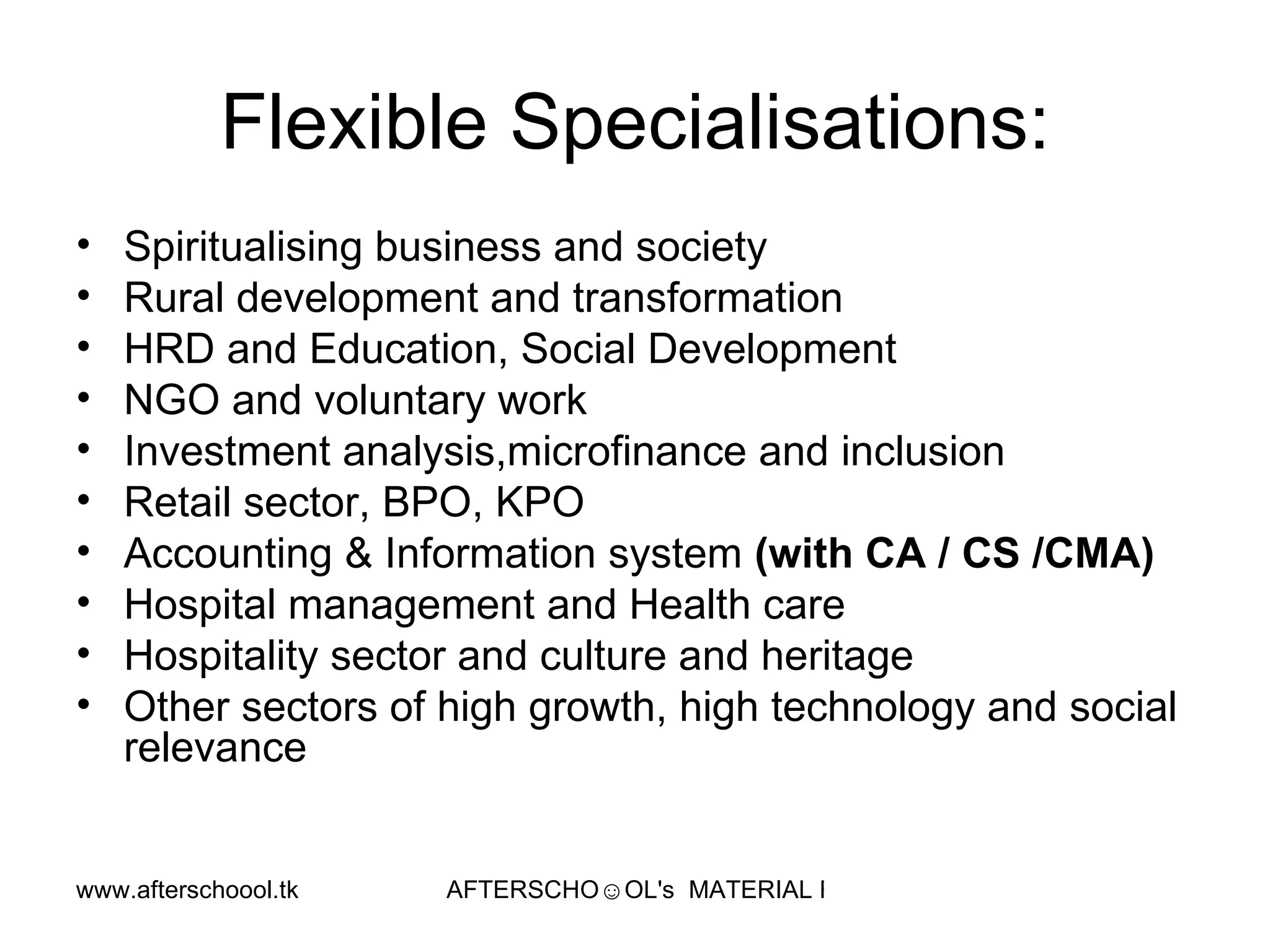
Flexible Specialisations: Spiritualising business and society Rural development and transformation HRD and Education, Social Development NGO and voluntary work Investment analysis,microfinance and inclusion  Retail sector, BPO, KPO Accounting & Information system  (with CA / CS /CMA) Hospital management and Health care Hospitality sector and culture and heritage Other sectors of high growth, high technology and social relevance
Salient features: The only programme of its kind (in the whole world) No publicity and low profile course For those who want to achieve  success in life  – not just a degree Flexible  – you may stay for a month and continue the rest of the education by distance mode. / you may attend weekend classes  Scholarships for those from poor economic background Latest  and constantly changing curriculum – keeping pace  with the time Placement  for those who are interested Admissions open throughout the year  Latest and most advanced technologies, books and study material
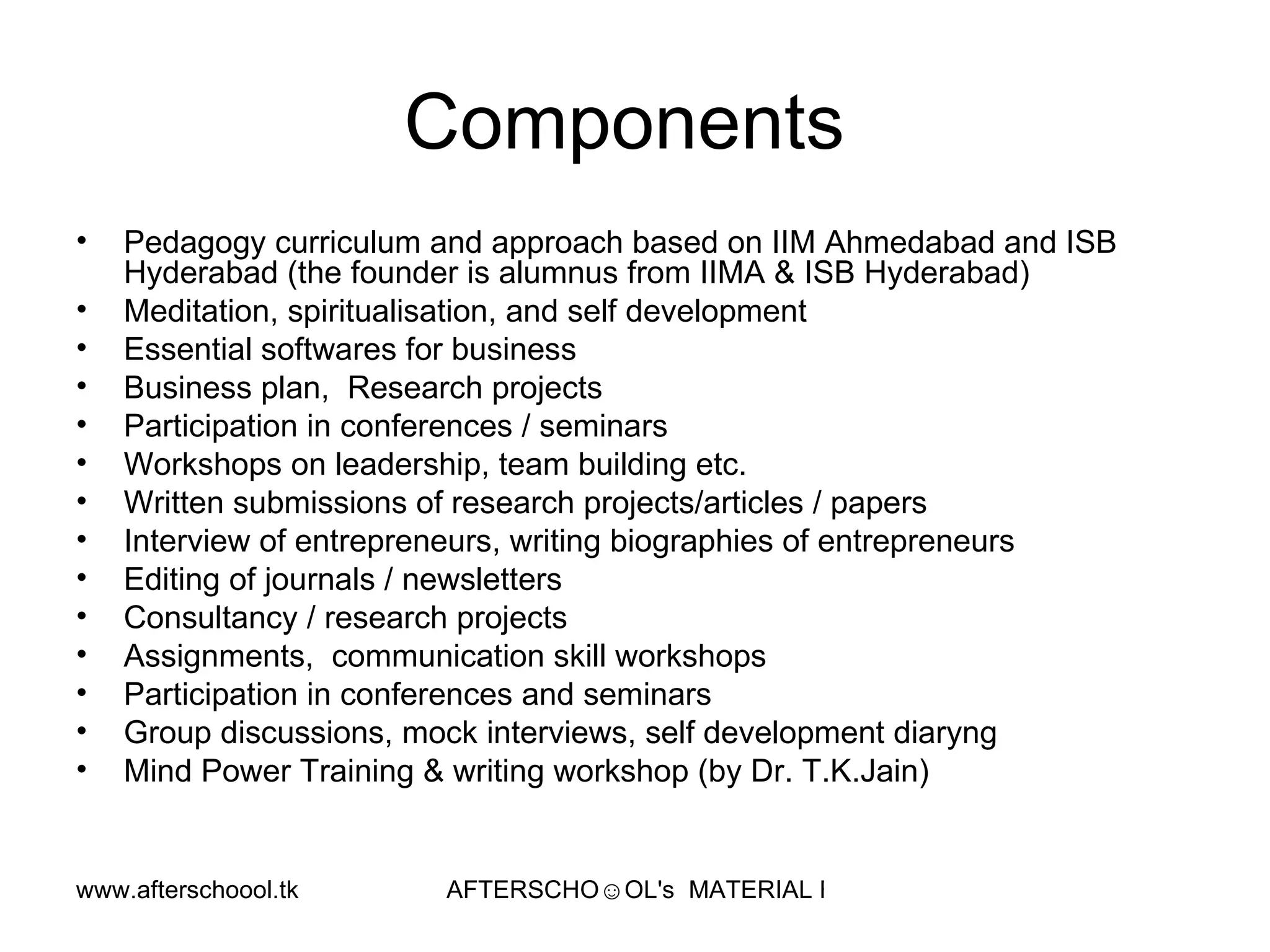
Components  Pedagogy curriculum and approach based on IIM Ahmedabad and ISB Hyderabad (the founder is alumnus from IIMA & ISB Hyderabad) Meditation, spiritualisation, and self development  Essential softwares for business Business plan,  Research projects Participation in conferences / seminars Workshops on leadership, team building etc.  Written submissions of research projects/articles / papers Interview of entrepreneurs, writing biographies of entrepreneurs Editing of journals / newsletters Consultancy / research projects  Assignments,  communication skill workshops Participation in conferences and seminars Group discussions, mock interviews, self development diaryng  Mind Power Training & writing workshop (by Dr. T.K.Jain)
Pedagogy  Case analysis, Articles from Harvard Business Review  Quiz, seminars, workshops, games,  Visits to entrepreneurs and industrial visits Presentations, Latest audio-visuals Group discussions and group projects Periodic self assessment Mentoring and counselling Study exchange programme (with institutions out of India) Rural development / Social welfare projects
Branches AFTERSCHO☺OL  will shortly open its branches in important cities in India including Delhi, Kota, Mumbai, Gurgaon and other important cities. Afterschooolians will be responsible for managing and developing these branches – and for promoting social entrepreneurs.
Case Studies We want to write case studies on social entrepreneurs, first generation entrepreneurs, ethical entrepreneurs. Please help us in this process. Help us to be in touch with entrepreneurs, so that we may develop entrepreneurs.
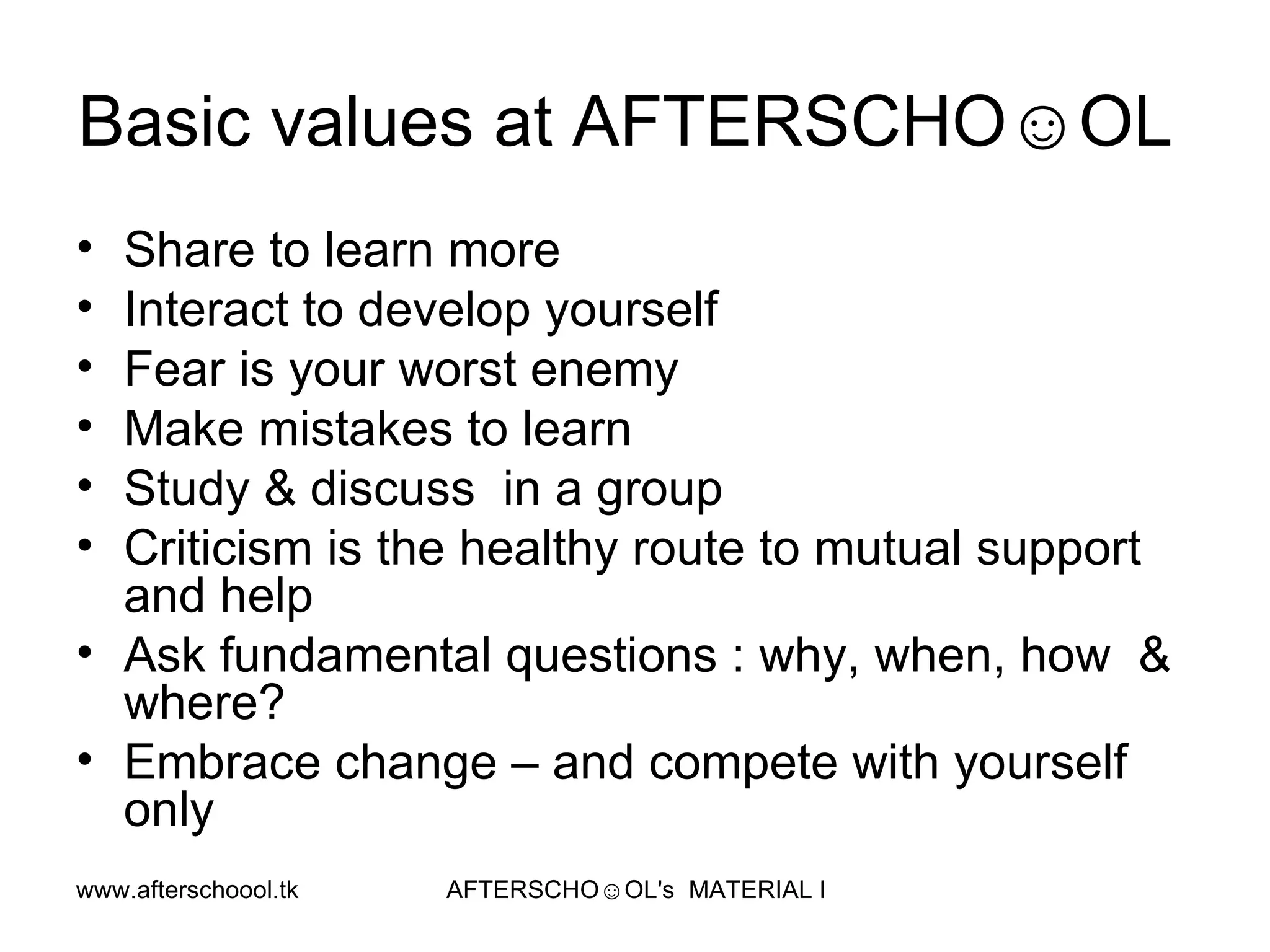
Basic values at AFTERSCHO☺OL  Share to learn more Interact to develop yourself Fear is your worst enemy Make mistakes to learn  Study & discuss  in a group Criticism is the healthy route to mutual support and help  Ask fundamental questions : why, when, how  & where? Embrace change – and compete with yourself only
www.afterschoool.tk   social entrepreneurship for better society

Statistics & Business Problems 8 Oct

  • 1.
    Economics for ManagementAFTERSCHO☺OL – DEVELOPING CHANGE MAKERS CENTRE FOR SOCIAL ENTREPRENEURSHIP PGPSE PROGRAMME – World’ Most Comprehensive programme in social entrepreneurship & spiritual entrepreneurship OPEN FOR ALL FREE FOR ALL
  • 2.
    Economics for ManagementDr. T.K. Jain. AFTERSCHO☺OL Centre for social entrepreneurship Bikaner M: 9414430763 [email_address] www.afterschool.tk , www.afterschoool.tk
  • 3.
    Which is incorrect? EPCG has been abolished CRR has been constantly increased SLR has been constantly increased Average Tariff rates have been reduced FERA has been replaced by FEMA. ANSWERS: 1,2,3
  • 4.
    WHAT IS TARIFF? Custom duties are called tariffs. (when you import goods, you have to pay tax).
  • 5.
    Can Finance ministercontinue to increase expenses over revenue unlimited? No There are WMA and FRBMA now.
  • 6.
    What is WMA? Ways and Means Advances (when you ask RBI to print currency, you have to present the reason for that, you have to tell RBI about your requirements).
  • 7.
    What is FRBMA? Fiscal Responsibility and Budget Management Act, says that the finance minister will try to reduce fiscal deficit.
  • 8.
    What is EPCG? Export Promotion capital Goods.
  • 9.
    What is thedifference in M4 & M1? Total post office deposits.
  • 10.
    What is thedifference in M3 & M1? Time deposits of public with Banks.
  • 11.
    What is thedifference in M2 & M1? Post office savings deposits.
  • 12.
    What is broadmoney? M3
  • 13.
    Name 3 qualitativemeasures? These measures are taken by RBI to persuade banks to give loans / financing in particular segments. These measures are: Moral suasion, Direct action, margin requirements, consumer credit regulations etc.
  • 14.
    What is BaselII? It is an international agreement regarding banking reforms. India is also implementing it.
  • 15.
    What is FRA? Forward rate agreement = here you can make agreement regarding foreign exchange for next 6 months.
  • 16.
    What is interestrate swap? Swap means exchange. When you can exchange your interest rate obligations, it is called SWAP. You may exchange fixed rate obligations for floating rate obligation or you may exchange your obligations in different foreign currencies.
  • 17.
    What is NPA? When there is credit default, it is called NPA. If I take loan from Bank and don’t repay, it will become NPA for the bank and bank will have to take some action for this. NPA = Non performing Asset
  • 18.
    What is EPZ?Export Processing Zone – it is a geographic area, where there are special facilities for exporters.
  • 19.
    What is EOU Export Oriented Unit. These are units, which have been set up exclusively for exporting.
  • 20.
    What is QR? Quantitative Restriction When there is restriction on import, it is called QR. Now these have been removed as per the discussions held at WTO meetings.
  • 21.
    What is exportsubsidy? These are monetary assistance to exporters for exporting more and more. These are not permitted as WTO guidelines. India also does not give export subsidies, but there are many indirect subsidies that are given like assistance in marketing, export promotion, guarantees, export finance, export insurance etc.
  • 22.
    What is DFEC? Duty Free Export Credit. In order to promote exports, there are many schemes to promote entrepreneurs to start export houses. One such scheme is DFEC. Served from India is also a DFEC.
  • 23.
    In which marketcan we have homogenous products? Perfect and Oligopoly
  • 24.
    In which marketscan we have differentiated products? Monopolistic Competition and Oligopoly
  • 25.
    What kind ofmarket is there in Telecom (mobile) in India? Oligopoly
  • 26.
    What kind ofmarket is there in case of soaps? Monopolistic competition
  • 27.
    What is theformulae of MR? MR = marginal revenue Change in revenue / change in quantity
  • 28.
    What is differencein outlay cost and opportunity cost? In outlay cost, we are actually spending some money. In opportunity cost, we are not spending any money.
  • 29.
    If the pricesincrease, in which of these products, our total sales revenue will increase? Salt, Rice, Car, Mobile, Wheat, Petrol, jewellery Solution: Salt, Rice, Wheat, Petrol are essential commodities, so their demand is relatively inelastic. So, total revenue will increase. Jewellery is luxury goods, but here demand increases with increase in price, so demand may increase. In other cases, total revenue will decrease.
  • 30.
    In your budgetline there are three indifference curves A,B,C. A is higher than B, and B is higher than C. Which curve will you choose for your decisions? A because higher indifference curve represents higher satisfaction.
  • 31.
    I get SambharVada at Rs. 10 per piece. My utility is 30,20,10,5,4 for successive units. What is my surplus? I shall use 3 units. My surplus will be (30-10) + (20-10) + (10-10) = 30 units. Answer.
  • 32.
    ABOUT AFTERSCHO☺OL Afterschoool conducts three year integrated PGPSE (after class 12 th along with IAS / CA / CS ) and 18 month PGPSE (Post Graduate Programme in Social Entrepreneurship) along with preparation for CS / CFP / CFA /CMA / FRM . This course is also available online also. It also conducts workshops on social entrepreneurship in schools and colleges all over India – start social entrepreneurship club in your institution today with the help from afterschoool and help us in developing society.
  • 33.
    Why such aprogramme? To promote people to take up entrepreneurship and help develop the society To enable people to take up franchising and other such options to start a business / social development project To enable people to take up social development as their mission To enable people to promote spirituality and positive thinking in the world
  • 34.
    Who are oursupporters? Afterschoolians, our past beneficiaries, entrepreneurs and social entrepreneurs are supporting us. You can also support us – not necessarily by money – but by being promotor of our concept and our ideas.
  • 35.
    About AFTERSCHO☺OL PGPSE – the best programme for developing great entrepreneurs Most flexible, adaptive but rigorous programme Available in distance learning mode Case study focused- latest cases Industry oriented practical curriculum Designed to make you entrepreneurs – not just an employee Option to take up part time job – so earn while you learn The only absolutely free course on internet
  • 36.
    Workshops from AFTERSCHO☺OL IIF, Delhi CIPS, Jaipur ICSI Hyderabad Branch Gyan Vihar, Jaipur Apex Institute of Management, Jaipur Aravali Institute of Management, Jodhpur Xavier Institute of Management, Bhubaneshwar Pacific Institute, Udaipur Engineering College, Hyderabad
  • 37.
    Flexible Specialisations: Spiritualisingbusiness and society Rural development and transformation HRD and Education, Social Development NGO and voluntary work Investment analysis,microfinance and inclusion Retail sector, BPO, KPO Accounting & Information system (with CA / CS /CMA) Hospital management and Health care Hospitality sector and culture and heritage Other sectors of high growth, high technology and social relevance
  • 38.
    Salient features: Theonly programme of its kind (in the whole world) No publicity and low profile course For those who want to achieve success in life – not just a degree Flexible – you may stay for a month and continue the rest of the education by distance mode. / you may attend weekend classes Scholarships for those from poor economic background Latest and constantly changing curriculum – keeping pace with the time Placement for those who are interested Admissions open throughout the year Latest and most advanced technologies, books and study material
  • 39.
    Components Pedagogycurriculum and approach based on IIM Ahmedabad and ISB Hyderabad (the founder is alumnus from IIMA & ISB Hyderabad) Meditation, spiritualisation, and self development Essential softwares for business Business plan, Research projects Participation in conferences / seminars Workshops on leadership, team building etc. Written submissions of research projects/articles / papers Interview of entrepreneurs, writing biographies of entrepreneurs Editing of journals / newsletters Consultancy / research projects Assignments, communication skill workshops Participation in conferences and seminars Group discussions, mock interviews, self development diaryng Mind Power Training & writing workshop (by Dr. T.K.Jain)
  • 40.
    Pedagogy Caseanalysis, Articles from Harvard Business Review Quiz, seminars, workshops, games, Visits to entrepreneurs and industrial visits Presentations, Latest audio-visuals Group discussions and group projects Periodic self assessment Mentoring and counselling Study exchange programme (with institutions out of India) Rural development / Social welfare projects
  • 41.
    Branches AFTERSCHO☺OL will shortly open its branches in important cities in India including Delhi, Kota, Mumbai, Gurgaon and other important cities. Afterschooolians will be responsible for managing and developing these branches – and for promoting social entrepreneurs.
  • 42.
    Case Studies Wewant to write case studies on social entrepreneurs, first generation entrepreneurs, ethical entrepreneurs. Please help us in this process. Help us to be in touch with entrepreneurs, so that we may develop entrepreneurs.
  • 43.
    Basic values atAFTERSCHO☺OL Share to learn more Interact to develop yourself Fear is your worst enemy Make mistakes to learn Study & discuss in a group Criticism is the healthy route to mutual support and help Ask fundamental questions : why, when, how & where? Embrace change – and compete with yourself only
  • 44.
    www.afterschoool.tk social entrepreneurship for better society