FINANCIAL ANALYSIS  AFTERSCHO☺OL  – DEVELOPING CHANGE MAKERS  CENTRE FOR SOCIAL ENTREPRENEURSHIP  PGPSE PROGRAMME –  World’ Most Comprehensive programme in social entrepreneurship & spiritual entrepreneurship OPEN FOR ALL FREE FOR ALL
FINANCIAL ANALYSIS Dr. T.K. Jain. AFTERSCHO☺OL Centre for social entrepreneurship Bikaner M: 9414430763 [email_address] www.afterschool.tk www.afterschoool.tk
WHAT IS CASH MANAGEMENT?  Managing cash requirements of an enterprise, predicting cash inflows and cash outflows and preparing cash budget is part of cash management.
What is  currency management?  Management of currency, particularly foreign exchange risks, exchange rate fluctuations. There may be exchange rate fluctuations due to many reasons like country risk, interest rate fluctuations, political instability etc.
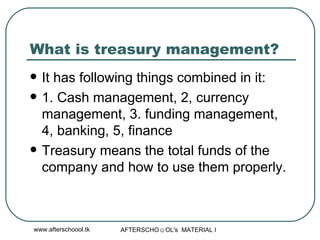
What is treasury management?  It has following things combined in it:  1. Cash management, 2, currency management, 3. funding management, 4, banking, 5, finance  Treasury means the total funds of the company and how to use them properly.
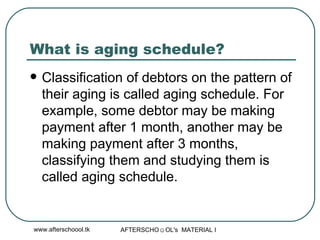
What is aging schedule?  Classification of debtors on the pattern of their aging is called aging schedule. For example, some debtor may be making payment after 1 month, another may be making payment after 3 months, classifying them and studying them is called aging schedule.
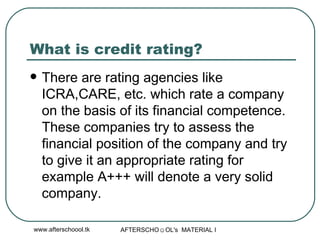
What is credit rating?  There are rating agencies like ICRA,CARE, etc. which rate a company on the basis of its financial competence. These companies try to assess the financial position of the company and try to give it an appropriate rating for example A+++ will denote a very solid company.
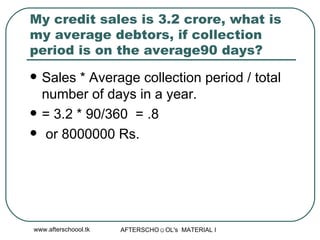
My credit sales is 3.2 crore, what is my average debtors, if collection period is on the average90 days?  Sales * Average collection period / total number of days in a year.  = 3.2 * 90/360  = .8 or 8000000 Rs.
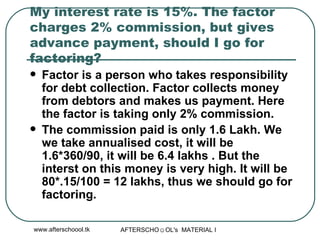
My interest rate is 15%. The factor charges 2% commission, but gives advance payment, should I go for factoring?  Factor is a person who takes responsibility for debt collection. Factor collects money from debtors and makes us payment. Here the factor is taking only 2% commission.  The commission paid is only 1.6 Lakh. We we take annualised cost, it will be 1.6*360/90, it will be 6.4 lakhs . But the interst on this money is very high. It will be 80*.15/100 = 12 lakhs, thus we should go for factoring.
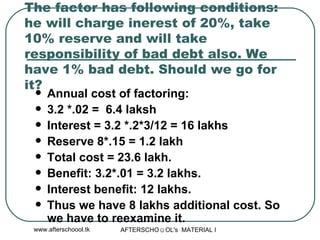
The factor has following conditions: he will charge inerest of 20%, take 10% reserve and will take responsibility of bad debt also. We have 1% bad debt. Should we go for it?  Annual cost of factoring:  3.2 *.02 =  6.4 laksh Interest = 3.2 *.2*3/12 = 16 lakhs Reserve 8*.15 = 1.2 lakh Total cost = 23.6 lakh.  Benefit: 3.2*.01 = 3.2 lakhs.  Interest benefit: 12 lakhs.  Thus we have 8 lakhs additional cost. So we have to reexamine it.
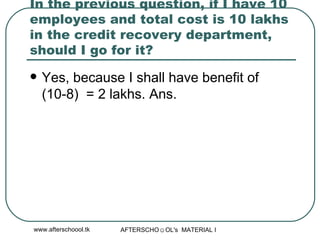
In the previous question, if I have 10 employees and total cost is 10 lakhs in the credit recovery department, should I go for it?  Yes, because I shall have benefit of (10-8)  = 2 lakhs. Ans.
What is working capital  Current assets  current liabilities.
What is COGS? Cost of goods sold (prime cost, factory cost, admn. Cost).
What is Capital employed? Total of Equity + Debt.  Or total of assets.
What is average collecion period?  Average debtors / Average sales per day
What is DPS?  Dividend Per share
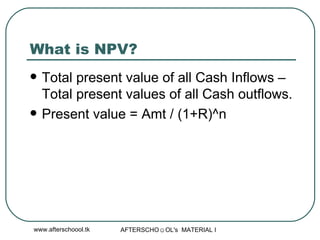
What is NPV?  Total present value of all Cash Inflows – Total present values of all Cash outflows.  Present value = Amt / (1+R)^n
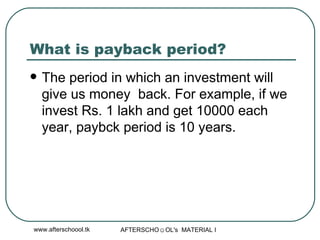
What is payback period?  The period in which an investment will give us money  back. For example, if we invest Rs. 1 lakh and get 10000 each year, paybck period is 10 years.
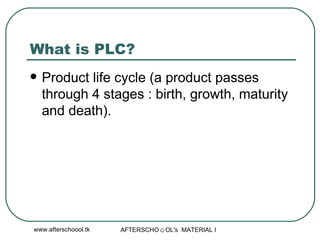
What is PLC?  Product life cycle (a product passes through 4 stages : birth, growth, maturity and death).
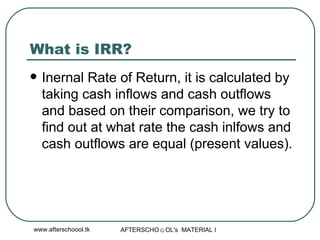
What is IRR?  Inernal Rate of Return, it is calculated by taking cash inflows and cash outflows and based on their comparison, we try to find out at what rate the cash inlfows and cash outflows are equal (present values).
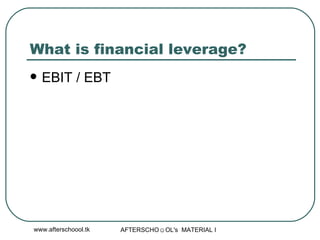
What is financial leverage?  EBIT / EBT
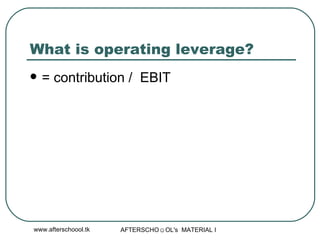
What is operating leverage?  = contribution /  EBIT
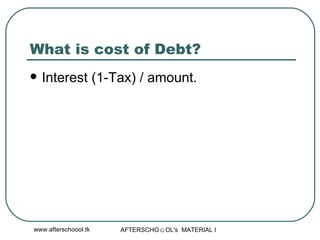
What is cost of Debt?  Interest (1-Tax) / amount.
ABOUT AFTERSCHOOOL Afterschoool conducts three year integrated PGPSE (after class  12 th   along with  IAS / CA / CS ) and 18 month PGPSE (Post Graduate Programme in Social Entrepreneurship) along with preparation for  CS / CFP / CFA  /CMA / FRM . This course is also available online also. It also conducts workshops on social entrepreneurship in schools and colleges all over India – start social entrepreneurship club in your institution today with the help from afterschoool and help us in developing society.
Why such a programme? To promote people to take up entrepreneurship and help develop the society To enable people to take up franchising and other such options to start a business / social development project To enable people to take up social development as their mission To enable people to promote spirituality and positive thinking in the world
Who are our supporters? Afterschoolians, our past beneficiaries, entrepreneurs and social entrepreneurs are supporting us. You can also support us – not necessarily by money – but by being promotor of our concept and our ideas.
About AFTERSCHOOOL PGPSE – the best programme for developing great entrepreneurs Most flexible, adaptive but rigorous programme Available in distance learning mode Case study focused- latest cases  Industry oriented practical curriculum Designed to make you entrepreneurs – not just an employee Option to take up part time job – so earn while you learn  The only absolutely free course on internet
Workshops from AFTERSCHOOOL IIF, Delhi CIPS, Jaipur ICSI Hyderabad Branch Gyan Vihar, Jaipur Apex Institute of Management, Jaipur Aravali Institute of Management, Jodhpur Xavier Institute of Management, Bhubaneshwar  Pacific Institute, Udaipur Engineering College, Hyderabad
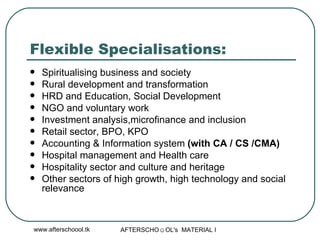
Flexible Specialisations: Spiritualising business and society Rural development and transformation HRD and Education, Social Development NGO and voluntary work Investment analysis,microfinance and inclusion  Retail sector, BPO, KPO Accounting & Information system  (with CA / CS /CMA) Hospital management and Health care Hospitality sector and culture and heritage Other sectors of high growth, high technology and social relevance
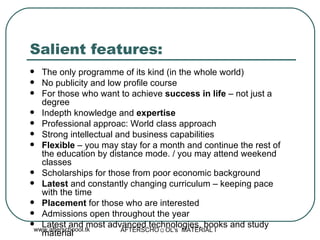
Salient features: The only programme of its kind (in the whole world) No publicity and low profile course For those who want to achieve  success in life  – not just a degree Indepth knowledge and  expertise  Professional approac: World class approach Strong intellectual and business capabilities Flexible  – you may stay for a month and continue the rest of the education by distance mode. / you may attend weekend classes  Scholarships for those from poor economic background Latest  and constantly changing curriculum – keeping pace  with the time Placement  for those who are interested Admissions open throughout the year  Latest and most advanced technologies, books and study material
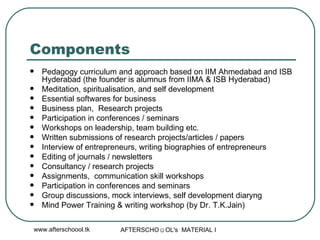
Components  Pedagogy curriculum and approach based on IIM Ahmedabad and ISB Hyderabad (the founder is alumnus from IIMA & ISB Hyderabad) Meditation, spiritualisation, and self development  Essential softwares for business Business plan,  Research projects Participation in conferences / seminars Workshops on leadership, team building etc.  Written submissions of research projects/articles / papers Interview of entrepreneurs, writing biographies of entrepreneurs Editing of journals / newsletters Consultancy / research projects  Assignments,  communication skill workshops Participation in conferences and seminars Group discussions, mock interviews, self development diaryng  Mind Power Training & writing workshop (by Dr. T.K.Jain)
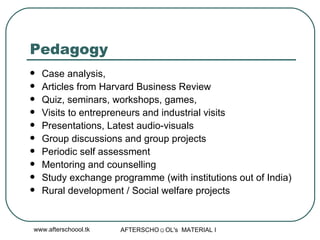
Pedagogy  Case analysis, Articles from Harvard Business Review  Quiz, seminars, workshops, games,  Visits to entrepreneurs and industrial visits Presentations, Latest audio-visuals Group discussions and group projects Periodic self assessment Mentoring and counselling Study exchange programme (with institutions out of India) Rural development / Social welfare projects
Branches AFTERSCHOOOL will shortly open its branches in important cities in India including Delhi, Kota, Mumbai, Gurgaon and other important cities. Afterschooolians will be responsible for managing and developing these branches – and for promoting social entrepreneurs.
Case Studies We want to write case studies on social entrepreneurs, first generation entrepreneurs, ethical entrepreneurs. Please help us in this process. Help us to be in touch with entrepreneurs, so that we may develop entrepreneurs.
Basic values at afterschoool Share to learn more Interact to develop yourself Fear is your worst enemy Make mistakes to learn  Study & discuss  in a group Criticism is the healthy route to mutual support and help  Ask fundamental questions : why, when, how  & where? Embrace change – and compete with yourself only
www.afterschoool.tk   social entrepreneurship for better society

25 August Financial Analysis

  • 1.
    FINANCIAL ANALYSIS AFTERSCHO☺OL – DEVELOPING CHANGE MAKERS CENTRE FOR SOCIAL ENTREPRENEURSHIP PGPSE PROGRAMME – World’ Most Comprehensive programme in social entrepreneurship & spiritual entrepreneurship OPEN FOR ALL FREE FOR ALL
  • 2.
    FINANCIAL ANALYSIS Dr.T.K. Jain. AFTERSCHO☺OL Centre for social entrepreneurship Bikaner M: 9414430763 [email_address] www.afterschool.tk www.afterschoool.tk
  • 3.
    WHAT IS CASHMANAGEMENT? Managing cash requirements of an enterprise, predicting cash inflows and cash outflows and preparing cash budget is part of cash management.
  • 4.
    What is currency management? Management of currency, particularly foreign exchange risks, exchange rate fluctuations. There may be exchange rate fluctuations due to many reasons like country risk, interest rate fluctuations, political instability etc.
  • 5.
    What is treasurymanagement? It has following things combined in it: 1. Cash management, 2, currency management, 3. funding management, 4, banking, 5, finance Treasury means the total funds of the company and how to use them properly.
  • 6.
    What is agingschedule? Classification of debtors on the pattern of their aging is called aging schedule. For example, some debtor may be making payment after 1 month, another may be making payment after 3 months, classifying them and studying them is called aging schedule.
  • 7.
    What is creditrating? There are rating agencies like ICRA,CARE, etc. which rate a company on the basis of its financial competence. These companies try to assess the financial position of the company and try to give it an appropriate rating for example A+++ will denote a very solid company.
  • 8.
    My credit salesis 3.2 crore, what is my average debtors, if collection period is on the average90 days? Sales * Average collection period / total number of days in a year. = 3.2 * 90/360 = .8 or 8000000 Rs.
  • 9.
    My interest rateis 15%. The factor charges 2% commission, but gives advance payment, should I go for factoring? Factor is a person who takes responsibility for debt collection. Factor collects money from debtors and makes us payment. Here the factor is taking only 2% commission. The commission paid is only 1.6 Lakh. We we take annualised cost, it will be 1.6*360/90, it will be 6.4 lakhs . But the interst on this money is very high. It will be 80*.15/100 = 12 lakhs, thus we should go for factoring.
  • 10.
    The factor hasfollowing conditions: he will charge inerest of 20%, take 10% reserve and will take responsibility of bad debt also. We have 1% bad debt. Should we go for it? Annual cost of factoring: 3.2 *.02 = 6.4 laksh Interest = 3.2 *.2*3/12 = 16 lakhs Reserve 8*.15 = 1.2 lakh Total cost = 23.6 lakh. Benefit: 3.2*.01 = 3.2 lakhs. Interest benefit: 12 lakhs. Thus we have 8 lakhs additional cost. So we have to reexamine it.
  • 11.
    In the previousquestion, if I have 10 employees and total cost is 10 lakhs in the credit recovery department, should I go for it? Yes, because I shall have benefit of (10-8) = 2 lakhs. Ans.
  • 12.
    What is workingcapital Current assets current liabilities.
  • 13.
    What is COGS?Cost of goods sold (prime cost, factory cost, admn. Cost).
  • 14.
    What is Capitalemployed? Total of Equity + Debt. Or total of assets.
  • 15.
    What is averagecollecion period? Average debtors / Average sales per day
  • 16.
    What is DPS? Dividend Per share
  • 17.
    What is NPV? Total present value of all Cash Inflows – Total present values of all Cash outflows. Present value = Amt / (1+R)^n
  • 18.
    What is paybackperiod? The period in which an investment will give us money back. For example, if we invest Rs. 1 lakh and get 10000 each year, paybck period is 10 years.
  • 19.
    What is PLC? Product life cycle (a product passes through 4 stages : birth, growth, maturity and death).
  • 20.
    What is IRR? Inernal Rate of Return, it is calculated by taking cash inflows and cash outflows and based on their comparison, we try to find out at what rate the cash inlfows and cash outflows are equal (present values).
  • 21.
    What is financialleverage? EBIT / EBT
  • 22.
    What is operatingleverage? = contribution / EBIT
  • 23.
    What is costof Debt? Interest (1-Tax) / amount.
  • 24.
    ABOUT AFTERSCHOOOL Afterschooolconducts three year integrated PGPSE (after class 12 th along with IAS / CA / CS ) and 18 month PGPSE (Post Graduate Programme in Social Entrepreneurship) along with preparation for CS / CFP / CFA /CMA / FRM . This course is also available online also. It also conducts workshops on social entrepreneurship in schools and colleges all over India – start social entrepreneurship club in your institution today with the help from afterschoool and help us in developing society.
  • 25.
    Why such aprogramme? To promote people to take up entrepreneurship and help develop the society To enable people to take up franchising and other such options to start a business / social development project To enable people to take up social development as their mission To enable people to promote spirituality and positive thinking in the world
  • 26.
    Who are oursupporters? Afterschoolians, our past beneficiaries, entrepreneurs and social entrepreneurs are supporting us. You can also support us – not necessarily by money – but by being promotor of our concept and our ideas.
  • 27.
    About AFTERSCHOOOL PGPSE– the best programme for developing great entrepreneurs Most flexible, adaptive but rigorous programme Available in distance learning mode Case study focused- latest cases Industry oriented practical curriculum Designed to make you entrepreneurs – not just an employee Option to take up part time job – so earn while you learn The only absolutely free course on internet
  • 28.
    Workshops from AFTERSCHOOOLIIF, Delhi CIPS, Jaipur ICSI Hyderabad Branch Gyan Vihar, Jaipur Apex Institute of Management, Jaipur Aravali Institute of Management, Jodhpur Xavier Institute of Management, Bhubaneshwar Pacific Institute, Udaipur Engineering College, Hyderabad
  • 29.
    Flexible Specialisations: Spiritualisingbusiness and society Rural development and transformation HRD and Education, Social Development NGO and voluntary work Investment analysis,microfinance and inclusion Retail sector, BPO, KPO Accounting & Information system (with CA / CS /CMA) Hospital management and Health care Hospitality sector and culture and heritage Other sectors of high growth, high technology and social relevance
  • 30.
    Salient features: Theonly programme of its kind (in the whole world) No publicity and low profile course For those who want to achieve success in life – not just a degree Indepth knowledge and expertise Professional approac: World class approach Strong intellectual and business capabilities Flexible – you may stay for a month and continue the rest of the education by distance mode. / you may attend weekend classes Scholarships for those from poor economic background Latest and constantly changing curriculum – keeping pace with the time Placement for those who are interested Admissions open throughout the year Latest and most advanced technologies, books and study material
  • 31.
    Components Pedagogycurriculum and approach based on IIM Ahmedabad and ISB Hyderabad (the founder is alumnus from IIMA & ISB Hyderabad) Meditation, spiritualisation, and self development Essential softwares for business Business plan, Research projects Participation in conferences / seminars Workshops on leadership, team building etc. Written submissions of research projects/articles / papers Interview of entrepreneurs, writing biographies of entrepreneurs Editing of journals / newsletters Consultancy / research projects Assignments, communication skill workshops Participation in conferences and seminars Group discussions, mock interviews, self development diaryng Mind Power Training & writing workshop (by Dr. T.K.Jain)
  • 32.
    Pedagogy Caseanalysis, Articles from Harvard Business Review Quiz, seminars, workshops, games, Visits to entrepreneurs and industrial visits Presentations, Latest audio-visuals Group discussions and group projects Periodic self assessment Mentoring and counselling Study exchange programme (with institutions out of India) Rural development / Social welfare projects
  • 33.
    Branches AFTERSCHOOOL willshortly open its branches in important cities in India including Delhi, Kota, Mumbai, Gurgaon and other important cities. Afterschooolians will be responsible for managing and developing these branches – and for promoting social entrepreneurs.
  • 34.
    Case Studies Wewant to write case studies on social entrepreneurs, first generation entrepreneurs, ethical entrepreneurs. Please help us in this process. Help us to be in touch with entrepreneurs, so that we may develop entrepreneurs.
  • 35.
    Basic values atafterschoool Share to learn more Interact to develop yourself Fear is your worst enemy Make mistakes to learn Study & discuss in a group Criticism is the healthy route to mutual support and help Ask fundamental questions : why, when, how & where? Embrace change – and compete with yourself only
  • 36.
    www.afterschoool.tk social entrepreneurship for better society