Statistical Methods And Applications In Forestry
And Environmental Sciences Girish Chandra
download
https://ebookbell.com/product/statistical-methods-and-
applications-in-forestry-and-environmental-sciences-girish-
chandra-52532668
Explore and download more ebooks at ebookbell.com
Here are some recommended products that we believe you will be
interested in. You can click the link to download.
Statistical Methods And Applications In Insurance And Finance Cimpa
School Marrakech And El Kelaa Mgouna Morocco April 2013 1st Edition
Mhamed Eddahbi
https://ebookbell.com/product/statistical-methods-and-applications-in-
insurance-and-finance-cimpa-school-marrakech-and-el-kelaa-mgouna-
morocco-april-2013-1st-edition-mhamed-eddahbi-5483942
Numerical And Statistical Methods For Bioengineering Applications In
Matlab 1st Edition Michael R King
https://ebookbell.com/product/numerical-and-statistical-methods-for-
bioengineering-applications-in-matlab-1st-edition-michael-r-
king-1779288
Statistical Learning And Modeling In Data Analysis Methods And
Applications 1st Edition Simona Balzano
https://ebookbell.com/product/statistical-learning-and-modeling-in-
data-analysis-methods-and-applications-1st-edition-simona-
balzano-33469896
Mathematical And Statistical Models And Methods In Reliability
Applications To Medicine Finance And Quality Control 1st Edition V S
Koroliuk
https://ebookbell.com/product/mathematical-and-statistical-models-and-
methods-in-reliability-applications-to-medicine-finance-and-quality-
control-1st-edition-v-s-koroliuk-2047240
Advances In Statistical Methods For The Health Sciences Applications
To Cancer And Aids Studies Genome Sequence Analysis And Survival
Analysis Jeanlouis Auget Et Al
https://ebookbell.com/product/advances-in-statistical-methods-for-the-
health-sciences-applications-to-cancer-and-aids-studies-genome-
sequence-analysis-and-survival-analysis-jeanlouis-auget-et-al-4096768
Supermathematics And Its Applications In Statistical Physics Grassmann
Variables And The Method Of Supersymmetry 1st Edition Franz Wegner
Auth
https://ebookbell.com/product/supermathematics-and-its-applications-
in-statistical-physics-grassmann-variables-and-the-method-of-
supersymmetry-1st-edition-franz-wegner-auth-5608822
Environmental Statistics Methods And Applications Wiley Series In
Probability And Statistics 1st Edition Vic Barnett
https://ebookbell.com/product/environmental-statistics-methods-and-
applications-wiley-series-in-probability-and-statistics-1st-edition-
vic-barnett-1309444
Methods And Applications Of Statistics In Clinical Trials Volume 2
Planning Analysis And Inferential Methods 1st Edition N Balakrishnan
https://ebookbell.com/product/methods-and-applications-of-statistics-
in-clinical-trials-volume-2-planning-analysis-and-inferential-
methods-1st-edition-n-balakrishnan-4981968
Methods And Applications Of Statistics In Clinical Trials Volume 1
Concepts Principles Trials And Design Balakrishnan
https://ebookbell.com/product/methods-and-applications-of-statistics-
in-clinical-trials-volume-1-concepts-principles-trials-and-design-
balakrishnan-5310774
Forum for Interdisciplinary Mathematics
Girish Chandra
Raman Nautiyal
Hukum Chandra Editors
Statistical Methods
and Applications
in Forestry and
Environmental
Sciences
Forum for Interdisciplinary Mathematics
Editor-in-Chief
P. V. Subrahmanyam, Department of Mathematics, Indian Institute of Technology
Madras, Chennai, Tamil Nadu, India
Editorial Board
Yogendra Prasad Chaubey, Department of Mathematics and Statistics, Concordia
University, Montreal, QC, Canada
Jorge Cuellar, Principal Researcher, Siemens AG, München, Bayern, Germany
Janusz Matkowski, Faculty of Mathematics, Computer Science and Econometrics,
University of Zielona Góra, Zielona Góra, Poland
Thiruvenkatachari Parthasarathy, Chennai Mathematical Institute, Kelambakkam,
Tamil Nadu, India
Mathieu Dutour Sikirić, Institute Rudjer Boúsković, Zagreb, Croatia
Bhu Dev Sharma, Forum for Interdisciplinary Mathematics, Meerut, Uttar Pradesh,
India
Forum for Interdisciplinary Mathematics is a Scopus-indexed book series. It
publishes high-quality textbooks, monographs, contributed volumes and lecture
notes in mathematics and interdisciplinary areas where mathematics plays a
fundamental role, such as statistics, operations research, computer science, financial
mathematics, industrial mathematics, and bio-mathematics. It reflects the increasing
demand of researchers working at the interface between mathematics and other
scientific disciplines.
More information about this series at http://www.springer.com/series/13386
Girish Chandra • Raman Nautiyal •
Hukum Chandra
Editors
Statistical Methods
and Applications in Forestry
and Environmental Sciences
123
Editors
Girish Chandra
Indian Council of Forestry Research
and Education
Dehradun, Uttarakhand, India
Raman Nautiyal
Indian Council of Forestry Research
and Education
Dehradun, Uttarakhand, India
Hukum Chandra
Indian Agricultural Statistics
Research Institute
New Delhi, Delhi, India
ISSN 2364-6748 ISSN 2364-6756 (electronic)
Forum for Interdisciplinary Mathematics
ISBN 978-981-15-1475-3 ISBN 978-981-15-1476-0 (eBook)
https://doi.org/10.1007/978-981-15-1476-0
© Springer Nature Singapore Pte Ltd. 2020
This work is subject to copyright. All rights are reserved by the Publisher, whether the whole or part
of the material is concerned, specifically the rights of translation, reprinting, reuse of illustrations,
recitation, broadcasting, reproduction on microfilms or in any other physical way, and transmission
or information storage and retrieval, electronic adaptation, computer software, or by similar or dissimilar
methodology now known or hereafter developed.
The use of general descriptive names, registered names, trademarks, service marks, etc. in this
publication does not imply, even in the absence of a specific statement, that such names are exempt from
the relevant protective laws and regulations and therefore free for general use.
The publisher, the authors and the editors are safe to assume that the advice and information in this
book are believed to be true and accurate at the date of publication. Neither the publisher nor the
authors or the editors give a warranty, expressed or implied, with respect to the material contained
herein or for any errors or omissions that may have been made. The publisher remains neutral with regard
to jurisdictional claims in published maps and institutional affiliations.
This Springer imprint is published by the registered company Springer Nature Singapore Pte Ltd.
The registered company address is: 152 Beach Road, #21-01/04 Gateway East, Singapore 189721,
Singapore
Preface
The application of statistics in forestry and environmental sciences is challenging
owing to the great amount of variations present in the nature. With a vast and varied
spectrum of disciplines spanning the sector and involvement of other areas of
knowledge including sociology, economics and natural sciences, the application of
statistical tools in forestry and environment does not follow a thumb rule logic and
requires innovative and imaginative thinking. The technological advancements in
other areas of science have contributed to the evolution of forestry from merely
targeting productivity to cutting-edge areas, like climate change, carbon seques-
tration and policy formulation. With the emerging interest in forests and environ-
ment, the need of the day is to base policy formulation and decision making on
strong foundations of science. With the involvement of people in forest manage-
ment, forestry has become a fusion of social and basic sciences. Thus, the need to
integrate a wide range of statistical tools in research has become the necessity
of the day.
This present book consists of 17 chapters, providing a broad coverage of sta-
tistical methodologies and their applications in forestry and environmental sector.
The main aim of the book is to enlarge the scope of the forestry statistics, as only
limited books are available in this area. The topics included in this volume are
designed to appeal to applied statisticians, as well as students, researchers, and
practitioners of subjects like sociology, economics and natural sciences. The
inclusion of real examples and case studies is, therefore, essential. We are sure that
the book will benefit researchers and students of different disciplines of forestry and
environmental sciences for improving research through the practical knowledge of
applied statistics.
The Chapter ‘Statistics in Indian Forestry: A Historical Perspective’ traces the
history of quantification of forest resources and the use of statistical methods for the
development of the forestry sector in India. The Chapter ‘National Forest Inventory
in India: Developments Toward a New Design to Meet Emerging Challenges’
provides a brief overview of the National Forest Inventory (NFI) in India, vis-à-vis
some other developed countries, and highlights the proposed changes in plot design
while revising NFI in India. The concept of Internet of Things with possible use in
v
forestry and environmental sciences is presented in the Chapter ‘Internet of Things
in Forestry and Environmental Sciences’. The Chapter ‘Inverse Adaptive Stratified
Random Sampling’ gives a new sampling design based on adaptive cluster sampling
useful for assessing rare plant species. The Chapter ‘Improved Nonparametric
Estimation Using Partially Ordered Sets’ discusses the use of ranked set sampling in
improving nonparametric estimation by using partially ordered sets. The robust
Bayesian method to analyze forestry data, when samples are selected with proba-
bility proportional to length from a finite population of unknown size, is presented in
the Chapter ‘Bayesian Inference of a Finite Population Mean Under Length-Biased
Sampling’. The Chapters ‘Calibration Approach-Based Estimators for Finite
Population Mean in Multistage Stratified Random Sampling’ and ‘A Joint
Calibration Estimator of Population Total Under Minimum Entropy Distance
Function Based on Dual Frame Surveys’ deal with the development of calibration
estimators of the population mean under two-stage stratified random sampling and
joint calibration estimation approach under the entropy distance function for dual
frame surveys, respectively. The Chapter ‘Fusing Classical Theories and
Biomechanics into Forest Modelling’ narrates some of the fusing classical theo-
ries and biomechanics in forest modeling. The Chapter ‘Investigating Selection
Criteria of Constrained Cluster Analysis: Applications in Forestry’ provides current
techniques of partial redundancy analysis and constrained cluster analysis to explore
how spatial variables determine structure in a managed regular spaced plantation.
The Chapter ‘Ridge Regression Model for the Estimation of Total Carbon
Sequestered by Forest Species’ describes the ridge regression technique in the
presence of multicollinearity. Two methods of construction of mixture experiments
with process variables have been detailed in the Chapter ‘Some Investigations
on Designs for Mixture Experiments with Process Variable’. The
Chapter ‘Development in Copula Applications in Forestry and Environmental
Sciences’ specifically examines the review on the development of copula models and
its applications in the area of forestry and environmental sciences. The
Chapter ‘Forest Cover-Type Prediction Using Model Averaging’ presents the
methodology to apply model averaging technique in multinomial logistic regression
model by using the forest cover type dataset. Small-area estimation methods to
handle zero-inflated, skewed, spatially structured data for the continuous target
response are given in the Chapters ‘Small Area Estimation for Skewed
Semicontinuous Spatially Structured Responses’, and ‘Small Area Estimation for
Total Basal Cover in the State of Maharashtra in India’ which describe the small-area
estimation technique to produce small-area estimates of the total basal cover for
trees, shrubs, and herbs for the state of Maharashtra in India. The applications of
three different sampling procedures for assessing the abundance of elephants in the
elephant reserves of Kerala, India, are presented in the Chapter ‘Estimation of
Abundance of Asiatic Elephants in Elephant Reserves of Kerala State, India’. The
book ends with a short note on integrated survey scheme with particular relevance to
forests in Bangladesh.
vi Preface
Most of the chapters of this book are the outcome of the three-day national
workshop on ‘Recent Advances in Statistical Methods and Application in Forestry
and Environmental Sciences’ organized by the Division of Forestry Statistics,
Indian Council of Forestry Research and Education (ICFRE), Dehradun, India,
from 23–25 May 2018. We would like to thank the Ministry of Statistics and
Program Implementation, Government of India and ICFRE for the funding support.
The guidance rendered by Dr. Suresh Gairola, Director General, ICFRE, and Shri
Arun Singh Rawat, Deputy Director General (Administration), ICFRE, provided
impetus and motivation in publishing this book. We extend our thanks and
appreciations to the authors for their continuous support during the finalization
of the book. We would like to express our sincere thanks to Shamim Ahmad, Senior
Editor, Mathematical Sciences, Springer Nature, for his continuous support and
cooperation from planning to the finalization of this volume. We would like to
thank the anonymous referees for their valuable comments and suggestions for the
improvement of this book.
Dehradun, India Girish Chandra
Raman Nautiyal
New Delhi, India Hukum Chandra
Preface vii
Contents
Statistics in Indian Forestry: A Historical Perspective . . . . . . . . . . . . . . 1
Anoop Singh Chauhan, Girish Chandra and Y. P. Singh
National Forest Inventory in India: Developments Toward
a New Design to Meet Emerging Challenges . . . . . . . . . . . . . . . . . . . . . 13
V. P. Tewari, Rajesh Kumar and K. v. Gadow
Internet of Things in Forestry and Environmental Sciences . . . . . . . . . . 35
S. B. Lal, Anu Sharma, K. K. Chaturvedi, M. S. Farooqi and Anil Rai
Inverse Adaptive Stratified Random Sampling . . . . . . . . . . . . . . . . . . . . 47
Raosaheb V. Latpate
Improved Nonparametric Estimation Using Partially Ordered Sets . . . . 57
Ehsan Zamanzade and Xinlei Wang
Bayesian Inference of a Finite Population Mean Under Length-Biased
Sampling . . . . . . . . . . . . . . . . . . . . . . . . . . . . . . . . . . . . . . . . . . . . . . . . 79
Zhiqing Xu, Balgobin Nandram and Binod Manandhar
Calibration Approach-Based Estimators for Finite Population Mean
in Multistage Stratified Random Sampling . . . . . . . . . . . . . . . . . . . . . . . 105
B. V. S. Sisodia and Dhirendra Singh
A Joint Calibration Estimator of Population Total Under Minimum
Entropy Distance Function Based on Dual Frame Surveys . . . . . . . . . . 125
Piyush Kant Rai, G. C. Tikkiwal and Alka
Fusing Classical Theories and Biomechanics into Forest Modelling . . . . 151
S. Suresh Ramanan, T. K. Kunhamu, Deskyong Namgyal and S. K. Gupta
Investigating Selection Criteria of Constrained Cluster Analysis:
Applications in Forestry . . . . . . . . . . . . . . . . . . . . . . . . . . . . . . . . . . . . . 161
Gavin Richard Corral
ix
Ridge Regression Model for the Estimation of Total Carbon
Sequestered by Forest Species . . . . . . . . . . . . . . . . . . . . . . . . . . . . . . . . 181
Manish Sharma, Banti Kumar, Vishal Mahajan and M. I. J. Bhat
Some Investigations on Designs for Mixture Experiments
with Process Variable . . . . . . . . . . . . . . . . . . . . . . . . . . . . . . . . . . . . . . . 193
Krishan Lal, Upendra Kumar Pradhan and V. K. Gupta
Development in Copula Applications in Forestry
and Environmental Sciences . . . . . . . . . . . . . . . . . . . . . . . . . . . . . . . . . . 213
M. Ishaq Bhatti and Hung Quang Do
Forest Cover-Type Prediction Using Model Averaging . . . . . . . . . . . . . 231
Anoop Chaturvedi and Ashutosh Kumar Dubey
Small Area Estimation for Skewed Semicontinuous Spatially
Structured Responses . . . . . . . . . . . . . . . . . . . . . . . . . . . . . . . . . . . . . . . 241
Chiara Bocci, Emanuela Dreassi, Alessandra Petrucci and Emilia Rocco
Small Area Estimation for Total Basal Cover in the State
of Maharashtra in India . . . . . . . . . . . . . . . . . . . . . . . . . . . . . . . . . . . . . 255
Hukum Chandra and Girish Chandra
Estimation of Abundance of Asiatic Elephants in Elephant Reserves
of Kerala State, India . . . . . . . . . . . . . . . . . . . . . . . . . . . . . . . . . . . . . . . 267
M. Sivaram, K. K. Ramachandran, E. A. Jayson and P. V. Nair
Short Note: Integrated Survey Scheme to Capture Forest Data
in Bangladesh . . . . . . . . . . . . . . . . . . . . . . . . . . . . . . . . . . . . . . . . . . . . . . . 283
x Contents
About the Editors
Girish Chandra, PhD, is a scientist at the Division of Forestry Statistics, Indian
Council of Forestry Research and Education (ICFRE), Dehradun, India. He previ-
ously worked at the Tropical Forest Research Institute, Jabalpur, and Central
Agricultural University, Sikkim. He has published over 25 research papers in various
respected journals and one book. He was awarded the Cochran–Hansen Prize 2017
by the International Association of Survey Statisticians, the Netherlands. He is also a
recipient of the ICFRE Outstanding Research Award 2018 and the Young Scientist
Award in Mathematical Sciences from the Government of Uttarakhand. He has
presented his research papers at various international conferences and workshops in
India and abroad. He has organised two national conferences and is a member of
various scientific institutions, including the International Statistical Institute,
International Indian Statistical Association, Computational and Methodological
Statistics, and the Indian Society for Probability and Statistics. His research interests
include sample surveys, probability theory and numerical methods.
Raman Nautiyal is head of the Division of Forestry Statistics, ICFRE. He pre-
viously worked as a scientist at the Institute of Forest Genetic and Tree Breeding,
Coimbatore. He has handled projects on forestry statistics funded by International
Tropical Timber Organization, Japan, Central Statistical Office, NOVOD Board,
and the Ministry of Environment, Forest and Climate Change, Government of
India.
Hukum Chandra is a National Fellow at the ICAR-Indian Agricultural Statistics
Research Institute, New Delhi, India. He holds a PhD from the University of
Southampton, United Kingdom, and has completed his postdoctoral research at the
University of Wollongong, Australia. His main research areas include sample survey
design and analysis, small area estimation, bootstrap methods, statistical modelling
and data analysis, and statistical methodology for the improvement of agricultural
statistics. He has received numerous awards and recognition for his research con-
tributions, including the National Award in Statistics from the Ministry of Statistics
and Programme Implementation, Government of India; Cochran–Hansen Award
xi
from the International Association of Survey Statisticians; Young Researcher/
Student Award from the American Statistical Association; Lal Bahadur Shastri
Outstanding Young Scientist Award from ICAR; Recognition Award from the
National Academy of Agricultural Sciences; Professor P.V. Sukhatme Gold Medal
Award; and Dr. D.N. Lal Memorial Award from the Indian Society of Agricultural
Statistics. He also received a scholarship from the Commonwealth Scholarship
Commission in the United Kingdom.
A council member of the International Association of Survey Statisticians,
Dr Chandra has worked as an expert member of various committees at a number of
institutions and ministries in India. As an international consultant for the FAO, he
has worked in Sri Lanka, Ethiopia and Myanmar. He is an elected member of the
International Statistical Institute and Fellow of the National Academy of Agricultural
Sciences, India. He has published more than 100 journal papers, three books, and
several technical bulletins, project reports, book chapters, working papers, and
training and teaching manuals.
xii About the Editors
Statistics in Indian Forestry: A Historical
Perspective
Anoop Singh Chauhan, Girish Chandra and Y. P. Singh
Abstract Indian forestry is one of the oldest profession. Quantification of forest
resources was an important component of forest management in the latter half of
the nineteenth century in India, replacing comprehensive reports of administrators,
mostly written by botanists and medicos. The distinctive role of statistics in Indian
forests was recognized with the establishment of Indian Forest Department in the
year 1864. The application of statistics over time has been extended from forest
administration to forestry research (primarily silviculture, trade in forest products,
biodiversity conservation, etc.). This chapter traces the history of quantification of
forest resources and the use of statistical methods for the development of forestry
sector in India.
Keywords Biometrics · Conservation · Silviculture · Tropical forestry
1 Introduction
Forests, being a vast and complex ecosystem, are challenging and difficult to enumer-
ate. There is a history of investigating forests with different objectives but without
any quantitative information. Even before the establishment of Forest Department in
1864, the custodian of these forests, primarily relied on comprehensive reports pre-
pared by the administrators, most of them botanists or of medical background. One
such notable report on the deteriorating state of the forests was prepared by Huge
Cleghorn in 1850. British Association in Edinborough formed a committee to assess
the destruction of tropical forests in India. The committee observed that there is no
control over a significant portion of the Indian Empire leading to forest destruction.
Again in 1854, Dr. Mc. Clelland prepared a report suggesting certain curtailments to
A. S. Chauhan (B) · G. Chandra
Division of Forestry Statistics, Indian Council of Forestry Research and Education,
Dehradun, Uttarakhand 248006, India
e-mail: ascddn@yahoo.com
Y. P. Singh
Division of Forest Pathology, Forest Research Institute, Dehradun, Uttarakhand 248006, India
© Springer Nature Singapore Pte Ltd. 2020
G. Chandra et al. (eds.), Statistical Methods and Applications in Forestry
and Environmental Sciences, Forum for Interdisciplinary Mathematics,
https://doi.org/10.1007/978-981-15-1476-0_1
1
2 A. S. Chauhan et al.
the exploitation by private parties. In response to these reports, Lord Dalhousie laid
down the outline of permanent policy for forest administration on August 3, 1855
(Bruenig 2017).
Statistics were finding a place in the governance of Imperial administration. The
first significant development in the pre-independence era was the constitution of a
Statistical Committee (1862) for the preparation of performance/framework to col-
lect relevant data on different subject areas. Also, Finance Department established
Statistical Branch and Statistical Bureau in 1862 and 1895, respectively. For the pur-
pose of collection of agricultural statistics, the agriculture departments were opened
in 1881 in various provinces inter alia after the recommendations of the Indian
Famine Commission. Until 1913, the Director General, Department of Commercial
Intelligence and Statistics was responsible for the compilation and publication of
almost all the principal statistical information including crop production. In April
1914, a separate Directorate of Statistics came into being.
During the time of expansion of British colonial rule in the eighteenth century,
the Indian subcontinent being a vast storehouse of exotic flora, fauna and minerals
was not only a perennial resource of raw material but also a natural depository of
fundamental knowledge of nature. This early phase of British expansion in India had
begun with many important investigations and surveys. Earlier surveys were carried
out by forest personnel, not trained foresters, presenting reports of descriptive nature
giving the subjective details of specific geographical areas of interest from different
parts of the country. It was difficult to comprehend the vast flora and fauna of the
country through these reports. The descriptive reports on resources based on empir-
ical results (numerical observations) made the forest management more precise and
uniform. The extensive use of natural resources, basically timber and fuel, increased
many folds in the wake of industrial revolution and better economic condition of the
people.AnotherkeyaccomplishmentwasestablishmentofIndianrailwaysbeginning
in the 1850s. The challenge to provide voluminous timber and other forest products
continuously laid emphasis on the need for scientific management of forests, exper-
imentation and research. The quantitative methods were then inevitable in all forest
operations.
The article focuses on forestry only. Wildlife was integral part of forestry before
the formation of Wildlife Institute in 1982. In the initial years of formation of Forest
Department, wildlife was an attraction for gaming-shikar for forest officers from
various departments of the Empire; many of them joined the forest service for the
adventure and romance of hunting. The wildlife of India kept declining till the end of
the nineteenth century with the improvement of guns and gunpowder. The first step to
check this problem was taken in 1887 by an Act. Soon after realizing importance of
wildlife for the existence of forests and other natural phenomena, number of studies
sprung out where use of statistics become inevitable. The estimation of wildlife
and their distribution, the animal-animal and plant-animal interaction—all required
statistics. Later, advancement in ecological statistics gained more importance.
The growing knowledge gained in forests through observations, experimenta-
tion and encountering other management challenges such as forest fires, grazing,
illicit felling and diseases made a place for them in the forestry journal, The Indian
Statistics in Indian Forestry: A Historical Perspective 3
Forester, probably first of its kind in the World. The journal became a depository of
all information ranging from scientific to others in forestry.
Statistics, beyond the use of descriptive statistics, popularized with the publica-
tion of Biometrika in 1901 by Francis Galton, Karl Pearson and Raphel Weldon
to promote the study of biometrics. The scope of statistics intensified in life sci-
ences and, consequently, in forestry as well. Formally, in pace with development in
statistics, a separate Statistical Branch in India was inaugurated on August 1, 1947
under the supervision of Prof. K. R. Nair. After the independence in 1947, statistics
gained prominence in administration, planning, research, census and other fields of
investigation. The main proponent for growth of statistics in India was Professor
P. C. Mahalanobis, the founder of the Indian Statistical Institute at Calcutta in the
year 1930. Later, various organizations were created catering to varied data needs,
including data on natural resources and their management.
2 Transition from Descriptive to Analytical Approach
Contrary to preparing the detailed reports, Dietrich Brandis, a German botanist and
founder of Indian Forest Department, in 1852, introduced observations, data and
calculation to describe Burmese forests as Conservator. On appointment as Head of
Forest Department in 1864, he initiated practices related to naming, classification,
counting, measuring and valuing forests (Brandis 1884a).
The precursor to quantification was developing and defining the forestry termi-
nology related to forest treatment, for example, different classes of forests and trees.
On the suggestion of Brandis, A. Smythies worked on terminology (Smythies 1876).
These terms, also called categorical or qualitative variables, helped in creating uni-
formity and removing ambiguity in forest reports. These terms are still in use, for
example, forest treatment: working plan, block, compartment; thinning: light, mod-
erate, heavy, cutting; forest classes: reserved, protected and un-classed, coppice; kind
of trees: conifers, leaf trees, shoots, etc. The quantitative understanding enabled to
measure the yield of forest timber, so that, it might be possible to estimate sustainable
yield from forests in future, keeping their productivity intact.
Other than India, the quantitative science of forestry was developed, mostly in
Europe, in the universities and in state forest research stations. In 1892, the first inter-
national forestry organization, the International Union of Forest Research Organisa-
tions (IUFRO) was formed. Primary interest was not only to investigate the relation-
ship of forests with water and climate, but also research works on silviculture includ-
ing selection of best species and provenance, nursery techniques, experimenting with
the spacing and thinning of tree stands, etc. (www.iufro.org). Other silvicultural
research objective was to find methods of growing and harvesting of trees.
Initially, the standard practice was to classify the landscape into the different
regions of vegetation types, and within the region, identification of different species,
and presenting them in tabular form. This practice helped foresters to take stock of
an entire region without ambiguity, like number of square miles of land, average
4 A. S. Chauhan et al.
number of trees per square mile, the volume of wood per square mile and the rev-
enue generated by sale of timber in rupees. With the help of these estimations and
relationship among measured units, foresters were more specific in advancing man-
agement plan. The precision of numbers had now replaced earlier reports of irregular
and ambiguous adjectives and superlatives used to described India’s vegetation and
trees (Agrawal 2005).
This initiation in measurements, data collection and introduction of statistical
techniques in forest management and related issues made the reports more objective
and precise to comprehend. The frequent use of statistics in the latter half of the nine-
teenth century became prominent part regarding the implementation of technologies
of the British government. As a scientific investigation in forestry, biometry was in
use with the development and practice of silvicultural methods. In the absence of
a systematic structure of statistical methods, only descriptive statistics were in use
up to 1912. With passing years, biometrics has gained prominence as one of the
medium of experimental forestry science. Its usefulness in forestry research extends
from molecular level to the whole of the biosphere. Now, quantification became the
preferred means to represent forests as well as to other activities in the process of
their management.
The distinctive and enduring role of statistics in the production of Indian forests
is found in historical documents, reports and journals. India’s forests magnitude,
economic value, services, losses and gains, importance, and place in the national
economy, demands for their conservation and management, and concerns about the
effects of human interventions—all are measured and understood with in terms of
empirical results. The temporal culmination of data revealed more facts regarding
the forest-related issues—as their change in extent as a whole or as per species or
geographical regions, economic variables like production and trade and plantation
operations-survival and growth. This approach helped forest officials in deciding
forest operation and management actions more decisively.
3 Demarcation and Surveys: An Earlier Endeavor
The early phase of British expansion in India has begun with many important surveys;
Great Trigonometrical Survey (GTS) was one of them. GTS was founded in 1817
(Sarkar 2012) under the direction of William Lambton and George Everest with the
aim to provide all possible geographical knowledge into a single, coherent whole
using the method of triangulation. This ‘mapping’ of the Indian territory comprises
topographical maps of the GTS and various other geological, botanical and forestry
surveys including the collection of data on finance, trade, health, population, crime,
etc. helping in the consolidation of the colonial state. These surveys also helped in
collecting data and information on the land settlement and tenure practices which
was compiled into district settlement reports for providing the basis of the state’s
revenue assessments (Bennett 2011).
Statistics in Indian Forestry: A Historical Perspective 5
In 1842, Mr. Connolly, District Collector of Malabar, raised a plantation of teak
(Tectonagrandis) in Nilambur Valley of Madras (Ribbentrop 1900). It is one of the
earliest examples of data collection to observe the growth, production and economic
value. The underlying reason for the plantation was shortage of good timber for
shipbuilding. To guide forestry practice, Mr. Connolly specified seven types of rules
that resembled some of the prescriptions for protection that Brandis was to create
in Burma a decade later. These rules addressed issues of planting, inventory, felling,
contractual arrangements, monitoring, enforcement and personnel. Before Mr. Chat-
ter Menon, as the sub-conservator of the plantations, the sowing and germination of
seeds required much experimentation (Logan 2004). Menon’s method for germinat-
ing teak continued to be used for the ensuing half-century, and he remained incharge
of plantations until his death in 1862 (Jeyade 1947).
Enumerating teak forest in Burma was one of the challenges with Indian forestry.
Brandis established a system for managing India’s forest wealth after taking charge as
Conservator in Pegu. His challenge was to ensure a permanent and sustainable yield
of teak, also to control human interactions and produce annual surplus revenue. As
a result, he formed a detailed procedure on improvement, conservation and revenue
generation and termed it as ‘sylviculture practices’. Further, in order to assess the
condition of teak forest, Brandis adopted linear valuation survey method by laying
predetermined transects (a road, a ridge, a stream, or an imaginary line across the
area of interest). In this method, he classified teak trees into four girth classes (6 feet
and above, 4 feet 6 in. to 6 feet, 1 foot 6 in. to 4 feet 6 in. and less than 1 foot 6 in. and
seedlings) and counted them by making notches on pieces of bamboo representing
different size classes; and by this count, calculated the amount of timber in each tree
class according to established formulae. It was concluded that the number of trees in
the first three girth classes was nearly equal in forests. Therefore, using the principle
of extraction, it was recommended that only trees belonging to the first girth class
to be felled and only as many trees should be felled as would be replaced during a
year by the growing stock of second class trees. This was an attempt to make the
guideline for conserving forests, inferred from the numerical data collected (Brandis
1884b).
In the middle of the nineteenth century, one of the upheaval tasks, mostly depen-
dent on Indian forests, was the construction of the railway. All the forests of India
were affected wholly or partially due to this massive work. A significant amount of
wood was needed continuously for the construction and fuel. The solution to the prob-
lem was sought in increasing the longevity of sleeper by treating them and finding
other suitable species. Around the 1880s, data was collected on sleepers of primar-
ily used species, namely, sal, teak, deodar, hardwood, ironwood and pine. The data
collected on the number of sleepers damaged (species-wise) and percent of sleepers
to be replaced after the number of average years. However, the descriptive statistics
exhibited contradictory results, for example, in a specific railway zone where deodar
has the average of 14 years, in another railway zone some other species showed better
average life. It was not possible to reach any conclusion regarding the longevity of
6 A. S. Chauhan et al.
sleepers based on descriptive statistics in use (Molesworth 1880). Though the data
was collected since the 1870s, later, Smythies (1891), eminent forester, reported ‘…
so many factors enter into the question of the durability of railway sleepers, such as
climate, ballast, traffic, seasoning of the sleeper before being laid down and others,
that it is almost impossible to draw any useful comparison between the results of these
experiments, and it will be as well to await their completion before attempting it.
This much, however, is clear that deodar is likely to hold its own with any of its com-
petitors, a gratifying result for those who have the management of deodar forests’.
Indeed, this problem of multifactor analysis arose in the 1890s. It was possible to
address such practical problems later when R. A. Fisher developed comprehensive
statistical designs and their analysis methods in the 1920s (Fisher 1925).
4 The First Forestry Journal: The Indian Forester
The forestry journal was founded in 1875 by the second Inspector General of India,
William Schlich to create a platform where foresters could record their observations
(Editorial, Indian Forester 1875). Initial articles were descriptive, but the information
regarding the trade and extraction of timber was quantitative, presented in tabular
form. Different provincial forestry departments started preparing and publishing the
working plans regularly that condensed the key features of their operations in the form
of statistical tables. The first Annual Report of the Forest Administration in India—
after the passage of the Forests Act of 1878—contained quantitative information
mainly on the area of land under the control of the forest department and the revenues
and expenditures of the provincial forest departments. Within the next decade, all
forest departments had begun to follow uniform reporting requirements to describe
the state of forests under their control and actions in the forests. Quantification had
brought desired uniformity in provincial and divisional operations.
By the end of the nineteenth century, foresters were well versed in using numerical
figures in official writings and memoranda while describing forest extent, losses,
timber extraction, trade, crime or any attribute that could be presented numerically.
Foresters had begun to use statistics as their preferred means to convey meaning
after the 1860s. By the time, entire organizational machinery began to collect data
actively and continuously. Standardized of data collection techniques increasingly
became the basis to train foresters. Quantification became a language to depict and
interpret the world of trees and vegetation. With the knowledge of statistics, it was
easy for forest administrators to reshape the policies that were more understandable
to other stakeholders.
Statistics in Indian Forestry: A Historical Perspective 7
5 Toward Experimentation: Establishment of Forest
Research Institute
In the 1890s, many experiments were laid to observe the effects of various methods
of propagation, growth, forest products and management of various indigenous and
newly introduced species (Fernandez 1883). Attempts were also made to investigate
the prospects of forest products such as lac, camphor, coffee, cardamom and vanilla.
Important outcomes on germination rates, growth rates and volume conversion fac-
tors for various timber species and important recommendations were published in
the journal.
After the establishment of Imperial Forest Research Institute in 1906, advances in
experimental techniques based upon contemporary statistical methods were intro-
duced in most of the provinces. Many official periodicals such as Forest Bul-
letins, Forest Pamphlets, Forest Leaflets, Forest Records, Forest Memoirs and Forest
Manuals were being published regularly.
The knowledge based on quantitative approach was useful in applying silvicul-
tural and other technologies. This is where the statistics coupled with the science of
forestry helping to get higher levels of returns per acre of managed forests. Silvicul-
tural knowledge gathered by successive experiments, field experiences and forestry
manuals helped foresters in a big way. With the emphasis on conclusions based
empirical results, it was easy to understand and address problems related to soil,
geomorphology, and human and non-human interactions.
The initial attempts toward statistical investigation were made by R. S. Troup,
the first silviculturist of the institute in 1909, when he initiated the Ledger Files
to collect all available data by species and subjects. The summaries of the species
were compiled in his classic three-volume book ‘Silviculture of Indian Trees (1921)’
(Troup 1921). Another attempt was made by Mardson in 1915 when he collected
a large amount of tree and crop growth statistics in plots of the forest divisions.
It was intended to make useful average values. But for the large discrepancies in
experimental plots, these values were not of much use. In 1918, first All-India Silvi-
cultural Conference was convened by Mardson. Successive silviculturists worked on
the lines of Troup, compiling data on five-yearly measurements in sample plots and
enriching crop yield tables. In 1925, H. G. Champion took charge and extended the
work through comprehensive survey of different forest types of India, a knowledge
required by silviculturists to work in these forests.
Third Silvicultural Conference (1929) marked the starting point for standardizing
methods for various forestry researches in India. Two assistant silviculturists were
sent to Indian Statistical Institute, Calcutta in 1939 for undergoing special training
under Professor P. C. Mahalanobis. Subsequently, in 1940, the President FRI invited
Prof. Mahalanobis to Dehradun for advising the researchers on various statistical
problems. Thereafter, Statistical Branch was established on August 1, 1947 under
the chairmanship of Prof. K. R. Nair with the mandate of planning of experiments
and analysis of data for various branches of the institute using the contemporary
statistical techniques.
8 A. S. Chauhan et al.
With the passage of time, understandings of forests and their practices allowed
foresters to explore other areas of interest in empirical results for decision making.
They also used numbers to compare forests of the country by employing uniform
measures such as growth rate, allometric relations between age, girth and length of
trees, volume of wood or other biomass and revenue. These comparisons of forests
were objective and devoid of human bias. The attributes of forests were comparable
by referring to specific numbers representing conservation, improvement, biomass
per unit area, growth per year per unit area, and the likely profits from harvesting
and selling of the standing plantations, etc. The use of statistics to represent crucial
features of forests and timber transformed them into comparable entities.
6 Post-independence Scenario
There was a significant growth of statistics in India with the vision of
Professor P. C. Mahalanobis and as a result he was appointed as the first Statisti-
cal Adviser to the Cabinet, Government of India in January 1949. He was architect
of the statistical system of independent India. Professor P. V. Sukhatme, as Statistical
Adviser to the Ministry of Agriculture, was responsible for the development of Agri-
cultural Statistics in which forestry was also one of the important sectors. In 1950,
National Sample Survey (NSS) came into being with the aim to collect information
through sample surveys on a variety of socioeconomic and other aspects.
In 1957, the Directorate of Economics and Statistics under the Ministry of Agri-
culture, Govt. of India was established with the mandate to deal with various areas
includingtheforestrystatistics.Itwasalsoresponsibleforcompilingthedatareceived
from state forest departments in the form of reports, namely, Indian Forest Statistics
and Forestry in India. However, these publications were discontinued after some
time.
The chief researchers of Forest Research Institute during the period of the 1950s
and 1970s made the important contribution in Indian forestry. ‘A Manual on Sampling
Techniques for Forest Surveys’ (Chacko 1965) is one of them. His other important
contributions in sample survey are found in Chacko (1962, 1963, 1966a, b) and
Chackoetal.(1964,1965).Duringthisperiod,thecontributionbyK.R.Nairindesign
of experiments, statistical quality control and importance of statistical methods in
forestry research is also important. The reports from him are Nair (1948a, b, 1950a,
b, 1953a, b, 1954) and Nair and Bhargava (1951). Some Statistical reporting in the
Indian forestry sector can be seen in Kishwan et al. (2008).
In 1994, the World Bank sponsored project, ‘Forest Research, Education and
Extension Project’ emphasized on growing need for comprehensive statistics in
forestry sector. As a follow-up, Directorate of Statistics was formed in Indian Coun-
cil of Forestry Research and Education (ICFRE) with the mandate of collection,
collation and compilation of data generated by the states and union territories, forest
corporations and other organizations in the country. The data is being published in
the form of Forestry Statistics India since 1995.
Statistics in Indian Forestry: A Historical Perspective 9
Some of the organizations in India that are dealing with specific areas of Forestry
Statistics are as follows:
State Forest Departments: The main source of forestry information generated at
forest division level is compiled and published in the form of Annual Forest Statis-
tics/AdministrativeReports.Theworkingplanspreparedbythedivisionforestoffices
are another good source of forestry statistics.
Survey and Utilization Division, Ministry of Environment, Forest and Climate
Change (MoEF&CC): It deals with the matters related to forest development cor-
porations, forest survey of India (except establishment), bamboo and rattan, export
and import related to wood and wood products, non-timber forest products. It also
published national level report on various forestry statistics based on returns from
state forest departments.
Ministry of Statistics and Program Implementation (MoSPI): Collects primary
and secondary data on forests to estimate gross domestic product contributed by for-
est sector. Central Statistical Office (CSO) in MoSPI is the nodal agency for a planned
development of the statistical system in the country and for bringing about coordi-
nation in statistical activities among statistical agencies in the Government of India
and State Directorates of Economics and Statistics. It publishes yearly publication
‘Compendium of Environmental Statistics’ besides many others.
Division of Forestry Statistics, ICFRE: Forest areas according to ownership type,
legal status, economic management or exploitation, protection and use for grazing;
forest areas surveyed, the boundaries and their progress including forest settlement;
afforestation, volume of standing timber and firewood and the production of timber,
firewoodandminorforestproducts;revenueandexpenditureoftheforestdepartment;
employment in forestry and forest industries and foreign trade in forest products.
Forest Survey of India, Dehradun: It generates a considerable amount of forestry
data using remote sensing technology and field surveys such as extent of forests
and its types covering all 14 physiographic zones of the country. These statistics are
published as India’s State of Forest Reports biennially.
Indian Institute of Forest Management, Bhopal: It carries out research for the
sustainable use of management and allied techniques and methods conducive to the
development of forestry in the country.
National Wasteland Development Board: It collects data on afforestation, social
and farm forestry.
Directorate of Commercial Intelligence and Statistics: It publishes data on the
import and export of forest products as part of its overall statistics on foreign trade.
Institute of Remote Sensing, Dehradun: It deals with nationwide forest cover
mapping and biome-level characterization of Indian forests biodiversity at land-
scape level. It is the source of data on growing stock and biomass assessment,
wildlife habitat modeling, sustainable development planning, national-level car-
bon flux measurement and vegetation carbon pool estimation, ecosystem dynam-
ics and hydrological modeling in north-eastern region, wildlife habitat evaluation in
Ranikhet and Ranthambore Tiger Reserve, grassland mapping and carrying capacity
estimation (https://www.iirs.gov.in/forestryandecology).
10 A. S. Chauhan et al.
In the last three decades, global forests are considered to have a potential role in
sequestering increased CO2, an important source of global warming. Development of
statistical models has become imperative in understanding the effect of elevated CO2
on tree physiology and the growth dynamics of forest stands. Besides, Indian forests
are under tremendous stress due to natural and anthropogenic causes. The present-
day objectives of forest management such as resource management, biodiversity
conservation, management of hydrological resources and recreation amenities are
becoming complex as they have to address the demands of multiple stakeholders.
In this context, statistical methods would help unveiling useful information from
multilevel data. The number of statistical software developed for data analysis has
encouraged applying statistical techniques to solve various practical forestry uses.
7 Conclusion
The occupation of Indian Territory by the Imperial forces posed many problems
including demarcation of territory, its ownership and administration, unexplored
natural wealth (flora and fauna), scientific management of natural resources, conser-
vation, etc. To understand and administer the vast forests of Indian subcontinents,
there was a dire necessity of common scientific language and quantification. This is
how the language and measurement/data/statistics came into being in the richness
of tropical forests. The linkage of imperial ruler with the outside scientific world
also had an influence over the scientific developments in the Indian forestry. Later,
statistics has increasingly played a significant role in Indian forestry research and
management. The use of statistically designed experiments, both in the laboratory
and field had improved our understanding of forest regeneration and responses to
management interventions. Such scientific efforts were documented in various forms
of publications including Indian Forester. Scientific views were also shared through
meetings like silviculture conferences and exchange programs among institutes.
References
Agrawal, A. (2005). Environmentality: Technologies of government and the making of subjects
(344p). London: Duke University Press.
Bennett, B. (2011). A network approach to the origin of forestry education in India, 1855–1885. In
B. Bennett & J. Hodge (Eds.), Science and empire: Knowledge and networks of science across
the British Empire, 1800–1970 (pp. 68–88). Great Britain: Palgrave Macmillan.
Brandis, D. (1884a). Untitled. Indian Forester, 10(8), 313–357.
Brandis, D. (1884b). Untitled. Indian Forester, 10(11), 493–500.
Bruenig, E. F. (2017). Conservation and management of tropical rainforest: An integrated approach
to sustainability (2nd ed., 420p). Oxfordshire, UK: CAB International.
Chacko, V. J. (1962). Sampling in forest inventories. Indian Forester, 88(6), 420–427.
Chacko, V. J. (1963). Survey of bamboos, canes and reeds. Indian Forester, 89(4), 275–279.
Statistics in Indian Forestry: A Historical Perspective 11
Chacko, V. J. (1965). A manual on sampling techniques for forest surveys (172p). Delhi: The
Manager of Publications.
Chacko, V. J. (1966a). Sequential sampling in forest insect surveys and diseases. Indian Forester,
92(4), 233–239.
Chacko, V. J. (1966b). The second stage of statistics in forestry and forest products work. Indian
Forester, 92(10), 646–652.
Chacko, V. J., Mukerji, H. K., & Mitra, S. N. (1965). A study of the efficiency of line plot surveys
in forest enumerations. Indian Forester, 91(1), 28–32.
Chacko, V. J., Rawat, A. S., & Negi, G. S. (1964). A point sampling trial with prisms at new forest.
Indian Forester, 90(6), 348–359.
Fernandez, E. E. (1883). Deodar in the Dhara Gad Valley. Indian Forester, 9(10), 493–502.
Fisher, R. A. (1925). Statistical methods for research workers (14th ed., 1973, 362p), New York,
Hafner Press.
Jeyade, T. (1947). In Memorium (Nilambur Teak Plantations), 1846–1946. Indian Forester, 73(11),
499–500.
Kishwan, J., Sohal, H. S., Nautiyal, R., Kolli, R., & Yadav, J. (2008). Statistical reporting in the
Indian forestry sector: Status, gaps and approach. International Forestry Review, 10(2), 331–340.
Logan, W. (2004). Malabar manual (Vols. 1&2, 772p). New Delhi: Asian Educational Services.
Molesworth, G. L. (1880). Durability of Indian railway sleepers, and the rules for making them.
Indian Forester, 6(10), 97–99.
Nair, K. R. (1948a). Statistical methods and experimental design. Indian Forester, 74(6), 248–250.
Nair, K. R. (1948b). On the application of statistical quality control methods in wood based
industries. Indian Forester, 74(11), 379–382.
Nair, K. R. (1950a). A brief historical sketch of the introduction of statistical methods in Indian
silvicultural experiments. Indian Forester, 76(2), 67–68.
Nair, K. R. (1950b). Sampling techniques—Adaptation of modern statistical methods to the
estimation of forest areas, timber volumes, growth and drain. Indian Forester, 76(1), 31–35.
Nair, K. R. (1953a). Statistical methods in forest products research. Indian Forester, 79(2), 87–91.
Nair, K. R. (1953b). Statistical methods in forest research. Indian Forester, 79(7), 383–389.
Nair, K. R. (1954). Place of statistics in scientific research. Indian Forester, 80(4), 240–241.
Nair, K. R., & Bhargava, R. P. (1951). Statistical sampling in timber surveys in India. In Indian
Forest Leaflets (153p). Dehradun: Forest Research Institute.
Ribbentrop, B. (1900). Forestry in British India, Republished in 1989 with a commentary by Rawat,
A. S. (189p). New Delhi: Indus Publishing Company.
Sarkar, O. (2012). The great trigonometrical survey: Histories of mapping, 1790–1850. ETraverse,
The Indian Journal of Spatial Science, 3(1), 1–6.
Smythies, A. (1876). Forest terminology with reference only to the more important terms. Indian
Forester, 1(3), 284–293.
Smythies, A. (1891). Durability of railway sleepers. Indian Forester, 17(8), 312–313.
Troup, R. S. (1921). The silviculture of Indian trees (Vols. 1–3, 1195p). Oxford: Oxford University
Press.
National Forest Inventory in India:
Developments Toward a New Design
to Meet Emerging Challenges
V. P. Tewari, Rajesh Kumar and K. v. Gadow
Abstract National Forest Inventory and forest assessments are attracting increas-
ing attention owing to their role in providing information related to manifold forest
functions. There is a high demand for global information about forests and multi-
ple services that these ecosystems provide. Of particular, current interest are forest
assessment systems at national level by countries that wish to engage themselves in
the REDD+ initiative. The discipline of Forest Inventory has developed a versatile
toolbox of techniques and methods useful for national-level forest assessments. This
chapter presents a brief overview of the National Forest Inventory (NFI) in India
vis-à-vis some other developed countries and highlights the proposed changes in
plot design while revising NFI in India. Some new initiatives by Forest Survey of
India have also been highlighted. With an increase in requirement of information
and new technological developments, a constant adaptation of the NFI framework
and introduction of the new NFI design for India is essential. The new NFI for India
has been designed to cope with changing contexts, new technical developments and
the unique socio-ecological conditions in India. The details of the new design with
a focus on terrestrial assessments using field plots of different sizes and shapes are
presented. It is shown why concentric circular plots, which are widely used in the
Northern Hemisphere, are found unsuitable for the species-rich forests of India. The
particular structure of the new Indian NFI is also briefly discussed and compared with
other large-scale NFI’s as well as global Big Data initiatives. A unique feature of the
new Indian NFI is an integrated system of temporary and permanent field plots. Per-
manent observational plots are designed to monitor forest change and complement
the network of temporary field plots.
Keywords Forest inventory · Permanent observation plot · Sampling design
V. P. Tewari (B)
Himalayan Forest Research Institute, Shimla, India
e-mail: vptewari@yahoo.com
R. Kumar
Forest Survey of India, Dehradun, India
K. v. Gadow
Georg-August University, Goettingen, Germany
© Springer Nature Singapore Pte Ltd. 2020
G. Chandra et al. (eds.), Statistical Methods and Applications in Forestry
and Environmental Sciences, Forum for Interdisciplinary Mathematics,
https://doi.org/10.1007/978-981-15-1476-0_2
13
14 V. P. Tewari et al.
1 Introduction
The status of the existing situation and estimated future requirements triggers the
planning process of renewable and non-renewable natural resources at a particular
epoch. This understanding drives the information needs for planning and surveys
are planned accordingly to generate desired information with acceptable levels of
accuracy and/or precision.
The concept of management of forest resources that started during the nineteenth
century necessitated the generation of quantitative information about various param-
eters of forest resources. In 1863, Manual of Forest Operation was prepared in India
for a systematic collection of data related to the working of the forests which paved
the path of today’s Working Plans (Tewari and Kleinn 2015). The mapping of forest
area was also started by Survey of India, and after 1910, this mapping was made
ancillary to topographical surveys (Jamir 2014).
Forest inventory is a systematic collection of data on forestry resources
within a given area. It allows assessment of the current status and lays the
ground for analysis and planning, constituting the basis for sustainable forest
management (http://www.fao.org/sustainable-forest-management/toolbox/modules/
forest-inventory/basic-knowledge/en/?type=111). The first National Forest Invento-
ries (NFIs) were established between 1919 and 1923 in Finland, Sweden, Norway
and New Zealand (Lorenz et al. 2005). The USA followed in 1930 (McRoberts et al.
2005) and India during the 1960s (Pandey 2012). China implemented a National For-
est Inventory during the 1970s (Zeng et al. 2015) followed by Japan in 1999 (Iehara
1999), Canada and Brazil in 2006 (Canada 2018; Brazil 2016). The original aim of
these NFIs was to assess forest areas and growing stock volumes within a geographi-
cal context. More objectives were added gradually to include changes in biodiversity
status and land use, carbon stock and ecosystem services, using a combination of
remote sensing technology and field sampling (Tewari 2016).
During1950s,greatamountofworkwasgoingonindevelopedcountries,inwhich
more emphasis was laid to develop suitable sampling design for forest inventories.
Statisticians were trying different sampling designs ranging from simple random
sampling, stratified, systematic, cluster and probability proportional to size. Few of
them were also trying to use aerial photographs. Most of the statisticians were of
the opinion that the best approach is to use aerial photograph plots and ground plots
in combination to estimate areas and volumes (Frayer and Furnival 2000). In this
methodology, a double sampling plan in which aerial photographs were used to form
strata and to estimate their sizes along with a subsample of the plots which were to
be measured as field plots was used.
In Forest Inventory, information is generated on the quantity and quality of the
forest resources and land area on which the trees are growing. Thus, the reports con-
tained the information not only on the species and diameter class-wise growing stock,
actual utilizable wood and bamboo, etc. but also about accessibility, transportation,
infrastructure, description of topography, etc. Preservation of survey results by way
National Forest Inventory in India: Developments Toward a New … 15
of mapping, etc. was done which was felt necessary for the industrial units interested
in putting up their manufacturing units.
Precision of estimates, which is influenced by manpower, cost, time and permis-
sible error, is the key factor while designing the forest inventory. Similarly, suitable
plot size and shape, optimum sample size has its impact on the requirement of man-
power, cost and time for a given level of precision (Tewari 2016). All these parameters
are functions of heterogeneity of the forest resources available in the study area. To
understand the level of heterogeneity, pilot surveys are conducted, and these param-
eters were estimated to ascertain suitable sampling designs for a particular study
area.
NFIsprovideessentialdataforformulatingnationalforestpolicies,planningforest
industry investments, forecasting wood production and monitoring forest ecosystem
dynamics. The traditional role of an NFI has been to provide unbiased information
about forest resource covering a whole country and including computation of forest
statistics (Tewari 2016). NFIs are continuously adapted to changing information
needs and technical innovations, but major changes in design need to be carefully
evaluated before implementation.
1.1 Temporary Sampling Plots
The standard procedure in field sampling involves a description of the sampling
frame (the complete list of possible plot locations) and the number of plots (n) (or
the proportion of locations) that are to be visited. The n plots are then assigned
to locations, either randomly or based on a systematic design. A specific set of
parameters of interest is assessed in each plot. Statistical reports provide estimates of
forest areas, volumes and biomass, summarized in various ways (e.g., by forest type,
age class, ownership or protection status) for specific geographic units (the whole
country, physiographic zones, administrative subdivisions like districts or states).
The advantage of a system of temporary field plots is a cost-effective assessment.
It is not necessary to mark the plot location or to assign numbers to individual
trees for re-identification. However, such temporary installations are inefficient in
measuring change because the covariance between observations taken at successive
sampling events is usually high. Temporary sample plots from forest inventories may
be representative of the total population, but provide only limited information about
forest change, i.e., the response to management and environmental conditions (Köhl
et al. 1995).
16 V. P. Tewari et al.
1.2 Permanent Observation Plots
Permanent observation plots (POPs) provide information on change, but they are
not necessarily representative of the total population (Avery and Burkhart 2002;
Burkhart and Amateis 2012). POPs are costly to maintain because plot locations and
plot boundaries have to be permanently fixed, trees are numbered for re-identification
and individual tree positions are usually mapped (Gadow 2017a, b). A temporary
plot with summary information does not provide effective observation, even if it is
re-measured.
That may be one of the reasons why several new permanent forest observational
networks have been established since the turn of the twentieth century in countries
where long-term forest observation has been lacking. Individual scientists identified a
real need for permanent monitoring in addition to the NFI assessments. An example
of such an initiative is the Forest Observational Network of the Beijing Forestry
University(Zhaoetal.2014).Thenetworkincludesverylargefieldplotswithmapped
trees in the mixed deciduous forests of Northeastern China, large plots in the northern
pine forests and in the central and western Abies-Picea mountain forests and in the
southeastern tropical forests. The large plots provide rare opportunities to evaluate
the effects of scale involving beta diversity (Tan et al. 2017), density dependence (Yao
et al. 2016), taxonomic structures (Fan et al. 2017) or species-habitat associations
(Zhang et al. 2012).
Another example is a new POP network in Mexico’s Sierra Madre Occidental.
The Mexican network was initiated in 2007 and includes 429 quarter-hectare obser-
vational field plots representing major forest types and physiographic regions. All
the trees within each plot are numbered and their positions are mapped and many
of the first installations have already been re-measured (Corral Rivas et al. 2016).
Such individual initiatives are indicative of the need for permanent observation, but
there is a risk that plots maintained by an individual scientist are abandoned when
that person retires.
2 Brief History of NFI in India
2.1 Forest Inventory During 1965–2002
After India’s independence in 1947, a huge forest area came under the control of
the government, and therefore, the National Forest Policy was formulated in 1952
which laid emphasis on forest survey and demarcation along with other aspects of
forest management and development. Having been in the era of industrial revolu-
tion, forestry sector of Government of India also intended to attract wood-based
industries. Keeping this in view, a project named Pre-Investment Survey of Forest
Resources (PISFR) was undertaken by Government of India in collaboration with
United Nations Development Program (UNDP)/Food and Agricultural Organization
National Forest Inventory in India: Developments Toward a New … 17
(FAO) (Singh 2006) in 1965. Three regions were selected for PISFR, mainly because
they contained forest tree species of industrial importance.
From 1965 to 1980, generally systematic cluster sampling was used after con-
ducting a pilot survey in the study area. The study area was divided into suitable grid
sizes (5 feet × 5 feet or 2.5 feet × 2.5 feet) depending upon the optimum sample
size. Within the selected grid, a cluster of 3–8 subplots was considered for record-
ing the data on different parameters of the inventory. Wherever the information on
stratification variable was available (generally, pre-stratification on the basis of aerial
photographs), stratified random sampling was used otherwise the collected data was
post-stratified to increase the precision of estimates (FSI 2015). As the forest inven-
tories carried out in different parts of the country since 1965 were in a different time
frame, it was not possible to generate national-level estimates on growing stock, area
statistics and other parameters with reference to one point of time (Pandey 2008).
The late 1970s and early 1980s were important regarding national as well as
international forest scenarios and influenced a paradigm shift regarding the role
of the national forests in India. The forests, which initially had seemed to be an
inexhaustible resource, were rapidly depleting under the pressure of rising human
and cattle populations. Therefore, strategies were proposed to remove the focus from
production forestry to conservation forestry by developing new programs in social
and agro-forestry (Tewari 2016).
To formulate suitable strategies for the new scenario, there was a need to have
informationatnationallevel.Acknowledgingtheutilityofforestresourcessurvey,the
National Commission on Agriculture, in its report in 1976, recommended the creation
of a National Forest Resource Survey Organization. As a result of this recommenda-
tion, PISFR was converted into the Forest Survey of India in 1981 (Tewari and Kleinn
2015). Anticipating this transcription, PISFR had started developing national-level
forest inventory design. A high-level committee was constituted in 1980 under the
chairmanship of Director, Central Statistical Organization which recommended that
systematic sampling should be used for National Forest Inventory (Singh 2006).
During the last decade of the twentieth century, the role of forests was further
redefined by including additional parameters like carbon sequestration in plant com-
munity and in forest soil, regeneration status, etc. Taking it as opportunity to fulfill
its dream of conducting NFI, Forest Survey of India conducted a series of workshops
and meetings with experts and came out with an integrated approach during 2001–
2002 in which it was decided to conduct forest inventory in a cycle of two years, with
the provision of capturing all these parameters. This approach is being followed, and
the estimates are being improved cycle after cycle (Pandey 2012).
2.2 NFI Since 2002
At the beginning of the Tenth Five-Year Plan in 2002, considering the resource
limitation, a new sampling design was adopted to generate national-level estimates
of various parameters including those of growing stock from forests (Pandey 2012).
18 V. P. Tewari et al.
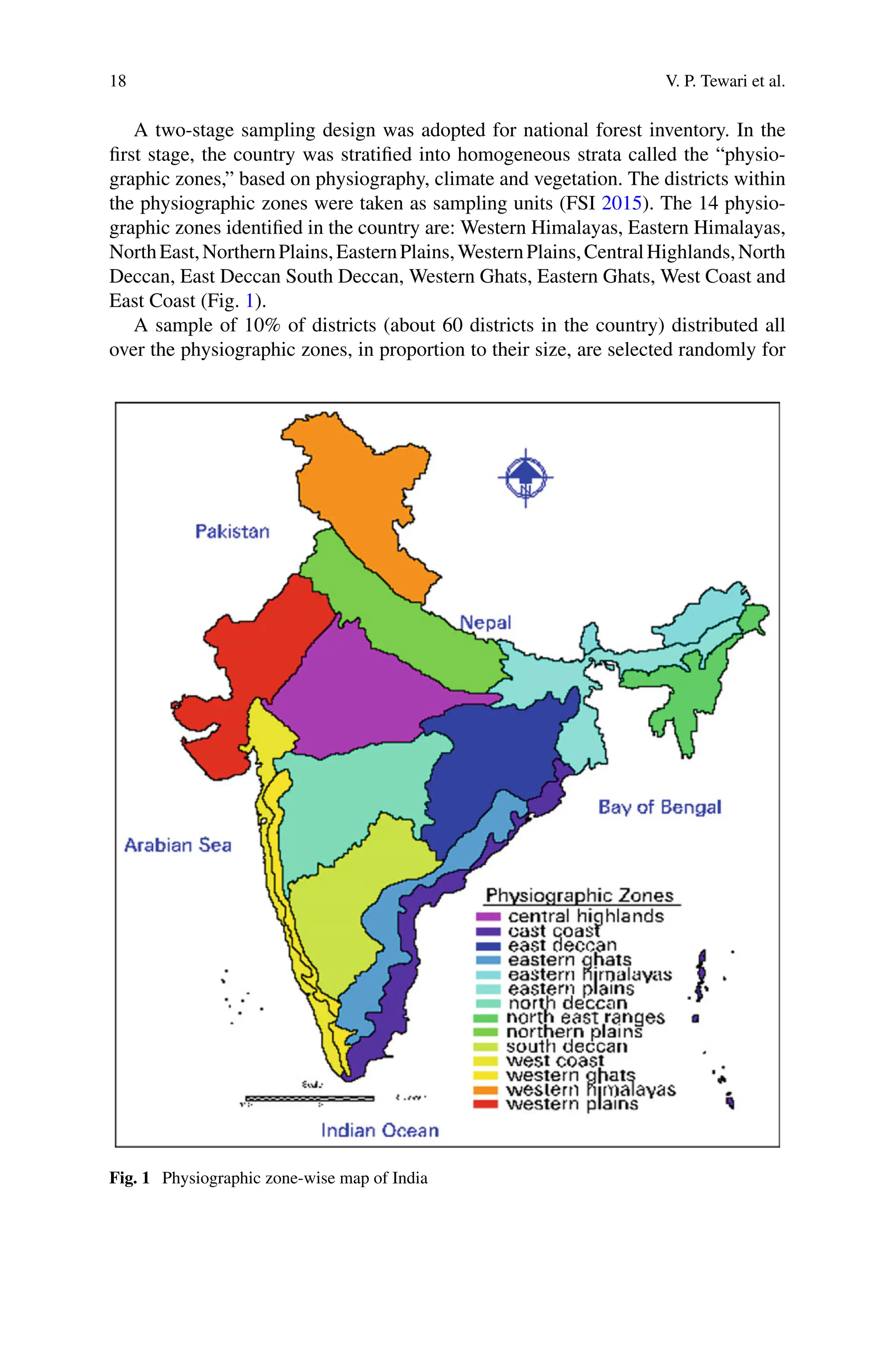
A two-stage sampling design was adopted for national forest inventory. In the
first stage, the country was stratified into homogeneous strata called the “physio-
graphic zones,” based on physiography, climate and vegetation. The districts within
the physiographic zones were taken as sampling units (FSI 2015). The 14 physio-
graphic zones identified in the country are: Western Himalayas, Eastern Himalayas,
NorthEast,NorthernPlains,EasternPlains,WesternPlains,CentralHighlands,North
Deccan, East Deccan South Deccan, Western Ghats, Eastern Ghats, West Coast and
East Coast (Fig. 1).
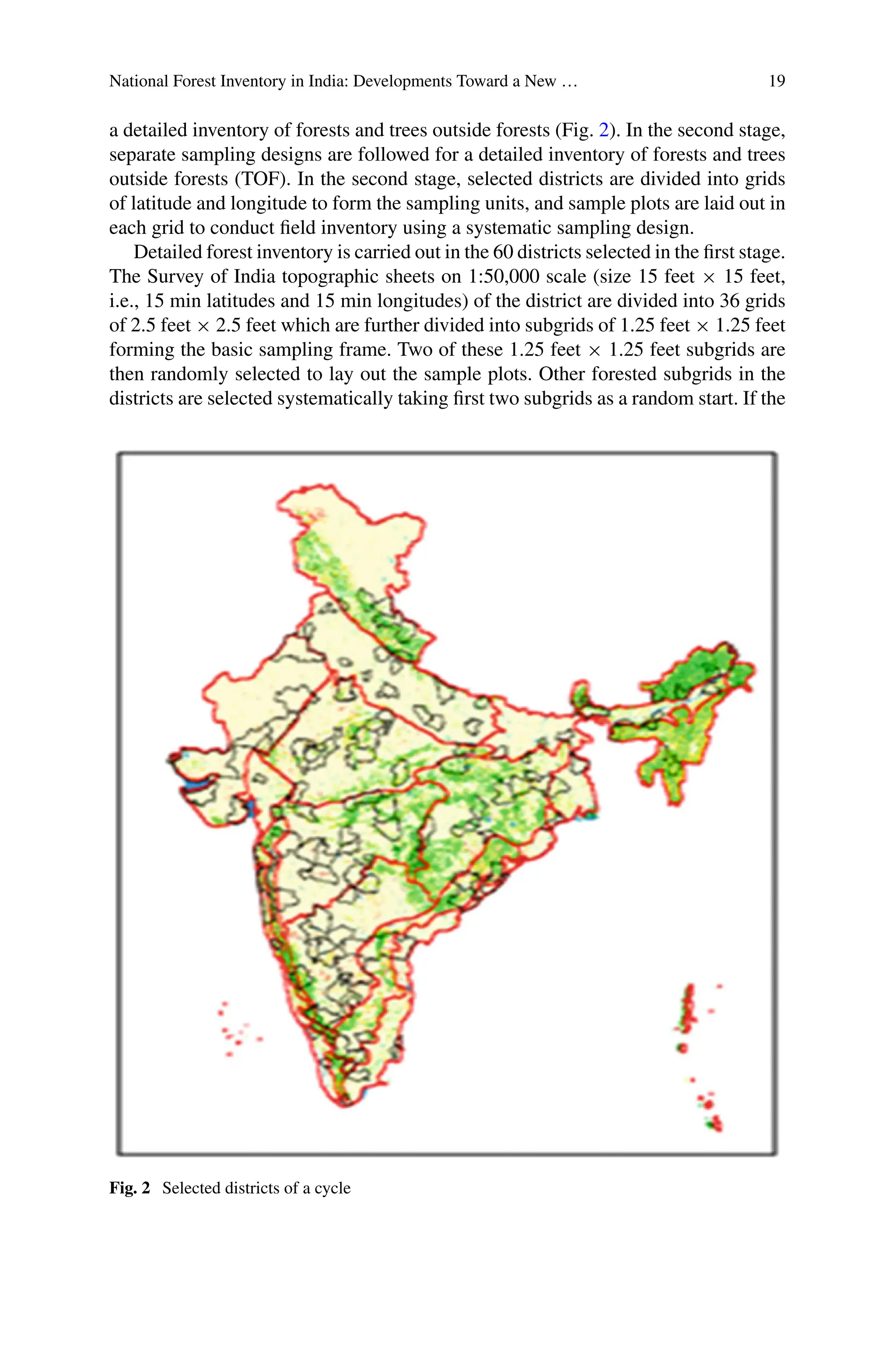
A sample of 10% of districts (about 60 districts in the country) distributed all
over the physiographic zones, in proportion to their size, are selected randomly for
Fig. 1 Physiographic zone-wise map of India
National Forest Inventory in India: Developments Toward a New … 19
a detailed inventory of forests and trees outside forests (Fig. 2). In the second stage,
separate sampling designs are followed for a detailed inventory of forests and trees
outside forests (TOF). In the second stage, selected districts are divided into grids
of latitude and longitude to form the sampling units, and sample plots are laid out in
each grid to conduct field inventory using a systematic sampling design.
Detailed forest inventory is carried out in the 60 districts selected in the first stage.
The Survey of India topographic sheets on 1:50,000 scale (size 15 feet × 15 feet,
i.e., 15 min latitudes and 15 min longitudes) of the district are divided into 36 grids
of 2.5 feet × 2.5 feet which are further divided into subgrids of 1.25 feet × 1.25 feet
forming the basic sampling frame. Two of these 1.25 feet × 1.25 feet subgrids are
then randomly selected to lay out the sample plots. Other forested subgrids in the
districts are selected systematically taking first two subgrids as a random start. If the
Fig. 2 Selected districts of a cycle
20 V. P. Tewari et al.
center of the selected 1.25 feet × 1.25 feet subgrid does not fall in the forest area, then
it is rejected. If it falls in the forest area, it is taken up for inventory. The intersections
of diagonals of such subgrids are marked as the center of the plot at which a square
sample plot of 0.1 ha area is laid out to record the measurements of diameter at breast
height (DBH) and height of selected trees species. In addition, within this 0.1 ha plot,
subplots of 1 m × 1 m are laid out at northeast and southwest corner for collecting
data on soil, forest floor (humus and litter), etc. The data regarding herbs, shrubs and
climbers are collected from four square plots of 1 m × 1 m and 3 m × 3 m size in all
four directions along the diagonal 30 m away from center of 0.1 ha plot (FSI 2015).
The data collected in the field are checked to detect any inconsistency or recording
error before entering them into computer datasheets. For processing of forest inven-
tory data, the design-based and model-based estimation protocols are employed, and
estimates for area and growing stocks are generated.
2.3 New Initiatives by Forest Survey of India in NFI
2.3.1 e-Green Watch
Compensatory Afforestation Fund Management and Planning Authority (CAMPA)
is the National Advisory Council for monitoring, technical assistance and evaluation
of compensatory afforestation and other forestry activities financed by it. Therefore,
e-Green Watch is designed and developed as a web-based, role-based workflow
applications and integrated information system which shall enable automating of
various functions and activities related to monitoring and transparency in the use of
CAMPA funds and various works sanctioned in the Annual Plan of Operations (state
CAMPA) approved by the state authorities (FSI 2015).
2.3.2 Decision Support System
Decision Support System is a web-GIS-based application which has been developed
to provide qualitative and quantitative information with respect to forest area. It
enables decision makers to take a well-informed decision based on the information
generated by the system. This system helps in a big way for taking decisions with
respect to proposals under the Forest Conservation Act (FSI 2015).
It uses different spatial layers for providing information on different issues related
to forest and wildlife areas such as “Forest Cover Mapping of Tiger Reserves” and
“Real-Time Monitoring of Forest Fires.”
National Forest Inventory in India: Developments Toward a New … 21
3 NFI in Some Other Countries
3.1 Swedish National Forest Inventory
The NFI of Sweden is based on a systematic sample. An inventory is conducted on
sample plots, and this forms the basis for both area and volume estimates. The sample
plots are circular having radius of 7–10 m. These are, for practical reasons, grouped
into clusters which are known as tracts. The tracts may be rectangular or square in
shape. Tracts may have different dimensions (300–1800 m) in different parts of the
country. The number of sample plots per tract also varies for different parts of the
country (Olsson et al. 2007).
The tracts are either permanent or temporary. The permanent tracts are laid out in
a systematic grid covering the whole country (with a random start) and are revisited
every fifth year (Fig. 3). The temporary tracts, which are visited only once, are
randomly distributed but with due consideration of the permanent tracts already laid
out in a systematic grid to avoid overlapping.
For estimation protocol, design-based and model-based approaches are used. For
small area estimates, satellite imageries are used as well (Olsson et al. 2007).
Fig. 3 Tract distribution of
single cycle of 5 years of
Swedish NFI
22 V. P. Tewari et al.
3.2 Finnish NFI
Since the beginning of 1920s, large-area forest resource information has been pro-
duced by the NFI of Finland. The NFI design was modified and the inventory cycle
is reduced to 5 years from tenth NFI in 2004. Every year measurements are done
in the whole country by measuring one-fifth of the plots, and 20% of all plots are
measured as permanent (Tomppo 2008).
To respond to current requirements and to optimize the use of the existing
resources, sampling design and stand and plot-level measurements have been
changed over a period of time. Line-wise survey sampling was adopted in the first
NFI taking the line interval as 16 km in most parts of the country, though an interval
of 13 km was used in one province and 10 km in another for estimating the error. Line
strips of 10 m wide were used for plot measurements keeping plot length as 50 m and
the distance between plots as 2 km. Same sampling design with different sampling
intensities was used for the next three inventories (Tomppo 2008). The initial four
inventories had a cycle of 3 years, but for the next five inventories, it varied from 6
to 9 years.
Presently, systematic cluster sampling is being followed where the sampling units
used are clusters, referred to as a tract. The distance between two tracts varies from
6 km × 6 km in the southernmost part of the country to 10 km × 10 km in Lapland.
The number of plots per tract varies from 9 to 14, while the distance between adjacent
plots within tract is 250–300 m (Tomppo 2008).
For estimation protocol, design-based and model-based approaches are used. For
small area estimates, satellite imageries are used as well.
3.3 German NFI
The main aim of NFI in Germany is to provide an overview of forest condition and
productivity by using a permanent design which enables re-measurement of the same
plots to obtain data on increment and drain. For the first time, a sample-based NFI was
carried out between 1986 and 1990, and second NFI took place during 2001–2002
(Polley et al. 2010). The third NFI was completed during 2011–2012.
A periodic survey is being carried out in German NFI in the whole territory
at time intervals which is not predefined but has to be determined a new in every
repetition. The information provided by the NFI is of immense significance for forest
policy, especially in connection with international commitments to report on forest
resources. The information generated is also useful for the wood processing industry
(Kändler 2008).
A systematic distribution of tracts on regular grids of regionally differing width is
used in the inventory design. The primary sampling unit is a quadrangular tract having
side length of 150 m, and the tract corners are the centers of permanently marked
subplots in which different sampling procedures are adopted for the selection of
National Forest Inventory in India: Developments Toward a New … 23
sample trees and the survey of various characteristics. The General Administrative
Regulation prescribes a basic grid of the width of 4 km × 4 km covering entire
country with a defined starting point. The sample grid size decreased in some states
to a 2.83 km × 2.83 km or 2 km × 2 km. The sample selection on a tract corner is made
according to size of plants using different methods like horizontal point sampling and
fixed plot sampling. For each inventory tract, almost 150 characteristics are recorded
(Kändler 2008).
Different estimators of volume growth are used, and estimates are developed. For
estimation protocol, satellite imageries are used as well.
3.4 US NFI
In USA, the Forest Inventory and Analysis (FIA) Program collects, analyzes and
reports information on the status, trends and condition of forests. Different kind
of information is generated like quantification of existing forest, their location and
ownership, change in forest condition, growth of the trees and other vegetation and
number of trees died or has been removed (Burkman 2005).
Irrespective of ownership or availability for forest harvesting, a single inventory
program includes all forested lands in the country which covers all public and private
forest land like reserved areas, wilderness, National Parks, defense installations and
National Forests.
As part of annual inventory, measurements are taken on a fixed proportion of the
plots in each state every year under FIA. Each portion of the plots is termed as a
panel. The legislative mandate requires measurement of 20% of the plots each year
in every state which is to be accomplished through a federal-state partnership. Plans
have also been formulated for less intensive sampling levels of 15% per year and
10% per year (Burkman 2005).
The plot intensity presumes that sufficient plots are measured to suit precision
standards for area and volume estimates that are consistent with historical levels.
Individual states have liberty to increase the sample intensity by installing additional
plots, but at their own expense, for increasing the precision. The annual inventory
system has one advantage that it provides maximum flexibility to states to engage in
such intensifications.
To provide a uniform basis for determining the annual set of measurement plots, a
nationally uniform cell grid has been super-imposed over old set of sample locations.
This system provides a standard frame for integrating FIA and for linking the other
data sources of program such as satellite imagery, spatial models and other surveys.
TheFIAprogramincludesanationalsetofcoremeasurementscollectedonastandard
field plot. The enhanced FIA program consists of three phases or tiers (Burkman
2005).
In Phase 1, remotely sensed data are collected in the form of aerial pho-
tographs/satellite imagery. In this Phase, two tasks (initial plot measurement using
24 V. P. Tewari et al.
remotely sensed data and stratification) are accomplishes. This phase “photograph
point” is characterized as non-forest or forest.
In Phase 2, a subset of the photograph points are selected for field data collection
which consists of one field sample site for every 6000 acres. Information about
forest type, site attributes, tree species, tree size, overall tree condition, etc. is being
collected by the field crews.
Phase 3 consists of a subset of Phase 2 sample plots. These plots are measured for a
broader set of forest health attributes (like tree crown conditions, lichen community
composition, under-story vegetation, down woody debris and soil attributes). An
associated sample scheme is also in place to detect and monitor ozone injury on
forest vegetation. For every 96,000 acres, there is one Phase 3 plot which means for
every 16 Phase 2 plots, there is one Phase 3 plot (Fig. 4).
An FIA plot consists of a cluster of four circular subplots which are spaced in
a fixed pattern. The plot is designed to provide a sampling frame for all Phase 2
Fig. 4 Phase 2/Phase 3 plot design
National Forest Inventory in India: Developments Toward a New … 25
and Phase 3 measurements. Most of the measurements are taken within the subplots.
Seedlings, saplings and other vegetation are measured in respective defined subplots.
For estimation protocol, design-based and model-based approaches are used.
Satellite imageries are also used for stratification, quantification of stratum size and
generating estimates of various parameters.
4 National Forest Monitoring and Assessment-FAO’s
Initiative
FAO initiated an activity to provide support to National Forest Monitoring and
Assessment (NFMA) in view of the growing demand for reliable information
on forests and tree resources both at country and global levels. The support
offered by FAO includes developing a harmonized approach to NFMA, informa-
tion management, reporting and support to policy impact analysis for national-level
decision-making.
NFMA focuses on the establishment of a long-term monitoring system that will
be sustainable in time with repeated periodic measurements. This is performed by
strengthening national capacity and institutionalizing the inventory process. Field
inventory and remote sensing, both are combined in the NFMA methodological
approach.
For the NFMA, the systematic sampling design is recommended. The latitude–
longitude grids of 1° × 1° (or appropriate size) are prepared to be used as a sampling
frame. Sampling units are selected at the intersection of every degree of this grid.
Optimum sample size is ascertained depending on country’s information needs at
requiredprecision.Pre-orpost-stratificationmaybeadoptedtooptimizetheprecision
and costs. The number of sampling units to be surveyed is ascertained by the required
statistical reliability of the data, the available resources for the work and with a view
of enabling periodic monitoring (Saket et al. 2010).
The major sampling unit is a square tract of 1 km × 1 km, and each sampling unit
contains a cluster of four permanent, rectangular, half-hectare sample plots, placed
in perpendicular orientations (Fig. 5). Smaller subunits are delineated within each
plot, e.g., three sets of subplots, three measurement points and three fallen dead wood
transect lines (FAO 2008). The use of satellite imageries is advised for stratification,
quantification of size of strata and generating estimates of various parameters.
5 New National Forest Inventory System in India
Generally, the information generated by NFI are used in forest policy making at
national and international levels, regional and national forest management plan-
ning, planning of forest investments, assessing sustainability of forests, evaluation
26 V. P. Tewari et al.
Fig. 5 FAO NFMA design
National Forest Inventory in India: Developments Toward a New … 27
of greenhouse gas emissions and changes in carbon storage and research, etc. (Tewari
2016).
The considerations related to use of data for planning sustainable forest man-
agement require that sampling units are uniformly spread (not a two-stage clus-
ter sampling) and revisited at shorter intervals (five years) to monitor changes and
national sample plots, and state plots must have statistical compatibility. It should
include new parameters like NTFP, eco-system services, evaluation of green house
gas emissions, disturbances in forests, etc. At the same time, it should provide infor-
mation at state level so that information for Measurement Reporting and Verification
(MRV) of REDD+ is generated. Remote sensing data have greater role for state-level
applications when integrated with field survey.
Seven main points are crystallized for the NFI which are as: (1) All the countries
(and FAO) are following systematic sampling for NFI, (2) nation-wide wall-to-wall
grids are considered, (3) cluster of plots are considered, (4) there are permanent and
temporary plots, (5) all the nation relevant data are collected, (6) use of geomatics,
specially remotely sensed data and (7) there is a provision of repeating the same plot
after fixed time period.
The new National Level Continuous Forest Inventory System has been conceived
to form a basis for making continuing policy and planning decisions, including the
role of forests as an ecosystem (the “conservation view”) and its role as resource
provider (the “utilization view”), and this holds for all levels of forestry from the
local to the global.
The revised NFI is a new generation of NFI system geared for providing compre-
hensive information to meet above requirements to meet information requirements
of sustainable forest management including those under Green India Mission and
CAMPA. Parameters for meeting reporting obligations under the conventions on
climate change (UN-FCCC), biodiversity (UN-CBD) and combating desertification
(UN-CCD) are also included. It may be mentioned that under REDD+, countries may
expect considerable payments when they successfully have implemented policies that
reduce emissions from deforestation and forest degradation. An important new fea-
ture of these payments, however, is that they are strictly performance based, which
means that the success of the policies needs to be evidenced by methodologically
sound and transparently documented forest monitoring (REDD+ MRV).
Incorporating above suggestions, according to national interest and utility, Forest
Survey of India has redesigned the NFI which will provide information about the
traditional variables, viz. growing stock, regeneration, land use within Recorded
Forest Area (RFA), grazing, size classes, humus classes and origin of stand as well as
newer variables, viz. quantification of important NTFP resource species, biodiversity
indicators, climate change indicators and carbon storage. It can provide estimates at
state level also for the states having more than 10,000 km2
of forest area.
28 V. P. Tewari et al.
5.1 Proposed New Design for NFI
The NFI is designed to include all forest area of the country which is notified by
the government. The digital boundaries of forest area are available for 12 states of
the country. For the remaining states, green-wash area (shown as green in Survey of
India topographic sheet depicting RFA and other traditional forest areas at the time
of preparation of the topographic sheets) will be taken as a proxy of Recorded Forest
Area.
The new NFI envisages measurement of about 35,000 sample points across the
country in five years. Every year 20% sample points will be covered. In other words,
it will measure a fixed proportion of the plots in each state, each year. About 10% of
the identified sample plots (may be referred as POPs) will be used for special studies
related to biodiversity, climate change, forest soils, etc.
The sample size is optimized so that enough plots are measured to satisfy precision
standards for area and volume estimates. There is provision that if states want more
precise estimates, then they may choose to increase the sample size by installing
additional plots. For NFI, 10% allowable error has been considered at state level
for forests and trees outside forest (TOF) separately. To achieve this target, for few
states, the number of sampling units has been increased to 2 or 3 per grid.
5.1.1 A Grid-Based Sampling Frame
Remote sensing-based inventories may benefit if the plot-level estimates correspond
with the pixel-level information (Ling et al. 2014). The new NFI design involves
a change from the current two-stage random sampling approach to a systematic
grid-based design using a country-wide uniform grid of 5 × 5 km pixels. A number
(1, 2, 3, 4 or 5) is assigned to each 25 km2
pixel.
A forest layer will be developed by combining the digital layer of the Recorded
Forest Area (RFA) boundaries of the 19 states and additional forest areas (known as
“green-wash areas” because of the map coloring) that are not part of the official RFA
classification. This forest layer will be overlaid on the grid layer, and the intersection
of these two layers will provide the general sampling frame for the NFI. The Forest
Survey of India maintains a large database with records of previous NFI sample
points which can be utilized in each new NFI.
Each individual grid cell representing a pixel of 25 km2
will thus be identified
regarding one of three possible attributes, namely forested, no forest and TOF. A
systematic sampling scheme with random start will be used. A random number will
be chosen from 1 to 5 as a random start and thereafter all grids with that number
and the attribute “forested” will be identified for data collection. The forest cover
map based on satellite-based remote sensing data will be utilized for stratum size
calculation.
Within the selected grid pixel, using Geographical Information System (GIS)
software, a random point will be selected as the center of a new temporary sample
National Forest Inventory in India: Developments Toward a New … 29
point. On average, every grid cell representing a forest area of 25 km2
will have one
sample point. Field crews will collect data on site attributes, tree species and DBHs
on accessible forest land. It is also envisaged that 10% of all plots will be subjected to
an additional assessment of indicators of biodiversity, forest health, climate change
and soil attributes.
5.1.2 New Plot Configuration
In the existing NFI, Forest Survey of India was laying out single plot of 0.1 ha at
the sample point location for tree species. Though, there were multiple subplots for
different characteristics, viz. four subplots for regeneration, four subplots for biomass
of herbs. Almost all the other leading countries are using cluster of plots for tree
measurements. Plots of different sizes are being used even in same country depending
upon the variability in different parts of country. Similarly, distance between plots
in the cluster varies among countries for obvious reasons.
For new NFI, Forest Survey of India conducted a pilot study, with the following
objectives:
• Plot design: Single plot layout or cluster of subplots is better,
• If cluster, then which subplot size is better among 7, 8 and 9 m radius vis-à-vis
0.1 ha plot,
• What should be the distance between subplots: 30 or 40 ms,
• Whether circular subplot is feasible for NFI and
• Time and manpower requirement.
Before the pilot study, it has been decided that the USDA Forest Service FIA plot
layout, i.e., cluster of four circular subplots spaced out in a fixed pattern, will be
more suitable, if cluster of subplots is to be used.
Pilot study concluded that:
• Among the seven alternatives of plot design, the cluster of subplots with radius 8 m
and at 40 m distance has better result compared with existing single plot layout.
• The circular subplot is feasible (the pilot study helped a lot as crew members got
convinced while conducting the pilot itself).
• It reduces time and manpower requirement.
Based on outcome of pilot study and discussions thereafter, the following plot
design (Fig. 6) is finalized which will address measurement of all the envisaged
characteristics of forests.
30 V. P. Tewari et al.
40m
40
m
40m 40m
40m
40 m
60 m
8m 5m
900
8m 900 8m 900
8m
900
5m 5m
5m
N
Fig. 6 Proposed plot design for NFI in India
6 Conclusions
In order to generate information for changing requirements of support to states in
sustainable forest management, inventory of NTFP and other new variables, mon-
itoring of change in forest characteristics, inclusion of climate change indicators,
significant improvement of precision at the state/regional level, etc., the following
changes have been proposed:
National Forest Inventory in India: Developments Toward a New … 31
• From two-stage sampling design to uniform grid-based (5 km × 5 km) systematic
sampling scheme;
• Re-measuring of same plot after 5 years (doubles the workload);
• Single plot design to cluster of subplots;
• Provision of permanent and temporary plots;
• Provision for nationally relevant data;
• Use of GIS and satellite imageries, for enhancing precision of estimates and
developing small, is the estimates; and
• Flexibility to increase sample size at state and local levels so that combined effort
may yield information at national, regional and local levels.
The value of the network of Mixed Permanent Observation Plots (POPs) will
increase with each additional re-measurement because observations collected over
long periods of time will increasingly reveal specific responses to climate change and
human disturbance. Additional large permanent plots, covering 1 ha or 4 ha, may be
established and maintained by the Indian Council of Forest Research and Education
to complement the database of Forest Survey of India.
A basic standard for analyzing POP datasets, using the R statistical software,
reflects current technology and analytical capabilities. Continuous adaptation is
essential, recognizing new developments in hardware and analytical tools, preferably
in co-operation with interested research institutes and universities. This requires a
national commitment to continuity, a firm decision to ensure that all POPs are re-
measured at regular intervals, for example, by assigning a special status to all POP’s
by an Act or Regulation through the Parliament.
References
Avery, T. E., & Burkhart, H. E. (2002). Forest measurements (5th ed., p. 456). New York: McGraw-
Hill.
Brazil. (2016). Inventário florestal nacional: principais resultados: Distrito Federal/Serviço Florestal
Brasileiro (SFB). Brasília: SFB, Série Relatório Técnico.
Burkhart, H. E., & Amateis, R. L. (2012). Plot installations for modeling growth and yield of loblolly
pine plantations. In X. H. Zhao, C. Y. Zhang, K. v. Gadow (Eds.), Forest observational studies.
Proceedings of the International Workshop Held, September 20–21, 2012 (pp. 17–34). Beijing
Forestry University.
Burkman, B. (2005). Forest inventory and analysis—sampling and plot design. FIA Fact Sheet
Series. USDA Forest Service. http://www.fia.fs.fed.us/library/fact-sheets/data…/Sampling%
20and%20Plot%20Design.pdf. Accessed on February 22, 2018.
Canada. (2018). https://nfi.nfis.org/en/history. Accessed February 22, 2018.
Corral Rivas, J. S., Torres-Rojo, J. M., Lujan-Soto, J. E., Nava-Miranda, M. G., Aguirre-Calderón,
O. A., & Gadow, K. v. (2016). Density and production in the natural forests of Durango/Mexico.
Allgemeine Forst-und Jagdzeitung (German Journal of Forest Research), 187(5–6), 93–103.
Fan, C., Tan L., Zhang, C., Zhao, X., & Gadow, K. v. (2017). Analysing taxonomic structures and
local ecological processes in temperate forests in North Eastern China. BMC Ecology, 17, 33,
1–11.
FAO. (2008). NFMA-Knowledge reference, dissemination and networking. National forest moni-
toring and assessment working paper. Food and Agriculture Organization, Rome (p. 12).
32 V. P. Tewari et al.
Frayer, W. E., & Furnival, G. M. (2000). History of forest survey sampling designs in the United
States (pp. 42–49). In M. Hansen & T. Burk (Eds.), Integrated tools for natural resources inven-
tories in the 21st century: Proceedings of the IUFRO conference, August 16–20, 1998, Boise, ID.
Gen. Tech. Rep. NC–212. St. Paul, MN: U.S. Department of Agriculture, Forest Service, North
Central Research Station.
FSI. (2015). India state of the forest report 2015. Dehradun, India: Forest Survey of India.
Gadow, K. v. (2017a). The potential of permanent forest observational studies in India. Report
prepared for FAO, Rome, July 2017 (p. 38).
Gadow, K. v. (2017b). Permanent forest observational plots-assessment and analysis. Report
prepared for FAO, Rome, October 2017 (p. 38).
Iehara, T. (1999). New Japanese forest resource monitoring survey. Sanrin, 1384, 54–61. (in
Japanese).
Jamir, W. (2014). Mapping of forest cover through remote sensing and geographical information
system (GIS), Wokha District, Nagaland IOSR. Journal of Environmental Science, Toxicology
and Food Technology, 8(4), 97–102.
Kändler, G. (2008). The design of second german national forest inventory (pp. 19–24). In R. E.
McRoberts, G. A. Reams, P. C. Van Deusen, & W. H. McWilliams (Eds.), Proceedings of the
Eighth Annual Forest Inventory and Analysis Symposium (p. 408). Monterey CA, October 19–16,
2006. Gen. Tech. Report WO-79. USDA Forest Service, Washington, DC.
Köhl, M., Scott, C. T., & Zingg, A. (1995). Evaluation of permanent sample surveys for growth and
yield studies: A Swiss example. Forest Ecology and Management, 71, 187–194.
Ling, D., Tao, Z., Zhenhua, Z., Xiang, Z., Kaicheng, H., & Hao, W. (2014). Mapping forest biomass
using remote sensing and national forest inventory in China. Forests, 5, 1267–1283.
Lorenz, M., Varjo, J., & Bahamondez, C. (2005). Forest assessment for changing information needs.
In G. Mery, R. Alfaro, M. Kanninen, & M. Lobovikov (Eds.), Forests in the global balance-
Changing paradigms (Vol. 17, pp. 139–150). IUFRO World Series.
McRoberts, R. E., Bechtold, W. A., Patterson, P. L., Scott, C. T., & Reams, G. A. (2005). The
enhancedforestinventoryandanalysisprogramoftheUSDAforestservice:Historicalperspective
and announcement of statistical documentation. Journal of Forestry, 103(6), 304–308.
Olsson, H., Egberth, M., Engberg, J., Fransson, J. E. S., Pahlén, T. G., Hagner, O., et al. (2007).
Current and emerging operational uses of remote sensing in Swedish forestry (pp. 39–46). In R.
E. McRoberts, G. A. Reams, P. C. V. Deusen, & W. H. McWilliams (Eds.), Proceedings of the
Seventh Annual Forest Inventory and Analysis Symposium (p. 319). Portland ME, October 3–6,
2005. Gen. Tech. Report WO-77. USDA Forest Service, Washington, DC.
Pandey, D. (2008). India’s forest resource base. International Forestry Review, 10, 116–124.
Pandey, D. (2012). National forest monitoring for REDD+ in India. In B. Mora, M. Herold, V. De Sy,
A. Wijaya, L. Verchot, & J. Penman (Eds.), Capacity development in national forest monitoring:
Experiences and progress for REDD+ (pp. 19–26). Joint report by CIFOR and GOFC-GOLD.
Bogor, Indonesia.
Polley, H., Schmitz, F., Hennig, P., & Kroiher, F. (2010). National forest inventories reports: Ger-
many. In E. Tomppo, T. Gschwantner, M. Lawrence, & R. E. McRoberts (Eds.), National forest
inventories—Pathways for common reporting (pp. 223–243). Berlin: Springer.
Saket, M., Branthomme, A., & Piazza, M. (2010). FAO NFMA—Support to developing countries
on national forest monitoring and assessment. In E. Tomppo, T. Gschwantner, M. Lawrence, &
R. E. McRoberts (Eds.), National forest inventories: Pathways for common reporting (p. 612).
Springer Science, Business Media B.V.
Singh, K. D. (2006). A tribute to Forest Survey of India, Dehradun. Souvenir: Silver Jubilee year
1981–2006. Forest Survey of India, Dehradun, India.
Tan, L., Fan, C., Zhang, C., Gadow, K. v., & Fan, X. (2017). How beta diversity and the underlying
causes vary with sampling scales in the Changbai mountain forests. Ecology and Evolution, 7(23),
10116–10123.
National Forest Inventory in India: Developments Toward a New … 33
Tewari, V. P. (2016). Forest inventory, assessment, and monitoring, and long-term forest obser-
vational studies, with special reference to India. Forest Science and Technology, 12(1),
24–32.
Tewari, V. P., & Kleinn, C. (2015). Considerations on capacity building for national forest assess-
ments in developing countries—With a case study of India. International Forestry Review, 17(2),
244–254.
Tomppo, E. (2008). The Finnish national forest inventory. In R. E. McRoberts, G. A. Reams, P. C.
V. Deusen, & W. H. McWilliams (Eds.), Proceedings of the Eighth Annual Forest Inventory and
Analysis Symposium (p. 408). Monterey CA, October 19–16, 2006. Gen. Tech. Report WO-79.
USDA Forest Service, Washington, DC (pp. 39–46).
Yao, J., Zhang, X., Zhang, C., Zhao, X., & Gadow, K. v. (2016). Effects of density dependence in
a temperate forest in northeastern China. NATURE Scientific Reports 6, Article number: 32844.
Zhang, C., Zhao, Y., Zhao, X., & Gadow, K. v. (2012). Species-Habitat associations in a northern
temperate forest in China. Silva Fennica, 46(4), 501–519.
Zhao, X. H., Corral-Rivas, J. J., Zhang, C. Y., Temesgen, H., & Gadow, K. v. (2014). Forest
observational studies-an essential infrastructure for sustainable use of natural resources. Forest
Ecosystem, 1, 8. https://doi.org/10.1186/2197-5620-1-8.
Zeng, W. -S., Tomppo E., Healey. S. P., & Gadow, K. V. (2015). The national forest inventory in
China: History—Results—International context. Forest Ecosystems, 2, 23
Internet of Things in Forestry
and Environmental Sciences
S. B. Lal, Anu Sharma, K. K. Chaturvedi, M. S. Farooqi and Anil Rai
Abstract Internet of Things (IoT) is a revolutionary technology that aims to inter-
connecteverydayobjectsequippedwithidentity,sensors,networking,andprocessing
capabilities and allow them to communicate with one another and with other devices
and services over the Internet to accomplish some objective. This is a transition from
interconnected computers to interconnected things that require support for interop-
erability among heterogeneous devices enabling simplification of new application
development for programmers under the infrastructure of IoT. Middleware for IoT
is a software layer interposed between the infrastructure and the applications that
basically aims to support important requirements for these applications (Yu et al. in
Cybern. Inf. Technol. 14(5):51–62, 2014). Generally, the form of communication has
been human–human or human–device, but the IoT is a communication as machine–
machine. So, it is a network of objects with a self-configured wireless network. These
IoT frameworks are used to collect, process, and analyze data streams in real time
and facilitate provision of smart solutions. IoT is observed as a natural evolution
of environmental sensing systems. This aims to use different sensors to measure
key parameters in forest areas in regular basis, with no need of human interven-
tion and to send this information via wireless communication to a central platform.
IoT-based environment monitoring technologies and a smart home technology are
being accepted by people because they have good prospects for development. IoT
products in agriculture include a number of IoT devices and sensors as well as a
powerful dashboard with analytical capabilities and in-built reporting features (Yu
et al. in Cybern. Inf. Technol. 14(5):51–62, 2014). A networking-based intelligent
platform can monitor forest environmental factors in time by applying IoT. This tech-
nology has the advantages of low power dissipation, low data rate, and high-capacity
transportation.
Keywords Agriculture · Forestry · Environment · Sensor networks · Smart
farming · Wireless networks
S. B. Lal (B) · A. Sharma · K. K. Chaturvedi · M. S. Farooqi · A. Rai
Centre for Agricultural Bioinformatics, ICAR-Indian Agricultural Statistics Research Institute,
New Delhi, India
e-mail: sblall16@gmail.com
© Springer Nature Singapore Pte Ltd. 2020
G. Chandra et al. (eds.), Statistical Methods and Applications in Forestry
and Environmental Sciences, Forum for Interdisciplinary Mathematics,
https://doi.org/10.1007/978-981-15-1476-0_3
35
36 S. B. Lal et al.
1 Introduction
Nowadays, every corner of the world is availing the facility of Internet for carry-
ing out day-to-day activities, business, education, and other fields. The activities
using this modern technology include online shopping, trading, ticket booking, chat,
discussion, health-related information, and many more uncounted activities. The
government is also encouraging the communications made using electronic media.
We all are aware that availability of Internet provides connection between one human
and another human. Additionally, it is also a connection between a connectible device
and any other equipment having a unique identification. These devices have neces-
sary components for being networked. Therefore, it is possible to transfer necessary
useful information if these devices are connected together using any networking
technology. This will enable the instant decision making for effective and timely use
of devices to get a fully automated system (Nandurkar et al. 2014).
When two networkable equipment (things) having a unique identification (ID)
are joined to a network (Internet), then managing them by using communication of
information between them is called Internet of Things (IoT) (Ashton 2009). Internet
is a connection between people; therefore, it is called Internet of People. IoT con-
nects all connectible things, so it is called Internet of Things. IoT is lot more than
what an Internet is because it increases the number of connections by any mean of
networking technology which includes any connectible electronic component (An
et al. 2012). IoT can bring dynamic control of industry and daily life of human being
by speeding up the decision-making process for better results and timely actions.
Production efficiency and other related activities of industrial sector can experience
a phenomenal progress by using IoT. Our daily life can also be equipped with more
intelligent activities and well on time actions to gain better living standards. Auto-
matic communication of useful information through connected devices enables every
necessary precautionary action very fast. Automatic communication of information
among the available connectible devices makes the signal transfer very fast. These
devices have unique identification (ID) which is used to connect them together to
transfer the useful information. This saves time to have very effective resource uti-
lization ratio. IoT can establish better relationship between human and nature as
the integrated sensors or other electronic devices transfer necessary and relevant
information very fast resulting in formation of an intellectual entity by integrating
human society and physical systems. By utilizing this, an intellectual institution can
be formed by integrating human society and physical systems (Khan et al. 2012).
It is possible to communicate information among the underlying devices due to the
flexible configuration of the software. Mobility can be brought in the field of forest
and environmental science too by implementing IoT as it functions as a technology
integrator.
In an agriculture environment, sensors measure various pieces of information
abouttheenvironmentandcommunicatewirelesslythroughagatewaywhichreceives
and transfers the messages and related data to online database. This information is
Internet of Things in Forestry and Environmental Sciences 37
made easily accessible online for analyzing further (Bayne et al. 2017). A large num-
ber of wireless sensor networks have been installed in the forest and environmental
sectors for monitoring of parameters for growth of plantation such as temperature,
humidity, soil moisture, and so on. Estimation of leaf area index is also a crop
monitoring process to measure plant growth rates (Qu et al. 2014a, b).
2 Layers of IoT
In the modern era, electronic devices and its usefulness in human life have increased
tremendously. All these devices have a very specific ability for their purpose of use
(Fig. 1). For example, telephone, mobile phone, laptop, GPS equipment, partial or
fully automatic car, electronic watch, and many other devices are designed to fulfill
a specific purpose. If these machines are connected by using any suitable medium
and the results generated by them are combined together to find an automatic useful
result, it can bring a revolutionary change in public life.
There are four layers of an IoT-based system, viz. sensor identification layer, net-
work construction layer, management layer, and integrated application layer. These
layers, as shown in Fig. 2, have their specific task to perform to carry out the whole
process efficiently. The first layer sense identification layer is responsible for sensing
the signal sent by the device (through Wi-Fi or radio frequency) to another device
present in the surrounding area and registers its ID. In the second layer, the infor-
mation sent by these devices is connected to the network for transferring to the next
layer. Processing the information obtained is done in the third layer by making it
suitable. In the last layer, the work of fulfilling the appropriate response is done by
conveying the right information to the right people or devices.
More itemized perspective of four layers of IoT has been represented in Fig. 3.
Some important sensor gadgets have been shown in the first layer, for example,
Fig. 1 Use of various instruments in human life
Random documents with unrelated
content Scribd suggests to you:
The Project Gutenberg eBook of A Gleeb for
Earth
This ebook is for the use of anyone anywhere in the United States
and most other parts of the world at no cost and with almost no
restrictions whatsoever. You may copy it, give it away or re-use it
under the terms of the Project Gutenberg License included with this
ebook or online at www.gutenberg.org. If you are not located in the
United States, you will have to check the laws of the country where
you are located before using this eBook.
Title: A Gleeb for Earth
Author: Charles Schafhauser
Illustrator: Ed Emshwiller
Release date: January 7, 2016 [eBook #50869]
Most recently updated: October 22, 2024
Language: English
Credits: Produced by Greg Weeks, Mary Meehan and the Online
Distributed Proofreading Team at http://www.pgdp.net
*** START OF THE PROJECT GUTENBERG EBOOK A GLEEB FOR
EARTH ***
A Gleeb for Earth
By CHARLES SHAFHAUSER
Illustrated by EMSH
[Transcriber's Note: This etext was produced from
Galaxy Science Fiction May 1953.
Extensive research did not uncover any evidence that
the U.S. copyright on this publication was renewed.]
Not to be or not to not be ... that was the
not-question for the invader of the not-world.
Dear Editor:
My 14 year old boy, Ronnie, is typing this letter for me because he
can do it neater and use better grammar. I had to get in touch with
somebody about this because if there is something to it, then
somebody, everybody, is going to point finger at me, Ivan Smernda,
and say, "Why didn't you warn us?"
I could not go to the police because they are not too friendly to me
because of some of my guests who frankly are stew bums. Also they
might think I was on booze, too, or maybe the hops, and get my
license revoked. I run a strictly legit hotel even though some of my
guests might be down on their luck now and then.
What really got me mixed up in this was the mysterious
disappearance of two of my guests. They both took a powder last
Wednesday morning.
Now get this. In one room, that of Joe Binkle, which maybe is an
alias, I find nothing but a suit of clothes, some butts and the letters
I include here in same package. Binkle had only one suit. That I
know. And this was it laying right in the middle of the room. Inside
the coat was the vest, inside the vest the shirt, inside the shirt the
underwear. The pants were up in the coat and inside of them was
also the underwear. All this was buttoned up like Binkle had melted
out of it and dripped through a crack in the floor. In a bureau drawer
were the letters I told you about.
Now. In the room right under Binkle's lived another stew bum that
checked in Thursday ... name Ed Smith, alias maybe, too. This guy
was a real case. He brought with him a big mirror with a heavy
bronze frame. Airloom, he says. He pays a week in advance,
staggers up the stairs to his room with the mirror and that's the last
I see of him.
In Smith's room on Wednesday I find only a suit of clothes, the
same suit he wore when he came in. In the coat the vest, in the vest
the shirt, in the shirt the underwear. Also in the pants. Also all in the
middle of the floor. Against the far wall stands the frame of the
mirror. Only the frame!
What a spot to be in! Now it might have been a gag. Sometimes
these guys get funny ideas when they are on the stuff. But then I
read the letters. This knocks me for a loop. They are all in different
handwritings. All from different places. Stamps all legit, my kid says.
India, China, England, everywhere.
My kid, he reads. He says it's no joke. He wants to call the cops or
maybe some doctor. But I say no. He reads your magazine so he
says write to you, send you the letters. You know what to do. Now
you have them. Maybe you print. Whatever you do, Mr. Editor,
remember my place, the Plaza Ritz Arms, is straight establishment. I
don't drink. I never touch junk, not even aspirin.
Yours very truly,
Ivan Smernda
Bombay, India
June 8
Mr. Joe Binkle
Plaza Ritz Arms
New York City
Dear Joe:
Greetings, greetings, greetings. Hold firm in your wretched
projection, for tomorrow you will not be alone in the not-world. In
two days I, Glmpauszn, will be born.
Today I hang in our newly developed not-pod just within the mirror
gateway, torn with the agony that we calculated must go with such
tremendous wavelength fluctuations. I have attuned myself to a
fetus within the body of a not-woman in the not-world. Already I am
static and for hours have looked into this weird extension of the
Universe with fear and trepidation.
As soon as my stasis was achieved, I tried to contact you, but got no
response. What could have diminished your powers of articulate
wave interaction to make you incapable of receiving my messages
and returning them? My wave went out to yours and found it, barely
pulsing and surrounded with an impregnable chimera.
Quickly, from the not-world vibrations about you, I learned the not-
knowledge of your location. So I must communicate with you by
what the not-world calls "mail" till we meet. For this purpose I must
utilize the feeble vibrations of various not-people through whose
inadequate articulation I will attempt to make my moves known to
you. Each time I will pick a city other than the one I am in at the
time.
I, Glmpauszn, come equipped with powers evolved from your
fragmentary reports before you ceased to vibrate to us and with a
vast treasury of facts from indirect sources. Soon our tortured
people will be free of the fearsome not-folk and I will be their
liberator. You failed in your task, but I will try to get you off with
light punishment when we return again.
The hand that writes this letter is that of a boy in the not-city of
Bombay in the not-country of India. He does not know he writes it.
Tomorrow it will be someone else. You must never know of my exact
location, for the not-people might have access to the information.
I must leave off now because the not-child is about to be born.
When it is alone in the room, it will be spirited away and I will spring
from the pod on the gateway into its crib and will be its exact
vibrational likeness.
I have tremendous powers. But the not-people must never know I
am among them. This is the only way I could arrive in the room
where the gateway lies without arousing suspicion. I will grow up as
the not-child in order that I might destroy the not-people completely.
All is well, only they shot this information file into my matrix too fast.
I'm having a hard time sorting facts and make the right decision.
Gezsltrysk, what a task!
Farewell till later.
Glmpauszn
Wichita, Kansas
June 13
Dear Joe:
Mnghjkl, fhfjgfhjklop phelnoprausynks. No. When I communicate
with you, I see I must avoid those complexities of procedure for
which there are no terms in this language. There is no way of
describing to you in not-language what I had to go through during
the first moments of my birth.
Now I know what difficulties you must have had with your limited
equipment. These not-people are unpredictable and strange. Their
doctor came in and weighed me again the day after my birth.
Consternation reigned when it was discovered I was ten pounds
heavier. What difference could it possibly make? Many doctors then
came in to see me. As they arrived hourly, they found me heavier
and heavier. Naturally, since I am growing. This is part of my
instructions. My not-mother (Gezsltrysk!) then burst into tears. The
doctors conferred, threw up their hands and left.
I learned the following day that the opposite component of my not-
mother, my not-father, had been away riding on some conveyance
during my birth. He was out on ... what did they call it? Oh, yes, a
bender. He did not arrive till three days after I was born.
When I heard them say that he was straightening up to come see
me, I made a special effort and grew marvelously in one afternoon. I
was 36 not-world inches tall by evening. My not-father entered while
I was standing by the crib examining a syringe the doctor had left
behind. He stopped in his tracks on entering the room and seemed
incapable of speech.
Dredging into the treasury of knowledge I had come equipped with,
I produced the proper phrase for occasions of this kind in the not-
world.
"Poppa," I said.
This was the first use I had made of the so-called vocal cords that
are now part of my extended matrix. The sound I emitted sounded
low-pitched, guttural and penetrating even to myself. It must have
jarred on my not-father's ears, for he turned and ran shouting from
the room.
They apprehended him on the stairs and I heard him babble
something about my being a monster and no child of his. My not-
mother appeared at the doorway and instead of being pleased at the
progress of my growth, she fell down heavily. She made a distinct
thump on the floor.
This brought the rest of them on the run, so I climbed out the
window and retreated across a nearby field. A prolonged search was
launched, but I eluded them. What unpredictable beings!
I reported my tremendous progress back to our world, including the
cleverness by which I managed to escape my pursuers. I received a
reply from Blgftury which, on careful analysis, seems to be small
praise indeed. In fact, some of his phrases apparently contain veiled
threats. But you know old Blgftury. He wanted to go on this
expedition himself and it's his nature never to flatter anyone.
From now on I will refer to not-people simply as people, dropping
the qualifying preface except where comparisons must be made
between this alleged world and our own. It is merely an offshoot of
our primitive mythology when this was considered a spirit world, just
as these people refer to our world as never-never land and other
anomalies. But we learned otherwise, while they never have.
New sensations crowd into my consciousness and I am having a
hard time classifying them. Anyway, I shall carry on swiftly now to
the inevitable climax in which I singlehanded will obliterate the terror
of the not-world and return to our world a hero. I cannot understand
your not replying to my letters. I have given you a box number.
What could have happened to your vibrations?
Glmpauszn
Albuquerque, New Mexico
June 15
Dear Joe:
I had tremendous difficulty getting a letter off to you this time. My
process—original with myself, by the way—is to send out feeler
vibrations for what these people call the psychic individual. Then I
establish contact with him while he sleeps and compel him without
his knowledge to translate my ideas into written language. He writes
my letter and mails it to you. Of course, he has no awareness of
what he has done.
My first five tries were unfortunate. Each time I took control of an
individual who could not read or write! Finally I found my man, but I
fear his words are limited. Ah, well. I had great things to tell you
about my progress, but I cannot convey even a hint of how I have
accomplished these miracles through the thick skull of this
incompetent.
In simple terms then: I crept into a cave and slipped into a kind of
sleep, directing my squhjkl ulytz & uhrytzg ... no, it won't come out.
Anyway, I grew overnight to the size of an average person here.
As I said before, floods of impressions are driving into my xzbyl ...
my brain ... from various nerve and sense areas and I am having a
hard time classifying them. My one idea was to get to a chemist and
acquire the stuff needed for the destruction of these people.
Sunrise came as I expected. According to my catalog of information,
the impressions aroused by it are of beauty. It took little conditioning
for me finally to react in this manner. This is truly an efficient
mechanism I inhabit.
I gazed about me at the mixture of lights, forms and impressions. It
was strange and ... now I know ... beautiful. However, I hurried
immediately toward the nearest chemist. At the same time I looked
up and all about me at the beauty.
Soon an individual approached. I knew what to do from my
information. I simply acted natural. You know, one of your earliest
instructions was to realize that these people see nothing unusual in
you if you do not let yourself believe they do.
This individual I classified as a female of a singular variety here. Her
hair was short, her upper torso clad in a woolen garment. She wore
... what are they? ... oh, yes, sneakers. My attention was diverted by
a scream as I passed her. I stopped.
The woman gesticulated and continued to scream. People hurried
from nearby houses. I linked my hands behind me and watched the
scene with an attitude of mild interest. They weren't interested in
me, I told myself. But they were.
I became alarmed, dived into a bush and used a mechanism that
you unfortunately do not have—invisibility. I lay there and listened.
"He was stark naked," the girl with the sneakers said.
A figure I recognized as a police officer spoke to her.
"Lizzy, you'll just have to keep these crackpot friends of yours out of
this area."
"But—"
"No more buck-bathing, Lizzy," the officer ordered. "No more
speeches in the Square. Not when it results in riots at five in the
morning. Now where is your naked friend? I'm going to make an
example of him."
That was it—I had forgotten clothes. There is only one answer to
this oversight on my part. My mind is confused by the barrage of
impressions that assault it. I must retire now and get them all
classified. Beauty, pain, fear, hate, love, laughter. I don't know one
from the other. I must feel each, become accustomed to it.
The more I think about it, the more I realize that the information I
have been given is very unrealistic. You have been inefficient, Joe.
What will Blgftury and the others say of this? My great mission is
impaired. Farewell, till I find a more intelligent mind so I can write
you with more enlightenment.
Glmpauszn
Moscow, Idaho
June 17
Dear Joe:
I received your first communication today. It baffles me. Do you
greet me in the proper fringe-zone manner? No. Do you express joy,
hope, pride, helpfulness at my arrival? No. You ask me for a loan of
five bucks!
It took me some time, culling my information catalog to come up
with the correct variant of the slang term "buck." Is it possible that
you are powerless even to provide yourself with the wherewithal to
live in this inferior world?
A reminder, please. You and I—I in particular—are now engaged in a
struggle to free our world from the terrible, maiming intrusions of
this not-world. Through many long gleebs, our people have lived a
semi-terrorized existence while errant vibrations from this world
ripped across the closely joined vibration flux, whose individual
fluctuations make up our sentient population.
Even our eminent, all-high Frequency himself has often been
jeopardized by these people. The not-world and our world are like
two baskets as you and I see them in our present forms. Baskets
woven with the greatest intricacy, design and color; but baskets
whose convex sides are joined by a thin fringe of filaments. Our
world, on the vibrational plane, extends just a bit into this, the not-
world. But being a world of higher vibration, it is ultimately tenuous
to these gross peoples. While we vibrate only within a restricted
plane because of our purer, more stable existence, these people
radiate widely into our world.
They even send what they call psychic reproductions of their own
selves into ours. And most infamous of all, they sometimes are able
to force some of our individuals over the fringe into their world
temporarily, causing them much agony and fright.
The latter atrocity is perpetrated through what these people call
mediums, spiritualists and other fatuous names. I intend to visit one
of them at the first opportunity to see for myself.
Meanwhile, as to you, I would offer a few words of advice. I picked
them up while examining the "slang" portion of my information
catalog which you unfortunately caused me to use. So, for the
ultimate cause—in this, the penultimate adventure, and for the glory
and peace of our world—shake a leg, bub. Straighten up and fly
right. In short, get hep.
As far as the five bucks is concerned, no dice.
Glmpauszn
Des Moines, Iowa
June 19
Dear Joe:
Your letter was imponderable till I had thrashed through long
passages in my information catalog that I had never imagined I
would need. Biological functions and bodily processes which are
labeled here "revolting" are used freely in your missive. You can be
sure they are all being forwarded to Blgftury. If I were not involved
in the most important part of my journey—completion of the weapon
against the not-worlders—I would come to New York immediately.
You would rue that day, I assure you.
Glmpauszn
Boise, Idaho
July 15
Dear Joe:
A great deal has happened to me since I wrote to you last.
Systematically, I have tested each emotion and sensation listed in
our catalog. I have been, as has been said in this world, like a reed
bending before the winds of passion. In fact, I'm rather badly bent
indeed. Ah! You'll pardon me, but I just took time for what is known
quaintly in this tongue as a "hooker of red-eye." Ha! I've mastered
even the vagaries of slang in the not-language.... Ahhh! Pardon me
again. I feel much better now.
You see, Joe, as I attuned myself to the various impressions that
constantly assaulted my mind through this body, I conditioned
myself to react exactly as our information catalog instructed me to.
Now it is all automatic, pure reflex. A sensation comes to me when I
am burned; then I experience a burning pain. If the sensation is a
tickle, I experience a tickle.
This morning I have what is known medically as a syndrome ... a
group of symptoms popularly referred to as a hangover ... Ahhh!
Pardon me again. Strangely ... now what was I saying? Oh, yes. Ha,
ha. Strangely enough, the reactions that come easiest to the people
in this world came most difficult to me. Money-love, for example. It
is a great thing here, both among those who haven't got it and
those who have.
I went out and got plenty of money. I walked invisible into a bank
and carried away piles of it. Then I sat and looked at it. I took the
money to a remote room of the twenty room suite I have rented in
the best hotel here in—no, sorry—and stared at it for hours.
Nothing happened. I didn't love the stuff or feel one way or the
other about it. Yet all around me people are actually killing one
another for the love of it.
Anyway.... Ahhh. Pardon me. I got myself enough money to fill ten
or fifteen rooms. By the end of the week I should have all eighteen
spare rooms filled with money. If I don't love it then, I'll feel I have
failed. This alcohol is taking effect now.
Blgftury has been goading me for reports. To hell with his reports!
I've got a lot more emotions to try, such as romantic love. I've been
studying this phenomenon, along with other racial characteristics of
these people, in the movies. This is the best place to see these
people as they really are. They all go into the movie houses and
there do homage to their own images. Very quaint type of idolatry.
Love. Ha! What an adventure this is becoming.
By the way, Joe, I'm forwarding that five dollars. You see, it won't
cost me anything. It'll come out of the pocket of the idiot who's
writing this letter. Pretty shrewd of me, eh?
I'm going out and look at that money again. I think I'm at last
learning to love it, though not as much as I admire liquor. Well, one
simply must persevere, I always say.
Glmpauszn
Penobscot, Maine
July 20
Dear Joe:
Now you tell me not to drink alcohol. Why not? You never mentioned
it in any of your vibrations to us, gleebs ago, when you first came
across to this world. It will stint my powers? Nonsense! Already I
have had a quart of the liquid today. I feel wonderful. Get that? I
actually feel wonderful, in spite of this miserable imitation of a body.
There are long hours during which I am so well-integrated into this
body and this world that I almost consider myself a member of it.
Now I can function efficiently. I sent Blgftury some long reports
today outlining my experiments in the realm of chemistry where we
must finally defeat these people. Of course, I haven't made the
experiments yet, but I will. This is not deceit, merely realistic
anticipation of the inevitable. Anyway, what the old xbyzrt doesn't
know won't muss his vibrations.
I went to what they call a nightclub here and picked out a blonde-
haired woman, the kind that the books say men prefer. She was
attracted to me instantly. After all, the body I have devised is perfect
in every detail ... actually a not-world ideal.
I didn't lose any time overwhelming her susceptibilities. I remember
distinctly that just as I stooped to pick up a large roll of money I had
dropped, her eyes met mine and in them I could see her admiration.
We went to my suite and I showed her one of the money rooms.
Would you believe it? She actually took off her shoes and ran around
through the money in her bare feet! Then we kissed.
Concealed in the dermis of the lips are tiny, highly sensitized nerve
ends which send sensations to the brain. The brain interprets these
impulses in a certain manner. As a result, the fate of secretion in the
adrenals on the ends of the kidneys increases and an enlivening of
the entire endocrine system follows. Thus I felt the beginnings of
love.
I sat her down on a pile of money and kissed her again. Again the
tingling, again the secretion and activation. I integrated myself
quickly.
Now in all the motion pictures—true representations of life and love
in this world—the man with a lot of money or virtue kisses the girl
and tries to induce her to do something biological. She then refuses.
This pleases both of them, for he wanted her to refuse. She, in turn,
wanted him to want her, but also wanted to prevent him so that he
would have a high opinion of her. Do I make myself clear?
I kissed the blonde girl and gave her to understand what I then
wanted. Well, you can imagine my surprise when she said yes! So I
had failed. I had not found love.
I became so abstracted by this problem that the blonde girl fell
asleep. I thoughtfully drank quantities of excellent alcohol called gin
and didn't even notice when the blonde girl left.
I am now beginning to feel the effects of this alcohol again. Ha.
Don't I wish old Blgftury were here in the vibrational pattern of an
olive? I'd get the blonde in and have her eat him out of a Martini.
That is a gin mixture.
I think I'll get a hot report off to the old so-and-so right now. It'll
take him a gleeb to figure this one out. I'll tell him I'm setting up an
atomic reactor in the sewage systems here and that all we have to
do is activate it and all the not-people will die of chain asphyxiation.
Boy, what an easy job this turned out to be. It's just a vacation. Joe,
you old gold-bricker, imagine you here all these gleebs living off the
fat of the land. Yak, yak. Affectionately.
Glmpauszn
Sacramento, Calif.
July 25
Dear Joe:
All is lost unless we work swiftly. I received your revealing letter the
morning after having a terrible experience of my own. I drank a lot
of gin for two days and then decided to go to one of these seance
things.
Somewhere along the way I picked up a red-headed girl. When we
got to the darkened seance room, I took the redhead into a corner
and continued my investigations into the realm of love. I failed again
because she said yes immediately.
The nerves of my dermis were working overtime when suddenly I
had the most frightening experience of my life. Now I know what a
horror these people really are to our world.
The medium had turned out all the lights. He said there was a
strong psychic influence in the room somewhere. That was me, of
course, but I was too busy with the redhead to notice.
Anyway, Mrs. Somebody wanted to make contact with her paternal
grandmother, Lucy, from the beyond. The medium went into his act.
He concentrated and sweated and suddenly something began to
take form in the room. The best way to describe it in not-world
language is a white, shapeless cascade of light.
Mrs. Somebody reared to her feet and screeched, "Grandma Lucy!"
Then I really took notice.
Grandma Lucy, nothing! This medium had actually brought Blgftury
partially across the vibration barrier. He must have been vibrating in
the fringe area and got caught in the works. Did he look mad! His
zyhku was open and his btgrimms were down.
Worst of all, he saw me. Looked right at me with an unbelievable
pattern of pain, anger, fear and amazement in his matrix. Me and
the redhead.
Then comes your letter today telling of the fate that befell you as a
result of drinking alcohol. Our wrenchingly attuned faculties in these
not-world bodies need the loathsome drug to escape from the reality
of not-reality. It's true. I cannot do without it now. The day is only
half over and I have consumed a quart and a half. And it is dulling
all my powers as it has practically obliterated yours. I can't even
become invisible any more.
I must find the formula that will wipe out the not-world men quickly.
Quickly!
Glmpauszn
Florence, Italy
September 10
Dear Joe:
This telepathic control becomes more difficult every time. I must
pick closer points of communication soon. I have nothing to report
but failure. I bought a ton of equipment and went to work on the
formula that is half complete in my instructions. Six of my hotel
rooms were filled with tubes, pipes and apparatus of all kinds.
I had got my mechanism as close to perfect as possible when I
realized that, in my befuddled condition, I had set off a reaction that
inevitably would result in an explosion. I had to leave there
immediately, but I could not create suspicion. The management was
not aware of the nature of my activities.
I moved swiftly. I could not afford time to bring my baggage. I
stuffed as much money into my pockets as I could and then
sauntered into the hotel lobby. Assuming my most casual air, I told
the manager I was checking out. Naturally he was stunned since I
was his best customer.
"But why, sir?" he asked plaintively.
I was baffled. What could I tell him?
"Don't you like the rooms?" he persisted. "Isn't the service good?"
"It's the rooms," I told him. "They're—they're—"
"They're what?" he wanted to know.
"They're not safe."
"Not safe? But that is ridiculous. This hotel is...."
At this point the blast came. My nerves were a wreck from the
alcohol.
"See?" I screamed. "Not safe. I knew they were going to blow up!"
He stood paralyzed as I ran from the lobby. Oh, well, never say die.
Another day, another hotel. I swear I'm even beginning to think like
the not-men, curse them.
Glmpauszn
Rochester, New York
September 25
Dear Joe:
I have it! It is done! In spite of the alcohol, in spite of Blgftury's
niggling criticism, I have succeeded. I now have developed a form of
mold, somewhat similar to the antibiotics of this world, that,
transmitted to the human organism, will cause a disease whose end
will be swift and fatal.
First the brain will dissolve and then the body will fall apart. Nothing
in this world can stop the spread of it once it is loose. Absolutely
nothing.
We must use care. Stock in as much gin as you are able. I will bring
with me all that I can. Meanwhile I must return to my original place
of birth into this world of horrors. There I will secure the gateway, a
large mirror, the vibrational point at which we shall meet and slowly
climb the frequency scale to emerge into our own beautiful, now
secure world. You and I together, Joe, conquerors, liberators.
You say you eat little and drink as much as you can. The same with
me. Even in this revolting world I am a sad sight. My not-world
senses falter. This is the last letter. Tomorrow I come with the
gateway. When the gin is gone, we will plant the mold in the hotel
where you live.
In only a single gleeb it will begin to work. The men of this queer
world will be no more. But we can't say we didn't have some fun,
can we, Joe?
And just let Blgftury make one crack. Just one xyzprlt. I'll have
hgutry before the ghjdksla!
Glmpauszn
Dear Editor:
These guys might be queer drunk hopheads. But if not? If soon
brain dissolve, body fall apart, how long have we got? Please,
anybody who knows answer, write to me—Ivan Smernda, Plaza Ritz
Arms—how long is a gleeb?
Welcome to our website – the perfect destination for book lovers and
knowledge seekers. We believe that every book holds a new world,
offering opportunities for learning, discovery, and personal growth.
That’s why we are dedicated to bringing you a diverse collection of
books, ranging from classic literature and specialized publications to
self-development guides and children's books.
More than just a book-buying platform, we strive to be a bridge
connecting you with timeless cultural and intellectual values. With an
elegant, user-friendly interface and a smart search system, you can
quickly find the books that best suit your interests. Additionally,
our special promotions and home delivery services help you save time
and fully enjoy the joy of reading.
Join us on a journey of knowledge exploration, passion nurturing, and
personal growth every day!
ebookbell.com

Statistical Methods And Applications In Forestry And Environmental Sciences Girish Chandra

  • 1.
    Statistical Methods AndApplications In Forestry And Environmental Sciences Girish Chandra download https://ebookbell.com/product/statistical-methods-and- applications-in-forestry-and-environmental-sciences-girish- chandra-52532668 Explore and download more ebooks at ebookbell.com
  • 2.
    Here are somerecommended products that we believe you will be interested in. You can click the link to download. Statistical Methods And Applications In Insurance And Finance Cimpa School Marrakech And El Kelaa Mgouna Morocco April 2013 1st Edition Mhamed Eddahbi https://ebookbell.com/product/statistical-methods-and-applications-in- insurance-and-finance-cimpa-school-marrakech-and-el-kelaa-mgouna- morocco-april-2013-1st-edition-mhamed-eddahbi-5483942 Numerical And Statistical Methods For Bioengineering Applications In Matlab 1st Edition Michael R King https://ebookbell.com/product/numerical-and-statistical-methods-for- bioengineering-applications-in-matlab-1st-edition-michael-r- king-1779288 Statistical Learning And Modeling In Data Analysis Methods And Applications 1st Edition Simona Balzano https://ebookbell.com/product/statistical-learning-and-modeling-in- data-analysis-methods-and-applications-1st-edition-simona- balzano-33469896 Mathematical And Statistical Models And Methods In Reliability Applications To Medicine Finance And Quality Control 1st Edition V S Koroliuk https://ebookbell.com/product/mathematical-and-statistical-models-and- methods-in-reliability-applications-to-medicine-finance-and-quality- control-1st-edition-v-s-koroliuk-2047240
  • 3.
    Advances In StatisticalMethods For The Health Sciences Applications To Cancer And Aids Studies Genome Sequence Analysis And Survival Analysis Jeanlouis Auget Et Al https://ebookbell.com/product/advances-in-statistical-methods-for-the- health-sciences-applications-to-cancer-and-aids-studies-genome- sequence-analysis-and-survival-analysis-jeanlouis-auget-et-al-4096768 Supermathematics And Its Applications In Statistical Physics Grassmann Variables And The Method Of Supersymmetry 1st Edition Franz Wegner Auth https://ebookbell.com/product/supermathematics-and-its-applications- in-statistical-physics-grassmann-variables-and-the-method-of- supersymmetry-1st-edition-franz-wegner-auth-5608822 Environmental Statistics Methods And Applications Wiley Series In Probability And Statistics 1st Edition Vic Barnett https://ebookbell.com/product/environmental-statistics-methods-and- applications-wiley-series-in-probability-and-statistics-1st-edition- vic-barnett-1309444 Methods And Applications Of Statistics In Clinical Trials Volume 2 Planning Analysis And Inferential Methods 1st Edition N Balakrishnan https://ebookbell.com/product/methods-and-applications-of-statistics- in-clinical-trials-volume-2-planning-analysis-and-inferential- methods-1st-edition-n-balakrishnan-4981968 Methods And Applications Of Statistics In Clinical Trials Volume 1 Concepts Principles Trials And Design Balakrishnan https://ebookbell.com/product/methods-and-applications-of-statistics- in-clinical-trials-volume-1-concepts-principles-trials-and-design- balakrishnan-5310774
  • 5.
    Forum for InterdisciplinaryMathematics Girish Chandra Raman Nautiyal Hukum Chandra Editors Statistical Methods and Applications in Forestry and Environmental Sciences
  • 6.
    Forum for InterdisciplinaryMathematics Editor-in-Chief P. V. Subrahmanyam, Department of Mathematics, Indian Institute of Technology Madras, Chennai, Tamil Nadu, India Editorial Board Yogendra Prasad Chaubey, Department of Mathematics and Statistics, Concordia University, Montreal, QC, Canada Jorge Cuellar, Principal Researcher, Siemens AG, München, Bayern, Germany Janusz Matkowski, Faculty of Mathematics, Computer Science and Econometrics, University of Zielona Góra, Zielona Góra, Poland Thiruvenkatachari Parthasarathy, Chennai Mathematical Institute, Kelambakkam, Tamil Nadu, India Mathieu Dutour Sikirić, Institute Rudjer Boúsković, Zagreb, Croatia Bhu Dev Sharma, Forum for Interdisciplinary Mathematics, Meerut, Uttar Pradesh, India
  • 7.
    Forum for InterdisciplinaryMathematics is a Scopus-indexed book series. It publishes high-quality textbooks, monographs, contributed volumes and lecture notes in mathematics and interdisciplinary areas where mathematics plays a fundamental role, such as statistics, operations research, computer science, financial mathematics, industrial mathematics, and bio-mathematics. It reflects the increasing demand of researchers working at the interface between mathematics and other scientific disciplines. More information about this series at http://www.springer.com/series/13386
  • 9.
    Girish Chandra •Raman Nautiyal • Hukum Chandra Editors Statistical Methods and Applications in Forestry and Environmental Sciences 123
  • 10.
    Editors Girish Chandra Indian Councilof Forestry Research and Education Dehradun, Uttarakhand, India Raman Nautiyal Indian Council of Forestry Research and Education Dehradun, Uttarakhand, India Hukum Chandra Indian Agricultural Statistics Research Institute New Delhi, Delhi, India ISSN 2364-6748 ISSN 2364-6756 (electronic) Forum for Interdisciplinary Mathematics ISBN 978-981-15-1475-3 ISBN 978-981-15-1476-0 (eBook) https://doi.org/10.1007/978-981-15-1476-0 © Springer Nature Singapore Pte Ltd. 2020 This work is subject to copyright. All rights are reserved by the Publisher, whether the whole or part of the material is concerned, specifically the rights of translation, reprinting, reuse of illustrations, recitation, broadcasting, reproduction on microfilms or in any other physical way, and transmission or information storage and retrieval, electronic adaptation, computer software, or by similar or dissimilar methodology now known or hereafter developed. The use of general descriptive names, registered names, trademarks, service marks, etc. in this publication does not imply, even in the absence of a specific statement, that such names are exempt from the relevant protective laws and regulations and therefore free for general use. The publisher, the authors and the editors are safe to assume that the advice and information in this book are believed to be true and accurate at the date of publication. Neither the publisher nor the authors or the editors give a warranty, expressed or implied, with respect to the material contained herein or for any errors or omissions that may have been made. The publisher remains neutral with regard to jurisdictional claims in published maps and institutional affiliations. This Springer imprint is published by the registered company Springer Nature Singapore Pte Ltd. The registered company address is: 152 Beach Road, #21-01/04 Gateway East, Singapore 189721, Singapore
  • 11.
    Preface The application ofstatistics in forestry and environmental sciences is challenging owing to the great amount of variations present in the nature. With a vast and varied spectrum of disciplines spanning the sector and involvement of other areas of knowledge including sociology, economics and natural sciences, the application of statistical tools in forestry and environment does not follow a thumb rule logic and requires innovative and imaginative thinking. The technological advancements in other areas of science have contributed to the evolution of forestry from merely targeting productivity to cutting-edge areas, like climate change, carbon seques- tration and policy formulation. With the emerging interest in forests and environ- ment, the need of the day is to base policy formulation and decision making on strong foundations of science. With the involvement of people in forest manage- ment, forestry has become a fusion of social and basic sciences. Thus, the need to integrate a wide range of statistical tools in research has become the necessity of the day. This present book consists of 17 chapters, providing a broad coverage of sta- tistical methodologies and their applications in forestry and environmental sector. The main aim of the book is to enlarge the scope of the forestry statistics, as only limited books are available in this area. The topics included in this volume are designed to appeal to applied statisticians, as well as students, researchers, and practitioners of subjects like sociology, economics and natural sciences. The inclusion of real examples and case studies is, therefore, essential. We are sure that the book will benefit researchers and students of different disciplines of forestry and environmental sciences for improving research through the practical knowledge of applied statistics. The Chapter ‘Statistics in Indian Forestry: A Historical Perspective’ traces the history of quantification of forest resources and the use of statistical methods for the development of the forestry sector in India. The Chapter ‘National Forest Inventory in India: Developments Toward a New Design to Meet Emerging Challenges’ provides a brief overview of the National Forest Inventory (NFI) in India, vis-à-vis some other developed countries, and highlights the proposed changes in plot design while revising NFI in India. The concept of Internet of Things with possible use in v
  • 12.
    forestry and environmentalsciences is presented in the Chapter ‘Internet of Things in Forestry and Environmental Sciences’. The Chapter ‘Inverse Adaptive Stratified Random Sampling’ gives a new sampling design based on adaptive cluster sampling useful for assessing rare plant species. The Chapter ‘Improved Nonparametric Estimation Using Partially Ordered Sets’ discusses the use of ranked set sampling in improving nonparametric estimation by using partially ordered sets. The robust Bayesian method to analyze forestry data, when samples are selected with proba- bility proportional to length from a finite population of unknown size, is presented in the Chapter ‘Bayesian Inference of a Finite Population Mean Under Length-Biased Sampling’. The Chapters ‘Calibration Approach-Based Estimators for Finite Population Mean in Multistage Stratified Random Sampling’ and ‘A Joint Calibration Estimator of Population Total Under Minimum Entropy Distance Function Based on Dual Frame Surveys’ deal with the development of calibration estimators of the population mean under two-stage stratified random sampling and joint calibration estimation approach under the entropy distance function for dual frame surveys, respectively. The Chapter ‘Fusing Classical Theories and Biomechanics into Forest Modelling’ narrates some of the fusing classical theo- ries and biomechanics in forest modeling. The Chapter ‘Investigating Selection Criteria of Constrained Cluster Analysis: Applications in Forestry’ provides current techniques of partial redundancy analysis and constrained cluster analysis to explore how spatial variables determine structure in a managed regular spaced plantation. The Chapter ‘Ridge Regression Model for the Estimation of Total Carbon Sequestered by Forest Species’ describes the ridge regression technique in the presence of multicollinearity. Two methods of construction of mixture experiments with process variables have been detailed in the Chapter ‘Some Investigations on Designs for Mixture Experiments with Process Variable’. The Chapter ‘Development in Copula Applications in Forestry and Environmental Sciences’ specifically examines the review on the development of copula models and its applications in the area of forestry and environmental sciences. The Chapter ‘Forest Cover-Type Prediction Using Model Averaging’ presents the methodology to apply model averaging technique in multinomial logistic regression model by using the forest cover type dataset. Small-area estimation methods to handle zero-inflated, skewed, spatially structured data for the continuous target response are given in the Chapters ‘Small Area Estimation for Skewed Semicontinuous Spatially Structured Responses’, and ‘Small Area Estimation for Total Basal Cover in the State of Maharashtra in India’ which describe the small-area estimation technique to produce small-area estimates of the total basal cover for trees, shrubs, and herbs for the state of Maharashtra in India. The applications of three different sampling procedures for assessing the abundance of elephants in the elephant reserves of Kerala, India, are presented in the Chapter ‘Estimation of Abundance of Asiatic Elephants in Elephant Reserves of Kerala State, India’. The book ends with a short note on integrated survey scheme with particular relevance to forests in Bangladesh. vi Preface
  • 13.
    Most of thechapters of this book are the outcome of the three-day national workshop on ‘Recent Advances in Statistical Methods and Application in Forestry and Environmental Sciences’ organized by the Division of Forestry Statistics, Indian Council of Forestry Research and Education (ICFRE), Dehradun, India, from 23–25 May 2018. We would like to thank the Ministry of Statistics and Program Implementation, Government of India and ICFRE for the funding support. The guidance rendered by Dr. Suresh Gairola, Director General, ICFRE, and Shri Arun Singh Rawat, Deputy Director General (Administration), ICFRE, provided impetus and motivation in publishing this book. We extend our thanks and appreciations to the authors for their continuous support during the finalization of the book. We would like to express our sincere thanks to Shamim Ahmad, Senior Editor, Mathematical Sciences, Springer Nature, for his continuous support and cooperation from planning to the finalization of this volume. We would like to thank the anonymous referees for their valuable comments and suggestions for the improvement of this book. Dehradun, India Girish Chandra Raman Nautiyal New Delhi, India Hukum Chandra Preface vii
  • 15.
    Contents Statistics in IndianForestry: A Historical Perspective . . . . . . . . . . . . . . 1 Anoop Singh Chauhan, Girish Chandra and Y. P. Singh National Forest Inventory in India: Developments Toward a New Design to Meet Emerging Challenges . . . . . . . . . . . . . . . . . . . . . 13 V. P. Tewari, Rajesh Kumar and K. v. Gadow Internet of Things in Forestry and Environmental Sciences . . . . . . . . . . 35 S. B. Lal, Anu Sharma, K. K. Chaturvedi, M. S. Farooqi and Anil Rai Inverse Adaptive Stratified Random Sampling . . . . . . . . . . . . . . . . . . . . 47 Raosaheb V. Latpate Improved Nonparametric Estimation Using Partially Ordered Sets . . . . 57 Ehsan Zamanzade and Xinlei Wang Bayesian Inference of a Finite Population Mean Under Length-Biased Sampling . . . . . . . . . . . . . . . . . . . . . . . . . . . . . . . . . . . . . . . . . . . . . . . . 79 Zhiqing Xu, Balgobin Nandram and Binod Manandhar Calibration Approach-Based Estimators for Finite Population Mean in Multistage Stratified Random Sampling . . . . . . . . . . . . . . . . . . . . . . . 105 B. V. S. Sisodia and Dhirendra Singh A Joint Calibration Estimator of Population Total Under Minimum Entropy Distance Function Based on Dual Frame Surveys . . . . . . . . . . 125 Piyush Kant Rai, G. C. Tikkiwal and Alka Fusing Classical Theories and Biomechanics into Forest Modelling . . . . 151 S. Suresh Ramanan, T. K. Kunhamu, Deskyong Namgyal and S. K. Gupta Investigating Selection Criteria of Constrained Cluster Analysis: Applications in Forestry . . . . . . . . . . . . . . . . . . . . . . . . . . . . . . . . . . . . . 161 Gavin Richard Corral ix
  • 16.
    Ridge Regression Modelfor the Estimation of Total Carbon Sequestered by Forest Species . . . . . . . . . . . . . . . . . . . . . . . . . . . . . . . . 181 Manish Sharma, Banti Kumar, Vishal Mahajan and M. I. J. Bhat Some Investigations on Designs for Mixture Experiments with Process Variable . . . . . . . . . . . . . . . . . . . . . . . . . . . . . . . . . . . . . . . 193 Krishan Lal, Upendra Kumar Pradhan and V. K. Gupta Development in Copula Applications in Forestry and Environmental Sciences . . . . . . . . . . . . . . . . . . . . . . . . . . . . . . . . . . 213 M. Ishaq Bhatti and Hung Quang Do Forest Cover-Type Prediction Using Model Averaging . . . . . . . . . . . . . 231 Anoop Chaturvedi and Ashutosh Kumar Dubey Small Area Estimation for Skewed Semicontinuous Spatially Structured Responses . . . . . . . . . . . . . . . . . . . . . . . . . . . . . . . . . . . . . . . 241 Chiara Bocci, Emanuela Dreassi, Alessandra Petrucci and Emilia Rocco Small Area Estimation for Total Basal Cover in the State of Maharashtra in India . . . . . . . . . . . . . . . . . . . . . . . . . . . . . . . . . . . . . 255 Hukum Chandra and Girish Chandra Estimation of Abundance of Asiatic Elephants in Elephant Reserves of Kerala State, India . . . . . . . . . . . . . . . . . . . . . . . . . . . . . . . . . . . . . . . 267 M. Sivaram, K. K. Ramachandran, E. A. Jayson and P. V. Nair Short Note: Integrated Survey Scheme to Capture Forest Data in Bangladesh . . . . . . . . . . . . . . . . . . . . . . . . . . . . . . . . . . . . . . . . . . . . . . . 283 x Contents
  • 17.
    About the Editors GirishChandra, PhD, is a scientist at the Division of Forestry Statistics, Indian Council of Forestry Research and Education (ICFRE), Dehradun, India. He previ- ously worked at the Tropical Forest Research Institute, Jabalpur, and Central Agricultural University, Sikkim. He has published over 25 research papers in various respected journals and one book. He was awarded the Cochran–Hansen Prize 2017 by the International Association of Survey Statisticians, the Netherlands. He is also a recipient of the ICFRE Outstanding Research Award 2018 and the Young Scientist Award in Mathematical Sciences from the Government of Uttarakhand. He has presented his research papers at various international conferences and workshops in India and abroad. He has organised two national conferences and is a member of various scientific institutions, including the International Statistical Institute, International Indian Statistical Association, Computational and Methodological Statistics, and the Indian Society for Probability and Statistics. His research interests include sample surveys, probability theory and numerical methods. Raman Nautiyal is head of the Division of Forestry Statistics, ICFRE. He pre- viously worked as a scientist at the Institute of Forest Genetic and Tree Breeding, Coimbatore. He has handled projects on forestry statistics funded by International Tropical Timber Organization, Japan, Central Statistical Office, NOVOD Board, and the Ministry of Environment, Forest and Climate Change, Government of India. Hukum Chandra is a National Fellow at the ICAR-Indian Agricultural Statistics Research Institute, New Delhi, India. He holds a PhD from the University of Southampton, United Kingdom, and has completed his postdoctoral research at the University of Wollongong, Australia. His main research areas include sample survey design and analysis, small area estimation, bootstrap methods, statistical modelling and data analysis, and statistical methodology for the improvement of agricultural statistics. He has received numerous awards and recognition for his research con- tributions, including the National Award in Statistics from the Ministry of Statistics and Programme Implementation, Government of India; Cochran–Hansen Award xi
  • 18.
    from the InternationalAssociation of Survey Statisticians; Young Researcher/ Student Award from the American Statistical Association; Lal Bahadur Shastri Outstanding Young Scientist Award from ICAR; Recognition Award from the National Academy of Agricultural Sciences; Professor P.V. Sukhatme Gold Medal Award; and Dr. D.N. Lal Memorial Award from the Indian Society of Agricultural Statistics. He also received a scholarship from the Commonwealth Scholarship Commission in the United Kingdom. A council member of the International Association of Survey Statisticians, Dr Chandra has worked as an expert member of various committees at a number of institutions and ministries in India. As an international consultant for the FAO, he has worked in Sri Lanka, Ethiopia and Myanmar. He is an elected member of the International Statistical Institute and Fellow of the National Academy of Agricultural Sciences, India. He has published more than 100 journal papers, three books, and several technical bulletins, project reports, book chapters, working papers, and training and teaching manuals. xii About the Editors
  • 19.
    Statistics in IndianForestry: A Historical Perspective Anoop Singh Chauhan, Girish Chandra and Y. P. Singh Abstract Indian forestry is one of the oldest profession. Quantification of forest resources was an important component of forest management in the latter half of the nineteenth century in India, replacing comprehensive reports of administrators, mostly written by botanists and medicos. The distinctive role of statistics in Indian forests was recognized with the establishment of Indian Forest Department in the year 1864. The application of statistics over time has been extended from forest administration to forestry research (primarily silviculture, trade in forest products, biodiversity conservation, etc.). This chapter traces the history of quantification of forest resources and the use of statistical methods for the development of forestry sector in India. Keywords Biometrics · Conservation · Silviculture · Tropical forestry 1 Introduction Forests, being a vast and complex ecosystem, are challenging and difficult to enumer- ate. There is a history of investigating forests with different objectives but without any quantitative information. Even before the establishment of Forest Department in 1864, the custodian of these forests, primarily relied on comprehensive reports pre- pared by the administrators, most of them botanists or of medical background. One such notable report on the deteriorating state of the forests was prepared by Huge Cleghorn in 1850. British Association in Edinborough formed a committee to assess the destruction of tropical forests in India. The committee observed that there is no control over a significant portion of the Indian Empire leading to forest destruction. Again in 1854, Dr. Mc. Clelland prepared a report suggesting certain curtailments to A. S. Chauhan (B) · G. Chandra Division of Forestry Statistics, Indian Council of Forestry Research and Education, Dehradun, Uttarakhand 248006, India e-mail: ascddn@yahoo.com Y. P. Singh Division of Forest Pathology, Forest Research Institute, Dehradun, Uttarakhand 248006, India © Springer Nature Singapore Pte Ltd. 2020 G. Chandra et al. (eds.), Statistical Methods and Applications in Forestry and Environmental Sciences, Forum for Interdisciplinary Mathematics, https://doi.org/10.1007/978-981-15-1476-0_1 1
  • 20.
    2 A. S.Chauhan et al. the exploitation by private parties. In response to these reports, Lord Dalhousie laid down the outline of permanent policy for forest administration on August 3, 1855 (Bruenig 2017). Statistics were finding a place in the governance of Imperial administration. The first significant development in the pre-independence era was the constitution of a Statistical Committee (1862) for the preparation of performance/framework to col- lect relevant data on different subject areas. Also, Finance Department established Statistical Branch and Statistical Bureau in 1862 and 1895, respectively. For the pur- pose of collection of agricultural statistics, the agriculture departments were opened in 1881 in various provinces inter alia after the recommendations of the Indian Famine Commission. Until 1913, the Director General, Department of Commercial Intelligence and Statistics was responsible for the compilation and publication of almost all the principal statistical information including crop production. In April 1914, a separate Directorate of Statistics came into being. During the time of expansion of British colonial rule in the eighteenth century, the Indian subcontinent being a vast storehouse of exotic flora, fauna and minerals was not only a perennial resource of raw material but also a natural depository of fundamental knowledge of nature. This early phase of British expansion in India had begun with many important investigations and surveys. Earlier surveys were carried out by forest personnel, not trained foresters, presenting reports of descriptive nature giving the subjective details of specific geographical areas of interest from different parts of the country. It was difficult to comprehend the vast flora and fauna of the country through these reports. The descriptive reports on resources based on empir- ical results (numerical observations) made the forest management more precise and uniform. The extensive use of natural resources, basically timber and fuel, increased many folds in the wake of industrial revolution and better economic condition of the people.AnotherkeyaccomplishmentwasestablishmentofIndianrailwaysbeginning in the 1850s. The challenge to provide voluminous timber and other forest products continuously laid emphasis on the need for scientific management of forests, exper- imentation and research. The quantitative methods were then inevitable in all forest operations. The article focuses on forestry only. Wildlife was integral part of forestry before the formation of Wildlife Institute in 1982. In the initial years of formation of Forest Department, wildlife was an attraction for gaming-shikar for forest officers from various departments of the Empire; many of them joined the forest service for the adventure and romance of hunting. The wildlife of India kept declining till the end of the nineteenth century with the improvement of guns and gunpowder. The first step to check this problem was taken in 1887 by an Act. Soon after realizing importance of wildlife for the existence of forests and other natural phenomena, number of studies sprung out where use of statistics become inevitable. The estimation of wildlife and their distribution, the animal-animal and plant-animal interaction—all required statistics. Later, advancement in ecological statistics gained more importance. The growing knowledge gained in forests through observations, experimenta- tion and encountering other management challenges such as forest fires, grazing, illicit felling and diseases made a place for them in the forestry journal, The Indian
  • 21.
    Statistics in IndianForestry: A Historical Perspective 3 Forester, probably first of its kind in the World. The journal became a depository of all information ranging from scientific to others in forestry. Statistics, beyond the use of descriptive statistics, popularized with the publica- tion of Biometrika in 1901 by Francis Galton, Karl Pearson and Raphel Weldon to promote the study of biometrics. The scope of statistics intensified in life sci- ences and, consequently, in forestry as well. Formally, in pace with development in statistics, a separate Statistical Branch in India was inaugurated on August 1, 1947 under the supervision of Prof. K. R. Nair. After the independence in 1947, statistics gained prominence in administration, planning, research, census and other fields of investigation. The main proponent for growth of statistics in India was Professor P. C. Mahalanobis, the founder of the Indian Statistical Institute at Calcutta in the year 1930. Later, various organizations were created catering to varied data needs, including data on natural resources and their management. 2 Transition from Descriptive to Analytical Approach Contrary to preparing the detailed reports, Dietrich Brandis, a German botanist and founder of Indian Forest Department, in 1852, introduced observations, data and calculation to describe Burmese forests as Conservator. On appointment as Head of Forest Department in 1864, he initiated practices related to naming, classification, counting, measuring and valuing forests (Brandis 1884a). The precursor to quantification was developing and defining the forestry termi- nology related to forest treatment, for example, different classes of forests and trees. On the suggestion of Brandis, A. Smythies worked on terminology (Smythies 1876). These terms, also called categorical or qualitative variables, helped in creating uni- formity and removing ambiguity in forest reports. These terms are still in use, for example, forest treatment: working plan, block, compartment; thinning: light, mod- erate, heavy, cutting; forest classes: reserved, protected and un-classed, coppice; kind of trees: conifers, leaf trees, shoots, etc. The quantitative understanding enabled to measure the yield of forest timber, so that, it might be possible to estimate sustainable yield from forests in future, keeping their productivity intact. Other than India, the quantitative science of forestry was developed, mostly in Europe, in the universities and in state forest research stations. In 1892, the first inter- national forestry organization, the International Union of Forest Research Organisa- tions (IUFRO) was formed. Primary interest was not only to investigate the relation- ship of forests with water and climate, but also research works on silviculture includ- ing selection of best species and provenance, nursery techniques, experimenting with the spacing and thinning of tree stands, etc. (www.iufro.org). Other silvicultural research objective was to find methods of growing and harvesting of trees. Initially, the standard practice was to classify the landscape into the different regions of vegetation types, and within the region, identification of different species, and presenting them in tabular form. This practice helped foresters to take stock of an entire region without ambiguity, like number of square miles of land, average
  • 22.
    4 A. S.Chauhan et al. number of trees per square mile, the volume of wood per square mile and the rev- enue generated by sale of timber in rupees. With the help of these estimations and relationship among measured units, foresters were more specific in advancing man- agement plan. The precision of numbers had now replaced earlier reports of irregular and ambiguous adjectives and superlatives used to described India’s vegetation and trees (Agrawal 2005). This initiation in measurements, data collection and introduction of statistical techniques in forest management and related issues made the reports more objective and precise to comprehend. The frequent use of statistics in the latter half of the nine- teenth century became prominent part regarding the implementation of technologies of the British government. As a scientific investigation in forestry, biometry was in use with the development and practice of silvicultural methods. In the absence of a systematic structure of statistical methods, only descriptive statistics were in use up to 1912. With passing years, biometrics has gained prominence as one of the medium of experimental forestry science. Its usefulness in forestry research extends from molecular level to the whole of the biosphere. Now, quantification became the preferred means to represent forests as well as to other activities in the process of their management. The distinctive and enduring role of statistics in the production of Indian forests is found in historical documents, reports and journals. India’s forests magnitude, economic value, services, losses and gains, importance, and place in the national economy, demands for their conservation and management, and concerns about the effects of human interventions—all are measured and understood with in terms of empirical results. The temporal culmination of data revealed more facts regarding the forest-related issues—as their change in extent as a whole or as per species or geographical regions, economic variables like production and trade and plantation operations-survival and growth. This approach helped forest officials in deciding forest operation and management actions more decisively. 3 Demarcation and Surveys: An Earlier Endeavor The early phase of British expansion in India has begun with many important surveys; Great Trigonometrical Survey (GTS) was one of them. GTS was founded in 1817 (Sarkar 2012) under the direction of William Lambton and George Everest with the aim to provide all possible geographical knowledge into a single, coherent whole using the method of triangulation. This ‘mapping’ of the Indian territory comprises topographical maps of the GTS and various other geological, botanical and forestry surveys including the collection of data on finance, trade, health, population, crime, etc. helping in the consolidation of the colonial state. These surveys also helped in collecting data and information on the land settlement and tenure practices which was compiled into district settlement reports for providing the basis of the state’s revenue assessments (Bennett 2011).
  • 23.
    Statistics in IndianForestry: A Historical Perspective 5 In 1842, Mr. Connolly, District Collector of Malabar, raised a plantation of teak (Tectonagrandis) in Nilambur Valley of Madras (Ribbentrop 1900). It is one of the earliest examples of data collection to observe the growth, production and economic value. The underlying reason for the plantation was shortage of good timber for shipbuilding. To guide forestry practice, Mr. Connolly specified seven types of rules that resembled some of the prescriptions for protection that Brandis was to create in Burma a decade later. These rules addressed issues of planting, inventory, felling, contractual arrangements, monitoring, enforcement and personnel. Before Mr. Chat- ter Menon, as the sub-conservator of the plantations, the sowing and germination of seeds required much experimentation (Logan 2004). Menon’s method for germinat- ing teak continued to be used for the ensuing half-century, and he remained incharge of plantations until his death in 1862 (Jeyade 1947). Enumerating teak forest in Burma was one of the challenges with Indian forestry. Brandis established a system for managing India’s forest wealth after taking charge as Conservator in Pegu. His challenge was to ensure a permanent and sustainable yield of teak, also to control human interactions and produce annual surplus revenue. As a result, he formed a detailed procedure on improvement, conservation and revenue generation and termed it as ‘sylviculture practices’. Further, in order to assess the condition of teak forest, Brandis adopted linear valuation survey method by laying predetermined transects (a road, a ridge, a stream, or an imaginary line across the area of interest). In this method, he classified teak trees into four girth classes (6 feet and above, 4 feet 6 in. to 6 feet, 1 foot 6 in. to 4 feet 6 in. and less than 1 foot 6 in. and seedlings) and counted them by making notches on pieces of bamboo representing different size classes; and by this count, calculated the amount of timber in each tree class according to established formulae. It was concluded that the number of trees in the first three girth classes was nearly equal in forests. Therefore, using the principle of extraction, it was recommended that only trees belonging to the first girth class to be felled and only as many trees should be felled as would be replaced during a year by the growing stock of second class trees. This was an attempt to make the guideline for conserving forests, inferred from the numerical data collected (Brandis 1884b). In the middle of the nineteenth century, one of the upheaval tasks, mostly depen- dent on Indian forests, was the construction of the railway. All the forests of India were affected wholly or partially due to this massive work. A significant amount of wood was needed continuously for the construction and fuel. The solution to the prob- lem was sought in increasing the longevity of sleeper by treating them and finding other suitable species. Around the 1880s, data was collected on sleepers of primar- ily used species, namely, sal, teak, deodar, hardwood, ironwood and pine. The data collected on the number of sleepers damaged (species-wise) and percent of sleepers to be replaced after the number of average years. However, the descriptive statistics exhibited contradictory results, for example, in a specific railway zone where deodar has the average of 14 years, in another railway zone some other species showed better average life. It was not possible to reach any conclusion regarding the longevity of
  • 24.
    6 A. S.Chauhan et al. sleepers based on descriptive statistics in use (Molesworth 1880). Though the data was collected since the 1870s, later, Smythies (1891), eminent forester, reported ‘… so many factors enter into the question of the durability of railway sleepers, such as climate, ballast, traffic, seasoning of the sleeper before being laid down and others, that it is almost impossible to draw any useful comparison between the results of these experiments, and it will be as well to await their completion before attempting it. This much, however, is clear that deodar is likely to hold its own with any of its com- petitors, a gratifying result for those who have the management of deodar forests’. Indeed, this problem of multifactor analysis arose in the 1890s. It was possible to address such practical problems later when R. A. Fisher developed comprehensive statistical designs and their analysis methods in the 1920s (Fisher 1925). 4 The First Forestry Journal: The Indian Forester The forestry journal was founded in 1875 by the second Inspector General of India, William Schlich to create a platform where foresters could record their observations (Editorial, Indian Forester 1875). Initial articles were descriptive, but the information regarding the trade and extraction of timber was quantitative, presented in tabular form. Different provincial forestry departments started preparing and publishing the working plans regularly that condensed the key features of their operations in the form of statistical tables. The first Annual Report of the Forest Administration in India— after the passage of the Forests Act of 1878—contained quantitative information mainly on the area of land under the control of the forest department and the revenues and expenditures of the provincial forest departments. Within the next decade, all forest departments had begun to follow uniform reporting requirements to describe the state of forests under their control and actions in the forests. Quantification had brought desired uniformity in provincial and divisional operations. By the end of the nineteenth century, foresters were well versed in using numerical figures in official writings and memoranda while describing forest extent, losses, timber extraction, trade, crime or any attribute that could be presented numerically. Foresters had begun to use statistics as their preferred means to convey meaning after the 1860s. By the time, entire organizational machinery began to collect data actively and continuously. Standardized of data collection techniques increasingly became the basis to train foresters. Quantification became a language to depict and interpret the world of trees and vegetation. With the knowledge of statistics, it was easy for forest administrators to reshape the policies that were more understandable to other stakeholders.
  • 25.
    Statistics in IndianForestry: A Historical Perspective 7 5 Toward Experimentation: Establishment of Forest Research Institute In the 1890s, many experiments were laid to observe the effects of various methods of propagation, growth, forest products and management of various indigenous and newly introduced species (Fernandez 1883). Attempts were also made to investigate the prospects of forest products such as lac, camphor, coffee, cardamom and vanilla. Important outcomes on germination rates, growth rates and volume conversion fac- tors for various timber species and important recommendations were published in the journal. After the establishment of Imperial Forest Research Institute in 1906, advances in experimental techniques based upon contemporary statistical methods were intro- duced in most of the provinces. Many official periodicals such as Forest Bul- letins, Forest Pamphlets, Forest Leaflets, Forest Records, Forest Memoirs and Forest Manuals were being published regularly. The knowledge based on quantitative approach was useful in applying silvicul- tural and other technologies. This is where the statistics coupled with the science of forestry helping to get higher levels of returns per acre of managed forests. Silvicul- tural knowledge gathered by successive experiments, field experiences and forestry manuals helped foresters in a big way. With the emphasis on conclusions based empirical results, it was easy to understand and address problems related to soil, geomorphology, and human and non-human interactions. The initial attempts toward statistical investigation were made by R. S. Troup, the first silviculturist of the institute in 1909, when he initiated the Ledger Files to collect all available data by species and subjects. The summaries of the species were compiled in his classic three-volume book ‘Silviculture of Indian Trees (1921)’ (Troup 1921). Another attempt was made by Mardson in 1915 when he collected a large amount of tree and crop growth statistics in plots of the forest divisions. It was intended to make useful average values. But for the large discrepancies in experimental plots, these values were not of much use. In 1918, first All-India Silvi- cultural Conference was convened by Mardson. Successive silviculturists worked on the lines of Troup, compiling data on five-yearly measurements in sample plots and enriching crop yield tables. In 1925, H. G. Champion took charge and extended the work through comprehensive survey of different forest types of India, a knowledge required by silviculturists to work in these forests. Third Silvicultural Conference (1929) marked the starting point for standardizing methods for various forestry researches in India. Two assistant silviculturists were sent to Indian Statistical Institute, Calcutta in 1939 for undergoing special training under Professor P. C. Mahalanobis. Subsequently, in 1940, the President FRI invited Prof. Mahalanobis to Dehradun for advising the researchers on various statistical problems. Thereafter, Statistical Branch was established on August 1, 1947 under the chairmanship of Prof. K. R. Nair with the mandate of planning of experiments and analysis of data for various branches of the institute using the contemporary statistical techniques.
  • 26.
    8 A. S.Chauhan et al. With the passage of time, understandings of forests and their practices allowed foresters to explore other areas of interest in empirical results for decision making. They also used numbers to compare forests of the country by employing uniform measures such as growth rate, allometric relations between age, girth and length of trees, volume of wood or other biomass and revenue. These comparisons of forests were objective and devoid of human bias. The attributes of forests were comparable by referring to specific numbers representing conservation, improvement, biomass per unit area, growth per year per unit area, and the likely profits from harvesting and selling of the standing plantations, etc. The use of statistics to represent crucial features of forests and timber transformed them into comparable entities. 6 Post-independence Scenario There was a significant growth of statistics in India with the vision of Professor P. C. Mahalanobis and as a result he was appointed as the first Statisti- cal Adviser to the Cabinet, Government of India in January 1949. He was architect of the statistical system of independent India. Professor P. V. Sukhatme, as Statistical Adviser to the Ministry of Agriculture, was responsible for the development of Agri- cultural Statistics in which forestry was also one of the important sectors. In 1950, National Sample Survey (NSS) came into being with the aim to collect information through sample surveys on a variety of socioeconomic and other aspects. In 1957, the Directorate of Economics and Statistics under the Ministry of Agri- culture, Govt. of India was established with the mandate to deal with various areas includingtheforestrystatistics.Itwasalsoresponsibleforcompilingthedatareceived from state forest departments in the form of reports, namely, Indian Forest Statistics and Forestry in India. However, these publications were discontinued after some time. The chief researchers of Forest Research Institute during the period of the 1950s and 1970s made the important contribution in Indian forestry. ‘A Manual on Sampling Techniques for Forest Surveys’ (Chacko 1965) is one of them. His other important contributions in sample survey are found in Chacko (1962, 1963, 1966a, b) and Chackoetal.(1964,1965).Duringthisperiod,thecontributionbyK.R.Nairindesign of experiments, statistical quality control and importance of statistical methods in forestry research is also important. The reports from him are Nair (1948a, b, 1950a, b, 1953a, b, 1954) and Nair and Bhargava (1951). Some Statistical reporting in the Indian forestry sector can be seen in Kishwan et al. (2008). In 1994, the World Bank sponsored project, ‘Forest Research, Education and Extension Project’ emphasized on growing need for comprehensive statistics in forestry sector. As a follow-up, Directorate of Statistics was formed in Indian Coun- cil of Forestry Research and Education (ICFRE) with the mandate of collection, collation and compilation of data generated by the states and union territories, forest corporations and other organizations in the country. The data is being published in the form of Forestry Statistics India since 1995.
  • 27.
    Statistics in IndianForestry: A Historical Perspective 9 Some of the organizations in India that are dealing with specific areas of Forestry Statistics are as follows: State Forest Departments: The main source of forestry information generated at forest division level is compiled and published in the form of Annual Forest Statis- tics/AdministrativeReports.Theworkingplanspreparedbythedivisionforestoffices are another good source of forestry statistics. Survey and Utilization Division, Ministry of Environment, Forest and Climate Change (MoEF&CC): It deals with the matters related to forest development cor- porations, forest survey of India (except establishment), bamboo and rattan, export and import related to wood and wood products, non-timber forest products. It also published national level report on various forestry statistics based on returns from state forest departments. Ministry of Statistics and Program Implementation (MoSPI): Collects primary and secondary data on forests to estimate gross domestic product contributed by for- est sector. Central Statistical Office (CSO) in MoSPI is the nodal agency for a planned development of the statistical system in the country and for bringing about coordi- nation in statistical activities among statistical agencies in the Government of India and State Directorates of Economics and Statistics. It publishes yearly publication ‘Compendium of Environmental Statistics’ besides many others. Division of Forestry Statistics, ICFRE: Forest areas according to ownership type, legal status, economic management or exploitation, protection and use for grazing; forest areas surveyed, the boundaries and their progress including forest settlement; afforestation, volume of standing timber and firewood and the production of timber, firewoodandminorforestproducts;revenueandexpenditureoftheforestdepartment; employment in forestry and forest industries and foreign trade in forest products. Forest Survey of India, Dehradun: It generates a considerable amount of forestry data using remote sensing technology and field surveys such as extent of forests and its types covering all 14 physiographic zones of the country. These statistics are published as India’s State of Forest Reports biennially. Indian Institute of Forest Management, Bhopal: It carries out research for the sustainable use of management and allied techniques and methods conducive to the development of forestry in the country. National Wasteland Development Board: It collects data on afforestation, social and farm forestry. Directorate of Commercial Intelligence and Statistics: It publishes data on the import and export of forest products as part of its overall statistics on foreign trade. Institute of Remote Sensing, Dehradun: It deals with nationwide forest cover mapping and biome-level characterization of Indian forests biodiversity at land- scape level. It is the source of data on growing stock and biomass assessment, wildlife habitat modeling, sustainable development planning, national-level car- bon flux measurement and vegetation carbon pool estimation, ecosystem dynam- ics and hydrological modeling in north-eastern region, wildlife habitat evaluation in Ranikhet and Ranthambore Tiger Reserve, grassland mapping and carrying capacity estimation (https://www.iirs.gov.in/forestryandecology).
  • 28.
    10 A. S.Chauhan et al. In the last three decades, global forests are considered to have a potential role in sequestering increased CO2, an important source of global warming. Development of statistical models has become imperative in understanding the effect of elevated CO2 on tree physiology and the growth dynamics of forest stands. Besides, Indian forests are under tremendous stress due to natural and anthropogenic causes. The present- day objectives of forest management such as resource management, biodiversity conservation, management of hydrological resources and recreation amenities are becoming complex as they have to address the demands of multiple stakeholders. In this context, statistical methods would help unveiling useful information from multilevel data. The number of statistical software developed for data analysis has encouraged applying statistical techniques to solve various practical forestry uses. 7 Conclusion The occupation of Indian Territory by the Imperial forces posed many problems including demarcation of territory, its ownership and administration, unexplored natural wealth (flora and fauna), scientific management of natural resources, conser- vation, etc. To understand and administer the vast forests of Indian subcontinents, there was a dire necessity of common scientific language and quantification. This is how the language and measurement/data/statistics came into being in the richness of tropical forests. The linkage of imperial ruler with the outside scientific world also had an influence over the scientific developments in the Indian forestry. Later, statistics has increasingly played a significant role in Indian forestry research and management. The use of statistically designed experiments, both in the laboratory and field had improved our understanding of forest regeneration and responses to management interventions. Such scientific efforts were documented in various forms of publications including Indian Forester. Scientific views were also shared through meetings like silviculture conferences and exchange programs among institutes. References Agrawal, A. (2005). Environmentality: Technologies of government and the making of subjects (344p). London: Duke University Press. Bennett, B. (2011). A network approach to the origin of forestry education in India, 1855–1885. In B. Bennett & J. Hodge (Eds.), Science and empire: Knowledge and networks of science across the British Empire, 1800–1970 (pp. 68–88). Great Britain: Palgrave Macmillan. Brandis, D. (1884a). Untitled. Indian Forester, 10(8), 313–357. Brandis, D. (1884b). Untitled. Indian Forester, 10(11), 493–500. Bruenig, E. F. (2017). Conservation and management of tropical rainforest: An integrated approach to sustainability (2nd ed., 420p). Oxfordshire, UK: CAB International. Chacko, V. J. (1962). Sampling in forest inventories. Indian Forester, 88(6), 420–427. Chacko, V. J. (1963). Survey of bamboos, canes and reeds. Indian Forester, 89(4), 275–279.
  • 29.
    Statistics in IndianForestry: A Historical Perspective 11 Chacko, V. J. (1965). A manual on sampling techniques for forest surveys (172p). Delhi: The Manager of Publications. Chacko, V. J. (1966a). Sequential sampling in forest insect surveys and diseases. Indian Forester, 92(4), 233–239. Chacko, V. J. (1966b). The second stage of statistics in forestry and forest products work. Indian Forester, 92(10), 646–652. Chacko, V. J., Mukerji, H. K., & Mitra, S. N. (1965). A study of the efficiency of line plot surveys in forest enumerations. Indian Forester, 91(1), 28–32. Chacko, V. J., Rawat, A. S., & Negi, G. S. (1964). A point sampling trial with prisms at new forest. Indian Forester, 90(6), 348–359. Fernandez, E. E. (1883). Deodar in the Dhara Gad Valley. Indian Forester, 9(10), 493–502. Fisher, R. A. (1925). Statistical methods for research workers (14th ed., 1973, 362p), New York, Hafner Press. Jeyade, T. (1947). In Memorium (Nilambur Teak Plantations), 1846–1946. Indian Forester, 73(11), 499–500. Kishwan, J., Sohal, H. S., Nautiyal, R., Kolli, R., & Yadav, J. (2008). Statistical reporting in the Indian forestry sector: Status, gaps and approach. International Forestry Review, 10(2), 331–340. Logan, W. (2004). Malabar manual (Vols. 1&2, 772p). New Delhi: Asian Educational Services. Molesworth, G. L. (1880). Durability of Indian railway sleepers, and the rules for making them. Indian Forester, 6(10), 97–99. Nair, K. R. (1948a). Statistical methods and experimental design. Indian Forester, 74(6), 248–250. Nair, K. R. (1948b). On the application of statistical quality control methods in wood based industries. Indian Forester, 74(11), 379–382. Nair, K. R. (1950a). A brief historical sketch of the introduction of statistical methods in Indian silvicultural experiments. Indian Forester, 76(2), 67–68. Nair, K. R. (1950b). Sampling techniques—Adaptation of modern statistical methods to the estimation of forest areas, timber volumes, growth and drain. Indian Forester, 76(1), 31–35. Nair, K. R. (1953a). Statistical methods in forest products research. Indian Forester, 79(2), 87–91. Nair, K. R. (1953b). Statistical methods in forest research. Indian Forester, 79(7), 383–389. Nair, K. R. (1954). Place of statistics in scientific research. Indian Forester, 80(4), 240–241. Nair, K. R., & Bhargava, R. P. (1951). Statistical sampling in timber surveys in India. In Indian Forest Leaflets (153p). Dehradun: Forest Research Institute. Ribbentrop, B. (1900). Forestry in British India, Republished in 1989 with a commentary by Rawat, A. S. (189p). New Delhi: Indus Publishing Company. Sarkar, O. (2012). The great trigonometrical survey: Histories of mapping, 1790–1850. ETraverse, The Indian Journal of Spatial Science, 3(1), 1–6. Smythies, A. (1876). Forest terminology with reference only to the more important terms. Indian Forester, 1(3), 284–293. Smythies, A. (1891). Durability of railway sleepers. Indian Forester, 17(8), 312–313. Troup, R. S. (1921). The silviculture of Indian trees (Vols. 1–3, 1195p). Oxford: Oxford University Press.
  • 31.
    National Forest Inventoryin India: Developments Toward a New Design to Meet Emerging Challenges V. P. Tewari, Rajesh Kumar and K. v. Gadow Abstract National Forest Inventory and forest assessments are attracting increas- ing attention owing to their role in providing information related to manifold forest functions. There is a high demand for global information about forests and multi- ple services that these ecosystems provide. Of particular, current interest are forest assessment systems at national level by countries that wish to engage themselves in the REDD+ initiative. The discipline of Forest Inventory has developed a versatile toolbox of techniques and methods useful for national-level forest assessments. This chapter presents a brief overview of the National Forest Inventory (NFI) in India vis-à-vis some other developed countries and highlights the proposed changes in plot design while revising NFI in India. Some new initiatives by Forest Survey of India have also been highlighted. With an increase in requirement of information and new technological developments, a constant adaptation of the NFI framework and introduction of the new NFI design for India is essential. The new NFI for India has been designed to cope with changing contexts, new technical developments and the unique socio-ecological conditions in India. The details of the new design with a focus on terrestrial assessments using field plots of different sizes and shapes are presented. It is shown why concentric circular plots, which are widely used in the Northern Hemisphere, are found unsuitable for the species-rich forests of India. The particular structure of the new Indian NFI is also briefly discussed and compared with other large-scale NFI’s as well as global Big Data initiatives. A unique feature of the new Indian NFI is an integrated system of temporary and permanent field plots. Per- manent observational plots are designed to monitor forest change and complement the network of temporary field plots. Keywords Forest inventory · Permanent observation plot · Sampling design V. P. Tewari (B) Himalayan Forest Research Institute, Shimla, India e-mail: vptewari@yahoo.com R. Kumar Forest Survey of India, Dehradun, India K. v. Gadow Georg-August University, Goettingen, Germany © Springer Nature Singapore Pte Ltd. 2020 G. Chandra et al. (eds.), Statistical Methods and Applications in Forestry and Environmental Sciences, Forum for Interdisciplinary Mathematics, https://doi.org/10.1007/978-981-15-1476-0_2 13
  • 32.
    14 V. P.Tewari et al. 1 Introduction The status of the existing situation and estimated future requirements triggers the planning process of renewable and non-renewable natural resources at a particular epoch. This understanding drives the information needs for planning and surveys are planned accordingly to generate desired information with acceptable levels of accuracy and/or precision. The concept of management of forest resources that started during the nineteenth century necessitated the generation of quantitative information about various param- eters of forest resources. In 1863, Manual of Forest Operation was prepared in India for a systematic collection of data related to the working of the forests which paved the path of today’s Working Plans (Tewari and Kleinn 2015). The mapping of forest area was also started by Survey of India, and after 1910, this mapping was made ancillary to topographical surveys (Jamir 2014). Forest inventory is a systematic collection of data on forestry resources within a given area. It allows assessment of the current status and lays the ground for analysis and planning, constituting the basis for sustainable forest management (http://www.fao.org/sustainable-forest-management/toolbox/modules/ forest-inventory/basic-knowledge/en/?type=111). The first National Forest Invento- ries (NFIs) were established between 1919 and 1923 in Finland, Sweden, Norway and New Zealand (Lorenz et al. 2005). The USA followed in 1930 (McRoberts et al. 2005) and India during the 1960s (Pandey 2012). China implemented a National For- est Inventory during the 1970s (Zeng et al. 2015) followed by Japan in 1999 (Iehara 1999), Canada and Brazil in 2006 (Canada 2018; Brazil 2016). The original aim of these NFIs was to assess forest areas and growing stock volumes within a geographi- cal context. More objectives were added gradually to include changes in biodiversity status and land use, carbon stock and ecosystem services, using a combination of remote sensing technology and field sampling (Tewari 2016). During1950s,greatamountofworkwasgoingonindevelopedcountries,inwhich more emphasis was laid to develop suitable sampling design for forest inventories. Statisticians were trying different sampling designs ranging from simple random sampling, stratified, systematic, cluster and probability proportional to size. Few of them were also trying to use aerial photographs. Most of the statisticians were of the opinion that the best approach is to use aerial photograph plots and ground plots in combination to estimate areas and volumes (Frayer and Furnival 2000). In this methodology, a double sampling plan in which aerial photographs were used to form strata and to estimate their sizes along with a subsample of the plots which were to be measured as field plots was used. In Forest Inventory, information is generated on the quantity and quality of the forest resources and land area on which the trees are growing. Thus, the reports con- tained the information not only on the species and diameter class-wise growing stock, actual utilizable wood and bamboo, etc. but also about accessibility, transportation, infrastructure, description of topography, etc. Preservation of survey results by way
  • 33.
    National Forest Inventoryin India: Developments Toward a New … 15 of mapping, etc. was done which was felt necessary for the industrial units interested in putting up their manufacturing units. Precision of estimates, which is influenced by manpower, cost, time and permis- sible error, is the key factor while designing the forest inventory. Similarly, suitable plot size and shape, optimum sample size has its impact on the requirement of man- power, cost and time for a given level of precision (Tewari 2016). All these parameters are functions of heterogeneity of the forest resources available in the study area. To understand the level of heterogeneity, pilot surveys are conducted, and these param- eters were estimated to ascertain suitable sampling designs for a particular study area. NFIsprovideessentialdataforformulatingnationalforestpolicies,planningforest industry investments, forecasting wood production and monitoring forest ecosystem dynamics. The traditional role of an NFI has been to provide unbiased information about forest resource covering a whole country and including computation of forest statistics (Tewari 2016). NFIs are continuously adapted to changing information needs and technical innovations, but major changes in design need to be carefully evaluated before implementation. 1.1 Temporary Sampling Plots The standard procedure in field sampling involves a description of the sampling frame (the complete list of possible plot locations) and the number of plots (n) (or the proportion of locations) that are to be visited. The n plots are then assigned to locations, either randomly or based on a systematic design. A specific set of parameters of interest is assessed in each plot. Statistical reports provide estimates of forest areas, volumes and biomass, summarized in various ways (e.g., by forest type, age class, ownership or protection status) for specific geographic units (the whole country, physiographic zones, administrative subdivisions like districts or states). The advantage of a system of temporary field plots is a cost-effective assessment. It is not necessary to mark the plot location or to assign numbers to individual trees for re-identification. However, such temporary installations are inefficient in measuring change because the covariance between observations taken at successive sampling events is usually high. Temporary sample plots from forest inventories may be representative of the total population, but provide only limited information about forest change, i.e., the response to management and environmental conditions (Köhl et al. 1995).
  • 34.
    16 V. P.Tewari et al. 1.2 Permanent Observation Plots Permanent observation plots (POPs) provide information on change, but they are not necessarily representative of the total population (Avery and Burkhart 2002; Burkhart and Amateis 2012). POPs are costly to maintain because plot locations and plot boundaries have to be permanently fixed, trees are numbered for re-identification and individual tree positions are usually mapped (Gadow 2017a, b). A temporary plot with summary information does not provide effective observation, even if it is re-measured. That may be one of the reasons why several new permanent forest observational networks have been established since the turn of the twentieth century in countries where long-term forest observation has been lacking. Individual scientists identified a real need for permanent monitoring in addition to the NFI assessments. An example of such an initiative is the Forest Observational Network of the Beijing Forestry University(Zhaoetal.2014).Thenetworkincludesverylargefieldplotswithmapped trees in the mixed deciduous forests of Northeastern China, large plots in the northern pine forests and in the central and western Abies-Picea mountain forests and in the southeastern tropical forests. The large plots provide rare opportunities to evaluate the effects of scale involving beta diversity (Tan et al. 2017), density dependence (Yao et al. 2016), taxonomic structures (Fan et al. 2017) or species-habitat associations (Zhang et al. 2012). Another example is a new POP network in Mexico’s Sierra Madre Occidental. The Mexican network was initiated in 2007 and includes 429 quarter-hectare obser- vational field plots representing major forest types and physiographic regions. All the trees within each plot are numbered and their positions are mapped and many of the first installations have already been re-measured (Corral Rivas et al. 2016). Such individual initiatives are indicative of the need for permanent observation, but there is a risk that plots maintained by an individual scientist are abandoned when that person retires. 2 Brief History of NFI in India 2.1 Forest Inventory During 1965–2002 After India’s independence in 1947, a huge forest area came under the control of the government, and therefore, the National Forest Policy was formulated in 1952 which laid emphasis on forest survey and demarcation along with other aspects of forest management and development. Having been in the era of industrial revolu- tion, forestry sector of Government of India also intended to attract wood-based industries. Keeping this in view, a project named Pre-Investment Survey of Forest Resources (PISFR) was undertaken by Government of India in collaboration with United Nations Development Program (UNDP)/Food and Agricultural Organization
  • 35.
    National Forest Inventoryin India: Developments Toward a New … 17 (FAO) (Singh 2006) in 1965. Three regions were selected for PISFR, mainly because they contained forest tree species of industrial importance. From 1965 to 1980, generally systematic cluster sampling was used after con- ducting a pilot survey in the study area. The study area was divided into suitable grid sizes (5 feet × 5 feet or 2.5 feet × 2.5 feet) depending upon the optimum sample size. Within the selected grid, a cluster of 3–8 subplots was considered for record- ing the data on different parameters of the inventory. Wherever the information on stratification variable was available (generally, pre-stratification on the basis of aerial photographs), stratified random sampling was used otherwise the collected data was post-stratified to increase the precision of estimates (FSI 2015). As the forest inven- tories carried out in different parts of the country since 1965 were in a different time frame, it was not possible to generate national-level estimates on growing stock, area statistics and other parameters with reference to one point of time (Pandey 2008). The late 1970s and early 1980s were important regarding national as well as international forest scenarios and influenced a paradigm shift regarding the role of the national forests in India. The forests, which initially had seemed to be an inexhaustible resource, were rapidly depleting under the pressure of rising human and cattle populations. Therefore, strategies were proposed to remove the focus from production forestry to conservation forestry by developing new programs in social and agro-forestry (Tewari 2016). To formulate suitable strategies for the new scenario, there was a need to have informationatnationallevel.Acknowledgingtheutilityofforestresourcessurvey,the National Commission on Agriculture, in its report in 1976, recommended the creation of a National Forest Resource Survey Organization. As a result of this recommenda- tion, PISFR was converted into the Forest Survey of India in 1981 (Tewari and Kleinn 2015). Anticipating this transcription, PISFR had started developing national-level forest inventory design. A high-level committee was constituted in 1980 under the chairmanship of Director, Central Statistical Organization which recommended that systematic sampling should be used for National Forest Inventory (Singh 2006). During the last decade of the twentieth century, the role of forests was further redefined by including additional parameters like carbon sequestration in plant com- munity and in forest soil, regeneration status, etc. Taking it as opportunity to fulfill its dream of conducting NFI, Forest Survey of India conducted a series of workshops and meetings with experts and came out with an integrated approach during 2001– 2002 in which it was decided to conduct forest inventory in a cycle of two years, with the provision of capturing all these parameters. This approach is being followed, and the estimates are being improved cycle after cycle (Pandey 2012). 2.2 NFI Since 2002 At the beginning of the Tenth Five-Year Plan in 2002, considering the resource limitation, a new sampling design was adopted to generate national-level estimates of various parameters including those of growing stock from forests (Pandey 2012).
  • 36.
    18 V. P.Tewari et al. A two-stage sampling design was adopted for national forest inventory. In the first stage, the country was stratified into homogeneous strata called the “physio- graphic zones,” based on physiography, climate and vegetation. The districts within the physiographic zones were taken as sampling units (FSI 2015). The 14 physio- graphic zones identified in the country are: Western Himalayas, Eastern Himalayas, NorthEast,NorthernPlains,EasternPlains,WesternPlains,CentralHighlands,North Deccan, East Deccan South Deccan, Western Ghats, Eastern Ghats, West Coast and East Coast (Fig. 1). A sample of 10% of districts (about 60 districts in the country) distributed all over the physiographic zones, in proportion to their size, are selected randomly for Fig. 1 Physiographic zone-wise map of India
  • 37.
    National Forest Inventoryin India: Developments Toward a New … 19 a detailed inventory of forests and trees outside forests (Fig. 2). In the second stage, separate sampling designs are followed for a detailed inventory of forests and trees outside forests (TOF). In the second stage, selected districts are divided into grids of latitude and longitude to form the sampling units, and sample plots are laid out in each grid to conduct field inventory using a systematic sampling design. Detailed forest inventory is carried out in the 60 districts selected in the first stage. The Survey of India topographic sheets on 1:50,000 scale (size 15 feet × 15 feet, i.e., 15 min latitudes and 15 min longitudes) of the district are divided into 36 grids of 2.5 feet × 2.5 feet which are further divided into subgrids of 1.25 feet × 1.25 feet forming the basic sampling frame. Two of these 1.25 feet × 1.25 feet subgrids are then randomly selected to lay out the sample plots. Other forested subgrids in the districts are selected systematically taking first two subgrids as a random start. If the Fig. 2 Selected districts of a cycle
  • 38.
    20 V. P.Tewari et al. center of the selected 1.25 feet × 1.25 feet subgrid does not fall in the forest area, then it is rejected. If it falls in the forest area, it is taken up for inventory. The intersections of diagonals of such subgrids are marked as the center of the plot at which a square sample plot of 0.1 ha area is laid out to record the measurements of diameter at breast height (DBH) and height of selected trees species. In addition, within this 0.1 ha plot, subplots of 1 m × 1 m are laid out at northeast and southwest corner for collecting data on soil, forest floor (humus and litter), etc. The data regarding herbs, shrubs and climbers are collected from four square plots of 1 m × 1 m and 3 m × 3 m size in all four directions along the diagonal 30 m away from center of 0.1 ha plot (FSI 2015). The data collected in the field are checked to detect any inconsistency or recording error before entering them into computer datasheets. For processing of forest inven- tory data, the design-based and model-based estimation protocols are employed, and estimates for area and growing stocks are generated. 2.3 New Initiatives by Forest Survey of India in NFI 2.3.1 e-Green Watch Compensatory Afforestation Fund Management and Planning Authority (CAMPA) is the National Advisory Council for monitoring, technical assistance and evaluation of compensatory afforestation and other forestry activities financed by it. Therefore, e-Green Watch is designed and developed as a web-based, role-based workflow applications and integrated information system which shall enable automating of various functions and activities related to monitoring and transparency in the use of CAMPA funds and various works sanctioned in the Annual Plan of Operations (state CAMPA) approved by the state authorities (FSI 2015). 2.3.2 Decision Support System Decision Support System is a web-GIS-based application which has been developed to provide qualitative and quantitative information with respect to forest area. It enables decision makers to take a well-informed decision based on the information generated by the system. This system helps in a big way for taking decisions with respect to proposals under the Forest Conservation Act (FSI 2015). It uses different spatial layers for providing information on different issues related to forest and wildlife areas such as “Forest Cover Mapping of Tiger Reserves” and “Real-Time Monitoring of Forest Fires.”
  • 39.
    National Forest Inventoryin India: Developments Toward a New … 21 3 NFI in Some Other Countries 3.1 Swedish National Forest Inventory The NFI of Sweden is based on a systematic sample. An inventory is conducted on sample plots, and this forms the basis for both area and volume estimates. The sample plots are circular having radius of 7–10 m. These are, for practical reasons, grouped into clusters which are known as tracts. The tracts may be rectangular or square in shape. Tracts may have different dimensions (300–1800 m) in different parts of the country. The number of sample plots per tract also varies for different parts of the country (Olsson et al. 2007). The tracts are either permanent or temporary. The permanent tracts are laid out in a systematic grid covering the whole country (with a random start) and are revisited every fifth year (Fig. 3). The temporary tracts, which are visited only once, are randomly distributed but with due consideration of the permanent tracts already laid out in a systematic grid to avoid overlapping. For estimation protocol, design-based and model-based approaches are used. For small area estimates, satellite imageries are used as well (Olsson et al. 2007). Fig. 3 Tract distribution of single cycle of 5 years of Swedish NFI
  • 40.
    22 V. P.Tewari et al. 3.2 Finnish NFI Since the beginning of 1920s, large-area forest resource information has been pro- duced by the NFI of Finland. The NFI design was modified and the inventory cycle is reduced to 5 years from tenth NFI in 2004. Every year measurements are done in the whole country by measuring one-fifth of the plots, and 20% of all plots are measured as permanent (Tomppo 2008). To respond to current requirements and to optimize the use of the existing resources, sampling design and stand and plot-level measurements have been changed over a period of time. Line-wise survey sampling was adopted in the first NFI taking the line interval as 16 km in most parts of the country, though an interval of 13 km was used in one province and 10 km in another for estimating the error. Line strips of 10 m wide were used for plot measurements keeping plot length as 50 m and the distance between plots as 2 km. Same sampling design with different sampling intensities was used for the next three inventories (Tomppo 2008). The initial four inventories had a cycle of 3 years, but for the next five inventories, it varied from 6 to 9 years. Presently, systematic cluster sampling is being followed where the sampling units used are clusters, referred to as a tract. The distance between two tracts varies from 6 km × 6 km in the southernmost part of the country to 10 km × 10 km in Lapland. The number of plots per tract varies from 9 to 14, while the distance between adjacent plots within tract is 250–300 m (Tomppo 2008). For estimation protocol, design-based and model-based approaches are used. For small area estimates, satellite imageries are used as well. 3.3 German NFI The main aim of NFI in Germany is to provide an overview of forest condition and productivity by using a permanent design which enables re-measurement of the same plots to obtain data on increment and drain. For the first time, a sample-based NFI was carried out between 1986 and 1990, and second NFI took place during 2001–2002 (Polley et al. 2010). The third NFI was completed during 2011–2012. A periodic survey is being carried out in German NFI in the whole territory at time intervals which is not predefined but has to be determined a new in every repetition. The information provided by the NFI is of immense significance for forest policy, especially in connection with international commitments to report on forest resources. The information generated is also useful for the wood processing industry (Kändler 2008). A systematic distribution of tracts on regular grids of regionally differing width is used in the inventory design. The primary sampling unit is a quadrangular tract having side length of 150 m, and the tract corners are the centers of permanently marked subplots in which different sampling procedures are adopted for the selection of
  • 41.
    National Forest Inventoryin India: Developments Toward a New … 23 sample trees and the survey of various characteristics. The General Administrative Regulation prescribes a basic grid of the width of 4 km × 4 km covering entire country with a defined starting point. The sample grid size decreased in some states to a 2.83 km × 2.83 km or 2 km × 2 km. The sample selection on a tract corner is made according to size of plants using different methods like horizontal point sampling and fixed plot sampling. For each inventory tract, almost 150 characteristics are recorded (Kändler 2008). Different estimators of volume growth are used, and estimates are developed. For estimation protocol, satellite imageries are used as well. 3.4 US NFI In USA, the Forest Inventory and Analysis (FIA) Program collects, analyzes and reports information on the status, trends and condition of forests. Different kind of information is generated like quantification of existing forest, their location and ownership, change in forest condition, growth of the trees and other vegetation and number of trees died or has been removed (Burkman 2005). Irrespective of ownership or availability for forest harvesting, a single inventory program includes all forested lands in the country which covers all public and private forest land like reserved areas, wilderness, National Parks, defense installations and National Forests. As part of annual inventory, measurements are taken on a fixed proportion of the plots in each state every year under FIA. Each portion of the plots is termed as a panel. The legislative mandate requires measurement of 20% of the plots each year in every state which is to be accomplished through a federal-state partnership. Plans have also been formulated for less intensive sampling levels of 15% per year and 10% per year (Burkman 2005). The plot intensity presumes that sufficient plots are measured to suit precision standards for area and volume estimates that are consistent with historical levels. Individual states have liberty to increase the sample intensity by installing additional plots, but at their own expense, for increasing the precision. The annual inventory system has one advantage that it provides maximum flexibility to states to engage in such intensifications. To provide a uniform basis for determining the annual set of measurement plots, a nationally uniform cell grid has been super-imposed over old set of sample locations. This system provides a standard frame for integrating FIA and for linking the other data sources of program such as satellite imagery, spatial models and other surveys. TheFIAprogramincludesanationalsetofcoremeasurementscollectedonastandard field plot. The enhanced FIA program consists of three phases or tiers (Burkman 2005). In Phase 1, remotely sensed data are collected in the form of aerial pho- tographs/satellite imagery. In this Phase, two tasks (initial plot measurement using
  • 42.
    24 V. P.Tewari et al. remotely sensed data and stratification) are accomplishes. This phase “photograph point” is characterized as non-forest or forest. In Phase 2, a subset of the photograph points are selected for field data collection which consists of one field sample site for every 6000 acres. Information about forest type, site attributes, tree species, tree size, overall tree condition, etc. is being collected by the field crews. Phase 3 consists of a subset of Phase 2 sample plots. These plots are measured for a broader set of forest health attributes (like tree crown conditions, lichen community composition, under-story vegetation, down woody debris and soil attributes). An associated sample scheme is also in place to detect and monitor ozone injury on forest vegetation. For every 96,000 acres, there is one Phase 3 plot which means for every 16 Phase 2 plots, there is one Phase 3 plot (Fig. 4). An FIA plot consists of a cluster of four circular subplots which are spaced in a fixed pattern. The plot is designed to provide a sampling frame for all Phase 2 Fig. 4 Phase 2/Phase 3 plot design
  • 43.
    National Forest Inventoryin India: Developments Toward a New … 25 and Phase 3 measurements. Most of the measurements are taken within the subplots. Seedlings, saplings and other vegetation are measured in respective defined subplots. For estimation protocol, design-based and model-based approaches are used. Satellite imageries are also used for stratification, quantification of stratum size and generating estimates of various parameters. 4 National Forest Monitoring and Assessment-FAO’s Initiative FAO initiated an activity to provide support to National Forest Monitoring and Assessment (NFMA) in view of the growing demand for reliable information on forests and tree resources both at country and global levels. The support offered by FAO includes developing a harmonized approach to NFMA, informa- tion management, reporting and support to policy impact analysis for national-level decision-making. NFMA focuses on the establishment of a long-term monitoring system that will be sustainable in time with repeated periodic measurements. This is performed by strengthening national capacity and institutionalizing the inventory process. Field inventory and remote sensing, both are combined in the NFMA methodological approach. For the NFMA, the systematic sampling design is recommended. The latitude– longitude grids of 1° × 1° (or appropriate size) are prepared to be used as a sampling frame. Sampling units are selected at the intersection of every degree of this grid. Optimum sample size is ascertained depending on country’s information needs at requiredprecision.Pre-orpost-stratificationmaybeadoptedtooptimizetheprecision and costs. The number of sampling units to be surveyed is ascertained by the required statistical reliability of the data, the available resources for the work and with a view of enabling periodic monitoring (Saket et al. 2010). The major sampling unit is a square tract of 1 km × 1 km, and each sampling unit contains a cluster of four permanent, rectangular, half-hectare sample plots, placed in perpendicular orientations (Fig. 5). Smaller subunits are delineated within each plot, e.g., three sets of subplots, three measurement points and three fallen dead wood transect lines (FAO 2008). The use of satellite imageries is advised for stratification, quantification of size of strata and generating estimates of various parameters. 5 New National Forest Inventory System in India Generally, the information generated by NFI are used in forest policy making at national and international levels, regional and national forest management plan- ning, planning of forest investments, assessing sustainability of forests, evaluation
  • 44.
    26 V. P.Tewari et al. Fig. 5 FAO NFMA design
  • 45.
    National Forest Inventoryin India: Developments Toward a New … 27 of greenhouse gas emissions and changes in carbon storage and research, etc. (Tewari 2016). The considerations related to use of data for planning sustainable forest man- agement require that sampling units are uniformly spread (not a two-stage clus- ter sampling) and revisited at shorter intervals (five years) to monitor changes and national sample plots, and state plots must have statistical compatibility. It should include new parameters like NTFP, eco-system services, evaluation of green house gas emissions, disturbances in forests, etc. At the same time, it should provide infor- mation at state level so that information for Measurement Reporting and Verification (MRV) of REDD+ is generated. Remote sensing data have greater role for state-level applications when integrated with field survey. Seven main points are crystallized for the NFI which are as: (1) All the countries (and FAO) are following systematic sampling for NFI, (2) nation-wide wall-to-wall grids are considered, (3) cluster of plots are considered, (4) there are permanent and temporary plots, (5) all the nation relevant data are collected, (6) use of geomatics, specially remotely sensed data and (7) there is a provision of repeating the same plot after fixed time period. The new National Level Continuous Forest Inventory System has been conceived to form a basis for making continuing policy and planning decisions, including the role of forests as an ecosystem (the “conservation view”) and its role as resource provider (the “utilization view”), and this holds for all levels of forestry from the local to the global. The revised NFI is a new generation of NFI system geared for providing compre- hensive information to meet above requirements to meet information requirements of sustainable forest management including those under Green India Mission and CAMPA. Parameters for meeting reporting obligations under the conventions on climate change (UN-FCCC), biodiversity (UN-CBD) and combating desertification (UN-CCD) are also included. It may be mentioned that under REDD+, countries may expect considerable payments when they successfully have implemented policies that reduce emissions from deforestation and forest degradation. An important new fea- ture of these payments, however, is that they are strictly performance based, which means that the success of the policies needs to be evidenced by methodologically sound and transparently documented forest monitoring (REDD+ MRV). Incorporating above suggestions, according to national interest and utility, Forest Survey of India has redesigned the NFI which will provide information about the traditional variables, viz. growing stock, regeneration, land use within Recorded Forest Area (RFA), grazing, size classes, humus classes and origin of stand as well as newer variables, viz. quantification of important NTFP resource species, biodiversity indicators, climate change indicators and carbon storage. It can provide estimates at state level also for the states having more than 10,000 km2 of forest area.
  • 46.
    28 V. P.Tewari et al. 5.1 Proposed New Design for NFI The NFI is designed to include all forest area of the country which is notified by the government. The digital boundaries of forest area are available for 12 states of the country. For the remaining states, green-wash area (shown as green in Survey of India topographic sheet depicting RFA and other traditional forest areas at the time of preparation of the topographic sheets) will be taken as a proxy of Recorded Forest Area. The new NFI envisages measurement of about 35,000 sample points across the country in five years. Every year 20% sample points will be covered. In other words, it will measure a fixed proportion of the plots in each state, each year. About 10% of the identified sample plots (may be referred as POPs) will be used for special studies related to biodiversity, climate change, forest soils, etc. The sample size is optimized so that enough plots are measured to satisfy precision standards for area and volume estimates. There is provision that if states want more precise estimates, then they may choose to increase the sample size by installing additional plots. For NFI, 10% allowable error has been considered at state level for forests and trees outside forest (TOF) separately. To achieve this target, for few states, the number of sampling units has been increased to 2 or 3 per grid. 5.1.1 A Grid-Based Sampling Frame Remote sensing-based inventories may benefit if the plot-level estimates correspond with the pixel-level information (Ling et al. 2014). The new NFI design involves a change from the current two-stage random sampling approach to a systematic grid-based design using a country-wide uniform grid of 5 × 5 km pixels. A number (1, 2, 3, 4 or 5) is assigned to each 25 km2 pixel. A forest layer will be developed by combining the digital layer of the Recorded Forest Area (RFA) boundaries of the 19 states and additional forest areas (known as “green-wash areas” because of the map coloring) that are not part of the official RFA classification. This forest layer will be overlaid on the grid layer, and the intersection of these two layers will provide the general sampling frame for the NFI. The Forest Survey of India maintains a large database with records of previous NFI sample points which can be utilized in each new NFI. Each individual grid cell representing a pixel of 25 km2 will thus be identified regarding one of three possible attributes, namely forested, no forest and TOF. A systematic sampling scheme with random start will be used. A random number will be chosen from 1 to 5 as a random start and thereafter all grids with that number and the attribute “forested” will be identified for data collection. The forest cover map based on satellite-based remote sensing data will be utilized for stratum size calculation. Within the selected grid pixel, using Geographical Information System (GIS) software, a random point will be selected as the center of a new temporary sample
  • 47.
    National Forest Inventoryin India: Developments Toward a New … 29 point. On average, every grid cell representing a forest area of 25 km2 will have one sample point. Field crews will collect data on site attributes, tree species and DBHs on accessible forest land. It is also envisaged that 10% of all plots will be subjected to an additional assessment of indicators of biodiversity, forest health, climate change and soil attributes. 5.1.2 New Plot Configuration In the existing NFI, Forest Survey of India was laying out single plot of 0.1 ha at the sample point location for tree species. Though, there were multiple subplots for different characteristics, viz. four subplots for regeneration, four subplots for biomass of herbs. Almost all the other leading countries are using cluster of plots for tree measurements. Plots of different sizes are being used even in same country depending upon the variability in different parts of country. Similarly, distance between plots in the cluster varies among countries for obvious reasons. For new NFI, Forest Survey of India conducted a pilot study, with the following objectives: • Plot design: Single plot layout or cluster of subplots is better, • If cluster, then which subplot size is better among 7, 8 and 9 m radius vis-à-vis 0.1 ha plot, • What should be the distance between subplots: 30 or 40 ms, • Whether circular subplot is feasible for NFI and • Time and manpower requirement. Before the pilot study, it has been decided that the USDA Forest Service FIA plot layout, i.e., cluster of four circular subplots spaced out in a fixed pattern, will be more suitable, if cluster of subplots is to be used. Pilot study concluded that: • Among the seven alternatives of plot design, the cluster of subplots with radius 8 m and at 40 m distance has better result compared with existing single plot layout. • The circular subplot is feasible (the pilot study helped a lot as crew members got convinced while conducting the pilot itself). • It reduces time and manpower requirement. Based on outcome of pilot study and discussions thereafter, the following plot design (Fig. 6) is finalized which will address measurement of all the envisaged characteristics of forests.
  • 48.
    30 V. P.Tewari et al. 40m 40 m 40m 40m 40m 40 m 60 m 8m 5m 900 8m 900 8m 900 8m 900 5m 5m 5m N Fig. 6 Proposed plot design for NFI in India 6 Conclusions In order to generate information for changing requirements of support to states in sustainable forest management, inventory of NTFP and other new variables, mon- itoring of change in forest characteristics, inclusion of climate change indicators, significant improvement of precision at the state/regional level, etc., the following changes have been proposed:
  • 49.
    National Forest Inventoryin India: Developments Toward a New … 31 • From two-stage sampling design to uniform grid-based (5 km × 5 km) systematic sampling scheme; • Re-measuring of same plot after 5 years (doubles the workload); • Single plot design to cluster of subplots; • Provision of permanent and temporary plots; • Provision for nationally relevant data; • Use of GIS and satellite imageries, for enhancing precision of estimates and developing small, is the estimates; and • Flexibility to increase sample size at state and local levels so that combined effort may yield information at national, regional and local levels. The value of the network of Mixed Permanent Observation Plots (POPs) will increase with each additional re-measurement because observations collected over long periods of time will increasingly reveal specific responses to climate change and human disturbance. Additional large permanent plots, covering 1 ha or 4 ha, may be established and maintained by the Indian Council of Forest Research and Education to complement the database of Forest Survey of India. A basic standard for analyzing POP datasets, using the R statistical software, reflects current technology and analytical capabilities. Continuous adaptation is essential, recognizing new developments in hardware and analytical tools, preferably in co-operation with interested research institutes and universities. This requires a national commitment to continuity, a firm decision to ensure that all POPs are re- measured at regular intervals, for example, by assigning a special status to all POP’s by an Act or Regulation through the Parliament. References Avery, T. E., & Burkhart, H. E. (2002). Forest measurements (5th ed., p. 456). New York: McGraw- Hill. Brazil. (2016). Inventário florestal nacional: principais resultados: Distrito Federal/Serviço Florestal Brasileiro (SFB). Brasília: SFB, Série Relatório Técnico. Burkhart, H. E., & Amateis, R. L. (2012). Plot installations for modeling growth and yield of loblolly pine plantations. In X. H. Zhao, C. Y. Zhang, K. v. Gadow (Eds.), Forest observational studies. Proceedings of the International Workshop Held, September 20–21, 2012 (pp. 17–34). Beijing Forestry University. Burkman, B. (2005). Forest inventory and analysis—sampling and plot design. FIA Fact Sheet Series. USDA Forest Service. http://www.fia.fs.fed.us/library/fact-sheets/data…/Sampling% 20and%20Plot%20Design.pdf. Accessed on February 22, 2018. Canada. (2018). https://nfi.nfis.org/en/history. Accessed February 22, 2018. Corral Rivas, J. S., Torres-Rojo, J. M., Lujan-Soto, J. E., Nava-Miranda, M. G., Aguirre-Calderón, O. A., & Gadow, K. v. (2016). Density and production in the natural forests of Durango/Mexico. Allgemeine Forst-und Jagdzeitung (German Journal of Forest Research), 187(5–6), 93–103. Fan, C., Tan L., Zhang, C., Zhao, X., & Gadow, K. v. (2017). Analysing taxonomic structures and local ecological processes in temperate forests in North Eastern China. BMC Ecology, 17, 33, 1–11. FAO. (2008). NFMA-Knowledge reference, dissemination and networking. National forest moni- toring and assessment working paper. Food and Agriculture Organization, Rome (p. 12).
  • 50.
    32 V. P.Tewari et al. Frayer, W. E., & Furnival, G. M. (2000). History of forest survey sampling designs in the United States (pp. 42–49). In M. Hansen & T. Burk (Eds.), Integrated tools for natural resources inven- tories in the 21st century: Proceedings of the IUFRO conference, August 16–20, 1998, Boise, ID. Gen. Tech. Rep. NC–212. St. Paul, MN: U.S. Department of Agriculture, Forest Service, North Central Research Station. FSI. (2015). India state of the forest report 2015. Dehradun, India: Forest Survey of India. Gadow, K. v. (2017a). The potential of permanent forest observational studies in India. Report prepared for FAO, Rome, July 2017 (p. 38). Gadow, K. v. (2017b). Permanent forest observational plots-assessment and analysis. Report prepared for FAO, Rome, October 2017 (p. 38). Iehara, T. (1999). New Japanese forest resource monitoring survey. Sanrin, 1384, 54–61. (in Japanese). Jamir, W. (2014). Mapping of forest cover through remote sensing and geographical information system (GIS), Wokha District, Nagaland IOSR. Journal of Environmental Science, Toxicology and Food Technology, 8(4), 97–102. Kändler, G. (2008). The design of second german national forest inventory (pp. 19–24). In R. E. McRoberts, G. A. Reams, P. C. Van Deusen, & W. H. McWilliams (Eds.), Proceedings of the Eighth Annual Forest Inventory and Analysis Symposium (p. 408). Monterey CA, October 19–16, 2006. Gen. Tech. Report WO-79. USDA Forest Service, Washington, DC. Köhl, M., Scott, C. T., & Zingg, A. (1995). Evaluation of permanent sample surveys for growth and yield studies: A Swiss example. Forest Ecology and Management, 71, 187–194. Ling, D., Tao, Z., Zhenhua, Z., Xiang, Z., Kaicheng, H., & Hao, W. (2014). Mapping forest biomass using remote sensing and national forest inventory in China. Forests, 5, 1267–1283. Lorenz, M., Varjo, J., & Bahamondez, C. (2005). Forest assessment for changing information needs. In G. Mery, R. Alfaro, M. Kanninen, & M. Lobovikov (Eds.), Forests in the global balance- Changing paradigms (Vol. 17, pp. 139–150). IUFRO World Series. McRoberts, R. E., Bechtold, W. A., Patterson, P. L., Scott, C. T., & Reams, G. A. (2005). The enhancedforestinventoryandanalysisprogramoftheUSDAforestservice:Historicalperspective and announcement of statistical documentation. Journal of Forestry, 103(6), 304–308. Olsson, H., Egberth, M., Engberg, J., Fransson, J. E. S., Pahlén, T. G., Hagner, O., et al. (2007). Current and emerging operational uses of remote sensing in Swedish forestry (pp. 39–46). In R. E. McRoberts, G. A. Reams, P. C. V. Deusen, & W. H. McWilliams (Eds.), Proceedings of the Seventh Annual Forest Inventory and Analysis Symposium (p. 319). Portland ME, October 3–6, 2005. Gen. Tech. Report WO-77. USDA Forest Service, Washington, DC. Pandey, D. (2008). India’s forest resource base. International Forestry Review, 10, 116–124. Pandey, D. (2012). National forest monitoring for REDD+ in India. In B. Mora, M. Herold, V. De Sy, A. Wijaya, L. Verchot, & J. Penman (Eds.), Capacity development in national forest monitoring: Experiences and progress for REDD+ (pp. 19–26). Joint report by CIFOR and GOFC-GOLD. Bogor, Indonesia. Polley, H., Schmitz, F., Hennig, P., & Kroiher, F. (2010). National forest inventories reports: Ger- many. In E. Tomppo, T. Gschwantner, M. Lawrence, & R. E. McRoberts (Eds.), National forest inventories—Pathways for common reporting (pp. 223–243). Berlin: Springer. Saket, M., Branthomme, A., & Piazza, M. (2010). FAO NFMA—Support to developing countries on national forest monitoring and assessment. In E. Tomppo, T. Gschwantner, M. Lawrence, & R. E. McRoberts (Eds.), National forest inventories: Pathways for common reporting (p. 612). Springer Science, Business Media B.V. Singh, K. D. (2006). A tribute to Forest Survey of India, Dehradun. Souvenir: Silver Jubilee year 1981–2006. Forest Survey of India, Dehradun, India. Tan, L., Fan, C., Zhang, C., Gadow, K. v., & Fan, X. (2017). How beta diversity and the underlying causes vary with sampling scales in the Changbai mountain forests. Ecology and Evolution, 7(23), 10116–10123.
  • 51.
    National Forest Inventoryin India: Developments Toward a New … 33 Tewari, V. P. (2016). Forest inventory, assessment, and monitoring, and long-term forest obser- vational studies, with special reference to India. Forest Science and Technology, 12(1), 24–32. Tewari, V. P., & Kleinn, C. (2015). Considerations on capacity building for national forest assess- ments in developing countries—With a case study of India. International Forestry Review, 17(2), 244–254. Tomppo, E. (2008). The Finnish national forest inventory. In R. E. McRoberts, G. A. Reams, P. C. V. Deusen, & W. H. McWilliams (Eds.), Proceedings of the Eighth Annual Forest Inventory and Analysis Symposium (p. 408). Monterey CA, October 19–16, 2006. Gen. Tech. Report WO-79. USDA Forest Service, Washington, DC (pp. 39–46). Yao, J., Zhang, X., Zhang, C., Zhao, X., & Gadow, K. v. (2016). Effects of density dependence in a temperate forest in northeastern China. NATURE Scientific Reports 6, Article number: 32844. Zhang, C., Zhao, Y., Zhao, X., & Gadow, K. v. (2012). Species-Habitat associations in a northern temperate forest in China. Silva Fennica, 46(4), 501–519. Zhao, X. H., Corral-Rivas, J. J., Zhang, C. Y., Temesgen, H., & Gadow, K. v. (2014). Forest observational studies-an essential infrastructure for sustainable use of natural resources. Forest Ecosystem, 1, 8. https://doi.org/10.1186/2197-5620-1-8. Zeng, W. -S., Tomppo E., Healey. S. P., & Gadow, K. V. (2015). The national forest inventory in China: History—Results—International context. Forest Ecosystems, 2, 23
  • 52.
    Internet of Thingsin Forestry and Environmental Sciences S. B. Lal, Anu Sharma, K. K. Chaturvedi, M. S. Farooqi and Anil Rai Abstract Internet of Things (IoT) is a revolutionary technology that aims to inter- connecteverydayobjectsequippedwithidentity,sensors,networking,andprocessing capabilities and allow them to communicate with one another and with other devices and services over the Internet to accomplish some objective. This is a transition from interconnected computers to interconnected things that require support for interop- erability among heterogeneous devices enabling simplification of new application development for programmers under the infrastructure of IoT. Middleware for IoT is a software layer interposed between the infrastructure and the applications that basically aims to support important requirements for these applications (Yu et al. in Cybern. Inf. Technol. 14(5):51–62, 2014). Generally, the form of communication has been human–human or human–device, but the IoT is a communication as machine– machine. So, it is a network of objects with a self-configured wireless network. These IoT frameworks are used to collect, process, and analyze data streams in real time and facilitate provision of smart solutions. IoT is observed as a natural evolution of environmental sensing systems. This aims to use different sensors to measure key parameters in forest areas in regular basis, with no need of human interven- tion and to send this information via wireless communication to a central platform. IoT-based environment monitoring technologies and a smart home technology are being accepted by people because they have good prospects for development. IoT products in agriculture include a number of IoT devices and sensors as well as a powerful dashboard with analytical capabilities and in-built reporting features (Yu et al. in Cybern. Inf. Technol. 14(5):51–62, 2014). A networking-based intelligent platform can monitor forest environmental factors in time by applying IoT. This tech- nology has the advantages of low power dissipation, low data rate, and high-capacity transportation. Keywords Agriculture · Forestry · Environment · Sensor networks · Smart farming · Wireless networks S. B. Lal (B) · A. Sharma · K. K. Chaturvedi · M. S. Farooqi · A. Rai Centre for Agricultural Bioinformatics, ICAR-Indian Agricultural Statistics Research Institute, New Delhi, India e-mail: sblall16@gmail.com © Springer Nature Singapore Pte Ltd. 2020 G. Chandra et al. (eds.), Statistical Methods and Applications in Forestry and Environmental Sciences, Forum for Interdisciplinary Mathematics, https://doi.org/10.1007/978-981-15-1476-0_3 35
  • 53.
    36 S. B.Lal et al. 1 Introduction Nowadays, every corner of the world is availing the facility of Internet for carry- ing out day-to-day activities, business, education, and other fields. The activities using this modern technology include online shopping, trading, ticket booking, chat, discussion, health-related information, and many more uncounted activities. The government is also encouraging the communications made using electronic media. We all are aware that availability of Internet provides connection between one human and another human. Additionally, it is also a connection between a connectible device and any other equipment having a unique identification. These devices have neces- sary components for being networked. Therefore, it is possible to transfer necessary useful information if these devices are connected together using any networking technology. This will enable the instant decision making for effective and timely use of devices to get a fully automated system (Nandurkar et al. 2014). When two networkable equipment (things) having a unique identification (ID) are joined to a network (Internet), then managing them by using communication of information between them is called Internet of Things (IoT) (Ashton 2009). Internet is a connection between people; therefore, it is called Internet of People. IoT con- nects all connectible things, so it is called Internet of Things. IoT is lot more than what an Internet is because it increases the number of connections by any mean of networking technology which includes any connectible electronic component (An et al. 2012). IoT can bring dynamic control of industry and daily life of human being by speeding up the decision-making process for better results and timely actions. Production efficiency and other related activities of industrial sector can experience a phenomenal progress by using IoT. Our daily life can also be equipped with more intelligent activities and well on time actions to gain better living standards. Auto- matic communication of useful information through connected devices enables every necessary precautionary action very fast. Automatic communication of information among the available connectible devices makes the signal transfer very fast. These devices have unique identification (ID) which is used to connect them together to transfer the useful information. This saves time to have very effective resource uti- lization ratio. IoT can establish better relationship between human and nature as the integrated sensors or other electronic devices transfer necessary and relevant information very fast resulting in formation of an intellectual entity by integrating human society and physical systems. By utilizing this, an intellectual institution can be formed by integrating human society and physical systems (Khan et al. 2012). It is possible to communicate information among the underlying devices due to the flexible configuration of the software. Mobility can be brought in the field of forest and environmental science too by implementing IoT as it functions as a technology integrator. In an agriculture environment, sensors measure various pieces of information abouttheenvironmentandcommunicatewirelesslythroughagatewaywhichreceives and transfers the messages and related data to online database. This information is
  • 54.
    Internet of Thingsin Forestry and Environmental Sciences 37 made easily accessible online for analyzing further (Bayne et al. 2017). A large num- ber of wireless sensor networks have been installed in the forest and environmental sectors for monitoring of parameters for growth of plantation such as temperature, humidity, soil moisture, and so on. Estimation of leaf area index is also a crop monitoring process to measure plant growth rates (Qu et al. 2014a, b). 2 Layers of IoT In the modern era, electronic devices and its usefulness in human life have increased tremendously. All these devices have a very specific ability for their purpose of use (Fig. 1). For example, telephone, mobile phone, laptop, GPS equipment, partial or fully automatic car, electronic watch, and many other devices are designed to fulfill a specific purpose. If these machines are connected by using any suitable medium and the results generated by them are combined together to find an automatic useful result, it can bring a revolutionary change in public life. There are four layers of an IoT-based system, viz. sensor identification layer, net- work construction layer, management layer, and integrated application layer. These layers, as shown in Fig. 2, have their specific task to perform to carry out the whole process efficiently. The first layer sense identification layer is responsible for sensing the signal sent by the device (through Wi-Fi or radio frequency) to another device present in the surrounding area and registers its ID. In the second layer, the infor- mation sent by these devices is connected to the network for transferring to the next layer. Processing the information obtained is done in the third layer by making it suitable. In the last layer, the work of fulfilling the appropriate response is done by conveying the right information to the right people or devices. More itemized perspective of four layers of IoT has been represented in Fig. 3. Some important sensor gadgets have been shown in the first layer, for example, Fig. 1 Use of various instruments in human life
  • 55.
    Random documents withunrelated content Scribd suggests to you:
  • 59.
    The Project GutenbergeBook of A Gleeb for Earth
  • 60.
    This ebook isfor the use of anyone anywhere in the United States and most other parts of the world at no cost and with almost no restrictions whatsoever. You may copy it, give it away or re-use it under the terms of the Project Gutenberg License included with this ebook or online at www.gutenberg.org. If you are not located in the United States, you will have to check the laws of the country where you are located before using this eBook. Title: A Gleeb for Earth Author: Charles Schafhauser Illustrator: Ed Emshwiller Release date: January 7, 2016 [eBook #50869] Most recently updated: October 22, 2024 Language: English Credits: Produced by Greg Weeks, Mary Meehan and the Online Distributed Proofreading Team at http://www.pgdp.net *** START OF THE PROJECT GUTENBERG EBOOK A GLEEB FOR EARTH ***
  • 62.
    A Gleeb forEarth By CHARLES SHAFHAUSER Illustrated by EMSH [Transcriber's Note: This etext was produced from Galaxy Science Fiction May 1953. Extensive research did not uncover any evidence that the U.S. copyright on this publication was renewed.]
  • 63.
    Not to beor not to not be ... that was the not-question for the invader of the not-world. Dear Editor: My 14 year old boy, Ronnie, is typing this letter for me because he can do it neater and use better grammar. I had to get in touch with
  • 64.
    somebody about thisbecause if there is something to it, then somebody, everybody, is going to point finger at me, Ivan Smernda, and say, "Why didn't you warn us?" I could not go to the police because they are not too friendly to me because of some of my guests who frankly are stew bums. Also they might think I was on booze, too, or maybe the hops, and get my license revoked. I run a strictly legit hotel even though some of my guests might be down on their luck now and then. What really got me mixed up in this was the mysterious disappearance of two of my guests. They both took a powder last Wednesday morning. Now get this. In one room, that of Joe Binkle, which maybe is an alias, I find nothing but a suit of clothes, some butts and the letters I include here in same package. Binkle had only one suit. That I know. And this was it laying right in the middle of the room. Inside the coat was the vest, inside the vest the shirt, inside the shirt the underwear. The pants were up in the coat and inside of them was also the underwear. All this was buttoned up like Binkle had melted out of it and dripped through a crack in the floor. In a bureau drawer were the letters I told you about. Now. In the room right under Binkle's lived another stew bum that checked in Thursday ... name Ed Smith, alias maybe, too. This guy was a real case. He brought with him a big mirror with a heavy bronze frame. Airloom, he says. He pays a week in advance, staggers up the stairs to his room with the mirror and that's the last I see of him. In Smith's room on Wednesday I find only a suit of clothes, the same suit he wore when he came in. In the coat the vest, in the vest the shirt, in the shirt the underwear. Also in the pants. Also all in the middle of the floor. Against the far wall stands the frame of the mirror. Only the frame! What a spot to be in! Now it might have been a gag. Sometimes these guys get funny ideas when they are on the stuff. But then I
  • 65.
    read the letters.This knocks me for a loop. They are all in different handwritings. All from different places. Stamps all legit, my kid says. India, China, England, everywhere. My kid, he reads. He says it's no joke. He wants to call the cops or maybe some doctor. But I say no. He reads your magazine so he says write to you, send you the letters. You know what to do. Now you have them. Maybe you print. Whatever you do, Mr. Editor, remember my place, the Plaza Ritz Arms, is straight establishment. I don't drink. I never touch junk, not even aspirin. Yours very truly, Ivan Smernda Bombay, India June 8 Mr. Joe Binkle Plaza Ritz Arms New York City Dear Joe: Greetings, greetings, greetings. Hold firm in your wretched projection, for tomorrow you will not be alone in the not-world. In two days I, Glmpauszn, will be born. Today I hang in our newly developed not-pod just within the mirror gateway, torn with the agony that we calculated must go with such tremendous wavelength fluctuations. I have attuned myself to a fetus within the body of a not-woman in the not-world. Already I am static and for hours have looked into this weird extension of the Universe with fear and trepidation. As soon as my stasis was achieved, I tried to contact you, but got no response. What could have diminished your powers of articulate
  • 66.
    wave interaction tomake you incapable of receiving my messages and returning them? My wave went out to yours and found it, barely pulsing and surrounded with an impregnable chimera. Quickly, from the not-world vibrations about you, I learned the not- knowledge of your location. So I must communicate with you by what the not-world calls "mail" till we meet. For this purpose I must utilize the feeble vibrations of various not-people through whose inadequate articulation I will attempt to make my moves known to you. Each time I will pick a city other than the one I am in at the time. I, Glmpauszn, come equipped with powers evolved from your fragmentary reports before you ceased to vibrate to us and with a vast treasury of facts from indirect sources. Soon our tortured people will be free of the fearsome not-folk and I will be their liberator. You failed in your task, but I will try to get you off with light punishment when we return again. The hand that writes this letter is that of a boy in the not-city of Bombay in the not-country of India. He does not know he writes it. Tomorrow it will be someone else. You must never know of my exact location, for the not-people might have access to the information. I must leave off now because the not-child is about to be born. When it is alone in the room, it will be spirited away and I will spring from the pod on the gateway into its crib and will be its exact vibrational likeness. I have tremendous powers. But the not-people must never know I am among them. This is the only way I could arrive in the room where the gateway lies without arousing suspicion. I will grow up as the not-child in order that I might destroy the not-people completely. All is well, only they shot this information file into my matrix too fast. I'm having a hard time sorting facts and make the right decision. Gezsltrysk, what a task! Farewell till later.
  • 67.
    Glmpauszn Wichita, Kansas June 13 DearJoe: Mnghjkl, fhfjgfhjklop phelnoprausynks. No. When I communicate with you, I see I must avoid those complexities of procedure for which there are no terms in this language. There is no way of describing to you in not-language what I had to go through during the first moments of my birth. Now I know what difficulties you must have had with your limited equipment. These not-people are unpredictable and strange. Their doctor came in and weighed me again the day after my birth. Consternation reigned when it was discovered I was ten pounds heavier. What difference could it possibly make? Many doctors then came in to see me. As they arrived hourly, they found me heavier and heavier. Naturally, since I am growing. This is part of my instructions. My not-mother (Gezsltrysk!) then burst into tears. The doctors conferred, threw up their hands and left. I learned the following day that the opposite component of my not- mother, my not-father, had been away riding on some conveyance during my birth. He was out on ... what did they call it? Oh, yes, a bender. He did not arrive till three days after I was born. When I heard them say that he was straightening up to come see me, I made a special effort and grew marvelously in one afternoon. I was 36 not-world inches tall by evening. My not-father entered while I was standing by the crib examining a syringe the doctor had left behind. He stopped in his tracks on entering the room and seemed incapable of speech.
  • 68.
    Dredging into thetreasury of knowledge I had come equipped with, I produced the proper phrase for occasions of this kind in the not- world. "Poppa," I said. This was the first use I had made of the so-called vocal cords that are now part of my extended matrix. The sound I emitted sounded low-pitched, guttural and penetrating even to myself. It must have jarred on my not-father's ears, for he turned and ran shouting from the room. They apprehended him on the stairs and I heard him babble something about my being a monster and no child of his. My not- mother appeared at the doorway and instead of being pleased at the progress of my growth, she fell down heavily. She made a distinct thump on the floor. This brought the rest of them on the run, so I climbed out the window and retreated across a nearby field. A prolonged search was launched, but I eluded them. What unpredictable beings! I reported my tremendous progress back to our world, including the cleverness by which I managed to escape my pursuers. I received a reply from Blgftury which, on careful analysis, seems to be small praise indeed. In fact, some of his phrases apparently contain veiled threats. But you know old Blgftury. He wanted to go on this expedition himself and it's his nature never to flatter anyone. From now on I will refer to not-people simply as people, dropping the qualifying preface except where comparisons must be made between this alleged world and our own. It is merely an offshoot of our primitive mythology when this was considered a spirit world, just as these people refer to our world as never-never land and other anomalies. But we learned otherwise, while they never have. New sensations crowd into my consciousness and I am having a hard time classifying them. Anyway, I shall carry on swiftly now to the inevitable climax in which I singlehanded will obliterate the terror of the not-world and return to our world a hero. I cannot understand
  • 69.
    your not replyingto my letters. I have given you a box number. What could have happened to your vibrations? Glmpauszn Albuquerque, New Mexico June 15 Dear Joe: I had tremendous difficulty getting a letter off to you this time. My process—original with myself, by the way—is to send out feeler vibrations for what these people call the psychic individual. Then I establish contact with him while he sleeps and compel him without his knowledge to translate my ideas into written language. He writes my letter and mails it to you. Of course, he has no awareness of what he has done. My first five tries were unfortunate. Each time I took control of an individual who could not read or write! Finally I found my man, but I fear his words are limited. Ah, well. I had great things to tell you about my progress, but I cannot convey even a hint of how I have accomplished these miracles through the thick skull of this incompetent. In simple terms then: I crept into a cave and slipped into a kind of sleep, directing my squhjkl ulytz & uhrytzg ... no, it won't come out. Anyway, I grew overnight to the size of an average person here. As I said before, floods of impressions are driving into my xzbyl ... my brain ... from various nerve and sense areas and I am having a hard time classifying them. My one idea was to get to a chemist and acquire the stuff needed for the destruction of these people. Sunrise came as I expected. According to my catalog of information, the impressions aroused by it are of beauty. It took little conditioning
  • 70.
    for me finallyto react in this manner. This is truly an efficient mechanism I inhabit. I gazed about me at the mixture of lights, forms and impressions. It was strange and ... now I know ... beautiful. However, I hurried immediately toward the nearest chemist. At the same time I looked up and all about me at the beauty. Soon an individual approached. I knew what to do from my information. I simply acted natural. You know, one of your earliest instructions was to realize that these people see nothing unusual in you if you do not let yourself believe they do. This individual I classified as a female of a singular variety here. Her hair was short, her upper torso clad in a woolen garment. She wore ... what are they? ... oh, yes, sneakers. My attention was diverted by a scream as I passed her. I stopped. The woman gesticulated and continued to scream. People hurried from nearby houses. I linked my hands behind me and watched the scene with an attitude of mild interest. They weren't interested in me, I told myself. But they were. I became alarmed, dived into a bush and used a mechanism that you unfortunately do not have—invisibility. I lay there and listened. "He was stark naked," the girl with the sneakers said. A figure I recognized as a police officer spoke to her. "Lizzy, you'll just have to keep these crackpot friends of yours out of this area." "But—" "No more buck-bathing, Lizzy," the officer ordered. "No more speeches in the Square. Not when it results in riots at five in the morning. Now where is your naked friend? I'm going to make an example of him." That was it—I had forgotten clothes. There is only one answer to this oversight on my part. My mind is confused by the barrage of
  • 71.
    impressions that assaultit. I must retire now and get them all classified. Beauty, pain, fear, hate, love, laughter. I don't know one from the other. I must feel each, become accustomed to it. The more I think about it, the more I realize that the information I have been given is very unrealistic. You have been inefficient, Joe. What will Blgftury and the others say of this? My great mission is impaired. Farewell, till I find a more intelligent mind so I can write you with more enlightenment. Glmpauszn Moscow, Idaho June 17 Dear Joe: I received your first communication today. It baffles me. Do you greet me in the proper fringe-zone manner? No. Do you express joy, hope, pride, helpfulness at my arrival? No. You ask me for a loan of five bucks! It took me some time, culling my information catalog to come up with the correct variant of the slang term "buck." Is it possible that you are powerless even to provide yourself with the wherewithal to live in this inferior world? A reminder, please. You and I—I in particular—are now engaged in a struggle to free our world from the terrible, maiming intrusions of this not-world. Through many long gleebs, our people have lived a semi-terrorized existence while errant vibrations from this world ripped across the closely joined vibration flux, whose individual fluctuations make up our sentient population. Even our eminent, all-high Frequency himself has often been jeopardized by these people. The not-world and our world are like
  • 72.
    two baskets asyou and I see them in our present forms. Baskets woven with the greatest intricacy, design and color; but baskets whose convex sides are joined by a thin fringe of filaments. Our world, on the vibrational plane, extends just a bit into this, the not- world. But being a world of higher vibration, it is ultimately tenuous to these gross peoples. While we vibrate only within a restricted plane because of our purer, more stable existence, these people radiate widely into our world. They even send what they call psychic reproductions of their own selves into ours. And most infamous of all, they sometimes are able to force some of our individuals over the fringe into their world temporarily, causing them much agony and fright. The latter atrocity is perpetrated through what these people call mediums, spiritualists and other fatuous names. I intend to visit one of them at the first opportunity to see for myself. Meanwhile, as to you, I would offer a few words of advice. I picked them up while examining the "slang" portion of my information catalog which you unfortunately caused me to use. So, for the ultimate cause—in this, the penultimate adventure, and for the glory and peace of our world—shake a leg, bub. Straighten up and fly right. In short, get hep. As far as the five bucks is concerned, no dice. Glmpauszn Des Moines, Iowa June 19 Dear Joe: Your letter was imponderable till I had thrashed through long passages in my information catalog that I had never imagined I
  • 73.
    would need. Biologicalfunctions and bodily processes which are labeled here "revolting" are used freely in your missive. You can be sure they are all being forwarded to Blgftury. If I were not involved in the most important part of my journey—completion of the weapon against the not-worlders—I would come to New York immediately. You would rue that day, I assure you. Glmpauszn Boise, Idaho July 15 Dear Joe: A great deal has happened to me since I wrote to you last. Systematically, I have tested each emotion and sensation listed in our catalog. I have been, as has been said in this world, like a reed bending before the winds of passion. In fact, I'm rather badly bent indeed. Ah! You'll pardon me, but I just took time for what is known quaintly in this tongue as a "hooker of red-eye." Ha! I've mastered even the vagaries of slang in the not-language.... Ahhh! Pardon me again. I feel much better now. You see, Joe, as I attuned myself to the various impressions that constantly assaulted my mind through this body, I conditioned myself to react exactly as our information catalog instructed me to. Now it is all automatic, pure reflex. A sensation comes to me when I am burned; then I experience a burning pain. If the sensation is a tickle, I experience a tickle. This morning I have what is known medically as a syndrome ... a group of symptoms popularly referred to as a hangover ... Ahhh! Pardon me again. Strangely ... now what was I saying? Oh, yes. Ha, ha. Strangely enough, the reactions that come easiest to the people
  • 74.
    in this worldcame most difficult to me. Money-love, for example. It is a great thing here, both among those who haven't got it and those who have. I went out and got plenty of money. I walked invisible into a bank and carried away piles of it. Then I sat and looked at it. I took the money to a remote room of the twenty room suite I have rented in the best hotel here in—no, sorry—and stared at it for hours. Nothing happened. I didn't love the stuff or feel one way or the other about it. Yet all around me people are actually killing one another for the love of it. Anyway.... Ahhh. Pardon me. I got myself enough money to fill ten or fifteen rooms. By the end of the week I should have all eighteen spare rooms filled with money. If I don't love it then, I'll feel I have failed. This alcohol is taking effect now. Blgftury has been goading me for reports. To hell with his reports! I've got a lot more emotions to try, such as romantic love. I've been studying this phenomenon, along with other racial characteristics of these people, in the movies. This is the best place to see these people as they really are. They all go into the movie houses and there do homage to their own images. Very quaint type of idolatry. Love. Ha! What an adventure this is becoming. By the way, Joe, I'm forwarding that five dollars. You see, it won't cost me anything. It'll come out of the pocket of the idiot who's writing this letter. Pretty shrewd of me, eh? I'm going out and look at that money again. I think I'm at last learning to love it, though not as much as I admire liquor. Well, one simply must persevere, I always say. Glmpauszn
  • 75.
    Penobscot, Maine July 20 DearJoe: Now you tell me not to drink alcohol. Why not? You never mentioned it in any of your vibrations to us, gleebs ago, when you first came across to this world. It will stint my powers? Nonsense! Already I have had a quart of the liquid today. I feel wonderful. Get that? I actually feel wonderful, in spite of this miserable imitation of a body. There are long hours during which I am so well-integrated into this body and this world that I almost consider myself a member of it. Now I can function efficiently. I sent Blgftury some long reports today outlining my experiments in the realm of chemistry where we must finally defeat these people. Of course, I haven't made the experiments yet, but I will. This is not deceit, merely realistic anticipation of the inevitable. Anyway, what the old xbyzrt doesn't know won't muss his vibrations. I went to what they call a nightclub here and picked out a blonde- haired woman, the kind that the books say men prefer. She was attracted to me instantly. After all, the body I have devised is perfect in every detail ... actually a not-world ideal. I didn't lose any time overwhelming her susceptibilities. I remember distinctly that just as I stooped to pick up a large roll of money I had dropped, her eyes met mine and in them I could see her admiration. We went to my suite and I showed her one of the money rooms. Would you believe it? She actually took off her shoes and ran around through the money in her bare feet! Then we kissed. Concealed in the dermis of the lips are tiny, highly sensitized nerve ends which send sensations to the brain. The brain interprets these impulses in a certain manner. As a result, the fate of secretion in the adrenals on the ends of the kidneys increases and an enlivening of the entire endocrine system follows. Thus I felt the beginnings of love.
  • 76.
    I sat herdown on a pile of money and kissed her again. Again the tingling, again the secretion and activation. I integrated myself quickly. Now in all the motion pictures—true representations of life and love in this world—the man with a lot of money or virtue kisses the girl and tries to induce her to do something biological. She then refuses. This pleases both of them, for he wanted her to refuse. She, in turn, wanted him to want her, but also wanted to prevent him so that he would have a high opinion of her. Do I make myself clear? I kissed the blonde girl and gave her to understand what I then wanted. Well, you can imagine my surprise when she said yes! So I had failed. I had not found love. I became so abstracted by this problem that the blonde girl fell asleep. I thoughtfully drank quantities of excellent alcohol called gin and didn't even notice when the blonde girl left. I am now beginning to feel the effects of this alcohol again. Ha. Don't I wish old Blgftury were here in the vibrational pattern of an olive? I'd get the blonde in and have her eat him out of a Martini. That is a gin mixture. I think I'll get a hot report off to the old so-and-so right now. It'll take him a gleeb to figure this one out. I'll tell him I'm setting up an atomic reactor in the sewage systems here and that all we have to do is activate it and all the not-people will die of chain asphyxiation. Boy, what an easy job this turned out to be. It's just a vacation. Joe, you old gold-bricker, imagine you here all these gleebs living off the fat of the land. Yak, yak. Affectionately. Glmpauszn Sacramento, Calif. July 25
  • 77.
    Dear Joe: All islost unless we work swiftly. I received your revealing letter the morning after having a terrible experience of my own. I drank a lot of gin for two days and then decided to go to one of these seance things. Somewhere along the way I picked up a red-headed girl. When we got to the darkened seance room, I took the redhead into a corner and continued my investigations into the realm of love. I failed again because she said yes immediately. The nerves of my dermis were working overtime when suddenly I had the most frightening experience of my life. Now I know what a horror these people really are to our world. The medium had turned out all the lights. He said there was a strong psychic influence in the room somewhere. That was me, of course, but I was too busy with the redhead to notice. Anyway, Mrs. Somebody wanted to make contact with her paternal grandmother, Lucy, from the beyond. The medium went into his act. He concentrated and sweated and suddenly something began to take form in the room. The best way to describe it in not-world language is a white, shapeless cascade of light. Mrs. Somebody reared to her feet and screeched, "Grandma Lucy!" Then I really took notice. Grandma Lucy, nothing! This medium had actually brought Blgftury partially across the vibration barrier. He must have been vibrating in the fringe area and got caught in the works. Did he look mad! His zyhku was open and his btgrimms were down. Worst of all, he saw me. Looked right at me with an unbelievable pattern of pain, anger, fear and amazement in his matrix. Me and the redhead. Then comes your letter today telling of the fate that befell you as a result of drinking alcohol. Our wrenchingly attuned faculties in these not-world bodies need the loathsome drug to escape from the reality
  • 78.
    of not-reality. It'strue. I cannot do without it now. The day is only half over and I have consumed a quart and a half. And it is dulling all my powers as it has practically obliterated yours. I can't even become invisible any more. I must find the formula that will wipe out the not-world men quickly. Quickly! Glmpauszn Florence, Italy September 10 Dear Joe: This telepathic control becomes more difficult every time. I must pick closer points of communication soon. I have nothing to report but failure. I bought a ton of equipment and went to work on the formula that is half complete in my instructions. Six of my hotel rooms were filled with tubes, pipes and apparatus of all kinds. I had got my mechanism as close to perfect as possible when I realized that, in my befuddled condition, I had set off a reaction that inevitably would result in an explosion. I had to leave there immediately, but I could not create suspicion. The management was not aware of the nature of my activities. I moved swiftly. I could not afford time to bring my baggage. I stuffed as much money into my pockets as I could and then sauntered into the hotel lobby. Assuming my most casual air, I told the manager I was checking out. Naturally he was stunned since I was his best customer. "But why, sir?" he asked plaintively. I was baffled. What could I tell him?
  • 79.
    "Don't you likethe rooms?" he persisted. "Isn't the service good?" "It's the rooms," I told him. "They're—they're—" "They're what?" he wanted to know. "They're not safe." "Not safe? But that is ridiculous. This hotel is...." At this point the blast came. My nerves were a wreck from the alcohol. "See?" I screamed. "Not safe. I knew they were going to blow up!" He stood paralyzed as I ran from the lobby. Oh, well, never say die. Another day, another hotel. I swear I'm even beginning to think like the not-men, curse them. Glmpauszn Rochester, New York September 25 Dear Joe: I have it! It is done! In spite of the alcohol, in spite of Blgftury's niggling criticism, I have succeeded. I now have developed a form of mold, somewhat similar to the antibiotics of this world, that, transmitted to the human organism, will cause a disease whose end will be swift and fatal. First the brain will dissolve and then the body will fall apart. Nothing in this world can stop the spread of it once it is loose. Absolutely nothing. We must use care. Stock in as much gin as you are able. I will bring with me all that I can. Meanwhile I must return to my original place of birth into this world of horrors. There I will secure the gateway, a
  • 80.
    large mirror, thevibrational point at which we shall meet and slowly climb the frequency scale to emerge into our own beautiful, now secure world. You and I together, Joe, conquerors, liberators. You say you eat little and drink as much as you can. The same with me. Even in this revolting world I am a sad sight. My not-world senses falter. This is the last letter. Tomorrow I come with the gateway. When the gin is gone, we will plant the mold in the hotel where you live. In only a single gleeb it will begin to work. The men of this queer world will be no more. But we can't say we didn't have some fun, can we, Joe? And just let Blgftury make one crack. Just one xyzprlt. I'll have hgutry before the ghjdksla! Glmpauszn Dear Editor: These guys might be queer drunk hopheads. But if not? If soon brain dissolve, body fall apart, how long have we got? Please, anybody who knows answer, write to me—Ivan Smernda, Plaza Ritz Arms—how long is a gleeb?
  • 81.
    Welcome to ourwebsite – the perfect destination for book lovers and knowledge seekers. We believe that every book holds a new world, offering opportunities for learning, discovery, and personal growth. That’s why we are dedicated to bringing you a diverse collection of books, ranging from classic literature and specialized publications to self-development guides and children's books. More than just a book-buying platform, we strive to be a bridge connecting you with timeless cultural and intellectual values. With an elegant, user-friendly interface and a smart search system, you can quickly find the books that best suit your interests. Additionally, our special promotions and home delivery services help you save time and fully enjoy the joy of reading. Join us on a journey of knowledge exploration, passion nurturing, and personal growth every day! ebookbell.com