powered by panjiva.com
Introduction
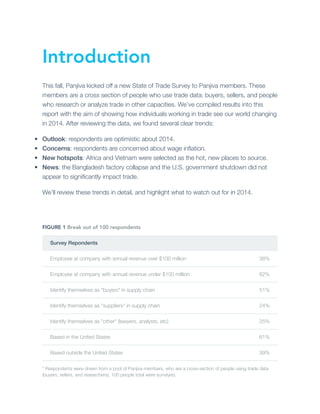
This fall, Panjiva kicked off a new State of Trade Survey to Panjiva members. These
members are a cross section of people who use trade data: buyers, sellers, and people
who research or analyze trade in other capacities. We’ve compiled results into this
report with the aim of showing how individuals working in trade see our world changing
in 2014. After reviewing the data, we found several clear trends:
•
•
•
•

Outlook: respondents are optimistic about 2014.
Concerns: respondents are concerned about wage inflation.
New hotspots: Africa and Vietnam were selected as the hot, new places to source.
News: the Bangladesh factory collapse and the U.S. government shutdown did not
appear to significantly impact trade.
We’ll review these trends in detail, and highlight what to watch out for in 2014.

FIGURE 1 Break out of 100 respondents
Survey Repondents
Employee at company with annual revenue over $100 million

38%

Employee at company with annual revenue under $100 million

62%

Identify themselves as "buyers" in supply chain

51%

Identify themselves as "suppliers" in supply chain

24%

Identify themselves as "other" (lawyers, analysts, etc)

25%

Based in the United States

61%

Based outside the United States

39%

* Respondents were drawn from a pool of Panjiva members, who are a cross-section of people using trade data
(buyers, sellers, and researchers). 100 people total were surveyed.
Outlook:
Global Trade & Economy
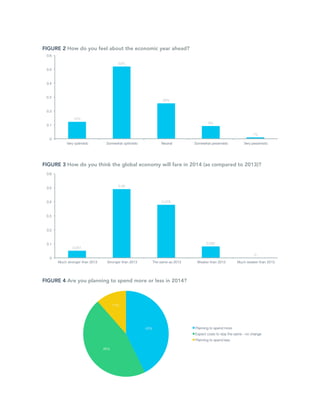
It may be that the gradual economic recovery will really take hold in 2014 1. About two
thirds of respondents said they were feeling ‘optimistic’ or ‘very optimistic’ about the
economic outlook of the year ahead. This is more positive than 2012, when only half of
our respondents were optimistic about the upcoming year, and 21% were pessimistic.
Approaching 2014 fewer than 10% of our respondents are feeling pessimistic about the
economy. More than half said the global economy will be stronger in 2014 than in 2013,
and only 8% thought the economy would be weaker.
When asked about spending, most respondents expected their spending to rise or be
consistent in 2013. Less than 11% expected to spend less than in 2013. In our 2012
survey 37% of respondents expected their costs to increase and 29% expected to
spend less. There are several possible explanations. People who are optimistic about
the health of the global economy may be expecting to grow their business. And, some
of our respondents may be expecting their spend to increase simply because their cost
of doing business is on the rise. We’ll delve into that as we review concerns.

1 http://www.oecd.org/newsroom/global-economy-recovering-at-moderate-pace-but-more-risks-ahead.htm
FIGURE 2 How do you feel about the economic year ahead?

FIGURE 3 How do you think the global economy will fare in 2014 (as compared to 2013)?

FIGURE 4 Are you planning to spend more or less in 2014?
Concerns:
Demand & Rising Wages
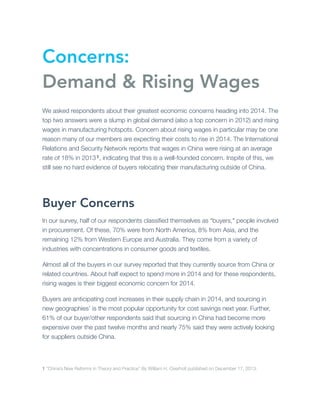
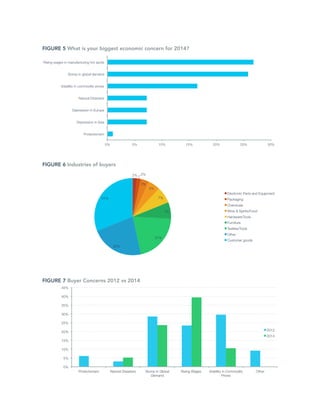
We asked respondents about their greatest economic concerns heading into 2014. The
top two answers were a slump in global demand (also a top concern in 2012) and rising
wages in manufacturing hotspots. Concern about rising wages in particular may be one
reason many of our members are expecting their costs to rise in 2014. The International
Relations and Security Network reports that wages in China were rising at an average
rate of 18% in 2013 1, indicating that this is a well-founded concern. Inspite of this, we
still see no hard evidence of buyers relocating their manufacturing outside of China.

Buyer Concerns
In our survey, half of our respondents classified themselves as “buyers," people involved
in procurement. Of these, 70% were from North America, 8% from Asia, and the
remaining 12% from Western Europe and Australia. They come from a variety of
industries with concentrations in consumer goods and textiles.
Almost all of the buyers in our survey reported that they currently source from China or
related countries. About half expect to spend more in 2014 and for these respondents,
rising wages is their biggest economic concern for 2014.
Buyers are anticipating cost increases in their supply chain in 2014, and sourcing in
new geographies’ is the most popular opportunity for cost savings next year. Further,
61% of our buyer/other respondents said that sourcing in China had become more
expensive over the past twelve months and nearly 75% said they were actively looking
for suppliers outside China.

1 “China’s New Reforms in Theory and Practice” By William H. Overholt published on December 17, 2013.
FIGURE 5 What is your biggest economic concern for 2014?

FIGURE 6 Industries of buyers

FIGURE 7 Buyer Concerns 2012 vs 2014
Supplier Concerns
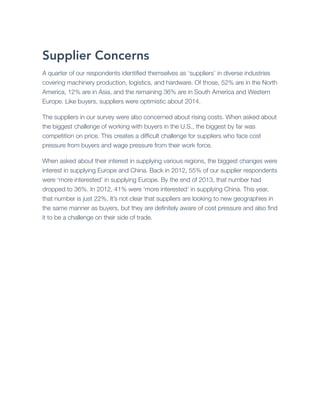
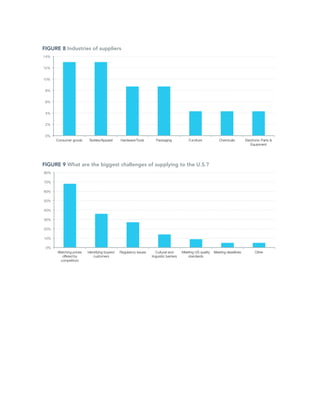
A quarter of our respondents identified themselves as ‘suppliers’ in diverse industries
covering machinery production, logistics, and hardware. Of those, 52% are in the North
America, 12% are in Asia, and the remaining 36% are in South America and Western
Europe. Like buyers, suppliers were optimistic about 2014.
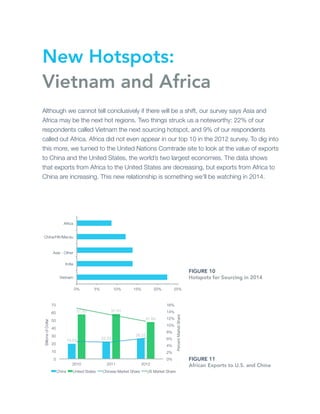
The suppliers in our survey were also concerned about rising costs. When asked about
the biggest challenge of working with buyers in the U.S., the biggest by far was
competition on price. This creates a difficult challenge for suppliers who face cost
pressure from buyers and wage pressure from their work force.
When asked about their interest in supplying various regions, the biggest changes were
interest in supplying Europe and China. Back in 2012, 55% of our supplier respondents
were ‘more interested’ in supplying Europe. By the end of 2013, that number had
dropped to 36%. In 2012, 41% were ‘more interested’ in supplying China. This year,
that number is just 22%. It’s not clear that suppliers are looking to new geographies in
the same manner as buyers, but they are definitely aware of cost pressure and also find
it to be a challenge on their side of trade.
FIGURE 8 Industries of suppliers

FIGURE 9 What are the biggest challenges of supplying to the U.S.?
New Hotspots:
Vietnam and Africa
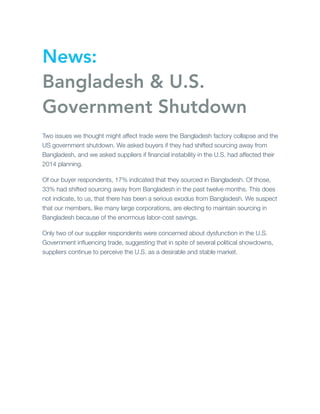
Although we cannot tell conclusively if there will be a shift, our survey says Asia and
Africa may be the next hot regions. Two things struck us a noteworthy: 22% of our
respondents called Vietnam the next sourcing hotspot, and 9% of our respondents
called out Africa. Africa did not even appear in our top 10 in the 2012 survey. To dig into
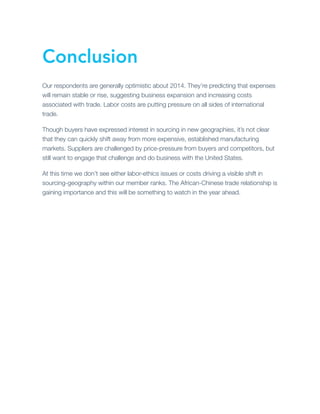
this more, we turned to the United Nations Comtrade site to look at the value of exports
to China and the United States, the world’s two largest economies. The data shows
that exports from Africa to the United States are decreasing, but exports from Africa to
China are increasing. This new relationship is something we’ll be watching in 2014.

FIGURE 10
Hotspots for Sourcing in 2014

FIGURE 11
African Exports to U.S. and China
News:
Bangladesh & U.S.
Government Shutdown
Two issues we thought might affect trade were the Bangladesh factory collapse and the
US government shutdown. We asked buyers if they had shifted sourcing away from
Bangladesh, and we asked suppliers if financial instability in the U.S. had affected their
2014 planning.
Of our buyer respondents, 17% indicated that they sourced in Bangladesh. Of those,
33% had shifted sourcing away from Bangladesh in the past twelve months. This does
not indicate, to us, that there has been a serious exodus from Bangladesh. We suspect
that our members, like many large corporations, are electing to maintain sourcing in
Bangladesh because of the enormous labor-cost savings.
Only two of our supplier respondents were concerned about dysfunction in the U.S.
Government influencing trade, suggesting that in spite of several political showdowns,
suppliers continue to perceive the U.S. as a desirable and stable market.
Conclusion
Our respondents are generally optimistic about 2014. They’re predicting that expenses
will remain stable or rise, suggesting business expansion and increasing costs
associated with trade. Labor costs are putting pressure on all sides of international
trade.
Though buyers have expressed interest in sourcing in new geographies, it’s not clear
that they can quickly shift away from more expensive, established manufacturing
markets. Suppliers are challenged by price-pressure from buyers and competitors, but
still want to engage that challenge and do business with the United States.
At this time we don’t see either labor-ethics issues or costs driving a visible shift in
sourcing-geography within our member ranks. The African-Chinese trade relationship is
gaining importance and this will be something to watch in the year ahead.

State of-trade-2014

  • 1.
  • 2.
    Introduction This fall, Panjivakicked off a new State of Trade Survey to Panjiva members. These members are a cross section of people who use trade data: buyers, sellers, and people who research or analyze trade in other capacities. We’ve compiled results into this report with the aim of showing how individuals working in trade see our world changing in 2014. After reviewing the data, we found several clear trends: • • • • Outlook: respondents are optimistic about 2014. Concerns: respondents are concerned about wage inflation. New hotspots: Africa and Vietnam were selected as the hot, new places to source. News: the Bangladesh factory collapse and the U.S. government shutdown did not appear to significantly impact trade. We’ll review these trends in detail, and highlight what to watch out for in 2014. FIGURE 1 Break out of 100 respondents Survey Repondents Employee at company with annual revenue over $100 million 38% Employee at company with annual revenue under $100 million 62% Identify themselves as "buyers" in supply chain 51% Identify themselves as "suppliers" in supply chain 24% Identify themselves as "other" (lawyers, analysts, etc) 25% Based in the United States 61% Based outside the United States 39% * Respondents were drawn from a pool of Panjiva members, who are a cross-section of people using trade data (buyers, sellers, and researchers). 100 people total were surveyed.
  • 3.
    Outlook: Global Trade &Economy It may be that the gradual economic recovery will really take hold in 2014 1. About two thirds of respondents said they were feeling ‘optimistic’ or ‘very optimistic’ about the economic outlook of the year ahead. This is more positive than 2012, when only half of our respondents were optimistic about the upcoming year, and 21% were pessimistic. Approaching 2014 fewer than 10% of our respondents are feeling pessimistic about the economy. More than half said the global economy will be stronger in 2014 than in 2013, and only 8% thought the economy would be weaker. When asked about spending, most respondents expected their spending to rise or be consistent in 2013. Less than 11% expected to spend less than in 2013. In our 2012 survey 37% of respondents expected their costs to increase and 29% expected to spend less. There are several possible explanations. People who are optimistic about the health of the global economy may be expecting to grow their business. And, some of our respondents may be expecting their spend to increase simply because their cost of doing business is on the rise. We’ll delve into that as we review concerns. 1 http://www.oecd.org/newsroom/global-economy-recovering-at-moderate-pace-but-more-risks-ahead.htm
  • 4.
    FIGURE 2 Howdo you feel about the economic year ahead? FIGURE 3 How do you think the global economy will fare in 2014 (as compared to 2013)? FIGURE 4 Are you planning to spend more or less in 2014?
  • 5.
    Concerns: Demand & RisingWages We asked respondents about their greatest economic concerns heading into 2014. The top two answers were a slump in global demand (also a top concern in 2012) and rising wages in manufacturing hotspots. Concern about rising wages in particular may be one reason many of our members are expecting their costs to rise in 2014. The International Relations and Security Network reports that wages in China were rising at an average rate of 18% in 2013 1, indicating that this is a well-founded concern. Inspite of this, we still see no hard evidence of buyers relocating their manufacturing outside of China. Buyer Concerns In our survey, half of our respondents classified themselves as “buyers," people involved in procurement. Of these, 70% were from North America, 8% from Asia, and the remaining 12% from Western Europe and Australia. They come from a variety of industries with concentrations in consumer goods and textiles. Almost all of the buyers in our survey reported that they currently source from China or related countries. About half expect to spend more in 2014 and for these respondents, rising wages is their biggest economic concern for 2014. Buyers are anticipating cost increases in their supply chain in 2014, and sourcing in new geographies’ is the most popular opportunity for cost savings next year. Further, 61% of our buyer/other respondents said that sourcing in China had become more expensive over the past twelve months and nearly 75% said they were actively looking for suppliers outside China. 1 “China’s New Reforms in Theory and Practice” By William H. Overholt published on December 17, 2013.
  • 6.
    FIGURE 5 Whatis your biggest economic concern for 2014? FIGURE 6 Industries of buyers FIGURE 7 Buyer Concerns 2012 vs 2014
  • 7.
    Supplier Concerns A quarterof our respondents identified themselves as ‘suppliers’ in diverse industries covering machinery production, logistics, and hardware. Of those, 52% are in the North America, 12% are in Asia, and the remaining 36% are in South America and Western Europe. Like buyers, suppliers were optimistic about 2014. The suppliers in our survey were also concerned about rising costs. When asked about the biggest challenge of working with buyers in the U.S., the biggest by far was competition on price. This creates a difficult challenge for suppliers who face cost pressure from buyers and wage pressure from their work force. When asked about their interest in supplying various regions, the biggest changes were interest in supplying Europe and China. Back in 2012, 55% of our supplier respondents were ‘more interested’ in supplying Europe. By the end of 2013, that number had dropped to 36%. In 2012, 41% were ‘more interested’ in supplying China. This year, that number is just 22%. It’s not clear that suppliers are looking to new geographies in the same manner as buyers, but they are definitely aware of cost pressure and also find it to be a challenge on their side of trade.
  • 8.
    FIGURE 8 Industriesof suppliers FIGURE 9 What are the biggest challenges of supplying to the U.S.?
  • 9.
    New Hotspots: Vietnam andAfrica Although we cannot tell conclusively if there will be a shift, our survey says Asia and Africa may be the next hot regions. Two things struck us a noteworthy: 22% of our respondents called Vietnam the next sourcing hotspot, and 9% of our respondents called out Africa. Africa did not even appear in our top 10 in the 2012 survey. To dig into this more, we turned to the United Nations Comtrade site to look at the value of exports to China and the United States, the world’s two largest economies. The data shows that exports from Africa to the United States are decreasing, but exports from Africa to China are increasing. This new relationship is something we’ll be watching in 2014. FIGURE 10 Hotspots for Sourcing in 2014 FIGURE 11 African Exports to U.S. and China
  • 10.
    News: Bangladesh & U.S. GovernmentShutdown Two issues we thought might affect trade were the Bangladesh factory collapse and the US government shutdown. We asked buyers if they had shifted sourcing away from Bangladesh, and we asked suppliers if financial instability in the U.S. had affected their 2014 planning. Of our buyer respondents, 17% indicated that they sourced in Bangladesh. Of those, 33% had shifted sourcing away from Bangladesh in the past twelve months. This does not indicate, to us, that there has been a serious exodus from Bangladesh. We suspect that our members, like many large corporations, are electing to maintain sourcing in Bangladesh because of the enormous labor-cost savings. Only two of our supplier respondents were concerned about dysfunction in the U.S. Government influencing trade, suggesting that in spite of several political showdowns, suppliers continue to perceive the U.S. as a desirable and stable market.
  • 11.
    Conclusion Our respondents aregenerally optimistic about 2014. They’re predicting that expenses will remain stable or rise, suggesting business expansion and increasing costs associated with trade. Labor costs are putting pressure on all sides of international trade. Though buyers have expressed interest in sourcing in new geographies, it’s not clear that they can quickly shift away from more expensive, established manufacturing markets. Suppliers are challenged by price-pressure from buyers and competitors, but still want to engage that challenge and do business with the United States. At this time we don’t see either labor-ethics issues or costs driving a visible shift in sourcing-geography within our member ranks. The African-Chinese trade relationship is gaining importance and this will be something to watch in the year ahead.