Getting Started: Start-up Basics
    for Creative Professionals

Program for Launching Artistic Entrepreneurs
                 (PLAE)
            November 12, 2011


                                               1
About the Speaker
Ronald L. Barabas, Esq., Corporate & Entertainment Attorney, Di Santo LLP

Ron’s practice is focused primarily on corporate and entertainment law. His
entertainment law experience spans a variety of intellectual property, litigation and
transactional matters related to film, music, radio, visual art, fashion, interactive
development, publishing, and sports. Ron also has general corporate law experience
with significant mergers and acquisitions expertise. In addition, Ron was engaged in
the business of independent film production prior to pursuing his legal career.

Di Santo LLP is a full service law firm with offices in New York and Miami that
specializes in all aspects of corporate and securities law, commercial litigation and
regulatory investigations, entertainment and new media matters, intellectual property,
and real estate transactions and finance. We have extensive experience in representing a
variety of business entities, including real estate investment trusts (or REITs),
investment banks, venture capital firms, real estate developers and small businesses.
We have structured and negotiated a wide range of transactions from multi-million
dollar securities offerings and private placements to complex mergers and acquisitions.
We also counsel start-up businesses and entrepreneurs in entity formation and venture
capital financing.


                                                                                        2
Starting Your Own Business
• Advantages: independence; opportunity to
  pursue your passion; tax benefits; earnings
  potential.
• Disadvantages: no job or income security; no
  unemployment insurance; total responsibility;
  client non-payments; personal liability for
  debts (which can be addressed); having to deal
  with ongoing legal and tax issues.

                                                   3
Initial Business Considerations
1. Market Opportunity: Define the market opportunity for
   your company.
2. Competitive Advantages: Identify competitive advantages
   that distinguish your product or service.
3. Valuation: Create a workable revenue model and
   supportable financial projections.
4. Management Team: Select management team candidates
   and advisors, preferably with experience in start-ups in
   your industry.
5. Funding: Determine project funding needs for 12-18
   month period.
6. Objective: Define the exit strategy for the company and
   investors.

                                                              4
Plan Ahead
• First-time entrepreneur artists often get started
  without fully considering and planning around the
  legal implications of their endeavor.
• Even if (or especially if) you’re going into
  business with someone close to you, it’s important
  to document expectations by agreement.
• An upfront investment in time and effort could
  save major costs and headaches in the future.
• While it is advisable to consult an attorney to help
  you plan within the unique circumstances of your
  new business, there are some other low-cost
  resources available to you that can help.

                                                     5
Initial Legal Considerations
1. Choice of Entity: Determine which type of entity is
   appropriate and file all initial founding documents as
   necessary.
2. IP Protection: File patents, trademarks and/or
   copyrights.
3. Operational Agreements: Execute protective
   agreements needed to operate your business.
4. Employees and Independent Contractors: Assess needs.
5. Funding Options: Consider all funding options for
   working capital needs.


                                                        6
Choosing an Entity Type
• Why it’s important: limit personal liability
  from business debts and lawsuits; added
  credibility; prepare for the company’s future.
• Key considerations: limited liability; tax
  treatment; costs involved; simplicity of entity
  maintenance; flexibility on allocation of profits
  and losses between multiple owners.


                                                  7
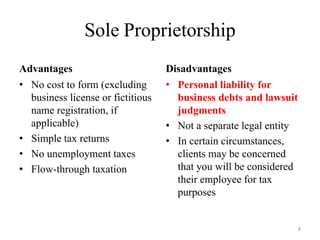
Sole Proprietorship
Advantages                         Disadvantages
• No cost to form (excluding       • Personal liability for
  business license or fictitious     business debts and lawsuit
  name registration, if              judgments
  applicable)                      • Not a separate legal entity
• Simple tax returns               • In certain circumstances,
• No unemployment taxes              clients may be concerned
• Flow-through taxation              that you will be considered
                                     their employee for tax
                                     purposes


                                                                   8
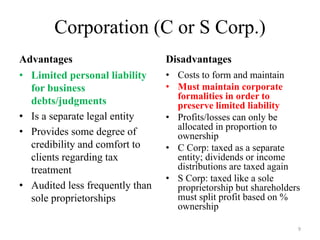
Corporation (C or S Corp.)
Advantages                       Disadvantages
• Limited personal liability     • Costs to form and maintain
  for business                   • Must maintain corporate
                                   formalities in order to
  debts/judgments                  preserve limited liability
• Is a separate legal entity     • Profits/losses can only be
                                   allocated in proportion to
• Provides some degree of          ownership
  credibility and comfort to     • C Corp: taxed as a separate
  clients regarding tax            entity; dividends or income
  treatment                        distributions are taxed again
                                 • S Corp: taxed like a sole
• Audited less frequently than     proprietorship but shareholders
  sole proprietorships             must split profit based on %
                                   ownership

                                                                 9
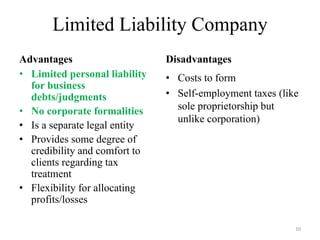
Limited Liability Company
Advantages                     Disadvantages
• Limited personal liability   • Costs to form
  for business
  debts/judgments              • Self-employment taxes (like
• No corporate formalities       sole proprietorship but
                                 unlike corporation)
• Is a separate legal entity
• Provides some degree of
  credibility and comfort to
  clients regarding tax
  treatment
• Flexibility for allocating
  profits/losses

                                                           10
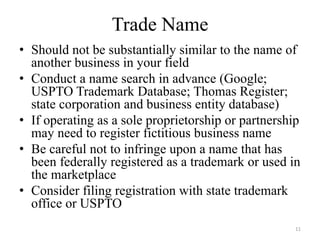
Trade Name
• Should not be substantially similar to the name of
  another business in your field
• Conduct a name search in advance (Google;
  USPTO Trademark Database; Thomas Register;
  state corporation and business entity database)
• If operating as a sole proprietorship or partnership
  may need to register fictitious business name
• Be careful not to infringe upon a name that has
  been federally registered as a trademark or used in
  the marketplace
• Consider filing registration with state trademark
  office or USPTO
                                                     11
Intellectual Property Issues
• All businesses need to protect their own and
  not infringe on others’ intellectual property
• Arts-related businesses in particular are more
  likely to draw revenue from the commercial
  exploitation of copyrighted material (e.g.,
  writings, graphics, designs, music, software)
• If your business relies on intellectual property
  owned by another party, a license will likely be
  needed

                                                 12
Types of Intellectual Property
• Patent: protects inventions that are new, useful
  and nonobvious as judged by the USPTO
• Trademark: protects names, logos and other
  marks used to identify a business or product
• Copyright: protects original works of
  authorship that are fixed in a tangible medium
  of expression


                                                 13
Copyright
• Copyright protection vests when an original
  work is created, whether or not the work is
  registered (though registration is advisable)
• Categories include: literary works; musical
  works, including any accompanying words;
  dramatic works, including any accompanying
  music; pantomimes and choreographic works;
  pictorial, graphic, and sculptural works; motion
  pictures and other audiovisual works; sound
  recordings; and architectural works (See Section
  102 of the US Copyright Law).

                                                 14
The Importance of Copyright Ownership
• Only the copyright owner can (or can authorize
  others to) reproduce, prepare derivatives of,
  perform, display or otherwise commercially
  exploit the copyrighted work.
• Who is the owner? When more than one person is
  involved, copyright ownership should be
  addressed before the work is created.
• Joint owners are entitled to license a work without
  the other owners’ approval but must share profits.
                                                    15
Generating Revenue from Copyrighted Works
• It’s up to you determine which rights you grant or
  acquire.
   – Transfer all rights: work-for-hire or assignment
     (creator may be able to get a higher fee but loses all
     potential future income from the work).
   – Transfer some rights and keep others (exclusive or
     non-exclusive licenses can be granted).
• Exclusive licenses (including work-for-hire and
  assignments) must be in writing to be valid.
• Although nonexclusive licenses can be oral, a
  written agreement is highly advisable.

                                                              16
NDAs, Employment and other
             Considerations
• Nondisclosure agreements are sometimes used with
  potential business partners, investors, contractors,
  employees and customers; they make clear that the
  party receiving trade secrets is bound not to disclose
  the information.
• How your company structures relationships with
  workers (employee vs. contractor) has important
  copyright, tax and various other ramifications.
• Other issues should be considered as necessary,
  including insurance and financing.
                                                      17
Conclusion
• Entrepreneurs working in entertainment and the
  arts need to carefully consider basic legal issues
  like entity structure and intellectual property (IP)
  to protect themselves and meet their business
  goals.
• Confront legal issues right away to avoid future
  problems.
• While it is important to consult legal and tax
  professionals, a general working knowledge of IP
  law and contracts will be extremely useful in
  effectively managing your business.

                                                     18
Some Helpful Resources
While there are many books, groups and other resources
geared to specific disciplines that can help (e.g., All You Need
to Know About the Music Business), below are some resources
of more general applicability.
- Volunteer Lawyers for the Arts: non-profit that provides pro
   bono legal referrals, legal education and other services for
   low-income artists.
- New York Foundation for the Arts: free professional
   workshops, panels and other programs including their
   summer Artist As Entrepreneur Boot Camp.
• Books by the legal publisher Nolo, including Working for
   Yourself: Law & Taxes for Independent Contractors,
   Freelancers & Consultants.

                                                               19
For Questions:
Ronald L. Barabas, Esq.
Corporate and Entertainment Attorney
Di Santo LLP
• Email: rbarabas@disantolaw.com
• Phone: 212.766.2467 (Office) or 516.528.9961
  (Cell)
• Fax: 866.428.3369

                                             20

Start-Up Basics for Artistic Entrepreneurs

  • 1.
    Getting Started: Start-upBasics for Creative Professionals Program for Launching Artistic Entrepreneurs (PLAE) November 12, 2011 1
  • 2.
    About the Speaker RonaldL. Barabas, Esq., Corporate & Entertainment Attorney, Di Santo LLP Ron’s practice is focused primarily on corporate and entertainment law. His entertainment law experience spans a variety of intellectual property, litigation and transactional matters related to film, music, radio, visual art, fashion, interactive development, publishing, and sports. Ron also has general corporate law experience with significant mergers and acquisitions expertise. In addition, Ron was engaged in the business of independent film production prior to pursuing his legal career. Di Santo LLP is a full service law firm with offices in New York and Miami that specializes in all aspects of corporate and securities law, commercial litigation and regulatory investigations, entertainment and new media matters, intellectual property, and real estate transactions and finance. We have extensive experience in representing a variety of business entities, including real estate investment trusts (or REITs), investment banks, venture capital firms, real estate developers and small businesses. We have structured and negotiated a wide range of transactions from multi-million dollar securities offerings and private placements to complex mergers and acquisitions. We also counsel start-up businesses and entrepreneurs in entity formation and venture capital financing. 2
  • 3.
    Starting Your OwnBusiness • Advantages: independence; opportunity to pursue your passion; tax benefits; earnings potential. • Disadvantages: no job or income security; no unemployment insurance; total responsibility; client non-payments; personal liability for debts (which can be addressed); having to deal with ongoing legal and tax issues. 3
  • 4.
    Initial Business Considerations 1.Market Opportunity: Define the market opportunity for your company. 2. Competitive Advantages: Identify competitive advantages that distinguish your product or service. 3. Valuation: Create a workable revenue model and supportable financial projections. 4. Management Team: Select management team candidates and advisors, preferably with experience in start-ups in your industry. 5. Funding: Determine project funding needs for 12-18 month period. 6. Objective: Define the exit strategy for the company and investors. 4
  • 5.
    Plan Ahead • First-timeentrepreneur artists often get started without fully considering and planning around the legal implications of their endeavor. • Even if (or especially if) you’re going into business with someone close to you, it’s important to document expectations by agreement. • An upfront investment in time and effort could save major costs and headaches in the future. • While it is advisable to consult an attorney to help you plan within the unique circumstances of your new business, there are some other low-cost resources available to you that can help. 5
  • 6.
    Initial Legal Considerations 1.Choice of Entity: Determine which type of entity is appropriate and file all initial founding documents as necessary. 2. IP Protection: File patents, trademarks and/or copyrights. 3. Operational Agreements: Execute protective agreements needed to operate your business. 4. Employees and Independent Contractors: Assess needs. 5. Funding Options: Consider all funding options for working capital needs. 6
  • 7.
    Choosing an EntityType • Why it’s important: limit personal liability from business debts and lawsuits; added credibility; prepare for the company’s future. • Key considerations: limited liability; tax treatment; costs involved; simplicity of entity maintenance; flexibility on allocation of profits and losses between multiple owners. 7
  • 8.
    Sole Proprietorship Advantages Disadvantages • No cost to form (excluding • Personal liability for business license or fictitious business debts and lawsuit name registration, if judgments applicable) • Not a separate legal entity • Simple tax returns • In certain circumstances, • No unemployment taxes clients may be concerned • Flow-through taxation that you will be considered their employee for tax purposes 8
  • 9.
    Corporation (C orS Corp.) Advantages Disadvantages • Limited personal liability • Costs to form and maintain for business • Must maintain corporate formalities in order to debts/judgments preserve limited liability • Is a separate legal entity • Profits/losses can only be allocated in proportion to • Provides some degree of ownership credibility and comfort to • C Corp: taxed as a separate clients regarding tax entity; dividends or income treatment distributions are taxed again • S Corp: taxed like a sole • Audited less frequently than proprietorship but shareholders sole proprietorships must split profit based on % ownership 9
  • 10.
    Limited Liability Company Advantages Disadvantages • Limited personal liability • Costs to form for business debts/judgments • Self-employment taxes (like • No corporate formalities sole proprietorship but unlike corporation) • Is a separate legal entity • Provides some degree of credibility and comfort to clients regarding tax treatment • Flexibility for allocating profits/losses 10
  • 11.
    Trade Name • Shouldnot be substantially similar to the name of another business in your field • Conduct a name search in advance (Google; USPTO Trademark Database; Thomas Register; state corporation and business entity database) • If operating as a sole proprietorship or partnership may need to register fictitious business name • Be careful not to infringe upon a name that has been federally registered as a trademark or used in the marketplace • Consider filing registration with state trademark office or USPTO 11
  • 12.
    Intellectual Property Issues •All businesses need to protect their own and not infringe on others’ intellectual property • Arts-related businesses in particular are more likely to draw revenue from the commercial exploitation of copyrighted material (e.g., writings, graphics, designs, music, software) • If your business relies on intellectual property owned by another party, a license will likely be needed 12
  • 13.
    Types of IntellectualProperty • Patent: protects inventions that are new, useful and nonobvious as judged by the USPTO • Trademark: protects names, logos and other marks used to identify a business or product • Copyright: protects original works of authorship that are fixed in a tangible medium of expression 13
  • 14.
    Copyright • Copyright protectionvests when an original work is created, whether or not the work is registered (though registration is advisable) • Categories include: literary works; musical works, including any accompanying words; dramatic works, including any accompanying music; pantomimes and choreographic works; pictorial, graphic, and sculptural works; motion pictures and other audiovisual works; sound recordings; and architectural works (See Section 102 of the US Copyright Law). 14
  • 15.
    The Importance ofCopyright Ownership • Only the copyright owner can (or can authorize others to) reproduce, prepare derivatives of, perform, display or otherwise commercially exploit the copyrighted work. • Who is the owner? When more than one person is involved, copyright ownership should be addressed before the work is created. • Joint owners are entitled to license a work without the other owners’ approval but must share profits. 15
  • 16.
    Generating Revenue fromCopyrighted Works • It’s up to you determine which rights you grant or acquire. – Transfer all rights: work-for-hire or assignment (creator may be able to get a higher fee but loses all potential future income from the work). – Transfer some rights and keep others (exclusive or non-exclusive licenses can be granted). • Exclusive licenses (including work-for-hire and assignments) must be in writing to be valid. • Although nonexclusive licenses can be oral, a written agreement is highly advisable. 16
  • 17.
    NDAs, Employment andother Considerations • Nondisclosure agreements are sometimes used with potential business partners, investors, contractors, employees and customers; they make clear that the party receiving trade secrets is bound not to disclose the information. • How your company structures relationships with workers (employee vs. contractor) has important copyright, tax and various other ramifications. • Other issues should be considered as necessary, including insurance and financing. 17
  • 18.
    Conclusion • Entrepreneurs workingin entertainment and the arts need to carefully consider basic legal issues like entity structure and intellectual property (IP) to protect themselves and meet their business goals. • Confront legal issues right away to avoid future problems. • While it is important to consult legal and tax professionals, a general working knowledge of IP law and contracts will be extremely useful in effectively managing your business. 18
  • 19.
    Some Helpful Resources Whilethere are many books, groups and other resources geared to specific disciplines that can help (e.g., All You Need to Know About the Music Business), below are some resources of more general applicability. - Volunteer Lawyers for the Arts: non-profit that provides pro bono legal referrals, legal education and other services for low-income artists. - New York Foundation for the Arts: free professional workshops, panels and other programs including their summer Artist As Entrepreneur Boot Camp. • Books by the legal publisher Nolo, including Working for Yourself: Law & Taxes for Independent Contractors, Freelancers & Consultants. 19
  • 20.
    For Questions: Ronald L.Barabas, Esq. Corporate and Entertainment Attorney Di Santo LLP • Email: rbarabas@disantolaw.com • Phone: 212.766.2467 (Office) or 516.528.9961 (Cell) • Fax: 866.428.3369 20