(eBook PDF) Starting Out with C++: Early Objects 9th Edition
(eBook PDF) Starting Out with C++: Early Objects 9th Edition
(eBook PDF) Starting Out with C++: Early Objects 9th Edition
(eBook PDF) Starting Out with C++: Early Objects 9th Edition
(eBook PDF) Starting Out with C++: Early Objects 9th Edition
1.
(eBook PDF) StartingOut with C++: Early Objects
9th Edition install download
https://ebookluna.com/product/ebook-pdf-starting-out-with-c-
early-objects-9th-edition/
Download more ebook instantly today - Get yours now at ebookluna.com
2.
We believe theseproducts will be a great fit for you. Click
the link to download now, or visit ebookluna.com
to discover even more!
Starting Out with C++: Early Objects 9th Edition by Tony Gaddis (eBook PDF)
https://ebookluna.com/product/starting-out-with-c-early-objects-9th-
edition-by-tony-gaddis-ebook-pdf/
(eBook PDF) Starting Out with Java: Early Objects 5th Edition
https://ebookluna.com/product/ebook-pdf-starting-out-with-java-early-
objects-5th-edition/
(eBook PDF) Starting Out with C++ from Control Structures to Objects 9th
Edition
https://ebookluna.com/product/ebook-pdf-starting-out-with-c-from-control-
structures-to-objects-9th-edition/
(eBook PDF) Starting Out with Java: Early Objects 5th Global Edition
https://ebookluna.com/product/ebook-pdf-starting-out-with-java-early-
objects-5th-global-edition/
3.
(eBook PDF) StartingOut with Java Early Objects 6th Edition by Tony Gaddis
https://ebookluna.com/product/ebook-pdf-starting-out-with-java-early-
objects-6th-edition-by-tony-gaddis/
(eBook PDF) Starting Out with C++: From Control Structures through Objects
8th Edition
https://ebookluna.com/product/ebook-pdf-starting-out-with-c-from-control-
structures-through-objects-8th-edition/
(eBook PDF) Starting Out with C++: From Control Structures through Objects,
Brief Version 8th Edition
https://ebookluna.com/product/ebook-pdf-starting-out-with-c-from-control-
structures-through-objects-brief-version-8th-edition/
(eBook PDF) Starting out with Visual C# 5th Edition
https://ebookluna.com/product/ebook-pdf-starting-out-with-visual-c-5th-
edition/
(eBook PDF) Starting Out with Java: From Control Structures through
Objects, 7th Edition
https://ebookluna.com/product/ebook-pdf-starting-out-with-java-from-
control-structures-through-objects-7th-edition/
"
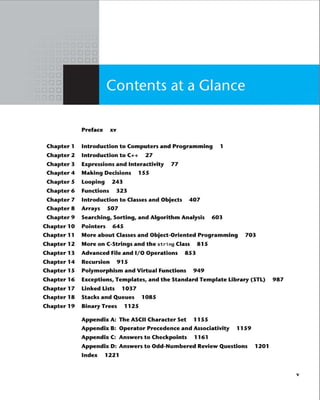
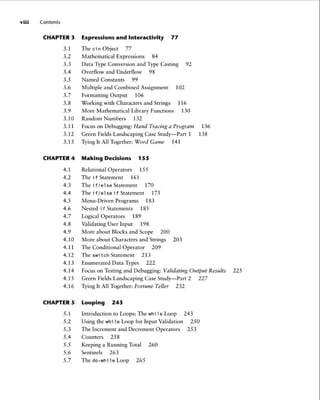
Preface xv
Chapter 1Introduction to Computers and Programming 1
Chapter 2 Introduction to C++ 27
Chapter 3 Expressions and Interactivity 77
Chapter 4 Making Decisions 155
Chapter 5 Looping 243
Chapter 6 Functions 323
Chapter 7 Introduction to Classes and Objects 407
Chapter 8 Arrays 507
Chapter 9 Searching, Sorting , and Algorithm Analysis 603
Chapter 10 Pointers 645
Chapter 11 More about Classes and Object -Oriented Programming 703
Chapter 12 More on ( -Strings and the string Class 815
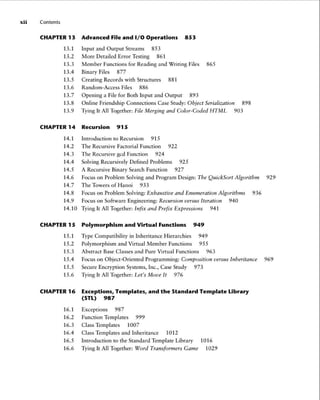
Chapter 13 Advanced File and 1/ 0 Operations 853
Chapter 14 Recursion 915
Chapter 15 Polymorphism and Virtual Functions 949
Chapter 16 Exceptions, Templates, and the Standard Template Library (STL) 987
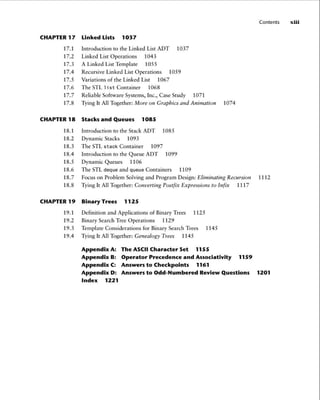
Chapter 17 Linked Lists 103 7
Chapter 18 Stacks and Queues 1085
Chapter 19 Binary Trees 1125
Appendix A: The ASCII Character Set 1155
Appendix B: Operator Precedence and Associativity 1159
Appendix C: Answers to Checkpoints 1161
Appendix D: Answers to Odd -Numbered Review Questions 1201
Index 1221
V
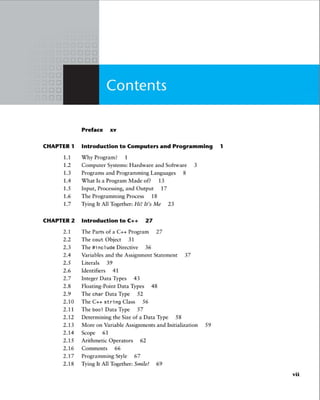
Preface xv
CHAPTER 1Introduction to Computers and Programming 1
1.1 Why Program? 1
1.2 Computer Systems: Hardware and Software 3
1.3 Programs and Programming Languages 8
1.4 What Is a Program Made of? 13
1.5 Input, Processing, and Output 17
1.6 The Programming Process 18
1.7 Tying It All Together: Hi! It's Me 23
CHAPTER 2 Introduction to C++ 27
2.1 The Parts of a C++ Program 27
2.2 The cout Object 31
2.3 The# i ncludeDirect ive 36
2.4 Variables and the Assignment Statement 37
2.5 Literals 39
2.6 Identifiers 41
2.7 Integer Data Types 43
2.8 Floating-Point Data Types 48
2.9 The char Data Type 52
2.10 TheC++str i ngClass 56
2.11 The bool Data Type 57
2.12 Determining the Size of a Data Type 58
2.13 More on Variable Assignments and Initialization 59
2.14 Scope 61
2.15 Arithmetic Operators 62
2.16 Comments 66
2.17 Programming Style 67
2.18 Tying It All Together: Smile! 69
vii
9.
viii Contents
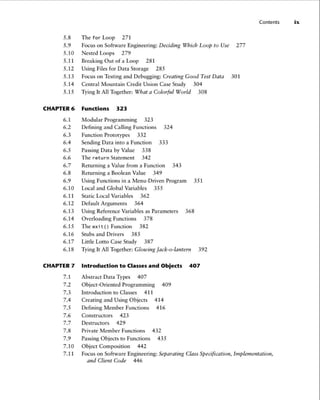
CHAPTER 3Expressions and Interactivity 77
3.1 ThecinObject 77
3.2 Mathematical Expressions 84
3.3 Data Type Conversion and Type Casting 92
3.4 Overflow and Underflow 98
3.5
3.6
3.7
3.8
3.9
3.10
Named Constants 99
Multiple and Combined Assignment
Formatting Output 106
Working with Characters and Strings
More Mathematical Library Functions
Random Numbers 132
102
116
130
3.11 Focus on Debugging: Hand Tracing a Program 136
3.12 Green Fields Landscaping Case Study- Part 1 138
3.13 Tying It All Together: Word Game 141
CHAPTER 4 Making Decisions 155
4.1 Relational Operators 155
4.2 The if Statement 161
4.3 Theif/elseStatement 170
4.4 The if /else if Statement 175
4.5 Menu-Driven Programs 183
4.6 Nested i f Statements 185
4.7 Logical Operators 189
4.8 Validating User Input 198
4.9 More about Blocks and Scope 200
4.10 More about Characters and Strings 203
4.11 The Conditional Operator 209
4.12 The switch Statement 213
4.13 Enumerated Data Types 222
4.14 Focus on Testing and Debugging: Validating Output Results 225
4.15 Green Fields Landscaping Case Study- Part 2 227
4.16 Tying It All Together: Fortune Teller 232
CHAPTER 5 Looping 243
5.1 Introduction to Loops: The whi le Loop 243
5.2 Using the while Loop for Input Validation 250
5.3 The Increment and Decrement Operators 253
5.4 Counters 258
5.5 Keeping a Running Total 260
5.6 Sentinels 263
5.7 The do-while Loop 265
10.
5.8 The forLoop 271
5.9 Focus on Software Engineering: Deciding Which Loop to Use 277
5.10 Nested Loops 279
5.11 Breaking Out of a Loop 281
5.12 Using Files for Data Storage 285
5.13 Focus on Testing and Debugging: Creating Good Test Data 301
5.14 Central Mountain Credit Union Case Study 304
5.15 Tying It All Together: What a Colorful World 308
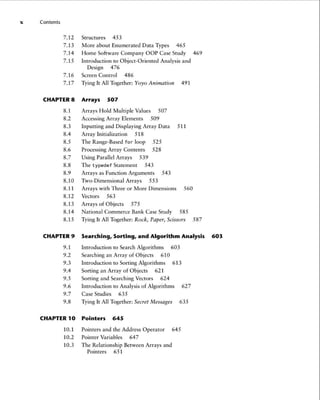
CHAPTER 6 Function s 323
6.1 Modular Programming 323
6.2 Defining and Calling Functions 324
6.3 Function Prototypes 332
6.4 Sending Data into a Function 333
6.5 Passing Data by Value 338
6.6 The return Statement 342
6.7 Returning a Value from a Function 343
6.8 Returning a Boolean Value 349
6.9 Using Functions in a Menu-Driven Program 351
6.10 Local and Global Variables 355
6.11 Static Local Variables 362
6.12 Default Arguments 364
6.13 Using Reference Variables as Parameters 368
6.14 Overloading Functions 378
6.15 The exit() Function 382
6.16 Stubs and Drivers 385
6.17 LittleLottoCaseStudy 387
6.18 Tying It All Together: Glowing Jack-o-lantern 392
CHAPTER 7 Introduction to Classes and Objects 407
7.1 Abstract Data Types 407
7.2 Object-Oriented Programming 409
7.3 Introduction to Classes 411
7.4 Creating and Using Objects 414
7.5 Defining Member Functions 416
7.6 Constructors 423
7.7 Destructors 429
7.8 Private Member Functions 432
7.9 Passing Objects to Functions 435
7.10 Object Composition 442
Contents ix
7.11 Focus on Software Engineering: Separating Class Specification, Implementation ,
and Client Code 446
11.
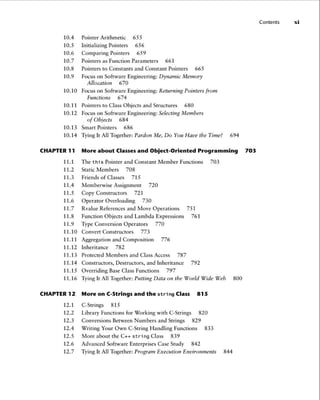
x Contents
7.12 Structures453
7.13 More about Enumerated Data Types 465
7.14 Home Software Company OOP Case Study 469
7.15 Introduction to Object-Oriented Analysis and
Design 476
7.16 Screen Contro l 486
7.17 Tying It All Together: Yoyo Animation 491
CHAPTER 8 Arrays 507
8.1 Arrays Hold Multiple Values 507
8.2 AccessingArray Elements 509
8.3 Inputting and Displaying Array Data 511
8.4 Array Initialization 518
8.5 The Range-Based for loop 525
8.6 Processing Array Contents 528
8.7 Using Parallel Arrays 539
8.8 The typede f Statement 543
8.9 Arrays as Function Arguments 543
8.10 Two-Dimensional Arrays 553
8.11 Arrays with Three or More Dimensions 560
8.12 Vectors 563
8.13 Arrays of Objects 575
8.14 National Commerce Bank Case Study 585
8.15 Tying It All Together: Rock, Paper, Scissors 587
CHAPTER 9 Searching, Sorting , and Algorithm Analysis 603
9.1 Introduction to Search Algorithms 603
9.2 Searching an Array of Objects 610
9.3 Introduction to Sorting Algorithms 613
9.4 Sorting an Array of Objects 621
9.5 Sorting and Searching Vectors 624
9.6 Introduction to Analysis of Algorithms 627
9.7 Case Studies 635
9.8 Tying It All Together: Secret Messages 635
CHAPTER 10 Pointers 645
10.1 Pointers and the Address Operator 645
10.2 Pointer Variables 647
10.3 The Relationship Between Arrays and
Pointers 651
12.
10.4 Pointer Arithmetic655
10.5 Initializing Pointers 656
10.6 Comparing Pointers 659
10.7 Pointers as Function Parameters 661
10.8 Pointers to Constants and Constant Pointers 665
10.9 Focus on Software Engineering: Dynamic Memory
Allocation 670
10.10 Focus on Software Engineering: Returning Pointers from
Functions 674
10.11 Pointers to Class Objects and Structures 680
10.12 Focus on Software Engineering: Selecting Members
of Objects 684
10.13 Smart Pointers 686
10.14 Tying It All Together: Pardon Me, Do You Have the Time? 694
CHAPTER 11 More about Classesand Object -Oriented Programming 703
11.1 The th is Pointer and Constant Member Functions 703
11.2 Static Members 708
11.3 Friends of Classes 715
11.4 Memberwise Assignment 720
11.5 Copy Constructors 721
11.6 Operator Overloading 730
11.7 Rvalue References and Move Operations 751
11.8 Function Objects and Lambda Expressions 761
11.9 Type Conversion Operators 770
11.10 Convert Constructors 773
11.11 Aggregation and Composition 776
11.12 Inheritance 782
11.13 Protected Members and Class Access 787
11.14 Constructors, Destructors, and Inheritance 792
11.15 Overriding Base Class Functions 797
11.16 Tying It All Together: Putting Data on the World Wide Web 800
CHAPTER 12 More on C-Strings and the s t ring Class 815
12.1 C-Strings 815
12.2 Library Functions for Working with C-Strings 820
12.3 Conversions Between Numbers and Strings 829
12.4 Writing Your Own C-String Handling Functions 833
12.5 More about the C++ str i ng Class 839
12.6 Advanced Software Enterprises Case Study 842
12.7 Tying It All Together: Program Execution Environments 844
Contents xi
13.
xii Contents
CHAPTER13 AdvancedFile and 1/ 0 Operations 853
13.1 Input and Output Streams 853
13.2 More Detailed Error Testing 861
13.3 Member Functions for Reading and Writing Files 865
13.4 Binary Files 877
13.5 Creating Records with Structures 881
13.6 Random -Access Files 886
13.7 Opening a File for Both Input and Output 893
13.8 Online Friendship Connections Case Study: Object Serialization 898
13.9 Tying It All Together: File Merging and Color-Coded HTML 903
CHAPTER14 Recursion 915
14.1 Introduction to Recursion 915
14.2 The Recursive Factorial Function 922
14.3 The Recursive gcd Function 924
14.4 Solving Recursively Defined Problems 925
14.5 A Recursive Binary Search Function 927
14.6 Focus on Problem Solving and Program Design: The QuickSort Algorithm 929
14.7 The Towersof Hanoi 933
14.8 Focus on Problem Solving: Exhaustive and Enumeration Algorithms 936
14.9 Focus on Software Engineering: Recursion versus Iteration 940
14.10 Tying It All Together: Infix and Prefix Expressions 941
CHAPTER15 Polymorphism and Virtual Functions 949
15.1 Type Compatibi lity in Inheritance Hierarchies 949
15.2 Polymorp hism and Virtual Member Functions 955
15.3 Abstract Base Classes and Pure Virtual Functions 963
15.4 Focus on Object-Oriented Programming : Composition versus Inheritance 969
15.5 Secure Encryption Systems, Inc., Case Study 973
15.6 Tying It All Together: Let's Move It 976
CHAPTER16 Exceptions, Templates, and the Standard Template Library
(STL) 987
16.1 Exceptions 987
16.2 Function Templates 999
16.3 Class Templates 1007
16.4 Class Templates and Inheritance 1012
16.5 Introduction to the Standard Template Library 1016
16.6 Tying It All Together: Word Transformers Game 1029
14.
CHAPTER 17 LinkedLists 1037
17.1 Introduction to the Linked List ADT 1037
17.2 Linked List Operations 1043
17.3 A Linked List Template 1055
17.4 Recursive Linked List Operations 1059
17.5 Variations of the Linked List 1067
17.6 The STL list Container 1068
17.7 Reliable Software Systems, Inc., Case Study 1071
17.8 Tying It All Together: More on Graphics and Animation 1074
CHAPTER 18 Stacks and Queues 1085
18.1 Introduction to the Stack ADT 1085
18.2 Dynamic Stacks 1093
18.3 The STL stack Container 1097
18.4 Introduction to the Queue ADT 1099
18.5 Dynamic Queues 1106
18.6 The STL deque and queue Containers 1109
18.7
18.8
Focus on Problem Solving and Program Design: Eliminating Recursion
Tying It All Together: Converting Postfix Expressions to Infix 1117
CHAPTER 19 Binary Trees 1125
19.1 Definition and Applications of Binary Trees 1125
19.2 Binary Search Tree Operations 1129
19.3 Template Considerations for Binary Search Trees 1145
19.4 Tying It All Together: Genealogy Trees 1145
Appendix A: The ASCII Character Set 1155
Appendix B: Operator Precedence and Associativity 1159
Appendix C: Answers to Checkpoints 1161
Contents xiii
1112
Appendix D: Answers to Odd -Numbered Review Questions 1201
Index 1221
15.
xi v Contents
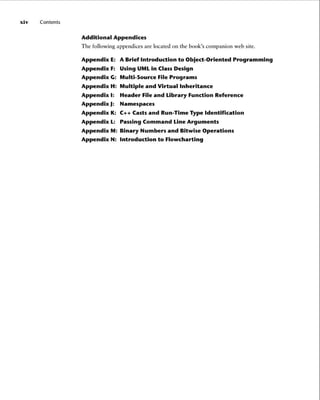
AdditionalAppendices
The following append ices are located on the book's companion web site.
Appendix E: A Brief Introduction to Object -Oriented Programming
Appendix F: Using UMLin Class Design
Appendix G: Multi-Source File Programs
Appendix H: Multiple and Virtual Inheritance
Appendix I: Header File and Library Function Reference
Appendix J: Namespaces
Appendix K: C++ Casts and Run-Time Type Identification
Appendix L: Passing Command Line Arguments
Appendix M: Binary Numbers and Bitwise Operations
Appendix N: Introduction to Flowcharting
16.
Welcome to StartingOut with C++:Early Objects, 9th Edition. This book is intended
for use in a two -term or three-term C++ programming sequence, or an accelerated
one-term course. Students new to programming, as well as those with prior course work
in other languages, will find this text beneficial. The fundamentals of programming
are covered for the novice, while the details, pitfalls, and nuances of the C++ language
are explored in-depth for both the beginner and more experienced student . The book
is written with clear, easy-to -understand language and it covers all the necessary
topics for an introductory programming course. This text is rich in example programs
that are concise, practica l, and real world oriented, ensuring that the student not only
learns how to implement the features and constructs of C++, but why and when to
use them.
What's New in the Ninth Edition
The New C++11 Standard
C++11 is the latest standard version of the C++ language. In previous years, while the
standard was being developed, it was known as C++Ox. In August 2011, it was
approved by the International Standards Organization (ISO), and the name of the
standard was officially changed to C++l l. Most of the popular C++ compilers now
support this standard.
The new C++11 standard was the primary motivat ion behind this edition, which
introduces many of the new language features. However, a C++11 compi ler is not
strictly required to use the book . As you progress through the book, you will see
C++ll icons in the margins, next to the new features that are introduced . Programs
appearing in sections that are not marked with this icon will still compi le using an
older compiler.
The C++11 Topics Introduced in This Edition
• The aut o key word is introduced in Chapter 2 as a way to simplify comp lex
variable definitions. This key word causes the compiler to infer a variable's data
type from its initialization value.
xv
17.
xvi Preface
• Chapter2 also introduces the new long long i nt and unsigned long long i nt
data types and the LL literal suffix.
• Chapter 5 shows how to pass a str i ng object directly to a file stream object's
open member function, without the need to call the c_st r () member function.
A discussion of the c_st r () function sti ll exists for anyone using a legacy
compiler.
• Th e range -based for loop is introduced in Chapter 7. Thi s new looping
mechanism automatically iterates over each element of an array, vector, or
other collection, without the need for a counter variable or a subscript.
• Chapter 7 also introduces strongly typed enums
.
• Chapter 8 introduces new ways to initialize variables and shows how a vect or
can now be initialized with an initialization list.
• Chapter 10 introduces smart pointers and provides examples of how and why to use
the new uni que_ptr and shared_ptr pointers for safely allocating and working
with dynamic memory.
• Chapter 10 also introduces the move assignment operator, and the null pt r key
word, which is now the standard way of representing a null pointer.
• Chapter 11 discusses move constructors, provides more in depth coverage of
move assignment operators, and introduces lambda expressions .
• Chapter 12 introduces new functions in the C++11 string library and discusses
the new overloaded to _stri ng functions for convert ing numeric values to stri ng
objects.
• Chapter 15 introduces and demonstrates the use of the new override key word
that helps prevent subtle overridin g errors and the new final key word that
prevents a virtua l member function from being overridden .
• Chapter 16 introduces the new C++11 functions begi n(c) and end (c) to specify
positions within a collection c where an operat ion should begin and end.
What Else is New
This book's pedagogy and clear writing style remain the same as in the previous edition.
However, in addition to updating the book to introduce the new C++l 1 standard,
many improvements have been made to make it even more student -friendly.
• Upd ated Material
Material has been updated throughout the book to reflect changes in technology
and in software development environments, as well as to improve clarity and
incorporate best practices in teaching introductory programming . As a result,
new graphics and new or redesigned figures have been added throughout the
book where appropriate and new or impr oved sample programs have been
included in a number of chapters .
• New Material
New materia l has been added on a number of topics. In addition to introducing
and using new C++11 features, this new edition includes new sections on literals,
random numbers, and enumerated data types, as well as improved materia l on
designing classes.
18.
Preface xvii
• NewProgramming Challenges
New Programming Challenge problems have been added to every chapter.
• Reorganized Chapters
Several chapters have been redesigned to improve student learning . Chapter 5
(Looping) has been reorganized to give students more practice using the whi le
loop before introducing do-while and for loops. The Chapter 6 (Functions)
material on defining and calling functions has been reorganized to introduce
function prototypes earl ier and allow main to always be the first function in
a client program .
Organization of the Text
This text teaches C++ in a step-by-step fashion. Each chapte r covers a major set of
topics and builds knowledge as the student progresses through the book . Although
the chapters can be easily taught in their existing sequence, flexibility is provided .
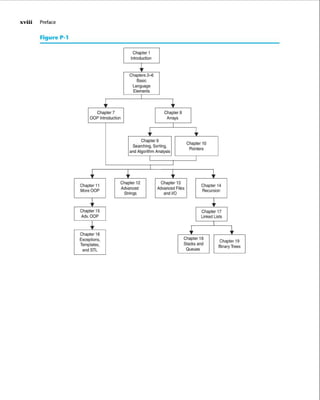
The following dependency diagram (Figur e P-1) suggests possible sequences of
instruct ion.
Chapter 1 covers fundamental hardware, software, and programm ing concepts. The
instructor may choose to skip this chapter if the class has already mastered those topics.
Chapters 2 through 6 cover basic C++ syntax, data types, expressions, selection
structures, repetition structures, and functions . Each of these chapters builds on the
previous chapter and should be covered in the order presented.
Chapter 7 introduces object-oriented programming . It can be covered any time after
Chapter 6, but before Chapter 11. Instructors who prefer to introduce arrays before
classes can cover Chapter 8 before Chapter 7. In this case it is only necessary to
postpone Section 8.13 (Arrays of Objects) until Chapter 7 has been covered.
As Figure P-1 illustrates, in the second half of the book Chapters 11, 12, 13, and 14
can be covered in any order. Chapters 11, 15, and 16, however, should be done in
sequence. Instructors who wish to introduce data structures at an earlier point in the
course, without having first covered advanced C++ and OO P features, can cover
Chapter 17 (Linked Lists), followed by Chapters 18 and 19 (Stacks & Queues and
Binary Tr ees), any time after Chapter 14 (Recursion). In this case it is necessary to
simply omit the sections in Chapters 17- 19 that deal with templates and the Standard
Template Library.
19.
xviii Preface
Figure P-1
Chapter1
Introduction
..
Chapters2-6
Basic
Language
Elements
I
••
Chapter7 Chapter8
OOPIntroduc
tion Arrays
I
+ +
Chapter9
Chapter10
Search
ing, Sorting
,
Pointers
andAlgorithm
Analys
is
I
I
+ • + •
Chapter12 Chapter13
Chapter14
Chapter11
Advanced AdvancedFiles
Recursion
MoreOOP
Strings and1/0
• •
Chapter15 Chapter17
Adv.OOP LinkedLists
I
• + +
Chapter16
Chapter18
Chapter19
Except
ions,
Stacksand
BinaryTrees
Templates
,
Queues
andSTL
20.
Preface xix
Brief Overviewof Each Chapter
Chapter 1: Introduction to Computers and Programming
This chapter provides an introduction to the field of computer science and covers
the fundamentals of hardware , software, operating systems, programming, problem
solving, and software engineering . The components of programs, such as key words,
variables, operators, and punctuation are covered . The tools of the trade , such as
hierarchy charts and pseudocode, are also presented . The Tying It All Together
sect ion shows students how to use the cout statement to create a personalized
output message. Programm ing Challenges at the end of the chapter help students see
how the same basic input, processing , and output structure can be used to create
multiple programs .
Chapter 2: Introduction to C++
This chapter gets the student started in C++ by introducing the basic parts of a
C++ program , data types, the use of variables and literals, assignment statements,
simple arithmetic operations, program output, and comments . The C++ st ring
class is presented and string objects are used from this point on in the book as
the primary method of handling strings. Programm ing style conventions are
introduced , and good programming style is modeled here, as it is throughout the
text . The Tying It All Toget her section lets the student play with simple text -
based graphics.
Chapter 3: Expressions and Interactivity
In this chapter the student learns to write programs that input and handle numer ic,
character, and string data. The use of arithmet ic operators and the creation of
mathemat ical expressions are covered, with emphasis on operator precedence .
Debugging is introduced, with a section on hand tracing a program . Sections are also
included on using random numbers , on simple output formatting, on data type
conversion and type casting, and on using library functions that work with numbers.
The Tying It All Together section shows students how to create a simple interactive
word game.
Chapter 4: Making Decisions
Here the student learns about relational expressions and how to control the flow of a
program with if, if I else , and if I else i f statements . Logical operators, the
conditional operator, and the swi tch statement are also covered. Applications of these
constructs, such as menu-driven programs , are illustrated . This chapter also introduces
the concepts of blocks and scope and continues the theme of debugging with a section
on validating output results. The Tying It All Together section uses random numbers
and branching statements to create a fortune telling game.
21.
xx Preface
Chapter 5:Looping
This chapter introduces, C++'s repetitive control mechanisms .The while loop, do-while
loop, and for loop are presented, along with a variety of methods to control them. These
include using counters, user input, end sentinels, and end-of-file testing. Applications
utilizing loops, such as keeping a running total and performing data validation, are also
covered . The chapter includes an extensive section on working with files and a section
on creating good test data, continuing the book's emphasis on testing and debugging.
The Tying It All Together section introduces students to Windows commands to create
colorful output and uses a loop to create a multi-colored display.
Chapter 6: Functions
In this chapter the student learns how and why to modularize programs, using both
void and value-returning functions. Parameter passing is covered, with emphasis on
when arguments shou ld be passed by value versus when they need to be passed by
reference. Scope of variables is covered and sections are provided on local versus global
variables and on static local variables . Overloaded functions are also introduced and
demonstrated . The Tying It All Together section includes a modular, menu -driven
program that emphasizes the versatility of functions, illustrating how their behavior
can be controlled by the arguments sent to them .
Chapter 7: Introduction to Classes and Objects
In this chapter the text beginsto focus on the object-oriented paradigm. Students have used
provided C++ classessince the beginning of the text, but now they learn how to define their
own classes and to create and use objects of these classes. Careful attention is paid to
illustrating which functions belong in a class versus which functions belong in a client
program that usesthe class.Good object-oriented practicesare discussedand modeled, such
as protecting member data through carefully constructed accessor and mutator functions
and hidingclassimplementation detailsfrom client programs. Once students are comfortable
working with classes and objects, the chapter provides a brief introduction to the topic of
object-oriented analysis and design. The chapter also includesa section on enumerated data
types and a section on structures, which are used in the Tying It All Together section, where
students learn to use screencontrol techniques to create a yoyo animation.
Chapter 8: Arrays
In this chapter the student learns to create and work with single and multidimensional
arrays. Many examples of array processing are provided, including functions to compute
the sum, average, highest and lowest values in an array. Students also learn to create tables
usingtwo-dimensional arrays, and to analyzearray data byrow or bycolumn.Programming
techniques using parallel arrays are also demonsrrated, and the student is shown how to
use a data file as an input source to populate an array . The range-based for loop is
introduced as an easy way to iterate through all the elements of an array, and STL vectors
are introduced and compared to arrays. A section on arrays of objects and structures is
located at the end of the chapter, so it can be covered now or saved for later ifthe instructor
wishes to cover this chapter before Chapter 7. The Tying It All Together section uses
arrays to create a game of Rock, Paper,Scissorsbetween a human playerand the computer.
22.
Preface xxi
Chapter 9:Searching, Sorting, and Algorithm Analysis
Here the student learns the basics of searching for information stored in arrays and of
sorting arrays, including arrays of objects. The chapter covers the Linear Search, Binary
Search, Bubble Sort, and Selection Sort algorithm s and has an optional section on
sortin g and search ing STL vectors. A brief introd uction to algorithm analysis is
included, and students are shown how to determine which of two algorithms is more
efficient. This chapter's Tying It All Together section uses both a table lookup and a
searching algorithm to encode and decode secret messages.
Chapter 10: Pointers
Thi s chapter explains how to use pointers . Topics include pointer arithmetic,
initialization of pointers , comparison of pointers, pointers and arrays, pointers
and funct ions, dynamic memory allocation , the new null pt r key word, and
more . A new section introduces smart pointers and shows how they can be used
to avoid memory leaks. The Tying It All Toget her section demonstrates the use of
pointers to access library data struct ures and functions that return calendar and
wall clock time.
Chapter 11: More About Classes and Object -Oriented Programming
This chapter contin ues the study of classes and object-oriented programming, covering
more advanced topics such as inheritance and object aggregat ion and compos ition.
Other topics include constant member functions, static members, friends, memberwise
assignment, copy constructors, object type conversion operators, convert constr uctors,
operator overloading, move constr uctors, and move assignment operators . A new
section introduces function objects and the C++ll lambda expressions. The Tying It
All Together section brings together the concepts ofinheritance and convert constr uctors
to build a program that formats the contents of an array to form an HTML table for
display on a Web site.
Chapter 12: More on (-Strings and the string Class
This chapter covers standard library functions for working with characters and
C-strings, as well as materia l on str i ng class functions, functions in the new C++11
string library, and new overloaded to_st ring functions for converting numeric
values to str i ng objects . The Tying It All Together section shows students how to
access string-based program environments to obtain information about the computer
and the network on which the program is running.
Chapter 13: Advanced File and 1/ 0 Operations
Thi s chapte r intr oduces more advanced topics for work ing with sequential access
text files and introduces random access and binary files. Various modes for open -
ing files are discussed, as well as the many methods for reading and writing their
contents. Th e Tying It All Toget her program app lies many of the techniques
covered in the chapte r to merge two text files into an HTML doc ument for display
on the Web, with different colors used to illustrate which file each piece of data
came from .
23.
xxii Preface
Chapter 14:Recursion
In this chapter recursion is defined and demonstrated . A visual trace of recursive calls
is provided, and recursive applications are discussed. Many recursive algorithms are
presented, including recursive functions for computing factorials, finding a greatest
common denominator (GCD), performing a binary search, sorting using QuickSort,
and solving the famous Towers of Hanoi problem . For students who need more
challenge, there is a section on exhaustive and enumeration algorithms. The Tying It
All Together section uses recursion to evaluate prefix expressions .
Chapter 15: Polymorphism and Virtual Functions
The study of classes and object-oriented programming continues in this chapter with
the introduction of more advanced concepts such as polymorphism and virtual
functions. Information is also presented on abstract base classes, pure virtual functions,
type compatibi lity within an inheritance hierarchy, and virtual inheritance. The Tying
It All Together section illustrates the use of inheritance and polymorphism to display
and animate graphica l images.
Chapter 16: Exceptions, Templates, and the Standard Template
Library (STL)
Here the student learns to develop enhanced error trapping techniques using exceptions.
Discussion then turns to using function and class templates to create generic code.
Finally, the student is introduced to the containers, iterators, and algorithms offered by
the Standard Template Library (STL). The Tying It All Together section uses various
conta iners in the Standard Template Librar y to create an educational children's game.
Chapter 17: Linked Lists
This chapter introduces concepts and techniques needed to work with lists. A linked list
ADT is developed,and the student learns how to create and destroy a list,as wellas to write
functionsto insert, append, and deletenodes, to traversethe list,and to search for a specific
node. A linked list class template is also demonstrated. The Tying It All Together section
brings together many of the most important concepts of OOP by using objeets,inheritance,
and polymorphism in conjunction with the STLlistclassto animate a collection of images.
Chapter 18: Stacks and Queues
In this chapter the student learns to create and use static and dynamic stacks and queues.
The operations of stacks and queues are defined, and templates for each ADT are
demonstrated . The stat ic array -based stack uses exception -handling to handle stack
overflow and underflow, providing a realisticand natural example of defining, throwing,
and catching except ions . The Tying It All Together section discusses strateg ies for
evaluating postfix expressions and uses a stack to convert a postfix expression to infix.
Chapter 19: Binary Trees
This chapter covers the binary tree ADT and demonstrates many binary tree operat ions.
The student learns to traverse a tree, insert, delete, and replace elements, search for a
particular element, and destroy a tree. The Tying It All Together section introduces a
tree structure versatile enough to create genealogy trees.
THE NATURE OFRELIGION. | 89 puting about single
events, as to whether or not they are to be called miraculous, gives
me a painful impression of the poverty and wretchedness of the
religious sense of the combatants. One party show it by protesting
everywhere against miracle, whereby they manifest their wish not to
see anything of immediate relationship to the Infinite and to the
Deity. The other party display the same poverty by laying stress on
this and that. A phenomenon for them must be marvellous before
they will regard it as a miracle, whereby they simply announce that
they are bad observers."° What is revelation ? Every original and
new communication of the Universe to man is a revelation, as, for
example, every. such moment of conscious insight as I have just
referred to. Every intuition and every original feeling proceeds from
revelation. As revelation lies beyond con- — sciousness,
demonstration is not possible, yet we are not merely to assume it
generally, but each one knows best himself what is repeated and
learned elsewhere, and what is original and new. If nothing original
has yet been generated in you, when it does come it will be a
revelation for you also, and I counsel you to weigh it well. What is
inspiration? Itis simply the general expression for the feeling of true
morality and freedom. But do not mistake me. It is not that
marvellous and much-praised morality and freedom that accompany
and embellish actions with deliberations. It is that action which
springs from the heart of man, despite of, or at least, regardless of,
all external occasion. In the same measure in which this action is
freed from all earthly entanglement, it is ae as divine and referred to
God. What is prophecy? Every religious anticipation of the other half
of a religious event, one half being given, is prophecy. It was very
religious of the ancient Hebrews to measure the divineness of a
prophet, neither by the difficulty of predicting, nor by the greatness
of the subject, but, quite simply, by the issue, for we cannot know
from one
26.
90 SECOND SPEECH.thing how complete the feeling is in
everything, till we see whether the religious aspect of this one
special circumstance has been rightly comprehended.. What is
operation of grace 217 Nothing else manifestly than the common
expression for revelation and inspiration, for interchange between
the entrance of the world into man, through intuition and feeling,
and the outgoing of man into the world, through action and culture.
Itincludes both, in their originality and in their divine character, so
that the whole life of the pious simply forms a series of operations of
divine grace. You see-that all these ideas, in so far as religion
requires, or can adopt ideas, are the first and the most essential.
They indicate in the most characteristic manner a man’s
consciousness of his religion, because they indicate just what
necessarily and universally must be in it. The man who does not see
miracles of his own from the standpoint from which he contemplates
the world, the man in whose heart no revelation of his own arises,
when his soul longs — to draw in the beauty of the world, and to be
permeated by its spirit; the man who does not, in supreme
moments, feel, with the most lively assurance, that a divine spirit
urges him, and that he speaks and acts from holy inspiration, has no
religion. The religious man must, at least, be conscious of his
feelings as the immediate product. of the Universe; for less would
mean nothing. He must recognize something individual in them,
something that cannot be imitated, something that guarantees the
purity of their origin from his own heart. To be assured of this
pasaaszton is the true belief. Belief, on the contrary, usually so
called, which is to accept what another has said or done, or to wish
to think and feel as another has thought and felt, is a hard and base
service. So far is it from being the highest in religion, as . is
asserted, that it must be rejected by all who would force their way
into the sanctuary of religion. To wish to have and
27.
THE NATURE OFRELIGION. 91 hold a faith that is an echo,
proves that a man is incapable of religion ; to demand it of others,
shows that there is no understanding of religion. You wish always to
stand on your own feet and go your own way, and this worthy intent
should not scare you from religion. Religion is no slavery, no
captivity, least of all for your reason. You must belong to yourselves.
Indeed, this is an indispensable condition of having any part in
religion. Every man, a few choice souls excepted, hones to be sure,
require a guide to lead and stimulate, to wake his religious sense
from its first slumber, and to give it its first direction. But this you
accord to all powers and functions of the human soul, and why not
to this one? For your satisfaction, be it said, that here, if anywhere,
this tutelage is only a passing — state. Hereafter, shall each man see
with his own eyes, and shall produce some contribution to the
treasures of religion ; otherwise, he deserves no place in its
kingdom, and receives none. Youare right in despising the wretched
echoes who derive their religion entirely from another, or depend on
a dead writing, swearing by it and proving out of it. Every sacred
writing is in itself a glorious production, a speaking monument from
the heroic time of religion, but, through servile reverence, it would
become merely a mausoleum, a monument that a great spirit once
was there, but is now no more. Did this spirit still live and work, he
would look with love, and with a feeling of equality upon his work
which yet could only be a weaker impress of himself. Not every
person has religion who believes in a sacred writing, but only the
man who has a lively and immediate understanding of it, and who,
therefore, so far as he himself is concerned, could most easily do
without it. Your very contempt for the poverty stricken and
powerless venerators of religion, in whom, from lack of nourishment,
religion died before ever it came to the birth, convinces me that you
have a talent for religion. The same | . «"
28.
92 | SECONDSPEECH. thing appears from your regard for
the persons of all true heroes of religion. That you should treat
them” with shallow scoffing or not acknowledge what is great or
powerful in them, I would hardly ascribe to you. This regard for the
persons confirms me in the thought that your contempt for the thing
rests merely on a misunderstanding, and has for its object only the
miserable figure which religion takes in the great incapable mass,
and the abuses which presumptuous leaders carry on. I have tried,
as best I could, therefore, to show you what religion really is. Have
you found anything therein unworthy of you, nay, of the highest
human culture? Must you not rather long all the more for that
universal union with the world which is only possible through feeling,
the more you are separated and isolated by definite culture and
individuality? Have you not often felt this holy longing, as something
unknown? Become conscious of the call of your deepest nature and
follow it, I conjure you.. Banish the false shame of a century which
should not determine you but should be made and determined by
you. Return to what lies so near to you, yes, even to you, the violent
separation from which cannot fail to destroy the most beautiful part
of your nature. It appears to me, however, that many among you do
not believe that I can here mean to end my present business. How
can I have spoken thoroughly of the nature of religion, seeing I have
not treated.at all of immortality, and of God only a little in passing ?
Is it not incumbent upon me, most of all, to speak of these two
things and to repre„sent to you how unhappy you would be without
belief in them? For are not these two things, for most pious people,
the very poles and first articles of religion ? But I am not of your
opinion. First of all, I do not believe I have said nothing about
immortality. and so little about God. Both, I believe, are in all and in
everything that, I have addnced as an element of religion. Had I not
29.
THE NATURE OFRELIGION. | 93 presupposed God and
immortality I could not have said what I have said, for, only what is
divine and immortal has room in which to speak of religion. In the
second place, just as little do I consider that I have the right to hold
the conceptions and doctrines of God and of immortality, as they are
usually understood, to. be the principal things in religion. Only what
in either is feeling and immediate consciousness, can belong to
religion. God and immortality, however, as they are found in such
doctrines, are ideas. How many among you—possibly most of you—
are firmly convinced of one or other or both of those doctrines,
without being on that account pious or having religion. As ideas they
can have no greater value in religion han ideas generally. But that
you may not think I am afraid to speak a straightforward word on
this subject, because it would be dangerous to speak, till some
definition of God and existence that has stood its trial, has been
brought to light and has been accepted in the German Empire as
good and valid ; or lest you should, on the other hand, perhaps,
believe that I am playing on you a pious fraud and wish, in order to
be all things to all men, with seeming indifference to make light of
what must be of far greater importance to me than I will confess—
lest you should think these things, I shall gladly be questioned and
will endeavour to make ciear to you that, according to my best
conviction, it really is, as I have just now maintained. Remember in
the first place that any feeling is not an emotion of piety because in
it a single object as such affects us, but only i in so far as in it and
along with it, it ‘affects us as revelation of God. It is, therefore, not
an individual or finite thing, but God, in whom alone the particular
thing is one and all, that enters our life. Nor do we stand over
against the World and in it at the same time by any one faculty, but
by our whole being. The divine in us, therefore, is immediately
affected and
30.
94 SECOND SPEECH.called forth by the feeling) Seeing
then that I have presented nothing but just this immediate and
original existence of God in us through feeling, how can anyone say
that I have depicted a religion without God? Is s not God the
highest, the only unity? Is it not God alone before whom and in
whom all particular things disappear? And if you see the world as a
Whole, a Universe, can you do it otherwise than in God? If not, how
could you distinguish the highest existence, the original and eternal
Being from a temporal and derived individual? Otherwise than by the
emotions produced in us by the world we do not claim to have God
in our feeling, and_consequently I have not said more of Him. If you
will not admit that this is to have God, and to be conscious of Him, I
can neither teach nor direct you farther. How much you may know I
do not judge, for it does not at present concern me, but in respect
of feeling and sentiment, you would be for me godless. Science, it is
true, is extolled as giving an immediate knowledge about God, that
isthe source of all other knowledge; only we are not now speaking of
science, but of religion, This way of knowing about God which most
praise and which I also am to laud, is neither the idea of God as the
undivided unity and source of all, that is placed by you at the head
of all knowledge ; nor is it the feeling of God in the heart, of which
we boast ourselves. It lags far behind the demands of science, and
is for piety something quite subordinate. It is an idea compounded
from characteristics, from what are called attributes of God. These
attributes correspond to the different ways | in which the unity of
the individual and the Whole, expresses itself in feeling. Hence I can
only say of this idea, what I have said of ideas generally, in
reference to religion, that there can be much piety without it, and
that it is first formed when piety is made an object of contemplation,
Yet this idea of God, as it is usually conceived, is dif
31.
THE NATURE OFRELIGION. 95 ferent from the other ideas
before: adduced, for though it seeks to be the highest and to stand
above all, God, being thought of as too like us, as a thinking and
willing Person, is drawn down into the region of opposition. It
therefore appears natural that the more like man God is conceived,
the more easily another mode of presentation is set over ‚against it.
Hence, we have an idea of the Highest Being, not as personally
thinking and willing, but exalted above all personality, as the
universal, productive, ers necessity of all thought and existence.
Nothing seems to me less fitting than for the adherents of the
former view to charge with godlessness those who, in dread of this
anthropomorphism, take refuge in the other, or for the adherents of
this latter view to make the humanness of the idea of God a ground
for charging the adherents of the former with idolatry, or for
declaring their piety void. It matters not what conceptions a man
adheres to, he can still be pious. His piety, the divine in his feeling,
may 7 be better than his. conception, : and his desire to place the
essence of piety in conception, only makes him misunderstand
himself. Consider how narrow is the presentation of God in the one
conception, and how dead and rigid in the other. Neither
corresponds to its object, and thus cannot be aproof of piety, except
in so far as it rests on somethingin the mind, of , of which it has
come far short. Rightly understood, both, present, at least, one
element of feeling, but, without feeling, neither is ‘of any value.
Many believe in and accept a God p sented in conception, and yet
are nothing less than nioud and | in no case is this conception the
germ from which their piety could ever spring, for it has no life in
itself, Neither conception is any sign of a perfect or of an imperfect
religion, but perfection and imperfection. sense. clint cfucihins more
that could ld bring us to an understanding on this subject of
conceptions, let us now go on to consider the development of the
religious sense.
32.
96 SECOND SPEECH.As long as man’s whole relation to the
world has not arrived at clearness, this feeling is but a vague
instinct, the world can appear to him nothing but a confused unity.
Nothing of its complexity is definitely distinguishable. It. is to him a
chaos, uniform in its confusion, without division, order, or law. Apart
from what most immediately concerns the subsistence of man, he
distinguishes nothing as individual except by arbitrarily cutting it off
in time and space. Here you will find but few traces of any
conceptions, and you will scarcely discern to which side they incline.
You will not set much value on the difference, whether a blind fate,
only to be indicated by magic rites, exhibits the character of the
Whole, or a being, alive indeed, but without definite characteristics,
an idol, a fetich, one, or, if many, only distinguishable by the
arbitrarily appointed . limits of their sphere. As we advance, the
feeling becomes more conscious. Circumstances display themselves
in their complexity and definiteness. The multiplicity. of the
heterogeneous elements and powers, by whose constant and
determined strife, phenome are determined, becomes more
prominent in man’s consciousness of the world. In the same degree
the result of the contemplation of this feeling changes. The opposite
forms of the idea stand more distinctly apart. Blind fate ate changes
into a higher necessity, in which, though unattainable and
unsearchable, reason s an md conneeiten rest. at the same time
divides and multiplies, each. power and element becomes animate,
and gods arise in endless number. They are now distinguishable by
means of the different objects of their activity, and different
inclinations and dispositions. A stronger, fairer life of the Universe in
feeling you must acknowledge is here exhibited. It is most beautiful
when this new won complexity and this innate . highest unity are
most intimately bound together in feeling, as for example, among
the Greeks, whom you so justly
33.
THE NATURE OFRELIGION. 97 revere. Both forms then
unite i ion, one being of more value for thought, the other for art,
one showing more ele PS ee of 1 the complexity, the other of the
unity. But this stage, even without such a union is more perfect than
the former, especially ‘if the idea of the Highest Being is placed
rather in the eternal unattainable necessity, than in single gods. Let
us now mount higher where opposing elements are again united,
where existence, by exhibiting itself as totality, as unity in variety, as
system, f first. dese serves-its. name. Is not the man who perceives
existence both as one and as all, who stands over against the
Whole, and yet is one with it in feeling, to be accounted happier in
his religion, let his feeling mirror itself in idea as it may? There as
elsewhere then, the manner in which the Deity is present to man in
feeling, is decisive of the worth of his religion, not the manner,
always inadequate, in which it is copied in idea. Suppose there is
someone arrived at this stage, who rejects the idea of a personal
God. I will not decide on the justice of the names you are
accustomed to apply to him, whether Pantheist or Spinozist. This
rejection of the idea of a personal Deity does not decide against the
presence of the Deity in his feeling. The ground of such a rejection
might be a humble consciousness of the limitation of personal
existence, and particularly of personality joined to consciousness. He
might stand as high above a worshipper of the twelve gods whom
you would rightly name after Lucretius, as a pious person at that
stage would be above an idolater. | But we have here the old
confusion, the unmistakable sign of defective culture. Those who are
at the same stage, only not at the same point, are most strongly
repudiated. T’he proper standard of religiousness, that ee oe which
announces the stage to which a man has attained, is et a eet his
sense for the Deity. But_to which idea he will attach himself depends
purely on n what he requires it for, and H .
34.
98 SECOND SPEECH.whether his imagination chiefly
inclines towards existence and nature or consciousness and thought.
“You will not, I trust, consider it blasphemy or incongruity that such
a matter should depend on the direction of the imagination. By
imagination I do not mean anything subordinate or confused, but
the highest and most original faculty in man. All else in the human ı
mind is simply reflection upon it, and is therefore dependent on it.
Imagination in this sense is the free generation of thoughts,
whereby you come to a conception of the world; such a conception
you cannot receive from without, nor compound from inferences.
From this conception you are then impressed with the feeling of
omnipotence. The subsequent translation into thought depends on
whether one is willing in the consciousness of his own weakness to
be lost in the mysterious obscurity, or whether, first of all, seeking
definiteness of thought, he cannot think of anything except under
the one form given to us, that of consciousness or self-
consciousness. Recoil from the obscurity 0: of indefinite thought
is_the one tendency of the im agination, recoil recoil from the
appearance of contradiction in transferring the forms of the finite to
the Infinite is the other. Now cannot the same inwardness of religion
be combined with both? Would not a closer consideration show that
the two ways of conceiving are not very wide apart? But the
pantheistic idea is not to be thought of as death, and no effort is to
be spared to surpass in thought the limits of the personal idea. So
much I have thought it necessary to say, not so much in explanation
of my own position, as to prevent you from thinking that all are
despisers of ‚religion who will n not accept the personality of the
Highest Being as it it is ; is usually set set forth. And I am quite
convinced that what has been said will not make the idea of the
personality of God more uncertain for anyone who truly has it; nor
will anyone more easily rid himself of the almost absolute necessity
to
35.
THE NATURE OFRELIGION. 99 acquire it, for knowing
whence this necessity comes. Among traly religious men there have
never been zealots, enthusiasts, or fanatics for this idea. Even when
timidity and hesitation about itis called atheism, truly pious persons
will leave it alone with great tranquillity. Not to have the Deity
immediately present in one’s feeling has always seemed to them
more irreligious. They would most unwillingly believe that anyone
could in point of fact be quite without religion. They believe that only
those who are quite without feeling, and whose nature has become
brutish, can have no consciousness of the God that is in us and in
the world, and of the divine life and operation whereby all things
consist. But whosoever insists, it matters not how many excellent
men _ hat the highest piety consists in confessing that the Highest
Being thinks asa person and wills outside the world, cannot be far
travelled in the region of piety. Nay, the profoundest words of the
most zealous defenders of his own faith must still be strange to him.
The number who would have something from this God, that is alien
to piety, is only too great. He is to give an outward guarantee of
their blessedness and incite them to morality. They want to have
it.before their eyes. They would not have God working on man by
freedom, but in the only way in which one free being can work on
another, by necessity, by making himself known either by pain or by
pleasure. But this cannotincite usto morality. Every external
incitement is alien to morality, whether it be hope or fear, To follow it
where it concerns morality is unfree, therefore unmoral. But the
Highest Being, particularly when he is thought of as free, cannot w
vun to make freedom itself not free, and morality not moral. This
now brings me to the second point, to immortality. I cannot conceal
that in the usual manner of treating this subject there is still more e
that seems to me inconsistent with the nature of piety. I believe I
have just shown you in what way each one bears in himself an
unchangeable and H 2 f (W En Viana te
36.
| 100 SECONDSPEECH. eternal nature. If our feeling
nowhere attaches itself to the individual, but if its content is our
relation to God wherein all that is individual and fleeting disappears,
there can be nothing fleeting in it, but all must be eternal. In the
religious life then we may well say we have already offered up and
disposed of all that is mortal, and that we actually are enjoying
immortality. But the immortality that most men imagine and their
longing for it, seem to me irreligious, nay quite opposed to the spirit
of piety. Dislike to the very aim of religion is the ground of their wish
to ‘be immortal. Recall how religion earnestly strives to expand the
sharply cut outlines of personality. Gradually they are “to be lost in
the Infinite that we, becoming conscious of the Universe, may as
much as possible be one withit. But men struggle against this aim.
They are anxious about their personality, and do not wish to
overstep the accustomed limit or to be anything else but a
manifestation of it. The one opportunity that death gives them of
transcending it, they are very far from wishing toembrace. On the
contrary, they are concerned as to how they are to carry it with
them beyond this life, and their utmost endeavour is for longer sight
and betterlimbs. But God speaks to them as it stands written, “
Whosoever loses his life for my sake, the same shall keep it, and
whosoever keeps it, the same shall lose it.” The life that they would
keep is one that cannot be kept. If their concern is with the eternity
of their single person, why are they not as anxious about what it has
been as about what it is to be? What does forwards avail when they
cannot go backwards? They desire an immortality that is no
immortality. They are not even capable of comprehending it, for who
can endure the effort to conceive an endless temporal existence?
Thereby they lose the immortality they could always have, and their
mortal life in addition, by thoughts that distress and torture them in
vain. Would they but attempt to surrender their lives from love to
God! Would they but strive to annihilate their person
37.
THE NATURE OFRELIGION. IOI ality and to live in the One
ai in the All! Whosoever has learned to be more than himself, knows
that he loses little when he loses himself. Only the ma man who
denying himself sinks himself 1 in as 1 as much of the whole |
Univer se as he can a ane arisen, has a right to ‘the hopes that .
death gives. With him aloneitisreally possible to hold further
converse about the endlessness to which, through death, we
infallibly soa This then is my view of these subjects. The usual
conception of God as one single being outside of the world and
behind the world is not the beginning and the end of religion. It is
only one manner of expressing God, seldom entirely pure and always
inadequate. Such an idea may be formed from mixed motives, from
the need for such a being to console and help, and such a God may
be believed in without piety, at least in my sense, and I think in the
true and right sense. If, however, this idea is formed, not arbitrarily,
but somehow by the necessity of a man’s way of thinking, if he
needs it for the security of his piety, the imperfections of his idea will
not cumber him nor contaminate his piety. Yetthe true nature of
religion is neither this aOR fe PR acti r idea nor any other, but
immediate consciousness of the Deity as He is found in ourselves
and in the world. Similarly the goal and the character of the religious
Tife is not the immortality desired and believed in by many—or what
their craving to be too wise about it would: suggest—pretended to
be believed in by many. It is not the immortality that is outside of
time, behind it, or rather after it, and which still is in time. It is the
immortality which we can now have in this temporal life ; it is the
problem in the solution of which we are for ever to be engaged. In
the midst of finitude to be one with the Infinite and in every moment
to be eternal is the immortality of religion.
38.
102 SECOND SPEECH.EXPLANATIONS OF THE SECOND
SPEECH. (1) Page 32.—The rhetorical character of this book and the
impossibility of continuing the subject, had my opinion really been
that religion is this restored unity of knowledge, wouid have allowed
me to say so by a very slight suggestion of irony. My meaning would
then have been that I would not now press this truth upon my
opponents, but that elsewhere and in. another form I would carry it
to a victorious issue. Wherefore it seems necessary to guard myself
against this interpretation, especially as so many theologians seem
to maintain at present that religion, and not religion generally, but
the Christian religion, is the highest knowledge. Not only in dignity
but in form is it identified with metaphysical speculations. It is the
most successful and pre-eminent, and all speculations that do not
reach the same results, as for example, if they cannot deduce the
Trinity, have failed. The assertion of others that the more imperfect,
especially the Polytheistic religions have no kinship with Christianity
is similar. I reject both, and in respect of the latter I have sought, in
the further progress of this book, and in the Introduction to my “
Glaubenslehre,” to show how all forms of religion, even the most
imperfect, are the same in kind. In respect of the former position, if
a philosopher as such will attempt to prove a Trinity in the Highest
Being, he does it at his risk, and I would maintain that this is not a
Christian Trinity because, being a speculative idea, it has its origin in
another part of the soul. Were religion really the highest: knowledge,
the scientific method alone would be suitable for its extension, and
religion could be acquired by study, athing not hitherto asserted.
Philosophy would be the first round in the ladder, the religion of the
Christian laity would as ziorıs be an imperfect way of having the
highest knowledge, and theology as yvaoıs would be the perfect way
and stand at the top, and no one of the three stages would be
consistent with the other two. This I cannot at all accept; therefore I
cannot hold religion the highest knowledge, or r indeed knowledge
at all. Wherefore, what the Christian layman has in less perfection
than the
39.
EXPLANATIONS. 103 theologianand which manifestly isa
knowledge is not religion itself, but something appended to it. At (2)
Page 39,—In rhetorical exposition generally, strict definitions are
dispensed with, and descriptions are substituted. This whole speech
is simply an extended description, mixed with criticism of other
conceptions, which in my opinion are false. The chief points being
scattered are of necessity repeated in different places, under
different expressions. This change of expression presents different
sides of the matter, and I find it useful evenin more scientific
treatment for avoiding the scrupulosity of too rigid a terminology. In
this kind of writing it seemed specially appropriate. Wherefore three
different expressions follow in rapid succession. It is said here of
religion that through it, the universal ewistence of all finite things in
the Infinite lives immediately in us. On page 39 it stands religion is
sense and taste for the Infinite. Sense may be capacity of perception
or capacity of sensibility. There it is the latter. In the former editions,
sensibility and taste stood not quite correctly for sense and taste for
the Infinite. What I am conscious of or feel, must be imagined, and
that is what I call the life of the object in me. But —mnee the
Infinite, meaning not something unconditioned, but the infinity I ea
Saar of existence generally, We Ca we Cannot be conscious of
immediately and through itself. It can only be through a finite object,
by means of which our tendency to postulate and seek a a world,
leads us from detail and part to the All and the Whole. Hence sense
for the Infinite and the immediate life of the ‘finite in us as it is in
the Infinite, are one and the same. If then, in the first expression,
taste be now added to sense, and in the latter expression, the
universal existence of all finite things in the Infinite be made explicit,
both become essentially identical. Taste includes liking as well as
mere faculty, and it is by this liking, this desire to find not merely the
finite thing, but to be conscious through it of the Infinite, that the
pious person finds that the existence of the finite in the Infinite is
universal. There is a similar passage on page 36. The connection
shows that the expression contemplation is to be taken in the widest
sense, not as speculation proper, but as all movement of the spirit
manifestly inconsistent withthe characteristics of his views and had
quite a different basis than the unity of substance. Even Jacobi has
in his criticism by no means hit upon what is most characteristic.
When I recovered my astonishment, in revising the second edition,
this parallel occurred tome. As it was known that Novalis in some
points hada tendency to Catholicism, I felt sure that, in praising his
art, I should have his
43.
EXPLANATIONS. 105 religiousaberrations ascribed me as
Spinozism had been because I praised Spinoza’s piety. Whether my
expectation has deceived me I do not yet very well know. (4) Page
46.—Even among the few who admit that religion originally is feeling
stirred in the highest direction, there will be many to whom it will:
appear ır that I assert too much when I say that all healthy feelings
are pious, or at least that, in order not to be diseased, they should
be pious. Even were this granted of all social feelings, it must be
shown how piety is to be found in all those feelings that unite men
for a higher or even a more sensuous enjoyment of life. Yet I can
retract nothing from the universality of the statement and ey. in no
way admit that it was a rhetorical hyperbole. To take one example,
Protestantism can only completely and consistently defend the
domestic and paternal relations of the clergy against the melancholy
folly of the peculiar holiness of the celibate life, by showing that
wedded love and all foregoing natural attraction of the sexes are
not, in the nature of the case, absolutely inconsistent with a pious
state. This only happens when the feeling is diseased, when there is
a tendency in it to the rage of Bacchus or the folly of Narcissus. In
accordance with this analogy I believe that the same could be shown
of each department of feeling not inconsistent with morality. But, if it
be inferred from this passage that, as all true human feelings belong
to the religious sphere, all ideas and principles of every sort are
foreign to it, the connection seems to show my meaning. ‚Religion
itself is to be rigidly distinguished from what merely belongs to TE
even those feelings which are usually separated from the religious
sphere, require ideas for their communication and representation,
and principles to exhibit their due measure. But these „Principles and
ideas do not belong to the feelings themselves, and it is similar with
the dogmatic and ascetic in respect of religion, as is shown more
fully further on. (5) Page 49.—For understanding my whole view I
could desire nothing better than that my readers should compare
these Speeches with my “Christliche Glaubenslehre.” In form they
are very different and their - points of departure lie far apart, yet in
matter they are quite parallel. But to provide the Speeches for this
44.
purpose with acomplete commentary was impossible, and I must
content myself with single references to such passages as seem to
me capable of appearing contrary or at least of lacking agreement.
Thus every one perhaps might not find the description here given of
an action of things upon us underlying all religious emotions, in
agreement with the declaration which goes through the whole
45.
106 SECOND SPEECH.“Glaubenslehre,” that the essence of
the religious emotions consists in the feeling of an absolute
dependence. The matter stands thus. Even there it is admitted that
we cannot really have this feeling except it is occasioned by the
action of single things. But if the single things are in their action only
single, the sole result is. definiteness of the sensuous self-
consciousness. In the “ Glaubenslehre,” likewise this is postulated as
the substratum of religious emotion. Yet, let the single thing be great
or small, our single life reacts against it, and there can be no feeling
of dependence except fortuitously in so far as the reaction is not
equal to the action. If, however, the single thing does not work upon
us as a single thing, but as part of the Whole, it will be, in acting
upon us, an opening for the Whöle. This result will depend entirely
on the mood and attitude of the mind. But then our reaction will
appear to us determined by the same cause and in the same way as
the action, änd being over against the Universe, our state must
bethe feeling of entire dependence. And this also showsthat however
we exhibit the World and God they cannot be divided. We do not
feel ourselves dependent on the Whole in so far as it is an aggregate
of mutually conditioned parts of which we ourselves are one, but
only in so far as underneath this coherence there is a unity
conditioning all things and conditioning our relations to the other
parts of the Whole. Only on this condition can the single thing be, as
it is here put, an exhibition of the Infinite, being so comprehended
that its opposition to all else entirely vanishes. (6) Page 50.—By
mythology I understand in general a purely ideal subject enunciated
in historical form. Exactly in accordance with the analogy of
Polytheistic Mythology, it seems to me that we have a Monotheistic
and a Christian. For this a dialogue of divine persons, such as is
found in Klopstock’s poems and elsewhere, is not necessary. It is
found in more rigid didactic form when something is represented as
happening in the Divine Being, as divine resolves made in respect of
something that has happened in the world, or again to modify
former resolves, not to speak of the special divine resolves that give
reality to the idea that prayer is heard. The representations of many
46.
divine attributes alsohave this historical form and are therefore
mythological. The divine pity for example, as the idea is mostly
understood, is only,something when the divine will that lightens the
evil is separated from the will that ordained it. Are both regarded as
one, then one cannot limit the other, but the divine will that decrees
the evil, decrees it only in a definite measure, and the idea of pity is
out of place. Similarly, in the idea
47.
EXPLANATIONS. 107 ofthe veracity of God, promise and
fulfilment are separated, and both together exhibit a historical
transaction. But when the activity that promises, is regarded as the
same that accomplishes the fulfilment, the conception of divine
veracity is something only in so far as many divine activities are
linked or not to one expression of them. In this distinction also a
history is told, but if the activity that brings to pass and its
expression are regarded in general as one, there is hardly place for a
special idea of the divine veracity. The same may be shown in other
things. By applying this name to them I in nowise blame these
representations. Rather I acknowledge them as indispensable, for
otherwise the subject could not be spoken of in such a way that any
distinction could be drawn between the more correct and less
correct. Even in more scientific presentations of religion, the use of
such mythology has no danger, for there it is always incumbent to
think away the historical and the time form generally. In the sphere
of religious poetry and oratory also it is indispensable. There we
have only to do with the like-minded, and forthem the chief worth of
those presentations is that by them they communicate and realize
their own religious moods. They naturally at once adjust the
defective expression. But I blame it as vain mythology when this,
that is only a help in need, is regarded as exact knowledge, and
treated as the essence of religion. (7) Page 53.—If here the system
of marks or attributes which in its completest form composes the
theological outline is represented rather as being determined by
outward circumstances than as coming forth of itself from the
religious capacity, the oft-repeated assertion, so contemptuous of all
historical sense, that the religious movements which in Christianity
have determined a great body of the most important ideas, were
merely accidental and the fruit of entirely alien interests, is not to be
made. I only wished to recall what is also expounded in my “ Kurze
Darstellung” and in the Introduction to the “ Glaubenslehre,” that t
he formation of the idea depends here, as elsewhere, on the
dominating language, the degree, manner, and quality of its
scientific development embracing of course the manner and quality
48.
of the philosophizing.But in respect of religion in and for itself, these
are only external circumstances. Apart from the ° - universal, divine
connection of all things, we can say, for example, that if Christianity
had had a great and preponderating Eastern extension, the Hellenic
and Western being, on the contrary, kept back, without being
essentially different, it might have been contained in another type of
doctrines. (8) Page 54.—This passage also might occasion various
miscon
49.
108 SECOND SPEECH.ceptions. First, in respect of the
opposition between true and false religion, I refer to my “
Glaubenslehre,” §§ 7 and 8 (2nd edit.). It is there treated fully, and I
would simply add that, in religion, error man’s religion is his highest
truth. Error therein would not only be error, it would be hypocrisy. In
religion then everything is immediately true, as nothing is expressed
at any moment of it, except the state of mind of the religious
person. Similarly, all types of religious association are good, for the
best in the existence of each man must be stored up in them. But
how little this prejudices the superiority of one type of faith to
another is in part plainly stated and in part easy to infer. One may
bethe utterance of a superior state of mind, or there may be in the
religious communion a higher spiritual power and love. Furthermore,
the rejection here of the thought of the universality of any one
religion and the assertion that only in the sum of all religions is the
whole extent of this bias of the mind ~ comprehended, in no way
expresses a doubt that Christianity will be able to extend itself over
the whole human race, though perhaps among many races, this
greatest of all religions may suffer important changes. Just as little
did this passage express a wish that other religions should always
continue alongside of Christianity. The influence of Judaism and
Hellenic Heathenism on Christianity was through a long period visible
in hostile, raging commotions. Thus both still appear in Christianity,
and therefore in the history of Christianity have a place. The same
thing would happen if Christianity should annex the territory of all
existing great religions. Consequently the religious sphere would not
be enclosed in narrower borders, but all religions would in a
historical way be visible in Christianity. From the connection again it
is clear that I only deny that a religion is universally true in the
sense that everything that exists or has existed outside of it, is not
to be called religion at all. Similarly, what follows is to be
understood, about every truly pious person willingly acknowledging
that to other types of religion much belongs for which the sense fails
him. Even if Christianity had supplanted all other religions, he would
not have a sense for all that would thereby be historically mirrored in
50.
Christianity, for justas little then as now would the Christianity of all
Christian people be quite the same. And if no one has an adequate
sense for all that is Christian, there can be none with the sense for
all there is in other religions that may be the germ of some future
Christian peculiarity. (9) Page 55.—There are still Christian divines
who reject the whole a a TD _
51.
EXPLANATIONS, 109 purposeof Christian dogmatics, and
there was a far greater number when this passage was first written.
They believe that Christianity would have been a healthier
development and would have shown a freer, fairer form if no one
had ever thought of presenting the Christian conceptions in a
finished connection. Hence they labour to prune it, to abolish it, as
much as possible, and to have it acknowledged as merely a
collection of monographs, as an accidental aggregate of single
theses of very unequal value. Their good intentions I do not
question, but even then, I was far removed from agreeing with
them. would be a_ grave misunderstanding to believe that this
invective against the mania for system makes light of the endeavour
to present the Christian faith in the closest possible connection. The
mania for system is merely a morbid degeneration of this
praiseworthy and wholesome endeavour. That systematic treatment
of religious conceptions.is.the best which, on the one side, does no
not take the conception and the idea for original and constitutive,
and on the other, that the living mobility of the letter be secured,
that it may not die and the spirit be drawn to death with it. Within
the great conformity characteristic difference is not only to be
endured, it is to be assigned its place. If this were to be taken for
the chief aim in my presentation of the Christian faith, I would fain
believe that I am in perfect agreement with myself. (10) Page 55.—I
feel that this passage gives a two-fold, grave offence. First I prefer
Heathen Rome, on account of its boundless mixture of religions, to
Christian Rome which, in comparison, I call godless, and that I
condemn the expulsion of heretics, while I myself declare certain
views to be heretical, and even seek to systematize heresy. I begin
with the latter as the deeper and more important. It does not appear
to me possible that there can be a sound dogmatic procedure
without a formula of the character of what is Christian, by the
application of which it would be possible, from any point of the line
of cleavage, to cut off the ordinates, and so to describe the extent of
Christian conceptions by approximation. It naturally follows that
what lies outside of this extent, and would yet be considered
52.
Christian, is whathas long been called in the Christian Church
heretical. In my dogmatics I could not avoid offering such a formula,
and I can only wish to attain my object as fully as possible. But this
definition of the subject has nothing to do with the treatment of } of
‘persons. 3. That many, while contending for the defence of their
ow: own opinion, may use a heretical expression without meaning
anything heretical, is apparent, and I have declared myself fully on it
in the “ Glaubenslehre,” $ 22, 3 and note, and $ 25, note.
53.
110 SECOND SPEECH.On many sides the wish has been
expressed in the Evangelical Church to renew church discipline in a
judicious manner that a Christian congregation may be in a position
to withdraw a measure of fellowship from persons disproving by
their lives their Christian _ disposition. This makes it specially
necessary to obviate the confusion between this proceeding and the
right to pronounce the bann on all we may choose to consider
heretics. If heretics are not also without a Christian disposition, the
Evangelical Church will rather acknowledge that its sole duty towards
them is to maintain fellowship with them that, by mutual
understanding, they may the sooner be led into the right way. If
individuals or small societies employ a contrary method and,
regardless of disposition, exclude from their fellowship all who do
not agree with them in the same letter of doctrine, they do not act
in an Evangelical spirit, but assume an authority our church grants to
none. And now passing to the second point, my preference of
Heathen to Christian Rome, and my statement that through
tolerance the former was full of gods, and that through persecution
of heretics, the latter was godless. First, the character of the
expressions used shows that this passage bears specially the
rhetorical cast of the book. What, however, is to be taken literally is
that the dogmatizing love of system which scorns to assign its place
to difference, but rather excludes all difference, plainly suppresses,
as much as it can, the living knowledge of God, and changes
doctrine into a dead letter. A rule so rigid that it condemns
everything of another shade, crushes out productiveness. As this
alone contains living knowledge of God, the system itself must
become dead. This is the history of the Roman Catholic system in
contrast to the Protestant. From this point of view the rise of the
Evangelical Church was simply to rescue its own productiveness from
fellowship with such a rule. My praise of the receptivity of ancient
Rome for strange worships is also to be taken seriously. It involved
an acknowledgment of the narrowness and one-sidedness of each
individualized Polytheism, and the desire to free the religious need
from the limits of political forms. Now these two things were not
54.
only praiseworthy inthemselves, but were much more favourable to
the spread of Christianity than heresy hunting, however well meant,
could ever be for its establishment and preservation. (11) Page 65.—
In the “ Glaubenslehre,” also § 8, note 1, I have declared myself
against the opinion that idolatry, embracing, according to the
somewhat perspective usage of the Holy Scriptures, all kinds of
Polytheism, has arisen from fear. There, however, I wished to ee ee
ae Bi a Mn un Finke FO
55.
Welcome to ourwebsite – the ideal destination for book lovers and
knowledge seekers. With a mission to inspire endlessly, we offer a
vast collection of books, ranging from classic literary works to
specialized publications, self-development books, and children's
literature. Each book is a new journey of discovery, expanding
knowledge and enriching the soul of the reade
Our website is not just a platform for buying books, but a bridge
connecting readers to the timeless values of culture and wisdom. With
an elegant, user-friendly interface and an intelligent search system,
we are committed to providing a quick and convenient shopping
experience. Additionally, our special promotions and home delivery
services ensure that you save time and fully enjoy the joy of reading.
Let us accompany you on the journey of exploring knowledge and
personal growth!
ebookluna.com