private func evaluate(ops:[Op])-> (result:Double?, remainingOps:[Op]) {
if !ops.isEmpty {
var remainingOps = ops
let op = remainingOps.removeLast()
switch op {
case .Operand(let operand):
return (operand, remainingOps)
case .UnaryOperation(_, let operation):
let operandEvaluation = evaluate(remainingOps)
if let operand = operandEvaluation.result {
return (operation(operand), operandEvaluation.remainingOps)
}
case .BinaryOperation(_, let operation):
let op1Evaluation = evaluate(remainingOps)
if let operand1 = op1Evaluation.result {
let op2Evaluation = evaluate(op1Evaluation.remainingOps)
if let operand2 = op2Evaluation.result {
return (operation(operand1, operand2), op2Evaluation.remainingOps)
}
}
}
}
return (nil, ops)
}
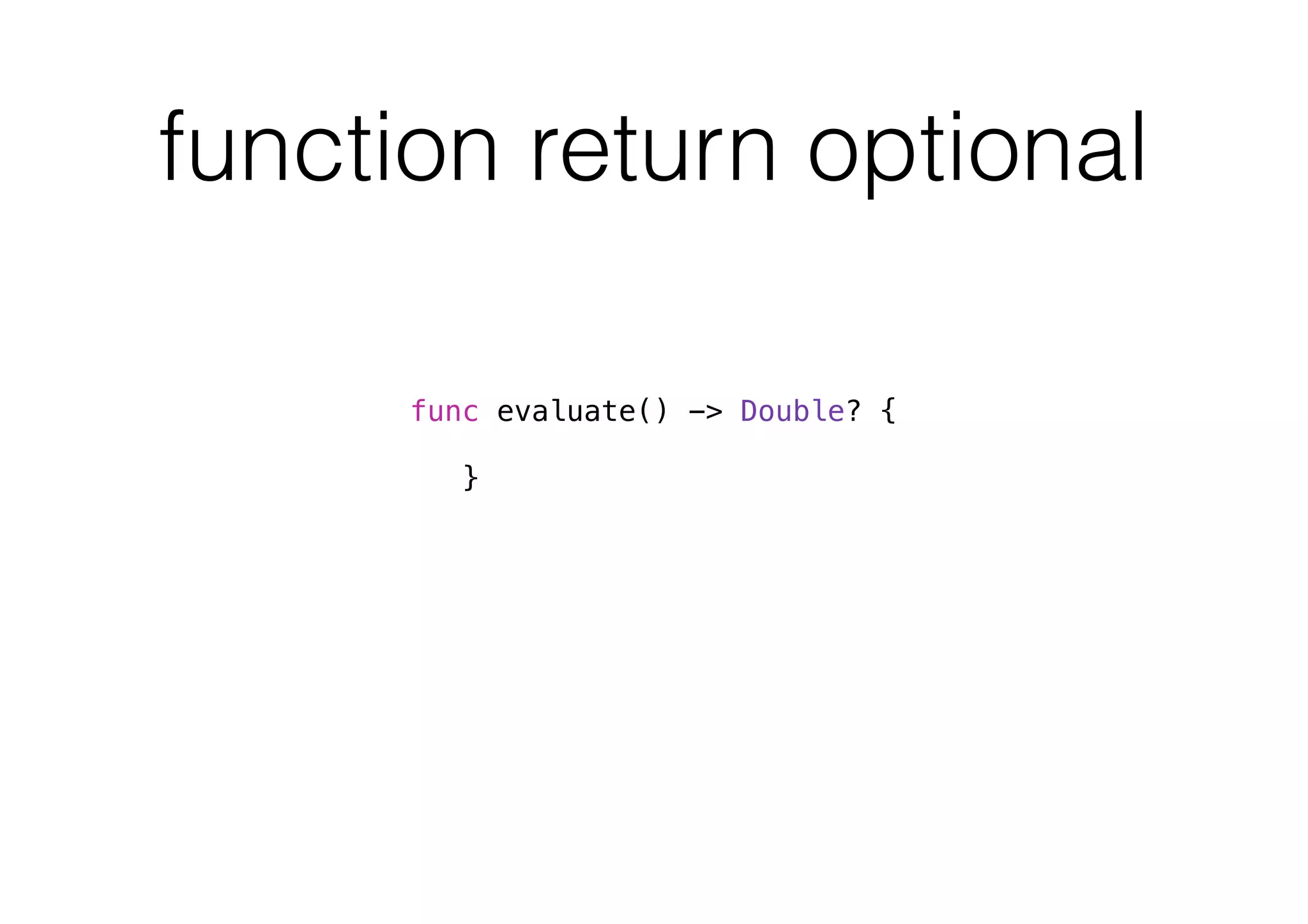
func evaluate() -> Double? {
let (result, _) = evaluate(opStack)
return result
}
recursion
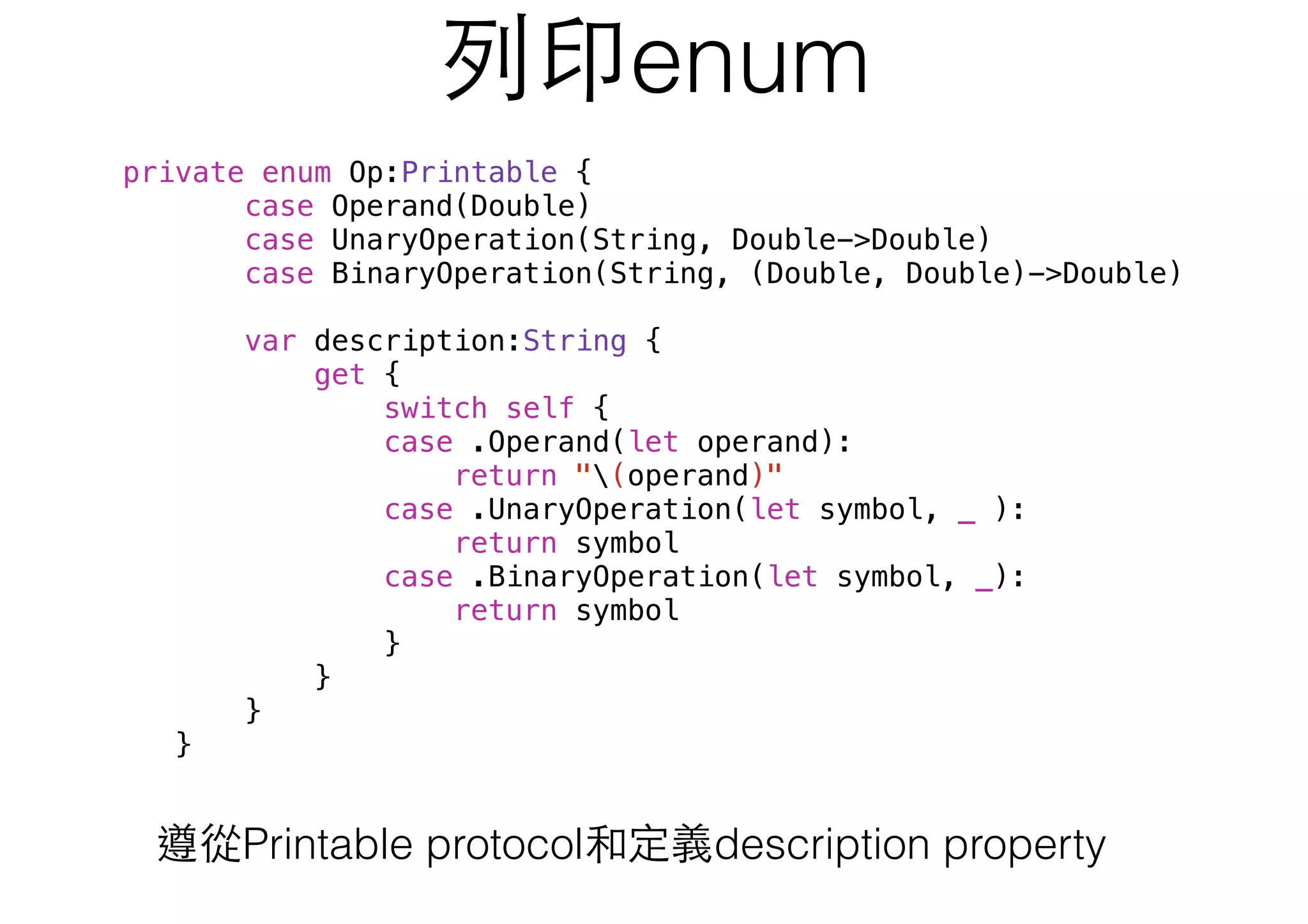
列印enum
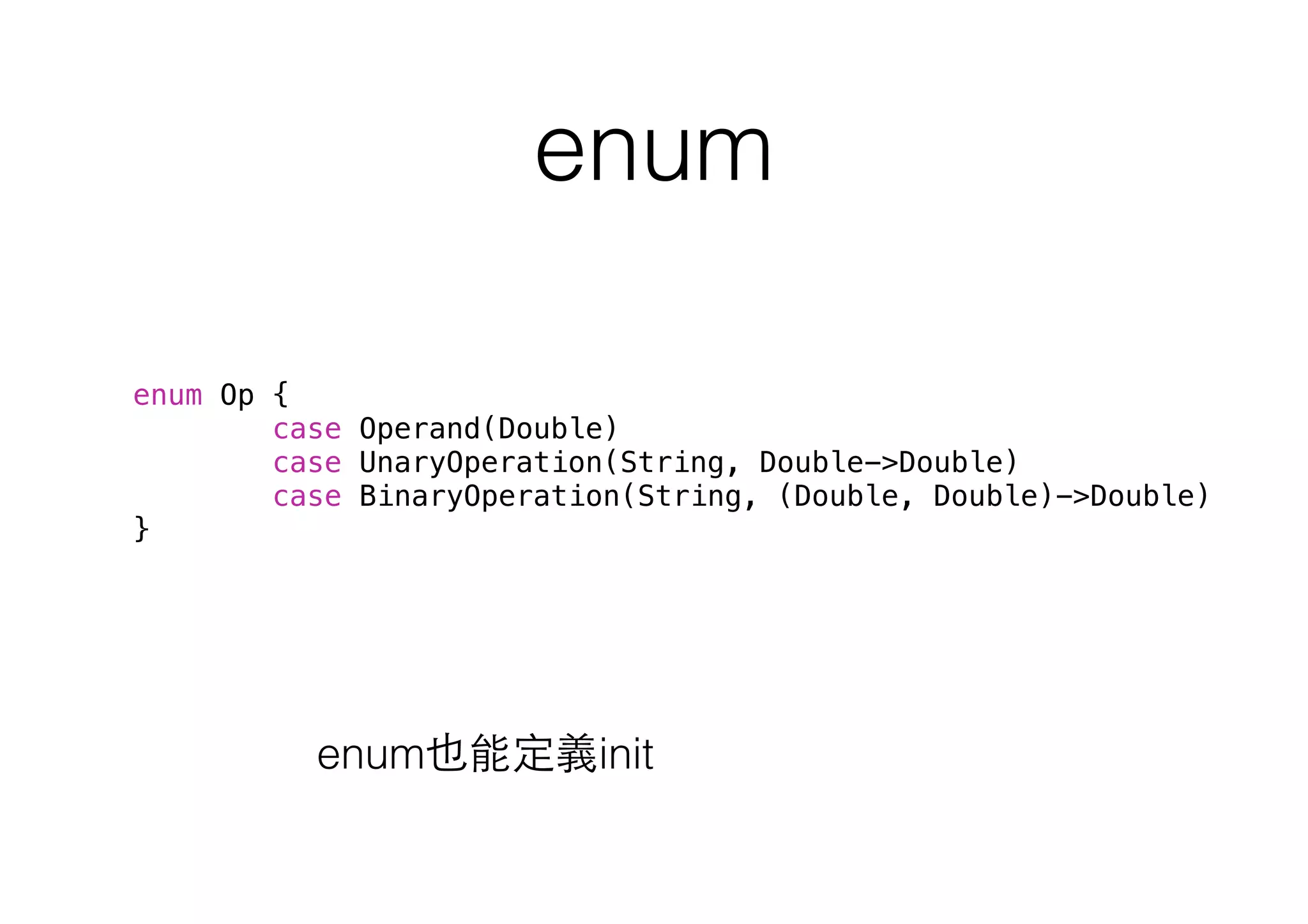
private enum Op:Printable{
case Operand(Double)
case UnaryOperation(String, Double->Double)
case BinaryOperation(String, (Double, Double)->Double)
var description:String {
get {
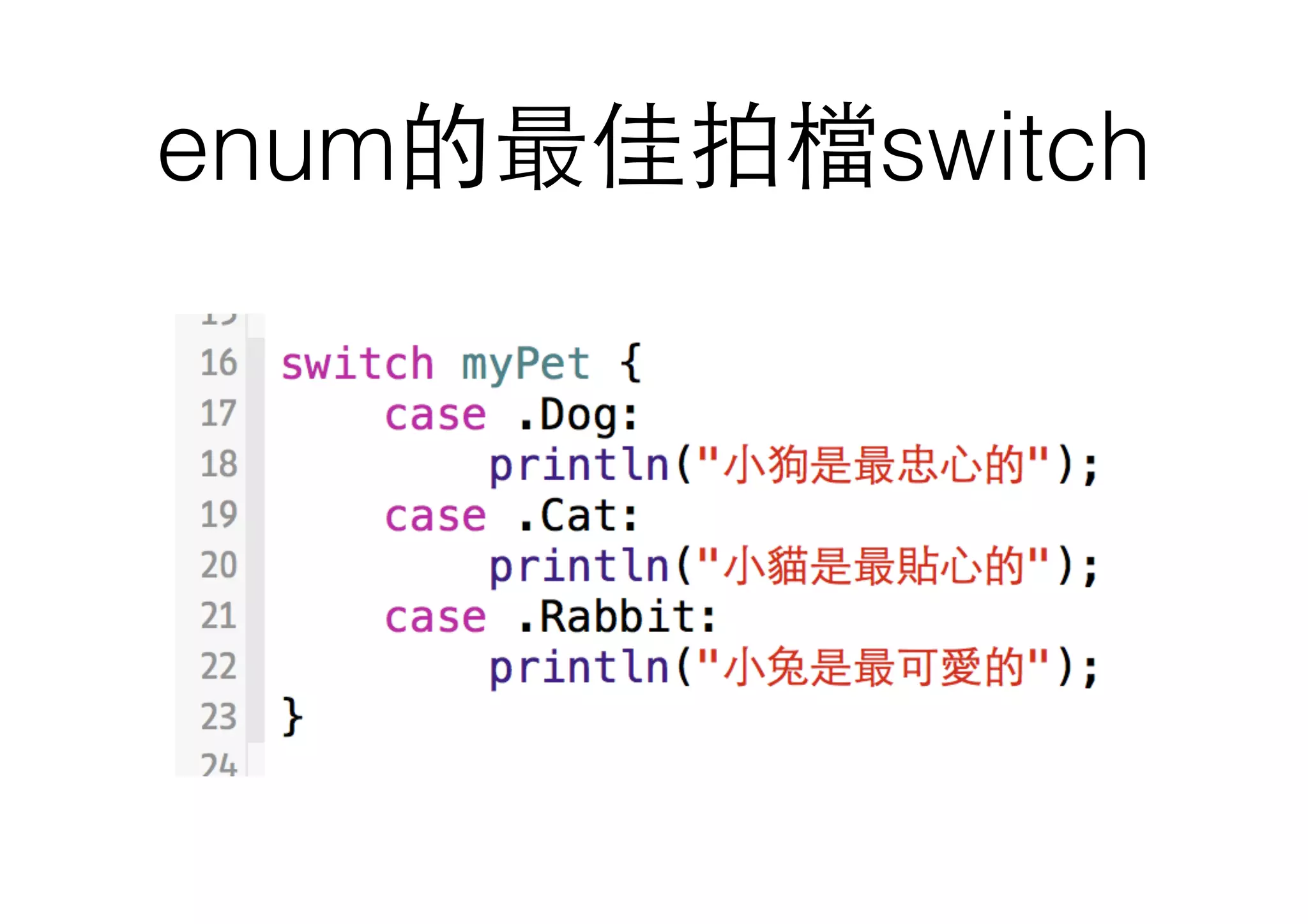
switch self {
case .Operand(let operand):
return "(operand)"
case .UnaryOperation(let symbol, _ ):
return symbol
case .BinaryOperation(let symbol, _):
return symbol
}
}
}
}
遵從Printable protocol和定義description property
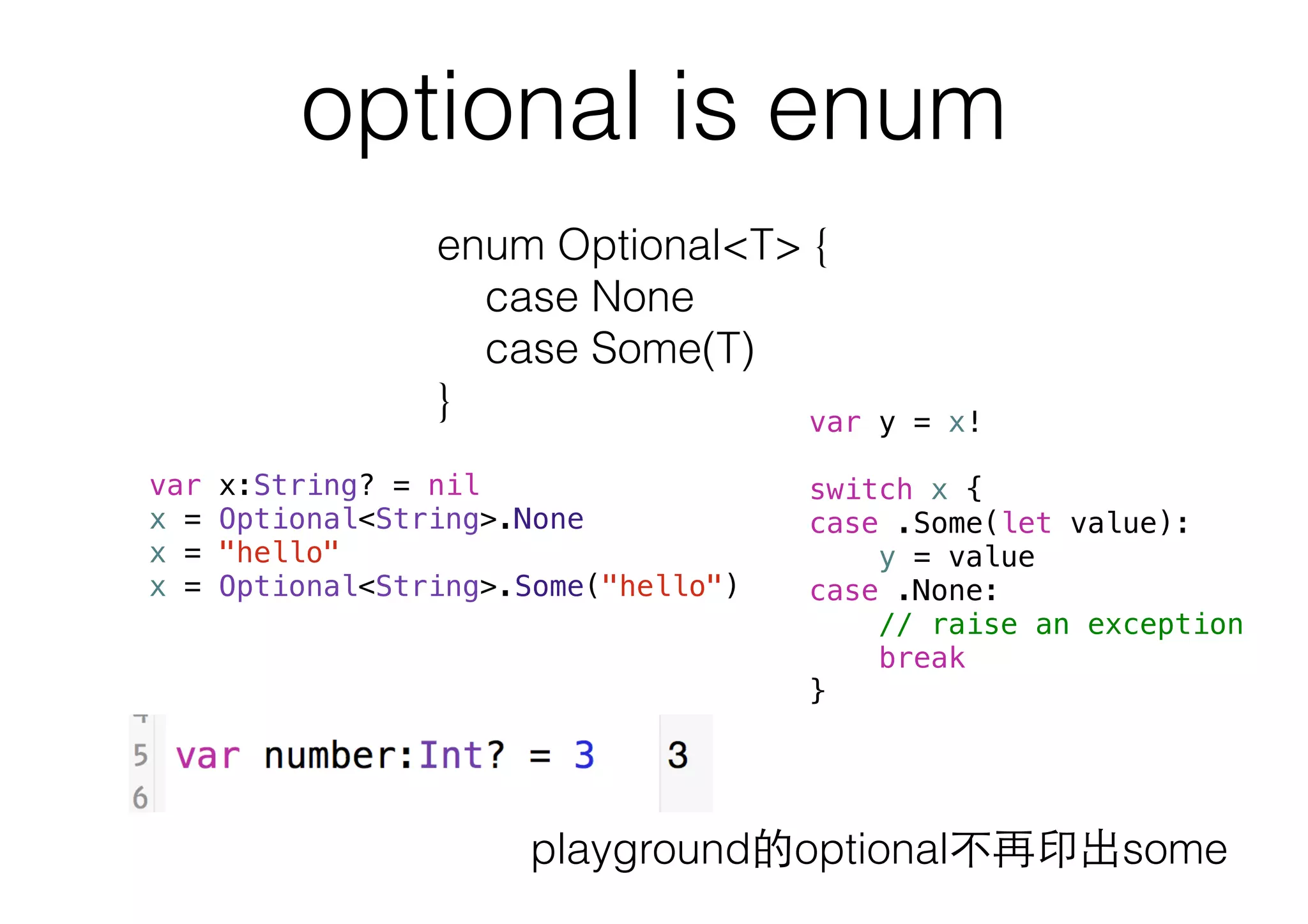
optional is enum
enumOptional<T> {
case None
case Some(T)
}
var x:String? = nil
x = Optional<String>.None
x = "hello"
x = Optional<String>.Some("hello")
var y = x!
switch x {
case .Some(let value):
y = value
case .None:
// raise an exception
break
}
playground的optional不再印出some
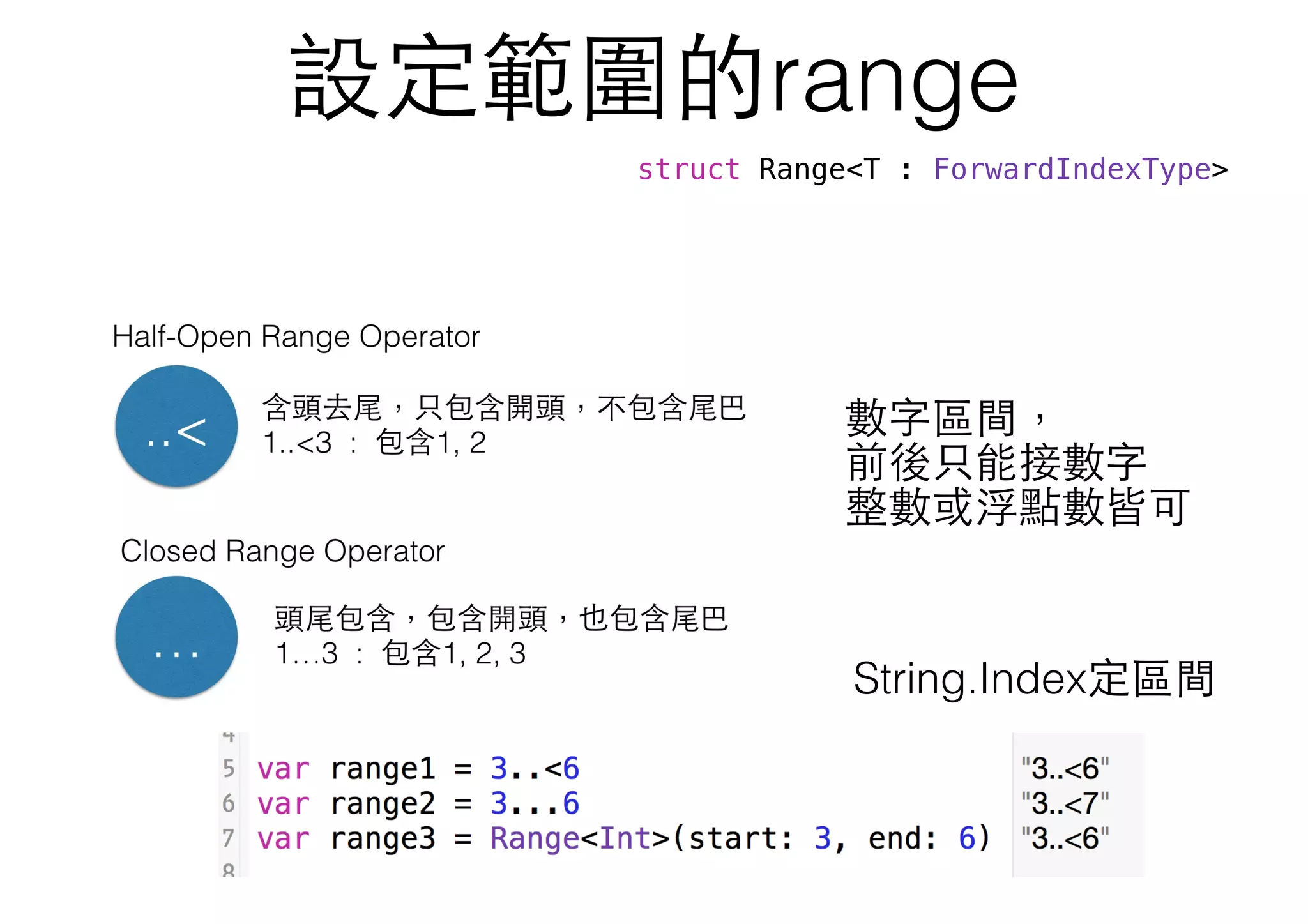
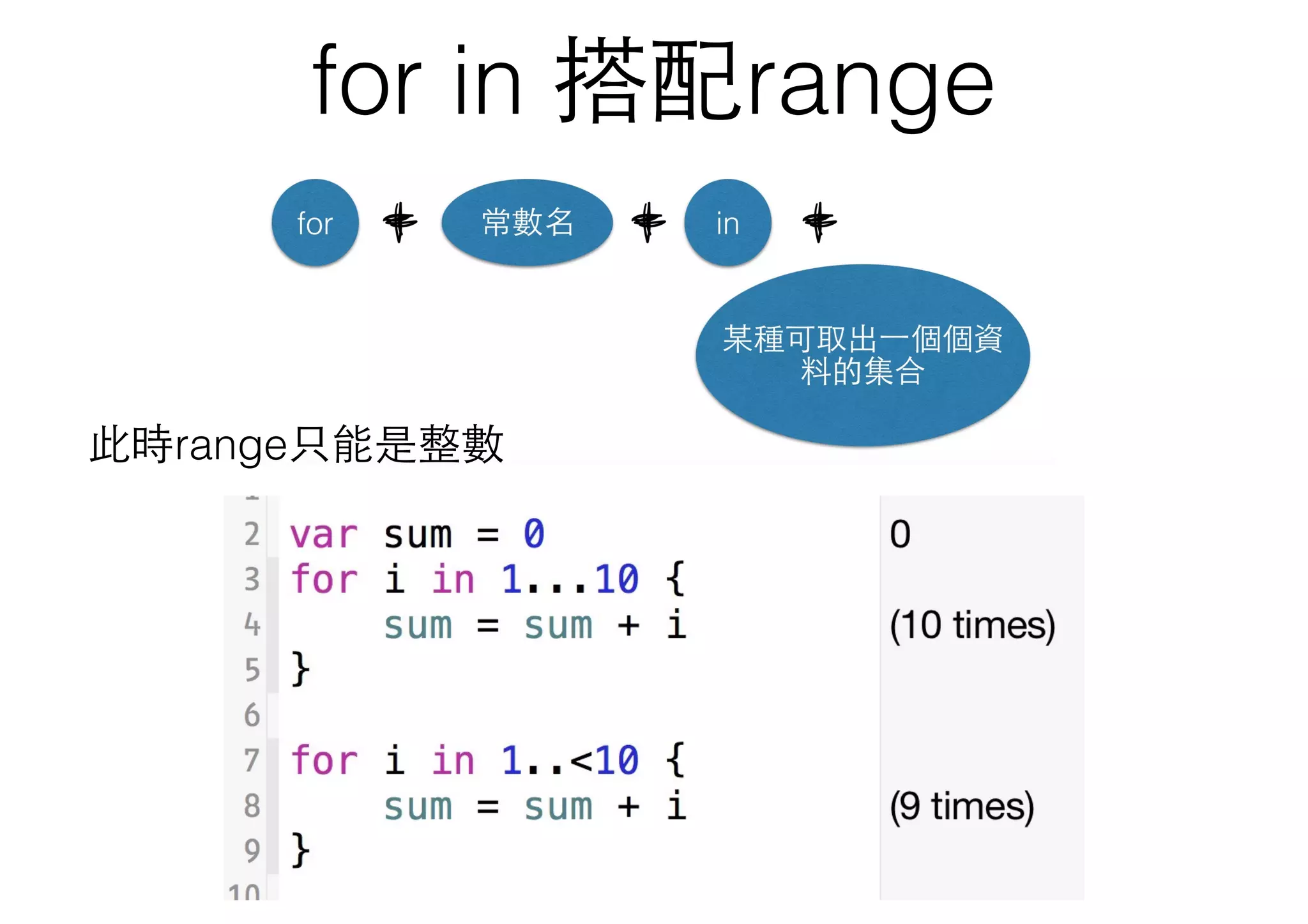
range搭配array
let array =["a","b","c","d"]
let subArray1 = array[2...3]
let subArray2 = array[2..<3]
println("(subArray1[1]) (subArray2[0])")
51.
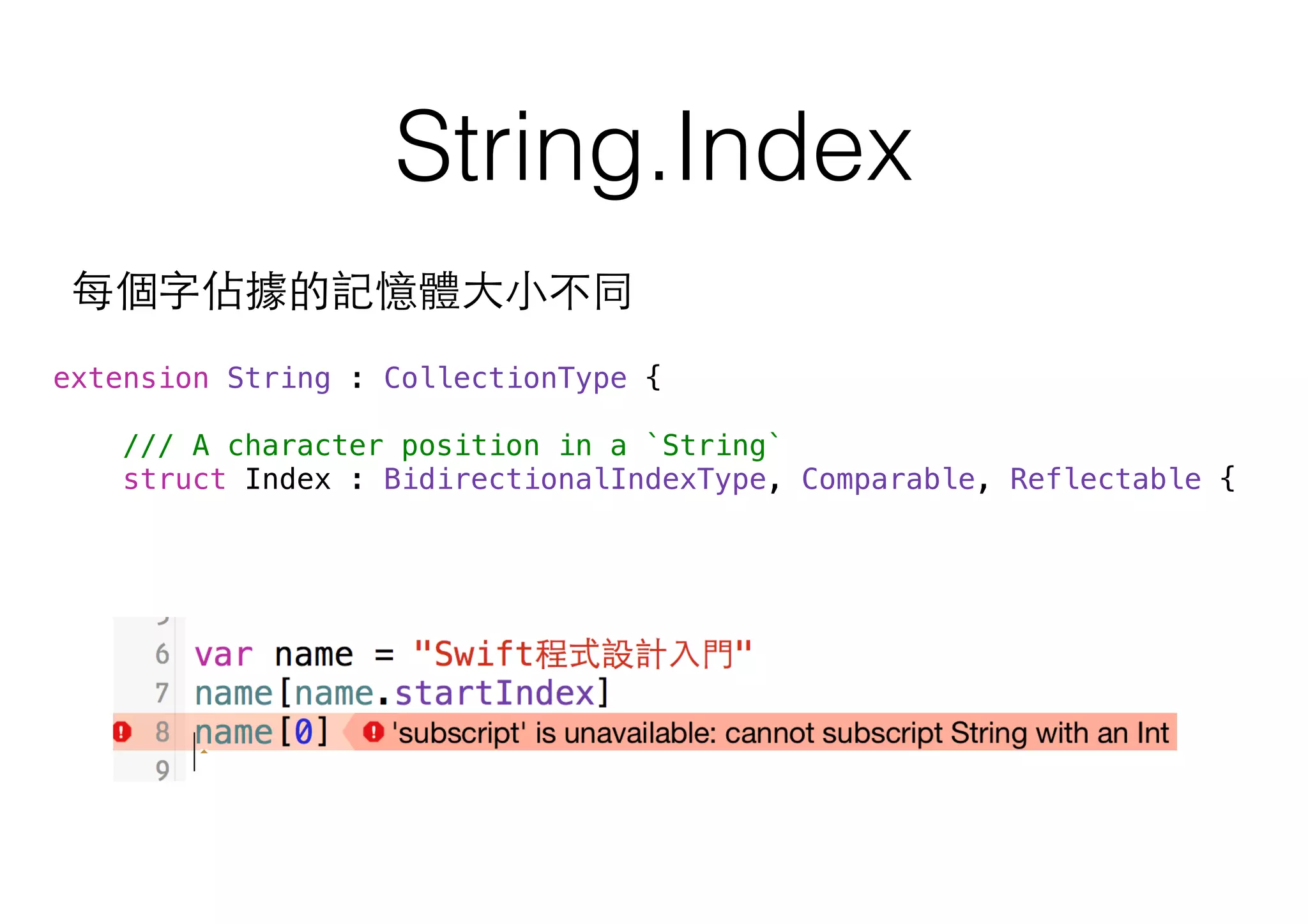
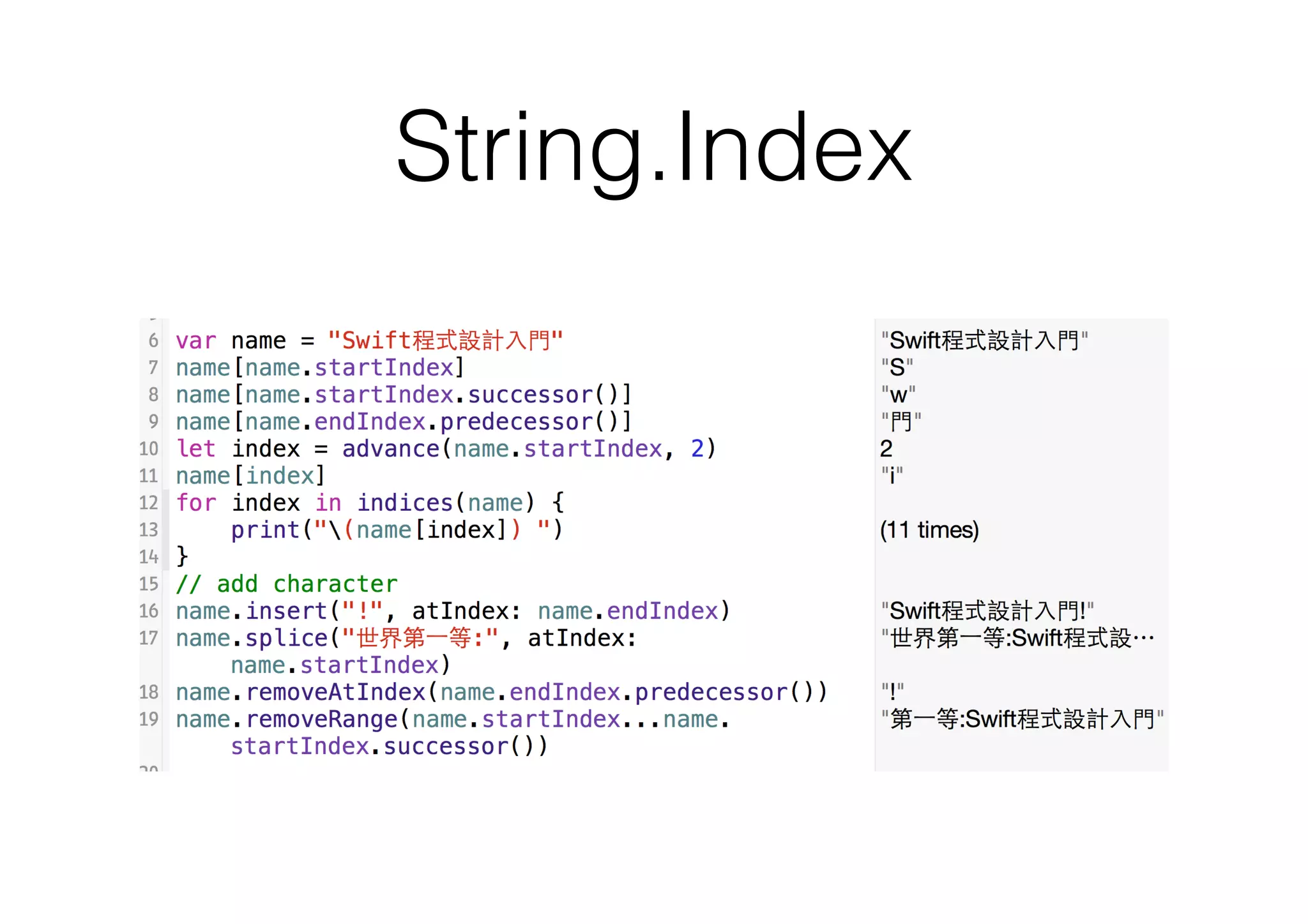
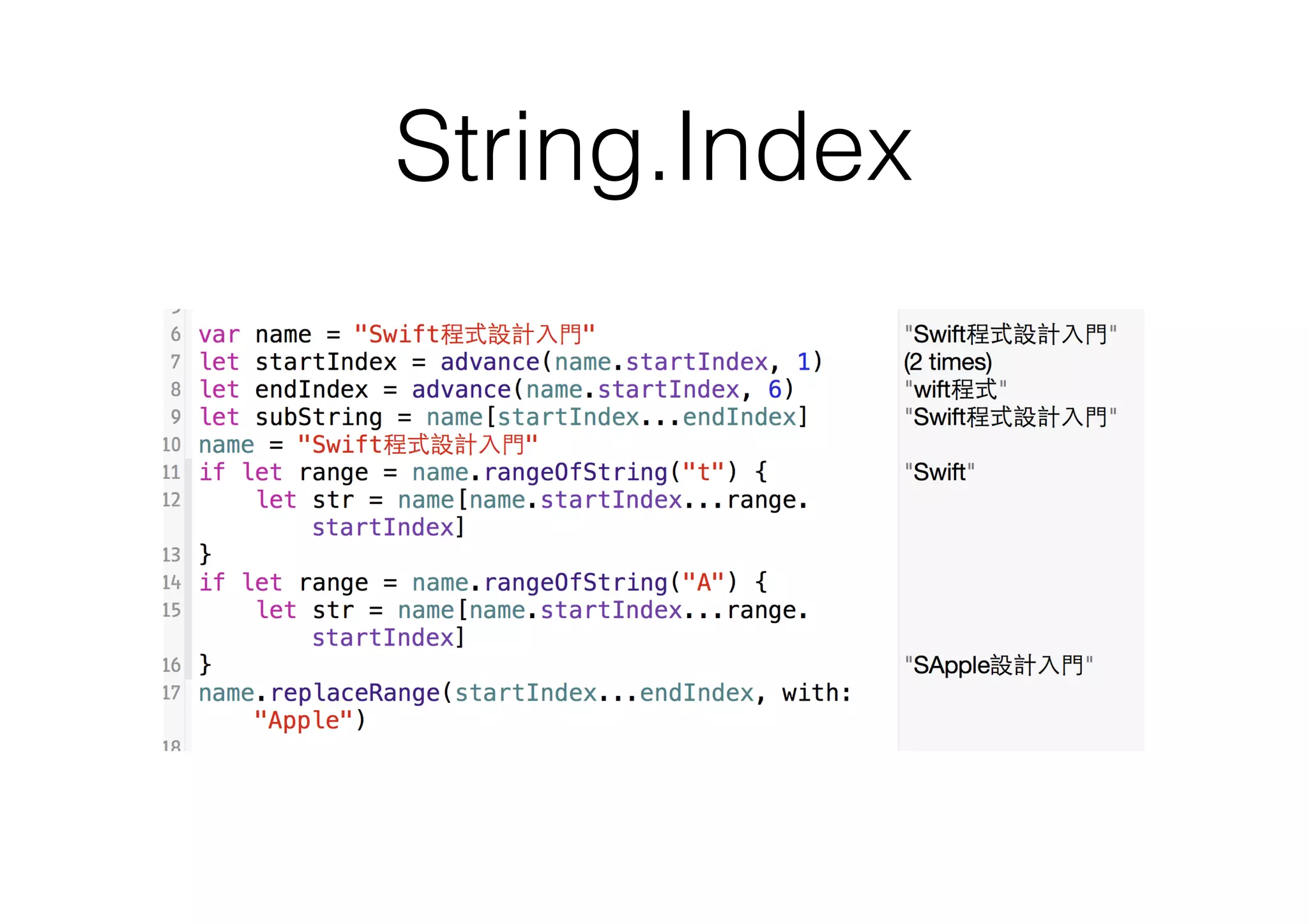
String.Index
extension String :CollectionType {
/// A character position in a `String`
struct Index : BidirectionalIndexType, Comparable, Reflectable {
每個字佔據的記憶體⼤大⼩小不同

![儲存operand & operation
var opStack = Array<Op>()
var opStack = [Op]()
空array的表達和建⽴立](https://image.slidesharecdn.com/standford2015week2-150418084257-conversion-gate02/75/Standford-2015-iOS-week2-1-Applying-MVC-2-More-Swift-and-Foundation-Frameworks-6-2048.jpg)
![像字典⼀一樣⽅方便搜尋的
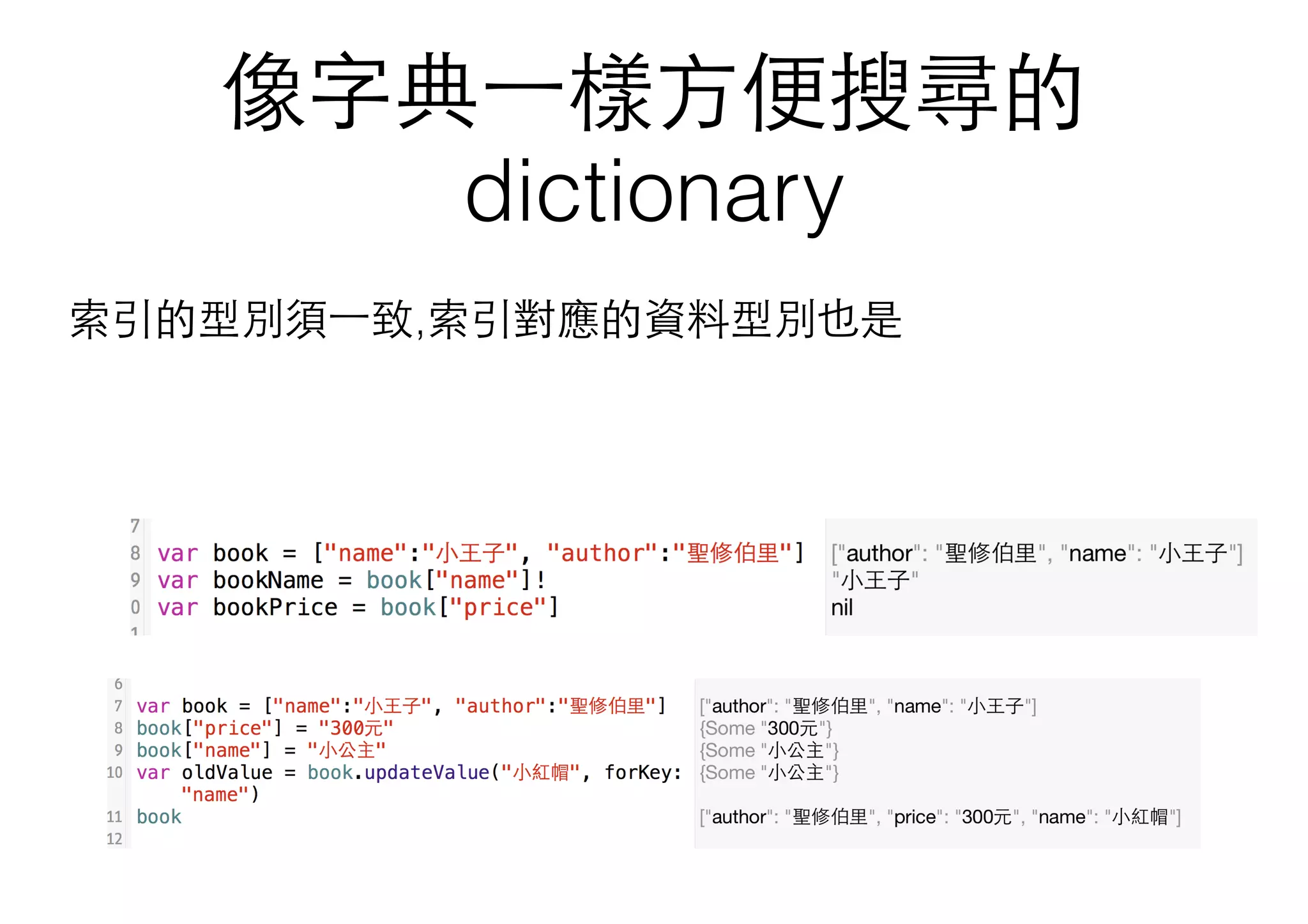
dictionary
var knownOps = Dictionary<String, Op>()
var knownOps = [String:Op]()](https://image.slidesharecdn.com/standford2015week2-150418084257-conversion-gate02/75/Standford-2015-iOS-week2-1-Applying-MVC-2-More-Swift-and-Foundation-Frameworks-17-2048.jpg)
![initializer
init() {
knownOps["×"] = Op.BinaryOperation("×", {$0*$1} )
}
init() {
knownOps["×"] = Op.BinaryOperation("×"){$0*$1}
}
case BinaryOperation(String, (Double, Double)->Double)](https://image.slidesharecdn.com/standford2015week2-150418084257-conversion-gate02/75/Standford-2015-iOS-week2-1-Applying-MVC-2-More-Swift-and-Foundation-Frameworks-22-2048.jpg)
![initializer
init() {
knownOps["×"] = Op.BinaryOperation("×"){$0*$1}
knownOps["÷"] = Op.BinaryOperation("÷"){$1/$0}
knownOps["+"] = Op.BinaryOperation("+"){$0+$1}
knownOps["−"] = Op.BinaryOperation("−"){$1-$0}
knownOps["√"] = Op.UnaryOperation("√"){sqrt($0)}
}
case BinaryOperation(String, (Double, Double)->Double)](https://image.slidesharecdn.com/standford2015week2-150418084257-conversion-gate02/75/Standford-2015-iOS-week2-1-Applying-MVC-2-More-Swift-and-Foundation-Frameworks-24-2048.jpg)
![initializer
init() {
knownOps["×"] = Op.BinaryOperation("×", *)
knownOps["÷"] = Op.BinaryOperation("÷"){$1/$0}
knownOps["+"] = Op.BinaryOperation("+", +)
knownOps["−"] = Op.BinaryOperation("−"){$1-$0}
knownOps["√"] = Op.UnaryOperation("√", sqrt)
}
case BinaryOperation(String, (Double, Double)->Double)
operator也是function](https://image.slidesharecdn.com/standford2015week2-150418084257-conversion-gate02/75/Standford-2015-iOS-week2-1-Applying-MVC-2-More-Swift-and-Foundation-Frameworks-25-2048.jpg)
![private func evaluate(ops:[Op]) -> (result:Double?, remainingOps:[Op]) {
if !ops.isEmpty {
var remainingOps = ops
let op = remainingOps.removeLast()
switch op {
case .Operand(let operand):
return (operand, remainingOps)
case .UnaryOperation(_, let operation):
let operandEvaluation = evaluate(remainingOps)
if let operand = operandEvaluation.result {
return (operation(operand), operandEvaluation.remainingOps)
}
case .BinaryOperation(_, let operation):
let op1Evaluation = evaluate(remainingOps)
if let operand1 = op1Evaluation.result {
let op2Evaluation = evaluate(op1Evaluation.remainingOps)
if let operand2 = op2Evaluation.result {
return (operation(operand1, operand2), op2Evaluation.remainingOps)
}
}
}
}
return (nil, ops)
}
func evaluate() -> Double? {
let (result, _) = evaluate(opStack)
return result
}
recursion](https://image.slidesharecdn.com/standford2015week2-150418084257-conversion-gate02/75/Standford-2015-iOS-week2-1-Applying-MVC-2-More-Swift-and-Foundation-Frameworks-38-2048.jpg)
![init() {
func learnOp(op:Op) {
knownOps[op.description] = op
}
learnOp(Op.BinaryOperation("×", *))
learnOp(Op.BinaryOperation("÷"){$1/$0})
learnOp(Op.BinaryOperation("+", +))
learnOp(Op.BinaryOperation("−"){$1-$0})
learnOp(Op.UnaryOperation("√", sqrt))
}
init() {
knownOps["×"] = Op.BinaryOperation("×", *)
knownOps["÷"] = Op.BinaryOperation("÷"){$1/$0}
knownOps["+"] = Op.BinaryOperation("+", +)
knownOps["−"] = Op.BinaryOperation("−"){$1-$0}
knownOps["√"] = Op.UnaryOperation("√", sqrt)
}](https://image.slidesharecdn.com/standford2015week2-150418084257-conversion-gate02/75/Standford-2015-iOS-week2-1-Applying-MVC-2-More-Swift-and-Foundation-Frameworks-44-2048.jpg)
![range搭配array
let array = ["a","b","c","d"]
let subArray1 = array[2...3]
let subArray2 = array[2..<3]
println("(subArray1[1]) (subArray2[0])")](https://image.slidesharecdn.com/standford2015week2-150418084257-conversion-gate02/75/Standford-2015-iOS-week2-1-Applying-MVC-2-More-Swift-and-Foundation-Frameworks-50-2048.jpg)

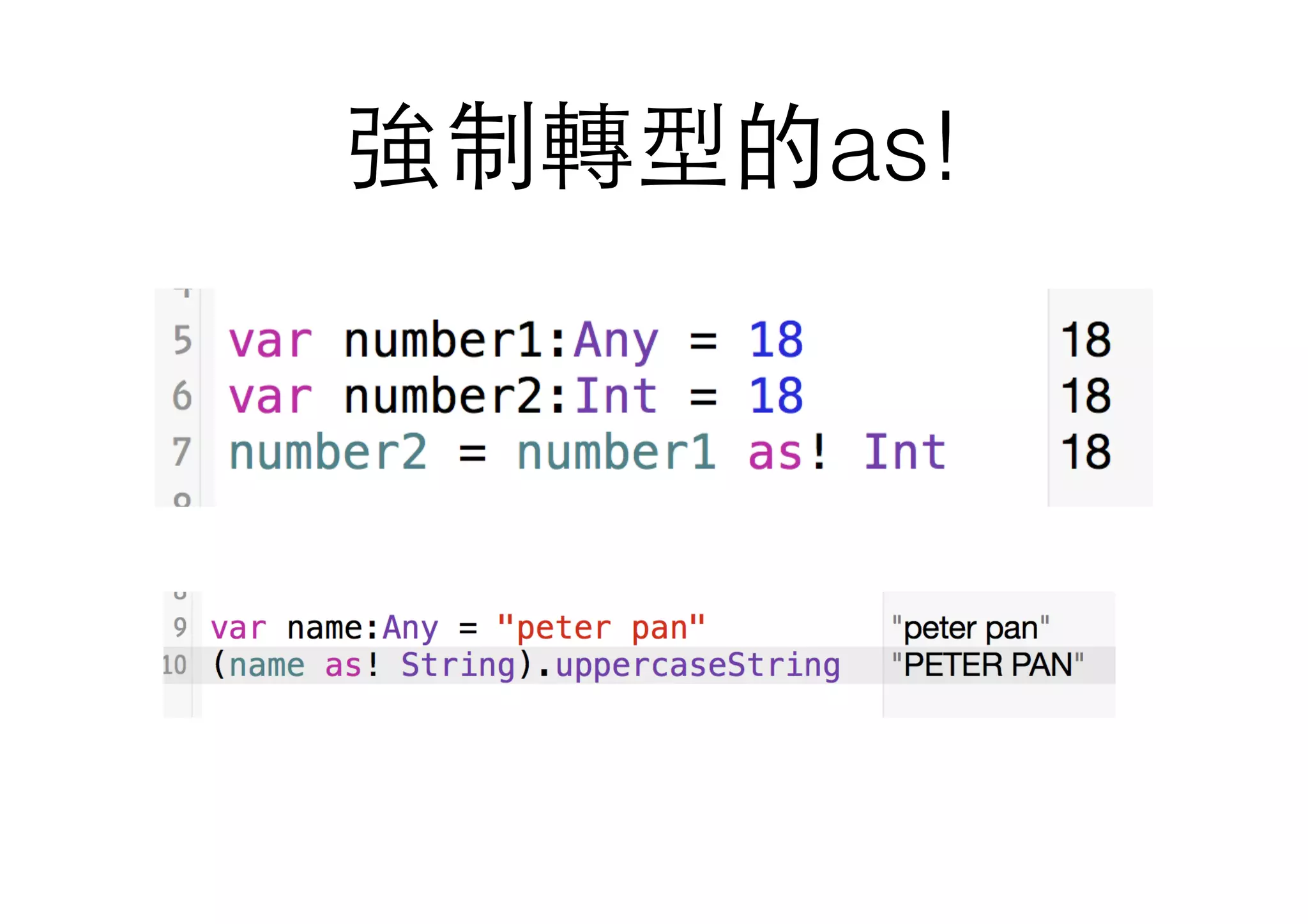
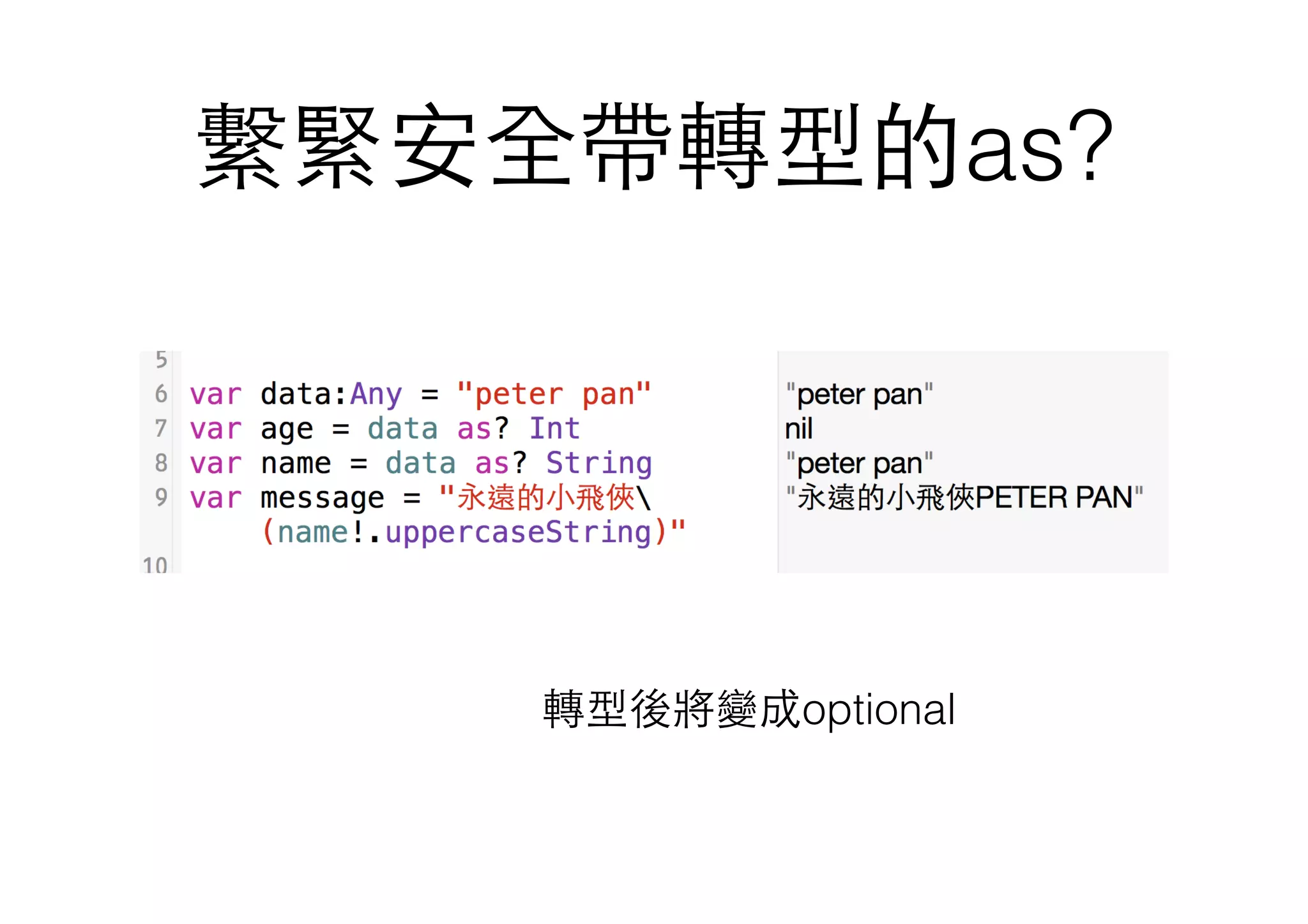
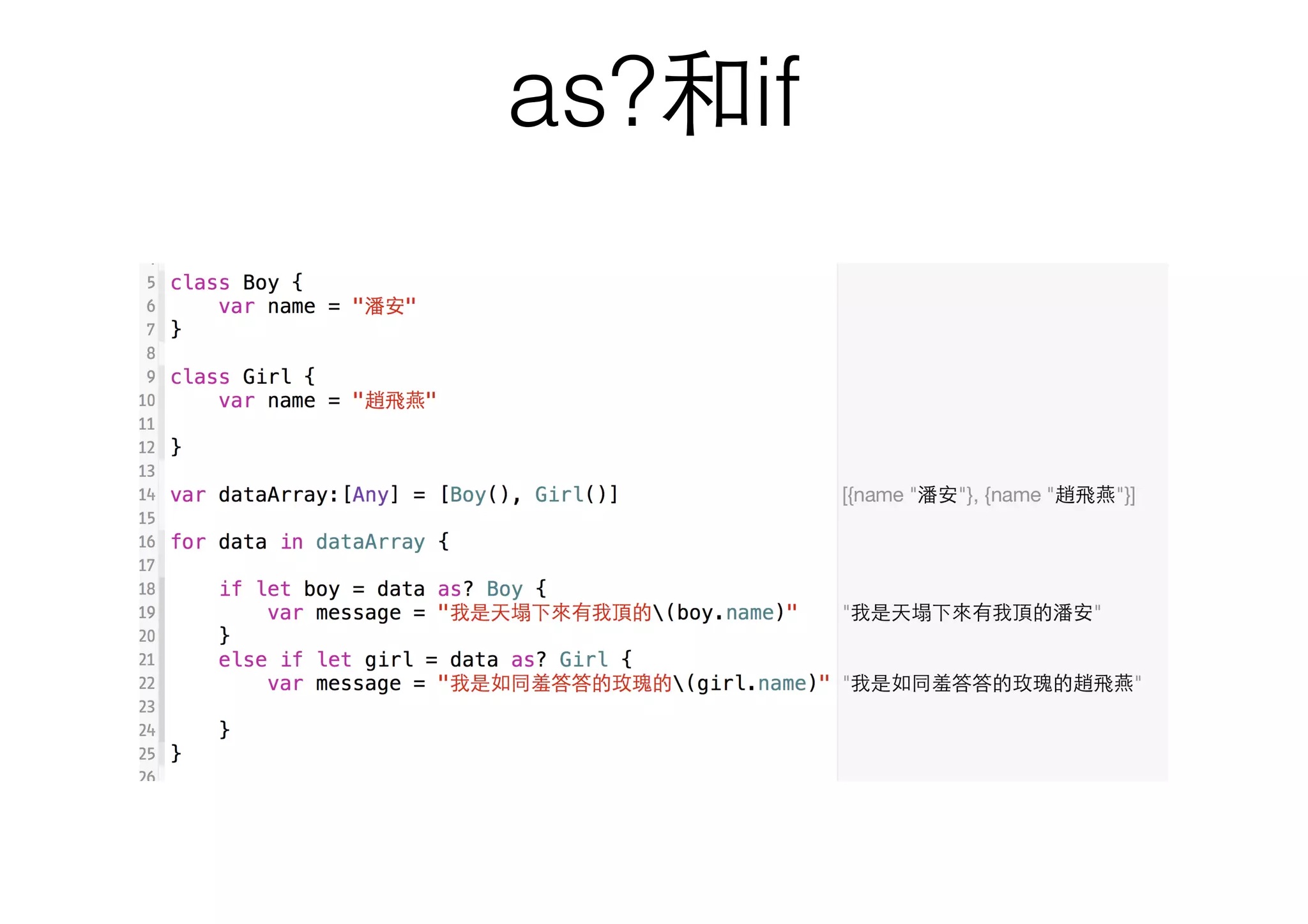
![as!和for
class Baby {
func cry() {
}
}
var babyArray:[AnyObject] = [Baby(), Baby()]
for baby in babyArray as! [Baby] {
baby.cry()
}
注意: Any轉型會crash
struct Baby {
func cry() {
}
}
var babyArray:[Any] = [Baby(), Baby()]
for baby in babyArray as! [Baby] {
baby.cry()
}](https://image.slidesharecdn.com/standford2015week2-150418084257-conversion-gate02/75/Standford-2015-iOS-week2-1-Applying-MVC-2-More-Swift-and-Foundation-Frameworks-97-2048.jpg)