Unit II: Stages In Learning,
Physical Environment And Well
Being
Presented By:
Mrs. Abeera Naz
Nursing Instructor
Shalamar Nursing College,
Lahore
Developmental stages and
learning, experiential
learning
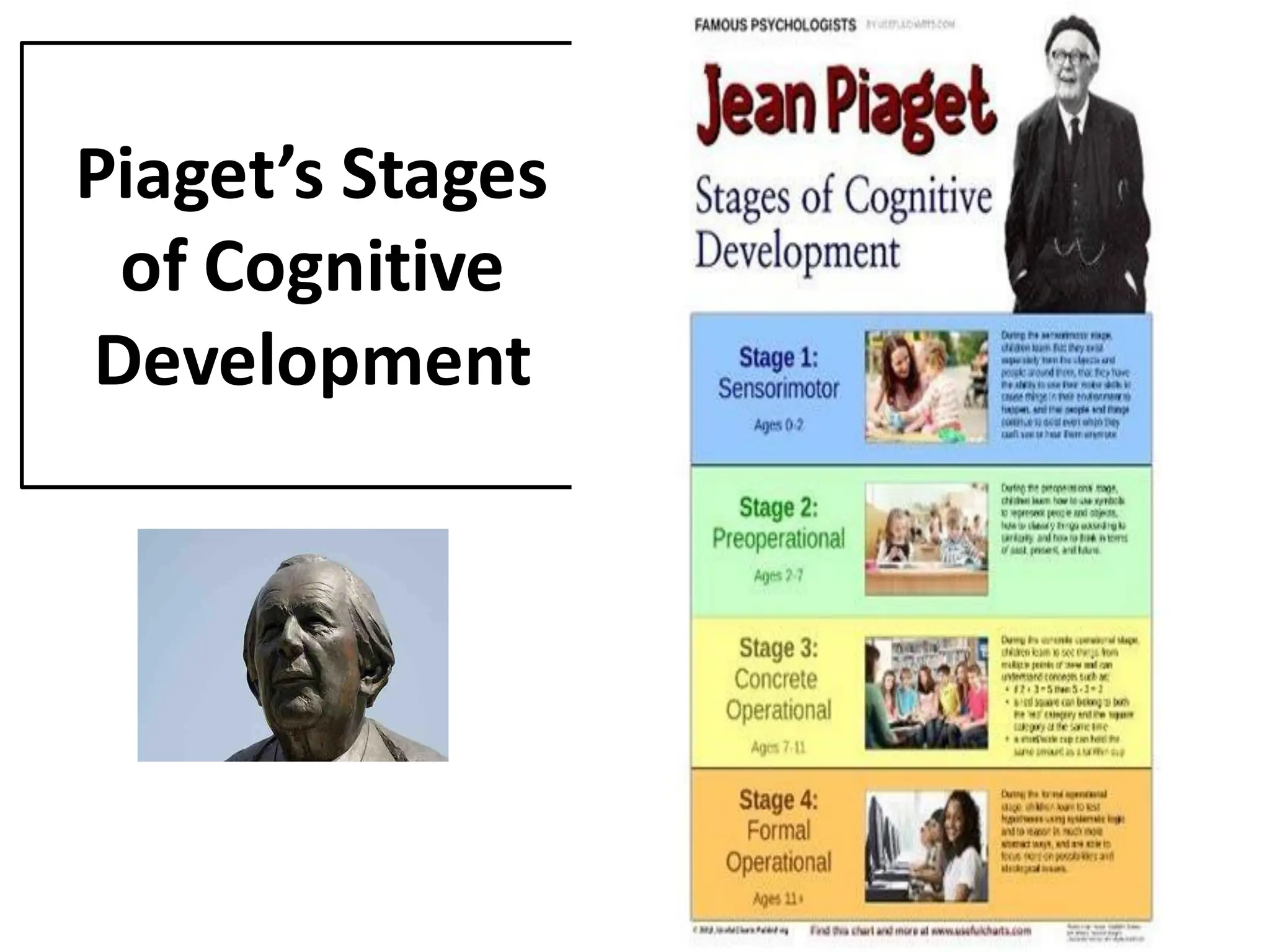
Piaget’s Stages
of Cognitive
Development
About Jean Piaget
• Swiss biologist and psychologist Jean Piaget
(1896-1980) observed his children (and their
process of making sense of the world around
them) and eventually developed a four-stage
model of how the mind processes new
information encountered. He posited that
children progress through 4 stages and that they
all do so in the same order.
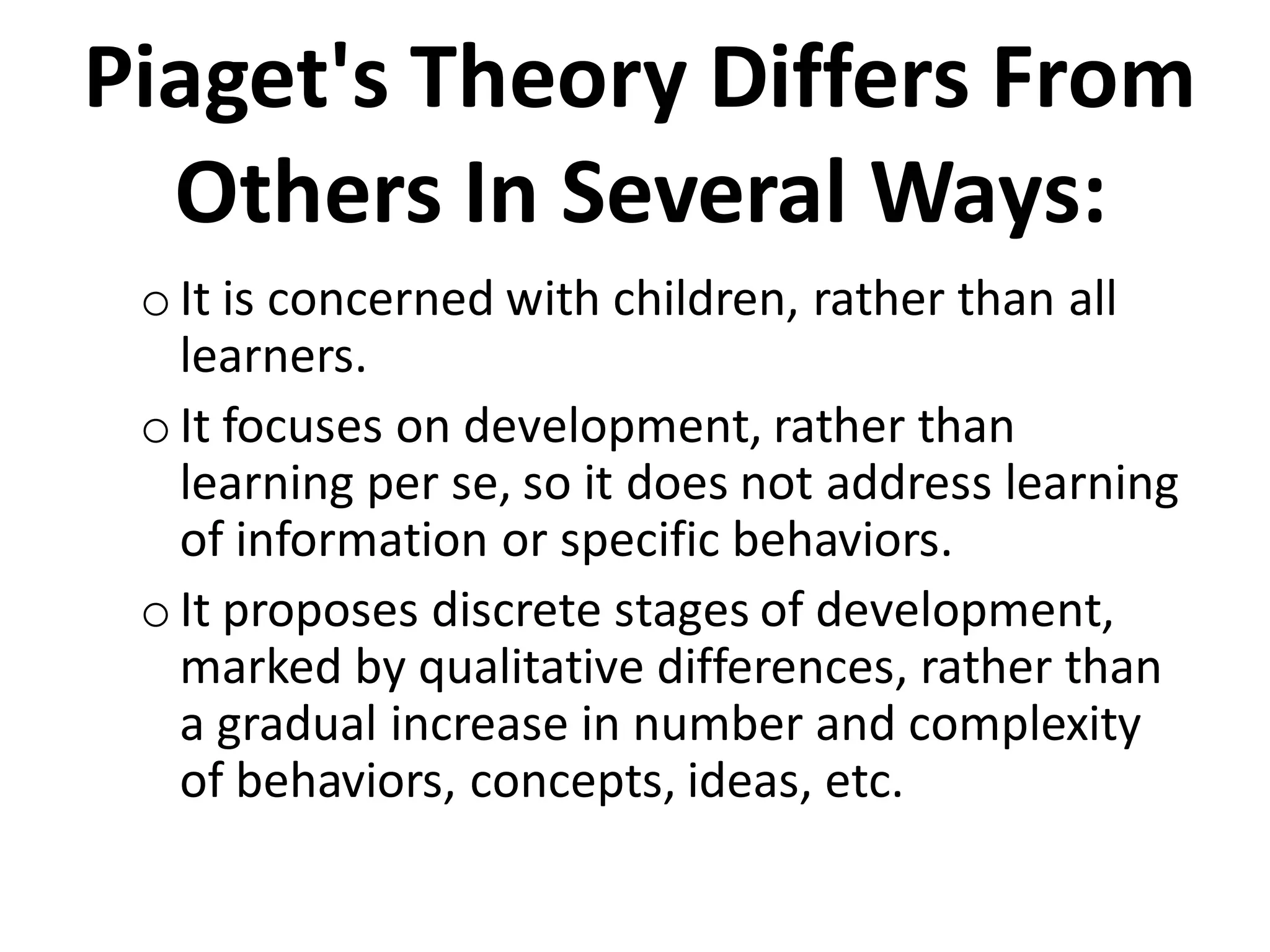
Piaget's Theory Differs From
Others In Several Ways:
oIt is concerned with children, rather than all
learners.
oIt focuses on development, rather than
learning per se, so it does not address learning
of information or specific behaviors.
o It proposes discrete stages of development,
marked by qualitative differences, rather than
a gradual increase in number and complexity
of behaviors, concepts, ideas, etc.
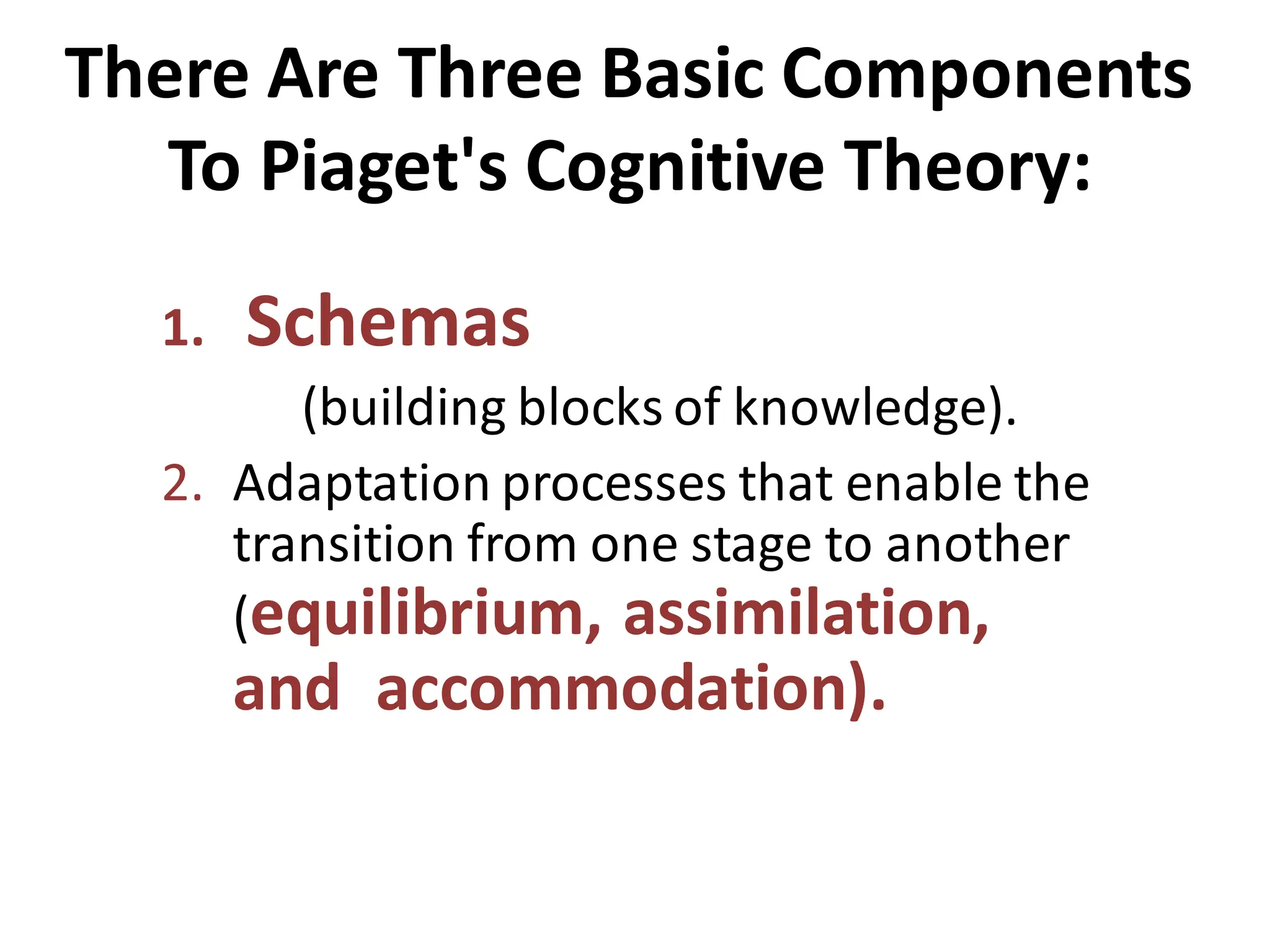
There Are Three Basic Components
To Piaget's Cognitive Theory:
1. Schemas
(building blocks of knowledge).
2. Adaptation processes that enable the
transition from one stage to another
(equilibrium, assimilation,
and accommodation).
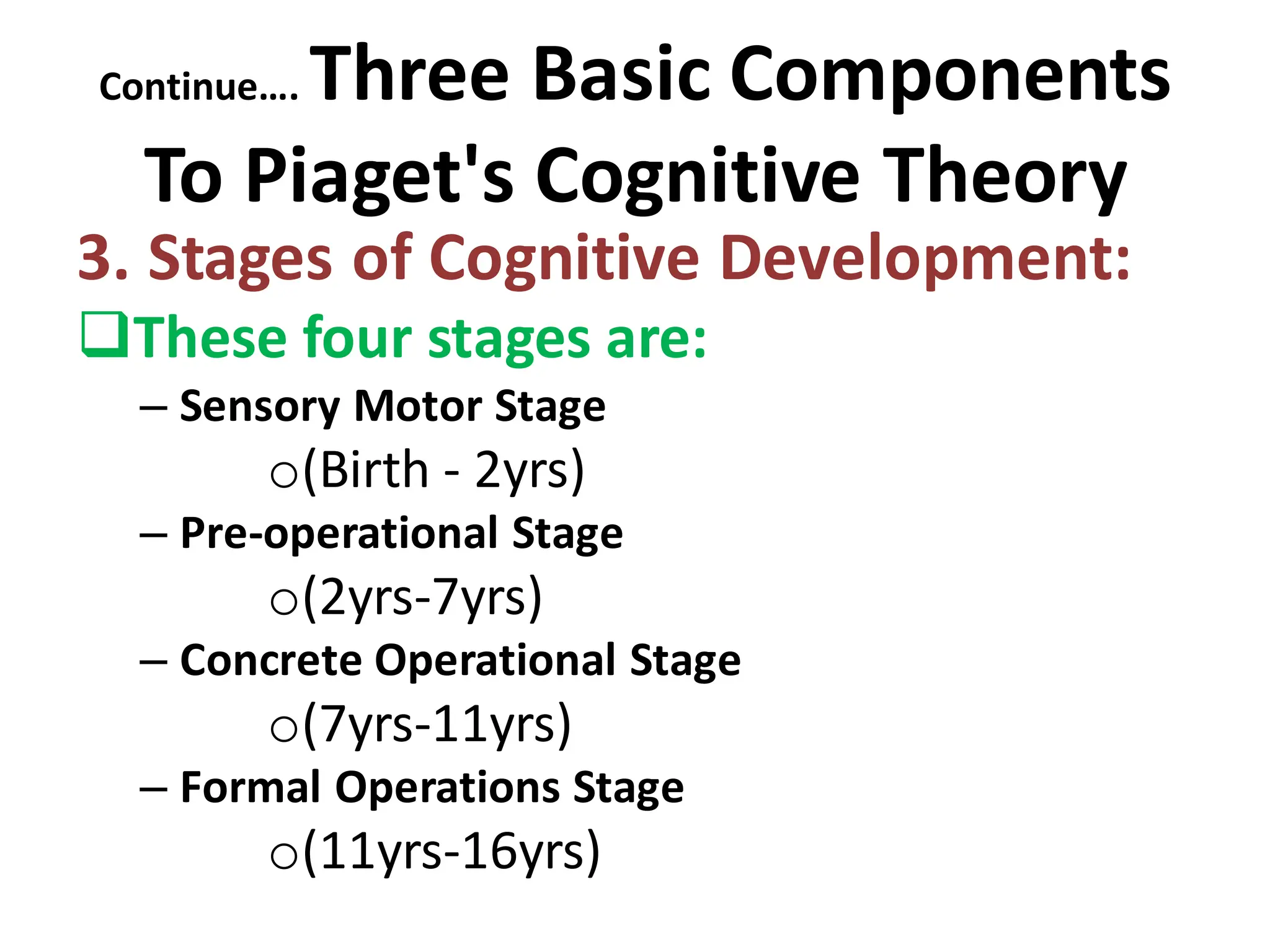
Continue…. Three Basic Components
To Piaget's Cognitive Theory
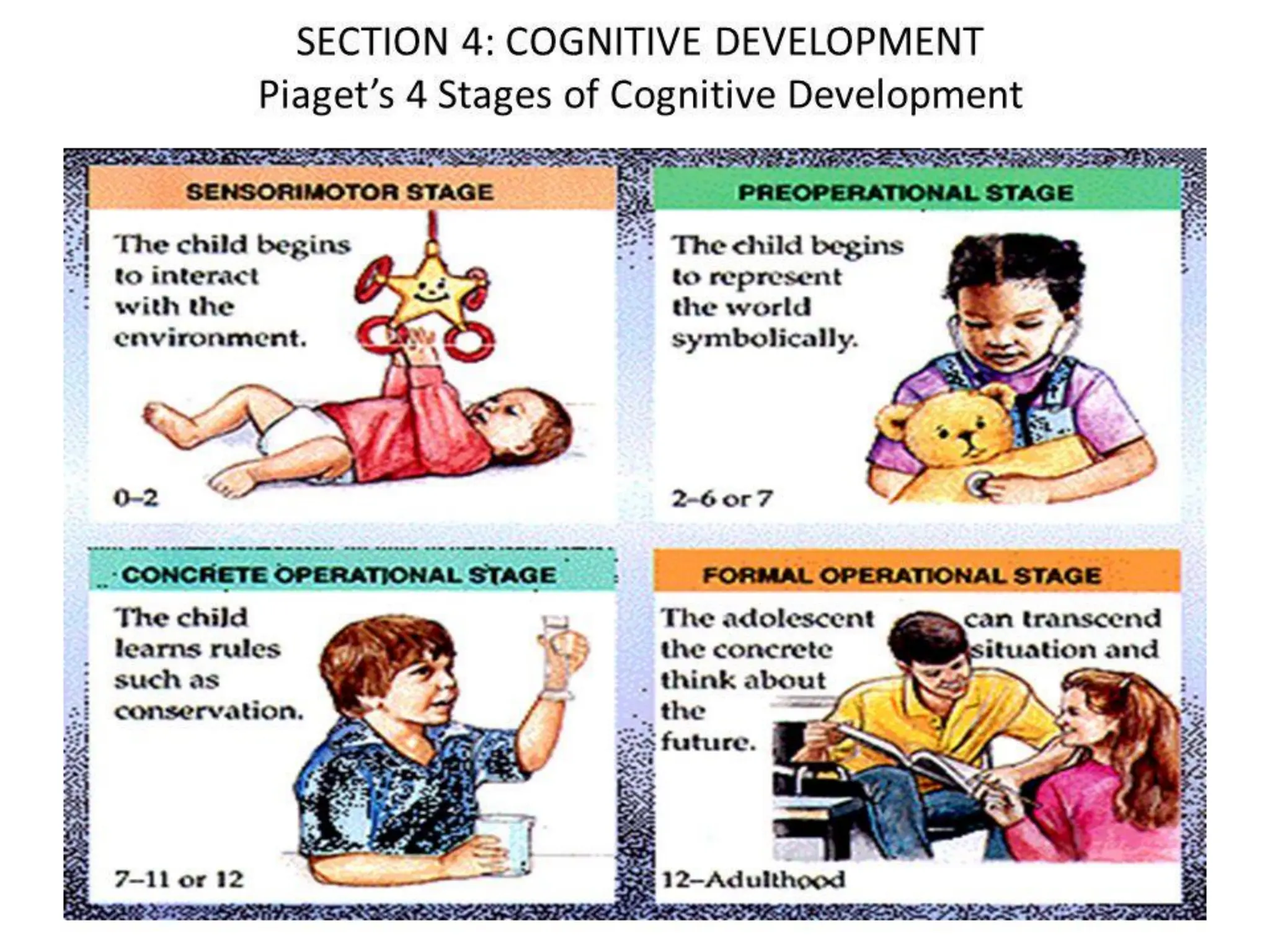
3. Stages of Cognitive Development:
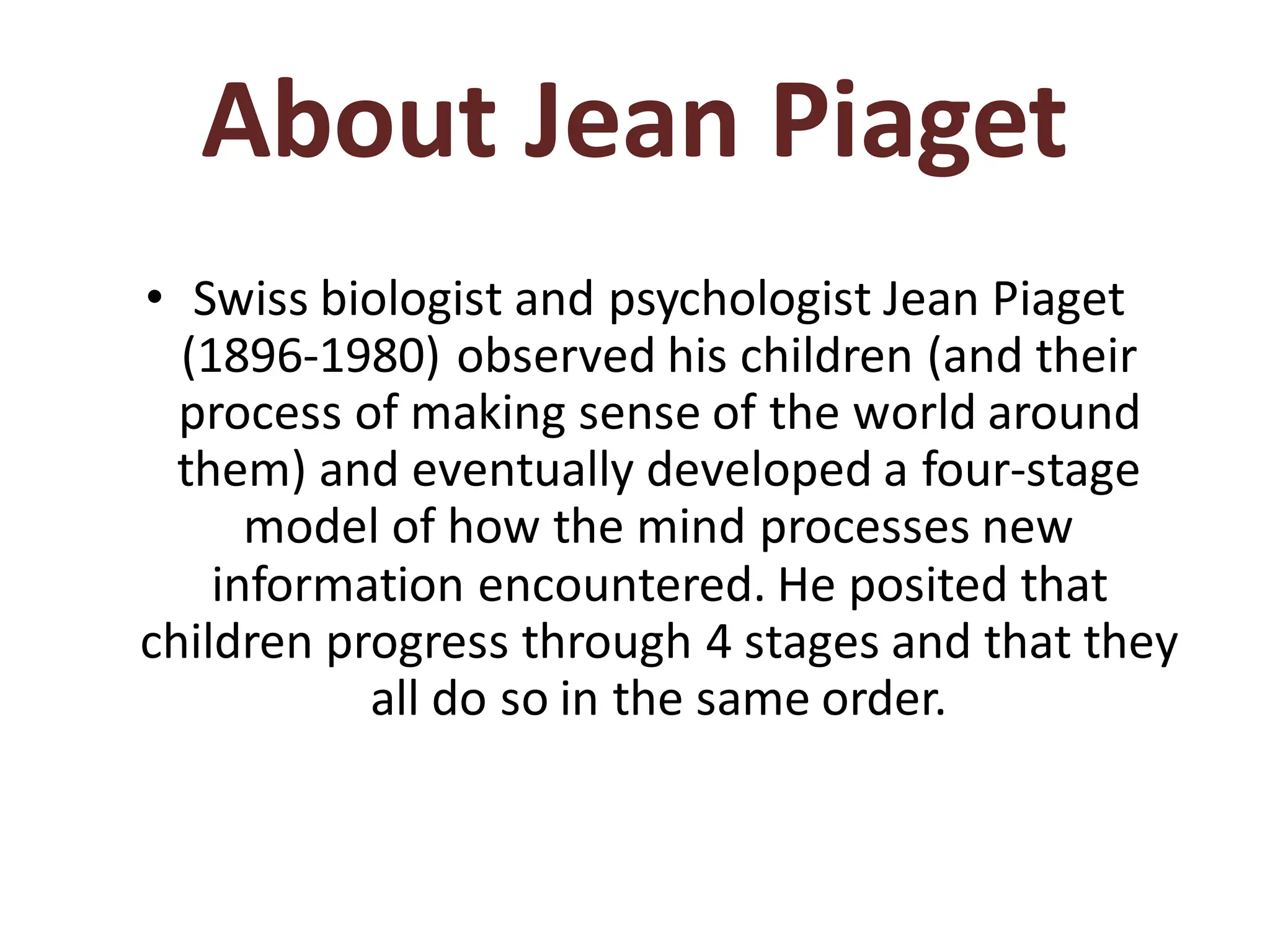
❑These four stages are:
– Sensory Motor Stage
o(Birth - 2yrs)
– Pre-operational Stage
o(2yrs-7yrs)
– Concrete Operational Stage
o(7yrs-11yrs)
– Formal Operations Stage
o(11yrs-16yrs)
Schemas
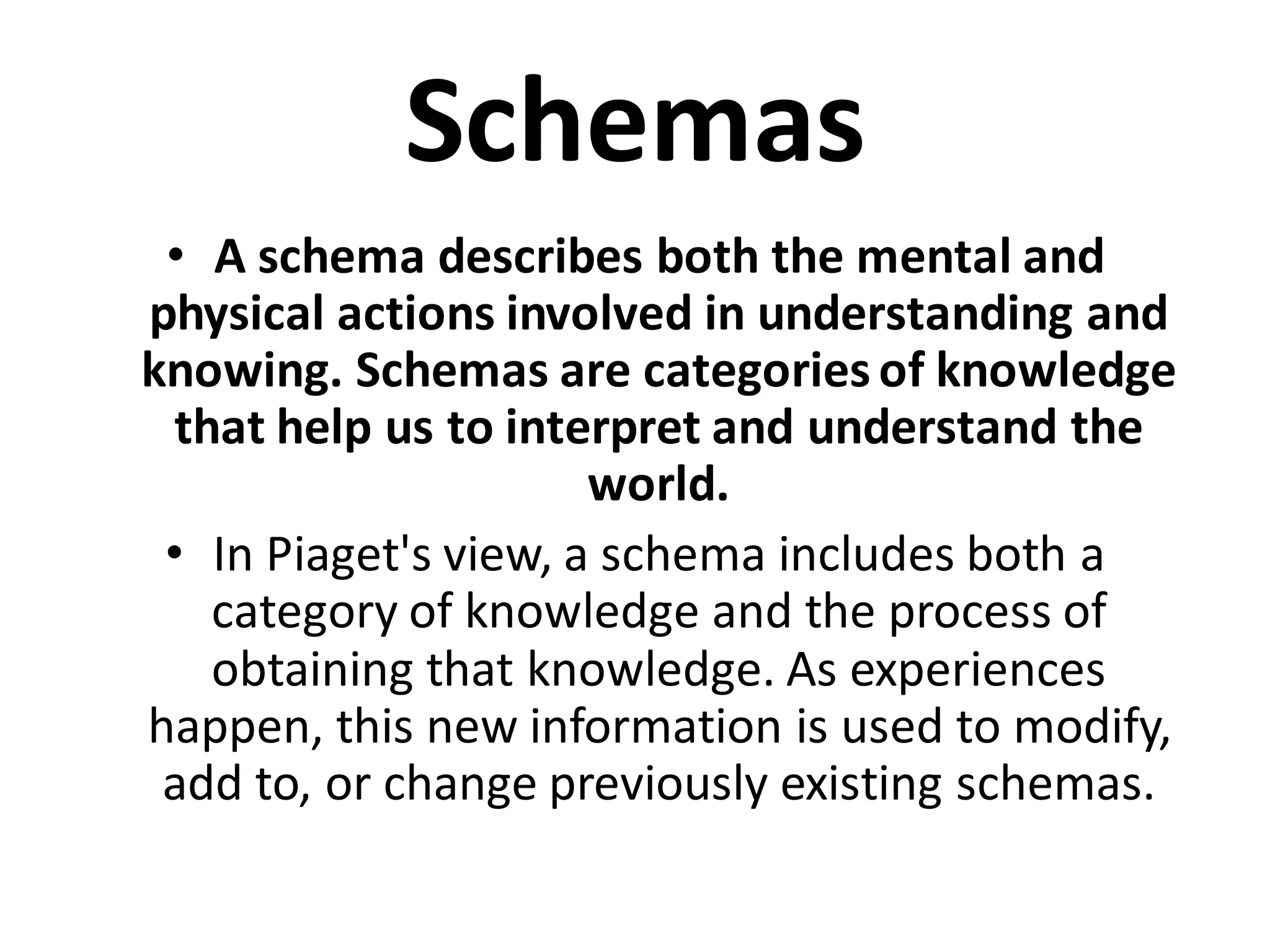
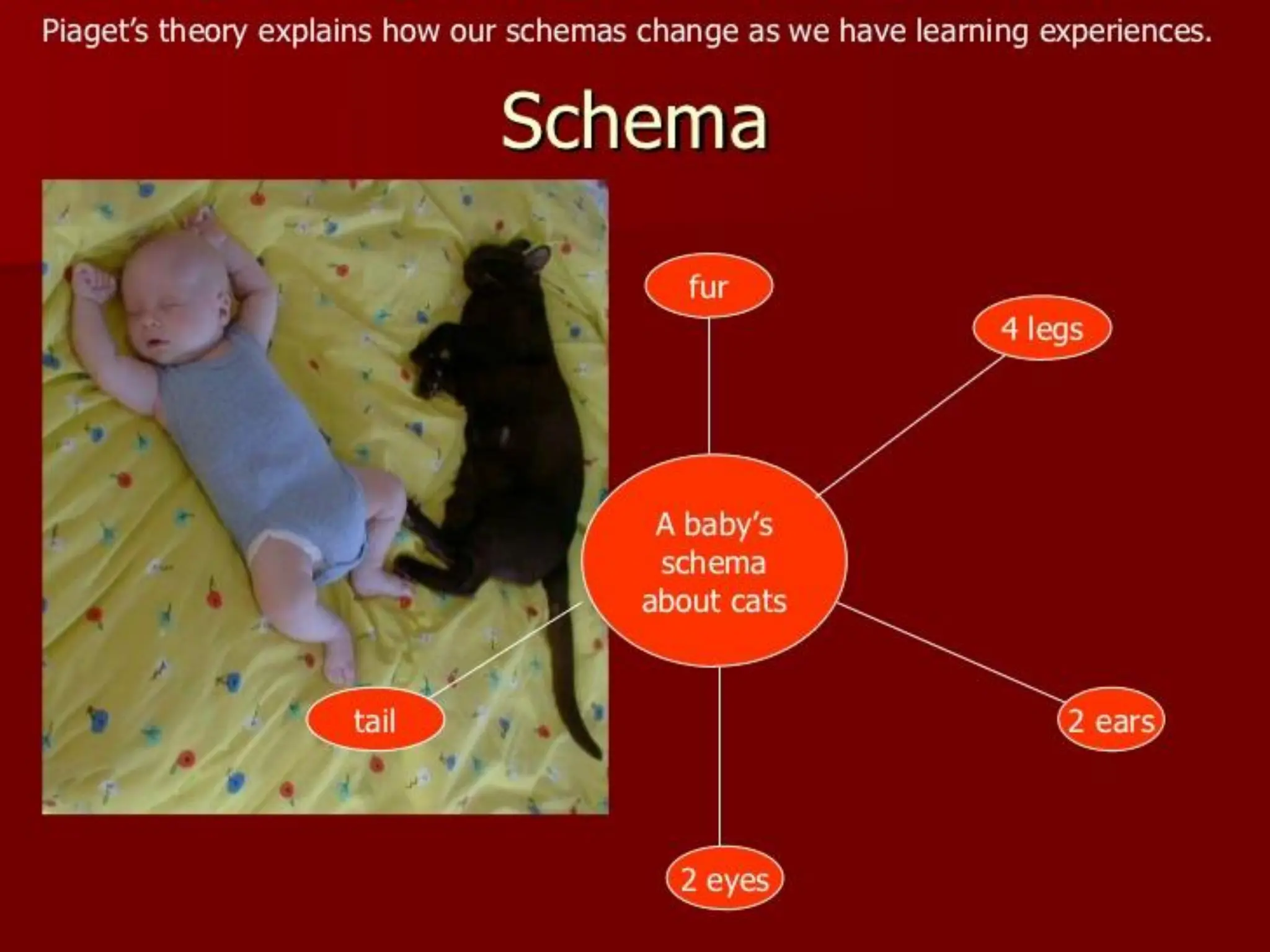
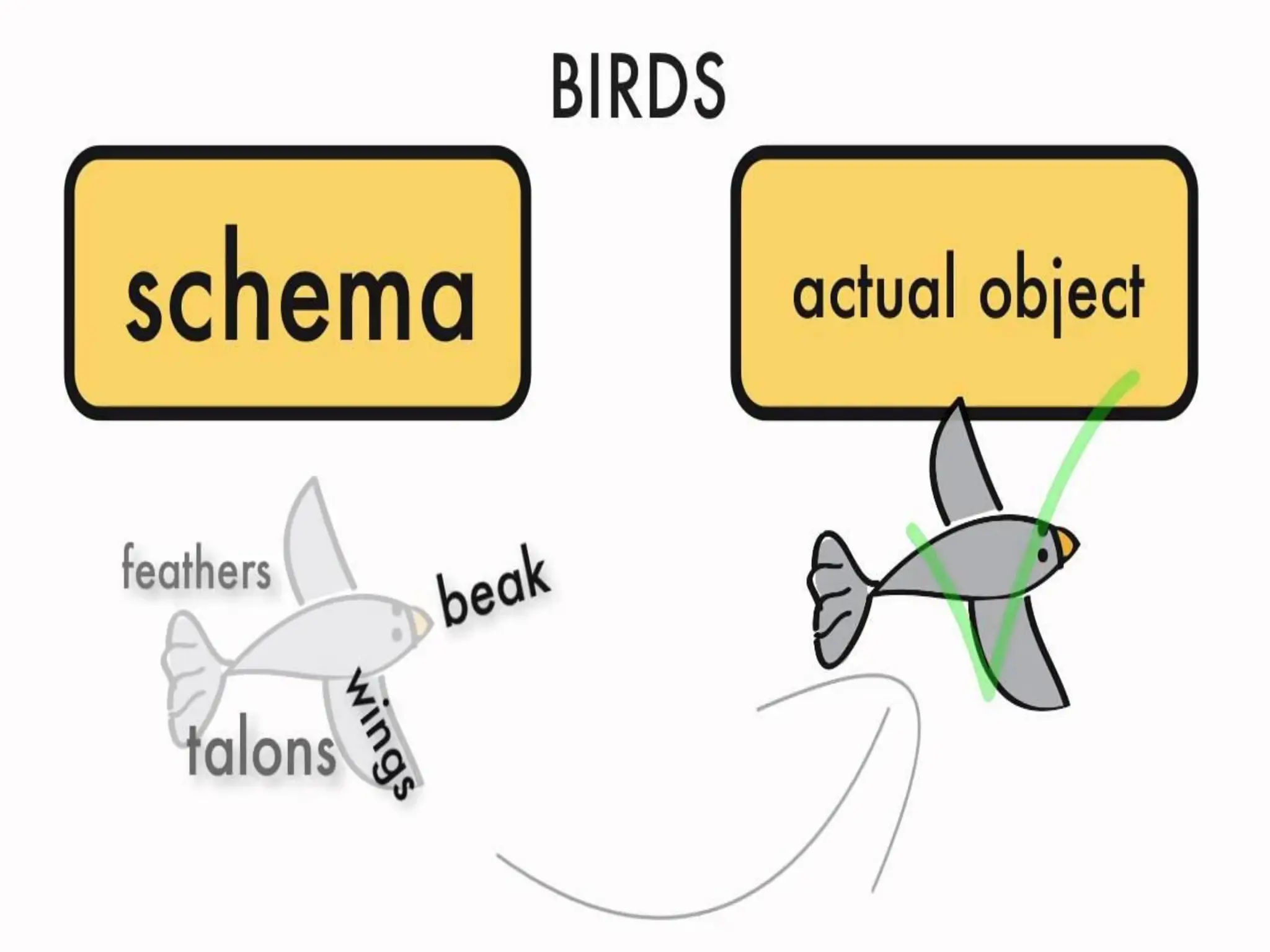
• A schema describes both the mental and
physical actions involved in understanding and
knowing. Schemas are categories of knowledge
that help us to interpret and understand the
world.
• In Piaget's view, a schema includes both a
category of knowledge and the process of
obtaining that knowledge. As experiences
happen, this new information is used to modify,
add to, or change previously existing schemas.
Assimilation
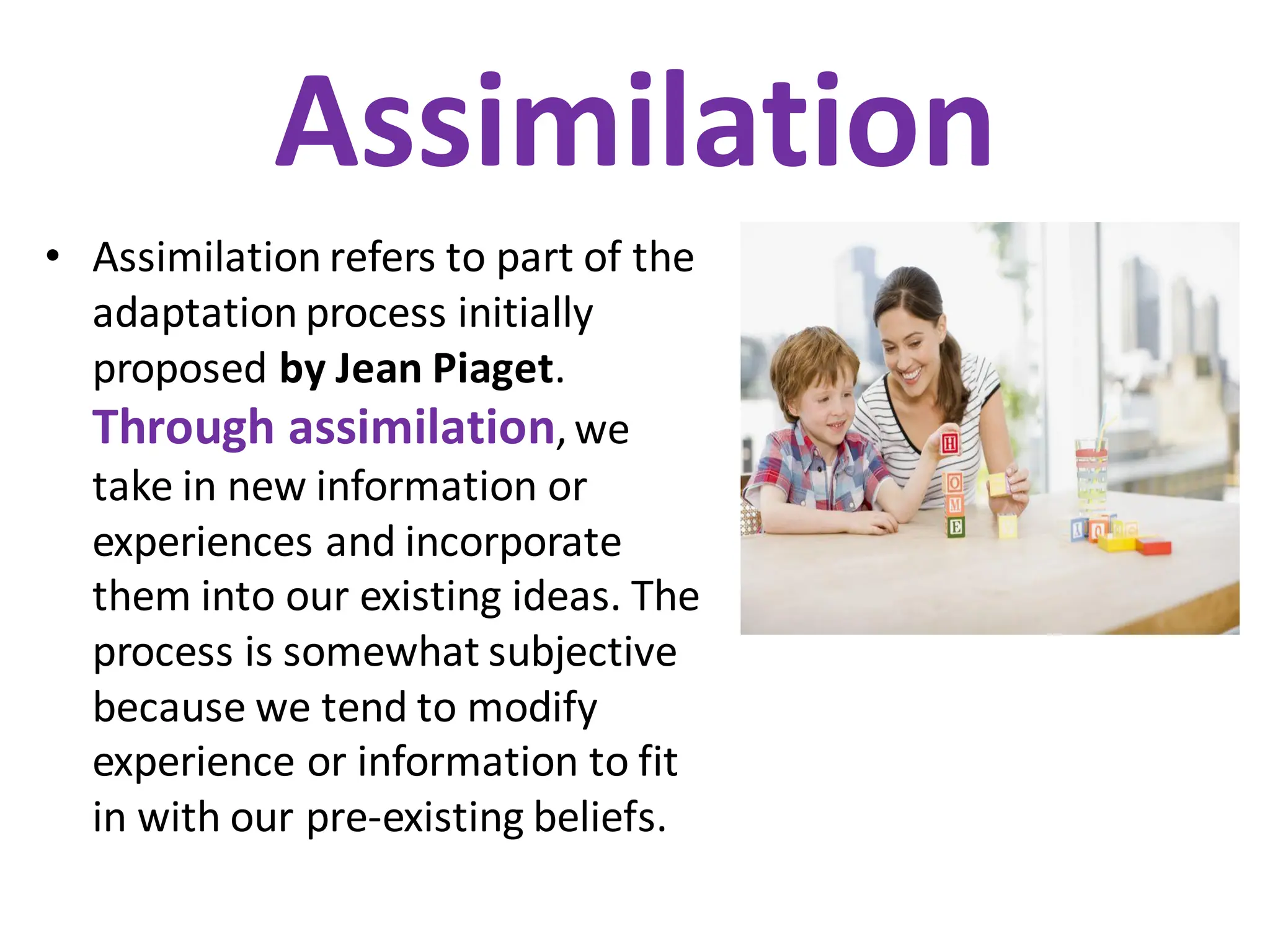
• Assimilation refers to part of the
adaptation process initially
proposed by Jean Piaget.
Through assimilation,we
take in new information or
experiences and incorporate
them into our existing ideas. The
process is somewhat subjective
because we tend to modify
experience or information to fit
in with our pre-existing beliefs.
Assimilation
❑More Examples of Assimilation
o A college student learning how to use a new
computer program
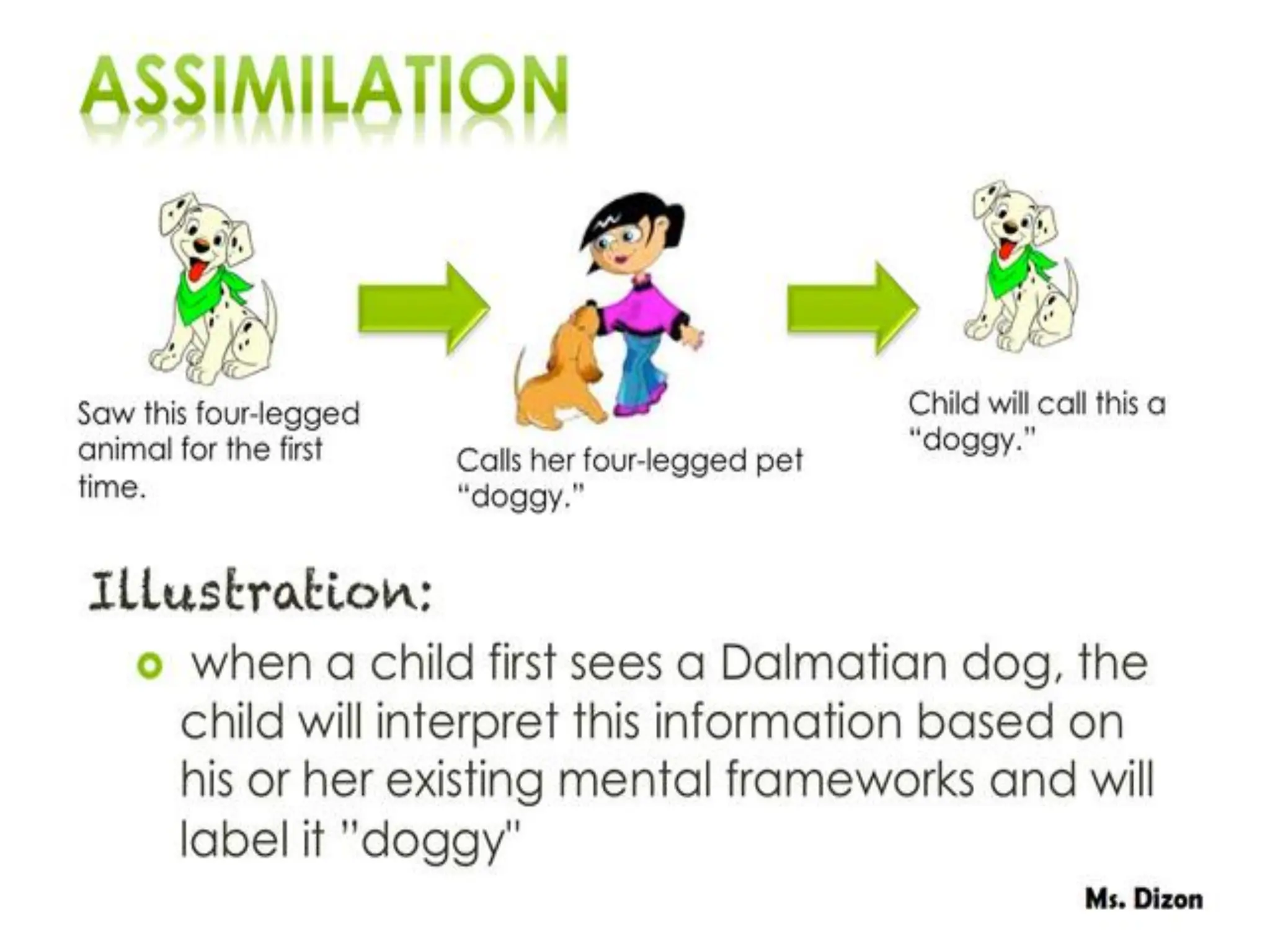
o A sees a new type of dog that he's never seen
before and he immediately points to the animal
and says, "Dog!"
o A chef learning a new cooking technique
o A computer programmer learning a new
programming language
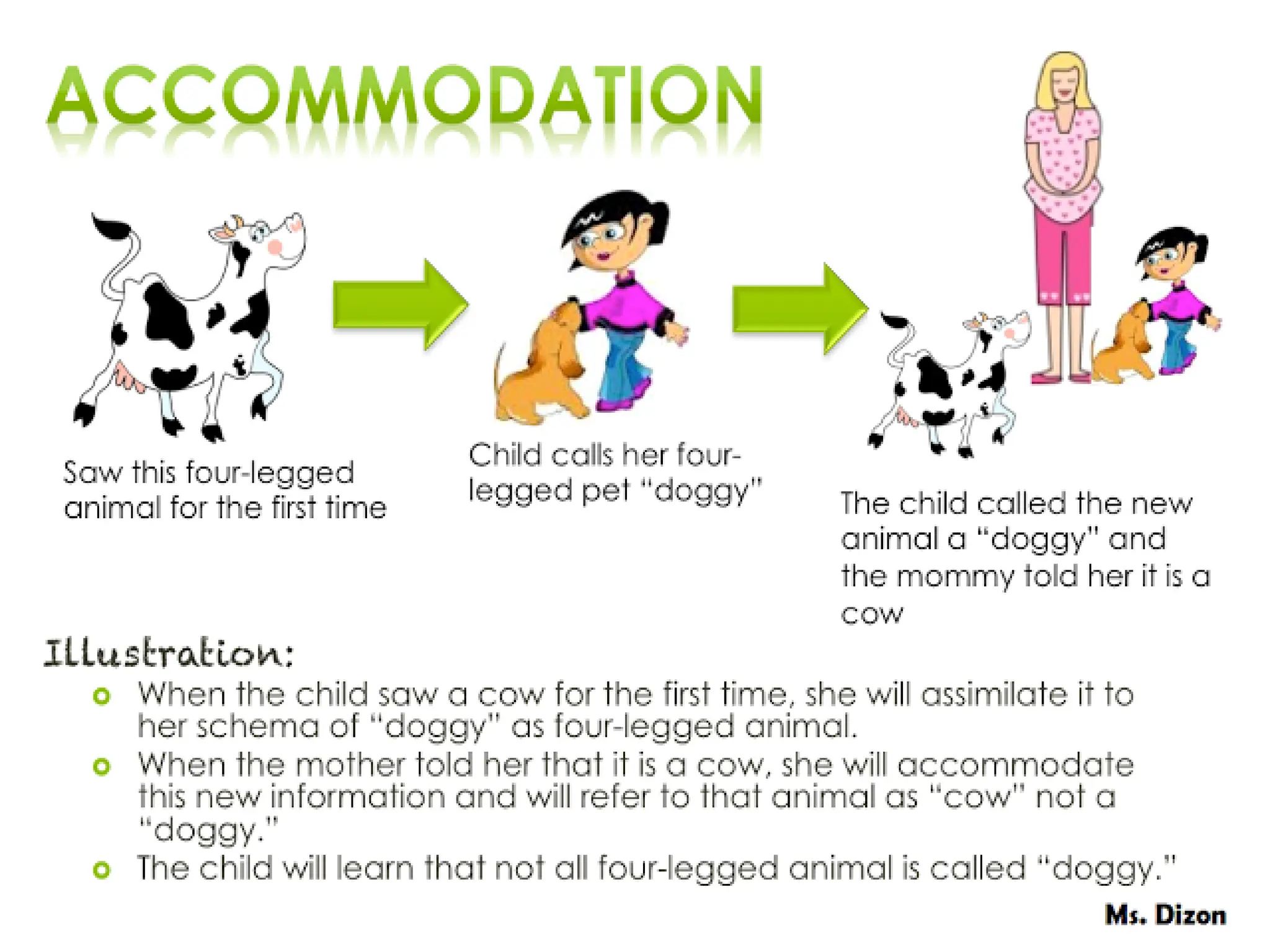
Accommodation
❑Accommodation – Another part of adaptation
involves changing or altering our existing
schemas in light of new information, a process
known as accommodation. Accommodation
involves altering existing schemas, or ideas, as a
result of new information or new experiences.
New schemas may also be developed during this
process.
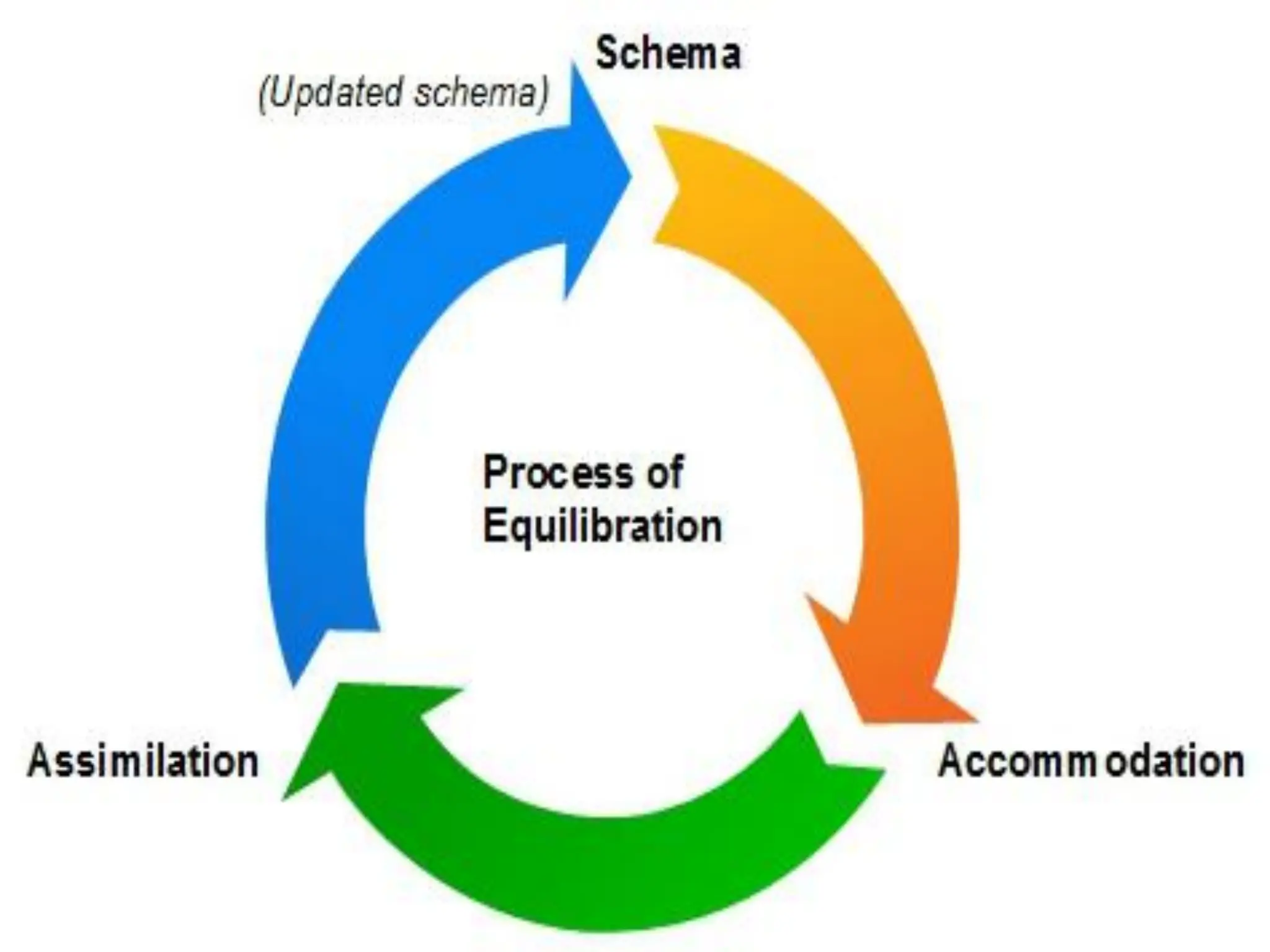
Equilibration
• Equilibration – Piaget believed that all
children try to strike a balance between
assimilation and accommodation, which is
achieved through a mechanism Piaget called
equilibration. As children progress through the
stages of cognitive development, it is important
to maintain a balance between applying previous
knowledge (assimilation) and changing behavior
to account for new knowledge (accommodation).
Equilibration helps explain how children are able
to move from one stage of thought into the next.
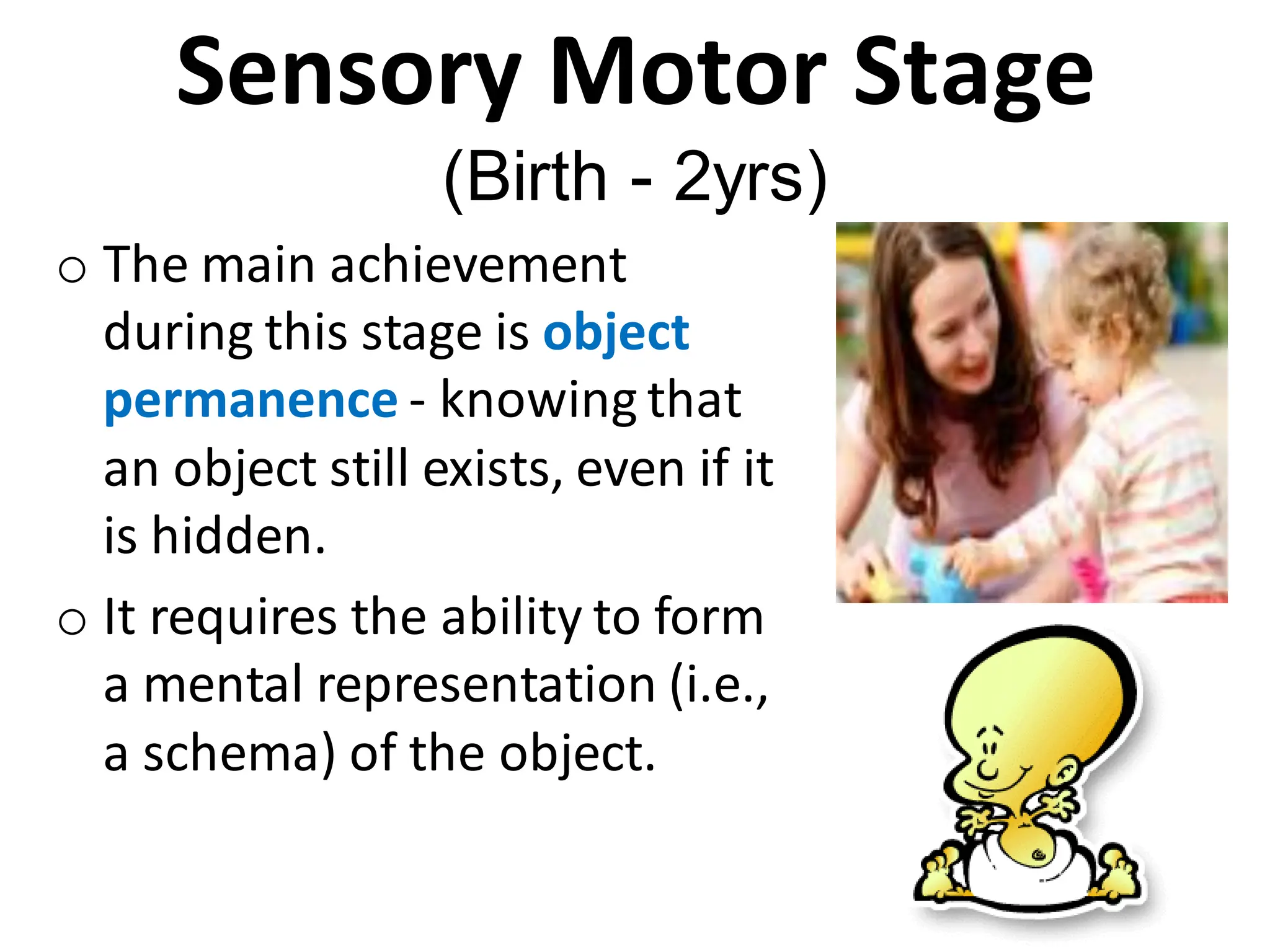
Sensory Motor Stage
(Birth - 2yrs)
o The main achievement
during this stage is object
permanence - knowing that
an object still exists, even if it
is hidden.
o It requires the ability to form
a mental representation (i.e.,
a schema) of the object.
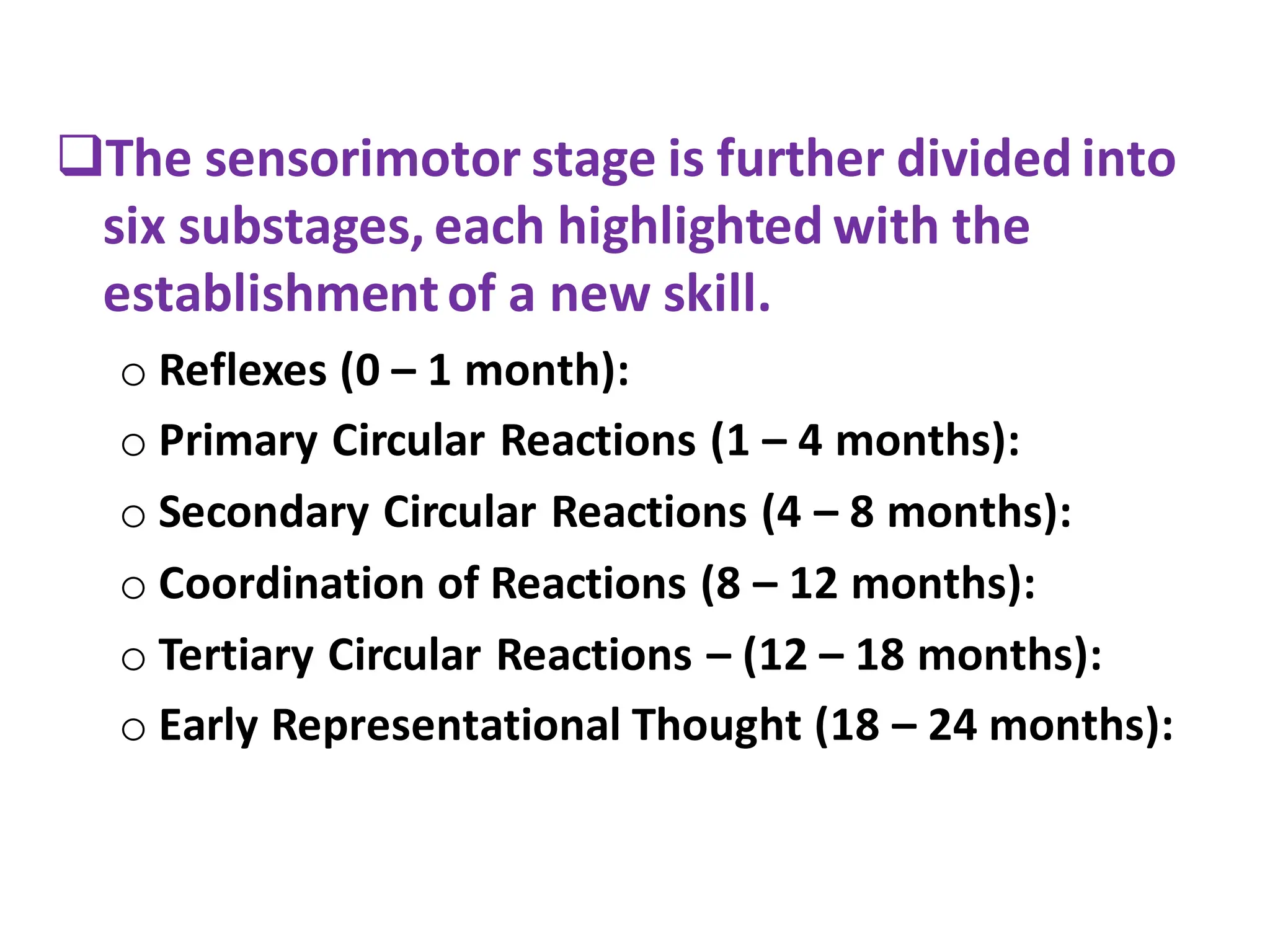
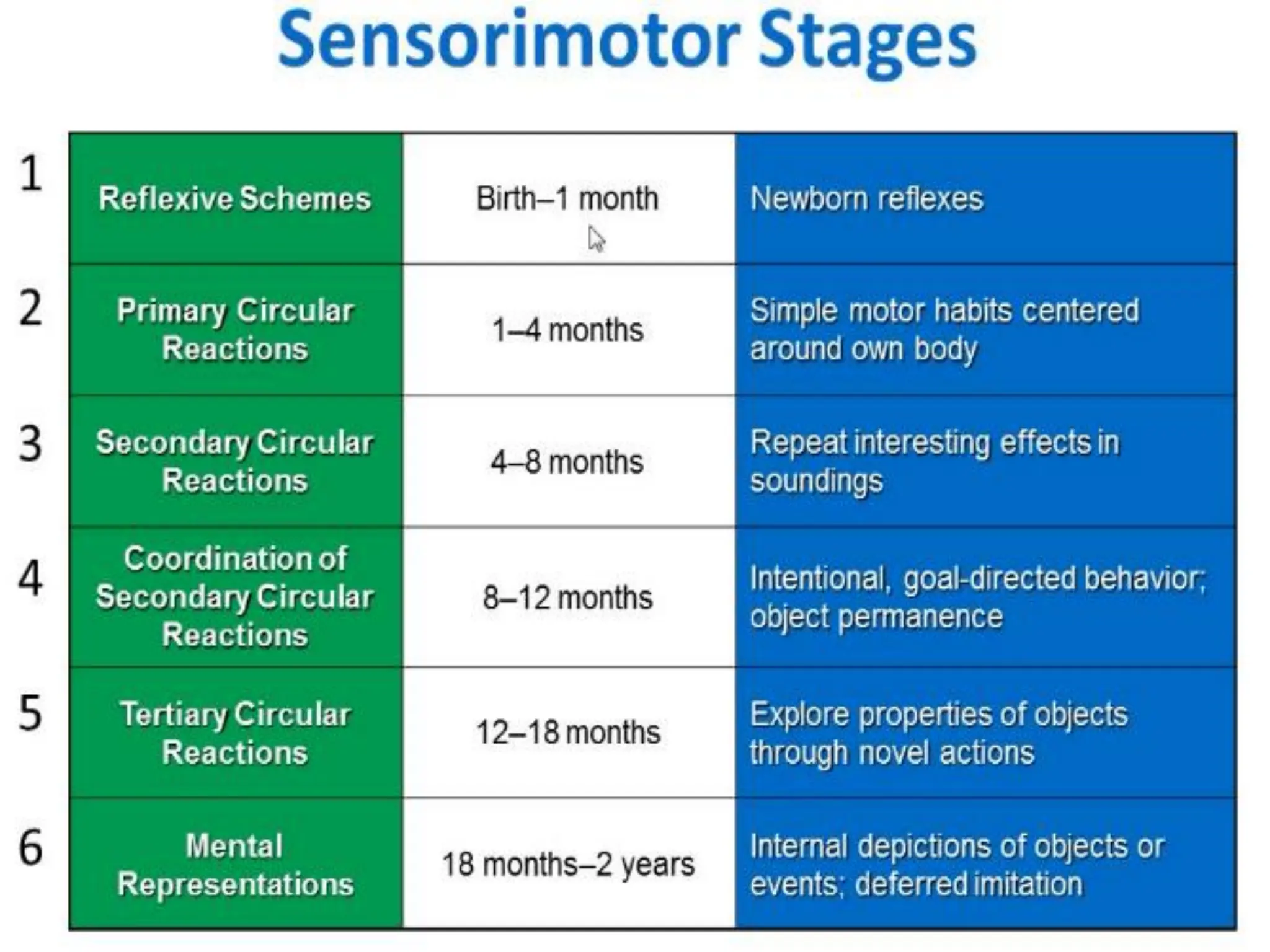
❑The sensorimotor stage is further divided into
six substages, each highlighted with the
establishmentof a new skill.
o Reflexes (0 – 1 month):
o Primary Circular Reactions (1 – 4 months):
o Secondary Circular Reactions (4 – 8 months):
o Coordination of Reactions (8 – 12 months):
o Tertiary Circular Reactions – (12 – 18 months):
o Early Representational Thought (18 – 24 months):
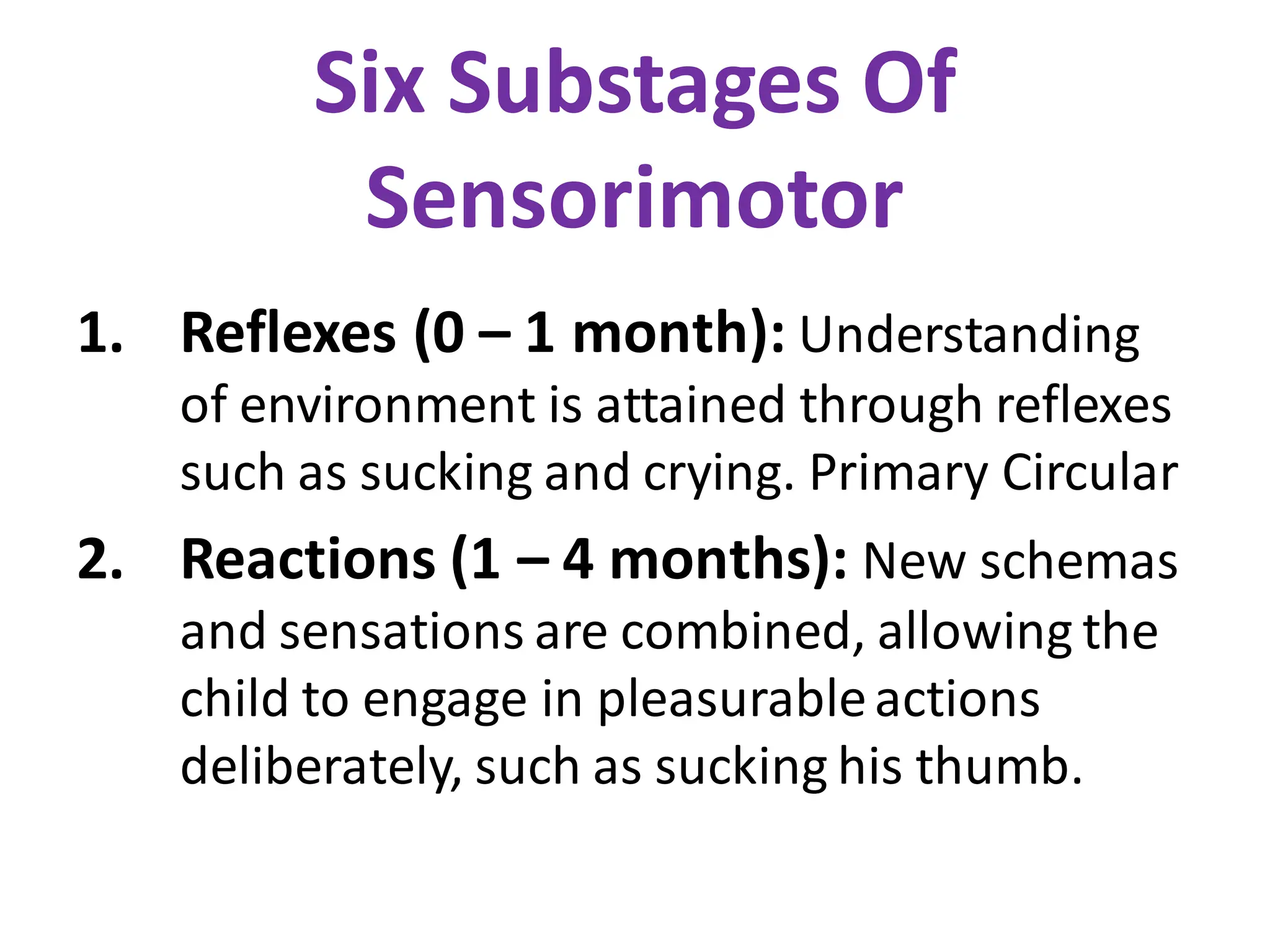
Six Substages Of
Sensorimotor
1. Reflexes (0 – 1 month): Understanding
of environment is attained through reflexes
such as sucking and crying. Primary Circular
2. Reactions (1 – 4 months): New schemas
and sensations are combined, allowing the
child to engage in pleasurableactions
deliberately, such as sucking his thumb.
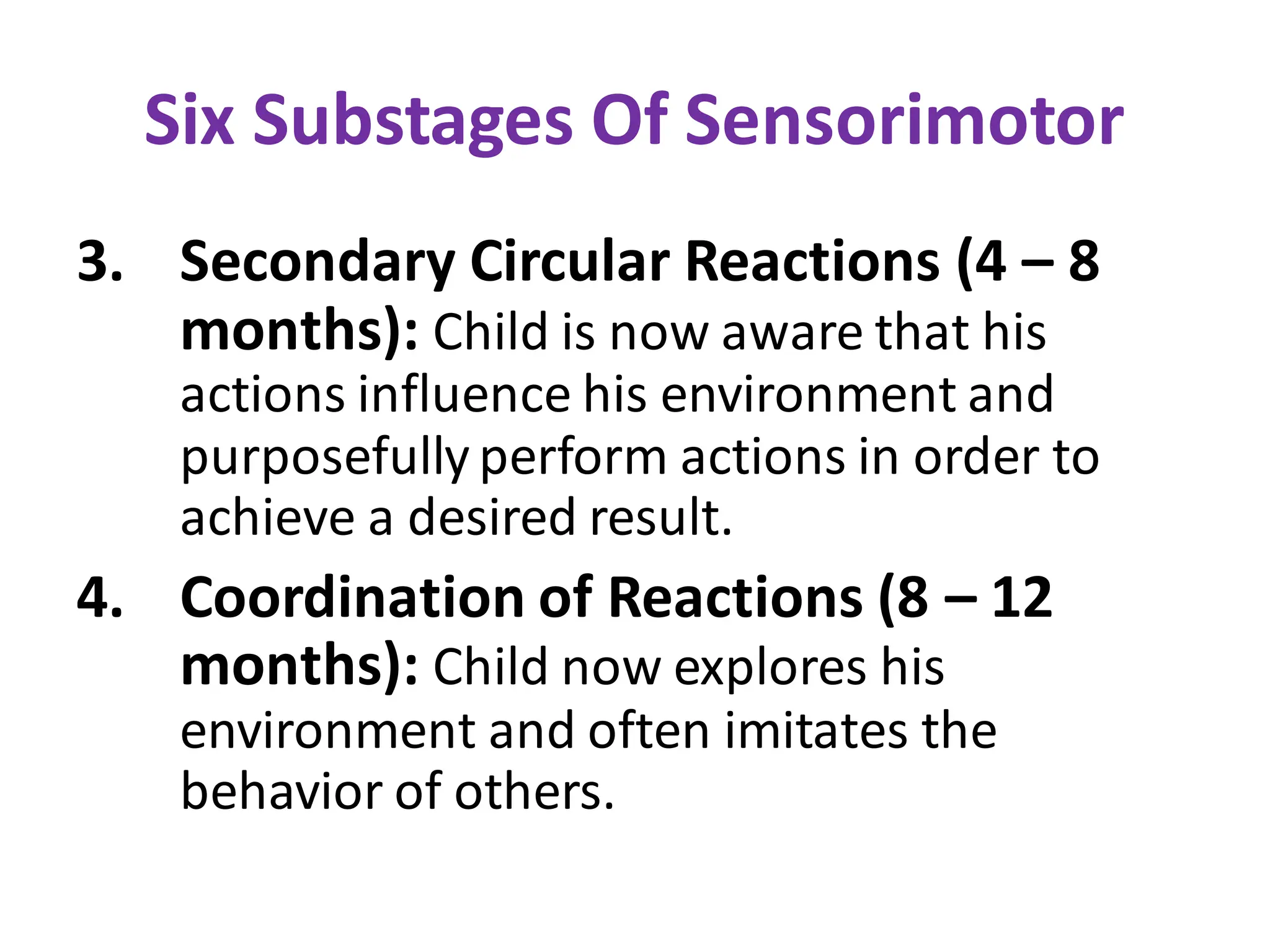
Six Substages Of Sensorimotor
3. Secondary Circular Reactions (4 – 8
months): Child is now aware that his
actions influence his environment and
purposefully perform actions in order to
achieve a desired result.
4. Coordination of Reactions (8 – 12
months): Child now explores his
environment and often imitates the
behavior of others.
Six Substages Of Sensorimotor
5. Tertiary Circular Reactions – (12 – 18
months): Child begins to experiment and
try out new behavior.
6. Early Representational Thought (18 –
24 months): Child begins to recognize and
appreciate symbols that represent objects
or events.
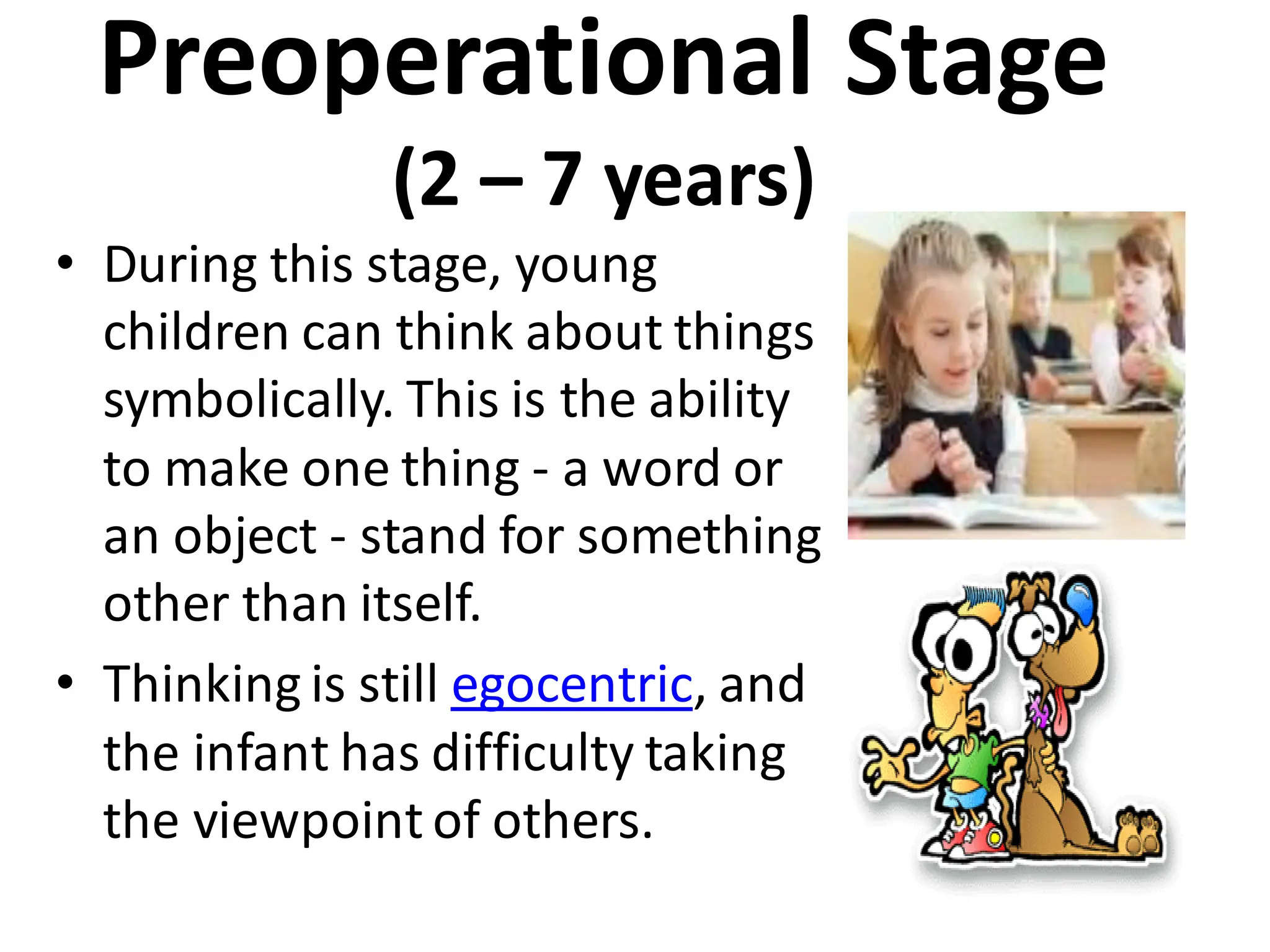
Preoperational Stage
(2 – 7 years)
• During this stage, young
children can think about things
symbolically. This is the ability
to make one thing - a word or
an object - stand for something
other than itself.
• Thinking is still egocentric, and
the infant has difficulty taking
the viewpoint of others.
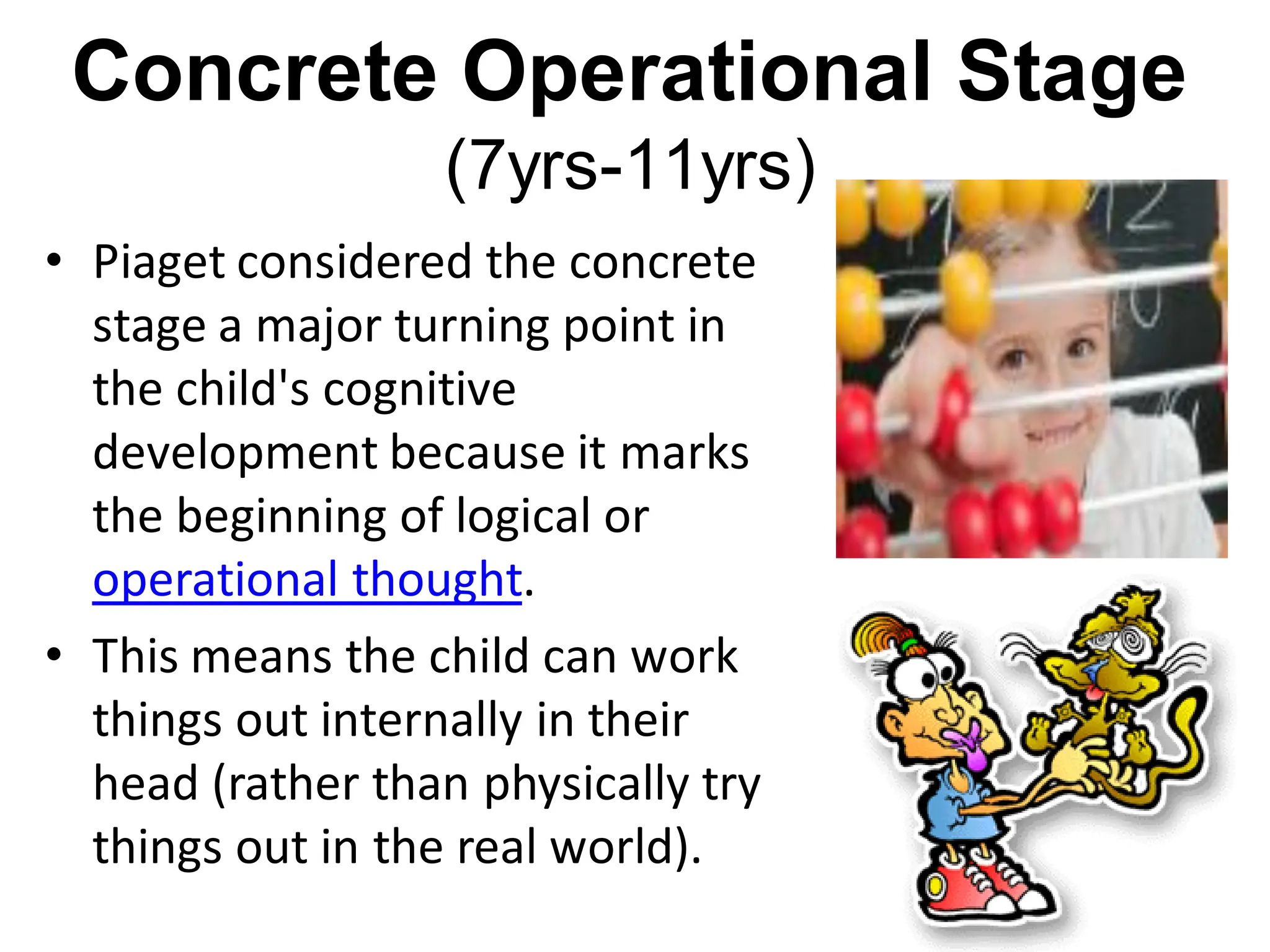
Concrete Operational Stage
(7yrs-11yrs)
• Piaget considered the concrete
stage a major turning point in
the child's cognitive
development because it marks
the beginning of logical or
operational thought.
• This means the child can work
things out internally in their
head (rather than physically try
things out in the real world).
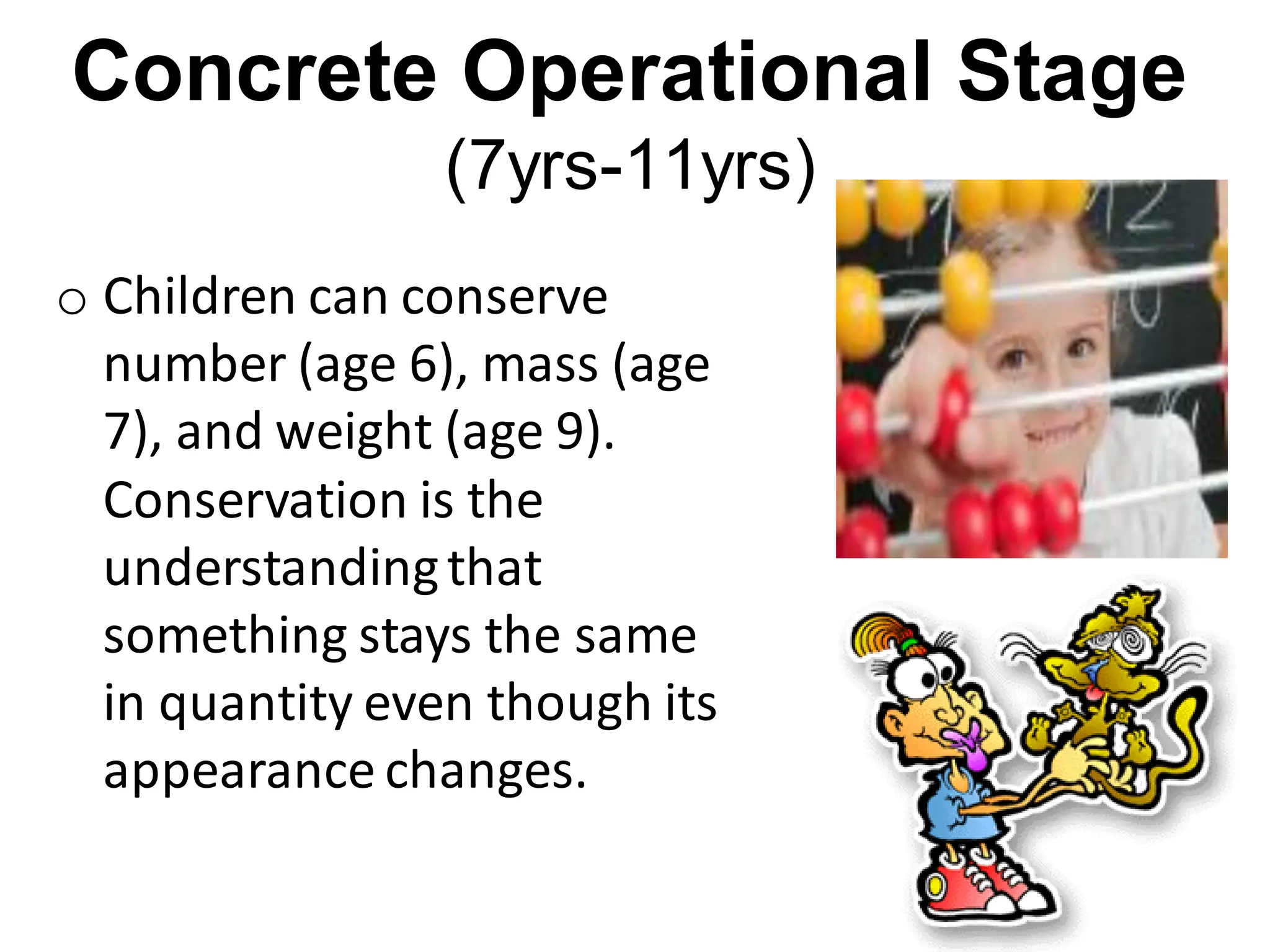
Concrete Operational Stage
(7yrs-11yrs)
o Children can conserve
number (age 6), mass (age
7), and weight (age 9).
Conservation is the
understandingthat
something stays the same
in quantity even though its
appearance changes.
Formal Operations Stage
(11yrs-16yrs)
• The formal operationalstage
begins at approximately age
eleven and lasts into
adulthood.During this time,
people develop the ability to
think about abstract
concepts, and logically test
hypotheses.
Stages of Cognitive Development unit 2.pdf

Stages of Cognitive Development unit 2.pdf

  • 1.
    Unit II: StagesIn Learning, Physical Environment And Well Being Presented By: Mrs. Abeera Naz Nursing Instructor Shalamar Nursing College, Lahore
  • 2.
  • 3.
  • 4.
    About Jean Piaget •Swiss biologist and psychologist Jean Piaget (1896-1980) observed his children (and their process of making sense of the world around them) and eventually developed a four-stage model of how the mind processes new information encountered. He posited that children progress through 4 stages and that they all do so in the same order.
  • 5.
    Piaget's Theory DiffersFrom Others In Several Ways: oIt is concerned with children, rather than all learners. oIt focuses on development, rather than learning per se, so it does not address learning of information or specific behaviors. o It proposes discrete stages of development, marked by qualitative differences, rather than a gradual increase in number and complexity of behaviors, concepts, ideas, etc.
  • 6.
    There Are ThreeBasic Components To Piaget's Cognitive Theory: 1. Schemas (building blocks of knowledge). 2. Adaptation processes that enable the transition from one stage to another (equilibrium, assimilation, and accommodation).
  • 7.
    Continue…. Three BasicComponents To Piaget's Cognitive Theory 3. Stages of Cognitive Development: ❑These four stages are: – Sensory Motor Stage o(Birth - 2yrs) – Pre-operational Stage o(2yrs-7yrs) – Concrete Operational Stage o(7yrs-11yrs) – Formal Operations Stage o(11yrs-16yrs)
  • 10.
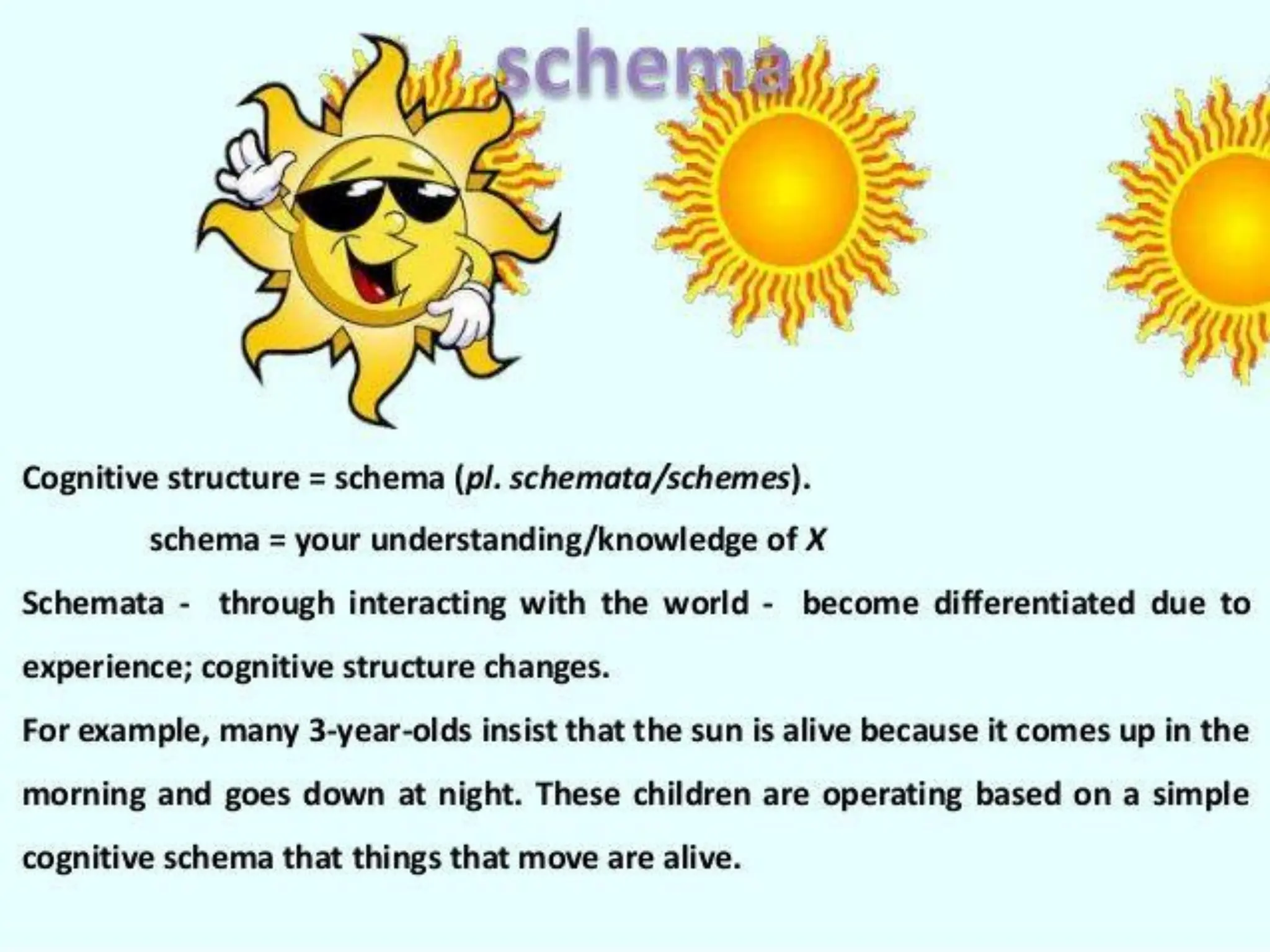
    Schemas • A schemadescribes both the mental and physical actions involved in understanding and knowing. Schemas are categories of knowledge that help us to interpret and understand the world. • In Piaget's view, a schema includes both a category of knowledge and the process of obtaining that knowledge. As experiences happen, this new information is used to modify, add to, or change previously existing schemas.
  • 13.
    Assimilation • Assimilation refersto part of the adaptation process initially proposed by Jean Piaget. Through assimilation,we take in new information or experiences and incorporate them into our existing ideas. The process is somewhat subjective because we tend to modify experience or information to fit in with our pre-existing beliefs.
  • 14.
    Assimilation ❑More Examples ofAssimilation o A college student learning how to use a new computer program o A sees a new type of dog that he's never seen before and he immediately points to the animal and says, "Dog!" o A chef learning a new cooking technique o A computer programmer learning a new programming language
  • 16.
    Accommodation ❑Accommodation – Anotherpart of adaptation involves changing or altering our existing schemas in light of new information, a process known as accommodation. Accommodation involves altering existing schemas, or ideas, as a result of new information or new experiences. New schemas may also be developed during this process.
  • 18.
    Equilibration • Equilibration –Piaget believed that all children try to strike a balance between assimilation and accommodation, which is achieved through a mechanism Piaget called equilibration. As children progress through the stages of cognitive development, it is important to maintain a balance between applying previous knowledge (assimilation) and changing behavior to account for new knowledge (accommodation). Equilibration helps explain how children are able to move from one stage of thought into the next.
  • 20.
    Sensory Motor Stage (Birth- 2yrs) o The main achievement during this stage is object permanence - knowing that an object still exists, even if it is hidden. o It requires the ability to form a mental representation (i.e., a schema) of the object.
  • 21.
    ❑The sensorimotor stageis further divided into six substages, each highlighted with the establishmentof a new skill. o Reflexes (0 – 1 month): o Primary Circular Reactions (1 – 4 months): o Secondary Circular Reactions (4 – 8 months): o Coordination of Reactions (8 – 12 months): o Tertiary Circular Reactions – (12 – 18 months): o Early Representational Thought (18 – 24 months):
  • 23.
    Six Substages Of Sensorimotor 1.Reflexes (0 – 1 month): Understanding of environment is attained through reflexes such as sucking and crying. Primary Circular 2. Reactions (1 – 4 months): New schemas and sensations are combined, allowing the child to engage in pleasurableactions deliberately, such as sucking his thumb.
  • 24.
    Six Substages OfSensorimotor 3. Secondary Circular Reactions (4 – 8 months): Child is now aware that his actions influence his environment and purposefully perform actions in order to achieve a desired result. 4. Coordination of Reactions (8 – 12 months): Child now explores his environment and often imitates the behavior of others.
  • 25.
    Six Substages OfSensorimotor 5. Tertiary Circular Reactions – (12 – 18 months): Child begins to experiment and try out new behavior. 6. Early Representational Thought (18 – 24 months): Child begins to recognize and appreciate symbols that represent objects or events.
  • 26.
    Preoperational Stage (2 –7 years) • During this stage, young children can think about things symbolically. This is the ability to make one thing - a word or an object - stand for something other than itself. • Thinking is still egocentric, and the infant has difficulty taking the viewpoint of others.
  • 27.
    Concrete Operational Stage (7yrs-11yrs) •Piaget considered the concrete stage a major turning point in the child's cognitive development because it marks the beginning of logical or operational thought. • This means the child can work things out internally in their head (rather than physically try things out in the real world).
  • 28.
    Concrete Operational Stage (7yrs-11yrs) oChildren can conserve number (age 6), mass (age 7), and weight (age 9). Conservation is the understandingthat something stays the same in quantity even though its appearance changes.
  • 29.
    Formal Operations Stage (11yrs-16yrs) •The formal operationalstage begins at approximately age eleven and lasts into adulthood.During this time, people develop the ability to think about abstract concepts, and logically test hypotheses.