Chapter 4 
Stack
Stack 
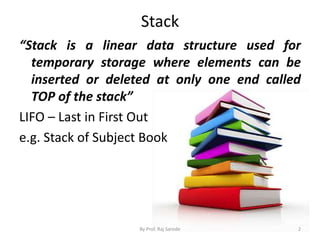
“Stack is a linear data structure used for 
temporary storage where elements can be 
inserted or deleted at only one end called 
TOP of the stack” 
LIFO – Last in First Out 
e.g. Stack of Subject Book 
By Prof. Raj Sarode 2
Stack 
WT 
DS DS 
OOAD 
WT 
DS 
DCCN 
OOAD 
WT 
DS 
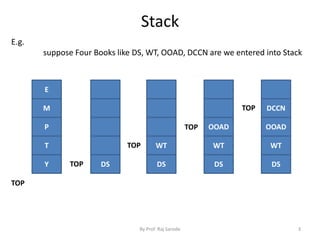
E.g. 
suppose Four Books like DS, WT, OOAD, DCCN are we entered into Stack 
By Prof. Raj Sarode 3 
TOP 
TOP 
TOP 
TOP 
E 
M 
P 
T 
Y 
TOP
Implementation or Representation of Stack 
1 Static / sequential / array representation 
 In this case of array, stack is also collection of 
homogeneous elements . 
 Therefore stack can be easily implemented 
using array. 
 Two operation : PUSH & POP 
 Element stored from stack[0] to stack[TOP] 
 Stack[0] ->Bottom of STACK 
 Stack [TOP]-> Top of STACK 
 TOP =-1 It indicate Stack is Empty. 
By Prof. Raj Sarode 4
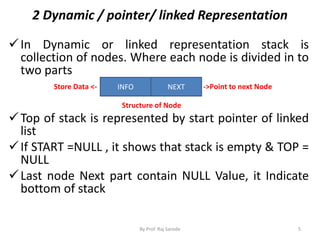
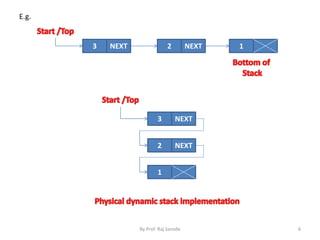
2 Dynamic / pointer/ linked Representation 
 In Dynamic or linked representation stack is 
collection of nodes. Where each node is divided in to 
two parts 
INFO NEXT 
Top of stack is represented by start pointer of linked 
list 
 If START =NULL , it shows that stack is empty & TOP = 
NULL 
 Last node Next part contain NULL Value, it Indicate 
bottom of stack 
By Prof. Raj Sarode 5 
Store Data <- 
Structure of Node 
->Point to next Node
3 NEXT 2 NEXT 1 
E.g. 
3 NEXT 
2 NEXT 
1 
By Prof. Raj Sarode 6
Stack Operation 
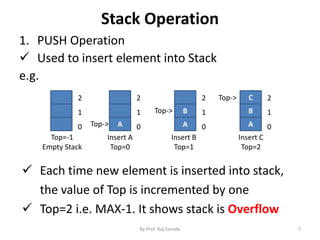
1. PUSH Operation 
 Used to insert element into Stack 
e.g. 
2 
1 
0 
Top=-1 
Empty Stack 
A 
2 
1 
0 
Insert A 
Top=0 
B 
A 
2 
1 
0 
Insert B 
Top=1 
C 
B 
A 
2 
1 
0 
Insert C 
Top=2 
Top-> 
Top-> 
Top-> 
 Each time new element is inserted into stack, 
the value of Top is incremented by one 
 Top=2 i.e. MAX-1. It shows stack is Overflow 
By Prof. Raj Sarode 7
Algorithm 1 
Push(stack, MAX, Top, Ele) 
1. Check for Overflow 
a. If Top=MAX-1 then 
b. Print “overflow” & return 
Else 
a. Top = Top+1 //Increment Top by One 
b. Stack[Top]=Ele //insert Element at new Location 
End if 
2. Return. 
By Prof. Raj Sarode 8
Stack Operation 
2. POP Operation 
 Used to Delete element From Stack 
e.g. 
2 
1 
0 
A is Removed 
Top=-1 
Stack is Empty 
A 
2 
1 
0 
B is Removed 
Top=0 
B 
A 
2 
1 
0 
C is Removed 
Top=1 
C 
B 
A 
2 
1 
0 
Top=2 
Top-> 
Top-> 
Top-> 
 In POP Last inserted element is Deleted First [LIFO] 
 After deleting element value of top is decreased by one 
 When all elements from stack are removed (i.e. empty stack) we 
cannot removed anything from stack. This condition is called 
“Underflow” By Prof. Raj Sarode 9
Algorithm 2 
POP(stack, MAX, Top, Ele) 
1. Check for Underflow 
a. If Top=-1 then 
b. Print “underflow” & return 
Else 
a. Ele=Stack[Top] //delete element from stack 
b. Top = Top-1 //decrement Top by One 
End if 
2. Return. 
By Prof. Raj Sarode 10
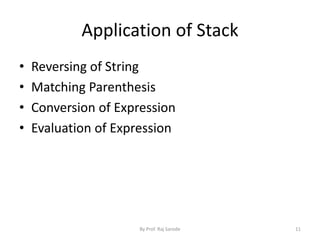
Application of Stack 
• Reversing of String 
• Matching Parenthesis 
• Conversion of Expression 
• Evaluation of Expression 
By Prof. Raj Sarode 11
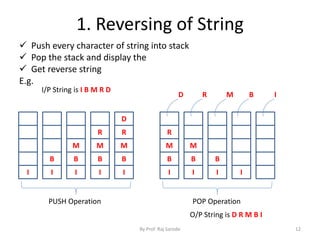
1. Reversing of String 
 Push every character of string into stack 
 Pop the stack and display the 
 Get reverse string 
E.g. 
R 
M 
B 
M 
B 
B 
By Prof. Raj Sarode 12 
B 
I I 
M 
B 
I 
R 
M 
B 
I 
D 
R 
M 
B 
I 
PUSH Operation 
I 
D 
I 
R 
I 
M 
I 
B I 
POP Operation 
O/P String is D R M B I 
I/P String is I B M R D
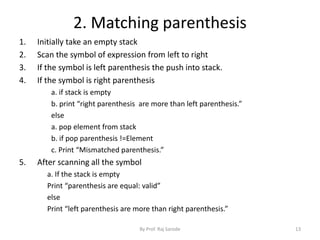
2. Matching parenthesis 
1. Initially take an empty stack 
2. Scan the symbol of expression from left to right 
3. If the symbol is left parenthesis the push into stack. 
4. If the symbol is right parenthesis 
a. if stack is empty 
b. print “right parenthesis are more than left parenthesis.” 
else 
a. pop element from stack 
b. if pop parenthesis !=Element 
c. Print “Mismatched parenthesis.” 
5. After scanning all the symbol 
a. If the stack is empty 
Print “parenthesis are equal: valid” 
else 
Print “left parenthesis are more than right parenthesis.” 
By Prof. Raj Sarode 13
By Prof. Raj Sarode 14 
E.g. (A + B ) * ( C – D ) 
Sr. No. Next I/P Symbol Stack O/P 
1 ( ( 
2 A ( 
3 + ( 
4 ) EMPTY [pop 1 left Parenthesis] 
5 * EMPTY 
6 ( ( 
7 C ( 
8 - ( 
9 D ( [pop 1 left Parenthesis] 
10 ) EMPTY Valid Expression
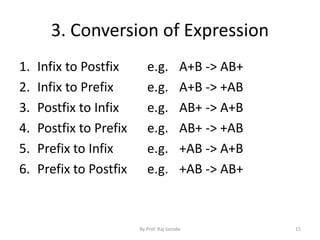
3. Conversion of Expression 
1. Infix to Postfix e.g. A+B -> AB+ 
2. Infix to Prefix e.g. A+B -> +AB 
3. Postfix to Infix e.g. AB+ -> A+B 
4. Postfix to Prefix e.g. AB+ -> +AB 
5. Prefix to Infix e.g. +AB -> A+B 
6. Prefix to Postfix e.g. +AB -> AB+ 
By Prof. Raj Sarode 15
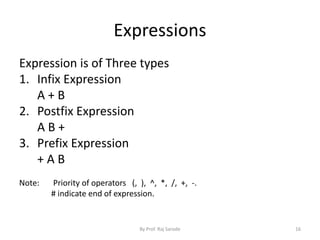
Expressions 
Expression is of Three types 
1. Infix Expression 
A + B 
2. Postfix Expression 
A B + 
3. Prefix Expression 
+ A B 
Note: Priority of operators (, ), ^, *, /, +, -. 
# indicate end of expression. 
By Prof. Raj Sarode 16
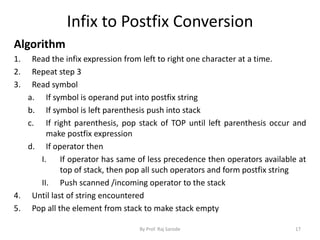
Infix to Postfix Conversion 
Algorithm 
1. Read the infix expression from left to right one character at a time. 
2. Repeat step 3 
3. Read symbol 
a. If symbol is operand put into postfix string 
b. If symbol is left parenthesis push into stack 
c. If right parenthesis, pop stack of TOP until left parenthesis occur and 
make postfix expression 
d. If operator then 
I. If operator has same of less precedence then operators available at 
top of stack, then pop all such operators and form postfix string 
II. Push scanned /incoming operator to the stack 
4. Until last of string encountered 
5. Pop all the element from stack to make stack empty 
By Prof. Raj Sarode 17
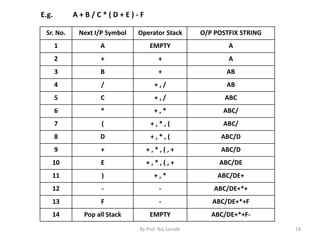
E.g. A + B / C * ( D + E ) - F 
Sr. No. Next I/P Symbol Operator Stack O/P POSTFIX STRING 
1 A EMPTY A 
2 + + A 
3 B + AB 
4 / + , / AB 
5 C + , / ABC 
6 * + , * ABC/ 
7 ( + , * , ( ABC/ 
8 D + , * , ( ABC/D 
9 + + , * , ( , + ABC/D 
10 E + , * , ( , + ABC/DE 
11 ) + , * ABC/DE+ 
12 - - ABC/DE+*+ 
13 F - ABC/DE+*+F 
14 Pop all Stack EMPTY ABC/DE+*+F- 
By Prof. Raj Sarode 18
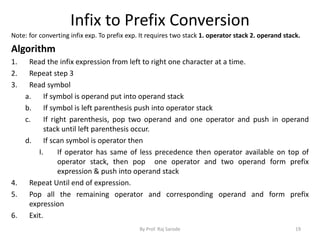
Infix to Prefix Conversion 
Note: for converting infix exp. To prefix exp. It requires two stack 1. operator stack 2. operand stack. 
Algorithm 
1. Read the infix expression from left to right one character at a time. 
2. Repeat step 3 
3. Read symbol 
a. If symbol is operand put into operand stack 
b. If symbol is left parenthesis push into operator stack 
c. If right parenthesis, pop two operand and one operator and push in operand 
stack until left parenthesis occur. 
d. If scan symbol is operator then 
I. If operator has same of less precedence then operator available on top of 
operator stack, then pop one operator and two operand form prefix 
expression & push into operand stack 
4. Repeat Until end of expression. 
5. Pop all the remaining operator and corresponding operand and form prefix 
expression 
6. Exit. 
By Prof. Raj Sarode 19
By Prof. Raj Sarode 20 
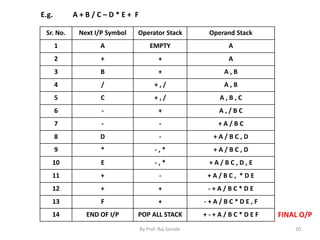
E.g. A + B / C – D * E + F 
Sr. No. Next I/P Symbol Operator Stack Operand Stack 
1 A EMPTY A 
2 + + A 
3 B + A , B 
4 / + , / A , B 
5 C + , / A , B , C 
6 - + A , / B C 
7 - - + A / B C 
8 D - + A / B C , D 
9 * - , * + A / B C , D 
10 E - , * + A / B C , D , E 
11 + - + A / B C , * D E 
12 + + - + A / B C * D E 
13 F + - + A / B C * D E , F 
14 END OF I/P POP ALL STACK + - + A / B C * D E F FINAL O/P
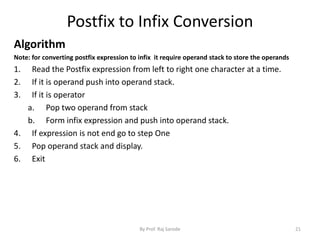
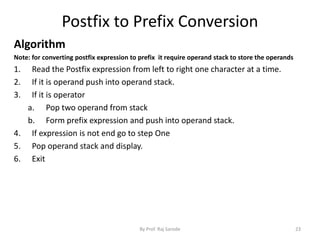
Postfix to Infix Conversion 
Algorithm 
Note: for converting postfix expression to infix it require operand stack to store the operands 
1. Read the Postfix expression from left to right one character at a time. 
2. If it is operand push into operand stack. 
3. If it is operator 
a. Pop two operand from stack 
b. Form infix expression and push into operand stack. 
4. If expression is not end go to step One 
5. Pop operand stack and display. 
6. Exit 
By Prof. Raj Sarode 21
By Prof. Raj Sarode 22 
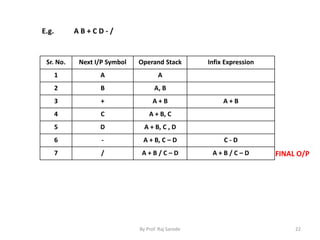
E.g. A B + C D - / 
Sr. No. Next I/P Symbol Operand Stack Infix Expression 
1 A A 
2 B A, B 
3 + A + B A + B 
4 C A + B, C 
5 D A + B, C , D 
6 - A + B, C – D C - D 
7 / A + B / C – D A + B / C – D FINAL O/P
Postfix to Prefix Conversion 
Algorithm 
Note: for converting postfix expression to prefix it require operand stack to store the operands 
1. Read the Postfix expression from left to right one character at a time. 
2. If it is operand push into operand stack. 
3. If it is operator 
a. Pop two operand from stack 
b. Form prefix expression and push into operand stack. 
4. If expression is not end go to step One 
5. Pop operand stack and display. 
6. Exit 
By Prof. Raj Sarode 23
By Prof. Raj Sarode 24 
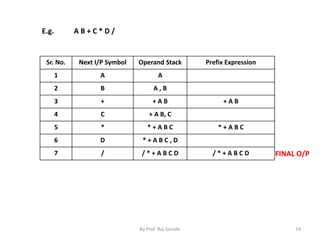
E.g. A B + C * D / 
Sr. No. Next I/P Symbol Operand Stack Prefix Expression 
1 A A 
2 B A , B 
3 + + A B + A B 
4 C + A B, C 
5 * * + A B C * + A B C 
6 D * + A B C , D 
7 / / * + A B C D / * + A B C D FINAL O/P
Prefix to Infix Conversion 
Algorithm 
Note: for converting prefix expression to infix it require one stack to store the operator as well as 
operands 
1. Read the prefix expression from left to right one character at a time. 
2. If it is operator push into stack. 
3. If it is operand 
while (operand (stack[TOP]) 
{ operand1 = pop(); 
operator = pop(); 
expression=(operand1, operator, symbol) 
symbol=expression; } 
4. Push symbol into stack 
5. If prefix string is not end go to step one 
6. POP stack & Display it 
7. Exit 
By Prof. Raj Sarode 25
By Prof. Raj Sarode 26 
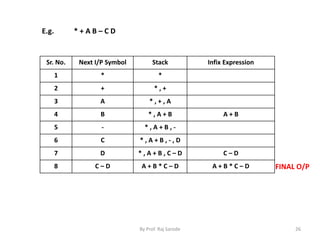
E.g. * + A B – C D 
Sr. No. Next I/P Symbol Stack Infix Expression 
1 * * 
2 + * , + 
3 A * , + , A 
4 B * , A + B A + B 
5 - * , A + B , - 
6 C * , A + B , - , D 
7 D * , A + B , C – D C – D 
8 C – D A + B * C – D A + B * C – D FINAL O/P
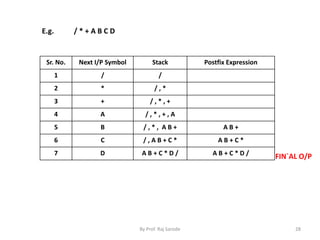
Prefix to Postfix Conversion 
Algorithm 
Note: for converting prefix expression to Postfix it require one stack to store the operator as well 
as operands 
1. Read the prefix expression from left to right one character at a time. 
2. If it is operator push into stack. 
3. If it is operand 
while (operand (stack[TOP]) 
{ operand1 = pop(); 
operator = pop(); 
expression=(operand1, symbol, operator) 
symbol=expression; } 
4. Push symbol into stack 
5. If prefix string is not end go to step one 
6. POP stack & Display it 
7. Exit 
By Prof. Raj Sarode 27
By Prof. Raj Sarode 28 
E.g. / * + A B C D 
Sr. No. Next I/P Symbol Stack Postfix Expression 
1 / / 
2 * / , * 
3 + / , * , + 
4 A / , * , + , A 
5 B / , * , A B + A B + 
6 C / , A B + C * A B + C * 
7 D A B + C * D / A B + C * D / FIN`AL O/P
/*program For stack operation */ 
By Prof. Raj Sarode 29 
#include<iostream.h> 
#include<conio.h> 
#include<stdlib.h> 
class stack 
{ 
int stk[5]; 
int top; 
public: 
stack() 
{ top=-1; } 
void push(int x) 
{ if(top > 4) 
{ cout <<"stack over flow"; 
return; 
} 
stk[++top]=x; 
cout <<"inserted" <<x; 
} 
void pop() 
{ if(top <0) 
{ cout <<"stack under flow"; 
return; 
} 
cout <<"deleted" <<stk[top--]; } 
void display() 
{ if(top<0) 
{ cout <<" stack empty"; 
return; 
} for(int i=top;i>=0;i--) 
cout <<stk[i] <<" "; 
} }; 
main() 
{ int ch; 
stack st; 
while(1) 
{ cout <<"n1.push 2.pop 3.display 
4.exitnEnter ur choice"; 
cin >> ch; 
switch(ch) 
{ case 1: cout <<"enter the element"; 
cin >> ch; 
st.push(ch); 
break; 
case 2: st.pop(); break; 
case 3: st.display();break; 
case 4: exit(0); 
} } 
return (0); }
/*program For Reverse String */ 
By Prof. Raj Sarode 30 
#include<iostream.h> 
#include<conio.h> 
#include<stdlib.h> 
# define MAX 10 
class stack 
{ char stk[MAX]; 
int top; 
public: 
stack() 
{ top=-1; } 
void push() 
{ int n,i; 
cout<<"Enter the size of string"; 
cin>>n; 
if(n>MAX) 
{ cout<<"out of size"; 
} else 
{ for(i=0;i<n;i++) 
cin>>stk[++top]; 
} 
} 
void reverse() 
{ if(top<0) 
{ cout <<" stack empty"; 
return; 
} for(int i=top;i>=0;i--) 
cout <<stk[i] <<" "; 
} }; 
main() 
{ int ch; 
clrscr(); 
stack st; 
while(1) 
{ cout <<"n1.push 2.reverse 3.exitn Enter ur 
choice"; 
cin >> ch; 
switch(ch) 
{ 
case 1: st.push();break; 
case 2: st.reverse();break; 
case 3: exit(0); 
} } 
return (0); }
Thank You 
By Prof. Raj Sarode 31

stack

  • 1.
  • 2.
    Stack “Stack isa linear data structure used for temporary storage where elements can be inserted or deleted at only one end called TOP of the stack” LIFO – Last in First Out e.g. Stack of Subject Book By Prof. Raj Sarode 2
  • 3.
    Stack WT DSDS OOAD WT DS DCCN OOAD WT DS E.g. suppose Four Books like DS, WT, OOAD, DCCN are we entered into Stack By Prof. Raj Sarode 3 TOP TOP TOP TOP E M P T Y TOP
  • 4.
    Implementation or Representationof Stack 1 Static / sequential / array representation  In this case of array, stack is also collection of homogeneous elements .  Therefore stack can be easily implemented using array.  Two operation : PUSH & POP  Element stored from stack[0] to stack[TOP]  Stack[0] ->Bottom of STACK  Stack [TOP]-> Top of STACK  TOP =-1 It indicate Stack is Empty. By Prof. Raj Sarode 4
  • 5.
    2 Dynamic /pointer/ linked Representation  In Dynamic or linked representation stack is collection of nodes. Where each node is divided in to two parts INFO NEXT Top of stack is represented by start pointer of linked list  If START =NULL , it shows that stack is empty & TOP = NULL  Last node Next part contain NULL Value, it Indicate bottom of stack By Prof. Raj Sarode 5 Store Data <- Structure of Node ->Point to next Node
  • 6.
    3 NEXT 2NEXT 1 E.g. 3 NEXT 2 NEXT 1 By Prof. Raj Sarode 6
  • 7.
    Stack Operation 1.PUSH Operation  Used to insert element into Stack e.g. 2 1 0 Top=-1 Empty Stack A 2 1 0 Insert A Top=0 B A 2 1 0 Insert B Top=1 C B A 2 1 0 Insert C Top=2 Top-> Top-> Top->  Each time new element is inserted into stack, the value of Top is incremented by one  Top=2 i.e. MAX-1. It shows stack is Overflow By Prof. Raj Sarode 7
  • 8.
    Algorithm 1 Push(stack,MAX, Top, Ele) 1. Check for Overflow a. If Top=MAX-1 then b. Print “overflow” & return Else a. Top = Top+1 //Increment Top by One b. Stack[Top]=Ele //insert Element at new Location End if 2. Return. By Prof. Raj Sarode 8
  • 9.
    Stack Operation 2.POP Operation  Used to Delete element From Stack e.g. 2 1 0 A is Removed Top=-1 Stack is Empty A 2 1 0 B is Removed Top=0 B A 2 1 0 C is Removed Top=1 C B A 2 1 0 Top=2 Top-> Top-> Top->  In POP Last inserted element is Deleted First [LIFO]  After deleting element value of top is decreased by one  When all elements from stack are removed (i.e. empty stack) we cannot removed anything from stack. This condition is called “Underflow” By Prof. Raj Sarode 9
  • 10.
    Algorithm 2 POP(stack,MAX, Top, Ele) 1. Check for Underflow a. If Top=-1 then b. Print “underflow” & return Else a. Ele=Stack[Top] //delete element from stack b. Top = Top-1 //decrement Top by One End if 2. Return. By Prof. Raj Sarode 10
  • 11.
    Application of Stack • Reversing of String • Matching Parenthesis • Conversion of Expression • Evaluation of Expression By Prof. Raj Sarode 11
  • 12.
    1. Reversing ofString  Push every character of string into stack  Pop the stack and display the  Get reverse string E.g. R M B M B B By Prof. Raj Sarode 12 B I I M B I R M B I D R M B I PUSH Operation I D I R I M I B I POP Operation O/P String is D R M B I I/P String is I B M R D
  • 13.
    2. Matching parenthesis 1. Initially take an empty stack 2. Scan the symbol of expression from left to right 3. If the symbol is left parenthesis the push into stack. 4. If the symbol is right parenthesis a. if stack is empty b. print “right parenthesis are more than left parenthesis.” else a. pop element from stack b. if pop parenthesis !=Element c. Print “Mismatched parenthesis.” 5. After scanning all the symbol a. If the stack is empty Print “parenthesis are equal: valid” else Print “left parenthesis are more than right parenthesis.” By Prof. Raj Sarode 13
  • 14.
    By Prof. RajSarode 14 E.g. (A + B ) * ( C – D ) Sr. No. Next I/P Symbol Stack O/P 1 ( ( 2 A ( 3 + ( 4 ) EMPTY [pop 1 left Parenthesis] 5 * EMPTY 6 ( ( 7 C ( 8 - ( 9 D ( [pop 1 left Parenthesis] 10 ) EMPTY Valid Expression
  • 15.
    3. Conversion ofExpression 1. Infix to Postfix e.g. A+B -> AB+ 2. Infix to Prefix e.g. A+B -> +AB 3. Postfix to Infix e.g. AB+ -> A+B 4. Postfix to Prefix e.g. AB+ -> +AB 5. Prefix to Infix e.g. +AB -> A+B 6. Prefix to Postfix e.g. +AB -> AB+ By Prof. Raj Sarode 15
  • 16.
    Expressions Expression isof Three types 1. Infix Expression A + B 2. Postfix Expression A B + 3. Prefix Expression + A B Note: Priority of operators (, ), ^, *, /, +, -. # indicate end of expression. By Prof. Raj Sarode 16
  • 17.
    Infix to PostfixConversion Algorithm 1. Read the infix expression from left to right one character at a time. 2. Repeat step 3 3. Read symbol a. If symbol is operand put into postfix string b. If symbol is left parenthesis push into stack c. If right parenthesis, pop stack of TOP until left parenthesis occur and make postfix expression d. If operator then I. If operator has same of less precedence then operators available at top of stack, then pop all such operators and form postfix string II. Push scanned /incoming operator to the stack 4. Until last of string encountered 5. Pop all the element from stack to make stack empty By Prof. Raj Sarode 17
  • 18.
    E.g. A +B / C * ( D + E ) - F Sr. No. Next I/P Symbol Operator Stack O/P POSTFIX STRING 1 A EMPTY A 2 + + A 3 B + AB 4 / + , / AB 5 C + , / ABC 6 * + , * ABC/ 7 ( + , * , ( ABC/ 8 D + , * , ( ABC/D 9 + + , * , ( , + ABC/D 10 E + , * , ( , + ABC/DE 11 ) + , * ABC/DE+ 12 - - ABC/DE+*+ 13 F - ABC/DE+*+F 14 Pop all Stack EMPTY ABC/DE+*+F- By Prof. Raj Sarode 18
  • 19.
    Infix to PrefixConversion Note: for converting infix exp. To prefix exp. It requires two stack 1. operator stack 2. operand stack. Algorithm 1. Read the infix expression from left to right one character at a time. 2. Repeat step 3 3. Read symbol a. If symbol is operand put into operand stack b. If symbol is left parenthesis push into operator stack c. If right parenthesis, pop two operand and one operator and push in operand stack until left parenthesis occur. d. If scan symbol is operator then I. If operator has same of less precedence then operator available on top of operator stack, then pop one operator and two operand form prefix expression & push into operand stack 4. Repeat Until end of expression. 5. Pop all the remaining operator and corresponding operand and form prefix expression 6. Exit. By Prof. Raj Sarode 19
  • 20.
    By Prof. RajSarode 20 E.g. A + B / C – D * E + F Sr. No. Next I/P Symbol Operator Stack Operand Stack 1 A EMPTY A 2 + + A 3 B + A , B 4 / + , / A , B 5 C + , / A , B , C 6 - + A , / B C 7 - - + A / B C 8 D - + A / B C , D 9 * - , * + A / B C , D 10 E - , * + A / B C , D , E 11 + - + A / B C , * D E 12 + + - + A / B C * D E 13 F + - + A / B C * D E , F 14 END OF I/P POP ALL STACK + - + A / B C * D E F FINAL O/P
  • 21.
    Postfix to InfixConversion Algorithm Note: for converting postfix expression to infix it require operand stack to store the operands 1. Read the Postfix expression from left to right one character at a time. 2. If it is operand push into operand stack. 3. If it is operator a. Pop two operand from stack b. Form infix expression and push into operand stack. 4. If expression is not end go to step One 5. Pop operand stack and display. 6. Exit By Prof. Raj Sarode 21
  • 22.
    By Prof. RajSarode 22 E.g. A B + C D - / Sr. No. Next I/P Symbol Operand Stack Infix Expression 1 A A 2 B A, B 3 + A + B A + B 4 C A + B, C 5 D A + B, C , D 6 - A + B, C – D C - D 7 / A + B / C – D A + B / C – D FINAL O/P
  • 23.
    Postfix to PrefixConversion Algorithm Note: for converting postfix expression to prefix it require operand stack to store the operands 1. Read the Postfix expression from left to right one character at a time. 2. If it is operand push into operand stack. 3. If it is operator a. Pop two operand from stack b. Form prefix expression and push into operand stack. 4. If expression is not end go to step One 5. Pop operand stack and display. 6. Exit By Prof. Raj Sarode 23
  • 24.
    By Prof. RajSarode 24 E.g. A B + C * D / Sr. No. Next I/P Symbol Operand Stack Prefix Expression 1 A A 2 B A , B 3 + + A B + A B 4 C + A B, C 5 * * + A B C * + A B C 6 D * + A B C , D 7 / / * + A B C D / * + A B C D FINAL O/P
  • 25.
    Prefix to InfixConversion Algorithm Note: for converting prefix expression to infix it require one stack to store the operator as well as operands 1. Read the prefix expression from left to right one character at a time. 2. If it is operator push into stack. 3. If it is operand while (operand (stack[TOP]) { operand1 = pop(); operator = pop(); expression=(operand1, operator, symbol) symbol=expression; } 4. Push symbol into stack 5. If prefix string is not end go to step one 6. POP stack & Display it 7. Exit By Prof. Raj Sarode 25
  • 26.
    By Prof. RajSarode 26 E.g. * + A B – C D Sr. No. Next I/P Symbol Stack Infix Expression 1 * * 2 + * , + 3 A * , + , A 4 B * , A + B A + B 5 - * , A + B , - 6 C * , A + B , - , D 7 D * , A + B , C – D C – D 8 C – D A + B * C – D A + B * C – D FINAL O/P
  • 27.
    Prefix to PostfixConversion Algorithm Note: for converting prefix expression to Postfix it require one stack to store the operator as well as operands 1. Read the prefix expression from left to right one character at a time. 2. If it is operator push into stack. 3. If it is operand while (operand (stack[TOP]) { operand1 = pop(); operator = pop(); expression=(operand1, symbol, operator) symbol=expression; } 4. Push symbol into stack 5. If prefix string is not end go to step one 6. POP stack & Display it 7. Exit By Prof. Raj Sarode 27
  • 28.
    By Prof. RajSarode 28 E.g. / * + A B C D Sr. No. Next I/P Symbol Stack Postfix Expression 1 / / 2 * / , * 3 + / , * , + 4 A / , * , + , A 5 B / , * , A B + A B + 6 C / , A B + C * A B + C * 7 D A B + C * D / A B + C * D / FIN`AL O/P
  • 29.
    /*program For stackoperation */ By Prof. Raj Sarode 29 #include<iostream.h> #include<conio.h> #include<stdlib.h> class stack { int stk[5]; int top; public: stack() { top=-1; } void push(int x) { if(top > 4) { cout <<"stack over flow"; return; } stk[++top]=x; cout <<"inserted" <<x; } void pop() { if(top <0) { cout <<"stack under flow"; return; } cout <<"deleted" <<stk[top--]; } void display() { if(top<0) { cout <<" stack empty"; return; } for(int i=top;i>=0;i--) cout <<stk[i] <<" "; } }; main() { int ch; stack st; while(1) { cout <<"n1.push 2.pop 3.display 4.exitnEnter ur choice"; cin >> ch; switch(ch) { case 1: cout <<"enter the element"; cin >> ch; st.push(ch); break; case 2: st.pop(); break; case 3: st.display();break; case 4: exit(0); } } return (0); }
  • 30.
    /*program For ReverseString */ By Prof. Raj Sarode 30 #include<iostream.h> #include<conio.h> #include<stdlib.h> # define MAX 10 class stack { char stk[MAX]; int top; public: stack() { top=-1; } void push() { int n,i; cout<<"Enter the size of string"; cin>>n; if(n>MAX) { cout<<"out of size"; } else { for(i=0;i<n;i++) cin>>stk[++top]; } } void reverse() { if(top<0) { cout <<" stack empty"; return; } for(int i=top;i>=0;i--) cout <<stk[i] <<" "; } }; main() { int ch; clrscr(); stack st; while(1) { cout <<"n1.push 2.reverse 3.exitn Enter ur choice"; cin >> ch; switch(ch) { case 1: st.push();break; case 2: st.reverse();break; case 3: exit(0); } } return (0); }
  • 31.
    Thank You ByProf. Raj Sarode 31