Applications of Stack
www.eshikshak.co.in
Reverse String or List
 ● We can accomplish this task by pushing each character or member from the
   string/list in the order it appears
 ● When the line is finished, characters are then proposed off the stack

                     “They come off in a reverse order”


                         www.eshikshak.co.in
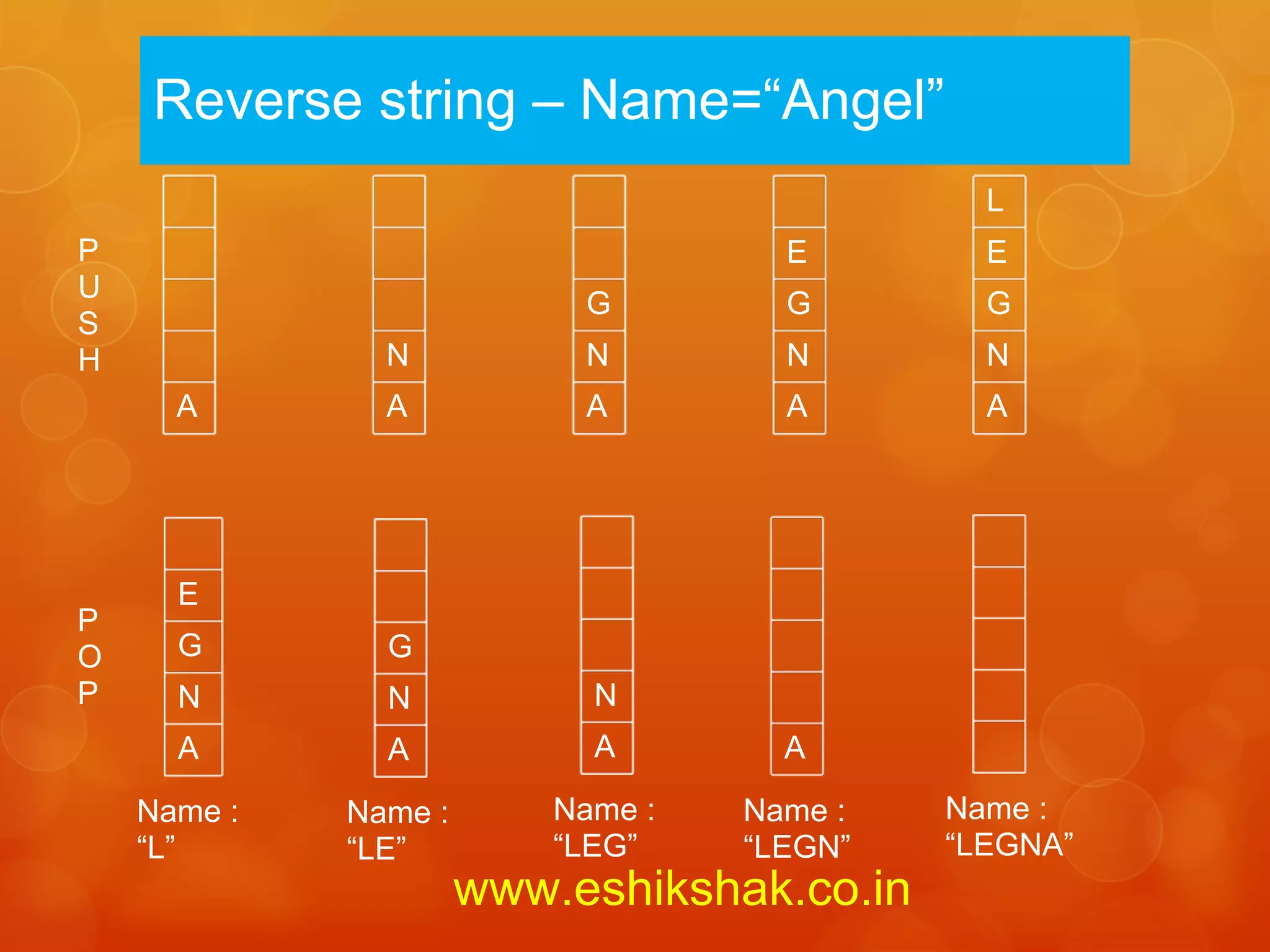
Reverse string – Name=“Angel”
                                              L
P                                    E        E
U
                           G         G        G
S
H              N           N         N        N
      A        A           A         A        A


      E
P
O     G        G
P     N        N            N
      A        A            A        A

    Name :   Name :       Name :   Name :   Name :
    “L”      “LE”         “LEG”    “LEGN”   “LEGNA”
                      www.eshikshak.co.in
Polish Notation
 ● The process of writing the operators of expression either before their
   operands or after them is called “Polish Notation”
 ● The main property of Polish Notation is that the order in which operations are
   to be performed is ascertained by the position of the operators and operands
   in the expression


                           www.eshikshak.co.in
Polish Notation
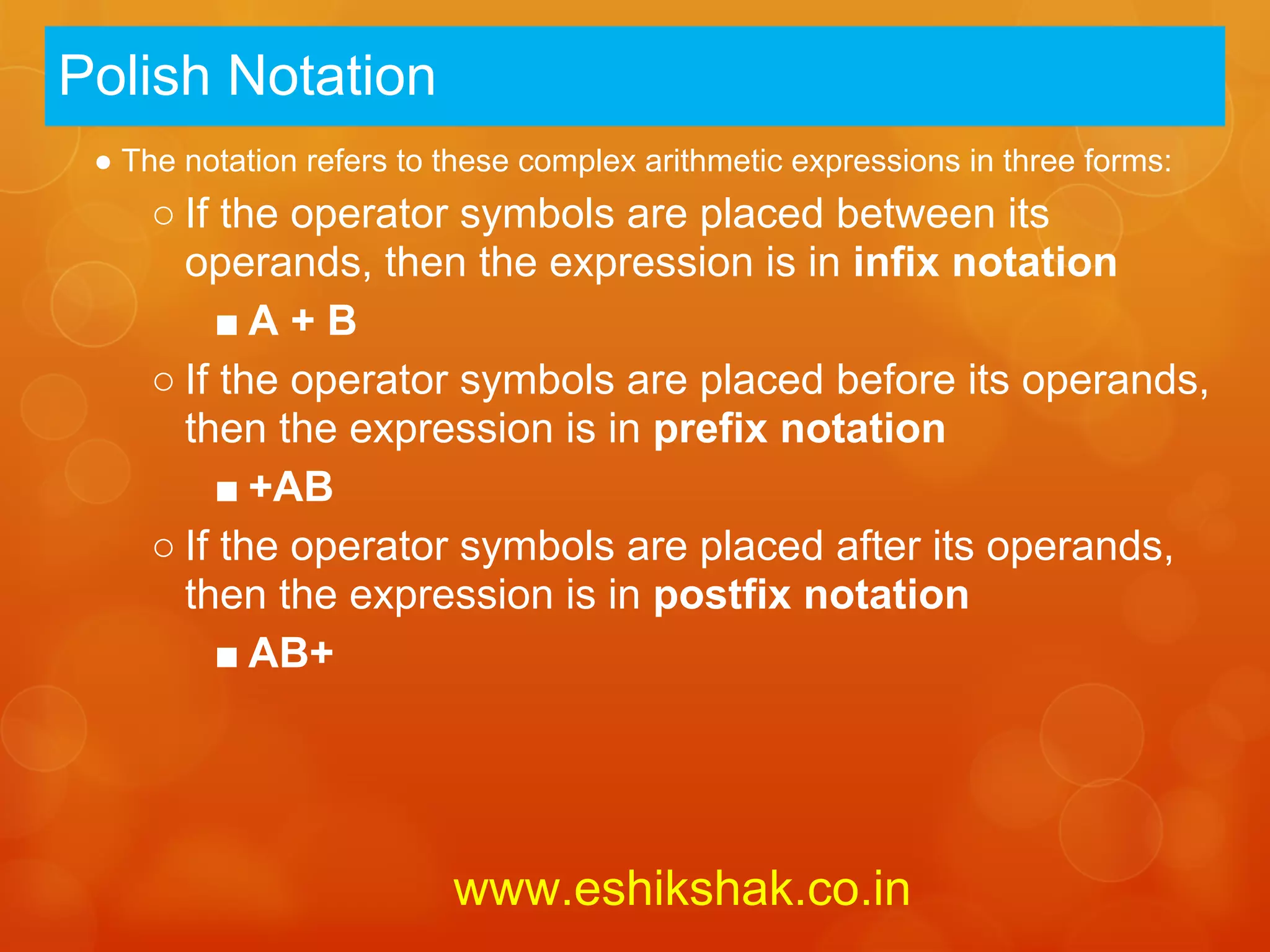
 ● The notation refers to these complex arithmetic expressions in three forms:
     ○ If the operator symbols are placed between its
       operands, then the expression is in infix notation
          ■A + B
     ○ If the operator symbols are placed before its operands,
       then the expression is in prefix notation
          ■ +AB
     ○ If the operator symbols are placed after its operands,
       then the expression is in postfix notation
          ■ AB+


                          www.eshikshak.co.in
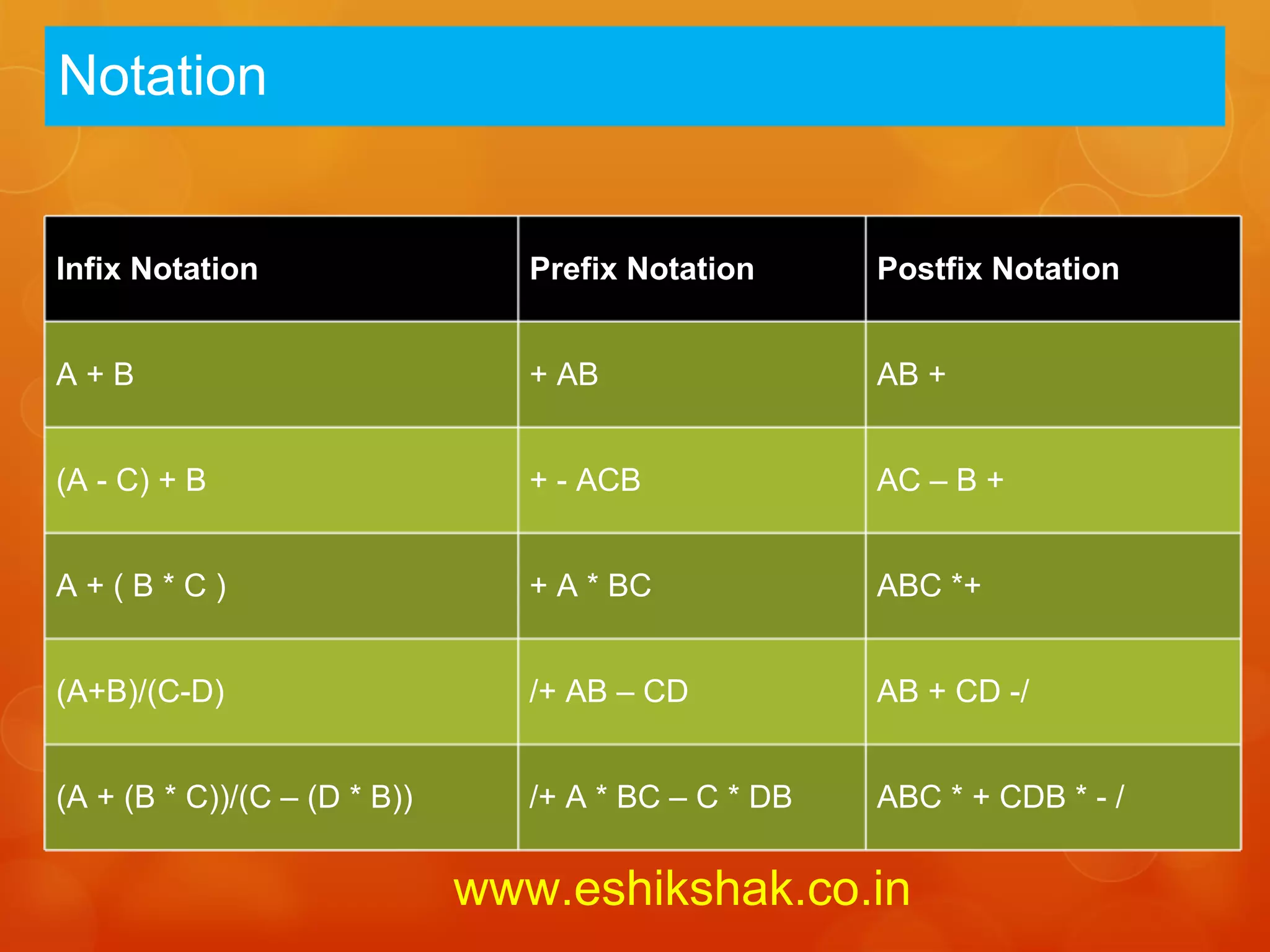
Notation


Infix Notation                   Prefix Notation      Postfix Notation


A+B                              + AB                 AB +


(A - C) + B                      + - ACB              AC – B +


A+(B*C)                          + A * BC             ABC *+


(A+B)/(C-D)                      /+ AB – CD           AB + CD -/


(A + (B * C))/(C – (D * B))      /+ A * BC – C * DB   ABC * + CDB * - /


                              www.eshikshak.co.in
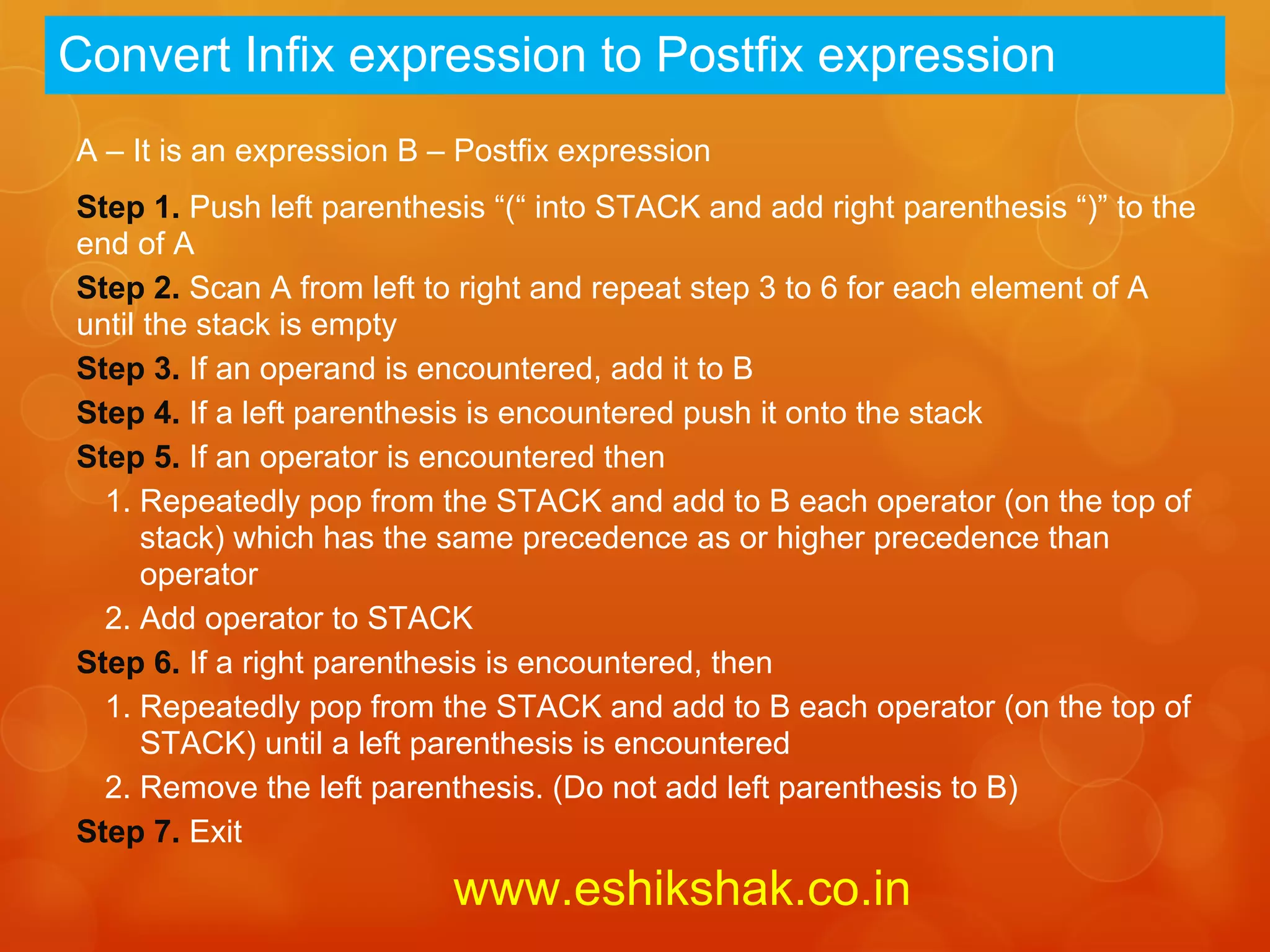
Convert Infix expression to Postfix expression
A – It is an expression B – Postfix expression
Step 1. Push left parenthesis “(“ into STACK and add right parenthesis “)” to the
end of A
Step 2. Scan A from left to right and repeat step 3 to 6 for each element of A
until the stack is empty
Step 3. If an operand is encountered, add it to B
Step 4. If a left parenthesis is encountered push it onto the stack
Step 5. If an operator is encountered then
  1. Repeatedly pop from the STACK and add to B each operator (on the top of
      stack) which has the same precedence as or higher precedence than
      operator
  2. Add operator to STACK
Step 6. If a right parenthesis is encountered, then
  1. Repeatedly pop from the STACK and add to B each operator (on the top of
      STACK) until a left parenthesis is encountered
  2. Remove the left parenthesis. (Do not add left parenthesis to B)
Step 7. Exit
                           www.eshikshak.co.in
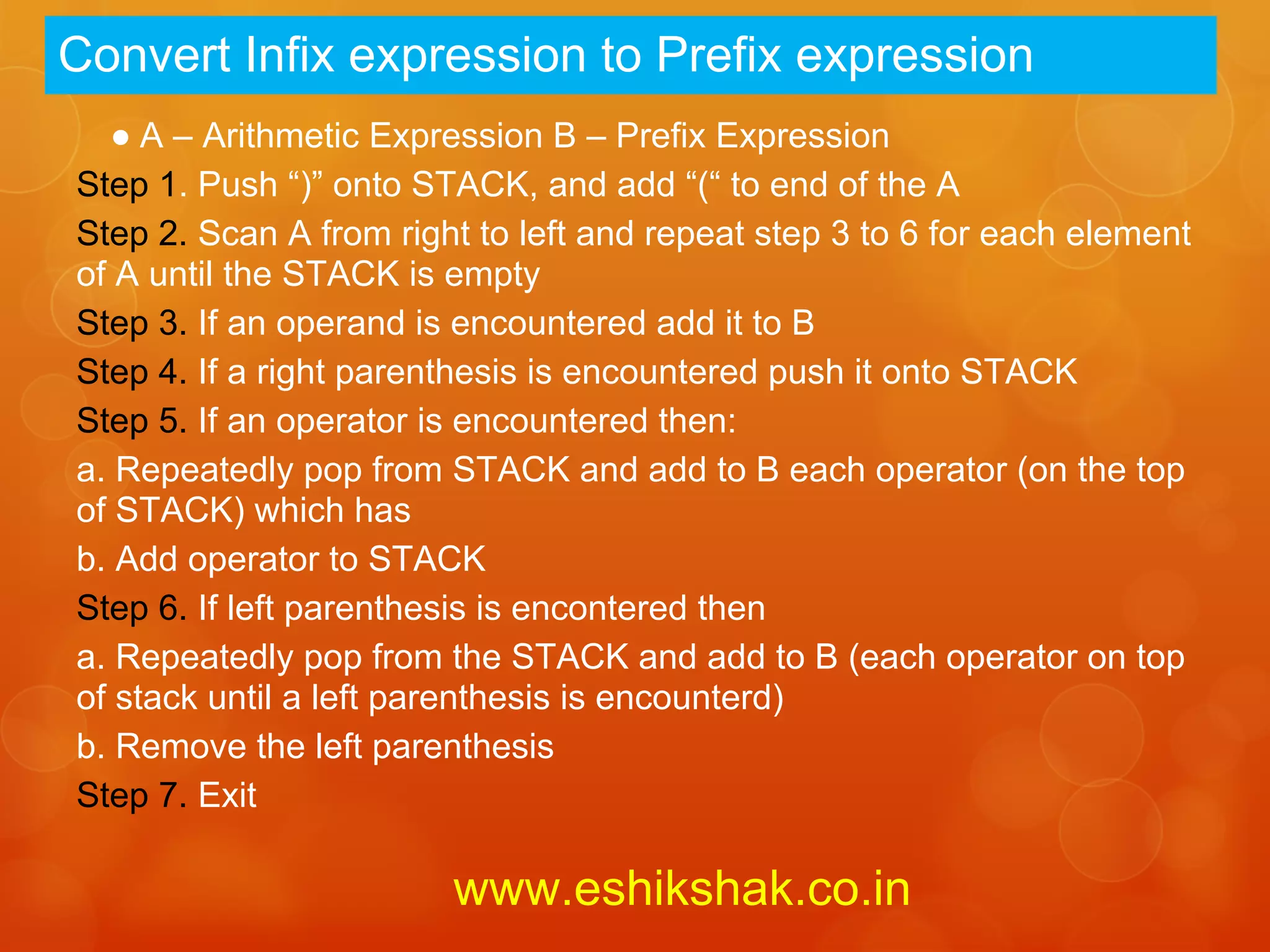
Convert Infix expression to Prefix expression
  ● A – Arithmetic Expression B – Prefix Expression
Step 1. Push “)” onto STACK, and add “(“ to end of the A
Step 2. Scan A from right to left and repeat step 3 to 6 for each element
of A until the STACK is empty
Step 3. If an operand is encountered add it to B
Step 4. If a right parenthesis is encountered push it onto STACK
Step 5. If an operator is encountered then:
a. Repeatedly pop from STACK and add to B each operator (on the top
of STACK) which has
b. Add operator to STACK
Step 6. If left parenthesis is encontered then
a. Repeatedly pop from the STACK and add to B (each operator on top
of stack until a left parenthesis is encounterd)
b. Remove the left parenthesis
Step 7. Exit

                        www.eshikshak.co.in
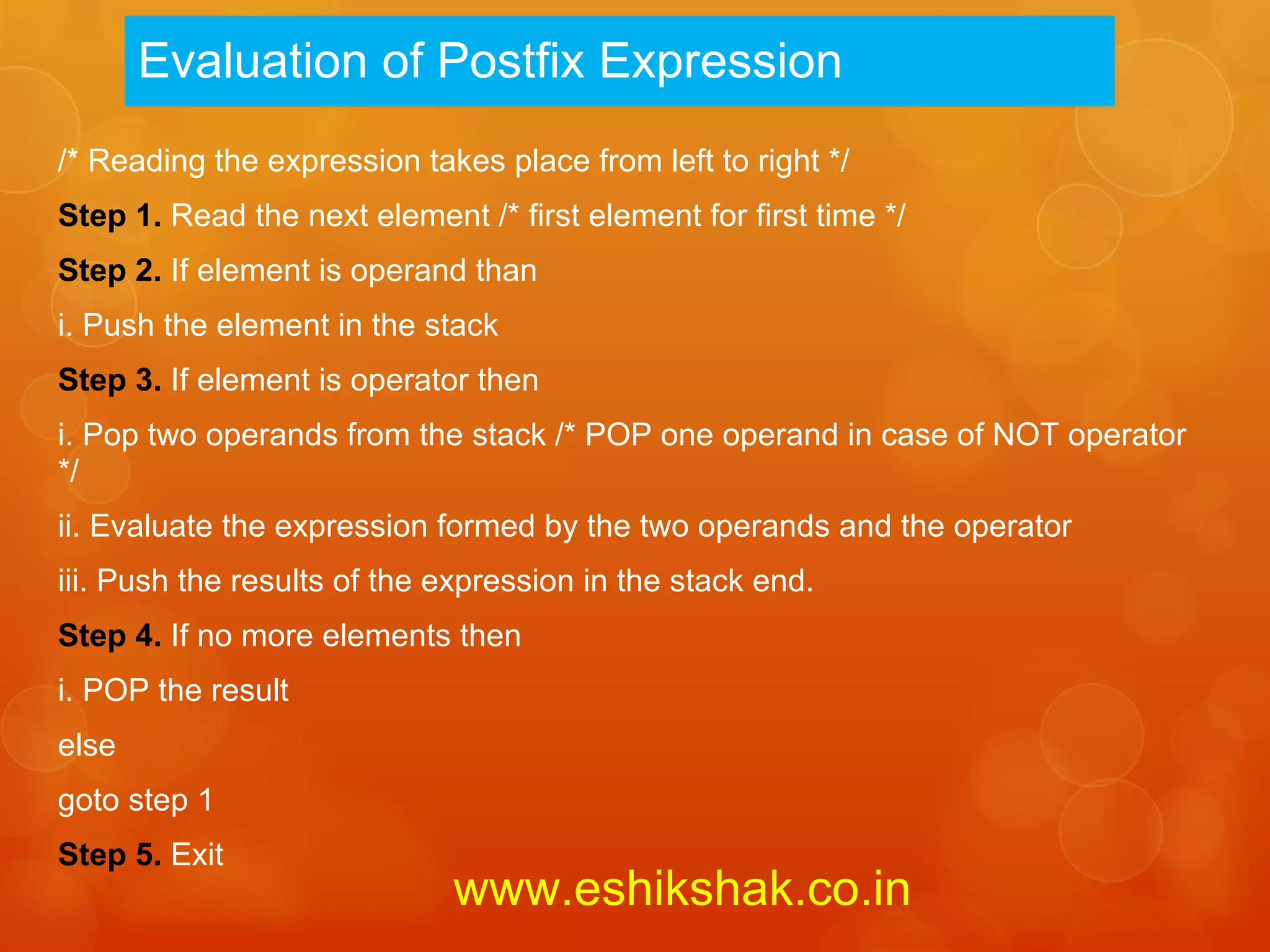
Evaluation of Postfix Expression
/* Reading the expression takes place from left to right */
Step 1. Read the next element /* first element for first time */
Step 2. If element is operand than
i. Push the element in the stack
Step 3. If element is operator then
i. Pop two operands from the stack /* POP one operand in case of NOT operator
*/
ii. Evaluate the expression formed by the two operands and the operator
iii. Push the results of the expression in the stack end.
Step 4. If no more elements then
i. POP the result
else
goto step 1
Step 5. Exit
                             www.eshikshak.co.in
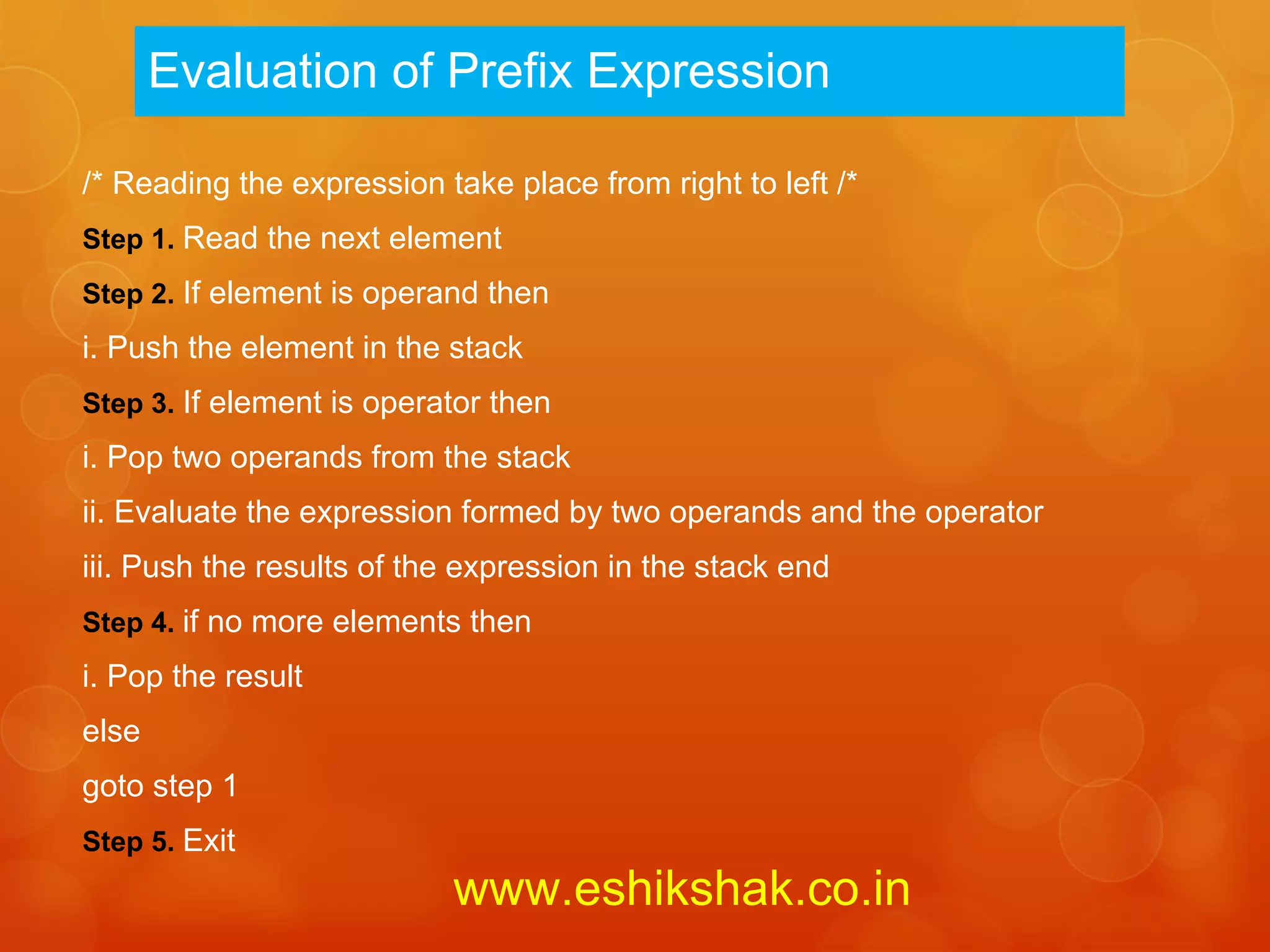
Evaluation of Prefix Expression

/* Reading the expression take place from right to left /*
Step 1. Read the next element
Step 2. If element is operand then
i. Push the element in the stack
Step 3. If element is operator then
i. Pop two operands from the stack
ii. Evaluate the expression formed by two operands and the operator
iii. Push the results of the expression in the stack end
Step 4. if no more elements then
i. Pop the result
else
goto step 1
Step 5. Exit
                           www.eshikshak.co.in
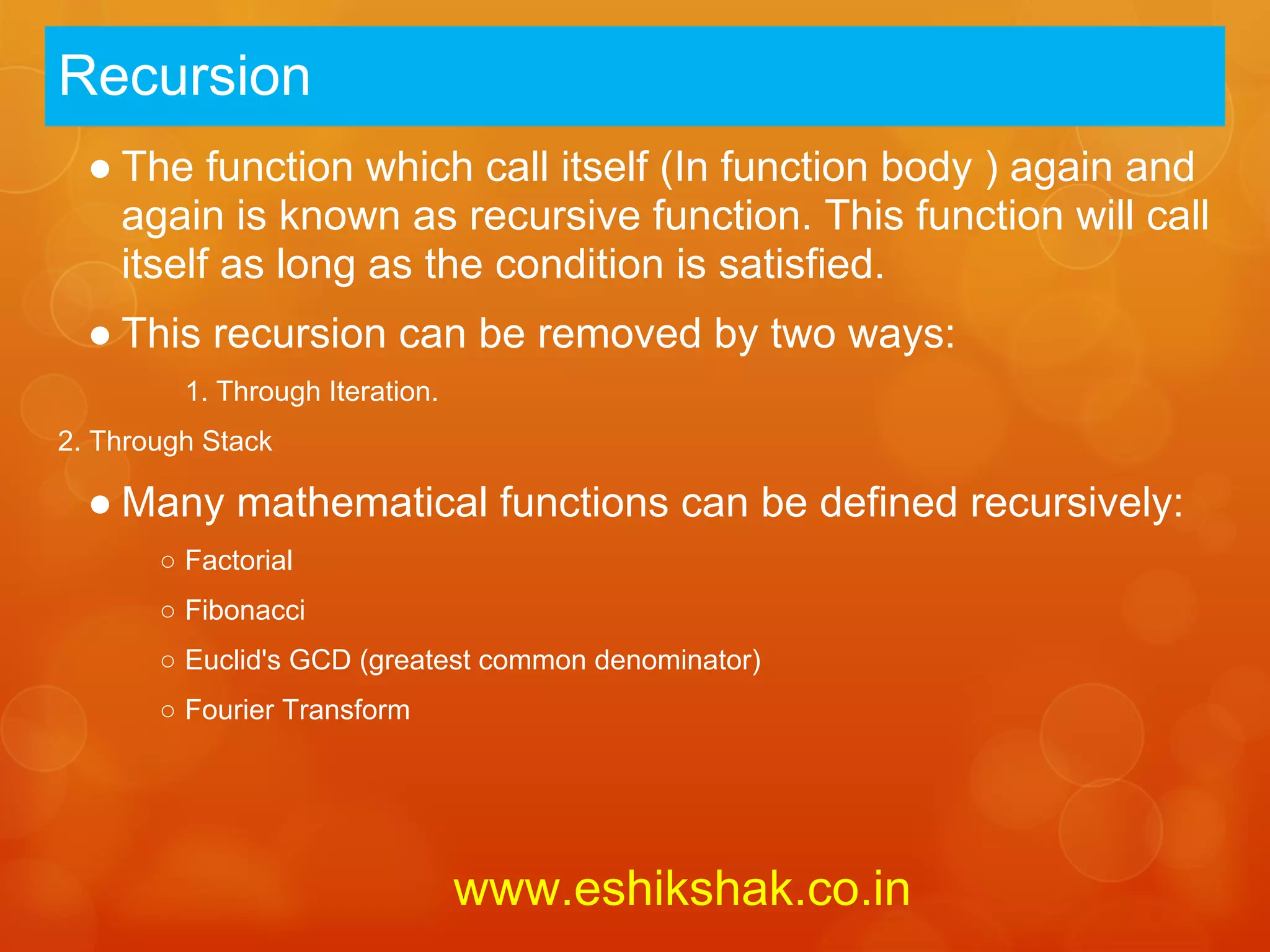
Recursion
  ● The function which call itself (In function body ) again and
    again is known as recursive function. This function will call
    itself as long as the condition is satisfied.
  ● This recursion can be removed by two ways:
         1. Through Iteration.
2. Through Stack

  ● Many mathematical functions can be defined recursively:
       ○ Factorial
       ○ Fibonacci
       ○ Euclid's GCD (greatest common denominator)
       ○ Fourier Transform


                                 www.eshikshak.co.in
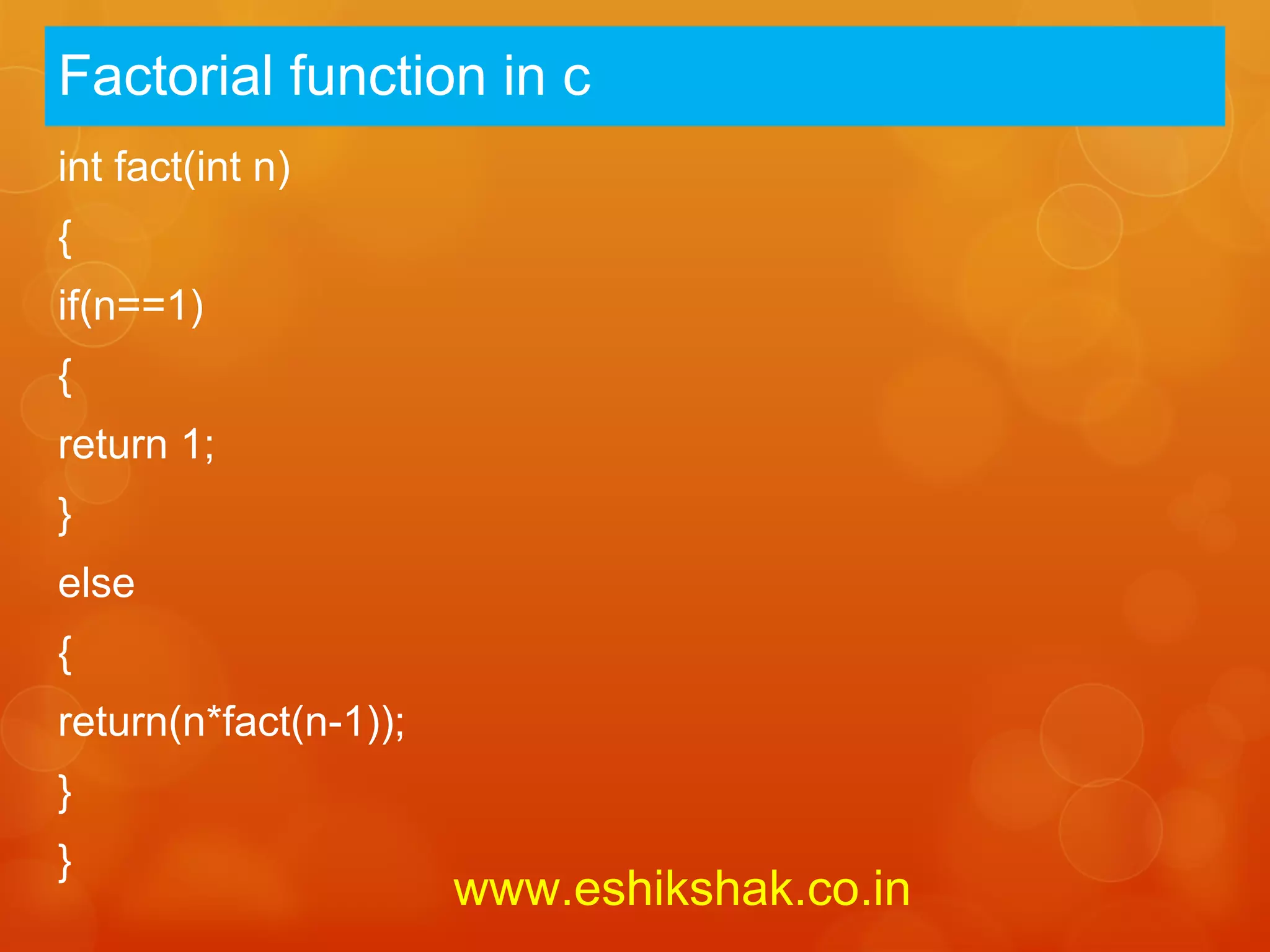
Factorial function in c
int fact(int n)
{
if(n==1)
{
return 1;
}
else
{
return(n*fact(n-1));
}
}
                       www.eshikshak.co.in
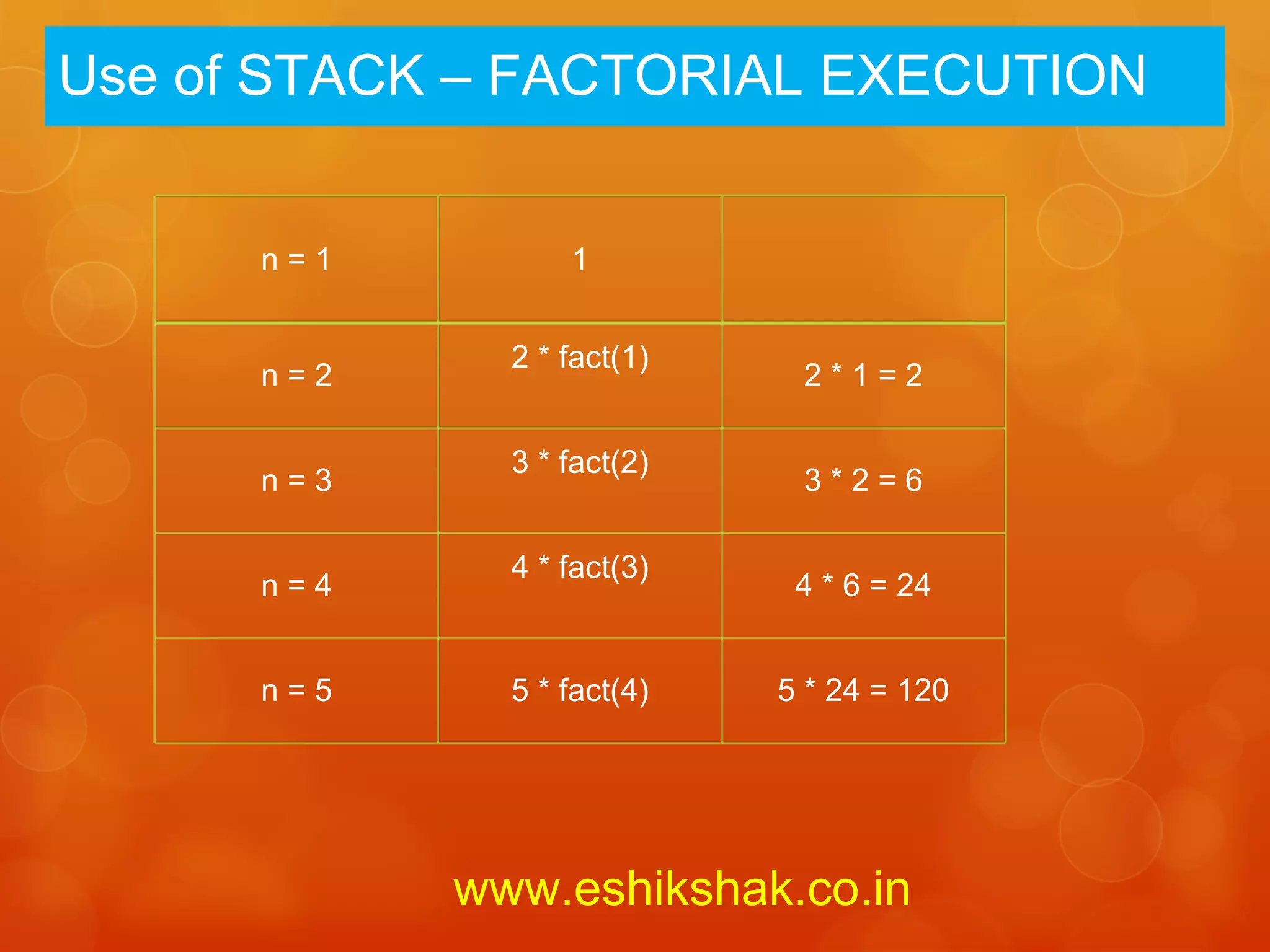
Use of STACK – FACTORIAL EXECUTION


      n=1         1


              2 * fact(1)
      n=2                    2*1=2

              3 * fact(2)
      n=3                    3*2=6

              4 * fact(3)
      n=4                    4 * 6 = 24


      n=5     5 * fact(4)   5 * 24 = 120


            www.eshikshak.co.in
Removal Through Stack
 ● Suppose P is a recursive procedure . The translation of
   recursive procedure P into a non recursive procedure
   work as follows:


 ● First of all, one defines:
1. A stack STPAR for each parameter PAR
2. A stack STVAR for each local variable VAR
3. A local variable ADD and a stack STADD to hold return
address.


                      www.eshikshak.co.in
● The algorithm which translates the recursive procedure P
   into a non recursive procedure follows. It consist of three
   parts:


1. Preparation
2. Translating each recursive call P in procedure P.
3. Translating each return in procedure P.


                     www.eshikshak.co.in
1. Preparation
(a) define a stack STPAR for each parameter PAR, a stack
STVAR for each local variable VAR, and a local variable
ADD and a stack STADD to hold return address.
(b) Set TOP = NULL
2. Translation of “step K.call P.”
(a) Push the current values of the parameters and local
variable onto the appropriate stacks, and push the new
return address [step ] K+1 onto STADD.


                     www.eshikshak.co.in
(b) reset the parameters using the new argument values.
(c) go to step 1.[The beginning of procedure P]
3. Translation of “Step J.return”
(a) if STADD is empty, then return.[control is return to the
main program].
(b) Restore the top values of the stacks.That is, set the
parameters and local variables equal to the top values on
the stacks, and set ADD equal to the top value on the
STADD.
(c) Go to the step ADD.
4. Step L. return


                     www.eshikshak.co.in
Translation of recursive to non-recursive procedure

● Declare STACK to hold all the local variables
● Push all the local variables and parameters called by
  value into the stack
● At the end of recursive function or whenever the function
  returns to the calling program, the following steps should
  be performed
   ○ If stack is empty, then the recursion has finished;
     make a normal return
   ○ Otherwise pop the stack to restore the values of all
     local variables and parameters called by value


                    www.eshikshak.co.in
Difference between Recursion and Iteration

 ● ITERATION                            ● RECURSIVE
  ● It is a process of executing        ● Recursion is a technique of
    statements repeatedly, until          defining anything in terms of
    some specific condition is            itself
    specified
                                        ● There must be an exclusive if
  ● Iteration involves four clear cut     statement inside the recursive
    steps, initialization, condition,     function specifying stopping
    execution and updating                condition
  ● Any recursive problem can be        ● Not all problems has recursive
    solved iteratively                    solution
  ● Iterative computer part of a        ● Recursion is generally a worst
    problem is more efficient in          option to go for simple program
    terms of memory utilization and       or problems not recursive in
    execution speed                       nature

        www.eshikshak.co.in
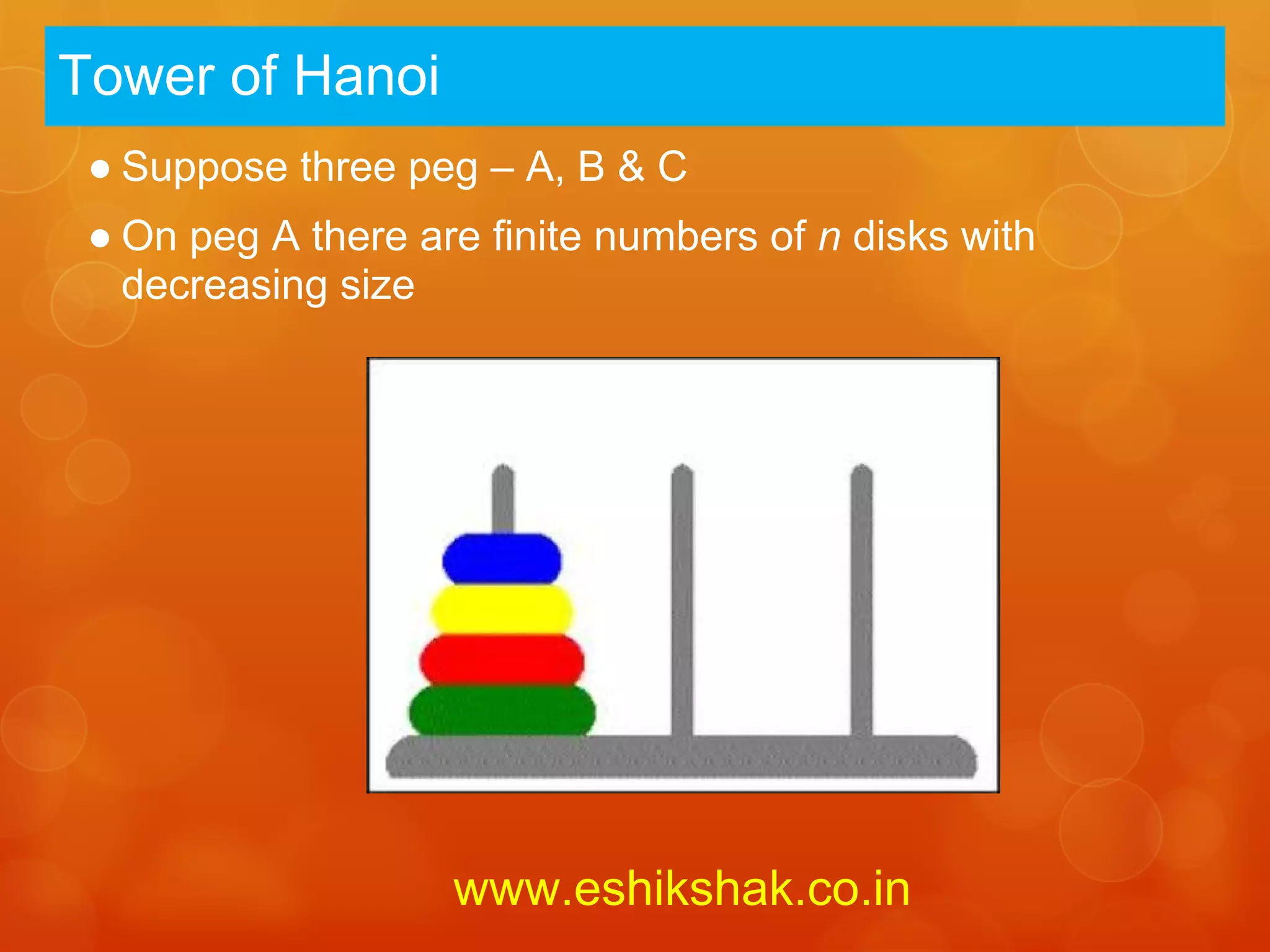
Tower of Hanoi
 ● Suppose three peg – A, B & C
 ● On peg A there are finite numbers of n disks with
   decreasing size


                    www.eshikshak.co.in
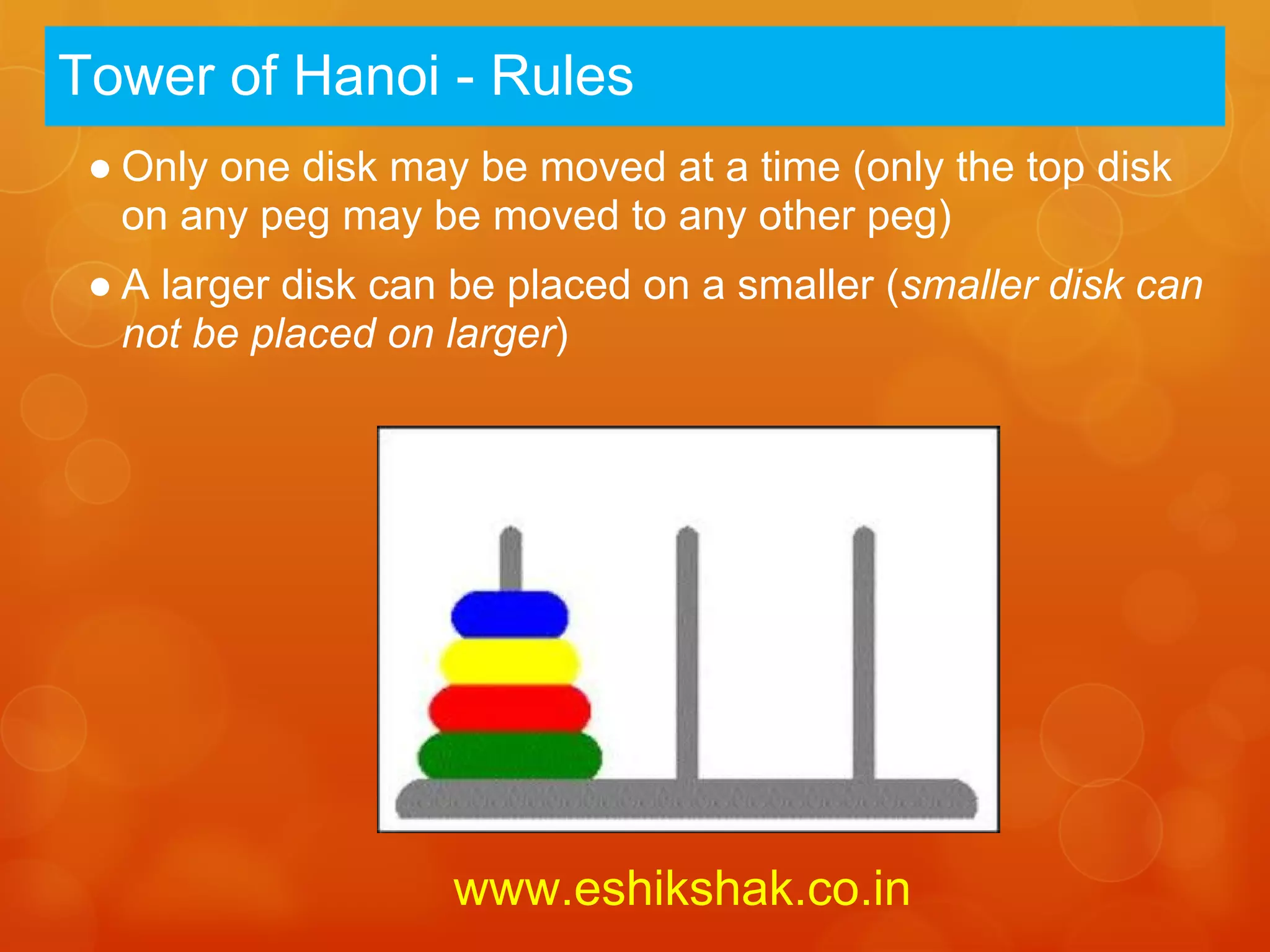
Tower of Hanoi - Rules
 ● Only one disk may be moved at a time (only the top disk
   on any peg may be moved to any other peg)
 ● A larger disk can be placed on a smaller (smaller disk can
   not be placed on larger)


                    www.eshikshak.co.in
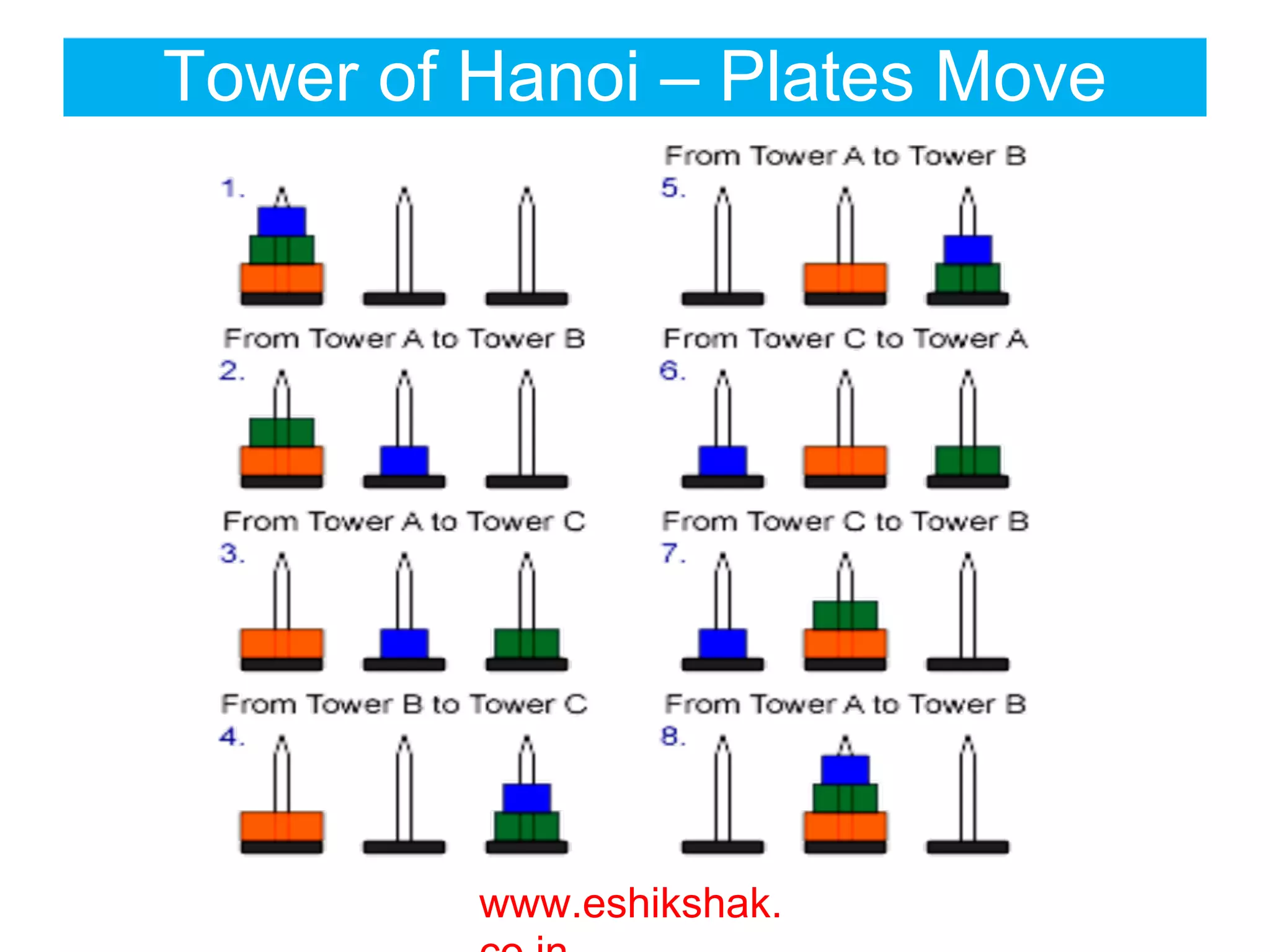
Tower of Hanoi – Plates Move


         www.eshikshak.
Algorithm : Tower(N, BEG, AUX, END)
 ● This procedure gives a recursive solution to the Towers of
   Hanoi problem for N disks
Step 1. If N = 1 then
(a) Write : BEG -> END
(b) Return
End of If Structure
Step 2. [Move N – 1 disks peg BEG to peg AUX ]
Call TOWER(N-1, BEG, END, AUX)
Step 3. Write : BEG->END
Step 4. [Move N – 1 disks peg AUX to peg END]
Call TOWER(N-1, AUX, BEG, END)
Step 5. Return

                         www.eshikshak.co.in
www.eshikshak.co.in

Applications of stack

  • 1.
  • 2.
    Reverse String orList ● We can accomplish this task by pushing each character or member from the string/list in the order it appears ● When the line is finished, characters are then proposed off the stack “They come off in a reverse order” www.eshikshak.co.in
  • 3.
    Reverse string –Name=“Angel” L P E E U G G G S H N N N N A A A A A E P O G G P N N N A A A A Name : Name : Name : Name : Name : “L” “LE” “LEG” “LEGN” “LEGNA” www.eshikshak.co.in
  • 4.
    Polish Notation ●The process of writing the operators of expression either before their operands or after them is called “Polish Notation” ● The main property of Polish Notation is that the order in which operations are to be performed is ascertained by the position of the operators and operands in the expression www.eshikshak.co.in
  • 5.
    Polish Notation ●The notation refers to these complex arithmetic expressions in three forms: ○ If the operator symbols are placed between its operands, then the expression is in infix notation ■A + B ○ If the operator symbols are placed before its operands, then the expression is in prefix notation ■ +AB ○ If the operator symbols are placed after its operands, then the expression is in postfix notation ■ AB+ www.eshikshak.co.in
  • 6.
    Notation Infix Notation Prefix Notation Postfix Notation A+B + AB AB + (A - C) + B + - ACB AC – B + A+(B*C) + A * BC ABC *+ (A+B)/(C-D) /+ AB – CD AB + CD -/ (A + (B * C))/(C – (D * B)) /+ A * BC – C * DB ABC * + CDB * - / www.eshikshak.co.in
  • 7.
    Convert Infix expressionto Postfix expression A – It is an expression B – Postfix expression Step 1. Push left parenthesis “(“ into STACK and add right parenthesis “)” to the end of A Step 2. Scan A from left to right and repeat step 3 to 6 for each element of A until the stack is empty Step 3. If an operand is encountered, add it to B Step 4. If a left parenthesis is encountered push it onto the stack Step 5. If an operator is encountered then 1. Repeatedly pop from the STACK and add to B each operator (on the top of stack) which has the same precedence as or higher precedence than operator 2. Add operator to STACK Step 6. If a right parenthesis is encountered, then 1. Repeatedly pop from the STACK and add to B each operator (on the top of STACK) until a left parenthesis is encountered 2. Remove the left parenthesis. (Do not add left parenthesis to B) Step 7. Exit www.eshikshak.co.in
  • 8.
    Convert Infix expressionto Prefix expression ● A – Arithmetic Expression B – Prefix Expression Step 1. Push “)” onto STACK, and add “(“ to end of the A Step 2. Scan A from right to left and repeat step 3 to 6 for each element of A until the STACK is empty Step 3. If an operand is encountered add it to B Step 4. If a right parenthesis is encountered push it onto STACK Step 5. If an operator is encountered then: a. Repeatedly pop from STACK and add to B each operator (on the top of STACK) which has b. Add operator to STACK Step 6. If left parenthesis is encontered then a. Repeatedly pop from the STACK and add to B (each operator on top of stack until a left parenthesis is encounterd) b. Remove the left parenthesis Step 7. Exit www.eshikshak.co.in
  • 9.
    Evaluation of PostfixExpression /* Reading the expression takes place from left to right */ Step 1. Read the next element /* first element for first time */ Step 2. If element is operand than i. Push the element in the stack Step 3. If element is operator then i. Pop two operands from the stack /* POP one operand in case of NOT operator */ ii. Evaluate the expression formed by the two operands and the operator iii. Push the results of the expression in the stack end. Step 4. If no more elements then i. POP the result else goto step 1 Step 5. Exit www.eshikshak.co.in
  • 10.
    Evaluation of PrefixExpression /* Reading the expression take place from right to left /* Step 1. Read the next element Step 2. If element is operand then i. Push the element in the stack Step 3. If element is operator then i. Pop two operands from the stack ii. Evaluate the expression formed by two operands and the operator iii. Push the results of the expression in the stack end Step 4. if no more elements then i. Pop the result else goto step 1 Step 5. Exit www.eshikshak.co.in
  • 11.
    Recursion ●The function which call itself (In function body ) again and again is known as recursive function. This function will call itself as long as the condition is satisfied. ● This recursion can be removed by two ways: 1. Through Iteration. 2. Through Stack ● Many mathematical functions can be defined recursively: ○ Factorial ○ Fibonacci ○ Euclid's GCD (greatest common denominator) ○ Fourier Transform www.eshikshak.co.in
  • 12.
    Factorial function inc int fact(int n) { if(n==1) { return 1; } else { return(n*fact(n-1)); } } www.eshikshak.co.in
  • 13.
    Use of STACK– FACTORIAL EXECUTION n=1 1 2 * fact(1) n=2 2*1=2 3 * fact(2) n=3 3*2=6 4 * fact(3) n=4 4 * 6 = 24 n=5 5 * fact(4) 5 * 24 = 120 www.eshikshak.co.in
  • 14.
    Removal Through Stack ● Suppose P is a recursive procedure . The translation of recursive procedure P into a non recursive procedure work as follows: ● First of all, one defines: 1. A stack STPAR for each parameter PAR 2. A stack STVAR for each local variable VAR 3. A local variable ADD and a stack STADD to hold return address. www.eshikshak.co.in
  • 15.
    ● The algorithmwhich translates the recursive procedure P into a non recursive procedure follows. It consist of three parts: 1. Preparation 2. Translating each recursive call P in procedure P. 3. Translating each return in procedure P. www.eshikshak.co.in
  • 16.
    1. Preparation (a) definea stack STPAR for each parameter PAR, a stack STVAR for each local variable VAR, and a local variable ADD and a stack STADD to hold return address. (b) Set TOP = NULL 2. Translation of “step K.call P.” (a) Push the current values of the parameters and local variable onto the appropriate stacks, and push the new return address [step ] K+1 onto STADD. www.eshikshak.co.in
  • 17.
    (b) reset theparameters using the new argument values. (c) go to step 1.[The beginning of procedure P] 3. Translation of “Step J.return” (a) if STADD is empty, then return.[control is return to the main program]. (b) Restore the top values of the stacks.That is, set the parameters and local variables equal to the top values on the stacks, and set ADD equal to the top value on the STADD. (c) Go to the step ADD. 4. Step L. return www.eshikshak.co.in
  • 18.
    Translation of recursiveto non-recursive procedure ● Declare STACK to hold all the local variables ● Push all the local variables and parameters called by value into the stack ● At the end of recursive function or whenever the function returns to the calling program, the following steps should be performed ○ If stack is empty, then the recursion has finished; make a normal return ○ Otherwise pop the stack to restore the values of all local variables and parameters called by value www.eshikshak.co.in
  • 19.
    Difference between Recursionand Iteration ● ITERATION ● RECURSIVE ● It is a process of executing ● Recursion is a technique of statements repeatedly, until defining anything in terms of some specific condition is itself specified ● There must be an exclusive if ● Iteration involves four clear cut statement inside the recursive steps, initialization, condition, function specifying stopping execution and updating condition ● Any recursive problem can be ● Not all problems has recursive solved iteratively solution ● Iterative computer part of a ● Recursion is generally a worst problem is more efficient in option to go for simple program terms of memory utilization and or problems not recursive in execution speed nature www.eshikshak.co.in
  • 20.
    Tower of Hanoi ● Suppose three peg – A, B & C ● On peg A there are finite numbers of n disks with decreasing size www.eshikshak.co.in
  • 21.
    Tower of Hanoi- Rules ● Only one disk may be moved at a time (only the top disk on any peg may be moved to any other peg) ● A larger disk can be placed on a smaller (smaller disk can not be placed on larger) www.eshikshak.co.in
  • 22.
    Tower of Hanoi– Plates Move www.eshikshak.
  • 23.
    Algorithm : Tower(N,BEG, AUX, END) ● This procedure gives a recursive solution to the Towers of Hanoi problem for N disks Step 1. If N = 1 then (a) Write : BEG -> END (b) Return End of If Structure Step 2. [Move N – 1 disks peg BEG to peg AUX ] Call TOWER(N-1, BEG, END, AUX) Step 3. Write : BEG->END Step 4. [Move N – 1 disks peg AUX to peg END] Call TOWER(N-1, AUX, BEG, END) Step 5. Return www.eshikshak.co.in
  • 24.