LINKED LIST
Linked list
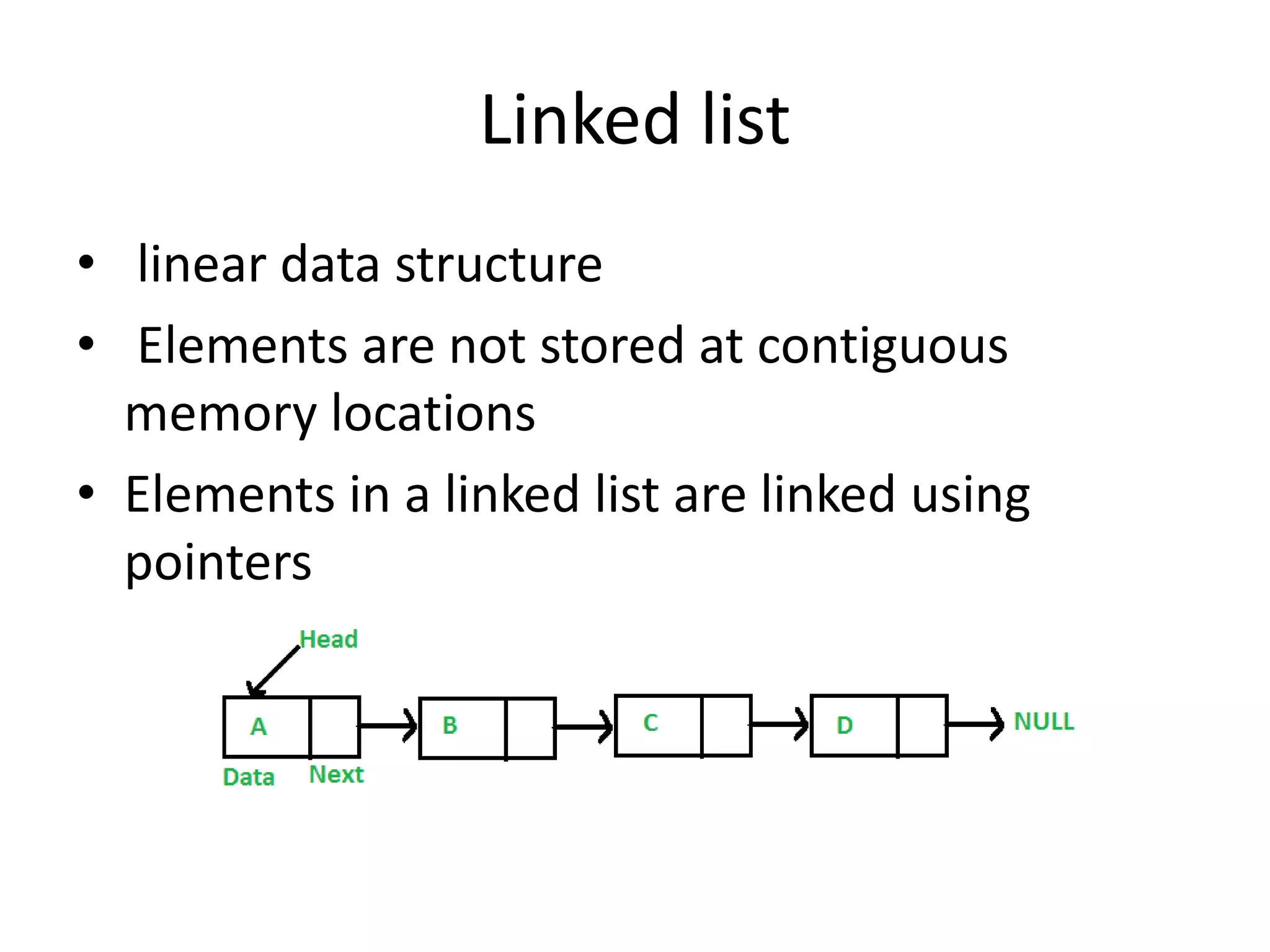
• linear data structure
• Elements are not stored at contiguous
memory locations
• Elements in a linked list are linked using
pointers
TYPES
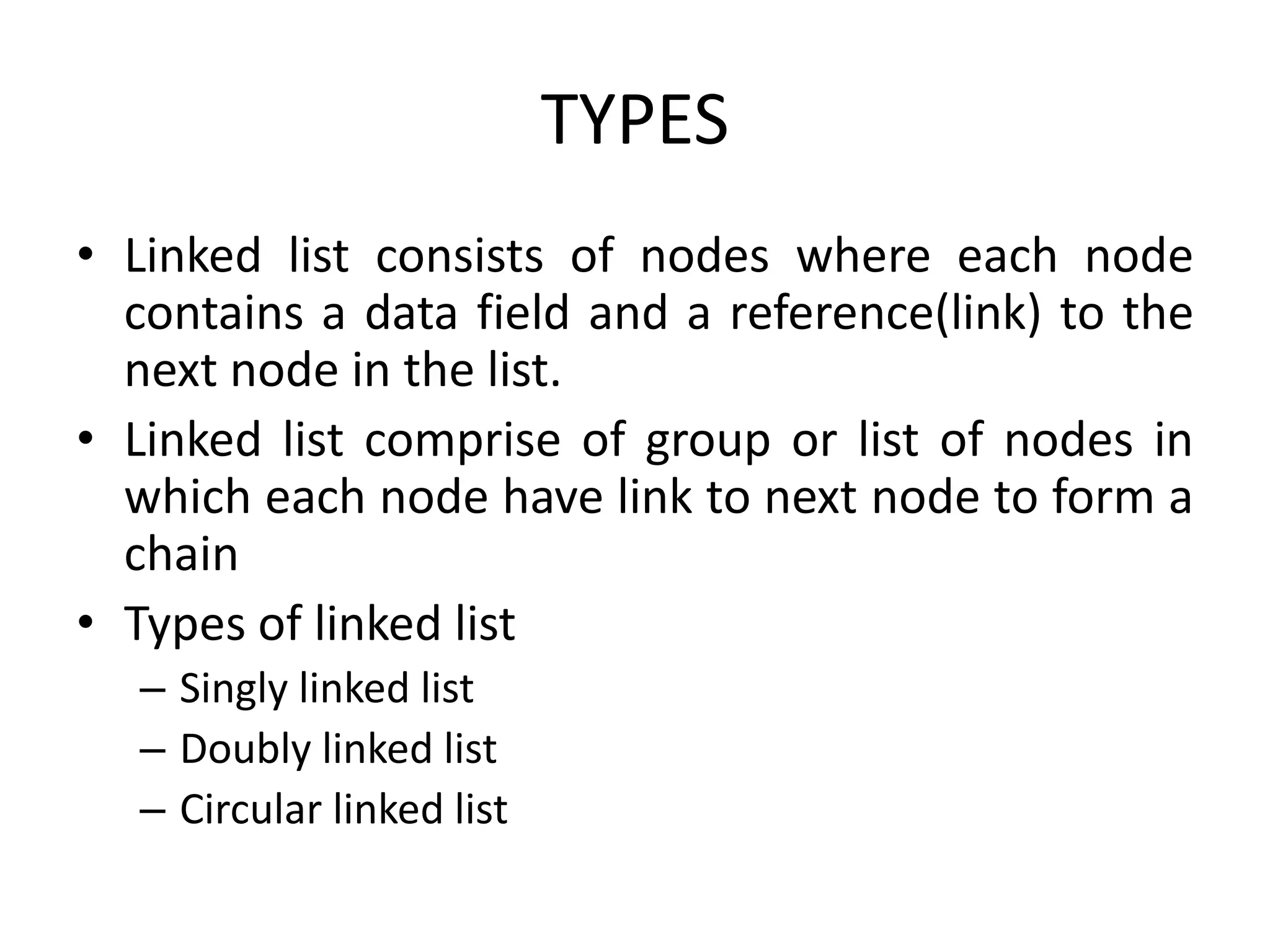
• Linked list consists of nodes where each node
contains a data field and a reference(link) to the
next node in the list.
• Linked list comprise of group or list of nodes in
which each node have link to next node to form a
chain
• Types of linked list
– Singly linked list
– Doubly linked list
– Circular linked list
Linked List vs Array
Array Linked List
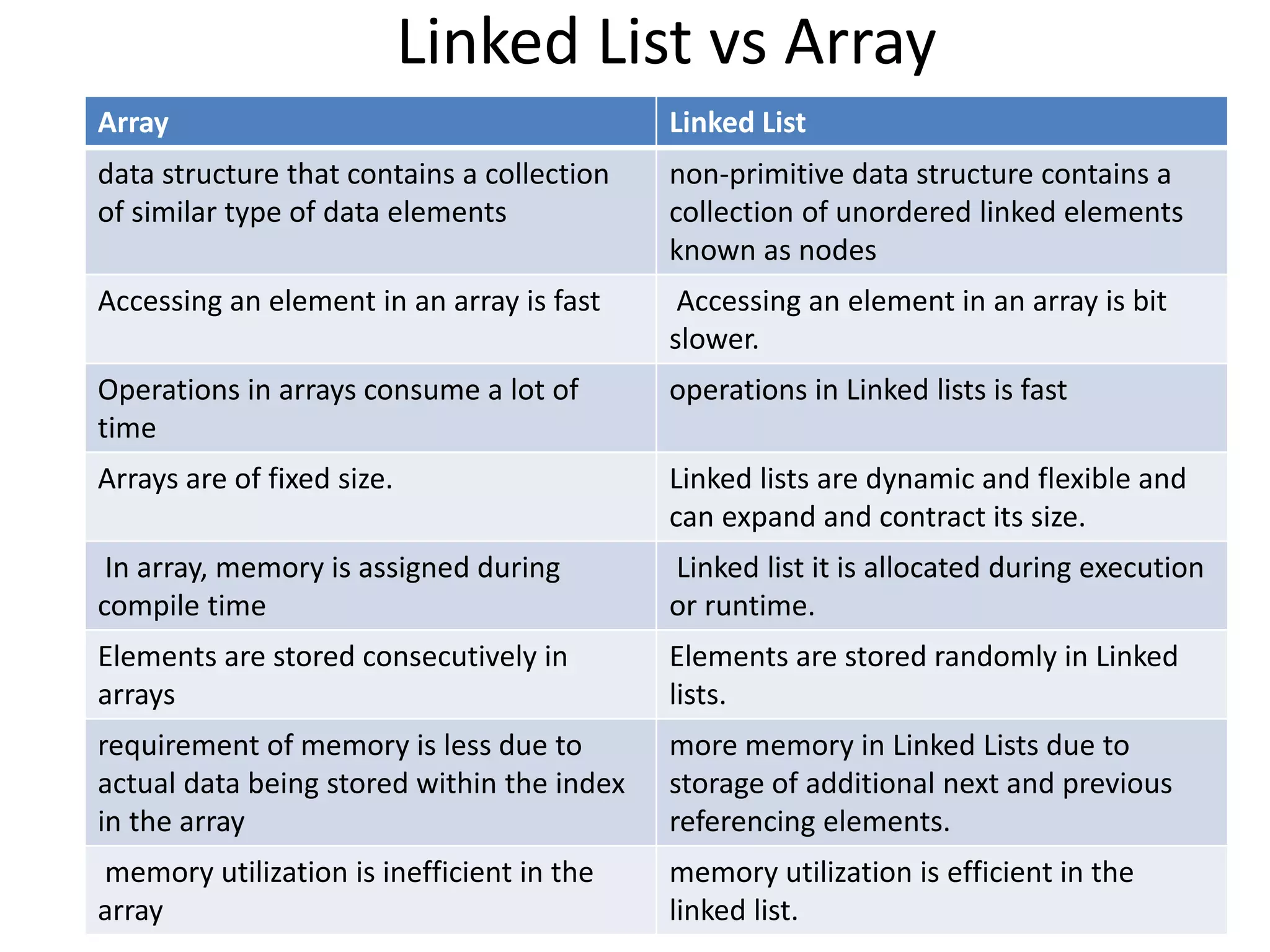
data structure that contains a collection
of similar type of data elements
non-primitive data structure contains a
collection of unordered linked elements
known as nodes
Accessing an element in an array is fast Accessing an element in an array is bit
slower.
Operations in arrays consume a lot of
time
operations in Linked lists is fast
Arrays are of fixed size. Linked lists are dynamic and flexible and
can expand and contract its size.
In array, memory is assigned during
compile time
Linked list it is allocated during execution
or runtime.
Elements are stored consecutively in
arrays
Elements are stored randomly in Linked
lists.
requirement of memory is less due to
actual data being stored within the index
in the array
more memory in Linked Lists due to
storage of additional next and previous
referencing elements.
memory utilization is inefficient in the
array
memory utilization is efficient in the
linked list.
Why Linked List?
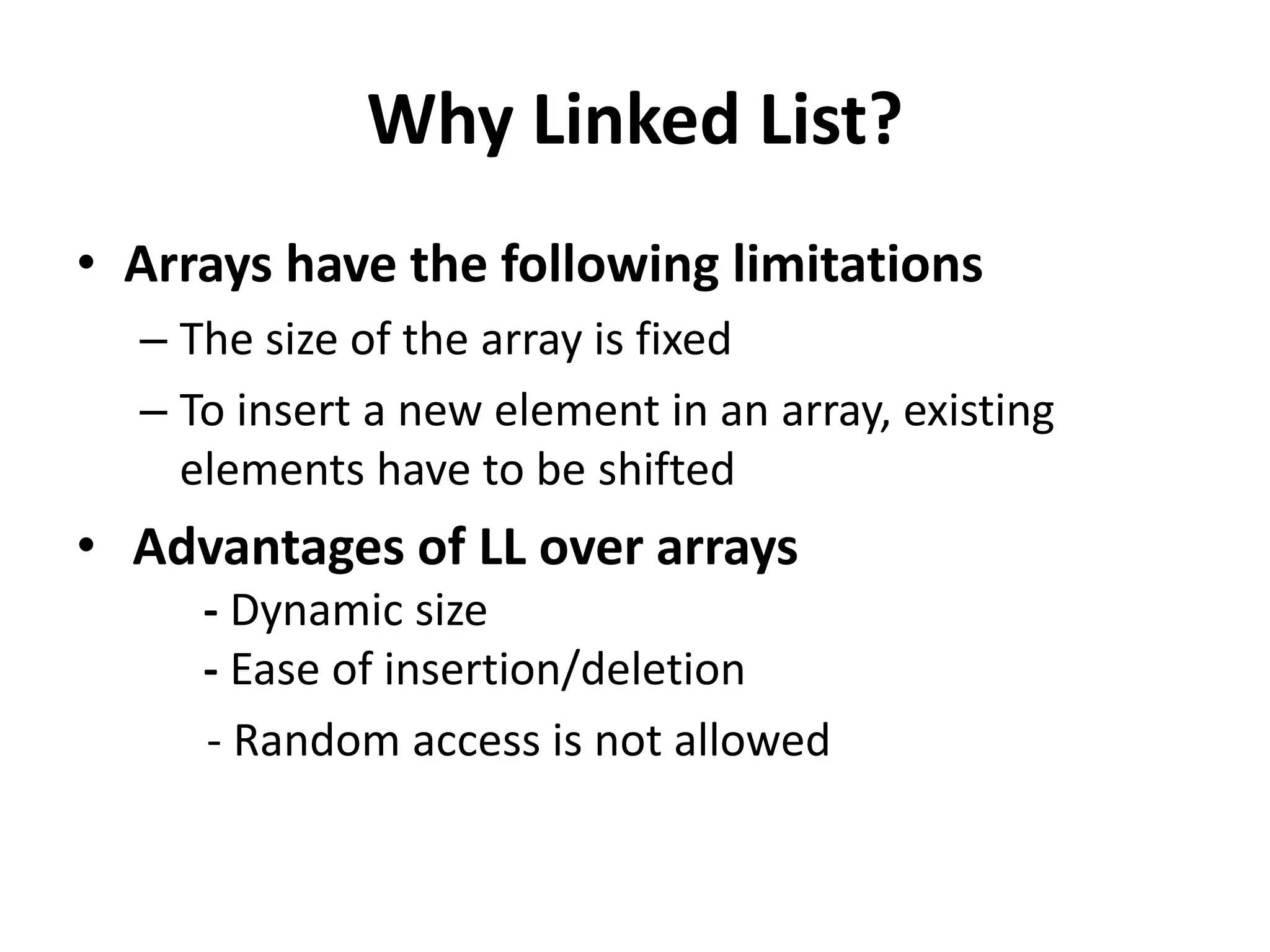
• Arrays have the following limitations
– The size of the array is fixed
– To insert a new element in an array, existing
elements have to be shifted
• Advantages of LL over arrays
- Dynamic size
- Ease of insertion/deletion
- Random access is not allowed
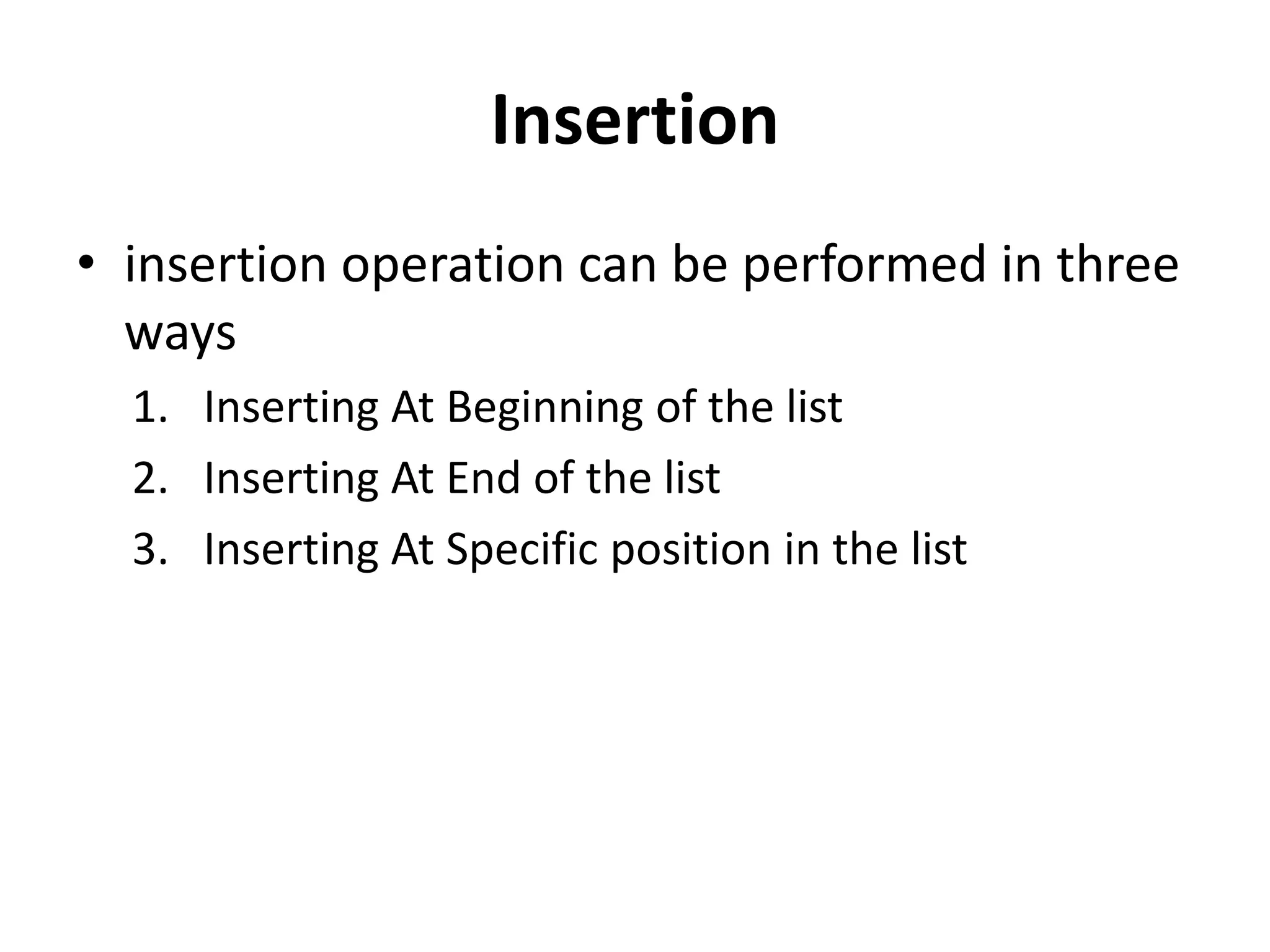
Representation of linked list
• Represented by a pointer to the first node of
the linked list
• The first node is called the head.
• If the linked list is empty, then the value of the
head is NULL.
• Each node in a list consists of at least two
parts:
1) data
2) Pointer (Or Reference) to the next node
Representation of linked list
Basic Operations
• Insertion − Adds an element into the list
• Deletion − Deletes an element from the list
• Display − Displays the complete list
• Search − Searches an element using the given
key
Linked list node creation
struct Node {
int data;
struct Node* next;
} *head;
Explanation:
declared structure of type “NODE”,
First field stores actual data and another field
stores address
Insertion
• insertion operation can be performed in three
ways
1. Inserting At Beginning of the list
2. Inserting At End of the list
3. Inserting At Specific position in the list
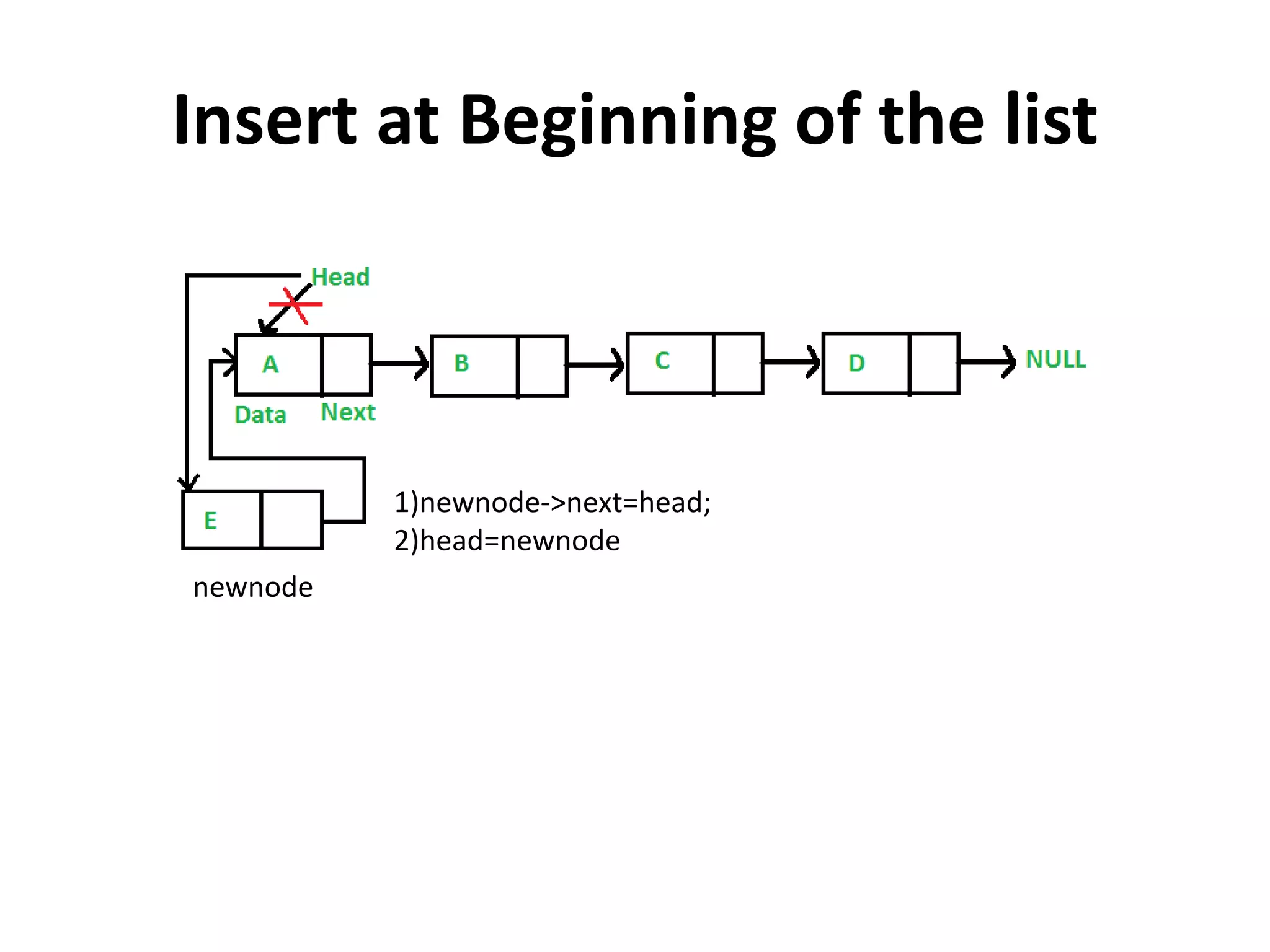
Insert at Beginning of the list
1)newnode->next=head;
2)head=newnode
newnode
Inserting At Beginning of the list
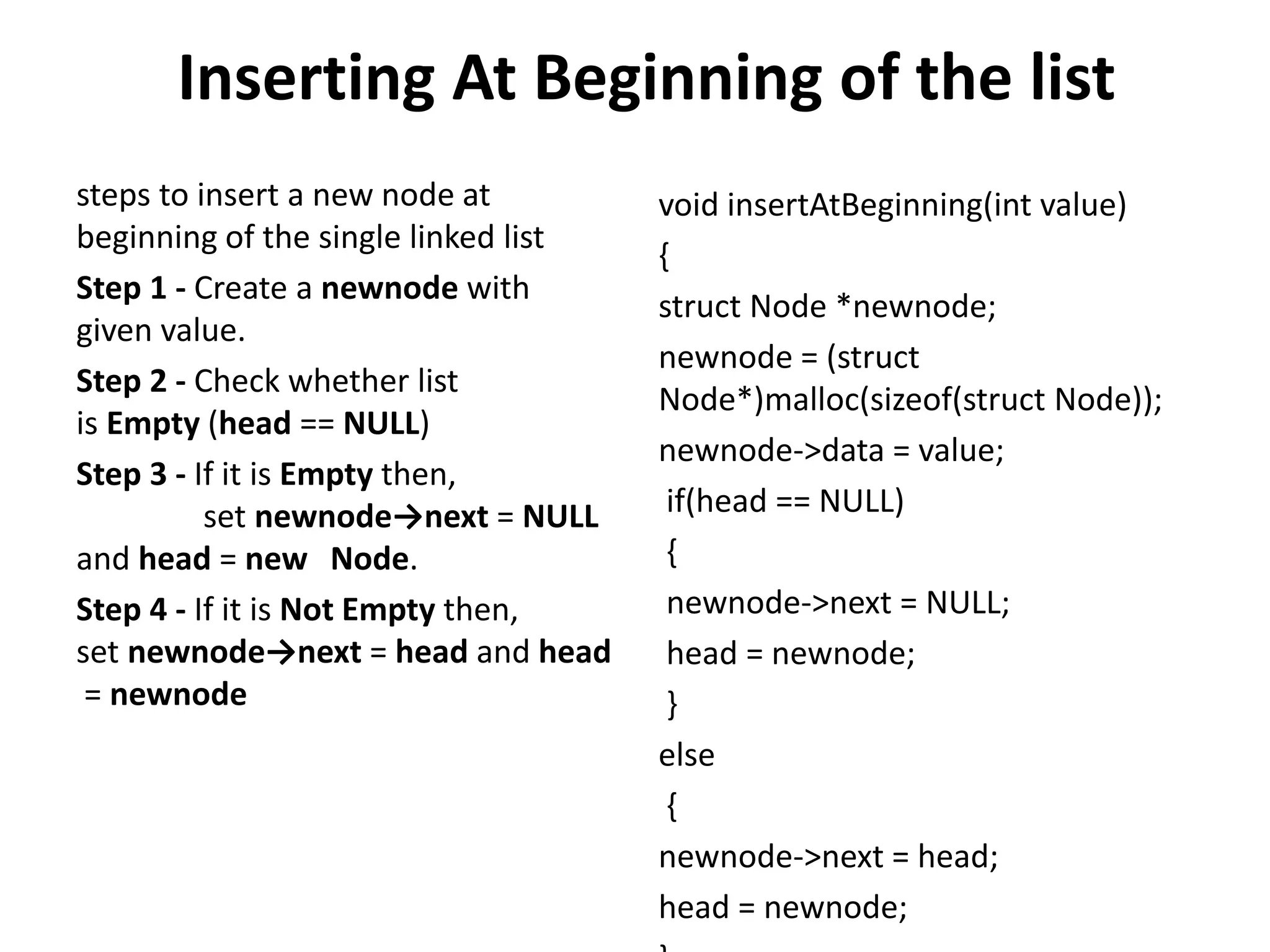
steps to insert a new node at
beginning of the single linked list
Step 1 - Create a newnode with
given value.
Step 2 - Check whether list
is Empty (head == NULL)
Step 3 - If it is Empty then,
set newnode→next = NULL
and head = new Node.
Step 4 - If it is Not Empty then,
set newnode→next = head and head
= newnode
void insertAtBeginning(int value)
{
struct Node *newnode;
newnode = (struct
Node*)malloc(sizeof(struct Node));
newnode->data = value;
if(head == NULL)
{
newnode->next = NULL;
head = newnode;
}
else
{
newnode->next = head;
head = newnode;
Inserting At Beginning of the list
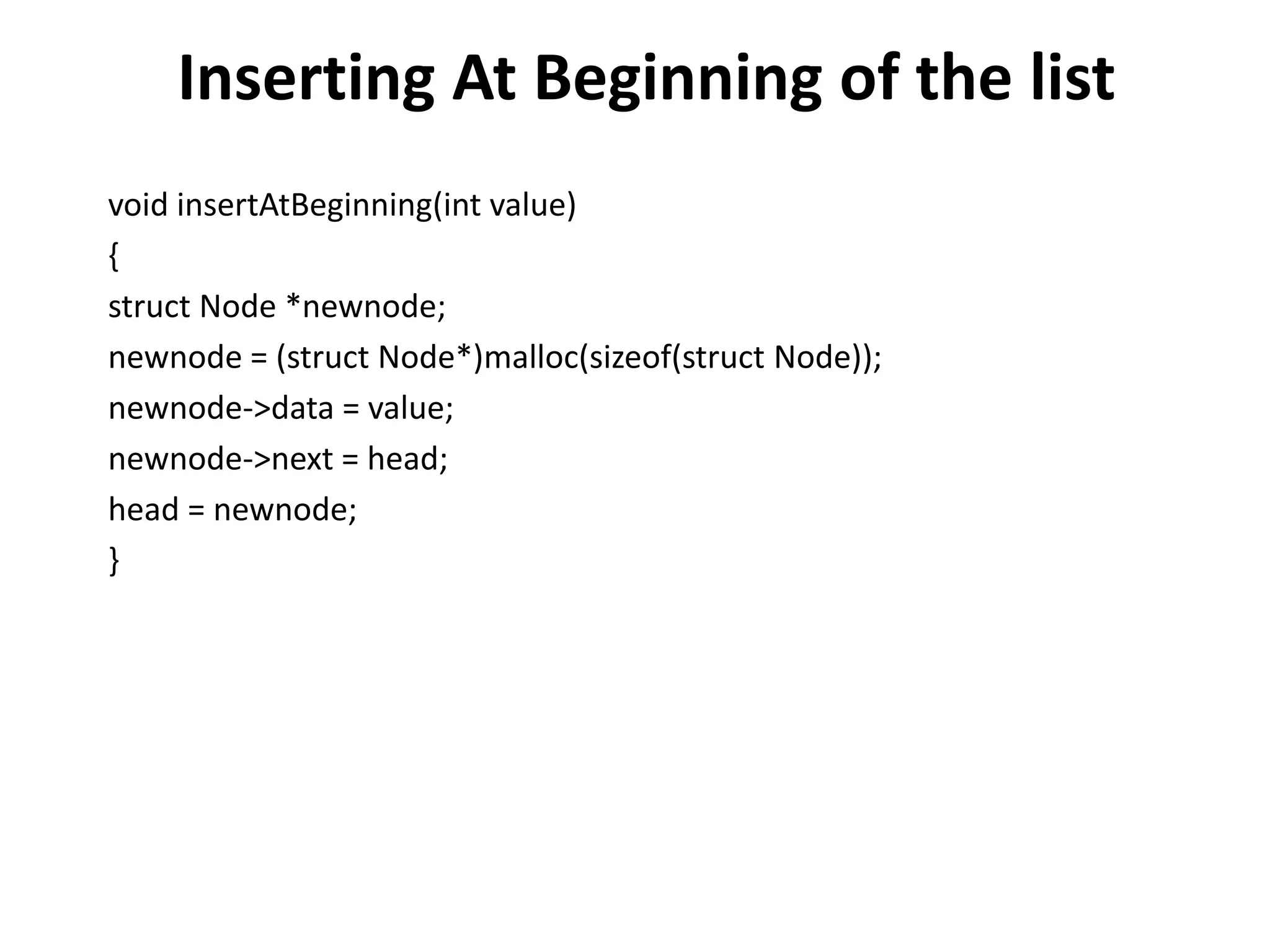
void insertAtBeginning(int value)
{
struct Node *newnode;
newnode = (struct Node*)malloc(sizeof(struct Node));
newnode->data = value;
newnode->next = head;
head = newnode;
}
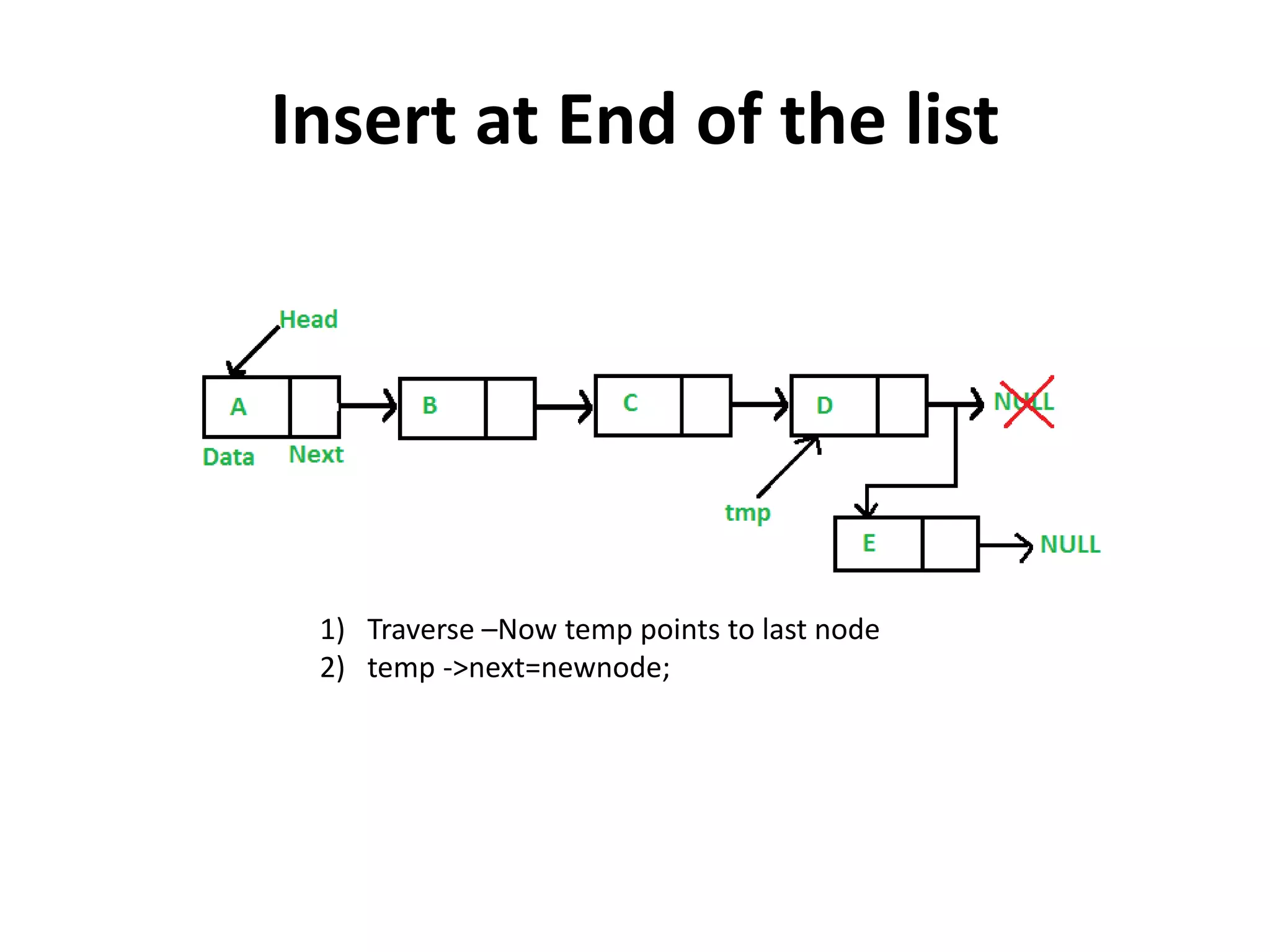
Insert at End of the list
1) Traverse –Now temp points to last node
2) temp ->next=newnode;
Insert at End of the list
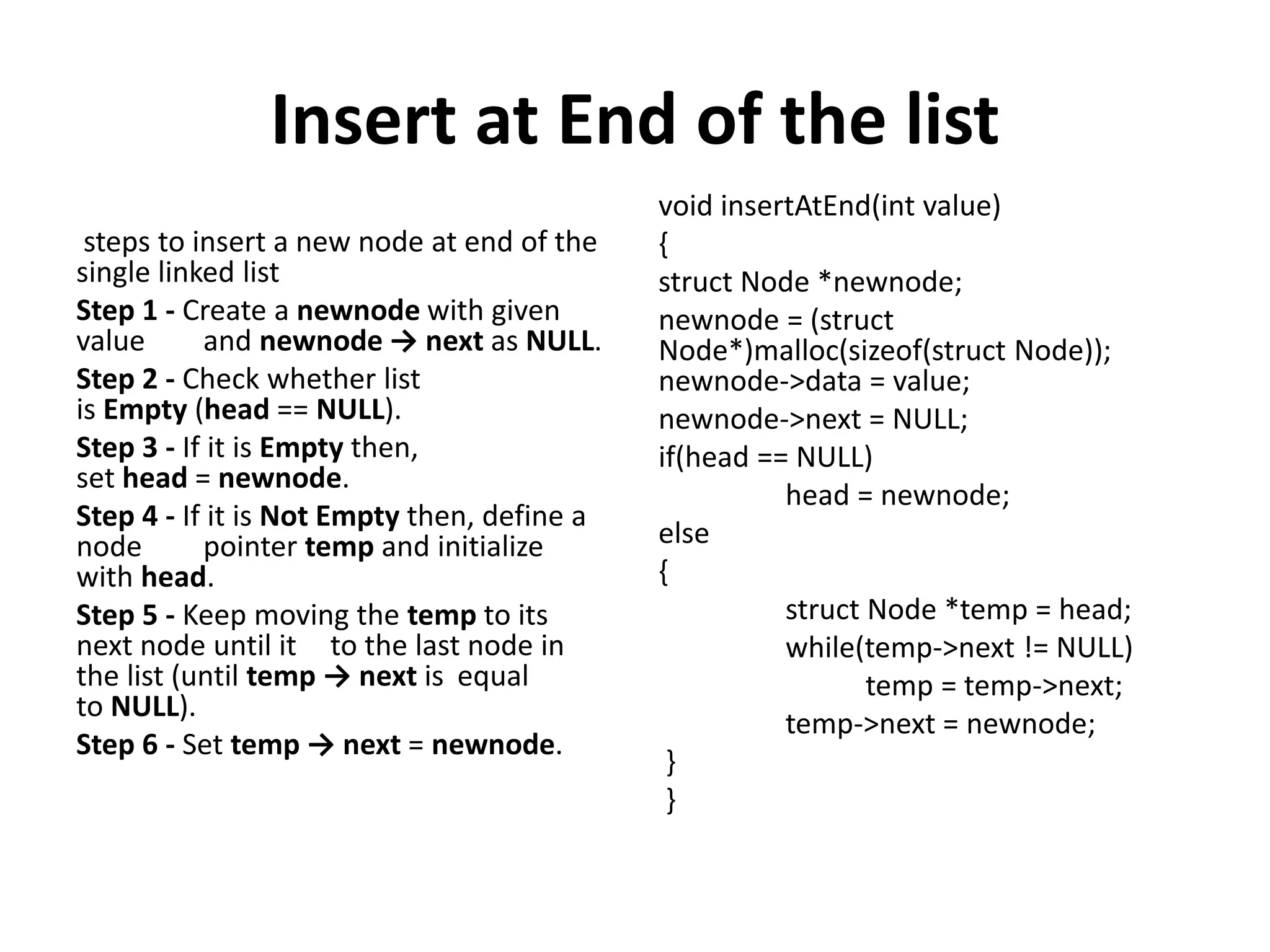
steps to insert a new node at end of the
single linked list
Step 1 - Create a newnode with given
value and newnode → next as NULL.
Step 2 - Check whether list
is Empty (head == NULL).
Step 3 - If it is Empty then,
set head = newnode.
Step 4 - If it is Not Empty then, define a
node pointer temp and initialize
with head.
Step 5 - Keep moving the temp to its
next node until it to the last node in
the list (until temp → next is equal
to NULL).
Step 6 - Set temp → next = newnode.
void insertAtEnd(int value)
{
struct Node *newnode;
newnode = (struct
Node*)malloc(sizeof(struct Node));
newnode->data = value;
newnode->next = NULL;
if(head == NULL)
head = newnode;
else
{
struct Node *temp = head;
while(temp->next != NULL)
temp = temp->next;
temp->next = newnode;
}
}
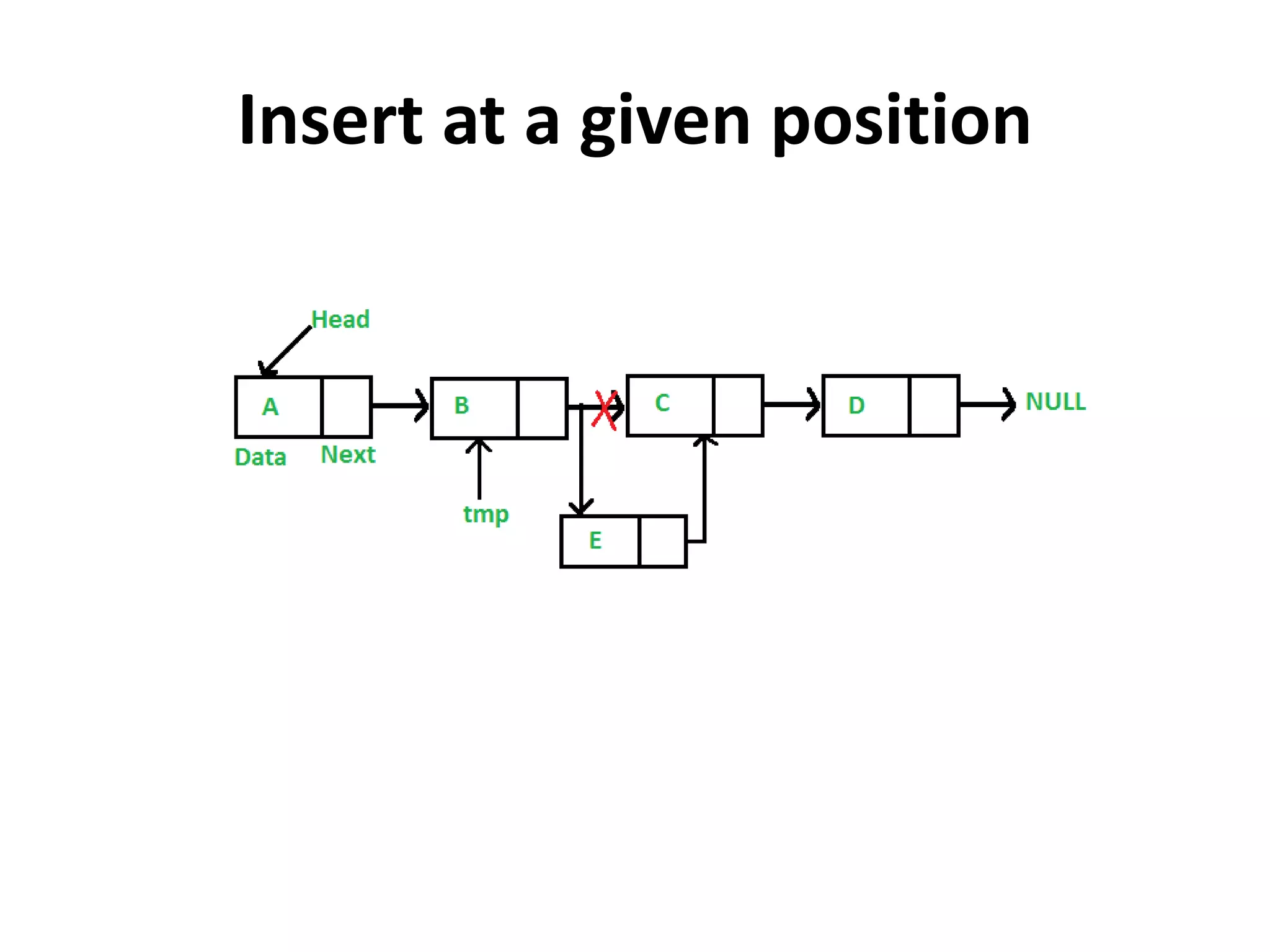
Insert at a given position
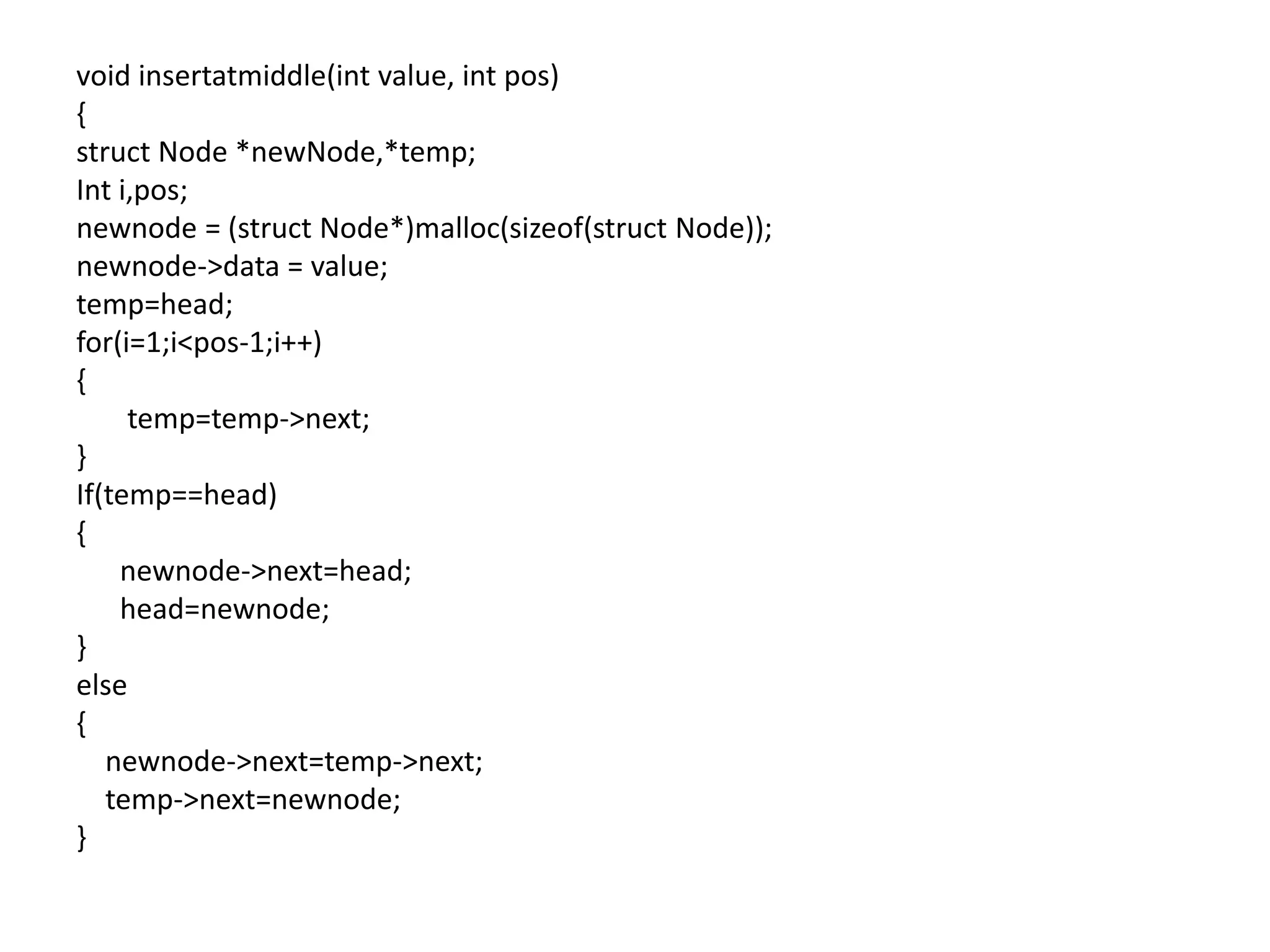
void insertatmiddle(int value, int pos)
{
struct Node *newNode,*temp;
Int i,pos;
newnode = (struct Node*)malloc(sizeof(struct Node));
newnode->data = value;
temp=head;
for(i=1;i<pos-1;i++)
{
temp=temp->next;
}
If(temp==head)
{
newnode->next=head;
head=newnode;
}
else
{
newnode->next=temp->next;
temp->next=newnode;
}
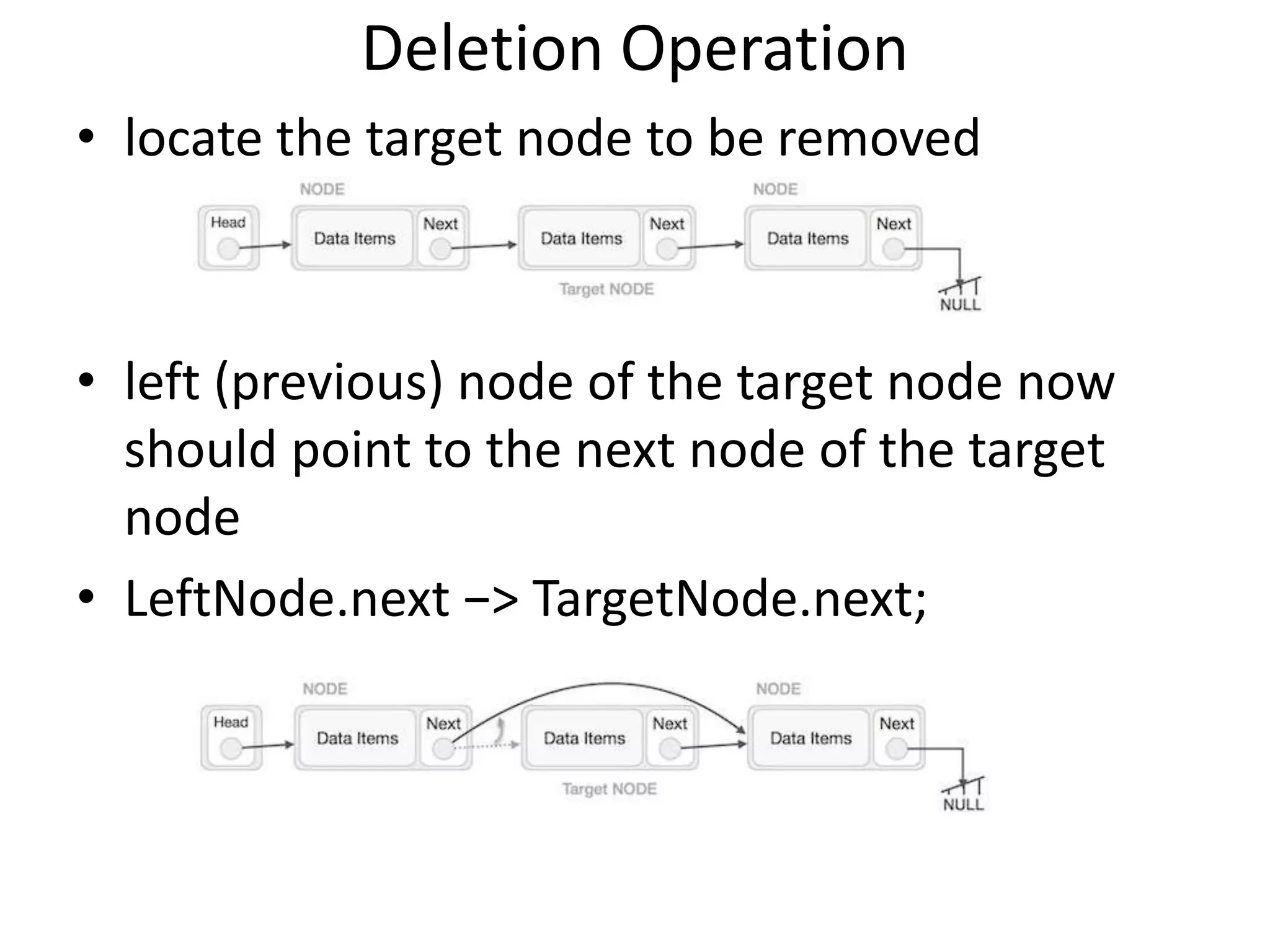
Deletion Operation
• locate the target node to be removed
• left (previous) node of the target node now
should point to the next node of the target
node
• LeftNode.next −> TargetNode.next;
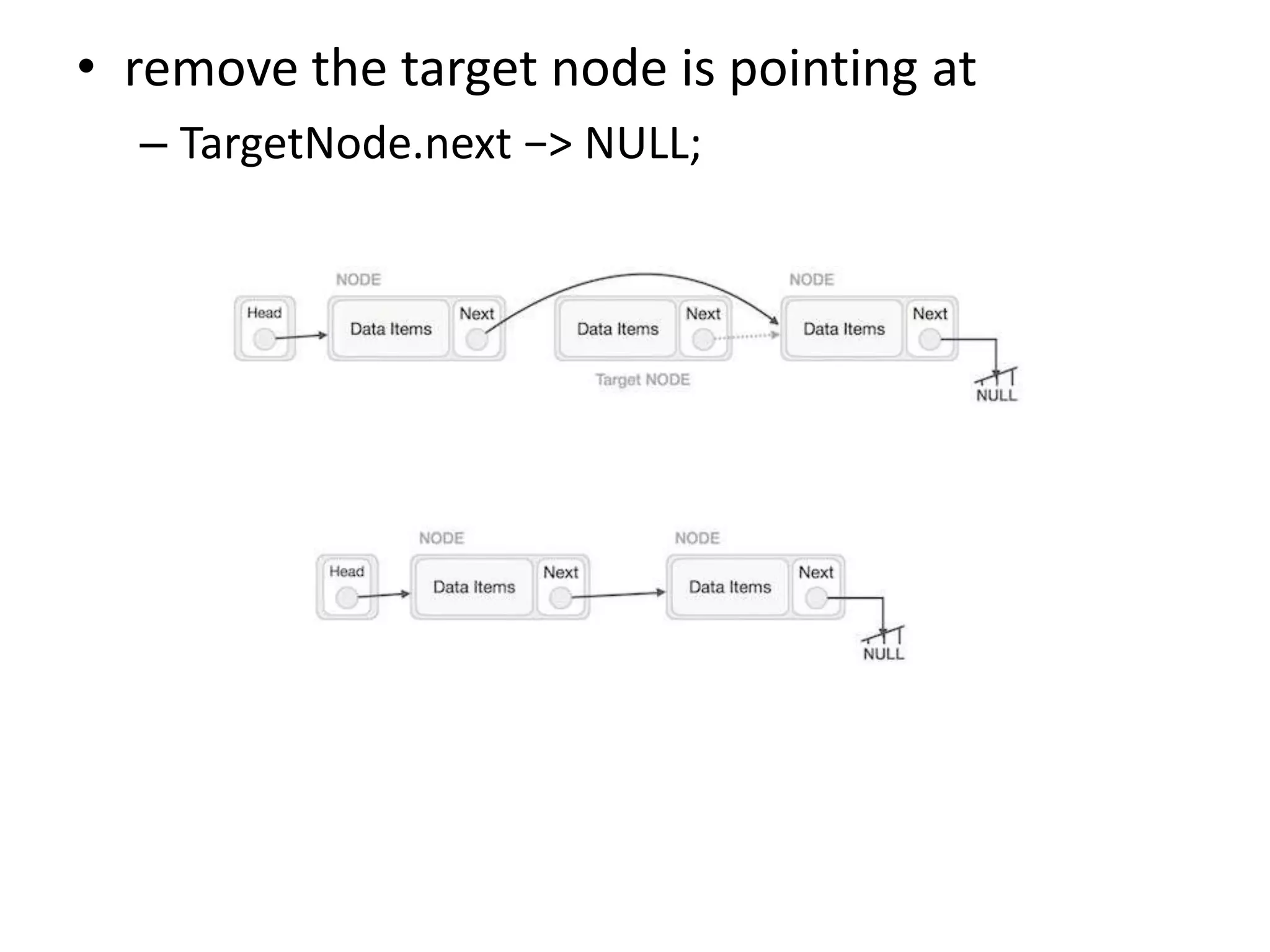
• remove the target node is pointing at
– TargetNode.next −> NULL;
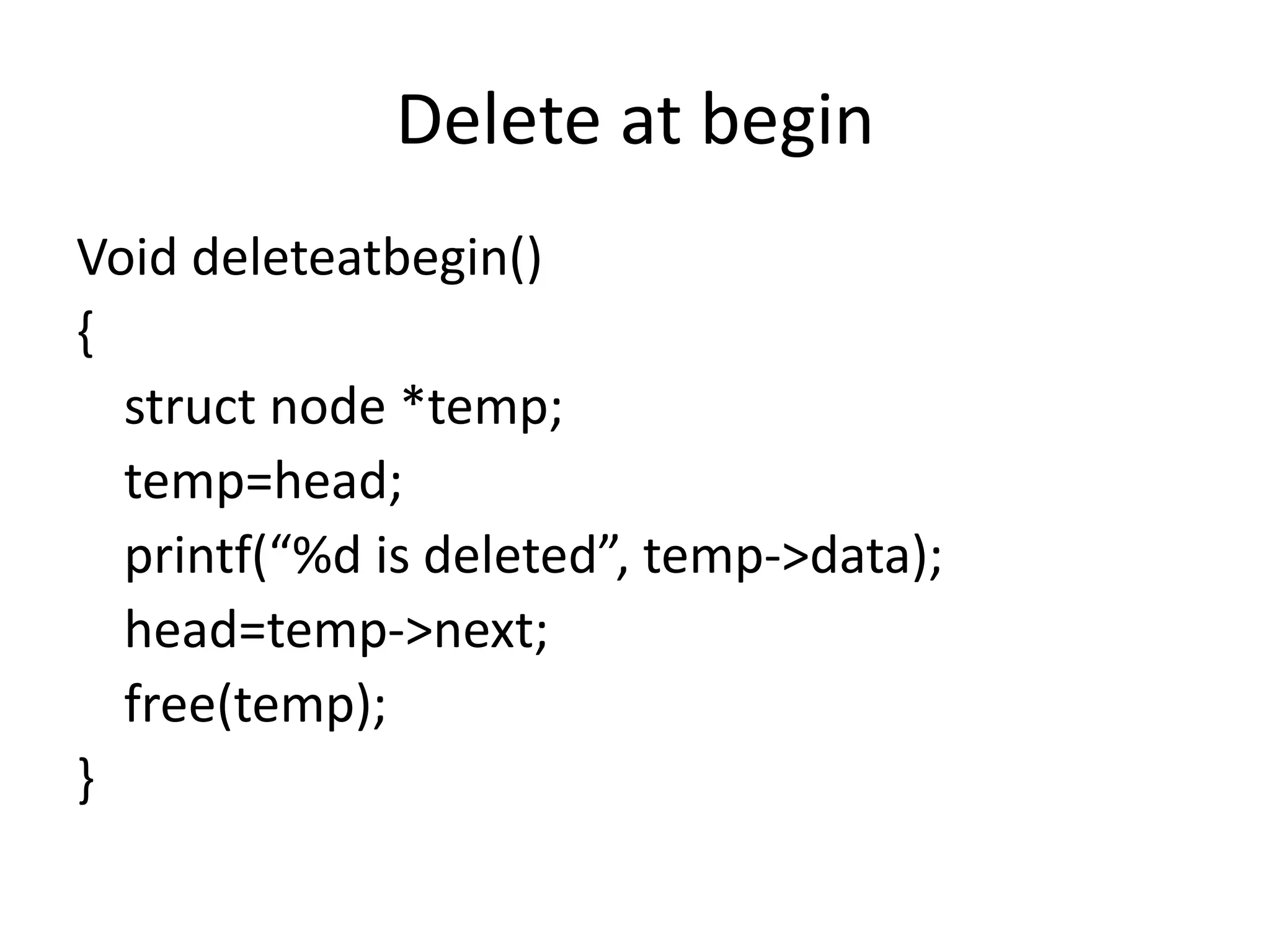
Delete at begin
Void deleteatbegin()
{
struct node *temp;
temp=head;
printf(“%d is deleted”, temp->data);
head=temp->next;
free(temp);
}
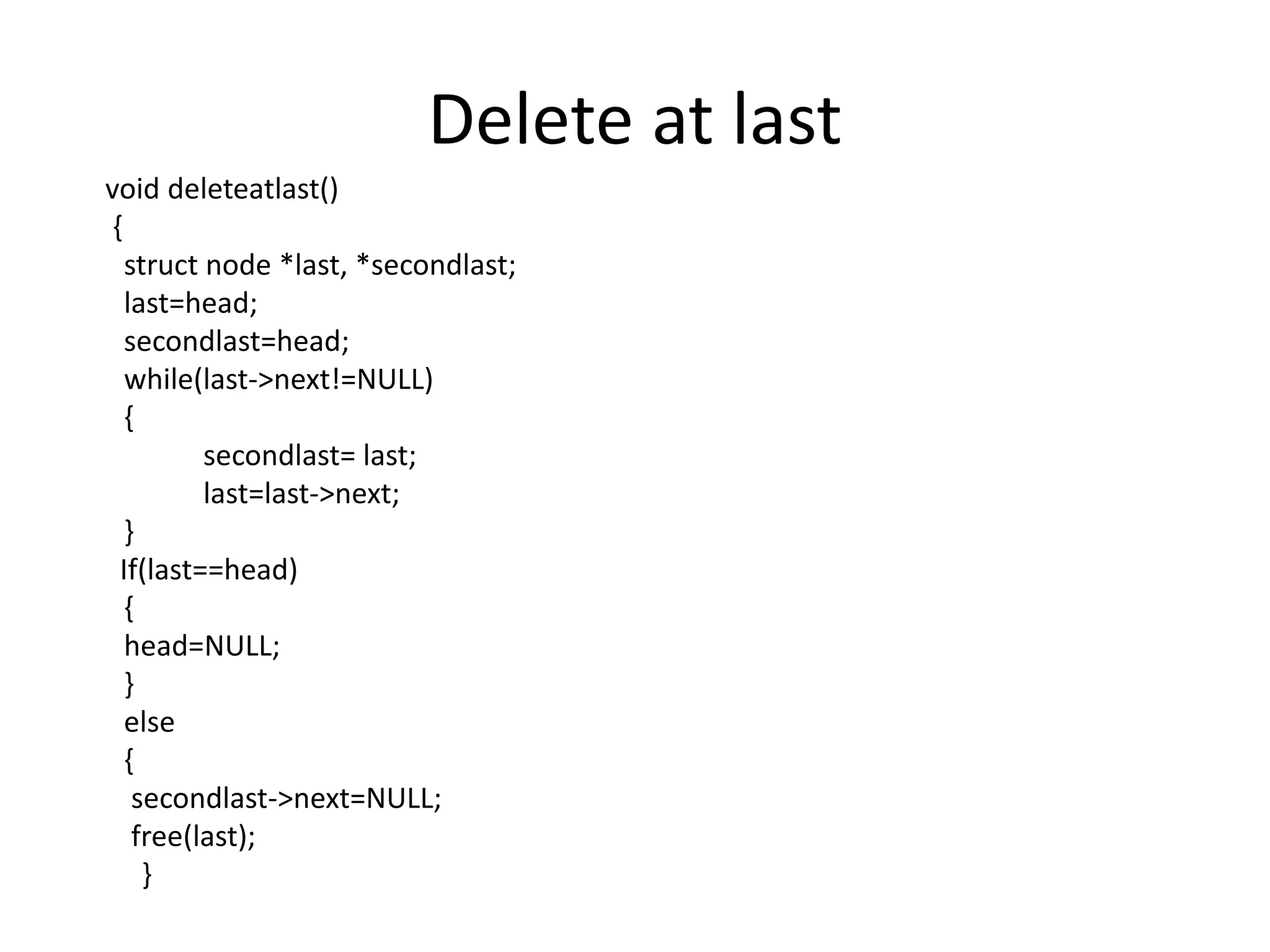
Delete at last
void deleteatlast()
{
struct node *last, *secondlast;
last=head;
secondlast=head;
while(last->next!=NULL)
{
secondlast= last;
last=last->next;
}
If(last==head)
{
head=NULL;
}
else
{
secondlast->next=NULL;
free(last);
}
Displaying the linked list
Void display()
{
struct node *temp;
temp=head;
while(temp!=NULL)
{
printf(“%d”, temp->data);
temp=temp->next;
}
}
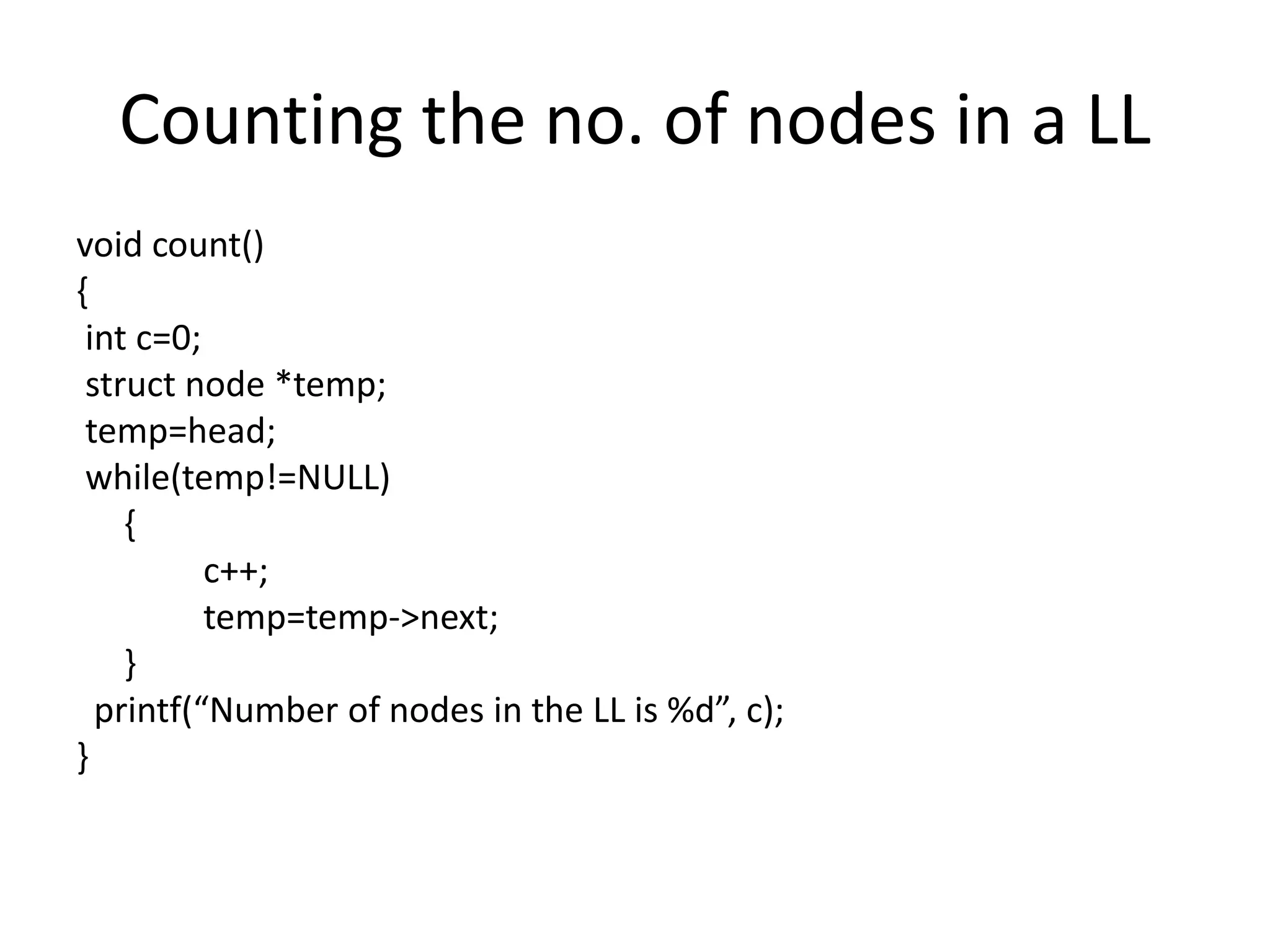
Counting the no. of nodes in a LL
void count()
{
int c=0;
struct node *temp;
temp=head;
while(temp!=NULL)
{
c++;
temp=temp->next;
}
printf(“Number of nodes in the LL is %d”, c);
}
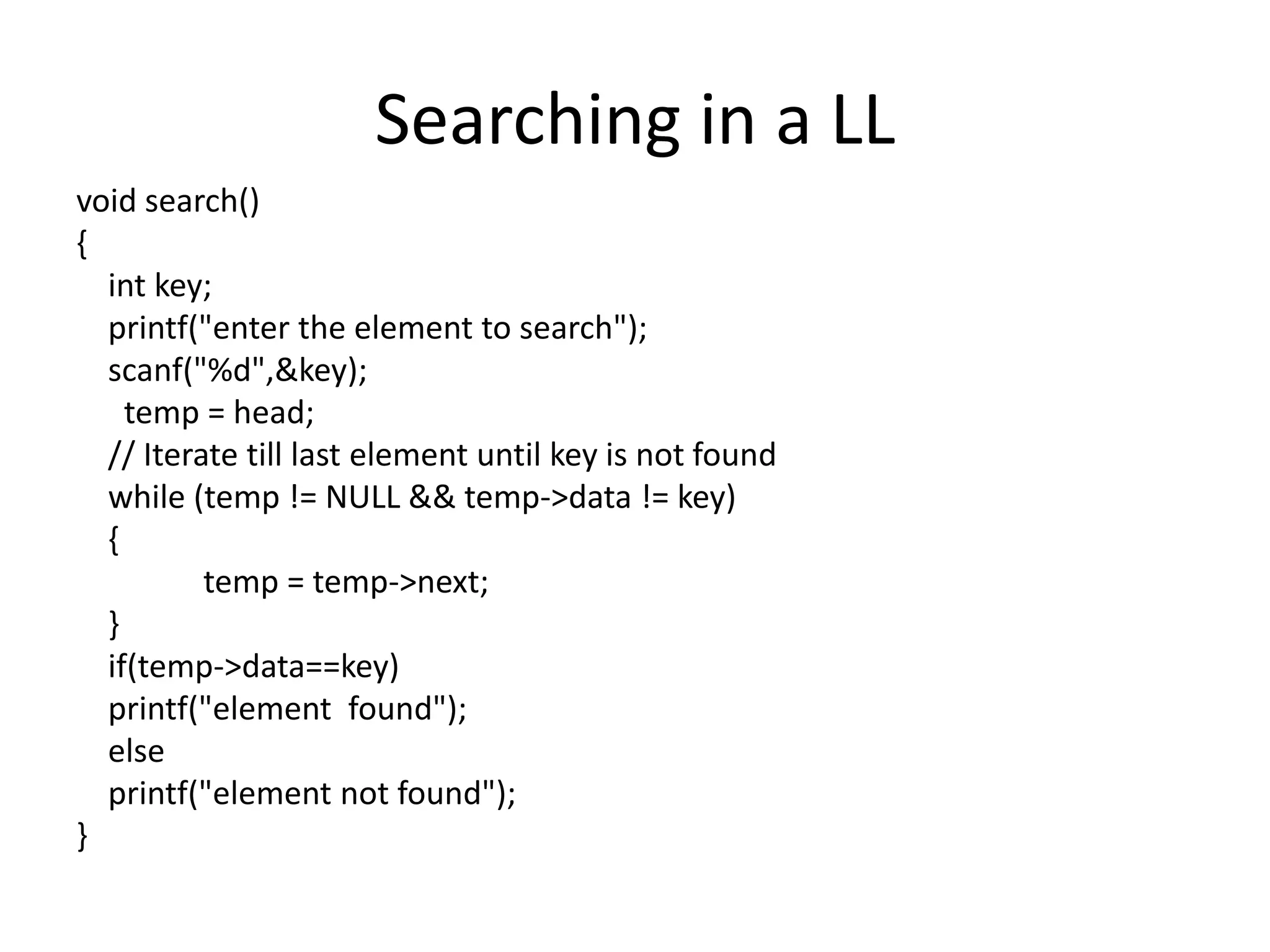
Searching in a LL
void search()
{
int key;
printf("enter the element to search");
scanf("%d",&key);
temp = head;
// Iterate till last element until key is not found
while (temp != NULL && temp->data != key)
{
temp = temp->next;
}
if(temp->data==key)
printf("element found");
else
printf("element not found");
}
Delete first by key
void deleteFirstByKey()
{
int key;
struct node *tempprev;
/* Check if head node contains key */
printf("enter the element to delete");
scanf("%d",&key);
while (head != NULL && head->data == key)
{
// Get reference of head node
temp = head;
// Adjust head node link
head = head->next;
// Delete prev since it contains reference to head node
free(temp);
}
Delete first by key(contd…)
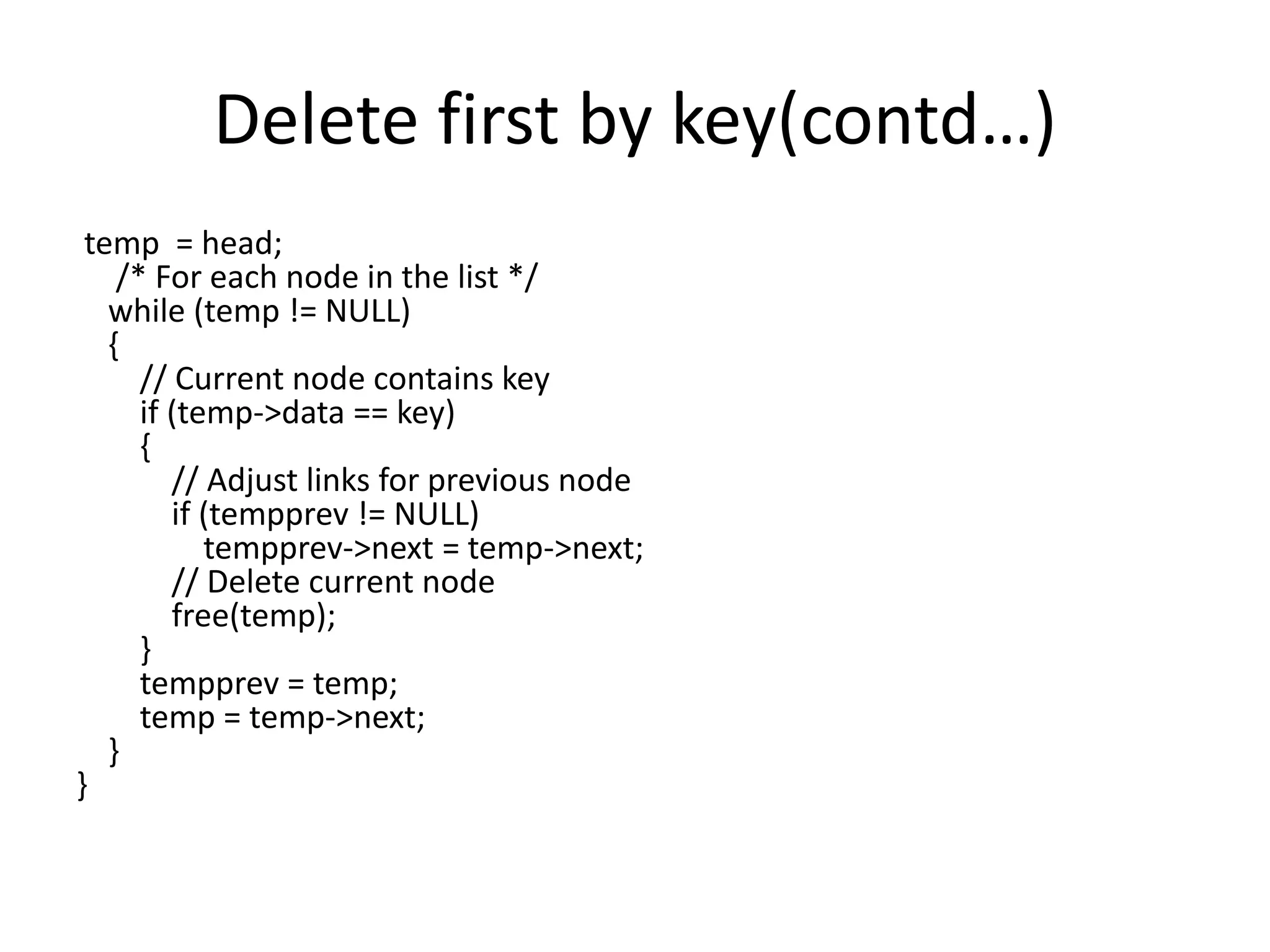
temp = head;
/* For each node in the list */
while (temp != NULL)
{
// Current node contains key
if (temp->data == key)
{
// Adjust links for previous node
if (tempprev != NULL)
tempprev->next = temp->next;
// Delete current node
free(temp);
}
tempprev = temp;
temp = temp->next;
}
}
DOUBLY LINKED LIST
Insertion at beginning of the LL
Void insertatbegin()
{
struct node *newnode;
newnode = (struct node*)malloc(sizeof(struct node));
printf(“Enter the value”);
scanf(“%d”, &newnode->data);
newnode->prev= NULL;
newnode->next = head;
head ->prev= newnode;
head=newnode;
}
Insertion at end of the LL
Void insertatend()
{
struct node *newnode;
If(head==NULL)
{
newnode = (struct node*)malloc(sizeof(struct node));
printf(“Enter the value”);
scanf(“%d”, &newnode->data);
newnode->prev= NULL;
newnode->next = NULL;
head=newnode;
current=head;
}
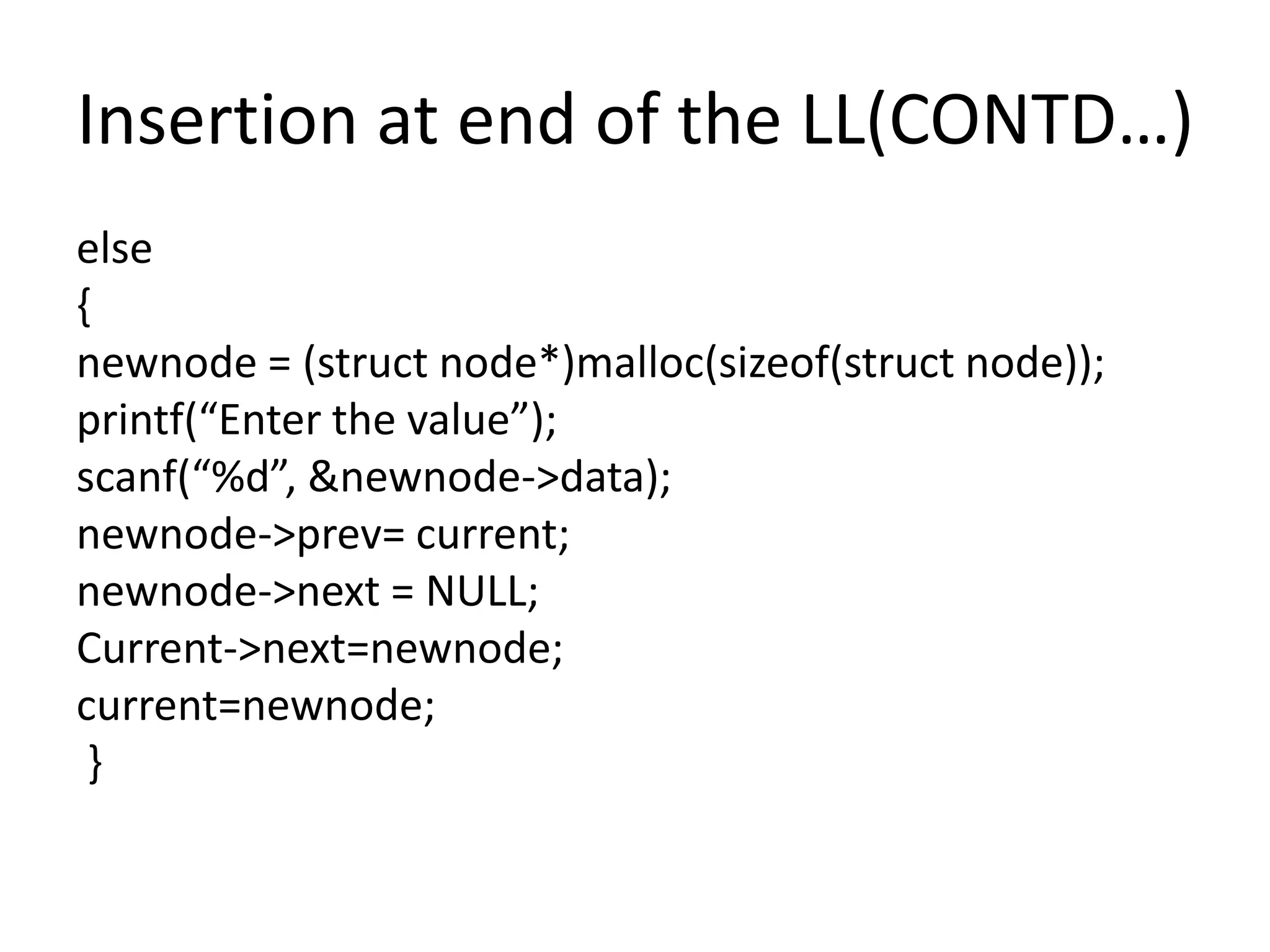
Insertion at end of the LL(CONTD…)
else
{
newnode = (struct node*)malloc(sizeof(struct node));
printf(“Enter the value”);
scanf(“%d”, &newnode->data);
newnode->prev= current;
newnode->next = NULL;
Current->next=newnode;
current=newnode;
}

Linked list

  • 1.
  • 2.
    Linked list • lineardata structure • Elements are not stored at contiguous memory locations • Elements in a linked list are linked using pointers
  • 3.
    TYPES • Linked listconsists of nodes where each node contains a data field and a reference(link) to the next node in the list. • Linked list comprise of group or list of nodes in which each node have link to next node to form a chain • Types of linked list – Singly linked list – Doubly linked list – Circular linked list
  • 4.
    Linked List vsArray Array Linked List data structure that contains a collection of similar type of data elements non-primitive data structure contains a collection of unordered linked elements known as nodes Accessing an element in an array is fast Accessing an element in an array is bit slower. Operations in arrays consume a lot of time operations in Linked lists is fast Arrays are of fixed size. Linked lists are dynamic and flexible and can expand and contract its size. In array, memory is assigned during compile time Linked list it is allocated during execution or runtime. Elements are stored consecutively in arrays Elements are stored randomly in Linked lists. requirement of memory is less due to actual data being stored within the index in the array more memory in Linked Lists due to storage of additional next and previous referencing elements. memory utilization is inefficient in the array memory utilization is efficient in the linked list.
  • 5.
    Why Linked List? •Arrays have the following limitations – The size of the array is fixed – To insert a new element in an array, existing elements have to be shifted • Advantages of LL over arrays - Dynamic size - Ease of insertion/deletion - Random access is not allowed
  • 6.
    Representation of linkedlist • Represented by a pointer to the first node of the linked list • The first node is called the head. • If the linked list is empty, then the value of the head is NULL. • Each node in a list consists of at least two parts: 1) data 2) Pointer (Or Reference) to the next node
  • 7.
  • 8.
    Basic Operations • Insertion− Adds an element into the list • Deletion − Deletes an element from the list • Display − Displays the complete list • Search − Searches an element using the given key
  • 9.
    Linked list nodecreation struct Node { int data; struct Node* next; } *head; Explanation: declared structure of type “NODE”, First field stores actual data and another field stores address
  • 10.
    Insertion • insertion operationcan be performed in three ways 1. Inserting At Beginning of the list 2. Inserting At End of the list 3. Inserting At Specific position in the list
  • 11.
    Insert at Beginningof the list 1)newnode->next=head; 2)head=newnode newnode
  • 12.
    Inserting At Beginningof the list steps to insert a new node at beginning of the single linked list Step 1 - Create a newnode with given value. Step 2 - Check whether list is Empty (head == NULL) Step 3 - If it is Empty then, set newnode→next = NULL and head = new Node. Step 4 - If it is Not Empty then, set newnode→next = head and head = newnode void insertAtBeginning(int value) { struct Node *newnode; newnode = (struct Node*)malloc(sizeof(struct Node)); newnode->data = value; if(head == NULL) { newnode->next = NULL; head = newnode; } else { newnode->next = head; head = newnode;
  • 13.
    Inserting At Beginningof the list void insertAtBeginning(int value) { struct Node *newnode; newnode = (struct Node*)malloc(sizeof(struct Node)); newnode->data = value; newnode->next = head; head = newnode; }
  • 14.
    Insert at Endof the list 1) Traverse –Now temp points to last node 2) temp ->next=newnode;
  • 15.
    Insert at Endof the list steps to insert a new node at end of the single linked list Step 1 - Create a newnode with given value and newnode → next as NULL. Step 2 - Check whether list is Empty (head == NULL). Step 3 - If it is Empty then, set head = newnode. Step 4 - If it is Not Empty then, define a node pointer temp and initialize with head. Step 5 - Keep moving the temp to its next node until it to the last node in the list (until temp → next is equal to NULL). Step 6 - Set temp → next = newnode. void insertAtEnd(int value) { struct Node *newnode; newnode = (struct Node*)malloc(sizeof(struct Node)); newnode->data = value; newnode->next = NULL; if(head == NULL) head = newnode; else { struct Node *temp = head; while(temp->next != NULL) temp = temp->next; temp->next = newnode; } }
  • 16.
    Insert at agiven position
  • 17.
    void insertatmiddle(int value,int pos) { struct Node *newNode,*temp; Int i,pos; newnode = (struct Node*)malloc(sizeof(struct Node)); newnode->data = value; temp=head; for(i=1;i<pos-1;i++) { temp=temp->next; } If(temp==head) { newnode->next=head; head=newnode; } else { newnode->next=temp->next; temp->next=newnode; }
  • 18.
    Deletion Operation • locatethe target node to be removed • left (previous) node of the target node now should point to the next node of the target node • LeftNode.next −> TargetNode.next;
  • 19.
    • remove thetarget node is pointing at – TargetNode.next −> NULL;
  • 20.
    Delete at begin Voiddeleteatbegin() { struct node *temp; temp=head; printf(“%d is deleted”, temp->data); head=temp->next; free(temp); }
  • 21.
    Delete at last voiddeleteatlast() { struct node *last, *secondlast; last=head; secondlast=head; while(last->next!=NULL) { secondlast= last; last=last->next; } If(last==head) { head=NULL; } else { secondlast->next=NULL; free(last); }
  • 22.
    Displaying the linkedlist Void display() { struct node *temp; temp=head; while(temp!=NULL) { printf(“%d”, temp->data); temp=temp->next; } }
  • 23.
    Counting the no.of nodes in a LL void count() { int c=0; struct node *temp; temp=head; while(temp!=NULL) { c++; temp=temp->next; } printf(“Number of nodes in the LL is %d”, c); }
  • 24.
    Searching in aLL void search() { int key; printf("enter the element to search"); scanf("%d",&key); temp = head; // Iterate till last element until key is not found while (temp != NULL && temp->data != key) { temp = temp->next; } if(temp->data==key) printf("element found"); else printf("element not found"); }
  • 25.
    Delete first bykey void deleteFirstByKey() { int key; struct node *tempprev; /* Check if head node contains key */ printf("enter the element to delete"); scanf("%d",&key); while (head != NULL && head->data == key) { // Get reference of head node temp = head; // Adjust head node link head = head->next; // Delete prev since it contains reference to head node free(temp); }
  • 26.
    Delete first bykey(contd…) temp = head; /* For each node in the list */ while (temp != NULL) { // Current node contains key if (temp->data == key) { // Adjust links for previous node if (tempprev != NULL) tempprev->next = temp->next; // Delete current node free(temp); } tempprev = temp; temp = temp->next; } }
  • 27.
  • 28.
    Insertion at beginningof the LL Void insertatbegin() { struct node *newnode; newnode = (struct node*)malloc(sizeof(struct node)); printf(“Enter the value”); scanf(“%d”, &newnode->data); newnode->prev= NULL; newnode->next = head; head ->prev= newnode; head=newnode; }
  • 29.
    Insertion at endof the LL Void insertatend() { struct node *newnode; If(head==NULL) { newnode = (struct node*)malloc(sizeof(struct node)); printf(“Enter the value”); scanf(“%d”, &newnode->data); newnode->prev= NULL; newnode->next = NULL; head=newnode; current=head; }
  • 30.
    Insertion at endof the LL(CONTD…) else { newnode = (struct node*)malloc(sizeof(struct node)); printf(“Enter the value”); scanf(“%d”, &newnode->data); newnode->prev= current; newnode->next = NULL; Current->next=newnode; current=newnode; }