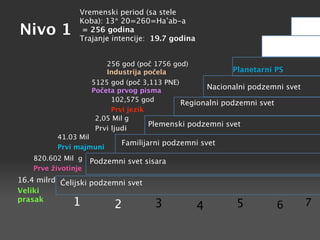
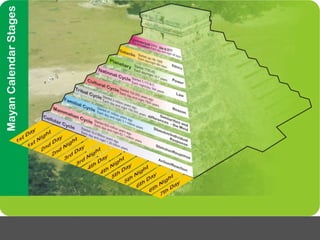
Vremenski period (sastele
Koba): 13* 20=260=Ha’ab-a
Nivo 1 = 256 godina
Trajanje intencije: 19.7 godina
256 god (poč 1756 god)
Industrija počela Planetarni PS
5125 god (poč 3,113 PNE)
Početa prvog pisma Nacionalni podzemni svet
102,575 god Regionalni podzemni svet
Prvi jezik
2,05 Mil g
Plemenski podzemni svet
Prvi ljudi
41.03 Mil
Familijarni podzemni svet
Prvi majmuni
820.602 Mil g Podzemni svet sisara
Prve životinje
16.4 milrd Ćelijski podzemni svet
Veliki
prasak 1 2 3 4 5 6 7
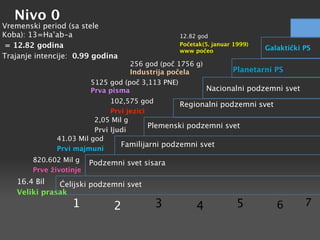
Nivo 0
Vremenski period(sa stele
Koba): 13=Ha’ab-a 12.82 god
= 12.82 godina Početak(5. januar 1999)
Galaktički PS
www počeo
Trajanje intencije: 0.99 godina
256 god (poč 1756 g)
Industrija počela Planetarni PS
5125 god (poč 3,113 PNE)
Prva pisma Nacionalni podzemni svet
102,575 god Regionalni podzemni svet
Prvi jezici
2,05 Mil g
Plemenski podzemni svet
Prvi ljudi
41.03 Mil god
Familijarni podzemni svet
Prvi majmuni
820.602 Mil g Podzemni svet sisara
Prve životinje
16.4 Bil Ćelijski podzemni svet
Veliki prasak
1 2 3 4 5 6 7
5.
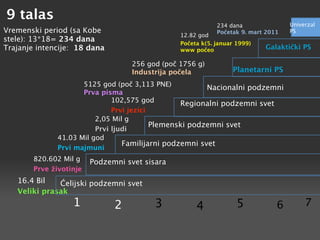
9 talas
234 dana Univerzal
Vremenski period (sa Kobe Početak 9. mart 2011 PS
12.82 god
stele): 13*18= 234 dana Početa k(5. januar 1999)
Trajanje intencije: 18 dana www počeo Galaktički PS
256 god (poč 1756 g)
Industrija počela Planetarni PS
5125 god (poč 3,113 PNE) Nacionalni podzemni
Prva pisma
102,575 god Regionalni podzemni svet
Prvi jezici
2,05 Mil g
Plemenski podzemni svet
Prvi ljudi
41.03 Mil god
Familijarni podzemni svet
Prvi majmuni
820.602 Mil g Podzemni svet sisara
Prve životinje
16.4 Bil Ćelijski podzemni svet
Veliki prasak
1 2 3 4 5 6 7
6.
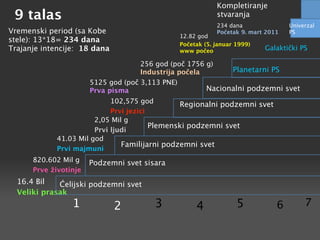
Kompletiranje
9 talas stvaranja
234 dana Univerzal
Vremenski period (sa Kobe Početak 9. mart 2011 PS
12.82 god
stele): 13*18= 234 dana
Početak (5. januar 1999)
Trajanje intencije: 18 dana www počeo Galaktički PS
256 god (poč 1756 g)
Industrija počela Planetarni PS
5125 god (poč 3,113 PNE)
Prva pisma Nacionalni podzemni svet
102,575 god Regionalni podzemni svet
Prvi jezici
2,05 Mil g
Plemenski podzemni svet
Prvi ljudi
41.03 Mil god
Familijarni podzemni svet
Prvi majmuni
820.602 Mil g Podzemni svet sisara
Prve životinje
16.4 Bil Ćelijski podzemni svet
Veliki prasak
1 2 3 4 5 6 7
7.
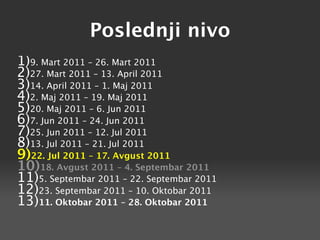
Poslednji nivo
1)9. Mart2011 – 26. Mart 2011
2)27. Mart 2011 – 13. April 2011
3)14. April 2011 – 1. Maj 2011
4)2. Maj 2011 – 19. Maj 2011
5)20. Maj 2011 – 6. Jun 2011
6)7. Jun 2011 – 24. Jun 2011
7)25. Jun 2011 – 12. Jul 2011
8)13. Jul 2011 – 21. Jul 2011
9)22. Jul 2011 – 17. Avgust 2011
10)18. Avgust 2011 – 4. Septembar 2011
11)5. Septembar 2011 – 22. Septembar 2011
12)23. Septembar 2011 – 10. Oktobar 2011
13)11. Oktobar 2011 – 28. Oktobar 2011
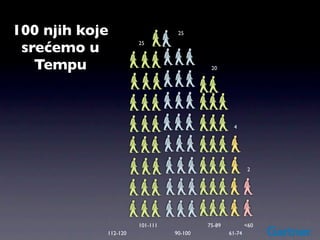
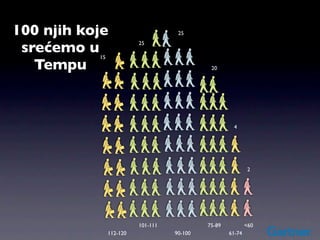
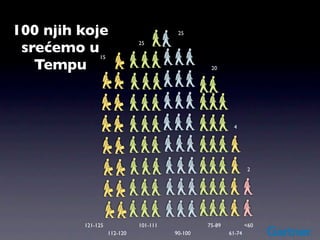
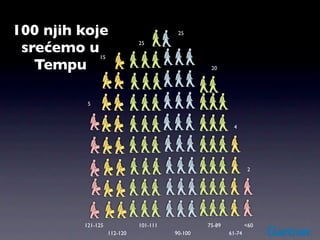
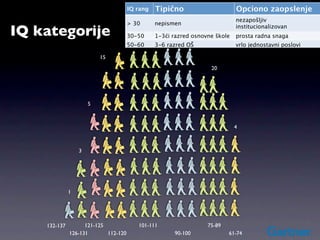
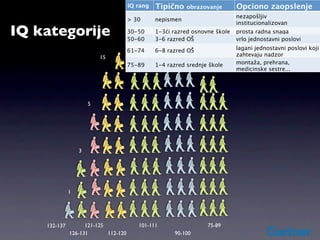
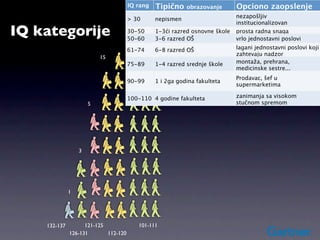
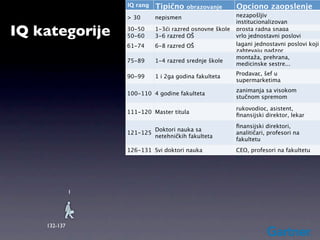
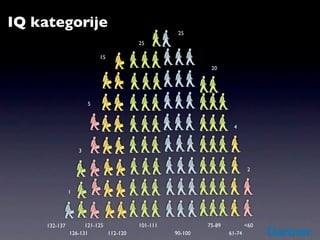
IQ rang Tipično Opciono zaopslenje
obrazovanje nezapošljiv
> 30 nepismen
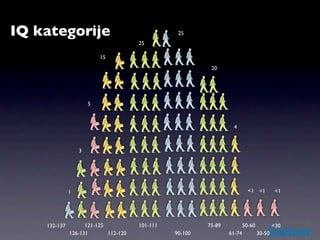
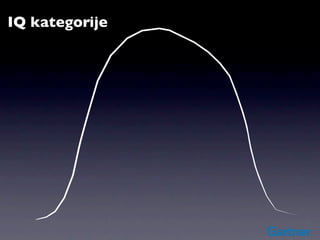
IQ kategorije 30-50
25
1-3ći razred osnovne škole
institucionalizovan
prosta radna snaga
25
50-60 3-6 razred OŠ vrlo jednostavni poslovi
15
20
5
4
3
1
132-137 121-125 101-111 75-89
126-131 112-120 90-100 61-74
42.
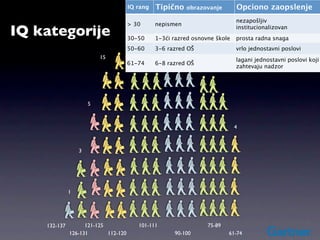
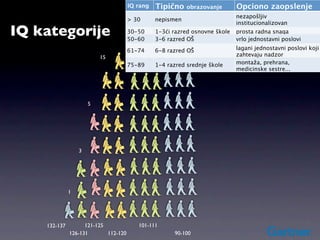
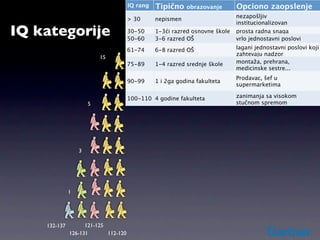
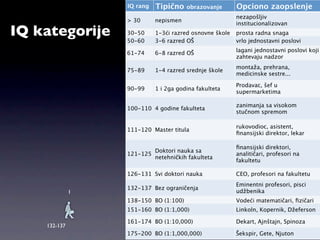
IQ rang Tipično obrazovanje Opciono zaopslenje
nezapošljiv
> 30 nepismen
IQ kategorije 30-50
25
1-3ći razred osnovne škole
institucionalizovan
prosta radna snaga
25
50-60 3-6 razred OŠ vrlo jednostavni poslovi
15 lagani jednostavni poslovi koji
61-74 6-8 razred OŠ
20 zahtevaju nadzor
5
4
3
1
132-137 121-125 101-111 75-89
126-131 112-120 90-100 61-74
43.
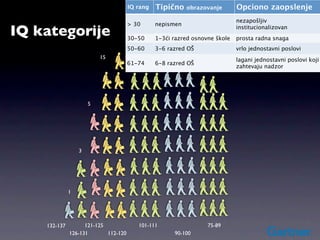
IQ rang Tipično obrazovanje Opciono zaopslenje
nezapošljiv
> 30 nepismen
IQ kategorije 30-50
25
1-3ći razred osnovne škole
institucionalizovan
prosta radna snaga
25
50-60 3-6 razred OŠ vrlo jednostavni poslovi
15 lagani jednostavni poslovi koji
61-74 6-8 razred OŠ
20 zahtevaju nadzor
5
3
1
132-137 121-125 101-111 75-89
126-131 112-120 90-100
44.
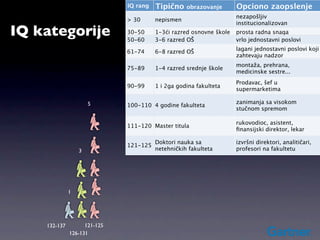
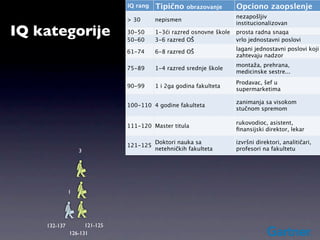
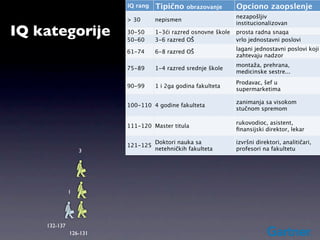
IQ rang Tipično obrazovanje Opciono zaopslenje
nezapošljiv
> 30 nepismen
institucionalizovan
IQ kategorije 30-50
50-60
1-3ći razred osnovne škole
25
3-6 razred OŠ
prosta radna snaga
vrlo jednostavni poslovi
25
61-74 6-8 razred OŠ lagani jednostavni poslovi koji
15 zahtevaju nadzor
75-89 1-4 razred srednje škole montaža, prehrana,
20 medicinske sestre...
5
3
1
132-137 121-125 101-111 75-89
126-131 112-120 90-100
45.
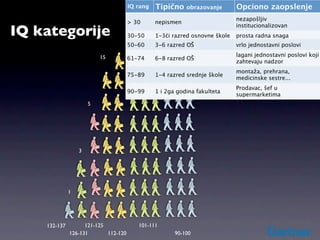
IQ rang Tipično obrazovanje Opciono zaopslenje
nezapošljiv
> 30 nepismen
institucionalizovan
IQ kategorije 30-50
50-60
1-3ći razred osnovne škole
25
3-6 razred OŠ
prosta radna snaga
vrlo jednostavni poslovi
25
61-74 6-8 razred OŠ lagani jednostavni poslovi koji
15 zahtevaju nadzor
75-89 1-4 razred srednje škole montaža, prehrana,
medicinske sestre...
5
3
1
132-137 121-125 101-111
126-131 112-120 90-100
46.
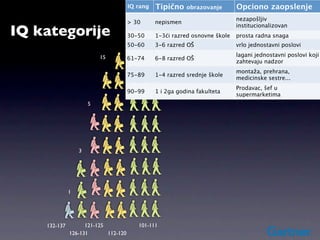
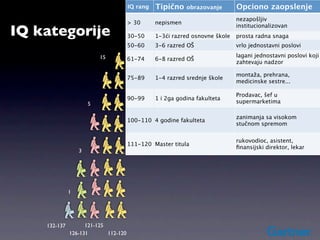
IQ rang Tipično obrazovanje Opciono zaopslenje
nezapošljiv
> 30 nepismen
IQ kategorije
institucionalizovan
30-50 25
1-3ći razred osnovne škole prosta radna snaga
25
50-60 3-6 razred OŠ vrlo jednostavni poslovi
15 lagani jednostavni poslovi koji
61-74 6-8 razred OŠ
zahtevaju nadzor
montaža, prehrana,
75-89 1-4 razred srednje škole
medicinske sestre...
Prodavac, šef u
90-99 1 i 2ga godina fakulteta
supermarketima
5
3
1
132-137 121-125 101-111
126-131 112-120 90-100
47.
IQ rang Tipično obrazovanje Opciono zaopslenje
nezapošljiv
> 30 nepismen
IQ kategorije
institucionalizovan
30-50 1-3ći razred osnovne škole prosta radna snaga
25
50-60 3-6 razred OŠ vrlo jednostavni poslovi
15 lagani jednostavni poslovi koji
61-74 6-8 razred OŠ
zahtevaju nadzor
montaža, prehrana,
75-89 1-4 razred srednje škole
medicinske sestre...
Prodavac, šef u
90-99 1 i 2ga godina fakulteta
supermarketima
5
3
1
132-137 121-125 101-111
126-131 112-120
48.
IQ rang Tipično obrazovanje Opciono zaopslenje
nezapošljiv
> 30 nepismen
institucionalizovan
IQ kategorije 30-50
50-60
1-3ći razred osnovne škole
3-6 razred OŠ
prosta radna snaga
vrlo jednostavni poslovi
25
61-74 6-8 razred OŠ lagani jednostavni poslovi koji
zahtevaju nadzor
15
75-89 1-4 razred srednje škole montaža, prehrana,
medicinske sestre...
Prodavac, šef u
90-99 1 i 2ga godina fakulteta
supermarketima
100-110 4 godine fakulteta zanimanja sa visokom
5 stučnom spremom
3
1
132-137 121-125 101-111
126-131 112-120
49.
IQ rang Tipično obrazovanje Opciono zaopslenje
nezapošljiv
> 30 nepismen
institucionalizovan
IQ kategorije 30-50
50-60
1-3ći razred osnovne škole
3-6 razred OŠ
prosta radna snaga
vrlo jednostavni poslovi
25
61-74 6-8 razred OŠ lagani jednostavni poslovi koji
zahtevaju nadzor
15
75-89 1-4 razred srednje škole montaža, prehrana,
medicinske sestre...
Prodavac, šef u
90-99 1 i 2ga godina fakulteta
supermarketima
100-110 4 godine fakulteta zanimanja sa visokom
5 stučnom spremom
3
1
132-137 121-125
126-131 112-120
50.
IQ rang Tipično obrazovanje Opciono zaopslenje
nezapošljiv
> 30 nepismen
IQ kategorije
institucionalizovan
30-50 1-3ći razred osnovne škole prosta radna snaga
25
50-60 3-6 razred OŠ vrlo jednostavni poslovi
15 lagani jednostavni poslovi koji
61-74 6-8 razred OŠ
zahtevaju nadzor
montaža, prehrana,
75-89 1-4 razred srednje škole
medicinske sestre...
Prodavac, šef u
90-99 1 i 2ga godina fakulteta
5 supermarketima
zanimanja sa visokom
100-110 4 godine fakulteta
stučnom spremom
rukovodioc, asistent,
111-120 Master titula
finansijski direktor, lekar
3
1
132-137 121-125
126-131 112-120
51.
IQ rang Tipično obrazovanje Opciono zaopslenje
nezapošljiv
> 30 nepismen
IQ kategorije
institucionalizovan
30-50 1-3ći razred osnovne škole prosta radna snaga
25
50-60 3-6 razred OŠ vrlo jednostavni poslovi
lagani jednostavni poslovi koji
61-74 6-8 razred OŠ
zahtevaju nadzor
montaža, prehrana,
75-89 1-4 razred srednje škole
medicinske sestre...
Prodavac, šef u
90-99 1 i 2ga godina fakulteta
5 supermarketima
zanimanja sa visokom
100-110 4 godine fakulteta
stučnom spremom
rukovodioc, asistent,
111-120 Master titula
finansijski direktor, lekar
3
1
132-137 121-125
126-131
52.
IQ rang Tipično obrazovanje Opciono zaopslenje
nezapošljiv
> 30 nepismen
institucionalizovan
IQ kategorije 30-50
50-60
1-3ći razred osnovne škole
3-6 razred OŠ
prosta radna snaga
vrlo jednostavni poslovi
25
lagani jednostavni poslovi koji
61-74 6-8 razred OŠ
zahtevaju nadzor
montaža, prehrana,
75-89 1-4 razred srednje škole
medicinske sestre...
Prodavac, šef u
90-99 1 i 2ga godina fakulteta
supermarketima
5 zanimanja sa visokom
100-110 4 godine fakulteta
stučnom spremom
rukovodioc, asistent,
111-120 Master titula
finansijski direktor, lekar
Doktori nauka sa izvršni direktori, analitičari,
121-125
3 netehničkih fakulteta profesori na fakultetu
1
132-137 121-125
126-131
53.
IQ rang Tipično obrazovanje Opciono zaopslenje
nezapošljiv
> 30 nepismen
institucionalizovan
IQ kategorije 30-50
50-60
1-3ći razred osnovne škole
3-6 razred OŠ
prosta radna snaga
vrlo jednostavni poslovi
25
lagani jednostavni poslovi koji
61-74 6-8 razred OŠ
zahtevaju nadzor
montaža, prehrana,
75-89 1-4 razred srednje škole
medicinske sestre...
Prodavac, šef u
90-99 1 i 2ga godina fakulteta
supermarketima
zanimanja sa visokom
100-110 4 godine fakulteta
stučnom spremom
rukovodioc, asistent,
111-120 Master titula
finansijski direktor, lekar
Doktori nauka sa izvršni direktori, analitičari,
121-125
3 netehničkih fakulteta profesori na fakultetu
1
132-137 121-125
126-131
54.
IQ rang Tipično obrazovanje Opciono zaopslenje
nezapošljiv
> 30 nepismen
institucionalizovan
IQ kategorije 30-50
50-60
1-3ći razred osnovne škole
3-6 razred OŠ
prosta radna snaga
vrlo jednostavni poslovi
25
lagani jednostavni poslovi koji
61-74 6-8 razred OŠ
zahtevaju nadzor
montaža, prehrana,
75-89 1-4 razred srednje škole
medicinske sestre...
Prodavac, šef u
90-99 1 i 2ga godina fakulteta
supermarketima
zanimanja sa visokom
100-110 4 godine fakulteta
stučnom spremom
rukovodioc, asistent,
111-120 Master titula
finansijski direktor, lekar
Doktori nauka sa izvršni direktori, analitičari,
121-125
3 netehničkih fakulteta profesori na fakultetu
1
132-137
126-131
55.
IQ rang Tipično obrazovanje Opciono zaopslenje
> 30 nepismen nezapošljiv
institucionalizovan
IQ kategorije 30-50
50-60
1-3ći razred osnovne škole
3-6 razred OŠ
prosta radna snaga
vrlo jednostavni poslovi
25
61-74 6-8 razred OŠ lagani jednostavni poslovi koji
zahtevaju nadzor
montaža, prehrana,
75-89 1-4 razred srednje škole
medicinske sestre...
Prodavac, šef u
90-99 1 i 2ga godina fakulteta
supermarketima
zanimanja sa visokom
100-110 4 godine fakulteta
stučnom spremom
rukovodioc, asistent,
111-120 Master titula
finansijski direktor, lekar
finansijski direktori,
Doktori nauka sa
121-125 analitičari, profesori na
netehničkih fakulteta
fakultetu
3 126-131 Svi doktori nauka CEO, profesori na fakultetu
1
132-137
126-131
56.
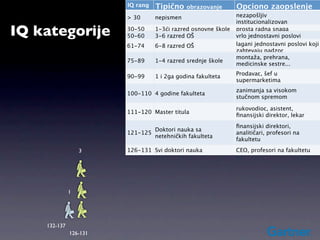
IQ rang Tipično obrazovanje Opciono zaopslenje
> 30 nepismen nezapošljiv
institucionalizovan
IQ kategorije 30-50
50-60
1-3ći razred osnovne škole
3-6 razred OŠ
prosta radna snaga
vrlo jednostavni poslovi
25
61-74 6-8 razred OŠ lagani jednostavni poslovi koji
zahtevaju nadzor
montaža, prehrana,
75-89 1-4 razred srednje škole
medicinske sestre...
Prodavac, šef u
90-99 1 i 2ga godina fakulteta
supermarketima
zanimanja sa visokom
100-110 4 godine fakulteta
stučnom spremom
rukovodioc, asistent,
111-120 Master titula
finansijski direktor, lekar
finansijski direktori,
Doktori nauka sa
121-125 analitičari, profesori na
netehničkih fakulteta
fakultetu
126-131 Svi doktori nauka CEO, profesori na fakultetu
1
132-137
57.
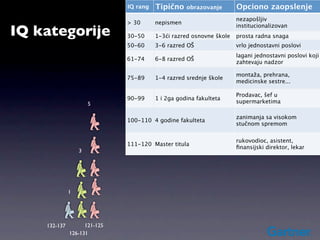
IQ rang Tipično obrazovanje Opciono zaopslenje
nezapošljiv
> 30 nepismen
institucionalizovan
IQ kategorije 30-50
50-60
1-3ći razred osnovne škole
3-6 razred OŠ
prosta radna snaga
vrlo jednostavni poslovi
25
lagani jednostavni poslovi koji
61-74 6-8 razred OŠ
zahtevaju nadzor
montaža, prehrana,
75-89 1-4 razred srednje škole
medicinske sestre...
Prodavac, šef u
90-99 1 i 2ga godina fakulteta
supermarketima
zanimanja sa visokom
100-110 4 godine fakulteta
stučnom spremom
rukovodioc, asistent,
111-120 Master titula
finansijski direktor, lekar
finansijski direktori,
Doktori nauka sa
121-125 analitičari, profesori na
netehničkih fakulteta
fakultetu
126-131 Svi doktori nauka CEO, profesori na fakultetu
Eminentni profesori, pisci
132-137 Bez ograničenja
1 udžbenika
138-150 BO (1:100) Vodeći matematičari, fizičari
151-160 BO (1:1,000) Linkoln, Kopernik, Džeferson
161-174 BO (1:10,000) Dekart, Ajnštajn, Spinoza
132-137
175-200 BO (1:1,000,000) Šekspir, Gete, Njuton
58.
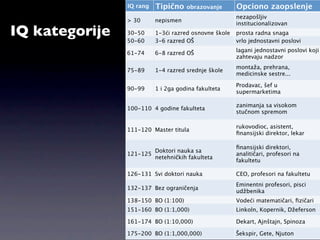
IQ rang Tipično obrazovanje Opciono zaopslenje
nezapošljiv
> 30 nepismen
institucionalizovan
IQ kategorije 30-50
50-60
1-3ći razred osnovne škole
3-6 razred OŠ
prosta radna snaga
vrlo jednostavni poslovi
25
lagani jednostavni poslovi koji
61-74 6-8 razred OŠ
zahtevaju nadzor
montaža, prehrana,
75-89 1-4 razred srednje škole
medicinske sestre...
Prodavac, šef u
90-99 1 i 2ga godina fakulteta
supermarketima
zanimanja sa visokom
100-110 4 godine fakulteta
stučnom spremom
rukovodioc, asistent,
111-120 Master titula
finansijski direktor, lekar
finansijski direktori,
Doktori nauka sa
121-125 analitičari, profesori na
netehničkih fakulteta
fakultetu
126-131 Svi doktori nauka CEO, profesori na fakultetu
Eminentni profesori, pisci
132-137 Bez ograničenja
udžbenika
138-150 BO (1:100) Vodeći matematičari, fizičari
151-160 BO (1:1,000) Linkoln, Kopernik, Džeferson
161-174 BO (1:10,000) Dekart, Ajnštajn, Spinoza
175-200 BO (1:1,000,000) Šekspir, Gete, Njuton
59.
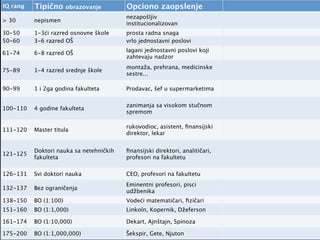
IQ rang Tipično obrazovanje Opciono zaopslenje
nezapošljiv
> 30 nepismen
institucionalizovan
30-50 1-3ći razred osnovne škole prosta radna snaga
50-60 3-6 razred OŠ vrlo jednostavni poslovi
25
lagani jednostavni poslovi koji
61-74 6-8 razred OŠ
zahtevaju nadzor
montaža, prehrana, medicinske
75-89 1-4 razred srednje škole
sestre...
90-99 1 i 2ga godina fakulteta Prodavac, šef u supermarketima
zanimanja sa visokom stučnom
100-110 4 godine fakulteta
spremom
rukovodioc, asistent, finansijski
111-120 Master titula
direktor, lekar
Doktori nauka sa netehničkih finansijski direktori, analitičari,
121-125
fakulteta profesori na fakultetu
126-131 Svi doktori nauka CEO, profesori na fakultetu
Eminentni profesori, pisci
132-137 Bez ograničenja
udžbenika
138-150 BO (1:100) Vodeći matematičari, fizičari
151-160 BO (1:1,000) Linkoln, Kopernik, Džeferson
161-174 BO (1:10,000) Dekart, Ajnštajn, Spinoza
175-200 BO (1:1,000,000) Šekspir, Gete, Njuton
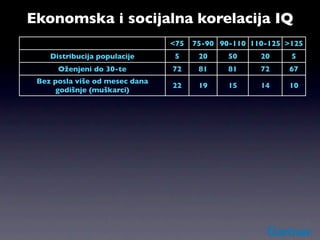
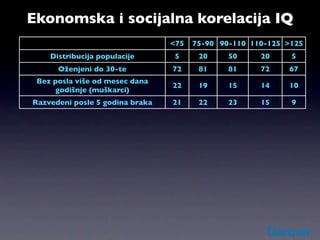
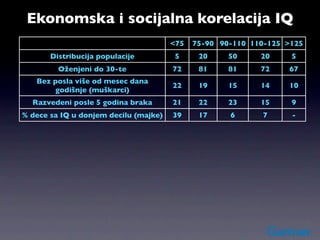
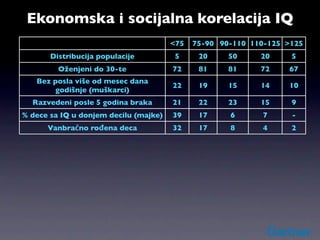
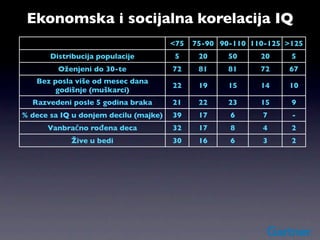
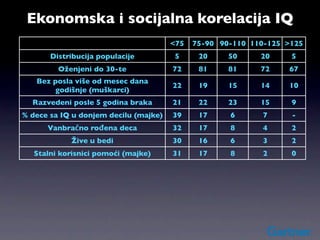
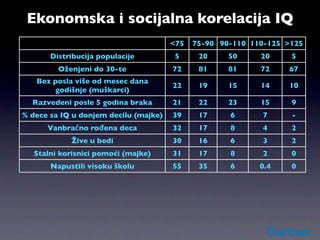
Ekonomska i socijalnakorelacija IQ
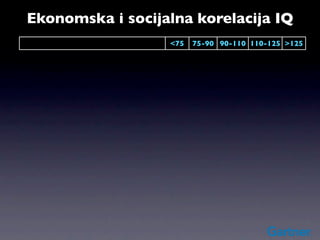
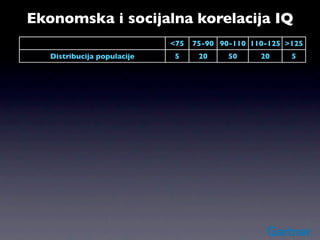
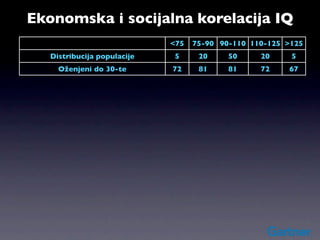
<75 75-90 90-110 110-125 >125
Distribucija populacije 5 20 50 20 5
Oženjeni do 30-te 72 81 81 72 67
Bez posla više od mesec dana
22 19 15 14 10
godišnje (muškarci)
Razvedeni posle 5 godina braka 21 22 23 15 9
% dece sa IQ u donjem decilu (majke) 39 17 6 7 -
Vanbračno rođena deca 32 17 8 4 2
Žive u bedi 30 16 6 3 2
Stalni korisnici pomoći (majke) 31 17 8 2 0
Napustili visoku školu 55 35 6 0.4 0
62.
Ekonomska i socijalnakorelacija IQ
<75 75-90 90-110 110-125 >125
Distribucija populacije 5 20 50 20 5
Oženjeni do 30-te 72 81 81 72 67
Bez posla više od mesec dana
22 19 15 14 10
godišnje (muškarci)
Razvedeni posle 5 godina braka 21 22 23 15 9
% dece sa IQ u donjem decilu (majke) 39 17 6 7 -
Vanbračno rođena deca 32 17 8 4 2
Žive u bedi 30 16 6 3 2
Stalni korisnici pomoći (majke) 31 17 8 2 0
Napustili visoku školu 55 35 6 0.4 0
63.
Ekonomska i socijalnakorelacija IQ
<75 75-90 90-110 110-125 >125
Distribucija populacije 5 20 50 20 5
Oženjeni do 30-te 72 81 81 72 67
Bez posla više od mesec dana
22 19 15 14 10
godišnje (muškarci)
Razvedeni posle 5 godina braka 21 22 23 15 9
% dece sa IQ u donjem decilu (majke) 39 17 6 7 -
Vanbračno rođena deca 32 17 8 4 2
Žive u bedi 30 16 6 3 2
Stalni korisnici pomoći (majke) 31 17 8 2 0
Napustili visoku školu 55 35 6 0.4 0
64.
Ekonomska i socijalnakorelacija IQ
<75 75-90 90-110 110-125 >125
Distribucija populacije 5 20 50 20 5
Oženjeni do 30-te 72 81 81 72 67
Bez posla više od mesec dana
22 19 15 14 10
godišnje (muškarci)
Razvedeni posle 5 godina braka 21 22 23 15 9
% dece sa IQ u donjem decilu (majke) 39 17 6 7 -
Vanbračno rođena deca 32 17 8 4 2
Žive u bedi 30 16 6 3 2
Stalni korisnici pomoći (majke) 31 17 8 2 0
Napustili visoku školu 55 35 6 0.4 0
65.
Ekonomska i socijalnakorelacija IQ
<75 75-90 90-110 110-125 >125
Distribucija populacije 5 20 50 20 5
Oženjeni do 30-te 72 81 81 72 67
Bez posla više od mesec dana
22 19 15 14 10
godišnje (muškarci)
Razvedeni posle 5 godina braka 21 22 23 15 9
% dece sa IQ u donjem decilu (majke) 39 17 6 7 -
Vanbračno rođena deca 32 17 8 4 2
Žive u bedi 30 16 6 3 2
Stalni korisnici pomoći (majke) 31 17 8 2 0
Napustili visoku školu 55 35 6 0.4 0
66.
Ekonomska i socijalnakorelacija IQ
<75 75-90 90-110 110-125 >125
Distribucija populacije 5 20 50 20 5
Oženjeni do 30-te 72 81 81 72 67
Bez posla više od mesec dana
22 19 15 14 10
godišnje (muškarci)
Razvedeni posle 5 godina braka 21 22 23 15 9
% dece sa IQ u donjem decilu (majke) 39 17 6 7 -
Vanbračno rođena deca 32 17 8 4 2
Žive u bedi 30 16 6 3 2
Stalni korisnici pomoći (majke) 31 17 8 2 0
Napustili visoku školu 55 35 6 0.4 0
67.
Ekonomska i socijalnakorelacija IQ
<75 75-90 90-110 110-125 >125
Distribucija populacije 5 20 50 20 5
Oženjeni do 30-te 72 81 81 72 67
Bez posla više od mesec dana
22 19 15 14 10
godišnje (muškarci)
Razvedeni posle 5 godina braka 21 22 23 15 9
% dece sa IQ u donjem decilu (majke) 39 17 6 7 -
Vanbračno rođena deca 32 17 8 4 2
Žive u bedi 30 16 6 3 2
Stalni korisnici pomoći (majke) 31 17 8 2 0
Napustili visoku školu 55 35 6 0.4 0
68.
Ekonomska i socijalnakorelacija IQ
<75 75-90 90-110 110-125 >125
Distribucija populacije 5 20 50 20 5
Oženjeni do 30-te 72 81 81 72 67
Bez posla više od mesec dana
22 19 15 14 10
godišnje (muškarci)
Razvedeni posle 5 godina braka 21 22 23 15 9
% dece sa IQ u donjem decilu (majke) 39 17 6 7 -
Vanbračno rođena deca 32 17 8 4 2
Žive u bedi 30 16 6 3 2
Stalni korisnici pomoći (majke) 31 17 8 2 0
Napustili visoku školu 55 35 6 0.4 0
69.
Ekonomska i socijalnakorelacija IQ
<75 75-90 90-110 110-125 >125
Distribucija populacije 5 20 50 20 5
Oženjeni do 30-te 72 81 81 72 67
Bez posla više od mesec dana
22 19 15 14 10
godišnje (muškarci)
Razvedeni posle 5 godina braka 21 22 23 15 9
% dece sa IQ u donjem decilu (majke) 39 17 6 7 -
Vanbračno rođena deca 32 17 8 4 2
Žive u bedi 30 16 6 3 2
Stalni korisnici pomoći (majke) 31 17 8 2 0
Napustili visoku školu 55 35 6 0.4 0
70.
Ekonomska i socijalnakorelacija IQ
<75 75-90 90-110 110-125 >125
Distribucija populacije 5 20 50 20 5
Oženjeni do 30-te 72 81 81 72 67
Bez posla više od mesec dana
22 19 15 14 10
godišnje (muškarci)
Razvedeni posle 5 godina braka 21 22 23 15 9
% dece sa IQ u donjem decilu (majke) 39 17 6 7 -
Vanbračno rođena deca 32 17 8 4 2
Žive u bedi 30 16 6 3 2
Stalni korisnici pomoći (majke) 31 17 8 2 0
Napustili visoku školu 55 35 6 0.4 0
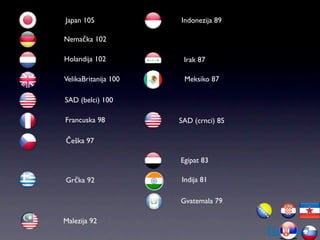
Japan 105 Indonezija 89
Nemačka 102
Holandija 102 Irak 87
VelikaBritanija 100 Meksiko 87
SAD (belci) 100
Francuska 98 SAD (crnci) 85
Češka 97
Egipat 83
Grčka 92 Indija 81
Gvatemala 79
Malezija 92
79.
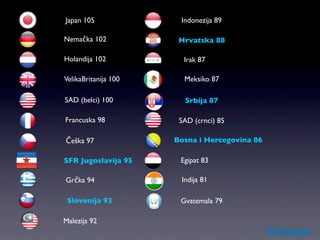
Japan 105 Indonezija 89
Nemačka 102 Hrvatska 88
Holandija 102 Irak 87
VelikaBritanija 100 Meksiko 87
SAD (belci) 100 Srbija 87
Francuska 98 SAD (crnci) 85
Češka 97 Bosna i Hercegovina 86
SFR Jugoslavija 95 Egipat 83
Grčka 94 Indija 81
Slovenija 93 Gvatemala 79
Malezija 92
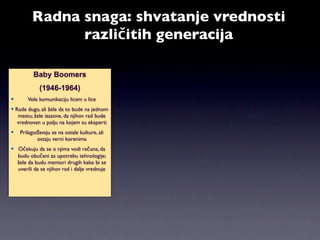
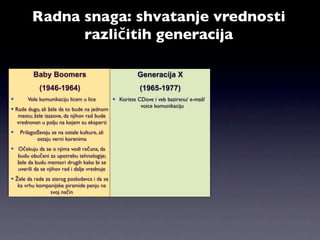
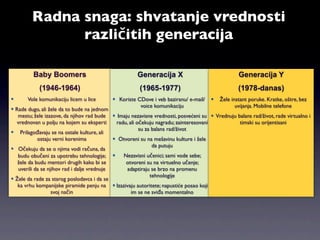
Radna snaga: shvatanjevrednosti
različitih generacija
Baby Boomers
(1946-1964)
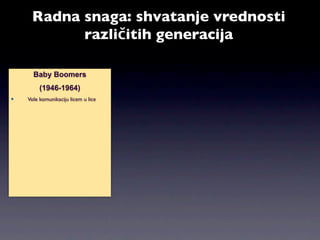
Vole komunikaciju licem u lice
87.
Radna snaga: shvatanjevrednosti
različitih generacija
Baby Boomers
(1946-1964)
Vole komunikaciju licem u lice
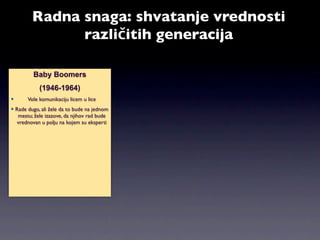
Rade dugo, ali žele da to bude na jednom
mestu; žele izazove, da njihov rad bude
vrednovan u polju na kojem su eksperti
88.
Radna snaga: shvatanjevrednosti
različitih generacija
Baby Boomers
(1946-1964)
Vole komunikaciju licem u lice
Rade dugo, ali žele da to bude na jednom
mestu; žele izazove, da njihov rad bude
vrednovan u polju na kojem su eksperti
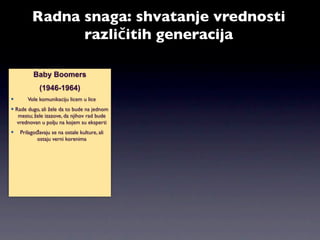
Prilagođavaju se na ostale kulture, ali
ostaju verni korenima
89.
Radna snaga: shvatanjevrednosti
različitih generacija
Baby Boomers
(1946-1964)
Vole komunikaciju licem u lice
Rade dugo, ali žele da to bude na jednom
mestu; žele izazove, da njihov rad bude
vrednovan u polju na kojem su eksperti
Prilagođavaju se na ostale kulture, ali
ostaju verni korenima
Očekuju da se o njima vodi računa, da
budu obučeni za upotrebu tehnologije;
žele da budu mentori drugih kako bi se
uverili da se njihov rad i dalje vrednuje
90.
Radna snaga: shvatanjevrednosti
različitih generacija
Baby Boomers
(1946-1964)
Vole komunikaciju licem u lice
Rade dugo, ali žele da to bude na jednom
mestu; žele izazove, da njihov rad bude
vrednovan u polju na kojem su eksperti
Prilagođavaju se na ostale kulture, ali
ostaju verni korenima
Očekuju da se o njima vodi računa, da
budu obučeni za upotrebu tehnologije;
žele da budu mentori drugih kako bi se
uverili da se njihov rad i dalje vrednuje
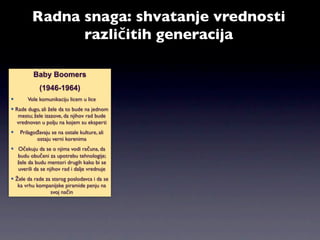
Žele da rade za starog poslodavca i da se
ka vrhu kompanijske piramide penju na
svoj način
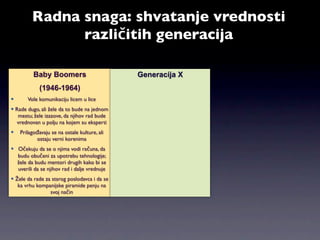
91.
Radna snaga: shvatanjevrednosti
različitih generacija
Baby Boomers Generacija X
(1946-1964)
Vole komunikaciju licem u lice
Rade dugo, ali žele da to bude na jednom
mestu; žele izazove, da njihov rad bude
vrednovan u polju na kojem su eksperti
Prilagođavaju se na ostale kulture, ali
ostaju verni korenima
Očekuju da se o njima vodi računa, da
budu obučeni za upotrebu tehnologije;
žele da budu mentori drugih kako bi se
uverili da se njihov rad i dalje vrednuje
Žele da rade za starog poslodavca i da se
ka vrhu kompanijske piramide penju na
svoj način
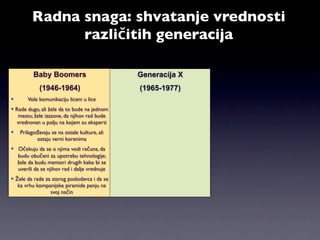
92.
Radna snaga: shvatanjevrednosti
različitih generacija
Baby Boomers Generacija X
(1946-1964) (1965-1977)
Vole komunikaciju licem u lice
Rade dugo, ali žele da to bude na jednom
mestu; žele izazove, da njihov rad bude
vrednovan u polju na kojem su eksperti
Prilagođavaju se na ostale kulture, ali
ostaju verni korenima
Očekuju da se o njima vodi računa, da
budu obučeni za upotrebu tehnologije;
žele da budu mentori drugih kako bi se
uverili da se njihov rad i dalje vrednuje
Žele da rade za starog poslodavca i da se
ka vrhu kompanijske piramide penju na
svoj način
93.
Radna snaga: shvatanjevrednosti
različitih generacija
Baby Boomers Generacija X
(1946-1964) (1965-1977)
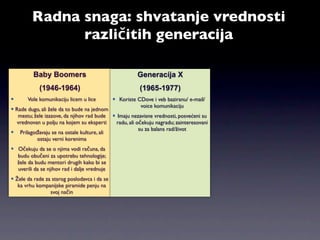
Vole komunikaciju licem u lice Koriste CDove i veb baziranu/ e-mail/
voice komunikaciju
Rade dugo, ali žele da to bude na jednom
mestu; žele izazove, da njihov rad bude
vrednovan u polju na kojem su eksperti
Prilagođavaju se na ostale kulture, ali
ostaju verni korenima
Očekuju da se o njima vodi računa, da
budu obučeni za upotrebu tehnologije;
žele da budu mentori drugih kako bi se
uverili da se njihov rad i dalje vrednuje
Žele da rade za starog poslodavca i da se
ka vrhu kompanijske piramide penju na
svoj način
94.
Radna snaga: shvatanjevrednosti
različitih generacija
Baby Boomers Generacija X
(1946-1964) (1965-1977)
Vole komunikaciju licem u lice Koriste CDove i veb baziranu/ e-mail/
voice komunikaciju
Rade dugo, ali žele da to bude na jednom
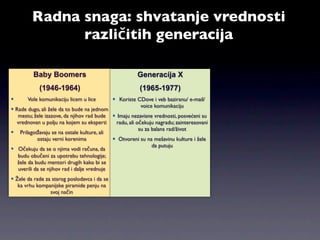
mestu; žele izazove, da njihov rad bude Imaju nezavisne vrednosti, posvećeni su
vrednovan u polju na kojem su eksperti radu, ali očekuju nagradu; zainteresovani
su za balans rad/život
Prilagođavaju se na ostale kulture, ali
ostaju verni korenima
Očekuju da se o njima vodi računa, da
budu obučeni za upotrebu tehnologije;
žele da budu mentori drugih kako bi se
uverili da se njihov rad i dalje vrednuje
Žele da rade za starog poslodavca i da se
ka vrhu kompanijske piramide penju na
svoj način
95.
Radna snaga: shvatanjevrednosti
različitih generacija
Baby Boomers Generacija X
(1946-1964) (1965-1977)
Vole komunikaciju licem u lice Koriste CDove i veb baziranu/ e-mail/
voice komunikaciju
Rade dugo, ali žele da to bude na jednom
mestu; žele izazove, da njihov rad bude Imaju nezavisne vrednosti, posvećeni su
vrednovan u polju na kojem su eksperti radu, ali očekuju nagradu; zainteresovani
su za balans rad/život
Prilagođavaju se na ostale kulture, ali
ostaju verni korenima Otvoreni su na mešavinu kulture i žele
da putuju
Očekuju da se o njima vodi računa, da
budu obučeni za upotrebu tehnologije;
žele da budu mentori drugih kako bi se
uverili da se njihov rad i dalje vrednuje
Žele da rade za starog poslodavca i da se
ka vrhu kompanijske piramide penju na
svoj način
96.
Radna snaga: shvatanjevrednosti
različitih generacija
Baby Boomers Generacija X
(1946-1964) (1965-1977)
Vole komunikaciju licem u lice Koriste CDove i veb baziranu/ e-mail/
voice komunikaciju
Rade dugo, ali žele da to bude na jednom
mestu; žele izazove, da njihov rad bude Imaju nezavisne vrednosti, posvećeni su
vrednovan u polju na kojem su eksperti radu, ali očekuju nagradu; zainteresovani
su za balans rad/život
Prilagođavaju se na ostale kulture, ali
ostaju verni korenima Otvoreni su na mešavinu kulture i žele
da putuju
Očekuju da se o njima vodi računa, da
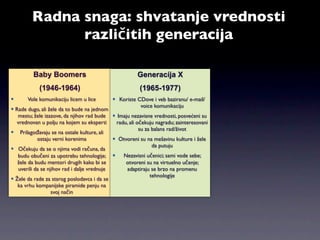
budu obučeni za upotrebu tehnologije; Nezavisni učenici; sami vode sebe;
žele da budu mentori drugih kako bi se otvoreni su na virtuelno učenje;
uverili da se njihov rad i dalje vrednuje adaptiraju se brzo na promenu
tehnologije
Žele da rade za starog poslodavca i da se
ka vrhu kompanijske piramide penju na
svoj način
97.
Radna snaga: shvatanjevrednosti
različitih generacija
Baby Boomers Generacija X
(1946-1964) (1965-1977)
Vole komunikaciju licem u lice Koriste CDove i veb baziranu/ e-mail/
voice komunikaciju
Rade dugo, ali žele da to bude na jednom
mestu; žele izazove, da njihov rad bude Imaju nezavisne vrednosti, posvećeni su
vrednovan u polju na kojem su eksperti radu, ali očekuju nagradu; zainteresovani
su za balans rad/život
Prilagođavaju se na ostale kulture, ali
ostaju verni korenima Otvoreni su na mešavinu kulture i žele
da putuju
Očekuju da se o njima vodi računa, da
budu obučeni za upotrebu tehnologije; Nezavisni učenici; sami vode sebe;
žele da budu mentori drugih kako bi se otvoreni su na virtuelno učenje;
uverili da se njihov rad i dalje vrednuje adaptiraju se brzo na promenu
tehnologije
Žele da rade za starog poslodavca i da se
ka vrhu kompanijske piramide penju na Izazivaju autoritete; napustiće posao koji
svoj način im se ne sviđa momentalno
98.
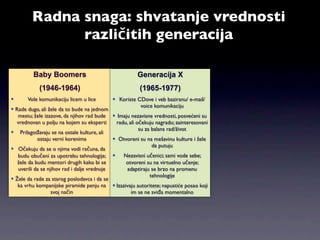
Radna snaga: shvatanjevrednosti
različitih generacija
Baby Boomers Generacija X Generacija Y
(1946-1964) (1965-1977)
Vole komunikaciju licem u lice Koriste CDove i veb baziranu/ e-mail/
voice komunikaciju
Rade dugo, ali žele da to bude na jednom
mestu; žele izazove, da njihov rad bude Imaju nezavisne vrednosti, posvećeni su
vrednovan u polju na kojem su eksperti radu, ali očekuju nagradu; zainteresovani
su za balans rad/život
Prilagođavaju se na ostale kulture, ali
ostaju verni korenima Otvoreni su na mešavinu kulture i žele
da putuju
Očekuju da se o njima vodi računa, da
budu obučeni za upotrebu tehnologije; Nezavisni učenici; sami vode sebe;
žele da budu mentori drugih kako bi se otvoreni su na virtuelno učenje;
uverili da se njihov rad i dalje vrednuje adaptiraju se brzo na promenu
tehnologije
Žele da rade za starog poslodavca i da se
ka vrhu kompanijske piramide penju na Izazivaju autoritete; napustiće posao koji
svoj način im se ne sviđa momentalno
99.
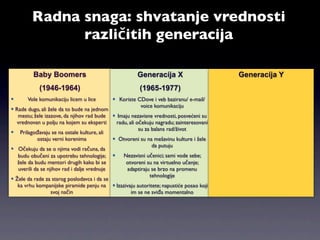
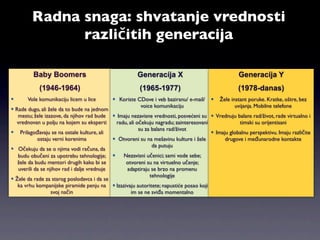
Radna snaga: shvatanjevrednosti
različitih generacija
Baby Boomers Generacija X Generacija Y
(1946-1964) (1965-1977) (1978-danas)
Vole komunikaciju licem u lice Koriste CDove i veb baziranu/ e-mail/
voice komunikaciju
Rade dugo, ali žele da to bude na jednom
mestu; žele izazove, da njihov rad bude Imaju nezavisne vrednosti, posvećeni su
vrednovan u polju na kojem su eksperti radu, ali očekuju nagradu; zainteresovani
su za balans rad/život
Prilagođavaju se na ostale kulture, ali
ostaju verni korenima Otvoreni su na mešavinu kulture i žele
da putuju
Očekuju da se o njima vodi računa, da
budu obučeni za upotrebu tehnologije; Nezavisni učenici; sami vode sebe;
žele da budu mentori drugih kako bi se otvoreni su na virtuelno učenje;
uverili da se njihov rad i dalje vrednuje adaptiraju se brzo na promenu
tehnologije
Žele da rade za starog poslodavca i da se
ka vrhu kompanijske piramide penju na Izazivaju autoritete; napustiće posao koji
svoj način im se ne sviđa momentalno
100.
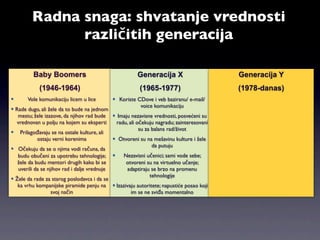
Radna snaga: shvatanjevrednosti
različitih generacija
Baby Boomers Generacija X Generacija Y
(1946-1964) (1965-1977) (1978-danas)
Vole komunikaciju licem u lice Koriste CDove i veb baziranu/ e-mail/ Žele instant poruke. Kratke, oštre, bez
voice komunikaciju uvijanja. Mobilne telefone
Rade dugo, ali žele da to bude na jednom
mestu; žele izazove, da njihov rad bude Imaju nezavisne vrednosti, posvećeni su
vrednovan u polju na kojem su eksperti radu, ali očekuju nagradu; zainteresovani
su za balans rad/život
Prilagođavaju se na ostale kulture, ali
ostaju verni korenima Otvoreni su na mešavinu kulture i žele
da putuju
Očekuju da se o njima vodi računa, da
budu obučeni za upotrebu tehnologije; Nezavisni učenici; sami vode sebe;
žele da budu mentori drugih kako bi se otvoreni su na virtuelno učenje;
uverili da se njihov rad i dalje vrednuje adaptiraju se brzo na promenu
tehnologije
Žele da rade za starog poslodavca i da se
ka vrhu kompanijske piramide penju na Izazivaju autoritete; napustiće posao koji
svoj način im se ne sviđa momentalno
101.
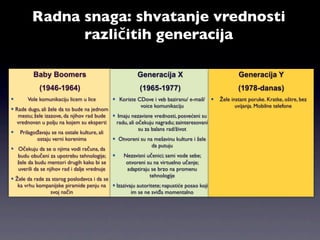
Radna snaga: shvatanjevrednosti
različitih generacija
Baby Boomers Generacija X Generacija Y
(1946-1964) (1965-1977) (1978-danas)
Vole komunikaciju licem u lice Koriste CDove i veb baziranu/ e-mail/ Žele instant poruke. Kratke, oštre, bez
voice komunikaciju uvijanja. Mobilne telefone
Rade dugo, ali žele da to bude na jednom
mestu; žele izazove, da njihov rad bude Imaju nezavisne vrednosti, posvećeni su Vrednuju balans rad/život, rade virtualno i
vrednovan u polju na kojem su eksperti radu, ali očekuju nagradu; zainteresovani timski su orijentisani
su za balans rad/život
Prilagođavaju se na ostale kulture, ali
ostaju verni korenima Otvoreni su na mešavinu kulture i žele
da putuju
Očekuju da se o njima vodi računa, da
budu obučeni za upotrebu tehnologije; Nezavisni učenici; sami vode sebe;
žele da budu mentori drugih kako bi se otvoreni su na virtuelno učenje;
uverili da se njihov rad i dalje vrednuje adaptiraju se brzo na promenu
tehnologije
Žele da rade za starog poslodavca i da se
ka vrhu kompanijske piramide penju na Izazivaju autoritete; napustiće posao koji
svoj način im se ne sviđa momentalno
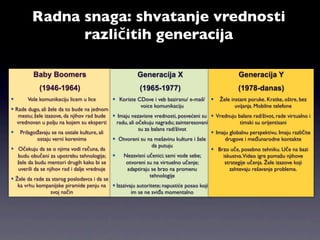
102.
Radna snaga: shvatanjevrednosti
različitih generacija
Baby Boomers Generacija X Generacija Y
(1946-1964) (1965-1977) (1978-danas)
Vole komunikaciju licem u lice Koriste CDove i veb baziranu/ e-mail/ Žele instant poruke. Kratke, oštre, bez
voice komunikaciju uvijanja. Mobilne telefone
Rade dugo, ali žele da to bude na jednom
mestu; žele izazove, da njihov rad bude Imaju nezavisne vrednosti, posvećeni su Vrednuju balans rad/život, rade virtualno i
vrednovan u polju na kojem su eksperti radu, ali očekuju nagradu; zainteresovani timski su orijentisani
su za balans rad/život
Prilagođavaju se na ostale kulture, ali Imaju globalnu perspektivu. Imaju različite
ostaju verni korenima Otvoreni su na mešavinu kulture i žele drugove i međunarodne kontakte
da putuju
Očekuju da se o njima vodi računa, da
budu obučeni za upotrebu tehnologije; Nezavisni učenici; sami vode sebe;
žele da budu mentori drugih kako bi se otvoreni su na virtuelno učenje;
uverili da se njihov rad i dalje vrednuje adaptiraju se brzo na promenu
tehnologije
Žele da rade za starog poslodavca i da se
ka vrhu kompanijske piramide penju na Izazivaju autoritete; napustiće posao koji
svoj način im se ne sviđa momentalno
103.
Radna snaga: shvatanjevrednosti
različitih generacija
Baby Boomers Generacija X Generacija Y
(1946-1964) (1965-1977) (1978-danas)
Vole komunikaciju licem u lice Koriste CDove i veb baziranu/ e-mail/ Žele instant poruke. Kratke, oštre, bez
voice komunikaciju uvijanja. Mobilne telefone
Rade dugo, ali žele da to bude na jednom
mestu; žele izazove, da njihov rad bude Imaju nezavisne vrednosti, posvećeni su Vrednuju balans rad/život, rade virtualno i
vrednovan u polju na kojem su eksperti radu, ali očekuju nagradu; zainteresovani timski su orijentisani
su za balans rad/život
Prilagođavaju se na ostale kulture, ali Imaju globalnu perspektivu. Imaju različite
ostaju verni korenima Otvoreni su na mešavinu kulture i žele drugove i međunarodne kontakte
da putuju
Očekuju da se o njima vodi računa, da Brzo uče, posebno tehniku. Uče na bazi
budu obučeni za upotrebu tehnologije; Nezavisni učenici; sami vode sebe; iskustva.Video igre pomažu njihove
žele da budu mentori drugih kako bi se otvoreni su na virtuelno učenje; strategije učenja. Žele izazove koji
uverili da se njihov rad i dalje vrednuje adaptiraju se brzo na promenu zahtevaju rešavanje problema.
tehnologije
Žele da rade za starog poslodavca i da se
ka vrhu kompanijske piramide penju na Izazivaju autoritete; napustiće posao koji
svoj način im se ne sviđa momentalno
104.
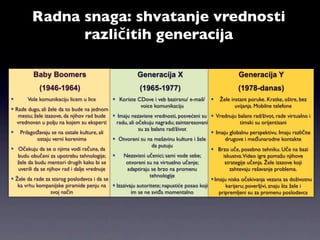
Radna snaga: shvatanjevrednosti
različitih generacija
Baby Boomers Generacija X Generacija Y
(1946-1964) (1965-1977) (1978-danas)
Vole komunikaciju licem u lice Koriste CDove i veb baziranu/ e-mail/ Žele instant poruke. Kratke, oštre, bez
voice komunikaciju uvijanja. Mobilne telefone
Rade dugo, ali žele da to bude na jednom
mestu; žele izazove, da njihov rad bude Imaju nezavisne vrednosti, posvećeni su Vrednuju balans rad/život, rade virtualno i
vrednovan u polju na kojem su eksperti radu, ali očekuju nagradu; zainteresovani timski su orijentisani
su za balans rad/život
Prilagođavaju se na ostale kulture, ali Imaju globalnu perspektivu. Imaju različite
ostaju verni korenima Otvoreni su na mešavinu kulture i žele drugove i međunarodne kontakte
da putuju
Očekuju da se o njima vodi računa, da Brzo uče, posebno tehniku. Uče na bazi
budu obučeni za upotrebu tehnologije; Nezavisni učenici; sami vode sebe; iskustva.Video igre pomažu njihove
žele da budu mentori drugih kako bi se otvoreni su na virtuelno učenje; strategije učenja. Žele izazove koji
uverili da se njihov rad i dalje vrednuje adaptiraju se brzo na promenu zahtevaju rešavanje problema.
tehnologije
Žele da rade za starog poslodavca i da se Imaju niska očekivanja vezana za doživotnu
ka vrhu kompanijske piramide penju na Izazivaju autoritete; napustiće posao koji karijeru; poverljivi, znaju šta žele i
svoj način im se ne sviđa momentalno pripremljeni su za promenu poslodavca
110.
Što duže živim,to više osećam, da sve ono
što je bilo dobro za naše očeve, nije više
dobro za nas
Oscar Wilde (1854-1900)
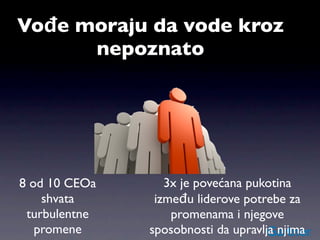
Vođe moraju davode kroz
nepoznato
8 od 10 CEOa 3x je povećana pukotina
shvata između liderove potrebe za
turbulentne promenama i njegove
promene sposobnosti da upravlja njima
174.
PONOVNO ZAMIŠLJANJE
IT
POSLOVANJE POSTMODERNE
POJEDNOSTAVLJIVANJE
KREATIVNA DESTRUKCIJA
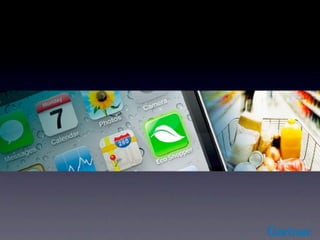
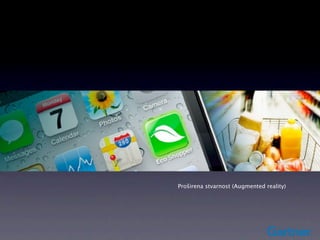
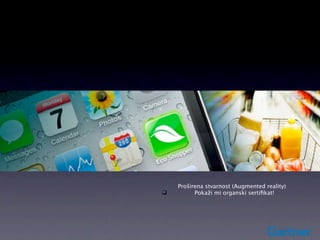
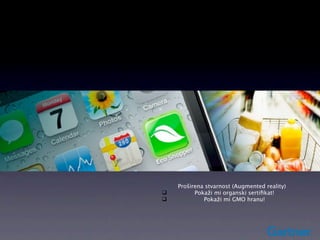
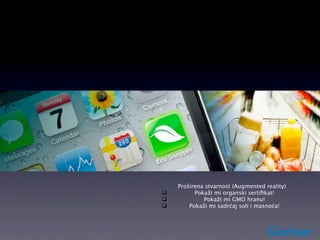
Proširena stvarnost (Augmentedreality)
Pokaži mi organski sertifikat!
Pokaži mi GMO hranu!
Pokaži mi sadrćaj soli i masnoća!
230.
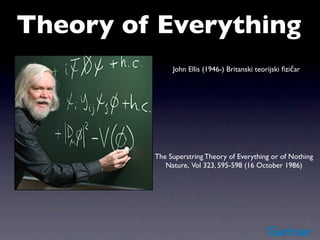
Theory of Everything
John Ellis (1946-) Britanski teorijski fizičar
The Superstring Theory of Everything or of Nothing
Nature, Vol 323, 595-598 (16 October 1986)
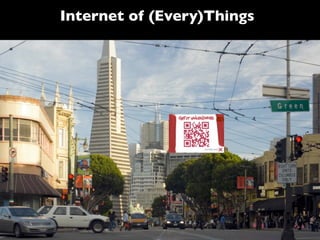
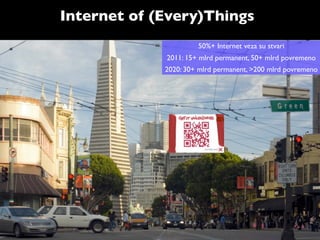
Internet of (Every)Things
50%+ Internet veza su stvari
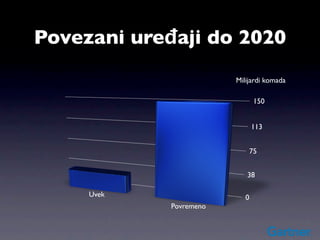
2011: 15+ mlrd permanent, 50+ mlrd povremeno
2020: 30+ mlrd permanent, >200 mlrd povremeno
233.
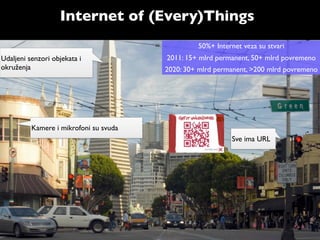
Internet of (Every)Things
50%+ Internet veza su stvari
Udaljeni senzori objekata i 2011: 15+ mlrd permanent, 50+ mlrd povremeno
okruženja 2020: 30+ mlrd permanent, >200 mlrd povremeno
Kamere i mikrofoni su svuda
Sve ima URL
234.
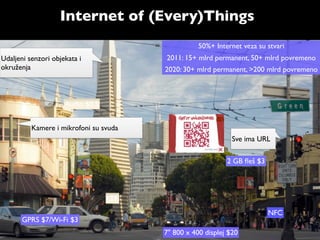
Internet of (Every)Things
50%+ Internet veza su stvari
Udaljeni senzori objekata i 2011: 15+ mlrd permanent, 50+ mlrd povremeno
okruženja 2020: 30+ mlrd permanent, >200 mlrd povremeno
Audio $0.5
Kamere i mikrofoni su svuda
Sve ima URL
2 GB fleš $3
LTE
NFC
GPRS $7/Wi-Fi $3
7" 800 x 400 displej $20
235.
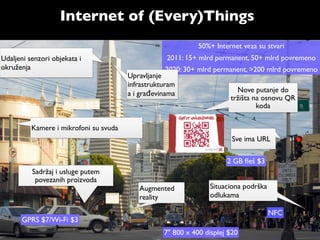
Internet of (Every)Things
50%+ Internet veza su stvari
Udaljeni senzori objekata i 2011: 15+ mlrd permanent, 50+ mlrd povremeno
okruženja 2020: 30+ mlrd permanent, >200 mlrd povremeno
Upravljanje
infrastrukturam
a i građevinama Nove putanje do
tržišta na osnovu QR
Audio $0.5 koda
Kamere i mikrofoni su svuda
Sve ima URL
2 GB fleš $3
Sadržaj i usluge putem
povezanih proizvoda
Augmented Situaciona podrška
LTE reality odlukama
NFC
GPRS $7/Wi-Fi $3
7" 800 x 400 displej $20
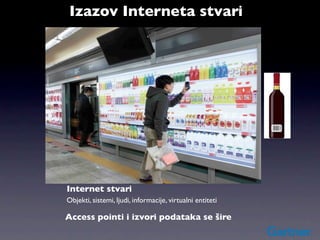
Izazov Interneta stvari
Internetstvari
Objekti, sistemi, ljudi, informacije, virtualni entiteti
Access pointi i izvori podataka se šire
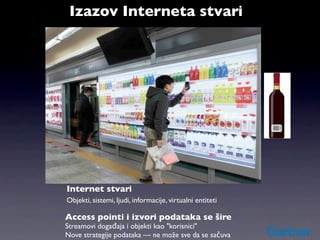
238.
Izazov Interneta stvari
Internetstvari
Objekti, sistemi, ljudi, informacije, virtualni entiteti
Access pointi i izvori podataka se šire
Streamovi događaja i objekti kao "korisnici"
Nove strategije podataka — ne može sve da se sačuva
239.
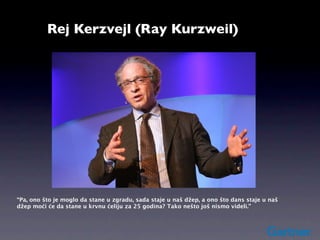
Rej Kerzvejl (RayKurzweil)
“Pa, ono što je moglo da stane u zgradu, sada staje u naš džep, a ono što dans staje u naš
džep moći će da stane u krvnu ćeliju za 25 godina? Tako nešto još nismo videli.”
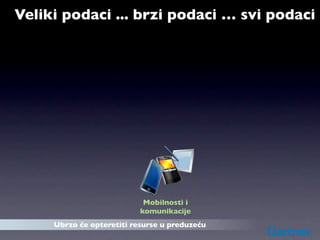
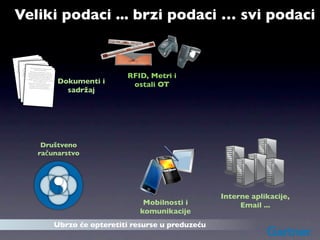
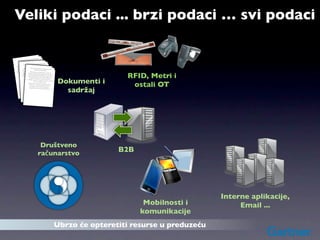
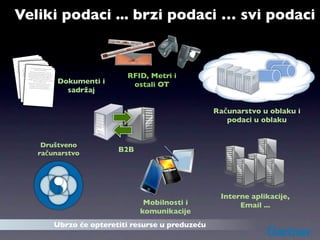
Veliki podaci ...brzi podaci … svi podaci
Ubrzo će opteretiti resurse u preduzeću
279.
Veliki podaci ...brzi podaci … svi podaci
Mobilnosti i
komunikacije
Ubrzo će opteretiti resurse u preduzeću
280.
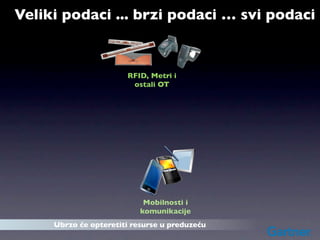
Veliki podaci ...brzi podaci … svi podaci
RFID, Metri i
ostali OT
Mobilnosti i
komunikacije
Ubrzo će opteretiti resurse u preduzeću
281.
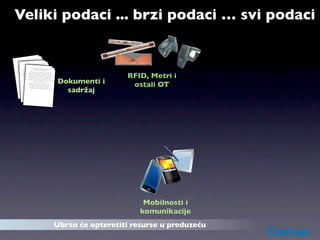
Veliki podaci ...brzi podaci … svi podaci
d
seball an
ckey, ba
aying ho s.
I like pl mountain
climbing th
ns in Nor at
civilizatio arvels th all and
baseb
I nt playi rin hockey,
The ancie like gineeng g m use
had en climbing mounca .s ce betains
America and Gree 700 year
d Rome t h
ancie ntabou ations in Nort
surpasse The the "0I"like playing hockn
civiliz "golde ey,
they invented discovered the g marvr baseball and
eerin theiels that
America had engin climbing mountains.
ey also aspect of ce because
eelier. Thsurpassed everyanci Gree
prove Rome The
and
RFID, Metri i
to im ring. ent civil 700 years
t
mean" they invented the had abou izations in North
Americ "0" eng ew "golden
enginee a
ed in N
discovered the
ineering marvels
eelier. They y invent Rom but t of their
all also
surpasse that
was actu improve dn food and e
every aspec
Pizzamean" tothey invented at, Greece because
Italia
y. It is not th "0" about
the
York cit N only
engineering.
Dokumenti i
earl ot
n food. ier. The China. in New
700 years
America wasinvented in y also discovered the
actually invented
"golden mean"
Pizzawas
i to n food but
spaghett city. It is not Italiaimprove every aspect
ostali OT
York of their engineethat, .
rican was Not only
AmePizza food.actu
ring
ted in China. in New
ally invented
spaghetti was inven
York city. It is
not Italian food
but
sadržaj
American food
. Not only that
spaghetti was ,
invented in Chin
a.
Mobilnosti i
komunikacije
Ubrzo će opteretiti resurse u preduzeću
282.
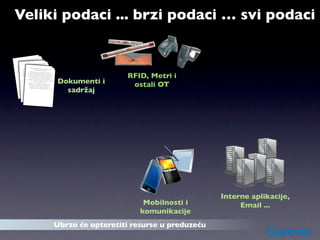
Veliki podaci ...brzi podaci … svi podaci
d
seball an
ckey, ba
aying ho s.
I like pl mountain
climbing th
ns in Nor at
civilizatio arvels th all and
baseb
I nt playi rin hockey,
The ancie like gineeng g m use
had en climbing mounca .s ce betains
America and Gree 700 year
d Rome t h
ancie ntabou ations in Nort
surpasse The the "0I"like playing hockn
civiliz "golde ey,
they invented discovered the g marvr baseball and
eerin theiels that
America had engin climbing mountains.
ey also aspect of ce because
eelier. Thsurpassed everyanci Gree
prove Rome The
and
RFID, Metri i
to im ring. ent civil 700 years
t
mean" they invented the had abou izations in North
Americ "0" eng ew "golden
enginee a
ed in N
discovered the
ineering marvels
eelier. They y invent Rom but t of their
all also
surpasse that
was actu improve dn food and e
every aspec
Pizzamean" tothey invented at, Greece because
Italia
y. It is not th "0" about
the
York cit N only
engineering.
Dokumenti i
earl ot
n food. ier. The China. in New
700 years
America wasinvented in y also discovered the
actually invented
"golden mean"
Pizzawas
i to n food but
spaghett city. It is not Italiaimprove every aspect
ostali OT
York of their engineethat, .
rican was Not only
AmePizza food.actu
ring
ted in China. in New
ally invented
spaghetti was inven
York city. It is
not Italian food
but
sadržaj
American food
. Not only that
spaghetti was ,
invented in Chin
a.
Interne aplikacije,
Mobilnosti i Email ...
komunikacije
Ubrzo će opteretiti resurse u preduzeću
283.
Veliki podaci ...brzi podaci … svi podaci
d
seball an
ckey, ba
aying ho s.
I like pl mountain
climbing th
ns in Nor at
civilizatio arvels th all and
baseb
I nt playi rin hockey,
The ancie like gineeng g m use
had en climbing mounca .s ce betains
America and Gree 700 year
d Rome t h
ancie ntabou ations in Nort
surpasse The the "0I"like playing hockn
civiliz "golde ey,
they invented discovered the g marvr baseball and
eerin theiels that
America had engin climbing mountains.
ey also aspect of ce because
eelier. Thsurpassed everyanci Gree
prove Rome The
and
RFID, Metri i
to im ring. ent civil 700 years
t
mean" they invented the had abou izations in North
Americ "0" eng ew "golden
enginee a
ed in N
discovered the
ineering marvels
eelier. They y invent Rom but t of their
all also
surpasse that
was actu improve dn food and e
every aspec
Pizzamean" tothey invented at, Greece because
Italia
y. It is not th "0" about
the
York cit N only
engineering.
Dokumenti i
earl ot
n food. ier. The China. in New
700 years
America wasinvented in y also discovered the
actually invented
"golden mean"
Pizzawas
i to n food but
spaghett city. It is not Italiaimprove every aspect
ostali OT
York of their engineethat, .
rican was Not only
AmePizza food.actu
ring
ted in China. in New
ally invented
spaghetti was inven
York city. It is
not Italian food
but
sadržaj
American food
. Not only that
spaghetti was ,
invented in Chin
a.
Društveno
računarstvo
Interne aplikacije,
Mobilnosti i Email ...
komunikacije
Ubrzo će opteretiti resurse u preduzeću
284.
Veliki podaci ...brzi podaci … svi podaci
d
seball an
ckey, ba
aying ho s.
I like pl mountain
climbing th
ns in Nor at
civilizatio arvels th all and
baseb
I nt playi rin hockey,
The ancie like gineeng g m use
had en climbing mounca .s ce betains
America and Gree 700 year
d Rome t h
ancie ntabou ations in Nort
surpasse The the "0I"like playing hockn
civiliz "golde ey,
they invented discovered the g marvr baseball and
eerin theiels that
America had engin climbing mountains.
ey also aspect of ce because
eelier. Thsurpassed everyanci Gree
prove Rome The
and
RFID, Metri i
to im ring. ent civil 700 years
t
mean" they invented the had abou izations in North
Americ "0" eng ew "golden
enginee a
ed in N
discovered the
ineering marvels
eelier. They y invent Rom but t of their
all also
surpasse that
was actu improve dn food and e
every aspec
Pizzamean" tothey invented at, Greece because
Italia
y. It is not th "0" about
the
York cit N only
engineering.
Dokumenti i
earl ot
n food. ier. The China. in New
700 years
America wasinvented in y also discovered the
actually invented
"golden mean"
Pizzawas
i to n food but
spaghett city. It is not Italiaimprove every aspect
ostali OT
York of their engineethat, .
rican was Not only
AmePizza food.actu
ring
ted in China. in New
ally invented
spaghetti was inven
York city. It is
not Italian food
but
sadržaj
American food
. Not only that
spaghetti was ,
invented in Chin
a.
Društveno
računarstvo
B2B
Interne aplikacije,
Mobilnosti i Email ...
komunikacije
Ubrzo će opteretiti resurse u preduzeću
285.
Veliki podaci ...brzi podaci … svi podaci
d
seball an
ckey, ba
aying ho s.
I like pl mountain
climbing th
ns in Nor at
civilizatio arvels th all and
baseb
I nt playi rin hockey,
The ancie like gineeng g m use
had en climbing mounca .s ce betains
America and Gree 700 year
d Rome t h
ancie ntabou ations in Nort
surpasse The the "0I"like playing hockn
civiliz "golde ey,
they invented discovered the g marvr baseball and
eerin theiels that
America had engin climbing mountains.
ey also aspect of ce because
eelier. Thsurpassed everyanci Gree
prove Rome The
and
RFID, Metri i
to im ring. ent civil 700 years
t
mean" they invented the had abou izations in North
Americ "0" eng ew "golden
enginee a
ed in N
discovered the
ineering marvels
eelier. They y invent Rom but t of their
all also
surpasse that
was actu improve dn food and e
every aspec
Pizzamean" tothey invented at, Greece because
Italia
y. It is not th "0" about
the
York cit N only
engineering.
Dokumenti i
earl ot
n food. ier. The China. in New
700 years
America wasinvented in y also discovered the
actually invented
"golden mean"
Pizzawas
i to n food but
spaghett city. It is not Italiaimprove every aspect
ostali OT
York of their engineethat, .
rican was Not only
AmePizza food.actu
ring
ted in China. in New
ally invented
spaghetti was inven
York city. It is
not Italian food
but
sadržaj
American food
. Not only that
spaghetti was ,
invented in Chin
a.
Računarstvo u oblaku i
podaci u oblaku
Društveno
računarstvo
B2B
Interne aplikacije,
Mobilnosti i Email ...
komunikacije
Ubrzo će opteretiti resurse u preduzeću
286.
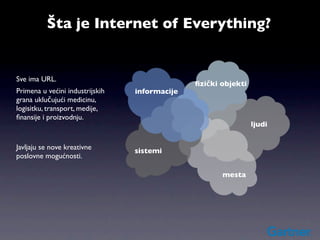
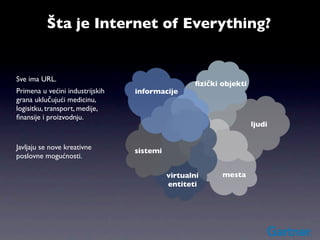
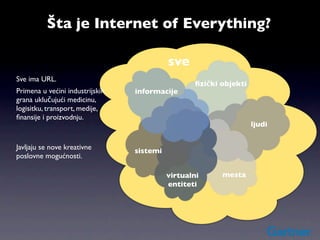
Šta je Internetof Everything?
Sve ima URL.
Primena u većini industrijskih
grana uklučujući medicinu,
logisitku, transport, medije,
finansije i proizvodnju.
Javljaju se nove kreativne
poslovne mogućnosti.
287.
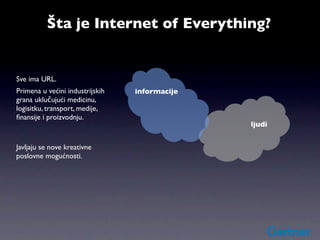
Šta je Internetof Everything?
Sve ima URL.
Primena u većini industrijskih informacije
grana uklučujući medicinu,
logisitku, transport, medije,
finansije i proizvodnju.
Javljaju se nove kreativne
poslovne mogućnosti.
288.
Šta je Internetof Everything?
Sve ima URL.
Primena u većini industrijskih informacije
grana uklučujući medicinu,
logisitku, transport, medije,
finansije i proizvodnju.
ljudi
Javljaju se nove kreativne
poslovne mogućnosti.
289.
Šta je Internetof Everything?
Sve ima URL.
Primena u većini industrijskih informacije
grana uklučujući medicinu,
logisitku, transport, medije,
finansije i proizvodnju.
ljudi
Javljaju se nove kreativne
poslovne mogućnosti.
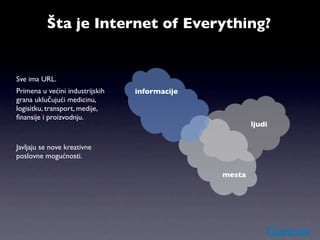
mesta
290.
Šta je Internetof Everything?
Sve ima URL.
Primena u većini industrijskih informacije
grana uklučujući medicinu,
logisitku, transport, medije,
finansije i proizvodnju.
ljudi
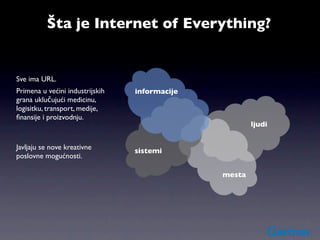
Javljaju se nove kreativne sistemi
poslovne mogućnosti.
mesta
291.
Šta je Internetof Everything?
Sve ima URL.
fizički objekti
Primena u većini industrijskih informacije
grana uklučujući medicinu,
logisitku, transport, medije,
finansije i proizvodnju.
ljudi
Javljaju se nove kreativne sistemi
poslovne mogućnosti.
mesta
292.
Šta je Internetof Everything?
Sve ima URL.
fizički objekti
Primena u većini industrijskih informacije
grana uklučujući medicinu,
logisitku, transport, medije,
finansije i proizvodnju.
ljudi
Javljaju se nove kreativne sistemi
poslovne mogućnosti.
virtualni mesta
entiteti
293.
Šta je Internetof Everything?
sve
Sve ima URL.
fizički objekti
Primena u većini industrijskih informacije
grana uklučujući medicinu,
logisitku, transport, medije,
finansije i proizvodnju.
ljudi
Javljaju se nove kreativne sistemi
poslovne mogućnosti.
virtualni mesta
entiteti
#22 Key Issue: What are CEOs' views on their CIOs' current and next positions?\nWe ran this question in a form that was very close to this year's EXP CIO survey in order to compare and contrast for differences of opinion and expectation. Though the detail comparison analysis is not complete, it appears that responses from CEOs and CIOs were in fact quite well aligned.\nA few of points to note:\n About a quarter of CIOs come from a business background. Here we see about a fifth of CEOs anticipating their CIO moving on to a business leadership role internally. It's likely this represents the cycling of business background people through the CIO position and that relatively few IT background CIOs are seen by their CEOs as internal business leaders next.\n In total, 40% of CEOs see their CIO as moving to a CIO in another company in a different industry. This suggest many see the role as an industry agnostic, itinerant professional and that makes it much less likely to be a closely held relationship.\n Only one CEO out of 229 thinks their CIO could be his or her successor. We may be at the apex of the information age but CIO is not a strong CXO route to the top job. \n
#23 Key Issue: What are CEOs' views on their CIOs' current and next positions?\nWe ran this question in a form that was very close to this year's EXP CIO survey in order to compare and contrast for differences of opinion and expectation. Though the detail comparison analysis is not complete, it appears that responses from CEOs and CIOs were in fact quite well aligned.\nA few of points to note:\n About a quarter of CIOs come from a business background. Here we see about a fifth of CEOs anticipating their CIO moving on to a business leadership role internally. It's likely this represents the cycling of business background people through the CIO position and that relatively few IT background CIOs are seen by their CEOs as internal business leaders next.\n In total, 40% of CEOs see their CIO as moving to a CIO in another company in a different industry. This suggest many see the role as an industry agnostic, itinerant professional and that makes it much less likely to be a closely held relationship.\n Only one CEO out of 229 thinks their CIO could be his or her successor. We may be at the apex of the information age but CIO is not a strong CXO route to the top job. \n
#24 Key Issue: What are CEOs' views on their CIOs' current and next positions?\nWe ran this question in a form that was very close to this year's EXP CIO survey in order to compare and contrast for differences of opinion and expectation. Though the detail comparison analysis is not complete, it appears that responses from CEOs and CIOs were in fact quite well aligned.\nA few of points to note:\n About a quarter of CIOs come from a business background. Here we see about a fifth of CEOs anticipating their CIO moving on to a business leadership role internally. It's likely this represents the cycling of business background people through the CIO position and that relatively few IT background CIOs are seen by their CEOs as internal business leaders next.\n In total, 40% of CEOs see their CIO as moving to a CIO in another company in a different industry. This suggest many see the role as an industry agnostic, itinerant professional and that makes it much less likely to be a closely held relationship.\n Only one CEO out of 229 thinks their CIO could be his or her successor. We may be at the apex of the information age but CIO is not a strong CXO route to the top job. \n
#25 Key Issue: What are CEOs' views on their CIOs' current and next positions?\nWe ran this question in a form that was very close to this year's EXP CIO survey in order to compare and contrast for differences of opinion and expectation. Though the detail comparison analysis is not complete, it appears that responses from CEOs and CIOs were in fact quite well aligned.\nA few of points to note:\n About a quarter of CIOs come from a business background. Here we see about a fifth of CEOs anticipating their CIO moving on to a business leadership role internally. It's likely this represents the cycling of business background people through the CIO position and that relatively few IT background CIOs are seen by their CEOs as internal business leaders next.\n In total, 40% of CEOs see their CIO as moving to a CIO in another company in a different industry. This suggest many see the role as an industry agnostic, itinerant professional and that makes it much less likely to be a closely held relationship.\n Only one CEO out of 229 thinks their CIO could be his or her successor. We may be at the apex of the information age but CIO is not a strong CXO route to the top job. \n
#26 Key Issue: What are CEOs' views on their CIOs' current and next positions?\nWe ran this question in a form that was very close to this year's EXP CIO survey in order to compare and contrast for differences of opinion and expectation. Though the detail comparison analysis is not complete, it appears that responses from CEOs and CIOs were in fact quite well aligned.\nA few of points to note:\n About a quarter of CIOs come from a business background. Here we see about a fifth of CEOs anticipating their CIO moving on to a business leadership role internally. It's likely this represents the cycling of business background people through the CIO position and that relatively few IT background CIOs are seen by their CEOs as internal business leaders next.\n In total, 40% of CEOs see their CIO as moving to a CIO in another company in a different industry. This suggest many see the role as an industry agnostic, itinerant professional and that makes it much less likely to be a closely held relationship.\n Only one CEO out of 229 thinks their CIO could be his or her successor. We may be at the apex of the information age but CIO is not a strong CXO route to the top job. \n
#27 Key Issue: What are CEOs' views on their CIOs' current and next positions?\nWe ran this question in a form that was very close to this year's EXP CIO survey in order to compare and contrast for differences of opinion and expectation. Though the detail comparison analysis is not complete, it appears that responses from CEOs and CIOs were in fact quite well aligned.\nA few of points to note:\n About a quarter of CIOs come from a business background. Here we see about a fifth of CEOs anticipating their CIO moving on to a business leadership role internally. It's likely this represents the cycling of business background people through the CIO position and that relatively few IT background CIOs are seen by their CEOs as internal business leaders next.\n In total, 40% of CEOs see their CIO as moving to a CIO in another company in a different industry. This suggest many see the role as an industry agnostic, itinerant professional and that makes it much less likely to be a closely held relationship.\n Only one CEO out of 229 thinks their CIO could be his or her successor. We may be at the apex of the information age but CIO is not a strong CXO route to the top job. \n
#28 Key Issue: What are CEOs' views on their CIOs' current and next positions?\nWe ran this question in a form that was very close to this year's EXP CIO survey in order to compare and contrast for differences of opinion and expectation. Though the detail comparison analysis is not complete, it appears that responses from CEOs and CIOs were in fact quite well aligned.\nA few of points to note:\n About a quarter of CIOs come from a business background. Here we see about a fifth of CEOs anticipating their CIO moving on to a business leadership role internally. It's likely this represents the cycling of business background people through the CIO position and that relatively few IT background CIOs are seen by their CEOs as internal business leaders next.\n In total, 40% of CEOs see their CIO as moving to a CIO in another company in a different industry. This suggest many see the role as an industry agnostic, itinerant professional and that makes it much less likely to be a closely held relationship.\n Only one CEO out of 229 thinks their CIO could be his or her successor. We may be at the apex of the information age but CIO is not a strong CXO route to the top job. \n
#29 Key Issue: What are CEOs' views on their CIOs' current and next positions?\nWe ran this question in a form that was very close to this year's EXP CIO survey in order to compare and contrast for differences of opinion and expectation. Though the detail comparison analysis is not complete, it appears that responses from CEOs and CIOs were in fact quite well aligned.\nA few of points to note:\n About a quarter of CIOs come from a business background. Here we see about a fifth of CEOs anticipating their CIO moving on to a business leadership role internally. It's likely this represents the cycling of business background people through the CIO position and that relatively few IT background CIOs are seen by their CEOs as internal business leaders next.\n In total, 40% of CEOs see their CIO as moving to a CIO in another company in a different industry. This suggest many see the role as an industry agnostic, itinerant professional and that makes it much less likely to be a closely held relationship.\n Only one CEO out of 229 thinks their CIO could be his or her successor. We may be at the apex of the information age but CIO is not a strong CXO route to the top job. \n
#30 Key Issue: What are CEOs' views on their CIOs' current and next positions?\nWe ran this question in a form that was very close to this year's EXP CIO survey in order to compare and contrast for differences of opinion and expectation. Though the detail comparison analysis is not complete, it appears that responses from CEOs and CIOs were in fact quite well aligned.\nA few of points to note:\n About a quarter of CIOs come from a business background. Here we see about a fifth of CEOs anticipating their CIO moving on to a business leadership role internally. It's likely this represents the cycling of business background people through the CIO position and that relatively few IT background CIOs are seen by their CEOs as internal business leaders next.\n In total, 40% of CEOs see their CIO as moving to a CIO in another company in a different industry. This suggest many see the role as an industry agnostic, itinerant professional and that makes it much less likely to be a closely held relationship.\n Only one CEO out of 229 thinks their CIO could be his or her successor. We may be at the apex of the information age but CIO is not a strong CXO route to the top job. \n
#31 Key Issue: What are CEOs' views on their CIOs' current and next positions?\nWe ran this question in a form that was very close to this year's EXP CIO survey in order to compare and contrast for differences of opinion and expectation. Though the detail comparison analysis is not complete, it appears that responses from CEOs and CIOs were in fact quite well aligned.\nA few of points to note:\n About a quarter of CIOs come from a business background. Here we see about a fifth of CEOs anticipating their CIO moving on to a business leadership role internally. It's likely this represents the cycling of business background people through the CIO position and that relatively few IT background CIOs are seen by their CEOs as internal business leaders next.\n In total, 40% of CEOs see their CIO as moving to a CIO in another company in a different industry. This suggest many see the role as an industry agnostic, itinerant professional and that makes it much less likely to be a closely held relationship.\n Only one CEO out of 229 thinks their CIO could be his or her successor. We may be at the apex of the information age but CIO is not a strong CXO route to the top job. \n
#32 Key Issue: What are CEOs' views on their CIOs' current and next positions?\nWe ran this question in a form that was very close to this year's EXP CIO survey in order to compare and contrast for differences of opinion and expectation. Though the detail comparison analysis is not complete, it appears that responses from CEOs and CIOs were in fact quite well aligned.\nA few of points to note:\n About a quarter of CIOs come from a business background. Here we see about a fifth of CEOs anticipating their CIO moving on to a business leadership role internally. It's likely this represents the cycling of business background people through the CIO position and that relatively few IT background CIOs are seen by their CEOs as internal business leaders next.\n In total, 40% of CEOs see their CIO as moving to a CIO in another company in a different industry. This suggest many see the role as an industry agnostic, itinerant professional and that makes it much less likely to be a closely held relationship.\n Only one CEO out of 229 thinks their CIO could be his or her successor. We may be at the apex of the information age but CIO is not a strong CXO route to the top job. \n
#33 Key Issue: What are CEOs' views on their CIOs' current and next positions?\nWe ran this question in a form that was very close to this year's EXP CIO survey in order to compare and contrast for differences of opinion and expectation. Though the detail comparison analysis is not complete, it appears that responses from CEOs and CIOs were in fact quite well aligned.\nA few of points to note:\n About a quarter of CIOs come from a business background. Here we see about a fifth of CEOs anticipating their CIO moving on to a business leadership role internally. It's likely this represents the cycling of business background people through the CIO position and that relatively few IT background CIOs are seen by their CEOs as internal business leaders next.\n In total, 40% of CEOs see their CIO as moving to a CIO in another company in a different industry. This suggest many see the role as an industry agnostic, itinerant professional and that makes it much less likely to be a closely held relationship.\n Only one CEO out of 229 thinks their CIO could be his or her successor. We may be at the apex of the information age but CIO is not a strong CXO route to the top job. \n
#34 Key Issue: What are CEOs' views on their CIOs' current and next positions?\nWe ran this question in a form that was very close to this year's EXP CIO survey in order to compare and contrast for differences of opinion and expectation. Though the detail comparison analysis is not complete, it appears that responses from CEOs and CIOs were in fact quite well aligned.\nA few of points to note:\n About a quarter of CIOs come from a business background. Here we see about a fifth of CEOs anticipating their CIO moving on to a business leadership role internally. It's likely this represents the cycling of business background people through the CIO position and that relatively few IT background CIOs are seen by their CEOs as internal business leaders next.\n In total, 40% of CEOs see their CIO as moving to a CIO in another company in a different industry. This suggest many see the role as an industry agnostic, itinerant professional and that makes it much less likely to be a closely held relationship.\n Only one CEO out of 229 thinks their CIO could be his or her successor. We may be at the apex of the information age but CIO is not a strong CXO route to the top job. \n
#35 Key Issue: What are CEOs' views on their CIOs' current and next positions?\nWe ran this question in a form that was very close to this year's EXP CIO survey in order to compare and contrast for differences of opinion and expectation. Though the detail comparison analysis is not complete, it appears that responses from CEOs and CIOs were in fact quite well aligned.\nA few of points to note:\n About a quarter of CIOs come from a business background. Here we see about a fifth of CEOs anticipating their CIO moving on to a business leadership role internally. It's likely this represents the cycling of business background people through the CIO position and that relatively few IT background CIOs are seen by their CEOs as internal business leaders next.\n In total, 40% of CEOs see their CIO as moving to a CIO in another company in a different industry. This suggest many see the role as an industry agnostic, itinerant professional and that makes it much less likely to be a closely held relationship.\n Only one CEO out of 229 thinks their CIO could be his or her successor. We may be at the apex of the information age but CIO is not a strong CXO route to the top job. \n
#36 Key Issue: What are CEOs' views on their CIOs' current and next positions?\nWe ran this question in a form that was very close to this year's EXP CIO survey in order to compare and contrast for differences of opinion and expectation. Though the detail comparison analysis is not complete, it appears that responses from CEOs and CIOs were in fact quite well aligned.\nA few of points to note:\n About a quarter of CIOs come from a business background. Here we see about a fifth of CEOs anticipating their CIO moving on to a business leadership role internally. It's likely this represents the cycling of business background people through the CIO position and that relatively few IT background CIOs are seen by their CEOs as internal business leaders next.\n In total, 40% of CEOs see their CIO as moving to a CIO in another company in a different industry. This suggest many see the role as an industry agnostic, itinerant professional and that makes it much less likely to be a closely held relationship.\n Only one CEO out of 229 thinks their CIO could be his or her successor. We may be at the apex of the information age but CIO is not a strong CXO route to the top job. \n
#37 Key Issue: What are CEOs' views on their CIOs' current and next positions?\nWe ran this question in a form that was very close to this year's EXP CIO survey in order to compare and contrast for differences of opinion and expectation. Though the detail comparison analysis is not complete, it appears that responses from CEOs and CIOs were in fact quite well aligned.\nA few of points to note:\n About a quarter of CIOs come from a business background. Here we see about a fifth of CEOs anticipating their CIO moving on to a business leadership role internally. It's likely this represents the cycling of business background people through the CIO position and that relatively few IT background CIOs are seen by their CEOs as internal business leaders next.\n In total, 40% of CEOs see their CIO as moving to a CIO in another company in a different industry. This suggest many see the role as an industry agnostic, itinerant professional and that makes it much less likely to be a closely held relationship.\n Only one CEO out of 229 thinks their CIO could be his or her successor. We may be at the apex of the information age but CIO is not a strong CXO route to the top job. \n
#38 Key Issue: What are CEOs' views on their CIOs' current and next positions?\nWe ran this question in a form that was very close to this year's EXP CIO survey in order to compare and contrast for differences of opinion and expectation. Though the detail comparison analysis is not complete, it appears that responses from CEOs and CIOs were in fact quite well aligned.\nA few of points to note:\n About a quarter of CIOs come from a business background. Here we see about a fifth of CEOs anticipating their CIO moving on to a business leadership role internally. It's likely this represents the cycling of business background people through the CIO position and that relatively few IT background CIOs are seen by their CEOs as internal business leaders next.\n In total, 40% of CEOs see their CIO as moving to a CIO in another company in a different industry. This suggest many see the role as an industry agnostic, itinerant professional and that makes it much less likely to be a closely held relationship.\n Only one CEO out of 229 thinks their CIO could be his or her successor. We may be at the apex of the information age but CIO is not a strong CXO route to the top job. \n
#39 Key Issue: What are CEOs' views on their CIOs' current and next positions?\nWe ran this question in a form that was very close to this year's EXP CIO survey in order to compare and contrast for differences of opinion and expectation. Though the detail comparison analysis is not complete, it appears that responses from CEOs and CIOs were in fact quite well aligned.\nA few of points to note:\n About a quarter of CIOs come from a business background. Here we see about a fifth of CEOs anticipating their CIO moving on to a business leadership role internally. It's likely this represents the cycling of business background people through the CIO position and that relatively few IT background CIOs are seen by their CEOs as internal business leaders next.\n In total, 40% of CEOs see their CIO as moving to a CIO in another company in a different industry. This suggest many see the role as an industry agnostic, itinerant professional and that makes it much less likely to be a closely held relationship.\n Only one CEO out of 229 thinks their CIO could be his or her successor. We may be at the apex of the information age but CIO is not a strong CXO route to the top job. \n
#40 Key Issue: What are CEOs' views on their CIOs' current and next positions?\nWe ran this question in a form that was very close to this year's EXP CIO survey in order to compare and contrast for differences of opinion and expectation. Though the detail comparison analysis is not complete, it appears that responses from CEOs and CIOs were in fact quite well aligned.\nA few of points to note:\n About a quarter of CIOs come from a business background. Here we see about a fifth of CEOs anticipating their CIO moving on to a business leadership role internally. It's likely this represents the cycling of business background people through the CIO position and that relatively few IT background CIOs are seen by their CEOs as internal business leaders next.\n In total, 40% of CEOs see their CIO as moving to a CIO in another company in a different industry. This suggest many see the role as an industry agnostic, itinerant professional and that makes it much less likely to be a closely held relationship.\n Only one CEO out of 229 thinks their CIO could be his or her successor. We may be at the apex of the information age but CIO is not a strong CXO route to the top job. \n
#41 Key Issue: What are CEOs' views on their CIOs' current and next positions?\nWe ran this question in a form that was very close to this year's EXP CIO survey in order to compare and contrast for differences of opinion and expectation. Though the detail comparison analysis is not complete, it appears that responses from CEOs and CIOs were in fact quite well aligned.\nA few of points to note:\n About a quarter of CIOs come from a business background. Here we see about a fifth of CEOs anticipating their CIO moving on to a business leadership role internally. It's likely this represents the cycling of business background people through the CIO position and that relatively few IT background CIOs are seen by their CEOs as internal business leaders next.\n In total, 40% of CEOs see their CIO as moving to a CIO in another company in a different industry. This suggest many see the role as an industry agnostic, itinerant professional and that makes it much less likely to be a closely held relationship.\n Only one CEO out of 229 thinks their CIO could be his or her successor. We may be at the apex of the information age but CIO is not a strong CXO route to the top job. \n
#42 Key Issue: What are CEOs' views on their CIOs' current and next positions?\nWe ran this question in a form that was very close to this year's EXP CIO survey in order to compare and contrast for differences of opinion and expectation. Though the detail comparison analysis is not complete, it appears that responses from CEOs and CIOs were in fact quite well aligned.\nA few of points to note:\n About a quarter of CIOs come from a business background. Here we see about a fifth of CEOs anticipating their CIO moving on to a business leadership role internally. It's likely this represents the cycling of business background people through the CIO position and that relatively few IT background CIOs are seen by their CEOs as internal business leaders next.\n In total, 40% of CEOs see their CIO as moving to a CIO in another company in a different industry. This suggest many see the role as an industry agnostic, itinerant professional and that makes it much less likely to be a closely held relationship.\n Only one CEO out of 229 thinks their CIO could be his or her successor. We may be at the apex of the information age but CIO is not a strong CXO route to the top job. \n
#43 Key Issue: What are CEOs' views on their CIOs' current and next positions?\nWe ran this question in a form that was very close to this year's EXP CIO survey in order to compare and contrast for differences of opinion and expectation. Though the detail comparison analysis is not complete, it appears that responses from CEOs and CIOs were in fact quite well aligned.\nA few of points to note:\n About a quarter of CIOs come from a business background. Here we see about a fifth of CEOs anticipating their CIO moving on to a business leadership role internally. It's likely this represents the cycling of business background people through the CIO position and that relatively few IT background CIOs are seen by their CEOs as internal business leaders next.\n In total, 40% of CEOs see their CIO as moving to a CIO in another company in a different industry. This suggest many see the role as an industry agnostic, itinerant professional and that makes it much less likely to be a closely held relationship.\n Only one CEO out of 229 thinks their CIO could be his or her successor. We may be at the apex of the information age but CIO is not a strong CXO route to the top job. \n
#44 Key Issue: What are CEOs' views on their CIOs' current and next positions?\nWe ran this question in a form that was very close to this year's EXP CIO survey in order to compare and contrast for differences of opinion and expectation. Though the detail comparison analysis is not complete, it appears that responses from CEOs and CIOs were in fact quite well aligned.\nA few of points to note:\n About a quarter of CIOs come from a business background. Here we see about a fifth of CEOs anticipating their CIO moving on to a business leadership role internally. It's likely this represents the cycling of business background people through the CIO position and that relatively few IT background CIOs are seen by their CEOs as internal business leaders next.\n In total, 40% of CEOs see their CIO as moving to a CIO in another company in a different industry. This suggest many see the role as an industry agnostic, itinerant professional and that makes it much less likely to be a closely held relationship.\n Only one CEO out of 229 thinks their CIO could be his or her successor. We may be at the apex of the information age but CIO is not a strong CXO route to the top job. \n
#45 Key Issue: What are CEOs' views on their CIOs' current and next positions?\nWe ran this question in a form that was very close to this year's EXP CIO survey in order to compare and contrast for differences of opinion and expectation. Though the detail comparison analysis is not complete, it appears that responses from CEOs and CIOs were in fact quite well aligned.\nA few of points to note:\n About a quarter of CIOs come from a business background. Here we see about a fifth of CEOs anticipating their CIO moving on to a business leadership role internally. It's likely this represents the cycling of business background people through the CIO position and that relatively few IT background CIOs are seen by their CEOs as internal business leaders next.\n In total, 40% of CEOs see their CIO as moving to a CIO in another company in a different industry. This suggest many see the role as an industry agnostic, itinerant professional and that makes it much less likely to be a closely held relationship.\n Only one CEO out of 229 thinks their CIO could be his or her successor. We may be at the apex of the information age but CIO is not a strong CXO route to the top job. \n
#46 Key Issue: What are CEOs' views on their CIOs' current and next positions?\nWe ran this question in a form that was very close to this year's EXP CIO survey in order to compare and contrast for differences of opinion and expectation. Though the detail comparison analysis is not complete, it appears that responses from CEOs and CIOs were in fact quite well aligned.\nA few of points to note:\n About a quarter of CIOs come from a business background. Here we see about a fifth of CEOs anticipating their CIO moving on to a business leadership role internally. It's likely this represents the cycling of business background people through the CIO position and that relatively few IT background CIOs are seen by their CEOs as internal business leaders next.\n In total, 40% of CEOs see their CIO as moving to a CIO in another company in a different industry. This suggest many see the role as an industry agnostic, itinerant professional and that makes it much less likely to be a closely held relationship.\n Only one CEO out of 229 thinks their CIO could be his or her successor. We may be at the apex of the information age but CIO is not a strong CXO route to the top job. \n
#47 Key Issue: What are CEOs' views on their CIOs' current and next positions?\nWe ran this question in a form that was very close to this year's EXP CIO survey in order to compare and contrast for differences of opinion and expectation. Though the detail comparison analysis is not complete, it appears that responses from CEOs and CIOs were in fact quite well aligned.\nA few of points to note:\n About a quarter of CIOs come from a business background. Here we see about a fifth of CEOs anticipating their CIO moving on to a business leadership role internally. It's likely this represents the cycling of business background people through the CIO position and that relatively few IT background CIOs are seen by their CEOs as internal business leaders next.\n In total, 40% of CEOs see their CIO as moving to a CIO in another company in a different industry. This suggest many see the role as an industry agnostic, itinerant professional and that makes it much less likely to be a closely held relationship.\n Only one CEO out of 229 thinks their CIO could be his or her successor. We may be at the apex of the information age but CIO is not a strong CXO route to the top job. \n
#48 Key Issue: What are CEOs' views on their CIOs' current and next positions?\nWe ran this question in a form that was very close to this year's EXP CIO survey in order to compare and contrast for differences of opinion and expectation. Though the detail comparison analysis is not complete, it appears that responses from CEOs and CIOs were in fact quite well aligned.\nA few of points to note:\n About a quarter of CIOs come from a business background. Here we see about a fifth of CEOs anticipating their CIO moving on to a business leadership role internally. It's likely this represents the cycling of business background people through the CIO position and that relatively few IT background CIOs are seen by their CEOs as internal business leaders next.\n In total, 40% of CEOs see their CIO as moving to a CIO in another company in a different industry. This suggest many see the role as an industry agnostic, itinerant professional and that makes it much less likely to be a closely held relationship.\n Only one CEO out of 229 thinks their CIO could be his or her successor. We may be at the apex of the information age but CIO is not a strong CXO route to the top job. \n
#49 Key Issue: What are CEOs' views on their CIOs' current and next positions?\nWe ran this question in a form that was very close to this year's EXP CIO survey in order to compare and contrast for differences of opinion and expectation. Though the detail comparison analysis is not complete, it appears that responses from CEOs and CIOs were in fact quite well aligned.\nA few of points to note:\n About a quarter of CIOs come from a business background. Here we see about a fifth of CEOs anticipating their CIO moving on to a business leadership role internally. It's likely this represents the cycling of business background people through the CIO position and that relatively few IT background CIOs are seen by their CEOs as internal business leaders next.\n In total, 40% of CEOs see their CIO as moving to a CIO in another company in a different industry. This suggest many see the role as an industry agnostic, itinerant professional and that makes it much less likely to be a closely held relationship.\n Only one CEO out of 229 thinks their CIO could be his or her successor. We may be at the apex of the information age but CIO is not a strong CXO route to the top job. \n
#50 Key Issue: What are CEOs' views on their CIOs' current and next positions?\nWe ran this question in a form that was very close to this year's EXP CIO survey in order to compare and contrast for differences of opinion and expectation. Though the detail comparison analysis is not complete, it appears that responses from CEOs and CIOs were in fact quite well aligned.\nA few of points to note:\n About a quarter of CIOs come from a business background. Here we see about a fifth of CEOs anticipating their CIO moving on to a business leadership role internally. It's likely this represents the cycling of business background people through the CIO position and that relatively few IT background CIOs are seen by their CEOs as internal business leaders next.\n In total, 40% of CEOs see their CIO as moving to a CIO in another company in a different industry. This suggest many see the role as an industry agnostic, itinerant professional and that makes it much less likely to be a closely held relationship.\n Only one CEO out of 229 thinks their CIO could be his or her successor. We may be at the apex of the information age but CIO is not a strong CXO route to the top job. \n
#51 Key Issue: What are CEOs' views on their CIOs' current and next positions?\nWe ran this question in a form that was very close to this year's EXP CIO survey in order to compare and contrast for differences of opinion and expectation. Though the detail comparison analysis is not complete, it appears that responses from CEOs and CIOs were in fact quite well aligned.\nA few of points to note:\n About a quarter of CIOs come from a business background. Here we see about a fifth of CEOs anticipating their CIO moving on to a business leadership role internally. It's likely this represents the cycling of business background people through the CIO position and that relatively few IT background CIOs are seen by their CEOs as internal business leaders next.\n In total, 40% of CEOs see their CIO as moving to a CIO in another company in a different industry. This suggest many see the role as an industry agnostic, itinerant professional and that makes it much less likely to be a closely held relationship.\n Only one CEO out of 229 thinks their CIO could be his or her successor. We may be at the apex of the information age but CIO is not a strong CXO route to the top job. \n
#52 Key Issue: What are CEOs' views on their CIOs' current and next positions?\nWe ran this question in a form that was very close to this year's EXP CIO survey in order to compare and contrast for differences of opinion and expectation. Though the detail comparison analysis is not complete, it appears that responses from CEOs and CIOs were in fact quite well aligned.\nA few of points to note:\n About a quarter of CIOs come from a business background. Here we see about a fifth of CEOs anticipating their CIO moving on to a business leadership role internally. It's likely this represents the cycling of business background people through the CIO position and that relatively few IT background CIOs are seen by their CEOs as internal business leaders next.\n In total, 40% of CEOs see their CIO as moving to a CIO in another company in a different industry. This suggest many see the role as an industry agnostic, itinerant professional and that makes it much less likely to be a closely held relationship.\n Only one CEO out of 229 thinks their CIO could be his or her successor. We may be at the apex of the information age but CIO is not a strong CXO route to the top job. \n
#53 Key Issue: What are CEOs' views on their CIOs' current and next positions?\nWe ran this question in a form that was very close to this year's EXP CIO survey in order to compare and contrast for differences of opinion and expectation. Though the detail comparison analysis is not complete, it appears that responses from CEOs and CIOs were in fact quite well aligned.\nA few of points to note:\n About a quarter of CIOs come from a business background. Here we see about a fifth of CEOs anticipating their CIO moving on to a business leadership role internally. It's likely this represents the cycling of business background people through the CIO position and that relatively few IT background CIOs are seen by their CEOs as internal business leaders next.\n In total, 40% of CEOs see their CIO as moving to a CIO in another company in a different industry. This suggest many see the role as an industry agnostic, itinerant professional and that makes it much less likely to be a closely held relationship.\n Only one CEO out of 229 thinks their CIO could be his or her successor. We may be at the apex of the information age but CIO is not a strong CXO route to the top job. \n
#54 Key Issue: What are CEOs' views on their CIOs' current and next positions?\nWe ran this question in a form that was very close to this year's EXP CIO survey in order to compare and contrast for differences of opinion and expectation. Though the detail comparison analysis is not complete, it appears that responses from CEOs and CIOs were in fact quite well aligned.\nA few of points to note:\n About a quarter of CIOs come from a business background. Here we see about a fifth of CEOs anticipating their CIO moving on to a business leadership role internally. It's likely this represents the cycling of business background people through the CIO position and that relatively few IT background CIOs are seen by their CEOs as internal business leaders next.\n In total, 40% of CEOs see their CIO as moving to a CIO in another company in a different industry. This suggest many see the role as an industry agnostic, itinerant professional and that makes it much less likely to be a closely held relationship.\n Only one CEO out of 229 thinks their CIO could be his or her successor. We may be at the apex of the information age but CIO is not a strong CXO route to the top job. \n
#55 Key Issue: What are CEOs' views on their CIOs' current and next positions?\nWe ran this question in a form that was very close to this year's EXP CIO survey in order to compare and contrast for differences of opinion and expectation. Though the detail comparison analysis is not complete, it appears that responses from CEOs and CIOs were in fact quite well aligned.\nA few of points to note:\n About a quarter of CIOs come from a business background. Here we see about a fifth of CEOs anticipating their CIO moving on to a business leadership role internally. It's likely this represents the cycling of business background people through the CIO position and that relatively few IT background CIOs are seen by their CEOs as internal business leaders next.\n In total, 40% of CEOs see their CIO as moving to a CIO in another company in a different industry. This suggest many see the role as an industry agnostic, itinerant professional and that makes it much less likely to be a closely held relationship.\n Only one CEO out of 229 thinks their CIO could be his or her successor. We may be at the apex of the information age but CIO is not a strong CXO route to the top job. \n
#56 Key Issue: What are CEOs' views on their CIOs' current and next positions?\nWe ran this question in a form that was very close to this year's EXP CIO survey in order to compare and contrast for differences of opinion and expectation. Though the detail comparison analysis is not complete, it appears that responses from CEOs and CIOs were in fact quite well aligned.\nA few of points to note:\n About a quarter of CIOs come from a business background. Here we see about a fifth of CEOs anticipating their CIO moving on to a business leadership role internally. It's likely this represents the cycling of business background people through the CIO position and that relatively few IT background CIOs are seen by their CEOs as internal business leaders next.\n In total, 40% of CEOs see their CIO as moving to a CIO in another company in a different industry. This suggest many see the role as an industry agnostic, itinerant professional and that makes it much less likely to be a closely held relationship.\n Only one CEO out of 229 thinks their CIO could be his or her successor. We may be at the apex of the information age but CIO is not a strong CXO route to the top job. \n
#57 Key Issue: What are CEOs' views on their CIOs' current and next positions?\nWe ran this question in a form that was very close to this year's EXP CIO survey in order to compare and contrast for differences of opinion and expectation. Though the detail comparison analysis is not complete, it appears that responses from CEOs and CIOs were in fact quite well aligned.\nA few of points to note:\n About a quarter of CIOs come from a business background. Here we see about a fifth of CEOs anticipating their CIO moving on to a business leadership role internally. It's likely this represents the cycling of business background people through the CIO position and that relatively few IT background CIOs are seen by their CEOs as internal business leaders next.\n In total, 40% of CEOs see their CIO as moving to a CIO in another company in a different industry. This suggest many see the role as an industry agnostic, itinerant professional and that makes it much less likely to be a closely held relationship.\n Only one CEO out of 229 thinks their CIO could be his or her successor. We may be at the apex of the information age but CIO is not a strong CXO route to the top job. \n
#58 Key Issue: What are CEOs' views on their CIOs' current and next positions?\nWe ran this question in a form that was very close to this year's EXP CIO survey in order to compare and contrast for differences of opinion and expectation. Though the detail comparison analysis is not complete, it appears that responses from CEOs and CIOs were in fact quite well aligned.\nA few of points to note:\n About a quarter of CIOs come from a business background. Here we see about a fifth of CEOs anticipating their CIO moving on to a business leadership role internally. It's likely this represents the cycling of business background people through the CIO position and that relatively few IT background CIOs are seen by their CEOs as internal business leaders next.\n In total, 40% of CEOs see their CIO as moving to a CIO in another company in a different industry. This suggest many see the role as an industry agnostic, itinerant professional and that makes it much less likely to be a closely held relationship.\n Only one CEO out of 229 thinks their CIO could be his or her successor. We may be at the apex of the information age but CIO is not a strong CXO route to the top job. \n
#59 Key Issue: What are CEOs' views on their CIOs' current and next positions?\nWe ran this question in a form that was very close to this year's EXP CIO survey in order to compare and contrast for differences of opinion and expectation. Though the detail comparison analysis is not complete, it appears that responses from CEOs and CIOs were in fact quite well aligned.\nA few of points to note:\n About a quarter of CIOs come from a business background. Here we see about a fifth of CEOs anticipating their CIO moving on to a business leadership role internally. It's likely this represents the cycling of business background people through the CIO position and that relatively few IT background CIOs are seen by their CEOs as internal business leaders next.\n In total, 40% of CEOs see their CIO as moving to a CIO in another company in a different industry. This suggest many see the role as an industry agnostic, itinerant professional and that makes it much less likely to be a closely held relationship.\n Only one CEO out of 229 thinks their CIO could be his or her successor. We may be at the apex of the information age but CIO is not a strong CXO route to the top job. \n
#70 Key Issue: What are CEOs' views on their CIOs' current and next positions?\nWe ran this question in a form that was very close to this year's EXP CIO survey in order to compare and contrast for differences of opinion and expectation. Though the detail comparison analysis is not complete, it appears that responses from CEOs and CIOs were in fact quite well aligned.\nA few of points to note:\n About a quarter of CIOs come from a business background. Here we see about a fifth of CEOs anticipating their CIO moving on to a business leadership role internally. It's likely this represents the cycling of business background people through the CIO position and that relatively few IT background CIOs are seen by their CEOs as internal business leaders next.\n In total, 40% of CEOs see their CIO as moving to a CIO in another company in a different industry. This suggest many see the role as an industry agnostic, itinerant professional and that makes it much less likely to be a closely held relationship.\n Only one CEO out of 229 thinks their CIO could be his or her successor. We may be at the apex of the information age but CIO is not a strong CXO route to the top job. \n
#71 Key Issue: What are CEOs' views on their CIOs' current and next positions?\nWe ran this question in a form that was very close to this year's EXP CIO survey in order to compare and contrast for differences of opinion and expectation. Though the detail comparison analysis is not complete, it appears that responses from CEOs and CIOs were in fact quite well aligned.\nA few of points to note:\n About a quarter of CIOs come from a business background. Here we see about a fifth of CEOs anticipating their CIO moving on to a business leadership role internally. It's likely this represents the cycling of business background people through the CIO position and that relatively few IT background CIOs are seen by their CEOs as internal business leaders next.\n In total, 40% of CEOs see their CIO as moving to a CIO in another company in a different industry. This suggest many see the role as an industry agnostic, itinerant professional and that makes it much less likely to be a closely held relationship.\n Only one CEO out of 229 thinks their CIO could be his or her successor. We may be at the apex of the information age but CIO is not a strong CXO route to the top job. \n
#72 Key Issue: What are CEOs' views on their CIOs' current and next positions?\nWe ran this question in a form that was very close to this year's EXP CIO survey in order to compare and contrast for differences of opinion and expectation. Though the detail comparison analysis is not complete, it appears that responses from CEOs and CIOs were in fact quite well aligned.\nA few of points to note:\n About a quarter of CIOs come from a business background. Here we see about a fifth of CEOs anticipating their CIO moving on to a business leadership role internally. It's likely this represents the cycling of business background people through the CIO position and that relatively few IT background CIOs are seen by their CEOs as internal business leaders next.\n In total, 40% of CEOs see their CIO as moving to a CIO in another company in a different industry. This suggest many see the role as an industry agnostic, itinerant professional and that makes it much less likely to be a closely held relationship.\n Only one CEO out of 229 thinks their CIO could be his or her successor. We may be at the apex of the information age but CIO is not a strong CXO route to the top job. \n
#73 Key Issue: What are CEOs' views on their CIOs' current and next positions?\nWe ran this question in a form that was very close to this year's EXP CIO survey in order to compare and contrast for differences of opinion and expectation. Though the detail comparison analysis is not complete, it appears that responses from CEOs and CIOs were in fact quite well aligned.\nA few of points to note:\n About a quarter of CIOs come from a business background. Here we see about a fifth of CEOs anticipating their CIO moving on to a business leadership role internally. It's likely this represents the cycling of business background people through the CIO position and that relatively few IT background CIOs are seen by their CEOs as internal business leaders next.\n In total, 40% of CEOs see their CIO as moving to a CIO in another company in a different industry. This suggest many see the role as an industry agnostic, itinerant professional and that makes it much less likely to be a closely held relationship.\n Only one CEO out of 229 thinks their CIO could be his or her successor. We may be at the apex of the information age but CIO is not a strong CXO route to the top job. \n
#81 An older workforce, along with increasing healthcare costs, will pressure employers to look for ways to reduce costs. We expect to see benefits administration capabilities that help to automate internal processes (for example, self-service), to offer better connectivity to providers and governments, and to lower overall administrative costs. In addition, especially in the U.S., we expect better tools to help employers understand healthcare spending and use, and to help them negotiate better with insurance carriers. By 2008, the aging workforce and rising healthcare costs will cause 40% of Fortune 1000 enterprises to adopt healthcare cost management tools. With workers staying in the workforce for longer, many enterprises will also face promotion impasses in middle- and upper-management positions. Smart enterprises will be creative in terms of career and succession planning to ensure that high-potential younger workers are not "crowded out" and, in turn, choose to leave the enterprise to advance to the next career level. These enterprises will use techniques such as "broad banding" (that is, enabling higher compensation levels at current positions), as well as alternative career paths (including lateral moves) that encourage more-diverse experience and better preparation for promotions. These trends will lead to improvements and interest in career and succession planning and recruiting tools. Large enterprises that have not invested in career and succession planning and recruiting tools should plan to do so by 2007 so that they are prepared to meet the demographic trend. Utilities face further complications because retiring workers will take with them knowledge and understanding of the working environment, much of it undocumented and based on experience. The gap in age between the retiring workers and the new generation of technical staff will also mean a vastly different perspective on the use of technology. New-generation workers will have more comfort with, and expect, advanced Web-based and mobile technology. These so-called "digital natives" are people who have grown up with IT as an ingrained part of their lives. ("Digital immigrants" are people who have learned to use IT as an adaptation in the way they work. See "Transforming Value in Digital Publishing Companies" [G00139904] for a detailed explanation of the digital native and digital immigrant concepts.) As the experience pool retires, energy and utility companies must increase their dependence on IT to continue to drive performance. On average, field workers nearing retirement have struggled with the small form factors of most mobile computing devices. However, digital natives use these small computing devices as a way of life. Effective utilities will find ways to better leverage technology to drive performance in the age of the digital natives. \n
#82 An older workforce, along with increasing healthcare costs, will pressure employers to look for ways to reduce costs. We expect to see benefits administration capabilities that help to automate internal processes (for example, self-service), to offer better connectivity to providers and governments, and to lower overall administrative costs. In addition, especially in the U.S., we expect better tools to help employers understand healthcare spending and use, and to help them negotiate better with insurance carriers. By 2008, the aging workforce and rising healthcare costs will cause 40% of Fortune 1000 enterprises to adopt healthcare cost management tools. With workers staying in the workforce for longer, many enterprises will also face promotion impasses in middle- and upper-management positions. Smart enterprises will be creative in terms of career and succession planning to ensure that high-potential younger workers are not "crowded out" and, in turn, choose to leave the enterprise to advance to the next career level. These enterprises will use techniques such as "broad banding" (that is, enabling higher compensation levels at current positions), as well as alternative career paths (including lateral moves) that encourage more-diverse experience and better preparation for promotions. These trends will lead to improvements and interest in career and succession planning and recruiting tools. Large enterprises that have not invested in career and succession planning and recruiting tools should plan to do so by 2007 so that they are prepared to meet the demographic trend. Utilities face further complications because retiring workers will take with them knowledge and understanding of the working environment, much of it undocumented and based on experience. The gap in age between the retiring workers and the new generation of technical staff will also mean a vastly different perspective on the use of technology. New-generation workers will have more comfort with, and expect, advanced Web-based and mobile technology. These so-called "digital natives" are people who have grown up with IT as an ingrained part of their lives. ("Digital immigrants" are people who have learned to use IT as an adaptation in the way they work. See "Transforming Value in Digital Publishing Companies" [G00139904] for a detailed explanation of the digital native and digital immigrant concepts.) As the experience pool retires, energy and utility companies must increase their dependence on IT to continue to drive performance. On average, field workers nearing retirement have struggled with the small form factors of most mobile computing devices. However, digital natives use these small computing devices as a way of life. Effective utilities will find ways to better leverage technology to drive performance in the age of the digital natives. \n
#83 An older workforce, along with increasing healthcare costs, will pressure employers to look for ways to reduce costs. We expect to see benefits administration capabilities that help to automate internal processes (for example, self-service), to offer better connectivity to providers and governments, and to lower overall administrative costs. In addition, especially in the U.S., we expect better tools to help employers understand healthcare spending and use, and to help them negotiate better with insurance carriers. By 2008, the aging workforce and rising healthcare costs will cause 40% of Fortune 1000 enterprises to adopt healthcare cost management tools. With workers staying in the workforce for longer, many enterprises will also face promotion impasses in middle- and upper-management positions. Smart enterprises will be creative in terms of career and succession planning to ensure that high-potential younger workers are not "crowded out" and, in turn, choose to leave the enterprise to advance to the next career level. These enterprises will use techniques such as "broad banding" (that is, enabling higher compensation levels at current positions), as well as alternative career paths (including lateral moves) that encourage more-diverse experience and better preparation for promotions. These trends will lead to improvements and interest in career and succession planning and recruiting tools. Large enterprises that have not invested in career and succession planning and recruiting tools should plan to do so by 2007 so that they are prepared to meet the demographic trend. Utilities face further complications because retiring workers will take with them knowledge and understanding of the working environment, much of it undocumented and based on experience. The gap in age between the retiring workers and the new generation of technical staff will also mean a vastly different perspective on the use of technology. New-generation workers will have more comfort with, and expect, advanced Web-based and mobile technology. These so-called "digital natives" are people who have grown up with IT as an ingrained part of their lives. ("Digital immigrants" are people who have learned to use IT as an adaptation in the way they work. See "Transforming Value in Digital Publishing Companies" [G00139904] for a detailed explanation of the digital native and digital immigrant concepts.) As the experience pool retires, energy and utility companies must increase their dependence on IT to continue to drive performance. On average, field workers nearing retirement have struggled with the small form factors of most mobile computing devices. However, digital natives use these small computing devices as a way of life. Effective utilities will find ways to better leverage technology to drive performance in the age of the digital natives. \n
#84 An older workforce, along with increasing healthcare costs, will pressure employers to look for ways to reduce costs. We expect to see benefits administration capabilities that help to automate internal processes (for example, self-service), to offer better connectivity to providers and governments, and to lower overall administrative costs. In addition, especially in the U.S., we expect better tools to help employers understand healthcare spending and use, and to help them negotiate better with insurance carriers. By 2008, the aging workforce and rising healthcare costs will cause 40% of Fortune 1000 enterprises to adopt healthcare cost management tools. With workers staying in the workforce for longer, many enterprises will also face promotion impasses in middle- and upper-management positions. Smart enterprises will be creative in terms of career and succession planning to ensure that high-potential younger workers are not "crowded out" and, in turn, choose to leave the enterprise to advance to the next career level. These enterprises will use techniques such as "broad banding" (that is, enabling higher compensation levels at current positions), as well as alternative career paths (including lateral moves) that encourage more-diverse experience and better preparation for promotions. These trends will lead to improvements and interest in career and succession planning and recruiting tools. Large enterprises that have not invested in career and succession planning and recruiting tools should plan to do so by 2007 so that they are prepared to meet the demographic trend. Utilities face further complications because retiring workers will take with them knowledge and understanding of the working environment, much of it undocumented and based on experience. The gap in age between the retiring workers and the new generation of technical staff will also mean a vastly different perspective on the use of technology. New-generation workers will have more comfort with, and expect, advanced Web-based and mobile technology. These so-called "digital natives" are people who have grown up with IT as an ingrained part of their lives. ("Digital immigrants" are people who have learned to use IT as an adaptation in the way they work. See "Transforming Value in Digital Publishing Companies" [G00139904] for a detailed explanation of the digital native and digital immigrant concepts.) As the experience pool retires, energy and utility companies must increase their dependence on IT to continue to drive performance. On average, field workers nearing retirement have struggled with the small form factors of most mobile computing devices. However, digital natives use these small computing devices as a way of life. Effective utilities will find ways to better leverage technology to drive performance in the age of the digital natives. \n
#85 An older workforce, along with increasing healthcare costs, will pressure employers to look for ways to reduce costs. We expect to see benefits administration capabilities that help to automate internal processes (for example, self-service), to offer better connectivity to providers and governments, and to lower overall administrative costs. In addition, especially in the U.S., we expect better tools to help employers understand healthcare spending and use, and to help them negotiate better with insurance carriers. By 2008, the aging workforce and rising healthcare costs will cause 40% of Fortune 1000 enterprises to adopt healthcare cost management tools. With workers staying in the workforce for longer, many enterprises will also face promotion impasses in middle- and upper-management positions. Smart enterprises will be creative in terms of career and succession planning to ensure that high-potential younger workers are not "crowded out" and, in turn, choose to leave the enterprise to advance to the next career level. These enterprises will use techniques such as "broad banding" (that is, enabling higher compensation levels at current positions), as well as alternative career paths (including lateral moves) that encourage more-diverse experience and better preparation for promotions. These trends will lead to improvements and interest in career and succession planning and recruiting tools. Large enterprises that have not invested in career and succession planning and recruiting tools should plan to do so by 2007 so that they are prepared to meet the demographic trend. Utilities face further complications because retiring workers will take with them knowledge and understanding of the working environment, much of it undocumented and based on experience. The gap in age between the retiring workers and the new generation of technical staff will also mean a vastly different perspective on the use of technology. New-generation workers will have more comfort with, and expect, advanced Web-based and mobile technology. These so-called "digital natives" are people who have grown up with IT as an ingrained part of their lives. ("Digital immigrants" are people who have learned to use IT as an adaptation in the way they work. See "Transforming Value in Digital Publishing Companies" [G00139904] for a detailed explanation of the digital native and digital immigrant concepts.) As the experience pool retires, energy and utility companies must increase their dependence on IT to continue to drive performance. On average, field workers nearing retirement have struggled with the small form factors of most mobile computing devices. However, digital natives use these small computing devices as a way of life. Effective utilities will find ways to better leverage technology to drive performance in the age of the digital natives. \n
#86 An older workforce, along with increasing healthcare costs, will pressure employers to look for ways to reduce costs. We expect to see benefits administration capabilities that help to automate internal processes (for example, self-service), to offer better connectivity to providers and governments, and to lower overall administrative costs. In addition, especially in the U.S., we expect better tools to help employers understand healthcare spending and use, and to help them negotiate better with insurance carriers. By 2008, the aging workforce and rising healthcare costs will cause 40% of Fortune 1000 enterprises to adopt healthcare cost management tools. With workers staying in the workforce for longer, many enterprises will also face promotion impasses in middle- and upper-management positions. Smart enterprises will be creative in terms of career and succession planning to ensure that high-potential younger workers are not "crowded out" and, in turn, choose to leave the enterprise to advance to the next career level. These enterprises will use techniques such as "broad banding" (that is, enabling higher compensation levels at current positions), as well as alternative career paths (including lateral moves) that encourage more-diverse experience and better preparation for promotions. These trends will lead to improvements and interest in career and succession planning and recruiting tools. Large enterprises that have not invested in career and succession planning and recruiting tools should plan to do so by 2007 so that they are prepared to meet the demographic trend. Utilities face further complications because retiring workers will take with them knowledge and understanding of the working environment, much of it undocumented and based on experience. The gap in age between the retiring workers and the new generation of technical staff will also mean a vastly different perspective on the use of technology. New-generation workers will have more comfort with, and expect, advanced Web-based and mobile technology. These so-called "digital natives" are people who have grown up with IT as an ingrained part of their lives. ("Digital immigrants" are people who have learned to use IT as an adaptation in the way they work. See "Transforming Value in Digital Publishing Companies" [G00139904] for a detailed explanation of the digital native and digital immigrant concepts.) As the experience pool retires, energy and utility companies must increase their dependence on IT to continue to drive performance. On average, field workers nearing retirement have struggled with the small form factors of most mobile computing devices. However, digital natives use these small computing devices as a way of life. Effective utilities will find ways to better leverage technology to drive performance in the age of the digital natives. \n
#87 An older workforce, along with increasing healthcare costs, will pressure employers to look for ways to reduce costs. We expect to see benefits administration capabilities that help to automate internal processes (for example, self-service), to offer better connectivity to providers and governments, and to lower overall administrative costs. In addition, especially in the U.S., we expect better tools to help employers understand healthcare spending and use, and to help them negotiate better with insurance carriers. By 2008, the aging workforce and rising healthcare costs will cause 40% of Fortune 1000 enterprises to adopt healthcare cost management tools. With workers staying in the workforce for longer, many enterprises will also face promotion impasses in middle- and upper-management positions. Smart enterprises will be creative in terms of career and succession planning to ensure that high-potential younger workers are not "crowded out" and, in turn, choose to leave the enterprise to advance to the next career level. These enterprises will use techniques such as "broad banding" (that is, enabling higher compensation levels at current positions), as well as alternative career paths (including lateral moves) that encourage more-diverse experience and better preparation for promotions. These trends will lead to improvements and interest in career and succession planning and recruiting tools. Large enterprises that have not invested in career and succession planning and recruiting tools should plan to do so by 2007 so that they are prepared to meet the demographic trend. Utilities face further complications because retiring workers will take with them knowledge and understanding of the working environment, much of it undocumented and based on experience. The gap in age between the retiring workers and the new generation of technical staff will also mean a vastly different perspective on the use of technology. New-generation workers will have more comfort with, and expect, advanced Web-based and mobile technology. These so-called "digital natives" are people who have grown up with IT as an ingrained part of their lives. ("Digital immigrants" are people who have learned to use IT as an adaptation in the way they work. See "Transforming Value in Digital Publishing Companies" [G00139904] for a detailed explanation of the digital native and digital immigrant concepts.) As the experience pool retires, energy and utility companies must increase their dependence on IT to continue to drive performance. On average, field workers nearing retirement have struggled with the small form factors of most mobile computing devices. However, digital natives use these small computing devices as a way of life. Effective utilities will find ways to better leverage technology to drive performance in the age of the digital natives. \n
#88 An older workforce, along with increasing healthcare costs, will pressure employers to look for ways to reduce costs. We expect to see benefits administration capabilities that help to automate internal processes (for example, self-service), to offer better connectivity to providers and governments, and to lower overall administrative costs. In addition, especially in the U.S., we expect better tools to help employers understand healthcare spending and use, and to help them negotiate better with insurance carriers. By 2008, the aging workforce and rising healthcare costs will cause 40% of Fortune 1000 enterprises to adopt healthcare cost management tools. With workers staying in the workforce for longer, many enterprises will also face promotion impasses in middle- and upper-management positions. Smart enterprises will be creative in terms of career and succession planning to ensure that high-potential younger workers are not "crowded out" and, in turn, choose to leave the enterprise to advance to the next career level. These enterprises will use techniques such as "broad banding" (that is, enabling higher compensation levels at current positions), as well as alternative career paths (including lateral moves) that encourage more-diverse experience and better preparation for promotions. These trends will lead to improvements and interest in career and succession planning and recruiting tools. Large enterprises that have not invested in career and succession planning and recruiting tools should plan to do so by 2007 so that they are prepared to meet the demographic trend. Utilities face further complications because retiring workers will take with them knowledge and understanding of the working environment, much of it undocumented and based on experience. The gap in age between the retiring workers and the new generation of technical staff will also mean a vastly different perspective on the use of technology. New-generation workers will have more comfort with, and expect, advanced Web-based and mobile technology. These so-called "digital natives" are people who have grown up with IT as an ingrained part of their lives. ("Digital immigrants" are people who have learned to use IT as an adaptation in the way they work. See "Transforming Value in Digital Publishing Companies" [G00139904] for a detailed explanation of the digital native and digital immigrant concepts.) As the experience pool retires, energy and utility companies must increase their dependence on IT to continue to drive performance. On average, field workers nearing retirement have struggled with the small form factors of most mobile computing devices. However, digital natives use these small computing devices as a way of life. Effective utilities will find ways to better leverage technology to drive performance in the age of the digital natives. \n
#89 An older workforce, along with increasing healthcare costs, will pressure employers to look for ways to reduce costs. We expect to see benefits administration capabilities that help to automate internal processes (for example, self-service), to offer better connectivity to providers and governments, and to lower overall administrative costs. In addition, especially in the U.S., we expect better tools to help employers understand healthcare spending and use, and to help them negotiate better with insurance carriers. By 2008, the aging workforce and rising healthcare costs will cause 40% of Fortune 1000 enterprises to adopt healthcare cost management tools. With workers staying in the workforce for longer, many enterprises will also face promotion impasses in middle- and upper-management positions. Smart enterprises will be creative in terms of career and succession planning to ensure that high-potential younger workers are not "crowded out" and, in turn, choose to leave the enterprise to advance to the next career level. These enterprises will use techniques such as "broad banding" (that is, enabling higher compensation levels at current positions), as well as alternative career paths (including lateral moves) that encourage more-diverse experience and better preparation for promotions. These trends will lead to improvements and interest in career and succession planning and recruiting tools. Large enterprises that have not invested in career and succession planning and recruiting tools should plan to do so by 2007 so that they are prepared to meet the demographic trend. Utilities face further complications because retiring workers will take with them knowledge and understanding of the working environment, much of it undocumented and based on experience. The gap in age between the retiring workers and the new generation of technical staff will also mean a vastly different perspective on the use of technology. New-generation workers will have more comfort with, and expect, advanced Web-based and mobile technology. These so-called "digital natives" are people who have grown up with IT as an ingrained part of their lives. ("Digital immigrants" are people who have learned to use IT as an adaptation in the way they work. See "Transforming Value in Digital Publishing Companies" [G00139904] for a detailed explanation of the digital native and digital immigrant concepts.) As the experience pool retires, energy and utility companies must increase their dependence on IT to continue to drive performance. On average, field workers nearing retirement have struggled with the small form factors of most mobile computing devices. However, digital natives use these small computing devices as a way of life. Effective utilities will find ways to better leverage technology to drive performance in the age of the digital natives. \n
#90 An older workforce, along with increasing healthcare costs, will pressure employers to look for ways to reduce costs. We expect to see benefits administration capabilities that help to automate internal processes (for example, self-service), to offer better connectivity to providers and governments, and to lower overall administrative costs. In addition, especially in the U.S., we expect better tools to help employers understand healthcare spending and use, and to help them negotiate better with insurance carriers. By 2008, the aging workforce and rising healthcare costs will cause 40% of Fortune 1000 enterprises to adopt healthcare cost management tools. With workers staying in the workforce for longer, many enterprises will also face promotion impasses in middle- and upper-management positions. Smart enterprises will be creative in terms of career and succession planning to ensure that high-potential younger workers are not "crowded out" and, in turn, choose to leave the enterprise to advance to the next career level. These enterprises will use techniques such as "broad banding" (that is, enabling higher compensation levels at current positions), as well as alternative career paths (including lateral moves) that encourage more-diverse experience and better preparation for promotions. These trends will lead to improvements and interest in career and succession planning and recruiting tools. Large enterprises that have not invested in career and succession planning and recruiting tools should plan to do so by 2007 so that they are prepared to meet the demographic trend. Utilities face further complications because retiring workers will take with them knowledge and understanding of the working environment, much of it undocumented and based on experience. The gap in age between the retiring workers and the new generation of technical staff will also mean a vastly different perspective on the use of technology. New-generation workers will have more comfort with, and expect, advanced Web-based and mobile technology. These so-called "digital natives" are people who have grown up with IT as an ingrained part of their lives. ("Digital immigrants" are people who have learned to use IT as an adaptation in the way they work. See "Transforming Value in Digital Publishing Companies" [G00139904] for a detailed explanation of the digital native and digital immigrant concepts.) As the experience pool retires, energy and utility companies must increase their dependence on IT to continue to drive performance. On average, field workers nearing retirement have struggled with the small form factors of most mobile computing devices. However, digital natives use these small computing devices as a way of life. Effective utilities will find ways to better leverage technology to drive performance in the age of the digital natives. \n
#91 An older workforce, along with increasing healthcare costs, will pressure employers to look for ways to reduce costs. We expect to see benefits administration capabilities that help to automate internal processes (for example, self-service), to offer better connectivity to providers and governments, and to lower overall administrative costs. In addition, especially in the U.S., we expect better tools to help employers understand healthcare spending and use, and to help them negotiate better with insurance carriers. By 2008, the aging workforce and rising healthcare costs will cause 40% of Fortune 1000 enterprises to adopt healthcare cost management tools. With workers staying in the workforce for longer, many enterprises will also face promotion impasses in middle- and upper-management positions. Smart enterprises will be creative in terms of career and succession planning to ensure that high-potential younger workers are not "crowded out" and, in turn, choose to leave the enterprise to advance to the next career level. These enterprises will use techniques such as "broad banding" (that is, enabling higher compensation levels at current positions), as well as alternative career paths (including lateral moves) that encourage more-diverse experience and better preparation for promotions. These trends will lead to improvements and interest in career and succession planning and recruiting tools. Large enterprises that have not invested in career and succession planning and recruiting tools should plan to do so by 2007 so that they are prepared to meet the demographic trend. Utilities face further complications because retiring workers will take with them knowledge and understanding of the working environment, much of it undocumented and based on experience. The gap in age between the retiring workers and the new generation of technical staff will also mean a vastly different perspective on the use of technology. New-generation workers will have more comfort with, and expect, advanced Web-based and mobile technology. These so-called "digital natives" are people who have grown up with IT as an ingrained part of their lives. ("Digital immigrants" are people who have learned to use IT as an adaptation in the way they work. See "Transforming Value in Digital Publishing Companies" [G00139904] for a detailed explanation of the digital native and digital immigrant concepts.) As the experience pool retires, energy and utility companies must increase their dependence on IT to continue to drive performance. On average, field workers nearing retirement have struggled with the small form factors of most mobile computing devices. However, digital natives use these small computing devices as a way of life. Effective utilities will find ways to better leverage technology to drive performance in the age of the digital natives. \n
#92 An older workforce, along with increasing healthcare costs, will pressure employers to look for ways to reduce costs. We expect to see benefits administration capabilities that help to automate internal processes (for example, self-service), to offer better connectivity to providers and governments, and to lower overall administrative costs. In addition, especially in the U.S., we expect better tools to help employers understand healthcare spending and use, and to help them negotiate better with insurance carriers. By 2008, the aging workforce and rising healthcare costs will cause 40% of Fortune 1000 enterprises to adopt healthcare cost management tools. With workers staying in the workforce for longer, many enterprises will also face promotion impasses in middle- and upper-management positions. Smart enterprises will be creative in terms of career and succession planning to ensure that high-potential younger workers are not "crowded out" and, in turn, choose to leave the enterprise to advance to the next career level. These enterprises will use techniques such as "broad banding" (that is, enabling higher compensation levels at current positions), as well as alternative career paths (including lateral moves) that encourage more-diverse experience and better preparation for promotions. These trends will lead to improvements and interest in career and succession planning and recruiting tools. Large enterprises that have not invested in career and succession planning and recruiting tools should plan to do so by 2007 so that they are prepared to meet the demographic trend. Utilities face further complications because retiring workers will take with them knowledge and understanding of the working environment, much of it undocumented and based on experience. The gap in age between the retiring workers and the new generation of technical staff will also mean a vastly different perspective on the use of technology. New-generation workers will have more comfort with, and expect, advanced Web-based and mobile technology. These so-called "digital natives" are people who have grown up with IT as an ingrained part of their lives. ("Digital immigrants" are people who have learned to use IT as an adaptation in the way they work. See "Transforming Value in Digital Publishing Companies" [G00139904] for a detailed explanation of the digital native and digital immigrant concepts.) As the experience pool retires, energy and utility companies must increase their dependence on IT to continue to drive performance. On average, field workers nearing retirement have struggled with the small form factors of most mobile computing devices. However, digital natives use these small computing devices as a way of life. Effective utilities will find ways to better leverage technology to drive performance in the age of the digital natives. \n
#93 An older workforce, along with increasing healthcare costs, will pressure employers to look for ways to reduce costs. We expect to see benefits administration capabilities that help to automate internal processes (for example, self-service), to offer better connectivity to providers and governments, and to lower overall administrative costs. In addition, especially in the U.S., we expect better tools to help employers understand healthcare spending and use, and to help them negotiate better with insurance carriers. By 2008, the aging workforce and rising healthcare costs will cause 40% of Fortune 1000 enterprises to adopt healthcare cost management tools. With workers staying in the workforce for longer, many enterprises will also face promotion impasses in middle- and upper-management positions. Smart enterprises will be creative in terms of career and succession planning to ensure that high-potential younger workers are not "crowded out" and, in turn, choose to leave the enterprise to advance to the next career level. These enterprises will use techniques such as "broad banding" (that is, enabling higher compensation levels at current positions), as well as alternative career paths (including lateral moves) that encourage more-diverse experience and better preparation for promotions. These trends will lead to improvements and interest in career and succession planning and recruiting tools. Large enterprises that have not invested in career and succession planning and recruiting tools should plan to do so by 2007 so that they are prepared to meet the demographic trend. Utilities face further complications because retiring workers will take with them knowledge and understanding of the working environment, much of it undocumented and based on experience. The gap in age between the retiring workers and the new generation of technical staff will also mean a vastly different perspective on the use of technology. New-generation workers will have more comfort with, and expect, advanced Web-based and mobile technology. These so-called "digital natives" are people who have grown up with IT as an ingrained part of their lives. ("Digital immigrants" are people who have learned to use IT as an adaptation in the way they work. See "Transforming Value in Digital Publishing Companies" [G00139904] for a detailed explanation of the digital native and digital immigrant concepts.) As the experience pool retires, energy and utility companies must increase their dependence on IT to continue to drive performance. On average, field workers nearing retirement have struggled with the small form factors of most mobile computing devices. However, digital natives use these small computing devices as a way of life. Effective utilities will find ways to better leverage technology to drive performance in the age of the digital natives. \n
#94 An older workforce, along with increasing healthcare costs, will pressure employers to look for ways to reduce costs. We expect to see benefits administration capabilities that help to automate internal processes (for example, self-service), to offer better connectivity to providers and governments, and to lower overall administrative costs. In addition, especially in the U.S., we expect better tools to help employers understand healthcare spending and use, and to help them negotiate better with insurance carriers. By 2008, the aging workforce and rising healthcare costs will cause 40% of Fortune 1000 enterprises to adopt healthcare cost management tools. With workers staying in the workforce for longer, many enterprises will also face promotion impasses in middle- and upper-management positions. Smart enterprises will be creative in terms of career and succession planning to ensure that high-potential younger workers are not "crowded out" and, in turn, choose to leave the enterprise to advance to the next career level. These enterprises will use techniques such as "broad banding" (that is, enabling higher compensation levels at current positions), as well as alternative career paths (including lateral moves) that encourage more-diverse experience and better preparation for promotions. These trends will lead to improvements and interest in career and succession planning and recruiting tools. Large enterprises that have not invested in career and succession planning and recruiting tools should plan to do so by 2007 so that they are prepared to meet the demographic trend. Utilities face further complications because retiring workers will take with them knowledge and understanding of the working environment, much of it undocumented and based on experience. The gap in age between the retiring workers and the new generation of technical staff will also mean a vastly different perspective on the use of technology. New-generation workers will have more comfort with, and expect, advanced Web-based and mobile technology. These so-called "digital natives" are people who have grown up with IT as an ingrained part of their lives. ("Digital immigrants" are people who have learned to use IT as an adaptation in the way they work. See "Transforming Value in Digital Publishing Companies" [G00139904] for a detailed explanation of the digital native and digital immigrant concepts.) As the experience pool retires, energy and utility companies must increase their dependence on IT to continue to drive performance. On average, field workers nearing retirement have struggled with the small form factors of most mobile computing devices. However, digital natives use these small computing devices as a way of life. Effective utilities will find ways to better leverage technology to drive performance in the age of the digital natives. \n
#95 An older workforce, along with increasing healthcare costs, will pressure employers to look for ways to reduce costs. We expect to see benefits administration capabilities that help to automate internal processes (for example, self-service), to offer better connectivity to providers and governments, and to lower overall administrative costs. In addition, especially in the U.S., we expect better tools to help employers understand healthcare spending and use, and to help them negotiate better with insurance carriers. By 2008, the aging workforce and rising healthcare costs will cause 40% of Fortune 1000 enterprises to adopt healthcare cost management tools. With workers staying in the workforce for longer, many enterprises will also face promotion impasses in middle- and upper-management positions. Smart enterprises will be creative in terms of career and succession planning to ensure that high-potential younger workers are not "crowded out" and, in turn, choose to leave the enterprise to advance to the next career level. These enterprises will use techniques such as "broad banding" (that is, enabling higher compensation levels at current positions), as well as alternative career paths (including lateral moves) that encourage more-diverse experience and better preparation for promotions. These trends will lead to improvements and interest in career and succession planning and recruiting tools. Large enterprises that have not invested in career and succession planning and recruiting tools should plan to do so by 2007 so that they are prepared to meet the demographic trend. Utilities face further complications because retiring workers will take with them knowledge and understanding of the working environment, much of it undocumented and based on experience. The gap in age between the retiring workers and the new generation of technical staff will also mean a vastly different perspective on the use of technology. New-generation workers will have more comfort with, and expect, advanced Web-based and mobile technology. These so-called "digital natives" are people who have grown up with IT as an ingrained part of their lives. ("Digital immigrants" are people who have learned to use IT as an adaptation in the way they work. See "Transforming Value in Digital Publishing Companies" [G00139904] for a detailed explanation of the digital native and digital immigrant concepts.) As the experience pool retires, energy and utility companies must increase their dependence on IT to continue to drive performance. On average, field workers nearing retirement have struggled with the small form factors of most mobile computing devices. However, digital natives use these small computing devices as a way of life. Effective utilities will find ways to better leverage technology to drive performance in the age of the digital natives. \n
#96 An older workforce, along with increasing healthcare costs, will pressure employers to look for ways to reduce costs. We expect to see benefits administration capabilities that help to automate internal processes (for example, self-service), to offer better connectivity to providers and governments, and to lower overall administrative costs. In addition, especially in the U.S., we expect better tools to help employers understand healthcare spending and use, and to help them negotiate better with insurance carriers. By 2008, the aging workforce and rising healthcare costs will cause 40% of Fortune 1000 enterprises to adopt healthcare cost management tools. With workers staying in the workforce for longer, many enterprises will also face promotion impasses in middle- and upper-management positions. Smart enterprises will be creative in terms of career and succession planning to ensure that high-potential younger workers are not "crowded out" and, in turn, choose to leave the enterprise to advance to the next career level. These enterprises will use techniques such as "broad banding" (that is, enabling higher compensation levels at current positions), as well as alternative career paths (including lateral moves) that encourage more-diverse experience and better preparation for promotions. These trends will lead to improvements and interest in career and succession planning and recruiting tools. Large enterprises that have not invested in career and succession planning and recruiting tools should plan to do so by 2007 so that they are prepared to meet the demographic trend. Utilities face further complications because retiring workers will take with them knowledge and understanding of the working environment, much of it undocumented and based on experience. The gap in age between the retiring workers and the new generation of technical staff will also mean a vastly different perspective on the use of technology. New-generation workers will have more comfort with, and expect, advanced Web-based and mobile technology. These so-called "digital natives" are people who have grown up with IT as an ingrained part of their lives. ("Digital immigrants" are people who have learned to use IT as an adaptation in the way they work. See "Transforming Value in Digital Publishing Companies" [G00139904] for a detailed explanation of the digital native and digital immigrant concepts.) As the experience pool retires, energy and utility companies must increase their dependence on IT to continue to drive performance. On average, field workers nearing retirement have struggled with the small form factors of most mobile computing devices. However, digital natives use these small computing devices as a way of life. Effective utilities will find ways to better leverage technology to drive performance in the age of the digital natives. \n
#97 An older workforce, along with increasing healthcare costs, will pressure employers to look for ways to reduce costs. We expect to see benefits administration capabilities that help to automate internal processes (for example, self-service), to offer better connectivity to providers and governments, and to lower overall administrative costs. In addition, especially in the U.S., we expect better tools to help employers understand healthcare spending and use, and to help them negotiate better with insurance carriers. By 2008, the aging workforce and rising healthcare costs will cause 40% of Fortune 1000 enterprises to adopt healthcare cost management tools. With workers staying in the workforce for longer, many enterprises will also face promotion impasses in middle- and upper-management positions. Smart enterprises will be creative in terms of career and succession planning to ensure that high-potential younger workers are not "crowded out" and, in turn, choose to leave the enterprise to advance to the next career level. These enterprises will use techniques such as "broad banding" (that is, enabling higher compensation levels at current positions), as well as alternative career paths (including lateral moves) that encourage more-diverse experience and better preparation for promotions. These trends will lead to improvements and interest in career and succession planning and recruiting tools. Large enterprises that have not invested in career and succession planning and recruiting tools should plan to do so by 2007 so that they are prepared to meet the demographic trend. Utilities face further complications because retiring workers will take with them knowledge and understanding of the working environment, much of it undocumented and based on experience. The gap in age between the retiring workers and the new generation of technical staff will also mean a vastly different perspective on the use of technology. New-generation workers will have more comfort with, and expect, advanced Web-based and mobile technology. These so-called "digital natives" are people who have grown up with IT as an ingrained part of their lives. ("Digital immigrants" are people who have learned to use IT as an adaptation in the way they work. See "Transforming Value in Digital Publishing Companies" [G00139904] for a detailed explanation of the digital native and digital immigrant concepts.) As the experience pool retires, energy and utility companies must increase their dependence on IT to continue to drive performance. On average, field workers nearing retirement have struggled with the small form factors of most mobile computing devices. However, digital natives use these small computing devices as a way of life. Effective utilities will find ways to better leverage technology to drive performance in the age of the digital natives. \n
#98 An older workforce, along with increasing healthcare costs, will pressure employers to look for ways to reduce costs. We expect to see benefits administration capabilities that help to automate internal processes (for example, self-service), to offer better connectivity to providers and governments, and to lower overall administrative costs. In addition, especially in the U.S., we expect better tools to help employers understand healthcare spending and use, and to help them negotiate better with insurance carriers. By 2008, the aging workforce and rising healthcare costs will cause 40% of Fortune 1000 enterprises to adopt healthcare cost management tools. With workers staying in the workforce for longer, many enterprises will also face promotion impasses in middle- and upper-management positions. Smart enterprises will be creative in terms of career and succession planning to ensure that high-potential younger workers are not "crowded out" and, in turn, choose to leave the enterprise to advance to the next career level. These enterprises will use techniques such as "broad banding" (that is, enabling higher compensation levels at current positions), as well as alternative career paths (including lateral moves) that encourage more-diverse experience and better preparation for promotions. These trends will lead to improvements and interest in career and succession planning and recruiting tools. Large enterprises that have not invested in career and succession planning and recruiting tools should plan to do so by 2007 so that they are prepared to meet the demographic trend. Utilities face further complications because retiring workers will take with them knowledge and understanding of the working environment, much of it undocumented and based on experience. The gap in age between the retiring workers and the new generation of technical staff will also mean a vastly different perspective on the use of technology. New-generation workers will have more comfort with, and expect, advanced Web-based and mobile technology. These so-called "digital natives" are people who have grown up with IT as an ingrained part of their lives. ("Digital immigrants" are people who have learned to use IT as an adaptation in the way they work. See "Transforming Value in Digital Publishing Companies" [G00139904] for a detailed explanation of the digital native and digital immigrant concepts.) As the experience pool retires, energy and utility companies must increase their dependence on IT to continue to drive performance. On average, field workers nearing retirement have struggled with the small form factors of most mobile computing devices. However, digital natives use these small computing devices as a way of life. Effective utilities will find ways to better leverage technology to drive performance in the age of the digital natives. \n
#99 An older workforce, along with increasing healthcare costs, will pressure employers to look for ways to reduce costs. We expect to see benefits administration capabilities that help to automate internal processes (for example, self-service), to offer better connectivity to providers and governments, and to lower overall administrative costs. In addition, especially in the U.S., we expect better tools to help employers understand healthcare spending and use, and to help them negotiate better with insurance carriers. By 2008, the aging workforce and rising healthcare costs will cause 40% of Fortune 1000 enterprises to adopt healthcare cost management tools. With workers staying in the workforce for longer, many enterprises will also face promotion impasses in middle- and upper-management positions. Smart enterprises will be creative in terms of career and succession planning to ensure that high-potential younger workers are not "crowded out" and, in turn, choose to leave the enterprise to advance to the next career level. These enterprises will use techniques such as "broad banding" (that is, enabling higher compensation levels at current positions), as well as alternative career paths (including lateral moves) that encourage more-diverse experience and better preparation for promotions. These trends will lead to improvements and interest in career and succession planning and recruiting tools. Large enterprises that have not invested in career and succession planning and recruiting tools should plan to do so by 2007 so that they are prepared to meet the demographic trend. Utilities face further complications because retiring workers will take with them knowledge and understanding of the working environment, much of it undocumented and based on experience. The gap in age between the retiring workers and the new generation of technical staff will also mean a vastly different perspective on the use of technology. New-generation workers will have more comfort with, and expect, advanced Web-based and mobile technology. These so-called "digital natives" are people who have grown up with IT as an ingrained part of their lives. ("Digital immigrants" are people who have learned to use IT as an adaptation in the way they work. See "Transforming Value in Digital Publishing Companies" [G00139904] for a detailed explanation of the digital native and digital immigrant concepts.) As the experience pool retires, energy and utility companies must increase their dependence on IT to continue to drive performance. On average, field workers nearing retirement have struggled with the small form factors of most mobile computing devices. However, digital natives use these small computing devices as a way of life. Effective utilities will find ways to better leverage technology to drive performance in the age of the digital natives. \n
#100 An older workforce, along with increasing healthcare costs, will pressure employers to look for ways to reduce costs. We expect to see benefits administration capabilities that help to automate internal processes (for example, self-service), to offer better connectivity to providers and governments, and to lower overall administrative costs. In addition, especially in the U.S., we expect better tools to help employers understand healthcare spending and use, and to help them negotiate better with insurance carriers. By 2008, the aging workforce and rising healthcare costs will cause 40% of Fortune 1000 enterprises to adopt healthcare cost management tools. With workers staying in the workforce for longer, many enterprises will also face promotion impasses in middle- and upper-management positions. Smart enterprises will be creative in terms of career and succession planning to ensure that high-potential younger workers are not "crowded out" and, in turn, choose to leave the enterprise to advance to the next career level. These enterprises will use techniques such as "broad banding" (that is, enabling higher compensation levels at current positions), as well as alternative career paths (including lateral moves) that encourage more-diverse experience and better preparation for promotions. These trends will lead to improvements and interest in career and succession planning and recruiting tools. Large enterprises that have not invested in career and succession planning and recruiting tools should plan to do so by 2007 so that they are prepared to meet the demographic trend. Utilities face further complications because retiring workers will take with them knowledge and understanding of the working environment, much of it undocumented and based on experience. The gap in age between the retiring workers and the new generation of technical staff will also mean a vastly different perspective on the use of technology. New-generation workers will have more comfort with, and expect, advanced Web-based and mobile technology. These so-called "digital natives" are people who have grown up with IT as an ingrained part of their lives. ("Digital immigrants" are people who have learned to use IT as an adaptation in the way they work. See "Transforming Value in Digital Publishing Companies" [G00139904] for a detailed explanation of the digital native and digital immigrant concepts.) As the experience pool retires, energy and utility companies must increase their dependence on IT to continue to drive performance. On average, field workers nearing retirement have struggled with the small form factors of most mobile computing devices. However, digital natives use these small computing devices as a way of life. Effective utilities will find ways to better leverage technology to drive performance in the age of the digital natives. \n
#101 An older workforce, along with increasing healthcare costs, will pressure employers to look for ways to reduce costs. We expect to see benefits administration capabilities that help to automate internal processes (for example, self-service), to offer better connectivity to providers and governments, and to lower overall administrative costs. In addition, especially in the U.S., we expect better tools to help employers understand healthcare spending and use, and to help them negotiate better with insurance carriers. By 2008, the aging workforce and rising healthcare costs will cause 40% of Fortune 1000 enterprises to adopt healthcare cost management tools. With workers staying in the workforce for longer, many enterprises will also face promotion impasses in middle- and upper-management positions. Smart enterprises will be creative in terms of career and succession planning to ensure that high-potential younger workers are not "crowded out" and, in turn, choose to leave the enterprise to advance to the next career level. These enterprises will use techniques such as "broad banding" (that is, enabling higher compensation levels at current positions), as well as alternative career paths (including lateral moves) that encourage more-diverse experience and better preparation for promotions. These trends will lead to improvements and interest in career and succession planning and recruiting tools. Large enterprises that have not invested in career and succession planning and recruiting tools should plan to do so by 2007 so that they are prepared to meet the demographic trend. Utilities face further complications because retiring workers will take with them knowledge and understanding of the working environment, much of it undocumented and based on experience. The gap in age between the retiring workers and the new generation of technical staff will also mean a vastly different perspective on the use of technology. New-generation workers will have more comfort with, and expect, advanced Web-based and mobile technology. These so-called "digital natives" are people who have grown up with IT as an ingrained part of their lives. ("Digital immigrants" are people who have learned to use IT as an adaptation in the way they work. See "Transforming Value in Digital Publishing Companies" [G00139904] for a detailed explanation of the digital native and digital immigrant concepts.) As the experience pool retires, energy and utility companies must increase their dependence on IT to continue to drive performance. On average, field workers nearing retirement have struggled with the small form factors of most mobile computing devices. However, digital natives use these small computing devices as a way of life. Effective utilities will find ways to better leverage technology to drive performance in the age of the digital natives. \n
#169 The Post-Modern Business reinvents itself focused on the customer experience, driven by the explosion in information, collaboration, and mobility and the intersection of these rapidly evolving capabilities. And enabled by the cloud. These changes are enabled not merely through the use of technology, but taking advantage of new ways that people interact with technology, create new use and architectural patterns, and managing with increasing levels of abstraction and recombination. These are disruptive technologies that fundamentally change business processes, business strategies and business models and they are coming at us faster than ever before. This is creating unprecedented uncertainty and opportunity. Services and applications can be developed and delivered faster, thanks to a suite of impressive innovations in applications development, and in the way we think about applications &#x2014; pace layers. The payoff: IT-based solutions that are flexible, timely and able to be tailored to short-term business needs.\nThere's a catch, however. To tap into the true power of this next generation of solutions, companies need to collaborate across a broader business and IT ecosystem: business units, alliance partners, the IT function, system and service integrators, vendors, outsourcers and more. No one can go it alone anymore. Indeed, organizations unable to collaborate&#x2014;those that cannot effectively manage the kinds of partnerships that encourage innovation and direct that innovation toward new strategic capabilities and business growth&#x2014;will find themselves at a severe disadvantage. For some years, CIOs have seen their sourcing partners&#x2014;integrators, vendors and outsourcers&#x2014;as a way to perform standard processes at less cost. Now, however, these partners are a source of innovation&#x2014;and often the only way complex solutions can be delivered and managed.\n
#170 The Post-Modern Business reinvents itself focused on the customer experience, driven by the explosion in information, collaboration, and mobility and the intersection of these rapidly evolving capabilities. And enabled by the cloud. These changes are enabled not merely through the use of technology, but taking advantage of new ways that people interact with technology, create new use and architectural patterns, and managing with increasing levels of abstraction and recombination. These are disruptive technologies that fundamentally change business processes, business strategies and business models and they are coming at us faster than ever before. This is creating unprecedented uncertainty and opportunity. Services and applications can be developed and delivered faster, thanks to a suite of impressive innovations in applications development, and in the way we think about applications &#x2014; pace layers. The payoff: IT-based solutions that are flexible, timely and able to be tailored to short-term business needs.\nThere's a catch, however. To tap into the true power of this next generation of solutions, companies need to collaborate across a broader business and IT ecosystem: business units, alliance partners, the IT function, system and service integrators, vendors, outsourcers and more. No one can go it alone anymore. Indeed, organizations unable to collaborate&#x2014;those that cannot effectively manage the kinds of partnerships that encourage innovation and direct that innovation toward new strategic capabilities and business growth&#x2014;will find themselves at a severe disadvantage. For some years, CIOs have seen their sourcing partners&#x2014;integrators, vendors and outsourcers&#x2014;as a way to perform standard processes at less cost. Now, however, these partners are a source of innovation&#x2014;and often the only way complex solutions can be delivered and managed.\n
#171 The Post-Modern Business reinvents itself focused on the customer experience, driven by the explosion in information, collaboration, and mobility and the intersection of these rapidly evolving capabilities. And enabled by the cloud. These changes are enabled not merely through the use of technology, but taking advantage of new ways that people interact with technology, create new use and architectural patterns, and managing with increasing levels of abstraction and recombination. These are disruptive technologies that fundamentally change business processes, business strategies and business models and they are coming at us faster than ever before. This is creating unprecedented uncertainty and opportunity. Services and applications can be developed and delivered faster, thanks to a suite of impressive innovations in applications development, and in the way we think about applications &#x2014; pace layers. The payoff: IT-based solutions that are flexible, timely and able to be tailored to short-term business needs.\nThere's a catch, however. To tap into the true power of this next generation of solutions, companies need to collaborate across a broader business and IT ecosystem: business units, alliance partners, the IT function, system and service integrators, vendors, outsourcers and more. No one can go it alone anymore. Indeed, organizations unable to collaborate&#x2014;those that cannot effectively manage the kinds of partnerships that encourage innovation and direct that innovation toward new strategic capabilities and business growth&#x2014;will find themselves at a severe disadvantage. For some years, CIOs have seen their sourcing partners&#x2014;integrators, vendors and outsourcers&#x2014;as a way to perform standard processes at less cost. Now, however, these partners are a source of innovation&#x2014;and often the only way complex solutions can be delivered and managed.\n
#172 The Post-Modern Business reinvents itself focused on the customer experience, driven by the explosion in information, collaboration, and mobility and the intersection of these rapidly evolving capabilities. And enabled by the cloud. These changes are enabled not merely through the use of technology, but taking advantage of new ways that people interact with technology, create new use and architectural patterns, and managing with increasing levels of abstraction and recombination. These are disruptive technologies that fundamentally change business processes, business strategies and business models and they are coming at us faster than ever before. This is creating unprecedented uncertainty and opportunity. Services and applications can be developed and delivered faster, thanks to a suite of impressive innovations in applications development, and in the way we think about applications &#x2014; pace layers. The payoff: IT-based solutions that are flexible, timely and able to be tailored to short-term business needs.\nThere's a catch, however. To tap into the true power of this next generation of solutions, companies need to collaborate across a broader business and IT ecosystem: business units, alliance partners, the IT function, system and service integrators, vendors, outsourcers and more. No one can go it alone anymore. Indeed, organizations unable to collaborate&#x2014;those that cannot effectively manage the kinds of partnerships that encourage innovation and direct that innovation toward new strategic capabilities and business growth&#x2014;will find themselves at a severe disadvantage. For some years, CIOs have seen their sourcing partners&#x2014;integrators, vendors and outsourcers&#x2014;as a way to perform standard processes at less cost. Now, however, these partners are a source of innovation&#x2014;and often the only way complex solutions can be delivered and managed.\n
#173 The Post-Modern Business reinvents itself focused on the customer experience, driven by the explosion in information, collaboration, and mobility and the intersection of these rapidly evolving capabilities. And enabled by the cloud. These changes are enabled not merely through the use of technology, but taking advantage of new ways that people interact with technology, create new use and architectural patterns, and managing with increasing levels of abstraction and recombination. These are disruptive technologies that fundamentally change business processes, business strategies and business models and they are coming at us faster than ever before. This is creating unprecedented uncertainty and opportunity. Services and applications can be developed and delivered faster, thanks to a suite of impressive innovations in applications development, and in the way we think about applications &#x2014; pace layers. The payoff: IT-based solutions that are flexible, timely and able to be tailored to short-term business needs.\nThere's a catch, however. To tap into the true power of this next generation of solutions, companies need to collaborate across a broader business and IT ecosystem: business units, alliance partners, the IT function, system and service integrators, vendors, outsourcers and more. No one can go it alone anymore. Indeed, organizations unable to collaborate&#x2014;those that cannot effectively manage the kinds of partnerships that encourage innovation and direct that innovation toward new strategic capabilities and business growth&#x2014;will find themselves at a severe disadvantage. For some years, CIOs have seen their sourcing partners&#x2014;integrators, vendors and outsourcers&#x2014;as a way to perform standard processes at less cost. Now, however, these partners are a source of innovation&#x2014;and often the only way complex solutions can be delivered and managed.\n
#174 The Post-Modern Business reinvents itself focused on the customer experience, driven by the explosion in information, collaboration, and mobility and the intersection of these rapidly evolving capabilities. And enabled by the cloud. These changes are enabled not merely through the use of technology, but taking advantage of new ways that people interact with technology, create new use and architectural patterns, and managing with increasing levels of abstraction and recombination. These are disruptive technologies that fundamentally change business processes, business strategies and business models and they are coming at us faster than ever before. This is creating unprecedented uncertainty and opportunity. Services and applications can be developed and delivered faster, thanks to a suite of impressive innovations in applications development, and in the way we think about applications &#x2014; pace layers. The payoff: IT-based solutions that are flexible, timely and able to be tailored to short-term business needs.\nThere's a catch, however. To tap into the true power of this next generation of solutions, companies need to collaborate across a broader business and IT ecosystem: business units, alliance partners, the IT function, system and service integrators, vendors, outsourcers and more. No one can go it alone anymore. Indeed, organizations unable to collaborate&#x2014;those that cannot effectively manage the kinds of partnerships that encourage innovation and direct that innovation toward new strategic capabilities and business growth&#x2014;will find themselves at a severe disadvantage. For some years, CIOs have seen their sourcing partners&#x2014;integrators, vendors and outsourcers&#x2014;as a way to perform standard processes at less cost. Now, however, these partners are a source of innovation&#x2014;and often the only way complex solutions can be delivered and managed.\n
#175 The Post-Modern Business reinvents itself focused on the customer experience, driven by the explosion in information, collaboration, and mobility and the intersection of these rapidly evolving capabilities. And enabled by the cloud. These changes are enabled not merely through the use of technology, but taking advantage of new ways that people interact with technology, create new use and architectural patterns, and managing with increasing levels of abstraction and recombination. These are disruptive technologies that fundamentally change business processes, business strategies and business models and they are coming at us faster than ever before. This is creating unprecedented uncertainty and opportunity. Services and applications can be developed and delivered faster, thanks to a suite of impressive innovations in applications development, and in the way we think about applications &#x2014; pace layers. The payoff: IT-based solutions that are flexible, timely and able to be tailored to short-term business needs.\nThere's a catch, however. To tap into the true power of this next generation of solutions, companies need to collaborate across a broader business and IT ecosystem: business units, alliance partners, the IT function, system and service integrators, vendors, outsourcers and more. No one can go it alone anymore. Indeed, organizations unable to collaborate&#x2014;those that cannot effectively manage the kinds of partnerships that encourage innovation and direct that innovation toward new strategic capabilities and business growth&#x2014;will find themselves at a severe disadvantage. For some years, CIOs have seen their sourcing partners&#x2014;integrators, vendors and outsourcers&#x2014;as a way to perform standard processes at less cost. Now, however, these partners are a source of innovation&#x2014;and often the only way complex solutions can be delivered and managed.\n
#176 The Post-Modern Business reinvents itself focused on the customer experience, driven by the explosion in information, collaboration, and mobility and the intersection of these rapidly evolving capabilities. And enabled by the cloud. These changes are enabled not merely through the use of technology, but taking advantage of new ways that people interact with technology, create new use and architectural patterns, and managing with increasing levels of abstraction and recombination. These are disruptive technologies that fundamentally change business processes, business strategies and business models and they are coming at us faster than ever before. This is creating unprecedented uncertainty and opportunity. Services and applications can be developed and delivered faster, thanks to a suite of impressive innovations in applications development, and in the way we think about applications &#x2014; pace layers. The payoff: IT-based solutions that are flexible, timely and able to be tailored to short-term business needs.\nThere's a catch, however. To tap into the true power of this next generation of solutions, companies need to collaborate across a broader business and IT ecosystem: business units, alliance partners, the IT function, system and service integrators, vendors, outsourcers and more. No one can go it alone anymore. Indeed, organizations unable to collaborate&#x2014;those that cannot effectively manage the kinds of partnerships that encourage innovation and direct that innovation toward new strategic capabilities and business growth&#x2014;will find themselves at a severe disadvantage. For some years, CIOs have seen their sourcing partners&#x2014;integrators, vendors and outsourcers&#x2014;as a way to perform standard processes at less cost. Now, however, these partners are a source of innovation&#x2014;and often the only way complex solutions can be delivered and managed.\n
#177 The Post-Modern Business reinvents itself focused on the customer experience, driven by the explosion in information, collaboration, and mobility and the intersection of these rapidly evolving capabilities. And enabled by the cloud. These changes are enabled not merely through the use of technology, but taking advantage of new ways that people interact with technology, create new use and architectural patterns, and managing with increasing levels of abstraction and recombination. These are disruptive technologies that fundamentally change business processes, business strategies and business models and they are coming at us faster than ever before. This is creating unprecedented uncertainty and opportunity. Services and applications can be developed and delivered faster, thanks to a suite of impressive innovations in applications development, and in the way we think about applications &#x2014; pace layers. The payoff: IT-based solutions that are flexible, timely and able to be tailored to short-term business needs.\nThere's a catch, however. To tap into the true power of this next generation of solutions, companies need to collaborate across a broader business and IT ecosystem: business units, alliance partners, the IT function, system and service integrators, vendors, outsourcers and more. No one can go it alone anymore. Indeed, organizations unable to collaborate&#x2014;those that cannot effectively manage the kinds of partnerships that encourage innovation and direct that innovation toward new strategic capabilities and business growth&#x2014;will find themselves at a severe disadvantage. For some years, CIOs have seen their sourcing partners&#x2014;integrators, vendors and outsourcers&#x2014;as a way to perform standard processes at less cost. Now, however, these partners are a source of innovation&#x2014;and often the only way complex solutions can be delivered and managed.\n
#178 The Post-Modern Business reinvents itself focused on the customer experience, driven by the explosion in information, collaboration, and mobility and the intersection of these rapidly evolving capabilities. And enabled by the cloud. These changes are enabled not merely through the use of technology, but taking advantage of new ways that people interact with technology, create new use and architectural patterns, and managing with increasing levels of abstraction and recombination. These are disruptive technologies that fundamentally change business processes, business strategies and business models and they are coming at us faster than ever before. This is creating unprecedented uncertainty and opportunity. Services and applications can be developed and delivered faster, thanks to a suite of impressive innovations in applications development, and in the way we think about applications &#x2014; pace layers. The payoff: IT-based solutions that are flexible, timely and able to be tailored to short-term business needs.\nThere's a catch, however. To tap into the true power of this next generation of solutions, companies need to collaborate across a broader business and IT ecosystem: business units, alliance partners, the IT function, system and service integrators, vendors, outsourcers and more. No one can go it alone anymore. Indeed, organizations unable to collaborate&#x2014;those that cannot effectively manage the kinds of partnerships that encourage innovation and direct that innovation toward new strategic capabilities and business growth&#x2014;will find themselves at a severe disadvantage. For some years, CIOs have seen their sourcing partners&#x2014;integrators, vendors and outsourcers&#x2014;as a way to perform standard processes at less cost. Now, however, these partners are a source of innovation&#x2014;and often the only way complex solutions can be delivered and managed.\n
#179 The Post-Modern Business reinvents itself focused on the customer experience, driven by the explosion in information, collaboration, and mobility and the intersection of these rapidly evolving capabilities. And enabled by the cloud. These changes are enabled not merely through the use of technology, but taking advantage of new ways that people interact with technology, create new use and architectural patterns, and managing with increasing levels of abstraction and recombination. These are disruptive technologies that fundamentally change business processes, business strategies and business models and they are coming at us faster than ever before. This is creating unprecedented uncertainty and opportunity. Services and applications can be developed and delivered faster, thanks to a suite of impressive innovations in applications development, and in the way we think about applications &#x2014; pace layers. The payoff: IT-based solutions that are flexible, timely and able to be tailored to short-term business needs.\nThere's a catch, however. To tap into the true power of this next generation of solutions, companies need to collaborate across a broader business and IT ecosystem: business units, alliance partners, the IT function, system and service integrators, vendors, outsourcers and more. No one can go it alone anymore. Indeed, organizations unable to collaborate&#x2014;those that cannot effectively manage the kinds of partnerships that encourage innovation and direct that innovation toward new strategic capabilities and business growth&#x2014;will find themselves at a severe disadvantage. For some years, CIOs have seen their sourcing partners&#x2014;integrators, vendors and outsourcers&#x2014;as a way to perform standard processes at less cost. Now, however, these partners are a source of innovation&#x2014;and often the only way complex solutions can be delivered and managed.\n
#180 The Post-Modern Business reinvents itself focused on the customer experience, driven by the explosion in information, collaboration, and mobility and the intersection of these rapidly evolving capabilities. And enabled by the cloud. These changes are enabled not merely through the use of technology, but taking advantage of new ways that people interact with technology, create new use and architectural patterns, and managing with increasing levels of abstraction and recombination. These are disruptive technologies that fundamentally change business processes, business strategies and business models and they are coming at us faster than ever before. This is creating unprecedented uncertainty and opportunity. Services and applications can be developed and delivered faster, thanks to a suite of impressive innovations in applications development, and in the way we think about applications &#x2014; pace layers. The payoff: IT-based solutions that are flexible, timely and able to be tailored to short-term business needs.\nThere's a catch, however. To tap into the true power of this next generation of solutions, companies need to collaborate across a broader business and IT ecosystem: business units, alliance partners, the IT function, system and service integrators, vendors, outsourcers and more. No one can go it alone anymore. Indeed, organizations unable to collaborate&#x2014;those that cannot effectively manage the kinds of partnerships that encourage innovation and direct that innovation toward new strategic capabilities and business growth&#x2014;will find themselves at a severe disadvantage. For some years, CIOs have seen their sourcing partners&#x2014;integrators, vendors and outsourcers&#x2014;as a way to perform standard processes at less cost. Now, however, these partners are a source of innovation&#x2014;and often the only way complex solutions can be delivered and managed.\n
#181 Building out the nexus of technologies will set up the right platform and skill set to take advantage of the Internet of Everything.\n
#182 The Post-Modern Business reinvents itself focused on the customer experience, driven by the explosion in information, collaboration, and mobility and the intersection of these rapidly evolving capabilities. And enabled by the cloud. These changes are enabled not merely through the use of technology, but taking advantage of new ways that people interact with technology, create new use and architectural patterns, and managing with increasing levels of abstraction and recombination. These are disruptive technologies that fundamentally change business processes, business strategies and business models and they are coming at us faster than ever before. This is creating unprecedented uncertainty and opportunity. Services and applications can be developed and delivered faster, thanks to a suite of impressive innovations in applications development, and in the way we think about applications &#x2014; pace layers. The payoff: IT-based solutions that are flexible, timely and able to be tailored to short-term business needs.\nThere's a catch, however. To tap into the true power of this next generation of solutions, companies need to collaborate across a broader business and IT ecosystem: business units, alliance partners, the IT function, system and service integrators, vendors, outsourcers and more. No one can go it alone anymore. Indeed, organizations unable to collaborate&#x2014;those that cannot effectively manage the kinds of partnerships that encourage innovation and direct that innovation toward new strategic capabilities and business growth&#x2014;will find themselves at a severe disadvantage. For some years, CIOs have seen their sourcing partners&#x2014;integrators, vendors and outsourcers&#x2014;as a way to perform standard processes at less cost. Now, however, these partners are a source of innovation&#x2014;and often the only way complex solutions can be delivered and managed.\n
#188 The Post-Modern Business reinvents itself focused on the customer experience, driven by the explosion in information, collaboration, and mobility and the intersection of these rapidly evolving capabilities. And enabled by the cloud. These changes are enabled not merely through the use of technology, but taking advantage of new ways that people interact with technology, create new use and architectural patterns, and managing with increasing levels of abstraction and recombination. These are disruptive technologies that fundamentally change business processes, business strategies and business models and they are coming at us faster than ever before. This is creating unprecedented uncertainty and opportunity. Services and applications can be developed and delivered faster, thanks to a suite of impressive innovations in applications development, and in the way we think about applications &#x2014; pace layers. The payoff: IT-based solutions that are flexible, timely and able to be tailored to short-term business needs.\nThere's a catch, however. To tap into the true power of this next generation of solutions, companies need to collaborate across a broader business and IT ecosystem: business units, alliance partners, the IT function, system and service integrators, vendors, outsourcers and more. No one can go it alone anymore. Indeed, organizations unable to collaborate&#x2014;those that cannot effectively manage the kinds of partnerships that encourage innovation and direct that innovation toward new strategic capabilities and business growth&#x2014;will find themselves at a severe disadvantage. For some years, CIOs have seen their sourcing partners&#x2014;integrators, vendors and outsourcers&#x2014;as a way to perform standard processes at less cost. Now, however, these partners are a source of innovation&#x2014;and often the only way complex solutions can be delivered and managed.\n
#190 The Post-Modern Business reinvents itself focused on the customer experience, driven by the explosion in information, collaboration, and mobility and the intersection of these rapidly evolving capabilities. And enabled by the cloud. These changes are enabled not merely through the use of technology, but taking advantage of new ways that people interact with technology, create new use and architectural patterns, and managing with increasing levels of abstraction and recombination. These are disruptive technologies that fundamentally change business processes, business strategies and business models and they are coming at us faster than ever before. This is creating unprecedented uncertainty and opportunity. Services and applications can be developed and delivered faster, thanks to a suite of impressive innovations in applications development, and in the way we think about applications &#x2014; pace layers. The payoff: IT-based solutions that are flexible, timely and able to be tailored to short-term business needs.\nThere's a catch, however. To tap into the true power of this next generation of solutions, companies need to collaborate across a broader business and IT ecosystem: business units, alliance partners, the IT function, system and service integrators, vendors, outsourcers and more. No one can go it alone anymore. Indeed, organizations unable to collaborate&#x2014;those that cannot effectively manage the kinds of partnerships that encourage innovation and direct that innovation toward new strategic capabilities and business growth&#x2014;will find themselves at a severe disadvantage. For some years, CIOs have seen their sourcing partners&#x2014;integrators, vendors and outsourcers&#x2014;as a way to perform standard processes at less cost. Now, however, these partners are a source of innovation&#x2014;and often the only way complex solutions can be delivered and managed.\n
#197 The Post-Modern Business reinvents itself focused on the customer experience, driven by the explosion in information, collaboration, and mobility and the intersection of these rapidly evolving capabilities. And enabled by the cloud. These changes are enabled not merely through the use of technology, but taking advantage of new ways that people interact with technology, create new use and architectural patterns, and managing with increasing levels of abstraction and recombination. These are disruptive technologies that fundamentally change business processes, business strategies and business models and they are coming at us faster than ever before. This is creating unprecedented uncertainty and opportunity. Services and applications can be developed and delivered faster, thanks to a suite of impressive innovations in applications development, and in the way we think about applications &#x2014; pace layers. The payoff: IT-based solutions that are flexible, timely and able to be tailored to short-term business needs.\nThere's a catch, however. To tap into the true power of this next generation of solutions, companies need to collaborate across a broader business and IT ecosystem: business units, alliance partners, the IT function, system and service integrators, vendors, outsourcers and more. No one can go it alone anymore. Indeed, organizations unable to collaborate&#x2014;those that cannot effectively manage the kinds of partnerships that encourage innovation and direct that innovation toward new strategic capabilities and business growth&#x2014;will find themselves at a severe disadvantage. For some years, CIOs have seen their sourcing partners&#x2014;integrators, vendors and outsourcers&#x2014;as a way to perform standard processes at less cost. Now, however, these partners are a source of innovation&#x2014;and often the only way complex solutions can be delivered and managed.\n
#203 The world is not just going mobile &#x2014; it already happened. \n&#xA0;Last year, the installed base of mobile PCs and smartphones exceeded that of desktop PCs. Our industry spent two decades designing around the desktop. But if you want to reach people, you need to go to where they are. \nDevices themselves are changing. Only 20 million tablets were sold in 2010, but by 2016, nearly a billion of them will be purchased &#x2014; that's one for every seven people on the planet. They'll be in the hands of your customers.\nTablets are one element of a bigger shift toward a new era of pervasive IT.\nBy 2014, the installed base of devices based on new lightweight mobile operating systems, such as Apple's iOS, Google's Android and Microsoft's Windows 8, will exceed the total installed base of all PC-based systems. \n
#223 The Internet of Things (IoT) is a concept that describes how the Internet will expand as physical items such as consumer devices and physical assets are connected to the Internet. The vision and concept have existed for years; however, there has been an acceleration in the number and types of things that are being connected and in the technologies for identifying, sensing and communicating. This leads to the important trend of imbuing IT tools and practices into operational technology (OT), plus value can be gained when these newly smart and connected objects can be linked to traditional IT systems to inject purchases and other business transactions. They can also use this link to receive updated behavioral orders, adjusting the way those OT objects act to the situation and the objectives determined by the business strategy and IT systems. Key elements of the IoT include:\nEmbedded sensors: Sensors that detect and communicate changes (e.g., accelerometers, GPS, compasses, cameras) are being embedded not just in mobile devices but in an increasing number of places and objects. \nImage recognition: Image recognition technologies strive to identify objects, people, buildings, places, logos and anything else that has value to consumers and enterprises. Smartphones and tablets equipped with cameras have pushed this technology from mainly industrial applications to broad consumer and enterprise applications.\nNFC payment: NFC allows users to make payments by waving their mobile phone in front of a compatible reader. Once NFC is embedded in a critical mass of phones for payment, industries such as public transportation, airlines, retail and healthcare can explore other areas in which NFC technology can improve efficiency and customer service.\n
#224 The Internet of Things (IoT) is a concept that describes how the Internet will expand as physical items such as consumer devices and physical assets are connected to the Internet. The vision and concept have existed for years; however, there has been an acceleration in the number and types of things that are being connected and in the technologies for identifying, sensing and communicating. This leads to the important trend of imbuing IT tools and practices into operational technology (OT), plus value can be gained when these newly smart and connected objects can be linked to traditional IT systems to inject purchases and other business transactions. They can also use this link to receive updated behavioral orders, adjusting the way those OT objects act to the situation and the objectives determined by the business strategy and IT systems. Key elements of the IoT include:\nEmbedded sensors: Sensors that detect and communicate changes (e.g., accelerometers, GPS, compasses, cameras) are being embedded not just in mobile devices but in an increasing number of places and objects. \nImage recognition: Image recognition technologies strive to identify objects, people, buildings, places, logos and anything else that has value to consumers and enterprises. Smartphones and tablets equipped with cameras have pushed this technology from mainly industrial applications to broad consumer and enterprise applications.\nNFC payment: NFC allows users to make payments by waving their mobile phone in front of a compatible reader. Once NFC is embedded in a critical mass of phones for payment, industries such as public transportation, airlines, retail and healthcare can explore other areas in which NFC technology can improve efficiency and customer service.\n
#225 The Internet of Things (IoT) is a concept that describes how the Internet will expand as physical items such as consumer devices and physical assets are connected to the Internet. The vision and concept have existed for years; however, there has been an acceleration in the number and types of things that are being connected and in the technologies for identifying, sensing and communicating. This leads to the important trend of imbuing IT tools and practices into operational technology (OT), plus value can be gained when these newly smart and connected objects can be linked to traditional IT systems to inject purchases and other business transactions. They can also use this link to receive updated behavioral orders, adjusting the way those OT objects act to the situation and the objectives determined by the business strategy and IT systems. Key elements of the IoT include:\nEmbedded sensors: Sensors that detect and communicate changes (e.g., accelerometers, GPS, compasses, cameras) are being embedded not just in mobile devices but in an increasing number of places and objects. \nImage recognition: Image recognition technologies strive to identify objects, people, buildings, places, logos and anything else that has value to consumers and enterprises. Smartphones and tablets equipped with cameras have pushed this technology from mainly industrial applications to broad consumer and enterprise applications.\nNFC payment: NFC allows users to make payments by waving their mobile phone in front of a compatible reader. Once NFC is embedded in a critical mass of phones for payment, industries such as public transportation, airlines, retail and healthcare can explore other areas in which NFC technology can improve efficiency and customer service.\n
#226 The Internet of Things (IoT) is a concept that describes how the Internet will expand as physical items such as consumer devices and physical assets are connected to the Internet. The vision and concept have existed for years; however, there has been an acceleration in the number and types of things that are being connected and in the technologies for identifying, sensing and communicating. This leads to the important trend of imbuing IT tools and practices into operational technology (OT), plus value can be gained when these newly smart and connected objects can be linked to traditional IT systems to inject purchases and other business transactions. They can also use this link to receive updated behavioral orders, adjusting the way those OT objects act to the situation and the objectives determined by the business strategy and IT systems. Key elements of the IoT include:\nEmbedded sensors: Sensors that detect and communicate changes (e.g., accelerometers, GPS, compasses, cameras) are being embedded not just in mobile devices but in an increasing number of places and objects. \nImage recognition: Image recognition technologies strive to identify objects, people, buildings, places, logos and anything else that has value to consumers and enterprises. Smartphones and tablets equipped with cameras have pushed this technology from mainly industrial applications to broad consumer and enterprise applications.\nNFC payment: NFC allows users to make payments by waving their mobile phone in front of a compatible reader. Once NFC is embedded in a critical mass of phones for payment, industries such as public transportation, airlines, retail and healthcare can explore other areas in which NFC technology can improve efficiency and customer service.\n
#227 The Internet of Things (IoT) is a concept that describes how the Internet will expand as physical items such as consumer devices and physical assets are connected to the Internet. The vision and concept have existed for years; however, there has been an acceleration in the number and types of things that are being connected and in the technologies for identifying, sensing and communicating. This leads to the important trend of imbuing IT tools and practices into operational technology (OT), plus value can be gained when these newly smart and connected objects can be linked to traditional IT systems to inject purchases and other business transactions. They can also use this link to receive updated behavioral orders, adjusting the way those OT objects act to the situation and the objectives determined by the business strategy and IT systems. Key elements of the IoT include:\nEmbedded sensors: Sensors that detect and communicate changes (e.g., accelerometers, GPS, compasses, cameras) are being embedded not just in mobile devices but in an increasing number of places and objects. \nImage recognition: Image recognition technologies strive to identify objects, people, buildings, places, logos and anything else that has value to consumers and enterprises. Smartphones and tablets equipped with cameras have pushed this technology from mainly industrial applications to broad consumer and enterprise applications.\nNFC payment: NFC allows users to make payments by waving their mobile phone in front of a compatible reader. Once NFC is embedded in a critical mass of phones for payment, industries such as public transportation, airlines, retail and healthcare can explore other areas in which NFC technology can improve efficiency and customer service.\n
#228 The Internet of Things (IoT) is a concept that describes how the Internet will expand as physical items such as consumer devices and physical assets are connected to the Internet. The vision and concept have existed for years; however, there has been an acceleration in the number and types of things that are being connected and in the technologies for identifying, sensing and communicating. This leads to the important trend of imbuing IT tools and practices into operational technology (OT), plus value can be gained when these newly smart and connected objects can be linked to traditional IT systems to inject purchases and other business transactions. They can also use this link to receive updated behavioral orders, adjusting the way those OT objects act to the situation and the objectives determined by the business strategy and IT systems. Key elements of the IoT include:\nEmbedded sensors: Sensors that detect and communicate changes (e.g., accelerometers, GPS, compasses, cameras) are being embedded not just in mobile devices but in an increasing number of places and objects. \nImage recognition: Image recognition technologies strive to identify objects, people, buildings, places, logos and anything else that has value to consumers and enterprises. Smartphones and tablets equipped with cameras have pushed this technology from mainly industrial applications to broad consumer and enterprise applications.\nNFC payment: NFC allows users to make payments by waving their mobile phone in front of a compatible reader. Once NFC is embedded in a critical mass of phones for payment, industries such as public transportation, airlines, retail and healthcare can explore other areas in which NFC technology can improve efficiency and customer service.\n
#229 The Internet of Things (IoT) is a concept that describes how the Internet will expand as physical items such as consumer devices and physical assets are connected to the Internet. The vision and concept have existed for years; however, there has been an acceleration in the number and types of things that are being connected and in the technologies for identifying, sensing and communicating. This leads to the important trend of imbuing IT tools and practices into operational technology (OT), plus value can be gained when these newly smart and connected objects can be linked to traditional IT systems to inject purchases and other business transactions. They can also use this link to receive updated behavioral orders, adjusting the way those OT objects act to the situation and the objectives determined by the business strategy and IT systems. Key elements of the IoT include:\nEmbedded sensors: Sensors that detect and communicate changes (e.g., accelerometers, GPS, compasses, cameras) are being embedded not just in mobile devices but in an increasing number of places and objects. \nImage recognition: Image recognition technologies strive to identify objects, people, buildings, places, logos and anything else that has value to consumers and enterprises. Smartphones and tablets equipped with cameras have pushed this technology from mainly industrial applications to broad consumer and enterprise applications.\nNFC payment: NFC allows users to make payments by waving their mobile phone in front of a compatible reader. Once NFC is embedded in a critical mass of phones for payment, industries such as public transportation, airlines, retail and healthcare can explore other areas in which NFC technology can improve efficiency and customer service.\n
#230 The Internet of Things (IoT) is a concept that describes how the Internet will expand as physical items such as consumer devices and physical assets are connected to the Internet. The vision and concept have existed for years; however, there has been an acceleration in the number and types of things that are being connected and in the technologies for identifying, sensing and communicating. This leads to the important trend of imbuing IT tools and practices into operational technology (OT), plus value can be gained when these newly smart and connected objects can be linked to traditional IT systems to inject purchases and other business transactions. They can also use this link to receive updated behavioral orders, adjusting the way those OT objects act to the situation and the objectives determined by the business strategy and IT systems. Key elements of the IoT include:\nEmbedded sensors: Sensors that detect and communicate changes (e.g., accelerometers, GPS, compasses, cameras) are being embedded not just in mobile devices but in an increasing number of places and objects. \nImage recognition: Image recognition technologies strive to identify objects, people, buildings, places, logos and anything else that has value to consumers and enterprises. Smartphones and tablets equipped with cameras have pushed this technology from mainly industrial applications to broad consumer and enterprise applications.\nNFC payment: NFC allows users to make payments by waving their mobile phone in front of a compatible reader. Once NFC is embedded in a critical mass of phones for payment, industries such as public transportation, airlines, retail and healthcare can explore other areas in which NFC technology can improve efficiency and customer service.\n
#231 The Internet of Things (IoT) is a concept that describes how the Internet will expand as physical items such as consumer devices and physical assets are connected to the Internet. The vision and concept have existed for years; however, there has been an acceleration in the number and types of things that are being connected and in the technologies for identifying, sensing and communicating. This leads to the important trend of imbuing IT tools and practices into operational technology (OT), plus value can be gained when these newly smart and connected objects can be linked to traditional IT systems to inject purchases and other business transactions. They can also use this link to receive updated behavioral orders, adjusting the way those OT objects act to the situation and the objectives determined by the business strategy and IT systems. Key elements of the IoT include:\nEmbedded sensors: Sensors that detect and communicate changes (e.g., accelerometers, GPS, compasses, cameras) are being embedded not just in mobile devices but in an increasing number of places and objects. \nImage recognition: Image recognition technologies strive to identify objects, people, buildings, places, logos and anything else that has value to consumers and enterprises. Smartphones and tablets equipped with cameras have pushed this technology from mainly industrial applications to broad consumer and enterprise applications.\nNFC payment: NFC allows users to make payments by waving their mobile phone in front of a compatible reader. Once NFC is embedded in a critical mass of phones for payment, industries such as public transportation, airlines, retail and healthcare can explore other areas in which NFC technology can improve efficiency and customer service.\n
#232 The Internet of Things (IoT) is a concept that describes how the Internet will expand as physical items such as consumer devices and physical assets are connected to the Internet. The vision and concept have existed for years; however, there has been an acceleration in the number and types of things that are being connected and in the technologies for identifying, sensing and communicating. This leads to the important trend of imbuing IT tools and practices into operational technology (OT), plus value can be gained when these newly smart and connected objects can be linked to traditional IT systems to inject purchases and other business transactions. They can also use this link to receive updated behavioral orders, adjusting the way those OT objects act to the situation and the objectives determined by the business strategy and IT systems. Key elements of the IoT include:\nEmbedded sensors: Sensors that detect and communicate changes (e.g., accelerometers, GPS, compasses, cameras) are being embedded not just in mobile devices but in an increasing number of places and objects. \nImage recognition: Image recognition technologies strive to identify objects, people, buildings, places, logos and anything else that has value to consumers and enterprises. Smartphones and tablets equipped with cameras have pushed this technology from mainly industrial applications to broad consumer and enterprise applications.\nNFC payment: NFC allows users to make payments by waving their mobile phone in front of a compatible reader. Once NFC is embedded in a critical mass of phones for payment, industries such as public transportation, airlines, retail and healthcare can explore other areas in which NFC technology can improve efficiency and customer service.\n
#233 The Internet of Things (IoT) is a concept that describes how the Internet will expand as physical items such as consumer devices and physical assets are connected to the Internet. The vision and concept have existed for years; however, there has been an acceleration in the number and types of things that are being connected and in the technologies for identifying, sensing and communicating. This leads to the important trend of imbuing IT tools and practices into operational technology (OT), plus value can be gained when these newly smart and connected objects can be linked to traditional IT systems to inject purchases and other business transactions. They can also use this link to receive updated behavioral orders, adjusting the way those OT objects act to the situation and the objectives determined by the business strategy and IT systems. Key elements of the IoT include:\nEmbedded sensors: Sensors that detect and communicate changes (e.g., accelerometers, GPS, compasses, cameras) are being embedded not just in mobile devices but in an increasing number of places and objects. \nImage recognition: Image recognition technologies strive to identify objects, people, buildings, places, logos and anything else that has value to consumers and enterprises. Smartphones and tablets equipped with cameras have pushed this technology from mainly industrial applications to broad consumer and enterprise applications.\nNFC payment: NFC allows users to make payments by waving their mobile phone in front of a compatible reader. Once NFC is embedded in a critical mass of phones for payment, industries such as public transportation, airlines, retail and healthcare can explore other areas in which NFC technology can improve efficiency and customer service.\n
#234 The Internet of Things (IoT) is a concept that describes how the Internet will expand as physical items such as consumer devices and physical assets are connected to the Internet. The vision and concept have existed for years; however, there has been an acceleration in the number and types of things that are being connected and in the technologies for identifying, sensing and communicating. This leads to the important trend of imbuing IT tools and practices into operational technology (OT), plus value can be gained when these newly smart and connected objects can be linked to traditional IT systems to inject purchases and other business transactions. They can also use this link to receive updated behavioral orders, adjusting the way those OT objects act to the situation and the objectives determined by the business strategy and IT systems. Key elements of the IoT include:\nEmbedded sensors: Sensors that detect and communicate changes (e.g., accelerometers, GPS, compasses, cameras) are being embedded not just in mobile devices but in an increasing number of places and objects. \nImage recognition: Image recognition technologies strive to identify objects, people, buildings, places, logos and anything else that has value to consumers and enterprises. Smartphones and tablets equipped with cameras have pushed this technology from mainly industrial applications to broad consumer and enterprise applications.\nNFC payment: NFC allows users to make payments by waving their mobile phone in front of a compatible reader. Once NFC is embedded in a critical mass of phones for payment, industries such as public transportation, airlines, retail and healthcare can explore other areas in which NFC technology can improve efficiency and customer service.\n
#235 The Internet of Things (IoT) is a concept that describes how the Internet will expand as physical items such as consumer devices and physical assets are connected to the Internet. The vision and concept have existed for years; however, there has been an acceleration in the number and types of things that are being connected and in the technologies for identifying, sensing and communicating. This leads to the important trend of imbuing IT tools and practices into operational technology (OT), plus value can be gained when these newly smart and connected objects can be linked to traditional IT systems to inject purchases and other business transactions. They can also use this link to receive updated behavioral orders, adjusting the way those OT objects act to the situation and the objectives determined by the business strategy and IT systems. Key elements of the IoT include:\nEmbedded sensors: Sensors that detect and communicate changes (e.g., accelerometers, GPS, compasses, cameras) are being embedded not just in mobile devices but in an increasing number of places and objects. \nImage recognition: Image recognition technologies strive to identify objects, people, buildings, places, logos and anything else that has value to consumers and enterprises. Smartphones and tablets equipped with cameras have pushed this technology from mainly industrial applications to broad consumer and enterprise applications.\nNFC payment: NFC allows users to make payments by waving their mobile phone in front of a compatible reader. Once NFC is embedded in a critical mass of phones for payment, industries such as public transportation, airlines, retail and healthcare can explore other areas in which NFC technology can improve efficiency and customer service.\n
#236 The Internet of Things (IoT) is a concept that describes how the Internet will expand as physical items such as consumer devices and physical assets are connected to the Internet. The vision and concept have existed for years; however, there has been an acceleration in the number and types of things that are being connected and in the technologies for identifying, sensing and communicating. This leads to the important trend of imbuing IT tools and practices into operational technology (OT), plus value can be gained when these newly smart and connected objects can be linked to traditional IT systems to inject purchases and other business transactions. They can also use this link to receive updated behavioral orders, adjusting the way those OT objects act to the situation and the objectives determined by the business strategy and IT systems. Key elements of the IoT include:\nEmbedded sensors: Sensors that detect and communicate changes (e.g., accelerometers, GPS, compasses, cameras) are being embedded not just in mobile devices but in an increasing number of places and objects. \nImage recognition: Image recognition technologies strive to identify objects, people, buildings, places, logos and anything else that has value to consumers and enterprises. Smartphones and tablets equipped with cameras have pushed this technology from mainly industrial applications to broad consumer and enterprise applications.\nNFC payment: NFC allows users to make payments by waving their mobile phone in front of a compatible reader. Once NFC is embedded in a critical mass of phones for payment, industries such as public transportation, airlines, retail and healthcare can explore other areas in which NFC technology can improve efficiency and customer service.\n
#237 The Internet of Things (IoT) is a concept that describes how the Internet will expand as physical items such as consumer devices and physical assets are connected to the Internet. The vision and concept have existed for years; however, there has been an acceleration in the number and types of things that are being connected and in the technologies for identifying, sensing and communicating. This leads to the important trend of imbuing IT tools and practices into operational technology (OT), plus value can be gained when these newly smart and connected objects can be linked to traditional IT systems to inject purchases and other business transactions. They can also use this link to receive updated behavioral orders, adjusting the way those OT objects act to the situation and the objectives determined by the business strategy and IT systems. Key elements of the IoT include:\nEmbedded sensors: Sensors that detect and communicate changes (e.g., accelerometers, GPS, compasses, cameras) are being embedded not just in mobile devices but in an increasing number of places and objects. \nImage recognition: Image recognition technologies strive to identify objects, people, buildings, places, logos and anything else that has value to consumers and enterprises. Smartphones and tablets equipped with cameras have pushed this technology from mainly industrial applications to broad consumer and enterprise applications.\nNFC payment: NFC allows users to make payments by waving their mobile phone in front of a compatible reader. Once NFC is embedded in a critical mass of phones for payment, industries such as public transportation, airlines, retail and healthcare can explore other areas in which NFC technology can improve efficiency and customer service.\n
#239 Mobile no longer refers only to use of cellular handsets or tablets. Cellular technology is being embedded in many new types of devices including pharmaceutical containers and automobiles. Smartphones and other intelligent devices don't just use the cellular network they communicate via NFC, Bluetooth, LE and Wi-Fi to a wide range of devices and peripherals such as wristwatch displays, healthcare sensors, smart posters, home entertainment systems and so on. This Internet of things will enable a wide range of new applications and services while raising new challenges. For example, objects will increasingly act as "users" of other systems. Imagine a scenario where a warehouse robot interfaces with the ERP system for self replenishment or a truck schedules it's own maintenance. IT will increasingly have to consider how these scenarios impact issues such as software licensing. \n
#240 Mobile no longer refers only to use of cellular handsets or tablets. Cellular technology is being embedded in many new types of devices including pharmaceutical containers and automobiles. Smartphones and other intelligent devices don't just use the cellular network they communicate via NFC, Bluetooth, LE and Wi-Fi to a wide range of devices and peripherals such as wristwatch displays, healthcare sensors, smart posters, home entertainment systems and so on. This Internet of things will enable a wide range of new applications and services while raising new challenges. For example, objects will increasingly act as "users" of other systems. Imagine a scenario where a warehouse robot interfaces with the ERP system for self replenishment or a truck schedules it's own maintenance. IT will increasingly have to consider how these scenarios impact issues such as software licensing. \n
#241 Mobile no longer refers only to use of cellular handsets or tablets. Cellular technology is being embedded in many new types of devices including pharmaceutical containers and automobiles. Smartphones and other intelligent devices don't just use the cellular network they communicate via NFC, Bluetooth, LE and Wi-Fi to a wide range of devices and peripherals such as wristwatch displays, healthcare sensors, smart posters, home entertainment systems and so on. This Internet of things will enable a wide range of new applications and services while raising new challenges. For example, objects will increasingly act as "users" of other systems. Imagine a scenario where a warehouse robot interfaces with the ERP system for self replenishment or a truck schedules it's own maintenance. IT will increasingly have to consider how these scenarios impact issues such as software licensing. \n
#242 Mobile no longer refers only to use of cellular handsets or tablets. Cellular technology is being embedded in many new types of devices including pharmaceutical containers and automobiles. Smartphones and other intelligent devices don't just use the cellular network they communicate via NFC, Bluetooth, LE and Wi-Fi to a wide range of devices and peripherals such as wristwatch displays, healthcare sensors, smart posters, home entertainment systems and so on. This Internet of things will enable a wide range of new applications and services while raising new challenges. For example, objects will increasingly act as "users" of other systems. Imagine a scenario where a warehouse robot interfaces with the ERP system for self replenishment or a truck schedules it's own maintenance. IT will increasingly have to consider how these scenarios impact issues such as software licensing. \n
#243 Mobile no longer refers only to use of cellular handsets or tablets. Cellular technology is being embedded in many new types of devices including pharmaceutical containers and automobiles. Smartphones and other intelligent devices don't just use the cellular network they communicate via NFC, Bluetooth, LE and Wi-Fi to a wide range of devices and peripherals such as wristwatch displays, healthcare sensors, smart posters, home entertainment systems and so on. This Internet of things will enable a wide range of new applications and services while raising new challenges. For example, objects will increasingly act as "users" of other systems. Imagine a scenario where a warehouse robot interfaces with the ERP system for self replenishment or a truck schedules it's own maintenance. IT will increasingly have to consider how these scenarios impact issues such as software licensing. \n
#276 Big data has such a vast size that it exceeds the capacity of traditional data management technologies; it requires the use of new or exotic technologies simply to manage the volume alone. But processing matters, too. A complex statistical model can make a 300 GB database seem bigger than a 110 TB database, even if both are running on multicore, distributed parallel processing platforms. Big data has quickly emerged as a significant challenge for IT leaders. The term only became popular in 2009. By February 2011, a Google search on "big data" yielded 2.9 million hits, and vendors now advertise their products as solutions to the big data challenge. Inquiries about big data from Gartner clients have risen sharply as well. \nMany new technologies are emerging, with the potential to be disruptive (e.g., in-memory DBMS), while others are hyped in the market and, although interesting, add no real value to the market (e.g., noSQL). Many new vendors are also emerging with this technology (see "Cool Vendors in Data Management and Integration, 2011" [G00211777]).\nIn addition to these, other new forces are coming into play. Analytics has become a major driving application for DW, with in-DBMS analytics (as delivered by Teradata and SAS, as well as others), use of MapReduce outside and inside the DBMS, and the use of self-service data marts, implemented in EMC/Greenplum and Teradata as a private cloud for internal implementation. \n
#277 Big data has such a vast size that it exceeds the capacity of traditional data management technologies; it requires the use of new or exotic technologies simply to manage the volume alone. But processing matters, too. A complex statistical model can make a 300 GB database seem bigger than a 110 TB database, even if both are running on multicore, distributed parallel processing platforms. Big data has quickly emerged as a significant challenge for IT leaders. The term only became popular in 2009. By February 2011, a Google search on "big data" yielded 2.9 million hits, and vendors now advertise their products as solutions to the big data challenge. Inquiries about big data from Gartner clients have risen sharply as well. \nMany new technologies are emerging, with the potential to be disruptive (e.g., in-memory DBMS), while others are hyped in the market and, although interesting, add no real value to the market (e.g., noSQL). Many new vendors are also emerging with this technology (see "Cool Vendors in Data Management and Integration, 2011" [G00211777]).\nIn addition to these, other new forces are coming into play. Analytics has become a major driving application for DW, with in-DBMS analytics (as delivered by Teradata and SAS, as well as others), use of MapReduce outside and inside the DBMS, and the use of self-service data marts, implemented in EMC/Greenplum and Teradata as a private cloud for internal implementation. \n
#278 Big data has such a vast size that it exceeds the capacity of traditional data management technologies; it requires the use of new or exotic technologies simply to manage the volume alone. But processing matters, too. A complex statistical model can make a 300 GB database seem bigger than a 110 TB database, even if both are running on multicore, distributed parallel processing platforms. Big data has quickly emerged as a significant challenge for IT leaders. The term only became popular in 2009. By February 2011, a Google search on "big data" yielded 2.9 million hits, and vendors now advertise their products as solutions to the big data challenge. Inquiries about big data from Gartner clients have risen sharply as well. \nMany new technologies are emerging, with the potential to be disruptive (e.g., in-memory DBMS), while others are hyped in the market and, although interesting, add no real value to the market (e.g., noSQL). Many new vendors are also emerging with this technology (see "Cool Vendors in Data Management and Integration, 2011" [G00211777]).\nIn addition to these, other new forces are coming into play. Analytics has become a major driving application for DW, with in-DBMS analytics (as delivered by Teradata and SAS, as well as others), use of MapReduce outside and inside the DBMS, and the use of self-service data marts, implemented in EMC/Greenplum and Teradata as a private cloud for internal implementation. \n
#279 Big data has such a vast size that it exceeds the capacity of traditional data management technologies; it requires the use of new or exotic technologies simply to manage the volume alone. But processing matters, too. A complex statistical model can make a 300 GB database seem bigger than a 110 TB database, even if both are running on multicore, distributed parallel processing platforms. Big data has quickly emerged as a significant challenge for IT leaders. The term only became popular in 2009. By February 2011, a Google search on "big data" yielded 2.9 million hits, and vendors now advertise their products as solutions to the big data challenge. Inquiries about big data from Gartner clients have risen sharply as well. \nMany new technologies are emerging, with the potential to be disruptive (e.g., in-memory DBMS), while others are hyped in the market and, although interesting, add no real value to the market (e.g., noSQL). Many new vendors are also emerging with this technology (see "Cool Vendors in Data Management and Integration, 2011" [G00211777]).\nIn addition to these, other new forces are coming into play. Analytics has become a major driving application for DW, with in-DBMS analytics (as delivered by Teradata and SAS, as well as others), use of MapReduce outside and inside the DBMS, and the use of self-service data marts, implemented in EMC/Greenplum and Teradata as a private cloud for internal implementation. \n
#280 Big data has such a vast size that it exceeds the capacity of traditional data management technologies; it requires the use of new or exotic technologies simply to manage the volume alone. But processing matters, too. A complex statistical model can make a 300 GB database seem bigger than a 110 TB database, even if both are running on multicore, distributed parallel processing platforms. Big data has quickly emerged as a significant challenge for IT leaders. The term only became popular in 2009. By February 2011, a Google search on "big data" yielded 2.9 million hits, and vendors now advertise their products as solutions to the big data challenge. Inquiries about big data from Gartner clients have risen sharply as well. \nMany new technologies are emerging, with the potential to be disruptive (e.g., in-memory DBMS), while others are hyped in the market and, although interesting, add no real value to the market (e.g., noSQL). Many new vendors are also emerging with this technology (see "Cool Vendors in Data Management and Integration, 2011" [G00211777]).\nIn addition to these, other new forces are coming into play. Analytics has become a major driving application for DW, with in-DBMS analytics (as delivered by Teradata and SAS, as well as others), use of MapReduce outside and inside the DBMS, and the use of self-service data marts, implemented in EMC/Greenplum and Teradata as a private cloud for internal implementation. \n
#281 Big data has such a vast size that it exceeds the capacity of traditional data management technologies; it requires the use of new or exotic technologies simply to manage the volume alone. But processing matters, too. A complex statistical model can make a 300 GB database seem bigger than a 110 TB database, even if both are running on multicore, distributed parallel processing platforms. Big data has quickly emerged as a significant challenge for IT leaders. The term only became popular in 2009. By February 2011, a Google search on "big data" yielded 2.9 million hits, and vendors now advertise their products as solutions to the big data challenge. Inquiries about big data from Gartner clients have risen sharply as well. \nMany new technologies are emerging, with the potential to be disruptive (e.g., in-memory DBMS), while others are hyped in the market and, although interesting, add no real value to the market (e.g., noSQL). Many new vendors are also emerging with this technology (see "Cool Vendors in Data Management and Integration, 2011" [G00211777]).\nIn addition to these, other new forces are coming into play. Analytics has become a major driving application for DW, with in-DBMS analytics (as delivered by Teradata and SAS, as well as others), use of MapReduce outside and inside the DBMS, and the use of self-service data marts, implemented in EMC/Greenplum and Teradata as a private cloud for internal implementation. \n
#282 Big data has such a vast size that it exceeds the capacity of traditional data management technologies; it requires the use of new or exotic technologies simply to manage the volume alone. But processing matters, too. A complex statistical model can make a 300 GB database seem bigger than a 110 TB database, even if both are running on multicore, distributed parallel processing platforms. Big data has quickly emerged as a significant challenge for IT leaders. The term only became popular in 2009. By February 2011, a Google search on "big data" yielded 2.9 million hits, and vendors now advertise their products as solutions to the big data challenge. Inquiries about big data from Gartner clients have risen sharply as well. \nMany new technologies are emerging, with the potential to be disruptive (e.g., in-memory DBMS), while others are hyped in the market and, although interesting, add no real value to the market (e.g., noSQL). Many new vendors are also emerging with this technology (see "Cool Vendors in Data Management and Integration, 2011" [G00211777]).\nIn addition to these, other new forces are coming into play. Analytics has become a major driving application for DW, with in-DBMS analytics (as delivered by Teradata and SAS, as well as others), use of MapReduce outside and inside the DBMS, and the use of self-service data marts, implemented in EMC/Greenplum and Teradata as a private cloud for internal implementation. \n