STRAND: 2.0 PEOPLE
AND POPULATION
Key Inquiry Question(S)
1.How do people in Bungoma County
depend on each other?
2.Why should we support each other in
Bungoma County?
SUB STRAND 2.1
INTER-DEPENDENCE OF
PEOPLE
Specific learning outcomes
By the end of the sub strand, the learner should be able to:
1. Identify ways in which people depend on each other in the
county,
2. Explain the benefits of inter- dependence of people in the
county,
3. Appreciate inter- dependence of people in the county.
INTERDEPENDENCE OF PEOPLE
Interdependence means depending on each other.
In our county, people depend on each other.
For example, we go to the market to buy what we
do not have. Other people go to the market to sell
what they have in excess.
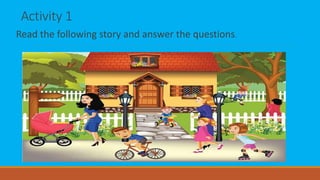
Activity 1
Read the following story and answer the questions.
Mama Nasimiyu and Mama Juma are good neighbours. They
have been living together for many years. When Mama Nasimiyu
goes to the market on Saturdays, she leaves Nasimiyu to play
with Juma at their home. Mama Juma also sends Mama
Nasimiyu to the market to buy her some items.
Mama Nasimiyu and her family assist Mama Juma's family
during the harvesting season. Occasionally, Nasimiyu fetches
water from Mama Juma's well and picks firewood from her farm.
1. Talk about how the two families depend on each other.
2. Name other ways in which people depend on each other at
home.
ACTIVITY 1
1.Share experience on how you depend on
each other at school.
2.Present your findings in class.
Group work
1.Discuss how you depend on each other at home.
2.Share experiences on how you depend on each
other in the community.
3.Discuss the meaning of interdependence.
Key Points
We all need each other.
Life becomes easier and enjoyable
when we depend on each other.
EXTENDED ACTIVITY
1. Find out from your parent or caregiver
how people depend on each other in
the community.
WAYS IN WHICH PEOPLE DEPEND ON EACH OTHER IN
BUNGOMA COUNTY
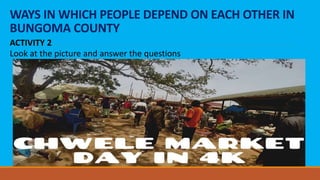
ACTIVITY 2
Look at the picture and answer the questions
1.Identify the activities going on
the picture.
2.How are people in the picture
above depending on each
other?
WAYS IN WHICH PEOPLE DEPEND ON EACH OTHER
IN BUNGOMA COUNTY
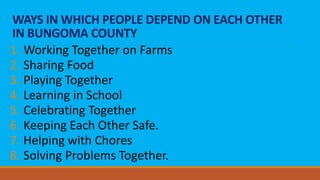
1. Working Together on Farms
2. Sharing Food
3. Playing Together
4. Learning in School
5. Celebrating Together
6. Keeping Each Other Safe.
7. Helping with Chores
8. Solving Problems Together.
ASSESSMENT
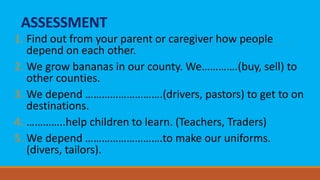
1. Find out from your parent or caregiver how people
depend on each other.
2. We grow bananas in our county. We………….(buy, sell) to
other counties.
3. We depend ……………………….(drivers, pastors) to get to on
destinations.
4. …………..help children to learn. (Teachers, Traders)
5. We depend ……………………….to make our uniforms.
(divers, tailors).
BENEFITS OF INTERDEPENDENCE
Activity 4
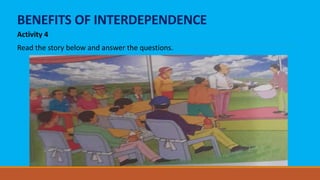
Read the story below and answer the questions.
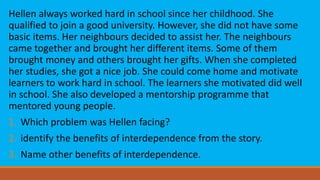
Hellen always worked hard in school since her childhood. She
qualified to join a good university. However, she did not have some
basic items. Her neighbours decided to assist her. The neighbours
came together and brought her different items. Some of them
brought money and others brought her gifts. When she completed
her studies, she got a nice job. She could come home and motivate
learners to work hard in school. The learners she motivated did well
in school. She also developed a mentorship programme that
mentored young people.
1. Which problem was Hellen facing?
2. identify the benefits of interdependence from the story.
3. Name other benefits of interdependence.
Key points
Through interdependence people are able to:
Get what they do not have.
Live in unity.
Get new ideas and knowledge.
Get assistance or support.
Appreciate each other's culture.
Do what they cannot do on their own.
ASSESSMENT
1. When different people depend on one another, it is
called……………………….
2. Learners …………on the teacher to teach them.
3. We buy things we need in the……or…. in our county.
4. We depend on ……… to make our school uniform
5. Patients depend on…… for their treatment
6. During sad ceremonies like burials, people depend on
others for ………..
POPULATION DISTRIBUTION
Population refers to the number of
people living in a particular area.
Population distribution refers to the
way in which people are spread over an
area.
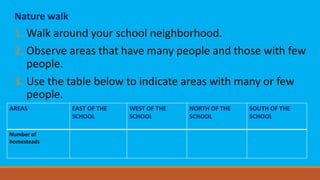
Nature walk
1. Walk around your school neighborhood.
2. Observe areas that have many people and those with few
people.
3. Use the table below to indicate areas with many or few
people.
AREAS EAST OF THE
SCHOOL
WEST OF THE
SCHOOL
NORTH OF THE
SCHOOL
SOUTH OF THE
SCHOOL
Number of
homesteads
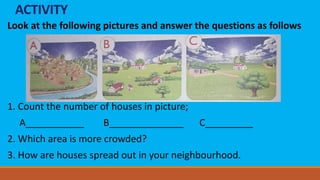
ACTIVITY
Look at the following pictures and answer the questions as follows
1. Count the number of houses in picture;
A___________ B______________ C_________
2. Which area is more crowded?
3. How are houses spread out in your neighbourhood.
WORK IN PAIRS
1.How many learners are in your class?
2.Talk about the number of people in your
school.
3.Which class has many learners?
4.Which class has few learners?
5.Compare your findings with those of your
classmates.
GROUP WORK
1. How many people are in your home?
2. Talk about the number of houses in your
neighbourhood.
3. Which side of your neighbourhood has more houses?
4. Which side has few people?
5. Present your findings in class.
SUB STRAND 2.2
POPULATION
DISTRIBUTION
SPECIFIC LEARNING OUTCOMES
By the end of the sub strand, the learner should be
able to:
1. Describe patterns of population distribution in the
county,
2. Design the patterns of population distribution in the
county,
3. Appreciate population distribution in the county
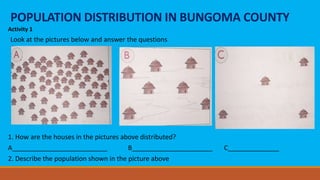
POPULATION DISTRIBUTION IN BUNGOMA COUNTY
Activity 1
Look at the pictures below and answer the questions
1. How are the houses in the pictures above distributed?
A__________________________ B______________________ C______________
2. Describe the population shown in the picture above
WORK IN-PAIRS
1.Talk about how houses are spread out near
your school.
2.Share your findings with your classmates.
GROUP WORK
1.Discuss how houses are spread out near
your home. Are they close to each or far
from each other?
2.Present your findings in class.
KEY POINTS
Areas with many houses are densely
populated.
Areas with few houses are sparsely
populated.
Areas with houses far away from each other
are unevenly distributed.
.
EXTENDED ACTIVITY
1.With the help of your caregiver, identify
areas which are sparsely populated,
densely populated and unevenly
populated in your county.
2.Present your findings in class.
CLASS ACTIVITY
1. Use the map of your county provided by your teacher
following questions.
2. How is the population distributed in your county?
3. Identify areas that are:
a) Densely populated
b) Sparsely populated
c) Unevenly populated
4. Draw a map of your county showing population distribution.
GROUP WORK
1. Discuss why some areas have:
a)Sparse population
b)Dense population
c)Uneven population
2. Present your findings in class.
EXTENDED ACTIVITY
1.Find out from your parent or caregiver
how population is distributed in your
county.
2.Report your findings in class.
ASSESSMENT
1. …………………refers to the number of people living in a particular area.
2. Population …………………………..refers to the way in which a population is
spread in a certain area.
3. Places with………………………..people are sparsely populated.
4. In a densely populated area, there are…………………………..people.
5. If a county's population is not equally distributed, it
is………………………….populated.
6. In areas with fertile soils, people are expected to be…………………………….
7. There are a……………………………..people in dry areas.
COMMON PATTERNS OF POPULATION DISTRIBUTION
CLASS ACTIVITY
Read the conversation below and answer the questions that follow.
Teacher: Good morning learners. Today we are going to learn about common
patterns of population distribution. Which pattern of population distribution is
common in your home area?
Hellen : Houses are close to each other and they are crowded in one place.
Teacher: What is the name of that population pattern?
Wanjala: Densely.
Teacher: That is right.
Chebet: In my neighbourhood, there are a few houses and they far apart.
Teacher: Class what is the name of the pattern of population distribution?
Nasike: Scattered population distribution pattern.
Teacher: That is right.
Ali: In my neighbourhood, houses are spread out along the road.
What is the name of that pattern of population distribution?
Adhiambo: Linear population distribution pattern.
Teacher: That is very good.
1. Identify common patterns of population distribution from the
conversation.
2. Which pattern of population distribution is common in your home
area?
3. In a _________________population distribution pattern, houses
are crowded in one place.
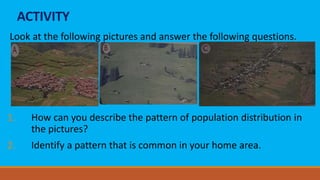
ACTIVITY
Look at the following pictures and answer the following questions.
1. How can you describe the pattern of population distribution in
the pictures?
2. Identify a pattern that is common in your home area.
GROUP WORK
1. Draw the map of Bungoma county.
2. Draw patterns of population distribution on
the map.
3. Display the map showing the patterns.
4. Identify the population patterns formed.
5. Present your findings in class.
CLASS ACTIVITY
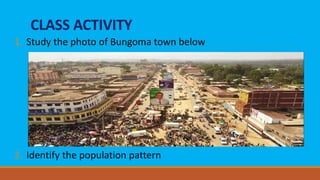
1. Study the photo of Bungoma town below
2. Identify the population pattern
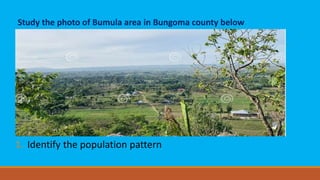
Study the photo of Bumula area in Bungoma county below
1. Identify the population pattern
In some areas in our county, houses are close
to each other. They form a clustered population
pattern.
In some areas, houses are arranged in a line.
They form a linear population pattern
In other areas, houses are spread out. They
form a scattered population pattern.
EXTENDED ACTIVITY
1. With the help of the guardian, designs
the patterns of population distribution in
the county creatively using digital
platforms.
ASSESSMENT
1. Population is……………………………
2. What is population distribution?
3. Areas with few people have………………………………………....
4. Areas with many people have………………………………………..
5. Which areas have a high population in your county?
6. Name areas with a low population in your county.

SST GRADE 4 strand 2.pptx SOCIAL SCIENCE

  • 1.
  • 2.
    Key Inquiry Question(S) 1.Howdo people in Bungoma County depend on each other? 2.Why should we support each other in Bungoma County?
  • 3.
  • 4.
    Specific learning outcomes Bythe end of the sub strand, the learner should be able to: 1. Identify ways in which people depend on each other in the county, 2. Explain the benefits of inter- dependence of people in the county, 3. Appreciate inter- dependence of people in the county.
  • 5.
    INTERDEPENDENCE OF PEOPLE Interdependencemeans depending on each other. In our county, people depend on each other. For example, we go to the market to buy what we do not have. Other people go to the market to sell what they have in excess.
  • 6.
    Activity 1 Read thefollowing story and answer the questions.
  • 7.
    Mama Nasimiyu andMama Juma are good neighbours. They have been living together for many years. When Mama Nasimiyu goes to the market on Saturdays, she leaves Nasimiyu to play with Juma at their home. Mama Juma also sends Mama Nasimiyu to the market to buy her some items. Mama Nasimiyu and her family assist Mama Juma's family during the harvesting season. Occasionally, Nasimiyu fetches water from Mama Juma's well and picks firewood from her farm. 1. Talk about how the two families depend on each other. 2. Name other ways in which people depend on each other at home.
  • 8.
    ACTIVITY 1 1.Share experienceon how you depend on each other at school. 2.Present your findings in class.
  • 9.
    Group work 1.Discuss howyou depend on each other at home. 2.Share experiences on how you depend on each other in the community. 3.Discuss the meaning of interdependence.
  • 10.
    Key Points We allneed each other. Life becomes easier and enjoyable when we depend on each other.
  • 11.
    EXTENDED ACTIVITY 1. Findout from your parent or caregiver how people depend on each other in the community.
  • 12.
    WAYS IN WHICHPEOPLE DEPEND ON EACH OTHER IN BUNGOMA COUNTY ACTIVITY 2 Look at the picture and answer the questions
  • 13.
    1.Identify the activitiesgoing on the picture. 2.How are people in the picture above depending on each other?
  • 14.
    WAYS IN WHICHPEOPLE DEPEND ON EACH OTHER IN BUNGOMA COUNTY 1. Working Together on Farms 2. Sharing Food 3. Playing Together 4. Learning in School 5. Celebrating Together 6. Keeping Each Other Safe. 7. Helping with Chores 8. Solving Problems Together.
  • 15.
    ASSESSMENT 1. Find outfrom your parent or caregiver how people depend on each other. 2. We grow bananas in our county. We………….(buy, sell) to other counties. 3. We depend ……………………….(drivers, pastors) to get to on destinations. 4. …………..help children to learn. (Teachers, Traders) 5. We depend ……………………….to make our uniforms. (divers, tailors).
  • 16.
    BENEFITS OF INTERDEPENDENCE Activity4 Read the story below and answer the questions.
  • 17.
    Hellen always workedhard in school since her childhood. She qualified to join a good university. However, she did not have some basic items. Her neighbours decided to assist her. The neighbours came together and brought her different items. Some of them brought money and others brought her gifts. When she completed her studies, she got a nice job. She could come home and motivate learners to work hard in school. The learners she motivated did well in school. She also developed a mentorship programme that mentored young people. 1. Which problem was Hellen facing? 2. identify the benefits of interdependence from the story. 3. Name other benefits of interdependence.
  • 18.
    Key points Through interdependencepeople are able to: Get what they do not have. Live in unity. Get new ideas and knowledge. Get assistance or support. Appreciate each other's culture. Do what they cannot do on their own.
  • 19.
    ASSESSMENT 1. When differentpeople depend on one another, it is called………………………. 2. Learners …………on the teacher to teach them. 3. We buy things we need in the……or…. in our county. 4. We depend on ……… to make our school uniform 5. Patients depend on…… for their treatment 6. During sad ceremonies like burials, people depend on others for ………..
  • 20.
    POPULATION DISTRIBUTION Population refersto the number of people living in a particular area. Population distribution refers to the way in which people are spread over an area.
  • 21.
    Nature walk 1. Walkaround your school neighborhood. 2. Observe areas that have many people and those with few people. 3. Use the table below to indicate areas with many or few people. AREAS EAST OF THE SCHOOL WEST OF THE SCHOOL NORTH OF THE SCHOOL SOUTH OF THE SCHOOL Number of homesteads
  • 22.
    ACTIVITY Look at thefollowing pictures and answer the questions as follows 1. Count the number of houses in picture; A___________ B______________ C_________ 2. Which area is more crowded? 3. How are houses spread out in your neighbourhood.
  • 23.
    WORK IN PAIRS 1.Howmany learners are in your class? 2.Talk about the number of people in your school. 3.Which class has many learners? 4.Which class has few learners? 5.Compare your findings with those of your classmates.
  • 24.
    GROUP WORK 1. Howmany people are in your home? 2. Talk about the number of houses in your neighbourhood. 3. Which side of your neighbourhood has more houses? 4. Which side has few people? 5. Present your findings in class.
  • 25.
  • 26.
    SPECIFIC LEARNING OUTCOMES Bythe end of the sub strand, the learner should be able to: 1. Describe patterns of population distribution in the county, 2. Design the patterns of population distribution in the county, 3. Appreciate population distribution in the county
  • 27.
    POPULATION DISTRIBUTION INBUNGOMA COUNTY Activity 1 Look at the pictures below and answer the questions 1. How are the houses in the pictures above distributed? A__________________________ B______________________ C______________ 2. Describe the population shown in the picture above
  • 28.
    WORK IN-PAIRS 1.Talk abouthow houses are spread out near your school. 2.Share your findings with your classmates.
  • 29.
    GROUP WORK 1.Discuss howhouses are spread out near your home. Are they close to each or far from each other? 2.Present your findings in class.
  • 30.
    KEY POINTS Areas withmany houses are densely populated. Areas with few houses are sparsely populated. Areas with houses far away from each other are unevenly distributed. .
  • 31.
    EXTENDED ACTIVITY 1.With thehelp of your caregiver, identify areas which are sparsely populated, densely populated and unevenly populated in your county. 2.Present your findings in class.
  • 32.
    CLASS ACTIVITY 1. Usethe map of your county provided by your teacher following questions. 2. How is the population distributed in your county? 3. Identify areas that are: a) Densely populated b) Sparsely populated c) Unevenly populated 4. Draw a map of your county showing population distribution.
  • 33.
    GROUP WORK 1. Discusswhy some areas have: a)Sparse population b)Dense population c)Uneven population 2. Present your findings in class.
  • 34.
    EXTENDED ACTIVITY 1.Find outfrom your parent or caregiver how population is distributed in your county. 2.Report your findings in class.
  • 35.
    ASSESSMENT 1. …………………refers tothe number of people living in a particular area. 2. Population …………………………..refers to the way in which a population is spread in a certain area. 3. Places with………………………..people are sparsely populated. 4. In a densely populated area, there are…………………………..people. 5. If a county's population is not equally distributed, it is………………………….populated. 6. In areas with fertile soils, people are expected to be……………………………. 7. There are a……………………………..people in dry areas.
  • 36.
    COMMON PATTERNS OFPOPULATION DISTRIBUTION CLASS ACTIVITY Read the conversation below and answer the questions that follow. Teacher: Good morning learners. Today we are going to learn about common patterns of population distribution. Which pattern of population distribution is common in your home area? Hellen : Houses are close to each other and they are crowded in one place. Teacher: What is the name of that population pattern? Wanjala: Densely. Teacher: That is right. Chebet: In my neighbourhood, there are a few houses and they far apart. Teacher: Class what is the name of the pattern of population distribution?
  • 37.
    Nasike: Scattered populationdistribution pattern. Teacher: That is right. Ali: In my neighbourhood, houses are spread out along the road. What is the name of that pattern of population distribution? Adhiambo: Linear population distribution pattern. Teacher: That is very good. 1. Identify common patterns of population distribution from the conversation. 2. Which pattern of population distribution is common in your home area? 3. In a _________________population distribution pattern, houses are crowded in one place.
  • 38.
    ACTIVITY Look at thefollowing pictures and answer the following questions. 1. How can you describe the pattern of population distribution in the pictures? 2. Identify a pattern that is common in your home area.
  • 39.
    GROUP WORK 1. Drawthe map of Bungoma county. 2. Draw patterns of population distribution on the map. 3. Display the map showing the patterns. 4. Identify the population patterns formed. 5. Present your findings in class.
  • 40.
    CLASS ACTIVITY 1. Studythe photo of Bungoma town below 2. Identify the population pattern
  • 41.
    Study the photoof Bumula area in Bungoma county below 1. Identify the population pattern
  • 42.
    In some areasin our county, houses are close to each other. They form a clustered population pattern. In some areas, houses are arranged in a line. They form a linear population pattern In other areas, houses are spread out. They form a scattered population pattern.
  • 43.
    EXTENDED ACTIVITY 1. Withthe help of the guardian, designs the patterns of population distribution in the county creatively using digital platforms.
  • 44.
    ASSESSMENT 1. Population is…………………………… 2.What is population distribution? 3. Areas with few people have……………………………………….... 4. Areas with many people have……………………………………….. 5. Which areas have a high population in your county? 6. Name areas with a low population in your county.