Ssl And TlsTheory And Practice 2nd Rolf
Oppliger download
https://ebookbell.com/product/ssl-and-tls-theory-and-
practice-2nd-rolf-oppliger-6833320
Explore and download more ebooks at ebookbell.com
2.
Here are somerecommended products that we believe you will be
interested in. You can click the link to download.
Ssl And Tls Theory And Practice Information Security And Privacy Rolf
Oppliger
https://ebookbell.com/product/ssl-and-tls-theory-and-practice-
information-security-and-privacy-rolf-oppliger-1376420
Bulletproof Ssl And Tls Understanding And Deploying Ssltls And Pki To
Secure Servers And Web Applications Ivan Ristic
https://ebookbell.com/product/bulletproof-ssl-and-tls-understanding-
and-deploying-ssltls-and-pki-to-secure-servers-and-web-applications-
ivan-ristic-5155402
Bulletproof Tls And Pki Second Edition Understanding And Deploying
Ssltls And Pki To Secure Servers And Web Applications 2nd Edition Ivan
Ristic
https://ebookbell.com/product/bulletproof-tls-and-pki-second-edition-
understanding-and-deploying-ssltls-and-pki-to-secure-servers-and-web-
applications-2nd-edition-ivan-ristic-232492032
Implementing Ssltls Using Cryptography And Pki Joshua Daviesauth
https://ebookbell.com/product/implementing-ssltls-using-cryptography-
and-pki-joshua-daviesauth-4306264
3.
Ssltls Under LockAnd Key Colour Ed Paul Baka Jeremy Schatten
https://ebookbell.com/product/ssltls-under-lock-and-key-colour-ed-
paul-baka-jeremy-schatten-42993144
Ssl Vpn Understanding Evaluating And Planning Secure Webbased Remote
Access A Comprehensive Overview Of Ssl Vpn Technologies And Design
Strategies Joseph Steinberg
https://ebookbell.com/product/ssl-vpn-understanding-evaluating-and-
planning-secure-webbased-remote-access-a-comprehensive-overview-of-
ssl-vpn-technologies-and-design-strategies-joseph-steinberg-1266180
Evaluation Of Some Smtp Testing Ssl Checkers Email Delivery Email
Forwarding And Wp Email Tools Dr Hedaya Alasooly
https://ebookbell.com/product/evaluation-of-some-smtp-testing-ssl-
checkers-email-delivery-email-forwarding-and-wp-email-tools-dr-hedaya-
alasooly-51197034
Ssl Remote Access Vpns 1st Edition Safari An Oreilly Media Company
Frahim
https://ebookbell.com/product/ssl-remote-access-vpns-1st-edition-
safari-an-oreilly-media-company-frahim-21889234
Juniperr Networks Secure Access Ssl Vpn Configuration Guide Neil R
Wyler
https://ebookbell.com/product/juniperr-networks-secure-access-ssl-vpn-
configuration-guide-neil-r-wyler-38559708
Chapter 5 FirewallTraversal 191
5.1 Introduction 191
5.2 SSL/TLS Tunneling 194
5.3 SSL/TLS Proxying 197
5.4 Final Remarks 199
References 200
Chapter 6 Public Key Certificates and Internet PKI 201
6.1 Introduction 201
6.2 X.509 Certificates 206
6.2.1 Certificate Format 207
6.2.2 Hierarchical Trust Model 209
6.3 Server Certificates 212
6.4 Client Certificates 216
6.5 Problems and Pitfalls 217
6.6 New Approaches 222
6.7 Final Remarks 228
References 229
Chapter 7 Concluding Remarks 233
References 235
Appendix A Registered TLS Cipher Suites 237
Appendix B Padding Oracle Attacks 245
B.1 Bleichenbacher Attack 247
B.2 Vaudenay Attack 251
References 260
Appendix C Abbreviations and Acronyms 263
About the Author 271
Index 273
10.
Preface
In theory, theoryand practice are the same.
In practice, they are not.
— Albert Einstein
Terms like electronic commerce (e-commerce), electronic business (e-business), and
electronic government (e-government) are omnipresent today. When people use
these terms, they often refer to stringent security requirements that must be met in
one way or another. If they want to manifest that they are tech-savvy, then they bring
in acronyms like SSL or TLS. Since SSL stands for secure sockets layer and TLS
stands for transport layer security, it seems that adding SSL or TLS to applications
automatically makes them secure and magically solves all security problems. This
is arguably not the case and largely exaggerates the role SSL/TLS can play in the
security arena.
But SSL/TLS is still the most widely used and most important technology to
secure e-∗ applications or certain aspects thereof. This is certainly the case for all
applications on the World Wide Web (WWW) based on the hypertext transfer proto-
col (HTTP), but it is increasingly also true for many other Internet applications, such
as electronic mail (e-mail), instant messaging, file transfer, terminal access, Internet
banking, money transfer, electronic voting (e-voting), and online gaming. Many of
these applications and respective application protocols are nowadays routinely lay-
ered on top of SSL and TLS protocols to provide some basic security services to
their users.
Considering the wide deployment of the SSL/TLS protocols, it is important
to teach e-∗ application designers and developers about the fundamental principles
and the rationale behind the various versions of the protocols. Simply invoking
security software libraries and respective function calls is not enough to design
11.
and develop secureapplications.1
In fact, it is fairly common today to invoke
such libraries and function calls from otherwise exploitable code. The resulting
application is not going to be secure—whether SSL/TLS is in place or not. Against
this background, secure programming and secure software development techniques
are of the utmost importance when it comes to building secure applications. Also, a
thorough understanding of a security technology is required to correctly apply it and
properly complement it with other security technologies. This rule of thumb also
applies to SSL/TLS. It is necessary to fully understand what the SSL/TLS protocols
can do and what they cannot do in order to apply them correctly. Otherwise, mistakes
and omissions are likely to occur and to hurt badly. The SSL/TLS protocols are
not a panacea. They enable applications to be only as secure as the underlying
infrastructural components, such as the computer systems and networks in use. If
these components are vulnerable and susceptible to attacks, then the security the
SSL/TLS protocols may provide is questionable or even illusive.
When I started to compile a teaching module about SSL/TLS more than 10
years ago, I was surprised to learn that the few books that were available then
either addressed the technology only superficially or—maybe worse—were out-
of-date. This was particularly true for the two reference books used in the field
[1, 2]. They both appeared in 2000—which was almost a decade ago. Against
this background, I decided to take my lecture notes and compile a new book that
would not only address the fundamental principles of the SSL/TLS protocols, but
would also try to explain the rationale behind their current designs. The resulting
book appeared in 2009. The triumphant success of SSL/TLS and many recent
developments have made it necessary to update the book and publish a second
edition sooner than originally anticipated. This seems to be the price to pay when
addressing a hot and fastly evolving field: Books become outdated even sooner
than is normally the case. So I have taken the opportunity to update the book
and to bring it in line with some of the more recent cryptanalytical results and
developments. Some of these results were known when the first edition of the book
1 Sometimes the libraries themselves contain bugs that allow adversaries to attack the systems that
employ them. In 2014, for example, it was revealed that the SSL/TLS implementation of Apple
iOS contained a serious bug that was later named the “double goto fail” bug (because it was caused
by a goto fail statement that was erroneously written twice) and that the GnuTLS implementation
contained a similar bug named “GnuTLS bug.” The bugs were similar in the sense that they both
allowed invalid public key certificates to pass certificate validation checks, and hence that an
adversary could use such certificates to mount a man-in-the-middle (MITM) attack. Maybe most
importantly, it was revealed in the same year that some elder versions of the OpenSSL library
contained a very severe bug in the implementation of the Heartbeat extension of the (D)TLS
protocol(s). As further addressed in Section 3.8, this bug allowed an adversary to read out the
server memory, possibly compromising cryptographic keys stored therein. The bug became known
as Heartbleed, and it casted a damning light on the security of OpenSSL.
12.
went to press.However, they were not properly addressed, because there was no
evidence that the underlying theoretical vulnerabilities could actually be exploited
in practice. This has changed fundamentally,and terms like BEAST, CRIME, TIME,
BREACH, POODLE, FREAK, Logjam, and Lucky 13 have made a lot of headlines
and frightened both application developers and users. Keeping the old saying that
“attacks always get better; they never get worse” in mind, one can reasonably expect
many interesting attacks to be mounted in the future.2
The situation remains risky
and scary.
More recently, a book on SSL/TLS that is more in line with this book has
appeared [3]. It also addresses the fundamentals of SSL/TLS and the abovemen-
tioned attacks. Unlike this book, however, major parts of [3] address complementary
topics (that are not directly related to security), such as implementation, deploy-
ment, performance optimization, and configuration issues—sometimes even related
to specific products. For the reasons discussed below, SSL/TLS: Theory and Practice,
Second Edition, takes a different approach and delves into neither implementation is-
sues nor configuration details of particular implementations. Also, it addresses some
practically important topics that are entirely neglected in other books including [3],
such as TLS extensions, TLS version 1.3, and datagram TLS (DTLS), and discusses
cryptanalytical attacks and techniques to protect against them and mitigate the re-
spective risks.
In addition to providing a basic introduction and discussion of the SSL/TLS
protocols, another important goal of this second edition is to provide enough back-
ground information to understand, discuss, and put into perspective the latest crypt-
analytical attacks and attack tools. This goal is ambitious, because the attacks are
not at all simple and straightforward. Instead, they require quite a lot of background
knowledge in cryptography. This is one of the reasons I have changed the outline of
the book a little bit: Instead of providing a cryptography primer and starting from
scratch, I assume that readers already have some basic knowledge about cryptogra-
phy and start from there. Thus, readers who want to seriously delve into the security
of SSL/TLS should acquire this knowledge first. Fortunately, they can use many
books for this purpose, including [4].
Except for the omission of the cryptography primer, I have tried to stay as close
as possible to the original outline of the first edition of the book. This edition is again
intended for anyone who wants to get a deep understanding of the SSL/TLS proto-
cols and their proper use—be they theorists or practitioners. As mentioned above,
implementation issues and respective details are not addressed or only addressed
superficially. There are so many implementations of the SSL/TLS protocols, both
freely and commercially available, that it makes no sense to address them in a book.
2 As an example of such attacks, you may refer to the blog entry “The POODLE has friends,” which
is available at https://vivaldi.net/en-US/blogs/entry/the-poodle-has-friends.
13.
They are modifiedand updated too frequently. The most popular open-source imple-
mentations are OpenSSL,3
GnuTLS,4
Bouncy Castle,5
and MatrixSSL,6
but there
are many more. Some of these implementations are available under a license that is
compatible with the GNU General Public License (GPL), such as GnuTLS, whereas
the licenses of some other implementations are special and slightly deviate from
the GPL, such as the OpenSSL license. Because this book targets technicians and
not lawyers, I do not further address the many issues regarding software licenses.
Instead, I emphasize the fact that some open-source implementations have a bad
track record when it comes to security (remember the Heartbleed bug mentioned in
footnote 1), and hence there are also a few open-source implementations that forked
from OpenSSL, such as LibreSSL from OpenBSD,7
BoringSSL from Google,8
and
s2n9
from Amazon.10
More interestingly, there are open source SSL/TLS imple-
mentations that make it possible to perform a formal verification of the resulting
implementation, such as miTLS.11
Furthermore, there are some SSL/TLS imple-
mentations that are dual-licensed, meaning that they are available either as an open
source or under a commercial license. Examples include mbed TLS12
(formerly
known as PolarSSL13
), wolfSSL14
(formerly known as CyaSSL), and cryptlib.15
In addition, all major software manufacturers have SSL/TLS implementations and
libraries of their own that they routinely embed in their products. Examples include
Secure Channel (SChannel) from Microsoft, Secure Transport from Apple, the Java
Secure Socket Extensions (JSSE) from Oracle, and the Network Security Services
(NSS) from Mozilla.16
Due to their origin, these implementations are particularly
widely deployed in the field and hence used by many people in daily life. If you
want to use the SSL/TLS protocols practically (e.g., to secure an e-∗ application),
then you have to delve into the documentation and technical specification of the
application or development environment that you are currently using. This book
is not a replacement for these documents; it is only aimed at providing the basic
3 http://www.openssl.org.
4 http://www.gnutls.org.
5 http://www.bouncycastle.org.
6 http://www.matrixssl.org.
7 http://www.libressl.org.
8 https://boringssl.googlesource.com/boringssl.
9 The acronym s2n stands for “signal to noise,” referring to the fact that the signals generated by
legitimate visitors of web sites may be hidden from noise by the use of strong cryptography.
10 https://github.com/awslabs/s2n.
11 http://www.mitls.org.
12 https://tls.mbed.org.
13 https://polarssl.org.
14 http://yassl.com.
15 http://www.cryptlib.com.
16 Note that the NSS is also available as open source under a special Mozilla Public License (MPL).
14.
knowledge to properlyunderstand them—you still have to capture and read them.
In the case of OpenSSL, for example, you may use [5] or Chapter 11 of [3] as a
reference. Keep in mind, though, that, due to Heartbleed, the reputation of OpenSSL
is discussed controversially in the community. In the case of another library or de-
velopment environment, you have to read the original documentation.
In addition to cryptography, this book also assumes some basic familiarity
with the TCP/IP protocols and their working principles. Again, this assumption
is reasonable, because anybody not familar with TCP/IP is well-advised to first
get in touch and try to comprehend TCP/IP networking, before moving on to the
SSL/TLS protocols—only trying to understand SSL/TLS is not likely to be fruitful.
Readers unfamiliar with TCP/IP networking can consult one of the many books
about TCP/IP. Among these books, I particularly recommend the classic books of
Richard Stevens [6] and Douglas Comer [7], but there are many other (or rather
complementary) books available.
To properly understand the current status of the SSL/TLS protocols, it is useful
to be familiar with the Internet standardization process. Again, this process is likely
to be explained in a book on TCP/IP networking. It is also explained in RFC 2026 [8]
and updated on a web page hosted by the Internet Engineering Task Force (IETF).17
For each protocol specified in an RFC document, we are going to say whether it
has been submitted to the Internet standards track or specified for experimental or
informational use. This distinction is important and highly relevant in practice.
When we discuss the practical use of the SSL/TLS protocols, it is quite
helpful to visualize things with a network protocol analyzer, such as Wireshark18
or any other software tool that provides a similar functionality. Wireshark is a
freely available open-source software tool. With regard to SSL/TLS, it is sufficiently
complete, meaning that it can be used to analyze SSL/TLS-based data exchanges.
We don’t reproduce screenshots in this book, mainly because the graphical user
interfaces (GUIs) of tools like Wireshark are highly nonlinear, and the corresponding
screenshots are difficult to read and interpret if only single screenshots are available.
When we use Wireshark output, we provide it in textual form. This is visually less
stimulating, but generally more appropriate and therefore more useful in practice.
SSL/TLS: Theory and Practice, Second Edition, is organized and structured in
seven chapters, described as follows.
• Chapter 1, Introduction, prepares the ground for the topic of this book and pro-
vides the fundamentals and basic principles that are necessary to understand
the SSL/TLS protocols properly.
17 https://www.ietf.org/about/standards-process.html.
18 http://www.wireshark.org.
15.
• Chapter 2,SSL Protocol, introduces, overviews, and puts into perspective the
SSL protocol.
• Chapter 3, TLS Protocol, does the same for the TLS protocol. Unlike Chapter
2, it does not start from scratch but focuses on the main differences between
the SSL and the various versions of the TLS protocol.
• Chapter 4, DTLS Protocol, elaborates on the DTLS protocol, which is basi-
cally a UDP version of the TLS protocol. Again, the chapter mainly focuses
on the differences between the SSL/TLS protocols and the DTLS protocol.
• Chapter 5, Firewall Traversal, addresses the practically relevant and nontrivial
problem of how the SSL/TLS protocols can (securely) traverse a firewall.
• Chapter 6, Public Key Certificates and Internet Public Key Infrastructure
(PKI), elaborates on the management of public key certificates used for
the SSL/TLS protocols, for example, as part of an Internet PKI. This is a
comprehensive topic that deserves a book of its own. Because the security of
the SSL/TLS (and DTLS) protocols depends on and is deeply interlinked with
the public key certificates in use, we have to say a little bit more than what is
usually found in introductory texts about this topic. We have to look behind
the scenes to understand what is going on.
• Chapter 7, Concluding Remarks, rounds off the book.
In addition, the book includes Appendix A, which summarizes the registered
TLS cipher suites; Appendix B, a primer on padding oracle attacks; Appendix C, a
list of abbreviations and acronyms; my biography; and an index.
At various places, the book refers to common vulnerabilities and exposures
(CVEs). This refers to a common enumeration scheme for publicly known problems
that should make it easier to share data across separate vulnerability capabilities
(e.g., tools, repositories, and services). For a representative repository for CVEs that
is widely used in the field, please see https://cve.mitre.org.
Referring to the introductory quote of Albert Einstein, it is sometimes im-
portant to make a clear distinction between what is available in theory and what
is achievable in practice. The second edition of this book makes this distinction
more clear. While the first edition mainly focuses on the theoretical security of the
SSL/TLS protocols, the second edition delves more deeply into the practically ori-
ented security considerations as exemplified by the many attacks and attack tools
mentioned above. In theory, they are a minor concern, because they can be easily
mitigated. In practice, however, they are a major concern, because the mitigation is
not always done or done properly. This simplifies an adversary’s job considerably.
16.
Again, I hopethat SSL/TLS: Theory and Practice, Second Edition, serves your
needs. The ultimate goal of a technical book is to save readers time, and I hope
that this applies to this book, too. Also, I would like to take the opportunity to
invite readers to let me know your opinions and thoughts. If you have something
to correct or add, please let me know. If I have not expressed myself clearly,
please let me know, too. I appreciate and sincerely welcome any comments or
suggestions to update the book in future editions and turn it into a reference book
that can be used for educational purposes. The best way to reach me is to send a
message to rolf.oppliger@esecurity.ch. You can also visit the book’s home page at
http://books.esecurity.ch/ssltls2e.html.I use this page periodically to post errata lists,
additional information, and complementary material. I look forward to hearing from
you in one way or another.
References
[1] Rescorla, E., SSL and TLS: Designing and Building Secure Systems. Addison-Wesley, Reading,
MA, 2000.
[2] Thomas, S.A., SSL and TLS Essentials: Securing the Web. John Wiley & Sons, New York, NY,
2000.
[3] Ristić, I., Bulletproof SSL and TLS: Understanding and Deploying SSL/TLS and PKI to Secure
Servers and Web Applications, Feisty Duck Limited, London, UK, 2014.
[4] Oppliger, R., Contemporary Cryptography, 2nd edition. Artech House Publishers, Norwood, MA,
2011.
[5] Viega, J., M. Messier, and P. Chandra, Network Security with OpenSSL. O’Reilly, Sebastopol,
CA, 2002.
[6] Fall, K.R., and W.R. Stevens, TCP/IP Illustrated, Volume 1: The Protocols, 2nd edition. Addison-
Wesley Professional, New York, NY, 2011.
[7] Comer, D.E., Internetworking with TCP/IP Volume 1: Principles, Protocols, and Architecture,
6th edition. Addison-Wesley, New York, NY, 2013.
[8] Bradner, S., “The Internet Standards Process—Revision 3,” Request for Comments 2026 (BCP
9), October 1996.
17.
Chapter 1
Introduction
This introductorychapter prepares the ground for the topic of the book. More
specifically, it starts with a brief introduction into information and network security
in Section 1.1, delves more deeply into transport layer security and the evolution
of the SSL/TLS protocols in Section 1.2, and concludes with some final remarks in
Section 1.3.
1.1 INFORMATION AND NETWORK SECURITY
According to the Internet security glossary available in RFC 4949 [1], information
security (INFOSEC) refers to “measures that implement and assure security services
in information systems, including in computer systems (computer security) and in
communication systems (communication security).” In this context, computer secu-
rity (COMPUSEC) refers to security services provided by computer systems (e.g.,
access control services), whereas communication security (COMSEC) refers to se-
curity services provided by communication systems that exchange data (e.g., data
confidentiality, authentication, and integrity services). It goes without saying that in
a practical setting, COMPUSEC and COMSEC must go hand in hand to provide a
reasonable level of INFOSEC. If, for example, data is cryptographically protected
while being transmitted, then that data may be susceptible to attacks on either side
of the communication channel while it is being stored or processed. So COMSEC—
which is essentially what this book is all about—must always be complemented by
COMPUSEC; otherwise all security measures are not particularly useful and can be
circumvented at will. It also goes without saying that the distinction between COM-
PUSEC and COMSEC has been blurred to some extent by recent developments in
the realm of middleware and service-oriented architectures (SOAs). The distinction
is no longer precise, and hence it may not be as useful as it was in the past.
18.
2 SSL andTLS: Theory and Practice
INFOSEC (as well as COMPUSEC and COMSEC) comprises all technical
and nontechnical measures aimed at implementing and assuring security services in
information systems. So it is not only about technology, and in many cases, organi-
zational, personnel, or legal measures are more effective than purely technical ones.
This should be kept in mind, despite the fact that this book is only about technology.
Any technical measure that is not complemented by adequate nontechnical measures
is likely to fail—at least in the long term.
For the purpose of this book, we use the term network security as a synonym
for communication security. So we try to invoke measures that can be used to imple-
ment and assure security services for data in transmission. When we talk about se-
curity services, it makes a lot of sense to introduce them (together with mechanisms
that provide them) in some standardized way. One standard that can be used here is
the security architecture that has been appended as part two of the formerly famous
(but nowadays almost entirely ignored) open systems interconnection (OSI) basic
reference model specified by the Joint Technical Committee 1 (JTC1) of the Interna-
tional Organization for Standardization (ISO) and the International Electrotechnical
Commission (IEC) in 1989 [2]. Without delving into the details, we only mention
that the OSI model has seven layers, whereas the more familiar TCP/IP model only
has four. Figure 1.1 illustrates the layers and the relationship between them. Most
importantly, the physical and data link layers of the OSI model are merged in a
single network access layer in the TCP/IP model, and the session, presentation, and
application layers of the OSI model are merged in a unique application layer in the
TCP/IP model.
According to its title, ISO/IEC 7498-2 claims to provide a security architec-
ture, but it is more a terminological framework than a true architecture (refer to [3]
for a discussion of what a security architecture really is). Nevertheless, we still use
the term OSI security architecture to refer to ISO/IEC 7498-2. In 1991, the Telecom-
munication Standardization Sector of the International Telecommunication Union
(ITU), also known as ITU-T, adopted the OSI security architecture in its recommen-
dation X.800 [4]. Also in the early 1990s, the Privacy and Security Research Group
(PSRG) of the Internet Research Task Force (IRTF1
) preliminarily adopted the OSI
security architecture in a corresponding Internet security architecture published as an
Internet draft.2
In essence, ISO/IEC 7498-2, ITU-T X.800, and the Internet security
architecture draft all describe the same security standard, and in this book we use
the term OSI security architecture to refer to all of them collectively. Contrary to
1 The IRTF is a sister group to the IETF. Its stated mission is “To promote research of importance
to the evolution of the future Internet by creating focused, long-term and small Research Groups
working on topics related to Internet protocols, applications, architecture and technology.” Its web
site is available at https://irtf.org.
2 This work has been abandoned.
19.
Introduction 3
Figure 1.1Layers of the OSI and TCP/IP models.
the OSI basic reference model, the OSI security architecture has been in widespread
use in the past few decades—at least for referential purposes. It provides a general
description of security services and related security mechanisms and discusses their
interrelationships. Let us briefly introduce the security services and mechanisms
that are mentioned in the OSI security architecture. Note that these services and
mechanisms are neither comprehensive nor are they intended to be so. For example,
anonymity and pseudonymity services are not addressed at all, but in any real-world
application setting, these services may still be important. Take electronic payment
or electronic voting (e-voting) systems as examples to make this point.
1.1.1 Security Services
As shown in Table 1.1, the OSI security architecture distinguishes between five
classes of security services (i.e., authentication, access control, data confidentiality,
data integrity, and nonrepudiation3
services). Just as layers define functionality in
3 There is some controversy in the community regarding the correct spelling of the term nonrepudia-
tion. In fact, the OSI security architecture uses non-repudiation instead of nonrepudiation, and there
are many people still using this spelling. In this book, however, we use the more modern spelling of
the term without a hyphen.
20.
4 SSL andTLS: Theory and Practice
Table 1.1
Classes of OSI Security Services
1 Peer entity authentication service
Data origin authentication service
2 Access control service
3 Connection confidentiality service
Connectionless confidentiality service
Selected field confidentiality service
Traffic flow confidentiality service
4 Connection integrity service with recovery
Connection integrity service without recovery
Selected field connection integrity service
Connectionless integrity service
Selected field connectionless integrity service
5 Nonrepudiation with proof of origin
Nonrepudiation with proof of delivery
the OSI reference model, so do services in the OSI security architecture. A security
service hence provides a particular security functionality.
1.1.1.1 Authentication Services
As its name suggests, an authentication service provides authentication for some-
thing, such as a peer entity or the origin of data. The respective services are slightly
different and described as follows.
• A peer entity authentication service provides authentication for a peer entity,
such as a user, client, or server, meaning that it allows an entity in an
association to verify that the peer entity is what it claims to be. This, in turn,
provides assurance that the peer entity is not attempting to masquerade or
performing an unauthorized replay. A peer entity authentication is typically
performed either during a connection establishment phase or, occasionally,
during a data transfer phase.
• A data origin authentication service provides authentication for the origin of
data, meaning that it allows an entity in an association to verify that the source
of data received is as claimed. A data origin authentication service is typically
performed during a data transfer phase. Note, however,that such a service only
protects the origin of data, and that an adversary may still duplicate or modify
the data at will. To protect against such attacks, a data origin authentication
21.
Introduction 5
service needsto be complemented with a data integrity service (as discussed
in Section 1.1.1.4).
Authentication services are very important in practice, and they often represent
a prerequisite for the provision of authorization, access control, and accountability
services. Authorization refers to the process of granting rights, which includes the
granting of access based on access rights. Access control refers to the process of
enforcing access rights, and accountability refers to the property that actions of
an entity can be traced uniquely to this particular entity. All of these services are
important for the overall security of a system.
1.1.1.2 Access Control Services
Access control services enforce access rights, meaning that they protect system re-
sources against unauthorized use. The use of a system resource is unauthorized if the
entity that seeks to use the resource does not have the proper privileges or permis-
sions needed to do so. As such, access control services are typically the most com-
monly thought of services in computer and network security. However, as mentioned
above, access control services are closely tied to authentication services: A user or
process acting on the user’s behalf must usually be authenticated before access can
be controlled and an access control service can be put in place. Authentication and
access control services therefore usually go hand in hand—this is why people some-
times use terms like authentication and authorization infrastructure (AAI), identity
management, or identity and access management (IAM) to refer to an infrastructure
that provides support for both authentication and authorization in terms of access
control. Such infrastructures are increasingly important in practice.
1.1.1.3 Data Confidentiality Services
In general parlance, data confidentiality refers to the property that data is not
made available or disclosed to unauthorized entities, and hence data confidentiality
services protect data from unauthorized disclosure. There are several forms of such
services:
• A connection confidentiality service provides confidentiality for all data trans-
ferred over a connection.
• A connectionless confidentiality service provides confidentiality for individual
data units (i.e., the data units are protected even though they are not transferred
over a connection).
22.
6 SSL andTLS: Theory and Practice
• A selective field confidentiality service provides confidentiality for certain
fields within individual data units or data transmitted in a connection.
• A traffic flow confidentiality service provides confidentiality for traffic flows,
meaning that it attempts to protect all data that is associated with and commu-
nicated in a traffic flow from traffic analysis.
The first three confidentiality services can be provided by standard crypto-
graphic techniques and mechanisms, whereas these techniques and mechanisms—at
least in their native form—do not help to provide traffic flow confidentiality services.
Complementary security mechanisms are needed here.
1.1.1.4 Data Integrity Services
Data integrity refers to the property that data is not modified (or even destroyed) in
any unauthorized way, and hence data integrity services protect data from unautho-
rized modification. Again, there are several forms of such services:
• A connection integrity service with recovery provides integrity for all data
transmitted over a connection. The loss of integrity is recovered.
• A connection integrity service without recovery is similar to a connection
integrity service with recovery, except that the loss of integrity is only detected
but not recovered.
• A selected field connection integrity service provides integrity for specific
fields within the data transmitted in a connection.
• A connectionless integrity service provides integrity for individual data units
that are not transmitted over a connection.
• A selected field connectionless integrity service provides integrity for specific
fields within individual data units.
To secure a connection, it is usually the case that a peer entity authentication
service provided at the start of the connection is combined with a connection
integrity service provided during the connection. This ensures that all data received
by the recipient is authentic and has not been tampered with during its transmission.
To keep things as simple as possible, connection integrity services are often provided
without recovery.
23.
Introduction 7
1.1.1.5 NonrepudiationServices
A nonrepudiation service protects an entity from having a peer entity (that is also
involved in the communication) deny that it has participated in all or part of the
communication. In general, there are two nonrepudiation services that are relevant
in practice:
• A nonrepudiation service with proof of origin provides the recipient of data
with a proof of origin, meaning that the sender cannot later deny having sent
the data.
• A nonrepudiation service with proof of delivery provides the sender of data
with a proof of delivery, meaning that the recipient of the data cannot later
deny having received it.4
Nonrepudiation services are key for Internet-based e-commerce (e.g., [5]).
Consider, for example, the situation in which an investor communicates with his
or her stockbroker over the Internet. If the investor decides to sell a large number
of stocks, then he or she may send a corresponding request to the stockbroker.
If the prices are about to change only moderately, then everything works fine.
However, if the stock price raises sharply, then the investor may deny having sent
the order to sell the stocks in the first place. Conversely, it is possible that under
reversed circumstances the stockbroker may deny having received the order to sell
the stocks. In situations like these, it seems to be the case that the ability to provide
nonrepudiation services is key to the success of the whole endeavor.
Not all security services are equally relevant for the SSL/TLS protocols.
Section 2.1 discusses what services are relevant for the SSL protocol, and the same
argument also applies to the TLS protocol. This introduction aims to familiarize the
readers with the terms and convey a common understanding for their meaning.
1.1.2 Security Mechanisms
In addition to the security services mentioned above, the OSI security architecture
itemizes security mechanisms that may be used to implement the services. A
distinction is made between specific security mechanisms and pervasive ones. While
a specific security mechanism can be used to implement a specific security service,
a pervasive security mechanism is generally not specific to a particular service and
can be used to implement—or rather complement—several security services at the
same time.
4 Note, however, that a proof of delivery only proves the successful delivery of the data. It does not
necessarily mean that the recipient has also read the data.
24.
8 SSL andTLS: Theory and Practice
Table 1.2
Specific Security Mechanisms
1 Encipherment
2 Digital signature mechanisms
3 Access control mechanisms
4 Data integrity mechanisms
5 Authentication exchange mechanisms
6 Traffic padding mechanisms
7 Routing control mechanisms
8 Notarization mechanisms
1.1.2.1 Specific Security Mechanisms
As summarized in Table 1.2, there are eight specific security mechanisms enumer-
ated in the OSI security architecture. They can be characterized as follows:
1. Encipherment can be used to protect the confidentiality of data or to support
other security mechanisms.
2. Digital signature mechanisms can be used to provide digital signatures and
respective nonrepudiation services. A digital signature is the electronic analog
of a handwritten signature, and as such it is applicable to electronic docu-
ments. Like handwritten signatures, digital signatures must not be forgeable;
a recipient must be able to verify the signature, and the signatory must not be
able to repudiate it later. But unlike handwritten signatures, digital signatures
incorporate the data (or a hash value of the data) that is signed. Different data
therefore results in different signatures, even if the signatory remains the same.
3. Access control mechanisms can be used to control access to system resources.
Traditionally, a distinction is made between a discretionary access control
(DAC) and a mandatory access control (MAC). In either case, the access
control is described in terms of subjects, objects, and access rights:
• A subject is an entity that attempts to access objects. This can be a host,
a user, or an application.
• An object is a resource to which access needs to be controlled. This can
range from an individual data field in a file to a large program.
• Access rights specify the level of authority for a subject to access
an object, so access rights are defined for each subject-object pair.
Examples of UNIX-style access rights are read, write, and execute.
25.
Introduction 9
More recently,people have introduced the notion of a role and have
developed role-based access controls (RBACs) to make the assignment of
access rights to subjects more simple and straightforward, and hence also
more flexible (e.g., [6, 7]). Today, people are elaborating on using attributes
to simplify the assignment of access rights in so-called attribute-based access
controls (ABACs).5
4. Data integrity mechanisms can be used to protect the integrity of data—be it
individual data units or fields within them or sequences of data units or fields
within them. Note that data integrity mechanisms, in general, do not protect
against replay attacks that work by recording and replaying previously sent
data units. Also, protecting the integrity of a sequence of data units and fields
within these data units generally requires some form of explicit ordering, such
as sequence numbering, time-stamping, or cryptographic chaining.
5. Authentication exchange mechanisms can be used to verify the claimed iden-
tities of entities. A broad distinction is made between weak authentication
exchange mechanisms that are vulnerable to passive wiretapping and replay
attacks and strong authentication exchange mechanisms that protect against
these attacks. Strong authentication exchange mechanisms usually employ
sophisticated cryptographic techniques and sometimes even rely on dedicated
hardware (e.g., smartcards). The use of biometrics in a nontrivial setting also
yields a strong authentication exchange mechanism for human users.
6. Traffic padding mechanisms can be used to protect against traffic analysis. It
works by having the data originator generate and transmit randomly composed
data hand in hand with the actual data. Only the data originator and intended
recipient(s) know how this data is transmitted; thus, an unauthorized party
who captures and attempts to replay the data cannot distinguish the randomly
generated data from meaningful data.
7. Routing control mechanisms can be used to choose—either dynamically or
by prearrangement—specific routes for data transmission. Communicating
systems may, on detection of persistent passive or active attacks, wish to
instruct the network service provider to establish a connection via a different
route. Similarly, data carrying certain security labels may be forbidden by
policy to pass through certain networks or links. Routing control mechanisms
are not always available, but if they are they tend to be very effective.
8. Notarization mechanisms can be used to assure certain properties of the data
communicated between two or more entities, such as its integrity, origin, time,
5 http://csrc.nist.gov/projects/abac.
26.
10 SSL andTLS: Theory and Practice
or destination. The assurance is provided by a trusted party—sometimes also
called a trusted third party (TTP)—in a testifiable manner.
As explained later, all specific security mechanisms except access control,
traffic padding, and routing control mechanisms are employed by the SSL/TLS
protocols. Access control mechanisms need to be invoked above the transport layer
(typically at the application layer), whereas traffic padding and routing control
mechanisms are better placed underneath the transport layer.
Table 1.3
Pervasive Security Mechanisms
1 Trusted functionality
2 Security labels
3 Event detection
4 Security audit trail
5 Security recovery
1.1.2.2 Pervasive Security Mechanisms
Contrary to the specific security mechanisms itemized in Section 1.1.2.1, pervasive
security mechanisms are generally not specific to a particular security service. Some
of these mechanisms can even be regarded as aspects of security management.
As shown in Table 1.3, the OSI security architecture enumerates five security
mechanisms that are pervasive:
1. As its name suggests, trusted functionality is about functionality that can be
trusted to perform as intended. From a security perspective, any functionality
(provided by a service and implemented by a mechanism) should be trusted,
and hence trusted functionality is a pervasive security mechanism that is
orthogonal to all specific security mechanisms itemized above.
2. System resources may have security labels associated with them, for example,
to indicate a sensitivity level. This allows the resources to be treated in an
appropriate way. For example, it allows data to be encrypted transparently
(i.e., without user invocation) for transmission. In general, a security label
may be additional data associated with the data or it may be implicit (e.g.,
implied by the use of a specific key to encipher data or implied by the context
of the data such as the source address or route).
27.
Introduction 11
3. Itis increasingly important to complement preventive security mechanisms
with detective and even corrective ones. This basically means that security-
related events must be detected in one way or another. This is where event
detection as another pervasive security mechanism comes into play. Event
detection basically depends on heuristics.
4. A security audit refers to an independent review and examination of system
records and activities to test for adequacy of system controls, to ensure
compliance with established policy and operational procedures, to detect
breaches in security, and to recommend any indicated changes in control,
policy, and procedures. Consequently, a security audit trail refers to data
collected and potentially used to facilitate a security audit. Needless to say,
this a very fundamental and important pervasive security mechanism.
5. As previously noted, corrective security mechanisms are getting more and
more important. Security recovery is about implementing corrective security
mechanisms and putting them in appropriate places. Similar to event detec-
tion, security recovery largely depends on heuristics.
The SSL/TLS protocols do not prescribe any pervasive security mechanism.
Instead, it is up to a particular implementation to support one or several of these
mechanisms. It goes without saying that SSL/TLS alert messages at least provide a
basis for event detection, security audit trail, and security recovery.
Last but not least, we recapitulate the fact that the OSI security architecture
has not been developed to solve a particular network security problem, but rather
to provide the network security community with a terminology that can be used
to consistently describe and discuss security-related problems and corresponding
solutions. This book follows this tradition and uses the OSI security architecture for
exactly this purpose.
1.2 TRANSPORT LAYER SECURITY
When the WWW began its triumphal success in the first half of the 1990s, many
people started to purchase items electronically. As is the case today, the predominant
electronic payment systems were credit cards and respective credit card payments
and transactions. Because people had reservations about the transmission of credit
card information as being part of a web transaction, many companies and researchers
looked into possibilities to provide web transaction security and corresponding
services to the general public. The greatest common denominator of all these
possibilities was the use of cryptographic techniques to provide basic security
28.
12 SSL andTLS: Theory and Practice
services. Other than that, however, there was hardly any consensus about what
particular techniques to use and at what layer to invoke them.
In general, there are many possibilities to invoke cryptographic techniques
at various layers of the TCP/IP model and protocol stack. In fact, all Internet
security protocols overviewed in [8] or Chapter 5 of [9] can be used to secure web
transactions. In practice, however, the combined use of the IP security (IPsec) and
the Internet key exchange (IKE) protocols [10] on the Internet layer, the SSL/TLS
protocols on the transport layer,6
and some variation of a secure messaging scheme
[11] on the application layer are the most appropriate possibilities. There is a end-
to-end argument in system design that strongly speaks in favor of providing security
services at a higher layer [12]. The argument basically says the following:
• Any nontrivial communications system involves intermediaries, such as net-
work devices, relay stations, computer systems, and software modules that are,
in principle, unaware of the context of the communication being involved;
• These intermediaries are incapable of ensuring that the data is processed
correctly.
The bottom line is that, whenever possible, communications protocol operations
should be defined to occur at the end points of a communications system, or as
close as possible to the resource being controlled. The end-to-end argument applies
generally (i.e., for any type of functionality), but as pointed out in [13], it particularly
applies to the provision of network security services.
Following the end-to-end argument and design principle, the IETF chartered a
web transaction security (WTS) WG in the early 1990s.7
The WG was tasked with
the specification of requirements and respective security services for web transac-
tions (i.e., transactions using HTTP). The outcome of the WG is documented in [14–
16]. Most importantly, the secure hypertext transfer protocol (S-HTTP or SHTTP)
was a security enhancement for HTTP that could be used to encrypt and/or digitally
sign documents or specific parts thereof [16]. As such, S-HTTP is conceptually sim-
ilar to today’s specifications of the World Wide Web Consortium (W3C) related to
extensible markup language (XML) encryption and XML signatures. It was submit-
ted to the web transaction discussion in 1994, and—due to its strong initial support
from the software industry—it seemed to be only a question of time until it would
become the key player in the field.
6 Strictly speaking, the SSL/TLS protocols operate at an intermediate layer between the transport
layer and the application layer. To keep things simple and in line with the TCP/IP model, however,
we refer to this layer as a part of the transport layer. This is not perfectly correct, but it simplifies
things considerably and is therefore justified.
7 http://www.ietf.org/html.charters/OLD/wts-charter.html.
29.
Introduction 13
Things evolveddifferently, however. Independent from the end-to-end argu-
ment and the S-HTTP proposal, the software developers at Netscape Communica-
tions8
had prosecuted the claim that transport layer security provides an interesting
trade-off between low-layer and high-layer security. In fact, they had taken the view-
point of the application developer and wanted to enable him or her to establish secure
connections (instead of “normal” connections) in a way that is as simple as possible.
To achieve this goal, they inserted an intermediate layer between the transport layer
and the application layer. This layer was named secure sockets layer (SSL), and its
job was to handle security, meaning that it had to establish secure connections and to
transmit data over these secure connections. Because its functionality is deeply inter-
winded with the transport layer, it can be technically assigned to this layer, meaning
that the SSL/TLS protocols can be assigned to the class of transport layer security
protocols. More specifically, the SSL protocol is layered on top of a connection-
oriented and reliable transport layer protocol like TCP. The connectionless best ef-
fort datagram delivery protocol that operates at the transport layer is named user
datagram protocol (UDP),9
and it has only been recently that the TLS protocol has
been adapted to be used on top of UDP, as well. This is the realm of the DTLS
protocol that is further addressed in Chapter 4.
Netscape Communications started to develop the SSL protocol soon after the
National Center for Supercomputing Applications (NCSA) released Mosaic 1.0—
the first popular web browser—in 1993. Eight months later, in the middle of 1994,
Netscape Communications had already completed the design of SSL version 1 (SSL
1.0). This version circulated only internally (i.e., inside Netscape Communications),
since it had several shortcomings and flaws. For example, it didn’t provide data
integrity protection. In combination with the use of the stream cipher RC4 for data
encryption, this allowed an adversary to make predictable changes to the plaintext
data. Also, SSL 1.0 did not use sequence numbers, so it was vulnerable to all types
of replay attacks. Later on, the designers of SSL 1.0 added sequence numbers and
8 Netscape Communications (formerly known as Netscape Communications Corporation and com-
monly known as Netscape) was an American software company that was best known for its web
browser, Netscape Navigator. The company was acquired by AOL Inc. (previously known as Amer-
ica Online) in 1999.
9 It is sometimes argued that TCP is connection-oriented and reliable, whereas UDP is connectionless
and unreliable. This characterization is imprecise, mainly because the term unreliable suggests that
UDP was intentionally designed to lose packets. This was clearly not the case. Instead, a best-effort
delivery protocol has no built-in functions to detect or correct for packet loss but relies on underlying
protocols to provide this service. Over a modern LAN, for example, loss is nearly zero, and hence
a best-effort delivery protocol is sufficient for many applications. A key benefit from providing no
loss detection is that the resulting protocol is efficient to process and introduces no latency to the
delivery. The bottom line is that it is more appropriate to say that UDP is a best-effort datagram
delivery protocol than an unreliable one.
30.
14 SSL andTLS: Theory and Practice
checksums, but still used an overly simple cyclic redundancy check (CRC) instead
of a cryptographically strong hash function to protect the integrity of data.
This and a few other problems had to be resolved before the SSL protocol
could be deployed in the field. Toward the end of 1994, Netscape Communications
came up with SSL version 2 (SSL 2.0). Among other changes, the CRC was replaced
with MD5 that was still assumed to be secure at this time. Netscape Communications
then released the Netscape Navigator that implemented SSL 2.0 together with a few
other products that also supported SSL 2.0. The official SSL 2.0 protocol specifi-
cation was written by Kipp E.B. Hickman from Netscape Communications, and as
such it was submitted to the IETF as an Internet draft entitled “The SSL Protocol”
in April 1995.10
Four months later, in August 1995, Netscape Communications also
filed a patent application entitled “Secure Socket Layer Application Program Ap-
paratus and Method,” which basically refers to the SSL protocol (hence the patent
is also called the SSL patent11
). The SSL patent was granted in August 1997 and
was assigned to Netscape Communications. Because Netscape Communications had
filed the patent for the sole purpose of preventing others from moving into the space,
it was given away to the community for everyone to use for free.
With the release of the Netscape Navigator (supporting the newly specified
SSL 2.0 protocol), the Internet and WWW really started to take off. This made
some other companies nervous about the potential and the lost opportunities of not
being involved. Most importantly, Microsoft decided to become active and came
up with the Internet Explorer in the second half of 1995. In October of the same
year, Microsoft published a protocol—named Private Communication Technology
(PCT)—that was conceptually and technically very similar and closely related to
SSL 2.0.12
In particular, the two protocols used a compatible record format, meaning
that a server could easily support both protocols. Because the most significant bit of
the protocol version number is set to one in the case of PCT (instead of zero as
in the case of SSL), a server supporting both protocols could easily be triggered
to use either of the two protocols. From today’s perspective, the PCT protocol is
only historically relevant. Some Microsoft products still support it, but outside the
world of Microsoft the PCT protocol has never been used and has silently sank
into oblivion. All one needs to know is the acronym and what it stands for (i.e., a
Microsoft version of the SSL protocol).
The few improvements that had been suggested by PCT were retrofitted into
SSL version 3 (SSL 3.0), which was officially released soon after the publication
of PCT (still in the year 1995). The SSL 3.0 protocol was specified by Alan O.
Freier and Philip Karlton from Netscape Communications with the support of an
10 http://tools.ietf.org/html/draft-hickman-netscape-ssl-00.
11 U.S. Patent No. 5,657,390.
12 http://graphcomp.com/info/specs/ms/pct.htm.
31.
Introduction 15
independent consultantnamed Paul C. Kocher (who later founded Cryptography
Research13
). Also, around this time, Netscape Communications hired several secu-
rity professionals, including Taher Elgamal—the inventor of the Elgamal public key
cryptosystem [17]. These distinguished security professionals helped make SSL 3.0
more robust and secure. The specification of SSL 3.0 was finally published as an
Internet draft entitled “The SSL Protocol Version 3.0” in November 1996. More
recently, the SSL 3.0 specification was released in a historic RFC document [18]
that is used for referential purposes.
SSL 2.0 had a few shortcomings and security problems that were corrected in
SSL 3.0:
• SSL 2.0 permitted the client and server to send only one public key certificate
to each other. This basically means that the certificate had to be directly signed
by a trusted root CA. Contrary to that, SSL 3.0 allows clients and servers to
have arbitrary-length certificate chains.
• SSL 2.0 used the same keys for message authentication and encryption, which
led to problems for certain ciphers. Also, if SSL 2.0 was used with RC4 in
export mode, then the message authentication and encryption keys were both
based on 40 bits of secret data. This is in contrast to the fact that the message
authentication keys could potentially be much longer (the export restrictions
only applied to encryption keys). In SSL 3.0, different keys are used, and
hence even if weak ciphers are used for encryption, mounting attacks against
message authenticity and integrity is still infeasible (because the respective
keys are much longer by default).
• SSL 2.0 exclusively used MD5 for message authentication. In SSL 3.0, how-
ever, MD5 has been complemented with SHA-1, and the MAC construction
has been made more sophisticated (we come to this construction in Section
2.2.1.3).
Due to these shortcomings and security problems, the IETF recommended the
complete replacement of SSL 2.0 with SSL 3.0 in 2011 [19]. Note, however, that
due to some even more recent developments (in particular, regarding the POODLE
attack), the IETF deprecated SSL 3.0 and the entire SSL protocol four years later in
2015 [20].
After the publication of SSL 3.0 and PCT, there was a lot of confusion in the
security community. On one hand, there was Netscape Communications and a large
part of the Internet and web security community pushing SSL 3.0. On the other hand,
there was Microsoft with its huge installed base pushing PCT. The company also
13 http://www.cryptography.com.
32.
16 SSL andTLS: Theory and Practice
had to support SSL for interoperability reasons. To make things worse, Microsoft
had even come up with yet another protocol proposal, named secure transport
layer protocol (STLP), which was basically a modification of SSL 3.0, providing
additional features that Microsoft considered to be critical, such as support for UDP,
client authentication based on shared secrets, and some performance optimizations
(many of these features are now included in the TLS protocol). In this situation,
an IETF Transport Layer Security (TLS) Working Group14
was formed in 1996
to resolve the issue and to standardize a unified TLS protocol. This task was
technically simple, because the protocols to begin with—SSL 3.0 and PCT/STLP—
were already technically similar. However, it still took the IETF TLS WG a long
time to accomplish its mission. There are at least three reasons for this delay:
• First, the Internet standards process [21] requires that a statement be obtained
from a patent holder indicating that a license will be made available to
applicants under reasonable terms and conditions. This also applied to the
SSL patent (such a statement was not included in the original specification of
SSL 3.0).
• Second, at the April 1995 IETF meeting in Danvers, Massachusetts, the
IESG adopted the so-called Danvers doctrine [22], which basically says that
the IETF should design protocols that embody good engineering principles,
regardless of exportability issues. With regard to the yet-to-be-defined TLS
protocol, the Danvers doctrine implied that DES needed to be supported at a
minimum and that 3DES was the preferred choice (remember that the export
of DES and 3DES from the United States was still regulated around this time).
• Third, the IETF had a longstanding preference for unencumbered algorithms
when possible. So when the Merkle-Hellman patent (covering many public
key cryptosystems) expired in 1998, but RSA was still patented, the IESG
began pressuring working groups to adopt the use of the unpatented public
key cryptosystems.
When the IETF TLS WG finished its work in late 1997, it sent the first ver-
sion of the TLS protocol specification to the IESG. The IESG, in turn, returned the
specification with a few instructions to add other cryptosystems, namely DSA for
authentication, Diffie-Hellman for key exchange (note that the respective patent was
about to expire), and 3DES for encryption, mainly to solve the two last issues men-
tioned above. The first issue could be solved by adding a corresponding statement
in the TLS protocol specification. Much discussion on the mailing list ensued, with
Netscape Communications in particular resisting mandatory cryptographic systems
14 http://www.ietf.org/html.charters/tls-charter.html.
33.
Introduction 17
in generaland 3DES in particular. After some heated discussions between the IESG
and the IETF TLS WG, grudging consensus was reached and the protocol specifica-
tion was resubmitted with the appropriate changes in place.
Unfortunately, another problem had appeared in the meantime: The IETF
Public Key Infrastructure (PKIX) WG had been tasked to standardize a profile for
X.509 certificates on the Internet, and this WG was just winding up its work. From
the very beginning, the TLS protocol depended on X.509 certificates and hence
on the outcome of the IETF PKIX WG. In the meantime, the rules of the IETF
forbid protocols advancing ahead of other protocols on which they depend. PKIX
finalization took rather longer than originally anticipated and added another delay.
The bottom line is that it took almost three years until the IETF TLS WG could
officially release its security protocol.15
In fact, the first version of the TLS protocol
(i.e., TLS 1.0) was specified in RFC 2246 [23] and released in January 1999. The
required patent statement was included in Appendix G of this document. Despite
the name change, TLS 1.0 is nothing more than a new version of SSL 3.0. In fact,
there are fewer differences between TLS 1.0 and SSL 3.0 than there are differences
between SSL 3.0 and SSL 2.0. TLS 1.0 is therefore sometimes also referred to as
SSL 3.1. In addition to the TLS 1.0 specification, the IETF TLS WG also completed
a series of extensions to the TLS protocol that are documented elsewhere.
After the 1999 release of TLS 1.0, work on the TLS protocol continued inside
the IETF TLS WG. In April 2006, the TLS protocol version 1.1 (TLS 1.1) was
specified in Standards Track RFC 4346 [24], making RFC 2246 [23] obsolete. As
discussed in the following two chapters, there were some cryptographic problems
that needed to be resolved in TLS 1.1. In addition to TLS 1.1, the IETF TLS WG also
released the first version of the DTLS protocol to secure UDP-based applications
(DTLS 1.0) in Standards Track RFC 4347 [25]. After another two-year revision
period, the TLS protocol version 1.2 (TLS 1.2) was specified in Standards Track
RFC 5246 in 2008 [26]. This document not only made RFC 4346 obsolete, but also
a few other RFC documents (most of them referring to TLS extensions). Four years
later, in January 2012, version 1.2 of the DTLS protocol was officially released in
Standards Track RFC 6347 [27]. Today, the IETF TLS WG is actively working on
version 1.3 of the TLS protocol (TLS 1.3) [28].16
This version is just the latest step
in the evolution of the SSL/TLS protocols, but it is not going to be the end of the
story (and not the end of the protocol evolution, respectively).
15 The protocol name had to be changed from SSL to TLS to avoid the appearance of bias toward any
particular company.
16 In spite of the fact that it is usually inappropriate to reference Internet drafts, we make an exception
for TLS 1.3. The protocol specification is fairly stable and highly relevant for the topic of this book.
34.
18 SSL andTLS: Theory and Practice
1.3 FINAL REMARKS
This chapter has prepared the ground for the topic of this book, and we are now ready
to delve more deeply into the SSL/TLS protocols. These protocols are omnipresent
on the Internet today, and we think that there are two major reasons for their success:
• On one hand, they can be used to secure any application layer protocol that is
stacked on them. This means that any TCP-based application can potentially
be secured with the SSL/TLS protocols. As explained later, there is even a
possibility to secure any UDP-based application with the DTLS protocol.
• On the other hand, they can operate nearly transparently for users, meaning
that users need not be aware of the fact that the SSL/TLS protocols are in
place.17
This simplifies the deployment of the protocols considerably.
The SSL/TLS protocols are cryptographic security protocols, meaning that
that they aim to provide security services with cryptographic means. In any security
discussion, it is mandatory to nail down the threats model and to specify against
whom one wants to protect oneself. In the cryptographic literature, the threats model
that is most frequently used is the Dolev-Yao model [29]. It basically says that
the adversary is yet able to control the communications network used to transmit
all messages but that he or she is not able to compromise the end systems. This
basically means that the adversary can mount all kinds of (passive and active)
attacks on the network. Roughly speaking, a passive attack “attempts to learn or
make use of information from the system but does not affect system resources,”
whereas an active attack “attempts to alter system resources or affect their operation”
[1]. Obviously, passive and active attacks can (and will) be combined to effectively
invade a computing or networking environment. For example, a passive wiretapping
attack can be used to eavesdrop on the authentication information that is transmitted
in the clear (e.g., username and password), and this information can then be used to
masquerade the user and to actively attack the system accordingly.
The SSL/TLS protocols have been designed to be secure in the Dolev-Yao
model, but the model has its limitations and shortcomings. For example, many
contemporary attacks are either based on malware or they employ sophisticated
techniques to spoof the user interface of the client system. Such attacks are outside
the scope of the Dolev-Yao model, and hence the SSL/TLS protcols do not natively
provide protection against them. In the future, it is possible and very likely that we
will have to adapt and extend the threats model a little bit. This is a current research
topic in network security, and its results will definitively have a deep impact on the
17 The only place where user involvement is ultimately required is when the user must verify the server
certificate. This is actually also the Achilles’ heel of SSL/TLS.
35.
Introduction 19
design offuture versions of the TLS protocol. The bottom line is that one always has
to be careful when people make claims about the security of a protocol. One always
has to look behind the scenes and assess the threats model against which the claims
are made. This is always important, and it is particularly important for the SSL/TLS
protocols.
References
[1] Shirey, R., “Internet Security Glossary, Version 2,” Informational RFC 4949 (FYI 36), August
2007.
[2] ISO/IEC 7498-2, Information Processing Systems—Open Systems Interconnection Reference
Model—Part 2: Security Architecture, 1989.
[3] Oppliger, R., “IT Security: In Search of the Holy Grail,” Communications of the ACM, Vol. 50,
No. 2, February 2007, pp. 96–98.
[4] ITU X.800, Security Architecture for Open Systems Interconnection for CCITT Applica-
tions, 1991 (CCITT is the acronym of “Comité Consultatif International Téléphonique et
Télégraphique,” which is the former name of the ITU).
[5] Zhou, J., Non-Repudiation in Electronic Commerce. Artech House Publishers, Norwood, MA,
2001.
[6] Ferraiolo, D.F., D.R. Kuhn, and R. Chandramouli, Role-Based Access Controls, 2nd edition.
Artech House Publishers, Norwood, MA, 2007.
[7] Coyne, E.J., and J.M. Davis, Role Engineering for Enterprise Security Management. Artech
House Publishers, Norwood, MA, 2008.
[8] Oppliger, R., Internet and Intranet Security, 2nd edition. Artech House Publishers, Norwood,
MA, 2002.
[9] Oppliger, R., Security Technologies for the World Wide Web, 2nd edition. Artech House Publish-
ers, Norwood, MA, 2003.
[10] Frankel, S., Demystifying the IPsec Puzzle, Artech House Publishers, Norwood, MA, 2001.
[11] Oppliger, R., Secure Messaging on the Internet, Artech House Publishers, Norwood, MA, 2014.
[12] Saltzer, J.H., D.P. Reed, and D.D. Clark, “End-to-End Arguments in System Design,” ACM
Transactions on Computer Systems, Vol. 2, No. 4, November 1984, pp. 277–288.
[13] Voydock, V., and S.T. Kent, “Security Mechanisms in High-Level Network Protocols,” ACM
Computing Surveys, Vol. 15, 1983, pp. 135–171.
[14] Bossert, G., S. Cooper, and W. Drummond, “Considerations for Web Transaction Security,”
Informational RFC 2084, January 1997.
[15] Rescorla, E., and A. Schiffman, “Security Extensions For HTML,” Experimental RFC 2659,
August 1999.
36.
20 SSL andTLS: Theory and Practice
[16] Rescorla, E., and A. Schiffman, “The Secure HyperText Transfer Protocol,” Experimental RFC
2660, August 1999.
[17] Elgamal, T., “A Public Key Cryptosystem and a Signature Scheme Based on Discrete Logarithm,”
IEEE Transactions on Information Theory, IT-31(4), 1985, pp. 469–472.
[18] Freier, A., P. Karlton, and P. Kocher, “The Secure Sockets Layer (SSL) Protocol Version 3.0,”
Historic RFC 6101, August 2011.
[19] Turner, S., and T. Polk, “Prohibiting Secure Sockets Layer (SSL) Version 2.0,” Standards Track
RFC 6176, March 2011.
[20] Barnes, R., et al., “Deprecating Secure Sockets Layer Version 3.0,” Standards Track RFC 7568,
June 2015.
[21] Bradner, S., “The Internet Standards Process—Revision 3,” RFC 2026 (BCP 9), October 1996.
[22] Schiller, J., “Strong Security Requirements for Internet Engineering Task Force Standard Proto-
cols,” RFC 3365 (BCP 61), August 2002.
[23] Dierks, T., and C. Allen, “The TLS Protocol Version 1.0,” Standards Track RFC 2246, January
1999.
[24] Dierks, T., and E. Rescorla, “The Transport Layer Security (TLS) Protocol Version 1.1,” Stan-
dards Track RFC 4346, April 2006.
[25] Rescorla, E., and N. Modadugu, “Datagram Transport Layer Security,” Standards Track RFC
4347, April 2006.
[26] Dierks, T., and E. Rescorla, “The Transport Layer Security (TLS) Protocol Version 1.2,” Stan-
dards Track RFC 5246, August 2008.
[27] Rescorla, E., and N. Modadugu, “Datagram Transport Layer Security Version 1.2,” Standards
Track RFC 6347, January 2012.
[28] Rescorla, E., “The Transport Layer Security (TLS) Protocol Version 1.3,” Internet-Draft, October
2015.
[29] Dolev, D., and A.C. Yao, “On the Security of Public Key Protocols,” Proceedings of the IEEE
22nd Annual Symposium on Foundations of Computer Science, 1981, pp. 350–357.
37.
Chapter 2
SSL Protocol
Thischapter introduces, discusses, and puts into perspective the first transport layer
security protocol1
mentioned in the title of this book (i.e., the SSL protocol that is
specified with retroactive effect in RFC 6101 [1]).2
More specifically, we provide
an introduction in Section 2.1, overview the SSL protocol and its subprotocols in
Section 2.2, outline the transcript of a protocol execution in Section 2.3, elaborate
on the security analyses and attacks that are available in Section 2.4, and conclude
with some final remarks in Section 2.5. The bottom line is that—due to the recent
POODLE attack—the SSL protocol should no longer be used. So you may wonder
why we spend so much time on introducing and explaining in detail a now depre-
cated protocol. The answer is related to the fact that the TLS and DTLS protocols
are very similar (and in many regards even identical) to the SSL protocol. So most
things we say about the SSL protocol similarly apply to the TLS and DTLS proto-
cols. This allows us to shorten the chapters on TLS and DTLS considerably, and to
put everything into the right perspective. The SSL protocol is really key to properly
understanding the TLS and DTLS protocols.
2.1 INTRODUCTION
Chapter 1 looked back into the 1990s and explained why Netscape Communications
proposed SSL and how the SSL protocol has evolved in three versions—SSL 1.0,
SSL 2.0, and SSL 3.0—to become what is currently known as the TLS protocol.
1 As mentioned in Section 1.2, the SSL protocol does not, strictly speaking, operate at the transport
layer. Instead, it operates at an intermediate layer between the transport layer and the application
layer.
2 Note that this RFC is historic and was published in August 2011. Before this date, there was only a
draft specification that could be used as a reference.
38.
22 SSL andTLS: Theory and Practice
Referring to the terminology introduced in Section 1.1, the SSL protocol is a
client/server protocol that provides the following basic security services to the
communicating peers:
• Authentication (both peer entity and data origin authentication) services;
• Connection confidentiality services;
• Connection integrity services (without recovery).
In spite of the fact that the SSL protocol uses public key cryptography, it does
not provide nonrepudiation services—neither nonrepudiation with proof of origin
nor nonrepudiation with proof of delivery. This is in sharp contrast to S-HTTP and
XML signatures that are able (and have been specifically designed) to provide such
services.
As its name suggests, the SSL protocol is sockets-oriented, meaning that all
or none of the data that is sent to or received from a network connection (usually
called a socket) is cryptographically protected in exactly the same way. This means
that if data must be treated differently or nonrepudiation services are needed, then
the application-layer protocol must take care of it (in the case of web traffic, this
is HTTP). This, in turn, suggests that there is and will always be room for other—
mostly complementary—security protocols in addition to SSL/TLS.
SSL can be best viewed as an intermediate layer between the transport and the
application layer that serves two purposes:
• On one hand, it has to establish a secure (i.e., authentic and confidential)
connection between the communicating peers.
• On the other hand, it has to use this connection to securely transmit higher-
layer protocol data from the sender to the recipient. It therefore fragments
the data into manageable pieces (called fragments) and processes each frag-
ment individually. More specifically, each fragment is optionally compressed,
authenticated, encrypted,3
prepended with a header, and transmitted to the re-
cipient. Each data fragment prepared this way is sent in a distinct SSL record.4
On the recipient’s side, the SSL records are decrypted,5
authenticated, decom-
pressed, and reassembled, before the data is actually delivered to the higher-
layer—typically the application-layer—protocol.
3 Depending on the mode of operation, encryption may include padding.
4 To be precise, an SSL record consists of four fields: a type field, a version field, a length field, and
a fragment field. The fragment field, in turn, comprises the higher-layer protocol data. The exact
format of an SSL record is addressed below.
5 Decryption may include padding verification.
39.
SSL Protocol 23
Figure2.1 The SSL with its (sub)layers and (sub)protocols.
The placement of the SSL layer is illustrated in Figure 2.1. In accordance to the
two functions mentioned above, it consists of two sublayers and a few subprotocols.
• The lower sublayer is stacked on top of some connection-oriented and reliable
transport layer protocol, such as TCP in the case of the TCP/IP protocol suite.6
This layer basically comprises the SSL record protocol that is used (together
with the SSL application data protocol) for the second function mentioned
above (i.e., the encapsulation of the higher-layer protocol data).
• The higher sublayer is stacked on top of the SSL record protocol and com-
prises four subprotocols.
– The SSL handshake protocol is the core subprotocol of SSL. It is used
for the first function mentioned above (i.e., establishment of a secure
6 This is in contrast to the DTLS protocol that is stacked on top of UDP. The DTLS protocol is
addressed in Chapter 4.
40.
24 SSL andTLS: Theory and Practice
connection). More specifically, it allows the communicating peers to au-
thenticate each other and to negotiate a cipher suite and a compression
method. As its name suggests, the cipher suite is used to cryptographi-
cally protect data in terms of authenticity, integrity, and confidentiality,
whereas the compression method is used to optionally compress data.7
– The SSL change cipher spec protocol allows the communicating peers to
signal to each other a cipher spec change (i.e., a change in the ciphering
strategy and the way data is cryptographically protected). While the
SSL handshake protocol is used to negotiate the parameters of a secure
connection, the SSL change cipher spec protocol is used to put these
parameters in place and make them effective.
– The SSL alert protocol allows the communicating peers to signal indica-
tors of potential problems and—as its name suggests—send respective
alert messages to each other.
– Together with the SSL record protocol, the SSL application data pro-
tocol is used for the second function mentioned above (i.e., the secure
transmission of application data). As such, it is the workhorse of SSL.
It takes higher-layer—typically application-layer—data and feeds it into
the SSL record protocol for cryptographic protection and optional com-
pression.
In spite of the fact that SSL consists of several subprotocols, we use the term
SSL protocol to refer to all of them simultaneously. When we refer to a specific
subprotocol, we usually employ its full name (but sometimes also leave the prefix
“sub” aside).
Like most protocols layered on top of TCP, the SSL protocol is self-delimiting,
meaning that it can autonomously (i.e., without the assistance of TCP) determine
the beginning and ending of an SSL record that is transported in a TCP segment,
as well as the beginning and ending of each SSL message that may be included in
an SSL record. The SSL protocol therefore employs multiple length fields. More
specifically, each SSL record is tagged with a (record) length field that refers to the
length of the entire record, whereas each SSL message included in such an SSL
record is additionally tagged with a (message) length field that refers to the length
of this particular message. Note and keep in mind that multiple SSL messages may
be carried inside a single SSL record.
7 Note that recent attacks have shown that compressing data in SSL/TLS is dangerous and should be
avoided in the first place. This topic is further addressed in Section 3.8.2.
41.
SSL Protocol 25
Onemajor advantage of the SSL protocol is that it is application-layer
protocol-independent, meaning that any TCP-based application protocol can be lay-
ered on top of it to provide the basic security services mentioned above. In order
to accomodate connections from clients that do not support SSL, servers should be
prepared to accept both secure and nonsecure versions of any given application-layer
protocol. In general, there are the following two strategies to achieve this:
• In a separate port strategy, two different port numbers are assigned to the
secure and nonsecure versions of the application-layer protocol. This suggests
that the server has to listen both on the original port and the new (secure) port,
for any connection that arrives on the secure port; SSL can then be invoked
automatically and transparently.
• In contrast to this, in an upward negotiation strategy, a single port is used for
both versions of the application-layer protocol. This protocol, in turn, must be
extended to support a message indicating that one side would like to upgrade
to SSL. If the other side agrees, then SSL can be invoked and a secure channel
can be established for the application-layer protocol.
Both strategies have advantages and disadvantages, and hence, in principle,
both strategies can be pursued. For example, in the case of HTTP, the upward
negotiation strategy is used in RFC 2817 [2],8
whereas the separate port strategy
is used in the more widely deployed RFC 2818 [3]. Both RFC documents can be
characterized as follows:
• RFC 2817 explains how to use the upgrade mechanism of HTTP/1.1 to initiate
SSL/TLS over an existing TCP connection. This mechanism can be invoked
by either the client or the server, and upgrading can be optional or mandatory.
In either case, the HTTP/1.1 upgrade header must be employed. This is a
hop-by-hop header, and hence care must be taken to upgrade across all proxy
servers in use. The bottom line is that the upgrade mechanism of HTTP/1.1
allows unsecured and secured HTTP traffic to share the same port (typically
port 80).
• In contrast, RFC 2818 elaborates on using a different server port for the
SSL/TLS-secured HTTP traffic (typically port 443). This is comparably sim-
ple and straightforward, and hence it is more widely deployed in the field.
In general, it is up to the designer of an application-layer protocol to make
a choice between the separate port and upward negotiation strategies. Historically,
8 Note that this RFC is written for the TLS protocol, but the same mechanism applies to the SSL
protocol, as well.
42.
26 SSL andTLS: Theory and Practice
most protocol designers have made a choice in favor of the separate port strategy.
For example, until the SSL 3.0 protocol specification was officially released in
1996, the Internet Assigned Numbers Authority (IANA) had already reserved the
port number 443 for use by HTTP over SSL (https), and was about to reserve
the port numbers 465 for use by the simple mail transfer protocol (SMTP) over
SSL (ssmtp) and 563 for the network news transfer protocol (NNTP) over SSL
(snntp). Later on, the IANA decided to consistently append the letter “s” after
the protocol name, so snntp effectively became nntps. Today, there are several
port numbers reserved by the IANA for application protocols layered on top of
SSL/TLS.9
The most important examples are summarized in Table 2.1. Among these
examples, ldaps, ftps (and ftps-data), imaps, and pop3s are particularly
important and widely used in the field. In contrast, there are only a few application
layer protocols that implement an upward negotiation strategy. We have mentioned
the HTTP/1.1 upgrade mechanism above. However, by far the most prominent
example is SMTP with its STARTTLS feature specified in RFC 2487 [4] that invokes
SSL/TLS to secure the messages that are exchanged between SMTP servers. Just
for the sake of completeness, we note that STARTTLS is based on the SMTP
extensions mechanism specified in RFC 1869 [5] and that multiple implementations
of STARTTLS originally had a flaw that is documented in CVE-2011-0411 and
could be exploited in a STARTTLS command injection attack. Because STARTTLS
and STARTTLS command injection attacks are outside the scope of this book, they
are not further addressed here.
Table 2.1
Port Numbers Reserved for Applicaton Protocols Layered over SSL/TLS
Protocol Description Port #
nsiiops IIOP Name Service over SSL/TLS 261
https HTTP over SSL/TLS 443
nntps NNTP over SSL/TLS 563
ldaps LDAP over SSL/TLS 636
ftps-data FTP Data over SSL/TLS 989
ftps FTP Control over SSL/TLS 990
telnets Telnet over SSL/TLS 992
imaps IMAP4 over SSL/TLS 993
ircs IRC over SSL/TLS 994
pop3s POP3 over SSL/TLS 995
tftps TFTP over SSL/TLS 3713
sip-tls SIP over SSL/TLS 5061
. . . . . . . . .
9 http://www.iana.org/assignments/port-numbers.
43.
SSL Protocol 27
Theseparate port strategy has the disadvantage that it effectively halves the
number of available ports on the server side (because two ports must be reserved for
each application-layer protocol). During an IETF meeting in 1997, the applications
area directors and the IESG therefore affirmed that the upward negotiation strategy
would be the way to go and that the separate port strategy should be deprecated. This
is also why the respective RFC 2818 is “only” informational. In reality, however,
we observe the opposite trend—at least in the realm of HTTP. In spite of the
fact that RFC 2817 (specifying an upgrade mechansism for HTTP/1.1) has been
available for almost a decade and has been submitted to the IETF standards track,
there has hardly been any interest in implementing alternatives to port 443. This
may change for other—especially future—application-layer protocols. For HTTP,
however, implementing the separate port strategy and using port 443 is still most
widely deployed, and this is not likely to change anytime soon in the future.
The SSL protocol was designed with interoperability in mind. This means
that the protocol is intended to make the probability that two independent SSL
implementations can interoperate as large as possible. As such, the design of the
SSL protocol is simpler and more straightforward than the design of many other
security protocols, including, for example, IPsec/IKE and even the TLS protocol (as
explained in Chapter 3). However, the simple and straightforward design of the SSL
protocol is also slightly stashed away by the fact that the specification of SSL 3.0
and the RFC documents that specify the various versions of the TLS protocol use
a specific presentation language. For the purpose of this book, we neither introduce
this language nor do we actually use it. Instead, we use plain English text to describe
the protocols with only a few bit-level details where necessary and appropriate. We
hope that this makes the book more readable than the respective RFC documents.
The SSL protocol (and its TLS and DTLS successors) are block-oriented with
a block size of one byte (i.e., eight bits). This means that multiple-byte values can
be seen as a concatenation of bytes. Such a concatenation is written from left to
right and from top to bottom, but keep in mind that the resulting strings are just byte
strings transmitted over the wire. The byte ordering—also known as endianness—
for muliple-byte values is the network byte order or big endian format. This means
that the first-appearing bytes refer to the higher values. For example, the sequence
of hexadecimally written bytes 0x01, 0x02, 0x03, and 0x04 refers to the following
decimal value:
1 · 166
+ 2 · 164
+ 3 · 162
+ 4 · 160
= 16, 777, 216 + 131, 072 + 768 + 4
= 16, 909, 060
The aim of the SSL protocol is to securely transmit application-layer data between
communicating peers. The SSL protocol therefore establishes and employs SSL
44.
28 SSL andTLS: Theory and Practice
connections and SSL sessions. Both terms are required to properly understand
the working principles of the SSL protocol. Unfortunately, the terms, described as
follows, are not consistently used in the literature.
• An SSL connection is used to actually transmit data between two communicat-
ing peers, typically a client and a server, in some cryptographically protected
and optionally compressed form. Hence, there are some cryptographic (and
other) parameters that must be put in place and applied to the data transmitted
over the SSL connection. One or several SSL connections may be associated
with an SSL session.
• Similar to an IPsec/IKE security association,10
an SSL session refers to an
association between two communicating peers that is established by the SSL
handshake protocol. The SSL session defines a set of cryptographic (and
other) parameters that are commonly used by the SSL connections associated
with the session to cryptographically protect and optionally compress data.
Hence, an SSL session can be shared among multiple SSL connections,
and SSL sessions are primarily used to avoid the necessity to perform a
computationally expensive negotiation of new cryptographic parameters for
each connection individually.
Between a pair of entities, there may be multiple SSL connections in place. In
theory, there may also coexist multiple simultaneous SSL sessions, but this is seldom
used in practice.
SSL sessions and connections are stateful, meaning that the client and the
server must keep some state information. It is the responsibility of the SSL hand-
shake protocol to establish and coordinate (as well as possibly synchronize) the
state on the client and server sides, thereby allowing the SSL state machines on
either side to operate consistently. Logically, the state is represented twice, once as
the current state and once as the pending state. Also, separate read and write states
are maintained. So there is a total of four states that need to be managed on either
side. As illustrated in Figure 2.2, the transition from a pending to a current state
10 There are still a few conceptual and subtle differences between an IPsec/IKE security association
and an SSL session: (1) An IPsec/IKE security association is unidirectional, whereas an SSL
session is bidirectional. (2) An IPsec/IKE security association identifier—also known as a security
parameter index (SPI)—is intentionally kept as short as 32 bits (as it is being transmitted in each
IP packet), whereas the length of an SSL session identifier does not really matter and need not be
minimized. (3) IPsec/IKE do not really represent client/server protocols, mainly because clients and
servers do not really exist at the Internet layer (instead the terms initiator and responder are used in
this context). In contrast, the SSL protocol in general and the SSL handshake protocol in particular
represent true client/server protocols.
45.
SSL Protocol 29
Figure2.2 The SSL state machine.
occurs when a CHANGECIPHERSPEC message is sent or received during an SSL
handshake. The rules are outlined as follows:
• If an entity (i.e., client or server) sends a CHANGECIPHERSPEC message,
then it copies the pending write state into the current write state. The read
states remain unchanged. This case refers to (a) in Figure 2.2.
• If an entity receives a CHANGECIPHERSPEC message, then it copies the
pending read state into the current read state. In this case, the write states
remain unchanged. This case refers to (b) in Figure 2.2.
When the SSL handshake negotiaton is complete, the client and server ex-
change CHANGECIPHERSPEC messages,11
and hence the pending states are copied
into the current states. This means that they can now use the newly agreed-upon
11 As mentioned above and further addressed below, the CHANGECIPHERSPEC messages are not part
of the SSL handshake protocol. Instead, they are the single messages that are exchanged as part of
the SSL change cipher spec protocol.
46.
30 SSL andTLS: Theory and Practice
cryptographic (and other) parameters. The FINISHED messages are then the first
SSL handshake messages that are protected according to these new parameters.
For each session and connection, the SSL state machine must hold some
information elements. The respective session state and connection state elements
are summarized in Tables 2.2 and 2.3. We revisit some of these elements when we
go through the SSL protocol in more detail. At this point in time, we only want to
introduce the elements together with their proper names.
Table 2.2
SSL Session State Elements
session identifier Arbitrary byte sequence chosen by the server to identify an active or
resumable session state (the maximum length is 32 bytes)
peer certificate X.509v3 certificate of the peer (if available)
compression method Data compression algorithm used (prior to encryption)
cipher spec Data encryption and MAC algorithms used (together with crypto-
graphic parameters, such as the length of the hash values)
master secret 48-byte secret that is shared between the client and the server
is resumable Flag indicating whether the SSL session is resumable, meaning that
it can be used to initiate new connections
Where appropriate and available (in the 1990s when the protocol was de-
signed), the developers of the SSL protocol tried to follow standards. For exam-
ple, RSA signatures are always performed using public key cryptography standard
(PKCS) #1 block type 1,12
whereas RSA encryption employs PKCS #1 block type 2.
The PKCS #1 version that was relevant when the SSL protocol was specified was 1.5
[6].13
As discussed in Section 2.4 (and more thoroughly addressed in Appendix B.1),
PKCS #1 version 1.5 turned out to be susceptible to an adaptive chosen ciphertext
attack (CCA2) that was due to Daniel Bleichenbacher, and hence it was replaced
with a more secure version 2.0 in 1998 [7]. Later on, more subtle vulnerabilities led
to another revision of PKCS #1, so the current version is 2.1 [8]. We postpone the
treatment of these vulnerabilities and the respective attacks to Section 2.4. Instead,
we now continue with a more detailed overview and explanation of the SSL protocol
and its subprotocols.
12 There is another block type 0 specified in PKCS #1. This type, however, is not used in the SSL
protocol specification.
13 Note that PKCS #1 had been published in a document series of RSA Laboratories, before it was
specified in an informational RFC document in 1998.
47.
SSL Protocol 31
Table2.3
SSL Connection State Elements
server and client random Byte sequences that are chosen by the server and client for
each connection.
server write MAC key Secret used in MAC operations on data written by the server.
client write MAC key Secret used in MAC operations on data written by the client.
server write key Key used for data encrypted by the server and decrypted by
the client.
client write key Key used for data encrypted by the client and decrypted by
the server.
initialization vectors If a block cipher in CBC mode is used for data encryption,
then an IV must be maintained for each key. This field is
first initialized by the SSL handshake protocol. Afterward,
the final ciphertext block from each SSL record is preserved
to serve as IV for the next record.
sequence numbers SSL message authentication employs sequence numbers.
This means that the client and server must maintain a
sequence number for the messages that are transmitted or
received on a particular connection. Each sequence number
is 64 bits long and ranges from 0 to 264 − 1. It is set to zero
whenever a CHANGECIPHERSPEC message is sent or
received. Since it cannot wrap, a new connection must be
negotiated when the number reaches 264 − 1.
2.2 PROTOCOLS
As mentioned above, the SSL protocols comprise the SSL record protocol, the SSL
handshake protocol, the SSL change cipher spec protocol, the SSL alert protocol,
and the SSL application data protocol. We walk through each of these protocols in
Sections 2.2.1–2.2.5.
2.2.1 SSL Record Protocol
We already said that the SSL record protocol is used for the encapsulation of
higher-layer protocol data, and that it therefore fragments the data into manageable
pieces—called fragments—that are processed individually. More specifically, each
fragment is optionally compressed and cryptographically protected according to the
compression method and cipher spec of the SSL session state (cf. Table 2.2) and the
cryptographic parameters and elements of the SSL connection state (cf. Table 2.3).
The result is sent to the recipient in the fragment field of the respective SSL record.
The SSL record processing consists of five steps, illustrated in Figure 2.3. The
first four steps refer to fragmentation, compression, message authentication, and
48.
32 SSL andTLS: Theory and Practice
Figure 2.3 The SSL record processing (overview).
encryption, whereas an SSL record header is prepended in the fifth step. According
to the SSL protocol specification, the data structure that results after fragmentation
is called SSLPlaintext; the one after compression is called SSLCompressed;
and the one after cryptographic protection (i.e., message authentication and encryp-
tion) is called SSLCiphertext. This is the one that is actually included in an
SSL record’s fragment field. In addition to the fragment field, each data structure
comprises an 8-bit type field, a 16-bit version field, and another 16-bit length field.
Let us briefly overview the contents of these fields:
1. The type field refers to the higher-layer SSL protocol. There are four prede-
fined values:
• 20 (0x14) refers to the SSL change cipher spec protocol;
49.
SSL Protocol 33
•21 (0x15) refers to the SSL alert protocol;
• 22 (0x16) refers to the SSL handshake protocol;
• 23 (0x17) refers to the SSL application data protocol.
2. The version field refers to the version of the SSL protocol in use. It is a two-
byte value that consists of a major and a minor version number.14
Hence,
the value of SSL 3.0 is 0x0300, where byte 0x03 refers to the major version
number and byte 0x00 refers to the minor version number. This value can also
be written in decimal notation with a comma separating the major and minor
version numbers. So 0x0300 corresponds to 3,0. As we will see later on, TLS
1.0 refers to 0x0301 (3,1), TLS 1.1 to 0x0302 (3,2), TLS 1.2 to 0x0303 (3,3),
and TLS 1.3 to 0x0304 (3,4).
3. The length field refers to the byte-length of the higher-layer protocol messages
that are transmitted in the fragment part of the SSL record (remember that
multiple higher-layer protocol messages that belong to the same type can
be concatenated into a single SSL record). The length field comprises two
bytes, so in theory an SSL record could be up to 216
− 1 = 65, 535 bytes in
length. According to the SSL protocol specification, however, the maximum
record length should not exceed 214
− 1 = 16, 384 bytes, but there are
always implementations that do not follow this recommendation and use
larger records.
In all SSL record processing steps, the contents of these fields are copied from
one SSL data structure to the next one. This means that the data structures illustrated
in Figure 2.3 comprise all fields (i.e., type, version, length, and fragment), but that
this subdivision is not visually replicated. Let us now briefly go through the five
steps mentioned above.
2.2.1.1 Fragmentation
In the first step, the SSL record protocol fragments the higher-layer protocol data—
typically the application-layer data—into blocks of 214
bytes or less. Each block is
packed into an SSLPlaintext structure. More specifically, the block is written
into the fragment field of the SSLPlaintext structure that is augmented with
appropriate values for the type, version, and length fields.
14 Remember from Section 1.2 that the PCT protocol’s record format was compatible with that of the
SSL protocol, and that in the case of PCT the most significant bit of the protocol version field was
set to one.
50.
34 SSL andTLS: Theory and Practice
2.2.1.2 Compression
In the second step, the SSL record protocol may optionally compress the fragment
field of the SSLPlaintext structure and write it into the fragment field of the
SSLCompressed structure. Whether compression takes place or not depends on
the compression method that is specified for the SSL session. In the case of SSL 3.0,
it is initially set to null, so no compression is invoked by default.
Before we delve more deeply into the topic of using compression, we start
with the following observation: If data needs to be compressed and encrypted,
then the order of the operations matters. In fact, the only order that makes sense
is first compress and then encrypt. If data is first encrypted, then compression
does not make a lot of sense, because the resulting ciphertext looks like random
data and cannot be compressed anymore. So any protocol that requires data to be
compressed and encrypted must ensure that compression is invoked first. This is
why compression is addressed in the SSL protocol. Once data is encrypted, it cannot
be compressed anymore (even not on lower layers in the protocol stack). The bottom
line is that the designers of the SSL protocol made a reasonable and wise decision
when they enabled the SSL record protocol to compress data before it is encrypted.
Today, the situation is slightly more involved and support for compression
in the SSL record protocol is known to be a dual-edged sword: On the one hand,
support for compression makes a lot of sense (due to the line of argumentation given
above), but on the other hand, the combined use of compression and encryption
is known to be dangerous, as it introduces some new vulnerabilities that may be
exploited by specific attacks (cf. Section 3.8.2). So the use of compression in
SSL/TLS has changed several times. In SSL 3.0, for example, it was theoretically
possible to invoke compression, but nobody did so. The only requirement was that
the compression be lossless and that it not increase the length of the fragment field
by more than 1,024 bytes.15
However, no compression method other than null was
defined for SSL 3.0. This has since changed, and at least a few compression methods
have been specified for TLS 1.2 (cf. Section 3.4.5). Due to the compression-related
attacks mentioned above, support for compression has again disappeared. Today,
most security practitioners recommend not to invoke compression when using SSL
(or TLS) in the first place. Support for compression has been entirely removed in
TLS 1.3.
In either case (i.e., independent from whether the data is compressed or not),
the output of this step is an SSLCompressed structure with distinct type, version,
length, and fragment fields. If the SSL protocol uses null compression, then the
15 Of course, one hopes that compression shrinks rather than expands the fragment. However, for very
short fragments, it is possible, because of formatting conventions, that the compression method
actually provides output that is longer than the input.
51.
SSL Protocol 35
compressionmethod represents the identity operation, and hence the fragment fields
of the SSLPlaintext and SSLCompressed structures are the same. The type
and version fields of the structures also remain the same, whereas the length field of
the SSLCompressed structure has a smaller value, if compression is invoked and
applied. If null compression is used, then the length fields of the two structures are
the same, as well.
2.2.1.3 Cryptographic Protection
In the third and fourth steps, the SSL record protocol protects an SSLCompressed
structure as defined in the cipher spec of the SSL session state. According to Table
2.2, a cipher spec refers to a pair of algorithms that are used to cryptographically
protect data (i.e., a data encryption and a MAC algorithm), but it does not comprise
a key exchange algorithm. The key exchange algorithm is used to establish an SSL
session and a respective master secret (that is another SSL session state element). It
is not part of the cipher spec. In order to refer to a cipher spec and a key exchange
algorithm, the term cipher suite is used. When profiling the use of SSL/TLS and
making recommendations, people basically refer to cipher suites.
In the case of SSL 3.0, the protocol specification comes along with 31
predefined cipher suites that are summarized in Appendix C of [1]. For the sake
of completeness, they are also itemized in Table 2.4. The cipher suites written in
italics used to be exportable from the United States.16
In fact, they were exportable
only if the length of the public key was not longer than 512 bits, and the key length
of the block cipher was not longer than 40 bits. The names of the cipher suites
are shown in the first column of Table 2.4. In the remaining three columns, each
cipher suite is decomposed into its components in terms of key exchange algorithm,
cipher (i.e., symmetric encryption system), and cryptographic hash function. For
example, SSL DH RSA WITH 3DES EDE CBC SHA refers to the cipher suite
that comprises an RSA-authenticated fixed Diffie-Hellman key exchange, Triple
DES (3DES) in CBC mode for encryption,17
and SHA-1 for message authentication.
Each cipher suite is encoded in two bytes: the first byte is 0x00 and the second byte
refers to the hexadecimal representation of the cipher suite number as it occurs in
Table 2.4 (starting with 0x00). This is partly in line with the encoding of the cipher
suites specified for TLS as summarized in Appendix A. There are a few differences.
For example, the FORTEZZA key exchange algorithm KEA is no longer supported
in TLS. So the respective cipher suites from Table 2.4 are no longer present in
16 This criterion was important until the end of the 1990s.
17 We ignore the acronym EDE here. It basically means that the 3DES cipher applies an encryption,
a decryption, and another encryption operation in this order. So the letters “E” and “D” refer to
encryption and decryption.
52.
36 SSL andTLS: Theory and Practice
Appendix A (and the respective places are now occupied by some cipher suites that
employ Kerberos for key exchange).
Table 2.4
SSL Cipher Suites (According to [1])
Name of the Cipher Suite Key Exchange Cipher Hash
SSL NULL WITH NULL NULL NULL NULL NULL
SSL RSA WITH NULL MD5 RSA NULL MD5
SSL RSA WITH NULL SHA RSA NULL SHA
SSL RSA EXPORT WITH RC4 40 MD5 RSA EXPORT RC4 40 MD5
SSL RSA WITH RC4 128 MD5 RSA RC4 128 MD5
SSL RSA WITH RC4 128 SHA RSA RC4 128 SHA
SSL RSA EXPORT WITH RC2 CBC 40 MD5 RSA EXPORT RC2 CBC 40 MD5
SSL RSA WITH IDEA CBC SHA RSA IDEA CBC SHA
SSL RSA EXPORT WITH DES40 CBC SHA RSA EXPORT DES40 CBC SHA
SSL RSA WITH DES CBC SHA RSA DES CBC SHA
SSL RSA WITH 3DES EDE CBC SHA RSA 3DES EDE CBC SHA
SSL DH DSS EXPORT WITH DES40 CBC SHA DH DSS EXPORT DES40 CBC SHA
SSL DH DSS WITH DES CBC SHA DH DSS DES CBC SHA
SSL DH DSS WITH 3DES EDE CBC SHA DH DSS 3DES EDE CBC SHA
SSL DH RSA EXPORT WITH DES40 CBC SHA DH RSA EXPORT DES40 CBC SHA
SSL DH RSA WITH DES CBC SHA DH RSA DES CBC SHA
SSL DH RSA WITH 3DES EDE CBC SHA DH RSA 3DES EDE CBC SHA
SSL DHE DSS EXPORT WITH DES40 CBC SHA DHE DSS EXPORT DES40 CBC SHA
SSL DHE DSS WITH DES CBC SHA DHE DSS DES CBC SHA
SSL DHE DSS WITH 3DES EDE CBC SHA DHE DSS 3DES EDE CBC SHA
SSL DHE RSA EXPORT WITH DES40 CBC SHA DHE RSA EXPORT DES40 CBC SHA
SSL DHE RSA WITH DES CBC SHA DHE RSA DES CBC SHA
SSL DHE RSA WITH 3DES EDE CBC SHA DHE RSA 3DES EDE CBC SHA
SSL DH anon EXPORT WITH RC4 40 MD5 DH anon EXPORT RC4 40 MD5
SSL DH anon WITH RC4 128 MD5 DH anon RC4 128 MD5
SSL DH anon EXPORT WITH DES40 CBC SHA DH anon DES40 CBC SHA
SSL DH anon WITH DES CBC SHA DH anon DES CBC SHA
SSL DH anon WITH 3DES EDE CBC SHA DH anon 3DES EDE CBC SHA
SSL FORTEZZA KEA WITH NULL SHA FORTEZZA KEA NULL SHA
SSL FORTEZZA KEA WITH FORTEZZA CBC SHA FORTEZZA KEA FORTEZZA CBC SHA
SSL FORTEZZA KEA WITH RC4 128 SHA FORTEZZA KEA RC4 128 SHA
Let us raise a terminology issue that applies to the entire book: While the
original specifications of the SSL/TLS protocols used the acronym DSS (standing
for “Digital Signature Standard”) universally [i.e., to refer to the digital signature
algorithm (DSA) and the respective NIST standard], the more recent specifications
of the TLS protocol make a distinction and use the acronym DSA to refer to the
algorithm and the acronym DSS to refer to the NIST FIPS PUB 186-4 that represents
the standard. Note, however, that the DSS as it is available today is broader and
comprises other algorithms than the DSA (e.g., RSA and ECDSA). The distinction
between DSA and DSS is made explicit in the specification of TLS 1.3. In this book,
we try to adopt it and also make a distinction whenever possible and appropriate.
53.
SSL Protocol 37
Thereis always an active cipher suite. It is initially set to SSL NULL WITH
NULL NULL, which does not provide any security at all. In fact, this cipher suite
refers to no key exchange (because no key exchange is needed in the first place),
the identity operation for encryption, and no message authentication (referring
to a MAC size of zero). It basically leads to a situation in which the fragment
fields of the SSLCompressed and SSLCiphertext structures are identical. The
SSL NULL WITH NULL NULL cipher suite is the first one itemized in Table 2.4.
If cryptographic protection comprises message authentication and encryption,
then one of the first questions that pops up is related to the order of the respective
operations. In theory, there are three approaches:
1. In the authenticate-then-encrypt (abbreviated AtE) approach, the message
is first authenticated (by appending a MAC) and then encrypted. In this
case, the encryption includes the MAC that is appended to the message for
authentication.
2. In the encrypt-then-authenticate (abbreviated EtA) approach, the message is
first encrypted and then authenticated. In this case, the encryption does not
include the MAC.
3. In the encrypt-and-authenticate (abbreviated E&A) approach, the message is
encrypted and authenticated simultaneously, meaning that the pair consisting
of a ciphertext and a MAC is sent to the recipient.
Different Internet security protocols follow different approaches. IPsec, for
example, follows the EtA approach, whereas SSH follows the E&A approach. In
the case of the SSL protocol, the developers of the original protocol followed the
AtE approach. All of these protocols were developed in the 1990s, and at this
time it was not yet clear what approach is best from a security perspective. It
was not before 2001 that Hugo Krawczyk and Ran Canetti showed that EtA is the
generically secure method of combining message authentication and encryption [9,
10]. So if one designed the SSL protocol today, then one would certainly follow the
EtA approach. However, this is clearly not the case and changing the order of the
message authentication and encryption operations in retrospective is difficult (to say
the least). So people have stayed with the AtE approach even for the TLS protocol.
According to the results of Krawczyk and Canetti, this shouldn’t be a problem,
because they also showed that—at least in theory and if properly implemented—
AtE is also secure if a block cipher in CBC mode or a stream cipher is used for
encryption. So people have thought that cipher suites that comprise either a block
cipher in CBC mode or a stream cipher are equally secure—even if AtE is used
instead of EtA. Unfortunately, this result only applies in theory. In practice, it has
been shown that there are many possibilities to attack an AtE implementation, and
54.
38 SSL andTLS: Theory and Practice
many recent padding oracle attacks against SSL/TLS bear witness to this fact. We
revisit this topic several times in this book.
Let us now have a closer look at the key exchange, message authentication,
and encryption as they are defined for SSL 3.0.
Key Exchange
The SSL protocol employs secret key cryptography for message authentication
and bulk data encryption. However, before such cryptographic techniques can be
invoked, some keying material must be established bilaterally between the client and
the server. In the case of SSL, this material is derived from a 48-byte premaster secret
(that is called pre_master_secret in the SSL protocol specification). There are
three key exchange algorithms that can be used to establish such a premaster secret:
RSA, Diffie-Hellman, and FORTEZZA.18
Some of these algorithms combine a key
exchange with peer entity authentication and hence actually refer to authenticated
key exchange. To make this distinction explicit, a key exchange without peer entity
authentication is called anonymous. SSL provides the following possibilities to
establish a premaster secret:
• If RSA is used for key exchange, then the client generates a premaster secret,
encrypts it with the server’s public key, and sends the resulting ciphertext
to the server. The server’s public key, in turn, can either be long-termed
and retrieved from a public key certificate, or short-termed and provided for
a particular key exchange. As outlined in Sections 2.2.2.4 and 2.2.2.5, the
situation is slightly more involved, due to the fact that an RSA key exchange
can also be exportable (if sufficiently short keys are used). In either case, the
server must use a private key to decrypt the premaster secret.
• If Diffie-Hellman is used for key exchange, then a Diffie-Hellman key ex-
change is performed and the resulting Diffie-Hellman value (without lead-
ing zero bytes) represents the premaster secret. Again, there are some sub-
tleties that must be considered when the Diffie-Hellman key exchange is to
be exportable (and these subtleties are also addressed in Sections 2.2.2.4 and
2.2.2.5). Except from that, the SSL protocol provides support for three ver-
sions of the Diffie-Hellman key exchange.
18 The FORTEZZA key exchange algorithm (KEA) dates back to the 1990s, when the U.S. government
tried to deploy a key escrow system using a cipher named Skipjack. The FORTEZZA KEA was
declassified in 1998. Because the original SSL 3.0 specification was released in 1996, the details of
the FORTEZZA KEA could not be included in the first place. Instead, the FORTEZZA KEA was
treated as a black box in the specification of SSL 3.0.
blouse faisait perdredes points au joueur dont la bille était blousée.
Les blouses ayant été supprimées, depuis que le jeu du billard
consiste exclusivement en l'art des carambolages, le sens du verbe
blouser a perdu son explication usuelle.
Reste à savoir pourquoi les trous du billard avaient reçu le nom du
vêtement populaire que chacun connaît.
267.—Alfred, surnommé le Grand, roi et conquérant de l'Angleterre,
divisait les vingt-quatre heures du jour en trois parties égales: l'une
pour les exercices de piété, l'autre pour le sommeil, la lecture et la
récréation, la troisième pour les affaires de son royaume. Mais
comme, de son temps, il n'y avait pas d'horloges, il faisait brûler des
cierges qui duraient quatre heures. Les chapelains venaient l'avertir
lorsque le cierge était consumé; et il divisait ainsi par des cierges de
quatre heures les douze heures du jour et de la nuit.
268.—Noys, fameux jurisconsulte sous le règne de Charles Ier
, qui le
fit son avocat général, était l'homme le plus doux du monde. Il avait
un fils unique, qui joignait à beaucoup de vices celui d'être un vrai
dissipateur. Cet esprit d'imprévoyance chez un fils qu'il chérissait et
qu'il n'avait pas le courage de réprimander, causait à Noys les plus
cuisants chagrins. Se voyant sur le point de mourir, il fit ses
dispositions testamentaires, dont un des articles portait: «Pour le
reste de mon bien, je le laisse à mon fils, que j'institue mon principal
héritier et l'exécuteur de ma dernière volonté. Je le lui laisse afin
qu'il le dissipe à sa fantaisie. Tel est mon dessein en le lui donnant,
et je n'attends point autre chose de lui.»
Quand le fils eut connaissance de cette clause, un généreux dépit et
quelques réflexions sur les bontés d'un père dont il se sentait si peu
digne, firent tout à coup, d'un franc étourdi, un sage administrateur
de sa fortune.
57.
Ce changement deconduite donna lieu à l'épitaphe suivante, qui fut
gravée sur la tombe de Noys:
Dans ce tombeau repose un père
Qui fit bien d'être peu sévère.
269.—Le poète Chapelle, grand buveur, était naturellement gai;
mais quand il avait bu plus que de raison, il devenait, au contraire de
beaucoup d'autres, sérieux à l'extrême.
Il se trouvait un soir à souper en tête-à-tête avec un maréchal de
France, qui était de complexion à peu près semblable. Le vin leur
ayant rappelé par degrés diverses idées morales, il en vinrent à
disserter sur les malheurs attachés à l'âme humaine, et peu à peu ils
en vinrent à envier le sort des martyrs.
«Quelques moments de souffrance leur valent le ciel, dit Chapelle.
Oui, allons donc en Turquie prêcher la foi. Nous serons conduits
devant un pacha, je lui répondrai comme il convient, vous répondrez
comme moi. On m'empalera, vous serez empalé; et nous voilà
devenus de saints martyrs.
—Comment! reprend le maréchal, c'est bien à vous, malotru
compagnon, à me donner l'exemple du courage! C'est moi qui
parlerai le premier au pacha, c'est moi qui serai le premier empalé;
oui, moi maréchal de France, moi duc et pair.
—Eh! répliqua Chapelle, quand il s'agit de montrer sa foi, je me
moque bien du maréchal de France et du duc et pair.»
Le maréchal lui lance son assiette à la tête. Chapelle se jette sur le
maréchal. Ils renversent table, buffet, sièges. On accourt au bruit,
on les sépare avec peine, et ce n'est qu'avec de grandes difficultés
qu'on parvient à les résoudre d'aller se coucher chacun de leur côté,
en attendant l'heure du martyre.
58.
270.—On sait queGustave Vasa, pour arriver à la couronne de
Suède, provoqua l'insurrection des paysans de la Dalécarlie contre
Christian II, qui l'avait emprisonné et qu'il détrôna. Depuis plus d'un
an, ce prince, échappé de sa prison et fugitif, parcourait les
montagnes en excitant les montagnards à la révolte. Quoique
prévenus par sa bonne mine, par la noblesse de ses traits, par sa
haute taille, les Dalécarliens hésitaient à le suivre, lorsqu'un jour, où
il avait harangué avec beaucoup d'énergie une foule de gens, les
anciens de la contrée remarquèrent que le vent du nord s'était élevé
pendant qu'il parlait. Ce coup de vent leur parut un signe certain de
la protection du Ciel, et ils y virent un ordre de s'armer. Aussitôt fut
décidée l'insurrection qui ne tarda pas à triompher. C'est donc en
réalité au vent du nord que Gustave Vasa dut de devenir roi de
Suède.
271.—C'était au moment où l'on commençait à s'engouer si fort de
la musique italienne que les œuvres des meilleurs, des plus célèbres
compositeurs français, devenaient peu à peu l'objet du plus profond
mépris. Méhul, le musicien, et Hoffmann, l'écrivain, imaginèrent une
mystification qui réussit au delà de leurs espérances.
Hoffmann ayant imaginé un livret à peu près dépourvu de sens
commun, intitulé l'Irato, Méhul en fit la musique. Et la pièce fut mise
en répétition, comme une sorte de pastiche composé, disait-on, de
morceaux empruntés aux plus nouveaux et brillants chefs-d'œuvre
d'Italie. L'ouvrage fut répété en cachette; et, malgré le nombre des
acteurs et des musiciens qui prirent part aux répétitions, le secret de
l'anonyme fut gardé jusqu'au jour de la première représentation.
L'ouverture fut suivie d'applaudissements; mais ce fut bien autre
chose après chacun des morceaux exécutés par Elleviou, Martin et
l'élite des chanteurs que possédait alors l'Opéra-Comique. On
trépignait de joie; et comme la nombreuse chambrée était composée
en partie de fanatiques de la musique italienne, on peut juger si les
élans de leur satisfaction furent bruyants et tumultueux. L'un avait
entendu ce duo à Naples, et il était de Fioravanti; un autre, ce
59.
morceau d'ensemble àla Scala, dans une œuvre de Cimarosa, et
ainsi de suite.
Enfin, la pièce achevée, quel ne fut pas l'ébahissement de ce public,
quand Elleviou vint annoncer que la musique de l'Irato était de
Méhul, qui, l'on doit le noter, s'était, autant que possible, attaché à
faire en ce cas de la musique française.
272.—L'usage des exécutions en effigie était jadis à peu près
général. Il nous venait des Grecs, chez lesquels on faisait
communément le procès aux absents. S'ils étaient condamnés,—
comme nous disons aujourd'hui, par contumace,—on suppliciait leur
image, ou bien on écrivait leurs noms, avec la sentence, sur des
colonnes dressées dans la place publique.
On cite à ce propos le fait dérisoire du roi de Castille Pierre, dit le
Cruel, qui, voulant se faire passer pour juste, et montrer qu'il était
passible des mêmes peines que ses sujets, livra un jour son effigie à
la justice, pour qu'on lui coupât la tête en expiation d'un meurtre
qu'il avait commis dans un moment de colère. Il ordonna même que
cette terrible exécution eût lieu devant son palais, afin qu'il pût y
assister,—spectacle qui, naturellement, dut lui procurer une
distraction assez originale.
Henry Estienne, le célèbre imprimeur, poursuivi pour son Apologie
d'Hérodote, qui contenait de violentes attaques contre l'Église
romaine, prit la fuite et dut errer assez longtemps sans trouver un
asile sûr. Il fut condamné à être brûlé en effigie. Depuis, ayant
connu la date du jour où cette sentence avait été exécutée, et se
rappelant qu'au même moment il vagabondait en plein hiver, il disait
en plaisantant:
«Je n'ai jamais eu si froid que le jour où je fus brûlé.»
273.—Il arrivait quelquefois à Rome que sur le théâtre un acteur
parlait pendant qu'un autre faisait les gestes accompagnant ses
60.
paroles. Ce singuliermode d'exécution dramatique venait de ce que
chez les Romains les spectateurs, en criant bis (coutume passée
chez nous), faisaient répéter les morceaux qui leur avaient plu. Il
arriva qu'un jour on fit tant de fois répéter l'acteur Livius Andronicus,
qu'épuisé, enroué, il fit parler un esclave à sa place, tandis qu'il
faisait les gestes expressifs. Il s'acquitta même si bien de cette partie
du rôle que ce fut, dit-on, ce qui donna lieu à la création de l'art de
la pantomime, qui bientôt fit fureur, et fut poussé par certains
acteurs à une véritable perfection.
274.—D'où viennent les mots épices, épiceries?
—Nos pères, dit Legrand d'Aussy dans son Histoire de la vie privée
des Français, avaient une véritable passion pour les
assaisonnements forts. Ce goût, au reste, n'était point encore un
penchant déréglé de la nature, mais un principe d'hygiène, un
système réfléchi. Accoutumés à des nourritures très substantielles,
qu'ils consommaient d'ailleurs avec l'appétit que donne l'habitude
des grands exercices physiques, ils croyaient que leur estomac avait
besoin d'être aidé dans ses fonctions par des stimulants, qui lui
donnassent du ton: d'après ces idées, non seulement ils firent entrer
beaucoup d'aromates dans leur nourriture, mais ils imaginèrent
même d'employer le sucre pour les confire ou les envelopper, et de
les manger ainsi, soit au dessert comme digestif, soit dans la journée
comme corroborants. Après les viandes, les Triomphes de la noble
Dame, on sert chez les riches, pour faire la digestion, de l'anis, du
fenouil et de la coriandre confits au sucre. Il y eut des dragées faites
avec de la coriandre et du genièvre, qu'on appelait dragées de Saint-
Roch, parce qu'on les croyait propres à préserver du mauvais air et
de la peste. Quant au peuple, à qui ses facultés ne permettaient pas
ces superfluités très coûteuses, vu le prix très élevé du sucre et des
épices fines apportées d'Orient, il mangeait les épices indigènes sans
aucune préparation.
Ce sont ces aromates confits que l'on nomma proprement épices, et
dont le nom se trouve si souvent répété dans nos anciennes
61.
histoires. Ce sonteux qui formaient presque exclusivement les
desserts, car les fruits, réputés froids, se mangeaient au
commencement du repas. On servait les épices avec différentes
sortes de vins artificiels, seules liqueurs alors connues. De là cette
commune façon de parler: après le vin et les épices, pour dire après
la table.
Les sucreries ont été longtemps comprises sous le nom d'épices, ou
mieux espices, expression dont au premier coup d'œil il est assez
difficile d'apercevoir l'origine. Dans la basse latinité on se servait du
mot species pour désigner les différentes espèces de fruits que
produit la terre. Dans Grégoire de Tours, notre plus ancien historien,
par exemple, il signifie du blé, du vin, de l'huile. Cependant, quand
on parla d'aromates, on distingua ceux-ci par l'épithète aromatiques,
qu'on ajouta au mot species. Par la suite, l'expression latine ayant
passé dans la langue française, ces dernières productions devinrent
espices aromatiques, puis, par abréviation, on ne dit plus qu'espices,
et enfin épices et épiceries.
Quoique les épices orientales fussent connues en Occident bien
avant les croisades, elles ne commencèrent cependant à y devenir
un peu communes qu'après que ces expéditions eurent fait naître et
affermi le commerce des Occidentaux avec le Levant. Malgré ce
débouché nouveau, les frais que les épiceries exigeaient pour être
transportées de l'Inde dans la Méditerranée étaient tels qu'elles
furent toujours énormément chères. Mais cette cherté même, la
sorte d'estime qu'on attache d'ordinaire à ce qui est rare, et qui vient
de loin, leur odeur agréable, la saveur, les vertus hygiéniques
qu'elles ajoutaient aux boissons et aux aliments, leur donnèrent un
prix infini. Chez nos poètes du moyen âge on voit souvent les mots
de cannelle, de muscade, de girofle et de gingembre. Veulent-ils
donner l'idée d'un parfum exquis, ils le comparent aux épices.
Veulent-ils peindre un jardin merveilleux, un séjour des fées, ils y
plantent les arbres qui produisent ces aromates précieux.
Nous pouvons noter ici que l'idée de trouver et conquérir le pays des
épices entra largement en compte dans les espérances de
62.
Christophe Colomb, quandil projeta ses découvertes. D'après
l'estime qu'on faisait des épices, l'on ne saurait être surpris qu'elles
aient été regardées comme constituant un présent très honorable.
Aussi était-ce un de ceux que les corps municipaux croyaient pouvoir
offrir aux personnes de la plus haute distinction dans les cérémonies
d'éclat, aux gouverneurs des provinces, aux rois mêmes, quand ils
faisaient leur entrée dans les villes. Ce don était encore fort usité à
la fin du dix-septième siècle.
A la nouvelle année, aux mariages, aux fêtes des parents, on
donnait des épices, et les boîtes de dragées ou de confitures sèches
que l'on distribue encore à propos des baptêmes et, en de certaines
régions, à propos des fiançailles, sont un vestige de l'ancienne
coutume.
Quand on avait gagné un procès, on allait par reconnaissance offrir
des épices à ses juges. Ceux-ci, quoique les ordonnances royales
eussent réglé que la justice serait absolument gratuite, se crurent
permis de les accepter, parce que, en effet, un présent aussi
modique n'était pas fait pour alarmer la probité. Bientôt cependant
l'avarice et la cupidité changèrent en abus vénal ce tribut de
gratitude. Saint Louis décréta que les juges ne pourraient recevoir
dans la semaine plus de dix sous en espices. Philippe le Bel leur
défendit d'en accepter plus qu'ils ne pourraient en consommer
journellement dans leur ménage. Mais le pli était pris, la coutume
était établie. Au lieu de ces paquets de bonbons, dont la multiplicité
embarrassait et dont on ne pouvait se défaire qu'avec perte, les
magistrats trouvèrent plus commode d'accepter de l'argent. Pendant
quelque temps il leur fallut une permission particulière pour être
autorisés à cette nouveauté. Aussi voyons-nous alors les plaideurs
qui avaient gagné leur procès présenter requête au parlement pour
demander à gratifier leurs juges d'un présent.
Lorsqu'ils furent accoutumés à cette forme de rétribution, les juges
oublièrent qu'en principe elles avaient été libres; ils en vinrent à
penser qu'elles leur étaient dues, et en 1402 un arrêt intervint qui
les déclara telles. Les plaideurs, de leur côté, au lieu d'attendre
63.
l'issue du procèspour payer les espices, ne craignirent pas de les
présenter d'avance à des juges, qui les acceptèrent sans aucun
scrupule. Et les juges ne tardèrent pas à transformer en tradition
normale cette nouvelle coutume; de là cette formule si célèbre,
qu'on lit en marge des rôles sur les anciens registres du parlement:
non deliberetur donec solvantur species (il ne sera pas délibéré
avant que les épices aient été payées). Jusqu'à la Révolution,
d'ailleurs, les honoraires des juges ont conservé le nom d'épices.
275.—Vers le milieu du dix-septième siècle, en 1746, le joug que
l'Espagne faisait d'ordinaire peser sur les Napolitains était devenu
absolument insupportable, sous la vice-royauté d'un duc d'Arcos, qui
ne semblait préoccupé que d'édicter les mesures les plus vexatoires
et de frapper des impôts les plus lourds les choses les plus
indispensables. Une taxe ayant été mise par lui sur les fruits et les
légumes, principale nourriture des pauvres gens en été, un grand
mécontentement agitait le populaire, qui n'attendait qu'une occasion
pour se révolter. Le signal lui fut donné par un pauvre pêcheur, un
jeune homme nommé Thomas Aniello, ou par abréviation
Masaniello, qui, sommé de payer la taxe pour des fruits qu'il
emportait du marché dans une corbeille, repoussa violemment
l'employé du fisc et appela à son aide le peuple, qui, après avoir
saccagé et incendié les bureaux de perception, porta en triomphe
Masaniello et, le plaçant sur un trône improvisé, le déclara chef
suprême ou roi de la ville de Naples.
Tout s'émeut, tout s'arme. Masaniello le pêcheur se voit bientôt obéi
par une multitude, à laquelle la milice espagnole n'ose résister. Le
vice-roi lui-même, cédant à la force des événements, négocie avec le
monarque improvisé et reconnaît son autorité. Masaniello, après les
premiers instants de joyeux et généreux triomphe, n'use bientôt plus
de son pouvoir que pour donner les ordres les plus cruels. On
incendie, on tue, on exerce partout le pillage et la vengeance. Ses
partisans eux-mêmes sont d'autant mieux effrayés que sa tyrannie
s'exerce contre plusieurs d'entre eux, ce qui s'explique enfin quand
64.
ils le voienttout à coup parcourir les rues en brandissant une épée,
dont il frappe en aveugle sur tous ceux qu'il rencontre, puis, après
ces signes évidents de démence furieuse, se réfugier dans sa
demeure, où, saisi d'une profonde mélancolie, il se cache à tous les
yeux. Le duc d'Arcos n'a pas de peine alors à exciter l'indignation
publique contre le malheureux, qui, repris d'un accès de fureur, est
tué à coups de fusil par un groupe d'hommes; et la multitude traîne
son cadavre dans les rues. La royauté de Masaniello avait duré dix
jours. Peu après cependant, ce même peuple qui l'a mis à mort et
qui a insulté sa dépouille, fait à Masaniello de magnifiques
funérailles.
Fig. 23.—Fac-similé d'une
gravure publiée à Paris en
65.
1647.
Cet épisode étrangede l'histoire de Naples, qui causa une grande
émotion chez les contemporains, est devenu populaire chez nous
depuis qu'il a servi de sujet à deux compositions lyriques, qui l'une
et l'autre eurent un grand succès dans leur nouveauté et sont
restées célèbres: Masaniello, opéra de Caraffa, et la Muette de
Portici d'Auber. Nous reproduisons en fac-similé une gravure qui se
vendait dans les rues de Paris à la fin de l'année 1647. Cet
événement attirait d'autant mieux l'attention que, la France étant
alors en guerre avec l'Espagne, ce n'était pas sans un certain
sentiment de satisfaction que l'on voyait dans notre pays une des
principales possessions espagnoles livrée à des agitations, qui
continuèrent longtemps après la mort de Masaniello, et qui furent
même sur le point d'enlever à la couronne d'Espagne cette partie de
son domaine.
276.—Exemples des moyens de transport chez nos pères. En 1561,
Gilles le Maître, premier président du parlement de Paris, stipulait
dans le bail qu'il passait avec les fermiers de sa terre près de Paris,
«qu'aux quatre bonnes fêtes de l'année et au temps des vendanges,
ils lui amèneraient une charrette couverte et de la paille fraîche
dedans, pour asseoir sa femme et sa fille, et qu'ils lui amèneraient
aussi un âne ou une ânesse pour monture de leur fille de chambre.
Il allait devant sur sa mule, accompagné de son clerc à pied.»
On lit dans le Journal de Paris du 15 mai 1782: «Le public est averti
qu'à dater du 20 de ce mois, la voiture de Vincennes, qui ne partait
qu'une fois par jour de Paris et de Vincennes, partira deux fois par
jour de chacun de ces endroits, savoir: de Paris à dix heures du
matin et à cinq heures du soir. La voiture se prendra à Vincennes au
lieu accoutumé; à Paris chez le sieur Gibé, limonadier, à la porte
Saint-Antoine, où l'on pourra retenir des places.»
66.
277.—Chacun sait qu'auxannées qui suivirent la terrilbe période
révolutionnaire, époque où le style avait affecté en même temps soit
la rudesse triviale, soit la plus pompeuse solennité, l'esprit d'extrême
réaction avait mis à la mode une sorte de jargon efféminé dont le
principal caractère consistait notamment dans la suppression des r.
C'est ce qu'on appela la langue des Incroyables, ou plutôt des
Incoyables, puisqu'une consonne trop dure ne pouvait alors figurer
dans un mot quelconque. On sait cela, mais on a généralement
oublié qu'au siècle précédent la préciosité, qui fit tant parler d'elle et
à laquelle Molière porta les premiers coups, ne dut pas se borner à
l'enflure et à la prétention dans la construction des phrases. Quelque
chose de ce style affecté avait dû passer dans le langage
proprement dit, c'est-à-dire dans l'articulation même des phrases,
que précieux et précieuses alambiquaient à qui mieux mieux.
Assurément Cathos, Madelon et le marquis de Mascarille, qui
tortillaient si mièvrement la période, devaient avoir une
prononciation particulière correspondant à la forme de leur
phraséologie. Un contemporain de Molière, le comédien Poisson, qui
a laissé quelques comédies assez insignifiantes comme conception
première et comme mérite littéraire, mais très curieuses comme
reflets des mœurs de l'époque, avait placé dans une de ses pièces
intitulée l'Après-soupé des auberges, une certaine vicomtesse
provinciale qui, voulant affecter en l'exagérant, bien entendu, le
parler précieux, nous offre un témoignage du caractère que pouvait
avoir ce langage, qui, dans la pièce imprimée, est orthographié
comme il doit être prononcé. Les modifications de ce parler—le
parler gueas, c'est-à-dire gras—portent sur l'r qui se change en l, sur
le j qui se change en z, sur le c dur et le q qui deviennent t, sur le ch
qui devient s ou c doux, etc. En entrant, la vicomtesse dit à une
autre femme:
67.
Vous nous aveztités, ma sèle, sans lien dile
(Vous nous avez quittés, ma chère, sans rien dire).
Me fais-ze entendle au moins, et mon gueasséiement
Ne m'oblize-t-il point d'avoil un tlucement?
Teltes (quelques) uns de mes mots vous essapent, ze daze (gage).
Et comme la dame lui assure que les gens de goût s'appliquent à
parler comme elle:
Et il bien vlai, ma sèle? ah! te les zens sont fous
De tloile (croire) t'ils poullont applendle ce landaze!
Ze dois à la natule un si gland avantaze.
Elles ont beau tassel (tâcher), elles n'applendlont pas.
Z'étais zeune, fol zeune et pallais dézà gueas.
Ze me souviens touzoul te z'étais dans un toce (coche);
Z'allais, ze pense, à Toul (Tours) et levenais de Loce (Loches),
Z'appelais un tocé (cocher): Tocé! tocé! tocé!
Et zamais ce tocé ne voulut applocé (approcher).
Or, comme elle est fort enlhumée, elle louzit (rougit), dit-elle, de
toussé si glosièlement (grossièrement). «Z'ai si mal à la dolze
(gorge) te ze ne sais t'y faile (qu'y faire).
Z'ai la dolze le soil tazi (quasi) toute étolcée (écorchée);
Z'aime la soupe aux soux avecque des pizons,
Ze m'en clève (crève) le soil (soir) tant ze les tlouve bons:
On dit t'assulément (qu'assurément) c'est cela ti m'enlhume.
Sur quoi une servante se récrie:
Eh! que ne dites-vous des choux et des pigeons?
68.
Alors la précieuse:
Lasotte me fait lile (rire),
Mais puiste ze ne puis enfin tant (quand) nous pallons
Plononcel tomme vous des choux et des pigeons.
Et Dieu sait si l'on rit de l'avoir poussée à la prononciation ordinaire.
Ce type, évidemment chargé, nous donne une idée intéressante des
originaux dont il était la copie, et nous apprend en outre que les
Incoyables du Directoire n'eurent pas dans leur façon de parler le
mérite de l'invention.
278.—Pourquoi la pivoine fut-elle jadis appelée rose de la
Pentecôte?
—Parce que le jour de la Pentecôte, lors de l'office solennel de cette
grande fête chrétienne, on avait autrefois coutume de faire tomber
de la voûte des églises les larges pétales rouges de la pivoine, pour
rappeler les langues de feu qui, selon le texte de l'Évangile,
s'arrêtèrent sur les apôtres pour leur communiquer le Saint-Esprit.
Chez les anciens, d'ailleurs, la pivoine était réputée comme
possédant des propriétés merveilleuses. Les poètes ont supposé
qu'elle devait son nom (en latin peonia, du grec paiôniæs, propre à
guérir) à Péon, médecin fameux, qui employa cette plante pour
guérir Mars blessé par Diomède, et Pluton blessé par Hercule. Galien
fait le plus grand éloge de cette plante, au point de vue purement
médicinal; et l'imagination, égarée par le christianisme, attribuait à
l'emploi de la pivoine des effets miraculeux. Avec elle, disait-on, il
était possible de conjurer les tempêtes, de dissiper les
enchantements, de chasser l'esprit malin!... Elle était surtout
souveraine pour toutes les maladies nerveuses, pour les convulsions,
la paralysie, l'épilepsie. A vrai dire, cette plante devait être cueillie
dans des conditions particulières, à de certaines heures de la nuit,
69.
en évitant d'êtreaperçu par le pivert, etc. Déchue de toutes ces
qualités extraordinaires, la pivoine, absolument inusitée en
médecine, n'est aujourd'hui qu'une des plus belles Heurs de nos
jardins.
279.—Vers 1826, il fut grand bruit du testament d'un avocat de
Colmar, qui léguait à l'hôpital des fous la somme de soixante-
quatorze mille francs. «J'ai gagné, disait le testateur, cette somme
avec ceux qui passent leur vie à plaider: ce n'est donc qu'une
restitution.»
Le 5 mars 1805, mourait à Londres un riche gentilhomme, lord
Borkey, qui, par son testament, laissait vingt-cinq livres sterling de
rente à quatre de ses chiens. Lord Borkey avait un attachement
excessif pour la race canine, et quand on lui représentait qu'une
partie des sommes qu'il dépensait pour eux serait mieux employée
au soulagement de ses semblables, il répondait: «Des hommes ont
attenté à mes jours; des chiens fidèles me les ont conservés.» En
effet, dans un voyage qu'il fit en Italie, lord Borkey, attaqué par des
brigands, avait dû son salut à un chien qui était avec lui. Les quatre
chiens auxquels il léguait une pension alimentaire descendaient de
celui qui lui avait sauvé la vie.
Sentant sa fin approcher, il fit placer sur des fauteuils, aux deux
côtés de son lit, ses quatre chiens, reçut leurs caresses, les leur
rendit de sa main défaillante, et mourut littéralement entre leurs
pattes. Il avait du reste ordonné, en outre, que les bustes de ces
quatre chiens, nés de son sauveur, fussent sculptés aux quatre coins
de son tombeau.
Un seigneur de la maison du Châlelet, mort en 1280, ordonna par
testament de creuser son tombeau dans un des piliers de l'église de
Neufchâteau et que son corps y fût placé debout, afin que «les
roturiers ne lui marchassent point sur le ventre».
70.
280.—Bambochade, dit unauteur du siècle dernier, est le nom
qu'on donne à certains tableaux représentant des scènes grotesques
ou triviales (notamment les compositions des peintres flamands). On
les a appelés ainsi de leur premier auteur, Pierre de Laer, que la
petitesse de sa taille fit nommer Bamboccio, qui signifie petit, par les
Italiens, chez lesquels il voyagea. Louis XIV n'aimait pas les
bambochades (où l'on comprenait alors des œuvres comme celles
des Téniers). La première fois qu'on lui présenta des ouvrages de ce
genre: «Qu'on m'ôte ces magots,» dit-il.
281.—Les Anglais ont un saint légendaire, dont l'influence
météorologique est analogue à celle que la vieille croyance attribue
chez nous à saint Médard: saint Swithin, dont la fête tombe le 18
juillet, et qui dans les anciens almanachs avait pour emblème une
averse. Or voici, d'après la légende, comment saint Swithin, évêque
de Winchester au neuvième siècle, devint le saint de la pluie. (Voy.
no
181.)
Ce très pieux, très charitable prélat, modèle de véritable humilité,
avait toujours protesté contre le faste des honneurs funèbres rendus
aux évêques, qu'on avait coutume d'inhumer dans les basiliques et à
qui l'on élevait de magnifiques tombeaux. Aussi, afin que sa
dépouille terrestre échappât à cette espèce de glorification, selon lui
contraire à l'esprit chrétien, avait-il recommandé qu'on l'enterrât à
l'extérieur de son église, dans un lieu «où les gouttes de pluie
pussent arroser sa tombe». Sa volonté fut respectée. Cent ans après
sa mort, toutefois, on eut l'idée de transporter, le jour de sa fête, ses
restes dans l'église mise sous l'invocation de sa mémoire, et où l'on
avait préparé pour les recevoir une superbe sépulture. Mais lorsqu'on
voulut procéder à l'exhumation, la pluie se mit à tomber si forte, si
épaisse, que l'on dut remettre l'opération au lendemain. Ce second
jour, dès qu'on voulut reprendre le travail, même pluie torrentielle,...
et il en fut de même pendant une période de quarante jours, au
bout de laquelle, comprenant que le saint manifestait ainsi sa
volonté bien formelle, l'on renonça à tout projet de translation, et
71.
dès lors letemps fut au beau fixe. De là, paraît-il, pour saint Swithin,
comme pour saint Médard, l'influence des quarante jours de pluie ou
de sécheresse, selon le temps qu'il fait le jour de sa fête.
282.—Tite-Live raconte, dans le XXIe
livre de son Histoire romaine,
qu'Annibal, franchissant les Alpes avec son armée, fut arrêté sur un
sommet neigeux par un rocher qui barrait le passage. «Obligés de
tailler ce roc, dit l'historien, les Carthaginois abattent çà et là des
arbres énormes, qu'ils dépouillent de leurs branches, et dont ils font
un immense bûcher. Un vent violent excite la flamme, et du vinaigre
que l'on verse sur la roche embrasée achève de la rendre friable.
Lorsqu'elle est entièrement calcinée, le fer l'entr'ouvre, les pentes
sont adoucies par de légères courbes, en sorte que les chevaux et
même les éléphants peuvent descendre par là...» Les commentaires
n'ont pas manqué à la singulière assertion que renferme ce passage
de Tite-Live; et jusqu'à présent, croyons-nous, nul n'a pu expliquer
convenablement l'opération qui consisterait à attaquer les rochers en
combinant l'effet du feu et du vinaigre. Toujours est-il qu'un plaisant
a pu dire, en s'appuyant sur ce texte fameux: Annibal mit un jour les
Alpes en vinaigrette.
283.—Jean de Launoy, écrivain ecclésiastique du dix-septième
siècle, s'était fait une tâche spéciale de détruire certaines légendes
qui, ne reposant sur aucun texte sérieux, lui semblaient nuire à la
dignité des croyances chrétiennes, comme, par exemple, le prétendu
apostolat de saint Denis l'Aréopagite en France, le voyage de Lazare
et de Madeleine en Provence, la vision de Simon Stock au sujet du
scapulaire, etc. Aussi l'avait-on surnommé le dénicheur de saints, et
les personnages les plus pieux rendaient-ils justice à la pureté de
son zèle. Le curé de Saint-Roch, qui le tenait en grande estime,
disait en souriant: «Je lui fais toujours de profondes révérences, de
peur qu'il ne m'ôte mon saint Roch.» Le président de Lamoignon le
pria un jour de ne pas faire de mal à saint Yon, patron d'un de ses
72.
villages: «Comment luiferais-je du mal! repartit spirituellement le
docteur; je n'ai pas l'honneur de le connaître.»
«En somme, disait-il, mon intention n'est point de chasser du paradis
les saints que Dieu y a mis, mais bien ceux que l'ignorance
superstitieuse des peuples a fait s'y glisser.»
284.—Né pour marmiter, armé pour mentir: cette double
anagramme fut faite au dix-septième siècle sur le nom de Pierre de
Montmaur, que ses contemporains avaient surnommé le prince des
parasites. Né dans le bas Limousin en 1576, ayant étudié chez les
jésuites, qui fondaient sur lui de grandes espérances, il les quitta
pour aller courir le monde. Avocat sans cause, il demanda à la
poésie de le dédommager des mécomptes du barreau, et composa
force acrostiches, anagrammes et petites pièces, qui se répétaient
dans le monde. En 1617, il fut précepteur du fils aîné du duc de
Choiseul, marquis de Praslin, et devint, en 1623, professeur royal de
langue grecque. L'occupation d'un tel poste suppose chez lui une
certaine valeur. «C'était, dit Vigneul-Marville, un fort bel esprit qui
avait de grands talents: les langues grecque et latine lui étaient
comme naturelles.»
73.
Fig. 24.—Caricature faiteau
dix-septième siècle sur
Pierre de Montmaur.
Choyé par les grands qu'il égayait, et qui aimaient à l'avoir à leur
table, où il apportait un infatigable appétit, le prince des parasites
eût assurément coulé des jours paisibles, si l'ardeur de médire, lui
faisant oublier toute mesure, ne l'avait porté à déchirer à belles
dents les hommes les plus distingués de son temps. Aussi parmi
ceux-ci fut-ce à qui écrirait contre lui la satire la plus vive, la plus
mordante: la guerre devint acharnée. Balzac, le célèbre épistolier,
ouvrit le feu en publiant le Barbon, auquel se rapporte la première
des deux gravures que nous reproduisons: «Ce barbon est si
amateur d'antiquités qu'il ne porta jamais d'habit neuf. Il a sur sa
robe de la graisse du dernier siècle et des crottes du règne de
François Ier
. La belle chose si on trépanait cette grosse tête: on y
74.
verrait un tumulte,une sédition qui n'est pas imaginable, de
langues, de dialectes, d'art, de sciences. Voilà l'image de l'esprit et
de la doctrine du barbon,» etc.
Fig. 25.—Caricature faite au
dix-septième siècle sur
Pierre de Montmaur.
Peu de temps après, Ménage écrivait la Métamorphose de Montmaur
en perroquet. On ne s'en tint pas là. Notre homme fut transformé en
cheval, et même en marmite, comme le prouve la seconde gravure.
A vrai dire, Montmaur ne sembla pas souffrir outre mesure de ces
attaques, qui d'ailleurs n'ôtaient rien à ses dispositions de beau et
75.
jovial mangeur; iloccupa sa chaire pendant plus de vingt-cinq ans,
et mourut âgé de soixante-quatorze ans, en 1646.
285.—On a souvent mis au compte d'une coquille (ou faute
typographique) la transformation d'une expression assez triviale en
une image des plus gracieuses dans une strophe de la pièce de vers
qui est, à bon droit, considérée comme le chef-d'œuvre de Malherbe.
On a dit et répété que, dans la fameuse Consolation à Duperrier sur
la mort de sa fille (qui s'appelait Rosette), dont les principales
strophes sont dans toutes les mémoires, le poète avait d'abord écrit:
Et Rosette a vécu ce que vivent les roses,
L'espace d'un matin,
mais qu'un compositeur avait mis:
Et, rose, elle a vécu, etc.;
version, par conséquent, due au hasard, et que le poète aurait
conservée. Pure fantaisie que cette assertion, qui se trouve
absolument démentie par ce fait que la Consolation à Duperrier,
avant d'être telle que nous la connaissons aujourd'hui, avait été
imprimée sous une forme singulièrement différente. Nous en
donnerons comme exemple les trois strophes les plus connues.
Dans l'édition primitive on lisait:
76.
Ta douleur, Cléophon,sera donc incurable,
Et les sages discours
Qu'apporte à l'adoucir un ami secourable
L'augmenteront toujours...
Mais elle était du monde où les plus belles choses
Font le moins de séjour,
Et ne pouvait, Rosette, être mieux que les roses
Qui ne vivent qu'un jour.
La mort d'un coup fatal toutes choses moissonne,
Et l'arrêt souverain
Qui veut que sa rigueur ne connaisse personne,
Est écrit en airain.
Ces strophes, dans une édition publiée sept ans plus tard, étaient
devenues celles-ci:
Ta douleur, Duperrier, sera donc éternelle,
Et les tristes discours
Que te met en l'esprit l'amitié paternelle
L'augmenteront toujours...
Mais elle était du monde où les plus belles choses
Ont le pire destin,
Et, rose, elle a vécu ce que vivent les roses,
L'espace d'un matin.
La mort a des rigueurs à nulle autre pareilles;
On a beau la prier,
La cruelle qu'elle est se bouche les oreilles
Et nous laisse crier.
A quoi Malherbe ajouta la strophe qui commence ainsi:
77.
Le pauvre ensa cabane...
qui ne se trouve pas dans la première édition. Il avait fallu sept ans
au poète pour amener sa composition au point de perfection où
nous la voyons aujourd'hui.
On sait d'ailleurs que Malherbe ne brillait pas par la faculté
d'improvisation; on raconte même à ce propos qu'ayant entrepris
une pièce de vers sur la mort de la femme d'un magistrat, quand il
l'eut achevée le veuf à qui la consolation était destinée avait déjà
contracté une nouvelle union.
286.—Le P. Bridaine, célèbre par la puissante originalité de sa
prédication, étant un jour à la tête d'une procession, prononça un
magnifique sermon sur la brièveté de la vie, et finit par dire à la
multitude qui le suivait: «Je vais vous ramener chacun chez vous.»
Et il les conduisit tous ensemble dans un cimetière.
287.—Camus, évêque de Belley, dont l'éloquence avait souvent des
formes très fantaisistes, disait un jour dans un de ses sermons
qu'après la mort les papes étaient des papillons, les rois des
roitelets, et les sires des cirons.
288.—En 1753, il y eut à Marseille une grève de spectateurs.
Le duc de Villars, commandant en Provence, ayant fait venir la
demoiselle Dumenil, actrice de Paris, pour jouer dans la troupe de
Marseille, ordonna, au profit de cette artiste et comme indemnité de
ses frais de voyage, une augmentation sur le prix des places de
spectacles. Les habitants de Marseille s'entendirent pour ne plus
aller à la comédie tant que cette augmentation subsisterait.
78.
Sur quoi lettredu gouverneur, M. de Saint-Florentin, au corps de
ville:
«Je suis informé, Messieurs, que, dans l'espérance d'une diminution
du prix des places de la comédie et pour la rendre pour ainsi dire
nécessaire, il s'est fait des cabales pour n'y plus aller. Il y a des paris
ouverts à qui n'ira pas. Les bontés que j'ai pour cette ville
m'engagent à vous prévenir sur les dangers auxquels elle s'expose.
Il n'y a aucune diminution à espérer; le roi ne veut pas en entendre
parler. Si, par entêtement ou par fausse vanité, on s'obstine à
abandonner le spectacle, et que, par ce moyen ou par d'autres
manœuvres, le directeur ne pouvait plus se soutenir, je proposerais
au roi de donner des défenses pour qu'il ne puisse plus à l'avenir
s'établir aucune troupe dans la ville. Vous ne sauriez trop
communiquer ma lettre, ni faire trop d'attention à ce que je vous
marque, parce que l'effet suivra certainement les menaces.»
Les membres du corps de ville répondirent: «Monseigneur, nous
avons répandu dans le public, selon vos ordres, la lettre que vous
nous avez fait l'honneur de nous écrire. Les tenants du spectacle et
ceux qui le fréquentaient le plus assidûment persistent à continuer
de le négliger. Peut-être que les instructions de Mgr
l'évêque et de
nos pasteurs y contribuent autant qu'une fausse vanité. Au surplus,
nous tenons de nos auteurs que, dans les beaux jours de notre
république, et lorsque nous donnions des lois au lieu d'en recevoir,
on regardait, comme les gens de bien regardent encore aujourd'hui,
les comédiens et la comédie pour être également capables de
donner atteinte à la pureté de nos mœurs, au maintien des lois et
aux progrès du commerce.»
Les éditions des Mémoires de Favart où se trouve rapportée cette
anecdote mettent en note: «Le rigorisme de MM. de Marseille fut
bientôt désarmé par l'attrait du plaisir et le charme des talents.»
289.—Quand le maréchal de la Ferté, après sa brillante campagne
de 1631, fit son entrée à Metz, les juifs, qui y étaient alors tolérés,
79.
Welcome to ourwebsite – the perfect destination for book lovers and
knowledge seekers. We believe that every book holds a new world,
offering opportunities for learning, discovery, and personal growth.
That’s why we are dedicated to bringing you a diverse collection of
books, ranging from classic literature and specialized publications to
self-development guides and children's books.
More than just a book-buying platform, we strive to be a bridge
connecting you with timeless cultural and intellectual values. With an
elegant, user-friendly interface and a smart search system, you can
quickly find the books that best suit your interests. Additionally,
our special promotions and home delivery services help you save time
and fully enjoy the joy of reading.
Join us on a journey of knowledge exploration, passion nurturing, and
personal growth every day!
ebookbell.com



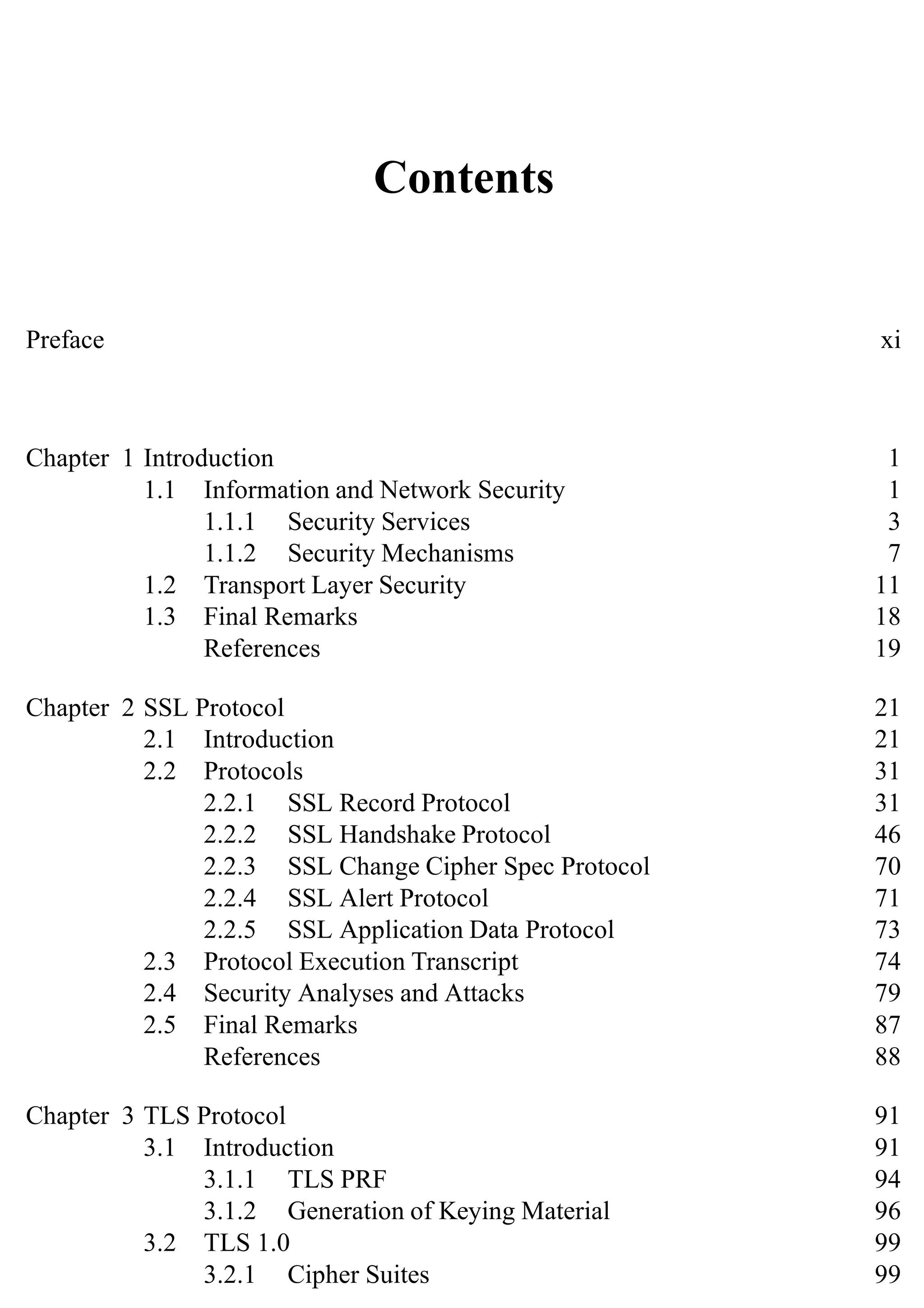
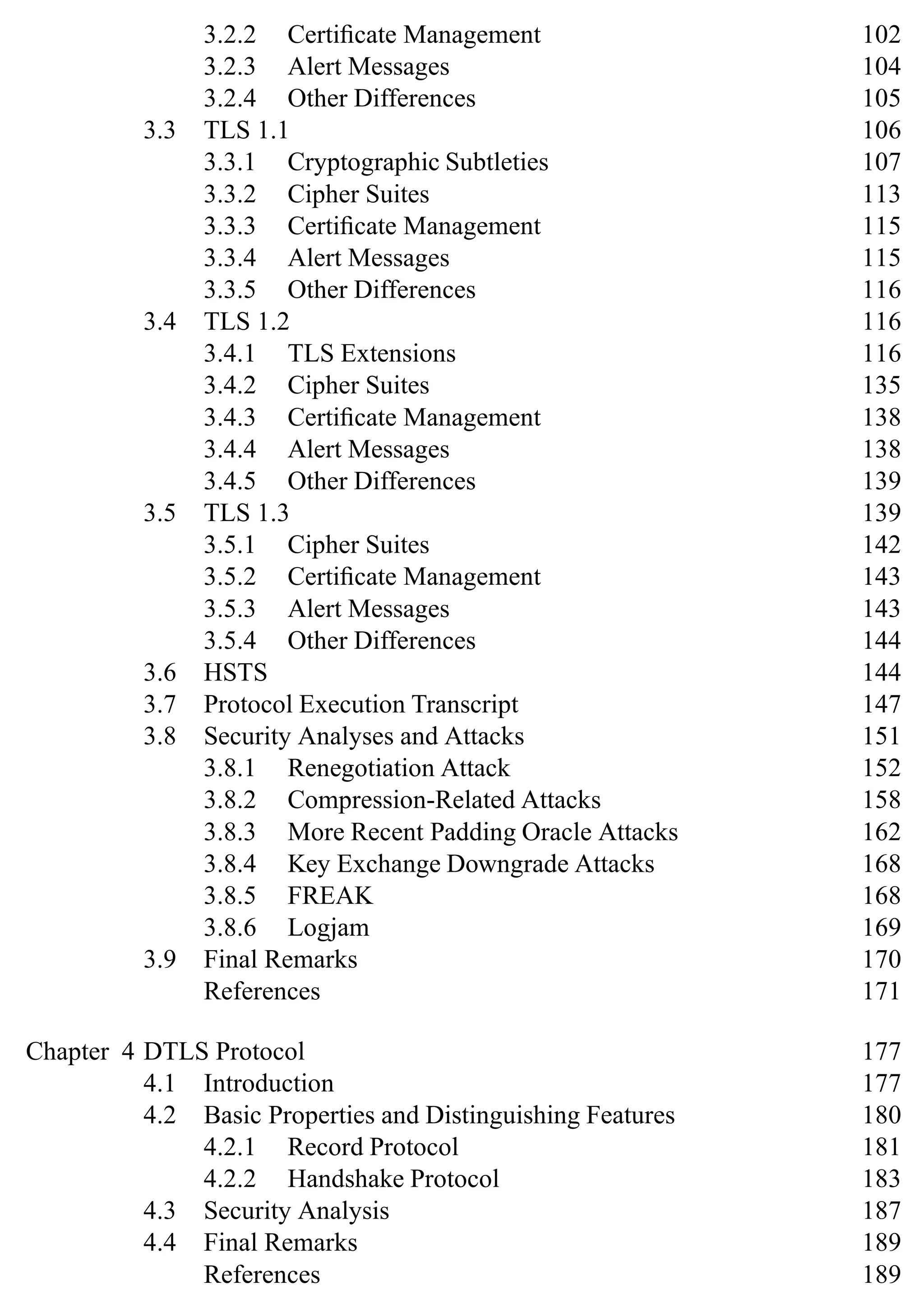
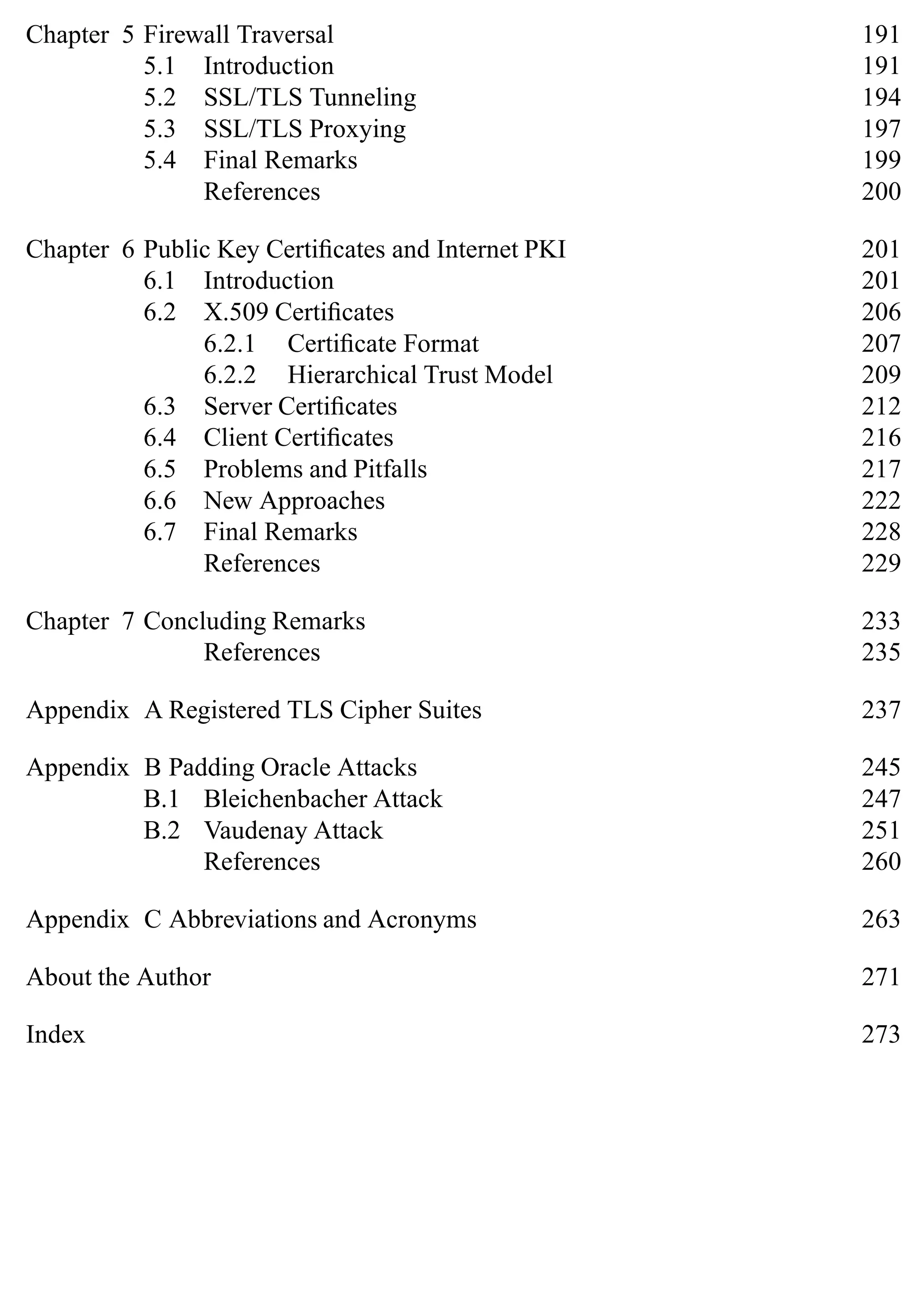
![and develop secure applications.1
In fact, it is fairly common today to invoke
such libraries and function calls from otherwise exploitable code. The resulting
application is not going to be secure—whether SSL/TLS is in place or not. Against
this background, secure programming and secure software development techniques
are of the utmost importance when it comes to building secure applications. Also, a
thorough understanding of a security technology is required to correctly apply it and
properly complement it with other security technologies. This rule of thumb also
applies to SSL/TLS. It is necessary to fully understand what the SSL/TLS protocols
can do and what they cannot do in order to apply them correctly. Otherwise, mistakes
and omissions are likely to occur and to hurt badly. The SSL/TLS protocols are
not a panacea. They enable applications to be only as secure as the underlying
infrastructural components, such as the computer systems and networks in use. If
these components are vulnerable and susceptible to attacks, then the security the
SSL/TLS protocols may provide is questionable or even illusive.
When I started to compile a teaching module about SSL/TLS more than 10
years ago, I was surprised to learn that the few books that were available then
either addressed the technology only superficially or—maybe worse—were out-
of-date. This was particularly true for the two reference books used in the field
[1, 2]. They both appeared in 2000—which was almost a decade ago. Against
this background, I decided to take my lecture notes and compile a new book that
would not only address the fundamental principles of the SSL/TLS protocols, but
would also try to explain the rationale behind their current designs. The resulting
book appeared in 2009. The triumphant success of SSL/TLS and many recent
developments have made it necessary to update the book and publish a second
edition sooner than originally anticipated. This seems to be the price to pay when
addressing a hot and fastly evolving field: Books become outdated even sooner
than is normally the case. So I have taken the opportunity to update the book
and to bring it in line with some of the more recent cryptanalytical results and
developments. Some of these results were known when the first edition of the book
1 Sometimes the libraries themselves contain bugs that allow adversaries to attack the systems that
employ them. In 2014, for example, it was revealed that the SSL/TLS implementation of Apple
iOS contained a serious bug that was later named the “double goto fail” bug (because it was caused
by a goto fail statement that was erroneously written twice) and that the GnuTLS implementation
contained a similar bug named “GnuTLS bug.” The bugs were similar in the sense that they both
allowed invalid public key certificates to pass certificate validation checks, and hence that an
adversary could use such certificates to mount a man-in-the-middle (MITM) attack. Maybe most
importantly, it was revealed in the same year that some elder versions of the OpenSSL library
contained a very severe bug in the implementation of the Heartbeat extension of the (D)TLS
protocol(s). As further addressed in Section 3.8, this bug allowed an adversary to read out the
server memory, possibly compromising cryptographic keys stored therein. The bug became known
as Heartbleed, and it casted a damning light on the security of OpenSSL.](https://image.slidesharecdn.com/3416660-250617111140-9c44c1e3/75/Ssl-And-Tls-Theory-And-Practice-2nd-Rolf-Oppliger-11-2048.jpg)
![went to press. However, they were not properly addressed, because there was no
evidence that the underlying theoretical vulnerabilities could actually be exploited
in practice. This has changed fundamentally,and terms like BEAST, CRIME, TIME,
BREACH, POODLE, FREAK, Logjam, and Lucky 13 have made a lot of headlines
and frightened both application developers and users. Keeping the old saying that
“attacks always get better; they never get worse” in mind, one can reasonably expect
many interesting attacks to be mounted in the future.2
The situation remains risky
and scary.
More recently, a book on SSL/TLS that is more in line with this book has
appeared [3]. It also addresses the fundamentals of SSL/TLS and the abovemen-
tioned attacks. Unlike this book, however, major parts of [3] address complementary
topics (that are not directly related to security), such as implementation, deploy-
ment, performance optimization, and configuration issues—sometimes even related
to specific products. For the reasons discussed below, SSL/TLS: Theory and Practice,
Second Edition, takes a different approach and delves into neither implementation is-
sues nor configuration details of particular implementations. Also, it addresses some
practically important topics that are entirely neglected in other books including [3],
such as TLS extensions, TLS version 1.3, and datagram TLS (DTLS), and discusses
cryptanalytical attacks and techniques to protect against them and mitigate the re-
spective risks.
In addition to providing a basic introduction and discussion of the SSL/TLS
protocols, another important goal of this second edition is to provide enough back-
ground information to understand, discuss, and put into perspective the latest crypt-
analytical attacks and attack tools. This goal is ambitious, because the attacks are
not at all simple and straightforward. Instead, they require quite a lot of background
knowledge in cryptography. This is one of the reasons I have changed the outline of
the book a little bit: Instead of providing a cryptography primer and starting from
scratch, I assume that readers already have some basic knowledge about cryptogra-
phy and start from there. Thus, readers who want to seriously delve into the security
of SSL/TLS should acquire this knowledge first. Fortunately, they can use many
books for this purpose, including [4].
Except for the omission of the cryptography primer, I have tried to stay as close
as possible to the original outline of the first edition of the book. This edition is again
intended for anyone who wants to get a deep understanding of the SSL/TLS proto-
cols and their proper use—be they theorists or practitioners. As mentioned above,
implementation issues and respective details are not addressed or only addressed
superficially. There are so many implementations of the SSL/TLS protocols, both
freely and commercially available, that it makes no sense to address them in a book.
2 As an example of such attacks, you may refer to the blog entry “The POODLE has friends,” which
is available at https://vivaldi.net/en-US/blogs/entry/the-poodle-has-friends.](https://image.slidesharecdn.com/3416660-250617111140-9c44c1e3/75/Ssl-And-Tls-Theory-And-Practice-2nd-Rolf-Oppliger-12-2048.jpg)
![knowledge to properly understand them—you still have to capture and read them.
In the case of OpenSSL, for example, you may use [5] or Chapter 11 of [3] as a
reference. Keep in mind, though, that, due to Heartbleed, the reputation of OpenSSL
is discussed controversially in the community. In the case of another library or de-
velopment environment, you have to read the original documentation.
In addition to cryptography, this book also assumes some basic familiarity
with the TCP/IP protocols and their working principles. Again, this assumption
is reasonable, because anybody not familar with TCP/IP is well-advised to first
get in touch and try to comprehend TCP/IP networking, before moving on to the
SSL/TLS protocols—only trying to understand SSL/TLS is not likely to be fruitful.
Readers unfamiliar with TCP/IP networking can consult one of the many books
about TCP/IP. Among these books, I particularly recommend the classic books of
Richard Stevens [6] and Douglas Comer [7], but there are many other (or rather
complementary) books available.
To properly understand the current status of the SSL/TLS protocols, it is useful
to be familiar with the Internet standardization process. Again, this process is likely
to be explained in a book on TCP/IP networking. It is also explained in RFC 2026 [8]
and updated on a web page hosted by the Internet Engineering Task Force (IETF).17
For each protocol specified in an RFC document, we are going to say whether it
has been submitted to the Internet standards track or specified for experimental or
informational use. This distinction is important and highly relevant in practice.
When we discuss the practical use of the SSL/TLS protocols, it is quite
helpful to visualize things with a network protocol analyzer, such as Wireshark18
or any other software tool that provides a similar functionality. Wireshark is a
freely available open-source software tool. With regard to SSL/TLS, it is sufficiently
complete, meaning that it can be used to analyze SSL/TLS-based data exchanges.
We don’t reproduce screenshots in this book, mainly because the graphical user
interfaces (GUIs) of tools like Wireshark are highly nonlinear, and the corresponding
screenshots are difficult to read and interpret if only single screenshots are available.
When we use Wireshark output, we provide it in textual form. This is visually less
stimulating, but generally more appropriate and therefore more useful in practice.
SSL/TLS: Theory and Practice, Second Edition, is organized and structured in
seven chapters, described as follows.
• Chapter 1, Introduction, prepares the ground for the topic of this book and pro-
vides the fundamentals and basic principles that are necessary to understand
the SSL/TLS protocols properly.
17 https://www.ietf.org/about/standards-process.html.
18 http://www.wireshark.org.](https://image.slidesharecdn.com/3416660-250617111140-9c44c1e3/75/Ssl-And-Tls-Theory-And-Practice-2nd-Rolf-Oppliger-14-2048.jpg)
![Again, I hope that SSL/TLS: Theory and Practice, Second Edition, serves your
needs. The ultimate goal of a technical book is to save readers time, and I hope
that this applies to this book, too. Also, I would like to take the opportunity to
invite readers to let me know your opinions and thoughts. If you have something
to correct or add, please let me know. If I have not expressed myself clearly,
please let me know, too. I appreciate and sincerely welcome any comments or
suggestions to update the book in future editions and turn it into a reference book
that can be used for educational purposes. The best way to reach me is to send a
message to rolf.oppliger@esecurity.ch. You can also visit the book’s home page at
http://books.esecurity.ch/ssltls2e.html.I use this page periodically to post errata lists,
additional information, and complementary material. I look forward to hearing from
you in one way or another.
References
[1] Rescorla, E., SSL and TLS: Designing and Building Secure Systems. Addison-Wesley, Reading,
MA, 2000.
[2] Thomas, S.A., SSL and TLS Essentials: Securing the Web. John Wiley & Sons, New York, NY,
2000.
[3] Ristić, I., Bulletproof SSL and TLS: Understanding and Deploying SSL/TLS and PKI to Secure
Servers and Web Applications, Feisty Duck Limited, London, UK, 2014.
[4] Oppliger, R., Contemporary Cryptography, 2nd edition. Artech House Publishers, Norwood, MA,
2011.
[5] Viega, J., M. Messier, and P. Chandra, Network Security with OpenSSL. O’Reilly, Sebastopol,
CA, 2002.
[6] Fall, K.R., and W.R. Stevens, TCP/IP Illustrated, Volume 1: The Protocols, 2nd edition. Addison-
Wesley Professional, New York, NY, 2011.
[7] Comer, D.E., Internetworking with TCP/IP Volume 1: Principles, Protocols, and Architecture,
6th edition. Addison-Wesley, New York, NY, 2013.
[8] Bradner, S., “The Internet Standards Process—Revision 3,” Request for Comments 2026 (BCP
9), October 1996.](https://image.slidesharecdn.com/3416660-250617111140-9c44c1e3/75/Ssl-And-Tls-Theory-And-Practice-2nd-Rolf-Oppliger-16-2048.jpg)
![Chapter 1
Introduction
This introductory chapter prepares the ground for the topic of the book. More
specifically, it starts with a brief introduction into information and network security
in Section 1.1, delves more deeply into transport layer security and the evolution
of the SSL/TLS protocols in Section 1.2, and concludes with some final remarks in
Section 1.3.
1.1 INFORMATION AND NETWORK SECURITY
According to the Internet security glossary available in RFC 4949 [1], information
security (INFOSEC) refers to “measures that implement and assure security services
in information systems, including in computer systems (computer security) and in
communication systems (communication security).” In this context, computer secu-
rity (COMPUSEC) refers to security services provided by computer systems (e.g.,
access control services), whereas communication security (COMSEC) refers to se-
curity services provided by communication systems that exchange data (e.g., data
confidentiality, authentication, and integrity services). It goes without saying that in
a practical setting, COMPUSEC and COMSEC must go hand in hand to provide a
reasonable level of INFOSEC. If, for example, data is cryptographically protected
while being transmitted, then that data may be susceptible to attacks on either side
of the communication channel while it is being stored or processed. So COMSEC—
which is essentially what this book is all about—must always be complemented by
COMPUSEC; otherwise all security measures are not particularly useful and can be
circumvented at will. It also goes without saying that the distinction between COM-
PUSEC and COMSEC has been blurred to some extent by recent developments in
the realm of middleware and service-oriented architectures (SOAs). The distinction
is no longer precise, and hence it may not be as useful as it was in the past.](https://image.slidesharecdn.com/3416660-250617111140-9c44c1e3/75/Ssl-And-Tls-Theory-And-Practice-2nd-Rolf-Oppliger-17-2048.jpg)
![2 SSL and TLS: Theory and Practice
INFOSEC (as well as COMPUSEC and COMSEC) comprises all technical
and nontechnical measures aimed at implementing and assuring security services in
information systems. So it is not only about technology, and in many cases, organi-
zational, personnel, or legal measures are more effective than purely technical ones.
This should be kept in mind, despite the fact that this book is only about technology.
Any technical measure that is not complemented by adequate nontechnical measures
is likely to fail—at least in the long term.
For the purpose of this book, we use the term network security as a synonym
for communication security. So we try to invoke measures that can be used to imple-
ment and assure security services for data in transmission. When we talk about se-
curity services, it makes a lot of sense to introduce them (together with mechanisms
that provide them) in some standardized way. One standard that can be used here is
the security architecture that has been appended as part two of the formerly famous
(but nowadays almost entirely ignored) open systems interconnection (OSI) basic
reference model specified by the Joint Technical Committee 1 (JTC1) of the Interna-
tional Organization for Standardization (ISO) and the International Electrotechnical
Commission (IEC) in 1989 [2]. Without delving into the details, we only mention
that the OSI model has seven layers, whereas the more familiar TCP/IP model only
has four. Figure 1.1 illustrates the layers and the relationship between them. Most
importantly, the physical and data link layers of the OSI model are merged in a
single network access layer in the TCP/IP model, and the session, presentation, and
application layers of the OSI model are merged in a unique application layer in the
TCP/IP model.
According to its title, ISO/IEC 7498-2 claims to provide a security architec-
ture, but it is more a terminological framework than a true architecture (refer to [3]
for a discussion of what a security architecture really is). Nevertheless, we still use
the term OSI security architecture to refer to ISO/IEC 7498-2. In 1991, the Telecom-
munication Standardization Sector of the International Telecommunication Union
(ITU), also known as ITU-T, adopted the OSI security architecture in its recommen-
dation X.800 [4]. Also in the early 1990s, the Privacy and Security Research Group
(PSRG) of the Internet Research Task Force (IRTF1
) preliminarily adopted the OSI
security architecture in a corresponding Internet security architecture published as an
Internet draft.2
In essence, ISO/IEC 7498-2, ITU-T X.800, and the Internet security
architecture draft all describe the same security standard, and in this book we use
the term OSI security architecture to refer to all of them collectively. Contrary to
1 The IRTF is a sister group to the IETF. Its stated mission is “To promote research of importance
to the evolution of the future Internet by creating focused, long-term and small Research Groups
working on topics related to Internet protocols, applications, architecture and technology.” Its web
site is available at https://irtf.org.
2 This work has been abandoned.](https://image.slidesharecdn.com/3416660-250617111140-9c44c1e3/75/Ssl-And-Tls-Theory-And-Practice-2nd-Rolf-Oppliger-18-2048.jpg)
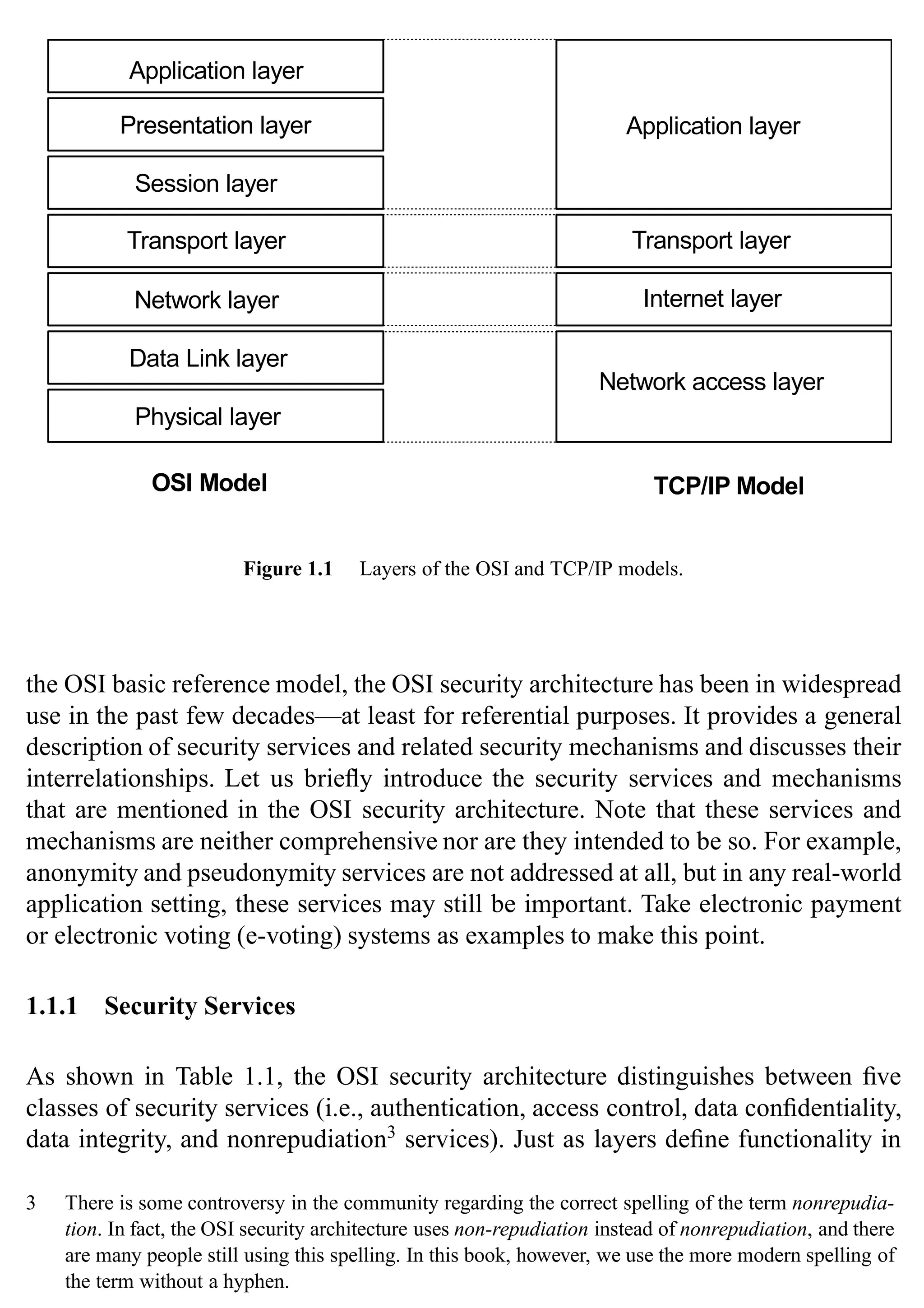
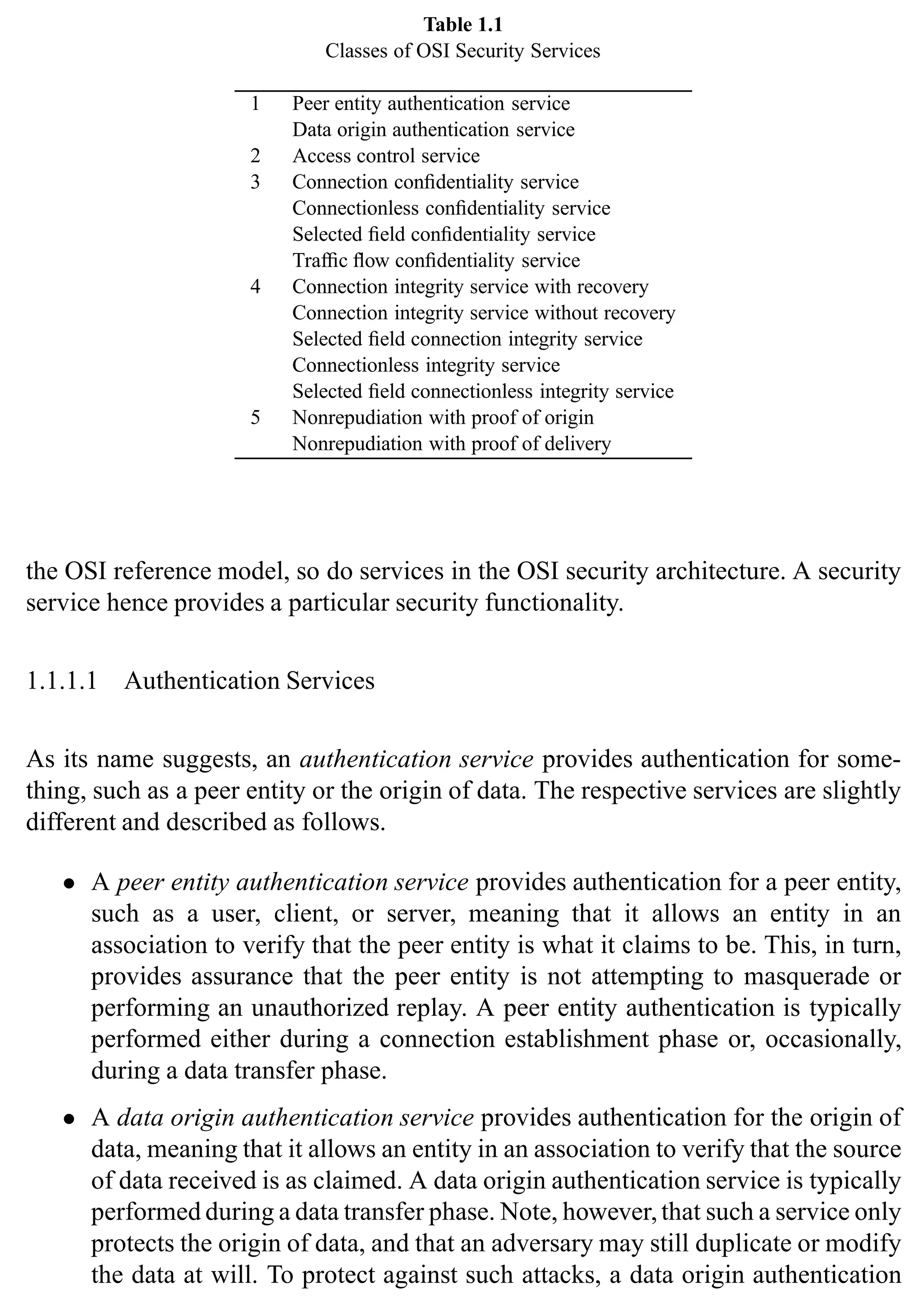
![Introduction 7
1.1.1.5 Nonrepudiation Services
A nonrepudiation service protects an entity from having a peer entity (that is also
involved in the communication) deny that it has participated in all or part of the
communication. In general, there are two nonrepudiation services that are relevant
in practice:
• A nonrepudiation service with proof of origin provides the recipient of data
with a proof of origin, meaning that the sender cannot later deny having sent
the data.
• A nonrepudiation service with proof of delivery provides the sender of data
with a proof of delivery, meaning that the recipient of the data cannot later
deny having received it.4
Nonrepudiation services are key for Internet-based e-commerce (e.g., [5]).
Consider, for example, the situation in which an investor communicates with his
or her stockbroker over the Internet. If the investor decides to sell a large number
of stocks, then he or she may send a corresponding request to the stockbroker.
If the prices are about to change only moderately, then everything works fine.
However, if the stock price raises sharply, then the investor may deny having sent
the order to sell the stocks in the first place. Conversely, it is possible that under
reversed circumstances the stockbroker may deny having received the order to sell
the stocks. In situations like these, it seems to be the case that the ability to provide
nonrepudiation services is key to the success of the whole endeavor.
Not all security services are equally relevant for the SSL/TLS protocols.
Section 2.1 discusses what services are relevant for the SSL protocol, and the same
argument also applies to the TLS protocol. This introduction aims to familiarize the
readers with the terms and convey a common understanding for their meaning.
1.1.2 Security Mechanisms
In addition to the security services mentioned above, the OSI security architecture
itemizes security mechanisms that may be used to implement the services. A
distinction is made between specific security mechanisms and pervasive ones. While
a specific security mechanism can be used to implement a specific security service,
a pervasive security mechanism is generally not specific to a particular service and
can be used to implement—or rather complement—several security services at the
same time.
4 Note, however, that a proof of delivery only proves the successful delivery of the data. It does not
necessarily mean that the recipient has also read the data.](https://image.slidesharecdn.com/3416660-250617111140-9c44c1e3/75/Ssl-And-Tls-Theory-And-Practice-2nd-Rolf-Oppliger-23-2048.jpg)
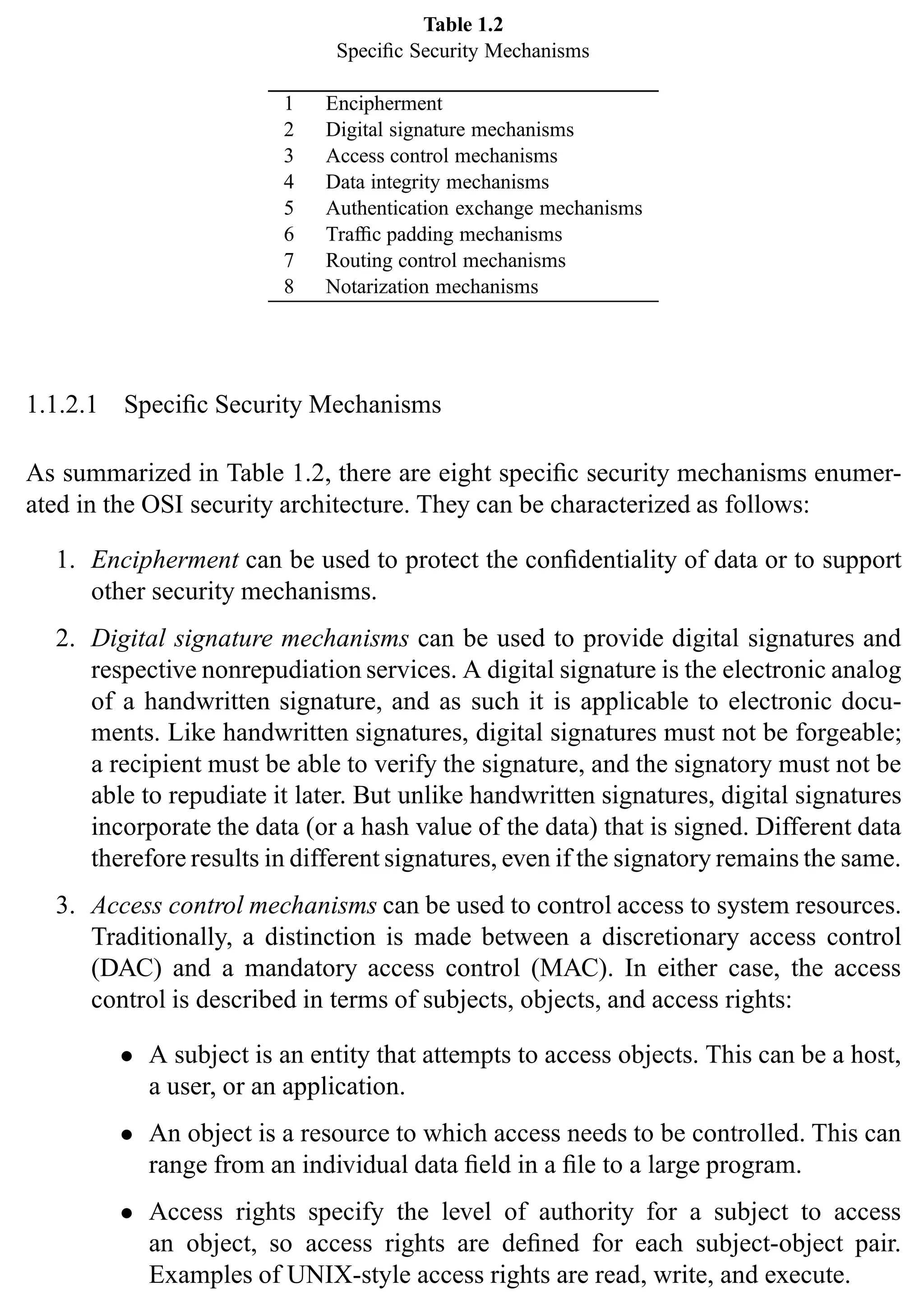
![Introduction 9
More recently, people have introduced the notion of a role and have
developed role-based access controls (RBACs) to make the assignment of
access rights to subjects more simple and straightforward, and hence also
more flexible (e.g., [6, 7]). Today, people are elaborating on using attributes
to simplify the assignment of access rights in so-called attribute-based access
controls (ABACs).5
4. Data integrity mechanisms can be used to protect the integrity of data—be it
individual data units or fields within them or sequences of data units or fields
within them. Note that data integrity mechanisms, in general, do not protect
against replay attacks that work by recording and replaying previously sent
data units. Also, protecting the integrity of a sequence of data units and fields
within these data units generally requires some form of explicit ordering, such
as sequence numbering, time-stamping, or cryptographic chaining.
5. Authentication exchange mechanisms can be used to verify the claimed iden-
tities of entities. A broad distinction is made between weak authentication
exchange mechanisms that are vulnerable to passive wiretapping and replay
attacks and strong authentication exchange mechanisms that protect against
these attacks. Strong authentication exchange mechanisms usually employ
sophisticated cryptographic techniques and sometimes even rely on dedicated
hardware (e.g., smartcards). The use of biometrics in a nontrivial setting also
yields a strong authentication exchange mechanism for human users.
6. Traffic padding mechanisms can be used to protect against traffic analysis. It
works by having the data originator generate and transmit randomly composed
data hand in hand with the actual data. Only the data originator and intended
recipient(s) know how this data is transmitted; thus, an unauthorized party
who captures and attempts to replay the data cannot distinguish the randomly
generated data from meaningful data.
7. Routing control mechanisms can be used to choose—either dynamically or
by prearrangement—specific routes for data transmission. Communicating
systems may, on detection of persistent passive or active attacks, wish to
instruct the network service provider to establish a connection via a different
route. Similarly, data carrying certain security labels may be forbidden by
policy to pass through certain networks or links. Routing control mechanisms
are not always available, but if they are they tend to be very effective.
8. Notarization mechanisms can be used to assure certain properties of the data
communicated between two or more entities, such as its integrity, origin, time,
5 http://csrc.nist.gov/projects/abac.](https://image.slidesharecdn.com/3416660-250617111140-9c44c1e3/75/Ssl-And-Tls-Theory-And-Practice-2nd-Rolf-Oppliger-25-2048.jpg)
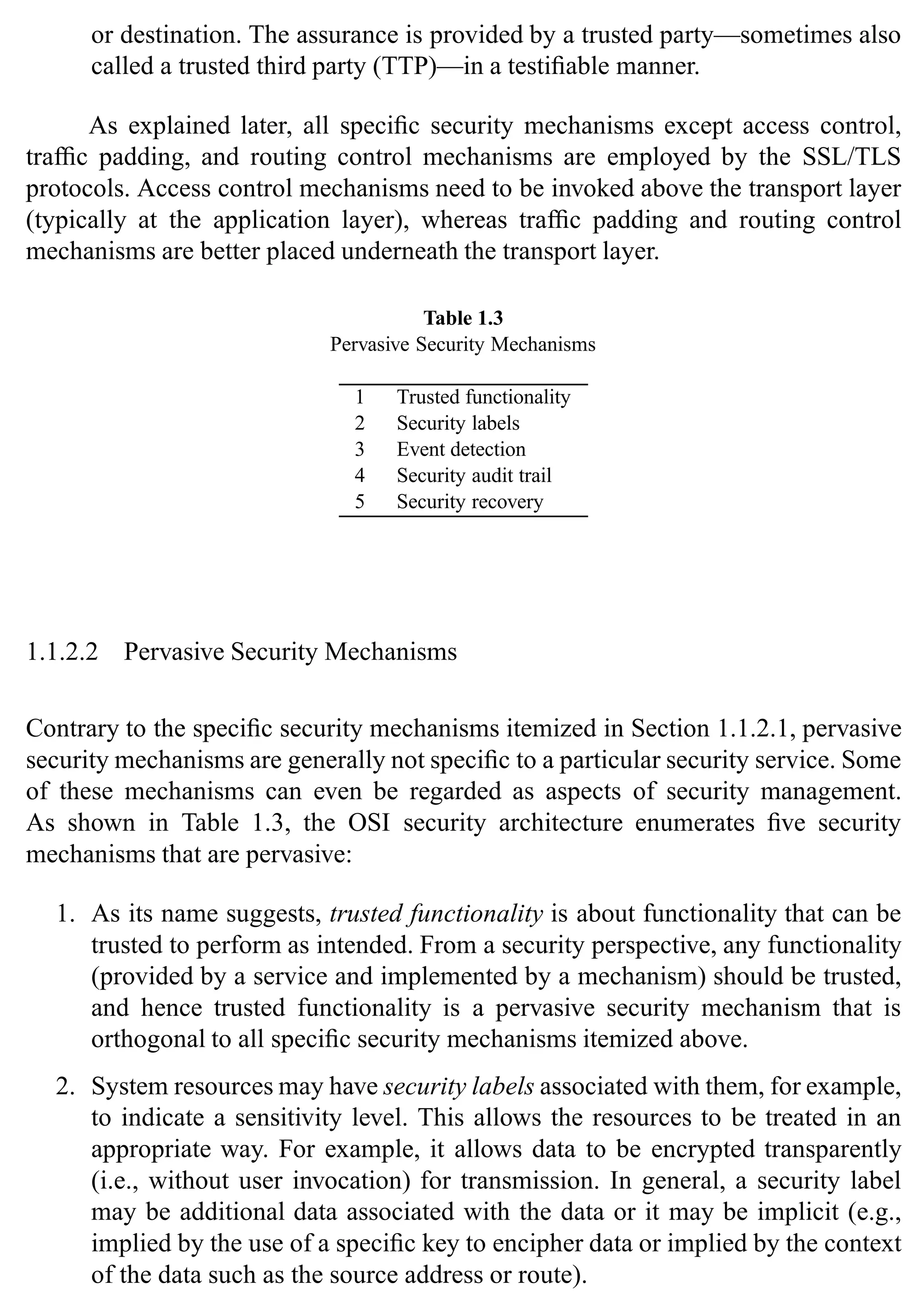
![12 SSL and TLS: Theory and Practice
services. Other than that, however, there was hardly any consensus about what
particular techniques to use and at what layer to invoke them.
In general, there are many possibilities to invoke cryptographic techniques
at various layers of the TCP/IP model and protocol stack. In fact, all Internet
security protocols overviewed in [8] or Chapter 5 of [9] can be used to secure web
transactions. In practice, however, the combined use of the IP security (IPsec) and
the Internet key exchange (IKE) protocols [10] on the Internet layer, the SSL/TLS
protocols on the transport layer,6
and some variation of a secure messaging scheme
[11] on the application layer are the most appropriate possibilities. There is a end-
to-end argument in system design that strongly speaks in favor of providing security
services at a higher layer [12]. The argument basically says the following:
• Any nontrivial communications system involves intermediaries, such as net-
work devices, relay stations, computer systems, and software modules that are,
in principle, unaware of the context of the communication being involved;
• These intermediaries are incapable of ensuring that the data is processed
correctly.
The bottom line is that, whenever possible, communications protocol operations
should be defined to occur at the end points of a communications system, or as
close as possible to the resource being controlled. The end-to-end argument applies
generally (i.e., for any type of functionality), but as pointed out in [13], it particularly
applies to the provision of network security services.
Following the end-to-end argument and design principle, the IETF chartered a
web transaction security (WTS) WG in the early 1990s.7
The WG was tasked with
the specification of requirements and respective security services for web transac-
tions (i.e., transactions using HTTP). The outcome of the WG is documented in [14–
16]. Most importantly, the secure hypertext transfer protocol (S-HTTP or SHTTP)
was a security enhancement for HTTP that could be used to encrypt and/or digitally
sign documents or specific parts thereof [16]. As such, S-HTTP is conceptually sim-
ilar to today’s specifications of the World Wide Web Consortium (W3C) related to
extensible markup language (XML) encryption and XML signatures. It was submit-
ted to the web transaction discussion in 1994, and—due to its strong initial support
from the software industry—it seemed to be only a question of time until it would
become the key player in the field.
6 Strictly speaking, the SSL/TLS protocols operate at an intermediate layer between the transport
layer and the application layer. To keep things simple and in line with the TCP/IP model, however,
we refer to this layer as a part of the transport layer. This is not perfectly correct, but it simplifies
things considerably and is therefore justified.
7 http://www.ietf.org/html.charters/OLD/wts-charter.html.](https://image.slidesharecdn.com/3416660-250617111140-9c44c1e3/75/Ssl-And-Tls-Theory-And-Practice-2nd-Rolf-Oppliger-28-2048.jpg)
![Introduction 15
independent consultant named Paul C. Kocher (who later founded Cryptography
Research13
). Also, around this time, Netscape Communications hired several secu-
rity professionals, including Taher Elgamal—the inventor of the Elgamal public key
cryptosystem [17]. These distinguished security professionals helped make SSL 3.0
more robust and secure. The specification of SSL 3.0 was finally published as an
Internet draft entitled “The SSL Protocol Version 3.0” in November 1996. More
recently, the SSL 3.0 specification was released in a historic RFC document [18]
that is used for referential purposes.
SSL 2.0 had a few shortcomings and security problems that were corrected in
SSL 3.0:
• SSL 2.0 permitted the client and server to send only one public key certificate
to each other. This basically means that the certificate had to be directly signed
by a trusted root CA. Contrary to that, SSL 3.0 allows clients and servers to
have arbitrary-length certificate chains.
• SSL 2.0 used the same keys for message authentication and encryption, which
led to problems for certain ciphers. Also, if SSL 2.0 was used with RC4 in
export mode, then the message authentication and encryption keys were both
based on 40 bits of secret data. This is in contrast to the fact that the message
authentication keys could potentially be much longer (the export restrictions
only applied to encryption keys). In SSL 3.0, different keys are used, and
hence even if weak ciphers are used for encryption, mounting attacks against
message authenticity and integrity is still infeasible (because the respective
keys are much longer by default).
• SSL 2.0 exclusively used MD5 for message authentication. In SSL 3.0, how-
ever, MD5 has been complemented with SHA-1, and the MAC construction
has been made more sophisticated (we come to this construction in Section
2.2.1.3).
Due to these shortcomings and security problems, the IETF recommended the
complete replacement of SSL 2.0 with SSL 3.0 in 2011 [19]. Note, however, that
due to some even more recent developments (in particular, regarding the POODLE
attack), the IETF deprecated SSL 3.0 and the entire SSL protocol four years later in
2015 [20].
After the publication of SSL 3.0 and PCT, there was a lot of confusion in the
security community. On one hand, there was Netscape Communications and a large
part of the Internet and web security community pushing SSL 3.0. On the other hand,
there was Microsoft with its huge installed base pushing PCT. The company also
13 http://www.cryptography.com.](https://image.slidesharecdn.com/3416660-250617111140-9c44c1e3/75/Ssl-And-Tls-Theory-And-Practice-2nd-Rolf-Oppliger-31-2048.jpg)
![16 SSL and TLS: Theory and Practice
had to support SSL for interoperability reasons. To make things worse, Microsoft
had even come up with yet another protocol proposal, named secure transport
layer protocol (STLP), which was basically a modification of SSL 3.0, providing
additional features that Microsoft considered to be critical, such as support for UDP,
client authentication based on shared secrets, and some performance optimizations
(many of these features are now included in the TLS protocol). In this situation,
an IETF Transport Layer Security (TLS) Working Group14
was formed in 1996
to resolve the issue and to standardize a unified TLS protocol. This task was
technically simple, because the protocols to begin with—SSL 3.0 and PCT/STLP—
were already technically similar. However, it still took the IETF TLS WG a long
time to accomplish its mission. There are at least three reasons for this delay:
• First, the Internet standards process [21] requires that a statement be obtained
from a patent holder indicating that a license will be made available to
applicants under reasonable terms and conditions. This also applied to the
SSL patent (such a statement was not included in the original specification of
SSL 3.0).
• Second, at the April 1995 IETF meeting in Danvers, Massachusetts, the
IESG adopted the so-called Danvers doctrine [22], which basically says that
the IETF should design protocols that embody good engineering principles,
regardless of exportability issues. With regard to the yet-to-be-defined TLS
protocol, the Danvers doctrine implied that DES needed to be supported at a
minimum and that 3DES was the preferred choice (remember that the export
of DES and 3DES from the United States was still regulated around this time).
• Third, the IETF had a longstanding preference for unencumbered algorithms
when possible. So when the Merkle-Hellman patent (covering many public
key cryptosystems) expired in 1998, but RSA was still patented, the IESG
began pressuring working groups to adopt the use of the unpatented public
key cryptosystems.
When the IETF TLS WG finished its work in late 1997, it sent the first ver-
sion of the TLS protocol specification to the IESG. The IESG, in turn, returned the
specification with a few instructions to add other cryptosystems, namely DSA for
authentication, Diffie-Hellman for key exchange (note that the respective patent was
about to expire), and 3DES for encryption, mainly to solve the two last issues men-
tioned above. The first issue could be solved by adding a corresponding statement
in the TLS protocol specification. Much discussion on the mailing list ensued, with
Netscape Communications in particular resisting mandatory cryptographic systems
14 http://www.ietf.org/html.charters/tls-charter.html.](https://image.slidesharecdn.com/3416660-250617111140-9c44c1e3/75/Ssl-And-Tls-Theory-And-Practice-2nd-Rolf-Oppliger-32-2048.jpg)
![Introduction 17
in general and 3DES in particular. After some heated discussions between the IESG
and the IETF TLS WG, grudging consensus was reached and the protocol specifica-
tion was resubmitted with the appropriate changes in place.
Unfortunately, another problem had appeared in the meantime: The IETF
Public Key Infrastructure (PKIX) WG had been tasked to standardize a profile for
X.509 certificates on the Internet, and this WG was just winding up its work. From
the very beginning, the TLS protocol depended on X.509 certificates and hence
on the outcome of the IETF PKIX WG. In the meantime, the rules of the IETF
forbid protocols advancing ahead of other protocols on which they depend. PKIX
finalization took rather longer than originally anticipated and added another delay.
The bottom line is that it took almost three years until the IETF TLS WG could
officially release its security protocol.15
In fact, the first version of the TLS protocol
(i.e., TLS 1.0) was specified in RFC 2246 [23] and released in January 1999. The
required patent statement was included in Appendix G of this document. Despite
the name change, TLS 1.0 is nothing more than a new version of SSL 3.0. In fact,
there are fewer differences between TLS 1.0 and SSL 3.0 than there are differences
between SSL 3.0 and SSL 2.0. TLS 1.0 is therefore sometimes also referred to as
SSL 3.1. In addition to the TLS 1.0 specification, the IETF TLS WG also completed
a series of extensions to the TLS protocol that are documented elsewhere.
After the 1999 release of TLS 1.0, work on the TLS protocol continued inside
the IETF TLS WG. In April 2006, the TLS protocol version 1.1 (TLS 1.1) was
specified in Standards Track RFC 4346 [24], making RFC 2246 [23] obsolete. As
discussed in the following two chapters, there were some cryptographic problems
that needed to be resolved in TLS 1.1. In addition to TLS 1.1, the IETF TLS WG also
released the first version of the DTLS protocol to secure UDP-based applications
(DTLS 1.0) in Standards Track RFC 4347 [25]. After another two-year revision
period, the TLS protocol version 1.2 (TLS 1.2) was specified in Standards Track
RFC 5246 in 2008 [26]. This document not only made RFC 4346 obsolete, but also
a few other RFC documents (most of them referring to TLS extensions). Four years
later, in January 2012, version 1.2 of the DTLS protocol was officially released in
Standards Track RFC 6347 [27]. Today, the IETF TLS WG is actively working on
version 1.3 of the TLS protocol (TLS 1.3) [28].16
This version is just the latest step
in the evolution of the SSL/TLS protocols, but it is not going to be the end of the
story (and not the end of the protocol evolution, respectively).
15 The protocol name had to be changed from SSL to TLS to avoid the appearance of bias toward any
particular company.
16 In spite of the fact that it is usually inappropriate to reference Internet drafts, we make an exception
for TLS 1.3. The protocol specification is fairly stable and highly relevant for the topic of this book.](https://image.slidesharecdn.com/3416660-250617111140-9c44c1e3/75/Ssl-And-Tls-Theory-And-Practice-2nd-Rolf-Oppliger-33-2048.jpg)
![18 SSL and TLS: Theory and Practice
1.3 FINAL REMARKS
This chapter has prepared the ground for the topic of this book, and we are now ready
to delve more deeply into the SSL/TLS protocols. These protocols are omnipresent
on the Internet today, and we think that there are two major reasons for their success:
• On one hand, they can be used to secure any application layer protocol that is
stacked on them. This means that any TCP-based application can potentially
be secured with the SSL/TLS protocols. As explained later, there is even a
possibility to secure any UDP-based application with the DTLS protocol.
• On the other hand, they can operate nearly transparently for users, meaning
that users need not be aware of the fact that the SSL/TLS protocols are in
place.17
This simplifies the deployment of the protocols considerably.
The SSL/TLS protocols are cryptographic security protocols, meaning that
that they aim to provide security services with cryptographic means. In any security
discussion, it is mandatory to nail down the threats model and to specify against
whom one wants to protect oneself. In the cryptographic literature, the threats model
that is most frequently used is the Dolev-Yao model [29]. It basically says that
the adversary is yet able to control the communications network used to transmit
all messages but that he or she is not able to compromise the end systems. This
basically means that the adversary can mount all kinds of (passive and active)
attacks on the network. Roughly speaking, a passive attack “attempts to learn or
make use of information from the system but does not affect system resources,”
whereas an active attack “attempts to alter system resources or affect their operation”
[1]. Obviously, passive and active attacks can (and will) be combined to effectively
invade a computing or networking environment. For example, a passive wiretapping
attack can be used to eavesdrop on the authentication information that is transmitted
in the clear (e.g., username and password), and this information can then be used to
masquerade the user and to actively attack the system accordingly.
The SSL/TLS protocols have been designed to be secure in the Dolev-Yao
model, but the model has its limitations and shortcomings. For example, many
contemporary attacks are either based on malware or they employ sophisticated
techniques to spoof the user interface of the client system. Such attacks are outside
the scope of the Dolev-Yao model, and hence the SSL/TLS protcols do not natively
provide protection against them. In the future, it is possible and very likely that we
will have to adapt and extend the threats model a little bit. This is a current research
topic in network security, and its results will definitively have a deep impact on the
17 The only place where user involvement is ultimately required is when the user must verify the server
certificate. This is actually also the Achilles’ heel of SSL/TLS.](https://image.slidesharecdn.com/3416660-250617111140-9c44c1e3/75/Ssl-And-Tls-Theory-And-Practice-2nd-Rolf-Oppliger-34-2048.jpg)
![Introduction 19
design of future versions of the TLS protocol. The bottom line is that one always has
to be careful when people make claims about the security of a protocol. One always
has to look behind the scenes and assess the threats model against which the claims
are made. This is always important, and it is particularly important for the SSL/TLS
protocols.
References
[1] Shirey, R., “Internet Security Glossary, Version 2,” Informational RFC 4949 (FYI 36), August
2007.
[2] ISO/IEC 7498-2, Information Processing Systems—Open Systems Interconnection Reference
Model—Part 2: Security Architecture, 1989.
[3] Oppliger, R., “IT Security: In Search of the Holy Grail,” Communications of the ACM, Vol. 50,
No. 2, February 2007, pp. 96–98.
[4] ITU X.800, Security Architecture for Open Systems Interconnection for CCITT Applica-
tions, 1991 (CCITT is the acronym of “Comité Consultatif International Téléphonique et
Télégraphique,” which is the former name of the ITU).
[5] Zhou, J., Non-Repudiation in Electronic Commerce. Artech House Publishers, Norwood, MA,
2001.
[6] Ferraiolo, D.F., D.R. Kuhn, and R. Chandramouli, Role-Based Access Controls, 2nd edition.
Artech House Publishers, Norwood, MA, 2007.
[7] Coyne, E.J., and J.M. Davis, Role Engineering for Enterprise Security Management. Artech
House Publishers, Norwood, MA, 2008.
[8] Oppliger, R., Internet and Intranet Security, 2nd edition. Artech House Publishers, Norwood,
MA, 2002.
[9] Oppliger, R., Security Technologies for the World Wide Web, 2nd edition. Artech House Publish-
ers, Norwood, MA, 2003.
[10] Frankel, S., Demystifying the IPsec Puzzle, Artech House Publishers, Norwood, MA, 2001.
[11] Oppliger, R., Secure Messaging on the Internet, Artech House Publishers, Norwood, MA, 2014.
[12] Saltzer, J.H., D.P. Reed, and D.D. Clark, “End-to-End Arguments in System Design,” ACM
Transactions on Computer Systems, Vol. 2, No. 4, November 1984, pp. 277–288.
[13] Voydock, V., and S.T. Kent, “Security Mechanisms in High-Level Network Protocols,” ACM
Computing Surveys, Vol. 15, 1983, pp. 135–171.
[14] Bossert, G., S. Cooper, and W. Drummond, “Considerations for Web Transaction Security,”
Informational RFC 2084, January 1997.
[15] Rescorla, E., and A. Schiffman, “Security Extensions For HTML,” Experimental RFC 2659,
August 1999.](https://image.slidesharecdn.com/3416660-250617111140-9c44c1e3/75/Ssl-And-Tls-Theory-And-Practice-2nd-Rolf-Oppliger-35-2048.jpg)
![20 SSL and TLS: Theory and Practice
[16] Rescorla, E., and A. Schiffman, “The Secure HyperText Transfer Protocol,” Experimental RFC
2660, August 1999.
[17] Elgamal, T., “A Public Key Cryptosystem and a Signature Scheme Based on Discrete Logarithm,”
IEEE Transactions on Information Theory, IT-31(4), 1985, pp. 469–472.
[18] Freier, A., P. Karlton, and P. Kocher, “The Secure Sockets Layer (SSL) Protocol Version 3.0,”
Historic RFC 6101, August 2011.
[19] Turner, S., and T. Polk, “Prohibiting Secure Sockets Layer (SSL) Version 2.0,” Standards Track
RFC 6176, March 2011.
[20] Barnes, R., et al., “Deprecating Secure Sockets Layer Version 3.0,” Standards Track RFC 7568,
June 2015.
[21] Bradner, S., “The Internet Standards Process—Revision 3,” RFC 2026 (BCP 9), October 1996.
[22] Schiller, J., “Strong Security Requirements for Internet Engineering Task Force Standard Proto-
cols,” RFC 3365 (BCP 61), August 2002.
[23] Dierks, T., and C. Allen, “The TLS Protocol Version 1.0,” Standards Track RFC 2246, January
1999.
[24] Dierks, T., and E. Rescorla, “The Transport Layer Security (TLS) Protocol Version 1.1,” Stan-
dards Track RFC 4346, April 2006.
[25] Rescorla, E., and N. Modadugu, “Datagram Transport Layer Security,” Standards Track RFC
4347, April 2006.
[26] Dierks, T., and E. Rescorla, “The Transport Layer Security (TLS) Protocol Version 1.2,” Stan-
dards Track RFC 5246, August 2008.
[27] Rescorla, E., and N. Modadugu, “Datagram Transport Layer Security Version 1.2,” Standards
Track RFC 6347, January 2012.
[28] Rescorla, E., “The Transport Layer Security (TLS) Protocol Version 1.3,” Internet-Draft, October
2015.
[29] Dolev, D., and A.C. Yao, “On the Security of Public Key Protocols,” Proceedings of the IEEE
22nd Annual Symposium on Foundations of Computer Science, 1981, pp. 350–357.](https://image.slidesharecdn.com/3416660-250617111140-9c44c1e3/75/Ssl-And-Tls-Theory-And-Practice-2nd-Rolf-Oppliger-36-2048.jpg)
![Chapter 2
SSL Protocol
This chapter introduces, discusses, and puts into perspective the first transport layer
security protocol1
mentioned in the title of this book (i.e., the SSL protocol that is
specified with retroactive effect in RFC 6101 [1]).2
More specifically, we provide
an introduction in Section 2.1, overview the SSL protocol and its subprotocols in
Section 2.2, outline the transcript of a protocol execution in Section 2.3, elaborate
on the security analyses and attacks that are available in Section 2.4, and conclude
with some final remarks in Section 2.5. The bottom line is that—due to the recent
POODLE attack—the SSL protocol should no longer be used. So you may wonder
why we spend so much time on introducing and explaining in detail a now depre-
cated protocol. The answer is related to the fact that the TLS and DTLS protocols
are very similar (and in many regards even identical) to the SSL protocol. So most
things we say about the SSL protocol similarly apply to the TLS and DTLS proto-
cols. This allows us to shorten the chapters on TLS and DTLS considerably, and to
put everything into the right perspective. The SSL protocol is really key to properly
understanding the TLS and DTLS protocols.
2.1 INTRODUCTION
Chapter 1 looked back into the 1990s and explained why Netscape Communications
proposed SSL and how the SSL protocol has evolved in three versions—SSL 1.0,
SSL 2.0, and SSL 3.0—to become what is currently known as the TLS protocol.
1 As mentioned in Section 1.2, the SSL protocol does not, strictly speaking, operate at the transport
layer. Instead, it operates at an intermediate layer between the transport layer and the application
layer.
2 Note that this RFC is historic and was published in August 2011. Before this date, there was only a
draft specification that could be used as a reference.](https://image.slidesharecdn.com/3416660-250617111140-9c44c1e3/75/Ssl-And-Tls-Theory-And-Practice-2nd-Rolf-Oppliger-37-2048.jpg)
![SSL Protocol 25
One major advantage of the SSL protocol is that it is application-layer
protocol-independent, meaning that any TCP-based application protocol can be lay-
ered on top of it to provide the basic security services mentioned above. In order
to accomodate connections from clients that do not support SSL, servers should be
prepared to accept both secure and nonsecure versions of any given application-layer
protocol. In general, there are the following two strategies to achieve this:
• In a separate port strategy, two different port numbers are assigned to the
secure and nonsecure versions of the application-layer protocol. This suggests
that the server has to listen both on the original port and the new (secure) port,
for any connection that arrives on the secure port; SSL can then be invoked
automatically and transparently.
• In contrast to this, in an upward negotiation strategy, a single port is used for
both versions of the application-layer protocol. This protocol, in turn, must be
extended to support a message indicating that one side would like to upgrade
to SSL. If the other side agrees, then SSL can be invoked and a secure channel
can be established for the application-layer protocol.
Both strategies have advantages and disadvantages, and hence, in principle,
both strategies can be pursued. For example, in the case of HTTP, the upward
negotiation strategy is used in RFC 2817 [2],8
whereas the separate port strategy
is used in the more widely deployed RFC 2818 [3]. Both RFC documents can be
characterized as follows:
• RFC 2817 explains how to use the upgrade mechanism of HTTP/1.1 to initiate
SSL/TLS over an existing TCP connection. This mechanism can be invoked
by either the client or the server, and upgrading can be optional or mandatory.
In either case, the HTTP/1.1 upgrade header must be employed. This is a
hop-by-hop header, and hence care must be taken to upgrade across all proxy
servers in use. The bottom line is that the upgrade mechanism of HTTP/1.1
allows unsecured and secured HTTP traffic to share the same port (typically
port 80).
• In contrast, RFC 2818 elaborates on using a different server port for the
SSL/TLS-secured HTTP traffic (typically port 443). This is comparably sim-
ple and straightforward, and hence it is more widely deployed in the field.
In general, it is up to the designer of an application-layer protocol to make
a choice between the separate port and upward negotiation strategies. Historically,
8 Note that this RFC is written for the TLS protocol, but the same mechanism applies to the SSL
protocol, as well.](https://image.slidesharecdn.com/3416660-250617111140-9c44c1e3/75/Ssl-And-Tls-Theory-And-Practice-2nd-Rolf-Oppliger-41-2048.jpg)
![26 SSL and TLS: Theory and Practice
most protocol designers have made a choice in favor of the separate port strategy.
For example, until the SSL 3.0 protocol specification was officially released in
1996, the Internet Assigned Numbers Authority (IANA) had already reserved the
port number 443 for use by HTTP over SSL (https), and was about to reserve
the port numbers 465 for use by the simple mail transfer protocol (SMTP) over
SSL (ssmtp) and 563 for the network news transfer protocol (NNTP) over SSL
(snntp). Later on, the IANA decided to consistently append the letter “s” after
the protocol name, so snntp effectively became nntps. Today, there are several
port numbers reserved by the IANA for application protocols layered on top of
SSL/TLS.9
The most important examples are summarized in Table 2.1. Among these
examples, ldaps, ftps (and ftps-data), imaps, and pop3s are particularly
important and widely used in the field. In contrast, there are only a few application
layer protocols that implement an upward negotiation strategy. We have mentioned
the HTTP/1.1 upgrade mechanism above. However, by far the most prominent
example is SMTP with its STARTTLS feature specified in RFC 2487 [4] that invokes
SSL/TLS to secure the messages that are exchanged between SMTP servers. Just
for the sake of completeness, we note that STARTTLS is based on the SMTP
extensions mechanism specified in RFC 1869 [5] and that multiple implementations
of STARTTLS originally had a flaw that is documented in CVE-2011-0411 and
could be exploited in a STARTTLS command injection attack. Because STARTTLS
and STARTTLS command injection attacks are outside the scope of this book, they
are not further addressed here.
Table 2.1
Port Numbers Reserved for Applicaton Protocols Layered over SSL/TLS
Protocol Description Port #
nsiiops IIOP Name Service over SSL/TLS 261
https HTTP over SSL/TLS 443
nntps NNTP over SSL/TLS 563
ldaps LDAP over SSL/TLS 636
ftps-data FTP Data over SSL/TLS 989
ftps FTP Control over SSL/TLS 990
telnets Telnet over SSL/TLS 992
imaps IMAP4 over SSL/TLS 993
ircs IRC over SSL/TLS 994
pop3s POP3 over SSL/TLS 995
tftps TFTP over SSL/TLS 3713
sip-tls SIP over SSL/TLS 5061
. . . . . . . . .
9 http://www.iana.org/assignments/port-numbers.](https://image.slidesharecdn.com/3416660-250617111140-9c44c1e3/75/Ssl-And-Tls-Theory-And-Practice-2nd-Rolf-Oppliger-42-2048.jpg)

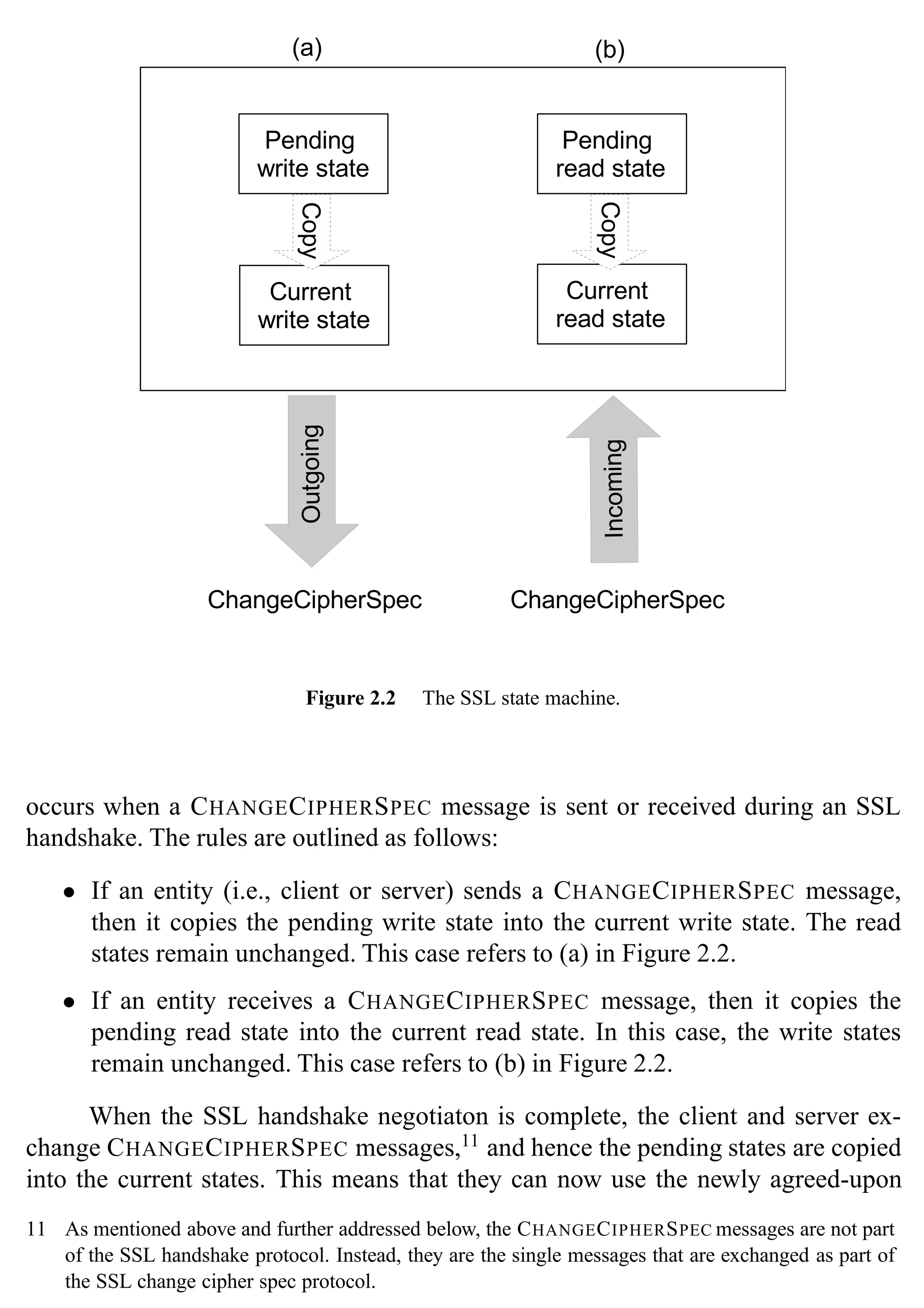
![30 SSL and TLS: Theory and Practice
cryptographic (and other) parameters. The FINISHED messages are then the first
SSL handshake messages that are protected according to these new parameters.
For each session and connection, the SSL state machine must hold some
information elements. The respective session state and connection state elements
are summarized in Tables 2.2 and 2.3. We revisit some of these elements when we
go through the SSL protocol in more detail. At this point in time, we only want to
introduce the elements together with their proper names.
Table 2.2
SSL Session State Elements
session identifier Arbitrary byte sequence chosen by the server to identify an active or
resumable session state (the maximum length is 32 bytes)
peer certificate X.509v3 certificate of the peer (if available)
compression method Data compression algorithm used (prior to encryption)
cipher spec Data encryption and MAC algorithms used (together with crypto-
graphic parameters, such as the length of the hash values)
master secret 48-byte secret that is shared between the client and the server
is resumable Flag indicating whether the SSL session is resumable, meaning that
it can be used to initiate new connections
Where appropriate and available (in the 1990s when the protocol was de-
signed), the developers of the SSL protocol tried to follow standards. For exam-
ple, RSA signatures are always performed using public key cryptography standard
(PKCS) #1 block type 1,12
whereas RSA encryption employs PKCS #1 block type 2.
The PKCS #1 version that was relevant when the SSL protocol was specified was 1.5
[6].13
As discussed in Section 2.4 (and more thoroughly addressed in Appendix B.1),
PKCS #1 version 1.5 turned out to be susceptible to an adaptive chosen ciphertext
attack (CCA2) that was due to Daniel Bleichenbacher, and hence it was replaced
with a more secure version 2.0 in 1998 [7]. Later on, more subtle vulnerabilities led
to another revision of PKCS #1, so the current version is 2.1 [8]. We postpone the
treatment of these vulnerabilities and the respective attacks to Section 2.4. Instead,
we now continue with a more detailed overview and explanation of the SSL protocol
and its subprotocols.
12 There is another block type 0 specified in PKCS #1. This type, however, is not used in the SSL
protocol specification.
13 Note that PKCS #1 had been published in a document series of RSA Laboratories, before it was
specified in an informational RFC document in 1998.](https://image.slidesharecdn.com/3416660-250617111140-9c44c1e3/75/Ssl-And-Tls-Theory-And-Practice-2nd-Rolf-Oppliger-46-2048.jpg)
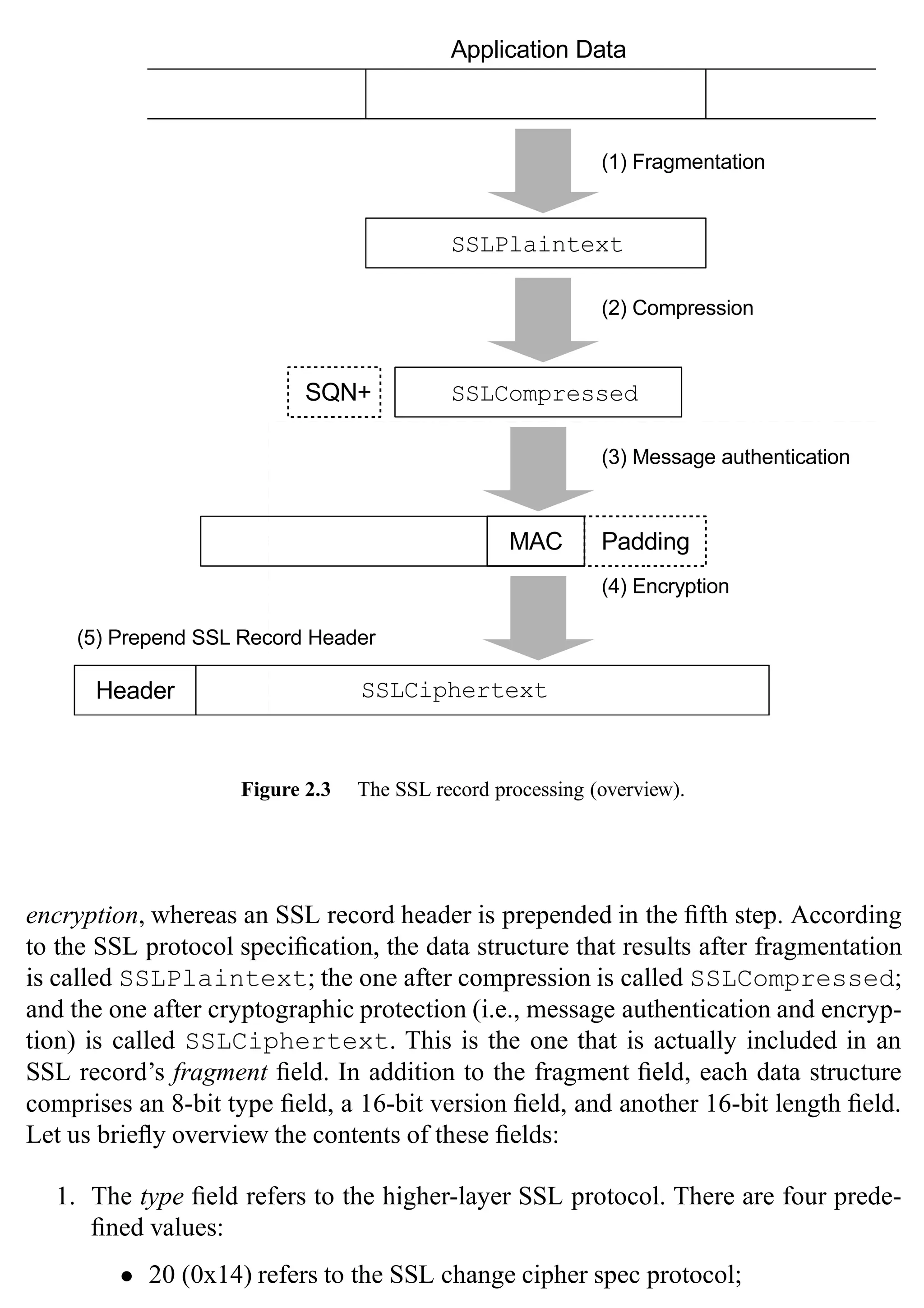

![SSL Protocol 35
compression method represents the identity operation, and hence the fragment fields
of the SSLPlaintext and SSLCompressed structures are the same. The type
and version fields of the structures also remain the same, whereas the length field of
the SSLCompressed structure has a smaller value, if compression is invoked and
applied. If null compression is used, then the length fields of the two structures are
the same, as well.
2.2.1.3 Cryptographic Protection
In the third and fourth steps, the SSL record protocol protects an SSLCompressed
structure as defined in the cipher spec of the SSL session state. According to Table
2.2, a cipher spec refers to a pair of algorithms that are used to cryptographically
protect data (i.e., a data encryption and a MAC algorithm), but it does not comprise
a key exchange algorithm. The key exchange algorithm is used to establish an SSL
session and a respective master secret (that is another SSL session state element). It
is not part of the cipher spec. In order to refer to a cipher spec and a key exchange
algorithm, the term cipher suite is used. When profiling the use of SSL/TLS and
making recommendations, people basically refer to cipher suites.
In the case of SSL 3.0, the protocol specification comes along with 31
predefined cipher suites that are summarized in Appendix C of [1]. For the sake
of completeness, they are also itemized in Table 2.4. The cipher suites written in
italics used to be exportable from the United States.16
In fact, they were exportable
only if the length of the public key was not longer than 512 bits, and the key length
of the block cipher was not longer than 40 bits. The names of the cipher suites
are shown in the first column of Table 2.4. In the remaining three columns, each
cipher suite is decomposed into its components in terms of key exchange algorithm,
cipher (i.e., symmetric encryption system), and cryptographic hash function. For
example, SSL DH RSA WITH 3DES EDE CBC SHA refers to the cipher suite
that comprises an RSA-authenticated fixed Diffie-Hellman key exchange, Triple
DES (3DES) in CBC mode for encryption,17
and SHA-1 for message authentication.
Each cipher suite is encoded in two bytes: the first byte is 0x00 and the second byte
refers to the hexadecimal representation of the cipher suite number as it occurs in
Table 2.4 (starting with 0x00). This is partly in line with the encoding of the cipher
suites specified for TLS as summarized in Appendix A. There are a few differences.
For example, the FORTEZZA key exchange algorithm KEA is no longer supported
in TLS. So the respective cipher suites from Table 2.4 are no longer present in
16 This criterion was important until the end of the 1990s.
17 We ignore the acronym EDE here. It basically means that the 3DES cipher applies an encryption,
a decryption, and another encryption operation in this order. So the letters “E” and “D” refer to
encryption and decryption.](https://image.slidesharecdn.com/3416660-250617111140-9c44c1e3/75/Ssl-And-Tls-Theory-And-Practice-2nd-Rolf-Oppliger-51-2048.jpg)
![36 SSL and TLS: Theory and Practice
Appendix A (and the respective places are now occupied by some cipher suites that
employ Kerberos for key exchange).
Table 2.4
SSL Cipher Suites (According to [1])
Name of the Cipher Suite Key Exchange Cipher Hash
SSL NULL WITH NULL NULL NULL NULL NULL
SSL RSA WITH NULL MD5 RSA NULL MD5
SSL RSA WITH NULL SHA RSA NULL SHA
SSL RSA EXPORT WITH RC4 40 MD5 RSA EXPORT RC4 40 MD5
SSL RSA WITH RC4 128 MD5 RSA RC4 128 MD5
SSL RSA WITH RC4 128 SHA RSA RC4 128 SHA
SSL RSA EXPORT WITH RC2 CBC 40 MD5 RSA EXPORT RC2 CBC 40 MD5
SSL RSA WITH IDEA CBC SHA RSA IDEA CBC SHA
SSL RSA EXPORT WITH DES40 CBC SHA RSA EXPORT DES40 CBC SHA
SSL RSA WITH DES CBC SHA RSA DES CBC SHA
SSL RSA WITH 3DES EDE CBC SHA RSA 3DES EDE CBC SHA
SSL DH DSS EXPORT WITH DES40 CBC SHA DH DSS EXPORT DES40 CBC SHA
SSL DH DSS WITH DES CBC SHA DH DSS DES CBC SHA
SSL DH DSS WITH 3DES EDE CBC SHA DH DSS 3DES EDE CBC SHA
SSL DH RSA EXPORT WITH DES40 CBC SHA DH RSA EXPORT DES40 CBC SHA
SSL DH RSA WITH DES CBC SHA DH RSA DES CBC SHA
SSL DH RSA WITH 3DES EDE CBC SHA DH RSA 3DES EDE CBC SHA
SSL DHE DSS EXPORT WITH DES40 CBC SHA DHE DSS EXPORT DES40 CBC SHA
SSL DHE DSS WITH DES CBC SHA DHE DSS DES CBC SHA
SSL DHE DSS WITH 3DES EDE CBC SHA DHE DSS 3DES EDE CBC SHA
SSL DHE RSA EXPORT WITH DES40 CBC SHA DHE RSA EXPORT DES40 CBC SHA
SSL DHE RSA WITH DES CBC SHA DHE RSA DES CBC SHA
SSL DHE RSA WITH 3DES EDE CBC SHA DHE RSA 3DES EDE CBC SHA
SSL DH anon EXPORT WITH RC4 40 MD5 DH anon EXPORT RC4 40 MD5
SSL DH anon WITH RC4 128 MD5 DH anon RC4 128 MD5
SSL DH anon EXPORT WITH DES40 CBC SHA DH anon DES40 CBC SHA
SSL DH anon WITH DES CBC SHA DH anon DES CBC SHA
SSL DH anon WITH 3DES EDE CBC SHA DH anon 3DES EDE CBC SHA
SSL FORTEZZA KEA WITH NULL SHA FORTEZZA KEA NULL SHA
SSL FORTEZZA KEA WITH FORTEZZA CBC SHA FORTEZZA KEA FORTEZZA CBC SHA
SSL FORTEZZA KEA WITH RC4 128 SHA FORTEZZA KEA RC4 128 SHA
Let us raise a terminology issue that applies to the entire book: While the
original specifications of the SSL/TLS protocols used the acronym DSS (standing
for “Digital Signature Standard”) universally [i.e., to refer to the digital signature
algorithm (DSA) and the respective NIST standard], the more recent specifications
of the TLS protocol make a distinction and use the acronym DSA to refer to the
algorithm and the acronym DSS to refer to the NIST FIPS PUB 186-4 that represents
the standard. Note, however, that the DSS as it is available today is broader and
comprises other algorithms than the DSA (e.g., RSA and ECDSA). The distinction
between DSA and DSS is made explicit in the specification of TLS 1.3. In this book,
we try to adopt it and also make a distinction whenever possible and appropriate.](https://image.slidesharecdn.com/3416660-250617111140-9c44c1e3/75/Ssl-And-Tls-Theory-And-Practice-2nd-Rolf-Oppliger-52-2048.jpg)
![SSL Protocol 37
There is always an active cipher suite. It is initially set to SSL NULL WITH
NULL NULL, which does not provide any security at all. In fact, this cipher suite
refers to no key exchange (because no key exchange is needed in the first place),
the identity operation for encryption, and no message authentication (referring
to a MAC size of zero). It basically leads to a situation in which the fragment
fields of the SSLCompressed and SSLCiphertext structures are identical. The
SSL NULL WITH NULL NULL cipher suite is the first one itemized in Table 2.4.
If cryptographic protection comprises message authentication and encryption,
then one of the first questions that pops up is related to the order of the respective
operations. In theory, there are three approaches:
1. In the authenticate-then-encrypt (abbreviated AtE) approach, the message
is first authenticated (by appending a MAC) and then encrypted. In this
case, the encryption includes the MAC that is appended to the message for
authentication.
2. In the encrypt-then-authenticate (abbreviated EtA) approach, the message is
first encrypted and then authenticated. In this case, the encryption does not
include the MAC.
3. In the encrypt-and-authenticate (abbreviated E&A) approach, the message is
encrypted and authenticated simultaneously, meaning that the pair consisting
of a ciphertext and a MAC is sent to the recipient.
Different Internet security protocols follow different approaches. IPsec, for
example, follows the EtA approach, whereas SSH follows the E&A approach. In
the case of the SSL protocol, the developers of the original protocol followed the
AtE approach. All of these protocols were developed in the 1990s, and at this
time it was not yet clear what approach is best from a security perspective. It
was not before 2001 that Hugo Krawczyk and Ran Canetti showed that EtA is the
generically secure method of combining message authentication and encryption [9,
10]. So if one designed the SSL protocol today, then one would certainly follow the
EtA approach. However, this is clearly not the case and changing the order of the
message authentication and encryption operations in retrospective is difficult (to say
the least). So people have stayed with the AtE approach even for the TLS protocol.
According to the results of Krawczyk and Canetti, this shouldn’t be a problem,
because they also showed that—at least in theory and if properly implemented—
AtE is also secure if a block cipher in CBC mode or a stream cipher is used for
encryption. So people have thought that cipher suites that comprise either a block
cipher in CBC mode or a stream cipher are equally secure—even if AtE is used
instead of EtA. Unfortunately, this result only applies in theory. In practice, it has
been shown that there are many possibilities to attack an AtE implementation, and](https://image.slidesharecdn.com/3416660-250617111140-9c44c1e3/75/Ssl-And-Tls-Theory-And-Practice-2nd-Rolf-Oppliger-53-2048.jpg)