Step 1
• Step1: 아래 공식에 맞추어서 검사가 적
절한지를 확인
• 오른쪽 수치가 왼쪽 수치에 비해서 차이가 10% 이
상이면 부적절
• 우측 기체성분 상관도에서 확인
• 수치가 부적절하면 검사 재시행 필요
• Example.
• pH 7.25, pCO2 48, HCO3− 29 mmol/L
• pH 7.25, HCO3
- 29 mmol/L에서의 [H+] 수
치 확인
4.
• The bloodgas is uninterpretable, and the ABG and
HCO3− need to be recollected.
• The most common reason for the numbers not
fitting is that the ABG and the chemistry panel
[HCO3−] were obtained at different times.
5.
Step 2
• Step2:
• Next, determine if an acidemia (pH <7.37) or an
alkalemia (pH >7.44) is present.
6.
Step 3 단순(simple)이냐복합(mixed)이냐
• Step 3: 최초 원인이 물질변화성(대사성)인지 호흡성인지 확인
• 단순 산염기 문제(simple acid-base problem)
• 산성혈증인 경우 pH가 감소
• pH가 감소하면 위 식에 견주었을 때 분모가 증가하거나 분자가 감소해야 하므로
• 분모가 증가하는 경우(PCO2 > 44 mmHg라면) 호흡성 산성혈증
• 분자가 감소하는 경우([HCO3−] <22 mmol/L)라면 물질변화성 산성혈증
• 복합 산염기 문제(mixed acid–base problem)
• 산성혈증임에도 두 성분이 pH감소에 기여하는 방향으로 움직일 수 있다.
• 즉, respiratory [pCO2 > 44 mm Hg]와 metabolic [HCO3− <22 mmol/L]의 두 요소가 모두
산도(pH) 감소에 기여
• 이런 경우 복합 산염기 문제가 발생했다고 볼 수 있다
7.
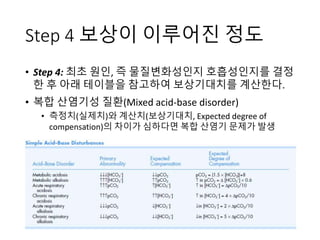
Step 4 보상이이루어진 정도
• Step 4: 최초 원인, 즉 물질변화성인지 호흡성인지를 결정
한 후 아래 테이블을 참고하여 보상기대치를 계산한다.
• 복합 산염기성 질환(Mixed acid-base disorder)
• 측정치(실제치)와 계산치(보상기대치, Expected degree of
compensation)의 차이가 심하다면 복합 산염기 문제가 발생
8.
Step 5 음이온차이 계산
• Step 5: 음이온 (anion gap)차이 계산
• Anion gap = Na+ – (Cl− + HCO3−).
• 정상 음이온 차이:8–12 mmol
• 음이온 차이가 증가해 있다면 step 6단계로 진행
9.
Step 6 음이온보상 상태 확인
• Step 6: 음이온 차이가 증가한 경우 음이온 차이
와 [HCO3
−]의 변화량을 비교
• 음이온 차이의 변화가 [HCO3
-]의 차이보다 큰 경
우 gap metabolic acidosis에 물질변화성 염기증이
발생한 상태
• 음이온 차이의 변화가 [HCO3
-]의 변화보다 작은
경우 gap metabolic acidosis에 nongap metabolic
acidosis가 발생한 상태
10.
Step 6 음이온보상 상태 확인 >
케톤산혈증 환자례
• 21세 환자가 구토감, 구토와 복통으로 내원, 음이온 차이 23, [HCO3
-] 18
• 실제 [HCO3
-]가 pure metabolic acidosis에 의한 11 mmol이 아니라 18 mmol 임.
중탄산이온의 양이 예상치보다 높으므로 gap metabolic acidosis에 더해서
metabolic alkalosis가 발생한 상태
• 이 환자의 경우 당뇨병성 케톤산혈증에 기인한 metabolic gap acidosis와 구
토에 의한 metabolic alkalosis가 발생한 상태
11.
예 1
• Step1: The
numbers fit
because the
difference between
the calculated and
observed is <10%.
A patient with COPD has a blood gas of
pH 7.34, pCO2 55, and [HCO3−] of 29.
12.
A patient withCOPD has a blood gas of
pH 7.34, pCO2 55, and [HCO3−] of 29.
• Step 2: pH < 7.37, the problem is an acidemia.
• Step 3: pCO2 > 44 and [HCO3−] is not < 22, so it
represents a respiratory acidosis.
13.
A patient withCOPD has a blood gas of
pH 7.34, pCO2 55, and [HCO3−] of 29.
• Step 4: Normal compensation for chronic (COPD)
respiratory acidosis
14.
• Expected [HCO3−]is 24 mEq/L + 6 = 30, which is
reasonably close to the measured [HCO3−] of 29,
therefore this is a simple respiratory acidosis.
• This patient has a chronic respiratory acidosis due
to hypoventilation (simple acid–base disorder).
A patient with COPD has a blood gas of
pH 7.34, pCO2 55, and [HCO3−] of 29.
15.
예 2
• Step1
• The numbers fit.
Immediately after a cardiac arrest a patient has a
pH 7.25, pCO2 28, and [HCO3-] 12
16.
Immediately after acardiac arrest a patient
has a pH 7.25, pCO2 28, HCO3-] 12
• Step 2: pH < 7.37, so the problem is an acidemia.
• Step 3: [HCO3−] is < 22 mEq/L and pCO2 is not > 44,
so this is a metabolic acidosis.
17.
• Step 4:
Immediatelyafter a cardiac arrest a patient
has a pH 7.25, pCO2 28, HCO3-] 12
18.
• The expectedpCO2 of 26 mm Hg is very similar to
the actual measured value of 28 mm HG,
• so this is a simple metabolic acidosis.
• This patient has a lactic acidosis following a
cardiopulmonary arrest
• (simple acid–base disorder).
Immediately after a cardiac arrest a patient
has a pH 7.25, pCO2 28, HCO3-] 12
19.
예 3
• Step1 45
• Numbers fit
A young man with a fever of 103.2°F and a fruity
odor on his breath has a blood gas with
pH = 7.36, pCO2 = 9, and [HCO3-] = 5
20.
• Step 2:The pH < 7.37 indicates an acidemia.
• Step 3: [HCO3−] < 22 and pCO2 is not >44, thus a
metabolic acidosis is present.
A young man with a fever of 103.2°F and a fruity odor on his breath
has a blood gas with
pH = 7.36, pCO2 = 9, and [HCO3-] = 5
21.
• Step 4:The expected compensation in pCO2 can be
calculated as follows (formula from Table 8–2):
A young man with a fever of 103.2°F and a fruity odor on his breath
has a blood gas with
pH = 7.36, pCO2 = 9, and [HCO3-] = 5
22.
• The expectedpCO2 is 15.5, but the actual result is
9 mm Hg, indicating a second process, which is a
respiratory alkalosis.
• This patient had a metabolic acidosis due to
diabetic ketoacidosis and a concomitant respiratory
alkalosis due to early sepsis and fever
• (mixed acid–base disorder).
A young man with a fever of 103.2°F and a fruity odor on his breath
has a blood gas with
pH = 7.36, pCO2 = 9, and [HCO3-] = 5
25.
케톤산혈증 환자례
• 21세환자가 구토감, 구토와 복통으로 내원, 음이온 차이 23, [HCO3
-] 18
• 실제 [HCO3
-]가 pure metabolic acidosis에 의한 11 mmol이 아니라 18 mmol 임.
중탄산이온의 양이 예상치보다 높으므로 gap metabolic acidosis에 더해서
metabolic alkalosis가 발생한 상태
• 이 환자의 경우 당뇨병성 케톤산혈증에 기인한 metabolic gap acidosis와 구
토에 의한 metabolic alkalosis가 발생한 상태
Editor's Notes
#10 If the change in the anion gap is greater than the change in the [HCO3−] from normal, then a metabolic alkalosis is present in addition to a gap metabolic acidosis.
If the change in the anion gap is less than the change in the [HCO3−] from normal, then a nongap metabolic acidosis is present in addition to a gap metabolic acidosis.


![Step 1
• Step 1: 아래 공식에 맞추어서 검사가 적
절한지를 확인
• 오른쪽 수치가 왼쪽 수치에 비해서 차이가 10% 이
상이면 부적절
• 우측 기체성분 상관도에서 확인
• 수치가 부적절하면 검사 재시행 필요
• Example.
• pH 7.25, pCO2 48, HCO3− 29 mmol/L
• pH 7.25, HCO3
- 29 mmol/L에서의 [H+] 수
치 확인](https://image.slidesharecdn.com/nwzyrieqm2fjkwrxlzkq-signature-c03b8a9930794def2db001141554b5d6a5b921741f805f19eaa0ef584d748ca1-poli-160725143816/85/slide-3-320.jpg)
![• The blood gas is uninterpretable, and the ABG and
HCO3− need to be recollected.
• The most common reason for the numbers not
fitting is that the ABG and the chemistry panel
[HCO3−] were obtained at different times.](https://image.slidesharecdn.com/nwzyrieqm2fjkwrxlzkq-signature-c03b8a9930794def2db001141554b5d6a5b921741f805f19eaa0ef584d748ca1-poli-160725143816/85/slide-4-320.jpg)

![Step 3 단순(simple)이냐 복합(mixed)이냐
• Step 3: 최초 원인이 물질변화성(대사성)인지 호흡성인지 확인
• 단순 산염기 문제(simple acid-base problem)
• 산성혈증인 경우 pH가 감소
• pH가 감소하면 위 식에 견주었을 때 분모가 증가하거나 분자가 감소해야 하므로
• 분모가 증가하는 경우(PCO2 > 44 mmHg라면) 호흡성 산성혈증
• 분자가 감소하는 경우([HCO3−] <22 mmol/L)라면 물질변화성 산성혈증
• 복합 산염기 문제(mixed acid–base problem)
• 산성혈증임에도 두 성분이 pH감소에 기여하는 방향으로 움직일 수 있다.
• 즉, respiratory [pCO2 > 44 mm Hg]와 metabolic [HCO3− <22 mmol/L]의 두 요소가 모두
산도(pH) 감소에 기여
• 이런 경우 복합 산염기 문제가 발생했다고 볼 수 있다](https://image.slidesharecdn.com/nwzyrieqm2fjkwrxlzkq-signature-c03b8a9930794def2db001141554b5d6a5b921741f805f19eaa0ef584d748ca1-poli-160725143816/85/slide-6-320.jpg)

![Step 6 음이온 보상 상태 확인
• Step 6: 음이온 차이가 증가한 경우 음이온 차이
와 [HCO3
−]의 변화량을 비교
• 음이온 차이의 변화가 [HCO3
-]의 차이보다 큰 경
우 gap metabolic acidosis에 물질변화성 염기증이
발생한 상태
• 음이온 차이의 변화가 [HCO3
-]의 변화보다 작은
경우 gap metabolic acidosis에 nongap metabolic
acidosis가 발생한 상태](https://image.slidesharecdn.com/nwzyrieqm2fjkwrxlzkq-signature-c03b8a9930794def2db001141554b5d6a5b921741f805f19eaa0ef584d748ca1-poli-160725143816/85/slide-9-320.jpg)
![Step 6 음이온 보상 상태 확인 >
케톤산혈증 환자례
• 21세 환자가 구토감, 구토와 복통으로 내원, 음이온 차이 23, [HCO3
-] 18
• 실제 [HCO3
-]가 pure metabolic acidosis에 의한 11 mmol이 아니라 18 mmol 임.
중탄산이온의 양이 예상치보다 높으므로 gap metabolic acidosis에 더해서
metabolic alkalosis가 발생한 상태
• 이 환자의 경우 당뇨병성 케톤산혈증에 기인한 metabolic gap acidosis와 구
토에 의한 metabolic alkalosis가 발생한 상태](https://image.slidesharecdn.com/nwzyrieqm2fjkwrxlzkq-signature-c03b8a9930794def2db001141554b5d6a5b921741f805f19eaa0ef584d748ca1-poli-160725143816/85/slide-10-320.jpg)
![예 1
• Step 1: The
numbers fit
because the
difference between
the calculated and
observed is <10%.
A patient with COPD has a blood gas of
pH 7.34, pCO2 55, and [HCO3−] of 29.](https://image.slidesharecdn.com/nwzyrieqm2fjkwrxlzkq-signature-c03b8a9930794def2db001141554b5d6a5b921741f805f19eaa0ef584d748ca1-poli-160725143816/85/slide-11-320.jpg)
![A patient with COPD has a blood gas of
pH 7.34, pCO2 55, and [HCO3−] of 29.
• Step 2: pH < 7.37, the problem is an acidemia.
• Step 3: pCO2 > 44 and [HCO3−] is not < 22, so it
represents a respiratory acidosis.](https://image.slidesharecdn.com/nwzyrieqm2fjkwrxlzkq-signature-c03b8a9930794def2db001141554b5d6a5b921741f805f19eaa0ef584d748ca1-poli-160725143816/85/slide-12-320.jpg)
![A patient with COPD has a blood gas of
pH 7.34, pCO2 55, and [HCO3−] of 29.
• Step 4: Normal compensation for chronic (COPD)
respiratory acidosis](https://image.slidesharecdn.com/nwzyrieqm2fjkwrxlzkq-signature-c03b8a9930794def2db001141554b5d6a5b921741f805f19eaa0ef584d748ca1-poli-160725143816/85/slide-13-320.jpg)
![• Expected [HCO3−] is 24 mEq/L + 6 = 30, which is
reasonably close to the measured [HCO3−] of 29,
therefore this is a simple respiratory acidosis.
• This patient has a chronic respiratory acidosis due
to hypoventilation (simple acid–base disorder).
A patient with COPD has a blood gas of
pH 7.34, pCO2 55, and [HCO3−] of 29.](https://image.slidesharecdn.com/nwzyrieqm2fjkwrxlzkq-signature-c03b8a9930794def2db001141554b5d6a5b921741f805f19eaa0ef584d748ca1-poli-160725143816/85/slide-14-320.jpg)
![예 2
• Step 1
• The numbers fit.
Immediately after a cardiac arrest a patient has a
pH 7.25, pCO2 28, and [HCO3-] 12](https://image.slidesharecdn.com/nwzyrieqm2fjkwrxlzkq-signature-c03b8a9930794def2db001141554b5d6a5b921741f805f19eaa0ef584d748ca1-poli-160725143816/85/slide-15-320.jpg)
![Immediately after a cardiac arrest a patient
has a pH 7.25, pCO2 28, HCO3-] 12
• Step 2: pH < 7.37, so the problem is an acidemia.
• Step 3: [HCO3−] is < 22 mEq/L and pCO2 is not > 44,
so this is a metabolic acidosis.](https://image.slidesharecdn.com/nwzyrieqm2fjkwrxlzkq-signature-c03b8a9930794def2db001141554b5d6a5b921741f805f19eaa0ef584d748ca1-poli-160725143816/85/slide-16-320.jpg)
![• Step 4:
Immediately after a cardiac arrest a patient
has a pH 7.25, pCO2 28, HCO3-] 12](https://image.slidesharecdn.com/nwzyrieqm2fjkwrxlzkq-signature-c03b8a9930794def2db001141554b5d6a5b921741f805f19eaa0ef584d748ca1-poli-160725143816/85/slide-17-320.jpg)
![• The expected pCO2 of 26 mm Hg is very similar to
the actual measured value of 28 mm HG,
• so this is a simple metabolic acidosis.
• This patient has a lactic acidosis following a
cardiopulmonary arrest
• (simple acid–base disorder).
Immediately after a cardiac arrest a patient
has a pH 7.25, pCO2 28, HCO3-] 12](https://image.slidesharecdn.com/nwzyrieqm2fjkwrxlzkq-signature-c03b8a9930794def2db001141554b5d6a5b921741f805f19eaa0ef584d748ca1-poli-160725143816/85/slide-18-320.jpg)
![예 3
• Step 1 45
• Numbers fit
A young man with a fever of 103.2°F and a fruity
odor on his breath has a blood gas with
pH = 7.36, pCO2 = 9, and [HCO3-] = 5](https://image.slidesharecdn.com/nwzyrieqm2fjkwrxlzkq-signature-c03b8a9930794def2db001141554b5d6a5b921741f805f19eaa0ef584d748ca1-poli-160725143816/85/slide-19-320.jpg)
![• Step 2: The pH < 7.37 indicates an acidemia.
• Step 3: [HCO3−] < 22 and pCO2 is not >44, thus a
metabolic acidosis is present.
A young man with a fever of 103.2°F and a fruity odor on his breath
has a blood gas with
pH = 7.36, pCO2 = 9, and [HCO3-] = 5](https://image.slidesharecdn.com/nwzyrieqm2fjkwrxlzkq-signature-c03b8a9930794def2db001141554b5d6a5b921741f805f19eaa0ef584d748ca1-poli-160725143816/85/slide-20-320.jpg)
![• Step 4: The expected compensation in pCO2 can be
calculated as follows (formula from Table 8–2):
A young man with a fever of 103.2°F and a fruity odor on his breath
has a blood gas with
pH = 7.36, pCO2 = 9, and [HCO3-] = 5](https://image.slidesharecdn.com/nwzyrieqm2fjkwrxlzkq-signature-c03b8a9930794def2db001141554b5d6a5b921741f805f19eaa0ef584d748ca1-poli-160725143816/85/slide-21-320.jpg)
![• The expected pCO2 is 15.5, but the actual result is
9 mm Hg, indicating a second process, which is a
respiratory alkalosis.
• This patient had a metabolic acidosis due to
diabetic ketoacidosis and a concomitant respiratory
alkalosis due to early sepsis and fever
• (mixed acid–base disorder).
A young man with a fever of 103.2°F and a fruity odor on his breath
has a blood gas with
pH = 7.36, pCO2 = 9, and [HCO3-] = 5](https://image.slidesharecdn.com/nwzyrieqm2fjkwrxlzkq-signature-c03b8a9930794def2db001141554b5d6a5b921741f805f19eaa0ef584d748ca1-poli-160725143816/85/slide-22-320.jpg)


![케톤산혈증 환자례
• 21세 환자가 구토감, 구토와 복통으로 내원, 음이온 차이 23, [HCO3
-] 18
• 실제 [HCO3
-]가 pure metabolic acidosis에 의한 11 mmol이 아니라 18 mmol 임.
중탄산이온의 양이 예상치보다 높으므로 gap metabolic acidosis에 더해서
metabolic alkalosis가 발생한 상태
• 이 환자의 경우 당뇨병성 케톤산혈증에 기인한 metabolic gap acidosis와 구
토에 의한 metabolic alkalosis가 발생한 상태](https://image.slidesharecdn.com/nwzyrieqm2fjkwrxlzkq-signature-c03b8a9930794def2db001141554b5d6a5b921741f805f19eaa0ef584d748ca1-poli-160725143816/85/slide-25-320.jpg)


