Lars Kurth
Community Manger, Xen Project
Chairman, Xen Project Advisory Board
Director, Open Source, Citrix lars_kurth
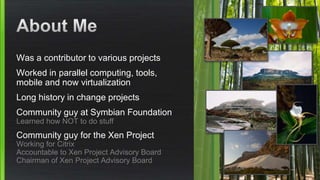
Was a contributor to various projects
Worked in parallel computing, tools,
mobile and now virtualization
Long history in change projects
Community guy at Symbian Foundation
Learned how NOT to do stuff
Community guy for the Xen Project
Working for Citrix
Accountable to Xen Project Advisory Board
Chairman of Xen Project Advisory Board
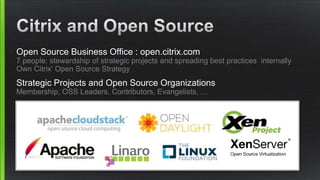
Open Source Business Office : open.citrix.com
7 people: stewardship of strategic projects and spreading best practices internally
Own Citrix’ Open Source Strategy
Strategic Projects and Open Source Organizations
Membership, OSS Leaders, Contributors, Evangelists, …
Developing Open Source Virtualization Technologies since 2003
> 10M Users
Several sub-projects
Xen Hypervisor, XAPI management tools, Mirage OS
Coming: Windows Drivers and Embedded/Automotive
Linux Foundation Collaborative Project
Financially sponsored by Amazon Web Services, AMD, ARM, Bromium, CA
Technologies, Cavium, Cisco, Citrix, Google, Intel, NetApp, Oracle, Rackspace,
Samsung and Verizon
Proven Within Largest Hyperscale Operations
The Xen Project Hypervisor is the No. 1 choice for the largest hyperscale clouds in the industry
Examples: AWS, CenturyLink, GoGrid, RackSpace, SoftLayer, Verizon, VirtuStream
Designed for Security
Xen Project software offers a multi-layered approach to security with the ability to wall off intruders
through Driver Domains, Stub Domains, Xen Security Modules
Driving Innovation
GPU Virtualization (e.g. XenGT), Cloud Operating Systems (e.g. ClickOS, ErlangOnXen, Elixir, HalVM,
our own MirageOS and OSv) and ARM Support (new, lean and simple)
Extreme Versatility: Going Beyond Cloud Computing
Our technology is used in a wide range of products and services ranging from server virtualization, cloud
and security. New applications ranging from networking (NFV), automotive to mobile are in the works.
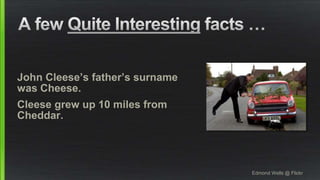
John Cleese’s father’s surname
was Cheese.
Cleese grew up 10 miles from
Cheddar.
Edmond Wells @ Flickr
Source: The 2014 Future of Open Source Survey Result
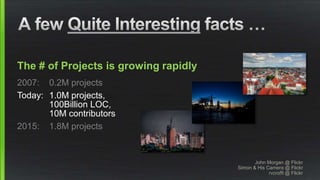
The # of Projects is growing rapidly
2007: 0.2M projects
Today: 1.0M projects,
100Billion LOC,
10M contributors
2015: 1.8M projects
John Morgan @ Flickr
Simon & His Camera @ Flickr
rvcroffi @ Flickr
80% of users chose OSS software
because of competitive features
72% of users chose OSS because
they believe it is more secure
Dave Straven @ Flickr
xiquinhosilva @ Flickr
50% of all enterprises adopt OSS
software
Julian Manson @ Flickr
30% of companies make it easy for
employees to contribute to projects
Influencing a project’s direction is one
of the main reason for contributing
Nick @ Flickr
toffehoff @ Flickr
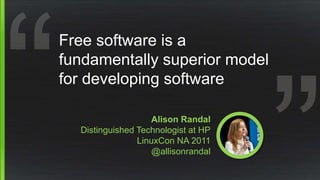
Alison Randal
Distinguished Technologist at HP
LinuxCon NA 2011
@allisonrandal
Free software is a
fundamentally superior model
for developing software
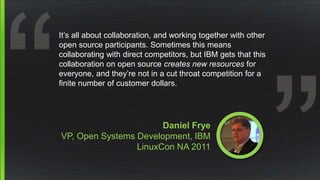
Daniel Frye
VP, Open Systems Development, IBM
LinuxCon NA 2011
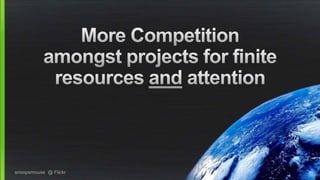
It’s all about collaboration, and working together with other
open source participants. Sometimes this means
collaborating with direct competitors, but IBM gets that this
collaboration on open source creates new resources for
everyone, and they’re not in a cut throat competition for a
finite number of customer dollars.
snoopsmouse @ Flickr
Bruce Schneier
Internationally renowned security Technologist
@Bruce_Schneier
Catastrophic is the right word
[for Heartbleed]. On the scale
of 1 to 10, this is an 11.
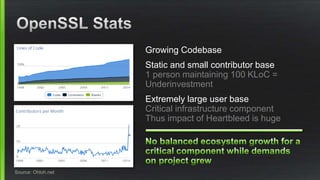
Growing Codebase
Static and small contributor base
1 person maintaining 100 KLoC =
Underinvestment
Extremely large user base
Critical infrastructure component
Thus impact of Heartbleed is huge
Source: Ohloh.net
snoopsmouse @ Flickr
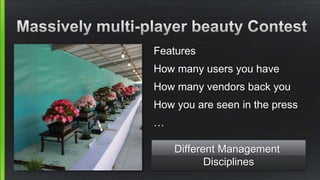
Features
How many users you have
How many vendors back you
How you are seen in the press
…
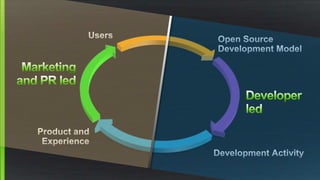
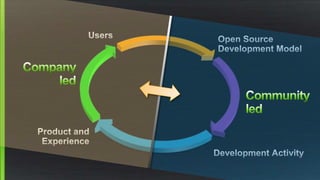
Different Management
Disciplines
Maria Ly @ Flickr
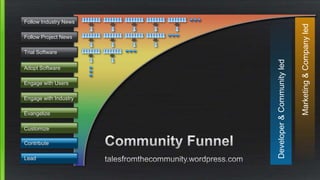
Follow Industry News
Follow Project News
Adopt Software
Engage with Users
Trial Software
Engage with Industry
Evangelize
Contribute
Customize
Lead
Developer&Communityled
Marketing&Companyled
Vinovyn @ Flickr
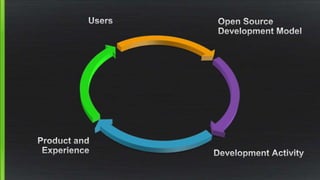
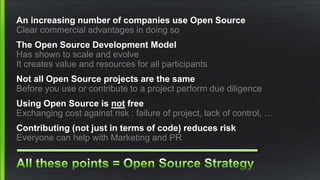
An increasing number of companies use Open Source
Clear commercial advantages in doing so
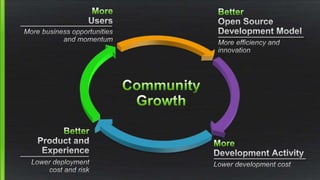
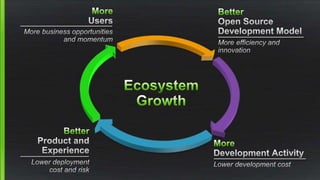
The Open Source Development Model
Has shown to scale and evolve
It creates value and resources for all participants
Not all Open Source projects are the same
Before you use or contribute to a project perform due diligence
Using Open Source is not free
Exchanging cost against risk : failure of project, lack of control, …
Contributing (not just in terms of code) reduces risk
Everyone can help with Marketing and PR
Please rate the talk
on slideshare or twitter
www.slideshare.net/xen_com_mgr/

Squaring the Circle Between Business and Community

  • 1.
    Lars Kurth Community Manger,Xen Project Chairman, Xen Project Advisory Board Director, Open Source, Citrix lars_kurth
  • 2.
    Was a contributorto various projects Worked in parallel computing, tools, mobile and now virtualization Long history in change projects Community guy at Symbian Foundation Learned how NOT to do stuff Community guy for the Xen Project Working for Citrix Accountable to Xen Project Advisory Board Chairman of Xen Project Advisory Board
  • 3.
    Open Source BusinessOffice : open.citrix.com 7 people: stewardship of strategic projects and spreading best practices internally Own Citrix’ Open Source Strategy Strategic Projects and Open Source Organizations Membership, OSS Leaders, Contributors, Evangelists, …
  • 4.
    Developing Open SourceVirtualization Technologies since 2003 > 10M Users Several sub-projects Xen Hypervisor, XAPI management tools, Mirage OS Coming: Windows Drivers and Embedded/Automotive Linux Foundation Collaborative Project Financially sponsored by Amazon Web Services, AMD, ARM, Bromium, CA Technologies, Cavium, Cisco, Citrix, Google, Intel, NetApp, Oracle, Rackspace, Samsung and Verizon
  • 5.
    Proven Within LargestHyperscale Operations The Xen Project Hypervisor is the No. 1 choice for the largest hyperscale clouds in the industry Examples: AWS, CenturyLink, GoGrid, RackSpace, SoftLayer, Verizon, VirtuStream Designed for Security Xen Project software offers a multi-layered approach to security with the ability to wall off intruders through Driver Domains, Stub Domains, Xen Security Modules Driving Innovation GPU Virtualization (e.g. XenGT), Cloud Operating Systems (e.g. ClickOS, ErlangOnXen, Elixir, HalVM, our own MirageOS and OSv) and ARM Support (new, lean and simple) Extreme Versatility: Going Beyond Cloud Computing Our technology is used in a wide range of products and services ranging from server virtualization, cloud and security. New applications ranging from networking (NFV), automotive to mobile are in the works.
  • 6.
    John Cleese’s father’ssurname was Cheese. Cleese grew up 10 miles from Cheddar. Edmond Wells @ Flickr
  • 7.
    Source: The 2014Future of Open Source Survey Result
  • 8.
    The # ofProjects is growing rapidly 2007: 0.2M projects Today: 1.0M projects, 100Billion LOC, 10M contributors 2015: 1.8M projects John Morgan @ Flickr Simon & His Camera @ Flickr rvcroffi @ Flickr
  • 9.
    80% of userschose OSS software because of competitive features 72% of users chose OSS because they believe it is more secure Dave Straven @ Flickr xiquinhosilva @ Flickr
  • 10.
    50% of allenterprises adopt OSS software Julian Manson @ Flickr
  • 11.
    30% of companiesmake it easy for employees to contribute to projects Influencing a project’s direction is one of the main reason for contributing Nick @ Flickr toffehoff @ Flickr
  • 13.
    Alison Randal Distinguished Technologistat HP LinuxCon NA 2011 @allisonrandal Free software is a fundamentally superior model for developing software
  • 19.
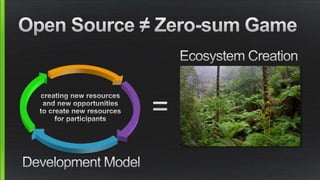
    Daniel Frye VP, OpenSystems Development, IBM LinuxCon NA 2011 It’s all about collaboration, and working together with other open source participants. Sometimes this means collaborating with direct competitors, but IBM gets that this collaboration on open source creates new resources for everyone, and they’re not in a cut throat competition for a finite number of customer dollars.
  • 22.
  • 23.
    Bruce Schneier Internationally renownedsecurity Technologist @Bruce_Schneier Catastrophic is the right word [for Heartbleed]. On the scale of 1 to 10, this is an 11.
  • 25.
    Growing Codebase Static andsmall contributor base 1 person maintaining 100 KLoC = Underinvestment Extremely large user base Critical infrastructure component Thus impact of Heartbleed is huge Source: Ohloh.net
  • 27.
  • 28.
    Features How many usersyou have How many vendors back you How you are seen in the press … Different Management Disciplines
  • 29.
    Maria Ly @Flickr
  • 33.
    Follow Industry News FollowProject News Adopt Software Engage with Users Trial Software Engage with Industry Evangelize Contribute Customize Lead Developer&Communityled Marketing&Companyled
  • 34.
  • 35.
    An increasing numberof companies use Open Source Clear commercial advantages in doing so The Open Source Development Model Has shown to scale and evolve It creates value and resources for all participants Not all Open Source projects are the same Before you use or contribute to a project perform due diligence Using Open Source is not free Exchanging cost against risk : failure of project, lack of control, … Contributing (not just in terms of code) reduces risk Everyone can help with Marketing and PR
  • 36.
    Please rate thetalk on slideshare or twitter www.slideshare.net/xen_com_mgr/

Editor's Notes

  • #2 TIMING: 0 MINS (8)
  • #3 Love to travel to weird places and grow weird plants
  • #4 10 years =stories to tell
  • #5 10 years =stories to tell
  • #7 PIC: Question
  • #8 PIC: Question
  • #9 Munich, London, Sao Paulo
  • #10 Pics: Tower Bridge Tower of London
  • #11 Pic: Canary Wharf
  • #14 http://techcrunch.com/2011/08/21/linuxcon-open-source-is-an-ecosystem-not-a-zero-sum-game/
  • #21 TODO: chose picture http://techcrunch.com/2011/08/21/linuxcon-open-source-is-an-ecosystem-not-a-zero-sum-game/ http://video.linux.com/videos/allison-randal-fallacy-of-the-zero-sum-game (Allison Randal) http://en.wikipedia.org/wiki/Zero-sum_game future of technological innovation is not stealing limited resources away from one another, but creating new resources — and new opportunities to create new resources — together in a rich ecosystem. Dan Frye It’s all about collaboration, and working together with other open source participants. Sometimes this means collaborating with direct competitors, but IBM “gets it” that this collaboration on open source creates new resources for everyone, and they’re not in a cut throat competition for a finite number of customer dollars. Wladawsky-Berger continued the “solutions company” explanation by pointing out that a skyscraper is never built by a single company. Legions of small companies with specific expertise work together under the guidance of a project manager to coordinate and execute their specific tasks in the right order. ---- Examples!
  • #28 Natural Selection
  • #32 Marketing vs. Community & Developer Driven
  • #35 TIMING: 44 MINUTES (4)
  • #37 TIMING: 48 MINS (2)