SQL Exercises
Queries in SQL to answer questions
about dataset
Mariana Rosária
29-08-2023
Dataset
● Free dataset available for project exercises on
https://www.sql-practice.com/
● 3 tables: patients, admissions, doctors
Questions and code in SQL to get answers:
Show first name and last name of patients who
does not have allergies.
SELECT
first_name,
last_name
FROM patients
WHERE
allergies IS NULL
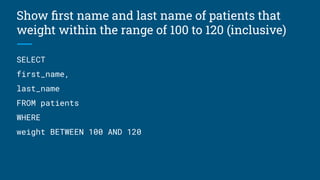
Show first name and last name of patients that
weight within the range of 100 to 120 (inclusive)
SELECT
first_name,
last_name
FROM patients
WHERE
weight BETWEEN 100 AND 120
Show first name, last name, and the full province
name of each patient.
SELECT
first_name,
last_name,
province_name
FROM
patients
INNER JOIN
province_names ON patients.province_id = province_names.province_id
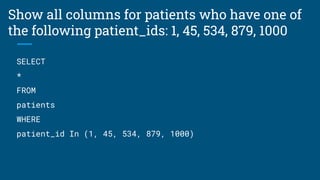
Show all columns for patients who have one of
the following patient_ids: 1, 45, 534, 879, 1000
SELECT
*
FROM
patients
WHERE
patient_id In (1, 45, 534, 879, 1000)
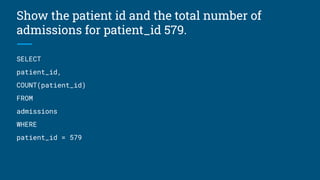
Show the patient id and the total number of
admissions for patient_id 579.
SELECT
patient_id,
COUNT(patient_id)
FROM
admissions
WHERE
patient_id = 579
Based on the cities that our patients live in, show
unique cities that are in province_id 'NS'?
SELECT
distinct city
FROM
patients
WHERE
province_id = 'NS'
Based on cities where our patient lives in, write a
query to display the list of unique city starting
with a vowel (a, e, i, o, u). Show the result order in
ascending by city.
SELECT
city
FROM
patients
WHERE
city like '[aeiou]%'
ORDER BY
city
Write a query to find the first_name, last name and
birth date of patients who has height greater than
160 and weight greater than 70.
SELECT
city
FROM
patients
WHERE
city like '[aeiou]%'
ORDER BY
city
Write a query to find the first_name, last name and
birth date of patients who has height greater than
160 and weight greater than 70
SELECT
first_name,
last_name,
birth_date
FROM
patients
WHERE
height > 160 AND weight > 70
Show the city and the total number of patients in
the city. Order from most to least patients and then
by city name ascending.
SELECT
city,
COUNT(patient_id) AS pacients_per_city
FROM
patients
GROUP BY
city
ORDER BY
pacients_per_city DESC,
city
Show first and last name, allergies from patients
which have allergies to either 'Penicillin' or
'Morphine'.Order by ascending by allergies then by
first_name then by last_name.
SELECT
first_name,
last_name,
allergies
FROM
patients
WHERE
allergies = 'Penicillin' OR allergies = 'Morphine'
ORDER BY
allergies,
first_name,
last_name
We want to display each patient's full name in a
single column. Their last_name in all upper letters
must appear first, then first_name in all lower
case letters. Separate the last_name and
first_name with a comma. Order the list by the
first_name in descending order.
EX: SMITH,jane
SELECT
CONCAT(UPPER (last_name), ",", LOWER(first_name))
FROM
patients
ORDER BY
first_name DESC
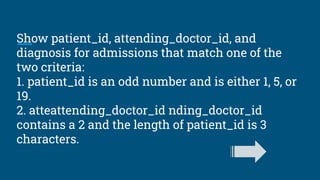
Show patient_id, attending_doctor_id, and
diagnosis for admissions that match one of the
two criteria:
1. patient_id is an odd number and is either 1, 5, or
19.
2. atteattending_doctor_id nding_doctor_id
contains a 2 and the length of patient_id is 3
characters.
SELECT
patient_id,
attending_doctor_id,
diagnosis
FROM
admissions
WHERE
(patient_id % 2 <> 0 AND attending_doctor_id IN (1, 5, 19)) OR
(attending_doctor_id like '%2%' AND LEN(patient_id) =3)
Display patient's full name, height in the units feet
rounded to 1 decimal, weight in the unit pounds
rounded to 0 decimals, birth_date, gender non
abbreviated.
Convert CM to feet by dividing by 30.48.
Convert KG to pounds by multiplying by 2.205.
SELECT
CONCAT(first_name, " ", last_name) AS patient_full_name,
ROUND((height/30.48),1) AS round_height_ft,
ROUND((weight*2.205),0) AS round_weight_pds,
birth_date,
(CASE
WHEN gender = 'M' THEN 'Male'
WHEN gender = 'F' THEN 'Female'
ELSE 'No Gender'
END) as full_gender
FROM
patients
Show patient_id, weight, height, isObese from the
patients table. Display isObese as a boolean 0 or 1.
Obese is defined as weight(kg)/(height(m)2) >= 30.
weight is in units kg.
height is in units cm.
SELECT
patient_id,
weight,
height,
CASE
WHEN weight/((height*0.01)*(height*0.01)) >= 30 THEN '1'
ELSE '0'
END AS isObese
FROM
patients
Show patient_id, first_name, last_name, and
attending doctor's specialty.
Show only the patients who has a diagnosis as
'Epilepsy' and the doctor's first name is 'Lisa'
Check patients, admissions, and doctors tables for
required information.
SELECT
patients.patient_id,
patients.first_name,
patients.last_name,
doctors.specialty
FROM
patients
JOIN
admissions on patients.patient_id = admissions.patient_id
JOIN
doctors on admissions.attending_doctor_id = doctors.doctor_id
WHERE
diagnosis = 'Epilepsy' AND doctors.first_name = 'Lisa'
For each day display the total amount of
admissions on that day. Display the amount
changed from the previous date.
WITH temp_table as (SELECT admission_date,
COUNT(*) AS total_admissions
FROM admissions
GROUP BY admission_date
ORDER BY admission_date DESC)
SELECT admission_date,
total_admissions,
total_admissions - LAG(total_admissions, 1, NULL) OVER (ORDER BY
admission_date) AS change
FROM
temp_table
ORDER BY
admission_date
We are looking for a specific patient. Pull all
columns for the patient who matches the
following criteria:
- First_name contains an 'r' after the first two
letters.
- Identifies their gender as 'F'
- Born in February, May, or December
- Their weight would be between 60kg and 80kg
- Their patient_id is an odd number
- They are from the city 'Kingston'
SELECT
*
FROM patients
WHERE
first_name like '__r%' AND
gender = 'F' AND
month(birth_date) IN (2, 5, 12) AND
weight BETWEEN 60 AND 80 AND
patient_id % 2 <> 0 AND
city = 'Kingston'
We need a breakdown for the total amount of
admissions each doctor has started each year.
Show the doctor_id, doctor_full_name, specialty,
year, total_admissions for that year.
SELECT
doctors.doctor_id,
CONCAT(doctors.first_name, " ", doctors.last_name) AS doctor_full_name,
doctors.specialty,
YEAR(admissions.admission_date) AS year_admissions,
COUNT(admissions.patient_id) AS total_admissions
FROM
doctors
LEFT JOIN
admissions on doctors.doctor_id = admissions.attending_doctor_id
GROUP BY
doctor_full_name,
year_admissions
ORDER BY
doctor_full_name,
year_admissions
Thank You!

SQL_Exercises.pdf

  • 1.
    SQL Exercises Queries inSQL to answer questions about dataset Mariana Rosária 29-08-2023
  • 2.
    Dataset ● Free datasetavailable for project exercises on https://www.sql-practice.com/ ● 3 tables: patients, admissions, doctors
  • 3.
    Questions and codein SQL to get answers:
  • 4.
    Show first nameand last name of patients who does not have allergies. SELECT first_name, last_name FROM patients WHERE allergies IS NULL
  • 5.
    Show first nameand last name of patients that weight within the range of 100 to 120 (inclusive) SELECT first_name, last_name FROM patients WHERE weight BETWEEN 100 AND 120
  • 6.
    Show first name,last name, and the full province name of each patient. SELECT first_name, last_name, province_name FROM patients INNER JOIN province_names ON patients.province_id = province_names.province_id
  • 7.
    Show all columnsfor patients who have one of the following patient_ids: 1, 45, 534, 879, 1000 SELECT * FROM patients WHERE patient_id In (1, 45, 534, 879, 1000)
  • 8.
    Show the patientid and the total number of admissions for patient_id 579. SELECT patient_id, COUNT(patient_id) FROM admissions WHERE patient_id = 579
  • 9.
    Based on thecities that our patients live in, show unique cities that are in province_id 'NS'? SELECT distinct city FROM patients WHERE province_id = 'NS'
  • 10.
    Based on citieswhere our patient lives in, write a query to display the list of unique city starting with a vowel (a, e, i, o, u). Show the result order in ascending by city. SELECT city FROM patients WHERE city like '[aeiou]%' ORDER BY city
  • 11.
    Write a queryto find the first_name, last name and birth date of patients who has height greater than 160 and weight greater than 70. SELECT city FROM patients WHERE city like '[aeiou]%' ORDER BY city
  • 12.
    Write a queryto find the first_name, last name and birth date of patients who has height greater than 160 and weight greater than 70 SELECT first_name, last_name, birth_date FROM patients WHERE height > 160 AND weight > 70
  • 13.
    Show the cityand the total number of patients in the city. Order from most to least patients and then by city name ascending. SELECT city, COUNT(patient_id) AS pacients_per_city FROM patients GROUP BY city ORDER BY pacients_per_city DESC, city
  • 14.
    Show first andlast name, allergies from patients which have allergies to either 'Penicillin' or 'Morphine'.Order by ascending by allergies then by first_name then by last_name. SELECT first_name, last_name, allergies FROM patients WHERE allergies = 'Penicillin' OR allergies = 'Morphine' ORDER BY allergies, first_name, last_name
  • 15.
    We want todisplay each patient's full name in a single column. Their last_name in all upper letters must appear first, then first_name in all lower case letters. Separate the last_name and first_name with a comma. Order the list by the first_name in descending order. EX: SMITH,jane
  • 16.
    SELECT CONCAT(UPPER (last_name), ",",LOWER(first_name)) FROM patients ORDER BY first_name DESC
  • 17.
    Show patient_id, attending_doctor_id,and diagnosis for admissions that match one of the two criteria: 1. patient_id is an odd number and is either 1, 5, or 19. 2. atteattending_doctor_id nding_doctor_id contains a 2 and the length of patient_id is 3 characters.
  • 18.
    SELECT patient_id, attending_doctor_id, diagnosis FROM admissions WHERE (patient_id % 2<> 0 AND attending_doctor_id IN (1, 5, 19)) OR (attending_doctor_id like '%2%' AND LEN(patient_id) =3)
  • 19.
    Display patient's fullname, height in the units feet rounded to 1 decimal, weight in the unit pounds rounded to 0 decimals, birth_date, gender non abbreviated. Convert CM to feet by dividing by 30.48. Convert KG to pounds by multiplying by 2.205.
  • 20.
    SELECT CONCAT(first_name, " ",last_name) AS patient_full_name, ROUND((height/30.48),1) AS round_height_ft, ROUND((weight*2.205),0) AS round_weight_pds, birth_date, (CASE WHEN gender = 'M' THEN 'Male' WHEN gender = 'F' THEN 'Female' ELSE 'No Gender' END) as full_gender FROM patients
  • 21.
    Show patient_id, weight,height, isObese from the patients table. Display isObese as a boolean 0 or 1. Obese is defined as weight(kg)/(height(m)2) >= 30. weight is in units kg. height is in units cm.
  • 22.
  • 23.
    Show patient_id, first_name,last_name, and attending doctor's specialty. Show only the patients who has a diagnosis as 'Epilepsy' and the doctor's first name is 'Lisa' Check patients, admissions, and doctors tables for required information.
  • 24.
    SELECT patients.patient_id, patients.first_name, patients.last_name, doctors.specialty FROM patients JOIN admissions on patients.patient_id= admissions.patient_id JOIN doctors on admissions.attending_doctor_id = doctors.doctor_id WHERE diagnosis = 'Epilepsy' AND doctors.first_name = 'Lisa'
  • 25.
    For each daydisplay the total amount of admissions on that day. Display the amount changed from the previous date.
  • 26.
    WITH temp_table as(SELECT admission_date, COUNT(*) AS total_admissions FROM admissions GROUP BY admission_date ORDER BY admission_date DESC) SELECT admission_date, total_admissions, total_admissions - LAG(total_admissions, 1, NULL) OVER (ORDER BY admission_date) AS change FROM temp_table ORDER BY admission_date
  • 27.
    We are lookingfor a specific patient. Pull all columns for the patient who matches the following criteria: - First_name contains an 'r' after the first two letters. - Identifies their gender as 'F' - Born in February, May, or December - Their weight would be between 60kg and 80kg - Their patient_id is an odd number - They are from the city 'Kingston'
  • 28.
    SELECT * FROM patients WHERE first_name like'__r%' AND gender = 'F' AND month(birth_date) IN (2, 5, 12) AND weight BETWEEN 60 AND 80 AND patient_id % 2 <> 0 AND city = 'Kingston'
  • 29.
    We need abreakdown for the total amount of admissions each doctor has started each year. Show the doctor_id, doctor_full_name, specialty, year, total_admissions for that year.
  • 30.
    SELECT doctors.doctor_id, CONCAT(doctors.first_name, " ",doctors.last_name) AS doctor_full_name, doctors.specialty, YEAR(admissions.admission_date) AS year_admissions, COUNT(admissions.patient_id) AS total_admissions FROM doctors LEFT JOIN admissions on doctors.doctor_id = admissions.attending_doctor_id GROUP BY doctor_full_name, year_admissions ORDER BY doctor_full_name, year_admissions
  • 31.