Evidence of Effective Approaches to Social
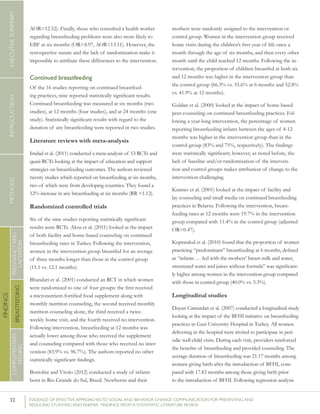
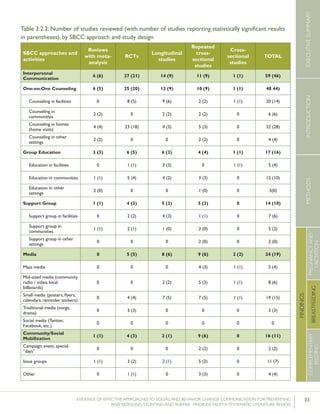
and Behavior Change Communication
for Preventing and Reducing Stunting and
Anemia
Findings from a Systematic Literature Review
August 2014
{Photo to come}
ABOUT SPRING
The Strengthening Partnerships, Results, and Innovations in Nutrition Globally (SPRING) project is a five-year USAID-funded Cooperative
Agreement to strengthen global and country efforts to scale up high impact nutrition practices and policies and improve maternal and child
nutrition outcomes. SPRING provides state-of-the-art technical support and focuses on the prevention of stunting and maternal and child
anemia in the first 1,000 days.The project is managed by JSI Research & Training Institute, Inc., with partners Helen Keller International,The
Manoff Group, Save the Children, and the International Food Policy Research Institute.
RECOMMENDED CITATION
Lamstein, S.,T. Stillman, P. Koniz-Booher,A.Aakesson, B. Collaiezzi,T.Williams, K. Beall, and M.Anson. 2014. Evidence of Effective Approaches to
Social and Behavior Change Communication for Preventing and Reducing Stunting and Anemia: Report from a Systematic Literature Review.
Arlington,VA: USAID/ Strengthening Partnerships, Results, and Innovations in Nutrition Globally (SPRING) Project.
ACKNOWLEDGMENTS
The authors wish to express our profound gratitude to the many individuals who contributed to this review. Anuradha Narayan, Joy Del
Rosso and Marcia Griffiths contributed to the development of the protocol, prioritization of practices and categorization of behaviors and
approaches. Marcia Griffiths, Michael Manske, and Agnes Guyon provided very thoughtful feedback on earlier drafts of this document. In ad-
dition, Vicky Santoso contributed tremendously to the analysis of data extracted; Allison Smith-Estelle expertly edited the entire document
cover to cover; Tammy Loverdos provided the beautiful graphic design; and Daniel Cothran shared this on SPRING’s website in a user-
friendly interactive format. Thank you all so much!
DISCLAIMER
The contents of this report are the responsibility of the authors, and do not necessarily reflect the views of USAID or the U.S. Government.
SPRING
JSI Research & Training Institute, Inc.
1616 Fort Myer Drive
16th Floor
Arlington,VA 22209 USA
Phone: 703-528-7474
Fax: 703-528-7480
Email: info@spring-nutrition.org
Internet: www.spring-nutrition.org
Cover photos: left photo, John Nicholson, SPRING; right photos, Peggy Koniz-Booher, SPRING
IEVIDENCE OF EFFECTIVE APPROACHES TO SOCIAL AND BEHAVIOR CHANGE COMMUNICATION FOR PREVENTING
AND REDUCING STUNTING AND ANEMIA: FINDINGS FROM A SYSTEMATIC LITERATURE REVIEW
TABLE OF CONTENTS
Table of Contents......................................................................................................................................................................................I
List of Tables	..........................................................................................................................................................................................III
Acronyms			..........................................................................................................................................................................................IV
Executive Summary ................................................................................................................................................................................V
1.	INTRODUCTION......................................................................................................................................................................1
	 A.	Background.............................................................................................................................................................................1
	 B.	Objectives................................................................................................................................................................................1
2.	METHODS...................................................................................................................................................................................3
	 A.	 Search Procedures..................................................................................................................................................................3
	 B.	 Organization of Findings.....................................................................................................................................................4
		 Priority practices....................................................................................................................................................................4
		 Study design ...........................................................................................................................................................................5
		 SBCC approaches .................................................................................................................................................................5
		 Implementation processes ...................................................................................................................................................5
	 C.	Limitations..............................................................................................................................................................................6
	 D. 	Works Cited and Literature Reviewed................................................................................................................................7
3.	FINDINGS...................................................................................................................................................................................8
3.1	 PRACTICES DURING PREGNANCY AND LACTATION........................................................................................... 8
	 A.	 Background............................................................................................................................................................................8
	 B.	 Search Results.........................................................................................................................................................................9
	 C.	 Overview of the Evidence, by Practice..............................................................................................................................9
		 Increased energy and protein intake during pregnancy and lactation .......................................................................... 9
		 Enhanced quality of diet during pregnancy and lactation ...........................................................................................10
	 	 Micronutrient supplementation or fortification .............................................................................................................12
		 Increased rest and decreased work during pregnancy ...................................................................................................12
	 D.	 Summary of the Evidence..................................................................................................................................................12
		 SBCC approaches utilized..................................................................................................................................................12
		 Implementation processes followed.................................................................................................................................14
	 E.	Conclusions...........................................................................................................................................................................15
	 F. 	 Works Cited and Literature Reviewed..............................................................................................................................20
II 	 EVIDENCE OF EFFECTIVE APPROACHES TO SOCIAL AND BEHAVIOR CHANGE COMMUNICATION FOR PREVENTING AND
REDUCING STUNTING AND ANEMIA: FINDINGS FROM A SYSTEMATIC LITERATURE REVIEW
3.2. 	 EVIDENCE OF EFFECTIVE SBCC APPROACHES TO PROMOTE BREASTFEEDING PRACTICES......22
	 A.	Background...........................................................................................................................................................................22
	 B.	 Search Results.......................................................................................................................................................................22
	 C.	 Overview of the Evidence, by Practice............................................................................................................................23
		 Early initiation of breastfeeding .......................................................................................................................................23
		 Exclusive breastfeeding ......................................................................................................................................................26
		 Continued breastfeeding ....................................................................................................................................................32
	 D.	 Summary of the Evidence..................................................................................................................................................34
		 SBCC approaches utilized..................................................................................................................................................34
		 Implementation processes followed.................................................................................................................................35
	 E.	Conclusions...........................................................................................................................................................................36
	 F.	 Works Cited and Literature Reviewed..............................................................................................................................55
3.3. 	 EVIDENCE OF EFFECTIVE SBCC APPROACHES TO IMPROVE COMPLEMENTARY
	 FEEDING PRACTICES ........................................................................................................................................................61
	 A.	Background...........................................................................................................................................................................61
	 B.	 Search Results.......................................................................................................................................................................62
	 C.	 Overview of the Evidence, by Practice............................................................................................................................63
		 Timely introduction of appropriate complementary foods..........................................................................................63
		 Dietary diversity...................................................................................................................................................................63
	 	 Micronutrient supplementation or fortification..............................................................................................................68
		 Responsive and active feeding...........................................................................................................................................72
		 Feeding during and after illness.........................................................................................................................................72
	 D.	 Summary of the Evidence..................................................................................................................................................72
	 E.	Conclusions .........................................................................................................................................................................77
	 F.	 Works Cited and Literature Reviewed............................................................................................................................102
APPENDIX: SBCC LITERATURE REVIEW SEARCHING SETS.......................................................................................106
IIIEVIDENCE OF EFFECTIVE APPROACHES TO SOCIAL AND BEHAVIOR CHANGE COMMUNICATION FOR PREVENTING
AND REDUCING STUNTING AND ANEMIA: FINDINGS FROM A SYSTEMATIC LITERATURE REVIEW
LIST OF TABLES
Table 2.1: High impact nutrition practices reviewed, by intervention area.......................................................................................3
Table 2.2: Number of studies by intervention area and study design...............................................................................................4
Table 2.3: Categorization of SBCC approaches and activities............................................................................................................4
Table 3.1.1: Number of studies reviewed (with number of studies reporting statistically
significant results in parentheses), by recommended practice and study design..............................................................................8
Table 3.1.2: Number of studies reviewed (with number of studies reporting statistically
significant results in parentheses), by SBCC approach and study design........................................................................................11
Table 3.1.3: Number of studies reviewed (with number of studies reporting statistically
significant results in parentheses), by SBCC approach, practice, and study design.......................................................................13
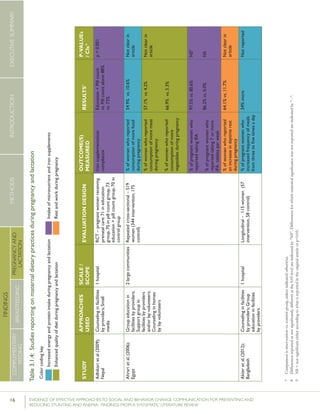
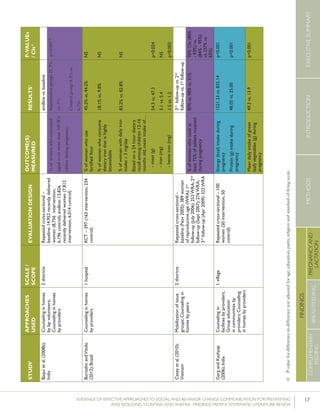
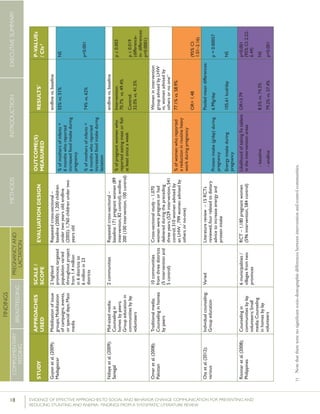
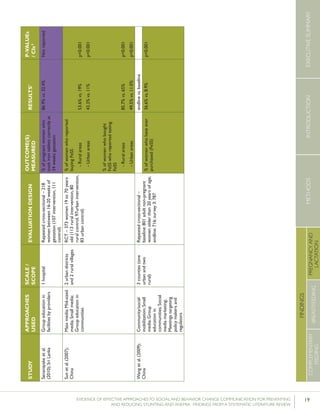
Table 3.1.4: Studies reporting on maternal dietary practices during pregnancy and lactation ....................................................16
Table 3.2.1: Number of studies reviewed (with number of studies reporting statistically
significant results in parentheses), by recommended practice and study design............................................................................23
Table 3.2.2: Number of studies reviewed (with number of studies reporting statistically
significant results in parentheses), by SBCC approach and study design........................................................................................33
Table 3.2.3: Number of studies reviewed (with number of studies reporting statistically
significant results in parentheses), by SBCC approach and study design........................................................................................37
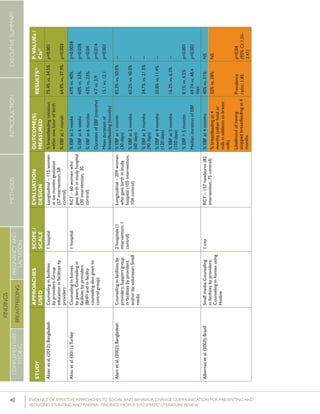
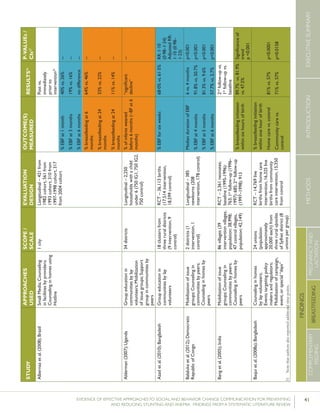
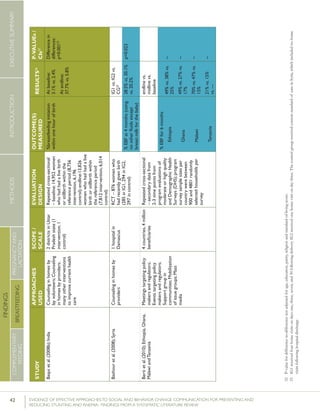
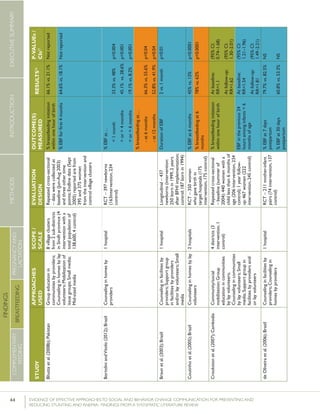
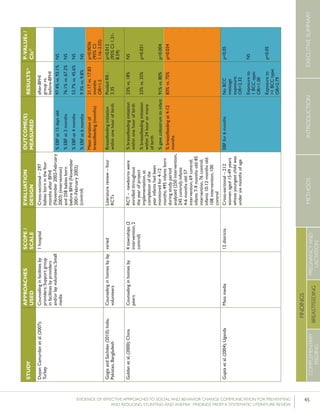
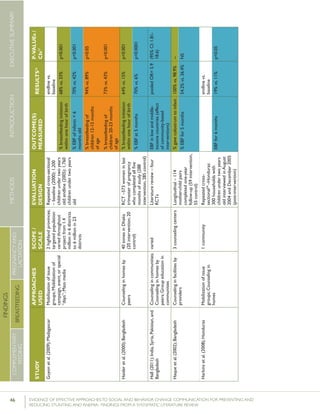
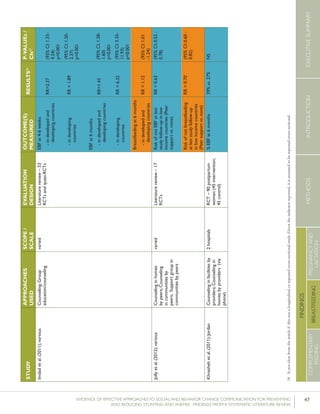
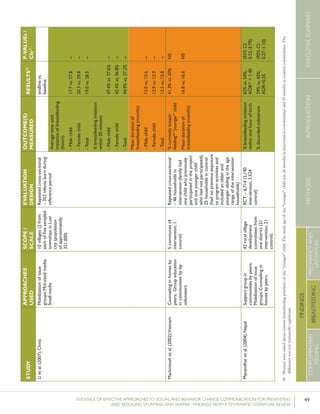
Table 3.2.4: Studies reporting on breastfeeding practices..................................................................................................................39
Table 3.3.1: WHO Guiding Principles for complementary feeding of the breastfed child.........................................................61
Table 3.3.2: Number of studies reviewed (with number of studies reporting statistically
significant results in parentheses), by recommended practice and study design............................................................................62
Table 3.3.3: Number of studies reviewed (with number of studies reporting statistically
significant results in parentheses), by SBCC approach and study design .......................................................................................73
Table 3.3.4: Number of studies reviewed (with number of studies reporting statistically
significant results in parentheses), by SBCC approach and study design........................................................................................75
Table 3.3.5: Studies reporting on complementary feeding practices...............................................................................................79
IV 	 EVIDENCE OF EFFECTIVE APPROACHES TO SOCIAL AND BEHAVIOR CHANGE COMMUNICATION FOR PREVENTING AND
REDUCING STUNTING AND ANEMIA: FINDINGS FROM A SYSTEMATIC LITERATURE REVIEW
ACRONYMS
ANC	 antenatal care
AOR	 adjusted odds ratio
BCC	 behavior change communication
BFH	 baby-friendly hospital
BFHI	 Baby-friendly Hospital Initiative
BINP	 Bangladesh Integrated Nutrition Project
CFG	 complementary feeding group
CHW	 Community Health Worker
CI	 confidence interval
DALY	 disability-adjusted life year
DISH	 Delivery of Improved Services for Health
EBF	 exclusive breastfeeding
ENA	 essential nutrition actions
FeSS	 iron-fortified soy sauce
GMP	 Growth monitoring and promotion
HKI	 Helen Keller International
ICFI	 Infant and Child Feeding Index
IEC	 Information, Education and Communication
IFA	 iron-folic acid
IFPRI	 International Food Policy Research Institute
IG	 Intervention group
IMCI	 Integrated Management of Childhood Illness
INE	 Intensive nutrition education
INE+SF 	 Intensive nutrition education plus 		
	 supplementary feeding
IPC	 Interpersonal communication
IYCF	 infant and young child feeding
IYCN	 infant and young child nutrition
KAP	 Knowledge, Attitudes, and Practices
KCAL	kilocalories
KJ	kilojoule
KSPES 	 Knowledge Sharing Practices with 		
	 Empowerment Strategies
LAM	 lactational amenorrhea method
LBW	 low birthweight
LHW 	 Lay or Lady Health Workers
MAD 	 minimum acceptable diet
MCHIP	 Maternal and Child Health Integrated
	Program
MICAH 	 Micronutrient and Health Program
MIYCN	 maternal, infant, and young child nutrition
NCD	 noncommunicable disease
NE	 nutrition education
NEC	 nutrition, education, and counseling
NGO	 nongovernmental organization
NLM	 National Library of Medicine
NRC	 Nutrition Rehabilitation Center
OR	 odds ratio
p	p-value
PAHO	 Pan-American Health Organization
PD	 positive deviance	
PROBIT	 Promotion of Breastfeeding Intervention Trial
RCF&PG	 Responsive Complementary Feeding and
	 Play Group
RCT	 randomized controlled trial
RR	 relative risk
SBCC	 social and behavior change communication
SC	 Save the Children
SGA	 Small for gestational age
SP	Sulfadoxine/Pyrimethamine
SPRING	 Strengthening Partnerships, Results, and 		
	 Innovations in Nutrition Globally
SUN	 Scaling Up Nutrition
TIP	 trials of improved practices
UNICEF	 United Nations Children’s Fund
USAID	 United States Agency for International 		
	Development
WASH	 water, sanitation, and hygiene
WHO	 World Health Organization
WRA	 women of reproductive age
YYB	 Ying Yang Bao (a Chinese multiple 		
	 micronutrient powder)
ZVITAMBO	 Zimbabwe Vitamin A for Mother and
	 Babies Trial
VEVIDENCE OF EFFECTIVE APPROACHES TO SOCIAL AND BEHAVIOR CHANGE COMMUNICATION FOR PREVENTING
AND REDUCING STUNTING AND ANEMIA: FINDINGS FROM A SYSTEMATIC LITERATURE REVIEW
FINDINGS
INTRODUCTIONMETHODSEXECUTIVESUMMARY
FINDINGS
COMPLEMENTARY
FEEDING
BREASTFEEDING
PREGNANCYAND
LACTATION
EXECUTIVE SUMMARY
Evidence suggests that simply increasing knowledge and
awareness of good nutrition practices rarely leads to sus-
tained behavior change, nor is sustained change in nutri-
tion behavior likely to be achieved through a single activity.
Several specific behaviors or practices impact nutritional
status during the critical first 1,000 days (pregnancy to age
two), while complex, contextual determinants also influence
individual decisions to consider, test, adopt and sustain a
given behavior or practice.  The field of Social and Be-
havior Change Communication (SBCC) is a collection of
approaches and tools informed by behavioral theories and
used to design public health interventions.
This review, part of a broader effort by SPRING to sup-
port governments and other stakeholders in their delivery
of high impact nutrition practices, provides a summary
of peer-reviewed evidence regarding the effectiveness of
SBCC approaches to increase the uptake of three key nutri-
tion behaviors: women’s dietary practices during pregnancy
and lactation, breastfeeding practices, and complementary
feeding practices. SBCC interventions have been broadly
categorized into three areas: interpersonal communication;
use of media; and community/social mobilization. This
review also identifies gaps in the evidence and recommen-
dations for further areas of study.
This review includes a total of 91 studies identified using
the Ovid MEDLINE database. Recognizing the potential
value of a broad array of study designs, results from five
study types are included: reviews (including meta-analysis),
randomized controlled trials, longitudinal studies, repeated
cross-sectional studies, and cross-sectional studies. Ex-
cluded studies include those with data from high income
countries,those published prior to 2000, those written in
a language other than English, and those that focused ex-
clusively on refinement of a research methodology. Other
exclusions are noted in the text.
Findings related to women’s dietary practices
during pregnancy and lactation
Undernutrition during pregnancy and lactation is a critical
determinant of maternal, neonatal, and child health out-
comes. Improving dietary adequacy during pregnancy and
lactation is important to help women accommodate their
nutritional requirements as well as their children’s require-
ments during intrauterine development and while breast-
feeding (Haileslassie, et al., 2013).
The body of literature on the effectiveness of SBCC to
improve women’s dietary practices during pregnancy and
lactation is still small (only 15 peer-reviewed studies met
the inclusion criteria), but indicates that SBCC approaches
can and do succeed in improving uptake of the behaviors
promoted. The greatest gap in the literature was in evidence
of effectiveness of SBCC in improving rest and work-
load during pregnancy. Given the importance of women’s
dietary practices during pregnancy and lactation, the dearth
of evidence is notable.
Findings related to breastfeeding practices
Breastfeeding is widely recognized as one of the most cost-
effective investments to improve child survival (UNICEF,
2013), as well as cognitive and motor development and aca-
demic performance (Horta et al, 2013). Breastfeeding also
imparts critical benefits to the woman, including natural
postnatal infertility. Despite the promise of optimal breast-
feeding practices, rates for WHO recommended breastfeed-
ing practices remain low (UNICEF, 2013).
The body of literature on the effectiveness of SBCC ap-
proaches in improving breastfeeding practices is strong and
broad (62 peer-reviewed studies met the inclusion criteria)
and supports the claim that SBCC approaches can and do
succeed in improving uptake of the behaviors promoted.
Evidence from several studies strongly suggests that
increasing the number of contacts increases the positive
effect of SBCC on breastfeeding practices. Greater con-
sistency in how breastfeeding practices are measured – the
definitions of indicators and the methods of data collec-
tion – exists for breastfeeding practices when compared
to women’s dietary practices and complementary feeding
practices, but even with globally-recognized indicators and
measurement guidance, considerable variation remains.
Findings related to complementary feeding
practices
Timely appropriate complementary feeding are critical to a
child’s growth and development and could avert millions of
VI 	 EVIDENCE OF EFFECTIVE APPROACHES TO SOCIAL AND BEHAVIOR CHANGE COMMUNICATION FOR PREVENTING AND
REDUCING STUNTING AND ANEMIA: FINDINGS FROM A SYSTEMATIC LITERATURE REVIEW
INTRODUCTIONMETHODSEXECUTIVESUMMARY
FINDINGS
COMPLEMENTARY
FEEDING
BREASTFEEDING
PREGNANCYAND
LACTATION
disability-adjusted life years, but global coverage of optimal
complementary feeding practices remains low.
The evidence of the effect of SBCC on complementary
feeding practices is quite broad (30 studies met the inclu-
sion criteria) and clearly indicates that SBCC interventions
can improve a wide range of complementary feeding
practices. However, measures of optimal complementary
feeding are so varied that it is particularly challenging to
draw conclusions regarding the effectiveness of particular
SBCC approaches.
Common findings
The SBCC approach most used, and the only one used
without other communication interventions, was inter-
personal communication. While media and community/
social mobilization were used, they were always used with
at least one other communication approach.
Studies included in this review employed a wide range of
implementation strategies with variations in the interactions
or combinations with other interventions, target groups,
content, messages, scale and coverage, length and intensity,
as well as context. Very little has been done to compare
the effect of differences in the delivery science, particularly
when implemented at scale.
The majority of the studies were implemented on a small
scale, typically with fewer than 500 people per group.
Additionally, there was considerable variation in how wom-
en’s dietary practices and complementary feeding practices
were defined and measured.
Conclusions
Evidence suggests that using multiple SBCC approaches
and channels to change behaviors is more effective than
using one, that targeting multiple contacts has a greater
effect than targeting only the woman herself, and that more
visits or contacts results in greater change. However, such
comparisons are not well-tested in the literature. Very few
comparisons have been made between the effect of timing
of communications and what little has been done presents
contradictory evidence. Unfortunately, it can be challenging
to conduct such studies that compare differences in deliv-
ery and/or disaggregate single approaches within a multi-
approach intervention. SBCC practitioners and researchers
must assess whether that line of research is useful.
Differences in local context (including social norms, cul-
ture, and environmental factors) as well as differences in the
implementation and scale of implementation also affect the
success of interventions. This underscores the importance
of proper context assessments, formative research and/or
ethnographic study prior to SBCC implementation.
Finally, if practices and indicators are not standardized, a
project may improve behaviors but it will be difficult to
attribute changes in outcomes. This underscores the impor-
tance of developing practices and indicators that are globally
recognized, accepted, and used by the research and program
communities. At the same time, many nutrition interven-
tions are suited to iterative programming for incremental
change toward the optimal, evidence-based behaviors. This
means that more easily achieved indicators (components of
standardized indicators or shorter time periods) may also
be needed to measure progress toward the ultimate goal of
changes in the standardized indicators of behaviors.
Other areas particularly important for future evaluations
and operations research include:
n the effect of targeting multiple audiences
or influencers of the behaviors being
promoted, rather than focusing on one target
population;
n the effect of the same SBCC intervention
implemented in different contexts (social and
environmental);
n the effectiveness of different approaches (including
intensity and targeting) for different behaviors;
n the cost and cost effectiveness of various SBCC
approaches (particularly as it relates to scalability); and
n the effectiveness and sustainability of these
approaches when implemented at scale.
1EVIDENCE OF EFFECTIVE APPROACHES TO SOCIAL AND BEHAVIOR CHANGE COMMUNICATION FOR PREVENTING
AND REDUCING STUNTING AND ANEMIA: FINDINGS FROM A SYSTEMATIC LITERATURE REVIEW
INTRODUCTIONMETHODSEXECUTIVESUMMARY
FINDINGS
COMPLEMENTARY
FEEDING
BREASTFEEDING
PREGNANCYAND
LACTATION
1. INTRODUCTION
A.	 Background
Evidence suggests that simply increasing knowledge and
awareness of good nutrition practices rarely leads to sus-
tained behavior change, nor is sustained change in nutri-
tion behavior likely to be achieved through a single activity
targeting a single subset of the population. Several specific
behaviors or practices greatly impact nutritional status
during the critical first 1,000 days (pregnancy to age two),
and many complex, contextual determinants also influence
individual decisions to actually consider, test, adopt and
sustain a given behavior or practice.
Realizing this, public health practitioners for decades have
applied theories from social psychology and marketing
about behavior change to improve the potential of inter-
ventions to change key practices. These theories address
how and why people practice certain behaviors, why they
make and sustain changes in their behaviors (or don’t),
and the way that social and environmental structures af-
fect both their current practices and the likelihood they
will change practices and sustain those changes. The field
of Social and Behavior Change Communication (SBCC) is
a collection of approaches and tools informed by behav-
ioral theories and used to design public health and nutri-
tion interventions.
SBCC theories, approaches, and tools have been widely ac-
cepted and integrated into public health, water, sanitation,
and hygiene (WASH), disaster prevention and response,
as well as maternal, infant, and young child nutrition
(MIYCN). Sectors such as agriculture and education have
also increased the impact of their interventions by utiliz-
ing SBCC, while the private sector, where much of SBCC
theory and practice originated, continues to use SBCC to
sell existing products and services and develop new ones,
and remains a key player in the evolution of the field.
SBCC is at an interesting crossroads. Technology is rapidly
increasing access to information, even among remote
populations, and the types of, and channels for, commu-
nication are ever expanding. New technologies have the
potential to democratize SBCC, giving those most affected
by health and nutrition problems a greater voice in address-
ing them, and creating a platform for mutual accountability
among social actors. While many programs and projects
have impacted health and nutrition outcomes using SBCC,
including campaigns to reduce tobacco use or increase use
of seatbelts or re-usable shopping bags, there is a sense that
SBCC may not be fulfilling its full potential to bring about
social and individual changes for improved health and
nutrition outcomes.
Under and over-nutrition, cancer and other NCDs, pre-
ventable childhood diseases, and maternal and infant/
young child mortality remain key global health issues. Some
of these issues, like chronic malnutrition (stunting) among
children, have been surprisingly resistant to improvement,
highlighting the need for more evidence about the potential
of SBCC. Specific areas of focus include how single or
combined SBCC interventions change certain types of be-
haviors among certain groups in specific contexts, how they
can be designed and implemented to ensure cost-effective-
ness, scalability and sustainability, and how investments in
SBCC can be targeted to take proven interventions to scale
and to foster continual innovation.
SPRING seeks to strengthen the SBCC evidence base for
stunting and anemia globally. SPRING conducted a system-
atic literature review to assess the state of SBCC evidence
related to three key areas of nutrition behavior: maternal diet
during pregnancy and lactation; breastfeeding; and comple-
mentary feeding. The review focused on communication
interventions, categorized into three broad areas: interper-
sonal communication (IPC); use of media; and community/
social mobilization. This report summarizes the evidence
for the different SBCC approaches related to these three key
behavioral or intervention areas, and findings are presented
first by intervention area, then by SBCC approach, then by
type of evidence.
We hope that SBCC practitioners and researchers will find
this report a valuable reference tool, and a place from
which to start when looking for current evidence regard-
ing specific SBCC approaches and/or key intervention
areas within MIYCN.
B.	 Objectives
To be effective, SBCC approaches should be grounded in
behavioral and social science theories, a deep understand-
2 	 EVIDENCE OF EFFECTIVE APPROACHES TO SOCIAL AND BEHAVIOR CHANGE COMMUNICATION FOR PREVENTING AND
REDUCING STUNTING AND ANEMIA: FINDINGS FROM A SYSTEMATIC LITERATURE REVIEW
INTRODUCTIONMETHODSEXECUTIVESUMMARY
FINDINGS
COMPLEMENTARY
FEEDING
BREASTFEEDING
PREGNANCYAND
LACTATION
ing of the local context, as well as evidence. This literature
review is part of a broader effort by SPRING to docu-
ment and disseminate evidence related to effective SBCC
approaches, and to develop program guidance to support
governments and other stakeholders in the delivery of high
impact nutrition practices at the facility, community, and
household levels.
This review provides a comprehensive summary of peer-
reviewed evidence regarding the effectiveness of SBCC
approaches in increasing the uptake of high impact MIYCN
practices, seeking to answer the following questions:
1.	 What is the state of peer-reviewed evidence regarding
the application of SBCC approaches to increase the
uptake of high impact nutrition practices?
2.	 Where are the gaps in the evidence? What SBCC ap-
proaches or activities lack evidence of effectiveness in
improving nutrition-related practices?
3EVIDENCE OF EFFECTIVE APPROACHES TO SOCIAL AND BEHAVIOR CHANGE COMMUNICATION FOR PREVENTING
AND REDUCING STUNTING AND ANEMIA: FINDINGS FROM A SYSTEMATIC LITERATURE REVIEW
INTRODUCTIONMETHODSEXECUTIVESUMMARY
FINDINGS
COMPLEMENTARY
FEEDING
BREASTFEEDING
PREGNANCYAND
LACTATION
2. METHODS
A.	 Search Procedures
The authors searched the United States National Library of
Medicine biomedical database (NLM®
) Ovid MEDLINE
between May-December 2012. The Ovid MEDLINE da-
tabase contains bibliographic citations and author abstracts
from more than 4,600 biomedical journals published in the
United States and 70 other countries. The database con-
tains over 13 million citations dating back to 1950, includ-
ing more than 130,000 population-related journal citations
(unique to the former POPLINE®
database) that were
added to MEDLINE in 2002.
The following primary search parameters were used: the
practices or behaviors promoted, the SBCC approach uti-
lized, and the study design. A complete list of search terms
is included as Appendix A.
Excluded from this review are studies with data from high
income countries,1
those published prior to 2000, and those
1	 The authors used the World Bank’s categorization and list of high income
countries. See: http://data.worldbank.org/about/country-classifications/
country-and-lending-groups#High_income. 	
written in a language other than English. Furthermore,
articles focused exclusively on the refinement of a research
methodology, those without a clear description of the prac-
tices promoted or the SBCC approach utilized, and those
that did not specifically quantify or disaggregate the effect
of SBCC on behavioral outcomes, were also excluded. Out
of 15,847 hits, 91 studies were extracted for detailed review.
Using a standardized procedure, researchers conducted an
in-depth review of each of the selected studies and extract-
ed the following information:
n location
n objective
n practice(s) promoted
n SBCC approach(es) utilized
n intervention design process (e.g. formative re	 search)
n scale of implementation
n duration of the intervention (where available)
n frequency of contact or of potential exposure (where
available)
n population targeted
n study design
n study results and p-values
Table 2.1: High impact nutrition practices reviewed, by intervention area
Intervention area Specific practices
Women’s dietary practices
during pregnancy and lactation
n Increased energy and protein intake during pregnancy and lactation
n Enhanced quality of diet during pregnancy and lactation
n Micronutrient supplementation or fortification
n Increased rest and decreased work during pregnancy
Breastfeeding practices n Early initiation of breastfeeding
n Exclusive breastfeeding
n Continued breastfeeding
Complementary feeding
practices
n Timely introduction of complementary foods
n Dietary diversity
- Feeding children animal source foods
- Feeding children fruits and vegetables
- Feeding children a minimum number of food groups (dietary diversity)
n Micronutrient supplementation or fortification
n Increased meal frequency and/or density
- Increasing frequency of feeding children
- Adding fats or oils to children’s foods
- Enhancing the consistency of children’s foods
- Increasing the quantity fed to children at each meal
n Responsive/active feeding
n Feeding during and after illness
4 	 EVIDENCE OF EFFECTIVE APPROACHES TO SOCIAL AND BEHAVIOR CHANGE COMMUNICATION FOR PREVENTING AND
REDUCING STUNTING AND ANEMIA: FINDINGS FROM A SYSTEMATIC LITERATURE REVIEW
INTRODUCTIONMETHODSEXECUTIVESUMMARY
FINDINGS
COMPLEMENTARY
FEEDING
BREASTFEEDING
PREGNANCYAND
LACTATION
B.	 Organization of Findings
The literature review focuses on evidence of effectiveness
around three primary intervention areas: women’s dietary
practices during pregnancy and lactation, breastfeeding
practices, and complementary feeding practices. These
intervention areas focus on actions by mothers or other
caretakers during the “first 1000 days” – the period between
conception and a child’s second birthday. The vast majority
of stunting occurs during this period, and there is generally
little potential for recovery thereafter.
This review is divided into three chapters corresponding
to each of these three intervention areas. The chapters
can be read together as one document, or read separately
as independent documents. With each of these chapters,
the findings are organized by priority practices, SBCC
approach(es) utilized, and study design. This organization
enables the reader to derive an independent judgment re-
garding findings from different study designs. In addition,
implementation processes followed are also discussed.
Priority practices
Within each chapter, we identify high impact nutrition
practices with proven efficacy with respect to child nutri-
tion outcomes. This list of practices is consistent with
those prioritized in The Lancet’s Maternal and Child Nutri-
tion Series (Bhutta et al., 2008a; Bhutta et al., 2013), the
World Health Organization’s “Essential Nutrition Actions:
Improving Maternal, Newborn, Infant and Young Child
Health and Nutrition” (WHO, 2013), the WHO e-Library
of Evidence for Nutrition Actions, and the United Nations
Children’s Fund’s (UNICEF) “Improving Child Nutrition:
The Achievable Imperative for Global Progress” (UNICEF,
2013). Where normative recommendations exist, the chap-
ter is organized accordingly. Where such recommendations
Table 2.2: Number of studies by intervention area and study design
Intervention area
Reviews
with meta-
analysis
RCT
Longitudinal
studies
Repeated
cross-
sectional
studies
Cross-
sectional
studies
Total
Women’s dietary practices
during pregnancy and
lactation
1 4 2 8 0 15
Breastfeeding practices 6 27 14 13 2 62
Complementary feeding
practices
0 11 9 10 0 30
Table 2.3: Categorization of SBCC approaches and activities
SBCC approaches Specific activities*
Interpersonal Communication The following activities can be conducted in facilities, communities, or homes and by health care
providers, lay health workers, or peers:
n One-on-one counseling
n Group education
n Support groups
Media n Mass media
n Mid-sized media (community radio / video, local billboards)
n Small media (posters, flyers, calendars, reminder stickers)
n Traditional media (songs, drama)
n Social media (Twitter, Facebook, etc.)
Community/Social Mobilization n Campaigns, events, special “days”, rallies
n Issue groups
5EVIDENCE OF EFFECTIVE APPROACHES TO SOCIAL AND BEHAVIOR CHANGE COMMUNICATION FOR PREVENTING
AND REDUCING STUNTING AND ANEMIA: FINDINGS FROM A SYSTEMATIC LITERATURE REVIEW
INTRODUCTIONMETHODSEXECUTIVESUMMARY
FINDINGS
COMPLEMENTARY
FEEDING
BREASTFEEDING
PREGNANCYAND
LACTATION
do not exist, we review practices with widely acknowledged
potential for impact. See Table 1.1.
There was considerable variation in indicators used to
measure these practices. This is partly due to the wide range
of practices included within each intervention area, but is
also because not all studies reviewed used standardized or
recommended indicators to measure behavioral outcomes.
Any difference in indicators is clearly indicated in the sum-
maries associated with each practice.
Finally, because the review is organized around the effec-
tiveness of SBCC activities on specific practices, studies
looking at the effectiveness of SBCC on more than one
of the prioritized practice are cited and discussed multi-
ple times. Where this occurs, we have provided a detailed
description of the study in the first reference, and only
discuss results in subsequent references.
Study design
Study design influences the validity and comparability
of outcomes. The Grades of Recommendation, Assess-
ment, Development, and Evaluation (GRADE) Working
Group2
focuses on four key elements to assess the validity
of study findings: study design, study quality, consistency,
and directness (GRADE Working Group, 2004). Habicht
et al. (1999) also provide guidance on evaluation design
for public health program performance based on “type
of inference to be made, whether this is a statement of
adequacy, plausibility, or probability” regarding attribution
of change to an intervention.
Recognizing the value of a broad array of study designs,
results from five primary study designs are included: reviews
(including meta-analysis), randomized controlled trials (RCT),
longitudinal studies, repeated cross-sectional studies, and
cross-sectional studies. Additional aspects of study design are
noted within each chapter. Table 1.2 summarizes the number
of studies reviewed, by intervention area and study design.
We included detailed information and analysis of all studies
reporting statistically significant findings related to prior-
ity practices. All studies are included in the summary tables
at the back of each chapter. Seventy-four of the studies
(including the seven literature reviews with meta-analyses)
2 	 See: http://www.gradeworkinggroup.org/intro.htm.	
reviewed reported statistically significant results relevant to
this literature review. Readers may wish to use caution in
interpreting statistically significant findings as the quality
and design of studies differ considerably.
SBCC approaches
While the importance of structural, environmental, and
systems-related interventions in achieving sustainable social
and behavior change (SBC) should not be underestimated,
this review was confined to the effectiveness of communi-
cation-related interventions in affecting behavior change.
We focused on evidence around three broad SBCC ap-
proaches: interpersonal communication, the use of media,
and community/social mobilization. Within each approach,
further identified sub-approaches or activities were identi-
fied. See Table 1.3.
The SBCC approaches and activities outlined are con-
sistent with those referenced in the C-Change/FHI360
Learning Package for Social and Behavior Change Com-
munication (2010), the Bill and Melinda Gates Foundation
“Social & Behavior Change Interventions Landscaping
Study: A Global Review” (Storey et al., 2011), the USAID
Infant and Young Child Nutrition (IYCN) Project “IYCN
Social and Behavior Change Communication Approach”
(2011), the USAID “Community Interventions to Promote
Optimal Breastfeeding: Evidence on Early Initiation, Any
Breastfeeding, Exclusive Breastfeeding, and Continued
Breastfeeding” (2012), the USAID “Behavior Change
Interventions and Child Nutritional Status: Evidence from
the Promotion of Improved Complementary Feeding Prac-
tices” (2011) and the USAID Maternal and Child Health
Integrated Program (MCHIP) publication “Technical Refer-
ence Materials: Behavior Change Interventions” (2010).
Most studies used more than one SBCC activity and many
used more than one approach.
Implementation processes
There is consensus that delivery systems for nutrition inter-
ventions are currently suboptimal (Black et al., 2008; Chopra
et al., 2012; Leroy and Menon, 2008; Menon et al., 2014).
The World Bank’s report on how to improve health service
delivery in developing countries reviewed the evidence and
concluded that “the evidence base is weak for claiming suc-
6 	 EVIDENCE OF EFFECTIVE APPROACHES TO SOCIAL AND BEHAVIOR CHANGE COMMUNICATION FOR PREVENTING AND
REDUCING STUNTING AND ANEMIA: FINDINGS FROM A SYSTEMATIC LITERATURE REVIEW
INTRODUCTIONMETHODSEXECUTIVESUMMARY
FINDINGS
COMPLEMENTARY
FEEDING
BREASTFEEDING
PREGNANCYAND
LACTATION
cess of any particular health services strengthening strategy
across LMICs3
,” noting that “how a strategy is implemented
is as important as the type of strategy implemented” (Ovret-
veit et al., 2009). Implementation processes include, but are
not limited to, the overall program design, intensity and tim-
ing of contacts; type and training of person(s) communicat-
ing messages, supervision of field workers, and audience(s)
targeted. Acknowledging the importance of how services are
delivered, information on targeted audiences, the scale, as
well as the timing and intensity of interventions is provided
whenever possible in the chapters that follow.
A particularly important aspect of the delivery of SBCC
interventions is the target audience. Many people can
influence whether an individual adopts or fails to adopt a
promoted behavior. Successful SBCC strategies target vari-
ous audiences and often more than one audience or sphere
of influence, including:4
n self/caregivers, such as pregnant and lactating women, as
well as other immediate caregivers of children under two;
n direct influencers, including partners/fathers, mothers-
in-law, siblings, other family members, and peers;
n actors within the local community, including
community members, leaders, social groups, and
providers; and
n actors within the enabling environment, including the
government (national, sub-regional, district and/or
municipal), business, faith and movement leaders.
3 	 LMIC stands for Low and Middle Income Countries	
4 	 See the C-Change Social Ecological Model for Change.	
C.	 Limitations
The authors limited this literature review to peer-reviewed
studies and those identified in the Ovid MEDLINE®
database. While use of a second peer-reviewed journal
database, Web of Science®
, was considered, the high
degree of overlap between the two databases made this
unnecessary. Since not all projects, programs and national
strategies publish in peer-reviewed journals, some relevant
SBCC information, experiences, and evidence may have
been omitted.
We limited the review to studies published on or after Janu-
ary 1, 2000. Studies published prior to 2000 may also in-
clude valuable findings that are not captured in this review.
The review excluded research conducted in high income
countries. We acknowledge that experience from other coun-
try contexts, including the United States, may be valuable to
assess the relative success of different SBCC approaches.
Despite comprehensive search terms that included the full
range of activities included in the term SBCC, review find-
ings are limited to communication-based approaches. This is
consistent with the types of SBCC delivery strategies and in-
terventions currently being utilized by the SBCC community.
Differences in local context (including social norms, cul-
ture, and environmental factors) as well as differences in the
implementation and scale of implementation can impact
the success of interventions and may affect generalizability
of findings included in this review.
7EVIDENCE OF EFFECTIVE APPROACHES TO SOCIAL AND BEHAVIOR CHANGE COMMUNICATION FOR PREVENTING
AND REDUCING STUNTING AND ANEMIA: FINDINGS FROM A SYSTEMATIC LITERATURE REVIEW
INTRODUCTIONMETHODSEXECUTIVESUMMARY
FINDINGS
COMPLEMENTARY
FEEDING
BREASTFEEDING
PREGNANCYAND
LACTATION
ACC/SCN. 2001. What Works? A Review of the Efficacy and Effectiveness of Nutrition Interventions, Allen LH and Gillespie
SR. ACC/SCN: Geneva in collaboration with the Asian Development Bank, Manila.
Bhutta, Zulfiqar A, Jai K Das, Arjumand Rizvi, Michelle F Gaffey, Neff Walker, Susan Horton, Patrick Webb, Anna Lartey, and
Robert E Black. 2013. “Evidence-based Interventions for Improvement of Maternal and Child Nutrition: What Can Be
Done and at What Cost?” The Lancet 382 (9890) (August): 452–477.
Bhutta, Zulfiqar A, Tahmeed Ahmed, Robert E Black, Simon Cousens, Kathryn Dewey, Elsa Giugliani, Batool A Haider, Betty
Kirkwood, Saul S Morris, H P S Sachdev, Meera Shekar, for the Maternal and Child Undernutrition Study Group. 2008a.
“What Works? Interventions for Maternal and Child Undernutrition and Survival.” The Lancet 371 (9610) (February):
417–440.
Black, Robert E, Lindsay H Allen, Zulfiqar A Bhutta, Laura E Caulfield, Mercedes de Onis, Majid Ezzati, Colin Mathers, and
Juan Rivera. 2008. “Maternal and Child Undernutrition: Global and Regional Exposures and Health Consequences.” The
Lancet 371 (9608) (January): 243–260.
C-Change.  C Modules: A Learning Package for Social and Behavior Change Communication (SBCC).  Washington, DC: C-
Change/FHI 360.
GRADE Working Group. “Grading Quality of Evidence and Strength of Recommendations.” 2004. BMJ 328 (7454): 1490–0.
Habicht, J P, C G Victora, and J P Vaughan. 1999. “Evaluation Designs for Adequacy, Plausibility and Probability of Public
Health Programme Performance and Impact.” International Journal of Epidemiology 28 (1): 10–18.
Leroy J. and Purnima Menon. 2008. “From Efficacy to Public Health Impact: A Call for Research on Program Delivery and
Utilization in Nutrition.” The Journal of Nutrition. 138 (3): 628-629.
Maternal and Child Health Integrated Program (MCHIP). 2010. Technical Reference Materials: Behavior Change Interventions.
Washington, DC: USAID.
Menon, Purnima, NM Covic, PB. Harrigan, SE Horton, NM Kazi, S Lamstein, L Neufeld, E Oakley, and D Pelletier. 2014.
“Strengthening Implementation and Utilization of Nutrition Interventions through Research: A Framework and Research
Agenda: Nutrition Implementation Framework and Research Agenda.” Annals of the New York Academy of Sciences
doi:10.1111/nyas.12447.
Chopra M, A Sharkey, N Dalmiya , D Anthony , N Binkin, on behalf of the UNICEF Equity in Child Survival, Health and Nu-
trition Analysis Team. 2012. “Strategies to improve health coverage and narrow the equity gap in child survival, health,
and nutrition.” The Lancet 380 (9850): 1331 – 1340.
Ota, Erika, R Tobe-Gai, R Mori, and D Farrar. Antenatal Dietary Advice and Supplementation to Increase Energy and Protein
Intake. In Cochrane Database of Systematic Reviews 2012, edited by The Cochrane Collaboration and Erika Ota. Chich-
ester, United Kingdom: John Wiley & Sons, Ltd.
Ovretveit J, B Siadat, DH Peters, A Thota, and S El-Saharty. 2009. “Chapter 1: Review of Strategies to Strengthen Health Ser-
vices.” In Improving Health Service Delivery in Developing Countries: From Evidence to Action, edited by D.H. Peters,
Sameh El-Saharty, Bafsheh Siadat, Katja Janovsky and Marko Vujicic, Washington DC: World Bank, 2009.
Storey D, K Lee, C Blake, P Lee, YL Lee, and N Depasquale. “Social & Behavior Change Interventions Landscaping Study: A
Global Review” Seattle: The Bill and Melinda Gates Foundation, 2011.
UNICEF. Improving Child Nutrition: The achievable imperative for global progress. New York: UNICEF, 2013.
USAID Infant and Young Child Nutrition (IYCN) Project. Behavior Change Interventions and Child Nutritional Status: Evi-
dence from the Promotion of Improved Complementary Feeding Practices. Washington, DC: UNICEF, 2011a.
USAID Infant and Young Child Nutrition (IYCN) Project. IYCN Social and Behavior Change Communication Approach.
Washington, DC: USAID, 2011.
USAID Infant and Young Child Nutrition (IYCN) Project. Community Interventions to Promote Optimal Breastfeeding:
Evidence on Early Initiation, Any Breastfeeding, Exclusive Breastfeeding, and Continued Breastfeeding. Washington, DC:
USAID, 2012.
World Health Organization. Essential Nutrition Actions: Improving maternal, newborn, infant, and young child health and
nutrition. Geneva: World Health Organization, 2013.
WHO. E-Library of Evidence for Nutrition Actions. Geneva: World Health Organization.
D. 	 Works Cited and Literature Reviewed
8 	 EVIDENCE OF EFFECTIVE APPROACHES TO SOCIAL AND BEHAVIOR CHANGE COMMUNICATION FOR PREVENTING AND
REDUCING STUNTING AND ANEMIA: FINDINGS FROM A SYSTEMATIC LITERATURE REVIEW
INTRODUCTIONMETHODSEXECUTIVESUMMARY
FINDINGS
COMPLEMENTARY
FEEDING
BREASTFEEDING
PREGNANCYAND
LACTATION
3. FINDINGS
3.1. Evidence of Effective SBCC
Approaches to Improve Women’s
Dietary Practices during Pregnancy
and Lactation
A.	 Background
Undernutrition during pregnancy and lactation is a criti-
cal determinant of maternal, neonatal, and child health
outcomes. Maternal undernutrition is associated with an
increased risk of maternal mortality (Christian et al., 2008),
and both maternal stunting and wasting are associated with
term and preterm births of children small for gestational age
(SGA) (Black et al., 2013) and low birth weight (ACC/SCN,
2001, among others). Children born SGA are more likely
to become stunted children and adults, which, for women,
can place them at increased risk for delivery complications,
morbidity, and mortality over time (Bhutta, 2013; Mason et
al., 2012). Low birth weight has been shown to cost society
in increased infant mortality (Katz et al 2013), lost wages
and productivity in adulthood, increased stunting and related
illness, and increased rates of noncommunicable disease
(NCDs) in adulthood (Alderman and Behrman, 2006).  
Maternal anemia is associated with an increased risk of
maternal death, and there is a strong causal link between
iron deficiency anemia and both low birthweight (LBW)
and perinatal mortality (Rasmussan and Stolzfus, 2003).
Maternal vitamin A deficiency is associated with visual
impairment among women (Black et al., 2013) as well as
increased risk of infants being LBW (Tielsh et al., 2008)
and infant mortality (Christian et al., 2001). Deficiencies
of zinc, iodine, folate, and calcium are also implicated in
adverse maternal and child health outcomes.
Improving dietary adequacy during pregnancy and lactation
is critical to helping women accommodate their nutritional
requirements as well as their children’s requirements during
intrauterine development and while breastfeeding (Haile-
slassie, et al., 2013).
There is limited evidence regarding the effectiveness of
protein and energy-related interventions to address mater-
nal wasting and SGA. The strongest evidence comes from
a Cochrane Review which concluded that balanced energy
protein supplementation reduced the incidence of SGA by
32%. A subsequent meta-analysis found that balanced en-
ergy protein supplementation increased birth weight by 73g
and reduced the risk of SGA by 34% (Bhutta et al., 2013).
Evidence supporting the benefits of maternal micronutri-
ent supplementation and fortification is more robust. Iron
folic acid supplementation during pregnancy is associated
with improved mean birth weight and a 79% reduction in
megaloblastic anemia (Lassi et al., 2013). Multiple micro-
nutrient supplementation in pregnant women is associated
with a 10% reduction in SGA and 11% reduction in LBW
babies (Haider and Bhutta, 2012). The consumption of
micronutrient and iron-rich foods can also contribute to
improved maternal nutritional status. Increasing the con-
Table 3.1.1: Number of studies reviewed (with number of studies reporting statistically significant results
in parentheses), by recommended practice and study design
Reviews
with meta-
analysis
RCT
Longitudinal
studies
Repeated
cross-
sectional
studies
Cross-
sectional
studies
Total
Increased energy and protein
intake during pregnancy and
lactation
1 (1) 0 1 (0) 3 (2) 0 5 (3)
Enhanced quality of diet during
pregnancy and lactation
1 (0) 1 (1) 0 4 (3) 0 6 (4)
Micronutrient supplementation
or fortification
0 3 (2) 0 3 (1) 0 6 (3)
Increased rest and decreased
work during pregnancy
0 0 0 1 (0) 1 (1) 2 (1)
* Note that columns do not sum to the “total” since some articles reported on multiple practices.
9EVIDENCE OF EFFECTIVE APPROACHES TO SOCIAL AND BEHAVIOR CHANGE COMMUNICATION FOR PREVENTING
AND REDUCING STUNTING AND ANEMIA: FINDINGS FROM A SYSTEMATIC LITERATURE REVIEW
INTRODUCTIONMETHODSEXECUTIVESUMMARY
FINDINGS
COMPLEMENTARY
FEEDING
BREASTFEEDING
PREGNANCYAND
LACTATION
sumption of certain plant-based foods (such as green leafy
vegetables) or meat and fish can have a considerable impact
on an individual’s iron status (Allen et al., 2001).
This chapter focuses on the effectiveness of Social and
Behavior Change Communication (SBCC) approaches to
increase the quantity and quality of women’s dietary intake
during pregnancy and lactation.
B.	 Search Results
Fifteen peer-reviewed studies on women’s dietary prac-
tices met the review’s inclusion criteria.5
A complete list of
the studies reviewed, including a summary of the SBCC
approach(es) utilized, the study design, practices measured,
and levels of significance is presented in Table 3.1.4 at the
end of this chapter.
Ten studies reported a statistically significant change in at
least one of the priority practices. Each of those articles is
described in greater detail below. Studies reporting a statisti-
cally significant change in more than one of the prioritized
practices and/or utilizing more than one SBCC approach
are cited and discussed multiple times. Where this occurs, we
have provided a detailed description of the study in the first
reference, and only discuss results in subsequent references.
The findings are organized by practices targeted, SBCC
approach(es) utilized, and study design. This organization
enables the reader to derive an independent judgment re-
garding findings from each study. In addition, implementa-
tion processes followed are also discussed.
Of the 15 studies reviewed for this chapter, one was a
literature review including a meta-analysis, four were rand-
omized controlled trials (RCT), one was a longitudinal study
(including a control group), eight were repeated cross-
sectional studies (five of which included control groups and
three that did not) and was a cross-sectional study imple-
mented only at one point in time. See Table 3.1.1.
C.	 Overview of the Evidence, by Practice
The evidence focuses on four key maternal nutrition prac-
tices: increased energy and protein intake during pregnancy,
enhanced quality of diet during pregnancy and lactation,
5 	 See the introductory chapter of this literature review for a full description
of search procedures and inclusion/ exclusion criteria.
consumption of micronutrient supplements, and reduced
work during pregnancy and lactation. While health status is
also an important determinant of women’s nutritional sta-
tus, practices associated with improved health status were
not explored in this review.
Of the studies reviewed, five explored energy and protein
intake among pregnant and lactating women, six assessed
enhanced quality of diet among pregnant and lactating
women, six reported on the intake of micronutrient supple-
ments, and two looked at increased rest and reduced work
during pregnancy. See Table 3.1.1.
Increased energy and protein intake during
pregnancy and lactation
Of the five studies that discussed increased energy and
protein intake, two measured the proportion of women
consuming more food during pregnancy, one measured the
proportion of women consuming more food during lacta-
tion, two measured caloric intake and two measured protein
intake. Three of the five studies reported statistically signifi-
cant results.
Literature Reviews with meta-analysis
Ota et al. (2012) conducted a meta-analysis of four RCTs
looking at energy and protein intake among pregnant
women. The authors included three studies in each of the
analyses comparing intake among women who received
nutritional advice during pregnancy and those who did not.
Following a pooled analysis, the authors concluded that
“advice to increase protein intake seems to be successful
in achieving its goal [mean difference of +6.99 g/day], but
there was no significant increase in energy intake.”
Cross-sectional studies
Garg and Kashyap (2006) conducted a repeated cross-
sectional study looking at mean daily energy and protein
intake among pregnant women in one village in India. The
nutrition education intervention included facility-based
counseling, weekly home visits to pregnant women, and
six group meetings for pregnant women over a period of
two to four months. Following baseline data collection, the
intervention was delivered to 50 pregnant women having
completed 5-7 months of gestation. Another 50 women in
month 8-9 of pregnancy were considered to be the control
10 	 EVIDENCE OF EFFECTIVE APPROACHES TO SOCIAL AND BEHAVIOR CHANGE COMMUNICATION FOR PREVENTING AND
REDUCING STUNTING AND ANEMIA: FINDINGS FROM A SYSTEMATIC LITERATURE REVIEW
INTRODUCTIONMETHODSEXECUTIVESUMMARY
FINDINGS
COMPLEMENTARY
FEEDING
BREASTFEEDING
PREGNANCYAND
LACTATION
group. By the time women in the intervention group had
reached 8-9 months of gestation they consumed 686 kcal
more per day than those in the control group.
Guyon et al. (2009) looked at dietary intake during lacta-
tion in two highland provinces in Madagascar. The inter-
vention included training of health workers, interpersonal
communication including small and large group activities,
one-to-one counseling in homes and at local health facili-
ties, community/social mobilization events such as festivals
celebrating breastfeeding and child health days, and the use
of mass media to air breastfeeding promotion songs. The
authors found that women in intervention communities
were 12% more likely to report increased food intake dur-
ing lactation than women in control communities.
Enhanced quality of diet during pregnancy
and lactation
Of the six studies explored the effectiveness of SBCC
interventions on the consumption of specific nutrient-rich
foods, including fortified foods, during pregnancy, four
reported statistically significant results.
Randomized controlled trials
Sun et al. (2007) conducted an RCT exploring the “effec-
tiveness of social marketing (SM) on the improvement of
women’s knowledge, attitudes, and behaviors” regarding
consumption of iron fortified soy sauce (FeSS) in Guidzhou
Province, China. The intervention included the use of mass
media and “social marketing strategies using an integrated 6
Ps approach (product, price, place, promotion, policy, and
partnership).” The SM strategy included physician-led coun-
seling of patients on the benefits of consuming FeSS, as well
as the distribution of FeSS samples and calendars with FeSS
information at the community level. The authors reported an
increase in eating and purchasing behaviors in rural and urban interven-
tion site as well as in control sites. In rural sites there was a net increase
in FeSS purchase in intervention sites of 35 percentage points compared
with rural control sites. Likewise, the net increase in was 29.5 percent-
age points in urban intervention sites compared with urban control sites.
With regard to the consumption of FeSS, the authors reported a net
increase of 21.1 percentage points in rural intervention sites compared
with rural control sites and a net increase of 25.6 percentage points in
the proportion of urban women consuming FeSS.
Repeated cross-sectional studies
Garg and Kashyap (2006) conducted a repeated cross-
sectional study looking at mean daily intake of green leafy
vegetables. By the time women in the intervention group
had reached 8-9 months of gestation they consumed 49.3g
of green leafy vegetables daily compared with only 12.9g
among women in the control group.
Ndiaye et al. (2009) looked at the intake of animal prod-
ucts among pregnant women in rural Senegal. The study
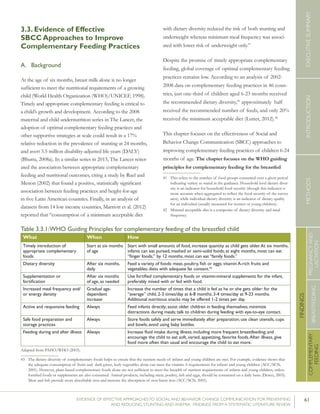
compared two intervention packages within the Micronutri-
ent and Health Program (MICAH). Control communities
received the standard MICAH intervention package which
included basic nutrition education and a supply of iron sup-
plements and other products through health centers. Inter-
vention communities received the standard MICAH package
along with a positive deviance (PD)/Hearth6
intervention,
exposure to mid-sized media (such as community radio/
video, local billboards), home counseling by peers, and group
education. After eight months, the percent of pregnant
women consuming meat or fish increased from 49.4% to
70.7% in PD/Hearth intervention communities while it had
declined from 41.5% to 32.0% in control communities.
Finally, Wang et al. (2009) conducted a study to look at “the
effectiveness of social mobilization and social marketing in
improving knowledge, attitudes and practices (KAP) and
Fe status in an Fe-deficient population.” The intervention
included a kick-off meeting with key stakeholders as well
as the training of community health workers, community
heads and store owners/market managers. In addition,
“schoolchildren were mobilized to distribute information,
education and communication (IEC) materials to the whole
family after they learned the relevant knowledge through
specially designed classes” and “trained volunteers were
recruited to disseminate IEC materials in public areas like
hospitals, culture and sports centres.” After one year, the
percentage of women in the intervention area who had ever
purchased FeSS increased from 8.9% to 36.6%.
6	 According to the CORE Group’s Resource Guide for Sustainably Rehabili-
tating Malnourished Children, “a Positive Deviance/Hearth Nutrition Pro-
gram is a home- and neighborhood-based nutrition program for children
who are at risk for protein-energy malnutrition in developing countries. The
program uses the “positive deviance” approach to identify those behaviors
practiced by the mothers or caretakers of well-nourished children from
poor families and to transfer such positive practices to others in the com-
munity with malnourished children. The “Hearth” or home is the location
for the nutrition education and rehabilitation sessions.” (McNulty, 2005).
11EVIDENCE OF EFFECTIVE APPROACHES TO SOCIAL AND BEHAVIOR CHANGE COMMUNICATION FOR PREVENTING
AND REDUCING STUNTING AND ANEMIA: FINDINGS FROM A SYSTEMATIC LITERATURE REVIEW
INTRODUCTIONMETHODSEXECUTIVESUMMARY
FINDINGS
COMPLEMENTARY
FEEDING
BREASTFEEDING
PREGNANCYAND
LACTATION
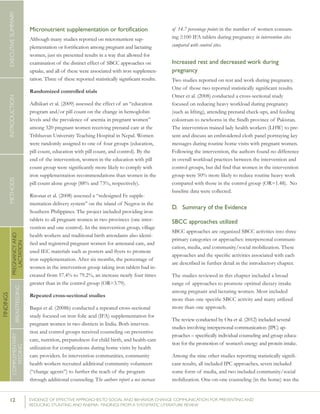
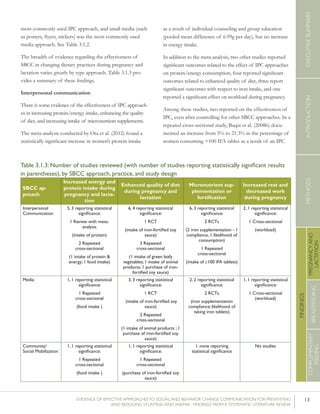
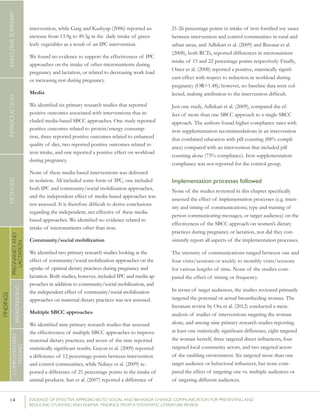
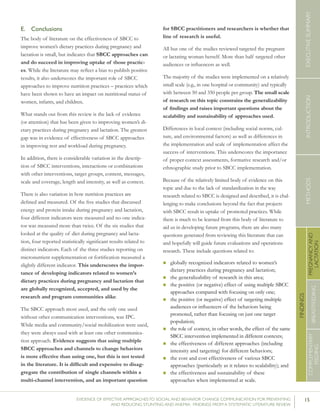
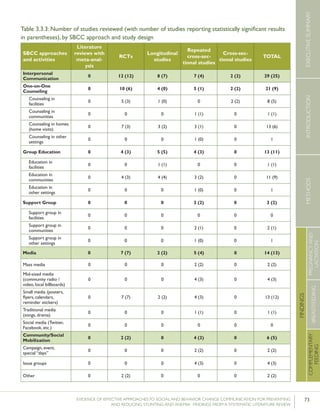
Table 3.1.2: Number of studies reviewed (with number of studies reporting statistically significant results in
parentheses), by SBCC approach and study design
SBCC approach
Reviews
with meta-
analysis
RCTs
Longitudinal
studies
Repeated
cross-
sectional
studies
Cross-
sectional
studies
TOTAL
Interpersonal Communication 1 (1) 4 (3) 1 (0) 8 (5) 1 (1) 15 (10)
One-on-One Counseling 1 (1) 3 (2) 1 (0) 6 (4) 1 (1) 12 (8)
Counseling in facilities 0 1 (1) 1 (0) 1 (1) 0 3 (2)
Counseling in communities 0 1 (1) 0 0 0 1 (1)
Counseling in homes (home visits) 0 2 (1) 0 5 (3) 1 (1) 8 (5)
Counseling in other settings 1 (1) 0 0 1 (1) 0 2 (2)
Group Education 1 (1) 1 (1) 1 (0) 6 (2) 0 9 (4)
Education in facilities 0 0 1 (0) 2 (1) 0 3 (1)
Education in communities 0 1 (1) 0 3 (0) 0 4 (1)
Education in other settings 1 (1) 0 0 1 (0) 0 2 (1)
Support Group 0 0 0 2 (1) 0 2 (1)
Support group in facilities 0 0 0 1 (0) 0 1
Support group in communities 0 0 0 0 0 0
Support group in other settings 0 0 0 1 (0) 0 1
Media 0 3 (3) 0 3 (3) 1 (1) 7 (7)
Mass media 0 1 (1) 0 1 (1) 0 2 (2)
Mid-sized media (community radio /
video, local billboards)
0 1 (1) 0 1 (0) 0 2 (1)
Small media (posters, flyers, calendars,
reminder stickers)
0 3 (3) 0 1 (0) 0 4 (3)
Traditional media (songs, drama) 0 0 0 0 1 (1) 1 (1)
Social media (Twitter, Facebook, etc.) 0 0 0 1 (0) 0 1
Community/Social Mobilization 0 0 0 3 (2) 0 3 (2)
Campaign, event, special “days” 0 0 0 1 (1) 0 1 (1)
Issue groups 0 0 0 2 (1) 0 1 (1)
Other 0 0 0 1 (1) 0 1 (1)
12 	 EVIDENCE OF EFFECTIVE APPROACHES TO SOCIAL AND BEHAVIOR CHANGE COMMUNICATION FOR PREVENTING AND
REDUCING STUNTING AND ANEMIA: FINDINGS FROM A SYSTEMATIC LITERATURE REVIEW
INTRODUCTIONMETHODSEXECUTIVESUMMARY
FINDINGS
COMPLEMENTARY
FEEDING
BREASTFEEDING
PREGNANCYAND
LACTATION
Micronutrient supplementation or fortification
Although many studies reported on micronutrient sup-
plementation or fortification among pregnant and lactating
women, just six presented results in a way that allowed for
examination of the distinct effect of SBCC approaches on
uptake, and all of these were associated with iron supplemen-
tation. Three of these reported statistically significant results.  
Randomized controlled trials
Adhikari et al. (2009) assessed the effect of an “education
program and/or pill count on the change in hemoglobin
levels and the prevalence of anemia in pregnant women”
among 320 pregnant women receiving prenatal care at the
Tribhuvan University Teaching Hospital in Nepal. Women
were randomly assigned to one of four groups (education,
pill count, education with pill count, and control). By the
end of the intervention, women in the education with pill
count group were significantly more likely to comply with
iron supplementation recommendations than women in the
pill count alone group (88% and 73%, respectively).
Risonar et al. (2008) assessed a “redesigned Fe supple-
mentation delivery system” on the island of Negros in the
Southern Philippines. The project included providing iron
tablets to all pregnant women in two provinces (one inter-
vention and one control). In the intervention group, village
health workers and traditional birth attendants also identi-
fied and registered pregnant women for antenatal care, and
used IEC materials such as posters and flyers to promote
iron supplementation. After six months, the percentage of
women in the intervention group taking iron tablets had in-
creased from 57.4% to 79.2%, an increase nearly four times
greater than in the control group (OR=3.79).
Repeated cross-sectional studies
Baqui et al. (2008b) conducted a repeated cross-sectional
study focused on iron folic acid (IFA) supplementation for
pregnant women in two districts in India. Both interven-
tion and control groups received counseling on preventive
care, nutrition, preparedness for child birth, and health-care
utilization for complications during home visits by health
care providers. In intervention communities, community
health workers recruited additional community volunteers
(“change agents”) to further the reach of the program
through additional counseling. The authors report a net increase
of 14.7 percentage points in the number of women consum-
ing ≥100 IFA tablets during pregnancy in intervention sites
compared with control sites.
Increased rest and decreased work during
pregnancy
Two studies reported on rest and work during pregnancy.
One of those two reported statistically significant results.
Omer et al. (2008) conducted a cross-sectional study
focused on reducing heavy workload during pregnancy
(such as lifting), attending prenatal check-ups, and feeding
colostrum to newborns in the Sindh province of Pakistan.
The intervention trained lady health workers (LHW) to pre-
sent and discuss an embroidered cloth panel portraying key
messages during routine home visits with pregnant women.
Following the intervention, the authors found no difference
in overall workload practices between the intervention and
control groups, but did find that women in the intervention
group were 50% more likely to reduce routine heavy work
compared with those in the control group (OR=1.48).  No
baseline data were collected.
D.	 Summary of the Evidence
SBCC approaches utilized
SBCC approaches are organized SBCC activities into three
primary categories or approaches: interpersonal communi-
cation, media, and community/social mobilization. These
approaches and the specific activities associated with each
are described in further detail in the introductory chapter.
The studies reviewed in this chapter included a broad
range of approaches to promote optimal dietary intake
among pregnant and lactating women. Most included
more than one specific SBCC activity and many utilized
more than one approach.
The review conducted by Ota et al. (2012) included several
studies involving interpersonal communication (IPC) ap-
proaches – specifically individual counseling and group educa-
tion for the promotion of women’s energy and protein intake.
Among the nine other studies reporting statistically signifi-
cant results, all included IPC approaches, seven included
some form of media, and two included community/social
mobilization. One-on-one counseling (in the home) was the
13EVIDENCE OF EFFECTIVE APPROACHES TO SOCIAL AND BEHAVIOR CHANGE COMMUNICATION FOR PREVENTING
AND REDUCING STUNTING AND ANEMIA: FINDINGS FROM A SYSTEMATIC LITERATURE REVIEW
INTRODUCTIONMETHODSEXECUTIVESUMMARY
FINDINGS
COMPLEMENTARY
FEEDING
BREASTFEEDING
PREGNANCYAND
LACTATION
Table 3.1.3: Number of studies reviewed (with number of studies reporting statistically significant results
in parentheses), by SBCC approach, practice, and study design
SBCC ap-
proach
Increased energy and
protein intake during
pregnancy and lacta-
tion
Enhanced quality of diet
during pregnancy and
lactation
Micronutrient sup-
plementation or
fortification
Increased rest and
decreased work
during pregnancy
Interpersonal
Communication
5, 3 reporting statistical
significance:
1 Review with meta-
analysis
(intake of protein)
2 Repeated
cross-sectional
(1 intake of protein &
energy; 1 food intake)
6, 4 reporting statistical
significance:
1 RCT
(intake of iron-fortified soy
sauce)
3 Repeated
cross-sectional
(1 intake of green leafy
vegetables; 1 intake of animal
products; 1 purchase of iron-
fortified soy sauce)
6, 3 reporting statistical
significance:
2 RCTs
(2 iron supplementation - 1
compliance, 1 likelihood of
consumption)
1 Repeated
cross-sectional
(intake of ≥100 IFA tablets)
2, 1 reporting statistical
significance:
1 Cross-sectional
(workload)
Media 1, 1 reporting statistical
significance:
1 Repeated
cross-sectional
(food intake )
3, 3 reporting statistical
significance:
1 RCT
(intake of iron-fortified soy
sauce)
2 Repeated
cross-sectional
(1 intake of animal products ; 1
purchase of iron-fortified soy
sauce)
2, 2 reporting statistical
significance:
2 RCTs
(iron supplementation
compliance; likelihood of
taking iron tablets)
1, 1 reporting statistical
significance:
1 Cross-sectional
(workload)
Community/
Social Mobilization
1, 1 reporting statistical
significance:
1 Repeated
cross-sectional
(food intake )
1, 1 reporting statistical
significance:
1 Repeated
cross-sectional
(purchase of iron-fortified soy
sauce)
1, none reporting
statistical significance
No studies
most commonly used IPC approach, and small media (such
as posters, flyers, stickers) was the most commonly used
media approach. See Table 3.1.2.
The breadth of evidence regarding the effectiveness of
SBCC in changing dietary practices during pregnancy and
lactation varies greatly by type approach. Table 3.1.3 pro-
vides a summary of these findings.
Interpersonal communication
There is some evidence of the effectiveness of IPC approach-
es in increasing protein/energy intake, enhancing the quality
of diet, and increasing intake of micronutrient supplements.
The meta-analysis conducted by Ota et al. (2012) found a
statistically significant increase in women’s protein intake
as a result of individual counseling and group education
(pooled mean difference of 6.99g per day), but no increase
in energy intake.
In addition to the meta-analysis, two other studies reported
significant outcomes related to the effect of IPC approaches
on protein/energy consumption, four reported significant
outcomes related to enhanced quality of diet, three report
significant outcomes with respect to iron intake, and one
reported a significant effect on workload during pregnancy.
Among these studies, two reported on the effectiveness of
IPC, even after controlling for other SBCC approaches. In a
repeated cross-sectional study, Baqui et al. (2008b) docu-
mented an increase from 5% to 21.3% in the percentage of
women consuming <100 IFA tables as a result of an IPC
14 	 EVIDENCE OF EFFECTIVE APPROACHES TO SOCIAL AND BEHAVIOR CHANGE COMMUNICATION FOR PREVENTING AND
REDUCING STUNTING AND ANEMIA: FINDINGS FROM A SYSTEMATIC LITERATURE REVIEW
INTRODUCTIONMETHODSEXECUTIVESUMMARY
FINDINGS
COMPLEMENTARY
FEEDING
BREASTFEEDING
PREGNANCYAND
LACTATION
intervention, while Garg and Kashyap (2006) reported an
increase from 13.9g to 49.3g in the daily intake of green
leafy vegetables as a result of an IPC intervention.
We found no evidence to support the effectiveness of IPC
approaches on the intake of other micronutrients during
pregnancy and lactation, or related to decreasing work load
or increasing rest during pregnancy.
Media
We identified six primary research studies that reported
positive outcomes associated with interventions that in-
cluded media-based SBCC approaches. One study reported
positive outcomes related to protein/energy consump-
tion, three reported positive outcomes related to enhanced
quality of diet, two reported positive outcomes related to
iron intake, and one reported a positive effect on workload
during pregnancy.
None of these media-based interventions was delivered
in isolation. All included some form of IPC, one included
both IPC and community/social mobilization approaches,
and the independent effect of media-based approaches was
not assessed. It is therefore difficult to derive conclusions
regarding the independent, net effective of these media-
based approaches. We identified no evidence related to
intake of micronutrients other than iron.
Community/social mobilization
We identified two primary research studies looking at the
effect of community/social mobilization approaches on the
uptake of optimal dietary practices during pregnancy and
lactation. Both studies, however, included IPC and media ap-
proaches in addition to community/social mobilization, and
the independent effect of community/social mobilization
approaches on maternal dietary practices was not assessed.
Multiple SBCC approaches
We identified nine primary research studies that assessed
the effectiveness of multiple SBCC approaches to improve
maternal dietary practices, and seven of the nine reported
statistically significant results. Guyon et al. (2009) reported
a difference of 12 percentage points between intervention
and control communities, while Ndiaye et al. (2009) re-
ported a difference of 21 percentage points in the intake of
animal products. Sun et al. (2007) reported a difference of
21-26 percentage points in intake of iron fortified soy sauce
between intervention and control communities in rural and
urban areas, and Adhikari et al. (2009) and Risonar et al.
(2008), both RCTs, reported differences in micronutrient
intake of 15 and 22 percentage points respectively. Finally,
Omer et al. (2008) reported a positive, statistically signifi-
cant effect with respect to reduction in workload during
pregnancy (OR=1.48); however, no baseline data were col-
lected, making attribution to the intervention difficult.
Just one study, Adhikari et al. (2009), compared the ef-
fect of more than one SBCC approach to a single SBCC
approach. The authors found higher compliance rates with
iron supplementation recommendations in an intervention
that combined education with pill counting (88% compli-
ance) compared with an intervention that included pill
counting alone (73% compliance). Iron supplementation
compliance was not reported for the control group.
Implementation processes followed
None of the studies reviewed in this chapter specifically
assessed the effect of implementation processes (e.g. inten-
sity and timing of communications; type and training of
person communicating messages, or target audience) on the
effectiveness of the SBCC approach on women’s dietary
practices during pregnancy or lactation, nor did they con-
sistently report all aspects of the implementation processes.
The intensity of communications ranged between one and
four visits/sessions or weekly to monthly visits/sessions
for various lengths of time. None of the studies com-
pared the effect of timing or frequency.
In terms of target audiences, the studies reviewed primarily
targeted the potential or actual breastfeeding woman. The
literature review by Ota et al. (2012) conducted a meta-
analysis of studies of interventions targeting the woman
alone, and among nine primary research studies reporting
at least one statistically significant difference, eight targeted
the woman herself, three targeted direct influencers, four
targeted local community actors, and two targeted actors
of the enabling environment. Six targeted more than one
target audience or behavioral influencer, but none com-
pared the effect of targeting one vs. multiple audiences or
of targeting different audiences.
15EVIDENCE OF EFFECTIVE APPROACHES TO SOCIAL AND BEHAVIOR CHANGE COMMUNICATION FOR PREVENTING
AND REDUCING STUNTING AND ANEMIA: FINDINGS FROM A SYSTEMATIC LITERATURE REVIEW
INTRODUCTIONMETHODSEXECUTIVESUMMARY
FINDINGS
COMPLEMENTARY
FEEDING
BREASTFEEDING
PREGNANCYAND
LACTATION
E.	 Conclusions
The body of literature on the effectiveness of SBCC to
improve women’s dietary practices during pregnancy and
lactation is small, but indicates that SBCC approaches can
and do succeed in improving uptake of those practic-
es. While the literature may reflect a bias to publish positive
results, it also underscores the important role of SBCC
approaches to improve nutrition practices – practices which
have been shown to have an impact on nutritional status of
women, infants, and children.
What stands out from this review is the lack of evidence
(or attention) that has been given to improving women’s di-
etary practices during pregnancy and lactation. The greatest
gap was in evidence of effectiveness of SBCC approaches
in improving rest and workload during pregnancy.
In addition, there is considerable variation in the descrip-
tion of SBCC interventions, interactions or combinations
with other interventions, target groups, content, messages,
scale and coverage, length and intensity, as well as context.
There is also variation in how nutrition practices are
defined and measured. Of the five studies that discussed
energy and protein intake during pregnancy and lactation,
four different indicators were measured and no one indica-
tor was measured more than twice. Of the six studies that
looked at the quality of diet during pregnancy and lacta-
tion, four reported statistically significant results related to
distinct indicators. Each of the three studies reporting on
micronutrient supplementation or fortification measured a
slightly different indicator. This underscores the impor-
tance of developing indicators related to women’s
dietary practices during pregnancy and lactation that
are globally recognized, accepted, and used by the
research and program communities alike.
The SBCC approach most used, and the only one used
without other communication interventions, was IPC.
While media and community/social mobilization were used,
they were always used with at least one other communica-
tion approach. Evidence suggests that using multiple
SBCC approaches and channels to change behaviors
is more effective than using one, but this is not tested
in the literature. It is difficult and expensive to disag-
gregate the contribution of single channels within a
multi-channel intervention, and an important question
for SBCC practitioners and researchers is whether that
line of research is useful.
All but one of the studies reviewed targeted the pregnant
or lactating woman herself. More than half targeted other
audiences or influencers as well.
The majority of the studies were implemented on a relatively
small scale (e.g., in one hospital or community) and typically
with between 50 and 350 people per group. The small scale
of research on this topic constrains the generalizability
of findings and raises important questions about the
scalability and sustainability of approaches used.
Differences in local context (including social norms, cul-
ture, and environmental factors) as well as differences in
the implementation and scale of implementation affect the
success of interventions. This underscores the importance
of proper context assessments, formative research and/or
ethnographic study prior to SBCC implementation.
Because of the relatively limited body of evidence on this
topic and due to the lack of standardization in the way
research related to SBCC is designed and described, it is chal-
lenging to make conclusions beyond the fact that projects
with SBCC result in uptake of promoted practices. While
there is much to be learned from this body of literature to
aid us in developing future programs, there are also many
questions generated from reviewing this literature that can
and hopefully will guide future evaluations and operations
research. These include questions related to:
n	globally recognized indicators related to women’s
dietary practices during pregnancy and lactation;
n	the generalizability of research in this area;
n	the positive (or negative) effect of using multiple SBCC
approaches compared with focusing on only one;
n	the positive (or negative) effect of targeting multiple
audiences or influencers of the behaviors being
promoted, rather than focusing on just one target
population;
n	the role of context, in other words, the effect of the same
SBCC intervention implemented in different contexts;
n	the effectiveness of different approaches (including
intensity and targeting) for different behaviors;
n	the cost and cost effectiveness of various SBCC
approaches (particularly as it relates to scalability); and
n	the effectiveness and sustainability of these
approaches when implemented at scale.
16 	 EVIDENCE OF EFFECTIVE APPROACHES TO SOCIAL AND BEHAVIOR CHANGE COMMUNICATION FOR PREVENTING AND
REDUCING STUNTING AND ANEMIA: FINDINGS FROM A SYSTEMATIC LITERATURE REVIEW
INTRODUCTIONMETHODSEXECUTIVESUMMARY
FINDINGS
COMPLEMENTARY
FEEDING
BREASTFEEDING
PREGNANCYAND
LACTATION
Table3.1.4:Studiesreportingonmaternaldietarypracticesduringpregnancyandlactation
Colorcodingkey
IncreasedenergyandproteinintakeduringpregnancyandlactationIntakeofmicronutrientandironsupplements
EnhancedqualityofdietduringpregnancyandlactationRestandworkduringpregnancy
STUDY
APPROACHES
USED
SCALE/
SCOPE
EVALUATIONDESIGN
OUTCOME(S)
MEASURED
RESULTS7P-VALUEs
/CIs8
Adhikarietal(2009);
Nepal
Counselinginfacilities
byproviders;Small
media
1hospitalRCT–pregnantwomenreceiving
prenatalcare:71ineducation
group,70inpillcountgroup,73
education+pillcountgroup,70in
controlgroup
Ironsupplementation
compliance
Education+Pillcount
vs.Pillcountalone:88%
vs.73%
p<0.001
Ahrarietal.(2006);
Egypt
Groupeducationin
facilitiesbyproviders;
Supportgroupin
facilitiesbyproviders
and/orlayvolunteers;
Counselinginhomes
bylayvolunteers
2largecommunitiesRepeatedcross-sectional–519
women(344intervention,175
control)
%ofwomenwhoreported
consumptionofmorefood
duringpregnancy
54.9%vs.10.6%Notclearin
article
%ofwomenwhoreported
consumptionofmoremeat
duringpregnancy
%ofwomenwhoreported
consumptionofmore
vegetablesduringpregnancy
57.1%vs.4.2%
66.9%vs.5.3%
Notclearin
article
%ofpregnantwomenwho
reportedtakingIFA
%ofpregnantwomenwho
reportedtaking7ormore
IFAtabletsperweek
97.5%vs.80.6%
86.2%vs.0.0%
NS9
NS
%ofwomenwhoreported
anincreaseindaytimerest
duringpregnancy
64.1%vs.11.7%Notclearin
article
Akteretal.(2012);
Bangladesh
Counselinginfacilities
byproviders;Group
educationinfacilities
byproviders
1hospitalLongitudinal–115women(57
intervention,58control)
%ofpregnantwomenwho
increasedfrequencyofmeals
fromthreetofivetimesaday
34%moreNotreported
7	Comparisonisinterventionvs.controlgroup,unlessindicatedotherwise.
8	Differencesreportedasnotsignificantlydifferentatthe0.05levelareindicatedby“NS”.Differencesforwhichstatisticalsignificancewasnotreportedareindicatedby“--“.
9	NS=notsignificanteitheraccordingtowhatisreportedintheoriginalarticleorp<0.05.
17EVIDENCE OF EFFECTIVE APPROACHES TO SOCIAL AND BEHAVIOR CHANGE COMMUNICATION FOR PREVENTING
AND REDUCING STUNTING AND ANEMIA: FINDINGS FROM A SYSTEMATIC LITERATURE REVIEW
INTRODUCTIONMETHODSEXECUTIVESUMMARY
FINDINGS
COMPLEMENTARY
FEEDING
BREASTFEEDING
PREGNANCYAND
LACTATION
STUDY
APPROACHES
USED
SCALE/
SCOPE
EVALUATIONDESIGN
OUTCOME(S)
MEASURED
RESULTS7P-VALUEs
/CIs8
Baquietal.(2008b);
India
Counselinginhomes
bylayvolunteers;
Counselinginhomes
byproviders
2districtsRepeatedcross-sectional–
baseline:14,952recentlydelivered
women(8,756intervention,
6,196control);endline:13,826
recentlydeliveredwomen(7,812
intervention,6,014control)
endlinevs.baseline
%ofwomenwhoconsumed
equaltoormorethan100IFA
tabletsduringpregnancy
Interventiongroup:21.3%
vs.5%
Controlgroup:8.3%vs.
6.7%
p<0.00110
BortoliniandVitolo
(2012);Brazil
Counselinginhomes
byproviders
1hospitalRCT–397(163intervention,234
control)
%ofwomenwhouse
fortifiedflour
%ofwomenwhoconsume
dietaryironthatishighly
bioavailable
%ofwomenwithdailyiron
intake≥3mg/day
Basedona24hourdietary
recallamongchildren12-16
monthsold,meanintakeof…
-meat(g)
-iron(mg)
-hemeiron(mg)
45.2%vs.44.2%
18.1%vs.9.8%
83.2%vs.82.8%
54.3vs.47.3
5.1vs.5.4
1.5vs.1.2
NS
NS
NS
p=0.024
NS
p=0.003
Caseyetal.(2010);
Vietnam
Mobilizationofissue
groups;Counselingin
homesbypeers
2districtsRepeatedcross-sectional–
baseline(Nov2005):389women
ofreproductiveage(WRA);1st
follow-up(July2006):253WRA;2nd
follow-up(Sept2007):276WRA;
3rd
follow-up(Apr2009):322WRA
3rd
follow-upvs.2nd
follow-upvs.1st
follow-up
%ofwomenwhotookat
least75%oftabletsreceived
duringpregnancy
87%vs.90%vs.51%95%CIs:(80%
-93%)vs.
(84%-95%)
vs.(37%vs.
65%)
GargandKashyap
(2006);India
Counselingin
facilitiesbyproviders;
Groupeducation
incommunitiesby
providers;Counseling
inhomesbyproviders
1villageRepeatedcross-sectional–100
women(50intervention,50
control)
Energy(kcal)intakeduring
pregnancy
Protein(g)intakeduring
pregnancy
1521.23vs.835.14
48.05vs.25.00
p<0.001
p<0.001
Meandailyintakeofgreen
leafyvegetables(g)during
pregnancy
49.3vs.13.9p<0.001
10	P-valuefordifference-in-differencetestadjustedforage,education,parity,religionandstandard-of-livingscore.
18 	 EVIDENCE OF EFFECTIVE APPROACHES TO SOCIAL AND BEHAVIOR CHANGE COMMUNICATION FOR PREVENTING AND
REDUCING STUNTING AND ANEMIA: FINDINGS FROM A SYSTEMATIC LITERATURE REVIEW
INTRODUCTIONMETHODSEXECUTIVESUMMARY
FINDINGS
COMPLEMENTARY
FEEDING
BREASTFEEDING
PREGNANCYAND
LACTATION
STUDY
APPROACHES
USED
SCALE/
SCOPE
EVALUATIONDESIGN
OUTCOME(S)
MEASURED
RESULTS7P-VALUEs
/CIs8
Guyonetal.(2009);
Madagascar
Mobilizationofissue
groups;Mobilization
ofcampaigns,events,
orspecialdays;Mass
media
2highland
provinces;targeted
populationvaried
throughoutproject
from1.4million
in6districtsto
6millionin23
districts
Repeatedcross-sectional–
baseline(2000):1,200children
undertwoyearsold;endline
(2005):1,760childrenundertwo
yearsold
endlinevs.baseline
%ofmothersofinfants<
6monthswhoreported
increasedfoodintakeduring
pregnancy
%ofmothersofinfants<
6monthswhoreported
increasedfoodintakeduring
lactation
55%vs.51%
74%vs.62%
NS
p<0.001
Ndiayeetal.(2009);
Senegal
Mid-sizedmedia;
Counselingin
homesbypeers;
Groupeducationin
communitiesbylay
volunteers
2communitiesRepeatedcross-sectional–
baseline:171pregnantwomen(89
intervention,82control);endline:
200(100intervention,100control)
endlinevs.baseline
%ofpregnantwomenwho
reportedeatingmeatorfish
atleastonceaweek
Intervention:
70.7%vs.49.4%
Control:
32.0%vs.41.5%
p≤0.003
p≤0.019
(difference-
in-differences:
p=0.0001)
Omeretal.(2008);
Pakistan
Traditionalmedia;
Counselinginhomes
bypeers
10communities
fromthreedistricts
(5interventionand
5control)
Cross-sectionalstudy–1,070
womenwerepregnantorhad
deliveredduringthepreceding
threeyears(529intervention,541
control;310womenadvisedby
anLHW,799womenadvisedby
othersorno-one)
Womeninintervention
groupadvisedbyLHW
vs.womenadvisedby
othersornoone11
%ofwomenwhoreported
areductioninroutineheavy
workduringpregnancy
77.1%vs.58.9%
OR=1.48(95%CI:
1.01–2.16)
Otaetal.(2012);
various
Individualcounseling;
Groupeducation
VariedLiteraturereview–15RCTs
reviewed,fourrelatedtodietary
advicetoincreaseenergyand
proteinintake
Proteinintake(g/day)during
pregnancy
Energyintakeduring
pregnancy
Pooledmeandifferences:
6.99g/day
105.61kcal/day
p=0.00057
NS
Risonaretal.(2008);
Philippines
Counselingin
communitiesbylay
volunteers;Small
media;Counseling
inhomesbylay
volunteers
6municipalities/
villagesfromtwo
provinces
RCT–1,180pregnantwomen
(596intervention,584control)
LikelihoodoftakingFetablets
intheinterventionareas
-baseline
-endline
OR=3.79
8.5%vs.74.3%
79.2%vs.57.4%
p=0.001
(95%CI:2.22-
6.49)
NS
p<0.001
11	Notethattherewerenosignificantsocio-demographicdifferencesbetweeninterventionandcontrolcommunities.
19EVIDENCE OF EFFECTIVE APPROACHES TO SOCIAL AND BEHAVIOR CHANGE COMMUNICATION FOR PREVENTING
AND REDUCING STUNTING AND ANEMIA: FINDINGS FROM A SYSTEMATIC LITERATURE REVIEW
INTRODUCTIONMETHODSEXECUTIVESUMMARY
FINDINGS
COMPLEMENTARY
FEEDING
BREASTFEEDING
PREGNANCYAND
LACTATION
STUDY
APPROACHES
USED
SCALE/
SCOPE
EVALUATIONDESIGN
OUTCOME(S)
MEASURED
RESULTS7P-VALUEs
/CIs8
Senanayakeetal.
(2010);SriLanka
Groupeducationin
facilitiesbyproviders
1hospitalRepeatedcross-sectional–218
womenbetween16-20weeksof
gestation(107intervention,111
control)
%ofpregnantwomenwho
tookirontabletscorrectlyat
34weeksgestation
86.9%vs.32.4%Notreported
Sunetal.(2007);
China
Massmedia;Mid-sized
media;Smallmedia;
Groupeducationin
communities
2urbandistricts
and2ruralvillages
RCT–373women19to70years
old(113ruralintervention,80
ruralcontrol,97urbanintervention,
83urbancontrol)
%ofwomenwhoreported
buyingFeSS
-Ruralareas
-Urbanareas
%ofwomenwhobought
FeSSwhoreportedeating
FeSS
-Ruralareas
-Urbanareas
53.6%vs.19%
43.3%vs.11%
85.7%vs.65%
49.5%vs.11.0%
p<0.001
p<0.001
p<0.001
p<0.001
Wangetal.(2009);
China
Community/social
mobilization;Small
media;Group
educationin
communities;Social
mediamarketing;
Meetingstargeting
policymakersand
regulators
3counties(one
urbanandtwo
rural)
Repeatedcross-sectional–
baseline:801adultnon-pregnant
womenolderthan20yearsofage;
endline:716;survey3:787
endlinevs.baseline
%ofwomenwhohaveever
purchased(FeSS)
36.6%vs.8.9%p<0.001
20 	 EVIDENCE OF EFFECTIVE APPROACHES TO SOCIAL AND BEHAVIOR CHANGE COMMUNICATION FOR PREVENTING AND
REDUCING STUNTING AND ANEMIA: FINDINGS FROM A SYSTEMATIC LITERATURE REVIEW
INTRODUCTIONMETHODSEXECUTIVESUMMARY
FINDINGS
COMPLEMENTARY
FEEDING
BREASTFEEDING
PREGNANCYAND
LACTATION
ACC/SCN. 2001. What Works? A Review of the Efficacy and Effectiveness of Nutrition Interventions, Allen LH and Gillespie SR. ACC/
SCN: Geneva in collaboration with the Asian Development Bank, Manila.
Adhikari, Kamala, Tippawan Liabsuetrakul, and Neelam Pradhan. 2009. “Effect of Education and Pill Count on Hemoglobin
Status During Prenatal Care in Nepalese Women: a Randomized Controlled Trial.” The Journal of Obstetrics and Gynaecology
Research 35 (3) (June): 459–466.
Ahrari, Mahshid, Robert F Houser, Siham Yassin, Mona Mogheez, Y Hussaini, Patrick Crump, Gary L Darmstadt, David Marsh,
and F James Levinson. 2006. “A Positive Deviance-based Antenatal Nutrition Project Improves Birth-weight in Upper
Egypt.” Journal of Health, Population, and Nutrition 24 (4) (December): 498–507.
Akter, S.M., S.K. Roy, S.K. Thakur, M. Sultana, W. Khatun, R. Rahman, S.S. Saliheen, and N. Alam. 2012. “Effects of Third
Trimester Counselling on Pregnancy Weight Gain, Birthweight, and Breastfeeding Among Urban Poor Women in Bangla-
desh.” Food & Nutrition Bulletin 33 (3) (September): 194–201.
Alderman, H, and JR Behrman. 2006. “Reducing the Incidence of Low Birth Weight in Low-Income Countries Has Substantial
Economic Benefits.” The World Bank Research Observer 21 (1): 25–48.
Allen, Lindsay H. 2005. “Multiple Micronutrients in Pregnancy and Lactation: An Overview.” The American Journal of Clinical
Nutrition 81 (5) (May): 1206S–1212S.
Baqui, Abdullahh, Emma K Williams, Amanda M Rosecrans, Praween K Agrawal, Saifuddin Ahmed, Gary L Darmstadt, Vish-
wajeet Kumar, Usha Kiran, Dharmendra Panwar, Ramesh C Ahuja, Vinod K Srivastava, Robert E Black, and Manthuram
Santoshama. 2008. “Impact of an Integrated Nutrition and Health Programme on Neonatal Mortality in Rural Northern
India.” Bulletin of the World Health Organization 86 (10) (October): 796–804.
Bhutta, Zulfiqar A, Jai K Das, Arjumand Rizvi, Michelle F Gaffey, Neff Walker, Susan Horton, Patrick Webb, Anna Lartey, and
Robert E Black. 2013. “Evidence-based Interventions for Improvement of Maternal and Child Nutrition: What Can Be
Done and at What Cost?” The Lancet 382 (9890) (August): 452–477.
Black, Robert E, Cesar G Victora, Susan P Walker, Zulfiqar A Bhutta, Parul Christian, Mercedes de Onis, Majid Ezzati,  Sally
Grantham-McGregor, Joanne Katz, Reynaldo Martorell, Ricardo Uauy, and the Maternal and Child Nutrition Study
Group. 2013. “Maternal and Child Undernutrition and Overweight in Low-income and Middle-income Countries.” The
Lancet 382 (9890) (August): 427–451.
Bortolini, Gisele Ane, and Márcia Regina Vitolo. 2012. “The Impact of Systematic Dietary Counselling During the First Year of
Life on Prevalence Rates of Anemia and Iron Deficiency at 12-16 Months.” Jornal de Pediatria 88 (1) (February): 33–39.
Casey, Gerard J, Damien Jolley, Tran Q Phuc, Ta T Tinh, Dang H Tho, Antonio Montresor, and Beverley-Ann Biggs. 2010.
“Long-term Weekly Iron-folic Acid and De-worming Is Associated with Stabilised Haemoglobin and Increasing Iron
Stores in Non-pregnant Women in Vietnam.” PloS One 5 (12): e15691.
Cochrane Database of Systematic Reviews.
De-Regil, Luz Maria, Parminder S Suchdev, Gunn E Vist, Silke Walleser, and Juan Pablo Peña-Rosas. 2011. “Home Fortification
of Foods with Multiple Micronutrient Powders for Health and Nutrition in Children Under Two Years of Age.” Cochrane
Database of Systematic Reviews 2011, edited by The Cochrane Collaboration and Luz Maria De-Regil. Chichester, United
Kingdom: John Wiley & Sons, Ltd.
F. 	 Works Cited and Literature Reviewed
21EVIDENCE OF EFFECTIVE APPROACHES TO SOCIAL AND BEHAVIOR CHANGE COMMUNICATION FOR PREVENTING
AND REDUCING STUNTING AND ANEMIA: FINDINGS FROM A SYSTEMATIC LITERATURE REVIEW
INTRODUCTIONMETHODSEXECUTIVESUMMARY
FINDINGS
COMPLEMENTARY
FEEDING
BREASTFEEDING
PREGNANCYAND
LACTATION
Dewey, K G, R J Cohen, K H Brown, and L L Rivera. 2001. “Effects of Exclusive Breastfeeding for Four Versus Six Months on
Maternal Nutritional Status and Infant Motor Development: Results of Two Randomized Trials in Honduras.” The Journal
of Nutrition 131 (2) (February): 262–267.
Garg, Aashima, and Sushma Kashyap. 2006. “Effect of Counselling on Nutritional Status During Pregnancy.” Indian Journal of
Pediatrics 73 (8) (August): 687–692.
Guyon, Agnès B, Victoria J Quinn, Michael Hainsworth, Priscilla Ravonimanantsoa, Voahirana Ravelojoana, Zo Rambeloson,
and Luann Martin. 2009. “Implementing an Integrated Nutrition Package at Large Scale in Madagascar: The Essential
Nutrition Actions Framework.” Food and Nutrition Bulletin 30 (3) (September): 233–244.
Haider, BA, and ZA Bhutta. 2012. “Multiple-Micronutrient Supplementation for Women During Pregnancy.”
Haileslassie, Kiday, Afework Mulugeta, and Meron Girma. 2013. “Feeding Practices, Nutritional Status and Associated Factors
of Lactating Women in Samre Woreda, South Eastern Zone of Tigray, Ethiopia.” Nutrition Journal 12 (1): 28
Katz, Joanne, Anne CC Lee, Naoko Kozuki, Joy E Lawn, Simon Cousens, Hannah Blencowe, Majid Ezzati, et al. 2013. “Mor-
tality Risk in Preterm and Small-for-Gestational-Age Infants in Low-Income and Middle-Income Countries: A Pooled
Country Analysis.” The Lancet 382 (9890): 417–25.
Mason, John B, Lisa S Saldanha, and Reynaldo Martorell. 2012. “The Importance of Maternal Undernutrition for Maternal,
Neonatal, and Child Health Outcomes: An Editorial.” Food and Nutrition Bulletin 33 (2 Suppl) (June): S3–5.
McNulty J. and CORE Group. Positive Deviance / Hearth Essential Elements: A Resource Guide for Sustainably Rehabilitating Malnourished
Children (Addendum), Washington, D.C.: CORE Group, 2005.
Ndiaye, Mamadou, Kendra Siekmans, Slim Haddad, and Olivier Receveur. 2009. “Impact of a Positive Deviance Approach to
Improve the Effectiveness of an Iron-supplementation Program to Control Nutritional Anemia among Rural Senegalese
Pregnant Women.” Food and Nutrition Bulletin 30 (2) (June): 128–136.
Omer, Khalid, Sharmila Mhatre, Noor Ansari, Jorge Laucirica, and Neil Andersson. 2008. “Evidence-based Training of Front-
line Health Workers for Door-to-door Health Promotion: a Pilot Randomized Controlled Cluster Trial with Lady Health
Workers in Sindh Province, Pakistan.” Patient Education and Counselling 72 (2) (August): 178–185.
Ota, Erika, Ruoyan Tobe-Gai, Rintaro Mori, and Diane Farrar. Antenatal Dietary Advice and Supplementation to Increase En-
ergy and Protein Intake. In Cochrane Database of Systematic Reviews 2012, edited by The Cochrane Collaboration and Erika
Ota. Chichester, United Kingdom: John Wiley & Sons, Ltd.
Risonar, Maria Grace D, Pura Rayco-Solon, Lorena W Tengco, Jesus N Sarol, Lourdes S Paulino, and Florentino S Solon. 2008.
“Effectiveness of a Redesigned Iron Supplementation Delivery System for Pregnant Women in Negros Occidental, Phil-
ippines.” Public Health Nutrition 12 (07) (August 27)
Senanayake, Hemantha M, Samanthi P Premaratne, Thilina Palihawadana, and Sumeda Wijeratne. 2010. “Simple Educational
Intervention Will Improve the Efficacy of Routine Antenatal Iron Supplementation.” The Journal of Obstetrics and Gynaecol-
ogy Research 36 (3) (June): 646–650.
Sun, Xinying, Yan Guo, Sisun Wang, and Jing Sun. 2007. “Social Marketing Improved the Consumption of Iron-fortified Soy
Sauce Among Women in China.” Journal of Nutrition Education and Behavior 39 (6) (December): 302–310.
Wang, Bo, Siyan Zhan, Jing Sun, and Liming Lee. 2009. “Social Mobilization and Social Marketing to Promote NaFeEDTA-
fortified Soya Sauce in an Iron-deficient Population through a Public-private Partnership.” Public Health Nutrition 12 (10)
(October): 1751–1759.
22 	 EVIDENCE OF EFFECTIVE APPROACHES TO SOCIAL AND BEHAVIOR CHANGE COMMUNICATION FOR PREVENTING AND
REDUCING STUNTING AND ANEMIA: FINDINGS FROM A SYSTEMATIC LITERATURE REVIEW
INTRODUCTIONMETHODSEXECUTIVESUMMARY
FINDINGS
COMPLEMENTARY
FEEDING
BREASTFEEDING
PREGNANCYAND
LACTATION
3.2. Evidence of Effective
SBCC Approaches to Promote
Breastfeeding Practices
A.	 Background
Breastfeeding is widely recognized as one of the most cost-
effective investments to improve child survival (UNICEF,
2013). According to The Lancet Series on Maternal and
Child Under Nutrition, the adoption of exclusive breast-
feeding through six months of age and continued breast-
feeding through age two in 36 high burden countries could
avert 11.6% of all deaths in children under the age of one,
and nearly 10% of all deaths in children under the age of
two (Bhutta et al., 2008a). The benefits of breastfeeding
stretch beyond a child’s survival. Breastfed children do bet-
ter on cognitive and motor development tests, and gener-
ally achieve better academic outcomes than non-breastfed
children (Horta et al., 2013).
Additionally, breastfeeding imparts critical benefits to the
woman. When practiced exclusively, breastfeeding is as-
sociated with lactational amenorrhea, the natural postnatal
infertility that occurs when a woman is amenorrheic (not
menstruating). The lactational amenorrhea method (LAM)
is considered a modern method of contraception that
prevents a second pregnancy within six months of giving
birth, and helps to conserve maternal iron stores (Dewey
et al., 2001). Increased birth spacing improves both the
health of the woman and her infant’s chances of survival,
while suboptimal pregnancy intervals are associated with an
increased risk of adverse perinatal and infant/child out-
comes including preterm birth, low birth weight, small for
gestational age (SGA), stunting, and underweight infants/
children (Bhutta et al, 2013; Conde-Agudelo, 2006; Conde-
Agudelo et al., 2012; Rutstein, 2008).
The World Health Organization (WHO) recommends
three primary breastfeeding practices: initiation of breast-
feeding within one hour after birth (also referred to as
immediate breastfeeding), exclusive breastfeeding (EBF)
through six months of age, and continued breastfeeding
until 24 months of age (Dyson et al., 2005; WHO, 2008).
Evidence associated with the recommendation for imme-
diate breastfeeding is limited and likely operates through
the effect of exclusive breastfeeding (Bhutta et al., 2013).
The Lancet, therefore, includes only EBF and continued
breastfeeding in the modeling of optimal breastfeeding
practices cited above.
Despite the promise of optimal breastfeeding practices,
rates for the three WHO recommended breastfeeding
practices remain low, and negligible progress has been made
to increase these rates over the past two decades (UNICEF,
2013). According to an analysis of data from 78 low and
middle income countries, rates of immediate breastfeed-
ing range from a mean of 36% in Eastern Europe to a
mean of 58% in Latin America, and the rate of exclusive
breastfeeding in children one to five months of age is just
30% (Black et al, 2013). According to the UNICEF global
database of national surveys from 2007-2011, the current
rate of breastfeeding at one year is 76%, while the rate of
breastfeeding at age two years is 58%.12
This chapter reviews the effectiveness of social and behav-
ior change communication (SBCC) approaches on improv-
ing breastfeeding practices.
B.	 Search Results
Sixty-two peer-reviewed studies met the literature review’s
inclusion criteria.2
A complete list of the studies reviewed,
including a summary of the SBCC approach(es) utilized,
the study design, practices measured, and levels of signifi-
cance is presented in Table 3.2.4 at the end of this chapter.
Forty-eight reported a statistically significant change in at
least one of the priority breastfeeding practices. Each of
those articles is described in greater detail below. Studies
reporting a statistically significant change in more than one
of the prioritized practices and/or utilizing more than one
SBCC approach are cited and discussed multiple times.
Where this occurs, we have provided a detailed description
of the study in the first reference, and only discuss results
in subsequent references.
The findings are organized by practices targeted, SBCC
approach(es) utilized, and study design. This organization
enables the reader to derive an independent judgment re-
garding findings from each study. In addition, implementa-
tion processes followed are also discussed.
12	 See: http://www.childinfo.org/breastfeeding_status.html.
13	 See the introductory chapter of this literature review for a full description
of search procedures and inclusion/exclusion criteria.
23EVIDENCE OF EFFECTIVE APPROACHES TO SOCIAL AND BEHAVIOR CHANGE COMMUNICATION FOR PREVENTING
AND REDUCING STUNTING AND ANEMIA: FINDINGS FROM A SYSTEMATIC LITERATURE REVIEW
INTRODUCTIONMETHODSEXECUTIVESUMMARY
FINDINGS
COMPLEMENTARY
FEEDING
BREASTFEEDING
PREGNANCYAND
LACTATION
Of the 62 studies reviewed for this chapter, six were
literature reviews that included meta-analysis, 27 were
randomized controlled trials (RCT), 14 were longitudinal
studies, 13 were repeated cross-sectional studies, and two
were cross-sectional studies. See Table 3.2.1.
The literature reviews were published between 2010 and
2012. Twenty-one of the 56 studies included in the previ-
ously published reviews met the inclusion criteria for the
present review, and these studies are included in the sum-
maries below.
C.	 Overview of the Evidence, by Practice
This chapter is organized around the three WHO recom-
mended breastfeeding practices: early initiation of breast-
feeding, EBF through six months of age, and continued
breastfeeding until 24 months of age. The feeding of
colostrum is included in the early initiation section. Specific
indicators used to measure these practices varied consider-
ably among studies.
Of the studies reviewed, 22 reported findings related to
early initiation of breastfeeding (including six which report-
ed on feeding colostrum), 41 reported on findings related
to EBF, and 16 reported on findings related to continued
breastfeeding. See Table 3.2.1.
Early initiation of breastfeeding
Of the 22 studies that measured breastfeeding initiation,
17 reported statistically significant results. Fifteen of those
looked at early initiation of breastfeeding (defined as
initiating breastfeeding within one hour of birth) and three
reported statistically significant results related to the feeding
of colostrum to infants.
Literature reviews with meta-analysis
Gogia and Sachdev (2010) conducted a literature review
and meta-analysis to “determine whether home visits
for neonatal care by community health workers (CHW)
can reduce infant and neonatal deaths and stillbirths.”
The review included four studies that assessed breast-
feeding counseling provided during home visits.14
All of
these studies have been included and are described in the
present review. The authors found that women in the in-
tervention group were more than three times more likely
to initiate breastfeeding compared with women in control
groups (pooled RR 3.35).
Lassi et al. (2010) conducted a review of 18 cluster-RCTs/
quasi-RCTs of community-based interventions that in-
volved training outreach workers in maternal care during
pregnancy, delivery and in the postpartum period as well
as newborn care. Six of the 18 studies assessed the impact
of these interventions on initiation of breastfeeding within
one hour after birth. The meta-analysis from these studies
revealed that following community-based interventions,
the practice nearly doubled (Relative Risk (RR) = 1.94).
All but one of the six studies included in the meta-analysis
matched the inclusion criteria for the present review. These
studies are included in the summaries that follow.15
14	 These include: Baqui et al. (2008a); Baqui et al. (2008b); Bhutta et al.
(2008b); and Kumar et al. (2008).
15	 These include the two arms of Baqui et al. (2008a); Kumar et al. (2008);
Manandhar et al. (2004); Syed et al. (2006).
Table 3.2.1: Number of studies reviewed (with number of studies reporting statistically significant results
in parentheses), by recommended practice and study design
Practice
Literature
reviews
with meta-
analysis
RCT
Longitudinal
studies
Repeated
cross-
sectional
studies
Cross-
sectional
studies
Total
Early initiation of
breastfeeding
2 (2) 8 (6) 2 (1) 10 (8) 0 22 (17)
Exclusive breastfeeding 4 (4) 20 (14) 12 (8) 7 (5) 2 (2) 41 (32)
Continued breastfeeding
2 (1) 7 (6) 3 (1) 4 (1) 0 16 (9)
* Note that columns do not sum to the “total” since some articles reported on multiple practices.
24 	 EVIDENCE OF EFFECTIVE APPROACHES TO SOCIAL AND BEHAVIOR CHANGE COMMUNICATION FOR PREVENTING AND
REDUCING STUNTING AND ANEMIA: FINDINGS FROM A SYSTEMATIC LITERATURE REVIEW
INTRODUCTIONMETHODSEXECUTIVESUMMARY
FINDINGS
COMPLEMENTARY
FEEDING
BREASTFEEDING
PREGNANCYAND
LACTATION
Randomized controlled trials
Six studies reporting statistically significant changes in  early
initiation of breastfeeding were RCTs. Two of these were
included in the meta-analyses described above.16
Bang et al.
(2005) looked at early initiation of breastfeeding as an out-
come associated with delivery of a home-based neonatal care
package in Gadchiroli District of India. The intervention in-
cluded the training of female village health workers (VHWs)
and traditional birth attendants (TBAs) to provide health
education to mothers and grandmothers about care of preg-
nant women and of neonates through advice, demonstration,
and assistance. Messaging addressed traditional beliefs and
practices as well as barriers to care identified during the first
two years of the program, and was delivered during group
meetings conducted once every four months, during home
visits in the eighth and ninth months of pregnancy, and on
the first day after delivery. By the end of the intervention pe-
riod, the percentage of women initiating breastfeeding within
six hours of birth had increased from 47.5% to 89.7%. The
authors did not report on the standard indicator of initiation
of breastfeeding within one hour of birth.
Baqui et al. (2008a) conducted a large-scale RCT in Sylhet
District, Bangladesh. Twenty-four clusters, each with a
population of approximately 20,000 people, were randomly
assigned to one of three study groups – a community-care
(CC) group, a home-care (HC) group, or a control group. In
both intervention groups (CC and HC), “male and female
community mobilisers were recruited to hold group meet-
ings for the dissemination of birth and newborn-care pre-
paredness messages…” Each female community mobilizer
held community meetings once every four months, while
each male community mobilizer did so every 10 months. In
the CC arm, female volunteers identified pregnant women
and encouraged them to attend community meetings organ-
ized by the community mobilizers, receive routine antenatal
care, and seek care for signs of serious illness in mothers
or newborns. In the HC arm, CHWs “promoted birth and
newborn care preparedness through two scheduled ante-
natal and three early postnatal home visits.” Furthermore,
female community mobilizers conducted group meetings
with women in the HC group once every eight months.
After nearly three years, breastfeeding initiation within one
hour of birth was dramatically higher in both interven-
16	 These include: Baqui et al. (2008a) and Kumar et al. (2008).
tion arms compared with the control group. While a total
of71% of women in the CC group and 81% in the HC
group reported initiating breastfeeding within one hour of
birth, only 57% in the control group reported the same.
Differences between both intervention groups and the
control group were statistically significant.
Guldan et al. (2000) looked at Infant and Young Child
Feeding (IYCF) practices in rural Sichuan, China. The study
included two intervention and two control groups. The
intervention included counseling by CHWs during monthly
growth monitoring and promotion sessions, and visits to
the homes of pregnant women and women with children
under the age of one. At the conclusion of the one year
intervention, the percentage of women reporting feeding
newborns colostrum was higher in the intervention group
than in the control group (91% vs. 80%). However, the
authors explained that complete randomization in group
selection was not possible as the “[intervention] and control
group townships could not be contiguous and needed to be
roughly equal geographically and socioeconomically” and
there were important differences between the women in
the intervention and control groups in terms of mean years
of education and main income source, making it difficult
to draw conclusions about the effect of the intervention or
the generalizability of the findings.
Haider et al (2000) looked at early initiation and EBF in Dha-
ka, Bangladesh. The intervention included home-based peer
counseling over a period of five months. Trained counselors
conducted a total of 15 home visits in the five month study
period: two in the last trimester of pregnancy, four in the first
month postpartum, and every fortnight afterward until the
completion of five months. At the conclusion of the study
period, the percentage of women initiating breastfeeding
within the first hour after birth was 64% in the intervention
group, compared with 15% in the control group.
Kumar et al. (2008) conducted a cluster-RCT looking at early
initiation of breastfeeding in the context of a neonatal mor-
tality intervention in Uttar Pradesh, India. The intervention
included training CHWs to hold community meetings with
folk songs and conduct home visits targeting community
leaders, priests, teachers, birth attendants, unqualified medical
care providers, healthcare workers, fathers-in-law, husbands,
mothers-in-law, pregnant women or mothers, neighbors, and
relatives. After 16 months of implementation, the rate of
25EVIDENCE OF EFFECTIVE APPROACHES TO SOCIAL AND BEHAVIOR CHANGE COMMUNICATION FOR PREVENTING
AND REDUCING STUNTING AND ANEMIA: FINDINGS FROM A SYSTEMATIC LITERATURE REVIEW
INTRODUCTIONMETHODSEXECUTIVESUMMARY
FINDINGS
COMPLEMENTARY
FEEDING
BREASTFEEDING
PREGNANCYAND
LACTATION
breastfeeding within one hour of birth was 70.6% among
women in intervention areas compared with 15.5% among
women in non-intervention areas.
Finally, Omer et al. (2008) conducted an RCT focused on
reducing heavy workload (such as lifting) during pregnancy,
attending prenatal check-ups, and feeding colostrum to
newborns in Sindh Province of Pakistan. The intervention
trained lady health workers (LHW) to present and discuss
an embroidered cloth panel portraying key messages dur-
ing routine home visits with pregnant women. Following
the interventions, the authors found that women advised
by a LHW were more likely to feed their newborn colos-
trum than those who were not advised by a LHW to do so
(79.2% vs. 65.3%).
Longitudinal studies
Akter et al. (2012) looked at breastfeeding initiation in a
longitudinal study conducted in one hospital in Bangladesh.
The intervention involved four group counseling ses-
sions during the last trimester of pregnancy. Following the
intervention, 75.4% of women in the intervention group
reported initiating breastfeeding within one hour of birth,
compared with 34.4% of women in the control group.
Repeated cross-sectional studies
Eight of the 15 studies reporting statistically significant
results were repeated cross-sectional studies. Baqui et
al. (2008b) looked at the impact of an intervention that
included counseling during home visits on preventive care
practices for mothers, newborn care practices, and the
use of health care services in India. In intervention areas,
CHWs recruited additional community volunteers (“change
agents”) to expand the reach of the program. Following
intervention, the number of women initiating breastfeeding
within one hour of birth increased by 31.2%.
Crookston et al. (2007) looked at breastfeeding behaviors
in rural Cambodia. The intervention “assess[ed] the impact
of Buddhist nuns and wat (pagoda) grannies on optimal
breastfeeding behaviours.” Young nuns were trained to pro-
mote breastfeeding in their villages using leaflets, visual aids
and home visits. In addition, the nuns mobilized communi-
ty groups, provided one-on-one counseling, and conducted
educational sessions with groups of 6-10 women. After
one year, women in the intervention group were 62% more
likely to initiate breastfeeding within one hour after birth
than those in the control group.
Quinn et al. (2005) conducted a repeated cross-sectional
study looking at timely initiation and EBF in three coun-
tries: Madagascar, Bolivia, and Ghana. The interventions
varied slightly by country, but all were implemented at
scale as part of the USAID-funded Linkages project.
In all three countries, “women were reached through
small- and large-group activities, one-on-one counseling
in homes and at local health posts, breastfeeding promo-
tion songs performed by women’s groups and musical
troupes, and community mobilization events such as local
theater, health fairs, and festivals celebrating breastfeeding
and child health days.” Mass media was used to comple-
ment this community-based work. After four years of
implementation, rates of early initiation of breastfeeding
increased from 34% to 78% in Madagascar, from 56%
to 74% in Bolivia, and from 32% to 50% in Ghana. All
changes were statistically significant.
Guyon et al. (2009) reported on the same intervention in
Madagascar after five years of implementation, finding an
increase from 33% to 68% in rates of early initiation of
breastfeeding. Neither Quinn et al. (2005) nor Guyon et al.
(2009) included a control group.
Saowakontha et al. (2000) looked at the feeding of colos-
trum to newborns in three districts in northeastern Thai-
land. The intervention included training health officials,
health care workers, and villagers, and disseminating mes-
saging through broadcasting systems, events and exhibi-
tions, and bulletin boards. By the end of the study period,
the percentage of women reporting feeding colostrum to
their newborns increased from 63.5% to 97.2%. There was
no control group in this study.
Sun et al. (2011) looked at infant and young child feeding
practices as part of an intervention to promote consumption
of Ying Yang Bao (YYB), a multiple micronutrient pow-
der, in Shan’xi Province, China. The intervention included
formative research and message testing as well as behavior
change communication (BCC) targeting health workers and
family members. BCC materials included handbooks about
IYCF for parents, booklets about YYB for health work-
ers, and television spots for the public. After 20 months of
project implementation, the percentage of women reporting
26 	 EVIDENCE OF EFFECTIVE APPROACHES TO SOCIAL AND BEHAVIOR CHANGE COMMUNICATION FOR PREVENTING AND
REDUCING STUNTING AND ANEMIA: FINDINGS FROM A SYSTEMATIC LITERATURE REVIEW
INTRODUCTIONMETHODSEXECUTIVESUMMARY
FINDINGS
COMPLEMENTARY
FEEDING
BREASTFEEDING
PREGNANCYAND
LACTATION
early initiation of breastfeeding had increased from 8.6% to
16.8%.17
There was no control group in this study.
Syed et al (2006) looked at the provision of newborn care
in 10 upazilas (sub-districts) in Bangladesh. The interven-
tion involved “increasing the coverage of health workers
and community-based caregivers trained and competent in
providing essential newborn care and promoting positive
maternal and newborn-care practices.” Activities targeted
pregnant mothers as well as family decision-makers, such
as husbands, mothers-in-law, and village leaders. After
less than two years of the intervention, the percentage of
women initiating breastfeeding within one hour of birth
had increased from 38.6% to 76.2%. Though this dif-
ference was statistically significant, the lack of a control
group makes it difficult to conclusively attribute the
change to the intervention.
Finally, Thompson and Harutyunyan (2009) looked at EBF
through six months of age in Martuni region in northeastern
Armenia. The intervention was delivered through a com-
munity-based Integrated Management of Childhood Illness
(IMCI) platform, and included home visits for pregnant and
lactating women, group education classes for new parents,
and a local mass media campaign. By the end of the study
period, the number of women initiating breastfeeding within
one hour of birth was 16.2% greater among women exposed
to the IMCI campaign compared with those who were not
exposed (72.5%. and 56.3%, respectively).
Exclusive breastfeeding
Of the 45 studies reporting on EBF practices, 33 reported
statistically significant results. Five of these studies reported
on duration of EBF, 14 reported on EBF for six months,
five reported on EBF among those under six months of
age, 19 reported on EBF at other ages, and two reported on
EBF at unspecified ages.
Literature reviews with meta-analysis
Hall (2011) conducted a meta-analysis of four RCTs to “as-
sess the effectiveness of community-based interventions to
improve the rates of exclusive breastfeeding at four to six
months in infants in low- and low-to-middle income coun-
17	 Note that the study authors did not define early initiation; however, given
that the authors used many globally recognized indicators, it is assumed
that this was defined to be within one hour of birth.
tries.” Community-based interventions were defined as inter-
ventions accessible locally to the woman (whether in her own
home or a local building such as a clinic or school); delivered
by a health professional or trained lay person; and provided
either individually or in a group. Interventions could be
provided antenatally, postnatally or both, and participants
were limited to women who were pregnant or currently
breastfeeding an infant less than six months of age. The
meta-analysis found a significant effect of community-based
interventions on rates of EBF (pooled OR=5.9). Three of
the four studies reviewed by Hall met the inclusion criteria of
the present review and these studies are summarized below.18
Imdad et al. (2011) conducted a meta-analysis of a total of
53 RCTs and quasi-RCTs looking at the impact of educa-
tion and support strategies on breastfeeding outcomes.
Fourteen of those studies were conducted in developing
countries. The interventions were defined as “breastfeed-
ing education and/or additional support given to mothers
through counselors (be they doctors, nurses, midwives,
lactation consultants or peer counselors) in individual or
group sessions.” The authors found a six-fold increase in
rates of EBF at six months of age and an 89% increase in
rates of EBF at 4-6 weeks of age following interventions
in developing countries. In sub-group analyses, the au-
thors found that changes in prenatal counseling, postnatal
counseling and a combination of both were statistically
significant, with “the highest impact being that of prena-
tal counselling.” Furthermore, “group counselling had a
greater impact (67% increase in EBF rate at 4-6 weeks),
compared with individual counselling (38% increase). The
results were statistically significant at all levels of care (com-
munity, facility and both combined).” Five of the fourteen
studies included in the Imdad et al. (2011) review met the
inclusion criteria of the present review and these studies are
included in the summaries below.19
Jolly et al. (2012) conducted a systematic literature review
and meta-regression analysis of RCTs conducted in high-,
middle- and low-income countries “to examine the effect
of setting, intensity, and timing of peer support on breast-
feeding practices.” The review included 17 RCTs; however,
only six were conducted in low income countries. In a
18	 These include Bashour et al. (2008); Bhandari et al. (2003); and Haider et
al. (2000).
19	 These include Aidam et al. (2005); Aksu et al. (2011); Bhandari et al.
(2003); Haider et al. (2000); and Kramer et al. (2001).
27EVIDENCE OF EFFECTIVE APPROACHES TO SOCIAL AND BEHAVIOR CHANGE COMMUNICATION FOR PREVENTING
AND REDUCING STUNTING AND ANEMIA: FINDINGS FROM A SYSTEMATIC LITERATURE REVIEW
INTRODUCTIONMETHODSEXECUTIVESUMMARY
FINDINGS
COMPLEMENTARY
FEEDING
BREASTFEEDING
PREGNANCYAND
LACTATION
sub-analysis of low income countries, those who received
peer support were significantly less likely to have stopped
EBF at the last study follow up (RR=0.63). Four of the six
low-income country studies included in this meta-analysis
met the inclusion criteria for the present review and are
included in the summaries below.20
Finally, Renfrew et al. (2012) conducted a Cochrane Review
looking at the effect of extra support for women on EBF at
six months of age. Extra support was defined as reassurance,
praise, information, and the opportunity to discuss questions
with professionals, trained lay people or both during home
visits or facility-based counseling sessions. This meta-analysis
used data from 52 RCTs or quasi-RCTs, 16 of which were
conducted in middle- to low-income countries. Extra support
led to a lower risk of having stopped EBF at 4-6 weeks (aver-
age RR=0.74) as well as a lower risk of having stopped EBF
at six months (average RR=0.86). In a sub-group analysis, the
authors found a greater treatment effect on EBF cessation
at six months “in settings where there were high background
rates of breastfeeding initiation (average RR=0.83) compared
with areas where there was intermediate (average RR=0.89) or
low background initiation rates (average RR = 1.00), […]  Re-
sults were even more pronounced for cessation of exclusive
breastfeeding at up to four to six weeks with interventions
seeming to be most effective for women living in areas with
high background initiation rates (average RR=0.61) compared
with areas with intermediate (average RR=0.81) or low rates
(average RR=0.97)” (Renfrew et al., 2012). Fourteen of the
16 middle- to low-income studies included in Renfrew et al.
(2012) met the inclusion criteria for the present review and
these studies are included in the summaries below.21
Randomized controlled trials
Fifteen of the 33 studies reporting statistically significant
results were RCTs. Thirteen of these were included in
the meta-analyses described previously.22
Agrasada et
20	 These include Agrasada et al. (2005); Coutinho et al. (2005); Leite et al.
(2005); and Tylleskär et al. (2011).
21	 These include Aidam et al. (2005); Aksu et al. (2011); Albernaz et al.
(2003); Bashour et al. (2008); Bhandari et al. (2003); Bhandari et al. (2005);
Coutinho et al. (2005); de Oliveira et al. (2006); Haider et al. (2000);
Khresheh et al. (2011); Kramer et al. (2001); Leite et al. (2005); Santiago
et al. (2003); and Tylleskär et al. (2011).
22	 These include Agrasada et al. (2005); Aidam et al. (2005); Aksu et al.
(2011); Bashour et al. (2008); Bhandari et al. (2003); Bhandari et al. (2005);
Coutinho et al. (2005); Haider et al. (2000); Kramer et al. (2001); Kupra-
takul et al. (2010); Leite et al. (2005); Santiago et al. (2003); and Tripathy
et al. (2010).
al. (2005) looked at the efficacy of postnatal peer coun-
seling conducted in a hospital in Manila, Philippines. The
study included two intervention groups – one in which
peer counselors were trained to provide breastfeeding
counseling and the other in which peer counselors were
trained to provide general childcare counseling. Women
in the control group did not receive any counseling. Both
intervention groups included eight counseling sessions
conducted at home at the following child ages: 3-5 days,
7-10 days, 21 days, and 1.5 months. Women then received
counseling monthly until their children reached the age of
5.5 months. Data on breastfeeding practices were col-
lected during well-child hospital visits at child age two and
four weeks and monthly until the child was six months
old. The authors found that women in the breastfeeding
counseling intervention group were more likely to report
EBF in the previous seven days at six months of age
(44%) than those in the childcare counseling group (7%)
or the control group (0%). Statistical modeling revealed
that women in the breastfeeding counseling group were
6.3 times more likely to EBF in the previous seven days at
six months than those in the other groups.
Aidam et al. (2005) conducted an RCT looking at EBF at
six months of age in Thema Township, Ghana. The inter-
vention involved provider counseling and home visits, and
included two intervention groups: the first intervention
group (IG1) included two prenatal counseling sessions, one
counseling session 48 hours postpartum, and six postpartum
home visits. The second group (IG2) excluded the prenatal
counseling, but included the rest. Following the intervention,
the rate of EBF at 6 months of age was 90% in IG1, 79.5%
in IG2, and 54.5% in the control group.23
The differences
were statistically significant for both intervention groups.
Aksu et al. (2011) looked at breastfeeding practices among
women who gave birth in a hospital following a Baby-friend-
ly Hospital Initiative (BFHI) intervention in Aydın, Turkey.
In addition to education in the first few hours after delivery,
which was provided to all women in the hospital, women in
the intervention group received breastfeeding education at
home three days after delivery and were then monitored for
six months. At each time point, women in the intervention
group were more likely to exclusively breastfeed than women
23	 Aidam et al. measured EBF at 6 months through both monthly recall and
24 hour recall. We site figures from the 24 hour recall.
28 	 EVIDENCE OF EFFECTIVE APPROACHES TO SOCIAL AND BEHAVIOR CHANGE COMMUNICATION FOR PREVENTING AND
REDUCING STUNTING AND ANEMIA: FINDINGS FROM A SYSTEMATIC LITERATURE REVIEW
INTRODUCTIONMETHODSEXECUTIVESUMMARY
FINDINGS
COMPLEMENTARY
FEEDING
BREASTFEEDING
PREGNANCYAND
LACTATION
in the control group – 67% vs. 40% at two weeks, 60% vs.
33% at six weeks, and 43% vs. 23% at six months. At six
months postpartum, women in the intervention group exclu-
sively breastfed an average of 0.8 months longer more than
women in the control group (4.7 vs. 3.9 months).
Bashour et al. (2008) explored the impact of home visits on
EBF in Damascus, Syria. Women who had recently given
birth at the Maternity Teaching Hospital in Damascus, Syria
were randomly assigned to one of two intervention groups
– women in IG1 received four home visits (on days 1, 3, 7,
and 30 following delivery), while women in IG2 received one
home visit on the third day after delivery. Registered midwives
were trained to provide information, education, and support
to women during the home visits. Following the intervention,
EBF at four months was significantly higher among women in
both intervention groups – 28.5% among women in IG1 and
30.1% among those in IG2 compared with those who received
no home visits (20.2%). Following a sub-analysis of find-
ings, the authors found that “the effect was major among the
groups of women who had normal vaginal delivery but not
the women who had a c-section or were primigravidae,” and
suggested that other factors such as hospital policy regarding
the practice of rooming-in (the practice of mothers and babies
staying together after birth) may play a role and that such sub-
groups may “require a special package of intervention.”
Bhandari et al. (2003) looked at median duration of EBF,
and EBF at three, four, five, and six months of age in
Haryana, India. The intervention included counseling by
traditional birth attendants at birth, monthly home visits
by community-based health workers during the child’s first
year of life, and counseling during weighing sessions every
three months. By the end of the study period, median
duration of EBF was significantly higher in the interven-
tion group compared with the control group (122 days vs.
41 days), the proportion of women reporting EBF at four
months was 69% in the intervention group compared with
12% in the control group, and EBF at six months was 42%
in the intervention group compared with 4% in the control
group. In a follow-up article, Bhandari et al. (2005) reported
that women exposed to three or more communication
channels were more likely to be practicing EBF at three
months than those exposed to just one or two communica-
tion channels or none at all (≥3 channels: 93.6%, 1-2 chan-
nels: 81.3%, no channels: 70.8%).
Bortolini and Vitolo (2012) looked at EBF practices
among infants born in one hospital in Brazil. The inter-
vention group received home visits during the children’s
first year of life on a monthly basis up to 6 months, and at
8, 10 and 12 months. Results showed that children in the
intervention group were more likely to be EBF for four or
more months than those in the control group (45.1% vs.
28.6%) and at six months (19.1% vs. 8.2%).
Coutinho et al. (2005) looked at EBF at six months of age
in Pernambuco, Brazil. Following the training for health
care providers on the BFHI,24
the proportion of infants
exclusively breastfed during the hospital stay increased sig-
nificantly, but EBF was not sustained beyond the hospital
stay. In an effort to increase the length of EBF, researchers
randomly assigned women who gave birth in two BFHI
hospitals to the intervention group, which received ten
postnatal home visits by trained community health agents,
or to the control group, which did not receive home visits
but still received the breastfeeding support provided during
the hospital stay. At six months post-partum, rates of EBF
among women in the intervention group was 45% com-
pared with 13% among women in the control group.
Haider et al (2000) looked at breastfeeding practices in
Dhaka, Bangladesh. Following a five month peer counseling
intervention, the proportion of children exclusively breast-
fed at five months of age was 70% in the intervention
group compared with 6% in the control group.
Kramer et al. (2001) looked at breastfeeding practices in 31
hospitals in Belarus. The objective of the Promotion of
Breastfeeding Intervention Trial (PROBIT) was to “assess
the effects of breastfeeding promotion on breastfeeding
duration and exclusivity and gastrointestinal and respiratory
infection and atopic eczema among infants.” The interven-
tion was “modeled on the Baby-Friendly Hospital Initiative
24	 According to the WHO website: “The Baby-friendly Hospital Initiative
(BFHI) was launched by WHO and UNICEF in 1991, following the In-
nocenti Declaration of 1990. The initiative is a global effort to implement
practices that protect, promote and support breastfeeding. To help in the
implementation of the initiative, different tools and materials were devel-
oped, field-tested and provided, including a course for maternity staff, a
self-appraisal tool and an external assessment tool.” The revised BFHI
package includes background and implementation; material for training/
raising the awareness of policy and decision-makers in relation of BFHI
and IYCF in general; materials for a 20-hour course for training facility
staff (clinical and non-clinical); self-appraisal and monitoring tools; and
assessment and re-assessment tools. See: http://www.who.int/nutrition/
topics/bfhi/en/
29EVIDENCE OF EFFECTIVE APPROACHES TO SOCIAL AND BEHAVIOR CHANGE COMMUNICATION FOR PREVENTING
AND REDUCING STUNTING AND ANEMIA: FINDINGS FROM A SYSTEMATIC LITERATURE REVIEW
INTRODUCTIONMETHODSEXECUTIVESUMMARY
FINDINGS
COMPLEMENTARY
FEEDING
BREASTFEEDING
PREGNANCYAND
LACTATION
of the World Health Organization and United Nations Chil-
dren’s Fund, which emphasizes health care worker assistance
with initiating and maintaining breastfeeding and lactation
and postnatal breastfeeding support, or a control interven-
tion of continuing usual infant feeding practices and poli-
cies.” At the end of the study period, rates of EBF at three
months were 43.3% in the intervention group and 6.4% in
the control group. Rates of EBF at six months were 7.9% in
the intervention group and 0.6% in the control group.
Kupratakul et al. (2010) looked at EBF in the context of
an intervention aimed at improving antenatal and postnatal
support in Bangkok, Thailand. The intervention included
Knowledge Sharing Practices with Empowerment Strategies
(KSPES) during antenatal education (storytelling, demonstra-
tion, and practice) as well as postnatal support. At the end of
the six month intervention period, 20% of the women in the
intervention group reported EBF through six months, while
none in the control group reported EBF through six months.
Leite et al. (2005) assessed “the effectiveness of home-
based peer counselling on breastfeeding rates for unfavour-
ably low birthweight babies” in Brazil. Women and their
newborn babies identified in the maternity services that met
the inclusion criteria were randomly assigned to the inter-
vention or control group. The intervention group received
six home visits from trained lay counselors at 5, 15, 30, 60,
90 and 120 days following birth. In addition to counseling,
home visits included “interviews with the mother; observa-
tion of the home environment; observation of all aspects
involved with the breastfeeding, including technical ones, as
well as the mother-child relationship; and identification of
the difficulties faced by the mother during breastfeeding.”
Following the intervention, rates of EBF at four months
were significantly higher among the intervention group
than the control group (24.7% vs. 19.4%).
Morrow and Guerrero (2001) conducted an RCT to deter-
mine the effectiveness of three vs. six home visits by peer
counselors on EBF rates among women in a peri-urban
area of Mexico. The intervention was informed by an eth-
nographic study identifying maternal beliefs, practices, and
needs. Lay counselors were recruited from each interven-
tion community and trained by La Leche League. Women
were enrolled during pregnancy and randomly assigned to
one of two intervention groups –women in IG1 received
six home visits and women in IG2 received three home
visits. In IG1, “mothers were visited by [peer counselors]
twice during pregnancy (mid and late pregnancy), imme-
diately postpartum, and at weeks 2, 4, and 6 postpartum.”
In IG2, women were visited once late in pregnancy, once
immediately postpartum, and once two weeks after delivery.
The authors found that women in IG1 who received six
home visits had higher rates of EBF than women in IG2
who received three visits (67% vs. 52%) or no visits (12%).
Santiago et al. (2003) explored the role of pediatricians in
improving EBF rates at four months in Brazil. Healthy, full
term infants born at the pediatrics outpatient clinic in the
Triângulo Mineiro teaching hospital in Minas Gerais were
randomly divided into three groups. Women in IG1 received
advice from a multidisciplinary breastfeeding support team
(including a pediatrician trained in breastfeeding, a social
worker, a psychologist, a dentist and a nurse) during which
time breastfeeding difficulties were discussed and potential
solutions were offered as a group. Women in IG2 received
advice from the same trained pediatrician, but in individual
consultations, while those in the control group received ad-
vice from a pediatrician with no breastfeeding training. Fol-
lowing the intervention, 82.9% of women in IG1, 66.7% of
women in IG2, and 30.3% of women in the control group
reported EBF at four months. The difference between IG1
and IG2 was not statistically significant; however, the differ-
ence between IG1 and the control was statistically significant.
Finally, Tripathy et al. (2010) conducted an RCT looking at
EBF in Orissa and Jharkhand, India. In intervention areas,
female facilitators conducted monthly meetings with new
mothers for a period of 20 months. The meetings revolved
around participatory learning and action, and led to the
development and implementation of strategies to address
maternal and newborn health problems. Following adjusted
analysis of surveillance data from years one and three, the
authors reported that the proportion of infants exclusively
breastfed at six weeks was higher in intervention areas than
in control areas (OR=1.82).25
Longitudinal studies
Eight of the 33 studies reporting statistically significant
results were longitudinal studies. Akter et al. (2012) studied
an intervention which involved four group counseling ses-
25	 These include: Baqui et al. (2008a); Baqui et al. (2008b); Bhutta et al.
(2008b); and Kumar et al. (2008).
30 	 EVIDENCE OF EFFECTIVE APPROACHES TO SOCIAL AND BEHAVIOR CHANGE COMMUNICATION FOR PREVENTING AND
REDUCING STUNTING AND ANEMIA: FINDINGS FROM A SYSTEMATIC LITERATURE REVIEW
INTRODUCTIONMETHODSEXECUTIVESUMMARY
FINDINGS
COMPLEMENTARY
FEEDING
BREASTFEEDING
PREGNANCYAND
LACTATION
sions during the last trimester of pregnancy. Following the
intervention, 64.9% of women in the intervention group
reported EBF at one month after birth, compared with
37.9% of women in the control group.
Balaluka et al. (2012) conducted a longitudinal study looking
at median duration of EBF, and EBF at four, five, and six
months in two health districts in the Democratic Republic of
Congo. The intervention involved a combination of home
visits, community based counseling, and community mobiliza-
tion, including monthly community “weighing sessions.” After
approximately three years of implementation, the authors
compared EBF practices in the intervention health district
with another health district that resembled the intervention
district. They found that median duration of EBF was two
months longer in the intervention district than in the control
district (six vs. four months). Likewise, the prevalence of EBF
was higher in the intervention district compared with the
control district at all of the following points in time: at four
months (91.8% vs. 50.7%), at five months (81.3% vs. 9.6%),
and at six months (57.7% vs. 2.7%). All differences were statis-
tically significant; however, the lack of baseline values makes it
difficult to attribute these differences to the intervention.
Braun et al. (2003) looked at the effect of the BFHI on
EBF by following two cohorts of babies born at a hospital
in Porto Alegre, Brazil – one cohort of babies born before
the BFHI initiative had been introduced and the other born
after the BFHI initiative had been introduced. Mothers
were interviewed at the end of the first, second, fourth,
and sixth months after birth. The authors found that the
median duration of EBF increased from one month to two
months after BFHI had been introduced.
Alam et al. (2002) conducted a longitudinal study compar-
ing EBF rates in two hospitals in Dhaka, Bangladesh. The
intervention hospital was certified “baby-friendly,” while
the control hospital was not. The authors assessed EBF
practices at 30, 60, 90, 120, and 150 days postpartum. At
each time point, EBF rates were higher among women
who delivered in the baby-friendly hospital compared with
those who delivered in the control hospital, but the sta-
tistical significance of these differences was not reported.
The likelihood of EBF for more than five months was
statistically greater in the intervention hospital compared
with the control hospital (8.1% vs. 6.5%) as was the me-
dian duration of EBF (69.74 days vs. 48.4 days).
Piwoz et al. (2005) conducted a longitudinal study within
the Zimbabwe Vitamin A for Mother and Babies Trail
(ZVITAMBO), in which 14,110 mother-baby pairs were
enrolled within 96 hours of delivery. “Formative research
was undertaken to guide the design of the program that
included group education, individual counselling, videos,
and brochures. Exclusive breast-feeding was recommend-
ed for mothers of unknown or negative HIV status, and
for HIV+ mothers who chose to breast-feed.” Com-
parisons were made between women who were enrolled
in the trial before, during, and after the education and
counseling program was implemented. The authors found
that women who enrolled in ZVITAMBO while the coun-
seling and education program was being fully implement-
ed were 8.4 times more likely to EBF at three months
compared with those who enrolled in ZVITAMBO before
the program began and, therefore, only partially partici-
pated in the program.
In a follow-up article, Piwoz et al. (2007) assessed the as-
sociation between exposure to the counseling and educa-
tion program described directly above and postnatal HIV
transmission among a subset of 437 HIV+ women, 365
of whom did not know their HIV status. They found that
EBF was higher in the intervention group at six weeks and
three months, but no such effect was found at six months.
Salud et al. (2009) evaluated a peer counseling interven-
tion aimed at increasing EBF rates in the Philippines. The
intervention targeted 312 “mothers with infants less than 2
months of age who were not exclusively breastfeeding or
had difficulty breastfeeding.” Each woman then received
three peer counseling visits: one at baseline, another after
one week, and the third after two weeks. Following inter-
vention, EBF had increased from 1% to 53.5%.
Finally, Sule et al. (2009) evaluated the impact of nutritional
education on IYCF knowledge, attitude and practices (KAP)
of women in southwest Nigeria. The intervention included
group-based nutrition education and demonstrations of
complementary food once every two weeks for a period
of six months. Participating women were also visited in
their homes monthly for six months to monitor their EBF
practices. After six months, women with children six months
or older in the intervention community were significantly
more likely to report EBF for six months than women in the
control community (66.7% and 52.0%, respectively).
31EVIDENCE OF EFFECTIVE APPROACHES TO SOCIAL AND BEHAVIOR CHANGE COMMUNICATION FOR PREVENTING
AND REDUCING STUNTING AND ANEMIA: FINDINGS FROM A SYSTEMATIC LITERATURE REVIEW
INTRODUCTIONMETHODSEXECUTIVESUMMARY
FINDINGS
COMPLEMENTARY
FEEDING
BREASTFEEDING
PREGNANCYAND
LACTATION
Repeated cross-sectional studies
Crookston et al. (2007) looked at breastfeeding behaviors in
a repeated cross-sectional study conducted in rural Cambo-
dia. At baseline, women in program communities were 54%
more likely than women in control communities to have
breastfed exclusively in the previous 24 hours. At follow-
up, they were 81% more likely to do so. After one year, the
RR associated with EBF through six months of age had
increased from 1.54 to 1.81.
Harkins et al. (2008) evaluated the effectiveness of IMCI
interventions on EBF for six months in San Luis, Hondu-
ras. The authors described the community IMCI approach
as using the “social-actor methodology” to create and
promote “linkages between partners that create syner-
gies in local and regional social mobilizations.” Teachers
and Red Cross volunteers trained in community IMCI
conducted home visits to promote prenatal care, exclusive
breastfeeding, vaccinations, and the healthy growth and
development of infants and children.” After one year,
the percentage of women reporting EBF for six months
increased from 11% to 19%.
Thompson and Harutyunyan (2009) looked at EBF
through six months of age in Martuni region in northeast-
ern Armenia. The intervention was delivered through a
community-based IMCI platform, and included home visits
for pregnant and lactating women, group education classes
for new parents, and a local mass media campaign. By the
end of the study period, rates of EBF through six months
increased from 16.7% to 48.1%. The finding was statisti-
cally significant; however, the lack of data from a control
group limits claims of attribution.
Quinn et al. (2005) looked at EBF in three countries:
Madagascar, Bolivia, and Ghana. Following a four year
multi-channel behavior change program, rates of exclusive
breastfeeding among children under six months of age
increased from 46% to 68% in Madagascar, from 54% to
65% in Bolivia, and from 68% to 79% in Ghana.
In a follow-up analysis to the Quinn et al. (2005) article,
Guyon et al. (2009) reported an increase in EBF from 42%
to 70% after five years of implementation in Madagascar.
Neither Quinn et al. (2005) or Guyon et al. (2009) included
control communities.
Cross-sectional studies
Gupta et al. (2004) “evaluated the extent to which expo-
sure to BCC messages in the media determined improve-
ments in exclusive breastfeeding knowledge and practices
in areas targeted by the Delivery of Improved Services for
Health (DISH) Project of Uganda.”  The DISH Project
developed and disseminated materials that targeted both
men and women of reproductive age and promoted EBF
for the first six months and appropriate complementary
feeding practices. The intervention used radio, television,
video, posters, and print materials (newspapers, magazines,
or leaflets). Multiple logistic regression analysis showed
that women exposed to multiple BCC messages were
more likely to exclusively breastfeed their infant for six
months than women exposed to just one message. How-
ever, women with no exposure were more likely to EBF
than those with exposure to any one message. The authors
cautioned that “even the positive effects of self-reported
BCC exposure on the outcomes of interest do not neces-
sarily imply a direct causation, since precise information
on the timing of changes in knowledge and practices of
individuals with respect to exposure to the mass media was
lacking.” They also discussed confounding factors which
may be related both to exposure and to EBF practices,
including age of respondent, marital status, parity and other
socio-demographic factors, and suggested that the effects
of media on breastfeeding practices “were less conclusive
possibly because of the short interval between the launch
of the BCC campaign and survey implementation.”
Matovu et al. (2008) conducted a retrospective study
comparing adherence to EBF recommendations among
HIV+ Ugandan women attending individual client-provider
counseling at a health facility and receiving education with
those who only received group counseling or education.
At enrollment all women opted to EBF. At the conclusion
of the study period, women who had received individual
counseling were more likely to EBF at six months than
those who had received only group counseling or educa-
tion (OR=3.43). Furthermore, those who had attended
at least four antenatal care (ANC) visits were even more
likely to EBF at 6 months (OR=5.95, Adjusted Odds
Ratio (AOR)=3.86), while those who attended at least six
postnatal counseling sessions were more likely to EBF
at six months than those who received less (OR=3.34,
32 	 EVIDENCE OF EFFECTIVE APPROACHES TO SOCIAL AND BEHAVIOR CHANGE COMMUNICATION FOR PREVENTING AND
REDUCING STUNTING AND ANEMIA: FINDINGS FROM A SYSTEMATIC LITERATURE REVIEW
INTRODUCTIONMETHODSEXECUTIVESUMMARY
FINDINGS
COMPLEMENTARY
FEEDING
BREASTFEEDING
PREGNANCYAND
LACTATION
AOR=12.52). Finally, those who consulted a health worker
regarding breastfeeding problems were also more likely to
EBF at six months (OR=4.97, AOR=13.11). However, the
retrospective nature and the lack of randomization make it
impossible to attribute these differences to the intervention.
Continued breastfeeding
Of the 16 studies reporting on continued breastfeed-
ing practices, nine reported statistically significant results.
Continued breastfeeding was measured at six months (two
studies), at 12 months (four studies), and at 24 months (one
study). Statistically significant results with regard to the
duration of any breastfeeding were reported in two studies.
Literature reviews with meta-analysis
Imdad et al. (2011) conducted a meta-analysis of 53 RCTs and
quasi-RCTs looking at the impact of education and support
strategies on breastfeeding outcomes. The authors reviewed
twenty studies which reported on breastfeeding at six months,
two of which were from developing countries. They found a
12% increase in any breastfeeding at six months (RR =1.12).
Randomized controlled trials
Six of the nine studies reporting statistically significant
results were RCTs. Aksu et al. (2011) looked at the impact
of both facility and home-based counseling on continued
breastfeeding rates in Turkey. Following the intervention,
women in the intervention group breastfed for an average
of three months longer than those in the control group
(15.1 vs. 12.1 months).
Bhandari et al. (2001) conducted an RCT in which women
were randomized to one of four groups: the first received
a micronutrient-fortified food supplement along with
monthly nutrition counseling, the second received monthly
nutrition counseling alone, the third received a twice-
weekly home visit, and the fourth received no intervention.
Following intervention, breastfeeding at 12 months was
actually lower among those who received the supplement
and counseling compared with those who received no inter-
vention (83.9% vs. 96.7%). The authors reported no other
statistically significant findings.
Bortolini and Vitolo (2012) conducted a study of infants
born in Rio Grande do Sul, Brazil. Newborns and their
mothers were randomly assigned to the intervention or
control group. Women in the intervention group received
home visits during the children’s first year of life once a
month through the age of six months, and then every other
month until the child reached 12 months. Following the in-
tervention, the proportion of children breastfed at both six
and 12 months was higher in the intervention group than
the control group (66.3% vs. 55.6% at 6 months and 52.8%
vs. 41.9% at 12 months).
Guldan et al. (2000) looked at the impact of home-based
peer counseling on continued breastfeeding practices. Fol-
lowing a year-long intervention, the percentage of women
reporting breastfeeding infants between the ages of 4-12
months was higher in the intervention group than in the
control group (83% and 75%, respectively). The findings
were statistically significant; however, as noted before, the
lack of baseline and/or randomization of the interven-
tion and control groups makes attribution of change to the
intervention challenging.
Kramer et al. (2001) looked at the impact of facility and
lay counseling and small media on continued breastfeeding
practices in Belarus. Following the intervention, breast-
feeding rates at 12 months were 19.7% in the intervention
group compared with 11.4% in the control group (adjusted
OR=0.47).
Kupratakul et al. (2010) found that the proportion of women
practicing “predominant” breastfeeding at 6 months, defined
as “infants … fed with the mothers’ breast milk and water,
sweetened water and juices without formula” was significant-
ly higher among women in the intervention group compared
with those in control group (40.0% vs. 5.3%).
Longitudinal studies
Duyan Camurdan et al. (2007) conducted a longitudinal study
looking at the impact of the BFHI initiative on breastfeeding
practices in Gazi University Hospital in Turkey. All women
delivering in the hospital were invited to participate in peri-
odic well-child visits. During each visit, providers reinforced
the benefits of breastfeeding and provided counseling. The
average duration of breastfeeding was 21.17 months among
women giving birth after the introduction of BFHI, com-
pared with 17.83 months among those giving birth prior
to the introduction of BFHI. Following regression analysis
33EVIDENCE OF EFFECTIVE APPROACHES TO SOCIAL AND BEHAVIOR CHANGE COMMUNICATION FOR PREVENTING
AND REDUCING STUNTING AND ANEMIA: FINDINGS FROM A SYSTEMATIC LITERATURE REVIEW
INTRODUCTIONMETHODSEXECUTIVESUMMARY
FINDINGS
COMPLEMENTARY
FEEDING
BREASTFEEDING
PREGNANCYAND
LACTATION
Table 3.2.2: Number of studies reviewed (with number of studies reporting statistically significant results
in parentheses), by SBCC approach and study design
SBCC approaches and
activities
Reviews
with meta-
analysis
RCTs
Longitudinal
studies
Repeated
cross-
sectional
studies
Cross-
sectional
studies
TOTAL
Interpersonal
Communication
6 (6) 27 (21) 14 (9) 11 (9) 1 (1) 59 (46)
One-on-One Counseling 6 (5) 25 (20) 12 (9) 10 (9) 1 (1) 48 44)
Counseling in facilities 0 8 (5) 9 (6) 2 (2) 1 (1) 20 (14)
Counseling in
communities
2 (2) 0 2 (2) 2 (2) 0 6 (6)
Counseling in homes
(home visits)
4 (4) 23 (18) 4 (3) 5 (3) 0 32 (28)
Counseling in other
settings
2 (2) 0 0 2 (2) 0 4 (4)
Group Education 3 (3) 6 (5) 6 (3) 4 (4) 1 (1) 17 (16)
Education in facilities 0 1 (1) 3 (3) 0 1 (1) 5 (4)
Education in communities 1 (1) 5 (4) 4 (2) 3 (3) 0 12 (10)
Education in other
settings
2 (0) 0 0 1 (0) 0 3(0)
Support Group 1 (1) 4 (3) 5 (3) 5 (3) 0 14 (10)
Support group in facilities 0 2 (2) 4 (3) 1 (1) 0 7 (6)
Support group in
communities
1 (1) 2 (1) 1 (0) 2 (0) 0 5 (2)
Support group in other
settings
0 0 0 2 (0) 0 2 (0)
Media 0 5 (5) 8 (6) 9 (6) 2 (2) 24 (19)
Mass media 0 0 0 4 (3) 1 (1) 5 (4)
Mid-sized media (community
radio / video, local
billboards)
0 0 2 (2) 5 (3) 1 (1) 8 (6)
Small media (posters, flyers,
calendars, reminder stickers)
0 4 (4) 7 (5) 7 (5) 1 (1) 19 (15)
Traditional media (songs,
drama)
0 3 (3) 0 0 0 3 (3)
Social media (Twitter,
Facebook, etc.)
0 0 0 0 0 0
Community/Social
Mobilization
1 (1) 4 (3) 2 (1) 9 (6) 0 16 (11)
Campaign, event, special
“days”
0 0 0 2 (2) 0 2 (2)
Issue groups 1 (1) 3 (2) 2 (1) 5 (2) 0 11 (7)
Other 0 1 (1) 0 3 (3) 0 4 (4)
34 	 EVIDENCE OF EFFECTIVE APPROACHES TO SOCIAL AND BEHAVIOR CHANGE COMMUNICATION FOR PREVENTING AND
REDUCING STUNTING AND ANEMIA: FINDINGS FROM A SYSTEMATIC LITERATURE REVIEW
INTRODUCTIONMETHODSEXECUTIVESUMMARY
FINDINGS
COMPLEMENTARY
FEEDING
BREASTFEEDING
PREGNANCYAND
LACTATION
that controlled for variables that might affect breastfeeding
practices (mother’s occupation, educational status, age, way
of birth, parity, duration of pregnancy, birth weight) the
breastfeeding rate was 1.5 times higher among women giving
birth after the introduction of BFHI, compared with those
giving birth prior to the introduction of BFHI.
Repeated cross-sectional studies
Guyon et al. (2009) conducted a repeated cross-sectional
study looking at breastfeeding practices in Madagascar. Fol-
lowing an intervention that included community mobiliza-
tion, campaign events, and mass media, rates of breastfeed-
ing among children 12-15 months of age increased from
89% to 94%, and among children 20-23 months of age the
rate increased from 43% to 73%.
D.	 Summary of the Evidence
SBCC approaches utilized
For the purposes of analysis, we organized SBCC activi-
ties into three primary categories or approaches: inter-
personal communication, media, and community/social
mobilization. These approaches and the specific activities
associated with each are described in further detail in the
introductory chapter.
The studies reviewed included a broad range of approaches
to promote optimal breastfeeding practices. Most included
more than one specific SBCC activity and many utilized
more than one approach.
All six literature reviews focused on interpersonal commu-
nication (IPC) approaches. One review included findings
related to community/social mobilization.
Among the 42 other studies reporting statistically signifi-
cant results, 40 included interpersonal communication
(IPC) approaches, 19 included some form of media, and
10 included community/social mobilization. One-on-one
counseling in the home was the most commonly used IPC
approach, small media was the most commonly used media
approach and the gathering of issues groups was the most
commonly used community/social mobilization approach
(see Table 3.2.2).
Nine of the reviewed studies explored the impact of the
BFHI on breastfeeding practices. In some cases an SBCC
intervention was added to the standard BFHI package,
while in other cases, facilities implementing BFHI were
compared with those who were not doing so.
There is a wide breadth of evidence regarding the effective-
ness of various SBCC approaches in changing breastfeeding
practices. Table 3.2.3 provides a summary of these findings.
Interpersonal communication
Six reviews with meta-analysis establish the effectiveness
of IPC approaches with respect to uptake of optimal
breastfeeding practices. All but one looked solely at IPC
interventions. Gogia and Sachdev (2010) reported a positive
effect of IPC with respect to early initiation of breastfeed-
ing (RR=3.35), while Imdad et al. (2011) reported a six-fold
increase in EBF rates at six months following breastfeed-
ing promotion in developing countries (RR=1.37 overall).
Renfrew et al. (2012) found that extra support led to a lower
risk of having stopped EBF at six months (RR=0.86), Hall
(2011) and Jolly et al. (2012) reported similar effect related to
EBF at other times, and Imdad et al. (2011) reported a posi-
tive effect of IPC on continued breastfeeding at six months
(RR=1.12). Lassi et al. (2010) reported an RR of 1.94 with
respect to early initiation of breastfeeding, but the inter-
vention package included both IPC and community/social
mobilization, making attribution to IPC difficult. None of
the reviews reported findings associated with breastfeeding at
two years of age, the universally recommended practice.
In addition to the reviews, 41 primary research studies re-
ported statistically significant outcomes related to the effect
of IPC interventions on breastfeeding initiation, 14 reported
significant outcomes with respect to breastfeeding initiation,
27 reported on EBF, and nine reported significant outcomes
with respect to continued breastfeeding rates.
Eighteen studies measured the effectiveness of IPC inde-
pendent of other SBCC approaches, including six which
were not included in the previously described reviews: three
RCTs, two longitudinal studies, and one repeated cross-sec-
tional study. Among the RCTs, Bortolini and Vitollo (2012)
reported the most compelling findings, a difference between
intervention and control communities of 10.7 percentage
points with respect to breastfeeding at six months and 10.9
percentage points with respect to breastfeeding at 12 months.
In the only study looking at continued breastfeeding at two
35EVIDENCE OF EFFECTIVE APPROACHES TO SOCIAL AND BEHAVIOR CHANGE COMMUNICATION FOR PREVENTING
AND REDUCING STUNTING AND ANEMIA: FINDINGS FROM A SYSTEMATIC LITERATURE REVIEW
INTRODUCTIONMETHODSEXECUTIVESUMMARY
FINDINGS
COMPLEMENTARY
FEEDING
BREASTFEEDING
PREGNANCYAND
LACTATION
years of age, Guyon et al. (2009) reported an increase of 30
percentage points in their repeated cross-sectional study.
Indicators and study design varied considerably among
studies, making consolidation of findings from studies not
included in previous literature reviews difficult.
Media
We did not identify any reviews documenting the effective-
ness of media-related interventions on breastfeeding out-
comes, but did identify 19 primary research studies report-
ing significant outcomes associated with interventions that
included media-based SBCC approaches. Nine reported a
significant effect with respect to breastfeeding initiation,
13 reported a significant effect with respect to uptake of
EBF, and three reported a significant effect with respect to
continued breastfeeding practices.
Only one of these studies, Gupta et al. (2004), presented
findings regarding the effect of media-based approaches
independent of other SBCC approaches. Researchers
measured the impact of exposure to messaging through
four different media channels: radio, television, posters, and
print materials. They reported a greater likelihood of EBF
for six months among those exposed to messages through
these forms of media two or more times.
Community/Social mobilization
Lassi et al., (2010) included findings related to community/
social mobilization. The review, however, looked at both
community/social mobilization and IPC, and did not disag-
gregate results between the two approaches. It is therefore
not possible to assess the effect of IPC independent of
other SBCC approaches.
Eight primary research studies reported a significant effect
of interventions including community/social mobiliza-
tion with respect to breastfeeding initiation, six reported a
significant effect with respect to EBF, and one reported a
significant effect with respect to continued breastfeeding.
None of these studies reported on the effect of com-
munity/social mobilization in isolation from other SBCC
approaches, so it is difficult to derive conclusions regarding
the singular effectiveness of community/social mobiliza-
tion in changing breastfeeding practices.
Multiple SBCC approaches
One review documented the effect of multiple SBCC ap-
proaches on the uptake of breastfeeding practices. Lassi et
al. (2010) reported an RR of 1.94 among studies employing
IPC and/or community/social mobilization to improve
uptake of early initiation of breastfeeding. They did not,
however, distinguish among studies employing IPC, com-
munity/social mobilization, or both.
In addition to the review by Lassi et al. (2010), we identi-
fied twenty-three primary research studies reporting posi-
tive outcomes associated with interventions that included
more than one SBCC approach. Eleven reported a posi-
tive effect with respect to early initiation of breastfeed-
ing, 15 report a positive effect with respect to EBF, and
three reported a positive effect with respect to continued
breastfeeding at six months or older. Among the most no-
table are three RCTs not included in the Lassi et al. (2010)
review: Bang et al. (2005); Morrow and Guerrero (2001);
and Omer et al. (2008).
None of these studies measured the effect of the utiliza-
tion of more than one SBCC approach compared with the
utilization of just one approach. One must use caution,
therefore, in drawing conclusions about the effectiveness of
interventions employing multiple approaches versus those
employing just one approach.
Implementation processes followed
Few of the studies reviewed in this chapter assessed the
effect of implementation processes (e.g. intensity and
timing of communications; type and training of person
communicating messages, or target audience) on the
effectiveness of the SBCC approach on breastfeeding
practices, nor did they consistently report all aspects of
the implementation processes.
Little work has been done to compare the effect of timing
or frequency of interventions. Imdad et al. (2011) con-
ducted a sub-analysis which showed that “prenatal counsel-
ling had greater impacts on breastfeeding rates at 4-6 weeks,
while combined prenatal and postnatal promotion were im-
portant for breastfeeding rates at 6 months.” Renfrew et al.
(2012) found no effect of the timing of the support (during
the antenatal or postnatal visit), while Jolly et al. (2012)
found that “combined antenatal and postnatal peer support
36 	 EVIDENCE OF EFFECTIVE APPROACHES TO SOCIAL AND BEHAVIOR CHANGE COMMUNICATION FOR PREVENTING AND
REDUCING STUNTING AND ANEMIA: FINDINGS FROM A SYSTEMATIC LITERATURE REVIEW
INTRODUCTIONMETHODSEXECUTIVESUMMARY
FINDINGS
COMPLEMENTARY
FEEDING
BREASTFEEDING
PREGNANCYAND
LACTATION
was not associated with a significant improvement in not
breast feeding at last study follow-up, whereas postnatal
only interventions did significantly reduce not breast feed-
ing.” Likewise, Aidam et al. (2005) found that women who
received two prenatal counselling sessions, one counseling
session 48 hours postpartum, and six postpartum home
visits were just as likely to EBF at six months as those who
received only postpartum counselling.
The intensity of communications ranged between one and
twenty visits or sessions, and several meta-analyses and studies
did make comparisons between the effectiveness of interven-
tions with varied intensities. Jolly et al. (2012) found that wom-
en in the more intensive interventions (≥5 contacts planned)
were more likely to report breastfeeding at last follow-up com-
pared with usual care. Similarly, Renfrew et al. (2012) found
that “studies with four to eight visits seemed to be associated
with a more pronounced treatment effect.” However, the au-
thors warned that “care is needed in the interpretation of this
finding as there is inconsistent reporting due to variations in
the timing of outcome assessments, and the settings of studies
and the population groups included in studies with more face-
to-face visits also varied. It is likely that support will be most
effective when it reflects the local needs of the population.”
Renfrew et al. also found a greater treatment effect on EBF
at six months when the “intervention was delivered by non-
professionals (average RR=0.74) compared with professionals
(average RR=0.93) or both (average RR=0.76).” Likewise,
women who received face-to-face support were 19% less likely
to have given up EBF at six months compared with those who
did not (average RR=0.81).
Piwoz et al. (2007) conducted an RCT comparing those
who received no visits, one visit, two visits or three visits
when counselling on HIV and infant feeding was provided.
They found that EBF at six weeks and three months was
incrementally higher with each additional visit. Statistical
significance of the differences between the groups were not
reported, but the authors did conclude that “frequency of
intervention contact was associated with safer breastfeeding
knowledge and exclusive breastfeeding practices.”
Finally, Morrow and Guerrero (2001) conducted an RCT in
which they compared EBF at three months between those
who received six home visits and those who received three
home visits. While those receiving six home visits appeared
to be more likely to EBF at three months than their counter-
parts who received only three home visits (a 15% difference),
the statistical significance of the difference was not reported.
Both were effective when compared with a control group.
In terms of target audiences, the majority of the studies
reviewed focused attention on the mother or caregiver.
Among the 48 studies (literature reviews and primary re-
search) reporting statistically significant results, all targeted
the mother of the child herself. Twenty-six targeted only
the mother of the child herself. Fourteen also targeted
direct influencers, 18 targeted local community actors, and
three targeted actors of the enabling environment in addi-
tion to pregnant or lactating women.
Only Lassi et al. (2010) compared the effect of targeting one
vs. multiple audiences or of targeting different audiences.
The authors found that “the most successful packages were
those that emphasized involving family members through
community support and advocacy groups and community/
social mobilization and education strategies, provision of care
through trained CHWs via home visitation, and strengthened
proper referrals for sick mothers and newborns.”
E.	 Conclusions
The body of literature focusing on SBCC approaches be-
ing used to improve breastfeeding practices is strong and
broad, supporting the claim that SBCC approaches can and
do succeed in improving uptake of the behaviors promot-
ed. While the literature may reflect a bias to publish positive
results, it also underscores the important role of SBCC ap-
proaches in improving nutrition practices – practices which
have been shown to have an impact on the nutritional
status of women, infants, and children.
There is more consistency in how breastfeeding practices
are defined and measured than in the other chapters of this
review. This is particularly so in the case of early initiation of
breastfeeding. However, even with globally-recognized indica-
tors and measurement guidance from the WHO, consider-
able variation remains. For example, while fourteen studies re-
ported statistically significant findings related to EBF children
six months old, 19 reported on EBF at a range of other ages.
There is considerable variation in the SBCC interven-
tions designed to improve breastfeeding practices – in
the interactions or combinations with other interven-
tions, target groups, content, messages, scale and
37EVIDENCE OF EFFECTIVE APPROACHES TO SOCIAL AND BEHAVIOR CHANGE COMMUNICATION FOR PREVENTING
AND REDUCING STUNTING AND ANEMIA: FINDINGS FROM A SYSTEMATIC LITERATURE REVIEW
INTRODUCTIONMETHODSEXECUTIVESUMMARY
FINDINGS
COMPLEMENTARY
FEEDING
BREASTFEEDING
PREGNANCYAND
LACTATION
Table 3.2.3: Number of studies reviewed (with number of studies reporting statistically significant results
in parentheses), by SBCC approach and study design
SBCC approach
Initiating
breastfeeding early
Exclusive
breastfeeding
Continued
breastfeeding
Interpersonal
Communication
20, 16 reporting statistical
significance:
2 Review with meta-analysis
(within one hour)
6 RCTs
(3 within one hour; 1 within 6
hours; 2 colostrum, 2 included in
previous meta-analysis)
1 Longitudinal
(within one hour)
7 Repeated cross-sectional
(6 within one hour; 1 “early
initiation”; 1 colostrum, 1 included
in previous meta-analysis)
40, 31 reporting statistical significance:
4 Review with meta-analysis
(2 any EBF; 2 at 4-6 weeks;
2 at 6 months)
14 RCTs
(8 at 6 months; 1 at 5 months; 8 at 4
months; 5 at 3 months; 1 at 2 months;
1 at 6 weeks; 2 at 30 days; 1 at 15 days;
1 at 7 days; 13 included in previous
meta-analysis)
8 Longitudinal
(1 at 1 month, 1 at 6 weeks, 3 at 3
months, 1 at 4 months, 1 at 5 months, 3
at 6 months, 2 duration)
5 Repeated cross-sectional
(1 at 6 months; 4 among children < 6
months)
1 Cross-sectional (at 6 months among
HIV+ women)
16, 10 reporting statistical
significance:
1 Review with meta-analysis
(at 6 months)
7 RCTs
(3 at 6 months; 2 at 12 months;
1 among those 4-12 months; 1
duration; 4 included in previous
meta-analysis)
1 Longitudinal
(duration)
1 Repeated cross-sectional
(at 24 months)
Media 10, 9 reporting statistical
significance:
3 RCTs
(1 within 1 hour; 1 within 6 hours;
colostrum; 1 included in previous
meta-analysis)
7 Repeated cross-sectional
(4 within one hour; 1 within 30
minutes, 1 “early initiation”;
1 colostrum)
17, 13 reporting statistical significance:
2 RCTs
(2 at 3 months; 1 at 6 months)
5 Longitudinal
(2 at 3 months; 1 at 5 months; 1 at 6
months; among children < 6 months;
duration)
4 Repeated cross-sectional
(among children < 6 months)
2 Cross-sectional
(2 at 6 months, 1 among
HIV+ women)
6, 3 reporting statistical
significance:
1 RCTs
(1 at 12 months)
1 Longitudinal
(duration)
1 Repeated cross-sectional
(at 24 months)
Community/social
mobilization
11, 8 reporting statistical
significance:
1 Review with meta-analysis
(within one hour)
1 RCT
(initiation within one hour; 1 within
6 hours, included in previous meta-
analysis)
7 Repeated cross-sectional
(5 within one hour; 1 within 30
minutes, 2 colostrum, 1 included in
previous meta-analysis)
8, 6 reporting statistical
significance:
1 RCT
(at 4 months; at 6 months, included in
previous meta-analysis)
1 Longitudinal
(at 3 months; at 4 months)
4 Repeated cross-sectional
(1 at 6 months; 3 among children < 6
months)
2, 1 reporting statistical
significance:
1 Repeated cross-sectional
(at 24 months)
38 	 EVIDENCE OF EFFECTIVE APPROACHES TO SOCIAL AND BEHAVIOR CHANGE COMMUNICATION FOR PREVENTING AND
REDUCING STUNTING AND ANEMIA: FINDINGS FROM A SYSTEMATIC LITERATURE REVIEW
INTRODUCTIONMETHODSEXECUTIVESUMMARY
FINDINGS
COMPLEMENTARY
FEEDING
BREASTFEEDING
PREGNANCYAND
LACTATION
coverage, length and intensity, as well as context.
Interpersonal communication was the most prevalent SBCC
approach found to be effective at improving breastfeeding
practices in both implementation and research. While media
and community/social mobilization were used, they were
almost always used with at least one other communication
approach. The evidence included in the review also reaffirms
the importance of peer support for improving breastfeeding
practices, whether one-on-one or in groups. The question
remains as to whether many projects use IPC because it is
more effective than other approaches at improving breast-
feeding practices, or whether it has become the default ap-
proach. Given the complex and personal nature of the suite
of behaviors making up optimal breastfeeding, it is likely the
former. Unfortunately it is both difficult and expensive
to disaggregate the contribution of single channels or
specific activities within a multi-channel intervention,
and an important question for SBCC practitioners and
researchers is whether that line of research is useful.
SBCC interventions to promote breastfeeding practices
are suited to iterative programming, because even if
standards for behaviors aren’t met, there can be signifi-
cant movement toward the standard. In a hypothetical ex-
ample, the target number of women exclusively breastfeeding
at six months might not be met, but many women may have
continued EBF for a month or two more than they would
have had the intervention not happened. In this example, the
intervention may not have succeeded in achieving the stand-
ardized indicator, but moved the EBF duration in the right di-
rection. Iterative interventions can learn what supported
that move in the right direction, and build on them.
All of the studies reporting statistically significant results
targeted the woman herself. Nearly half targeted other
audiences or influencers as well. Little has been done to
compare the effect of targeting one vs. multiple audiences
or of targeting different audiences, but what was done
suggested that targeting multiple contacts has a greater
effect than targeting only the woman herself, given
the important role of husbands, mothers-in-law, and
community leaders. With regard to timing, few compari-
sons were made between the effect of different timings and
what little was done presents contradictory evidence.
There is some evidence that intensity (number of contacts)
influences the effectiveness of SBCC interventions in pro-
moting adoption of optimal breastfeeding practices. The in-
tensity of communications ranged between one and twenty
visits or sessions. While some studies reported statistically
significant improvements in breastfeeding practices after
only one or a few contacts, evidence from several meta-
analyses and primary research studies strongly suggests that
increasing the number of contacts increases the positive
effect of SBCC interventions on breastfeeding practices.
The majority of studies were implemented on a relatively
small scale, within a few health facilities or communities
and typically with fewer than 500 study participants per
group. Because of these limitation and due to the lack
of standardization in the way research related to SBCC is
designed and described, it is challenging to make conclu-
sions beyond the fact that projects with SBCC will result in
uptake of promoted practices.
The evidence for SBCC and breastfeeding suggests the
effect of context (including social norms, culture, and envi-
ronmental factors) as well as existing national breastfeeding
rates. This underscores the importance of proper context
assessments, formative research and/or ethnographic study
prior to SBCC implementation.
While there is much to be learned from this large body of
literature to aid us in developing future programs, a number
of questions remain. These include questions related to:
n	the positive (or negative) effect of using multiple SBCC
approaches compared with focusing on only one;
n	the positive (or negative) effect of targeting multiple
audiences or influencers of the behaviors being promoted,
rather than focusing on just one target population;
n	the role of context, in other words, the effect of the same
SBCC intervention implemented in different contexts;
n	the effectiveness of different approaches (including
intensity and targeting) for different behaviors;
n	the cost and cost effectiveness of various SBCC
approaches (particularly as it relates to scalability); and
n	the effectiveness and sustainability of these approaches
when implemented at scale.
39EVIDENCE OF EFFECTIVE APPROACHES TO SOCIAL AND BEHAVIOR CHANGE COMMUNICATION FOR PREVENTING
AND REDUCING STUNTING AND ANEMIA: FINDINGS FROM A SYSTEMATIC LITERATURE REVIEW
INTRODUCTIONMETHODSEXECUTIVESUMMARY
FINDINGS
COMPLEMENTARY
FEEDING
BREASTFEEDING
PREGNANCYAND
LACTATION
Table3.2.4:Studiesreportingonbreastfeedingpractices
Colorcodingkey
Breastfeedinginitiation
Exclusivebreastfeeding
Continuedbreastfeeding
STUDY
APPROACHES
USED
SCOPE/
SCALE
EVALUATION
DESIGN
OUTCOME(S)
MEASURED
RESULTS26P-VALUEs/
CIs27
Abolyan(2006);RussiaCounselinginfacilitiesby
providers;Supportgroup
infacilitiesbyproviders
and/orlayvolunteers;Small
media
8maternityhospitalsLongitudinal–741healthy
postpartumwomen(383
intervention,358control)
Mediantimeuntilinitiation
ofbreastfeeding
2hrs.vs.12hrs.NS28
%EBFfrombirthuntil
dischargefromhospital
88.9%vs.32.6%NS
Agrasadaetal.(2005);PhilippinesCounselinginhomesbylay
volunteers
1hospitalRCT–179postpartum
women(60IG1,60IG2,
59control)
counseling
groupvs.“other
groups”29
%EBFduringprevious7
daysat6months
LikelihoodofEBF
44%vs.0%
OR=6.3(based
ongeneralized
estimating
equation
models)
--
p<0.001
(95%CI:3.53-
11.3)
Aidametal.(2005);GhanaCounselinginfacilitiesby
providers;Counselingin
homesbyproviders
2hospitalsRCT–123pregnant
womenattendingprenatal
clinics:40IG1,39IG2,44
control)30
IG1vs.IG2vs.
control
%EBFduringprevious
monthat6months
%EBFduringprevious24
hoursat6months
%EBF“sincebirth”at6
months
90.0%vs.74.4%
vs.47.7%
90.0%vs.79.5%
vs.54.5%
Pooled
interventionvs.
control
39.5%vs.19.6%
p=0.008
p=0.001
p=0.02
26	Comparisonisinterventionvs.controlgroup,unlessindicatedotherwise.
27	Differencesreportedasnotsignificantlydifferentareindicatedby“NS”.Differencesforwhichstatisticalsignificancewasnotreportedareindicatedby“--“.
28	NS=notsignificanteitheraccordingtowhatisreportedintheoriginalarticleorp<0.05.
29	TheauthorscomparedEBFratesamongthebreastfeedingcounselinggroupwithratesfoundamongthoseinthegroupwherepeercounselorsweretrainedtoprovidegeneralchildcarecounseling,andthecontrol
armwhodidnotreceiveanycounseling.
30	Interventiongroup1(IG1)includedtwoprenatalcounselingsessions,onecounselingsession48hourspostpartum,andsixpostpartumhomevisits.IG2excludedtheprenatalcounseling,butincludedtheother
interventions.
40 	 EVIDENCE OF EFFECTIVE APPROACHES TO SOCIAL AND BEHAVIOR CHANGE COMMUNICATION FOR PREVENTING AND
REDUCING STUNTING AND ANEMIA: FINDINGS FROM A SYSTEMATIC LITERATURE REVIEW
INTRODUCTIONMETHODSEXECUTIVESUMMARY
FINDINGS
COMPLEMENTARY
FEEDING
BREASTFEEDING
PREGNANCYAND
LACTATION
STUDY
APPROACHES
USED
SCOPE/
SCALE
EVALUATION
DESIGN
OUTCOME(S)
MEASURED
RESULTS26P-VALUEs/
CIs27
Akteretal.(2012);BangladeshCounselinginfacilities
byproviders;Group
educationinfacilitiesby
providers
1hospitalLongitudinal–115women
atsixmonthsgestation
(57intervention,58
control)
%breastfeedinginitiation
withinonehourofbirth
%EBFat1month
75.4%vs.34.5%
64.9%vs.37.9%
p=0.001
p=0.003
Aksuetal.(2011);TurkeyCounselinginhomes
bypeers;Counselingin
facilitiesbyproviders
(BHFIandinfacility
counselingalsogivento
controlgroup)
1hospitalRCT–60womenwho
gavebirthinstudyhospital
(30intervention,30
control)
%EBFat2weeks
%EBFat6weeks
%EBFat6months
DurationofEBF(months)
Meandurationof
breastfeeding(months)
67%vs.40%
60%vs.33%
43%vs.23%
4.7vs.3.9
15.1vs.12.1
p=0.0038
p=0.038
p=0.04
p=0.014
p=0.001
Alametal.(2002);BangladeshCounselinginfacilitiesby
providers;Supportgroup
infacilitiesbyproviders
and/orlayvolunteer;Small
media
2hospitals(1
intervention,1
control)
Longitudinal–209women
whogavebirthinstudy
hospital(105intervention,
104control)
%EBFat1month
(30days)
%EBFat2months
(60days)
%EBFat3months
(90days)
%EBFat4months
(120days)
%EBFat5months
(150days)
%EBF>5months
MediandurationofEBF
82.3%vs.50.0%
63.2%vs.40.0%
34.7%vs.21.5%
20.8%vs.11.4%
16.2%vs.6.5%
8.1%vs.6.5%
69.74vs.48.4
days
--
--
--
--
--
p<0.001
p<0.001
Albernazetal.(2003);BrazilSmallmedia;Counseling
infacilitiesbyproviders;
Counselinginhomesusing
Hotline
1cityRCT–157newborns(82
intervention,75control)
%EBFat4months40%vs.31%NS
%breastfeedingat4
months(otherfoodor
milkinadditiontobreast
milk)
Likelihoodofhaving
stoppedbreastfeedingat4
months
32%vs.28%
Prevalence
ratio::1.85
NS
p=0.04
(95%CI:1.01-
3.41)
41EVIDENCE OF EFFECTIVE APPROACHES TO SOCIAL AND BEHAVIOR CHANGE COMMUNICATION FOR PREVENTING
AND REDUCING STUNTING AND ANEMIA: FINDINGS FROM A SYSTEMATIC LITERATURE REVIEW
INTRODUCTIONMETHODSEXECUTIVESUMMARY
FINDINGS
COMPLEMENTARY
FEEDING
BREASTFEEDING
PREGNANCYAND
LACTATION
STUDY
APPROACHES
USED
SCOPE/
SCALE
EVALUATION
DESIGN
OUTCOME(S)
MEASURED
RESULTS26P-VALUEs/
CIs27
Albernazetal.(2008);BrazilSmallMedia;Counseling
infacilitiesbyproviders;
Counselinginhomesusing
Hotline
1cityLongitudinal–421from
1982cohort,561from
1993cohort,310from
1997-1998cohort,317
from2004cohort
Postvs.
immediately
priorto
intervention31
%EBFat1month
%EBFat3months
%EBFat6months
40%vs.26%
19%vs.16%
nodifference
--
--
--
%breastfeedingat6
months
%breastfeedingat24
months
%breastfeedingat24
months
64%vs.46%
33%vs.22%
11%vs.14%
--
--
--
Alderman(2007);UgandaGroupeducationin
communitiesbylay
volunteers;Mobilization
ofissuegroups;Support
groupincommunitiesby
peers
34districtsLongitudinal–2,250
householdswithachild
under6(750IG1,750IG2,
750control)
%ofinfantsweaned
before6months(~BFat6
months)
“significant
decline”
--
Azadetal.(2010);BangladeshGroupeducationin
communitiesbylay
volunteers
18clustersfrom
threeruraldistricts
(9intervention,9
control)
RCT–36,113births
(17,514intervention,
18,599control)
%EBFforsixweeks68·0%vs.61·5%RR:1·10
(0·98–1·24)
AdjustedRR:
1·10(0·98–
1·23)
Balalukaetal.(2012);Democratic
RepublicofCongo
Mobilizationofissue
groups;Counselingin
communitiesbypeers;
Counselinginhomesby
peers
2districts(1
intervention,1
control)
Longitudinal–385
newborns(208
intervention,178control)
MediandurationofEBF
%EBFat4months
%EBFat5months
%EBFat6months
6vs.4months
91.8%vs.50.7%
81.3%vs.9.6%
57.7%vs.2.7%
p<0.001
p<0.001
p<0.001
p<0.001
Bangetal.(2005);IndiaMobilizationofissue
groups;Counselingin
communitiesbypeers;
Counselinginhomesby
peers
86villages(39
interventionvillages,
population:38,998;
47controlvillages,
population:42,149)
RCT–2,361neonates;
baseline(1995-1996):
763;1st
follow-up(1996–
1997):685;2nd
follow-up
(1997–1998):913
2nd
follow-upvs.
1st
follow-upvs.
baseline
%breastfeedinginitiation
withinsixhoursofbirth
89.7%vs.81.9%
vs.47.5%
Significanceof
trend
p<0.001
Baquietal.(2008a);BangladeshCounselinginhomes
bylayvolunteers;
Eventstargetingpolicy
makersandregulators;
Mobilizationofcampaign,
event,orspecial“days”
24unions
(population:
approximately
20,000each)from
threeruralupazilas
ofSylhetdistrict(8
unionspergroup)
RCT–14,769live
birthsfromhomecare
intervention,16,325live
birthsfromcommunity
careintervention,15,350
fromcontrol
%breastfeedinginitiation
withinonehourofbirth
Homecarevs.control
Communitycarevs.
control
81%vs.57%
71%vs.57%
p<0.0001
p=0.0158
31	Notethatauthorsalsoreportedadditionaltimepoints.
42 	 EVIDENCE OF EFFECTIVE APPROACHES TO SOCIAL AND BEHAVIOR CHANGE COMMUNICATION FOR PREVENTING AND
REDUCING STUNTING AND ANEMIA: FINDINGS FROM A SYSTEMATIC LITERATURE REVIEW
INTRODUCTIONMETHODSEXECUTIVESUMMARY
FINDINGS
COMPLEMENTARY
FEEDING
BREASTFEEDING
PREGNANCYAND
LACTATION
STUDY
APPROACHES
USED
SCOPE/
SCALE
EVALUATION
DESIGN
OUTCOME(S)
MEASURED
RESULTS26P-VALUEs/
CIs27
Baquietal.(2008b);IndiaCounselinginhomesby
layvolunteers;Counseling
inhomesbyproviders;
manyotherinterventions
toimprovecurrenthealth
care
2districtsinUttar
Pradeshstate(1
intervention,1
control)
Repeatedcross-sectional
–baseline:14,952women
whohadhadalivebirth
orstillbirthwithinthe
referenceperiod(8,756
intervention,6,196
control);endline:13,826
womenwhohadhadalive
birthorstillbirthwithin
thereferenceperiod
(7,812intervention,6,014
control)
%breastfeedinginitiation
withinonehourofbirth
Atbaseline:
3.1%vs.2.4%
Atendline:
37.7%vs.5.8%
Differencein
differences:
p<0.00132
Bashouretal.(2008);SyriaCounselinginhomesby
providers
1hospitalin
Damascus
RCT–876womenwho
hadrecentlygivenbirth
(285inIG1,294inIG2,
297incontrol)
IG1vs.IG2vs.
CG33
%EBFat4months(using
nootherfluidsexcept
breastmilkforthebaby)
28.5%vs.30.1%
vs.20.2%
p=0.023
Bertietal.(2010);Ethiopia,Ghana,
MalawiandTanzania
Meetingstargetingpolicy
makersandregulators;
Eventstargetingpolicy
makersandregulators;
Supportgroupin
communities;Mobilization
ofissuegroups;Mass
media
4countries,4million
beneficiaries
Repeatedcross-sectional
–secondarydatafrom
2-3timepointsfrom
programevaluationsof
moderateorhighquality
andDemographicHealth
Surveys(DHS);program
surveysamplesizesper
countrywerebetween
900and4801randomly
selectedhouseholdsper
survey
endlinevs.
midlinevs.
baseline
%EBFfor6months
Ethiopia
Ghana
Malawi
Tanzania
49%vs.38%vs.
25%
49%vs.27%vs.
17%
70%vs.47%vs.
15%
21%vs.15%
vs.---
--
--
--
--
32	P-valuefordifference-in-differencetestadjustedforage,education,parity,religionandstandard-of-livingscore.
33	IG1receivedfourhomevisitsondaysone,three,seven,and30followingdelivery.IG2receivedonehomevisitondaythree.ThecontrolgroupreceivedcurrentstandardofcareinSyria,whichincludednohome
visitsfollowinghospitaldischarge
43EVIDENCE OF EFFECTIVE APPROACHES TO SOCIAL AND BEHAVIOR CHANGE COMMUNICATION FOR PREVENTING
AND REDUCING STUNTING AND ANEMIA: FINDINGS FROM A SYSTEMATIC LITERATURE REVIEW
INTRODUCTIONMETHODSEXECUTIVESUMMARY
FINDINGS
COMPLEMENTARY
FEEDING
BREASTFEEDING
PREGNANCYAND
LACTATION
STUDY
APPROACHES
USED
SCOPE/
SCALE
EVALUATION
DESIGN
OUTCOME(S)
MEASURED
RESULTS26P-VALUEs/
CIs27
Bhandarietal.(2001);IndiaCounselinginhomesby
providers
1communityin
Delhi
RCT–418infantsfour
monthsofage(96infood
supplementgroup;95
innutritionalcounseling
group;and96invisitation
group;100incontrol
group);datacollected
wheninfantswere6,9and
12monthsofage
Supplement
+counseling
vs.counseling
alonevs.
visitationvs.
control
Comparisons
withfinalgroup
(visitation)
%breastfeeding…
at6months
at9months
at12months
93.8%vs.97.9%
vs.99.0%vs.
93.0%,
92.0%vs.95.5%
vs.97.9%vs.
91.4%
83.9%vs.96.9%
vs.96.7%vs.
89.2%
NS,NS,NS
NS,NS,NS
p<0.05,NS,NS
Bhandarietal.(2003);IndiaGroupeducationin
communitiesbyproviders;
Counselinginhomesby
peers
8communities
(4intervention,4
control)
RCT–1,115infants
bornwithin9monthsof
startofintervention;3
monthassessment:895
infants(483intervention,
412control);6month
assessment:880infants
(468intervention,412
control)
%EBFat3months
%EBFat4months
%EBFat5months
%EBFat6months
MediandurationofEBF
EBFamonglow-birth
weightbabies
79%vs.48%
69%vs.12%
49%vs.6%
42%vs.4%
122daysvs.41
days
higherrates
ateverytime
point
p-<0.0001
p-<0.0001
p-<0.0001
p-<0.0001
p-<0.0001
p<0.001
Bhandarietal.(2005);IndiaCounselinginfacilities
byproviders;Counseling
inhomesbypeers;
Mobilizationofissue
groups
8communities
(4intervention,4
control)
RCT–1025newborns0vs.1-2vs.3+
channels
%EBFat3months
%EBFat4months
MeandurationofEBF
(days)
70.8%vs.81.3%
vs.93.6%
datanot
reported
114.1vs.127.3
vs.128.7days
p=0.0002
adj.p=0.002
p=0.001
p=0.090
adj.p=0.064
44 	 EVIDENCE OF EFFECTIVE APPROACHES TO SOCIAL AND BEHAVIOR CHANGE COMMUNICATION FOR PREVENTING AND
REDUCING STUNTING AND ANEMIA: FINDINGS FROM A SYSTEMATIC LITERATURE REVIEW
INTRODUCTIONMETHODSEXECUTIVESUMMARY
FINDINGS
COMPLEMENTARY
FEEDING
BREASTFEEDING
PREGNANCYAND
LACTATION
STUDY
APPROACHES
USED
SCOPE/
SCALE
EVALUATION
DESIGN
OUTCOME(S)
MEASURED
RESULTS26P-VALUEs/
CIs27
Bhuttaetal.(2008b);PakistanGroupeducationin
communitiesbyproviders;
Counselinginhomesbylay
volunteers;Mobilizationof
issuegroups;Smallmedia;
Mid-sizedmedia
8villageclusters
from2sub-districts
inSindhprovince(4
interventionwitha
totalpopulationof
138,600,4control)
Repeatedcross-sectional
–datawerecollectedat
baseline(Jun-Aug2003)
andthreeothertime
points;Endlinedata(Sept
2005)reportedarefrom
395and375women
fromtheinterventionand
controlvillageclusters
%breastfeedinginitiation
withinonehourofbirth
66.1%vs.21.1%Notreported
%EBFforfirst4months64.6%vs.18.1%Notreported
BortoliniandVitolo(2012);BrazilCounselinginhomesby
providers
1hospitalRCT–397newborns
(163intervention,234
control)
%EBFat…
<1month
=or>4months
=or>6months
33.3%vs.48%
45.1%vs.28.6%
19.1%vs.8.2%
p=0.004
p=0.001
p=0.001
%breastfeedingat…
-at6months
-at12months
66.3%vs.55.6%
52.8%vs.41.9%
p=0.04
p=0.04
Braunetal.(2003);BrazilCounselinginfacilitiesby
providers;Supportgroup
infacilitiesbyproviders
and/orlayvolunteers;Small
media
1hospitalLongitudinal–437
newborns(intervention:
250bornin1999,2years
afterBFHIimplementation;
control:187bornin1994)
DurationofEBF2vs.1monthp=0.01
Coutinhoetal.(2005);BrazilCounselinginhomesbylay
volunteers
2hospitalsRCT–350women
whogavebirthin
targethospitals(175
intervention,175control)
%EBFat6months45%vs.13%p<0.0001
%breastfeedingat6
months
78%vs.62%p<0.0001
Crookstonetal.(2007);CambodiaCommunity/social
mobilization;Group
educationincommunities
bylayvolunteers;
Counselingincommunities
bylayvolunteers;Small
media;Supportgroupin
facilitiesbyprovidersand/
orlayvolunteers
4districts(3
intervention,1
control)
Repeatedcross-sectional
–baseline(summerof
2004):440womenwitha
childlessthan6monthsof
age(206intervention,234
control);1yearfollow-
up:467women(222
intervention,245control)
%breastfeedinginitiation
withinonehourofbirth
Atbaseline:
RR=1.1
Atfollow-up:
RR=1.62
(95%CI:
0.74–1.68)
(95%CI:
1.30–2.01)
EBFintheprevious24
hoursamonginfants<6
monthsofage
Atbaseline:
RR=1.54
Atfollow-up:
RR=1.81
(95%CI:
1.21–1.96)
(95%CI:
1.49–2.21)
deOliveiraetal.(2006);BrazilCounselinginfacilitiesby
providers;Counselingin
homesbyproviders
1hospitalRCT–211mother-infant
pairs(74intervention,137
control)
%EBFat7days
postpartum
%EBFat30days
postpartum
79.7%vs.82.5%
60.8%vs.53.3%
NS
NS
45EVIDENCE OF EFFECTIVE APPROACHES TO SOCIAL AND BEHAVIOR CHANGE COMMUNICATION FOR PREVENTING
AND REDUCING STUNTING AND ANEMIA: FINDINGS FROM A SYSTEMATIC LITERATURE REVIEW
INTRODUCTIONMETHODSEXECUTIVESUMMARY
FINDINGS
COMPLEMENTARY
FEEDING
BREASTFEEDING
PREGNANCYAND
LACTATION
STUDY
APPROACHES
USED
SCOPE/
SCALE
EVALUATION
DESIGN
OUTCOME(S)
MEASURED
RESULTS26P-VALUEs/
CIs27
DuyanCamurdanetal.(2007);
Turkey
Counselinginfacilitiesby
providers;Supportgroup
infacilitiesbyproviders
and/orlayvolunteers;Small
media
1hospitalCross-sectional–297
babiesborninthefour
monthsafterBFHI
(November2002-February
2003)(intervention)
and258babiesborn
beforeBFHI(November
2001-February2002)
(control)
after-BFHI
groupvs.
before-BFHI
%EBFat15daysold
%EBFat2months
%EBF-at4months
%EBFat6months
97.4%vs.93.1%
76.1%vs.67.2%
53.7%vs.45.6%
9.3%vs.9.8%
NS
NS
NS
NS
Meandurationof
breastfeeding(months)
21.17vs.17.83
months
OR=1.5
p=0.0036
(95%CI:
1.16–2.03)
GogiaandSachdev(2010);India,
Pakistan,Bangladesh
Counselinginhomesbylay
volunteers
variedLiteraturereview–four
RCTs
Breastfeedinginitiation
withinonehourofbirth
PooledRR:
3.35
p=0.012
(95%CI:1.31-
8.59)
Guldanetal.(2000);ChinaCounselinginhomesby
peers
4townships(2
intervention,2
control)
RCT–newbornswere
enrolledthroughout
theyearofproject
implementation,at
completionofthe
yearinfantshadbeen
monitoredfor4-12
months;495infantsborn
duringstudyperiod
analyzed(250intervention,
245control);infants
4-6monthsold:57
intervention,69control;
infants7-9monthsold:85
intervention,76control;
infants10-12monthsold:
108intervention,100
control
%breastfeedinginitiation
withinonehourofbirth
%breastfeedinginitiation
within24hourormore
ofbirth
%gavecolostrumtoinfant
23%vs.18%
23%vs.35%
91%vs.80%
NS
p=0.031
p<0.004
%breastfeedingat4-12
months
83%vs.75%p=0.034
Guptaetal.(2004);UgandaMassmedia12districtsCross-sectional–212
womenaged15-49years
whoseyoungestchildwas
undersixmonthsofage
EBFfor6monthsNoBCC
message
exposure:
OR=2.32
Exposureto
1BCCtype:
OR=1.00
Exposureto
>1BCCtype:
OR=2.79
p<0.05
NS
p<0.05
46 	 EVIDENCE OF EFFECTIVE APPROACHES TO SOCIAL AND BEHAVIOR CHANGE COMMUNICATION FOR PREVENTING AND
REDUCING STUNTING AND ANEMIA: FINDINGS FROM A SYSTEMATIC LITERATURE REVIEW
INTRODUCTIONMETHODSEXECUTIVESUMMARY
FINDINGS
COMPLEMENTARY
FEEDING
BREASTFEEDING
PREGNANCYAND
LACTATION
STUDY
APPROACHES
USED
SCOPE/
SCALE
EVALUATION
DESIGN
OUTCOME(S)
MEASURED
RESULTS26P-VALUEs/
CIs27
Guyonetal.(2009);MadagascarMobilizationofissue
groups;Mobilizationof
campaign,event,orspecial
“days”;Massmedia
2highlandprovinces;
targetedpopulation
variedthroughout
projectfrom1.4
millionin6districts
to6millionin23
districts
Repeatedcross-sectional
–baseline(2000):1,200
childrenundertwoyears
old;endline(2005):1,760
childrenundertwoyears
old
endlinevs.
baseline
%breastfeedinginitiation
withinonehourofbirth
68%vs.33%p<0.001
%EBFofinfants<6
monthsold
70%vs.42%p<0.001
%breastfeedingof
children12-15months
ofage
%breastfeedingof
children20-23months
ofage
94%vs.89%
73%vs.43%
p<0.05
p<0.001
Haideretal.(2000);BangladeshCounselinginhomesby
peers
40zonesinDhaka
(20intervention,20
control)
RCT–573womeninlast
trimesterofpregnancy
whocompletedallfive
monthsofstudy(288
intervention,285control)
%breastfeedinginitiation
withinonehourofbirth
64%vs.15%p<0.001
%EBFat5months70%vs.6%p<0.0001
Hall(2011);India,Syria,Pakistan,and
Bangladesh
Counselingincommunities;
Counselinginhomesby
peers;Groupeducationin
communities
variedLiteraturereview–four
RCTs
EBFinlowandmiddle-
incomecountries(effect
ofcommunity-based
interventions)
pooledOR=5.9(95%CI:1.81-
18.6)
Haqueetal.(2002);BangladeshCounselinginfacilitiesby
providers
3counselingcentersLongitudinal–114
mother-childpairs
completedone-year
follow-up(59intervention,
55control)
%gavecolostrumtoinfant100%vs.98.9%--
%EBFfor5months54.2%vs.36.4%NS
Harkinsetal.(2008);HondurasMobilizationofissue
groups;Counselingin
homes
1communityRepeatedcross-
sectional34
–Honduras:
300householdswith
childrenundertwoyears
oldinterviewedinAugust
2004andDecember2005
(post-intervention)
endlinevs.
baseline
EBFfor6months19%vs.11%p<0.05
47EVIDENCE OF EFFECTIVE APPROACHES TO SOCIAL AND BEHAVIOR CHANGE COMMUNICATION FOR PREVENTING
AND REDUCING STUNTING AND ANEMIA: FINDINGS FROM A SYSTEMATIC LITERATURE REVIEW
INTRODUCTIONMETHODSEXECUTIVESUMMARY
FINDINGS
COMPLEMENTARY
FEEDING
BREASTFEEDING
PREGNANCYAND
LACTATION
STUDY
APPROACHES
USED
SCOPE/
SCALE
EVALUATION
DESIGN
OUTCOME(S)
MEASURED
RESULTS26P-VALUEs/
CIs27
Imdadetal.(2011);variousCounseling;Group
education/counseling
variedLiteraturereview–53
RCTsandquasi-RCTs
EBFat4-6weeks
-indevelopedand
developingcountries
-indeveloping
countries
EBFat6months
-indevelopedand
developingcountries
-indeveloping
countries
RR=2.37
RR=1.89
RR=1.43
RR=6.32
(95%CI:1.33-
4.24)
p<0.001
(95%CI:1.50-
2.37)
p<0.001
(95%CI:1.28-
1.60)
p<0.001
(95%CI:3.35-
11.93)
p<0.001
Breastfeedingat6months
-indevelopedand
developingcountries
RR=1.12(95%CI:1.01
-1.24)
Jollyetal.(2012);variousCounselinginhomes
bypeers;Counseling
incommunitiesby
peers;Supportgroupin
communitiesbypeers
variedLiteraturereview–17
RCTs
RiskofnotEBFatlast
studyfollow-upinlow
incomecountries(Peer
supportvs.none)
RR=0.63(95%CI:0.52-
0.78)
Riskofnotbreastfeeding
atlaststudyfollow-up
inlowincomecountries
(Peersupportvs.none)
RR=0.70(95%CI:0.60-
0.82)
Khreshehetal.(2011);JordanCounselinginfacilitiesby
providers;Counselingin
homesbyproviders(via
phone)
2hospitalsRCT–90postpartum
women(45intervention,
45control)
%EBFat6months39%vs.27%NS
34	Itnotclearfromthearticleifthiswasalongitudinalorrepeatedcross-sectionalstudy.Giventheindicatorreported,itisassumedtoberepeatedcross-sectional.
48 	 EVIDENCE OF EFFECTIVE APPROACHES TO SOCIAL AND BEHAVIOR CHANGE COMMUNICATION FOR PREVENTING AND
REDUCING STUNTING AND ANEMIA: FINDINGS FROM A SYSTEMATIC LITERATURE REVIEW
INTRODUCTIONMETHODSEXECUTIVESUMMARY
FINDINGS
COMPLEMENTARY
FEEDING
BREASTFEEDING
PREGNANCYAND
LACTATION
STUDY
APPROACHES
USED
SCOPE/
SCALE
EVALUATION
DESIGN
OUTCOME(S)
MEASURED
RESULTS26P-VALUEs/
CIs27
Krameretal.(2001);Republicof
Belarus
Counselinginfacilitiesby
providers;Supportgroup
infacilitiesbyproviders
and/orlayvolunteers;Small
media
31maternity
hospitalsand
polyclinics(16
intervention,15
control)
RCT–16,442mother-
infantpairs(8,547
intervention,7,895
control)
%EBFat3months
%EBFat6months
43.3%vs.6.4%
AOR=0.47
7.9%vs.0.6%
p<0.001
(95%CI:0.32-
0.69)
p=0.01
%breastfeedingat12
months
19.7%vs.11.4%
AOR=0.47
(95%CI:0.32-
0.69)
Kumaretal.(2008);IndiaGroupEducationin
communitiesbylay
volunteers;Counselingin
homesbylayvolunteers;
Smallmedia;Traditional
media
39villages
(population:
104,123)(13villages
ineachgroups)35
RCT–2,601livebirths
(1,522intervention,1,079
control)
%pre-lactealfeed
%breastfeedinginitiation
withinonehourofbirth
38·4%vs.79·9%
70·6%vs.15·5%
Rateratio:0·49
(0·42–0·57)
p<0·0001
Rateratio:4·57
(3·38–6·15)
p<0·0001
Kupratakuletal.(2010);ThailandSupportgroupinfacilities
byprovidersand/orlay
volunteer;Counseling
inhomesbyproviders;
Counselinginhomesby
providers(viaphone)
5hospitalsRCT–80pregnant
womenofmorethan
32weeks’gestation(40
intervention;40control)
%EBFat…
-14days
-1month
-2months
-4months
-5months
-6months
82.5%vs.52.6%
77.5%vs.52.6%
62.5%vs.36.8%
35.0%vs.7.9%
25.0%vs.2.6%
20.0%vs.0%
p=0.005
p=0.021
p=0.023
p=0.008
p=0.012
p=0.005
%predominant
breastfeedingat6months
%partialbreastfeedingat
6months
40.0%vs.5.3%
15.0%vs.15.8%
p=0.0002
p=0.923
Lassietal.(2010);variousEventstargetingpolicy
makersandregulators;
Mobilizationofissue
groups;Counselingin
homesbypeers
variedLiteraturereview–18
RCTsandquasi-RCTs
BFinitiationwithinone
hourofbirth
RR=1.94p<0.001
(95%CI:1.56-
2.42)
Leiteetal.(2005);BrazilCounselinginhomesby
peers
8healthcentersRCT–1,003women
andtheirnewborns(503
intervention,500control)
%EBFat4months24.7%vs.19.4%p=0.044
35	Thefocushereisonthecontrolgroup,which“receivedtheusualservicesofgovernmentalandnon-governmentalorganizationsinthearea;anintervention
group,whichreceivedapreventivepackageofinterventionsforessentialnewborncare(birthpreparedness,cleandeliveryandcordcare,thermalcare[including
skin-to-skincare],breastfeedingpromotion,anddangersignrecognition)”(Kumaretal.,2008).
49EVIDENCE OF EFFECTIVE APPROACHES TO SOCIAL AND BEHAVIOR CHANGE COMMUNICATION FOR PREVENTING
AND REDUCING STUNTING AND ANEMIA: FINDINGS FROM A SYSTEMATIC LITERATURE REVIEW
INTRODUCTIONMETHODSEXECUTIVESUMMARY
FINDINGS
COMPLEMENTARY
FEEDING
BREASTFEEDING
PREGNANCYAND
LACTATION
STUDY
APPROACHES
USED
SCOPE/
SCALE
EVALUATION
DESIGN
OUTCOME(S)
MEASURED
RESULTS26P-VALUEs/
CIs27
Lietal.(2007);ChinaMobilizationofissue
groups;Mid-sizedmedia;
Smallmedia
10villages(2from
eachoffivesampled
townshipsinLuxi
city(population
ofapproximately
321,000)
Repeatedcross-sectional
–352infantsbornduring
referenceperiod
endlinevs.
baseline
Averagetimeuntil
initiationofbreastfeeding
(hours)
-Malechild
-Femalechild
-Total
%breastfeedinginitiation
within30minutes
-Malechild
-Femalechild
-Total
17.7vs.27.8
20.3vs.29.8
19.0vs.28.5
47.4%vs.37.6%
42.4%vs.36.8%
44.9%vs.37.2%
--
--
--
--
--
--
Meandurationof
breastfeeding(months)
-Malechild
-Femalechild
-Total
12.0vs.12.6
12.9vs.12.9
12.5vs.12.8
--
--
--
Mackintoshetal.(2002);VietnamCounselinginhomesby
peers;Groupeducation
incommunitiesbylay
volunteers
5communes(4
intervention,1
control)
Repeatedcross-sectional
–46householdsin
intervention(familyhad
onechildwhopreviously
participatedintheproject
andoneyoungerchild
whohadnotparticipated),
25householdsincontrol
(hadnopreviousexposure
toprogramactivitiesand
includedanolderand
youngersiblingintheage
rangeoftheintervention
households)
%currentlybreast-
feeding36
“younger”child
Meandurationof
breastfeeding(months)
41.3%vs.20%
16.8vs.16.6
NS
NS
Manandharetal.(2004);NepalSupportgroupin
communitiesbypeers;
Mobilizationofissue
groups;Counselingin
homesbypeers
42ruralvillage
development
committeesfrom
onedistrict(21
intervention,21
control)
RCT–6,714(3,190
intervention,3,524
control)
%breastfeedinginitiation
withinonehourofbirth
%discardedcolostrum
62%vs.54%,
AOR37
=1.40
29%vs.42%,
AOR=0.55
(95%CI:
0.52–3.79)
(95%CI:
0.27–1.10)
36	Womenwereaskedaboutcurrentbreastfeedingpracticesofthe“younger”child.Themeanageofthe“younger”childwas26monthsininterventioncommunitiesand29monthsincontrolcommunities.The
differencewasnotstatisticallysignificant.
50 	 EVIDENCE OF EFFECTIVE APPROACHES TO SOCIAL AND BEHAVIOR CHANGE COMMUNICATION FOR PREVENTING AND
REDUCING STUNTING AND ANEMIA: FINDINGS FROM A SYSTEMATIC LITERATURE REVIEW
INTRODUCTIONMETHODSEXECUTIVESUMMARY
FINDINGS
COMPLEMENTARY
FEEDING
BREASTFEEDING
PREGNANCYAND
LACTATION
STUDY
APPROACHES
USED
SCOPE/
SCALE
EVALUATION
DESIGN
OUTCOME(S)
MEASURED
RESULTS26P-VALUEs/
CIs27
Matovuetal.(2008);UgandaCounselinginfacilities
byproviders;Group
educationinfacilitiesby
providers;Smallmedia;
Mid-sizedmedia
3healthfacilities(2
hospitals,1center)
Retrospectivecross-
sectionalstudy–139
HIVinfectedwomenwith
children6-12months
oldwhoadheredtoEBF
forsixmonths,139HIV
infectedwomenwhodid
notadheretoEBFforsix
months
EBFfor6monthsamong
HIV+women(individual
vs.groupcounseling)
EBFfor6monthsamong
HIV+women(atleast4
ANCsessionsattendedvs.
fewerthan4)
%EBFfor6months
amongHIV+women
(attendedatleast6
postnatalcounseling
sessionsvs.fewerthan6)
EBFfor6monthsamong
HIV+women(discussed
withhealthworker
decisionregardingEBFvs.
didnot)
OR=3.43
OR=5.95
OR=3.34
OR=4.97
p<0.05
p<0.05
p<0.05
p<0.05
MorrowandGuerrero(2001);
Mexico
Counselinginhomesby
peers;Smallmedia
1community
(populationof
approximately
30,000)
RCT–130women3
monthspostpartum(44
IG1,52IG2,34control)
IG1vs.IG2vs.
controlgroup
%EBFat3months67%vs.52%vs.
12%
p<0.001,log
ranktest
Omeretal.(2008);PakistanTraditionalmedia;
Counselinginhomesby
peers
10communities
from3districts
(5intervention,5
control),8ofwhich
wererural
RCT–1,070women
whohadbeenpregnant
anddeliveredduring
thethreeyearspriorto
theintervention(529
intervention,541control)
%gavecolostrumtoinfant79.2%vs.65.3%
OR=1.60
(95%CI:
1.17–2.18)
Pachónetal.(2002);VietnamGroupeducationin
communitiesbylay
volunteers
12communesfrom
oneruralVietnam
(6intervention,6
control)
Longitudinal–238
children5-25monthsold
(119intervention,119
control)
%breastfeedingprevious
dayatmonth0
%breastfeedingprevious
dayatmonth12
72.3%vs.65.5%
13.4%vs.13.9%
NS
NS
37	Adjustedoddsratio
51EVIDENCE OF EFFECTIVE APPROACHES TO SOCIAL AND BEHAVIOR CHANGE COMMUNICATION FOR PREVENTING
AND REDUCING STUNTING AND ANEMIA: FINDINGS FROM A SYSTEMATIC LITERATURE REVIEW
INTRODUCTIONMETHODSEXECUTIVESUMMARY
FINDINGS
COMPLEMENTARY
FEEDING
BREASTFEEDING
PREGNANCYAND
LACTATION
STUDY
APPROACHES
USED
SCOPE/
SCALE
EVALUATION
DESIGN
OUTCOME(S)
MEASURED
RESULTS26P-VALUEs/
CIs27
Piwozetal.(2005);ZimbabweCounselinginfacilitiesby
providers;Counselingin
communitiesbyproviders;
Groupeducationin
facilities;Groupeducation
incommunities;Mid-sized
media
14maternityclinics
fromgreater
Harare
RCT–14,110women
fromtheZimbabwe
VitaminAforMothers
andBabiesProjectclinical
(ZVITAMBO)clinicaltrial;
11,362,1311,and1437
wereenrolledduring
thepre,partial,andfull
interventionperiod;data
werecollectedatmultiple
timepoints
%EBFforatleast3
months
Partial
participation:
AOR=1.75
Full
participation:
AOR=8.43
Noparticipation
vs.grouponly
vs.individual
counselingonly
vs.group+
individual
5.5%vs.13.4%
vs.15.9%vs.
23.7%
p<0.001
(95%CI:1.31-
2.35)
p<0.0001
(95%CI:
6.13–11.59)
p<0.0001
Piwozetal.(2007);ZimbabweGroupeducationin
facilitiesbyproviders;Small
media;Mid-sizedmedia;
Counselinginfacilitiesby
providers
14maternityclinics
fromgreater
Harare
RCT–437HIV+post-
interventionwomenfrom
theZVITAMBOclinical
trial(20received3visits,
108received2visits,
234received1visit,75
receivednovisits);used
datacollectedat6weeks
postpartum,3months
postpartum,andevery3
monthsthereafterforup
to24months
Doseresponse:
0vs.1vs.2vs.3
visits
%EBFat6weeks
%EBFat3months
%EBFat6months
8%vs.15%vs.
14.8%vs.30%
6.7%vs.12.8%
vs.17.6%vs.
25%
4.0%vs.6.0%vs.
4.6%vs.5.0%
p=0.02
p=0.005
p=0.48
Quinnetal.(2005);Bolivia,
MadagascarandGhana
Individualcounseling;
Supportgroup;Mass
media;Smallmedia;
Mobilization
Bolivia-3
ecoregionsinrural
andurbanareas(1
millionpeople)
Ghana–30districts
(3.5millionpeople)
Madagascar-10
focusdistrictsof2
highlandprovinces
(expandedand
contracteddueto
politicalcrises)
Repeatedcross-sectional
–largerepeatedsurveysin
eachcountry
%timelyinitiationof
breastfeeding
Bolivia
Madagascar
Ghana
74%vs.56%
78%vs.34%
50%vs.32%
p<0.001
p<0.001
p<0.05
%EBFofinfants<6
monthsold
Bolivia
Madagascar
Ghana
65%vs.54%
68%vs.46%
79%vs.68%
p<0.001
p<0.001
p<0.001
52 	 EVIDENCE OF EFFECTIVE APPROACHES TO SOCIAL AND BEHAVIOR CHANGE COMMUNICATION FOR PREVENTING AND
REDUCING STUNTING AND ANEMIA: FINDINGS FROM A SYSTEMATIC LITERATURE REVIEW
INTRODUCTIONMETHODSEXECUTIVESUMMARY
FINDINGS
COMPLEMENTARY
FEEDING
BREASTFEEDING
PREGNANCYAND
LACTATION
STUDY
APPROACHES
USED
SCOPE/
SCALE
EVALUATION
DESIGN
OUTCOME(S)
MEASURED
RESULTS26P-VALUEs/
CIs27
Renfrewetal.(2012);variousIndividualcounseling;
Groupeducation/
counseling
variedLiteraturereview–52
RCTsorquasi-RCTs;37
inhigh-incomecountries,
12inupper-middle-income
countries,2inlow-middle-
incomecountries,and2in
low-incomecountries38
riskratios
following
allformsof
extrasupport
together
Riskofhavingstopped
EBFatsixmonths(all
countries)
Riskofhavingstopped
EBFat4-6weeks(all
countries)
RR=0.86
RR=0.74
(95%CI:0.82-
0.91)
(95%CI:0.61-
0.89)
Durationofbreastfeeding
(allcountries)
Riskofstopping
breastfeedingbeforesix
months(allcountries)
positiveeffect
RR=0.91
--
(95%CI:0.88-
0.96)
Saludetal.(2009);PhilippinesCounselinginhomesby
peers;
15zonesfromone
city(population
25,499)
Longitudinal–312women
withinfantslessthan2
monthsoldwhowerenot
exclusivelybreastfeeding
atbaseline
endlinevs.
baseline
%EBFofinfants<3
monthsold
53.5%vs.1%
Note:baseline
=infant<2
months,endline
=3weekslater
p<0.001
Santiagoetal.(2003);BrazilCounselinginfacilitiesby
providers;Counselingin
facilitiesbylayvolunteers;
Groupeducationin
facilitiesbyproviders
1clinicRCT–101babies(35in
IG1,33inIG2,and33in
control)39
IG1vs.IG2vs.
control
%EBFofinfants4months
old
82.9%vs.66.7%
vs.30.3%
OR=1.00vs.
OR=0.39vs.
OR=0.11
p<0.001
(95%CI:0.12-
1.36)vs.(95%
CI:0.03-0.39)
Saowakonthaetal.(2000);ThailandMobilizationofcampaign,
event,orspecial“days”;
Mid-sizedmedia;Small
media
90villages(target
populationwas
approximately
33,000womenof
reproductiveage)
Repeatedcross-sectional
–700
endlinevs.
baseline
%gavecolostrumtoinfant97.2%vs.65.3%p=0.000
Suleetal.(2009);NigeriaSmallmedia;Group
educationincommunities
byproviders;Counselingin
homesbyproviders
2ruralcommunities
(1intervention
withapopulation
of5,202,1control
withapopulationof
8,121)
Longitudinal–300
mothersofchildren
aged0-18months(150
intervention,150control)
%EBFfor6months
amonginfantswere≥6
months
baseline:59.0%
vs.47.9%
endline(6
monthslater):
66.7%vs.52%
NS
p=0.01
38	Notethatonestudywasconductedintwocountries.
53EVIDENCE OF EFFECTIVE APPROACHES TO SOCIAL AND BEHAVIOR CHANGE COMMUNICATION FOR PREVENTING
AND REDUCING STUNTING AND ANEMIA: FINDINGS FROM A SYSTEMATIC LITERATURE REVIEW
INTRODUCTIONMETHODSEXECUTIVESUMMARY
FINDINGS
COMPLEMENTARY
FEEDING
BREASTFEEDING
PREGNANCYAND
LACTATION
STUDY
APPROACHES
USED
SCOPE/
SCALE
EVALUATION
DESIGN
OUTCOME(S)
MEASURED
RESULTS26P-VALUEs/
CIs27
Sunetal.(2011);ChinaSmallmedia;Mass
media;Mid-sizedmedia;
Counselinginfacilitiesby
providers
2countiesin
Shan’xiprovince
(approximately
6,000children6-24
monthsofage)
Repeatedcross-sectional
–baseline(June2008):
226caregiversandtheir
children6-24month-old;
endline(January2010):
221caregiversandtheir
children6-24month-old
endlinevs.
baseline
%earlyinitiationof
breastfeeding
16.8%vs.8.6%p=0.01
%breastfeedingat12
months
%breastfeedingat24
months
66.7%vs.76%
37.0%vs.42.3%
NS
NS
Syedetal.(2006);BangladeshCounselinginfacilities
byproviders;Social
andcommunity
mobilization/engagement/
empowerment;Counseling
inhomesbyproviders
11upazilas(sub-
districts)(10
intervention,1
control)
Repeatedcross-sectional
–baseline:3,325women
withchildrenagedless
thanoneyear(2,989
intervention,336control);
endline:3,110womenwith
childrenagedlessthanone
year(2,782intervention,
323control)
%breastfeedinginitiation
withinonehourofbirth
%gavecolostrumtoinfant
baseline:38.6%
vs.32.7%
endline:76.2%
vs.46.7%
Differencein
differences:23.6
baseline:86.3%
vs.91.7%
endline:96.5%
vs.93.5%
Differencein
differences:8.4
p=0.01
--
ThompsonandHarutyunyan(2009);
Armenia
Counselinginhomesby
peers;Supportgroupin
communitiesbypeers;
Smallmedia;Mid-sized
media
16villagesacross
Martuniregionof
Gegharkunikmarz
Repeatedcross-sectional
–600withatleastone
childaged24months
oryounger(300pre-
intervention;300post-
intervention)
endlinevs.
baseline
%breastfeedinginitiation
withinonehourofbirth
endlinevs.
baseline:66.9%
vs.70.4%
exposedvs.
unexposed:
72.5%vs.56.3%
p<0.05
p<0.05
%EBFinthepast24
hoursamonginfants<6
monthsold
endlinevs.
baseline:48.1%
vs.16.7%
exposedvs.
unexposed:
58.1%37.5%
p<0.05
p<0.05
39	WomeninIG1receivedadvicefromamulti-professionalbreastfeedingteam;womeninIG2receivedadvicefromapediatriciantrainedinbreastfeeding;andwomeninthecontrolgroupreceivedadvicefroma
pediatricianwithnobreastfeedingtraining.
54 	 EVIDENCE OF EFFECTIVE APPROACHES TO SOCIAL AND BEHAVIOR CHANGE COMMUNICATION FOR PREVENTING AND
REDUCING STUNTING AND ANEMIA: FINDINGS FROM A SYSTEMATIC LITERATURE REVIEW
INTRODUCTIONMETHODSEXECUTIVESUMMARY
FINDINGS
COMPLEMENTARY
FEEDING
BREASTFEEDING
PREGNANCYAND
LACTATION
STUDY
APPROACHES
USED
SCOPE/
SCALE
EVALUATION
DESIGN
OUTCOME(S)
MEASURED
RESULTS26P-VALUEs/
CIs27
Tripathyetal.(2010);IndiaSupportgroupin
communitiesbypeers
36clusters(18
intervention,18
control)witha
populationof
approximately
228,186
RCT–livebirths
identifiedoverstudy
period;analysisof
breastfeedingindicators
waslimitedto16,926
infantsaliveat1month
(8,807intervention;8,119
control)
%breastfeedinginitiation
withinfourhoursofbirth
61%vs.61%
OR=1.0140
(95%CI:0·38–
3·11)
%EBFfor6weeks80%vs.69%
OR=1·82
(95%CI:
1.14–2.92)
Tylleskaretal.(2011);BurkinaFaso,
Uganda,SouthAfrica
Counselinginhomesby
peers
24communitiesin
BurkinaFaso,24in
Uganda,and34in
SouthAfrica(villages
randomlyassignedin
a1:1ratiotocontrol
orintervention
clusters)
RCT–2,579mother-
infantpairs
BurkinaFaso:392
intervention,402control
Uganda:396intervention,
369control
SouthAfrica:535
intervention,485control
%EBFduringprevious
7daysat3months(12
weeks)
BurkinaFaso
Uganda
SouthAfrica
%EBFduringprevious
7daysat6months(24
weeks)
BurkinaFaso
Uganda
SouthAfrica
77%vs.23%
77%vs.34%
8%vs.4%
71%vs.9%
OR=3.27
51%vs.11%
OR=2.30
2%vs.<1%
OR=1.98
--
--
--
(95%CI:
2.13–5.03)
(95%CI:
2.00–2.65)
(95%CI:1.30-
3.02)
40	Oddsratiosareadjustedforclustering,stratification,maternaleducation,assets,andanytribalaffiliation.
55EVIDENCE OF EFFECTIVE APPROACHES TO SOCIAL AND BEHAVIOR CHANGE COMMUNICATION FOR PREVENTING
AND REDUCING STUNTING AND ANEMIA: FINDINGS FROM A SYSTEMATIC LITERATURE REVIEW
INTRODUCTIONMETHODSEXECUTIVESUMMARY
FINDINGS
COMPLEMENTARY
FEEDING
BREASTFEEDING
PREGNANCYAND
LACTATION
Abolyan, Lyubov V. 2006. “The Breastfeeding Support and Promotion in Baby-Friendly Maternity Hospitals and Not-as-Yet
Baby-Friendly Hospitals in Russia.” Breastfeeding Medicine 1 (2) (June): 71–78.
Agrasada, Grace V, Jan Gustafsson, Elisabeth Kylberg, and Uwe Ewald. 2005. “Postnatal Peer Counselling on Exclusive Breast-
feeding of Low-birthweight Infants: a Randomized, Controlled Trial.” Acta Paediatrica (94 (8): 1109–1115.
Aidam, Bridget A, Rafael Pérez-Escamilla, and Anna Lartey. 2005. “Lactation Counselling Increases Exclusive Breast-feeding
Rates in Ghana.” The Journal of Nutrition 135 (7) (July): 1691–1695.
Aksu, Hilmiye, Mert Küçük, and Gülergün Düzgün. 2011. “The Effect of Postnatal Breastfeeding Education/support Offered
at Home 3 Days after Delivery on Breastfeeding Duration and Knowledge: a Randomized Trial.” The Journal of Maternal-
fetal & Neonatal Medicine: The Official Journal of the European Association of Perinatal Medicine, the Federation of Asia and Oceania
Perinatal Societies, the International Society of Perinatal Obstetricians 24 (2) (February): 354–361.
Akter, S.M., S.K. Roy, S.K. Thakur, M. Sultana, W. Khatun, R. Rahman, S.S. Saliheen, and N. Alam. 2012. “Effects of Third
Trimester Counselling on Pregnancy Weight Gain, Birthweight, and Breastfeeding Among Urban Poor Women in Bangla-
desh.” Food & Nutrition Bulletin 33 (3) (September): 194–201.
Alam, M U L, M Rahman, and F Rahman. 2002. “Effectiveness of Baby Friendly Hospital Initiative on the Promotion of
Exclusive Breastfeeding Among the Dhaka City Dwellers in Bangladesh.” Mymensingh Medical Journal: MMJ 11 (2) (July):
94–99.
Albernaz, Elaine, Cesar G Victora, Hinke Haisma, Antony Wright, and William A Coward. 2003. “Lactation Counselling In-
creases Breast-feeding Duration but Not Breast Milk Intake as Measured by Isotopic Methods.” The Journal of Nutrition
133 (1) (January): 205–210.
Albernaz, Elaine, Cora L Araújo, Elaine Tomasi, Gicele Mintem, Elsa Giugliani, Alicia Matijasevich, Mercedes de Onis, Fernan-
do C Barros, and Cesar G Victora. 2008. “Influence of Breastfeeding Support on the Tendencies of Breastfeeding Rates
in the City of Pelotas (RS), Brazil, from 1982 to 2004.” Jornal de Pediatria 84 (6) (December): 560–564.
Alderman, H. 2007. “Improving Nutrition through Community Growth Promotion: Longitudinal Study of the Nutrition and
Early Child Development Program in Uganda.” World Development 35 (8): 1376–1389.
Azad, Kishwar, Sarah Barnett, Biplob Banerjee, Sanjit Shaha, Kasmin Khan, Arati Roselyn Rego, Shampa Barua, Dorothy Flat-
man, Christina Pagel, Audrey Prost, Matthew Ellis, Anthony Costello. 2010. “Effect of Scaling up Women’s Groups on
Birth Outcomes in Three Rural Districts in Bangladesh: A Cluster-Randomised Controlled Trial.” The Lancet 375 (9721)
(April): 1193–1202.
Balaluka, Ghislain B, Pépin S Nabugobe, Prudence N Mitangala, Nickel B Cobohwa, Carole Schirvel, Michèle W Dramaix, and
Philippe Donnen. 2012. “Community Volunteers Can Improve Breastfeeding Among Children Under Six Months of Age
in the Democratic Republic of Congo Crisis.” International Breastfeeding Journal 7.
Bang, Abhay T, Rani A Bang, Hanimi M Reddy, Mahesh D Deshmukh, and Sanjay B Baitule. 2005. “Reduced Incidence of
Neonatal Morbidities: Effect of Home-Based Neonatal Care in Rural Gadchiroli, India.” Journal of Perinatology 25 (March):
S51–S61.
Baqui, Abdullah H, Shams El-Arifeen, Gary L Darmstadt, Saifuddin Ahmed, Emma K Williams, Habibur R Seraji, Ishtiaq
Mannan, Syed M Rahman, Rasheduzzaman Shah, Samir K Saha, Uzma Syed, Peter J Winch, Amnesty Lefevre, Ma-
thuram Santosham, Robert E Black, for the Projahnmo Study Group. 2008. “Effect of Community-based Newborn-care
Intervention Package Implemented through Two Service-delivery Strategies in Sylhet District, Bangladesh: a Cluster-
randomized Controlled Trial.” The Lancet 371 (9628) (June 7): 1936–1944.
F. 	 Works Cited and Literature Reviewed
56 	 EVIDENCE OF EFFECTIVE APPROACHES TO SOCIAL AND BEHAVIOR CHANGE COMMUNICATION FOR PREVENTING AND
REDUCING STUNTING AND ANEMIA: FINDINGS FROM A SYSTEMATIC LITERATURE REVIEW
INTRODUCTIONMETHODSEXECUTIVESUMMARY
FINDINGS
COMPLEMENTARY
FEEDING
BREASTFEEDING
PREGNANCYAND
LACTATION
Baqui, Abdullahh, Emma K Williams, Amanda M Rosecrans, Praween K Agrawal, Saifuddin Ahmed, Gary L Darmstadt, Vish-
wajeet Kumar, Usha Kiran, Dharmendra Panwar, Ramesh C Ahuja, Vinod K Srivastava, Robert E Black, and Manthuram
Santoshama. 2008. “Impact of an Integrated Nutrition and Health Programme on Neonatal Mortality in Rural Northern
India.” Bulletin of the World Health Organization 86 (10) (October): 796–804, A.
Bashour, Hyam N, Mayada H Kharouf, Asma A Abdulsalam, Khalil El Asmar, Mohammed A Tabbaa, and Salah A Cheikha.
2008. “Effect of Postnatal Home Visits on Maternal/infant Outcomes in Syria: a Randomized Controlled Trial.” Public
Health Nursing 25 (2) (April): 115–125.
Berti, Peter R, Alison Mildon, Kendra Siekmans, Barbara Main, and Carolyn Macdonald. 2010. “An Adequacy Evaluation of a
10-year, Four-country Nutrition and Health Programme.” International Journal of Epidemiology 39 (2) (April): 613–629.
Bhandari, N, R Bahl, B Nayyar, P Khokhar, J E Rohde, and M K Bhan. 2001. “Food Supplementation with Encouragement
to Feed It to Infants from 4 to 12 Months of Age Has a Small Impact on Weight Gain.” The Journal of Nutrition 131 (7)
(July): 1946–1951.
Bhandari, Nita, Rajiv Bahl, Sarmila Mazumdar, Jose Martines, Robert E Black, and Maharaj K Bhan. 2003. “Effect of Commu-
nity-based Promotion of Exclusive Breastfeeding on Diarrhoeal Illness and Growth: a Cluster Randomised Controlled
Trial.” The Lancet 361 (9367) (April 26): 1418–1423.
Bhandari, Nita, Sarmila Mazumder, Rajiv Bahl, José Martines, Robert E Black, and Maharaj K Bhan. 2005. “Use of Multiple Op-
portunities for Improving Feeding Practices in Under-twos Within Child Health Programmes.” Health Policy and Planning
20 (5) (September): 328–336.
Bhutta, Zulfiqar A, Jai K Das, Arjumand Rizvi, Michelle F Gaffey, Neff Walker, Susan Horton, Patrick Webb, Anna Lartey, and
Robert E Black. 2013. “Evidence-based Interventions for Improvement of Maternal and Child Nutrition: What Can Be
Done and at What Cost?” The Lancet 382 (9890) (August): 452–477.
Bhutta, Zulfiqar A, Tahmeed Ahmed, Robert E Black, Simon Cousens, Kathryn Dewey, Elsa Giugliani, Batool A Haider, Betty
Kirkwood, Saul S Morris, H P S Sachdev, Meera Shekar, for the Maternal and Child Undernutrition Study Group. 2008a.
“What Works? Interventions for Maternal and Child Undernutrition and Survival.” The Lancet 371 (9610) (February):
417–440.
Bhutta, Zulfiqar A, Zahid A Memon, Sajid Soofi, Muhammad Suhail Salat, Simon Cousens, and Jose Martines. 2008b. “Im-
plementing Community-Based Perinatal Care: Results from a Pilot Study in Rural Pakistan.” Bulletin of the World Health
Organization 86 (6) (June): 452–459.
Black, Robert E, Cesar G Victora, Susan P Walker, Zulfiqar A Bhutta, Parul Christian, Mercedes de Onis, Majid Ezzati, Sally
Grantham-McGregor, Joanne Katz, Reynaldo Martorell, Ricardo Uauy, and the Maternal and Child Nutrition Study
Group. 2013. “Maternal and Child Undernutrition and Overweight in Low-income and Middle-income Countries.” The
Lancet 382 (9890): 427–451.
Black, Robert E, Lindsay H Allen, Zulfiqar A Bhutta, Laura E Caulfield, Mercedes de Onis, Majid Ezzati, Colin Mathers, and
Juan Rivera. 2008. “Maternal and Child Undernutrition: Global and Regional Exposures and Health Consequences.” The
Lancet 371 (9608) (January): 243–260.
Bortolini, Gisele Ane, and Márcia Regina Vitolo. 2012. “The Impact of Systematic Dietary Counselling During the First Year of
Life on Prevalence Rates of Anemia and Iron Deficiency at 12-16 Months.” Jornal de Pediatria 88 (1) (February): 33–39.
Braun, Maria Luiza G., Elsa R. J. Giugliani, Maria Emília Mattos Soares, Camila Giugliani, Andréa Proenço de Oliveira, and
Claudia Maria Machado Danelon. 2003. “Evaluation of the Impact of the Baby-Friendly Hospital Initiative on Rates of
Breastfeeding.” American Journal of Public Health 93 (8) (August): 1277–1279.
Conde-Agudelo A, A Rosas-Bermudez , F Castano, MH Norton. 2012. “Effects of birth spacing on maternal, perinatal, infant,
and child health: a systematic review of causal mechanisms.” Studies in Family Planning 43: 93–114.
57EVIDENCE OF EFFECTIVE APPROACHES TO SOCIAL AND BEHAVIOR CHANGE COMMUNICATION FOR PREVENTING
AND REDUCING STUNTING AND ANEMIA: FINDINGS FROM A SYSTEMATIC LITERATURE REVIEW
INTRODUCTIONMETHODSEXECUTIVESUMMARY
FINDINGS
COMPLEMENTARY
FEEDING
BREASTFEEDING
PREGNANCYAND
LACTATION
Conde-Agudelo A, A Rosas-Bermudez, AC Kafury-Goeta. 2006. “Birth spacing and risk of adverse perinatal outcomes: a meta-
analysis.” The Journal of the American Medical Association 295: 1809.
Conde-Agudelo, A. 2006. Birth Spacing and Risk of Adverse Perinatal Outcomes: A Meta-analysis. The Journal of the American
Medical Association 295 (15): 1809–1823.
Conde-Agudelo, A., and José M Belizán. 2000. “Maternal Morbidity and Mortality Associated with Interpregnancy Interval:
Cross-sectional Study.” BMJ 321 (7271) (November 18): 1255–1259.
Conde-Agudelo, Agustín, Anyeli Rosas-Bermudez, Fabio Castaño, and Maureen H Norton. 2012. “Effects of Birth Spacing on
Maternal, Perinatal, Infant, and Child Health: a Systematic Review of Causal Mechanisms.” Studies in Family Planning 43 (2)
(June): 93–114.
Conde-Agudelo, Agustin. 2006. “Birth Spacing and Risk of Adverse Perinatal Outcomes: A Meta-analysis.” The Journal of the
American Medical Association 295 (15) (April 19): 1809.
Coutinho, Sonia Bechara, Pedro Israel Cabral de Lira, Marilia de Carvalho Lima, and Ann Ashworth. 2005. “Comparison of the
Effect of Two Systems for the Promotion of Exclusive Breastfeeding.” The Lancet 366 (9491) (September 24): 1094–1100.
Crookston, Benjamin T, Kirk A Dearden, Ketsana Chan, Theary Chan, and David D Stoker. 2007. “Buddhist Nuns on the
Move: An Innovative Approach to Improving Breastfeeding Practices in Cambodia.” Maternal & Child Nutrition 3 (1)
(January): 10–24.
De Oliveira, Luciana Dias, Elsa Regina Justo Giugliani, Lilian Córdova do Espírito Santo, and Leandro Meirelles Nunes. 2012. “Impact
of a Strategy to Prevent the Introduction of Non-breast Milk and Complementary Foods During the First 6 Months of Life: a
Randomized Clinical Trial with Adolescent Mothers and Grandmothers.” Early Human Development 88 (6) (June): 357–361.
De Oliveira, Luciana Dias, Elsa Regina Justo Giugliani, Lílian Córdova do Espírito Santo, Maristela Cavalheiro Tamborindeguy
França, Enilda Maria Lara Weigert, Celina Valderez Feijó Kohler, and Ana Lúcia de Lourenzi Bonilha. 2006. “Effect of
Intervention to Improve Breastfeeding Technique on the Frequency of Exclusive Breastfeeding and Lactation-related Prob-
lems.” Journal of Human Lactation: Official Journal of International Lactation Consultant Association 22 (3) (August): 315–321.
Debes, Amanda K, Anjalee Kohli, Neff Walker, Karen Edmond, and Luke C Mullany. 2013. “Time to Initiation of Breastfeed-
ing and Neonatal Mortality and Morbidity: a Systematic Review.” BMC Public Health 13 (Suppl 3): S19.
Dewey, Kathryn. 2003. Guiding Principles for Complementary Feeding of the Breastfed Child. Washington, DC, USA: PAHO/WHO,
Division of Health Promotion and Protection/Food and Nutrition Program.
Dewey, K G, R J Cohen, K H Brown, and L L Rivera. 2001. “Effects of Exclusive Breastfeeding for Four Versus Six Months on
Maternal Nutritional Status and Infant Motor Development: Results of Two Randomized Trials in Honduras.” The Journal
of Nutrition 131 (2) (February): 262–267.
Duyan Camurdan, A, S Ozkan, D Yüksel, F Pasli, F Sahin, and U Beyazova. 2007. “The Effect of the Baby-friendly Hospital
Initiative on Long-term Breastfeeding.” International Journal of Clinical Practice 61 (8) (August): 1251–1255.
Ghosh, Shanti, Asha Kilaru, and Saraswathy Ganapathy. 2002. “Nutrition Education and Infant Growth in Rural Indian Infants:
Narrowing the Gender Gap?” Journal of the Indian Medical Association 100 (8) (August): 483–484, 486–488, 490.
Gogia, Siddhartha, and Harshpal Singh Sachdev. 2010. “Home Visits by Community Health Workers to Prevent Neonatal
Deaths in Developing Countries: a Systematic Review.” Bulletin of the World Health Organization 88 (9) (September 1):
658–666B.
Guldan, G S, H C Fan, X Ma, Z Z Ni, X Xiang, and M Z Tang. 2000. “Culturally Appropriate Nutrition Education Improves
Infant Feeding and Growth in Rural Sichuan, China.” The Journal of Nutrition 130 (5) (May): 1204–1211.
58 	 EVIDENCE OF EFFECTIVE APPROACHES TO SOCIAL AND BEHAVIOR CHANGE COMMUNICATION FOR PREVENTING AND
REDUCING STUNTING AND ANEMIA: FINDINGS FROM A SYSTEMATIC LITERATURE REVIEW
INTRODUCTIONMETHODSEXECUTIVESUMMARY
FINDINGS
COMPLEMENTARY
FEEDING
BREASTFEEDING
PREGNANCYAND
LACTATION
Gupta, Neeru, Charles Katende, and Ruth Bessinger. 2004. “An Evaluation of Post-campaign Knowledge and Practices of Ex-
clusive Breastfeeding in Uganda.” Journal of Health, Population, and Nutrition 22 (4) (December): 429–439.
Guyon, Agnès B, Victoria J Quinn, Michael Hainsworth, Priscilla Ravonimanantsoa, Voahirana Ravelojoana, Zo Rambeloson,
and Luann Martin. 2009. “Implementing an Integrated Nutrition Package at Large Scale in Madagascar: The Essential
Nutrition Actions Framework.” Food and Nutrition Bulletin 30 (3) (September): 233–244.
Haider, R, A Ashworth, I Kabir, and S R Huttly. 2000. “Effect of Community-based Peer Counsellors on Exclusive Breastfeed-
ing Practices in Dhaka, Bangladesh: a Randomised Controlled Trial.” The Lancet 356 (9242) (November 11): 1643–1647.
Hall, Jennifer. 2011. “Effective Community-based Interventions to Improve Exclusive Breastfeeding at Four to Six Months in
Low- and Low-middle-income Countries: a Systematic Review of Randomised Controlled Trials.” Midwifery 27 (4) (Au-
gust): 497–502.
Haque, M F, M Hussain, A Sarkar, M M Hoque, Fakir Anjuman Ara, and S Sultana. 2002. “Breast-feeding Counselling and
Its Effect on the Prevalence of Exclusive Breast-feeding.” Journal of Health, Population, and Nutrition 20 (4) (December):
312–316.
Harkins, Thomas, Christopher Drasbek, Juan Arroyo, and Michael McQuestion. 2008. “The Health Benefits of Social Mobiliza-
tion: Experiences with Community-based Integrated Management of Childhood Illness in Chao, Peru and San Luis, Hon-
duras.” Promotion & Education 15 (2) (June): 15–20.
Horta, B, R Bahl, J Martines, C Victora. “Evidence on the long-term effects of breastfeeding.” Geneva: World Health Organiza-
tion, 2007.
Imdad, Aamer, Mohammad Yawar Yakoob, and Zulfiqar A Bhutta. 2011. “Effect of Breastfeeding Promotion Interventions on
Breastfeeding Rates, with Special Focus on Developing Countries.” BMC Public Health 11 (Suppl 3): S24.
Jolly, Kate, Lucy Ingram, Khalid S Khan, Jonathan J Deeks, Nick Freemantle, and Christine MacArthur. 2012. “Systematic
Review of Peer Support for Breastfeeding Continuation: Metaregression Analysis of the Effect of Setting, Intensity, and
Timing.” BMJ (Clinical Research Ed.) 344: d8287.
Khresheh, Reham, Aida Suhaimat, Fawzia Jalamdeh, and Lesley Barclay. 2011. “The Effect of a Postnatal Education and Sup-
port Program on Breastfeeding Among Primiparous Women: A Randomized Controlled Trial.” International Journal of
Nursing Studies 48 (9) (September): 1058–1065.
Kramer, M S, B Chalmers, E D Hodnett, Z Sevkovskaya, I Dzikovich, S Shapiro, J P Collet, I Vanilovich, I Mezen, T Ducruet, G
Shishko, V Zubovich, D Mknuik, E Gluchanina, V Dombrovskiy, A Ustinovitch, T Kot, N Bogdanovich, L Ovchinikova,
E Helsing; and PROBIT Study Group. 2001. “Promotion of Breastfeeding Intervention Trial (PROBIT): a Randomized
Trial in the Republic of Belarus.” The Journal of the American Medical Association 285 (4): 413–420.
Kramer, Michael S, and Ritsuko Kakuma. 2004. “The Optimal Duration of Exclusive Breastfeeding: a Systematic Review.” Ad-
vances in Experimental Medicine and Biology 554: 63–77.
Kumar, Vishwajeet, Saroj Mohanty, Aarti Kumar, Rajendra P Misra, Mathuram Santosham, Shally Awasthi, Abdullah H Baqui,
Pramod Singh, Vivek Singh, Ramesh C Ahuja, Jai Vir Singh, Gyanendra Kumar Malik, Saifuddin Ahmed, Robert E Black,
Mahendra Bhandari, Gary L Darmstadt, for the Saksham Study Group. 2008. “Effect of Community-Based Behaviour
Change Management on Neonatal Mortality in Shivgarh, Uttar Pradesh, India: A Cluster-Randomised Controlled Trial.”
The Lancet 372 (9644): 1151–1162.
Kupratakul, Jutamart, Surasak Taneepanichskul, Nipunporn Voramongkol, and Vorapong Phupong. 2010. “A Randomized
Controlled Trial of Knowledge Sharing Practice with Empowerment Strategies in Pregnant Women to Improve Exclusive
Breastfeeding during the First Six Months Postpartum.” Journal of the Medical Association of Thailand = Chotmaihet Thang-
phaet 93 (9) (September): 1009–1018.
59EVIDENCE OF EFFECTIVE APPROACHES TO SOCIAL AND BEHAVIOR CHANGE COMMUNICATION FOR PREVENTING
AND REDUCING STUNTING AND ANEMIA: FINDINGS FROM A SYSTEMATIC LITERATURE REVIEW
INTRODUCTIONMETHODSEXECUTIVESUMMARY
FINDINGS
COMPLEMENTARY
FEEDING
BREASTFEEDING
PREGNANCYAND
LACTATION
Lassi, Zohra S, Batool A Haider, and Zulfiqar A Bhutta. “Community-Based Intervention Packages for Reducing Maternal and
Neonatal Morbidity and Mortality and Improving Neonatal Outcomes.” In Cochrane Database of Systematic Reviews 2010,
edited by The Cochrane Collaboration and Zulfiqar A Bhutta. Chichester, UK: John Wiley & Sons, Ltd.
Leite, Alvaro J Madeiro, Rosana Fiorini Puccini, Alvaro N Atalah, Antonio L Alves Da Cunha, and Márcia Tavares Machado.
2005. “Effectiveness of Home-based Peer Counselling to Promote Breastfeeding in the Northeast of Brazil: a Rand-
omized Clinical Trial.” Acta Paediatrica 94 (6): 741–746.
Li, Yan, Masanaka Hotta, Anping Shi, Zhi Li, Jianzhing Yin, Guangping Guo, Kimiko Kawata, and Hiroshi Ushijima. 2007.
“Malnutrition Improvement for Infants Under 18 Months Old of Dai Minority in Luxi, China.” Pediatrics International 49
(2) (April): 273–279.
Mackintosh, U Agnes Trinh, David R Marsh, and Dirk G Schroeder. 2002. “Sustained Positive Deviant Child Care Practices and
Their Effects on Child Growth in Viet Nam.” Food and Nutrition Bulletin 23 (4 Suppl) (December): 18–27.
Manandhar, Dharma S, David Osrin, Bhim Prasad Shrestha, Natasha Mesko, Joanna Morrison, Kirti Man Tumbahangphe,
Suresh Tamang, Sushma Thapa, Dej Shrestha, Bidur Thapa, Jyoti Raj Shrestha, Angie Wade, Josephine Borghi, Hilary
Standing, Madan Manandhar, Anthony M de L Costello, and members of the MIRA Makwanpur trial team. 2004. “Ef-
fect of a Participatory Intervention with Women’s Groups on Birth Outcomes in Nepal: Cluster-randomized Controlled
Trial.” The Lancet 364 (9438): 970–979.
Matovu, A, B Kirunda, G Rugamba-Kabagambe, N M Tumwesigye, and F Nuwaha. 2008. “Factors Influencing Adherence to
Exclusive Breast Feeding among HIV Positive Mothers in Kabarole District, Uganda.” East African Medical Journal 85 (4):
162–70.
Morrow, A L, and M L Guerrero. 2001. “From Bioactive Substances to Research on Breast-feeding Promotion.” Advances in
Experimental Medicine and Biology 501: 447–455.
Nunes, Leandro Meirelles, Elsa Regina Justo Giugliani, Lilian Cordova do Espírito Santo, and Luciana Dias de Oliveira. 2011.
“Reduction of Unnecessary Intake of Water and Herbal Teas on Breast-fed Infants: a Randomized Clinical Trial with
Adolescent Mothers and Grandmothers.” The Journal of Adolescent Health: Official Publication of the Society for Adolescent Medi-
cine 49 (3) (September): 258–264.
Omer, Khalid, Sharmila Mhatre, Noor Ansari, Jorge Laucirica, and Neil Andersson. 2008. “Evidence-based Training of Front-
line Health Workers for Door-to-door Health Promotion: a Pilot Randomized Controlled Cluster Trial with Lady Health
Workers in Sindh Province, Pakistan.” Patient Education and Counselling 72 (2) (August): 178–185.
Pachón, Helena, Dirk G Schroeder, David R Marsh, Kirk A Dearden, Tran Thu Ha, and Tran Thi Lang. 2002. “Effect of an In-
tegrated Child Nutrition Intervention on the Complementary Food Intake of Young Children in Rural North Viet Nam.”
Food and Nutrition Bulletin 23 (4 Suppl) (December): 62–69.
Piwoz, Ellen G, Peter J Iliff, Naume Tavengwa, Lorrie Gavin, Edmore Marinda, Kevin Lunney, Clare Zunguza, Kusum J Nathoo,
and Jean H Humphrey. 2005. “An Education and Counseling Program for Preventing Breast-Feeding-Associated HIV
Transmission in Zimbabwe: Design and Impact on Maternal Knowledge and Behavior.” The Journal of Nutrition 135 (4):
950–55.
Piwoz, Ellen G., Jean H. Humphrey, Naume V. Tavengwa, Peter J. Iliff, Edmore T. Marinda, Clare D. Zunguza, Kusum J. Na-
thoo, Kuda Mutasa, Lawrence H. Moulton, and Brian J. Ward. 2007. “The Impact of Safer Breastfeeding Practices on
Postnatal HIV-1 Transmission in Zimbabwe.” American Journal of Public Health 97 (7): 1249–54.
Quinn, Victoria J, Agnès B Guyon, Joan W Schubert, Maryanne Stone-Jiménez, Michael D Hainsworth, and Luann H Martin.
2005. “Improving Breastfeeding Practices on a Broad Scale at the Community Level: Success Stories from Africa and
Latin America.” Journal of Human Lactation: Official Journal of International Lactation Consultant Association 21 (3) (August):
345–354.
60 	 EVIDENCE OF EFFECTIVE APPROACHES TO SOCIAL AND BEHAVIOR CHANGE COMMUNICATION FOR PREVENTING AND
REDUCING STUNTING AND ANEMIA: FINDINGS FROM A SYSTEMATIC LITERATURE REVIEW
INTRODUCTIONMETHODSEXECUTIVESUMMARY
FINDINGS
COMPLEMENTARY
FEEDING
BREASTFEEDING
PREGNANCYAND
LACTATION
Renfrew, Mary J, Felicia M McCormick, Angela Wade, Beverley Quinn, and Therese Dowswell. “Support for Healthy Breastfeed-
ing Mothers with Healthy Term Babies.” In Cochrane Database of Systematic Reviews 2012, edited by The Cochrane Collabo-
ration and Felicia M McCormick. Chichester, UK: John Wiley & Sons, Ltd.
Rutstein, Shea O., and Macro International Inc. “Further Evidence of the Effects of Preceding Birth Intervals on Neonatal,
Infant, and Under-Five-Years Mortality and Nutritional Status in Developing Countries: Evidence from the Demographic
and Health Surveys.” 41. DHS Working Papers. Calverton, Maryland, USA: USAID, 2008.
Salud, M. A. L. B., J. I. Gallardo, J. A. Dineros, A. F. Gammad, J. Basilio, V. Borja, A. Iellamo, L. Worobec, H. Sobel, and J.-M.
Olive. 2009. “People’s Initiative to Counteract Misinformation and Marketing Practices: The Pembo, Philippines, Breast-
feeding Experience, 2006.” Journal of Human Lactation 25 (3): 341–49. doi:10.1177/0890334409334605.
Santiago, Luciano B, Heloisa Bettiol, Marco A Barbieri, Manoel R P Guttierrez, and Luiz A Del Ciampo. 2003. “Promotion of
Breastfeeding: The Importance of Pediatricians with Specific Training.” Jornal de Pediatria 79 (6) (December): 504–512.
Saowakontha, S, P Pongpaew, N Vudhivai, R Tungtrongchitr, P Sanchaisuriya, U Mahaweerawat, W Laohasiriwong, C Intara-
khao, P Leelapanmetha, K Chaisiri, V Vatanasapt, A Merkle, and FP Schlep. 2000. “Promotion of the Health of Rural
Women Towards Safe Motherhood--an Intervention Project in Northeast Thailand.” The Southeast Asian Journal of Tropical
Medicine and Public Health 31 Suppl 2: 5–21.
Singh K, P Srivastava. 1992. “The effect of colostrum on infant mortality: Urban rural differentials.” Health and Population 15
(3&4):94–100
Sule, S, A Onayade, T C Abiona, A O Fatusi, E O Ojofeitimi, O A Esimai, and K T Ijadunola. 2009. “Impact of Nutritional
Education on Nutritional Status of Under-five Children in Two Rural Communities of South-west Nigeria.” The Nigerian
Postgraduate Medical Journal 16 (2) (June): 115–125.
Sun, Jing, Yaohua Dai, Shuaiming Zhang, Jian Huang, Zhenyu Yang, Junsheng Huo, and Chunming Chen. 2011. “Implemen-
tation of a Programme to Market a Complementary Food Supplement (Ying Yang Bao) and Impacts on Anaemia and
Feeding Practices in Shanxi, China.” Maternal & Child Nutrition 7 Suppl 3 (October): 96–111.
Syed, Uzma, S K Asiruddin, M S I Helal, Imteaz I Mannan, and John Murray. 2006. “Immediate and Early Postnatal Care for
Mothers and Newborns in Rural Bangladesh.” Journal of Health, Population, and Nutrition 24 (4) (December): 508–518.
Thompson, Michael E, and Tsovinar L Harutyunyan. 2009. “Impact of a Community-based Integrated Management of Child-
hood Illnesses (IMCI) Programme in Gegharkunik, Armenia.” Health Policy and Planning 24 (2) (March): 101–107.
Tripathy, Prasanta, Nirmala Nair, Sarah Barnett, Rajendra Mahapatra, Josephine Borghi, Shibanand Rath, Suchitra Rath, et al.
2010. “Effect of a Participatory Intervention with Women’s Groups on Birth Outcomes and Maternal Depression in
Jharkhand and Orissa, India: A Cluster-Randomised Controlled Trial.” The Lancet 375 (9721) (April): 1182–1192.
Tylleskär, Thorkild, Debra Jackson, Nicolas Meda, Ingunn Marie S Engebretsen, Mickey Chopra, Abdoulaye Hama Diallo, Tanya
Doherty, Eva-Charlotte Ekström, Lars T Fadnes, Ameena Goga, Chipepo Kankasa, Jørn I Klungsøyr, Carl Lombard,
Victoria Nankabirwa, Jolly K Nankunda, Philippe Van de Perre, David Sanders, Rebecca Shanmugam, Halvor Sommer-
felt, Henry Wamani, James K Tumwine, for the PROMISE-EBF Study Group. 2011. “Exclusive Breastfeeding Promotion
by Peer Counsellors in sub-Saharan Africa (PROMISE-EBF): a Cluster-randomized Trial.” The Lancet 378 (9789) (July 30):
420–427.
Uruakpa, F O, M A H  Ismond, E N T Akobundu. 2002. “Colostrum and its benefits: a review” Nutrition Research, Volume 22,
Issue 6, June 2002, Pages: 755-767.
USAID Infant and Young Child Nutrition (IYCN) Project. Community Interventions to Promote Optimal Breastfeeding: Evidence on Early
Initiation, Any Breastfeeding, Exclusive Breastfeeding, and Continued Breastfeeding. Washington, DC: USAID, 2012.
World Health Organization. Indicators for assessing infant and young child feeding practices: conclusions of a consensus meeting held 6–8 Novem-
ber 2007 in Washington D.C., USA. Geneva: World Health Organization Press, 2008.
61EVIDENCE OF EFFECTIVE APPROACHES TO SOCIAL AND BEHAVIOR CHANGE COMMUNICATION FOR PREVENTING
AND REDUCING STUNTING AND ANEMIA: FINDINGS FROM A SYSTEMATIC LITERATURE REVIEW
INTRODUCTIONMETHODSEXECUTIVESUMMARY
FINDINGS
COMPLEMENTARY
FEEDING
BREASTFEEDING
PREGNANCYAND
LACTATION
3.3. Evidence of Effective
SBCC Approaches to Improve
Complementary Feeding Practices
A.	 Background
At the age of six months, breast milk alone is no longer
sufficient to meet the nutritional requirements of a growing
child (World Health Organization (WHO)/UNICEF, 1998).
Timely and appropriate complementary feeding is critical to
a child’s growth and development. According to the 2008
maternal and child undernutrition series in The Lancet, the
adoption of optimal complementary feeding practices and
other supportive strategies at scale could result in a 17%
relative reduction in the prevalence of stunting at 24 months,
and avert 5.5 million disability-adjusted life years (DALY)
(Bhutta, 2008a). In a similar series in 2013, The Lancet reiter-
ated the association between appropriate complementary
feeding and nutritional outcomes, citing a study by Ruel and
Menon (2002) that found a positive, statistically significant
association between feeding practices and height-for-age
in five Latin American countries. Finally, in an analysis of
datasets from 14 low income countries, Marriott et al. (2012)
reported that “consumption of a minimum acceptable diet
with dietary diversity reduced the risk of both stunting and
underweight whereas minimum meal frequency was associ-
ated with lower risk of underweight only.”
Despite the promise of timely appropriate complementary
feeding, global coverage of optimal complementary feeding
practices remains low. According to an analysis of 2002-
2008 data on complementary feeding practices in 46 coun-
tries, just one-third of children aged 6-23 months received
the recommended dietary diversity,41
approximately half
received the recommended number of feeds, and only 20%
received the minimum acceptable diet (Lutter, 2012).42
This chapter focuses on the effectiveness of Social and
Behavior Change Communication (SBCC) approaches to
improving complementary feeding practices of children 6-24
months of age. The chapter focuses on the WHO guiding
principles for complementary feeding for the breastfed
41 	 This refers to the number of food groups consumed over a given period
indicating variety as stated in the guidance. Household level dietary diver-
sity is an indicator for household food security (though this indicator is
more accurate when aggregated to reflect the food security of the survey
area), while individual dietary diversity is an indicator of dietary quality
for an individual (usually measured for women or young children).
42	 Minimal acceptable diet is a composite of dietary diversity and meal
frequency.
Table 3.3.1:WHO Guiding Principles for complementary feeding of the breastfed child 1
What When How
Timely introduction of
appropriate complementary
foods
Start at six months
of age
Start with small amounts of food, increase quantity as child gets older.At six months,
infants can eat pureed, mashed or semi-solid foods; at eight months, most can eat
“finger foods;” by 12 months, most can eat “family foods.”
Dietary diversity After six months,
daily
Feed a variety of foods: meat, poultry, fish or eggs; vitamin A-rich fruits and
vegetables; diets with adequate fat content.43
Supplementation or
fortification
After six months
of age, as needed
Use fortified complementary foods or vitamin-mineral supplements for the infant,
preferably mixed with or fed with food.
Increased meal frequency and/
or energy density
Gradual age-
dependent
increase
Increase the number of times that a child is fed as he or she gets older: for the
“average” child, 2-3 times/day at 6-8 months; 3-4 times/day at 9-23 months.
Additional nutritious snacks may be offered 1-2 times per day.
Active and responsive feeding Always Feed infants directly; assist older children in feeding themselves; minimize
distractions during meals; talk to children during feeding with eye-to-eye contact.
Safe food preparation and
storage practices
Always Store foods safely and serve immediately after preparation; use clean utensils, cups
and bowls; avoid using baby bottles.
Feeding during and after illness Always Increase fluid intake during illness; including more frequent breastfeeding; and
encourage the child to eat soft, varied, appetizing, favorite foods.After illness, give
food more often than usual and encourage the child to eat more.
Adapted from PAHO/WHO (2003).
43	 The dietary diversity of complementary foods helps to ensure that the nutrient needs of infants and young children are met. For example, evidence shows that
the adequate consumption of fruits and dark green, leafy vegetables alone can meet the vitamin A requirements for infants and young children (ACC/SCN,
2001). However, plant-based complementary foods alone are not sufficient to meet the breadth of nutrient requirements of infants and young children, unless
fortified foods or supplements are also consumed. Animal products, including meat, poultry, fish and eggs, should be consumed on a daily basis (Dewey, 2003).
Meat and fish provide more absorbable iron and increase the absorption of non-haem iron (ACC/SCN, 2001).
62 	 EVIDENCE OF EFFECTIVE APPROACHES TO SOCIAL AND BEHAVIOR CHANGE COMMUNICATION FOR PREVENTING AND
REDUCING STUNTING AND ANEMIA: FINDINGS FROM A SYSTEMATIC LITERATURE REVIEW
INTRODUCTIONMETHODSEXECUTIVESUMMARY
FINDINGS
COMPLEMENTARY
FEEDING
BREASTFEEDING
PREGNANCYAND
LACTATION
child (Pan-American Health Organization (PAHO)/ WHO,
2003). See Table 3.3.1.
B.	 Search Results
Thirty peer-reviewed studies met the literature review inclu-
sion criteria.443
A complete list of the studies reviewed, in-
cluding a summary of the SBCC approach(es) utilized, the
study design, practices measured, and levels of significance
is provided in Table 3.3.5 at the end of this chapter.
Twenty-five studies reported a statistically significant
change in at least one of the recommended complementary
44 	 See the introductory chapter of this literature review for a full description
of search procedures and inclusion/exclusion criteria.	
feeding practices. Each of those articles is described in
greater detail below. Studies reporting a statistically signifi-
cant change in more than one of the prioritized practices
and/or utilizing more than one SBCC approach are cited
and discussed multiple times. Where this occurs, we have
provided a detailed description of the study in the first ref-
erence, and only discuss results in subsequent references.
The findings are organized by practices targeted, SBCC
approach(es) utilized, and study design. This organization
enables the reader to derive an independent judgment re-
garding findings from each study. In addition, implementa-
tion processes followed are discussed.
Table 3.3.2: Number of studies reviewed (with number of studies reporting statistically significant results
in parentheses), by recommended practice and study design
Practice Sub-practice
Literature
reviews
with meta-
analysis
RCTs
Longi-
tudinal
studies
Repeated
cross-
sectional
studies
Cross-
sectional
studies
Total
Timely
introduction of
complementary
foods
0 1 (1) 1 (0) 3 (1) 0 5 (2)
Dietary diversity
Feeding children
animal source foods
0 7 (7) 4 (3) 2 (2) 1 (1) 14 (13)
Feeding children
fruits and vegetables
0 3 (3) 3 (2) 3 (3) 1 (1) 10 (9)
Feeding children a
minimum number of
food groups
0 2 (0) 0 2 (1) 2 (1) 6 (2)
Micronutrient
supplementation
or fortification
0 4 (1) 0 1 (1) 0 5 (2)
Increased meal
frequency and/or
density
Increasing frequency
of feeding children
0 3 (2) 2 (2) 3 (2) 2 (1) 10 (7)
Adding fats or oils
to children’s foods
0 5 (4) 0 0 0 5 (4)
Enhancing the
consistency of
children’s foods
0 2 (2) 1 (0) 0 0 3 (2)
Increasing the
quantity fed to
children at each meal
0 3 (2) 1 (1) 0 0 4 (3)
Responsive/active
feeding
0 2 (2) 1 (0) 0 0 (0) 3 (2)
Feeding during and
after illness
0 1 (1) 0 2 (0) 0 3 (1)
* Note that columns do not sum to the “total” since some articles reported on multiple practices.
63EVIDENCE OF EFFECTIVE APPROACHES TO SOCIAL AND BEHAVIOR CHANGE COMMUNICATION FOR PREVENTING
AND REDUCING STUNTING AND ANEMIA: FINDINGS FROM A SYSTEMATIC LITERATURE REVIEW
INTRODUCTIONMETHODSEXECUTIVESUMMARY
FINDINGS
COMPLEMENTARY
FEEDING
BREASTFEEDING
PREGNANCYAND
LACTATION
Of the 30 studies reviewed for this chapter, eleven were rand-
omized controlled trials (RCT), nine were longitudinal studies
(five with control groups and four with no control group),
and ten were repeated cross-sectional studies (five with con-
trol groups and five with no control group). See Table 3.3.2.
C.	 Overview of the Evidence, by Practice
With the release of the PAHO/ WHO’s Guiding Principles for
Complementary Feeding of Breastfed Children (2003), the need to
develop standardized indicators to capture the breadth of
recommended complementary feeding practices was estab-
lished. This recognition resulted in the development of five
standardized indicators of complementary feeding: intro-
duction of solid, semi-solid or soft foods, minimum dietary
diversity, minimum meal frequency, minimum acceptable
diet (MAD), and consumption of iron-rich or iron-fortified
foods (WHO, 2008).
The studies reviewed in this chapter, however, revealed very
little consistency in how complementary feeding prac-
tices were measured, and few employed the standardized
indicators described above. The review is therefore focused
on the WHO Guiding Principles rather than the “recom-
mended” indicators. See Table 3.3.1. The guiding principle
related to the safe preparation and storage of food was
considered beyond the scope of this review.
Of the 30 studies reviewed, five measured the introduction of
complementary foods (mean age at or the frequency of intro-
duction of foods at specified ages); 20 explored the nutrient
content of foods; five studied the use or consumption of for-
tified products or supplements; 16 measured meal frequency,
energy density, or energy intake; three looked at how children
were fed (responsively or actively), and three measured feed-
ing practices during and after illness. See Table 3.3.2.
Timely introduction of appropriate
complementary foods
Of the five studies looking at the introduction of comple-
mentary foods or particular food types, two reported at
least one statistically significant result. Each of the studies
measured the practice differently, and neither reported on
the recommended standard indicator, namely the “propor-
tion of infants 6-8 months of age who receive solid, semi-
solid or soft foods” (WHO, 2008).
De Oliveira et al. (2012) conducted an RCT measuring the
mean age of introduction of complementary foods in a
hospital in Brazil. The intervention included client-provider
counseling in the facility and follow-up home visits. At the
conclusion of the study period, the mean age at introduction
of complementary foods was 153 days in the intervention
group, compared with 95 days in the control group. Similarly,
22.8% of children were introduced to complementary foods
at four months of age in the intervention group, compared
with 41% in the control group. However, the authors found
that “at 6 months, the prevalence of infants receiving com-
plementary foods was similar for the two groups: 87.1% for
the intervention group and 88.4% for the control group.”
Li et al. (2007) conducted a repeated cross-sectional study
looking at the mean age of introduction of seven wean-
ing foods in five townships in Yunan Province, China. The
intervention included one-on-one counseling, food prepa-
ration demonstrations, peer education, growth monitoring
from birth through 17 months, and dissemination of a
maternal and child nutrition video and pamphlet. The pro-
ject also supported the strengthening of integrated man-
agement of childhood illness (IMCI)-related services, and
provided thiamine to women just before or after delivery.
Following the intervention, the age of introduction of all
food groups except cow’s milk had increased.
Dietary diversity
Of the 20 studies that looked at the nutrient content of
complementary foods, 15 reported statistically significant
results. Of those reporting statistically significant findings,
13 reported on the feeding of animal source foods, nine
reported on the feeding of fruits and vegetables, and three
reported on dietary diversity. Just one article (Sun et al.,
2011) reported on the recommended standard indicator,
“proportion of children 6-23 months of age who receive
foods from 4 or more food groups.” (WHO, 2008)
Feeding children animal source foods
Of the 14 studies that measured the feeding or consump-
tion of animal source foods, all but one reported statisti-
64 	 EVIDENCE OF EFFECTIVE APPROACHES TO SOCIAL AND BEHAVIOR CHANGE COMMUNICATION FOR PREVENTING AND
REDUCING STUNTING AND ANEMIA: FINDINGS FROM A SYSTEMATIC LITERATURE REVIEW
INTRODUCTIONMETHODSEXECUTIVESUMMARY
FINDINGS
COMPLEMENTARY
FEEDING
BREASTFEEDING
PREGNANCYAND
LACTATION
cally significant results. The outcomes measured, however,
varied considerably among studies. There was little con-
sistency among studies with respect to the meat product
promoted (meat, cow’s milk, buffalo milk, eggs, positive
deviance (PD) foods including animal source foods, and/
or “iron-rich foods”), the measurement of milk intake
(quantity consumed and frequency of consumption), and
measurement of egg consumption (mean number of times
consumed and percentage of children fed three or more
eggs). Furthermore, reference periods and age ranges varied
considerably among studies.
Randomized controlled trials
Seven of the studies reporting statistically significant results
were RCTs. Bhandari et al. (2004) looked at the consump-
tion of milk, fruit, and vegetables in India. The intervention
involved “monthly home visits for new births until aged 12
months and weighing once every 3 months for children under
2 years of age conducted by Anganwadi workers, immuniza-
tion clinics run by the auxiliary nurse midwives and sick child
contacts with health care providers.” Additionally, auxiliary
nurse midwives discussed key messages during monthly meet-
ings with community representatives who, in turn, shared
them during monthly neighborhood meetings. Following
the intervention, the percentage of children nine months of
age consuming any type of milk was 91.8% in the interven-
tion group, compared with 82.6% in the control group. This
finding was statistically significant. While the difference at 18
months of age was not statistically significant, differences in
mean energy intake from milk between the intervention and
control group were statistically significant at both 9 month
and 18 months – 837kcal vs. 607kcal at 9 months of age and
2021kcal vs. 1289kcal at 18 months of age.
Bortolini and Vitolo (2012) looked at mean intake of cow’s
milk and meat among children 12 to 16 months of age
in Rio Grande do Sul, Brazil. Women in the intervention
group received monthly home visits during their child’s
first six months of life, and follow up visits when the
children reached 8, 10 and 12 months of age. Following
the intervention, the proportion of women postponing the
introduction of cow’s milk was higher in the intervention
group (50.9%) than the control group (36.6%). Further-
more, mean intake of cow’s milk and meat in children 6-12
months of age was higher in the intervention group (588.1
ml and 54.3 g, respectively) than in the control group (501.6
ml and 47.3 g, respectively).
Guldan et al. (2000) looked at the frequency of feeding
children eggs, meat, and fish or meat broth in rural Sichuan,
China. The intervention included counseling by community
health workers (CHW) during monthly growth monitoring
sessions, and visits to the homes of pregnant women and
women with children under the age of one. During the home
visits “nutrition educators disseminated a feeding guidebook
and growth chart to each family, [provided] age-appropriate
breastfeeding and complementary feeding suggestions and
advice, answered questions and weighed each infant, marking
the infant’s weight on the growth chart.” Following the inter-
vention, the percentage of children ages 4-6 months and 7-9
months that were fed eggs was 37% and 66% respectively in
the intervention group, compared with 16% and 41% respec-
tively in the control group. The percentage of children ages
7-9 months and 10-12 months that were fed fish or meat
broth on a daily basis was 9% and 13% respectively in the
intervention group, compared with 1% and 3% respectively
in the control group, while the proportion of children ages
7-9 months and 10-12 months that were fed meat was 19%
and 23% respectively in the intervention group, compared
with 8% and 9% in the control group.
Penny et al. (2005) looked at the consumption of egg, chick-
en liver, or fish in Trujillo, Peru. The intervention aimed to
“enhance the quality of nutrition counseling through training
and provision of simple, standardized, age-appropriate mes-
sages to be used at all points of contact with young children
[or their caregivers] in the facility.” Data were collected on a
cohort of children from intervention and control facilities
from birth to age 18 months. Following the intervention,
a higher proportion of women in the intervention group
reported feeding egg, chicken, liver, or fish across the six
measurement points (at 6, 8, 9, 12, 15, and 18 months of
age) than women in the control group; however, results were
only significant at six and eight months of age. The practice
of feeding animal foods improved in the immediate period
following counseling; but diminished over time.
Roy et al. (2007) looked at the feeding of eggs, the addition
of oil to children’s food, the feeding of energy and protein
65EVIDENCE OF EFFECTIVE APPROACHES TO SOCIAL AND BEHAVIOR CHANGE COMMUNICATION FOR PREVENTING
AND REDUCING STUNTING AND ANEMIA: FINDINGS FROM A SYSTEMATIC LITERATURE REVIEW
INTRODUCTIONMETHODSEXECUTIVESUMMARY
FINDINGS
COMPLEMENTARY
FEEDING
BREASTFEEDING
PREGNANCYAND
LACTATION
rich local complementary foods rich in micronutrients,45
and
the feeding of children from a separate pot in Bangladesh.
The intervention included the delivery of nutrition education
sessions to small groups of women through trained commu-
nity health workers. The groups met weekly for the first three
months and biweekly for the second three months. Forma-
tive research guided development of messages, and the ses-
sions included food preparation demonstrations. In addition
to the mothers groups, men and older family members were
targeted through monthly community/social mobilization ef-
forts. Following the intervention, the percentage of children
receiving three or more eggs increased from 11.3% to 29.8%
in the intervention group and from 10% to 11.9% in the
control group. Furthermore, the percentage of caregivers
reporting feeding an animal-based complementary food in-
creased from 30.4% to 88.5% in the intervention group and
declined from 31% to 24.5% in the control group.
Vazir et al. (2013) looked at consumption of iron-rich
foods among children 9-15 months of age in 60 villages
in India. The intervention, implemented over a period of
12 months, included regular home visits by trained village
women (twice a month or four times a month depend-
ing on the age of the infant). The complementary feeding
group (CFG), received eleven nutrition education messages
on sustained breastfeeding and complementary feeding,
while the responsive complementary feeding and play
group (RCF&PG), received these same messages as well as
eight messages on responsive feeding and eight messages
on developmental stimulation using five simple toys. The
control group received routine services provided under
India’s Integrated Child Development Services program.
At nine months of age, 30.7% of children in the CFG
and 25.6% of children in the RCF&PG consumed goat or
chicken liver during the previous week compared with 2.3%
45	 This complementary food is called kitchuri in Bangladesh. According
to the authors, “Khichuri is a home-based transitional complementary
food made with locally available inexpensive items in which rice and
lentils complement each other to provide limiting amino acids (lysine and
methionine, respectively), and the addition of an egg further increased the
protein quality. Moreover, egg yolk and vegetables increased the vitamin
A, carotene, and other micronutrient contents of khichuri. Although
animal-origin foods are a rich source of iron, they were not affordable
to a large proportion of the families in our study population. During the
intervention, there was a sharp increase in the use of khichuri as the main
complementary food, but subsequently the practice decreased to some
extent, largely due to the increase in age of the study children, when they
were already habituated to the family foods.” (Roy et al., 2007)
of children in the control group. In addition, 22.3% of chil-
dren in the CFG and 11.3% of children in the RCF&PG
consumed goat meat during the previous week compared
with 4.5% of children in the control group. At 15 months
of age, 43.5% of children in the CFG group and 44% in
the RCF&PG group consumed liver compared with 13.1%
of children in the control group, while 37.5% of children
in the CFG group and 45.2% of children in the RCF&PG
group had consumed poultry in the previous week com-
pared with 18.9% in the control group. The findings were
statistically significant. The authors found no statistical
difference with respect to intake of eggs.
Finally, Zaman et al. (2008) looked at the feeding of eggs,
meat, and liver, the addition of ghee or butter to children’s
foods, and feeding of a fortified complementary food in
Lahore, Pakistan. The intervention was introduced as part
of an IMCI program, and included counseling of sick
women and children seeking care at a local health center.
The counseling was provided by trained health workers
equipped with counseling cards that had been adapted to
the local culture and language. Eight to 14 days after re-
cruitment, the proportion of women offering their children
eggs was 16 percentage points higher among children in the
intervention compared with those in the control group. Six
months after recruitment, the difference was 21 percent-
age points. The proportion of women offering children
chicken, beef, or mutton 8-14 days after recruitment was
approximately 18 percentage points higher in the interven-
tion group than the control group. These findings were
statistically significant. The authors found no statistically
significant differences in the feeding of chicken, beef or
mutton six months after recruitment, or in the feeding of
liver during any period of follow up.
Longitudinal studies
Pachón et al. (2002) conducted a longitudinal randomized
study looking at the consumption of locally available PD
foods in rural Vietnam.46
The intervention was based on
46	 PD foods included: crab, fish, fruit, peanut, sesame seed, vegetables,
eggs, shrimp, tofu, beans, cassava, meat, potatoes, rice, snail, clams, corn,
sweet potatoes, bananas, green vegetables, oranges, papaya, starches, and
tangerines.
66 	 EVIDENCE OF EFFECTIVE APPROACHES TO SOCIAL AND BEHAVIOR CHANGE COMMUNICATION FOR PREVENTING AND
REDUCING STUNTING AND ANEMIA: FINDINGS FROM A SYSTEMATIC LITERATURE REVIEW
INTRODUCTIONMETHODSEXECUTIVESUMMARY
FINDINGS
COMPLEMENTARY
FEEDING
BREASTFEEDING
PREGNANCYAND
LACTATION
the PD/Hearth approach.47
The authors identified several
locally available highly nutritious foods, which were then
promoted in intensive nutrition rehabilitation sessions for
mothers of malnourished children. Women attended the
sessions for two weeks each month for up to nine months.
During the intensive intervention period (months 2-6) chil-
dren under the age of three in the intervention group were
fed PD foods an average of 4.1 times per day compared
with an average of 3.6 times per day among children in the
control group.
Palwala et al. (2009) conducted a longitudinal study without
controls looking at mean intake of cow’s milk, eggs, meat,
legumes, fruits, and vegetables in Mumbai, India. Trained
fieldworkers worked with groups of 8-10 mothers using
what the authors describe as “innovative modules and dem-
onstrations.” The workers then followed up weekly using
“a simple checklist … to assess impact, identify practices
not adopted, and provide further inputs.” By the end of
the study period, mean intake of milk among children 6-36
months of age had increased from 134 mL to 202 mL,
while mean intake of egg had increased from 20 g to 29
g, and mean intake of meat (mutton, chicken, or fish) had
increased from 4 g to 9 g.
Repeated cross-sectional studies
Aboud et al. (2008) looked at mean egg, fish, and cow’s
milk consumption among children in Sripur, Bangladesh.
Both intervention and control groups received 12 education
sessions on child development, including five on comple-
mentary feeding. The intervention group received an ad-
ditional six sessions on responsive feeding. Although both
the intervention and control groups participated in sessions
on complementary feeding, at the five month follow up
children in the intervention group consumed a mean of
0.28 eggs during the previous 24 hours, while children in
the control group consumed just 0.09 eggs in the previous
24 hours. The difference was statistically significant. Differ-
47	 According to the CORE Group’s Resource Guide for Sustainably Rehabili-
tating Malnourished Children, “a Positive Deviance/Hearth Nutrition Pro-
gram is a home- and neighborhood-based nutrition program for children
who are at risk for protein-energy malnutrition in developing countries. The
program uses the “positive deviance” approach to identify those behaviors
practiced by the mothers or caretakers of well-nourished children from
poor families and to transfer such positive practices to others in the com-
munity with malnourished children. The “Hearth” or home is the location
for the nutrition education and rehabilitation sessions” (McNulty, 2005).
ences in the consumption of fish and cow’s milk were not
significantly different.
Mackintosh et al. (2002) conducted a repeated cross-
sectional study with controls looking at consumption of
specific foods,48
hygiene, and health practices in Tan Hoah,
Vietnam. The intervention included growth monitoring
and promotion (GMP) for all children under three years of
age, and a PD/Hearth nutrition rehabilitation program for
malnourished children that involved education and dem-
onstration with their caretakers. At the conclusion of the
study period, 93.3% of children in the intervention group
had consumed shrimp in the previous week compared
with 76% of children in the control group, and 97.8% of
children in the intervention group had consumed eggs in
the past week, compared with 72% in the control group.
These findings were statistically significant. Similarly, the
mean frequency of shrimp and egg consumption in the in-
tervention group (3.2 and 4.0, respectively) was significantly
greater than consumption in the control group (1.0 and 1.5,
respectively). Differences in the consumption of meat and
fresh fish were not statistically significant.
Sun et al. (2011) measured the percentage of children fed
iron-rich foods (defined here as meat, fish, poultry, liver
and iron supplements) before and after an eight month
behavior change communication (BCC) intervention in
Shan’xi, China. The program, which was primarily aimed
at increasing children’s consumption of a multiple micro-
nutrient powder, included formative research and develop-
ment of messaging and materials. The BCC materials in-
cluded infant and young child feeding (IYCF) handbooks
for parents, booklets for health workers, and television
spots. Caregivers “were educated about [IYCF] (includ-
ing the use of YYB) during their children’s regular village
doctor visits. Brochures were also distributed by pediatri-
cians to families with infants and young children during
sick and well child visits at maternal and child health care
hospitals.” Data from the endline survey revealed that the
percentage of children fed iron-rich foods had increased
from19.2% to 56.8%; however, the lack of baseline values
or a control group makes it difficult to attribute these dif-
ferences to the intervention.
48	 Foods included locally identified PD foods (peanuts, sesame, dried fish,
snails, shrimp, crab, and greens) and other foods (sweet potatoes, soy
beans, eggs, fresh fish, meat, fruit, and oil/fat).
67EVIDENCE OF EFFECTIVE APPROACHES TO SOCIAL AND BEHAVIOR CHANGE COMMUNICATION FOR PREVENTING
AND REDUCING STUNTING AND ANEMIA: FINDINGS FROM A SYSTEMATIC LITERATURE REVIEW
INTRODUCTIONMETHODSEXECUTIVESUMMARY
FINDINGS
COMPLEMENTARY
FEEDING
BREASTFEEDING
PREGNANCYAND
LACTATION
Cross-sectional studies
Ghosh et al. (2002) looked at the consumption of animal
milk, the number of food groups consumed, and feeding fre-
quency among children in a cross-sectional study conducted
in 13 villages in India. The intervention included monthly
home visits by trained workers for a period of four to six
months. Comparisons were made between infants included in
the baseline study who reached 12 months of age before the
intervention began (control group) and those who were less
than six months old at the start of the intervention and con-
tinued to participate until the child reached 12 months of age
(intervention group). By the end of the study period, 53.2%
of children between six and 10 months of age in the inter-
vention group had been fed animal milk in the previous 24
hours compared with 31.9% of children in the control group.
Feeding children fruits and vegetables
Of the ten studies that measured fruit and vegetable intake,
nine reported statistically significant results. The indica-
tors measured varied considerably between studies, making
comparisons across studies difficult.
Randomized controlled trials
Bhandari et al. (2004) conducted an RCT looking at vegeta-
ble and fruit consumption among children in India. At the
end of the study period, the percentage of children nine
months of age consuming any type of vegetables was 6.7%
in the intervention group, compared with 2% in the control
group. This difference was statistically significant. The au-
thors found no statistically significant differences between
the intervention group and control group with respect to
fruit consumption, or children’s consumption of vegetables
at 18 months of age.
Guldan et al. (2000) looked at the consumption of fruits
and vegetables in rural Sichuan, China. Following a peer
counseling intervention, the percentage of children in the
intervention group consuming fruit exceeded the percent-
age among controls in all age groups (26% vs. 10% at 4-6
months of age, 68% vs. 42% at 7-9 months of age, and
79% vs. 52% at 10-12 months of age). These findings were
statistically significant. Vegetable consumption among chil-
dren in the intervention group was significantly greater than
the control group in children 7-9 months of age (79% vs.
65%), but not in children 4-6 or 10-12 months of age.
Finally, Vazir et al. (2013) looked at the consumption of
bananas and spinach by children in India. The study included
two different intervention groups: a CFG and an RCF&PG.
At nine months of age, 60.9% of children in the CFG and
59.4% of children in the RCF&PG consumed bananas dur-
ing the previous week, compared with 38.6% of children
in the control group, while 20.1% of children in the CFG
and 14.4% of children in the RCF&PG consumed spinach
during the previous week, compared with 5.1% of children
in the control group. Both findings were statistically signifi-
cant. At 15 months of age, 79.3% of children in the CFG
group and 78.3% in the RCF&PG group consumed bananas,
compared with 61.9% of children in the control group, while
42.4% of children in the CFG group and 45.2% of children
in the RCF&PG group had consumed spinach in the previ-
ous week, compared with 29.5% in the control group.
Longitudinal studies
Pachón et al. (2002) children under three in the interven-
tion group were fed PD foods,49
including vegetables, green
vegetables, sweet potatoes, bananas, oranges, papayas, and
tangerines, an average of 4.1 times per day compared with
only 3.6 times per day among children in the control group.
This finding was statistically significant.
Palwala et al. (2009) measured children’s mean consumption
of fruits and the proportion of children consuming veg-
etables in Mumbai, India. By the end of the study period,
mean intake of fruit in children between six and 36 months
of age had increased from 41g to 82g, the percentage of
children consuming green leafy vegetables had increased
from 16.7% to 87.6%, and the percentage of children
consuming carrots had increased from 8.3% to 52.1%. The
results were statistically significant.
Repeated cross-sectional studies
Aboud et al. (2008) conducted a repeated cross-sectional
study looking at mean fruit and vegetable intake among chil-
49	 PD foods identified through a PD inquiry included: crab, fish, fruit,
peanut, sesame seed, vegetables, eggs, shrimp, tofu, beans, cassava, meat,
potatoes, rice, snail, clams, corn, sweet potatoes, bananas, green vegeta-
bles, oranges, papaya, starches, and tangerines.
68 	 EVIDENCE OF EFFECTIVE APPROACHES TO SOCIAL AND BEHAVIOR CHANGE COMMUNICATION FOR PREVENTING AND
REDUCING STUNTING AND ANEMIA: FINDINGS FROM A SYSTEMATIC LITERATURE REVIEW
INTRODUCTIONMETHODSEXECUTIVESUMMARY
FINDINGS
COMPLEMENTARY
FEEDING
BREASTFEEDING
PREGNANCYAND
LACTATION
dren in Sripur, Bangladesh. Five months after the responsive
feeding intervention, the mean number of times children
consumed fruit and vegetables during the previous day was .6
and 1.37 (respectively) in the intervention group, compared
with .32 and .8 (respectively) in the control group.
Mackintosh et al. (2002) looked at consumption of greens,
sweet potatoes, and fruit in Thanh Hoa, Vietnam. At the
conclusion of a GMP and PD/Hearth intervention, 100%
of children in the intervention group consumed fruit in the
previous week, compared with 88% in the control group.
Similarly, the mean frequency of fruit consumption in the
previous week was 5.4 in the intervention group, compared
with 1.5 in the control group. These findings were statisti-
cally significant. Differences in the consumption of greens
and sweet potatoes were not statistically significant, although
the authors did report an increase in the mean frequency of
sweet potato consumption (6.7 times/week in the interven-
tion group vs. 3.2 times/week in the control group).
Parvanta et al. (2007) looked at child feeding practices,
particularly associated with iron-rich foods, in northwest
Bangladesh. Intervention group 1 (IG1) included home-
based counseling (once in a three month period) by health
educators to pregnant women and mothers of children 6–24
months old. Intervention group 2 (IG2) included discussion
of role modeling stories facilitated by peer group leaders dur-
ing gardening group or credit group meetings. Participants
were asked to share these stories with related women who
fell into the eligibility categories mentioned above. Following
the intervention, 52% of women in IG2 reported feeding
children 6-24 months of age the recommended portion of
green leafy vegetables, compared with 33% of women in
IG1, and 17% of women in the control group.
Cross-sectional studies
Finally, Kilaru et al. (2005) looked at the consumption of
bananas and dietary diversity in rural Karnataka, India. The
intervention included monthly counseling (referred to as
“education” in the article) for caregivers of infants from
birth through a child’s second birthday. The nutrition edu-
cation was provided in the home by trained field research
staff (high school or college educated fieldworkers who live
in close proximity to the study villages). “After administer-
ing the monthly questionnaire, the field staff would discuss
reported feeding practices with the primary caregiver. The
total time for the questionnaire and counseling was about
1½ hours. Field staff would review dietary information
from the questionnaires and talk about ways of improving
the quality and quantity of the diet through questions and
probes asked in a friendly manner. The field staff would
often provide personal examples of how to overcome
challenges in feeding young children, including the kind
of communication skills needed to coax young children to
eat.” Following the intervention, 33% of caregivers in the
intervention group reported feeding children 7-11 months
of age bananas, compared with 4% in the control group.
Feeding children a minimum number of food
groups (dietary diversity)
Two of six studies that measured dietary diversity reported
statistically significant results. Sun et al. (2011) conducted a
repeated cross-sectional study looking at dietary diversity in
Shan’xi, China. Following a provider counseling and media
intervention, the percentage of women reporting that
they fed their six to 24 month old children more than four
food groups50
had increased from 57.5% to 74.1% among
breastfed children, and from 27.6% to 53.9% among non-
breastfed children. Furthermore, the percentage of children
fed a minimal acceptable diet had increased from 42.1% to
73.5% among breastfed children and from 25.0% to 45.0%
among non-breastfed children. There was no control group
included in the study.
Kilaru et al. (2005) conducted a cross-sectional analysis
looking at dietary diversity in Karnakaka, India. Following
a home-based counseling intervention, the percentage of
children 11 months of age consuming at least five different
food groups was 42% in the intervention group, compared
with 19% in the control group.
Micronutrient supplementation or fortification
Although we identified many studies reporting on the
consumption of micronutrient supplements or fortified
products, only five presented results in a way that enabled
an examination of the distinct effect of specific SBCC
50	 The authors did not explain if dietary data were based on a food recall
and, if so, the recall period.
69EVIDENCE OF EFFECTIVE APPROACHES TO SOCIAL AND BEHAVIOR CHANGE COMMUNICATION FOR PREVENTING
AND REDUCING STUNTING AND ANEMIA: FINDINGS FROM A SYSTEMATIC LITERATURE REVIEW
INTRODUCTIONMETHODSEXECUTIVESUMMARY
FINDINGS
COMPLEMENTARY
FEEDING
BREASTFEEDING
PREGNANCYAND
LACTATION
approaches on uptake. Two of these reported statistically
significant results.
Bonvecchio et al. (2007) conducted an RCT looking at
the impact of a behavior change intervention designed to
improve the utilization of a multi-micronutrient nutritional
supplement (papilla) among children 6-23 months of age
in Mexico. Papilla was provided as part of the Oportunidades
Program free of charge, but conditional upon mothers’
participation in monthly education sessions on health and
nutrition in all study communities. In intervention communi-
ties, these education sessions were complemented by home
visits in which volunteers conveyed four key messages related
to the preparation and use of papilla, and demonstrated its
preparation. Health care service providers conveyed similar
messaging during consultations, and videos on these top-
ics were screened in health facility waiting rooms. Posters
were mounted in multiple sites, including health centers,
stores, community centers, and churches, while megaphones
mounted on trucks broadcast messages and announcements.
At follow up, the authors reported a net increase of 43.5
percentage points in proper preparation of papilla in inter-
vention communities compared with control communities, a
net increase of 64.4 percentage points in daily provision of
papilla, and a net increase of 61.5 percentage points in those
providing papilla between breakfast and dinner.
Dongre et al. (2011) conducted a repeated cross-sectional
study with controls focused on increasing coverage of iron
supplementation among children under the age of three in
23 villages in India. The intervention included nutritional
education sessions conducted during the Bal Suraksha Diwas
(child health day) celebration and during home visits, free
distribution of iron syrup, and monthly village-level commu-
nity/social mobilization meetings. Furthermore, “a photo-
graph of locally available iron-rich foods and citrus fruits was
shown to mothers to increase their awareness of sources of
iron. […]” After three months, the percentage of children
under the age of three who took iron supplementation in-
creased from 8.8% to 41.6%. It is important to note that this
intervention distributed the iron syrup free of charge.
Increased meal frequency and/or energy
density
Sixteen studies measured meal frequency and energy den-
sity and 12 of them reported statistically significant results.
Four broad categories of practices were reported: seven
studies reported on frequency of feeding, four reported on
the addition of fats or oils to children’s foods, two reported
on enhancing the energy density of children’s foods (i.e.
decreasing water content), and three reported on increasing
quantity fed to children at each meal.
Increasing frequency of feeding children
Seven of eleven studies that looked at the frequency or
number of meals fed to children over a specified period of
time reported statistically significant results.
Randomized controlled trials
Bhandari et al. (2004) looked at meal frequency among
children at nine and 18 months of age in India. At the
conclusion of the facility and home based counseling
intervention, children nine months of age in the interven-
tion group consumed a mean of 4.4 meals in the previ-
ous 24 hours, compared with a mean of 3.9 meals in the
control group, while children 18 months of age in the
intervention group consumed a mean of 5.9 meals in the
previous 24 hours, compared with a mean of 5.4 among
children in the control group. Both differences were
statistically significant. Mean energy intake in the previous
24 hours was higher among children in the intervention
group than in the control group (1556 kilojoule (kJ) of
energy vs. 1025 kJ among 9 month olds, and 3807 kJ vs.
2577 kJ among 18 month olds).
Roy et al. (2007) looked at children fed three or more times
per day in Bangladesh. At the conclusion of the group
education and small media intervention, 83.8% of children
in the intervention group were fed three or more times per
day compared with 19.4% of children in the control group.
These differences remained statistically significant at follow
up six months later (88.5% vs. 24.5% respectively).
70 	 EVIDENCE OF EFFECTIVE APPROACHES TO SOCIAL AND BEHAVIOR CHANGE COMMUNICATION FOR PREVENTING AND
REDUCING STUNTING AND ANEMIA: FINDINGS FROM A SYSTEMATIC LITERATURE REVIEW
INTRODUCTIONMETHODSEXECUTIVESUMMARY
FINDINGS
COMPLEMENTARY
FEEDING
BREASTFEEDING
PREGNANCYAND
LACTATION
Longitudinal studies
Pachón et al. (2002) looked at meal frequency among chil-
dren under the age of three in rural Vietnam. After two to
six months of a PD/Hearth group education intervention,
children in the intervention group were fed a mean of 4.6
times per day compared with a mean of 4.2 times per day
among children in the control group. After 12 months of the
intervention, children in the intervention group consumed
a mean of 4.9 meals per day compared with a mean of 4.6
meals per day among children in the control group. Further-
more, during the intensive intervention period (months two
to six) children in the intervention group were more likely to
meet energy intake requirements (kcal/kg) than those in the
control group (49.0% vs. 35.1%). This difference was statisti-
cally significant. At the 12 month follow-up period, however,
the difference in the percentage of children meeting the
recommended intake was not statistically significant.
Repeated cross-sectional studies
Guyon et al. (2009) looked at the impact of interventions
designed to increase food intake during pregnancy and lacta-
tion and feeding frequency in children in two highland prov-
inces in Madagascar. The intervention included training of
health workers, interpersonal communication, community/
social mobilization, and the use of mass media. At the end
of the study period, “the proportion of breastfed children
6-23 months of age fed the recommended number of times
increased from 87% to 92%. There was no increase in the
rate of feeding the recommended times per day among chil-
dren 6-8 months of age, but there was a significant increase
among children 9 to 23 months of age (from 85% to 93%).”
Kimmons et al. (2004) reported on several studies assess-
ing the feasibility of different approaches for improving
complementary feeding practices in rural Bangladesh. Each
study was conducted for seven days among approximately
30 women. One tested the feasibility and effectiveness of
educational messages to increase the frequency of meals
fed to children. Women were asked to feed at least three
meals per day, and more if possible. They were advised that
snack foods (amounts less than 10 g) were not to be consid-
ered meals, and they were encouraged to continue to give
snacks as usual. By the end of the seven day trial, the num-
ber of meals provided to children in the previous 24 hours
had increased from a mean of 2.2 to a mean of 4.1. The
second study focused on increasing the quantity of food
offered to, and consumed by, infants at each meal. This trial
did not have an effect on meal frequency, but did improve
the quantity of food consumed by children (see below in
discussion of quantity fed to children at each meal). In the
third small study, women were taught to decrease viscosity
of children’s food (and therefore increase food or energy
consumption) by “changing the recipe or adding amylase,
increasing energy density by adding sugar or oil, or chang-
ing the food’s organoleptic characteristics.”
Mackintosh et al. (2002) conducted a repeated cross-sectional
study looking at feeding frequency among children in Tan
Hoa, Vietnam. Following a PD/Hearth intervention, children
in the intervention group consumed a mean of 2.9 full meals
per day compared with a mean of 2.2 meals per day among
children in the control group, and children in the intervention
group consumed a mean of 2.5 snacks per day compared
with a mean of 1.6 snacks per day in the control group.
Cross-sectional studies
Kilaru et al. (2005) looked at the frequency of feeding in
two age groups in India. Following a provider counseling
intervention, the percentage of children 7 to 11 months of
age that were fed at least four times in addition to breast
milk in the previous 24 hours was 78% in the intervention
group and 51% in the control group.
Adding fats or oils to children’s foods
Five studies looked at the addition of oil, butter, or other fat
to children’s diets to increase energy density, and all but one
reported statistically significant results. Bhandari et al. (2004)
conducted an RCT looking at the addition of oil or butter to
infant foods in India. Following an intervention that included
home visits and counseling at the facility level, the percentage
of children nine months of age consuming foods with added
oil or butter was 8.6% in the intervention group compared
with 0.5% in the control group, and the percentage of chil-
dren 18 months of age consuming foods with added oil or
butter was 24.1% in the intervention group compared with
5.8% in the control group. The researchers found a corre-
sponding change in energy intake from oil (kJ per 24 hours)
among children nine months and 18 months of age.
71EVIDENCE OF EFFECTIVE APPROACHES TO SOCIAL AND BEHAVIOR CHANGE COMMUNICATION FOR PREVENTING
AND REDUCING STUNTING AND ANEMIA: FINDINGS FROM A SYSTEMATIC LITERATURE REVIEW
INTRODUCTIONMETHODSEXECUTIVESUMMARY
FINDINGS
COMPLEMENTARY
FEEDING
BREASTFEEDING
PREGNANCYAND
LACTATION
In a second RCT, Mackintosh et al. (2002) conducted a re-
peated cross-sectional study in Tan Hoa, Vietnam. Among
other foods, they looked at the consumption of oil/fat
by children between 7-9 months of age. Following a PD/
Hearth intervention, children in the intervention group
were fed oil/fat 6.6 times per week on average compared
with 2.8 times among children in the control group.
Roy et al. (2007) looked at the addition of oil to children’s
food in Bangladesh. Following the intervention, the per-
centage of children at six months of age that received food
with added oil was 69.8% in the intervention group com-
pared with 20.9% in the control group, and the percentage
of children at 12 months of age that received food with
added oil was 61.3% in the intervention group compared
with 21.5% in the control group.
Finally, Vazir et al. (2013) looked at the addition of fat to
complementary foods and the energy intake of children
in India. The study included two different intervention
groups: a CFG and an RCF&PG. At nine months of age,
51.4% of children in the CFG and 44.4% of children in the
RCF&PG consumed added fat during the previous week
compared with 24.4% of children in the control group.
At 15 months of age, 42.4% of children in the CFG and
52.5% of children in the RCF&PG consumed added fat
during the previous week compared with 29.5% of children
in the control group. Similar differences in median energy
intake following intervention were also reported. At nine
months of age, median energy intake among children in
the CFG group was 348 kcal and 331kcal in the RCF&PG
group, compared with 209 kcal in the control group. At 15
months of age, median energy intake among children in
both intervention groups was 569 kcal compared with 460
kcal among children in the control group.
Enhancing the consistency of children’s foods
Four studies evaluated the effect of an SBCC intervention
on energy density of complementary food by enhancing
the consistency of foods. Two reported statistically signifi-
cant results. Zaman et al. (2008) conducted an RCT looking
at the feeding of kitchuri, a thick complementary food in
Lahore, Pakistan. At 8 to 14 days after recruitment, 61.6%
of women in the intervention group had offered their chil-
dren kitchuri compared with 45% of women in the control
group, and at 180 days after recruitment, 65.9% of women
had offered their children kitchuri compared with 44.3% in
the control group. Findings 8 to 14 days after recruitment
were not statistically significant, while findings from 180
days after recruitment were statistically significant.
Penny et al. (2005) conducted an RCT looking at the feed-
ing of thick consistency foods among six age groups in
Trujillo, Peru. A significantly higher percentage of caregiv-
ers in the intervention group compared with the control
group fed food of a thick consistency to their children at
measurements taken at six months of age (31% vs. 20%),
at nine months of age (35% vs. 17%), and at 12 months of
age (42% vs. 26%). Differences at the ages of 8, 15, and 18
months were not statistically significant.
Increasing the quantity fed to children at each
meal
While several studies measured energy intake among
children, only three reported statistically significant results
specifically relating to increasing the quantity of food fed
to children at each meal. Two studies reported on the use
of a separate feeding pot, and one article reported on an
increase in the quantity of food offered and time allocated
for feeding children.
Roy et al. (2005) conducted an RCT looking at the use of
a separate feeding pot for malnourished children 6 to 24
months of age in rural Chandpur, Bangladesh. The inter-
vention took place within the Bangladesh Integrated Nutri-
tion Project (BINP), and included two intervention groups
of mothers. In the first group, women received intensive
nutrition education (INE group) twice each week for three
months. In the second group, women received the same nu-
trition education as well as supplementary feeding (INE+SF
group). The control group received standard BINP services
of twice-monthly nutrition education. After three months,
99% of women in the INE group and 100% of women in
the INE+SF group reported the use of a separate pot for
children, compared with 47% in the control group. At the
end of six months of observation, 100% of women in both
intervention groups reported use of separate pots for chil-
dren, compared with 48% in the control group.
72 	 EVIDENCE OF EFFECTIVE APPROACHES TO SOCIAL AND BEHAVIOR CHANGE COMMUNICATION FOR PREVENTING AND
REDUCING STUNTING AND ANEMIA: FINDINGS FROM A SYSTEMATIC LITERATURE REVIEW
INTRODUCTIONMETHODSEXECUTIVESUMMARY
FINDINGS
COMPLEMENTARY
FEEDING
BREASTFEEDING
PREGNANCYAND
LACTATION
Roy et al. (2007) also looked at the use of a separate feed-
ing pot for children 6 to 9 months of age in four upazilas
(administrative units within districts) in four geographic
regions of Bangladesh. Following the intervention, the
authors reported an increase of 14.3% in the proportion of
children served from their own pots.
Finally, Kimmons et al. (2004) conducted a longitudinal
study looking at the quantity of food and duration of feed-
ing in Bangladesh.  Following an intervention in which field
workers encouraged women to increase the quantity of
food fed to their children and allocate more time for meals,
the researchers observed no statistically significant differ-
ence in the amount of food offered. However, they did
observe a statistically significant difference in the quantity
of food consumed between day one of the study (40 g) and
day 7 (64 g), and in the duration of the meal – from six to
13 minutes.
Responsive and active feeding
Three studies looked at responsive or active feeding and
two (both RCTs) reported statistically significant results.
Bhandari et al. (2004) looked at several active feeding prac-
tices in Indian children at nine and 18 months of age. The
intervention included provider counseling, peer counseling,
and group education to mothers. At nine months of age,
34.8% of women in the intervention group reported active
encouragement, compared with 7.7% in the control group.
At 18 months of age, 89.7% of women in the interven-
tion group reported active encouragement, compared
with 49.0% in the control group. Differences between the
intervention group and control group held across a series
of specific practices, including feeding with love and affec-
tion (41% vs. 11%), trying repeatedly if the child did not
eat (15.4% vs. 1%), woman feeding her child herself (34.9%
vs. 26.4%), woman making the child sit in her lap (18.2%
vs. 6.6%), and feeding the child with other family members
(12.4% vs. 2.5%).
Zhang et al. (2013) looked at active feeding and feed-
ing during illness among infants in rural Lasihui, China.
Children were enrolled at two to four months of age and
were assessed at 6, 9, 12, 15 and 18 months of age. The
intervention included group training sessions conducted
by trained township doctors for mothers, grandmothers,
and fathers, and home visits by trained providers every
three months “with the purpose of identifying possible
feeding problems and providing individual counselling.”
The project disseminated child feeding booklets, and con-
ducted demonstrations of food preparation using locally
available, affordable, acceptable and nutrient-dense foods.
After 18 months of the intervention, 88.0% of women
in the intervention group encouraged their children to
eat when they refused food, compared with 53.9% in the
control group.
Feeding during and after illness
Three studies measured practices related to complementary
feeding of sick or malnourished children, but only one
reported statistically significant results. Zhang et al. (2013)
conducted an RCT looking at feeding of breast milk and
easy-to-digest foods to sick children in rural Laishui, China.
Following the intervention, 88.8% of women reported
feeding breast milk and easy-to-digest foods to their chil-
dren with diarrhea, compared with 65% of women in the
control group, while 67.3% of women in the intervention
group reported preparing easy-to-digest food separately for
their children with diarrhea, compared with 32.8% in the
control group.
D.	 Summary of the Evidence
SBCC approaches utilized
For the purposes of analysis, we organized SBCC activi-
ties into three primary categories or approaches: inter-
personal communication, media, and community/social
mobilization. These approaches and the specific activities
associated with each are described in further detail in the
introductory chapter.
The studies reviewed included a broad range of approaches
to promote optimal complementary feeding practices. Most
included more than one specific SBCC activity and many
utilized more than one approach.
Of the 25 studies reporting statistically significant findings,
24 utilized interpersonal communication (IPC) approaches,
73EVIDENCE OF EFFECTIVE APPROACHES TO SOCIAL AND BEHAVIOR CHANGE COMMUNICATION FOR PREVENTING
AND REDUCING STUNTING AND ANEMIA: FINDINGS FROM A SYSTEMATIC LITERATURE REVIEW
INTRODUCTIONMETHODSEXECUTIVESUMMARY
FINDINGS
COMPLEMENTARY
FEEDING
BREASTFEEDING
PREGNANCYAND
LACTATION
Table 3.3.3: Number of studies reviewed (with number of studies reporting statistically significant results
in parentheses), by SBCC approach and study design
SBCC approaches
and activities
Literature
reviews with
meta-anal-
ysis
RCTs
Longitudinal
studies
Repeated
cross-sec-
tional studies
Cross-sec-
tional studies
TOTAL
Interpersonal
Communication
0 12 (12) 8 (7) 7 (4) 2 (2) 29 (25)
One-on-One
Counseling
0 10 (6) 4 (0) 5 (1) 2 (2) 21 (9)
Counseling in
facilities
0 5 (3) 1 (0) 0 2 (2) 8 (5)
Counseling in
communities
0 0 0 1 (1) 0 1 (1)
Counseling in homes
(home visits)
0 7 (3) 3 (2) 3 (1) 0 13 (6)
Counseling in other
settings
0 0 0 1 (0) 0 1
Group Education 0 4 (3) 5 (5) 4 (3) 0 13 (11)
Education in
facilities
0 0 1 (1) 0 0 1 (1)
Education in
communities
0 4 (3) 4 (4) 3 (2) 0 11 (9)
Education in
other settings
0 0 0 1 (0) 0 1
Support Group 0 0 0 3 (2) 0 3 (2)
Support group in
facilities
0 0 0 0 0 0
Support group in
communities
0 0 0 2 (1) 0 2 (1)
Support group in
other settings
0 0 0 1 (0) 0 1
Media 0 7 (7) 2 (2) 5 (4) 0 14 (13)
Mass media 0 0 0 2 (2) 0 2 (2)
Mid-sized media
(community radio /
video, local billboards)
0 0 0 4 (3) 0 4 (3)
Small media (posters,
flyers, calendars,
reminder stickers)
0 7 (7) 2 (2) 4 (3) 0 13 (12)
Traditional media
(songs, drama)
0 0 0 1 (1) 0 1 (1)
Social media (Twitter,
Facebook, etc.)
0 0 0 0 0 0
Community/Social
Mobilization
0 2 (2) 0 4 (3) 0 6 (5)
Campaign, event,
special “days”
0 0 0 2 (2) 0 2 (2)
Issue groups 0 0 0 4 (3) 0 4 (3)
Other 0 2 (2) 0 0 0 2 (2)
74 	 EVIDENCE OF EFFECTIVE APPROACHES TO SOCIAL AND BEHAVIOR CHANGE COMMUNICATION FOR PREVENTING AND
REDUCING STUNTING AND ANEMIA: FINDINGS FROM A SYSTEMATIC LITERATURE REVIEW
INTRODUCTIONMETHODSEXECUTIVESUMMARY
FINDINGS
COMPLEMENTARY
FEEDING
BREASTFEEDING
PREGNANCYAND
LACTATION
12 utilized some form of media, and five employed com-
munity/social mobilization. Group education in commu-
nities was the most commonly used IPC approach; small
media was the most commonly used media approach; and
issue groups were the most commonly used forms of com-
munity/social mobilization. See Table 3.3.3.
The breadth of evidence regarding the effectiveness of
SBCC in changing complementary feeding practices varies
by type approach. Below, we discuss the evidence associ-
ated with each of the primary SBCC approaches utilized
to promoted complementary feeding practices. Table 3.3.4
provides a consolidated summary of these findings.
Interpersonal communication
We identified no previous reviews looking at the effective-
ness of IPC on uptake of optimal complementary feeding
practices, but did identify 24 primary research studies
reporting statistically significant outcomes associated with
interventions that included IPC. One study reported a
positive effect with respect to the timely introduction of
complementary foods, 15 reported a positive effect with
respect to dietary diversity, two documented a positive
effect with respect to supplementation or fortification, 12
reported a positive effect with respect to meal frequency
or density, two reported a positive effect with respect to
responsive or active feeding, and one reported a posi-
tive effect with respect to feeding during or after illness.
Twelve of these studies measured the effectiveness of
IPC independent of other SBCC approaches, including
four RCTs. Indicators and study design varied consider-
ably between studies, making consolidation of findings
difficult. In the only study comparing the effectiveness
of different IPC approaches in changing complemen-
tary feeding practices, Parvanta et al. (2007) compared
individual stage-based counseling by a trained agent and
education through storytelling led by a group leader.
They found that “twice as many women who met with
the trained agent (in contrast to those who met with the
group leaders) demonstrated feeding a portion of green
vegetables equal to or surpassing the recommended quan-
tity.” Though statistical significance of this difference was
not reported, it was suggested in the authors’ analysis.
Media
We identified no previous reviews documenting the effec-
tiveness of media-related interventions on complementary
feeding outcomes, but did identify 13 primary research
studies that reported positive outcomes associated with
interventions including media-based SBCC approaches.
One study reported a positive effect with respect to the
timely introduction of complementary foods, nine studies
reported a positive effect with respect to dietary diversity,
one study documented a positive effect with respect to
supplementation or fortification, seven reported a positive
effect with respect to meal frequency or density, one study
reported a positive effect with respect to responsive or ac-
tive feeding, and one study reported a positive effect with
respect to feeding during or after illness.
None of these studies, however, measured the effect of
media interventions independent of other SBCC ap-
proaches, making it difficult to make definitive conclusions
regarding the effectiveness of media related interventions
on complementary feeding outcomes.
Community/social mobilization
We identified no reviews documenting the effectiveness of
community/social mobilization approaches on complemen-
tary feeding outcomes, but did identify five primary research
studies reporting statistically significant outcomes that includ-
ed community/social mobilization approaches: One study
reported a positive effect with respect to the timely introduc-
tion of complementary foods, one reported a positive effect
with respect to dietary diversity, one documented a positive
effect with respect to supplementation or fortification, two
reported a positive effect with respect to meal frequency or
density, one reported a positive effect with respect to respon-
sive or active feeding, and one reported a positive effect with
respect to feeding during or after illness.
None of these studies measured the effectiveness of com-
munity/social mobilization independent of other SBCC
approaches. It is therefore difficult to derive conclusions re-
garding the effectiveness of community/social mobilization
with respect to uptake of complementary feeding practices.
75EVIDENCE OF EFFECTIVE APPROACHES TO SOCIAL AND BEHAVIOR CHANGE COMMUNICATION FOR PREVENTING
AND REDUCING STUNTING AND ANEMIA: FINDINGS FROM A SYSTEMATIC LITERATURE REVIEW
INTRODUCTIONMETHODSEXECUTIVESUMMARY
FINDINGS
COMPLEMENTARY
FEEDING
BREASTFEEDING
PREGNANCYAND
LACTATION
Table3.3.4:Numberofstudiesreviewed(withnumberofstudiesreportingstatisticallysignificantresultsinparentheses),bySBCC
approachandstudydesign
SBCC
approach
Timely
introduc-
tionof
comple-
mentary
foods
Dietarydiversity
Micronu-
trientsup-
plementa-
tionor
fortifica-
tion
Increasedmealfrequencyand/ordensity
Respon-
sive/
active
feeding
Feeding
during
andafter
illness
Feeding
children
animal
source
foods
Feeding
children
fruitsand
vegeta-
bles
Feeding
childrena
minimum
number
offood
groups
Increasing
frequency
offeeding
children
Adding
fatsor
oilsto
children’s
foods
Enhancing
thecon-
sistencyof
children’s
foods
Increasing
thequan-
tityfedto
children
ateach
meal
Interper-
sonalCom-
munication
4(1)
1RCT
(ageatintro-
duction)
14(13)
6RCTs
(5egg,1
liver,1fish,3
meat)
3Longitu-
dinal
(2milk,1
egg,1meat,
1PD)
3Repeated
cross-sec-
tional
(1egg,1fish,
1iron-rich)
1Cross-sec-
tional(milk)
10(9)
3RCTs
(2fruits,2
vegetables;
bananaand
spinach)
2Longitu-
dinal
(1PD,1
vegetables)
3Repeated
cross-sec-
tional
(2fruits,2
vegetables,
1sweet
potato)
1Cross-
sectional
(banana)
6(2)
1Repeated
cross-sec-
tional
(>=4food
groups)
1Cross-
sectional
(≥5food
groups)
5(2)
1RCT
(fortified
complemen-
taryfood)
1Longitu-
dinal
(ironsup-
plementation
coverage)
10(7)
2RCTs
(≥3meals;#
ofmeals)
2Longitu-
dinal
(2#of
meals)
2Repeated
cross-sec-
tional
(#ofmeals)
1Cross-
sectional(≥
4times)
5(4)
4RCTs
(2addedfat/
oil/butter;
vegetable
oildaily;lard
daily;woman
addedfatto
herchil-
dren’sfood)
4(2)
1RCT
(thickfoods)
1Repeated
cross-sec-
tional
(thickfoods)
4(3)
2RCTs
(separate
pot)
1Longitu-
dinal
(mealdura-
tion)
3(2)
2RCTs
(encourage-
ment)
3(1)
1RCT
(feedingdur-
ingdiarrhea)
76 	 EVIDENCE OF EFFECTIVE APPROACHES TO SOCIAL AND BEHAVIOR CHANGE COMMUNICATION FOR PREVENTING AND
REDUCING STUNTING AND ANEMIA: FINDINGS FROM A SYSTEMATIC LITERATURE REVIEW
INTRODUCTIONMETHODSEXECUTIVESUMMARY
FINDINGS
COMPLEMENTARY
FEEDING
BREASTFEEDING
PREGNANCYAND
LACTATION
SBCC
approach
Timely
introduc-
tionof
comple-
mentary
foods
Dietarydiversity
Micronu-
trientsup-
plementa-
tionor
fortifica-
tion
Increasedmealfrequencyand/ordensity
Respon-
sive/
active
feeding
Feeding
during
andafter
illness
Feeding
children
animal
source
foods
Feeding
children
fruitsand
vegeta-
bles
Feeding
childrena
minimum
number
offood
groups
Increasing
frequency
offeeding
children
Adding
fatsor
oilsto
children’s
foods
Enhancing
thecon-
sistencyof
children’s
foods
Increasing
thequan-
tityfedto
children
ateach
meal
Media1(1)
1Repeated
cross-sec-
tional
(ageatintro-
duction)
5(5)
3RCT
(3egg,2liver,
1fish,1goat,
1poultry)
1Longitudi-
nal(egg)
1Repeated
cross-sec-
tional
(iron-rich)
3(3)
1RCT
(bananaand
spinach)
1Longitudi-
nal(vegeta-
bles)
1Repeated
cross-sec-
tional
(vegetables)
2(1)
1Repeated
cross-sec-
tional
(>=4food
groups)
2(1)
1RCT
(fortified
complemen-
taryfood)
4(2)
1RCT
(≥3meals)
1Repeated
cross-sec-
tional
(#ofmeals)
2(2)
2RCTs(1
addedfat/
oil/butter;
woman
addedfatto
herchil-
dren’sfood)
2(1)
1Repeated
cross-sec-
tional
(thickfoods)
2(2)
2RCTs
(separate
pot)
1(1)
1RCT
(encourage-
ment)
2(1)
1RCT(feed-
ingduring
diarrhea)
Commu-
nity/Social
Mobiliza-
tion
1(1)
1Repeated
cross-sec-
tional(ageat
introduction)
1(1)
1RCT
0(0)0(0)1(1)
1Repeated
cross-sec-
tional
(ironsup-
plementation
coverage)
1(1)
1Repeated
cross-sec-
tional(#of
meals)
1(0)1(1)
1RCT
(thickfoods)
0(0)1(1)
1RCT
(encourage-
ment)
3(1)
1RCT(feed-
ingduring
diarrhea)
77EVIDENCE OF EFFECTIVE APPROACHES TO SOCIAL AND BEHAVIOR CHANGE COMMUNICATION FOR PREVENTING
AND REDUCING STUNTING AND ANEMIA: FINDINGS FROM A SYSTEMATIC LITERATURE REVIEW
INTRODUCTIONMETHODSEXECUTIVESUMMARY
FINDINGS
COMPLEMENTARY
FEEDING
BREASTFEEDING
PREGNANCYAND
LACTATION
Multiple SBCC approaches
We identified no reviews documenting the effectiveness
of multiple SBCC approaches on complementary feeding
outcomes. Of the 25 primary research studies reporting
statistically significant results with respect to complemen-
tary feeding outcomes, one study reported a positive effect
with respect to timely introduction of complementary
foods, seven reported a positive effect with respect to
dietary diversity, two reported a positive effect with respect
to micronutrient supplementation and fortification, six
reported a positive effect with respect to meal frequency
and/or density, one reported a positive effect with respect
to responsive or active feeding, and one reported a positive
effect with respect to feeding during or after illness.
No studies compared the effect of different SBCC ap-
proaches or measured the effect of the utilization of more
than one SBCC approach compared with the utilization
of just one approach. One must use caution, therefore, in
deriving conclusions regarding the effectiveness of inter-
ventions employing multiple approaches vis-à-vis those
employing just one approach.
Implementation processes followed
None of the studies reviewed in this chapter assessed
the effect of implementation processes (e.g. intensity and
timing of communications; type and training of person
communicating messages, or target audience) on the effec-
tiveness of the SBCC approach on complementary feeding
practices, nor did they consistently report all aspects of the
implementation processes.
The intensity of communications ranged from one to 24
visits/sessions, conducted weekly or monthly for various
lengths of time. However, none of the studies compared
the effect of timing or frequency.
In terms of target audiences, all of the studies reviewed in
this chapter targeted the mother or primary caregiver of the
child. Among the 25 studies reporting statistically significant
results, fourteen targeted only the mother/caregiver while
eleven targeted an additional audience as well. Eight also
targeted direct influencers, eight targeted local community
actors, and one targeted actors of the enabling environment.
None of the studies compared the effect of targeting one vs.
multiple audiences or of targeting different audiences.
E.	 Conclusions
The evidence of the effect of SBCC on complementary
feeding practices is quite broad, and clearly indicates that
SBCC interventions can improve a wide range of comple-
mentary feeding practices. While the literature may reflect
a bias to publish positive results, it also underscores the
important role of SBCC approaches in improving nutrition
practices – practices which have been shown to have an im-
pact on nutritional status of women, infants, and children.
There is very little consistency in how complementary prac-
tices are defined, the normative standards followed for them,
and the indicators used to measure them. This is the case,
even with the existence of globally recognized indicators
and measurement guidance from the WHO. An additional
challenge is that behaviors are highly context-specific when
it comes to complementary feeding – with different food
taboos and different foods available that are appropriate for
complementary feeding. If behaviors aren’t standardized, a
project may improve behaviors but it will be difficult to at-
tribute changes in outcomes to those behaviors.
Similarly, there is considerable variation in the descrip-
tion of SBCC interventions – the interactions or
combinations with other interventions, target groups,
content, messages, scale and coverage, length and
intensity, as well as context.
SBCC interventions to promote complementary feed-
ing practices are suited to iterative programming, be-
cause even if standards for behaviors aren’t met, there
can be significant movement toward the standard.
In a hypothetical example, the target number of families
introducing leafy green vegetables at six months might not
be met, but many families may have begun introducing by
eight months, whereas before the intervention they were
not introducing until one year. Iterative interventions can
learn what supported that move in the right direction,
and build on them.
Interpersonal communication is the most prevalent SBCC
approach used and researched, and is consistently effective
78 	 EVIDENCE OF EFFECTIVE APPROACHES TO SOCIAL AND BEHAVIOR CHANGE COMMUNICATION FOR PREVENTING AND
REDUCING STUNTING AND ANEMIA: FINDINGS FROM A SYSTEMATIC LITERATURE REVIEW
INTRODUCTIONMETHODSEXECUTIVESUMMARY
FINDINGS
COMPLEMENTARY
FEEDING
BREASTFEEDING
PREGNANCYAND
LACTATION
at improving complementary feeding practices. All but one
of the studies in this chapter used IPC, and half of
these measured the effectiveness of IPC independent
of other SBCC approaches. While media and com-
munity/social mobilization were used, they were always
used with at least one other communication approach. No
studies compared the effectiveness between differ-
ent approaches or between one versus multiple SBCC
channels or specific activities. This may be due to the
difficult and cost of implementing multiple arms of a
study or disaggregating the contribution of single channels
or specific activities within a multi-channel intervention.  
Whatever the reason, it is important for SBCC practitioners
and researchers to consider whether this line of research is
worth the effort it will require.
All of the studies reporting statistically significant results
targeted the mother of the child herself. More than half of
those targeted one or more other audiences or influencers
as well. No studies were identified that compared the
effect of targeting one vs. multiple audiences or of
targeting different audiences.
Little was mentioned in the articles reviewed regarding the
timing of communications. The intensity of communica-
tions ranged from one to 24 visits or sessions, conducted
weekly or monthly for various lengths of time. None of
the studies compared the effect of timing or intensity of
communications.
Most studies were implemented on a relatively small scale,
within only a few communities and typically having fewer
than 300 study participants per group.
Finally, differences in local context (including social norms,
culture, and environmental factors) as well as differences in
the implementation and scale of implementation affect the
success of interventions. This underscores the importance
of proper context assessments, formative research and/or
ethnographic study prior to SBCC implementation.
Due to the lack of standardization in the way research re-
lated to SBCC is designed and described, it is challenging to
make conclusions beyond the fact that projects with SBCC
will result in uptake of promoted practices. While there is
much to be learned from this body of literature to aid us in
developing future programs, a number of questions remain.
These include questions related to:
n	the positive (or negative) effect of using multiple SBCC
approaches compared with focusing on only one;
n	the positive (or negative) effect of targeting multiple
audiences or influencers of the behaviors being
promoted, rather than focusing on just one target
population;
n	the role of context, in other words, the effect of the same
SBCC intervention implemented in different contexts;
n	the effectiveness of different approaches (including
intensity and targeting) for different behaviors;
n	the cost and cost effectiveness of various SBCC
approaches (particularly as it relates to scalability); and
n	the effectiveness and sustainability of these
approaches when implemented at scale.
79EVIDENCE OF EFFECTIVE APPROACHES TO SOCIAL AND BEHAVIOR CHANGE COMMUNICATION FOR PREVENTING
AND REDUCING STUNTING AND ANEMIA: FINDINGS FROM A SYSTEMATIC LITERATURE REVIEW
INTRODUCTIONMETHODSEXECUTIVESUMMARY
FINDINGS
COMPLEMENTARY
FEEDING
BREASTFEEDING
PREGNANCYAND
LACTATION
Table3.3.5:Studiesreportingoncomplementaryfeedingpractices
Colorcodingkey
IntroductionofcomplementaryfoodsEnsuringnutrientcontentoffoods
ProvidingsupplementsorfortifiedproductsProvidingadequatemealfrequencyandenergydensity
FeedingresponsivelyoractivelyFeedingduringandafterillness
STUDY
APPROACHES
USED
SCALE/SCOPE
EVALUATION
METHODS
OUCOME(S)MEAS-
URED
RESULTS51P-VALUEs
/CIs52
Aboudetal.(2008);BangladeshGroupeducationin
communitiesbylay
volunteers
36villageclusters
inaruralSripur
sub-district(18
intervention,18
control)
Repeatedcross-sectional
–183womenwith
children12to24months
old(91intervention,92
control);datacollected
atbaselineand5month
follow-up
Meannumberoftimes
foodswereeatenbychild
yesterday
-animal(fish)
-egg
-cow’smilk
0.86vs.1.01
0.28vs.0.09
0.85vs.0.73
NS53
p=0.02
NS
Meannumberoftimes
fruitwaseatenbychild
yesterday
Meannumberoftimes
vegetableswereeatenby
childyesterday
0.60vs.0.32
1.37vs.0.80
p=0.04
p=0.004
Aboudetal.(2009);BangladeshGroupeducationin
communitiesbylay
volunteers
37villageclusters
inaruralJalakha
sub-district(19
intervention,18
control)
Repeatedcross-sectional
–203womenwith
children8to20months
old(108intervention;95
control)
Meannumberoffood
typeseaten(ofseven)by
childrenasreportedby
mother
Meannumberoffood
typeseaten(ofseven)by
childrenasreportedby
mother
3.25vs.2.93
2.22vs.2.26
NS
NS
Meannumberofmouthfuls
offoodtakenbychildren
atmiddaymeal
-Pre-test
-Post-test
-Follow-up
13.77vs.15.10
20.78vs.20.11
21.23vs.21.62
NS
NS
NS
51	Comparisonisinterventionvs.controlgroup,unlessindicatedotherwise.
  52	Differencesreportedasnotsignificantlydifferentareindicatedby“NS”.Differencesforwhichstatisticalsignificancewasnotreportedareindicatedby“--“.
  53	NS=notsignificanteitheraccordingtowhatisreportedintheoriginalarticleorp<0.05.
80 	 EVIDENCE OF EFFECTIVE APPROACHES TO SOCIAL AND BEHAVIOR CHANGE COMMUNICATION FOR PREVENTING AND
REDUCING STUNTING AND ANEMIA: FINDINGS FROM A SYSTEMATIC LITERATURE REVIEW
INTRODUCTIONMETHODSEXECUTIVESUMMARY
FINDINGS
COMPLEMENTARY
FEEDING
BREASTFEEDING
PREGNANCYAND
LACTATION
STUDY
APPROACHES
USED
SCALE/SCOPE
EVALUATION
METHODS
OUCOME(S)MEAS-
URED
RESULTS51P-VALUEs
/CIs52
Bhandarietal.(2001);IndiaCounselinginhomesby
providers
1communityin
Delhi
RCT–418infantsfour
monthsofage(96infood
supplementgroup;95
innutritionalcounseling
group;100incontrol
group;and96invisitation
controlgroup);data
collectedwheninfants
were6,9and12months
ofage
Supplement+
counselingvs.
counselingalone
vs.visitationvs.
control
Comparisons
withfinal
group
(visitation
control)
Medianenergy(kJ)intake/
dayfromusualfoods
amongchildren
-at26weeks
-at38weeks
-at52weeks
Mediantotalenergy(kJ)
intake/dayamongchildren
-at26weeks
-at38weeks
-at52weeks
171vs.472vs.
192vs.268
476vs.978vs.
430vs.577
761vs.1417vs.
665vs.924
1409vs.472vs.
192vs.268
2169vs.978vs.
430vs.577
2922vs.1417
vs.665vs.924
NS,p<0.05,
NS
NS,p<0.05,
NS
NS,p<0.05,
NS
--
--
--
81EVIDENCE OF EFFECTIVE APPROACHES TO SOCIAL AND BEHAVIOR CHANGE COMMUNICATION FOR PREVENTING
AND REDUCING STUNTING AND ANEMIA: FINDINGS FROM A SYSTEMATIC LITERATURE REVIEW
INTRODUCTIONMETHODSEXECUTIVESUMMARY
FINDINGS
COMPLEMENTARY
FEEDING
BREASTFEEDING
PREGNANCYAND
LACTATION
STUDY
APPROACHES
USED
SCALE/SCOPE
EVALUATION
METHODS
OUCOME(S)MEAS-
URED
RESULTS51P-VALUEs
/CIs52
Bhandarietal.(2004);IndiaCounselinginfacilities
byproviders;Group
educationincommunities
byproviders;Counselingin
homesbypeers
8communities
(4intervention,4
control)
RCT–1,025newborns
(552intervention,473
control);datacollected
every3monthsfor18
months
%ofchildrenwho
consumedanymilk
-at9months
-at18months
Meanenergyintakefrom
milk,kJ/24hrs
-at12months
-at18months
%ofchildrenwho
consumedvegetables
-at12months
-at18months
%ofchildrenwho
consumedfruits
-at12months
-at18months
91.8%vs.82.6%
98.6%vs.95.9%
837vs.607
2021vs.1289
6.7%vs.2%
26%vs.24.1%
16.2%vs.11.9%
44.8%vs.40.4%
p<0.01
NS
p<0.01
p<0.001
p<0.05
NS
NS
NS
Energyintake(allfoods),
kJ/24h
-at9months
-at18months
Energyintakefromoil,
kJ/24h
-at9months
-at18months
%ofchildrenwho
consumedaddedoilor
buttertorecipes
-at9months
-at18months
Meannumberofmeals
consumedbychildinthe
previous24hours
-at9months
-at18months
1556vs.1025
3807vs.2577
134vs.58
335vs.184
8.6%vs.0.5%
24.1%vs.5.8%
4.4vs.3.9
5.9vs.5.4
p<0.001
p<0.001
p<0.001
p<0.001
p<0.01
p<0.001
p<0.01
p<0.01
82 	 EVIDENCE OF EFFECTIVE APPROACHES TO SOCIAL AND BEHAVIOR CHANGE COMMUNICATION FOR PREVENTING AND
REDUCING STUNTING AND ANEMIA: FINDINGS FROM A SYSTEMATIC LITERATURE REVIEW
INTRODUCTIONMETHODSEXECUTIVESUMMARY
FINDINGS
COMPLEMENTARY
FEEDING
BREASTFEEDING
PREGNANCYAND
LACTATION
STUDY
APPROACHES
USED
SCALE/SCOPE
EVALUATION
METHODS
OUCOME(S)MEAS-
URED
RESULTS51P-VALUEs
/CIs52
%ofwomenthatreported
activelyencouragingtheir
childrentoeatmore
-at9months
-at18months
At18months…
-%ofwomenthat
reportedfeedingtheir
childrenwithlove
-%ofwomenthat
reportedtrying
repeatedlyiftheirchild
didnoteat
-%ofwomenthat
reportedfeedingtheir
childherself
-%ofwomenthat
reportedmakingher
childsitinherlap
-%ofwomenthat
reportedfeedingtheir
childwithotherfamily
members
34.8%vs.7.7%
89.7vs.49%
41%vs.11%
15.4%vs.1%
34.9vs.26.4%
18.2%vs.6.6%
12.4%vs.2.5%
p<0.0001
p<0.0001
p<0.0001
p<0.0001
p<0.0001
p<0.0001
p<0.0001
83EVIDENCE OF EFFECTIVE APPROACHES TO SOCIAL AND BEHAVIOR CHANGE COMMUNICATION FOR PREVENTING
AND REDUCING STUNTING AND ANEMIA: FINDINGS FROM A SYSTEMATIC LITERATURE REVIEW
INTRODUCTIONMETHODSEXECUTIVESUMMARY
FINDINGS
COMPLEMENTARY
FEEDING
BREASTFEEDING
PREGNANCYAND
LACTATION
STUDY
APPROACHES
USED
SCALE/SCOPE
EVALUATION
METHODS
OUCOME(S)MEAS-
URED
RESULTS51P-VALUEs
/CIs52
Bonvecchioetal.(2007);MexicoCounselinginfacilitiesby
providers;Counselingin
homesbylayvolunteers;
Smallmedia
4communities
fromVeracruzand
Chiapasstates(1
interventionand1
controlcommunity
fromeachstate)
RCT–715households
participatedinthe
Oportunidadesprogram
andhadachild
6-23monthsofage
present(Veracruz:171
intervention,173control;
Chiapas:190intervention,
181control);data
collectedatbaselineand5
monthslater
Preparedpapilla
(nutritionalsupplement)
correctly
Gavepapillaeveryday
Gavepapillabetween
breakfastanddinner
Veracruz:82.8%
vs.19.3%
Chiapas:80.8%
vs.15.6%
[netincreaseof
42.9percentage
pointsin
intervention
comparedwith
control]
Veracruz:78.2%
vs.17%
Chiapas:71.6%
vs.22.2%
[netincreaseof
64.4percentage
pointsin
intervention
comparedwith
control]
Nodataon
Veracruz
andChiapas
provided
[netincreaseof
61.5percentage
pointsin
intervention
comparedwith
control]
p<0.0554
p<0.05
p<0.05
84 	 EVIDENCE OF EFFECTIVE APPROACHES TO SOCIAL AND BEHAVIOR CHANGE COMMUNICATION FOR PREVENTING AND
REDUCING STUNTING AND ANEMIA: FINDINGS FROM A SYSTEMATIC LITERATURE REVIEW
INTRODUCTIONMETHODSEXECUTIVESUMMARY
FINDINGS
COMPLEMENTARY
FEEDING
BREASTFEEDING
PREGNANCYAND
LACTATION
STUDY
APPROACHES
USED
SCALE/SCOPE
EVALUATION
METHODS
OUCOME(S)MEAS-
URED
RESULTS51P-VALUEs
/CIs52
BortoliniandVitolo(2012);BrazilCounselinginhomesby
providers
1hospitalRCT–397newborns
(163intervention,234
control)
Basedona24hourdietary
recallamongchildren
12-16monthsold,mean
intakeof…
-cow’smilk(mL)
-meat(g)
-iron(mg)
-hemeiron(mg)
-non-hemeiron(mg)
501.6vs.588.1
54.3vs.47.3
5.1vs.5.4
1.5vs.1.2
3.8vs.4.5
p=0.03
p=0.024
p=0.22
p=0.003
p=0.002
%ironsupplementationof
childrenat0-6months
%ironsupplementationof
childrenat6-12months
18.2%vs.19.6%
23%vs.21.8%
NS
NS
Colecraftetal.(2004);GhanaGroupeducationin
facilitiesbyproviders
fourprimaryhealth
carefacilitiesin
Accra
withafunctioning
day-carenutrition
rehabilitation
center(NRC)
Longitudinal–108
caregiversandtheir116
childrenwhowerenewly
enrolledinanNRC
betweenNovember1999
andJuly2000
baselinevs.
endlinevs.
followup
%ofeatingevents
containingfishpowder
%ofeatingevents
containingotheranimal
protein
%ofeatingevents
containingmilk
%ofeatingevents
containingeggs
%ofeatingevents
containinggreenleafy
vegetables
24.1%vs.23.6%
vs.14.3%
49.1%vs.58.2%
vs.50.0%
39.3%vs.25.5%
vs.11.9%
18.7%vs.14.6%
vs.4.8%
13.4%vs.23.6%
vs.38.1%
NS
NS
p=0.007
NS
NS
85EVIDENCE OF EFFECTIVE APPROACHES TO SOCIAL AND BEHAVIOR CHANGE COMMUNICATION FOR PREVENTING
AND REDUCING STUNTING AND ANEMIA: FINDINGS FROM A SYSTEMATIC LITERATURE REVIEW
INTRODUCTIONMETHODSEXECUTIVESUMMARY
FINDINGS
COMPLEMENTARY
FEEDING
BREASTFEEDING
PREGNANCYAND
LACTATION
54	P-valuesareformeanincrementsfrombaselinetoendlineininterventionsitescomparedwithcontrolsites.
STUDY
APPROACHES
USED
SCALE/SCOPE
EVALUATION
METHODS
OUCOME(S)MEAS-
URED
RESULTS51P-VALUEs
/CIs52
DeOliveiraetal.(2012);BrazilCounselinginfacilitiesby
providers
1hospitalRCT–datafrom255
adolescentgirlsdelivering
inthehospitalanalyzed
(132mother-childpairs
intervention,123control);
datacollectedatbaseline
andmonthlyforsix
monthspostpartum
Meanageofintroduction
ofnon-breastmilkand
complementaryfoods
(days)
%ofchildrenfed
complementaryfoodsat4
months
%ofchildrenfed
complementaryfoodsat6
months
153(95%CI,
114.6–191.4)vs.
95days(95%CI,
8.7–111.3)
22.8%(95%CI:
15.9–29.7)vs.
41%(95%CI:
32.8–49.2)
87.1%(95%CI:
81.4–92.8)vs.
88.4%(95%CI:
82.9–93.9)
CIsdidnot
overlap
CIsdidnot
overlap
CIsoverlap
Dongreetal.(2011);IndiaMobilizationofcampaign,
event,orspecial“days”;
Mobilizationofissue
groups
23villagesRepeatedcrosssectional
–children6to35months
ofage(baseline:261;
endline/3monthsfollow-
up:372)
endlinevs.
baseline
%ironsupplementation
amongchildren6-35
monthsofage
41.6%vs.8.8%p=0.001
Ghoshetal.(2002);IndiaCounselinginhomesby
providers
13villagesCrosssectional–infants
agedlessthansixmonths
wereenrolledonan
on-goingbasisbetween
1997-1999;242infants
5-11monthsoldwere
includedinthisanalysis
(173infants<6months
ofageatbaselineformed
interventiongroup,69
infantswhoreached
12monthspriortothe
interventionformed
controlgroup);data
collectedmonthlyuntil
thechildreached24
monthsofage
%ofchildren6-10months
ofagefedanimalmilk
Meannumberofdifferent
foodgroupsfedina24-
hourperiod
-at9months
-at10months
-at11months
53.2%
vs.31.9%3.61vs.
2.86
3.87vs.3.1
4.34vs.3.4
p<0.01
Notreported
Meannumberofchild
feedsintheprevious24
hours
-at9months
-at10months
-at11months
3.7vs.2.71
4.17vs.3.03
4.28vs.3.09
Notreported
86 	 EVIDENCE OF EFFECTIVE APPROACHES TO SOCIAL AND BEHAVIOR CHANGE COMMUNICATION FOR PREVENTING AND
REDUCING STUNTING AND ANEMIA: FINDINGS FROM A SYSTEMATIC LITERATURE REVIEW
INTRODUCTIONMETHODSEXECUTIVESUMMARY
FINDINGS
COMPLEMENTARY
FEEDING
BREASTFEEDING
PREGNANCYAND
LACTATION
STUDY
APPROACHES
USED
SCALE/SCOPE
EVALUATION
METHODS
OUCOME(S)MEAS-
URED
RESULTS51P-VALUEs
/CIs52
Guldanetal.(2000);ChinaCounselinginhomesby
peers
4townships(2
intervention,2
control)
RCT–newbornswere
enrolledthroughout
theyearofproject
implementation,at
completionofthe
yearinfantshadbeen
monitoredfor4-12
months;495infants
bornduringstudy
periodanalyzed(250
intervention,245control);
infants4-6monthsold:57
intervention,69control;
infants7-9monthsold:85
intervention,76control;
infants10-12monthsold:
108intervention,100
control
%ofchildrenfedeggsdaily
-at4-6months
-at7-9months
-at10-12months
%ofchildrenfedfish/meat
brothdaily
-at4-6months
-at7-9months
-at10-12months
%ofchildrenfedmeat
daily
-at4-6months
-at7-9months
-at10-12months
%ofchildrenfed
vegetablesdaily
-at4-6months
-at7-9months
-at10-12months
%ofchildrenfedfruitdaily
-at4-6months
-at7-9months
-at10-12months
37%vs.16%
66%vs.41%
66%vs.62%
4%vs.0%
9%vs.1%
13%vs.3%
4%vs.0%
19%vs.8%
23%vs.9%
35%vs.32%
79%vs.65%
89%vs.89%
26%vs.10%
68%vs.42%
79%vs.52%
p<0.01
p<0.01
NS
NS
p<0.05
p<0.01
NS
p<0.05
p<0.01
NS
p<0.05
NS
p<0.05
p<0.01
p<0.001
%ofchildrenfedvegetable
oildaily
-at4-6months
-at7-9months
-at10-12months
%ofchildrenfedlarddaily
-at4-6months
-at7-9months
-at10-12months
32%vs.29%
65%vs.58% 
82%vs.82%
9%vs.4%
31%vs.9%
46%vs.28%
NS
NS
NS
NS
p<0.01
p<0.01
87EVIDENCE OF EFFECTIVE APPROACHES TO SOCIAL AND BEHAVIOR CHANGE COMMUNICATION FOR PREVENTING
AND REDUCING STUNTING AND ANEMIA: FINDINGS FROM A SYSTEMATIC LITERATURE REVIEW
INTRODUCTIONMETHODSEXECUTIVESUMMARY
FINDINGS
COMPLEMENTARY
FEEDING
BREASTFEEDING
PREGNANCYAND
LACTATION
STUDY
APPROACHES
USED
SCALE/SCOPE
EVALUATION
METHODS
OUCOME(S)MEAS-
URED
RESULTS51P-VALUEs
/CIs52
Guyonetal.(2009);MadagascarMobilizationofissue
groups;Mobilizationof
campaign,event,orspecial
“days”;Massmedia
2highlandprovinces;
targetedpopulation
variedthroughout
projectfrom1.4
millionin6districts
to6millionin23
districts
Repeatedcross-sectional
–baseline(2000):1,200
childrenundertwoyears
old;endline(2005):1,760
childrenundertwoyears
old
endlinevs.
baseline
%ofchildrenfedthe
minimumrecommended
numberofmealsperdayat
6-23months
92%vs.87%p<0.001
%ofchildren(6–8months)
fedcomplementaryfoods
intheprevious24hours
96%vs.92%NS
%sickinfantsandchildren
(6-23months)fedmore
thanusualduringillnessin
previous2weeks
%sickinfantsandchildren
(6-23months)fedmore
thanusualafterillness
5%vs.4%
20%vs.25%
NS
NS
Haqueetal.(2002);BangladeshCounselinginfacilitiesby
providers
3centers(2
breastfeeding
counselingcenters
and1maincenter)
Longitudinal–59
child-motherpairsin
interventioncompleted
one-yearfollow-up,55in
control
%ofwomenwho
introducedcomplementary
foodsat6monthsofage
88%vs.53%NS
Harkinsetal.(2008);PeruMobilizationofissue
groups;Counselingin
homes
1community
(population:25,000)
Repeatedcross-sectional
–Peru:78women55
interviewedin2002andin
2004(afterintervention)
endlinevs.
baseline
%ofsickchildrenfedmore
frequentlyandinsmaller
quantities
61%vs.22%Notreported
88 	 EVIDENCE OF EFFECTIVE APPROACHES TO SOCIAL AND BEHAVIOR CHANGE COMMUNICATION FOR PREVENTING AND
REDUCING STUNTING AND ANEMIA: FINDINGS FROM A SYSTEMATIC LITERATURE REVIEW
INTRODUCTIONMETHODSEXECUTIVESUMMARY
FINDINGS
COMPLEMENTARY
FEEDING
BREASTFEEDING
PREGNANCYAND
LACTATION
STUDY
APPROACHES
USED
SCALE/SCOPE
EVALUATION
METHODS
OUCOME(S)MEAS-
URED
RESULTS51P-VALUEs
/CIs52
Kilaruetal.(2005);IndiaCounselinginhomesby
providers
13villagesCross-sectional–infants
agedlessthansixmonths
wereenrolledonan
on-goingbasisbetween
1997-1999;242infants
5-11monthsoldwere
includedinthisanalysis
(173infants<6months
ofageatbaselineformed
intervention,69infants
whoreached12months
priortotheintervention
formedcontrol);data
collectedlongitudinally,
monthlyuntilthechild
reached24monthsofage,
howeveranalysisiscross-
sectional
NOTE:Thesearethesame
dataanalyzedbyGhosh
etal.(2002)usedhere
toreportondifferent
indicators.
%ofcaregiversfeeding
children(7-11months)
bananas
%ofcaregiversfeeding
children(11months)
atleast5differentfood
groups56
33%vs.4%
adjustedOR=
3.23
42%vs.19%
adjustedOR=
10.00
p<0.001
(95%CI:1.28
-7.69)
p=0.01
(95%CI:2.78-
33.33)
%ofchildren(7-11
months)fedatleast4
timesinadditiontobreast
milkintheprevious24
hours
78%vs.51%
adjusted
OR=4.35
p<0.001
(95%CI:1.96-
10.00)
89EVIDENCE OF EFFECTIVE APPROACHES TO SOCIAL AND BEHAVIOR CHANGE COMMUNICATION FOR PREVENTING
AND REDUCING STUNTING AND ANEMIA: FINDINGS FROM A SYSTEMATIC LITERATURE REVIEW
INTRODUCTIONMETHODSEXECUTIVESUMMARY
FINDINGS
COMPLEMENTARY
FEEDING
BREASTFEEDING
PREGNANCYAND
LACTATION
55	Itisnotclearfromthearticle,butbasedontheindicatorsreportedonewouldassumethesearemothersofchildrenundertheageoftwoyears.
STUDY
APPROACHES
USED
SCALE/SCOPE
EVALUATION
METHODS
OUCOME(S)MEAS-
URED
RESULTS51P-VALUEs
/CIs52
Kimmonsetal.(2004);BangladeshGroupeducationin
communitiesbylay
volunteers
severalsmallrural
villages
Longitudinal–30mothers
withinfants6-12months
ofageinthemealquantity
study;30inthemeal
frequencystudy
Day7vs.day1
(baseline)
Mealquantitystudy:
-Quantityoffood
offered(g)
-Quantityoffood
consumed(g)
-Meannumberofmeals
fedtochildreninthe
previous24hours
-Durationofmeal
(minutes)
-Viscosityoffoodfedto
children57
Mealfrequencystudy:
-Meannumber
mealsduringwhich
complementaryfood
wastochildreninthe
previous24hours
95vs.67
64vs.40
2.9vs.2.3
13vs.6
3.1vs.3.7
4.1vs.2.2
NS
p<0.05
NS
p<0.05
NS
p<0.05
Lietal.(2007);ChinaMobilizationofissue
groups;Mid-sizedmedia;
Smallmedia
10villages(2from
eachoffivesampled
townshipsinLuxi
city(population
ofapproximately
321,000)
Repeatedcross-sectional
–352infants(agegroup
notclearfromarticle)
endlinevs.
baseline
Averageage(inmonths)
ofintroductionforeach
weaningfood
-Egg
-Pork
-Fish
-Animalliver
-Milk
-Vegetable
-Fruit
9.0vs.6.5
7.5vs.6.2
10.6vs.8.3
10.1vs.9.5
5.9vs.7.5
7.7vs.6.3
8.4vs.6.6
p<0.01
p<0.01
p<0.01
p<0.05
p<0.01
p<0.01
p<0.01
90 	 EVIDENCE OF EFFECTIVE APPROACHES TO SOCIAL AND BEHAVIOR CHANGE COMMUNICATION FOR PREVENTING AND
REDUCING STUNTING AND ANEMIA: FINDINGS FROM A SYSTEMATIC LITERATURE REVIEW
INTRODUCTIONMETHODSEXECUTIVESUMMARY
FINDINGS
COMPLEMENTARY
FEEDING
BREASTFEEDING
PREGNANCYAND
LACTATION
56	Foodgroupsexaminedweredairy,cereal,protein,fruit,vegetables,oilandfat,sugarandsavorysnacks.
STUDY
APPROACHES
USED
SCALE/SCOPE
EVALUATION
METHODS
OUCOME(S)MEAS-
URED
RESULTS51P-VALUEs
/CIs52
Mackintoshetal.(2002);VietnamCounselingincommunities
bypeers;Groupeducation
incommunitiesbylay
volunteers
5communes(4
intervention,1
control)
Repeatedcross-
sectional–46childrenin
interventiongroup(family
hadone
childwhopreviously
participatedintheproject
andoneyoungerchild
whohadnotparticipated),
25householdsincontrol
group(hadnoprevious
exposuretoprogram
activitiesandincludedan
olderandyoungersibling
intheagerangeofthe
interventionhouseholds)
%ofwomenreporting
feedingtheirchild…
-driedfish
-shrimp
-freshfish
-meat
-eggs
-greens
-sweetpotatoes
-fruit
Mean#oftimes/wk
womanreportedfeeding
herchild…
-driedfish
-shrimp
-freshfish
-meat
-eggs
-greens
-sweetpotatoes
-fruit
20.9%vs.64.0%
93.3%vs.76.0%
95.6%vs.96.0%
97.8%vs.92.0%
97.8%vs.72.0%
93.3%vs.96.0%
97.7%vs.88.0%
100.0%vs.
88.0%
2.3vs.0.8
3.2vs.1.0
5.6vs.4.6
2.6vs.0.7
4.0vs.1.5
6.9vs.6.4
6.7vs.3.2
5.4vs.1.5
p<0.01
p<0.05
NS
NS
p<0.01
NS
NS
p<0.05
p<0.05
p<0.01
NS
p<0.01
p<0.01
NS
p<0.01
p<0.01
Mean#ofmainmeals/day
fedtochild
%ofwomenthatreport
feedingtheirchildsnacks
Mean#ofsnacksfed/day
fedtochild
2.9vs.2.2
95.7%vs.52%
2.5vs.1.6
p<0.001
p<0.001
p<0.001
91EVIDENCE OF EFFECTIVE APPROACHES TO SOCIAL AND BEHAVIOR CHANGE COMMUNICATION FOR PREVENTING
AND REDUCING STUNTING AND ANEMIA: FINDINGS FROM A SYSTEMATIC LITERATURE REVIEW
INTRODUCTIONMETHODSEXECUTIVESUMMARY
FINDINGS
COMPLEMENTARY
FEEDING
BREASTFEEDING
PREGNANCYAND
LACTATION
  57	Scalerangesfrom1(liketea)to4(likecookedrice).
STUDY
APPROACHES
USED
SCALE/SCOPE
EVALUATION
METHODS
OUCOME(S)MEAS-
URED
RESULTS51P-VALUEs
/CIs52
Pachónetal.(2002);VietnamGroupeducationin
communitiesbylay
volunteers
12communesfrom
oneruralVietnam
(6intervention,6
control)
Longitudinal–238
children5-25monthsold
(119intervention,119
control)
Frequencyofconsuming
PDfoods(timesperday
-baseline
-month2-6of
intervention
-month12of
intervention
4.3vs.4.2
4.1vs.3.6
3.8vs.3.7
NS
p<0.05
NS
Quantityoffood
consumed(g)
-baseline
-month2-6of
intervention
-month12of
intervention
Mealtimefrequency
(perday)
-baseline
-month2-6of
intervention
-month12of
intervention
Energyintake(kcal)
-baseline
-month2-6of
intervention
-month12of
intervention
Proportionmetenergy
(kcal/kg)requirements
-baseline
-month2-6of
intervention
-month12of
intervention
262.2vs.243.5
299.7vs.254.5
409.8vs.340.3
4.6vs.4.4
4.6vs.4.2
4.9±1.5vs.4.4
629.2vs.596.6
662.7vs.597.4
826.9vs.718.4
66.4%vs.62.2%
49.0%vs.35.1%
31.3%vs.23.5%
NS
p<0.05
p<0.01
NS
p<0.01
p<0.01
NS
NS
NS
NS
p<0.01
NS
92 	 EVIDENCE OF EFFECTIVE APPROACHES TO SOCIAL AND BEHAVIOR CHANGE COMMUNICATION FOR PREVENTING AND
REDUCING STUNTING AND ANEMIA: FINDINGS FROM A SYSTEMATIC LITERATURE REVIEW
INTRODUCTIONMETHODSEXECUTIVESUMMARY
FINDINGS
COMPLEMENTARY
FEEDING
BREASTFEEDING
PREGNANCYAND
LACTATION
STUDY
APPROACHES
USED
SCALE/SCOPE
EVALUATION
METHODS
OUCOME(S)MEAS-
URED
RESULTS51P-VALUEs
/CIs52
Palwalaetal.(2009);IndiaGroupeducationin
communitiesbyproviders;
Smallmedia
5communitiesin
Mumbai
Longitudinal–398women
withchildren6-36
monthsold
Meanamountsoffood-
stuffsfedtochildren
Milk(mL)
-baselinevs.1stfollow-
up
-1stfollow-upvs.2nd
follow-up
-2ndfollow-upvs.3rd
follow-up
Egg(g)
-baselinevs.1stfollow-
up
-1stfollow-upvs.2nd
follow-up
-2ndfollow-upvs.3rd
follow-up
Mutton/chicken/fish(g)
-baselinevs.1stfollow-
up
-1stfollow-upvs.2nd
follow-up
-2ndfollow-upvs.3rd
follow-up
Meanamountoffruit(g)
fedtochildren
-baselinevs.1stfollow-
up
-1stfollow-upvs.2nd
follow-up
-2ndfollow-upvs.3rd
follow-up
%ofchildrenfedgreen
leafyvegetables(baseline
vs.3rdfollow-up)
134vs.153
153vs.196
196vs.202
20vs.21
21vs.26
26vs.29
4vs.7
7vs.9
9vs.9
41vs.61
61vs.79
79vs.82
16.7%vs.87.6%
p<0.05
p<0.05
NS
p<0.05
p<0.05
NS
p<0.05
p<0.05
NS
p<0.05
p<0.05
NS
p<0.001
93EVIDENCE OF EFFECTIVE APPROACHES TO SOCIAL AND BEHAVIOR CHANGE COMMUNICATION FOR PREVENTING
AND REDUCING STUNTING AND ANEMIA: FINDINGS FROM A SYSTEMATIC LITERATURE REVIEW
INTRODUCTIONMETHODSEXECUTIVESUMMARY
FINDINGS
COMPLEMENTARY
FEEDING
BREASTFEEDING
PREGNANCYAND
LACTATION
STUDY
APPROACHES
USED
SCALE/SCOPE
EVALUATION
METHODS
OUCOME(S)MEAS-
URED
RESULTS51P-VALUEs
/CIs52
%ofchildrenfedcarrot
(baselinevs.3rdfollow-up)
%ofchildrenfedtomato
(baselinevs.3rdfollow-up)
%ofchildrenfedvitaminc/
beta-carotene-richfruits
(baselinevs.3rdfollow-up)
%ofchildrenfedother
fruits(baselinevs.3rd
follow-up)
8.3%vs.52.1%
52.0%vs.81.3%
25.8%vs.50.5%
62.5%vs.85.4%
p<0.001
p<0.001
p<0.05
Notreported
%ofchildrenfeddalof
thickconsistency(1:2-3)
-Baselinevs.1stfollow-
up
-1stfollow-upvs.2nd
follow-up
-2ndfollow-upvs.3rd
follow-up
4.2%vs.34%
34%vs.37.5%
37.5%vs.39.5%
Notreported
Parvantaetal.(2007);BangladeshTraditionalmedia;Mid-
sizedmedia;Smallmedia;
Counselinginhomesby
peers;Supportgroupin
communitiesbypeers
northwest
Bangladesh
Repeatedcross-sectional
–428womenwith
children6-24months
old(IG1=144,IG2=141,
Controlgroup=143)
Basedon48-hourrecallIG1vs.IG258
vs.
CG
%ofwomenfeedingtheir
childrenanyvegetables
duringthe48-hrrecall
%ofwomenfeedingtheir
childrenrecommended
portionofgreenvegetables
Medianquantityofgreen
vegetables(g)fedto
children
Medianquantityofyellow
vegetables(g)fedto
children
74%vs.75%vs.
58%
33%vs.52%vs.
17%
42.5gvs.40gvs.
30g
25gvs.25g.vs.
20g
p=0.003
p=0.001
p=0.001
p=0.00459
94 	 EVIDENCE OF EFFECTIVE APPROACHES TO SOCIAL AND BEHAVIOR CHANGE COMMUNICATION FOR PREVENTING AND
REDUCING STUNTING AND ANEMIA: FINDINGS FROM A SYSTEMATIC LITERATURE REVIEW
INTRODUCTIONMETHODSEXECUTIVESUMMARY
FINDINGS
COMPLEMENTARY
FEEDING
BREASTFEEDING
PREGNANCYAND
LACTATION
STUDY
APPROACHES
USED
SCALE/SCOPE
EVALUATION
METHODS
OUCOME(S)MEAS-
URED
RESULTS51P-VALUEs
/CIs52
Pennyetal.(2005);PeruCounselinginfacilitiesby
providers;Smallmedia
1city(Trujillo)with
apopulationof
600,000
RCT–377newborns
(187intervention,190
control)
%ofchildreneatingthick
foodasfirstmainmealat
mealtimes(i.e.,notjust
givingsoup)at…
-6months
-8months
-9months
-12months
-15months
-18months
31%vs.20%
21%vs.27%
35%vs.17%
42%vs.26%
42%vs.34%
44%vs.38%
p=0.03
NS
p=0.000
p=0.003
NS
NS
%ofchildrenconsuming
egg,chickenliver,orfish
at…
-6months
-8months
%ofchildrenconsuming
breastmilk+2thick
preparations+animal
sourcefoodat9months
65%vs.51%
61%vs.49%
34%vs.23%
p=0.009
p=0.019
NSat9,12,15,
or18months
p=0.029
NSat6,8,
12,15,or18
months
%ofchildrenfedbreast
milk+2thickpreparations
+animalsourcefoodat9
months
34%vs.23%p=0.029
NSatmonths
6,8,12,15,
or18
95EVIDENCE OF EFFECTIVE APPROACHES TO SOCIAL AND BEHAVIOR CHANGE COMMUNICATION FOR PREVENTING
AND REDUCING STUNTING AND ANEMIA: FINDINGS FROM A SYSTEMATIC LITERATURE REVIEW
INTRODUCTIONMETHODSEXECUTIVESUMMARY
FINDINGS
COMPLEMENTARY
FEEDING
BREASTFEEDING
PREGNANCYAND
LACTATION
58	IG1includedhome-basedcounseling(onceinathree-monthperiod)byhealtheducatorstopregnantwomenandmothersofchildren6–24monthsold.IG2includeddiscussionofrolemodelingstoriesfacilitated
bypeergroupleadersduringgardeninggrouporcreditgroupmeetings.
59	Itisnotclearforwhichcomparisonthisisthep-value.Theauthors’interpretationwasasfollows:  “Mothersintheinterventiongroups(1and2)weremorelikelytoreportfeedinganyvegetables,andreportedfeed-
ingalargerportionofvegetablesusingafoodmodel,thanmothersinthecontrolgroup(3).Theserelationshipswerestatisticallysignificant…Thisresultalsoindicatestheseasonalavailabilityofgreenvegetables
andlackofyellowvegetables.Onthislevel,itappearsasiftheinterventionsperformedbygroups1and2werenearlyequalintheirimpact.”
STUDY
APPROACHES
USED
SCALE/SCOPE
EVALUATION
METHODS
OUCOME(S)MEAS-
URED
RESULTS51P-VALUEs
/CIs52
Royetal.(2005);BangladeshGroupeducationin
communitiesbylay
volunteers;Smallmedia
ruralBangladeshRCT–282moderately
malnourishedchildren
6-23months(93inINE
group,99inINE-SFgroup,
and90incontrolgroup)
INEvs.INE-SF
vs.Control
Useoffeedingpotsby
mothers
-Atbaseline
-After3month
intervention
-After6month
observation
Childrenfed>3times/day
-Atbaseline
-After3month
intervention
-After6month
observation
43%vs.66%vs.
43%
99%vs.100%vs.
47%
100%vs.100%
vs.48%
3%vs.13%vs.
15%
98%vs.99%vs.
54%
97%vs.100%vs.
58%
NS
p<0.0001
p<0.0001
NS
NS
NS
96 	 EVIDENCE OF EFFECTIVE APPROACHES TO SOCIAL AND BEHAVIOR CHANGE COMMUNICATION FOR PREVENTING AND
REDUCING STUNTING AND ANEMIA: FINDINGS FROM A SYSTEMATIC LITERATURE REVIEW
INTRODUCTIONMETHODSEXECUTIVESUMMARY
FINDINGS
COMPLEMENTARY
FEEDING
BREASTFEEDING
PREGNANCYAND
LACTATION
STUDY
APPROACHES
USED
SCALE/SCOPE
EVALUATION
METHODS
OUCOME(S)MEAS-
URED
RESULTS51P-VALUEs
/CIs52
Royetal.(2007);BangladeshGroupeducationin
communitiesbylay
volunteers;Smallmedia
121Community
NutritionCenters
(CNCs)ofthe
Bangladesh
IntegratedNutrition
Project(BINP)in
fourregions
RCT–576normaland
mildlymalnourished
children6-9monthsold
(294intervention,282
control)
%ofchildrenfed<3eggs
perweek
-baseline
-endline(6months)
-follow-up(12months)
%ofchildrenfed3or
moreeggsperweek
-baseline
-endline(6months)
-follow-up(12months)
89.3%vs.90%
51.5%vs.83.7%
70.3%vs.88.1%
11.3%vs.10%
38.5%vs.16.2%
29.8%vs.11.9%
NS
p<0.01
p<0.01
NS
NS
p<0.01
%ofwomenwhoreported
addingextraoiltotheir
children’sfood
-baseline
-endline(6months)
-follow-up(12months)
CFfedtoinfant=or>3
times/day
-baseline
-endline(6months)
-follow-up(12months
Separatepotforchild
-baseline
-endline(6months)
-follow-up(12months)
1.6%vs.22.8%
69.8%vs.20.9%
61.3%vs.21.5%
30.4%vs.31.0%
83.8%vs.19.4%
88.5%vs.24.5%
52.5%vs.52.3%
91.6%vs.76.8%
91.8%vs.76.8%
NS
p<0.0001
p<0.0001
NS
p<0.0001
p<0.0001
NS
p<0.0001
p<0.0001
Santosetal.(2001);BrazilSmallmedia;Counselingin
facilitiesbyproviders
28government
healthcentersina
SouthernBrazilcity
(14interventionand
14control)
RCT–424childrenless
than18monthsold(218
intervention,206control)
endlinevs.
baseline
Meannutrientintake(kJ)
at2ndfollow-up(45-days
postconsultation)among
infants
3827.5vs.
3546.8
NS
97EVIDENCE OF EFFECTIVE APPROACHES TO SOCIAL AND BEHAVIOR CHANGE COMMUNICATION FOR PREVENTING
AND REDUCING STUNTING AND ANEMIA: FINDINGS FROM A SYSTEMATIC LITERATURE REVIEW
INTRODUCTIONMETHODSEXECUTIVESUMMARY
FINDINGS
COMPLEMENTARY
FEEDING
BREASTFEEDING
PREGNANCYAND
LACTATION
STUDY
APPROACHES
USED
SCALE/SCOPE
EVALUATION
METHODS
OUCOME(S)MEAS-
URED
RESULTS51P-VALUEs
/CIs52
Sunetal.(2011);ChinaSmallmedia;Mass
media;Mid-sizedmedia;
Counselinginfacilitiesby
providers
2countiesin
Shan’xiprovince
(approximately
6,000children6-24
monthsofage)
Repeatedcross-sectional
–baseline(June2008):
226caregiversandtheir
children6-24month-old;
endline(January2010):
221caregiversandtheir
children6-24month-old
endlinevs.
baseline
%ofcaregiverswho
introducedsolid,semi-
solidorsoftfoodsafter6
months
71.1%vs.92.9%NS
%ofbreastfedchildrenfed
minimaldietarydiversity
>4groups
%ofnon-breastfed
childrenfedminimal
dietarydiversity>4groups
74.1%vs.57.5%
53.9%vs.27.6%
p=0.007
p=0.008
%ofcaregiversthatknew
aboutYYB
Ofthosethatknewabout
YYB,the%whoever
purchasedit
Ofthosewhoever
purchasedYYB,%of
childrenconsumedit…
-everyday
-everyotherday
59.6%(endline)
13.5%(endline)
55.6%(endline)
40.7%(endline)
Notreported
Notreported
Notreported
Notreported
%ofbreastfedchildrenfed
minimalmealfrequency
%ofnon-breastfed
childrenfedminimalmeal
frequency
%ofbreastfedchildrenfed
minimalacceptablediet
%ofnon-breastfed
childrenfedminimal
acceptablediet
51.0%vs.53.7%
53.4%vs.47.1%
73.5%vs.42.1%
45%vs.25.0%
NS
NS
p<0.01
p=0.025
98 	 EVIDENCE OF EFFECTIVE APPROACHES TO SOCIAL AND BEHAVIOR CHANGE COMMUNICATION FOR PREVENTING AND
REDUCING STUNTING AND ANEMIA: FINDINGS FROM A SYSTEMATIC LITERATURE REVIEW
INTRODUCTIONMETHODSEXECUTIVESUMMARY
FINDINGS
COMPLEMENTARY
FEEDING
BREASTFEEDING
PREGNANCYAND
LACTATION
STUDY
APPROACHES
USED
SCALE/SCOPE
EVALUATION
METHODS
OUCOME(S)MEAS-
URED
RESULTS51P-VALUEs
/CIs52
ThompsonandHarutyunyan
(2009);Armenia
Counselinginhomesby
peers;Supportgroupin
communitiesbypeers;
Smallmedia;Mid-sized
media
16villagesRepeatedcross-sectional
–300womenwithatleast
onechildaged24months
andyoungeratpre-and
post-intervention
endlinevs.
baseline
%ofinfantsaged6-9
monthsreceiving
breastmilkandCFs
48.1%vs.16.7%NS
Vaziretal.(2013);IndiaCounselinginhomesbylay
volunteers;Smallmedia
60villagesfrom
threeIntegrated
ChildDevelopment
Services(ICDS)
Projectareasin
AndhraPradesh(20
villagespergroup)
RCT–600women
enrolledinthirdtrimester
ofpregnancyandfollowed
throughchild’s15months
ofage(170inCFG,145in
RCF&PG,168inCG)60
CFGvs.CG,
RCF&PGvs.CG
%ofchildrenconsuming
goat/chickenliver61
-9months
-15months
%ofchildrenconsuming
goatmeat
-9months
-15months
%ofchildrenconsuming
poultry
-9months
-15months
%ofchildrenconsuming
buffalomilk
-9months
-15months
%ofchildrenconsuming
egg
-9months
-15months
30.7%vs.2.3%,
25.6%vs.2.3%
38%vs.13.1%,
33.7%vs.13.1%
22.3%vs.4.5%,
11.3%vs.4.5%
43.5%vs.33%,
44%vs.33%
4.5%vs.1.7%,
4.4%vs.1.7%
37.5%vs.18.9%,
45.2%vs.18.9%
98.6%vs.100%,
99.2%vs.100%
81.5%vs.72.7%,
78.9%vs.72.7%
55.3%vs.17.6%,
51.9%vs.17.6%
73.9%vs.54%,
77.7%vs.54%
p<0.05,p<0.05
p<0.05,p<0.05
p<0.05,p<0.05
NS,NS
NS,NS
p<0.05,p<0.05
NS,NS
NS,NS
p<0.05,p<0.05
p<0.05,p<0.05
99EVIDENCE OF EFFECTIVE APPROACHES TO SOCIAL AND BEHAVIOR CHANGE COMMUNICATION FOR PREVENTING
AND REDUCING STUNTING AND ANEMIA: FINDINGS FROM A SYSTEMATIC LITERATURE REVIEW
INTRODUCTIONMETHODSEXECUTIVESUMMARY
FINDINGS
COMPLEMENTARY
FEEDING
BREASTFEEDING
PREGNANCYAND
LACTATION
STUDY
APPROACHES
USED
SCALE/SCOPE
EVALUATION
METHODS
OUCOME(S)MEAS-
URED
RESULTS51P-VALUEs
/CIs52
%ofchildrenconsuming
anybanana
-at9months
-at15months
%ofchildrenconsuming
anyspinach
-at9months
-at15months
60.9%vs.38.6%,
59.4%vs.38.6%
79.3%vs.61.9%,
78.3%vs.61.9%
20.1%vs.5.1%,
14.4%vs.5.1%
42.4%vs.29.5%,
45.2%vs.29.5%
p<0.05,p<0.05
p<0.05,p<0.05
p<0.05,p<0.05
p<0.05,p<0.05
Medianenergyintake(kcal)
amongchildren
-at9months
-at15months
%ofchildrenconsuming
addedfat
-at9months
-at15months
348vs.209,331
vs.209
569vs.460,569
vs.460
51.4%vs.24.4%,
44.4%vs.24.4%
42.4%vs.29.5%,
52.5%vs.29.5%
p<0.05,p<0.05
p<0.05,p<0.05
p<0.05,p<0.05
p<0.05,p<0.05
100 	 EVIDENCE OF EFFECTIVE APPROACHES TO SOCIAL AND BEHAVIOR CHANGE COMMUNICATION FOR PREVENTING AND
REDUCING STUNTING AND ANEMIA: FINDINGS FROM A SYSTEMATIC LITERATURE REVIEW
INTRODUCTIONMETHODSEXECUTIVESUMMARY
FINDINGS
COMPLEMENTARY
FEEDING
BREASTFEEDING
PREGNANCYAND
LACTATION
60	CFG=Complementaryfeeding;RCF&PG=Responsivecomplementaryfeeding&playgroup;CG=Controlgroup
61	ConsumptionisbasedonaFoodFrequencyQuestionnaireusedtoassessthefrequencyofmicronutrient-richvegetableandanimalfoodsconsumedbyinfantsduringthepreviousweek.
STUDY
APPROACHES
USED
SCALE/SCOPE
EVALUATION
METHODS
OUCOME(S)MEAS-
URED
RESULTS51P-VALUEs
/CIs52
Zamanetal.(2008);PakistanCounselinginfacilitiesby
providers;community/
socialmobilization
36healthcenters
(18pergroup)
RCT–375mothersand
theirchildrenaged6-24
monthsrecruited8-14
daysafterrecruitment:
320mother-childpairs
(151intervention,169
control);180days
afterrecruitment:266
mother-childpairs(129
intervention,137control)
%ofwomenwhoreported
increasingtheamountof
milkofferedtochildren62
-At8-14daysafter
recruitment
-At180daysafter
recruitment
%ofchildrenofferedeggs
-At8-14daysafter
recruitment
-At180daysafter
recruitment
%ofchildrenoffered
chicken/beef/mutton
-At8-14daysafter
recruitment
-At180daysafter
recruitment
%ofchildrenofferedliver
-At8-14daysafter
recruitment
-At180daysafter
recruitment
38.41%vs.
24.26%
48.0%vs.29.2%
49.67%vs.
31.95%
60.32%vs.
39.69%
49.67%vs.
31.95%
60.32%vs.
39.69%
17.22%vs.
9.47%
30.95%vs.
19.85%
p=0.0352
p=0.0324
p=0.0368
p=0.0428
p=0.0155
p=0.0508
p=0.0934
p=0.1589
101EVIDENCE OF EFFECTIVE APPROACHES TO SOCIAL AND BEHAVIOR CHANGE COMMUNICATION FOR PREVENTING
AND REDUCING STUNTING AND ANEMIA: FINDINGS FROM A SYSTEMATIC LITERATURE REVIEW
INTRODUCTIONMETHODSEXECUTIVESUMMARY
FINDINGS
COMPLEMENTARY
FEEDING
BREASTFEEDING
PREGNANCYAND
LACTATION
STUDY
APPROACHES
USED
SCALE/SCOPE
EVALUATION
METHODS
OUCOME(S)MEAS-
URED
RESULTS51P-VALUEs
/CIs52
%ofwomenwhoreported
addingghee/butter/oilto
children’sfood
-At8-14daysafter
recruitment
-At180daysafter
recruitment
%ofwomenwhoreported
offeringchildrenthick
kitchuri
-At8-14daysafter
recruitment
-At180daysafter
recruitment
30.46%vs.
24.85%
53.97%vs.
38.17%
61.59%vs.
44.97%
65.87%vs.
44.27%
p=0.5616
p=0.1736
p=0.0682
p=0.0441
Zhangetal.(2013);ChinaGroupeducationin
communitiesbyproviders;
Counselinginhomesby
providers;community/
socialmobilization;Small
media
8townships(4
intervention,4
control)inLaishui
county
RCT–atbaseline:599
infantsaged2-4months
old(294intervention,
305control);492at
18monthsofage(251
intervention,241control);
datacollectedatbaseline,
6,9,12,15and18months
ofage
%ofwomenwho
encouragedchildrentoeat
whentheyrefusedfood63
88.0%vs.53.9%p<0.05
%ofwomenwhofed
breastmilkandeasy-to-
digestfoodsforchildren
withdiarrhea
%ofwomenwho
cookedeasy-to-digest
foodseparatelyfortheir
childrenwithdiarrhea
88.8%vs.65.0%
67.3%vs.32.8%
p<0.05
p<0.05
  63	Theauthorsalsoreportedstatisticallysignificantdifferencesbetweeninterventionandcontrolgroupsateachtimepointintheinfantandchildfeedingindex(ICFI)whichincludedbreastfeeding,bottle-feeding,di-
etarydiversity,foodfrequency,varietyoffoodgroupsandfrequencyofconsumptionofdifferentfoodgroups.However,sincenootherarticlesreportedonthisindicator,thishasnotbeenemphasizedinthisreview.
102 	 EVIDENCE OF EFFECTIVE APPROACHES TO SOCIAL AND BEHAVIOR CHANGE COMMUNICATION FOR PREVENTING AND
REDUCING STUNTING AND ANEMIA: FINDINGS FROM A SYSTEMATIC LITERATURE REVIEW
INTRODUCTIONMETHODSEXECUTIVESUMMARY
FINDINGS
COMPLEMENTARY
FEEDING
BREASTFEEDING
PREGNANCYAND
LACTATION
62	Notethatp-valuesareofreportedoddsratioandaccountforclusterrandomization.
Aboud, Frances E, Anna C Moore, and Sadika Akhter. 2008. “Effectiveness of a Community-based Responsive Feeding
Programme in Rural Bangladesh: a Cluster Randomized Field Trial.” Maternal & Child Nutrition 4 (4) (October): 275–286.
Aboud, Frances E, Sohana Shafique, and Sadika Akhter. 2009. “A Responsive Feeding Intervention Increases Children’s
Self-feeding and Maternal Responsiveness but Not Weight Gain.” The Journal of Nutrition 139 (9) (September): 1738–1743.
ACC/SCN. 2001. What Works? A Review of the Efficacy and Effectiveness of Nutrition Interventions, Allen LH and Gillespie SR.
ACC/SCN: Geneva in collaboration with the Asian Development Bank, Manila.
Arimond, Mary, and Marie T Ruel. 2004. “Dietary Diversity Is Associated with Child Nutritional Status: Evidence from 11
Demographic and Health Surveys.” The Journal of Nutrition 134 (10) (October): 2579–2585.
Atwood, Stephen J., and Karen Codling. Strategy to Reduce Maternal and Child Undernutrition. Bangkok: UNICEF, East Asia
and Pacific Regional Office, 2003.
Bhandari, N, R Bahl, B Nayyar, P Khokhar, J E Rohde, and M K Bhan. 2001. “Food Supplementation with Encourage-
ment to Feed It to Infants from 4 to 12 Months of Age Has a Small Impact on Weight Gain.” The Journal of Nutrition 131
(7) (July): 1946–1951.
Bhandari, Nita, Sarmila Mazumder, Rajiv Bahl, Jose Martines, Robert E Black, and Maharaj K Bhan. 2004. “An Educa-
tional Intervention to Promote Appropriate Complementary Feeding Practices and Physical Growth in Infants and Young
Children in Rural Haryana, India.” The Journal of Nutrition 134 (9) (September): 2342–2348.
Bhutta, Zulfiqar A, Jai K Das, Arjumand Rizvi, Michelle F Gaffey, Neff Walker, Susan Horton, Patrick Webb, Anna
Lartey, and Robert E Black. 2013. “Evidence-based Interventions for Improvement of Maternal and Child Nutrition:
What Can Be Done and at What Cost?” The Lancet 382 (9890) (August): 452–477.
Bhutta, Zulfiqar A, Tahmeed Ahmed, Robert E Black, Simon Cousens, Kathryn Dewey, Elsa Giugliani, Batool A Haider,
et al. 2008a. “What Works? Interventions for Maternal and Child Undernutrition and Survival.” The Lancet 371 (9610)
(February): 417–440.
Black, Robert E, Cesar G Victora, Susan P Walker, Zulfiqar A Bhutta, Parul Christian, Mercedes de Onis, Majid Ezzati,
Sally Grantham-McGregor, Joanne Katz, Reynaldo Martorell, Ricardo Uauy, and the Maternal and Child Nutrition Study
Group. 2013. “Maternal and Child Undernutrition and Overweight in Low-income and Middle-income Countries.” The
Lancet 382 (9890): 427–451.
Bonvecchio, Anabelle, Gretel H Pelto, Erika Escalante, Erick Monterrubio, J P Habicht, Fernanda Nava, Maria-Angeles
Villanueva, Margarita Safdie, and J A Rivera. 2007. “Maternal Knowledge and Use of a Micronutrient Supplement Was
Improved with a Programmatically Feasible Intervention in Mexico.” The Journal of Nutrition 137 (2) (February): 440–446.
Bortolini, Gisele Ane, and Márcia Regina Vitolo. 2012. “The Impact of Systematic Dietary Counselling During the First
Year of Life on Prevalence Rates of Anemia and Iron Deficiency at 12-16 Months.” Jornal de Pediatria 88 (1) (February):
33–39.
Bruyeron, Olivier, Mirrdyn Denizeau, Jacques Berger, and Serge Trèche. 2010. “Marketing Complementary Foods and
Supplements in Burkina Faso, Madagascar, and Vietnam: Lessons Learned from the Nutridev Program.” Food and Nutrition
Bulletin 31 (2 Suppl) (June): S154–167.
F. 	 Works Cited and Literature Reviewed
103EVIDENCE OF EFFECTIVE APPROACHES TO SOCIAL AND BEHAVIOR CHANGE COMMUNICATION FOR PREVENTING
AND REDUCING STUNTING AND ANEMIA: FINDINGS FROM A SYSTEMATIC LITERATURE REVIEW
INTRODUCTIONMETHODSEXECUTIVESUMMARY
FINDINGS
COMPLEMENTARY
FEEDING
BREASTFEEDING
PREGNANCYAND
LACTATION
Colecraft, Esi K, Grace S Marquis, Alfred A Bartolucci, LeaVonne Pulley, W Bruce Owusu, and H Michael Maetz. 2004.
“A Longitudinal Assessment of the Diet and Growth of Malnourished Children Participating in Nutrition Rehabilitation
Centres in Accra, Ghana.” Public Health Nutrition 7 (4) (June): 487–494.
De Oliveira, Luciana Dias, Elsa Regina Justo Giugliani, Lilian Córdova do Espírito Santo, and Leandro Meirelles Nunes.
2012. “Impact of a Strategy to Prevent the Introduction of Non-breast Milk and Complementary Foods During the First
6 Months of Life: a Randomized Clinical Trial with Adolescent Mothers and Grandmothers.” Early Human Development 88
(6) (June): 357–361.
Dewey, Kathryn G., and Seth Adu-Afarwuah. 2008. “Systematic Review of the Efficacy and Effectiveness of Comple-
mentary Feeding Interventions in Developing Countries.” Maternal & Child Nutrition 4 (s1) (April): 24–85.
Dewey, Kathryn. Guiding Principles for Complementary Feeding of the Breastfed Child. Washington, DC, USA: PAHO/WHO,
Division of Health Promotion and Protection/Food and Nutrition Program, 2003.
Dickey, Vanessa C, Helena Pachón, David R Marsh, Tran Thi Lang, David R Claussenius, Kirk A Dearden, Tran Thu Ha,
and Dirk G Schroeder. 2002. “Implementation of Nutrition Education and Rehabilitation Programs (NERPs) in Viet
Nam.” Food and Nutrition Bulletin 23 (4 Suppl) (December): 78–85.
Dongre, Amol R, Pradeep R Deshmukh, and Bishan S Garg. 2011. “Community-led Initiative for Control of Anemia
Among Children 6 to 35 Months of Age and Unmarried Adolescent Girls in Rural Wardha, India.” Food and Nutrition Bul-
letin 32 (4) (December): 315–323.
Ghosh, Shanti, Asha Kilaru, and Saraswathy Ganapathy. 2002. “Nutrition Education and Infant Growth in Rural Indian
Infants: Narrowing the Gender Gap?” Journal of the Indian Medical Association 100 (8) (August): 483–484, 486–488, 490.
Gibson, Rosalind S, and Victoria P Anderson. 2009. “A Review of Interventions Based on Dietary Diversification or
Modification Strategies with the Potential to Enhance Intakes of Total and Absorbable Zinc.” Food and Nutrition Bulletin 30
(1 Suppl) (March): S108–143.
Guldan, G S, H C Fan, X Ma, Z Z Ni, X Xiang, and M Z Tang. 2000. “Culturally Appropriate Nutrition Education Im-
proves Infant Feeding and Growth in Rural Sichuan, China.” The Journal of Nutrition 130 (5) (May): 1204–1211.
Guyon, Agnès B, Victoria J Quinn, Michael Hainsworth, Priscilla Ravonimanantsoa, Voahirana Ravelojoana, Zo Rambelo-
son, and Luann Martin. 2009. “Implementing an Integrated Nutrition Package at Large Scale in Madagascar: The Essential
Nutrition Actions Framework.” Food and Nutrition Bulletin 30 (3) (September): 233–244.
Haque, M F, M Hussain, A Sarkar, M M Hoque, Fakir Anjuman Ara, and S Sultana. 2002. “Breast-feeding Counselling and Its
Effect on the Prevalence of Exclusive Breast-feeding.” Journal of Health, Population, and Nutrition 20 (4) (December): 312–316.
Harkins, Thomas, Christopher Drasbek, Juan Arroyo, and Michael McQuestion. 2008. “The Health Benefits of Social
Mobilization: Experiences with Community-based Integrated Management of Childhood Illness in Chao, Peru and San
Luis, Honduras.” Promotion & Education 15 (2) (June): 15–20.
Imdad, Aamer, Mohammad Yawar Yakoob, and Zulfiqar A Bhutta. 2011. “Impact of Maternal Education About Comple-
mentary Feeding and Provision of Complementary Foods on Child Growth in Developing Countries.” BMC Public Health
11 (Suppl 3): S25.
Kilaru, A, P L Griffiths, S Ganapathy, and Shanti Ghosh. 2005. “Community-based Nutrition Education for Improving
Infant Growth in Rural Karnataka.” Indian Pediatrics 42 (5) (May): 425–432.
104 	 EVIDENCE OF EFFECTIVE APPROACHES TO SOCIAL AND BEHAVIOR CHANGE COMMUNICATION FOR PREVENTING AND
REDUCING STUNTING AND ANEMIA: FINDINGS FROM A SYSTEMATIC LITERATURE REVIEW
INTRODUCTIONMETHODSEXECUTIVESUMMARY
FINDINGS
COMPLEMENTARY
FEEDING
BREASTFEEDING
PREGNANCYAND
LACTATION
Kimmons, Joel E, Kathryn G Dewey, Emdadul Haque, J Chakraborty, Saskia J M Osendarp, and Kenneth H Brown. 2004.
“Behavior-change Trials to Assess the Feasibility of Improving Complementary Feeding Practices and Micronutrient In-
take of Infants in Rural Bangladesh.” Food and Nutrition Bulletin 25 (3) (September): 228–238.
Li, Yan, Masanaka Hotta, Anping Shi, Zhi Li, Jianzhing Yin, Guangping Guo, Kimiko Kawata, and Hiroshi Ushijima.
2007. “Malnutrition Improvement for Infants Under 18 Months Old of Dai Minority in Luxi, China.” Pediatrics International
49 (2) (April): 273–279.
Lutter, CK, B M Daelmans, M de Onis, M Kothari, M T Ruel, M Arimond, M Deitchler, K G Dewey, M Blossner, and E
Borghi. (2007). “Undernutrition, poor feeding practices, and low coverage of key nutrition interventions.” Pediatrics. 128(6),
e1418-1427.
Mackintosh, U Agnes Trinh, David R Marsh, and Dirk G Schroeder. 2002. “Sustained Positive Deviant Child Care Prac-
tices and Their Effects on Child Growth in Viet Nam.” Food and Nutrition Bulletin 23 (4 Suppl) (December): 18–27.
Marriott, Bernadette P., Alan White, Louise Hadden, Jayne C. Davies, and John C. Wallingford. 2012. “World Health
Organization (WHO) Infant and Young Child Feeding Indicators: Associations with Growth Measures in 14 Low-income
Countries: WHO Core Feeding Indicators and Growth.” Maternal & Child Nutrition 8 (3) (July): 354–370.
Mason, John B, Lisa S Saldanha, and Reynaldo Martorell. 2012. “The Importance of Maternal Undernutrition for Mater-
nal, Neonatal, and Child Health Outcomes: An Editorial.” Food and Nutrition Bulletin 33 (2 Suppl) (June): S3–5.
McNulty J. and CORE Group. Positive Deviance / Hearth Essential Elements: A Resource Guide for Sustainably Rehabilitating Mal-
nourished Children (Addendum), Washington, D.C.: CORE Group, 2005.
Pachón, Helena, Dirk G Schroeder, David R Marsh, Kirk A Dearden, Tran Thu Ha, and Tran Thi Lang. 2002. “Effect of
an Integrated Child Nutrition Intervention on the Complementary Food Intake of Young Children in Rural North Viet
Nam.” Food and Nutrition Bulletin 23 (4 Suppl) (December): 62–69.
Palwala, Misba, Shweta Sharma, Shobha A Udipi, Padmini S Ghugre, Gopa Kothari, and Pradeep Sawardekar. 2009. “Nu-
tritional Quality of Diets Fed to Young Children in Urban Slums Can Be Improved by Intensive Nutrition Education.”
Food and Nutrition Bulletin 30 (4) (December): 317–326.
Parvanta, C F, K K Thomas, and KS Zaman. 2007. “Changing Nutrition Behavior in Bangladesh: Successful Adaptation
of New Theories and Anthropological Methods.” Ecology of Food and Nutrition 46 (3/4): 221–244.
Penny, Mary E, Hilary M Creed-Kanashiro, Rebecca C Robert, M Rocio Narro, Laura E Caulfield, and Robert E Black.
2005. “Effectiveness of an Educational Intervention Delivered through the Health Services to Improve Nutrition in
Young Children: a Cluster-Randomised Controlled Trial.” The Lancet 365 (9474) (June 28): 1863–1872.
Roy, S K, G J Fuchs, Zeba Mahmud, Gulshan Ara, Sumaya Islam, Sohana Shafique, Syeda Sharmin Akter, and Barnali
Chakraborty. 2005. “Intensive Nutrition Education with or without Supplementary Feeding Improves the Nutritional Sta-
tus of Moderately-Malnourished Children in Bangladesh.” Journal of Health, Population, and Nutrition 23 (4): 320–30.
Roy, Swapan Kumar, Saira Parveen Jolly, Sohana Shafique, George J Fuchs, Zeba Mahmud, Barnali Chakraborty, and
Suchismita Roy. 2007. “Prevention of Malnutrition among Young Children in Rural Bangladesh by a Food-Health-Care
Educational Intervention: A Randomized, Controlled Trial.” Food and Nutrition Bulletin 28 (4): 375–83.
Ruel, Marie T, and Purnima Menon. 2002. “Child Feeding Practices Are Associated with Child Nutritional Status in Latin
America: Innovative Uses of the Demographic and Health Surveys.” The Journal of Nutrition 132 (6) (June): 1180–1187.
105EVIDENCE OF EFFECTIVE APPROACHES TO SOCIAL AND BEHAVIOR CHANGE COMMUNICATION FOR PREVENTING
AND REDUCING STUNTING AND ANEMIA: FINDINGS FROM A SYSTEMATIC LITERATURE REVIEW
INTRODUCTIONMETHODSEXECUTIVESUMMARY
FINDINGS
COMPLEMENTARY
FEEDING
BREASTFEEDING
PREGNANCYAND
LACTATION
Santos, I, C G Victora, J Martines, H Gonçalves, D P Gigante, N J Valle, and G Pelto. 2001. “Nutrition Counselling In-
creases Weight Gain Among Brazilian Children.” The Journal of Nutrition 131 (11) (November): 2866–2873.
Sun, Jing, Yaohua Dai, Shuaiming Zhang, Jian Huang, Zhenyu Yang, Junsheng Huo, and Chunming Chen. 2011. “Imple-
mentation of a Programme to Market a Complementary Food Supplement (Ying Yang Bao) and Impacts on Anaemia and
Feeding Practices in Shanxi, China.” Maternal & Child Nutrition 7 Suppl 3 (October): 96–111.
Thompson, Michael E, and Tsovinar L Harutyunyan. 2009. “Impact of a Community-based Integrated Management of
Childhood Illnesses (IMCI) Programme in Gegharkunik, Armenia.” Health Policy and Planning 24 (2) (March): 101–107.
Vazir, Shahnaz, Patrice Engle, Nagalla Balakrishna, Paula L Griffiths, Susan L Johnson, Hilary Creed-Kanashiro, Syl-
via Fernandez Rao, Monal R Shroff, and Margaret E Bentley. 2013. “Cluster-randomized Trial on Complementary and
Responsive Feeding Education to Caregivers Found Improved Dietary Intake, Growth and Development Among Rural
Indian Toddlers.” Maternal & Child Nutrition 9 (1) (January): 99–117.
World Health Organization. Indicators for assessing infant and young child feeding practices: conclusions of a consensus meeting held 6–8
November 2007 in Washington D.C., USA. Geneva: World Health Organization, 2008.
World Health Organization/UNICEF. Complementary feeding of young children in developing countries: a review of current scientific
knowledge. Geneva: World Health Organization, 1998.
Zaman, Shakila, Rifat N Ashraf, and José Martines. 2008. “Training in Complementary Feeding Counselling of Healthcare
Workers and Its Influence on Maternal Behaviours and Child Growth: a Cluster-randomized Controlled Trial in Lahore,
Pakistan.” Journal of Health, Population, and Nutrition 26 (2) (June): 210–222.
Zhang, Jingxu, Ling Shi, Da-Fang Chen, Jing Wang, and Yan Wang. 2013. “Effectiveness of an Educational Intervention
to Improve Child Feeding Practices and Growth in Rural China: Updated Results at 18 Months of Age.” Maternal & Child
Nutrition 9 (1) (January): 118–129.
106 	 EVIDENCE OF EFFECTIVE APPROACHES TO SOCIAL AND BEHAVIOR CHANGE COMMUNICATION FOR PREVENTING AND
REDUCING STUNTING AND ANEMIA: FINDINGS FROM A SYSTEMATIC LITERATURE REVIEW
APPENDIX:
SBCC LITERATURE REVIEW
SEARCHING SETS
The following search terms were used for this review.
They are organized according to the original conceptu-
alization of categories of nutrition practices and SBCC
approaches. Over time, these search terms evolved, so
they do not precisely align with the current chapters but
they do provide evidence of all terms that were searched.
Note that the asterisk (“*”) was used to call up variations
in word endings.
A.	 PRACTICES
1. Optimal maternal nutrition practices
((pregnancy OR lactation) AND ((diet OR consumption)
OR (energy intake) OR (energy expenditure) OR (micro-
nutrient intake) OR (iron supplement*) OR (diet* diversity)
OR (nutrition practice))
2.	Optimal infant and young child nutrition
practices
a) Breastfeeding
((breast feed*) OR (infant feeding) OR (rooming-in care)
OR (rooming-in) OR (early initiation of breast feed*) OR
(initiation of breast feed*) OR (timely initiation of breast
feed*) OR (exclusive breast feed*) OR (breast milk sub-
stitute) OR (length of feeding) OR (breast feed* on both
breast) OR (feed* on demand) OR (breast feed* frequency)
OR (duration of breast feed*))
NOTE: Our interest in breast milk substitutes is limited to
circumstances where breast feeding is not possible.
b) Complementary feeding
((child) OR (infant)) AND ((complementary food*) OR
(complementary feeding) OR (introduction of comple-
mentary food) OR ((frequency) AND (feeding)) OR
(active feeding) OR (dietary diversity) OR (protein) OR
(energy) OR (food-based intervention) OR ((food*)
AND ((liquid) OR (soft) OR (semi-solid) OR (solid) OR
(amount) OR (quantity) OR (quality) OR (consistency)
OR (density))))
3. IYCF of the sick and/or malnourished and/or
HIV+ child
((child*) OR (infant*)) AND ((illness) OR (malaria) OR
(pneumonia) OR (HIV) or (diarrhea) OR (malnutrition)
OR (stunt*) OR (wast*) OR (underweight)) AND ((breast
feed*) OR (feeding) OR (rooming-in care) OR (breast milk
substitute) OR (complementary food*) OR (complemen-
tary feeding) OR (food-based intervention) OR (IMCI food
box) OR (recuperative feeding) OR (Ready-to-use Thera-
peutic Food) OR (Ready-to-use Supplementary Food))
4. Control and prevention of MN deficiencies
((child OR wom*n) AND ((intake OR consumption) AND
(food) AND ((vitamin A rich) OR (vitamin A fortified) OR
(animal source) OR (iron rich))) OR (Purchase of forti-
fied food) OR (micronutrient powder) OR (sprinkles) OR
(iron intake) OR (zinc intake) OR (anemia) OR (fortified
complementary food) OR (micronutrient powder) OR
(ITN) OR (insecticide-treated nets) OR (lipid-based nutri-
ent supplement) OR (ready-to-use food) OR (de-worm*)
OR (deworm*) OR (helminth*) OR (malaria prophylaxis)
OR (intermittent preventive therapy) OR (IPT) OR (Lacta-
tional amenorrhea method) OR (Lactational amenorrhoea
method) OR (LAM)))
5. WASH
((hygiene) OR (handwash*) OR (hand-wash*) OR (wash
hand*) OR (food prepar*) OR ((safe handl*) AND food)
OR ((safe water) AND use*) OR (boil* water) OR (chlorine
AND water) OR (use* AND latrine))
B.	 SBCC APPROACHES
1. Broad and cross-cutting approaches
((behavior change) OR (behavior-centered) OR (behaviour
change) OR (behaviour-centered) (communication chan-
nels) OR (communication) OR (essential nutrition actions)
OR (information education and communication) OR (IEC)
OR (social change) OR (social mobiliz*) OR (social move-
ment) OR (social network*) OR (social norm*) OR (social
support) OR (strategic communication))
NOTE: Search results that reference essential nutrition ac-
tions must include a communications/counseling component.
107EVIDENCE OF EFFECTIVE APPROACHES TO SOCIAL AND BEHAVIOR CHANGE COMMUNICATION FOR PREVENTING
AND REDUCING STUNTING AND ANEMIA: FINDINGS FROM A SYSTEMATIC LITERATURE REVIEW
2. Community-based approaches
((baby friendly community initiative) OR (baby-friendly com-
munity initiative) OR (behavior signal*) OR (care group) OR
(community defined quality) OR (community engagement)
OR (community intervention) OR (community leader) OR
(community mobilization) OR (community outreach) OR
(community role-play) OR (community-led) OR (counsel)
OR (dance) OR (demonstration*) OR (drama) OR (group
education) OR (model breastfeeding community) OR (moth-
er* group) OR (music) OR (positive deviance) OR (public
opinion leader) OR (religious leader) OR (support group)
OR (trials of improved practices) OR (TIPS))
NOTES: Search results that reference community defined
quality or trials of improved practices (TIPS) must include a
communications/counseling component. Supports groups
may include peer, mother, mother-to-mother and other types.
3. Facility-based approaches
((community health worker) OR (frontline health worker)
OR (midwives) OR (nurse*) OR (nutrition worker) OR
(physician) OR (traditional birth attendant) OR (partnership
defined quality) OR (PDQ) OR (provider defined quality)
OR (quality AND communications) OR (quality AND coun-
seling) OR (quality assurance) OR (quality improvement) OR
(baby friendly hospital initiative) OR (baby-friendly hospital
initiative) OR (BFHI) OR (baby-friendly) OR (nutrition as-
sessment counseling and support) OR (NACS) OR (preven-
tion of mother to child transmission) OR (PMTCT))
NOTE: Search results that reference Partnership Defined
Quality (PDQ), Provider Defined Quality, quality assurance,
quality improvement, and prevention of mother-to-child
transmission (PMTCT) must include a communications/
counseling component.
4. Interpersonal communication approaches
((caregiver contact) OR (client-provider interaction) OR
(patient-provider interaction) OR (physician-patient interac-
tion) OR (provider-client interaction) OR (provider-patient
interaction) OR (clinic talks) OR (counsel*) OR (facilitated
discussion) OR (growth promot*) OR (home visit) OR
(household outreach) OR (outreach) OR (interpersonal
communication) OR (job aid) OR (negotiat*) OR (peer
educat*) OR (persuas*) OR (promot*) OR (role play))
NOTES: Counsel* includes but is not limited to peer coun-
seling. Job aid references must include a communications/
counseling component.
5. Mass media and social marketing
((advocacy) OR (marketing) OR (mass media) OR (print
media) OR (radio) OR (SMS) OR (social franchising) OR
(social marketing) OR (social media) OR (television) OR
(text messag*) OR (video))
NOTE: References to social franchising and social market-
ing must include a communications/counseling component.
C.	 ASSESSMENT / EVALUATIONTERMS
((review) OR (effectiv*) OR (evaluat*) OR (evidence) OR
(impact) OR (improv*) OR (meta-analysis) OR (rand-
omized controlled trial) OR (RCT))
D.	 COUNTRY EXCLUSION
NOT (United States)
NOTE: All studies conducted in all other high income coun-
tries were individually excluded during the review process.
spring_sbcc_lit_review

spring_sbcc_lit_review

  • 1.
    Evidence of EffectiveApproaches to Social and Behavior Change Communication for Preventing and Reducing Stunting and Anemia Findings from a Systematic Literature Review August 2014 {Photo to come}
  • 2.
    ABOUT SPRING The StrengtheningPartnerships, Results, and Innovations in Nutrition Globally (SPRING) project is a five-year USAID-funded Cooperative Agreement to strengthen global and country efforts to scale up high impact nutrition practices and policies and improve maternal and child nutrition outcomes. SPRING provides state-of-the-art technical support and focuses on the prevention of stunting and maternal and child anemia in the first 1,000 days.The project is managed by JSI Research & Training Institute, Inc., with partners Helen Keller International,The Manoff Group, Save the Children, and the International Food Policy Research Institute. RECOMMENDED CITATION Lamstein, S.,T. Stillman, P. Koniz-Booher,A.Aakesson, B. Collaiezzi,T.Williams, K. Beall, and M.Anson. 2014. Evidence of Effective Approaches to Social and Behavior Change Communication for Preventing and Reducing Stunting and Anemia: Report from a Systematic Literature Review. Arlington,VA: USAID/ Strengthening Partnerships, Results, and Innovations in Nutrition Globally (SPRING) Project. ACKNOWLEDGMENTS The authors wish to express our profound gratitude to the many individuals who contributed to this review. Anuradha Narayan, Joy Del Rosso and Marcia Griffiths contributed to the development of the protocol, prioritization of practices and categorization of behaviors and approaches. Marcia Griffiths, Michael Manske, and Agnes Guyon provided very thoughtful feedback on earlier drafts of this document. In ad- dition, Vicky Santoso contributed tremendously to the analysis of data extracted; Allison Smith-Estelle expertly edited the entire document cover to cover; Tammy Loverdos provided the beautiful graphic design; and Daniel Cothran shared this on SPRING’s website in a user- friendly interactive format. Thank you all so much! DISCLAIMER The contents of this report are the responsibility of the authors, and do not necessarily reflect the views of USAID or the U.S. Government. SPRING JSI Research & Training Institute, Inc. 1616 Fort Myer Drive 16th Floor Arlington,VA 22209 USA Phone: 703-528-7474 Fax: 703-528-7480 Email: info@spring-nutrition.org Internet: www.spring-nutrition.org Cover photos: left photo, John Nicholson, SPRING; right photos, Peggy Koniz-Booher, SPRING
  • 3.
    IEVIDENCE OF EFFECTIVEAPPROACHES TO SOCIAL AND BEHAVIOR CHANGE COMMUNICATION FOR PREVENTING AND REDUCING STUNTING AND ANEMIA: FINDINGS FROM A SYSTEMATIC LITERATURE REVIEW TABLE OF CONTENTS Table of Contents......................................................................................................................................................................................I List of Tables ..........................................................................................................................................................................................III Acronyms ..........................................................................................................................................................................................IV Executive Summary ................................................................................................................................................................................V 1. INTRODUCTION......................................................................................................................................................................1 A. Background.............................................................................................................................................................................1 B. Objectives................................................................................................................................................................................1 2. METHODS...................................................................................................................................................................................3 A. Search Procedures..................................................................................................................................................................3 B. Organization of Findings.....................................................................................................................................................4 Priority practices....................................................................................................................................................................4 Study design ...........................................................................................................................................................................5 SBCC approaches .................................................................................................................................................................5 Implementation processes ...................................................................................................................................................5 C. Limitations..............................................................................................................................................................................6 D. Works Cited and Literature Reviewed................................................................................................................................7 3. FINDINGS...................................................................................................................................................................................8 3.1 PRACTICES DURING PREGNANCY AND LACTATION........................................................................................... 8 A. Background............................................................................................................................................................................8 B. Search Results.........................................................................................................................................................................9 C. Overview of the Evidence, by Practice..............................................................................................................................9 Increased energy and protein intake during pregnancy and lactation .......................................................................... 9 Enhanced quality of diet during pregnancy and lactation ...........................................................................................10 Micronutrient supplementation or fortification .............................................................................................................12 Increased rest and decreased work during pregnancy ...................................................................................................12 D. Summary of the Evidence..................................................................................................................................................12 SBCC approaches utilized..................................................................................................................................................12 Implementation processes followed.................................................................................................................................14 E. Conclusions...........................................................................................................................................................................15 F. Works Cited and Literature Reviewed..............................................................................................................................20
  • 4.
    II EVIDENCEOF EFFECTIVE APPROACHES TO SOCIAL AND BEHAVIOR CHANGE COMMUNICATION FOR PREVENTING AND REDUCING STUNTING AND ANEMIA: FINDINGS FROM A SYSTEMATIC LITERATURE REVIEW 3.2. EVIDENCE OF EFFECTIVE SBCC APPROACHES TO PROMOTE BREASTFEEDING PRACTICES......22 A. Background...........................................................................................................................................................................22 B. Search Results.......................................................................................................................................................................22 C. Overview of the Evidence, by Practice............................................................................................................................23 Early initiation of breastfeeding .......................................................................................................................................23 Exclusive breastfeeding ......................................................................................................................................................26 Continued breastfeeding ....................................................................................................................................................32 D. Summary of the Evidence..................................................................................................................................................34 SBCC approaches utilized..................................................................................................................................................34 Implementation processes followed.................................................................................................................................35 E. Conclusions...........................................................................................................................................................................36 F. Works Cited and Literature Reviewed..............................................................................................................................55 3.3. EVIDENCE OF EFFECTIVE SBCC APPROACHES TO IMPROVE COMPLEMENTARY FEEDING PRACTICES ........................................................................................................................................................61 A. Background...........................................................................................................................................................................61 B. Search Results.......................................................................................................................................................................62 C. Overview of the Evidence, by Practice............................................................................................................................63 Timely introduction of appropriate complementary foods..........................................................................................63 Dietary diversity...................................................................................................................................................................63 Micronutrient supplementation or fortification..............................................................................................................68 Responsive and active feeding...........................................................................................................................................72 Feeding during and after illness.........................................................................................................................................72 D. Summary of the Evidence..................................................................................................................................................72 E. Conclusions .........................................................................................................................................................................77 F. Works Cited and Literature Reviewed............................................................................................................................102 APPENDIX: SBCC LITERATURE REVIEW SEARCHING SETS.......................................................................................106
  • 5.
    IIIEVIDENCE OF EFFECTIVEAPPROACHES TO SOCIAL AND BEHAVIOR CHANGE COMMUNICATION FOR PREVENTING AND REDUCING STUNTING AND ANEMIA: FINDINGS FROM A SYSTEMATIC LITERATURE REVIEW LIST OF TABLES Table 2.1: High impact nutrition practices reviewed, by intervention area.......................................................................................3 Table 2.2: Number of studies by intervention area and study design...............................................................................................4 Table 2.3: Categorization of SBCC approaches and activities............................................................................................................4 Table 3.1.1: Number of studies reviewed (with number of studies reporting statistically significant results in parentheses), by recommended practice and study design..............................................................................8 Table 3.1.2: Number of studies reviewed (with number of studies reporting statistically significant results in parentheses), by SBCC approach and study design........................................................................................11 Table 3.1.3: Number of studies reviewed (with number of studies reporting statistically significant results in parentheses), by SBCC approach, practice, and study design.......................................................................13 Table 3.1.4: Studies reporting on maternal dietary practices during pregnancy and lactation ....................................................16 Table 3.2.1: Number of studies reviewed (with number of studies reporting statistically significant results in parentheses), by recommended practice and study design............................................................................23 Table 3.2.2: Number of studies reviewed (with number of studies reporting statistically significant results in parentheses), by SBCC approach and study design........................................................................................33 Table 3.2.3: Number of studies reviewed (with number of studies reporting statistically significant results in parentheses), by SBCC approach and study design........................................................................................37 Table 3.2.4: Studies reporting on breastfeeding practices..................................................................................................................39 Table 3.3.1: WHO Guiding Principles for complementary feeding of the breastfed child.........................................................61 Table 3.3.2: Number of studies reviewed (with number of studies reporting statistically significant results in parentheses), by recommended practice and study design............................................................................62 Table 3.3.3: Number of studies reviewed (with number of studies reporting statistically significant results in parentheses), by SBCC approach and study design .......................................................................................73 Table 3.3.4: Number of studies reviewed (with number of studies reporting statistically significant results in parentheses), by SBCC approach and study design........................................................................................75 Table 3.3.5: Studies reporting on complementary feeding practices...............................................................................................79
  • 6.
    IV EVIDENCEOF EFFECTIVE APPROACHES TO SOCIAL AND BEHAVIOR CHANGE COMMUNICATION FOR PREVENTING AND REDUCING STUNTING AND ANEMIA: FINDINGS FROM A SYSTEMATIC LITERATURE REVIEW ACRONYMS ANC antenatal care AOR adjusted odds ratio BCC behavior change communication BFH baby-friendly hospital BFHI Baby-friendly Hospital Initiative BINP Bangladesh Integrated Nutrition Project CFG complementary feeding group CHW Community Health Worker CI confidence interval DALY disability-adjusted life year DISH Delivery of Improved Services for Health EBF exclusive breastfeeding ENA essential nutrition actions FeSS iron-fortified soy sauce GMP Growth monitoring and promotion HKI Helen Keller International ICFI Infant and Child Feeding Index IEC Information, Education and Communication IFA iron-folic acid IFPRI International Food Policy Research Institute IG Intervention group IMCI Integrated Management of Childhood Illness INE Intensive nutrition education INE+SF Intensive nutrition education plus supplementary feeding IPC Interpersonal communication IYCF infant and young child feeding IYCN infant and young child nutrition KAP Knowledge, Attitudes, and Practices KCAL kilocalories KJ kilojoule KSPES Knowledge Sharing Practices with Empowerment Strategies LAM lactational amenorrhea method LBW low birthweight LHW Lay or Lady Health Workers MAD minimum acceptable diet MCHIP Maternal and Child Health Integrated Program MICAH Micronutrient and Health Program MIYCN maternal, infant, and young child nutrition NCD noncommunicable disease NE nutrition education NEC nutrition, education, and counseling NGO nongovernmental organization NLM National Library of Medicine NRC Nutrition Rehabilitation Center OR odds ratio p p-value PAHO Pan-American Health Organization PD positive deviance PROBIT Promotion of Breastfeeding Intervention Trial RCF&PG Responsive Complementary Feeding and Play Group RCT randomized controlled trial RR relative risk SBCC social and behavior change communication SC Save the Children SGA Small for gestational age SP Sulfadoxine/Pyrimethamine SPRING Strengthening Partnerships, Results, and Innovations in Nutrition Globally SUN Scaling Up Nutrition TIP trials of improved practices UNICEF United Nations Children’s Fund USAID United States Agency for International Development WASH water, sanitation, and hygiene WHO World Health Organization WRA women of reproductive age YYB Ying Yang Bao (a Chinese multiple micronutrient powder) ZVITAMBO Zimbabwe Vitamin A for Mother and Babies Trial
  • 7.
    VEVIDENCE OF EFFECTIVEAPPROACHES TO SOCIAL AND BEHAVIOR CHANGE COMMUNICATION FOR PREVENTING AND REDUCING STUNTING AND ANEMIA: FINDINGS FROM A SYSTEMATIC LITERATURE REVIEW FINDINGS INTRODUCTIONMETHODSEXECUTIVESUMMARY FINDINGS COMPLEMENTARY FEEDING BREASTFEEDING PREGNANCYAND LACTATION EXECUTIVE SUMMARY Evidence suggests that simply increasing knowledge and awareness of good nutrition practices rarely leads to sus- tained behavior change, nor is sustained change in nutri- tion behavior likely to be achieved through a single activity. Several specific behaviors or practices impact nutritional status during the critical first 1,000 days (pregnancy to age two), while complex, contextual determinants also influence individual decisions to consider, test, adopt and sustain a given behavior or practice. The field of Social and Be- havior Change Communication (SBCC) is a collection of approaches and tools informed by behavioral theories and used to design public health interventions. This review, part of a broader effort by SPRING to sup- port governments and other stakeholders in their delivery of high impact nutrition practices, provides a summary of peer-reviewed evidence regarding the effectiveness of SBCC approaches to increase the uptake of three key nutri- tion behaviors: women’s dietary practices during pregnancy and lactation, breastfeeding practices, and complementary feeding practices. SBCC interventions have been broadly categorized into three areas: interpersonal communication; use of media; and community/social mobilization. This review also identifies gaps in the evidence and recommen- dations for further areas of study. This review includes a total of 91 studies identified using the Ovid MEDLINE database. Recognizing the potential value of a broad array of study designs, results from five study types are included: reviews (including meta-analysis), randomized controlled trials, longitudinal studies, repeated cross-sectional studies, and cross-sectional studies. Ex- cluded studies include those with data from high income countries,those published prior to 2000, those written in a language other than English, and those that focused ex- clusively on refinement of a research methodology. Other exclusions are noted in the text. Findings related to women’s dietary practices during pregnancy and lactation Undernutrition during pregnancy and lactation is a critical determinant of maternal, neonatal, and child health out- comes. Improving dietary adequacy during pregnancy and lactation is important to help women accommodate their nutritional requirements as well as their children’s require- ments during intrauterine development and while breast- feeding (Haileslassie, et al., 2013). The body of literature on the effectiveness of SBCC to improve women’s dietary practices during pregnancy and lactation is still small (only 15 peer-reviewed studies met the inclusion criteria), but indicates that SBCC approaches can and do succeed in improving uptake of the behaviors promoted. The greatest gap in the literature was in evidence of effectiveness of SBCC in improving rest and work- load during pregnancy. Given the importance of women’s dietary practices during pregnancy and lactation, the dearth of evidence is notable. Findings related to breastfeeding practices Breastfeeding is widely recognized as one of the most cost- effective investments to improve child survival (UNICEF, 2013), as well as cognitive and motor development and aca- demic performance (Horta et al, 2013). Breastfeeding also imparts critical benefits to the woman, including natural postnatal infertility. Despite the promise of optimal breast- feeding practices, rates for WHO recommended breastfeed- ing practices remain low (UNICEF, 2013). The body of literature on the effectiveness of SBCC ap- proaches in improving breastfeeding practices is strong and broad (62 peer-reviewed studies met the inclusion criteria) and supports the claim that SBCC approaches can and do succeed in improving uptake of the behaviors promoted. Evidence from several studies strongly suggests that increasing the number of contacts increases the positive effect of SBCC on breastfeeding practices. Greater con- sistency in how breastfeeding practices are measured – the definitions of indicators and the methods of data collec- tion – exists for breastfeeding practices when compared to women’s dietary practices and complementary feeding practices, but even with globally-recognized indicators and measurement guidance, considerable variation remains. Findings related to complementary feeding practices Timely appropriate complementary feeding are critical to a child’s growth and development and could avert millions of
  • 8.
    VI EVIDENCEOF EFFECTIVE APPROACHES TO SOCIAL AND BEHAVIOR CHANGE COMMUNICATION FOR PREVENTING AND REDUCING STUNTING AND ANEMIA: FINDINGS FROM A SYSTEMATIC LITERATURE REVIEW INTRODUCTIONMETHODSEXECUTIVESUMMARY FINDINGS COMPLEMENTARY FEEDING BREASTFEEDING PREGNANCYAND LACTATION disability-adjusted life years, but global coverage of optimal complementary feeding practices remains low. The evidence of the effect of SBCC on complementary feeding practices is quite broad (30 studies met the inclu- sion criteria) and clearly indicates that SBCC interventions can improve a wide range of complementary feeding practices. However, measures of optimal complementary feeding are so varied that it is particularly challenging to draw conclusions regarding the effectiveness of particular SBCC approaches. Common findings The SBCC approach most used, and the only one used without other communication interventions, was inter- personal communication. While media and community/ social mobilization were used, they were always used with at least one other communication approach. Studies included in this review employed a wide range of implementation strategies with variations in the interactions or combinations with other interventions, target groups, content, messages, scale and coverage, length and intensity, as well as context. Very little has been done to compare the effect of differences in the delivery science, particularly when implemented at scale. The majority of the studies were implemented on a small scale, typically with fewer than 500 people per group. Additionally, there was considerable variation in how wom- en’s dietary practices and complementary feeding practices were defined and measured. Conclusions Evidence suggests that using multiple SBCC approaches and channels to change behaviors is more effective than using one, that targeting multiple contacts has a greater effect than targeting only the woman herself, and that more visits or contacts results in greater change. However, such comparisons are not well-tested in the literature. Very few comparisons have been made between the effect of timing of communications and what little has been done presents contradictory evidence. Unfortunately, it can be challenging to conduct such studies that compare differences in deliv- ery and/or disaggregate single approaches within a multi- approach intervention. SBCC practitioners and researchers must assess whether that line of research is useful. Differences in local context (including social norms, cul- ture, and environmental factors) as well as differences in the implementation and scale of implementation also affect the success of interventions. This underscores the importance of proper context assessments, formative research and/or ethnographic study prior to SBCC implementation. Finally, if practices and indicators are not standardized, a project may improve behaviors but it will be difficult to attribute changes in outcomes. This underscores the impor- tance of developing practices and indicators that are globally recognized, accepted, and used by the research and program communities. At the same time, many nutrition interven- tions are suited to iterative programming for incremental change toward the optimal, evidence-based behaviors. This means that more easily achieved indicators (components of standardized indicators or shorter time periods) may also be needed to measure progress toward the ultimate goal of changes in the standardized indicators of behaviors. Other areas particularly important for future evaluations and operations research include: n the effect of targeting multiple audiences or influencers of the behaviors being promoted, rather than focusing on one target population; n the effect of the same SBCC intervention implemented in different contexts (social and environmental); n the effectiveness of different approaches (including intensity and targeting) for different behaviors; n the cost and cost effectiveness of various SBCC approaches (particularly as it relates to scalability); and n the effectiveness and sustainability of these approaches when implemented at scale.
  • 9.
    1EVIDENCE OF EFFECTIVEAPPROACHES TO SOCIAL AND BEHAVIOR CHANGE COMMUNICATION FOR PREVENTING AND REDUCING STUNTING AND ANEMIA: FINDINGS FROM A SYSTEMATIC LITERATURE REVIEW INTRODUCTIONMETHODSEXECUTIVESUMMARY FINDINGS COMPLEMENTARY FEEDING BREASTFEEDING PREGNANCYAND LACTATION 1. INTRODUCTION A. Background Evidence suggests that simply increasing knowledge and awareness of good nutrition practices rarely leads to sus- tained behavior change, nor is sustained change in nutri- tion behavior likely to be achieved through a single activity targeting a single subset of the population. Several specific behaviors or practices greatly impact nutritional status during the critical first 1,000 days (pregnancy to age two), and many complex, contextual determinants also influence individual decisions to actually consider, test, adopt and sustain a given behavior or practice. Realizing this, public health practitioners for decades have applied theories from social psychology and marketing about behavior change to improve the potential of inter- ventions to change key practices. These theories address how and why people practice certain behaviors, why they make and sustain changes in their behaviors (or don’t), and the way that social and environmental structures af- fect both their current practices and the likelihood they will change practices and sustain those changes. The field of Social and Behavior Change Communication (SBCC) is a collection of approaches and tools informed by behav- ioral theories and used to design public health and nutri- tion interventions. SBCC theories, approaches, and tools have been widely ac- cepted and integrated into public health, water, sanitation, and hygiene (WASH), disaster prevention and response, as well as maternal, infant, and young child nutrition (MIYCN). Sectors such as agriculture and education have also increased the impact of their interventions by utiliz- ing SBCC, while the private sector, where much of SBCC theory and practice originated, continues to use SBCC to sell existing products and services and develop new ones, and remains a key player in the evolution of the field. SBCC is at an interesting crossroads. Technology is rapidly increasing access to information, even among remote populations, and the types of, and channels for, commu- nication are ever expanding. New technologies have the potential to democratize SBCC, giving those most affected by health and nutrition problems a greater voice in address- ing them, and creating a platform for mutual accountability among social actors. While many programs and projects have impacted health and nutrition outcomes using SBCC, including campaigns to reduce tobacco use or increase use of seatbelts or re-usable shopping bags, there is a sense that SBCC may not be fulfilling its full potential to bring about social and individual changes for improved health and nutrition outcomes. Under and over-nutrition, cancer and other NCDs, pre- ventable childhood diseases, and maternal and infant/ young child mortality remain key global health issues. Some of these issues, like chronic malnutrition (stunting) among children, have been surprisingly resistant to improvement, highlighting the need for more evidence about the potential of SBCC. Specific areas of focus include how single or combined SBCC interventions change certain types of be- haviors among certain groups in specific contexts, how they can be designed and implemented to ensure cost-effective- ness, scalability and sustainability, and how investments in SBCC can be targeted to take proven interventions to scale and to foster continual innovation. SPRING seeks to strengthen the SBCC evidence base for stunting and anemia globally. SPRING conducted a system- atic literature review to assess the state of SBCC evidence related to three key areas of nutrition behavior: maternal diet during pregnancy and lactation; breastfeeding; and comple- mentary feeding. The review focused on communication interventions, categorized into three broad areas: interper- sonal communication (IPC); use of media; and community/ social mobilization. This report summarizes the evidence for the different SBCC approaches related to these three key behavioral or intervention areas, and findings are presented first by intervention area, then by SBCC approach, then by type of evidence. We hope that SBCC practitioners and researchers will find this report a valuable reference tool, and a place from which to start when looking for current evidence regard- ing specific SBCC approaches and/or key intervention areas within MIYCN. B. Objectives To be effective, SBCC approaches should be grounded in behavioral and social science theories, a deep understand-
  • 10.
    2 EVIDENCEOF EFFECTIVE APPROACHES TO SOCIAL AND BEHAVIOR CHANGE COMMUNICATION FOR PREVENTING AND REDUCING STUNTING AND ANEMIA: FINDINGS FROM A SYSTEMATIC LITERATURE REVIEW INTRODUCTIONMETHODSEXECUTIVESUMMARY FINDINGS COMPLEMENTARY FEEDING BREASTFEEDING PREGNANCYAND LACTATION ing of the local context, as well as evidence. This literature review is part of a broader effort by SPRING to docu- ment and disseminate evidence related to effective SBCC approaches, and to develop program guidance to support governments and other stakeholders in the delivery of high impact nutrition practices at the facility, community, and household levels. This review provides a comprehensive summary of peer- reviewed evidence regarding the effectiveness of SBCC approaches in increasing the uptake of high impact MIYCN practices, seeking to answer the following questions: 1. What is the state of peer-reviewed evidence regarding the application of SBCC approaches to increase the uptake of high impact nutrition practices? 2. Where are the gaps in the evidence? What SBCC ap- proaches or activities lack evidence of effectiveness in improving nutrition-related practices?
  • 11.
    3EVIDENCE OF EFFECTIVEAPPROACHES TO SOCIAL AND BEHAVIOR CHANGE COMMUNICATION FOR PREVENTING AND REDUCING STUNTING AND ANEMIA: FINDINGS FROM A SYSTEMATIC LITERATURE REVIEW INTRODUCTIONMETHODSEXECUTIVESUMMARY FINDINGS COMPLEMENTARY FEEDING BREASTFEEDING PREGNANCYAND LACTATION 2. METHODS A. Search Procedures The authors searched the United States National Library of Medicine biomedical database (NLM® ) Ovid MEDLINE between May-December 2012. The Ovid MEDLINE da- tabase contains bibliographic citations and author abstracts from more than 4,600 biomedical journals published in the United States and 70 other countries. The database con- tains over 13 million citations dating back to 1950, includ- ing more than 130,000 population-related journal citations (unique to the former POPLINE® database) that were added to MEDLINE in 2002. The following primary search parameters were used: the practices or behaviors promoted, the SBCC approach uti- lized, and the study design. A complete list of search terms is included as Appendix A. Excluded from this review are studies with data from high income countries,1 those published prior to 2000, and those 1 The authors used the World Bank’s categorization and list of high income countries. See: http://data.worldbank.org/about/country-classifications/ country-and-lending-groups#High_income. written in a language other than English. Furthermore, articles focused exclusively on the refinement of a research methodology, those without a clear description of the prac- tices promoted or the SBCC approach utilized, and those that did not specifically quantify or disaggregate the effect of SBCC on behavioral outcomes, were also excluded. Out of 15,847 hits, 91 studies were extracted for detailed review. Using a standardized procedure, researchers conducted an in-depth review of each of the selected studies and extract- ed the following information: n location n objective n practice(s) promoted n SBCC approach(es) utilized n intervention design process (e.g. formative re search) n scale of implementation n duration of the intervention (where available) n frequency of contact or of potential exposure (where available) n population targeted n study design n study results and p-values Table 2.1: High impact nutrition practices reviewed, by intervention area Intervention area Specific practices Women’s dietary practices during pregnancy and lactation n Increased energy and protein intake during pregnancy and lactation n Enhanced quality of diet during pregnancy and lactation n Micronutrient supplementation or fortification n Increased rest and decreased work during pregnancy Breastfeeding practices n Early initiation of breastfeeding n Exclusive breastfeeding n Continued breastfeeding Complementary feeding practices n Timely introduction of complementary foods n Dietary diversity - Feeding children animal source foods - Feeding children fruits and vegetables - Feeding children a minimum number of food groups (dietary diversity) n Micronutrient supplementation or fortification n Increased meal frequency and/or density - Increasing frequency of feeding children - Adding fats or oils to children’s foods - Enhancing the consistency of children’s foods - Increasing the quantity fed to children at each meal n Responsive/active feeding n Feeding during and after illness
  • 12.
    4 EVIDENCEOF EFFECTIVE APPROACHES TO SOCIAL AND BEHAVIOR CHANGE COMMUNICATION FOR PREVENTING AND REDUCING STUNTING AND ANEMIA: FINDINGS FROM A SYSTEMATIC LITERATURE REVIEW INTRODUCTIONMETHODSEXECUTIVESUMMARY FINDINGS COMPLEMENTARY FEEDING BREASTFEEDING PREGNANCYAND LACTATION B. Organization of Findings The literature review focuses on evidence of effectiveness around three primary intervention areas: women’s dietary practices during pregnancy and lactation, breastfeeding practices, and complementary feeding practices. These intervention areas focus on actions by mothers or other caretakers during the “first 1000 days” – the period between conception and a child’s second birthday. The vast majority of stunting occurs during this period, and there is generally little potential for recovery thereafter. This review is divided into three chapters corresponding to each of these three intervention areas. The chapters can be read together as one document, or read separately as independent documents. With each of these chapters, the findings are organized by priority practices, SBCC approach(es) utilized, and study design. This organization enables the reader to derive an independent judgment re- garding findings from different study designs. In addition, implementation processes followed are also discussed. Priority practices Within each chapter, we identify high impact nutrition practices with proven efficacy with respect to child nutri- tion outcomes. This list of practices is consistent with those prioritized in The Lancet’s Maternal and Child Nutri- tion Series (Bhutta et al., 2008a; Bhutta et al., 2013), the World Health Organization’s “Essential Nutrition Actions: Improving Maternal, Newborn, Infant and Young Child Health and Nutrition” (WHO, 2013), the WHO e-Library of Evidence for Nutrition Actions, and the United Nations Children’s Fund’s (UNICEF) “Improving Child Nutrition: The Achievable Imperative for Global Progress” (UNICEF, 2013). Where normative recommendations exist, the chap- ter is organized accordingly. Where such recommendations Table 2.2: Number of studies by intervention area and study design Intervention area Reviews with meta- analysis RCT Longitudinal studies Repeated cross- sectional studies Cross- sectional studies Total Women’s dietary practices during pregnancy and lactation 1 4 2 8 0 15 Breastfeeding practices 6 27 14 13 2 62 Complementary feeding practices 0 11 9 10 0 30 Table 2.3: Categorization of SBCC approaches and activities SBCC approaches Specific activities* Interpersonal Communication The following activities can be conducted in facilities, communities, or homes and by health care providers, lay health workers, or peers: n One-on-one counseling n Group education n Support groups Media n Mass media n Mid-sized media (community radio / video, local billboards) n Small media (posters, flyers, calendars, reminder stickers) n Traditional media (songs, drama) n Social media (Twitter, Facebook, etc.) Community/Social Mobilization n Campaigns, events, special “days”, rallies n Issue groups
  • 13.
    5EVIDENCE OF EFFECTIVEAPPROACHES TO SOCIAL AND BEHAVIOR CHANGE COMMUNICATION FOR PREVENTING AND REDUCING STUNTING AND ANEMIA: FINDINGS FROM A SYSTEMATIC LITERATURE REVIEW INTRODUCTIONMETHODSEXECUTIVESUMMARY FINDINGS COMPLEMENTARY FEEDING BREASTFEEDING PREGNANCYAND LACTATION do not exist, we review practices with widely acknowledged potential for impact. See Table 1.1. There was considerable variation in indicators used to measure these practices. This is partly due to the wide range of practices included within each intervention area, but is also because not all studies reviewed used standardized or recommended indicators to measure behavioral outcomes. Any difference in indicators is clearly indicated in the sum- maries associated with each practice. Finally, because the review is organized around the effec- tiveness of SBCC activities on specific practices, studies looking at the effectiveness of SBCC on more than one of the prioritized practice are cited and discussed multi- ple times. Where this occurs, we have provided a detailed description of the study in the first reference, and only discuss results in subsequent references. Study design Study design influences the validity and comparability of outcomes. The Grades of Recommendation, Assess- ment, Development, and Evaluation (GRADE) Working Group2 focuses on four key elements to assess the validity of study findings: study design, study quality, consistency, and directness (GRADE Working Group, 2004). Habicht et al. (1999) also provide guidance on evaluation design for public health program performance based on “type of inference to be made, whether this is a statement of adequacy, plausibility, or probability” regarding attribution of change to an intervention. Recognizing the value of a broad array of study designs, results from five primary study designs are included: reviews (including meta-analysis), randomized controlled trials (RCT), longitudinal studies, repeated cross-sectional studies, and cross-sectional studies. Additional aspects of study design are noted within each chapter. Table 1.2 summarizes the number of studies reviewed, by intervention area and study design. We included detailed information and analysis of all studies reporting statistically significant findings related to prior- ity practices. All studies are included in the summary tables at the back of each chapter. Seventy-four of the studies (including the seven literature reviews with meta-analyses) 2 See: http://www.gradeworkinggroup.org/intro.htm. reviewed reported statistically significant results relevant to this literature review. Readers may wish to use caution in interpreting statistically significant findings as the quality and design of studies differ considerably. SBCC approaches While the importance of structural, environmental, and systems-related interventions in achieving sustainable social and behavior change (SBC) should not be underestimated, this review was confined to the effectiveness of communi- cation-related interventions in affecting behavior change. We focused on evidence around three broad SBCC ap- proaches: interpersonal communication, the use of media, and community/social mobilization. Within each approach, further identified sub-approaches or activities were identi- fied. See Table 1.3. The SBCC approaches and activities outlined are con- sistent with those referenced in the C-Change/FHI360 Learning Package for Social and Behavior Change Com- munication (2010), the Bill and Melinda Gates Foundation “Social & Behavior Change Interventions Landscaping Study: A Global Review” (Storey et al., 2011), the USAID Infant and Young Child Nutrition (IYCN) Project “IYCN Social and Behavior Change Communication Approach” (2011), the USAID “Community Interventions to Promote Optimal Breastfeeding: Evidence on Early Initiation, Any Breastfeeding, Exclusive Breastfeeding, and Continued Breastfeeding” (2012), the USAID “Behavior Change Interventions and Child Nutritional Status: Evidence from the Promotion of Improved Complementary Feeding Prac- tices” (2011) and the USAID Maternal and Child Health Integrated Program (MCHIP) publication “Technical Refer- ence Materials: Behavior Change Interventions” (2010). Most studies used more than one SBCC activity and many used more than one approach. Implementation processes There is consensus that delivery systems for nutrition inter- ventions are currently suboptimal (Black et al., 2008; Chopra et al., 2012; Leroy and Menon, 2008; Menon et al., 2014). The World Bank’s report on how to improve health service delivery in developing countries reviewed the evidence and concluded that “the evidence base is weak for claiming suc-
  • 14.
    6 EVIDENCEOF EFFECTIVE APPROACHES TO SOCIAL AND BEHAVIOR CHANGE COMMUNICATION FOR PREVENTING AND REDUCING STUNTING AND ANEMIA: FINDINGS FROM A SYSTEMATIC LITERATURE REVIEW INTRODUCTIONMETHODSEXECUTIVESUMMARY FINDINGS COMPLEMENTARY FEEDING BREASTFEEDING PREGNANCYAND LACTATION cess of any particular health services strengthening strategy across LMICs3 ,” noting that “how a strategy is implemented is as important as the type of strategy implemented” (Ovret- veit et al., 2009). Implementation processes include, but are not limited to, the overall program design, intensity and tim- ing of contacts; type and training of person(s) communicat- ing messages, supervision of field workers, and audience(s) targeted. Acknowledging the importance of how services are delivered, information on targeted audiences, the scale, as well as the timing and intensity of interventions is provided whenever possible in the chapters that follow. A particularly important aspect of the delivery of SBCC interventions is the target audience. Many people can influence whether an individual adopts or fails to adopt a promoted behavior. Successful SBCC strategies target vari- ous audiences and often more than one audience or sphere of influence, including:4 n self/caregivers, such as pregnant and lactating women, as well as other immediate caregivers of children under two; n direct influencers, including partners/fathers, mothers- in-law, siblings, other family members, and peers; n actors within the local community, including community members, leaders, social groups, and providers; and n actors within the enabling environment, including the government (national, sub-regional, district and/or municipal), business, faith and movement leaders. 3 LMIC stands for Low and Middle Income Countries 4 See the C-Change Social Ecological Model for Change. C. Limitations The authors limited this literature review to peer-reviewed studies and those identified in the Ovid MEDLINE® database. While use of a second peer-reviewed journal database, Web of Science® , was considered, the high degree of overlap between the two databases made this unnecessary. Since not all projects, programs and national strategies publish in peer-reviewed journals, some relevant SBCC information, experiences, and evidence may have been omitted. We limited the review to studies published on or after Janu- ary 1, 2000. Studies published prior to 2000 may also in- clude valuable findings that are not captured in this review. The review excluded research conducted in high income countries. We acknowledge that experience from other coun- try contexts, including the United States, may be valuable to assess the relative success of different SBCC approaches. Despite comprehensive search terms that included the full range of activities included in the term SBCC, review find- ings are limited to communication-based approaches. This is consistent with the types of SBCC delivery strategies and in- terventions currently being utilized by the SBCC community. Differences in local context (including social norms, cul- ture, and environmental factors) as well as differences in the implementation and scale of implementation can impact the success of interventions and may affect generalizability of findings included in this review.
  • 15.
    7EVIDENCE OF EFFECTIVEAPPROACHES TO SOCIAL AND BEHAVIOR CHANGE COMMUNICATION FOR PREVENTING AND REDUCING STUNTING AND ANEMIA: FINDINGS FROM A SYSTEMATIC LITERATURE REVIEW INTRODUCTIONMETHODSEXECUTIVESUMMARY FINDINGS COMPLEMENTARY FEEDING BREASTFEEDING PREGNANCYAND LACTATION ACC/SCN. 2001. What Works? A Review of the Efficacy and Effectiveness of Nutrition Interventions, Allen LH and Gillespie SR. ACC/SCN: Geneva in collaboration with the Asian Development Bank, Manila. Bhutta, Zulfiqar A, Jai K Das, Arjumand Rizvi, Michelle F Gaffey, Neff Walker, Susan Horton, Patrick Webb, Anna Lartey, and Robert E Black. 2013. “Evidence-based Interventions for Improvement of Maternal and Child Nutrition: What Can Be Done and at What Cost?” The Lancet 382 (9890) (August): 452–477. Bhutta, Zulfiqar A, Tahmeed Ahmed, Robert E Black, Simon Cousens, Kathryn Dewey, Elsa Giugliani, Batool A Haider, Betty Kirkwood, Saul S Morris, H P S Sachdev, Meera Shekar, for the Maternal and Child Undernutrition Study Group. 2008a. “What Works? Interventions for Maternal and Child Undernutrition and Survival.” The Lancet 371 (9610) (February): 417–440. Black, Robert E, Lindsay H Allen, Zulfiqar A Bhutta, Laura E Caulfield, Mercedes de Onis, Majid Ezzati, Colin Mathers, and Juan Rivera. 2008. “Maternal and Child Undernutrition: Global and Regional Exposures and Health Consequences.” The Lancet 371 (9608) (January): 243–260. C-Change. C Modules: A Learning Package for Social and Behavior Change Communication (SBCC). Washington, DC: C- Change/FHI 360. GRADE Working Group. “Grading Quality of Evidence and Strength of Recommendations.” 2004. BMJ 328 (7454): 1490–0. Habicht, J P, C G Victora, and J P Vaughan. 1999. “Evaluation Designs for Adequacy, Plausibility and Probability of Public Health Programme Performance and Impact.” International Journal of Epidemiology 28 (1): 10–18. Leroy J. and Purnima Menon. 2008. “From Efficacy to Public Health Impact: A Call for Research on Program Delivery and Utilization in Nutrition.” The Journal of Nutrition. 138 (3): 628-629. Maternal and Child Health Integrated Program (MCHIP). 2010. Technical Reference Materials: Behavior Change Interventions. Washington, DC: USAID. Menon, Purnima, NM Covic, PB. Harrigan, SE Horton, NM Kazi, S Lamstein, L Neufeld, E Oakley, and D Pelletier. 2014. “Strengthening Implementation and Utilization of Nutrition Interventions through Research: A Framework and Research Agenda: Nutrition Implementation Framework and Research Agenda.” Annals of the New York Academy of Sciences doi:10.1111/nyas.12447. Chopra M, A Sharkey, N Dalmiya , D Anthony , N Binkin, on behalf of the UNICEF Equity in Child Survival, Health and Nu- trition Analysis Team. 2012. “Strategies to improve health coverage and narrow the equity gap in child survival, health, and nutrition.” The Lancet 380 (9850): 1331 – 1340. Ota, Erika, R Tobe-Gai, R Mori, and D Farrar. Antenatal Dietary Advice and Supplementation to Increase Energy and Protein Intake. In Cochrane Database of Systematic Reviews 2012, edited by The Cochrane Collaboration and Erika Ota. Chich- ester, United Kingdom: John Wiley & Sons, Ltd. Ovretveit J, B Siadat, DH Peters, A Thota, and S El-Saharty. 2009. “Chapter 1: Review of Strategies to Strengthen Health Ser- vices.” In Improving Health Service Delivery in Developing Countries: From Evidence to Action, edited by D.H. Peters, Sameh El-Saharty, Bafsheh Siadat, Katja Janovsky and Marko Vujicic, Washington DC: World Bank, 2009. Storey D, K Lee, C Blake, P Lee, YL Lee, and N Depasquale. “Social & Behavior Change Interventions Landscaping Study: A Global Review” Seattle: The Bill and Melinda Gates Foundation, 2011. UNICEF. Improving Child Nutrition: The achievable imperative for global progress. New York: UNICEF, 2013. USAID Infant and Young Child Nutrition (IYCN) Project. Behavior Change Interventions and Child Nutritional Status: Evi- dence from the Promotion of Improved Complementary Feeding Practices. Washington, DC: UNICEF, 2011a. USAID Infant and Young Child Nutrition (IYCN) Project. IYCN Social and Behavior Change Communication Approach. Washington, DC: USAID, 2011. USAID Infant and Young Child Nutrition (IYCN) Project. Community Interventions to Promote Optimal Breastfeeding: Evidence on Early Initiation, Any Breastfeeding, Exclusive Breastfeeding, and Continued Breastfeeding. Washington, DC: USAID, 2012. World Health Organization. Essential Nutrition Actions: Improving maternal, newborn, infant, and young child health and nutrition. Geneva: World Health Organization, 2013. WHO. E-Library of Evidence for Nutrition Actions. Geneva: World Health Organization. D. Works Cited and Literature Reviewed
  • 16.
    8 EVIDENCEOF EFFECTIVE APPROACHES TO SOCIAL AND BEHAVIOR CHANGE COMMUNICATION FOR PREVENTING AND REDUCING STUNTING AND ANEMIA: FINDINGS FROM A SYSTEMATIC LITERATURE REVIEW INTRODUCTIONMETHODSEXECUTIVESUMMARY FINDINGS COMPLEMENTARY FEEDING BREASTFEEDING PREGNANCYAND LACTATION 3. FINDINGS 3.1. Evidence of Effective SBCC Approaches to Improve Women’s Dietary Practices during Pregnancy and Lactation A. Background Undernutrition during pregnancy and lactation is a criti- cal determinant of maternal, neonatal, and child health outcomes. Maternal undernutrition is associated with an increased risk of maternal mortality (Christian et al., 2008), and both maternal stunting and wasting are associated with term and preterm births of children small for gestational age (SGA) (Black et al., 2013) and low birth weight (ACC/SCN, 2001, among others). Children born SGA are more likely to become stunted children and adults, which, for women, can place them at increased risk for delivery complications, morbidity, and mortality over time (Bhutta, 2013; Mason et al., 2012). Low birth weight has been shown to cost society in increased infant mortality (Katz et al 2013), lost wages and productivity in adulthood, increased stunting and related illness, and increased rates of noncommunicable disease (NCDs) in adulthood (Alderman and Behrman, 2006). Maternal anemia is associated with an increased risk of maternal death, and there is a strong causal link between iron deficiency anemia and both low birthweight (LBW) and perinatal mortality (Rasmussan and Stolzfus, 2003). Maternal vitamin A deficiency is associated with visual impairment among women (Black et al., 2013) as well as increased risk of infants being LBW (Tielsh et al., 2008) and infant mortality (Christian et al., 2001). Deficiencies of zinc, iodine, folate, and calcium are also implicated in adverse maternal and child health outcomes. Improving dietary adequacy during pregnancy and lactation is critical to helping women accommodate their nutritional requirements as well as their children’s requirements during intrauterine development and while breastfeeding (Haile- slassie, et al., 2013). There is limited evidence regarding the effectiveness of protein and energy-related interventions to address mater- nal wasting and SGA. The strongest evidence comes from a Cochrane Review which concluded that balanced energy protein supplementation reduced the incidence of SGA by 32%. A subsequent meta-analysis found that balanced en- ergy protein supplementation increased birth weight by 73g and reduced the risk of SGA by 34% (Bhutta et al., 2013). Evidence supporting the benefits of maternal micronutri- ent supplementation and fortification is more robust. Iron folic acid supplementation during pregnancy is associated with improved mean birth weight and a 79% reduction in megaloblastic anemia (Lassi et al., 2013). Multiple micro- nutrient supplementation in pregnant women is associated with a 10% reduction in SGA and 11% reduction in LBW babies (Haider and Bhutta, 2012). The consumption of micronutrient and iron-rich foods can also contribute to improved maternal nutritional status. Increasing the con- Table 3.1.1: Number of studies reviewed (with number of studies reporting statistically significant results in parentheses), by recommended practice and study design Reviews with meta- analysis RCT Longitudinal studies Repeated cross- sectional studies Cross- sectional studies Total Increased energy and protein intake during pregnancy and lactation 1 (1) 0 1 (0) 3 (2) 0 5 (3) Enhanced quality of diet during pregnancy and lactation 1 (0) 1 (1) 0 4 (3) 0 6 (4) Micronutrient supplementation or fortification 0 3 (2) 0 3 (1) 0 6 (3) Increased rest and decreased work during pregnancy 0 0 0 1 (0) 1 (1) 2 (1) * Note that columns do not sum to the “total” since some articles reported on multiple practices.
  • 17.
    9EVIDENCE OF EFFECTIVEAPPROACHES TO SOCIAL AND BEHAVIOR CHANGE COMMUNICATION FOR PREVENTING AND REDUCING STUNTING AND ANEMIA: FINDINGS FROM A SYSTEMATIC LITERATURE REVIEW INTRODUCTIONMETHODSEXECUTIVESUMMARY FINDINGS COMPLEMENTARY FEEDING BREASTFEEDING PREGNANCYAND LACTATION sumption of certain plant-based foods (such as green leafy vegetables) or meat and fish can have a considerable impact on an individual’s iron status (Allen et al., 2001). This chapter focuses on the effectiveness of Social and Behavior Change Communication (SBCC) approaches to increase the quantity and quality of women’s dietary intake during pregnancy and lactation. B. Search Results Fifteen peer-reviewed studies on women’s dietary prac- tices met the review’s inclusion criteria.5 A complete list of the studies reviewed, including a summary of the SBCC approach(es) utilized, the study design, practices measured, and levels of significance is presented in Table 3.1.4 at the end of this chapter. Ten studies reported a statistically significant change in at least one of the priority practices. Each of those articles is described in greater detail below. Studies reporting a statisti- cally significant change in more than one of the prioritized practices and/or utilizing more than one SBCC approach are cited and discussed multiple times. Where this occurs, we have provided a detailed description of the study in the first reference, and only discuss results in subsequent references. The findings are organized by practices targeted, SBCC approach(es) utilized, and study design. This organization enables the reader to derive an independent judgment re- garding findings from each study. In addition, implementa- tion processes followed are also discussed. Of the 15 studies reviewed for this chapter, one was a literature review including a meta-analysis, four were rand- omized controlled trials (RCT), one was a longitudinal study (including a control group), eight were repeated cross- sectional studies (five of which included control groups and three that did not) and was a cross-sectional study imple- mented only at one point in time. See Table 3.1.1. C. Overview of the Evidence, by Practice The evidence focuses on four key maternal nutrition prac- tices: increased energy and protein intake during pregnancy, enhanced quality of diet during pregnancy and lactation, 5 See the introductory chapter of this literature review for a full description of search procedures and inclusion/ exclusion criteria. consumption of micronutrient supplements, and reduced work during pregnancy and lactation. While health status is also an important determinant of women’s nutritional sta- tus, practices associated with improved health status were not explored in this review. Of the studies reviewed, five explored energy and protein intake among pregnant and lactating women, six assessed enhanced quality of diet among pregnant and lactating women, six reported on the intake of micronutrient supple- ments, and two looked at increased rest and reduced work during pregnancy. See Table 3.1.1. Increased energy and protein intake during pregnancy and lactation Of the five studies that discussed increased energy and protein intake, two measured the proportion of women consuming more food during pregnancy, one measured the proportion of women consuming more food during lacta- tion, two measured caloric intake and two measured protein intake. Three of the five studies reported statistically signifi- cant results. Literature Reviews with meta-analysis Ota et al. (2012) conducted a meta-analysis of four RCTs looking at energy and protein intake among pregnant women. The authors included three studies in each of the analyses comparing intake among women who received nutritional advice during pregnancy and those who did not. Following a pooled analysis, the authors concluded that “advice to increase protein intake seems to be successful in achieving its goal [mean difference of +6.99 g/day], but there was no significant increase in energy intake.” Cross-sectional studies Garg and Kashyap (2006) conducted a repeated cross- sectional study looking at mean daily energy and protein intake among pregnant women in one village in India. The nutrition education intervention included facility-based counseling, weekly home visits to pregnant women, and six group meetings for pregnant women over a period of two to four months. Following baseline data collection, the intervention was delivered to 50 pregnant women having completed 5-7 months of gestation. Another 50 women in month 8-9 of pregnancy were considered to be the control
  • 18.
    10 EVIDENCEOF EFFECTIVE APPROACHES TO SOCIAL AND BEHAVIOR CHANGE COMMUNICATION FOR PREVENTING AND REDUCING STUNTING AND ANEMIA: FINDINGS FROM A SYSTEMATIC LITERATURE REVIEW INTRODUCTIONMETHODSEXECUTIVESUMMARY FINDINGS COMPLEMENTARY FEEDING BREASTFEEDING PREGNANCYAND LACTATION group. By the time women in the intervention group had reached 8-9 months of gestation they consumed 686 kcal more per day than those in the control group. Guyon et al. (2009) looked at dietary intake during lacta- tion in two highland provinces in Madagascar. The inter- vention included training of health workers, interpersonal communication including small and large group activities, one-to-one counseling in homes and at local health facili- ties, community/social mobilization events such as festivals celebrating breastfeeding and child health days, and the use of mass media to air breastfeeding promotion songs. The authors found that women in intervention communities were 12% more likely to report increased food intake dur- ing lactation than women in control communities. Enhanced quality of diet during pregnancy and lactation Of the six studies explored the effectiveness of SBCC interventions on the consumption of specific nutrient-rich foods, including fortified foods, during pregnancy, four reported statistically significant results. Randomized controlled trials Sun et al. (2007) conducted an RCT exploring the “effec- tiveness of social marketing (SM) on the improvement of women’s knowledge, attitudes, and behaviors” regarding consumption of iron fortified soy sauce (FeSS) in Guidzhou Province, China. The intervention included the use of mass media and “social marketing strategies using an integrated 6 Ps approach (product, price, place, promotion, policy, and partnership).” The SM strategy included physician-led coun- seling of patients on the benefits of consuming FeSS, as well as the distribution of FeSS samples and calendars with FeSS information at the community level. The authors reported an increase in eating and purchasing behaviors in rural and urban interven- tion site as well as in control sites. In rural sites there was a net increase in FeSS purchase in intervention sites of 35 percentage points compared with rural control sites. Likewise, the net increase in was 29.5 percent- age points in urban intervention sites compared with urban control sites. With regard to the consumption of FeSS, the authors reported a net increase of 21.1 percentage points in rural intervention sites compared with rural control sites and a net increase of 25.6 percentage points in the proportion of urban women consuming FeSS. Repeated cross-sectional studies Garg and Kashyap (2006) conducted a repeated cross- sectional study looking at mean daily intake of green leafy vegetables. By the time women in the intervention group had reached 8-9 months of gestation they consumed 49.3g of green leafy vegetables daily compared with only 12.9g among women in the control group. Ndiaye et al. (2009) looked at the intake of animal prod- ucts among pregnant women in rural Senegal. The study compared two intervention packages within the Micronutri- ent and Health Program (MICAH). Control communities received the standard MICAH intervention package which included basic nutrition education and a supply of iron sup- plements and other products through health centers. Inter- vention communities received the standard MICAH package along with a positive deviance (PD)/Hearth6 intervention, exposure to mid-sized media (such as community radio/ video, local billboards), home counseling by peers, and group education. After eight months, the percent of pregnant women consuming meat or fish increased from 49.4% to 70.7% in PD/Hearth intervention communities while it had declined from 41.5% to 32.0% in control communities. Finally, Wang et al. (2009) conducted a study to look at “the effectiveness of social mobilization and social marketing in improving knowledge, attitudes and practices (KAP) and Fe status in an Fe-deficient population.” The intervention included a kick-off meeting with key stakeholders as well as the training of community health workers, community heads and store owners/market managers. In addition, “schoolchildren were mobilized to distribute information, education and communication (IEC) materials to the whole family after they learned the relevant knowledge through specially designed classes” and “trained volunteers were recruited to disseminate IEC materials in public areas like hospitals, culture and sports centres.” After one year, the percentage of women in the intervention area who had ever purchased FeSS increased from 8.9% to 36.6%. 6 According to the CORE Group’s Resource Guide for Sustainably Rehabili- tating Malnourished Children, “a Positive Deviance/Hearth Nutrition Pro- gram is a home- and neighborhood-based nutrition program for children who are at risk for protein-energy malnutrition in developing countries. The program uses the “positive deviance” approach to identify those behaviors practiced by the mothers or caretakers of well-nourished children from poor families and to transfer such positive practices to others in the com- munity with malnourished children. The “Hearth” or home is the location for the nutrition education and rehabilitation sessions.” (McNulty, 2005).
  • 19.
    11EVIDENCE OF EFFECTIVEAPPROACHES TO SOCIAL AND BEHAVIOR CHANGE COMMUNICATION FOR PREVENTING AND REDUCING STUNTING AND ANEMIA: FINDINGS FROM A SYSTEMATIC LITERATURE REVIEW INTRODUCTIONMETHODSEXECUTIVESUMMARY FINDINGS COMPLEMENTARY FEEDING BREASTFEEDING PREGNANCYAND LACTATION Table 3.1.2: Number of studies reviewed (with number of studies reporting statistically significant results in parentheses), by SBCC approach and study design SBCC approach Reviews with meta- analysis RCTs Longitudinal studies Repeated cross- sectional studies Cross- sectional studies TOTAL Interpersonal Communication 1 (1) 4 (3) 1 (0) 8 (5) 1 (1) 15 (10) One-on-One Counseling 1 (1) 3 (2) 1 (0) 6 (4) 1 (1) 12 (8) Counseling in facilities 0 1 (1) 1 (0) 1 (1) 0 3 (2) Counseling in communities 0 1 (1) 0 0 0 1 (1) Counseling in homes (home visits) 0 2 (1) 0 5 (3) 1 (1) 8 (5) Counseling in other settings 1 (1) 0 0 1 (1) 0 2 (2) Group Education 1 (1) 1 (1) 1 (0) 6 (2) 0 9 (4) Education in facilities 0 0 1 (0) 2 (1) 0 3 (1) Education in communities 0 1 (1) 0 3 (0) 0 4 (1) Education in other settings 1 (1) 0 0 1 (0) 0 2 (1) Support Group 0 0 0 2 (1) 0 2 (1) Support group in facilities 0 0 0 1 (0) 0 1 Support group in communities 0 0 0 0 0 0 Support group in other settings 0 0 0 1 (0) 0 1 Media 0 3 (3) 0 3 (3) 1 (1) 7 (7) Mass media 0 1 (1) 0 1 (1) 0 2 (2) Mid-sized media (community radio / video, local billboards) 0 1 (1) 0 1 (0) 0 2 (1) Small media (posters, flyers, calendars, reminder stickers) 0 3 (3) 0 1 (0) 0 4 (3) Traditional media (songs, drama) 0 0 0 0 1 (1) 1 (1) Social media (Twitter, Facebook, etc.) 0 0 0 1 (0) 0 1 Community/Social Mobilization 0 0 0 3 (2) 0 3 (2) Campaign, event, special “days” 0 0 0 1 (1) 0 1 (1) Issue groups 0 0 0 2 (1) 0 1 (1) Other 0 0 0 1 (1) 0 1 (1)
  • 20.
    12 EVIDENCEOF EFFECTIVE APPROACHES TO SOCIAL AND BEHAVIOR CHANGE COMMUNICATION FOR PREVENTING AND REDUCING STUNTING AND ANEMIA: FINDINGS FROM A SYSTEMATIC LITERATURE REVIEW INTRODUCTIONMETHODSEXECUTIVESUMMARY FINDINGS COMPLEMENTARY FEEDING BREASTFEEDING PREGNANCYAND LACTATION Micronutrient supplementation or fortification Although many studies reported on micronutrient sup- plementation or fortification among pregnant and lactating women, just six presented results in a way that allowed for examination of the distinct effect of SBCC approaches on uptake, and all of these were associated with iron supplemen- tation. Three of these reported statistically significant results. Randomized controlled trials Adhikari et al. (2009) assessed the effect of an “education program and/or pill count on the change in hemoglobin levels and the prevalence of anemia in pregnant women” among 320 pregnant women receiving prenatal care at the Tribhuvan University Teaching Hospital in Nepal. Women were randomly assigned to one of four groups (education, pill count, education with pill count, and control). By the end of the intervention, women in the education with pill count group were significantly more likely to comply with iron supplementation recommendations than women in the pill count alone group (88% and 73%, respectively). Risonar et al. (2008) assessed a “redesigned Fe supple- mentation delivery system” on the island of Negros in the Southern Philippines. The project included providing iron tablets to all pregnant women in two provinces (one inter- vention and one control). In the intervention group, village health workers and traditional birth attendants also identi- fied and registered pregnant women for antenatal care, and used IEC materials such as posters and flyers to promote iron supplementation. After six months, the percentage of women in the intervention group taking iron tablets had in- creased from 57.4% to 79.2%, an increase nearly four times greater than in the control group (OR=3.79). Repeated cross-sectional studies Baqui et al. (2008b) conducted a repeated cross-sectional study focused on iron folic acid (IFA) supplementation for pregnant women in two districts in India. Both interven- tion and control groups received counseling on preventive care, nutrition, preparedness for child birth, and health-care utilization for complications during home visits by health care providers. In intervention communities, community health workers recruited additional community volunteers (“change agents”) to further the reach of the program through additional counseling. The authors report a net increase of 14.7 percentage points in the number of women consum- ing ≥100 IFA tablets during pregnancy in intervention sites compared with control sites. Increased rest and decreased work during pregnancy Two studies reported on rest and work during pregnancy. One of those two reported statistically significant results. Omer et al. (2008) conducted a cross-sectional study focused on reducing heavy workload during pregnancy (such as lifting), attending prenatal check-ups, and feeding colostrum to newborns in the Sindh province of Pakistan. The intervention trained lady health workers (LHW) to pre- sent and discuss an embroidered cloth panel portraying key messages during routine home visits with pregnant women. Following the intervention, the authors found no difference in overall workload practices between the intervention and control groups, but did find that women in the intervention group were 50% more likely to reduce routine heavy work compared with those in the control group (OR=1.48). No baseline data were collected. D. Summary of the Evidence SBCC approaches utilized SBCC approaches are organized SBCC activities into three primary categories or approaches: interpersonal communi- cation, media, and community/social mobilization. These approaches and the specific activities associated with each are described in further detail in the introductory chapter. The studies reviewed in this chapter included a broad range of approaches to promote optimal dietary intake among pregnant and lactating women. Most included more than one specific SBCC activity and many utilized more than one approach. The review conducted by Ota et al. (2012) included several studies involving interpersonal communication (IPC) ap- proaches – specifically individual counseling and group educa- tion for the promotion of women’s energy and protein intake. Among the nine other studies reporting statistically signifi- cant results, all included IPC approaches, seven included some form of media, and two included community/social mobilization. One-on-one counseling (in the home) was the
  • 21.
    13EVIDENCE OF EFFECTIVEAPPROACHES TO SOCIAL AND BEHAVIOR CHANGE COMMUNICATION FOR PREVENTING AND REDUCING STUNTING AND ANEMIA: FINDINGS FROM A SYSTEMATIC LITERATURE REVIEW INTRODUCTIONMETHODSEXECUTIVESUMMARY FINDINGS COMPLEMENTARY FEEDING BREASTFEEDING PREGNANCYAND LACTATION Table 3.1.3: Number of studies reviewed (with number of studies reporting statistically significant results in parentheses), by SBCC approach, practice, and study design SBCC ap- proach Increased energy and protein intake during pregnancy and lacta- tion Enhanced quality of diet during pregnancy and lactation Micronutrient sup- plementation or fortification Increased rest and decreased work during pregnancy Interpersonal Communication 5, 3 reporting statistical significance: 1 Review with meta- analysis (intake of protein) 2 Repeated cross-sectional (1 intake of protein & energy; 1 food intake) 6, 4 reporting statistical significance: 1 RCT (intake of iron-fortified soy sauce) 3 Repeated cross-sectional (1 intake of green leafy vegetables; 1 intake of animal products; 1 purchase of iron- fortified soy sauce) 6, 3 reporting statistical significance: 2 RCTs (2 iron supplementation - 1 compliance, 1 likelihood of consumption) 1 Repeated cross-sectional (intake of ≥100 IFA tablets) 2, 1 reporting statistical significance: 1 Cross-sectional (workload) Media 1, 1 reporting statistical significance: 1 Repeated cross-sectional (food intake ) 3, 3 reporting statistical significance: 1 RCT (intake of iron-fortified soy sauce) 2 Repeated cross-sectional (1 intake of animal products ; 1 purchase of iron-fortified soy sauce) 2, 2 reporting statistical significance: 2 RCTs (iron supplementation compliance; likelihood of taking iron tablets) 1, 1 reporting statistical significance: 1 Cross-sectional (workload) Community/ Social Mobilization 1, 1 reporting statistical significance: 1 Repeated cross-sectional (food intake ) 1, 1 reporting statistical significance: 1 Repeated cross-sectional (purchase of iron-fortified soy sauce) 1, none reporting statistical significance No studies most commonly used IPC approach, and small media (such as posters, flyers, stickers) was the most commonly used media approach. See Table 3.1.2. The breadth of evidence regarding the effectiveness of SBCC in changing dietary practices during pregnancy and lactation varies greatly by type approach. Table 3.1.3 pro- vides a summary of these findings. Interpersonal communication There is some evidence of the effectiveness of IPC approach- es in increasing protein/energy intake, enhancing the quality of diet, and increasing intake of micronutrient supplements. The meta-analysis conducted by Ota et al. (2012) found a statistically significant increase in women’s protein intake as a result of individual counseling and group education (pooled mean difference of 6.99g per day), but no increase in energy intake. In addition to the meta-analysis, two other studies reported significant outcomes related to the effect of IPC approaches on protein/energy consumption, four reported significant outcomes related to enhanced quality of diet, three report significant outcomes with respect to iron intake, and one reported a significant effect on workload during pregnancy. Among these studies, two reported on the effectiveness of IPC, even after controlling for other SBCC approaches. In a repeated cross-sectional study, Baqui et al. (2008b) docu- mented an increase from 5% to 21.3% in the percentage of women consuming <100 IFA tables as a result of an IPC
  • 22.
    14 EVIDENCEOF EFFECTIVE APPROACHES TO SOCIAL AND BEHAVIOR CHANGE COMMUNICATION FOR PREVENTING AND REDUCING STUNTING AND ANEMIA: FINDINGS FROM A SYSTEMATIC LITERATURE REVIEW INTRODUCTIONMETHODSEXECUTIVESUMMARY FINDINGS COMPLEMENTARY FEEDING BREASTFEEDING PREGNANCYAND LACTATION intervention, while Garg and Kashyap (2006) reported an increase from 13.9g to 49.3g in the daily intake of green leafy vegetables as a result of an IPC intervention. We found no evidence to support the effectiveness of IPC approaches on the intake of other micronutrients during pregnancy and lactation, or related to decreasing work load or increasing rest during pregnancy. Media We identified six primary research studies that reported positive outcomes associated with interventions that in- cluded media-based SBCC approaches. One study reported positive outcomes related to protein/energy consump- tion, three reported positive outcomes related to enhanced quality of diet, two reported positive outcomes related to iron intake, and one reported a positive effect on workload during pregnancy. None of these media-based interventions was delivered in isolation. All included some form of IPC, one included both IPC and community/social mobilization approaches, and the independent effect of media-based approaches was not assessed. It is therefore difficult to derive conclusions regarding the independent, net effective of these media- based approaches. We identified no evidence related to intake of micronutrients other than iron. Community/social mobilization We identified two primary research studies looking at the effect of community/social mobilization approaches on the uptake of optimal dietary practices during pregnancy and lactation. Both studies, however, included IPC and media ap- proaches in addition to community/social mobilization, and the independent effect of community/social mobilization approaches on maternal dietary practices was not assessed. Multiple SBCC approaches We identified nine primary research studies that assessed the effectiveness of multiple SBCC approaches to improve maternal dietary practices, and seven of the nine reported statistically significant results. Guyon et al. (2009) reported a difference of 12 percentage points between intervention and control communities, while Ndiaye et al. (2009) re- ported a difference of 21 percentage points in the intake of animal products. Sun et al. (2007) reported a difference of 21-26 percentage points in intake of iron fortified soy sauce between intervention and control communities in rural and urban areas, and Adhikari et al. (2009) and Risonar et al. (2008), both RCTs, reported differences in micronutrient intake of 15 and 22 percentage points respectively. Finally, Omer et al. (2008) reported a positive, statistically signifi- cant effect with respect to reduction in workload during pregnancy (OR=1.48); however, no baseline data were col- lected, making attribution to the intervention difficult. Just one study, Adhikari et al. (2009), compared the ef- fect of more than one SBCC approach to a single SBCC approach. The authors found higher compliance rates with iron supplementation recommendations in an intervention that combined education with pill counting (88% compli- ance) compared with an intervention that included pill counting alone (73% compliance). Iron supplementation compliance was not reported for the control group. Implementation processes followed None of the studies reviewed in this chapter specifically assessed the effect of implementation processes (e.g. inten- sity and timing of communications; type and training of person communicating messages, or target audience) on the effectiveness of the SBCC approach on women’s dietary practices during pregnancy or lactation, nor did they con- sistently report all aspects of the implementation processes. The intensity of communications ranged between one and four visits/sessions or weekly to monthly visits/sessions for various lengths of time. None of the studies com- pared the effect of timing or frequency. In terms of target audiences, the studies reviewed primarily targeted the potential or actual breastfeeding woman. The literature review by Ota et al. (2012) conducted a meta- analysis of studies of interventions targeting the woman alone, and among nine primary research studies reporting at least one statistically significant difference, eight targeted the woman herself, three targeted direct influencers, four targeted local community actors, and two targeted actors of the enabling environment. Six targeted more than one target audience or behavioral influencer, but none com- pared the effect of targeting one vs. multiple audiences or of targeting different audiences.
  • 23.
    15EVIDENCE OF EFFECTIVEAPPROACHES TO SOCIAL AND BEHAVIOR CHANGE COMMUNICATION FOR PREVENTING AND REDUCING STUNTING AND ANEMIA: FINDINGS FROM A SYSTEMATIC LITERATURE REVIEW INTRODUCTIONMETHODSEXECUTIVESUMMARY FINDINGS COMPLEMENTARY FEEDING BREASTFEEDING PREGNANCYAND LACTATION E. Conclusions The body of literature on the effectiveness of SBCC to improve women’s dietary practices during pregnancy and lactation is small, but indicates that SBCC approaches can and do succeed in improving uptake of those practic- es. While the literature may reflect a bias to publish positive results, it also underscores the important role of SBCC approaches to improve nutrition practices – practices which have been shown to have an impact on nutritional status of women, infants, and children. What stands out from this review is the lack of evidence (or attention) that has been given to improving women’s di- etary practices during pregnancy and lactation. The greatest gap was in evidence of effectiveness of SBCC approaches in improving rest and workload during pregnancy. In addition, there is considerable variation in the descrip- tion of SBCC interventions, interactions or combinations with other interventions, target groups, content, messages, scale and coverage, length and intensity, as well as context. There is also variation in how nutrition practices are defined and measured. Of the five studies that discussed energy and protein intake during pregnancy and lactation, four different indicators were measured and no one indica- tor was measured more than twice. Of the six studies that looked at the quality of diet during pregnancy and lacta- tion, four reported statistically significant results related to distinct indicators. Each of the three studies reporting on micronutrient supplementation or fortification measured a slightly different indicator. This underscores the impor- tance of developing indicators related to women’s dietary practices during pregnancy and lactation that are globally recognized, accepted, and used by the research and program communities alike. The SBCC approach most used, and the only one used without other communication interventions, was IPC. While media and community/social mobilization were used, they were always used with at least one other communica- tion approach. Evidence suggests that using multiple SBCC approaches and channels to change behaviors is more effective than using one, but this is not tested in the literature. It is difficult and expensive to disag- gregate the contribution of single channels within a multi-channel intervention, and an important question for SBCC practitioners and researchers is whether that line of research is useful. All but one of the studies reviewed targeted the pregnant or lactating woman herself. More than half targeted other audiences or influencers as well. The majority of the studies were implemented on a relatively small scale (e.g., in one hospital or community) and typically with between 50 and 350 people per group. The small scale of research on this topic constrains the generalizability of findings and raises important questions about the scalability and sustainability of approaches used. Differences in local context (including social norms, cul- ture, and environmental factors) as well as differences in the implementation and scale of implementation affect the success of interventions. This underscores the importance of proper context assessments, formative research and/or ethnographic study prior to SBCC implementation. Because of the relatively limited body of evidence on this topic and due to the lack of standardization in the way research related to SBCC is designed and described, it is chal- lenging to make conclusions beyond the fact that projects with SBCC result in uptake of promoted practices. While there is much to be learned from this body of literature to aid us in developing future programs, there are also many questions generated from reviewing this literature that can and hopefully will guide future evaluations and operations research. These include questions related to: n globally recognized indicators related to women’s dietary practices during pregnancy and lactation; n the generalizability of research in this area; n the positive (or negative) effect of using multiple SBCC approaches compared with focusing on only one; n the positive (or negative) effect of targeting multiple audiences or influencers of the behaviors being promoted, rather than focusing on just one target population; n the role of context, in other words, the effect of the same SBCC intervention implemented in different contexts; n the effectiveness of different approaches (including intensity and targeting) for different behaviors; n the cost and cost effectiveness of various SBCC approaches (particularly as it relates to scalability); and n the effectiveness and sustainability of these approaches when implemented at scale.
  • 24.
    16 EVIDENCEOF EFFECTIVE APPROACHES TO SOCIAL AND BEHAVIOR CHANGE COMMUNICATION FOR PREVENTING AND REDUCING STUNTING AND ANEMIA: FINDINGS FROM A SYSTEMATIC LITERATURE REVIEW INTRODUCTIONMETHODSEXECUTIVESUMMARY FINDINGS COMPLEMENTARY FEEDING BREASTFEEDING PREGNANCYAND LACTATION Table3.1.4:Studiesreportingonmaternaldietarypracticesduringpregnancyandlactation Colorcodingkey IncreasedenergyandproteinintakeduringpregnancyandlactationIntakeofmicronutrientandironsupplements EnhancedqualityofdietduringpregnancyandlactationRestandworkduringpregnancy STUDY APPROACHES USED SCALE/ SCOPE EVALUATIONDESIGN OUTCOME(S) MEASURED RESULTS7P-VALUEs /CIs8 Adhikarietal(2009); Nepal Counselinginfacilities byproviders;Small media 1hospitalRCT–pregnantwomenreceiving prenatalcare:71ineducation group,70inpillcountgroup,73 education+pillcountgroup,70in controlgroup Ironsupplementation compliance Education+Pillcount vs.Pillcountalone:88% vs.73% p<0.001 Ahrarietal.(2006); Egypt Groupeducationin facilitiesbyproviders; Supportgroupin facilitiesbyproviders and/orlayvolunteers; Counselinginhomes bylayvolunteers 2largecommunitiesRepeatedcross-sectional–519 women(344intervention,175 control) %ofwomenwhoreported consumptionofmorefood duringpregnancy 54.9%vs.10.6%Notclearin article %ofwomenwhoreported consumptionofmoremeat duringpregnancy %ofwomenwhoreported consumptionofmore vegetablesduringpregnancy 57.1%vs.4.2% 66.9%vs.5.3% Notclearin article %ofpregnantwomenwho reportedtakingIFA %ofpregnantwomenwho reportedtaking7ormore IFAtabletsperweek 97.5%vs.80.6% 86.2%vs.0.0% NS9 NS %ofwomenwhoreported anincreaseindaytimerest duringpregnancy 64.1%vs.11.7%Notclearin article Akteretal.(2012); Bangladesh Counselinginfacilities byproviders;Group educationinfacilities byproviders 1hospitalLongitudinal–115women(57 intervention,58control) %ofpregnantwomenwho increasedfrequencyofmeals fromthreetofivetimesaday 34%moreNotreported 7 Comparisonisinterventionvs.controlgroup,unlessindicatedotherwise. 8 Differencesreportedasnotsignificantlydifferentatthe0.05levelareindicatedby“NS”.Differencesforwhichstatisticalsignificancewasnotreportedareindicatedby“--“. 9 NS=notsignificanteitheraccordingtowhatisreportedintheoriginalarticleorp<0.05.
  • 25.
    17EVIDENCE OF EFFECTIVEAPPROACHES TO SOCIAL AND BEHAVIOR CHANGE COMMUNICATION FOR PREVENTING AND REDUCING STUNTING AND ANEMIA: FINDINGS FROM A SYSTEMATIC LITERATURE REVIEW INTRODUCTIONMETHODSEXECUTIVESUMMARY FINDINGS COMPLEMENTARY FEEDING BREASTFEEDING PREGNANCYAND LACTATION STUDY APPROACHES USED SCALE/ SCOPE EVALUATIONDESIGN OUTCOME(S) MEASURED RESULTS7P-VALUEs /CIs8 Baquietal.(2008b); India Counselinginhomes bylayvolunteers; Counselinginhomes byproviders 2districtsRepeatedcross-sectional– baseline:14,952recentlydelivered women(8,756intervention, 6,196control);endline:13,826 recentlydeliveredwomen(7,812 intervention,6,014control) endlinevs.baseline %ofwomenwhoconsumed equaltoormorethan100IFA tabletsduringpregnancy Interventiongroup:21.3% vs.5% Controlgroup:8.3%vs. 6.7% p<0.00110 BortoliniandVitolo (2012);Brazil Counselinginhomes byproviders 1hospitalRCT–397(163intervention,234 control) %ofwomenwhouse fortifiedflour %ofwomenwhoconsume dietaryironthatishighly bioavailable %ofwomenwithdailyiron intake≥3mg/day Basedona24hourdietary recallamongchildren12-16 monthsold,meanintakeof… -meat(g) -iron(mg) -hemeiron(mg) 45.2%vs.44.2% 18.1%vs.9.8% 83.2%vs.82.8% 54.3vs.47.3 5.1vs.5.4 1.5vs.1.2 NS NS NS p=0.024 NS p=0.003 Caseyetal.(2010); Vietnam Mobilizationofissue groups;Counselingin homesbypeers 2districtsRepeatedcross-sectional– baseline(Nov2005):389women ofreproductiveage(WRA);1st follow-up(July2006):253WRA;2nd follow-up(Sept2007):276WRA; 3rd follow-up(Apr2009):322WRA 3rd follow-upvs.2nd follow-upvs.1st follow-up %ofwomenwhotookat least75%oftabletsreceived duringpregnancy 87%vs.90%vs.51%95%CIs:(80% -93%)vs. (84%-95%) vs.(37%vs. 65%) GargandKashyap (2006);India Counselingin facilitiesbyproviders; Groupeducation incommunitiesby providers;Counseling inhomesbyproviders 1villageRepeatedcross-sectional–100 women(50intervention,50 control) Energy(kcal)intakeduring pregnancy Protein(g)intakeduring pregnancy 1521.23vs.835.14 48.05vs.25.00 p<0.001 p<0.001 Meandailyintakeofgreen leafyvegetables(g)during pregnancy 49.3vs.13.9p<0.001 10 P-valuefordifference-in-differencetestadjustedforage,education,parity,religionandstandard-of-livingscore.
  • 26.
    18 EVIDENCEOF EFFECTIVE APPROACHES TO SOCIAL AND BEHAVIOR CHANGE COMMUNICATION FOR PREVENTING AND REDUCING STUNTING AND ANEMIA: FINDINGS FROM A SYSTEMATIC LITERATURE REVIEW INTRODUCTIONMETHODSEXECUTIVESUMMARY FINDINGS COMPLEMENTARY FEEDING BREASTFEEDING PREGNANCYAND LACTATION STUDY APPROACHES USED SCALE/ SCOPE EVALUATIONDESIGN OUTCOME(S) MEASURED RESULTS7P-VALUEs /CIs8 Guyonetal.(2009); Madagascar Mobilizationofissue groups;Mobilization ofcampaigns,events, orspecialdays;Mass media 2highland provinces;targeted populationvaried throughoutproject from1.4million in6districtsto 6millionin23 districts Repeatedcross-sectional– baseline(2000):1,200children undertwoyearsold;endline (2005):1,760childrenundertwo yearsold endlinevs.baseline %ofmothersofinfants< 6monthswhoreported increasedfoodintakeduring pregnancy %ofmothersofinfants< 6monthswhoreported increasedfoodintakeduring lactation 55%vs.51% 74%vs.62% NS p<0.001 Ndiayeetal.(2009); Senegal Mid-sizedmedia; Counselingin homesbypeers; Groupeducationin communitiesbylay volunteers 2communitiesRepeatedcross-sectional– baseline:171pregnantwomen(89 intervention,82control);endline: 200(100intervention,100control) endlinevs.baseline %ofpregnantwomenwho reportedeatingmeatorfish atleastonceaweek Intervention: 70.7%vs.49.4% Control: 32.0%vs.41.5% p≤0.003 p≤0.019 (difference- in-differences: p=0.0001) Omeretal.(2008); Pakistan Traditionalmedia; Counselinginhomes bypeers 10communities fromthreedistricts (5interventionand 5control) Cross-sectionalstudy–1,070 womenwerepregnantorhad deliveredduringthepreceding threeyears(529intervention,541 control;310womenadvisedby anLHW,799womenadvisedby othersorno-one) Womeninintervention groupadvisedbyLHW vs.womenadvisedby othersornoone11 %ofwomenwhoreported areductioninroutineheavy workduringpregnancy 77.1%vs.58.9% OR=1.48(95%CI: 1.01–2.16) Otaetal.(2012); various Individualcounseling; Groupeducation VariedLiteraturereview–15RCTs reviewed,fourrelatedtodietary advicetoincreaseenergyand proteinintake Proteinintake(g/day)during pregnancy Energyintakeduring pregnancy Pooledmeandifferences: 6.99g/day 105.61kcal/day p=0.00057 NS Risonaretal.(2008); Philippines Counselingin communitiesbylay volunteers;Small media;Counseling inhomesbylay volunteers 6municipalities/ villagesfromtwo provinces RCT–1,180pregnantwomen (596intervention,584control) LikelihoodoftakingFetablets intheinterventionareas -baseline -endline OR=3.79 8.5%vs.74.3% 79.2%vs.57.4% p=0.001 (95%CI:2.22- 6.49) NS p<0.001 11 Notethattherewerenosignificantsocio-demographicdifferencesbetweeninterventionandcontrolcommunities.
  • 27.
    19EVIDENCE OF EFFECTIVEAPPROACHES TO SOCIAL AND BEHAVIOR CHANGE COMMUNICATION FOR PREVENTING AND REDUCING STUNTING AND ANEMIA: FINDINGS FROM A SYSTEMATIC LITERATURE REVIEW INTRODUCTIONMETHODSEXECUTIVESUMMARY FINDINGS COMPLEMENTARY FEEDING BREASTFEEDING PREGNANCYAND LACTATION STUDY APPROACHES USED SCALE/ SCOPE EVALUATIONDESIGN OUTCOME(S) MEASURED RESULTS7P-VALUEs /CIs8 Senanayakeetal. (2010);SriLanka Groupeducationin facilitiesbyproviders 1hospitalRepeatedcross-sectional–218 womenbetween16-20weeksof gestation(107intervention,111 control) %ofpregnantwomenwho tookirontabletscorrectlyat 34weeksgestation 86.9%vs.32.4%Notreported Sunetal.(2007); China Massmedia;Mid-sized media;Smallmedia; Groupeducationin communities 2urbandistricts and2ruralvillages RCT–373women19to70years old(113ruralintervention,80 ruralcontrol,97urbanintervention, 83urbancontrol) %ofwomenwhoreported buyingFeSS -Ruralareas -Urbanareas %ofwomenwhobought FeSSwhoreportedeating FeSS -Ruralareas -Urbanareas 53.6%vs.19% 43.3%vs.11% 85.7%vs.65% 49.5%vs.11.0% p<0.001 p<0.001 p<0.001 p<0.001 Wangetal.(2009); China Community/social mobilization;Small media;Group educationin communities;Social mediamarketing; Meetingstargeting policymakersand regulators 3counties(one urbanandtwo rural) Repeatedcross-sectional– baseline:801adultnon-pregnant womenolderthan20yearsofage; endline:716;survey3:787 endlinevs.baseline %ofwomenwhohaveever purchased(FeSS) 36.6%vs.8.9%p<0.001
  • 28.
    20 EVIDENCEOF EFFECTIVE APPROACHES TO SOCIAL AND BEHAVIOR CHANGE COMMUNICATION FOR PREVENTING AND REDUCING STUNTING AND ANEMIA: FINDINGS FROM A SYSTEMATIC LITERATURE REVIEW INTRODUCTIONMETHODSEXECUTIVESUMMARY FINDINGS COMPLEMENTARY FEEDING BREASTFEEDING PREGNANCYAND LACTATION ACC/SCN. 2001. What Works? A Review of the Efficacy and Effectiveness of Nutrition Interventions, Allen LH and Gillespie SR. ACC/ SCN: Geneva in collaboration with the Asian Development Bank, Manila. Adhikari, Kamala, Tippawan Liabsuetrakul, and Neelam Pradhan. 2009. “Effect of Education and Pill Count on Hemoglobin Status During Prenatal Care in Nepalese Women: a Randomized Controlled Trial.” The Journal of Obstetrics and Gynaecology Research 35 (3) (June): 459–466. Ahrari, Mahshid, Robert F Houser, Siham Yassin, Mona Mogheez, Y Hussaini, Patrick Crump, Gary L Darmstadt, David Marsh, and F James Levinson. 2006. “A Positive Deviance-based Antenatal Nutrition Project Improves Birth-weight in Upper Egypt.” Journal of Health, Population, and Nutrition 24 (4) (December): 498–507. Akter, S.M., S.K. Roy, S.K. Thakur, M. Sultana, W. Khatun, R. Rahman, S.S. Saliheen, and N. Alam. 2012. “Effects of Third Trimester Counselling on Pregnancy Weight Gain, Birthweight, and Breastfeeding Among Urban Poor Women in Bangla- desh.” Food & Nutrition Bulletin 33 (3) (September): 194–201. Alderman, H, and JR Behrman. 2006. “Reducing the Incidence of Low Birth Weight in Low-Income Countries Has Substantial Economic Benefits.” The World Bank Research Observer 21 (1): 25–48. Allen, Lindsay H. 2005. “Multiple Micronutrients in Pregnancy and Lactation: An Overview.” The American Journal of Clinical Nutrition 81 (5) (May): 1206S–1212S. Baqui, Abdullahh, Emma K Williams, Amanda M Rosecrans, Praween K Agrawal, Saifuddin Ahmed, Gary L Darmstadt, Vish- wajeet Kumar, Usha Kiran, Dharmendra Panwar, Ramesh C Ahuja, Vinod K Srivastava, Robert E Black, and Manthuram Santoshama. 2008. “Impact of an Integrated Nutrition and Health Programme on Neonatal Mortality in Rural Northern India.” Bulletin of the World Health Organization 86 (10) (October): 796–804. Bhutta, Zulfiqar A, Jai K Das, Arjumand Rizvi, Michelle F Gaffey, Neff Walker, Susan Horton, Patrick Webb, Anna Lartey, and Robert E Black. 2013. “Evidence-based Interventions for Improvement of Maternal and Child Nutrition: What Can Be Done and at What Cost?” The Lancet 382 (9890) (August): 452–477. Black, Robert E, Cesar G Victora, Susan P Walker, Zulfiqar A Bhutta, Parul Christian, Mercedes de Onis, Majid Ezzati, Sally Grantham-McGregor, Joanne Katz, Reynaldo Martorell, Ricardo Uauy, and the Maternal and Child Nutrition Study Group. 2013. “Maternal and Child Undernutrition and Overweight in Low-income and Middle-income Countries.” The Lancet 382 (9890) (August): 427–451. Bortolini, Gisele Ane, and Márcia Regina Vitolo. 2012. “The Impact of Systematic Dietary Counselling During the First Year of Life on Prevalence Rates of Anemia and Iron Deficiency at 12-16 Months.” Jornal de Pediatria 88 (1) (February): 33–39. Casey, Gerard J, Damien Jolley, Tran Q Phuc, Ta T Tinh, Dang H Tho, Antonio Montresor, and Beverley-Ann Biggs. 2010. “Long-term Weekly Iron-folic Acid and De-worming Is Associated with Stabilised Haemoglobin and Increasing Iron Stores in Non-pregnant Women in Vietnam.” PloS One 5 (12): e15691. Cochrane Database of Systematic Reviews. De-Regil, Luz Maria, Parminder S Suchdev, Gunn E Vist, Silke Walleser, and Juan Pablo Peña-Rosas. 2011. “Home Fortification of Foods with Multiple Micronutrient Powders for Health and Nutrition in Children Under Two Years of Age.” Cochrane Database of Systematic Reviews 2011, edited by The Cochrane Collaboration and Luz Maria De-Regil. Chichester, United Kingdom: John Wiley & Sons, Ltd. F. Works Cited and Literature Reviewed
  • 29.
    21EVIDENCE OF EFFECTIVEAPPROACHES TO SOCIAL AND BEHAVIOR CHANGE COMMUNICATION FOR PREVENTING AND REDUCING STUNTING AND ANEMIA: FINDINGS FROM A SYSTEMATIC LITERATURE REVIEW INTRODUCTIONMETHODSEXECUTIVESUMMARY FINDINGS COMPLEMENTARY FEEDING BREASTFEEDING PREGNANCYAND LACTATION Dewey, K G, R J Cohen, K H Brown, and L L Rivera. 2001. “Effects of Exclusive Breastfeeding for Four Versus Six Months on Maternal Nutritional Status and Infant Motor Development: Results of Two Randomized Trials in Honduras.” The Journal of Nutrition 131 (2) (February): 262–267. Garg, Aashima, and Sushma Kashyap. 2006. “Effect of Counselling on Nutritional Status During Pregnancy.” Indian Journal of Pediatrics 73 (8) (August): 687–692. Guyon, Agnès B, Victoria J Quinn, Michael Hainsworth, Priscilla Ravonimanantsoa, Voahirana Ravelojoana, Zo Rambeloson, and Luann Martin. 2009. “Implementing an Integrated Nutrition Package at Large Scale in Madagascar: The Essential Nutrition Actions Framework.” Food and Nutrition Bulletin 30 (3) (September): 233–244. Haider, BA, and ZA Bhutta. 2012. “Multiple-Micronutrient Supplementation for Women During Pregnancy.” Haileslassie, Kiday, Afework Mulugeta, and Meron Girma. 2013. “Feeding Practices, Nutritional Status and Associated Factors of Lactating Women in Samre Woreda, South Eastern Zone of Tigray, Ethiopia.” Nutrition Journal 12 (1): 28 Katz, Joanne, Anne CC Lee, Naoko Kozuki, Joy E Lawn, Simon Cousens, Hannah Blencowe, Majid Ezzati, et al. 2013. “Mor- tality Risk in Preterm and Small-for-Gestational-Age Infants in Low-Income and Middle-Income Countries: A Pooled Country Analysis.” The Lancet 382 (9890): 417–25. Mason, John B, Lisa S Saldanha, and Reynaldo Martorell. 2012. “The Importance of Maternal Undernutrition for Maternal, Neonatal, and Child Health Outcomes: An Editorial.” Food and Nutrition Bulletin 33 (2 Suppl) (June): S3–5. McNulty J. and CORE Group. Positive Deviance / Hearth Essential Elements: A Resource Guide for Sustainably Rehabilitating Malnourished Children (Addendum), Washington, D.C.: CORE Group, 2005. Ndiaye, Mamadou, Kendra Siekmans, Slim Haddad, and Olivier Receveur. 2009. “Impact of a Positive Deviance Approach to Improve the Effectiveness of an Iron-supplementation Program to Control Nutritional Anemia among Rural Senegalese Pregnant Women.” Food and Nutrition Bulletin 30 (2) (June): 128–136. Omer, Khalid, Sharmila Mhatre, Noor Ansari, Jorge Laucirica, and Neil Andersson. 2008. “Evidence-based Training of Front- line Health Workers for Door-to-door Health Promotion: a Pilot Randomized Controlled Cluster Trial with Lady Health Workers in Sindh Province, Pakistan.” Patient Education and Counselling 72 (2) (August): 178–185. Ota, Erika, Ruoyan Tobe-Gai, Rintaro Mori, and Diane Farrar. Antenatal Dietary Advice and Supplementation to Increase En- ergy and Protein Intake. In Cochrane Database of Systematic Reviews 2012, edited by The Cochrane Collaboration and Erika Ota. Chichester, United Kingdom: John Wiley & Sons, Ltd. Risonar, Maria Grace D, Pura Rayco-Solon, Lorena W Tengco, Jesus N Sarol, Lourdes S Paulino, and Florentino S Solon. 2008. “Effectiveness of a Redesigned Iron Supplementation Delivery System for Pregnant Women in Negros Occidental, Phil- ippines.” Public Health Nutrition 12 (07) (August 27) Senanayake, Hemantha M, Samanthi P Premaratne, Thilina Palihawadana, and Sumeda Wijeratne. 2010. “Simple Educational Intervention Will Improve the Efficacy of Routine Antenatal Iron Supplementation.” The Journal of Obstetrics and Gynaecol- ogy Research 36 (3) (June): 646–650. Sun, Xinying, Yan Guo, Sisun Wang, and Jing Sun. 2007. “Social Marketing Improved the Consumption of Iron-fortified Soy Sauce Among Women in China.” Journal of Nutrition Education and Behavior 39 (6) (December): 302–310. Wang, Bo, Siyan Zhan, Jing Sun, and Liming Lee. 2009. “Social Mobilization and Social Marketing to Promote NaFeEDTA- fortified Soya Sauce in an Iron-deficient Population through a Public-private Partnership.” Public Health Nutrition 12 (10) (October): 1751–1759.
  • 30.
    22 EVIDENCEOF EFFECTIVE APPROACHES TO SOCIAL AND BEHAVIOR CHANGE COMMUNICATION FOR PREVENTING AND REDUCING STUNTING AND ANEMIA: FINDINGS FROM A SYSTEMATIC LITERATURE REVIEW INTRODUCTIONMETHODSEXECUTIVESUMMARY FINDINGS COMPLEMENTARY FEEDING BREASTFEEDING PREGNANCYAND LACTATION 3.2. Evidence of Effective SBCC Approaches to Promote Breastfeeding Practices A. Background Breastfeeding is widely recognized as one of the most cost- effective investments to improve child survival (UNICEF, 2013). According to The Lancet Series on Maternal and Child Under Nutrition, the adoption of exclusive breast- feeding through six months of age and continued breast- feeding through age two in 36 high burden countries could avert 11.6% of all deaths in children under the age of one, and nearly 10% of all deaths in children under the age of two (Bhutta et al., 2008a). The benefits of breastfeeding stretch beyond a child’s survival. Breastfed children do bet- ter on cognitive and motor development tests, and gener- ally achieve better academic outcomes than non-breastfed children (Horta et al., 2013). Additionally, breastfeeding imparts critical benefits to the woman. When practiced exclusively, breastfeeding is as- sociated with lactational amenorrhea, the natural postnatal infertility that occurs when a woman is amenorrheic (not menstruating). The lactational amenorrhea method (LAM) is considered a modern method of contraception that prevents a second pregnancy within six months of giving birth, and helps to conserve maternal iron stores (Dewey et al., 2001). Increased birth spacing improves both the health of the woman and her infant’s chances of survival, while suboptimal pregnancy intervals are associated with an increased risk of adverse perinatal and infant/child out- comes including preterm birth, low birth weight, small for gestational age (SGA), stunting, and underweight infants/ children (Bhutta et al, 2013; Conde-Agudelo, 2006; Conde- Agudelo et al., 2012; Rutstein, 2008). The World Health Organization (WHO) recommends three primary breastfeeding practices: initiation of breast- feeding within one hour after birth (also referred to as immediate breastfeeding), exclusive breastfeeding (EBF) through six months of age, and continued breastfeeding until 24 months of age (Dyson et al., 2005; WHO, 2008). Evidence associated with the recommendation for imme- diate breastfeeding is limited and likely operates through the effect of exclusive breastfeeding (Bhutta et al., 2013). The Lancet, therefore, includes only EBF and continued breastfeeding in the modeling of optimal breastfeeding practices cited above. Despite the promise of optimal breastfeeding practices, rates for the three WHO recommended breastfeeding practices remain low, and negligible progress has been made to increase these rates over the past two decades (UNICEF, 2013). According to an analysis of data from 78 low and middle income countries, rates of immediate breastfeed- ing range from a mean of 36% in Eastern Europe to a mean of 58% in Latin America, and the rate of exclusive breastfeeding in children one to five months of age is just 30% (Black et al, 2013). According to the UNICEF global database of national surveys from 2007-2011, the current rate of breastfeeding at one year is 76%, while the rate of breastfeeding at age two years is 58%.12 This chapter reviews the effectiveness of social and behav- ior change communication (SBCC) approaches on improv- ing breastfeeding practices. B. Search Results Sixty-two peer-reviewed studies met the literature review’s inclusion criteria.2 A complete list of the studies reviewed, including a summary of the SBCC approach(es) utilized, the study design, practices measured, and levels of signifi- cance is presented in Table 3.2.4 at the end of this chapter. Forty-eight reported a statistically significant change in at least one of the priority breastfeeding practices. Each of those articles is described in greater detail below. Studies reporting a statistically significant change in more than one of the prioritized practices and/or utilizing more than one SBCC approach are cited and discussed multiple times. Where this occurs, we have provided a detailed description of the study in the first reference, and only discuss results in subsequent references. The findings are organized by practices targeted, SBCC approach(es) utilized, and study design. This organization enables the reader to derive an independent judgment re- garding findings from each study. In addition, implementa- tion processes followed are also discussed. 12 See: http://www.childinfo.org/breastfeeding_status.html. 13 See the introductory chapter of this literature review for a full description of search procedures and inclusion/exclusion criteria.
  • 31.
    23EVIDENCE OF EFFECTIVEAPPROACHES TO SOCIAL AND BEHAVIOR CHANGE COMMUNICATION FOR PREVENTING AND REDUCING STUNTING AND ANEMIA: FINDINGS FROM A SYSTEMATIC LITERATURE REVIEW INTRODUCTIONMETHODSEXECUTIVESUMMARY FINDINGS COMPLEMENTARY FEEDING BREASTFEEDING PREGNANCYAND LACTATION Of the 62 studies reviewed for this chapter, six were literature reviews that included meta-analysis, 27 were randomized controlled trials (RCT), 14 were longitudinal studies, 13 were repeated cross-sectional studies, and two were cross-sectional studies. See Table 3.2.1. The literature reviews were published between 2010 and 2012. Twenty-one of the 56 studies included in the previ- ously published reviews met the inclusion criteria for the present review, and these studies are included in the sum- maries below. C. Overview of the Evidence, by Practice This chapter is organized around the three WHO recom- mended breastfeeding practices: early initiation of breast- feeding, EBF through six months of age, and continued breastfeeding until 24 months of age. The feeding of colostrum is included in the early initiation section. Specific indicators used to measure these practices varied consider- ably among studies. Of the studies reviewed, 22 reported findings related to early initiation of breastfeeding (including six which report- ed on feeding colostrum), 41 reported on findings related to EBF, and 16 reported on findings related to continued breastfeeding. See Table 3.2.1. Early initiation of breastfeeding Of the 22 studies that measured breastfeeding initiation, 17 reported statistically significant results. Fifteen of those looked at early initiation of breastfeeding (defined as initiating breastfeeding within one hour of birth) and three reported statistically significant results related to the feeding of colostrum to infants. Literature reviews with meta-analysis Gogia and Sachdev (2010) conducted a literature review and meta-analysis to “determine whether home visits for neonatal care by community health workers (CHW) can reduce infant and neonatal deaths and stillbirths.” The review included four studies that assessed breast- feeding counseling provided during home visits.14 All of these studies have been included and are described in the present review. The authors found that women in the in- tervention group were more than three times more likely to initiate breastfeeding compared with women in control groups (pooled RR 3.35). Lassi et al. (2010) conducted a review of 18 cluster-RCTs/ quasi-RCTs of community-based interventions that in- volved training outreach workers in maternal care during pregnancy, delivery and in the postpartum period as well as newborn care. Six of the 18 studies assessed the impact of these interventions on initiation of breastfeeding within one hour after birth. The meta-analysis from these studies revealed that following community-based interventions, the practice nearly doubled (Relative Risk (RR) = 1.94). All but one of the six studies included in the meta-analysis matched the inclusion criteria for the present review. These studies are included in the summaries that follow.15 14 These include: Baqui et al. (2008a); Baqui et al. (2008b); Bhutta et al. (2008b); and Kumar et al. (2008). 15 These include the two arms of Baqui et al. (2008a); Kumar et al. (2008); Manandhar et al. (2004); Syed et al. (2006). Table 3.2.1: Number of studies reviewed (with number of studies reporting statistically significant results in parentheses), by recommended practice and study design Practice Literature reviews with meta- analysis RCT Longitudinal studies Repeated cross- sectional studies Cross- sectional studies Total Early initiation of breastfeeding 2 (2) 8 (6) 2 (1) 10 (8) 0 22 (17) Exclusive breastfeeding 4 (4) 20 (14) 12 (8) 7 (5) 2 (2) 41 (32) Continued breastfeeding 2 (1) 7 (6) 3 (1) 4 (1) 0 16 (9) * Note that columns do not sum to the “total” since some articles reported on multiple practices.
  • 32.
    24 EVIDENCEOF EFFECTIVE APPROACHES TO SOCIAL AND BEHAVIOR CHANGE COMMUNICATION FOR PREVENTING AND REDUCING STUNTING AND ANEMIA: FINDINGS FROM A SYSTEMATIC LITERATURE REVIEW INTRODUCTIONMETHODSEXECUTIVESUMMARY FINDINGS COMPLEMENTARY FEEDING BREASTFEEDING PREGNANCYAND LACTATION Randomized controlled trials Six studies reporting statistically significant changes in early initiation of breastfeeding were RCTs. Two of these were included in the meta-analyses described above.16 Bang et al. (2005) looked at early initiation of breastfeeding as an out- come associated with delivery of a home-based neonatal care package in Gadchiroli District of India. The intervention in- cluded the training of female village health workers (VHWs) and traditional birth attendants (TBAs) to provide health education to mothers and grandmothers about care of preg- nant women and of neonates through advice, demonstration, and assistance. Messaging addressed traditional beliefs and practices as well as barriers to care identified during the first two years of the program, and was delivered during group meetings conducted once every four months, during home visits in the eighth and ninth months of pregnancy, and on the first day after delivery. By the end of the intervention pe- riod, the percentage of women initiating breastfeeding within six hours of birth had increased from 47.5% to 89.7%. The authors did not report on the standard indicator of initiation of breastfeeding within one hour of birth. Baqui et al. (2008a) conducted a large-scale RCT in Sylhet District, Bangladesh. Twenty-four clusters, each with a population of approximately 20,000 people, were randomly assigned to one of three study groups – a community-care (CC) group, a home-care (HC) group, or a control group. In both intervention groups (CC and HC), “male and female community mobilisers were recruited to hold group meet- ings for the dissemination of birth and newborn-care pre- paredness messages…” Each female community mobilizer held community meetings once every four months, while each male community mobilizer did so every 10 months. In the CC arm, female volunteers identified pregnant women and encouraged them to attend community meetings organ- ized by the community mobilizers, receive routine antenatal care, and seek care for signs of serious illness in mothers or newborns. In the HC arm, CHWs “promoted birth and newborn care preparedness through two scheduled ante- natal and three early postnatal home visits.” Furthermore, female community mobilizers conducted group meetings with women in the HC group once every eight months. After nearly three years, breastfeeding initiation within one hour of birth was dramatically higher in both interven- 16 These include: Baqui et al. (2008a) and Kumar et al. (2008). tion arms compared with the control group. While a total of71% of women in the CC group and 81% in the HC group reported initiating breastfeeding within one hour of birth, only 57% in the control group reported the same. Differences between both intervention groups and the control group were statistically significant. Guldan et al. (2000) looked at Infant and Young Child Feeding (IYCF) practices in rural Sichuan, China. The study included two intervention and two control groups. The intervention included counseling by CHWs during monthly growth monitoring and promotion sessions, and visits to the homes of pregnant women and women with children under the age of one. At the conclusion of the one year intervention, the percentage of women reporting feeding newborns colostrum was higher in the intervention group than in the control group (91% vs. 80%). However, the authors explained that complete randomization in group selection was not possible as the “[intervention] and control group townships could not be contiguous and needed to be roughly equal geographically and socioeconomically” and there were important differences between the women in the intervention and control groups in terms of mean years of education and main income source, making it difficult to draw conclusions about the effect of the intervention or the generalizability of the findings. Haider et al (2000) looked at early initiation and EBF in Dha- ka, Bangladesh. The intervention included home-based peer counseling over a period of five months. Trained counselors conducted a total of 15 home visits in the five month study period: two in the last trimester of pregnancy, four in the first month postpartum, and every fortnight afterward until the completion of five months. At the conclusion of the study period, the percentage of women initiating breastfeeding within the first hour after birth was 64% in the intervention group, compared with 15% in the control group. Kumar et al. (2008) conducted a cluster-RCT looking at early initiation of breastfeeding in the context of a neonatal mor- tality intervention in Uttar Pradesh, India. The intervention included training CHWs to hold community meetings with folk songs and conduct home visits targeting community leaders, priests, teachers, birth attendants, unqualified medical care providers, healthcare workers, fathers-in-law, husbands, mothers-in-law, pregnant women or mothers, neighbors, and relatives. After 16 months of implementation, the rate of
  • 33.
    25EVIDENCE OF EFFECTIVEAPPROACHES TO SOCIAL AND BEHAVIOR CHANGE COMMUNICATION FOR PREVENTING AND REDUCING STUNTING AND ANEMIA: FINDINGS FROM A SYSTEMATIC LITERATURE REVIEW INTRODUCTIONMETHODSEXECUTIVESUMMARY FINDINGS COMPLEMENTARY FEEDING BREASTFEEDING PREGNANCYAND LACTATION breastfeeding within one hour of birth was 70.6% among women in intervention areas compared with 15.5% among women in non-intervention areas. Finally, Omer et al. (2008) conducted an RCT focused on reducing heavy workload (such as lifting) during pregnancy, attending prenatal check-ups, and feeding colostrum to newborns in Sindh Province of Pakistan. The intervention trained lady health workers (LHW) to present and discuss an embroidered cloth panel portraying key messages dur- ing routine home visits with pregnant women. Following the interventions, the authors found that women advised by a LHW were more likely to feed their newborn colos- trum than those who were not advised by a LHW to do so (79.2% vs. 65.3%). Longitudinal studies Akter et al. (2012) looked at breastfeeding initiation in a longitudinal study conducted in one hospital in Bangladesh. The intervention involved four group counseling ses- sions during the last trimester of pregnancy. Following the intervention, 75.4% of women in the intervention group reported initiating breastfeeding within one hour of birth, compared with 34.4% of women in the control group. Repeated cross-sectional studies Eight of the 15 studies reporting statistically significant results were repeated cross-sectional studies. Baqui et al. (2008b) looked at the impact of an intervention that included counseling during home visits on preventive care practices for mothers, newborn care practices, and the use of health care services in India. In intervention areas, CHWs recruited additional community volunteers (“change agents”) to expand the reach of the program. Following intervention, the number of women initiating breastfeeding within one hour of birth increased by 31.2%. Crookston et al. (2007) looked at breastfeeding behaviors in rural Cambodia. The intervention “assess[ed] the impact of Buddhist nuns and wat (pagoda) grannies on optimal breastfeeding behaviours.” Young nuns were trained to pro- mote breastfeeding in their villages using leaflets, visual aids and home visits. In addition, the nuns mobilized communi- ty groups, provided one-on-one counseling, and conducted educational sessions with groups of 6-10 women. After one year, women in the intervention group were 62% more likely to initiate breastfeeding within one hour after birth than those in the control group. Quinn et al. (2005) conducted a repeated cross-sectional study looking at timely initiation and EBF in three coun- tries: Madagascar, Bolivia, and Ghana. The interventions varied slightly by country, but all were implemented at scale as part of the USAID-funded Linkages project. In all three countries, “women were reached through small- and large-group activities, one-on-one counseling in homes and at local health posts, breastfeeding promo- tion songs performed by women’s groups and musical troupes, and community mobilization events such as local theater, health fairs, and festivals celebrating breastfeeding and child health days.” Mass media was used to comple- ment this community-based work. After four years of implementation, rates of early initiation of breastfeeding increased from 34% to 78% in Madagascar, from 56% to 74% in Bolivia, and from 32% to 50% in Ghana. All changes were statistically significant. Guyon et al. (2009) reported on the same intervention in Madagascar after five years of implementation, finding an increase from 33% to 68% in rates of early initiation of breastfeeding. Neither Quinn et al. (2005) nor Guyon et al. (2009) included a control group. Saowakontha et al. (2000) looked at the feeding of colos- trum to newborns in three districts in northeastern Thai- land. The intervention included training health officials, health care workers, and villagers, and disseminating mes- saging through broadcasting systems, events and exhibi- tions, and bulletin boards. By the end of the study period, the percentage of women reporting feeding colostrum to their newborns increased from 63.5% to 97.2%. There was no control group in this study. Sun et al. (2011) looked at infant and young child feeding practices as part of an intervention to promote consumption of Ying Yang Bao (YYB), a multiple micronutrient pow- der, in Shan’xi Province, China. The intervention included formative research and message testing as well as behavior change communication (BCC) targeting health workers and family members. BCC materials included handbooks about IYCF for parents, booklets about YYB for health work- ers, and television spots for the public. After 20 months of project implementation, the percentage of women reporting
  • 34.
    26 EVIDENCEOF EFFECTIVE APPROACHES TO SOCIAL AND BEHAVIOR CHANGE COMMUNICATION FOR PREVENTING AND REDUCING STUNTING AND ANEMIA: FINDINGS FROM A SYSTEMATIC LITERATURE REVIEW INTRODUCTIONMETHODSEXECUTIVESUMMARY FINDINGS COMPLEMENTARY FEEDING BREASTFEEDING PREGNANCYAND LACTATION early initiation of breastfeeding had increased from 8.6% to 16.8%.17 There was no control group in this study. Syed et al (2006) looked at the provision of newborn care in 10 upazilas (sub-districts) in Bangladesh. The interven- tion involved “increasing the coverage of health workers and community-based caregivers trained and competent in providing essential newborn care and promoting positive maternal and newborn-care practices.” Activities targeted pregnant mothers as well as family decision-makers, such as husbands, mothers-in-law, and village leaders. After less than two years of the intervention, the percentage of women initiating breastfeeding within one hour of birth had increased from 38.6% to 76.2%. Though this dif- ference was statistically significant, the lack of a control group makes it difficult to conclusively attribute the change to the intervention. Finally, Thompson and Harutyunyan (2009) looked at EBF through six months of age in Martuni region in northeastern Armenia. The intervention was delivered through a com- munity-based Integrated Management of Childhood Illness (IMCI) platform, and included home visits for pregnant and lactating women, group education classes for new parents, and a local mass media campaign. By the end of the study period, the number of women initiating breastfeeding within one hour of birth was 16.2% greater among women exposed to the IMCI campaign compared with those who were not exposed (72.5%. and 56.3%, respectively). Exclusive breastfeeding Of the 45 studies reporting on EBF practices, 33 reported statistically significant results. Five of these studies reported on duration of EBF, 14 reported on EBF for six months, five reported on EBF among those under six months of age, 19 reported on EBF at other ages, and two reported on EBF at unspecified ages. Literature reviews with meta-analysis Hall (2011) conducted a meta-analysis of four RCTs to “as- sess the effectiveness of community-based interventions to improve the rates of exclusive breastfeeding at four to six months in infants in low- and low-to-middle income coun- 17 Note that the study authors did not define early initiation; however, given that the authors used many globally recognized indicators, it is assumed that this was defined to be within one hour of birth. tries.” Community-based interventions were defined as inter- ventions accessible locally to the woman (whether in her own home or a local building such as a clinic or school); delivered by a health professional or trained lay person; and provided either individually or in a group. Interventions could be provided antenatally, postnatally or both, and participants were limited to women who were pregnant or currently breastfeeding an infant less than six months of age. The meta-analysis found a significant effect of community-based interventions on rates of EBF (pooled OR=5.9). Three of the four studies reviewed by Hall met the inclusion criteria of the present review and these studies are summarized below.18 Imdad et al. (2011) conducted a meta-analysis of a total of 53 RCTs and quasi-RCTs looking at the impact of educa- tion and support strategies on breastfeeding outcomes. Fourteen of those studies were conducted in developing countries. The interventions were defined as “breastfeed- ing education and/or additional support given to mothers through counselors (be they doctors, nurses, midwives, lactation consultants or peer counselors) in individual or group sessions.” The authors found a six-fold increase in rates of EBF at six months of age and an 89% increase in rates of EBF at 4-6 weeks of age following interventions in developing countries. In sub-group analyses, the au- thors found that changes in prenatal counseling, postnatal counseling and a combination of both were statistically significant, with “the highest impact being that of prena- tal counselling.” Furthermore, “group counselling had a greater impact (67% increase in EBF rate at 4-6 weeks), compared with individual counselling (38% increase). The results were statistically significant at all levels of care (com- munity, facility and both combined).” Five of the fourteen studies included in the Imdad et al. (2011) review met the inclusion criteria of the present review and these studies are included in the summaries below.19 Jolly et al. (2012) conducted a systematic literature review and meta-regression analysis of RCTs conducted in high-, middle- and low-income countries “to examine the effect of setting, intensity, and timing of peer support on breast- feeding practices.” The review included 17 RCTs; however, only six were conducted in low income countries. In a 18 These include Bashour et al. (2008); Bhandari et al. (2003); and Haider et al. (2000). 19 These include Aidam et al. (2005); Aksu et al. (2011); Bhandari et al. (2003); Haider et al. (2000); and Kramer et al. (2001).
  • 35.
    27EVIDENCE OF EFFECTIVEAPPROACHES TO SOCIAL AND BEHAVIOR CHANGE COMMUNICATION FOR PREVENTING AND REDUCING STUNTING AND ANEMIA: FINDINGS FROM A SYSTEMATIC LITERATURE REVIEW INTRODUCTIONMETHODSEXECUTIVESUMMARY FINDINGS COMPLEMENTARY FEEDING BREASTFEEDING PREGNANCYAND LACTATION sub-analysis of low income countries, those who received peer support were significantly less likely to have stopped EBF at the last study follow up (RR=0.63). Four of the six low-income country studies included in this meta-analysis met the inclusion criteria for the present review and are included in the summaries below.20 Finally, Renfrew et al. (2012) conducted a Cochrane Review looking at the effect of extra support for women on EBF at six months of age. Extra support was defined as reassurance, praise, information, and the opportunity to discuss questions with professionals, trained lay people or both during home visits or facility-based counseling sessions. This meta-analysis used data from 52 RCTs or quasi-RCTs, 16 of which were conducted in middle- to low-income countries. Extra support led to a lower risk of having stopped EBF at 4-6 weeks (aver- age RR=0.74) as well as a lower risk of having stopped EBF at six months (average RR=0.86). In a sub-group analysis, the authors found a greater treatment effect on EBF cessation at six months “in settings where there were high background rates of breastfeeding initiation (average RR=0.83) compared with areas where there was intermediate (average RR=0.89) or low background initiation rates (average RR = 1.00), […] Re- sults were even more pronounced for cessation of exclusive breastfeeding at up to four to six weeks with interventions seeming to be most effective for women living in areas with high background initiation rates (average RR=0.61) compared with areas with intermediate (average RR=0.81) or low rates (average RR=0.97)” (Renfrew et al., 2012). Fourteen of the 16 middle- to low-income studies included in Renfrew et al. (2012) met the inclusion criteria for the present review and these studies are included in the summaries below.21 Randomized controlled trials Fifteen of the 33 studies reporting statistically significant results were RCTs. Thirteen of these were included in the meta-analyses described previously.22 Agrasada et 20 These include Agrasada et al. (2005); Coutinho et al. (2005); Leite et al. (2005); and Tylleskär et al. (2011). 21 These include Aidam et al. (2005); Aksu et al. (2011); Albernaz et al. (2003); Bashour et al. (2008); Bhandari et al. (2003); Bhandari et al. (2005); Coutinho et al. (2005); de Oliveira et al. (2006); Haider et al. (2000); Khresheh et al. (2011); Kramer et al. (2001); Leite et al. (2005); Santiago et al. (2003); and Tylleskär et al. (2011). 22 These include Agrasada et al. (2005); Aidam et al. (2005); Aksu et al. (2011); Bashour et al. (2008); Bhandari et al. (2003); Bhandari et al. (2005); Coutinho et al. (2005); Haider et al. (2000); Kramer et al. (2001); Kupra- takul et al. (2010); Leite et al. (2005); Santiago et al. (2003); and Tripathy et al. (2010). al. (2005) looked at the efficacy of postnatal peer coun- seling conducted in a hospital in Manila, Philippines. The study included two intervention groups – one in which peer counselors were trained to provide breastfeeding counseling and the other in which peer counselors were trained to provide general childcare counseling. Women in the control group did not receive any counseling. Both intervention groups included eight counseling sessions conducted at home at the following child ages: 3-5 days, 7-10 days, 21 days, and 1.5 months. Women then received counseling monthly until their children reached the age of 5.5 months. Data on breastfeeding practices were col- lected during well-child hospital visits at child age two and four weeks and monthly until the child was six months old. The authors found that women in the breastfeeding counseling intervention group were more likely to report EBF in the previous seven days at six months of age (44%) than those in the childcare counseling group (7%) or the control group (0%). Statistical modeling revealed that women in the breastfeeding counseling group were 6.3 times more likely to EBF in the previous seven days at six months than those in the other groups. Aidam et al. (2005) conducted an RCT looking at EBF at six months of age in Thema Township, Ghana. The inter- vention involved provider counseling and home visits, and included two intervention groups: the first intervention group (IG1) included two prenatal counseling sessions, one counseling session 48 hours postpartum, and six postpartum home visits. The second group (IG2) excluded the prenatal counseling, but included the rest. Following the intervention, the rate of EBF at 6 months of age was 90% in IG1, 79.5% in IG2, and 54.5% in the control group.23 The differences were statistically significant for both intervention groups. Aksu et al. (2011) looked at breastfeeding practices among women who gave birth in a hospital following a Baby-friend- ly Hospital Initiative (BFHI) intervention in Aydın, Turkey. In addition to education in the first few hours after delivery, which was provided to all women in the hospital, women in the intervention group received breastfeeding education at home three days after delivery and were then monitored for six months. At each time point, women in the intervention group were more likely to exclusively breastfeed than women 23 Aidam et al. measured EBF at 6 months through both monthly recall and 24 hour recall. We site figures from the 24 hour recall.
  • 36.
    28 EVIDENCEOF EFFECTIVE APPROACHES TO SOCIAL AND BEHAVIOR CHANGE COMMUNICATION FOR PREVENTING AND REDUCING STUNTING AND ANEMIA: FINDINGS FROM A SYSTEMATIC LITERATURE REVIEW INTRODUCTIONMETHODSEXECUTIVESUMMARY FINDINGS COMPLEMENTARY FEEDING BREASTFEEDING PREGNANCYAND LACTATION in the control group – 67% vs. 40% at two weeks, 60% vs. 33% at six weeks, and 43% vs. 23% at six months. At six months postpartum, women in the intervention group exclu- sively breastfed an average of 0.8 months longer more than women in the control group (4.7 vs. 3.9 months). Bashour et al. (2008) explored the impact of home visits on EBF in Damascus, Syria. Women who had recently given birth at the Maternity Teaching Hospital in Damascus, Syria were randomly assigned to one of two intervention groups – women in IG1 received four home visits (on days 1, 3, 7, and 30 following delivery), while women in IG2 received one home visit on the third day after delivery. Registered midwives were trained to provide information, education, and support to women during the home visits. Following the intervention, EBF at four months was significantly higher among women in both intervention groups – 28.5% among women in IG1 and 30.1% among those in IG2 compared with those who received no home visits (20.2%). Following a sub-analysis of find- ings, the authors found that “the effect was major among the groups of women who had normal vaginal delivery but not the women who had a c-section or were primigravidae,” and suggested that other factors such as hospital policy regarding the practice of rooming-in (the practice of mothers and babies staying together after birth) may play a role and that such sub- groups may “require a special package of intervention.” Bhandari et al. (2003) looked at median duration of EBF, and EBF at three, four, five, and six months of age in Haryana, India. The intervention included counseling by traditional birth attendants at birth, monthly home visits by community-based health workers during the child’s first year of life, and counseling during weighing sessions every three months. By the end of the study period, median duration of EBF was significantly higher in the interven- tion group compared with the control group (122 days vs. 41 days), the proportion of women reporting EBF at four months was 69% in the intervention group compared with 12% in the control group, and EBF at six months was 42% in the intervention group compared with 4% in the control group. In a follow-up article, Bhandari et al. (2005) reported that women exposed to three or more communication channels were more likely to be practicing EBF at three months than those exposed to just one or two communica- tion channels or none at all (≥3 channels: 93.6%, 1-2 chan- nels: 81.3%, no channels: 70.8%). Bortolini and Vitolo (2012) looked at EBF practices among infants born in one hospital in Brazil. The inter- vention group received home visits during the children’s first year of life on a monthly basis up to 6 months, and at 8, 10 and 12 months. Results showed that children in the intervention group were more likely to be EBF for four or more months than those in the control group (45.1% vs. 28.6%) and at six months (19.1% vs. 8.2%). Coutinho et al. (2005) looked at EBF at six months of age in Pernambuco, Brazil. Following the training for health care providers on the BFHI,24 the proportion of infants exclusively breastfed during the hospital stay increased sig- nificantly, but EBF was not sustained beyond the hospital stay. In an effort to increase the length of EBF, researchers randomly assigned women who gave birth in two BFHI hospitals to the intervention group, which received ten postnatal home visits by trained community health agents, or to the control group, which did not receive home visits but still received the breastfeeding support provided during the hospital stay. At six months post-partum, rates of EBF among women in the intervention group was 45% com- pared with 13% among women in the control group. Haider et al (2000) looked at breastfeeding practices in Dhaka, Bangladesh. Following a five month peer counseling intervention, the proportion of children exclusively breast- fed at five months of age was 70% in the intervention group compared with 6% in the control group. Kramer et al. (2001) looked at breastfeeding practices in 31 hospitals in Belarus. The objective of the Promotion of Breastfeeding Intervention Trial (PROBIT) was to “assess the effects of breastfeeding promotion on breastfeeding duration and exclusivity and gastrointestinal and respiratory infection and atopic eczema among infants.” The interven- tion was “modeled on the Baby-Friendly Hospital Initiative 24 According to the WHO website: “The Baby-friendly Hospital Initiative (BFHI) was launched by WHO and UNICEF in 1991, following the In- nocenti Declaration of 1990. The initiative is a global effort to implement practices that protect, promote and support breastfeeding. To help in the implementation of the initiative, different tools and materials were devel- oped, field-tested and provided, including a course for maternity staff, a self-appraisal tool and an external assessment tool.” The revised BFHI package includes background and implementation; material for training/ raising the awareness of policy and decision-makers in relation of BFHI and IYCF in general; materials for a 20-hour course for training facility staff (clinical and non-clinical); self-appraisal and monitoring tools; and assessment and re-assessment tools. See: http://www.who.int/nutrition/ topics/bfhi/en/
  • 37.
    29EVIDENCE OF EFFECTIVEAPPROACHES TO SOCIAL AND BEHAVIOR CHANGE COMMUNICATION FOR PREVENTING AND REDUCING STUNTING AND ANEMIA: FINDINGS FROM A SYSTEMATIC LITERATURE REVIEW INTRODUCTIONMETHODSEXECUTIVESUMMARY FINDINGS COMPLEMENTARY FEEDING BREASTFEEDING PREGNANCYAND LACTATION of the World Health Organization and United Nations Chil- dren’s Fund, which emphasizes health care worker assistance with initiating and maintaining breastfeeding and lactation and postnatal breastfeeding support, or a control interven- tion of continuing usual infant feeding practices and poli- cies.” At the end of the study period, rates of EBF at three months were 43.3% in the intervention group and 6.4% in the control group. Rates of EBF at six months were 7.9% in the intervention group and 0.6% in the control group. Kupratakul et al. (2010) looked at EBF in the context of an intervention aimed at improving antenatal and postnatal support in Bangkok, Thailand. The intervention included Knowledge Sharing Practices with Empowerment Strategies (KSPES) during antenatal education (storytelling, demonstra- tion, and practice) as well as postnatal support. At the end of the six month intervention period, 20% of the women in the intervention group reported EBF through six months, while none in the control group reported EBF through six months. Leite et al. (2005) assessed “the effectiveness of home- based peer counselling on breastfeeding rates for unfavour- ably low birthweight babies” in Brazil. Women and their newborn babies identified in the maternity services that met the inclusion criteria were randomly assigned to the inter- vention or control group. The intervention group received six home visits from trained lay counselors at 5, 15, 30, 60, 90 and 120 days following birth. In addition to counseling, home visits included “interviews with the mother; observa- tion of the home environment; observation of all aspects involved with the breastfeeding, including technical ones, as well as the mother-child relationship; and identification of the difficulties faced by the mother during breastfeeding.” Following the intervention, rates of EBF at four months were significantly higher among the intervention group than the control group (24.7% vs. 19.4%). Morrow and Guerrero (2001) conducted an RCT to deter- mine the effectiveness of three vs. six home visits by peer counselors on EBF rates among women in a peri-urban area of Mexico. The intervention was informed by an eth- nographic study identifying maternal beliefs, practices, and needs. Lay counselors were recruited from each interven- tion community and trained by La Leche League. Women were enrolled during pregnancy and randomly assigned to one of two intervention groups –women in IG1 received six home visits and women in IG2 received three home visits. In IG1, “mothers were visited by [peer counselors] twice during pregnancy (mid and late pregnancy), imme- diately postpartum, and at weeks 2, 4, and 6 postpartum.” In IG2, women were visited once late in pregnancy, once immediately postpartum, and once two weeks after delivery. The authors found that women in IG1 who received six home visits had higher rates of EBF than women in IG2 who received three visits (67% vs. 52%) or no visits (12%). Santiago et al. (2003) explored the role of pediatricians in improving EBF rates at four months in Brazil. Healthy, full term infants born at the pediatrics outpatient clinic in the Triângulo Mineiro teaching hospital in Minas Gerais were randomly divided into three groups. Women in IG1 received advice from a multidisciplinary breastfeeding support team (including a pediatrician trained in breastfeeding, a social worker, a psychologist, a dentist and a nurse) during which time breastfeeding difficulties were discussed and potential solutions were offered as a group. Women in IG2 received advice from the same trained pediatrician, but in individual consultations, while those in the control group received ad- vice from a pediatrician with no breastfeeding training. Fol- lowing the intervention, 82.9% of women in IG1, 66.7% of women in IG2, and 30.3% of women in the control group reported EBF at four months. The difference between IG1 and IG2 was not statistically significant; however, the differ- ence between IG1 and the control was statistically significant. Finally, Tripathy et al. (2010) conducted an RCT looking at EBF in Orissa and Jharkhand, India. In intervention areas, female facilitators conducted monthly meetings with new mothers for a period of 20 months. The meetings revolved around participatory learning and action, and led to the development and implementation of strategies to address maternal and newborn health problems. Following adjusted analysis of surveillance data from years one and three, the authors reported that the proportion of infants exclusively breastfed at six weeks was higher in intervention areas than in control areas (OR=1.82).25 Longitudinal studies Eight of the 33 studies reporting statistically significant results were longitudinal studies. Akter et al. (2012) studied an intervention which involved four group counseling ses- 25 These include: Baqui et al. (2008a); Baqui et al. (2008b); Bhutta et al. (2008b); and Kumar et al. (2008).
  • 38.
    30 EVIDENCEOF EFFECTIVE APPROACHES TO SOCIAL AND BEHAVIOR CHANGE COMMUNICATION FOR PREVENTING AND REDUCING STUNTING AND ANEMIA: FINDINGS FROM A SYSTEMATIC LITERATURE REVIEW INTRODUCTIONMETHODSEXECUTIVESUMMARY FINDINGS COMPLEMENTARY FEEDING BREASTFEEDING PREGNANCYAND LACTATION sions during the last trimester of pregnancy. Following the intervention, 64.9% of women in the intervention group reported EBF at one month after birth, compared with 37.9% of women in the control group. Balaluka et al. (2012) conducted a longitudinal study looking at median duration of EBF, and EBF at four, five, and six months in two health districts in the Democratic Republic of Congo. The intervention involved a combination of home visits, community based counseling, and community mobiliza- tion, including monthly community “weighing sessions.” After approximately three years of implementation, the authors compared EBF practices in the intervention health district with another health district that resembled the intervention district. They found that median duration of EBF was two months longer in the intervention district than in the control district (six vs. four months). Likewise, the prevalence of EBF was higher in the intervention district compared with the control district at all of the following points in time: at four months (91.8% vs. 50.7%), at five months (81.3% vs. 9.6%), and at six months (57.7% vs. 2.7%). All differences were statis- tically significant; however, the lack of baseline values makes it difficult to attribute these differences to the intervention. Braun et al. (2003) looked at the effect of the BFHI on EBF by following two cohorts of babies born at a hospital in Porto Alegre, Brazil – one cohort of babies born before the BFHI initiative had been introduced and the other born after the BFHI initiative had been introduced. Mothers were interviewed at the end of the first, second, fourth, and sixth months after birth. The authors found that the median duration of EBF increased from one month to two months after BFHI had been introduced. Alam et al. (2002) conducted a longitudinal study compar- ing EBF rates in two hospitals in Dhaka, Bangladesh. The intervention hospital was certified “baby-friendly,” while the control hospital was not. The authors assessed EBF practices at 30, 60, 90, 120, and 150 days postpartum. At each time point, EBF rates were higher among women who delivered in the baby-friendly hospital compared with those who delivered in the control hospital, but the sta- tistical significance of these differences was not reported. The likelihood of EBF for more than five months was statistically greater in the intervention hospital compared with the control hospital (8.1% vs. 6.5%) as was the me- dian duration of EBF (69.74 days vs. 48.4 days). Piwoz et al. (2005) conducted a longitudinal study within the Zimbabwe Vitamin A for Mother and Babies Trail (ZVITAMBO), in which 14,110 mother-baby pairs were enrolled within 96 hours of delivery. “Formative research was undertaken to guide the design of the program that included group education, individual counselling, videos, and brochures. Exclusive breast-feeding was recommend- ed for mothers of unknown or negative HIV status, and for HIV+ mothers who chose to breast-feed.” Com- parisons were made between women who were enrolled in the trial before, during, and after the education and counseling program was implemented. The authors found that women who enrolled in ZVITAMBO while the coun- seling and education program was being fully implement- ed were 8.4 times more likely to EBF at three months compared with those who enrolled in ZVITAMBO before the program began and, therefore, only partially partici- pated in the program. In a follow-up article, Piwoz et al. (2007) assessed the as- sociation between exposure to the counseling and educa- tion program described directly above and postnatal HIV transmission among a subset of 437 HIV+ women, 365 of whom did not know their HIV status. They found that EBF was higher in the intervention group at six weeks and three months, but no such effect was found at six months. Salud et al. (2009) evaluated a peer counseling interven- tion aimed at increasing EBF rates in the Philippines. The intervention targeted 312 “mothers with infants less than 2 months of age who were not exclusively breastfeeding or had difficulty breastfeeding.” Each woman then received three peer counseling visits: one at baseline, another after one week, and the third after two weeks. Following inter- vention, EBF had increased from 1% to 53.5%. Finally, Sule et al. (2009) evaluated the impact of nutritional education on IYCF knowledge, attitude and practices (KAP) of women in southwest Nigeria. The intervention included group-based nutrition education and demonstrations of complementary food once every two weeks for a period of six months. Participating women were also visited in their homes monthly for six months to monitor their EBF practices. After six months, women with children six months or older in the intervention community were significantly more likely to report EBF for six months than women in the control community (66.7% and 52.0%, respectively).
  • 39.
    31EVIDENCE OF EFFECTIVEAPPROACHES TO SOCIAL AND BEHAVIOR CHANGE COMMUNICATION FOR PREVENTING AND REDUCING STUNTING AND ANEMIA: FINDINGS FROM A SYSTEMATIC LITERATURE REVIEW INTRODUCTIONMETHODSEXECUTIVESUMMARY FINDINGS COMPLEMENTARY FEEDING BREASTFEEDING PREGNANCYAND LACTATION Repeated cross-sectional studies Crookston et al. (2007) looked at breastfeeding behaviors in a repeated cross-sectional study conducted in rural Cambo- dia. At baseline, women in program communities were 54% more likely than women in control communities to have breastfed exclusively in the previous 24 hours. At follow- up, they were 81% more likely to do so. After one year, the RR associated with EBF through six months of age had increased from 1.54 to 1.81. Harkins et al. (2008) evaluated the effectiveness of IMCI interventions on EBF for six months in San Luis, Hondu- ras. The authors described the community IMCI approach as using the “social-actor methodology” to create and promote “linkages between partners that create syner- gies in local and regional social mobilizations.” Teachers and Red Cross volunteers trained in community IMCI conducted home visits to promote prenatal care, exclusive breastfeeding, vaccinations, and the healthy growth and development of infants and children.” After one year, the percentage of women reporting EBF for six months increased from 11% to 19%. Thompson and Harutyunyan (2009) looked at EBF through six months of age in Martuni region in northeast- ern Armenia. The intervention was delivered through a community-based IMCI platform, and included home visits for pregnant and lactating women, group education classes for new parents, and a local mass media campaign. By the end of the study period, rates of EBF through six months increased from 16.7% to 48.1%. The finding was statisti- cally significant; however, the lack of data from a control group limits claims of attribution. Quinn et al. (2005) looked at EBF in three countries: Madagascar, Bolivia, and Ghana. Following a four year multi-channel behavior change program, rates of exclusive breastfeeding among children under six months of age increased from 46% to 68% in Madagascar, from 54% to 65% in Bolivia, and from 68% to 79% in Ghana. In a follow-up analysis to the Quinn et al. (2005) article, Guyon et al. (2009) reported an increase in EBF from 42% to 70% after five years of implementation in Madagascar. Neither Quinn et al. (2005) or Guyon et al. (2009) included control communities. Cross-sectional studies Gupta et al. (2004) “evaluated the extent to which expo- sure to BCC messages in the media determined improve- ments in exclusive breastfeeding knowledge and practices in areas targeted by the Delivery of Improved Services for Health (DISH) Project of Uganda.” The DISH Project developed and disseminated materials that targeted both men and women of reproductive age and promoted EBF for the first six months and appropriate complementary feeding practices. The intervention used radio, television, video, posters, and print materials (newspapers, magazines, or leaflets). Multiple logistic regression analysis showed that women exposed to multiple BCC messages were more likely to exclusively breastfeed their infant for six months than women exposed to just one message. How- ever, women with no exposure were more likely to EBF than those with exposure to any one message. The authors cautioned that “even the positive effects of self-reported BCC exposure on the outcomes of interest do not neces- sarily imply a direct causation, since precise information on the timing of changes in knowledge and practices of individuals with respect to exposure to the mass media was lacking.” They also discussed confounding factors which may be related both to exposure and to EBF practices, including age of respondent, marital status, parity and other socio-demographic factors, and suggested that the effects of media on breastfeeding practices “were less conclusive possibly because of the short interval between the launch of the BCC campaign and survey implementation.” Matovu et al. (2008) conducted a retrospective study comparing adherence to EBF recommendations among HIV+ Ugandan women attending individual client-provider counseling at a health facility and receiving education with those who only received group counseling or education. At enrollment all women opted to EBF. At the conclusion of the study period, women who had received individual counseling were more likely to EBF at six months than those who had received only group counseling or educa- tion (OR=3.43). Furthermore, those who had attended at least four antenatal care (ANC) visits were even more likely to EBF at 6 months (OR=5.95, Adjusted Odds Ratio (AOR)=3.86), while those who attended at least six postnatal counseling sessions were more likely to EBF at six months than those who received less (OR=3.34,
  • 40.
    32 EVIDENCEOF EFFECTIVE APPROACHES TO SOCIAL AND BEHAVIOR CHANGE COMMUNICATION FOR PREVENTING AND REDUCING STUNTING AND ANEMIA: FINDINGS FROM A SYSTEMATIC LITERATURE REVIEW INTRODUCTIONMETHODSEXECUTIVESUMMARY FINDINGS COMPLEMENTARY FEEDING BREASTFEEDING PREGNANCYAND LACTATION AOR=12.52). Finally, those who consulted a health worker regarding breastfeeding problems were also more likely to EBF at six months (OR=4.97, AOR=13.11). However, the retrospective nature and the lack of randomization make it impossible to attribute these differences to the intervention. Continued breastfeeding Of the 16 studies reporting on continued breastfeed- ing practices, nine reported statistically significant results. Continued breastfeeding was measured at six months (two studies), at 12 months (four studies), and at 24 months (one study). Statistically significant results with regard to the duration of any breastfeeding were reported in two studies. Literature reviews with meta-analysis Imdad et al. (2011) conducted a meta-analysis of 53 RCTs and quasi-RCTs looking at the impact of education and support strategies on breastfeeding outcomes. The authors reviewed twenty studies which reported on breastfeeding at six months, two of which were from developing countries. They found a 12% increase in any breastfeeding at six months (RR =1.12). Randomized controlled trials Six of the nine studies reporting statistically significant results were RCTs. Aksu et al. (2011) looked at the impact of both facility and home-based counseling on continued breastfeeding rates in Turkey. Following the intervention, women in the intervention group breastfed for an average of three months longer than those in the control group (15.1 vs. 12.1 months). Bhandari et al. (2001) conducted an RCT in which women were randomized to one of four groups: the first received a micronutrient-fortified food supplement along with monthly nutrition counseling, the second received monthly nutrition counseling alone, the third received a twice- weekly home visit, and the fourth received no intervention. Following intervention, breastfeeding at 12 months was actually lower among those who received the supplement and counseling compared with those who received no inter- vention (83.9% vs. 96.7%). The authors reported no other statistically significant findings. Bortolini and Vitolo (2012) conducted a study of infants born in Rio Grande do Sul, Brazil. Newborns and their mothers were randomly assigned to the intervention or control group. Women in the intervention group received home visits during the children’s first year of life once a month through the age of six months, and then every other month until the child reached 12 months. Following the in- tervention, the proportion of children breastfed at both six and 12 months was higher in the intervention group than the control group (66.3% vs. 55.6% at 6 months and 52.8% vs. 41.9% at 12 months). Guldan et al. (2000) looked at the impact of home-based peer counseling on continued breastfeeding practices. Fol- lowing a year-long intervention, the percentage of women reporting breastfeeding infants between the ages of 4-12 months was higher in the intervention group than in the control group (83% and 75%, respectively). The findings were statistically significant; however, as noted before, the lack of baseline and/or randomization of the interven- tion and control groups makes attribution of change to the intervention challenging. Kramer et al. (2001) looked at the impact of facility and lay counseling and small media on continued breastfeeding practices in Belarus. Following the intervention, breast- feeding rates at 12 months were 19.7% in the intervention group compared with 11.4% in the control group (adjusted OR=0.47). Kupratakul et al. (2010) found that the proportion of women practicing “predominant” breastfeeding at 6 months, defined as “infants … fed with the mothers’ breast milk and water, sweetened water and juices without formula” was significant- ly higher among women in the intervention group compared with those in control group (40.0% vs. 5.3%). Longitudinal studies Duyan Camurdan et al. (2007) conducted a longitudinal study looking at the impact of the BFHI initiative on breastfeeding practices in Gazi University Hospital in Turkey. All women delivering in the hospital were invited to participate in peri- odic well-child visits. During each visit, providers reinforced the benefits of breastfeeding and provided counseling. The average duration of breastfeeding was 21.17 months among women giving birth after the introduction of BFHI, com- pared with 17.83 months among those giving birth prior to the introduction of BFHI. Following regression analysis
  • 41.
    33EVIDENCE OF EFFECTIVEAPPROACHES TO SOCIAL AND BEHAVIOR CHANGE COMMUNICATION FOR PREVENTING AND REDUCING STUNTING AND ANEMIA: FINDINGS FROM A SYSTEMATIC LITERATURE REVIEW INTRODUCTIONMETHODSEXECUTIVESUMMARY FINDINGS COMPLEMENTARY FEEDING BREASTFEEDING PREGNANCYAND LACTATION Table 3.2.2: Number of studies reviewed (with number of studies reporting statistically significant results in parentheses), by SBCC approach and study design SBCC approaches and activities Reviews with meta- analysis RCTs Longitudinal studies Repeated cross- sectional studies Cross- sectional studies TOTAL Interpersonal Communication 6 (6) 27 (21) 14 (9) 11 (9) 1 (1) 59 (46) One-on-One Counseling 6 (5) 25 (20) 12 (9) 10 (9) 1 (1) 48 44) Counseling in facilities 0 8 (5) 9 (6) 2 (2) 1 (1) 20 (14) Counseling in communities 2 (2) 0 2 (2) 2 (2) 0 6 (6) Counseling in homes (home visits) 4 (4) 23 (18) 4 (3) 5 (3) 0 32 (28) Counseling in other settings 2 (2) 0 0 2 (2) 0 4 (4) Group Education 3 (3) 6 (5) 6 (3) 4 (4) 1 (1) 17 (16) Education in facilities 0 1 (1) 3 (3) 0 1 (1) 5 (4) Education in communities 1 (1) 5 (4) 4 (2) 3 (3) 0 12 (10) Education in other settings 2 (0) 0 0 1 (0) 0 3(0) Support Group 1 (1) 4 (3) 5 (3) 5 (3) 0 14 (10) Support group in facilities 0 2 (2) 4 (3) 1 (1) 0 7 (6) Support group in communities 1 (1) 2 (1) 1 (0) 2 (0) 0 5 (2) Support group in other settings 0 0 0 2 (0) 0 2 (0) Media 0 5 (5) 8 (6) 9 (6) 2 (2) 24 (19) Mass media 0 0 0 4 (3) 1 (1) 5 (4) Mid-sized media (community radio / video, local billboards) 0 0 2 (2) 5 (3) 1 (1) 8 (6) Small media (posters, flyers, calendars, reminder stickers) 0 4 (4) 7 (5) 7 (5) 1 (1) 19 (15) Traditional media (songs, drama) 0 3 (3) 0 0 0 3 (3) Social media (Twitter, Facebook, etc.) 0 0 0 0 0 0 Community/Social Mobilization 1 (1) 4 (3) 2 (1) 9 (6) 0 16 (11) Campaign, event, special “days” 0 0 0 2 (2) 0 2 (2) Issue groups 1 (1) 3 (2) 2 (1) 5 (2) 0 11 (7) Other 0 1 (1) 0 3 (3) 0 4 (4)
  • 42.
    34 EVIDENCEOF EFFECTIVE APPROACHES TO SOCIAL AND BEHAVIOR CHANGE COMMUNICATION FOR PREVENTING AND REDUCING STUNTING AND ANEMIA: FINDINGS FROM A SYSTEMATIC LITERATURE REVIEW INTRODUCTIONMETHODSEXECUTIVESUMMARY FINDINGS COMPLEMENTARY FEEDING BREASTFEEDING PREGNANCYAND LACTATION that controlled for variables that might affect breastfeeding practices (mother’s occupation, educational status, age, way of birth, parity, duration of pregnancy, birth weight) the breastfeeding rate was 1.5 times higher among women giving birth after the introduction of BFHI, compared with those giving birth prior to the introduction of BFHI. Repeated cross-sectional studies Guyon et al. (2009) conducted a repeated cross-sectional study looking at breastfeeding practices in Madagascar. Fol- lowing an intervention that included community mobiliza- tion, campaign events, and mass media, rates of breastfeed- ing among children 12-15 months of age increased from 89% to 94%, and among children 20-23 months of age the rate increased from 43% to 73%. D. Summary of the Evidence SBCC approaches utilized For the purposes of analysis, we organized SBCC activi- ties into three primary categories or approaches: inter- personal communication, media, and community/social mobilization. These approaches and the specific activities associated with each are described in further detail in the introductory chapter. The studies reviewed included a broad range of approaches to promote optimal breastfeeding practices. Most included more than one specific SBCC activity and many utilized more than one approach. All six literature reviews focused on interpersonal commu- nication (IPC) approaches. One review included findings related to community/social mobilization. Among the 42 other studies reporting statistically signifi- cant results, 40 included interpersonal communication (IPC) approaches, 19 included some form of media, and 10 included community/social mobilization. One-on-one counseling in the home was the most commonly used IPC approach, small media was the most commonly used media approach and the gathering of issues groups was the most commonly used community/social mobilization approach (see Table 3.2.2). Nine of the reviewed studies explored the impact of the BFHI on breastfeeding practices. In some cases an SBCC intervention was added to the standard BFHI package, while in other cases, facilities implementing BFHI were compared with those who were not doing so. There is a wide breadth of evidence regarding the effective- ness of various SBCC approaches in changing breastfeeding practices. Table 3.2.3 provides a summary of these findings. Interpersonal communication Six reviews with meta-analysis establish the effectiveness of IPC approaches with respect to uptake of optimal breastfeeding practices. All but one looked solely at IPC interventions. Gogia and Sachdev (2010) reported a positive effect of IPC with respect to early initiation of breastfeed- ing (RR=3.35), while Imdad et al. (2011) reported a six-fold increase in EBF rates at six months following breastfeed- ing promotion in developing countries (RR=1.37 overall). Renfrew et al. (2012) found that extra support led to a lower risk of having stopped EBF at six months (RR=0.86), Hall (2011) and Jolly et al. (2012) reported similar effect related to EBF at other times, and Imdad et al. (2011) reported a posi- tive effect of IPC on continued breastfeeding at six months (RR=1.12). Lassi et al. (2010) reported an RR of 1.94 with respect to early initiation of breastfeeding, but the inter- vention package included both IPC and community/social mobilization, making attribution to IPC difficult. None of the reviews reported findings associated with breastfeeding at two years of age, the universally recommended practice. In addition to the reviews, 41 primary research studies re- ported statistically significant outcomes related to the effect of IPC interventions on breastfeeding initiation, 14 reported significant outcomes with respect to breastfeeding initiation, 27 reported on EBF, and nine reported significant outcomes with respect to continued breastfeeding rates. Eighteen studies measured the effectiveness of IPC inde- pendent of other SBCC approaches, including six which were not included in the previously described reviews: three RCTs, two longitudinal studies, and one repeated cross-sec- tional study. Among the RCTs, Bortolini and Vitollo (2012) reported the most compelling findings, a difference between intervention and control communities of 10.7 percentage points with respect to breastfeeding at six months and 10.9 percentage points with respect to breastfeeding at 12 months. In the only study looking at continued breastfeeding at two
  • 43.
    35EVIDENCE OF EFFECTIVEAPPROACHES TO SOCIAL AND BEHAVIOR CHANGE COMMUNICATION FOR PREVENTING AND REDUCING STUNTING AND ANEMIA: FINDINGS FROM A SYSTEMATIC LITERATURE REVIEW INTRODUCTIONMETHODSEXECUTIVESUMMARY FINDINGS COMPLEMENTARY FEEDING BREASTFEEDING PREGNANCYAND LACTATION years of age, Guyon et al. (2009) reported an increase of 30 percentage points in their repeated cross-sectional study. Indicators and study design varied considerably among studies, making consolidation of findings from studies not included in previous literature reviews difficult. Media We did not identify any reviews documenting the effective- ness of media-related interventions on breastfeeding out- comes, but did identify 19 primary research studies report- ing significant outcomes associated with interventions that included media-based SBCC approaches. Nine reported a significant effect with respect to breastfeeding initiation, 13 reported a significant effect with respect to uptake of EBF, and three reported a significant effect with respect to continued breastfeeding practices. Only one of these studies, Gupta et al. (2004), presented findings regarding the effect of media-based approaches independent of other SBCC approaches. Researchers measured the impact of exposure to messaging through four different media channels: radio, television, posters, and print materials. They reported a greater likelihood of EBF for six months among those exposed to messages through these forms of media two or more times. Community/Social mobilization Lassi et al., (2010) included findings related to community/ social mobilization. The review, however, looked at both community/social mobilization and IPC, and did not disag- gregate results between the two approaches. It is therefore not possible to assess the effect of IPC independent of other SBCC approaches. Eight primary research studies reported a significant effect of interventions including community/social mobiliza- tion with respect to breastfeeding initiation, six reported a significant effect with respect to EBF, and one reported a significant effect with respect to continued breastfeeding. None of these studies reported on the effect of com- munity/social mobilization in isolation from other SBCC approaches, so it is difficult to derive conclusions regarding the singular effectiveness of community/social mobiliza- tion in changing breastfeeding practices. Multiple SBCC approaches One review documented the effect of multiple SBCC ap- proaches on the uptake of breastfeeding practices. Lassi et al. (2010) reported an RR of 1.94 among studies employing IPC and/or community/social mobilization to improve uptake of early initiation of breastfeeding. They did not, however, distinguish among studies employing IPC, com- munity/social mobilization, or both. In addition to the review by Lassi et al. (2010), we identi- fied twenty-three primary research studies reporting posi- tive outcomes associated with interventions that included more than one SBCC approach. Eleven reported a posi- tive effect with respect to early initiation of breastfeed- ing, 15 report a positive effect with respect to EBF, and three reported a positive effect with respect to continued breastfeeding at six months or older. Among the most no- table are three RCTs not included in the Lassi et al. (2010) review: Bang et al. (2005); Morrow and Guerrero (2001); and Omer et al. (2008). None of these studies measured the effect of the utiliza- tion of more than one SBCC approach compared with the utilization of just one approach. One must use caution, therefore, in drawing conclusions about the effectiveness of interventions employing multiple approaches versus those employing just one approach. Implementation processes followed Few of the studies reviewed in this chapter assessed the effect of implementation processes (e.g. intensity and timing of communications; type and training of person communicating messages, or target audience) on the effectiveness of the SBCC approach on breastfeeding practices, nor did they consistently report all aspects of the implementation processes. Little work has been done to compare the effect of timing or frequency of interventions. Imdad et al. (2011) con- ducted a sub-analysis which showed that “prenatal counsel- ling had greater impacts on breastfeeding rates at 4-6 weeks, while combined prenatal and postnatal promotion were im- portant for breastfeeding rates at 6 months.” Renfrew et al. (2012) found no effect of the timing of the support (during the antenatal or postnatal visit), while Jolly et al. (2012) found that “combined antenatal and postnatal peer support
  • 44.
    36 EVIDENCEOF EFFECTIVE APPROACHES TO SOCIAL AND BEHAVIOR CHANGE COMMUNICATION FOR PREVENTING AND REDUCING STUNTING AND ANEMIA: FINDINGS FROM A SYSTEMATIC LITERATURE REVIEW INTRODUCTIONMETHODSEXECUTIVESUMMARY FINDINGS COMPLEMENTARY FEEDING BREASTFEEDING PREGNANCYAND LACTATION was not associated with a significant improvement in not breast feeding at last study follow-up, whereas postnatal only interventions did significantly reduce not breast feed- ing.” Likewise, Aidam et al. (2005) found that women who received two prenatal counselling sessions, one counseling session 48 hours postpartum, and six postpartum home visits were just as likely to EBF at six months as those who received only postpartum counselling. The intensity of communications ranged between one and twenty visits or sessions, and several meta-analyses and studies did make comparisons between the effectiveness of interven- tions with varied intensities. Jolly et al. (2012) found that wom- en in the more intensive interventions (≥5 contacts planned) were more likely to report breastfeeding at last follow-up com- pared with usual care. Similarly, Renfrew et al. (2012) found that “studies with four to eight visits seemed to be associated with a more pronounced treatment effect.” However, the au- thors warned that “care is needed in the interpretation of this finding as there is inconsistent reporting due to variations in the timing of outcome assessments, and the settings of studies and the population groups included in studies with more face- to-face visits also varied. It is likely that support will be most effective when it reflects the local needs of the population.” Renfrew et al. also found a greater treatment effect on EBF at six months when the “intervention was delivered by non- professionals (average RR=0.74) compared with professionals (average RR=0.93) or both (average RR=0.76).” Likewise, women who received face-to-face support were 19% less likely to have given up EBF at six months compared with those who did not (average RR=0.81). Piwoz et al. (2007) conducted an RCT comparing those who received no visits, one visit, two visits or three visits when counselling on HIV and infant feeding was provided. They found that EBF at six weeks and three months was incrementally higher with each additional visit. Statistical significance of the differences between the groups were not reported, but the authors did conclude that “frequency of intervention contact was associated with safer breastfeeding knowledge and exclusive breastfeeding practices.” Finally, Morrow and Guerrero (2001) conducted an RCT in which they compared EBF at three months between those who received six home visits and those who received three home visits. While those receiving six home visits appeared to be more likely to EBF at three months than their counter- parts who received only three home visits (a 15% difference), the statistical significance of the difference was not reported. Both were effective when compared with a control group. In terms of target audiences, the majority of the studies reviewed focused attention on the mother or caregiver. Among the 48 studies (literature reviews and primary re- search) reporting statistically significant results, all targeted the mother of the child herself. Twenty-six targeted only the mother of the child herself. Fourteen also targeted direct influencers, 18 targeted local community actors, and three targeted actors of the enabling environment in addi- tion to pregnant or lactating women. Only Lassi et al. (2010) compared the effect of targeting one vs. multiple audiences or of targeting different audiences. The authors found that “the most successful packages were those that emphasized involving family members through community support and advocacy groups and community/ social mobilization and education strategies, provision of care through trained CHWs via home visitation, and strengthened proper referrals for sick mothers and newborns.” E. Conclusions The body of literature focusing on SBCC approaches be- ing used to improve breastfeeding practices is strong and broad, supporting the claim that SBCC approaches can and do succeed in improving uptake of the behaviors promot- ed. While the literature may reflect a bias to publish positive results, it also underscores the important role of SBCC ap- proaches in improving nutrition practices – practices which have been shown to have an impact on the nutritional status of women, infants, and children. There is more consistency in how breastfeeding practices are defined and measured than in the other chapters of this review. This is particularly so in the case of early initiation of breastfeeding. However, even with globally-recognized indica- tors and measurement guidance from the WHO, consider- able variation remains. For example, while fourteen studies re- ported statistically significant findings related to EBF children six months old, 19 reported on EBF at a range of other ages. There is considerable variation in the SBCC interven- tions designed to improve breastfeeding practices – in the interactions or combinations with other interven- tions, target groups, content, messages, scale and
  • 45.
    37EVIDENCE OF EFFECTIVEAPPROACHES TO SOCIAL AND BEHAVIOR CHANGE COMMUNICATION FOR PREVENTING AND REDUCING STUNTING AND ANEMIA: FINDINGS FROM A SYSTEMATIC LITERATURE REVIEW INTRODUCTIONMETHODSEXECUTIVESUMMARY FINDINGS COMPLEMENTARY FEEDING BREASTFEEDING PREGNANCYAND LACTATION Table 3.2.3: Number of studies reviewed (with number of studies reporting statistically significant results in parentheses), by SBCC approach and study design SBCC approach Initiating breastfeeding early Exclusive breastfeeding Continued breastfeeding Interpersonal Communication 20, 16 reporting statistical significance: 2 Review with meta-analysis (within one hour) 6 RCTs (3 within one hour; 1 within 6 hours; 2 colostrum, 2 included in previous meta-analysis) 1 Longitudinal (within one hour) 7 Repeated cross-sectional (6 within one hour; 1 “early initiation”; 1 colostrum, 1 included in previous meta-analysis) 40, 31 reporting statistical significance: 4 Review with meta-analysis (2 any EBF; 2 at 4-6 weeks; 2 at 6 months) 14 RCTs (8 at 6 months; 1 at 5 months; 8 at 4 months; 5 at 3 months; 1 at 2 months; 1 at 6 weeks; 2 at 30 days; 1 at 15 days; 1 at 7 days; 13 included in previous meta-analysis) 8 Longitudinal (1 at 1 month, 1 at 6 weeks, 3 at 3 months, 1 at 4 months, 1 at 5 months, 3 at 6 months, 2 duration) 5 Repeated cross-sectional (1 at 6 months; 4 among children < 6 months) 1 Cross-sectional (at 6 months among HIV+ women) 16, 10 reporting statistical significance: 1 Review with meta-analysis (at 6 months) 7 RCTs (3 at 6 months; 2 at 12 months; 1 among those 4-12 months; 1 duration; 4 included in previous meta-analysis) 1 Longitudinal (duration) 1 Repeated cross-sectional (at 24 months) Media 10, 9 reporting statistical significance: 3 RCTs (1 within 1 hour; 1 within 6 hours; colostrum; 1 included in previous meta-analysis) 7 Repeated cross-sectional (4 within one hour; 1 within 30 minutes, 1 “early initiation”; 1 colostrum) 17, 13 reporting statistical significance: 2 RCTs (2 at 3 months; 1 at 6 months) 5 Longitudinal (2 at 3 months; 1 at 5 months; 1 at 6 months; among children < 6 months; duration) 4 Repeated cross-sectional (among children < 6 months) 2 Cross-sectional (2 at 6 months, 1 among HIV+ women) 6, 3 reporting statistical significance: 1 RCTs (1 at 12 months) 1 Longitudinal (duration) 1 Repeated cross-sectional (at 24 months) Community/social mobilization 11, 8 reporting statistical significance: 1 Review with meta-analysis (within one hour) 1 RCT (initiation within one hour; 1 within 6 hours, included in previous meta- analysis) 7 Repeated cross-sectional (5 within one hour; 1 within 30 minutes, 2 colostrum, 1 included in previous meta-analysis) 8, 6 reporting statistical significance: 1 RCT (at 4 months; at 6 months, included in previous meta-analysis) 1 Longitudinal (at 3 months; at 4 months) 4 Repeated cross-sectional (1 at 6 months; 3 among children < 6 months) 2, 1 reporting statistical significance: 1 Repeated cross-sectional (at 24 months)
  • 46.
    38 EVIDENCEOF EFFECTIVE APPROACHES TO SOCIAL AND BEHAVIOR CHANGE COMMUNICATION FOR PREVENTING AND REDUCING STUNTING AND ANEMIA: FINDINGS FROM A SYSTEMATIC LITERATURE REVIEW INTRODUCTIONMETHODSEXECUTIVESUMMARY FINDINGS COMPLEMENTARY FEEDING BREASTFEEDING PREGNANCYAND LACTATION coverage, length and intensity, as well as context. Interpersonal communication was the most prevalent SBCC approach found to be effective at improving breastfeeding practices in both implementation and research. While media and community/social mobilization were used, they were almost always used with at least one other communication approach. The evidence included in the review also reaffirms the importance of peer support for improving breastfeeding practices, whether one-on-one or in groups. The question remains as to whether many projects use IPC because it is more effective than other approaches at improving breast- feeding practices, or whether it has become the default ap- proach. Given the complex and personal nature of the suite of behaviors making up optimal breastfeeding, it is likely the former. Unfortunately it is both difficult and expensive to disaggregate the contribution of single channels or specific activities within a multi-channel intervention, and an important question for SBCC practitioners and researchers is whether that line of research is useful. SBCC interventions to promote breastfeeding practices are suited to iterative programming, because even if standards for behaviors aren’t met, there can be signifi- cant movement toward the standard. In a hypothetical ex- ample, the target number of women exclusively breastfeeding at six months might not be met, but many women may have continued EBF for a month or two more than they would have had the intervention not happened. In this example, the intervention may not have succeeded in achieving the stand- ardized indicator, but moved the EBF duration in the right di- rection. Iterative interventions can learn what supported that move in the right direction, and build on them. All of the studies reporting statistically significant results targeted the woman herself. Nearly half targeted other audiences or influencers as well. Little has been done to compare the effect of targeting one vs. multiple audiences or of targeting different audiences, but what was done suggested that targeting multiple contacts has a greater effect than targeting only the woman herself, given the important role of husbands, mothers-in-law, and community leaders. With regard to timing, few compari- sons were made between the effect of different timings and what little was done presents contradictory evidence. There is some evidence that intensity (number of contacts) influences the effectiveness of SBCC interventions in pro- moting adoption of optimal breastfeeding practices. The in- tensity of communications ranged between one and twenty visits or sessions. While some studies reported statistically significant improvements in breastfeeding practices after only one or a few contacts, evidence from several meta- analyses and primary research studies strongly suggests that increasing the number of contacts increases the positive effect of SBCC interventions on breastfeeding practices. The majority of studies were implemented on a relatively small scale, within a few health facilities or communities and typically with fewer than 500 study participants per group. Because of these limitation and due to the lack of standardization in the way research related to SBCC is designed and described, it is challenging to make conclu- sions beyond the fact that projects with SBCC will result in uptake of promoted practices. The evidence for SBCC and breastfeeding suggests the effect of context (including social norms, culture, and envi- ronmental factors) as well as existing national breastfeeding rates. This underscores the importance of proper context assessments, formative research and/or ethnographic study prior to SBCC implementation. While there is much to be learned from this large body of literature to aid us in developing future programs, a number of questions remain. These include questions related to: n the positive (or negative) effect of using multiple SBCC approaches compared with focusing on only one; n the positive (or negative) effect of targeting multiple audiences or influencers of the behaviors being promoted, rather than focusing on just one target population; n the role of context, in other words, the effect of the same SBCC intervention implemented in different contexts; n the effectiveness of different approaches (including intensity and targeting) for different behaviors; n the cost and cost effectiveness of various SBCC approaches (particularly as it relates to scalability); and n the effectiveness and sustainability of these approaches when implemented at scale.
  • 47.
    39EVIDENCE OF EFFECTIVEAPPROACHES TO SOCIAL AND BEHAVIOR CHANGE COMMUNICATION FOR PREVENTING AND REDUCING STUNTING AND ANEMIA: FINDINGS FROM A SYSTEMATIC LITERATURE REVIEW INTRODUCTIONMETHODSEXECUTIVESUMMARY FINDINGS COMPLEMENTARY FEEDING BREASTFEEDING PREGNANCYAND LACTATION Table3.2.4:Studiesreportingonbreastfeedingpractices Colorcodingkey Breastfeedinginitiation Exclusivebreastfeeding Continuedbreastfeeding STUDY APPROACHES USED SCOPE/ SCALE EVALUATION DESIGN OUTCOME(S) MEASURED RESULTS26P-VALUEs/ CIs27 Abolyan(2006);RussiaCounselinginfacilitiesby providers;Supportgroup infacilitiesbyproviders and/orlayvolunteers;Small media 8maternityhospitalsLongitudinal–741healthy postpartumwomen(383 intervention,358control) Mediantimeuntilinitiation ofbreastfeeding 2hrs.vs.12hrs.NS28 %EBFfrombirthuntil dischargefromhospital 88.9%vs.32.6%NS Agrasadaetal.(2005);PhilippinesCounselinginhomesbylay volunteers 1hospitalRCT–179postpartum women(60IG1,60IG2, 59control) counseling groupvs.“other groups”29 %EBFduringprevious7 daysat6months LikelihoodofEBF 44%vs.0% OR=6.3(based ongeneralized estimating equation models) -- p<0.001 (95%CI:3.53- 11.3) Aidametal.(2005);GhanaCounselinginfacilitiesby providers;Counselingin homesbyproviders 2hospitalsRCT–123pregnant womenattendingprenatal clinics:40IG1,39IG2,44 control)30 IG1vs.IG2vs. control %EBFduringprevious monthat6months %EBFduringprevious24 hoursat6months %EBF“sincebirth”at6 months 90.0%vs.74.4% vs.47.7% 90.0%vs.79.5% vs.54.5% Pooled interventionvs. control 39.5%vs.19.6% p=0.008 p=0.001 p=0.02 26 Comparisonisinterventionvs.controlgroup,unlessindicatedotherwise. 27 Differencesreportedasnotsignificantlydifferentareindicatedby“NS”.Differencesforwhichstatisticalsignificancewasnotreportedareindicatedby“--“. 28 NS=notsignificanteitheraccordingtowhatisreportedintheoriginalarticleorp<0.05. 29 TheauthorscomparedEBFratesamongthebreastfeedingcounselinggroupwithratesfoundamongthoseinthegroupwherepeercounselorsweretrainedtoprovidegeneralchildcarecounseling,andthecontrol armwhodidnotreceiveanycounseling. 30 Interventiongroup1(IG1)includedtwoprenatalcounselingsessions,onecounselingsession48hourspostpartum,andsixpostpartumhomevisits.IG2excludedtheprenatalcounseling,butincludedtheother interventions.
  • 48.
    40 EVIDENCEOF EFFECTIVE APPROACHES TO SOCIAL AND BEHAVIOR CHANGE COMMUNICATION FOR PREVENTING AND REDUCING STUNTING AND ANEMIA: FINDINGS FROM A SYSTEMATIC LITERATURE REVIEW INTRODUCTIONMETHODSEXECUTIVESUMMARY FINDINGS COMPLEMENTARY FEEDING BREASTFEEDING PREGNANCYAND LACTATION STUDY APPROACHES USED SCOPE/ SCALE EVALUATION DESIGN OUTCOME(S) MEASURED RESULTS26P-VALUEs/ CIs27 Akteretal.(2012);BangladeshCounselinginfacilities byproviders;Group educationinfacilitiesby providers 1hospitalLongitudinal–115women atsixmonthsgestation (57intervention,58 control) %breastfeedinginitiation withinonehourofbirth %EBFat1month 75.4%vs.34.5% 64.9%vs.37.9% p=0.001 p=0.003 Aksuetal.(2011);TurkeyCounselinginhomes bypeers;Counselingin facilitiesbyproviders (BHFIandinfacility counselingalsogivento controlgroup) 1hospitalRCT–60womenwho gavebirthinstudyhospital (30intervention,30 control) %EBFat2weeks %EBFat6weeks %EBFat6months DurationofEBF(months) Meandurationof breastfeeding(months) 67%vs.40% 60%vs.33% 43%vs.23% 4.7vs.3.9 15.1vs.12.1 p=0.0038 p=0.038 p=0.04 p=0.014 p=0.001 Alametal.(2002);BangladeshCounselinginfacilitiesby providers;Supportgroup infacilitiesbyproviders and/orlayvolunteer;Small media 2hospitals(1 intervention,1 control) Longitudinal–209women whogavebirthinstudy hospital(105intervention, 104control) %EBFat1month (30days) %EBFat2months (60days) %EBFat3months (90days) %EBFat4months (120days) %EBFat5months (150days) %EBF>5months MediandurationofEBF 82.3%vs.50.0% 63.2%vs.40.0% 34.7%vs.21.5% 20.8%vs.11.4% 16.2%vs.6.5% 8.1%vs.6.5% 69.74vs.48.4 days -- -- -- -- -- p<0.001 p<0.001 Albernazetal.(2003);BrazilSmallmedia;Counseling infacilitiesbyproviders; Counselinginhomesusing Hotline 1cityRCT–157newborns(82 intervention,75control) %EBFat4months40%vs.31%NS %breastfeedingat4 months(otherfoodor milkinadditiontobreast milk) Likelihoodofhaving stoppedbreastfeedingat4 months 32%vs.28% Prevalence ratio::1.85 NS p=0.04 (95%CI:1.01- 3.41)
  • 49.
    41EVIDENCE OF EFFECTIVEAPPROACHES TO SOCIAL AND BEHAVIOR CHANGE COMMUNICATION FOR PREVENTING AND REDUCING STUNTING AND ANEMIA: FINDINGS FROM A SYSTEMATIC LITERATURE REVIEW INTRODUCTIONMETHODSEXECUTIVESUMMARY FINDINGS COMPLEMENTARY FEEDING BREASTFEEDING PREGNANCYAND LACTATION STUDY APPROACHES USED SCOPE/ SCALE EVALUATION DESIGN OUTCOME(S) MEASURED RESULTS26P-VALUEs/ CIs27 Albernazetal.(2008);BrazilSmallMedia;Counseling infacilitiesbyproviders; Counselinginhomesusing Hotline 1cityLongitudinal–421from 1982cohort,561from 1993cohort,310from 1997-1998cohort,317 from2004cohort Postvs. immediately priorto intervention31 %EBFat1month %EBFat3months %EBFat6months 40%vs.26% 19%vs.16% nodifference -- -- -- %breastfeedingat6 months %breastfeedingat24 months %breastfeedingat24 months 64%vs.46% 33%vs.22% 11%vs.14% -- -- -- Alderman(2007);UgandaGroupeducationin communitiesbylay volunteers;Mobilization ofissuegroups;Support groupincommunitiesby peers 34districtsLongitudinal–2,250 householdswithachild under6(750IG1,750IG2, 750control) %ofinfantsweaned before6months(~BFat6 months) “significant decline” -- Azadetal.(2010);BangladeshGroupeducationin communitiesbylay volunteers 18clustersfrom threeruraldistricts (9intervention,9 control) RCT–36,113births (17,514intervention, 18,599control) %EBFforsixweeks68·0%vs.61·5%RR:1·10 (0·98–1·24) AdjustedRR: 1·10(0·98– 1·23) Balalukaetal.(2012);Democratic RepublicofCongo Mobilizationofissue groups;Counselingin communitiesbypeers; Counselinginhomesby peers 2districts(1 intervention,1 control) Longitudinal–385 newborns(208 intervention,178control) MediandurationofEBF %EBFat4months %EBFat5months %EBFat6months 6vs.4months 91.8%vs.50.7% 81.3%vs.9.6% 57.7%vs.2.7% p<0.001 p<0.001 p<0.001 p<0.001 Bangetal.(2005);IndiaMobilizationofissue groups;Counselingin communitiesbypeers; Counselinginhomesby peers 86villages(39 interventionvillages, population:38,998; 47controlvillages, population:42,149) RCT–2,361neonates; baseline(1995-1996): 763;1st follow-up(1996– 1997):685;2nd follow-up (1997–1998):913 2nd follow-upvs. 1st follow-upvs. baseline %breastfeedinginitiation withinsixhoursofbirth 89.7%vs.81.9% vs.47.5% Significanceof trend p<0.001 Baquietal.(2008a);BangladeshCounselinginhomes bylayvolunteers; Eventstargetingpolicy makersandregulators; Mobilizationofcampaign, event,orspecial“days” 24unions (population: approximately 20,000each)from threeruralupazilas ofSylhetdistrict(8 unionspergroup) RCT–14,769live birthsfromhomecare intervention,16,325live birthsfromcommunity careintervention,15,350 fromcontrol %breastfeedinginitiation withinonehourofbirth Homecarevs.control Communitycarevs. control 81%vs.57% 71%vs.57% p<0.0001 p=0.0158 31 Notethatauthorsalsoreportedadditionaltimepoints.
  • 50.
    42 EVIDENCEOF EFFECTIVE APPROACHES TO SOCIAL AND BEHAVIOR CHANGE COMMUNICATION FOR PREVENTING AND REDUCING STUNTING AND ANEMIA: FINDINGS FROM A SYSTEMATIC LITERATURE REVIEW INTRODUCTIONMETHODSEXECUTIVESUMMARY FINDINGS COMPLEMENTARY FEEDING BREASTFEEDING PREGNANCYAND LACTATION STUDY APPROACHES USED SCOPE/ SCALE EVALUATION DESIGN OUTCOME(S) MEASURED RESULTS26P-VALUEs/ CIs27 Baquietal.(2008b);IndiaCounselinginhomesby layvolunteers;Counseling inhomesbyproviders; manyotherinterventions toimprovecurrenthealth care 2districtsinUttar Pradeshstate(1 intervention,1 control) Repeatedcross-sectional –baseline:14,952women whohadhadalivebirth orstillbirthwithinthe referenceperiod(8,756 intervention,6,196 control);endline:13,826 womenwhohadhadalive birthorstillbirthwithin thereferenceperiod (7,812intervention,6,014 control) %breastfeedinginitiation withinonehourofbirth Atbaseline: 3.1%vs.2.4% Atendline: 37.7%vs.5.8% Differencein differences: p<0.00132 Bashouretal.(2008);SyriaCounselinginhomesby providers 1hospitalin Damascus RCT–876womenwho hadrecentlygivenbirth (285inIG1,294inIG2, 297incontrol) IG1vs.IG2vs. CG33 %EBFat4months(using nootherfluidsexcept breastmilkforthebaby) 28.5%vs.30.1% vs.20.2% p=0.023 Bertietal.(2010);Ethiopia,Ghana, MalawiandTanzania Meetingstargetingpolicy makersandregulators; Eventstargetingpolicy makersandregulators; Supportgroupin communities;Mobilization ofissuegroups;Mass media 4countries,4million beneficiaries Repeatedcross-sectional –secondarydatafrom 2-3timepointsfrom programevaluationsof moderateorhighquality andDemographicHealth Surveys(DHS);program surveysamplesizesper countrywerebetween 900and4801randomly selectedhouseholdsper survey endlinevs. midlinevs. baseline %EBFfor6months Ethiopia Ghana Malawi Tanzania 49%vs.38%vs. 25% 49%vs.27%vs. 17% 70%vs.47%vs. 15% 21%vs.15% vs.--- -- -- -- -- 32 P-valuefordifference-in-differencetestadjustedforage,education,parity,religionandstandard-of-livingscore. 33 IG1receivedfourhomevisitsondaysone,three,seven,and30followingdelivery.IG2receivedonehomevisitondaythree.ThecontrolgroupreceivedcurrentstandardofcareinSyria,whichincludednohome visitsfollowinghospitaldischarge
  • 51.
    43EVIDENCE OF EFFECTIVEAPPROACHES TO SOCIAL AND BEHAVIOR CHANGE COMMUNICATION FOR PREVENTING AND REDUCING STUNTING AND ANEMIA: FINDINGS FROM A SYSTEMATIC LITERATURE REVIEW INTRODUCTIONMETHODSEXECUTIVESUMMARY FINDINGS COMPLEMENTARY FEEDING BREASTFEEDING PREGNANCYAND LACTATION STUDY APPROACHES USED SCOPE/ SCALE EVALUATION DESIGN OUTCOME(S) MEASURED RESULTS26P-VALUEs/ CIs27 Bhandarietal.(2001);IndiaCounselinginhomesby providers 1communityin Delhi RCT–418infantsfour monthsofage(96infood supplementgroup;95 innutritionalcounseling group;and96invisitation group;100incontrol group);datacollected wheninfantswere6,9and 12monthsofage Supplement +counseling vs.counseling alonevs. visitationvs. control Comparisons withfinalgroup (visitation) %breastfeeding… at6months at9months at12months 93.8%vs.97.9% vs.99.0%vs. 93.0%, 92.0%vs.95.5% vs.97.9%vs. 91.4% 83.9%vs.96.9% vs.96.7%vs. 89.2% NS,NS,NS NS,NS,NS p<0.05,NS,NS Bhandarietal.(2003);IndiaGroupeducationin communitiesbyproviders; Counselinginhomesby peers 8communities (4intervention,4 control) RCT–1,115infants bornwithin9monthsof startofintervention;3 monthassessment:895 infants(483intervention, 412control);6month assessment:880infants (468intervention,412 control) %EBFat3months %EBFat4months %EBFat5months %EBFat6months MediandurationofEBF EBFamonglow-birth weightbabies 79%vs.48% 69%vs.12% 49%vs.6% 42%vs.4% 122daysvs.41 days higherrates ateverytime point p-<0.0001 p-<0.0001 p-<0.0001 p-<0.0001 p-<0.0001 p<0.001 Bhandarietal.(2005);IndiaCounselinginfacilities byproviders;Counseling inhomesbypeers; Mobilizationofissue groups 8communities (4intervention,4 control) RCT–1025newborns0vs.1-2vs.3+ channels %EBFat3months %EBFat4months MeandurationofEBF (days) 70.8%vs.81.3% vs.93.6% datanot reported 114.1vs.127.3 vs.128.7days p=0.0002 adj.p=0.002 p=0.001 p=0.090 adj.p=0.064
  • 52.
    44 EVIDENCEOF EFFECTIVE APPROACHES TO SOCIAL AND BEHAVIOR CHANGE COMMUNICATION FOR PREVENTING AND REDUCING STUNTING AND ANEMIA: FINDINGS FROM A SYSTEMATIC LITERATURE REVIEW INTRODUCTIONMETHODSEXECUTIVESUMMARY FINDINGS COMPLEMENTARY FEEDING BREASTFEEDING PREGNANCYAND LACTATION STUDY APPROACHES USED SCOPE/ SCALE EVALUATION DESIGN OUTCOME(S) MEASURED RESULTS26P-VALUEs/ CIs27 Bhuttaetal.(2008b);PakistanGroupeducationin communitiesbyproviders; Counselinginhomesbylay volunteers;Mobilizationof issuegroups;Smallmedia; Mid-sizedmedia 8villageclusters from2sub-districts inSindhprovince(4 interventionwitha totalpopulationof 138,600,4control) Repeatedcross-sectional –datawerecollectedat baseline(Jun-Aug2003) andthreeothertime points;Endlinedata(Sept 2005)reportedarefrom 395and375women fromtheinterventionand controlvillageclusters %breastfeedinginitiation withinonehourofbirth 66.1%vs.21.1%Notreported %EBFforfirst4months64.6%vs.18.1%Notreported BortoliniandVitolo(2012);BrazilCounselinginhomesby providers 1hospitalRCT–397newborns (163intervention,234 control) %EBFat… <1month =or>4months =or>6months 33.3%vs.48% 45.1%vs.28.6% 19.1%vs.8.2% p=0.004 p=0.001 p=0.001 %breastfeedingat… -at6months -at12months 66.3%vs.55.6% 52.8%vs.41.9% p=0.04 p=0.04 Braunetal.(2003);BrazilCounselinginfacilitiesby providers;Supportgroup infacilitiesbyproviders and/orlayvolunteers;Small media 1hospitalLongitudinal–437 newborns(intervention: 250bornin1999,2years afterBFHIimplementation; control:187bornin1994) DurationofEBF2vs.1monthp=0.01 Coutinhoetal.(2005);BrazilCounselinginhomesbylay volunteers 2hospitalsRCT–350women whogavebirthin targethospitals(175 intervention,175control) %EBFat6months45%vs.13%p<0.0001 %breastfeedingat6 months 78%vs.62%p<0.0001 Crookstonetal.(2007);CambodiaCommunity/social mobilization;Group educationincommunities bylayvolunteers; Counselingincommunities bylayvolunteers;Small media;Supportgroupin facilitiesbyprovidersand/ orlayvolunteers 4districts(3 intervention,1 control) Repeatedcross-sectional –baseline(summerof 2004):440womenwitha childlessthan6monthsof age(206intervention,234 control);1yearfollow- up:467women(222 intervention,245control) %breastfeedinginitiation withinonehourofbirth Atbaseline: RR=1.1 Atfollow-up: RR=1.62 (95%CI: 0.74–1.68) (95%CI: 1.30–2.01) EBFintheprevious24 hoursamonginfants<6 monthsofage Atbaseline: RR=1.54 Atfollow-up: RR=1.81 (95%CI: 1.21–1.96) (95%CI: 1.49–2.21) deOliveiraetal.(2006);BrazilCounselinginfacilitiesby providers;Counselingin homesbyproviders 1hospitalRCT–211mother-infant pairs(74intervention,137 control) %EBFat7days postpartum %EBFat30days postpartum 79.7%vs.82.5% 60.8%vs.53.3% NS NS
  • 53.
    45EVIDENCE OF EFFECTIVEAPPROACHES TO SOCIAL AND BEHAVIOR CHANGE COMMUNICATION FOR PREVENTING AND REDUCING STUNTING AND ANEMIA: FINDINGS FROM A SYSTEMATIC LITERATURE REVIEW INTRODUCTIONMETHODSEXECUTIVESUMMARY FINDINGS COMPLEMENTARY FEEDING BREASTFEEDING PREGNANCYAND LACTATION STUDY APPROACHES USED SCOPE/ SCALE EVALUATION DESIGN OUTCOME(S) MEASURED RESULTS26P-VALUEs/ CIs27 DuyanCamurdanetal.(2007); Turkey Counselinginfacilitiesby providers;Supportgroup infacilitiesbyproviders and/orlayvolunteers;Small media 1hospitalCross-sectional–297 babiesborninthefour monthsafterBFHI (November2002-February 2003)(intervention) and258babiesborn beforeBFHI(November 2001-February2002) (control) after-BFHI groupvs. before-BFHI %EBFat15daysold %EBFat2months %EBF-at4months %EBFat6months 97.4%vs.93.1% 76.1%vs.67.2% 53.7%vs.45.6% 9.3%vs.9.8% NS NS NS NS Meandurationof breastfeeding(months) 21.17vs.17.83 months OR=1.5 p=0.0036 (95%CI: 1.16–2.03) GogiaandSachdev(2010);India, Pakistan,Bangladesh Counselinginhomesbylay volunteers variedLiteraturereview–four RCTs Breastfeedinginitiation withinonehourofbirth PooledRR: 3.35 p=0.012 (95%CI:1.31- 8.59) Guldanetal.(2000);ChinaCounselinginhomesby peers 4townships(2 intervention,2 control) RCT–newbornswere enrolledthroughout theyearofproject implementation,at completionofthe yearinfantshadbeen monitoredfor4-12 months;495infantsborn duringstudyperiod analyzed(250intervention, 245control);infants 4-6monthsold:57 intervention,69control; infants7-9monthsold:85 intervention,76control; infants10-12monthsold: 108intervention,100 control %breastfeedinginitiation withinonehourofbirth %breastfeedinginitiation within24hourormore ofbirth %gavecolostrumtoinfant 23%vs.18% 23%vs.35% 91%vs.80% NS p=0.031 p<0.004 %breastfeedingat4-12 months 83%vs.75%p=0.034 Guptaetal.(2004);UgandaMassmedia12districtsCross-sectional–212 womenaged15-49years whoseyoungestchildwas undersixmonthsofage EBFfor6monthsNoBCC message exposure: OR=2.32 Exposureto 1BCCtype: OR=1.00 Exposureto >1BCCtype: OR=2.79 p<0.05 NS p<0.05
  • 54.
    46 EVIDENCEOF EFFECTIVE APPROACHES TO SOCIAL AND BEHAVIOR CHANGE COMMUNICATION FOR PREVENTING AND REDUCING STUNTING AND ANEMIA: FINDINGS FROM A SYSTEMATIC LITERATURE REVIEW INTRODUCTIONMETHODSEXECUTIVESUMMARY FINDINGS COMPLEMENTARY FEEDING BREASTFEEDING PREGNANCYAND LACTATION STUDY APPROACHES USED SCOPE/ SCALE EVALUATION DESIGN OUTCOME(S) MEASURED RESULTS26P-VALUEs/ CIs27 Guyonetal.(2009);MadagascarMobilizationofissue groups;Mobilizationof campaign,event,orspecial “days”;Massmedia 2highlandprovinces; targetedpopulation variedthroughout projectfrom1.4 millionin6districts to6millionin23 districts Repeatedcross-sectional –baseline(2000):1,200 childrenundertwoyears old;endline(2005):1,760 childrenundertwoyears old endlinevs. baseline %breastfeedinginitiation withinonehourofbirth 68%vs.33%p<0.001 %EBFofinfants<6 monthsold 70%vs.42%p<0.001 %breastfeedingof children12-15months ofage %breastfeedingof children20-23months ofage 94%vs.89% 73%vs.43% p<0.05 p<0.001 Haideretal.(2000);BangladeshCounselinginhomesby peers 40zonesinDhaka (20intervention,20 control) RCT–573womeninlast trimesterofpregnancy whocompletedallfive monthsofstudy(288 intervention,285control) %breastfeedinginitiation withinonehourofbirth 64%vs.15%p<0.001 %EBFat5months70%vs.6%p<0.0001 Hall(2011);India,Syria,Pakistan,and Bangladesh Counselingincommunities; Counselinginhomesby peers;Groupeducationin communities variedLiteraturereview–four RCTs EBFinlowandmiddle- incomecountries(effect ofcommunity-based interventions) pooledOR=5.9(95%CI:1.81- 18.6) Haqueetal.(2002);BangladeshCounselinginfacilitiesby providers 3counselingcentersLongitudinal–114 mother-childpairs completedone-year follow-up(59intervention, 55control) %gavecolostrumtoinfant100%vs.98.9%-- %EBFfor5months54.2%vs.36.4%NS Harkinsetal.(2008);HondurasMobilizationofissue groups;Counselingin homes 1communityRepeatedcross- sectional34 –Honduras: 300householdswith childrenundertwoyears oldinterviewedinAugust 2004andDecember2005 (post-intervention) endlinevs. baseline EBFfor6months19%vs.11%p<0.05
  • 55.
    47EVIDENCE OF EFFECTIVEAPPROACHES TO SOCIAL AND BEHAVIOR CHANGE COMMUNICATION FOR PREVENTING AND REDUCING STUNTING AND ANEMIA: FINDINGS FROM A SYSTEMATIC LITERATURE REVIEW INTRODUCTIONMETHODSEXECUTIVESUMMARY FINDINGS COMPLEMENTARY FEEDING BREASTFEEDING PREGNANCYAND LACTATION STUDY APPROACHES USED SCOPE/ SCALE EVALUATION DESIGN OUTCOME(S) MEASURED RESULTS26P-VALUEs/ CIs27 Imdadetal.(2011);variousCounseling;Group education/counseling variedLiteraturereview–53 RCTsandquasi-RCTs EBFat4-6weeks -indevelopedand developingcountries -indeveloping countries EBFat6months -indevelopedand developingcountries -indeveloping countries RR=2.37 RR=1.89 RR=1.43 RR=6.32 (95%CI:1.33- 4.24) p<0.001 (95%CI:1.50- 2.37) p<0.001 (95%CI:1.28- 1.60) p<0.001 (95%CI:3.35- 11.93) p<0.001 Breastfeedingat6months -indevelopedand developingcountries RR=1.12(95%CI:1.01 -1.24) Jollyetal.(2012);variousCounselinginhomes bypeers;Counseling incommunitiesby peers;Supportgroupin communitiesbypeers variedLiteraturereview–17 RCTs RiskofnotEBFatlast studyfollow-upinlow incomecountries(Peer supportvs.none) RR=0.63(95%CI:0.52- 0.78) Riskofnotbreastfeeding atlaststudyfollow-up inlowincomecountries (Peersupportvs.none) RR=0.70(95%CI:0.60- 0.82) Khreshehetal.(2011);JordanCounselinginfacilitiesby providers;Counselingin homesbyproviders(via phone) 2hospitalsRCT–90postpartum women(45intervention, 45control) %EBFat6months39%vs.27%NS 34 Itnotclearfromthearticleifthiswasalongitudinalorrepeatedcross-sectionalstudy.Giventheindicatorreported,itisassumedtoberepeatedcross-sectional.
  • 56.
    48 EVIDENCEOF EFFECTIVE APPROACHES TO SOCIAL AND BEHAVIOR CHANGE COMMUNICATION FOR PREVENTING AND REDUCING STUNTING AND ANEMIA: FINDINGS FROM A SYSTEMATIC LITERATURE REVIEW INTRODUCTIONMETHODSEXECUTIVESUMMARY FINDINGS COMPLEMENTARY FEEDING BREASTFEEDING PREGNANCYAND LACTATION STUDY APPROACHES USED SCOPE/ SCALE EVALUATION DESIGN OUTCOME(S) MEASURED RESULTS26P-VALUEs/ CIs27 Krameretal.(2001);Republicof Belarus Counselinginfacilitiesby providers;Supportgroup infacilitiesbyproviders and/orlayvolunteers;Small media 31maternity hospitalsand polyclinics(16 intervention,15 control) RCT–16,442mother- infantpairs(8,547 intervention,7,895 control) %EBFat3months %EBFat6months 43.3%vs.6.4% AOR=0.47 7.9%vs.0.6% p<0.001 (95%CI:0.32- 0.69) p=0.01 %breastfeedingat12 months 19.7%vs.11.4% AOR=0.47 (95%CI:0.32- 0.69) Kumaretal.(2008);IndiaGroupEducationin communitiesbylay volunteers;Counselingin homesbylayvolunteers; Smallmedia;Traditional media 39villages (population: 104,123)(13villages ineachgroups)35 RCT–2,601livebirths (1,522intervention,1,079 control) %pre-lactealfeed %breastfeedinginitiation withinonehourofbirth 38·4%vs.79·9% 70·6%vs.15·5% Rateratio:0·49 (0·42–0·57) p<0·0001 Rateratio:4·57 (3·38–6·15) p<0·0001 Kupratakuletal.(2010);ThailandSupportgroupinfacilities byprovidersand/orlay volunteer;Counseling inhomesbyproviders; Counselinginhomesby providers(viaphone) 5hospitalsRCT–80pregnant womenofmorethan 32weeks’gestation(40 intervention;40control) %EBFat… -14days -1month -2months -4months -5months -6months 82.5%vs.52.6% 77.5%vs.52.6% 62.5%vs.36.8% 35.0%vs.7.9% 25.0%vs.2.6% 20.0%vs.0% p=0.005 p=0.021 p=0.023 p=0.008 p=0.012 p=0.005 %predominant breastfeedingat6months %partialbreastfeedingat 6months 40.0%vs.5.3% 15.0%vs.15.8% p=0.0002 p=0.923 Lassietal.(2010);variousEventstargetingpolicy makersandregulators; Mobilizationofissue groups;Counselingin homesbypeers variedLiteraturereview–18 RCTsandquasi-RCTs BFinitiationwithinone hourofbirth RR=1.94p<0.001 (95%CI:1.56- 2.42) Leiteetal.(2005);BrazilCounselinginhomesby peers 8healthcentersRCT–1,003women andtheirnewborns(503 intervention,500control) %EBFat4months24.7%vs.19.4%p=0.044 35 Thefocushereisonthecontrolgroup,which“receivedtheusualservicesofgovernmentalandnon-governmentalorganizationsinthearea;anintervention group,whichreceivedapreventivepackageofinterventionsforessentialnewborncare(birthpreparedness,cleandeliveryandcordcare,thermalcare[including skin-to-skincare],breastfeedingpromotion,anddangersignrecognition)”(Kumaretal.,2008).
  • 57.
    49EVIDENCE OF EFFECTIVEAPPROACHES TO SOCIAL AND BEHAVIOR CHANGE COMMUNICATION FOR PREVENTING AND REDUCING STUNTING AND ANEMIA: FINDINGS FROM A SYSTEMATIC LITERATURE REVIEW INTRODUCTIONMETHODSEXECUTIVESUMMARY FINDINGS COMPLEMENTARY FEEDING BREASTFEEDING PREGNANCYAND LACTATION STUDY APPROACHES USED SCOPE/ SCALE EVALUATION DESIGN OUTCOME(S) MEASURED RESULTS26P-VALUEs/ CIs27 Lietal.(2007);ChinaMobilizationofissue groups;Mid-sizedmedia; Smallmedia 10villages(2from eachoffivesampled townshipsinLuxi city(population ofapproximately 321,000) Repeatedcross-sectional –352infantsbornduring referenceperiod endlinevs. baseline Averagetimeuntil initiationofbreastfeeding (hours) -Malechild -Femalechild -Total %breastfeedinginitiation within30minutes -Malechild -Femalechild -Total 17.7vs.27.8 20.3vs.29.8 19.0vs.28.5 47.4%vs.37.6% 42.4%vs.36.8% 44.9%vs.37.2% -- -- -- -- -- -- Meandurationof breastfeeding(months) -Malechild -Femalechild -Total 12.0vs.12.6 12.9vs.12.9 12.5vs.12.8 -- -- -- Mackintoshetal.(2002);VietnamCounselinginhomesby peers;Groupeducation incommunitiesbylay volunteers 5communes(4 intervention,1 control) Repeatedcross-sectional –46householdsin intervention(familyhad onechildwhopreviously participatedintheproject andoneyoungerchild whohadnotparticipated), 25householdsincontrol (hadnopreviousexposure toprogramactivitiesand includedanolderand youngersiblingintheage rangeoftheintervention households) %currentlybreast- feeding36 “younger”child Meandurationof breastfeeding(months) 41.3%vs.20% 16.8vs.16.6 NS NS Manandharetal.(2004);NepalSupportgroupin communitiesbypeers; Mobilizationofissue groups;Counselingin homesbypeers 42ruralvillage development committeesfrom onedistrict(21 intervention,21 control) RCT–6,714(3,190 intervention,3,524 control) %breastfeedinginitiation withinonehourofbirth %discardedcolostrum 62%vs.54%, AOR37 =1.40 29%vs.42%, AOR=0.55 (95%CI: 0.52–3.79) (95%CI: 0.27–1.10) 36 Womenwereaskedaboutcurrentbreastfeedingpracticesofthe“younger”child.Themeanageofthe“younger”childwas26monthsininterventioncommunitiesand29monthsincontrolcommunities.The differencewasnotstatisticallysignificant.
  • 58.
    50 EVIDENCEOF EFFECTIVE APPROACHES TO SOCIAL AND BEHAVIOR CHANGE COMMUNICATION FOR PREVENTING AND REDUCING STUNTING AND ANEMIA: FINDINGS FROM A SYSTEMATIC LITERATURE REVIEW INTRODUCTIONMETHODSEXECUTIVESUMMARY FINDINGS COMPLEMENTARY FEEDING BREASTFEEDING PREGNANCYAND LACTATION STUDY APPROACHES USED SCOPE/ SCALE EVALUATION DESIGN OUTCOME(S) MEASURED RESULTS26P-VALUEs/ CIs27 Matovuetal.(2008);UgandaCounselinginfacilities byproviders;Group educationinfacilitiesby providers;Smallmedia; Mid-sizedmedia 3healthfacilities(2 hospitals,1center) Retrospectivecross- sectionalstudy–139 HIVinfectedwomenwith children6-12months oldwhoadheredtoEBF forsixmonths,139HIV infectedwomenwhodid notadheretoEBFforsix months EBFfor6monthsamong HIV+women(individual vs.groupcounseling) EBFfor6monthsamong HIV+women(atleast4 ANCsessionsattendedvs. fewerthan4) %EBFfor6months amongHIV+women (attendedatleast6 postnatalcounseling sessionsvs.fewerthan6) EBFfor6monthsamong HIV+women(discussed withhealthworker decisionregardingEBFvs. didnot) OR=3.43 OR=5.95 OR=3.34 OR=4.97 p<0.05 p<0.05 p<0.05 p<0.05 MorrowandGuerrero(2001); Mexico Counselinginhomesby peers;Smallmedia 1community (populationof approximately 30,000) RCT–130women3 monthspostpartum(44 IG1,52IG2,34control) IG1vs.IG2vs. controlgroup %EBFat3months67%vs.52%vs. 12% p<0.001,log ranktest Omeretal.(2008);PakistanTraditionalmedia; Counselinginhomesby peers 10communities from3districts (5intervention,5 control),8ofwhich wererural RCT–1,070women whohadbeenpregnant anddeliveredduring thethreeyearspriorto theintervention(529 intervention,541control) %gavecolostrumtoinfant79.2%vs.65.3% OR=1.60 (95%CI: 1.17–2.18) Pachónetal.(2002);VietnamGroupeducationin communitiesbylay volunteers 12communesfrom oneruralVietnam (6intervention,6 control) Longitudinal–238 children5-25monthsold (119intervention,119 control) %breastfeedingprevious dayatmonth0 %breastfeedingprevious dayatmonth12 72.3%vs.65.5% 13.4%vs.13.9% NS NS 37 Adjustedoddsratio
  • 59.
    51EVIDENCE OF EFFECTIVEAPPROACHES TO SOCIAL AND BEHAVIOR CHANGE COMMUNICATION FOR PREVENTING AND REDUCING STUNTING AND ANEMIA: FINDINGS FROM A SYSTEMATIC LITERATURE REVIEW INTRODUCTIONMETHODSEXECUTIVESUMMARY FINDINGS COMPLEMENTARY FEEDING BREASTFEEDING PREGNANCYAND LACTATION STUDY APPROACHES USED SCOPE/ SCALE EVALUATION DESIGN OUTCOME(S) MEASURED RESULTS26P-VALUEs/ CIs27 Piwozetal.(2005);ZimbabweCounselinginfacilitiesby providers;Counselingin communitiesbyproviders; Groupeducationin facilities;Groupeducation incommunities;Mid-sized media 14maternityclinics fromgreater Harare RCT–14,110women fromtheZimbabwe VitaminAforMothers andBabiesProjectclinical (ZVITAMBO)clinicaltrial; 11,362,1311,and1437 wereenrolledduring thepre,partial,andfull interventionperiod;data werecollectedatmultiple timepoints %EBFforatleast3 months Partial participation: AOR=1.75 Full participation: AOR=8.43 Noparticipation vs.grouponly vs.individual counselingonly vs.group+ individual 5.5%vs.13.4% vs.15.9%vs. 23.7% p<0.001 (95%CI:1.31- 2.35) p<0.0001 (95%CI: 6.13–11.59) p<0.0001 Piwozetal.(2007);ZimbabweGroupeducationin facilitiesbyproviders;Small media;Mid-sizedmedia; Counselinginfacilitiesby providers 14maternityclinics fromgreater Harare RCT–437HIV+post- interventionwomenfrom theZVITAMBOclinical trial(20received3visits, 108received2visits, 234received1visit,75 receivednovisits);used datacollectedat6weeks postpartum,3months postpartum,andevery3 monthsthereafterforup to24months Doseresponse: 0vs.1vs.2vs.3 visits %EBFat6weeks %EBFat3months %EBFat6months 8%vs.15%vs. 14.8%vs.30% 6.7%vs.12.8% vs.17.6%vs. 25% 4.0%vs.6.0%vs. 4.6%vs.5.0% p=0.02 p=0.005 p=0.48 Quinnetal.(2005);Bolivia, MadagascarandGhana Individualcounseling; Supportgroup;Mass media;Smallmedia; Mobilization Bolivia-3 ecoregionsinrural andurbanareas(1 millionpeople) Ghana–30districts (3.5millionpeople) Madagascar-10 focusdistrictsof2 highlandprovinces (expandedand contracteddueto politicalcrises) Repeatedcross-sectional –largerepeatedsurveysin eachcountry %timelyinitiationof breastfeeding Bolivia Madagascar Ghana 74%vs.56% 78%vs.34% 50%vs.32% p<0.001 p<0.001 p<0.05 %EBFofinfants<6 monthsold Bolivia Madagascar Ghana 65%vs.54% 68%vs.46% 79%vs.68% p<0.001 p<0.001 p<0.001
  • 60.
    52 EVIDENCEOF EFFECTIVE APPROACHES TO SOCIAL AND BEHAVIOR CHANGE COMMUNICATION FOR PREVENTING AND REDUCING STUNTING AND ANEMIA: FINDINGS FROM A SYSTEMATIC LITERATURE REVIEW INTRODUCTIONMETHODSEXECUTIVESUMMARY FINDINGS COMPLEMENTARY FEEDING BREASTFEEDING PREGNANCYAND LACTATION STUDY APPROACHES USED SCOPE/ SCALE EVALUATION DESIGN OUTCOME(S) MEASURED RESULTS26P-VALUEs/ CIs27 Renfrewetal.(2012);variousIndividualcounseling; Groupeducation/ counseling variedLiteraturereview–52 RCTsorquasi-RCTs;37 inhigh-incomecountries, 12inupper-middle-income countries,2inlow-middle- incomecountries,and2in low-incomecountries38 riskratios following allformsof extrasupport together Riskofhavingstopped EBFatsixmonths(all countries) Riskofhavingstopped EBFat4-6weeks(all countries) RR=0.86 RR=0.74 (95%CI:0.82- 0.91) (95%CI:0.61- 0.89) Durationofbreastfeeding (allcountries) Riskofstopping breastfeedingbeforesix months(allcountries) positiveeffect RR=0.91 -- (95%CI:0.88- 0.96) Saludetal.(2009);PhilippinesCounselinginhomesby peers; 15zonesfromone city(population 25,499) Longitudinal–312women withinfantslessthan2 monthsoldwhowerenot exclusivelybreastfeeding atbaseline endlinevs. baseline %EBFofinfants<3 monthsold 53.5%vs.1% Note:baseline =infant<2 months,endline =3weekslater p<0.001 Santiagoetal.(2003);BrazilCounselinginfacilitiesby providers;Counselingin facilitiesbylayvolunteers; Groupeducationin facilitiesbyproviders 1clinicRCT–101babies(35in IG1,33inIG2,and33in control)39 IG1vs.IG2vs. control %EBFofinfants4months old 82.9%vs.66.7% vs.30.3% OR=1.00vs. OR=0.39vs. OR=0.11 p<0.001 (95%CI:0.12- 1.36)vs.(95% CI:0.03-0.39) Saowakonthaetal.(2000);ThailandMobilizationofcampaign, event,orspecial“days”; Mid-sizedmedia;Small media 90villages(target populationwas approximately 33,000womenof reproductiveage) Repeatedcross-sectional –700 endlinevs. baseline %gavecolostrumtoinfant97.2%vs.65.3%p=0.000 Suleetal.(2009);NigeriaSmallmedia;Group educationincommunities byproviders;Counselingin homesbyproviders 2ruralcommunities (1intervention withapopulation of5,202,1control withapopulationof 8,121) Longitudinal–300 mothersofchildren aged0-18months(150 intervention,150control) %EBFfor6months amonginfantswere≥6 months baseline:59.0% vs.47.9% endline(6 monthslater): 66.7%vs.52% NS p=0.01 38 Notethatonestudywasconductedintwocountries.
  • 61.
    53EVIDENCE OF EFFECTIVEAPPROACHES TO SOCIAL AND BEHAVIOR CHANGE COMMUNICATION FOR PREVENTING AND REDUCING STUNTING AND ANEMIA: FINDINGS FROM A SYSTEMATIC LITERATURE REVIEW INTRODUCTIONMETHODSEXECUTIVESUMMARY FINDINGS COMPLEMENTARY FEEDING BREASTFEEDING PREGNANCYAND LACTATION STUDY APPROACHES USED SCOPE/ SCALE EVALUATION DESIGN OUTCOME(S) MEASURED RESULTS26P-VALUEs/ CIs27 Sunetal.(2011);ChinaSmallmedia;Mass media;Mid-sizedmedia; Counselinginfacilitiesby providers 2countiesin Shan’xiprovince (approximately 6,000children6-24 monthsofage) Repeatedcross-sectional –baseline(June2008): 226caregiversandtheir children6-24month-old; endline(January2010): 221caregiversandtheir children6-24month-old endlinevs. baseline %earlyinitiationof breastfeeding 16.8%vs.8.6%p=0.01 %breastfeedingat12 months %breastfeedingat24 months 66.7%vs.76% 37.0%vs.42.3% NS NS Syedetal.(2006);BangladeshCounselinginfacilities byproviders;Social andcommunity mobilization/engagement/ empowerment;Counseling inhomesbyproviders 11upazilas(sub- districts)(10 intervention,1 control) Repeatedcross-sectional –baseline:3,325women withchildrenagedless thanoneyear(2,989 intervention,336control); endline:3,110womenwith childrenagedlessthanone year(2,782intervention, 323control) %breastfeedinginitiation withinonehourofbirth %gavecolostrumtoinfant baseline:38.6% vs.32.7% endline:76.2% vs.46.7% Differencein differences:23.6 baseline:86.3% vs.91.7% endline:96.5% vs.93.5% Differencein differences:8.4 p=0.01 -- ThompsonandHarutyunyan(2009); Armenia Counselinginhomesby peers;Supportgroupin communitiesbypeers; Smallmedia;Mid-sized media 16villagesacross Martuniregionof Gegharkunikmarz Repeatedcross-sectional –600withatleastone childaged24months oryounger(300pre- intervention;300post- intervention) endlinevs. baseline %breastfeedinginitiation withinonehourofbirth endlinevs. baseline:66.9% vs.70.4% exposedvs. unexposed: 72.5%vs.56.3% p<0.05 p<0.05 %EBFinthepast24 hoursamonginfants<6 monthsold endlinevs. baseline:48.1% vs.16.7% exposedvs. unexposed: 58.1%37.5% p<0.05 p<0.05 39 WomeninIG1receivedadvicefromamulti-professionalbreastfeedingteam;womeninIG2receivedadvicefromapediatriciantrainedinbreastfeeding;andwomeninthecontrolgroupreceivedadvicefroma pediatricianwithnobreastfeedingtraining.
  • 62.
    54 EVIDENCEOF EFFECTIVE APPROACHES TO SOCIAL AND BEHAVIOR CHANGE COMMUNICATION FOR PREVENTING AND REDUCING STUNTING AND ANEMIA: FINDINGS FROM A SYSTEMATIC LITERATURE REVIEW INTRODUCTIONMETHODSEXECUTIVESUMMARY FINDINGS COMPLEMENTARY FEEDING BREASTFEEDING PREGNANCYAND LACTATION STUDY APPROACHES USED SCOPE/ SCALE EVALUATION DESIGN OUTCOME(S) MEASURED RESULTS26P-VALUEs/ CIs27 Tripathyetal.(2010);IndiaSupportgroupin communitiesbypeers 36clusters(18 intervention,18 control)witha populationof approximately 228,186 RCT–livebirths identifiedoverstudy period;analysisof breastfeedingindicators waslimitedto16,926 infantsaliveat1month (8,807intervention;8,119 control) %breastfeedinginitiation withinfourhoursofbirth 61%vs.61% OR=1.0140 (95%CI:0·38– 3·11) %EBFfor6weeks80%vs.69% OR=1·82 (95%CI: 1.14–2.92) Tylleskaretal.(2011);BurkinaFaso, Uganda,SouthAfrica Counselinginhomesby peers 24communitiesin BurkinaFaso,24in Uganda,and34in SouthAfrica(villages randomlyassignedin a1:1ratiotocontrol orintervention clusters) RCT–2,579mother- infantpairs BurkinaFaso:392 intervention,402control Uganda:396intervention, 369control SouthAfrica:535 intervention,485control %EBFduringprevious 7daysat3months(12 weeks) BurkinaFaso Uganda SouthAfrica %EBFduringprevious 7daysat6months(24 weeks) BurkinaFaso Uganda SouthAfrica 77%vs.23% 77%vs.34% 8%vs.4% 71%vs.9% OR=3.27 51%vs.11% OR=2.30 2%vs.<1% OR=1.98 -- -- -- (95%CI: 2.13–5.03) (95%CI: 2.00–2.65) (95%CI:1.30- 3.02) 40 Oddsratiosareadjustedforclustering,stratification,maternaleducation,assets,andanytribalaffiliation.
  • 63.
    55EVIDENCE OF EFFECTIVEAPPROACHES TO SOCIAL AND BEHAVIOR CHANGE COMMUNICATION FOR PREVENTING AND REDUCING STUNTING AND ANEMIA: FINDINGS FROM A SYSTEMATIC LITERATURE REVIEW INTRODUCTIONMETHODSEXECUTIVESUMMARY FINDINGS COMPLEMENTARY FEEDING BREASTFEEDING PREGNANCYAND LACTATION Abolyan, Lyubov V. 2006. “The Breastfeeding Support and Promotion in Baby-Friendly Maternity Hospitals and Not-as-Yet Baby-Friendly Hospitals in Russia.” Breastfeeding Medicine 1 (2) (June): 71–78. Agrasada, Grace V, Jan Gustafsson, Elisabeth Kylberg, and Uwe Ewald. 2005. “Postnatal Peer Counselling on Exclusive Breast- feeding of Low-birthweight Infants: a Randomized, Controlled Trial.” Acta Paediatrica (94 (8): 1109–1115. Aidam, Bridget A, Rafael Pérez-Escamilla, and Anna Lartey. 2005. “Lactation Counselling Increases Exclusive Breast-feeding Rates in Ghana.” The Journal of Nutrition 135 (7) (July): 1691–1695. Aksu, Hilmiye, Mert Küçük, and Gülergün Düzgün. 2011. “The Effect of Postnatal Breastfeeding Education/support Offered at Home 3 Days after Delivery on Breastfeeding Duration and Knowledge: a Randomized Trial.” The Journal of Maternal- fetal & Neonatal Medicine: The Official Journal of the European Association of Perinatal Medicine, the Federation of Asia and Oceania Perinatal Societies, the International Society of Perinatal Obstetricians 24 (2) (February): 354–361. Akter, S.M., S.K. Roy, S.K. Thakur, M. Sultana, W. Khatun, R. Rahman, S.S. Saliheen, and N. Alam. 2012. “Effects of Third Trimester Counselling on Pregnancy Weight Gain, Birthweight, and Breastfeeding Among Urban Poor Women in Bangla- desh.” Food & Nutrition Bulletin 33 (3) (September): 194–201. Alam, M U L, M Rahman, and F Rahman. 2002. “Effectiveness of Baby Friendly Hospital Initiative on the Promotion of Exclusive Breastfeeding Among the Dhaka City Dwellers in Bangladesh.” Mymensingh Medical Journal: MMJ 11 (2) (July): 94–99. Albernaz, Elaine, Cesar G Victora, Hinke Haisma, Antony Wright, and William A Coward. 2003. “Lactation Counselling In- creases Breast-feeding Duration but Not Breast Milk Intake as Measured by Isotopic Methods.” The Journal of Nutrition 133 (1) (January): 205–210. Albernaz, Elaine, Cora L Araújo, Elaine Tomasi, Gicele Mintem, Elsa Giugliani, Alicia Matijasevich, Mercedes de Onis, Fernan- do C Barros, and Cesar G Victora. 2008. “Influence of Breastfeeding Support on the Tendencies of Breastfeeding Rates in the City of Pelotas (RS), Brazil, from 1982 to 2004.” Jornal de Pediatria 84 (6) (December): 560–564. Alderman, H. 2007. “Improving Nutrition through Community Growth Promotion: Longitudinal Study of the Nutrition and Early Child Development Program in Uganda.” World Development 35 (8): 1376–1389. Azad, Kishwar, Sarah Barnett, Biplob Banerjee, Sanjit Shaha, Kasmin Khan, Arati Roselyn Rego, Shampa Barua, Dorothy Flat- man, Christina Pagel, Audrey Prost, Matthew Ellis, Anthony Costello. 2010. “Effect of Scaling up Women’s Groups on Birth Outcomes in Three Rural Districts in Bangladesh: A Cluster-Randomised Controlled Trial.” The Lancet 375 (9721) (April): 1193–1202. Balaluka, Ghislain B, Pépin S Nabugobe, Prudence N Mitangala, Nickel B Cobohwa, Carole Schirvel, Michèle W Dramaix, and Philippe Donnen. 2012. “Community Volunteers Can Improve Breastfeeding Among Children Under Six Months of Age in the Democratic Republic of Congo Crisis.” International Breastfeeding Journal 7. Bang, Abhay T, Rani A Bang, Hanimi M Reddy, Mahesh D Deshmukh, and Sanjay B Baitule. 2005. “Reduced Incidence of Neonatal Morbidities: Effect of Home-Based Neonatal Care in Rural Gadchiroli, India.” Journal of Perinatology 25 (March): S51–S61. Baqui, Abdullah H, Shams El-Arifeen, Gary L Darmstadt, Saifuddin Ahmed, Emma K Williams, Habibur R Seraji, Ishtiaq Mannan, Syed M Rahman, Rasheduzzaman Shah, Samir K Saha, Uzma Syed, Peter J Winch, Amnesty Lefevre, Ma- thuram Santosham, Robert E Black, for the Projahnmo Study Group. 2008. “Effect of Community-based Newborn-care Intervention Package Implemented through Two Service-delivery Strategies in Sylhet District, Bangladesh: a Cluster- randomized Controlled Trial.” The Lancet 371 (9628) (June 7): 1936–1944. F. Works Cited and Literature Reviewed
  • 64.
    56 EVIDENCEOF EFFECTIVE APPROACHES TO SOCIAL AND BEHAVIOR CHANGE COMMUNICATION FOR PREVENTING AND REDUCING STUNTING AND ANEMIA: FINDINGS FROM A SYSTEMATIC LITERATURE REVIEW INTRODUCTIONMETHODSEXECUTIVESUMMARY FINDINGS COMPLEMENTARY FEEDING BREASTFEEDING PREGNANCYAND LACTATION Baqui, Abdullahh, Emma K Williams, Amanda M Rosecrans, Praween K Agrawal, Saifuddin Ahmed, Gary L Darmstadt, Vish- wajeet Kumar, Usha Kiran, Dharmendra Panwar, Ramesh C Ahuja, Vinod K Srivastava, Robert E Black, and Manthuram Santoshama. 2008. “Impact of an Integrated Nutrition and Health Programme on Neonatal Mortality in Rural Northern India.” Bulletin of the World Health Organization 86 (10) (October): 796–804, A. Bashour, Hyam N, Mayada H Kharouf, Asma A Abdulsalam, Khalil El Asmar, Mohammed A Tabbaa, and Salah A Cheikha. 2008. “Effect of Postnatal Home Visits on Maternal/infant Outcomes in Syria: a Randomized Controlled Trial.” Public Health Nursing 25 (2) (April): 115–125. Berti, Peter R, Alison Mildon, Kendra Siekmans, Barbara Main, and Carolyn Macdonald. 2010. “An Adequacy Evaluation of a 10-year, Four-country Nutrition and Health Programme.” International Journal of Epidemiology 39 (2) (April): 613–629. Bhandari, N, R Bahl, B Nayyar, P Khokhar, J E Rohde, and M K Bhan. 2001. “Food Supplementation with Encouragement to Feed It to Infants from 4 to 12 Months of Age Has a Small Impact on Weight Gain.” The Journal of Nutrition 131 (7) (July): 1946–1951. Bhandari, Nita, Rajiv Bahl, Sarmila Mazumdar, Jose Martines, Robert E Black, and Maharaj K Bhan. 2003. “Effect of Commu- nity-based Promotion of Exclusive Breastfeeding on Diarrhoeal Illness and Growth: a Cluster Randomised Controlled Trial.” The Lancet 361 (9367) (April 26): 1418–1423. Bhandari, Nita, Sarmila Mazumder, Rajiv Bahl, José Martines, Robert E Black, and Maharaj K Bhan. 2005. “Use of Multiple Op- portunities for Improving Feeding Practices in Under-twos Within Child Health Programmes.” Health Policy and Planning 20 (5) (September): 328–336. Bhutta, Zulfiqar A, Jai K Das, Arjumand Rizvi, Michelle F Gaffey, Neff Walker, Susan Horton, Patrick Webb, Anna Lartey, and Robert E Black. 2013. “Evidence-based Interventions for Improvement of Maternal and Child Nutrition: What Can Be Done and at What Cost?” The Lancet 382 (9890) (August): 452–477. Bhutta, Zulfiqar A, Tahmeed Ahmed, Robert E Black, Simon Cousens, Kathryn Dewey, Elsa Giugliani, Batool A Haider, Betty Kirkwood, Saul S Morris, H P S Sachdev, Meera Shekar, for the Maternal and Child Undernutrition Study Group. 2008a. “What Works? Interventions for Maternal and Child Undernutrition and Survival.” The Lancet 371 (9610) (February): 417–440. Bhutta, Zulfiqar A, Zahid A Memon, Sajid Soofi, Muhammad Suhail Salat, Simon Cousens, and Jose Martines. 2008b. “Im- plementing Community-Based Perinatal Care: Results from a Pilot Study in Rural Pakistan.” Bulletin of the World Health Organization 86 (6) (June): 452–459. Black, Robert E, Cesar G Victora, Susan P Walker, Zulfiqar A Bhutta, Parul Christian, Mercedes de Onis, Majid Ezzati, Sally Grantham-McGregor, Joanne Katz, Reynaldo Martorell, Ricardo Uauy, and the Maternal and Child Nutrition Study Group. 2013. “Maternal and Child Undernutrition and Overweight in Low-income and Middle-income Countries.” The Lancet 382 (9890): 427–451. Black, Robert E, Lindsay H Allen, Zulfiqar A Bhutta, Laura E Caulfield, Mercedes de Onis, Majid Ezzati, Colin Mathers, and Juan Rivera. 2008. “Maternal and Child Undernutrition: Global and Regional Exposures and Health Consequences.” The Lancet 371 (9608) (January): 243–260. Bortolini, Gisele Ane, and Márcia Regina Vitolo. 2012. “The Impact of Systematic Dietary Counselling During the First Year of Life on Prevalence Rates of Anemia and Iron Deficiency at 12-16 Months.” Jornal de Pediatria 88 (1) (February): 33–39. Braun, Maria Luiza G., Elsa R. J. Giugliani, Maria Emília Mattos Soares, Camila Giugliani, Andréa Proenço de Oliveira, and Claudia Maria Machado Danelon. 2003. “Evaluation of the Impact of the Baby-Friendly Hospital Initiative on Rates of Breastfeeding.” American Journal of Public Health 93 (8) (August): 1277–1279. Conde-Agudelo A, A Rosas-Bermudez , F Castano, MH Norton. 2012. “Effects of birth spacing on maternal, perinatal, infant, and child health: a systematic review of causal mechanisms.” Studies in Family Planning 43: 93–114.
  • 65.
    57EVIDENCE OF EFFECTIVEAPPROACHES TO SOCIAL AND BEHAVIOR CHANGE COMMUNICATION FOR PREVENTING AND REDUCING STUNTING AND ANEMIA: FINDINGS FROM A SYSTEMATIC LITERATURE REVIEW INTRODUCTIONMETHODSEXECUTIVESUMMARY FINDINGS COMPLEMENTARY FEEDING BREASTFEEDING PREGNANCYAND LACTATION Conde-Agudelo A, A Rosas-Bermudez, AC Kafury-Goeta. 2006. “Birth spacing and risk of adverse perinatal outcomes: a meta- analysis.” The Journal of the American Medical Association 295: 1809. Conde-Agudelo, A. 2006. Birth Spacing and Risk of Adverse Perinatal Outcomes: A Meta-analysis. The Journal of the American Medical Association 295 (15): 1809–1823. Conde-Agudelo, A., and José M Belizán. 2000. “Maternal Morbidity and Mortality Associated with Interpregnancy Interval: Cross-sectional Study.” BMJ 321 (7271) (November 18): 1255–1259. Conde-Agudelo, Agustín, Anyeli Rosas-Bermudez, Fabio Castaño, and Maureen H Norton. 2012. “Effects of Birth Spacing on Maternal, Perinatal, Infant, and Child Health: a Systematic Review of Causal Mechanisms.” Studies in Family Planning 43 (2) (June): 93–114. Conde-Agudelo, Agustin. 2006. “Birth Spacing and Risk of Adverse Perinatal Outcomes: A Meta-analysis.” The Journal of the American Medical Association 295 (15) (April 19): 1809. Coutinho, Sonia Bechara, Pedro Israel Cabral de Lira, Marilia de Carvalho Lima, and Ann Ashworth. 2005. “Comparison of the Effect of Two Systems for the Promotion of Exclusive Breastfeeding.” The Lancet 366 (9491) (September 24): 1094–1100. Crookston, Benjamin T, Kirk A Dearden, Ketsana Chan, Theary Chan, and David D Stoker. 2007. “Buddhist Nuns on the Move: An Innovative Approach to Improving Breastfeeding Practices in Cambodia.” Maternal & Child Nutrition 3 (1) (January): 10–24. De Oliveira, Luciana Dias, Elsa Regina Justo Giugliani, Lilian Córdova do Espírito Santo, and Leandro Meirelles Nunes. 2012. “Impact of a Strategy to Prevent the Introduction of Non-breast Milk and Complementary Foods During the First 6 Months of Life: a Randomized Clinical Trial with Adolescent Mothers and Grandmothers.” Early Human Development 88 (6) (June): 357–361. De Oliveira, Luciana Dias, Elsa Regina Justo Giugliani, Lílian Córdova do Espírito Santo, Maristela Cavalheiro Tamborindeguy França, Enilda Maria Lara Weigert, Celina Valderez Feijó Kohler, and Ana Lúcia de Lourenzi Bonilha. 2006. “Effect of Intervention to Improve Breastfeeding Technique on the Frequency of Exclusive Breastfeeding and Lactation-related Prob- lems.” Journal of Human Lactation: Official Journal of International Lactation Consultant Association 22 (3) (August): 315–321. Debes, Amanda K, Anjalee Kohli, Neff Walker, Karen Edmond, and Luke C Mullany. 2013. “Time to Initiation of Breastfeed- ing and Neonatal Mortality and Morbidity: a Systematic Review.” BMC Public Health 13 (Suppl 3): S19. Dewey, Kathryn. 2003. Guiding Principles for Complementary Feeding of the Breastfed Child. Washington, DC, USA: PAHO/WHO, Division of Health Promotion and Protection/Food and Nutrition Program. Dewey, K G, R J Cohen, K H Brown, and L L Rivera. 2001. “Effects of Exclusive Breastfeeding for Four Versus Six Months on Maternal Nutritional Status and Infant Motor Development: Results of Two Randomized Trials in Honduras.” The Journal of Nutrition 131 (2) (February): 262–267. Duyan Camurdan, A, S Ozkan, D Yüksel, F Pasli, F Sahin, and U Beyazova. 2007. “The Effect of the Baby-friendly Hospital Initiative on Long-term Breastfeeding.” International Journal of Clinical Practice 61 (8) (August): 1251–1255. Ghosh, Shanti, Asha Kilaru, and Saraswathy Ganapathy. 2002. “Nutrition Education and Infant Growth in Rural Indian Infants: Narrowing the Gender Gap?” Journal of the Indian Medical Association 100 (8) (August): 483–484, 486–488, 490. Gogia, Siddhartha, and Harshpal Singh Sachdev. 2010. “Home Visits by Community Health Workers to Prevent Neonatal Deaths in Developing Countries: a Systematic Review.” Bulletin of the World Health Organization 88 (9) (September 1): 658–666B. Guldan, G S, H C Fan, X Ma, Z Z Ni, X Xiang, and M Z Tang. 2000. “Culturally Appropriate Nutrition Education Improves Infant Feeding and Growth in Rural Sichuan, China.” The Journal of Nutrition 130 (5) (May): 1204–1211.
  • 66.
    58 EVIDENCEOF EFFECTIVE APPROACHES TO SOCIAL AND BEHAVIOR CHANGE COMMUNICATION FOR PREVENTING AND REDUCING STUNTING AND ANEMIA: FINDINGS FROM A SYSTEMATIC LITERATURE REVIEW INTRODUCTIONMETHODSEXECUTIVESUMMARY FINDINGS COMPLEMENTARY FEEDING BREASTFEEDING PREGNANCYAND LACTATION Gupta, Neeru, Charles Katende, and Ruth Bessinger. 2004. “An Evaluation of Post-campaign Knowledge and Practices of Ex- clusive Breastfeeding in Uganda.” Journal of Health, Population, and Nutrition 22 (4) (December): 429–439. Guyon, Agnès B, Victoria J Quinn, Michael Hainsworth, Priscilla Ravonimanantsoa, Voahirana Ravelojoana, Zo Rambeloson, and Luann Martin. 2009. “Implementing an Integrated Nutrition Package at Large Scale in Madagascar: The Essential Nutrition Actions Framework.” Food and Nutrition Bulletin 30 (3) (September): 233–244. Haider, R, A Ashworth, I Kabir, and S R Huttly. 2000. “Effect of Community-based Peer Counsellors on Exclusive Breastfeed- ing Practices in Dhaka, Bangladesh: a Randomised Controlled Trial.” The Lancet 356 (9242) (November 11): 1643–1647. Hall, Jennifer. 2011. “Effective Community-based Interventions to Improve Exclusive Breastfeeding at Four to Six Months in Low- and Low-middle-income Countries: a Systematic Review of Randomised Controlled Trials.” Midwifery 27 (4) (Au- gust): 497–502. Haque, M F, M Hussain, A Sarkar, M M Hoque, Fakir Anjuman Ara, and S Sultana. 2002. “Breast-feeding Counselling and Its Effect on the Prevalence of Exclusive Breast-feeding.” Journal of Health, Population, and Nutrition 20 (4) (December): 312–316. Harkins, Thomas, Christopher Drasbek, Juan Arroyo, and Michael McQuestion. 2008. “The Health Benefits of Social Mobiliza- tion: Experiences with Community-based Integrated Management of Childhood Illness in Chao, Peru and San Luis, Hon- duras.” Promotion & Education 15 (2) (June): 15–20. Horta, B, R Bahl, J Martines, C Victora. “Evidence on the long-term effects of breastfeeding.” Geneva: World Health Organiza- tion, 2007. Imdad, Aamer, Mohammad Yawar Yakoob, and Zulfiqar A Bhutta. 2011. “Effect of Breastfeeding Promotion Interventions on Breastfeeding Rates, with Special Focus on Developing Countries.” BMC Public Health 11 (Suppl 3): S24. Jolly, Kate, Lucy Ingram, Khalid S Khan, Jonathan J Deeks, Nick Freemantle, and Christine MacArthur. 2012. “Systematic Review of Peer Support for Breastfeeding Continuation: Metaregression Analysis of the Effect of Setting, Intensity, and Timing.” BMJ (Clinical Research Ed.) 344: d8287. Khresheh, Reham, Aida Suhaimat, Fawzia Jalamdeh, and Lesley Barclay. 2011. “The Effect of a Postnatal Education and Sup- port Program on Breastfeeding Among Primiparous Women: A Randomized Controlled Trial.” International Journal of Nursing Studies 48 (9) (September): 1058–1065. Kramer, M S, B Chalmers, E D Hodnett, Z Sevkovskaya, I Dzikovich, S Shapiro, J P Collet, I Vanilovich, I Mezen, T Ducruet, G Shishko, V Zubovich, D Mknuik, E Gluchanina, V Dombrovskiy, A Ustinovitch, T Kot, N Bogdanovich, L Ovchinikova, E Helsing; and PROBIT Study Group. 2001. “Promotion of Breastfeeding Intervention Trial (PROBIT): a Randomized Trial in the Republic of Belarus.” The Journal of the American Medical Association 285 (4): 413–420. Kramer, Michael S, and Ritsuko Kakuma. 2004. “The Optimal Duration of Exclusive Breastfeeding: a Systematic Review.” Ad- vances in Experimental Medicine and Biology 554: 63–77. Kumar, Vishwajeet, Saroj Mohanty, Aarti Kumar, Rajendra P Misra, Mathuram Santosham, Shally Awasthi, Abdullah H Baqui, Pramod Singh, Vivek Singh, Ramesh C Ahuja, Jai Vir Singh, Gyanendra Kumar Malik, Saifuddin Ahmed, Robert E Black, Mahendra Bhandari, Gary L Darmstadt, for the Saksham Study Group. 2008. “Effect of Community-Based Behaviour Change Management on Neonatal Mortality in Shivgarh, Uttar Pradesh, India: A Cluster-Randomised Controlled Trial.” The Lancet 372 (9644): 1151–1162. Kupratakul, Jutamart, Surasak Taneepanichskul, Nipunporn Voramongkol, and Vorapong Phupong. 2010. “A Randomized Controlled Trial of Knowledge Sharing Practice with Empowerment Strategies in Pregnant Women to Improve Exclusive Breastfeeding during the First Six Months Postpartum.” Journal of the Medical Association of Thailand = Chotmaihet Thang- phaet 93 (9) (September): 1009–1018.
  • 67.
    59EVIDENCE OF EFFECTIVEAPPROACHES TO SOCIAL AND BEHAVIOR CHANGE COMMUNICATION FOR PREVENTING AND REDUCING STUNTING AND ANEMIA: FINDINGS FROM A SYSTEMATIC LITERATURE REVIEW INTRODUCTIONMETHODSEXECUTIVESUMMARY FINDINGS COMPLEMENTARY FEEDING BREASTFEEDING PREGNANCYAND LACTATION Lassi, Zohra S, Batool A Haider, and Zulfiqar A Bhutta. “Community-Based Intervention Packages for Reducing Maternal and Neonatal Morbidity and Mortality and Improving Neonatal Outcomes.” In Cochrane Database of Systematic Reviews 2010, edited by The Cochrane Collaboration and Zulfiqar A Bhutta. Chichester, UK: John Wiley & Sons, Ltd. Leite, Alvaro J Madeiro, Rosana Fiorini Puccini, Alvaro N Atalah, Antonio L Alves Da Cunha, and Márcia Tavares Machado. 2005. “Effectiveness of Home-based Peer Counselling to Promote Breastfeeding in the Northeast of Brazil: a Rand- omized Clinical Trial.” Acta Paediatrica 94 (6): 741–746. Li, Yan, Masanaka Hotta, Anping Shi, Zhi Li, Jianzhing Yin, Guangping Guo, Kimiko Kawata, and Hiroshi Ushijima. 2007. “Malnutrition Improvement for Infants Under 18 Months Old of Dai Minority in Luxi, China.” Pediatrics International 49 (2) (April): 273–279. Mackintosh, U Agnes Trinh, David R Marsh, and Dirk G Schroeder. 2002. “Sustained Positive Deviant Child Care Practices and Their Effects on Child Growth in Viet Nam.” Food and Nutrition Bulletin 23 (4 Suppl) (December): 18–27. Manandhar, Dharma S, David Osrin, Bhim Prasad Shrestha, Natasha Mesko, Joanna Morrison, Kirti Man Tumbahangphe, Suresh Tamang, Sushma Thapa, Dej Shrestha, Bidur Thapa, Jyoti Raj Shrestha, Angie Wade, Josephine Borghi, Hilary Standing, Madan Manandhar, Anthony M de L Costello, and members of the MIRA Makwanpur trial team. 2004. “Ef- fect of a Participatory Intervention with Women’s Groups on Birth Outcomes in Nepal: Cluster-randomized Controlled Trial.” The Lancet 364 (9438): 970–979. Matovu, A, B Kirunda, G Rugamba-Kabagambe, N M Tumwesigye, and F Nuwaha. 2008. “Factors Influencing Adherence to Exclusive Breast Feeding among HIV Positive Mothers in Kabarole District, Uganda.” East African Medical Journal 85 (4): 162–70. Morrow, A L, and M L Guerrero. 2001. “From Bioactive Substances to Research on Breast-feeding Promotion.” Advances in Experimental Medicine and Biology 501: 447–455. Nunes, Leandro Meirelles, Elsa Regina Justo Giugliani, Lilian Cordova do Espírito Santo, and Luciana Dias de Oliveira. 2011. “Reduction of Unnecessary Intake of Water and Herbal Teas on Breast-fed Infants: a Randomized Clinical Trial with Adolescent Mothers and Grandmothers.” The Journal of Adolescent Health: Official Publication of the Society for Adolescent Medi- cine 49 (3) (September): 258–264. Omer, Khalid, Sharmila Mhatre, Noor Ansari, Jorge Laucirica, and Neil Andersson. 2008. “Evidence-based Training of Front- line Health Workers for Door-to-door Health Promotion: a Pilot Randomized Controlled Cluster Trial with Lady Health Workers in Sindh Province, Pakistan.” Patient Education and Counselling 72 (2) (August): 178–185. Pachón, Helena, Dirk G Schroeder, David R Marsh, Kirk A Dearden, Tran Thu Ha, and Tran Thi Lang. 2002. “Effect of an In- tegrated Child Nutrition Intervention on the Complementary Food Intake of Young Children in Rural North Viet Nam.” Food and Nutrition Bulletin 23 (4 Suppl) (December): 62–69. Piwoz, Ellen G, Peter J Iliff, Naume Tavengwa, Lorrie Gavin, Edmore Marinda, Kevin Lunney, Clare Zunguza, Kusum J Nathoo, and Jean H Humphrey. 2005. “An Education and Counseling Program for Preventing Breast-Feeding-Associated HIV Transmission in Zimbabwe: Design and Impact on Maternal Knowledge and Behavior.” The Journal of Nutrition 135 (4): 950–55. Piwoz, Ellen G., Jean H. Humphrey, Naume V. Tavengwa, Peter J. Iliff, Edmore T. Marinda, Clare D. Zunguza, Kusum J. Na- thoo, Kuda Mutasa, Lawrence H. Moulton, and Brian J. Ward. 2007. “The Impact of Safer Breastfeeding Practices on Postnatal HIV-1 Transmission in Zimbabwe.” American Journal of Public Health 97 (7): 1249–54. Quinn, Victoria J, Agnès B Guyon, Joan W Schubert, Maryanne Stone-Jiménez, Michael D Hainsworth, and Luann H Martin. 2005. “Improving Breastfeeding Practices on a Broad Scale at the Community Level: Success Stories from Africa and Latin America.” Journal of Human Lactation: Official Journal of International Lactation Consultant Association 21 (3) (August): 345–354.
  • 68.
    60 EVIDENCEOF EFFECTIVE APPROACHES TO SOCIAL AND BEHAVIOR CHANGE COMMUNICATION FOR PREVENTING AND REDUCING STUNTING AND ANEMIA: FINDINGS FROM A SYSTEMATIC LITERATURE REVIEW INTRODUCTIONMETHODSEXECUTIVESUMMARY FINDINGS COMPLEMENTARY FEEDING BREASTFEEDING PREGNANCYAND LACTATION Renfrew, Mary J, Felicia M McCormick, Angela Wade, Beverley Quinn, and Therese Dowswell. “Support for Healthy Breastfeed- ing Mothers with Healthy Term Babies.” In Cochrane Database of Systematic Reviews 2012, edited by The Cochrane Collabo- ration and Felicia M McCormick. Chichester, UK: John Wiley & Sons, Ltd. Rutstein, Shea O., and Macro International Inc. “Further Evidence of the Effects of Preceding Birth Intervals on Neonatal, Infant, and Under-Five-Years Mortality and Nutritional Status in Developing Countries: Evidence from the Demographic and Health Surveys.” 41. DHS Working Papers. Calverton, Maryland, USA: USAID, 2008. Salud, M. A. L. B., J. I. Gallardo, J. A. Dineros, A. F. Gammad, J. Basilio, V. Borja, A. Iellamo, L. Worobec, H. Sobel, and J.-M. Olive. 2009. “People’s Initiative to Counteract Misinformation and Marketing Practices: The Pembo, Philippines, Breast- feeding Experience, 2006.” Journal of Human Lactation 25 (3): 341–49. doi:10.1177/0890334409334605. Santiago, Luciano B, Heloisa Bettiol, Marco A Barbieri, Manoel R P Guttierrez, and Luiz A Del Ciampo. 2003. “Promotion of Breastfeeding: The Importance of Pediatricians with Specific Training.” Jornal de Pediatria 79 (6) (December): 504–512. Saowakontha, S, P Pongpaew, N Vudhivai, R Tungtrongchitr, P Sanchaisuriya, U Mahaweerawat, W Laohasiriwong, C Intara- khao, P Leelapanmetha, K Chaisiri, V Vatanasapt, A Merkle, and FP Schlep. 2000. “Promotion of the Health of Rural Women Towards Safe Motherhood--an Intervention Project in Northeast Thailand.” The Southeast Asian Journal of Tropical Medicine and Public Health 31 Suppl 2: 5–21. Singh K, P Srivastava. 1992. “The effect of colostrum on infant mortality: Urban rural differentials.” Health and Population 15 (3&4):94–100 Sule, S, A Onayade, T C Abiona, A O Fatusi, E O Ojofeitimi, O A Esimai, and K T Ijadunola. 2009. “Impact of Nutritional Education on Nutritional Status of Under-five Children in Two Rural Communities of South-west Nigeria.” The Nigerian Postgraduate Medical Journal 16 (2) (June): 115–125. Sun, Jing, Yaohua Dai, Shuaiming Zhang, Jian Huang, Zhenyu Yang, Junsheng Huo, and Chunming Chen. 2011. “Implemen- tation of a Programme to Market a Complementary Food Supplement (Ying Yang Bao) and Impacts on Anaemia and Feeding Practices in Shanxi, China.” Maternal & Child Nutrition 7 Suppl 3 (October): 96–111. Syed, Uzma, S K Asiruddin, M S I Helal, Imteaz I Mannan, and John Murray. 2006. “Immediate and Early Postnatal Care for Mothers and Newborns in Rural Bangladesh.” Journal of Health, Population, and Nutrition 24 (4) (December): 508–518. Thompson, Michael E, and Tsovinar L Harutyunyan. 2009. “Impact of a Community-based Integrated Management of Child- hood Illnesses (IMCI) Programme in Gegharkunik, Armenia.” Health Policy and Planning 24 (2) (March): 101–107. Tripathy, Prasanta, Nirmala Nair, Sarah Barnett, Rajendra Mahapatra, Josephine Borghi, Shibanand Rath, Suchitra Rath, et al. 2010. “Effect of a Participatory Intervention with Women’s Groups on Birth Outcomes and Maternal Depression in Jharkhand and Orissa, India: A Cluster-Randomised Controlled Trial.” The Lancet 375 (9721) (April): 1182–1192. Tylleskär, Thorkild, Debra Jackson, Nicolas Meda, Ingunn Marie S Engebretsen, Mickey Chopra, Abdoulaye Hama Diallo, Tanya Doherty, Eva-Charlotte Ekström, Lars T Fadnes, Ameena Goga, Chipepo Kankasa, Jørn I Klungsøyr, Carl Lombard, Victoria Nankabirwa, Jolly K Nankunda, Philippe Van de Perre, David Sanders, Rebecca Shanmugam, Halvor Sommer- felt, Henry Wamani, James K Tumwine, for the PROMISE-EBF Study Group. 2011. “Exclusive Breastfeeding Promotion by Peer Counsellors in sub-Saharan Africa (PROMISE-EBF): a Cluster-randomized Trial.” The Lancet 378 (9789) (July 30): 420–427. Uruakpa, F O, M A H Ismond, E N T Akobundu. 2002. “Colostrum and its benefits: a review” Nutrition Research, Volume 22, Issue 6, June 2002, Pages: 755-767. USAID Infant and Young Child Nutrition (IYCN) Project. Community Interventions to Promote Optimal Breastfeeding: Evidence on Early Initiation, Any Breastfeeding, Exclusive Breastfeeding, and Continued Breastfeeding. Washington, DC: USAID, 2012. World Health Organization. Indicators for assessing infant and young child feeding practices: conclusions of a consensus meeting held 6–8 Novem- ber 2007 in Washington D.C., USA. Geneva: World Health Organization Press, 2008.
  • 69.
    61EVIDENCE OF EFFECTIVEAPPROACHES TO SOCIAL AND BEHAVIOR CHANGE COMMUNICATION FOR PREVENTING AND REDUCING STUNTING AND ANEMIA: FINDINGS FROM A SYSTEMATIC LITERATURE REVIEW INTRODUCTIONMETHODSEXECUTIVESUMMARY FINDINGS COMPLEMENTARY FEEDING BREASTFEEDING PREGNANCYAND LACTATION 3.3. Evidence of Effective SBCC Approaches to Improve Complementary Feeding Practices A. Background At the age of six months, breast milk alone is no longer sufficient to meet the nutritional requirements of a growing child (World Health Organization (WHO)/UNICEF, 1998). Timely and appropriate complementary feeding is critical to a child’s growth and development. According to the 2008 maternal and child undernutrition series in The Lancet, the adoption of optimal complementary feeding practices and other supportive strategies at scale could result in a 17% relative reduction in the prevalence of stunting at 24 months, and avert 5.5 million disability-adjusted life years (DALY) (Bhutta, 2008a). In a similar series in 2013, The Lancet reiter- ated the association between appropriate complementary feeding and nutritional outcomes, citing a study by Ruel and Menon (2002) that found a positive, statistically significant association between feeding practices and height-for-age in five Latin American countries. Finally, in an analysis of datasets from 14 low income countries, Marriott et al. (2012) reported that “consumption of a minimum acceptable diet with dietary diversity reduced the risk of both stunting and underweight whereas minimum meal frequency was associ- ated with lower risk of underweight only.” Despite the promise of timely appropriate complementary feeding, global coverage of optimal complementary feeding practices remains low. According to an analysis of 2002- 2008 data on complementary feeding practices in 46 coun- tries, just one-third of children aged 6-23 months received the recommended dietary diversity,41 approximately half received the recommended number of feeds, and only 20% received the minimum acceptable diet (Lutter, 2012).42 This chapter focuses on the effectiveness of Social and Behavior Change Communication (SBCC) approaches to improving complementary feeding practices of children 6-24 months of age. The chapter focuses on the WHO guiding principles for complementary feeding for the breastfed 41 This refers to the number of food groups consumed over a given period indicating variety as stated in the guidance. Household level dietary diver- sity is an indicator for household food security (though this indicator is more accurate when aggregated to reflect the food security of the survey area), while individual dietary diversity is an indicator of dietary quality for an individual (usually measured for women or young children). 42 Minimal acceptable diet is a composite of dietary diversity and meal frequency. Table 3.3.1:WHO Guiding Principles for complementary feeding of the breastfed child 1 What When How Timely introduction of appropriate complementary foods Start at six months of age Start with small amounts of food, increase quantity as child gets older.At six months, infants can eat pureed, mashed or semi-solid foods; at eight months, most can eat “finger foods;” by 12 months, most can eat “family foods.” Dietary diversity After six months, daily Feed a variety of foods: meat, poultry, fish or eggs; vitamin A-rich fruits and vegetables; diets with adequate fat content.43 Supplementation or fortification After six months of age, as needed Use fortified complementary foods or vitamin-mineral supplements for the infant, preferably mixed with or fed with food. Increased meal frequency and/ or energy density Gradual age- dependent increase Increase the number of times that a child is fed as he or she gets older: for the “average” child, 2-3 times/day at 6-8 months; 3-4 times/day at 9-23 months. Additional nutritious snacks may be offered 1-2 times per day. Active and responsive feeding Always Feed infants directly; assist older children in feeding themselves; minimize distractions during meals; talk to children during feeding with eye-to-eye contact. Safe food preparation and storage practices Always Store foods safely and serve immediately after preparation; use clean utensils, cups and bowls; avoid using baby bottles. Feeding during and after illness Always Increase fluid intake during illness; including more frequent breastfeeding; and encourage the child to eat soft, varied, appetizing, favorite foods.After illness, give food more often than usual and encourage the child to eat more. Adapted from PAHO/WHO (2003). 43 The dietary diversity of complementary foods helps to ensure that the nutrient needs of infants and young children are met. For example, evidence shows that the adequate consumption of fruits and dark green, leafy vegetables alone can meet the vitamin A requirements for infants and young children (ACC/SCN, 2001). However, plant-based complementary foods alone are not sufficient to meet the breadth of nutrient requirements of infants and young children, unless fortified foods or supplements are also consumed. Animal products, including meat, poultry, fish and eggs, should be consumed on a daily basis (Dewey, 2003). Meat and fish provide more absorbable iron and increase the absorption of non-haem iron (ACC/SCN, 2001).
  • 70.
    62 EVIDENCEOF EFFECTIVE APPROACHES TO SOCIAL AND BEHAVIOR CHANGE COMMUNICATION FOR PREVENTING AND REDUCING STUNTING AND ANEMIA: FINDINGS FROM A SYSTEMATIC LITERATURE REVIEW INTRODUCTIONMETHODSEXECUTIVESUMMARY FINDINGS COMPLEMENTARY FEEDING BREASTFEEDING PREGNANCYAND LACTATION child (Pan-American Health Organization (PAHO)/ WHO, 2003). See Table 3.3.1. B. Search Results Thirty peer-reviewed studies met the literature review inclu- sion criteria.443 A complete list of the studies reviewed, in- cluding a summary of the SBCC approach(es) utilized, the study design, practices measured, and levels of significance is provided in Table 3.3.5 at the end of this chapter. Twenty-five studies reported a statistically significant change in at least one of the recommended complementary 44 See the introductory chapter of this literature review for a full description of search procedures and inclusion/exclusion criteria. feeding practices. Each of those articles is described in greater detail below. Studies reporting a statistically signifi- cant change in more than one of the prioritized practices and/or utilizing more than one SBCC approach are cited and discussed multiple times. Where this occurs, we have provided a detailed description of the study in the first ref- erence, and only discuss results in subsequent references. The findings are organized by practices targeted, SBCC approach(es) utilized, and study design. This organization enables the reader to derive an independent judgment re- garding findings from each study. In addition, implementa- tion processes followed are discussed. Table 3.3.2: Number of studies reviewed (with number of studies reporting statistically significant results in parentheses), by recommended practice and study design Practice Sub-practice Literature reviews with meta- analysis RCTs Longi- tudinal studies Repeated cross- sectional studies Cross- sectional studies Total Timely introduction of complementary foods 0 1 (1) 1 (0) 3 (1) 0 5 (2) Dietary diversity Feeding children animal source foods 0 7 (7) 4 (3) 2 (2) 1 (1) 14 (13) Feeding children fruits and vegetables 0 3 (3) 3 (2) 3 (3) 1 (1) 10 (9) Feeding children a minimum number of food groups 0 2 (0) 0 2 (1) 2 (1) 6 (2) Micronutrient supplementation or fortification 0 4 (1) 0 1 (1) 0 5 (2) Increased meal frequency and/or density Increasing frequency of feeding children 0 3 (2) 2 (2) 3 (2) 2 (1) 10 (7) Adding fats or oils to children’s foods 0 5 (4) 0 0 0 5 (4) Enhancing the consistency of children’s foods 0 2 (2) 1 (0) 0 0 3 (2) Increasing the quantity fed to children at each meal 0 3 (2) 1 (1) 0 0 4 (3) Responsive/active feeding 0 2 (2) 1 (0) 0 0 (0) 3 (2) Feeding during and after illness 0 1 (1) 0 2 (0) 0 3 (1) * Note that columns do not sum to the “total” since some articles reported on multiple practices.
  • 71.
    63EVIDENCE OF EFFECTIVEAPPROACHES TO SOCIAL AND BEHAVIOR CHANGE COMMUNICATION FOR PREVENTING AND REDUCING STUNTING AND ANEMIA: FINDINGS FROM A SYSTEMATIC LITERATURE REVIEW INTRODUCTIONMETHODSEXECUTIVESUMMARY FINDINGS COMPLEMENTARY FEEDING BREASTFEEDING PREGNANCYAND LACTATION Of the 30 studies reviewed for this chapter, eleven were rand- omized controlled trials (RCT), nine were longitudinal studies (five with control groups and four with no control group), and ten were repeated cross-sectional studies (five with con- trol groups and five with no control group). See Table 3.3.2. C. Overview of the Evidence, by Practice With the release of the PAHO/ WHO’s Guiding Principles for Complementary Feeding of Breastfed Children (2003), the need to develop standardized indicators to capture the breadth of recommended complementary feeding practices was estab- lished. This recognition resulted in the development of five standardized indicators of complementary feeding: intro- duction of solid, semi-solid or soft foods, minimum dietary diversity, minimum meal frequency, minimum acceptable diet (MAD), and consumption of iron-rich or iron-fortified foods (WHO, 2008). The studies reviewed in this chapter, however, revealed very little consistency in how complementary feeding prac- tices were measured, and few employed the standardized indicators described above. The review is therefore focused on the WHO Guiding Principles rather than the “recom- mended” indicators. See Table 3.3.1. The guiding principle related to the safe preparation and storage of food was considered beyond the scope of this review. Of the 30 studies reviewed, five measured the introduction of complementary foods (mean age at or the frequency of intro- duction of foods at specified ages); 20 explored the nutrient content of foods; five studied the use or consumption of for- tified products or supplements; 16 measured meal frequency, energy density, or energy intake; three looked at how children were fed (responsively or actively), and three measured feed- ing practices during and after illness. See Table 3.3.2. Timely introduction of appropriate complementary foods Of the five studies looking at the introduction of comple- mentary foods or particular food types, two reported at least one statistically significant result. Each of the studies measured the practice differently, and neither reported on the recommended standard indicator, namely the “propor- tion of infants 6-8 months of age who receive solid, semi- solid or soft foods” (WHO, 2008). De Oliveira et al. (2012) conducted an RCT measuring the mean age of introduction of complementary foods in a hospital in Brazil. The intervention included client-provider counseling in the facility and follow-up home visits. At the conclusion of the study period, the mean age at introduction of complementary foods was 153 days in the intervention group, compared with 95 days in the control group. Similarly, 22.8% of children were introduced to complementary foods at four months of age in the intervention group, compared with 41% in the control group. However, the authors found that “at 6 months, the prevalence of infants receiving com- plementary foods was similar for the two groups: 87.1% for the intervention group and 88.4% for the control group.” Li et al. (2007) conducted a repeated cross-sectional study looking at the mean age of introduction of seven wean- ing foods in five townships in Yunan Province, China. The intervention included one-on-one counseling, food prepa- ration demonstrations, peer education, growth monitoring from birth through 17 months, and dissemination of a maternal and child nutrition video and pamphlet. The pro- ject also supported the strengthening of integrated man- agement of childhood illness (IMCI)-related services, and provided thiamine to women just before or after delivery. Following the intervention, the age of introduction of all food groups except cow’s milk had increased. Dietary diversity Of the 20 studies that looked at the nutrient content of complementary foods, 15 reported statistically significant results. Of those reporting statistically significant findings, 13 reported on the feeding of animal source foods, nine reported on the feeding of fruits and vegetables, and three reported on dietary diversity. Just one article (Sun et al., 2011) reported on the recommended standard indicator, “proportion of children 6-23 months of age who receive foods from 4 or more food groups.” (WHO, 2008) Feeding children animal source foods Of the 14 studies that measured the feeding or consump- tion of animal source foods, all but one reported statisti-
  • 72.
    64 EVIDENCEOF EFFECTIVE APPROACHES TO SOCIAL AND BEHAVIOR CHANGE COMMUNICATION FOR PREVENTING AND REDUCING STUNTING AND ANEMIA: FINDINGS FROM A SYSTEMATIC LITERATURE REVIEW INTRODUCTIONMETHODSEXECUTIVESUMMARY FINDINGS COMPLEMENTARY FEEDING BREASTFEEDING PREGNANCYAND LACTATION cally significant results. The outcomes measured, however, varied considerably among studies. There was little con- sistency among studies with respect to the meat product promoted (meat, cow’s milk, buffalo milk, eggs, positive deviance (PD) foods including animal source foods, and/ or “iron-rich foods”), the measurement of milk intake (quantity consumed and frequency of consumption), and measurement of egg consumption (mean number of times consumed and percentage of children fed three or more eggs). Furthermore, reference periods and age ranges varied considerably among studies. Randomized controlled trials Seven of the studies reporting statistically significant results were RCTs. Bhandari et al. (2004) looked at the consump- tion of milk, fruit, and vegetables in India. The intervention involved “monthly home visits for new births until aged 12 months and weighing once every 3 months for children under 2 years of age conducted by Anganwadi workers, immuniza- tion clinics run by the auxiliary nurse midwives and sick child contacts with health care providers.” Additionally, auxiliary nurse midwives discussed key messages during monthly meet- ings with community representatives who, in turn, shared them during monthly neighborhood meetings. Following the intervention, the percentage of children nine months of age consuming any type of milk was 91.8% in the interven- tion group, compared with 82.6% in the control group. This finding was statistically significant. While the difference at 18 months of age was not statistically significant, differences in mean energy intake from milk between the intervention and control group were statistically significant at both 9 month and 18 months – 837kcal vs. 607kcal at 9 months of age and 2021kcal vs. 1289kcal at 18 months of age. Bortolini and Vitolo (2012) looked at mean intake of cow’s milk and meat among children 12 to 16 months of age in Rio Grande do Sul, Brazil. Women in the intervention group received monthly home visits during their child’s first six months of life, and follow up visits when the children reached 8, 10 and 12 months of age. Following the intervention, the proportion of women postponing the introduction of cow’s milk was higher in the intervention group (50.9%) than the control group (36.6%). Further- more, mean intake of cow’s milk and meat in children 6-12 months of age was higher in the intervention group (588.1 ml and 54.3 g, respectively) than in the control group (501.6 ml and 47.3 g, respectively). Guldan et al. (2000) looked at the frequency of feeding children eggs, meat, and fish or meat broth in rural Sichuan, China. The intervention included counseling by community health workers (CHW) during monthly growth monitoring sessions, and visits to the homes of pregnant women and women with children under the age of one. During the home visits “nutrition educators disseminated a feeding guidebook and growth chart to each family, [provided] age-appropriate breastfeeding and complementary feeding suggestions and advice, answered questions and weighed each infant, marking the infant’s weight on the growth chart.” Following the inter- vention, the percentage of children ages 4-6 months and 7-9 months that were fed eggs was 37% and 66% respectively in the intervention group, compared with 16% and 41% respec- tively in the control group. The percentage of children ages 7-9 months and 10-12 months that were fed fish or meat broth on a daily basis was 9% and 13% respectively in the intervention group, compared with 1% and 3% respectively in the control group, while the proportion of children ages 7-9 months and 10-12 months that were fed meat was 19% and 23% respectively in the intervention group, compared with 8% and 9% in the control group. Penny et al. (2005) looked at the consumption of egg, chick- en liver, or fish in Trujillo, Peru. The intervention aimed to “enhance the quality of nutrition counseling through training and provision of simple, standardized, age-appropriate mes- sages to be used at all points of contact with young children [or their caregivers] in the facility.” Data were collected on a cohort of children from intervention and control facilities from birth to age 18 months. Following the intervention, a higher proportion of women in the intervention group reported feeding egg, chicken, liver, or fish across the six measurement points (at 6, 8, 9, 12, 15, and 18 months of age) than women in the control group; however, results were only significant at six and eight months of age. The practice of feeding animal foods improved in the immediate period following counseling; but diminished over time. Roy et al. (2007) looked at the feeding of eggs, the addition of oil to children’s food, the feeding of energy and protein
  • 73.
    65EVIDENCE OF EFFECTIVEAPPROACHES TO SOCIAL AND BEHAVIOR CHANGE COMMUNICATION FOR PREVENTING AND REDUCING STUNTING AND ANEMIA: FINDINGS FROM A SYSTEMATIC LITERATURE REVIEW INTRODUCTIONMETHODSEXECUTIVESUMMARY FINDINGS COMPLEMENTARY FEEDING BREASTFEEDING PREGNANCYAND LACTATION rich local complementary foods rich in micronutrients,45 and the feeding of children from a separate pot in Bangladesh. The intervention included the delivery of nutrition education sessions to small groups of women through trained commu- nity health workers. The groups met weekly for the first three months and biweekly for the second three months. Forma- tive research guided development of messages, and the ses- sions included food preparation demonstrations. In addition to the mothers groups, men and older family members were targeted through monthly community/social mobilization ef- forts. Following the intervention, the percentage of children receiving three or more eggs increased from 11.3% to 29.8% in the intervention group and from 10% to 11.9% in the control group. Furthermore, the percentage of caregivers reporting feeding an animal-based complementary food in- creased from 30.4% to 88.5% in the intervention group and declined from 31% to 24.5% in the control group. Vazir et al. (2013) looked at consumption of iron-rich foods among children 9-15 months of age in 60 villages in India. The intervention, implemented over a period of 12 months, included regular home visits by trained village women (twice a month or four times a month depend- ing on the age of the infant). The complementary feeding group (CFG), received eleven nutrition education messages on sustained breastfeeding and complementary feeding, while the responsive complementary feeding and play group (RCF&PG), received these same messages as well as eight messages on responsive feeding and eight messages on developmental stimulation using five simple toys. The control group received routine services provided under India’s Integrated Child Development Services program. At nine months of age, 30.7% of children in the CFG and 25.6% of children in the RCF&PG consumed goat or chicken liver during the previous week compared with 2.3% 45 This complementary food is called kitchuri in Bangladesh. According to the authors, “Khichuri is a home-based transitional complementary food made with locally available inexpensive items in which rice and lentils complement each other to provide limiting amino acids (lysine and methionine, respectively), and the addition of an egg further increased the protein quality. Moreover, egg yolk and vegetables increased the vitamin A, carotene, and other micronutrient contents of khichuri. Although animal-origin foods are a rich source of iron, they were not affordable to a large proportion of the families in our study population. During the intervention, there was a sharp increase in the use of khichuri as the main complementary food, but subsequently the practice decreased to some extent, largely due to the increase in age of the study children, when they were already habituated to the family foods.” (Roy et al., 2007) of children in the control group. In addition, 22.3% of chil- dren in the CFG and 11.3% of children in the RCF&PG consumed goat meat during the previous week compared with 4.5% of children in the control group. At 15 months of age, 43.5% of children in the CFG group and 44% in the RCF&PG group consumed liver compared with 13.1% of children in the control group, while 37.5% of children in the CFG group and 45.2% of children in the RCF&PG group had consumed poultry in the previous week com- pared with 18.9% in the control group. The findings were statistically significant. The authors found no statistical difference with respect to intake of eggs. Finally, Zaman et al. (2008) looked at the feeding of eggs, meat, and liver, the addition of ghee or butter to children’s foods, and feeding of a fortified complementary food in Lahore, Pakistan. The intervention was introduced as part of an IMCI program, and included counseling of sick women and children seeking care at a local health center. The counseling was provided by trained health workers equipped with counseling cards that had been adapted to the local culture and language. Eight to 14 days after re- cruitment, the proportion of women offering their children eggs was 16 percentage points higher among children in the intervention compared with those in the control group. Six months after recruitment, the difference was 21 percent- age points. The proportion of women offering children chicken, beef, or mutton 8-14 days after recruitment was approximately 18 percentage points higher in the interven- tion group than the control group. These findings were statistically significant. The authors found no statistically significant differences in the feeding of chicken, beef or mutton six months after recruitment, or in the feeding of liver during any period of follow up. Longitudinal studies Pachón et al. (2002) conducted a longitudinal randomized study looking at the consumption of locally available PD foods in rural Vietnam.46 The intervention was based on 46 PD foods included: crab, fish, fruit, peanut, sesame seed, vegetables, eggs, shrimp, tofu, beans, cassava, meat, potatoes, rice, snail, clams, corn, sweet potatoes, bananas, green vegetables, oranges, papaya, starches, and tangerines.
  • 74.
    66 EVIDENCEOF EFFECTIVE APPROACHES TO SOCIAL AND BEHAVIOR CHANGE COMMUNICATION FOR PREVENTING AND REDUCING STUNTING AND ANEMIA: FINDINGS FROM A SYSTEMATIC LITERATURE REVIEW INTRODUCTIONMETHODSEXECUTIVESUMMARY FINDINGS COMPLEMENTARY FEEDING BREASTFEEDING PREGNANCYAND LACTATION the PD/Hearth approach.47 The authors identified several locally available highly nutritious foods, which were then promoted in intensive nutrition rehabilitation sessions for mothers of malnourished children. Women attended the sessions for two weeks each month for up to nine months. During the intensive intervention period (months 2-6) chil- dren under the age of three in the intervention group were fed PD foods an average of 4.1 times per day compared with an average of 3.6 times per day among children in the control group. Palwala et al. (2009) conducted a longitudinal study without controls looking at mean intake of cow’s milk, eggs, meat, legumes, fruits, and vegetables in Mumbai, India. Trained fieldworkers worked with groups of 8-10 mothers using what the authors describe as “innovative modules and dem- onstrations.” The workers then followed up weekly using “a simple checklist … to assess impact, identify practices not adopted, and provide further inputs.” By the end of the study period, mean intake of milk among children 6-36 months of age had increased from 134 mL to 202 mL, while mean intake of egg had increased from 20 g to 29 g, and mean intake of meat (mutton, chicken, or fish) had increased from 4 g to 9 g. Repeated cross-sectional studies Aboud et al. (2008) looked at mean egg, fish, and cow’s milk consumption among children in Sripur, Bangladesh. Both intervention and control groups received 12 education sessions on child development, including five on comple- mentary feeding. The intervention group received an ad- ditional six sessions on responsive feeding. Although both the intervention and control groups participated in sessions on complementary feeding, at the five month follow up children in the intervention group consumed a mean of 0.28 eggs during the previous 24 hours, while children in the control group consumed just 0.09 eggs in the previous 24 hours. The difference was statistically significant. Differ- 47 According to the CORE Group’s Resource Guide for Sustainably Rehabili- tating Malnourished Children, “a Positive Deviance/Hearth Nutrition Pro- gram is a home- and neighborhood-based nutrition program for children who are at risk for protein-energy malnutrition in developing countries. The program uses the “positive deviance” approach to identify those behaviors practiced by the mothers or caretakers of well-nourished children from poor families and to transfer such positive practices to others in the com- munity with malnourished children. The “Hearth” or home is the location for the nutrition education and rehabilitation sessions” (McNulty, 2005). ences in the consumption of fish and cow’s milk were not significantly different. Mackintosh et al. (2002) conducted a repeated cross- sectional study with controls looking at consumption of specific foods,48 hygiene, and health practices in Tan Hoah, Vietnam. The intervention included growth monitoring and promotion (GMP) for all children under three years of age, and a PD/Hearth nutrition rehabilitation program for malnourished children that involved education and dem- onstration with their caretakers. At the conclusion of the study period, 93.3% of children in the intervention group had consumed shrimp in the previous week compared with 76% of children in the control group, and 97.8% of children in the intervention group had consumed eggs in the past week, compared with 72% in the control group. These findings were statistically significant. Similarly, the mean frequency of shrimp and egg consumption in the in- tervention group (3.2 and 4.0, respectively) was significantly greater than consumption in the control group (1.0 and 1.5, respectively). Differences in the consumption of meat and fresh fish were not statistically significant. Sun et al. (2011) measured the percentage of children fed iron-rich foods (defined here as meat, fish, poultry, liver and iron supplements) before and after an eight month behavior change communication (BCC) intervention in Shan’xi, China. The program, which was primarily aimed at increasing children’s consumption of a multiple micro- nutrient powder, included formative research and develop- ment of messaging and materials. The BCC materials in- cluded infant and young child feeding (IYCF) handbooks for parents, booklets for health workers, and television spots. Caregivers “were educated about [IYCF] (includ- ing the use of YYB) during their children’s regular village doctor visits. Brochures were also distributed by pediatri- cians to families with infants and young children during sick and well child visits at maternal and child health care hospitals.” Data from the endline survey revealed that the percentage of children fed iron-rich foods had increased from19.2% to 56.8%; however, the lack of baseline values or a control group makes it difficult to attribute these dif- ferences to the intervention. 48 Foods included locally identified PD foods (peanuts, sesame, dried fish, snails, shrimp, crab, and greens) and other foods (sweet potatoes, soy beans, eggs, fresh fish, meat, fruit, and oil/fat).
  • 75.
    67EVIDENCE OF EFFECTIVEAPPROACHES TO SOCIAL AND BEHAVIOR CHANGE COMMUNICATION FOR PREVENTING AND REDUCING STUNTING AND ANEMIA: FINDINGS FROM A SYSTEMATIC LITERATURE REVIEW INTRODUCTIONMETHODSEXECUTIVESUMMARY FINDINGS COMPLEMENTARY FEEDING BREASTFEEDING PREGNANCYAND LACTATION Cross-sectional studies Ghosh et al. (2002) looked at the consumption of animal milk, the number of food groups consumed, and feeding fre- quency among children in a cross-sectional study conducted in 13 villages in India. The intervention included monthly home visits by trained workers for a period of four to six months. Comparisons were made between infants included in the baseline study who reached 12 months of age before the intervention began (control group) and those who were less than six months old at the start of the intervention and con- tinued to participate until the child reached 12 months of age (intervention group). By the end of the study period, 53.2% of children between six and 10 months of age in the inter- vention group had been fed animal milk in the previous 24 hours compared with 31.9% of children in the control group. Feeding children fruits and vegetables Of the ten studies that measured fruit and vegetable intake, nine reported statistically significant results. The indica- tors measured varied considerably between studies, making comparisons across studies difficult. Randomized controlled trials Bhandari et al. (2004) conducted an RCT looking at vegeta- ble and fruit consumption among children in India. At the end of the study period, the percentage of children nine months of age consuming any type of vegetables was 6.7% in the intervention group, compared with 2% in the control group. This difference was statistically significant. The au- thors found no statistically significant differences between the intervention group and control group with respect to fruit consumption, or children’s consumption of vegetables at 18 months of age. Guldan et al. (2000) looked at the consumption of fruits and vegetables in rural Sichuan, China. Following a peer counseling intervention, the percentage of children in the intervention group consuming fruit exceeded the percent- age among controls in all age groups (26% vs. 10% at 4-6 months of age, 68% vs. 42% at 7-9 months of age, and 79% vs. 52% at 10-12 months of age). These findings were statistically significant. Vegetable consumption among chil- dren in the intervention group was significantly greater than the control group in children 7-9 months of age (79% vs. 65%), but not in children 4-6 or 10-12 months of age. Finally, Vazir et al. (2013) looked at the consumption of bananas and spinach by children in India. The study included two different intervention groups: a CFG and an RCF&PG. At nine months of age, 60.9% of children in the CFG and 59.4% of children in the RCF&PG consumed bananas dur- ing the previous week, compared with 38.6% of children in the control group, while 20.1% of children in the CFG and 14.4% of children in the RCF&PG consumed spinach during the previous week, compared with 5.1% of children in the control group. Both findings were statistically signifi- cant. At 15 months of age, 79.3% of children in the CFG group and 78.3% in the RCF&PG group consumed bananas, compared with 61.9% of children in the control group, while 42.4% of children in the CFG group and 45.2% of children in the RCF&PG group had consumed spinach in the previ- ous week, compared with 29.5% in the control group. Longitudinal studies Pachón et al. (2002) children under three in the interven- tion group were fed PD foods,49 including vegetables, green vegetables, sweet potatoes, bananas, oranges, papayas, and tangerines, an average of 4.1 times per day compared with only 3.6 times per day among children in the control group. This finding was statistically significant. Palwala et al. (2009) measured children’s mean consumption of fruits and the proportion of children consuming veg- etables in Mumbai, India. By the end of the study period, mean intake of fruit in children between six and 36 months of age had increased from 41g to 82g, the percentage of children consuming green leafy vegetables had increased from 16.7% to 87.6%, and the percentage of children consuming carrots had increased from 8.3% to 52.1%. The results were statistically significant. Repeated cross-sectional studies Aboud et al. (2008) conducted a repeated cross-sectional study looking at mean fruit and vegetable intake among chil- 49 PD foods identified through a PD inquiry included: crab, fish, fruit, peanut, sesame seed, vegetables, eggs, shrimp, tofu, beans, cassava, meat, potatoes, rice, snail, clams, corn, sweet potatoes, bananas, green vegeta- bles, oranges, papaya, starches, and tangerines.
  • 76.
    68 EVIDENCEOF EFFECTIVE APPROACHES TO SOCIAL AND BEHAVIOR CHANGE COMMUNICATION FOR PREVENTING AND REDUCING STUNTING AND ANEMIA: FINDINGS FROM A SYSTEMATIC LITERATURE REVIEW INTRODUCTIONMETHODSEXECUTIVESUMMARY FINDINGS COMPLEMENTARY FEEDING BREASTFEEDING PREGNANCYAND LACTATION dren in Sripur, Bangladesh. Five months after the responsive feeding intervention, the mean number of times children consumed fruit and vegetables during the previous day was .6 and 1.37 (respectively) in the intervention group, compared with .32 and .8 (respectively) in the control group. Mackintosh et al. (2002) looked at consumption of greens, sweet potatoes, and fruit in Thanh Hoa, Vietnam. At the conclusion of a GMP and PD/Hearth intervention, 100% of children in the intervention group consumed fruit in the previous week, compared with 88% in the control group. Similarly, the mean frequency of fruit consumption in the previous week was 5.4 in the intervention group, compared with 1.5 in the control group. These findings were statisti- cally significant. Differences in the consumption of greens and sweet potatoes were not statistically significant, although the authors did report an increase in the mean frequency of sweet potato consumption (6.7 times/week in the interven- tion group vs. 3.2 times/week in the control group). Parvanta et al. (2007) looked at child feeding practices, particularly associated with iron-rich foods, in northwest Bangladesh. Intervention group 1 (IG1) included home- based counseling (once in a three month period) by health educators to pregnant women and mothers of children 6–24 months old. Intervention group 2 (IG2) included discussion of role modeling stories facilitated by peer group leaders dur- ing gardening group or credit group meetings. Participants were asked to share these stories with related women who fell into the eligibility categories mentioned above. Following the intervention, 52% of women in IG2 reported feeding children 6-24 months of age the recommended portion of green leafy vegetables, compared with 33% of women in IG1, and 17% of women in the control group. Cross-sectional studies Finally, Kilaru et al. (2005) looked at the consumption of bananas and dietary diversity in rural Karnataka, India. The intervention included monthly counseling (referred to as “education” in the article) for caregivers of infants from birth through a child’s second birthday. The nutrition edu- cation was provided in the home by trained field research staff (high school or college educated fieldworkers who live in close proximity to the study villages). “After administer- ing the monthly questionnaire, the field staff would discuss reported feeding practices with the primary caregiver. The total time for the questionnaire and counseling was about 1½ hours. Field staff would review dietary information from the questionnaires and talk about ways of improving the quality and quantity of the diet through questions and probes asked in a friendly manner. The field staff would often provide personal examples of how to overcome challenges in feeding young children, including the kind of communication skills needed to coax young children to eat.” Following the intervention, 33% of caregivers in the intervention group reported feeding children 7-11 months of age bananas, compared with 4% in the control group. Feeding children a minimum number of food groups (dietary diversity) Two of six studies that measured dietary diversity reported statistically significant results. Sun et al. (2011) conducted a repeated cross-sectional study looking at dietary diversity in Shan’xi, China. Following a provider counseling and media intervention, the percentage of women reporting that they fed their six to 24 month old children more than four food groups50 had increased from 57.5% to 74.1% among breastfed children, and from 27.6% to 53.9% among non- breastfed children. Furthermore, the percentage of children fed a minimal acceptable diet had increased from 42.1% to 73.5% among breastfed children and from 25.0% to 45.0% among non-breastfed children. There was no control group included in the study. Kilaru et al. (2005) conducted a cross-sectional analysis looking at dietary diversity in Karnakaka, India. Following a home-based counseling intervention, the percentage of children 11 months of age consuming at least five different food groups was 42% in the intervention group, compared with 19% in the control group. Micronutrient supplementation or fortification Although we identified many studies reporting on the consumption of micronutrient supplements or fortified products, only five presented results in a way that enabled an examination of the distinct effect of specific SBCC 50 The authors did not explain if dietary data were based on a food recall and, if so, the recall period.
  • 77.
    69EVIDENCE OF EFFECTIVEAPPROACHES TO SOCIAL AND BEHAVIOR CHANGE COMMUNICATION FOR PREVENTING AND REDUCING STUNTING AND ANEMIA: FINDINGS FROM A SYSTEMATIC LITERATURE REVIEW INTRODUCTIONMETHODSEXECUTIVESUMMARY FINDINGS COMPLEMENTARY FEEDING BREASTFEEDING PREGNANCYAND LACTATION approaches on uptake. Two of these reported statistically significant results. Bonvecchio et al. (2007) conducted an RCT looking at the impact of a behavior change intervention designed to improve the utilization of a multi-micronutrient nutritional supplement (papilla) among children 6-23 months of age in Mexico. Papilla was provided as part of the Oportunidades Program free of charge, but conditional upon mothers’ participation in monthly education sessions on health and nutrition in all study communities. In intervention communi- ties, these education sessions were complemented by home visits in which volunteers conveyed four key messages related to the preparation and use of papilla, and demonstrated its preparation. Health care service providers conveyed similar messaging during consultations, and videos on these top- ics were screened in health facility waiting rooms. Posters were mounted in multiple sites, including health centers, stores, community centers, and churches, while megaphones mounted on trucks broadcast messages and announcements. At follow up, the authors reported a net increase of 43.5 percentage points in proper preparation of papilla in inter- vention communities compared with control communities, a net increase of 64.4 percentage points in daily provision of papilla, and a net increase of 61.5 percentage points in those providing papilla between breakfast and dinner. Dongre et al. (2011) conducted a repeated cross-sectional study with controls focused on increasing coverage of iron supplementation among children under the age of three in 23 villages in India. The intervention included nutritional education sessions conducted during the Bal Suraksha Diwas (child health day) celebration and during home visits, free distribution of iron syrup, and monthly village-level commu- nity/social mobilization meetings. Furthermore, “a photo- graph of locally available iron-rich foods and citrus fruits was shown to mothers to increase their awareness of sources of iron. […]” After three months, the percentage of children under the age of three who took iron supplementation in- creased from 8.8% to 41.6%. It is important to note that this intervention distributed the iron syrup free of charge. Increased meal frequency and/or energy density Sixteen studies measured meal frequency and energy den- sity and 12 of them reported statistically significant results. Four broad categories of practices were reported: seven studies reported on frequency of feeding, four reported on the addition of fats or oils to children’s foods, two reported on enhancing the energy density of children’s foods (i.e. decreasing water content), and three reported on increasing quantity fed to children at each meal. Increasing frequency of feeding children Seven of eleven studies that looked at the frequency or number of meals fed to children over a specified period of time reported statistically significant results. Randomized controlled trials Bhandari et al. (2004) looked at meal frequency among children at nine and 18 months of age in India. At the conclusion of the facility and home based counseling intervention, children nine months of age in the interven- tion group consumed a mean of 4.4 meals in the previ- ous 24 hours, compared with a mean of 3.9 meals in the control group, while children 18 months of age in the intervention group consumed a mean of 5.9 meals in the previous 24 hours, compared with a mean of 5.4 among children in the control group. Both differences were statistically significant. Mean energy intake in the previous 24 hours was higher among children in the intervention group than in the control group (1556 kilojoule (kJ) of energy vs. 1025 kJ among 9 month olds, and 3807 kJ vs. 2577 kJ among 18 month olds). Roy et al. (2007) looked at children fed three or more times per day in Bangladesh. At the conclusion of the group education and small media intervention, 83.8% of children in the intervention group were fed three or more times per day compared with 19.4% of children in the control group. These differences remained statistically significant at follow up six months later (88.5% vs. 24.5% respectively).
  • 78.
    70 EVIDENCEOF EFFECTIVE APPROACHES TO SOCIAL AND BEHAVIOR CHANGE COMMUNICATION FOR PREVENTING AND REDUCING STUNTING AND ANEMIA: FINDINGS FROM A SYSTEMATIC LITERATURE REVIEW INTRODUCTIONMETHODSEXECUTIVESUMMARY FINDINGS COMPLEMENTARY FEEDING BREASTFEEDING PREGNANCYAND LACTATION Longitudinal studies Pachón et al. (2002) looked at meal frequency among chil- dren under the age of three in rural Vietnam. After two to six months of a PD/Hearth group education intervention, children in the intervention group were fed a mean of 4.6 times per day compared with a mean of 4.2 times per day among children in the control group. After 12 months of the intervention, children in the intervention group consumed a mean of 4.9 meals per day compared with a mean of 4.6 meals per day among children in the control group. Further- more, during the intensive intervention period (months two to six) children in the intervention group were more likely to meet energy intake requirements (kcal/kg) than those in the control group (49.0% vs. 35.1%). This difference was statisti- cally significant. At the 12 month follow-up period, however, the difference in the percentage of children meeting the recommended intake was not statistically significant. Repeated cross-sectional studies Guyon et al. (2009) looked at the impact of interventions designed to increase food intake during pregnancy and lacta- tion and feeding frequency in children in two highland prov- inces in Madagascar. The intervention included training of health workers, interpersonal communication, community/ social mobilization, and the use of mass media. At the end of the study period, “the proportion of breastfed children 6-23 months of age fed the recommended number of times increased from 87% to 92%. There was no increase in the rate of feeding the recommended times per day among chil- dren 6-8 months of age, but there was a significant increase among children 9 to 23 months of age (from 85% to 93%).” Kimmons et al. (2004) reported on several studies assess- ing the feasibility of different approaches for improving complementary feeding practices in rural Bangladesh. Each study was conducted for seven days among approximately 30 women. One tested the feasibility and effectiveness of educational messages to increase the frequency of meals fed to children. Women were asked to feed at least three meals per day, and more if possible. They were advised that snack foods (amounts less than 10 g) were not to be consid- ered meals, and they were encouraged to continue to give snacks as usual. By the end of the seven day trial, the num- ber of meals provided to children in the previous 24 hours had increased from a mean of 2.2 to a mean of 4.1. The second study focused on increasing the quantity of food offered to, and consumed by, infants at each meal. This trial did not have an effect on meal frequency, but did improve the quantity of food consumed by children (see below in discussion of quantity fed to children at each meal). In the third small study, women were taught to decrease viscosity of children’s food (and therefore increase food or energy consumption) by “changing the recipe or adding amylase, increasing energy density by adding sugar or oil, or chang- ing the food’s organoleptic characteristics.” Mackintosh et al. (2002) conducted a repeated cross-sectional study looking at feeding frequency among children in Tan Hoa, Vietnam. Following a PD/Hearth intervention, children in the intervention group consumed a mean of 2.9 full meals per day compared with a mean of 2.2 meals per day among children in the control group, and children in the intervention group consumed a mean of 2.5 snacks per day compared with a mean of 1.6 snacks per day in the control group. Cross-sectional studies Kilaru et al. (2005) looked at the frequency of feeding in two age groups in India. Following a provider counseling intervention, the percentage of children 7 to 11 months of age that were fed at least four times in addition to breast milk in the previous 24 hours was 78% in the intervention group and 51% in the control group. Adding fats or oils to children’s foods Five studies looked at the addition of oil, butter, or other fat to children’s diets to increase energy density, and all but one reported statistically significant results. Bhandari et al. (2004) conducted an RCT looking at the addition of oil or butter to infant foods in India. Following an intervention that included home visits and counseling at the facility level, the percentage of children nine months of age consuming foods with added oil or butter was 8.6% in the intervention group compared with 0.5% in the control group, and the percentage of chil- dren 18 months of age consuming foods with added oil or butter was 24.1% in the intervention group compared with 5.8% in the control group. The researchers found a corre- sponding change in energy intake from oil (kJ per 24 hours) among children nine months and 18 months of age.
  • 79.
    71EVIDENCE OF EFFECTIVEAPPROACHES TO SOCIAL AND BEHAVIOR CHANGE COMMUNICATION FOR PREVENTING AND REDUCING STUNTING AND ANEMIA: FINDINGS FROM A SYSTEMATIC LITERATURE REVIEW INTRODUCTIONMETHODSEXECUTIVESUMMARY FINDINGS COMPLEMENTARY FEEDING BREASTFEEDING PREGNANCYAND LACTATION In a second RCT, Mackintosh et al. (2002) conducted a re- peated cross-sectional study in Tan Hoa, Vietnam. Among other foods, they looked at the consumption of oil/fat by children between 7-9 months of age. Following a PD/ Hearth intervention, children in the intervention group were fed oil/fat 6.6 times per week on average compared with 2.8 times among children in the control group. Roy et al. (2007) looked at the addition of oil to children’s food in Bangladesh. Following the intervention, the per- centage of children at six months of age that received food with added oil was 69.8% in the intervention group com- pared with 20.9% in the control group, and the percentage of children at 12 months of age that received food with added oil was 61.3% in the intervention group compared with 21.5% in the control group. Finally, Vazir et al. (2013) looked at the addition of fat to complementary foods and the energy intake of children in India. The study included two different intervention groups: a CFG and an RCF&PG. At nine months of age, 51.4% of children in the CFG and 44.4% of children in the RCF&PG consumed added fat during the previous week compared with 24.4% of children in the control group. At 15 months of age, 42.4% of children in the CFG and 52.5% of children in the RCF&PG consumed added fat during the previous week compared with 29.5% of children in the control group. Similar differences in median energy intake following intervention were also reported. At nine months of age, median energy intake among children in the CFG group was 348 kcal and 331kcal in the RCF&PG group, compared with 209 kcal in the control group. At 15 months of age, median energy intake among children in both intervention groups was 569 kcal compared with 460 kcal among children in the control group. Enhancing the consistency of children’s foods Four studies evaluated the effect of an SBCC intervention on energy density of complementary food by enhancing the consistency of foods. Two reported statistically signifi- cant results. Zaman et al. (2008) conducted an RCT looking at the feeding of kitchuri, a thick complementary food in Lahore, Pakistan. At 8 to 14 days after recruitment, 61.6% of women in the intervention group had offered their chil- dren kitchuri compared with 45% of women in the control group, and at 180 days after recruitment, 65.9% of women had offered their children kitchuri compared with 44.3% in the control group. Findings 8 to 14 days after recruitment were not statistically significant, while findings from 180 days after recruitment were statistically significant. Penny et al. (2005) conducted an RCT looking at the feed- ing of thick consistency foods among six age groups in Trujillo, Peru. A significantly higher percentage of caregiv- ers in the intervention group compared with the control group fed food of a thick consistency to their children at measurements taken at six months of age (31% vs. 20%), at nine months of age (35% vs. 17%), and at 12 months of age (42% vs. 26%). Differences at the ages of 8, 15, and 18 months were not statistically significant. Increasing the quantity fed to children at each meal While several studies measured energy intake among children, only three reported statistically significant results specifically relating to increasing the quantity of food fed to children at each meal. Two studies reported on the use of a separate feeding pot, and one article reported on an increase in the quantity of food offered and time allocated for feeding children. Roy et al. (2005) conducted an RCT looking at the use of a separate feeding pot for malnourished children 6 to 24 months of age in rural Chandpur, Bangladesh. The inter- vention took place within the Bangladesh Integrated Nutri- tion Project (BINP), and included two intervention groups of mothers. In the first group, women received intensive nutrition education (INE group) twice each week for three months. In the second group, women received the same nu- trition education as well as supplementary feeding (INE+SF group). The control group received standard BINP services of twice-monthly nutrition education. After three months, 99% of women in the INE group and 100% of women in the INE+SF group reported the use of a separate pot for children, compared with 47% in the control group. At the end of six months of observation, 100% of women in both intervention groups reported use of separate pots for chil- dren, compared with 48% in the control group.
  • 80.
    72 EVIDENCEOF EFFECTIVE APPROACHES TO SOCIAL AND BEHAVIOR CHANGE COMMUNICATION FOR PREVENTING AND REDUCING STUNTING AND ANEMIA: FINDINGS FROM A SYSTEMATIC LITERATURE REVIEW INTRODUCTIONMETHODSEXECUTIVESUMMARY FINDINGS COMPLEMENTARY FEEDING BREASTFEEDING PREGNANCYAND LACTATION Roy et al. (2007) also looked at the use of a separate feed- ing pot for children 6 to 9 months of age in four upazilas (administrative units within districts) in four geographic regions of Bangladesh. Following the intervention, the authors reported an increase of 14.3% in the proportion of children served from their own pots. Finally, Kimmons et al. (2004) conducted a longitudinal study looking at the quantity of food and duration of feed- ing in Bangladesh. Following an intervention in which field workers encouraged women to increase the quantity of food fed to their children and allocate more time for meals, the researchers observed no statistically significant differ- ence in the amount of food offered. However, they did observe a statistically significant difference in the quantity of food consumed between day one of the study (40 g) and day 7 (64 g), and in the duration of the meal – from six to 13 minutes. Responsive and active feeding Three studies looked at responsive or active feeding and two (both RCTs) reported statistically significant results. Bhandari et al. (2004) looked at several active feeding prac- tices in Indian children at nine and 18 months of age. The intervention included provider counseling, peer counseling, and group education to mothers. At nine months of age, 34.8% of women in the intervention group reported active encouragement, compared with 7.7% in the control group. At 18 months of age, 89.7% of women in the interven- tion group reported active encouragement, compared with 49.0% in the control group. Differences between the intervention group and control group held across a series of specific practices, including feeding with love and affec- tion (41% vs. 11%), trying repeatedly if the child did not eat (15.4% vs. 1%), woman feeding her child herself (34.9% vs. 26.4%), woman making the child sit in her lap (18.2% vs. 6.6%), and feeding the child with other family members (12.4% vs. 2.5%). Zhang et al. (2013) looked at active feeding and feed- ing during illness among infants in rural Lasihui, China. Children were enrolled at two to four months of age and were assessed at 6, 9, 12, 15 and 18 months of age. The intervention included group training sessions conducted by trained township doctors for mothers, grandmothers, and fathers, and home visits by trained providers every three months “with the purpose of identifying possible feeding problems and providing individual counselling.” The project disseminated child feeding booklets, and con- ducted demonstrations of food preparation using locally available, affordable, acceptable and nutrient-dense foods. After 18 months of the intervention, 88.0% of women in the intervention group encouraged their children to eat when they refused food, compared with 53.9% in the control group. Feeding during and after illness Three studies measured practices related to complementary feeding of sick or malnourished children, but only one reported statistically significant results. Zhang et al. (2013) conducted an RCT looking at feeding of breast milk and easy-to-digest foods to sick children in rural Laishui, China. Following the intervention, 88.8% of women reported feeding breast milk and easy-to-digest foods to their chil- dren with diarrhea, compared with 65% of women in the control group, while 67.3% of women in the intervention group reported preparing easy-to-digest food separately for their children with diarrhea, compared with 32.8% in the control group. D. Summary of the Evidence SBCC approaches utilized For the purposes of analysis, we organized SBCC activi- ties into three primary categories or approaches: inter- personal communication, media, and community/social mobilization. These approaches and the specific activities associated with each are described in further detail in the introductory chapter. The studies reviewed included a broad range of approaches to promote optimal complementary feeding practices. Most included more than one specific SBCC activity and many utilized more than one approach. Of the 25 studies reporting statistically significant findings, 24 utilized interpersonal communication (IPC) approaches,
  • 81.
    73EVIDENCE OF EFFECTIVEAPPROACHES TO SOCIAL AND BEHAVIOR CHANGE COMMUNICATION FOR PREVENTING AND REDUCING STUNTING AND ANEMIA: FINDINGS FROM A SYSTEMATIC LITERATURE REVIEW INTRODUCTIONMETHODSEXECUTIVESUMMARY FINDINGS COMPLEMENTARY FEEDING BREASTFEEDING PREGNANCYAND LACTATION Table 3.3.3: Number of studies reviewed (with number of studies reporting statistically significant results in parentheses), by SBCC approach and study design SBCC approaches and activities Literature reviews with meta-anal- ysis RCTs Longitudinal studies Repeated cross-sec- tional studies Cross-sec- tional studies TOTAL Interpersonal Communication 0 12 (12) 8 (7) 7 (4) 2 (2) 29 (25) One-on-One Counseling 0 10 (6) 4 (0) 5 (1) 2 (2) 21 (9) Counseling in facilities 0 5 (3) 1 (0) 0 2 (2) 8 (5) Counseling in communities 0 0 0 1 (1) 0 1 (1) Counseling in homes (home visits) 0 7 (3) 3 (2) 3 (1) 0 13 (6) Counseling in other settings 0 0 0 1 (0) 0 1 Group Education 0 4 (3) 5 (5) 4 (3) 0 13 (11) Education in facilities 0 0 1 (1) 0 0 1 (1) Education in communities 0 4 (3) 4 (4) 3 (2) 0 11 (9) Education in other settings 0 0 0 1 (0) 0 1 Support Group 0 0 0 3 (2) 0 3 (2) Support group in facilities 0 0 0 0 0 0 Support group in communities 0 0 0 2 (1) 0 2 (1) Support group in other settings 0 0 0 1 (0) 0 1 Media 0 7 (7) 2 (2) 5 (4) 0 14 (13) Mass media 0 0 0 2 (2) 0 2 (2) Mid-sized media (community radio / video, local billboards) 0 0 0 4 (3) 0 4 (3) Small media (posters, flyers, calendars, reminder stickers) 0 7 (7) 2 (2) 4 (3) 0 13 (12) Traditional media (songs, drama) 0 0 0 1 (1) 0 1 (1) Social media (Twitter, Facebook, etc.) 0 0 0 0 0 0 Community/Social Mobilization 0 2 (2) 0 4 (3) 0 6 (5) Campaign, event, special “days” 0 0 0 2 (2) 0 2 (2) Issue groups 0 0 0 4 (3) 0 4 (3) Other 0 2 (2) 0 0 0 2 (2)
  • 82.
    74 EVIDENCEOF EFFECTIVE APPROACHES TO SOCIAL AND BEHAVIOR CHANGE COMMUNICATION FOR PREVENTING AND REDUCING STUNTING AND ANEMIA: FINDINGS FROM A SYSTEMATIC LITERATURE REVIEW INTRODUCTIONMETHODSEXECUTIVESUMMARY FINDINGS COMPLEMENTARY FEEDING BREASTFEEDING PREGNANCYAND LACTATION 12 utilized some form of media, and five employed com- munity/social mobilization. Group education in commu- nities was the most commonly used IPC approach; small media was the most commonly used media approach; and issue groups were the most commonly used forms of com- munity/social mobilization. See Table 3.3.3. The breadth of evidence regarding the effectiveness of SBCC in changing complementary feeding practices varies by type approach. Below, we discuss the evidence associ- ated with each of the primary SBCC approaches utilized to promoted complementary feeding practices. Table 3.3.4 provides a consolidated summary of these findings. Interpersonal communication We identified no previous reviews looking at the effective- ness of IPC on uptake of optimal complementary feeding practices, but did identify 24 primary research studies reporting statistically significant outcomes associated with interventions that included IPC. One study reported a positive effect with respect to the timely introduction of complementary foods, 15 reported a positive effect with respect to dietary diversity, two documented a positive effect with respect to supplementation or fortification, 12 reported a positive effect with respect to meal frequency or density, two reported a positive effect with respect to responsive or active feeding, and one reported a posi- tive effect with respect to feeding during or after illness. Twelve of these studies measured the effectiveness of IPC independent of other SBCC approaches, including four RCTs. Indicators and study design varied consider- ably between studies, making consolidation of findings difficult. In the only study comparing the effectiveness of different IPC approaches in changing complemen- tary feeding practices, Parvanta et al. (2007) compared individual stage-based counseling by a trained agent and education through storytelling led by a group leader. They found that “twice as many women who met with the trained agent (in contrast to those who met with the group leaders) demonstrated feeding a portion of green vegetables equal to or surpassing the recommended quan- tity.” Though statistical significance of this difference was not reported, it was suggested in the authors’ analysis. Media We identified no previous reviews documenting the effec- tiveness of media-related interventions on complementary feeding outcomes, but did identify 13 primary research studies that reported positive outcomes associated with interventions including media-based SBCC approaches. One study reported a positive effect with respect to the timely introduction of complementary foods, nine studies reported a positive effect with respect to dietary diversity, one study documented a positive effect with respect to supplementation or fortification, seven reported a positive effect with respect to meal frequency or density, one study reported a positive effect with respect to responsive or ac- tive feeding, and one study reported a positive effect with respect to feeding during or after illness. None of these studies, however, measured the effect of media interventions independent of other SBCC ap- proaches, making it difficult to make definitive conclusions regarding the effectiveness of media related interventions on complementary feeding outcomes. Community/social mobilization We identified no reviews documenting the effectiveness of community/social mobilization approaches on complemen- tary feeding outcomes, but did identify five primary research studies reporting statistically significant outcomes that includ- ed community/social mobilization approaches: One study reported a positive effect with respect to the timely introduc- tion of complementary foods, one reported a positive effect with respect to dietary diversity, one documented a positive effect with respect to supplementation or fortification, two reported a positive effect with respect to meal frequency or density, one reported a positive effect with respect to respon- sive or active feeding, and one reported a positive effect with respect to feeding during or after illness. None of these studies measured the effectiveness of com- munity/social mobilization independent of other SBCC approaches. It is therefore difficult to derive conclusions re- garding the effectiveness of community/social mobilization with respect to uptake of complementary feeding practices.
  • 83.
    75EVIDENCE OF EFFECTIVEAPPROACHES TO SOCIAL AND BEHAVIOR CHANGE COMMUNICATION FOR PREVENTING AND REDUCING STUNTING AND ANEMIA: FINDINGS FROM A SYSTEMATIC LITERATURE REVIEW INTRODUCTIONMETHODSEXECUTIVESUMMARY FINDINGS COMPLEMENTARY FEEDING BREASTFEEDING PREGNANCYAND LACTATION Table3.3.4:Numberofstudiesreviewed(withnumberofstudiesreportingstatisticallysignificantresultsinparentheses),bySBCC approachandstudydesign SBCC approach Timely introduc- tionof comple- mentary foods Dietarydiversity Micronu- trientsup- plementa- tionor fortifica- tion Increasedmealfrequencyand/ordensity Respon- sive/ active feeding Feeding during andafter illness Feeding children animal source foods Feeding children fruitsand vegeta- bles Feeding childrena minimum number offood groups Increasing frequency offeeding children Adding fatsor oilsto children’s foods Enhancing thecon- sistencyof children’s foods Increasing thequan- tityfedto children ateach meal Interper- sonalCom- munication 4(1) 1RCT (ageatintro- duction) 14(13) 6RCTs (5egg,1 liver,1fish,3 meat) 3Longitu- dinal (2milk,1 egg,1meat, 1PD) 3Repeated cross-sec- tional (1egg,1fish, 1iron-rich) 1Cross-sec- tional(milk) 10(9) 3RCTs (2fruits,2 vegetables; bananaand spinach) 2Longitu- dinal (1PD,1 vegetables) 3Repeated cross-sec- tional (2fruits,2 vegetables, 1sweet potato) 1Cross- sectional (banana) 6(2) 1Repeated cross-sec- tional (>=4food groups) 1Cross- sectional (≥5food groups) 5(2) 1RCT (fortified complemen- taryfood) 1Longitu- dinal (ironsup- plementation coverage) 10(7) 2RCTs (≥3meals;# ofmeals) 2Longitu- dinal (2#of meals) 2Repeated cross-sec- tional (#ofmeals) 1Cross- sectional(≥ 4times) 5(4) 4RCTs (2addedfat/ oil/butter; vegetable oildaily;lard daily;woman addedfatto herchil- dren’sfood) 4(2) 1RCT (thickfoods) 1Repeated cross-sec- tional (thickfoods) 4(3) 2RCTs (separate pot) 1Longitu- dinal (mealdura- tion) 3(2) 2RCTs (encourage- ment) 3(1) 1RCT (feedingdur- ingdiarrhea)
  • 84.
    76 EVIDENCEOF EFFECTIVE APPROACHES TO SOCIAL AND BEHAVIOR CHANGE COMMUNICATION FOR PREVENTING AND REDUCING STUNTING AND ANEMIA: FINDINGS FROM A SYSTEMATIC LITERATURE REVIEW INTRODUCTIONMETHODSEXECUTIVESUMMARY FINDINGS COMPLEMENTARY FEEDING BREASTFEEDING PREGNANCYAND LACTATION SBCC approach Timely introduc- tionof comple- mentary foods Dietarydiversity Micronu- trientsup- plementa- tionor fortifica- tion Increasedmealfrequencyand/ordensity Respon- sive/ active feeding Feeding during andafter illness Feeding children animal source foods Feeding children fruitsand vegeta- bles Feeding childrena minimum number offood groups Increasing frequency offeeding children Adding fatsor oilsto children’s foods Enhancing thecon- sistencyof children’s foods Increasing thequan- tityfedto children ateach meal Media1(1) 1Repeated cross-sec- tional (ageatintro- duction) 5(5) 3RCT (3egg,2liver, 1fish,1goat, 1poultry) 1Longitudi- nal(egg) 1Repeated cross-sec- tional (iron-rich) 3(3) 1RCT (bananaand spinach) 1Longitudi- nal(vegeta- bles) 1Repeated cross-sec- tional (vegetables) 2(1) 1Repeated cross-sec- tional (>=4food groups) 2(1) 1RCT (fortified complemen- taryfood) 4(2) 1RCT (≥3meals) 1Repeated cross-sec- tional (#ofmeals) 2(2) 2RCTs(1 addedfat/ oil/butter; woman addedfatto herchil- dren’sfood) 2(1) 1Repeated cross-sec- tional (thickfoods) 2(2) 2RCTs (separate pot) 1(1) 1RCT (encourage- ment) 2(1) 1RCT(feed- ingduring diarrhea) Commu- nity/Social Mobiliza- tion 1(1) 1Repeated cross-sec- tional(ageat introduction) 1(1) 1RCT 0(0)0(0)1(1) 1Repeated cross-sec- tional (ironsup- plementation coverage) 1(1) 1Repeated cross-sec- tional(#of meals) 1(0)1(1) 1RCT (thickfoods) 0(0)1(1) 1RCT (encourage- ment) 3(1) 1RCT(feed- ingduring diarrhea)
  • 85.
    77EVIDENCE OF EFFECTIVEAPPROACHES TO SOCIAL AND BEHAVIOR CHANGE COMMUNICATION FOR PREVENTING AND REDUCING STUNTING AND ANEMIA: FINDINGS FROM A SYSTEMATIC LITERATURE REVIEW INTRODUCTIONMETHODSEXECUTIVESUMMARY FINDINGS COMPLEMENTARY FEEDING BREASTFEEDING PREGNANCYAND LACTATION Multiple SBCC approaches We identified no reviews documenting the effectiveness of multiple SBCC approaches on complementary feeding outcomes. Of the 25 primary research studies reporting statistically significant results with respect to complemen- tary feeding outcomes, one study reported a positive effect with respect to timely introduction of complementary foods, seven reported a positive effect with respect to dietary diversity, two reported a positive effect with respect to micronutrient supplementation and fortification, six reported a positive effect with respect to meal frequency and/or density, one reported a positive effect with respect to responsive or active feeding, and one reported a positive effect with respect to feeding during or after illness. No studies compared the effect of different SBCC ap- proaches or measured the effect of the utilization of more than one SBCC approach compared with the utilization of just one approach. One must use caution, therefore, in deriving conclusions regarding the effectiveness of inter- ventions employing multiple approaches vis-à-vis those employing just one approach. Implementation processes followed None of the studies reviewed in this chapter assessed the effect of implementation processes (e.g. intensity and timing of communications; type and training of person communicating messages, or target audience) on the effec- tiveness of the SBCC approach on complementary feeding practices, nor did they consistently report all aspects of the implementation processes. The intensity of communications ranged from one to 24 visits/sessions, conducted weekly or monthly for various lengths of time. However, none of the studies compared the effect of timing or frequency. In terms of target audiences, all of the studies reviewed in this chapter targeted the mother or primary caregiver of the child. Among the 25 studies reporting statistically significant results, fourteen targeted only the mother/caregiver while eleven targeted an additional audience as well. Eight also targeted direct influencers, eight targeted local community actors, and one targeted actors of the enabling environment. None of the studies compared the effect of targeting one vs. multiple audiences or of targeting different audiences. E. Conclusions The evidence of the effect of SBCC on complementary feeding practices is quite broad, and clearly indicates that SBCC interventions can improve a wide range of comple- mentary feeding practices. While the literature may reflect a bias to publish positive results, it also underscores the important role of SBCC approaches in improving nutrition practices – practices which have been shown to have an im- pact on nutritional status of women, infants, and children. There is very little consistency in how complementary prac- tices are defined, the normative standards followed for them, and the indicators used to measure them. This is the case, even with the existence of globally recognized indicators and measurement guidance from the WHO. An additional challenge is that behaviors are highly context-specific when it comes to complementary feeding – with different food taboos and different foods available that are appropriate for complementary feeding. If behaviors aren’t standardized, a project may improve behaviors but it will be difficult to at- tribute changes in outcomes to those behaviors. Similarly, there is considerable variation in the descrip- tion of SBCC interventions – the interactions or combinations with other interventions, target groups, content, messages, scale and coverage, length and intensity, as well as context. SBCC interventions to promote complementary feed- ing practices are suited to iterative programming, be- cause even if standards for behaviors aren’t met, there can be significant movement toward the standard. In a hypothetical example, the target number of families introducing leafy green vegetables at six months might not be met, but many families may have begun introducing by eight months, whereas before the intervention they were not introducing until one year. Iterative interventions can learn what supported that move in the right direction, and build on them. Interpersonal communication is the most prevalent SBCC approach used and researched, and is consistently effective
  • 86.
    78 EVIDENCEOF EFFECTIVE APPROACHES TO SOCIAL AND BEHAVIOR CHANGE COMMUNICATION FOR PREVENTING AND REDUCING STUNTING AND ANEMIA: FINDINGS FROM A SYSTEMATIC LITERATURE REVIEW INTRODUCTIONMETHODSEXECUTIVESUMMARY FINDINGS COMPLEMENTARY FEEDING BREASTFEEDING PREGNANCYAND LACTATION at improving complementary feeding practices. All but one of the studies in this chapter used IPC, and half of these measured the effectiveness of IPC independent of other SBCC approaches. While media and com- munity/social mobilization were used, they were always used with at least one other communication approach. No studies compared the effectiveness between differ- ent approaches or between one versus multiple SBCC channels or specific activities. This may be due to the difficult and cost of implementing multiple arms of a study or disaggregating the contribution of single channels or specific activities within a multi-channel intervention. Whatever the reason, it is important for SBCC practitioners and researchers to consider whether this line of research is worth the effort it will require. All of the studies reporting statistically significant results targeted the mother of the child herself. More than half of those targeted one or more other audiences or influencers as well. No studies were identified that compared the effect of targeting one vs. multiple audiences or of targeting different audiences. Little was mentioned in the articles reviewed regarding the timing of communications. The intensity of communica- tions ranged from one to 24 visits or sessions, conducted weekly or monthly for various lengths of time. None of the studies compared the effect of timing or intensity of communications. Most studies were implemented on a relatively small scale, within only a few communities and typically having fewer than 300 study participants per group. Finally, differences in local context (including social norms, culture, and environmental factors) as well as differences in the implementation and scale of implementation affect the success of interventions. This underscores the importance of proper context assessments, formative research and/or ethnographic study prior to SBCC implementation. Due to the lack of standardization in the way research re- lated to SBCC is designed and described, it is challenging to make conclusions beyond the fact that projects with SBCC will result in uptake of promoted practices. While there is much to be learned from this body of literature to aid us in developing future programs, a number of questions remain. These include questions related to: n the positive (or negative) effect of using multiple SBCC approaches compared with focusing on only one; n the positive (or negative) effect of targeting multiple audiences or influencers of the behaviors being promoted, rather than focusing on just one target population; n the role of context, in other words, the effect of the same SBCC intervention implemented in different contexts; n the effectiveness of different approaches (including intensity and targeting) for different behaviors; n the cost and cost effectiveness of various SBCC approaches (particularly as it relates to scalability); and n the effectiveness and sustainability of these approaches when implemented at scale.
  • 87.
    79EVIDENCE OF EFFECTIVEAPPROACHES TO SOCIAL AND BEHAVIOR CHANGE COMMUNICATION FOR PREVENTING AND REDUCING STUNTING AND ANEMIA: FINDINGS FROM A SYSTEMATIC LITERATURE REVIEW INTRODUCTIONMETHODSEXECUTIVESUMMARY FINDINGS COMPLEMENTARY FEEDING BREASTFEEDING PREGNANCYAND LACTATION Table3.3.5:Studiesreportingoncomplementaryfeedingpractices Colorcodingkey IntroductionofcomplementaryfoodsEnsuringnutrientcontentoffoods ProvidingsupplementsorfortifiedproductsProvidingadequatemealfrequencyandenergydensity FeedingresponsivelyoractivelyFeedingduringandafterillness STUDY APPROACHES USED SCALE/SCOPE EVALUATION METHODS OUCOME(S)MEAS- URED RESULTS51P-VALUEs /CIs52 Aboudetal.(2008);BangladeshGroupeducationin communitiesbylay volunteers 36villageclusters inaruralSripur sub-district(18 intervention,18 control) Repeatedcross-sectional –183womenwith children12to24months old(91intervention,92 control);datacollected atbaselineand5month follow-up Meannumberoftimes foodswereeatenbychild yesterday -animal(fish) -egg -cow’smilk 0.86vs.1.01 0.28vs.0.09 0.85vs.0.73 NS53 p=0.02 NS Meannumberoftimes fruitwaseatenbychild yesterday Meannumberoftimes vegetableswereeatenby childyesterday 0.60vs.0.32 1.37vs.0.80 p=0.04 p=0.004 Aboudetal.(2009);BangladeshGroupeducationin communitiesbylay volunteers 37villageclusters inaruralJalakha sub-district(19 intervention,18 control) Repeatedcross-sectional –203womenwith children8to20months old(108intervention;95 control) Meannumberoffood typeseaten(ofseven)by childrenasreportedby mother Meannumberoffood typeseaten(ofseven)by childrenasreportedby mother 3.25vs.2.93 2.22vs.2.26 NS NS Meannumberofmouthfuls offoodtakenbychildren atmiddaymeal -Pre-test -Post-test -Follow-up 13.77vs.15.10 20.78vs.20.11 21.23vs.21.62 NS NS NS 51 Comparisonisinterventionvs.controlgroup,unlessindicatedotherwise. 52 Differencesreportedasnotsignificantlydifferentareindicatedby“NS”.Differencesforwhichstatisticalsignificancewasnotreportedareindicatedby“--“. 53 NS=notsignificanteitheraccordingtowhatisreportedintheoriginalarticleorp<0.05.
  • 88.
    80 EVIDENCEOF EFFECTIVE APPROACHES TO SOCIAL AND BEHAVIOR CHANGE COMMUNICATION FOR PREVENTING AND REDUCING STUNTING AND ANEMIA: FINDINGS FROM A SYSTEMATIC LITERATURE REVIEW INTRODUCTIONMETHODSEXECUTIVESUMMARY FINDINGS COMPLEMENTARY FEEDING BREASTFEEDING PREGNANCYAND LACTATION STUDY APPROACHES USED SCALE/SCOPE EVALUATION METHODS OUCOME(S)MEAS- URED RESULTS51P-VALUEs /CIs52 Bhandarietal.(2001);IndiaCounselinginhomesby providers 1communityin Delhi RCT–418infantsfour monthsofage(96infood supplementgroup;95 innutritionalcounseling group;100incontrol group;and96invisitation controlgroup);data collectedwheninfants were6,9and12months ofage Supplement+ counselingvs. counselingalone vs.visitationvs. control Comparisons withfinal group (visitation control) Medianenergy(kJ)intake/ dayfromusualfoods amongchildren -at26weeks -at38weeks -at52weeks Mediantotalenergy(kJ) intake/dayamongchildren -at26weeks -at38weeks -at52weeks 171vs.472vs. 192vs.268 476vs.978vs. 430vs.577 761vs.1417vs. 665vs.924 1409vs.472vs. 192vs.268 2169vs.978vs. 430vs.577 2922vs.1417 vs.665vs.924 NS,p<0.05, NS NS,p<0.05, NS NS,p<0.05, NS -- -- --
  • 89.
    81EVIDENCE OF EFFECTIVEAPPROACHES TO SOCIAL AND BEHAVIOR CHANGE COMMUNICATION FOR PREVENTING AND REDUCING STUNTING AND ANEMIA: FINDINGS FROM A SYSTEMATIC LITERATURE REVIEW INTRODUCTIONMETHODSEXECUTIVESUMMARY FINDINGS COMPLEMENTARY FEEDING BREASTFEEDING PREGNANCYAND LACTATION STUDY APPROACHES USED SCALE/SCOPE EVALUATION METHODS OUCOME(S)MEAS- URED RESULTS51P-VALUEs /CIs52 Bhandarietal.(2004);IndiaCounselinginfacilities byproviders;Group educationincommunities byproviders;Counselingin homesbypeers 8communities (4intervention,4 control) RCT–1,025newborns (552intervention,473 control);datacollected every3monthsfor18 months %ofchildrenwho consumedanymilk -at9months -at18months Meanenergyintakefrom milk,kJ/24hrs -at12months -at18months %ofchildrenwho consumedvegetables -at12months -at18months %ofchildrenwho consumedfruits -at12months -at18months 91.8%vs.82.6% 98.6%vs.95.9% 837vs.607 2021vs.1289 6.7%vs.2% 26%vs.24.1% 16.2%vs.11.9% 44.8%vs.40.4% p<0.01 NS p<0.01 p<0.001 p<0.05 NS NS NS Energyintake(allfoods), kJ/24h -at9months -at18months Energyintakefromoil, kJ/24h -at9months -at18months %ofchildrenwho consumedaddedoilor buttertorecipes -at9months -at18months Meannumberofmeals consumedbychildinthe previous24hours -at9months -at18months 1556vs.1025 3807vs.2577 134vs.58 335vs.184 8.6%vs.0.5% 24.1%vs.5.8% 4.4vs.3.9 5.9vs.5.4 p<0.001 p<0.001 p<0.001 p<0.001 p<0.01 p<0.001 p<0.01 p<0.01
  • 90.
    82 EVIDENCEOF EFFECTIVE APPROACHES TO SOCIAL AND BEHAVIOR CHANGE COMMUNICATION FOR PREVENTING AND REDUCING STUNTING AND ANEMIA: FINDINGS FROM A SYSTEMATIC LITERATURE REVIEW INTRODUCTIONMETHODSEXECUTIVESUMMARY FINDINGS COMPLEMENTARY FEEDING BREASTFEEDING PREGNANCYAND LACTATION STUDY APPROACHES USED SCALE/SCOPE EVALUATION METHODS OUCOME(S)MEAS- URED RESULTS51P-VALUEs /CIs52 %ofwomenthatreported activelyencouragingtheir childrentoeatmore -at9months -at18months At18months… -%ofwomenthat reportedfeedingtheir childrenwithlove -%ofwomenthat reportedtrying repeatedlyiftheirchild didnoteat -%ofwomenthat reportedfeedingtheir childherself -%ofwomenthat reportedmakingher childsitinherlap -%ofwomenthat reportedfeedingtheir childwithotherfamily members 34.8%vs.7.7% 89.7vs.49% 41%vs.11% 15.4%vs.1% 34.9vs.26.4% 18.2%vs.6.6% 12.4%vs.2.5% p<0.0001 p<0.0001 p<0.0001 p<0.0001 p<0.0001 p<0.0001 p<0.0001
  • 91.
    83EVIDENCE OF EFFECTIVEAPPROACHES TO SOCIAL AND BEHAVIOR CHANGE COMMUNICATION FOR PREVENTING AND REDUCING STUNTING AND ANEMIA: FINDINGS FROM A SYSTEMATIC LITERATURE REVIEW INTRODUCTIONMETHODSEXECUTIVESUMMARY FINDINGS COMPLEMENTARY FEEDING BREASTFEEDING PREGNANCYAND LACTATION STUDY APPROACHES USED SCALE/SCOPE EVALUATION METHODS OUCOME(S)MEAS- URED RESULTS51P-VALUEs /CIs52 Bonvecchioetal.(2007);MexicoCounselinginfacilitiesby providers;Counselingin homesbylayvolunteers; Smallmedia 4communities fromVeracruzand Chiapasstates(1 interventionand1 controlcommunity fromeachstate) RCT–715households participatedinthe Oportunidadesprogram andhadachild 6-23monthsofage present(Veracruz:171 intervention,173control; Chiapas:190intervention, 181control);data collectedatbaselineand5 monthslater Preparedpapilla (nutritionalsupplement) correctly Gavepapillaeveryday Gavepapillabetween breakfastanddinner Veracruz:82.8% vs.19.3% Chiapas:80.8% vs.15.6% [netincreaseof 42.9percentage pointsin intervention comparedwith control] Veracruz:78.2% vs.17% Chiapas:71.6% vs.22.2% [netincreaseof 64.4percentage pointsin intervention comparedwith control] Nodataon Veracruz andChiapas provided [netincreaseof 61.5percentage pointsin intervention comparedwith control] p<0.0554 p<0.05 p<0.05
  • 92.
    84 EVIDENCEOF EFFECTIVE APPROACHES TO SOCIAL AND BEHAVIOR CHANGE COMMUNICATION FOR PREVENTING AND REDUCING STUNTING AND ANEMIA: FINDINGS FROM A SYSTEMATIC LITERATURE REVIEW INTRODUCTIONMETHODSEXECUTIVESUMMARY FINDINGS COMPLEMENTARY FEEDING BREASTFEEDING PREGNANCYAND LACTATION STUDY APPROACHES USED SCALE/SCOPE EVALUATION METHODS OUCOME(S)MEAS- URED RESULTS51P-VALUEs /CIs52 BortoliniandVitolo(2012);BrazilCounselinginhomesby providers 1hospitalRCT–397newborns (163intervention,234 control) Basedona24hourdietary recallamongchildren 12-16monthsold,mean intakeof… -cow’smilk(mL) -meat(g) -iron(mg) -hemeiron(mg) -non-hemeiron(mg) 501.6vs.588.1 54.3vs.47.3 5.1vs.5.4 1.5vs.1.2 3.8vs.4.5 p=0.03 p=0.024 p=0.22 p=0.003 p=0.002 %ironsupplementationof childrenat0-6months %ironsupplementationof childrenat6-12months 18.2%vs.19.6% 23%vs.21.8% NS NS Colecraftetal.(2004);GhanaGroupeducationin facilitiesbyproviders fourprimaryhealth carefacilitiesin Accra withafunctioning day-carenutrition rehabilitation center(NRC) Longitudinal–108 caregiversandtheir116 childrenwhowerenewly enrolledinanNRC betweenNovember1999 andJuly2000 baselinevs. endlinevs. followup %ofeatingevents containingfishpowder %ofeatingevents containingotheranimal protein %ofeatingevents containingmilk %ofeatingevents containingeggs %ofeatingevents containinggreenleafy vegetables 24.1%vs.23.6% vs.14.3% 49.1%vs.58.2% vs.50.0% 39.3%vs.25.5% vs.11.9% 18.7%vs.14.6% vs.4.8% 13.4%vs.23.6% vs.38.1% NS NS p=0.007 NS NS
  • 93.
    85EVIDENCE OF EFFECTIVEAPPROACHES TO SOCIAL AND BEHAVIOR CHANGE COMMUNICATION FOR PREVENTING AND REDUCING STUNTING AND ANEMIA: FINDINGS FROM A SYSTEMATIC LITERATURE REVIEW INTRODUCTIONMETHODSEXECUTIVESUMMARY FINDINGS COMPLEMENTARY FEEDING BREASTFEEDING PREGNANCYAND LACTATION 54 P-valuesareformeanincrementsfrombaselinetoendlineininterventionsitescomparedwithcontrolsites. STUDY APPROACHES USED SCALE/SCOPE EVALUATION METHODS OUCOME(S)MEAS- URED RESULTS51P-VALUEs /CIs52 DeOliveiraetal.(2012);BrazilCounselinginfacilitiesby providers 1hospitalRCT–datafrom255 adolescentgirlsdelivering inthehospitalanalyzed (132mother-childpairs intervention,123control); datacollectedatbaseline andmonthlyforsix monthspostpartum Meanageofintroduction ofnon-breastmilkand complementaryfoods (days) %ofchildrenfed complementaryfoodsat4 months %ofchildrenfed complementaryfoodsat6 months 153(95%CI, 114.6–191.4)vs. 95days(95%CI, 8.7–111.3) 22.8%(95%CI: 15.9–29.7)vs. 41%(95%CI: 32.8–49.2) 87.1%(95%CI: 81.4–92.8)vs. 88.4%(95%CI: 82.9–93.9) CIsdidnot overlap CIsdidnot overlap CIsoverlap Dongreetal.(2011);IndiaMobilizationofcampaign, event,orspecial“days”; Mobilizationofissue groups 23villagesRepeatedcrosssectional –children6to35months ofage(baseline:261; endline/3monthsfollow- up:372) endlinevs. baseline %ironsupplementation amongchildren6-35 monthsofage 41.6%vs.8.8%p=0.001 Ghoshetal.(2002);IndiaCounselinginhomesby providers 13villagesCrosssectional–infants agedlessthansixmonths wereenrolledonan on-goingbasisbetween 1997-1999;242infants 5-11monthsoldwere includedinthisanalysis (173infants<6months ofageatbaselineformed interventiongroup,69 infantswhoreached 12monthspriortothe interventionformed controlgroup);data collectedmonthlyuntil thechildreached24 monthsofage %ofchildren6-10months ofagefedanimalmilk Meannumberofdifferent foodgroupsfedina24- hourperiod -at9months -at10months -at11months 53.2% vs.31.9%3.61vs. 2.86 3.87vs.3.1 4.34vs.3.4 p<0.01 Notreported Meannumberofchild feedsintheprevious24 hours -at9months -at10months -at11months 3.7vs.2.71 4.17vs.3.03 4.28vs.3.09 Notreported
  • 94.
    86 EVIDENCEOF EFFECTIVE APPROACHES TO SOCIAL AND BEHAVIOR CHANGE COMMUNICATION FOR PREVENTING AND REDUCING STUNTING AND ANEMIA: FINDINGS FROM A SYSTEMATIC LITERATURE REVIEW INTRODUCTIONMETHODSEXECUTIVESUMMARY FINDINGS COMPLEMENTARY FEEDING BREASTFEEDING PREGNANCYAND LACTATION STUDY APPROACHES USED SCALE/SCOPE EVALUATION METHODS OUCOME(S)MEAS- URED RESULTS51P-VALUEs /CIs52 Guldanetal.(2000);ChinaCounselinginhomesby peers 4townships(2 intervention,2 control) RCT–newbornswere enrolledthroughout theyearofproject implementation,at completionofthe yearinfantshadbeen monitoredfor4-12 months;495infants bornduringstudy periodanalyzed(250 intervention,245control); infants4-6monthsold:57 intervention,69control; infants7-9monthsold:85 intervention,76control; infants10-12monthsold: 108intervention,100 control %ofchildrenfedeggsdaily -at4-6months -at7-9months -at10-12months %ofchildrenfedfish/meat brothdaily -at4-6months -at7-9months -at10-12months %ofchildrenfedmeat daily -at4-6months -at7-9months -at10-12months %ofchildrenfed vegetablesdaily -at4-6months -at7-9months -at10-12months %ofchildrenfedfruitdaily -at4-6months -at7-9months -at10-12months 37%vs.16% 66%vs.41% 66%vs.62% 4%vs.0% 9%vs.1% 13%vs.3% 4%vs.0% 19%vs.8% 23%vs.9% 35%vs.32% 79%vs.65% 89%vs.89% 26%vs.10% 68%vs.42% 79%vs.52% p<0.01 p<0.01 NS NS p<0.05 p<0.01 NS p<0.05 p<0.01 NS p<0.05 NS p<0.05 p<0.01 p<0.001 %ofchildrenfedvegetable oildaily -at4-6months -at7-9months -at10-12months %ofchildrenfedlarddaily -at4-6months -at7-9months -at10-12months 32%vs.29% 65%vs.58%  82%vs.82% 9%vs.4% 31%vs.9% 46%vs.28% NS NS NS NS p<0.01 p<0.01
  • 95.
    87EVIDENCE OF EFFECTIVEAPPROACHES TO SOCIAL AND BEHAVIOR CHANGE COMMUNICATION FOR PREVENTING AND REDUCING STUNTING AND ANEMIA: FINDINGS FROM A SYSTEMATIC LITERATURE REVIEW INTRODUCTIONMETHODSEXECUTIVESUMMARY FINDINGS COMPLEMENTARY FEEDING BREASTFEEDING PREGNANCYAND LACTATION STUDY APPROACHES USED SCALE/SCOPE EVALUATION METHODS OUCOME(S)MEAS- URED RESULTS51P-VALUEs /CIs52 Guyonetal.(2009);MadagascarMobilizationofissue groups;Mobilizationof campaign,event,orspecial “days”;Massmedia 2highlandprovinces; targetedpopulation variedthroughout projectfrom1.4 millionin6districts to6millionin23 districts Repeatedcross-sectional –baseline(2000):1,200 childrenundertwoyears old;endline(2005):1,760 childrenundertwoyears old endlinevs. baseline %ofchildrenfedthe minimumrecommended numberofmealsperdayat 6-23months 92%vs.87%p<0.001 %ofchildren(6–8months) fedcomplementaryfoods intheprevious24hours 96%vs.92%NS %sickinfantsandchildren (6-23months)fedmore thanusualduringillnessin previous2weeks %sickinfantsandchildren (6-23months)fedmore thanusualafterillness 5%vs.4% 20%vs.25% NS NS Haqueetal.(2002);BangladeshCounselinginfacilitiesby providers 3centers(2 breastfeeding counselingcenters and1maincenter) Longitudinal–59 child-motherpairsin interventioncompleted one-yearfollow-up,55in control %ofwomenwho introducedcomplementary foodsat6monthsofage 88%vs.53%NS Harkinsetal.(2008);PeruMobilizationofissue groups;Counselingin homes 1community (population:25,000) Repeatedcross-sectional –Peru:78women55 interviewedin2002andin 2004(afterintervention) endlinevs. baseline %ofsickchildrenfedmore frequentlyandinsmaller quantities 61%vs.22%Notreported
  • 96.
    88 EVIDENCEOF EFFECTIVE APPROACHES TO SOCIAL AND BEHAVIOR CHANGE COMMUNICATION FOR PREVENTING AND REDUCING STUNTING AND ANEMIA: FINDINGS FROM A SYSTEMATIC LITERATURE REVIEW INTRODUCTIONMETHODSEXECUTIVESUMMARY FINDINGS COMPLEMENTARY FEEDING BREASTFEEDING PREGNANCYAND LACTATION STUDY APPROACHES USED SCALE/SCOPE EVALUATION METHODS OUCOME(S)MEAS- URED RESULTS51P-VALUEs /CIs52 Kilaruetal.(2005);IndiaCounselinginhomesby providers 13villagesCross-sectional–infants agedlessthansixmonths wereenrolledonan on-goingbasisbetween 1997-1999;242infants 5-11monthsoldwere includedinthisanalysis (173infants<6months ofageatbaselineformed intervention,69infants whoreached12months priortotheintervention formedcontrol);data collectedlongitudinally, monthlyuntilthechild reached24monthsofage, howeveranalysisiscross- sectional NOTE:Thesearethesame dataanalyzedbyGhosh etal.(2002)usedhere toreportondifferent indicators. %ofcaregiversfeeding children(7-11months) bananas %ofcaregiversfeeding children(11months) atleast5differentfood groups56 33%vs.4% adjustedOR= 3.23 42%vs.19% adjustedOR= 10.00 p<0.001 (95%CI:1.28 -7.69) p=0.01 (95%CI:2.78- 33.33) %ofchildren(7-11 months)fedatleast4 timesinadditiontobreast milkintheprevious24 hours 78%vs.51% adjusted OR=4.35 p<0.001 (95%CI:1.96- 10.00)
  • 97.
    89EVIDENCE OF EFFECTIVEAPPROACHES TO SOCIAL AND BEHAVIOR CHANGE COMMUNICATION FOR PREVENTING AND REDUCING STUNTING AND ANEMIA: FINDINGS FROM A SYSTEMATIC LITERATURE REVIEW INTRODUCTIONMETHODSEXECUTIVESUMMARY FINDINGS COMPLEMENTARY FEEDING BREASTFEEDING PREGNANCYAND LACTATION 55 Itisnotclearfromthearticle,butbasedontheindicatorsreportedonewouldassumethesearemothersofchildrenundertheageoftwoyears. STUDY APPROACHES USED SCALE/SCOPE EVALUATION METHODS OUCOME(S)MEAS- URED RESULTS51P-VALUEs /CIs52 Kimmonsetal.(2004);BangladeshGroupeducationin communitiesbylay volunteers severalsmallrural villages Longitudinal–30mothers withinfants6-12months ofageinthemealquantity study;30inthemeal frequencystudy Day7vs.day1 (baseline) Mealquantitystudy: -Quantityoffood offered(g) -Quantityoffood consumed(g) -Meannumberofmeals fedtochildreninthe previous24hours -Durationofmeal (minutes) -Viscosityoffoodfedto children57 Mealfrequencystudy: -Meannumber mealsduringwhich complementaryfood wastochildreninthe previous24hours 95vs.67 64vs.40 2.9vs.2.3 13vs.6 3.1vs.3.7 4.1vs.2.2 NS p<0.05 NS p<0.05 NS p<0.05 Lietal.(2007);ChinaMobilizationofissue groups;Mid-sizedmedia; Smallmedia 10villages(2from eachoffivesampled townshipsinLuxi city(population ofapproximately 321,000) Repeatedcross-sectional –352infants(agegroup notclearfromarticle) endlinevs. baseline Averageage(inmonths) ofintroductionforeach weaningfood -Egg -Pork -Fish -Animalliver -Milk -Vegetable -Fruit 9.0vs.6.5 7.5vs.6.2 10.6vs.8.3 10.1vs.9.5 5.9vs.7.5 7.7vs.6.3 8.4vs.6.6 p<0.01 p<0.01 p<0.01 p<0.05 p<0.01 p<0.01 p<0.01
  • 98.
    90 EVIDENCEOF EFFECTIVE APPROACHES TO SOCIAL AND BEHAVIOR CHANGE COMMUNICATION FOR PREVENTING AND REDUCING STUNTING AND ANEMIA: FINDINGS FROM A SYSTEMATIC LITERATURE REVIEW INTRODUCTIONMETHODSEXECUTIVESUMMARY FINDINGS COMPLEMENTARY FEEDING BREASTFEEDING PREGNANCYAND LACTATION 56 Foodgroupsexaminedweredairy,cereal,protein,fruit,vegetables,oilandfat,sugarandsavorysnacks. STUDY APPROACHES USED SCALE/SCOPE EVALUATION METHODS OUCOME(S)MEAS- URED RESULTS51P-VALUEs /CIs52 Mackintoshetal.(2002);VietnamCounselingincommunities bypeers;Groupeducation incommunitiesbylay volunteers 5communes(4 intervention,1 control) Repeatedcross- sectional–46childrenin interventiongroup(family hadone childwhopreviously participatedintheproject andoneyoungerchild whohadnotparticipated), 25householdsincontrol group(hadnoprevious exposuretoprogram activitiesandincludedan olderandyoungersibling intheagerangeofthe interventionhouseholds) %ofwomenreporting feedingtheirchild… -driedfish -shrimp -freshfish -meat -eggs -greens -sweetpotatoes -fruit Mean#oftimes/wk womanreportedfeeding herchild… -driedfish -shrimp -freshfish -meat -eggs -greens -sweetpotatoes -fruit 20.9%vs.64.0% 93.3%vs.76.0% 95.6%vs.96.0% 97.8%vs.92.0% 97.8%vs.72.0% 93.3%vs.96.0% 97.7%vs.88.0% 100.0%vs. 88.0% 2.3vs.0.8 3.2vs.1.0 5.6vs.4.6 2.6vs.0.7 4.0vs.1.5 6.9vs.6.4 6.7vs.3.2 5.4vs.1.5 p<0.01 p<0.05 NS NS p<0.01 NS NS p<0.05 p<0.05 p<0.01 NS p<0.01 p<0.01 NS p<0.01 p<0.01 Mean#ofmainmeals/day fedtochild %ofwomenthatreport feedingtheirchildsnacks Mean#ofsnacksfed/day fedtochild 2.9vs.2.2 95.7%vs.52% 2.5vs.1.6 p<0.001 p<0.001 p<0.001
  • 99.
    91EVIDENCE OF EFFECTIVEAPPROACHES TO SOCIAL AND BEHAVIOR CHANGE COMMUNICATION FOR PREVENTING AND REDUCING STUNTING AND ANEMIA: FINDINGS FROM A SYSTEMATIC LITERATURE REVIEW INTRODUCTIONMETHODSEXECUTIVESUMMARY FINDINGS COMPLEMENTARY FEEDING BREASTFEEDING PREGNANCYAND LACTATION 57 Scalerangesfrom1(liketea)to4(likecookedrice). STUDY APPROACHES USED SCALE/SCOPE EVALUATION METHODS OUCOME(S)MEAS- URED RESULTS51P-VALUEs /CIs52 Pachónetal.(2002);VietnamGroupeducationin communitiesbylay volunteers 12communesfrom oneruralVietnam (6intervention,6 control) Longitudinal–238 children5-25monthsold (119intervention,119 control) Frequencyofconsuming PDfoods(timesperday -baseline -month2-6of intervention -month12of intervention 4.3vs.4.2 4.1vs.3.6 3.8vs.3.7 NS p<0.05 NS Quantityoffood consumed(g) -baseline -month2-6of intervention -month12of intervention Mealtimefrequency (perday) -baseline -month2-6of intervention -month12of intervention Energyintake(kcal) -baseline -month2-6of intervention -month12of intervention Proportionmetenergy (kcal/kg)requirements -baseline -month2-6of intervention -month12of intervention 262.2vs.243.5 299.7vs.254.5 409.8vs.340.3 4.6vs.4.4 4.6vs.4.2 4.9±1.5vs.4.4 629.2vs.596.6 662.7vs.597.4 826.9vs.718.4 66.4%vs.62.2% 49.0%vs.35.1% 31.3%vs.23.5% NS p<0.05 p<0.01 NS p<0.01 p<0.01 NS NS NS NS p<0.01 NS
  • 100.
    92 EVIDENCEOF EFFECTIVE APPROACHES TO SOCIAL AND BEHAVIOR CHANGE COMMUNICATION FOR PREVENTING AND REDUCING STUNTING AND ANEMIA: FINDINGS FROM A SYSTEMATIC LITERATURE REVIEW INTRODUCTIONMETHODSEXECUTIVESUMMARY FINDINGS COMPLEMENTARY FEEDING BREASTFEEDING PREGNANCYAND LACTATION STUDY APPROACHES USED SCALE/SCOPE EVALUATION METHODS OUCOME(S)MEAS- URED RESULTS51P-VALUEs /CIs52 Palwalaetal.(2009);IndiaGroupeducationin communitiesbyproviders; Smallmedia 5communitiesin Mumbai Longitudinal–398women withchildren6-36 monthsold Meanamountsoffood- stuffsfedtochildren Milk(mL) -baselinevs.1stfollow- up -1stfollow-upvs.2nd follow-up -2ndfollow-upvs.3rd follow-up Egg(g) -baselinevs.1stfollow- up -1stfollow-upvs.2nd follow-up -2ndfollow-upvs.3rd follow-up Mutton/chicken/fish(g) -baselinevs.1stfollow- up -1stfollow-upvs.2nd follow-up -2ndfollow-upvs.3rd follow-up Meanamountoffruit(g) fedtochildren -baselinevs.1stfollow- up -1stfollow-upvs.2nd follow-up -2ndfollow-upvs.3rd follow-up %ofchildrenfedgreen leafyvegetables(baseline vs.3rdfollow-up) 134vs.153 153vs.196 196vs.202 20vs.21 21vs.26 26vs.29 4vs.7 7vs.9 9vs.9 41vs.61 61vs.79 79vs.82 16.7%vs.87.6% p<0.05 p<0.05 NS p<0.05 p<0.05 NS p<0.05 p<0.05 NS p<0.05 p<0.05 NS p<0.001
  • 101.
    93EVIDENCE OF EFFECTIVEAPPROACHES TO SOCIAL AND BEHAVIOR CHANGE COMMUNICATION FOR PREVENTING AND REDUCING STUNTING AND ANEMIA: FINDINGS FROM A SYSTEMATIC LITERATURE REVIEW INTRODUCTIONMETHODSEXECUTIVESUMMARY FINDINGS COMPLEMENTARY FEEDING BREASTFEEDING PREGNANCYAND LACTATION STUDY APPROACHES USED SCALE/SCOPE EVALUATION METHODS OUCOME(S)MEAS- URED RESULTS51P-VALUEs /CIs52 %ofchildrenfedcarrot (baselinevs.3rdfollow-up) %ofchildrenfedtomato (baselinevs.3rdfollow-up) %ofchildrenfedvitaminc/ beta-carotene-richfruits (baselinevs.3rdfollow-up) %ofchildrenfedother fruits(baselinevs.3rd follow-up) 8.3%vs.52.1% 52.0%vs.81.3% 25.8%vs.50.5% 62.5%vs.85.4% p<0.001 p<0.001 p<0.05 Notreported %ofchildrenfeddalof thickconsistency(1:2-3) -Baselinevs.1stfollow- up -1stfollow-upvs.2nd follow-up -2ndfollow-upvs.3rd follow-up 4.2%vs.34% 34%vs.37.5% 37.5%vs.39.5% Notreported Parvantaetal.(2007);BangladeshTraditionalmedia;Mid- sizedmedia;Smallmedia; Counselinginhomesby peers;Supportgroupin communitiesbypeers northwest Bangladesh Repeatedcross-sectional –428womenwith children6-24months old(IG1=144,IG2=141, Controlgroup=143) Basedon48-hourrecallIG1vs.IG258 vs. CG %ofwomenfeedingtheir childrenanyvegetables duringthe48-hrrecall %ofwomenfeedingtheir childrenrecommended portionofgreenvegetables Medianquantityofgreen vegetables(g)fedto children Medianquantityofyellow vegetables(g)fedto children 74%vs.75%vs. 58% 33%vs.52%vs. 17% 42.5gvs.40gvs. 30g 25gvs.25g.vs. 20g p=0.003 p=0.001 p=0.001 p=0.00459
  • 102.
    94 EVIDENCEOF EFFECTIVE APPROACHES TO SOCIAL AND BEHAVIOR CHANGE COMMUNICATION FOR PREVENTING AND REDUCING STUNTING AND ANEMIA: FINDINGS FROM A SYSTEMATIC LITERATURE REVIEW INTRODUCTIONMETHODSEXECUTIVESUMMARY FINDINGS COMPLEMENTARY FEEDING BREASTFEEDING PREGNANCYAND LACTATION STUDY APPROACHES USED SCALE/SCOPE EVALUATION METHODS OUCOME(S)MEAS- URED RESULTS51P-VALUEs /CIs52 Pennyetal.(2005);PeruCounselinginfacilitiesby providers;Smallmedia 1city(Trujillo)with apopulationof 600,000 RCT–377newborns (187intervention,190 control) %ofchildreneatingthick foodasfirstmainmealat mealtimes(i.e.,notjust givingsoup)at… -6months -8months -9months -12months -15months -18months 31%vs.20% 21%vs.27% 35%vs.17% 42%vs.26% 42%vs.34% 44%vs.38% p=0.03 NS p=0.000 p=0.003 NS NS %ofchildrenconsuming egg,chickenliver,orfish at… -6months -8months %ofchildrenconsuming breastmilk+2thick preparations+animal sourcefoodat9months 65%vs.51% 61%vs.49% 34%vs.23% p=0.009 p=0.019 NSat9,12,15, or18months p=0.029 NSat6,8, 12,15,or18 months %ofchildrenfedbreast milk+2thickpreparations +animalsourcefoodat9 months 34%vs.23%p=0.029 NSatmonths 6,8,12,15, or18
  • 103.
    95EVIDENCE OF EFFECTIVEAPPROACHES TO SOCIAL AND BEHAVIOR CHANGE COMMUNICATION FOR PREVENTING AND REDUCING STUNTING AND ANEMIA: FINDINGS FROM A SYSTEMATIC LITERATURE REVIEW INTRODUCTIONMETHODSEXECUTIVESUMMARY FINDINGS COMPLEMENTARY FEEDING BREASTFEEDING PREGNANCYAND LACTATION 58 IG1includedhome-basedcounseling(onceinathree-monthperiod)byhealtheducatorstopregnantwomenandmothersofchildren6–24monthsold.IG2includeddiscussionofrolemodelingstoriesfacilitated bypeergroupleadersduringgardeninggrouporcreditgroupmeetings. 59 Itisnotclearforwhichcomparisonthisisthep-value.Theauthors’interpretationwasasfollows: “Mothersintheinterventiongroups(1and2)weremorelikelytoreportfeedinganyvegetables,andreportedfeed- ingalargerportionofvegetablesusingafoodmodel,thanmothersinthecontrolgroup(3).Theserelationshipswerestatisticallysignificant…Thisresultalsoindicatestheseasonalavailabilityofgreenvegetables andlackofyellowvegetables.Onthislevel,itappearsasiftheinterventionsperformedbygroups1and2werenearlyequalintheirimpact.” STUDY APPROACHES USED SCALE/SCOPE EVALUATION METHODS OUCOME(S)MEAS- URED RESULTS51P-VALUEs /CIs52 Royetal.(2005);BangladeshGroupeducationin communitiesbylay volunteers;Smallmedia ruralBangladeshRCT–282moderately malnourishedchildren 6-23months(93inINE group,99inINE-SFgroup, and90incontrolgroup) INEvs.INE-SF vs.Control Useoffeedingpotsby mothers -Atbaseline -After3month intervention -After6month observation Childrenfed>3times/day -Atbaseline -After3month intervention -After6month observation 43%vs.66%vs. 43% 99%vs.100%vs. 47% 100%vs.100% vs.48% 3%vs.13%vs. 15% 98%vs.99%vs. 54% 97%vs.100%vs. 58% NS p<0.0001 p<0.0001 NS NS NS
  • 104.
    96 EVIDENCEOF EFFECTIVE APPROACHES TO SOCIAL AND BEHAVIOR CHANGE COMMUNICATION FOR PREVENTING AND REDUCING STUNTING AND ANEMIA: FINDINGS FROM A SYSTEMATIC LITERATURE REVIEW INTRODUCTIONMETHODSEXECUTIVESUMMARY FINDINGS COMPLEMENTARY FEEDING BREASTFEEDING PREGNANCYAND LACTATION STUDY APPROACHES USED SCALE/SCOPE EVALUATION METHODS OUCOME(S)MEAS- URED RESULTS51P-VALUEs /CIs52 Royetal.(2007);BangladeshGroupeducationin communitiesbylay volunteers;Smallmedia 121Community NutritionCenters (CNCs)ofthe Bangladesh IntegratedNutrition Project(BINP)in fourregions RCT–576normaland mildlymalnourished children6-9monthsold (294intervention,282 control) %ofchildrenfed<3eggs perweek -baseline -endline(6months) -follow-up(12months) %ofchildrenfed3or moreeggsperweek -baseline -endline(6months) -follow-up(12months) 89.3%vs.90% 51.5%vs.83.7% 70.3%vs.88.1% 11.3%vs.10% 38.5%vs.16.2% 29.8%vs.11.9% NS p<0.01 p<0.01 NS NS p<0.01 %ofwomenwhoreported addingextraoiltotheir children’sfood -baseline -endline(6months) -follow-up(12months) CFfedtoinfant=or>3 times/day -baseline -endline(6months) -follow-up(12months Separatepotforchild -baseline -endline(6months) -follow-up(12months) 1.6%vs.22.8% 69.8%vs.20.9% 61.3%vs.21.5% 30.4%vs.31.0% 83.8%vs.19.4% 88.5%vs.24.5% 52.5%vs.52.3% 91.6%vs.76.8% 91.8%vs.76.8% NS p<0.0001 p<0.0001 NS p<0.0001 p<0.0001 NS p<0.0001 p<0.0001 Santosetal.(2001);BrazilSmallmedia;Counselingin facilitiesbyproviders 28government healthcentersina SouthernBrazilcity (14interventionand 14control) RCT–424childrenless than18monthsold(218 intervention,206control) endlinevs. baseline Meannutrientintake(kJ) at2ndfollow-up(45-days postconsultation)among infants 3827.5vs. 3546.8 NS
  • 105.
    97EVIDENCE OF EFFECTIVEAPPROACHES TO SOCIAL AND BEHAVIOR CHANGE COMMUNICATION FOR PREVENTING AND REDUCING STUNTING AND ANEMIA: FINDINGS FROM A SYSTEMATIC LITERATURE REVIEW INTRODUCTIONMETHODSEXECUTIVESUMMARY FINDINGS COMPLEMENTARY FEEDING BREASTFEEDING PREGNANCYAND LACTATION STUDY APPROACHES USED SCALE/SCOPE EVALUATION METHODS OUCOME(S)MEAS- URED RESULTS51P-VALUEs /CIs52 Sunetal.(2011);ChinaSmallmedia;Mass media;Mid-sizedmedia; Counselinginfacilitiesby providers 2countiesin Shan’xiprovince (approximately 6,000children6-24 monthsofage) Repeatedcross-sectional –baseline(June2008): 226caregiversandtheir children6-24month-old; endline(January2010): 221caregiversandtheir children6-24month-old endlinevs. baseline %ofcaregiverswho introducedsolid,semi- solidorsoftfoodsafter6 months 71.1%vs.92.9%NS %ofbreastfedchildrenfed minimaldietarydiversity >4groups %ofnon-breastfed childrenfedminimal dietarydiversity>4groups 74.1%vs.57.5% 53.9%vs.27.6% p=0.007 p=0.008 %ofcaregiversthatknew aboutYYB Ofthosethatknewabout YYB,the%whoever purchasedit Ofthosewhoever purchasedYYB,%of childrenconsumedit… -everyday -everyotherday 59.6%(endline) 13.5%(endline) 55.6%(endline) 40.7%(endline) Notreported Notreported Notreported Notreported %ofbreastfedchildrenfed minimalmealfrequency %ofnon-breastfed childrenfedminimalmeal frequency %ofbreastfedchildrenfed minimalacceptablediet %ofnon-breastfed childrenfedminimal acceptablediet 51.0%vs.53.7% 53.4%vs.47.1% 73.5%vs.42.1% 45%vs.25.0% NS NS p<0.01 p=0.025
  • 106.
    98 EVIDENCEOF EFFECTIVE APPROACHES TO SOCIAL AND BEHAVIOR CHANGE COMMUNICATION FOR PREVENTING AND REDUCING STUNTING AND ANEMIA: FINDINGS FROM A SYSTEMATIC LITERATURE REVIEW INTRODUCTIONMETHODSEXECUTIVESUMMARY FINDINGS COMPLEMENTARY FEEDING BREASTFEEDING PREGNANCYAND LACTATION STUDY APPROACHES USED SCALE/SCOPE EVALUATION METHODS OUCOME(S)MEAS- URED RESULTS51P-VALUEs /CIs52 ThompsonandHarutyunyan (2009);Armenia Counselinginhomesby peers;Supportgroupin communitiesbypeers; Smallmedia;Mid-sized media 16villagesRepeatedcross-sectional –300womenwithatleast onechildaged24months andyoungeratpre-and post-intervention endlinevs. baseline %ofinfantsaged6-9 monthsreceiving breastmilkandCFs 48.1%vs.16.7%NS Vaziretal.(2013);IndiaCounselinginhomesbylay volunteers;Smallmedia 60villagesfrom threeIntegrated ChildDevelopment Services(ICDS) Projectareasin AndhraPradesh(20 villagespergroup) RCT–600women enrolledinthirdtrimester ofpregnancyandfollowed throughchild’s15months ofage(170inCFG,145in RCF&PG,168inCG)60 CFGvs.CG, RCF&PGvs.CG %ofchildrenconsuming goat/chickenliver61 -9months -15months %ofchildrenconsuming goatmeat -9months -15months %ofchildrenconsuming poultry -9months -15months %ofchildrenconsuming buffalomilk -9months -15months %ofchildrenconsuming egg -9months -15months 30.7%vs.2.3%, 25.6%vs.2.3% 38%vs.13.1%, 33.7%vs.13.1% 22.3%vs.4.5%, 11.3%vs.4.5% 43.5%vs.33%, 44%vs.33% 4.5%vs.1.7%, 4.4%vs.1.7% 37.5%vs.18.9%, 45.2%vs.18.9% 98.6%vs.100%, 99.2%vs.100% 81.5%vs.72.7%, 78.9%vs.72.7% 55.3%vs.17.6%, 51.9%vs.17.6% 73.9%vs.54%, 77.7%vs.54% p<0.05,p<0.05 p<0.05,p<0.05 p<0.05,p<0.05 NS,NS NS,NS p<0.05,p<0.05 NS,NS NS,NS p<0.05,p<0.05 p<0.05,p<0.05
  • 107.
    99EVIDENCE OF EFFECTIVEAPPROACHES TO SOCIAL AND BEHAVIOR CHANGE COMMUNICATION FOR PREVENTING AND REDUCING STUNTING AND ANEMIA: FINDINGS FROM A SYSTEMATIC LITERATURE REVIEW INTRODUCTIONMETHODSEXECUTIVESUMMARY FINDINGS COMPLEMENTARY FEEDING BREASTFEEDING PREGNANCYAND LACTATION STUDY APPROACHES USED SCALE/SCOPE EVALUATION METHODS OUCOME(S)MEAS- URED RESULTS51P-VALUEs /CIs52 %ofchildrenconsuming anybanana -at9months -at15months %ofchildrenconsuming anyspinach -at9months -at15months 60.9%vs.38.6%, 59.4%vs.38.6% 79.3%vs.61.9%, 78.3%vs.61.9% 20.1%vs.5.1%, 14.4%vs.5.1% 42.4%vs.29.5%, 45.2%vs.29.5% p<0.05,p<0.05 p<0.05,p<0.05 p<0.05,p<0.05 p<0.05,p<0.05 Medianenergyintake(kcal) amongchildren -at9months -at15months %ofchildrenconsuming addedfat -at9months -at15months 348vs.209,331 vs.209 569vs.460,569 vs.460 51.4%vs.24.4%, 44.4%vs.24.4% 42.4%vs.29.5%, 52.5%vs.29.5% p<0.05,p<0.05 p<0.05,p<0.05 p<0.05,p<0.05 p<0.05,p<0.05
  • 108.
    100 EVIDENCEOF EFFECTIVE APPROACHES TO SOCIAL AND BEHAVIOR CHANGE COMMUNICATION FOR PREVENTING AND REDUCING STUNTING AND ANEMIA: FINDINGS FROM A SYSTEMATIC LITERATURE REVIEW INTRODUCTIONMETHODSEXECUTIVESUMMARY FINDINGS COMPLEMENTARY FEEDING BREASTFEEDING PREGNANCYAND LACTATION 60 CFG=Complementaryfeeding;RCF&PG=Responsivecomplementaryfeeding&playgroup;CG=Controlgroup 61 ConsumptionisbasedonaFoodFrequencyQuestionnaireusedtoassessthefrequencyofmicronutrient-richvegetableandanimalfoodsconsumedbyinfantsduringthepreviousweek. STUDY APPROACHES USED SCALE/SCOPE EVALUATION METHODS OUCOME(S)MEAS- URED RESULTS51P-VALUEs /CIs52 Zamanetal.(2008);PakistanCounselinginfacilitiesby providers;community/ socialmobilization 36healthcenters (18pergroup) RCT–375mothersand theirchildrenaged6-24 monthsrecruited8-14 daysafterrecruitment: 320mother-childpairs (151intervention,169 control);180days afterrecruitment:266 mother-childpairs(129 intervention,137control) %ofwomenwhoreported increasingtheamountof milkofferedtochildren62 -At8-14daysafter recruitment -At180daysafter recruitment %ofchildrenofferedeggs -At8-14daysafter recruitment -At180daysafter recruitment %ofchildrenoffered chicken/beef/mutton -At8-14daysafter recruitment -At180daysafter recruitment %ofchildrenofferedliver -At8-14daysafter recruitment -At180daysafter recruitment 38.41%vs. 24.26% 48.0%vs.29.2% 49.67%vs. 31.95% 60.32%vs. 39.69% 49.67%vs. 31.95% 60.32%vs. 39.69% 17.22%vs. 9.47% 30.95%vs. 19.85% p=0.0352 p=0.0324 p=0.0368 p=0.0428 p=0.0155 p=0.0508 p=0.0934 p=0.1589
  • 109.
    101EVIDENCE OF EFFECTIVEAPPROACHES TO SOCIAL AND BEHAVIOR CHANGE COMMUNICATION FOR PREVENTING AND REDUCING STUNTING AND ANEMIA: FINDINGS FROM A SYSTEMATIC LITERATURE REVIEW INTRODUCTIONMETHODSEXECUTIVESUMMARY FINDINGS COMPLEMENTARY FEEDING BREASTFEEDING PREGNANCYAND LACTATION STUDY APPROACHES USED SCALE/SCOPE EVALUATION METHODS OUCOME(S)MEAS- URED RESULTS51P-VALUEs /CIs52 %ofwomenwhoreported addingghee/butter/oilto children’sfood -At8-14daysafter recruitment -At180daysafter recruitment %ofwomenwhoreported offeringchildrenthick kitchuri -At8-14daysafter recruitment -At180daysafter recruitment 30.46%vs. 24.85% 53.97%vs. 38.17% 61.59%vs. 44.97% 65.87%vs. 44.27% p=0.5616 p=0.1736 p=0.0682 p=0.0441 Zhangetal.(2013);ChinaGroupeducationin communitiesbyproviders; Counselinginhomesby providers;community/ socialmobilization;Small media 8townships(4 intervention,4 control)inLaishui county RCT–atbaseline:599 infantsaged2-4months old(294intervention, 305control);492at 18monthsofage(251 intervention,241control); datacollectedatbaseline, 6,9,12,15and18months ofage %ofwomenwho encouragedchildrentoeat whentheyrefusedfood63 88.0%vs.53.9%p<0.05 %ofwomenwhofed breastmilkandeasy-to- digestfoodsforchildren withdiarrhea %ofwomenwho cookedeasy-to-digest foodseparatelyfortheir childrenwithdiarrhea 88.8%vs.65.0% 67.3%vs.32.8% p<0.05 p<0.05 63 Theauthorsalsoreportedstatisticallysignificantdifferencesbetweeninterventionandcontrolgroupsateachtimepointintheinfantandchildfeedingindex(ICFI)whichincludedbreastfeeding,bottle-feeding,di- etarydiversity,foodfrequency,varietyoffoodgroupsandfrequencyofconsumptionofdifferentfoodgroups.However,sincenootherarticlesreportedonthisindicator,thishasnotbeenemphasizedinthisreview.
  • 110.
    102 EVIDENCEOF EFFECTIVE APPROACHES TO SOCIAL AND BEHAVIOR CHANGE COMMUNICATION FOR PREVENTING AND REDUCING STUNTING AND ANEMIA: FINDINGS FROM A SYSTEMATIC LITERATURE REVIEW INTRODUCTIONMETHODSEXECUTIVESUMMARY FINDINGS COMPLEMENTARY FEEDING BREASTFEEDING PREGNANCYAND LACTATION 62 Notethatp-valuesareofreportedoddsratioandaccountforclusterrandomization. Aboud, Frances E, Anna C Moore, and Sadika Akhter. 2008. “Effectiveness of a Community-based Responsive Feeding Programme in Rural Bangladesh: a Cluster Randomized Field Trial.” Maternal & Child Nutrition 4 (4) (October): 275–286. Aboud, Frances E, Sohana Shafique, and Sadika Akhter. 2009. “A Responsive Feeding Intervention Increases Children’s Self-feeding and Maternal Responsiveness but Not Weight Gain.” The Journal of Nutrition 139 (9) (September): 1738–1743. ACC/SCN. 2001. What Works? A Review of the Efficacy and Effectiveness of Nutrition Interventions, Allen LH and Gillespie SR. ACC/SCN: Geneva in collaboration with the Asian Development Bank, Manila. Arimond, Mary, and Marie T Ruel. 2004. “Dietary Diversity Is Associated with Child Nutritional Status: Evidence from 11 Demographic and Health Surveys.” The Journal of Nutrition 134 (10) (October): 2579–2585. Atwood, Stephen J., and Karen Codling. Strategy to Reduce Maternal and Child Undernutrition. Bangkok: UNICEF, East Asia and Pacific Regional Office, 2003. Bhandari, N, R Bahl, B Nayyar, P Khokhar, J E Rohde, and M K Bhan. 2001. “Food Supplementation with Encourage- ment to Feed It to Infants from 4 to 12 Months of Age Has a Small Impact on Weight Gain.” The Journal of Nutrition 131 (7) (July): 1946–1951. Bhandari, Nita, Sarmila Mazumder, Rajiv Bahl, Jose Martines, Robert E Black, and Maharaj K Bhan. 2004. “An Educa- tional Intervention to Promote Appropriate Complementary Feeding Practices and Physical Growth in Infants and Young Children in Rural Haryana, India.” The Journal of Nutrition 134 (9) (September): 2342–2348. Bhutta, Zulfiqar A, Jai K Das, Arjumand Rizvi, Michelle F Gaffey, Neff Walker, Susan Horton, Patrick Webb, Anna Lartey, and Robert E Black. 2013. “Evidence-based Interventions for Improvement of Maternal and Child Nutrition: What Can Be Done and at What Cost?” The Lancet 382 (9890) (August): 452–477. Bhutta, Zulfiqar A, Tahmeed Ahmed, Robert E Black, Simon Cousens, Kathryn Dewey, Elsa Giugliani, Batool A Haider, et al. 2008a. “What Works? Interventions for Maternal and Child Undernutrition and Survival.” The Lancet 371 (9610) (February): 417–440. Black, Robert E, Cesar G Victora, Susan P Walker, Zulfiqar A Bhutta, Parul Christian, Mercedes de Onis, Majid Ezzati, Sally Grantham-McGregor, Joanne Katz, Reynaldo Martorell, Ricardo Uauy, and the Maternal and Child Nutrition Study Group. 2013. “Maternal and Child Undernutrition and Overweight in Low-income and Middle-income Countries.” The Lancet 382 (9890): 427–451. Bonvecchio, Anabelle, Gretel H Pelto, Erika Escalante, Erick Monterrubio, J P Habicht, Fernanda Nava, Maria-Angeles Villanueva, Margarita Safdie, and J A Rivera. 2007. “Maternal Knowledge and Use of a Micronutrient Supplement Was Improved with a Programmatically Feasible Intervention in Mexico.” The Journal of Nutrition 137 (2) (February): 440–446. Bortolini, Gisele Ane, and Márcia Regina Vitolo. 2012. “The Impact of Systematic Dietary Counselling During the First Year of Life on Prevalence Rates of Anemia and Iron Deficiency at 12-16 Months.” Jornal de Pediatria 88 (1) (February): 33–39. Bruyeron, Olivier, Mirrdyn Denizeau, Jacques Berger, and Serge Trèche. 2010. “Marketing Complementary Foods and Supplements in Burkina Faso, Madagascar, and Vietnam: Lessons Learned from the Nutridev Program.” Food and Nutrition Bulletin 31 (2 Suppl) (June): S154–167. F. Works Cited and Literature Reviewed
  • 111.
    103EVIDENCE OF EFFECTIVEAPPROACHES TO SOCIAL AND BEHAVIOR CHANGE COMMUNICATION FOR PREVENTING AND REDUCING STUNTING AND ANEMIA: FINDINGS FROM A SYSTEMATIC LITERATURE REVIEW INTRODUCTIONMETHODSEXECUTIVESUMMARY FINDINGS COMPLEMENTARY FEEDING BREASTFEEDING PREGNANCYAND LACTATION Colecraft, Esi K, Grace S Marquis, Alfred A Bartolucci, LeaVonne Pulley, W Bruce Owusu, and H Michael Maetz. 2004. “A Longitudinal Assessment of the Diet and Growth of Malnourished Children Participating in Nutrition Rehabilitation Centres in Accra, Ghana.” Public Health Nutrition 7 (4) (June): 487–494. De Oliveira, Luciana Dias, Elsa Regina Justo Giugliani, Lilian Córdova do Espírito Santo, and Leandro Meirelles Nunes. 2012. “Impact of a Strategy to Prevent the Introduction of Non-breast Milk and Complementary Foods During the First 6 Months of Life: a Randomized Clinical Trial with Adolescent Mothers and Grandmothers.” Early Human Development 88 (6) (June): 357–361. Dewey, Kathryn G., and Seth Adu-Afarwuah. 2008. “Systematic Review of the Efficacy and Effectiveness of Comple- mentary Feeding Interventions in Developing Countries.” Maternal & Child Nutrition 4 (s1) (April): 24–85. Dewey, Kathryn. Guiding Principles for Complementary Feeding of the Breastfed Child. Washington, DC, USA: PAHO/WHO, Division of Health Promotion and Protection/Food and Nutrition Program, 2003. Dickey, Vanessa C, Helena Pachón, David R Marsh, Tran Thi Lang, David R Claussenius, Kirk A Dearden, Tran Thu Ha, and Dirk G Schroeder. 2002. “Implementation of Nutrition Education and Rehabilitation Programs (NERPs) in Viet Nam.” Food and Nutrition Bulletin 23 (4 Suppl) (December): 78–85. Dongre, Amol R, Pradeep R Deshmukh, and Bishan S Garg. 2011. “Community-led Initiative for Control of Anemia Among Children 6 to 35 Months of Age and Unmarried Adolescent Girls in Rural Wardha, India.” Food and Nutrition Bul- letin 32 (4) (December): 315–323. Ghosh, Shanti, Asha Kilaru, and Saraswathy Ganapathy. 2002. “Nutrition Education and Infant Growth in Rural Indian Infants: Narrowing the Gender Gap?” Journal of the Indian Medical Association 100 (8) (August): 483–484, 486–488, 490. Gibson, Rosalind S, and Victoria P Anderson. 2009. “A Review of Interventions Based on Dietary Diversification or Modification Strategies with the Potential to Enhance Intakes of Total and Absorbable Zinc.” Food and Nutrition Bulletin 30 (1 Suppl) (March): S108–143. Guldan, G S, H C Fan, X Ma, Z Z Ni, X Xiang, and M Z Tang. 2000. “Culturally Appropriate Nutrition Education Im- proves Infant Feeding and Growth in Rural Sichuan, China.” The Journal of Nutrition 130 (5) (May): 1204–1211. Guyon, Agnès B, Victoria J Quinn, Michael Hainsworth, Priscilla Ravonimanantsoa, Voahirana Ravelojoana, Zo Rambelo- son, and Luann Martin. 2009. “Implementing an Integrated Nutrition Package at Large Scale in Madagascar: The Essential Nutrition Actions Framework.” Food and Nutrition Bulletin 30 (3) (September): 233–244. Haque, M F, M Hussain, A Sarkar, M M Hoque, Fakir Anjuman Ara, and S Sultana. 2002. “Breast-feeding Counselling and Its Effect on the Prevalence of Exclusive Breast-feeding.” Journal of Health, Population, and Nutrition 20 (4) (December): 312–316. Harkins, Thomas, Christopher Drasbek, Juan Arroyo, and Michael McQuestion. 2008. “The Health Benefits of Social Mobilization: Experiences with Community-based Integrated Management of Childhood Illness in Chao, Peru and San Luis, Honduras.” Promotion & Education 15 (2) (June): 15–20. Imdad, Aamer, Mohammad Yawar Yakoob, and Zulfiqar A Bhutta. 2011. “Impact of Maternal Education About Comple- mentary Feeding and Provision of Complementary Foods on Child Growth in Developing Countries.” BMC Public Health 11 (Suppl 3): S25. Kilaru, A, P L Griffiths, S Ganapathy, and Shanti Ghosh. 2005. “Community-based Nutrition Education for Improving Infant Growth in Rural Karnataka.” Indian Pediatrics 42 (5) (May): 425–432.
  • 112.
    104 EVIDENCEOF EFFECTIVE APPROACHES TO SOCIAL AND BEHAVIOR CHANGE COMMUNICATION FOR PREVENTING AND REDUCING STUNTING AND ANEMIA: FINDINGS FROM A SYSTEMATIC LITERATURE REVIEW INTRODUCTIONMETHODSEXECUTIVESUMMARY FINDINGS COMPLEMENTARY FEEDING BREASTFEEDING PREGNANCYAND LACTATION Kimmons, Joel E, Kathryn G Dewey, Emdadul Haque, J Chakraborty, Saskia J M Osendarp, and Kenneth H Brown. 2004. “Behavior-change Trials to Assess the Feasibility of Improving Complementary Feeding Practices and Micronutrient In- take of Infants in Rural Bangladesh.” Food and Nutrition Bulletin 25 (3) (September): 228–238. Li, Yan, Masanaka Hotta, Anping Shi, Zhi Li, Jianzhing Yin, Guangping Guo, Kimiko Kawata, and Hiroshi Ushijima. 2007. “Malnutrition Improvement for Infants Under 18 Months Old of Dai Minority in Luxi, China.” Pediatrics International 49 (2) (April): 273–279. Lutter, CK, B M Daelmans, M de Onis, M Kothari, M T Ruel, M Arimond, M Deitchler, K G Dewey, M Blossner, and E Borghi. (2007). “Undernutrition, poor feeding practices, and low coverage of key nutrition interventions.” Pediatrics. 128(6), e1418-1427. Mackintosh, U Agnes Trinh, David R Marsh, and Dirk G Schroeder. 2002. “Sustained Positive Deviant Child Care Prac- tices and Their Effects on Child Growth in Viet Nam.” Food and Nutrition Bulletin 23 (4 Suppl) (December): 18–27. Marriott, Bernadette P., Alan White, Louise Hadden, Jayne C. Davies, and John C. Wallingford. 2012. “World Health Organization (WHO) Infant and Young Child Feeding Indicators: Associations with Growth Measures in 14 Low-income Countries: WHO Core Feeding Indicators and Growth.” Maternal & Child Nutrition 8 (3) (July): 354–370. Mason, John B, Lisa S Saldanha, and Reynaldo Martorell. 2012. “The Importance of Maternal Undernutrition for Mater- nal, Neonatal, and Child Health Outcomes: An Editorial.” Food and Nutrition Bulletin 33 (2 Suppl) (June): S3–5. McNulty J. and CORE Group. Positive Deviance / Hearth Essential Elements: A Resource Guide for Sustainably Rehabilitating Mal- nourished Children (Addendum), Washington, D.C.: CORE Group, 2005. Pachón, Helena, Dirk G Schroeder, David R Marsh, Kirk A Dearden, Tran Thu Ha, and Tran Thi Lang. 2002. “Effect of an Integrated Child Nutrition Intervention on the Complementary Food Intake of Young Children in Rural North Viet Nam.” Food and Nutrition Bulletin 23 (4 Suppl) (December): 62–69. Palwala, Misba, Shweta Sharma, Shobha A Udipi, Padmini S Ghugre, Gopa Kothari, and Pradeep Sawardekar. 2009. “Nu- tritional Quality of Diets Fed to Young Children in Urban Slums Can Be Improved by Intensive Nutrition Education.” Food and Nutrition Bulletin 30 (4) (December): 317–326. Parvanta, C F, K K Thomas, and KS Zaman. 2007. “Changing Nutrition Behavior in Bangladesh: Successful Adaptation of New Theories and Anthropological Methods.” Ecology of Food and Nutrition 46 (3/4): 221–244. Penny, Mary E, Hilary M Creed-Kanashiro, Rebecca C Robert, M Rocio Narro, Laura E Caulfield, and Robert E Black. 2005. “Effectiveness of an Educational Intervention Delivered through the Health Services to Improve Nutrition in Young Children: a Cluster-Randomised Controlled Trial.” The Lancet 365 (9474) (June 28): 1863–1872. Roy, S K, G J Fuchs, Zeba Mahmud, Gulshan Ara, Sumaya Islam, Sohana Shafique, Syeda Sharmin Akter, and Barnali Chakraborty. 2005. “Intensive Nutrition Education with or without Supplementary Feeding Improves the Nutritional Sta- tus of Moderately-Malnourished Children in Bangladesh.” Journal of Health, Population, and Nutrition 23 (4): 320–30. Roy, Swapan Kumar, Saira Parveen Jolly, Sohana Shafique, George J Fuchs, Zeba Mahmud, Barnali Chakraborty, and Suchismita Roy. 2007. “Prevention of Malnutrition among Young Children in Rural Bangladesh by a Food-Health-Care Educational Intervention: A Randomized, Controlled Trial.” Food and Nutrition Bulletin 28 (4): 375–83. Ruel, Marie T, and Purnima Menon. 2002. “Child Feeding Practices Are Associated with Child Nutritional Status in Latin America: Innovative Uses of the Demographic and Health Surveys.” The Journal of Nutrition 132 (6) (June): 1180–1187.
  • 113.
    105EVIDENCE OF EFFECTIVEAPPROACHES TO SOCIAL AND BEHAVIOR CHANGE COMMUNICATION FOR PREVENTING AND REDUCING STUNTING AND ANEMIA: FINDINGS FROM A SYSTEMATIC LITERATURE REVIEW INTRODUCTIONMETHODSEXECUTIVESUMMARY FINDINGS COMPLEMENTARY FEEDING BREASTFEEDING PREGNANCYAND LACTATION Santos, I, C G Victora, J Martines, H Gonçalves, D P Gigante, N J Valle, and G Pelto. 2001. “Nutrition Counselling In- creases Weight Gain Among Brazilian Children.” The Journal of Nutrition 131 (11) (November): 2866–2873. Sun, Jing, Yaohua Dai, Shuaiming Zhang, Jian Huang, Zhenyu Yang, Junsheng Huo, and Chunming Chen. 2011. “Imple- mentation of a Programme to Market a Complementary Food Supplement (Ying Yang Bao) and Impacts on Anaemia and Feeding Practices in Shanxi, China.” Maternal & Child Nutrition 7 Suppl 3 (October): 96–111. Thompson, Michael E, and Tsovinar L Harutyunyan. 2009. “Impact of a Community-based Integrated Management of Childhood Illnesses (IMCI) Programme in Gegharkunik, Armenia.” Health Policy and Planning 24 (2) (March): 101–107. Vazir, Shahnaz, Patrice Engle, Nagalla Balakrishna, Paula L Griffiths, Susan L Johnson, Hilary Creed-Kanashiro, Syl- via Fernandez Rao, Monal R Shroff, and Margaret E Bentley. 2013. “Cluster-randomized Trial on Complementary and Responsive Feeding Education to Caregivers Found Improved Dietary Intake, Growth and Development Among Rural Indian Toddlers.” Maternal & Child Nutrition 9 (1) (January): 99–117. World Health Organization. Indicators for assessing infant and young child feeding practices: conclusions of a consensus meeting held 6–8 November 2007 in Washington D.C., USA. Geneva: World Health Organization, 2008. World Health Organization/UNICEF. Complementary feeding of young children in developing countries: a review of current scientific knowledge. Geneva: World Health Organization, 1998. Zaman, Shakila, Rifat N Ashraf, and José Martines. 2008. “Training in Complementary Feeding Counselling of Healthcare Workers and Its Influence on Maternal Behaviours and Child Growth: a Cluster-randomized Controlled Trial in Lahore, Pakistan.” Journal of Health, Population, and Nutrition 26 (2) (June): 210–222. Zhang, Jingxu, Ling Shi, Da-Fang Chen, Jing Wang, and Yan Wang. 2013. “Effectiveness of an Educational Intervention to Improve Child Feeding Practices and Growth in Rural China: Updated Results at 18 Months of Age.” Maternal & Child Nutrition 9 (1) (January): 118–129.
  • 114.
    106 EVIDENCEOF EFFECTIVE APPROACHES TO SOCIAL AND BEHAVIOR CHANGE COMMUNICATION FOR PREVENTING AND REDUCING STUNTING AND ANEMIA: FINDINGS FROM A SYSTEMATIC LITERATURE REVIEW APPENDIX: SBCC LITERATURE REVIEW SEARCHING SETS The following search terms were used for this review. They are organized according to the original conceptu- alization of categories of nutrition practices and SBCC approaches. Over time, these search terms evolved, so they do not precisely align with the current chapters but they do provide evidence of all terms that were searched. Note that the asterisk (“*”) was used to call up variations in word endings. A. PRACTICES 1. Optimal maternal nutrition practices ((pregnancy OR lactation) AND ((diet OR consumption) OR (energy intake) OR (energy expenditure) OR (micro- nutrient intake) OR (iron supplement*) OR (diet* diversity) OR (nutrition practice)) 2. Optimal infant and young child nutrition practices a) Breastfeeding ((breast feed*) OR (infant feeding) OR (rooming-in care) OR (rooming-in) OR (early initiation of breast feed*) OR (initiation of breast feed*) OR (timely initiation of breast feed*) OR (exclusive breast feed*) OR (breast milk sub- stitute) OR (length of feeding) OR (breast feed* on both breast) OR (feed* on demand) OR (breast feed* frequency) OR (duration of breast feed*)) NOTE: Our interest in breast milk substitutes is limited to circumstances where breast feeding is not possible. b) Complementary feeding ((child) OR (infant)) AND ((complementary food*) OR (complementary feeding) OR (introduction of comple- mentary food) OR ((frequency) AND (feeding)) OR (active feeding) OR (dietary diversity) OR (protein) OR (energy) OR (food-based intervention) OR ((food*) AND ((liquid) OR (soft) OR (semi-solid) OR (solid) OR (amount) OR (quantity) OR (quality) OR (consistency) OR (density)))) 3. IYCF of the sick and/or malnourished and/or HIV+ child ((child*) OR (infant*)) AND ((illness) OR (malaria) OR (pneumonia) OR (HIV) or (diarrhea) OR (malnutrition) OR (stunt*) OR (wast*) OR (underweight)) AND ((breast feed*) OR (feeding) OR (rooming-in care) OR (breast milk substitute) OR (complementary food*) OR (complemen- tary feeding) OR (food-based intervention) OR (IMCI food box) OR (recuperative feeding) OR (Ready-to-use Thera- peutic Food) OR (Ready-to-use Supplementary Food)) 4. Control and prevention of MN deficiencies ((child OR wom*n) AND ((intake OR consumption) AND (food) AND ((vitamin A rich) OR (vitamin A fortified) OR (animal source) OR (iron rich))) OR (Purchase of forti- fied food) OR (micronutrient powder) OR (sprinkles) OR (iron intake) OR (zinc intake) OR (anemia) OR (fortified complementary food) OR (micronutrient powder) OR (ITN) OR (insecticide-treated nets) OR (lipid-based nutri- ent supplement) OR (ready-to-use food) OR (de-worm*) OR (deworm*) OR (helminth*) OR (malaria prophylaxis) OR (intermittent preventive therapy) OR (IPT) OR (Lacta- tional amenorrhea method) OR (Lactational amenorrhoea method) OR (LAM))) 5. WASH ((hygiene) OR (handwash*) OR (hand-wash*) OR (wash hand*) OR (food prepar*) OR ((safe handl*) AND food) OR ((safe water) AND use*) OR (boil* water) OR (chlorine AND water) OR (use* AND latrine)) B. SBCC APPROACHES 1. Broad and cross-cutting approaches ((behavior change) OR (behavior-centered) OR (behaviour change) OR (behaviour-centered) (communication chan- nels) OR (communication) OR (essential nutrition actions) OR (information education and communication) OR (IEC) OR (social change) OR (social mobiliz*) OR (social move- ment) OR (social network*) OR (social norm*) OR (social support) OR (strategic communication)) NOTE: Search results that reference essential nutrition ac- tions must include a communications/counseling component.
  • 115.
    107EVIDENCE OF EFFECTIVEAPPROACHES TO SOCIAL AND BEHAVIOR CHANGE COMMUNICATION FOR PREVENTING AND REDUCING STUNTING AND ANEMIA: FINDINGS FROM A SYSTEMATIC LITERATURE REVIEW 2. Community-based approaches ((baby friendly community initiative) OR (baby-friendly com- munity initiative) OR (behavior signal*) OR (care group) OR (community defined quality) OR (community engagement) OR (community intervention) OR (community leader) OR (community mobilization) OR (community outreach) OR (community role-play) OR (community-led) OR (counsel) OR (dance) OR (demonstration*) OR (drama) OR (group education) OR (model breastfeeding community) OR (moth- er* group) OR (music) OR (positive deviance) OR (public opinion leader) OR (religious leader) OR (support group) OR (trials of improved practices) OR (TIPS)) NOTES: Search results that reference community defined quality or trials of improved practices (TIPS) must include a communications/counseling component. Supports groups may include peer, mother, mother-to-mother and other types. 3. Facility-based approaches ((community health worker) OR (frontline health worker) OR (midwives) OR (nurse*) OR (nutrition worker) OR (physician) OR (traditional birth attendant) OR (partnership defined quality) OR (PDQ) OR (provider defined quality) OR (quality AND communications) OR (quality AND coun- seling) OR (quality assurance) OR (quality improvement) OR (baby friendly hospital initiative) OR (baby-friendly hospital initiative) OR (BFHI) OR (baby-friendly) OR (nutrition as- sessment counseling and support) OR (NACS) OR (preven- tion of mother to child transmission) OR (PMTCT)) NOTE: Search results that reference Partnership Defined Quality (PDQ), Provider Defined Quality, quality assurance, quality improvement, and prevention of mother-to-child transmission (PMTCT) must include a communications/ counseling component. 4. Interpersonal communication approaches ((caregiver contact) OR (client-provider interaction) OR (patient-provider interaction) OR (physician-patient interac- tion) OR (provider-client interaction) OR (provider-patient interaction) OR (clinic talks) OR (counsel*) OR (facilitated discussion) OR (growth promot*) OR (home visit) OR (household outreach) OR (outreach) OR (interpersonal communication) OR (job aid) OR (negotiat*) OR (peer educat*) OR (persuas*) OR (promot*) OR (role play)) NOTES: Counsel* includes but is not limited to peer coun- seling. Job aid references must include a communications/ counseling component. 5. Mass media and social marketing ((advocacy) OR (marketing) OR (mass media) OR (print media) OR (radio) OR (SMS) OR (social franchising) OR (social marketing) OR (social media) OR (television) OR (text messag*) OR (video)) NOTE: References to social franchising and social market- ing must include a communications/counseling component. C. ASSESSMENT / EVALUATIONTERMS ((review) OR (effectiv*) OR (evaluat*) OR (evidence) OR (impact) OR (improv*) OR (meta-analysis) OR (rand- omized controlled trial) OR (RCT)) D. COUNTRY EXCLUSION NOT (United States) NOTE: All studies conducted in all other high income coun- tries were individually excluded during the review process.