Star Petroleum Refining Public Company Limited.
Submited By:
Miss. Supaporn phaofu 115710509139-8
Miss. Sirichada Meesrimatupot 115710509151-3
Mr. Sorathun Sukjomroen 115710509156-2
Mr. Yamon Kaewma 115710509160-4
Mr. Pakornkiat Jaruwattanakit 115710509161-2
Mr. Kritsada Kasurong 115710509163-8
Miss. Thanatchaporn Thongnak 115710509179-4
Miss.Wanichara Thongboonrod 115710509183-6
Miss.Nitcha Prompitak 115710509185-1
Miss.Suwaree yuyuen 115710509191-9
Miss.Supawadee Bumrungluxsanawong 115710509192-7
Submited To:
Mr. Ryan Federogaya
Rajamangala University of Technology Thanyaburi
2016
Table of Contents
List of lllustrations………………………………………………………………………….......iii
Executive Summary…………………………………………………………………………….iv
Determining Charlestonians’ Perceptions of the Cruise Industry………………………………1
The Problem…………………………………………………………………………….1
The purpose……………………………………………………………………………..1
Scope of Analysis……………………………………………………………………….1
Delimitations……………………………………………………………………………2
Limitations………………………………………………………………………………2
Definitions………………………………………………………………………………2
How the study was Conducted………………………………………………………………….2
Secondary Data. ………………………………………………………………………..2
Primary Data……………………………………………………………………………2
Downtown residents……………………………………………………………3
Downtown merchants…………………………………………………………..3
Data Analysis…………………………………………………………………………...3
What the Study Revealed………………………………………………………………………3
Guides for Waterfront Development …………………………………………………..4
Knowledge of Current Economic impact………………………………………………5
Attitudes about Projected Economic Benefits of Terminal Relocation ……………….5
Personal and Business Experiences…………………………………………………….5
Impact of Terminal Relocation on Quality of Life……………………………………..8
Summary………………………………………………………………………………………..9
Conclusions……………………………………………………………………………………..9
Recommendations………………………………………………………………………………9
Works Cited…………………………………………………………………………………….11
Appendix A. Data Collection Instruments……………………………………………………..12
Text of Email Transmittal Message Merchants………………………………………..12
Transmittal Letter to Residents………………………………………………………..13
Questionnaire for Merchants and Residents…………………………………………...14
Appendix B. Profiles of Respondents………………………………………………………….16
List of lllustrations
Chart 1. Jobs Supported………………………………………………………………………..6
Chart 2. Economic Impact (millions)………………………………………………………….6
Chart 3. Attitudes toward Jobs Projections…………………………………………………....7
Chart 4. Attitudes toward Projected Economic Benefits………………………………………7
Charts 5. Experiences Related to Cruise Passengers…………………………………………..8
Table 1. Quality of Life………………………………………………………………………..8
Chapter1
Generation of the study
1.1 Introduction of the study
SPRC we are proud to have achieved several global standards in this area, including the
ISO 9001 quality management standard, the ISO 14001 environmental management standard, the
OHSAS 18001 occupational health and safety standard, the ISO/IEC 17025 laboratory
compliance standard and Chevron's Operational Excellence (OE) standard. For the purchase of
our products, to facilitate the distribution of hydrocarbon fuels, and petrochemical feedstock to
the southeast and northeast of Thailand, in Rayong province and for export Indochina. Markets
including Laos, Cambodia and Myanmar.
The refinery is located in the south-east of Bangkok. It is important market for
hydrocarbon fuels and near transport. That help to save costs. The company will send
hydrocarbon fuels and petrochemical to purchase at the southeast and northeast of Thailand.
SPCC is know as one of the leading refineries in Thailand.
Map Ta Phut Industrial Estate, I-3B Road Takhoun-hatsaithong, Tambol Map Ta Phut,
AmphoeMueang, Rayong, 21150 Place are located in an industrial Map Ta Phut ,Access to deep-
sea port, have a road for transportation and production transmission pipeline.SPRC Refinery has
close to the facilities to the transportation to the customers.
Executive Summary
The company is the operator of the refinery. Company caltex trading and transport
(Thailand) The Company Chevron and its major shareholders. The company is a manufacturer
Petroleum, high-quality and reliable for use in Thailand and export with a focus on excellence in
operational efficiency and accident-free. The refinery is a model to improve the quality of oil.
The crude oil refining capacity of 165,000 bars per day rate. The company manufactures and
sells products, Petroleum and Liquid Petroleum Gas. Unleaded Gasoline Diesel fuel Jet fuel and
fuel oil The Company also distributes chemical products. Asphalt and sulfur A byproduct of the
manufacturing process.
Determining the lndustry
Star Petroleum Refining Co., Ltd.is the company operates petroleum refinery. They
supply Benzene, Diesel and Lubricants Oil to the Automotive Industry and Maritime Industry.
The capacity of benzene production is equivalent to one third of demand. Moreover, the
company also sells other products, i.e. Asphalt and Sulfur which is a co-product from the
production of oil refinery.
The Problem
The company's refinery in SPRC is a large refinery and numerous partners. The problem
of pollution in the vicinity of the refinery. The refinery is very important to have a large area and
wide enough to control. Problem of SPRC is recruiting area and factory production control, strict
pollution control.
The Purpose
From studying the purpose of SPRC Company, it is concluded that their aim is to be a safe
and technologically advanced petroleum refinery. And to be considerate of the surrounding
community in order to become a highly profitable company.
Scope of the Analysis
The scope of the analysis is the extent of SPRC Refinery, the quality and standards of
safety and operational excellence. The scope of SPRC is able to produce a variety of high quality
products such as petroleum. Liquefied Petroleum Gas (LPG), unleaded gasoline. Jet Fuel Diesel
oil and fuel oil, asphalt and other petrochemical products, such as polymer-grade propylene,
naphtha, gas mixed C4 (Mix C4) and Reeve aromatics.
Delimitations
1. We have little time to do research but there are lots of data. This research may be
incomplete.
2. The information we can find them from the Internet altogether.
3. We are students; we might not have enough money to study this project to the actual
location.
Limitations
The refinery is the largest in the country. In oil exports there will be restrictions on the
management of them. It is a great company the dada will not leak and companies must have a
license to be sent to various companies. SPRC is one of the leading operators of refineries,
Thailand. A crude oil refining capacity of 165,000 barrels per day.Representing a capacity of 13
percent of total crude oil refining capacity.With the capacity to focus on the production of
gasoline, making gasoline SPRC production volume in nearly a third of domestic
demand.Current SPRC group Chevron holds 64% and the PLC. PTT. (PTT) holds 36%, with a
capacity of 1.65 lakh barrels / day. The main products include gasoline, which can be produced
in quantity equivalent to one third of the demand in the country, diesel fuel, jet fuel, fuel oil,
liquefied petroleum gas (LPG) as feedstock in the production of other petrochemicals. The major
customer groups are Chevron and PTT.
Definitions of terms
Vocabulary Meaning
1. unleaded —adjective
1. (Of gasoline) containing no tetraethyl lead;
lead-free.
2. Printing. Not separated or spaced with
leads, as lines of type or printed matter.
—noun
1. An unleaded product, especially gasoline
that contains no tetraethyl lead.
2. refinery —noun, plural re·fin·er·ies.
1. An establishment for refining something, as
metal, sugar, or petroleum.
3. asphalt — noun
1. Any of various dark-colored, solid,
bituminous substances, native in various areas
of the earth and composed mainly of
hydrocarbon mixtures.
2. A similar substance that is the by-product of
petroleum-cracking operations.
3. A mixture of such substances with gravel,
crushed rock, or the like, used for paving.
— verb (used with object)
1. To cover or pave with asphalt.
— adjective
1. Of, relating to, or containing asphalt: asphalt
tile.
4. restriction —noun
1. Something that restricts; a
restrictivecondition or regulation; limitation. 2.
The act of restricting.
3. The state of being restricted.
5. license —noun
1. Formal permission from a governmental or
other constituted authority to do something, as
to carry on some business or profession.
2. A certificate, tag, plate, etc., giving proof of
such permission; official permit: a driver's
license.
3. Permission to do or not to do something. 4.
Intentional deviation from rule, convention, or
fact, as for the sake of literary or artistic effect:
poetic license.
5. Exceptional freedom allowed in a special
situation.
6. Excessive or undue freedom or liberty.
7. Licentiousness.
8. The legal right to use a patent owned by
another.
—verb (used with object), licensed, licensing.
1. To grant authoritative permission or license
to.
6. various —adjective
1. Of different kinds, as two or more things;
differing one from another: Various
experiments have not proved his theory.
2. Marked by or exhibiting variety or
diversity: houses of various designs.
3. Presenting or having many different
qualities or aspects: a woman of various talent.
4. Having a variety of colors; varicolored.
5. different from each other; dissimilar.
6. Variant.
7. Numerous; many: living at various hotels. 8.
individual (in a group, class, kind, etc.);
separate: permission from various officials in
Washington.
—pronoun
1. Informal. Several, many, or numerous ones:
I spoke with several of them.
7. operator —noun
1. A person who operates a machine,
apparatus, or the like: a telegraph operator. 2.
A person who operates a telephone
switchboard, especially for a telephone
company.
3. A person who manages a working or
industrial establishment, enterprise, or system:
the operators of a mine.
4. A person who trades in securities, especially
speculatively or on a large scale. 5. A person
who performs a surgical operation; a surgeon.
6. Mathematics.
* A symbol for expressing a mathematical
operation.
* A function, especially one transforming a
function, set, etc., into another: a differential
operator. 7. Informal.
* A person who accomplishes his or her
purposes by devious means; faker; fraud.
* A person who is adroit at overcoming,
avoiding, or evading difficulties, regulations,
or restrictions.
* A person who is extremely successful with or
smoothly persuasive to members of the
opposite sex.
8. Genetics. A segment of DNA that interacts
with a regulatory molecule, preventing
transcription of the adjacent region.
8. crude —adjective, crud·er, crud·est.
1. in a raw or unprepared state; unrefined or
natural: crude sugar.
2. Lacking in intellectual subtlety, perceptivity,
etc.; rudimentary; undeveloped. 3. Lacking
finish, polish, or completeness: a crude
summary.
4. Lacking culture, refinement, tact, etc.: crude
behavior.
5. Undisguised; blunt: a crude answer. 6.
Obsolete. Unripe; not mature.
—noun
1. Crude oil.
9. capacity —noun, plural ca·pac·i·ties.
1. The ability to receive or contain: This hotel
has a large capacity.
2. The maximum amount or number that can
be received or contained; cubic contents;
volume: The inn is filled to capacity. The
gasoline tank has a capacity of 20 gallons. 3.
Power of receiving impressions, knowledge,
etc.; mental ability: the capacity to learn
calculus.
4. Actual or potential ability to perform, yield,
or withstand: He has a capacity for hard work.
The capacity of the oil well was 150 barrels a
day. She has the capacity to go two days
without sleep.
5. Quality or state of being susceptible to a
given treatment or action: Steel has a high
capacity to withstand pressure.
6. Position; function; role: He served in the
capacity of legal adviser.
7. Legal qualification.
8. Electricity.
* Capacitance.
* Maximum possible output.
—adjective
1. Reaching maximum capacity: a capacity
audience; a capacity crowd.
10. equivalent — adjective
1. Equal in value, measure, force, effect,
significance, etc.: His silence is equivalent to
an admission of guilt.
2. Corresponding in position, function, etc.: In
some ways their prime minister is equivalent to
our president.
3. Geometry. Having the same extent, as a
triangle and a square of equal area.
4. Mathematics. (Of two sets) able to be placed
in one-to-one correspondence.
5. Chemistry having the same capacity to
combine or react chemically.
— noun
1. Something that is equivalent.
11. feedstock —noun
1. Raw material for processing or
manufacturing industry.
12. numerous — adjective
1. Very many; being or existing in great
quantity: numerous visits; numerous fish.
2. Consisting of or comprising a great number
of units or individuals: Recent audiences have
been more numerous.
13. vicinity —noun, plural vi·cin·i·ties.
1. The area or region near or about a place;
surrounding district; neighborhood: There are
no stores in the vicinity of our house.
2. State or fact of being near; proximity;
propinquity: He was troubled by the vicinity of
the nuclear testing area.
14. recruit —noun
1. A newly enlisted or drafted member of the
armed forces.
2. A new member of a group, organization, or
the like.
3. A fresh supply of something.
—verb (used with object)
1. To enlist (a person) for service in one of the
armed forces.
2. To raise (a force) by enlistment.
3. To strengthen or supply (an armed force)
with new members.
4. To furnish or replenish with a fresh supply;
renew.
5. To renew or restore (the health, strength,
etc.).
6. to attempt to acquire the services of (a
person) for an employer: She recruits
executives for all the top companies.
7. to attempt to enroll or enlist (a member,
affiliate, student, or the like): a campaign to
recruit new club members.
8. To seek to enroll (an athlete) at a school or
college, often with an offer of an athletic
scholarship.
—verb (used without object)
1. To enlist persons for service in one of the
armed forces.
2. To engage in finding and attracting
employees, new members, students, athletes,
etc.
3. To recover health, strength, etc.
4. To gain new supplies of anything lost or
wasted.
15. lubricant —noun
1. A substance, as oil or grease, for lessening
friction, especially in the working parts of a
mechanism.
—adjective
1. capable of lubricating; used to lubricate.
16. automotive —adjective
1. Pertaining to the design, operation,
manufacture, or sale of automobiles:
automotive parts.
2. propelled by a self-contained motor,
Engine or the like.
—noun
1. Informal. An industry, store department,
etc., specializing in appliances and parts for
cars, trucks, and other motorized vehicles: You
may find what you're looking for in
automotive.
17. maritime —adjective
1. Connected with the sea in relation to
navigation, shipping, etc.
2. Of or relating to the sea: maritime resources.
3. Bordering on the sea: maritime provinces. 4.
Living near or in the sea: maritime plants. 5.
characteristic of a sailor; nautical: maritime
clothing.
18. sulfur —noun
1. Also, especially British, sulphur. Chemistry.
A nonmetallic element that exists in several
forms, the ordinary one being a yellow
rhombic crystalline solid, and that burns with a
blue flame and a suffocating odor: used
especially in making gunpowder and matches,
in medicine, in vulcanizing rubber, etc.
Symbol: S; atomic weight:32.064; atomic
number: 16; specific gravity: 2.07 at 20° C.
19. shareholder —noun
1. A holder or owner of shares, especially in a
company or corporation.
20. distribute — Verb (used with object), dis·trib·ut·ed,
dis·trib·ut·ing.
1. To divide and give out in shares; deal out;
allot.
2. To disperse through a space or over an area;
spread; scatter.
3. To promote, sell, and ship or deliver (an
item or line of merchandise) to individual
customers, especially in a specified region or
area.
4. To pass out or deliver (mail, newspapers,
etc.) to intended recipients.
5. To divide into distinct phases: The process
was distributed into three stages.
6. To divide into classes: These plants are
distributed into 22 classes.
7. Logic. To employ (a term) in a proposition
so as to refer to all individuals denoted by the
term.
8. Physical Chemistry. to dissolve uniformly in
a solvent consisting of layers of immiscible or
partially miscible substances. 9. Printing.
* To roll out (ink) on the table to attain the
proper consistency.
* To return (type) to the proper place after
printing.
How the study was conducted
Name ID Student Conducted
1. Miss Supaporn Phaofu 115710509139-8
Search the data and
translate meaning.
2. Miss Slirichaada Meesrimatupot 115710509151-3
Search the data and
design task.
3. Mr. Sorathun Sukjomreon 115710509156-2 Search the data.
4. Mr. Yamon kaewma 115710509160-4 Search the data.
5. Mr. Pakornkiat Jaruwattanakit 115710509161-2
Search the data and
translate meaning.
6. Mr. Kritsada Kasurong 115710509163-8 Search the data.
7. Miss Thanatchaporn Thongnak 115710509179-4 Collecting data.
8. Miss Wanichara Thongboonrod 115710509183-6
Search the data and
design task.
9. Miss Nicha Prompitak 115710509185-1
Separate the task and
search the data.
10. Miss Suwaree Yuyuen 115710509191-9 Collecting data.
11. Miss Supawadee Bumrungluxsanawong 115710509192-7
Separate the task and
search the data.
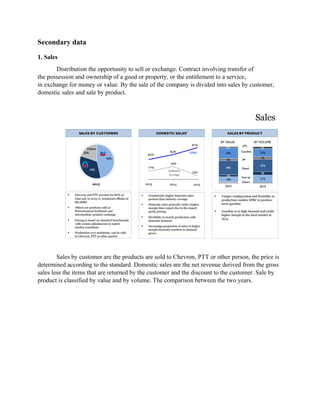
Secondary data
1. Sales
Distribution the opportunity to sell or exchange. Contract involving transfer of
the possession and ownership of a good or property, or the entitlement to a service,
in exchange for money or value. By the sale of the company is divided into sales by customer,
domestic sales and sale by product.
Sales by customer are the products are sold to Chevron, PTT or other person, the price is
determined according to the standard. Domestic sales are the net revenue derived from the gross
sales less the items that are returned by the customer and the discount to the customer. Sale by
product is classified by value and by volume. The comparison between the two years.
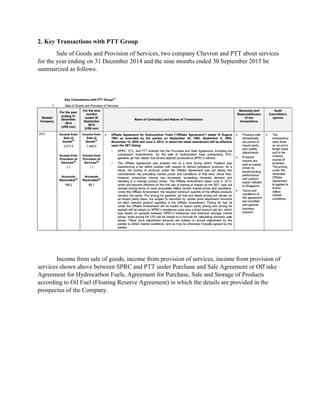
2. Key Transactions with PTT Group
Sale of Goods and Provision of Services, two company Chevron and PTT about services
for the year ending on 31 December 2014 and the nine months ended 30 September 2015 be
summarized as follows.
Income from sale of goods, income from provision of services, income from provision of
services shown above between SPRC and PTT under Purchase and Sale Agreement or Off take
Agreement for Hydrocarbon Fuels, Agreement for Purchase, Sale and Storage of Products
according to Oil Fuel (Floating Reserve Agreement) in which the details are provided in the
prospectus of the Company.
3. Target Customers and Distribution Channels
SPRC sells its products both domestically and for export. And sells a significant portion
of its petroleum most products have an agreement with Chevron and PTT.Each year has a
different the table shows the percent of total revenue in the coming years.
The following table sets forth the percentage of total revenue accounted for by Chevron
and PTT, respectively, for the periods indicated.
The following table sets forth SPRC’s sales revenue for its petroleum products that are
sold domestically or via export.
The strategic location of SPRC’s refinery in the Map Ta Phut Industrial Estate in Rayong
provides the Company access to a convenient product delivery network that allows the Company
to distribute its products in a cost effective Both domestic and export.
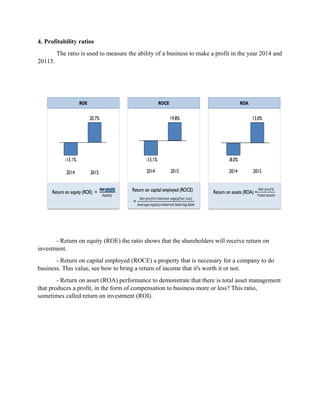
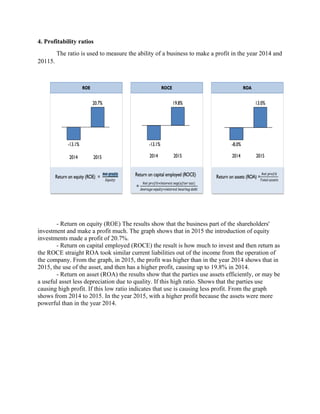
4. Profitability ratios
The ratio is used to measure the ability of a business to make a profit in the year 2014 and
20115.
- Return on equity (ROE) the ratio shows that the shareholders will receive return on
investment.
- Return on capital employed (ROCE) a property that is necessary for a company to do
business. This value, see how to bring a return of income that it's worth it or not.
- Return on asset (ROA) performance to demonstrate that there is total asset management
that produces a profit, in the form of compensation to business more or less? This ratio,
sometimes called return on investment (ROI).
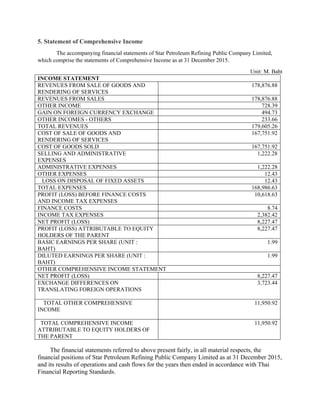
5. Statement of Comprehensive Income
The accompanying financial statements of Star Petroleum Refining Public Company Limited,
which comprise the statements of Comprehensive Income as at 31 December 2015.
Unit: M. Baht
INCOME STATEMENT
REVENUES FROM SALE OF GOODS AND
RENDERING OF SERVICES
178,876.88
REVENUES FROM SALES 178,876.88
OTHER INCOME 728.39
GAIN ON FOREIGN CURRENCY EXCHANGE 494.73
OTHER INCOMES - OTHERS 233.66
TOTAL REVENUES 179,605.26
COST OF SALE OF GOODS AND
RENDERING OF SERVICES
167,751.92
COST OF GOODS SOLD 167,751.92
SELLING AND ADMINISTRATIVE
EXPENSES
1,222.28
ADMINISTRATIVE EXPENSES 1,222.28
OTHER EXPENSES 12.43
LOSS ON DISPOSAL OF FIXED ASSETS 12.43
TOTAL EXPENSES 168,986.63
PROFIT (LOSS) BEFORE FINANCE COSTS
AND INCOME TAX EXPENSES
10,618.63
FINANCE COSTS 8.74
INCOME TAX EXPENSES 2,382.42
NET PROFIT (LOSS) 8,227.47
PROFIT (LOSS) ATTRIBUTABLE TO EQUITY
HOLDERS OF THE PARENT
8,227.47
BASIC EARNINGS PER SHARE (UNIT :
BAHT)
1.99
DILUTED EARNINGS PER SHARE (UNIT :
BAHT)
1.99
OTHER COMPREHENSIVE INCOME STATEMENT
NET PROFIT (LOSS) 8,227.47
EXCHANGE DIFFERENCES ON
TRANSLATING FOREIGN OPERATIONS
3,723.44
TOTAL OTHER COMPREHENSIVE
INCOME
11,950.92
TOTAL COMPREHENSIVE INCOME
ATTRIBUTABLE TO EQUITY HOLDERS OF
THE PARENT
11,950.92
The financial statements referred to above present fairly, in all material respects, the
financial positions of Star Petroleum Refining Public Company Limited as at 31 December 2015,
and its results of operations and cash flows for the years then ended in accordance with Thai
Financial Reporting Standards.
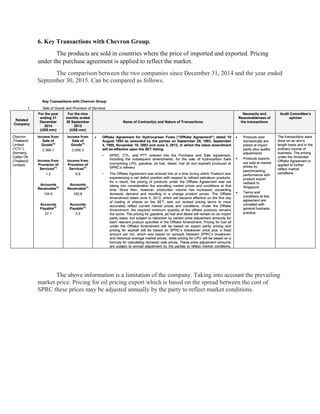
6. Key Transactions with Chevron Group.
The products are sold in countries where the price of imported and exported. Pricing
under the purchase agreement is applied to reflect the market.
The comparison between the two companies since December 31, 2014 and the year ended
September 30, 2015. Can be compared as follows.
The above information is a limitation of the company. Taking into account the prevailing
market price. Pricing for oil pricing export which is based on the spread between the cost of
SPRC these prices may be adjusted annually by the party to reflect market conditions.
7. Revenue Structure
The products are diesel fuel, gasoline, jet fuel and LPG. And fuel Government has a role
in controlling the price of the product.
SPRC’s revenue structures as of 2014 and the nine months ended September 30, 2015 are
as follows.
- Total light products of the light in 2014: 34% of total revenue during the nine months
ended 2004 and September 30, 2015.
- Total middle distillates in 2015: 45.8% of total revenue during the nine months ended
2004 and September 30, 2015.
- Total heavy products in 2012. 10.9%.
- Total others in 2014: 11.6% of total revenue during the nine months ended 2004 and
September 30, 2015.
- Total Revenue in 2012.
Sales 8,444.8: sales at most nine months ended September and the 2014 30, 2015. Total
Revenue middle distillates%, with total sales revenue in most product categories, because this
type of product is a fuel product that everyone needs in daily life such as diesel oil. The average
for this type of products, with total sales at most.
8. Employees
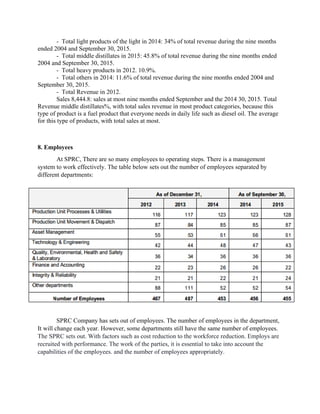
At SPRC, There are so many employees to operating steps. There is a management
system to work effectively. The table below sets out the number of employees separated by
different departments:
SPRC Company has sets out of employees. The number of employees in the department,
It will change each year. However, some departments still have the same number of employees.
The SPRC sets out. With factors such as cost reduction to the workforce reduction. Employs are
recruited with performance. The work of the parties, it is essential to take into account the
capabilities of the employees. and the number of employees appropriately.
9. Overview of product spread.
Product spread is an activity to move product from the manufacturer to the consumer.
Product spread of SPRC in 2015, each product has a different distribution, Depending on the
needs of consumers and if you can see from the chart below.
Product spread of SPRC, The product follows are Gasoline, Jet fuel, diesel and Fuel oil.
Comparison of product spread during 1Q, 2Q, 3Q, and 4Q in 2015, and in the comparison of
each product changes are different or the same.
10. Financial Statistics
The financial statements of Star Petroleum Refining Public Company Limited During the
year 2558 or 2557.
The financial statements of the company shows the changes between the years 2558 with
2557 that in 2558 have better money and debtors decreased, but the income of big shareholders
decrease.
11. Margin and OPEX
Gross margin and operating margin are two fundamental profit metrics used by investors,
creditors and analysts to evaluate a company's current financial condition and prospects for
future profitability. The two margins differ in regard to the specific costs and expenses included
in their calculations and the different purposes they serve in providing a company with
information for analysis.
Operating margin is a margin ratio used to measure a company's pricing strategy and
operating of 'Profit Margin' Profit margin is a useful ratio and can help provide insight about a
variety of aspects of a company’s financial performance.
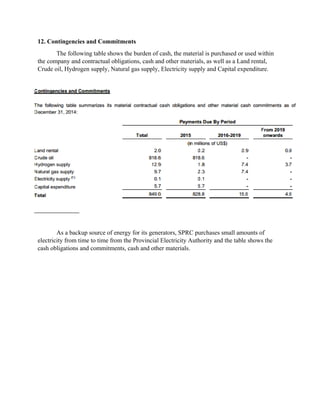
12. Contingencies and Commitments
The following table shows the burden of cash, the material is purchased or used within
the company and contractual obligations, cash and other materials, as well as a Land rental,
Crude oil, Hydrogen supply, Natural gas supply, Electricity supply and Capital expenditure.
As a backup source of energy for its generators, SPRC purchases small amounts of
electricity from time to time from the Provincial Electricity Authority and the table shows the
cash obligations and commitments, cash and other materials.
13. Target Customers and Distribution Channels.
Determine if the target customer groups, or we want to offer the customer group, sales of
goods and services? Customers want to buy anything, so aware of the real needs that customers
want from products which our company group lead, SPRC is that people value such petroleum.
And distribution channel management is the process of moving. The rights in the product (and
may include the product) from manufacturer through to consumers.
SPRC is a company, the company's major petroleum distribution both domestic
production and exports. And there are significant customers firm Chevron and PTT made the
purchase agreement. The company must deliver in quantity not less than 88200 barrels per day of
petroleum products, their price depends on import equal pricing may have been modified.
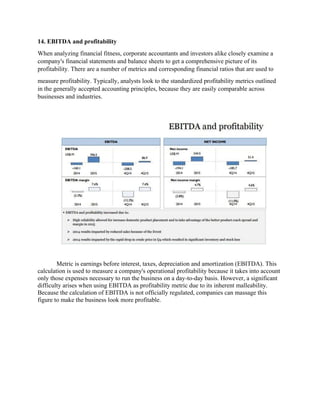
14. EBITDA and profitability
When analyzing financial fitness, corporate accountants and investors alike closely examine a
company's financial statements and balance sheets to get a comprehensive picture of its
profitability. There are a number of metrics and corresponding financial ratios that are used to
measure profitability. Typically, analysts look to the standardized profitability metrics outlined
in the generally accepted accounting principles, because they are easily comparable across
businesses and industries.
Metric is earnings before interest, taxes, depreciation and amortization (EBITDA). This
calculation is used to measure a company's operational profitability because it takes into account
only those expenses necessary to run the business on a day-to-day basis. However, a significant
difficulty arises when using EBITDA as profitability metric due to its inherent malleability.
Because the calculation of EBITDA is not officially regulated, companies can massage this
figure to make the business look more profitable.
15. Accounting Summary
The table below shows the summary of account information SPRC each year, with details
clearly from the following aspects.
The table is square accounts SPRC has said income to net income and was told dividend
of shares in the first quarter of 2012 to 2015, has said the price of the stock per unit in each
quarter of the price of the stock has increased or fallen. The price and how much is explained
about the dividend that will be affected by the account summary page of each year, each quarter
of SPRC.
Data Analysis
1. Sales
Distribution the opportunity to sell or exchange. Contract involving transfer of
the possession and ownership of a good or property, or the entitlement to a service,
in exchange for money or value. By the sale of the company is divided into sales by customer,
domestic sales and sale by product.
Sales from Chevron and PTT, 80%of the total sales in 2015, compared with a minimum
purchase. Sales in the country generally yield higher. Profit margin than exports due to the
export of equal pricing flexibility to match production with demand in the country. Cause is
growing continuously. Defining unique values from value and by quantity is classified by the
flexibility in production allows SPRC in production. More gasoline from 2014 to 2015, gasoline
is in high demand and has higher yields than the profit ratio in the local market.
2. Sale of Goods and Provision of Services
The following table shows the SPRC and PTT to difference goods and services.
SPRC and PTT entered into the Purchase and Sale Agreement. For the year ending 31
December 2014 (US$ mm).Income from Sale of Goods 3,372.5.Income from Provision of
Services 1.7 and Accounts Receivable 186.2. In 2104 as been increased over the year 2015.For
the nine months ended 30 September 2015 (US$ mm) was less than the peak year of 2014.From
Sale of Goods 1,449.6 .Income from Provision of Services 1.1 and Accounts Receivable 88.7 in
2015. In parts of audit committee’s opinion. The transactions of SPRC and PTT were done on an
arm’s length basis and in the ordinary course of business.
3. Target Customers and Distribution Channels
SPRC sells its products both domestically and for export and sells a significant portion of
its petroleum most products have an agreement with Chevron and PTT.Each year has a different
the table shows the percent of total revenue in the coming years.
The following table sets forth the percentage of total revenue accounted for by Chevron
and PTT, respectively, for the periods indicated.
The table shows the total revenue, depending on the import price parity. Subject to
change. Total revenue from Chevron is growing down from 36.9, 34.3, 33.8 in 2012, 2013 and
2014, respectively for year ended December 31. And total revenue growing up to 49.8 in 2015
for nine months ended September 30.
4. Profitability ratios
The ratio is used to measure the ability of a business to make a profit in the year 2014 and
20115.
- Return on equity (ROE) The results show that the business part of the shareholders'
investment and make a profit much. The graph shows that in 2015 the introduction of equity
investments made a profit of 20.7%.
- Return on capital employed (ROCE) the result is how much to invest and then return as
the ROCE straight ROA took similar current liabilities out of the income from the operation of
the company. From the graph, in 2015, the profit was higher than in the year 2014 shows that in
2015, the use of the asset, and then has a higher profit, causing up to 19.8% in 2014.
- Return on asset (ROA) the results show that the parties use assets efficiently, or may be
a useful asset less depreciation due to quality. If this high ratio. Shows that the parties use
causing high profit. If this low ratio indicates that use is causing less profit. From the graph
shows from 2014 to 2015. In the year 2015, with a higher profit because the assets were more
powerful than in the year 2014.
5. Statement of Comprehensive Income
SPRC that require recording of the statement of comprehensive income and financial
statements. The company notes that the data were analyzed to determine the progress of the
company that each year the company has increased revenues or reduced losses, increased or
decreased. In order to develop the company to further progress.
Unit: M.Baht
INCOME STATEMENT
REVENUES FROM SALE OF GOODS AND
RENDERING OF SERVICES
178,876.88
REVENUES FROM SALES 178,876.88
OTHER INCOME 728.39
GAIN ON FOREIGN CURRENCY EXCHANGE 494.73
OTHER INCOMES - OTHERS 233.66
TOTAL REVENUES 179,605.26
COST OF SALE OF GOODS AND
RENDERING OF SERVICES
167,751.92
COST OF GOODS SOLD 167,751.92
SELLING AND ADMINISTRATIVE
EXPENSES
1,222.28
ADMINISTRATIVE EXPENSES 1,222.28
OTHER EXPENSES 12.43
LOSS ON DISPOSAL OF FIXED ASSETS 12.43
TOTAL EXPENSES 168,986.63
PROFIT (LOSS) BEFORE FINANCE COSTS
AND INCOME TAX EXPENSES
10,618.63
FINANCE COSTS 8.74
INCOME TAX EXPENSES 2,382.42
NET PROFIT (LOSS) 8,227.47
PROFIT (LOSS) ATTRIBUTABLE TO EQUITY
HOLDERS OF THE PARENT
8,227.47
BASIC EARNINGS PER SHARE (UNIT :
BAHT)
1.99
DILUTED EARNINGS PER SHARE (UNIT :
BAHT)
1.99
OTHER COMPREHENSIVE INCOME STATEMENT
NET PROFIT (LOSS) 8,227.47
EXCHANGE DIFFERENCES ON
TRANSLATING FOREIGN OPERATIONS
3,723.44
TOTAL OTHER COMPREHENSIVE
INCOME
11,950.92
TOTAL COMPREHENSIVE INCOME
ATTRIBUTABLE TO EQUITY HOLDERS OF
THE PARENT
11,950.92
It can be seen that the company has revenues from sales of goods and services the most,
which is equal to 178,876.88 million baht. And when the total profit then profit is equal to the
SPRC Company 11950.92 million baht. The company is a business SPRC about the petroleum,
chemical elements, and its value to the company and made a fortune.
6. Key Transactions with Chevron Group.
The following table shows the SPRC and Chevron Group
- For 2015, -revenues from sales decreased from the year 2014 decreased to 327.8 for the
year 2015 was the company's economic and political concerns.
- Revenues from services in 2014 increased over 2015. In 2014, the service had been
deemed successful at making sales to customers make the company receive much money.
- In the accounts of the year 2015 over 2014. Because receivable increased from 134.5 to
162.8.
- In the accounts payable decreased from 2014 in 2015 to 33.6. Because the
administration has focused care financial management in these parts, so as to effectively reduce
payables significantly.
7. Revenue Structure
The products are diesel fuel, gasoline, jet fuel and LPG. And fuel Government has a role
in controlling the price of the product. SPRC’s revenue structures as of 2014 and the nine months
ended September 30, 2015 are as follows:
SPRC’s revenue structures Information the Government's fuel subsidies. And contains
sulfur the products sold by the company with the Tang of the feed.
8. Employees
As of September 30, 2015, the table below sets out the number of employees separated
by different departments:
- Production Unit Processes &Utilities: Since 2012 Employees will be minimal compared
to other years and is increasing steadily. Until 2015 the number of employees totaled 128 people.
Because the company has increased the production capacity. It make the company had to
increase the number of employees.
- Production Unit Movement &Dispatch: The number of employees in each year. Not
much changed. In the years 2013, 2014, 2015, will be reduced in 2015, but the company has also
held a number of staff to be equal to the past in the year 2012, because the same movement and
Dispatch is important, so it is not necessary to reduce the number of employees.
- Asset Management: Asset Management can be seen that the year 2014 in September.
Employees are used the most. Since that year, there may be a problem in many areas. The
employees came in 2015 when the management employees was reduced to the equivalent of
December, 2014.
- Technology &Engineering: Technology & Engineering will be seen that the number of
employees each year and there are not very stable. A little change Because of the specialization
of tasks that require employees with expertise in the only.
- Quality, Environmental, Health and Safety &Laboratory: Technology & Engineering as
well as the employees must have specialized expertise in the work. And employees have the
knowledge and experience in the workplace. It is evident from the table that the number of
employees each year more.
- Finance and Accounting: From the table to see that. There is a minority employees.
There may be some increase it fell in 2015. Because the work of this department employees have
the knowledge and prudence. as well as the skills to really work effectively.
- Integrity &Reliability: Employees in this department is the smallest of the grid due
Integrity & Reliability is measured not studied not but be that as it really is. And qualified
employees are available to very few people. And the highest increase in year 2015.
- Other departments: Other departmentshave separate jobs, increasing the number of
employees in 2013. And reduced size due to various However, to reduce the number of
employees down to enable the company to cut costs as much.
The cause of the change in the number of employees, depending on factors such as the
capacity need. The policy of production department when the company have a high demand for
production, it will result in more employees. But if we want to reduce the production cost. The
company may have to reduce the number of employees at the same time; advanced technology
may cause a change from employees people are machines and computer systems used to control
instead of employees. In addition, the machine will work. Also, more powerful, and can reduce
costs in the production process. Therefore, the number of employees according to the different
departments, so it is extremely important to the company, the company must therefore divide the
appropriate operational employees.
9. Overview of product spread.
Product spread is an activity to move product from the manufacturer to the consumer.
Product spread of SPRC in 2015, each product has a different distribution, Depending on the
needs of consumers and if you can see from the chart below.
Product spread in 2015, Gasoline, Jet fuel, diesel and Fuel oil of each have changes
product spread up and down. Gasoline spreads exceptionally high and average gasoline spread is
at 18.3$/bbl. Jet fuel have average spread is at 13.9$/bbl. Diesel have additional refining based
added oversea and China slowdown, squeeze margin and average diesel spread is at 13.7$/bbl.
And Fuel oil have Average spread is at -5$/bbl, strong bunker fuel demand offset with lower
demand from industry and FO spread expected to be better from lower supply from Europe.
10. Financial Statistics
The Company's financial statements in order to see the growth of companies that are
growing better or much reduced. And income of the shareholders that have changed me. The
data acquired to develop the company.
It is seen that the company in 2558 with registered capital by 33,038.45 less than the year
2557 with a registered capital of 41029.51 make changes in the Company's financial statements.
11. Margin and OPEX
Gross margin and operating margin are two fundamental profit metrics used by investors,
creditors and analysts to evaluate a company's current financial condition and prospects for
future profitability. The two margins differ in regard to the specific costs and expenses included
in their calculations and the different purposes they serve in providing a company with
information for analysis.
Gross refinery margin increased due to: Costs related expenses are much higher. As a
result, the impact on sales dropped significantly in 2014 if it costs too much. The higher costs
Price goods more expensive As a result, sales have fallen. When this is not solved by the
proposed costs of the offering of US $ 14 million one-time THB 1.6 US $ / bbl crude feed.
12. Contingencies and Commitments
The following table summarizes its material contractual cash obligations and other
material cash commitments as of December 31, 2014.
From the following table land rental, crude oil, hydrogen supply, natural gas supply
electricity supply, capital expenditure in each express in expenses related to the company. The
expenditure figures shown are in millions. And in total expenses for the spending in years 2016-
2019. The SPRC's company had bought electricity produce from the Provincial Electricity
Authority.
13. Target Customers and Distribution Channels
Distribution Channels is the process of moving on the right product to the consumer.
Both direct and indirect, and Chevron and PTT are main target customers of the Company
petroleum products under the new condition.
The percentage of total revenue for by Chevron and PTT. In year ended December 31,
Chevron is the largest percentage of total revenue in 2012 was 36.9 and PTT is the largest
percentage of total revenue in 2013 and 2014 was 54.9. And In nine months ended September
30, Chevron is the largest percentage of total revenue in 2015 was 49.8 and PTT is the largest
percentage of total revenue in 2014 was 55.1.
Petroleum product sales, domestic sales and exports. In the year ended December 31,
2012, 2013 and 2014. Are as follows total revenues, in 2012 have total revenue 8,444.8, In 2013
have total revenue 8,436.5, and in 2014 total revenue 7,034.6. And the nine months ended
September 30, 2014 and 2015. Are as follows total revenues, in 2014 have total revenue 5,339.1
and in 2015 have total revenue 4,093.9.
14. EBITDA and profitability
When analyzing financial fitness, corporate accountants and investors alike closely
examine a company's financial statements and balance sheets to get a comprehensive picture of
its profitability. There are a number of metrics and corresponding financial ratios that are used to
measure profitability. Typically, analysts look to the standardized profitability metrics outlined
in the generally accepted accounting principles, because they are easily comparable across
businesses and industries
EBITDA and profitability increased due to :The increase in revenues, we must analyze
the cost of items such as net profit + interest + taxes + depreciation + amortization so that we
will know the exact cost, deducting certain expenses, and to make them aware of a good profit
can be ordered instantly from 2014, affecting the rapid decline in crude oil prices, reo. Make the
result with the inventory.
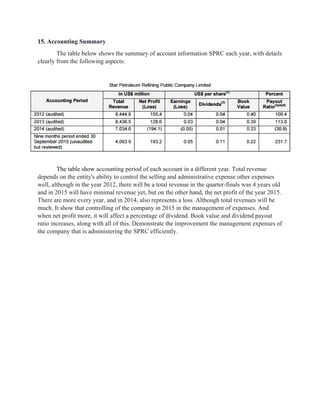
15. Accounting Summary
The table below shows the summary of account information SPRC each year, with details
clearly from the following aspects:
The table show accounting period of each account in a different year. Total revenue
depends on the entity's ability to control the selling and administrative expense other expenses
well, although in the year 2012, there will be a total revenue in the quarter-finals was 4 years old
and in 2015 will have minimal revenue yet, but on the other hand, the net profit of the year 2015.
There are more every year, and in 2014, also represents a loss. Although total revenues will be
much. It show that controlling of the company in 2015 in the management of expenses. And
when net profit more, it will affect a percentage of dividend. Book value and dividend payout
ratio increases, along with all of this. Demonstrate the improvement the management expenses of
the company that is administering the SPRC efficiently.

Sprc

  • 1.
    Star Petroleum RefiningPublic Company Limited. Submited By: Miss. Supaporn phaofu 115710509139-8 Miss. Sirichada Meesrimatupot 115710509151-3 Mr. Sorathun Sukjomroen 115710509156-2 Mr. Yamon Kaewma 115710509160-4 Mr. Pakornkiat Jaruwattanakit 115710509161-2 Mr. Kritsada Kasurong 115710509163-8 Miss. Thanatchaporn Thongnak 115710509179-4 Miss.Wanichara Thongboonrod 115710509183-6 Miss.Nitcha Prompitak 115710509185-1 Miss.Suwaree yuyuen 115710509191-9 Miss.Supawadee Bumrungluxsanawong 115710509192-7 Submited To: Mr. Ryan Federogaya Rajamangala University of Technology Thanyaburi 2016
  • 2.
    Table of Contents Listof lllustrations………………………………………………………………………….......iii Executive Summary…………………………………………………………………………….iv Determining Charlestonians’ Perceptions of the Cruise Industry………………………………1 The Problem…………………………………………………………………………….1 The purpose……………………………………………………………………………..1 Scope of Analysis……………………………………………………………………….1 Delimitations……………………………………………………………………………2 Limitations………………………………………………………………………………2 Definitions………………………………………………………………………………2 How the study was Conducted………………………………………………………………….2 Secondary Data. ………………………………………………………………………..2 Primary Data……………………………………………………………………………2 Downtown residents……………………………………………………………3 Downtown merchants…………………………………………………………..3 Data Analysis…………………………………………………………………………...3 What the Study Revealed………………………………………………………………………3 Guides for Waterfront Development …………………………………………………..4 Knowledge of Current Economic impact………………………………………………5 Attitudes about Projected Economic Benefits of Terminal Relocation ……………….5 Personal and Business Experiences…………………………………………………….5 Impact of Terminal Relocation on Quality of Life……………………………………..8 Summary………………………………………………………………………………………..9 Conclusions……………………………………………………………………………………..9 Recommendations………………………………………………………………………………9 Works Cited…………………………………………………………………………………….11 Appendix A. Data Collection Instruments……………………………………………………..12 Text of Email Transmittal Message Merchants………………………………………..12
  • 3.
    Transmittal Letter toResidents………………………………………………………..13 Questionnaire for Merchants and Residents…………………………………………...14 Appendix B. Profiles of Respondents………………………………………………………….16 List of lllustrations Chart 1. Jobs Supported………………………………………………………………………..6 Chart 2. Economic Impact (millions)………………………………………………………….6 Chart 3. Attitudes toward Jobs Projections…………………………………………………....7 Chart 4. Attitudes toward Projected Economic Benefits………………………………………7 Charts 5. Experiences Related to Cruise Passengers…………………………………………..8 Table 1. Quality of Life………………………………………………………………………..8
  • 4.
    Chapter1 Generation of thestudy 1.1 Introduction of the study SPRC we are proud to have achieved several global standards in this area, including the ISO 9001 quality management standard, the ISO 14001 environmental management standard, the OHSAS 18001 occupational health and safety standard, the ISO/IEC 17025 laboratory compliance standard and Chevron's Operational Excellence (OE) standard. For the purchase of our products, to facilitate the distribution of hydrocarbon fuels, and petrochemical feedstock to the southeast and northeast of Thailand, in Rayong province and for export Indochina. Markets including Laos, Cambodia and Myanmar. The refinery is located in the south-east of Bangkok. It is important market for hydrocarbon fuels and near transport. That help to save costs. The company will send hydrocarbon fuels and petrochemical to purchase at the southeast and northeast of Thailand. SPCC is know as one of the leading refineries in Thailand. Map Ta Phut Industrial Estate, I-3B Road Takhoun-hatsaithong, Tambol Map Ta Phut, AmphoeMueang, Rayong, 21150 Place are located in an industrial Map Ta Phut ,Access to deep- sea port, have a road for transportation and production transmission pipeline.SPRC Refinery has close to the facilities to the transportation to the customers.
  • 5.
    Executive Summary The companyis the operator of the refinery. Company caltex trading and transport (Thailand) The Company Chevron and its major shareholders. The company is a manufacturer Petroleum, high-quality and reliable for use in Thailand and export with a focus on excellence in operational efficiency and accident-free. The refinery is a model to improve the quality of oil. The crude oil refining capacity of 165,000 bars per day rate. The company manufactures and sells products, Petroleum and Liquid Petroleum Gas. Unleaded Gasoline Diesel fuel Jet fuel and fuel oil The Company also distributes chemical products. Asphalt and sulfur A byproduct of the manufacturing process. Determining the lndustry Star Petroleum Refining Co., Ltd.is the company operates petroleum refinery. They supply Benzene, Diesel and Lubricants Oil to the Automotive Industry and Maritime Industry. The capacity of benzene production is equivalent to one third of demand. Moreover, the company also sells other products, i.e. Asphalt and Sulfur which is a co-product from the production of oil refinery. The Problem The company's refinery in SPRC is a large refinery and numerous partners. The problem of pollution in the vicinity of the refinery. The refinery is very important to have a large area and wide enough to control. Problem of SPRC is recruiting area and factory production control, strict pollution control. The Purpose From studying the purpose of SPRC Company, it is concluded that their aim is to be a safe and technologically advanced petroleum refinery. And to be considerate of the surrounding community in order to become a highly profitable company.
  • 6.
    Scope of theAnalysis The scope of the analysis is the extent of SPRC Refinery, the quality and standards of safety and operational excellence. The scope of SPRC is able to produce a variety of high quality products such as petroleum. Liquefied Petroleum Gas (LPG), unleaded gasoline. Jet Fuel Diesel oil and fuel oil, asphalt and other petrochemical products, such as polymer-grade propylene, naphtha, gas mixed C4 (Mix C4) and Reeve aromatics. Delimitations 1. We have little time to do research but there are lots of data. This research may be incomplete. 2. The information we can find them from the Internet altogether. 3. We are students; we might not have enough money to study this project to the actual location. Limitations The refinery is the largest in the country. In oil exports there will be restrictions on the management of them. It is a great company the dada will not leak and companies must have a license to be sent to various companies. SPRC is one of the leading operators of refineries, Thailand. A crude oil refining capacity of 165,000 barrels per day.Representing a capacity of 13 percent of total crude oil refining capacity.With the capacity to focus on the production of gasoline, making gasoline SPRC production volume in nearly a third of domestic demand.Current SPRC group Chevron holds 64% and the PLC. PTT. (PTT) holds 36%, with a capacity of 1.65 lakh barrels / day. The main products include gasoline, which can be produced in quantity equivalent to one third of the demand in the country, diesel fuel, jet fuel, fuel oil, liquefied petroleum gas (LPG) as feedstock in the production of other petrochemicals. The major customer groups are Chevron and PTT.
  • 7.
    Definitions of terms VocabularyMeaning 1. unleaded —adjective 1. (Of gasoline) containing no tetraethyl lead; lead-free. 2. Printing. Not separated or spaced with leads, as lines of type or printed matter. —noun 1. An unleaded product, especially gasoline that contains no tetraethyl lead. 2. refinery —noun, plural re·fin·er·ies. 1. An establishment for refining something, as metal, sugar, or petroleum. 3. asphalt — noun 1. Any of various dark-colored, solid, bituminous substances, native in various areas of the earth and composed mainly of hydrocarbon mixtures. 2. A similar substance that is the by-product of petroleum-cracking operations. 3. A mixture of such substances with gravel, crushed rock, or the like, used for paving. — verb (used with object) 1. To cover or pave with asphalt. — adjective 1. Of, relating to, or containing asphalt: asphalt tile. 4. restriction —noun 1. Something that restricts; a restrictivecondition or regulation; limitation. 2. The act of restricting. 3. The state of being restricted. 5. license —noun 1. Formal permission from a governmental or other constituted authority to do something, as to carry on some business or profession. 2. A certificate, tag, plate, etc., giving proof of such permission; official permit: a driver's license. 3. Permission to do or not to do something. 4. Intentional deviation from rule, convention, or fact, as for the sake of literary or artistic effect: poetic license. 5. Exceptional freedom allowed in a special situation.
  • 8.
    6. Excessive orundue freedom or liberty. 7. Licentiousness. 8. The legal right to use a patent owned by another. —verb (used with object), licensed, licensing. 1. To grant authoritative permission or license to. 6. various —adjective 1. Of different kinds, as two or more things; differing one from another: Various experiments have not proved his theory. 2. Marked by or exhibiting variety or diversity: houses of various designs. 3. Presenting or having many different qualities or aspects: a woman of various talent. 4. Having a variety of colors; varicolored. 5. different from each other; dissimilar. 6. Variant. 7. Numerous; many: living at various hotels. 8. individual (in a group, class, kind, etc.); separate: permission from various officials in Washington. —pronoun 1. Informal. Several, many, or numerous ones: I spoke with several of them. 7. operator —noun 1. A person who operates a machine, apparatus, or the like: a telegraph operator. 2. A person who operates a telephone switchboard, especially for a telephone company. 3. A person who manages a working or industrial establishment, enterprise, or system: the operators of a mine. 4. A person who trades in securities, especially speculatively or on a large scale. 5. A person who performs a surgical operation; a surgeon. 6. Mathematics. * A symbol for expressing a mathematical operation. * A function, especially one transforming a function, set, etc., into another: a differential operator. 7. Informal. * A person who accomplishes his or her purposes by devious means; faker; fraud. * A person who is adroit at overcoming,
  • 9.
    avoiding, or evadingdifficulties, regulations, or restrictions. * A person who is extremely successful with or smoothly persuasive to members of the opposite sex. 8. Genetics. A segment of DNA that interacts with a regulatory molecule, preventing transcription of the adjacent region. 8. crude —adjective, crud·er, crud·est. 1. in a raw or unprepared state; unrefined or natural: crude sugar. 2. Lacking in intellectual subtlety, perceptivity, etc.; rudimentary; undeveloped. 3. Lacking finish, polish, or completeness: a crude summary. 4. Lacking culture, refinement, tact, etc.: crude behavior. 5. Undisguised; blunt: a crude answer. 6. Obsolete. Unripe; not mature. —noun 1. Crude oil. 9. capacity —noun, plural ca·pac·i·ties. 1. The ability to receive or contain: This hotel has a large capacity. 2. The maximum amount or number that can be received or contained; cubic contents; volume: The inn is filled to capacity. The gasoline tank has a capacity of 20 gallons. 3. Power of receiving impressions, knowledge, etc.; mental ability: the capacity to learn calculus. 4. Actual or potential ability to perform, yield, or withstand: He has a capacity for hard work. The capacity of the oil well was 150 barrels a day. She has the capacity to go two days without sleep. 5. Quality or state of being susceptible to a given treatment or action: Steel has a high capacity to withstand pressure. 6. Position; function; role: He served in the capacity of legal adviser. 7. Legal qualification. 8. Electricity. * Capacitance. * Maximum possible output. —adjective
  • 10.
    1. Reaching maximumcapacity: a capacity audience; a capacity crowd. 10. equivalent — adjective 1. Equal in value, measure, force, effect, significance, etc.: His silence is equivalent to an admission of guilt. 2. Corresponding in position, function, etc.: In some ways their prime minister is equivalent to our president. 3. Geometry. Having the same extent, as a triangle and a square of equal area. 4. Mathematics. (Of two sets) able to be placed in one-to-one correspondence. 5. Chemistry having the same capacity to combine or react chemically. — noun 1. Something that is equivalent. 11. feedstock —noun 1. Raw material for processing or manufacturing industry. 12. numerous — adjective 1. Very many; being or existing in great quantity: numerous visits; numerous fish. 2. Consisting of or comprising a great number of units or individuals: Recent audiences have been more numerous. 13. vicinity —noun, plural vi·cin·i·ties. 1. The area or region near or about a place; surrounding district; neighborhood: There are no stores in the vicinity of our house. 2. State or fact of being near; proximity; propinquity: He was troubled by the vicinity of the nuclear testing area. 14. recruit —noun 1. A newly enlisted or drafted member of the armed forces. 2. A new member of a group, organization, or the like. 3. A fresh supply of something. —verb (used with object) 1. To enlist (a person) for service in one of the armed forces. 2. To raise (a force) by enlistment. 3. To strengthen or supply (an armed force) with new members. 4. To furnish or replenish with a fresh supply;
  • 11.
    renew. 5. To renewor restore (the health, strength, etc.). 6. to attempt to acquire the services of (a person) for an employer: She recruits executives for all the top companies. 7. to attempt to enroll or enlist (a member, affiliate, student, or the like): a campaign to recruit new club members. 8. To seek to enroll (an athlete) at a school or college, often with an offer of an athletic scholarship. —verb (used without object) 1. To enlist persons for service in one of the armed forces. 2. To engage in finding and attracting employees, new members, students, athletes, etc. 3. To recover health, strength, etc. 4. To gain new supplies of anything lost or wasted. 15. lubricant —noun 1. A substance, as oil or grease, for lessening friction, especially in the working parts of a mechanism. —adjective 1. capable of lubricating; used to lubricate. 16. automotive —adjective 1. Pertaining to the design, operation, manufacture, or sale of automobiles: automotive parts. 2. propelled by a self-contained motor, Engine or the like. —noun 1. Informal. An industry, store department, etc., specializing in appliances and parts for cars, trucks, and other motorized vehicles: You may find what you're looking for in automotive. 17. maritime —adjective 1. Connected with the sea in relation to navigation, shipping, etc. 2. Of or relating to the sea: maritime resources. 3. Bordering on the sea: maritime provinces. 4. Living near or in the sea: maritime plants. 5. characteristic of a sailor; nautical: maritime
  • 12.
    clothing. 18. sulfur —noun 1.Also, especially British, sulphur. Chemistry. A nonmetallic element that exists in several forms, the ordinary one being a yellow rhombic crystalline solid, and that burns with a blue flame and a suffocating odor: used especially in making gunpowder and matches, in medicine, in vulcanizing rubber, etc. Symbol: S; atomic weight:32.064; atomic number: 16; specific gravity: 2.07 at 20° C. 19. shareholder —noun 1. A holder or owner of shares, especially in a company or corporation. 20. distribute — Verb (used with object), dis·trib·ut·ed, dis·trib·ut·ing. 1. To divide and give out in shares; deal out; allot. 2. To disperse through a space or over an area; spread; scatter. 3. To promote, sell, and ship or deliver (an item or line of merchandise) to individual customers, especially in a specified region or area. 4. To pass out or deliver (mail, newspapers, etc.) to intended recipients. 5. To divide into distinct phases: The process was distributed into three stages. 6. To divide into classes: These plants are distributed into 22 classes. 7. Logic. To employ (a term) in a proposition so as to refer to all individuals denoted by the term. 8. Physical Chemistry. to dissolve uniformly in a solvent consisting of layers of immiscible or partially miscible substances. 9. Printing. * To roll out (ink) on the table to attain the proper consistency. * To return (type) to the proper place after printing.
  • 13.
    How the studywas conducted Name ID Student Conducted 1. Miss Supaporn Phaofu 115710509139-8 Search the data and translate meaning. 2. Miss Slirichaada Meesrimatupot 115710509151-3 Search the data and design task. 3. Mr. Sorathun Sukjomreon 115710509156-2 Search the data. 4. Mr. Yamon kaewma 115710509160-4 Search the data. 5. Mr. Pakornkiat Jaruwattanakit 115710509161-2 Search the data and translate meaning. 6. Mr. Kritsada Kasurong 115710509163-8 Search the data. 7. Miss Thanatchaporn Thongnak 115710509179-4 Collecting data. 8. Miss Wanichara Thongboonrod 115710509183-6 Search the data and design task. 9. Miss Nicha Prompitak 115710509185-1 Separate the task and search the data. 10. Miss Suwaree Yuyuen 115710509191-9 Collecting data. 11. Miss Supawadee Bumrungluxsanawong 115710509192-7 Separate the task and search the data.
  • 14.
    Secondary data 1. Sales Distributionthe opportunity to sell or exchange. Contract involving transfer of the possession and ownership of a good or property, or the entitlement to a service, in exchange for money or value. By the sale of the company is divided into sales by customer, domestic sales and sale by product. Sales by customer are the products are sold to Chevron, PTT or other person, the price is determined according to the standard. Domestic sales are the net revenue derived from the gross sales less the items that are returned by the customer and the discount to the customer. Sale by product is classified by value and by volume. The comparison between the two years.
  • 15.
    2. Key Transactionswith PTT Group Sale of Goods and Provision of Services, two company Chevron and PTT about services for the year ending on 31 December 2014 and the nine months ended 30 September 2015 be summarized as follows. Income from sale of goods, income from provision of services, income from provision of services shown above between SPRC and PTT under Purchase and Sale Agreement or Off take Agreement for Hydrocarbon Fuels, Agreement for Purchase, Sale and Storage of Products according to Oil Fuel (Floating Reserve Agreement) in which the details are provided in the prospectus of the Company.
  • 16.
    3. Target Customersand Distribution Channels SPRC sells its products both domestically and for export. And sells a significant portion of its petroleum most products have an agreement with Chevron and PTT.Each year has a different the table shows the percent of total revenue in the coming years. The following table sets forth the percentage of total revenue accounted for by Chevron and PTT, respectively, for the periods indicated. The following table sets forth SPRC’s sales revenue for its petroleum products that are sold domestically or via export. The strategic location of SPRC’s refinery in the Map Ta Phut Industrial Estate in Rayong provides the Company access to a convenient product delivery network that allows the Company to distribute its products in a cost effective Both domestic and export.
  • 17.
    4. Profitability ratios Theratio is used to measure the ability of a business to make a profit in the year 2014 and 20115. - Return on equity (ROE) the ratio shows that the shareholders will receive return on investment. - Return on capital employed (ROCE) a property that is necessary for a company to do business. This value, see how to bring a return of income that it's worth it or not. - Return on asset (ROA) performance to demonstrate that there is total asset management that produces a profit, in the form of compensation to business more or less? This ratio, sometimes called return on investment (ROI).
  • 18.
    5. Statement ofComprehensive Income The accompanying financial statements of Star Petroleum Refining Public Company Limited, which comprise the statements of Comprehensive Income as at 31 December 2015. Unit: M. Baht INCOME STATEMENT REVENUES FROM SALE OF GOODS AND RENDERING OF SERVICES 178,876.88 REVENUES FROM SALES 178,876.88 OTHER INCOME 728.39 GAIN ON FOREIGN CURRENCY EXCHANGE 494.73 OTHER INCOMES - OTHERS 233.66 TOTAL REVENUES 179,605.26 COST OF SALE OF GOODS AND RENDERING OF SERVICES 167,751.92 COST OF GOODS SOLD 167,751.92 SELLING AND ADMINISTRATIVE EXPENSES 1,222.28 ADMINISTRATIVE EXPENSES 1,222.28 OTHER EXPENSES 12.43 LOSS ON DISPOSAL OF FIXED ASSETS 12.43 TOTAL EXPENSES 168,986.63 PROFIT (LOSS) BEFORE FINANCE COSTS AND INCOME TAX EXPENSES 10,618.63 FINANCE COSTS 8.74 INCOME TAX EXPENSES 2,382.42 NET PROFIT (LOSS) 8,227.47 PROFIT (LOSS) ATTRIBUTABLE TO EQUITY HOLDERS OF THE PARENT 8,227.47 BASIC EARNINGS PER SHARE (UNIT : BAHT) 1.99 DILUTED EARNINGS PER SHARE (UNIT : BAHT) 1.99 OTHER COMPREHENSIVE INCOME STATEMENT NET PROFIT (LOSS) 8,227.47 EXCHANGE DIFFERENCES ON TRANSLATING FOREIGN OPERATIONS 3,723.44 TOTAL OTHER COMPREHENSIVE INCOME 11,950.92 TOTAL COMPREHENSIVE INCOME ATTRIBUTABLE TO EQUITY HOLDERS OF THE PARENT 11,950.92 The financial statements referred to above present fairly, in all material respects, the financial positions of Star Petroleum Refining Public Company Limited as at 31 December 2015, and its results of operations and cash flows for the years then ended in accordance with Thai Financial Reporting Standards.
  • 19.
    6. Key Transactionswith Chevron Group. The products are sold in countries where the price of imported and exported. Pricing under the purchase agreement is applied to reflect the market. The comparison between the two companies since December 31, 2014 and the year ended September 30, 2015. Can be compared as follows. The above information is a limitation of the company. Taking into account the prevailing market price. Pricing for oil pricing export which is based on the spread between the cost of SPRC these prices may be adjusted annually by the party to reflect market conditions.
  • 20.
    7. Revenue Structure Theproducts are diesel fuel, gasoline, jet fuel and LPG. And fuel Government has a role in controlling the price of the product. SPRC’s revenue structures as of 2014 and the nine months ended September 30, 2015 are as follows.
  • 21.
    - Total lightproducts of the light in 2014: 34% of total revenue during the nine months ended 2004 and September 30, 2015. - Total middle distillates in 2015: 45.8% of total revenue during the nine months ended 2004 and September 30, 2015. - Total heavy products in 2012. 10.9%. - Total others in 2014: 11.6% of total revenue during the nine months ended 2004 and September 30, 2015. - Total Revenue in 2012. Sales 8,444.8: sales at most nine months ended September and the 2014 30, 2015. Total Revenue middle distillates%, with total sales revenue in most product categories, because this type of product is a fuel product that everyone needs in daily life such as diesel oil. The average for this type of products, with total sales at most. 8. Employees At SPRC, There are so many employees to operating steps. There is a management system to work effectively. The table below sets out the number of employees separated by different departments: SPRC Company has sets out of employees. The number of employees in the department, It will change each year. However, some departments still have the same number of employees. The SPRC sets out. With factors such as cost reduction to the workforce reduction. Employs are recruited with performance. The work of the parties, it is essential to take into account the capabilities of the employees. and the number of employees appropriately.
  • 22.
    9. Overview ofproduct spread. Product spread is an activity to move product from the manufacturer to the consumer. Product spread of SPRC in 2015, each product has a different distribution, Depending on the needs of consumers and if you can see from the chart below. Product spread of SPRC, The product follows are Gasoline, Jet fuel, diesel and Fuel oil. Comparison of product spread during 1Q, 2Q, 3Q, and 4Q in 2015, and in the comparison of each product changes are different or the same.
  • 23.
    10. Financial Statistics Thefinancial statements of Star Petroleum Refining Public Company Limited During the year 2558 or 2557. The financial statements of the company shows the changes between the years 2558 with 2557 that in 2558 have better money and debtors decreased, but the income of big shareholders decrease.
  • 24.
    11. Margin andOPEX Gross margin and operating margin are two fundamental profit metrics used by investors, creditors and analysts to evaluate a company's current financial condition and prospects for future profitability. The two margins differ in regard to the specific costs and expenses included in their calculations and the different purposes they serve in providing a company with information for analysis. Operating margin is a margin ratio used to measure a company's pricing strategy and operating of 'Profit Margin' Profit margin is a useful ratio and can help provide insight about a variety of aspects of a company’s financial performance.
  • 25.
    12. Contingencies andCommitments The following table shows the burden of cash, the material is purchased or used within the company and contractual obligations, cash and other materials, as well as a Land rental, Crude oil, Hydrogen supply, Natural gas supply, Electricity supply and Capital expenditure. As a backup source of energy for its generators, SPRC purchases small amounts of electricity from time to time from the Provincial Electricity Authority and the table shows the cash obligations and commitments, cash and other materials.
  • 26.
    13. Target Customersand Distribution Channels. Determine if the target customer groups, or we want to offer the customer group, sales of goods and services? Customers want to buy anything, so aware of the real needs that customers want from products which our company group lead, SPRC is that people value such petroleum. And distribution channel management is the process of moving. The rights in the product (and may include the product) from manufacturer through to consumers. SPRC is a company, the company's major petroleum distribution both domestic production and exports. And there are significant customers firm Chevron and PTT made the purchase agreement. The company must deliver in quantity not less than 88200 barrels per day of petroleum products, their price depends on import equal pricing may have been modified.
  • 27.
    14. EBITDA andprofitability When analyzing financial fitness, corporate accountants and investors alike closely examine a company's financial statements and balance sheets to get a comprehensive picture of its profitability. There are a number of metrics and corresponding financial ratios that are used to measure profitability. Typically, analysts look to the standardized profitability metrics outlined in the generally accepted accounting principles, because they are easily comparable across businesses and industries. Metric is earnings before interest, taxes, depreciation and amortization (EBITDA). This calculation is used to measure a company's operational profitability because it takes into account only those expenses necessary to run the business on a day-to-day basis. However, a significant difficulty arises when using EBITDA as profitability metric due to its inherent malleability. Because the calculation of EBITDA is not officially regulated, companies can massage this figure to make the business look more profitable.
  • 28.
    15. Accounting Summary Thetable below shows the summary of account information SPRC each year, with details clearly from the following aspects. The table is square accounts SPRC has said income to net income and was told dividend of shares in the first quarter of 2012 to 2015, has said the price of the stock per unit in each quarter of the price of the stock has increased or fallen. The price and how much is explained about the dividend that will be affected by the account summary page of each year, each quarter of SPRC.
  • 29.
    Data Analysis 1. Sales Distributionthe opportunity to sell or exchange. Contract involving transfer of the possession and ownership of a good or property, or the entitlement to a service, in exchange for money or value. By the sale of the company is divided into sales by customer, domestic sales and sale by product. Sales from Chevron and PTT, 80%of the total sales in 2015, compared with a minimum purchase. Sales in the country generally yield higher. Profit margin than exports due to the export of equal pricing flexibility to match production with demand in the country. Cause is growing continuously. Defining unique values from value and by quantity is classified by the flexibility in production allows SPRC in production. More gasoline from 2014 to 2015, gasoline is in high demand and has higher yields than the profit ratio in the local market.
  • 30.
    2. Sale ofGoods and Provision of Services The following table shows the SPRC and PTT to difference goods and services. SPRC and PTT entered into the Purchase and Sale Agreement. For the year ending 31 December 2014 (US$ mm).Income from Sale of Goods 3,372.5.Income from Provision of Services 1.7 and Accounts Receivable 186.2. In 2104 as been increased over the year 2015.For the nine months ended 30 September 2015 (US$ mm) was less than the peak year of 2014.From Sale of Goods 1,449.6 .Income from Provision of Services 1.1 and Accounts Receivable 88.7 in 2015. In parts of audit committee’s opinion. The transactions of SPRC and PTT were done on an arm’s length basis and in the ordinary course of business.
  • 31.
    3. Target Customersand Distribution Channels SPRC sells its products both domestically and for export and sells a significant portion of its petroleum most products have an agreement with Chevron and PTT.Each year has a different the table shows the percent of total revenue in the coming years. The following table sets forth the percentage of total revenue accounted for by Chevron and PTT, respectively, for the periods indicated. The table shows the total revenue, depending on the import price parity. Subject to change. Total revenue from Chevron is growing down from 36.9, 34.3, 33.8 in 2012, 2013 and 2014, respectively for year ended December 31. And total revenue growing up to 49.8 in 2015 for nine months ended September 30.
  • 32.
    4. Profitability ratios Theratio is used to measure the ability of a business to make a profit in the year 2014 and 20115. - Return on equity (ROE) The results show that the business part of the shareholders' investment and make a profit much. The graph shows that in 2015 the introduction of equity investments made a profit of 20.7%. - Return on capital employed (ROCE) the result is how much to invest and then return as the ROCE straight ROA took similar current liabilities out of the income from the operation of the company. From the graph, in 2015, the profit was higher than in the year 2014 shows that in 2015, the use of the asset, and then has a higher profit, causing up to 19.8% in 2014. - Return on asset (ROA) the results show that the parties use assets efficiently, or may be a useful asset less depreciation due to quality. If this high ratio. Shows that the parties use causing high profit. If this low ratio indicates that use is causing less profit. From the graph shows from 2014 to 2015. In the year 2015, with a higher profit because the assets were more powerful than in the year 2014.
  • 33.
    5. Statement ofComprehensive Income SPRC that require recording of the statement of comprehensive income and financial statements. The company notes that the data were analyzed to determine the progress of the company that each year the company has increased revenues or reduced losses, increased or decreased. In order to develop the company to further progress. Unit: M.Baht INCOME STATEMENT REVENUES FROM SALE OF GOODS AND RENDERING OF SERVICES 178,876.88 REVENUES FROM SALES 178,876.88 OTHER INCOME 728.39 GAIN ON FOREIGN CURRENCY EXCHANGE 494.73 OTHER INCOMES - OTHERS 233.66 TOTAL REVENUES 179,605.26 COST OF SALE OF GOODS AND RENDERING OF SERVICES 167,751.92 COST OF GOODS SOLD 167,751.92 SELLING AND ADMINISTRATIVE EXPENSES 1,222.28 ADMINISTRATIVE EXPENSES 1,222.28 OTHER EXPENSES 12.43 LOSS ON DISPOSAL OF FIXED ASSETS 12.43 TOTAL EXPENSES 168,986.63 PROFIT (LOSS) BEFORE FINANCE COSTS AND INCOME TAX EXPENSES 10,618.63 FINANCE COSTS 8.74 INCOME TAX EXPENSES 2,382.42 NET PROFIT (LOSS) 8,227.47 PROFIT (LOSS) ATTRIBUTABLE TO EQUITY HOLDERS OF THE PARENT 8,227.47 BASIC EARNINGS PER SHARE (UNIT : BAHT) 1.99 DILUTED EARNINGS PER SHARE (UNIT : BAHT) 1.99 OTHER COMPREHENSIVE INCOME STATEMENT NET PROFIT (LOSS) 8,227.47 EXCHANGE DIFFERENCES ON TRANSLATING FOREIGN OPERATIONS 3,723.44 TOTAL OTHER COMPREHENSIVE INCOME 11,950.92 TOTAL COMPREHENSIVE INCOME ATTRIBUTABLE TO EQUITY HOLDERS OF THE PARENT 11,950.92
  • 34.
    It can beseen that the company has revenues from sales of goods and services the most, which is equal to 178,876.88 million baht. And when the total profit then profit is equal to the SPRC Company 11950.92 million baht. The company is a business SPRC about the petroleum, chemical elements, and its value to the company and made a fortune. 6. Key Transactions with Chevron Group. The following table shows the SPRC and Chevron Group - For 2015, -revenues from sales decreased from the year 2014 decreased to 327.8 for the year 2015 was the company's economic and political concerns. - Revenues from services in 2014 increased over 2015. In 2014, the service had been deemed successful at making sales to customers make the company receive much money. - In the accounts of the year 2015 over 2014. Because receivable increased from 134.5 to 162.8. - In the accounts payable decreased from 2014 in 2015 to 33.6. Because the administration has focused care financial management in these parts, so as to effectively reduce payables significantly.
  • 35.
    7. Revenue Structure Theproducts are diesel fuel, gasoline, jet fuel and LPG. And fuel Government has a role in controlling the price of the product. SPRC’s revenue structures as of 2014 and the nine months ended September 30, 2015 are as follows: SPRC’s revenue structures Information the Government's fuel subsidies. And contains sulfur the products sold by the company with the Tang of the feed.
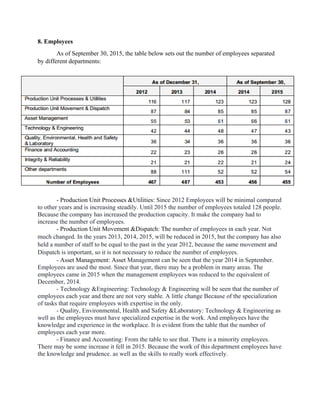
  • 36.
    8. Employees As ofSeptember 30, 2015, the table below sets out the number of employees separated by different departments: - Production Unit Processes &Utilities: Since 2012 Employees will be minimal compared to other years and is increasing steadily. Until 2015 the number of employees totaled 128 people. Because the company has increased the production capacity. It make the company had to increase the number of employees. - Production Unit Movement &Dispatch: The number of employees in each year. Not much changed. In the years 2013, 2014, 2015, will be reduced in 2015, but the company has also held a number of staff to be equal to the past in the year 2012, because the same movement and Dispatch is important, so it is not necessary to reduce the number of employees. - Asset Management: Asset Management can be seen that the year 2014 in September. Employees are used the most. Since that year, there may be a problem in many areas. The employees came in 2015 when the management employees was reduced to the equivalent of December, 2014. - Technology &Engineering: Technology & Engineering will be seen that the number of employees each year and there are not very stable. A little change Because of the specialization of tasks that require employees with expertise in the only. - Quality, Environmental, Health and Safety &Laboratory: Technology & Engineering as well as the employees must have specialized expertise in the work. And employees have the knowledge and experience in the workplace. It is evident from the table that the number of employees each year more. - Finance and Accounting: From the table to see that. There is a minority employees. There may be some increase it fell in 2015. Because the work of this department employees have the knowledge and prudence. as well as the skills to really work effectively.
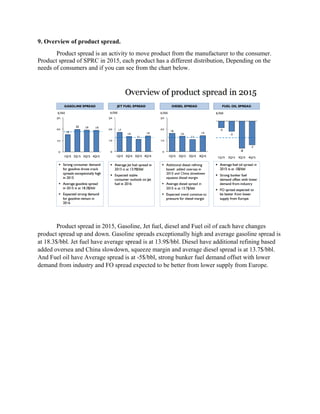
  • 37.
    - Integrity &Reliability:Employees in this department is the smallest of the grid due Integrity & Reliability is measured not studied not but be that as it really is. And qualified employees are available to very few people. And the highest increase in year 2015. - Other departments: Other departmentshave separate jobs, increasing the number of employees in 2013. And reduced size due to various However, to reduce the number of employees down to enable the company to cut costs as much. The cause of the change in the number of employees, depending on factors such as the capacity need. The policy of production department when the company have a high demand for production, it will result in more employees. But if we want to reduce the production cost. The company may have to reduce the number of employees at the same time; advanced technology may cause a change from employees people are machines and computer systems used to control instead of employees. In addition, the machine will work. Also, more powerful, and can reduce costs in the production process. Therefore, the number of employees according to the different departments, so it is extremely important to the company, the company must therefore divide the appropriate operational employees.
  • 38.
    9. Overview ofproduct spread. Product spread is an activity to move product from the manufacturer to the consumer. Product spread of SPRC in 2015, each product has a different distribution, Depending on the needs of consumers and if you can see from the chart below. Product spread in 2015, Gasoline, Jet fuel, diesel and Fuel oil of each have changes product spread up and down. Gasoline spreads exceptionally high and average gasoline spread is at 18.3$/bbl. Jet fuel have average spread is at 13.9$/bbl. Diesel have additional refining based added oversea and China slowdown, squeeze margin and average diesel spread is at 13.7$/bbl. And Fuel oil have Average spread is at -5$/bbl, strong bunker fuel demand offset with lower demand from industry and FO spread expected to be better from lower supply from Europe.
  • 39.
    10. Financial Statistics TheCompany's financial statements in order to see the growth of companies that are growing better or much reduced. And income of the shareholders that have changed me. The data acquired to develop the company. It is seen that the company in 2558 with registered capital by 33,038.45 less than the year 2557 with a registered capital of 41029.51 make changes in the Company's financial statements.
  • 40.
    11. Margin andOPEX Gross margin and operating margin are two fundamental profit metrics used by investors, creditors and analysts to evaluate a company's current financial condition and prospects for future profitability. The two margins differ in regard to the specific costs and expenses included in their calculations and the different purposes they serve in providing a company with information for analysis. Gross refinery margin increased due to: Costs related expenses are much higher. As a result, the impact on sales dropped significantly in 2014 if it costs too much. The higher costs Price goods more expensive As a result, sales have fallen. When this is not solved by the proposed costs of the offering of US $ 14 million one-time THB 1.6 US $ / bbl crude feed.
  • 41.
    12. Contingencies andCommitments The following table summarizes its material contractual cash obligations and other material cash commitments as of December 31, 2014. From the following table land rental, crude oil, hydrogen supply, natural gas supply electricity supply, capital expenditure in each express in expenses related to the company. The expenditure figures shown are in millions. And in total expenses for the spending in years 2016- 2019. The SPRC's company had bought electricity produce from the Provincial Electricity Authority.
  • 42.
    13. Target Customersand Distribution Channels Distribution Channels is the process of moving on the right product to the consumer. Both direct and indirect, and Chevron and PTT are main target customers of the Company petroleum products under the new condition. The percentage of total revenue for by Chevron and PTT. In year ended December 31, Chevron is the largest percentage of total revenue in 2012 was 36.9 and PTT is the largest percentage of total revenue in 2013 and 2014 was 54.9. And In nine months ended September 30, Chevron is the largest percentage of total revenue in 2015 was 49.8 and PTT is the largest percentage of total revenue in 2014 was 55.1. Petroleum product sales, domestic sales and exports. In the year ended December 31, 2012, 2013 and 2014. Are as follows total revenues, in 2012 have total revenue 8,444.8, In 2013 have total revenue 8,436.5, and in 2014 total revenue 7,034.6. And the nine months ended September 30, 2014 and 2015. Are as follows total revenues, in 2014 have total revenue 5,339.1 and in 2015 have total revenue 4,093.9.
  • 43.
    14. EBITDA andprofitability When analyzing financial fitness, corporate accountants and investors alike closely examine a company's financial statements and balance sheets to get a comprehensive picture of its profitability. There are a number of metrics and corresponding financial ratios that are used to measure profitability. Typically, analysts look to the standardized profitability metrics outlined in the generally accepted accounting principles, because they are easily comparable across businesses and industries EBITDA and profitability increased due to :The increase in revenues, we must analyze the cost of items such as net profit + interest + taxes + depreciation + amortization so that we will know the exact cost, deducting certain expenses, and to make them aware of a good profit can be ordered instantly from 2014, affecting the rapid decline in crude oil prices, reo. Make the result with the inventory.
  • 44.
    15. Accounting Summary Thetable below shows the summary of account information SPRC each year, with details clearly from the following aspects: The table show accounting period of each account in a different year. Total revenue depends on the entity's ability to control the selling and administrative expense other expenses well, although in the year 2012, there will be a total revenue in the quarter-finals was 4 years old and in 2015 will have minimal revenue yet, but on the other hand, the net profit of the year 2015. There are more every year, and in 2014, also represents a loss. Although total revenues will be much. It show that controlling of the company in 2015 in the management of expenses. And when net profit more, it will affect a percentage of dividend. Book value and dividend payout ratio increases, along with all of this. Demonstrate the improvement the management expenses of the company that is administering the SPRC efficiently.