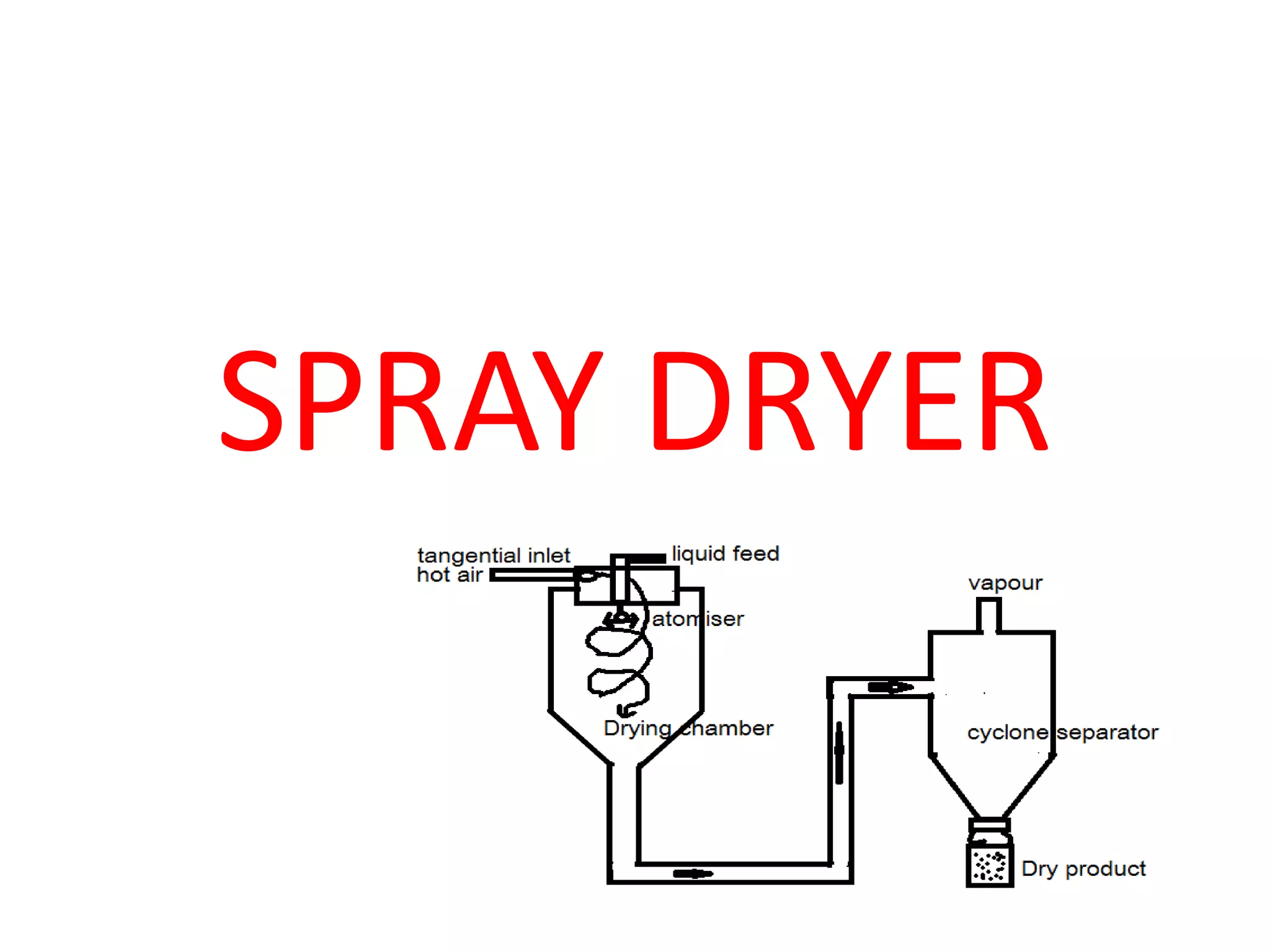
SPRAY DRYER
SPRAY DRYER
PRINCIPLE
• The fluids to be dried is atomized in to fine
droplets
• The droplets thrown radially in to a moving
stream of hot gas
• The temperature of the droplet increases
rapidly and get converted in to dried spherical
particles
• This process completes in a few seconds
before the droplet reach the wall of the dryer
CONSTRUCTION
• It consists of a large cylindrical drying chamber
with a short conical bottom
 material : stainless steel
Diameter:2.5-9 M
Height :25 m or more
• Air inlet present in the roof of the chamber
• Another inlet- carrying spray disk atomizer –
set in the roof
CONSTRUCTION
• Spray disk atomizer :
– Diameter – 300 mm
– Speed - 3000-50,000 rpm
• Bottom of the dryer is connected to a cyclone
separator
WORKING
• 3 stages
Atomization of the liquid
Drying of the liquid droplet
Recovery of the dried product
WORKING
ATOMIZATION OF THE LIQUID TO FORM DROPLETS
• The feed is introduced through the atomizer
• It form fine droplets
• The selection of the type of atomizer is
important because the properties of the final
product depends on the nature of the droplet
formed
WORKING
• Types of atomizer :
Pneumatic atomizer
Pressure nozzle atomizer
Spinning disc atomizer
The feed rate is adjusted in such a way that the
droplets should be completely dried before
reaching the walls of the drying chamber
WORKING
• The product should not be overheated
Drying of the liquid droplet :
• Hot air is introduced through the hot air inlet
• The fine droplet introduced in to this air
stream.
• It absorb heat from the hot air and it get
dried in the drying chamber
WORKING
• The surface of the liquid droplet is dried
immediately to form a tough shell
• The liquid from inner side of the shell diffuses out
through the shell at a particular rate
• At the same time heat transfer takes place at a
rate greater than the liquid diffusion rate
• As a result heat inside mounts up
• this allows the liquid to be evaporate at a faster
rate .so vapor will be produced inside the shell
WORKING
• So the internal pressure increases and that causes
the droplet to swell
• The vapor present in the shell starts to permeate
through the shell.
• So the thickness of the shell decreases and finally
it ruptures and releases the internal pressure
• The feed rate and the temperature of the air is
adjusted in such a way that the droplets should
be completely dried before reaching the wall of
the drying chamber
WORKING
• Recovery of the dried product:
• Centrifugal force of atomizer drives the
droplets to follow helical path
• This particles are dried during their journey
and finally falls at the conical bottom
• All these processes are completed in a few
seconds
• The particle size of final product ranges from
2-500mm
USES
• The quantity of the material to be dried is
large
• Thermolabile ,hygroscopic materials can be
handled
ADVANTAGES
• Spray drying is a continuous process
• Drying is very rapid(completes within 3-30
seconds)
• Labour costs are low
• Fine droplets formed provide large surface
area for heat and mass transfer .so product
shows excellent solubility
ADVANTAGES
• It is suitable for drying sterile products
Free flowing products of uniform spheres is
formed .convenient for tabletting process
DISADVANTAGE
• Spray drier is bulky(25m –height ,9m diameter
) and expensive
• Not easy to operate
• Thermal efficiency is low ,as much heat is lost
in the discharged gases.

SPRAY DRYER.pptx

  • 1.
  • 2.
  • 3.
    PRINCIPLE • The fluidsto be dried is atomized in to fine droplets • The droplets thrown radially in to a moving stream of hot gas • The temperature of the droplet increases rapidly and get converted in to dried spherical particles • This process completes in a few seconds before the droplet reach the wall of the dryer
  • 4.
    CONSTRUCTION • It consistsof a large cylindrical drying chamber with a short conical bottom  material : stainless steel Diameter:2.5-9 M Height :25 m or more • Air inlet present in the roof of the chamber • Another inlet- carrying spray disk atomizer – set in the roof
  • 5.
    CONSTRUCTION • Spray diskatomizer : – Diameter – 300 mm – Speed - 3000-50,000 rpm • Bottom of the dryer is connected to a cyclone separator
  • 6.
    WORKING • 3 stages Atomizationof the liquid Drying of the liquid droplet Recovery of the dried product
  • 7.
    WORKING ATOMIZATION OF THELIQUID TO FORM DROPLETS • The feed is introduced through the atomizer • It form fine droplets • The selection of the type of atomizer is important because the properties of the final product depends on the nature of the droplet formed
  • 8.
    WORKING • Types ofatomizer : Pneumatic atomizer Pressure nozzle atomizer Spinning disc atomizer The feed rate is adjusted in such a way that the droplets should be completely dried before reaching the walls of the drying chamber
  • 9.
    WORKING • The productshould not be overheated Drying of the liquid droplet : • Hot air is introduced through the hot air inlet • The fine droplet introduced in to this air stream. • It absorb heat from the hot air and it get dried in the drying chamber
  • 10.
    WORKING • The surfaceof the liquid droplet is dried immediately to form a tough shell • The liquid from inner side of the shell diffuses out through the shell at a particular rate • At the same time heat transfer takes place at a rate greater than the liquid diffusion rate • As a result heat inside mounts up • this allows the liquid to be evaporate at a faster rate .so vapor will be produced inside the shell
  • 11.
    WORKING • So theinternal pressure increases and that causes the droplet to swell • The vapor present in the shell starts to permeate through the shell. • So the thickness of the shell decreases and finally it ruptures and releases the internal pressure • The feed rate and the temperature of the air is adjusted in such a way that the droplets should be completely dried before reaching the wall of the drying chamber
  • 12.
    WORKING • Recovery ofthe dried product: • Centrifugal force of atomizer drives the droplets to follow helical path • This particles are dried during their journey and finally falls at the conical bottom • All these processes are completed in a few seconds • The particle size of final product ranges from 2-500mm
  • 13.
    USES • The quantityof the material to be dried is large • Thermolabile ,hygroscopic materials can be handled
  • 14.
    ADVANTAGES • Spray dryingis a continuous process • Drying is very rapid(completes within 3-30 seconds) • Labour costs are low • Fine droplets formed provide large surface area for heat and mass transfer .so product shows excellent solubility
  • 15.
    ADVANTAGES • It issuitable for drying sterile products Free flowing products of uniform spheres is formed .convenient for tabletting process
  • 16.
    DISADVANTAGE • Spray drieris bulky(25m –height ,9m diameter ) and expensive • Not easy to operate • Thermal efficiency is low ,as much heat is lost in the discharged gases.