CENTRIFUGATION
CENTRIFUGATION
• Centrifugation is a unit operation employed for
separating the constituents present in a dispersion with
the aid of Centrifugal force
• Centrifugal force is the driving force for the separation
CENTRIFUGATION
• Separation of constituents by using ordinary filtration
is difficult in such cases centrifugation techniques
employed
Examples:-
▪ Separation of highly viscous mixture
▪Separation of colloidal dispersion
▪Separation of two immiscible liquids or a solid from a
liquid
CENTRIFUGATION
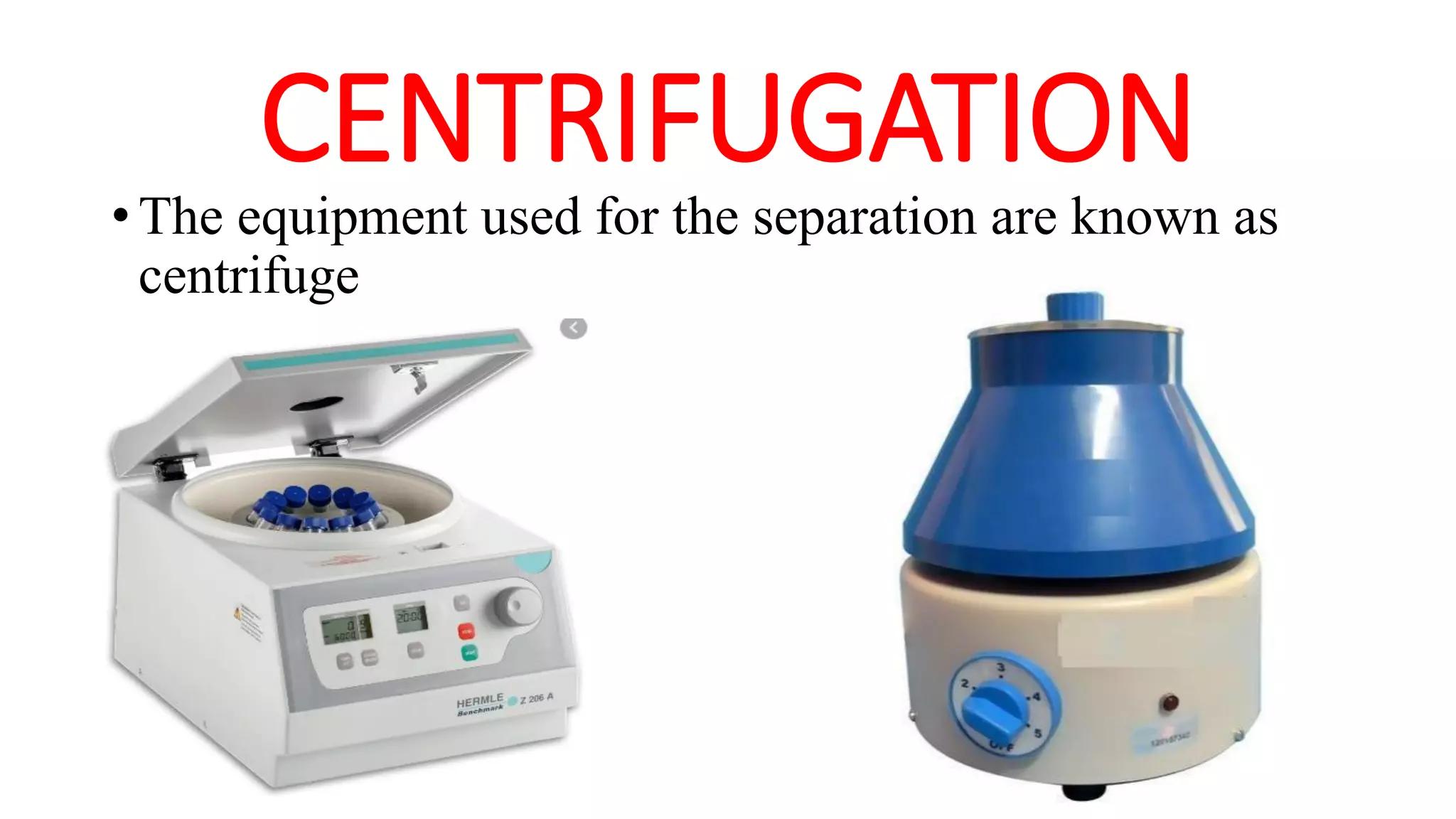
• The equipment used for the separation are known as
centrifuge
CENTRIFUGATION
Process:-
• Centrifuge consists of a container in Which a mixture
of solid and liquid or two liquids is placed
• Centrifuge rotated at high speeds
• The mixture separated in to its constituent parts by the
action of centrifugal force on their densities
CENTRIFUGATION
• A solid or liquid having higher specific gravity is
thrown outward with greater force
• It is retained at the bottom of the container leaving a
clear supernatant layer of pure liquid
• The speed of centrifuge is expressed in terms of the
number of revolutions per minute of the rotor
CENTRIFUGATION
Applications:-
• Production of bulk drugs
• Production of biological products
• Biopharmaceutical analysis of drugs
• Evaluation of suspensions and emulsions
• Determination of molecular weight of colloids
CENTRIFUGATION
❖Production of bulk drugs:-
Centrifugation technique used to separate crystalline drugs
such as aspirin from mother liquor.
❖Production of biological products :-
Most of the proteinaceous drugs and macromolecules are
present as colloidal dispersion in water.
Centrifugal methods are used to separate these constituents
from water.
CENTRIFUGATION
• Insulin separated from the mother liquor by employing
ultracentrifugation technique
• Centrifugation is employed for separating the blood cells
from blood.
❖Biopharmaceutical applications:-
• Drugs present in the blood, tissue fluids, urine are normally
present in the form of colloidal dispersions
• Centrifugation employed for separating the drugs
• This method also used for the evaluation of pharmacokinetic
parameters
CENTRIFUGATION
❖Evaluation of suspension and emulsion
• The emulsion centrifuged at 2000-3000 RPM at room
temperature
if it is stable emulsion, it does not show any signs of
separation even after centrifugation
❖Determination of molecular weight of
colloids:-
• Ultracentrifugation methods employed
• E.g. determination of molecular weight of serum albumin,
insulin and methyl cellulose
CENTRIFUGATION
Theory of centrifugation:-
• In a colloidal dispersion the dispersed phase may be
either a solid or a liquid
• The particles having the size range above 5 um
sediment at the bottom due to gravitational force. In
such cases filtration employed as a separation
technique
CENTRIFUGATION
• If particles having the size 5um or less, they undergo
Brownian motion so they do not sediment under
gravity.
i.e. a stronger force(gravitational force) is applied to
separate them
• Sedimentation depends on the densities of the
dispersed phase and the dispersion medium
CENTRIFUGATION
Centrifugal effect or relative centrifugal
force:-
• Consider a body of mass ‘m’ kg rotating in a circular
path of radius ‘r’ metres at a velocity of ‘v’
metre/minute
• The force acting in radial direction
F =
𝒎𝒗 𝟐
𝒓
→ 1
CENTRIFUGATION
The same body is experiencing gravitational force. It is
expressed as
• Gravitational force (G) = mg →2
• g- acceleration due to gravity
• The centrifugal effect is expressed as a ratio of
centrifugal force to gravitational force
CENTRIFUGATION• Centrifugal effect is a force, which is a number of times
greater than the gravitational force
• Separating power of the centrifuge is expressed as a ratio of
the centrifugal force to the gravitation acceleration
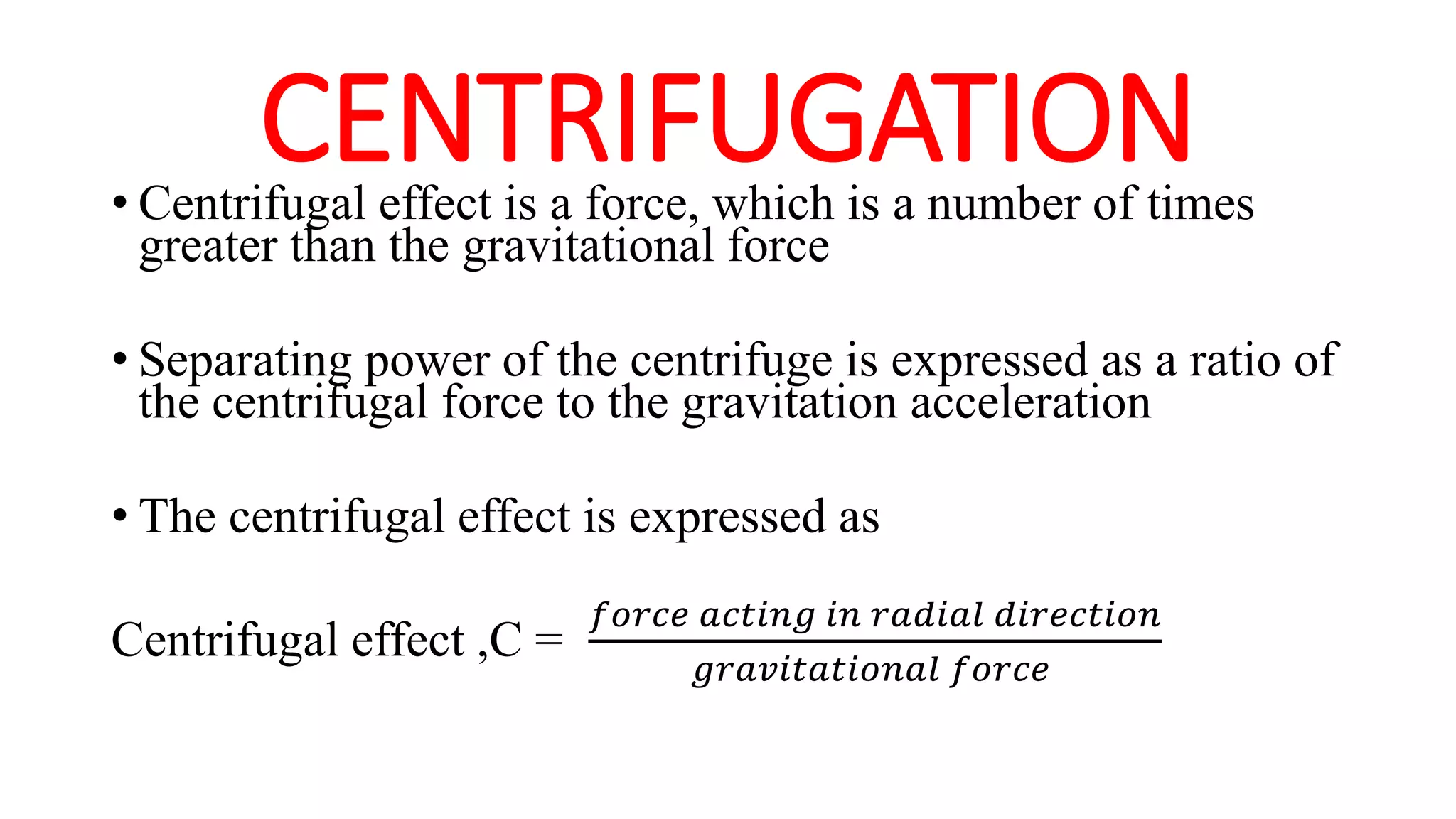
• The centrifugal effect is expressed as
Centrifugal effect ,C =
𝑓𝑜𝑟𝑐𝑒 𝑎𝑐𝑡𝑖𝑛𝑔 𝑖𝑛 𝑟𝑎𝑑𝑖𝑎𝑙 𝑑𝑖𝑟𝑒𝑐𝑡𝑖𝑜𝑛
𝑔𝑟𝑎𝑣𝑖𝑡𝑎𝑡𝑖𝑜𝑛𝑎𝑙 𝑓𝑜𝑟𝑐𝑒
CENTRIFUGATION
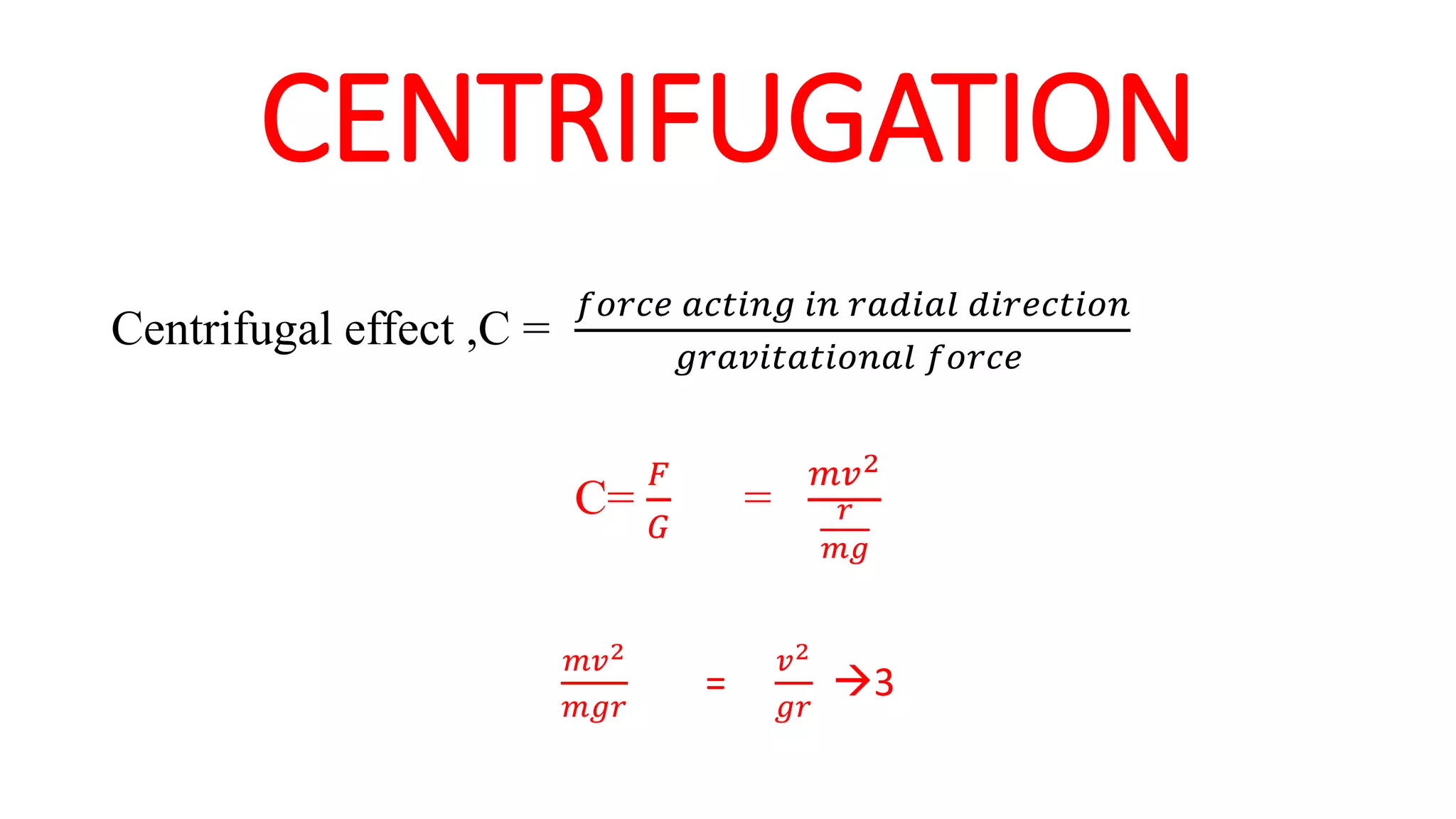
Centrifugal effect ,C =
𝑓𝑜𝑟𝑐𝑒 𝑎𝑐𝑡𝑖𝑛𝑔 𝑖𝑛 𝑟𝑎𝑑𝑖𝑎𝑙 𝑑𝑖𝑟𝑒𝑐𝑡𝑖𝑜𝑛
𝑔𝑟𝑎𝑣𝑖𝑡𝑎𝑡𝑖𝑜𝑛𝑎𝑙 𝑓𝑜𝑟𝑐𝑒
C=
𝐹
𝐺
=
𝑚𝑣2
𝑟
𝑚𝑔
𝑚𝑣2
𝑚𝑔𝑟
=
𝑣2
𝑔𝑟
→3
CENTRIFUGATION
• V= 2𝜋𝑟𝑛,where n -> speed of rotation substituting this equation in (3)
yields
C =
(𝟐𝝅𝒓𝒏) 𝟐
𝒈𝒓
C=
𝟒𝝅 𝟐 𝒓 𝟐 𝒏 𝟐
𝒈𝒓
=
𝟒𝝅 𝟐 𝒓𝒏 𝟐
𝒈
• Since 2r =d, where d is the diameter of the rotation • C=
2𝜋2 𝑑𝑛2
𝑔
CENTRIFUGATION
C =
𝟐𝝅 𝟐 𝒅𝒏 𝟐
𝒈
• g = 9.807m/𝑠2
C = 2.013𝒏 𝟐d
• Centrifugal effect ∝ diameter
• Centrifugal effect ∝ (𝑠𝑝𝑒𝑒𝑑 𝑜𝑓 𝑟𝑜𝑡𝑎𝑡𝑖𝑜𝑛)2
CENTRIFUGATION
Classification of centrifuges:-
Based on their mechanism of separation
❖sedimentation centrifuge
❖filtration centrifuge
Sedimentation centrifuge :-
• The centrifuge produces sedimentation of solids based
on the difference in the densities of two or more
phases of the mixture
CENTRIFUGATION
• The efficiency depends on
❖ the velocity of rotation to which the mixture is
subjected
Examples
❖ Horizontal continuous centrifuge
❖Super centrifuge
❖Conical disc centrifuge
CENTRIFUGATION
Ultra centrifuge:-
• Ultracentrifuge is used for the separation of extremely fine
solid matter from a liquid
• In this instrument a relatively small rotor is operated at
speeds exceeding 1,00,000 RPM with forces up to one
million times gravity
E.g., ultra centrifuges used in colloidal research
CENTRIFUGATION
Uses of sedimentation centrifuges:
❖Suspensions containing low concentration of solids
can be separated quickly
❖Olive and fish liver oils are purification
Uses of sedimentation centrifuges
❖Bacterial enzymes are prepared by removing bacteria
❖Blood plasma is separated from whole blood
❖Clarification of insulin liquor
CENTRIFUGATION
Advantages:-
❖Centrifuges are compact and occupy a very small
space
❖Separation efficiency is high
CENTRIFUGATION
Advantages:-
❖Two immiscible liquids are easily separated on a
continuous process
❖By controlling the speed of rotation and rate of flow
coarser particles are separated
CENTRIFUGATION
Disadvantages :-
• Construction is complicated
• Capacity is limited
CENTRIFUGATION
Filtration centrifuge
• FS is a centrifuge in which liquid pass through the
porous medium based on the difference in densities of
the solid and liquid phases
• The container contains a porous wall through which
the liquid phase may pass and on which the solid
phase retained
CENTRIFUGATIONExamples:-
❖perforated basket centrifuge
❖semi continuous centrifuge
Normally perforated wall is covered with a filter
medium
Uses:-
• Solid recovery is the primary goal in such cases
filtration centrifuges are used
• Used for removing unwanted solids from a liquid
CENTRIFUGATION
Advantages:
• Slurry containing high proportion of solids can be
separated
• Paste like materials can be handled
• The final product may have very low moisture content
• Dissolved solids are separated from the cake
CENTRIFUGATION
Disadvantages
• The entire cycle is complicated resulting in
considerable labour costs
• Batch process or semi continuous process
• Solids may form hard cake due to CF which is difficult
to remove
CENTRIFUGATION
Laboratory scale
1. Horizontal spinning arm
type
2. Angle centrifuge
3. High speed centrifuge
4. Ultracentrifuge
Commercial scale
1.Batch type
Perforated basket centrifuge
2.Semi continuous scale
Short cycle batch centrifuge
3.Continuous centrifuge
Super centrifuge
Classification based on scale of usage:-
THANK YOU

Centrifugation

  • 1.
  • 2.
    CENTRIFUGATION • Centrifugation isa unit operation employed for separating the constituents present in a dispersion with the aid of Centrifugal force • Centrifugal force is the driving force for the separation
  • 3.
    CENTRIFUGATION • Separation ofconstituents by using ordinary filtration is difficult in such cases centrifugation techniques employed Examples:- ▪ Separation of highly viscous mixture ▪Separation of colloidal dispersion ▪Separation of two immiscible liquids or a solid from a liquid
  • 4.
    CENTRIFUGATION • The equipmentused for the separation are known as centrifuge
  • 5.
    CENTRIFUGATION Process:- • Centrifuge consistsof a container in Which a mixture of solid and liquid or two liquids is placed • Centrifuge rotated at high speeds • The mixture separated in to its constituent parts by the action of centrifugal force on their densities
  • 6.
    CENTRIFUGATION • A solidor liquid having higher specific gravity is thrown outward with greater force • It is retained at the bottom of the container leaving a clear supernatant layer of pure liquid • The speed of centrifuge is expressed in terms of the number of revolutions per minute of the rotor
  • 7.
    CENTRIFUGATION Applications:- • Production ofbulk drugs • Production of biological products • Biopharmaceutical analysis of drugs • Evaluation of suspensions and emulsions • Determination of molecular weight of colloids
  • 8.
    CENTRIFUGATION ❖Production of bulkdrugs:- Centrifugation technique used to separate crystalline drugs such as aspirin from mother liquor. ❖Production of biological products :- Most of the proteinaceous drugs and macromolecules are present as colloidal dispersion in water. Centrifugal methods are used to separate these constituents from water.
  • 9.
    CENTRIFUGATION • Insulin separatedfrom the mother liquor by employing ultracentrifugation technique • Centrifugation is employed for separating the blood cells from blood. ❖Biopharmaceutical applications:- • Drugs present in the blood, tissue fluids, urine are normally present in the form of colloidal dispersions • Centrifugation employed for separating the drugs • This method also used for the evaluation of pharmacokinetic parameters
  • 10.
    CENTRIFUGATION ❖Evaluation of suspensionand emulsion • The emulsion centrifuged at 2000-3000 RPM at room temperature if it is stable emulsion, it does not show any signs of separation even after centrifugation ❖Determination of molecular weight of colloids:- • Ultracentrifugation methods employed • E.g. determination of molecular weight of serum albumin, insulin and methyl cellulose
  • 11.
    CENTRIFUGATION Theory of centrifugation:- •In a colloidal dispersion the dispersed phase may be either a solid or a liquid • The particles having the size range above 5 um sediment at the bottom due to gravitational force. In such cases filtration employed as a separation technique
  • 12.
    CENTRIFUGATION • If particleshaving the size 5um or less, they undergo Brownian motion so they do not sediment under gravity. i.e. a stronger force(gravitational force) is applied to separate them • Sedimentation depends on the densities of the dispersed phase and the dispersion medium
  • 13.
    CENTRIFUGATION Centrifugal effect orrelative centrifugal force:- • Consider a body of mass ‘m’ kg rotating in a circular path of radius ‘r’ metres at a velocity of ‘v’ metre/minute • The force acting in radial direction F = 𝒎𝒗 𝟐 𝒓 → 1
  • 14.
    CENTRIFUGATION The same bodyis experiencing gravitational force. It is expressed as • Gravitational force (G) = mg →2 • g- acceleration due to gravity • The centrifugal effect is expressed as a ratio of centrifugal force to gravitational force
  • 15.
    CENTRIFUGATION• Centrifugal effectis a force, which is a number of times greater than the gravitational force • Separating power of the centrifuge is expressed as a ratio of the centrifugal force to the gravitation acceleration • The centrifugal effect is expressed as Centrifugal effect ,C = 𝑓𝑜𝑟𝑐𝑒 𝑎𝑐𝑡𝑖𝑛𝑔 𝑖𝑛 𝑟𝑎𝑑𝑖𝑎𝑙 𝑑𝑖𝑟𝑒𝑐𝑡𝑖𝑜𝑛 𝑔𝑟𝑎𝑣𝑖𝑡𝑎𝑡𝑖𝑜𝑛𝑎𝑙 𝑓𝑜𝑟𝑐𝑒
  • 16.
    CENTRIFUGATION Centrifugal effect ,C= 𝑓𝑜𝑟𝑐𝑒 𝑎𝑐𝑡𝑖𝑛𝑔 𝑖𝑛 𝑟𝑎𝑑𝑖𝑎𝑙 𝑑𝑖𝑟𝑒𝑐𝑡𝑖𝑜𝑛 𝑔𝑟𝑎𝑣𝑖𝑡𝑎𝑡𝑖𝑜𝑛𝑎𝑙 𝑓𝑜𝑟𝑐𝑒 C= 𝐹 𝐺 = 𝑚𝑣2 𝑟 𝑚𝑔 𝑚𝑣2 𝑚𝑔𝑟 = 𝑣2 𝑔𝑟 →3
  • 17.
    CENTRIFUGATION • V= 2𝜋𝑟𝑛,wheren -> speed of rotation substituting this equation in (3) yields C = (𝟐𝝅𝒓𝒏) 𝟐 𝒈𝒓 C= 𝟒𝝅 𝟐 𝒓 𝟐 𝒏 𝟐 𝒈𝒓 = 𝟒𝝅 𝟐 𝒓𝒏 𝟐 𝒈 • Since 2r =d, where d is the diameter of the rotation • C= 2𝜋2 𝑑𝑛2 𝑔
  • 18.
    CENTRIFUGATION C = 𝟐𝝅 𝟐𝒅𝒏 𝟐 𝒈 • g = 9.807m/𝑠2 C = 2.013𝒏 𝟐d • Centrifugal effect ∝ diameter • Centrifugal effect ∝ (𝑠𝑝𝑒𝑒𝑑 𝑜𝑓 𝑟𝑜𝑡𝑎𝑡𝑖𝑜𝑛)2
  • 19.
    CENTRIFUGATION Classification of centrifuges:- Basedon their mechanism of separation ❖sedimentation centrifuge ❖filtration centrifuge Sedimentation centrifuge :- • The centrifuge produces sedimentation of solids based on the difference in the densities of two or more phases of the mixture
  • 20.
    CENTRIFUGATION • The efficiencydepends on ❖ the velocity of rotation to which the mixture is subjected Examples ❖ Horizontal continuous centrifuge ❖Super centrifuge ❖Conical disc centrifuge
  • 21.
    CENTRIFUGATION Ultra centrifuge:- • Ultracentrifugeis used for the separation of extremely fine solid matter from a liquid • In this instrument a relatively small rotor is operated at speeds exceeding 1,00,000 RPM with forces up to one million times gravity E.g., ultra centrifuges used in colloidal research
  • 22.
    CENTRIFUGATION Uses of sedimentationcentrifuges: ❖Suspensions containing low concentration of solids can be separated quickly ❖Olive and fish liver oils are purification
  • 23.
    Uses of sedimentationcentrifuges ❖Bacterial enzymes are prepared by removing bacteria ❖Blood plasma is separated from whole blood ❖Clarification of insulin liquor
  • 24.
    CENTRIFUGATION Advantages:- ❖Centrifuges are compactand occupy a very small space ❖Separation efficiency is high
  • 25.
    CENTRIFUGATION Advantages:- ❖Two immiscible liquidsare easily separated on a continuous process ❖By controlling the speed of rotation and rate of flow coarser particles are separated
  • 26.
    CENTRIFUGATION Disadvantages :- • Constructionis complicated • Capacity is limited
  • 27.
    CENTRIFUGATION Filtration centrifuge • FSis a centrifuge in which liquid pass through the porous medium based on the difference in densities of the solid and liquid phases • The container contains a porous wall through which the liquid phase may pass and on which the solid phase retained
  • 28.
    CENTRIFUGATIONExamples:- ❖perforated basket centrifuge ❖semicontinuous centrifuge Normally perforated wall is covered with a filter medium Uses:- • Solid recovery is the primary goal in such cases filtration centrifuges are used • Used for removing unwanted solids from a liquid
  • 29.
    CENTRIFUGATION Advantages: • Slurry containinghigh proportion of solids can be separated • Paste like materials can be handled • The final product may have very low moisture content • Dissolved solids are separated from the cake
  • 30.
    CENTRIFUGATION Disadvantages • The entirecycle is complicated resulting in considerable labour costs • Batch process or semi continuous process • Solids may form hard cake due to CF which is difficult to remove
  • 31.
    CENTRIFUGATION Laboratory scale 1. Horizontalspinning arm type 2. Angle centrifuge 3. High speed centrifuge 4. Ultracentrifuge Commercial scale 1.Batch type Perforated basket centrifuge 2.Semi continuous scale Short cycle batch centrifuge 3.Continuous centrifuge Super centrifuge Classification based on scale of usage:-
  • 32.