PRACTICAL ASSIGNMENT PRESENTATION
TOPIC:-
TWO STAGE SPRAY DRIER WITH FLUIDIZED BED DRIER
DE-221
DAIRY PROCESS ENGINEERING
COMPILED AND SUBMITTED BY:- SUBMITTED TO:-
BISHAL BARMAN ER ANKIT DEEP
17-B-DT-10
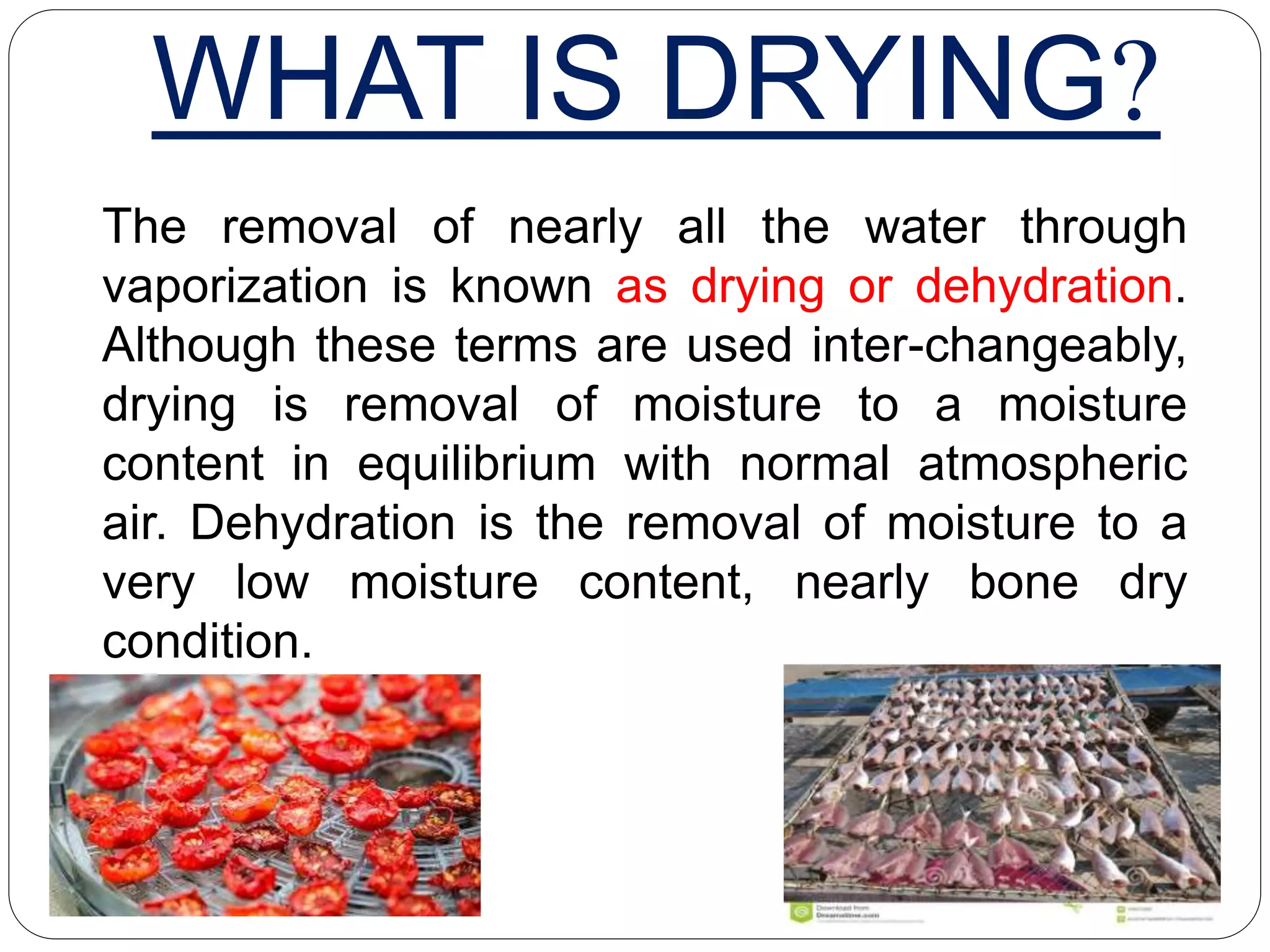
The removal of nearly all the water through
vaporization is known as drying or dehydration.
Although these terms are used inter-changeably,
drying is removal of moisture to a moisture
content in equilibrium with normal atmospheric
air. Dehydration is the removal of moisture to a
very low moisture content, nearly bone dry
condition.
WHAT IS DRYING?
SPRAY DRYING
 Transformation of feed from a fluid state into a dried particle.
 By spraying the feed into a hot drying medium.
 Considered to be one of the best methods.
 Applied to fluids of high moisture content and high viscosity.
Short drying period.
BASIC WORKING PRINCIPLE
 First milk is pumped through atomizer. Milk is split
into fine droplets.
 Droplets are subjected to a stream of hot air flowing
 Dry powder particles fall down towards the bottom
of the chamber from where it is removed.
 Large liquid surface is created by atomization so
evaporation takes place very quickly at a low
temperature.
 Hot air supplied to the feed heat the droplets and
carry away the vapors' evolved.
 METHOD FOR ATOMIZING SPRAY MATERIAL
1. Hydraulic pressure jet
2. Pneumatic
3.Centrifugal disc
 METHOD OF FURNISHING HEAT:
1.Steam
2.Gas
3.Fuel
4.Electricity
 METHOD OF HEATING AIR
1. Direct (gas or fuel oil)
2. Indirect (utilizing heat exchanger plate or coils.
 DIRECTION OF AIR FLOW IN RELATION TO PRODUCT FLOW
1. Counter current
2. Parallel
3. Mixed
 PRESSURE IN DRIER
1. Atmospheric
2. Vacuum
 SHAPE OF DRYING CHAMBER
1. Flat bottom
2 Conical bottom
CONSTRUCTION & WORKING
 Air filter : Incoming air is washed by drawing it through a spray of water or through a series
of screens of wire mesh.
 Air heating : Steam/oil/electricity is used for heating air. Saturated steam of 10-12 bar gives
an air temperature of 170-180° C.
 Atomization:-
 Hydraulic Pressure Jet Type:-
In this type, the original form of atomizer forces the milk at a high pressure ~ 141-
211kg/cm2 through a very small orifice, which may be only 0.125 mm in diameter, in hard ste
el disk. Drop size is not uniform,
Drop size reduced by increasing the pressure, reducing the nozzle diameter, or reducing the
liquid, but this type of atomizer is unsuitable for producing a large proportion of drops below
30µ diameter.
 Pneumatic Type
stream of compressed air is used to disintegrate a jet of milk.
- air impinges at high velocity onto a film of liquid at right angle.
- more concentrated liquid can be processed.
- not used for size range exceeding 50 µm.
 Centrifugal Type
- No pressure is applied to the milk,
- velocity is imparted by centrifugal force in rotating device.
- feed breaks up into umbrella like spray
 Drying chamber : Drying chambers are designed to discharge the
majority of the product at the base or to convey all the product with
the exhaust air to a product separation and recovery unit.
 Rotary valve: It is a pump like assembly located at the bottom of
cone of the spray drier or the cyclone. It helps in maintaining vacuum
inside drier and conveys the dried powder downward with each
rotation.
 Manhole: It is a type of door which allows a person to go inside the
drying chamber.
 Hammer: Hammers have been provided at the cone wall outside the
spray drier. The hammer strikes the powder deposited on cone wall.
fig: Drying chamber fig: Rotary valve fig: Hammer fig:
Manhole
 1st stage drying
 Air at temperature (180-2200C) moves into and through
the drier at a velocity from 360 to 600 m per min.
 The greater the velocity, the more likely the product will
be carried from the dryer.
 Residence time is 10-30 seconds.
 2nd stage drying:(static fluidized bed dryer)
 The second stage is a fluid bed built into the cone of the
spray drying chamber.
 This fluid bed is called the integrated fluid bed.
 Here drying occur for 2-3 minutes and hot air upto 900C
is used for drying.
 3rd Stage Drying(VFBD)
 The powdered products are made to flow through a permeable support on
which material, when gas is passed through grid.
 At greater velocities the particles in the bed will begin to be in turbulent
motion.
 A further increase in the stream of gas finally leads to a velocity at which the
particles float, which occurs when the upward force equals the force of gravity
acting on the particles.
 In the first section, the powder is dried to its final moisture content by air at
60-900C and in the second section, the powder is cooled by air at
approximately 300C.
 Here chilled water is used for cooling air(4-10˙C) and air should be
dehumidified before using otherwise it will give its moisture to powder. Then
steam is further used for heating at desired temperature. Time for drying is 10-
12 min.
 Powder dried to 6-9 % moisture in main drying chamber is taken to <4%
moisture in vibro fluid bed
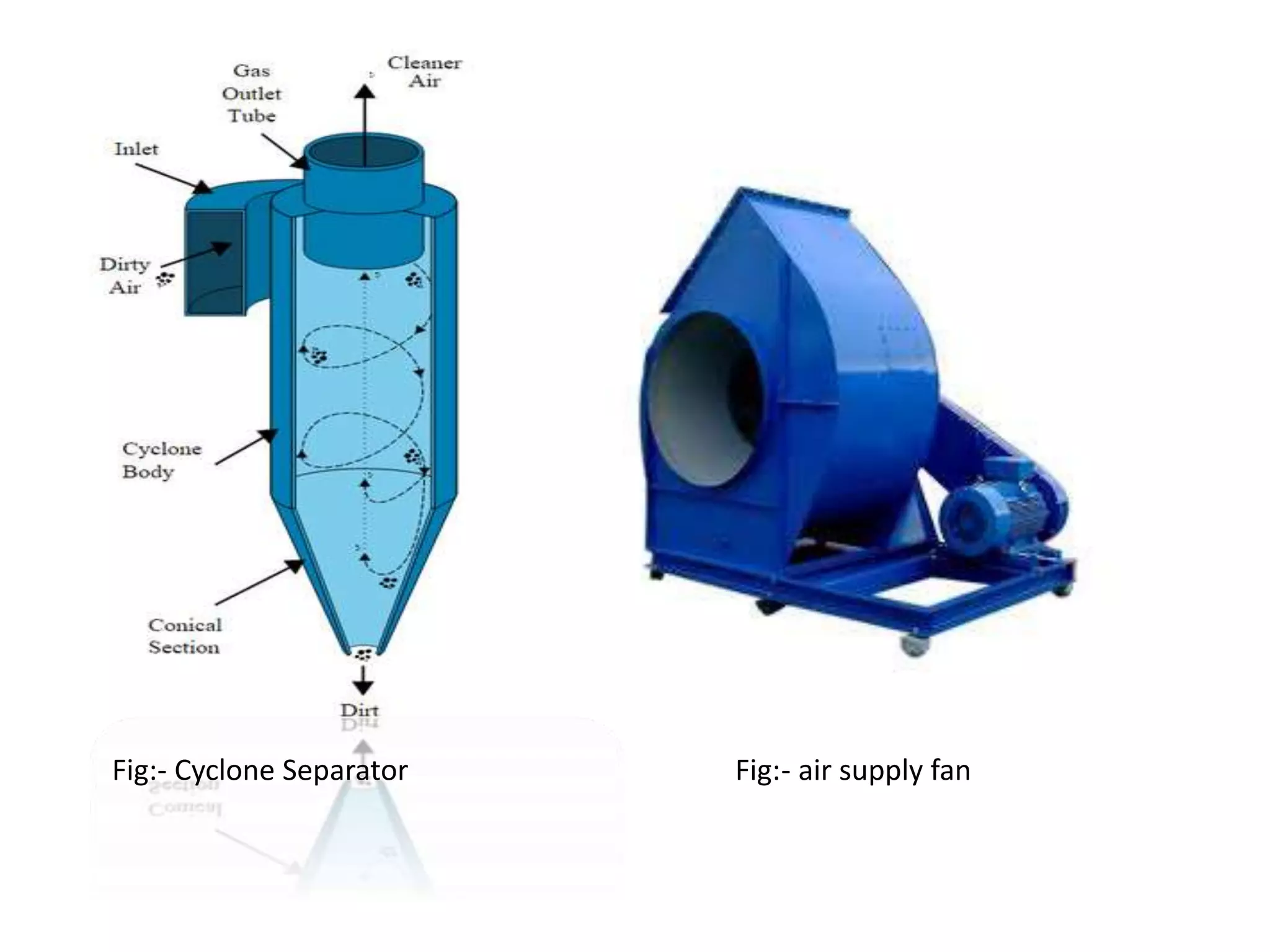
 Cyclone separator: Cyclones are centrifugal Particle separators. It
employs centrifugal force rather than gravitational force to remove the
particles. In cyclone separator air at high velocity is introduced
tangentially into a cylindrical vessel which has a much larger cross
section than the entering duct.
 Instantizaion: In experimental dairy 3 stage spray dryer has a blower
and heater for air supply present at bottom of cyclone separator so
that fines that we have collected can either be used for agglomeration
or when there is no need of agglomeration then they are supplied to
heating chamber of vibro fluidized bed dryer.
 Fan requirements for spray dryer:
- Air supply fan
- Exhaust air fan
- Transport air fan (agglomeration)
- Cooling fan
- Air heater fan
Moisture content after final drying:
Powder dried to 6-9 % moisture in main drying chamber is taken to <4%
moisture in vibro fluid bed. This reduction in main drying chamber outlet air
temperature of 10-150C giving an outlet temperature of 80-850C compared
with 950C in two stage drying.
Results of multistage drying:
•Higher quality powders with much better rehydrating properties directly from
the drier
•Lower energy consumption
•Increased range of products which can be spray dried
Smaller space requirements
SEPARATION OF POWDER FROM AIR
As the product is dried, it is necessary to separate the dried
product from the air.
Without special design features, the product will be carried by th
e moist air from the drier. It is necessary to remove the particles
(a) To get a maximum yield from the dryer by saving all powder
product.
(b) To avoid air pollution surrounding the drying plant.
Fig:- Cyclone Separator Fig:- air supply fan
Fig:- vibro fluidized bed drier
LINE DIAGRAM OF TWO STAGE SPRAY DRYER WITH FLUIDIZED BED DRYER
Care and maintenance
 All gaskets must be changed periodically.
 Avoid the use of high pressure steam.
 Ensure heating surfaces are clean and free from
deposits.
 Condensate must be removed properly from the
heating surface.
 Check the air leaks which may develop around
valves,joints,cover.
ADVANTAGES OF SPRAY DRYER
•The whole process proceeds very rapidly and the air residence time in the
chamber is up to 30 s. And drying is accomplished at low temperatures.
•There is no oxidation, loss of vitamins, denaturation of proteins, lactose
transformation and other adverse effects of heat. For these reasons, spray
drying is also used for drying of different pharmaceuticals, biological
substances and thermo sensitive materials.
•The product obtained by spray drying is similar in quality to the product
obtained by freeze drying.
•During spray drying, it is possible to automatically control the drying
parameters and by this, to control the properties of the final product such as
final moisture and temperature, bulk density and powder particle size.
•The process is fully automated, so that even high capacities with high
productivity require minimal labor.
•Since the product comes into contact with the wall of the closed chamber only
in the powder form, there is neither a problem of equipment maintenance or
corrosion nor a problem with the microbiological quality of the final product.
DISADVANTAGES
•Very large dimensions of the drying chamber.
•Expensive equipment.
•High electricity usage.
•Steam consumption.
•High installation cost
CONCLUSION
Effective process control is essential if dairy powders and
concentrated products are to be manufactured safely, in
compliance with regulatory requirements, with acceptable
product quality and low manufacturing costs. The key to
success is the elimination of external disturbances. This can
best be accomplished by careful design of the services
infrastructure. Particular attention should be directed to
steam, hot, cold and chilled water, compressed air and
condenser cooling towers.
Sources:
E-course (NDRI)
Dairy plant engineering and management by
TUFAIL AHMAD
Internet
Class notes

spray Drier with fluidized bed drier

  • 1.
    PRACTICAL ASSIGNMENT PRESENTATION TOPIC:- TWOSTAGE SPRAY DRIER WITH FLUIDIZED BED DRIER DE-221 DAIRY PROCESS ENGINEERING COMPILED AND SUBMITTED BY:- SUBMITTED TO:- BISHAL BARMAN ER ANKIT DEEP 17-B-DT-10
  • 2.
    The removal ofnearly all the water through vaporization is known as drying or dehydration. Although these terms are used inter-changeably, drying is removal of moisture to a moisture content in equilibrium with normal atmospheric air. Dehydration is the removal of moisture to a very low moisture content, nearly bone dry condition. WHAT IS DRYING?
  • 3.
    SPRAY DRYING  Transformationof feed from a fluid state into a dried particle.  By spraying the feed into a hot drying medium.  Considered to be one of the best methods.  Applied to fluids of high moisture content and high viscosity. Short drying period.
  • 4.
    BASIC WORKING PRINCIPLE First milk is pumped through atomizer. Milk is split into fine droplets.  Droplets are subjected to a stream of hot air flowing  Dry powder particles fall down towards the bottom of the chamber from where it is removed.  Large liquid surface is created by atomization so evaporation takes place very quickly at a low temperature.  Hot air supplied to the feed heat the droplets and carry away the vapors' evolved.
  • 5.
     METHOD FORATOMIZING SPRAY MATERIAL 1. Hydraulic pressure jet 2. Pneumatic 3.Centrifugal disc  METHOD OF FURNISHING HEAT: 1.Steam 2.Gas 3.Fuel 4.Electricity  METHOD OF HEATING AIR 1. Direct (gas or fuel oil) 2. Indirect (utilizing heat exchanger plate or coils.  DIRECTION OF AIR FLOW IN RELATION TO PRODUCT FLOW 1. Counter current 2. Parallel 3. Mixed  PRESSURE IN DRIER 1. Atmospheric 2. Vacuum  SHAPE OF DRYING CHAMBER 1. Flat bottom 2 Conical bottom
  • 7.
    CONSTRUCTION & WORKING Air filter : Incoming air is washed by drawing it through a spray of water or through a series of screens of wire mesh.  Air heating : Steam/oil/electricity is used for heating air. Saturated steam of 10-12 bar gives an air temperature of 170-180° C.  Atomization:-  Hydraulic Pressure Jet Type:- In this type, the original form of atomizer forces the milk at a high pressure ~ 141- 211kg/cm2 through a very small orifice, which may be only 0.125 mm in diameter, in hard ste el disk. Drop size is not uniform, Drop size reduced by increasing the pressure, reducing the nozzle diameter, or reducing the liquid, but this type of atomizer is unsuitable for producing a large proportion of drops below 30µ diameter.
  • 8.
     Pneumatic Type streamof compressed air is used to disintegrate a jet of milk. - air impinges at high velocity onto a film of liquid at right angle. - more concentrated liquid can be processed. - not used for size range exceeding 50 µm.  Centrifugal Type - No pressure is applied to the milk, - velocity is imparted by centrifugal force in rotating device. - feed breaks up into umbrella like spray
  • 9.
     Drying chamber: Drying chambers are designed to discharge the majority of the product at the base or to convey all the product with the exhaust air to a product separation and recovery unit.  Rotary valve: It is a pump like assembly located at the bottom of cone of the spray drier or the cyclone. It helps in maintaining vacuum inside drier and conveys the dried powder downward with each rotation.  Manhole: It is a type of door which allows a person to go inside the drying chamber.  Hammer: Hammers have been provided at the cone wall outside the spray drier. The hammer strikes the powder deposited on cone wall. fig: Drying chamber fig: Rotary valve fig: Hammer fig: Manhole
  • 10.
     1st stagedrying  Air at temperature (180-2200C) moves into and through the drier at a velocity from 360 to 600 m per min.  The greater the velocity, the more likely the product will be carried from the dryer.  Residence time is 10-30 seconds.  2nd stage drying:(static fluidized bed dryer)  The second stage is a fluid bed built into the cone of the spray drying chamber.  This fluid bed is called the integrated fluid bed.  Here drying occur for 2-3 minutes and hot air upto 900C is used for drying.
  • 11.
     3rd StageDrying(VFBD)  The powdered products are made to flow through a permeable support on which material, when gas is passed through grid.  At greater velocities the particles in the bed will begin to be in turbulent motion.  A further increase in the stream of gas finally leads to a velocity at which the particles float, which occurs when the upward force equals the force of gravity acting on the particles.  In the first section, the powder is dried to its final moisture content by air at 60-900C and in the second section, the powder is cooled by air at approximately 300C.  Here chilled water is used for cooling air(4-10˙C) and air should be dehumidified before using otherwise it will give its moisture to powder. Then steam is further used for heating at desired temperature. Time for drying is 10- 12 min.  Powder dried to 6-9 % moisture in main drying chamber is taken to <4% moisture in vibro fluid bed
  • 12.
     Cyclone separator:Cyclones are centrifugal Particle separators. It employs centrifugal force rather than gravitational force to remove the particles. In cyclone separator air at high velocity is introduced tangentially into a cylindrical vessel which has a much larger cross section than the entering duct.  Instantizaion: In experimental dairy 3 stage spray dryer has a blower and heater for air supply present at bottom of cyclone separator so that fines that we have collected can either be used for agglomeration or when there is no need of agglomeration then they are supplied to heating chamber of vibro fluidized bed dryer.  Fan requirements for spray dryer: - Air supply fan - Exhaust air fan - Transport air fan (agglomeration) - Cooling fan - Air heater fan
  • 13.
    Moisture content afterfinal drying: Powder dried to 6-9 % moisture in main drying chamber is taken to <4% moisture in vibro fluid bed. This reduction in main drying chamber outlet air temperature of 10-150C giving an outlet temperature of 80-850C compared with 950C in two stage drying. Results of multistage drying: •Higher quality powders with much better rehydrating properties directly from the drier •Lower energy consumption •Increased range of products which can be spray dried Smaller space requirements
  • 14.
    SEPARATION OF POWDERFROM AIR As the product is dried, it is necessary to separate the dried product from the air. Without special design features, the product will be carried by th e moist air from the drier. It is necessary to remove the particles (a) To get a maximum yield from the dryer by saving all powder product. (b) To avoid air pollution surrounding the drying plant.
  • 15.
    Fig:- Cyclone SeparatorFig:- air supply fan
  • 16.
  • 17.
    LINE DIAGRAM OFTWO STAGE SPRAY DRYER WITH FLUIDIZED BED DRYER
  • 18.
    Care and maintenance All gaskets must be changed periodically.  Avoid the use of high pressure steam.  Ensure heating surfaces are clean and free from deposits.  Condensate must be removed properly from the heating surface.  Check the air leaks which may develop around valves,joints,cover.
  • 19.
    ADVANTAGES OF SPRAYDRYER •The whole process proceeds very rapidly and the air residence time in the chamber is up to 30 s. And drying is accomplished at low temperatures. •There is no oxidation, loss of vitamins, denaturation of proteins, lactose transformation and other adverse effects of heat. For these reasons, spray drying is also used for drying of different pharmaceuticals, biological substances and thermo sensitive materials. •The product obtained by spray drying is similar in quality to the product obtained by freeze drying. •During spray drying, it is possible to automatically control the drying parameters and by this, to control the properties of the final product such as final moisture and temperature, bulk density and powder particle size. •The process is fully automated, so that even high capacities with high productivity require minimal labor. •Since the product comes into contact with the wall of the closed chamber only in the powder form, there is neither a problem of equipment maintenance or corrosion nor a problem with the microbiological quality of the final product.
  • 20.
    DISADVANTAGES •Very large dimensionsof the drying chamber. •Expensive equipment. •High electricity usage. •Steam consumption. •High installation cost
  • 21.
    CONCLUSION Effective process controlis essential if dairy powders and concentrated products are to be manufactured safely, in compliance with regulatory requirements, with acceptable product quality and low manufacturing costs. The key to success is the elimination of external disturbances. This can best be accomplished by careful design of the services infrastructure. Particular attention should be directed to steam, hot, cold and chilled water, compressed air and condenser cooling towers.
  • 22.
    Sources: E-course (NDRI) Dairy plantengineering and management by TUFAIL AHMAD Internet Class notes