SPERMATOGENESIS
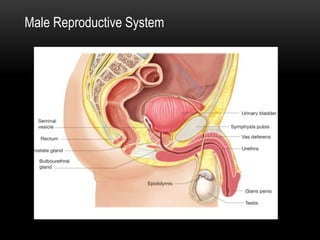
MALE REPRODUCTIVE SYSTEM
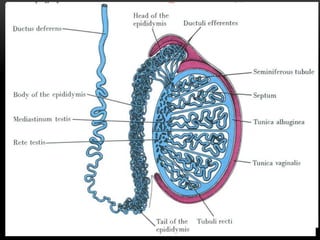
 TESTES
 EPIDIDYMIS
 VAS DEFERENS
 SEMINAL VESICLES
 PROSTATE
 BULBOURETHRAL GLANDS
 URETHRA
Male Reproductive System
DRTSK
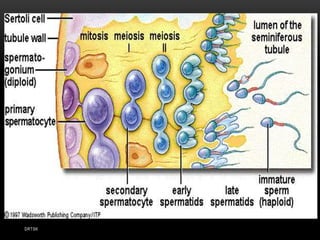
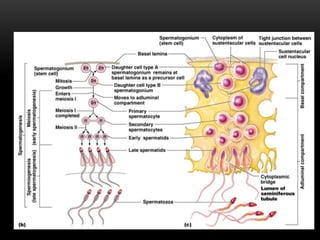
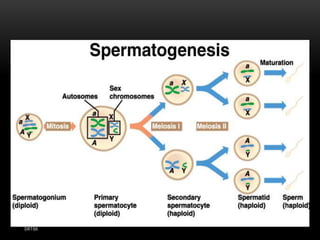
SPERMATOGENESIS
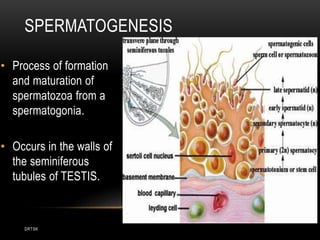
• Process of formation
and maturation of
spermatozoa from a
spermatogonia.
• Occurs in the walls of
the seminiferous
tubules of TESTIS.
DRTSK
DRTSK
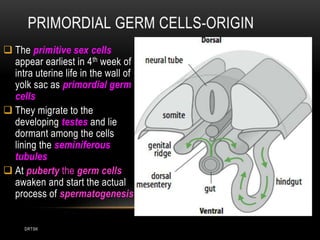
 The primitive sex cells
appear earliest in 4th week of
intra uterine life in the wall of
yolk sac as primordial germ
cells
 They migrate to the
developing testes and lie
dormant among the cells
lining the seminiferous
tubules
 At puberty the germ cells
awaken and start the actual
process of spermatogenesis
DRTSK
SPERMATOGENESIS
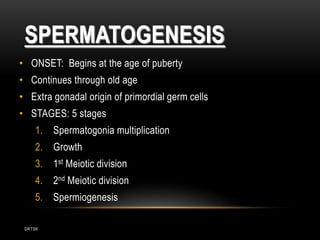
• ONSET: Begins at the age of puberty
• Continues through old age
• Extra gonadal origin of primordial germ cells
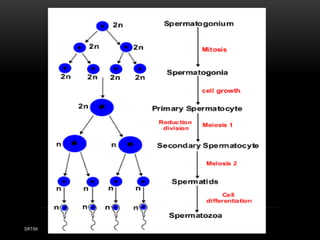
• STAGES: 5 stages
1. Spermatogonia multiplication
2. Growth
3. 1st Meiotic division
4. 2nd Meiotic division
5. Spermiogenesis
DRTSK
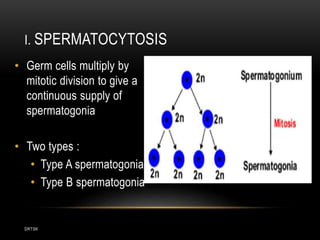
I. SPERMATOCYTOSIS
• Germ cells multiply by
mitotic division to give a
continuous supply of
spermatogonia
• Two types :
• Type A spermatogonia
• Type B spermatogonia
DRTSK
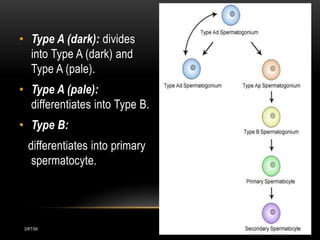
• Type A (dark): divides
into Type A (dark) and
Type A (pale).
• Type A (pale):
differentiates into Type B.
• Type B:
differentiates into primary
spermatocyte.
DRTSK
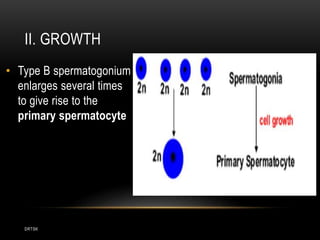
II. GROWTH
• Type B spermatogonium
enlarges several times
to give rise to the
primary spermatocyte
DRTSK
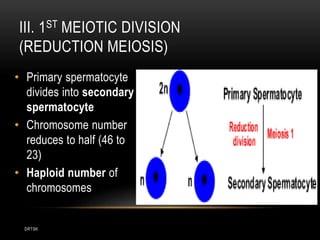
III. 1ST MEIOTIC DIVISION
(REDUCTION MEIOSIS)
• Primary spermatocyte
divides into secondary
spermatocyte
• Chromosome number
reduces to half (46 to
23)
• Haploid number of
chromosomes
DRTSK
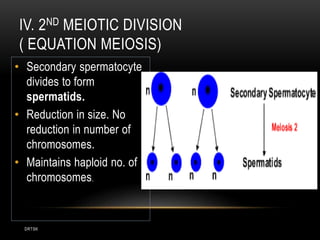
IV. 2ND MEIOTIC DIVISION
( EQUATION MEIOSIS)
• Secondary spermatocyte
divides to form
spermatids.
• Reduction in size. No
reduction in number of
chromosomes.
• Maintains haploid no. of
chromosomes.
DRTSK
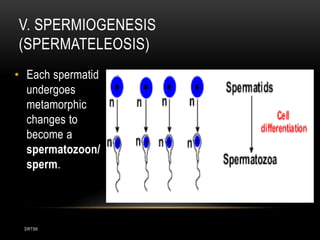
V. SPERMIOGENESIS
(SPERMATELEOSIS)
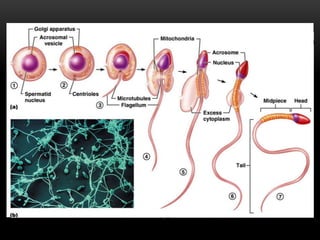
• Each spermatid
undergoes
metamorphic
changes to
become a
spermatozoon/
sperm.
DRTSK
DRTSK
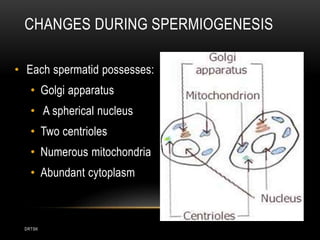
CHANGES DURING SPERMIOGENESIS
• Each spermatid possesses:
• Golgi apparatus
• A spherical nucleus
• Two centrioles
• Numerous mitochondria
• Abundant cytoplasm
DRTSK
CHANGES DURING SPERMIOGENESIS
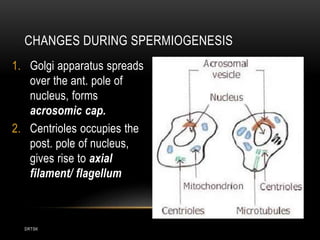
1. Golgi apparatus spreads
over the ant. pole of
nucleus, forms
acrosomic cap.
2. Centrioles occupies the
post. pole of nucleus,
gives rise to axial
filament/ flagellum
DRTSK
CHANGES DURING SPERMIOGENESIS
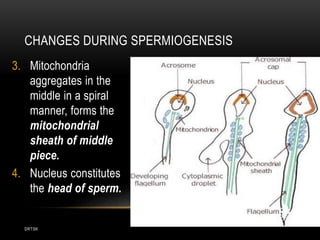
3. Mitochondria
aggregates in the
middle in a spiral
manner, forms the
mitochondrial
sheath of middle
piece.
4. Nucleus constitutes
the head of sperm.
DRTSK
CHANGES DURING SPERMIOGENESIS
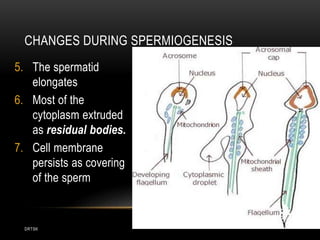
5. The spermatid
elongates
6. Most of the
cytoplasm extruded
as residual bodies.
7. Cell membrane
persists as covering
of the sperm
DRTSK
21
DRTSK
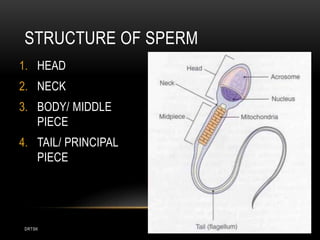
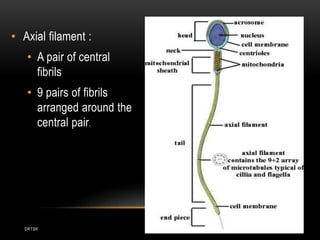
STRUCTURE OF SPERM
1. HEAD
2. NECK
3. BODY/ MIDDLE
PIECE
4. TAIL/ PRINCIPAL
PIECE
DRTSK
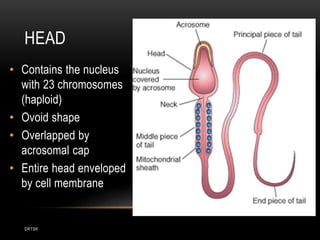
HEAD
• Contains the nucleus
with 23 chromosomes
(haploid)
• Ovoid shape
• Overlapped by
acrosomal cap
• Entire head enveloped
by cell membrane
DRTSK
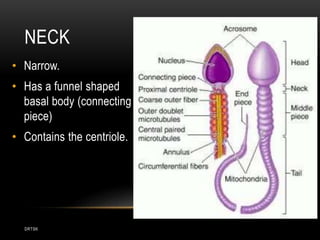
NECK
• Narrow.
• Has a funnel shaped
basal body (connecting
piece)
• Contains the centriole.
DRTSK
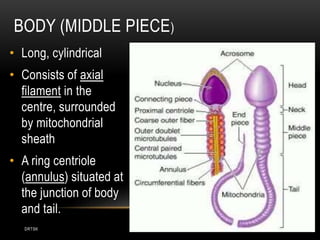
BODY (MIDDLE PIECE)
• Long, cylindrical
• Consists of axial
filament in the
centre, surrounded
by mitochondrial
sheath
• A ring centriole
(annulus) situated at
the junction of body
and tail.
DRTSK
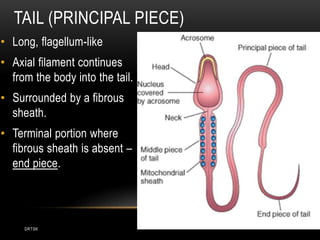
TAIL (PRINCIPAL PIECE)
• Long, flagellum-like
• Axial filament continues
from the body into the tail.
• Surrounded by a fibrous
sheath.
• Terminal portion where
fibrous sheath is absent –
end piece.
DRTSK
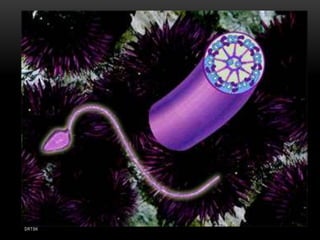
• Axial filament :
• A pair of central
fibrils
• 9 pairs of fibrils
arranged around the
central pair.
DRTSK
DRTSK
• Spermatazoon produced in the seminiferous
tubule are:
• Immature
• Non-motile
• Incapable of fertilizing an ovum
• These immature sperm are carried to the
epididymis
DRTSK
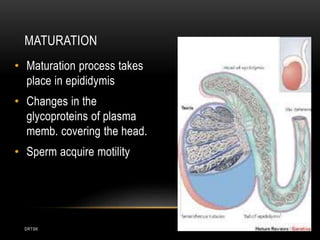
MATURATION
• Maturation process takes
place in epididymis
• Changes in the
glycoproteins of plasma
memb. covering the head.
• Sperm acquire motility
DRTSK
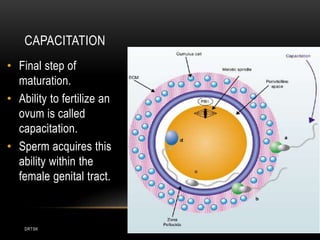
CAPACITATION
• Final step of
maturation.
• Ability to fertilize an
ovum is called
capacitation.
• Sperm acquires this
ability within the
female genital tract.
DRTSK
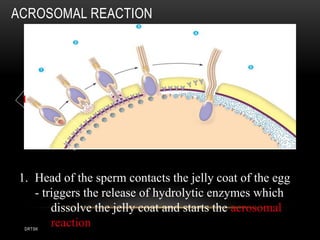
ACROSOMAL REACTION
1
2
3
4 5
6
1. Head of the sperm contacts the jelly coat of the egg
- triggers the release of hydrolytic enzymes which
dissolve the jelly coat and starts the acrosomal
reaction
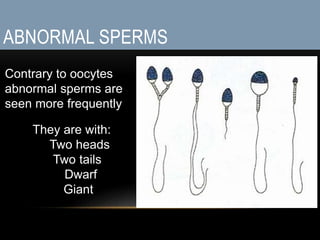
ABNORMAL SPERMS
They are with:
Two heads
Two tails
Dwarf
Giant
Contrary to oocytes
abnormal sperms are
seen more frequently
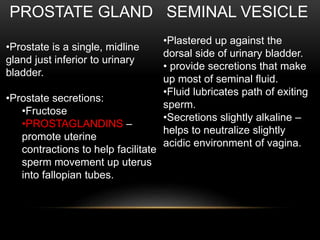
PROSTATE GLAND
•Prostate is a single, midline
gland just inferior to urinary
bladder.
•Prostate secretions:
•Fructose
•PROSTAGLANDINS –
promote uterine
contractions to help facilitate
sperm movement up uterus
into fallopian tubes.
SEMINAL VESICLE
•Plastered up against the
dorsal side of urinary bladder.
• provide secretions that make
up most of seminal fluid.
•Fluid lubricates path of exiting
sperm.
•Secretions slightly alkaline –
helps to neutralize slightly
acidic environment of vagina.
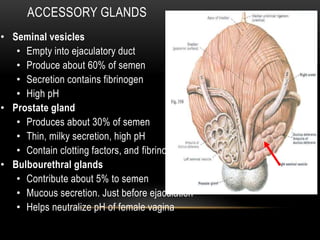
ACCESSORY GLANDS
• Seminal vesicles
• Empty into ejaculatory duct
• Produce about 60% of semen
• Secretion contains fibrinogen
• High pH
• Prostate gland
• Produces about 30% of semen
• Thin, milky secretion, high pH
• Contain clotting factors, and fibrinolysin
• Bulbourethral glands
• Contribute about 5% to semen
• Mucous secretion. Just before ejaculation
• Helps neutralize pH of female vagina
SEMEN OR SEMINAL FLUID
• 2-5 mL of fluid expelled, Mixture of sperm and seminal fluid
• 60% seminal vesicle fluid, 30% prostatic, 10% sperm
• normal sperm count 50-120 million/mL
• Provides transport medium, nutrients
components of semen
• fructose - energy for sperm motility
• fibrinogen causes clotting
• enzymes convert fibrinogen to fibrin
• fibrinolysin liquefies semen within 30 minutes
• prostaglandins stimulate female peristaltic contractions
• spermine is a base stabilizing sperm pH at 7.2 to 7.6
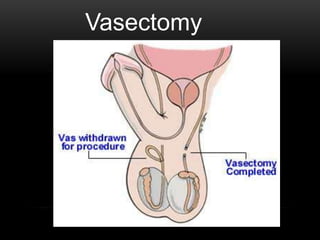
Vasectomy
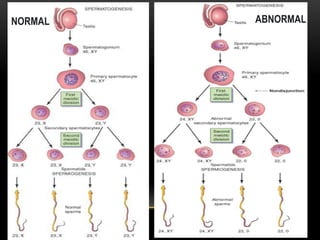
NORMAL ABNORMAL
DRTSK
POINTS TO REMEMBER
• Time taken for spermatogonia to convert into a
spermatozoa : 64 days.
• A single ejaculation usually contains: 200-300 million
sperms.
• Degeneration time of sperm:
• 48 hours after ejaculation

Spermatogenesis ppt presentation documentary

  • 1.
  • 2.
    MALE REPRODUCTIVE SYSTEM TESTES  EPIDIDYMIS  VAS DEFERENS  SEMINAL VESICLES  PROSTATE  BULBOURETHRAL GLANDS  URETHRA
  • 3.
  • 4.
    DRTSK SPERMATOGENESIS • Process offormation and maturation of spermatozoa from a spermatogonia. • Occurs in the walls of the seminiferous tubules of TESTIS.
  • 5.
  • 6.
    DRTSK  The primitivesex cells appear earliest in 4th week of intra uterine life in the wall of yolk sac as primordial germ cells  They migrate to the developing testes and lie dormant among the cells lining the seminiferous tubules  At puberty the germ cells awaken and start the actual process of spermatogenesis
  • 7.
    DRTSK SPERMATOGENESIS • ONSET: Beginsat the age of puberty • Continues through old age • Extra gonadal origin of primordial germ cells • STAGES: 5 stages 1. Spermatogonia multiplication 2. Growth 3. 1st Meiotic division 4. 2nd Meiotic division 5. Spermiogenesis
  • 8.
    DRTSK I. SPERMATOCYTOSIS • Germcells multiply by mitotic division to give a continuous supply of spermatogonia • Two types : • Type A spermatogonia • Type B spermatogonia
  • 9.
    DRTSK • Type A(dark): divides into Type A (dark) and Type A (pale). • Type A (pale): differentiates into Type B. • Type B: differentiates into primary spermatocyte.
  • 10.
    DRTSK II. GROWTH • TypeB spermatogonium enlarges several times to give rise to the primary spermatocyte
  • 11.
    DRTSK III. 1ST MEIOTICDIVISION (REDUCTION MEIOSIS) • Primary spermatocyte divides into secondary spermatocyte • Chromosome number reduces to half (46 to 23) • Haploid number of chromosomes
  • 12.
    DRTSK IV. 2ND MEIOTICDIVISION ( EQUATION MEIOSIS) • Secondary spermatocyte divides to form spermatids. • Reduction in size. No reduction in number of chromosomes. • Maintains haploid no. of chromosomes.
  • 13.
    DRTSK V. SPERMIOGENESIS (SPERMATELEOSIS) • Eachspermatid undergoes metamorphic changes to become a spermatozoon/ sperm.
  • 15.
  • 16.
    DRTSK CHANGES DURING SPERMIOGENESIS •Each spermatid possesses: • Golgi apparatus • A spherical nucleus • Two centrioles • Numerous mitochondria • Abundant cytoplasm
  • 17.
    DRTSK CHANGES DURING SPERMIOGENESIS 1.Golgi apparatus spreads over the ant. pole of nucleus, forms acrosomic cap. 2. Centrioles occupies the post. pole of nucleus, gives rise to axial filament/ flagellum
  • 18.
    DRTSK CHANGES DURING SPERMIOGENESIS 3.Mitochondria aggregates in the middle in a spiral manner, forms the mitochondrial sheath of middle piece. 4. Nucleus constitutes the head of sperm.
  • 19.
    DRTSK CHANGES DURING SPERMIOGENESIS 5.The spermatid elongates 6. Most of the cytoplasm extruded as residual bodies. 7. Cell membrane persists as covering of the sperm
  • 21.
  • 22.
    DRTSK STRUCTURE OF SPERM 1.HEAD 2. NECK 3. BODY/ MIDDLE PIECE 4. TAIL/ PRINCIPAL PIECE
  • 23.
    DRTSK HEAD • Contains thenucleus with 23 chromosomes (haploid) • Ovoid shape • Overlapped by acrosomal cap • Entire head enveloped by cell membrane
  • 24.
    DRTSK NECK • Narrow. • Hasa funnel shaped basal body (connecting piece) • Contains the centriole.
  • 25.
    DRTSK BODY (MIDDLE PIECE) •Long, cylindrical • Consists of axial filament in the centre, surrounded by mitochondrial sheath • A ring centriole (annulus) situated at the junction of body and tail.
  • 26.
    DRTSK TAIL (PRINCIPAL PIECE) •Long, flagellum-like • Axial filament continues from the body into the tail. • Surrounded by a fibrous sheath. • Terminal portion where fibrous sheath is absent – end piece.
  • 27.
    DRTSK • Axial filament: • A pair of central fibrils • 9 pairs of fibrils arranged around the central pair.
  • 28.
  • 29.
    DRTSK • Spermatazoon producedin the seminiferous tubule are: • Immature • Non-motile • Incapable of fertilizing an ovum • These immature sperm are carried to the epididymis
  • 30.
    DRTSK MATURATION • Maturation processtakes place in epididymis • Changes in the glycoproteins of plasma memb. covering the head. • Sperm acquire motility
  • 31.
    DRTSK CAPACITATION • Final stepof maturation. • Ability to fertilize an ovum is called capacitation. • Sperm acquires this ability within the female genital tract.
  • 32.
    DRTSK ACROSOMAL REACTION 1 2 3 4 5 6 1.Head of the sperm contacts the jelly coat of the egg - triggers the release of hydrolytic enzymes which dissolve the jelly coat and starts the acrosomal reaction
  • 33.
    ABNORMAL SPERMS They arewith: Two heads Two tails Dwarf Giant Contrary to oocytes abnormal sperms are seen more frequently
  • 34.
    PROSTATE GLAND •Prostate isa single, midline gland just inferior to urinary bladder. •Prostate secretions: •Fructose •PROSTAGLANDINS – promote uterine contractions to help facilitate sperm movement up uterus into fallopian tubes. SEMINAL VESICLE •Plastered up against the dorsal side of urinary bladder. • provide secretions that make up most of seminal fluid. •Fluid lubricates path of exiting sperm. •Secretions slightly alkaline – helps to neutralize slightly acidic environment of vagina.
  • 35.
    ACCESSORY GLANDS • Seminalvesicles • Empty into ejaculatory duct • Produce about 60% of semen • Secretion contains fibrinogen • High pH • Prostate gland • Produces about 30% of semen • Thin, milky secretion, high pH • Contain clotting factors, and fibrinolysin • Bulbourethral glands • Contribute about 5% to semen • Mucous secretion. Just before ejaculation • Helps neutralize pH of female vagina
  • 36.
    SEMEN OR SEMINALFLUID • 2-5 mL of fluid expelled, Mixture of sperm and seminal fluid • 60% seminal vesicle fluid, 30% prostatic, 10% sperm • normal sperm count 50-120 million/mL • Provides transport medium, nutrients components of semen • fructose - energy for sperm motility • fibrinogen causes clotting • enzymes convert fibrinogen to fibrin • fibrinolysin liquefies semen within 30 minutes • prostaglandins stimulate female peristaltic contractions • spermine is a base stabilizing sperm pH at 7.2 to 7.6
  • 37.
  • 38.
  • 39.
    DRTSK POINTS TO REMEMBER •Time taken for spermatogonia to convert into a spermatozoa : 64 days. • A single ejaculation usually contains: 200-300 million sperms. • Degeneration time of sperm: • 48 hours after ejaculation