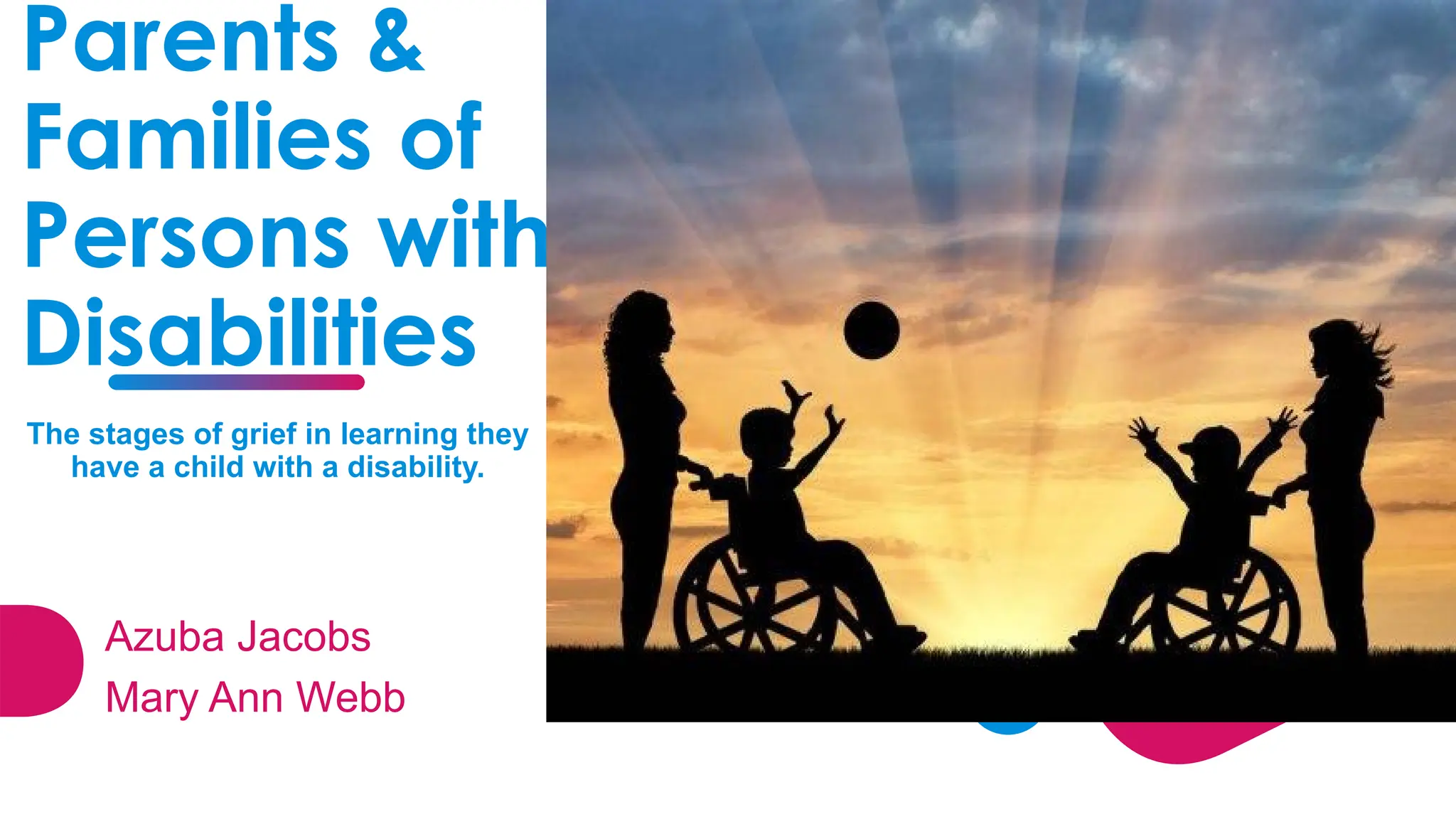
Parents &
Families of
Persons with
Disabilities
The stages of grief in learning they
have a child with a disability.
Azuba Jacobs
Mary Ann Webb
OBJECTIVES
AT THE END OF THIS PRESENTATION
YOU WILL LEARN ABOUT:
1. Experience of families with disabled persons.
2. Stages of grief for parents of students with
disabilities
3. Responsibilities of parents with children with
disabilities
4. How can teachers support parents of students
with disabilities
ADD A FOOTER 2
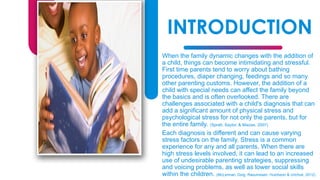
INTRODUCTION
When the family dynamic changes with the addition of
a child, things can become intimidating and stressful.
First time parents tend to worry about bathing
procedures, diaper changing, feedings and so many
other parenting customs. However, the addition of a
child with special needs can affect the family beyond
the basics and is often overlooked. There are
challenges associated with a child's diagnosis that can
add a significant amount of physical stress and
psychological stress for not only the parents, but for
the entire family. (Spratt, Saylor, & Macias, 2007)
Each diagnosis is different and can cause varying
stress factors on the family. Stress is a common
experience for any and all parents. When there are
high stress levels involved, it can lead to an increased
use of undesirable parenting strategies, suppressing
and voicing problems, as well as lower social skills
within the children. (McLennan, Doig, Rasumssen, Hutcheon & Urichuk, 2012).
3
EXPERIENCES OF DISABLED PEOPLE FAMILY
DO YOU HAVE A DISABLED PERSON IN YOUR FAMILY?
WHAT IS LIKE FROM TIME TO TIME?
4
EXPERIENCES
Families are a critical
source of support for
children with disabilities.
Family members absorb the
added demands on time,
emotional resources, and
financial resources that are
associated with having a
child with a disability.
(Baker- Ericzen et al, 2005)
5
EXPERIENCES
While parents are the most
common type of caregivers
for young children with
disabilities, there are a
growing number of
grandparents who are
providing custodial care. Yet,
rewards from having a family
member with a disability, such
as personal and spiritual
growth is quite evident.
6
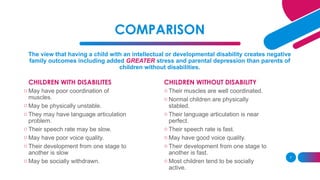
COMPARISON
The view that having a child with an intellectual or developmental disability creates negative
family outcomes including added GREATER stress and parental depression than parents of
children without disabilities.
CHILDREN WITH DISABILITES
o May have poor coordination of
muscles.
o May be physically unstable.
o They may have language articulation
problem.
o Their speech rate may be slow.
o May have poor voice quality.
o Their development from one stage to
another is slow
o May be socially withdrawn.
CHILDREN WITHOUT DISABILITY
o Their muscles are well coordinated.
o Normal children are physically
stabled.
o Their language articulation is near
perfect.
o Their speech rate is fast.
o May have good voice quality.
o Their development from one stage to
another is fast.
o Most children tend to be socially
active.
7
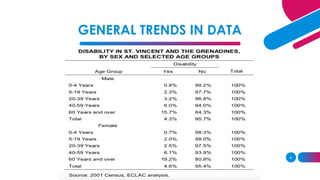
GENERAL TRENDS IN DATA
8
GENERAL TRENDS IN DATA
The trends regarding the prevalence of disability found in
the census data for St. Vincent and the Grenadines 2001
were similar to those found for Antigua and Barbuda and
Saint Lucia. A little less than 5 per cent of the total
population reported suffering from a disability with slightly
higher prevalence rates for women than for men. Also, the
earlier observed positive correlation between age and
disability prevalence is reflected in this data set with the
highest prevalence rates observed in the age group 60 years
and over. And, again, older women are over-proportionally
affected by these ailments. 9
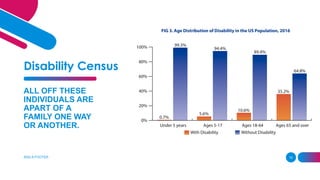
Disability Census
ADD A FOOTER 10
ALL OFF THESE
INDIVIDUALS ARE
APART OF A
FAMILY ONE WAY
OR ANOTHER.
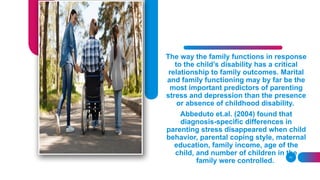
The way the family functions in response
to the child’s disability has a critical
relationship to family outcomes. Marital
and family functioning may by far be the
most important predictors of parenting
stress and depression than the presence
or absence of childhood disability.
Abbeduto et.al. (2004) found that
diagnosis-specific differences in
parenting stress disappeared when child
behavior, parental coping style, maternal
education, family income, age of the
child, and number of children in the
family were controlled.
11
“Parents generate core level dreams for their children even before the child is
born. Disability shatters those dreams. Grieving is the process whereby
parents separate from those shattered dreams and begin creating new
dreams.”—Dr. Ken Moses
12
13
The grieving process you may experience when your child is diagnosed
is different from the grief you feel when someone close to you dies:
✔It’s an unlearned and automatic process. No one has to tell you to
“feel.” You feel the way you do no matter what anyone else says
✔It must be shared with a significant other. The more couples can
communicate at difficult times like these, the greater their collective
strength
✔Grieving is not always accepted by our society or sometimes even by
the grieving person. Sometimes tears make people uncomfortable
✔Grieving brings out the “feeling states” of denial, anxiety, fear, guilt,
depression and/or anger
STAGES OF GRIEF IN LEARNING THEY
HAVE A CHILD WITH A DISABILITY
STAGES OF GRIEF
14
FEAR
GUILT
DEPRESSION AND ANXIETY
DENIAL AND ANGER
STAGES OF GRIEF: FEAR
STAGE 1 OF 4 15
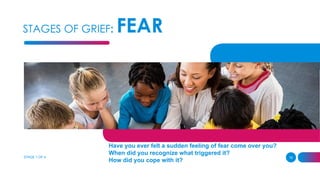
Have you ever felt a sudden feeling of fear come over you?
When did you recognize what triggered it?
How did you cope with it?
16
FEAR
Recognizing it—Fear brings out the issue of fight or flight. The flight takes you into
denial and the fight gives you the energy to reattach and generate new dreams.
We fear the unknown more than we fear the known.
Having the complete diagnosis and some knowledge of the child’s future prospects
can be easier than uncertainty. In either case, however, fear of the future is a
common emotion. You may ask yourself questions like, “Will he ever learn?” “Will
he go to college?” “Will he or she have the capability of loving and living and
laughing?”
RECOGNIZE IT – COPE WITH IT
17
FEAR
Coping with it—Fears of the future can immobilize you.
Living with the reality of the day at hand is more manageable
if parents throw out the “what-ifs” and the “then-what's” of
the future. Even though it may not seem possible, good
things will continue to happen each day. Worrying about the
future will only deplete their limited resources. Parents have
enough to focus on.
RECOGNIZE IT – COPE WITH IT
18
CEREBRAL
PALSY
A group of
disorders that
affect a person’s
ability to move or
maintain balance
and posture.
STAGES OF GRIEF: GUILT
STAGE 2 OF 4 19
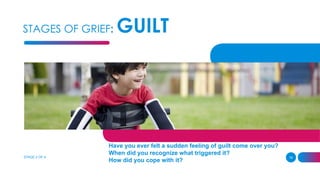
Have you ever felt a sudden feeling of guilt come over you?
When did you recognize what triggered it?
How did you cope with it?
20
GUILT
Recognizing it—Guilt and concern often come in the form of questions
about whether you, the parents, caused the problem:
“Did I do something to cause this?”
“Am I being punished for something I have done?”
“Did I take care of myself when I was pregnant?”
“Did my wife take good enough care of herself when she was pregnant?”
A lot of self-criticism and remorse comes from questioning the causes of
the disability.
“Why me?” or “Why my child?”
RECOGNIZE IT – COPE WITH IT
21
GUILT
Coping with it—Talk about the guilt feelings and
don’t be afraid to confront your beliefs about
what caused your child to have a disability.
Recognize that your beliefs have no effect on
what happened in the past, or what may happen
in the future. Parents may come to realize that
their actions were not the cause of their child’s
disability and this will help them move forward.
RECOGNIZE IT – COPE WITH IT
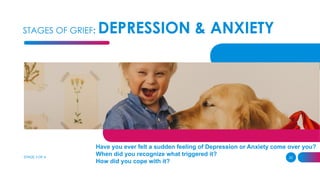
STAGES OF GRIEF: DEPRESSION & ANXIETY
STAGE 3 OF 4 22
Have you ever felt a sudden feeling of Depression or Anxiety come over you?
When did you recognize what triggered it?
How did you cope with it?
23
DEPRESSION AND ANXIETY
Recognizing depression—Depression can
make you question whether you are a
competent, capable, valuable, and strong
person. It is a part of the grieving
process. The feeling of sadness and
isolation at the time of diagnosis is almost
universal among parents.
RECOGNIZE IT – COPE WITH IT
24
DEPRESSION AND ANXIETY
Coping with depression and anxiety—It can
help to know that what you are feeling has
been experienced by many, many others. You
are not abnormal, and you are not “broken.”
Parent can start to calm their depression and
anxiety through the support of other parents
who know what they are going through.
RECOGNIZE IT – COPE WITH IT
STAGES OF GRIEF: DENIAL & ANGER
STAGE 4 OF 4 25
Have you ever felt a sudden feeling of Denial or Anger come over you?
When did you recognize what triggered it?
How did you cope with it?
26
DENIAL AND ANGER
Recognizing denial and anger—On learning that their child
may have a disability, most parents react with denial. “This
cannot be happening to me, to my child, to our family.”
Denial rapidly merges with anger, which may be directed
toward the medical personnel who give you the information
about your child’s problem.
Anger can also hurt communication between partners or
with grandparents and extended family members. Early on,
anger may be very intense because it is triggered by the
feelings of grief and terrible loss.
RECOGNIZE IT – COPE WITH IT
27
DENIAL AND ANGER
Coping with denial and anger—Feelings of denial and anger are
inevitable and to be expected when you realize that you must revise
the hopes and dreams you had for your child. Recognizing your
denial and anger is a valuable first step in learning how to let go of
them. You may need outside help to do this. If getting support from
other parents is not enough, consider talking to a professional.
It may not feel like it, but life will get better and the day will come
when you will feel positive again. By acknowledging and working
through your negative feelings, you will be better equipped to meet
new challenges, and bitterness and anger will no longer drain your
energies and initiative.
RECOGNIZE IT – COPE WITH IT
28
SACRAL AGENESIS
Sacral Agenesis is a congenital
condition associated with caudal
regression syndrome characterized
by the partial or complete absence
of sacrum and lower lumbar spine.
After losing both legs from the
pelvis down at the age of five due
to a genetic disease, Spencer West
tackled challenge after challenge,
learning to navigate a world set
against those with disabilities.
Spencer West is a Content Creator,
Motivational Speaker and Author.
29
The saying goes, having kids will not only be the most
challenging thing you’ll do in life, but also the most rewarding.
Parents take on a tremendous responsibility for their child’s well-
being. Everything they do and say helps to shape or hinder their
child’s development and personality. The job becomes even more
challenging when they have a child with special needs.
A parent’s role is ever-changing where every day is a new day
with a new set of challenges, and a new set of praises as well.
Parents have to give love, support, and guidance to their loved
ones through the easy and tough situations throughout their
lives. But parents are amazing and with a little help, they can do it
and be an excellent parent for their child.
RESPONSIBILITIES OF PARENTS WITH
CHILDREN WITH DISABILITIES
30
RESPONSIBILITIES
OF PARENTS WITH
CHILDREN WITH
DISABILITIES
Learn More about Your
Child’s Needs
Knowing the specific needs of
your child makes taking care
of them a little easier. The
more you know about their
needs, the better you can
prepare to help your child.
Learning about various autism
and disability needs will also
broaden your perspective.
(Stepheny n.d.)
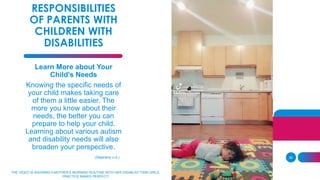
THE VIDEO IS SHOWING A MOTHER’S MORNING ROUTINE WITH HER DISABLED TWIN GIRLS.
PRACTICE MAKES PERFECT!
31
RESPONSIBILITIES
OF PARENTS WITH
CHILDREN WITH
DISABILITIES
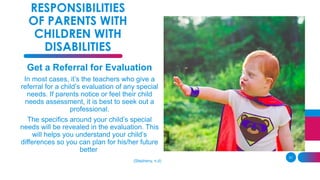
Get a Referral for Evaluation
In most cases, it’s the teachers who give a
referral for a child’s evaluation of any special
needs. If parents notice or feel their child
needs assessment, it is best to seek out a
professional.
The specifics around your child’s special
needs will be revealed in the evaluation. This
will helps you understand your child’s
differences so you can plan for his/her future
better
(Stepheny, n.d)
32
RESPONSIBILITIES OF
PARENTS WITH
CHILDREN WITH
DISABILITIES
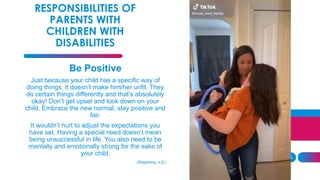
Be Positive
Just because your child has a specific way of
doing things, it doesn’t make him/her unfit. They
do certain things differently and that’s absolutely
okay! Don’t get upset and look down on your
child. Embrace the new normal, stay positive and
fair.
It wouldn’t hurt to adjust the expectations you
have set. Having a special need doesn’t mean
being unsuccessful in life. You also need to be
mentally and emotionally strong for the sake of
your child.
(Stepheny, n.d.)
33
RESPONSIBILITIES
OF PARENTS WITH
CHILDREN WITH
DISABILITIES
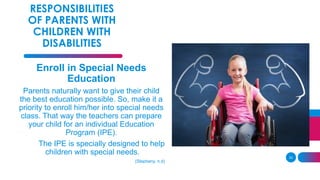
Enroll in Special Needs
Education
Parents naturally want to give their child
the best education possible. So, make it a
priority to enroll him/her into special needs
class. That way the teachers can prepare
your child for an individual Education
Program (IPE).
The IPE is specially designed to help
children with special needs.
(Stepheny, n.d)
34
RESPONSIBILITIES
OF PARENTS WITH
CHILDREN WITH
DISABILITIES
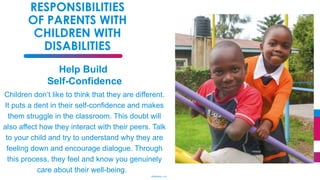
Help Build
Self-Confidence
Children don’t like to think that they are different.
It puts a dent in their self-confidence and makes
them struggle in the classroom. This doubt will
also affect how they interact with their peers. Talk
to your child and try to understand why they are
feeling down and encourage dialogue. Through
this process, they feel and know you genuinely
care about their well-being.
(Stepheny, n.d)
35
RESPONSIBILITIES
OF PARENTS WITH
CHILDREN WITH
DISABILITIES
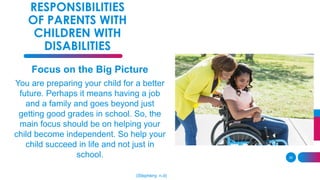
Focus on the Big Picture
You are preparing your child for a better
future. Perhaps it means having a job
and a family and goes beyond just
getting good grades in school. So, the
main focus should be on helping your
child become independent. So help your
child succeed in life and not just in
school.
(Stepheny, n.d)
36
RESPONSIBILITIES
OF PARENTS WITH
CHILDREN WITH
DISABILITIES
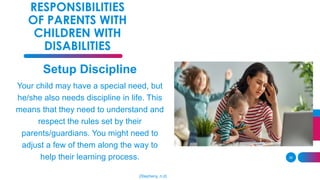
Setup Discipline
Your child may have a special need, but
he/she also needs discipline in life. This
means that they need to understand and
respect the rules set by their
parents/guardians. You might need to
adjust a few of them along the way to
help their learning process.
(Stepheny, n.d)
37
RESPONSIBILITIES
OF PARENTS WITH
CHILDREN WITH
DISABILITIES
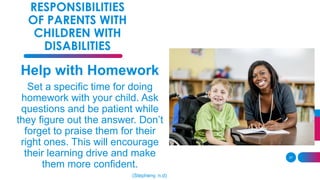
Help with Homework
Set a specific time for doing
homework with your child. Ask
questions and be patient while
they figure out the answer. Don’t
forget to praise them for their
right ones. This will encourage
their learning drive and make
them more confident.
(Stepheny, n.d)
38
RESPONSIBILITIES
OF PARENTS WITH
CHILDREN WITH
DISABILITIES
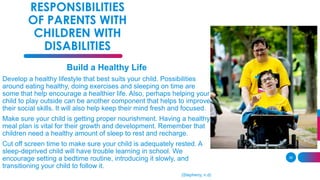
Build a Healthy Life
Develop a healthy lifestyle that best suits your child. Possibilities
around eating healthy, doing exercises and sleeping on time are
some that help encourage a healthier life. Also, perhaps helping your
child to play outside can be another component that helps to improve
their social skills. It will also help keep their mind fresh and focused.
Make sure your child is getting proper nourishment. Having a healthy
meal plan is vital for their growth and development. Remember that
children need a healthy amount of sleep to rest and recharge.
Cut off screen time to make sure your child is adequately rested. A
sleep-deprived child will have trouble learning in school. We
encourage setting a bedtime routine, introducing it slowly, and
transitioning your child to follow it.
(Stepheny, n.d)
HOW CAN TEACHERS SUPPORT PARENTS
OF STUDENTS WITH DISABILITIES
39
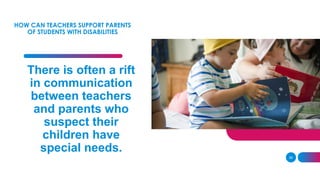
There is often a rift
in communication
between teachers
and parents who
suspect their
children have
special needs.
40
HOW CAN TEACHERS
SUPPORT PARENTS OF
STUDENTS WITH
DISABILITIES
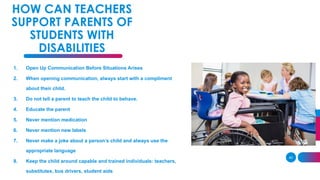
1. Open Up Communication Before Situations Arises
2. When opening communication, always start with a compliment
about their child.
3. Do not tell a parent to teach the child to behave.
4. Educate the parent
5. Never mention medication
6. Never mention new labels
7. Never make a joke about a person’s child and always use the
appropriate language
8. Keep the child around capable and trained individuals: teachers,
substitutes, bus drivers, student aids
41
VIDEO SHOWING CELEBRITIES WITH DISABILITIES
42
THANK YOU!
What can you walk away
with from our presentation?
Stevland Hardaway Morris (born May 13, 1950),
known professionally as Stevie Wonder, is an
American singer, songwriter, musician and record
producer.
Did you know the famous Stevie Wonder is
blind?
REFERENCES
44
The 2017 Disability Statistics Annual Report. (n.d.). Retrieved from
https://disabilitycompendium.org/sites/default/files/user-uploads/2017_AnnualReport_2017_FINAL.pdf
Families of Children with Special Needs. (n.d.). Retrieved from https://uk.sagepub.com/sites/default/files/upm-binaries/11286_Sample.pdf
Gray, E. L. (2021, September 29). First steps when a child has special needs. Retrieved from
https://www.specialneedsalliance.org/blog/first-steps-when-a-child-has-special-needs/
Hartman, R. (2016, April 26). 8 tips for working with parents of special needs children. Retrieved from
https://blog.reallygoodstuff.com/8-tips-for-teachers-for-working-with-parents-of-special-needs-children/
The immune system in Down's syndrome. (n.d.). Retrieved from
https://www.intellectualdisability.info/physical-health/articles/the-immune-system-in-downs-syndrome
A parent’s role in the development of a child with special needs. (2019, March 14). Retrieved from
https://www.bhwcares.com/parents-role-child-with-special-needs/
Supporting parents of students with special needs. (2018, June 21). Retrieved from
https://www.edutopia.org/article/supporting-parents-students-special-needs
Understanding the stages of grief. (n.d.). Retrieved from https://www.parentcompanion.org/article/understanding-the-stages-of-grief

SPECIAL NEEDS power point on Griefing .pptx

  • 1.
    Parents & Families of Personswith Disabilities The stages of grief in learning they have a child with a disability. Azuba Jacobs Mary Ann Webb
  • 2.
    OBJECTIVES AT THE ENDOF THIS PRESENTATION YOU WILL LEARN ABOUT: 1. Experience of families with disabled persons. 2. Stages of grief for parents of students with disabilities 3. Responsibilities of parents with children with disabilities 4. How can teachers support parents of students with disabilities ADD A FOOTER 2
  • 3.
    INTRODUCTION When the familydynamic changes with the addition of a child, things can become intimidating and stressful. First time parents tend to worry about bathing procedures, diaper changing, feedings and so many other parenting customs. However, the addition of a child with special needs can affect the family beyond the basics and is often overlooked. There are challenges associated with a child's diagnosis that can add a significant amount of physical stress and psychological stress for not only the parents, but for the entire family. (Spratt, Saylor, & Macias, 2007) Each diagnosis is different and can cause varying stress factors on the family. Stress is a common experience for any and all parents. When there are high stress levels involved, it can lead to an increased use of undesirable parenting strategies, suppressing and voicing problems, as well as lower social skills within the children. (McLennan, Doig, Rasumssen, Hutcheon & Urichuk, 2012). 3
  • 4.
    EXPERIENCES OF DISABLEDPEOPLE FAMILY DO YOU HAVE A DISABLED PERSON IN YOUR FAMILY? WHAT IS LIKE FROM TIME TO TIME? 4
  • 5.
    EXPERIENCES Families are acritical source of support for children with disabilities. Family members absorb the added demands on time, emotional resources, and financial resources that are associated with having a child with a disability. (Baker- Ericzen et al, 2005) 5
  • 6.
    EXPERIENCES While parents arethe most common type of caregivers for young children with disabilities, there are a growing number of grandparents who are providing custodial care. Yet, rewards from having a family member with a disability, such as personal and spiritual growth is quite evident. 6
  • 7.
    COMPARISON The view thathaving a child with an intellectual or developmental disability creates negative family outcomes including added GREATER stress and parental depression than parents of children without disabilities. CHILDREN WITH DISABILITES o May have poor coordination of muscles. o May be physically unstable. o They may have language articulation problem. o Their speech rate may be slow. o May have poor voice quality. o Their development from one stage to another is slow o May be socially withdrawn. CHILDREN WITHOUT DISABILITY o Their muscles are well coordinated. o Normal children are physically stabled. o Their language articulation is near perfect. o Their speech rate is fast. o May have good voice quality. o Their development from one stage to another is fast. o Most children tend to be socially active. 7
  • 8.
  • 9.
    GENERAL TRENDS INDATA The trends regarding the prevalence of disability found in the census data for St. Vincent and the Grenadines 2001 were similar to those found for Antigua and Barbuda and Saint Lucia. A little less than 5 per cent of the total population reported suffering from a disability with slightly higher prevalence rates for women than for men. Also, the earlier observed positive correlation between age and disability prevalence is reflected in this data set with the highest prevalence rates observed in the age group 60 years and over. And, again, older women are over-proportionally affected by these ailments. 9
  • 10.
    Disability Census ADD AFOOTER 10 ALL OFF THESE INDIVIDUALS ARE APART OF A FAMILY ONE WAY OR ANOTHER.
  • 11.
    The way thefamily functions in response to the child’s disability has a critical relationship to family outcomes. Marital and family functioning may by far be the most important predictors of parenting stress and depression than the presence or absence of childhood disability. Abbeduto et.al. (2004) found that diagnosis-specific differences in parenting stress disappeared when child behavior, parental coping style, maternal education, family income, age of the child, and number of children in the family were controlled. 11
  • 12.
    “Parents generate corelevel dreams for their children even before the child is born. Disability shatters those dreams. Grieving is the process whereby parents separate from those shattered dreams and begin creating new dreams.”—Dr. Ken Moses 12
  • 13.
    13 The grieving processyou may experience when your child is diagnosed is different from the grief you feel when someone close to you dies: ✔It’s an unlearned and automatic process. No one has to tell you to “feel.” You feel the way you do no matter what anyone else says ✔It must be shared with a significant other. The more couples can communicate at difficult times like these, the greater their collective strength ✔Grieving is not always accepted by our society or sometimes even by the grieving person. Sometimes tears make people uncomfortable ✔Grieving brings out the “feeling states” of denial, anxiety, fear, guilt, depression and/or anger STAGES OF GRIEF IN LEARNING THEY HAVE A CHILD WITH A DISABILITY
  • 14.
    STAGES OF GRIEF 14 FEAR GUILT DEPRESSIONAND ANXIETY DENIAL AND ANGER
  • 15.
    STAGES OF GRIEF:FEAR STAGE 1 OF 4 15 Have you ever felt a sudden feeling of fear come over you? When did you recognize what triggered it? How did you cope with it?
  • 16.
    16 FEAR Recognizing it—Fear bringsout the issue of fight or flight. The flight takes you into denial and the fight gives you the energy to reattach and generate new dreams. We fear the unknown more than we fear the known. Having the complete diagnosis and some knowledge of the child’s future prospects can be easier than uncertainty. In either case, however, fear of the future is a common emotion. You may ask yourself questions like, “Will he ever learn?” “Will he go to college?” “Will he or she have the capability of loving and living and laughing?” RECOGNIZE IT – COPE WITH IT
  • 17.
    17 FEAR Coping with it—Fearsof the future can immobilize you. Living with the reality of the day at hand is more manageable if parents throw out the “what-ifs” and the “then-what's” of the future. Even though it may not seem possible, good things will continue to happen each day. Worrying about the future will only deplete their limited resources. Parents have enough to focus on. RECOGNIZE IT – COPE WITH IT
  • 18.
    18 CEREBRAL PALSY A group of disordersthat affect a person’s ability to move or maintain balance and posture.
  • 19.
    STAGES OF GRIEF:GUILT STAGE 2 OF 4 19 Have you ever felt a sudden feeling of guilt come over you? When did you recognize what triggered it? How did you cope with it?
  • 20.
    20 GUILT Recognizing it—Guilt andconcern often come in the form of questions about whether you, the parents, caused the problem: “Did I do something to cause this?” “Am I being punished for something I have done?” “Did I take care of myself when I was pregnant?” “Did my wife take good enough care of herself when she was pregnant?” A lot of self-criticism and remorse comes from questioning the causes of the disability. “Why me?” or “Why my child?” RECOGNIZE IT – COPE WITH IT
  • 21.
    21 GUILT Coping with it—Talkabout the guilt feelings and don’t be afraid to confront your beliefs about what caused your child to have a disability. Recognize that your beliefs have no effect on what happened in the past, or what may happen in the future. Parents may come to realize that their actions were not the cause of their child’s disability and this will help them move forward. RECOGNIZE IT – COPE WITH IT
  • 22.
    STAGES OF GRIEF:DEPRESSION & ANXIETY STAGE 3 OF 4 22 Have you ever felt a sudden feeling of Depression or Anxiety come over you? When did you recognize what triggered it? How did you cope with it?
  • 23.
    23 DEPRESSION AND ANXIETY Recognizingdepression—Depression can make you question whether you are a competent, capable, valuable, and strong person. It is a part of the grieving process. The feeling of sadness and isolation at the time of diagnosis is almost universal among parents. RECOGNIZE IT – COPE WITH IT
  • 24.
    24 DEPRESSION AND ANXIETY Copingwith depression and anxiety—It can help to know that what you are feeling has been experienced by many, many others. You are not abnormal, and you are not “broken.” Parent can start to calm their depression and anxiety through the support of other parents who know what they are going through. RECOGNIZE IT – COPE WITH IT
  • 25.
    STAGES OF GRIEF:DENIAL & ANGER STAGE 4 OF 4 25 Have you ever felt a sudden feeling of Denial or Anger come over you? When did you recognize what triggered it? How did you cope with it?
  • 26.
    26 DENIAL AND ANGER Recognizingdenial and anger—On learning that their child may have a disability, most parents react with denial. “This cannot be happening to me, to my child, to our family.” Denial rapidly merges with anger, which may be directed toward the medical personnel who give you the information about your child’s problem. Anger can also hurt communication between partners or with grandparents and extended family members. Early on, anger may be very intense because it is triggered by the feelings of grief and terrible loss. RECOGNIZE IT – COPE WITH IT
  • 27.
    27 DENIAL AND ANGER Copingwith denial and anger—Feelings of denial and anger are inevitable and to be expected when you realize that you must revise the hopes and dreams you had for your child. Recognizing your denial and anger is a valuable first step in learning how to let go of them. You may need outside help to do this. If getting support from other parents is not enough, consider talking to a professional. It may not feel like it, but life will get better and the day will come when you will feel positive again. By acknowledging and working through your negative feelings, you will be better equipped to meet new challenges, and bitterness and anger will no longer drain your energies and initiative. RECOGNIZE IT – COPE WITH IT
  • 28.
    28 SACRAL AGENESIS Sacral Agenesisis a congenital condition associated with caudal regression syndrome characterized by the partial or complete absence of sacrum and lower lumbar spine. After losing both legs from the pelvis down at the age of five due to a genetic disease, Spencer West tackled challenge after challenge, learning to navigate a world set against those with disabilities. Spencer West is a Content Creator, Motivational Speaker and Author.
  • 29.
    29 The saying goes,having kids will not only be the most challenging thing you’ll do in life, but also the most rewarding. Parents take on a tremendous responsibility for their child’s well- being. Everything they do and say helps to shape or hinder their child’s development and personality. The job becomes even more challenging when they have a child with special needs. A parent’s role is ever-changing where every day is a new day with a new set of challenges, and a new set of praises as well. Parents have to give love, support, and guidance to their loved ones through the easy and tough situations throughout their lives. But parents are amazing and with a little help, they can do it and be an excellent parent for their child. RESPONSIBILITIES OF PARENTS WITH CHILDREN WITH DISABILITIES
  • 30.
    30 RESPONSIBILITIES OF PARENTS WITH CHILDRENWITH DISABILITIES Learn More about Your Child’s Needs Knowing the specific needs of your child makes taking care of them a little easier. The more you know about their needs, the better you can prepare to help your child. Learning about various autism and disability needs will also broaden your perspective. (Stepheny n.d.) THE VIDEO IS SHOWING A MOTHER’S MORNING ROUTINE WITH HER DISABLED TWIN GIRLS. PRACTICE MAKES PERFECT!
  • 31.
    31 RESPONSIBILITIES OF PARENTS WITH CHILDRENWITH DISABILITIES Get a Referral for Evaluation In most cases, it’s the teachers who give a referral for a child’s evaluation of any special needs. If parents notice or feel their child needs assessment, it is best to seek out a professional. The specifics around your child’s special needs will be revealed in the evaluation. This will helps you understand your child’s differences so you can plan for his/her future better (Stepheny, n.d)
  • 32.
    32 RESPONSIBILITIES OF PARENTS WITH CHILDRENWITH DISABILITIES Be Positive Just because your child has a specific way of doing things, it doesn’t make him/her unfit. They do certain things differently and that’s absolutely okay! Don’t get upset and look down on your child. Embrace the new normal, stay positive and fair. It wouldn’t hurt to adjust the expectations you have set. Having a special need doesn’t mean being unsuccessful in life. You also need to be mentally and emotionally strong for the sake of your child. (Stepheny, n.d.)
  • 33.
    33 RESPONSIBILITIES OF PARENTS WITH CHILDRENWITH DISABILITIES Enroll in Special Needs Education Parents naturally want to give their child the best education possible. So, make it a priority to enroll him/her into special needs class. That way the teachers can prepare your child for an individual Education Program (IPE). The IPE is specially designed to help children with special needs. (Stepheny, n.d)
  • 34.
    34 RESPONSIBILITIES OF PARENTS WITH CHILDRENWITH DISABILITIES Help Build Self-Confidence Children don’t like to think that they are different. It puts a dent in their self-confidence and makes them struggle in the classroom. This doubt will also affect how they interact with their peers. Talk to your child and try to understand why they are feeling down and encourage dialogue. Through this process, they feel and know you genuinely care about their well-being. (Stepheny, n.d)
  • 35.
    35 RESPONSIBILITIES OF PARENTS WITH CHILDRENWITH DISABILITIES Focus on the Big Picture You are preparing your child for a better future. Perhaps it means having a job and a family and goes beyond just getting good grades in school. So, the main focus should be on helping your child become independent. So help your child succeed in life and not just in school. (Stepheny, n.d)
  • 36.
    36 RESPONSIBILITIES OF PARENTS WITH CHILDRENWITH DISABILITIES Setup Discipline Your child may have a special need, but he/she also needs discipline in life. This means that they need to understand and respect the rules set by their parents/guardians. You might need to adjust a few of them along the way to help their learning process. (Stepheny, n.d)
  • 37.
    37 RESPONSIBILITIES OF PARENTS WITH CHILDRENWITH DISABILITIES Help with Homework Set a specific time for doing homework with your child. Ask questions and be patient while they figure out the answer. Don’t forget to praise them for their right ones. This will encourage their learning drive and make them more confident. (Stepheny, n.d)
  • 38.
    38 RESPONSIBILITIES OF PARENTS WITH CHILDRENWITH DISABILITIES Build a Healthy Life Develop a healthy lifestyle that best suits your child. Possibilities around eating healthy, doing exercises and sleeping on time are some that help encourage a healthier life. Also, perhaps helping your child to play outside can be another component that helps to improve their social skills. It will also help keep their mind fresh and focused. Make sure your child is getting proper nourishment. Having a healthy meal plan is vital for their growth and development. Remember that children need a healthy amount of sleep to rest and recharge. Cut off screen time to make sure your child is adequately rested. A sleep-deprived child will have trouble learning in school. We encourage setting a bedtime routine, introducing it slowly, and transitioning your child to follow it. (Stepheny, n.d)
  • 39.
    HOW CAN TEACHERSSUPPORT PARENTS OF STUDENTS WITH DISABILITIES 39 There is often a rift in communication between teachers and parents who suspect their children have special needs.
  • 40.
    40 HOW CAN TEACHERS SUPPORTPARENTS OF STUDENTS WITH DISABILITIES 1. Open Up Communication Before Situations Arises 2. When opening communication, always start with a compliment about their child. 3. Do not tell a parent to teach the child to behave. 4. Educate the parent 5. Never mention medication 6. Never mention new labels 7. Never make a joke about a person’s child and always use the appropriate language 8. Keep the child around capable and trained individuals: teachers, substitutes, bus drivers, student aids
  • 41.
  • 42.
  • 43.
    THANK YOU! What canyou walk away with from our presentation? Stevland Hardaway Morris (born May 13, 1950), known professionally as Stevie Wonder, is an American singer, songwriter, musician and record producer. Did you know the famous Stevie Wonder is blind?
  • 44.
    REFERENCES 44 The 2017 DisabilityStatistics Annual Report. (n.d.). Retrieved from https://disabilitycompendium.org/sites/default/files/user-uploads/2017_AnnualReport_2017_FINAL.pdf Families of Children with Special Needs. (n.d.). Retrieved from https://uk.sagepub.com/sites/default/files/upm-binaries/11286_Sample.pdf Gray, E. L. (2021, September 29). First steps when a child has special needs. Retrieved from https://www.specialneedsalliance.org/blog/first-steps-when-a-child-has-special-needs/ Hartman, R. (2016, April 26). 8 tips for working with parents of special needs children. Retrieved from https://blog.reallygoodstuff.com/8-tips-for-teachers-for-working-with-parents-of-special-needs-children/ The immune system in Down's syndrome. (n.d.). Retrieved from https://www.intellectualdisability.info/physical-health/articles/the-immune-system-in-downs-syndrome A parent’s role in the development of a child with special needs. (2019, March 14). Retrieved from https://www.bhwcares.com/parents-role-child-with-special-needs/ Supporting parents of students with special needs. (2018, June 21). Retrieved from https://www.edutopia.org/article/supporting-parents-students-special-needs Understanding the stages of grief. (n.d.). Retrieved from https://www.parentcompanion.org/article/understanding-the-stages-of-grief