J Am Acad Audiol 7: 161-167 (1996)
Speech Understanding in the Elderly
Larry E. Humes*
Abstract
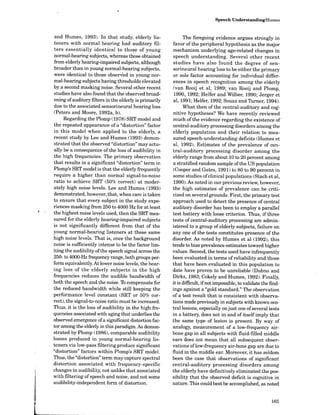
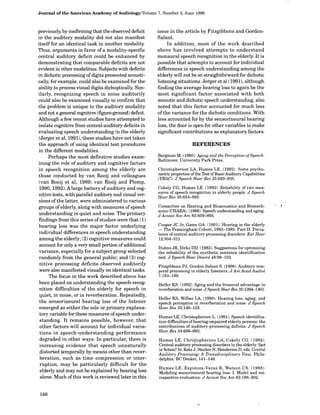
Three basic hypotheses regarding the speech-understanding difficulties of the elderly are
reviewed: the peripheral, central-auditory, and cognitive hypotheses. Evidence obtained in
our laboratory and in others is reviewed regarding the viability of each hypothesis. It is con-
cluded that the strongest support exists for the peripheral hypothesis. Specifically, individual
variations in the amount of sensorineural hearing loss among the elderly are most respon-
sible for individual variations in speech-understanding performance. ("Speech understanding"
is used throughout this article as a general term for the proportion of a speech signal that is
accurately perceived by a listener whether in a discrimination, identification, recognition, or
comprehension paradigm.) The focus to date, however, has been placed on monaural speech
understanding measured in quiet, noise, or reverberation. It is possible that a more complex
picture may yet emerge for other forms of temporally distorted speech or for dichotic mea-
sures of speech understanding.
Key Words: elderly, presbyacusis, speech recognition, speech understanding
F
ew would argue with the statement that
many people over 60 years of age have
difficulty understanding speech and that,
as age increases beyond 60 years, the likelihood
that such difficulties will be encountered also
increases. There is probably more disagreement,
however, as to the primary factor or factors
underlying the observed speech-recognition dif-
ficulties among the elderly.
An excellent review of the hypothesized fac-
tors and mechanisms underlying the speech-
understanding difficulties ofthose over 60 years
of age was published in 1988 by a Working
Group of the Committee on Hearing and Bio-
acoustics and Biomechanics of the National
Research Council (CHABA, 1988). Briefly, the
Working Group considered three distinct
hypotheses as to the mechanisms accompanying
age-related decline in speech understanding.
These three basic hypotheses are contrasted in
Figure 1 using a highly schematized overview
of the structure and function of various compo-
nents of the auditory system. The simplest ofthe
three hypotheses, illustrated in the top of Fig-
ure 1, was the peripheral hypothesis, which
'Department of Speech and Hearing Sciences, Indiana
University, Bloomington, Indiana
Reprint requests: Larry E. Humes, Department
of Speech and Hearing Sciences, Indiana University,
Bloomington, IN 47405
maintained that the speech-recognition diffi-
culties ofthe elderly were primarily attributable
to age-related changes in the auditory periph-
ery. This hypothesis could be further subdivided
into two versions: (1) simple changes in audibility
associated with peripheral changes in structure
(outer ear through inner ear and eighth nerve);
and (2) other peripheral deficits accompanying
cochlear pathology beyond the loss of hearing
sensitivity, such as abnormal spectral and tem-
poral resolution. The second hypothesis, shown
in the middle panel of Figure 1, maintained
that there were structural or functional changes
in the auditory pathways of the brain stem or
the auditory portions ofthe cortex. This will be
referred to as the central-auditory hypothesis.
The final hypothesis, the cognitive hypothesis,
is illustrated in the lower portion of Figure 1.
Notice that higher centers in the auditory path-
way are again involved in this hypothesis, just
as in the central-auditory hypothesis. The cog-
nitive hypothesis, however, differs from the cen-
tral-auditory hypothesis in that a general
cognitive deficit is implied, which affects not
only the auditory modality, but results in dys-
function for similar processing functions in other
sensory modalities . This hypothesis, for exam-
ple, would suggest that those elderly having
difficulty processing auditory stimuli presented
dichotically would also have difficulty on simil-
iar tasks with visual stimuli (dichoptic vision).
Of course, as the CHABA Working Group was
quick to note, it is possible that all of these
Journal of the American Academy of Audiology/Volume 7, Number 3, June 1996
Auditory Brainstem
Sound
PeripheryPathways
Cortex
Complex Peripheral Neural Information
Acoustic Encoding Transmission Processing,
Speech l._----- and Labelling, &
Signal
Feature Extraction Storage
~
Sound
Auditory
Periphery Pathways
Complex Peripheral Neural Information
Acoustic Encoding Transmission Processing,
Speech
and Labelling, &
Signal
Feature Extraction Storage
Sound
Auditory
Periphery
Brainstem
Cortex
Complex
Acoustic
Speech
Signal
Pathways
Cortex
Peripheral Neural I Information
Encoding Transmission Processing,
and j Labelling, & j
Feature Extraction' Storage
Figure 1 Highly schematic overview ofthe auditory sys-
tem from periphery to cortex used to contrast three
hypotheses regarding the mechanisms underlying age-
related changes in speech understanding: peripheral
hypothesis (top), central-auditory hypothesis (middle), and
cognitive hypothesis (bottom) . The dashed-dotted box
highlights the region ofpresumed dysfunction in each of
the hypotheses.
hypotheses are valid either for the elderly as a
group, with some elderly having pure peripheral
explanations oftheir difficulties and others hav-
ing pure central-auditory or cognitive explana-
tions, or as combined factors within an elderly
individual, with a portion ofa given listener's dif-
ficulty being due to perpipheral factors, a por-
tion being due to central-auditory dysfunction
and the remainder attributable to cognitive
decline.
Over the past several years, we have con-
ducted a series of studies examining the con-
tributions of various factors to the speech-
recognition deficits ofthe elderly. For various rea-
sons, we began this series of studies with the
objective ofseeinghow far we could take the sim-
plest of all of the hypotheses, the peripheral
hypothesis . Moreover, we began by evaluating
the simplest form of the simplest hypothesis,
which maintains that the primary peripheral fac-
tor underlying the speech-recognition deficit of
the elderly is the well-documented peripheral
sensorineural hearing loss associated with pres-
byacusis.
Acommon control procedure used in several
of these studies was to introduce a spectrally
shaped masking noise into the ear of normal-
hearing young adults and then test these con-
trol subjects in a manner identical to that used
with the elderly. The spectrally shaped masking
noise was designed so that the young normal-
hearing adults would have thresholds shifted by
the noise to levels identical to those ofthe aver-
age audiogram obtained in quiet from the elderly
subjects. Previous work on modeling the per-
ceptual effects of sensorineural hearing loss for
younger hearing-impaired listeners, including
loudness recruitment and level-dependent
changes in frequency resolution, had indicated
that this would also provide a good approxima-
tion ofthese effects in young normal-hearing sub-
jects (Humes et al, 1988 ; Humes and Jesteadt,
1991).
The first study in this series (Humes and
Roberts, 1990) compared the monaural and bin-
aural speech-identification performance ofyoung
normal-hearing listeners, elderly hearing-
impaired subjects, and young listeners with
hearing loss simulated via noise masking (sim-
ulation for monaural conditions only). Conditions
evaluated included reverberation and back-
ground noise, both separately and in combina-
tion, with the materials consisting of a closed-set
nonsense-syllable identification task. As would
be expected solely from the presence of sen-
sorineural hearing loss, the hearing-impaired
elderly performed worse than young normal-
hearing subjects on all speech-identification
tasks. The monaural performance ofthe elderly,
however, was virtually identical to that observed
in the noise-masked simulated hearing loss.
Moreover, among the elderly, there were strong
correlations (r = -0.7 to -0.9) between the amount
ofpure-tone hearing loss (average at 1000, 2000,
and 4000 Hz) and speech-identification scores,
regardless of the listening condition. In gen-
eral, these results were consistent with the
peripheral hypothesis, which ascribes individ-
ual differences in-performance to individual dif-
ferences in peripheral processing accompanying
sensorineural hearing loss.
Next, we further studied monaural speech-
identification performance in the elderly by
examining the contributions ofhearing loss and
aging to the identification ofnonsense syllables
162
Speech Understanding/Humes
that were degraded both spectrally and tempo-
rally (Humes and Christopherson, 1991). Tem-
poral degradation was accomplished via
reverberation (Tso = 0.8 sec), as in the previous
study, and spectral distortion was introduced by
bandpass filtering the materials from 500 to
2000 Hz. The addition of spectral distortion via
filtering was introduced for two primary reasons.
First, it had been suggested that the effects of
aging on speech recognition may be subtle and
would require use of more difficult speech mate-
rials to observe age-related effects (Bergman,
1980). In addition, we were attempting to cor-
relate speech-identification performance to a
battery ofauditory-discrimination tests, referred
to as the Test of Basic Auditory Capabilities
(TBAC), (Watson et al, 1982 ; Christopherson
and Humes, 1992). This battery of tests makes
use of stimuli that range in frequency from
about 500 to 2000 Hz, and it has been demon-
strated previously that correlations between
psychoacoustic measures and measures ofspeech
understanding are optimized when the frequency
regions examined with both tests are similar
(Thibodeau and Van Tasell, 1987).
Once again, the results ofthis study indicated
that the primary factor determining performance
on the nonsense-syllable identification task was
the sensorineural hearing loss of the listener.
The greater the hearing loss, the lower the
speech-identification score. However, group
differences were also observed between young
normal-hearing listeners and elderly hearing-
impaired listeners on a number ofthe auditory-
discrimination tasks. By comparing the per-
formance of a third experimental group,
noise-masked normal-hearing young adults, to
that of the other two groups on the same task,
however, it was possible to discern which effects
were likely due to the presence ofhearing loss and
which were due to age or the interaction of age
and hearing loss. Doing so, it was clear that
there were several auditory-discrimination tasks
on which the elderly hearing-impaired subjects
performed worse than young normal-hearing
subjects, whether the latter group was tested in
quiet or in the presence of a spectrally shaped
noise simulating the average hearing loss ofthe
elderly. We also observed that, when we divided
the elderly subjects into two groups according to
their age, young-old (63-74 years) and old-old
(75-83 years), there appeared to be further age-
related decline in performance among the elderly
on these same tasks. In the study by Humes
and Christopherson (1991), we did not have cog-
nitive measures for the subjects, however, and it
has since been shown that performance on the
TBAC battery among young adults is affected by
cognitive ability (Watson, 1991). We decided to
conduct a follow-up study in which we controlled
for general cognitive differences between the
young-old and old-old (Lee and Humes, 1992). In
the follow-up study, we matched two groups of
elderly subjects for hearing loss and general cog-
nitive function (IQ and digit-span memory), with
age being the only between-group difference
(young-old vs old-old). As can be seen in Figure
2, the more recent study by Lee and Humess
(1992, vertical bars) failed to find an age-related
difference in performance between the old-old and
young-old groups (filled and unfilled vertical
bars are identical) . When these data are com-
pared to the results ofthe previous study obtained
from young normal-hearing subjects with and
without simulated hearing loss (filled and unfilled
circles in Fig. 2, respectively), both elderly groups
performed considerably poorer than either group
of young normal-hearing subjects on four ofthe
TBAC tests. In summary, there do seem to be
some age-related differences in auditory-dis-
crimination performance using a test that has
proven to be reliable when applied to the elderly
(Christopherson and Humes, 1992). In particu-
lar, the elderly demonstrate observed deficits in
110. N-s & cn-'.'nerson (1991)
M YOUNG-OLD (63-74 y) " YOUNG NOR--HEARING
Q OLD-OLD (75-83 y) O YOUNG NOISE-ASKED
TBAC TEST
Figure 2 Comparison of the results from Lee and
Humes (1992; vertical bars) with those of Humes and
Christopherson (1991; circles) for a series of standardized
tests of auditory-discrimination ability known as the
Test of Basic Auditory Capabilities (TBAC) . Two age
groups of elderly subjects in the more recent study were
matched for hearing loss and cognitive function. These
two elderly groups (vertical bars) did not differ in per-
formance on the TBAC. The young noise-masked listen-
ers (unfilled circles) had a hearing loss simulated by
noise masking that mimicked that of the elderly listen-
ers. Notice that, for several ofthe tests in the TBAC bat-
tery, the unfilled circles indicate performance levels
comparable to those for the elderly subjects . There are
also several tests, however, for which this is notthe case
(vertical bars are below both circles).
Journal of the American Academy of Audiology/Volume 7, Number 3, June 1996
auditory-discrimination tasks that involve pure-
tone frequency discrimination ("delta F"), tem-
poral-order discrimination for sequences oftones
("temp ord") or syllables ("syll seq"), and inten-
sity discrimination involving complex tonal pat-
terns ("10-tone").
Are these differences in auditory-discrimi-
nation performance between young and elderly
subjects related in any way to differences in
speech identification? In both the studies by
Humes and Christopherson (1991) and Lee and
Humes (1992), multiple-regression analyses
revealed that the vast majority of the differ-
ences across subjects could be explained by indi-
vidual variations in the degree of sensorineural
hearing loss. In both studies, however, signifi-
cant percentages ofadditional variance could be
accounted for by inclusion of some measures of
auditory-discrimination performance. Across
studies and conditions, the auditory-discrimi-
nation test emerging most frequently as an
important contributor was simple tonal fre-
quency discrimination for a 1000-Hz tone. The
percentage of variance accounted for by this
variable ranged from about 3 to 14 percent,
however, whereas that accounted for by the
pure-tone hearing loss ranged from 55 to 90
percent.
Perhaps our inability to find correlations
between speech-understanding performance and
auditory measures other than hearing loss
resulted from the limited data collected in the
studies described above. It could be argued, for
instance, that use of nonsense syllables at a
moderate level (70 dB SPL) in each of the pre-
vious studies could increase the likelihood that
performance would be related to peripheral fac-
tors, such as the hearing loss of the listener.
Few cognitive resources are required, for
instance, to identify consonant-vowel or vowel-
consonant syllables in a closed set. Further, use
of a conversational level could enhance the
importance of the hearing loss to an extent that
might not be observed at higher levels, especially
.in a noise background. In addition, it was pos-
sible that nonauditory factors, such as cognition,
memory, and attention, could affect speech-
understanding performance for more complex
speech materials in a way not captured by the
simple auditory-discrimination measures used
previously.
To address these issues, a larger scale study
was conducted in which 50 elderly persons,
between the ages of 63 and 84 years, served as
subjects (Humes et al, 1994). A wide range of
speech-understanding measures was included
that spanned from closed-set identification of
nonsense syllables to open-set recognition of
the final word in meaningful sentences (five
types of speech materials all together). In addi-
tion, two speech levels (70 and 90 dB SPL) and
two background conditions (quiet and +7 dB
signal-to-noise ratio) were included. In addition
to these 20 measures of speech understanding,
all subjects were again administered the TBAC
battery ofauditory-discrimination tasks. In addi-
tion, measures of cognitive function were
obtained with the revised Wechsler Adult Intel-
ligence Scale (WAIS-R; Wechsler, 1981) and the
revised Wechsler Memory Scale (WMS-R; Wech-
sler, 1987).
The two primary findings that emerged
from this study were that (1) the 20 measures
of speech understanding were highly correlated,
such that subjects who performed poorly on one
task tended to perform poorly on all of the
speech-understanding tasks; and (2) the single
strongest factor that accounted for individual dif-
ferences in speech-understanding performance
was the degree of sensorineural hearing loss of
the listener. A very strong association (canoni-
cal correlation of 0.89) was observed between the
set of 20 speech-recognition measures and the
set ofauditory and cognitive measures with the
primary, if not sole, factor underlying that asso-
ciation being due to the effects of a single pre-
dictor variable, the average hearing loss at 1000,
2000, and 4000 Hz.
We began this series of studies fully expect-
ing to observe a complex relationship between
individual differences in speech understanding
and a host ofother predictive measures. Instead,
a strong association was observed repeatedly
between speech-understanding ability and the
average high-frequency hearing loss. That being
the case, we decided to investigate a couple of
the areas that led us to believe that the situa-
tion would be much more complicated than
observed. In prior auditory perceptual research
conducted with the elderly over the past 20
years, two of the most influential findings sug-
gesting that more than loss ofhearing sensitivity
was involved in the elderly were a study on age-
related changes in the auditory filter (Patterson
et al, 1982) and the frequent identification of a
"distortion" component in a widely used model
of speech-reception threshold (SRT) developed
by Plomp (1978).
Briefly, the age-related widening of the
auditory filter was demonstrated to be due to
associated declines in hearing threshold accom-
panying the sensorineural impairment (Sommers
164
Speech Understanding/Humes
and Humes, 1993). In that study, elderly lis-
teners with normal hearing had auditory fil-
ters essentially identical to those of young
normal-hearing subjects, whereas those obtained
from elderly hearing-impaired subjects, although
broader than in young normal-hearing subjects,
were identical to those observed in young nor-
mal-hearing subjects having thresholds elevated
by a second masking noise. Several other recent
studies have also found that the observed broad-
ening of auditory filters in the elderly is primarily
due to the associated sensorineural hearing loss
(Peters and Moore, 1992a, b).
Regarding the Plomp (1978) SRTmodel and
the repeated appearance of a "distortion" factor
in this model when applied to the elderly, a
recent study by Lee and Humes (1993) demon-
strated that the observed "distortion" mayactu-
ally be a consequence of the loss of audibility in
the high frequencies. The primary observation
that results in a significant "distortion" term in
Plomp's SRT model is that the elderly frequently
require a higher than normal signal-to-noise
ratio to achieve SRT (50% correct) at moder-
ately high noise levels. Lee and Humes (1993)
demonstrated, however, that, when care is taken
to ensure that every subject in the study expe-
riences masking from 250 to 4000 Hz for at least
the highest noise levels used, then the SRT mea-
sured for the elderly hearing-impaired subjects
is not significantly different from that of the
young normal-hearing listeners at these same
high noise levels. That is, once the background
noise is sufficiently intense to be the factor lim-
iting the audibility ofthe speech signal across the
250- to 4000-Hz frequency range, both groups per-
form equivalently. At lower noise levels, the hear-
ing loss of the elderly subjects in the high
frequencies reduces the audible bandwidth of
both the speech and the noise. To compensate for
the reduced bandwidth while still keeping the
performance level constant (SRT or 50% cor-
rect), the signal-to-noise ratio must be increased.
Thus, it is the loss of audibility in the high fre-
quencies associated with aging that underlies the
observed emergence ofa significant distortion fac-
tor amongthe elderly in this paradigm. As demon-
strated by Plomp (1986), comparable audibility
losses produced in young normal-hearing lis-
teners via low-pass filtering produce significant
"distortion" factors within Plomp's SRT model.
Thus, the "distortion" term maycapture spectral
distortion associated with frequency-specific
changes in audibility, not unlike that associated
with filtering of speech and noise, and not some
audibility-independent form of distortion.
The foregoing evidence argues strongly in
favor of the peripheral hypothesis as the major
mechanism underlying age-related changes in
speech understanding. Several other recent
studies have also found the degree of sen-
sorineural hearing loss to be either the primary
or sole factor accounting for individual differ-
ences in speech recognition among the elderly
(van Rooij et al, 1989; van Rooij and Plomp,
1990, 1992; Helfer and Wilber, 1990; Jerger et
al, 1991 ; Helfer, 1992 ; Souza and Turner, 1994).
What then of the central-auditory and cog-
nitive hypotheses? We have recently reviewed
much ofthe evidence regarding the existence of
central-auditory processing disorders among the
elderly population and their relation to mea-
sured speech-understanding deficits (Humes et
al, 1992). Estimates of the prevalence of cen-
tral-auditory processing disorder among the
elderly range from about 10 to 20 percent among
a stratified random sample ofthe US population
(Cooper and Gates, 1991) to 80 to 90 percent in
some studies ofclinical populations (Stack et al,
1990). As noted in our previous review, however,
the high estimates of prevalence can be criti-
cized on several grounds. First, the primary test
approach used to detect the presence of central
auditory disorder has been to employ a parallel
test battery with loose criterion. Thus, if three
tests of central-auditory processing are admin-
istered to a group of elderly subjects, failure on
any one of the tests constitutes presence of the
disorder. As noted by Humes et al (1992), this
tends to bias prevalence estimates toward higher
values. Second, the tests used have infrequently
been evaluated in terms ofreliability and those
that have been evaluated in this population to
date have proven to be unreliable (Dubno and
Dirks, 1983 ; Cokely and Humes, 1992). Finally,
it is difficult, ifnot impossible, tovalidate the find-
ings against a "gold standard." The observation
of a test result that is consistent with observa-
tions made previously in subjects with known cen-
tral lesions, especially on just one ofseveral tests
in a battery, does not in and of itself imply that
the same type of lesion is present. By way of
analogy, measurement of a low-frequency air-
bone gap in all subjects with fluid-filled middle
ears does not mean that all subsequent obser-
vations oflow-frequency air-bone gap are due to
fluid in the middle ear. Moreover, it has seldom
been the case that observations of significant
central-auditory processing disorders among
the elderly have definitively eliminated the pos-
sibility that the observed deficit is cognitive in
nature. This could best be accomplished, as noted
Journal of the American Academy of Audiology/Volume 7, Number 3, June 1996
previously, by confirming that the observed deficit
in the auditory modality did not also manifest
itself for an identical task in another modality.
Thus, arguments in favor of a modality-specific
central auditory deficit could be enhanced by
demonstrating that comparable deficits are not
evident in other modalities. Subjects with deficits
in dichotic processing ofdigits presented acousti-
cally, for example, could also be examined for the
ability to process visual digits dichoptically. Sim-
ilarly, recognizing speech in noise auditorily
could also be examined visually to confirm that
the problem is unique to the auditory modality
and not a general cognitive (figure-ground) deficit.
Although a few recent studies have attempted to
isolate cognitive from central-auditory deficits in
evaluating speech understanding in the elderly
(Jerger et al, 1991), these studies have not taken
the approach of using identical test procedures
in the different modalities.
Perhaps the most definitive studies exam-
ining the role of auditory and cognitive factors
in speech recognition among the elderly are
those conducted by van Rooij and colleagues
(van Rooij et al, 1989; van Rooij and Plomp,
1990, 1992). Alarge battery ofauditory and cog-
nitive tests, with parallel auditory and visual ver-
sions of the latter, were administered to various
groups ofelderly, along with measures of speech
understanding in quiet and noise. The primary
findings from this series of studies were that (1)
hearing loss was the major factor underlying
individual differences in speech understanding
among the elderly; (2) cognitive measures could
account for only a very small portion of additional
variance, especially for a subject group selected
randomly from the general public; and (3) cog-
nitive processing deficits observed auditorily
were also manifested visually on identical tasks.
The focus in the work described above has
been placed on understanding the speech-recog-
nition difficulties of the elderly for speech in
quiet, in noise, or in reverberation. Repeatedly,
the sensorineural hearing loss of the listener
emerged as either the sole or primary explana-
tory variable for these measures ofspeech under-
standing. It remains possible, however, that
other factors will account for individual varia-
tions in speech-understanding performance
degraded in other ways. In particular, there is
increasing evidence that speech unnaturally
distorted temporally by means other than rever-
beration, such as time compression or inter-
ruption, may be particularly difficult for the
elderly and may not be explained by hearing loss
alone. Much ofthis work is reviewed later in this
issue in the article by Fitzgibbons and Gordon-
Salant.
In addition, most of the work described
above has involved attempts to understand
monaural speech recognition in the elderly. It is
possible that attempts to account for individual
differences in speech understanding among the
elderly will not be so straightforward for dichotic
listening situations. Jerger et al (1991), although
finding the average hearing loss to again be the
most significant factor associated with both
monotic and dichotic speech understanding, also
noted that this factor accounted for much less
of the variance for the dichotic conditions. With
less accounted for by the sensorineural hearing
loss, the door is open for other variables to make
significant contributions as explanatory factors.
REFERENCES
Bergman M. (1980) . Aging and the Perception ofSpeech.
Baltimore: University Park Press.
Christopherson LA, Humes LE. (1992). Some psycho-
metric properties oftheTest ofBasicAuditoryCapabilities
(TBAC). J Speech HearRes 35:929-935.
Cokely CG, Humes LE. (1992). Reliability of two mea-
sures of speech recognition in elderly people. J Speech
Hear Res 35 :654-660.
Committee on Hearing and Bioacoustics and Biomech-
anics (CHABA). (1988). Speech understanding and aging.
JAcoust SocAm 83 :859-895.
Cooper JC Jr, Gates GA. (1991) . Hearing in the elderly
- The Framingham Cohort, 1983-1985: Part II. Preva-
lence ofcentral auditory processing disorders. Ear Hear
12:304-311 .
Dubno JR, Dirks DD. (1983). Suggestions for optimizing
the reliability ofthe synthetic sentence identification
test. J Speech Hear Disord 48:98-103.
Fitzgibbons PJ, Gordon-Salant S. (1996). Auditory tem-
poral processing in elderly listeners. JAm Acad Audiol
7:183-189 .
Helfer KS . (1992) . Aging and the binaural advantage in
reverberation and noise. JSpeech Hear Res 35:1394-1401 .
Helfer KS, Wilber LA. (1990). Hearing loss, aging, and
speech perception in reverberation and noise. J Speech
Hear Res 33:149-155.
Humes LE, Christopherson L. (1991). Speech identifica-
tion difficulties ofhearing-impaired elderly persons: the
contributions of auditory-processing deficits. J Speech
Hear Res 34:686-693 .
Humes LE, Christopherson LA, Cokely CG. (1992) .
Central auditory processing disorders in the elderly: fact
or fiction? In: Katz J, SteckerN, Henderson D, eds. Central
Auditory Processing: A 71-ansdisciplinary View . Phila-
delphia: BC Decker, 141-149.
Humes LE, Espinoza-Varas B, Watson CS. (1988).
Modeling sensorineural hearing loss. I. Model and ret-
rospective evaluation . JAcoust Soc Am 83:188-202 .
166
Speech Understanding/Humes
Humes LE, Jesteadt W. (1991). Models of the effects of
threshold on loudness growth and summation. JAcoust
Soc Am 90:1933-1943.
Plomp R. (1986). A signal-to-noise ratio model for the
speech-reception threshold of the hearing impaired. J
Speech Hear Res 29:146-154.
Humes LE, Roberts L. (1990) . Speech-recognition diffi-
culties ofthe hearing-impaired elderly: the contributions
of audibility. JSpeech Hear Res 33 :726-735 .
Humes LE, Watson BU, Christensen LA, Cokely CA,
Halling DA, Lee L. (1994) . Factors associated with indi-
vidual differences in clinical measures of speech
recognition among the elderly. J Speech Hear Res
37:465-474 .
Jerger J, Jerger S, Pirozzolo F. (1991) . Correlational
analysis ofspeech audiometric scores, hearing loss, age
and cognitive abilities in the elderly. EarHear 12:103-109.
Lee LW, Humes LE. (1992) . Factors associated with
speech-recognition ability ofthe hearing- impaired elderly.
ASHA 34(10) :212.
Lee LW Humes LE . (1993) . Evaluating a speech-recep-
tion threshold model for hearing-impaired listeners. J
Acoust Soc Am 93:2879-2885.
Patterson RD, Nimmo-Smith I, Weber DL, Milroy R.
(1982) . The deterioration ofhearingwith age: frequency
selectivity, the critical ratio, the audiogram, and speech
thresholds . JAcoust Soc Am 72:1788-1803.
Peters RW, Moore BCJ. (1992a). Auditory filters and
aging: filters when audiometric thresholds are normal.
In: Cazals Y et al, eds. Auditory Physiology and Perception.
Paris: Pergamon Press.
Peters RW Moore BCJ. (1992b). Auditory filter shapes
at low center frequencies in young and elderly hearing-
impaired subjects . JAcoust Soc Am 91:256-266 .
Plomp R. (1978). Auditory handicap ofhearing impair-
ment and the limited benefit of hearing aids. J Acoust
Soc Am 63:533-549 .
Sommers MS, Humes LE. (1993). Auditory filter shapes
in normal-hearing, noise-masked normal, and elderly lis-
teners. J Acoust Soc Am 93:2903-2914 .
Souza PE, Turner CW (1994). Masking ofspeech in young
and elderly listeners with hearing loss . JSpeech Hear
Res 37:655-661 .
Stach B, Spretnjak ML, Jerger J. (1990). The prevalence
ofcentral presbycusis in a clinical population. JAm Acad
Audiol 1 :109-115 .
Thibodeau LM, Van Tasell DJ. (1987) . Tone detection and
synthetic speech discrimination in band-reject noise by
hearing-impaired listeners. JAcoust SocAm 81:427-438 .
van Rooij JCGM, Plomp R. (1990) . Auditive and cogni-
tive factors in speech perception by elderly listeners. II.
Multivariate analyses . JAcoust Soc Am 88:2611-2624.
van Rooij JCGM, Plomp R. (1992). Auditive and cogni-
tive factors in speech perception by elderly listeners. III.
Additional data and final discussion . J Acoust Soc Am
91:1028-1033 .
van Rooij JCGM, Plomp R, Orlebeke JF. (1989) . Auditive
and cognitive factors in speech perception by elderly lis-
teners . I. : development of test battery. J Acoust Soc Am
86:1294-1309.
Watson BU. (1991) . Some relationships between intelli-
gence and auditory discrimination . JSpeech Hear Res
34:621-627 .
Watson CS, Johnson DM, Lehman JR, Kelly WJ, Jensen
JK. (1982) . An auditory discrimination test battery. J
Acoust Soc Am 71:573.
Wechsler D. (1981). The WechslerAdultIntelligence Scale-
Revised. New York : The Psychological Corporation.
Wechsler D. (1987) . Wechsler Memory ScaleRevised. New
York : The Psychological Corporation.

Speach understanding

  • 1.
    J Am AcadAudiol 7: 161-167 (1996) Speech Understanding in the Elderly Larry E. Humes* Abstract Three basic hypotheses regarding the speech-understanding difficulties of the elderly are reviewed: the peripheral, central-auditory, and cognitive hypotheses. Evidence obtained in our laboratory and in others is reviewed regarding the viability of each hypothesis. It is con- cluded that the strongest support exists for the peripheral hypothesis. Specifically, individual variations in the amount of sensorineural hearing loss among the elderly are most respon- sible for individual variations in speech-understanding performance. ("Speech understanding" is used throughout this article as a general term for the proportion of a speech signal that is accurately perceived by a listener whether in a discrimination, identification, recognition, or comprehension paradigm.) The focus to date, however, has been placed on monaural speech understanding measured in quiet, noise, or reverberation. It is possible that a more complex picture may yet emerge for other forms of temporally distorted speech or for dichotic mea- sures of speech understanding. Key Words: elderly, presbyacusis, speech recognition, speech understanding F ew would argue with the statement that many people over 60 years of age have difficulty understanding speech and that, as age increases beyond 60 years, the likelihood that such difficulties will be encountered also increases. There is probably more disagreement, however, as to the primary factor or factors underlying the observed speech-recognition dif- ficulties among the elderly. An excellent review of the hypothesized fac- tors and mechanisms underlying the speech- understanding difficulties ofthose over 60 years of age was published in 1988 by a Working Group of the Committee on Hearing and Bio- acoustics and Biomechanics of the National Research Council (CHABA, 1988). Briefly, the Working Group considered three distinct hypotheses as to the mechanisms accompanying age-related decline in speech understanding. These three basic hypotheses are contrasted in Figure 1 using a highly schematized overview of the structure and function of various compo- nents of the auditory system. The simplest ofthe three hypotheses, illustrated in the top of Fig- ure 1, was the peripheral hypothesis, which 'Department of Speech and Hearing Sciences, Indiana University, Bloomington, Indiana Reprint requests: Larry E. Humes, Department of Speech and Hearing Sciences, Indiana University, Bloomington, IN 47405 maintained that the speech-recognition diffi- culties ofthe elderly were primarily attributable to age-related changes in the auditory periph- ery. This hypothesis could be further subdivided into two versions: (1) simple changes in audibility associated with peripheral changes in structure (outer ear through inner ear and eighth nerve); and (2) other peripheral deficits accompanying cochlear pathology beyond the loss of hearing sensitivity, such as abnormal spectral and tem- poral resolution. The second hypothesis, shown in the middle panel of Figure 1, maintained that there were structural or functional changes in the auditory pathways of the brain stem or the auditory portions ofthe cortex. This will be referred to as the central-auditory hypothesis. The final hypothesis, the cognitive hypothesis, is illustrated in the lower portion of Figure 1. Notice that higher centers in the auditory path- way are again involved in this hypothesis, just as in the central-auditory hypothesis. The cog- nitive hypothesis, however, differs from the cen- tral-auditory hypothesis in that a general cognitive deficit is implied, which affects not only the auditory modality, but results in dys- function for similar processing functions in other sensory modalities . This hypothesis, for exam- ple, would suggest that those elderly having difficulty processing auditory stimuli presented dichotically would also have difficulty on simil- iar tasks with visual stimuli (dichoptic vision). Of course, as the CHABA Working Group was quick to note, it is possible that all of these
  • 2.
    Journal of theAmerican Academy of Audiology/Volume 7, Number 3, June 1996 Auditory Brainstem Sound PeripheryPathways Cortex Complex Peripheral Neural Information Acoustic Encoding Transmission Processing, Speech l._----- and Labelling, & Signal Feature Extraction Storage ~ Sound Auditory Periphery Pathways Complex Peripheral Neural Information Acoustic Encoding Transmission Processing, Speech and Labelling, & Signal Feature Extraction Storage Sound Auditory Periphery Brainstem Cortex Complex Acoustic Speech Signal Pathways Cortex Peripheral Neural I Information Encoding Transmission Processing, and j Labelling, & j Feature Extraction' Storage Figure 1 Highly schematic overview ofthe auditory sys- tem from periphery to cortex used to contrast three hypotheses regarding the mechanisms underlying age- related changes in speech understanding: peripheral hypothesis (top), central-auditory hypothesis (middle), and cognitive hypothesis (bottom) . The dashed-dotted box highlights the region ofpresumed dysfunction in each of the hypotheses. hypotheses are valid either for the elderly as a group, with some elderly having pure peripheral explanations oftheir difficulties and others hav- ing pure central-auditory or cognitive explana- tions, or as combined factors within an elderly individual, with a portion ofa given listener's dif- ficulty being due to perpipheral factors, a por- tion being due to central-auditory dysfunction and the remainder attributable to cognitive decline. Over the past several years, we have con- ducted a series of studies examining the con- tributions of various factors to the speech- recognition deficits ofthe elderly. For various rea- sons, we began this series of studies with the objective ofseeinghow far we could take the sim- plest of all of the hypotheses, the peripheral hypothesis . Moreover, we began by evaluating the simplest form of the simplest hypothesis, which maintains that the primary peripheral fac- tor underlying the speech-recognition deficit of the elderly is the well-documented peripheral sensorineural hearing loss associated with pres- byacusis. Acommon control procedure used in several of these studies was to introduce a spectrally shaped masking noise into the ear of normal- hearing young adults and then test these con- trol subjects in a manner identical to that used with the elderly. The spectrally shaped masking noise was designed so that the young normal- hearing adults would have thresholds shifted by the noise to levels identical to those ofthe aver- age audiogram obtained in quiet from the elderly subjects. Previous work on modeling the per- ceptual effects of sensorineural hearing loss for younger hearing-impaired listeners, including loudness recruitment and level-dependent changes in frequency resolution, had indicated that this would also provide a good approxima- tion ofthese effects in young normal-hearing sub- jects (Humes et al, 1988 ; Humes and Jesteadt, 1991). The first study in this series (Humes and Roberts, 1990) compared the monaural and bin- aural speech-identification performance ofyoung normal-hearing listeners, elderly hearing- impaired subjects, and young listeners with hearing loss simulated via noise masking (sim- ulation for monaural conditions only). Conditions evaluated included reverberation and back- ground noise, both separately and in combina- tion, with the materials consisting of a closed-set nonsense-syllable identification task. As would be expected solely from the presence of sen- sorineural hearing loss, the hearing-impaired elderly performed worse than young normal- hearing subjects on all speech-identification tasks. The monaural performance ofthe elderly, however, was virtually identical to that observed in the noise-masked simulated hearing loss. Moreover, among the elderly, there were strong correlations (r = -0.7 to -0.9) between the amount ofpure-tone hearing loss (average at 1000, 2000, and 4000 Hz) and speech-identification scores, regardless of the listening condition. In gen- eral, these results were consistent with the peripheral hypothesis, which ascribes individ- ual differences in-performance to individual dif- ferences in peripheral processing accompanying sensorineural hearing loss. Next, we further studied monaural speech- identification performance in the elderly by examining the contributions ofhearing loss and aging to the identification ofnonsense syllables 162
  • 3.
    Speech Understanding/Humes that weredegraded both spectrally and tempo- rally (Humes and Christopherson, 1991). Tem- poral degradation was accomplished via reverberation (Tso = 0.8 sec), as in the previous study, and spectral distortion was introduced by bandpass filtering the materials from 500 to 2000 Hz. The addition of spectral distortion via filtering was introduced for two primary reasons. First, it had been suggested that the effects of aging on speech recognition may be subtle and would require use of more difficult speech mate- rials to observe age-related effects (Bergman, 1980). In addition, we were attempting to cor- relate speech-identification performance to a battery ofauditory-discrimination tests, referred to as the Test of Basic Auditory Capabilities (TBAC), (Watson et al, 1982 ; Christopherson and Humes, 1992). This battery of tests makes use of stimuli that range in frequency from about 500 to 2000 Hz, and it has been demon- strated previously that correlations between psychoacoustic measures and measures ofspeech understanding are optimized when the frequency regions examined with both tests are similar (Thibodeau and Van Tasell, 1987). Once again, the results ofthis study indicated that the primary factor determining performance on the nonsense-syllable identification task was the sensorineural hearing loss of the listener. The greater the hearing loss, the lower the speech-identification score. However, group differences were also observed between young normal-hearing listeners and elderly hearing- impaired listeners on a number ofthe auditory- discrimination tasks. By comparing the per- formance of a third experimental group, noise-masked normal-hearing young adults, to that of the other two groups on the same task, however, it was possible to discern which effects were likely due to the presence ofhearing loss and which were due to age or the interaction of age and hearing loss. Doing so, it was clear that there were several auditory-discrimination tasks on which the elderly hearing-impaired subjects performed worse than young normal-hearing subjects, whether the latter group was tested in quiet or in the presence of a spectrally shaped noise simulating the average hearing loss ofthe elderly. We also observed that, when we divided the elderly subjects into two groups according to their age, young-old (63-74 years) and old-old (75-83 years), there appeared to be further age- related decline in performance among the elderly on these same tasks. In the study by Humes and Christopherson (1991), we did not have cog- nitive measures for the subjects, however, and it has since been shown that performance on the TBAC battery among young adults is affected by cognitive ability (Watson, 1991). We decided to conduct a follow-up study in which we controlled for general cognitive differences between the young-old and old-old (Lee and Humes, 1992). In the follow-up study, we matched two groups of elderly subjects for hearing loss and general cog- nitive function (IQ and digit-span memory), with age being the only between-group difference (young-old vs old-old). As can be seen in Figure 2, the more recent study by Lee and Humess (1992, vertical bars) failed to find an age-related difference in performance between the old-old and young-old groups (filled and unfilled vertical bars are identical) . When these data are com- pared to the results ofthe previous study obtained from young normal-hearing subjects with and without simulated hearing loss (filled and unfilled circles in Fig. 2, respectively), both elderly groups performed considerably poorer than either group of young normal-hearing subjects on four ofthe TBAC tests. In summary, there do seem to be some age-related differences in auditory-dis- crimination performance using a test that has proven to be reliable when applied to the elderly (Christopherson and Humes, 1992). In particu- lar, the elderly demonstrate observed deficits in 110. N-s & cn-'.'nerson (1991) M YOUNG-OLD (63-74 y) " YOUNG NOR--HEARING Q OLD-OLD (75-83 y) O YOUNG NOISE-ASKED TBAC TEST Figure 2 Comparison of the results from Lee and Humes (1992; vertical bars) with those of Humes and Christopherson (1991; circles) for a series of standardized tests of auditory-discrimination ability known as the Test of Basic Auditory Capabilities (TBAC) . Two age groups of elderly subjects in the more recent study were matched for hearing loss and cognitive function. These two elderly groups (vertical bars) did not differ in per- formance on the TBAC. The young noise-masked listen- ers (unfilled circles) had a hearing loss simulated by noise masking that mimicked that of the elderly listen- ers. Notice that, for several ofthe tests in the TBAC bat- tery, the unfilled circles indicate performance levels comparable to those for the elderly subjects . There are also several tests, however, for which this is notthe case (vertical bars are below both circles).
  • 4.
    Journal of theAmerican Academy of Audiology/Volume 7, Number 3, June 1996 auditory-discrimination tasks that involve pure- tone frequency discrimination ("delta F"), tem- poral-order discrimination for sequences oftones ("temp ord") or syllables ("syll seq"), and inten- sity discrimination involving complex tonal pat- terns ("10-tone"). Are these differences in auditory-discrimi- nation performance between young and elderly subjects related in any way to differences in speech identification? In both the studies by Humes and Christopherson (1991) and Lee and Humes (1992), multiple-regression analyses revealed that the vast majority of the differ- ences across subjects could be explained by indi- vidual variations in the degree of sensorineural hearing loss. In both studies, however, signifi- cant percentages ofadditional variance could be accounted for by inclusion of some measures of auditory-discrimination performance. Across studies and conditions, the auditory-discrimi- nation test emerging most frequently as an important contributor was simple tonal fre- quency discrimination for a 1000-Hz tone. The percentage of variance accounted for by this variable ranged from about 3 to 14 percent, however, whereas that accounted for by the pure-tone hearing loss ranged from 55 to 90 percent. Perhaps our inability to find correlations between speech-understanding performance and auditory measures other than hearing loss resulted from the limited data collected in the studies described above. It could be argued, for instance, that use of nonsense syllables at a moderate level (70 dB SPL) in each of the pre- vious studies could increase the likelihood that performance would be related to peripheral fac- tors, such as the hearing loss of the listener. Few cognitive resources are required, for instance, to identify consonant-vowel or vowel- consonant syllables in a closed set. Further, use of a conversational level could enhance the importance of the hearing loss to an extent that might not be observed at higher levels, especially .in a noise background. In addition, it was pos- sible that nonauditory factors, such as cognition, memory, and attention, could affect speech- understanding performance for more complex speech materials in a way not captured by the simple auditory-discrimination measures used previously. To address these issues, a larger scale study was conducted in which 50 elderly persons, between the ages of 63 and 84 years, served as subjects (Humes et al, 1994). A wide range of speech-understanding measures was included that spanned from closed-set identification of nonsense syllables to open-set recognition of the final word in meaningful sentences (five types of speech materials all together). In addi- tion, two speech levels (70 and 90 dB SPL) and two background conditions (quiet and +7 dB signal-to-noise ratio) were included. In addition to these 20 measures of speech understanding, all subjects were again administered the TBAC battery ofauditory-discrimination tasks. In addi- tion, measures of cognitive function were obtained with the revised Wechsler Adult Intel- ligence Scale (WAIS-R; Wechsler, 1981) and the revised Wechsler Memory Scale (WMS-R; Wech- sler, 1987). The two primary findings that emerged from this study were that (1) the 20 measures of speech understanding were highly correlated, such that subjects who performed poorly on one task tended to perform poorly on all of the speech-understanding tasks; and (2) the single strongest factor that accounted for individual dif- ferences in speech-understanding performance was the degree of sensorineural hearing loss of the listener. A very strong association (canoni- cal correlation of 0.89) was observed between the set of 20 speech-recognition measures and the set ofauditory and cognitive measures with the primary, if not sole, factor underlying that asso- ciation being due to the effects of a single pre- dictor variable, the average hearing loss at 1000, 2000, and 4000 Hz. We began this series of studies fully expect- ing to observe a complex relationship between individual differences in speech understanding and a host ofother predictive measures. Instead, a strong association was observed repeatedly between speech-understanding ability and the average high-frequency hearing loss. That being the case, we decided to investigate a couple of the areas that led us to believe that the situa- tion would be much more complicated than observed. In prior auditory perceptual research conducted with the elderly over the past 20 years, two of the most influential findings sug- gesting that more than loss ofhearing sensitivity was involved in the elderly were a study on age- related changes in the auditory filter (Patterson et al, 1982) and the frequent identification of a "distortion" component in a widely used model of speech-reception threshold (SRT) developed by Plomp (1978). Briefly, the age-related widening of the auditory filter was demonstrated to be due to associated declines in hearing threshold accom- panying the sensorineural impairment (Sommers 164
  • 5.
    Speech Understanding/Humes and Humes,1993). In that study, elderly lis- teners with normal hearing had auditory fil- ters essentially identical to those of young normal-hearing subjects, whereas those obtained from elderly hearing-impaired subjects, although broader than in young normal-hearing subjects, were identical to those observed in young nor- mal-hearing subjects having thresholds elevated by a second masking noise. Several other recent studies have also found that the observed broad- ening of auditory filters in the elderly is primarily due to the associated sensorineural hearing loss (Peters and Moore, 1992a, b). Regarding the Plomp (1978) SRTmodel and the repeated appearance of a "distortion" factor in this model when applied to the elderly, a recent study by Lee and Humes (1993) demon- strated that the observed "distortion" mayactu- ally be a consequence of the loss of audibility in the high frequencies. The primary observation that results in a significant "distortion" term in Plomp's SRT model is that the elderly frequently require a higher than normal signal-to-noise ratio to achieve SRT (50% correct) at moder- ately high noise levels. Lee and Humes (1993) demonstrated, however, that, when care is taken to ensure that every subject in the study expe- riences masking from 250 to 4000 Hz for at least the highest noise levels used, then the SRT mea- sured for the elderly hearing-impaired subjects is not significantly different from that of the young normal-hearing listeners at these same high noise levels. That is, once the background noise is sufficiently intense to be the factor lim- iting the audibility ofthe speech signal across the 250- to 4000-Hz frequency range, both groups per- form equivalently. At lower noise levels, the hear- ing loss of the elderly subjects in the high frequencies reduces the audible bandwidth of both the speech and the noise. To compensate for the reduced bandwidth while still keeping the performance level constant (SRT or 50% cor- rect), the signal-to-noise ratio must be increased. Thus, it is the loss of audibility in the high fre- quencies associated with aging that underlies the observed emergence ofa significant distortion fac- tor amongthe elderly in this paradigm. As demon- strated by Plomp (1986), comparable audibility losses produced in young normal-hearing lis- teners via low-pass filtering produce significant "distortion" factors within Plomp's SRT model. Thus, the "distortion" term maycapture spectral distortion associated with frequency-specific changes in audibility, not unlike that associated with filtering of speech and noise, and not some audibility-independent form of distortion. The foregoing evidence argues strongly in favor of the peripheral hypothesis as the major mechanism underlying age-related changes in speech understanding. Several other recent studies have also found the degree of sen- sorineural hearing loss to be either the primary or sole factor accounting for individual differ- ences in speech recognition among the elderly (van Rooij et al, 1989; van Rooij and Plomp, 1990, 1992; Helfer and Wilber, 1990; Jerger et al, 1991 ; Helfer, 1992 ; Souza and Turner, 1994). What then of the central-auditory and cog- nitive hypotheses? We have recently reviewed much ofthe evidence regarding the existence of central-auditory processing disorders among the elderly population and their relation to mea- sured speech-understanding deficits (Humes et al, 1992). Estimates of the prevalence of cen- tral-auditory processing disorder among the elderly range from about 10 to 20 percent among a stratified random sample ofthe US population (Cooper and Gates, 1991) to 80 to 90 percent in some studies ofclinical populations (Stack et al, 1990). As noted in our previous review, however, the high estimates of prevalence can be criti- cized on several grounds. First, the primary test approach used to detect the presence of central auditory disorder has been to employ a parallel test battery with loose criterion. Thus, if three tests of central-auditory processing are admin- istered to a group of elderly subjects, failure on any one of the tests constitutes presence of the disorder. As noted by Humes et al (1992), this tends to bias prevalence estimates toward higher values. Second, the tests used have infrequently been evaluated in terms ofreliability and those that have been evaluated in this population to date have proven to be unreliable (Dubno and Dirks, 1983 ; Cokely and Humes, 1992). Finally, it is difficult, ifnot impossible, tovalidate the find- ings against a "gold standard." The observation of a test result that is consistent with observa- tions made previously in subjects with known cen- tral lesions, especially on just one ofseveral tests in a battery, does not in and of itself imply that the same type of lesion is present. By way of analogy, measurement of a low-frequency air- bone gap in all subjects with fluid-filled middle ears does not mean that all subsequent obser- vations oflow-frequency air-bone gap are due to fluid in the middle ear. Moreover, it has seldom been the case that observations of significant central-auditory processing disorders among the elderly have definitively eliminated the pos- sibility that the observed deficit is cognitive in nature. This could best be accomplished, as noted
  • 6.
    Journal of theAmerican Academy of Audiology/Volume 7, Number 3, June 1996 previously, by confirming that the observed deficit in the auditory modality did not also manifest itself for an identical task in another modality. Thus, arguments in favor of a modality-specific central auditory deficit could be enhanced by demonstrating that comparable deficits are not evident in other modalities. Subjects with deficits in dichotic processing ofdigits presented acousti- cally, for example, could also be examined for the ability to process visual digits dichoptically. Sim- ilarly, recognizing speech in noise auditorily could also be examined visually to confirm that the problem is unique to the auditory modality and not a general cognitive (figure-ground) deficit. Although a few recent studies have attempted to isolate cognitive from central-auditory deficits in evaluating speech understanding in the elderly (Jerger et al, 1991), these studies have not taken the approach of using identical test procedures in the different modalities. Perhaps the most definitive studies exam- ining the role of auditory and cognitive factors in speech recognition among the elderly are those conducted by van Rooij and colleagues (van Rooij et al, 1989; van Rooij and Plomp, 1990, 1992). Alarge battery ofauditory and cog- nitive tests, with parallel auditory and visual ver- sions of the latter, were administered to various groups ofelderly, along with measures of speech understanding in quiet and noise. The primary findings from this series of studies were that (1) hearing loss was the major factor underlying individual differences in speech understanding among the elderly; (2) cognitive measures could account for only a very small portion of additional variance, especially for a subject group selected randomly from the general public; and (3) cog- nitive processing deficits observed auditorily were also manifested visually on identical tasks. The focus in the work described above has been placed on understanding the speech-recog- nition difficulties of the elderly for speech in quiet, in noise, or in reverberation. Repeatedly, the sensorineural hearing loss of the listener emerged as either the sole or primary explana- tory variable for these measures ofspeech under- standing. It remains possible, however, that other factors will account for individual varia- tions in speech-understanding performance degraded in other ways. In particular, there is increasing evidence that speech unnaturally distorted temporally by means other than rever- beration, such as time compression or inter- ruption, may be particularly difficult for the elderly and may not be explained by hearing loss alone. Much ofthis work is reviewed later in this issue in the article by Fitzgibbons and Gordon- Salant. In addition, most of the work described above has involved attempts to understand monaural speech recognition in the elderly. It is possible that attempts to account for individual differences in speech understanding among the elderly will not be so straightforward for dichotic listening situations. Jerger et al (1991), although finding the average hearing loss to again be the most significant factor associated with both monotic and dichotic speech understanding, also noted that this factor accounted for much less of the variance for the dichotic conditions. With less accounted for by the sensorineural hearing loss, the door is open for other variables to make significant contributions as explanatory factors. REFERENCES Bergman M. (1980) . Aging and the Perception ofSpeech. Baltimore: University Park Press. Christopherson LA, Humes LE. (1992). Some psycho- metric properties oftheTest ofBasicAuditoryCapabilities (TBAC). J Speech HearRes 35:929-935. Cokely CG, Humes LE. (1992). Reliability of two mea- sures of speech recognition in elderly people. J Speech Hear Res 35 :654-660. Committee on Hearing and Bioacoustics and Biomech- anics (CHABA). (1988). Speech understanding and aging. JAcoust SocAm 83 :859-895. Cooper JC Jr, Gates GA. (1991) . Hearing in the elderly - The Framingham Cohort, 1983-1985: Part II. Preva- lence ofcentral auditory processing disorders. Ear Hear 12:304-311 . Dubno JR, Dirks DD. (1983). Suggestions for optimizing the reliability ofthe synthetic sentence identification test. J Speech Hear Disord 48:98-103. Fitzgibbons PJ, Gordon-Salant S. (1996). Auditory tem- poral processing in elderly listeners. JAm Acad Audiol 7:183-189 . Helfer KS . (1992) . Aging and the binaural advantage in reverberation and noise. JSpeech Hear Res 35:1394-1401 . Helfer KS, Wilber LA. (1990). Hearing loss, aging, and speech perception in reverberation and noise. J Speech Hear Res 33:149-155. Humes LE, Christopherson L. (1991). Speech identifica- tion difficulties ofhearing-impaired elderly persons: the contributions of auditory-processing deficits. J Speech Hear Res 34:686-693 . Humes LE, Christopherson LA, Cokely CG. (1992) . Central auditory processing disorders in the elderly: fact or fiction? In: Katz J, SteckerN, Henderson D, eds. Central Auditory Processing: A 71-ansdisciplinary View . Phila- delphia: BC Decker, 141-149. Humes LE, Espinoza-Varas B, Watson CS. (1988). Modeling sensorineural hearing loss. I. Model and ret- rospective evaluation . JAcoust Soc Am 83:188-202 . 166
  • 7.
    Speech Understanding/Humes Humes LE,Jesteadt W. (1991). Models of the effects of threshold on loudness growth and summation. JAcoust Soc Am 90:1933-1943. Plomp R. (1986). A signal-to-noise ratio model for the speech-reception threshold of the hearing impaired. J Speech Hear Res 29:146-154. Humes LE, Roberts L. (1990) . Speech-recognition diffi- culties ofthe hearing-impaired elderly: the contributions of audibility. JSpeech Hear Res 33 :726-735 . Humes LE, Watson BU, Christensen LA, Cokely CA, Halling DA, Lee L. (1994) . Factors associated with indi- vidual differences in clinical measures of speech recognition among the elderly. J Speech Hear Res 37:465-474 . Jerger J, Jerger S, Pirozzolo F. (1991) . Correlational analysis ofspeech audiometric scores, hearing loss, age and cognitive abilities in the elderly. EarHear 12:103-109. Lee LW, Humes LE. (1992) . Factors associated with speech-recognition ability ofthe hearing- impaired elderly. ASHA 34(10) :212. Lee LW Humes LE . (1993) . Evaluating a speech-recep- tion threshold model for hearing-impaired listeners. J Acoust Soc Am 93:2879-2885. Patterson RD, Nimmo-Smith I, Weber DL, Milroy R. (1982) . The deterioration ofhearingwith age: frequency selectivity, the critical ratio, the audiogram, and speech thresholds . JAcoust Soc Am 72:1788-1803. Peters RW, Moore BCJ. (1992a). Auditory filters and aging: filters when audiometric thresholds are normal. In: Cazals Y et al, eds. Auditory Physiology and Perception. Paris: Pergamon Press. Peters RW Moore BCJ. (1992b). Auditory filter shapes at low center frequencies in young and elderly hearing- impaired subjects . JAcoust Soc Am 91:256-266 . Plomp R. (1978). Auditory handicap ofhearing impair- ment and the limited benefit of hearing aids. J Acoust Soc Am 63:533-549 . Sommers MS, Humes LE. (1993). Auditory filter shapes in normal-hearing, noise-masked normal, and elderly lis- teners. J Acoust Soc Am 93:2903-2914 . Souza PE, Turner CW (1994). Masking ofspeech in young and elderly listeners with hearing loss . JSpeech Hear Res 37:655-661 . Stach B, Spretnjak ML, Jerger J. (1990). The prevalence ofcentral presbycusis in a clinical population. JAm Acad Audiol 1 :109-115 . Thibodeau LM, Van Tasell DJ. (1987) . Tone detection and synthetic speech discrimination in band-reject noise by hearing-impaired listeners. JAcoust SocAm 81:427-438 . van Rooij JCGM, Plomp R. (1990) . Auditive and cogni- tive factors in speech perception by elderly listeners. II. Multivariate analyses . JAcoust Soc Am 88:2611-2624. van Rooij JCGM, Plomp R. (1992). Auditive and cogni- tive factors in speech perception by elderly listeners. III. Additional data and final discussion . J Acoust Soc Am 91:1028-1033 . van Rooij JCGM, Plomp R, Orlebeke JF. (1989) . Auditive and cognitive factors in speech perception by elderly lis- teners . I. : development of test battery. J Acoust Soc Am 86:1294-1309. Watson BU. (1991) . Some relationships between intelli- gence and auditory discrimination . JSpeech Hear Res 34:621-627 . Watson CS, Johnson DM, Lehman JR, Kelly WJ, Jensen JK. (1982) . An auditory discrimination test battery. J Acoust Soc Am 71:573. Wechsler D. (1981). The WechslerAdultIntelligence Scale- Revised. New York : The Psychological Corporation. Wechsler D. (1987) . Wechsler Memory ScaleRevised. New York : The Psychological Corporation.