ITG Executive Summary
                                                                                                        October 2009

VALUE PROPOSITION FOR IBM SYSTEM STORAGE:
COST/BENEFIT CASE FOR SAP DEPLOYMENT
IN ENTERPRISE INSTALLATIONS

Challenges
It is a time of unprecedented challenges for the SAP world. Recent SAP documents and statements have
variously referred to the need to maintain business momentum in “challenging times…hard times…
perilous times…tough times…volatile times…turbulent times.”

Economic conditions have led many organizations to adopt conservative strategies that focus on cost
cutting. But other challenges remain. They include globalization, competitive pressures, shifts in market
and competitive structures, new regulatory requirements and the growing complexity and volatility of
business environments.

For many users, the evolution of the SAP solution portfolio presents opportunities to meet short-term
challenges in ways that will enable long-term growth and enhance competitive performance.

SAP’s new Business Suite 7 continues a transition in the SAP world that has been under way since the
1990s. The SAP solution portfolio has grown functionally broader, expanding beyond transactional
processes to address new variables such as the way in which information is used and the effectiveness of
collaboration with customers and partners, and within the enterprise itself.

Realizing the potential of this transition will require new directions in business strategy, in the business
processes within organizations and in the networks that link them with partners and customers. A new
focus must also be placed on the use of information as a critical tool for competitive leadership and
operational excellence.

This report deals with the role that IT infrastructures may play in supporting these goals. Specifically, it
looks at the value that IBM System Storage solutions may provide as the basis of infrastructures that
increase the effectiveness, and reduce the costs of the storage resources that support SAP solutions in
large organizations.

The IBM concept of an “Information Infrastructure” is appropriate in addressing this subject. It is no
longer sufficient to purchase and deploy storage systems and software on a case-by-case basis. As the
SAP enterprise environment has grown more complex and interdependent, it increasingly makes sense to
treat storage as a continuum of resources serving the entire organization.

The following sections outline the requirements of an effective SAP enterprise storage infrastructure in
three critical areas – functional capabilities, cost-effectiveness, and integration and optimization of
diverse server and storage resources – and discuss how IBM System Storage solutions may meet these
requirements.


This ITG EXECUTIVE SUMMARY is based upon results and methodology contained in a Management Brief released by the
International Technology Group.                                                                                    1
Capabilities
An effective SAP enterprise storage infrastructure requires four main sets of components: (1) storage
platforms; (2) software tools for point-in-time copy, backup and recovery, archiving and content
management, business continuity, storage infrastructure management and other functions; (3) cross-
platform virtualization capabilities; and (4) storage area network (SAN) integration.
IBM System Storage offerings provide all of the components necessary for a state-of-the-art SAP
enterprise storage infrastructure. Many have been customized to meet SAP-specific requirements.
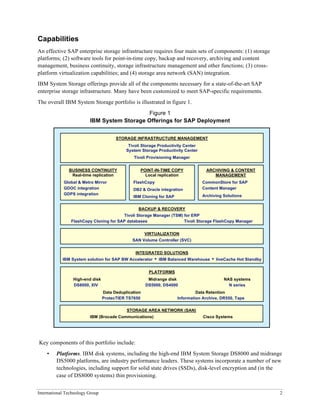
The overall IBM System Storage portfolio is illustrated in figure 1.
                                             Figure 1
                         IBM System Storage Offerings for SAP Deployment


                                       STORAGE INFRASTRUCTURE MANAGEMENT
                                             Tivoli Storage Productivity Center
                                            System Storage Productivity Center
                                               Tivoli Provisioning Manager


               BUSINESS CONTINUITY                 POINT-IN-TIME COPY               ARCHIVING & CONTENT
                Real-time replication                Local replication                 MANAGEMENT
            Global & Metro Mirror              FlashCopy                          CommonStore for SAP
            GDOC integration                   DB2 & Oracle integration           Content Manager
            GDPS integration                                                      Archiving Solutions
                                               IBM Cloning for SAP

                                                  BACKUP & RECOVERY
                                        Tivoli Storage Manager (TSM) for ERP
                FlashCopy Cloning for SAP databases                  Tivoli Storage FlashCopy Manager


                                                      VIRTUALIZATION
                                               SAN Volume Controller (SVC)


                                                INTEGRATED SOLUTIONS
            IBM System solution for SAP BW Accelerator     
                                                               IBM Balanced Warehouse   
                                                                                            liveCache Hot Standby


                                                       PLATFORMS
                 High-end disk                         Midrange disk                           NAS systems
                 DS8000, XIV                          DS5000, DS4000                             N series
                                 Data Deduplication                             Data Retention
                                 ProtecTIER TS7650                     Information Archive, DR550, Tape
             systems
                                            STORAGE AREA NETWORK (SAN)
                         IBM (Brocade Communications)                              Cisco Systems


Key components of this portfolio include:
    •    Platforms. IBM disk systems, including the high-end IBM System Storage DS8000 and midrange
         DS5000 platforms, are industry performance leaders. These systems incorporate a number of new
         technologies, including support for solid state drives (SSDs), disk-level encryption and (in the
         case of DS8000 systems) thin provisioning.


International Technology Group                                                                                      2
The new IBM XIV Storage System has also enjoyed strong early acceptance among SAP users.
         Its innovative, low-cost architecture and ease of administration have made it popular not only for
         performance- and availability-sensitive Tier 1 applications, but also for Tier 2 and in some cases
         Tier 3 applications. It has proved highly cost-competitive in all of these roles.
         IBM offers a parallel set of System Storage N series systems, which are primarily employed for
         file serving using network-attached storage system (NAS) protocols – Common Internet File
         System and Network File System (CIFS-NFS) are supported. N series systems are accompanied
         by an extensive suite of software tools for data protection, restore, availability, retention,
         compliance and other functions.
         Among SAP users, N series offerings typically support distributed Microsoft Windows Server
         and SQL Server environments. They are also commonly used in smaller installations that do not
         employ SANs.
         The IBM portfolio also includes the new IBM Information Archive and earlier System Storage
         DR550 data retention systems; a variety of tape offerings ranging from mainframe-class virtual
         tape servers to midrange and low-end systems; and IBM System Storage ProtecTIER TS7650
         data deduplication systems, which offer the potential to significantly reduce backup costs.
    •    Software. IBM platforms are complemented by a full suite of enterprise software, including
         industry-leading tools for such functions as point-in-time copy (FlashCopy, IBM Cloning for
         SAP), archiving and content management (CommonStore for SAP, IBM Content Manager and
         others), and backup and recovery (Tivoli Storage Manager family).
         In addition, IBM Global Mirror and Metro Mirror offer high-volume remote real-time replication
         capabilities. These may be integrated with IBM Geographically Dispersed Parallel Sysplex
         (GDPS) and Geographically Dispersed Open Clusters (GDOC) for mainframe and open systems
         respectively, and with other IBM offerings to provide end-to-end business continuity (disaster
         recovery) coverage even for very high volume SAP systems.
         Storage infrastructure management services across all platforms and software tools are provided
         by the Tivoli Storage Productivity Center suite, which may interface to higher-level IBM Tivoli
         solutions for enterprise service management. For example, Tivoli Provisioning Manager may be
         employed to automate a wide range of database, system and storage administration tasks.
    •    Virtualization. The IBM System Storage SAN Volume Controller (SVC) is – by a wide margin –
         the industry’s most widely used storage virtualization solution. SVC is a recognized leader in
         performance, as well as in the number of IBM and third-party platforms and software tools it
         supports. Many large SAP users have successfully deployed it.
         In contrast to some competitive approaches, which provide virtualization only within single disk
         system frames, SVC offers network-based virtualization. Its services can be extended across
         heterogeneous disk systems, enabling users to increase capacity utilization, consolidate systems
         and simplify administration of a wide range of IBM as well as non-IBM platforms.
    •    Integrated solutions. IBM offers a set of integrated, application-specific hardware and software
         solutions for SAP users. These include the IBM Systems solution for SAP NetWeaver Business
         Warehouse (BW) Accelerator and the IBM liveCache hot standby solution for SAP Advanced
         Planning and Optimization (APO) systems.
         IBM InfoSphere Balanced Warehouse solutions, which incorporate preconfigured servers, storage
         and networks for high-performance business intelligence (BI) applications, may also be employed
         in SAP enterprise environments.
International Technology Group                                                                                3
•    Storage area networks. IBM markets, installs and supports a range of SAN solutions, including
         enterprise-class SAN directors and routers, and entry-level and midrange SAN switches supplied
         by Brocade Communications Systems (offered under the IBM logo) and Cisco Systems.
Moreover, there is a further level of capability. The overall performance, functionality and cost-
effectiveness of an enterprise storage infrastructure depend not only upon individual hardware, software
and network components, but also on the manner in which these are integrated and optimized.
From this perspective, the strength of the IBM System Storage portfolio is not simply that all
requirements are addressed. It is also that they are addressed in a consistent and integrated manner.

Cost-effectiveness
Cost Variables

The business criticality of SAP solutions means that, for most organizations, it is not realistic simply to
target cost reduction. Inexpensive solutions may impair quality of service, with bottom-line impacts for
businesses that may more than cancel out IT cost savings.
Equally, however, there is no reason to spend more than is necessary. Adoption of “best practice”
techniques in such areas as system design, consolidation, application development and support, and
operating efficiency has become the norm among large SAP users. The objective is to be cost-effective.
Economic pressures have sharpened awareness of both the potential to improve cost-effectiveness and the
financial benefits of doing so. This applies as much to storage resources as to other components of SAP
system infrastructures.
There are a number of reasons to pay special attention to storage. One is that storage volumes continue to
grow rapidly. Overall growth rates of 30 to 50 percent per year in installed disk capacity are routine
among large SAP users, and many organizations experience higher levels.
Some applications, such as business intelligence and records retention for business and compliance
purposes, are experiencing exceptional growth. However, the increasing breadth and complexity of SAP
solution portfolios, adoption of new “informational” tools, organic database growth and increasing cross-
system replication volumes mean that storage growth has become pervasive across the entire SAP
enterprise environment.
Large-scale corporate SAP environments now routinely include hundreds of terabytes (TB) of disk
storage and, if current trends continue, the largest will be more than one petabyte (1,024 TB) within the
next few years. Unicode adoption is causing further acceleration – the industry norm is that Unicode
transitions increase disk capacity by 30 percent or more.
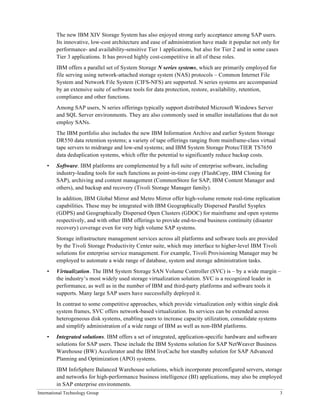
One large SAP manufacturing user, for example, experienced the growth rates shown in figure 2 over a
five-year period.
                                                 Figure 2
                                        SAP Growth Trends: Example
                                                     YEAREND        YEAREND
                                 INSTALLATION
                                                       2003           2008
                                 SAP instances          50            150
                                 Disk storage (TB)     150            600
                                 Servers               250            400


International Technology Group                                                                                4
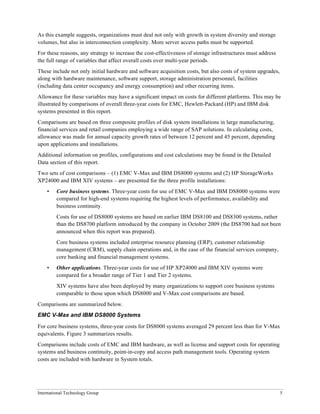
As this example suggests, organizations must deal not only with growth in system diversity and storage
volumes, but also in interconnection complexity. More server access paths must be supported.
For these reasons, any strategy to increase the cost-effectiveness of storage infrastructures must address
the full range of variables that affect overall costs over multi-year periods.
These include not only initial hardware and software acquisition costs, but also costs of system upgrades,
along with hardware maintenance, software support, storage administration personnel, facilities
(including data center occupancy and energy consumption) and other recurring items.
Allowance for these variables may have a significant impact on costs for different platforms. This may be
illustrated by comparisons of overall three-year costs for EMC, Hewlett-Packard (HP) and IBM disk
systems presented in this report.
Comparisons are based on three composite profiles of disk system installations in large manufacturing,
financial services and retail companies employing a wide range of SAP solutions. In calculating costs,
allowance was made for annual capacity growth rates of between 12 percent and 45 percent, depending
upon applications and installations.
Additional information on profiles, configurations and cost calculations may be found in the Detailed
Data section of this report.
Two sets of cost comparisons – (1) EMC V-Max and IBM DS8000 systems and (2) HP StorageWorks
XP24000 and IBM XIV systems – are presented for the three profile installations:
    •    Core business systems. Three-year costs for use of EMC V-Max and IBM DS8000 systems were
         compared for high-end systems requiring the highest levels of performance, availability and
         business continuity.
         Costs for use of DS8000 systems are based on earlier IBM DS8100 and DS8300 systems, rather
         than the DS8700 platform introduced by the company in October 2009 (the DS8700 had not been
         announced when this report was prepared).
         Core business systems included enterprise resource planning (ERP), customer relationship
         management (CRM), supply chain operations and, in the case of the financial services company,
         core banking and financial management systems.
    •    Other applications. Three-year costs for use of HP XP24000 and IBM XIV systems were
         compared for a broader range of Tier 1 and Tier 2 systems.
         XIV systems have also been deployed by many organizations to support core business systems
         comparable to those upon which DS8000 and V-Max cost comparisons are based.
Comparisons are summarized below.
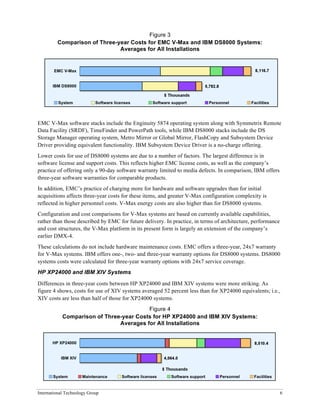
EMC V-Max and IBM DS8000 Systems

For core business systems, three-year costs for DS8000 systems averaged 29 percent less than for V-Max
equivalents. Figure 3 summarizes results.
Comparisons include costs of EMC and IBM hardware, as well as license and support costs for operating
systems and business continuity, point-in-copy and access path management tools. Operating system
costs are included with hardware in System totals.


International Technology Group                                                                               5
Figure 3
         Comparison of Three-year Costs for EMC V-Max and IBM DS8000 Systems:
                              Averages for All Installations


EMC V-Max software stacks include the Enginuity 5874 operating system along with Symmetrix Remote
Data Facility (SRDF), TimeFinder and PowerPath tools, while IBM DS8000 stacks include the DS
Storage Manager operating system, Metro Mirror or Global Mirror, FlashCopy and Subsystem Device
Driver providing equivalent functionality. IBM Subsystem Device Driver is a no-charge offering.
Lower costs for use of DS8000 systems are due to a number of factors. The largest difference is in
software license and support costs. This reflects higher EMC license costs, as well as the company’s
practice of offering only a 90-day software warranty limited to media defects. In comparison, IBM offers
three-year software warranties for comparable products.
In addition, EMC’s practice of charging more for hardware and software upgrades than for initial
acquisitions affects three-year costs for these items, and greater V-Max configuration complexity is
reflected in higher personnel costs. V-Max energy costs are also higher than for DS8000 systems.
Configuration and cost comparisons for V-Max systems are based on currently available capabilities,
rather than those described by EMC for future delivery. In practice, in terms of architecture, performance
and cost structures, the V-Max platform in its present form is largely an extension of the company’s
earlier DMX-4.
These calculations do not include hardware maintenance costs. EMC offers a three-year, 24x7 warranty
for V-Max systems. IBM offers one-, two- and three-year warranty options for DS8000 systems. DS8000
systems costs were calculated for three-year warranty options with 24x7 service coverage.
HP XP24000 and IBM XIV Systems

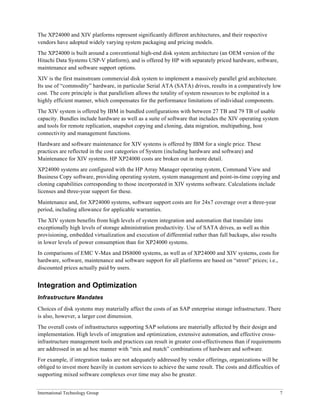
Differences in three-year costs between HP XP24000 and IBM XIV systems were more striking. As
figure 4 shows, costs for use of XIV systems averaged 52 percent less than for XP24000 equivalents; i.e.,
XIV costs are less than half of those for XP24000 systems.
                                         Figure 4
            Comparison of Three-year Costs for HP XP24000 and IBM XIV Systems:
                               Averages for All Installations


International Technology Group                                                                               6
The XP24000 and XIV platforms represent significantly different architectures, and their respective
vendors have adopted widely varying system packaging and pricing models.
The XP24000 is built around a conventional high-end disk system architecture (an OEM version of the
Hitachi Data Systems USP-V platform), and is offered by HP with separately priced hardware, software,
maintenance and software support options.
XIV is the first mainstream commercial disk system to implement a massively parallel grid architecture.
Its use of “commodity” hardware, in particular Serial ATA (SATA) drives, results in a comparatively low
cost. The core principle is that parallelism allows the totality of system resources to be exploited in a
highly efficient manner, which compensates for the performance limitations of individual components.
The XIV system is offered by IBM in bundled configurations with between 27 TB and 79 TB of usable
capacity. Bundles include hardware as well as a suite of software that includes the XIV operating system
and tools for remote replication, snapshot copying and cloning, data migration, multipathing, host
connectivity and management functions.
Hardware and software maintenance for XIV systems is offered by IBM for a single price. These
practices are reflected in the cost categories of System (including hardware and software) and
Maintenance for XIV systems. HP XP24000 costs are broken out in more detail.
XP24000 systems are configured with the HP Array Manager operating system, Command View and
Business Copy software, providing operating system, system management and point-in-time copying and
cloning capabilities corresponding to those incorporated in XIV systems software. Calculations include
licenses and three-year support for these.
Maintenance and, for XP24000 systems, software support costs are for 24x7 coverage over a three-year
period, including allowance for applicable warranties.
The XIV system benefits from high levels of system integration and automation that translate into
exceptionally high levels of storage administration productivity. Use of SATA drives, as well as thin
provisioning, embedded virtualization and execution of differential rather than full backups, also results
in lower levels of power consumption than for XP24000 systems.
In comparisons of EMC V-Max and DS8000 systems, as well as of XP24000 and XIV systems, costs for
hardware, software, maintenance and software support for all platforms are based on “street” prices; i.e.,
discounted prices actually paid by users.


Integration and Optimization
Infrastructure Mandates

Choices of disk systems may materially affect the costs of an SAP enterprise storage infrastructure. There
is also, however, a larger cost dimension.
The overall costs of infrastructures supporting SAP solutions are materially affected by their design and
implementation. High levels of integration and optimization, extensive automation, and effective cross-
infrastructure management tools and practices can result in greater cost-effectiveness than if requirements
are addressed in an ad hoc manner with “mix and match” combinations of hardware and software.
For example, if integration tasks are not adequately addressed by vendor offerings, organizations will be
obliged to invest more heavily in custom services to achieve the same result. The costs and difficulties of
supporting mixed software complexes over time may also be greater.


International Technology Group                                                                                7
A poorly optimized infrastructure will affect other costs. Low capacity utilization will increase costs for
hardware and for software, particularly when offerings are priced on a per terabyte basis, and may result
in excessive energy consumption. Lower staff productivity will escalate personnel costs.
The creation of an efficient storage infrastructure, however, cannot simply address costs. Organizations
must also ensure that adequate levels of functionality, performance and quality of service – including
such variables as availability, recoverability and security – are delivered not only to support current SAP
solution environments, but also to enable their future evolution.
The core challenge is to achieve all of these objectives – which is the goal of the IBM Information
Infrastructure strategy.

Information Infrastructure

The IBM Information Infrastructure initiative, announced in 2009, is a subset of the company’s broader
Dynamic Infrastructure strategy, which extends across the company’s entire portfolio of product and
service offerings.
The Information Infrastructure initiative combines IBM storage offerings – including the products and
solutions described in this report – with customized requirements assessment, infrastructure design and
implementation services. The objective is to deliver solutions in four primary areas, summarized by the
company as Compliance, Availability, Retention and Security (CARS).
A key IBM focus has been to apply new technology to these areas. For example, the IBM XIV system
offers the potential for significant reductions in acquisition as well as operating costs for disk systems;
IBM Information Archive solutions address key compliance and retention requirements; and IBM Tivoli
solutions and advanced encryption technologies may be employed to enhance information security. Many
other such examples might be cited.
Energy efficiency remains an IBM priority. Use of SATA drives and of SSDs in multiple IBM systems
offers the potential for lower energy consumption. ProtecTIER devices offers a similar potential for
backup and archival storage. More generally, the company continues to build industry-leading energy
efficiency features into all of its storage systems.
The Information Infrastructure initiative also addresses the need to better synchronize system processes
for servers and storage systems. For example, performance-related functions are closely optimized across
z/OS mainframe and DS8000 systems. A high-end business continuity solution set built around IBM
Metro Mirror and Global Mirror exploits the strengths of both platforms.
The IBM Global Services (IGS) organization also offers customized integration and optimization of SAP
enterprise infrastructures incorporating servers, storage systems, software and networks.
IBM IT Optimization for SAP Business Suite solution consists of product and service offerings that
enable the creation of common, organization-wide services for service-level management, provisioning,
system automation, data management and movement, financial management and other functions. These
extend across IBM server and storage platforms as well as software.
IBM IT Optimization for SAP Business Suite solution has been implemented for a number of large SAP
user organizations. Implementation is customized to meet the requirements of individual customers.
These capabilities are relevant to the needs of large organizations that are undertaking SAP Business
Suite deployments, as well to those that continue to employ R/3 Enterprise systems.


International Technology Group                                                                                8
Conclusions
The business value of SAP deployment is realized through application solutions and through the business
transformations they enable. However, the extent to which this value will be realized will depend in no
small measure on the quality, functionality and cost-effectiveness of underlying platforms, and on the
manner in which these are integrated and optimized.
There are many vendors of storage products and services. However, few can deliver state-of-the-art
solutions that address all of the major requirements for a storage infrastructure supporting large-scale,
complex SAP landscapes. Moreover, in designing and implementing such an infrastructure, there are even
fewer who can draw upon world-class capabilities in all required areas of competency.
Among these, IBM is the obvious leader.

Additional Information
This ITG Executive Summary is based upon results and methodology contained in a Management Brief
released by the International Technology Group. For copies of this Management Brief, please email
requests to info-itg@pacbell.net.


                                                       International Technology Group
                                                              4546 El Camino Real, Suite 230
                                                              Los Altos, California 94022-1069
                                           ITG                 Telephone: (650) 949-8410
                                                               Facsimile: (650) 949-8415
                                                               Email:      info-itg@pacbell.net
Copyright © 2009 by the International Technology Group. All rights reserved. Material, in whole or part, contained in this document may not be
reproduced or distributed by any means or in any form, including original, without the prior written permission of the International Technology
Group (ITG). Information has been obtained from sources assumed to be reliable and reflects conclusions at the time. This document was
developed with International Business Machines Corporation (IBM) funding. Although the document may utilize publicly available material from
various sources, including IBM, it does not necessarily reflect the positions of such sources on the issues addressed in this document. Material
contained and conclusions presented in this document are subject to change without notice. All warranties as to the accuracy, completeness or
adequacy of such material are disclaimed. There shall be no liability for errors, omissions or inadequacies in the material contained in this
document or for interpretations thereof. Trademarks included in this document are the property of their respective owners.

International Technology Group                                                                                                                9
                                                                                                                          SPE03004-USEN-00

VALUE PROPOSITION FOR IBM SYSTEM STORAGE: COST/BENEFIT CASE FOR SAP DEPLOYMENT IN ENTERPRISE INSTALLATIONS

  • 1.
    ITG Executive Summary October 2009 VALUE PROPOSITION FOR IBM SYSTEM STORAGE: COST/BENEFIT CASE FOR SAP DEPLOYMENT IN ENTERPRISE INSTALLATIONS Challenges It is a time of unprecedented challenges for the SAP world. Recent SAP documents and statements have variously referred to the need to maintain business momentum in “challenging times…hard times… perilous times…tough times…volatile times…turbulent times.” Economic conditions have led many organizations to adopt conservative strategies that focus on cost cutting. But other challenges remain. They include globalization, competitive pressures, shifts in market and competitive structures, new regulatory requirements and the growing complexity and volatility of business environments. For many users, the evolution of the SAP solution portfolio presents opportunities to meet short-term challenges in ways that will enable long-term growth and enhance competitive performance. SAP’s new Business Suite 7 continues a transition in the SAP world that has been under way since the 1990s. The SAP solution portfolio has grown functionally broader, expanding beyond transactional processes to address new variables such as the way in which information is used and the effectiveness of collaboration with customers and partners, and within the enterprise itself. Realizing the potential of this transition will require new directions in business strategy, in the business processes within organizations and in the networks that link them with partners and customers. A new focus must also be placed on the use of information as a critical tool for competitive leadership and operational excellence. This report deals with the role that IT infrastructures may play in supporting these goals. Specifically, it looks at the value that IBM System Storage solutions may provide as the basis of infrastructures that increase the effectiveness, and reduce the costs of the storage resources that support SAP solutions in large organizations. The IBM concept of an “Information Infrastructure” is appropriate in addressing this subject. It is no longer sufficient to purchase and deploy storage systems and software on a case-by-case basis. As the SAP enterprise environment has grown more complex and interdependent, it increasingly makes sense to treat storage as a continuum of resources serving the entire organization. The following sections outline the requirements of an effective SAP enterprise storage infrastructure in three critical areas – functional capabilities, cost-effectiveness, and integration and optimization of diverse server and storage resources – and discuss how IBM System Storage solutions may meet these requirements. This ITG EXECUTIVE SUMMARY is based upon results and methodology contained in a Management Brief released by the International Technology Group. 1
  • 2.
    Capabilities An effective SAPenterprise storage infrastructure requires four main sets of components: (1) storage platforms; (2) software tools for point-in-time copy, backup and recovery, archiving and content management, business continuity, storage infrastructure management and other functions; (3) cross- platform virtualization capabilities; and (4) storage area network (SAN) integration. IBM System Storage offerings provide all of the components necessary for a state-of-the-art SAP enterprise storage infrastructure. Many have been customized to meet SAP-specific requirements. The overall IBM System Storage portfolio is illustrated in figure 1. Figure 1 IBM System Storage Offerings for SAP Deployment STORAGE INFRASTRUCTURE MANAGEMENT Tivoli Storage Productivity Center System Storage Productivity Center Tivoli Provisioning Manager BUSINESS CONTINUITY POINT-IN-TIME COPY ARCHIVING & CONTENT Real-time replication Local replication MANAGEMENT Global & Metro Mirror FlashCopy CommonStore for SAP GDOC integration DB2 & Oracle integration Content Manager GDPS integration Archiving Solutions IBM Cloning for SAP BACKUP & RECOVERY Tivoli Storage Manager (TSM) for ERP FlashCopy Cloning for SAP databases Tivoli Storage FlashCopy Manager VIRTUALIZATION SAN Volume Controller (SVC) INTEGRATED SOLUTIONS IBM System solution for SAP BW Accelerator  IBM Balanced Warehouse  liveCache Hot Standby PLATFORMS High-end disk Midrange disk NAS systems DS8000, XIV DS5000, DS4000 N series Data Deduplication Data Retention ProtecTIER TS7650 Information Archive, DR550, Tape systems STORAGE AREA NETWORK (SAN) IBM (Brocade Communications) Cisco Systems Key components of this portfolio include: • Platforms. IBM disk systems, including the high-end IBM System Storage DS8000 and midrange DS5000 platforms, are industry performance leaders. These systems incorporate a number of new technologies, including support for solid state drives (SSDs), disk-level encryption and (in the case of DS8000 systems) thin provisioning. International Technology Group 2
  • 3.
    The new IBMXIV Storage System has also enjoyed strong early acceptance among SAP users. Its innovative, low-cost architecture and ease of administration have made it popular not only for performance- and availability-sensitive Tier 1 applications, but also for Tier 2 and in some cases Tier 3 applications. It has proved highly cost-competitive in all of these roles. IBM offers a parallel set of System Storage N series systems, which are primarily employed for file serving using network-attached storage system (NAS) protocols – Common Internet File System and Network File System (CIFS-NFS) are supported. N series systems are accompanied by an extensive suite of software tools for data protection, restore, availability, retention, compliance and other functions. Among SAP users, N series offerings typically support distributed Microsoft Windows Server and SQL Server environments. They are also commonly used in smaller installations that do not employ SANs. The IBM portfolio also includes the new IBM Information Archive and earlier System Storage DR550 data retention systems; a variety of tape offerings ranging from mainframe-class virtual tape servers to midrange and low-end systems; and IBM System Storage ProtecTIER TS7650 data deduplication systems, which offer the potential to significantly reduce backup costs. • Software. IBM platforms are complemented by a full suite of enterprise software, including industry-leading tools for such functions as point-in-time copy (FlashCopy, IBM Cloning for SAP), archiving and content management (CommonStore for SAP, IBM Content Manager and others), and backup and recovery (Tivoli Storage Manager family). In addition, IBM Global Mirror and Metro Mirror offer high-volume remote real-time replication capabilities. These may be integrated with IBM Geographically Dispersed Parallel Sysplex (GDPS) and Geographically Dispersed Open Clusters (GDOC) for mainframe and open systems respectively, and with other IBM offerings to provide end-to-end business continuity (disaster recovery) coverage even for very high volume SAP systems. Storage infrastructure management services across all platforms and software tools are provided by the Tivoli Storage Productivity Center suite, which may interface to higher-level IBM Tivoli solutions for enterprise service management. For example, Tivoli Provisioning Manager may be employed to automate a wide range of database, system and storage administration tasks. • Virtualization. The IBM System Storage SAN Volume Controller (SVC) is – by a wide margin – the industry’s most widely used storage virtualization solution. SVC is a recognized leader in performance, as well as in the number of IBM and third-party platforms and software tools it supports. Many large SAP users have successfully deployed it. In contrast to some competitive approaches, which provide virtualization only within single disk system frames, SVC offers network-based virtualization. Its services can be extended across heterogeneous disk systems, enabling users to increase capacity utilization, consolidate systems and simplify administration of a wide range of IBM as well as non-IBM platforms. • Integrated solutions. IBM offers a set of integrated, application-specific hardware and software solutions for SAP users. These include the IBM Systems solution for SAP NetWeaver Business Warehouse (BW) Accelerator and the IBM liveCache hot standby solution for SAP Advanced Planning and Optimization (APO) systems. IBM InfoSphere Balanced Warehouse solutions, which incorporate preconfigured servers, storage and networks for high-performance business intelligence (BI) applications, may also be employed in SAP enterprise environments. International Technology Group 3
  • 4.
    Storage area networks. IBM markets, installs and supports a range of SAN solutions, including enterprise-class SAN directors and routers, and entry-level and midrange SAN switches supplied by Brocade Communications Systems (offered under the IBM logo) and Cisco Systems. Moreover, there is a further level of capability. The overall performance, functionality and cost- effectiveness of an enterprise storage infrastructure depend not only upon individual hardware, software and network components, but also on the manner in which these are integrated and optimized. From this perspective, the strength of the IBM System Storage portfolio is not simply that all requirements are addressed. It is also that they are addressed in a consistent and integrated manner. Cost-effectiveness Cost Variables The business criticality of SAP solutions means that, for most organizations, it is not realistic simply to target cost reduction. Inexpensive solutions may impair quality of service, with bottom-line impacts for businesses that may more than cancel out IT cost savings. Equally, however, there is no reason to spend more than is necessary. Adoption of “best practice” techniques in such areas as system design, consolidation, application development and support, and operating efficiency has become the norm among large SAP users. The objective is to be cost-effective. Economic pressures have sharpened awareness of both the potential to improve cost-effectiveness and the financial benefits of doing so. This applies as much to storage resources as to other components of SAP system infrastructures. There are a number of reasons to pay special attention to storage. One is that storage volumes continue to grow rapidly. Overall growth rates of 30 to 50 percent per year in installed disk capacity are routine among large SAP users, and many organizations experience higher levels. Some applications, such as business intelligence and records retention for business and compliance purposes, are experiencing exceptional growth. However, the increasing breadth and complexity of SAP solution portfolios, adoption of new “informational” tools, organic database growth and increasing cross- system replication volumes mean that storage growth has become pervasive across the entire SAP enterprise environment. Large-scale corporate SAP environments now routinely include hundreds of terabytes (TB) of disk storage and, if current trends continue, the largest will be more than one petabyte (1,024 TB) within the next few years. Unicode adoption is causing further acceleration – the industry norm is that Unicode transitions increase disk capacity by 30 percent or more. One large SAP manufacturing user, for example, experienced the growth rates shown in figure 2 over a five-year period. Figure 2 SAP Growth Trends: Example YEAREND YEAREND INSTALLATION 2003 2008 SAP instances 50 150 Disk storage (TB) 150 600 Servers 250 400 International Technology Group 4
  • 5.
    As this examplesuggests, organizations must deal not only with growth in system diversity and storage volumes, but also in interconnection complexity. More server access paths must be supported. For these reasons, any strategy to increase the cost-effectiveness of storage infrastructures must address the full range of variables that affect overall costs over multi-year periods. These include not only initial hardware and software acquisition costs, but also costs of system upgrades, along with hardware maintenance, software support, storage administration personnel, facilities (including data center occupancy and energy consumption) and other recurring items. Allowance for these variables may have a significant impact on costs for different platforms. This may be illustrated by comparisons of overall three-year costs for EMC, Hewlett-Packard (HP) and IBM disk systems presented in this report. Comparisons are based on three composite profiles of disk system installations in large manufacturing, financial services and retail companies employing a wide range of SAP solutions. In calculating costs, allowance was made for annual capacity growth rates of between 12 percent and 45 percent, depending upon applications and installations. Additional information on profiles, configurations and cost calculations may be found in the Detailed Data section of this report. Two sets of cost comparisons – (1) EMC V-Max and IBM DS8000 systems and (2) HP StorageWorks XP24000 and IBM XIV systems – are presented for the three profile installations: • Core business systems. Three-year costs for use of EMC V-Max and IBM DS8000 systems were compared for high-end systems requiring the highest levels of performance, availability and business continuity. Costs for use of DS8000 systems are based on earlier IBM DS8100 and DS8300 systems, rather than the DS8700 platform introduced by the company in October 2009 (the DS8700 had not been announced when this report was prepared). Core business systems included enterprise resource planning (ERP), customer relationship management (CRM), supply chain operations and, in the case of the financial services company, core banking and financial management systems. • Other applications. Three-year costs for use of HP XP24000 and IBM XIV systems were compared for a broader range of Tier 1 and Tier 2 systems. XIV systems have also been deployed by many organizations to support core business systems comparable to those upon which DS8000 and V-Max cost comparisons are based. Comparisons are summarized below. EMC V-Max and IBM DS8000 Systems For core business systems, three-year costs for DS8000 systems averaged 29 percent less than for V-Max equivalents. Figure 3 summarizes results. Comparisons include costs of EMC and IBM hardware, as well as license and support costs for operating systems and business continuity, point-in-copy and access path management tools. Operating system costs are included with hardware in System totals. International Technology Group 5
  • 6.
    Figure 3 Comparison of Three-year Costs for EMC V-Max and IBM DS8000 Systems: Averages for All Installations EMC V-Max software stacks include the Enginuity 5874 operating system along with Symmetrix Remote Data Facility (SRDF), TimeFinder and PowerPath tools, while IBM DS8000 stacks include the DS Storage Manager operating system, Metro Mirror or Global Mirror, FlashCopy and Subsystem Device Driver providing equivalent functionality. IBM Subsystem Device Driver is a no-charge offering. Lower costs for use of DS8000 systems are due to a number of factors. The largest difference is in software license and support costs. This reflects higher EMC license costs, as well as the company’s practice of offering only a 90-day software warranty limited to media defects. In comparison, IBM offers three-year software warranties for comparable products. In addition, EMC’s practice of charging more for hardware and software upgrades than for initial acquisitions affects three-year costs for these items, and greater V-Max configuration complexity is reflected in higher personnel costs. V-Max energy costs are also higher than for DS8000 systems. Configuration and cost comparisons for V-Max systems are based on currently available capabilities, rather than those described by EMC for future delivery. In practice, in terms of architecture, performance and cost structures, the V-Max platform in its present form is largely an extension of the company’s earlier DMX-4. These calculations do not include hardware maintenance costs. EMC offers a three-year, 24x7 warranty for V-Max systems. IBM offers one-, two- and three-year warranty options for DS8000 systems. DS8000 systems costs were calculated for three-year warranty options with 24x7 service coverage. HP XP24000 and IBM XIV Systems Differences in three-year costs between HP XP24000 and IBM XIV systems were more striking. As figure 4 shows, costs for use of XIV systems averaged 52 percent less than for XP24000 equivalents; i.e., XIV costs are less than half of those for XP24000 systems. Figure 4 Comparison of Three-year Costs for HP XP24000 and IBM XIV Systems: Averages for All Installations International Technology Group 6
  • 7.
    The XP24000 andXIV platforms represent significantly different architectures, and their respective vendors have adopted widely varying system packaging and pricing models. The XP24000 is built around a conventional high-end disk system architecture (an OEM version of the Hitachi Data Systems USP-V platform), and is offered by HP with separately priced hardware, software, maintenance and software support options. XIV is the first mainstream commercial disk system to implement a massively parallel grid architecture. Its use of “commodity” hardware, in particular Serial ATA (SATA) drives, results in a comparatively low cost. The core principle is that parallelism allows the totality of system resources to be exploited in a highly efficient manner, which compensates for the performance limitations of individual components. The XIV system is offered by IBM in bundled configurations with between 27 TB and 79 TB of usable capacity. Bundles include hardware as well as a suite of software that includes the XIV operating system and tools for remote replication, snapshot copying and cloning, data migration, multipathing, host connectivity and management functions. Hardware and software maintenance for XIV systems is offered by IBM for a single price. These practices are reflected in the cost categories of System (including hardware and software) and Maintenance for XIV systems. HP XP24000 costs are broken out in more detail. XP24000 systems are configured with the HP Array Manager operating system, Command View and Business Copy software, providing operating system, system management and point-in-time copying and cloning capabilities corresponding to those incorporated in XIV systems software. Calculations include licenses and three-year support for these. Maintenance and, for XP24000 systems, software support costs are for 24x7 coverage over a three-year period, including allowance for applicable warranties. The XIV system benefits from high levels of system integration and automation that translate into exceptionally high levels of storage administration productivity. Use of SATA drives, as well as thin provisioning, embedded virtualization and execution of differential rather than full backups, also results in lower levels of power consumption than for XP24000 systems. In comparisons of EMC V-Max and DS8000 systems, as well as of XP24000 and XIV systems, costs for hardware, software, maintenance and software support for all platforms are based on “street” prices; i.e., discounted prices actually paid by users. Integration and Optimization Infrastructure Mandates Choices of disk systems may materially affect the costs of an SAP enterprise storage infrastructure. There is also, however, a larger cost dimension. The overall costs of infrastructures supporting SAP solutions are materially affected by their design and implementation. High levels of integration and optimization, extensive automation, and effective cross- infrastructure management tools and practices can result in greater cost-effectiveness than if requirements are addressed in an ad hoc manner with “mix and match” combinations of hardware and software. For example, if integration tasks are not adequately addressed by vendor offerings, organizations will be obliged to invest more heavily in custom services to achieve the same result. The costs and difficulties of supporting mixed software complexes over time may also be greater. International Technology Group 7
  • 8.
    A poorly optimizedinfrastructure will affect other costs. Low capacity utilization will increase costs for hardware and for software, particularly when offerings are priced on a per terabyte basis, and may result in excessive energy consumption. Lower staff productivity will escalate personnel costs. The creation of an efficient storage infrastructure, however, cannot simply address costs. Organizations must also ensure that adequate levels of functionality, performance and quality of service – including such variables as availability, recoverability and security – are delivered not only to support current SAP solution environments, but also to enable their future evolution. The core challenge is to achieve all of these objectives – which is the goal of the IBM Information Infrastructure strategy. Information Infrastructure The IBM Information Infrastructure initiative, announced in 2009, is a subset of the company’s broader Dynamic Infrastructure strategy, which extends across the company’s entire portfolio of product and service offerings. The Information Infrastructure initiative combines IBM storage offerings – including the products and solutions described in this report – with customized requirements assessment, infrastructure design and implementation services. The objective is to deliver solutions in four primary areas, summarized by the company as Compliance, Availability, Retention and Security (CARS). A key IBM focus has been to apply new technology to these areas. For example, the IBM XIV system offers the potential for significant reductions in acquisition as well as operating costs for disk systems; IBM Information Archive solutions address key compliance and retention requirements; and IBM Tivoli solutions and advanced encryption technologies may be employed to enhance information security. Many other such examples might be cited. Energy efficiency remains an IBM priority. Use of SATA drives and of SSDs in multiple IBM systems offers the potential for lower energy consumption. ProtecTIER devices offers a similar potential for backup and archival storage. More generally, the company continues to build industry-leading energy efficiency features into all of its storage systems. The Information Infrastructure initiative also addresses the need to better synchronize system processes for servers and storage systems. For example, performance-related functions are closely optimized across z/OS mainframe and DS8000 systems. A high-end business continuity solution set built around IBM Metro Mirror and Global Mirror exploits the strengths of both platforms. The IBM Global Services (IGS) organization also offers customized integration and optimization of SAP enterprise infrastructures incorporating servers, storage systems, software and networks. IBM IT Optimization for SAP Business Suite solution consists of product and service offerings that enable the creation of common, organization-wide services for service-level management, provisioning, system automation, data management and movement, financial management and other functions. These extend across IBM server and storage platforms as well as software. IBM IT Optimization for SAP Business Suite solution has been implemented for a number of large SAP user organizations. Implementation is customized to meet the requirements of individual customers. These capabilities are relevant to the needs of large organizations that are undertaking SAP Business Suite deployments, as well to those that continue to employ R/3 Enterprise systems. International Technology Group 8
  • 9.
    Conclusions The business valueof SAP deployment is realized through application solutions and through the business transformations they enable. However, the extent to which this value will be realized will depend in no small measure on the quality, functionality and cost-effectiveness of underlying platforms, and on the manner in which these are integrated and optimized. There are many vendors of storage products and services. However, few can deliver state-of-the-art solutions that address all of the major requirements for a storage infrastructure supporting large-scale, complex SAP landscapes. Moreover, in designing and implementing such an infrastructure, there are even fewer who can draw upon world-class capabilities in all required areas of competency. Among these, IBM is the obvious leader. Additional Information This ITG Executive Summary is based upon results and methodology contained in a Management Brief released by the International Technology Group. For copies of this Management Brief, please email requests to info-itg@pacbell.net. International Technology Group 4546 El Camino Real, Suite 230 Los Altos, California 94022-1069 ITG Telephone: (650) 949-8410 Facsimile: (650) 949-8415 Email: info-itg@pacbell.net Copyright © 2009 by the International Technology Group. All rights reserved. Material, in whole or part, contained in this document may not be reproduced or distributed by any means or in any form, including original, without the prior written permission of the International Technology Group (ITG). Information has been obtained from sources assumed to be reliable and reflects conclusions at the time. This document was developed with International Business Machines Corporation (IBM) funding. Although the document may utilize publicly available material from various sources, including IBM, it does not necessarily reflect the positions of such sources on the issues addressed in this document. Material contained and conclusions presented in this document are subject to change without notice. All warranties as to the accuracy, completeness or adequacy of such material are disclaimed. There shall be no liability for errors, omissions or inadequacies in the material contained in this document or for interpretations thereof. Trademarks included in this document are the property of their respective owners. International Technology Group 9 SPE03004-USEN-00