USE of GEO-SPATIAL TECHNOLOGY
IN
PARTICIPATORY COMMUNITY FOREST
RESOURCE MAPPING
Presented By
Swapneswar Dehury
Content
 Introduction
 Literature review
 Methodology
 Result and discussion
 Conclusion
 References
Introduction
 Forest right Act 2006 provides a window to Gramsabha for
legal recognition of Community forest resources ( CFRs).
 To file claim on Community forest resource areas, local
community need to prepare and submit detail information in
the form of maps as one of the requirement
 They could submit if those maps are readily available. But in
India other than cadastral map no other village level maps
are available
 Hence preparation of CFRs maps are the need of the hour.
 Geospatial technology is one of the tool may be used for
this purposes.
“Community forest resource”
means customary common forest
land with in the traditional
customary of the village or
seasonal use of landscape in the
case of pastoral communities,
including reserve forests,
protected forest and protected
areas such as Sanctuaries and
National park to which the
community have traditional
access
Review and literature
 Although, basic maps are widely available in many countries but
unfortunately this is not the case in India.( Oskarson, P. , 2012)
 In India cadastral maps are available for revenue villages but not for non-
surveyed villages.
 However, cadastral maps available for many states in India are more than fifty
years old; were originally made by the British, mostly remain inaccessible,
very expensive to procure, and maps that are accessible will be in poor state
and quality.
 There are, however, as many as 30,000 villages in the state which could be
eligible for the recognition of CFR rights under the FRA, provided the act was
properly implemented in its true spirit.(The Hindu)
Methodology
Preparatory discussion with Gramsabha
members/community members
Preparation of sketch map of their forest resources
Training on use of GPS to village youth
Topographical map study and satellite map display to
community to understand their location and extend of
their forest
Transact work with community for proper mapping of
their forest resources.
Map generation in GIS enabled system through GPS data
Verification
Step 1-Preparatory discussion with Gramsabha
members/community
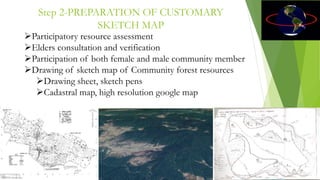
Step 2-PREPARATION OF CUSTOMARY
SKETCH MAP
Participatory resource assessment
Elders consultation and verification
Participation of both female and male community member
Drawing of sketch map of Community forest resources
Drawing sheet, sketch pens
Cadastral map, high resolution google map
Step 3-GPS TRAINING TO COMMUNITY
 How to operate GPS
 Record locations ,landmarks, boundary, forest resources
etc.
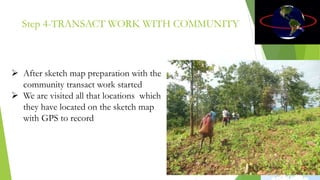
Step 4-TRANSACT WORK WITH COMMUNITY
 After sketch map preparation with the
community transact work started
 We are visited all that locations which
they have located on the sketch map
with GPS to record
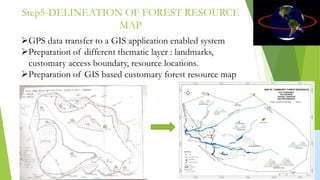
Step5-DELINEATION OF FOREST RESOURCE
MAP
GPS data transfer to a GIS application enabled system
Preparation of different thematic layer : landmarks,
customary access boundary, resource locations.
Preparation of GIS based customary forest resource map
Result and discussion
 Clearly demarcated boundaries of forest land in the village with proper
participation with defined geographical area
 Visual assessment using Google map was quite interesting to get involved
interest
 Local youth were trained in handling a GPS
 Database generated for review or reference
 The village inhabitants were aware of legal processes involved in FRA claim
 The IT personnel of the organisation are got trained in updating and
maintaining the geospatial database
 No of CFR claims are generated at Gramsabha level under FRA
Conclusion
 Indigenous and community-based forest lands mapping is empowering tool to
delineate the CFR map.
 That empowered local youth through training and education on ethnographic
GIS methods, and useful for resource management and monitoring.
 It also helpful to researchers and policy makers in order to bring inclusive
land governance polices through research and advocacy
References
 Wily, L. A. 2011. The Tragedy of Public Lands the Fate of the Commons Under Global
Commercial Pressure. Commercial Pressures on Land. The International Land Coalition.
 Rights and Resources Initiative, 2015. Who owns the world’s land? A Global baseline of formally
recognized indigenous and community land rights. RRI, Washington, D. C.
 Veit, P, and Reytar, K. 2015. LandMark: Protecting Indigenous and Community Land by Making
Them Visible. World Resources Institute. Washington, D.C.
 Rights and Resources. Seeing People through the Trees. Rights and Resources Initiative:
Washington, DC, USA, 2008; p. 20, RRI, 2015.
 Banerjee, A. and L. Iyer, 2008. Colonial Land Tenure, Electoral Competition and Public Goods in
India. Working paper 08-062.
 Kumar, K., P., Choudhary, S. Sarangi, S. Behera, P., Mishra. 2007. Contested landscapes,
dispossessed people: Land, forests, and tribals in Orissa. MoRDiWorld Bank workshop on "Land
Policies for Accelerated Growth and Poverty Reduction in India".
 Springate-Baginski. O, M. Sarin, S. Ghosh, P. Dasgupta, I. Bose, A. Banerjee, K. Sarap, P. Misra,
S. Behera, M.G Reddy and P.T. Rao, 2009. Redressing ‘historical injustice’ through the Indian
Forest Rights Act 2006, A Historical Institutional analysis of contemporary forest rights reform.
Discussion Paper Series, Number twenty-seven. IPPG Programme Office, IDPM, UK.
 Oskarsson, P, 2012. A Methodology for Community Mapping of Natural Resources, Forests and
Revenue Land in Bargarh District of Odisha. RULNR Working Paper 19.
Thanks You

Spatial technology in community forestry resource mapping

  • 1.
    USE of GEO-SPATIALTECHNOLOGY IN PARTICIPATORY COMMUNITY FOREST RESOURCE MAPPING Presented By Swapneswar Dehury
  • 2.
    Content  Introduction  Literaturereview  Methodology  Result and discussion  Conclusion  References
  • 3.
    Introduction  Forest rightAct 2006 provides a window to Gramsabha for legal recognition of Community forest resources ( CFRs).  To file claim on Community forest resource areas, local community need to prepare and submit detail information in the form of maps as one of the requirement  They could submit if those maps are readily available. But in India other than cadastral map no other village level maps are available  Hence preparation of CFRs maps are the need of the hour.  Geospatial technology is one of the tool may be used for this purposes. “Community forest resource” means customary common forest land with in the traditional customary of the village or seasonal use of landscape in the case of pastoral communities, including reserve forests, protected forest and protected areas such as Sanctuaries and National park to which the community have traditional access
  • 4.
    Review and literature Although, basic maps are widely available in many countries but unfortunately this is not the case in India.( Oskarson, P. , 2012)  In India cadastral maps are available for revenue villages but not for non- surveyed villages.  However, cadastral maps available for many states in India are more than fifty years old; were originally made by the British, mostly remain inaccessible, very expensive to procure, and maps that are accessible will be in poor state and quality.  There are, however, as many as 30,000 villages in the state which could be eligible for the recognition of CFR rights under the FRA, provided the act was properly implemented in its true spirit.(The Hindu)
  • 5.
    Methodology Preparatory discussion withGramsabha members/community members Preparation of sketch map of their forest resources Training on use of GPS to village youth Topographical map study and satellite map display to community to understand their location and extend of their forest Transact work with community for proper mapping of their forest resources. Map generation in GIS enabled system through GPS data Verification
  • 6.
    Step 1-Preparatory discussionwith Gramsabha members/community
  • 7.
    Step 2-PREPARATION OFCUSTOMARY SKETCH MAP Participatory resource assessment Elders consultation and verification Participation of both female and male community member Drawing of sketch map of Community forest resources Drawing sheet, sketch pens Cadastral map, high resolution google map
  • 8.
    Step 3-GPS TRAININGTO COMMUNITY  How to operate GPS  Record locations ,landmarks, boundary, forest resources etc.
  • 9.
    Step 4-TRANSACT WORKWITH COMMUNITY  After sketch map preparation with the community transact work started  We are visited all that locations which they have located on the sketch map with GPS to record
  • 10.
    Step5-DELINEATION OF FORESTRESOURCE MAP GPS data transfer to a GIS application enabled system Preparation of different thematic layer : landmarks, customary access boundary, resource locations. Preparation of GIS based customary forest resource map
  • 11.
    Result and discussion Clearly demarcated boundaries of forest land in the village with proper participation with defined geographical area  Visual assessment using Google map was quite interesting to get involved interest  Local youth were trained in handling a GPS  Database generated for review or reference  The village inhabitants were aware of legal processes involved in FRA claim  The IT personnel of the organisation are got trained in updating and maintaining the geospatial database  No of CFR claims are generated at Gramsabha level under FRA
  • 12.
    Conclusion  Indigenous andcommunity-based forest lands mapping is empowering tool to delineate the CFR map.  That empowered local youth through training and education on ethnographic GIS methods, and useful for resource management and monitoring.  It also helpful to researchers and policy makers in order to bring inclusive land governance polices through research and advocacy
  • 13.
    References  Wily, L.A. 2011. The Tragedy of Public Lands the Fate of the Commons Under Global Commercial Pressure. Commercial Pressures on Land. The International Land Coalition.  Rights and Resources Initiative, 2015. Who owns the world’s land? A Global baseline of formally recognized indigenous and community land rights. RRI, Washington, D. C.  Veit, P, and Reytar, K. 2015. LandMark: Protecting Indigenous and Community Land by Making Them Visible. World Resources Institute. Washington, D.C.  Rights and Resources. Seeing People through the Trees. Rights and Resources Initiative: Washington, DC, USA, 2008; p. 20, RRI, 2015.  Banerjee, A. and L. Iyer, 2008. Colonial Land Tenure, Electoral Competition and Public Goods in India. Working paper 08-062.  Kumar, K., P., Choudhary, S. Sarangi, S. Behera, P., Mishra. 2007. Contested landscapes, dispossessed people: Land, forests, and tribals in Orissa. MoRDiWorld Bank workshop on "Land Policies for Accelerated Growth and Poverty Reduction in India".  Springate-Baginski. O, M. Sarin, S. Ghosh, P. Dasgupta, I. Bose, A. Banerjee, K. Sarap, P. Misra, S. Behera, M.G Reddy and P.T. Rao, 2009. Redressing ‘historical injustice’ through the Indian Forest Rights Act 2006, A Historical Institutional analysis of contemporary forest rights reform. Discussion Paper Series, Number twenty-seven. IPPG Programme Office, IDPM, UK.  Oskarsson, P, 2012. A Methodology for Community Mapping of Natural Resources, Forests and Revenue Land in Bargarh District of Odisha. RULNR Working Paper 19.
  • 14.